Readers Responses to my Last Post

I have received many responses to my last post. Many are in the comment section of the post itself. Others, were send to me by email, and I have selected a cross section here. Michael Young responded. I will not respond to it now, believing it wiser to let passions cool. Many of the issues he raises are also raised by other readers:

A Syrian Alawite woman writing from Damascus:

Thank you Josh. I believe, we have learnt to live as much solid as we can. It is our fate to live and fight, but in most cases we get nothing! Let (them [the Lebanese]) get what they want. We are the real slaves.

A Lebanese American in Lebanon:
Dear Josh, I often read your blog with interest. I have a major criticism about your last piece about “Counting Lebanon Shiite’s as Slaves.”  You seem to assume that only Shiite MPs can represent Shiites! This is completely erroneous. While the percentage of Shiite seats in Parliament are less than today’s percentage of Shiites, that does not mean that their votes counts as less. Christians, Sunnis, other denomination (you can have your pick), represent Shiites as well in their districts.

The line of argumentation you offer is quite dangerous (and slippery). It is an argument often used by the Maronite church (most notably in Patriarch Sfeir’s complaint that Christian MPs are being elected by non-Christians)… The solution to Lebanon’s problems is not in making the system even more confessional (by making members of a religious community) chose only MPs from their religion – but rather in a slow and steady deconstruction of the system.
[End]

From Charles Coutinho, Ph.D., Realestate mogul and writter of The Diplomat of the Future
.
Dear Professor Landis, I agree with most of the premises of your last post. I only have one caveat really and, that deals with your (mostly / somewhat) negative response to the Lebanon's current form of Democracy. It is true of course that an arrangement in which forty percent of the population, has only twenty-two percent of the political representation in Parliament, is problematic, both now and in the long-term.  The issue for me (and I suppose for Michael Young perhaps, and many others who have a mostly positive view of the Lebanon as a political model for the Near and Middle East), is that will obtaining justice for the Shiite population, have the end result of potentially destroying Lebanon's demographic and political pluralism (the real meaning of Young's statement about emigrating).
.
One of the remarkable aspects of Beirut for example is that it is probably the most pluralistic city in the entire Near East, remarkably so.  Whereas say, fifty or seventy-five years ago, that was probably not the case. Which is really my larger point (and perhaps Young's?): namely that in the 20th century, the entire region, with a few exceptions, witnessed a process in which most of the cities in the region (and this is probably true of Syria as well), became much more, demographically homogeneous. With in many cases this homogeneity an end result, of political violence, enforced.  For example: Baghdad circa 1945, had very large Jewish and Christian populations, where are they now? The same could be said for Tripoli, Alexandria, Damascus, et, cetera, et cetera.
.
And, it could very well be argued, it is this enforced demographic homogeneity, which in part helps to explain the economic backwardness of the entire region in the last one hundred plus years.  Much more so than say 'colonialism', or imperialism, et cetera (if the latter two were the problems, one wonders what to make of the economic transformations of say Hong Kong, South Korea, Malaysia, Singapore, Taiwan).  As you know, many economic theorists posit that cities are really the motors of economic transformation, and, insofar as most of the Near East, has seen an exodus of most of its wealthy, and energetic economic minority groups, from its major cities in the last seventy-five years, well that points up to a key variable in the related problems of economic backwardness and political stagnation and absence of pluralism.
.
Obviously, it is not the only variable, but, I do think that it may be a major one. And, it could be argued, that insofar as the current constitutional arrangements in the Lebanon, hold together a fabric, which if not tended to, will witness the same (negative) transformation that has been undergone by the rest of the region, then in that sense Michael Young does have a good point to make. Sad but true.
.
Thanks and take care, Charles Coutinho
.
Landis replies: Many respondents to my article have pointed out that Syrians have few political rights in comparison to Lebanese. This is the sad truth. Lebanon presents the best example of political liberties in the Middle East and the best prospect for showing the region a way out of its authoritarian quagmire. All the more reason why reforming the system to better reflect demographics is the right thing to do, especially at this time when the entire world's attention is focused on it. A universal problem in the Middle East is finding a way to encourage reform. Some believe that violence is necessary. I believe that it will not hasten change, but, in most cases, retard it.

Martin Kramer, the Wexler-Fromer fellow at the Washington Institute for Near East Policy, whose most recent article I referred to:

Josh,

My article is not about a "Shiite Crescent," and I don't use the term. It is about the "Islamist Axis" (that even appears in the title), and throughout the piece, the argument is that it includes both Shiites and Sunnis. Also, you give as title of the article the title of the conference panel I shared with Dr. Paz. The title of my own article is "Israel vs. the New Islamist Axis."

Best, Martin

Landis Replies: Thanks for the correction Martin. Perhaps there are too many axis to grind? In arguing "that the reversal of the tide driven by the Iranian Revolution is the only way for a new Middle East to come about," you refer only to an "Islamic" Axis. It is George Bush who refers to the Evil Axis, and the two Abdullahs who worry about the Shiite Axis.

Philip Weiss, a Journalist and blogger in New York:

The article is great, and underlines your other point, all these polities, including Israel, are struggling with related issues, of minority rights.

Marlin Dick, former Editor in Chief of the Beirut Daily Star, writes: 

Did you ever see this? http://www.voltairenet.org/article144997.html

Is there proof in these articles that great minds think similarly? Lebanon is truly crappy these days… and one of the crappiest things about Iraq has to be the – who in the hell exactly was it? LBC/al-Hurra staff-types… or whoever, who thought that if Maronite-Shiite-Sunni has worked so well in Lebanon, Kurd-Shiite-Sunni would be perfect for Iraq?

Landis replies: Marlin Dick's article, originally written for the Fresno Bee, is a must read. He said all the things I did, only less confrontationally and with considerable depth. Here are the first lines:

The United States is wrong to envisage its Lebanese policy as an opposition between pro and anti-Syrian groups. The fundamental problem is of a socio-political nature: No solution can be found as long as the Shiite majority will not be properly represented by the institutions…

Ehsani2, a Syrian born American:

As you know, I have long maintained that Bashar made the strategic mistake of not working with America from day one of the invasion of Iraq. Were he to have helped in Iraq from day 1, he would have gotten a free pass in lebanon de facto. If it were me, by late 2002 and after the events of Sept. 11th, I would have guessed that America changed forever after that event. By early 2003, I would have expected the Americans to be in Iraq soon. I would have worked to be their man in the region. Going against them was not smart long term strategy. Yes, he was right that the invasion was not going to go smoothly but so what? What has it changed from a strategic perspective?

Even if the US said they don't need my help, I would have done everything in my power to make my shift then. I would have hinted about a deal with Israel. I would have handed Saddam loyalists. I would have stopped the Sunni insurgency. UN resolution 1559 of late 2004 would not have taken place. The 2005 killing of Hariri would not have been necessary. The subsequent weak position of the country was not the ideal time to ask for an Israel deal. I know that I am in a minority here.

Landis response to Ehsani2:

I believe the US should have made a deal with Syria, much as Baker made a deal with Hafiz in 1990. Bush didn't understand the Middle East and set his sights irresponsibly high. He wanted to change the Iraqi regime and create democracy there; he wanted to take Lebanon away from Syria and isolate Syria in the hope of later changing the regime, not to mention reform of the Greater Middle East. By shooting too high, the US sacrificed whatever chances it had of avoiding civil war in Iraq. He should have concentrated on Iraq – even at the price of placating Syria, a regime the administration detests, in order to increase the chances of a favorable outcome in Iraq. Who knows whether it would have worked, but once the US decided on invasion, it was incumbent on it to to do everything to make its gamble succeed, for the sake of Iraqis and for the sake of the American soldiers that are giving their lives in Iraq.

By refusing to deal with Syria, the US guaranteed that Asad would not police mujaheddin going in and out of the country and would work to undermine the US in Iraq.

Now Iraq is a mess. Bashar is still there and still refusing to do all he can to help the US in Iraq. The US will eventually have to deal with him if they want to make progress in the region. He has his finger in too many pies. In the mean time, what have we gained by refusing to work with Syria? Very little, I would say. On the contrary, we have lost a lot. Both Lebanon and Iraq are a mess and radicalism has flourished throughout the Middle East and our relations with most countries of the region are in shambles.

The US has won nothing from its anger and resentment. Neither has Syria – on that you are right. Certainly Syria has made its share of mistakes, but that is no excuse for the US doing the same. Secretary of State Powell has dismissed those who claim that Syria refused to deal. He recently said that Syria "offered a lot." Most likely he was referring to his and Armitage's trips to Syria in late 2003 and early 2004, when I believe Asad was trying to make a deal. Of course Asad wanted to trade Syria's help in Iraq for America's acceptance of the status quo in Lebanon, which Bush refused to countenance. Many Lebanese, and particularly Lebanese Americans, did not want such a deal to be struck. In the interest getting it right in Iraq, Powell should have been allowed to explore a deal with Syria. If he had, we might not be in the situation we are today, in which both Lebanon and Iraq are a mess.

Ehsani2's response to Landis:

Powerful nations can make mistakes and get away with it. For Poorer nations, it is harder. It is like playing NASDAQ and the stock market with very little savings. One bad bet and your savings are gone.

First, ME leaders rarely follow the demands of their people. Second, the people want to eat, live and prosper. They are not interested in standing up to America and suffering for years after that.

Bashar knows that by 2010, he will have no oil to export. The economic challenges on his country's finances will be enormous. This was his chance. The American invasion of his number one competitor was a Godsend. Lebanon was getting restless. He was new to the office. His people were already expecting a softer and more western approach. Instead, he took the exact opposite road. In my opinion, the best achievement he can claim for his strategy is that he is still in power. If that is indeed the standard, then fine. But, is this really the standard that he should be judged by? Vision and bold leadership is what it takes. Would his father have done this? Would he have gone so far against the Americans? Would he have misunderstood the way America changed after Sept. 11th? Hafez did not have to prove his manhood. Bashar did. Regrettably, at a huge cost to his country.

Ex Secretary of State Baker today: from Associated Press

"Ex-U.S. secretary of state Baker calls for broad talks with Syria"
The Middle East has grown less stable during the presidency of U.S. President George W. Bush, but dramatic improvements could be made by opening broad talks with Syria, former U.S. Secretary of State James A. Baker III said here Sunday.

"Once-pragmatic U.S. relations with Syria have gone downhill in recent years," said Baker, who is in Dubai to oversee the expansion of the Baker Botts LLP law offices. Baker is a senior partner at the Houston, Texas-based law firm.

But he said the outlines of a peace deal between Israel and Syria were clear and encouraged both sides to seize the opportunity. "There's the deal. It's all spelled out, Baker said. This is all by way of saying we need to engage Syria."

Israel and Syria are officially at war, though there have been no open hostilities between them for decades. Syria has demanded the return of the Golan, which Israel captured in 1967 and later annexed, as the price for any peace deal.

Israel says it will not discuss a formal treaty with its northern neighbor as long as Damascus continues to back Lebanon's Hezbollah and the Palestinian Hamas.

Washington brands both groups as terrorists, and several of Hamas' top leaders live in exile in Syria.

Syrian President Bashar Assad has the power to force Hamas to recognize Israel if Assad believed it was in Syria's interest, Baker said. "Hamas' officers are in Damascus. They can do this, he said."

Hamas' recognition of Israel would leave the Jewish state in a stronger position to make peace with the Palestinians, said Baker, who made similar recommendations as co-chair of the Iraq Study Group, a bipartisan panel that recommended changes in Bush's Iraq strategy, including
direct talks with Syria and Iran.

Baker noted with some satisfaction that U.S. officials were in talks in Iraq over the weekend with both Iran and Syria. He said he hoped those early contacts could be expanded. The Bush administration had long been reluctant to talk to Syria, citing its support for groups like Hamas.

Baker said a good opportunity to forge an Israeli-Palestinian settlement was lost after the 1993 Oslo accords. He said he was dismayed to see those accords, opposed by right-wing Israelis and hard-liners in the current Bush administration, fall to the wayside. Since then, the Mideast has descended deeper into chaos.

"Am I sorry to see Oslo hasn't ripened into a greater peace? Of course I am, Baker said. It's disappointing to me to see the degree to which the Middle East today is unstable, in a number of arenas. There was a great hope back in the early 1990s. Now, we have a lot of other sources
of instability that need to be addressed."

The oil-rich Arab countries of the Persian Gulf were some of America's closest allies under former President George H.W. Bush, when Baker was secretary of state. Baker and the elder Bush brought Arab leaders together in a coalition that drove Saddam Hussein's troops from Kuwait in 1991.

But Gulf Arab relations with the United States have become strained since September 11, 2001 attacks and the subsequent U.S.-led invasion of Iraq.

Baker, who turns 77 next month, said he was still hopeful for Israeli-Arab settlement in his lifetime.

Asked whether he backed the presence of two U.S. Navy aircraft carrier battle groups in the Mideast – for the first time since the 2003 Iraq invasion – Baker said he supported the Bush administration's stance on Iran. That includes being prepared to launch a military attack on
Iran's disputed nuclear facilities, he said.

"It's too bad we can't pursue the foreign policy ideals of Mother Theresa, but we just can't," Baker said. "It's a tough world out there."

[End]
On estimates of Shiites:
.
From Robert Tuttle: 
.
Josh, with all do respect, the use of the term slave is way over the top. First, your 40 percent number has been disputed by the most recent non-official census that I know of that shows that a breakdown of about 30 percent Sunni, 30 percent Shiite and 35 percent Christian. It is true that the political system does not give Shiites representative political power but that was not the case when the country was founded. Obviously changing the sectarian distribution of spoils is sensitive business. But compare Lebanon to just about every other Arab government and tell me who are slaves. Are the Shiites of Lebanon any less represented than the Sunnis of Syria? No other sectarian group has the kind of clout held by Shiites and that is because the Shiites have their own army. Michael Young is the one person who has actually suggested a solution to this situation that would ensure majority rights while protecting minorities. If the big issue here is about Shiite representation, then in exchange for Hezbollah disarming, a bicameral legislator would be created, not unlike what we have in the U.S., and the troika would be rotating so you would have a Maronite president one year, a Sunni the next and then a Shiite.
.
From Gibran:

According to a recent study by Al-Jazeera (a well known Pro-Syrian/Pro-Hezbollah news network), these are the statistics: Voters according to sectarian affiliation (drawn from recent polling government records):

Sunnis 795233 %26.44
Shia 783903 %26.06
Druze 169293 %5.63
Maronite 667556 %22.19
Orthodox 236406 %7.86
Catholic 156521 %5.2
Armenians (Orthodox) 90675 %3.01
Armenians (Catholics) 20217 %0.67
Evangelical 17409 %0.58
Minorities 47018 %1.56
Alawites 23696 %0.79

See: http://www.aljazeera.net/NR/exeres/DF237A1C-7F36-4376-B505-D60ABFF288C0.htm

Now the Shia have 27 members of parliament – equal in number to the number of MPs accorded to the Sunnis that outnumber the Shia. The Shia also have the position of the speaker of parliament which is the second highest authority in the country. With all this power Joshua still has the guts to call the Shia Lebanese Slaves.

Landis replies: Tuttle and Gibran are right in pointing out that voter registration records give the same numbers of Sunnis as Shiites. But do they offer an accurate reflection of population statistics? We don't know, but it is likely that Shiites, as the poorest Lebanese and the most frequently displaced over the last 20 years, register to vote in smaller numbers than other groups. In the past, Lebanese had to register and vote in their natal village. I am not sure if this requirement exists today, but it used to be a large disincentive from voting for Lebanese who had moved and were poor.

Estimates of Lebanon's population are all over the place. The CIA throughout much of the 1990s claimed that Muslims accounted for 70% of Lebanon's population. In 2004, it lowered the statistic on its webpage to 59.7%, where it remains today. I inquired about the reasons for this change from members of the Lebanon and Syria desk at the agency in 2004. None could give me an answer. Such estimates have great political significance and are contested. All the more reason for Lebanon to carry out a new census and end the guessing game. It would clear up this most vital issue that weighs so heavily on power-sharing issues and is the source of conflict.

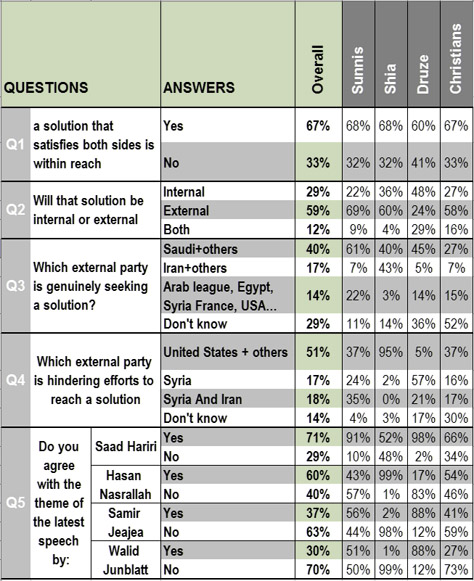
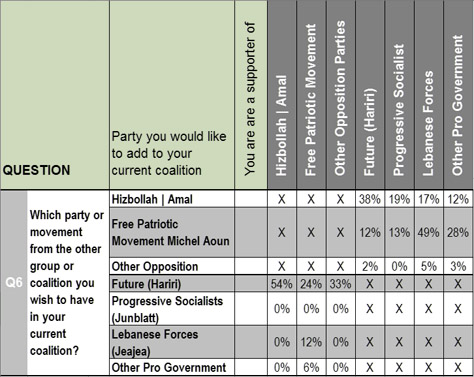
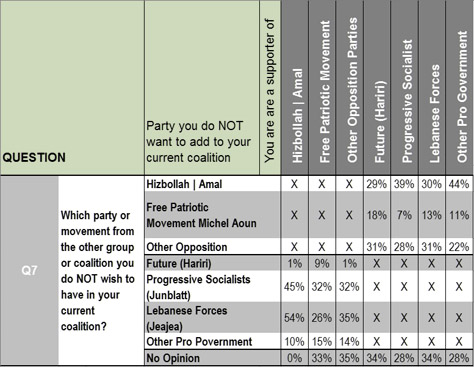
Alex composed these tables based on a recent opinion poll conducted by the Beirut Center for Research & Information between the 24th and 28th of February 2007. They show that the Lebanese public is in favor of a political deal between the sects. The vast majority of Lebanese believe a deal is within reach. 51% of Lebanese believe the US is hindering a deal; whereas, 17% believe Syria is.

Most Shiites and Sunnis want each other as allies. Saad Hariri, the Sunni leader is the most popular Lebanese politician followed by Nasrallah, the Shiite leader. Few Lebanese appreciate the extremism of Junblatt or Geagea. This shows that in obstructing a political deal between the factions, the US is working against Lebanese public wishes. (Thank you Alex.)

lebanon-poll-eng1.jpg


lebanon-poll-eng2.jpg


lebanon-poll-eng3.jpg

Counting Lebanon’s Shiites as Slaves: Why the Lebanon Deal is Obstructed

The isolation of Syria appears to be breaking as Damascus seeks deals with the Saudis and the Lebanese, writes Nicholas Blanford. EU foreign policy chief Javier Solana will travel to Syria soon, marking a resumption of high-level contacts between Damascus and the Europeans. The prospect of a thaw with Syria has caused howls of protest from Lebanon's obstructionists who continue to believe that America's plan for changing the Middle East is working. They call on the US to ratchet up military and economic pressure on Iran and Syria in the benighted belief that reform of the Greater Middle East is on the horizon. Michael Young insists in the Daily Star that Syria is on the verge of breaking. He believes Syria will change its policies and fall in line with the US. This is the identical line that Junblatt and Raghida Dergham have been trumpeting.

The biggest assets of the obstructionists is US Ambassador Feltman, who has been working assiduously to keep a deal from being struck in Lebanon. He refuses to allow the Syrians satisfaction on their demand that the establishment of the International tribunal be delayed until after a Lebanon deal is clinched. His fear is that if the Lebanese opposition gets a 19+11 cabinet sharing formula before the Lebanese government signs over permission for an international tribunal, it will never get established. To avoid such a prospect, the US is willing to sacrifice Lebanon's future and any prospects of economic growth for the country. Stagnation and paralysis will continue to be the order of the day in Lebanon. With a deal, all the participants gain. Feltman has a most unusual arrangement with Secretary Rice; he has a weekly video conference with the Secretary  – access of the like only the Ambassador to Iraq can boast. Colonel Pat Lang writes:

Everyone was happy, even giddy about the prospect of a typically muddled but non-violent solution to the impasse in Lebanon.  Today the leaders say "not so fast."  What happened overnight?  Was it Feltman that happened?  Was it Rice? Was it our unending malicious meddling in other people's business? 

Michael Young is particularly outraged because his good friend David Ignatius recommended negotiating with Syria and Iran. Ignatius writes that a senior Bush administration official explained: "We think our Iraq strategy is consistent with Baker-Hamilton. We want to get to the same place, but not on the same time-line." Ignatius proposes that Baker be appointed to begin negotiations with Syria and Israel because the administration's hard line tactics have failed. Ignatius does not believe that Iran and Syria are about to crack.

Martin Kramer supports Michael Young in his belief that the Shiite Crescent is the true enemy of the West and liberty in the region, but his animus is directed at the Iranian end of the crescent, which most directly threatens Israel, and not the Syrian end. In a MERIA article, A New Middle East: Islamism and Terrorism, he argues that only by destroying Iran's nuclear ambitions and arrogant attempts to exploit the Palestinian and Lebanese problems can the West bring peace to the region.

The only problem with this analysis is that it is has led to a long list of failures and the needless death of thousands of Iraqis and Americans. Michael Young recommended the invasion of Iraq in 2003, claiming that the "consociational" Lebanese model of government that has served his country so well would bring peace and happiness to Iraq and quickly be replicated throughout the Middle East. It has taken the West four long years of watching Iraq descend into ferocious civil war to come to grips with the short comings of this analysis. In 2006, Young advocated keeping the incompetent Lahoud as president of Lebanon rather than giving Michel Aoun a chance at elections. (Aoun was the most popular candidate in Lebanon at the time.) This obstructionism led directly to the summer war between Lebanon and Israel. With no prospects of a non-violent adjustment to Lebanon's lopsided power-sharing formula, Hizbullah and its opposition allies fell back on the old formula of "resistance" and demonstrations. When war broke out, Young began excitedly prognosticating that Israel could break Hizbullah and international forces disarm it. He insisted the Shiite party did not represent authentic Lebanese demands, being merely a creature of Iran and Syria. Again, Young's dreams didn't materialize. Instead, the inconclusive war led to paralysis in Lebanon as Hizbullah and the Siniora government stand face to face, each unwilling to bow to the demands of the other. Rather that admit that he has misjudged the opposition or the ability of American and Israeli power to reshape the hearts and minds of Middle Easterners, Young continues to insist that Syria and Hizbullah will buckle if only the US will inflict a bit more pain on them.

Rather than come to grips with the real flaws of Lebanon's democracy, Michael Young, like many other Lebanese, believes that the use of force by foreign powers can preserve the skewed status quo in Lebanon. He wants international forces to disarm the Shiites in the South, and the US to inflict more pain on Syria. The Lebanese obstructionist solution is to import violence into Lebanon and the region. They refuse to allow a "typically muddled but non-violent solution to the impasse." Importing foreign armies to keep the Shiites in their place will only lead to further war and extremism on both sides.

What is wrong with the "consociational" system that is held up as the epitome of Lebanese democracy and power-sharing? Quite simply, it treats Shiites like slaves. In pre-civil war America, black slaves were counted as half a white person. In Lebanon they are accorded the same political weight. Although Shiites are estimated to make up some 40% of the population, the Taif Accords, Lebanon's constitutional arrangement, permit the Shiites only 22% of the seats in parliament.

The defenders of Taif will scoff at this analogy between Lebanese Shiites and American slaves. They will say, "But we don't treat Shiites as slaves. They can vote and they are allocated the third most powerful political office in the land: the President of the Parliament. All true, I admit, but this doesn't obscure the simple fact that Shiites are accorded only half the political worth of other human beings in Lebanon.

Hizbollah and its opposition allies have repeatedly stated that they have no intention of challenging the Taif Accords. Instead they ask for a greater number of cabinet posts. They make these diminutive demands in order not to appear as revolutionaries. They do not want to threaten the Sunnis, who have most to lose from a more equitable power-sharing formula. What the obstructionists fear, however, is that if the governing coalition makes one concession, it will lead to others. It is a slippery slop. If they concede more cabinet positions to the Shiites today, the sons of Hussein will call for a proper census and a reconsideration of Taif tomorrow.

In a recent PBS News Hour with Jim Lehrer during which I debated opposite the al-Arabiya reporter Hisham Milhem, I was left speechless when he insisted that the "Shiites wanted to turn Beirut into a Tehran on the Mediterranean." I was not prepared for such super-heated rhetoric. The only way to counter such fear mongering, however, is to shoot back that Beirut today is Mecca on the Mediterranean. Yes, Club Mec. Or, perhaps a cross between the Vatican and Mecca on the Med. Sunnis and Christians enjoy the lion's share of power. The mellifluous and jolly sounding term "consociationalism" cannot hide the ugly fact that Lebanon is a religious state, in which Sunnis and Christians are privileged, politically and economically.

Undoing the mutual fear and resentment which divide the opposition from the governing coalition will not be easy, but obstructing the kind of deal that the Saudis and Egyptians are trying to broker is not the answer. It will invite further violence. Young rightly fears for Lebanon's sovereignty, but only concord among Lebanese can act as proof against foreign influence. Young is one of the smartest hawks in the Lebanese firmament and he has written thoughtfully on the need for a more equitable power-sharing in Lebanon. Now is the time to do it.

At the same time, Michael Young once said to me that if Taif were rewritten and Christians were allocated less than their present 50% share of Parliamentary seats, he might be forced to leave Lebanon. That is a sad comment on the state of Lebanon's consociational system and the prospects for a political deal in the immediate future.

If the United States is sincere about promoting democracy in the most democratic state in the Arab East, burnishing its reputation for justice, and promoting freedom, it cannot stand on the side of counting Shiites as slaves. If any nation in the Middle East has a chance to point the way toward a more tolerant and democratic future, it is Lebanon.

“Iranian General Defects with Hizbullah’s Secrets,” by Nicholas Noe

Nicholas Noe of Mideastwire.com, an expert on Hizbullah, writes that the former Iranian deputy defense minister Ali Reza Asghari, who defected last month to the US, knows Hizbullah missile and defense secrets. "It may represent the biggest intelligence coup for the US and Israel in Hizbullah's history," writes Noe. News reports mention Asghari's possible knowledge of Iran's nuclear secrets and of the whereabouts of Israeli pilot Arad. But Noe explains that Asghari's most valuable knowledge may be about Hizbullah's military plans and capabilities.

For background read this article followed by Noe's analysis.

Missing Iranian official being questioned in N. Europe

By Yoav Stern, Haaretz

The Iranian former deputy defense minister who disappeared in neighboring Turkey last month is being questioned in a northern European country under strict supervision, the pan-Arab newspaper al-Sharq al-Awsat reported Wednesday.

According to the newspaper, published in London, Ali Reza Asghari is undergoing thorough investigation by intelligence forces before being transferred to the United States.

Asghari, who is a retired general in the elite Revolutionary Guards, disappeared in Istanbul about a month ago. A hotel room was booked under Asghari's name, but several reports indicate that he never arrived at the hotel….

[End]

Here is Nicholas Noe's analysis received by Syria Comment Wednesday 7, 2007

Josh –
I just wanted to send you some quick thoughts about the recent defection/disappearance of a high ranking Iranian general. The story is particularly pertinent I think vis a vis Hezbollah – if in fact this is a defection, it may represent the biggest intelligence coup for the US and Israel (by association) in the Party's history. Indeed, as has been well acknowledged by US and Israeli officials, penetration of Hezbollah since its inception has been largely unsuccessful. Although the Mossad (presumably) has been able to track and assassinate some Hezbollah officials over the years – and less so after the withdrawal in 2000 – this has mostly been around the edges – hence the IDF's utter inability to predict accurately Hezbollah rocket capabilities of any sort in 1993, 1996 and in the 2006 conflict (as a confirmation of this, one should note that although Israel confidently predicted that almost all of hezbollah's long range capabilities were hit in the first few days of the summer war (not to mention their wild overstatements on short range rockets), recently the intelligence community in Israel has been "leaking" that Hezbollah has replenished precisely these stocks – in other words, the "proof" of the earlier specious claim is no longer an issue since Hezbollah merely "resupplied").

In any event, the defection is absolutely critical because it means for the first time, Hezbollah's adversary's may have accurate estimates of stockpiles, weapons types, even perhaps placement and tactics – this is crucial because the limits and placement of Hezbollah weaponry has been a major problem each time during a Hezbollah-Israel conflict – all the more so if there is a future one, as some analysts, myself included, suspect may very well be the case.

Here are some details Mideastwire has culled – more tonight from a translated piece from Asharq al Awsat. But as you can see the general was the IRGC liaison here in Lebanon prior to the 2000 withdrawal and, as a principle of the armaments industry going forward, would have detailed knowledge of Hezbollah capabilities even after he left Lebanon:

Ali Reda Askari or Asghari:

* He holds rank in the Iranian Revolutionary guard equivalent to that of a Major-General.

* He succeeded Ahmad Kana’ni and Hussein Muslih in the command of the Revolutionary Guard units in Lebanon where he stayed for two years in the 90s. He frequented Sudan, Syria, Pakistan and Afghanistan.

* He was one of the top officials in the logistics department in the defense department during the Iranian-Iraqi war in the 80s.

* He headed the general committee responsible for running the largest weapons production facility in Iran.

* He was appointed an aide to the defense minister Admiral Ali Shamkhani responsible for logistics affairs and military purchases during the reign of President Ahmad Khatami.

* He was known for his financial integrity and gained fame after he uncovered a corrupt network inside the ministry headed by one of the top commanders of the Revolutionary Guide. This network had managed to swindle more than 160 million dollars in commission as well as 60 million dollars from bogus weapons’ deals.

* He was responsible for acquiring spare parts and equipment used in producing the Shehab 3 ballistic missiles.

* Turkish newspapers report that he was opposed to the Iranian government and that he possessed knowledge of the Iranian nuclear secrets.

Nicholas Noe
Nicholas Noe is the founder of the Beirut-based Mideastwire.com, a news translation service covering the Arabic and Persian media. He is currently editing a collection of translated speeches by Sayyid Hassan Nasrallah.

Has a Lebanon Deal Been Clinched?

Is a Lebanon deal in the works? Did the Saudi-Iran meeting produce results?

There are two versions. The Lebanese are saying it did produce results. The Daily Star and al-Sharq al-Awsat both claim a Lebanon deal has been clinched, but the details remain vague, which is not a good sign of success. The Daily Star writes:

Lebanese Forces leader Samir Geagea, a strong critic of the opposition who has been repeatedly accused of hampering efforts to end the deadlock, confirmed on Sunday that there was "indeed an effective solution."

"The solution is based on two things, on forming a joint committee that will oversee the modifications to the international court [to try suspects in the 2005 assassination of former Prime Minister Rafik Hariri] and the formation of a national consensus government of 19 + 10 + 1," Geagea told the Lebanese Broadcasting Corporation.

The unaffiliated Cabinet minister in Geagea's formulation would belong neither to the majority or the opposition but would serve as an independent.

Geagea's version of the agreement was confirmed by Parliament Speaker Nabih Berri, who earlier had called for a "joint judicial committee" to work on a final draft of the international tribunal.

The details of the International Tribunal do not seem to have been completely worked out, nevertheless, diplomats have been trying to finesse the issue in order to get a cabinet deal that would bring Hizbullah and the opposition back into government and allow the Lebanese economy to be relieved of the paralyzing demonstrations in the downtown financial district.

Syria has insisted that it would not allow the International Tribunal to go forward for fear that it will be politicized and used to further isolate and harm Syria. Damascus insists that the Brammertz final report, which is due out this summer, first be published. Only then, it claims, should the decision of whether to establish a tribunal or not be taken. Damascus believes that the evidence that the UN team has been able to gather in the last two years is less than compelling and will not justify a trial. Damascus insists that the reason the US and Lebanese government want a tribunal established before the release of the report is precisely because they know the evidence against Syria, or anyone else for that matter, is weak. Washington wants the court established before the release of the Brammertz report in order to be able to tie Syria up in litigation for the next several years and use it's existence as an excuse to isolate Damascus for another several years. Syria is gambling that the report is a bust and that international support for a tribunal will evaporate once the public understands that the US and France are engaged in a fishing expedition.

Hassan Fattah of the NYTimes, in contrast to the Daily Star, writes that the "Saudi-Iran Meeting Yields Little Substance." The Saudi proposed Arab Peace Plan for Palestine was discussed, however, despite Iranian denials. Fattah writes:

The Saudi Press Agency reported that Mr. Ahmadinejad had expressed support for a Saudi-led land-for-peace initiative that would have Arab states recognize Israel in return for the establishment of a Palestinian state in the lands occupied by Israel in 1967. Arab foreign ministers meeting in Cairo on Sunday agreed to revive the plan ahead of the Arab League summit meeting in Riyadh later this month.

An Iranian official, speaking to Iran’s state-run media, reportedly denied that the initiative was discussed during the summit meeting.

The possibility that that Islamic World will get behind a renewed effort to promote an Arab-Israeli peace plan has many in Israel worried and some excited.
Haaretz published an editorial yesterday asking Olmert to respond positively to the Saudi initiative:

Saudi Arabia holds a unique status because of the king’s role as the guardian of Islam’s holiest sites and also because of the country’s oil wealth. It is therefore in a position, more than any other state, to offer religious and economic backing to peace settlements between Israel and the Palestinians, Syria and Lebanon.

Saudi Arabia and Israel also share concerns about the growing strength of Iran and both wish to prevent another war in the region. They have a shared interest in the renewal of the peace process. Taking advantage of this opportunity requires both sides to show flexibility and openness. The Saudis need to understand, as Foreign Minister Tzipi Livni has said, that Israel has red lines on the issue of refugees, and it will not be able to accept the right of return as the basis for dialogue. It is therefore important that the Riyadh summit conclude with a more pragmatic formulation of the initiative.

It is the duty of the government of Israel not to reject the hand that is being offered by Saudi Arabia. Olmert must consider the Arab peace initiative to be an appropriate basis for dialogue, one that will lead to a permanent settlement and a settling of the status of Israel in the region, and which will serve as a definitive response to Ahmadinejad and his partners in the extremist camp. A renewed peace process will save Olmert’s government from the impasse in which it is stuck. It is important that the four weeks left before the summit in Riyadh involve intensive diplomatic efforts to formulate an agreed-upon framework for the regional peace initiative.

Haaretz writer Akiva Eldar bemoans what he sees as his government's inability to move toward negotiations and peace. He writes:
The government is fighting the Mecca agreement, which was designed to allow the Palestinian Authority unity government to authorize PA Chairman Mahmoud Abbas to conduct negotiations on a final-status accord. Instead of talking to Syria and Lebanon on a peace agreement, the government is preparing the public for another war in the North. Essentially, the Olmert-Peretz government isn't offering anything but more blood, sweat and tears. …
It is precisely the dangers lying in wait at Israel's gates, and threatening the pragmatic Sunni regimes, that have provided the Olmert government with a rare opportunity to end the conflict with all Arab states, once and for all. Five years after the missed opportunity of the Arab peace initiative approved in Beirut, the Arab League is offering Israel a second chance. In a Riyadh summit at the end of the month, the Arab League intends to pave the way for accelerated negotiations between Israel and the Palestinians and lay the groundwork for an end to the conflict along the northern border as well. Israeli acceptance of the initiative would be rewarded by "normal relations" with all its neighbors. Even the Bush administration has discovered that anger is not a policy and decided to to talk with the Iranians and Syrians on ways to leave Iraq. The United States would no doubt be grateful to Israel for any contribution to the fight against the global jihad that is shedding its soldiers' blood.

Amr Mousa, has come out against any changes in the Saudi peace plan despite FM Livni's insistance that the article demanding the Palestinian right of return be removed from the proposal. Read: Arab League chief: We will not change Saudi peace initiative.

Recent public opinion polls in Arab countries, according to a sweeping overview of recent polling by Peter Kiernan, demonstrate that the single most important issue that Arabs want the US to fix is the Arab-Israeli dispute.

When asked what steps the United States could take to improve its regional standing, 62 percent identified brokering an Israeli-Palestinian peace deal based on 1967 borders. A significant minority of respondents identified withdrawal from Iraq (33 percent), and withdrawal of U.S. forces from the Arabian Peninsula (22 percent) as well. More than half (52 percent) ranked U.S. policy on the Arab-Israeli conflict as "extremely important."

The polls also show that Sunnis throughout the Arab World are in favor of Iran developing nuclear power and even weapons, despite Saudi and US efforts to stimulate Sunni fears of Iran.

Ben-Eliezer, an Israeli minister, is forced to cancel a trip to Egypt because he is accused of executing Egyptian war prisoners. Israel denies it, but the issue brings up an ugly past. Egyptian ministers exploit the flap to call for renewed war with Israel.

Lebanon

A number of pro-government journalists and politicians in Lebanon have spent the last several days trying to insist that the government does not need to cut a deal with Syria or the Lebanese opposition. 

John Aziz of al-Akhbar (March 3) reports that (Junblat ?) has been insisting that the United States will bomb Iran and scare Syria enough that Hizbullah will be forced to come back into the government with its tail between its legs and without a greater share of power. He tells Lebanese not to worry and that the West is with Lebanon; its economy will be fine after the bombing of Iran. 

Raghida Dergham of Al Hayat (March 2) tells us that the Syrian opposition is "well prepared and trained" in Syria and ready to "carry out acts of sabotage" capable of overwhelming the Syrian leadership. Powered by her faith in the Syrian opposition, Dergham is certain that the Siniora government will win the day, not make concessions to Syria, and that Damascus will be forced to accept the international tribunal for fear of being overthrown by the opposition.  She explains: (translation thanks to mideastwire.com)

“The US president still has the upper hand in foreign policy making. He will continue this way for another two years despite the collapse of his popularity because of the war on Iraq. He is not considering a deal with Damascus and Tehran that would sacrifice the international tribunal and Lebanon. He may not be considering plans to topple the regimes in Damascus and Tehran, either. But he will never hesitate to do so if Syria and Lebanon press on with their efforts to destabilize Lebanon. This is the reason why there has been much talk lately about strengthening the capabilities of the Syrian opposition.

“This opposition is not only based in European capitals, but it is also based in many of Syria's neighbors. If well prepared and trained, it is ready to carry out acts of sabotage, outstripping the scale of the Syrian leadership. There is a significant opposition in key positions in Syria seeking to save the country from a fate similar to Iraq's and sees that the only means to do so is to overthrow the government. Clearly, the Syrian regime opposes the setting up of a tribunal of an international character for existential reasons. However, it will have to surrender to an emerging Arab consensus about the tribunal – in addition to the international one.

According to the Oxford Business Group Lebanon's real problem is the economy. The government cannot hold out for a better deal or resist Hizbullah's and Syria's demands forever because the economy will implode. The OBG's article, "Lebanon: Downtown Beirut Going Down" of 5 March 2007 has this to say:

Eighty institutions have closed in downtown Beirut and there are fears of more businesses being shut if the situation continues this way, Salameh said during a press conference called by representatives of various professional groups on March 1.

In order to give the commercial sector some respite there should be an end to the demonstrations and even talks between rival factions and cabinet meetings should be shifted to another location to reduce the tension in the business district, he said.

Another speaker at the press conference was Paul Ariss, the president of the Lebanese syndicate of restaurant owners, who said the country's political leaders had to resolve the stand off before the damage to the economy becomes worse.

Business groups have called on the government to come to their rescue, proposing interest-free medium and long-term loans for companies worst affected, and a holiday for the payment of state levies such as taxes, municipal fees and rents.

However, Salameh said these calls have fallen on deaf ears.

It's been three months since we started visiting politicians, explaining our suffering to them, he said. We received promises but up to now they haven't been implemented.

The option of taking legal action against the state was also raised during the meeting, in an effort to recoup some of the losses sustained over the past three months.

Lawyers representing business groups have drafted up documentation to support civil action against the government and business owners have been collating estimates of losses.

During the March 1 press conference, it was said that, unless concrete measures were taken within the next two weeks to alleviate the pressure on the central business district, the battle front would be moved to the courts.

Another sector to call for an end to the clogging up of downtown Beirut and the subsequent disruption to the economy is Lebanon's beleaguered tourism industry.

However, while the proposals to provide low cost or interest free loans and tax breaks have been canvassed, no formal decisions have been taken. Indeed, without a cease fire in the political conflict engulfing central Beirut, there can be little hope of relief for the businesses holding the trenches in the front line.

Iraqi Refugees in Syria are safe for now. Syria has rescinded the stricter rules it announced in January for Iraqi refuges.

Previously, the authorities had demanded that refugees leave the country for a month once their residency permits expired, and only after that period could they return and reapply.

Now, Iraqis fleeing the violence back home can stay for a month before applying for a three-month permit which can then be renewed by leaving Syria and returning again as early as the same day.

Syrian Bloggers responded in force to the sentencing of Egyptian blogger Kareem Nabeel Sulaiman, with a joint statement, started on Levantine Dreamhouse… The statement was republished on many other Syrian blogs, and will stay on the main page of Syria Planet -Syrian Bloggers Portal- for a week. Read Ihsan Attar from Damascus on the regime and whether Syrian bloggers are any safer than Egyptians. Blogspot has been blocked in Syria for weeks.

How Barack Obama learned to love Israel ( 4 March 2007)

Jean-Pierre de Chadarevian wrote Syria Comment this interesting note about his Aleppine relative who was reportedly dissolved in Sulfuric acid!

By chance, I stumbled on an old discussion on your blog referring to so-called François de Chadarevian, Syrian communist activist killed in the 60ies for his ties to the Syrian Communist Party .  Someone, maybe you, asked who was this man.  I would like to clarify some details and make a slight correction.  The man in question was not called François, but Pierre, and, indeed he was eliminated by the Syrian secret services.  Rumor has it that his body was dissolved in sulfuric acid, the alleged reason why the family was not allowed to open the coffin.  He was the grand-son of Thoross de Chadarevian, who was a prominent Aleppo [Syria] lawyer made Count of the Vatican by Pope Benedict XV for services rendered to the Holy Sea, protecting the rights of the custodians of the Terra Sancta in Jerusalem.  Pierre de Chadarevian was a passionate and also a communist, and belonged to a passionate family who produced several catholic priests! [his uncle who died in Damascus, Syria, and his nephew who's now priest in Vancouver, Canada.] 

Just for the record!  How do I know this?  Pierre's grand-father, the Count, was my great-grand-father!!
Jean-Pierre de Chadarevian, M.D., Philadelphia, PA

Two older articles that I overlooked last month are:

Martin van Creveld, the dean of Israel's military historians, in his "Make a Deal With Syria," tears into the defense argument for not negotiation a deal on the Golan. (See his site for other good articles on the Lebanon War this summer.)

Shlomo Ben-Ami, Test of Syria's intentions, also argues for dialogue. He explains that "the road map" is dead and that a deal with Syria offers "a more functional regional order, stability in Lebanon and a severing of the Damascus-Tehran axis."

Saudis and Syrians …Brothers or Rivals?

Written and POSTED BY ALEX.
March 5, 2007 for "Syria Comment"

Ibrahim Hamidi wrote in Al-Hayat today about the new, more constructive tone in Damascus:

President Bashar Assad spoke about the historic relationship between his father, late president Hafez Assad, and King Abdallah. He spoke about the personal respect he has for the Saudi king and for the significance of Syrian-Saudi relationships.

After a meeting with the Saudi envoy to Damascus, a marked change in the tone of Syrian media outlets has been discernible. Many journalists, from both state-owned as well as privately owned media outlets, were criticized by government agents for their previous criticism of Saudi role.

In sharp contrast to the general movement towards Syrian Saudi reconciliation, prominent Saudi journalist Mr. Abdul Rahman Al-Rashed, director of Al-Arabia Satellite TV station, and ex-editor of the largest Saudi owned newspaper Al-Sharq Al-Awsat, wrote today an exceptionally negative piece on Syria. He even ended it with a strong warning.

Here is a translation and breakdown of the article:

The crisis between Damascus and Riyadh is a complex one that got worse with:

– Syria’s reaction to the adoption of UN resolution 1559

– The assassination of Rafiq Hariri which was “the biggest shock to Saudi Arabia” because of Saudi suspicions that Syria was behind the assassination.

– Syria’s role in facilitating infiltration of Saudis nationals wanting to fight in Iraq

– Syria’s open smears regarding Prince Bandar “the Personal Saudi envoy to Damascus”

– Attitudes that accompanied Hizbollah’s war with Israel

– The language used in the Syrian president’s speech who surprised all the Arabs with his attacks on Saudi, Egyptian, and Jordanian leaders.

– Syria’s “open alliance with Iran against the Gulf countries, Egypt, and the rest of Arabs”

– Vice president Sharaa stating that there is a personal component to the Saudi leadership’s problems with Damascus.

– Syria’s support for Lebanese opposition in their attempts to undermine the Seniora government.

Al-Rashed claims that after this “extreme deterioration” in the relations between the two countries over the past two years, Syria now feels that the upcoming Arab summit is its only hope “after it has lost almost everything .. even its ally Iran showed readiness to sell Syria at the first opportunity”

Mr. Al-Rashed then compared Bashar’s approach today to that of late President Hafez Assad, who, Al-Rashed claims, always moved quickly to fix Syrian mistakes that led to problems in Syria’s relations with Saudi Arabia. For example, he lists:

– Syrian attacks on the PLO forces during the early stages of Lebanon’s civil war.

– Syrian attacks on the Syrian Muslim Brotherhood

– Syria’s decision not to side with Saddam Hussein’s Iraq in his first war against Iran.

Syria’s actions over the past two years have been bewildering, Al-Rashid insists. Syria destroyed its most significant alliance in the region (that with Saudi Arabia). As a result, Syria became exposed to “internal, regional and international hazards”.

This is how he perceives the state of Syria prior to the upcoming Arab summit.

He explains that political differences among enemies are never impossible to fix, so it should not be impossible to do so among brothers. But Syria will be mistaken if it believes that its disagreements with Saudi Arabia are based on personal issues. The way Syria opened the door for Iran into Iraq, Syria, Lebanon, and the Palestine is not a simple matter… it changes the map of the Middle East and it leaves the door wide open to a major war … with sectarian, security, regional, and international aspects.

The article is concluded with a warning: If Syria does not take steps to fix the causes of its problems with Saudi Arabia, then the Arab summit will not save Syria from a dark future ahead … Syria is responsible for its own encirclement.

Questions and background:

Mr Al-Rashed’s tone and his long list of alleged Saudi grievances with the two Assads, lead to the following question:

What exactly does Saudi Arabia stand for?

It is obvious that Syria cannot please all the Saudis all the time… Saudi Arabia has many, often contradictory requirements. Saudi journalists have been critical of the Syrians for many reasons: Syria is not democratic; Syria is giving a role to non-Arab and non-Sunni Iran in Arab affairs; Syria is helping the Iraqi Sunnis; Syria did not expel the leader of Hamas from Damascus, when the US insisted that he do so. Later, the Kingdom seems to have reversed its positions on these same issues. Just like Syria, the Saudis warmly welcomed Hamas leader Khaled Mashaal in Mecca, and closely coordinated with Iran officials their joint proposed solutions to many Arab conflicts. What is it exactly that they still do not like in Syria's behavior? The lack of Democracy?

Mr. Al-Rashed’s argument that during the past two years the Syrian regime has made many mistakes leading to an unprecedented deterioration in Syrian Saudi relations in not entirely convincing.

The proof is in going back two years to an article by another prominent Journalist, Mr. Mamoun Fandy, close friend of many members of the Saudi Royal Family. In a 2005 article in Al-Sharq al-Awsat, Mr. Fandy was already warning Syria that it had one last chance to make dramatic changes in its position or it would slide toward hell at the speed of light (that was two years ago):

“Syria is now in real trouble. What can be done to save Syrian people from paying the price of their governments wrong decisions? The solution is a meeting between all Arab countries including Syria, on the condition that Syria listens without being allowed a single one of its long disdainful speeches. The aim of such a meeting would be to give Syria a political cover to use in coming out of its current bottleneck. It would also present Syria with a frame to preserve its dignity as it withdraws from the pack of policies that reflect a state of obstinacy. Without such rapid Syrian withdrawal and without a similarly rapid Arab political involvement we will watch Syria move confidently towards hell with the speed of light. A group of foolish Arabs will remain applauding Syria as it heads to the bottom of the rank of Arab nationalism. I also hope that Syria will not imagine that this scenario will take many years to be executed, or that the Bush regime may have departed before the effects fully impact Syria.”

President Assad was not impressed by Fandy's "last chance" warnings. Instead, Assad announced his decision to defy Saudi Arabia and resist US pressure in a speech at the University of Damascus in November 2005, during which he said:

“Many times we read or hear from foreign emissaries that the reason some foreign officials in these countries are angry… The reason they are angry at Syria is that President Bashar Al-Assad made a commitment to them to carry out internal reform, and has not done so. I didn’t know that the Syrian people appointed them as representatives instead of his parliament members, and President Bashar is supposed to make commitments to these foreign officials. I didn’t know they cared for us more than we care for ourselves. I didn’t know someone appointed them to be in charge of us and to give us grades… The region is now facing two options alone: either resistance and steadfastness, or anarchy. There is no third option. Resistance prevents anarchy. Resistance has a price, and anarchy has a price, but the price of the resistance and steadfastness is much lower than the price of anarchy.”

Conclusion:
The death of Hafez Assad and the demise of Iraq’s strong man, Saddam Hussein, created a perceived "leadership gap" in the area. America, Saudi Arabia, and Iran competed to fill the vacuum.

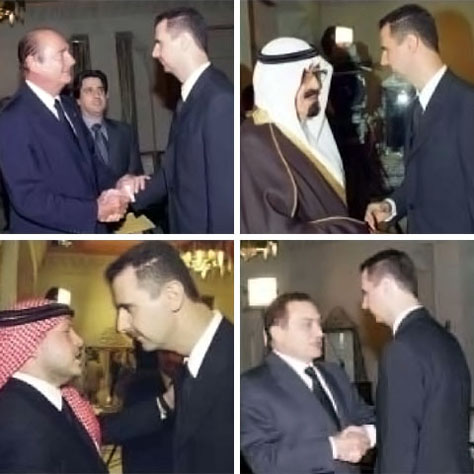
Those presidents and kings who attended Hafez Assad's funeral in 2000 all wanted to change Syria's traditional role in the region. They believed that they could take the young and unproven Bashar al-Assad under their wings and direct him to abandon Syria's positions on Palestine, Lebanon, Iraq and Iran. President Bashar al-Assad turned out to have a mind of his own and refused to cooperate with the KSA, France or Jordan, causing grave concern about his leadership abilities. The first real test for Bashar al-Assad was the US invasion of Iraq. His refusal to cooperate with America's invasion meant Syria was elevated to the status of an adjunct participant in the "axis of evil."

Here are photos of the presidents and kings who attended the funeral of Hafez al-Assad in 2000.

at_hafez-assads_funeral.jpg

Rather than supporting the US in its invasion of Iraq, both Syria and Iran competed with the Untied States to share the Iraq pie. Syria and Iran made gains in Palestine through their Hamas allies. Saudi Arabia, the U.S., and the French took Lebanon away from Syria and probably had plans to "change Syria's behavior", preferably through regime-change in Damascus. Because of the lack of a better candidate, ex-Vice President Abdul Halim Khaddam was floated as a possible alternative president for Syria. He is known to be a friend of President Chirac, King Abdallah, and the Late Rafiq Hariri.

Thomas Friedman’s syndicated columns are translated every week and published in the Saudi Al-Sharq Al-Awsat. A few weeks ago his column did not appear in the Saudi paper, however. In that column he explained his preference for Iran over Saudi Arabia as the more natural future ally of the USA in the Middle East.

The Saudis are worried that the Untied states will eventually talk to Iran. When this happens, there are many reasons to believe that the Americans will rediscover the tremendous utility of Iran. Should Washington find common ground with Tehran, it will be at the expense of Saudi Arabia’s exclusive role as US ally and heavy hitter in the Middle East.

Today’s article by Mr. Al-Rashed reflects Saudi fears, which are mixed with self confidence and even arrogance. The kingdom is feeling both powerful and vulnerable at the same time… just as Syria and Iran do.

Hopefully, at the upcoming Iraq round-table meeting, all the competitors (The US, Saudi Arabia, Syria, and Iran) will find a way to reach an acceptable compromise over who will play what regional role for how long and towards what purpose. It seems that Syria’s request that the meeting not restrict discussions to the subject of Iraq will be accommodated, if not at the table, then through the Iranian/Saudi negotiations in Riyadh and elsewhere. For example, a new Lebanon agreement seems to be in the making. Syria has already given the Saudis a gift by facilitating the Mecca agreement. A lot more give and take can be expected.

Still, coming to total agreement will be difficult, if not impossible. There are too many players sitting at the table and there are too many conflicts to be managed.

One fears that another round of muscle flexing might be necessary to better determine the strength of each player. An Israeli summer war against Hizbollah or Syria is not out of the question. Neither is an American attack on Iran, or Sunni-Shia confrontations in Iraq or Lebanon. Al-Rashed's clear warnings to Syria might be connected to joint American and Saudi plans to destabilize Syria, as reported by Seymour Hersh in his article in the New Yorker last week, in which he writes:

This time, the U.S. government consultant told me, Bandar and other Saudis have assured the White House that “they will keep a very close eye on the religious fundamentalists. Their message to us was ‘We’ve created this movement, and we can control it.’ It’s not that we don’t want the Salafis to throw bombs; it’s who they throw them at—Hezbollah, Moqtada al-Sadr, Iran, and at the Syrians, if they continue to work with Hezbollah and Iran.”

Hopefully, the competing powers in the region will have the wisdom to diffuse the simmering conflicts that threaten to drag the region into another round of blood letting. Much hangs in the balance during the next month of conferences and negotiations.

News Round Up (3 March 2007)

Correction: In my article Will Saudi Arabia Solve America’s Problems? I incorrectly wrote that Mohammed Ben Jelloun "was writing at a Hizbullah backed think tank." This is wrong. Ben Jelloun is a sociologist and political scientist unaffiliated with any party. I should have written that "Ali Fayyad is a "director of a think tank closely affiliated with Hezbollah." Ben Jelloun was quoting from an article by Mr. Fayyad, who is affiliated with Hizbullah. I apologize for any insult to Mohammed Ben Jelloun or to those associated with the website "Swans Commentary" that published his excellent article, all of whom are unaffilliated with Hizbullah. I recommend everyone to read Mohammed Ben Jelloun's fine article, "Hizbullah's Democratic Demands." Best, Joshua Landis 

Will Saudi Arabia Solve America’s Problems? I incorrectly wrote that Mohammed Ben Jelloun "was writing at a Hizbullah backed think tank." This is wrong. Ben Jelloun is a sociologist and political scientist unaffiliated with any party. I should have written that "Ali Fayyad is a "director of a think tank closely affiliated with Hezbollah." Ben Jelloun was quoting from an article by Mr. Fayyad, who is affiliated with Hizbullah. I apologize for any insult to Mohammed Ben Jelloun or to those associated with the website "Swans Commentary" that published his excellent article, all of whom are unaffilliated with Hizbullah. I recommend everyone to read Mohammed Ben Jelloun's fine article, "Hizbullah's Democratic Demands." Best, Joshua Landis 

Helena Cobban Interviewed Foreign Minister Walid Mouallem on Feb 28th when she was visiting Damascus. Cobban has serialized them here: one (on Iraq), two (Peace with Israel), three Israel again. Here is a bit from part one. Mouallem explains Syria's view of the upcoming Baghdad conference:

The idea of the meeting is to rally the goodwill of the neighboring countries and to express support for Iraq's security and stability.  For Syria, it's our vital interest to achieve security and stability in Iraq.  In Syria, we have more than a million displaced Iraqis.  They are a real burden on our economy, and on our education and healthcare systems.  We're not getting any support from anyone for this– including the Iraqi government.

This is a humanitarian issue, and it's increasing in gravity on a daily basis, because of the terrible security situation in Iraq.

He explained that because Syria hopes that these displaced persons can speedily return to their homes in Iraq, his government is reluctant to refer to them as refugees, calling them instead "displaced perople."

Mouallem described the Bush administration's decision to attecnd the Baghdad conference as,

a partial step in the correct direction.  But it's not the full step we are expecting Washington to reach to.  The full step will be when the Americans decide to have a comprehensive dialogue on regional issues, starting with the Arab-Israeli issue, which is the core issue in the region. 

[End]

V.P. Sharaa had this to say about the March 10 talks in Baghdad. Quoted from the Daily Star:

"I am optimistic, but in a measured fashion," Sharaa told Le Monde newspaper.

"The Baghdad meeting is a good thing, even if it is coming a bit late. It should have been held two years ago," he said. "Much depends on what the American administration has in its head."

Iraqi Prime Minister Nuri al-Maliki has invited neighboring countries, including Syria and Iran; the five permanent members of the United Nations Security Council – the US, Russia, Britain, France and China; and representatives of the Arab League and Organization of the Islamic Conference to the March 10 meeting in Baghdad.

Washington has said that agreeing to attend the conference does not amount to a change in policy toward Iran and Syria, which it accuses of fuelling violence in Iraq.

But Sharaa indicated that he thought the US presence might signify a shift of stance.

"I have to say that I have already noted positive elements," he said.

SANA adds this:

Al-Sharaa called for caution because the situation in Iraq is slipping toward chaos, and there are important proposed issues such as national reconciliation, and agreement on a timetable for withdrawal of the foreign troops, indicating that Syria stands in at the same distance from all the Iraqi parties whether in the government or in the opposition, because the role of a mediator can not be played if we take sides with any party.

On the Syrian-French relations, the vice president expressed hope that the crisis between the two countries will end by the French presidential elections whoever would the president-elect be, because there is no reason for the continuation of boycott between the two countries, and healthy normal relations should be restored in the best interest of the two countries.

On Ahmedinehad's visit to Saudi Arabia, Parisa Hafezi of Reuters (1 March 2007) explains that the Middle Eastern powers are trying to reduce friction and to bring Syria out of the cold:

A Lebanese political source in Beirut said Iran wanted to break the ice between Saudis and Syrians — a key element in defusing Lebanon's crisis — before an Arab League summit set for Saudi Arabia at the end of March.

Saudi commentators, noting Syrian officials have not visited Saudi Arabia in months, say Riyadh might want a thaw in its relations with Damascus to pry Syria away from Iran.

The crisis in Lebanon and Sunni-Shi'ite fighting in Iraq has led to fears of growing sectarian divides across the region.

Saudi Arabia, Iran and Syria have all accepted Baghdad's invitation to attend a regional conference in March on ways of easing tensions in Iraq.

Iraqi analyst Mustafa Alani, who recently visited Riyadh and met Saudi officials, said "The Iranian leadership think they are going to face a major crisis sooner or later with the nuclear programme and the United States trying to push them out of Iraq, so basically they want to neutralise Gulf opposition at the least," Alani said.

"The visit is an Iranian initiative. It wasn't an invitation. The problem is Ahmadinejad himself. He is not trusted by the Saudi leadership," he said.

"The Iranians tried to show the Saudis goodwill in Lebanon and that they are open to diplomatic bargaining. They reduced the tension markedly in Lebanon." (Additional reporting by Beirut bureau)

The first day of the meeting produced little agreement on Lebanon but "The two parties have agreed to stop any attempt aimed at spreading sectarian strife in the region," Saudi Foreign Minister Prince Saud al-Faisal told reporters without elaborating.

The State Department is sending a special envoy to Syria to discuss Iraqi refugees. This is the first official high level US visit to Syria since Washington withdrew its ambassador two years ago; it is an additional indication that Syria's isolation is ending. John Donnelly of the Boston Globe writes (1 March 2007)

A senior State Department official has applied for a visa to travel to Syria to address the problems of Iraqi refugees, further eroding the Bush administration's previous position of not engaging in direct talks with Damascus.

Ellen R. Sauerbrey, the assistant secretary for the bureau of population, refugees, and migration, applied for the visa earlier this week, according to a State Department official, who asked to speak anonymously because he was not authorized to talk publicly on the issue.

The decision for the administration to ask Syria for permission for Sauerbrey's travel comes as US officials have also agreed to hold high-level talks with Iranian and Syrian officials during an upcoming international meeting on Iraq's future. President Bush had previously disallowed any direct talks with officials from the two nations, especially Iran. The United States has diplomatic relations with Syria, including a charge d'affaires at the embassy in Damascus; it has had no diplomatic relations with Iran since the 1979 Islamist revolution.

The US official said Sauerbrey was given instructions to talk only about Iraqi refugees, but that still represented a significant turnaround within the senior levels of administration, particularly the office of Vice President Dick Cheney, who had been opposing any outreach to Syria. Cheney and others have argued that senior administration officials should shun Syria because of its long period of hegemony over Lebanon and allowing weapons to flow from Iran into Lebanon to support Hezbollah fighters.

"We think that this is very important and commendable," said Dawn Calabia, a senior adviser at Refugees International, a Washington- based advocacy group, about Sauerbrey's planned trip. "Her visit is a way of saying we appreciate that Syria is permitting so many Iraqis to stay there and give them at least a safe place to be. That's an important gesture."

The conservative Heritage Foundation is dismayed that the US will talk to Syria. They oppose talks because they believe Syrian and Iranian diplomats are smarter than Americans and will "sucker" them into giving away the store. "Bush Administration has reinforced the perception that it is going soft on America's enemies," writes James Philips. "The Bush Administration must not be suckered into trading concessions on Iran's nuclear program for a cosmetic deal on Iraq that involves Iranian and Syrian promises that will never be fulfilled."

Steven Cook of the CFR says "The Decision to Meet With Syria & Iran is ‘Positive'. On Syria, He answers Gwertzman's question:

What about Syria? Can they do anything to help out Iraq?

The Syrians can do a better job on policing their border. But what’s uppermost in the minds of the Syrian leadership is relieving the pressure on the investigation and international tribunal on the assassination of former Lebanese Prime Minister Rafik Hariri. That is essentially the price the United States is going to have to pay. That’s what the Syrians are looking for in terms of gaining its cooperation. Talks with the Iranians are much more important than the talks with the Syrians, to be honest with you. But there is a Syrian-Israeli angle here. The Israelis have demonstrated an interest in dealing with the Syrians as a result of the war in Lebanon over the summer. There may be something that can be done as a result of these talks to jump-start a Syrian-Israeli negotiation. But the Syrians have a history of playing both ends of the fence, being constructive in one area and being the furthest from constructive in another area.

Farid Ghadry, leader of the Syrian Reform Party, has blasted Walid Junblat, the anti-Syrian Lebanese leader of the Druze, for arguing at the American Enterprise Institute that the US should support Khaddam and the Muslim Brotherhood against Bashar al-Asad. He writes on his blog:

The event of AEI provided a hint of what is illogical in the approach of the Lebanese politicians and why it has been difficult for the international community to lock-step with their wishes. Jumblatt, in his last three visits, has called for the US to support the Syrian Muslim Brotherhood and Abdul Halim Khaddam, an ex-vice president of Syria and an adamant supporter of Ba’athism,….

I, personally, have a problem with someone supporting the Syrian opposition in general vs. supporting a portion of the Syrian opposition that is not representative of the people of Syria anymore than a past corrupt official and a group with a history of violence do. Lebanon’s security can not be the price for Syria’s insecurity. Yesterday’s headline in a Muslim Brotherhood Arabic web site read: “Jumblatt supports the Muslim Brotherhood as an alternative to Assad’. Since when the alternative is a group and not a democracy, I ask !!!

French President Jacques Chirac told Lebanese parliamentary majority leader MP Saad Hariri Friday that the "constructive" outcome of the Paris III donor conference should not be squandered by political infighting. In a meeting at Elysee Palace in Paris, the leaders also discussed plans for an international tribunal to try suspects in the assassination of former Premier Rafik Hariri, the Lebanese Broadcasting Corp. reported.

Chirac told Hariri the "constructive outcome of the Paris III donor summit should not be jeopardized by the political skirmishes prevailing on the Lebanese scene," the station said.

The French president said that the international court could be formed under Chapter 7 of the UN Charter, but he told Hariri that the establishment of the court "is better implemented within Lebanese constitutional institutions," adding that  if such an approach failed "other means of having the court formed will be discussed."

Hariri said after the meeting that the establishment of the international tribunal was the only way to protect Lebanon from "evil forces that roam around it."

Asked whether the court will be established under Chapter 7 if various Lebanese groups fail to agree on its formation, Hariri said that "everything will be discussed in time."

A Chapter 7 designation would allow for the implementation of the court by international parties without the approval of Lebanon's Parliament.

Speaker Nabih Berri, a member of the opposition, has so far refused to convene a parliamentary session to endorse a draft proposal for the tribunal. In an interview Thursday on CNN, Hariri said Berri was "not allowed" to suspend parliamentary sessions "because Lebanon is a democratic country." "We will denounce anyone who contributes to hindering the formation of the court," he said.

Western intelligence sources worried by jihadist upsurge in Lebanon (From Warincontext.org)
By Amos Harel, Haaretz, March 2, 2007

Western intelligence agencies are worried by a growing concentration of terror operatives associated with the global jihad movement in Lebanon.

Recent intelligence indicates that hundreds of Sunni Muslim terrorists from various Arab countries are currently residing around Tyre, mainly in a Palestinian refugee camp near the city. Some of the terrorists are apparently from Sudan and Yemen.

Both Western and Israeli intelligence agencies fear that the jihadists' growing presence in southern Lebanon will lead to more attacks against Israel and a renewed escalation along the northern border. The United Nations forces deployed along the border following last summer's war with Hezbollah are also considered potential targets. [complete article]

New polling research finds opposition to war highest among Jews
By Nathan Guttman, The Forward, March 2, 2007

Even as a new study found that American Jews are significantly more opposed to the Iraq War than are Christians, Jewish organizations decided not to take up the issue at their annual policy conference.

Drawing from the results of 13 polls conducted since 2005, the Gallup Organization found that 77% of American Jews think the Iraq War was a mistake, compared with 52% of the general American public. The poll found that Jewish opposition to the war in Iraq transcends political boundaries, with Jewish Democrats and Jewish Republicans being more likely than their respective non-Jewish counterparts to oppose the war.

"These data show that the average American Jew — even those who are Republicans and may support the Bush administration on other matters — opposes the war," Gallup concluded in the report, released last week.

News Round Up (27 February 2007)

U.S. Agrees to Meeting with Iran and Syria writes David Ignatius – or sort of. This is how it has been explained:

The Bush administration has agreed to sit around a negotiating table with official representatives of Iran and Syria next month — as part of a planned regional conference in Baghdad to discuss ways to stabilize Iraq.

In joining the Baghdad conference, the administration is tiptoeing into what has become one of the most contentious issues in the roiling Iraq debate. Critics for months have been urging the administration to end its diplomatic isolation of Iran and Syria and begin a constructive dialogue about with them about how to stabilize Iraq. Even former secretary of State Henry Kissinger, who has generally supported administration policy on Iraq, argued in an op-ed piece last weekend that it’s time to end the diplomatic quarantine and convene an international conference on Iraq.

 The government will invite representatives of the five permanent members of the U.N. Security Council — Britain, France, Russia, China and the United States — in addition to all of its Mideast neighbors.

Though it will bring together American, Syrian and Iranian representatives, the Baghdad meeting doesn’t signal a direct U.S. diplomatic engagement with Iran and Syria. A senior State Department official said Monday night that it wasn’t likely there would be separate bilateral meetings with Iran or Syria. Rather, the planned Baghdad meeting is an extension of the administration’s current policy of using the Iraqi government as the channel for discussions with Iran and Syria about Iraqi security.

The initial meeting, tentatively planned for the first half of March, will be at the ambassadorial level, the State Department official said. The American representative will be Zalmay Khalilzad, the current U.S. ambassador to Iraq, or his successor, Ryan Crocker. Khalilzad has long favored direct meetings with Iran. If the initial meeting goes well, a second meeting at the foreign minister level is planned for April.

 Iran and Syria haven’t formally agreed to attend the meeting, but “they haven’t said no,” said the State Department official, and the Iraqis expect they will attend.

The trick for the administration has been to gain Iranian and Syrian help in Iraq — or at least, a cessation of harmful activity — without conceding ground on the larger issues of paramount importance to those countries. The Baghdad conference appears to offer such a finesse. It begins contact, but leaves diplomatic “grand bargains — that would address the Iranian nuclear program or Syria’s role in Lebanon — for other times and venues.

Although US diplomats claim there will be no "grand bargains," such as Syria's role in Lebanon, but, of course, Syria can ask the Iraqis what they want and then explain that they will do it if the US takes Syria off the terrorist list or drops economic sanctions. At which point, the Iraqi officials will look at the American ambassador and wait for his response. It will help clarify the issues. At least this way, the American public will get a better idea of how interested its government is in stabilizing Iraq and can assess the price Syria and Iran will ask for cooperation. It is a positive turn of events which fits in well with the diplomacy that the US has farmed out to Saudi Arabia. Both Iraq and Saudi Arabia will be able to lobby Washington on Syria's behalf.

U.S. takes harder line on talks between Jerusalem, Damascus
By Ze'ev Schiff, Amos Harel and Yoav Stern, Haaretz, February 24, 2007

The United States demanded that Israel desist from even exploratory contacts with Syria, of the sort that would test whether Damascus is serious in its declared intentions to hold peace talks with Israel.

In meetings with Israeli officials recently, Secretary of State Condoleezza Rice was forceful in expressing Washington's view on the matter.

The American argument is that even "exploratory talks" would be considered a prize in Damascus, whose policy and actions continue to undermine Lebanon's sovereignty and the functioning of its government, while it also continues to stir unrest in Iraq, to the detriment of the U.S. presence there. [complete article]

Siniora denies arming Sunni extremist groups

Lahoud officially invited to Arab League summit

Assad accepts to go to Saudi Arabia, Arab League meeting 

“Al-Assad after receiving Abdullah’s invitation: my attendance is decided” (Translation by mideastwire.com)

Al Hayat, an independent Saudi owned newspaper, reported in its February 26 issue about the latest developments in the preparations for the Arab summit which will be held in March. The newspaper added: “The Saudi minister of state Abdullah Zeinal announced to Al Hayat yesterday that the Syrian president Bashar Al-Assad has confirmed that he will attend the Arab summit set for the 28th and 29th of next month. Al-Assad announced to Zeinal: “My attendance is decided. I will expend all my efforts to ensure that the summit succeeds”. Zeinal had delivered to the Syrian president yesterday a letter from the Saudi king Abdullah Bin Abdul Aziz that includes an invitation to attend the 19th Arab summit which will be held in Riyadh next month.”

The newspaper added: “A Syrian presidential spokesman announced that the meeting which took place in the presence of the Saudi ambassador in Riyadh Ahmad Bin Ali Al-Qahtani discussed “the necessity of ensuring the success of the Arab summit because of its importance for the Arab people”. Zeinal clarified to Al Hayat that the meeting with Al-Assad was “very distinguished and Al-Assad gave me valuable time. As soon as I handed over the invitation, he told me that his attendance was decided and that he will do his best to ensure its success before also expressing his estimation for the Saudi king and the old relationship between them”. While diplomatic sources announced that Syrian officials told them that the Arab summit is “important and it must succeed”, Syrian sources clarified that Damascus is “anxious for the success of the summit in the current circumstances and it is paying attention to the suggested agenda”

The newspaper continued: “The Syrian foreign minister Walid Al-Muallem is supposed to participate in the Arab foreign ministers’ meeting which will be held at the beginning of next week in Cairo. It was learned that Syrian Saudi arrangements prepared for Zeinal’s visit as he met the Syrian deputy foreign minister Faisal Al-Miqdad before he met with Al-Assad…” – Al Hayat, United Kingdom Click here for source

Several good stories on the Sunni-Shiite divide:

As U.S. Puts Pressure on Iran, Gulf's Religious Rift Spreads,
Sunni States See Rise In Anti-Shiite Actions; Scare Tactics in Bahrain, By ANDREW HIGGINS, WSJ, February 26, 2007; Page A1

MUHARRAQ, Bahrain — One night last fall, incendiary leaflets denouncing Iran suddenly appeared on the walls of houses and mosques in this tiny Persian Gulf kingdom.

"Iranians are trying to occupy your homes, the homes of your fathers and grandfathers," warned the anonymous tracts. "Do you want to be ruled by these people? No, a thousand times no!"

Bahrain, a crucial American ally and home to the U.S. Navy's Fifth Fleet, was quickly caught up in a wave of anti-Iranian paranoia. Politicians, clerics and the media jumped on the theme, turning Iran into a big issue in bitter local elections …

The Devil We Know, by PETER BEINART follows along the lines of my post of several days ago on Saudi Arabia 
How low have America's fortune in the Middle East sunk? So low that we're staking our hopes for the region on … Saudi Arabia….


David Schenker (February 26, 2007) of WINEP writes: Saudi-Iranian Mediation on Hizballah: Will a Lebanon Deal Come at Syria's Expense?

He concludes:

For the time being, it appears that Iran and Hizballah will not sacrifice Syria for a Lebanon deal. Ultimately, however, if a deal is to be reached and Lebanon is to avoid civil war, Hizballah will have to consent—even if only temporarily—to approve the tribunal in parliament. The framework of the deal, as currently structured, essentially forces Hizballah to choose between securing its local interests (more political power in Lebanon) and protecting its Syrian ally (by opposing the tribunal). While Hizballah and Iran would like both, it seems likely that, at the end of the day, they will choose to prioritize political power. And this is what troubles Damascus.

I am not sure why Schenker thinks that Hizbullah and Iran will eventually accept the Hariri tribunal at Syria's expense. This seems like wishful thinking to me. If Hizbullah breaks with Syria, it will have no means of importing arms. Perhaps Schenker assumes that Hizb will accept to give up its role as "resistance" and accept peace with Israel without a Golan deal or Palestinian deal. Possible, but not likely. It is also unlikely that Siniora will give up his insistance that Lebanon fully support an international tribune, designed to take on Syria. Stalemate is the most likely outcome. Both sides seem adverse to compromise.

“Scholars and sheikhs: conversions to Shi’ism in Syria individual cases” (translation by mideastwire.com)

On February 25, Al Jazeera.net, the online version of Al Jazeera TV, reported that: “Syrian religious scholars denied the news about the spread of [efforts to] convert [people] to Shi’ism in the country and considered the [news] to be “rumors” promoted by some out of ignorance and to be part of the American pressures. Other scholars talked about the fact that this was linked to the building by Iranian donors of shrines in the northeastern region of the country. The director of the Islamic Studies Center and Syrian MP Dr. Muhammad Habash, said that what was being circulated about the issue was groundless.

“He believed that “Saudi Sheikh Salman Al-Awded who said that about Syria, based his talk on doubts and illusions”. He said that the situation in Syria was different from Saudi Arabia. He added that: “Let them show us one case which proves that people were paid to convert from one sect to the other”. He continued that people converted from the Sunni sect to the Shi’i sect and vice versa everywhere, and considered these cases to be individual cases which were present in all the societies.

“Worshippers and sheikhs quoted the scholar, Wehbe Al-Zuheili, as saying after the Friday prayer in a mosque in Damascus a few weeks ago that there were cases of Shi’ization in one of the towns in the Raqqa governorate northeast of Damascus, and [he] asked the worshippers to make sure of that. We were unable to contact Al-Zuheili, but the general supervisor of the Ghuraba Al-Sham media institution…, Sheikh Mahmoud Kul Aghasi, said to Al Jazeera.net that Al-Zuheili’s position was “investigative and was confirmed the following week”.

“Aghasi added that the story started from Al-Raqqa where an Iranian institution built two shrines for the Companion [of the Prophet] Ammar Bin Yasser and follower Awais Al-Qarni (God bless them), as well as a cultural bureau and a tapes library. He indicated that some people in that area were influenced by the building pattern and the ideology and found common grounds with those who are responsible for them. He assured however that they never changed their sect, and if they did “there are very few of them”. He believed that some exaggerated the entire issue…

“For his part, the former assistant to the Syrian minister of endowments, Dr. Abdul Razzak Al-Muanness, said he heard a lot of “talk” regarding Shi’ization in Syria in newspapers, satellite channels and websites. He checked the veracity of these claims by conducting tours and visits in many Syrian regions and didn’t find any proof for the spread of Shi’ization. The dean of the Islamic Studies College in Damascus, Abdullah Nizam, said that talks about Shi’ization in Syria were “lies” and said to Al Jazeera.net that he called upon all those who raised this issue to provide proof for the fact that someone converted to Shi’ism or was asked to convert to Shi’ism in exchange for money…

“Aghasi believed it was the right of any group to promote what it believes in… but in correct and clear ways. He said that the Shi’is have been declaring their creed for years via books, publications, and recordings and wondered why this issue was raised in these “difficult circumstances” that the region was going through. He concluded by saying that foreign sides connected with the American administration were interested in talking about a Shi’i spread as part of an Iranian path.

“Al-Muanness believed that such allegations were not innocent and were the result of the American occupation of Iraq, and an attempt to weaken the domestic communities of its neighboring states by spreading sectarian strife, in order to undermine peacefulness and cooperation with Iran. For his part, Nizam said that this issue was raised because of the “critical circumstances that the nation is going through, following the victory achieved by the Lebanese resistance over the Israeli army”. He added that what he called “media mouthpieces” and some scholars “fell in the American-Israeli trap and launched a campaign to arouse the common people and the sectarian conflicts among the Muslims.” – Al Jazeera, QatarClick here for source

“Lebanese Sunnis Deeply Divided over Relations with Hizbullah” by Anonymous

A Lebanon analyst sent this note on the Hersh and Saab articles copied in the previous two posts. He prefers not to use his name.  The following is his:
_____

Allow me to add a number of comments to the fine discussion initiated by Bilal Saab on Seymour Hersh's New Yorker piece.

Lebanese Sunnis Deeply Divided over Relations with Hizbullah

** First, Saab is right that Hersh misrepresents the loyalty of Sunni groups as determined by sectarian lines in Lebanon, but I disagree that Sunni fundamentalist groups want to join hands with Hizballah to fight the US and Israel. They are deeply divided on this issue. Saab slightly overstates Fathi Yakan's role and importance as a Sunni fundamentalist leader. He is certainly a good thinker/speaker/coalition-builder, and has managed to build a pro-Hezbollah umbrella group, but his authority in Tripoli, where Yakan has his support base, is contested. Granted, some Sunni groups actually want to align with Hezbollah, but others are vehemently anti-Shia, and unimpressed or supremely infuriated by Hezbollah (not just because it is Shia, but because it is also successful). Don't forget that last year, prior to the summer war, Zarqawi accused Hezbollah of protecting Israel and preventing Sunnis from resisting!!! The fact that Hezbollah sought to monopolize anti-Israeli resistance for years (note that Nasrallah recently offered to expand the resistance to other, non-Shia groups; Saab writes in his paper that Hezbollah claims that Sunni fighters assisted Hezbollah during the summer war) and the Syria-Hezbollah alliance (after all, Sunni radicals suffered greatly under Syrian hegemony) are problematic issues for some Sunni groups.

** Second, it is important to differentiate between established organizations and boutique structures. The larger groups (Tawhid, Ahbash, Yakan, Jamaa etc.) are what Saab calls Sunni fundamentalist groups. They are involved in the political game, which makes their own calculations a great deal more complex than one might think. They can derive benefits from aligning with this or that leader, they have to think about Islamic solidarity, elections, image, social services. Yakan supports Hezbollah, while the Jamaa supports Hariri. The boutique groups (or Sunni radical groups) are more complex to understand, and they are multiplying. They have their own internal dynamics, but can also act as front ends for domestic and foreign intelligence.

** Third, Hersh has a point when he says that people linked to Hariri have dealings with Sunni radicals. Hariri politicians have tried to manage and manipulate (as necessary) Sunni radicalism. They sometimes succeeded, sometimes failed. They have bailed out the Denniye prisoners, claiming that the 2000 clashes were fabricated by Syrian intelligence (this is a baseless claim). It is a game of trying to outsmart and buy off the radicals, but that there is no guarantee of success (Sunni militants are growing more radical and more emboldened), and the consequences of failure are disastrous.

But guess what? Hariri is far from being the only one to play this game. In the North, Karame, Mikati and Safadi do it too, as does former Defense Minister Mrad in the Bekaa. Karame, Mikati and Mrad are aligned with Syria, have supported Sunni radical groups in the past, and are still involved in manipulating them. Most notably, Mikati is the one who brought back Sheikh Hashem Minkara (a Sunni fundamentalist who opposed Syria in the 1980s) from his Syrian jail to Lebanon during the Summer 2000 elections in order to win the votes of Sunni Islamists – with Syrian blessing. The Syrians were probably also trying to placate Sunni Islamists after the Denniyeh clashes. Sunni politicians, whether pro or anti-Syrian (the distinction matters only from 2005 on), have showered these groups with money and attention, hoping to get their votes (I think that the Jamaa Islamiyah can count on at least 10,000 votes in the North if not more) and buy some quietness (Ironically, Christian politicians played this game too, since Tripoli was merged into one district with other Christian regions. The same thing happened in Akkar. They disbursed money, but nothing compared to their Sunni counterparts.)

** Fourth, Hersh is wrong to assert that there is an official (but

undeclared) Lebanese policy of supporting Sunni extremist groups as a way to counter Hezbollah. The allegations that Siniora's government is courting Sunni radicals disregards the simple fact that these guys don't want to deal with the government (Saab is right to write: "1- these groups are very serious about their salafist jihadist ideology: the pro-American Lebanese government is an agent of the US-Zionist alliance and must be fought, period. 2- The history of terrorism and political violence perpetrated by these groups against Lebanese interests and the Lebanese political establishment is a testament to the seriousness of their fundamental disagreements with the makeup of the Lebanese secular and confessional order") and can extract much more from politicians than the state. While possible, we need more than Hersh's reporting to ascertain that "Asbat al-Ansar has received arms and supplies from Lebanese internal-security forces and militias associated with the Siniora government." Some government employees are certainly implicated (guess what, you are in Lebanon, where loyalties are porous); this does not necessarily mean that this is government policy.

The other side of this argument is that the ISF is the new Sunni militia with a new intelligence branch set up by a Hariri protege. This is a grave accusation (but not new – nothing in Hersh's piece breaks new ground). The argument of government officials for setting up this new intelligence branch is that military intelligence is infiltrated by pro-Syrian and pro-Hezbollah elements (very true) and that there is a need for an intelligence agency that reports through the chain of command. This is a dangerous game on the part of the government. But the ISF is not a militia (yet?), is still underequipped (except for their poweful cars) and ill-trained, and opposition fears might be overstated (but should certainly be addressed). Does the ISF provide support to groups like Asbat al-Ansar that military intelligence is busy containing? Possible, but again, Hersh offers no evidence.

** Fifth, and in disagreement with Saab, Sunni extremists are still wondering who their top enemy is: is it the government, UNIFIL, Israel, Hezbollah and the Shia community, the Christians? Who comes first? There is no (or maybe not yet) dominant and coherent framework that identifies all these parties as a single enemy. Sunni groups have simply too many enemies in Lebanon and limited resources, and the consequences of a strategic mistake could be disastrous. So basically, they are in the process of deciding who is going to be their next target. There are intense debates within these groups: some jihadis returning from Iraq are bitter about their experience there (either disgruntled about the whole thing or frustrated that intra-Iraqi politics constrained their actions – some recount tensions with Iraqi Sunnis), others are ready to pursue their anti-US struggle in Lebanon, others see Lebanon as a place where to export their anti-Shia agenda, and some are ready to fight UNIFIL (the irony here is that Hezbollah is probably providing intelligence and protection to UNIFIL, not because it likes UNIFIL, but because it wants to choose the timing, form and scope of any confrontation). The fact that these debates are ongoing should not be of any comfort to anyone: these groups could split over these differences and pursue their own objectives independently.

It is also difficult to know who arms and funds them. Some (not all) of the weaponry that enters the Palestinian camps (including Nahr al-Bared that Hersh talks about) is from Syrian origin (Syrian officials claim weapons are smuggled from Iraq to Lebanon without their knowledge, but there is a serious probability that Syrian intelligence itself is involved in this trafficking and arming of Palestinian groups). But the funding often comes from Arab Gulf individuals, not states (though there are rumours that states are also joining the fray). Still, I doubt that the Syrians and the Gulf Arabs are coordinating their efforts. What is interesting is the Syrian game. A measure of instability in Lebanon is good for Syria because it illustrates the 'stabilizing' role it played and that its allies in Lebanon (i.e. Hezbollah) are organized, rational and not apocalyptic like the Sunni radical groups (remember the February 2006 burning of a consulate in Achrafieh at the hands of Sunni radicals protesting the Danish cartoons). At the same time, Syria of all countries knows the risk of Sunni radicalism and is probably not behind every single one of these groups. Syria has reasons to be concerned about the jihadi problem in Lebanon to say the least.

** Sixth, for all the rumours about a massive rearmament of the various political parties in Lebanon to prepare for a civil war, the available evidence (and deduction from market prices) shows that there is a sharp increase in small weaponry, a slight increase in light weaponry and no apparent increase in heavy weaponry.

Here are the rumours that are circulating: Hariri is allegedly training his people in Jordan, Jumblatt has hired Kurdish peshmergas, the Lebanese Forces have training camps in the Christian mountains, Amal and Aoun's FPM are having their people re-trained and re-armed by Hezbollah, the Marada (Frangieh) have reopened their weapons cache in the Miziara region etc.

But there is no evidence of a major military build-up. What is taking place is ugly, but nothing on the scale of what rumours and hearsay have

it: political indoctrination camps with often overweight people trying to get back in shape by doing physical exercise and training to shoot small weapons, not a reorganization of wartime militias on a large scale. You also have politicians and businessmen dramatically increasing their bodyguard teams. One story that was played up in the news in November turned up to be a bust. Initial reports talked about 60 men armed with light and heavy weaponry training in the Kesrouan region and affiliated with the Lebanese Forces, while in reality they were 9 bodyguards of the CEO of LBC training with small licensed weapons at a site well-known by the military that had advanced knoweldge of the training session. The LAF commander published a statement to that effect, but it went unnoticed.

Just a final note on Seymour Hersh: he may be very good at researching the US side of a story and exposing bureaucratic debates and infighting over important policy issues. His research and analysis on foreign countries is less impressive.

Bilal Saab on Jihadis in Lebanon

Bilal Saab, an analyst who specilaizes in Middle East security and terrorism at the Saban Center for Middle East Policy at the Brookings Institution, has recently published :Expanding the "Jihad": Hizb'allah's Sunni Islamist Network" with Bruce Riedel, a Senior Fellow at the Saban Center. Saab has provided the following comments of Hersh's New Yorker article copied in the last post.

Bilal Saab writes:

I will only tackle the section on Jihadis in Lebanon in Seymour Hersh's article. 
“We are in a program to enhance the Sunni capability to resist Shiite influence, and we’re spreading the money around as much as we can,” the former senior intelligence official said. The problem was that such money “always gets in more pockets than you think it will,” he said. “In this process, we’re financing a lot of bad guys with some serious potential unintended consequences. We don’t have the ability to determine and get pay vouchers signed by the people we like and avoid the people we don’t like. It’s a very high-risk venture.”

That's a key policy statement and I don't think anyone has problems with or doubts its revelations. In other words, it is no secret.

Now, let me dissect the following statement and place it in the Lebanese context.

"American, European, and Arab officials I spoke to told me that the Siniora government and its allies had allowed some aid to end up in the hands of emerging Sunni radical groups in northern Lebanon, the Bekaa Valley, and around Palestinian refugee camps in the south. These groups, though small, are seen as a buffer to Hezbollah; at the same time, their ideological ties are with Al Qaeda."

Sunni radical groups… First of all, Sy assumes that Sunni radical groups and Salafist jihadist groups in Lebanon are pretty much the same thing. Whether by default or design, this is a flawed perception and interpretation.

Who are these Sunni radical groups? The established fundamentalist (rather than radical) groups in Lebanon are Harakat al Tawhid al Islami, Al Jama'a al Islamiyyah, and Al Ahbash. The first two are the relevant actors in the Lebanese political scene as the latter has ideologically shown a disinterest in politics and has refuted militancy throughout its existence. In terms of worldview and political positioning, I can assure you that the leaders and core cadres of Harakat al Tawhid al Islami and Al Jama'a al Islamiyyah have today allied themselves with Hizb'allah under the Fathi Yakan-formed umbrella of Jabhat al Amal al Islami. Bottom line, Hizb'allah ahs outmanoeuvered and preempted any major attempts by the government to win over the core Sunni voices in the country. For a detailed description and analysis of the relationship between Hizb'allah and the Sunni fundamentalist groups in Lebanon, you can post my article with Bruce Riedel which will appear on the Brookings homepage tomorrow morning (your readers will see it on your website first). So, in terms of financing by the Siniora government, I obviously am unable to disprove that but can seriously doubt its efficiency in terms of winning them over. It is money down the drain as I see it.
Who are the Salafist Jiadist factions? These are Osbat al Ansar, Jund al Sham, the dismantled (but now regrouped in Ein el Helweh under the leadership of Ahmad Miqati) al Dinniyeh Group, the Majdal Anjar group, the Qarun group, rogue (turned salafist jihadist) elements inside Harakat al Tawhid al Islami and al Jama'a al Islamiyya, and finally alienated and unemployed Lebanese Sunni Muslim youth who belong to the lower and middle classes of the Sunni community, who mostly center around the coastal areas of Lebanon and the capital (Tariq al Jdideh, also in the town of Aramoun) and who are all, without any exxageration, potential al-Qaeda recruits.
Here again, I am in no position to disprove that elements inside the Siniora government (the article refers to the Internal Security Forces who pretty much operate under Siniora's leaderhsip and the command of the pro-government ISF Director Ashraf Rifi) may be attempting to finance such salafist jihadist factions. In fact, I find such assumption resonably believable. What I doubt is the success of such efforts. While the ISF may succeed in financing and arming alienated and unemployed Sunni youth and rogue Islamist elements here and there, I have enough empirical evidence (mostly based on field work, which I will reveal in a journal article I will soon be running with Magnus Ranstorp entitled "Securing Lebanon and UNIFIL from the threat of Salafist Militancy") to support the argument that any virtual attempts by the government at reaching out to the core salafist jihadist groups in Lebanon, mentioned above, will not only fail but backfire and have grave consequences.
Three main reasons why the salafist jihadist groups won't be "bought" (at least not all) by evildoers inside the Siniora government are:
1- these groups are very serious about their salafist jihadist ideology: the pro-American Lebanese government is an agent of the US-Zionist alliance and must be fought, period.
2- The history of terrorism and political violence perpetrated by these groups against Lebanese interests and the Lebanese political establishment is a testament to the seriousness of their fundamental disagreements with the makeup of the Lebanese secular and confessional order.
3- the salafist jihadist current in Lebanon is disunited and divided along political lines (the most notable example is the serious rift between Osbat al Ansar and Jund al Sham). So even assuming that some factions might be lured by the government, the majority will categorically refuse any "reaching out attempts".
Best, Bilal

Seymour Hersh, “The Administration’s New Policy on Terrorism”

Seymour Hersh's new article is copied below. It is followed by an interview of his with Wolf Blitzer on CNN and a "Telegraph" article, claiming US support for terrorist operations in Iran. (Thanks T-Desco). I will post the remarks of Bilal Saab on Hersh's Lebanon allegations in a separate post to follow.
Is the Administration’s new policy aiding our enemies in the war on terrorism?
by Seymour M. Hersh
The New Yorker, 2007-03-05

A STRATEGIC SHIFT

In the past few months, as the situation in Iraq has deteriorated, the Bush Administration, in both its public diplomacy and its covert operations, has significantly shifted its Middle East strategy. The “redirection,” as some inside the White House have called the new strategy, has brought the United States closer to an open confrontation with Iran and, in parts of the region, propelled it into a widening sectarian conflict between Shiite and Sunni Muslims.

To undermine Iran, which is predominantly Shiite, the Bush Administration has decided, in effect, to reconfigure its priorities in the Middle East. In Lebanon, the Administration has coöperated with Saudi Arabia’s government, which is Sunni, in clandestine operations that are intended to weaken Hezbollah, the Shiite organization that is backed by Iran. The U.S. has also taken part in clandestine operations aimed at Iran and its ally Syria. A by-product of these activities has been the bolstering of Sunni extremist groups that espouse a militant vision of Islam and are hostile to America and sympathetic to Al Qaeda.

One contradictory aspect of the new strategy is that, in Iraq, most of the insurgent violence directed at the American military has come from Sunni forces, and not from Shiites. But, from the Administration’s perspective, the most profound—and unintended—strategic consequence of the Iraq war is the empowerment of Iran. Its President, Mahmoud Ahmadinejad, has made defiant pronouncements about the destruction of Israel and his country’s right to pursue its nuclear program, and last week its supreme religious leader, Ayatollah Ali Khamenei, said on state television that “realities in the region show that the arrogant front, headed by the U.S. and its allies, will be the principal loser in the region.”

After the revolution of 1979 brought a religious government to power, the United States broke with Iran and cultivated closer relations with the leaders of Sunni Arab states such as Jordan, Egypt, and Saudi Arabia. That calculation became more complex after the September 11th attacks, especially with regard to the Saudis. Al Qaeda is Sunni, and many of its operatives came from extremist religious circles inside Saudi Arabia. Before the invasion of Iraq, in 2003, Administration officials, influenced by neoconservative ideologues, assumed that a Shiite government there could provide a pro-American balance to Sunni extremists, since Iraq’s Shiite majority had been oppressed under Saddam Hussein. They ignored warnings from the intelligence community about the ties between Iraqi Shiite leaders and Iran, where some had lived in exile for years. Now, to the distress of the White House, Iran has forged a close relationship with the Shiite-dominated government of Prime Minister Nuri al-Maliki.

The new American policy, in its broad outlines, has been discussed publicly. In testimony before the Senate Foreign Relations Committee in January, Secretary of State Condoleezza Rice said that there is “a new strategic alignment in the Middle East,” separating “reformers” and “extremists”; she pointed to the Sunni states as centers of moderation, and said that Iran, Syria, and Hezbollah were “on the other side of that divide.” (Syria’s Sunni majority is dominated by the Alawi sect.) Iran and Syria, she said, “have made their choice and their choice is to destabilize.”

Some of the core tactics of the redirection are not public, however. The clandestine operations have been kept secret, in some cases, by leaving the execution or the funding to the Saudis, or by finding other ways to work around the normal congressional appropriations process, current and former officials close to the Administration said.

A senior member of the House Appropriations Committee told me that he had heard about the new strategy, but felt that he and his colleagues had not been adequately briefed. “We haven’t got any of this,” he said. “We ask for anything going on, and they say there’s nothing. And when we ask specific questions they say, ‘We’re going to get back to you.’ It’s so frustrating.”

The key players behind the redirection are Vice-President Dick Cheney, the deputy national-security adviser Elliott Abrams, the departing Ambassador to Iraq (and nominee for United Nations Ambassador), Zalmay Khalilzad, and Prince Bandar bin Sultan, the Saudi national-security adviser. While Rice has been deeply involved in shaping the public policy, former and current officials said that the clandestine side has been guided by Cheney. (Cheney’s office and the White House declined to comment for this story; the Pentagon did not respond to specific queries but said, “The United States is not planning to go to war with Iran.”)

The policy shift has brought Saudi Arabia and Israel into a new strategic embrace, largely because both countries see Iran as an existential threat. They have been involved in direct talks, and the Saudis, who believe that greater stability in Israel and Palestine will give Iran less leverage in the region, have become more involved in Arab-Israeli negotiations.

The new strategy “is a major shift in American policy—it’s a sea change,” a U.S. government consultant with close ties to Israel said. The Sunni states “were petrified of a Shiite resurgence, and there was growing resentment with our gambling on the moderate Shiites in Iraq,” he said. “We cannot reverse the Shiite gain in Iraq, but we can contain it.”

“It seems there has been a debate inside the government over what’s the biggest danger—Iran or Sunni radicals,” Vali Nasr, a senior fellow at the Council on Foreign Relations, who has written widely on Shiites, Iran, and Iraq, told me. “The Saudis and some in the Administration have been arguing that the biggest threat is Iran and the Sunni radicals are the lesser enemies. This is a victory for the Saudi line.”

Martin Indyk, a senior State Department official in the Clinton Administration who also served as Ambassador to Israel, said that “the Middle East is heading into a serious Sunni-Shiite Cold War.” Indyk, who is the director of the Saban Center for Middle East Policy at the Brookings Institution, added that, in his opinion, it was not clear whether the White House was fully aware of the strategic implications of its new policy. “The White House is not just doubling the bet in Iraq,” he said. “It’s doubling the bet across the region. This could get very complicated. Everything is upside down.”

The Administration’s new policy for containing Iran seems to complicate its strategy for winning the war in Iraq. Patrick Clawson, an expert on Iran and the deputy director for research at the Washington Institute for Near East Policy, argued, however, that closer ties between the United States and moderate or even radical Sunnis could put “fear” into the government of Prime Minister Maliki and “make him worry that the Sunnis could actually win” the civil war there. Clawson said that this might give Maliki an incentive to coöperate with the United States in suppressing radical Shiite militias, such as Moqtada al-Sadr’s Mahdi Army.

Even so, for the moment, the U.S. remains dependent on the coöperation of Iraqi Shiite leaders. The Mahdi Army may be openly hostile to American interests, but other Shiite militias are counted as U.S. allies. Both Moqtada al-Sadr and the White House back Maliki. A memorandum written late last year by Stephen Hadley, the national-security adviser, suggested that the Administration try to separate Maliki from his more radical Shiite allies by building his base among moderate Sunnis and Kurds, but so far the trends have been in the opposite direction. As the Iraqi Army continues to founder in its confrontations with insurgents, the power of the Shiite militias has steadily increased.

Flynt Leverett, a former Bush Administration National Security Council official, told me that “there is nothing coincidental or ironic” about the new strategy with regard to Iraq. “The Administration is trying to make a case that Iran is more dangerous and more provocative than the Sunni insurgents to American interests in Iraq, when—if you look at the actual casualty numbers—the punishment inflicted on America by the Sunnis is greater by an order of magnitude,” Leverett said. “This is all part of the campaign of provocative steps to increase the pressure on Iran. The idea is that at some point the Iranians will respond and then the Administration will have an open door to strike at them.”

President George W. Bush, in a speech on January 10th, partially spelled out this approach. “These two regimes”—Iran and Syria—“are allowing terrorists and insurgents to use their territory to move in and out of Iraq,” Bush said. “Iran is providing material support for attacks on American troops. We will disrupt the attacks on our forces. We’ll interrupt the flow of support from Iran and Syria. And we will seek out and destroy the networks providing advanced weaponry and training to our enemies in Iraq.”

In the following weeks, there was a wave of allegations from the Administration about Iranian involvement in the Iraq war. On February 11th, reporters were shown sophisticated explosive devices, captured in Iraq, that the Administration claimed had come from Iran. The Administration’s message was, in essence, that the bleak situation in Iraq was the result not of its own failures of planning and execution but of Iran’s interference.

The U.S. military also has arrested and interrogated hundreds of Iranians in Iraq. “The word went out last August for the military to snatch as many Iranians in Iraq as they can,” a former senior intelligence official said. “They had five hundred locked up at one time. We’re working these guys and getting information from them. The White House goal is to build a case that the Iranians have been fomenting the insurgency and they’ve been doing it all along—that Iran is, in fact, supporting the killing of Americans.” The Pentagon consultant confirmed that hundreds of Iranians have been captured by American forces in recent months. But he told me that that total includes many Iranian humanitarian and aid workers who “get scooped up and released in a short time,” after they have been interrogated.

“We are not planning for a war with Iran,” Robert Gates, the new Defense Secretary, announced on February 2nd, and yet the atmosphere of confrontation has deepened. According to current and former American intelligence and military officials, secret operations in Lebanon have been accompanied by clandestine operations targeting Iran. American military and special-operations teams have escalated their activities in Iran to gather intelligence and, according to a Pentagon consultant on terrorism and the former senior intelligence official, have also crossed the border in pursuit of Iranian operatives from Iraq.

At Rice’s Senate appearance in January, Democratic Senator Joseph Biden, of Delaware, pointedly asked her whether the U.S. planned to cross the Iranian or the Syrian border in the course of a pursuit. “Obviously, the President isn’t going to rule anything out to protect our troops, but the plan is to take down these networks in Iraq,” Rice said, adding, “I do think that everyone will understand that—the American people and I assume the Congress expect the President to do what is necessary to protect our forces.”

The ambiguity of Rice’s reply prompted a response from Nebraska Senator Chuck Hagel, a Republican, who has been critical of the Administration:

Some of us remember 1970, Madam Secretary. And that was Cambodia. And when our government lied to the American people and said, “We didn’t cross the border going into Cambodia,” in fact we did.
I happen to know something about that, as do some on this committee. So, Madam Secretary, when you set in motion the kind of policy that the President is talking about here, it’s very, very dangerous.

The Administration’s concern about Iran’s role in Iraq is coupled with its long-standing alarm over Iran’s nuclear program. On Fox News on January 14th, Cheney warned of the possibility, in a few years, “of a nuclear-armed Iran, astride the world’s supply of oil, able to affect adversely the global economy, prepared to use terrorist organizations and/or their nuclear weapons to threaten their neighbors and others around the world.” He also said, “If you go and talk with the Gulf states or if you talk with the Saudis or if you talk with the Israelis or the Jordanians, the entire region is worried. . . . The threat Iran represents is growing.”

The Administration is now examining a wave of new intelligence on Iran’s weapons programs. Current and former American officials told me that the intelligence, which came from Israeli agents operating in Iran, includes a claim that Iran has developed a three-stage solid-fuelled intercontinental missile capable of delivering several small warheads—each with limited accuracy—inside Europe. The validity of this human intelligence is still being debated.

A similar argument about an imminent threat posed by weapons of mass destruction—and questions about the intelligence used to make that case—formed the prelude to the invasion of Iraq. Many in Congress have greeted the claims about Iran with wariness; in the Senate on February 14th, Hillary Clinton said, “We have all learned lessons from the conflict in Iraq, and we have to apply those lessons to any allegations that are being raised about Iran. Because, Mr. President, what we are hearing has too familiar a ring and we must be on guard that we never again make decisions on the basis of intelligence that turns out to be faulty.”

Still, the Pentagon is continuing intensive planning for a possible bombing attack on Iran, a process that began last year, at the direction of the President. In recent months, the former intelligence official told me, a special planning group has been established in the offices of the Joint Chiefs of Staff, charged with creating a contingency bombing plan for Iran that can be implemented, upon orders from the President, within twenty-four hours.

In the past month, I was told by an Air Force adviser on targeting and the Pentagon consultant on terrorism, the Iran planning group has been handed a new assignment: to identify targets in Iran that may be involved in supplying or aiding militants in Iraq. Previously, the focus had been on the destruction of Iran’s nuclear facilities and possible regime change.

Two carrier strike groups—the Eisenhower and the Stennis—are now in the Arabian Sea. One plan is for them to be relieved early in the spring, but there is worry within the military that they may be ordered to stay in the area after the new carriers arrive, according to several sources. (Among other concerns, war games have shown that the carriers could be vulnerable to swarming tactics involving large numbers of small boats, a technique that the Iranians have practiced in the past; carriers have limited maneuverability in the narrow Strait of Hormuz, off Iran’s southern coast.) The former senior intelligence official said that the current contingency plans allow for an attack order this spring. He added, however, that senior officers on the Joint Chiefs were counting on the White House’s not being “foolish enough to do this in the face of Iraq, and the problems it would give the Republicans in 2008.”

PRINCE BANDAR’S GAME

The Administration’s effort to diminish Iranian authority in the Middle East has relied heavily on Saudi Arabia and on Prince Bandar, the Saudi national-security adviser. Bandar served as the Ambassador to the United States for twenty-two years, until 2005, and has maintained a friendship with President Bush and Vice-President Cheney. In his new post, he continues to meet privately with them. Senior White House officials have made several visits to Saudi Arabia recently, some of them not disclosed.

Last November, Cheney flew to Saudi Arabia for a surprise meeting with King Abdullah and Bandar. The Times reported that the King warned Cheney that Saudi Arabia would back its fellow-Sunnis in Iraq if the United States were to withdraw. A European intelligence official told me that the meeting also focussed on more general Saudi fears about “the rise of the Shiites.” In response, “The Saudis are starting to use their leverage—money.”

In a royal family rife with competition, Bandar has, over the years, built a power base that relies largely on his close relationship with the U.S., which is crucial to the Saudis. Bandar was succeeded as Ambassador by Prince Turki al-Faisal; Turki resigned after eighteen months and was replaced by Adel A. al-Jubeir, a bureaucrat who has worked with Bandar. A former Saudi diplomat told me that during Turki’s tenure he became aware of private meetings involving Bandar and senior White House officials, including Cheney and Abrams. “I assume Turki was not happy with that,” the Saudi said. But, he added, “I don’t think that Bandar is going off on his own.” Although Turki dislikes Bandar, the Saudi said, he shared his goal of challenging the spread of Shiite power in the Middle East.

The split between Shiites and Sunnis goes back to a bitter divide, in the seventh century, over who should succeed the Prophet Muhammad. Sunnis dominated the medieval caliphate and the Ottoman Empire, and Shiites, traditionally, have been regarded more as outsiders. Worldwide, ninety per cent of Muslims are Sunni, but Shiites are a majority in Iran, Iraq, and Bahrain, and are the largest Muslim group in Lebanon. Their concentration in a volatile, oil-rich region has led to concern in the West and among Sunnis about the emergence of a “Shiite crescent”—especially given Iran’s increased geopolitical weight.

“The Saudis still see the world through the days of the Ottoman Empire, when Sunni Muslims ruled the roost and the Shiites were the lowest class,” Frederic Hof, a retired military officer who is an expert on the Middle East, told me. If Bandar was seen as bringing about a shift in U.S. policy in favor of the Sunnis, he added, it would greatly enhance his standing within the royal family.

The Saudis are driven by their fear that Iran could tilt the balance of power not only in the region but within their own country. Saudi Arabia has a significant Shiite minority in its Eastern Province, a region of major oil fields; sectarian tensions are high in the province. The royal family believes that Iranian operatives, working with local Shiites, have been behind many terrorist attacks inside the kingdom, according to Vali Nasr. “Today, the only army capable of containing Iran”—the Iraqi Army—“has been destroyed by the United States. You’re now dealing with an Iran that could be nuclear-capable and has a standing army of four hundred and fifty thousand soldiers.” (Saudi Arabia has seventy-five thousand troops in its standing army.)

Nasr went on, “The Saudis have considerable financial means, and have deep relations with the Muslim Brotherhood and the Salafis”—Sunni extremists who view Shiites as apostates. “The last time Iran was a threat, the Saudis were able to mobilize the worst kinds of Islamic radicals. Once you get them out of the box, you can’t put them back.”

The Saudi royal family has been, by turns, both a sponsor and a target of Sunni extremists, who object to the corruption and decadence among the family’s myriad princes. The princes are gambling that they will not be overthrown as long as they continue to support religious schools and charities linked to the extremists. The Administration’s new strategy is heavily dependent on this bargain.

Nasr compared the current situation to the period in which Al Qaeda first emerged. In the nineteen-eighties and the early nineties, the Saudi government offered to subsidize the covert American C.I.A. proxy war against the Soviet Union in Afghanistan. Hundreds of young Saudis were sent into the border areas of Pakistan, where they set up religious schools, training bases, and recruiting facilities. Then, as now, many of the operatives who were paid with Saudi money were Salafis. Among them, of course, were Osama bin Laden and his associates, who founded Al Qaeda, in 1988.

This time, the U.S. government consultant told me, Bandar and other Saudis have assured the White House that “they will keep a very close eye on the religious fundamentalists. Their message to us was ‘We’ve created this movement, and we can control it.’ It’s not that we don’t want the Salafis to throw bombs; it’s who they throw them at—Hezbollah, Moqtada al-Sadr, Iran, and at the Syrians, if they continue to work with Hezbollah and Iran.”

The Saudi said that, in his country’s view, it was taking a political risk by joining the U.S. in challenging Iran: Bandar is already seen in the Arab world as being too close to the Bush Administration. “We have two nightmares,” the former diplomat told me. “For Iran to acquire the bomb and for the United States to attack Iran. I’d rather the Israelis bomb the Iranians, so we can blame them. If America does it, we will be blamed.”

In the past year, the Saudis, the Israelis, and the Bush Administration have developed a series of informal understandings about their new strategic direction. At least four main elements were involved, the U.S. government consultant told me. First, Israel would be assured that its security was paramount and that Washington and Saudi Arabia and other Sunni states shared its concern about Iran.

Second, the Saudis would urge Hamas, the Islamist Palestinian party that has received support from Iran, to curtail its anti-Israeli aggression and to begin serious talks about sharing leadership with Fatah, the more secular Palestinian group. (In February, the Saudis brokered a deal at Mecca between the two factions. However, Israel and the U.S. have expressed dissatisfaction with the terms.)

The third component was that the Bush Administration would work directly with Sunni nations to counteract Shiite ascendance in the region.

Fourth, the Saudi government, with Washington’s approval, would provide funds and logistical aid to weaken the government of President Bashir Assad, of Syria. The Israelis believe that putting such pressure on the Assad government will make it more conciliatory and open to negotiations. Syria is a major conduit of arms to Hezbollah. The Saudi government is also at odds with the Syrians over the assassination of Rafik Hariri, the former Lebanese Prime Minister, in Beirut in 2005, for which it believes the Assad government was responsible. Hariri, a billionaire Sunni, was closely associated with the Saudi regime and with Prince Bandar. (A U.N. inquiry strongly suggested that the Syrians were involved, but offered no direct evidence; there are plans for another investigation, by an international tribunal.)

Patrick Clawson, of the Washington Institute for Near East Policy, depicted the Saudis’ coöperation with the White House as a significant breakthrough. “The Saudis understand that if they want the Administration to make a more generous political offer to the Palestinians they have to persuade the Arab states to make a more generous offer to the Israelis,” Clawson told me. The new diplomatic approach, he added, “shows a real degree of effort and sophistication as well as a deftness of touch not always associated with this Administration. Who’s running the greater risk—we or the Saudis? At a time when America’s standing in the Middle East is extremely low, the Saudis are actually embracing us. We should count our blessings.”

The Pentagon consultant had a different view. He said that the Administration had turned to Bandar as a “fallback,” because it had realized that the failing war in Iraq could leave the Middle East “up for grabs.”

JIHADIS IN LEBANON

The focus of the U.S.-Saudi relationship, after Iran, is Lebanon, where the Saudis have been deeply involved in efforts by the Administration to support the Lebanese government. Prime Minister Fouad Siniora is struggling to stay in power against a persistent opposition led by Hezbollah, the Shiite organization, and its leader, Sheikh Hassan Nasrallah. Hezbollah has an extensive infrastructure, an estimated two to three thousand active fighters, and thousands of additional members.

Hezbollah has been on the State Department’s terrorist list since 1997. The organization has been implicated in the 1983 bombing of a Marine barracks in Beirut that killed two hundred and forty-one military men. It has also been accused of complicity in the kidnapping of Americans, including the C.I.A. station chief in Lebanon, who died in captivity, and a Marine colonel serving on a U.N. peacekeeping mission, who was killed. (Nasrallah has denied that the group was involved in these incidents.) Nasrallah is seen by many as a staunch terrorist, who has said that he regards Israel as a state that has no right to exist. Many in the Arab world, however, especially Shiites, view him as a resistance leader who withstood Israel in last summer’s thirty-three-day war, and Siniora as a weak politician who relies on America’s support but was unable to persuade President Bush to call for an end to the Israeli bombing of Lebanon. (Photographs of Siniora kissing Condoleezza Rice on the cheek when she visited during the war were prominently displayed during street protests in Beirut.)

The Bush Administration has publicly pledged the Siniora government a billion dollars in aid since last summer. A donors’ conference in Paris, in January, which the U.S. helped organize, yielded pledges of almost eight billion more, including a promise of more than a billion from the Saudis. The American pledge includes more than two hundred million dollars in military aid, and forty million dollars for internal security.

The United States has also given clandestine support to the Siniora government, according to the former senior intelligence official and the U.S. government consultant. “We are in a program to enhance the Sunni capability to resist Shiite influence, and we’re spreading the money around as much as we can,” the former senior intelligence official said. The problem was that such money “always gets in more pockets than you think it will,” he said. “In this process, we’re financing a lot of bad guys with some serious potential unintended consequences. We don’t have the ability to determine and get pay vouchers signed by the people we like and avoid the people we don’t like. It’s a very high-risk venture.”

American, European, and Arab officials I spoke to told me that the Siniora government and its allies had allowed some aid to end up in the hands of emerging Sunni radical groups in northern Lebanon, the Bekaa Valley, and around Palestinian refugee camps in the south. These groups, though small, are seen as a buffer to Hezbollah; at the same time, their ideological ties are with Al Qaeda.

During a conversation with me, the former Saudi diplomat accused Nasrallah of attempting “to hijack the state,” but he also objected to the Lebanese and Saudi sponsorship of Sunni jihadists in Lebanon. “Salafis are sick and hateful, and I’m very much against the idea of flirting with them,” he said. “They hate the Shiites, but they hate Americans more. If you try to outsmart them, they will outsmart us. It will be ugly.”

Alastair Crooke, who spent nearly thirty years in MI6, the British intelligence service, and now works for Conflicts Forum, a think tank in Beirut, told me, “The Lebanese government is opening space for these people to come in. It could be very dangerous.” Crooke said that one Sunni extremist group, Fatah al-Islam, had splintered from its pro-Syrian parent group, Fatah al-Intifada, in the Nahr al-Bared refugee camp, in northern Lebanon. Its membership at the time was less than two hundred. “I was told that within twenty-four hours they were being offered weapons and money by people presenting themselves as representatives of the Lebanese government’s interests—presumably to take on Hezbollah,” Crooke said.

The largest of the groups, Asbat al-Ansar, is situated in the Ain al-Hilweh Palestinian refugee camp. Asbat al-Ansar has received arms and supplies from Lebanese internal-security forces and militias associated with the Siniora government.

In 2005, according to a report by the U.S.-based International Crisis Group, Saad Hariri, the Sunni majority leader of the Lebanese parliament and the son of the slain former Prime Minister—Saad inherited more than four billion dollars after his father’s assassination—paid forty-eight thousand dollars in bail for four members of an Islamic militant group from Dinniyeh. The men had been arrested while trying to establish an Islamic mini-state in northern Lebanon. The Crisis Group noted that many of the militants “had trained in al-Qaeda camps in Afghanistan.”

According to the Crisis Group report, Saad Hariri later used his parliamentary majority to obtain amnesty for twenty-two of the Dinniyeh Islamists, as well as for seven militants suspected of plotting to bomb the Italian and Ukrainian embassies in Beirut, the previous year. (He also arranged a pardon for Samir Geagea, a Maronite Christian militia leader, who had been convicted of four political murders, including the assassination, in 1987, of Prime Minister Rashid Karami.) Hariri described his actions to reporters as humanitarian.

In an interview in Beirut, a senior official in the Siniora government acknowledged that there were Sunni jihadists operating inside Lebanon. “We have a liberal attitude that allows Al Qaeda types to have a presence here,” he said. He related this to concerns that Iran or Syria might decide to turn Lebanon into a “theatre of conflict.”

The official said that his government was in a no-win situation. Without a political settlement with Hezbollah, he said, Lebanon could “slide into a conflict,” in which Hezbollah fought openly with Sunni forces, with potentially horrific consequences. But if Hezbollah agreed to a settlement yet still maintained a separate army, allied with Iran and Syria, “Lebanon could become a target. In both cases, we become a target.”

The Bush Administration has portrayed its support of the Siniora government as an example of the President’s belief in democracy, and his desire to prevent other powers from interfering in Lebanon. When Hezbollah led street demonstrations in Beirut in December, John Bolton, who was then the U.S. Ambassador to the U.N., called them “part of the Iran-Syria-inspired coup.”

Leslie H. Gelb, a past president of the Council on Foreign Relations, said that the Administration’s policy was less pro democracy than “pro American national security. The fact is that it would be terribly dangerous if Hezbollah ran Lebanon.” The fall of the Siniora government would be seen, Gelb said, “as a signal in the Middle East of the decline of the United States and the ascendancy of the terrorism threat. And so any change in the distribution of political power in Lebanon has to be opposed by the United States—and we’re justified in helping any non-Shiite parties resist that change. We should say this publicly, instead of talking about democracy.”

Martin Indyk, of the Saban Center, said, however, that the United States “does not have enough pull to stop the moderates in Lebanon from dealing with the extremists.” He added, “The President sees the region as divided between moderates and extremists, but our regional friends see it as divided between Sunnis and Shia. The Sunnis that we view as extremists are regarded by our Sunni allies simply as Sunnis.”

In January, after an outburst of street violence in Beirut involving supporters of both the Siniora government and Hezbollah, Prince Bandar flew to Tehran to discuss the political impasse in Lebanon and to meet with Ali Larijani, the Iranians’ negotiator on nuclear issues. According to a Middle Eastern ambassador, Bandar’s mission—which the ambassador said was endorsed by the White House—also aimed “to create problems between the Iranians and Syria.” There had been tensions between the two countries about Syrian talks with Israel, and the Saudis’ goal was to encourage a breach. However, the ambassador said, “It did not work. Syria and Iran are not going to betray each other. Bandar’s approach is very unlikely to succeed.”

Walid Jumblatt, who is the leader of the Druze minority in Lebanon and a strong Siniora supporter, has attacked Nasrallah as an agent of Syria, and has repeatedly told foreign journalists that Hezbollah is under the direct control of the religious leadership in Iran. In a conversation with me last December, he depicted Bashir Assad, the Syrian President, as a “serial killer.” Nasrallah, he said, was “morally guilty” of the assassination of Rafik Hariri and the murder, last November, of Pierre Gemayel, a member of the Siniora Cabinet, because of his support for the Syrians.

Jumblatt then told me that he had met with Vice-President Cheney in Washington last fall to discuss, among other issues, the possibility of undermining Assad. He and his colleagues advised Cheney that, if the United States does try to move against Syria, members of the Syrian Muslim Brotherhood would be “the ones to talk to,” Jumblatt said.

The Syrian Muslim Brotherhood, a branch of a radical Sunni movement founded in Egypt in 1928, engaged in more than a decade of violent opposition to the regime of Hafez Assad, Bashir’s father. In 1982, the Brotherhood took control of the city of Hama; Assad bombarded the city for a week, killing between six thousand and twenty thousand people. Membership in the Brotherhood is punishable by death in Syria. The Brotherhood is also an avowed enemy of the U.S. and of Israel. Nevertheless, Jumblatt said, “We told Cheney that the basic link between Iran and Lebanon is Syria—and to weaken Iran you need to open the door to effective Syrian opposition.”

There is evidence that the Administration’s redirection strategy has already benefitted the Brotherhood. The Syrian National Salvation Front is a coalition of opposition groups whose principal members are a faction led by Abdul Halim Khaddam, a former Syrian Vice-President who defected in 2005, and the Brotherhood. A former high-ranking C.I.A. officer told me, “The Americans have provided both political and financial support. The Saudis are taking the lead with financial support, but there is American involvement.” He said that Khaddam, who now lives in Paris, was getting money from Saudi Arabia, with the knowledge of the White House. (In 2005, a delegation of the Front’s members met with officials from the National Security Council, according to press reports.) A former White House official told me that the Saudis had provided members of the Front with travel documents.

Jumblatt said he understood that the issue was a sensitive one for the White House. “I told Cheney that some people in the Arab world, mainly the Egyptians”—whose moderate Sunni leadership has been fighting the Egyptian Muslim Brotherhood for decades—“won’t like it if the United States helps the Brotherhood. But if you don’t take on Syria we will be face to face in Lebanon with Hezbollah in a long fight, and one we might not win.”

THE SHEIKH

On a warm, clear night early last December, in a bombed-out suburb a few miles south of downtown Beirut, I got a preview of how the Administration’s new strategy might play out in Lebanon. Sheikh Hassan Nasrallah, the Hezbollah leader, who has been in hiding, had agreed to an interview. Security arrangements for the meeting were secretive and elaborate. I was driven, in the back seat of a darkened car, to a damaged underground garage somewhere in Beirut, searched with a handheld scanner, placed in a second car to be driven to yet another bomb-scarred underground garage, and transferred again. Last summer, it was reported that Israel was trying to kill Nasrallah, but the extraordinary precautions were not due only to that threat. Nasrallah’s aides told me that they believe he is a prime target of fellow-Arabs, primarily Jordanian intelligence operatives, as well as Sunni jihadists who they believe are affiliated with Al Qaeda. (The government consultant and a retired four-star general said that Jordanian intelligence, with support from the U.S. and Israel, had been trying to infiltrate Shiite groups, to work against Hezbollah. Jordan’s King Abdullah II has warned that a Shiite government in Iraq that was close to Iran would lead to the emergence of a Shiite crescent.) This is something of an ironic turn: Nasrallah’s battle with Israel last summer turned him—a Shiite—into the most popular and influential figure among Sunnis and Shiites throughout the region. In recent months, however, he has increasingly been seen by many Sunnis not as a symbol of Arab unity but as a participant in a sectarian war.

Nasrallah, dressed, as usual, in religious garb, was waiting for me in an unremarkable apartment. One of his advisers said that he was not likely to remain there overnight; he has been on the move since his decision, last July, to order the kidnapping of two Israeli soldiers in a cross-border raid set off the thirty-three-day war. Nasrallah has since said publicly—and repeated to me—that he misjudged the Israeli response. “We just wanted to capture prisoners for exchange purposes,” he told me. “We never wanted to drag the region into war.”

Nasrallah accused the Bush Administration of working with Israel to deliberately instigate fitna, an Arabic word that is used to mean “insurrection and fragmentation within Islam.” “In my opinion, there is a huge campaign through the media throughout the world to put each side up against the other,” he said. “I believe that all this is being run by American and Israeli intelligence.” (He did not provide any specific evidence for this.) He said that the U.S. war in Iraq had increased sectarian tensions, but argued that Hezbollah had tried to prevent them from spreading into Lebanon. (Sunni-Shiite confrontations increased, along with violence, in the weeks after we talked.)

Nasrallah said he believed that President Bush’s goal was “the drawing of a new map for the region. They want the partition of Iraq. Iraq is not on the edge of a civil war—there is a civil war. There is ethnic and sectarian cleansing. The daily killing and displacement which is taking place in Iraq aims at achieving three Iraqi parts, which will be sectarian and ethnically pure as a prelude to the partition of Iraq. Within one or two years at the most, there will be total Sunni areas, total Shiite areas, and total Kurdish areas. Even in Baghdad, there is a fear that it might be divided into two areas, one Sunni and one Shiite.”

He went on, “I can say that President Bush is lying when he says he does not want Iraq to be partitioned. All the facts occurring now on the ground make you swear he is dragging Iraq to partition. And a day will come when he will say, ‘I cannot do anything, since the Iraqis want the partition of their country and I honor the wishes of the people of Iraq.’ ”

Nasrallah said he believed that America also wanted to bring about the partition of Lebanon and of Syria. In Syria, he said, the result would be to push the country “into chaos and internal battles like in Iraq.” In Lebanon, “There will be a Sunni state, an Alawi state, a Christian state, and a Druze state.” But, he said, “I do not know if there will be a Shiite state.” Nasrallah told me that he suspected that one aim of the Israeli bombing of Lebanon last summer was “the destruction of Shiite areas and the displacement of Shiites from Lebanon. The idea was to have the Shiites of Lebanon and Syria flee to southern Iraq,” which is dominated by Shiites. “I am not sure, but I smell this,” he told me.

Partition would leave Israel surrounded by “small tranquil states,” he said. “I can assure you that the Saudi kingdom will also be divided, and the issue will reach to North African states. There will be small ethnic and confessional states,” he said. “In other words, Israel will be the most important and the strongest state in a region that has been partitioned into ethnic and confessional states that are in agreement with each other. This is the new Middle East.”

In fact, the Bush Administration has adamantly resisted talk of partitioning Iraq, and its public stances suggest that the White House sees a future Lebanon that is intact, with a weak, disarmed Hezbollah playing, at most, a minor political role. There is also no evidence to support Nasrallah’s belief that the Israelis were seeking to drive the Shiites into southern Iraq. Nevertheless, Nasrallah’s vision of a larger sectarian conflict in which the United States is implicated suggests a possible consequence of the White House’s new strategy.

In the interview, Nasrallah made mollifying gestures and promises that would likely be met with skepticism by his opponents. “If the United States says that discussions with the likes of us can be useful and influential in determining American policy in the region, we have no objection to talks or meetings,” he said. “But, if their aim through this meeting is to impose their policy on us, it will be a waste of time.” He said that the Hezbollah militia, unless attacked, would operate only within the borders of Lebanon, and pledged to disarm it when the Lebanese Army was able to stand up. Nasrallah said that he had no interest in initiating another war with Israel. However, he added that he was anticipating, and preparing for, another Israeli attack, later this year.

Nasrallah further insisted that the street demonstrations in Beirut would continue until the Siniora government fell or met his coalition’s political demands. “Practically speaking, this government cannot rule,” he told me. “It might issue orders, but the majority of the Lebanese people will not abide and will not recognize the legitimacy of this government. Siniora remains in office because of international support, but this does not mean that Siniora can rule Lebanon.”

President Bush’s repeated praise of the Siniora government, Nasrallah said, “is the best service to the Lebanese opposition he can give, because it weakens their position vis-à-vis the Lebanese people and the Arab and Islamic populations. They are betting on us getting tired. We did not get tired during the war, so how could we get tired in a demonstration?”

There is sharp division inside and outside the Bush Administration about how best to deal with Nasrallah, and whether he could, in fact, be a partner in a political settlement. The outgoing director of National Intelligence, John Negroponte, in a farewell briefing to the Senate Intelligence Committee, in January, said that Hezbollah “lies at the center of Iran’s terrorist strategy. . . . It could decide to conduct attacks against U.S. interests in the event it feels its survival or that of Iran is threatened. . . . Lebanese Hezbollah sees itself as Tehran’s partner.”

In 2002, Richard Armitage, then the Deputy Secretary of State, called Hezbollah “the A-team” of terrorists. In a recent interview, however, Armitage acknowledged that the issue has become somewhat more complicated. Nasrallah, Armitage told me, has emerged as “a political force of some note, with a political role to play inside Lebanon if he chooses to do so.” In terms of public relations and political gamesmanship, Armitage said, Nasrallah “is the smartest man in the Middle East.” But, he added, Nasrallah “has got to make it clear that he wants to play an appropriate role as the loyal opposition. For me, there’s still a blood debt to pay”—a reference to the murdered colonel and the Marine barracks bombing.

Robert Baer, a former longtime C.I.A. agent in Lebanon, has been a severe critic of Hezbollah and has warned of its links to Iranian-sponsored terrorism. But now, he told me, “we’ve got Sunni Arabs preparing for cataclysmic conflict, and we will need somebody to protect the Christians in Lebanon. It used to be the French and the United States who would do it, and now it’s going to be Nasrallah and the Shiites.

“The most important story in the Middle East is the growth of Nasrallah from a street guy to a leader—from a terrorist to a statesman,” Baer added. “The dog that didn’t bark this summer”—during the war with Israel—“is Shiite terrorism.” Baer was referring to fears that Nasrallah, in addition to firing rockets into Israel and kidnapping its soldiers, might set in motion a wave of terror attacks on Israeli and American targets around the world. “He could have pulled the trigger, but he did not,” Baer said.

Most members of the intelligence and diplomatic communities acknowledge Hezbollah’s ongoing ties to Iran. But there is disagreement about the extent to which Nasrallah would put aside Hezbollah’s interests in favor of Iran’s. A former C.I.A. officer who also served in Lebanon called Nasrallah “a Lebanese phenomenon,” adding, “Yes, he’s aided by Iran and Syria, but Hezbollah’s gone beyond that.” He told me that there was a period in the late eighties and early nineties when the C.I.A. station in Beirut was able to clandestinely monitor Nasrallah’s conversations. He described Nasrallah as “a gang leader who was able to make deals with the other gangs. He had contacts with everybody.”

TELLING CONGRESS

The Bush Administration’s reliance on clandestine operations that have not been reported to Congress and its dealings with intermediaries with questionable agendas have recalled, for some in Washington, an earlier chapter in history. Two decades ago, the Reagan Administration attempted to fund the Nicaraguan contras illegally, with the help of secret arms sales to Iran. Saudi money was involved in what became known as the Iran-Contra scandal, and a few of the players back then—notably Prince Bandar and Elliott Abrams—are involved in today’s dealings.

Iran-Contra was the subject of an informal “lessons learned” discussion two years ago among veterans of the scandal. Abrams led the discussion. One conclusion was that even though the program was eventually exposed, it had been possible to execute it without telling Congress. As to what the experience taught them, in terms of future covert operations, the participants found: “One, you can’t trust our friends. Two, the C.I.A. has got to be totally out of it. Three, you can’t trust the uniformed military, and four, it’s got to be run out of the Vice-President’s office”—a reference to Cheney’s role, the former senior intelligence official said.

I was subsequently told by the two government consultants and the former senior intelligence official that the echoes of Iran-Contra were a factor in Negroponte’s decision to resign from the National Intelligence directorship and accept a sub-Cabinet position of Deputy Secretary of State. (Negroponte declined to comment.)

The former senior intelligence official also told me that Negroponte did not want a repeat of his experience in the Reagan Administration, when he served as Ambassador to Honduras. “Negroponte said, ‘No way. I’m not going down that road again, with the N.S.C. running operations off the books, with no finding.’ ” (In the case of covert C.I.A. operations, the President must issue a written finding and inform Congress.) Negroponte stayed on as Deputy Secretary of State, he added, because “he believes he can influence the government in a positive way.”

The government consultant said that Negroponte shared the White House’s policy goals but “wanted to do it by the book.” The Pentagon consultant also told me that “there was a sense at the senior-ranks level that he wasn’t fully on board with the more adventurous clandestine initiatives.” It was also true, he said, that Negroponte “had problems with this Rube Goldberg policy contraption for fixing the Middle East.”

The Pentagon consultant added that one difficulty, in terms of oversight, was accounting for covert funds. “There are many, many pots of black money, scattered in many places and used all over the world on a variety of missions,” he said. The budgetary chaos in Iraq, where billions of dollars are unaccounted for, has made it a vehicle for such transactions, according to the former senior intelligence official and the retired four-star general.

“This goes back to Iran-Contra,” a former National Security Council aide told me. “And much of what they’re doing is to keep the agency out of it.” He said that Congress was not being briefed on the full extent of the U.S.-Saudi operations. And, he said, “The C.I.A. is asking, ‘What’s going on?’ They’re concerned, because they think it’s amateur hour.”

The issue of oversight is beginning to get more attention from Congress. Last November, the Congressional Research Service issued a report for Congress on what it depicted as the Administration’s blurring of the line between C.I.A. activities and strictly military ones, which do not have the same reporting requirements. And the Senate Intelligence Committee, headed by Senator Jay Rockefeller, has scheduled a hearing for March 8th on Defense Department intelligence activities.

Senator Ron Wyden, of Oregon, a Democrat who is a member of the Intelligence Committee, told me, “The Bush Administration has frequently failed to meet its legal obligation to keep the Intelligence Committee fully and currently informed. Time and again, the answer has been ‘Trust us.’ ” Wyden said, “It is hard for me to trust the Administration.”

Seymour Hersh on CNN Late Edition with Wolf Blitzer:
CNN  “…

BLITZER: And you write that already, some special operations forces, some U.S. intelligence forces have crossed the line and have gone into Iran. Is that right?

HERSH: Oh, yes, that’s been happening for months. There’s been a lot of very aggressive cross-border activity. It’s more than just casual. There has been a lot of jumping over the border, chasing bad guys, or people we think are bad guys. That’s been going on quite a bit.
…

HERSH: …
I will tell you also that there’s a lot of evidence — I didn’t get into this that much into the piece — that the Iranians are digging more holes, moving their leadership into underground bunkers in other places besides Tehran in case of a bombing. They are anticipating the worst.
…

HERSH: Look, of course, nobody knows what the answer to that question is with no assurances, but I can tell you, from what I know — and I do have some access obviously, information — there is no thought in this administration to letting Israel do it.

If Israel feels it has to do it, we will do it because that is the last thing they want. Israel, of course, is capable of firing some cruise missiles from the Indian Ocean, but we are certainly just as capable of doing that and much more.

So I think if it goes, and one doesn’t know, it is going to — you know, I have been writing the same story for a year, sort of like I would call up my friends and say, it is Chicken Little, you know, the sky is falling, in the last year. And now, obviously, it seems to be much more serious. It is much more intent.

My own instinct is, Wolf, that this president is not going to leave office without doing something about Iran. And he could always negotiate, it’s always on the table. And he keeps on refusing to negotiate. He keeps on saying he will not. And he keeps on talking tough.

And maybe we just have to really listen to what he is saying. And I don’t know what can stop him because he is president.

BLITZER: Near the end of your article, you have this explosive point in there about John Negroponte, who is now going to be the deputy secretary of state, as opposed to the head of U.S. intelligence. You write this: “I was subsequently told by the two government consultants and the former senior intelligence officials that the echoes of Iran-Contra were a factor in Negroponte’s decision to resign from the National Intelligence directorship and accept the position of deputy secretary of state.”

Explain what you were hearing, because that’s obviously a very explosive charge.

HERSH: Yes, it’s probably the single most explosive, if you will, or depressing or distressing sort of thing I discovered in the last few months, which is simply this: This administration has made a policy change, a decision that they’re going to put all the pressure they can on the Shiites.

That is the Shiite regime in Iran, and they’re also doing everything they can to stop Hezbollah, which is Shiite, the Hezbollah organization from getting any control or any more of a political foothold in Lebanon.

So essentially, I quote — I saw Nasrallah, the head of Hezbollah, and he described it this way, as fitna, the Arab word for civil war. As far as he is concerned, we are interested in recreating what’s happening in Iraq in Lebanon, that is, Sunni versus Shia.

And in looking into that story — and I saw him in December — I found this. That we have been pumping money, a great deal of money, without Congressional authority, without any Congressional oversight — Prince Bandar of Saudi Arabia is putting up some of this money — for covert operations in many areas of the Middle East where we think that the — we want to stop the Shiite spread or the Shiite influence.

They call it the “Shiite Crescent.” And a lot of this money, and I can’t tell you with absolute assurance how, exactly when and how, but this money has gotten into the hands, among other places, in Lebanon, into the hands of three, at least three jihadist groups.

There’s three Sunni jihadist groups whose main claim to fame inside Lebanon right now is that they are very tough. These are people connected to al Qaida who want to take on Hezbollah. So this government, at the minimum, we may not directly be funneling money to them, but we certainly know that these groups exist.

My government, which arrests al Qaida every place it can find them and sends — some of them are in Guantanamo and other places, is sitting back while the Lebanese government we support, the government of Prime Minister Siniora, is providing arms and sustenance to three jihadist groups whose sole function seems to me and to the people that talk to me in our government, to be there in case there is a real shoot-’em-up with Hezbollah and we really get into some sort of serious major conflict between the Sunni government and Hezbollah, which is largely Shia, who are basically — as you know, there is a coalition headed by Hezbollah that is challenging the government right now, demonstrations, sit-ins. There has been some violence.

So America, my country, without telling Congress, using funds not appropriated, I don’t know where, but my sources believe much of the money obviously came from Iraq, where there’s all kinds of piles of loose money, pools of cash that could be used for covert operations.

All of this should be investigated by Congress, by the way, and I trust it will be. In my talking to the membership, members there, they are very upset that they know nothing about this. And they have great many suspicions.

We are simply in a situation where this president is really taking his notion of executive privilege to the absolute limit here, running covert operations, using money that was not authorized by Congress, supporting groups indirectly that are involved with the same people that did 9/11, and we should be arresting these people rather than looking the other way…

US funds terror groups to sow chaos in Iran
The Daily Telegraph

America is secretly funding militant ethnic separatist groups in Iran in an attempt to pile pressure on the Islamic regime to give up its nuclear programme.

In a move that reflects Washington’s growing concern with the failure of diplomatic initiatives, CIA officials are understood to be helping opposition militias among the numerous ethnic minority groups clustered in Iran’s border regions.

The operations are controversial because they involve dealing with movements that resort to terrorist methods in pursuit of their grievances against the Iranian regime.
…

Funding for their separatist causes comes directly from the CIA’s classified budget but is now “no great secret”, according to one former high-ranking CIA official in Washington who spoke anonymously to The Sunday Telegraph.

His claims were backed by Fred Burton, a former US state department counter-terrorism agent, who said: “The latest attacks inside Iran fall in line with US efforts to supply and train Iran’s ethnic minorities to destabilise the Iranian regime.”
…

John Pike, the head of the influential Global Security think tank in Washington, said: “The activities of the ethnic groups have hotted up over the last two years and it would be a scandal if that was not at least in part the result of CIA activity.”

Such a policy is fraught with risk, however. Many of the groups share little common cause with Washington other than their opposition to President Mahmoud Ahmadinejad, whose regime they accuse of stepping up repression of minority rights and culture.

The Baluchistan-based Brigade of God group, which last year kidnapped and killed eight Iranian soldiers, is a volatile Sunni organisation that many fear could easily turn against Washington after taking its money.