Syrian Opposition – New Articles

A number of articles on the Syrian Opposition are due to come out soon.

One, written by Joe Pace and myself, appeared in this December's issue of the Washington Quarterly: 

1. Joshua Landis & Joe Pace, “The Syrian Opposition,” The Washington Quarterly, Vol. 30, pp. 45-68.

2. Seth Wikas of WINEP is finishing up an article soon. He has been working on it for some months and it should be good. It promises to have coverage of the US and European side of the opposition, something Joe and I were unable to concentrate on.

3. Robin Wright's new book: 

Dreams and Shadows: The Future of the Middle East by Robin Wright (Hardcover – Jul 19, 2007)

Will have an excellent chapter on Syria. She includes a moving interview with Riad al-Turk, who gives an overview of the opposition struggle and his years in prison. She also has one of the last interviews with Michel Kilo before his imprisonment.

4. Salim Abraham wrote his master's thesis at Columbia Journalism School on Farid Ghadry. It is excellent, but I have been unable to publish it as Salim is looking for a paying publisher. Salim, who was an AP reporter in Syria for many years, has recently gotten married and moved to Great Brittain, where he is looking for a journalism job. I hope to get permission from Salim to publish his thesis yet.

Finally, I am adding this excellent article:
5. Andrew Tabler, "Democracy to the Rescue," Institute of Current World Affairs, AJT-1- Middle East, March 2006.

Andrew knows as much as anyone about the Syrian Opposition and has interviewed many of its leaders in Syria. I did not ask Andrew or the ICWA for permission to post this article and will take it down if asked to do so. It was an important source for my own article and Andrew was able to confirm a number of facts for me that Joe and I used in the article.

Ammar Abdulhamid has a good interview: Towards a democratic Syria: "In 1998, only 219 Syrians voted against Hafez Assad's government. One of them was Ammar Abdulhamid. Now exiled and awaiting political asylum in US, Syrian opposition leader talks to Ynet in exclusive interview…"

Syria, Iran and Saudi Arabia: Three’s a Crowd

Published by Alex

The unprecedented complexity of the situation in the Middle East is perhaps best explained through this title from the Marsh 2007 edition of the Economist Intelligence Unit: “Three’s a crowd”

“The development of the three-cornered relationship between Iran, Saudi Arabia and Syria will have an important bearing on how the region’s various crises evolve.”

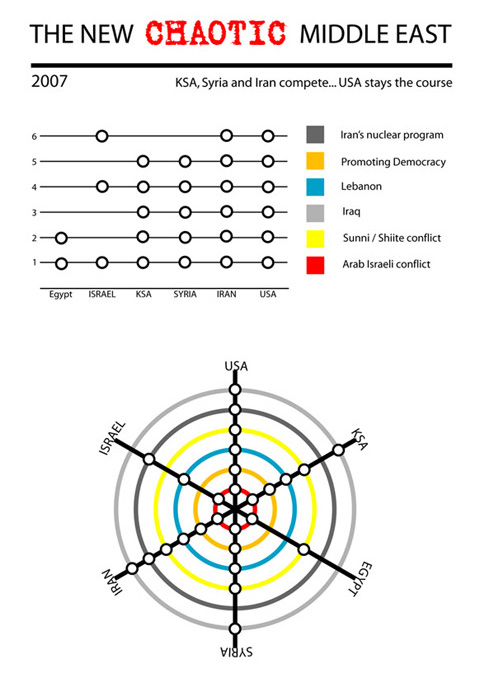
Comparing the situation in the Middle East today to that during the nineties, we now see many more conflicts and challenges. More regional players involved in many additional conflicts, confrontations, and crises.

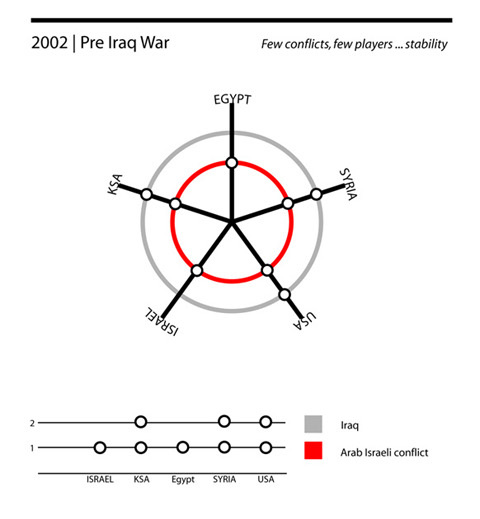
Back in the nineties (until 2001), one had to deal with either the classic Arab Israeli conflict (Syrian and Palestinian tracks) or the situation in Iraq after Saddam Hussein lost the first Gulf war and had to be held to his own country.

The regional players were Egypt (in charge of Palestinian affairs), Syria (in charge of Lebanon) Saudi Arabia (supporting roles in both Lebanon and Palestine) and the United States and Israel.

With regional trouble maker Saddam Hussein weakened after his loss in the first Gulf war, an agreement between Hafez Assad, Hosni Mubarak and Prince Abdullah was sufficient to keep things under control. The three Arab leaders simply made sure they did not undermine each other.

In addition, Presidents Bush Sr. and then Bill Clinton were not interested in “changing Syria’s behavior” or in regime change in Damascus. Syria in turn was an enthusiastic participant in peace talks with Israel and did not interfere in the Palestinian track.


mideast-timeline480_02.jpg


These days (2007), the United States and Iran are heavily involved in several of the region's crises. While Egypt remained satisfied with its role as the largest Arab country, Saudi Arabia became interested in filling the perceived leadership gap left by Hafez Assad’s passing away. That meant taking sole responsibility for Lebanon, away from Syrian control. A bit further to the East, Iran decided to assume the old leadership role left vacant by the dismantled Iraq. In a way, Iran started representing the interests of the region’s Shiite population. Many new conflicts and confrontations were started. A dangerous Sunni-Shiite crisis, panic in Israel as Iran gets closer to owning nuclear technology, Recurring news of a summer war between Syria and Israel, and finally, what started as American efforts to spread democracy in the Middle East (Iraq, Syria Egypt, and Iran) was reduced to a more practical goal: regime change in Syria. U.S. allies Egypt and Saudi Arabia got away with minor reforms for now.

So here is a graphical look at the very busy Middle East. It shows who has been more active lately and it shows which conflicts are the most popular for the regional players to try to participate in. And it shows that no single country seems to have control on any of the conflicts. Without an agreement between the regional players and without balanced and practical American expectations probably nothing will be solved.


mideast-timeline480_07.jpg


Will Saudi Arabia Solve America’s Problems?

Will Saudi Arabia Be Able to Solve America's Problems? Will it split Iran from Syria?

There has been considerable chest beating by supporters of the Bush administration over the prospect of splitting Syria from Iran and forcing it to relinquish, not only its Palestinian and Iraqi cards, but also its Lebanon card. As proof of Syria's impending downfall, they point to the frequent meetings between Saudi and Iranian mediators, which they claim cut Syria out of the picture. They point to the Mecca deal between Hamas and the PLO, brokered by Saudi Arabia, and to the failure of Hizbullah to carry out a coup against the American backed Siniora government, and even the impending downfall of Nabih Berri, the Shiite president of the Parliament. What is more, they point to new European resolve to back US attempts to impose sanctions on Syria and get the international court fully mandated to try Syria for the Hariri murder. Stratfor concludes its most recent report, claiming: "But from all appearances, the rumors of a rift between Iran and Syria may indeed have some merit."

This confidence seems far fetched, largely because it rests on fragile supports. First, it is driven by President Bush's success in pushing through his troop surge for Iraq in the face of democratic success at the polls and the Baker-Hamilton advice to return to diplomacy. This success will be temporary. The US cannot sustain the cost of or concentration on Iraq. Secondly, it is driven by the administration's seeming success in saddling up the Saudis to do the heavy lifting against Iran and Syria. Some argue that putting US eggs in Saudi Arabia's basket is smart and crafty. By playing on Muslim sectarian fears, the US can harness Sunnis to spend their money and political capital to defeat the growing Shi'a crescent.

No only is this unwise because Wahhabism, which under-girds Saudi legitimacy, is neither tolerant nor a force of moderation in the region, but also because Saudi interests diverge from those of the United States on several important points. Saudi Arabia is the spiritual heartland of al-Qaida. We do not need to be reminded that it gave birth to Bin Laden and most of the 9-11 bombers. Even if the Saudi political elite is capable, Wahhabism, on which it depends, constitutes the theological headwaters feeding the Jihadist swamp. In order to take on Iran and marshal Sunnis against Shiites, Saudi Arabia will be forced to put Wahhabi intolerance on steroids. Here are the words of a Syrian opposition member who has been enlisted to raise the banner of the Saudi jihad against Shiism in his article, "Safavid Sassanian Iranian plan to restore the Empire of Cyrus."

"While the Zionist plan targets Jerusalem, which is holy to us, the Safavid plan targets Mecca and Al-Madina. If you go back to their books – which they do not mention in the media, yet these books exist and are accepted by them – they claim that their Hidden Imam will come to Mecca and Al-Madina, destroy the Al-Haram Mosque and the Mosque of the Prophet, and dig in the graves of Abu Bakr and Omar and burn them both, and then he will command the wind to blow them away. He will also dig in the grave of Aisha, the Mother of the Believers, and will execute her. All this is part of their plan."

This sort of bunkum is not what the US wants to promote. Stirring up sectarian hatreds and medieval myths will undercut any attempt to inculcate secular liberalism in the region. Secretary Rice knows this. She recently chided the Arabs for their failure to uphold Arab national bonds in the face of sectarian feuding. “There’s still a tendency to see these things in Sunni-Shia terms,” Ms. Rice said. “But the Middle East is going to have to overcome that.” It is all well and good for the US to preach ecumenicism, but by asking the KSA to ratchet up Sunni fears of Shiism, it is doing the exact opposite. The late grand Mufti of Saudi Arabia, Abd-al-Aziz ibn Abd-Allah ibn Baaz, called Arab nationalism an alien and atheist creed that should have no place in the land of Islam. The neocons insist the War on Terror is at heart a war of ideas. By throwing US weight behind the KSA, Washington is promoting the wrong ideas.

Supporting Saudi Arabian propaganda would be acceptable if the Kingdom were taking concrete measures to reform. But it is not. Central to US demands that Saudi Arabia distance itself from the more objectionable extremes of its Wahhabi ideology, has been the request that the KSA reform its Islamic school curriculum. The monarchy has held numerous conferences on curriculum reform because Saudi school books preach jihad, takfir, and instruct Muslims not to shake the hands of Christians and other kufar lest they be dragged down to hell by emotional proximity to unbelievers. The outcome of these curriculum conferences is invariably the same. Saudi Imams reject the notion that the curriculum advocates anything dangerous or un-Islamic. Reforms are not agreed upon and results are always "inconclusive" and "inoperative."  The Saudis are not changing their spots. Enlisting intolerant Sunni Islam in the war against Iran and Shiite extremism is exactly what the US should not be doing. Surely this strategy will come back to bite the West, as it did in Afghanistan.

But let us look more closely at Saudi interests to see how closely they dovetail with US interests.

Saudi and Palestine

On Palestine, Saudi interests differ from those of the US. The US offered Saudi progress on the Palestinian front in exchange for closer Saudi support in isolating Syria and tackling Iran. Most likely, Saudi authorities told Washington that in order to align more closely with US foreign policy in the region, which would surely alienate their people, they would have to be able to alleviate Palestinian suffering and find a way to take the Palestinian Authority off the "diet" that Israel and the US imposed on it following Hamas' electoral victory last year.

This is how we got to the Mecca deal. Saudi Arabia has no interest in knocking out Hamas, but it does need to provide a happy PLO veil for Hamas in order to reopen the spigot of international funding for the Territories. Having pictures on al-Jazeera and al-Arabiya of Palestinians suffering and cannibalizing each other as they slowly starved like rats is not tolerable for the KSA if it is to embrace US policy in the region. 

Pro-Israeli interests in the US are insisting that Saudi Arabia deal a real blow to Hamas authority rather than merely cobble together a coalition government for Palestine that would lift a convenient PLO veil over Hamas power. Saudi Arabia has failed to do this in its Mecca deal.

This is why the Washington Post writes that the Saudis have actually complicated Secretary of State Rice's task in visiting the Middle East, rather than assisting her. Here are Rice's words:

"Our position toward the Hamas government was very clear: It did not meet the international test," Rice told a group of newspaper reporters on the eve of her departure. "I have to say that we have not yet seen any evidence that this one will."

Rice added, "I don't deny that it's more complicated" now and that before the announcement of the unity government "it was clear, more black and white."

The problem is that Hamas has agreed to "respect [not accept] international resolutions," but not international demands that the new government pledge to "recognize" Israel, renounce violence, and abide by previous agreements signed by the Palestinian Authority. Hamas officials later told reporters that the movement has no intention of ever recognizing Israel. Israeli Foreign Minister Tzipi Livni ended discussion on the issue Saturday by declaring that the unity government deal "did not satisfy the demands of the international community," and President Bush and Prime Minister Olmert agreed to shun the Palestinian unity government unless it meets international conditions.

David Makovsky of WINEP sums up what he calls "the less benign interpretation" of Saudi goals. He writes:

what is driving Saudi Arabia is sectarianism, not pursuit of Arab-Israeli peace. Under this view, Riyadh has no problem supporting Hamas's program, so long as it is a Sunni organization and can keep Iranian money and influence at bay.

Therefore, it would be useful for the United States to explore Saudi objectives and strategies. Moreover, for a political horizon to succeed, one needs to consider whether Riyadh and Cairo are willing to do something that they were not willing to do in 2000 at the time of Camp David (July) and the Clinton parameters (December). Namely, they need to provide the requisite political cover for Abbas to compromise. If they do not, they need to know that unlike 2000 they will be politically exposed for failing to do their share. In short, if the Bush administration is really serious about a political horizon, it needs to have a dialogue not just with Israelis and Palestinians but also with America's Arab friends to discern the depth of their commitment to peacemaking in a very specific way.

The Mecca experience suggests that not everyone is on the same page.

Mohammad Yaghi, a Palestinian fellow at WINEP and writer for the Palestinian newspaper al-Ayyam, explains in his article: "Hamas's Victory: From Gaza to Mecca," that Hamas was the winner in the Mecca deal because it bested PLO forces on the ground in recent fighting and was able to translate that advantage into the terms of the Mecca deal, which retains the prime-ministership for Haniyyah and most cabinet positions for Hamas. The PLO panicked and gave away the store, Yaghi writes.

As it stands, the agreement spells significant gains for Hamas politically, institutionally, bureaucratically, and in its relations with the Arab world. It is likely that Abbas and Hamas together will still attempt to use the Mecca accord as a means of alleviating the Quartet's sanctions by claiming the government has accepted its conditions — even if Hamas as a party retains its core political ideology.

The Mecca accord will not end the struggle between Fatah and Hamas to dominate the Palestinian political system, but it does represent an effort to gain a respite from the violence by dividing the PA according to each faction's current position on the ground.

King Abdullah has promised the PA one billion dollars for their new alliance. Rice must make sure it is not received. The US is going back to the drawing board. Underneath the squabbling, the problem is that the US wants to starve Hamas and force the PA to accept much less than the 1967 borders. The KSA wants to feed Palestinians and get them more land than Israel will offer. So much for the Zionist-Wahhabi alliance on matters Palestinian. The dream of the Israelis is that the mutual Israeli-Saudi fear of Iran can be used to turn the KSA into a hammer against Palestinian demands for land. This will not work unless Israel can put a promising deal on the table, something it refuses to do. So long as the US resists pressuring Israel to uphold international law on the 1967 borders, Saudi Arabia will resist falling in line with Israeli plans.

Syria and the Mecca Deal

The Lebanese neocons don't give a fig about Palestine. What excites them is that Saudi Arabia is doing battle with Syria, or so they insist. They argue that because the Palestinian deal was penned in Mecca and not Damascus, Saudi Arabia has stolen the Palestine card from Damascus. But claim is misguided.

From all reports, the Mecca deal was worked out in Damascus, where Palestinian representatives met to hash out the terms of their new proposed coalition government. The proof of this was made clear when various Palestinian heads thanked Damascus for its help in arriving at the settlement. Al-Hayat reporters have covered the Saudi-Syrian cooperation on the Mecca deal in some depth. They write that the deal was struck in Damascus and announced in Mecca, where the Saudis put up the money that cemented the compact. Far from excluding Syria, the KSA worked with Damascus to broker the deal. In the following quote Muhammad Shuqair ???? ???? of al-Hayat writes that Syria pressured Khalid Mashaal to participate in the meetings and prepared the way for "rebuilding trust between the Saudi leadership and Syria. He also indicates that Syria and Saudi Arabia are quietly cooperating for a Lebanon deal.

?? ?? ???? ???? ???? ?????? ??????? ????? ???????? ????????? «????» ???? ???? ??? ???? ???????? ????????? – ????????? ?????? ?????? ???? ??????? ??? ??????? ???????? ???????? ???????? ????? ??????? ??? ????? ?? ?????? ?? ?????? ?????? ?? ?? ???? ??? ??? ?? ???? ??? ???????? ?? ??????? ??????? ??? ???? ??????? ??????.

???? ??????? ????? ????? ?? ???? ???? ?? ???? ??????? ??????? ????????? ??? ????? ????? ???????? ??? ??????? ?????? ?? ???? ????????? ??????? ?? ???????? ??? ?? ????? ?????? ?????? ?? ?????? ????? ??? ???? ?? ????? ?? ??? ?????? ?? ??? ?????.

Lebanon and Syria

The Coup

Many Lebanese government figures claim that Hizbullah wants to carry out a "coup" against the Lebanese state but has failed, thanks to stalwart western support. Hizbullah, however, insists that far from wanting to overthrow the government or change Lebanon's consociational form of government, it merely wants better representation for the opposition, commensurate with its numbers. Mohammed Ben Jelloun writes that Hizbullah has this to say:

By demanding a national unity government and a veto power over major decisions, Hezbollah and its allies are sticking to the consociational (multi-confessional) letter and the republican (patriotic) spirit of the Lebanese constitution.

Hariri Turns down the rhetoric

In my last post, I wrote that the February 14 coalition turned up the anti-Syrian rhetoric on the second anniversary of their leader's assassination. But a source that I respect in Damascus wrote me a few days ago that I was mistaken. He explained:

Saad Hariri did not mention Syria at all. Quite possibly, the Saudis have warned him to be careful as they are working with Iranians to cool things down in Lebanon. What Janbulat and Geaga said was expected. They do not want any solution for the crisis. They have much to lose from a deal to solve the crisis. 

On the 17th of February, Ibrahim Hamidi of Al-Hayat wrote that the Syrians are confident Iran is not planning to diverge too much from the Syrian positions on Lebanon and Iraq. Although they admit to some differences with Iran, such as:

1) On Iraq: Syria wants a consensus that includes the Sunnis and the more neutral baathists, Iran is more interested in helping its Shia allies.

2) Lebanon: Iran is more willing than Syria to compromise on Lebanon. Out of all regional conflicts, Syria is probably most concerned with Lebanon.

3) On Palestine there is almost no disagreement.

For those who believed that Iran and Syria could be so easily divided by Saudi Arabia without offering real concessions, Asad's trip to Tehran this weekend should put such speculation to rest. The news was about how Assad and Ahmadinejad vowed to form a stronger alliance against the U.S. and Israel.

Syrian President Bashar Assad said that expansion of Tehran-Damascus ties would help resolve the problems of the Islamic world. He accused the U.S. of trying to attract public opinion within the Islamic world by undermining Iran-Syria relations.

The Syrian leader said Muslims worldwide should be informed about “the evil aims by the U.S. and Zionists” which he said were sowing discord among Muslims.

Sami Moubayed, a smart Syrian analyst, claims that Syria believes it is holding its own quite well against US pressures. Here is what Sami writes of Asad's meeting with Khomenei:

Syrian President Bashar Al Assad went to Tehran last Saturday for a much publicised meeting with Iranian President Mahmoud Ahmadinejad and the Grand Ayatollah Ali Khamenei. His two-day visit received a lot of media attention, coming in the midst of Saudi-Iranian talks over Lebanon, the situation in Palestine and much speculation on how Syria can help combat the insurgency in Iraq.

By all accounts, Syria's allies seem to be winning throughout the region. In Palestine, despite all the thunder, Hamas has been called in to form another government with Esmail Haniya as prime minister. This is a victory for Syria. Its allies in Iraq, headed by President Jalal Talabani, are putting great effort in normalising relations between Baghdad and Damascus. And in Lebanon, Hezbollah is still struggling to bring down the anti-Syrian cabinet of Prime Minister Fouad Siniora. They have not won in Lebanon, but they certainly are not losing. The situation in each of these three countries is linked, one way or another, to the Syrian-Iranian alliance. If anything, Bashar's visit to Tehran is further proof that to the great displeasure of the United States, this relationship is intact.  

Russia has announced an arms deal for Syria, which will be financed by Iran.

Syria and Saudi Arabia 

So what does this mean for Saudi-Syrian relations? Although many Lebanese journalists and neocons somehow convinced themselves that Saudi Arabia would work to isolate Syria on Washington's behalf, the opposite seems to be the case. There is no doubt that Saudi-Syrian relations have been terrible since Hariri was killed. Lebanon is a big plumb, and both states would like to have preeminence there. Syria can no longer call the shots in Lebanon, as it once did. But it does insist on having a voice, and through Hizbullah and Aoun has the muscle to paralyze Lebanon. Saudi Arabia knows it is pointless to try to eliminate Syrian influence in Lebanon. It has tried and failed. The stand-off in Lebanon between the pro-American and pro-Saudi Lebanese government and the pro-Syrian and pro-Iranian opposition cannot be solved without compromise. Lebanon will run out of money. Oxford business group argues that the Lebanese deficit is so large that it will eat up the 7.5 billion dollars of foreign donations recently promised to Lebanon in a matter of two to three years. The KSA understands that without a political solution and economic growth, Lebanon may not be able to avoid a hard economic crash. To resist Syria altogether will be to kill the goose that lays the golden egg. Neither country is interested in that. Lebanon is too important.

Bahia Mardini writing for Elaph claims that the Saudi monarch is sending a delegation to Damascus to smooth out relations with Asad. King Abdullah wants Asad to come to the Arab League meeting in March and wants to repair relations, strained since the Hariri killing. What is more, Mardini claims that Saudi sources argue that their diplomacy with Iran favors Syria and does not threaten it. Today's Elaph also says that that Salim al-Hoss has traveled to both the KSA and Damascus recently. He will travel to Tehran next week in an attempt to find a solution to the Lebanon crisis. Salim al-Hoss has traditionally been Damascus' choice for PM of Lebanon.

Conclusion

Saudi Arabia is playing a positive role in trying to bring unity to the Palestinians and Lebanon. It is doing this, not by following Washington's policy of confrontation and isolation, but through the sort of intensive diplomacy that President Bush and his team refuse to engage in. In effect, Washington is farming out its diplomacy. In matters of high politics, this may turn out to be a good thing, at least in the short term. All the same, as we have seen with the Palestinian unity government, Washington has refused to recognize or give its blessing to the diplomatic solutions that Saudi Arabian has so far arrived at. If Saudi Arabia can broker a Lebanon compromise by giving the opposition a larger role in the cabinet, will Washington agree to the Saudi brokered terms? There will be many in the White House and in Beirut who will try to torpedo it. Maybe that is the best diplomats in Washington can do at the moment? Better to have some diplomacy rather than none. All the same, the President of the United States should have the vision to carry out his own diplomacy. 

Those who expect Saudi Arabia to isolate Syria and Iran, will be deceived, just as they have been let down by Saudi's Palestine deal. Saudi Arabia has a mind and interests of its own. Its interests are not to follow blindly President Bush's interests. 

In a perverse sense, Washington is using the KSA to do what the Baker-Hamilton report recommended: get Iraq's neighbors together to discuss solutions to regional problems. Hopefully Washington will not spurn the results.

Feb 14 Raises the Rhetoric

Government forces in Lebanon turned up the rhetoric today, the anniversary of the assassination of Rafiq al-Hariri. Downtown Beirut was filled with demonstrators, who were regaled by a sting of government figures.

Jumblat described Syrian President Bashar Assad as "a snake, the missing link, the despot of Damascus, a beast, an Israeli product, a liar, a criminal," and a number of other colorful epithets. "This year will witness the creation of the international tribunal, justice will be served and the punishment will be a death sentence," Jumblat pledged.

Geagea warned of "dire consequences for those standing in the way of the international tribunal." In his opinion column, Michael Young claims the international community, including Russia, is preparing to break the Lebanese logjam moving decisively and unanimously against Syria. He insists a new chapter in Syria's misfortunes is about to be opened: "Syrian intransigence may be leading toward an unintended consequence: passage of the tribunal under Chapter VII of the United Nations Charter."

The governing alliance, in a statement after an emergency meeting, urged the Arab League, the U.N. Security Council and the international community to "shoulder your responsibilities in lifting the Syrian regime's aggression off Lebanon."

The statement called for imposing sanctions on Syrian President Bashar Assad's regime and for dispatching U.N. peacekeepers to "control the Lebanese-Syrian borders that would halt the flow of weapons to tools of this (Syrian) regime."

U.S. Ambassador Jeffrey Feltman has vowed to dedicate himself to ensuring that "international partnerships" benefit Lebanon and propel it toward independence and democracy.

In the US, Zvika Krieger writing in the New Republic says that Hezbollah is calming some of the bloodiest Shia rituals, but not for the better. "The Shia holiday of Ashura," she writes, "generates an endless supply of gruesome images: thousands of enraged young men slicing their foreheads with swords, beating themselves with chains, and screaming their allegiance to Allah in the streets of Saudi Arabia, Iraq, Pakistan, and across the Muslim world–scenes that perfectly encapsulate Western fears of militant Islam…."

Former Jordanian information minister Saleh Al-Qallab, currently a columnist for the London daily Al-Sharq Al-Awsat, writes that "the cooling in Iran-Syria relations may lead to the end of their partnership and even to intense hostility between the two countries."

Gulfsands Petroleum and Emerald Energy tanked as poor test drilling results from a joint venture in Syria proved inconclusive.

Supporters of the Opposition are striking back, however.

Ibrahime Al-Amine, chairman of the board of directors of Al Akhbar insists that America and French officials are pushing the "Lebanese military to suppress the opposition no matter the price and to tighten the siege on the resistance." They do not want a mediation of the conflict.

Hizbullah authorities echo this by claiming the government's onslaught is "aimed at scuttling the Saudi-Iranian and Arab initiatives."

Nabih Berri the Shiite leader and President of the Parliament also insists that the true aim of the government in accusing Syria of the bombings and asking for sanctions to be imposed on Damascus, is their fear of "breakthroughs, solutions and a positive outlook." He suggests the Arab League attempts to broker a deal are bearing fruit.

Dardari forecasts higher GDP growth: Syria’s Gross Domestic Product is expected to grow by 5.6 percent in 2007 according to Abdallah Dardari, Deputy Prime Minister for Economic Affairs. Dardari also recently readjusted growth estimates upward for the Syrian economy during the past two years because of the positive impact of trade with and currency inflows from Iraq.

The US will accept 7,000 Iraqi refugees by the end of the year. Some will come from Syria.

Here are bits from some of the stories refered to above:

Opposition accuses Geagea and Jumblatt of using speeches to poison mediation efforts, by Hani M. Bathish, 15 February 2007, Daily Star

Beirut — BEIRUT: Hizbullah accused the March 14 Forces on Wednesday of trying to "scuttle" initiatives aimed at breaking the political deadlock in Lebanon through "inflammatory speeches" made during the rally to mark the assassination two years ago of former Premier Rafik Hariri.

Hizbullah MP Hussein Hajj Hassan said the speeches made in Martyrs' Square by Lebanese Forces leader Samir Geagea and Progressive Socialist Party leader MP Walid Jumblatt were "aimed at scuttling the Saudi-Iranian and Arab initiatives."

In a statement issued a few hours after the speeches, Hassan said Geagea and Jumblatt had been given orders by "Washington and Paris to destroy the initiatives, just at a point when the possibility for a compromise seemed at hand."

The speeches were aimed at the Syrian regime, and followed hot on the heels of a March 14 statement issued Tuesday blaming Damascus for the twin bus bombings in Ain Alaq that killed three and calling for sanctions to be imposed on the regime.

Jumblatt described Syrian President Bashar Assad as "a snake, the missing link and the despot of Damascus," among other colorful appellations. Geagea warned of "dire consequences for those standing in the way of the international tribunal."

Hajj Hassan said Jumblatt's words were "not worthy of a man of his stature," but saw Future Movement leader MP Saad Hariri's words as "moderate."

Hajj Hassan said he "has proof that Jumblatt wants the international tribunal to pass based on a US design."

"Four weeks ago, Jumblatt said he does not accept altering a single word in the draft agreement for the tribunal," he added. "But we have serious observations on the draft that need to be taken into consideration."

"The case of Premier Rafik Hariri's assassination has been manipulated politically, as have all other assassinations even before the draft of the tribunal was approved," Hajj Hassan said.

Responding to Jumblatt's call for all weapons to be in the government's hands, Hajj Hassan said he wondered "whether the martyr Adnan Shamas was killed on January 25 by government or PSP weapons."

Hajj Hassan reiterated that Hizbullah's arms would "not be used internally."

"Why the campaign by ruling team, France, & U.S on army & its commander?"

Berri said the statement, accusing Syria of the bombings and asking for sanctions to be imposed on Damascus, "shows that some among the pro-government forces are beginning to fear breakthroughs, solutions and a positive outlook."

He wondered why "some insist on spreading negativity and closing doors in the face of resolutions to the crisis."

Speaking of Arab League chief Amr Moussa's recent trip to Damascus, the speaker said it had not passed without "results," adding that Moussa said he wanted to complete what he started and needed to take further necessary but difficult steps.

Berri added that the March 14 coalition's statement had placed "some of the responsibly for the bombing on the shoulders of the opposition," which "cannot possibly target an area, the North Metn, considered to be supportive of the opposition."

"The bombing was a dangerous precedent, as it targets innocent civilians," he added.

Meanwhile, President Emile Lahoud, in response to Geagea's speech Wednesday, said in a statement that "the Lebanese have not forgotten that the man speaking to them about a free, sovereign and capable state today was himself among those who crippled the state, struck at its institutions and usurped its resources and presented federalism as a model for a formula."
[end]

Ibrahime Al-Amine, chairman of the board of directors of Al Akhbar, an independent pro-opposition newspaper, commented in the February 14 issue on the latest developments in the Lebanese political situation. American and French requirements from the head of the Lebanese military include suppressing the opposition no matter the price and increasing the pressure and tightening the siege on the resistance along with implementing steps to normalize the situation along the southern borders."

Al-Amine added: "The recent incidents resulted in the results contrary to what was hoped. The eye of the ruling team is now on the army!…In those guys' opinion, the army should have suppressed the opposition during their strike on Tuesday two weeks ago, and should have participated in shooting at the people on black Thursday. It should not break into any house to arrest any of the suspects in the shootings on civilians and soldiers. It should have also rooted out the protestors from downtown Beirut and should have cleared the Ozza'i area from the protests of the families of the victims of the gangs of the ruling team…" – Al Akhbar Lebanon, Lebanon

Click here for source


"French sources reveal to Al Hayat background for resolution 1559"

Al Hayat, an independent Saudi owned newspaper, reported in its February 14 issue about the background of the issuance of Security Council resolution 1559. The newspaper wrote: "On the second anniversary of the assassination of the ex Lebanese Prime Minister Rafik Al-Hariri, knowledgeable French sources revealed to Al Hayat the circumstances which pushed the major powers to take the decision to revive democracy in Lebanon and restrain the Syrian influence [-] which caused the birth of Security Council resolution 1559. Sources in the French administration revealed that "since 2003, Al-Hariri was interested in Lebanon regaining its sovereignty through a gradual withdrawal of the Syrian forces from its territories". The sources pointed out that in November 2003 and in the light of the circumstances in the region following the American invasion of Iraq, there were two countries under American surveillance: Iran and Syria."

The newspaper added: "Three European countries, France, Germany, and England, suggested that they negotiate with Iran to help it avoid being accused of violating the nuclear non-proliferation treaty. The sources announced that France, Germany, and Russia on the other hand decided to direct a strong message to Syria to push it to implement an initiative that expresses its desire to return to its natural position in the international community. The French presidential advisor Maurice Gordo Mauntanieh went to Damascus carrying the directives of the presidents of the three countries and suggested to President Bashar Al-Assad that he implement an initiative because the situation is extremely dangerous and Syria must do something to help itself in the regional and international context. He also clarified to Al-Assad that the three countries do not want to impose a specific initiative on Syria because of their respect for its sovereignty."

The newspaper continued: "The sources clarified that the French and Russian presidents and the German chancellor were thinking along the lines of Syria closing down the offices of the terrorist organizations in Damascus and resuming the peace track started by Denis Ross or performing some initiative on the Golan Heights. The sources announced that their ideas also included Lebanon but the French envoy intentionally kept this hidden. The Syrian president's answer was that all that he was being offered were part of an American plan. But the French envoy announced that it is not an American plan[;he] then left Syria and went to Lebanon where he informed Al-Hariri of his negotiations then [he] went to Saudi Arabia where he also informed the Saudi king of them then returned to France where he informed his Russian and German counterparts of the results of his negotiations."

The newspaper added: "The sources added that this was not followed by any Syrian response which caused the dialogue to be ended between the two factions. The sources announced that the French envoy had been in constant communication with his American counterpart back then, Condoleezza Rice, to whom he always stressed the necessity of expending efforts to help Lebanon gain its independence and sovereignty and the importance of working with Syria to reach these goals…" – Al Hayat, United Kingdom

Click here for source

Syria: Upcoming Elections: the Arab Reform Bulletin of the Carnagie Foundation for Peace summs up the new laws governing Syria's elections.

In light of the parliamentary elections scheduled for April, on January 3 Syrian President Bashar Al Assad approved an amendment (Arabic text) to the 1973 electoral law that includes strict regulations on campaign financing. The new law prohibits candidates from providing “services and financial assistance” prior to elections, limits campaign spending to 3 million Syrian pounds (US$57,466), and obligates candidates to use an accountant to supervise expenditures during the election campaigns. The legislative elections are also expected to operate under a new political parties law which has not yet been passed. The draft law requires that new parties be “allied to, created by, or friends of the Baath” and that party founders be over 35 years old, have no criminal record, and be proven supporters of the Baathist March 8 Revolution. Political parties cannot be based on religious, sectarian, or tribal identities and cannot have operated before 1963 (only the Baath Party, the Syrian Social Nationalist Party, and the Communist Party are exempted from the last restriction). According to the draft law, the decision to grant a new party a license will be made by a committee that includes the head of the Shura Council, the ministers of justice and interior, the minister of state for people's assembly affairs, and three independent judges.

The presidential referendum whereby all eligible Syrian voters will be called upon to give their confidence to Assad for a second seven-year term is scheduled to take place at the end of May.

Municipal elections—the first under the new local administration law introduced in September 2005— will be held in August. The new law abolishes the “closed lists” system in existence since 1971 under which Syrians voted for candidates for provincial councils from a list set by the National Progressive Front, the ruling coalition of parties overwhelmingly dominated by the Baath Party. The law, however, continues to allow the cabinet, headed by the president, to appoint provincial governors by decree.

News Round Up (13 February 2007)

Twin bus bombings in Lebanon today are a bid by anti-government elements to destabilize the country and part of a general campaign to intimidate Lebanon's Christian population, Samy Gemayel, brother of assassinated Lebanese politician Pierre Gemayel told WND in an interview. Samy Gemayel

The bus bombings come on the eve of the second anniversary of the assassination of former Lebanese Prime Minister Rafiq Hariri, whose death has been widely blamed on Syria.

The attacks, which killed at least three people and injured dozens, occurred as the two buses passed through the Christian town of Ein Alaq, the ancestral home of Samy Gemayel's father, former president Amin Gemayel, and his uncle Bashir, also a former president.

"Previous Lebanese institutions have failed. Our current institutions have failed. We need new institutions and a new political formula so everyone feels they are fairly represented," Gemayel said.

Leaders in the Lebanese government said they believed today's attacks were timed to deter people from attending protests to mark the anniversary of Hariri's murder. Pro-government groups had planned a mass memorial for Hariri in Beirut's Martyrs Square for tomorrow.

Walid Jumblatt, leader of Lebanon's Druze community and head of the Progressive Socialist Party, blamed today's bus bombings on Syria.

"This is an attempt by Syria to intimidate and to sabotage the formation of a tribunal to try the murderers of Hariri," Jumblatt told WND.

Jumblatt, largely considered the most prominent anti-Syrian Lebanese politician, said he hoped the attacks would prompt the people of Lebanon to unite.

Lebanon has failed the past few months to approve the formation of a tribunal to try suspects for Hariri's murder due to opposition from Hezbollah, which has threatened to derail the government unless the militia gains more control of the parliament.

Stratfor concludes of the dual bus bombing:

The politically motivated attack likely is connected to the Syrian intelligence apparatus, which aims to instigate violent clashes between Lebanon's heavily armed factions in order to justify a Syrian intervention. Most of the victims were Greek Orthodox.

there are a number of players in Lebanon that would like to see the situation spiral out of control, namely Syria. The buses that were attacked originated in the hometown of Lebanese Defense Minister Elias Murr, who on Feb. 8 seized a truckload of explosives belonging to Hezbollah and containing more than 120 mortars, Katyusha rockets and scores of mortar shell cases. Murr's refusal to return the weapons to Hezbollah, which was transporting them from the Bekaa Valley to stockpile in Beirut's Shiite-controlled southern suburb, was an embarrassment for Hezbollah's leadership.

The perpetrators of the bus bombings likely are attempting to draw a connection between the confiscation of Hezbollah's weapons and the attack in order to draw the group into a violent conflict. The Bteghrine area in the upper Metn is part of the domain of influence of the Syrian Nationalist and Socialist Party, which has direct links to Syrian intelligence. While Hezbollah is unlikely to have carried out this attack against civilian targets — since doing so would bring political repercussions while it is in the midst of a heated protest campaign — members of Syria's intelligence apparatus would have an interest in skyrocketing tensions in Lebanon and ensuring that the Feb. 14 anniversary is marred by violence. Doing so would give Syria the justification to intervene in the affairs of its western neighbor to restore order and reclaim its military position in the country, which was lost in the aftermath of the al-Hariri assassination.

The biggest problem with pinning the bombing on Syria is that many SSNP members (Syria Social Nationalist Party) were killed, who have been loyal backers of Syria and the Lebanese opposition. As Stratfor admits, "Most of the victims were Greek Orthodox." Ali Qansouh, the head of SSNP announced that many of the people hurt on the buses were members of his party. Coming on the eve of the second anniversary of the Hariri killing, the timing is clearly political and designed to inflame demonstrators. Who authored this crime is not yet clear, although the inflamed political environment in Lebanon will ensure that both sides blame the other.

Analysis: Gemayel vying for presidency? CLAUDE SALHANI of UPI wonders what Amine Gemayel, a former Lebanese president, was doing at the White House last week, meeting with President Bush. He askes, "Is his visit to the White House an indication that the Bush administration might want to see him become president once again?" Maybe the US likes him better than either Aoun or Geagea? Salhani is on to something.

Palestinian gratitude to Syria for Hamas, Fatah conciliation: This story confirms Alex's argument in a previous comment section that the Hamas-PLO deal announced in Mecca had largely been worked out in Damascus the previous week. It also lends support to Alex's conjecture that there is a Syrian-Saudi dialogue taking place beneath the meetings. Read Alex's analysis here. 

Palestinian President Mahmoud Abbas on Tuesday sent special envoy Rohi Fattoh to brief the leadership of Syria on 'new developments' on the Palestinian arena, Syria's official news agency SANA reported.

Farouk al-Sharaa met Fattoh for discussions on the issue.

At the conclusion of the meeting, the Palestinian envoy expressed gratitude for the 'positive role' Syrian leadership played in achieving Palestinian conciliation. Syrian intervention had 'paved the way' for the Mecca accord, he told reporters.

Fattoh noted that leaders from the Palestinian factions would meet in Damascus at the end of the month as was agreed in the Cairo Declaration of March 2005.

Arab League Chief Amr Moussa has visited Damascus to persuade Syrian President Bashar Assad to take part in the next summit of the League, according to a very informed source. The next AL summit is scheduled to be held in Riyadh in March. Syria will demand a price of Saudi Arabia for Bashar's attendence. This story also suggests a Saudi-Syrian dialogue. As an unnamed Egyptian source told Michael Slackman of the NYT's recently, the AL meeting in Saudi during march will see an attempt to bring Syria back into Saudi Arabia's good graces. Egyptians are clearly hoping that Amr Moussa will be able to broker a Lebanon deal by then, which could be announced at the AL meeting. We will see. 

Israeli Prime Minister Ehud Olmert told the Knesset Foreign Affairs and Defense Committee on Monday that Israel will have no choice but to part with the Golan Heights if it ever wants peace with neighboring Syria.

"The whole world knows that in any future negotiations, if they are renewed, we will have to give up on the entire Golan Heights," Ha'aretz quoted Olmert as telling the committee.

The remarks came as part of a heated argument with committee member and opposition leader Binyamin Netanyahu.

Olmert charged that during his tenure as prime minister, Netanyahu had held negotiations with Syria based on the premise of ceding territory on the strategic plateau. Netanyahu denied that he had ever intended to comply with Syrian territorial demands.

At any rate, Olmert reiterated his opposition to renewing negotiations with Syria at this time, pointing out that Damascus is "interested in the industry of peace, rather than real peace."

Arabs try outreach to Israel, U.S. Jews, by Barbara Slavin in USA TODAY runs through the high-level meetings between Gulf figures and Israeli officials and American Jews, organized to cement relations between the new "moderate states" and allies of the US. Here are a few:

•Last month, Prince Turki al-Faisal, Saudi Arabia's departing ambassador to the United States, attended a Washington reception sponsored by American Jewish organizations. The event honored a State Department diplomat appointed to combat anti-Semitism.

•Saudi national security adviser Bandar bin Sultan met privately with Israeli Prime Minister Ehud Olmert in Jordan in September, said Daniel Ayalon, Israel's former ambassador to Washington. He said it was the highest-level Saudi-Israeli meeting he'd ever heard of.

•The United Arab Emirates has invited a delegation from the Conference of Presidents of Major American Jewish Organizations. The conference, a 51-member umbrella group, is a strong supporter of Israel.

•Israeli Deputy Prime Minister Shimon Peres met the emir of Qatar in late January after taking part in a debate with Arab students there. It was the highest-level Israeli meeting with the Gulf nation since 1996, when Peres visited as prime minister.

Iraqi Refugees in Syria

The Syrian Embassy in Washington announced Monday that:

Contrary to what the Senate Foreign Relations Committee was told last Thursday, there has been no communication between any U.S. and Syrian officials regarding the Iraqi refugees’ situation in Syria.

Reuters reports: Iraq's government said on Tuesday it would close its borders with Syria and Iran and extend the hours of a night curfew in Baghdad under a U.S.- backed security plan to rein in violence in the capital. The measures were ordered by Shi'ite Prime Minister Nuri al- Maliki. Qanbar said the border with Iran and Syria would be closed for 72 hours. He did not say when the closures would take effect.

The Economist Intelligence Unit writes on 16 February 2007:

The exodus of Iraqis from the chaos and carnage in their country has had mixed effects on its neighbours

The Syrian government has said that its recent decision to impose restrictions on the entry of Iraqis was taken for both security and economic reasons. The statement suggested that the chief concern was the potentially damaging effects of the growing numbers of Iraqis in Syria on the country’s social harmony and economic well-being. The timing of the decision appears to reflect anxiety in Damascus about the impact of any worsening of the internal situation in Iraq, as the US prepares for its new security “surge” in Baghdad and the surrounding area, and in light of the looming storm over the question of Kirkuk.

The UN High Commission for Refugees estimates that 1.8m Iraqis have sought refuge in the region, with the largest concentrations in Syria and Jordan. In both countries, the influx of Iraqis has brought some benefits, as many of the refugees have come from relatively wealthy strata of Iraqi society, and their presence has acted as an economic stimulus and an important source of foreign exchange inflows. Syria, for example has recently revised upwards its real GDP growth figures for 2004 and 2005 (to 8.6% and 4.5% respectively) and has altered its current-account figures for those two years to show a surplus rather than a deficit through adding some US$2bn in to its export figures in both years. These exports are mainly from the non-oil private sector, and turn up in the accounts as originating from “other countries”. The possibility that these funds relate to transfers into Syria from Iraq cannot be ruled out.

However, the influx has also bred social tensions in both Syria and Jordan, as the Iraqis are widely blamed for stoking inflation, particularly in the housing market, and services such as education and health have been placed under increasing strain.

Syria’s response has been to impose a visa requirement on Iraqis entering Syria and on those already present in the country. The visas are valid for only 15 days, and may only be renewed once on presentation of documents including a valid rental contract. Otherwise, Iraqis must return home for 30 days before re-applying. For wealthier Iraqis already present in Syria, this should not be a serious impediment. However, the new system should help the Syrian authorities to put a cap on any further major influx of refugees, particularly in the event of an Arab-Kurdish flare-up in Kirkuk.

Turkish ructions

The Kurdish question is also of critical importance for Turkey, both for its own domestic political reasons and for trade. Turkey and Iraq have recently resumed border trade after a dispute arose in January over the issuing of permits for Turkish companies exporting petroleum products. The dispute concerned letters mailed to Turkish petroleum transportation companies by Iraq’s oil ministry instructing them to apply to officials in the semi-autonomous Kurdish region in the north of the country for licences to continue exporting fuel into Iraq.

The matter was subsequently taken up by the Turkish foreign ministry, which sent letters to the Iraqi oil ministry and to Iraq’s State Oil Marketing Organisation (SOMO) warning them that Turkey did not recognise any authorities other than the administration in Baghdad.

The confrontation saw Turkey halt exports of petroleum products to Iraq, and the authorities on the Iraqi side responded by refusing to allow trucks carrying meat and poultry products to cross the border, and queues of up to 40 km built up towards the Habur border crossing between the two countries. The situation was only resolved following the receipt by Turkey’s Department of Foreign trade of a letter from SOMO, confirming that Turkish companies would not be obliged to obtain permits from officials of the semi-autonomous Kurdish controlled region in northern Iraq and could continue to export petroleum products under the existing system. However, even before the dispute, the number of Turkish tankers supplying Iraq had been in decline. SOMO has preferred to place orders with companies in Iran, Jordan and Syria, and even with Azeri companies shipping products via Turkey.

The tensions on the Turkish border are likely to be exacerbated if Iraq’s Kurds step up their efforts to incorporate Kirkuk into their region, as Turkey has made clear its strong objections to any such move.

The Oxford Business Group has this to say about the Syrian economy:

Syria: Balancing Act: Feb 12, 2007

Syria is looking to build on last year's achievements in shifting the country's economy away from centralised control toward a more open, market-based model, as the talk of senior officials is matched by new moves toward liberalisation.

In 2006, Syria took a number of significant steps toward opening up the economy, implementing measures designed to strengthen the role of the private sector, attract foreign investment and reduce the state's presence of the state in the day to day running of business.

These included sanctioning the opening of private insurance firms, liberalising banking laws to allow for the full entry of foreign banks into the market and forming partnerships with existing Syrian financial institutions. They also allowed for laying the groundwork for the opening of the Damascus Stock Exchange, due to start trading in mid-2007.

Syria has maintained this momentum into this year. At the end of January, President Bashar al-Assad signed two decrees replacing 16-year-old legislation governing foreign investment. The new regulations allow domestic and overseas investors to own or lease land for their activities.

The decrees also create provisions for the repatriation of profits, dividends and invested capital, as long as all tax liabilities have been fulfilled, and for foreign workers to remit up to 50% of their earnings. Another incentive for investors is the waiving of Customs duties on equipment imported for use in their businesses.

Having been criticised in the past for the slow pace at which officials approve applications to establish projects in Syria, the new regulations enact an assessment regime designed to streamline the process. Under the new decree, any project application is deemed to have been granted a licence to operate unless the newly created Syrian Investment Authority raises an objection within 15 days.

Another step was the managed float of the Syrian pound, On January 13, the central bank governor, Adib al-Mayaleh, announced a shift from the currency being pegged to the US dollar to a mixed basket weighted at 44% euros, 34% US dollars and 11% each for pounds sterling and the yen.

Al-Mayaleh also announced that the government was drafting laws to allow for the issuing of treasury bills and other financial instruments and the opening up of private currency exchange bureaux.

On February 1, Amir Hosni Lutfi, Syria's minister of economy and trade, said the state and the private sector had to work together to raise productivity and improve quality to be able to compete in Arab and international markets.

The government is working to put in place the required rules to move into the social market economy, he told the Annual Conference of the Banking and Insurance Workers Union.

However, while Syria appears committed to developing a market economy, Lutfi said the government had no intention of completely taking its hands off the levers. He said the state would maintain balances on the prices of commodities and basic materials to ensure that the shift does not negatively affect low-income earners.

Prime Minister Mohammad Naji Ottri reinforced this message of cautious progress on January 28 during a meeting with Syrian business leaders in Damascus.

We have adopted a social market economy program and we believe we are on the right road, he said. Some say go for a savage market economy. We won't but there will be no retreat either. The incremental approach is aimed at avoiding a backlash.

At the same meeting, the finance minister, Mohammad al-Hussein, said the economy had reached a new level through clear and transparent dialogue between the government and the private sector.

However, that dialogue also included criticism of the government by private sector representatives over the slow pace of reforms in some areas, failures to provide infrastructure in industrial zones, and the lack of recognised arbitration mechanisms.

Even this could be seen as an indicator of the growing strength of the private sector, with criticism of the state previously being restricted.

The government still has to balance the interests of the public sector and its own desire to open up the economy with political forces within the country and the need to protect low- income earners. Caught in the middle of conflicting interests, the government appears committed to moving forward, at its own pace.

Powell Says, “We got plenty” from Syria in Talks

Powell tells Newsweek in Blowup? America’s Hidden War With Iran: "We got plenty" from [Syria]. This is a reference to his trips to Syria in 2003 and 2004 as well as talks with Iranians. "I don't like the administration saying, 'Powell went, Armitage went … and [they] got nothing.' We got plenty," he says. "You can't negotiate when you tell the other side, 'Give us what a negotiation would produce before the negotiations start'."

Here is the passage from a must-read story on Iran, which explains how Washington has consistantly missed opportunities to help itself in Iraq. By being ideologically opposed to dealing with Iran, this administration has ensured that Iran moved right and refused help to the US. The same is true of Syria. Here is the Powell quote in full.

Powell, for one, thinks Bush simply wasn't prepared to deal with a regime he thought should not be in power. As secretary of State he met fierce resistance to any diplomatic overtures to Iran and its ally Syria. "My position in the remaining year and a half was that we ought to find ways to restart talks with Iran," he says of the end of his term. "But there was a reluctance on the part of the president to do that." The former secretary of State angrily rejects the administration's characterization of efforts by him and his top aides to deal with Tehran and Damascus as failures. "I don't like the administration saying, 'Powell went, Armitage went … and [they] got nothing.' We got plenty," he says. "You can't negotiate when you tell the other side, 'Give us what a negotiation would produce before the negotiations start'." (Thanks Ehsani for sending this along.)

Here is a second passage about Iran arming Iraqi militias. This appraisal probably fits Syria just as well as it fits Iran.

What's scant is hard evidence that the weapons are provided by the Iranian government, rather than arms dealers or rogue Revolutionary Guard elements. "Iranian lethal support for select groups of Iraqi Shia militants clearly intensifies the conflict in Iraq," says the latest National Intelligence Estimate on Iraq. But the most that can be said with certainty is that Tehran is failing to stop the traffic. The Iranians themselves admit they're not trying as hard as they could. "I can give you my word that we don't give IEDs to the Mahdi Army," says an Iranian intelligence official who asked not to be named because secrecy is his business. "But if you asked me if we could control our borders better if we wanted to, I would say: 'Yes, if we knew that the Americans would not use Iraq as a base to attack Iran'."

M.J. Rosenberg on Obama

For those who wondered if Sen. Obama would speak out on controversial issues, risking campaign funds, we have our answer.

Obama, on Sixty Minutes tonight, was asked if he would negotiate with Syria and Iran. His answer; "I would."

No saber rattling. No boilerplate rhetoric about how bad Ahmedenijad or Assad is. No BS.

He has thus differentiated himself from Edwards and Clinton on the biggest threat America faces (the threat of war with Iran).

For those who do not follow the politics of the Middle East closely, let me tell you that Obama's statement was courageous and will cost him with the DLC-Neocon wing of the Democratic party. But he did it anyway. He simply endorsed a position that is right for America, right for Israel, and right for the entire world.

The US and Syria: Is Dialogue Coming?

Is the US contemplating a broader dialogue with Syria?

Not at this time. I explain the reasons why in an interview with Abdullah Ghadwi, published in al-Seyassah, Febrary 1, 2007.

All the same, a number of analysts believe that the administration is torn over dialogue with Syria and may be more open to such a dialogue than at any time in the past two years. Here are the arguments they put forward.

1. Secretary of State Condoleezza Rice said she has given the U.S. embassy in Syria authorization to discuss Iraqi refugees with Damascus.

Rice told the Senate Foreign Relations Committee U.S. diplomats were given authorization to discuss the flow of refugees with the Syrian government, but the talks are not to be part of a larger discussion with the country about Iraq, CNN reported Friday.

The secretary of state said talks with the country on the subject of closing its borders to insurgents would likely lead to Damascus demanding U.S. concessions on Lebanon, where Syrian troops were removed amid international pressure in 2005.

"I am concerned that given the circumstances of Syrian behavior in Lebanon … talking with Syria now about Iraq would have downsides for us in terms of Lebanon, in terms of what Syria would be looking for, in terms of how it would be perceived," Rice said.

This permission to Michael Corbin, the very capable US charge' d'affaires in Damascus, to carry out a dialogue on Iraqi refugees is a very narrow brief. The US is under immense pressure to help the Iraqi refugees fleeing its failed experiment in Iraq. Syria, until recently, has been willing to take in the poorest Iraqis, something no other state has been willing to do. Beginning in January new restrictions may exclude the most vulnerable and poorest refugees. (Iraqis must now prove that they have a legal rental contract for an apartment or rooms before they are issued three month, renewable residency permits.) The UN High Commissioner for Refugees announced that "Syria has assured the United Nations it would keep hosting one million Iraqi refugees despite new rules imposed on residency. There was a clear statement from the government members I met that no Iraqis will be sent back to Iraq against their will in the present dramatic circumstances," Guterres said after meeting senior Syrian officials. Syria insists that the benefit of the new measure will be to force Iraqis in Syria to get proper papers, register with authorities, and to maintain security. Iraqi refugees say Syrian authorities have been deporting Iraqis accused of fomenting sectarian tensions at home.

Guterres's visit to Damascus, during which he praised Syria for being generous to Iraqis, was motivated by fear that Syria could take away the welcome mat, creating a crisis among the refugees. "Syria … needs to be effectively supported by the international community, because the generosity Syria has shown needs to be assumed at the same level by the international community," he said. International pressure and pressure from home have forced Rice to open up a refugee dialogue with Syria, despite US desire to maintain its strict boycott on dialogue. Amnesty International has turned up the heat of the US, claiming:

The US bears a particular responsibility to protect those who have been displaced as a result of the ongoing conflict in Iraq. In addition, the US needs to make a proactive effort to resettle more Iraqis quickly and safely than it has up to this point.

"US policy and military action helped create the dreadful situation that now prevails in Iraq, yet up until now very few Iraqis displaced as a result of war have been allowed to take refuge in the US," said Malcolm Smart. "The US authorities must stand up their obligations on this issue and help lead the effort to provide long term durable solutions for Iraqi refugees."

A few American congress members have begun putting pressure on the US to do more. It is not certain that this will translate into action, however. Exactly 466 Iraqi refugees have been admitted to the United States in four years, even though one out of every seven Iraqis has fled his home. The State Department devoted less than $14 million in 2006 to programs aimed at shoring up the resources within host communities across Iraq. That works out to less than 4$ for each of the 3.7 million displaced Iraqis. Syria got no funds. On Feb. 5, the State Department set up a new "senior task force" to deal with refugees, but signs are not good that it will increase US help dramatically. Warren Strobel reports:

In his just-released budget, President Bush asked for $35 million to help Iraq's refugees in fiscal year 2008, plus $15 million in supplemental funding for this year.

The U.S. Committee for Refugees and Immigrants, a private nonprofit group, had urged Bush to seek $250 million as part of a supplemental war funding request.

The Bush administration "has been slow to react to a worsening situation, amid ample warnings," Sen. Patrick Leahy, D-Vt., said in a statement. Rice's task force, he said, "is a hopeful sign, and it can move us forward as long as it doesn't waste time pondering the obvious."

Senior U.S. officials would not accept any special US responsibility for Iraqis fleeing the violence created by the US invasion. "It's a shared global responsibility," State Department spokesman Sean McCormack told reporters in response to questions of whether the US had any special moral obligation to assist Iraqi refugees. The amounts of money allocated for refugees in the next two years and official administration statements suggest that President Bush will hold the line against helping Iraqi refugees or admitting the US must take special action.

"In six months, it will be too late," said Kristele Younes of Refugees International, an advocacy group. "We're not seeing the U.S. do much, frankly."

All the same, the new avenue for refugee dialogue is a toe in the door for Damascus. By compartmentalizing and allowing limited dialogue, Washington proves that separating the many issues it has with Damascus is possible. Right now, the differences between Washington and Damascus over Lebanon are the main sticking points, according to Rice. The US does not want to be asked to make concessions on Lebanon.

2. Saudi Arabia may be looking to bring Syria back into the Arab fold and pry it away from Iran. Michael Slackman and Hassan Fattah of the NY Times recently wrote:

Saudia Arabia has decided that it will be the host of the next meeting of the Arab League, in Riyadh.

Officials said they hoped at that meeting to smooth relations with Syria after its president, Bashar al-Assad, insulted the Saudi king and President Hosni Mubarak of Egypt in a speech last summer. Officials believe that Syria had moved closer to Iran because of its isolation, and that that shift has given Iran a bridge to the Arab world.

“Politically speaking, Syria is not in the fold,” said an Egyptian diplomat who spoke on the condition he not be identified. “Maybe the goal is to bring Syria back to the Arab world.” If so, that, too, could antagonize Washington, which wants to isolate Syria further.

3. Sami Moubayed writes in his article, The keys of Beirut:

Currently there is talk of serious Syrian cooperation in Iraq. The Syrians are expected to extradite some former Baathists from the Iraqi regime. They are expected to conduct stronger border control with Iraq. And they are expected to invite senior clerics and tribal leaders from the Shiite and Sunni community of Iraq for reconciliation talks in Damascus and an end to the sectarian killings of Baghdad. The Syrians have their own channels to the Sunni street (at least parts of it) and can do the same in the Shiite street via Hizbullah. They have already welcomed Sheikh Harith al-Dari from the Muslim Scholars Association, who was in Damascus last week. The Iraqi Minister of Interior Jawad al-Boulani came to Syria to discuss security coordination. If the Syrians are able to deliver on Iraq, and thereby show the world that the keys to stability in Baghdad are in Damascus, how will the situation in Lebanon change, and in the favor of whom? The US administration, after all, despite all talk by George W. Bush and Condoleezza Rice, cares more so for Iraq than Lebanon. That is a fact. The keys to stability in the Middle East are in Baghdad, not Beirut. 

I am not convinced Syria has the ability to affect the violence in Iraq very much, even if it were willing to throw its weight behind American plans there. President Asad said in his ABC interview with Diane Sawyer, "we are the main player in this issue." He was speaking about Iraq. Syria is not the main player. To be fair to Asad, he added that "our role is going to be through supporting the dialogue between the different parties inside Iraq with the support from the other parties like the Americans and the other neighboring countries and any other country in the world. So that's how we can stop the violence." This is fair enough. Syria can help, but it cannot make any dramatic difference in Iraq on its own. It can lend its weight through urging various groups to come to the table. Secretary Rice has made it clear that the US does not believe Syria can or will help enough to make dialogue on this front worth the concessions that Washignton would have to make on the Lebanese front or Israeli front.

Conclusion 

All of this suggests that the US will have to review its stand on Syrian isolation eventually, but not in the short term. In 2007, the US will focus on its surge, on advancing Saudi initiatives, and arming the pro-American Lebanese and Palestinian factions. None of this is likely to bear fruit. Only after frustration on this front will Washington begin to come around to trying something new. Bush may hold out to the end of his administration. In the mean time, Lebanon will remain paralysed. The promise of foreign assistance should keep the economy afloat, but only staggering along. The Palestinians will continue to kill each other and witness the steady decay of what institutions and quality of life remain, and the Iraqi situation will deteriorate progressively, building up ever larger refugee populations in the neighboring states.

The problem the US has created with the destruction of the Iraqi state is that the traditional balance of power between the Arab states and Iran has tilted firmly in Iran's favor. The only remedy to this is to build up Arab cooperation and unity to bring the balance back into some equilibrium. Without serious action to address Palestinian grievances, bring Lebanese factions to the table, and, most importantly, to make peace between Syria and the rest of the Arab World through a comprehensive Israel, Syrian, Lebanon peace, there is no hope that the Arabs will arrive at greater unity and common purpose in countering Iran. 

US policy, as presently formulated, is designed to exacerbate Arab divisions, guaranteeing that the region remains fragmented and an open field for Iranian influence.  The US tried to rule the Middle East through Saudi Arabia following the Suez Crisis. It failed. Most likely, Washington's present Saudi gambit will be no more successful. Only by bringing Egypt, Saudi Arabia and Syria together, can the Arabs begin to make up for the loss of an Iraqi deterrent to Iran. Washington will fail to arm-wrestle the Arabs it doesn't like to the mat. Eventually, it will have to turn to diplomacy and making concessions that are difficult in order to bring the various sides together. Saudi Arabia has tried to do that in brokering the Hamas-PLO deal in Mekka. US officials are not listening or learning. They have already begun to decry Saudi accomplishments. Time Magazine headlines – US the Big Loser in the Mecca Deal? even as Syria lauds the deal.

Is Syria Supplying Weapons to Iraqi Militias?

Dissinformation or Truth? Nizar Nayouf and Farid Ghadry claim Syria is distributing anti-aircraft missiles in Iraq and Lebanon.

Nizar Nayouf, the Syrian dissident and author of the web newsletter, "al-Haqiqa," or "The Truth," sent out a special dispatch to warn that Syria is handing over shoulder held anti-aircraft missiles, the 9K310 Egla-1 or Gimlet, to Iraqi resistance groups. The system is designed for destroying low flying aircraft and helicopters.

Nayouf insists that General Amin Sharaba has distributed the missiles. Nayouf reports that al-Haqiqa was told this by a good military source working for Air Force Intelligence in the Ghouta, in the suburbs of Damascus.

Nayouf was also the first give a detailed report on how Iraqi WMD had been hidden in three locations in Syria. Much like his present report. He gave names, dates, and places. He even included a hand written map of the hidden sites in Syria, which he insisted had been turned over to him by his deep throat in Syrian intelligence. (Nayouf has since taken down the map and reporting on this, alas.)

Farid Gadry jumped on the Gimlet bandwagon, sending out a circular in the name of the Reform Party of Syria, claiming:

Washington DC – February 8, 2007/RPS/ — The Middle East Newswire reported today, quoting from Lebanese opposition figures, that Syria has provided Hezbollah with the advanced Russian-made SA-18 missiles. It quoted the Lebanese Army as saying: "Hezbollah intends to significantly increase its anti-aircraft capabilities for any future war with Israel".

The SA-18 are sold to Syria under strict guidelines that prohibits Syria from re-deployment of the shoulder-based missile to another entity. According to the same sources quoted by MENEWS, the SA-18 anti-aircraft missiles have been concealed in the Bekaa valley across the border with Syria.

American authorities in Iraq have not blamed this on Syria yet, but this kind of reporting by the Syrian opposition is clearly intended to get infiltrated into the intelligence mix.  General Conway in Iraq denied that recently downed helicopters had been hit by sophisticated weaponry. Although, "he said the CH-46 was not believed to have been shot down, Conway said Wednesday there was a new and troubling "intensity of effort" by insurgents to attack helicopters. The Fox News story, continues:

The most commonly seen anti-aircraft missiles among insurgents is the SA-7, which Marine troop transports have equipment to avoid, Conway said.

But he said more modern, portable anti-aircraft missiles, the SA-16 and SA-18 had begun to appear. The SA-16 uses a more advanced infrared guidance system and is effective at altitudes of up to about 10,000 feet.

Is Iran supplying advanced weaponry to Iraqi militias?

The Wall Street Journal and other papers reported: Secretary of Defense Gates said serial numbers and other markings on bombs, particularly the deadly new "shaped charge" IEDs, show Iranians are supplying weapons and technology, but "he didn't draw a direct link to the Tehran government." He also didn't explain how the serial numbers show they came from Iran or from private contractors.

US Flying Fortresses used to bomb downtown Damascus

This report made me think of the 1948 War in Palestine, when the US and other major powers imposed an arms embargo on both Arab governments and Israel. Despite the embargo, US merchants and Jewish Americans supplied Israeli forces with large amounts of arms. In July of 1948, three American supplied Flying Fortresses bombed down-town Damascus for three days after a truce had been declared. Although the Syrian government complained bitterly to American officials in Damascus that the airplanes proved the U.S. was not respecting its arms embargo, U.S. officials announced that "the planes had been acquired from American civilians over whom the U.S. government had no control."

Interestingly, a Flying Fortress hit the residence of the U.S. military Attaché, badly damaging his house and wounding the Attaché. "The Syrian government censored all press reports about the provenance of the bombers in order to avoid further stirring up the passions of the local populace."

A report of this bombing can be found in the US National Archives: Robert Memminger,  charge' d'affaires (Damascus) to Secretary of State, "Syria, Monthly Political Review – July – 1948," (31 July 1948) 890D.00/7-3148.

Ironically, this is the only occasion in Syrian history that a US official has been wounded in Syria. (At least, I am not aware of any American official being hurt in Syria.)

New Zogby poll: 80 % of moderate Arabs say Israel and the U.S. are their two biggest external threats. 6% cited Iran

The last post which covered President Assad's recent interview with ABC News' Diane Sawyer, generated an intense discussion that focused in part on the popularity, or lack of popularity, of president Assad's regional policies. Many of the commentators argued that Bashar's decision to cooperate with Iran which contributed to a political confrontation with Saudi Arabia, was a terrible mistake that led to a deterioration in Syria's regional standing. The same commentators seem to be convinced that Bashar's alliance with Iran is surely not in harmony with the wishes of the majority of Syrian people.

To help answer some of the open questions in our discussions, here is a poll designed by Shibley Telhami (Brookings institution) and conducted by Zogby International in "the moderate Arab states" of Saudi Arabia, Egypt, Morocco, Lebanon, the UAE and Jordan… America's allies in the fight against Iran.

Unfortunately the poll was not conducted in Syria and its results do not reveal any information regarding the preferences of the Syrian people, but with the clarity of the results from the Moderate Sunni Arab states one can probably assume more polarized opinions from Syria.

Alex.


Arabs Less Worried About Iran
by Jim Lobe

U.S. and Israeli hopes of forging of a Sunni Arab alliance to contain Iran and its regional allies may be misplaced, at least at the popular level, according to a major survey of six Arab countries released here Thursday.

The face-to-face survey of a total of 3,850 respondents in Egypt, Jordan, Lebanon, Morocco, Saudi Arabia and the United Arab Emirates found that close to 80 percent of Arabs consider Israel and the United States the two biggest external threats to their security. Only six percent cited Iran.

And less than one in four Arabs believe Iran should be pressured to halt its nuclear program, while 61 percent, including majorities in all six countries, said Tehran had the right to pursue it even if, as most believe, the program is designed to develop nuclear weapons.

The poll, the fifth in an annual series conducted by Zogby International and designed by Shibley Telhami, a senior fellow at the Saban Center for Middle East Policy at the Washington-based Brookings Institution, was carried out in November and early December – after last summer's war between Lebanon's Hezbollah and Israel, but just before the controversial execution of former Iraqi President Saddam Hussein.

The latter event has widened the divide between Shi'ite and Sunni Muslims throughout the region, according to some reports, and played into recent efforts by the U.S. to forge a de facto alliance between Israel and Sunni-led Arab states, including Egypt, Jordan, Saudi Arabia, and the Gulf sheikhdoms, to contain what they see growing Iranian influence in Iraq, Syria, Lebanon, and Palestine.

But Telhami, who will present his findings at a major Brookings-sponsored conference of Islamic leaders in Doha next week, told IPS he doubts these sectarian tensions are changing basic attitudes among the general public on key regional issues in the countries covered in the survey, with the exception of Lebanon.

"The public of the Arab world is not looking at the important issues through the Sunni-Shi'ite divide," he said. "They see them rather through the lens of Israeli-Palestinian issues and anger with U.S. policy (in the region). Most Sunni Arabs take the side of the Shi'ites on the important issues."

Indeed, the survey strongly suggests that the U.S., whose image in the Arab world has fallen to an all-time low over the past year according to this and other recent polling, faces a steep uphill battle in rallying Arab public opinion behind it on critical regional questions.

More than three out of four of all respondents described their attitudes towards Washington as either "somewhat" (21 percent) or "very" (57 percent) unfavorable. Negative feelings were strongest in the three monarchies: Jordan, where 90 percent of respondents described their views as unfavorable., Morocco (87 percent), and Saudi Arabia (82 percent).

After aggregating the poll results in each country and weighting them by national population, the survey found that nearly four out of 10 Arabs named President George W. Bush as the foreign leader they most disliked, far ahead of two Israeli leaders, Ariel Sharon (11 percent) and his successor, Ehud Olmert (seven percent).

That result was particularly remarkable, according to Telhami, because, in his 2005 survey, Sharon led Bush in the "most disliked" category by a 45-30 percent margin. Even in Lebanon, Bush was found to be more than twice as disliked as Olmert, despite the latter's responsibility for destroying much of the country's infrastructure during last summer's war with Hezbollah.

The most effective way for Bush to improve Arab views of the U.S., according to the survey, would be by brokering a comprehensive peace between Israelis and Palestinians based on Israel's return to its 1967 borders.

Asked to choose among six possible steps Washington could take to improve its image, substantial majorities or pluralities of respondents in every country except Saudi Arabia opted for a comprehensive peace settlement. The other choices included withdrawing U.S. troops from Iraq and from the Arabian Peninsula, stopping aid to Israel, promoting democracy and providing more economic aid to the region.

Ironically, only 16 percent of respondents in Saudi Arabia, whose leaders have pressed Bush hardest in recent months for a more vigorous U.S. effort to achieve a peace agreement, chose the Arab-Israeli option. That was their fourth choice, behind withdrawing U.S. forces from Iraq and the Arabian Peninsula and stopping aid to Israel.

Asked to rate the importance of the Arab-Israeli conflict in developing their attitudes towards the U.S. on a five-point scale, 76 percent of Jordanians, 65 percent of Moroccans, 62 percent of Lebanese, and 54 percent of Saudis gave it a five, or "extremely important".

Majorities in every country said they were prepared for peace with Israel based on its return to the 1967 borders, but, among those who said so, majorities also said they did "not believe the Israelis will give up the territories (it has occupied) peacefully."

On the other hand, pluralities in both Saudi Arabia (42 percent) and Jordan (36 percent) said that "Arabs should continue to fight Israel" even if it returned to its 1967 borders.

Weighted by national population, the survey found that 61 percent of Arabs would accept such an agreement. "That is much more than I had expected," noted Telhami. Twenty-nine percent said Arabs should keep fighting.

If Bush displaced Sharon as the most disliked leader in 2006, the Iranian-backed leader of Hezbollah, Hassan Nasrallah, has displaced French President Jacques Chirac as the most admired, according to survey.

Asked to volunteer their favorite for that category, the weighted aggregate of 14 percent named Nasrallah; eight percent, Chirac; four percent, Iranian President Mahmoud Ahmadinejad; and three percent, Venezuelan President Hugo Chávez. "These are people who are seen to have stood up to the U.S.," Telhami said, adding, "Not a single one is a Sunni Arab."

As in the past several years, large majorities of Arabs attribute less benign objectives to U.S. policy in the region, including "controlling oil" (75 percent, "protecting Israel"; 69 percent "weakening the Muslim World"; and 68 percent, "the desire to dominate the region." Only nine percent of the weighted aggregates they believed one of Washington's main objectives was promoting democracy.

Majorities, ranging from 51 percent in Lebanon to 68 percent in Jordan and 77 percent in Morocco, believe Iran has the right to pursue its nuclear program

"Even in Saudi Arabia and the UAE, whose governments are really frightened about Iranian power, their publics do not define Iran as the major threat," noted Telhami, who added that tended to confirm that Arab leaders and their citizenries do not see key issues through the same prism.

(Inter Press Service)


Syria’s President Says He Needs Iran’s Support

President Bashar al-Assad Spoke With ABC's Diane Sawyer About Criticisms Against Him

Feb. 6, 2007 — – Although Damascus is in many ways a modern city, ancient hatreds are flaring up within it, bleeding across borders from Iran to Israel to Lebanon.

Some say Syrian President Bashar al-Assad is to blame for the recent unrest in the region.

It's a charge that has been passed down to Assad from his father, Hafez al-Assad, the former president of Syria who Richard Nixon once said had a touch of genius playing three-D chess to keep Syria secure in the Middle East — tilting a little to America's enemies, then tilting a little back.

Now, Assad, 41, is at the center of a crisis that would challenge even his father.

In a few months, a U.N. tribunal is expected to accuse Syria, possibly even Assad's brother-in-law, and the chief of military intelligence of political assassination in Lebanon.

While Americans insist Assad pull away from a meddling and menacing Iran, Assad says Syria and Iran have been allies since his dad's presidency — for 25 years.

In an exclusive interview, Assad told ABC's Diane Sawyer that Syria needed Iran and that there was no evidence that Syria had a hand in the assassination of Lebanon's former prime minister. He also spoke about human rights issues that had been brought against Syria.

Assad: So should I tell them, "You have to go away from me. I don't need your support," when the rest of the world is trying to isolate Syria? Of course not. We need the support of Iran. We need the support of every other country.

Sawyer: The United States is reportedly, next week, this week going to announce the documentation it has of Iranian military support for insurgents in Iraq. Do you believe this is happening?

Assad: We cannot say concretely what's happening there. But before the war in Iraq … they say there's WMD in Iraq. We didn't find any weapons of mass destruction. They said there's a link between Saddam and al Qaeda. It hasn't been proven yet. So why should we believe them?

Sawyer: A quick question about Lebanon. As you know the United Nations has a tribunal and they are investigating the assassination of former Prime Minister Rafiq Hariri and they have said they have forensic, they have financial, they have witness evidence that it leads to Syria.

Assad: Yeah.

Sawyer: If indeed, they have evidence and they present it, would you turn over to them, any Syrian official who is implicated?

Assad: I said that publicly, if anyone that could have been involved in such a crime is a traitor. So before turning him over, he will be tried under our laws and our constitution.

Sawyer: Before turning him over?

Assad: Of course in our tribunal, yes, because it's a matter of sovereignty.

Sawyer: Because you know the implication is they have evidence about your brother-in-law?

Assad: If they have any evidence, any concrete evidence, they have to show it off. We haven't had any such evidence. We only have accusations. No evidence at all.

Sawyer: And the report that PM Hariri came here, met with you, and I think the quote they gave, that the tribunal gave — "You said that you would break Lebanon over his head" — and he left so angry that he had to [take] blood pressure medication.

Assad: [I have] heard this story many times, but this is just a political accusation. We only heard these stories after the assassination. Why didn't we hear these stories before the assassination? [These are] only false pretenses.

Sawyer: You have said to Israel, "Call my bluff." Call my bluff. … What did you mean? What do they not know about what you're prepared to do?

Assad: The basics is the peace process, which depends on a land for peace. Are they willing to give back our land and withdraw completely? I asked for negotiations many times, especially the last few years and their Prime Minister [Ehud] Olmert said we are not going to talk to Syria.

Sawyer: Of course the reason they say is Hamas. And that not only does the leader of Hamas live here, has a base here, but gets financial support and political support from you. When you hear that buses of children or marketplaces or restaurants have been bombed by members of Hamas … do you denounce it? Is it terrorism?

Assad: First of all, we are against violence in general. We don't believe in violence. But it's not enough to like or not or to dislike. The most important thing is to deal with the events. If we don't like it, it won't stop it. You have people who kill Israelis, but you have people that kill civilians, Palestinian civilians every day in the Palestinian territory.

Sawyer: But the Israelis say you can stop it and you can withdraw financial support and you can withdraw political support.

Assad: First of all, they don't have any financial support. Their base and their grass roots are in Palestine, they are not in Syria. There are only few, less than 10, in Syria.

Sawyer: Is there something new in the peace process?

Assad: No, nothing new, because as I said earlier this administration doesn't have the will, and it's really difficult to move on the peace track without the United States.

Sawyer: And chance Hamas will volunteer recognition of Israel's right to exist?

Assad: It's a matter of dialogue. If you want them to do so, to be involved in peace, you better talk to them. Convince them.

Sawyer: As I came here, human rights groups sent me the names of what they say are political prisoners and journalistic prisoners. People who [are] imprisoned and treated horribly just for writing, writing criticism of the government.

Assad: This is not true. We don't have such political prisoners. We have two kinds of prisoners. Either involved in terrorist attacks or breaking the law of Syria.

Sawyer: To the Americans that read the Human Rights Watch and that read the human rights reports.

Assad: Yeah, we don't say that we are perfect and whenever I talk about this issue I always say we are still at the very beginning. We still have a long way to go. Actually the democratic development has suffered from the serious setback recently especially after the war on Iraq. It's not only what you want to do. It's not only a matter of laws. You need the development of the society and you need the political atmosphere and you need the security.

Sawyer: But you were educated in England and you saw. … Press freedom, political freedom. Why not have complete democracy here? Why not have Western-style democracy in Syria?

Assad: Well, I was educated in Syria. I went to London when I was 27 years old. But again, the democracy is a tool to a better life, but it is a part of the political development. And the political development should be part of the society development. It needs time. You cannot develop society suddenly just like this.

The democracy in your country and in Europe is a result of long history. It didn't happen suddenly. So you can't talk about abrupt changes in our region. It's a matter of time, and it should go this way, but not according to Western standards — unless we change our customs and habits. So it's going to be democracy, but according to our standards.