Will Engaging Syria deal a “Blow to Iran”? Not Likely.

There goes Andrew Tabler again. This time he claims that the present US engagement with Syria is part of a new grand US strategy to hurt Iran. It is going to roll it back. What? Can someone explain this to me? I must be missing something. Here is what Tabler argues:

Andrew Tabler: The hand extended to Syria is also intended as a blow to Iran. The Independent. Thursday, 18 February 2010

The appointment of Robert Ford as US Ambassador to Syria is part of the Obama administration’s general policy of engagement with America’s foes. Its timing to coincide with Under Secretary of State William Burns’ visit to Damascus, however, has a wider purpose. The move is part of a massive diplomatic push in the Middle East to isolate and roll back Syria’s ally, Iran…..

It is hard to understand how normalizing relations with Syria — returning an ambassador, jump starting intelligence sharing, and slowly rekindling economic relations — is going to separate it from Iran, as Tabler argues. Will America withdraw its ambassador if Syria continues to purchase arms and develop economic relations with Iran? I doubt it. Will the US re-impose travel restrictions on Syria if Syria continues to support Iranian positions? I doubt it. Will Syria vote against Iran in the UN? No. Will Syria shutter the Iranian car factory in Syria? No. Will Syria stop supporting Hizbullah or the Palestinians? No. Even Tabler doubts this. So why claim that the US will pry Syria away from Iran with engagement? Tabler also doesn’t believe that Israel is going to give back the Golan, which would be the only way to induce Syria to reevaluate its regional alliances. Syria needs a powerful Iran and Hizbullah to counterbalance an expansionist Israel. Syria’s alliances make sense given the threat perception it has of Israel and America.

This “blow to Iran” argument is dissembling. So why make it? Can it be a face saver to mollify those who oppose engagement with Syria? Whatever the reason, it is not a convincing argument. One can pretend to be winning something out of engagement, at least something more than intelligence sharing on Iraq and al-Qaida. Syria has always been ready to trade help with Iraq and fundamentalists for normal relations. Syria stopped intelligence sharing with the US initially because of the US’ down-grading of relations. Now that an ambassador is back, Syria is back to intelligence sharing. American isolation of Syria was a big waste of time and effort. It hurt Iraq. It hurt America. And it hurt Syria. Everyone lost. WINEP can try to fool its supporters that somehow they are winning one for Israel out of renewed US-Syria engagement (Cutting Syria-Iran relations is all about Israel) or that WINEP analysts have been right all along about its anti-Syria policy proposals, but who are they really fooling? Isolation and sanctions on Syria were always bad policies. They gained America nothing. As I wrote yesterday, even Jeffery Feltman, the State Department’s leading policy guy on Syria, admitted that the US had isolated itself by its policies, rather than isolating Syria. The US is engaging, he averred, because sanctions and isolation had failed. Washington has no choice but to get back into the diplomacy game and try carrots rather than sticks.

There is no blow to Iran. Clinton’s Iran policy is in a shambles. Pretending that there is some big policy roll out underway of which engaging Syria is a part, is not altogether convincing. The US needs to engage Syria for its own reasons. The Bush administration lost Washington friends and clout in the region through its refusal to engage with adversaries and its bad choices over the last 8 years. The Bush effort to put the squeeze to Syria was a bust. There is no way to dress it up. Syria is back in Lebanon; it has more influence in Iraq than it did under Saddam; it has closer relations with Turkey than it could ever have hoped for (thanks to Washington’s club-footedness). Even Saudi Arabia needs Syria again. The world is not going to buy into a major US squeeze effort designed to bring Iran to its knees. Most countries will pretend to go along because they don’t want to piss off America but they will drag their feet or comply halfheartedly. Impoverishing Iran and cutting relations with it are not in the world’s interests. We don’t need another Iraq. Most people know this. An Iran that continues to develop its nuclear know how is not a disaster. Even a nuclear Iran can be contained.  Ruining Iran is a disaster.

Syria is not going to deliver a blow to Iran.

U.S. reaches out to Syria after 5-year rift
Washington Times

“… At the same time, the State Department removed an official warning discouraging Americans from traveling to Syria, which was previously deemed unsafe.
The U.S. moves followed a series of recent visits to Syria by senior European officials, who have been urging the Obama administration to engage fully with Damascus. But it was the prospect of weakening Syria’s close relationship with Iran that motivated Washington to extend a hand, diplomats and analysts said.

“There are challenges on the road, but my meeting with President Assad leaves me hopeful that we can make progress together in the interest of both our countries,” said William J. Burns, undersecretary of state for political affairs and the highest-ranking U.S. official to visit Syria in more than five years. Mr. Burns described his Wednesday discussions with Mr. Assad as “quite productive and extensive,” covering “areas on which we disagree, but also we found areas of common ground on which we can build.”…

US anti-terror official has ‘productive talks’ in Syria
AFP

Daniel Benjamin, the US State Department’s coordinator for counterterrorism, met with a group of Syrian officials on Thursday for “productive and detailed” talks, the US embassy said.
The two sides discussed “shared counterterrorism concerns and threats,” it said, adding that “we believe Syria can play a constructive role in mitigating these and other threats in cooperation with regional states and the United States.”…… according to Seymour Hersh of New Yorker magazine, cooperation has been restored between the CIA and Syria’s intelligence services. Syrian President Bashar al-Assad said in 2008 that he would not renew security cooperation with the United States until diplomatic relations were restored.

SYRIA: U.S. Starts Normalisation Process in Earnest
By Charles Fromm and Jim Lobe for IPS

Feb 18, 2010 (IPS) – After months of delay, the administration of President Barack Obama is taking major steps engage the government of Syrian President Bashar al-Assad as part of a broader regional strategy designed in major part to isolate Iran, escalate the fight against al Qaeda and other radical Sunni groups, and encourage peace talks with Israel.

Wednesday’s meeting in Damascus between Undersecretary of State for Political Affairs William Burns and Assad marked the highest-ranking official exchange between the two countries since former Secretary of State Colin Powell traveled there almost six years ago.

And the long-awaited nomination of a new U.S. ambassador to Syria, Robert S. Ford, announced by the White House late Tuesday, confirmed the effective end to a diplomatic boycott by Washington that began with the 2005 assassination of former Lebanese Prime Minister Rafiq Hariri which former President George W. Bush blamed on Damascus.

While Ford must still be confirmed in his new post by the U.S. Senate, the fact of his nomination, Burns said after his meeting with Assad, “is a clear sign, after five years without an American ambassador in Damascus, of America’s readiness to improve relations, and to cooperate in the pursuit of a just, lasting and comprehensive peace between Arab and Israelis with progress on all tracks of the peace process and in the pursuit of regional peace and stability.”

Burns also announced that the State Department’s top counterterrorism official, Amb. Daniel Benjamin, would stay on in Damascus for additional discussions with top Syrian officials presumably focused on fully restoring intelligence and related cooperation that was halted under Bush.

Limited cooperation, especially relating to Syrian help in preventing its border with Iraq from serving as an infiltration and supply route for Sunni or Baathist fighters, has resumed over the past year, largely at the initiative of the chief of the U.S. Central Command, Gen. David Petraeus, who had been barred by the previous administration from visiting Damascus.

But Washington now hopes to expand that cooperation both with respect to Iraq and to the larger region as well, given the Assad regime’s long experience in combating Sunni extremism.

Most analysts, as well as the Syrian government itself, had expected that the latest steps toward normalising ties would have taken place much earlier in Obama’s tenure, particularly given his criticism of Bush’s refusal to engage diplomatically with Washington’s perceived foes in the region during his election campaign. Indeed, the administration first officially announced its intention to return an ambassador to Damascus last June.

But resistance from hawkish elements of the so-called “Israel Lobby” here; concerns that a premature rapprochement could strengthen Syria’s allies in Lebanon; as well as the administration’s early focus on re-launching a credible peace process between Israel and the Palestinians, delayed action, although Obama’s special envoy for Arab-Israeli peace, former Sen. George Mitchell, has traveled to Damascus three times since last June.

In fact, Burns’s emphasis on the Arab-Israeli peace track in his remarks Wednesday suggested that Washington is putting a high priority on getting a Syrian-Israeli negotiating process underway, particularly in light of the prolonged impasse on the Israeli-Palestinian front.

The prospect of reviving what some have called the “Syria First” option may help persuade Palestine Authority President Mahmoud Abbas to drop his demand that Israel freeze all settlement activity on the occupied West Bank and East Jerusalem as a precondition for Israeli-Palestinian talks, according to some analysts here.

But the fact that the moves of the last two days come amid a major diplomatic campaign directed against Iran suggests that Washington’s top priority is to test the degree to which Damascus may be willing to loosen its alliance with Tehran in the interests of improving ties with Washington which, among other things, is also seen as critical to Syria’s hopes of recovering the Golan Heights from Israel.

In addition to Syria itself, Burns and his delegation visited with Lebanon’s President Michel Suleiman and Prime Minister Saad Hariri in Beirut earlier this week and are now traveling to Turkey and Azerbaijan. Secretary of State Hillary Clinton met with top officials in Qatar and Saudi Arabia earlier this week, while her deputy, James Steinberg, is due in Israel early next week.

Meanwhile, the chairman of the Joint Chiefs of Staff, Adm. Michael Mullen, met with Egyptian President Hosni Mubarak in Cairo and top Israeli military officials in Tel Aviv over the weekend and is scheduled to travel to Jordan, Saudi Arabia, and the United Arab Emirates (UAE) this week. He told McClatchy Newspapers that Iran was at the top of his agenda.

It is in this context that “the timing of the (Ford’s) appointment, together with the visit of William Burns to Damascus, is part of a tactical push to show Tehran how isolated they really are,” Andrew Tabler, a Syria specialist at the Washington Institute for Near East Policy (WINEP), told Politico.com Wednesday.

How open Assad will be to Washington’s more earnest courtship – particularly if it requires them to turn on their long-time ally in Iran – remains far from clear, particularly given his earlier expectations of a much faster normalisation process, including the easing of economic sanctions that remain in effect.

The Syria Accountability Act, approved by Congress in 2004, imposes a number of harsh economic sanctions against Syria, including a ban on the sale of U.S. goods to Damascus. Its terms, however, can be waived if the president finds that such a sale was necessary for national security, an authority that Obama has yet to use despite appeals by Boeing Co. to permit it to sell spare parts and technology for Syria’s aging commercial airliner fleet.

Indeed, in a recent interview with the New Yorker’s legendary investigative journalist, Seymour Hersh, Assad expressed great scepticism that about the administration’s ability to accommodate even minimal Syrian requirements.

“Maybe I am optimistic about about Obama, but that does not mean that I am optimistic about other (U.S.) institutions that play negative or paralysing role(s)…,” he said, noting the role of Congress, where pro-Israel forces are especially strong, in particular.

“(T)he whole atmosphere is not positive towards the president in general,” he said. “And that is why I think his envoys cannot succeed.”

He also rejected Washington’s current strategy of seeking greater international support for economic sanctions on Iran to persuade it to curb its nuclear programme.

“Imposing sanctions (on Iran) is a problem because they will not stop the programme and they will accelerate it if you are suspicious,” he told Hersh. “They can make problems to the Americans more than the other way around,” he added.

Moreover, Assad is considered to be in a much stronger position both internally and internationally than even a year ago when Obama took office.

Syria’s economy is attracting record foreign investment due to the implementation of a sweeping reform programme. On the diplomatic front, it has fully normalised ties with France and other European nations and has regained considerable influence in Lebanon since the so-called Cedar Revolution that followed Hariri’s assassination and forced the withdrawal of Syrian troops from the country.

Michele Dunne, the delightful and talented editor of Arab Reform Bulletin writes: I wanted to highlight for you that the ARB has undergone another evolution: we will publish 1-2 articles weekly instead of 5 monthly. Subscribers can now set their preferences to receive an email from us whenever we post new material, once a week, or once a month–whichever way they will get all the material we post.

Robert Fisk accuses Britain of collusion with Israel on the Dubai killings. Britain’s explanation is riddled with inconsistencies. It’s time to come clean

US Economic Sanctions on Syria Have Failed

Syrian Businessmen

Syrian Businessmen

US Economic Sanctions on Syria Have Failed,” by Joshua Landis

Contrary to what Andrew Tabler of WINEP, a right-wing think tank argues, US sanctions on Syria have failed. Tabler, in a Newsweek article copied below, recommends keeping sanctions on Syria.  He claims they are working. He is joined in his desire to keep sanctions on Syria by Ileana Ros-Lehtinen of Florida, the top Republican on the House Foreign Affairs Committee. She worries that Obama is going soft on Syria because it has returned its ambassador and is engaging. She said, “The administration is aiding an unrepentant regime and is sending a signal that the U.S. will make concessions and seek dialogue regardless of what the facts dictate.” She said this in a Feb. 12 statement after the U.S. let Chicago-based Boeing Co. sell aircraft parts for the repair of two 747 jets owned by Syrian Arab Airlines.

Tabler argues that US sanctions have worked and are forcing Syria into a corner where it must finally make important foreign policy concessions. I don’t know what cool-aid Tabler has been drinking, but it may well be from the same dispenser as Ros-Lehtinen’s. US sanction efforts have failed badly. Don’t take my word for it.  Here is what Assistant Secretary of State, Bureau of Near Eastern Affairs, Jeffrey Feltman said about Washington’s backfiring sanctions effort just the other day:

So you ended up at a point when we isolate – we were the ones isolated. It was no longer Syria being isolated. It was the United States that was being isolated. So I think this administration decided that engagement is not – engagement is something we need to try.

This contorted jumble of passive constructions by Feltman can be summed up to mean only one thing: sanctions failed. Over a year ago, France broke the isolation regime that Washington had established. Quickly other European countries followed suit. They invited Syria to join the Mediterranean Process, a free trade agreement linking Europe with Mediterranean countries. Western bankers and businessmen are streaming into Syria to sniff out the possibilities for investment. Abdullah Dardari, Syria’s Deputy Prime Minister for the Economy, has been besieged with delegations of businessmen from American banks as well as European countries over the last few months. Big Western concerns may make only small investments in Syria for the time being because Syria’s financial infrastructure is primitive and new legal protections for foreign capital are untested. All the same, it is in Syria’s power to attract foreign money if it makes the desired reforms. US sanctions are no longer a major factor inhibiting investors.

French Prime Minister Francois Fillion is arriving in Damascus this Saturday flanked by over 30 French businessmen eager to have his support to clinch deals in Syria. If Americans don’t get into the act soon, they will find themselves at a serious disadvantage in an emerging market that has promise and where most assets are undervalued.  As Feltman explained, the US is only sanctioning its own businessmen in Syria. For someone who is in better touch with Syria read Chris Phillips of the BBC: Syria’s Assad: pariah to power-broker.

Addendum: Alex in the comment section writes:

Andrew Tabler argues: “Damascus has never needed a bailout as badly as it does now….

Andrew habibi, what planet are you on? You have a great new idea? … to wait until Syria’s economy collapses? … until Syria’s oil reserves vanish …. a year or two of additional “effective” sanctions? … maybe hope for more bad harvests in Hassakeh region to starve them out? …

Here is an opinion piece in TIME of 27 years ago, Monday, Dec. 19, 1983.

A more serious threat to the (Syrian) regime may be the country’s worsening economy. Plummeting oil revenues and bad harvests have drained foreign reserves. According to an International Monetary Fund report, Syria’s total reserves (excluding gold) dropped from $927 million in mid-1981 to $40 million by early 1982. Electricity is now rationed nationwide.

And you say, “Damascus has NEVER needed a bailout as badly as it does now”? In 1982 .. Syria’s total reserves were down to 40 millions. The regime did not collapse and it did not change behavior, nor did it change position on peace with Israel. (peace based on UN 242 and 338). Today: Syria’s total reserves are 15 billion dollars. Keep dreaming.

In a Corner
Even with little to show, Obama still hasn’t given up engaging America’s foes. In Syria, it might just work.
By Andrew Tabler in Newsweek

The backstory, of course, is sanctions—and how badly they’ve hit the Assad regime even if they haven’t changed its behavior yet. They began in 1979, when the United States added Syria to the list of state sponsors of terrorism for supporting Palestinian terrorist groups, but the screws really tightened after 2003, when Syria allowed jihadist insurgents fighting the U.S. occupation to cross into Iraq. The resulting Syrian Accountability and Lebanese Sovereignty Restoration Act (SALSA), alongside a series of executive orders, banned all U.S. exports except food and medicine, seized the assets of regime officials, and banned U.S. dollar transactions with the state-owned Commercial Bank of Syria. With enforcement overseen by the no-nonsense Commerce Department, it became even harder to trade with Syria than with Iran…..

Damascus has never needed a bailout as badly as it does now….

President Obama may be tempted to ease Syria’s pain—by rewriting the executive orders girding the sanctions regime due to be renewed next May—with some expectation that he’ll get something in return. He shouldn’t. Since Syria won’t abandon support for terrorist groups tomorrow, Washington should start small, with selective adjustment of sanctions rather than their outright cancellation. As Senate Foreign Relations Committee chairman John Kerry said last year, “Sanctions can always be tightened if Syria backtracks” from any deal with American negotiators. Those small steps (like Ford’s appointment, for example) are exactly the thing Syria is looking to respond to.

The administration is aiding an unrepentant regime and is sending a signal that the U.S. will make concessions and seek dialogue regardless of what the facts dictate,” Ileana Ros-Lehtinen of Florida, the top Republican on the House Foreign Affairs Committee, said in a Feb. 12 statement after the U.S. let Chicago-based Boeing Co. sell aircraft parts for the repair of two 747 jets owned by Syrian Arab Airlines. Bloomberg

Syria’s Assad: pariah to power-broker | Chris Phillips
Written by: Editor on 17th February 2010
Syria’s Assad: pariah to power-broker | Chris Phillips

It’s a remarkable recovery in political and economic fortune that sees Syria and Assad being courted by the west and Arabs alike

Assad’s liberalising economic policies have also reaped rewards, with Syria’s unexpected growth enhancing Damascus’s emerging international confidence. New trade from Turkey, Iraq and the EU has eased fears that economic demands would force Syria to compromise with the US and Israel. Instead, western investors are flocking to Syria, and even the tourist industry is expanding, with Damascus recently named by the New York Times as seventh top destination for 2010. Not surprisingly, Assad’s domestic popularity is enhanced by the developing middle class, who credit their president for this economic success.

This popularity is mirrored in the wider Arab world, where Assad was voted most popular Arab leader in a 2009 Zogby poll. This further boosts Damascus’s regional clout, already vying with Egypt and Lebanon for cultural dominance over the Arab world following the widespread popularity of the Syrian drama and soap-opera industry which further projects a positive view of Syria into Arab living rooms.

While sharing his father’s unwillingness to bend to US pressure and, perhaps less ruthlessly, stifling of opposition at home, Assad has shown himself to be a different kind of leader. Since the Lebanon withdrawal he has demonstrated opportunism when backed into a corner and a sound reading of the international climate. After the initial disaster of 2005, Assad was quick to adapt the hard power exercised over Beirut by Hafez into the soft power and indirect influence that has seen Syrian dominance in Lebanon return.

As the US ambassador’s residence in Damascus is once again inhabited, its occupier will find himself dealing with a more confident and influential Syrian president than the one his predecessor left behind in 2005.

Addendum: Are US sanctions against Syria working?

As the US names its first ambassador to Syria in five years, the BBC’s Lina Sinjab, in Damascus, examines the effect of US sanctions against the country….

The French prime minister in Damascus Saturday…” al-Hayat by Ibrahim Hamidi (translation thanks to mideastwire.com)

On February 17, the Saudi-owned London-based Al-Hayat daily carried in its paper edition the following article by its correspondents in Damascus and Paris Ibrahim Hamidi and Randa Takieddin: “Damascus is witnessing an important economic and political action after the visit of a number of American and European officials to the Syrian capital. The Czech Foreign Minister Jan Kohout had opened yesterday a meeting for the Syrian and Czech businessmen in order to strengthen the economic relations between Damascus and Prague. He later on held a meeting with his Syrian counterpart Walid al-Muallem in which they both discussed the latest developments in the region and the bilateral relations. The Czech official is also expected to meet today with Syrian president Bashar al-Assad.

“The Czech Foreign Minister was quoted in this respect by Al-Hayat as saying: “The relationship between Damascus and Prague is strong and is well rooted after long years of cooperation and friendship. The relationship today is even stronger than before since Syria is a neighbor of the EU and cooperates political and economically with all the European efforts.” The Syrian president is also expected to meet with American official William Burns who is visiting the region. The Under-Secretary of State for Political Affairs is heading an important American delegation that includes Daniel Shapiro who is in charge of the Middle East dossier at the State Department. Al-Hayat has also learned that the Syrian Deputy Foreign Minister Faysal al-Meqdad has returned from Morocco to take part in the America-Syrian talks.

“French diplomatic sources told Al-Hayat that a delegation of French businessmen including more than thirty persons will be accompanying French Prime Minister Francois Fillion during his expected visit to Damascus this Saturday where he will be meeting his Syrian counterpart Mohammad Naji al-Otari and Syrian President Bashar al-Assad. French sources in Paris told Al-Hayat that Fillion’s visit to Syria aimed at strengthening the political and economic cooperation between the two countries. The sources were quoted in this respect as saying: “This new and important cooperation has been launched two years ago and Fillion’s visit aims at strengthening the political relations between Damascus and Paris. Fillion will talk politics in Damascus but also will deal with cultural and economic matters. He will be signing an agreement between the Louvre and the Damascus National Museum…” – Al-Hayat, United Kingdom

Talk to Hamas
As Israeli soldiers we hang our heads in shame over last year’s attack on Gaza’s civilian population. Dialogue, not war, is needed
Arik Diamant and David Zonsheine
guardian.co.uk, Monday 15 February 2010

The Israeli media marked the one-year anniversary of Operation Cast Lead, the war on Gaza, almost as a celebration. The operation is recognised almost unanimously in Israel as a military triumph, a combat victory over one of Israel’s deadliest enemies: Hamas.

As combat soldiers of the Israeli Defence Forces (IDF), we have serious doubts about this conclusion, primarily because hardly any combat against Hamas took place during the operation. As soon as the operation started, Hamas went underground.

Most casualties were inflicted on Palestinians by air strikes, artillery fire, and snipers from afar. Combat victory? Shooting fish in a barrel is more like it. Operation Cast Lead consisted essentially of bombing one of the most crowded places on earth, striking civilian targets such as homes, schools and mosques, and ultimately leaving a trail of more than 1,300 casualties, mostly civilians, over 300 of whom were children. As soldiers of the IDF reserves, we bow our heads in shame against this hideous attack on a civilian population.

As for the goals of the operation, these too are questionable. Allegedly, operation Cast Lead was intended to stop the firing of missiles by Hamas. But the Qassam missile problem had been solved before the operation started. The ceasefire agreement between Hamas and Israel in place from 19 June 2008 had resulted in a drastic reduction of missiles fired from Gaza from a few hundreds per month to about a dozen for a period of five months. It was Israel that never lived up to its end of the bargain to end the siege of Gaza, breached the ceasefire in November 2008 by attacking targets in the Strip, essentially ignored Hamas’s proposal to renew the ceasefire, and eventually began operation Cast Lead a few weeks later.

The true goal of this operation was different from the one announced by Israeli officials. The real objective was not to stop the Qassams but to overthrow the Hamas government. As such, the operation failed. Hamas in Gaza is stronger than ever.

A year after this brutal war, a change of strategy is needed. Israel should commence immediate talks with Hamas, negotiating not only a ceasefire but also the “core issues” to be part of an end-of-conflict agreement. An open dialogue with Hamas is clearly in Israel’s interest.

First, because Hamas was democratically elected in Gaza and has won the trust and respect of a significant part of the Palestinian people, anyone hoping to resolve this conflict will eventually need to bargain with the group.

Second, Hamas has proven capable of delivering peace and quiet to the citizens of southern Israel. As demonstrated before, Hamas has a strong hold on all organisations acting in Gaza and can enforce a truce.

Third, a prisoner exchange deal is our only chance to bring back the abducted IDF soldier, Gilad Shalit. In return, Israel will release hundreds of Hamas prisoners, out of the 8,000 Palestinian prisoners held in Israeli jails. Such a deal can have a pacifying influence on public opinion both in Israel and in Palestine and can be an important step towards reconciliation between the two peoples.

Hamas is currently Israel’s enemy, but peace is made with enemies, not with friends. Hamas is also a powerful, pragmatic and well organised movement, possibly a future partner with whom Israel can “cut a deal”. A reluctance to recognise Hamas as the party in charge in Gaza is a strategy that failed and needs to be replaced. A nation that is truly looking for peace cannot afford to ignore its partners.

• Arik Diamant and David Zonsheine are the founders of Courage to Refuse, a movement of Israeli reserve soldiers who refuse to serve in the occupied territories. In November 2009 they launched an initiative calling Israel to open a dialogue with Hamas

Obama Nominates Ambassador to Syria as Businessmen Rush in

Obama has nominated diplomat Robert S. Ford to be the first U.S. ambassador to Syria since 2005. There were reports in the last few days that the nomination might not go through, but it has. Laura Rozen belives it was timed in part to add pressure on Iran to fall in line.

Several friends have told me that Syria has been hosting one delegation of American and European businessmen after another as Western banks scramble to get in on the bottom floor of the Syrian economy. The normalization of US – Syrian relations has been in the air for some time and the reform process in Syria is beginning to reach a critical mass. There remains much to be done in the way of reforming the legal infrastructure and, perhaps even more importantly, the judicial system, but capitalists are taking notice and no one wants to be left out while Syrian assets are undervalued.

Human rights issues continue to dog Syria. The president has shown little inclination to loosen security controls as a response to improving relations with the West and growing economic activity.

Obama announces return of ambassador to Syria
Laura Rozen:
February 16, 2010

Ford is a highly regarded diplomat and career Foreign Service officer who currently serves as deputy chief of mission at the U.S. embassy in Iraq. He previously served as the U.S. Ambassador to Algeria, and deputy chief of mission in Bahrain, among many other assignments. An Arabic speaker, Ford is the recipient of a half dozen several State Department awards for honor and outstanding service.

“Ambassador Ford is a highly accomplished diplomat with many years of experience in the Middle East,” White House spokesman Robert Gibbs said in a statement. “His appointment represents President Obama’s commitment to use engagement to advance U.S. interests by improving communication with the Syrian government and people. If confirmed by the Senate, Ambassador Ford will engage the Syrian government on how we can enhance relations, while addressing areas of ongoing concern.”

POLITICO previously reported that Ford would be the nominee.

His prospective nomination was conveyed to Damascus last month by U.S. Middle East envoy George Mitchell, journalist Hisham Melham reported.

Undersecretary of State Bill Burns is traveling to Syria this week to discuss it further, as well as efforts to ensure that Syria help prevent insurgents from crossing its border into Iraq, especially ahead of Iraq’s elections next month, Syrian-Lebanese relations, and chiefly, Iran.

The timing of the White House announcement of the plan to return an envoy to Damascus also has a great deal to do with Washington’s efforts to signal Iran that its failure to engage will lead to greater international isolation and pressure. Syria is one of Iran’s closest allies, and both nations arm militant groups Hamas and Lebanese-based Hezbollah.

Tensions have been sharply escalating in recent weeks between Israel and Lebanon, with many Lebanese commentators fearing a possible new Israeli attack on their country over recent Hezbollah moves. Hezbollah leader Hassan Nasrallah today warned Israel that if it attacked Lebanon’s airport as it did in 2006, Hezbollah would attack Israel’s airport.

Group sees Syria as a stepping stone
February 15 2010, Damascus, Syria

No doubt his superiors at Halcrow, a leading British design and planning consultant, looked at the Arab nation and thought of a maverick state accused of backing Islamist extremists – more international pariah than business destination.

Yet Mr Jazairi, a Syrian based in the UK for 30 years, believed there was potential. He convinced Halcrow that things were slowly changing in Syria as reformers within the government have tentatively pushed to open up the struggling economy and shift it away from a socialist legacy which has seriously stymied growth and development.

In 2006, after two years of market studies and visits by senior management, Halcrow took the plunge, opening an office on the outskirts of Damascus, initially with just a handful of staff. It is a decision which appears to have paid off.

Today, Halcrow is the biggest private consultant operating in Syria and boasts some 250 engineers and administrators in the country. And while Halcrow’s Middle East headquarters in debt-stricken Dubai has been laying off staff, with its personnel dropping from around 335 to 240 in the wake of that emirate’s economic crisis, the Syrian office has continued to grow.

It has hired around 60 people over the past 18 months and expects to continue to expand its Syria operation.

“We saw evidence of changes, of the policies and openness, and we saw a need for our company on the engineering side,” says Mr Jazairi, general manager of the Damascus office. “There is enough work here, probably for 30 years.”

Driving the business is government spending on infrastructure – water, roads, bridges, sewerage treatment plans and water projects – as well as increasing private sector activity. Being relatively isolated from the international economy has also meant that the country has been less affected by the global financial crisis than neighbouring states.

For Halcrow, building up its presence in the domestic market is only a first step, with the company looking to take advantage of operating costs that are about half of those in Gulf states and using its Damascus office as a base to offer design and production services for other markets in the Middle East.

“It’s one of the region’s growth areas and in the future it will not just serve the Syrian market but we will also be able to deliver work back here to the UAE,” says Jim Fyvie, Middle East executive director at Halcrow. Increased interest in Syria’s under-developed market has coincided with a tentative improvement in Damascus’s relations with the west and important regional powers, such as Saudi Arabia.

A British trade official says interest from UK companies has increased by around 70 per cent over the past year, albeit from a tiny base.

“The number of companies visiting the market has gone up markedly – a couple of years ago we would see around two or three new companies. This year we have had over 50, usually as part of [trade] missions,” the British official says.

British exports to Syria rose to £76.7m ($120.4m) between January and July 2009, up from £44.2m over the same period in the previous year.

French companies have also shown renewed interest with Lafarge building a cement plant with capacity of 2.75m tons a year.

However, Syria remains under US sanctions which can cause problems for businesses requiring US parts or software. And while the reform process has had some successes, most noticeably in the financial services sector, experts say far tougher challenges lie ahead.

A three-year drought has highlighted Syria’s dependence on agriculture and its vulnerabilities to nature, while its oil resources, which provide 20 per cent of the government’s revenues and about 40 per cent of its export receipts, have been in decline for some time.

The country is also burdened with a bloated, inefficient bureaucracy. Reformers, meanwhile, face stiff resistance to change from hardliners and vested interests in a country where corruption is rampant and a cabal of powerful businessmen close to the ruling regime hold great sway.

Just how committed the government is to moving ahead with tougher reforms to further open and develop the economy remains to be seen.

“The question we have is: what is the next stage of reform and how do we get to the next stage? From what we hear, there are divisions about how far we should open the economy,” says Bassel Hamwi, general manager of Bank Audi. “I believe that gradual opening is also a high-risk approach. The longer we wait, the more potential burden we are giving ourselves, or the next generation.”

Syria: Population Policy Under Scrutiny

The Syrian authorities have been criticised for lacking an effective birth control strategy, despite warnings from officials and experts of the risks to society and the economy of soaring population growth. The alarm was raised by the Syrian Commission for Family Affairs, an official body responsible for setting family and population-related policies, which said the population is expected to increase from around 22 million today to an estimated 30 million in 15 years’ time.

The head of the commission, Dr Ensaf Hamad, called on the government during a January conference to implement policies that directly address population growth issues.

Policies have yet to match the seriousness of the situation, critics say, even if the need to curb population growth has been recognised by the authorities in recent years.

They started distributing the contraceptive pill a decade ago and in 2001, a new law stipulated that women could have maternity leave and financial support only for their first three pregnancies.

Even that is a remarkable change after decades in which the government encouraged large families. Until the late 1980s, families with more than 12 children received medals as a symbol of national appreciation.

The 2009 Arab Human Development Report issued by the United Nations warned that Syria could face a population explosion. With an annual rate of growth reaching 2.5 per cent, the country had one of the fastest growing populations in the Arab region and the world.

Syria: Reforms Continue
16 February 2010, Oxford Business Group

As the Damascus Securities Exchange (DSE) prepares to celebrate its first birthday on March 10, traders and staff alike will be heartened by figures that demonstrate a continued rise in trading volumes on the bourse.

According to local business publication The Syria Report, volumes surged 55.7% in the first week of February to S£157m ($3.5m), a record for the exchange. The DSE had already posted one new high in 2010, when trading volume hit S£130m ($2.9m) in the third week of January. The growth in volumes is impressive, considering that weekly trade figures in December were as low as S£33m ($750,000). The increase seems to suggest that investors are greeting the New Year with renewed enthusiasm for the bourse, following a slow start to trading when the DSE opened in 2009. Trading volumes for the first month of operation were a modest S£13.6m ($300,000), spread over only nine sessions.

With eight companies listed initially, low volumes were to be expected. By October, after moving from two to three sessions a week (Monday, Tuesday and Thursday), and with an additional three companies joining the exchange in the interim, monthly volumes had risen more than twenty-fold to S£284m ($6.2m), or an average of S£23.6m ($500,000) per session. By January, average volume had risen to S£28.4m ($600,000).

If the latest figures are supported (they have not yet been published on the DSE’s website), average volume per session for the first week of February would have hit S£52m, or just over $1m. The average number of trades per session has also jumped from only 16 last April to 107 in January, while volume of shares traded has grown from an average 1660 per session to 22,500 (a small drop from October’s average of 25,400).

Joining the positive trading statistics was news that a DSE-listed company has broken the S£1bn mark in terms of the accumulated value of shares traded. The Syrian International Islamic Bank (SIIB) recently hit S£1001.34m ($21m) in value traded, despite being a latecomer to the DSE, and indeed being registered on the secondary “growth” market (designed for smaller companies).

The growth in market activity suggests that a few of the teething troubles experienced by the market in its opening months are being resolved. Initially, a 2% cap on price movements, coupled with limited trading of only four hours a week, led to an absence of liquidity on the bourse and a lack of appetite for trading. By the middle of last year, of 37,000 registered investors in the 11 listed companies on the exchange, only 1200 had actually engaged in any trading.

Despite the recent increases, trading remains modest and confined to a few particular stocks; behind SIIB the next highest traded stock is the Bank of Syria and Overseas at S£375.4m, or less than half the volume, while only three companies out of 12 have broken the S£200m mark. While forming a trading culture will take time and regulations may indeed remain overly cautious, the biggest barrier to greater activity is nonetheless an absence of listed companies.

In an attempt to attract new listings in December the authorities reduced minimum capital requirements for the main market from $6.5m to $2.5m. Time will tell whether the move will have a significant impact; currently, a major barrier to Syria’s myriad family-owned corporations listing on the exchange is not so much an absence of capital as an absence of necessary financial disclosure. Changing accountancy procedures, which may require further reform of the tax code, is arguably the most pressing requirement to increase the number of listings.

Market appetite though is clearly in favour of new IPOs. An IPO by the local subsidiary of Bahrain’s Al Baraka last November was oversubscribed 3.4 times, with S£7.67bn ($167m) of capital chasing a 35% stake running to S£1.75bn ($38m). The news suggests that Syria’s financial institutions, which currently make up the large majority of listed companies, may succeed in meeting new regulations to raise capital from $30m to $200m ($300m in the case of Islamic banks) over the next three years. That in itself would represent a significant advancement in the DSE’s standing, as the bourse continues to evolve into a cornerstone of the new economy.

Mossad assassination squad used British passports’ – The Times, February 16, 2010

Why chuckles greeted Hillary’s Gulf tour by Rami Khouri – always good.

Game-Changer: Nasrallah Announces a New Hezbollah Deterrence Strategy by Qifa Nabki

GAZA CITY, Gaza Strip — The United States should break Israel’s blockade of Gaza and deliver badly needed supplies by sea, a U.S. congressman told Gaza students.
Rep. Brian Baird, a Democrat from Washington state, also urged President Barack Obama’s Mideast envoy to visit the Hamas-ruled territory to get a firsthand look at the destruction caused by Israeli’s military offensive last year…..
Israel allows humanitarian supplies and food into Gaza, but has kept out cement and other building supplies needed for reconstruction. Israel argues such materials could be diverted by Hamas for military use.
Baird, who has announced his retirement from Congress, told a group of Gaza students Sunday evening that the U.S. should not condone the blockade.
“We ought to bring roll-on, roll-off ships and roll them right to the beach and bring the relief supplies in, in our version of the Berlin airlift,” he said, adding that the supplies could be delivered to U.N. aid agencies.

Finally a good obituary of Amin al-Hafiz by Lawrence Joffe with a little help from Sami Moubayed

Amin al-Hafez obituary: Leader of Syria’s first Ba’athist regime
by Lawrence Joffe
guardian.co.uk, Tuesday 16 February 2010

Hafez greatly admired Egyptian president Gamal Abdul Nasser. Photograph: AP

Amin al-Hafez, who has died aged 88, ruled Syria’s first Ba’athist administration with a genial smile and an iron fist during the turbulent years from 1963 to 1966. He was also the last genuine president from that country’s Sunni Muslim majority, since his successor was just a Sunni figurehead for two Alawite officers.

Although Hafez cemented Ba’ath party rule over Syria, he was more a military opportunist than a dedicated ideologue. Ultimately his dictatorial tendencies did not prevent his downfall, and his ties to an Israeli spy proved particularly embarrassing. Syria experienced stability, albeit of a nervous sort, only after Hafez al-Assad became president in 1970.

Al-Hafez’s first taste of politics came in 1958 as part of a Syrian army delegation that visited Gamal Abdul Nasser, the Egyptian president. The 14 officers beseeched the “hero of Suez” to rescue their coup-ridden nation. The two states duly merged into one United Arab Republic in February that year, and Hafez was posted to Cairo.

Soon formerly enthusiastic Ba’athists grew to loathe Nasser for banning their party and turning Syria into a virtual satrapy. The union crumbled after another Syrian uprising in September 1961, and the resultant secessionist regime banished the troublesome Hafez to Argentina as Syria’s military attaché.

Hafez returned to join the Ba’athist-led cabal that toppled Damascus’s pro-western government on 8 March 1963, a month after other Ba’athists had taken Iraq. Suddenly allied radicals were steering two of the region’s most powerful countries.

While Iraq’s Ba’athists were ousted within nine months, in Syria the party’s civilian founders cleverly used the bluff Major General Hafez as their military shield. In May 1963 he became interior minister. And after viciously crushing a pro-Egyptian rebellion on 18 July, submachine gun in hand, he was appointed president of the ruling National Council.

Hafez declared a state of emergency that still exists, and nationalised all Arab-owned banks and oil resources. He also improved ties with the Soviets, bankrolled Yasser Arafat’s Palestinian Fatah guerrillas, and ordered engineers to divert two rivers that fed Israel’s share of the Jordan. The ensuing artillery exchanges across the Israeli-Syrian border almost certainly led to the 1967 six-day war. By then, however, Hafez had been toppled by a bloody coup on 23 February 1966.

Hafez was born in humble circumstances in Aleppo, northern Syria. The son of a policeman, he graduated from Syria’s military academy in 1946, the same year French troops left his country. Hafez gravitated towards the secular, anti-imperialist, pan-Arab Ba’ath party after fighting in the 1948 Arab-Israeli war. Yet he remained at heart a Nasserist, and forlornly dreamt of reuniting Syria, Egypt and Iraq – even when his idol called him a fascist.

While in Buenos Aires, Hafez befriended a supposed Lebanese trader named Kamal Amin Thaabet, in reality an Egyptian-born Jewish Mossad agent, Eli Cohen. The spy arrived in Syria in early 1962, a year before Hafez’s return, and soon began relaying reports and photographs about Syrian military plans to Israel.

As president, Hafez groomed his friend to be a future defence minister, possibly even his successor. He invited him to banquets, thanked him for giving his wife a $1,000 fur coat and led him on tours of secret Golan Heights fortifications. When Cohen was caught red-handed in January 1965, Hafez personally interrogated him and arrested 500 of his high-placed friends. Brushing aside international pleas for clemency and his own qualms, Hafez ordered Cohen’s public execution, by hanging, in Damascus.

Hafez proved as ruthless when he crushed a Sunni uprising in 1964. He authorised the aerial bombing of the Sultan mosque in Hama and awarded himself new titles, including prime minister. But 15 reshuffles from 1963 onwards and numerous army purges eroded his limited support base. Most imprudently, he sacked Salah Jadid, the dynamic leftist general, as chief of staff in September 1965.

In the end, as the historian Sami Moubayed has noted, Hafez fell victim to his stubborn refusal to arbitrate between feuding Ba’ath factions. He seemed startled when Jadid and Assad, of the clandestine Ba’ath military committee, dared to challenge him.

Wounded in a three-hour shootout during their 1966 assault, Hafez was jailed in Damascus’s Mazza prison, then spirited away to Lebanon in June 1967, before relocating to Baghdad in 1968. Damascus sentenced Hafez to death, in absentia, in 1971. Yet Saddam Hussein treated him and his fellow exile, Ba’ath founder Michel Aflaq, like royalty. After the fall of Saddam in 2003, Hafez was allowed home. He received a state funeral. He is survived by his wife, Zainab, and their five children.

• Mohammed Amin al-Hafez, soldier and politician, born 1921; died 17 December 2009

News Round Up (15 February 2010)

France intends to sell Syria ATR-72 planes for short flights –

After French President Nicolas Sarkozy failed to persuade the Americans to accept the sale to Syria of Airbuses, which include some US-made parts……. the ATR-72 sale does not need US approval. Sarkozy will seal the deal in his upcoming visit to Damascus, scheduled for next week. “friday-lunch-club”

Syria approves US ambassador

DAMASCUS: The Syrian government has approved a request by the United States to re-appoint an ambassador in Damascus after a five year break, a pro-government Syrian newspaper said on Thursday.

‘A disaster! Right in New York!’
by Max Blumenthal on February 11, 2010 · at Mondoweiss

On February 9, Intelligence Squared sponsored a debate on the resolution: “The US should step back from its special relationship with Israel.” Debating in favor of the resolution were Roger Cohen and Rashid Khalidi; against it were former US Ambassador to the European Union Stuart Eizenstat and former Israeli Ambassador to the US and ex Tel Aviv University President Itamar Rabinovich. I was among the overflow crowd of several hundred people that packed New York University’s student union for the event…..

Tens of thousands of Lebanese rallied in Beirut Sunday to mark the fifth anniversary of former Prime Minister Rafiq Hariri’s assassination. He and 22 other people were killed in a truck bombing in Beirut on February 14, 2005.  …

Daily Star

Mariam Makfout, 20, said she had come to Downtown Beirut with her friends from Tripoli to show her support for freedom of speech in Lebanon.

“We are here to note that we are against killing in this way,” she said, in reference to the former premier’s assassination. “[Hariri] wanted prosperity for Lebanon and elected leaders.  “We want freedom of speech and it is not acceptable to kill someone because of what they wrote in a newspaper or if they said something in a certain way.”

As the political addresses continued, partisans of Premier Saad Hariri and Lebanese Forces leader head Geagea waited for their respective leaders to speak. “It is not really a cocktail of Lebanese society here; it is mostly the Sunni community with a little bit of March 14,” said a 54-year-old taxi driver from Beirut, who gave his name as Khaled T. “But Rafik Hariri has managed to unite Lebanon, or at least he got people to agree not to disagree. Now Saad [Hariri] is following in his father’s footsteps, but needs a Ferrari to catch up.”

As midday came around, the sea of flags continued to swell. Toddlers with painted faces, packs of teenagers with flag bandanas and elderly men and women brandishing placards – everyone on Martyrs Square Sunday displayed their political affiliation with pride.

“We need to tell everyone that we want to be free. No matter how much others pressure or threaten us, we are going to come [to Martyrs Square] every year because we want to be free,” said Fadi Mohammad, 22.  “This is a day for all of Lebanon. Politicians did not make [March 14], the people did. This movement is unique in Lebanon, it is made up of people who want to be free and that is the most important thing.”

Some used the day as an opportunity to protest a range of issues, including Hizbullah’s continued possession of arms.

Despite the perfect weather, Sunday’s crowd was noticeably smaller in size compared with previous February 14 rallies. “I think it’s normal that there are less people than the years before,” said a 29-year-old Beiruti who declined to be identified. “Every year it is a little less exciting. It is also a sign the situation in Lebanon is getting better. I hope it stays that way.”

Jerusalem Post: Olmert: ‘I was very close to meeting Syrian foreign minister’
2010-02-14

At a speech given at Tel Aviv University on Sunday, former prime minister Ehud Olmert said that during his premiership he was “a matter of hours” from meeting Syria’s Foreign Minister, Walid Muallem. According to Olmert, the meeting was canceled following the decision to implement Operation Cast Lead. Also during his speech, the former prime minister addressed Turkey’s role as mediator in negotiations between Jerusalem and Damascus, saying that Turkish Prime Minister Recep Tayyip Erdogan conducted himself in a fair, and responsible manner.

“Who is This Angry Arab?” Or so asks Jeffrey Goldberg, the Jailer of Palestinians

Goldberg asked this question on his blog yesterday, but I don’t have to ask who this Jeffrey Goldberg is. I mean, this is a man who relocated to Israel to serve in its occupation army and to serve as a jailer of the Palestinians–the natives to the land. This American took it upon himself to go and live in Israel to lock Palestinians up, in their own land, in their own homeland. But this is a man who is so hostile to the truth, that he can’t even quote anything accurately, not even something I wrote only the other day. Look how he summarizes my points: he claims that I said that he is the worst Middle East reporter. I never said such a thing. I said that he is the worst writer on the Middle East. The difference is rather huge. In fact, a writer is a title that Goldberg does not even deserve: he is a babbler and propagandist, whose own trail of babble is the best refutation of his own work. Reporter? And what qualifies you to write on the Middle East, anyway? You consider your training in the Israeli occupation army, and your stint as a jailer in a prison where human rights violations were commonplace, as qualification to write about the Middle East? That made you a Middle East expert when you have not underwent any serious academic study of the Middle East? Or did you study the Middle East when you were part of an Israeli occupation prison where Palestinians were tortured? And notice that when I stated my goal as the “liberation of Palestine”, he changed it into wanting that “Israel be destroyed.” This is a typical ploy by Zionist propagandists in the US. But let me tell you something, O Israeli jailer–your real and only title. I am not one of those Arabs in the US who can be intimidated into a defensive stance: I am not one to protest and say: oh, no. I recognize the state of Israel. Oh, no: I want two states side by side, because I don’t. I don’t recognize Israel and will never recognize it. I am one of those Arabs who still believe in the 3 No’s of Khartum, and still believe in the first charter of the PLO, and not the Zionist amended version of the charter. I want one state only, where Zionism does not exist. Only then, can Jews, Muslims, and Christians and atheists live together in peace. ….. [He goes on. Worth the read]

Flynt and Hillary Leverett, who have been offering important analysis on Iran, are also being attacked scurrilously by Jeff Goldberg, with an assist by Lee Smith. Read their good reply here. They are on their way to Beirut, Damascus and Tehran soon, which has the neocons in a lather. If anyone has missed

Clinton Pushes Saudis to Pay for Getting China on Board Iranian Sanctions
Laura Rosen, Politico via FLC

“…. What’s on Clinton’s Saudi agenda? Getting Saudi leaders to offer the Chinese energy supply guarantees in exchange for Beijing’s nod for Iran sanctions, AFP’s Lachlan Carmichael posits:

Clinton’s aides neither confirmed nor denied suggestions that they would ask Saudi leaders to offer China, which imports much of its oil from Iran, supply guarantees in return for Beijing’s support for new UN sanctions.
“Saudi Arabia has an important trading relationship with China already,” Jeffrey Feltman, Clinton’s top assistant for the Middle East, told reporters en route to Doha, via Shannon, Ireland.
Feltman noted that there have been a number of recent visits between the Gulf and China.

“We would expect them (the Saudis) to use these visits, to use their relationship in ways that can help increase the pressure that Iran feels,” said Feltman …

State’s Bill Burns heading to Syria, Lebanon
Laura Rosen, Politico

Undersecretary of State for Political Affairs Bill Burns is heading to Lebanon and Syria, amid growing tensions between Israel and Lebanon and the U.S. considering returning a U.S. ambassador to Damascus.
A former senior U.S. official aware of the trip described its purpose as “Iran, what else?” Among other issues, that includes U.S. pressure on Syria to stop supplying Lebanon’s Hezbollah militia. Officials aware of Burns’ travel didn’t discuss his agenda, and his exact itinerary is unclear.

But the visit of the top career U.S. diplomat comes as Lebanon’s Prime Minister Saad Hariri has said Israeli planes are crossing daily into Lebanon and described the threat of another Israeli-Lebanese war as escalating. “We hear a lot of Israeli threats day in and day out,” Hariri said in an interview with the BBC …..”I think they’re (Israelis) betting that there might be some division in Lebanon, if there is a war against us,” Hariri said. “There won’t be a division in Lebanon. We will stand against Israel. We will stand with our own people.”

Washington is also considering returning a U.S. ambassador to Syria. … But the White House has not yet announced the Damascus ambassador nominee. One reason is the White House seeks to use such an announcement and the stepped up diplomatic engagement with Syria it would represent as a way to further signal Iran of its diplomatic isolation.

If Resistance Is Attacked, Iran Will Target American Interests: Article in Syrian Gov’t Daily: translated by MEMRI

Syria Must Be A Top Priority

By Prof Alon Ben Meir
Recently Israel’s Foreign Minister Avigdor Lieberman caused yet another blunder for Israel’s foreign image in a series of hawkish comments and threats toward Syria. Following the diplomatic breech with Turkey by Deputy Foreign Minister Danny Ayalon, Israel has allowed its foreign policy to be poorly misrepresented by ideologues that differ greatly from the majority of Israelis who want peace. As the US finally announced that it is reinstating an ambassador to Syria, Israel needs to consider some gestures to ease the negative attention it has received and start looking to the North to resolve its own disputes with Syria.

…… Israel must seize the opportunity to enter into negotiations with Syria not only because it can now negotiate from strength but also because of the collective Arab will to make peace as enunciated time and again by the Arab Peace Initiative. Israel cannot make the claim that it seeks peace but then fail to seize the opportunity when one is presented. President Bashar al-Assad, like his father, has prioritized peace with Israel as a strategic option. He has expressed time and again his desire to conclude a deal in exchange for the Golan Heights and a healthy relationship with the US. Israel must make a choice. It cannot continue trying to justify the occupation in the name of security when the whole Arab world is extending its hand to achieve a genuine peace. Israel must choose between territory and real security; as long as Syria has territorial claims against Israel, Israel will never be secure on its northern borders. If Syria offers peace, normalization of relations, and meets Israel’s legitimate security concerns and Israel still refuses, the Golan will become a national liability rather than national security asset….

Hard Mideast Truths
By ROGER COHEN, Op-Ed Columnist
NYTimes, February 11, 2010

NEW YORK — For over a century now, Zionism and Arab nationalism have failed to find an accommodation in the Holy Land. Both movements attempted to fill the space left by collapsed empire, and it has been left to the quasi-empire, the United States, to try to coax them to peaceful coexistence. The attempt has failed.

President Barack Obama came to office more than a year ago promising new thinking, outreach to the Muslim world, and relentless focus on Israel-Palestine. But nice speeches have given way to sullen stalemate. I am told Obama and the Israeli prime minister, Benjamin Netanyahu, have a zero-chemistry relationship.

Domestic U.S. politics constrain innovative thought — even open debate — on the process without end that is the peace search. As Aaron David Miller, who long labored in the trenches of that process, once observed, the United States ends up as “Israel’s lawyer” rather than an honest broker. The upside for an American congressman in speaking out for Palestine is nonexistent.

I don’t see these constraints shifting much, but the need for Obama to honor his election promise grows. The conflict gnaws at U.S. security, eats away at whatever remote possibility of a two-state solution is left, clouds Israel’s future, scatters Palestinians and devours every attempt to bridge the West and Islam.

Here’s what I believe. Centuries of persecution culminating in the Holocaust created a moral imperative for a Jewish homeland, Israel, and demand of America that it safeguard that nation in the breach.

But past persecution of the Jews cannot be a license to subjugate another people, the Palestinians. Nor can the solemn U.S. promise to stand by Israel be a blank check to the Jewish state when its policies undermine stated American aims.

One such Israeli policy is the relentless settlement of the West Bank. Two decades ago, James Baker, then secretary of state, declared, “Forswear annexation; stop settlement activity.” Fast-forward 20 years to Barack Obama in Cairo: “The United States does not accept the legitimacy of continued Israeli settlements.” In the interim the number of settlers almost quadrupled from about 78,000 in 1990 to around 300,000 last year.

Since Obama spoke, Netanyahu, while promising an almost-freeze, has been planting saplings in settlements and declaring them part of Israel for “eternity.” In a normal relationship between allies — of the kind I think America and Israel should have — there would be consequences for such defiance. In the special relationship between the United States and Israel there are none.

The U.S. objective is a two-state peace. But day by day, square meter by square meter, the physical space for the second state, Palestine, is disappearing. Can the Gaza sardine can and fractured labyrinth of the West Bank now be seen as anything but a grotesque caricature of a putative state? America has allowed this self-defeating process to advance to near irreversibility.

In fact, it has helped fund it. The settlements are expensive, as is the security fence (hated “separation wall” to the Palestinians) that is itself an annexation mechanism. According to a recent report by the Congressional Research Service, U.S. aid to Israel totaled $28.9 billion over the past decade, a sum that dwarfs aid to any other nation and amounts to four times the total gross domestic product of Haiti.

It makes sense for America to assure Israel’s security. It does not make sense for America to bankroll Israeli policies that undermine U.S. strategic objectives.

This, too, I believe: Through violence, anti-Semitic incitation, and annihilationist threats, Palestinian factions have contributed mightily to the absence of peace and made it harder for America to adopt the balance required. But the impressive recent work of Prime Minister Salam Fayyad in the West Bank shows that Palestinian responsibility is no oxymoron and demands of Israel a response less abject than creeping annexation.

And this: the “existential threat” to Israel is overplayed. It is no feeble David facing an Arab (or Arab-Persian) Goliath. Armed with a formidable nuclear deterrent, Israel is by far the strongest state in the region. Room exists for America to step back and apply pressure without compromising Israeli security.

And this: Obama needs to work harder on overcoming Palestinian division, a prerequisite for peace, rather than playing the no-credible-interlocutor Israeli game. The Hamas charter is vile. But the breakthrough Oslo accords were negotiated in 1993, three years before the Palestine Liberation Organization revoked the annihilationist clauses in its charter. When Arafat and Rabin shook hands on the White House lawn, that destroy-Israel charter was intact. Things change through negotiation, not otherwise. If there are Taliban elements worth engaging, are there really no such elements in the broad movements that are Hamas and Hezbollah?

If there are not two states there will be one state between the river and the sea and very soon there will be more Palestinian Arabs in it than Jews. What then will become of the Zionist dream?

It’s time for Obama to ask such tough questions in public and demand of Israel that it work in practice to share the land rather than divide and rule it.

ISRAEL: Double talk to Syria, and tax benefits to Golan
February 11, 2010 | 12:57 pm

A previous post here discussed the recent exchange of threats between Israel and Syria and the chances of regional war. Israeli Foreign Minister Avigdor Lieberman warned Syrian President Bashar Assad that attacking Israel would cost him his regime. Although there is speculation that Lieberman’s words were really aimed at officials in the political system who support talks with Syria, this didn’t help. It also enraged the political system. Israeli Prime Minister Benjamin Netanyahu gave a reassuring statement — and orders that ministers stay off the topic.
Good advice. Next thing you know, Israel’s pushing legislation for tax benefits to some 30 Israeli communities in the Golan Heights. Most Israelis do not view the Golan as occupied territory or even controversial. Israel annexed the land in 1981, captured from Syria in 1967. The move was not internationally recognized.

Does this reassure Syria? Hardly. This is proof that Israel does not want peace, Syrian officials said Wednesday. But it does reassure Israelis opposed to a peace treaty with Syria that would cost Israel the Golan. Lawmaker Carmel Shama of the Likud Party, who chairs the parliament’s Golan lobby, said the bill makes a clear statement about the future of the Golan. He also said the vote heralds the disintegration of the main opposition party, Kadima.

ANALYSIS-Syria again holds upper hand in Lebanon10 Feb 2010, Reuters
By Alistair Lyon
* Syria regains strength in Lebanon, without troop presence
* Hezbollah key ally for Syria after Hariri assassination
* Saudi, Western rapprochement with Syria sealed new reality

BEIRUT, Feb 10 (Reuters) – Slowly but surely, Syria has regained influence in Lebanon, but wields it more diplomatically than in the era before the slaying of Lebanese statesman Rafik al-Hariri five years ago led to a humiliating Syrian troop exit.

A Lebanese, Arab and Western outcry over the Sunni Muslim leader’s assassination on Feb. 14, 2005 forced Syria to relax its grip on its weaker neighbour. But it kept powerful friends there, notably the Iranian-backed Shi’ite Hezbollah movement.

Just as Syria has rebuilt its sway in Lebanon, with a green light from Hariri’s regional ally Saudi Arabia, it has recovered its standing abroad, shrugging off Western efforts to isolate it and developing strong new ties with Turkey, a former enemy. Even the United States, which had led efforts to ostracise Syria, is about to send an ambassador to Damascus for the first time since withdrawing its envoy after Hariri’s death.

Yet the days when a Syrian intelligence chief in Lebanon gave peremptory orders to local politicians are over for now. “There was not even the pretence of diplomacy and dignity,” recalled Karim Makdisi, who teaches international relations at the American University of Beirut, referring to Syrian behaviour in the years after Lebanon’s 15-year civil war ended in 1990.

“It’s not so much that Lebanon is now a sovereign country,” he said, but a more normal relationship had been restored. Symbols of this change abound. Syria and Lebanon have opened embassies in each other’s capitals for the first time — Damascus had been ambivalent about Lebanon’s independence since the 1940s.

Even more striking was a visit to Damascus in December by Prime Minister Saad al-Hariri, who had previously said Syria was behind his father’s assassination and several later killings of Lebanese foes of Syrian influence. Despite the bad blood, his talks with President Bashar al-Assad were apparently cordial.

The younger Hariri became prime minister after his Western- and Saudi-backed coalition narrowly won a June election against Hezbollah and other Syrian allies. But he heads a national unity government in which the minority enjoys significant power.

SHIFTING GROUND

Lebanese politicians who had hoped the United States, France and Saudi Arabia would block any Syrian interference after the last Syrian troops left in April 2005 have trimmed their sails. Druze leader Walid Jumblatt, once one of Syria’s fieriest critics, left the Hariri-led coalition last year to take a more centrist stance — and is expected to visit Damascus soon.

For Marwan Hamadeh, a Jumblatt aide who survived an attempt on his life in October 2004, the new relationship with Syria stops short of genuine reconciliation and cannot obstruct an international tribunal formed to prosecute Hariri’s killers. “I wouldn’t say the Syrians are back,” he told Reuters. “In political and intelligence terms they never left. Syria’s overt hegemony has faded, but finds a subtler form via the veto power its allies hold in the Beirut cabinet. That effective veto was enshrined in a Lebanese political deal struck in Qatar after pro-Hezbollah fighters briefly seized much of Beirut in May 2008 in a decisive show of force.

Saudi Arabia then buried its quarrel with Syria, hoping to stabilise Lebanon, calm regional Sunni-Shi’ite tensions, restore a semblance of Arab harmony and loosen Syria’s bonds with Iran. Most Lebanese politicians now clear their lines with Syria. President Michel Suleiman, a former army commander, holds a weekly call with Assad. Hariri has spoken by telephone to the Syrian leader several times since his trip to Damascus.

SYRIAN-SAUDI TUNE

“Once the Syrians and Saudis got together, local politicians would always have to dance to their music,” said Makdisi. Anti-Syrian politicians had to compromise because they had realised that Lebanon was “not the centre of the universe” and Western leaders would not come to their rescue, he added. Syria sees its influence in Lebanon as a trump card in any negotiations with the West and Israel, Hamadeh said.

The West still wanted to keep Lebanon from coming under Syria’s thumb again. “But everything in this world is now relative, especially independence and sovereignty,” he shrugged. The Syrians may seek to avoid the high-handedness of the past — even Assad acknowledged last year in an interview with Beirut’s as-Safir newspaper that “mistakes” had been made. But progress could be slow on measures that Hariri sees as vital to reinforce a normal state-to-state relationship.

These include demarcation of the Syrian-Lebanese border, removal of Palestinian guerrilla bases that straddle it, reform of bilateral treaties and information about missing Lebanese said to have fallen foul of the Syrians during the civil war. Hariri no longer publicly accuses Syria of orchestrating the huge seafront bomb blast that killed his father and 22 others, saying he will await the outcome of the U.N.-backed tribunal.

Investigators initially implicated Syrian and Lebanese security officials, but the tribunal has yet to indict any suspects and critics say it appears to have lost momentum. Lebanese commentator Michael Young said the United States and France, both hostile to Syria at the time, had spearheaded efforts to set up the tribunal, but now had other priorities. “Today there is no critical mass to see the tribunal accuse Syria or anybody else. For many in the international community, the tribunal is more a headache than anything else,” he argued.

Makdisi, the academic, said the tribunal had a life of its own, but might never uncover the truth behind Hariri’s killing. Citing the multitude of unpunished killings committed during and after Lebanon’s civil war, he said: “You can most likely put this down as yet another unsolved murder.”

Netanyahu heading to war
PM knows that rejection of peace with Syria will lead to terrible war
Eyal Megged, Ynetnews, 02.08.10, 11:38 / Israel Opinion

Enough has been said about the war mongers, ranging from Yossi Peled to Avigdor Lieberman. These are honest and transparent people. However, at this time we must raise a hue and cry vis-à-vis the peace imposers. We must scream in the prime minister’s face: You are not heading towards peace, so stop talking nonsense. You are heading towards war with Syria.

You know it, even if you do not desire it. If you were seeking peace, you would be sitting down with Syrian President Assad and secure it. You know the price.

You also know where all the rejections and refusals, masks and costumes lead to. Ranging from Golda to Olmert, they have led to war, blood, and needless victims. Ariel Sharon told Assad to go to hell when the latter was at the door like a poor man begging to be rescued. The excuse was that Assad is too weak, so what’s the point. The result was that we missed out on peace with Syria on the most convenient terms possible.

It’s not too late

Sharon’s successor, Olmert, also ignored Assad’s pleas, because the Americans ordered him to do so. The price was a miserable and cursed war in Lebanon. The Left, for some reason, also does not rush to give up the Golan Heights for peace, so the media silence – with the exception of a few crazy souls committed to the cause like this writer – is guaranteed.

Netanyahu’s excuse is real: He does not believe in this peace, period. He will prevent it as long as he does not have the American sword at his throat. As his predecessors, he represses the incredibly clear knowledge that the death throes of peace will be followed by war. He also knows how terrible it will be.

Netanyahu most certainly knows that in the wake of that war he will be made to sit down and sign the same peace treaty he is presented with now, plus the needless victims. But hey, will he survive in power for another year? He will. That’s the most important thing. He will be coming up with an excuse to clear his conscience, and his speeches at military cemeteries, as a man who had known bereavement personally, will be better than his predecessors’ speeches.

Yet it’s not too late. We can still be salvaged.

a production syrienne de pétrole quasi stable en 2009
LaSyrie.net
La Syrie a produit en moyenne 376 920 barils de brut par jour en 2009, selon les chiffres publiés par le ministère syrien du Pétrole.

Ce résultat marque une progression de 0,1 % par rapport à 2008 qui avait enregistré une production moyenne quotidienne de 376 525 barils….

En parallèle, la production syrienne de gaz naturel s’est établie à 22,3 millions de mètres cubes en moyenne par jour en 2009. Ce résultat reflète une croissance de 7,4 % en comparaison avec la production quotidienne moyenne de 20,75 mètres cubes enregistrée en 2008.

Jumblat: I Won’t Visit Syria … I Will Participate in Commemorating Feb. 14
Progressive Socialist Party leader MP Walid Jumblat on Wednesday said he will participate alongside PM Saad Hariri in the mass rally to commemorate ex-PM Rafik Hariri’s 5th assassination anniversary on February 14 but without delivering a speech.
“I will perform my duty, and I will participate as a citizen, and akin to all of the Lebanese. In the end, Rafik Hariri belongs to all of the Lebanese,” said Jumblat after his meeting with Hariri at the Grand Serail.

Answering a question on whether he would visit Syria before February 14, Jumblat said: “I won’t visit Syria, and I have already stated what I believe to be clear remarks: When the Syrian leadership decides that it is appropriate to visit Damascus, I won’t have any objection, but there’s nothing within the next few days.”

Dear Josh,

Damascus authorities anger academics when they cancel conference on Secularism hosted by the Danish Institute in Damascus at the last minute.

“Syria: Annulment of conference on secularism in Damascus”

On February 12, the Palestinian-owned Al-Quds al-Arabi daily carried the
following report by Kamel Sakr.

“One day before it was to be held, the second conference on secularism in the Arab Levant entitled “The Secular State and the Issue of Religion” was cancelled. The activities of the conference should have started on Friday and lasted until Saturday in one of the halls of Damascus University in Syria, but the organizers of the conference said that Damascus University informed them there was something wrong with the sound installation in the hall that was to have witnessed the activities of the conference, i.e. the famous Rida Sa’id Hall.

“In an official statement issued by the Petra and Atlas publishing houses partaking in the organization of the conference along with the Danish Cultural Institute – a copy of which was delivered to Al-Quds al-Arabi – the publishing houses said that after they were informed by Damascus University that it could not host the conference due to a technical problem affecting the sound installation, the Culture Ministry was contacted to change the location of the event. However, the decision of the Culture Minister was very stringent, since he recommended the non-staging of the conference in any public location and the discontinuation of the public invitation in all its forms… Therefore, the organizers were forced to annul the conference and the statement read: “Our discontent is not only due to the nature of the positions of these official sides, but also to the timing of their decision which came lightly and at the wrong time.”

“The conference which should have been held was to be attended by intellectuals from Syria, Tunisia, Turkey and Denmark… What is noteworthy this year is that the conference was going to address the Turkish secular experience as a model for the state, whether or not “the religious state is a popular demand and the secular state an elitist obligation,” and the “extent of the acceptance of secular living by the Muslim populations and communities.” The conference should then have concluded its sessions by addressing the “possible creation of an Islamic secularism.”

“For his part, author Lu’ay Hussein who is the director of a publishing house and one of the organizers of the conference, said to Al-Quds al-Arabi: “The organizers received the authorizations of the Damascus University and the Syrian Ministry of Culture, and have extended invitations to the Ministry of Endowments and the Syrian Dar al-Iftaa to attend the conference. It is a cultural event which will address secularism. The first conference was held in Damascus in 2007 with the participation of a number of Christian and Muslim clerics.” On the other hand, the Syrian Ministry of Culture assured there was no ideological or intellectual problem preventing the
staging of the conference and that the only problem was a technical one in the hall which should have hosted the conference.

“Najm al-Samman, the director of the press office at the Ministry of Culture said that the Ministry “received a letter from the Danish Cultural Institute about the conference as an organizing side along with two publishing houses. However, it was unable to provide an alternative hall since all the others were booked for artistic and cultural events. It thus suggested that the conference be held at the Danish centre itself whose hall only fits 70 or 80 people, which would have limited the number of invitees.” He then denied to Al-Quds al-Arabi that the conference was cancelled or that the Ministry tried to transfer it to a smaller hall to give it a private rather than a
public character. It was said in this context that the Ministry of Culture tried to prevent the conference under pressures from religious sides which did not approve of it. “However, Al-Samman denied these claims and said that the problem was technical, adding that the organizers earned the proper authorizations and that had there been an intention to prevent the conference, these authorizations would never have been issued.” – Al-Quds al-Arabi, United Kingdom

The Case for Syria

The Case for Syria
By Alex
February 8, 2010
for Syria comment


“I understood Assad Sr., with whom I conducted negotiations, very well, But unfortunately, I simply don’t understand Assad Jr. I don’t know what he wants.”
Israeli Prime Minister Benjamin Netanyahu. Feb 2010


During the Cold War, the US and USSR used Syria as a pawn with scant regard to its legitimate rights. Israel’s decision in the 1970s under Likud leadership to limit territorial concessions to the return of the Sinai meant that Syria had to be isolated and weakened. Israel’s gamble was that Syria, without Egyptian backing, could be made to give up its demand for the full return of the Golan Heights.

Syria looks at its diplomatic options and strategic situation somewhat differently than do Israeli or American statesmen.

Although it appears from the rhetoric of Israeli and American right wing ideologues that Syria is an evil state determined to spoil all peaceful efforts while sponsoring terror, the reality is that Syria wants a peaceful and secular Middle East where International law is respected by all.

While the American and Israeli critics of Syria speak of extending democracy and capitalism, Syrians also speak of their security, recognition, and the full return of their illegally-occupied land.

It is time to carefully examine the manufactured negative image of Syria and to bring forward the case for Syria.  How does Syria see the world around her?  How does Syria see its history and what lessons can be learned from the futility of the repetitive cycles of different actions and strategies since the sixties?

The following is an overview of relevant events from a Syrian perspective with a particular emphasis on two competing visions for the Middle East: the one Syria and Turkey aspire to, and the one right wing ideologues in Israel and the United States passionately promote.


The 60’s: “Ahh, this Golan is absolutely fantastic. The view is wonderful *”
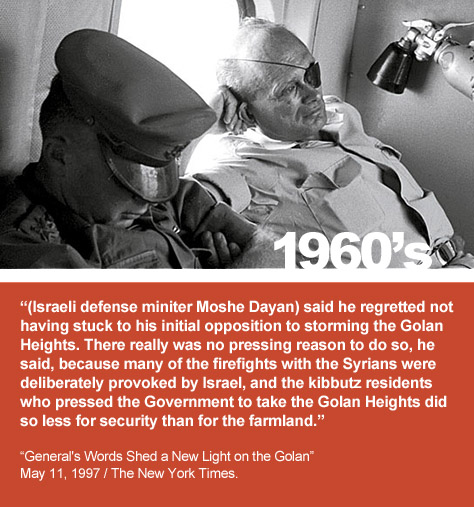
Golan_Heights

* Israeli Prime Minister Levi Eshkol’s conversation with his wife after his forces took control of the Golan Heights in June 1967.

Initially, many Israeli leaders and army officers did not think that Israel should invade the Golan Heights. But after the quick collapse of the Egyptian and Jordanian armies, and after it was clear that the Soviet Union was not really ready to protect Syria as initially claimed, some senior Israeli officers insisted that they must be allowed to conquer the Golan Heights. Mr. Dayan eventually gave them few more hours to finish the job, before he ended the 1967 war.

In 1997 the New York Times revealed that late Israeli defense minister Moshe Dayan admitted, 21 years earlier, that the Golan was seized from Syria because Israeli farmers wanted those lands.

The frequently cited Israeli security concern that obliged them to seize the Golan Heights, Syrian shelling of Israeli settlers, was not much more than an excuse to justify Israel’s capture that attractive piece of land.

Israel’s easy victory over its Arab neighbors had a lasting impact on the way many Israelis formed their attitudes towards the Arab Israeli conflict and the optimal way it should be settled, or even the need to settle it. Israeli hawks concluded that preemption works best, and it reinforced their conviction that Arabs only understand force. They also realized that the United States will provide Israel with necessary cover when needed. The IDF became the pride of every Israeli citizen.


The 70’s: “No war without Egypt and no peace without Syria”

The difficult experience of the 1973 war led a majority of Israelis to be interested again in exploring different options for settling their conflict with the Arabs.

Syrian President Hafez Assad was firm in his belief that only a comprehensive solution that is based on UN resolutions 242 and 338 will work. He made it clear that he would offer Israel peace and recognition in exchange for withdrawal from all the Arab territories that Israel conquered and continued to occupy since the 1967 war.

President Nixon was the first American President to visit Syria since its independence. He later described Hafez Assad in his memoirs as a “tough negotiator but he has a great deal of mystique, tremendous stamina, and a lot of charm. All-in-all he is a man of substance, and at his age, he will be a leader to be reckoned with in this part of the world… This man really has elements of genius – without any question”.

Unfortunately for Syria, American officials such as former secretary of state Henry Kissinger, who by 1975 had spent a total of 130 difficult hours negotiating with Hafez Al-Assad, realized that Egypt’s Anwar Sadat would be better suited to potential talks with Israel’s new hard line Likud leadership.

With the arrival of Likud to power in May 1977, Israel was not in the mood to offer territorial concessions to the Arabs. Likud’s leaders had their own way of reading Henri Kissinger’s “no war without Egypt and no peace without Syria”. Instead of believing in comprehensive peace that required negotiating with the Egyptians and the Syrians, Israeli leaders at the time decided in effect that their optimal option would be to reach a state of “no war” with their Arab neighbors without the need for full peace. That way, all they had to do was to take Egypt out of the Arab camp. Egypt’s price was manageable. By giving Sadat back his occupied Sinai, Israel got to survive in a state of no-war without having to give back the Golan Heights and the Palestinian territories. The incremental benefits of going from a state of no war to a state of peace were not worth the known price of comprehensive peace.

It was during the seventies that one started to hear Israelis explain why they could not have peace with Syria … “Syria’s price is too high”. Syria wanted its Golan Heights back and wanted Israel to settle with the Palestinians at the same time. Nothing more than what UN resolutions 242 an 338 call for.

Israel and its friends in the United States, often relying on America’s allies in the Arab world, created countless difficulties and obstacles for Syria in order to keep the country too busy and too weak to challenge Israel one day.

The Lebanese Civil war kept the Syrian army busy for decades. The war started in 1975 when Lebanon’s Christians, unhappy with the way the PLO was abusing Lebanon’s hospitality, welcomed Israel’s offer to arm them and train them on the condition that the Christians would fight Israel’s enemy in Lebanon the PLO.

Lebanese Muslim and Druze forces joined PLO fighters in fighting the Christian forces. In 1976, Syria decided that it has no choice but to send its army into Lebanon. First, the civil war in Lebanon had to be stopped. Religious inspired violence in Lebanon could easily spill inside Syria’s borders and from there to the rest of the Middle East. Second, the PLO had to be confronted. Their fighters were behaving in a dangerous manner that was quite similar to the way they behaved in Jordan in 1969. Again, Syria felt that they could eventually do the same inside Syria. Third, if Syria did not step in to protect the Christians of Lebanon, Israel would have taken advantage of the situation by continuing to arm, cooperate, and coordinate with the Christians. This high-risk arrangement would have turned Lebanon’s Christian regions into Israeli protectorates.

Towards the end of the seventies, Lebanon’s Christians moved again to Israel’s camp and the civil war continued to keep Syria’s army busy for at least another decade before the Taef agreement signaled the end of the bloody civil war in Lebanon.

In 1979 a well funded and well armed group of Syrian religious fundamentalists by the name of the Muslim Brotherhood launched a three year long campaign of violence that attempted to overthrow Hafez Al-Assad. The brotherhood was backed by a number of America’s Arab friends who were unhappy with Syria’s army in Lebanon taking the side of the Christians against the Palestinian Lebanese-Muslim alliance. Some of them, such as Iraq’s ambitious new President, Saddam Hussein, were also not happy with the prominent role Syria was playing in the region, and Jordan’s King Hussein was known for his general agreement with American strategies for the region. His kingdom played a direct role supporting Syrian Islamic fundamentalists trying to destabilize and overthrow the regime of Hafez Al-Assad by force.

When President Assad led the Arab world to boycotting Egypt, after it signed a separate peace agreement with Israel in 1978, President Carter’s administration expressed its disappointment by placing Syria on the State Department’s new list of states supporting terrorism. That entry was never removed and it continues to complicate Syria’s efforts to improve its economy and to receive international loans and grants.


The 80’s: Right wing ideologues in power in both Israel and the United States
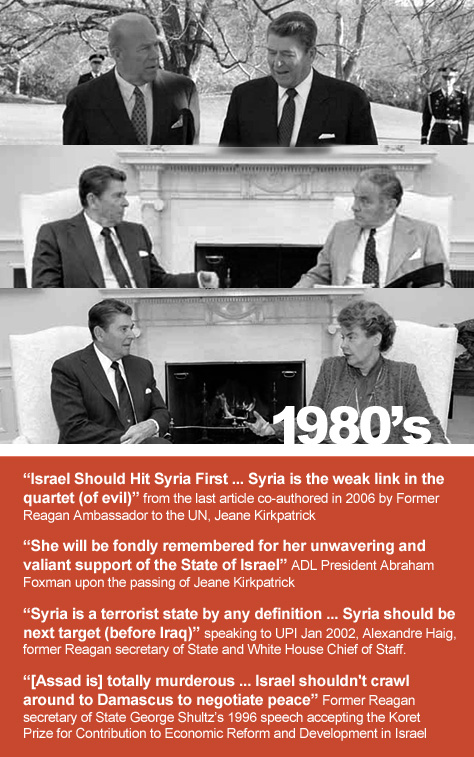
reagan_years

Israeli Likud leaders (Menachem Begin, Yitzhak Shamir, and Ariel Sharon) who managed to unseat Israel’s labour party from power in the 1970’s at first had to deal with a Carter administration that was not fully in synch with Likud’s goals and vision. In contrast, the Reagan administration that showed up in 1980 was a perfect match for Israel’s Likud leadership. President Reagan was happy to delegate tasks and even decision making to his assistants in areas where he did not feel very knowledgeable. The Middle East was not one of the President’s areas of expertise. Gradually, Israel’s friends among the hawks of the Reagan administration (George Shultz, Alexander Haig, Jeane Kirkpatrick, and Eliott Abrams)  aligned America’s goals with those championed by Likud. The language used by both leaderships was almost identical. The Americans and the Israelis portrayed their enemies as evil entities that had to be confronted until their collapse… “The communists” and “The terrorists”

George Shultz boycotted Hafez Assad for five years (1983 to 1988). Assad successfully acted as a spoiler when George Shultz tried in 1983 to take advantage of the special conditions that existed in Lebanon under Israeli occupation to encourage the Lebanese to sign a hurriedly drafted peace treaty with their Israeli occupiers. An agreement that made it almost certain that Lebanon would move away from Syria’s sphere of influence to Israel’s orbit.

President Reagan’s success in waiting until the collapse of the Soviet Union gave American neoconservatives and Israeli hawks an example that they continue to follow until today. The American British alliance of conservative leaders did not hesitate to send its troops to fight in the Middle East and around the globe. Preemption was considered wise and talking to your enemy was foolish.

Although “Dual containment”, an official United States foreign policy aimed at containing Iraq and Iran, two of Israel’s most formidable adversaries, was first announced in 1994, by Martin Indyk (NSC), The 1980-1988 Iran Iraq war was the first real application of the dual containment policy. Millions died or got injured as a result of that war. The United States sold weapons to both Iran and Iraq during that war but clearly favored Saddam Hussein’s Iraq.

President George W. Bush based his Middle East foreign policy largely on that of his conservative idol Ronald Reagan. His administration tried to use its eight years in office to finish the job that President Reagan’s administration could not finish in the Middle East from 1980 to 1988.


The 90’s a decade of peace negotiations and relative stability in the Middle East.  Netanyahu could not sell Clinton his new “Clean break” strategy.
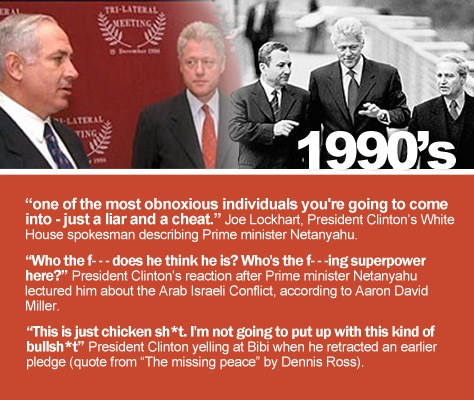
90s

Following Saddam’s invasion of Kuwait, President Bush Sr. and secretary of State James Baker decided that before they can build a coalition to fight Saddam they needed the blessing of Syria’s Hafez Assad, champion of Arab Nationalism. Assad joined the coalition after he secured promises from the Americans that they will not occupy Iraq and will start working with Syria towards a goal of comprehensive peace in the region. The Madrid conference was the format Syria proposed to the Bush administration for peace negotiations. Israeli Prime Minister at the time, Yitzhak Shamir, tried to boycott the conference but eventually had to attend in order to avoid escalating his conflict with the American administration.

At the peace conference Prime Minister Shamir launched a fierce verbal attack on Syria. Syria’s foreign minister, Farouk Sharaa reciprocated by wanted poster of a young Yitzhak Shamir when he was wanted for his leadership of a terror group in the 1940’s.

By personally attending the conference, Mr. Shamir ensured that it failed. He survived the Bush-Baker administration without being obliged to offer the Arabs any territorial concessions in exchange for peace.

In June 1992 Yitzhak Rabin was elected to replace Yitzhak Shamir as new Prime Minister of Israel. Mr. Rabin and President Clinton continued to be interested in negotiating with Syria and succeeded in reaching a final agreement before Prime minister Rabin was assassinated by an Israeli extremist in November 1995.

After Rabin’s successor, Shimon Peres failed to convince the Israeli people that he has what it takes to protect Israel’s security, Likud, led by Benjamin Netanyahu, returned to power in 1996.

Upon his arrival to power Mr. Netanyahu commissioned a study by a number of his neocon friends at an Israeli/American think tank. The document was titled “a Clean break”. It called for sweeping changes to Israel’s environment. Changes that would weaken or destroy all of Israel’s enemies. The document also suggested that Israel can then avoid having to return the occupied Arab territories to their original owners. Here are some quotes:

“Israel can shape its strategic environment, in cooperation with Turkey and Jordan, by weakening, containing, and even rolling back Syria. This effort can focus on removing Saddam Hussein from power in Iraq ? an important Israeli strategic objective in its own right ? as a means of foiling Syria’s regional ambitions.”[1]

“Since Iraq’s future could affect the strategic balance in the Middle East profoundly, it would be understandable that Israel has an interest in supporting the Hashemites in their efforts to redefine Iraq …  and diverting Syria’s attention by using Lebanese opposition elements to destabilize Syrian control of Lebanon” … “”Syria challenges Israel on Lebanese soil. An effective approach, and one with which American can sympathize, would be if Israel seized the strategic initiative along its northern borders by engaging Hizballah, Syria, and Iran, as the principal agents of aggression in Lebanon”

“While the previous government, and many abroad, may emphasize land for peace? which placed Israel in the position of cultural, economic, political, diplomatic, and military retreat ? the new government can promote Western values and traditions. Such an approach, which will be well received in the United States, includes peace for peace, peace through strength and self reliance: the balance of power.”


Prime minister Netanyahu visited the author of Clean Break, American Neocon Richard Pearle and few days later he delivered a powerful speech at a joint session of the US congress that was largely based on the recommendations outlined in Clean Break. Mr. Netanyahu’s speech was an attempt to rally the troops in Washington DC behind his approach to settling the Middle East conflict.

“The most dangerous of these regimes is Iran, that has wed a cruel despotism to a fanatic militancy. If this regime, or its despotic neighbor Iraq, were to acquire nuclear weapons, this could presage catastrophic consequences, not only for my country, and not only for the Middle East, but for all mankind.

believe the international community must reinvigorate its efforts to isolate these regimes, and prevent them from acquiring atomic power. The United States and Israel have been at the forefront of this effort, but we can and must do much more.
Until this democratization becomes a mainstay of the region, the proper course for the democratic world, led by the United States, is to strengthen the only democracy in the Middle East, Israel … we must make the pursuit of human rights and democracy a cornerstone of our quest.
Deterrence must now be reinforced with prevention — immediate and effective prevention.
There will never be such a re-division of Jerusalem. Never.
The third pillar of lasting peace is democracy and human rights.


Translation: 1) No rush for peace now, let us spread democracy in the Arab world first while we continue to settle the occupied lands, 2) “prevention” means we can decide to hit the bad guys (the way we define them) even before they provide us with an excuse to hit them, 3) No territorial compromises 4) Sanctions and war on Iraq and Iran

But President Clinton, who despite having special affinity towards Israel (source: Aaron David Miller) had an extremely negative opinion of Mr. Netanyahu. It was impossible for Mr. Netanyahu to motivate President Clinton to believe in his ambitious Clean Break vision.

Mr. Netanyahu had to wait until the next American administration arrives hoping that Likud’s friends can make it to powerful positions in that administration and that another President, Like Ronald Reagan, who did not hesitate to use America’s power to confront its enemies would be in charge.

Ehud Barak, a realist, was elected in 1999. A few months later he took part in peace negotiations with Syria that were mediated by President Bill Clinton. Syria insisted that Israel should withdraw to the 1967 line, Prime minister Barak  worried that he won’t be able to sell his people an agreement that included total withdrawal from the Golan Heights and President Assad reiterated his position that Syria will not accept to compromise its lands. Negotiations stopped and Mr. Barak decided that before he sits down again to negotiate peace with the Syrians, he needed to weaken their hand by taking the Hezbollah/Lebanon card away from them. Ehud Barak decided to unilaterally withdraw the Israeli army from Lebanon hoping that by doing so, Hezbollah won’t be relevant anymore.


2000: Eight more years of American Israeli ideologues in power. The great anti-Syria coalition
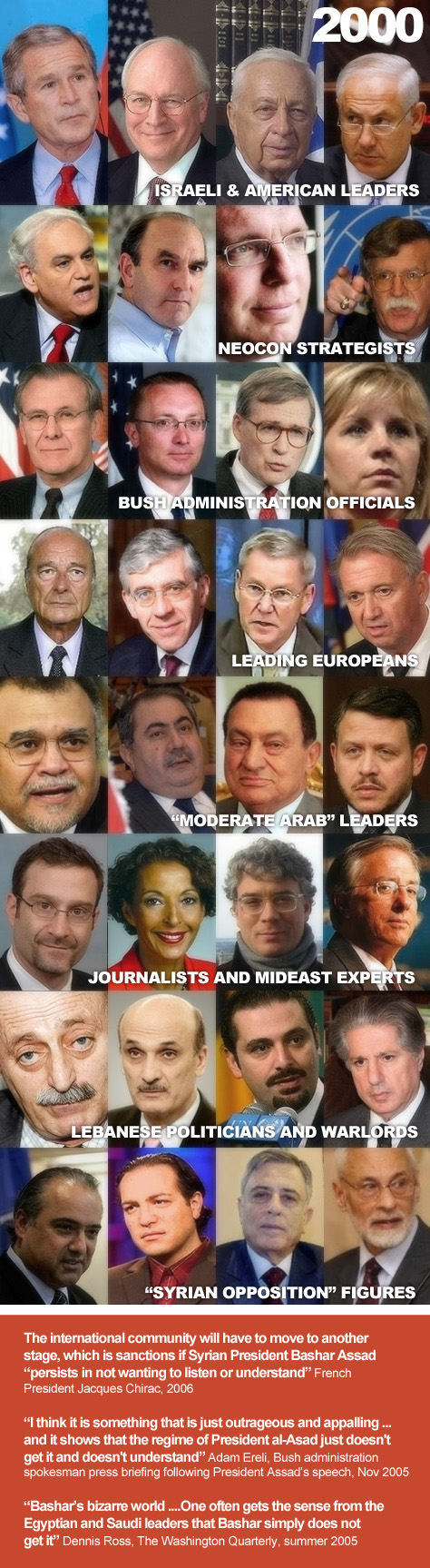
2000s

Hafez Assad Passed away June 2000. There was hope in the United States, Europe and in Israel that his son and successor will be a Sadat, not an Assad.

Everyone was nice to Bashar Al-Assad for two or three years.The Queen of England received him, President Chirac called him every week, moderate Arab leaders offered to help in anything he needs.

In Israel, Ariel Sharon replaced Ehud Barak. He made it clear  there will be a new approach to dealing with Israel’s Arab neighbors.

The attacks of 9/11, GWB’s wish to punish and finish Saddam Hussein, the role of the defense industry’s lobby, and the presence of a number of leading neocons who occupied senior positions in the Bush/Cheney administration helped Likud hawks (Benjamin Netanyahu and Ariel Sharon) to take advantage of the best chance ever to shape Israel’s environment to its liking. Plans were put in effect to destroy Saddam Hussein’s Iraq and to weaken and, if necessary, invade Syria next. Hezbollah and Iran were also on the list.

Starting in 2003, following Syria’s refusal to support President Bush’s planned war on Iraq, the strongest ever anti Syria coalition was formed. It included, besides Israel and the United States, leading “moderate Arab” regimes hoping to diminish Syria’s major role in Middle Easters politics. After the mysterious murder of Lebanon’s former prime minister Rafiq Hariri in February 2005, French President Jacques Chirac, Hariri’s close friend, was outraged and was convinced that Syria killed his friend. He found it convenient to join the American Israeli anti Syria coalition. Lebanese politicians in addition to various individuals that were described as “Syrian opposition in exile” also joined the coalition. Hundreds of world leaders, politicians, journalists, think tankers, diplomats, and even United Nations figures joined forces in producing on a daily basis pressure elements that were designed to humiliate, weaken, isolate and destabilize Syria. This went on for five years (2003 to 2008)

Syria promptly complied with UN resolution 1559 by withdrawing the last 15,000 troops it had in Lebanon (out of 62,000 peak). Israel continued to occupy a small part of South Lebanon and Hezbollah continued to define itself as the defendant of Lebanon against Israeli occupation and aggressions.

With the invasion of Iraq In 2003, millions of Iraqis were affected. Hundreds of thousands were killed, millions injured, displaced, terrorized, imprisoned or tortured.

In 2005 it seemed that Mr. Netanyahu’s strategy, as outlined in “Clean Break”, was in its final and highly successful stages of application. Baghdad fell to the coalition forces with so much ease that Arab nationalism, as championed by Saddam Hussein and Syria was being perceived by the Arab masses as a huge failure. Syria, the only Arab state that continued to resist American and Israeli right wing ideologues’s aggressive  plans for the region was at the receiving end of words of wisdom expressed in endless “moderate Arab” newspapers’ editorials and opinion pieces that called on the “foolish” and “inexperienced” “Baathist” leaders in Damascus to give up everything and save Damascus from imminent and inescapable Baghdad-style destruction at the hands of American forces who would be heading to Damascus as soon as they are done with Iraq.

The Palestinians were demoralized, Prime minister Sharon was described as a man of peace by President Bush at the time Israeli forces were pounding Palestinian cities in the west bank.

In Jan 2004, Mr. Netanyahu became confident enough to declare his modified offer for any future peace negotiations … No more land for peace, Israel only needs to offer the embattled Syrians peace for peace:

“The world had changed,… [my] offer to cede the Golan in return for peace is no longer valid … After the American war in Iraq, Syria had become an insignificant and isolated backwater, on the verge of expulsion from the international community. Thus, there’s no reason to make a deal that
entails major Israeli concessions”


November 2005. President Assad delivered a speech at Damascus University in which he made it clear that his country will not give up.

“We supported international legitimacy and did not support international disorder. International legitimacy is the UN charter, while international disorder is basing resolutions on the interests and moods of certain officials in this world. Those countries, those forces and everybody in this region and in the world should know that the era of tutelage which existed at the beginning of the last century is over, and now the region is in front of two choices, either resistance and steadfastness or chaos. There is no third choice. Resistance prevents chaos. Resistance has a price and chaos has a price, but the price of resistance is much less than the price of chaos. We need to know these things. But if they believe that they can blackmail Syria, we tell them they got the wrong address.”


It was time for more pressure on Syria. Destroying Hezbollah seemed like a logical next step and just like the sequence of events during the Reagan administration, Israel invaded Lebanon severely damaging the country’s civil infrastructure and killing 1183 Lebanese people (UN children’s fund figures). To everyone’s surprise, Hezbollah’s five thousand fighters performed very well against the much larger and better equipped Israeli army.

Hezbollah emerged much stronger after it managed to keep at bay Israel’s powerful army.

At that time, it was reported that French President Jacque Chirac asked Israel to attack Syria and topple President Assad.

Similarly, leading neocon, Dr. Meyrav Wurmser (Hudson Institute) explained to Yedioth’s ynetnews.com that

“the [US administration’s] anger is over the fact that Israel did not fight against the Syrians. Instead of Israel fighting against Hizbullah, many parts of the American administration believe that Israel should have fought against the real enemy, which is Syria and not Hizbullah”


Israeli, French, and American frustration aside, it was clearly the beginning of Syria’s rise to prominence in the Middle East. The Arab world believed in resistance again. “Hassan” (Nasrallah) became one of the most popular names that parents gave to their male newborns in much of the Arab world.

Next, it was time to try burning Syria’s other “card”, democratically elected Palestinian representatives in Hamas. Near the end of the Bush administration, Israel got the green light to attack Hamas in Gaza. Over a thousand Palestinian people were killed and Gaza was destroyed (est 1314).

Syria and Turkey lost faith in Israeli politicians’ claims that they were genuine in their interest in peace. The timing of the very optional Gaza attack was not easy to justify.

During and after the bloodshed in Gaza, public pressure mounted for America’s main Arab ally, Saudi Arabia. The rich kingdom finally decided to give up on the Bush administration’s five year campaign to isolate Syria. The Saudis recognized Syria’s leading role in Lebanon and in the Arab world in general. Most of their Lebanese allies followed.


2010: … or is it 1938?

Obama US Mideast

Mr. Netanyahu’s prime decade has just ended. By 2005 it seemed that almost everything was going according to his battle plan.

But things changed. The turning point was President Assad’s defiant speech at Damascus University in November 2005. Another turning point was Israel’s failure to achieve its objectives during its 2006 invasion of Lebanon.

By the end of the decade, there was radical change.

Mr. Netanyahu’s focus is now on Iran. It seems that everywhere he spoke he pleaded with his audience to understand why he wants them to find Iran’s attitude and actions alarming. He wants the world to impose a new round of painful sanctions against the Islamic republic and if those sanctions fail to bring Iran to its knees, then war would be the only option… “This is 1938 and Iran is Germany”


ANALYSIS

In the long run, there are two main strategists with lasting power in the Middle East, Israeli/American right wing ideologues, and Syria. Their visions for the Middle East are in most ways diametrically opposed. When one side is winning, the other is usually in retreat.

So where do they stand today?

1/ Around the Globe
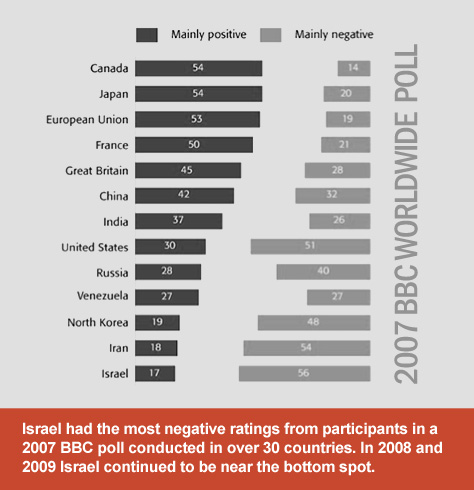
BBC-poll

The BBC conducts world-wide opinion polls that attempt to measure positive and negative impressions for a large number of countries. Between 2007 and 2009, Israel hovered around the lowest spot. Israel’s competitors for the highest percentage of negative opinions were Iran, North Korea and the United States under the Bush/Cheney leadership.

BBC polls results are compatible with other polls such as the one conducted in October 2003 after being requested by the European commission. In all Member States of the European Union (with the exception of Italy) the majority of citizens believed that Israel represented a threat to peace in the world … Israel was considered a threat by 59 per cent of those polled. The United States, Iran and North Korea, come only second on this list, each considered a threat by 53 per cent of the EU population.” (“Iraq and Peace in the World,” European Commission, November 2003, p. 81)

2/ In The United States

Israel continues to enjoy nearly unanimous support on Capitol Hill. While most issues debated in congress receive votes that are split 48-52% at most, any vote that seems to interest Israel one way or the other tends to unite America’s elected representatives who always manage to vote Israel’s way with over 90%.

On the other hand, the Obama administration is mostly made of realists who prefer prudence over preemption. It is clearly not a natural or automatic partner for Mr. Netanyahu’s “This is 1938 and Iran is Germany” war project, although there is little doubt the administration will continue to show more sensitivity and understanding to Israel’ needs and desires than it will for the Arabs.

Finally, a poll conducted by the Israel Project, revealed that support for Israel in the United States suffered a 20 point drop in 2009.

Israel poll

Support for Israel among Christian Zionists and some evangelical Christians remains strong. Israeli ambassadors and prominent allies of Israel from Capitol Hill often put in an appearance at Christian Zionist rallies to motivate them and to encourage them to lobby for Israel more actively in Washington.

3/ In the Arab world:

In recent years, Syria’s image in Lebanon suffered heavily from constantly reinforced accusations that it was behind the assassination of Rafiq Hariri in addition to American and Saudi claims that Syria is interfering in Lebanese politics. As it became clear that there is no evidence to link Syria with the Hariri murder, and as Syria demonstrated its ability to help the Lebanese settle their differences peacefully (Qatar agreement) support for Syria in Lebanon skyrocketed. A poll conducted between 11-15 August 2009 reveals that Syria’s support in Lebanon is up by close to 25% (from 47.5% in 2008 to 72.3% in 2009).

lebanon_poll

In comparison, Israel received the support of 1% of the Lebanese people. Positive opinions of the United States significantly dropped in 2009 (from 37.3% in 2008 down to 26.5% in 2009)

Syria’s close political ally, Qatar was the most popular country in Lebanon (86.6%), followed by Syria.

A number of polls suggest that in 2009, President Assad appears to be the most popular leader in the Arab world. A University of Maryland/Zoghby International poll conducted in a number of moderate Arab countries showed that Assad was the most admired foreign leader.

A CNN (Arabic) online poll asked the site’s readers to vote for the “2009 international person of the year” award. President Assad won by a landslide, receiving the votes of 67% of the 30,679 Arabs who voted. Syria’s closest ally Turkish Prime minister Recep Erdogan got 28% of the votes.
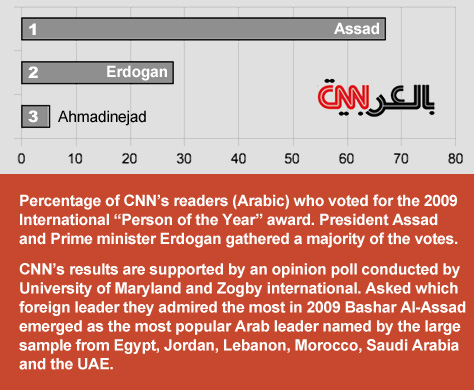
CNN

The above polls demonstrate that Syria and its allies (Turkey, Qatar, Iran, and Hezbollah) are the choices of an overwhelming majority of the Arab people.

In 2005 Israel had the respect of many Arab leaders who agreed to secretly cooperate with the Jewish state against their common adversaries: Syria, Hezbollah, Hamas and Iran. By 2010, very few Arab officials wanted anything to do with Israel. Egypt and Jordan remain to two exceptions, but only at the official level. Egyptian leader Hosni Mubarak is growing increasingly unpopular every time he cooperates with Israel against Hamas.

The Saudis made it clear to the Obama administration that they will not normalize with Israel ahead of a final settlement between Israel and its Arab neighbors. Prince Bandar who Aluf Benn claimed was the man “behind the quiet slide [Saudi Arabia] is making towards Israel”, totally disappeared from public life in Saudi Arabia. His fall from grace is perhaps the most vivid example of the collapse of efforts to normalize Israel’s relations with the Arab world based on peace for peace, with no prior land concessions on Israel’s part. Saudi Arabia realized that Syria’s camp is the wiser choice.

4/ in the Periphery (Iran and Turkey)

By 2009 and specifically after Israel terminated Turkish mediated peace talks between Syria and Israel through its surprise war on Gaza, Syria completed a process it started in 1979… to gain the friendship of the two large and important Islamic countries that lie on the periphery of the Middle East, Iran and Turkey. Both countries used to be among Israel’s strongest allies.

Today, over 600,000 Iranian tourists visit Syria every year. Borders with Turkey are open to people from the two countries to Travel and trade as if they are in their own country.

Ben Gurion’s “Alliance of the Periphery” doctrine is not sustainable for Israel anymore.
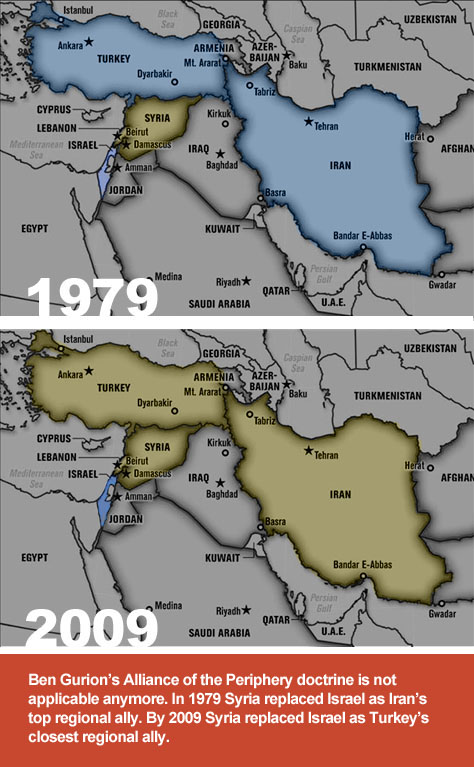
turkey_iran_Syria-Israel_map

5)    Public Relations, press coverage

Israel continues to enjoy special relations with owners, managers, and editors of media outlets. However, a number of highly unpopular actions (invasions of Lebanon and Gaza, failure to stop the expansion of Israeli settlements) and  a number of controversial Israeli statements (see “voices from Israel”) are generating increasingly negative coverage for Israel.

It seems that even experienced Israeli “doves” are not sensitive anymore to international public opinion. Former Prime Minister Ehud Barak in 2000 told the producers of a PBS documentary (watch it at 2:20 of this clip) about an Israeli cabinet meeting that discussed possible responses to the first Palestinian intifada (1987). Mr. Barak said:

“Some of the ministers made horrifying suggestions … send in the tanks, kill a thousand and it will collapse, order will be restored to Israel. But we knew if we killed a thousand it will get worse, and we will be branded war criminals”


Yet in 2008, the same Ehud Barak led his troops into Gaza, killing in the process over a thousand Palestinians, and as he predicted in 1987, it did get worse and he was branded a war criminal.

The rise of the popularity of online news and other online sources of information contributed to a gradual erosion of Israel’s traditional effectiveness in ensuring press coverage in traditional media outlets that was generally seen as being to its advantage. You Tube is full of clips showing Israeli bombardment of civilians in Gaza. Unflattering news reports and opinion pieces are promptly and widely forwarded or posted on FaceBook profiles. Israel believes it can undo the damage by recruiting an army of bloggers to combat unfriendly websites.

Syria coverage, exceptionally negative during the Bush administration, morphed into a completely different tone.

Saudi opinion writer Hussein Shebokshi wrote last month:

“The situation in the Middle East today can safely be described as having something of a “Syrian flavor.” The most important tourist and travel magazines contain articles that promote Syria as being an excellent tourist destination, praising the Hamidiya market and Mount Qassioun in Damascus, the water-wheels of Hama, the ruins of Palmyra and Apamea, as well as the Aleppo citadel. This is not to mention Syrian music and food, and of course all of this [praise] comes after years of warnings against visiting Syria due to fears of it being unsafe. Syrian soap operas have also invaded Arabic television, achieving great successes… Syrian deserts and [Syrian-style] Halabi Kebab have also become very popular, and many ancient Syrian sayings and proverbs are now being used as everyday terms. There is also the nostalgia of listening to the traditional Aleppo kudood [traditional Arab poetic form accompanied by music] of Sabah Fakhri, or reading the stories of Hanna Mina, or watching the plays of Saadallah Wannous.”
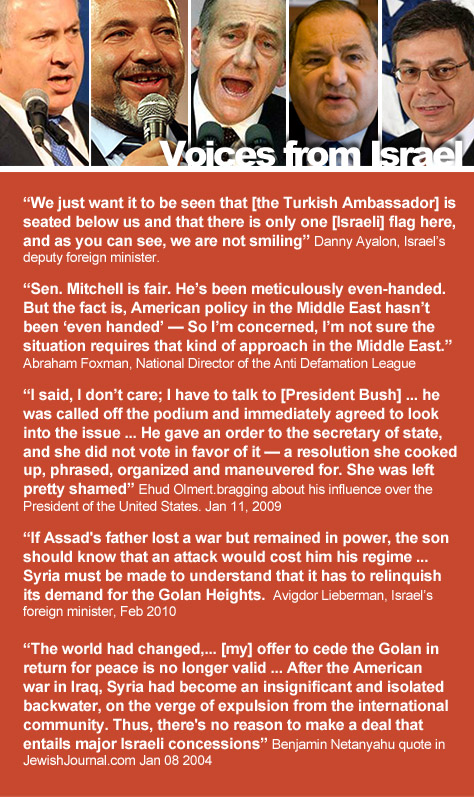

israel_quotes


6/ Legacy / Decision making

syria_decisions2

Syria’s decision making over the past four decades was mostly on the mark. The table below shows that no other player in the Middle East can claim the same.

When everyone was betting on Saddam Hussein, Syria bet against him and warned that he is a dangerous man. His Sunni, Shia and kurdish opponents lived safely in Damascus. among those were Iraq’s current President and current Prime Minister as well as former Iraqi Prime Ministers.

When everyone was involved in arming Afghani Mujahidin to fight the Soviet army in Afghanistan and when they were ignoring the rise of Saudi wahabi financed Arab Islamic fundamentalists, Syria was fighting those same religious extremists.

Syria predicted that the Oslo agreements will be a failure, that the same fate awaited “the road map”, that Egypt’s Camp David Accord will not bring peace to the Middle East, that Ariel Sharon’s unilateral withdrawal from Gaza was not a step towards peace, that George Shultz’ May 17 “peace” (surrender) agreement he proposed for Lebanon was dangerous, that the second Iraq war will be a quagmire for the United States and a disaster for Iraq and the Middle East.

In 2005 Dennis Ross wrote in the Washington Quarterly a paper titled “US policy towards a weak Assad”. Here is how Mr. Ross described Assad’s warning against the grave mistake the Bush administration was about to commit in Iraq:

“When Bashar spoke about the situation in Iraq just prior to the war, his comments bordered on the hysterical”


Being described as hysterical, obstructionist, or a supporter of terror are a few examples of the price Syria had to pay each time it warned against what it strongly believed was a mistake, at times when The United States, Israel and “moderate Arab” countries (US allies) held different views.

Syria made one serious strategic mistake. It waited too long before withdrawing its army from Lebanon and its representatives in Lebanon played a role that was beyond their security role.

But when a very large number of Lebanese were planning to demonstrate against Syria in downtown Beirut, Syria’s army did not close the area and did not prevent them from demonstrating. When UN resolution 1559 asked Syria to withdraw its forces from Lebanon, Syria promptly complied even though Syria was not specifically named in that resolution that only called for the withdrawal of all “foreign armies” from Lebanon.

Israel, on the other hand, proved to be mostly unwilling to learn from past mistakes. Israeli leaders continue to find it difficult to resist sending their army to deliver non-proportional punishment to their Arab neighbors. They still encourage any like-minded American administration to help them rearrange the Middle East, and they still do not want to respect international law.

A good example is Israel’s invasion of Lebanon in 1982 which was initially justified by the need to push the PLO 45 kilometers north of Israel’s borders to prevent them from attacking Israel. Instead, Ariel Sharon motivated his Prime Minister, Menachem Begin, to approve a much more ambitious operation that would send Israeli troops to Beirut and to Syria’s border. Eighteen years later (and 18,000 Lebanese and Syrian casualties later), when Prime minister Ehud Barak withdrew Israeli troops from the south of Lebanon in 2000 Syria was able to claim victory over Israel and a new enemy of Israel was created. Hezbollah (and Lebanon’s Shia population) … a considerably more effective enemy than the PLO in resisting Israel’s occupation.

Israeli hawks sometimes give the impression that they do not think the laws of nature apply to their country.

Every action has an equal and opposite reaction, … it might be the case that routinely threatening Iran with crippling international sanctions and possible preemptive wars (starting in 1996) might have been one of the reasons Iran today adopted a similarly hostile language towards Israel.

Energy can not be destroyed, it can only be transformed from one state to another. Israeli occupation of other people’s land by force led to anger and or determination to resist the occupation. Israel did not destroy this energy when it pounded Beirut in 1982 until it sent the PLO away to Tunisia. That energy was acquired by Hezbollah. When right wing ideologues destroyed Iraq, that energy was not destroyed, it was acquired by Iraq’s neighbor Iran. At the risk of sounding simplistic, the only way Israel can have real peace and security would be for Israel to undo the reasons that led to resistance.

Israel_strategy

(1)

Looking back at the legacy of the various combinations of American/Israeli administrations, it is clear that there was rarely any positive achievement. Saddam Hussein was kicked out of Kuwait in 1991, then he was removed from power in 2003, Egypt signed a peace treaty with Israel but its people today generally have highly negative opinions of Israel. Jordan also signed a peace treaty with Israel, although it was not much more than a formality given the prevailing excellent ties between Israel and the Hashemite King of Jordan.

The list of negative outcomes is much longer. And most of them come from the times when both Israel and the United States were governed by right wing ideologues, eight years of the Reagan administration (Begin and Shamir in Israel) and eight years of the George W. Bush administration (Sharon and Olmert in Israel).

The legacy of the “dual containment” policy is that over a million Iraqis and Iranians died during the 1980-1988 war between the two countries. The legacy of the Bush/Cheney/Netanyahu “shaping of Israel’s environment” Clean Break strategy is that millions of Iraqis were killed, injured, or turned into refugees.

It might be true that as a result of the Iraq invasion Israel’s enemy Iraq was weakened, but it is also true that Israel’s much more serious enemy, Iran, was empowered and was able to extend its influence into Iraq as well as next to Israel’s borders in Lebanon and in Gaza.

realist_ideologue

It is also useful to illustrate the similarities of the strategies, tactics and legacies of the two eight-year periods when right wing ideologues where in power in both Israel and the United States, as outlined in the table below.

Reagan_Bush_Syria

Another similarity: Three years into their term in office, the Secretary of State (George Shultz in 1983, and Colin Powell in 2003) was sent to Damascus with a serious and long list of American/Israeli demands. Both secretaries explained to their Syrian hosts that the American administration had enough talking and now wants results …. capitulation, in other words.

Hafez and Bashar Al-Assad explained that Syria does not accept dictation, and does not sacrifice its national rights no matter how much pressure Washington and Tel Aviv managed to apply.

For the next five years (1983-1988, 2003-2008) American secretary of States boycotted Damascus and communication lines between Damascus and Washington DC ceased to exist . Given the central role that both Syria and the United States play in the Middle East, the decision to boycott Syria had many negative consequences. It is important to realize that decisions to boycott Syria emerge as a result of not only ideological convictions, but also due to personal animosities held by ideologues in Washington towards Syria’s leaders who are not good in taking orders from ideologues who do not understand the Middle East too well.

“Shultz’s crankiness may have serious consequences: when he found Syrian President Hafez Assad personally intractable, Shultz refused to hold further talks with him.” TIME, 27 Feb 1984

“Assad was also nervously watching for any last-minute surprises by a departing George W. Bush, who hated the Syrian regime with a passion” Jerusalem Post 05 Feb 2010


Mr. Jeffrey D. Feltman, who as ambassador to Lebanon for the Bush administration used to wake up everyday thinking of how he can contribute to isolating Syria, recently concluded that isolating Syria does not work:

“consequently, the United States, not Syria, seems to be isolated.”


WHAT SYRIA REALLY WANTS (“SYRIA’S PRICE”) IS A DIFFERENT CLEAN BREAK

Prime Minister Netanyahu is surely aware that the original “Clean Break”  was a speech by Mahatma Gandhi in which he called for

“Complete and immediate orderly withdrawal of the British from India [which will] at once put the Allied cause on a completely moral basis”


Mahatma Gandhi’s original calls on occupiers to accept the futility of fighting to maintain control over lands occupied by force … a clean break with their occupied lands, a clean break with all the time, energy, and high hopes associated with their long battle to retain those territories forever.

Mr. Netanyahu’s version calls for using force to secure the realm, or to favorably shape the occupier’s environment by assembling more potent coalitions in order to discredit, weaken, destroy and break the will of all those who might resist the occupier’s wish to maintain control over his occupied lands forever.

Israel and its friends and allies in the United States need to make a clear and decisive choice. A choice between the two diametrically different versions of clean break.

If Mr. Netanyahu continues to believe in his own doctrine, then we can already predict a bleak future for the region.

If Israel’s leadership is ready for a lasting paradigm shift, if it is ready to abandon its quest to reshape Israel’s strategic environment by force, it might find Syria ready to articulate a vision for the Middle East where an Israel that is willing to act like an ordinary state, despite its many impressive achievements, can play one of the leading roles in the development of a new harmonious, prosperous and highly connected Middle East.

Former Israeli foreign minister Abba Eban said “History teaches us that men and nations behave wisely once they have exhausted all other alternatives”

One hopes that fifteen eventful years after late Prime Minister Rabin’s transformation into a genuine peace maker earned him the respect and trust of his enemies, Mr. Netanyahu is finally ready for a serious and constructive dialogue with his neighbors about a common vision for the future of the wider Middle East and not about the parts of their occupied lands that Israel refuses to give back.

Economy Grows at 4%ish; Saudi Handshaking; Israeli-Syria Verbal Jousting

Global Crisis Had Limited Impact on Syrian Economy – IMF Report
Syria Report:  08/02/2010

Syria’s economy continued to grow at about 4 percent last year, as the impact of the global crisis remained limited, an IMF report said.

The report by the International Monetary Fund consisted of the preliminary findings of a mission conducted in Damascus last December under Article IV of the IMF’s Articles of Agreement.

The IMF mission said that, while the GDP growth rate had slowed down to 4 percent last year, non-oil GDP had risen by a slightly faster rate of 4.5 percent. The relative deceleration in output growth was a consequence of “lower growth in manufacturing, construction, and services” and was partially offset “by a moderate recovery in agriculture.”

An increase in the unemployment rate to 11 percent, a decrease in the inflation rate to 2.5 percent, partly due to a reversal in global prices of food and other basic commodities, and a widening fiscal deficit to 5.5 percent due to “counter-cyclical measures to mitigate the effects of the global economic crisis” by the Government are among the main consequences of the global economic and financial crisis on the Syrian economy.

Projections for the coming year were relatively optimistic. The economy’s total output, excluding oil, is expected to rise by some 5 percent this year, led by a recovery in agricultural output, exports, FDI and remittances. A relatively good raining season is likely to lead to an increase in yields in cereal crops, including wheat.

More significantly the report commends the Government’s efforts at streamlining public financial management, reforming the oil subsidies system and preparing for the introduction of the Value Added Tax. Long awaited, and delayed, VAT is now expected by the Government to enter into force, although the deadline is still seen as too optimistic by many analysts.

Key Indicators

2008*

2009**

2010**

Real GDP Growth (%)

5.2

4.0

5.0

Nominal GDP (USD, billion)

54.5

52.5

59.4

CPI Period Average (%)

15.2

2.5

5.0

Fiscal balance (% of GDP)

-2.8

-5.5

-4.4

Current account balance (% of GDP)

-.6

-4.5

-3.8

Source: IMF
*Preliminary

**Projections

Syria’s GDP Growth Forecast at 4% in 2010
Syria Report, 01/02/2010

Syria’s economy is expected to grow by 4 percent in 2010 and 5.5 percent in 2011, according to a recent World Bank report.

This forecast is published in the Global Economic Prospectus 2010. Syria’s growth level is above the MENA region’s average of 3.7 percent. The WB estimates Syria’s real GDP growth in 2008 and 2009 at 5.2 and 3.0 percent respectively.

Meanwhile, the current account deficit is expected to rise again this year to 4.3 percent of GDP, from 3.2 percent in 2009 and 4.0 percent in 2008, before falling slightly again to 4.0 percent next year.

GDP and Current Account Data

2007

2008

2009

2010

2011

GDP Growth Rate (%)

4.2

5.2

3.0

4.0

5.5

Current account/GDP (%)

-3.3

-4.0

-3.2

-4.3

-4.0

Source: World Bank

??? ?? ??? ????? .. ?? ?? ???? ?????? ???? 2009
???????? – 3 ???? – 2010 – 6:40:39

???? ?????? ??????? ??????? ?????? ??? ?? ???? ?????? ???? 2009 ?? ???? 2.8%? ?? ???? ????? ?????? ??? ??????????? ?????????? ??? ?? ????? ????? ?? ?????? ????? ????????? ????? ?? ??? ??? ????? ?????? ?? ??? ?????? ??????? ??? ?????? ???? ???? ?? ???? ??? ?????? ?? 2008. ??? ???? ????? ????

????? ????? ????? ???? ?????? ???? ?? ???? ?????? ?????? ??? ?????? ??????? ???? 2008? ????? ???? 15%? ??? ?????? ??? ???? ?????? ???????? ????? ??????? ?? ????? ???100% ??????115%? ?? ????? ?????? ????????? ????? 2.8% ???? ????? ??????.

???? ??????? ??????? ???? ??? ??? ?????? ??????? ?? ????? ??? 2007 ??? 100 ????? ????? ????? ?? 2008 ????? 115 ????? ????? ?? ???? ???? ??? 2009 ???? ????? ?? 2.8 ????? ????? ???? ?? ?? ?? ?????!.

????? ????? ???? ?????? ???? ??????? ???? (2008 ?2009) ????????? ??? ??? 2007 ???? ????? ??? ?? ?????? “?????” ???? ??????? ???? (15.15% ?????? 2.8% ????? 17.95%)? ????? ???? ????? 9%? ???? ???? ?????? ??????? ?????? ?? ???????? ?????? ??? ????? ???????.

???? ??? ???? ??????? ?????? ???? ???? ???? ???? ?????? ??? ??? ????????? ??? ?? ??? ???????? (????? ??????)? ??? ???? ?????? ??? ????? ?????? ???? ?? ???? ?? ???? ???? ??? ???? ????? ????? ??? ?? ??? ?? ????? ??????? ????????? ?????? ????????? ?????? ????? ????? ?????? ??????? ????? .

?? ?? ??????? ?? ???? ?????? ?? ????? ??? ???????? ????????? ??? ??????? ??????? ??????? ???? ??? ?????? ????????? ???? ??? ?????? ??????? ?????? ?????? ??????? ??? ?? ???? ?? ?????? ???????? ???? ?? ??????? ????? ???: ?? ???? ????? ?????? ?????? ????? ???? ??????? ??? ?????? ????????!.

??? ?????

Haitham Satayhi – member of the Regional Leadership of the ruling Baath Party and a close friend of the President, says there will be no privatization of the public sector industries.

??????: ????? ??? ????? ??????? ?? ??????? ???????? ?????? ‘??????’
????? ????? ?????? ???????? – ??????? 1 ????/ ?????? 2010

??? ????? ???? ???? ?? ????? ???? ??????? ??? ??????? ??????? ?? ??????? ???????? ?????? ?????? ?????? ????? ????????.

???? ??? ??????? ??????? ???? ????? ?????? ?? ????? ???? ?????? ?? ?????? ?????? ??? ??????? ???? ?????? ???? ???? ???? ????? ??????? ??????? ??? ?????? ???????? ?? ??? ??? ???? ??????? ????? ?????? ?????? ???? ?????? ??? ?????? ???? ????? ???? ?????? ??????? ?????? ‘??????’ ??? ??????? ??????? ?? ?????? ??? ???????.

????? ??? ??????? ??????? ?? ???? ?? ???? ????? ????? ?????? ????? ?? ???? ?? ??? ????? ?? ??????? ??????? ????? ??? ????? ?? ??? ??????? ?????? ?? ??????? ?????????? ????? ???? ???? ??? ??????? ???? ????????? ????? ?? ???? ??????? ???????? ????? ???????? ??? ?????? ?????? ????? ?? ?????? ???????? ??? ???? ????????? ?? ???? ??????? ????? ??????? ????????.

????? ??????? ???????? ??????? ???????? ???? ????? ????? 2009 ???? ????? ????? ?? ???? ???????? ?????? ???? ?????? ???? ???? ?? ????? ??????? ??? ????? ??????? ??????? ????????? ?? ??? ?? 26 ?? ????? ????? (??????) 2009 ??? ?????? ??? ?? ?????? ????? ‘????’ ????? ?? ??????? ??? ??????? ??? ?????? ???? ???? ??????? ????????.

????? ???? ??????? ?? ????? ????? ????? ?? ????? ???????? ???? ????????? ???? ?? ??? ???? ??? ???? ???? ?? ????? ??????? ??????? ??? ????? ??????? ??????? ????????? ?? 26 ????? ????? (??????) ????? ?????? ??? ??? ????? ????? ??????? ?????? ?????? ?????? ??? ????? ??? ????? ???????? ?? ???? ?? ???? ??? ???????? ????? ????? ?????? ?? ??????? ????????? ?????????? ???? ?? ??? ??????? ???? ?? ??? ??????? ???????? ?? ????? 2004 ??? ?? ?? ?? ???? ??????? ??????? ?? ???????? ???????? ??????????? ??? ????? ??????? ???? ??????? ????????? ???? ????? ??????? ?????????.

??? ???? ???? ??? ?????? ??? ?? ????? ???????? ?????????? ???????? ?????? ???? ????? ??????? ????? ????????? ???? ??? ????? ????????? ???? ???? ???????? ???? ??? ?? ????? ??? ???? ???? ?????? ????? ?????? ?? ??? ???????.

By Lachlan Carmichael (AFP)
WASHINGTON — The Obama team may get modest benefits from ending a five-year chill with Damascus but will find it hard, if not impossible to peel Syria way from hardline ally Iran and break the Arab-Israeli stalemate, analysts said.

US President Barack Obama’s administration said last week it submitted its nominee for ambassador to Damascus, the fruit of a year-long drive to engage Syria in a bid to promote Arab-Israeli peace. Syria says it is studying the proposed nominee, who is widely reported to be Robert Ford, a career diplomat with experience in Arab countries like Algeria and Iraq, his most recent posting. He would be the first US ambassador to Damascus since the one recalled after former Lebanese prime minister Rafiq Hariri was killed in a bombing blamed on Syria on February 14, 2005.

Analysts said a thaw in ties can allow Washington to reap benefits from intelligence cooperation with Damascus and improve chances for Syria-Israeli peace, even while Palestinian-Israeli peace remains elusive. Indeed, investigative journalist Seymour Hersh, writing in the New Yorker last week, disclosed that the Syrian secret services have already resumed cooperation with the CIA and Britain’s MI6.

Aaron David Miller, who was a Middle East adviser in past US administrations, said Washington can achieve modest objectives, such as intelligence sharing, but he set expectations low. The appointment of an ambassador “doesn’t reflect anything like a significant improvement, let alone a transformation in the US-Syrian relationship,” Miller told AFP. Syria is a hard nut to crack, he said, because President Bashar al-Assad, from the minority Alawite sect, focuses foremost on ensuring his regime’s survival — and that means having strategic ties with non-Arab and Shiite Iran. “I’m not suggesting that it (the relationship) isn’t amenable to change, but it would only change if the Syrians could convince themselves that they could get their needs met elsewhere,” he added. And its needs flow from its stakeholding in Lebanon via Hezbollah, the powerful Shiite Muslim political and militant movement which Iran has also backed in its decades-old campaign against Israel. “As long as the Hezbollah-Iranian relationship is as close as it is, the Syrians, I think, will only alienate the Iranians at their own peril,” Miller said.

He said Assad’s Syria, which has a majority Sunni Muslim population, sees Iran as a hedge against a Sunni-led Arab world that it mistrusts, while it also looks to energy-rich Tehran for economic support. Syria also needs Israel to return the Golan Heights, which was captured in the 1967 Arab-Israeli war, said Miller, a Woodrow Wilson Center policy scholar. Despite the odds, he said, it is worth the effort to improve US-Syria ties, “manage” Lebanon, try to promote Syrian-Israeli peace talks, and “even make the Iranians nervous,” as is likely with the ambassador’s appointment. But Miller doubted that a “fundamental improvement” in US-Syrian ties can occur before a peace breakthrough between Israel and Syria, which would require Damascus to open up economically and cut support to militants.

Jon Alterman, a former State Department policy planning staff, did not expect Syria to abandon its strategic alliance with Iran but said it could “rebalance its relationship” with Tehran and Washington. And that could blunt Iranian ambitions in the region. “Having a more isolated Iran may lead to an Iran that is more cautious in its dealings, for fear of further antagonizing the rest of the world,” ….

Syria frets over drought’s harvest
Fresh Plaza (NL): 2010-02-04

Syria frets over drought’s harvest A farmer balances skilfully on a plank of wood that a horse is drawing across a small patch of earth to cover freshly planted garlic, and as he works other men stand nearby chatting animatedly about the weather. It

Time: Why the U.S. is Back on the Road to Damascus
Andrew Lee Butters/Beirut 2010-02-07

The Obama Administration is moving to send an ambassador to Syria five years after President Bush called home the last one. That could help U.S. goals in Iraq, Iran and elsewhere, but trouble may be looming on the Israeli-Syrian front Why the U.S. …

Deputy FM Ayalon shakes hands with Saudi prince in rare gesture
By Barak Ravid, Haaretz

In a rare occurrence, Deputy Foreign Minister Danny Ayalon shook the hand of Saudi Arabia’s Prince Turki al-Faisal during the annual security conference in Munich on Saturday. The handshake was preceded by the prince’s attempts at avoiding participation in a panel alongside Ayalon, a consequent uproar and a sharp American condemnation of the Saudi behavior.

The security conference took place over the weekend, and was attended by dozens of world leaders, foreign ministers and senior officials. On Saturday, a panel convened on the topic of the Middle East. The panel was to include both Ayalon and the Saudi prince, who formerly served as the head of the Saudi intelligence service, as well as the Turkish foreign minister, U.S. Senator Joe Lieberman and senior Egyptian and Russian officials.

However, when Ayalon arrived at the conference on Friday, he discovered that the panel in which he was set to participate had been split into two separate panels. The first panel was to include the Saudi prince and other Saudi officials, as well as officials from Egypt and Turkey, followed by a separate panel to include himself, Lieberman and the American and Russia representatives.

According to Israeli diplomats, the split was a Saudi request. Prince al-Faisal refused to sit on the same stage as Ayalon and the organizers heeded his request and split the panel. Ayalon, who was surprised by the move, addressed the incident at the very start of the panel, saying that “this is micro cosmos of the Middle East conflict. The Arabs refuse to sit with us, recognize us or talk to us.”

U.S. Senator Lieberman joined Ayalon’s criticism, saying “I am disappointed with the Saudis,” adding that he had thought that he was participating in a six-person panel, only to discover that the panels had been split because the Saudis refuse to sit with the Israelis.

The Saudi prince, who was sitting in the audience at the time, rose from his seat and rushed to deny the allegation that he had requested the split. Ayalon quickly responded “if that is so, come and shake my hand.” The prince refused to get on the stage, but Ayalon did not lose his stride, announcing that he would be willing to get off the stage. He then walked toward the prince and shook his hand. “Israel is committed to peace,” he told the prince.

The handshake was a rare public occurrence between and Israeli and a Saudi official. Prince al-Faisal holds no official post in Saudi Arabia currently, but he is considered to have a very high status among Saudi royalty.

KSA not to recognise Israel despite handshake
Sunday, February 07, 2010

RIYADH: A senior Saudi diplomat said Sunday his handshake with Israel’s deputy foreign minister at a Munich security conference was no step toward recognition of the Jewish state.

Prince Turki al-Faisal, the country’s former intelligence chief and ex-ambassador to the United States, said his handshake Saturday with Israeli Deputy Foreign Minister Danny Ayalon only came after Ayalon apologised for actions that Turki objected to.

“This event should not be taken out of context or misunderstood,” Turki said in a statement received in Riyadh.

“My strong objections and condemnations of Israel’s policies and actions against the Palestinians remain unchanged.

“It is clear that Israel’s Arab neighbours want peace, but they cannot be expected to tolerate what amounts to theft, and certainly should not be pressured into rewarding Israel for the return of land that does not belong to it in the first place,” Turki said.

“Until Israel heeds US President Barak Obama’s call for the removal of all settlements, the Israelis must be under no illusion that Saudi Arabia will offer what they most desire — regional recognition.”

Turki, who though currently with no official government title continues to carry out diplomatic work for the Saudi government, said the handshake came after Ayalon publicly reprimanded him for not sitting together on a panel at the annual international security conference in Munich.

“I objected to sitting on the same panel with him not because he is the deputy minister of foreign affairs of Israel but because of his boorish conduct with the Turkish ambassador to Israel Ahmet Oguz Celikkol,” Turki said.

In January Ayalon made a show of publicly humiliating Celikkol to demonstrate displeasure with a Turkish television show critical of Israel.

Turki also said he objected to Ayalon’s allegation that Saudi Arabia has not provided any aid to the Palestinian Authority — when in fact Riyadh has provided hundreds of millions of dollars to the authority.

“Mr. Ayalon then asked me to come up to the podium to shake hands to show that there were no hard feelings,” Turki said.

“I pointed to him that he should step down from the podium,” Turki said.

“When we stood face-to-face, he said that he apologised for what he had said and I replied that I accept his apology not only to me but also to the Turkish ambassador.”

U.S. official: Arming of Hezbollah could spark Israel-Syria war
By Jack Khoury, Haaretz

Peace with Syria as vital as stopping Iran’s bomb
By Zvi Bar’el, Haaretz Correspondent

Ehud Barak said what he had to say, Bashar Assad did not understand or maybe he did, Avigdor Lieberman uttered his usual concoction, Benjamin Netanyahu explained that “we want peace,” and life is good. Everything is all right. This week’s ruckus is over. All that remains is the media circus. Because war, we should recall, is not something Israel does in winter.

The chatter, on the other hand, works all year round and Lieberman is its strategic asset. Lieberman can babble on about the collapse of the Assad family’s rule, swear at Hosni Mubarak and ridicule Jordan. His importance at the Foreign Ministry compares only to that of the Strategic Affairs Ministry under Moshe Ya’alon or the Regional Development Ministry under Silvan Shalom. These three frustrated ministries fall under the category “we want peace” and have transformed chatter into policy.

But Lieberman is not really the problem. The root of evil is the hoax of “we want peace,” because Israel is not really interested in peace with Syria – not at the cost of withdrawing from the Golan Heights. Israel’s working assumption is that there is no rush for negotiations with Syria; our northern neighbor does not constitute a military threat and its regional position does not allow it to rally the support of other Arab countries to carry out a full-blown war. Syria can be threatened without risking damage.
Advertisement

Syria itself “contributed” to this Israeli approach by keeping the border calm for decades, and there is no way to convince Israelis, who understand only Katyushas and Qassam rockets, that Syria is a threat for which a single bed-and-breakfast needs to be removed from the Golan. The Syrian promise for the “fruits of peace” is also shoddy. Compared to Saudi Arabia or the United Arab Emirates, Syria is not offering any real economic incentives to make peace.

But Syria holds an asset that Israel does not recognize. Peace at this time means the possibility that Israel’s strategic position in the Middle East and the world will change. Syria is a key country along a new axis being formed in the Middle East, which includes Turkey, Iran, Saudi Arabia and Iraq. The backbone of this axis is economic, security and diplomatic cooperation that would replace the old axis of Egypt, Saudi Arabia and Jordan.

More on New US Amb., War Bluster, Hariri Court

BACK TO DAMASCUS?
by FREDERICK DEKNATEL in The Nation”
February 5, 2010

Washington has nominated Robert Ford, a career Foreign Service officer, as its ambassador to Syria, a post that has been vacant since the United States withdrew its envoy in 2005 to protest alleged Syrian involvement in the assassination of former Lebanese Prime Minister Rafik Hariri. (Syria denied any involvement.)

Ford, currently deputy ambassador to Iraq, was ambassador to Algeria from 2006 to 2008. He ran a Coalition Provisional Authority office in Najaf in 2003, and from 2004 to 2006 he was a political officer at the US Embassy in Baghdad, where he helped draft Iraq’s new Constitution, establish the transitional government and oversee elections in 2005.

The appointment of a career officer who speaks Arabic represents a shift for Obama, who has often chosen well-heeled friends and contributors for ambassadorial posts. According to the Center for Responsive Politics, as of November twenty-four nominees were high-profile campaign “bundlers” who corralled more than $10 million for Obama. About half of all ninety-nine nominees either donated to Obama, other Democratic candidates or the Democratic Party.

Sending Ford to Damascus is part of the administration’s effort to back up Obama’s fleeting Cairo oratory. The London-based Arabic daily Al-Sharq Al-Awsat quoted an unnamed American official saying, “Washington wants to help in launching direct peace negotiations between Syria and Israel in the next few months.” But Joshua Landis, a regional expert who runs the popular Syria Comment blog, is not so sure. “The Syrians I have spoken to are skeptical that [negotiations] can lead to anything but frustration,” he said. “Netanyahu is not giving any ground to the Palestinians and there’s no reason to expect him to give ground to the Syrians.”

Reopening the ambassador’s residence is a step, not a solution. After all, last year Obama renewed harsh economic sanctions on Syria that were imposed by George W. Bush. And Syria holds the dubious distinction of being Washington’s oldest designated state sponsor of terrorism–since 1979.

Washington has called on Israel and Syria to curb recent tensions that might make it more difficult to resume stalled peace negotiations, the London-based A-Sharq Al-Awsat reported on Friday.

State Department sources told the Arabic-language daily that the U.S. was determined to see Israel re-enter the peace process, both on the Palestinian and Syrian track.

The sources said that the new U.S. envoy to Syria was dealing with a number of issues challenging the resumption of talks, and that Washington was making efforts to see the obstacles overcome.
Advertisement
A top aide to Prime Minister Benjamin Netanyahu said Thursday that Israel wants to start talks that would culminate with a permanent peace agreement with Syria, but would continue to react against any threats to its safety.

Nir Hefetz, head of the National Information Directorate in the prime minister’s bureau, said after a meeting with Netanyahu and Foreign Minister Avigdor Lieberman that the two wished to emphasize their commitment to peace with Israel’s neighbor to the north.

FM on Syria feud: Grave issues in Mideast require a response
By Haaretz

Foreign Minister Avigdor Lieberman on Friday defended his controversial comments warning Syria not to attack Israel, saying that grave issues in the Middle East cannot go without response. Lieberman on Thursday said “Assad should know that if he attacks, he will not only lose the war. Neither he nor his family will remain in power.” His remarks came after Syrian President Bashar Assad on Wednesday told Spanish Foreign Minister Miguel Angel Moratinos that Israel was pushing the Middle East toward a new war.

Lieberman’s comments drew harsh criticism on Thursday from a range of Knesset members, some of whom urged Prime Minister Benjamin Netanyahu to rein him in or dismiss him. However, the Foreign Minister dismissed the criticism on Friday, saying, “I don’t work for the media or for public opinion.”

“My response, which I made in order to clarify that the situation [with Syria] is unbearable, was immediately met with a hysterical reaction in Israel of ‘how dare we anger the nobleman,'” Lieberman said on Friday in an interview with Channel 2 news. He went on to say that he finds it unfortunate the Israeli left has adopted this reactionary habit and added, “I think that in the Middle East, we cannot let grave things go without a response.”

Lieberman also denied that behind-the-scenes meetings have been taking place between Israeli and Syrian officials.

Walid Jumblatt vows solidarity with Syria in the face of what he calls ‘a frenzied Israeli attitude.’

“Amid the Israeli madness and radical threats, I tell the Syrian people and leadership that we are with you above all else,” he said in a statement issued by the PSP and quoted by pan-Arab A-Sharq al-Awsat newspaper, the Lebanese portal Naharnet reported on Friday.

He said, “We took our decision a long time ago on who is the enemy and who is the friend … Syria is our strategic depth.”

China throws kink into U.S.-led push for sanctions on Iran
(By Glenn Kessler, The Washington Post)

China on Thursday threw a roadblock in the path of a U.S.-led push for sanctions against Iran, saying that it is important to continue negotiations as long as Iran appears willing to consider a deal to give up some of its enriched uranium.

“To talk about sanctions at the moment will complicate the situation and might stand in the way of finding a diplomatic solution,” Chinese Foreign Minister Yang Jiechi said at a conference in Paris.

After months of spurning the proposed deal, which would provide Iran with fuel for a medical reactor, Iranian President Mahmoud Ahmadinejad showed a suddenly renewed interest in it this week just as France, a strong advocate of sanctions, assumed the rotating presidency of the U.N. Security Council. French Prime Minister François Fillon said Wednesday that he would ask the United Nations to adopt a resolution imposing “strong sanctions” against Iran because of its nuclear program.

Lebanese fear stall in tribunal on Hariri slaying
By BASSEM MROUE
The Associated Press
Saturday, February 6,

The head of the international tribunal on the assassination of Lebanon’s former prime minister sought to reassure Lebanese this week that the investigation is on track, but there are growing concerns here that work is languishing in the case…..

Israel and Syria Threaten War as US Pushes for Talks: Feltman and Abrams Explain US Policy

Following peace-envoy Mitchell’s most recent trip to Israel and Syria, both Middle East countries began to threaten war and accuse the other side of fanning the flames of conflict. Neither Syria nor Israel have an interest in war; nor does Hamas or Hizbullah. They are jockeying for position should Washington insist on talks that that Middle Easterners are convinced will be hollow and all about process. Each side will be able to turn to Mitchell and claim that the other side started it, is unfriendly, and should have the lion’s share of pressure applied to it. All sides, I believe, want a process even if it is hollow, because they don’t want trouble.. All sides are more interested in growing their economies and pursuing domestic issues than war. What we are witnessing is the bluster and initial bargaining postures that precede the opening of talks through a third part that most believe will be inconsequential. This is a classic case of “Jaw, jaw, jaw is better than war, war, war,” as Prime Minister Winston Churchill explained.

Read the following exchange at the Hudson Institute between Elliott Abrams and Assistant Secretary of State, Bureau of Near Eastern Affairs, Jeffrey Feltman on negotiations and Syria. The following are excerpts: (thanks to Elias)

Elliott Abrams:
On the Israeli-Palestinian question…. I think the fundamental error being made today is the same error that was made toward the end of the Bush administration, which is the focus – one might even say the sole focus of U.S. policy – is negotiations – getting a negotiation going. But the aftermath of Annapolis I think demonstrated that if the conditions aren’t right those negotiations won’t succeed. The administration is devoting itself now to getting the Palestinians and Israelis to the table. It may get them to the table. The United States has a great deal of clout. But then what? I think it almost inconceivable that they will actually, under current conditions, reach an agreement, sign an agreement, for reasons who can get into. But I think they’re pretty far apart. I do not buy the notion that they’re just an inch apart. And I don’t see the ability to compromise the differences right now….. I think there should have been for the last five years anyway much more concentration on building the institutions and the sinews of the Palestinian state in the West Bank.

Mr. Feltman:
These three things we believe have to go together. If you neglect the security track, it’s obvious why it doesn’t work. If you neglect the institutional track, it means that you’re creating the conditions for what could very well be a failed state, even if you succeed on negotiations. But if you leave negotiations out, if you don’t have a process, then there’s very little incentive or interest for the Palestinians to be working on those other two tracks, the ground-up approach. So we see these three working together. And waiting to try to get back into negotiations we don’t think serves anyone except the extremists.

On the Levant:
You know, Elliott’s right. The Lebanon portfolio is certainly close to my heart. I feel blessed that I was able to spend the time that I did in Lebanon. President Obama, when he came into office, did in fact offer to engage Syria as well. I have traveled to Damascus a couple times, something I never felt I would do, certainly in 2006. Sen. Mitchell has traveled a couple times. We’ve had one – we’ve had a Syrian visit here in Washington.
I’ll just say, these are tough discussions that we’re having – that we’re having with the Syrians. What’s different is we’re now talking not just about the Syrians; we’re talking to the Syrians. But believe me, we’re talking to the Syrians about all the issues that we’ve always talked about the Syrians on. So these new lines of communication do not mean, by any means, that we are somehow putting aside our concerns about Syrian policy or that we’re somehow looking to suddenly sell out our Lebanese partners.

The message about not selling out Lebanon or our Iraqi partners has been made clear to the Syrians, both publicly and privately. But I – you know, I know Lebanon well enough to admit honestly that our friends in Lebanon continue to have questions about this and continue to ask – continue to ask us about this.

MR. FELTMAN: When I look back on that 2005 period in Lebanon, I analyzed that one of the assets that the Lebanese had was international and regional unity. It obviously did not include Syria and Iran. But by and large, there was – the reaction to the assassination of Rafic Hariri brought together the Lebanese, but also brought together the international community; so that you had the Lebanese and the international community all working in the same direction for a short period.

Now, the Bush administration, working with the French, had already put in place the foundation stones for an international consensus regarding the need for Syria to withdraw from Lebanon before Rafic Hariri’s assassination. It started in the summer and the fall of 2004. But that traumatic event, the assassination of Rafic Hariri, brought other countries into play, brought an international consensus into play. Unfortunately, that international consensus did not last. As Elliott said, the Israelis opened the door to re-engagement with Syria when they had their negotiations – their indirect negotiations via the Turks.

When President Sarkozy looked at policy for the Middle East, he made a dramatic shift from his predecessor. He decided that it was worth trying to engage Syria to try to see if you could embrace Syria in a way that would moderate Syrian behavior. Of course, more recently you’ve had the Saudi rapprochement which I think has a number of roots, but I would agree with you that part of the discussions have been on – have probably been on Iraq.

So you ended up at a point when we isolate – we were the ones isolated. It was no longer Syria being isolated. It was the United States that was being isolated. So I think this administration decided that engagement is not – engagement is something we need to try. And I’ll emphasize. Engagement does not mean – as I said before, to engage does not mean to embrace. Engagement does not mean endorsement of certain policies. Engagement does not mean that you go and say, oh, President Assad, we love everything you’re doing. It’s simply a different tool to try to achieve the means – so far the results have been modest at best. But this also hasn’t been something that we’ve been doing that long.

MR. ABRAMS: I think Bush administration policy became too soft or was too soft on Syria, and I think Obama administration policy is as well….. If I could just say something. I mean, I entirely agree with you that engaging someone is not the same as embracing them. However, I guess I would also ask why aren’t we acting – and maybe we are, and please correct me – why aren’t we acting with a conviction that diplomacy is not necessarily the opposite of war, when certainly it seems that – we seem to believe this president came to office campaigning on the idea that we’re going to use real diplomacy, not just military action.

Why can’t all of these tools be part of the same portfolio? So while we’re working on engaging the Syrians – the Syrians certainly do this. They have – they’re very talented at doing this. They’re willing to sit down with anyone while they’re blowing them up at different points.

So why aren’t we using – why can’t we use pressure on them as well as engage them diplomatically?

MR. FELTMAN: I would argue – I would argue that we are. I would argue that the – for example, there’s been renewal of executive orders [J.L. – These are presidential sanctions on Syria, which were recently renewed. It should also be mentioned that the US has helped stop shipments of arms to Syria from Iran and N. Korea, as well as pressure Russia not to sell arms to Syria, while it has supplied Israel with more and better arms. All of these methods are what Abrams would call “blowing them up” while you sit down with them.], that – we’re trying to use, as I said, as much – we’re trying to use as many tools in the diplomatic toolbox as we possibly can.

Lieberman: “Syria must understand that it has to let go of the demand for the Golan, in the same way that it gave up on the Greater Syria dream,” said Lieberman. “The foreign minister went on to stress that he supports peace with Syria as long as the Golan Heights remain in Israel’s hands.”

Lieberman Warns Assad as Syria and Israel Exchange War Threats
By Massoud A. Derhally and Jonathan Ferziger

Feb. 4 (Bloomberg) — Israeli Foreign Minister Avigdor Lieberman warned Syrian President Bashar al-Assad that he’ll lose the war and his grip on power if his country picks a fight with Israel.

“Assad needs to know that if he provokes Israel, he will fall from power,” Lieberman said today at a conference near Tel Aviv, in comments conveyed by his spokesman Tzachi Moshe. “I hope the message will be well understood in Damascus.”

The comments came a day after Assad and his foreign minister said Israel was pushing the region toward war. The two countries, which have fought three full-scale wars since Israel was founded in 1948, are trading threats just as the U.S. prepares to restore diplomatic ties with Syria and kickstart peace talks that broke down more than a year ago.

Israel’s December 2008 assault on the Gaza Strip led to the collapse of indirect peace talks with Syria that had been mediated by Turkey. The previous round of talks had foundered in 2000 over the terms for Israel to return the Golan Heights, which it captured in 1967.

In a meeting with Spanish Foreign Minister Miguel Angel Moratinos in Damascus yesterday, Syrian President Bashar al- Assad said that Israel is “not serious” about peace and is instead “pushing the region toward war,” the state-run Syrian Arab News Agency said.

At a joint press conference with Moratinos late yesterday, Syrian Foreign Minister Walid Muallem called on Israel to “desist from making threats against Gaza, southern Lebanon, Iran and now Syria.”

Just Peace

Muallem said Israel “should not test Syria’s determination for it should know that a war will move to Israeli cities,” and should instead “abide by the requirements for a just and comprehensive peace.”

Israeli Prime Minister Benjamin Netanyahu’s office sent a text message to journalists last night saying he’s “ready and willing to come to any place in the world, at any time, in order to open peace talks with Syria, with no prior conditions,” and blaming Syria for “creating difficulties and preventing the establishment of negotiations.”

“This escalation of words comes in the context of Israel’s saber-rattling vis-à-vis Iran and the Hezbollah movement in Lebanon,” said Amal Saad-Ghorayeb, author of a forthcoming book, “The Iran Connection: The Alliance with Syria, Hezbollah and Hamas,” in a phone interview from Beirut.

Israel has been pushing for tougher international action against Syria’s ally Iran over its nuclear program. Earlier this week, Netanyahu accused the Syrian-backed Hezbollah of illegally stockpiling weapons.

“When you talk like this in the Middle East, especially at this delicate time, you have to realize it can be dangerous,” said Eytan Gilboa, a political scientist at Israel’s Bar Ilan University who attended Lieberman’s speech.

Direct Quotes: Bashar Assad
Posted by Seymour M. Hersh in the New Yorker Blog, February 3, 2010

I spoke to Bashar Assad, the president of Syria, this winter in Damascus. Assad assumed the presidency after his father’s death, in 2000, when he was thirty-four years old, and he expressed some empathy for President Barack Obama, who, like Assad, was confronted with a steep learning curve.

One note: a transcript of our talk, provided by Assad’s office, was generally accurate but it did not include an exchange we had about intelligence. A senior Syrian official had told me that, last year, Syria, which is on the State Department’s list of state sponsors of terrorism, had renewed its sharing of intelligence on terrorism with the C.I.A. and with Britain’s MI6, after a request from Obama that was relayed by George Mitchell, the President’s envoy for the Middle East. (The White House declined to comment.) Assad said that he had agreed to do so, and then added that he also has warned Mitchell “that if nothing happens from the other side”—in terms of political progress—“we will stop it.”

Quotes from our conversation follow.

President Barack Obama:

Bush gave Obama this big ball of fire, and it is burning, domestically and internationally. Obama, he does not know how to catch it.

The approach has changed; no more dictations but more listening and more recognition of America’s problems around the world, especially in Afghanistan and Iraq. But at the same time there are no concrete results…. What we have is only the first step…. Maybe I am optimistic about Obama, but that does not mean that I am optimistic about other institutions that play negative or paralyzing role[s] to Obama.

If you talk about four years, you have one year to learn and the last year to work for the next elections. So, you only have two years. The problem, with these complicated problems around the world, where the United States should play a role to find a solution, is that two years is a very short time…. Is it enough for somebody like Obama?

Hillary Clinton:

Some say that even Hilary Clinton does not support Obama. Some say she still has ambition to be President some day—that is what they say.

The press conference of Hillary with [Israeli Prime Minister Benjamin] Netanyahu [in which she appeared to walk away from the Administration’s call for a freeze on settlements] was very bad, even for the image of the United States.

Israel and the United States:

To be biased and side with the Israelis, this is traditional for the United States; we do not expect them to be in the middle soon. So we can deal with this issue, and we can find a way if you want to talk about the peace process. But the vision does not seem to be clear on the U.S. side as to what they really want to happen in the Middle East.

Negotiations with Israel:

I have half a million Palestinians and they have been living here for three generations now. So, if you do not find a solution for them, then what peace you are talking about?

What, I said, is the difference between peace and a peace treaty? Peace treaty is what you sign, but peace is when you have normal relations. So, you start with a peace treaty in order to achieve peace…. If they say you can have the entire Golan back, we will have a peace treaty. But they cannot expect me to give them the peace they expect…. You start with the land; you do not start with peace.

The Israelis:

You need a special dictionary for their terms…. They do not have any of the old generation who used to know what politics means, like Rabin and the others. That is why I said they are like children fighting each other, messing with the country; they do not know what to do.

[The Israelis] wanted to destroy Hamas in the war [in December, 2008] and make Abu Mazen strong in the West Bank. Actually it is a police state, and they weakened Abu Mazen and made Hamas stronger. Now they wanted to destroy Hamas. But what is the substitute for Hamas? It is Al Qaeda, and they do not have a leader to talk to, to talk about anything. They are not ready to make dialogue. They [Al Qaeda] only want to die in the field.

Europe and the Iranian nuclear negotiation:

This is not European but Bush’s initiative adopted by the Europeans. The Europeans are like the postman; they pretend that they are not like this but they are like a postman; they are completely passive and I told them that. I told the French when I visited France.

Iran:

Imposing sanctions [on Iran] is a problem because they will not stop the program and they will accelerate it if you are suspicious. They can make problems to the Americans more than the other way around.

If I am Ahmadinejad, I will not give all the uranium because I do not have a guarantee [in response to American and European insistence that most of Iran’s low-enriched uranium be sent abroad for further enrichment to make it usable for a research reactor, but not for a bomb]…. So, the only solution is that they can send you part and you send it back enriched, and then they send another part…. The only advice I can give to Obama: accept this Iranian proposal because this is very good and very realistic. [Note: the Iranian position appeared to be shifting this week.]

Lebanon:

The civil war in Lebanon could start in days; it does not take weeks or months; it could start just like this. One cannot feel assured about anything in Lebanon unless they change the whole system.

Cooperating with the United States in Iraq:

They [American officials] only talk about the borders; this is a very narrow-minded way. But we said yes. We said yes—and, you know, during Bush we used to say no, but when Mitchell came [as Obama’s envoy] I said O.K.… I told Mitchell by saying this is the first step and when find something positive from the American side we move to the next level…. We sent our delegation to the borders and [the Iraqis] did not come. Of course, the reason is that [Nouri] al-Maliki [the Prime Minister of Iraq] is against it. So far there is nothing, there is no cooperation about anything and even no real dialogue.

George Mitchell:

I told him, you were successful in Ireland, but this is different…. [Mitchell] is very keen to succeed. And he wants to do something good, but I compare with the situation in the United States: the Congress has not changed…. But the whole atmosphere is not positive towards the President in general. And that is why I think his envoys cannot succeed.

Criticisms of some Israeli policies at the J-Street founding conference:

Ahh … that is new!… But we should educate them that if they are worried about Israel, then the only thing that can protect Israel is peace, nothing else. No amount of airplanes or weapons could protect Israel, so they have to forget about that.

Pakistan’s government:

They supported [Afghan President Hamid] Karzai and realized he cannot deliver. I do not know why they supported him and why—nobody knows why.

American power:

Now the problem is that the United States is weaker, and the whole influential world is weak as well…. You always need power to do politics. Now nobody is doing politics…. So what you need is strong United States with good politics, not weaker United States. If you have weaker United States, it is not good for the balance of the world.

Exclusive: Israeli commander: ‘We rewrote the rules of war for Gaza’
By Donald Macintyre in Jerusalem, February 3, 2010

Civilians ‘put at greater risk to save military lives’ in winter attack – revelations that will pile pressure on Netanyahu to set up full inquiry
A high-ranking officer has acknowledged for the first time that the Israeli army went beyond its previous rules of engagement on the protection of civilian lives in order to minimise military casualties during last year’s Gaza war, The Independent can reveal.

The officer, who served as a commander during Operation Cast Lead, made it clear that he did not regard the longstanding principle of military conduct known as “means and intentions” – whereby a targeted suspect must have a weapon and show signs of intending to use it before being fired upon – as being applicable before calling in fire from drones and helicopters in Gaza last winter. A more junior officer who served at a brigade headquarters during the operation described the new policy – devised in part to avoid the heavy military casualties of the 2006 Lebanon war – as one of “literally zero risk to the soldiers”. ….

White House Opening to Hezbollah, Hamas?
posted by Robert Dreyfuss on 08/10/2009 in the Nation

Last week, speaking at the Center for Strategic and International Studies (CSIS) in Washington, John Brennan, the White House’s top adviser on terrorism, described the outlines of the Obama administration’s new counterterrorism strategy. During his appearance, which drew several hundred people to the basement conference room at CSIS, I had a chance to ask Brennan about US policy toward Hezbollah and Hamas. In his response, Brennan opened the door a crack to the idea of a new US policy toward the two groups, and his comments stirred some unhappiness at the State Department…..

‘Israel infiltrated Syria leadership’
BY KHALED ABU TOAMEH
03/02/2010

….“We don’t rule out the possibility that the Israelis or some other security agency that works with them have recruited a senior Syrian intelligence officer who feeds them with details about the movements and whereabouts of representatives of Hamas and other groups, particularly Hizbullah,” he said… The mysterious death of Mahmoud al-Mabhouh in Dubai last month has prompted Hamas to launch an internal investigation to determine whether Israel has managed to infiltrate the highest echelons of the Islamist movement, a senior Hamas official in the Gaza Strip revealed on Tuesday……Meanwhile, Hamas appears to be divided over the question of whether it should attack Israeli and Jewish targets around the world to avenge the killing of its top operative.

Steve Clemons in The Washington Note writes: that Iraq has Cut off Supply Convoys to Jordan in order to Punish Sunni Iraqis and Joranians for trying to check Iran’s Influence in Region.

The Palestine Note has reported and intelligence sources have confirmed to this writer that the Department of Defense is cutting off all supply convoys via the western corridor into Iraq to supply US forces in Iraq. Reportedly, the Iraqi government has stopped providing needed security from its forces along the convoy routes that the suppliers use. Sources with whom I have spoken state that this cutoff of the supply route is designed to punish Sunni Iraqis in Western Iraq and in Jordan, and to punish the Jordanian government for its efforts to check Iran’s influence in the region.

Rendition victim appeals to US Supreme Court

(AFP) WASHINGTON — A Canadian man who was transferred by US officials to Syria, where he was imprisoned and allegedly tortured, filed a suit before the US Supreme Court seeking to sue the United States. Maher Arar is appealing a lower court ruling that his case could not proceed because it involved secret national security information. Arar, an engineer of Syrian origin, was arrested by US officials while he was transiting through New York in 2002. He was detained in the basis of information shared with US authorities by Canadian police that suggested he had ties to terrorists.

US officials deported him to Syria, where he was imprisoned for a year, during which time he alleges he was tortured, before finally being released and returned to Canada. Canadian authorities later cleared him of any connections to terrorism, apologized officially and agreed to pay him a substantial amount of money in damages for having supplied the incorrect information that led to his arrest. He has sought the same from the US government, but has been rejected by lower courts. The suit filed before the Supreme Court questions “whether federal officials who conspired with Syrian officials to subject an individual in US custody in the United States to torture in Syria may be sued for damages.” It alleges that US “officials also intentionally obstructed the victim’s access to the judicial remedy provided by Congress to prevent torture, and damages are the only remedy available to vindicate the victim’s rights.” In a statement, Arar said he hoped the court would “hear my plight and eventually overturn lower courts’ rulings which essentially gave the government the green light to continue the abuse of its executive powers in matters related to national security.”

Has Washington Decided to Focus on Syrian-Israeli Peace?

Is the return of a US ambassador to Damascus connected to a decision by Washington turn to the Syrian track of the peace process?

Clinton Blamed the Failure of Israel-Syria Peace Talks on Syria

Clinton Blamed the Failure of Israel-Syria Peace Talks on Syria

Jeb Koogler, a research fellow at the New America Foundation, writes here that the Al Sharq Al-Awsat reports that the new nominee to be ambassador to Syria, Robert Ford, will have as a key focus the Israel-Syrian track of the peace process.  “The Obama administration is trying to get those talks up and running in the next months,” he asserts. The Al Sharq Al Awsat piece can be found here.

The Al-Sharq al-Awsat article is correct from what I understand. Syrian officials have been led to understand that the return of a US ambassador is linked to Mitchell’s interest in jump starting the Syrian track of the peace process now that the Palestinian track has gone cold. The Syrians welcome the return of an Ambassador, which they have been pushing for for years. All the same, they fear that the Obama administration is interested in the Syrian track for purely strategic reasons. They worry that it is a gimmick and that Washington has no genuine faith that it can actually bring the process to a conclusion – certainly not one that satisfies Syria’s key request that the Golan be returned. After witnessing Obama’s Palestinian policy collapse and the Obama’s retreat from pressuring Israel on settlements, Syrian authorities are skeptical that Mitchell will have any more luck delivering on the Golan.

President Netanyahu insists that the Golan belongs to Israel. When running for the Prime Minister’s office, candidate Netanyahu promised never to return the Golan. He said,

“Gamla will not fall again. The Golan will stay in our hands only if the Likud is victorious. If Kadima wins, we will leave the Golan,” [Gamla was the historic capital of the Jewish Golan, sacked by the Romans in 68 CE

In Novermber 2009, Netanyahu seemed to back track ever so slightly from this position. During a meeting with French President Sarkozy and shortly after meeting with Obama in Washington, he announced that,

“Israel would be prepared to hold immediate peace negotiations with Syria, as long as the talks were held without preconditions.

This was a change in rhetoric and not in policy. Syria announced in response that it preferred to talk with Israel through the Turks. Israel insisted that the Turks were anti-Israeli and that talks be through the French, or better yet, direct and without preconditions. Syria refuses to hold direct negotiations without a stated Israeli commitment to withdraw from the Golan. Netanyahu will not give such a commitment. The Syrians are convinced that Netanyahu means what he says about not returning the Golan. They also believe that US officials cannot or will not pressure Israel to return the Golan, as they could not pressure it to stop expansion in the occupied Palestinian territories.

Mitchell: Syria, Lebanon key to Mideast peace

Mitchell: Syria, Lebanon key to Mideast peace

In short, the return of an ambassador is good, but playing along with a peace process that is long on process and short on peace will be difficult for Syria, which has none of the media savvy that Israel has. Damascus undoubtedly fears that Mitchell will ask Syrians to meet with Netanyahu without conditions. Syria believes this is tantamount to normalizing relations without any Israeli concession. This is what happened to the Saudis only months ago. They were asked to normalize relations with Israel as a good faith measure and prerequisite to getting the Palestinian track working. When the Saudis refused, claiming that they had already offered a viable peace plan and had won the willingness of every Muslim country to recognize Israel in the case of peace, Israelis and some US State Department officials blamed the Saudis for the collapse of the talks. Syrians worry that the same thing is about to happen to them. Washington, unable to get peace, will settle for process, the failure of which will ultimately be blamed on Syria. Syria does not want to be a Patsy.
.
NEWS SUMMARY

Barak: Without Syria peace, we could be headed for all-out war
By Amos Harel, Haaretz

Defense Minister Ehud Barak warned Monday that the stalled peace process with Syria could augur ill for the future of the Middle East.

“In the absence of an arrangement with Syria, we are liable to enter a belligerent clash with it that could reach the point of an all-out, regional war,” Barak told senior Israel Defense Forces officers on Monday.

“Just like the familiar reality in the Middle East, we will immediately sit down [with Syria] after such a war and negotiate on the exact same issues which we are have been discussing with them for the last 15 years,” the defense minister said.

“A political arrangement is not the dream come true of the other side,” Barak added. “This will be a choice of no choice. If the other side believes that it is possible to bring down Israel, to wage a battle of attrition against it, or lure it into a honey trap, then it will prefer to do so.”

The defense minister has long called for a resumption of peace talks with Damascus, yet his warning of a regional war is significant in that it is uncharacteristically sharp and strident.

Berlosconi, Italy’s Prime Minister, is calling for peace between Israel and Syria with the return of the Golan as the centerpiece. (Haaretz)

“Henry Kissinger used to say that there could never be war in the Middle East without Egypt, but no peace was possible without Syria. By virtue of the courage of statesmen like [Egyptian President Anwar] Sadat and [Israeli Prime Minister Menachem] Begin, Egypt definitively disengaged from this equation and President [Hosni] Mubarak has decisively continued on this path. The time has come for Syria and Israel to act together for the sake of peace, in the framework of which the Golan Heights will be returned and at the same time diplomatic and friendly relations will be established between the two countries, and Damascus for its part will stop supporting organizations that do not recognize Israel’s existence. All of us are working to find a comprehensive solution, and Italy’s presence in Lebanon [as part of the United Nations peacekeeping force] is testimony to this.”

On Israel’s settlement policy in the West Bank and relations with the Palestinians:

“Israel’s settlement policy could be an obstacle to peace. I would like to say to the people and government of Israel, as a friend, with my hand on my heart, that persisting with this policy is a mistake.

Israel Spied On Iran, Syria From Secret Turkish Base
Press TV | January 30, 2010

Revelations of a secret Israeli spy base, which was allegedly set up in Ankara to gather classified information on Iran and Syria, has dragged Tel Aviv into a new spy scandal. Sources in Turkey’s ruling party told Russia’s Mignews that Israeli spy agents ran an advanced electronic monitoring station from the Ankara military headquarters to keep tabs on communication networks in Iran and Syria.

According to the sources who were speaking on condition of anonymity, the Signals Intelligence station was solely managed by Israeli intelligence personnel and had become off-limits for members of the Turkish government. (Excerpt) Read more at presstv.ir

Turkey PM: Israel should mull future without us as ally
By Haaretz Service

Turkish Prime Minister Recep Tayyip Erdogan on Sunday warned Israel should to “take another look at its relations with its neighbors” if it wants to maintain ties with Turkey in the future.

“Israel should give some thought to what it would be like to lose a friend like Turkey in the future,” Erodegan told Euronews, regarding his thoughts on the recent tensions between the two Mediterranean countries.

“The way they recently treated our ambassador has no place in international politics,” said Erdogan, referring to a recent diplomatic incident in which Deputy Foreign Minister Danny Ayalon summoned the envoy and treated him with deliberate disrespect.
Advertisement

“We have done our best for Israel-Syria relations,” added Erdogan. “But now we see Benjamin Netanyahu saying: ‘I do not trust Erdogan, but I trust Sarkozy’. Do you have to give a name? This is diplomatic inexperience, too.”

Diplomatic relations between Israel and Turkey deteriorated over a sequence of incidents since the 2008 Gaza offensive, which Erdogan and his cabinet in Ankara adamantly criticized.

“We have important ongoing agreements between us. How can these agreements be kept going in this climate of mistrust?” Erdogan told Euronews.

Regarding Turkey’s criticism over Israel’s Cast Lead Operation, Erdogan said: “When innocent civilians are ruthlessly killed, struck by phosphorus bombs, infrastructure is demolished in bombing and people are forced to live in an open-air prison?

“We can not see this as compatible with the Universal Declaration of Human Rights, simply human rights, and we can not close our eyes to all this happening,” he said.

Foreign Minister Avigdor Lieberman has declared that he would never allow Turkey to resume its role as mediator in Israel’s indirect peace talks with Syria. Following ongoing diplomatic tension, Lieberman also suggested to Netanyahu that Israel recall its envoy in Ankara, but the prime minister vetoed the idea

Dershowitz: Goldstone is a traitor to the Jewish people
By Haaretz Service. “The Goldstone report is a defamation written by an evil, evil man,” Dershowitz said.

Clinton warns China to stay the course on Iran nuclear sanctions
By Paul Richter

In Paris, the U.S. secretary of State tells Beijing to think about the longer-term consequences even though it may seem ‘counterproductive’ to sanction a country from which it gets key resources.

China threatens U.S. with sanctions on Taiwan arms
Ben Blanchard and Chris Buckley, Sat Jan 30, 2010

BEIJING (Reuters) – China threatened U.S. firms who sell weapons to Taiwan with sanctions on Saturday, as Beijing ratcheted up the pressure in a ballooning crisis that will widen already deep rifts in their relationship.

The Foreign Ministry, Defense Ministry and China’s Taiwan Affairs Office all piled in with their own dire warnings, including that arms sales would affect Sino-U.S. cooperation on major international and regional issues.

“The United States must be responsible for the serious repercussions if it does not immediately reverse the mistaken decision to sell Taiwan weapons,” Chinese Vice Foreign Minister He Yafei told the U.S. ambassador to China, Jon Huntsman…..

From POMED

Debate Intensifies Over Regime Change in Iran: A Newsweek column written by Richard Haass, president of the influential Council on Foreign Relations, ignited a firestorm of debate. Though an admitted “card-carrying realist,” Haass announced his support for regime change and called upon Western governments to formulate and sufficiently resource new Iran policies that simultaneously support the opposition and weaken the pillars of the regime. … Stephen Walt offered a rejoinder to Haass, claiming that “we simply don’t have enough information to know what is happening in Tehran.” …Gregg Carlstrom pushed back with the claim by saying, “If the regime falls, it will be because the Iranians decide to topple it – not because of anything that happens on Pennsylvania Avenue.” Finally, Flynt and Hillary Mann Leverett disputed Haass’ argument and highlighted eerie similarities between his recent column and his erstwhile pronouncements of “enough” with respect to Iraq.

Elsewhere, Secretary of State Hillary Clinton announced the administration’s support for “even stricter sanctions on Iran to try to change the behavior of the regime.” This statement came as Iran prepared to execute two men for their alleged role in anti-government protests and a deadly mosque bombing..

Also, Larry Diamond, senior fellow at the Hoover Institution and the director of Stanford’s Center on Democracy, Development, and the Rule of Law, penned an interesting piece [PDF] entitled “Why Are There No Arab Democracies?” for the latest issue of the Journal of Democracy. Diamond highlights, and attempts to explain, the dearth of democracies throughout the Arab world. Alarmed that the “third wave” of democratization produced a “critical mass” of democracies in every region save one – the Middle East – he considers the possible reasons behind the region’s collective reticence toward meaningful reform. You can find a more detailed summary of Diamond’s piece on POMED’s blog.

Reuters (Thanks FLC)

” … Jones said the United States and Israel are in close coordination over how to handle Iran. “We have very good dialogue with Israel, continual dialogue,” he told The Jerusalem Post. “We’re working very closely with them.” Asked whether Washington was concerned about Israel trying to take on its arch-foe alone, Jones said: “Our Israeli partners are very responsible.” Michael Oren, Israel’s envoy to the United States, said last month the military option “was not a subject of discussion.”…..”

YNEtnews

“Tzipi Livni claimed in her speech at the Herzliya Conference at the Interdisciplinary Center, “The connection the government has made between the Iranian threat and the end of the conflict with the Palestinians is erroneous and a double mistake.” … “The request to the world to help us with Iran so that we can make progress with the Palestinians sends the message that Iran is an Israeli problem, and this is not true. The world must understand that Iran is a problem for the entire international community, and action must be taken against it,” claimed Livni.

Syria – From Isolation to Key Player in the International Arena
Written by Memri.org
Saturday, 30 January 2010 09:08

In a December 29, 2009 speech to the Syrian parliament, Syrian Foreign Minister Walid Al-Mu’allem summed up the achievements of his country’s political policy in 2009 by saying, “For Syria, 2009 was a year of political success in every sense of the term, and on all fronts…”[1] Indeed, the past year has seen a significant improvement in Syria’s regional and international standing; it managed to extricate itself from its isolation internationally and in the Arab world, and to position itself as an influential regional force. By the end of 2009, the Syrian regime had become self-confident and certain of the effectiveness of its “path of resistance” policy, and was challenging the regional order and the world order and acting powerfully to change both…..

…The Armed Resistance in Lebanon and Palestine

In the recent years, Syria stepped up its support of Hamas and Hizbullah, as representatives of the resistance in Palestine and in Lebanon respectively. It also continued its mostly covert support of the insurgents fighting U.S. forces in Iraq.[7]

France, U.S. Turn Towards Syria

This strategy won Syria much support in the Arab street, but brought it into an almost unprecedented conflict – to the brink of a cold war[8] – with many Arab regimes, especially Saudi Arabia and Egypt, as well as with the U.S. Even though this policy led to its isolation by some Arab regimes and by the West, and seemed to place the Syrian regime in danger of collapse, it has as of late 2009 proven to be wise. In contrast to the Bush administration and to Chirac’s government, which saw Syria as an obstacle and as posing a risk to their attainment of their goals in the Middle East, the governments of French President Nicolas Sarkozy and of U.S. President Barack Obama, and, following them, also the Saudi regime, see Syria as a means for achieving broader goals, and they are attempting to get it on their side. With Syria stubbornly clinging to its positions, these governments are moving away from the policies of their predecessors and are abandoning the approach of clashing with Syria and isolating it. Instead, they have begun treating it as a key regional country capable of mediating between the West and Iran and of influencing the level of violence in the Palestinian territories, in Lebanon, and in Iraq…..

Observer 53 writes:

Syria has now coordinated with Iran the political stabilization of Iraq whereby the alliance of the Sunni tribes that straddle the border between Syria and Iraq is the responsibility of Syria and the Shia alliances are those of Iran. Iran, Syria, and Turkey are now working together to contain the instability in Iraq, reduce the Kurdish areas to their proper state as they had developed ideas of grandeur. The Iranians are conducting deep incursions into Kurdish areas to allegedly stop smuggling, but it could be for many other reasons. They are going to negotiate the exploitation of oil fields with both Kurdistan and Iraq from a position of strength. Both are slowly replacing the vacuum left by the US as it abandons Iraq in 2011. They will apply the same technique that they did in Lebanon, control the political landscape to their full advantage.

My reading of the situation in Lebanon is that the Sunnis are quite despondent about the performance of their leader Hariri. They are now divided and like the Maronites without any real power. Even France has acquiesced to allow Syria full control over Lebanon.

The State of Union speech has clearly shown that the theme that the US is falling behind is now accepted. When Obama says that we should not accept that other countries can make faster trains, he is already admitting that the US is behind at least in this area.

For those not in the US, I can tell you that there is a great malaise about the state of the country. Individuals may still be looking forward to the next football game, but all are quite concerned with the fact their children will have a worse situation than they did.

Syria, Iran, and Turkey are now moving more to the East and will continue to have a greater alliance than ever. The efforts to woe Syria away from Iran actually made Syria even stronger for now it can negotiate from a position of strength and has ever more cards in its hands.

How telling that Petraues has accused the Justice and Accountability commission in Iraq of being an Iranian instrument.

If Jumblat is a bell weather for Lebanon then Chalabi is the same for Iraq and he is singing an Farsi tune these days.

In the West Bank’s stony hills, Palestine is slowly dying
Saturday, 30 January 2010
Robert Fisk, INdependent

In the richest of the Occupied lands, Israeli bureaucracy is driving Palestinians out of their homes. Robert Fisk reports from Jiftlik

Palestinian women huddle amid their belongings after Israeli forces demolished their homes in the West Bank village of Khirbet Tana, near Nablus earlier this month

Area C doesn’t sound very ominous. A land of stone-sprinkled grey hills and soft green valleys, it’s part of the wreckage of the equally wrecked Oslo Agreement, accounting for 60 per cent of the Israeli-occupied West Bank that was eventually supposed to be handed over to its Palestinian inhabitants.

But look at the statistics and leaf through the pile of demolition orders lying on the table in front of Abed Kasab, head of the village council in Jiftlik, and it all looks like ethnic cleansing via bureaucracy. Perverse might be the word for the paperwork involved. Obscene appear to be the results.

Palestinian houses that cannot be permitted to stand, roofs that must be taken down, wells closed, sewage systems
demolished; in one village, I even saw a primitive electricity system in which Palestinians must sink their electrical poles cemented into concrete blocks standing on the surface of the dirt road. To place the poles in the earth would ensure their destruction – no Palestinian can dig a hole more than 40cm below the ground……..

Critics of Pro-Israel Lobby Gather
Several of the pro-Israel lobby’s strongest critics gathered in Chicago to fight what they described as Jewish efforts to..
by Ben Harris, Jewish Telegraph Agency (JTA)
October 16, 2007

Chicago (JTA) — Collectively they have published more than a hundred books and countless articles. Four are tenured professors at elite American universities. Internet searches reveal them to be widely cited experts on international affairs and American foreign policy.

In short, it’s difficult to imagine a collection of academics more secure in their posts or more prominent.

But there they were — Noam Chomsky, John Mearsheimer, Tony Judt and fellow travelers — at a conference last week hosted by the University of Chicago warning that pressure from American Jewish groups is having a chilling effect on unpopular scholarship and free-wheeling debate on university campuses.

“Universities are the one place in the United States where Israel tends to get treated like a normal country,” said Mearsheimer, the University of Chicago professor and co-author of “The Israel Lobby,” which asserts that the pro-Israel community stifles debate over U.S. policy in the Middle East.

“Some find this situation intolerable,” he told a nearly packed 1,500-seat auditorium, “which causes them to work hard to stifle criticism of Israel and to instead promote a positive image of Israel on campuses.”…..

Syrian woman celebrates 110th birthday
2010-02-01 12:28:06.671 GMT

A Syrian woman Wasila Ali Qaddour, known as Um Hassan, celebrated her 110th birthday in January in her hometown village in Syria’s northwestern governorate of Idleb, the official SANA news agency reported on Monday.

Wasila is still blessed with good health and does her housework. The people of her town call her “the memory of the village” or the oldest grandmother with 100 grandsons. They consider her a historical reference for the writers and historians of the village, the report said, Xinhua reported.

The long-lived lady has a good memory, remembering old popular lyrics and folk songs.

She can talk her childhood story clearly such as how she was walking barefooted with her mother when the French occupation forces gathered the people of the village to force them to give information about the revolutionists and their relatives, SANA said.

Vegetables are her basic food. She doesn’t eat meat except at the religious and social events. Moreover, She even can fast in the Ramadan.

Robert Ford Named US Ambassador to Syria

UPDATE: Now Lebanon reporting that “US Special Envoy to the Middle East George Mitchell informed Syrian President Bashar al-Assad of Obama’s decision [to nominate Ford as ambassador to Syria] during his visit to Damascus earlier this month, according to the daily” newspaper An-Nahar, in a piece published today by the very well-informed Hisham Melham (who scored the first post-inaugural Obama interview).

Ford is a native of Maryland. He received his Master of Arts in 1983 from Johns Hopkins University.  Ford is a career member of the Senior Foreign Service. He entered the service in 1985 and has been stationed in ?zmir, Cairo, Algiers, and Yaoundé. Ford served as Deputy Chief of Mission in Bahrain from 2001 until 2004, and Political Counselor to the U.S. Embassy in Baghdad from 2004 until 2006. He is a recipient of several Department of State awards, including the 2005 James Clement Dunn Award for outstanding work at the mid-level in the Foreign Service as well as three Superior Honor Awards and two Meritorious Honor Awards.

Robert Stephen Ford is a native of Maryland. He received his Master of Arts in 1983 from Johns Hopkins University. Ford is a career member of the Senior Foreign Service. He entered the service in 1985 and has been stationed in ?zmir, Cairo, Algiers, and Yaoundé. Ford served as Deputy Chief of Mission in Bahrain from 2001 until 2004, and Political Counselor to the U.S. Embassy in Baghdad from 2004 until 2006. United States Ambassador to Algeria from Aug 11 2006 until June 26, 2008. Then he became America’s deputy ambassador to Iraq.

He is a recipient of several Department of State awards, including the 2005 James Clement Dunn Award for outstanding work at the mid-level in the Foreign Service as well as three Superior Honor Awards and two Meritorious Honor Awards.

U.S. to Name Ambassador to Syria
CBS News Learns Obama Administration Will Fill Long-Vacant Post in Move to Bolster Syrian-Israeli Peace Talks
By George Baghdadi, DAMASCUS, Jan. 30, 2010

(CBS) Five years after the United States pulled its envoy from Damascus in response to the assassination of Lebanon’s prime minister, Washington is prepared to fill the post of Ambassador to Syria, CBS News has learned.

The U.S. had not had an ambassador in Syria since the Bush administration called back its envoy following the assassination of Lebanese Prime Minister Rafik Hariri in February 2005.

U.S. Middle East envoy George Mitchell named the new ambassador in a meeting with Syrian President Bashar Assad last week, according to an official who spoke to CBS News on condition of anonymity.

The United States has passed the name of a candidate to fill a post vacant for five years, and is waiting for feedback from Damascus, a State Department official revealed on Saturday.

“Yes, the request of the Ambassador was passed to the Syrians; however, we don’t have any personal announcement to make and we will not get into diplomatic exchanges,” the official added, refusing to name the envoy, apparently until Washington hears back from the Syrian government.

But diplomats in the Syrian capital said Washington’s intended Ambassador was Robert Stephen Ford, who until now has served as the deputy ambassador to Iraq.

Ford, who speaks Arabic fluently, has also served as the U.S. envoy to Algeria from 2006 to 2008, and is considered to be an expert in Mideast affairs.

“A decision was made last year to return an Ambassador to Syria and this is a concrete example of the administration’s commitment to use our tools, including dialogue, to address our concerns,” the official said in a telephone conversation.

“The decision reflects recognition of the importance of Syria’s role in the region and we hope that it will play constructive efforts to promote peace and stability in the region,” said the U.S. department official.

Mitchell’s visit to Syria, the third since he was appointed as President Obama’s envoy to the region, was to discuss how to re-launch the long-stalled Syrian-Israeli peace talks, and review bilateral relations…..

Syria jails two for ‘fomenting unrest in Iraq’ (AFP)

NICOSIA — Damascus has jailed two Syrians convicted of seeking to foment unrest in Iraq for nine and seven years, the London-based Syrian Observatory for Human Rights said on Thursday.

“The state security court on January 26 sentenced two Syrians, Abbas Yusif and Maher Yusif, to nine and seven years in prison, for attempting to cause trouble in Iraq,” SOHR said in a statement.

According to the newspaper Al-Iraqi, the condemned men were arrested “while trying to supply bombs to an armed group” in the war-torn country. The Iraqi paper did not give the group’s name, while the decision by the court in Damascus went unreported in the official Syrian media.

The Syrian advocacy group said the court also “interrogated Mustafa Ibrahim Qadhi, an Algerian, who had gone to fight in Iraq for Al-Qaeda and was then sent to Syria to liaise with groups there wishing to fight in Iraq,” adding that a new hearing has been scheduled for Sunday.

Damascus, which has been accused by Washington and Baghdad of facilitating the flow of Arab combatants into Iraq, has strengthened security along its porous borders in recent years and claims to have arrested hundreds of alleged insurgents.

Some Iraqi officials blamed people backed by Syria and Saudi Arabia for carrying out coordinated bombings in Baghdad on December 8 that killed 127 people.

Nearly 400 people were killed and more than 1,000 were wounded between August and December last year in coordinated vehicle bombings at government buildings, including the ministries of finance, foreign affairs and justice.

Experiencing the Real Syria
Boutique hotels in Damascus and Aleppo offer intimate service
By DON DUNCAN, Wall Street Journal

The pillar of Saint Simeon Stylites outside Aleppo

The pillar of Saint Simeon Stylites outside Aleppo

In the past few months, the long dried-up Quweiq River that runs through Aleppo has begun to flow anew, thanks to improved relations with neighboring country Turkey, whose dams control much of the water flowing into northern Syria. Changing diplomacy has also helped bring another kind of wave — tourists.

Visitor numbers through Syria’s main airport in the capital Damascus have doubled in the past five years to 4.5 million a year, according to the Damascus Chamber of Tourism, and signs of the bump are apparent everywhere. Damascus and Aleppo are the two cities with the most pulling power for tourists. At the core of their appeal are their respective old towns — medieval walled cities replete with religious sites, sprawling souks, miniscule porticos and maze-like alleys…..

Interior of the Baron Hotel

Interior of the Baron Hotel

Syria: A Year in Review 2009
Oxford Business Group
28 January 2010

As Syria prepares to take stock of the first decade under President Bashar Al Assad’s rule, observers of the Arab state will record a period of significant reform, the implications of which are steadily transforming both the country itself, and its standing in the wider region. With a new five-year plan under development however, 2010 will not be merely a year for reflection, but an important milestone in setting the tone of reform for the decade to come.

Of the various reforms undertaken over the past decade, perhaps the most significant have been those relating to the financial services sector. Prior to 2004, banking in Syria was a static state monopoly serviced by six public banks, with the largest being the Commercial Bank of Syria (CBoS). Following liberalisation however, 10 private commercial banks now operate in the country, while restrictions on convertibility have also been eased to allow Syrians to transfer up to $10,000 in foreign currency each month.

Private insurance companies and other financial services followed banks in 2005 and 2007, respectively. The liberalisation of capital that this process kick-started will transform Syria from “a socialist to a social market economy”. The capacity of private banks to finance capital projects is growing steadily, as demonstrated by Bank Audi Syria’s provision of a $380m bridging loan to Lafarge recently for the construction of a new cement works.

Numerous challenges do remain in the financial sector. The opening of the Damascus Securities Exchange in 2009 was a significant step in widening access to capital for the private sector, although listings have been limited. Likewise, in the continued absence of treasury bills, or certificates of deposit, private banks continue to have limited tools with which to price debt. A further decree issued in the second week of January 2010, requiring an increase in minimum capital from $30m to $200m, is also likely to prove controversial, though it was sweetened by a concession allowing private banks to increase their ownership from 49% to 60%, which may well result in more big hitters entering the Syrian banking sector in 2010.

As oil revenues continue to decline, the government will be hoping that investment – both in the form of capital from the nation’s new private banks, as well as foreign direct investment – will be able to ensure the 7% annual growth estimated to be required to provide enough jobs for Syria’s ever-expanding labour market. After early predictions from the government of 6% growth for 2009 (5.2% from the IMF), a downward revision was required midway through the year to account for the impact of continued drought in the agricultural sector and a severe recession in the textiles industry. The IMF revised growth expectations to 3% for 2009, although it expects 2010 to be more positive, with growth projected at 4.2%, while the government has announced growth of 4.5% for 2009.

One tenet of the government’s reform strategy has been improving business infrastructure – a crucial step, given that a major element in holding back more rapid growth is poor standards in accountancy among small and medium-sized private enterprises, which employ up to 70% of Syria’s workforce. Low standards prompted the government to delay indefinitely the introduction of value-added tax in 2009, thus hampering the transition of the state from oil revenues to tax-based revenues. Moreover, poor accountancy is affecting access to capital for these same companies from the nascent private banking sector. The expansion of Syria’s NGO sector (a feature of the 10th Five-Year Plan currently being concluded) means that there are now organisations such as the Syrian Enterprise and Business Centre, or indeed the First Microfinance Institution, which can provide advice and/or credit to private businesses, big and small. However, strengthening private enterprise will continue to remain an economic priority.

In all likelihood, the coming period will see further liberalisation of the economy, though not necessarily towards the US and EU. Instead, the beneficiary is likely to be Turkey, which recently concluded a visa exemption agreement with Syria, and has overseen the creation of a visa-free zone now including Syria, Lebanon and Jordan.

A Jewish voice warns against France’s ‘burqa ban’
By Joshua M. Z. Stanton
Commentary by
Friday, January 29, 2010

Cosmetic Eye-colour Surgery Sparks Alarm in Syria
By an IWPR-trained reporter
Friday, 29 January 2010 18:58

A controversial surgical operation carried out in Damascus to change the colour of a Syrian woman’s eyes has raised public fears about the safety of cosmetic surgery in the country.

The surgeon who performed the operation, Mohamad Shoujah, said the procedure that replaced the unidentified patient’s brown irises with artificial green ones was revolutionary.

He told a packed news conference at a hotel in Damascus in December that the surgery could be used not only for cosmetic purposes but also for the restoration of irises damaged as a result of an accident, a birth defect or a tumour.

“The operation consists in removing the iris and doing an implant of a totally new iris. The new iris is made of synthetic fibres…..