Elaine Imady: “A Damascus Life: Walking a Tightrope, How a Multi-cultural Family can Thrive”

Elaine Imady

Elaine Imady

A Damascus Life: Walking a Tightrope, How a Multi-cultural Family can Thrive
By Elaine Rippey Imady
for Syria Comment

I was very surprised and pleased to find my book, Road to Damascus recommended on the Syria Comment blog. Since my publisher, MSI Press, is small, there has been no campaign to promote my book and it can only be ordered on-line from Amazon or Barnes and Noble. The only bookstore that stocks it is Ex Libris in Damascus so I welcome any publicity I can get.

Since last Sunday, March first, marked exactly fifty years since I arrived in Damascus, my thoughts have naturally gone back to that unforgettable day and the events that led up to it. Half a century has passed since my arrival with my husband Mohammed Imady and our daughter, Susu, after a three-week trip from New York to Beirut across the rough Atlantic by freighter in the dead of winter followed by a wild taxi drive in the dark over the two mountain ranges separating Lebanon and Syria. Traveling to Syria meant leaving behind my mother and my two sisters and uprooting myself from my small Hudson River town where my mother’s family had lived since 1765. How surprising that I would end up thousands of miles from home in a country where I did not know a soul and could not speak the language and how even more unlikely that I would still be here today, fifty years later.

Mohammed and I met at NYU in December 1955 and we knew from the first day that we were destined for each other. I told my mother that night that I had met the man I would marry and she laughed. Seven months later we were married. We felt our meeting and marriage was maktoub – that it was written, ordained.

When I first met Mohammed, we talked a great deal about Islam and, as a disillusioned Christian, I listened with interest. To tell the truth, at this time in my life, my understanding of Islam was quite superficial. I merely felt that if Islam was Mohammed’s religion, it must be good. I had my letter of confirmation in the Palisades Presbyterian Church removed and made the shahada, the profession of faith in Islam, in front of two witnesses. That is all there was to it. I was now a Muslim.

Some time after this, I saw a film about the Middle East at the Organization of Arab Students in New York. In one scene, there was a man in flowing robes praying in the desert while the voice-over – first in Arabic and then in English – recited one of the famous verses from the Qur’an: Qul hua Allahu ahad … Say, God is One… The voice seemed to speak directly to me, and I was electrified. This was the moment of truth that sealed and affirmed my acceptance of Islam.

April came and, with it, my first Ramadan. I told Mohammed that I intended to fast, but the first day he found me in the university cafeteria drinking coffee.

“I thought you were going to fast,” he said.

“I am – I haven’t eaten a thing.”

“But you’re drinking coffee.”

“You mean you aren’t supposed to eat or drink? You didn’t tell me that.”

The next day I was caught smoking a cigarette, and the third day I was chewing gum, two more things that broke the fast. Finally, I got it sorted out. I remember one afternoon mowing the lawn in Palisades while watching the slow, the very slow progress of the sun across the sky. It wasn’t easy, but I kept the fast all that Ramadan without any more mistakes and was thrilled to have shared this special month with Mohammed.

Mohammed Imady

Mohammed Imady

After we married, Mohammed sometimes took me with him to the Islamic Student Organization of New York, and we would join the small number of Muslims who gathered for Friday prayers. Half a century ago there was not a single mosque in New York City, and we Muslims had to make do with a chapel on the campus of Columbia University which we shared with Christians and Jews. On Fridays, we would unroll the beautiful Persian carpet donated by the government of Saudi Arabia and conduct our prayers. Students took turns being the imam, the one who leads the prayers and gives the sermon. Things were much more relaxed in those days. We girls prayed in skimpy scarves that did not really conceal our hair; only nylon stockings covered our legs and some of us even had bare arms sticking out of short sleeves. None of this would be acceptable today…

When I arrived in Syria, secularization and Westernization seemed to be the wave of the future. Two factors reversed this tide beginning in the late sixties: one was the blanket support of the West for Israel, particularly after the 1967 War, and the second was the appearance of several female Islamic scholars who began to reclaim Islam for women from centuries of male interpretation. Young girls were attracted to these charismatic teachers and adopted the hijab from religious conviction. These teachers encouraged their students to get the best education possible and many of these girls became medical doctors, pharmacists, engineers, members of Parliament, bank directors and teachers. They actually achieved more than many of their feminist, secular mothers had.

In 1960, I was a young mother of twenty-five with a small daughter. Now I am a great-grandmother of seventy-five with four great-grandchildren in addition to my eleven grandchildren and three children. Unlike most of my friends whose grown children are studying or living abroad, all our children, grandchildren and great-grandchildren live in and around Damascus and every Friday they visit us and our home and garden reverberates with their laughter, their tears and their uproar. English, Arabic and “Englibic” – what my children call the mishmash of Arabic and English that some of the younger ones speak – all compete to be heard. My granddaughter’s young fiancé sometimes leads the prayers with his beautiful voice, but more often our patriarch, my husband, is the imam and several generations line up behind him.

Let me introduce my children: Sawsan, my oldest child, has a Masters in Education from the University of Southern California and is in charge of the English curriculum at a private school with classes from Kg to 12th grade. Muna, my second child, graduated from Damascus University in the English Department and later got a diploma in English/Arabic translation. She teaches young Syrian children English with her own books and curriculum in two private schools.

Omar

Omar Imady

Omar, my youngest is the newly appointed Dean of the New York Institute of Technology in Amman, Jordan. He has a PhD from the University of Pennsylvania and commutes home to his family in Damascus every weekend. Three of my granddaughters teach English and three of my grandchildren have certificates for memorizing the entire Qur’an. My children, their children and their grandchildren are all bi-lingual, bi-cultural and observant Muslims. In fact, my daughters and five of my granddaughters, all but the youngest, wear hijab.

Sometimes I ask myself, how did all this happen? How is it that all our children decided to return home to Syria after many years abroad? How is it that even to the fourth generation, our bi-lingual, bi-cultural English/Arabic family tradition persists? Part of the reason is that early on I made the conscious decision that I didn’t want my children to feel like strangers in their own country so I shared them generously with my in-laws who lived in the same building. Children in Syria are encouraged to feel dependent upon their parents, grandparents, aunts and uncles which helps knit the family together in a way Americans might envy on the one hand and find stifling on the other hand. First Susu, and then my other two children were to walk a tightrope between the expectations of two very different cultures. Upstairs with their Syrian grandmother, uncle and aunties they would fit in seamlessly, accepting the dependent role unquestioningly. Downstairs, with me, they would be independent, assertive and self-reliant. As they switched from Arabic to English effortlessly, so they seemed to adjust their behavior automatically.

The Light of the World

Light of the World

As for the children’s religion, I left that to the aunties – my sisters-in-law. The children knew I had accepted Islam, they saw me fast in Ramadan and yet we had a Christmas tree, a turkey dinner for Thanksgiving, parties for New Year’s Eve and Halloween and picnics for the Fourth of July. Observing these American holidays helped me feel there was some continuity between my old life and my new. It not only was a link to my past, it also enriched my children’s lives as they grew up with not one culture and its traditions, but with two. My children were very confident in their Islam and, at the same time, very accepting of their American relatives’ religion. In my mother’s parlor there was a large picture of Christ called “The Light of the World”, a reproduction of a popular 19th century painting by William Holman Hunt. Over the years, many of the photographs of our children were taken with this picture on the wall behind them. Susu would blithely refer to it as the “picture of the Prophet Issa” and my mother would smile. My mother was amazingly supportive of my decision to become a Muslim and always respected her grandchildren’s religion. My mother – who was always “Mommy” to my children – wrote the following about her visit to Damascus in 1974 and it will give an idea of how the differences in our family were bridged. Omar was eight years old at the time.

Mother wrote: One night in the year, the 15th of Shaaban – the lunar month just before the month of Ramadan – Muslims believe that the gates of Heaven are open and that everyone who prays this night will have his wishes granted. This year I happen to be in Damascus on this special night and my darling grandchildren tell me the things they are going to pray for. Omar wants to be superman and Muna wants her own bedroom. They both say they will also pray that I have a long life and come to see them many times.

Mother continued: Omar, when he was very tiny, used to go around the house saying, “Ya Rub” (Oh Lord!”) over and over. Now he goes with his father to the mosque every Friday and no matter where we are, Mohammed always manages to find a mosque. Omar comes back and tells me that he prayed for me.

Omar Imady and his Shaykh

Omar Imady and his Shaykh, Muhammad Bashir al-Bani

I guess Omar feels I am in need of his prayers. One hot afternoon when I am trying to catch a nap, I hear Omar shouting angrily over the courtyard wall. I can also hear the taunting voice of the neighbor’s son shouting back. Minutes later Omar bursts into my room with a red, excited face.

“What’s the matter?” I ask, “Why were you and the boy next door shouting?”

“Mommy,” says Omar earnestly, “I hate him! He called you a name and I told him I would kill him if he said it again.”

Piqued, I ask him what the boy said.

Muhammad Bashir al-Imady, son of Omar Imady

Omar says, “He called you a Kafir (unbeliever) but, don’t worry he won’t dare to say it again!”

Dear little confused boy. I decide to take off the large cross I had been wearing recently. Omar, I knew, would eventually sort out his motley family and end up, like all his Syrian/American family, very tolerant and open-minded. (And so he did.)

My mother died in 1995, but my children remember her with love. Her tolerance and the way she, a life-long Presbyterian, embraced her Syrian Muslim family sets an example for how a multi-cultural family can thrive.

My journey on the road to Damascus has been – still is – an amazing trip, one I would not have missed for worlds. To learn more about my adventures, you can read my book, Road to Damascus.

John Kerry and Leveretts Talk to Assad

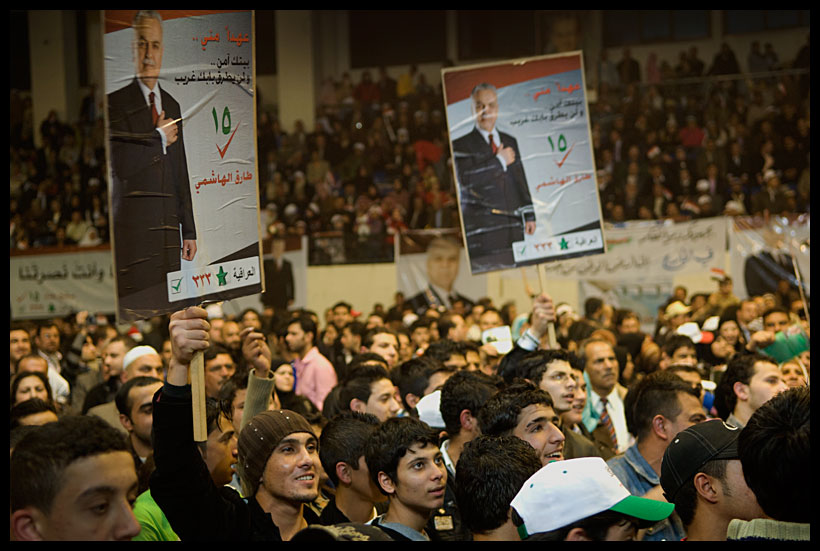
IraqElectionMarch2010_JohnWrefordJohn Wreford was among among the hundreds of Iraqi refugees inside a Damascus sports stadium this evening who listened to Tarek al-Hashemi kick of the election campaign. He sent this photo.

Iraq VP thanks Syria for embracing refugees
Tuesday, March 02, 2010

Iraqi Vice President Tarek Al Hashemi accused powerful decision makers of stalling a major decision to resolve the issue of Iraqi refugees.
Al-Hashemi thanked Syria for its “historic” stand of embracing refugees despite bilateral political rows. Iraqi VP’s statements came in a meeting with Iraqi Community in Damascus. Al Hashemi in Syria coming from Amman, is carrying a message to Syrian President Bashar Al Asad from Iraqi Government about the future of Iraqi-Syrian relations.

Kerry: No imminent flashpoint between Syria and Israel
By HERB KEINON
02/03/2010 05:29

Senator spoke to Assad from Jordan before coming to Israel.

Visiting US Sen. John Kerry tried to put the recent escalation of rhetoric and tensions between Israel and Syria into context Monday, telling a Jerusalem press conference that he did not believe there was a “flashpoint imminent” between Syria and Israel.

Kerry’s comments came shortly after his arrival and meeting with Prime Minister Binyamin Netanyahu.

On Sunday, Kerry was in Amman and, along with meetings with Palestinian Authority President Mahmoud Abbas and Jordan’s King Abdullah II, he spoke by phone with Syrian President Bashar Assad.

“I had a conversation last night with President Assad on a number of different topics, and – needless to say – I raised the issue of the visit of [Iranian President Mahmoud] Ahmadinejad and some comments made there,” said Kerry, who heads the Senate’s Foreign Relations Committee.

“I don’t believe that there is somehow some flashpoint imminent between Syria and Israel, though I am obviously very cognizant of the increased arming of Hizbullah and the types of weapons they have, and I recognize there is an inherent threat to Israel in that,” he said.

Israeli defense officials said that Israel’s primary concern was that Syria would supply Hizbullah with advanced air-defense missile systems such as the SA-8. Israel has in the past warned that it would be prepared to take preemptive action to stop the delivery of these systems to Lebanon.

This concern was reinforced by last week’s terror summit between Iranian President Ahmadinejad, Assad and Hizbullah leader Sheikh Hassan Nasrallah.

“Our assumption is that these three sit together and come up with ways to hit Israel,” one official explained.

In an apparent reference to Assad’s disparaging comments last week during Ahmadinejad’s visit about US Secretary of State Hilary Clinton’s efforts to drive a wedge between Syria and Iran, Kerry said “no one should be surprised, given the relationship of the last years, that discussions are continuing between Syria and Iran.”

The two countries are neighbors, he said, “and they have obviously been pushed somewhat together by the events of the last years. My hope is that we can offer a better alternative, a better set of choices.”

He said that the meetings held in Damascus between Ahmadinejad, Assad, Nasrallah and Hamas’s Khaled Mashaal, “say more of President Ahmadinejad than the intentions of President Assad. We need to keep the door open.”

In a related development, Clinton reportedly passed on a message to Lebanon saying that Washington would not be able to restrain Israel from taking military action if arms smuggling from Syria to Hizbullah was not stopped.

According to the pan-Arabic Al-Hayat published in London, Clinton passed on a letter making this clear to the speaker of the Lebanese parliament, Nabih Berri.

According to the paper, Berri – who received the letter via the US Ambassador to Lebanon Michele Sison – replied that while Lebanon has “no problem” finding a solution to the arms issue, “the US should stop supplying weapons to Israel.”

Likewise, the Qatari newspaper Al-Watan reported on Monday that Clinton has told European colleagues recently that she planned to visit Syria in the near future, a move that she said would come following recent developments in the US-Syrian relationship, specifically the appointment of a new US ambassador to Damascus.

Flynt Leverett and Hillary Mann Leverett visit Assad

A week before Ahmadinejad’s arrival in Damascus, we had our own conversation with President Assad—a conversation that came one day after U.S. Undersecretary of State for Political Affairs William Burns met with the Syrian leader.  In our session with him, Assad expressed satisfaction over his meeting with Undersecretary Burns.  However, Assad also made clear that Syria’s relations with Iran, as well as its ties to Hizballah and HAMAS, are not on the table.

Syria’s relationship with the Islamic Republic seems increasingly strategic in character.  Over the past year, key advisers to President Assad have told us as much; one of them went so far as to describe Syrian-Iranian relations with the French adjective, “intime”.  If the Obama Administration is unable or unwilling to acknowledge this reality and the regional dynamics that have given rise to it, the already limited effectiveness of American diplomacy in the Middle East will be further undermined.  To understand Syria’s increasingly strategic partnership with Iran, a bit of history is in order…..

For Bashar al-Assad, these developments have created both enormous challenges and, over time, new strategic opportunities.  In this context of daunting challenges and emerging opportunities, Syria’s diplomatic calculations have shifted in at least three important ways during Bashar’s presidency; one consequence of these shifting diplomatic calculations has been an ever greater inclination in Damascus to see Syria’s relationship with the Islamic Republic as a unalloyed strategic partnership.

First, Syria’s ties to regional “resistance” forces—including groups like Hizballah and HAMAS that are also closely linked to Iran—have taken on an increasingly strategic character during Bashar’s tenure.  As we have discussed previously, with the removal of Syrian military forces from Lebanon following the Hariri assassination, Hizballah has become an even more valuable asset for Syria.  Similarly, on the Palestinian front, it is hard to imagine that, at this point, Bashar would agree to expel Khalid Mishal from Syria as part of a purely bilateral peace settlement with Israel—as, it would seem, his father had been prepared to do.  (For our assessment of the strategic implications of HAMAS’s rise as a force in Palestinian politics, click here.)

On this point, it is noteworthy that, since late 2008, Bashar has adopted a rhetorical position on Arab-Israeli issues emphasizing the need for a “comprehensive” Arab-Israeli settlement, along the lines indicated in the 2002 Arab League peace initiative, and with HAMAS playing a central role on the Palestinian side.  When we asked him about this evolution in his rhetoric, President Assad said that, if Israel were prepared to conclude a peace treaty with Syria meeting his longstanding requirements (full return of the occupied Golan Heights to the June 4, 1967 line, etc.), he “could not say ‘no’.”  He noted, though, that, while Israel could get a “peace treaty” with Syria, such a settlement would give Israel little more than a “ceasefire” and, perhaps, a heavily guarded embassy in Damascus.  For real “peace”, according to President Assad, Israel will need to negotiate a comprehensive settlement, including on the Palestinian track.

Second, the Islamic Republic has proven its steadfastness to Syria in recent years.  Syria and Iran were the two regional states which argued most vociferously that the United States would face serious difficulties in its occupation of post-Saddam Iraq, and their stance was widely viewed in the region as having been vindicated by events.  More practically, Syria’s ties to Iran were critical in fending off the heavy pressure applied on the Assad regime by the United States, most of Europe, and moderate Arab states in the wake of the Hariri assassination.  As another of Bashar’s advisers said to me recently, it would be hard for Syria to forsake Iran, as Iran, in the period following Hariri’s assassination, had “stood by us when no one else did”.  This should not be interpreted as a sentimental statement.  Rather, it is a statement that, in an uncertain strategic environment, Syria will continue to need the “hedge” provided by its close relationship with the Islamic Republic.

Third, the perceived value in Damascus of strategic realignment with the United States through a carefully conditioned peace deal with Israel is slowly declining as America’s hegemonic standing and influence erode.  Certainly, the Syrian leadership was relieved by President George W. Bush’s departure from office and his replacement by President Obama.  But, with a right-leaning coalition headed by Prime Minister Binyamin Netanyahu in power in Israel, expectations in Damascus for what Syria would see as major improvements in America’s Middle East policy are not high.  And, as President Assad noted to us, poor policy choices in the Middle East by the United States over the last decade have created “vacuums” which “others [Iran and Turkey] filled”.  (In this context, Assad argued that Iran’s evolving regional role does not represent “new ambitions” on Tehran’s part.)  This has expanded Syria’s strategic optionality.  In this context, Assad underscored that the rise of Iran and Turkey to new levels of regional influence has not come at Syria’s expense; rather, all three states have been able to improve their own relations and bolster their regional influence.

This is not to say that Hafiz al-Assad’s preferred strategic option of realignment toward the West through a “principled” peace with Israel does not remain deeply attractive to his son and successor.  But, the longer that Damascus must wait for the United States to deliver on its end of the peace process, the more time that Bashar and his advisers have to internalize what they see as the reality of America’s slow decline.  And that has a palpable effect on the price they are willing to pay for realizing Hafiz al-Assad’s preferred strategic option.

In closing, we would note that we had not had an in-depth meeting with President Assad for five years.  Flynt’s Inheriting Syria—for which he interviewed President Assad—was published in 2005, shortly after the Hariri assassination.  At the time, many U.S. and Western commentators were predicting the downfall of the Assad regime.  We visited Damascus in June 2005, immediately following the withdrawal of Syrian military forces from Lebanon, to observe the Ba’ath Party congress.  We came away from that visit convinced—contra the conventional wisdom in Washington—that the Lebanon withdrawal had been well internalized in Syria, that President Assad was more in control of the Syrian government than he had been before Hariri’s assassination, and that U.S.-French efforts to isolate Syria from regional affairs would ultimately fail.  That assessment has been powerfully validated with the passage of time.  Bashar al-Assad has weathered the storm unleashed in the aftermath of the Hariri assassination and has emerged as a masterful player of the regional game.  It is striking that many of the people who argued in 2005 that the Syrian leadership was internally conflicted and uniquely vulnerable to external pressure are now making the same arguments about the Islamic Republic of Iran. They were wrong then; they are wrong now.

US State Dept. Warns Lebanon It Can’t Stop Israeli Attack:
by Jason Ditz, March 01, 2010

If anyone is interested in why Syria has not signed the Mediterranean Process which would bring it neareror the free trade agreement with Europe, read no further than this report on what has happened with Syria’s trade with Turkey as a result of freeing up cross-border traffic….

Syria’s Trade Deficit with Turkey Doubles as Exports Decline, Thanks to Syria Report

Syria’s trade deficit with Turkey doubled last year to USD 1 billion as Syrian exports halved while Turkish exports continued to increase, Turkish statistics show.

Haaretz

“…The Emirates will now deny entry to anyone suspected of having Israeli citizenship, Tamim said at a security conference in Abu Dhabi Monday.
It was unclear if the measure would apply to Israeli athletes competing in international sports events being held there, such as tennis player Shahar Peer, a recent semifinalist in the local WTA tennis tournament…..

“Mossad shouldn’t come to us. We haven’t done anything to Israel. This is an insult to us, to Britain, to Australia, to Germany and to New Zealand and it’s shameful,” Tamim told reporters in Dubai, a member of the United Arab Emirates…”

Haaretz: Iran, Syria may talk a big talk, but too scared to act
2010-03-02

The banquet at Syrian President Bashar Assad’s palace last weekend was held in the best tradition of Western state dinners, complete with white silk tablecloth, name cards at every place setting, fine china, pure …

“Syrian source: Assad-Ahmadinezhad meeting surprised Washington…
by Kamel Sakr, March 2, Al-Quds al-Arabi (thanks to Mideastwire.com)

No sooner had Iranian President Mahmoud Ahmadinezhad returned to Tehran after a “war” visit to Damascus during which he met with Syrian President Bashar al-Assad and the figures of the resistance represented by Hezbollah leader Hassan Nasrallah and the leaders of the Islamic Jihad and the Popular Front, that another meeting was being held between Iranian Revolution Guide Ayatollah Ali Khamenei and one of the leaders of the ruling Ba’th Party in Syria and member of the local command Haytham Satayhi. A prominent Syrian source commented by saying to Al-Quds al-Arabi that this meeting corroborated the message which was announced in Damascus following the Assad-Ahmadinezhad meeting and then the Ahmadinezhad-Nasrallah meeting in the presence of Al-Assad.

“According to the information, Damascus may have failed to find hope in seeing Obama’s administration pushing Israel toward the adoption of any step on the Syrian-Israeli peace track and was growing tired after over a year of stalemate. The Syrian source added that what was mostly important for Syria was for Washington to force Tel Aviv into accepting the resumption of the indirect peace talks from the point where they had stopped in Ankara and under Turkish sponsorship before the eruption of the Gaza war in 2008. He continued: “Any other American step, regardless of its importance, will fall behind this priority for Damascus, including the reappointment of the American ambassador, the lifting of the level of political relations and the annulment of the economic sanctions imposed on Damascus by Washington…

“On the other hand, the Syrian source stated that the Assad-Ahmadinezhad meeting was not a political maneuver as much as it was a clear Syrian message saying that the relations with Iran were a “red line” that could not be the object of any compromise, denying at the same time that Syria turned its back on Obama’s administration. The Syrian source then bet that the American contacts toward Syria will intensify during the upcoming stage which will witness additional gestures of good intention, assuring that what recently happened in Damascus (Ahmadinezhad’s visit and the tripartite meeting) surprised the American diplomacy which did not expect the Syrian response to be that clear and that fast, and raised its political appetite toward Damascus.

“The source continued: “Damascus wanted to put an end to the American hope of seeing Damascus distancing itself from Tehran, in order to focus the awaited efforts from Obama’s administration on the peace and bilateral relations dossiers…”” – Al-Quds al-Arabi, United Kingdom

The Hariri Trial and Comments on Articles about the Hariri Case and the STL
by T_Desco

  1. Bellemare und die Bombe von Beirut
    Markus Bickel, F.A.Z.., 12. Februar 2010
  2. “Cinq ans après la mort de Rafic Hariri, le Tribunal pour le Liban n’a toujours pas rassemblé de preuves décisives”,
    Stéphanie Maupas, Le Monde , 13.02.10

If you watched Sayyed Hassan Nasrallah’s speech, you will remember that he described the Le Monde article as ‘psychological warfare’.

Both articles are similar to a degree that they seem to be following the same talking points:

– both quote the Spiegel article;

– both claim that the Spiegel allegations are (in essence) true;

– both cite unnamed investigators as sources for these claims; in addition, the F.A.Z. says it got confirmation directly from the STL and apparently also from Serge Brammertz;

– both say that the STL does not have sufficient judicial evidence (surprise, surprise);

– both still point the finger at Syria, but Iran is now mentioned as well;

– both contain attacks on Bellemare.

Frankly, I don’t think that Serge Brammertz confirmed anything at all. He was so careful in all his reports, why would he now ‘spill the beans’ to some reporter? And if you look at the actual quotes, they are ‘pure Brammertz’, typical abstract generalities very similar to what he said in his reports. But they are cited in a way that seems to suggest that he is confirming the Spiegel allegations.

However, an unnamed high-ranking former investigator who worked under Brammertz does confirm at least some those allegations: “The Spiegel article was certainly not entirely wrong”.

“Ein ranghoher früherer Ermittler, der zu Brammertz’ Beiruter Zeit mit dem Fall befasst war, bestätigt die Verdachtsmomente gegen die Hizbullah: „Der Artikel im ‘Spiegel‘ war sicherlich nicht ganz falsch.“”

Le Monde also quotes an anonymous investigator to back up the Spiegel allegations:

“”Qui est la taupe ?”, s’interrogeait alors un chercheur proche de l’enquête.”

Perhaps most importantly, the F.A.Z. claims, without naming the source, that it obtained confirmation directly from the STL that members of Hizbullah “could” be indicted (literally: “the prosecution could have its sights on members of Hizbullah”):

“Denn wie die Frankfurter Allgemeine Zeitung aus dem (…) Tribunal erfuhr, könnten Mitglieder der schiitischen Hizbullah ins Visier einer Anklage geraten.”

The article is silent about a possible motive, but does conspicuously mention Resolution 1559. Hizbullah’s links to Iran are also stressed, apparently to suggest the involvement of Teheran.

However, both articles agree that the judicial evidence is insufficient:

-“Hinzu kommt, dass es genügend gerichtsverwertbare Beweise gegen die Verdächtigen aus Kreisen der Hizbullah bislang offenbar nicht gibt”;
– “le Tribunal pour le Liban n’a pas rassemblé de preuves décisives”, “l’analyse ne suffit pas à monter un dossier judiciaire”.

It is interesting that both articles also contain attacks on Bellemare. This could be interpreted as an attempt to influence and put pressure on the Canadian regarding the timing of his next steps, be it either an indictment or just summons orders (as Michael Young suggested).

Even mere summons would indicate to the public in Lebanon in which direction the investigation is being taken, so they could potentially be used to great political effect (a fact missed by Michael Young).

The F.A.Z. indicates that the “donor nations” are getting impatient with Bellemare because of the delay in issuing the indictment:

“Länger als bis Ende dieses Jahres kann sich Bellemare mit der Erhebung der Anklage kaum Zeit lassen – schon heute wächst die Ungeduld der Geberstaaten, die nicht bereit sind, weiter Geld in ein Tribunal ohne Angeklagte zu stecken.”

Even more telling are the comments by a French government source in Le Monde:

“Mais la discrétion du procureur Bellemare agace néanmoins les diplomates “qui essayent de lui tendre des pièges, mais il reste muet sur l’enquête”, raconte une source proche du Quai d’Orsay. “Il est très prétentieux dans ses rapports avec les autres, notamment les autorités nationales et les services étrangers, et donc peu populaire. Il se sent surpuissant mais ne comprend pas bien les finesses du dossier. Il veut adapter des méthodes d’enquête traditionnelles canadiennes à une enquête politique sur un territoire qu’il ne contrôle et ne comprend pas”, regrette un enquêteur.”

As an aside, it would be absolutely unthinkable, say, in social sciences to have a researcher who does understand neither the “finesses du dossier” nor the country he is investigating, but apparently in matters of international justice this is acceptable…

Add to this investigators sporting a world view not dissimilar to that of Michael Young and you got a recipe for disaster:

“”Si on estime que c’est le Hezbollah, on peut assumer qu’il n’aurait jamais fait cela sans l’aval de la Syrie, et éventuellement l’aide de l’Iran”, affirme une source au sein de l’enquête.”

The many leaks just in these two articles, in disregard of official policy, do not exactly inspire confidence in the professionalism and neutrality of the investigation:

– “wie die Frankfurter Allgemeine Zeitung aus dem (…) Tribunal erfuhr”, “ein ranghoher früherer Ermittler, der zu Brammertz’ Beiruter Zeit mit dem Fall befasst war”, “heißt es in Beirut, wo das Tribunal ein Büro unterhält”;
– “selon certaines sources”, “un chercheur proche de l’enquête”, “plusieurs sources”, “une source au in de l’enquête”, “un autre enquêteur”, “une source proche du Quai d’Orsay”, “un enquêteur”.

It seems that I was way too optimistic in the past about the possibility of international justice. Of course, there is no moral foreign policy, countries simply pursue their interests and these can only occasionally coincide with the truth. Events are primarily seen from the angle of how to make political hay out of them. The UN investigation was probably very useful in that regard (e.g. the intelligence resulting from the analysis of all telecommunication data in Lebanon that was handed over to the commission). And the temptation is certainly there to use the STL against Hizbullah and Iran.

Of course, the possibility that both articles are just ‘psychological warfare’ cannot be discarded, but even that has significant consequences. It means that either both Le Monde and the F.A.Z, (and also Le Figaro‘s Georges Malbrunot) are lying about their sources, or, even worse, that manipulation sits right at the heart of the UN investigation and the STL.

Clinton to Damascus?

Jerusalem Post: Clinton says she may visit Syria
2010-03-01

US Secretary of State Hillary Rodham Clinton said she may visit Syria soon, but did not name a date, Israel Radio reported. Clinton made the comment while speaking to reporters in Qatar, the station said.

Iraqi PM says relations with Syria improving
2010-02-28, BBC MidEast: Text of report in English by privately-owned Aswat al-Iraq news agency website

“Maliki To Aswat Al-Iraq: Iraqi-Syrian Relations Are Getting Better”

Baghdad, 28 February: Iraqi Prime Minister Nuri al-Maliki on Sunday [28 February] said that Iraqi-Syrian ties are getting better.

“The climate of relations between Iraq and Syria is improving,” Al-Maliki told Aswat al-Iraq news agency, adding that the better the relations between the two countries, the lesser the need for international courts.

The Iraqi government had called on the United Nations Security Council to establish an international court and probe into a series of bombings that rocked Baghdad and left many people killed or wounded in August 2009, urging the Syrian government to hand over Ba’thist leaders who were allegedly involved in the attacks. (Originally published by Aswat al-Iraq, Arbil, in English 0943 28 Feb 10.)

Jeffery Feltman and Ambassador Imad Moustapha meet over weekend
By JPOST.COM STAFF
28/02/2010

US Assistant Secretary of State Jeffery Feltman met with Syrian Ambassador to the US Imad Mustafa over the weekend, the London-based Arab daily al-Hayat reported on Sunday.

According to the report, a senior State Department official refused to provide information about the content of the meeting but said it was part of ongoing American efforts to strengthen ties with Damascus. He added that the meeting had nothing to do with Syrian President Bashar Assad’s mocking response to USSecretary of State Hillary Clinton’s demand that Syria distance itself from Iran.

YNETnews: Nabih Berri to US: “US must also stop arming Israel with weapons and equipment…”

“… London-based al-Hayat newspaper reported on Monday that the message was conveyed via US Ambassador to Lebanon Michele Sison to Lebanese Parliament Speaker Nabih Berri.

According to the report, Berri asked Sison to tell Clinton that finding a solution to the arms smuggling issue is “not a problem”, but that the US must also stop arming Israel with weapons and equipment…”

Haaretz: As the West woos Syria, Assad aligns himself with Iran
2010-03-01, By Avi Issacharoff

There is something provocative in Syria’s behavior over the last few weeks. … And in terms of intimacy with Hezbollah, Syrian President Bashar Assad is outdoing even his father. Hafez Assad always remained wary of the Lebanese group and in the 1990s even dispatched forces to Lebanon to fight it. Bashar, in contrast, has supplied Hezbollah with weapons more deadly than any it had in the past – weapons which threaten to ignite the entire region.

It is true that overtures from the West could keep Syria from giving itself wholly to Iran. And persuading Syria to negotiate with Israel could even significantly weaken its axis with Tehran and might neutralize the threat of regional war. But with the Damascus summit, Assad is signaling unease over American and French attempts to woo him and, moreover, that he has no interest in reopening talks with Israel. Ahmadinejad has been to Damascus before, of course, and Bashar has visited Tehran. But the presence this time of Hamas and Hezbollah hints at more than the usual show of deterrence to Israel and the West….

Hamas’ growing loyalty to Iran is worrying. Until just a few years ago, before the assassination of Sheikh Ahmed Yassin, Palestinians were on the whole suspicious of the Iranians and the group tried to keep its links with Tehran inconspicuous.

But power in Hamas has since shifted from the West Bank and Gaza to the organization’s political leadership in Damascus. The now dominant Syrian branch has crept gradually closer to Iran and Hamas policy has hardened accordingly.

Saudi writer says Syria’s quest for peace contradicts ties with Iran
2010-02-28 BBC MidEast: Al-Sharq al-Awsat website on 27 February [Commentary by Chief Editor Tariq al-Humayd: “Syria And Iran … Who is Deceiving Whom?”]

At a time when US Secretary of State Hillary Clinton said that her country requested the Syrians to distance themselves from Iran, Syrian President Bashar al-Asad received hospitably his Iranian counterpart in Damascus. And both leaders marked together Prophet Muhammad’s birthday and signed an agreement canceling entry visas between the two countries. Was this development a challenge to the United States, or was it merely intended to publicly embarrass the United States in response to Clinton’s embarrassment of Damascus, particularly because President Al-Asad’s comment on Clinton’s statement was clearly
sarcastic. He said: “We met today to sign an alienation agreement,” and he added laughing: “But since we have misunderstood things, perhaps due to mistranslation or limited understanding, we signed an agreement to cancel entry visas between the two countries. I do not know if the two things go together.” He added: “I wish that others would not give us lessons about our region and history; we decide how things go.”

This is a strong and harsh statement. But if Damascus is the one that decides how things go, and sees that its interest lies in cementing ties with Tehran, why is Syria openly calling on the Americans to intercede in the negotiations with Israel? After all, Syrian Foreign Minister Walid al-Mu’allim recently stated that “normalizing US-Syrian relations is extremely important to lay the groundwork for helping reach direct negotiations with Israel one day.”

If Damascus agrees with Ahmadinezhad, who likened Hillary Clinton to a mother of a bride – though we do not know who the bridegroom is – that “the Zionist entity is headed to its demise” and that “all regional peoples, foremost of whom are, Syria, Lebanon, Iran and Iraq, will stand up to Israel,” why does Syria cooperate in security matters with the Americans? Washington has admitted that the number of foreign fighters heading for Iraq from Syria has decreased. And since Damascus and Baghdad are partners, why is this sharp dispute between the two capitals? If Syria is a partner of Tehran, how can one understand
Syrian Foreign Minister Al-Mu’allim’s statement on international concern about Iran’s nuclear dossier? Al-Mu’allim said that Syria seeks “to work for a constructive dialogue between Iran and the West leading to a peaceful solution” based on two principles: “Iran’s right to use nuclear energy for peaceful purposes and regional countries’ confidence that Iran has no military nuclear programme.” This statement does not indicate that Syria stands with Iran!

This situation is quite perplexing. If the Syrians want to have normal relations with the United States and want the United States to sponsor mediation efforts with Israel, why do they stand with Ahmadinezhad and agree with him that Israel should be wiped out? How does Ahmadinezhad trust Syria as a partner since Damascus talks of peace with Israel? If Syria’s negotiations with the Israelis are acceptable to Iran, why does Tehran brand others [who negotiate with Israel] as traitors?

On the Arab level, there has been no comment on Al-Asad- Ahmadinezhad meeting in Damascus, but as far as the United States is concerned, my
sources in Washington say that Ahmadinezhad’s statement demonstrates the extent of the Iranians’ tension and concern over US Under Secretary of State William Burns’s visit to Syria as part of a tour that also took him to Lebanon and Turkey. According to available information, Burns’ visit was for the purpose of garnering support for a resolution imposing sanctions on Iran. The Americans believe that Al-Asad’s statement was intended to ease the Iranians’ concern about Burns’ visit and about the forthcoming arrival in Damascus of the US ambassador.

The question is this: Who is deceiving whom? This is because there is something not right in Damascus’s relations with Tehran. Raising voices betrays the fact that one party is tense and that the other shows the opposite of what it conceals. So let us wait and see. (Originally published by Al-Sharq al-Awsat website, London, in Arabic 27 Feb 10.)

Israelis suspected of using Australian passports to spy on Iran, Syria and Lebanon, report says
2010-02-28, LA Times [Reg]: MIDDLE EAST:

A stunning report in this weekend’s Sydney Morning Herald alleges that Australian counterintelligence officials are investigating at least three Israeli citizens suspected of using Australian passports to spy in the Middle East. According to two …

Can the US afford not to help in the Dubai murder investigation?
War in context: 28 Feb 2010

On Thursday, the US State Department spokesmen P J Crowley was called on to break the US silence regarding the murder of Mahmoud al-Mahbouh: QUESTION: …has there been any comment on the apparent assassination in Dubai? Is that something the U.S. has weighed in on? MR. CROWLEY: I don’t think we’ve weighed in on it. It is […]

Moshe Dayan’s widow Ruth, in Haaretz (Thanks to FLC)

(…)And we expelled?

We didn’t expel. During my childhood, we didn’t expel. We bought those tracts of land. Since then, however, many things have happened and today Israel is not the same. It’s cliche to talk about how we’re in a state of occupation and we’re trying to occupy more and more. I’m at that age where I don’t even talk about peace anymore. We don’t know how to make peace. We go from war to war and this will never end.

Whose fault is it?
Ours, mainly. Are we, with all our power, incapable of taking a step?

Have you lost hope for peace?
I think Zionism has finished its work. I’ve endured many wars and I can’t ignore the fact that they didn’t want us. When I go to the territories, I don’t even bother instilling hope in them. Out of courtesy, I tell them that I hope something will change, but the deterioration is just awful. Particularly the fence. This is something I can’t tolerate.

People say it stopped terrorism.
Oh, please. “It stopped terrorism.” Nothing will be able to stop terrorism except dialogue.

Are you Jewish?
I’m just an Israeli. It was a great honor to be Israeli, even when I was still a Jewish Palestinian during my childhood in London. I’m the first daughter of graduates of the Herzliya Gymnasium after Yehudi Menuhin was the first son. In London, I went to pray with the gentile girls.

Two states or one?
There was a time when I thought one state for two peoples. Now I see that we have to have two states because we really are different and it would be best if everyone takes care of his own business. We’re a mob that can’t even get along internally. So we’re going to get along with them?

What would you do if you were prime minister?

Just like how we started. Like when we met with [Jordanian King] Abdullah and when [Yitzhak] Rabin tried. Rabin could have delivered peace. (…)

39 army raids, 28 arrests: Just another day in the West Bank
By Amira Hass
HAARETZ

“The year 2009 was the quietest for Israelis from the security point of view and the most violent for the Palestinians from the point of view of attacks by settlers in the West Bank.” Just as he was saying this – as an example of one of the absurdities that characterize the political situation – Palestinian Agriculture Minister Ismail Daiq received a phone call from the Jenin district to inform him that five artesian wells in the village of Daan had been destroyed that morning. One person was shot and wounded in the abdomen when he tried to lift the pump to save it from damage. This was not an attack by settlers but a raid by the army.

And that wasn’t the only routine event on Wednesday, February 24. The negotiations affairs department of the Palestine Liberation Organization collects information daily from all the districts of the occupied territories (Gaza and the West Bank, as well as Jerusalem) and publishes it in a daily situation report by the Palestinian Monitoring Group. For the sake of convenience, the report categorizes the events and then provides details for each district.

That Wednesday, a total of 212 occupation-related incidents were recorded. Examples include: four physical assaults (which took place in the West Bank, and included civilians being beaten in Nablus and Jerusalem); one injury (a civilian hurt in a clash in Daan); eight military shooting attacks (two of which took place in Gaza, two were in the midst of raids, and one came from a military outpost; 39 army raids (one in Gaza); 28 arrests; and 12 detentions at checkpoints and in residential areas. The items on the checklist include home demolition (none that day), the leveling of agricultural land (one, in Gaza), and construction of the separation wall (at 22 locations). ……

Reactions to the Assad-Ahmadinejad Summit

Syrian-Iranian-Hezbollah meeting new front against USA, Israel
BBC MidEast: 2010-02-27 tanslation of
“‘Council of War’ in Damascus”
by Chief Editor Abd-al-Bari Atwan, Al-Quds al- Arabi 27 February Article

The tripartite meeting held in Damascus the day before yesterday between Syrian President Bashar al-Asad and his Iranian guest President Mahmud Ahmadinezhad in addition to “Hezbollah” leader Hasan Nasrallah was tantamount to a “council of war” to draw up future plans and distribute roles in case of any Israeli attack on any of the three parties or all of them. We do not forget an expanded meeting between Ahmadinezhad and leaders of the Palestinian factions within the same framework.

The timing of this meeting, the way it was held, and the press conference held at its conclusion confirm that a strategic alliance’s bonds are being tightened and a new front is being formed that will be the spearhead against the US-Israeli alliance and any of the Arab governments that might join it, covertly or overtly, if war broke out. The Iranian president expected this war to break out this coming spring or summer, that is, after very few months, while Nasrallah
stressed he would strike Tel Aviv, its airports, and electricity stations if Israel dared to strike Lebanon’s airport or any of its electricity stations and vital targets.

We have here a new language, unprecedented self-confidence, and readiness to retaliate which we have not heard before, especially from the Arab regimes, from when they turned towards the peace option, dropped all other ones, and underlined this turning in an Arab peace initiative whose provisions were prepared carefully in the US kitchen by expert chefs….

Syria was for 30 years a major side in the Egyptian-Saudi troika which ruled the region for 30 years and wagered on peace. What has Washington offered it in return for “its moderation?” Has it returned the Golan Heights to it, unleashed its billions to end up in investments that create jobs and a dignified life for the unemployed, or is it still on the list of terrorist countries?

There is no direct air flights between Damascus and any American city and we have not even seen a single American plane landing at Damascus Airport for 50 years even though Syria opposed Iraqi President Saddam Husayn’s regime, took part directly in the “liberation” of Kuwait, and cooperated fully in the war on terror and continues to do so.

We are facing quickening developments in the region. When did we see Nasrallah arriving openly in Damascus and when did we see Ahmadinezhad praying in a Sunni mosque and behind a Sunni imam and reacting emotionally when Al-Alam television channel’s correspondent tried to provoke him by asking him about this matter!

Some might argue that it was a carefully-prepared media step for the purpose of getting closer to the Sunni community. This might be the case and what is wrong with it? We are all Muslims and the Kingdom of Saudi Arabia -a leading country in the moderation axis which is opposed to Iran -launched through its King Abdallah Bin- Abd-al-Aziz two important initiatives during the past two years, the first by opening dialogues in depth for bringing the Islamic doctrines closer, in particular the Sunni and Shi’i ones, and the second was the launch of the interfaith dialogue between followers of the three divine
religions…..

We understand very well that the new Syrian-Iranian alliance does not possess nuclear warheads or the sophisticated weapons that Israel and the United States possess. In other words, the military balance is unequal. But was this not the situation when Israel sent its warplanes and tanks to invade south Lebanon in the summer of 2006? What was the result?

The US-Israeli strike force is mighty by all standards and this is indisputable. But we must remember that Japan remained Japan even though two atomic bombs were dropped on Nagasaki and Hiroshima, Germany was reunited 50 years after being partitioned, and Syria and Egypt survived after the 1967 defeat. But the question is whether Israel will remain in existence if it embarks on new aggression and even if it survives, will it be as it is now?

Israel is in a suffocating crisis, internally and externally, and is hated even in the circles of its Western allies who are fed up with its arrogance, swaggering, repeated aggression against the weak in Gaza and elsewhere, and its provocative rejection of all peace plans and proposals and is therefore in a state of confusion that was clearly manifested by its dispatch of a “regiment” of agents to assassinate a single unarmed person called Mahmud al-Mabhuh in Dubai
and which was totally counterproductive for it despite its success.

The Israelis are beating the drums of war and the Obama administration seems to be incapable of keeping it under control and has probably became more convinced of their theory about the inevitability of launching an aggression against Iran and Syria. ….

We do not believe it was a “slip of the tongue” when Ahmadinezhad said at the press conference with President Al-Asad that the peoples of Syria, Iran, Lebanon, Palestine… and Iraq” would confront Israel and its aggression. Has Washington heard this “slip” which confirms the failure of its aggression against Iraq and its spending of more than $800 billion on it!

The coming days are going to be full of surprises and we are hoping that they will be good news for us Arabs and Muslims.

Originally published by Al-Quds al-Arabi website, London, in Arabic 27 Feb 10.

A Syrian in the Emirates writes:

It’s not just Atwan who is happy with the Assad-Ahmadinejad summit. Almost everyone in this part of the world is jubilant (other than Saudi media who are still waiting for the official reaction to follow). You have to see the commentary in Arab newspapers or your average shisha-smoking man in the street. The underlying message in all commentaries is: finally, someone with real balls standing up to Israel, and its cronies in DC (AIPAC, the senate, etc.)

Here is a taste of reaction in right-wing land; from the comment section of Gateway Pundit

One cruise missile and we could have saved a lot of blood and treasure.

Dial-in the coordinates Bibi, save us all a lot of trouble

This would have been a great opportunity to use our super top secret earthquake machine that Chavez claimed we tested recently on Haiti.

Would somebody kindly tell me how that building remained standing ? That’s the kind of get-together worth starting a war over.

Mossad agents need to change tactics to kill Nasrallah. If they use some 28 or more to kill one arms dealer. He may have been a trial run but Mossad will get him sooner or later.

Where is a Predator strike when you need one……?

Haaretz: ‘Israel pressing U.S. not to send new envoy to Syria’
2010-02-27

Israel is urging the United States to freeze its decision to send a new envoy to Syria, in the wake of this week’s tripartite meeting between Iranian President Mahmoud Ahmadinejad, Syrian President Bashar Assad and Hezbollah leader Hassan Nasrallah, according to a report Saturday in London-based Arabic daily A-Sharq Al-Awsat.

According to the report, Defense Minister Ehud Barak and an aide to Prime Minister Benjamin Netanyahu both made the request during meetings with U.S. officials in Washington this week.

The report added that Israeli officials made the request after witnessing Assad’s public defiance of U.S. calls to curb its ties with Iran this week. Assad said his long-standing alliance with Tehran remains strong despite overtures from Washington intended to shift his loyalties. With Ahmadinejad by his side, Assad told America not to dictate relationships in the Middle East.

Asharq al awsat carries the same news: Barak and Netanyahu try to convince Washington to rescind the decision to return an ambassador to Damascus and push for war.

“… According to the Saudi princely pulpit, Ehud Barak and an adviser to Benjamin Netanyahu made the request in meetings in Washington this week…”

Politico on Ehud Barak says US and Israel wide apart on how to deal with Iran

“………… But the most interesting moment of Barak’s address to the friendly Washington audience with lots of familiar faces for him came when Barak finished his overview. And the Institute’s executive director Rob Satloff, in the typical format of such events, asked Barak a first question to get the discussion going before turning to the audience for questions………. Satloff asked Barak about how well he thought U.S. and Israel were coordinating on the Iran issue.

Barak listened to Satloff’s question and then said, ‘Let’s take a few more questions and I will answer them in a bunch.’ And Satloff, the event host and moderator, laughed and said, ‘Well, answer that opening question and then I can call on members of the audience and take several questions’ in a bunch. And Barak smiled, acknowledging the laughter, and then said, again, “Let’s take a few more questions.” Until it became quite clear that he did not want to answer Satloff’s question about the state of U.S.-Israel relations on Iran, and this was not based on a misunderstanding of the format procedure….

Asked by a Middle Eastern correspondent, why Israel couldn’t live with a nuclear Iran, Barak said Israel welcomed U.S. leadership in seeking international sanctions on Iran. But he added, that with all the instability the U.S. is currently managing including a nuclear Pakistan and North Korea, Afghanistan, draw down in Iraq, etc. it was his impression that Washington believes that while it’s highly undesirable, at the end of the day the U.S. could live with a nuclear Iran. While for Israel, Barak said, it would be a “tipping point” in the strategic equation in the region…. some in the U.S. see a world with a “nuclear Pakistan, India, North Korea….From this corner of the world (Washington), [perhaps] it doesn’t change the equation” if Iran goes nuclear. ….

For his part, Barak also said he thought Iranian leaders’ decisionmaking is quite sophisticated, and he thought it highly unlikely that they would lob a nuclear weapon at Israel. And he said he thought that neither a nuclear Iran, nor anything else, poses a threat to the continuity of Israel’s existence.”

Ehud Barak on Syria
Speaking at WINEP
, Minister of Defense State of Israel
Friday, February 26, 2010

….. I cannot ignore the issue of Syria. It’s not a secret that in Israel, both myself as defense minister in the past and now, as well as the Israel defense establishment on all its levels, believe that we have – in the Middle East – have strategic interest in putting an end to our conflict with Syria. We have been in negotiations in this city and in the  other places regarding to this issue under Rabin and during Peres’ government, Netanyahu previous government, my government and Olmert’s government.

And all of us know what is on the table. All of us know what kind of decisions are needed to be taken by both sides. All of us are realistic about what could be achieved and what probably cannot be achieved at the very first moment. And I insist that this is an opportunity more than a threat if navigated cleverly keeping the dignity of the other side on all stages. Having said that, I can tell you that we are strong enough to face a deterioration if it happens on our northern front, but we are not interested in it; we will not initiate it; and I don’t believe that anyone in the region – in the immediate neighborhood of Israel – really needs it.

We follow carefully what happens in Lebanon and I think that the time has come to deal with it in a much more straight and real manner. The essence of 1701 – the U.N. Security Council resolution following the last war in the north in 2006 – was to put an end to this anomality (ph) of the existence of Hezbollah in Lebanon. And instead of solving the problem, it just allowed it to become more complicated. There is a bizarre anomaly there. Lebanon is a member state of the United Nations. It happens to have a militia. The militia happen to have members in parliament, even ministers in the cabinet with a veto power over the decision of the Lebanese government.

Now, it is supported and equipped by two other member states of the United Nations, Syria and Iran, technologically and with equipment. And many civil servants in uniform and without uniform of both member states of the United Nations are serving in Lebanon within the chain of command of Hezbollah and giving orders stemming out of the interests not of the Lebanese people but of other players. And it happens to be that this militia doesn’t just develop a new long bow or more effective arrows, but it happened to have 45,000 rockets and missiles that happen to cover all Israel and they are part of a deployment that tells that they will activate it and we have seen that they already did it in the past. This militia happens to have a weapons system that some – many sovereigns do not have.

We cannot accept it. We cannot accept these artificial differentiations between the terrorists of Hezbollah and the state of Lebanon and their sponsors. And we keep saying, we do not need any conflict there; we will not lead it towards one. But if attacked, we will not run or chase any individual Hezbollah terrorist – and they are in fact building and digging within the urban concentration, inside the cities, inside the civilian population and these weapons that they have mainly cannot be used against any military target. They are not accurate enough – the only conceivable use of most of those weapons is against civilian populations in heavily urban concentration and that’s what they tried to do in the past. So we make it clear: We don’t need this conflict but if it is imposed upon us, we will not run after every individual terrorist but we will take both the Lebanese government and other sources of sponsorship, but mainly the Lebanese government and the Lebanese infrastructure as part of the equation facing us.

China accuses US of online warfare in Iran
Iran election unrest an example of US ‘naked political scheming’ behind free speech facade, says Communist party editorial
Tania Branigan in Beijing and agencies

The United States used “online warfare” to stir up unrest in Iran after last year’s elections, the Chinese Communist party newspaper claimed today, hitting back at Hillary Clinton’s speech last week about internet freedom.

An editorial in the People’s Daily accused the US of launching a “hacker brigade” and said it had used social media such as Twitter to spread rumours and create trouble.

“Behind what America calls free speech is naked political scheming. How did the unrest after the Iranian election come about?” said the editorial, signed by Wang Xiaoyang. “It was because online warfare launched by America, via YouTube video and Twitter microblogging, spread rumours, created splits, stirred up and sowed discord between the followers of conservative reformist factions.”……..

Here’s Sami Moubayed on the question of “Who Wants War in Lebanon?”

“Syria does not want war either, but top officials have said that they will support Lebanon if it comes to it. The Saudis feel the same way. Iran, however, would not mind another war in Lebanon. There are certain radicals within Iran who are not pleased about the so-called ‘Lebanonisation’ of Hezbollah. The party, they believe, is becoming overly immersed in Lebanese domestic issues, pursing more of a political programme than a military one — a programme very different from the one formulated by Hezbollah’s founding charter in 1982. They are itching for another war, to remind the world what Hezbollah is really all about. They are seemingly very convinced that Hezbollah can strike back at Israel, surviving a war just as it did the one in 2006, inflicting maximal damage on Israeli cities and infrastructure. These people believe Hezbollah would do sufficiently well that the international community would think twice before pushing for another confrontation with the organisation or, at a later stage, with Iran itself.

Others, however, are more sceptical, fearing that if Israel lives up to its threats, striking at all of Lebanon and not just the Shiite south, then this would create a very unfavourable environment for Hezbollah within Lebanese society, at least among Sunnis, Maronites and Druze.”</blockquote

Ayman Abdalnour who puts together the invaluable Website and newsource all4syria has inaugurated a new service for people interested in Syria. He writes:

We have started to publish a weekly report about Syria in English ( please check this out)

Josh Ruebner: U.S. Can’t Afford Military Aid to Israel

In his recent State of the Union address, President Obama pledged to “go through the budget line by line to eliminate programs that we can’t afford and don’t work.” One week later, he sent his FY2011 budget request to Congress, which included a record-breaking $3 billion in military aid to Israel.
This requested increase in U.S. weapons to Israel — part of a ten-year $30 billion agreement signed between the two countries in 2007 — qualifies on both counts as a program that the United States can’t afford and that doesn’t work in establishing a just and lasting peace between Israelis and Palestinians.
Data published recently by the US Campaign to End the Israeli Occupation shows that U.S. military aid to Israel comes at a financial and moral price that this country cannot afford to pay. Its website reveals that this same $3 billion earmark for Israel could be used instead to provide more than 364,000 low-income households with affordable housing vouchers, or to retrain 498,000 workers for green jobs, or to provide early reading programs to 887,000 at-risk students, or to provide access to primary health care services for more than 24 million uninsured Americans.

If U.S. weapons were going to Israel for a good purpose, then perhaps a coherent guns versus butter debate would be appropriate. However, Israel repeatedly misuses U.S. weapons to commit grave human rights abuses against Palestinians who are forced to live under its illegal 42-year military occupation of the West

New York Post: Syria bites Bam’s open hand (again)

How many times does the Obama ad ministration have to get bitten before it stops leading with an “open hand”? Hillary Clinton this week called on Syrian President Bashar Assad to respond to recent US overtures by distancing his country from Iran. …

Commentary: RE: Must We Waste Another Year?
2010-02-26

A route to resolution for Syria and Israel
Gabrielle Rifkind in the Guardian, Friday 26 February 2010

Any agreement between Israel and Syria depends on Turkey and the US to mediate the process

The diplomatic crisis following allegations that the Mossad assassinated Mahmoud al-Mabhouh in Dubai has come on top of what looks like ongoing deadlock in the two-state talks between Israelis and Palestinians. But the hysteria of conflict and the ensuing dramas tend to have more appeal than the careful steps of conflict resolution.

When it comes to Israel and its regional neighbours, bellicose language often drowns out peacemaking in a conflict that so often looks intractable. But a potential opening on the Israel-Syria track deserves attention because it could offer movement in a process that suffers from fatigue and cynicism.

The recent furore over potential Syrian-Israeli negotiations revealed both the extent of mistrust and the danger of misunderstanding between two veteran foes. The rhetorical battle flared up when Ehud Barak, Israel’s defence minister, declared that it was vital to resume peace talks with the Syrians because otherwise a war was likely to break out. His remarks were interpreted in ­Damascus as a threat to pursue war.

Shortly afterwards Barak said: “This is a tough neighbourhood and there is no compassion for the weak.” Behind the statement was the belief that if words were used like bullets the enemy would come to the table more likely to escalate the conflict.

The belief that only the tough can win is common in a region where politics are all too often redolent of macho posturing. The model is that only an iron fist will bring security, and no calculation is made about the traumatic consequences of war. Addressing the legitimate grievances of the conflict is too readily dismissed as weakness – and in any case remains impossible if no one listens to what the other side is saying.

Walid Muallem, Syria’s foreign minister, reveals a very different approach to the revival of peace talks. In a meeting with myself and colleagues in December last year, he said: “For peacemaking, Israel needs to be ready to recognise that Syria is entitled to every inch of the Golan, but we wish to engage in talks.” “For us,” he continued, “the land is sacred and a matter of honour.”

Muallem suggested that Syria was prepared to contemplate a step-by-step approach to the return of the Golan Heights, territory that Israel captured in the 1967 war. “There could be stages of withdrawal, the timing of which could involve a form of normalisation,” he said. “Half of the Golan could lead to an end of enmity; three-quarters of the Golan, to a special interest section in the US embassy in Damascus: a full withdrawal would allow a Syrian embassy in Israel.” Key issues, such as Syria’s support for Hamas, Hezbollah and its policy to Iran, would, he said, “only be answered after withdrawal”.

In terms of third-party mediation the Syrians are in favour of indirect talks through Turkey, which has already worked on defining the 1967 border. This unresolved issue is the demarcation of the line on the water between Syria and Israel, and ­determining who controls the shoreline on Lake Tiberias.

The next stage, said Muallem, “would entail direct talks with America to address the security concerns. The key issue here is US flights over the Golan in order to provide security.”

In Syria’s view, Turkey plays the role of an honest broker. But relations between Israel and Turkey plummeted after last year’s war in Gaza, and the latest diplomatic spat does not augur well for any Israeli recognition of Turkey’s good faith as a mediator.

Syria’s insistence that it will not negotiate any change in its relationship with Hezbollah and Hamas until after the Golan is returned is particularly hard for Israel to swallow. This is because Israel believes that Syria plays an active role in providing passage for Iranian weapons to these groups.

If Syria and Israel managed to scale the initial peak of agreement on the Golan, the view from the top may be significantly different. A potential role for Syria as a mediator between Israel, Hamas and Hezbollah could drastically improve the chances of a long-term truce – or even a permanent resolution – between these parties. Without any legitimate process, a deluded fiction will prevail around a temporary quiet with the dangers of escalating violence, potentially leading to conflict.

As so often in conflict, it is not the end game that is the problem, but the inability to find a route to a resolution – not least because of the consequences of endless mistrust and suspicion that sets an inauspicious tone for peacemaking. It is in these conditions that active third party mediation becomes central to nurture any process and calm dangerously short-tempers. Turkey and the US now need to play a very active role.

Damascus Day One
February 26, 2010 01:23 PM EST by Cheryl Casone, Fox Business News

I had been told that in Syria, the younger generation was obsessed with their I-Phones, their Blackberry’s, and their computers. I can tell you first hand, they absolutely are.  Today is actually a national holiday in Syria, the birthday of the prophet Muhammad, but still we found our first real images of consumerism in this isolated Middle Eastern country.

I am in Syria to begin our series on Frontier Markets, a small subset of investment opportunity that is has been all the chatter in the halls of fund managers looking for a place that offers big returns.  With the United States and even markets like China showing signs of fatigue, Fox Business is looking for the next investment opportunity for you.  I have been on the ground less than 24 hours, but I am not surprised to see Dell Computer, KFC, and Coca Cola.  If American companies are looking at this nation the size of North Dakota, should the rest of us?

I have more questions than answers, but that is why I am spending a week in the Middle East, to find out if this region is worth your money.

More tomorrow…

Iraq to reinstate 20,000 Saddam-era officers

The Iraqi military will reinstate 20,000 Saddam Hussein-era army officers who were dismissed from their posts after the 2003 US-led invasion for serving under the former dictator, an Iraqi defense spokesman said Friday….

Kyodo (EN): N. Korea provided raw uranium to Syria in 2007:
2010-02-27

TOKYO, Feb. 28 KYODO North Korea provided about 45 tons of ”yellowcake” uranium to Syria in September 2007 for production of fuel for an undeclared nuclear reactor, diplomatic and military sources knowledgeable on North Korean issues said …

The Syrian Crackdown
by Mohamad Bazzi, The Nation, February 26, 2010

Kurdish Autonomy Calls Split Dissidents

Opposition wants to retain unitary Syrian state, rejects self-rule for Kurds.

By an IWPR-trained reporter (SB No. 94, 25-Feb-10)
A rift has emerged between Kurdish opposition groups and other Syrian dissidents over calls for Syrian Kurds to be granted autonomy.

Against the backdrop of Kurdish minorities in neighbouring Turkey and Iraq gaining more rights, the Syrian Yakiti party, one of the main Kurdish opposition groups, declared that the solution to the Kurdish issue would be to give Kurds the right to self-government.

The statement, which came during the party’s convention last December, sparked a wave of criticism from other elements of the Syrian opposition.

Pro-democracy dissidents, who in 2005 formed a united opposition front against the Syrian regime known as the Damascus Declaration for National Democratic Change, rejected these demands as “untimely” and “separatist”.

The Damascus Declaration is an umbrella gathering of secular, Kurdish, and Islamist dissidents and other minority groups.

Kurds constitute around ten per cent of the 22 million Syrian population and live mostly in the agricultural areas of the north and northeast. International and local organisations say they suffer political and cultural discrimination.

The Kurdish language is not recognised and is banned from being taught in schools. Many Kurds are denied Syrian nationality even if they were born and live in the country.

New-York based Human Rights Watch said in a report in November, “Syria has been especially hostile to any Kurdish political or cultural expression.”

The report said that repression greatly intensified following large-scale Kurdish demonstrations in March 2004.

Fouad Aliko, the Yakiti party’s secretary general, said Syrian Kurds had a legitimate right to govern their own affairs and be granted autonomy as long as this does not harm Syria’s security and geographical integrity.

Aliko added that the opening of the Turkish government towards the Kurds and the autonomy of Kurds in Iraq had encouraged Syrian Kurds to hope for a regional solution to the issue.

But neither Aliko nor the Yakiti party have elaborated on the nature of their demands for autonomy.

Following their conference, the Syrian authorities rounded up four leading members of the Kurdish group, Hassan Saleh, Mohamad Mustafa, Maarouf Mala Ahmad and Anwar Naso. They remain behind bars.

The human rights watchdog Amnesty International called for their unconditional release in a January statement.

“Four Kurdish political activists were detained on December 26 in Syria, and have been held incommunicado since then. They are at risk of torture and other ill-treatment,” Amnesty said.

Although Kurdish groups in Syria had been calling for recognition as the country’s second largest ethnic group after the Arabs since 1957, it is only lately that Kurdish dissidents have clearly expressed their desire for autonomy.

“The universal declaration of human rights gives Kurds the right to self-determination, like any other ethnic group in the world,” said a Kurdish advocate who wished to remain anonymous.

Their demands have clearly irritated other members of the opposition. Hassan Abdel-Azim, leader of the Democratic Arab Socialist Union, said, according to media reports, that the opposition “rejected categorically the use of terms like Syrian Kurdistan, self-rule or any separatist talk”.

He said that Syrian opposition groups in general seek solutions to the Kurdish issue “within the limits of the unity of Syrian land and people”, adding that they supported granting Kurds equal citizenship and cultural rights.

Many in the opposition believe that the moment is not ripe in Syria for talk of self-rule.

Separatist demands are divisive and weaken the opposition, said Faek al-Mir, a member of the Syrian Democratic Party, an opposition group.

“Syrians today need to be in a state of total unity and solidarity in their struggle to build a free society and democratic state,” he said.

The Syrian opposition has been violently crushed by the authorities for decades and hundreds of prisoners of conscience remain in jail for their peaceful opposition to the regime.

Twelve prominent figures from the Damascus Declaration are in prison today, serving sentences of two and a half years.

Another dissident said that there was no point in raising the issue of autonomy while the whole country remained under the tyranny of emergency laws, effective since the Baath party took power in 1963.

In 2005, when the Damascus Declaration voiced its vision for democratic change in Syria, the solutions presented to the Kurdish issue remained vague and contentious, according to observers.

“The rejection by Arab groups of the notion of autonomy results from a misunderstanding of that principle, which had been confused with separatism,” Aliko said.

He added that Kurdish dissidents were disappointed with the rest of the opposition, which viewed their demands the same way the government did.

A lawyer and civil rights activist based in Damascus who asked to remain anonymous agrees that Kurds should be allowed to decide their own future.

“Unity cannot be forcefully imposed on people who see themselves as independent. This only complicates the situation,” he said.

Assad and Ahmadinejad – “There is No Separating Iran and Syria”

President Bashar al-Assad and Mahmoud Ahmadinejad, who was in Damascus today, threw down the gauntlet. Only the day before Hilary Clinton warned Syria “to begin to move away from the relationship with Iran,” and stop supporting Hizbullah, Hamas, and ex-Baathists in Iraq. For several years, Syria has been told to “flip” and break from Iran if it expects to be allowed out of diplomatic and economic isolation.  Israel has made Syria’s break with Iran a condition for peace with Damascus.

Today, Assad came out forcefully and defiantly to end any talk of separation .

“We must have understood Clinton wrong because of a bad translation or our limited understanding, so we signed the agreement to cancel the visas,” Assad said. “I find it strange that they (Americans) talk about Middle East stability and peace and the other beautiful principles and call for two countries to move away from each other,” he added.

Ahmadinejad, for his part, held up his hand with his thumb and index finger only a centimeter apart to indicate how little separated the positions of both countries.

Ahmadinejad threatened Israel, which has threatened to bomb Iran’s nuclear refining facilities and which is urging the international community to cut off sale of refined fuel products to Iran. Here are his threats: (thanks Alex)

1) President Ahmadinejad, who is widely quoted for his conditional prediction: IF ISRAEL DECIDES TO COMMIT ANOTHER “MISTAKE” (start another war) it will be its end, also said today in Damascus:

????? ??? ?? ????? ?????? ?????? ?? ?? ??? ??????.. ?????? ???????? ??? ?????? ?????? ??? ??????? ????? ???? ??????? ???????? ?????? ??? ?????? ??? ????? ?? ?????? ?????? ?????? ??? ???? ??? ?? ???????.

“I say to them that the new Middle East is in the process of formation … I call on the Zionists to return to their senses and to recognize the legitimate rights of the people of the region and to respect them and to understand that if they continue to go down the wrong path, which they have traveled in the past, there will be no place for them in our region.”

2) If Israel is not willing to change its ways:

?? ??????? ???????? ???? ???? ?????? ????? ?????? ????? ??? ??????? ????? ???????? ?????? ????????? ?????? ????? ??????? ???? ??? ???? ?????? ???????? ?? ???? ????? ?????? ??? ???? ???? ???? ???? ??????? ???? ????? ?? ???? ??????? ??? ??????? ????? ?????? ?????? ??????? ????? ?????? ?????? ?? ??? ??? ??????

“The news indicates that they (the Israelis) are about to repeat their past mistakes. President Assad and I know it, the Syrian and Iranian people as well as the other people of our region know it, … if The Zionist entity wants to repeat its mistakes once again [go to war] such a move will lead to its inevitable demise. This time all the people of the region, particularly the people of Syria, Iran, Lebanon and Iraq, and all others will stand against this entity”

Interestingly, Lebanon and Iraq are singled out as members of the resistance front. Ahmadinejad is promising that Iraq will be among the nations that will respond to Israeli aggression.

Some might ask why Syria is making this calculated provocation now, when Washington has made a series of positive gestures to Syria. It has announced the return of an ambassador to Damascus. Last week William Burns, America’s most senior foreign service officer, was in Damascus for talks with the President. Ibrahim Hamidi of al-Hayat wrote in yesterday’s paper that Syrian sources have suggested that Burns assured them that the US would lift its veto on Syrian efforts to join the World Trade Organization. One can only assume that Burns read out the long list of demands that Hilary Clinton reiterated yesterday, beginning with the demand that Syria distance itself from Iran. But why should Assad make a public display of his refusal to go along with Washington’s plan for him, particularly in such a manner designed to embarrass Clinton? Why not just cash in his winnings and stay silent?

One can only speculate. Here goes:

  1. Syria believes that Washington has over-played its hand and needs Syria more than Syria needs Washington.
  2. The US is asking Syria, in essence, to give up its claim to the Golan in order to win normalized relations with the US. This is what distancing itself from Iran means.
  3. It is sick of being read long lists of demands and offered little in return.
  4. It has told America and anyone that will listen that it will not distance itself from Iran.
  5. When Obama backed down on his demand that Israel “stop settlements,” Assad realized that America could offer him little. He has reestablished Syrian influence in Lebanon; the US is pulling out of Iraq; Saudi Arabia has come to terms with Syria. Turkey and France split with the US on on the policy of isolating Syria and reengaged; Europe followed. The US is alone in its pretense of isolating Syria. Isolation backfired. Thus, Syria calculates that Washington’s return of its ambassador was motivated by weakness, not strength, as some Washington analysts insisted. What is more, Syria insists that the exchange ambassadors is normal behavior and not something it must pay for by fulfilling a laundry list of demands.
  6. Iran needs a boost. The US is trying to isolate Iran and ear-twist the international community into broader sanctions, as well as some form of UN rebuke. Iran needs Syria to start a little log rolling; it needs a bit of resistance momentum to give cover to countries like Turkey, Brazil, India and ultimately China and Russia to speak out against sanctions and further anti-Iran action.

Here are comments from two Syrian and an Israeli friend:

1:

I am glad the president finally set the record straight when it comes to this silly notion of separating Iran from Syria. It has been utterly frustrating to listen to this idiotic concept being promoted by the press and the white house. Damascus had to firmly kill this idea once and for all. Today, the world heard it from the horse’s mouth. From this day on, peace talks in return for throwing Iran under the bus no longer works. As for Israel, the reference to Lebanon and Iraq as part of the group is a message that the two countries will be in the cross fire should Israel decide to act foolishly. Taking on Hillary this way is an embarrassment for the white house. Damascus and Tehran are in control..Hillary are you listening? As for Cairo and Riyadh, not a peep, of course. You can hear a needle drop in their presidential palaces. Bashar must have been irritated by the latest visit of Burns who may have delivered a long to-do list to Damascus. The answer came back today loud and clear. Israel is paranoid of Iranians? Well today 75 million of them can walk visa free into their northern neighbor’s country anytime. Take that Bibi.

2:

Either they want to send s decisive message: no “pealing” of Syria off Iran will take place. So stop playing this card. Or Syria is upping the ante before a new round of negotiations with Israel.

3:

Ahmadinejad’s statements are, by all accounts, belligerent and threatening. His double-talk is useless, because the “sensible” parts (if you can find any) are quickly overshadowed by contradictions and threats. Unlike his Syrian counterpart, his isn’t an arm stretched out in Peace. While his differential use of “Zionists”, “Zionist rulers”, “Zionist entity” may be of some interest to Arabs (ya’ani, maybe he’s not really talking about all of Israel, just the Zionist-part), we Israelis aren’t particularly interested in careful examination of his choice of words, just as Syrians aren’t particularly interested in Lieberman’s anti-Syrian-regime rhetoric. To Israelis, “Zionist Entity” means Israel and all its citizens, just as to Syrians “You (Assad) and your family” means Syria, its citizens, its sovereignty, and its pride. When the Iranian President (and his boss) declare that the end of the Zionist Entity is coming soon, few in my country search for alternative meanings to this threat. Before Iran sought nuclear weapons, no one in Israel ever spoke of “hitting it”, despite the vehement anti-Israeli rhetoric that has been coming out of the Islamic Republic since the Revolution.

___ [News summary follows] Read the excellent Peter Harling article below.

Syria, Iran Leaders Snub U.S. With Vow of Closer Ties
February 25, 2010
By Massoud A. Derhally and Ladane Nasseri

Feb. 25 (Bloomberg) — Syrian President Bashar al-Assad and his Iranian counterpart, Mahmoud Ahmadinejad, vowed to strengthen ties between their countries, rejecting a U.S. push for Syria to move away from Iran.

“I am surprised how they can talk about stability and peace in the Middle East and call on two countries to distance themselves from one another,” al-Assad said of the U.S. today in a televised news conference with Ahmadinejad in Damascus. “We are the ones who decide what’s in our interest and prefer that others not give us advice.”

Ahmadinejad called for the U.S. to “pack up and leave the region,” saying “nothing can come between” Syria and Iran. The allies signed a visa-waiver accord today, al-Assad said.

U.S. Secretary of State Hillary Clinton told a Senate subcommittee yesterday that Undersecretary of State William Burns urged Syrian officials recently to “begin to move away from the relationship with Iran, which is so deeply troubling to the region as well as to the United States.”

The Syrian and Iranian presidents joined in condemning Israel, which backs U.S. pressure for tougher international action to halt Iran’s nuclear program. Ahmadinejad reiterated his stance on Israel today, saying if the Jewish state “repeats the mistakes of the past, this will affirm its demise.”

Israeli Defense Minister Ehud Barak has said no option is being taken off the table in dealing with Iran. Israel and the U.S. suspect Iran is trying to develop a nuclear weapon, an allegation Iran denies.

Traded Threats

Syria and Israel have traded threats in recent weeks. Al- Assad said on Feb. 3 that Israel is “pushing the region toward war.” Israeli Foreign Minister Avigdor Lieberman warned the following day that al-Assad risked falling from power “if he provokes Israel.”

Al-Assad said Syria supports Iran’s enrichment of uranium as part of its nuclear program. In a swipe at the U.S. and European countries, he said, “Colonial efforts are being made to forbid an independent state that is a United Nations member and signatory to Non-proliferation Treaty from attaining nuclear energy for peaceful purposes.”

“There is a preplanned strategy to forbid Muslim countries from acquiring nuclear-energy technology, and what is implemented with respect to Iran will be applied to other countries,” al-Assad said.

Ahmadinejad, who is on a two-day visit to Syria, marked the Prophet Muhammad’s birthday today as he attended afternoon prayers at a mosque in Damascus with al-Assad.

To contact the reporters on this story: Massoud A. Derhally in Amman at +962-779-881-588 or [email protected]

Syria’s ties to Iran self-isolating, US says
Feb 26, 2010

Washington – Damascus’ close relationship with Iran is undermining Syria’s position in the Middle East, the US State Department said Thursday, as Iranian President Mahmoud Ahmadinejad visited the Syrian capital.

State Department spokesman PJ Crowley told reporters that the United States has expressed concerns to Syrian President Bashar al- Assad about his country’s relationship with Tehran.

‘This is ultimately a decision that Syria has to make,’ Crowley said. ‘But I think as President Assad assesses Syria’s long-term interest, he need only look around the region and recognize that Syria is increasingly an outlier.’

Crowley said that the US wants ‘to see Syria play a more constructive role in the region, and one step would be to make clear what Iran needs to do differently. And, unfortunately, there was no evidence of that today.’….

Haaretz: Barak to U.S.: Now is the time to impose new Iran nuclear sanctions, 2010-02-25

Syria, Iran affirm ties despite US calls
By ALBERT AJI and ELIZABETH A. KENNEDY, AP

…..Assad’s strong words Thursday indicate that America does not have the kind of leverage it thought over Syria, said Joshua Landis, an American professor and Syria expert who runs a popular blog called Syria Comment.

“America overplayed its hand,” Landis said. “The rest of the world is engaged with Syria — France is doing business, Turkey is doing business. Syria can survive. But it can’t survive cutting ties with Iran.”

Still, there are signs Assad could be open to a breakthrough with America.

Assad has begun to dismantle his father’s socialist legacy since he rose to office in 2000. He has loosened the reins on banking, sought to attract foreign investment, and encouraged tourism and private education.

He also is hoping for U.S. help in boosting the Syrian economy and American mediation in direct peace talks with Israel — a recognition that he needs U.S. help to reach his goal of winning the return of the Golan Heights, seized by Israel in the 1967 Mideast war.

But Clinton said Wednesday that the recent decision to send an ambassador to Syria did not mean American concerns about the country have been addressed….

The Middle East’s Dangerous Equilibrium
BY PETER HARLING | FEBRUARY 23, 2010 | FOREIGN POLICY

President Obama’s first year of “engagement” has yielded little more than simmering crises and a frustrating diplomatic stalemate. But for all its pitfalls, the United States cannot quit the Arab world.

A year into U.S. President Barack Obama’s presidency, the Middle East is on the brink. Almost every country in the region spent 2009 waiting in vain for something dramatic to come out of Washington. By the time 2010 was rung in, most players appeared to have given up just as hastily on the Obama administration. As hopes of progress wane, the region risks slipping back into chaos.

The year’s holding pattern produced some positive signs. In Lebanon and Gaza, Hezbollah and Hamas showed relative restraint, a reflection of the new constraints they face, having both assumed a larger share of power and suffered the destructive consequences of past wars. The West Bank appears remarkably quiet. Iraq continued to witness, as the U.S. military put it, “sustainable levels of violence.”

But the calm is deceptive. None of the region’s fundamental problems has been solved. There has been no progress on the peace process, whether in its Palestinian or Syrian versions. Iran’s nuclear file is fast approaching a perilous impasse. Iraq’s future remains as unpredictable as ever: Regional actors have yet to fully play their part, even as the United States, seeming more interested in maintaining acceptable conditions for a withdrawal than in consolidating what it will leave behind, gradually bows out. In Lebanon, the stalemate reached during George W. Bush’s administration is now enshrined in a national unity government which has yet to prove it can produce much more than paralysis. Yemen is shaken to its roots. Throughout the area, a vicious struggle is taking place just under the surface at a time when the rules of the game are dangerously unclear.

Hamas, virtually strangled in Gaza, might be tempted to reframe its struggle more regionally — something it historically has been loath to do. So far, the United States has done little to lift the Israeli siege and has done much to obstruct Palestinian reconciliation, meaning thatHamas has few other options than to look outside the territory.

Hezbollah has been preparing for the next, more decisive round with Israel since the 2006 showdown. Because the movement is now an integral part of the Lebanese government, because it has redeployed its military deeper into Lebanese territory, and because it doesn’t see its defeat as an option, there exists a real potential for a far more comprehensive war than last time. Although, arguably, neither side wants a renewed conflict, their mutually reinforcing military and rhetorical buildup, combined with the absence of negotiated redlines and effective containment mechanisms, creates a dynamic that could spiral out of control. Rather than attempting to mediate between the parties and work toward clarifying and enforcing reciprocal redlines, the United States has urged the side on which it has least leverage, Hezbollah, to stop its “provocations.”

The Iranian issue has fallen back into a now familiar pattern, with yet another cycle of halfhearted diplomatic overtures, half-effective sanctions, and half-empty threats. Washington and Tehran apparently have turned the page on their elusive “engagement,” returning to a state of subdued confrontation. Here as well, Iran’s uneasy domestic situation, coupled with the U.S. preoccupation with withdrawing from Iraq and “surging” in Afghanistan, could lower the threshold for confrontation.

As is often the case, Damascus offers a relatively accurate reflection of the regional state of play, as it endlessly seeks to adjust to the shifting political terrain. Washington contends that Syria is covertly deepening its military cooperation with Iran and Hezbollah just as fast as it is, overtly, developing ties with Turkey in all other domains. Skepticism in the United States has reduced prospects for a genuine partnership, while reluctance in Israel has thwarted progress in peace negotiations. For this reason, the Turkish and Iranian offers are — from the perspective of Damascus — the only games in town. Moreover, as pressure mounts onHamas , Hezbollah, and Iran, Syria’s room to maneuver shrinks. When the perils of war return, Syria will need those allies more than ever. In this instance, Damascus fears that anotherredline could be crossed, leading to conflict spilling over onto Syrian territory for the first time since 1973.

Such dynamics represent clear threats to U.S. interests. They render calls for disengagement illusory; if Washington were to ignore the Middle East, the region surely would find tragic ways to recapture its attention. At a time when the United States is discovering the limits of military might, confronting its tarnished regional image, and struggling with dwindling political leverage, it is tempting to conclude that there is little for it to do. Yet a lack of progress in the region is having a considerable effect all its own, and not for the better. As the administration’s calls for peace fall flat and pressure on the militant camp comes to bear, the balance between diplomacy and conflict is turning wobbly in a region that desperately needs some external stabilization from Washington.

BBC MidEast translation of Ahmadinejad’s speech: Iran president warns US not to “interfere” in regional issues
2010-02-25

Iranian President Mahmud Ahmadinezhad has warned both US and Israel against repeating past “mistakes”. In a joint news conference with his Syrian counterpart in Damascus on 25 February, Ahmadinezhad said: “We believe that if the US secretary of State wants to do something, she should do it for the people of America. No-one has asked her to express her opinion on regional issues. Of course we know that they [American authorities] have reached a dead-end. They desired once to rule over the entire Middle-East. Now, they not only have failed to gain any power, but also they are forced to leave their aspirations behind and leave the region. They are leaving their reputation, image and power behind in order to escape. They are angry. Let them be angry. Our reply to them is: be angry and die with anger. The whole government of America has no influence in the regional ties.” The following is the text of Ahmadinezhad’s comments broadcast live by state-run Iranian TV news channel on 25 February; subheadings inserted editorially:

In the name of God, the Compassionate, the Merciful. [Prayers in Arabic]. I would like to also congratulate my dear brother his Excellency President Bashar Al-Asad, you dears, the great Syrian nation and the whole of mankind on the birthday of the great prophet of Islam.

I thank the Almighty God for giving me the opportunity to visit my dear brother [al-Asad] and to extend my good wishes to the great Syrian people on such a great day. I would also like to thank the president [al-Asad] for mentioning important issues. I endorse everything that he has said. I also agree with and endorse everything that my dear brother said. Our hearts, thoughts and hands are together and God wiling this will be the case forever. Our great prophet was
the key to and flag-bearer of unity and the harbinger of our unity. He is the one that linked our hearts together. His love is the key to our endeavour toward genuine peace and justice. I would like to once more offer my best wishes on the birthday of the great prophet of Islam. I am happy about the fact that we are amongst our dear brothers on such a day. I would like to make one or two short points to reiterate on what my dear brother has said.

Iran-Syria relations

The first point is about Iran-Syria relations. Everyone must know that these relations are brotherly, deep, broad and ever-lasting. No factor can undermine these brotherly relations. These relations are becoming deeper, broader, and closer everyday. We are like two brothers living in two geographical locations. We have common interests and objectives and of course common enemies. Our economic, cultural and political cooperation is increasing everyday. The outlook for our relations is very bright and constructive. Both sides are determined to broaden their relations as much as possible. The second point is about the conditions of the world and our region. As he [Asad] clearly said, the whole world and our region are on the verge of great developments and changes. The relations and arrangements which have existed for the past few decades have reached the end of their path. Today, the world is in need of new arrangements and relations which are based on justice, respect for human beings and equal rights of nations.

“Zionist regime doomed to destruction”

Both the Zionists and their supporters have reached a dead end. Praise be to God, the passage of time is to the benefit of the nations of the region and to the disadvantage of the imperialists and occupiers. It is very clear. I explicitly stress that the Zionist regime is doomed to destruction. The reason d’etre of this regime has come to an end and the world is against the Zionist criminals and occupiers. Time is against the criminal and occupier Zionists. They are facing a complete dead end. The pressures that they are exerting on the Palestinians and the threats they are making are due to their weakness. They are seeing
themselves in a deadlock. They are under the impression that if they scratch the faces of the nations in the region they will find a way for their survival. Reports are suggesting that they are thinking of making their previous mistakes. But we – myself and my brother Bashar al- Asad – the nations of Iran and Syria know and everyone else must know that if the Zionist regime wants to repeat its previous mistakes, it confirms its definite death of that regime. This time, all of the nations of the region, spearheaded by Iran, Syria, Lebanon, and Iraq, and all of the world countries will rise before them and uproot them.
The world must know that the Iranian nation will be by the side of the Syrian government and nation and the Palestinian resistance forever.

Dream of Greater Middle East “dead”

They were dreaming of creating a Greater Middle East under the hegemony of the Zionists and the imperialists. Today, this dream is dead. However, I would like to tell them that a new Middle East is on its way. It will be a Middle East without the Zionists and imperialists. This is a divine promise and God willing it will
materialize. This is a wish which the countries of the region have and hopefully it will materialize. Of course, we hope that they come to their senses and officially recognize the rights of and respect the countries of this region. But they must know that if they decide to repeat the same past mistakes they will have no place in our region. Today, relations between the nations of the region are very strong. Relations between Iran and Syria are very strong. The Palestinian resistance, Lebanese resistance and nation, the Syrian and Iranian nations are all by each other’s side forever. We are confident that
world developments are to Iran and Syria’s benefit. It is to the benefit of freedom-seeking nations and governments. The ill-wishes can not do anything.

I thank God for giving me the opportunity to visit my dear brothers on the birthday of the honourable prophet of Islam. It is a great honour for me to take part in the celebrations held to mark the birthday of the prophet of Islam alongside my dear brother and brave Syrian president, and the proud Syrian people. I would like to thank him for being a good host and will now answer any questions.

Unity among Muslim nations

[Reporter poses a question to President Asad regarding the increasing Israeli threats against Syria. In response, President Asad plays down the threats]
[Reporter in Arabic Farsi voice-over] I am from Al-Manar TV channel and would like to congratulate Mr Ahmadinezhad and Mr Asad [on the occasion of the birthday of Prophet Muhammad]. Mr Ahmadinezhad you are now standing next to Mr Asad taking part in the Prophet Muhammad’s birthday ceremonies. What does your presence next to Mr Asad in Syria mean?

[Ahmadinezhad in Farsi] I would like to thank my dear brother Mr Asad. I think we are a united nation. Many of these geographical borders are imposed on us. None of those borders are originated from our religion and our dear prophet. Our dear prophet was the harbinger of unity among Muslim nations. Our enemies are united today and we should obviously take lessons from our prophet and be united. For us, a mosque is [the same as any other] mosque, a Muslim is [the same as any other] Muslim and a brother is [the same as any other] brother, particularly the Syrian nation and government. We feel we are parts of
one same body with the Syrian nation. As it was well-said, we are one family. Our talks are held in a brotherly atmosphere. It is like a family atmosphere and I am very happy to be among my dear brothers for the birthday celebrations. I think that your answer is in the word brother.

In a family, too, there might be different views regarding different issues. However, a family remains a family and brotherhood remains there. Today, a stable relation and a deep bond have brought us [Iran and Syria] together. Our Islamic beliefs, aspirations, our Islamic independence and dignity as well as defending our nations, dignity and honour [are our common bonds]. We consider the Syrian nation and the Iranian nation as separate nations and yet we consider the two nations a united entity. There is no room for differences. We believe that all the arguments which promote differences are coming from the enemies.

Take a look at Iraq. The Iraqi nation coexisted for hundreds of years and people [from different sects] are still marrying into one another. Since the arrival of the aggressors the issue of differences among the people of Iraq has been raised. In the past, no one would ask you if you were Kurdish, Turkmen, Shi’i or Sunni. They all lived together. Ever since the aggressors arrived, such issues have been brought up. It is clear where those issues are originated in. We all have one God, one prophet and one holy book. We all follow one path and pursue one objective. With the grace of God, we shall all achieve our objectives.

[Reporter asks Bashar al-Asad to comment on the recent remarks by US Secretary of State Hilary Clinton. In response, he says that Damascus intends to improve its ties with Iran]

Future of regional relations

[Al-Jazeera’s reporter] I am from the Al-Jazeera network. Will Syria, Turkey and Iran sign any agreements in future, so that a new prospect can be created for the region?

[Ahmadinezhad] Yes, that is true. We want to act as that lady [the US secretary of State Hillary Clinton] advised [us]. [He and the audience laugh] She said keep your distance from one another. I want to tell her there is actually no distance. We have a proverb in Farsi used for anyone who makes inappropriate comments that he/she is not supposed to make: “Now a word from the mother-in-law”. [The audience applauds]

We believe that if she [Hillary Clinton] wants to do something, she should do it for the people of America. No one has asked her to express her opinion on regional issues. Of course, we know that they [American authorities] have reached a dead-end. They once wished to rule over the entire Middle-East. Now, they not only have failed to gain any power, but also they are forced to leave [their aspirations] behind and leave the region. They are leaving their reputation, image and power behind in order to escape. They are angry. Let them be angry. Our reply to them is: be angry and die with anger. The whole
government of America has no influence in the regional ties. The period when someone from overseas could issue orders for [the Middle- East] to be obeyed by rows of [regional] countries and nations is over. Today [regional] countries are in control. The expansion of Iran-Syria ties, Syria-Turkey ties and Iran-Turkey ties God willing, Iraq too will joint the circle shows that regional countries follow the path of convergence. [This coalition stands] opposed to those who are trying to rule over the region.

Of course, they want to gain [regional rule] and see that Syria and Iran are obstacles blocking their way. So they make comments and their comments have no validity for us. We recommend them to take their leave soon and cut the nuisance, instead of interfering with regional issues. If they are ready, we may hold a referendum in the region so that they can see how much they and their actions are hated; though we are sure that they already know [how much they are hated] however they are so rude that they pretend not to know.

We advise them to pack up and go. However, we also remind them that if they continue their interferences [and go on with] their previous approaches, the nations of the region will get rid of them. We stand together and we remain together to the end. Nothing can divide us. I believe what I said is enough for her [Hillary Clinton].

Originally published by Islamic Republic of Iran News Network, Tehran, in Persian 0902 25 Feb 10. (c) 2010 BBC Monitoring Middle East.

US sees no sign Syria heeding US concerns on Iran

WASHINGTON (AFP) – The United States said it saw no sign Thursday that Syria, which welcomed Iranian President Mahmoud Ahmadinejad in Damascus, was heeding US concerns about the Syrian-Iranian alliance.

Secretary of State Hillary Clinton said Wednesday that Washington is urging Syria to “begin to move away from the relationship with Iran” now that a US ambassador is returning to Damascus for the first time in five years.

“As the secretary reiterated yesterday, we have expressed our concern directly to President (Bashar) Assad about Syria’s relationship with Iran,” Clinton’s spokesman Philip Crowley said.

“This is ultimately a decision that Syria has to make, but as President Assad assesses Syria’s long-term interests, he need only look around the region and recognize that Syria is increasingly an outlier,” Crowley told reporters.

“We want to see Syria play a more constructive role in the region,” he added.

“One step would be to make clear what Iran’s need to do differently and unfortunately there was no evidence of that today,” he said.

Syria and Iran defy Clinton in show of unity
By Khaled Yacoub Oweis -Thu Feb 25, 2010

DAMASCUS (Reuters) – Syria and Iran put on a show of unity and defied U.S. Secretary of State Hillary Clinton on Thursday, dismissing her call on Damascus to loosen its decades-long alliance with Tehran…..

A New York-based company called Payoneer, named by Dubai police today in connection with the murder of Mahmoud al Mahbouh, is run by Yuval Tal, is a former Israeli special-forces soldier, and provides financial services for Taglit-Birthright Israel:

Lebanese PM: trust-building process with Syria can’t be obstruct
2010-02-25

BEIRUT, Feb 25, 2010 (Xinhua via COMTEX) — Lebanese Prime Minister Saad Hariri on Thursday attempted to defuse tension with Damascus by vowing to maintain the trust-building process with the Syrian leadership, amid a looming crisis with Syrian President Bashar al-Assad over earlier remarks made by Hariri. “I decided to build trust with Syria because it serves the interests of both Beirut and Damascus,” Hariri told reporters at the Government Palace in Beirut, adding that he would not go
back on his decision to do so. He said that “trust-building is an ongoing process with Syria, and nothing can obstruct it. The national and Arab interests are above anything else.”

Hariri’s comments came after Syrian daily al-Watan quoted high- ranking Syrian sources as expressing in remarks published on Wednesday disappointment about Hariri’s remarks published in Italian daily Corriere della Sera last Sunday. The Lebanese PM told the Italian newspaper that “Syrian behavior was similar to the one that existed between Iraq and Kuwait when former Iraqi President Saddam Hussein refused to recognize Kuwait.”

Al-Watan said that Damascus is seeking clarification from Hariri over his “insult” to both Lebanon and Syria. Gaza’s power plant to shut down amidst latest fuel crisis

Gaza – Ma’an

An EU contract paying for fuel shipments into the Gaza Strip for its sole power plant expired on 30 November 2009, according to Kan’an Obeid, deputy manager of the Energy Authority in the coastal enclave.

While the EU had been providing the service after the contract expired, EU officials notified the Energy Authority that they would no longer pay for the fuel shipments unless the Palestinian Authority in Ramallah drafted a new agreement and payment scheme.

Obeid said that the fuel in Gaza will last until Thursday morning. If a new shipment does not arrive, Gaza’s power plant will be forced to shut down, in turn affecting 70 percent of the population.

The Energy Authority is in talks with the finance minister in Ramallah to implement a payment plan whereby the Gaza Electricity Company will collect money from its customers, then transfer the funds to the minister, who would pay Israeli fuel companies for the service.

Gaza’s power plant has four generators, and while all are functional, only one is being used. This generator supplies electricity to the population of Gaza for 16 hours a day, Obeid said, as there is not enough fuel to power all four. The plant is currently running on reserve supplies, he added.

The fuel for the plant is delivered by Israel through the Kerem Shalom crossing, southern Gaza, in trucks. The majority of fuel used for personal use is smuggled from Egypt through the tunnel matrix. The plant can only use Israeli industrial grade diesel.

In December 2008, Gaza’s power plant was shut down as a result of the fuel shortage, shortly before Israel’s military offensive on the blockaded area.

Support for Israel in U.S. at 63%, Near Record High
Near-record-low 30% optimistic about Arab-Israeli peace
by Lydia Saad

PRINCETON, NJ — For the first time since 1991, more than 6 in 10 Americans — 63% — say their sympathies in the Middle East situation lie more with the Israelis than with the Palestinians. Fifteen percent side more with the Palestinians, down slightly from recent years, while a combined 23% favor both sides, favor neither side, or have no opinion.

The 63% sympathizing with Israel today is statistically unchanged from the 58% to 59% seen from 2006 to 2009; however, it is considerably higher than most of the previous readings on this Gallup measure since 1993. The trend includes two 38% readings in 1996 and 1997. Only in January 1991 — shortly after Israel was hit by Iraqi Scud missiles during the Gulf War — did U.S. support for Israel register as high as it does today.

Turkey’s “Tulip Revolution”?

Big things are going on in Turkey, where government has detained 49 top military officers and formally arrested 12. It accuses them of plotting a 2003 coup called “Sledgehammer,” which was to be proceeded by explosions at several mosques to create chaos and a pretext for overthrowing the Erdogan government and the AK Party.

The government has decided to force a showdown with the country’s military leadership. They have been antagonists for much of the last century. The military has been called everything from the “guardian of democracy” to the “enemy of democracy.” The army, which has long enjoyed full immunity from civilian law, has ousted four governments in the last 50 years without facing any challenges itself until the AK Party came to power eight years ago. Champions of the military fear that the success of the government will mean the end of secularism and Turkey’s slide toward Islamic government. Champions of the AK party and many liberals argue that democracy in Turkey is now mature, and the country no longer needs the military nursemaid to protect civil society from itself. Intervention into politics by the Army, they argue, undermines democracy and change.

Much of the Middle East, which is ruled by military rulers, is watching this confrontation with intense interest. Is Turkey undergoing its own brand of “velvet revolution,” which one could brand the “tulip revolution?” Is it paving the way toward a real democracy? Or is it tempting the dangers of chaos?

Addendum: A smart comment left by Vedat The Turk:

All this talk about a Erdogan’s political “revolution” in Turkey is a bit premature. Turkeys military is still held in high esteem by the general populace and any action the government takes will have to take this into consideration.

More importantly any action by the Erdogan government against the Armed Forces will have to be arbitrated by the Supreme Constitutional Court. This is the same court that forced erdogan out of office a few years back.

A better way to look at the modern Turkish body politic is to view it as a tripartite body with power evenly divided between the government, army and the judiciary. None of the parties can effectively govern without the assistance of at least one of the other branches. Right now the government is trying to force the court into action – whether it will enter the fray and on whose side they would rule is still yet to be determined. The most likely outcome will be that the court will find a way to maintain the status quo which the Turkish populace seems to favor.

__

I find it hard to believe that Damascus and Tehran have thrown their weight behind Iyad Allawi to unseat Prime Minister Nouri al-Maliki in the March elections.” This is what UPI is saying that an unnamed source assures their reporter. Why would Iran back a secular government over an Islamic one?

Imad Mughniya is the subject of a long article in the Telegraph by Gordon Thomas, an author of a pot boiler and unreliable history of Mossad. In Mossad’s most wanted: A deadly vengeance, he claims to reveal the inside story of its most daring hit in great detail. Your guess is a good as mine if any of it are true.

Obama’s decision to appoint Ambassador Ford to the Damascus job which has been vacant since 2005 continues to incite heated criticism from supporters of Israel. See David Shenker, Tony Badran, or Matthew Brodsky.

Hillary Clinton was defensive about the State Department’s warming relationship with Syria and during a Senate budget debate. She tried to allay fears that she would not hold Syria’s feet to the fire for more concessions in its policies toward Iraq, Lebanon, Israel and Iran.

US asks Syria to move away from Iran: Clinton
by Lachlan Carmichael Lachlan Carmichael

WASHINGTON (AFP) – Washington is urging Syria to move away from ally Iran as well as stop arming Hezbollah, cooperate in Iraq and resume peace talks with Israel, US Secretary of State Hillary Clinton said Wednesday.

In disclosing US demands for engagement with Syria, Clinton was blunter than ever about Washington’s bid to drive a wedge between Damascus and Tehran, the target of a US drive for sanctions designed to halt Iran’s nuclear program.

Clinton’s remarks during a Senate budget debate come as Syria announced that Iranian President Mahmoud Ahmadinejad will visit Damascus on Thursday for talks with Syrian counterpart Bashar al-Assad.

The chief US diplomat told a Senate committee that William Burns, the undersecretary for political affairs and third-ranking US diplomat, “had very intense, substantive talks in Damascus” when he visited there last week.

“And we’ve laid out for the Syrians the need for greater cooperation with respect to Iraq, the end to interference in Lebanon and the… provision of weapons to Hezbollah, a resumption of the Israeli-Syrian track…,” she said.

Clinton said Washington also is asking Syria to “generally to begin to move away from the relationship with Iran, which is so deeply troubling to the region as well as to the United States.”

The United States accuses Syria and Iran of supporting militant groups in the region, including the Lebanese political and guerrilla movement Hezbollah as well as the Palestinian radical group Hamas.

It also accuses Syria of turning a blind eye to militants crossing its border into Iraq.

Clinton also said she would study a senator’s proposal to consider ways to invite Syrian leader Assad and Israeli Prime Minister Benjamin Netanyahu to the White House in a bid to break the stalemate in talks between the two nations.

“I certainly will look at anything that might break the stalemate. I’m not sure that would be acceptable or do-able to all the parties involved,” Clinton told the senator Arlen Specter.

She repeated that the goal is to restart the formerly Turkish-brokered talks that Syria suspended after Israel launched a brief war in the Gaza Strip in December 2008.

Obama last week announced that Robert Ford will be the first US ambassador to Damascus since Washington recalled its envoy after Lebanon’s former prime minister Rafiq Hariri was killed in February 2005 in a bombing blamed on Syria.

The move is part of the Obama administration’s year-long campaign to engage a former US foe and energize its thwarted push for a broad Arab-Israeli peace, particularly between Israel and the Palestinians.

Analysts says engagement is more likely to produce modest benefits — like better intelligence cooperation and an improved climate for peace — than peel Syria away from a strategic ally like Iran or achieve a peace breakthrough.

Haaretz

“… Israel demands that Lebanon implement UN Resolution 1701. The weapons Iran and Syria transfer to Lebanon are offensive arms whose sole purpose is to harm Israeli civilians.” …. “Nuclear weapons in Iran will change the strategic balance in the region,” said Barak. “We must impose harsh sanctions, with a defined time frame, on Iran.”

Ban said he supported Israel’s position on preventing Iran from obtaining nuclear weapons and added that the UN would do everything in its ability to advance sanctions against Iran….”

Haaretz exclusive: Hamas founder’s son worked for Shin Bet for years
By Avi Issacharoff, 24/02/2010, Haaretz

The son of a leading Hamas figure, who famously converted to Christianity, served for over a decade as the Shin Bet security service’s most valuable source in the militant organization’s leadership, Haaretz has learned.

Mosab Hassan Yousef is the son of Sheikh Hassan Yousef, a Hamas founder and one of its leaders in the West Bank. The intelligence he supplied Israel led to the exposure of a number of terrorist cells, and to the prevention of dozens of suicide bombings and assassination attempts on Israeli figures.

The exclusive story will appear in this Friday’s Haaretz Magazine, and Yousef’s memoir, “Son of Hamas” (written with Ron Brackin) will be released next week in the United States. Yousef, 32, became a devout Christian 10 years ago and now lives in California after fleeing the West Bank in 2007 and going public with his conversion.

Maj. General Dani Haloutz, the ex-IDF chief of general staff and architect of the war against Lebanon, gave an interview to Barabara Opall-Rome in which he said, among other things:

“I didn’t then — And I don’t think now — that you need to conquer territory to stop rockets, because operations of this sort are likely to fail.
“The solution to rockets and missiles is to operate in a manner that imposes an unbearable cost to the other side for the enemy and civilians, by way of severely damaging national infrastructure and exacting a price beyond expectations.”

“In this neighborhood, after you’ve tried all other options, you need to act in ways the other side understands. Restraint cannot be part of the vocabulary because the other side views that as a weakness. What ey understand if force …(and) it’s our challenge and obligation to employ it not [in] a brutal way, but in a very careful, selective, but very intensive way that generates maximum effects in minimum time.

“If you’re dealing with terrorists and their leaders, you have to cut their heads through constant targeting operations. But if you’re dealing with governments, you need to severely damage the country. No rational leader wants to be held accountable for severe damage to his country. …And by severe damage, I mean all infrastructure, bridge by bridge, power station by power station, communications center, airport by airport.”

For Israel, defiance comes at the cost of legitimacy
By Henry Siegman
Financial Times, February 23 2010

The Middle East peace process and its quest for a two-state solution to the Israel-Palestine conflict that got under way nearly 20 years ago with the Oslo accords has undergone two fundamental transformations. It is now on the brink of a third.

The first was the crossing of a threshold by Israel’s settlement project in the West Bank; there is no longer any prospect of its removal by this or any future Israeli government, which was the precise goal of the settlements’ relentless expansion all along. The previous prime minister, Ehud Olmert, who declared that a peace accord requires Israel to withdraw “from most, if not all” of the occupied territories, “including East Jerusalem,” was unable even to remove any of the 20 hilltop outposts Israel had solemnly promised to dismantle.

A two-state solution could therefore come about only if Israel were compelled to withdraw to the pre-1967 border by an outside power whose wishes an Israeli government could not defy – the US. The assumption has always been that at the point where Israel’s colonial ambitions collide with critical US national interests, an American president would draw on the massive credit the US has accumulated with Israel to insist it dismantle its illegal settlements, which successive US administrations held to be the main obstacle to a peace accord.

The second transformation resulted from the shattering of that assumption when President Barack Obama – who took a more forceful stand against Israel’s settlements than any of his predecessors, and did so at a time when the damage this unending conflict was causing American interests could not have been more obvious – backed off ignominiously in the face of Prime Minister Benjamin Netanyahu’s rejection of his demand. This left prospects for a two-state accord dead in the water.

The disappearance of the two-state solution is triggering a third transformation, which is turning Israel from a democracy into an apartheid state. The democracy Israel provides for its (mostly) Jewish citizens cannot hide its changed character. A democracy reserved for privileged citizens while all others are denied individual and national rights and kept behind checkpoints, barbed wire fences and separation walls manned by Israel’s military, is not democracy.

At first, the collapse of the assumptions on which hopes for a fair and just resolution of the Israel-Palestine conflict rested triggered much despair. But that despair has begun to turn to anger, and options for resolving the conflict, previously dismissed by the international community as unrealistic, are being looked at anew. That anger is also spawning a new global challenge to Israel’s legitimacy.

Anti-Semitic opponents of Israel will undoubtedly celebrate this emerging challenge to Israel’s incipient apartheid regime……the government’s response has been to mount a campaign to discredit critics as anti-Semitic enemies of Israel, rather than abandoning the policies that are transforming it into an apartheid state.

Deputy FM: Israel will increase aid to S. America in return for support
02.24.10/ Israel News

Deputy Foreign Minister Danny Ayalon said “Israel intends to increase the aid it sends to South American and Latin American states, but in return it expects support from them in the UN.”

Speaking at a conference of the heads of Latin American Jewish communities in Jerusalem, Ayalon called on those present to “stop the Iranian advance into South American states.” (Roni Sofer)

Palestine Note: Blog Post » Syria Is reasserting Its regional authority
2010-02-23

After lying low for almost five years, Syria is now standing tall, as is evident in its expanding relationships in the region and elsewhere. Even the Obama administration is now doing its best to win over Syria’s capable President Bashar Al Assad, …

Syria plans to increase public investment in next five years: official
Tuesday, February 23, 2010 (Xinhua News Agency)

Syria plans to increase public investment in next five year: official. Syria’s deputy prime minister for economic affairs Abdullah al-Dardari said the country’s next five- year plan will see a significant increase in public expenditure, the official SANA news agency reported on Tuesday.

The senior economic official affirmed on Monday that Syria will increase public investment, particularly focusing on infrastructure constructions and energy security in its 11th Five- Year plan, compared with the 10th plan.

He made the remarks at the opening ceremony of a branch of the Syrian Investment Commission in Suweida governorate.

“We have signed several contracts worth of 5 billion U.S. dollars to produce 5000 MW of electric power by the end of 2013, increasing the generation of electric power in Syria during the next five years to 70 percent.” the news agency quoted Dardari as saying.

The Ministry of Electricity earlier announced its plans to build new plants and accessories, which includes upgrade power stations and connecting lines, in addition to work on reducing wastage in the electricity transfer networks.

The demand for electric power in Syria increased for more than 20 percent during past three months, while the consumption of electricity in 2009 to 43.7 billion KWH and will rise in 2015 to 61 billion as the ministry estimated.

According to the earlier official reports, Syria’s next Five- Year plan will be ready by next March, which is planned to achieve a growth rate of up to 8 percent and an unemployment rate of 4 percent in the next few years.

According to Dardari, the plan will also focus on health and education sectors to meet the growing needs of Syrian people.

He said it will also encourage local talent who are capable of managing projects to achieve partnership between government and investors and creating comfortable investment climate, which he believe will provide more job opportunities and increase incomes for the Syrian people.

Report: Mabhouh aide arrested in Syria
Roee Nahmias, 2.23.10, 21:53 / Israel News

Fatah-affiliated website says Damascus authorities detained Muhammad Nasser, who arrived in Dubai before Hamas man’s assassination, for possible involvement in plot. Police uncover identity of four other people involved in operation

Syrian authorities have arrested one of the associates of assassinated Hamas member Mahmoud al-Mabhouh for possible involvement in the plot, a Fatah-affiliated website reported Tuesday.

The man, Mahmoud Nasser, was said to have been aware of all of Mabhouh’s movements and flights. According to an Arab diplomatic source, the Dubai police asked the Syrians to turn over Hamas members for questioning, including Nasser.

The Easiest Fix to Obama’s Mideast Woes
by Reza Aslan in The Daily Beast!

For its part, Syria wants to be taken seriously by the United States as an important regional power. More urgently, it wants an end to U.S. sanctions, which have badly crippled the country’s economy. Bashar al-Assad has also stated his willingness to pursue peace talks with Israel, as long as any agreement includes the return of the Golan Heights, the highly contested strip of mostly farmland that Israel seized in the 1967 war. Although international law recognizes the land as belonging to Syria, Netanyahu has openly rejected any land for peace deal and indicated absolutely no willingness to give up the Golan Heights.

These issues may seem intractable but according to Edward P. Djerejian, the founding director of Rice University’s Baker Institute for Public Policy, they are no more insoluble than the issues that divided Syria, Israel, and the United States two decades ago. Djerejian should know. He served as U.S. ambassador to Syria from 1988-1991, at a time in which the two countries had an extremely adversarial relationship. And yet Djerejian and his boss, Secretary of State James Baker, managed to engage the Syrian leadership in tough diplomatic negotiations that not only helped end the civil war in Lebanon but also led to the release of American hostages held in Beirut. Even more remarkable is the fact that Baker and Djerejian were able to get Syria to join the Desert Storm coalition against its fellow Baathist regime in Iraq. Djerejian, who also served as U.S. ambassador to Israel and assistant secretary of State for Near Eastern Affairs, even convinced Damascus to engage in direct negotiations with Israel, which led to the Madrid peace conference.

“We got [Israeli Prime Minister] Yitzhak Shamir to come to Madrid. We got Menachem Begin to shake hands with Yasir Arafat on the White House lawn,” says Djerejian, who writes about his experiences in the recently released book Danger and Opportunity: An American Ambassador’s Journey Through the Middle East. “The art of diplomacy is to create a situation in which it is difficult for the participating parties to say no. That’s what we did in 1991. I believe that the Obama administration can do the same in 2010.”

Of course, neither of those historic events led to a lasting peace agreement between the parties involved, though they did form a strong foundation for future negotiations. In any case, Djerjian believes that the Obama administration is in a unique position to take advantage of the profound changes in the region in the wake of 9/11. He thinks that Ford’s ambassadorship could prepare the way for a high level visit to Damascus by the secretary of State. It could even lay the groundwork for presidential summit to be held outside of Syria, perhaps in Ankara, though that depends in large part on political will in Washington, Ramallah, and Jerusalem.

“The president is a very intelligent man,” Djerjian says. “He has a very strong secretary of State in Hillary Clinton. [Obama’s Middle East negotiator] George Mitchell is a topnotch negotiator who knows the issues. But they have to be in lock step. There can’t be a shadow of difference between the three for these negotiations to work.”

George Schultz once said that much of diplomacy is merely “weeding the garden.” The problem is that Syria’s garden has been untended for five years and is overgrown with weeds. Whether Ford can be an able gardener remains to be seen. But at least the Obama administration recognizes that the potential harvest to be reaped from diplomatic engagement with Syria is too valuable to be ignored any longer.

“Arab Democracy is Fantasy,” by Elie Elhadj

Elie Elhadj posted the following article to the comment section of SC. I have created a post for it as it raises an important and certainly controversial question that has been getting increasing attention since President Bush decided that the US should bring democracy to Iraq. At the heart of Bush’s argument was the contention that Arab countries and society are ready for Democracy but are being kept from it by bad regimes and autocrats. President Bush proposed forceful regime removal as the best way to remedy this. Most Americans supported their president or were silent in the run up to war. Democrats hardly opposed Bush, largely because they could not or would not argue against democracy promotion, which is an American religion.

Those critics who did argue against Bush’s policy claimed not that Iraq was unprepared for democratic government, but that the US was not the right vehicle to bring democracy. Few argued that Iraq was not prepared for democracy itself. Elie did. [JL]

Arab Democracy is Fantasy

Democratic ideology cannot defeat Islamic theology
By Elie Elhadj

Notwithstanding that Arab rule is tribal, corrupt, and mired in favoritism and nepotism it is significant that Arab rulers typically stay in office until death, be it natural or resulting from a military coup.  No Arab king or president, however, spares an opportunity, to display the loyalty of his subjects. While the presidents conduct stage-managed referendums in which they consistently manage to achieve near 100% approvals, the monarchs draw mile-long queues of happy-looking men on every national and religious occasion to demonstrate their people’s allegiance.

Regardless of the contrived appearance of these demonstrations, a degree of real support for Arab rulers does exist. It is impossible to falsify every ballot and force every subject to hail the king. When the presidents of Egypt and Yemen allowed contested presidential elections on September 7, 2005 and September 20, 2006; respectively, the former gained a fifth term with 88.6% of the votes cast, hardly different from his four previous uncontested referendums, and the latter won 77.2% majority, after 28 years of rule.

Representative democracy is not a natural choice for most Arabs. Obedience to hierarchical Islamic authority is. Obedience is at the heart of ulama’s teaching. In the Arab home, school, mosque, work place, and the nation at large a culture of blind obedience to autocracy prevails. Poverty, illiteracy, and ill health, together with a fatalistic belief in predestination make the masses politically quietist, save for small minorities of Jihadists on the one hand and Western influenced professional activists on the other. It should be noted that the Shiite partisans of Ali have been rebellious against the religious and temporal order of Sunni rulers since the early Islamic state. Obedience here, therefore, refers to the obedience of the adherents of a specific sect to the rulers of their own sect.

Curiously, Muslim, but non-Arab countries such as Bangladesh, Indonesia, Pakistan, and Turkey, together representing almost two thirds of world Muslims, conduct democratic elections and allow female prime ministers and presidents. Obviously, these non-Arab Muslims have a more relaxed attitude towards Islamic dogma than Arabs do. Why is the political persona of the Arab masses quietist?

First, the masses fear the security forces.

Secondly, the masses worry that change could result in a worse ruler.

Thirdly, the influence of Islam is strong on the Arab peoples. The Quran describes them as the “best nation evolved to mankind” (3:110). The Prophet, His Companions, the Quran, and the Sanctuaries in Mecca, Medina, and Jerusalem are all Arabic. Arabs feel they are the guardians of an Arabic religion. Additionally, political frustrations during the past half-century over U.S. policies in the Middle East and Israeli humiliation have been drawing Arabs closer to Islam.

Obedience to authority is the hallmark of Islam’s political theory. In the harsh environment of the Arabian Desert, disobedience and strife could waste scarce water and staples. Islam is a way of life guided by the Quran and the Prophet’s actions and words in the Hadith. To be a good Muslim one must abide strictly by the rules of the Quran and the Hadith. The Prophet Muhammad, a product of desert living, enshrined obedience to authority into the Islamic Creed. In 4:59, the Quran orders: “Obey God and obey God’s messenger and obey those of authority among you.” The Prophet has also reportedly said: “Hear and obey the emir, even if your back is whipped and your property is taken; hear and obey.”

Belief in predestination makes tyrannical rulers seem as if they were ordained by God’s will.

Many eminent Islamic jurists opine that in the name of societal peace, years of unjust ruler are better that a day of societal strife.

Today, Arab rulers exploit Islam to prolong their dictatorships. Egypt’s president and the Saudi king declared on February 24, 2004: “The Western model of democracy does not necessarily fit a region largely driven by Islamic teaching.” Pandering ulama to Arab kings and presidents preach that obedience to Muslim authority is a form of piety. Unless the historicity of the Quran and the Hadith are allowed to be  examined, freely, rationally, and philosophically and without the fear of persecution under blasphemy laws and ulama intimidation genuine Arab democratic reforms will not evolve for generations, if ever.

Fourthly, in the Arab home, poverty drives the father to transform his children into a ‘security blanket’ for old age. Fear of destitution makes the father into what Nobel Laureate Najib Mahfouz calls the “central agent of repression,” constantly threatening his children with the wrath of God if they disobey him. At school, corporal punishment terrorizes students into blind obedience in classrooms. The manager at work, a product of the Arab milieu, demands obsequiousness from subordinates. In the thin Arab labor markets, the employee finds that blind obedience averts financial catastrophe.

Islamist democracy is no Western democracy

Lately, leaders of the Arab World’s best known Islamist movement, the Muslim Brothers, have been supporting free parliamentary elections.

Is Islamist parliamentary democracy consistent with Western democracy? The answer is no. The parliament in an Islamist democracy is not the final authority in lawmaking. Sovereignty in Islamist democracy is to God whereas sovereignty under Western democracy is to the people. Islamist parliamentary democracy superimposes an Islamist constitutional court; composed of unelected clerics, on top of an elected parliament to ensure that man’s laws comply with God’s laws, a structure similar to Iran’s Council of Guardians.

Is the Islamist constitutional court similar to Western constitutional courts? Again, the answer is no. While the former adjudicates according to the ulama’s interpretation of Islamic law, the latter adjudicates according to parliamentary laws.

The failure of Washington’s Arab democratization project

Washington has been supporting Arab dictators in order to keep the Islamists at bay. The advances that the Islamists made in every one of the Arab countries that held elections in 2005 and early 2006 at the instigation of the Bush administration indicate that the foray into Arab elections is over.

In the occupied Palestinian territories, the Islamist Hamas won 74 of the 132 seats. Iraq’s January 30, 2005 elections were expedited, if not forced, by the leader of the country’s Shiite majority, Grand Ayatollah Ali Al-Sistani. His candidates won 140 of the 275 parliamentary seats: In the December 15, 2005 elections, they won 128 seats. In Saudi Arabia, the 2005 municipal council elections were theatrics. Women were excluded altogether. One-half of the councilors were government appointed and the councils have no power, merely a local advisory role. In Egypt, democratic reforms meant many restrictions on the opposition and a fifth term for the incumbent. Finally, the cause of democracy was certainly not enhanced when Colonel Qaddafi, the Libyan dictator, capitulated to U.S. pressure without an ounce of change in his tyrannical rule.

The U.S. “War on Terrorism” has also delayed Arab democratic reforms. Since Arab rulers’ cooperation is needed to eliminate the local Jihadists, Washington cannot seriously pressure its dictator friends to become democrats, because of the fear that democracy could usher more Islamists into city halls. Furthermore, the enormity of the damage inflicted upon Iraq since 2003 by the American occupation in the name of democracy has repelled the Arab masses from democratic reforms.

Arab kings and presidents are delighted!

What is the solution?
Since democratic governance is unlikely to grow in Arab soil, an alternative would be benevolent dictatorship. Except for its non-representative nature, benevolent dictatorship could deliver participatory rule, ensure justice for all, fight corruption, nepotism, sectarianism and tribalism. Such traits would also defuse the anger that breeds and inflames the Jihadists.

How likely is it that benevolent dictatorships might replace Arab rulers’ tyranny? The answer is that since benevolent dictatorship does not evolve institutionally there is no predictable pattern to discern here. There might be a coup d’état by a benevolent dictator tomorrow; or, there might not be one, ever.

Arab democracy is sheer fantasy.
____

Elie Elhadj was Chief Executive Officer of a major Saudi bank during most of the 1990s. Born in Syria, he retired from banking early to earn a Ph.D. from the London University’s School of Oriental and African Studies. He has published two books:

  1. The Islamic Shield: Arab Resistance to Democratic and Religious Reforms
  2. Experiments in Achieving Water and Food Self-Sufficiency in the Middle East: The Consequences of Contrasting Endowments, Ideologies, and Investment Policies in Saudi Arabia and Syria

Austrian FM and James Baker III on Syria-Israel Peace Talks

Austrian Foreign Minister Michael Spindelegger: Hopeful that Peace Talks will Resume and Syria and the EU Will Sign the Association Agreement by July
By Ibrahim HAMIDI of Al-Hayat in Damascus
Exclusive for Syria Comment

The Austrian Minister for Foreign Affairs Michael Spindelegger hopes that the indirect talks between Syria and Israel “will be resumed soon” through the Turkish mediator. He said this after his tour in the region, which included the Palestinian territories, Israel, Lebanon and Syria. Mr Spindelegge believes that the association agreement between Syria and EU might be signed under the Spanish presidency of the EU which comes to an end in July 2010.

Q: The Syrian officials call on Austria and Europe to support the Turkish role, how can that be?
– First we have to talk with the Turkish to know if they are ready to play the role of broker once again, I believe the Turkish side is ready . Secondly, we should convince the Israelis to restart a political process. I understood from my Syrian colleagues that they want to go on in this way and they will do their best.

Q: Will you transmit that to the Israelis?
– First, I will report to the meeting of the Council of the Foreign Ministers of the European Union on my talks in the region. We will see what kind of steps can be taken in the future, in order to overcome the deadlock. .

Q: It has been said that you transmitted a message from the Israeli, is that true?
– The present situation is not satisfactory for any side. The Syrians, as I understood, are ready for a serious start of negotiations. I have the impression from the Isarelis that they too are ready. They want security in their neighbourhood, they don’t want the events of the past to be repeated from the Palestinian or the Lebanese territories .

Q: They are ready to resume the negotiations from where they have been stopped?
– I think it is not useful to talks over preconditions, or without preconditions. First, we should move in the direction, that in principle, we are ready. If you say that, this will be the start for something. But, if you say we are ready according to defined circumstances, this will be a problem. We should overcome this problem.

Q: But for the Syrians, the question of Golan is not an issue for negotiations. Are the Israelis ready to restore Golan?
– It is not up to me to answer for the Israelis. They have to answer themselves. Our role is to help to bring them together (the concerned parties) . Europeans and Americans alike, want to assist in relaunching the process. If the start is through Turkey as broker, then we should move as soon as possible to direct negotiations. Then it is possible to get answers. It is time to say: we are ready in principle.

Q: Do you think we are close to resume shortly the indirect negotiations?
– If the process starts quickly, we might reach solutions, because every part will have to put something on the table.

Q: Has the prelude for a process of launching indirect negotiations started?
– Not yet, but we think that we are close to a step ahead. It is possible (the indirect negotiations) would happen soon.

Q: The Syrians say they negotiated with five Israeli governments, every time when we are close to reach a solutions a new government comes and likes to start from the zero. Therefore, Syria wants to start the negotiations from the point they stopped?
– I understand that there have been many disappointments in the past. But at the same time, we should try again. There is simply no alternative to negotiations. Otherwise it is impossible to achieve anything in the future…

Q: If we go to the Association Agreement, did you discuss this issue with the Syrian side and do you believe it will be signed under the Spanish Presidency?
– We discussed this issue intensively with the Syrian officials. The aim to sign the agreement under the Spanish Presidency. But I understood that the Syrian side still wants to discuss some technical issues. A delegation from the Commission should come to finalize (the agreement) – after that it will be ready for decision and signature.
– My advice to the Syrian Minister for Foreign Affairs is to come to a decision as soon as possible, because we do not know what will happen, if the agreement is reopened. It is the right time to take the decision.
– An Association Agreement between Syria and the European Union would offer both sides many advantages and would strengthen also our political relations. It would establish a framework to discuss all the issues.

Q: Is the Commission ready to reopen the agreement?
– We will have to discuss this in Brussels. For technical issues, there might be room to reach some arrangement. But the core of the agreement should not be reopened to discussion….
Q- What is your position towards the development of the Syrian-American relations?
– We welcome the appointment of an American Ambassador to Syria. This is a positive sign for the future and for a normalization of ties with the USA. This is valuable for both sides and for the whole region. Syria is and remains a key partner in the Middle East.
[end interview]

Baker Says Middle East Agreement Still Possible
NATIONAL JOURNAL
FORMER SECRETARY OF STATE AND HIS INSTITUTE WORK TO BREAK THE IMPASSE BETWEEN ISRAELIS AND PALESTINIANS.
by James Kitfield
Saturday, Feb. 20, 2010

….NJ: Secretary Baker, do you fault the Obama administration for initially insisting on a “freeze” on Israeli settlements, a proposal that Israeli Prime Minister Benjamin Netanyahu rejected outright?

Baker: I don’t fault President Obama for making settlements an issue, but I do fault him for caving in. You can’t take a position that is consistent with U.S. policy going back many years, and the minute you get push-back you soften your position. When you are dealing with foreign leaders, they can smell that kind of weakness a thousand miles away. Both Democratic and Republican administrations have long endorsed the U.S. policy that settlements are an obstacle to peace. If “land for peace” is the path to a resolution, then settlements clearly create facts on the ground that foreclose the possibility of negotiations.
I would also stress that United States taxpayers are giving Israel roughly $3 billion each year, which amounts to something like $1,000 for every Israeli citizen, at a time when our own economy is in bad shape and a lot of Americans would appreciate that kind of helping hand from their own government. Given that fact, it is not unreasonable to ask the Israeli leadership to respect U.S. policy on settlements.

NJ: You were the only senior U.S. official to ever use the leverage of U.S. aid to try to halt the continuing construction of Israeli settlements in the occupied territories. Did you ever regret that decision?

Baker: No, because if we hadn’t done that, the [1991] Madrid Conference would never have happened. But you have to remember the context. At the time Israel was asking for $10 billion to help them settle Jewish émigrés from the Soviet Union and elsewhere, on top of the $3 billion we were already giving them annually. We had also recently repealed a United Nations resolution equating Zionism with racism. We had just decimated the Iraqi military machine, removing a major threat to Israel.

Against that backdrop, we had an opportunity to convene a historic conference where the Arabs were willing to reverse 25 years of policy and meet face-to-face with Israeli leaders. So we told the Israelis that we wouldn’t give them the extra $10 billion unless they agreed to respect the U.S. position regarding settlements. Israeli leaders told us they would just get the money from the U.S. Congress. Our reply was, “We’ll see you on Capitol Hill.” And we eventually won the vote on that bill. So I don’t regret that decision at all.

NJ: Do you see parallels to current U.S. efforts to get both sides to the negotiating table?

Baker: Today we are discovering once again that as important as the United States is to finding a solution to the problem, we cannot want peace more than the parties themselves. If both parties just assume that you have to keep giving this issue maximum effort no matter how recalcitrant they are, then you won’t make any progress. Before the Madrid Conference, for instance, there was a point where our peacemaking efforts just collapsed. And I told both the Arabs and the Israelis at the time, “When you get serious about peace, give us a call. Here is our number.” And guess what? They got the message. Both sides called, and after that they were more willing to compromise for peace.

NJ: Ambassador, why did your report call for a specific U.S. “bridging proposal” on territory and borders, instead of proposing that the two sides just get back to the negotiating table to settle those issues themselves?

Djerejian: Because absent a proactive American role in bringing the two parties closer together and showing them that the necessary territorial compromises are possible, this issue will not be resolved simply by direct talks between Israelis and Palestinians. That’s why a U.S. bridging proposal is so important. President Obama will have to spend political capital, however, because there are elements on both the Israeli and Palestinian sides, and perhaps domestically, who will attack a bridging proposal.

On the Israeli side, Netanyahu’s government is based on a narrow, right-wing coalition that somewhat inhibits his policy options. On the Palestinian side, the split between the Palestinian Authority on the West Bank and Hamas in Gaza looms large. So leaders on both sides of the conflict face constituencies and internal political dynamics at home that often make it more comfortable for them to say no to a peace deal rather than yes. American leadership will be critical to bringing the parties close enough together to get to yes.

NJ: Given the myriad problems he faces at home and abroad, why should Obama spend his already depleted political capital on an Israeli-Palestinian peace deal that has eluded so many presidents over so many years?

Djerejian: Fundamentally, because this issue affects the United States’ core national security interests. The Arab-Israeli conflict, and especially the Palestinian issue, remains one of the most contentious and sensitive issues in the entire Muslim world. The Palestinian issue can get Muslims demonstrating in the streets from Jakarta to Nigeria to Lebanon. Osama bin Laden exploits the plight of the Palestinians, as does [Iranian President Mahmoud] Ahmadinejad, as did [former Iraqi President] Saddam Hussein.

When the United States is expending its blood and treasure fighting insurgencies in overwhelmingly Muslim Iraq and Afghanistan, the dots are even easier to connect. It’s all part of a very important whole. We would be naive to think that resolving the Israeli-Palestinian conflict will eliminate the problems of terrorism and radicalization in the Islamic world, but it will go a long way toward draining the swamp of issues that extremists exploit for their own ends. So I think any American president would be well-advised to tackle this issue. How much political capital to spend at any given time, however, is a decision only the president himself can make.

NJ: Secretary Baker, how do you assess today’s prospects for a peace deal?

Baker: Well, the situation is difficult, but there are some new dynamics in play. First and foremost, there is a general appreciation on the part of the Israeli body politic that Israel will be unable to maintain both its Jewish and democratic character as long as it continues to occupy Arab lands and, in particular, the West Bank. More and more Israelis understand that sooner or later, the demographics of occupation [given higher Arab birthrates] are going to overwhelm them. If Israel doesn’t want to become an apartheid type of nation — and as a democracy I don’t believe it does — then in order to retain its Jewish, democratic character Israel will have to find a negotiated peace. As positive as the withdrawal of Israeli forces from Gaza was, it showed that unilateral actions alone will not bring about a lasting peace.

NJ: Do you think that the Israeli and Palestinian leaders are really willing and able to negotiate a peace deal?

Baker: I’ve dealt with Bibi Netanyahu personally, and I think underneath it all he would like to be the prime minister who brings peace to his people. He’s more pragmatic than a lot of people think. Remember, in the run-up to the Madrid Conference, I was dealing with a very hard-line Israeli leader in [former Prime Minister Yitzhak] Shamir, who used to say that Bibi was too soft! But despite our policy differences, Shamir and I developed trust and even personal fondness for one another. I actually wouldn’t be surprised to see Netanyahu negotiate a peace deal with Syria, though that will be easier to accomplish than a deal with the Palestinians.

NJ: Does Netanyahu have a reliable partner for talks?

Baker: On the Palestinian side of the equation, the situation is more complicated, with the Palestinian Authority governing in the West Bank and Hamas in Gaza. The reason I mentioned a possible peace deal with Syria, however, is because the headquarters for Hamas is in Damascus, and Syria has great influence over the group. If you reach a peace deal between Israel and Syria, you will probably find a negotiating partner on the Palestinian issue.

Of course, Hamas’s refusal to recognize Israel’s right to exist makes it difficult to sit down and talk to them, but we confronted a similar situation in the 1980s and 1990s with the [Palestine Liberation Organization], which was considered a terrorist organization. To get around the problem, we found Palestinians in the occupied territories who were not PLO officials, and we used them as interlocutors. That cutout allowed us to have indirect discussions with the people calling the shots in the PLO. A similar arrangement could conceivably work today in dealing with Hamas through third parties in Gaza.

NJ: Ambassador, of all the final-status issues, why did your report focus on territorial issues and borders?

Djerejian: We came to the conclusion that the territorial aspect of the conflict was the easiest to address, relatively speaking, and that progress on borders could spur movement on other final-status issues such as Jerusalem, the right of return for Palestinian refugees, and security arrangements. Both the Palestinian and Israeli participants agreed on the 1967 borders as the starting point, with a 1-to-1 ratio for land swaps to incorporate several big settlement blocks into Israel. In the end, we got the two sides within a few percentage points of West Bank territory, with the Israelis wanting to annex settlements comprising between 4.4 and 7.3 percent of the West Bank, and the Palestinians willing to swap between 3.4 percent and 1.9 percent of land. We recommend that U.S. negotiators work within that band.

NJ: Why did you stress the need for a “master plan” for the division of Jerusalem?

Djerejian: We worked on the assumption that Jerusalem would be the capital of both states, with eastern, Arab neighborhoods residing in Palestine and western, Jewish neighborhoods in Israel. Without such a division of Jerusalem, there is no possibility of a peace settlement. Even dealing with just the municipal-boundary issues, some of the most contentious outstanding disputes between our Palestinian and Israeli participants involved settlements in and around Jerusalem.

NJ: Does the fact that Palestinian and Israeli participants declined to even put their names on the report indicate the sensitivities involved in such negotiations, even among former officials?

Djerejian: Yes, that shows you just how controversial these issues remain. The truth is, there are extremists on each side who are eager to blast Israeli or Palestinian officials who are perceived as “giving away the store.” The very first brainstorming session we had here at the Baker Institute quickly turned confrontational, for instance, with a lot of pent-up anger and frustration on both sides. At one point, it got so heated that the Israelis started cursing at the Palestinians in Arabic, and the Palestinians were cursing back in Hebrew! I stopped them and said, “Do you guys realize what you’re doing?” At that point everyone started laughing, and it sort of broke the ice. But it shows you just how close the Israelis and Palestinians are as people but also how far apart they are in their political psychology.

NJ: Bottom line: Is a two-state solution still achievable?

Djerejian: My bottom line from this exercise is that a two-state solution is still possible, but it will take strong, unwavering political will on the part of all concerned to achieve it. We’ve gotten close before, but one side or another proved a weak link. We’ve also seen major steps forward, however, whether it was the Israel-Egypt peace signed at Camp David, the Madrid Conference, or the Israel-Jordan peace deal. The key is to shape a diplomatic landscape that makes it hard for the two parties to say no. That will only happen if there is strong political will in Jerusalem, Ramallah, and Washington. That has always been the key ingredient and often the big flaw in this equation. Political will on all sides is essential for peace.

NJ: Secretary Baker, given current circumstances and your long experience with this problem, is a two-state solution still attainable?

Baker: Yes, because everyone knows what a two-state solution looks like and the general formula for getting there. Ed is right — the tough thing is marshaling the necessary political will. In that regard, I always stress a few axioms for negotiating the Arab-Israeli conflict. First, because of our special relationship with Israel and the fact that we’re trusted by the Israelis in ways that other nations are not, you will get no progress toward peace without active U.S. participation. Second, there is no military solution to this conflict, meaning a lasting peace depends on United Nations Resolutions 242 and 338. Three, it’s the hard-liners on both sides that are the real problem.

My fourth axiom is the real Catch-22: Israel will never enjoy real security as long as it occupies Palestinian land, and Palestinians will never achieve an independent state as long as Israel feels insecure. The most important thing the United States can do is help them both out of that conundrum.

The Project on Middle East Democracy and the Cairo Institute for Human Rights Studies (CIHRS) hosted an event to examine the current state of human rights in the Arab world.

….Radwan Ziadeh spoke next, describing what he believes is the main problem in the Arab world: the “human rights circle.” The first element of this construct is the never-ending emergency state, which at least five Arab countries have used to justify draconian policies for years or even decades. This leads to a deficit of constitutional rights, the second element. Both the emergency state and flexible constitutionalism lead to the third element: impunity and a lack of accountability.

Ziadeh then explored three country case studies. First, he relayed that Egypt continues to top the list of countries in which torture is routinely and systematically practiced. Its emergency law has been widely used to harass and detain bloggers without charge. Second, he looked at Syria and described how its government has failed to take even one step to reconsider laws that are inimical to human rights, leaving it in a much worse situation than Egypt. Finally, Yemen is an example of a country where U.S. aid has increased significantly, but the human rights situation has yet to improve. Ziadeh diagnosed U.S. foreign policy as having a “lack of understanding of the nature of authoritarian regimes in the Arab world.” He provided three recommendations: Democratization must become a goal for this administration; the U.S. needs to establish a long-term commitment to this goal; and efforts to advance democracy in the region should be unique to each country’s level of development and social and economic rights.

Radwan Ziadeh, Director of the Damascus Center for Human Rights Studies.

Assad Reaches Out to Business, Turkey, France and the US

P.M. Fillon and Assad

French P.M. Fillon and Assad

Ibrahim Hamidi writes from Damascus about recent business activities that according to him, “are amazing.” A top businessman and banker in Syria also reports that the mood is “upbeat in Damascus.” Evidently people are standing by for important economic indicators during the March investor conference.

Hamidi in al-Hayat covers the serge of businessmen visiting Damascus, the creation of 68 chambers of commerce and the upcoming investor’s conference.

???? ???? ????????? ?????? 68 ???? ?????
??????, 19 ?????? ,???? – ??????? ?????2010

???? ????? ???? ???????? ????? ??? ????? 68 ?????? ????? ??????? ??? ?????? ???????? ?? ??? ????? ???????? ???? ??? ?????? ?????? ????? ?? ????? «???? ??????????» ?????? ????? ??? ???? ??? ????? ????? ?????? ?????? ??????? ??? ?????? ???????: ?????? ??????? ?????? ???????? ??????? ??????.
????? «??????» ?? ??????? ????? ??????? ??????????? ????? ?????? ?? ???? ?? ?????? ?? ???? (????) ?????? ??????? ???? ??? ????? ?? ??????? ???? ????? ?????????? ???????? ??????????? ?????? ???? ????????? ?? ????????? ???????? ????? ??? ??? ??? ????? ??????? ?? ??????? ?????? ??? 60 ?? ?????? ????? ????? ????????? ??????? ?????? ???? ??????? ???????? ??? ?????? ?????? ????? ?????????? ?? ???? ????????.

????? ???? ?????? ?????? ?? ???? ???? ??????? ?????? ?? ????? ???? ????? ?? ???? ??? «??????»? ?? «35 ?????? ??????? ????? ?????? ???????? ???? ??????? ??????? ???? ?? ?????? ????? ???? ???? ?????? ????? ???? ?? ?????? ???? ????? ??? ?????? ??????? ??? ???? ??????? ?? ????? ?????? ???? ???? ???? ????.

?????? ???? ????? ??????? ???????? ?????? ??????? ???????? ???? ???????? ????????? ??????? ??????? ????? ??? ???? «???? ?????? ??????» ??????? ????? ????? «???? ????» ???? ?????? ????? «??????? ???????? ???????» ???? ???? ?????? ??? ?? ????. ?????? ??????? ?? ????????? ???? ?????? ??? ?? ????????? ?????????? ??? ???????.

????? ????? ?? ???? ???? ??????? ?????? ?????????? ??????? ??????? ?????? ???????? ??????? ??????? ???????? ???? ???????? ?????? ??????? ????? ???? ??????? ?????? – ??????? ?? ???? ?????? ?? ?? ???????? ????????? ???? ????? ?? ????? ???????? ?????? ??? ??? ?????? ?????? ??? ??????????? ???????? ?? ?????. ???? ??? ?????? ?? ????? ?? ??????? ???????? ??? ?? ??? ????? ??? 68? ????? ???????? ???? ??? ???? ???????? ??? ?????.

????? ???????? ??? ????? ??? ???????? ??? ?????? ??????? ?? ??????? ???????? ???? ?????? ????? 1.5 ????? ?????? ????? ??? ?????? ????????? ?? ?????? ?????? ??????? ??????? ???????? ?????? ???? 50 ????? ????? ?? ??????? ???????.

?????? ????? ???? «??????» ???????? ?????? ???? ??????? ?? ???? ??????? ??? ???? ???????? ????????. ????? ?????? ?????? ?? ??????? ???? ???? ?? ????? ??? «??????»? ?? «????? ???? 682 ????? ????? ???? ???? ?????? ????? ?? ??????». ?????? ????? ???????? ??? ???? ??? ??????? ???????? «?? ???? ????? ???? ???? ?????? ???????? ??? ??????? ???????? ?????? ??????».

????? ????? ??????? ?????? ??????? ??? ????? ??? ????? ????? ????????? ?????? ??????? ??? ???????? ?? ?????? ?????? ??????? ???????? ?????? ?????? ??????? ???? «??????» ?? ???? ????? ???????? ????????? ???? ???????? ????? ???? ??????? ?????? ?????? ????? ???? ??????? ???? – ??????. ??? ??? ???? ????? ?????? ???? ?????? ?? ?????? ???????? ??????? ???????? ??????? ???? ???????? ??????? ?????? ??????????? ???????? ????????.

????? ????? ?????? ??? ?? 30 ??? ????? ??? ???? ?????? ?????? ?? ???? ???? ??????? ??????? ??? ?????? ????? ???? ???? ?? ????? «?????? ???? ???? ??????? ??? ??????? ?????? ????? ?????? ???? ??? ????? ?????? «?????? ????????? ??????» ?? ???? ??????? ?????? ??????? 300 ????? ?????? ????? ????? ?????? ???? ????????? ?????? ???? ?????.

??? ????? ?????? ?????? ????? ??????? ?????? – ????????.

Syria’s Assad pledges help for Turkish investors
22.02.2010, ZAMAN

Syrian President Bashar al-Assad has requested that Turkish businessmen directly get in contact with him to report any issues they face when investing in Syria, assuring them that the difficulties will be resolved.

Assad, speaking at a meeting with Turkish Union of Chambers and Commodity Exchanges (TOBB) President Rifat Hisarc?kl?o?lu on Saturday, said, “We want Turkish businessmen to make investments in Syria.” To overcome any difficulties these businessmen face, he requested that they directly get in touch with him so as not to have to deal with bureaucratic obstacles. In regards to the plans of Ziraat Bankas? to establish a bank in Syria with Syrian partners, the TOBB head stated that the negotiations were continuing but that there were some obstacles. He said Assad expressed pleasure over the visit of 35 Syrian businessmen to Turkey last week. The Syrian president also stated that he wanted priority to be given to Turkish businessmen and construction companies in tenders in various fields such as highway construction, Hisarc?kl?o?lu reported. The TOBB head underlined that “Syria should not be regarded merely as a country with a population of 21 million, but as a gateway to the Arab world.”

He stressed that with the recent visa requirements between the two countries no longer in existence, the largest barrier that had hindered bilateral trade had been removed.

Hisarc?kl?o?lu stated that Syrian businessmen want to establish a structure similar to Turkey’s Foreign Economic Relations Board (DE?K) and requested help from TOBB. Recalling that TOBB conducts training activities for the Syria Investment Agency, he continued: “The Economic Policy Research Foundation of Turkey [TEPAV], the think tank of TOBB, will conduct an investment environment analysis of Syria. The project, which will also be supported by the World Bank, will determine the obstacles for investing in Syria.”

Following the completion of the analysis, a conference will be held jointly in Syria by TOBB, the Islamic Development Agency (?KT), the World Bank and the Syria Investment Agency, he said.

Addendum: Syrian-Saudi Businessmen Forum kicks off next March
Feb 21, 2010, SANA

Damascus, (SANA)-Syria will host the first Syrian-Saudi Businessmen Forum on March 6-7 with the participation of over 200 high-profile companies. Minister of Finance Mohammad al-Hussein announced in a press conference on Sunday with the Saudi Ambassador in Damascus Abdullah al-Eifan that the Forum will be held in coincidence with the Syrian-Saudi Ministerial Committee meetings.

He said that his ministry has been preparing for the Forum in cooperation with the Saudi Ministry of Finance and Economy and in coordination with the Syrian Investment Commission and the Saudi Embassy.

Al-Hussein expressed hope that the Forum will contribute to boosting economic relations between Syria and Saudi Arabia based on the directives of both countries’ leaderships.

The Forum will include work sessions on the advantages and opportunities of investment in Syria and issues related to many other sectors.

Minister al-Hussein asserted that Syria is working on upgrading the economic relations with Saudi Arabia to the level of the political ones and benefiting from both countries’ capabilities serving their best interest.

For his part, the Saudi Ambassador pointed out that the Forum will include an intensive dialogue between high ranking officials and businessmen from both countries in addition to reviewing the successful Saudi investments in Syria and the bilateral sessions between companies and businessmen of both sides.

Al-Eifan affirmed his country’s keenness on boosting its relations with Syria in all domains, pointing out that the Forum and the meetings of the Joint Ministerial Committee constitute a suitable opportunity for discussing means of consolidating bilateral relations and activating the signed agreements between the two sides.

Russia to supply Iran with S-300 defense systems
By Reuters

Russia intends to fulfill a contract to supply S-300 air defense missile systems to Iran, Interfax news agency quoted Deputy Foreign Minister Sergei Ryabkov as saying on Friday.

Israel and the United States have repeatedly asked Russia to scrap a contract to sell Iran the truck-mounted S-300, which can shoot down hostile missiles or aircraft up to 150 km (90 miles) away.

“There is a contract to supply these systems to Iran, and we will fulfill it,” Ryabkov told Interfax in an interview. “Delays (with deliveries) are linked to technical problems with adjusting these systems,” he added.

He also cautioned against politicizing Russia’s arms exports to Iran.

“It is absolutely incorrect to put the emphasis on the issue of S-300 supplies… and to turn it into a major problem, to say nothing of linking it to the discussion on restoring trust in the purely peaceful character of Iran’s nuclear program,” Ryabkov said.

The possible sale of the S-300s, which could protect Iran’s nuclear facilities against air strikes, is an extremely sensitive issue in Russia’s relations with Israel. Israeli Prime Minister Benjamin Netanyahu visited Moscow this week to press the Kremlin to back tougher sanctions against Iran.

Via Juan Cole

“… Russia’s General of the Army Nikolay Makarov, Chief of the General Staff of the Armed Forces of the Russian Federation, warned that an American attack on Iran now, when the US is bogged down in two wars, might well lead to the collapse of the United States. He said that such an attack would roil the region and have negative consequences for Russia (a neighbor of Iran via the Caspian Sea). And, he said, the Russian military is taking steps to forestall such an American strike on Iran. Makarov made the remarks in Vzglyad on Friday, February 19, 2010, and they were translated or paraphrased by the USG Open Source Center:

Syrian woman arrested after writing politically charged novel
Amnesty International

Amnesty International has called for the release of a Syrian writer who was arrested last week after she wrote a novel that describes the political situation in the country during the 1990s.

Raghdah Hassan has been held incommunicado since she was seized on the Syrian side of the Al Arida border crossing with Lebanon on 10 February. She is at risk of torture and other ill-treatment.

Her unpublished first and only novel, The New Prophets, tackles political issues through a love story involving two Syrian prisoners.

Three days after Hassan’s arrest, her currently unoccupied flat was ransacked and a paper print-out of the novel was confiscated. Several opposition political publications were also taken in the search, thought to have been carried out by Syrian security forces.

“We suspect that Raghdah’s arrest is related to her intention to publish a novel about sensitive political issues, as well as to suspicions that she is active in an opposition party,” said Philip Luther, Amnesty Internationals Deputy Director for the Middle East and North Africa.

Amnesty International understands that Raghdah Hassan is now being kept at the Political Security branch in Tartus, a city on Syrias Mediterranean coast. Political Security is one of several security forces involved in the arrest, detention and questioning of people accused of political offences. The Syrian authorities have not revealed the reasons behind Raghdah Hassans arrest or any charges brought against her.

“Raghdah Hassan appears to be a prisoner of conscience, detained solely for the peaceful exercise of her right to freedom of expression, and if this is the case she must be released immediately and unconditionally,” said Philip Luther.

Raghdah Hassan was questioned by Political Security on several occasions towards the end of 2009, including when they visited her at home and at work. The authorities demanded she sign a statement promising she would not publish the novel but she refused to do so.

The 38-year-old was previously detained without trial or charge for two and a half years, between 1992 and 1995, for her alleged membership of the Communist Action Party (CAP). In 1995, she was brought before the Supreme State Security Court (SSSC) and acquitted. This period of her detention inspired The New Prophets.

Freedoms of expression and association are strictly controlled in Syria, aided by “state of emergency” laws which have been in force since 1964.

Are we living in the post-moral age?
by Paul Woodward on February 20, 2010

Syrian progress linked to peace efforts: French PM
Feb 20, 2010

Syria can make economic progress by helping Middle East peace efforts, including finding an agreement on Iran’s nuclear drive, visiting French Prime Minister Francois Fillon said on Saturday.

“One of the conditions of continued economic development in Syria is peace and security in the region,” Fillon said at the opening of an economic forum in Syria’s capital Damascus.

“If France decides to resume and strengthen dialogue with Syria, it will be because we believe Syria has a key role in establishing peace in the Middle East,” said Fillon.

“What must prevail is truth and transparency. To improve the situation, everyone must make an effort.”

Fillon, the first head of a French government to visit Syria in more than 30 years, singled out world powers’ standoff with Syria’s ally Iran over its nuclear drive as an issue in which Damascus can play a positive role.

“Peace requires a change in attitude of the Iranian government,” said the French premier, adding that “Iran is not complying with international rules and constantly violates UN Security Council resolutions.”

“We have reached out to the Iranian government without success” so far, he said, referring to Tehran’s rejection late last year of an offer from the UN atomic watchdog regarding the enrichment of uranium by the Islamic republic.

“We hope that Syria will help us in this effort for Iran to renounce decisions that endanger world peace,” said the French prime minister.

Fillon said France also was “very attentive” to Palestinian reconciliation between the Islamist group Hamas and Fatah, which dominates the Palestinian Authority led by president Mahmoud Abbas.

He added that France also was “available” to facilitate dialogue between Syria and Israel with Turkish mediation.

“We will do all that is necessary for the resumption of the dialogue,” he said.

Fillon was accompanied by Economic Minister Christine Lagarde, Culture Minister Frederic Mitterrand and a delegation of French businessmen when he arrived in Damascus on Friday.

He held talks later with Syrian President Bashar al-Assad.

Paris hopes to build economic ties with Syria at a time when the country is opening up more and more to foreign investments as part of its reforms.

Ties between France and Syria have warmed since Assad paid a landmark visit to Paris in 2008 for Bastille Day. French President Nicolas Sarkozy went to Damascus two months later, and Assad revisited Paris last November.

America’s First Consul in Damascus, a Brief History
An excellent article by Frederick Deknatel in The Faster Times

….. Mikhayil Mishaqa, a Christian notable from Lebanon became America’s first consul in Damascus in 1859. He witnessed a massacre of Christians in Damascus in 1860, a sordid event in the city’s long history.

Most travel passages today suggest visitors wander the alleyways of the Old City of Damascus, ducking into idyllic courtyards and seeing the church where Paul supposedly recovered from his conversion. Somewhere in that wandering is the street where Mikhayil Mishaqa was cornered by a mob.

Sectarian conflict over the hills in Mount Lebanon between Christian and Druze was about to spill into Damascus. Mishaqa, advisor to a prominent Lebanese amir, had moved to Damascus, where, as Eugene Rogan tells it, “he secured an appointment as the vice consul of a relatively minor power at the time, the United States of America.” Though Christian, he didn’t look fondly on newfound assertiveness among Christians of the region, who had recently been granted greater political rights under the Ottoman Empire.

“As the Empire began to implement reforms and equality among its subjects regardless of their religious affiliation,” Mishaqa wrote (quoted in Rogans’s excellent new history, The Arabs) “the ignorant Christians went too far in their interpretation of equality and thought that the small did not have to submit to the great, and the low did not have to respect the high. Indeed they thought that humble Christians were on a par with exalted Muslims.”

Needless to say, the US Embassy in Damascus’s website ignores this quote of Mishaqa in telling “The Evolution of U.S. – Syrian Diplomatic Relations.” The Feds keep it simple: “In January 1859, Doctor Michael Meshaka was appointed U.S. vice consul in Damascus. He served until April 22, 1870, and was succeeded by his son, Nasif, who served until February 10, 1914.”

News of religious violence in the area of what is now Lebanon reached the Muslim population in Damascus. After the town of Zahleh, a Christian stronghold, fell to the Druze, Mishaqa wrote of Damascenes’ reactions: “There was such rejoicing and celebration… you would have though the Empire had conquered Russia.” Christian refugees fled into the Old City as villages in the hinterland came under Druze attack.

The Ottoman governor of Damascus, “no friend to the city’s Christian community,” stoked fears by “posting cannons to ‘protect’ mosques from Christian attack.” Then he orchestrated a procession of Muslim prisoners “jailed for crimes against Christians” through the streets – sure enough before long, a mob was incited. They broke the captors free and turned on the Christian quarter.

The mob broke into Mishaqa’s house. He fled out a backdoor with his children, “hoping to take refuge in the house of a Muslim neighbor,” as Rogan writes. “At each turn, their path was blocked by rioters. To divert them, Mishaqa threw handfuls of coins and fled with his children while the crowd scrambled after his money.” Then they were cornered.

“I had nowhere to run. They surrounded me to strip and kill me. My son and daughter were screaming, ‘Kill us instead of our father!’ One of these wretches struck my daughter on the head with an ax, and he will answer for her blood. Another fired at me from a distance of six paces and missed, but I was wounded on my right temple by a blow with an ax, and my right side, face and arm were crushed by a blow with a cudgel. There were so many crowding around me that it was impossible to fire without hitting others.”

Somehow Mishaqa and his whole family survived the massacre; they were given sanctuary by a Muslim neighbor. Other Muslims helped Christians, most famously the Algerian resistance hero Abd al-Qadir, who had been living in exile in Damascus.

But the Christian quarter was leveled, and Mishaqa reported to the American consul in Beirut “that no less than 5,000 Christians had been killed… one-quarter of a community that numbered 20,000.” Damascus had never seen such sectarian violence.

Glass-photo of the destruction of the Christian Quarter in Damascus in 1860.

Obama’s nominee Robert Ford will have very different circumstances to contend with, and likely no mob will chase him through the streets. Though Ryan Crocker, the US envoy in the late 1990s, still holds a grudge against the Syrians, after a mob was allowed to riot in Damascus’s upscale Rawda neighborhood, home to the American embassy and residence. Clinton was bombing Baghdad at the time. Protesters scaled the walls of the compound, smashed the ambassador’s car and rampaged through the ground floor of the residence. His wife was alone inside and took refuge in the upstairs panic room.

U.S. Middle East Policy – A Road to Disaster
By Dan Lieberman, opednews.com: Dan Lieberman is editor of Alternative Insight, a monthly web based newsletter.

U.S. support for the repressive Saudi regime has assisted Saudi’s royal family to exerecise rigid political control and self-serving economic policies. The latter has aroused severe resentment from radicalized Muslims who suspect the U.S. support maintains Saudi power. All American administrations have ignored that Saudi Wahabbism and Sharia law, the most fundamentalist aspects of the Muslim religion, have developed an extreme ideology in Muslim youth. Let us recall that most of the 9/11 conspirators were Saudi and many of the al-Qaeda in Iraq militants proceeded from Saudi Arabia. Imagine if they originated from Syria? Would Syria even exist today?…

U.S. administrations consider Syria as an enemy, but why? The Syrians must answer to its repressive attitude, and its relations with states and groups which the U.S. determines undesirable. Nevertheless, these negative characteristics are not unique. China, Egypt and several other nations with whom the U.S. has close relations share similar attributes.

The U.S. can resolve its differences and clarifying its relations with Syria by understanding Syria’s position. Isn’t it natural for Syria to act hesitatingly with a nation who defends Israel, which has apprehended the Golan Heights? Why would Syria welcome U.S. troops at its borders after the invasion of Iraq? The U.S. exaggerates Syria’s obstinate policies and does not credit Syria with its helpful policies.

After Syrian President Bashar al-Asad denounced the 9/11 attacks, FBI agents traveled to Syria in 2002 and investigated al-Qaeda activists who had been in Syria or had maintained ties with Syrian citizens. Senior American officials were quoted as saying that the information provided by Syria helped prevent attacks on American targets in the Gulf and saved many American lives.

Syria’s most meaningful assistance to the world community and to the United States is its operation as a safety valve for refugee displacements. Syria has housed several hundreds of thousand Palestinian refugees for decades and granted them almost full rights. It has hosted two million Iraq refugees. What would have happened if Syria refused entry to these refugees?

Responding to U.S. and UN demands, Syria has removed its troops and authorities from Lebanon. Has Israel responded to UN requests to leave the West Bank? Unlike Israel, who bombed the U.S. ship USS liberty during the 1967 war, has denied entry to and imprisoned many U.S. citizens, and been complicit in the deaths of several Americans, the Syrian regime has never harmed any American. Doesn’t responsive to UN dictates and behavior to American citizens count in the formulation of foreign policy?

Iran showing fastest scientific growth of any country
18 February 2010 by Debora MacKenzie

It might be the Chinese year of the tiger, but scientifically, 2010 is looking like Iran’s year.

Scientific output has grown 11 times faster in Iran than the world average, faster than any other country. A survey of the number of scientific publications listed in the Web of Science database shows that growth in the Middle East – mostly in Turkey and Iran – is nearly four times faster than the world average.

Science-Metrix, a data-analysis company in Montreal, Canada, has published a detailed report (PDF) on “geopolitical shifts in knowledge creation” since 1980. “Asia is catching up even more rapidly than previously thought, Europe is holding its position more than most would expect, and the Middle East is a region to watch,” says the report’s author, Eric Archambault.

World scientific output grew steadily, from 450,000 papers a year in 1980 to 1,500,000 in 2009. Asia as a whole surpassed North America last year.

Nuclear, nuclear, nuclear

Archambaut notes that Iran’s publications have emphasised inorganic and nuclear chemistry, nuclear and particle physics and nuclear engineering. Publications in nuclear engineering grew 250 times faster than the world average – although medical and agricultural research also increased.

Science-Metrix also predicts that this year, China will publish as many peer-reviewed papers in natural sciences and engineering as the US. If current trends continue, by 2015 China will match the US across all disciplines – although the US may publish more in the life and social sciences until 2030…..

“The number of papers is a first-order metric that doesn’t capture quality,” admits Archambaut. There are measures for quality, such as the number of times papers are cited, and “Asian science does tend to be less cited overall”.

But dismissing the Asian surge on this basis is risky, he feels. “In the 1960s, when Japanese cars started entering the US market, US manufacturers dismissed their advance based on their quality” – but then lost a massive market share to Japan. The important message, he says, is that “Asia is becoming the world leader in science, with North America progressively left behind”.

Visiting French Prime Minister Francois Fillon said Sunday his country will help Jordan realize its nuclear ambitions with the signing of an agreement Sunday to mine its uranium reserves.  Jordan’s peaceful nuclear development – backed by the United States – will generate electricity and desalinate water.  The Jordanian government said it hoped nuclear energy will provide 30 percent of the country’s electricity by 2030.

‘New US envoy to Syria a mistake’
BY HERB KEINON, 22/02/2010

Democratic US Congressman Eliot Engel slams Obama’s Mideast policy.

US President Barack Obama’s decision to re-appoint an ambassador to Syria was a “mistake,” US Congressman Eliot Engel (D-New York) told The Jerusalem Post. Engel was the sponsor of a 2003 bill calling for sanctions against Syria if it doesn’t end support for terrorism and leave Lebanon.

In reference to the brouhaha over the Foreign Ministry’s decision not to meet with J Street members accompanying a delegation of US congressman, Engel – who was in Israel last week – defended the government’s right to meet with whom it saw fit. “It’s up to Israeli officials to decide who they will meet with, and who not to meet with,” he said. He pointed out that a number of the congressmen that J Street brought over vote against Israel on resolutions that generally carry massive support on the House floor.

In response to the editorial in the Washington Post last week, Ahmed Salkini, spokesperson at the Syrian Embassy, published this letter:

Engage Syria? Some favor it
By Ahmed Salkini, Washington Post

What I found most admirable about the Feb. 19 editorial “Dead end in Damascus” was its courage to stand up to voices from the left and the right, all the mainstream calls, and most of the world leaders and say: “No. Engagement will not work.”

I also found impressive that while a U.N. tribunal has spent years and millions of dollars trying to pinpoint the murderers of former Lebanese prime minister Rafiq al-Hariri and has failed, you succeeded. That while former secretary of state Colin L. Powell tells Newsweek that it upsets him when people said that he went to Syria and Syria did not deliver, you still repeat it. That while Sen. John F. Kerry (D-Mass.) lauds cooperation with Syria, you disagree. That when Mr. Kerry and then-Sen. Chuck Hagel (R-Neb.) say that “history shows that intensive diplomacy can pay off [with Syria],” you contest. And when they also say that “our policy of nonengagement has isolated us more than the Syrians” and Assistant Secretary of State Jeffrey D. Feltman says that “the United States, not Syria, seems to be isolated,” you still advocate nonengagement.

Luckily, there is a new administration that learns from history and heeds erudite advice.

Ahmed Salkini, Washington: The writer is the spokesman for the Embassy of Syria.

New Books on Syria by Imady, Ellery, and Saldaña

Here are three new books about Syria that I can recommend wholeheartedly. I have corresponded with the authors for some time.

The Road to Damascus:
by Elaine Rippey Imady

E.E. Whiting Talks to Elaine Rippey Imady about her life in Syria

“…but we’ll only stay for a short while.”

With these famous last words, Elaine Rippey Imady, young wife and new mother, set sail in 1960 from New York on a steamer bound for Damascus, Syria. Had she asked any of the friends bidding her farewell on the dock where Damascus actually was, she would have met with stares as blank as her own on a snowy day in 1955 when a handsome Syrian graduate student at NYU named Mohammed Imady introduced himself.

In the mid-1950s, young American women were on the borderland of change. Ahead lay the upheaval of the women’s movement and behind lay the landscape of their mothers. Girls were encouraged to get an education at moderate cost and a husband at all cost. A middle class girl from Palisades, NY, was not supposed to take up a life on a whole new continent.

Road to Damascus, Imady’s autobiography of the first years of her marriage is a sharp-eyed look into the delights and detours of being a foreign wife in a country that most of her family and friends had never heard of. The book is both a tribute to her adopted country and the story of the Imadys, an old and distinguished family descending from a line of scholars and public servants dating back 600 years.

Mohammad Imady is the long-serving Minister of the Economy for the Syrian Arab Republic who helped found the nascent Damascus Stock Exchange, and who now is Chairman of the Syrian Commission on Financial Markets and Securities. Elaine Imady has stood alongside her husband throughout his career and subtly became an unofficial representative of American culture within the Arab world.

Since their departure in 1960, the Imadys have shared every step of that journey that began in Manhattan and is still winding its way through the narrow, ancient streets of Damascus. Nearly 50 years after leaving New York, Elaine Imady, now young-at-heart wife and great-grandmother has presented the saga of her life in her adopted country.

Having embraced Syria with a joy that is palpable in her writing, Imady shows the land and its people to a Western audience with the unapologetic intention of dispelling preconceptions and stereotypes. Her life has coincided with years of great change and progress and her tale provides an honestly unique perspective on the old and new, the ancient and the modern.

Her position as the wife of a cabinet minister afforded her an unrivaled perspective. Her life was not that of a cosseted, sheltered “little woman”, kept in the background and blissfully ignorant of the history being made around her. She has been a teacher at the American School and the American Language Center (an adult learning center for Syrian students), a copyeditor for the UN Food and Agricultural Organization, and the head of the UNICEF desk in Damascus.

While not inflammatory or sensational, she is not coy about describing her experiences. Her description of the bombardment by Israel on residential areas near her home in October of 1973 is the tale of all women who see war coming while they and their children look on.

In Road to Damascus, Imady openly presents Syria, warts and all, demonstrating through family stories the same struggles and foibles familiar to any Westerner. At the same time, she reminds her Syrian readers of days gone by, of a way of life that has almost disappeared amid the rush into the modern world. Passages depicting her cooking lessons, literally at the knee of her mother-in-law, when neither of them could speak a common language, are warm and insightful and profoundly familiar.

Yet, she does not shrink from addressing the hard questions that point out the vast distinction between American and Syrian attitudes and traditions. Hers was a balancing act between choosing to adopt or reject the ways of her new home. She speaks candidly of the difficulties that other Western wives had in adjusting to their new society and mourns the loss of cherished friends who could not find their way to stay. Having converted to Islam, she discusses the issues facing women in the faith. The mother of three, she speaks candidly about attitudes on childrearing and education.

I met Elaine in Damascus in May 2009 when, coincidentally, Road to Damascus was being released. Response to the book has been enthusiastic and I returned to Damascus in October to discuss the work and her focus on promoting Syrian American friendship.

Read this interview with Elaine Imady

Another book I highly recommend is this collection of poems by Chris Ellery. I got to know Chris in 2005. His poems are beautiful. Many are about Aleppo. I will ask him to copy one poem to the comment section once this is posted so we can read a little of his work. Here is the blurb from his book. He sent a copy and I have read about a third of them. I look forward to reading the remainder, The Aleppo poems swim with images that capture the city and its people in a new way. His images make simple and common things fresh and unusual; they shark off the page in subtle surprise and grab you. Here is one of his poems –  “Long Walk” – that I published on SC in 2005, when I first got to know Chris.

The Big Mosque of Mercy
by Chris Ellery
Temple, TX: Ink Brush Press, 2010

In The Big Mosque of Mercy, poet Chris Ellery transfigures his encounter with Islam and the Middle East into a meditation on Mercy. The architecture of Ellery’s mosque is revealed in poems both politically and psychologically probing. These poems reflect the spirit of the seeker, one who understands that illumination requires the humility to set aside preconceptions and pierce the attitudes of one’s own culture and conditioning. Thus, Ellery’s poems are rooted in the realist’s powers of observation and description, sometimes with a directness stripped of poetic device. Ellery obviously seeks beauty in the psychic and cultural terrain of his sojourn, yet his idealism is etched in an unsentimental rendering of landscape and society. These poems acknowledge conflict; a tragic sense of history intersects with a persistent faith in the possibility of union. The collection reflects the difficulty and promise of that union in the mining of culture and geography for common symbols and in the diminishing tension between stereotype and insight, between the urge to judge and the yearning to cross boundaries and comprehend the real significance of slogans. Whether in a voice feverishly prophetic or as unpretentious as a pistachio cracking open, Ellery expresses a vision of a transformed self and society. At home in the language of mystics and inspired by seekers of every faith, Ellery guides the reader through geography, history, religion, politics along a way where the clamor of hostility and difference is silenced, to a field where Mercy transcends its signifiers.

For more information contact the author at [email protected]

There is one other book I must mention by a friend I got to know in Damascus in 2005. She is coming to the University of Oklahoma next week to talk about “Jesus and Mary in Islam,”

The Bread of Angels: A Journey to Love and Faith
by Stephanie Saldana, February 2010, 320pp. Knopf Doubleday

Kirkus Review: Learning about Christianity from the Muslim point of view.

In 2004, Saldaña arrived in Damascus, where she learned Arabic, studied the Quran, mingled with the micro-societies inhabiting the old city and frequented the Mar Musa monastery, where she rekindled her Christian faith. Raised in San Antonio, Texas, to a half-Mexican Catholic family with a history of manic depression and violence, Saldaña fled to the Middle East after college, where she felt strangely safer. She reinvented herself as a journalist in Lebanon, before moving back stateside to attend Harvard Divinity School. The author arrived in Damascus during the second Iraq war, as U.S. bombs were dropping on Baghdad, yet she received no hostility from the denizens of the Christian quarter Bab Touma, where she found a room off Straight Street. She happily ensconced herself in this “neighborhood of exiles,” full of Assyrians, Palestinians and Iraqis fleeing violence, and befriended the shopkeepers, recognizing soon that her medieval Arabic was unusable and laughable. Yet taking a practical language class at Damascus University only yielded tedious sentences full of current terminology like “guns,” “bombs,” “politics” and “explosion.” A month’s stint undergoing rigorous spiritual exercises at the Mar Musa monastery plunged her into meditation on what her calling was—to become a nun, or a writer? Ultimately, she resolved to engage in the “messiness” of life, and fell in love with a young French monk, Frédéric. In the second half of her memoir, the author chronicles her apprenticeship under a famous teacher of the Quran. This “lesson in personal humility” is the most affecting part of the book, and the American author’s reading of the Quran in Arabic proves gracious and moving.
A beautifully woven exploration of language and spirituality.

Praise for The Bread of Angels:

“A remarkable, wise and lovely book from a truly gifted new writer, The Bread of Angels brims with originality and insight. There is poetry here—the language and the depth of attention recall the young Annie Dillard.  But this is, above all, a love story, and a compelling one. Not many people can write transcendent, mystical prose and also create a page turner that keeps you up nights. Stephanie Saldaña’s achievement is extraordinary.”

—Geraldine Brooks, Pulitzer Prize–winning author of March

“In the tradition of Elizabeth Gilbert’s Eat, Pray, Love, Stephanie Saldaña’s The Bread of Angels is a stunning memoir that is both a contemporary spiritual quest and a sweet, surprising love story.… Carefully observed, beautifully detailed, structured like a ceremony, The Bread of Angels takes us from a fallen world into a luminous, resurrected one through faith and love and the exquisite skill of a fine writer, who writes like an angel!”

—Julia Alvarez, author of How the García Girls Lost Their Accents

“Brace yourself for an intense inner and outer journey.  Bread of Angels is a many-layered personal story, ricocheting from Damascus to Texas to the desert fathers to scruffy Cambridge. A passionate young scholar confronts war, love, the mysteries of language, and God.  Stephanie Saldaña is up to the task.  A brilliant debut.”

–Frances Mayes, author of Under the Tuscan Sun

“A fragrant, elegantly observed journey that captures the dilapidated glory of Damascus and the resilient wit of its people. Saldaña’s tale of spiritual dislocation and self-discovery is remarkable for its poignancy and keen intelligence.”

—Azadeh Moaveni, author of Lipstick Jihad and Honeymoon in Tehran

The Bread of Angels is dazzling, delicious, wise and brilliantly funny, endearing in every way. It is a love letter to the Middle East and to one’s own entire life, replete with doubt and fear, faith and deep connection.  A masterpiece.”

–Naomi Shihab Nye, author of 19 Varieties of Gazelle: Poems of the Middle East

“Reading The Bread of Angels, I smelled the souks of Damascus, tasted the black coffee, and heard the calls of the minarets. Stephanie Saldaña writes with humor and intensity about her search for God, love, and a place to be. This is an unswerving look into the loneliness and darkness that shadow all of us, by a woman who has known depression and loss, but who also knows a shining joy…. A fiercely courageous book.”

–Harvey Cox, Professor, Harvard Divinity School, and author of The Future of Faith