A New Study Abroad Program in Aleppo – CET

A New Study Abroad Program in Aleppo
By Kala Carruthers Azar

CET Academic Programs, in conjunction with American University, is proud to announce the launch of their new program in Aleppo, Syria. Based at the University of Aleppo, the program will offer intensive Arabic language instruction over the summer term and Arabic plus content courses taught in English and Arabic during the fall and spring terms. The first summer program will be offered during the summer 2010 term. The first semester program will be offered in spring 2011.

I just returned from Aleppo where I was working to get the details of our summer program arranged. We are in the final push for applicants as our summer application deadline is April 1st. A direct link to the program details is here: The summer program fee ($4800).

Best, Kala
Syria Program Manager
1920 N Street, N.W., Suite 200, Washington, D.C. 20036
Phone: 202-349-0676, 800-225-4262, ext. 7383
Fax: 202-342-0317
E-mail: [email protected]
Web: www.cetacademicprograms.com

Kala writes:

Like every American I’ve met who has studied in Syria, I too had an incredible experience. I stretched my student Fulbright money to complete the Arabic program at the University of Damascus and then IFPO’s Arabic program. I went back to Damascus for CASA in the Spring of 2008. Thus, I am very excited to have accepted a position with CET Academic Programs to manage their brand new Arabic study abroad program in Aleppo.

Students from all institutions are welcome to apply for the summer 2010 term. Intermediate, advanced intermediate and advanced Arabic language levels will be offered during the eight-week term. Students will take eight hours/week of Modern Standard Arabic, eight hours/week of Levantine Arabic, and four hours/week of Media Arabic for a total of 140 hours of class time. They will also have the opportunity to participate in homestays, excursions, and service learning projects. Further details about the program are available at http://www.cetacademicprograms.com.

Will Israel Flex Its Muscle Further?

Syria’s position in the Middle East continues to strengthen as Saudi Arabia, Europe, and the US seek to engage it in an effort to win Syrian support for their policies in Iraq and the region as a whole. Despite Assad’s recent summit with Ahmadinejad, during which he stated that Syria would not distance itself from Iran, Western leaders continue to believe that strengthening ties with Syria is a good thing. Saudi Arabia is discussing extending development loans to Syria. Europe’s  top diplomat arrived in Damascus late Monday as part of a regional tour to win more clout on the world’s diplomatic stage and to encourage Syria to sign the Euro-Mediterranean Association Agreement. The US military remains keen on developing security agreements with Syria.

At the same time that the West is relatively bullish on Syria, Israel’s stock seems to have hit a bear market. The Biden face slap delivered by Netanyahu this weekend has caused a crises that the White House seems to be taking seriously. Its two-state policy as a solution to the Arab-Israeli conflict is in a shambles. Everyone recognized that it was toothless once Obama climbed down from his “no-settlement” policy. But Netanyahu’s empty promise to freeze settlement expansion served as a useful fig leaf for Obama. It allowed him to pretend that the two-state policy remained viable. With Israel’s announcement of 1,600 new units to be build, the fig leaf has been pulled away.

The Palestinians are now backing away from the the proximity talks that the US was counting on. Saudi Arabia has all but abandoned its cozy relationship with Israel. Obama’s failure to rally world opinion behind his Iran policy had already made him look weak and directionless in the Middle East. But with America’s closest ally making a mockery of its policies, the fat has hit the fire. AIPAC issued a sharp warning to Obama today not to make an issue of the settlement construction. If past is any precedent,  Obama will find a way to turn down the rhetoric and avoid conflict with Israel. This spat is likely to be a flash in the pan. Israel will continue to settle the West Bank and the Golan Heights and spurn meaningful peace with the Arab world. Some analysts believe that the US military may be braver in taking on Israel than elected officials have been. I am not so sanguine. When it comes to Israel, Washington’s policies so often have few teeth.

All the same, with Hillary Clinton serving as the keynote speaker at the AIPAC meeting this Sunday, there is intense speculation about the impact on the conference of the crisis that Israel’s ambassador to Washington, Michael Oren, reportedly called the worst in 35 years. James Besser at Jewish Week writes:

[Netanyahu] will will find many congressional Republicans eager to embrace him – and to use the perception of a U.S. overreaction to score political points against the hated Obama administration.  Will Netanyahu focus on generating congressional back pressure against the administration, or will he emphasize mending fences with the White House?

Republican lawmakers are already admonishing the White House for taking back to Israel.
“The administration’s decision to escalate its rhetoric following Vice President Biden’s visit to Israel is not merely irresponsible, it is an affront to the values and foundation of our long-term relationship with a close friend and ally,” read a statement by House Minority Leader John Boehner, R-OH. Similar statements have been issued by Sen. Sam Brownback, R-KS, Rep.Ileana Ros-Lehtinen, R-FL, and others…”

My guess is that Obama will be cautious, as is his want. AIPAC will most likely choose caution as well. It has nothing to win by trying to break Obama or humiliating him further. Steve Clemons of the Washington Note writes that:

To gain his global standing, Obama will have to turn this worsening crisis with Israel and Netanyahu into a pivotal moment for US foreign policy

But he doubts that Obama will have “the vision and strategic capability to pull off something that leaves Israel, the US, and the Middle East in a better place.” Israelis are pitching this as a fight over who owns Jerusalem. That is a fight that Obama will not want to take on. Congress has been voting for years to recognize all of Jerusalem, including those expanded parts that Israel unilaterally annexed after 1967, as Israeli. Of course, this has huge implications for the two-state solution and largely puts paid to the notion of a viable Palestinian state. The wind has been going out of that notion since the failure of the Oslo process. Increasingly, policy makers recognize this but continue to maintain the two-state solution on life support, fearing what happens when they pull its tubes out. When they do admit that it is no longer a viable option, they must accept the terrible implications – that the Palestinians will be forever condemned to Israeli over-lordship. The US will then have only two choices: distance itself from Israel, or assisting Israel in controlling Palestinians and limiting the damage they and their sympathizers can do Israel or US interests in the region. The obvious choice for the US is the later option. It is the option Washington has flirted with since Truman decided to back the creation of a Jewish State in Palestine.
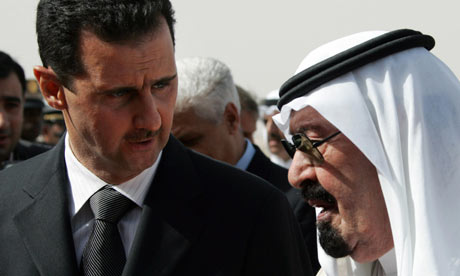
Saudi Arabia plans aid to Syria as ties improve
By Khaled Yacoub Oweis, Mon Mar 15, 2010
* Differences linger, but agreement on Lebanon
* Saudi investor appetite for Syria recovers

DAMASCUS, March 15 (Reuters) – Saudi Arabia is discussing extending development loans to Syria as ties between the two countries improve but there will not be direct cash assistance, the Saudi central bank governor said on Monday.

Diplomatic activity between Damascus and Riyadh picked up in the last months after they agreed to set aside their political differences and lower tension between their allies in Lebanon, which is a recipient of large Saudi cash injections.

Ties deteriorated after the 2005 assassination of Rafik al-Hariri, a Saudi-backed Lebanese member of parliament and former prime minister, resulting in the waning of Saudi investment appetite and aid to Syria.

“Syria is one of the most important Arab economies. It’s a promising market to whoever has money to invest,” Muhammad al-Jasser, head of the Saudi Arabian Monetary Agency, said after attending a banking conference in the Syrian capital.

“The Saudi finance minister was in Damascus and talked about this and what the Saudi Fund for Development is doing along with other Saudi government institutions,” he added.

Syria needs billions of dollars in investment to overhaul its infrastructure, resuscitate its drought hit east, lower unemployment and deal with a 2.5 percent annual population growth.

Most of the investment has been by amongst others Syrian expatriates and from the Gulf into banking and real estate. Economic growth fell to 3 percent last year compared with 5.2 percent in 2008, according to the World Bank.

Asked whether Saudi Arabia could deposit cash directly into the Syrian central bank, as it did with Lebanon, Jasser said such a move “will not be considered”.

But he said that the Saudi Fund for Development signed a memorandum of understanding with the Syrian finance ministry last week to lend $140 million to raise output at a power station in Syria.

INVESTOR MOOD

If extended, the loan will be the first since the Hariri assassination, which Saudi-backed politicians in Lebanon blame on Syria. Damascus denied any involvement.

Syria, which is under U.S. sanctions for its support of militant groups, has opened several sectors of the economy to private investment, especially banking and insurance, since President Bashar al-Assad succeeded his late father, Hafez al-Assad, in 2000.

The ruling Baath Party, which Bashar controls, nationalised large parts of the economy and enacted bans on private enterprise when it took power in 1963. It also imposed emergency law which is still in force and banned any opposition.

In a sign of changing investor mood, Saleh Kamel, a leading Saudi businessmen, addressed an investment forum in Damascus this month.

He said Syria was underperforming compared to Lebanon, its much smaller neighbour, because of what he described as antiquated laws, corruption and a lack of pro-investment culture.

Syria supports the Lebanese opposition led by the armed Shi’ite movement Hezbollah, which is also backed by Iran. Saudi Arabia is the political patron of Lebanese Prime Minister Saad al-Hariri, son of the late Rafik al-Hariri.

© Thomson Reuters 2010. All rights reserved. Users may download and print extracts of content from this website for their own personal and non-commercial use only. Republication or redistribution of Thomson Reuters content, including by framing or similar means, is expressly prohibited without the prior written consent of Thomson Reuters. Thomson Reuters and its logo are registered trademarks or trademarks of the Thomson Reuters group of companies around the world.

EU Renews Push for Mideast Peace Talks
George Bagdadi for CBS

The European Union’s top diplomat arrived in Damascus late Monday for talks with Syrian President Bashar Al-Assad, as part of a regional tour to try to give the EU more clout on the world’s diplomatic stage…. Baroness Ashton’s ambitious visit — her first big international test of the “quiet diplomacy” that she promised would deliver results for Europe — will also take her over the course of the week to Lebanon, Jordan, Israel and the Palestinian Territories to meet with political leaders and civil society representatives, before heading to Moscow on Friday for a meeting of the international quartet on the Middle East. The Middle East Quartet comprises Russia, the United Nations, the United States and the EU.

Ashton was scheduled to meet with Assad and foreign minister Walid Mouallem Tuesday morning before holding a press conference.

A major economic deal between Syria and the EU (known as the Euro-Mediterranean Association Agreement) has been on hold for the last six years, and is on top of the agenda. The two sides came close in October to sealing the pact, which centers on economic and legal reforms as well as respect for human rights and democratic values.

The agreement would qualify Syria for more aid from the European Union, beyond the €500 million ($748.6 million) it has received since 1979.

Netanyahu Offers Apology, but No Shift in Policy
BY: ISABEL KERSHNER | THE NEW YORK TIMES

Prime Minister Benjamin Netanyahu of Israel told his cabinet on Sunday that the ill-timed announcement of new housing plans for a Jewish neighborhood in East Jerusalem during a visit by Vice President Joseph R. Biden Jr. last week had been “regrettable” and “hurtful. … But he did not indicate that the building project would be canceled …

Obama’s Turn Against Israel
MARCH 15, 2010, Wall Street Journal, Editorials
The U.S. makes a diplomatic crisis out of a blunder.

In recent weeks, the Obama Administration has endorsed “healthy relations” between Iran and Syria, mildly rebuked Syrian President Bashar Assad for accusing the U.S. of “colonialism,” and publicly apologized to Moammar Gadhafi for treating him with less than appropriate deference after the Libyan called for “a jihad” against Switzerland.

When it comes to Israel, however, the Administration has no trouble rising to a high pitch of public indignation. On a visit to Israel last week, Vice President Joe Biden condemned an announcement by a mid-level Israeli official that the government had approved a planning stage—the fourth out of seven required—for …

AIPAC CALLS RECENT STATEMENTS BY THE U.S. GOVERNMENT “A MATTER OF SERIOUS CONCERN”
URGES OBAMA ADMINISTRATION TO WORK TO IMMEDIATELY DIFFUSE THE TENSION WITH ISRAEL

The Administration should make a conscious effort to move away from public demands and unilateral deadlines directed at Israel, with whom the United States shares basic, fundamental, and strategic interests.

The escalated rhetoric of recent days only serves as a distraction from the substantive work that needs to be done to with regard to the urgent issue of Iran’s rapid pursuit of nuclear weapons, and the pursuit of peace between Israel and all her Arab neighbors.

We strongly urge the Administration to work closely and privately with our partner Israel, in a manner befitting strategic allies, to address any issues between the two governments.

As Vice President Biden said last week in Israel, “Progress in the Middle East occurs when there is no daylight between the United States and Israel.”

Haaretz via FLC

In Oren’s Saturday conference call with the Israeli consuls general, he said that the current crisis was the most serious with the Americans since a confrontation between Henry Kissinger and Yitzhak Rabin in 1975 over an American demand for a partial withdrawal from the Sinai Peninsula. …..Four consuls discussed the conference call with Haaretz. Some noted that in previous conference calls with Oren, the ambassador took pains to make clear that relations with the United States were excellent. This time, however, Oren sounded extremely tense and pessimistic. Oren was quoted as saying that “the crisis was very serious and we are facing a very difficult period in relations [between the two countries].” ….. Oren told participants in the conference call of a meeting he was summoned to on Friday with Deputy Secretary of State James Steinberg for a reprimand. Oren spoke of his surprise at being summoned after believing that the crisis had ended on Thursday. ..”

MEET THE PRESS 3/14/10

…..MR. BROKAW: Why didn’t the president pick up the phone and call “Bibi” Netanyahu on…
MR. AXELROD: Well, the vice president was right there to convey the president’s view. The secretary of State conveyed that view. The ambassador was called to the State Department and our views were made clear to them. And I know the prime minister spoke to this this morning after his Cabinet meeting. I think the message was received.

TOM FRIEDMAN:
MR. BROKAW: All right. Let’s talk about something else that was in the news this week and almost got overwhelmed by the healthcare reform except for the audacity of what it was. Vice President Biden goes to Israel to have a high-level meeting with the prime minister to talk about trying to get the peace process started again. While he is there, the Israeli government announces that they’re going to build 1,600 new settlements in East Jerusalem. Tom, you had something to say about that. The secretary of State had something to say about it. We’re going to begin by sharing her interview with Andrea Mitchell. Here is Hillary Clinton.
(Videotape, Friday)

MS. ANDREA MITCHELL: Here you are with the Middle East just beginning to approach negotiations, and Israel announces an expansion of settlements. It was really a slap in the face to the visiting vice president.

SEC’Y HILLARY CLINTON: It was, Andrea. And I’ve expressed that directly to the prime minister. It was not just an unfortunate incident of timing, but the substance was, you know, something that is not needed as we are attempting to move toward the resumption of negotiations. … It was insulting. And it was insulting not just to the vice president, who certainly didn’t deserve that. He was there with a very clear message of commitment to the peace process, solidarity with the Israeli people. But it was an insult to the United States.
(End videotape)

MR. BROKAW: And that’s Secretary of State Hillary Clinton. Today, in The New York Times, Tom Friedman, who really began his career or certainly commanded all of our attention by writing from the Middle East, has written this. “Biden should have snapped his notebook shut, gotten right back on Air Force Two, flown home and left the following scribbled note behind: `Message from America to the Israeli government: Friends don’t let friends drive drunk. And right now, you’re driving drunk. You think you can embarrass your only true ally in the world to satisfy some domestic political need with no consequences? You have lost total contact with reality. Call us when you’re serious. We need to focus on building our country.'” Has it ever been more serious between the United States and Israel in recent years than this?

MR. TOM FRIEDMAN: No, this is a serious crisis, Tom. But I, I put it in–first of all, I think the president, the vice president, secretary of State did exactly the right thing for American interests and for Israel, by, by the way. I think we got to put this in a, in a broad context, all right? I think what Hillary–Hillary’s reaction and Biden’s reaction, first of all, they were speaking for many secretaries of State, many presidents in the past who have had Israeli settlements shoved in their face before, during, and after a visit by Israel saying, “Look, you guys do what you do, but we need to take care of our politics.” So there’s a lot of backstory here, this isn’t just about that trip.

Second, I think we need to keep the following in mind. What have we been–we, the United States–been doing for Israel rightly, I believe? We didn’t, we didn’t fight the Iraq war for Israel, but the fact is, in taking out Saddam Hussein, we took out a guy who had scud-missiled Israel and was giving $25,000 to any Palestinian who committed suicide against Israel. We have fought against the–what I think was the tendentious Goldstone Report on, on the Gaza war on the world stage. We’ve helped Israel protect it from that. We’ve been trying to organize a global coalition against Iran. And we give Israel, in the FY 2011 budget, $3 billion in military aid, the most advanced equipment. So let’s put that context on.

Then let’s look at the moment we’re in. We have an Israeli prime minister from the right who actually could deliver the right. He’s done actually a lot of good things on the ground in the West Bank. You have to give him credit for that. We have the best Palestinian leadership we’ve had in a long time. And we have a Sunni Arab world obsessed with Iran, ready to work with Israel more than ever. You’d think in that context Israel could say to the United States, you know, “You’re doing all this for us, we’re just going to stop settlements in Jerusalem, in the West Bank, not temporarily, not moratorium. We’re going to give you a chance to actually test the other side whether they’re for real. We’ve got enough settlements, we’ve go enough housing. Barack Obama, this Bud’s for you. We’re going to do this for the American people.” Is that anti-Semitism, is that anti-Israelism, to ask that of an Israeli government, to ask, act first in its own interest and then in America’s interest? I don’t think so.

The State Department released its annual country reports on human rights, which described deteriorating conditions across the Middle East. The country reports for the Middle East and North Africa region included several recurring themes such as judicial misconduct, fraudulent or rigged electoral systems, a disregard for basic human freedoms, and general malfeasance by public officials. You can find a detailed summary of the reports for particular MENA countries of concern on the POMED blog.

Ali Gharib writes at Lobelog:

In the March 11 London Review of Books, (behind a fire-wall, unfortunately,) Yonaton Mendel has a short primer on recent “hasbara” campaigns — essentially Israeli propaganda. In it, he summarizes instructions that would be given to diplomatic conscripts (to include all Israelis and other Jews): ‘Stick to your personal stories,’ they were told, ‘do not be drawn into political discussions. There will be people who irritate you and say that you are occupiers … do not go there.’

Nasrallah announces Jumblatt’s visit to Syria in Daily Star

Jumblatt apologises to al-Assad
14 March 2010, Al Jazeera English

Walid Jumblatt, a Lebanese MP and leader of the Progressive Socialist Party, has made a public apology for “indecent comments” he made in the past against Bashar al-Assad, the Syrian president. Jumblatt, who was part of the anti-Syria March 14 movement, had described al-Assad in 2007 as “Damascus’ dictator”, “a savage” and “an Israeli product”. Participating in Hiwar Maftouh (Open Dialogue), an Al Jazeera Arabic talk show, Jumblatt said his comments were made out of anger, amid stressful atmosphere and at a time the sectarian and ethnic split in Lebanon was at its peak.

He said: andldquo;My remarks were indecent, out of context and go beyond the political manners.” Jumblatt expressed his willingness to open a new chapter with Syria, the country that many in Lebanon hold responsible for the murder of his politician father, Kamal Jumblatt in 1977. Damascus has also been blamed by many for the 2005 assassination of Rafiq al-Hariri, the former Lebanese prime minister.

Asked whether he was willing to visit Damascus, he said his visit to Syria depended on Syrians’ willingness to move on. He said: “I call on the Syrian leadership; for the sake of nation’s (Arab nation) interest, regional interests, Arab objective dialogue, objective Syrian-Lebanese relations and the ties between the two neighbouring countries, can he (President al-Assad) rise above this issue? I simply ask for this.” “Yes, I want to turn the page,” he stressed.

After joining the March 14 movement, Jumblatt had pressed for the withdrawal of Syrian forces from Lebanon following al-Hariri’s murder. Under intense pressure, Syria withdrew its troops from Lebanon in April 2005, ending three decades of military presence in its smaller neighbour. Jumblatt has since split from the March 14 movement.

Petraeus Asks that Palestinians be Considered Middle Eastern and Not European – Politics Prevail over National Interest

The Petraeus briefing: Biden’s embarrassment is not the whole story
By Mark Perry in Foreign Policy [See Mark Perry’s new book: Talking to Terrorists: Why America Must Engage with its Enemies– excellent]

On January 16, two days after a killer earthquake hit Haiti, a team of senior military officers from the U.S. Central Command (responsible for overseeing American security interests in the Middle East), arrived at the Pentagon to brief JCS Chairman Michael Mullen on the Israeli-Palestinian conflict. The team had been dispatched by CENTCOM commander David Petraeus to underline his growing worries at the lack of progress in resolving the issue. The 33-slide 45-minute PowerPoint briefing stunned Mullen. The briefers reported that there was a growing perception among Arab leaders that the U.S. was incapable of standing up to Israel, that CENTCOM’s mostly Arab constituency was losing faith in American promises, that Israeli intransigence on the Israeli-Palestinian conflict was jeopardizing U.S. standing in the region, and that Mitchell himself was (as a senior Pentagon officer later bluntly described it) “too old, too slow…and too late.”

The January Mullen briefing was unprecedented. No previous CENTCOM commander had ever expressed himself on what is essentially a political issue; which is why the briefers were careful to tell Mullen that their conclusions followed from a December 2009 tour of the region where, on Petraeus’s instructions, they spoke to senior Arab leaders. “Everywhere they went, the message was pretty humbling,” a Pentagon officer familiar with the briefing says. “America was not only viewed as weak, but its military posture in the region was eroding.” But Petraeus wasn’t finished: two days after the Mullen briefing, Petraeus sent a paper to the White House requesting that the West Bank and Gaza (which, with Israel, is a part of the European Command – or EUCOM), be made a part of his area of operations. Petraeus’s reason was straightforward: with U.S. troops deployed in Iraq and Afghanistan, the U.S. military had to be perceived by Arab leaders as engaged in the region’s most troublesome conflict.

The Mullen briefing and Petraeus’s request hit the White House like a bombshell. While Petraeus’s request that CENTCOM be expanded to include the Palestinians was denied (“it was dead on arrival,” a Pentagon officer confirms), the Obama Administration decided it would redouble its efforts – pressing Israel once again on the settlements issue, sending Mitchell on a visit to a number of Arab capitals and dispatching Mullen for a carefully arranged meeting with Chief of the Israeli General Staff, Lt. General Gabi Ashkenazi. While the American press speculated that Mullen’s trip focused on Iran, the JCS Chairman actually carried a blunt, and tough, message on the Israeli-Palestinian conflict: that Israel had to see its conflict with the Palestinians “in a larger, regional, context” – as having a direct impact on America’s status in the region. Certainly, it was thought, Israel would get the message.

Israel didn’t. When Vice President Joe Biden was embarrassed by an Israeli announcement that the Netanyahu government was building 1600 new homes in East Jerusalem, the administration reacted. But no one was more outraged than Biden who, according to the Israeli daily Yedioth Ahronoth, engaged in a private, and angry, exchange with the Israeli Prime Minister. Not surprisingly, what Biden told Netanyahu reflected the importance the administration attached to Petraeus’s Mullen briefing: “This is starting to get dangerous for us,” Biden reportedly told Netanyahu. “What you’re doing here undermines the security of our troops who are fighting in Iraq, Afghanistan and Pakistan. That endangers us and it endangers regional peace.” Yedioth Ahronoth went on to report: “The vice president told his Israeli hosts that since many people in the Muslim world perceived a connection between Israel’s actions and US policy, any decision about construction that undermines Palestinian rights in East Jerusalem could have an impact on the personal safety of American troops fighting against Islamic terrorism.” The message couldn’t be plainer: Israel’s intransigence could cost American lives.

There are important and powerful lobbies in America: the NRA, the American Medical Association, the lawyers – and the Israeli lobby. But no lobby is as important, or as powerful, as the U.S. military. While commentators and pundits might reflect that Joe Biden’s trip to Israel has forever shifted America’s relationship with its erstwhile ally in the region, the real break came in January, when David Petraeus sent a briefing team to the Pentagon with a stark warning: America’s relationship with Israel is important, but not as important as the lives of America’s soldiers. Maybe Israel gets the message now.

Addendum: Read further about Perry’s sources at “War in Context” by Paul Woodward, “Israel is putting American lives at risk”

Ibrahim Hamidi writes in al-Hayat that the Obama administration will take several steps in the coming weeks to assure that Washington’s “engagement strategy” with Damascus moves forward.

????? ????? ??????? ??? ????? ?? «????? ??????? ????????»: ??? ????? ?????? ??????? ???? ???????? ???????
?????, 14 ???? 2010

???? – ??????? ?????
???? ???? ?? ?????? ??????? ??? ?? ????????? ??????????? ???????? ?? ??? ???? ?????? ???????? ?? ???? ?????? ???? ?????? ?????? ?????? ?? ???? ????? ???? ??????? ?????? ??? ??????? ??? ?????? ?? ???????? ???????? ?? ???? ??????? ????? ?????? ????? ?????? ?? «?????????? ????????» ?? ???? ????? ??? «????? ???????» ???? ????? ????? ?? ???????.

???? ?? ??????? ??? ????? ??????? ???????? ?????? ?????? ????????? ???? ??????? ????? ???? ????? ??????? ??????? ??? ?????? ?????? ?? ?????? ??????? ???? ?? ??? ??????? ??????? ???? ??? ??? ?????? ????? ????? ????? ??????? ?????? ????? ??????? ??? ??? ????? ?????? «????? ?????? ?????? ??? ???? ????????? ??? ???? ?????? ??????».

???? ???? ????? ???? ?? ?????? ???? ????? ??? ???? ????? ???? ???????? ?????? ???? ???? ????? ??? ???? «??? ???? ??? ???????? ???? ?????? ?????? ??? ??? ???? ???? ???? ???? ???? ?? ????? ??? ????? ????? ??????????» ?? ????? ??????. ????? ??? ???? ????? ?? ???? ??? «??????» ?? ??????? ????? ???????? ????????? ??? ???????? ??? ????? ????????? ??? ????????? ?????????? «????? ????» ????? ??????? ????????? ??? ????????? ?? ???? ?????? ?????????? ???? ???? ????? ?????? ?? ????? ??????? ?? ????? ?? ????? ????? ???????? ?????? ???????? ????? ????? ??? ????? ??? ???? ?? 17 ????? ??????.

????? ??????? ??????? ?? «??????»? ??? ???????? ?????? ????? ????? ?????? ?????? ??????? ???? ??? ??? ????? ??????? ???? ????? ??????? ???????? ???? 1600 ???? ????????? ????? ?? ????? ???????? ???? ????? ????? ??? ?? ?????? ??? ?? ??? ?????? ????? ??????? ??????? ???? ????? ????? ???? ??? ???? ???? ???????? ??????? ??????? ?????? ??? ??????? ??? ?????? ??? ??????????? ?????????????. ??? ?? ???? ???? ???? ?????????? ??????????? ?? ????? ?????? ??????.
?????? ????? ??? ??? ????? ?? ???? ???????? ??????? ?????? ???? ?? ???? ?????? ???????? ?? ???? ??????. ????? ?? ????????? ??? ???? ??? ????? ?? ????? ???? ?????? ?? «????? ????????? ?? ?????? ???? ????? ??????? ??????» ??? ??? ?????? ?? ????? ???????? ?????????? ?? ????? ???????? ?????? ??????? ????? ??? ????? ????? ??????? ??????? ?????? «??? ???????? ???? ????????».

???? ????? ?? ?????? ???? ????? ??????? ?? ?????? ?????? ?????? ????? ???? ?????? ??? ????? ????? ?????? ?? ????? ???????? ????? ???????? ?????? ????? ?????? ?? ???? ????? ?????? ?????? ?????? ?? ???????? ???????? ???? ?????? ?? ????? ?????? ??? ???? ????? ??????? ?? ????? ??? 27 ?29 ????? ??????. ?????? ????? ??????? ????????? ?? ???? ????? «??????? ?? ????» ????? ??????? ???????? ????? ???? ?? «??????» ????? «??? ????? ????? ???? ?????????? ?????? ????????? ??? ?? ????? ????? ????? ?????? ?? ??? ????????????».
??? ???? ???? ??????? ?? ?????? ????? ????? ??? ????? ??????? ???????? ?? «??? ??????» ??? ??????? ?????? ????? ??? ???????? ????? ???? ????? ?????? ???? ??? ????? ????? ?????? ?? ?? ??? ??? ??? ??????? ??? ??? 2001. ????? ??????? ?? ???? ?????? «??? ?? ?????????? ???????? ??? ????? ??????? ???????? ???? ?????? ?? ??????? ???????? ??? ???????»? ??? ??? ?????? «???? ????? ??????? ????????» ?? ?????. ????? ???? ?????? ?? ???? ?????? ??? ??????? ??? ???? «???????? ???????? ???????? ????????»? ????? ??? «?????? ??????? ????????» ?? ?? ????? ?????? ??? ????? ?????? ?????? ?? ????? ?????? ?????? ??????? ??????? ?????? ?? ???????.

Syrian ambassador charts route to peace for Israel in Middle East: Moustapha: Relations with U.S. better with Bush gone
By Lee Howard, The Day, New London, Conn., 12 March 2010

New London – Syrian Ambassador Imad Moustapha told a crowd of about 100 at Connecticut College Thursday that “there should be a historic exchange of land for peace” in the Middle East.

Moustapha, speaking to members of the Southeast Connecticut Committee on Foreign Relations at the college’s Blaustein Hall, endorsed the so-called Pan-Arab Peace Initiative. The proposal, adopted at an Arab summit in 2002, calls for Israel to adhere to internationally recognized borders – essentially giving back territories it acquired in a series of wars last century – in return for Arabs’ recognition of the Jewish state as well as normalization of relations.

“If they want to be accepted by their neighbors, they need to stop their policy of occupation and expanding settlements,” Moustapha said of the Israelis. “If they want peace … this is the only way to move forward. In my heart, I believe this is inevitable. If this is inevitable … why not do it today instead of next year?”

Moustapha, responding to a question, noted the Israelis greeted Vice President Joe Biden’s visit this week with an announcement that they had expanded more settlements into occupied Arab territories.

“When will the Israelis realize this is insane and counter to their own national interests?” he said.

Moustapha questioned Israel’s commitment to the so-called two-state solution and wondered if it would continue a policy that he said essentially has turned it into an “apartheid state.”

Moustapha blamed the United States for allowing Israel to continue the policy unchecked. While acknowledging that the Obama administration has been much more amenable to working with the Syrians than the Bush administration, he said he still believes America can do more to push peace in the Middle East.

The United States “should have the moral courage to tell a friend that what you are doing is absolutely wrong,” he said.

Still, under President Obama, Moustapha said Syria feels like it’s at the table as “part of the solution” to peace in the Middle East, rather than being depicted as part of the problem, as under President Bush.

Moustapha said Bush’s “flagrant hostility” toward Syria grew to a boiling point after the U.S. invasion of Iraq, which led to 1.2 million Iraqi refugees flooding his country and 4.2 million stateless people taking up residence throughout the Middle East – what he called the biggest exodus in the history of the region.

Moustapha said he had no direct contact with high-level members of the U.S. government for four or five years after the conflict started, despite the fact that Syria, after 9/11, invited Americans to share their intelligence on the terrorist organization al-Qaida. Syrian intelligence helped snuff out al-Qaida attacks against Americans in both Canada and Bahrain, he said.

Moustapha pointed out that Syria had also joined the United States in the 1990s Gulf War after Iraq’s invasion of neighboring Kuwait. Yet when Syria tried to dissuade the United States from going to war with Iraq a second time in 2003, Moustapha said the neoconservatives in Washington “mocked us in our face.”

“That was the breaking point between us and the Bush administration,” he said. “All that cooperation came to a standstill when the United States decided to invade Iraq.”

Now, though, Moustapha sees some signs of progress in Washington’s stance toward Syria. Just a few weeks ago, the United States sent its special envoy to the Middle East, George Mitchell, to meet with Syrian President Bashar Assad, in talks that Moustapha found encouraging.

Moustapha was not as hopeful about the future of what he called the “failed state” of Iraq. And, though he views democracy as historically inevitable, Moustapha said “democracy by brute force,” as imposed by the United States in Iraq, created a reaction that may have hindered democratic progress throughout the Arab world.

“It needs to happen from within; it can’t happen from without,” he said.

But Moustapha said he doesn’t want to point fingers. Rather than reliving the turbulent history of the Middle East and quibbling over who wronged whom, he suggested that Arabs, Israelis and Americans put the past behind them.

“The question is do you want to live in peace or do you not want to live in peace?”

From All4Syria: Mahdi Dakhlallah, Syria’s Ambassador to Saudi Arabia explained that:

“Syria’s relations with Saudi Arabia went beyond traditional diplomatic ties to the extent that by now it represents a model for Arab-Arab relations. He also spoke about coordination between the two countries aiming to protect Iraq’s unity and stability through support for the national movements in Iraq facing those with ties to the United States or the separatists or the federalists”

Andrew Sullivan and Jeffrey Goldberg argue over the meaning of the following map. Goldberg claims that it is propaganda and pushes a lie. Sullivan argues that the maps tells an irrefutable truth.

“The point of the illustration was to provide some background to the now-unavoidable fact that Israel has every intention of expanding its sovereignty to the Jordan river for ever, to segregate Palestinians into walled enclaves within, and to station large numbers of Israeli troops on the Eastern border.

Via Politico/ Ben Caspit in today’s Maariv, excerpts below: [Thanks FLC]

It was supposed to be a visit that would restore our trust. It was the visit that destroyed trust. Binyamin Netanyahu kicked over the bucket that contained no milk. Biden was supposed to fill it. Instead, Biden burned with anger. “They stabbed me in the back,” the vice president said last Tuesday in meetings that he held. “They hurt me, President Obama, the United States, the peace process, trust, and everyone who believed that something could be done here.” He was furious. On Tuesday, he spoke with President Obama. The conversation included condemnatory language unfit for print. He was on the verge of canceling dinner with the Netanyahus. Again and again, he changed the speech that he was to give on Tuesday at the university. He did not know what to do with himself, where to take his frustration, his feeling of betrayal, of lost opportunity. […]

[Biden] was supposed to restart the process. To create, finally, a relationship of trust with Netanyahu. Instead, the moment he landed, he discovered a plan to construct sixteen hundred dwelling units in Ramat Shlomo. Where the heck is Ramat Shlomo? The absurd thing is that there is no significance to the registering of this zoning plan. There are no tenders or anything that could not have been done three months ago or in six months from now. Much ado about nothing whatsoever. […]

Anyone who has been listening over the past several weeks to Yitzhak Molcho, Netanyahu’s closest and most intimate representative in the political sphere, and his partner Mike Herzog (who is about to retire), heard both of them saying the same thing: the peace process is hopeless, it is all tactics, Netanyahu has no intention of going to real peace … In short, the settlers can relax. But see—the settlers are not relaxed. Because they know Bibi. Today it is one way, tomorrow it could be otherwise. It depends on who is pressuring him and who scares him more. …

High-ranking American officials said this week that Israel was not behaving like an ally of the United States. There is no worse thing to say at such a critical time, when Iran is charging toward the last stretch on its way to the nuclear bomb. At this stage, At this stage, there should have been blind coordination between ourselves and them. Netanyahu should have been Obama’s best friend. A word is a word and a promise is a promise, and all the details of the operation to stop Iran’s progress toward the nuclear bomb, including the negotiations with the Palestinians and the Syrians (even in neutral) were supposed to be kept secret for the sake of calming things down on the ground and neutralizing ticking bombs. In reality? There is nothing. Only the broken glass of the souvenir that Bibi prepared for Biden and shattered with his own hands. […]

Next year [Palestinian PM Fayyad] will show the world a quiet PA, a law-abiding PA with institutions and reforms with one military, one law, one authority. And then, he will ask for recognition of the Palestinian state in the 1967 borders. As it seems now, he will get this. From everyone except from us. [….]

Syria NOT Pursuing Nuclear Power, Biden Flounders, Ford to Confirmation

Syria has no decision to develop peaceful nuclear energy
2010-03-13

DAMASCUS, Mar 13, 2010 (Xinhua via COMTEX) — The head of the Syrian Atomic Council Ibrahim Othman on Saturday told Xinhua that Syria has by far no decision to develop nuclear energy for peaceful use.

Othman made the remarks on the sidelines of Syria’s National Conference of Energy, which started on Saturday at Ummayad conference palace in Damascus. The conference aimed to develop a comprehensive plan on the development of energy sector in Syria. “Developing nuclear power in Syria is quite different from developing other energy types due to considerable technical and financial obstacles,” Othman said. Syrian Deputy Foreign Minister Faysal Mekdad said last week at an international conference on civilian nuclear power held in Paris that his country believed it was important to consider alternative sources of energy, including nuclear power.

However, Othman confirmed on Saturday that the atomic council has no decision to set up any nuclear power plant, because there are lots of barriers in finance, construction and operation, and most of all, the huge cost.

Nicolas writes in the last comment section:

On the nuclear debate, Syria is NOT pursuing nuclear power. There was a recent dedicated conference in Tunisia attended by Arab nuclear power authorities. All outlined their plans for developing nuclear power generation. Only Syria clearly stated that it is NOT pursing this option; very rightly and realistically so.

Syria is focusing on developing the conventional fuel-based and renewable (wind) IPPs; which is the right move, and a move that still has a lot of way to run. The nuclear option is still far from tested in the region, and the most advanced project (the Abu Dhabi project) is still in its infancy, despite the large amount of work already carried out and the press releases, it still is not a sealed deal (let along the other announcements made by the other less wealthy countries in the region). Such projects require years of groundwork preparation on the legal, political and technical angles, let alone the financing to come in support.

I had noted in an earlier post, that there was talk in the market about Syria potentially joining the project in Jordan (2nd “more serious” approach in the region) and obtaining a share of the power outcome via a cross-country cable against Syria investing equity and providing the much needed water requirements for a nuclear project that Jordan does not have (not sure Syria does either but still…). This looks theoretically more realistic, despite the massive political uphill drive to get this through. Ideally, it would look good as part of peace incentive package with the world power’s backing.

The only other option would be for Iran to pass on the nuclear technology to Syria; if it were to happen, then that would be just folly as it would just drive the Syria into a position of confrontation with the entire world (maybe unjustified but this would be the case).

Luckily, there seems to be a good level of common sense within the circles running the power generation projects in Syria and they seem intent on focusing on realistic targets rather than fancy unrealistic schemes.

I do not see where in Mekdad’s statement he says that Syria wants to develop nuclear power.

Daniel Levy has a fine article on Biden’s visit to Israel on the new ME Channel at Foreign Policy – the picture of Biden is worth a thousand words (Above)

The Leveretts explain the significance of the Biden visit with typical precision and honesty on their site, RFI

….President Obama missed a critical opportunity in his June 2009 Cairo speech to take U.S. policy on Israeli settlements in occupied Palestinian territory back to what is was under the Johnson, Nixon, Ford, and Carter administrations, when U.S. policy actually achieved meaningful progress towards a resolution of the Arab-Israeli conflict—namely, a clear-cut stance the such settlements were illegal, in that the settlement of Israeli civilians in occupied territory violates the Fourth Geneva Convention….

President Obama’s approach to the Middle East [enables] Israel to act without cost or consequence, no matter how damaging its actions might be to regional peace prospects and America’s own strategic interests….

Turkey needs more from Ataturk’s heirs
By David Gardner, March 11 2010

Turkey’s ruling party has once again entered into conflict with the Turkish army. This is more than the latest episode in a power struggle commenced as soon as the Justice and Development party (AKP) of Recep Tayyip Erdogan first came to power in 2002.

It is more, too, than a battle of wills between neo-Islamists and secularists; more even than a new and dangerous chapter in a recurring constitutional crisis. It is, above all, a clash between two rival establishments jostling for supremacy: the traditional metropolitan elites who see themselves as the guardians of the secular, republican heritage of Mustafa Kemal Ataturk, the father of modern Turkey; and the new AKP establishment that combines the conservative and religiously observant traditions of Anatolia with a huge constituency in Turkey’s modern but Muslim middle class.

One of the principal reasons for this now chronic crisis is that the first group, the Kemalists, are unelectable: after being trounced in two general elections by the AKP they appear to have no strategy except to return to power by goading the army and the judiciary into seizing back what their howlingly irrelevant parties keep losing at the ballot box.

It is a commonplace, often deployed with self-serving slyness in Europe, that Turkey is engaged in a struggle to determine its real identity. Yet, the real drama of Turkey today is more banal: it lacks an effective opposition to the AKP. It will keep bobbing from crisis to crisis until it has one.

The Council on Foreign Relation’s Steven Cook explains what the Neocons got right. The CFR is perhaps the leading think tank in the US. It is interesting to see how negative Cook’s view of Syria is. He argues that Syria is one of the main subjects on which that the Neocons were right.  He buys the line that Syria’s support for Ahmedinejad is the “real” Syria as opposed to Assad’s insistence that Syria wants peace with Israel, which he (and the neocons) view as a smokescreen to hide Syria’s true nature. Cook sums up that nature as:

Syrian President Bashar al-Assad regime’s is all about: violence, repression, and duplicity.

This does not augur well for Syria.

Israel and Syria ‘to renew talks’
Thomas Seibert in the National
UAE / March 10. 2010

ISTANBUL // More than a year after the breakdown of indirect peace talks between Israel and Syria organised by Turkey, Ankara says it is close to bringing the two sides together again.

Turkey’s move came as the United States was trying to get new peace talks between Israel and the Palestinians on track during a visit by Joe Biden, the vice president. Observers in Turkey said US pressure on Israel was vital for the relaunch of talks with Syria as well.

“There is renewed interest” in a continuation of indirect talks between Israel and Syria, Recep Tayyip Erdogan, Turkey’s prime minister, said during a visit to Saudi Arabia this week, according to news reports. He added that Syria was ready for new talks under Turkish mediation and that there had been positive signals from Israel as well.

Mr Erdogan said his government would study the Israeli response. “If there is a positive result of this evaluation, I want us to restart this process.” Israel denied that it had resolved to engage in fresh indirect talks with Damascus under Turkish mediation. “No decision has been taken,” The Jerusalem Post newspaper quoted the office of Benjamin Netanyahu, the Israeli prime minister, as saying in a statement. But if Mr Erdogan’s comments reflected “Turkey’s desire to strengthen its relations with Israel and to contribute to peacemaking in the region – then Israel would clearly welcome that aspiration”, Mr Netanyahu’s office said.

Exiled from Iraq, with no hope of return
Deborah Amos is a skillful writer and a perceptive analyst.
(By Thomas W. Lippman, The Washington Post)

If I were developing a reading list for newcomers to the Middle East, it would not begin with Deborah Amos’s poignant and disturbing “Eclipse of the Sunnis.” Her book is not for beginners; it requires some knowledge of the region’s history, personalities and neuroses….

Amos, a journalistic veteran of the Middle East, is not much interested here in the palace coups, rigged elections, official corruption and failed negotiations that make up standard histories. Her thesis is that the U.S. invasion of Iraq in 2003, whatever its justification, has had a catastrophic effect on the people of the region, unleashing sectarian hostilities that had been bottled up for centuries, not just in Iraq but in Lebanon and other Arab states as well.

She did most of her interviewing in Syria, Lebanon and Jordan, where she found tens of thousands of Iraqis driven from their country by the violence that followed the ouster of Saddam Hussein. These unfortunate people, she reports, are the very citizens who would have been essential to the creation of a modern, democratic Iraq: doctors, scholars, artists and government workers, Christians and Sunni Muslims, deemed unworthy by the Shiites now running the country. It is a measure of their desperation that they found Syria, of all places, to be a refuge of cultural freedom….

Amos concludes that it is no longer possible, if it ever was, to construct a tolerant, multicultural Iraq. Returning there in 2009, she found that “Iraq was effectively a different country, transformed by the sectarian civil war. The Shiites had won, the Sunnis had lost. There was no getting around that. In the current political environment there was little hope of restoring Baghdad’s historic character, a city where Iraq’s rich sectarian mix once lived side by side.” Even the non-Shiites who remain, she found, live separate lives, hunkered down behind protective walls, cut off from their former compatriots.

“Eclipse of the Sunnis” is persuasive and very well written, filled with deft turns of phrase such as her description of a Lebanese imam who sympathizes with jihadists because he is pious and “the modern world was bearing down on his soul.”

800 Iraqi Christians displaced in days
2010-03-10

MOSUL, Iraq,  March 10 (UPI) — The safety of the Christian minority community in northern Iraq is of utmost concern as the rate of displacement soars, U.N. agencies said. U.N. figures show the number of displaced Christians in Iraq rose by more than 800 people in a three-day period beginning March 1. The U.N. Office for the Coordination of Humanitarian Affairs said it was concerned for the minority religious community. “Protection remains an ongoing concern for the Christian community as well as other vulnerable groups remaining in Mosul,” an OCHA report said. U.N. and local authorities said they were working to provide food and other humanitarian aid to the Christians who fled their homes in Mosul, the capital city of Ninawa province. The United Nations said the Kurdistan Regional Government told local universities to open enrollment to displaced Christians after it was revealed they were afraid to attend classes in their hometowns. The Kurdish and Arab authorities are at odds over security issues in the north. A spate of attacks rocked the Christian community of Iraq in 2008, displacing nearly half of the population.

As Its Arms Makers Falter, Russia Buys Abroad
The New York Times

in today’s Russia, the $40 billion military equipment industry is withering alongside civilian manufacturing.

Once-legendary Russian weapons are suffering embarrassing quality-control problems. Algeria, for example, recently returned a shipment of MIG jets because of defects.

An aircraft carrier refurbishment for India is four years late and hundreds of millions of dollars over budget.

In perhaps the most poignant sign of trouble, Russia’s own military is now voting with its rubles: Moscow is in talks with France to buy four French amphibious assault ships. If a deal is struck, it would be Russia’s most significant acquisition of foreign weapons since World War II.

The purchase of Mistral-class ships would be “the most salient example of the deficiencies in the Russian defense industry,” said Dmitri Trenin, a military analyst at the Carnegie Moscow Center, a policy research organization.

Next week, the Senate Foreign Relations Committee will convene a hearing to confirm Robert Ford as ambassador to Syria. And the hearing, though likely to confirm Ford, will be an occasion for administration critics to question the Syrian re-engagement policy.

On Ambassador Ford’s Confirmation Process in Congress by Ziad Haydar and Joe Maceron

???????? ????? ???????? ????? ???? ??????
??????? ??????? ?????? ???? ??? ????? ????

?????? ? ?? ??????
???? ? ???? ????
?? ???? ???? ??????? ????? ??????? ?? ????? ???????? ??????????? ?? ????? ??? ???? ?????? ??? ???? ??????? ??? ????? ?????? ????? ???? ?? ????? ?? ????? ????? ??????? ??????? ???????? ?? ??????? ?????? ????? ???? ??? ?? ?? ????? ????? ???????? ????? ????? ?????? ????? ??????? ????? ????? ?????? ?? ???? ????? ?????? ??? ??????? ??? ????? ?? ??? ???? ??????.
???? ???? ????????? ?? ???? ???????? ???????? ?? ???? ?????? ???????? ???? ?? «??????»? ?? ???? ????? ???? ???? ??????? ???? ??? «???? ????? ???? ?????»? ??? «???? ?? ????? ????? ?????? ??? ????»? ????? ?? ???? ?????? ????????? ??? ???? ????? ????? ????? «??? ??? ????» ?? ??? ?????? ??? «????? ?????? ???? ????? ???????? ?? ?????? ???? ??????? ????????? ??? ???????? ?? ????».
???? ???? ?? ???? ?? ??? ???? ?? ????? ????? ????? ??? ?? ??? ?????? ????? ?? ?? ????? ?????? ?????? ????????? ????? ?? ???????? ?? ?????????? ????? ?????? ???????? ?? ???? ????? ?? ????? ???? ???? ??????? ?? ??? ??????? ?? ????? ????????.
???? ??? ???? ??? ?????? ???? ????? ???? ???????? ??? ???? ??? ????? ???? ?????? ????? ??? ???? ??? ????? ????????? ??? ?? ???? ????? ?????? ??????? ????? ??????? ??? ????? ???? ???? ???? ???? ???? ???????? ???????? ????? ??? ?????? ?????? ????? ??????? ?? ???? ?? ???? ????? ??????? ??? ??? ??????? ?? ??? ?? ??????? ?? «???» ????? ????? ???? ?????? ???????? ???????? ?? ???? ???? ?? ????? ???? ????? ?????.
????? ????? ???? ???? ???????? ??? ???????? ?????? ?? ???? ??????? ????? ???? ???? ???? ?????? ?? ?????? ????? ????? ??????? ????????? ?? ?????. ????? «??????» ?? ???? ????? ???????? ?????? ???????? ????? ????? ???? ?????? ?????? ????? ??? ?????? ??? ???? ?? 17 ???? ?????? ???? ?????? ??????? ??????? ?? ??? ??????? ???.
??? ??? ???? ??? ??????? ??????? ????? ?? ?????? ?????? ??? ?????? ???? ?????? ?? ??? ???? ????? ?? ??????? ????????? ??? ??? ??????? ??? ??? ????? ?????? ??????? ??????? ??????? ??? ????? ???? ???? ???? ?????? ???????? ??? ????? ???? ???????? ?? ????? ??????? ??????? ??? ??????? ?????????? ?? ???? ??? ???? ???? ????? ???? ???? ???? ?????????? ????????? ????? ?????? ???????? ??? ?????? ????? ?????? ??????? ????????? ?? ????.
????? «??????» ?? ????? ?????? ?? ????? ?? ????? ??????? ???? ??? ????? ???? ??????? ???? ?? ???? «??????? ?????? ???????? ??? ???? ??????? ??? ????? ???????? ???????? ?????? ???????». ????? ??????? ?? ??????? ???? ??????? ?????? ??? ?????? ???? ?????? ??????? «?????? ??????»? ???? ???? ?? ??????? ?? ???? ??????? ???? ????? ???? ???????? ??????? ???? ??????? ?????? ?????? ????? ??????? ?? ???? ?????? ?????.
?????? ???? ??????? ?? ???????? ???? ?????? ???? ???????? ???????? ??????? ?? ??? ????? ???? ??????? ?? ?????? ??? ?? ???? ?????? ?????? ???? ????? ???????? ?? ??? ???????? ?? ???????? ??????? ????? ?? ??? ??????? ?? ??? ????? ?? ????? ??? ???????. ?????? ???? ???? ???? ????? ?????? ?? ??? ???????? ??? ??????? ?? ????? ?? ??? ????? ????? ???? ?? ???? ???????? ?? ??? ?? ??? ????? ?? ???? ??? ??? ???? ????? ?????? ?????? ????? ?????? ??? ????. ?????? ??????? ??? ????? ???? ??? ?????? ?????? ?? ??? 51 ???? ?? ??? 100.
??? ??? 8 ????? ???????? ?? ???? ?????? ????? ??? ????? ???????? ?????? ??????? ????? ????? ??????? ??? ???? ?? «???????? ?? ????? ?????? ?? ????? ?????? ??????? ??? ???????? ????? ????? ??? ??? ?? ?????????? ?????? ?? ????? ????? ??????. ??? ???????? ???? ????????? ??? ?????». ??????? ??????? ?? ???? ????? ?????? ??? ???? ?????? «????? ????»? ????? ??? ?? ??????? ??? ????? ??????? ??? ????? ???? ??? ?????? ??????. ??? ??? ???????? ??? ??????? ??? ???? ?? ???? ???????? ???????? ?? ????????? ??? ??????. ????? ?????? ???????? ????? ?????? ????? ??????? ?????? ????? ??????????? ???? ??? ???? ????? ??????? ??? ??????? ???? ?????.
??? ??????? ??? ???? ???? ?????? ????? ?????? ?? ????? ????????? ????? ?????? ?? «??????»? ?? ??? ???? ????? ?? ???????? ??????? ????????? ???? ??? ????? ?? ??????? ????????? ???? ??????? ????? ????? ???? ?? ????? ???????? ??? ??????? ?? ???????? ??????? ????????? ??? ???? ????? ????? ??????. ?????? ?? ???? ????? ???? ????? ?????? ?? «??????? ????????? ?? ????? ???????? ???? ?? ???? ???????? ?? ?????». ???? ?? ????? «???? ???? ????? ??????? ??????? ?? ????? ?????? ???? ?????? ?????? ?? ??????? ????? ??????? ?? ?????? ????? ????? ?? ???????».

Foggy Bottom’s Man In Baghdad
By Michael Rubin in the Wall Street Journal
Saturday, Mar 13, 2010

(Editor’s Note: Mr. Rubin, a resident scholar at the American Enterprise Institute, was a governance adviser in the Coalition Provisional Authority.)

…..Mr. Allawi failed to break double-digits in the December 2005 election. He was bitter. “Our adversaries in Iraq are heavily supported financially by other quarters. We are not,” he later told CNN’s Wolf Blitzer as insurgency raged. He failed to mention the millions of dollars funneled to him by Saddam’s former allies in Jordan and other Arab states……

….While Iraqis brave bombs and bullets to hold leaders to account and participate in democracy, a dangerous cocktail of anti-Shiite bias and dictator chic permeates Washington’s foreign-policy elite. This may make Mr. Allawi attractive in Foggy Bottom and Langley, but not to most Iraqis. Strongmen — including Saddam — drove Iraq into ruin and espoused ethnic and sectarian supremacy.

Iran’s influence is pernicious, but Iraqi Shiites are not Iranian pawns. …

History matters. In January, I met with one grand ayatollah and representatives of two others in Najaf. Each castigated Iran but said they could neither forgive nor forget 1991, when the elder Bush abandoned Iraq’s Shiite uprising to Saddam’s helicopter gunships. No Iraqi candidate is perfect, but it’s puzzling that the U.S. has thrown so much weight behind one with ties to the country’s Baathist past.

Enemies of the Internet: KSA, Egypt, Iran, Syria
2010-03-13,Next Web (US)

Middle Easterns, Rejoice! If the Axis of Evil wasn’t enough, 4 of our countries have made it to the top 12 “Enemies of the Internet”. The list, drawn up every year by Reporters Without Borders, presents the worst violators of freedom of …

Nuclear Power Plants Fashionable in Middle East; Israel Pokes Fun at Biden

Syria announces that it wants to develop nuclear power now that Israel, Egypt, Iran, Jordan, Turkey and the Emirates have also begun or announced plans for nuclear plants.

Rivals Israel, Syria Want to Build Nuclear Power Plants
Tuesday , March 09, 2010

Mideast rivals Israel and Syria on Tuesday each announced ambitions to develop nuclear energy, with Israel facing the prospect that its plan could bring new attention to its secretive nuclear activities.

The countries laid out their hopes at an international conference in Paris on civilian nuclear energy — which contributes far less to global warming than burning of fossil fuels but still evokes many concerns about long-term safety issues.

Also on Tuesday, Egypt announced it would aim for four nuclear plants by 2025, with the first starting in 2019, Reuters quoted an Egyptian minister. The announcements raise the prospect that the countries’ nuclear programs could come under the microscope of international inspectors to ensure that they don’t cross the forbidden line into weapons programs. Iran, for example, has come under intense pressure to show its nuclear program is peaceful. The United States is providing financing and training for nuclear power plans in Jordan. The United Arab Emirates in December awarded a South Korean consortium a contract to build energy-producing nuclear reactors.

Iran and North Korea, whose nuclear program has also drawn international scorn, were not invited to the Organization for Economic Cooperation and Development conference. Israeli Infrastructure Minister Uzi Landau said nuclear plants built in Israel will be subject to strict safety and security controls, and even said his country would like to build them in cooperation with scientists and engineers from “our Arab neighbors.”

“Israel has always considered nuclear power to partially replace its dependence on coal,” Landau said. The program aims to help Israel secure its energy supplies and battle global warming. Israel currently uses coal and natural gas to produce electricity.

The effort by Israel, which has long been suspected to have a secret nuclear weapons program, runs the risk that its nuclear energy program will draw the eyes of the International Atomic Energy Agency. The construction of a nuclear reactor could draw international attention to Israel’s nuclear activities. Asked if Israel would allow IAEA inspectors to supervise any new project, Landau aide Chen Ben Lulu said only that Israel would follow all the relevant rules.

Israel has not signed the Nonproliferation Treaty, which aims to limit the number of countries capable of developing nuclear weapons. Separately at the conference, Syrian Deputy Foreign Minister Faysal Mekdad his country is looking at “alternative energy sources, including nuclear energy” to meet its growing demands for energy.

“The peaceful application of nuclear energy should not be monopolized by the few that own this technology but should be available to all,” Mekdad said, noting Syria’s growing population. He did not elaborate on specific nuclear plans.

Between the two countries, Israel is seen as closer to actually developing nuclear energy in terms of know-how and infrastructure. The idea of generating nuclear energy has been floating around for years in Israel. In 2007, one of Landau’s predecessors said he was working on a plan to build a nuclear power plant in Israel’s southern Negev desert. Landau met several months ago with the French Energy Minister Jean-Louis Borloo, and raised the idea of French-Israeli-Jordanian cooperation in developing a nuclear power plant.

Borloo was enthusiastic about that idea, Landau said. France derives more of its electricity from nuclear power than any other country and has a highly developed civilian nuclear industry — and Paris sees export potential.

It was France that, beginning in the 1950s, helped Israel build its nuclear reactor at Dimona. Israel is believed to have used that reactor to construct a stockpile of nuclear weapons. Israel has never acknowledged being a nuclear power, following a policy it calls “nuclear ambiguity.” Israel also has a smaller nuclear reactor for research at Nahal Soreq, not far from Tel Aviv. Landau’s office says no specific plans to set up a third nuclear power plant have been drawn up so far.

Will the Exiles Return to Iraq?Sunday’s election is a test of the permanence of the division between Iraq’s Sunnis and Shiites.
By Deborah Amos, Friday, March 5, 2010

Iraq’s electoral commission expects as many as 180,000 exiles to cast ballots in 23 voting centers across Syria, and Iraq’s Sunni politicians are courting the exile vote. … According to the latest U.S. government report, few of the 2 million Iraqis who fled the country from 2004 to 2008 have returned…..

An estimated 60 percent of the refugees are Sunni Arabs; approximately 15 percent are Iraqi Christians. Their departure represents a dramatic demographic alteration in Iraq, yet the sectarian nature of the exodus has been largely overlooked. This shifting population is a huge loss to Iraq, a vast problem to neighboring governments, a collective tragedy for many caught up in it, and a significant indicator of the future health, stability, and viability of Iraq and the Middle East. Most in the exile population have never sought refugee status with the United Nations. Indeed, fewer than 10 percent have applied to be considered for resettlement to the United States, Europe, or Australia, which suggests the overwhelming majority still hope to return to Iraq and are waiting for some indication that they are welcome there. So far, the signals from the election campaign have not been positive…..

U.S. Ambassador Christopher Hill summed up the trial ahead: “The real test of democracy is not so much the behavior of the winners; it will be the behavior of the losers.” There can be no stability without political reconciliation and the exiles’ return. They are in daily contact with their families, waiting for word that is time to come back. The rest of the region is waiting, too.

Barak approves 112 new apartments in West Bank
By The Associated Press and Haaretz Service

Israel authorized the construction of 112 new apartments in the West Bank despite a pledge to slow settlement building, the government disclosed Monday – a decision that enraged the Palestinians a day after they reluctantly agreed to resume peace talks. Word of the new construction in the Beitar Illit settlement came amid a flurry of activity by the U.S. to try to salvage peacemaking.

Biden Condemns Israeli Decision on Settlements,

…With the Interior Ministry adding insult to injury, (announcing a plan to build 1,600 new homes in East Jerusalem, on top of the new settlements on the West Bank) the VP came out sort of swinging.

“I condemn the decision by the government of Israel to advance planning for new housing units in East Jerusalem. The substance and timing of the announcement, particularly with the launching of proximity talks, is precisely the kind of step that undermines the trust we need right now and runs counter to the constructive discussions that I’ve had here in Israel. We must build an atmosphere to support negotiations, not complicate them. This announcement underscores the need to get negotiations under way that can resolve all the outstanding issues of the conflict. The United States recognizes that Jerusalem is a deeply important issue for Israelis and Palestinians and for Jews, Muslims and Christians. We believe that through good faith negotiations, the parties can mutually agree on an outcome that realizes the aspirations of both parties for Jerusalem and safeguards its status for people around the world. Unilateral action taken by either party cannot prejudge the outcome of negotiations on permanent status issues. As George Mitchell said in announcing the proximity talks, “we encourage the parties and all concerned to refrain from any statements or actions which may inflame tensions or prejudice the outcome of these talks.”

Netanyahu and Pastor Hagee’s Lovefest on Eve of Biden’s Arrival in Israel
On 03.09.10, By Max

Vice President Joe Biden was greeted in Jerusalem with the announcement that the Israeli Interior Ministry approved the construction of 1600 new homes in Occupied East Jerusalem contrary to U.S. wishes and complicating Biden’s mission to help jump start the peace process. But Biden should have known that Prime Minister Bibi Netanyahu intended to upset his plans by Netanyahu’s appearance with John Hagee.

The day after a series of talks between US Special Envoy for the Middle East George Mitchell and Netanyahu, and a day before Biden’s arrival, Netanyahu appeared onstage with Pastor John Hagee in Jerusalem. The occasion was Hagee’s Night To Honor Israel, an event the far-right Texas-based preacher arranged to tout his ministry’s millions in donations to Israeli organizations and to level bellicose rhetoric against Israel’s perceived enemies.

At the gathering, Hagee called Iranian President Mahmoud Ahmadinejad “the Hitler of the Middle East” and denounced the Goldstone Report as “character assassination by an unbiased and uninformed committee.”

Netanyahu welcomed the crowd of 1000 American evangelicals to Jerusalem, a city he described as “the undivided, eternal capitol of the Jewish people. Then, he told them, “I salute you! The Jewish people salute you!” He used the rest of his speech to call for “tough, biting sanctions” against Iran that “bite deep into its energy sector.”

The price tag for Israeli intransigence
by Paul Woodward on March 9, 2010

The day before Vice President Joe Biden arrived in Israel — supposedly on a mission to help kick-start peace talks between Israelis and Palestinians — the Netanyahu government made its contempt for the Obama administration clear by approving new settlement construction.

They were quick to take offense — they being the Israelis! “While we welcome Vice President Biden, a longtime friend and supporter of Israel,” Danny Danon, the deputy speaker of the Knesset, told the Washington Post, “we see it as nothing short of an insult that President Obama himself is not coming.”

Washington on the other hand had no interest in creating a fuss about settlement growth — its impotence on that particular issue has already been amply demonstrated. Pushing for a real settlement freeze is passé. The new game is proximity talks and shuttle diplomacy. After 17 years of direct talks it’s now time to talk from a distance…

Israelis and Palestinians: Agreeing to Talk — and to Fail
By Tony Karon in Time Magazine

They won’t be talking directly to each other, but at least the leaders of Israel and Palestine have a common objective in the “proximity talks” the Obama Administration is launching this week. Unfortunately, that shared goal is not to reach a final agreement on a two-state solution to their conflict — both sides know better than to expect that U.S. special envoy Senator George Mitchell’s shuttling between Jerusalem and Ramallah will be able to bridge the chasm between their demands. Instead, the mutual goal in the latest round of talks is to avoid being blamed for their failure.

The very fact that two decades after the start of the Oslo peace process, the two sides are no longer even negotiating directly but instead communicating via the Americans is a clear sign of just how grim the prospects have become for achieving peace through bilateral talks. Both sides, in fact, are showing up for the U.S.’s latest version of a peace process largely to prove a point. For the Palestinians and their Arab backers, who have given the latest round of talks just four months to produce results (a deadline not endorsed by the Obama Administration), their purpose is to demonstrate to the U.S. that no credible peace agreement can be achieved with the hawkish government of Prime Minister Benjamin Netanyahu and that creating a viable independent Palestinian state requires that the Americans press the Israelis to do things they’re not going to do voluntarily. Setting conditions and deadlines is a way for Palestinian Authority President Mahmoud Abbas to offset the domestic political damage he suffers from participating in endless rounds of fruitless negotiations. Abbas was helped by the fact that the new talks were endorsed by the Arab League last week, but the tone of its statement is telling: “Despite the lack of conviction in the seriousness of the Israeli side,” said Arab League Secretary Amr Moussa, his committee agreed to back the talks “as a last attempt and to facilitate the U.S. role.”

The Israelis, for their part, need to demonstrate good faith and position themselves to blame the Palestinians, as they have done up to now, for the absence of a peace deal. And Israeli officials make no bones about the fact that they need to go through the motions in order to pursue their own priority: resuming talks, a senior Israeli official told the dailyYediot Ahronot, “would create an atmosphere in the Arab world and the international community that would allow the world to focus on the real threat — Iran.”

Netanyahu, after taking office, came around to talking of a two-state solution, which he had previously rejected, but at the same time he defined Palestinian statehood in terms too limited to be acceptable to the Palestinian leadership. Netanyahu had publicly opposed the offers made to the Palestinians by previous Israeli governments, and his government made clear last week that new talks would not begin from understandings reached with any of his predecessors but would instead start from scratch — a position vehemently rejected by the Palestinians. Of course, none of those previous offers had been accepted by the Palestinian leadership; it’s hard to see how offering less than the proposals previously rejected by Abbas, as Netanyahu appears set to do, is going to break the deadlock. But Netanyahu will argue that Israel is willing to talk directly and without conditions and to use the Palestinians’ refusal to do so as a basis to blame them for the stalemate.


Read this story about travel in Syria with great photos

Ibrahim Hamidi, al-Hayat’s bureau chief in Damascus interviewed the Turkish FM Ahmad Daout Oglu after his meeting with Mr Assad and other Syrian officials.
He says that “the groundwork has been prepared to resume indirect talks between Syria and Israel under Turkish auspicious,” and that “all US officials with whom he has met strongly support resumption of these talks”

???? ?????: ??????? ????? ???????? ????????? ??????? ? ???????????
????????, 09 ???? 2010

???? – ??????? ?????

??? ???? ???????? ?????? ???? ???? ????? ?? «??????? ?????» ???????? ????????? ??? ???????? ??? ????? ???????? ?????? ?????? ????? ??? ?? ???? ????????? ?????????? ????? ??????? «?????? ????» ????? ????? ??? ?????????. ????? ?? «??????? ?????» ??? «?????? ????? ??????» ??? ????? ??????. ???? ?????? ????????? ????? ???? ????? ?????? ??????? ??»????» ???? ???? ??? «?????? ???? ????????»? ?? «??? ??? ????? ???????? ????????? ?? ??????? ?????? ???????».

???? ???? ????? ????? ??? «??????» ?? ???? ????? ????? ??? ?? ??? ????? ???? ?????? ???? ????? ????? ???? ??????.

???? ?????? ??????? ??? ??? ???? ?? ??? ??? ??????? ????????? ??????? ????????? ??? ???????? ??? ????? ???????? ???? ????? ??? ????? ??? ??? ?? ????? 2008: «??? ?????? ????? ?? (?????? ????????) ???????? (????) ????? ???????? (??????) ??????? ???????? ??????????. ???? ?????? ????? ????? ??? ?????????». ????? ??? ?? ?????? «?????? ????? ?? ????????????» ???? ?????? ??? ??????? ???????? ???? ???:»????? ??? ??????? ???? ?????? ????????? ????? ?????? ????? ???????»? ????? ??? ??????? ????? ???????? ????????? ??? ???????? ?? ??? ?????. ????:»???? ?????? ??? ????????? ???????. ?? ?????? ????? ???????? ???? ?????? ???».

Continues

Turkish Prime Minister Recep Tayyip Erdogan announced on Tuesday that Israel has agreed to permit Ankara to resume its former role as mediator between Israel and Syria. This contradicts recent statements from Israel that Turkey’s fiercely anti-Israel statements since Operation Cast Lead disqualify it from playing this role in the future. The prime minister was quoted by Turkey’s NTV television, telling members of the press in Saudi Arabia that talks that broke off during the former Olmert administration between Jerusalem and Damascus may resume “at any moment’. (Yeshiva World News)

Turkey’s Domestic Controversy Unfolds Amidst Increasing Ties with Iran
By Shayan Ghajar, insideIRAN.org

Events the past few weeks in Turkey indicate that a sea change is occurring in the nation’s domestic politics. Prime Minister Erdogan’s maneuvering against the traditionally untouchable military marks a new phase in Turkey’s history. This shift in Turkey’s domestic politics follows a more gradual but no less relevant shift in its foreign policy, and likely indicates even greater changes to come. Mutual trade, investment, and tourism are growing between Turkey and Iran, and the two nations are increasingly in accord on three of the regions biggest security issues, namely the Middle East peace process, Iran’s nuclear program, and Kurdish separatism.

Simultaneously, American policy has been increasingly out of step with Turkey’s vision for its future. The recent American congressional vote to declare the Armenian deportations and relocations a genocide will certainly have damaged Turkish-American relations for the foreseeable future, and will be yet another factor in Turkey seeking alternative allies in the region.

Diplomatic contact between Iran and Turkey has increased in frequency and intensity in recent months, starting with Turkish Prime Minister Erdogan’s visit to Iran in October 2009. Concurrently with Erdogan’s visit, Iran announced that Turkey was investing $4 billion into Iran’s South Pars gas field, which holds one of the largest gas reserves in the world. Shortly after Erdogan’s visit, Iranian President Mahmoud Ahmadinejad stated that there are “no limitations to increasing ties” with Turkey.

New Republic’s Marty Peretz: The Multitudinous Disasters Of The Obama Administration. Here: On Syria And Iran
2010-03-08 22:04:10.188 GMT

A Delusional Left, a Hysterical Right, and a Sullen Center: Have American Politics Ever Been This Bad? The Oscars Made Some Good Calls This Year. So Why Am I Still Disappointed? How an Obscure Nomination Fight Turned Into a Hinge Moment for the …

I’ve written myself about the Obama administration’s more-than-flatfooted policies on Syria (here, here, and here) and Iran (here, here, and here). So I am particularly gratified when I find myself in alignment with Barry Rubin, a truly brainy scholar with a slight polemical touch. His latest analysis is below.

Syria is a galling instance of the president’s obsessions … and for several reasons. A weak country, both economically and militarily, its only possible political sway is to exacerbate the hatreds of its neighbors towards Israel.

Lebanon Defense Talks Going Nowhere: AFP

“……… “This dialogue is going nowhere,” said Rafic Khoury, chief editor of the independent daily Al-Anwar, referring to national defence strategy talks that resumed on Tuesday at the presidential palace before being adjourned until March 15. “Hezbollah, as well as Syria and Iran, clearly stated recently their strategy of resistance against Israel,” he added.

The talks, which were launched in 2006, have repeatedly been adjourned because of the successive political crises that have shaken Lebanon. The last round was held in June 2009. The stated aim is for Lebanon’s Western- and Saudi-backed majority and a coalition led by the Iranian- and Syrian-supported Shiite militant group to agree on a national defence strategy as concerns neighbouring enemy Israel…….

“Syria and Egypt are competitors when it comes to attracting foreign investments,” writes Ehsani two. “Egypt is looking for $10 billion of foreign investment a year. Jordan is too. Lebanon has seen capital come into its real estate sector. Syria has set a target of attracting $85 billion over 5 years, which will not be easy at tall.”

“The Armenian Genocide: The Islamist and Kemalist Consensus,” by Firat Demir

firat

Firat

The Armenian Genocide: The Islamist and Kemalist Consensus
by Firat Demir
for Syria Comment, 10 March 2010

Tension between Turkey and the US is rising as the anniversary of the Armenian genocide (April 24)  approaches. The pain and suffering of hundreds of thousands of Armenians who perished in the hands of the Committee of Union and Progress during the final years of the Ottoman empire will again be sidelined thanks to politics.  Every year, the US congress, attempts to recognize the “the Great Calamity” as Genocide and the Turkish government does everything in its power to prevent it. Turkish newspapers and TV stations devote hundreds of pages and hours of air time to the issue. They dust off arguments that no one believes in anymore.

An original photograph from the ancient twon of Van, South East turkey showing an irregular militant group that attached Armenians and Assyrians villages in the area of Van

An original photograph from the ancient town of Van, South East turkey showing an irregular militant group that attached Armenians and Assyrians villages in the area of Van

The Armenian genocide is probably the number two issue (in addition to the Kurdish problem) that the Erdogan government and the military agree on completely. During an interview on the Charlie Rose show on December 8, 2009, Erdogan stated that “I can say very clearly that we do not accept genocide. This is completely a lie.” On the same day, he reiterated his views in a speech at John Hopkins university, during which he argued that “my ancestors did not and would not commit genocide”. Likewise, “foreign minister Ahmet Davutoglu described the 1915 Armenian killings as genocide is an insult to Turkey’s ‘honour’“. You can have a glimpse of how different views (as, for example, voiced by Taner Akcam, or late Hrant Dink) to Turkish official position are treated, here.

Using the same absolutist tone, Mr. Erdogan also previously defended the Sudanese president al-Bashir (whose arrest warrant is ordered by the International Criminal Court on genocide charges) and denied the genocide in Darfur claiming that it is not possible for Muslims to commit genocide.

Recent News Articles on this Subject

Turkey threatens ‘serious consequences’ after US vote on Armenian genocide
Robert Tait in Istanbul and Ewen MacAskill in Washington, guardian.co.uk, Friday 5 March 2010 21.34 GMT

Turkey has threatened to downgrade its strategic relationship with the US amid nationalist anger over a vote in the US Congress that defined the mass killings of Armenians during the first world war as genocide.

Turkey should pause before a mirror, Stephen Kinzer, guardian.co.uk, Monday 8 March 2010 18.42 GMT

An ultra nationalist left party supporters “shout slogans during a protest outside the US embassy in Ankara, Turkey, after a US congressional committee approved a resolution branding the 1915 killing of Armenians a genocide”. The banner reads ‘We did not do genocide, We defended the motherland’.  Photograph: Burhan Ozbilici/AP

When a committee of the US Congress foolishly voted last week to brand as genocide the 1915 slaughter of Armenians by Ottoman Turks, there was plenty of blame to go around. Ethnic lobbies, big-money politics and narrow-minded congressmen all played their part. Together they poked a gratuitous stick in the eye of a valuable friend. Once again America repeated its classic foreign policy blunder: do something that makes you feel good now, but that in the long run actually undermines American security interests.

Amid all this finger-pointing, however, it is only fair to single out one other culprit for this misguided vote: Turkey itself. After the vote, which was broadcast live on Turkish TV and followed as passionately if it were a World Cup match, thousands of Turks took to the streets in protest. They were right to be angry. As Turks try to figure out who brought this insult upon them, though, they should pause before a mirror.

US genocide resolution is an ignorant stunt
Marcel Berlins, guardian.co.uk, Monday 8 March 2010

So the foreign affairs committee of the US House of Representatives has passed a resolution (by 23 votes to 22) that the Turkish killings of Armenians in 1915 amounted to genocide. What business is it of theirs? I’m not judging whether their decision was right; I don’t know enough to do that. My concern is that such ham-fisted intervention, and the publicity it received, demeans a crime which should be treated as the worst in the annals of human behaviour, and turns it into a political event played out by largely ignorant legislators responding to a campaign by a well-funded political lobby.

Thankfully, their presumptuous decision will not find its way into the statute book. President Obama doesn’t want it to, just as an identical decision by the House of Representatives in 2007 did not become law because President Bush didn’t find it politically expedient.

Living proof of the Armenian genocide
Robert Fisk, Independent, Tuesday, 9 March 2010

The US wants to deny that Turkey’s slaughter of 1.5 million Armenians in 1915 was genocide. But the evidence is there, in a hilltop orphanage near Beirut.

“Every vestige, and as far as possible every memory, of the children’s Armenian or Kurdish origin was to be done away with. Turkish names were assigned and the children were compelled to undergo the rites prescribed by Islamic law and tradition … Not a word of Armenian or Kurdish was allowed. The teachers and overseers were carefully trained to impress Turkish ideas and customs upon the lives of the children and to catechize [sic] them regularly on … the prestige of the Turkish race.”

The Armenian question, Turkey and the US
Ihsan Dagi, Monday, April 27, 2009

Can you imagine a foreign policy strategy in which a particular issue turns into a constant source of problems that cannot be resolved permanently? It appears that Turkish foreign policy has been taken hostage by the genocide issue and as if Turkey is prepared to do anything to make the word “genocide” be forgotten or prevent it from being spelled out.

Devastation in the North East; Left Laments Israel; Right Laments Syria

Samir ‘Aita is writing a series of articles on the economic disaster befalling the North-East of Syria. They are published in Arabic on all4Syria’s daily newsletter that is sent out by email. For some reason they are not copied on the website.

Police checks the belongings of a migrant, 1940

‘Aita argues that the economic plight of the region is not merely a result of drought and natural bad luck. Rather, he suggests that drought has merely exacerbated the effects of a policy begun almost a decade ago – a policy to pull the plug on Syria’s socialist agriculture. He points out that Syria has lost some 40% of its agricultural manpower in an ongoing migration that has few parallels in the country’s modern history. ‘Aita makes the point that this migration began in 2003-2004, well before the drought had begun to make matters worse and speed up the exodus. The government is dismantling the country’s socialist infrastructure while neglecting to replace it with a social safety net that might protect the most vulnerable, who lose what land they have, are forced to sell off their few livestock, and ultimately join the flood of poor headed for the city slums. State services that might have softened the blow for Syria’s farmers are also deteriorating.  Starved for funds and with dwindling political commitment, Syria’s socialist agrarian institutions cannot keep up and are collapsing. As the political establishment adopts a liberal economy philosophy, Syria’s rural poor have little choice but to abandon less productive lands and head for the cities to build a new future.

From reading IFAD reports, the great engine of rural poverty is the population explosion combined with the absence of alternative job creation, brought about by a failing rural education system and no proper mechanisms for agricultural loans and micro-finance that could help the landless poor start small businesses.

Here are some rural poverty statistics provided by IFAD

In rural areas, almost 50 per cent of the labor force is employed in agriculture. Overall, about 25 per cent of young men (20 — 24 age group) are unemployed, with the result that many Syrians migrate to Lebanon to find work.

Syrian Women with their children in 1936

In 2004, the livelihoods of about 56 per cent of rural poor people depended on agriculture, a sector characterized by low productivity and an irregular demand for labour. More than 77 per cent of poor rural people were landless, though they had other assets such as cattle, sheep or other animals.

Poverty is prevalent among:

* tenant farmers and small-scale farmers
* small-scale herders
* labourers with no access to land
* unemployed young people
* rural women, particularly women who are heads of households

Households headed by women are often dependent on irregular or insecure sources of income, such as money sent home by migrant family members. They are particularly vulnerable to external economic shocks. Families with large numbers of children and widows with children are more likely to be poor.

The north-eastern region is the poorest and most deprived part of Syria. Poverty rates in other parts of the country declined between 1996 and 2004, but the incidence and severity of poverty increased in rural areas of the north-eastern and coastal regions. The numbers and proportions of landless people have increased steadily over the last three decades throughout the country, but the increase is particularly high in the north-east. Poverty is most severe and most concentrated in the three economically depressed eastern provinces of Deir Ezzor, Hassaka and Raqqa.

The main causes of rural poverty in Syria include:

small and fragmented nature of farms
water shortages and the drying up of groundwater wells, coupled with persistent droughts
lack of access to credit and markets
lack of appropriate technology

Other causes of poverty include:

* illiteracy, which affects about 28 per cent of rural adults
* large number of landless people, whose skills are limited
* high rate of rural population growth
* large proportion of young people and the growing number of new entrants to the job market
* lack of a suitable microfinance system responding to the needs of rural poor people; this limits employment opportunities and inhibits the development of on-farm and off-farm enterprises to create new jobs

‘Aita worries that recent Saudi investment in Syrian agriculture may create a new phenomenon of big estates run by agribusinesses that shifts land ownership out of the country.

????? ????????? ?????????? (2)
?? ???? ???????? ??????? ?? ???????
???? ??????* : (???? ?????) 6/3/2010

???? ????????? ????????? ?? ?????? ????????? ?????????? ???????? ?? ????? (1) ??????? ?? ?? ???? “??????” ???? ?????? ??? ??????? ?? ????? (??????? ??????? ?? ????? ???????? ????? ????? ???? ???? ????? ?? ???? ??? ?????)? ?????? ?????? ?????? ?? ????? ???? ????? ?? ????? ?? ??? ????? ???? ??????? ?? ?????? ??????? ?????? ?

????? ??? ???? ??????? ??????? (?????? 2000 ???????) ?? ?????? ??? 2007 ???? ????? ?????? ????? 13% ?? ??? 2006? ???? ??? ??? ?????? ???? ????? 12% ???? ???? ???? ??? 2000 (1). ?????? ??? ??? ???????? ???????? ????? ????? ?????? ??? 2007? ???? ??? ????? ?? ???? (??? ?????? ???????? ???????? ????? ???????) ?? ??? ????? ?????? ???????? ?? ??? ???????? ????????? (2). ????? ????? ?????? ??????? ?? ???? ??????? ????????? ?? ???????.

..???? ???? ?????? ?????? ????????? ????? ??????? ????: ?? ????? ??? ????????? ?? ?????? ??????? (??????? ?? ????? ??? ?????) ?? 1.4 ????? ??? ??? ????? 800 ??? ??? 2002 ?2008? ?? ????? 44%. ??? ??? ??? ???????? ????? ??????? ??? (-50% ????? ?? ?????? ??????)? ?? ????? ?????? ???????? (-67%) ???? ???? (-60%) ???????? ???? (-59%) ???? (-54%) ????? ????????? (-28%). ????? ?? ?????? (-30%)? ??? ????? ?????? ?????? (-68%) ??????? ??????? ?????? ???? ?? ????? ???????? ???? ?? ?? ???????

(continued)

Great Photos and interview with Kashi: on the NYTimes photo blog: “On Assignment: Syria Changes, to a Point”By ED KASHI AND JAMES ESTRIN

Militants vs. moderates
Robert Malley and Peter Harling
Washington Post

Shifting allegiances in Middle East mean opportunities for President Obama…..

Today, the relevant competition in the Middle East is not between a pro-Iranian and a pro-American axis but between two homegrown visions. One, backed by Iran, emphasizes resistance to Israel and the West, speaks to the region’s thirst for dignity and prioritizes military cooperation. The other, symbolized by Turkey, highlights diplomacy, stresses engagement with all parties and values economic integration. Both outlooks are championed by non-Arab emerging regional powers and resonate with an Arab street as incensed by Israel as it is weary of its own leaders…..

His administration must start by discarding a reading of the region in which “moderates” fight “militants,” and “moderates” prevail. That vision has no local credibility or local resonance. It has no chance.

Posted: 07 Mar 2010
Gideon Levy at his best: The Israeli peace camp didn’t die. It was never born in the first place. While it’s true that since the summer of 1967, several radical and brave political groups have been working against the occupation – all worthy of recognition – a large, influential peace camp has never existed here. It’s true […]

Once justice dwelled in Jerusalem, now settlers do
By Avraham Burg
HAARETZ, 07/03/2010

Greater, unified Jerusalem is being torn apart. The Israeli – Jewish and Arab – capital is becoming the capital of the hallucinatory, dangerous fanatics. This is not the city of all its residents nor the capital of all its citizens. It is a sad city that belongs to its settlers, its ultra-Orthodox, its violent residents and its messiahs.

The prophet asked, “How is the faithful city become a harlot! She that was full of justice, righteousness lodged in her, but now murderers” (Isaiah 1: 21). We haven’t had murders here yet, but the nation’s soul is dying here every day before our very eyes. The Israeli spirit of justice is being run roughshod by politicians, settlers and judges. The national soul is being slain with red tape and bureaucratic indifference.

Yes, the capital of the Jewish people – the people that always swore not to do to others what it would not have done to it – has become a harlot. Morally wanton, emotionally sealed-off. It is manipulated by its shepherds for their benefit and is full of law – everyone is suing everyone else, hiding behind the laws of injustice. And the judges – as though forced – issue rulings in accordance with discriminatory laws, unique to the “chosen people.” Once justice dwelled here. Now the settlers do, murderers of the nation’s soul.

And no one utters a word, but for a few patriots. People of truth and morals who refuse to stand idly by while the state of Jewish refugees repeatedly throws Palestinian families into the street and hands their miserable homes over to bearded, blaspheming thugs.

These people of integrity are the leftists of Jerusalem, who have been through countless clashes with the “Jerusalem syndrome” loonies. ….

Haaretz/ here

“… Israeli officials said that if the PA does not keep the protests and boycott campaign in check, Israel will reduce cooperation with the PA and increase its arrests in Palestinian-controlled areas, the Palestinian sources said.
The messages to the PA were delivered during several conversations between senior Israeli security officials and their Palestinian counterparts, as well as by political figures…..”

Gulf Finance House Plans to Form Islamic Bank in Syria
2010-03-07, By Shaji Mathew

(Bloomberg) — Gulf Finance House EC, the Bahrain-based investment bank, plans to form an Islamic bank in Syria with a capital of 15 billion Syrian pounds. Gulf Finance plans to sell 30 percent of Syria Finance House in an initial public offering after getting approval from the Central Bank of Syria, it said in an e-mailed statement.

Conservative critics of Syria are apoplectic about the State Department returning an ambassador to Syria and have been calling for congress not to confirm.

Obama Talks, Syria Mocks
The wages of appeasement.
BY Elliott Abrams
March 15, 2010, Vol. 15, No. 25

The Obama administration has from the start seen Syria as a leading case for engagement….. What is to be done? First, the United States should acknowledge that engagement has failed and end it. No more high-level visits, no ambassador, no WTO. If the Obama administration insists on crawling forward, the Senate should not confirm the nominee for ambassador, and Congress should by legislation prevent any further weakening of our economic sanctions against Syria. Second, the United States should loudly and frequently condemn continuing Syrian human rights violations; there are fish in this barrel and we should start shooting them. Third, we should raise in the United Nations Syria’s continuing violations of Security Council resolutions 1559 and 1701 (barring violations of Lebanon’s sovereignty and arms supplies to Hezbollah).

Ytzhak Benhorin – Ynet – Senators to Obama: Don’t send ambassador to Syria

Republican senators demanded that the Obama administration cancel the appointment of a new US ambassador to Syria. In a letter addressed to Secretary of State Hillary Clinton over the weekend, six senators asked for an answer before the nomination of career diplomat Robert Ford is sent to the floor for the consideration of the Senate….

Commentary Magazine: Syria Engagement, or How America Loses Its Soul

America’s founders fought an eight-year war that killed 25,000 of their countrymen — 1 percent of the total population of our fledgling republic — in order to be free.

Iraq has seen 9,400 men in uniform killed since the U.S. toppled Saddam Hussein’s regime. That’s not even half of a 10th of a percent of the nation’s population of almost 24 million.

That’s because 4,379 American troops were killed and 31,693 more were wounded trying to rescue Iraq.

But it’s also because the civilian population of Iraq has absorbed so much of the blow. Estimating the number of Iraqi civilians killed by terrorists is difficult, but there is broad consensus that more than 100,000 Iraqis have been killed during the post-invasion insurgency.

American history has no parallel to that kind of civilian sacrifice.

Baghdad alone lost almost 30,000 of its 6.5 million civilian residents in the first three years of the allied occupation. Losing so many people so fast in a city the same size as the Dallas metro area means that every family paid part of the human price.

As for the financial price, we’ve footed the tab.

We have spent $700 billion on our Iraq democracy project — as much as the Bush-Obama bailout package.

We fought the entire Second World War and funded the Marshall Plan at a cost, in 2010 dollars, of about $3 trillion. So at least on a per-person-liberated basis, Iraq has been our most expensive nation-building project ever: about $30,000 per Iraqi.

We have spent more than $257 billion blowing up and rebuilding Afghanistan — about $22,000 per Afghan — and the administration will have to spend at least an additional $100 billion on the second Obama surge.

There are half as many Afghans as Iraqis, but they are spread out over a country that is 50 percent larger and has neither a middle class nor a history of central government. President Obama may yet take the title of most ambitious nation builder away from George W. Bush.

But for now, the Iraq project remains unparalleled. An increasing number of Americans believe that our commitment to Iraq has been worth the effort. The NBC News/Wall Street Journal poll in December found that 57 percent of Americans thought the war had been at least somewhat successful, up from 43 percent in July 2008….

Flotilla sailing from Turkey to break the Siege of Gaza

Contact: IHH, Ahmet Emin +90 530 341 19 34
Free Gaza Movement, Eliza Ernshire +44 754 011 22 94

[Istanbul, Turkey]

Yesterday, the Free Gaza Movement and the Turkish Relief Foundation (IHH), announced a joint venture, sending 10 boats in the spring of 2010 to the besieged Gaza strip. Organizations from Greece, Ireland and Sweden have also promised to send boats to join the flotilla with the Free Gaza movement and Turkey.

Mr. Bulent Yildirim, chairman of the IHH said, “We sail in the spring to Gaza, and our last port is freedom; freedom for the 1.5 million Palestinians denied the right to rebuild their society. We will never stop sailing until Israel’s siege is lifted.”

Two cargo ships will be part of the flotilla, one donated by the Malaysia-based Perdana Foundation and one from IHH. Both will be laden with building supplies, generators and educational materials that Israel prohibits from entering Gaza since their brutal attack on the civilian population a year ago.

The many passenger boats accompanying the cargo ships will carry members of Parliament from countries around the world as well as high-profile journalists and human rights workers.

According to the chair of the Free Gaza Movement, Huwaida Arraf, “The illegal blockade on Gaza and Israel’s continued intransigence make a mockery of international law. If our governments will not take a stance to stop Israel’s abuse of the Palestinian people, global civil society is showing that we will.”

“Erdogan and the Military: One Authoritarianism for Another” by Serdar

A comment on the clash between Erdogan and the military by Serdar
(This is copied from the comment section on the last post: “Turkey at a Crossroad: Democracy or Military Rule?”)

One must be very careful, and the comments so far about what’s happening in Turkey are quite naive, while the balance of articles provided by Syria Comment are quite good.

An authoritarianism is being displaced by another one which is forming its own security structures and apparatus. The coverage in the international media has so far been quite one sided.

If Erdogan and party genuinely want to enable more democracy they have to:

1. Remove the immunity from prosecution armor around MPs, where it applies not only to freedom of speech related matters but also to plain corruption cases/inquiries. There are many such strong cases against their MPs including Gul and Erdogan themselves.

2. Enable reform of the judicial system, by improving the funding for the courts, part of the problem is that cases take forever to resolve.

3. Remove the 10% barrier to representation in Parliament as mentioned in one of the articles quoted above.

I think one should not get too carried away about Zionist conspiracies and the like. The Turkish people still overwhelmingly trust the army (77%) than the government (55%) or the political system. Of course the army should not have intervened in 1997 the so-called “soft coup” which removed Erbakan, but this enabled AK Party members to break off from the previous Islamist party of Erbakan and take a more centrist position. The army enabled AK government to an extent. The inner workings of the army are largely modern and meritocracy based, the officer class is very well trained and professional, and face it, it was an officer of the Ottoman army who founded the republic. The army has a great stake in protecting the republic.

In the final analysis, I don’t think AK party and the military will have a final confrontation, but they will come to an accommodation.

Who do you think is monitoring phone conversations, discussions in meetings (both in Ankara and in Brussels) among the top brass of the army and leaking it to the pro-AK Party press. This has taken place more than a few times over the past few months. My candidates are foreign intelligence services–but they are leaking them to the anti-Army faction.

Look, US is very nervous that Turkey will move away from the NATO camp, it is actually the more pro-Eurasian, more pro-Kemalist and anti-NATO officers that are being targeted in the recent goings on. Yes, these officers are also anti AK Party, but this is not a distinguishing feature, almost all officers are anti AK Party. If anything the US administration prefers this “moderate Islamic” Turkey to a more nationalistic secularist and anti-NATO Turkey.

I know this is going to raise eyebrows, but it is hard to understand what’s going on in Turkey on the basis of the analyses in the foreign press. The (essentially) only English language Turkish paper Today’s Zaman is extremely one-sided with a very strong Pro AK Party bias.

Thanks to Joshua for the wonderful forum Syria Comment.

News Round Up (6 March 2010)

EFG-Hermes Expands Into Syria, Starts Syrian Private Equity Fund
2010-03-03
By Mahmoud Kassem

March 3 (Bloomberg) — EFG-Hermes Holding SAE, the biggest publicly traded Arab investment bank, will open an office in Damascus with a local partner and start a Syrian private equity fund at the same time. EFG-Hermes has a 70 percent stake in EFG-Hermes Syria, while Syrian businessman Firas Tlass has a 30 percent stake, the Cairo-based company said in an e-mailed statement today.

EFG-Hermes gains most in 7 months
3 March 2010, Daily News Egypt

CAIRO: Egypt’s EFG-Hermes jumped 7 percent, its sharpest gain in more than seven months, after it said it was opening an office in Syria, boosting the stock further after market talk of a hefty dividend payment.

4 March, EFG-Hermes said Thursday its full-year 2009 net profit tumbled 41% due to a steep drop in fee and commission income. The bank said 2009 net profit fell to to 551.8 million Egyptian pounds ($100.6 million) from 933.5 million pounds a the year earlier. Revenues fell to 1.47 billion pounds …

Realestate in Hama is higher priced that similar property in Switzerland     ???????? ?? ???? ???? ?? ?????? ?? ??????.

Turkey Thumbs its Nose at US Sanctions on Iran as Senate Approves Genocide Bill
Xinhua
Iran and Turkey signed a Memorandum of Understanding (MOU) to establish joint industrial estate on the border of the two countries, the state IRIB TV reported on Tuesday.

Establishment of the joint industrial estate on Iran-Turkey border would strengthen security of the region as well as welfare of those who are residing in the two countries’ border region, Ahmadi said…..

For his part, Turkey’s Yildirim expressed hope that the two countries’ economic ties would be expanded. ….Speaking at the opening of the Joint Economic Committee (JEC) meeting, Turkish State Minister Cevdet Yilmaz was quoted as saying that Turkey aimed at opening a “golden age” in Turkish-Iranian relations with projects such as carrying Turkmen and Iranian energy resources to Europe over Turkey.

Iraq election: In Syria, disillusioned refugees trudge to the polls
By Sarah Birke Contributor / March 5, 2010

Candidates in the Iraq election have focused attention on Syria, which has the largest number of Iraqi expatriates. Sunni candidates in particular are seeking out extra support, given Iraq’s Shiite-dominated politics.

The Leveretts in the RFI/ via FLC

“…. The “Tripartite Alliance Stands Firm”, opens by noting the rather alarmist commentary in the West about the recent “resistance” summit in Damascus, involving President Assad, Iranian President Mahmoud Ahmadinejad, and Hizballah Secretary General Hassan Nasrallah. (HAMAS’s Khalid Mishal also met with Ahmadinejad while the Iranian President was in Damascus.) Sami also notes a tone of perplexity in Western commentary on these meetings, which came on the heels of a visit to Damascus by U.S. Undersecretary of State for Political Affairs William Burns and Washington’s announcement that it would be posting a U.S. ambassador to Syria for the first time in five years.

Sami insightfully explains Bashar al-Assad’s approach to foreign affairs as an adroit exercise in what, from a European historical perspective, could well be described as “classical diplomacy”, based on a nuanced reading of the regional and global balance of power and a flexible approach to individual bilateral relationships. He also relates the “resistance” summit to the question of a possible war in the region later this year, a question that we took up a few days ago.

“Syria wants to keep all doors to Damascus open, much like it did in the 1990s, when Syria enjoyed excellent relations with the US, France, Saudi Arabia, Iran, and both HAMAS and Hezbollah. Many in the West claim this is no longer possible, echoing words spoken by George W. Bush after 9/11, when he said: ‘Either you are with us or with the terrorists.’ Syria thinks otherwise, however, arguing that Syrian-Iranian relations are in the best interest of the international community, and should be seen as a blessing in disguise for the United States.

“King Abdullah bin Abdul Aziz of Saudi Arabia shares this view, believing that Syria can indeed walk the tightrope between the so-called moderate and radical camps in the Middle East, helping influence and moderate the behavior of HAMAS, Hezbollah, and Iran. Syria has repeatedly used its influence with these players in meetings like the ones that just took place in Damascus (which perhaps were not as high profile) to get HAMAS to accept the Arab Peace Initiative, for example, or to get Hezbollah more involved in the political process in Lebanon….

“The Damascus Summit…is a reminder of how helpful Syria can be [to the United States and others] in dealing with these non-state players. Nevertheless, it sends another strong message: Think twice before waging another war on Lebanon, because neither Syria nor Iran will allow it. Rather than escalate the conflict, the tripartite meeting in Damascus actually force Israel to recalculate, thereby minimizing the chances of war next summer.”

Along the lines of Sami’s analysis, in our meeting with President Assad in Damascus two weeks ago,the Syrian leader underscored that his ties to Iran and to resistance groups like HAMAS and Hizballah should be seen by the United States as an asset—as something that could help open doors that would otherwise remain shut. It was at a press conference in Damascus in 2006, after all, that Khalid Mishal began talking publicly about the 1967 lines as a potential basis for settling the Arab-Israeli conflict; during 2009, Mishal spoke openly about the prospect of a two-state solution to the Israeli-Palestinian conflict. (Indeed, in our first meeting with Mishal last summer, he pointed out that HAMAS has offered Israel “a two-state solution on the 1967 lines”, and noted that “no Arab state has gone farther than that”.)

President Assad presents himself as someone focused on solving problems. He is clearly thinking in comprehensive terms about the Middle East’s core conflicts—as we discussed in our post yesterday, he believes a comprehensive settlement of the unresolved tracks of the Arab-Israeli conflict is necessary, and that such a settlement will necessarily involve groups like HAMAS and Hizballah. He also says that the challenge of U.S.-Iranian relations is, in some ways, a relatively simple problem, but could become the region’s “worst” problem if it is not solved. In our view, President Assad is likely to be an important player in “the race for Iran”, and in Middle Eastern diplomacy more generally, for many years to come.

Peace not wanted
04/03/2010 – Haaretz
By Gideon Levy

Israel does not want peace with Syria. Let’s take off all the masks we’ve been hiding behind and tell the truth for a change. Let’s admit that there’s no formula that suits us, except the ludicrous “peace for peace.” Let’s admit it to ourselves, at least, that we do not want to leave the Golan Heights, no matter what. Forget about all the palaver, all the mediations, all the efforts.

Let’s face it, we don’t want peace, we want to run wild, to paraphrase an Israeli pop song from the ’70s. Don’t bother us with new Syrian proposals, like the one published in Haaretz this week that calls for a phased withdrawal and peace in stages; don’t pester us with talk about peace as a way to break up the dangerous link between Syria and Iran; don’t tell us peace with Syria is the key to forging peace with Lebanon and weakening Hezbollah. Turkey isn’t an “honest” broker, the Syrians are part of the axis of evil, all is quiet on the Golan – you know how much we love the place, its mineral waters, its wines – so who needs all the commotion of demonstrations and evacuating settlements, just for peace?

It’s not only the current extreme right-wing government that doesn’t want this whole headache, and it wasn’t only all of its predecessors – some of which were on the very brink of withdrawing from the Golan and only at the last moment, the very last moment, changed their minds. It’s all the Israelis – the minority that is really against it and the majority that doesn’t give a damn. They’d rather pretend not to hear the encouraging sounds coming out of Damascus in recent months and not even try to put them to the test.

Everyone would rather wave the menacing picture of Bashar Assad alongside Hassan Nasrallah and Mahmoud Ahmadinejad, his partners in the axis of evil, with the hummus and the bulgur…….

ut we are not the only ones who don’t want peace. The United States has turned out to be a true friend that extricates us from every briar patch. It doesn’t want peace enough either, praise the Lord. It’s a fact: Washington is applying no pressure. Here’s another marvelous pretext for doing nothing – America isn’t pressing us and the redeemer will come to Zion, in the words of the prophet Isaiah. Yet we are the ones who have to stay in the dangerous and menacing Middle East, not the Americans; we should be more interested than anyone in preventing another war in the north, in creating a new relationship with Syria and then with Lebanon, and in weakening Iranian influence; in trying to integrate, at last. An Israeli interest, no? And what do we do to advance it? Half of nothing.

So what is there left to do? At least admit the truth: We do not want peace with Syria. That’s all there is to it.

Syria suggests Israel might have planted suspect uranium
Posted on : 2010-03-04 | Author : dpa
News Category : Middle East

Vienna – Syria suggested Thursday that nuclear material might have been planted on its territory by Israel – offering a new explanation for uranium traces found by the International Atomic Energy Agency, according to participants at an IAEA meeting. Syria had claimed that a site bombed by Israel in 2007 was not a secret nuclear reactor and that the uranium traces found by IAEA inspectors stemmed from Israeli ammunition.

Addressing the IAEA Board of Governors, Syrian Ambassador Bassam Sabbagh spoke of “Israeli airplanes that have overflown that site and dropped things, and material,” according to one of the participants recounting the remarks to the German Press Agency dpa.

“It’s a slightly desperate charge, isn’t it?” US Ambassador Glyn Davies told reporters after the meeting.

The IAEA has analysed samples taken at the bombed al-Kibar site in the Syrian desert, also known as Dair Alzour.

It judged in its latest report in February that “there is a low probability that the source of these particles was the use of missiles” and that the presence of the material pointed to possible nuclear activities.

Syria is currently not granting the IAEA access to locations, officials and documents that may shed more light on possible clandestine nuclear activities.

Syria’s ‘Festering’ IAEA File May Deter Investors, U.S. Says
By Jonathan Tirone, 2010-03-04

March 4 (Bloomberg) — Syria’s failure to cooperate with United Nations atomic inspectors seeking answers about a suspected nuclear reactor bombed by Israel in 2007 should cause companies to re-consider investment decisions, the U.S. said. “Companies who have to worry about their bottom line have to look at how Syria stands in the international community,” U.S. International Atomic Energy Agency ambassador Glyn Davies said in an interview in Vienna today. “Companies will look at Syria’s festering failure to comply.”

Idaf writes: “Check these titles in Israeli media:”

  • Ha’aretz: Trucks carrying Israeli Golan apples into Syria
  • Ynetnews: Syrian markets to enjoy Israeli apples

It is funny that the titles insist that the apples are “Israeli”?! They were grown by Syrians who do not have Israeli nationality, living on Syrian land that no country in the world (other than Israel) recognizes as anything but Syrian! Are the authors suggesting that the apples speak Hebrew or something? Or is it a policy to hammer to Israeli public the “Israeliness” of the Golan and everything in it!?

The old narrow gauge steam train that runs from Damascus to Ain El Fijeh
March 3, 2010 Frederick Deknatel

Obama Committed to Israel’s Miltiary superiority Provides Advance Fighter Jets with Sensitive New Technology
By Nathan Guttman

Among the new initiatives taken by the administration, the Forward has learned, are adjustments in a massive arms deal that the Bush administration made with Arab Gulf states in response to Israeli concerns. There have also been upgrades in U.S.-Israeli military cooperation on missile defense. And a deal is expected next year that will see one of the United States’ most advanced fighter jets go to Israel with some of America’s most sensitive new technology.

Amid the cacophony of U.S.-Israel clashes on the diplomatic front, public attention given to this intensified strategic cooperation has been scant. But in a rare public comment in October, Israeli U.S. Ambassador Michael Oren praised the Obama administration’s response to complaints about lost ground during the close of the Bush years as “warm and immediate.”

Many Arab-Americans check ‘white’ on the U.S. Census. Why community leaders want to change that.
By Roqaya Ashmawey | Newsweek, Mar 1, 2010

Ten years ago, when Sarah Kazem’s dad filled out the U.S. Census form for the household, he racially identified his family of Egyptian descent as “white” when he answered the question on race. But this time around, Kazem, a 22-year-old Michigan resident, is going to make sure her dad marks “Some Other Race” and write in “Arab” instead.

From South Africa to Israel: personal stories of apartheid
Jesse Rosenfeld

I grew up in an anti-apartheid household in Toronto. My parents met while my father was touring southern Africa as part of a Canadian anti-apartheid organisation, building links with postcolonial African socialist states and the South African liberation movement. On long car journeys, our family would mix Nelson Mandela’s autobiography with Just William children’s story tapes, and my parents would occasionally hire a babysitter so they could attend organising meetings for the international boycott campaign against South Africa.

As much as I was taught about apartheid, the violence of segregation, and the brutality of a state designed only to serve a settler population, I didn’t experience it first-hand until I moved to Ramallah in 2007.

Going to Jerusalem through the Qalandia terminal checkpoint and watching the soldiers harass and degrade Palestinians with Jerusalem IDs – while most of my Ramallah friends were barred from travelling there altogether – was the first I saw of state-run segregation. Walking through the Balata refugee camp on the edge of Nablus was the first township-style ghetto I set foot in. Seeing the Palestinian Authority beat anti-Bush demonstrators in the street during the former president’s visit in 2008 was my first real taste of the bitterness of Inkatha-style divide-and-rule.

In Ramallah I was regularly woken in the middle of the night to the sounds of my neighbours’ gates being blown off, followed by the screams of children as their father or brother was violently taken by the Israeli army. However, it was not until I met Ibrahim Bornat that I really understood the price Israel imposes on Palestinians who demand freedom and equality.

A vocal activist in the West Bank town of Bi’lin, struggling against Israel’s use of the wall to annex village farmland to the nearby Jewish settlement, Ibrahim was arrested on February 2 during a night raid on the village. After appearing regularly in the front lines of the weekly protests against Israel’s barrier, he now sits in Israel’s notorious Ofer military prison alongside other leaders of the town’s Non-Violent Popular Committee, facing a slew of charges in a military court.
“Why are we marking white when we’re Arab?” she asks. But that is how the Census counts Arabs. After 20th-century Syrian immigrants won citizenship as “whites,” Uncle Sam applied the label to all Arabs …

Syrian leadership joins Libya in refusing to meet Abbas
Posted: 03-03-2010

The Syrian government has put off a meeting with Palestinian Authority President Mahmoud Abbas, who was scheduled to visit Damascus on Saturday. His visit did not get the green light by the Syrian leadership, according to Arabic press reports.

Syrian officials conveyed to the Palestinian side that the senior Syrian officials’ agenda was busy and that Damascus would prefer to postpone the visit. The Palestinian National Authority has considered this message as a political signal reflecting a Syrian decision not to support President Abbas’ policies, which call to resume indirect peace talks with Israel. The London-based Al Quds Al Arabi newspaper quoted Syrian sources as saying that Damascus is not entirely satisfied with the overall policies of Abbas, who “ignore” Syria’s interests. In recent days it was reported that leaders in Libya and Tunisia have both ignored Abbas’ requests for a meeting. It was reported that Libyan leader Colonel Gaddafi refused to accept Abbas, who visited Libya Sunday, after the latter refused to sign a paper to reconcile with Hamas in the Arab Summit scheduled to 27 March in Sirte

My Father Was a Freedom Fighter: Gaza’s Untold Story.  Not out yet. Here’s the Amazon page:
Reviewed by Robin Yassin-Kassab (Qunfuz) on the EI web site

From afar,” writes Ramzy Baroud, “Gaza’s reality, like that of all of Palestine, is often presented without cohesion, without proper context; accounts of real life in Gaza are marred with tired assumptions and misrepresentations that deprive the depicted humans of their names, identities and very dignity.”

Palestinian-American author, journalist and editor of the Palestine Chronicle, Ramzy Baroud’s latest book My Father was a Freedom Fighter is an antidote to the US, European and Israeli media’s decontextualization and dehumanization of Palestinians. It’s also an instant classic, one of the very best books to have examined the
Palestinian tragedy……….

?? ?????? ??????? ??? ????? ????? ?????
?????? ?? ????? ??????… ??????? ???????

?? ??????

?????? :
?? ??????? ?????? ?????? ????? ???????? ??????? ?????????? ??? ?????? ?????? ??? ?????? ???? ????? ????? ??????? ????? ??????? ?? ??? ?????? ????? ??????? ?? ???? ?? ???? ???????? ????????? ????????? ??? ??????? ???? ?? ????? ??? ???? ?? ?????? ????? ??? ?????.
???? ??????? ?? ????? ????? ???????? ????? ????? ?????? ????? ??????? ?? ????? ???????? ?????? ??????? ???? ????? ??? ????? ??????? ??? ????? ???? ????? ?????? ?? ???? ????? ?????? ??? ?????? ?? ???? ?????? ??????? ?????? ????? ????? ????? ???????? ?????? ???????? ????? ????? ??? ???? ?? 17 ???? ??????? ????? ???? ???????? ?? ????? ????? ?????? ????? ????? ???? ????? ??? ????? ??? ?????? ???????? ??? ??? ?????.

???? ??????? ?????? ?? ???? ????..
????? ???? ???? ???? ?????? ????? ?????? ????? ??????? ?????..????? : ????? ????????? ??????…??????? ?? ???????? ????? ?? ?????
03/03/2010

???? – ??????????- ???? ???

??? ????? ???? ???? ???? ???? ????? ????????….???? ?????? ??? ?????? ?????? ???? ????? ??? ?????? ????? ??????? ???? ???? ???? ?????? ?? ?????? ??????? ?????? ????? ??????? ??????????? ????? ????? ????? ?????? ????? ??? ??? ?????? ????? ?????? ?? ???? ???? ??????? ????? ??????? ??? ????? ???? ?????????.

??? ?????? ????? ?????? ?????? ?? ???? ?????? ???????? ???? ?? ??? ?????? ??? ????? ???? ??? ????? ?????? ?????? ??? ????? ????? ?? ????? ???? ?? ???????????? ???????? ????? ???? ?? ?????? ?????? ?????? ??? ?? ????? ?? ???? ??????? ???? ???? ??? ????? ?? ?????????? ??????????? ???????.

???? “?? ??? ??????? ???????? ??? ???? ???? ????? ??????? ???? ????????? ?????? ???? ??? ???????????? ???????? ????? ??? ???????? ?????? ????? ???????? ?????? ??? ?? ????? ?? ???? ????”.

???? “??? ???? ?? ????? ??? ?????? ????? ?? ???? ????? ????? ???? ?? ??????? ??? ??????? ????????? ?????? ??? ??????? ??? ?????? ?? ?????? ???????? ????????”.

???? ????? ???? “?? ????? ?????? ????? ???????? ??? ?? ????? ??? ??????? ????? ???…???? ?? ???? ????? ??????? ??? ??? ???? ???? ?? ???? ?????? ???????? ??? ?? ?????? ??? ??????? ????? ???????? ?????”.

?????? “??? ??????? ???? ????? ??? ????? ??? ???? ????????? ????? ???? ?? ?????? ?????? ?????? ???????? ??????????? ????????”

“Turkey at a Crossroad: Democracy or Military Rule?” by Firat Demir

“Turkey at a Crossroad: Democracy or Military Rule?” by Firat Demir
March 5, 2010
For Syria Comment

The Final Showdown is Near

The Final Showdown is Near

The single most important event in the recent history of the Middle East is now taking place in Turkey. At stake is whether a Muslim Middle Eastern country can build a true democracy?  Turkey’s “democracy” has long been overseen and periodically reshaped by a paternalistic elite, made up of the military, the state bureaucracy, and the judiciary. It has meant that although Turkey has had many of the trappings of democracy, it could not stand on its own two feet. Four times since WWII, the military has intervened in the democratic process. The last major intervention was twelve years ago on February 28, 1997 when the Turkish military presented an ultimatum to the Islamist-dominated coalition government following a meeting of the National Security Council (MGK) . The Turkish military had previously carried out coups in 1960, 1971 and 1980. In the course of the military intervention in 1997, General Cevik Bir, the deputy chief of general staff, cynically declared that the aim of the army “was to readjust the balance of democracy.”  The Armed Forces were non-accountable for what they said or what they did. For the first time, they are being held to account

Today, the need for a nursemaid elite is being questioned. The events that have been unfolding since 2007 are crucial if Turkey is to evolve toward real democracy. The changes are long overdue.

Over the last three years, more and more Turks have begun to question whether they need a guardianship of the Kemalist Elite. Indeed, the very notion that Turkey’s elites act paternally and in the interests of all is being questioned. Increasingly Turks are coming to the conclusion that the elites are driven by narrow self interest and that they cling to the status quo in order to preserve their monetary and political privileges, not because they are acting as true custodians of secularism and people’s liberties.

The political and economic benefits that accrue to the top military brass, government bureaucrats and judges are only too visible to the average person in Turkey. You can find a detailed discussion here).

Top Turkish officers charged over ‘coup plot’
Thursday, 25 February 2010, BBC

Seven senior military officers have been formally charged in Turkey with attempting to overthrow the government.

They include four admirals, a general and two colonels, some of them retired. The seven were among more than 40 officers arrested on Monday over an alleged 2003 plot to stir up chaos in Turkey and justify a military coup. President Abdullah Gul and Prime Minister Tayyip Erdogan have called a meeting with General Ilker Basuk, the head of the armed forces, on Thursday.

The meeting was called after the country’s top generals and admirals met at short notice on Tuesday to evaluate what the military called a “serious situation”.

Turkish police arrest 49 military officers over suspected coup plot|
Robert Tait, Guardian, Monday 22 February 2010

Turkey’s once all-powerful military is facing the biggest challenge to its authority in decades after 49 senior officers were detained on accusations of plotting to topple the country’s Islamist-rooted government in a violent coup.

A former deputy chief of the army, a retired air force chief, the chief of the navy and several generals and admirals were among those detained by police in a sweep carried out in eight Turkish cities. Hurriyet reported on its website that the round-up included 17 retired generals, four serving admirals and 27 lower-ranking officers.

The detentions dramatically raised the ante in a rumbling power struggling between the Justice and Development party (AKP) government and the armed forces, and prompted the army chief of staff, General Ilker Basbug, to call off a trip to Egypt.

They represented the boldest assault yet on the military’s elevated status by prosecutors, who have been investigating alleged conspiracies by secularists to unseat the AKP for more than two years. The army, which has dispatched four governments in the past 50 years, was once considered all but untouchable in its role as custodian of Turkey’s secular state.

The increasing intensity of the conflict between pro-democracy and pro-authoritarianism groups, however, does not mean that the AK party is the champion and savior of democracy in Turkey.

In the nine years since it was established, the AK party has not always acted more nobly than an amateur belly dancer. Some of its more ignoble acts are:

  • The justice minister called the organizers and participants of a 2005 conference on the Armenian genocide “traitors” and accused them of “stabbing us in the back.”
  • A state prosecutor seeking to bring charges against military officers caught red handed attempting to blow up a book store in the city of Semdinli was fired.
  • PM Erdogan himself has resisted lowering the minimum threshold for party representation in Parliament from ten percent, which prevents small parties from entering the parliament. The main reason for resisting reform is to prevent Kurdish parties from gaining a foothold in parliament. With the power struggle between the military and the government at its height, the two antagonists agree on marginalizing Kurds. Last year, they arrested hundreds of Kurdish politicians and even many children as young as 12 on grounds of supporting terrorism. The Kurdish (and Armenian) problem is the one issue they all agree on.
  • The public distrusts the government’s attitude toward the free press. In the past 9 years, the government has gone after journalists and publishers for back taxes and on charges of insulting Erdoghan. In fact, PM Erdogan (who was jailed for four months for reciting a poem in 1998) himself sued several caricaturists for their depiction of him in popular comics magazines (see a selection of the cartoons here). Another recent example of the PM Erdogan’s attitude towards press freedom can be found here:

Edo?an’s ‘Warning’ to Columnists Creates a Growing Stir
Erol ÖNDERO?LU Istanbul – B?A News Center, 04 March 2010, Thursday

A steadily increasing number of journalists voiced their criticism after Prime Minister Recep Tayyip Erodo?an issued his ‘warning’ to the press last weekend. Among other things, Erdo?an said, “You are paying the salaries of the columnists. You have no right to complain tomorrow”.

“We as the undersinged columnists think that Prime Minister Erdo?an’s statement that the newspaper bosses should control the columnists is contrary to obligatory press freedom and opposes the ideal of a ‘democratic Turkey’.

The following is from the European Commission’s 2009 report for Turkey:

“There is a growing awareness in the country that Turkey’s Constitution, drafted in the aftermath of the 1980 military coup, needs to be amended in order to allow further democratisation in a number of areas and give stronger guarantees of fundamental freedoms in line with EU standards. These include, for example, rules on political parties, institution of an Ombudsman, use of languages other than Turkish and enhancement of trade union rights.

However, to give credit to the Erdogan government, their limited attempts so far to change the constitution has been blocked by the judicial system. For example, “in June 2009 Parliament passed legislation providing for civilian courts to try military personnel in peacetime for crimes subject to Heavy Penal Court jurisdiction under article 250 of the Code of Criminal Procedure, including in the event of attempted coups d’état, crimes affecting national security and organised crime” (European Commission, 2009). This, however, got overturned by the Supreme Court in January, 2010 (for a discussion see here).

On the economics side, there is little difference between the AK Party and its rivals (including the military), especially with regard to their loyalty to Wild-West capitalism in Turkey. Recent remarks by AK party members calling TEKEL workers (the recently privatized public enterprise producing cigarettes, tobacco, alcohol and spirits) who went on on strike protesting “the move of the AKP government to veto the workers’ existing contracts and force them to accept part-time conditions with significant loss of pay and of social rights” as PKK terrorist, or Mr. Erdogan himself advising the workers to give up strike because of the availability of millions of unemployed who will be happy to replace their (low-paid) jobs are just quick examples of this (for a discussion on this strike see here). In fact, the current Vice Prime Minsiter and the minister of state H. Yazici blamed the PKK and the Satan for provocating the TEKEL workers.

Regarding the ongoing battles, we entered 2010 with an increase in the degree of misinformation campaign regarding the significance of the fact that for the first time in Turkish (and for that matter Middle Eastern) history, the all powerful military and its top ranking generals who staged three and a half coups and who have the habit of regularly issuing ultimatums to the democratically elected governments of the country, and threaten the general public or intellectuals and academicians (who dare to question their sacredness and untouchable status) with various sanctions  (including warnings not to test their patience threshold), and who have the habit of lecturing the public on issues ranging from the ‘dangers of postmodernism’ to constitutional law, politics, or economics are brought to the same level of common man with regard to the rule of law. The question is whether or not the military should be able to continue lecturing academicians on topics ranging from constitutional law to the evils of postmodernity, and to continue playing the role of an ‘armed’ opposition party to the democratically elected governments.

What’s Really Behind Turkey’s Coup Arrests?
Soner Cagaptay, Foreign Policy, Februray 25 2010

“All signs point to Fethullah Gülen, whose shadowy Islamist movement is rapidly extending its tentacles into all aspects of Turkish political life.”

Is that really so? Should we treat such opinion-pieces as ‘opinions’ or a part of broader propaganda campaign by the ultra nationalists and anti-democratic forces to reduce the legitimacy of the court cases against former and active duty soldiers including high ranking generals?

Turkey is indeed a county of many wonders and the flow of breaking news is a just a fact of daily life. This week (first week of March), the military itself had to admit that an important piece of evidence that the Chief of Staff earlier called “a piece of paper” is authentic:.

Credibility of plot deniers decreases with military acknowledgement
?ule Kulu, Today’s Zaman, March 4, 2010

A new military investigation into a coup plot allegedly drafted by a colonel on active duty after fresh evidence was acquired pointing to the plot’s authenticity has put the credibility of those who strongly deny that authenticity under the spotlight.

The General Staff announced the new development in a statement posted on its Web site on Monday. The General Staff also announced on Monday that a military prosecutor had demanded the arrest of Col. Dursun Çiçek.

The General Staff’s announcement immediately called to mind those who lodged a strong denial of the plot’s authenticity, including Chief of General Staff Gen. ?lker Ba?bu?, who harshly denied the plot after it was exposed.

During a press conference at General Staff headquarters a week after the publication of the plot in June of last year, Ba?bu? termed the alleged plan “a piece of paper” and urged a civilian court to find out who was behind the document outlining the plot, which he said was aimed at discrediting the image of the military. “We believe this piece of paper was prepared with the aim of damaging and defaming the Turkish Armed Forces [TSK]. Now it rests on the shoulders of the state’s relevant judicial bodies to find out by whom and for what reason it was prepared,” said an angry Ba?bu? at the briefing held on June 26, 2009.

He was referring to the Action Plan to Fight Reaction, which was first published in June by Taraf, a left wing daily. The alleged action plan bears the signature of Col. Çiçek and describes a plot to bring down the governing Justice and Development Party (AK Party) and the faith-based Gülen movement by framing individuals via planting weapons in their homes and manufacturing false news stories.

The chief of General Staff underlined several times that the alleged plot had been created by certain circles to undermine and besmirch the TSK.

“We see this as part of an organized smear campaign to weaken the military. This is an attempt to stir up and divide the military. As the commander of the armed forces, I am telling you very clearly: Take your hands off the armed forces and stop defining your political position in the armed forces. Stop carrying out an asymmetrical psychological campaign against the armed forces in the media,” he remarked.