Syria Gets Better Russian Missiles

The following Jerusalem Post editorial is a fine study in manufactured outrage. Israel is astonished and insulted on behalf of the US because Syria is upgrading its missiles. And this despite the fact that the US has sought to engaged Syria by naming an Ambassador, whom it has refused to actually dispatch to Damascus. At the same time President Obama has managed to drop its demand that Israel stop settling its citizens in what Washington claims will be the future Palestinian. To top it off, Washington has agreed to give Israel 30 billion dollars in stealth bomber planes….. Can those really be tears coming from Jerusalem? Or is it just to hide the jubilation?

Haaretz reports:

Prime Minister Benjamin Netanyahu told a meeting of Likud ministers yesterday that Moscow’s arms sale to Syria is “problematic.”

“We’ve known about this deal for a while, and we held meetings with Russians at every level. Unfortunately the sale went through,” he said. “We are living with the threat of a new variety of missiles and rockets, and we must have a military response to them.” Netanyahu cited the advanced F-35 fighter jet as part of that military response….

The Bashar Assad regime recently supplied Hezbollah with sophisticated weapons, like the Iranian-made M-600 missile, and has also begun providing Hamas with cutting-edge anti-tank weaponry that it had previously supplied only to Hezbollah. Syria is also said to be funding Hamas training camps in the Damascus area.

Jerusalem Post: Editorial: Syria’s derisive response to US engagement
Editorial: 2010-09-19

Syria’s President Bashar al-Assad (R) welcomes Iran’s President Mahmoud Ahmadinejad,in Damascus September 18, 2010. REUTERS/Sana

Over the weekend it became known that Russia would provide Syria with its P-800 Yakhont supersonic anti-ship cruise missile. Russian Defense Minister Anatoly Serdyukov announced the deal during talks last week in Washington with US Defense Secretary Robert Gates, noting that his country was simply honoring a contract that had been signed back in 2007.

The Yakhont is about 9 meters long, weighs close to 3 tons, has a range of 300 kilometers, can carry a 200 kilogram warhead and has the ability to cruise at just a few meters above sea level at over twice the speed of sound, which makes it a highly difficult missile to intercept.

Israel is concerned that the missile will be transferred by Syria to Hizbullah, its terrorist proxy in Lebanon, to be used against Israeli naval vessels.

There is more than a little basis for such concerns. During the 2006 Second Lebanon War, four Israeli sailors were killed when Hizbullah, aided by undercover Iranian Revolutionary Guards fighting in Lebanon at the time, hit the Israel Navy missile boat Hanit with a Chinese-made C-802 surface-to-sea radar-guided missile that had been sold to Iran and smuggled into Lebanon via Syria.

In April of this year, reports surfaced that Syria was supplying Hizbullah with Scud missiles that could strike any part of Israel.

And if these precedents were not enough to arouse concern, Syrian President Bashar Assad made it clear with whom his loyalties reside this Yom Kippur when he met with Iranian President Mahmoud Ahmadinejad, who was on a stopover en route to the UN General Assembly.

The meeting with Ahmadinejad symbolically canceled out any purported “understandings” reached just two days before when Assad received US Middle East envoy George Mitchell. Mitchell had claimed he had had a “very useful conversation” about renewing the Syrian-Israeli track.

IT HAS become abundantly clear that the Obama administration’s attempt to “engage” Syria – which has included, in addition to Mitchell’s recent visit there, ongoing attempts to reinstate a US ambassador in Damascus – has been a resounding failure….

Iranian, Syrian presidents meet after Assad-U.S. talks
By Khaled Yacoub Oweis
DAMASCUS | Sat Sep 18, 2010

DAMASCUS (Reuters) – Iranian President Mahmoud Ahmadinejad and Syrian President Bashar al-Assad met in Damascus on Saturday, two days after Assad held talks with a U.S. envoy about the prospects of renewing peace negotiations with Israel.

…Mitchell said he had assured Assad that the U.S. focus on securing a peace deal between the Palestinians and Israel would not distract Washington from seeking an Israeli-Syrian accord.

An official Syrian statement said Ahmadinejad and Assad discussed “a range of bilateral and international issues” and need to resolve the government crisis in neighboring Iraq.

Assad met on Wednesday an envoy of acting Iraqi Prime Minister Nuri al-Maliki, signaling that Syria’s dissatisfaction with Maliki, who has links with Iran and is vying to hold on to power after inconclusive elections in March, may have lessened.

Syrian political commentator Ayman Abdel Nour said Washington has been unable to drive a wedge between Ahmadinejad and Assad. “The Syrians have assured the Iranians that any progress in ties with the United States or in peace with Israel will not come on the expense of Tehran,” he said. …”

Israel outspends the entire Arab world on public relations. Only Saudi Arabia spends about a third of that, but the rest very little or nothing.
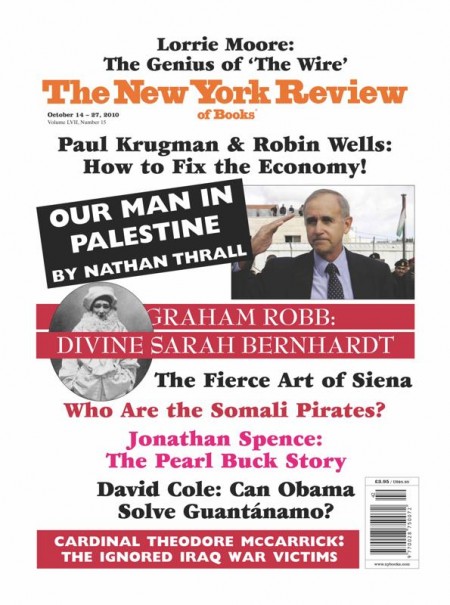

Nathan Thrall has written an excellent article — Our Man in Palestine — in the October 14, 2010 issue of the New York Review of Books. He underlines how fragile the Palestine Authority is under Mahmoud Abbas and Salam Fayyad and how completely dependent the West Bank’s new stability and growth is on American, and ultimately Israeli, good will.

The Palestinians have few choices. Hamas and resistance have paved a road to self destruction; the devastation in Gaza is bleak testimony to this. Can the PA do better? Leaning on the authority of men such as general Keith Dayton, who is largely absent in this article despite it’s ostensibly being about him, and who probably has limited authority in Washington, cannot be wise.

Thrall argues that Fayyad, Washington’s real man in Palestine, understands full well that the US is a paper cut out of Israel and cannot pressure the Jewish state do do much that it does not want to. So what is Fayyad’s plan for the day after failure? It seems he plans to throw Palestine at the mercy of the UN and EU, in the hope they they will be able to protect a “de facto Palestinian state,” in contrast to Washington. The impotence of the UN and international law to protect Palestinians is well known. It all becomes curiouser and curiouser. Here is the most important quote in the article which should be read in its entirety:

Fayyad’s speech concerned his ambitious plan, made public in late August 2009, to establish unilaterally a de facto Palestinian state by August 2011. By that time, according to Fayyad, “the reality of [a Palestinian] state will impose itself on the world.”5 Fayyad’s plan to “build” a state—he does not say he will declare one—has been endorsed by the Quartet (the US, EU, UN, and Russian Federation) and supported eagerly by international donors.

Some Palestinians have rejected it as too closely resembling Israeli Prime Minister Benjamin Netanyahu’s notion of “economic peace,” which proposes that development precede independence. And a number of Israelis have expressed suspicions that Palestine will seek UN recognition of its statehood when the plan is complete. Avigdor Lieberman, the Israeli foreign minister, has warned that any unilateral steps Fayyad takes toward a state could prompt Israel to annul past agreements and annex parts of the West Bank.6

Fayyad has said that his plan to build a new state “is intended to generate pressure” on Israeli–Palestinian negotiations, and the direct talks recently started by the two parties have a late summer 2011 deadline that coincides with Fayyad’s.7 Mike Herzog, former chief of staff to Israeli Defense Minister Ehud Barak, told me, “Ultimately, I think Fayyad calculates that political negotiations will not succeed and his plan [to establish a state] will be the only game in town.” The danger, for Israel and the Palestinian Authority alike, is what will happen if negotiations fail and Fayyad’s plan does not produce significant concessions from Israel. “We are not going to withdraw from certain areas just because there was a declaration or a UN resolution,” Herzog said. In that event Hamas will be able to present a persuasive argument that violence is the only means of achieving national liberation. “Fayyad sets an arbitrary date and says, ‘Okay, now all of you break your heads if you want to avoid a catastrophe,’” ……

Israeli Foreign Ministry PR to focus on social media
More than NIS 60 million will be spent on bringing big-name bloggers and media mavens to Israel.
By Ayala Tsoref

The Foreign Ministry plans to target leading social media figures as part of a new public relations campaign. The ministry will soon launch the NIS 60 to 70 million initiative, which constitutes a large chunk of a NIS 100 million publicity budget approved by the Finance Ministry this week.

The Foreign Ministry had initially requested NIS 300 million for efforts to cultivate Israel as a “brand,” but the treasury ultimately approved NIS 100 million.

The campaign will focus on hosting figures the ministry has identified as having significant influence on public opinion. The first step in that effort was seen in ministry involvement in coordinating Arianna Huffington’s visit to Israel. She is the co-founder of the prominent Huffington Post political blog.

The ministry says it will work to cover the visits of many other opinion makers next year. The focus will be on people involved in lifestyle issues, culture and art, as well as leaders of specific population segments such as the gay community.

The Foreign Ministry also plans to fund activities already underway online. For example the site “I am Israel,” which features video clips and articles about the average Israeli. The project, part of an effort to change the world conception of Israelis, was initiated by individual Israelis. While the ministry is not currently involved in this site, in the future it intends to fund such projects……

Edo Aharoni, who visualized and found the branding project, says that the chosen PR company will be responsible for promoting Israel through sub-brands that work within the company, such as tourist sights with international affinity (the Dead Sea, Jerusalem); Leading figures (artists, scientists) or products (olive oil, wine).***

The internet activity will focus on audiences that are interested in these niches, through the social networks that they surf, including wine and culture enthusiast forums and websites. Aharoni says it’s a quantum leap for the Ministry of Foreign Affairs that until now dealt mainly with classic Hasbara and crisis management.

The Ministry of Foreign Affairs said that the goal is to align the activity of the public sector, on Hasbara issues, to that of the private sector, in relation to the models and methods of action. Similar to the way private companies manage their marketing budget.

The Minister of Foreign Affairs, Avigdor Leiberman, said on the matter that “today’s world requires completely different paths and plans than those we were accustomed to in the past, and it’s the governmental sector’s responsibility to move forward with the world of media and business and bring to the maximizing of Israel’s relative advantages with modern means.”

Relations with Syria Continue to Improve- Iraqi Official
15/09/2010By Rahmat al-Salaam – Asharq Al-Awsat

Relations between Baghdad and Damascus have improved in the last dew days, particularly after the telephone contact made by Syrian Prime Minister Muhammad Naji Itri with his counterpart Al-Maliki early last week. Within the same context, informed sources, which refused to be identified, told Asharq Al-Awsat that “the Syrian Foreign Ministry is preparing to issue a statement in which it welcomes the recent Iraqi tendency toward Syria, particularly after the statements of the Iraqi Government spokesman (Al-Dabbagh) in which he pointed out the presence of mutual economic interests between Iraq and Syria.” The sources refused to elaborate further.

Al-Dabbagh said in press statements last Friday that “the Syrian-Iraqi relations are developing well and there are joint economic interests,” pointing out that the two sides “have signed a memorandum of understanding late last month concerning three pipelines to transport energy, two of which are for transporting crude oil to the Mediterranean and a third for transporting gas.”

Meanwhile, and on the level of the dialogues between the political blocs on forming the government, Shakir Kitab, member of the Al-Iraqiya list led by former Prime Minister Iyad Allawi, said that all the negotiations between the political parties “have been a failure,” explaining to Asharq Al-Awsat that “all the negotiations between the political parties in the country have failed and all have reached a dead end.”

Writing to share a piece I have in the The National (Abu Dhabi) on a new biography of Sayyid Qutb, the ‘father’ of radical Islam. Have a look:

Sayyid Qutb, man of his era
Frederick Deknatel
September 17. 2010

Sayyid Qutb behind bars in Cairo in 1966, the year of his execution. AFP

During the Second World War, Sayyid Qutb commuted to his government job in central Cairo on a train that ran north from his home in the suburb of Helwan. Qutb worked as a school inspector, but was also a man of letters who wrote novels, poetry and criticism. The Egyptian Nobel Laureate Naguib Mahfouz later credited Qutb as one of two literary critics who had been “responsible for rescuing him from obscurity”: Qutb had praised Mahfouz’s early novel The Struggle of Thebes, an allegory of Egypt’s anti-colonial struggle against the British told through the ancient Egyptians’ battle with the Hyksos invaders. In an interview in the 1990s, Mahfouz remarked that “had it not been for his tendency to extremism,” Qutb “would have become the most important critic in Egypt.”…..

Gulfsands Petroleum Profit Rises Almost Fivefold
2010-09-16, By Brian Swint

Sept. 16 (Bloomberg) — Gulfsands Petroleum Plc, a U.K. explorer focused on the Middle East and North Africa, said first-half profit rose almost fivefold as it increased output. Net income climbed to $18.7 million from $3.9 million in the first six months of 2009, the company said today in a statement. Average production rose to 9,689 barrels of oil equivalent a day compared with 6,165 barrels a year earlier. The company reached a milestone of 10 million barrels of output in Syria at the end of July from its Yousefieh and Khurbet East fields. After rejecting a takeover from Indian Oil Corp. and Oil India Ltd. in May, Gulfsands is buying into fields in Tunisia and aims to build its business in Iraq.

Students meet Hamas and Hizbollah for education beyond the classroom
Effie-Michelle Metallidis
September 15. 2010  UAE

Students of the Damascus Exchange are encouraged to get outside the walls of the university to engage with the Syrian capital. Al-Azem Palace, above, houses the Museum of Arts and Popular Traditions. Ola Rifai / AP Photo

Few Arabic-language study programmes include visits with Hamas and Hizbollah officials as part of their curriculum. But at Damascus Exchange, a two-week course, access to such people is what students sign up for.

“Getting a chance to talk with Hamas was an amazing opportunity,” said Mert Karakus, a 22-year-old student from Turkey and one of 11 participants in this summer’s programme in Damascus, which is run by Mideastwire.com, a Beirut news translation service.

The Meaning of the Koran
By ROBERT WRIGHT, September 14, 2010, 9:00 pm

Test your religious literacy:

Which sacred text says that Jesus is the “word” of God? a) the Gospel of John; b) the Book of Isaiah; c) the Koran.

The correct answer is the Koran. But if you guessed the Gospel of John you get partial credit because its opening passage — “In the beginning was the word, and the word was with God” — is an implicit reference to Jesus. In fact, when Muhammad described Jesus as God’s word, he was no doubt aware that he was affirming Christian teaching.

Extra-credit question: Which sacred text has this to say about the Hebrews: God, in his “prescience,” chose “the children of Israel … above all peoples”? I won’t bother to list the choices, since you’ve probably caught onto my game by now; that line, too, is in the Koran.

I highlight these passages in part for the sake of any self-appointed guardians of Judeo-Christian civilization who might still harbor plans to burn the Koran. I want them to be aware of everything that would go up in smoke.

But I should concede that I haven’t told the whole story. Even while calling Jesus the word of God — and “the Messiah” — the Koran denies that he was the son of God or was himself divine. And, though the Koran does call the Jews God’s chosen people, and sings the praises of Moses, and says that Jews and Muslims worship the same God, it also has anti-Jewish, and for that matter anti-Christian, passages.

The regrettable parts of the Koran — the regrettable parts of any religious scripture — don’t have to matter.
This darker side of the Koran, presumably, has already come to the attention of would-be Koran burners and, more broadly, to many of the anti-Muslim Americans whom cynical politicians like Newt Gingrich are trying to harness and multiply. The other side of the Koran — the part that stresses interfaith harmony — is better known in liberal circles.

As for people who are familiar with both sides of the Koran — people who know the whole story — well, there may not be many of them. It’s characteristic of contemporary political discourse that the whole story doesn’t come to the attention of many people.

[http://www.haaretz.com/news/diplomacy-defense/obama-wants-to-restore-lebanon-aid-congress-feared-would-be-used-against-israel-1.314242]
‘Obama wants to restore Lebanon aid Congress feared would be used against Israel’ – Haaretz Daily Newspaper | Israel News

In its time of trial, Lebanon must be warier about its economy
By AKenan Mortan
Friday, September 17, 2010

Lebanon’s main economic indicators show steady improvement: GNP increased from $21 billion in 2004 to $32 billion in 2009, inflation remains under control, foreign trade is balanced, and the unemployment rate is tolerable. Moreover, the Lebanese pound is pegged to the US dollar. According to the IMF, “the crisis did not directly affect the Lebanese economy, the banks are solid and the funds are flowing in.”

But, although the World Bank classifies Lebanon as an “upper middle income” country, with a per capita GNP of $10,800, 28 percent of the population lives below the poverty line. As many of Lebanon’s poorest are Shiites, this provides fertile ground for Hizbullah recruiters.

Other economic shadows remain, with serious potential political implications. The IMF forecasts that the Hariri government should be able to tap capital markets to cover its financial needs for 2010. But the current budget relies on foreign aid to cover a $3 billion (10 percent of GNP) shortfall. The issue is not so much where the funds will come from as the amount itself. Lebanon’s growth rate, which has averaged 3.7 percent over the last 10 years, has been, according to the IMF, “lower and more volatile than (averaged) in the MENA [Middle East-North Africa] region.”

Under these conditions, it is difficult to see how the country can ever offset the damage caused by the various wars of the 1975-2006 period, estimated to have caused $35 billion in damage. The “emergency post-conflict assistance” (under $100 million) provided by the IMF after the 2006 fighting with Israel fell well short of the amount needed to rebuild. The Lebanese government has been highlighting the US aid that it has received. But this assistance – military hardware and a five-year military training program – does not address the country’s fundamental economic problems….

Hariri’s government is set to keep its 71-member majority in Lebanon’s 128-seat Parliament, helped by the 8 percent economic growth projected for this year…..

Egypt is moving forward with plans to build four nuclear power plants.

Jordanian TV viewers prefer Syrian and Egyptian drama series over Jordanian ones.

A new Arab Advisors online Media Survey of Jordan’s Internet users revealed that 92.5% of Jordanian TV viewers prefer watching Syrian drama series while 61.6% prefer watching Egyptian drama series. This is compared to 26.6% of the respondents who stated that they prefer watching Jordanian drama series.

Why would Syria and Saudi Arabia be so keen about Lebanon to the extent both made it the jewel of their rapprochement? Kamal Dib in Daily Star

The reason lies in the common family legacy that both King Abdullah and Assad inherited from their fathers. This heritage was a lesson from the fathers on geo-politics and it states that it is in the best interest of their respective countries to work together.

Patrick Seale in his seminal biography on late President Hafiz Assad mentions an episode about King Abdel-Aziz, the founder of Saudi Arabia. In his last days, King Abdel-Aziz gathered his sons – Saud, Faisal, Fahed, and Abdullah – around him to give them a crash course on how to run the affairs of the vast and wealthy kingdom. Among the many things he had said was that Syria was important for Saudi security, which should take center-stage in Saudi regional policy. He warned his sons not to let Syria go either with Iraq or with Egypt because that would isolate Saudi Arabia and enfeeble its clout and influence in the region. These sons later iterated that Syria should not be run over by Israel either, since Arabia itself would be the next prey.

“New Media is Straining Government Tolerance In Syria,” by Deb Amos

Deb Amos on NPR:  A really good story about how the New Media is  Straining  Government Tolerance In Syria

Photo: Honey al-Sayed, the queen of morning drive time radio in Damascus, has pushed the boundaries of free speech in Syria. The autocratic regime in Syria has been forced to accommodate new media, including Facebook and Twitter.

Elie Elhadj writes about the latest diatribe against Syria by the Gemayyel family

As long as the Lebanese are unequal at the ballot box, injustice and societal tension will persist.

That the Lebanese Shi’ites, around 40%+ of the population, share 21% of the parliamentary seats, while Christians, roughly 35% of the population, enjoy 50% of the parliamentary seats make Shi’ite men and women as if they were lesser voting beings than Christian men and women. That the Maronites get 26.6% of the seats, while they constitute around 15% of the population is wrong.

A One-person one-vote voting system will evolve in Lebanon sooner or later. When that happens, extremists Gemayel, Geagea, and co. (may be described as Maronite Taliban) will be put in their place.

Western-backed Lebanese faction slams Hezbollah
By BASSEM MROUE (AP)

BEIRUT — A Western-backed alliance in Lebanon’s government accused the militant group Hezbollah and its allies Wednesday of trying to take the country back to the days when Syria dominated this tiny Arab nation.

The alliance is struggling to maintain its political clout as Hezbollah and its patrons in Damascus gain strength in Lebanon. The March 14 coalition is named for a day of massive demonstrations in 2005 when millions turned out and forced Syria to leave Lebanon after nearly 30 years.

“Lebanon is being subjected at the present time to a wild coup attempt that aims to take us back to the time before the March 14, 2005 independence uprising,” Fares Soeid, a senior official with the alliance told reporters Wednesday.

Robert Fisk: Freedom, democracy and human rights in Syria
Ribal al-Assad gives our writer a rare insight into the dynasty that has shaped modern Syria
Thursday, 16 September 2010

Ribal al-Assad doesn’t look like the son of a war criminal; fluent English, fluent French, fluent Arabic (of course), fluffy black hair and brown eyes, a youngish 35, Boston graduate, self-assured, a member of the Damascus elite, sitting in a Marble Arch hotel, turning down my offer of coffee, talking about freedom and democracy and human rights in Syria, denying – gently but forcefully – that his father, Rifaat, is a war criminal.

The Maliki government in Iraq is looking to improve relations with Syria. This is an important development, as Iraq is the last country Syrian neighbor that has failed to reconcile with Damascus since the Bush administration left the White House. Of course Syria’s relations with Israel remain terrible.

Syria welcomes agreement to transfer crude Iraqi oil via its territories… (thanks to mideastwire.com)
On September 14, Al-Watan daily carried the following report by Janbulat Shakai:

In a step pointing toward a new action to overcome the past stage of relations between the State of Law Coalition and Syria, President Bashar al-Assad is receiving today a high level delegation from the Coalition headed by Iraqi Prime Minister Nouri al-Maliki, whose term has ended. In the meantime, Syria welcomed – via an official source – the signing of an agreement between Baghdad and Damascus to allow the transfer of Iraqi crude oil and gas to the coasts of the Mediterranean Sea via the Syrian territories. Iraqi sources stated to Al-Watan: “A delegation from the State of Law Coalition headed by Minister of State for National Security Affairs Shirwan al-Wa’ili, and official in the Dawa Party Abdul Halim al-Zuheiri, arrived in Damascus yesterday at noon.”

“The sources added: “The delegation met with Assistant Vice President Brigadier General Muhammad Nassif over a business dinner,” indicating that the delegation’s program featured a meeting with President Al-Assad this morning. The sources then mentioned: “The delegation will try to normalize relations between the Dawa Party and Damascus after a year of severance, which followed the accusation made by Al-Maliki to Syria of being behind the bloody explosions which rocked Baghdad in August 2009, assuring that the delegation will be carrying “an apology” from Al-Maliki to the Syrian command. The sources pointed out that the Iraqi government previously tried to mend its relations with Damascus, as its official spokesman Ali al-Dabbagh visited Damascus mid-August, in addition to the phone call made by [Syrian] Prime Minister Muhammad Naji al-Otari to his [Iraqi] counterpart Al-Maliki on Eid el-Fitr last Thursday.

“They added at the same time that “the approval of the extension of a gas pipe from Iran to Syria via Iraq by Iraqi Oil Minister Hussein al-Shahrastani, also contributed to the alleviation of the climate between the two countries… – Al-Watan Syria, Syria

Do Israelis Want Peace?
Matt Duss

israeli palestinian flagsIsraeli Ambassador Michael Oren takes to the L.A. Times op-ed page today to respond to last week’s TIME cover story, which claimed that “Israelis are no longer preoccupied with” the peace process. From the TIME article….

Tal al Muloohi, a 19 year old female blogger, was arrested last year for writing a poem on her blog. Muloohi was in high school and her whereabouts are unknown. Her parents have contacted many state officials but without any progress.

Damascenes have taken over public space in Damascus for private use.

This study, a PFD document, documents the urban development of Damascus in the 1960s and 1970s. The study by the ETH Studio Basel- an institute of urban research- describes the social, political, and demographic forces that shaped the development of Damascus in the second half of the 20th century. In particular the study focuses on three districts Mezzeh, Dummar, and Barzeh. The Authors also document the unplanned development around these districts and the large scale illegal modifications and additions to the exterior as well as to the shared public spaces within buildings in these areas. ETH Studio Basel Contemporary City Institute Elsa Wifstrand, Rujun Jia, Prof. Jacques Herzog Prof. Pierre de Meuron Manuel Herz Shadi Rahbaran, Ying Zhou, The Middle East Studio Wintersemester 2009

Envoy Mitchell flies to Syria for talks with Assad
Phil Sands, Foreign correspondent
September 16. 2010 12:18AM UAE

DAMASCUS // The US special envoy George Mitchell arrives in Damascus today for talks with the Syrian president Bashar Assad.

The visit is being viewed as a sign that Washington is seeking to engage Syria more deeply in the Middle East peace process. While Israel and the Palestinian Authority have renewed direct talks, Syria and Israel remain technically at war and are not involved in negotiations, even indirectly.

Mr Mitchell was in Egypt this week when the Israeli prime minister, Benjamin Netanyahu, and Mahmoud Abbas, the president of the Palestinian Authority, held their second round of face-to-face discussions since talks reopened in Washington a fortnight ago.

After meeting Mr Assad today Mr Mitchell is expected to travel to Lebanon for discussions there. His visit to Syria comes three days after Claude Cousseran, a French presidential envoy, came to Damascus in an effort to restart Syrian-Israel negotiations.

Islam Comment – A New Forum by Alex

Syria Comment’s very own Alex – Camille-Alexandre Otrakji – has begun

Islam Comment

It includes a stellar line up of essayists:

Sadik Al-Azm, Mona Eltahawy, Hussein Ibish, Marc Gopin, Nasser Rabbat, Hind Kabawat, Wassim Al-Adel, Elie Elhadj, Joseph Helou, Taufiq Rahim, Nabil Beitinjaneh, Ghassan Karam, Hind Obiedin, Tarek Barakat, Jihad Bitar, Ayman Hakki

The first essay question is: “Should the West Welcome New Mosques? Should the East welcome other places of worship?”  Take a look.

What Does Turkey’s “Yes” Vote Mean for Democracy

Turkey Voted Yes
By Firat Demir
For Syria Comment
Sept 13, 2010

Here is a map of the referendum voting. Blue is YES. The voting pattern of the referendum was very close to that of the 2009 elections. The Mediterranean coastal region voted No (though with a very close margin), but the major cities, Istanbul and Ankara, and the rest of the country voted Yes.”

Turkey voted “Yes” to more democracy, more human rights, and a more civilian administration, free from the frequent interventions of the once all powerful military. We should now see an accelerated trend toward real and honest democracy in Turkey.

A new constitution, the first one to be ever written by civilians, not dictators is the first thing to be expected after this day. The Yes vote is also a response to the military coup of September 12, 1980 that marks one of Turkey’s darkest days.

Despite the fear mongering with the images of Iran after Humayni, Turkish voters decided that they want the army to return to its barracks and not deployed on Turkey’s streets. They want generals and judges off the front pages of the newspapers, where they have been so prominent for a century. Officers and judges have viewed themselves as the guardians of the state rather than of law.

The Kurds, who have been most discriminated against by this oppressive alliance of the military and judiciary, not surprisingly voted ‘Yes,” despite demands by their own leaders that they boycott the election. In Diyarbakir, the participation rate was around 35% (which shows that the boycott was effective and AKP party will have to reconcile with the Kurdish representatives in the parliament) but 94% of those that voted, voted Yes. In 17 Kurdish cities, the average participation rate was 55%, ranging from a low of 7% in Hakkari to a high of 78% in Bingol, reflecting the confusion among the Kurdish voters. Nevertheless, more than 95% of those who went to the ballot box, despite the boycott decision by the PKK and pro-Kurdish party DTP, voted Yes.

Key issues in the constitutional changes

Some key issues in a package of 26 reforms to the constitution that were included in the referendum voted on in Sunday’s referendum were:

Military:

  • The changes give officers who are dismissed by the military the right to appeal their dismissal.
  • It redefines the jurisdiction of military courts and empowers civilian courts to try military personnel for crimes against state security or against the constitutional order — such as coup attempts.
  • It opens the way for the prosecution of Turkey’s 1980 military coup leaders.

Equality:

  • It strengthens gender equality and bars discrimination against children, the elderly, the disabled and veterans.

Privacy:

  • It recognizes the right to protection of personal information and limits government access to personal records.

Freedoms:

  • It restricts travel bans imposed on individuals.

Labor:

  • It allows membership in more than one union in a workplace
  • It recognizes the right to collective bargaining for civil servants and other state employees
  • It removes bans on politically motivated strikes

Parliament

  • It ensures that elected officials can remain in Parliament if their political party is disbanded by a court decision.

Constitutional Court:

  • It increases the number of judges on the Constitutional Court from 11 to 17
  • It gives power to Parliament to appoint some of them.
  • It recognizes the right of individual appeals to the court.

Judiciary:

  • It increases the number of members of the Supreme Board of Judges and Prosecutors (HSYK), which oversees the appointments of judges and prosecutors in the country, from 7 to 22.
  • It opens the way for appeals of decisions to remove them from the profession.

Turkey votes for new constitution in tussle for country’s future
By Patrick Cockburn Monday, 13 September 2010

The Turkish government secured victory yesterday in a vote to amend the constitution drawn up by the country’s military to protect their power after a coup in 1980. Yesterday’s vote, in which 58 percent of voters backed the changes – was held on the 30th anniversary of the 1980 coup, when as many as 600,000 Turks were arrested and at least 450 people died under torture; many others disappeared. The military of the day drew up a constitution that severely limited democracy and entrenched the power of the armed forces and a judiciary sympathetic to military control.

The changing of the constitution will make possible to try officers in civilian courts, stop the judiciary banning political parties (the ruling party was almost banned in 2008), and allowing the President and parliament to have a say in the composition of the powerful constitutional court.

The changing of the constitution will make possible to try officers in civilian courts, stop the judiciary banning political parties (the ruling party was almost banned in 2008), and allowing the President and parliament to have a say in the composition of the powerful constitutional court.

It was also seen as a key indicator of who would win parliamentary elections due before July next year between the ruling and mildly Islamic AK party and the opposition Republican party (CHP) which claims to be the defender of Turkish secularism.

Since coming to power in 2002, the AK, led by Mr Erdogan, has been cutting back the power of the army and is being accused by the CHP of covertly undermining secularism.

The CHP is a revived political force under its new leader Kemal Kilicdaroglu and campaigned vigorously in defence of the Turkish version of secularism. The struggle between supporters of the old secular but authoritarian elite, who have held power since 1923, and the AK government is likely to continue despite the government’s narrow victory.

The army’s grip on power has been weakened by a series of confrontations with Mr Erdogan over the past eight years in which it has come off worst. The military has not intervened in the referendum.

Who is afraid of Europeanization?
Ihsan Dagi September 6, 2010

The Kemalists, who stood naked in their authoritarian and anti-Western disposition, have waged a war against Turkey’s Europeanization and democratization through their representatives in politics, business and bureaucracy. This is the background to the Kemalists’ opposition to constitutional change. They do not accept the principle that people have the right to choose who will represent them.

Turkey poised for major shakeup as voters back constitutional reforms
Robert Tait in Istanbul Sunday 12 September 2010, Guardian

PM celebrates unexpectedly easy win in referendum on amendments opposed by all opposition parties Referendum delivers clear support for Turkish PM’s plans to curtail judiciary and make armed forces subservient to civilian rule Link to this video Turkey stood on the brink of a ground-breaking political transformation tonight after voters in a referendum backed a constitutional shakeup designed to tame its once mighty secular establishment.

With more than 99% of votes counted, returns showed 58% backing for amendments that would drastically curtail the judiciary and make the armed forces subservient to civilian rule. The result confounded earlier forecasts of a tight race and represented a stunning political triumph for Turkey’s prime minister, Recep Tayyip Erdogan, and his ruling Justice and Development party (AKP), which is rooted in political Islam.

The government had called the vote to decide on a 26-article reform package that it said would give Turkey a democratic constitution fit for EU membership and mark a break with the country’s baleful legacy of military coups.

The European commission, which had criticised the government for stifling public debate, welcomed the results. “These reforms are a step in the right direction as they address a number of longstanding priorities in Turkey’s efforts towards fully complying with the accession criteria,” the commissioner for enlargement, Stefan Fule, said in a statement.

The vote took place on the 30th anniversary of a 1980 putsch that ushered in a military government that introduced the current constitution.

Turkey stood on the brink of a ground-breaking political transformation tonight after voters in a referendum backed a constitutional shakeup designed to tame its once mighty secular establishment. With more than 99% of votes counted, returns showed 58% backing for amendments that would drastically curtail the judiciary and make the armed forces subservient to civilian rule.

Erdogan Like Ataturk Roils Elite as Kiler Rises With AK’s Power
By Benjamin Harvey and Mark Bentley (Bloomberg), 2010-09-13

The Istanbul Stock Exchange 100 index rose 2.7 percent yesterday to a record, helped by the referendum results.

Erdogan, 56, has plenty to brag about in the Turkish economy. “A Turkey that in 2002 was the 26th-largest economy in the world is now the 17th,” he said in a speech in Ankara on June 29. “Turkey is being talked about as an example for the world. We’re being watched with envy.”

Under the AK Party, the government has tamed the inflation that plagued the country for decades. Since early 2004, consumer price increases have been no more than 13 percent. That’s a victory in Turkey, where the inflation rate touched 73 percent as recently as February 2002 and was even higher, on average, throughout the 1990s.

Strong Growth

While gross domestic product shrank in the first three quarters of 2009 because of the global financial crunch, Turkey has recovered strongly. In the first quarter of 2010, the economy grew at an 11.7 percent annual pace, though the International Monetary Fund predicts that growth will slow later this year. The average annual pace of growth in Turkey from 2004 to 2008 was 6.1 percent, more than triple the rate in the previous five years. Turkey’s exports were $102 billion last year, up from $36 billion in 2002, even as the economies of Turkey’s trading partners contracted.

Erdogan has pushed to make Islam more prominent since the AK Party swept to power by winning a majority of the seats in Turkey’s parliament in a 2002 vote and ending more than a decade of coalition governments. The prime minister has said Turks should drink fruit juice instead of alcohol and has proposed prison terms for adultery.

He has tried — and so far failed — to lift a ban on women wearing Islamic-style headscarves in universities. This prohibition is loaded with history and symbolism, having first been instituted by Mustafa Kemal Ataturk, the champion of
secular values who founded the Turkish Republic in 1923. Ataturk challenged the elite of his day with political and social changes that transformed the remnants of the Ottoman Empire into the modern state of Turkey.

News Round Up (13 Sept 2010)

Koucnher & Hezbollah’s Nawaf Mussawi (Thanks to our friends at Friday Lunch Club)

“…Walid Jumblatt, urged Paris to “abolish” the verdict to be issued by the United Nations Special Tribunal for Lebanon (STL), which is investigating the assassination of former Lebanese premier Rafiq Hariri, Naharnet reported citing an article published in Al-Hayat.

It is feared that the tribunal might trigger strife within Lebanon by potential indictment of figures with the Lebanon’s Hezbollah resistance movement. …The movement has categorically rejected the allegations and called the tribunal an “Israeli project.” …

Jumblatt also warned French Foreign Minister Bernard Kouchner that France would be “held responsible if civil war was ignited in the country,” Al-Hayat added. …Earlier in the year, the Lebanese daily As-Safir also said that Saudi Arabia had asked France to use its influence to find a way out of the indictment issue. The French authorities, however, told Prince Muqrin, the Saudi envoy and the Kingdom’s intelligence chief, that the solution lied in the United States. …”

Read Qifa Nabki on the Hariri Tribunal and the likely impact of Saad’s apology for having accused Syria of orchestrating the crime.

Americans will never be at war with Islam — Obama
Kuwait News Agency – 12 September, 2010

While al Qaeda may seek to spark conflict between different faiths, Americans “are not, and never will be, at war with Islam,” President Barack Obama said on Saturday.
Speaking at the Pentagon Memorial on the ninth anniversary of the terrorist strikes, the President said it was not a religion that attacked the United States that day, killing nearly 3,000 people.

“It was al Qaeda, a sorry band of men which perverts religion,” Obama said. “And just as we condemn intolerance and extremism abroad, so will we stay true to our traditions here at home as a diverse and tolerant nation. We champion the rights of every American, including the right to worship as one chooses — as service members and civilians from many faiths do just steps from here, at the very spot where the terrorists struck this building.” The attackers sought to demoralize and divide Americans, to deprive them of the unity and ideals that have made the United States “a beacon of freedom and hope to billions around the world,” he said. “Today we declare once more

we will never hand them that victory….

Hichame Assi invites you to join SyriaConnect – a news aggregater about Syria. He also invites you to join a project to map Syria by helping to name the streets and shops you love on Google Maps. Learn about the effort here. It looks like a great and useful project. Also a great way to meet some interesting Syrians.

WSJ [Reg]: Nuclear Scrutiny to Turn to Israel
2010-09-11

WASHINGTON—Arab states are preparing to press for far greater United Nations controls over Israel’s nuclear program, in a move that could complicate the Obama administration’s broader nonproliferation campaign and Middle East peace drive. …

Report: French envoy to meet with Assad on renewal of Israel-Syria peace talks

Eli Bardenstein, Maariv, September 13 2010 [page 5; Hebrew original here and at bottom of post] (Didi Ramez)

Along with the direct talks between Israel and the Palestinians, France and the US are acting to put in motion the political negotiations between Israel and Syria. Over the course of the holiday and yesterday, two top officials visited Israel who are responsible for talks on this channel. They met with top Israeli officials and in the next few days will go to Damascus for meetings with Syrian President Bashar Assad and with Syrian Foreign Minister Walid Muallem.

The Lebanese As-Safir newspaper wrote that the French official was Jean Claude Cousseran, French President Nicolas Sarkozy’s special envoy to the Israeli-Syrian talks, and Fred Hoff, deputy to special US envoy to the Middle East George Mitchell, who is responsible for the Syrian-Lebanese desk for Washington. Cousseran and Hoff met with Defense Ministry officials, including Defense Minister Barak.

The paper further reported that in his visit to Damascus, Cousseran will try to clarify to what extent Syria will agree to be flexible in its demands of Israel even though, at every opportunity, Assad is firm about stressing that without a withdrawal from the Golan Heights, there will be no peace. Cousseran will also try to help get the dialogue moving on this track by means of putting pressure on the Israeli side to enter into the negotiations. France believes that if this works, the US will take on itself the role of patron of the talks.

Envoy Mitchell is also expected to visit Damascus and will try to get the support of President Assad for the direct talks between Israel and the Palestinians and to relay a message in the matter of the importance that the US attributes to talks on the Israel-Syria track.

[SYR] Syrian channels launched in US and Canada
2010-09-09

State-owned Syrian Satellite Channel and the newly launched sister channel, Syria Drama, have announced their launch in the US and Canada. The two channels will be available as part of the premium packages of IPTV platform TV2MORO in North America. Earlier this year TV2MORO launched two Arabic television subscription packages.

Iran’s Growing Interests and Influence in Central Asia
Dario Cristiani | 10 Sep 2010 in World Politics Review

In early August, at the fourth trilateral summit between Iran, Afghanistan and Tajikistan held in Tehran, Iranian President Mahmoud Ahmadinejad urged the leaders of the other two countries to join in an alliance to counterbalance NATO’s growing presence in Central Asia. Though any such formal alliance is unlikely, the declaration reflects Tehran’s desire to play a larger role in Central Asia’s regional dynamics.

If Iran has always been geographically part of the regional context of Central Asia and the Caucasus, Tehran’s geopolitical orientation has historically been focused southward, on the Persian Gulf. For more than a century, Iranian interests in the area were limited to dealing with Russia’s — and later the Soviet Union’s — expansionism. The end of the Cold War and the implosion of the Soviet Union opened new opportunities on Iran’s northern borders, even if Iran remained more preoccupied with the need for domestic reconstruction following the war with Iraq.

In the past 15 years, however, Tehran has been particularly active in trying to create a deep net of institutional and economic links in the region, in part to counter the increasing reach of Turkey, perceived as an American proxy, and of Pakistan, historically an enemy of Iran. Such an approach has been characterized by the “pragmatism” typical of Iran’s post-revolutionary leadership. Eschewing the idea of exporting revolution, Iran has instead tried to improve ties with all the countries of the region, focusing on those with which it shares cultural and historical links. This explains the strong attention paid by Tehran to Tajikistan and Afghanistan, which represent cornerstones of the Iranian strategy in the region. At the same time, a clear example of Iran’s pragmatism is the close relationship it has forged with Armenia, cemented by the common interest of containing Azerbaijan….

Tehran faces a strategic dilemma. On one hand, Iran is clearly interested in a stable Afghanistan: Iran and Afghanistan are linked by a “strategic geography,” and problems due to instability in one country can easily affect its neighbor. For example, Iran is already deeply concerned about drug trafficking, refugee flows and crime along its borders with Afghanistan. Only a stable government in Kabul can reduce such threats.

On the other hand, Tehran perceives the longstanding presence of American troops at its borders as a strategic threat. Moreover, the ability to undermine American interests in Afghanistan can provide Tehran with leverage over Washington on other issues, such as the confrontation over its nuclear program. As a result, Tehran could potentially see an interest in destabilizing Afghanistan in order to affect the American military effort there.

This same unresolved ambiguity in Tehran’s approach can also be seen, if to a lesser extent, in Iran’s relationships with Russia and China….

China to build $2bn railway for Iran

Thousands of Syrians Cross Turkish Borders to Visit Relatives on Eid al-Fitr: More than 31,000 people crossed Bab al-Hawa border point to congratulate their relatives on a two-day visit – in Raqqa it was 24,000. 800,000 Syrians are expected to visit Turkey this year.

Untangling the Bizarre CIA Links to the Ground Zero Mosque
By Mark Ames in The New York Observer
September 10, 2010 | 2:36 p.m
Untangling the Bizarre CIA Links to the Ground Zero Mosque

So far, the debate over the proposed Islamic center near Ground Zero has unfolded along predictable lines, with the man at the center of the project, Imam Feisal Abdul Rauf, drawing attacks from the right painting him as a terrorist sympathizer with ties to Hamas and the Muslim Brotherhood.

But meanwhile, links between the group behind the controversial mosque, the CIA and U.S. military establishment have gone unacknowledged.

For instance, one of the earliest backers of the nonprofit group, the Cordoba Initiative, that is spearheading the Ground Zero mosque, is a 52-year-old Scarsdale, New York, native named R. Leslie Deak. In addition to serving on the group’s board of advisors since its founding in 2004 by Imam Feisal Abdul Rauf, Deak was its principal funder, donating $98,000 to the nonprofit between 2006 and 2008. This figure appears to represent organization’s total operating budget–though, oddly, the group reported receipts of just a third of that total during the same time period.

Deak describes himself as a “Practicing Muslim with background in Christianity and Judaism, [with] in-depth personal and business experiences in the Middle East, living and working six months per year in Egypt.” Born into a Christian home, Deak became an Orthodox Jew and married a Jewish woman before converting to Islam when he married his current wife, Moshira Soliman, with whom he now lives in Rye.

Leslie Deak’s resume also notes his role as “business consultant” for Patriot Defense Group, LLC, a private defense contractor with offices in Winter Park, Florida, and in Tucson. The only names listed on the firm’s website are those of its three “strategic advisers.” These include retired four-star General Bryan “Doug” Brown, commander of the U.S. Special Operations Command until 2007, where he headed “all special operations forces, both active duty and reserve, leading the Global War On Terrorism,” and James Pavitt, former deputy director for operations at the Central Intelligence Agency, where he “managed the CIA’s globally deployed personnel and nearly half of its multi-billion dollar budget” and “served as head of America’s Clandestine Service, the CIA’s operational response to the attacks of September 11, 2001.” …

Subject: An Unsettled Issue
SPIEGEL ONLINE
3 September 2010
Israeli Settlement Construction Booms Despite Ban

By Juliane von Mittelstaedt in Jerusalem

In Washington, the Israelis and Palestinians are discussing peace, but in the Jewish settlements in the West Bank, construction is proceeding at full speed. A legal ban is being ignored and the government is looking away. The thousands of new homes could hinder reconciliation….

It’s also an issue where the fronts are growing increasingly tense. “As far as we are concerned, we will continue building after we have buried our dead,” Naftali Bennett, the general director of the settlers’ association Yesha said hours before the start of peace talks. Just a short time after his announcement, the settlers began erecting several symbolic settlements in the West Bank. In an interview with SPIEGEL ONLINE, Bennett had threatening words. “It is not good enough that the moratorium will end on Sept. 26,” he said. “Ehud Barak needs to act to approve 3,000 new housing units — 1,500 of them right now.”

….And why should they if they have the impression that the government doesn’t even support the moratorium?

…. From the start of the Oslo peace process in the 1990s until today, the number of Israeli settlers living in the West Bank has tripled — growing from 110,000 to more than 300,000 people living in 121 settlements and 100 outposts. In addition to that there are 200,000 more settlers in East Jerusalem.

The Land Is Practically Free….. Construction may even proceed at a faster pace than before. In the West Bank, there are few signs that the moratorium has even been put in place. In dozens of settlements, excavators and cement mixers are a regular sight, and Palestinians work in temperatures of 40 degrees Celsius (104 degrees Fahrenheit). Around 2,000 homes are currently under construction — and in most cases, work had begun shortly before or after the start of the moratorium….

…. The Moratorium ‘Was a Fiction Right from the Outset’…. “The construction boom here began shortly before the building freeze,” says Dror Etkes, who is perhaps the Israeli who knows the most about the settlements. For years he has been documenting settlement construction and submitting complaints against illegal projects.

Etkes is sure that active construction is taking place in at least 46 out of 120 settlements. Building projects have only actually been frozen in five settlements, he says. Even government inspectors have found violations of the moratorium in 29 settlements. So far, however, no construction firm has been called to account over those violations. That is despite the fact that the building freeze, for the first time in Israeli history, is not just a “political” requirement, but is actually enshrined in law — meaning that any violation should be legally punished.

Additionally, infrastructure projects are not included in the building moratorium. As a result, a number of sewage treatment plants and water reservoirs are being built in settlements — including on Palestinian land. In Beitar Illit, a new road is being built.

Neither were the associated financial incentives — the only reason that many Israelis choose to live in the West Bank — affected by the moratorium. Those benefits include cheap loans, subsidized rents, tax breaks and countless other perks, all of which could easily be cancelled.

“The difference between the level of construction before and during the moratorium is much, much less than the settlers claim,” says Etkes. “It’s not just that the building freeze has been undermined — it was a fiction right from the outset.” One of the consequences, he says, has been that construction activities have become even more focused on the eastern settlements — in other words, those small, isolated and often radical settlements that would need to be evacuated if a peace agreement were reached. It is expected that the inhabitants of those settlements would defend themselves with force against such a move.

‘Building Freeze Is More Harmful than Useful’

Construction work is also going on in Kfar Adumim. The settlement is significantly larger than the norm — 2,700 people live here in the hills between Jerusalem and Jericho. Among them are two members of the Knesset, the two hardliners Aryeh Eldad and Uri Ariel. 30 houses are to be built here and 50 Palestinian workers are employed on the site. One man, who is busy laying bathroom tiles, says they started work a month before the building freeze came into force. In the beginning, they had 300 men working at full speed to lay as many foundations as possible in the short time.

Etkes sees the circumventing of the building freeze here as a “classic example of the cooperation between the settlers and the government”: Some of the foundations were hastily laid before the building freeze came into force, some afterwards — but nobody bothers to police it. “The building freeze was discussed for half a year, that was enough time for all parties to prepare.”

This is no different from other settlements. Once the moratorium comes to an end, the settlers immediately begin to build. Or, if they do not need housing right away, they can save the foundations as a “reserve” in case of future building freezes. In addition, dozens of settlers’ organizations have submitted building applications to local authorities that could be approved in the coming months.

The tiler will not give his name because he is afraid of losing his job, which pays him a minimum of about €30 a day. But he did say that many of his colleagues began work on the site two days before the construction moratorium in the settlements came into force. He also said that building work is still going on in Har Homa in Bethlehem, even though the building freeze is in force there. Carpenters work at night so as not to draw so much attention.

With Each Project, the Future Clearing of Settlements Becomes More Difficult…

…All it takes is a few figures from Israel’s statistical office to determine that no reduction of construction activity worthy of mention has taken place. Israel’s Channel 10 TV, for example, has reported that 8,000 Israelis either moved to the West Bank or have been born there in the past six months. Projected over the remaining months of 2010, that would be 16,000 people. In recent years — without the construction moratorium — the average growth rate was 5.5 percent, which with 300,000 settlers in the West Bank, would mean an annual increase of around 16,500 people. “In other words, the much-discussed construction moratorium has brought us 500 fewer settlers,” Etkes says.

‘At the End of the Day, There Will Be Another 1,000 Homes’

For the Palestinians, the time elapsed since the start of the construction moratorium hasn’t been a good one. According to Human Rights Watch, the Israeli civil administration in West Jordan has torn down a total of 267 Palestinian homes in recent months, more than ever before. The homes had been built without permits, but that’s the case with most new Palestinian homes because they are hardly ever approved.

By contrast, says Etkes, he has no doubt that the homes in the settlement that have been built illegally during the moratorium will, at least some of them, be legalized later. “At the end of the day, there will still be another 1,000 homes more in the West Bank.”

Special investigation: How Blair rescued Palestine deal worth $200m to his £2m-a-year paymasters
David Rose | The Daily Mail | September 12 2010

Tony Blair mounted an intense political lobbying campaign to rescue a struggling mobile-phone business owned by a client of the bank that pays him a £2?million annual salary. The firm, Wataniya, had already built a brand-new network in the Israeli-occupied Palestinian West Bank.
But it almost collapsed before launching its service, jeopardising a £450?million investment, because Israel’s government was refusing to let it use the frequencies it needed to operate.

President al-Assad Performs Eid Al-Fitr Prayers at Badr Mosque
Interestingly, the English version of the SANA article about the sermon delivered by Imam Husam Eddin Farfour during the Eid celebration that President Assad attended, is much abridged from the Arabic version and leaves out the attack on America and what America means by democracy. Farfour explains that the the US is spreading a new world order that is spreading chaos throughout the region. It is returning man to the law of the jungle where the poor eats the weak and the rich eats the poor and where humanity and civilization is abased. Man was made by the creator…

President Bashar al-Assad performed Eid al-Fitr Prayers on Friday morning at the Damascus-based Badr Mosque.

After the prayer, President al-Assad listened to the Eid al-Fitr sermon by Sheikh Husam Eddin Farfour. The sermon talked about the supreme meanings of the Eid as an opportunity for cooperation, amity and rapprochement, noting the pioneer place of the Islamic nation as the carrier of the message of Islam to the world.

Sheikh Farfour said Islam is a human world religion that is not confined to a nation, society or group, but a religion that belongs to the whole world.

”The world nowadays is afflicted by injustice, woes, wars and massacres as a result of the world hegemony and domineering powers claiming that they want to set a new world order,” he said, describing this new order as a legitimization of chaos and a setback to humanity.

”The war on terrorism, as Your Excellency said, is a war waged on us for the sake of terrorism which is disavowed by all heavenly religions, mainly Islam” Sheikh Farfour said.

The sermon affirmed that Islam was the first to preach dialogue as a substitute for clash of civilizations.

Sheikh Farfour hailed President al-Assad’s wise leadership that laid the foundation of dignity, security and stability in Syria, wishing him success and prosperity.

???? ???? ????? ” ??? ???? ?? ???????? ??????? ?????? ????? ???????? ???? ???????? ???? ???? ” ???? ??? ?? ????? ????????” ????? ??? ??? ?????? ????? ? ??? ??????? ?????? ??? ???? ???? ????? ?????? ???????? ???????? ???????? ?????? ?????? ???????? ??????? ???? ???? ????? ? ??? ??????? ?? ???? ?????? ??????? ???? ?????? ?????? ???? ??? ????? ???????? ?? ??? ?????? ???? ???? ?? ..???? ????? ???????? ?????? ?? ??? ??? ?????? ????? ???????? “.

????? ?????? ” ??? ???? ?????? ???? ????? ?? ????? ?????? ?? ???? ????? ?????? ???? ?????? ????? ???? ????? ?????? ????? ” ??? ????? ??????” ? ??? ???? ?????? ?? ????? ????? ?????? ????? ???? ?? ?????? ?? ???? ????????? ????? ??? ????? ????? ???? ??? ?????? ?????? ?????? ?????? ” ? ??? ??? ??????? ?? ??? ?????? ?????? ?????? ????????? ???????? ????? ??????? ????????? ?????? ??? ?? ??????? ? ?????? ??????? ?? ????? ???????” .

????? ” ?? ??? ?? ???? ???? ????? ?????? ???????? ????? ?????? ?????? ???????? ??? ????? ???????? ..?????? ??? ???????? ?? ????? ?????? ?????? ????? ???? ???? ??????? ?????? ??????? ?? ????? ??????? ??? ????? ????” .

?? ????? ???? ????? ?????? ?? ???? ??? ?? ????? ?????? ????? ???? ” ??? ???? ??????? ?????? “?? ?????? ??????????? ???? ???? ??????” ????? ??? ??? ????? ???? ????? ?? ??????? ???? ??? ???????? ???????? ???? ????? ??????? ???? ?? ?? ??????? ??? ????? ???????”.

??? ???? ?? ????? ???????? ??????? ? ????? ???? ????? ??????? ? ???? ?????? ????? ??? ????? ..??? ??? ????? ?????? ?????? ?? ??????? ?? ??? ???? ?????? ????? ?? ????? ???? ??? ???? ???? ?????? ..???? ????? ???? ??? ?????? ???????? ..??? ???? ????? ??? ?? ?????? ?? ??? ??? ?????? ?????? ???? ????? ” ???? ???????” .

???? ????? ?????? ?????? ??????? ?????? ?? ????? ???????? ???? ? ? ???? ” ???? ???? ?? ???? ????? ??? ?????? ???? ???? ????? ???? ????? ???? ???? ???? ?? ??????? ???????? ” ??? ???? ????? ??????? ?? ??????? ?? ??????? ????? ?????? ?? ??? ??????? ..????? ???? ??? ??????? ???? ?????? .

Muhammad al-Habash Resigns from all Religious Activities

Muhammad al-Habash has been forced to resign from all his religious activities by the Ministry of Awqaf.

Muhammad al-Habash, a public intellectual, religious authority, and member of parliament, goes many steps further than most liberal Syrian Imams in proposing a reinterpretation of teh Qur’an. He argues that Islam is not the only path to salvation, that women are the equals of men, and that holy texts must be interpreted in the light of modern day requirements.  For example he has called for abandoning corporal punishment, such as cutting the hands off of thieves. In his view, such commands are to be merely taken as a message that theft is forbidden in Islam. He was one of three imams who spoke up in support of the government ban on the niqab. His liberal interpretations have been met with considerable opposition, as one can gather from reading this post at “Marifah.” All4Syria has reported on this story in Arabic.

It is suggest that he was forced to resign by the Minister of Awqaf because Habash’s wife, Asma’ Kaftaru, the daughter of the former Grand Mufti Kaftaru, has been critical of the minister. There are other conjectures as well.

????? ???? ??? ?????? ?? ???? ??????? ??????? ?????? ???????

????? ?????? ?? ??????? ?? ???? ??? ???? ??? ?????? ?????? ??????? ..
??? ???????? ???? ????? ????? ?? ???? ??????? ?????? ?.???? ??? ?????? ????? ?? ??? ???? ??? ???? ???? ?????? ?? ???? ????? ???? ?????? ?. ???? ??? ??????? ?? ???????? ??????? ?????? ???????? ??? ??? ?????? ?????? ?????? .. ????? ??? ????? ??????? ????? ????? ?? ??????? ??????? ..
???? ???? ???? ??? ????? ?????? ???????? ?? ????? ????? ????? ??? ?????? ?? (?????? ?????? ) ??? ?? ???? ????? ??? ?? ?????? ??? ????? ?????? ???? ?????? ..?? ???? ????? ???? ?????? ????? ????? ???? ????? ??????? ?????? ??????? ????? ??????? ?????? …???? ????? ????? ???? ??????? ??????.

?? ??????? ???? ???? ???? ??? ????????? : ?????? ???????? ? !

???? ?? ????? ????? ??? ?????? ?? ?? ????? ?????? ?? ?????? ??????? ????? ??? ?????? ?? ???? ??????? ????????.
????? ( ???? ?????) ??? ?? ??? ?? ???? ???? ??????? ??? ??? ?? ????? ?????? ???? ??????? ?? ????? ?????? ????? ??? ?? ??? ?? ???? ??? ???? ????? ?? ????? ????? ?? ??? ???????? ?? ???? ??????? ??????? ???? ???? ?????? ??????? ???????.
????? ?? ???? ??????? ?? ??? ?????? ???? ????? ????? ?? ??????? ?? ????? ?? ???????? ???? ??? ??????? ??? ??????? (??? ????????) ??? ????? ????? ??? ???? ???????? ????????? ???? ????? ????? ??????? ?????? ????? ?????? ??? ???? ????? ?????? ??? ???? ??? ????? ???? ??????? ?????? ????? ???? ???? ?????? ?? ??????? ?? ????? ?????? ..
??? ?? ????? ???? ???? ?? ????? ????? ??????? ???? ???? ????? ??????? ???? ?? ???? ??????? ??? ?????? ???? ?????? ?? ??? ????? ???????. ????? ??? ???? ???? ????????? ?????? ?? ?????? ????? ??????? ??? ??? ????? ?????? ??? ?????? ?? ??? ????????? ??? ????? ?????? ???? ???? ???? ???? ?????? ?? ???? ??? ?????? ??? ??? ?? ???? ??? ????? ???? ??????? ??????? ?? ????? ??????? ??? ?????? ?? ???? ??????? ?????? ???? ???? ??? ??? ????? ???.
??? ???? ?? ??? ???? ???? ????? ????? ?? ????? ??????? ???? ????? ???? ?? ????? ???? ????? ?? ????? ??? ????? ??????? ????? ??? ??????? ???? ???? ?? ?????? ?????? ??????? ???????? ???????????? ???? ???? ?? ????? ????? ??????? ?? ?????? ?????? ?? ??? ?? ????????? ??? ?????.

This is from Habash’s resume: Damascus – Syria 1962

Degrees Diplomas:   Ph. D. In Islamic Law
* B.A. In Arabic Lit.                             Beirut Univ.
* B.A. In Islamic Studies                      Islamic Call College.
* The High License in memorizing the Holy Qur’an and mastering reading it.
* M.A In Islamic Studies                      Univ. of Higher studies-Karachi.
* ph. D. In the sciences of the Quran     Univ. of the Holy Quran-Khartoum.

Jobs Positions:
•    Prof. at the University of Damascus
•    Director of the Islamic Studies Center in Damascus
•    President of the association of Arbab Al-Sha‘a‘er (the league of scientists)
•    Member of the High Council in the International Islamic University -Islamabad
•    He was elected as a Member of Syrian parliament 2003 (independent)
•    He was elected three times as an administrative committee in Syrian parliament
•    He has a daily T.V. programs on four satellite channels

Paul Heck of Georgetown University has written an interesting and short article about Habash’s important role in supporting ecumenicism and tolerance in Syria.

Paul Heck, “Muhammad al-Habash and Inter-religious Dialogue.” (Here are a few excerpts)

…..His central theological point is not simply that Islam can exist amicably alongside other religions, but that its own message is one of religious plurality.  Remarkable for being based entirely on Islamic sources (e.g. Q 4:123-124), his argument underscores that Islam did not come to abrogate other religions but to confirm all religion as submission to the one God, Creator and Judge of all, who rewards and punishes according to good works, not religious affiliation…. Although viewed with some suspicion by local Christian leaders, al-Habash’s position, meant to counter sectarian tension within Syrian society, looks to reinforce a national unity that embraces all religions and is not monopolized by any one; his inter-religious engagements thus have specific national implications….

His vast scholarly erudition allows him to highlight long forgotten rulings which, even if not enjoying a preferred status (arjah), still legitimately represent Islam and speak more appropriately (aslah) to the conditions of today’s world – a way for Muslims to be reconciled to contemporary life as Muslims.  One example of this is his ideas on women in Islam, a reading of the religious heritage that does not reject but rather challenges — not without controversy — the claim that traditional Muslim attitudes towards women are the only ones recognized by Islam.  This type of reflection has potentially important ramifications for the relation of Syrian law to international agreements: A recent treatise by al-Habash demonstrates that Muslim values do indeed conform with the 1979 UN Convention on the Elimination of All Forms of Discrimination against Women, highlighting that human rights and equality of women are not reducible to western constructions but belong to the human heritage universally……

“Why Does Syria Do So Badly in World Economic Rankings,” by Ehsani

Ehsani provides this interesting analysis of latest world economic rankings provided by the World Economic Forum. He writes:

The rankings are based on twelve criteria of competitiveness.

1- institutions , 2-infrastructure, 3- macroeconomic environment, 4- health and primary education, 5- higher education and training, 6- goods market efficiency, 7- labor market efficiency, 8- financial market development, 9- technological readiness, 10- market size, 11- business sophistication, 12- innovation.

The first 4 criteria are known as the basic requirement
The next 6 criteria are known as efficiency enhancers
The last 2 criteria are the innovation and sophistication factors

Syria slipped 3 levels to 97 from 94 last year. The study assumed the following key statistics:
Population 21.9 million, GDP $ 52.5 billion, Gdp per capita $ 2579.

Most interesting is that the country received a number one ranking when asked about “business costs of crime and violence”. It was also ranked number one in the world in the HIV prevalence category. It also received very high rankings in “lack of organized crime”, “business costs of terrorism”, “national savings rate”, ” interest rate spread”, “rigidity of employment” and “control of international distribution”. The above areas were notable competitive advantages by the study.

On the negative side, here is what went wrong:

Syria was dead last (rank 139) in “extent of staff training”, The country was at 137 in “company spending on R&D”, “university-industry collaboration in R&D” and “prevalence of foreign ownership”. Surprisingly perhaps, it got a 136 ranking in “female participation in the labor force”. It was ranked at 133-134 in “transparency of government policy making”, “strength of auditing and reporting standards”, “reliance on professional management”, “the legal rights index” and “burden of customs procedures”. Another low ranking was in “internet access to schools” at 131.
____

Switzerland Again Tops Global Competitiveness Rankings, Canada Drops to 10 (Table)
2010-09-09, By Marco Babic (Bloomberg)

The following table ranks countries on their competitiveness from the World Economic Forum’s Global Competitiveness Index.

The rankings are based on twelve criteria of competitiveness.

=======================================================================
                           2010-11     2009-10        Rank     2011-10
Country                       Rank        Rank      Change       Score
=======================================================================
Switzerland                      1           1           0        5.63
Sweden                           2           4           2        5.56
Singapore                        3           3           0        5.48
United States                    4           2          -2        5.43
Germany                          5           7           2        5.39
Japan                            6           8           2        5.37
Finland                          7           6          -1        5.37
Netherlands                      8          10           2        5.33
Denmark                          9           5          -4        5.32
Canada                          10           9          -1        5.30
=======================================================================
                           2010-11     2009-10        Rank     2011-10
Country                       Rank        Rank      Change       Score
=======================================================================
Hong Kong SAR                   11          11           0        5.27
United Kingdom                  12          13           1        5.25
Taiwan, Chna                    13          12          -1        5.21
Norway                          14          14           0        5.14
France                          15          16           1        5.13
Australia                       16          15          -1        5.11
Qatar                           17          22           5        5.10
Austria                         18          17          -1        5.09
Belgium                         19          18          -1        5.07
Luxembourg                      20          21           1        5.05
Saudi Arabia                    21          28           7        4.95
Korea, Rep.                     22          19          -3        4.93
New Zealand                     23          20          -3        4.92
Israel                          24          27           3        4.91
UAE                             25          23          -2        4.89
Malaysia                        26          24          -2        4.88
China                           27          29           2        4.84
=======================================================================
                           2010-11     2009-10        Rank     2011-10
Country                       Rank        Rank      Change       Score
=======================================================================
Brunei Darussalam               28          32           4        4.75
Ireland                         29          25          -4        4.74
Chile                           30          30           0        4.69
Iceland                         31          26          -5        4.68
Tunisia                         32          40           8        4.65
Estonia                         33          35           2        4.61
Oman                            34          41           7        4.61
Kuwait                          35          39           4        4.59
Czech Republic                  36          31          -5        4.57
Bahrain                         37          38           1        4.54
Thailand                        38          36          -2        4.51
Poland                          39          46           7        4.51
Cyprus                          40          34          -6        4.50
Puerto Rico                     41          42           1        4.49
Spain                           42          33          -9        4.49
Barbados                        43          44           1        4.45
Indonesia                       44          54          10        4.43
=======================================================================
                           2010-11     2009-10        Rank     2011-10
Country                       Rank        Rank      Change       Score
=======================================================================
Slovenia                        45          37          -8        4.42
Portugal                        46          43          -3        4.38
Lithuania                       47          53           6        4.38
Italy                           48          48           0        4.37
Montenegro                      49          62          13        4.36
Malta                           50          52           2        4.34
India                           51          49          -2        4.33
Hungary                         52          58           6        4.33
Panama                          53          59           6        4.33
South Africa                    54          45          -9        4.32
Mauritius                       55          57           2        4.32
Costa Rica                      56          55          -1        4.31
Azerbaijan                      57          51          -6        4.29
Brazil                          58          56          -2        4.28
Vietnam                         59          75          16        4.27
Slovak Republic                 60          47         -13        4.25
Turkey                          61          61           0        4.25
=======================================================================
                           2010-11     2009-10        Rank     2011-10
Country                       Rank        Rank      Change       Score
=======================================================================
Sri Lanka                       62          79          17        4.25
Russian Federation              63          63           0        4.24
Uruguay                         64          65           1        4.23
Jordan                          65          50         -15        4.21
Mexico                          66          60          -6        4.19
Romania                         67          64          -3        4.16
Colombia                        68          69           1        4.14
Iran, Islamic Republic          69         n/a         n/a        4.14
Latvia                          70          68          -2        4.14
Bulgaria                        71          76           5        4.13
Kazakhstan                      72          67          -5        4.12
Peru                            73          78           5        4.11
Namibia                         74          74           0        4.09
Morocco                         75          73          -2        4.08
Botswana                        76          66         -10        4.05
Croatia                         77          72          -5        4.04
Guatemala                       78          80           2        4.04
=======================================================================
                           2010-11     2009-10        Rank     2011-10
Country                       Rank        Rank      Change       Score
=======================================================================
Macedonia, FYR                  79          84           5        4.02
Rwanda                          80         n/a         n/a        4.00
Egypt                           81          70         -11        4.00
El Salvador                     82          77          -5        3.99
Greece                          83          71         -12        3.99
Trinidad and Tobago             84          86           2        3.97
Philippines                     85          87           2        3.96
Algeria                         86          83          -3        3.96
Argentina                       87          85          -2        3.95
Albania                         88          96           8        3.94
Ukraine                         89          82          -7        3.90
Gambia, The                     90          81          -9        3.90
Honduras                        91          89          -2        3.89
Lebanon                         92         n/a         n/a        3.89
Georgia                         93          90          -3        3.86
Moldova                         94         n/a         n/a        3.86
Jamaica                         95          91          -4        3.85
=======================================================================
                           2010-11     2009-10        Rank     2011-10
Country                       Rank        Rank      Change       Score
=======================================================================
Serbia                          96          93          -3        3.84
Syria                           97          94          -3        3.79
Armenia                         98          97          -1        3.76
Mongolia                        99         117          18        3.75
Libya                          100          88         -12        3.74
Dominican Republic             101          95          -6        3.72
Bosnia and Herzegovina         102         109           7        3.70
Benin                          103         103           0        3.69
Senegal                        104          92         -12        3.67
Ecuador                        105         105           0        3.65
Kenya                          106          98          -8        3.65
Bangladesh                     107         106          -1        3.64
Bolivia                        108         120          12        3.64
Cambodia                       109         110           1        3.63
Guyana                         110         104          -6        3.62
Cameroon                       111         111           0        3.58
Nicaragua                      112         115           3        3.57
=======================================================================
                           2010-11     2009-10        Rank     2011-10
Country                       Rank        Rank      Change       Score
=======================================================================
Tanzania                       113         100         -13        3.56
Ghana                          114         114           0        3.56
Zambia                         115         112          -3        3.55
Tajikistan                     116         122           6        3.53
Cape Verde                     117         n/a         n/a        3.51
Uganda                         118         108         -10        3.51
Ethiopia                       119         118          -1        3.51
Paraguay                       120         124           4        3.49
Kyrgyz Republic                121         123           2        3.49
Venezuela                      122         113          -9        3.48
Pakistan                       123         101         -22        3.48
Madagascar                     124         121          -3        3.46
Malawi                         125         119          -6        3.45
Swaziland                      126         n/a         n/a        3.40
Nigeria                        127          99         -28        3.38
Lesotho                        128         107         -21        3.36
Cote d’Ivoire                  129         116         -13        3.35
=======================================================================
                           2010-11     2009-10        Rank     2011-10
Country                       Rank        Rank      Change       Score
=======================================================================
Nepal                          130         125          -5        3.34
Mozambique                     131         129          -2        3.32
Mali                           132         130          -2        3.28
Timor-Leste                    133         126          -7        3.23
Burkina Faso                   134         128          -6        3.20
Mauritania                     135         127          -8        3.14
Zimbabwe                       136         132          -4        3.03
Burundi                        137         133          -4        2.96
Angola                         138         n/a         n/a        2.93
Chad                           139         131          -8        2.73
=====================================================================

A Ukrainian website has printed an interview with me here about Syria’s role in the Middle East and its relations with the US. If you read Ukrainian read here.

WSJ [Reg]: Marking Ramadan’s End in a Big Way

DAMASCUS—As Muslims prepare to celebrate Eid ul-Fitr, the holiday marking the end of the holy month of Ramadan, many restaurants across the Arab world boost their meat orders by a few crates. But every year, Damascus Gate restaurant—officially …

Arab regimes’ autocratic nature masks their vulnerability
Lack of public debate makes Arab societies less compliant to new laws – and explains the heavy-handed state enforcement
Brian Whitaker,  guardian, Thursday 9 September 2010

There is a popular assumption – especially in the west – that because Arab regimes tend to be autocratic and authoritarian, the state in Arab countries is also strong.

Yesterday on Cif, Ahmed Moor wrote about the problem of disbanding Palestinian militias in Lebanon. Why, you might wonder, doesn’t the Lebanese government just pull its finger out and disarm them? The short answer is that it can’t because it’s too weak.

Similarly, as I pointed out myself in an article a couple of weeks ago, most Arab governments are incapable of collecting taxes effectively.

There is a paradox here, because Arab regimes have an almost insatiable urge to control. They legislate and regulate endlessly, they establish large armies and security forces and employ vast bureaucracies – and yet their ability to exercise power and influence the behaviour of their citizens is far more limited than it looks.

Regime survival is of course the top priority, so it’s hardly surprising that the power of the state should be directed towards controlling dissent, and that this is the area where its might is deployed most forcefully and effectively. But exercising power in this way is often mistaken for a sign of strength when in reality it is an acknowledgment of vulnerability. As the late Nazih Ayubi noted in his book, Over-stating the Arab State: “The Arab state is therefore often violent because it is weak.”

The Egyptian state, for example, may be perfectly capable of arresting demonstrators by the lorry-load, but it has also been trying for 10 years to persuade its citizens to wear seatbelts in their cars, with little success. For more than half a century, off and on, it has also been trying to stamp out female genital mutilation – again, without making much of a dent in traditional attitudes

In his groundbreaking book, Ayubi drew an important distinction between strong states and hard states. Unlike a strong state, a state that is hard may also be weak. A hard state tends to be highly centralised and interventionist, seeking (though not necessarily successfully) “to enforce a detailed, standardised regulation of the economy and the society”….

This is not to suggest that western systems are perfect, but to show why, by comparison, Arab countries have such problems with compliance. In line with the generally patriarchal approach to government, Arab laws tend to be handed down from on high by diktat and the lack of critical scrutiny before they are approved often results in vague or ambiguous language that makes them more difficult to implement…”

Fears for Turkey Roil Vote on Constitution

Capital Intelligence assigns sovereign ratings to Syria for the first time

“Syria’s credit prospects depend upon the success of policy initiatives aimed at improving the investment climate, as well as on the implementation of further measures to strengthen the public finances and financial management. Substantial economic reform has taken place over the past decade and an accelerated pace of reform could lead to higher ratings over the medium term,” CI says.

Capital Intelligence (CI) said that it has assigned Syria a long-term foreign currency rating of ‘BB-’ (BB minus) and a short-term foreign currency rating of ‘B’. CI has also assigned Syria a long-term local currency rating of ‘BB’ and a short-term local currency rating of ‘B’. The outlook on all ratings is Stable.

CI notes that Syria’s sovereign credit profile is characterised by comparatively strong solvency and liquidity indicators and a demonstrable commitment to gradual economic reform. Less favourably, political risk is a more material concern compared to many higher rated sovereigns, the economic structure and institutional frameworks are relatively weak, and the financial system underdeveloped. In addition, the government is exposed to potentially significant contingent liabilities because of the dominant role of the state in the economy. Syria also faces major longer-term risks associated with declining oil production and a fast growing workforce.

“The overarching strategy for overcoming these challenges is focused on completing the transition to a market-based and more open economy. But this will require many more years of sometimes difficult and politically-sensitive changes and hence there is a risk that the reform process might falter,” CI said.

“Syria’s economy has been only moderately affected by the global economic downturn, mainly because of its limited linkages with the international financial system, and is well-placed to return to trend real output growth of about 5 per cent in 2010-11 as its main trading partners recover,” it added.

New Syrian Brotherhood Leader: Continuity or Change?
Najib Ghadbian September 8, 2010
Arab Reform Bulletin

The Syrian Muslim Brotherhood’s recent selection of a new General Guide is generating speculation about the group’s trajectory after a period in which it gave up most opposition activities. Muhammad Riyadh al-Shaqfih, elected in July after former Guide Ali al-Bayanouni’s third term, served as a Brotherhood military leader in the 1980s and was unknown outside its ranks. While al-Shaqfih and his predecessor assert that there will be continuity in organization policies, a change at the top inevitably raises questions about a possible shift in the group’s strategies toward the Syrian regime…..

Drought Hits East for Forth Year Causing More Distress

Anyone interested in the Peace Talks should watch this al-Jazeera show: Empire looks at the Israeli-Palestinian talks and asks what it will take to reach the promised land. Rob Malley, John Mearsheimer, Nabil Shaath. Once the first seven minutes are over, they get down to a very interesting discussion of the realities and strategies of each side. Skip to 7 minutes into the show. See Philip Weiss for commentary on the video.

Syria droughts devastate crops, livestock: UN
By Rim Haddad (AFP)

DAMASCUS — Four consecutive droughts since 2006 have triggered “significant losses” of crops and livestock in Syria, mostly in the northeast of the country, a UN official said on Tuesday.

Olivier De Schutter, the UN special rapporteur on the right to food said who has been in Syria since August 29, said the droughts have left Syrians reeling and are having serious effects beyond purely economic ones.

“As a result of recent droughts … between two and three million” Syrians are now “living in extreme poverty in the country,” compared to 2.02 million in 2003-2004, Schutter told a news conference in Damascus.

He added, without elaborating, that this figure “remains tentative.”

Schutter said that “since 2006, four consecutive droughts have affected Syria, with the drought in 2007-2008 being particularly devastating.”

“The losses from these repeated droughts have been significant for the population in the northeastern part of the country, particularly in the provinces of Al-Hasakeh, Deir Ezzor and Al-Raqqa,” he said.

“In total, 1.3 million people have been affected, 95 percent of which live in these provinces and 800,000 of which were severely devastated,” he added.

In June, the World Food Programme started delivering food aid to nearly 200,000 people in those three provinces in the second such initiative since the United Nations launched a plan last year to combat the effects of the drought.

“The situation is really bad” in northeast Syria, WFP official Selly Muzammil said in June.

Schutter said those most affected are “small-scale farmers,” and that the situation of many “further worsened in 2010 as a result of the yellow rust disease affecting the soft wheat production.”

Meanwhile, small-scale herders have lost around 80-85 percent of their livestock since 2005, he said.

Schutter noted that the droughts force many families to migrate to urban areas, leaving behind unattended farm land while their children dropped out of school as families tried to ends meet.

The United Nations estimates more than a million people have left the northeast, with farmers simply not cultivating enough food or earning enough money to sustain them.

Fifty thousand families are expected to leave rural areas for urban ones this year, compared to 29,000-30,000 in 2009.

Schutter said the arrival of hundreds of thousands of Iraqi refugees in Syria after the March 2003 US-led invasion of Iraq was “another stress placed on Syria.”

He also spoke of the “decrease of water table levels in Syria” and described that as “a serious source of concern.”

Wheat production, a key strategic resource, is believed to have fallen this year to 2.4 million tonne from from 4.1 million in 2007, while consumption has risen to 4.0 million tonnes annually, the ruling party’s newspaper Al-Baath reported in June.

“We are going to import wheat for the third consecutive year,” the daily said.

Elie Elhadj writes on Syria’s Water Problems:

For a clearer picture of Syria’s water problem, it ought to be noted that Between 1988 and 2000 the Syrian government spent, I estimated a few years ago, $15 billion on irrigation projects of different kinds. Despite this, however, reliance on capricious rainfall was not reduced and food self-sufficiency unrealized, despite false claims to the contrary.

In 1989, wheat production was 1 million tons; in 1995, it jumped to 4.2 million tons; in 1999, it dropped to 2.7 million tons; and in 2007, it increased to 4.1 million tons. Estimates for 2008 were around 2.5 million tons, and for this year 2.4 million tonnes.

Why was the reliance on rain water not reduced? Because huge resources were invested where the return was meager. The Tabqa Dam, for example, failed to achieve its targets. The plan was for the dam to increase the irrigated surface in the Euphrates Basin by 640,000 hectares by 2000. However, by 2000, only 124,000 hectares were irrigated in this salt-affected and drainage-poor Basin. Gypsum in the soil caused the irrigation networks to collapse. In the Euphrates Basin, 43 percent of the land was identified by the World Bank as having drainage problems or potential to develop problems in the future.

The World Bank concluded that Syria’s government “will need to recognize that achieving food security with respect to wheat and other cereals in the short-term as well as the encouragement of water-intensive cotton appear to be undermining Syria’s security over the long-term by depleting available groundwater resources.”

Had Syria invested in low water using manufacturing industries, instead of irrigation projects to generate the forex to import high water using foodstuffs, Syria would be today, I contend, in a better position in terms of per capita GDP as well as ground water volume and quality.

Schutter …. also spoke of the “decrease of water table levels in Syria” and described that as “a serious source of concern.”

Describing the decrease of water table levels as a serious source of concern is too diplomatic.

Irrigation extractions beyond the volume of renewable water have led to negative balances in five out the country’s seven basins; thus, reducing the quantity and degrading the quality of the remaining water reserves. This situation explains the serious challenge Syria faces in providing sufficient drinking and household water to most cities, a challenge that will grow over time as cities grow, if serious and major remedial steps are not taken immediately.

Veteran Syrian director takes on Muslim “extremism”
By Khaled Yacoub Oweis, Tue Sep 7, 2010

DAMASCUS (Reuters) – A veteran Syrian director who has shocked audiences by portraying a religious zealot who abuses women says his popular television series could help stop an Arab slide towards extremism.

Najdat Anzour’s “What your right hand possesses,” whose heroine Leila is forced by her brother Tawfiq to wear the full veil while he has illicit affairs, is being shown on television stations during the Muslim holy month of Ramadan in Lebanon, Syria, Yemen, Oman and Libya.

The 30-episode series, set in Syria and France, has attracted a wide following, as well as criticism by some Syrians who see it as unfairly targeting the highly devout — especially since its title is taken from the Koran.

Mohammad al-Buti, a government backed cleric who teaches Islamic law at Damascus University, initially described the series as a cancer and a mockery of God, though he later retracted his remarks saying he had not seen the work.

“When I film Damascus from the mountain I count thousands of green lit mosques and only a handful of theatres and cinemas,” Anzour told Reuters.

“Balance in society needs to be restored. My target is those remaining in the middle and who have not yet turned into extremism,” said the 56-year-old director of pan Arab fame.

Anzour argues for wider political freedom in the Arab world and says “wrong” interpretations of Islam cannot be allowed to dominate Arab media and television, with Saudi Arabia controlling major outlets.

“Lack of confidence in Arab regimes is opening the door to the spread of religious and extremist ideas. Our duty is to put the spotlight on the extremists to try to preserve the Middle ground. We dissect what they are saying and show that it has nothing to do with Islam ,” Anzour said.

Syrian television drama is big business by Arab standards, attracting millions of dollars in investment and adverts and vying with Egypt for audiences across the Middle East during the month of Ramadan, when new productions make their debut.

While the issues raised can stir controversy, they are usually in line with the policy of the government, which has been controlled by the Baath Party since it took power in 1963, outlawing opposition and imposing emergency law still in force.

The state, which crushed the Muslim Brotherhood as well as secular opposition parties in the 1980s, has recently made it clear that it does not favour having fully veiled women in the education system.

But the authorities have been tolerant of other Muslim religious displays and support the Palestinian Islamist group Hamas and Lebanon’s Hezbollah Shi’ite movement.

“NOT MOCKING ISLAM”

Anzour says the series does not exclusively criticise religious characters, and shows unsavoury secular figures as well.

Leila’s devout father opposes her brother dictating how she dresses, as well as his decision to whip her after he catches her with her boyfriend — despite a medical examination showing she was still a virgin.

Impervious to contradictions, Tawfiq gets a high school girl pregnant and starts an affair with a wife of an Islamist militant who died fighting in Iraq.

The series, which ends this week, shows Tawfiq espousing violence as hints of his private transgressions become known to his family. He preaches that violence should be used to make people adhere to what he regards as strict tenets of faith and that it is a duty of the faithful to topple non-Islamic systems.

“I think some were premature in their judgement. The more episodes people see the more they realise that it does not mock Islam but searches for real Islam in the society,” Anzour said.

“…Syrian society is a mural and I see these people are outside it,” he said. “Political conditions will play a main role in reversing the structure of society and the terrorist thinking that is being spread.”

Anzour’s work in recent years has focussed on religious themes, including a defence of Islam in “The ceiling of the universe,” following the outrage over a Danish newspaper cartoons depicting the Prophet. In “Passers by,” he described how Arab emigrants in Western societies could turn to violence.

In his current series, Leila eventually marries a good man and moves with her husband, who subsequently dies, to France, where she removes the veil totally but remains a devout Muslim.

Anzour, a Circassian who grew up in the once cosmopolitan city of Aleppo, said he was not against the veil but women should have the freedom not to wear it.

“Out of the thousands you see walking in Damascus 90 percent are now veiled. This was unthinkable several decades ago,” he said. “Are the women wearing the veil out of conviction or out of pressure by families and surroundings?”

LA Times [Reg]: LEBANON: Supporters stunned as Hariri says Syria didn’t kill his dad
2010-09-07 14:59:13.654 GMT

Praise, skepticism, betrayal, and mere confusion. The list of reactions is long in Arab media commentaries and on blogs and Web forums to Lebanese Premier Saad Hariri retracting his accusation against Syria in the 2005 assassination of his father in …

AFP:

….All you have to do is read the history of Lebanon to understand that there are no solutions in Lebanon without Syria,… Officials in Lebanon cannot be against Syria,” Makdisi told AFP. “That is just not an option, and Hariri has realised that.”

Hariri initially accused his then-foe Syria of the February 14, 2005 bombing that killed his father, ex-premier Rafiq Hariri, and 22 others in Beirut, at a time when Damascus retained a tight grip over Lebanon…. on Monday, the prime minister was quoted as saying he had erred. “At some point, we made a mistake, … At one stage, we accused Syria … That was a political accusation, and that political accusation is over.”

Hariri’s retraction, which one Lebanese daily dubbed a “political bomb,” comes amid high tension in Lebanon over pending indictments by the Special Tribunal for Lebanon, a UN-backed probe into the assassination.

Preliminary reports by a committee of The Hague-based tribunal concluded there was evidence implicating Syrian and Lebanese intelligence services in Hariri’s murder, but there are no suspects in custody.

The tribunal is reportedly set to implicate Lebanese Shiite party Hezbollah in the murder…..

Fadia Kiwan, head of the political science department at Saint Joseph University, argues that one party stands to gain from Hariri’s political metamorphosis: Syria. “After a difficult phase from 2005 to 2007, Syria’s power is once again consecrated,” Kiwan told AFP. “This will also put Syria’s allies in Lebanon in a position of even more power. “We should have expected this position since Hariri’s first visit to Syria,” she added. “It’s a natural stop in changing his political path.”

Syria: Mobile feast
16 September 2010
Economist Intelligence Unit

Telecoms companies have been waiting for a long time for the Syrian mobile market to open up. They have finally been granted their wish

The Syrian government has approved plans for the entry of a third mobile-phone operator and for the conversion of the build-operate-transfer (BOT) contracts of the two incumbents into fully paid-up licences. The opportunity to enter one of the least developed markets in the region is likely to elicit strong interest, particularly given the recent improvements in the perception of Syria as an investment destination. It could also provide a tidy windfall for the Syrian Treasury.

The way was opened for the award of a new licence when parliament passed a telecoms law on May 18th, which provided for the creation of an independent regulator, with the discretion to issue licences, and for the transformation of the Syrian Telecommunications Establishment (STE) into a state-owned corporation. The telecoms minister, Imad Sabouni, told Al Watan, a local newspaper, that the process of awarding the licence will take between five and seven months from the issue of the tender invitation, which he said would take place in the next two weeks. The process will entail two rounds of pre-qualification followed by a public auction. The ministry has used the services of Detecon, a German consultant, to prepare the terms of reference for the new licence and to advise on the conversion of the BOT contracts into licences.

Level playing field?

The two existing operators are Syriatel, controlled by Rami Makhlouf, a prominent businessman and a cousin of the president, Bashar al-Assad (he also happens to be Al Watan’s proprietor), and MTN, a South African firm that entered the market in 2006 through acquiring Beirut-based Investcom. The BOT contracts were awarded to Syriatel and Investcom in 2001 for 15 years, with the option of extending for a further three years, and with a guarantee that no new operator would be authorised for at least seven years. They have about 9m subscribers in total, with Syriatel leading with a share of about 55%. The contracts oblige the two firms to pay a 50% share of their gross revenue to STE. This amounted to S£41bn (US$890m) in 2009, making up a significant portion of the public-sector surpluses included in general budget revenue.

Mr Sabouni said that Detecon’s studies had shown that the state would reap a better return from the sale of the licences and through a new revenue-sharing arrangement than that which it gets from Syriatel and MTN.

The government has not yet provided details about the conversion of the BOT contracts. One option would be to oblige the two incumbents to pay the same fee as the winning bid in the auction—this would at least assure the new operator that the system is based on fair competition. Another critical question for new entrants will be the role of the regulatory authority, which is expected to start its operations in January 2011. The two operators have so far been subject to the supervision of STE.

Gulf operators keen to expand

Several regional telecoms companies have already expressed interest in taking up any opportunity to become the third operator in Syria. Bidders can be expected to include the major players in the Gulf, such as Etisalat of the UAE, Saudi Telecom, Qatar Telecom and Kuwait’s Zain, as well as the leading Turkish operator, Turkcell, which had previously been reported to be considering a bid to acquire Syriatel. There could also be some interest from Asian or Russian operators, and possibly from west European firms. Egypt’s Orascom Telecom would normally be expected to pursue an opportunity of this sort, but it could be deterred by its experience as the original partner of Mr Makhlouf in Syriatel, a relationship that quickly soured and which was eventually broken off.

Syria comes fairly low down the regional rankings for mobile penetration, according to figures provided by the International Telecommunication Union, with 44 users per 100 inhabitants (see Database, p.12). It lags behind most of its regional peers, with the exception of Sudan, Lebanon and Yemen (the figure for Lebanon is oddly low, perhaps because most mobile-phone users subscribe to networks in third countries rather than paying inflated fees for the state-owned service). To judge by comments on local news sites, Syrian consumers appear to be keen to see new entrants offering the same sort of packages and special deals that are widely available in the Gulf, and which are considerably more generous than those provided by Syriatel and MTN.

The opening up of the Syrian telecoms market is part of a wider effort to attract investment and to develop the private sector. Besides stimulating growth in the telecoms sector, it could also to provide a boost to the fledgling Damascus stockmarket, as both the incumbents and the new licensee are likely to offer shares to the public to help cover some of the costs of the fees.

FACTBOX-UN issues human rights report on Syria
07 Sep 2010, Reuters

Sept 7 (Reuters) – The United Nations High Commissioner for Human Rights has issued a rare report on Syria, calling on the government to intensify its response to a severe drought and stop discrimination against the Arab country’s Kurd minority.

Here are key points of the report…..

IRAQI REFUGEES

– Syria receives high marks for opening its public services and education system to Iraqi refugees, of whom 150,000 are registered with the United Nations.

– The refugees, however, are not allowed to work in Syria, which drives them to the underground economy at below minimum wage salaries and exposes them to employer abuse.

– Allowing the refugees access to the formal economy would “reduce the risk” of Iraqis competing with Syrian workers because they would then be given equal pay.

RIGHT TO FOOD

– Syria has a food subsidies programme supplying 10-15 percent of food demand. In theory the system is open to all Syrians, but many families cannot register if they have a male member who did not comply with mandatory military service.

– Programme should be extended to cover lentils, chickpeas, eggs and more fruits, vegetables and dairy products for children and pregnant women. If funds are lacking, the United Nations suggests that the programme could be limited to those falling below a defined poverty line.

DROUGHT IN EASTERN SYRIA

– School enrolment in northeastern Syria fell by 80 percent as a result of internal displacement driven by the drought.

– Government is focusing on schemes to make irrigation more efficient but also on big projects that could further deplete groundwater. More help is needed for vulnerable small farmers, who could benefit from low-tech but sustainable solutions, such as rainwater gathering techniques.

GOLAN HEIGHTS

– Territory held by Israel since 1967 is still home to 20,000 Syrians.

– Israeli settlers farm 80 square km (31 square miles) compared with 20 square km farmed by Syrians, although the two groups are comparable in size.

– The Special Rapporteur suspects “gross disparities” between the water usage allotted to the Israeli settlers and the Syrian inhabitants.

(For a story on Syrian treatment of the Kurdish minority, click on [ID:nLDE68619Y])

(Writing by Khaled Yacoub Oweis;

Syria treatment of Kurds “unacceptible” -UN official
By Khaled Yacoub Oweis

DAMASCUS, Sept 7 (Reuters) – Syria’s denial of citizenship rights to its Kurdish minority is “unacceptable” and the government should improve their treatment to help build national unity, a high-level U.N. human rights official said on Tuesday.

Lebanon PM: I was wrong to accuse Syria of Rafik Hariri murder

I was recently asked by a Turkish think-tank if I believed that the Special Lebanon Tribunal indictments would destabilize Lebanon? Here is how I answered:

The Tribunal’s indictments will probably not be politically explosive. Even though the Special Tribunal was originally conceived by the US to further its political objectives in the region which included eliminating Syrian influence in Lebanon and disarming Hizbullah, those objectives have largely been abandoned. Renewed Saudi-Syrian cooperation and the survival of Lebanon’s national unity government  suggest that regional powers and Lebanese politicians are cooperating to make sure that the indictments will not be explosive and will not change the communal balance of power in Lebanon or undermine the government.

Prime Minister Saad Hariri’s statement today that he made a mistake in blaming Syria for killing his father seems designed to ensure Lebanon’s stability.

Lebanon PM: It was wrong to accuse Syria of assassinating Rafiq al-Hariri

Sa’ad al-Hariri signals further rapprochement with Syria, saying it was a mistake to blame Damascus for his father’s 2005 murder

Lebanon ‘s prime minister, Sa’ad al-Hariri, has said it was a “mistake” to accuse Syria of the assassination of his father, Rafiq al-Hariri.

Hariri’s comments mark part of the ongoing reconciliation between the two countries following Syria’s withdrawal from Lebanon after the “Cedar Revolution ” protests that were triggered by the 2005 killing.

“At a certain point we made a mistake in accusing Syria of assassinating the martyred prime minster,” Hariri told al-Sharq al-Awsat , the London-based Saudi daily. “That was a political accusation and that political accusation has now come to an end.” The UN tribunal investigating the affair would look “only at the evidence”, he added.

Syria, which was widely blamed for the bombing that killed Hariri and 22 others, has always denied involvement but the issue remains highly sensitive in Lebanon.

One Sided Comments: A SC reader writes:

I’ve been subscribed to your blog for several years now and I always enjoy receiving it. It’s a wonderful way to keep abreast with what’s happening in Syria, my country of residence for the past seven years now. However, I couldn’t help feeling the comments you chose to publish in response to the Sept. 3 NY Times article were terribly one-sided. Mix with practicing Muslims in Syria, and you will find the poor and the rich, the illiterate and the educated, the frustrated and the content. The only common element is that all of them, in one way or another, find a religious worldview helps them to make sense of the world and of their place in it. It may be that there are more liberal ways of casting that worldview, more in line with modern society. It may be there is room for reform within religious legal interpretation. Only by allowing free debate will all options get a free airing and the best ones rise to the surface. And if there are people who believe secularism is the only way to go, let them argue their stance too. But what really bothers me is the elitist attitude that secularism must be forcibly imposed on the masses for their own good, because they’re too dumb to know any better. There’s frighteningly little room for democracy in such a stance.

Jordan and Syria call for Israeli withdrawal from all Arab lands DPA

Leaders of both states say that Israel must return to pre-1967 borders in order to end Israeli-Palestinian conflict.

Jordanian King Abdullah II and Syrian President Bashar Assad on Monday stressed the need for Israel to pull out from all Arab territories it occupied in the 1967 war, if peace with the Palestinians is to be achieved.

Abdullah made a whirlwind visit to Damascus to brief the Syrian leader on the outcome of his talks in Washington last week with United States President Barack Obama, Egyptian President Hosni Mubarak, Palestinian President Mahmoud Abbas and Prime Minister Benjamin Netanyahu, a royal court statement said.

The monarch had attended the six-way meeting on the eve of direct talks between Israel and the Palestinians being relaunched Thursday.

Abdullah and Assad “emphasized that resolving the Palestinian- Israeli conflict on the basis of the two-state vision requires the regaining of all Arab rights in accordance with … the Arab peace initiative,” the statement said.

The Arab peace initiative offered Israel recognition by all Arab states if it pulled out from all Arab territories it occupied in the 1967 Six-Day Warr, including East Jerusalem.

Lieberman: This generation will not see Middle East peace – Haaretz Daily Newspaper | Israel News

Was dining in a popular Turkish restaurant in Aleppo yesterday that is frequented by Turks. The TV was tuned to a Turkish news channel. When a report and rally by Erdogan and his wife started (some local campaigning or something), every one in the restaurant, including the waiters, stopped whatever they’re doing and started following enthusiastically for 30 minutes or so, followed by positive and cheerful discussions. The guy is very popular internally and regionally.

New 2010 World Bank figures for doing business in Syria have been posted. In almost every category Syria has lost ground. In the ease of doing business category, it fell five places to 143 from 138. In ease-of-enforcing-contracts it fell only one from 176 to 175.

Cellular News: Syrian Operators to Pay $500 Million for License Conversions

2010-09-06

Syria’s two incumbent mobile networks, Syriatel and MTN-Syria will be asked to pay SYP 25 billion (US$500 million) to convert their existing Built-Operate-Transfer (BOT) agreements into conventional licenses, Click here for more.

????? ???? – ???????? ??????? ??????? ???? “????? ??????” ??????? ???????
?? ?????? ???? ??????? ?????? ???????? ????? ????? ?????? ?????????? ????? ????? ?? ????????? ?????? ??? ????? ??????. (? ?)
???? ????? ???????? ??? ????? ???? ??????? ??????? ??? ???? ?????? ?????? ??????? ????????? ??? ???? ????? ?????? ???????? ??? ???????? ????? ??? ????? ????? ???? ??????? ???????????? ???????????.

Independent: Taboo-breaking Syrian soap causes Ramadan stir
2010-09-07

A Syrian soap opera that tackles such taboos as homosexuality, corruption and extra-marital sex in the predominantly conservative Muslim country is proving hugely popular during Ramadan. The TV drama “Ma Malakat Aymanukum,” which takes its name from …

Planned Quran-burning could endanger troops, Petraeus warns
CNN Monday, September 06

(CNN) — The U.S. commander in Afghanistan on Monday criticized a Florida church’s plan to burn copies of the Quran on September 11, warning the demonstration “could cause significant problems” for American troops overseas.

“It could endanger troops and it could endanger the overall effort in Afghanistan,” Gen. David Petraeus said in a statement issued Monday….

The Park51 money trail

POLITICO’s Ken Vogel and Giovanni Russonello dig into the money trail of the Park51 Islamic community center, and the campaign against it:

IDF document: “policy principle: separating Gaza from West Bank”
Promised Land blog, September 5th, 2010 | Author: noam

….The recent IDF slideshow is the first time an Israeli official document publicly declares that the current policy objective is to create two separate political entities in the Palestinian territories.

Nirit Ben-Ari, spokeswoman for Gisha, an Israeli NGO dealing with the freedom of movement, export and import to and from the Palestinian territories, said that “while in Washington a Palestinian state is being negotiated and people are already discussing ‘a train line between Gaza and Ramallah‘, in reality Israel is working to separate Gaza from the West bank even further than the separation already caused by the split in the Palestinian leadership.

“This policy is aimed against civilian population and against people who have nothing to do with Israel’s security concerns. It hurts family ties, and harms any future possibility to develop commerce, education and economical life in the Palestinian society. Those policies should raise concerns regarding the intentions of the Israeli government in Gaza.”….

Is Syria Cracking Down on Religious Groups? Why?

Kareem Fahim of the New York Times writes (article copied below) that the Syrian government is cracking down on religious groups. To a large extent this move is a return to business as usual. When George Bush was making his big push into the region in 2003-2004, Syria cracked down on the secular opposition that responded to Bush’s pressure on the Syrian regime by organizing the Damascus Declaration in the spring of 2005. In order to shore up support on the right as it attacked the left, Damascus gave greater latitude to religious leaders and groups.

Today, the secular opposition is weak, and Washington has largely stopped pressuring the Syrian regime. The instability and radicalism left behind by the Bush years has manifested itself in largely religious forms. The Syrian government has reassessed the threat that it faces and is leaning on religious groups even as most secular opponents are getting out of jail.

Change in Syria’s alcohol laws: Syria’s law states that you cannot serve alcohol if you are 100 meter away from a religious place of worship. Last night they changed the law to 75 meters.

One SC member writes:

“Syrian Law prohibits any Muslim from acquiring a liquor license for his/her restaurant. In fact, the last government liquor license issued to anyone was in the early 60’s. Any new place serving liquor today is operating without a license – no matter how close or far from a mosque. Ever since the Ba’ath came to power, being as secular as it is, they did not issue a single liquor license, even to Christians. If they did, it would be anti-secular! No Christian, Muslim, Armenian, or whatever had ever received a liquor license since 1963.

New-York Times sept 3 2010

Syria Moves to Curb Influence of Muslim Conservatives
By KAREEM FAHIM

DAMASCUS, Syria — This country, which had sought to show solidarity with Islamist groups and allow religious figures a greater role in public life, has recently reversed course, moving forcefully to curb the influence of Muslim conservatives in its mosques, public universities and charities.

The government has asked imams for recordings of their Friday sermons and started to strictly monitor religious schools. Members of an influential Muslim women’s group have now been told to scale back activities like preaching or teaching Islamic law. And this summer, more than 1,000 teachers who wear the niqab, or the face veil, were transferred to administrative duties.

The crackdown, which began in 2008 but has gathered steam this summer, is an effort by President Bashar al-Assad to reassert Syria’s traditional secularism in the face of rising threats from radical groups in the region, Syrian officials say.

The policy amounts to a sharp reversal for Syria, which for years tolerated the rise of the conservatives. And it sets the government on the seemingly contradictory path of moving against political Islamists at home, while supporting movements like Hamas and Hezbollah abroad.

Syrian officials are adamant that the shifts stem from alarming domestic trends, and do not affect support for those groups, allies in their struggle against Israel. At the same time, they have spoken proudly about their secularizing campaign. Some Syrian analysts view that as an overture to the United States and European nations, which have been courting Syria as part of a strategy to isolate Iran and curb the influence of Hamas and Hezbollah.

Human rights advocates say the policy exacerbates pressing concerns: the arbitrary imprisonment of Islamists, as well as the continued failure to allow them any political space.

Pressure on Islamic conservatives in Syria began in earnest after a powerful car bomb exploded in the Syrian capital in September 2008, killing 17 people. The government blamed the radical group Fatah al-Islam.

“The bombing was the trigger, but the pressure had been building,” said Peter Harling, a senior analyst with the International Crisis Group. “After a period of accommodation with the Islamic groups, the regime entered this far more proactive and repressive mode. It realizes the challenge that the Islamization of Syrian society poses.”

The government’s campaign drew wider notice this summer, when a decision to bar students wearing the niqab from registering for university classes was compared to a similar ban in France. That move seemed to underscore a reduced tolerance for strict observance by Muslims in public life. Syrian officials have put it differently, saying the niqab is “alien” to Syrian society.

The campaign carries risks for a secular government that has fought repeated, violent battles with Islamists in the past, most notably in 1982, when Mr. Assad’s father, Hafez al-Assad, razed the city of Hama while confronting the Muslim Brotherhood, killing tens of thousands of people. For the moment there has been no visible domestic backlash, but one cleric, who said he was dismissed without being given a reason two years ago, suggested that could change.

“The Islamists now have a strong argument that the regime is antagonizing the Muslims,” he said.

The government courted religious conservatives as Western powers moved to isolate Syria amid accusations that it was behind the assassination of a former Lebanese prime minister, Rafik Hariri, in 2005. The government appointed a sheik instead of a member of the ruling Baathist party to head the Ministry of Religious Affairs, and allowed, for the first time, religious activities in the stadium at Damascus University.

As the country emerged from that isolation, it focused on domestic challenges, including the fear that sectarian tensions in the region could spread — a recurring fear in Syria, a country with a Sunni majority ruled by Alawites, a religious minority.

The government also focused on conservatives. “What they had nourished and empowered, they felt the need to break,” said Hassan Abbas, a Syrian researcher.

The details of the campaign have remained murky, though Syrian officials have not been afraid to publicize its aims, including in foreign media outlets. In an interview with the American talk show host Charlie Rose in May, Mr. Assad was asked to name his biggest challenge.

“How we can keep our society as secular as it is today,” he said. “The challenge is the extremism in this region.”

Mr. Assad has in the past singled out northern Lebanon as a source of that extremism.

“We didn’t forget Nahr al-Bared,” said Mohammed al-Habash, a Syrian lawmaker, referring to battles in that region three years ago between Lebanese forces and Fatah al-Islam. “We have to take this seriously.”

Beginning in 2008, the government embarked on its new course when it fired administrators at several Islamic charities, according to the former cleric, who spoke on the condition of anonymity because he feared reprisal by the government.

The clampdown has intensified in recent months. Last spring, the Qubaisiate, an underground women’s prayer group that was growing in prominence, was barred from meeting at mosques, according to members. Earlier this summer, top officials in Damascus Governorate were fired for their religious leanings, according to Syrian analysts.

Other moves underscore the delicacy of Mr. Assad’s campaign — or perhaps send mixed signals. A planned conference on secularism earlier this year, initially approved by the government, was abruptly canceled for no reason, according to Mr. Abbas.

“Secularism is their version of being secular,” Mr. Abbas said.

Another episode can be seen as a concession to Islamists, or a sign of just how comfortable the conservatives have become. A proposed rewrite of Syria’s personal status law, which governs civil matters, leaked last year, retained provisions that made it legal for men to marry girls as young as 13 years old. Under pressure, including from women’s groups, lawmakers abandoned the draft law.

“There are limits to what they can do,” Mr. Harling, the analyst, said of the Syrian government. “They will try things out and pedal back if things go too far. It says a lot about how difficult it is — even for a regime that is deeply secular itself and whose survival is tied to the secular nature of Syrian society.”

Nawara Mahfoud contributed reporting.

Comments from some Syrian readers about the NYTimes article:

A formidable balancing act for the government. I was personally very struck by how much more religious Syria has become. Aleppo has developed the area around the imposing and spectacular castle in order to attract tourists. Cars were banned from the area. Restaurants and cafes now dominate the scene. Having said that, you cannot have a single beer in the entire area. Not a single cafe or restaurant is allowed to do so. Why i asked? Because the area’s residents are too religious and hence would not allow any establishment to offer alcohol. Which tourist would choose to sit here and drink Pepsi I asked particularly when the Saudis and other Gulf Arabs are not exactly in Syria for the history and museums that it offers. Blank stares is what i got back. I offer this as an example. This is by far Aleppo’s most important tourist attraction. How the government allows residents to intimidate restaurant owners is very telling. It is almost like don’t ask don’t tell kind of arrangement. These restaurants and cafes will close down soon. You cannot survive the rent on selling Pepsi and tea. What a shame to see what this area can be and what it is today. It can put Lebanon to shame. It can take all the business that is going to that country. Instead, we want to bring our religion to the streets, cafes and restaurants. I hope that I am not offending my Muslim brothers on this list. I feel very strongly about this and I expressed my feelings to everyone in Aleppo that would listen including raees al baladiye

A reply from another reader:

Wait until the amazing Carlton Citadel hotel opens near the citadel. The ancient restored building was once a religious school. You’ll soon be able to sit in one of the hotel rooms overlooking the Citadel drinking beer (in a room where once student were being taught religious preaching). When Damascus’ Layla’s restaurant started serving alcohol on the terrace overlooking the grand mosque many eyebrows were raised. now the area next to the mosque has several restaurants serving alcohol.

It is only a matter of time.

Another response

It’s about time there was a crack down, but it’s not going to work, and I’m hoping it won’t backfire and produce the exact opposite results.  It’s is a day late and a dollar short, I’m afraid.

What has been proven time and again is that a hapless incompetent government cannot suppress religious movements that are a manifestation of uncertainty, ignorance, and hopelessness in an illiberal society like Syria. Someone from the Syrian leadership should have studied Egypt before embarking on such a stupid move.

You want to move people away from religious extremism that is coupled with ignorance and hopelessness?  Study the reasons first and address the underlying causes.  Don’t fight the symptoms, offer enlightenment and hope instead.

When Syrian women renounced the hijab, uncovered their heads and went “sufur” in the street back in the 20s and 30s, it was a sign of what Syrian thought a future free of the Ottomans and a dream of liberty. It didn’t take us long to screw that dream up, big time.

Another Commentator:

There are a number of measures the government ought to take that would quickly have a favorable impact; such as, narrowing the huge disparities of wealth (tax top earners) created through corruption (investigate a few big cases) and violation of the law with impunity (throw in jail a few convicted major violators regardless how big they might be), raise the salaries of government’s lower earners and pensioners (fund through cutting military spending and/or white elephant projects), take really serious steps to alleviate water and electricity shortages (fund through cutting military spending and/or white elephant projects) relax the state of emergency law, allow a bit of freedom of expression to opponents, reduce the degree of the cult of personality surrounding the Asad family.

Such actions could neutralize many who are candidates for religious orthodoxy or are ripe for radicalization. Such gain would, in my view, be achieved without causing serious threat to the stability of the regime. Then, sooner than later, genuine secularization can be introduced. Two areas are critical. The first is enacting a modern family law that would apply to every religion and sect. The second is reforming religious education in schools. Joshua’s research paper (Islamic Education in Syria) on the subject shows the dangers, in my opinion, of the existing curriculum. Modifying today’s material and adding to it material on ethics and comparative religious thought would translate to graduating students with a more balanced and mature view of life and the world.

I believe that the strength of the opposition to such reforms by Syria’s loud minority is exaggerated. It is the silent majority that counts here. The silent majority would hail these reforms. I’d love to see the results of a professional poll on the matter. The government should conduct such research. I suspect that the great majority of Syria’s women would support a new family law. Also, Syria’s educated and enlightened men would support such a law as well. I would guess that this category of men in Syria represent a majority of the country’s men. It must be made clear that religion in Syria shall be respected and that anyone can practice their chosen religion freely. What’s being advocated here is merely separating religion from the law and future law making. The manner through which such reforms is introduced is important to not inflame feelings and cut short the expected attempts of the loud active minority to spoil the effort. Turkey’s and Tunisia’s experience could have a calming effect.

FT [Reg]: Hizbollah leader denies rift with Syria
2010-09-03

Hassan Nasrallah, the leader of the radical Lebanese Shia group Hizbollah, denied that a rift was opening up between the Iranian-backed organisation and its Syrian allies during a speech given to mark a day of international solidarity with the …

Here is an email conversation with a few friends:

First response:

“I fail to see why Syria and HA would divorce. Lebanon’s Shiites are 40%+ of the population (and growing). HA is Lebanon’s best armed force. HA is Syria’s safety valve against Wahhabi infiltration into Lebanon via the Hariri Trojan Horse. I venture to say.”

Second response:

It is wishful thinking among the M14 and Saudis. I was dining yesterday with 10 or so Lebanese (Sunnis and Christians). They all had the same view (and were happy about it) that Syria sold HA for Saudi money. I told then that this is all wishful thinking and that HA is way too precious for Syria. They’ll be disappointed soon. Also

1-HA’s popularity among Syrians is legendary. No sane political leader in Syria would waste political capital by going against the popular hero who continue to give Israel a bloody nose on every occasion. Regardless if this political leader is a dictator or democratically elected, popular or not.

2-A key part of Asad’s soaring popularity in Syria and the region is his alliance with HA specifically. No reason to jeopardize this for mere useless brownie points with Obama or anyone else.

?Third respondent:

I had a similar conversation with a Maronite group yesterday. They are all excited by the prospect that Syria will throw HA under the bus. I tried to tell me it ain’t happening.

Jerusalem Post: Arab World: Syria’s comeback game
2010-09-04

President Bashar Assad of Syria this week reiterated his country’s firm strategic alliance with Hizbullah. The occasion for the dictator’s remarks was the latest visit by Lebanese Prime Minister Saad Hariri to the Syrian capital. Assad’s …

Israeli-Palestinian Peace: Lowering the Bar on ‘Progress’
By Tony Karon in Time, Friday, Sep. 03, 2010

[The money quote] Abbas, may be hoping simply to demonstrate, with Americans in the room, that Netanyahu won’t willingly implement a viable two-state solution, and that if Washington believes, as Secretary of State Clinton emphasized, that a two-state peace is important to U.S. national security, it had better be prepared to pressure the Israelis. Obama’s retreat on the settlement freeze standoff suggests that may be wishful thinking.(See why Israel doesn’t care about peace.)

Asma al-Assad: Ceremony honoring Father Elias Zahlawi and Choir of Joy at the People Palace in Damascus

The Listening Post – The media and the ‘Ground Zero mosque’ story

Syrian Studies Association Newsletter, with a special focus on Syria studies in Scotland and Scandinavia, is now available online. The table of contents appears below; a link to the newspaper can be found at the end of this message.

* Letter from the President

* Syrian Studies Association News

Syria-Related MESA 2010 Panels

* Feature Articles

“The St Andrews University Centre for Syrian Studies” by Raymond Hinnebusch

“Syria Studies in Sweden” by Annika Rabo

“The Finnish Institute in Damascus” by Hannu Juusola

“Profile of a Swedish Arabist” by Steve Tamari

“New Private Library in Sha’alan” by Beverly A Levine

“Teaching with Middle Eastern Constitutions: Exploring Ideals, Assessing Realities” by Andrea L Stanton

To read this issue, click here:  or the
Syrian Studies Association homepage: www.ou.edu/ssa