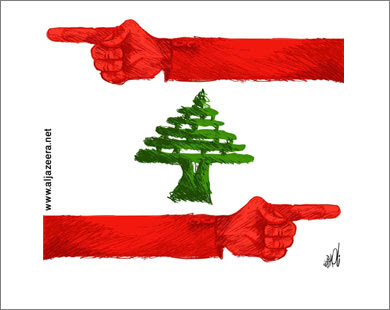
Lebanon Remains Hostage to the Arab-Israeli Conflict with US Blessing

The big news for Syria this week come from Lebanon. Walid Jumblatt’s announcement that he would throw his support behind Hizbullah and Syria caused jubilation in Damascus and bitter remarks from Neoconservatives. Israelis pronounced it “dangerous for Israel.” Geagea declared that Lebanon would become Gaza. Saad Hariri will refuse to join any government formed by the opposition. He insists that there was no such thing as a “consensual candidate.” Qifa Nabki does the math to show that parliament will either be stalemated over the next Prime Minister, or, if most of Jumblatt’s bloc follow him, elect the pro-Syrian Billionaire Najib Mikati as Prime Minister. Hariri has 60 seats while the Iranian- and Syrian-backed Hezbollah and its allies, including the Amal movement and Christian leader Michel Aoun, have 57. Jumblatt leads a bloc of 11 parliamentarians and his support could now give Hezbollah and its allies a veto over who becomes the country’s next prime minister. It is bitter blow to Saad Hariri, who will be unable to secure enough votes to form a new government.

Jumblatt the Kingmaker

The decision by Saad Hariri to stand by the Special Tribunal for Lebanon and allow the opposition to withdraw from the government was a principled one, according to those close to him and US authorities. What is more, Hariri’s position is intimately connected to the US and Saudi Arabia and the US is dead set against Hizbullah and the Lebanese opposition gaining greater legitimacy in the region. The STL was America’s brainchild; Washington will stand by it.  Perhaps most important in understanding Washington’s course of action over the last few weeks, is America’s long-term effort to disarm and destroy Hizbullah. The US government calculates that STL indictments against Hizbullah will force European governments to finally move against the Shiite organization and define it legally as a terrorist organization. US efforts to isolate and dismantle Hizbullah through economic sanctions and international organizations has been undercut by the failure of European governments to join US efforts. What is more, the European refusal to proscribe Hizbullah as a terrorist organization has impeded Israeli efforts to lock in its territorial gains on the Golan.

As one SC Commentator argued:

The significance of the indictments will not be that the accused will stand trial. Rather it will be an international court making a formal allegation within the framework of a multi-national body. This is the classic precursor of sanctions. The Europeans will be hard pressed to ignore them because they are strong proponents of such multi-lateral bodies to solve international problems. Also the fact that most of the judges / staff are from the EU should not go unnoticed…. Over time they will be severely weakened. Think of it as death by a thousand small paper cuts. … Yes, a lot of innocent people will be harmed …. But in the end the Lebanese people will have to determine whether Hezbollah is worth paying such a price and what they plan to do about it.

Lebanon remains a hostage to the Arab-Israeli conflict. Being divided, the Lebanese people have little ability to “determine whether Hizbullah is worth paying such a price for.” Hizbullah and the regional powers will make that decision.

More importantly, the Arab-Israeli conflict could easily be solved, releasing Lebanon from its long list of victims. If the Wikileaked cables from Syria showed us anything, it is that Assad was and remains keen for peace with Israel if he can get back the Golan. Assad is recorded in several of the leaked cables promising US statesmen that Syria’s support for HIzbullah and Hamas would change if a real peace could be hammered out. The regional dynamic would change. Assad is not the only regional statesman to argue this, Israel’s leading military authorities are also convinced that returning the Golan would lead to an important change in Syria’s strategic calculations and posture. Israel’s chief of staff and head of military intelligence have both spoken out recently to argue that peace with Syria is the key to settling issues such as Hizbullah. They lament Netanyahu’s determination to hang onto the Golan.

Washington’s position on the Golan is so intimately tied to Israel’s that it has but one option: to stand by Israel’s refusal to give up land and to fight Israel’s enemies. The US cables leaked to al-Jazeera record how generous Palestinian offers to Israel were also refused Israeli authorities. Israel has tried to argue that it does not have interlocutors in either Syria or Palestine. Leaked cables have shown the opposite. It is the Syrians and Palestinians who have no interlocutor in Israel.  The real story is not so much that they were turned down by Israel. Anyone who has watched the process closely understands by now that Israel is no longer interested in a two-state solution.  The real story is that America is so vulnerable to Israeli dictates. US diplomats must shadow Israeli policy makers.  So long as both the Democratic and Republican Parties compete to be the most pro-Israeli party, the White House must accommodate Israeli appetites not matter how harmful they are to US interests in the region. To blunt accusations that it is supporting Israel’s illegal and bad behavior, Washington must use a high degree of subterfuge and diversion. This is why so many Arabs see the STL as a diversion. They see it as an instrument designed to hobble “resistance” to Israel and help Tel Aviv gain greater military advantage. Many do not view the investigation to be primarily designed to promote lawfulness and justice in the region. See David Pollock’s article in Foreign Policy- Case Closed – revealing how Christian Lebanese have abandoned support for the STL.

[End Landis analysis]

News Roundup

Ehsani2 writes: The Lebanese “people” will soon turn against the court. Their real estate values would have dropped. Their economy would be in tatters. Will people blame HA?

T_Desco writes:

“Regarding the rumor that Khamenei will be indicted by the STL: the original source seems to be an article by Kenneth R. Timmerman (“UN: Iran Ordered Rafik Hariri Execution”, Newsmax, 01 Dec 2010 (sic; Israeli media quoted the article but gave a more recent date)).

I always thought that Newsmax was about as credible as Debka (incidentally one of Timmerman’s trusted sources).

The article is quite funny, actually:

“Sources familiar with the investigation tell Newsmax that the United Nations Special Tribunal for Lebanon will accuse Iranian Supreme Leader Ayatollah Khamenei of giving the order to murder Hariri, (…)”.

“Syrian President Bashar al-Aassad, and his brother-in-law, Assef Shawkat, the head of Syrian intelligence, also played key roles in the assassination plot, the sources told Newsmax.”

Case Closed
Lebanon’s Christian community has lost faith in the court established to prosecute the killers of the country’s former premier.
BY DAVID POLLOCK | JANUARY 20, 2011 Foreign Policy…

“… Behind Hezbollah’s power play against the tribunal lies something more than brute force: Lebanon’s Christians and Sunnis, once largely united in support of the tribunal, have parted ways. This split began a few years ago at the elite level with the defection of Gen. Michel Aoun, the leader of the largest Christian party …… At this point, a majority of Lebanon’s Christian community has actually turned against the tribunal. As a result, there is little prospect today of the sort of mass popular demonstrations that kicked Syrian forces out of Lebanon in 2005 following the assassination of Hariri, a Sunni — or that booted president-for-life Zine el-Abidine Ben Ali out of Tunisia just a few days ago.

This is the most surprising and politically significant finding of a public opinion poll conducted in Lebanon during November and December 2010 by Pechter Middle East Polls, a firm advised by the author. ….. As of last month, 79 percent of Lebanon’s Sunnis called the tribunal “free and fair,” including a solid majority (60 percent) who felt “strongly” that way. But only about half as many (42 percent) of the Christians agreed even “somewhat” with that position. Instead, a majority (55 percent) of Christians said the tribunal was not free and fair. In this respect, Lebanon’s Christian community is closer to the country’s Shiite population, from which Hezbollah draws its support….

The tribunal is not the only issue on which Lebanese Christian and Shiite views have converged. Regarding Syrian strongman Bashar al-Assad, around 60 percent of Shiites and 40 percent of Christians now voice at least somewhat favorable views. Among Sunnis, by contrast, that percentage plummets to just 17 percent. By comparison, Lebanese caretaker Prime Minister Saad Hariri, Rafik’s son, garners favorable ratings from nearly all Lebanese Sunnis (94 percent) and around two-thirds of the country’s Christians; a mere 11 percent of Lebanon’s Shiites concur with that assessment. Nevertheless, when asked in an open-ended way to name the national leader they most admire, 51 percent of Sunnis cite Hariri, but only 3 percent of Christians do….. Such intriguing nuances notwithstanding, the central finding from this survey remains: Lebanon’s Sunnis are currently the only group who continue to support the tribunal. They are more isolated than ever before, as the Shiite opposition to the court has remained strong and the Christian community has clearly moved toward an anti-tribunal and even pro-Syrian position. As a result, Hezbollah’s firm opposition to the tribunal, to the Hariri government, and to what remains of U.S. policy in Lebanon will probably carry the day — not only among the shifting Lebanese elites, but also on Lebanon’s volatile streets.”

The Mideastwire Blog
Excerpts from the Arab and Iranian Media & Analysis of US Policy in the Region

TOP ISRAELI military/intel people say to trade the Golan for Peace with Syria

From FPA, here: part two of an exclusive interview with Ilan Mizrahi, the former deputy chief of the Mossad and former head of the Israeli National Security Council under former PM Ehud Olmert.

“…FPA ISRAEL BLOG: Why such urgency on the Syrian track?

MIZRAHI: [On] my first day as national security counsel to Ehud Olmert [i recommended] make a deal with Syria. It will change the security situation in the Middle East. … I think that if we would strike a deal, our key enemy always, Israel’s enemy from the first day of independence, was radicalism in the Middle East. …. most of their masses, are supporting Iran because they are against Israel and against the United states. So, what I’m saying is that if you want to diminish, to mitigate the influence of Iran, to weaken their position in the Middle East, you have to look for the weakest link in their axis. And the weakest link is Syria because Syria is an Arab country. 75 percent are Sunni Muslims. It’s a secular state. It’s a secular state — it’s not Saudi Arabia or even Egypt. And in my point of view, Bashar al-Asad, doesn’t like the idea that Hezbollah is totally an Iranian instrument. He wouldn’t like to see Lebanon ruled forever by Hezbollah backed by Iran….. I do believe that his father and he himself already decided that he would like to have agreement with Israel. Not because they want to live in peace with us, because they need the United States.

This is my point of view. First Syria and then Palestinians….

FPA ISRAEL BLOG: Would giving back the Golan prove to be a strategic problem?

Our chief of staff doesn’t think so. Our head of intelligence, military intelligence doesn’t think so.

You know, in the ottoman empire, the sultan sent his Navy to take Cyprus. You know why? For its wine, because the Cyprus wine was very good. Now, we’re not going to keep the Golan because the wine there is wonderful. But, this is a territory to be negotiated, in my point of view. Now, if our military generals come and say the minute you give the Golan there is a direct threat against Israel, you should not do it. Then I’d have to think several times about it. But the best Israeli generals are saying we can negotiate it, so I believe them. Though, it’s a wonderful piece of land. Wonderful Druze restaurants. So I won’t go to Majid al-Shams. I’ll have my oriental food in Jaffa…”

The Case for Syria
Samer Araabi | Posted: January 18, 2011

In late December, with Congress away on recess, Robert Ford was appointed the new U.S. ambassador to Syria, filling a six-year vacancy. Shortly thereafter, condemnations poured in from those critical of U.S. efforts to engage Syria. President Barack Obama was criticized for “sending the wrong message” amounting to “a major concession to the Syrian regime.”[1] Pundits and commentators expressed concern that such “appeasement” would compromise the influence and authority of the United States in the Middle East.

Five days later, the unity government of Lebanon collapsed after the resignation of 11 members of the pro-Syrian opposition bloc. Though the ensuing competition for power is widely expected to further empower Hizballah and undermine the Special Tribunal for Lebanon—two serious setbacks for U.S. regional policy—Washington finds itself lacking the necessary connections to alter the situation.[2]

Lebanon’s unraveling and the undiminished influence of the Syrian state clearly demonstrate that U.S. attempts to isolate Damascus have failed. Syria continues to occupy an important strategic position in the Levant, and it sits at the crossroads of a number of U.S. interests. Direct and honest engagement, which Ambassador Ford will hopefully foster, is the only way to satisfy U.S. foreign policy goals, rein in violent extremism, and encourage political reforms in that country.

A History of Hostility

During the past decade, U.S. relations with Syria have been primarily characterized by mutual distrust and antagonism. Washington’s hostility toward Damascus has been fueled in part by concerns that the Syrian government has supported violent political factions in both Lebanon and Palestine, interfered in the democratic functions of Lebanon, and actively undermined the stability of the new Iraqi state. In response, a number of prominent analysts and regional experts have called for direct engagement as the only effective means to reform the Syrian state. However, the continued isolation of Syria plays to interests of powerful groups with significant political leverage, including neoconservative and other rightwing “pro-Israel” organizations, their allied politicians, and Saudi backers.

Wonks at institutes like the  Heritage Foundation, the Hudson Institute, the Washington Institute for Near East Affairs (WINEP), and the Foundation for the Defense of Democracies have been amongst the most fervent hawks on Syria. Other parts of the “Israel lobby,” like the American Israel Public Affairs Committee, have also used their connections in Congress to prevent engagement with Damascus.

Rightist factions in the United States have been targeting Syria since well before the 9/11 attacks and the election of President George W. Bush. Back in February 2000, for example, David Wurmser published an article for the American Enterprise Institute entitled, “Let’s Defeat Syria, Not Appease It,” which called on the Israeli and U.S. governments to assist Lebanon to “take matters into their own hands, and Syria will slowly bleed to death there.”[3]

That same year, Wurmser and other likeminded ideologues assisted in the production of a strategy document co-published by Daniel PipesMiddle East Forum and Ziad Abdelnour‘s U.S. Committee for a Free Lebanon that helped clarify the central role that hardline views of Israeli security have played in rightist anti-Syria advocacy. The study, entitled “Ending Syria’s Occupation of Lebanon: The U.S. Role?” called for the United States to force Syria from Lebanon and to disarm it of its alleged weapons of mass destruction. It also argued that “Syrian rule in Lebanon stands in direct opposition to American ideals” and criticized the United States for engaging rather than confronting the regime. Among the document’s signatories were several leading neoconservative figures—many of whom would be given posts in the Bush administration—including Elliott Abrams, Douglas Feith, Michael Rubin, and Paula Dobriansky, Richard Perle, Jeane Kirkpatrick, Michael Ledeen, and Frank Gaffney.

No More Waiting

For many years, a shared conviction of the anti-Syria hawks had been that Syria would eventually recognize that to succeed and advance, it needs the blessing of the West. They in effect decided that there was no point in engaging the Assad regime. Instead, they opted for active enmity while awaiting the fall of the Baath.

However, following the withdrawal of Syrian troops from Lebanon in the wake of Prime Minister Rafik Al-Hariri’s assassination in February 2005, conservatives saw a prime opportunity for “regime change” in another “rogue state,” and launched an intensive international political campaign with the ultimate goal of overthrowing the Assad regime in Syria.

Shortly thereafter, WINEP featured an article by Dennis Ross—now a Mideast adviser in the Obama administration—which was entitled “U.S. Policy toward a Weak Assad.” The article argued that Washington should “avoid engaging with the Syrian leadership” in expectation of its imminent collapse.[4] Ross lamented President Bashar Al-Assad’s failure to recognize “the immediate value of cooperating with the United States,” and recommended that the United States passively enable regional forces to take down the Syrian leadership.[5]

In line with this advice, the Bush administration recalled its ambassador to Syria. It also began using Lebanon as a staging ground to empower Bashar Al-Assad’s purported enemies, particularly the Lebanese Maronite establishment, which they hoped to leverage as a counterweight to the overwhelming Shi’a support for Syria’s Lebanese ally Hizballah.[6]

The Bush administration’s heavy-handed approach failed to take into account the complexity, nuance, and local dynamics of the region. Instead of compelling Syria to change its policies, it produced a backlash that severely undermined U.S. regional goals. As local parties realized that strong relations with the Syrian state provided far greater security and benefits than adherence to American expectations, the pro-western coalition formed during the Cedar Revolution quickly disintegrated. Within a short span, the largest Maronite party—the Free Patriotic Movement—switched sides to join the pro-Syria opposition, followed by a number of smaller groups, ultimately ending with the defection last year of Walid Jumblatt’s Progressive Socialist Party, the darling of Western diplomats.[7]

Meanwhile, the Syrian government entrenched itself and flourished, adapting to the sanctions imposed by the Syria Accountability Act of 2004 by developing new domestic industries (producing an annual growth rate of five percent since the implementation of sanctions), powerful support and influence in Lebanon, and key strategic capital with both Iraq and Iran.[8]

..

Turkey and Qatar have suspended efforts to broker a new government in Lebanon, a day after Saudi Arabia also threw in the towel,Local media reported on Tuesday that a gathering of “hundreds of unarmed men” from the two Shia parties, Amal and Hezbollah, had marched on downtown Beirut. Tension has risen in the capital since Monday, when the prosecutor in the assassination of former Lebanese Prime Minister Rafik Hariri submitted his long-awaited results of the case.

Prince Saud al-Faisal, Saudi Arabia’s minister of foreign affairs, said Wednesday that his country had abandoned mediation talks to resolve the crisis and situation in Lebanon as “dangerous.”

Saudi Arabia’s King Abdullah said that he would “lifted his hands and kept away from the negotiations,” al-Faisal said. The Saudi foreign minister add, that “if matters come to separation and partition of Lebanon, then Lebanon will end as a state containing this type of peaceful coexistence between religions, nationalities, and different strata and this will be a loss for the entire Arab nation.”

Turkey

“… Speaking to a small group of journalists on his way to Beirut, Davuto?lu said that Hezbollah — which brought down Saad al-Hariri’s government, and Iran, which has close links to the Shiite group, had to be involved in the efforts to find a solution to the crisis. “We will definitely meet with Hezbollah representatives. As a political party and a group with very strong support within Lebanese society, Hezbollah is one of the most essential elements of this process,” Davuto?lu said earlier in the day, while speaking to reporters before departing for Beirut…..

Speaking before the talks with Davuto?lu, Salehi said a solution should come from within the region and opposed the involvement of “foreign actors.” He did not mention any non-regional country, but said actors in the region such as Syria and Saudi Arabia could also be involved in Turkish-Iranian efforts to help stability in Lebanon. “We see no benefit in foreign actors getting involved in this,” Salehi said. Speaking on Tuesday, Davuto?lu appeared to back Salehi’s call for a regional solution and said Iran would be part of efforts for a settlement. He said Salehi had told him during their talks on Monday that Iran was ready to contribute to Lebanon’s stability and support every Turkish effort to that effect. “Our consultations with Iran will continue. No actor should be left out of this process, otherwise there will be polarization both within Lebanon and on a regional and international scale,” said Davuto?lu……..

Prime Minister Recep Tayyip Erdo?an said on Monday that he has received a written invitation from French President Nicolas Sarkozy to attend an international meeting on Lebanon and has instructed his staff to respond in the affirmative to the invitation. Erdo?an said seven countries have been invited and that no date has been set for the meeting yet. Iran is not among the countries invited….”

Obama thanked Mubarak for Egyptian support of the tribunal, ” and achieving justice for the Lebanese people,” the White House said…”

Elliott Abrams on Lebanon: ‘the atmosphere is rife with trouble’

Anthony Shadid in the NYTImes:

“The confrontation here is the latest sign of a shifting map of the Middle East, where longtime stalwarts like Saudi Arabia and Egypt have further receded in influence, and emerging powers like Turkey, Iran and even the tiny Persian Gulf state of Qatar have decisively emerged in just a matter of a few years. It is yet another episode in which the United States has watched — seemingly helplessly — as events in places like Tunisia, Lebanon and even Iraq unfold unexpectedly and beyond its ability to control. The jockeying might be a glimpse of a post-American Middle East, where the United States’ allies and foes, brought together in the interests of stability, plot foreign policies that intersect in initiatives the United States must grudgingly accept.”

Desperately Seeking Syria at Lebanon’s Expense
Richard Grenell – Huffington

It has been almost six years since a brutal bombing in Beirut killed Lebanon’s Prime Minister Rafiq Hariri and 22 others on Valentine’s Day 2005. This week, the UN prosecutor overseeing the investigation finally submitted sealed indictments to the criminal court’s pre-trial judge as to who was responsible for the bombing. UN investigators and foreign intelligence over the last several years, however, have consistently pointed to senior Syrian and Iranian officials’ involvement. While the names of the indicted individuals are not expected to be known for eight weeks, the Obama administration has known for quite some time that senior Syrian and Iranian officials are to blame for the brutal killings.

That is why it is puzzling that while the long-awaited indictments were being prepared last month, President Barack Obama naively ordered the return of the U.S. Ambassador to Syria after a six-year hiatus. Obama’s premature move gave Hezbollah, Damascus and Tehran the instant credibility they had been looking for to characterize the coming indictments as political rather than criminal.

Administration officials have ignored Lebanon’s developing crisis from the moment they took office by consistently siding with Syria. Last week, administration officials leaked that President Obama has now given French President Nicholas Sarkozy the lead in dealing with Lebanon and the indictments for the international community. The move washes Obama’s hands of Lebanon’s problems and gives France control.

January 20, 2011 Edition 2
Breaking, not engaging, the region

It is said that repeating an action and still expecting a different result every time, despite proof of the contrary, is a sure sign of insanity. With its strange attitude towards Cuba’s regime, the US has for decades demonstrated that adage while seemingly making Cuba the exception to the rules of diplomatic engagement. In particular, in the Middle East, American influence was for long directly proportional to its direct involvement, be it positive or negative.

Since the Bush administration, however, the Castro approach–or lack thereof–has been applied to what should be one of the most crucial centers of open communication for Washington. After over 12 years of serious and consistent US engagement with the Middle East peace process, with full recognition of Syrian territorial rights on the Golan, George W. Bush decided to alienate Syria even while banging on the drums of war for Iraq. Instead of cajoling the neighbors when invading and occupying Iraq turned nasty, Bush and his neocons directed every possible accusation at Damascus and piled on the demands.

The big freeze came on Lebanese turf: following the assassination of Rafiq Hariri, Bush promptly withdrew his ambassador from Damascus, pushed for Syrian troops’ exit from Lebanon, and actively sought to isolate Syria.

Six years later, a new US ambassador, Robert Ford, has landed in Syria a year after his nomination. There is no cause for celebration, however, because US-Syrian relations are neither being upgraded nor being restored to the point they were at six years ago. Instead of getting back to square one, things are now much worse, elegant letters of accreditation notwithstanding. The more the US has connived to redraw the political map of the region, looking to sideline its opponents and to punish them for insubordination, the more it has created imbroglios from which it can’t extract itself.

Instead of seeking stability at all costs, the US has steadily lessened the potential of compromise between all parties and increased the likelihood of a major clash, all under the guise of protecting Lebanon’s sovereignty from Syria.

The premise that Lebanon could function, politically, without the benign acquiescence of the major powers in the region was always false. The premise that the Lebanese would unite under one “majority” in cultural or political terms was always false as well, and all efforts aimed at coaxing one half of Lebanon to abide by the terms of the other half were never going to bear fruit. Yet, the US has had a burning obsession: the eradication of Hizballah, which would end all resistance to Israel, remove Syria’s proverbial cards from Lebanon, and weaken Iran in the region. To that end, with other tricks having failed, the US needed the Special Tribunal for Lebanon; one could argue, in fact, that it needed the assassination of Hariri.

But while motives abound whenever Syria is blamed, speculation with regards to Israel shines in its absence, as if nobody but Hizballah could think of a single reason why Israel would want to wreak havoc in Lebanon. Indeed, the investigation into Hariri’s murder has not even bothered to pretend to explore all options–including the one country with a steadfast history of assassinations in the Arab world……

Lebanon Must Find Its Own Way Out Of Crisis -Clinton
2011-01-20 19:27:48.693 GMT

WASHINGTON (AFP)–The U.S. stands ready to help Lebanon out of its ongoing political impasse, but it is ultimately up to Beirut to resolve the crisis, Secretary of State Hillary Clinton told reporters Thursday.

Asked at a press conference about international mediation efforts following the collapse this week of Prime Minister Saad Hariri’s government, Clinton said: “We stand ready, as do many others in the region and beyond, to be of assistance,” Clinton said. But she said, “any decision will have to be made by the Lebanese people.”

The top U.S. diplomat added: “Any mediation effort engaged in by anyone outside of Lebanon itself should be aimed at supporting the people of Lebanon and making decisions that lead to stability and security, justice and a commitment to bringing those who committed the murders of prime minister Hariri and 22 others to account.”


Lebanon crisis a test for the US
by Antoun Issa

Obama Trapped in Bush’s Lebanon War

Obama spoke out about the Special Tribunal for Lebanon today as a new phase has started. The proceedings of the STL are now in the hands of an international group of professional judges. The role of regional politics is presumably over, but of course the political implications will only grow. Purported leaks about those indicted again remind us how political it is. Some reports are indicating that the indictments will accuse Iranian Supreme Leader Ayatollah Khamenei of ordering the assassination and that it was carried out in cooperation with the Iranian Revolutionary Guards and Hezbollah. Paul Salem says that if this is the case, it will mean war.

Paul Salem writes from Lebanon:

If the indictments indeed go in this direction, the crisis will engulf the country and the region. Iran and Syria will effectively interpret this as a declaration of war, in which case they would abandon any talk of a unity government in Lebanon and urge Hezbollah to launch a full takeover of state institutions.

If the indictments prove to be more limited, however, there would be a better chance of hammering out an agreement and putting together a coalition government.

In this crisis where issues of justice, stability and security coincide, and where a complex knot of sectarian, political, regional and international interests intersect, there is a strong chance the situation will get worse before it gets better. A solution appears a long ways away.

Judge Daniel Fransen of Belgium, who receives the indictments will take six to ten weeks to decide how to proceed before making them public. In the meantime we can expect more leaks and rising tensions.

When the neoconservatives of the Bush administration established the Special Tribunal for Lebanon in 2005, a number of them argued that it would serve as a ticking time bomb that would go off in the distant future and would ensure that whatever administration came after Bush would be forced to continue fighting his war. They were right. The STL means Obama must fight Bush’s war in Lebanon, despite his attempt to bury it in the name of dialogue with Syria and Iran and settling the Arab-Israeli conflict.

President Bush is partially to blame for Hariri’s assassination and the present round of endemic civil strife in Lebanon. When he decided to ripe up the agreement on Lebanon that his father had hammered out in 1990 with Syria, he blew oxygen on the embers of the long Civil War that had never been settled but only dampened. When George W Bush proclaimed that the Syrian military was an “occupation force” and not a “positive presence” in Lebanon, the battle lines were drawn. The US had declared war on Hizbullah, Syria, and Iran.  When Bush teamed up with French President Chirac to convince Rafiq Hariri to choose sides in their battle and to back UN resolutions demanding Syria’s withdrawal from Lebanon, Hariri could no longer play the man in the middle. He became a combatant in a war that he did not chose and could not win.  He became its most famous victim.

The STL is tasked with bringing his killers to justice. They can indict and accuse, but of course, they cannot bring his killers to justice. The investigators first accused Syria of the crime, then they jettisoned their claims against Syria as the story of the “false witnesses” and trumped up evidence was revealed; it then turned to accusing Hizbullah. Now it seems, Iran will be placed in the cross-hairs. It is not clear how this drama will play out. The Tribunal has been badly damaged by the false witnesses, Hariri tape, and unprofessional behavior all around. All the same, much of the world remains convinced that Syria, Iran, and Hizbullah are the authors of the crime. Will Turkey and Saudi Arabia side with the United States? Will the United States become isolated on the issue as Middle Eastern countries tire of endless conflict, which the US has neither the military power or diplomatic authority to resolve?

The Lebanon crisis has always been a hostage to the Arab-Israeli conflict. Now that the US has abandoned any realistic attempt to push through a two-state solution and will support Israel as it dislodges what remains of Palestinian authority in Jerusalem and the West Bank, much of the Muslim World will not side with America on Lebanon. Those who do, will be seen to be siding with Israel. This is the Saudi and Egyptian dilemma.

If the Tunisian uprising brings increasing democracy to the Middle East, it will not be good for America’s brand of justice or American policies in the region. Just as Turkey has moved away from the US and Israel in response to popular will, so will other Middle Eastern regimes should they become more responsive to their people. In the meantime, President Obama finds himself trapped in a Lebanese civil war that President Bush reignited and that he cannot win. The Lebanese state will remain inoperative. Obama will have to spend his time shoring up “moderate” Arab regimes to fight against the “radical” ones that support “resistance” and the Palestinian struggle. This is not where US policy should be – especially as Israel turns ever more to the radical right, violating international law in its rollback of Palestinian rights.

[End Landis analysis]

Obama’s Misguided Lebanon Policy: While in Lebanon or Tunisia, Iraq or Egypt, President Obama‘s policies have deepened the suffering of the people there, notes Abbas J. Ali.

WASHINGTON (AFP)–U.S.

President Barack Obama welcomed Monday’s indictment for the 2005 murder of former Lebanese premier Rafiq Hariri as key to ending an “era of impunity” but urged calm amid rising tensions. “I welcome the announcement by the Office of the Prosecutor for the Special Tribunal for Lebanon today that he has filed an indictment relating to the assassination of former prime minister Rafiq Hariri and 22 others,” Obama said in a statement. “This action represents an important step toward ending the era of impunity for murder in Lebanon, and achieving justice for the Lebanese people.

This is the judge who will decide if the indictments handed in today are sufficient to start calling in suspects and witnesses. 6-10 weeks he needs to make that decision Judge Daniel Fransen (Belgium), Pre-Trial Judge

Judge Daniel Fransen (Belgium), Pre-Trial Judge After working as a defence lawyer at the Brussels Bar from 1989 to 1993 and subsequently as a lawyer in the public service at the Société Régionale du Port de Bruxelles (1994 to 1995), Judge Fransen entered the judiciary, where he served as an investigating judge at the Brussels District Court for more than ten years. He dealt with serious and organised financial and economic crime before specialising in international humanitarian law and terrorism cases. Until his appointment as Pre-Trial Judge of the Special Tribunal for Lebanon, Judge Fransen was also the dean of the investigating judges specialised in terrorism in Belgium (2006 to 2009). He has also participated in many international conferences and written several publications on terrorism.

According to the Statute, proceedings in absentia may be instituted under three sets of circumstances, namely, when the accused: i) has expressly and in writing waived his right to be present; ii) has not been handed over to the Tribunal by the State authorities concerned; or iii) has absconded or cannot be found.

If, after “reasonable attempts” the accused cannot be located and served with an indictment, the President of the Tribunal can, after consulting the Pre-Trial Judge, decide to advertise the indictment, in part or in its entirety, in an effort to inform the accused of the need to appear before the Tribunal [Rule 76(E)]. The advertisement shall invite any person with information as to the whereabouts of the accused to communicate that information to the Tribunal [Rule 76bis].

there will not be “A” local judge. Once the pre trial judge accepts the validity of the indictments, the actual trial chamber will take over (three judges: one Lebanese and two international, plus two alternate judges, one Lebanese and one international).

Judge Antonio Cassese (Italy), President of the chamber Judge Ralph Riachy (Lebanon), Vice-President of the chamber
Thirty calendar days following such an advertisement, the Tribunal can proceed to conduct a trial in absentia, i.e. with the accused absent. In such a case, a lawyer would be assigned to represent the interests of the accused [Rule 105bis]. Also, if a trial does take place in absentia but an accused is located afterwards, that person would be entitled to a new trial [Rule 109].

[Erdogan and Assad] meeting in Damascus

“affirmed their care to find a solution to this crisis based on the … Syrian-Saudi efforts to achieve harmony between the Lebanese,” an official Syrian statement said after Monday’s talks, referring to earlier failed efforts by Saudi Arabia and Syria to forge a deal. Erdogan also said Iran’s foreign minister would visit Turkey on Monday after the Turkish prime minister discussed the issue at the weekend with Iranian President Mahmoud Ahmadinejad. Nasrallah said on Sunday that Hezbollah would fight efforts to tarnish its image. “We will not allow our reputation and our honor to be touched.” He said leaders from several countries had intervened to demand Hariri be picked again to form the next government, but defended the decision to bring down the last one…”

Iran Cuts Subsidies, as Syria has only begun to Do

The subsidy cuts, which the International Monetary Fund says have amounted to  $4,000 a year for the average Iranian family, began in earnest last month when the rationed  price of gasoline jumped to about $1.44 a gallon from just 38 cents.  With a ration of only 16 gallons a month at the subsidized rate, most  motorists buy the bulk of their fuel now at the even higher market rate  of $2.64 per gallon, significantly more than the $1.80 that people pay  in nearby Dubai.

In recent weeks, subsidies have also been reduced on flour, water and  diesel. But the spike in prices has not provoked the angry protests that followed the introduction of fuel rationing in 2007. The price of bread has tripled, on average, the government says; water, which used to be  practically free, now costs between 10 cents and 85 cents per cubic  meter, based on a sliding scale under which consumers pay a higher rate  the more they use.
The government says these are just the first steps in what it calls an  “economic transformation plan” that will also include banking reform,  sweeping changes in Iran’s tax and customs system, and ever more  privatization of state-owned industries.

Syria Announces USD 575 million in New Social Support Measures

In the last 4 days, the Syrian Government has announced in two separate measures that it was disbursing a total of SYP 27 billion in additional funding to help its civil servants and the neediest parts of its population, while the Ministry of Electricity has announced that it had no plans to raise the heavily subsidized electricity prices.

Ehsani Writes: “The Welfare payments are not a response to Tunisia.

600,000 families will visit local post offices. They will qualify to receive: 1- syp 3500 ($75.3) a month. 2- syp 2500 ($53.7) a month 3- syp 1000 ($21.5) a month. 4- syp 500 ($10.75) a month The total allocation for this program can reach up to syp 12 billion ($258 million). The Hasake region is expected to see the largest families who qualify. The money will be paid every four months. This way the family will get 4 months of the above allocation upfront 3 times a year. Presumably, the 600,000 is what the government considers to live below the poverty line where the head of the family is largely unemployed. While many will view this as a response to the Tunisia situation, I can confirm that the welfare payment was already in the planning stage several months ago. It has to be viewed as part of the government’s attempt to continue to lift the extremely expensive energy subsidies with more announcements to come in April. We are likely to see a 53% increase in the price of fuel oil. I would have personally thought that the program should have been announced at the same time as the government communicates its substantial fuel price increase. The latter will hit industry (and especially textiles) very hard while the welfare program covers only 12% of the population or (600,00 families) (Sent to me by email)

Tunisia’s Jasmine revolution has been keenly watched in Syria,
by Ian Black – The Guardian

Tunisia’s Jasmine revolution has been keenly watched in Syria, one of the most repressive of the Arab regimes, though the chances of a re-run of Tunis in Damascus are slim. Syria’s benchmark experience for dealing with serious unrest remains the Hama events of 1982, when the security forces killed thousands in crushing an uprising by the Muslim Brotherhood. Syrian Islamists are largely behind bars or in exile, and liberal and democratic activists neutralised by surveillance and repression.

The Syrian military and security services are dominated by the ruling Alawite minority, which would see a sectarian or clan interest in defending the presidency and the state against the Sunni majority, especially after the lessons of Iraq’s internecine struggle and communal fissures in Lebanon next door. “The fear of civil war based on religious affiliation is the greatest legitimiser or bulwark of authoritarianism in Syria,” commented Syria watcher Joshua Landis. It is relatively easy for the state to change direction, since critical comment is unlikely. On Sunday the government raised a heating oil subsidy it had previously cut – an apparent response to economically-driven unrest in neighbouring Jordan, Tunisia and elsewhere. On Monday the government announced a plan to help 420,000 impoverished families. Official Syrian comment has been confined to lecturing Tunisia sternly on the perils of relying on fair-weather foreign allies. Events there, said the pro-government daily al-Watan, were “a lesson that no Arab regime should ignore, especially those following Tunisia’s political approach of relying on ‘friends’ to protect them.” Ian Black

First US ambassador to Syria in 5 years arrives to take up post …
The Canadian Press

“Intelligence sharing is the most promising overlap in US-Syrian relations,” said Joshua Landis, an American professor and Syria expert. …

US Ambassador to Lebanon Summoned Amid Tension
By ELIZABETH A. KENNEDY 2011-01-17

Beirut (AP) — An official in Lebanon’s Foreign Ministry says the U.S. ambassador has been summoned over accusations that she is interfering with the ountry’s political process. The official said Monday that the foreign minister asked Ambassador Maura Connelly to clarify the circumstances behind her visit this weekend with lawmaker Nicolas Fattouch.

The official spoke on condition of anonymity because he is not authorized to speak publicly. Connelly did not take questions as she left the Foreign Ministry on Monday.

Fattouch is seen as a key “undecided” lawmaker as Lebanon’s rival political factions scramble to form a new government.

Roger Cohen: The Arab Gdansk 2011-01-17

Last month, after a visit to Beirut, I wrote a column called “The captive Arab mind” about the psychological cost of repression in the region: the reflex of blaming others, the perception of conspiracies everywhere and the paralyzing fear of acting or thinking for oneself. Tunis can be Act One in the liberation of the Arab mind.

That will also require the West to cast aside tired thinking. You can’t be a little bit democratic any more than you can be a little bit pregnant. Holding free elections in Tunisia requires the lifting of the ban on Islamist parties. Dealing with the Middle East as it is — rather than indulging in the “Green Zone politics” of imaginary worlds — demands recognition that facile terrorist designations for broad movements like Hezbollah are self-defeating and inadequate. Peace in Northern Ireland would have been impossible if Sinn Fein’s links to violent resistance had proved an impassable barrier to negotiations with it. Western double-standards in the supposed interest of Arab stability have proved a recipe for radicalization. The West should honor Tunisian bravery with some of its own. Dynasties rusting on their thrones are not the answer to Arab disquiet. Nor is democracy a one-way street. It is about give-and-take, not irreversible power grabs. Political Islam betrayed its liberating banner in Tehran by replacing secular repression — the shah’s — with theocratic. Iran has proved more dynamic than its Arab neighbors because the Islamic Republic has at times felt obliged to reflect the “republic” in its name — but only under an unelected supreme leader. Islamist parties must commit to democracy rather than exploit democracy for despotic ends.

Nine years separated Walentynowicz’s firing from the fall of the Berlin Wall. Bouazizi’s suicide proclaimed that the shelf life of Arab despots can be no longer than that. Little Tunisia is a clarion call for a regional awakening.

Tape Two from New TV: Hariri Gives His Side of the Story

Saad Hariri, in a 2007 recording in English, describes the atmosphere and events leading up to his father’s assassination and right after. He describes the Syrian threats that many Lebanese officials close to Hariri described following the assassination; Jamil al-Sayyid who was in the pocket of the Syrians; Bashar al-Assad, who Hariri claims “said one thing and did another;” how Rafiq al-Hariri paid off Rustum Ghazali and other Syrians and Newspaper owners who blackmailed him.  He explains that his father trusted Hassan Nasrallah, the leader of Hizbullah, and believed he was someone he could make deals with and do business with. He has a particular animus against Asef Shawkat, the head of Syrian intelligence at the time and brother-in-law of Assad, who he explains bragged to Pakistani ISI about how he had tortured people. Mustapha Tlass, the ex-Syrian defense minister, warned Hariri about Shawkat and said, “may God save Syria from this man.” Clearly relations were terrible between Rafiq Hariri and the Syrians, as well as between Hariri and the Lebanese opposition. There is a lot of hearsay and little that we didn’t already know, although the overall picture is depressing.

See www.Trella.org for an Arabic transcription of the recording.

See Qifa Nabki on Nasrallah’s speech tonight.

“The ‘Missing Dimension’: Britain’s Secret War against France in Syria and Lebanon, 1942–45,” by Meir Zamir

Press Release: The ‘Missing Dimension’ by Meir Zamir

Article: The ‘Missing Dimension’: Britain’s Secret War against France in Syria and Lebanon, 1942–45 – Part II
Author: Meir Zamir
Journal: Middle Eastern Studies, published by Routledge, Taylor & Francis Group
Issue: Volume 46, Issue 6, November 2010, pages 791 – 899
Web: http://www.informaworld.com/smpp/content~db=all~content=a930912406~frm=titlelink [The article will be available for free viewing by the public for only a limited time]

Meir Zamir is a professor of Middle East history in the Department of Middle Eastern Studies at Ben-Gurion University of the Negev. Born in Bagdad in 1947, Professor Zamir earned his BA from Hebrew University in Jerusalem, his MA from Tel Aviv University, and PhD from the London School of Economics and Political Science under the supervision of Professor Elie Kedourie. Professor Zamir’s article studies British intelligence activities in the Middle East during the Second World War. Drawing on documents previously unavailable to the public, his research uncovers a hitherto shrouded chapter of MI6 history and establishes itself as key reading for all those interested in the history of the British Secret Service.

Abstract
The article provides the ‘missing dimension’ in the historiography of Syria and Lebanon in the Second World War. It is based on secret British and Syrian documents obtained by the French intelligence from their agents in the British Legation in Beirut and the Syrian government in Damascus, never before published. These documents, recently discovered by the author, shed new light on the activities of the British intelligence agencies in the Middle East during and after the war. They reveal that these agencies played an important role in shaping Britain’s policy in the region by securing the tacit collaboration of prominent Arab nationalists in Syria and Lebanon and other Arab countries. In Syria (and Palestine), Britain conducted a ‘dual policy’: one purported to mediate between the French and the Syrians, details of which are found in British archives, and a tacit policy aimed to evict France, of which few traces remain in official documentation. Hence de Gaulle’s accusations that Britain secretly engineered the expulsion of France from the Levant were indeed justified, and that the Syrians’ claim that their country was the first Arab state to secure complete independence is questionable. The article also discloses that Britain was behind the Hashemite schemes to integrate Syria in a Greater Syria or an Iraqi-led Hashemite confederation. Copies of more than one hundred of the documents are annexed to the article, including a secret agreement from 29 May 1945 revealing that President Quwatli was coerced into granting Britain a dominant position in Syria and that Syria would accept a unified Greater Syria under a Hashemite king.

[Comment by Joshua Landis: I am copying below a few of the British documents that Meir Zamir found in the French archives and that he kindly sent to me. This is an extraordinary find and very important article. It explains a crucial chapter in Syrian, French and British history that has largely been kept secret until now. It helps explain much of the background to my own forthcoming book on the independence period. For example, during the first years of independence, President Quwatli was very fearful of British plans for Greater Syria. It seems clear that President Quwatli had no intention of carry out the promises he was forced to make to the British about using British advisors and accepting a united Greater Syria under a Hashemite King. Adel Arslan explained in his diaries that Quwatli was ‘obsessed’ by the Hashemite threat during the first years of independence: 1946-1949. Quwatli worked assiduously to diminish British influence in Syria. The nacent Syrian intelligence agency that he set up was tasked to track down Hashemite agents in Syria and report on them. 

Quwatli’s planning during the 1948 War in Palestine was guided by his anxiety that Britain and Jordan were conspiring to push through the Greater Syria Plan and that they believed that the “fog of war” would provide an opportunity for it to be carried out. Quwatli restricted the Syrian army to a very limited role in the Palestinian conflict. He did this because he feared that should Syrian forces be defeated by the Jewish Haganah – an outcome that both he and Prime Minister Mardam suspected to be likely – Kind Abdullah of Jordan would exploit Syrian weakness to march on Damascus and carry out his dream of Greater Syria.

 Zamir’s archival find explains why Quwatli believed this was the case and why he was convinced that the British would give it full diplomatic and political backing. When I wrote my article:  “Syria in the 1948 Palestine War: Fighting King Abdullah’s Greater Syria Plan,” which is published in Eugene Rogan and Avi Shlaim, eds., Rewriting the Palestine War: 1948 and the History of the Arab-Israeli Conflict, Cambridge: Cambridge University Press, 2001, pp. 178-205, [You can read it on the web, here.] I gave it the subtitle: “Fighting Kind Abdullah’s Greater Syria Plan,” because Quwatli’s guiding strategy during the war was to prevent the possible fulfillment of Kind Abdullah’s dream of taking Damascus and ruling Greater Syria. Some critics argued that I was exaggerating Quwatli’s fear of King Abdullah and the British. I thank Zamir for helping me to prove that Quwatli was not paranoid, but had a legitimate reason to believe that Syrian independence was at stake during the 1948 War. The British had lost much of their power and confidence by 1948 and the US, the emerging superpower, was against the Greater Syria Plan, but Quwatli, nevertheless, remained fearful of British designs in the region due to the painful and revealing experience he underwent during WWII, when Britain tried to impose its vision of the Middle East on Syria through secret diplomacy.

The “missing dimension” also helps explain why Quwatli was loath to commit the Syrian army to protracted fighting and possible defeat in Palestine. He limited Syria’s military ambitions to grabbing a bit of Palestinian territory on the Palestinian side of the Jordan River, which he planned to use as a bargaining chip in future negotiations with Israel. He wanted the border between Syrian and Israeli to run through the middle of Lake Tiberius and not along its north-eastern shore. That is what Khalid al-`Azm writes in his memoirs. Quwatli organized the Jaysh al-Inqadh, or al-Qawuqji’s Arab Volunteer Army, as the main instrument by which Syria would assist and help direct the Palestinian struggle against Zionist forces. It was designed to avoid the necessity of ordering the Syrian army into the fray.

Quwatli’s strategy failed because the Jaysh al-Inqadh was defeated by Zionist forces leading to the overthrow of Quwatli’s government Husni Zaim, Syria’s Chief of Staff . These events, in part, explain the failure of  Syria’s republican form of government and the collapse of the landed and merchant elite that had guided Syrian politics under the Ottomans and through the struggle for independence.  End]

 A Few DOCUMENTS

 Document 12:  British secret proposal (MacKereth) via Sulh to Jabri             

Translation

Top Secret

British Proposals Officially Presented by Riad al-Sulh on 5 August 1944 to Sa’adallah Jabri

——————

1)    The British government pledges to effectively and completely and absolutely protect Syrian independence against any aggression or transgressions from any state or group of states that lay claim to Syria’s rights.

2)    Great Britain pledges to provide the necessary funds to exploit Syria’s agricultural and metallurgical resources in the framework of a financial and economic agreement in which Syria’s interests will be safeguarded in all ways possible.

3)    Great Britain pledges to provide experts and technicians who will freely enter into contracts with the Syrian government and who will be considered its officials.

4)    Great Britain will help Syria to set bounds to the direction of Arab Unity. It will occupy itself with unifying financial and economic regulations as well as teaching methods in the Arab states. It will help Syria to attain a prominent position among the Arab states.

5)    Great Britain pledges to ensure the application of the clauses of the White Paper in Palestine and promises to put a complete stop to Jewish ambitions.

6)    If Syria seeks unification with Transjordan and Palestine, the British government will not impose the type of regime. If Syria chooses a monarchy, Great-Britain will not impose Amir Abdullah as king, but it hopes that the Syrians will choose a Hashemite Arab Amir.

7)    In return for all this, Great Britain wishes to be assured:

a)    that Syria will finally strive to free itself.

b)    that Syria will conclude a treaty with Great Britain only.

c)    that Syria will not enter into any pact or international agreement before consulting Great Britain.


Document 22
:  Nuri al-Sa’id-Jamil Mardam secret agreement      

Copy of the secret agreement between

Nuri Sa’id and Jamil Mardam

15 September 1944

       We the undersigned, Nuri Sa’id and Jamil Mardam, have reached agreement on the following:

       We will act with one mind to deliver Syria from the colonizers’ yoke. We will fight for its unification. We will act to establish a Hashemite Arab throne there, under which Syria, in its natural borders, will be unified and which will constitute the prelude to the realization of general Arab Unity.

       The primary position in Syria can only be for a return to Jamil Mardam. He will be, after the occupant of the throne, the country’s premier and its only leader. It is in the name of the occupant of the throne, whoever it may be, that Nuri Sa’id promises this and undertakes on his honor and his religion to employ all his efforts to bring it about.

       The two parties undertake to keep this agreement secret.

       Made in two copies.

                                                                               15 September 1944

                                                                   S/ Jamil Mardam      S/ Nuri Sa’id
 

Document 27:  Quwatli to Ibn Sa’ud                                       

Translated from the Arabic

Top Secret

Letter from President Quwatli to King Ibn Sa’ud

To His Highness and brother His Majesty King Abd al-Aziz Ibn Abd al-Rahman al Faisal al Sa’ud

May God support him

————

Greetings from Arabism. Our brothers are headed for Alexandria. I don’t know your final decision. Have you decided to withdraw or has something new happened?

The only thing I can inform Your Majesty is that the situation is going from bad to worse. Our difficulties are continually increasing. God has sent us these impious French and British, enemies of the nation and religion; our disappointments with both are great and our misfortune enormous.

As I am writing these lines, news is arriving that these cursed French are preparing traps for us throughout the country. They threaten us everywhere.

As for the blue-eyed men [English], they sent us this atrocious Cornwallis to convince us of the necessity of favoring the English, otherwise we’ll pay for our attitude. He began by threatening to abandon us to France, which will do with us as it pleases. I informed him that we do not want that and that we will not agree at any price to recognize the French, whom we wish to get rid of for good; but we also don’t want the British to treat us like subordinates. He then assured me of their good intentions (deceitful) and hastened to present me with an agreement, or a treaty, as he called it, comprising two parts: one secret and the other public. He added that eventually, the same treaty – but only the public part – could be concluded with the French and the Americans.

I’ll tell you about the treaty when they send me the copy, because they told me verbally and I didn’t keep the text.

The most important thing he tried to convince me of is their plan for Syria’s unification. He declares that the British do not insist on Amir Abdallah. We will have the option of choosing one of the members of the Hashemite family. Despite everything, this cunning man took precautions. He assured me that he was asking me as a friend and not in an official capacity, and that in his opinion these solutions were the best and in the interests of both the Syrians and the Arabs.

In any case, I am asking you to give orders to Yusuf (1) to participate in the Congress in Alexandria. His participation in this Congress will help us and alleviate our burden.

May God keep you, Your Highness and dear brother. You are our protector and our support.

4 Shawal 363 (2)  

           Signed: Shukri

(1)   Sheikh Yusuf Yasin, Special Adviser to Ibn Sa’ud

(2)   21 September 1944


Document 29:  Ibn Sa’ud to Quwatli                                               

Translated from the Arabic

Top Secret

Reply of King Ibn Sa’ud to President Shukri Bey Quwatli


To our beloved brother Shukri Bey, may God protect you and keep you.

———————— 

Greetings and holy blessings. Thanks to God I received your letter and noted all that it says. We do not wish to boycott these people but we cannot bear their maneuvering and intrigues. May God protect us and keep us from their iniquity.

Dear brother, personally, I count only on God, who is my only support. Whatever the British do, I do not fear them. I only fear God. Their man in our country is like a fox. The intrigues of this cursed Cornwallis are not unknown to me. For a long time he has been malicious and treacherous, and he is the son of malicious and treacherous persons.

The blue-eyed individuals promised me that they would not do anything without my consent and that this rambling Abdallah would get nothing. They make fun of him like they make fun of many others. Personally, I was used to their lies, but I didn’t believe that they would lie to me this time. What is their interest in unifying the Arabs? If they had wanted to, they could have done it after the last war, but may God protect the Arab nation from their games and the Muslims from their iniquity.

We will send Yusuf to Alexandria; he alone will deal with them. Tell your people to serve as intermediaries between him and the others. That they don’t adopt the same attitude as his, so that they can retain the means to annoy Nuri and company.

The son of Sa’ud sends his greetings. Bashir and everyone wish you success.

Greetings  from your brother.

10 Shawal 363 (1)

S/ Abd al-Aziz Ibn Abd al-Rahman

(1)  27 September 1944


Document 36:  Quwatli’s report on his meeting with Faruq and Ibn Sa’ud

Translated from the Arabic

Syrian Republic                                                         

The President                                                           

Report by the President of the Syrian Republic

16 February 1945

—————

The copy of this document delivered on 20 February 1945, was filed in the Syrian Ministry of Foreign Affairs under No. 20/946 “Secret Political Reports.”

—————-

On 16 February 1945, I drove with His Majesty King Faruq I, may God protect him, in his car to a meeting with His Majesty King Abd al-Aziz.

The meeting, which lasted about two hours, took place at the “Obrige” Hotel (1) in Faiyum. Following is the summary of the conversations that took place between us and which focused on the following points:

  1. The question of Palestine,
  2. The question of Syria and Lebanon,
  3. The mineral resources of the Arab countries.

In general, we completely agreed on the answers each of us would give to Mr. Roosevelt or Mr. Churchill concerning the problems of the entire Arab nation. Regarding the matters of specific interest to each of our countries, we were allowed complete freedom to reply according to the interest of the cause.

The question of Palestine  – We agreed that:

–          the English White Paper would be regarded as the limit to Arab claims,

–          that  emigration would be absolutely limited,

–          sales [of land] would be forbidden,

–          and we would enter into negotiations that would lead to the individual autonomy of the two governments, but incorporated in the greater Arab union (if the Jews do not want to suffer from an Arab economic embargo). If the Jews refuse these proposals, the Arabs have no objection to their compensation. In this case all the reunited Arab governments will ensure this compensation. If the Jews wish for the realization of a Greater Syria, the Syrians will accommodate them on the basis of a republican administration, but will help them only to a very limited extent and they will not be allowed to buy land.


The question of Syria and Lebanon.

We agreed that the independence of Syria and Lebanon is final. This independence is assured and guaranteed by the reunited Arab states which are willing to defend it against any aggression.

The Arab states are not willing to recognize France’s privileged position; they are loyal to the Charter of Syro-Lebanese independence recognized by the Great Allied States and at the present time will not allow the conclusion of a treaty with France, because such a treaty would weaken Syria’s independence and return the Syrians to a mandate regime. His Majesty King Abd al-Aziz stressed this point, declaring: “Syria’s safety is as important as the safety of my own country.”

We agreed that the question of an army is fundamentally linked to this independence, which we want to be absolutely complete.

The mineral resources of the Arab countries

We reached the following understanding: our common desire is to adopt an open door policy regarding the future exploitation of mineral resources in the Arab countries.

Current concessions obtained by official companies will be maintained according to agreements already concluded, but each Arab government will proclaim its own laws, which will be considered essential and which the companies will have to take into consideration. In other words, we want these companies to understand that we are not merchandise to be exploited cheaply. We will therefore claim our part of our mineral resources and from now on will be guided only by our interests. His Majesty King Abd al-Aziz in fact explained it to Mr. Roosevelt when he told him: “I am your friend and the friend of the English. I ask you to prove your friendship to us.”

Another possible solution would be to consider giving these concessions to Anglo-American companies and thereby enjoy the political protection of both nations.

(The question of Soviet and French capital was not touched upon in the conversation as we want to avoid these dangerous influences as quickly as possible.)

Generally speaking, the understanding between us is absolute and the agreement certain. What is important is that each sovereign has committed himself to defending our viewpoint concerning our independence and our army.

        16 February 1945                                    S/ Shukri Quwatli


Document  37:  Quwatli’s report on his meeting with Churchill and Eden   

Translated from the Arabic

Syrian Republic                                                                               

The President                                                         

Report by the President of the Syrian Republic

————————–

The copy of the report drafted on 20 February 1945 was registered under the no. 21/245 – “Secret Political Reports”.

————————– 

On Saturday, 17 February 1945, Mr. Terence Shone, the British Minister Plenipotentiary in Syria, informed me that Mr. Churchill could receive me immediately after King Faruq. He accompanied me up to the British prime minister’s house, where the meeting lasted approximately 45 minutes.

 I felt that the atmosphere was chilly and that Mr. Churchill was not frank with his replies. From the beginning, I noticed that Mr. Eden was not favorable towards us; he listened to what I said with chilliness. Mr. Shone had warned me about Mr. Eden’s chilliness, but it hadn’t convinced me.

I explained to Mr. Churchill all the stages of the Arab cause and spoke to him about Syria’s role. It was unfair, I told him, that the affairs of the Syrian people – who are more mature that the other Arab peoples – are destined to be at the mercy of France, which refuses to recognize our legitimate rights.

Mr. Eden then said to me:

–  “But are you sure you have fulfilled your obligations towards France? I believe that General Catroux’ declaration conditioned the end of the mandate on the conclusion of a treaty.”

I replied:

– “We would like to conclude a treaty with all the Allies, not solely with France. We would like to come to the Peace Conference in the company of other Arab states, free and with no ties.”

Mr. Churchill’s reply, if I understood it correctly, was as follows:

– “You can deal with the issue of the Peace Conference only after you are in a state of war with the Axis.”

I presented the Syrian problem in detail, saying:

–  “There are some British diplomats who have understood exactly the Syrian issue.”

Mr. Eden, cutting me off, said:

–  “You are referring, perhaps, to General Spears.”

–  “Yes, I replied, he noted the legitimacy of our claims.”

But Mr. Eden, maintaining his mood, said to me:

–  “Mr. Spears is a citizen of Damascus and is Lebanese …..”

Finally, Mr. Churchill asked me this question:

–  “What solution do you see to the Syro-Lebanese problems? This question interests the Allies in general, not only Britain. It should not be forgotten that France is our ally and friend and we cannot displease it, seeing that we agree that it has a privileged position.”

I replied:

–  “I speak as a patriot before speaking as the President of the Republic. Syria is not willing to recognize France’s privileged position and there is nobody in Syria ready to conclude a treaty with France that would preserve the country’s state of slavery. We understand what the French are asking of us in their proposed treaty … Now our independence is final; it has been recognized by all the Great Powers. We offer our friendship to these reunited states and do not wish to favor one and not the others.”

Mr. Churchill declared:

–  “All this may be true, but in any event I would advise you to enter into negotiations with the French. They are logical, and political matters are not a question of character, but of interest.”

–  “It is equally a matter of trust,” I replied.

Mr. Eden then said:

–  “May the President of the Syrian Republic allow me to remind him, while appreciating his patriotism and desire for the independence of his country, that His Majesty the King Abd al-Aziz attained the success that we welcome only thanks to the important quality he has which makes him practical.”

–  “But, I said, how do you want us to be practical with France when, for twenty years, we had to put up with it? Our people no longer trust the agreements it enters into. It concluded a treaty with us in 1936 that it annulled. I cannot shoulder the responsibility of new action with France – especially now when the matter does not depend only on us – because Syria is the key to all the Arab countries, and all the Arab states are anxious to deliver Syria from French influence.”

Mr. Churchill continued the conversation, saying:

–  “I do not doubt, my friend, your noble patriotic feelings, but as I already said, I am not free to act as I please. I informed King Abd al-Aziz, for whom I have a special respect, about all of this. The Middle East is the object of serious conversations among all the Allies. Mr. Stalin raised the question of a clash of European interests in this important region. It is a pity that the Arab nations have not yet attained the necessary state of recovery, and there is no doubt that the main world Powers need to agree on their influence in your country.

       “France cannot be chased out of positions it occupies. We do not know what the future holds for us, and Stalin’s friendship, despite his communism, requires from us, as you know, oil concessions. Are you willing to do that?”

I replied:

–  “Who can tell us that our according France a privileged position won’t be exploited on behalf of the Soviet Union?”

       Shrugging his shoulders and smiling, he said to me:

–  “Who knows, who knows.” 

Mr. Eden then continued:

–  “We advise the Syrians to weaken the violence of their demonstrations. We equally advise them not to malign France, like they are doing today. We will serve as an intermediary between the two.”  

Sensing that the meeting was drawing to a close, I said:

–  “I will make efforts to begin new negotiations on condition that you help us, but I must remind you that right now Syria does not belong solely to the Syrians, that it is an Arab country, and that all the Arab states are signatories of the Pact of Arab Unity and they share its sorrow.” 

Mr. Eden declared:

–  “Their Majesties Kings Abd al-Aziz and Faruq have confirmed it. Be sure, Mr. President, that we wish to satisfy you as much as possible, but you are not unaware that it doesn’t depend only on us.”

The moment I left, I realized that Great Britain would like to support us, but that support will depend on what we do to oblige it to help us. This confirms what General Spears repeatedly said to me: “Make Great Britain face the fait accompli so that it will help you.”

Cairo, Saturday evening, 17 February 1945

S/ Shukri Quwatli

(1)  Probably what the Egyptian press called ‘L’Auberge du Lac’.


Document 85:  Quwatli-Shone secret agreement                         

Translated from the Arabic

                                                                           Exchange of letters no. 1

Secret

I, the undersigned, Shukri Quwatli, President of the Republic of Syria, pledge on my honor, in my name, and in the name of the Syrian nation that has honored me by making me its president, to make the utmost effort to realize the unity of Syria in its natural borders, that is, from the Taurus to the desert, to Egypt and to the Mediterranean Sea.

I promise to do my utmost to realize the unity of Bar al-Sham * and to be a soldier in the struggle for Syria’s absolute unity, a natural step towards complete Arab Unity.

This is our agreement, and God is our witness.

Damascus, 29 May 1945

                                                                S/ Shukri Quwatli

            Approved by the President of the Republic

             S/ Jamil Mardam Bey

* Translator’s note: literally, “Desert of Damascus,” an expression denoting geographical Syria.

——————–    

Not delivered to the Foreign Ministry.

This document was provided by he who drew it up and who served as secretary.

———————————  


Translated from the Arabic                             Exchange of letters no. 2

Secret

I, the undersigned, Shukri Quwatli, President of the Republic of Syria, pledge on my honor, in my name, and in the name of the Syrian nation that has honored me by making me its president, to accept, when necessary, the Agreement of the Syrian Oil Company, to grant it a legal and judicial status and to obtain the Syrian Parliament’s vote in its favor.

God be my witness.

Damascus, 29 May 1945

                                                         S/ Shukri Quwatli

                               Approved by the President of the Republic

                                         S/ Jamil Mardam Bey

————————-   

Not delivered to the Foreign Ministry.

This document was provided by he who drew it up and who served as secretary.

————————————-

Translated from the Arabic                           Exchange of letters no. 3       

 Secret                                                                                

I, the undersigned, Shukri Quwatli, President of the Republic of Syria,

pledge on my honor, in my name, and in the name of the Syrian nation which has honored me by making me its president, to grant Great Britain a privileged position in all spheres in Syria, in the clearest of terms, namely, to grant it all privileges that are possible to grant to a friendly state, bound with an everlasting friendship.

I am prepared to obtain from Parliament a vote in favor of providing Great Britain with all possible economic, financial and political facilities.

Damascus, 29 May 1945

                                                    S/ Shukri Quwatli

                               Approved by the President of the Republic

                                    S/ Jamil Mardam Bey

——————————   

Not delivered to the Foreign Ministry.

This document was provided by he who drew it up and who served as secretary.

————————————————— 

Translated from the Arabic                           Exchange of letters no. 4

Secret

I, the undersigned, Shukri Quwatli, President of the Republic of Syria, pledge on my honor, in my name, and in the name of the Syrian nation that has honored me by making me its president, that the Syrian Government’s policies will always be consistent with British policy, we being two friendly states, and that Syria will never turn to another international bloc without the knowledge and agreement of Great Britain.

                                                  Damascus, 29 May 1945

                                                        S/ Shukri Quwatli

                         Approved by the President of the Republic

                             S/ Jamil Mardam Bey

———————     

Not delivered to the Foreign Ministry.

This document was provided by he who drew it up and who served as secretary.

——————————————————

Translated from the Arabic                               Exchange of letters no. 5

Secret

I, the undersigned, Shukri Quwatli, President of the Republic of Syria, pledge on my honor, in my name, and in the name of the Syrian nation that has honored me by making me its president, that the future Syrian army will be an Arab army that will adopt the most sincere attitude toward the British people and the Government of His Majesty the King.

Its instructors, trainers and guides will preferably be British.

It will depend on Britain’s noble assistance for its arming and equipping.

                                                                 Damascus, 29 May 1945

                                                            S/Shukri Quwatli

                Approved by the President of the Republic

             S/ Jamil Mardam Bey

_______________  

Not delivered to the Foreign Ministry.

This document was provided by he who drew it up and who served as secretary.

————————————————

Translated from the Arabic

Secret

           To His Excellency the President of the Syrian Republic,

    I have been authorized by my Government to promise you formally and on my honor, to maintain the secrecy of the text of the letter – a declaration made by Your Excellency regarding Syrian Unity.

                     Damascus, 29 May 1945

                                          S/ Shone

———————      

Not delivered to the Foreign Ministry.

———————————————————  

Translated from the Arabic

Secret

To His Excellency the President of the Syrian Republic,

My Government has authorized me to formally promise that it will retain the secrecy of the letters nos. 2, 3, 4 and 5 – dated from this day. It hopes, however, that all their contents will, if necessary, assume the form of a treaty linking Great Britain and Syria in eternal friendship.

                      Damascus, 29 May 1945

                                                                    Your obedient servant

                                                                      S/ T. Shone

—————————-   

Not delivered to the Foreign Ministry.

Saad Hariri Talking to Saddiq, a False witness; Why Tunisia Is Unlikely in Syria

Al-Jadid TV [New TV] in Lebanon just aired this taped recording of a meeting that took place between Saad al-Hariri, Information Branch chief Colonel Wissam al-Hassan, the Special Tribunal of Lebanon deputy chief investigator Gerhard Lehmann, and Muhammad Zuhair al-Siddiq, one of the false witnesses whose testimony was used by Mehlis to accuse Syria of plotting the murder of Rafiq al-Hariri. It records the four men laying out a plan for how to convince the international community and other Arab leaders of Syria’s culpability. They all believe Syria to be the instigator of the killing. They agree that they must present the world with an air-tight case and lots of proof if it is to act against Syria. 

Saddiq explains to Hariri that he tried to warn him of May Shidiyaq’s attempted assassination two days ahead of the bombing that maimed her, but chastizes Hariri for refusing to answer his calls; otherwise, the bombing might have been averted, he argues. Hariri asks Saddiq why he didn’t text-message him, as was was his custom in the past. Hariri calls Saddiq a “diarrhea mouth” to Mehlis’s lieutenant, but goes on to explain that Saddiq should be believed and is trustworthy even though Hariri and his intelligence chief elsewhere appeare to be quizzing Saddiq on the details of his story. At one point the intelligence chief advises him not to forget any of the details and to write them down least he get it wrong. Hariri contromands this advice to argue that it would be best for Saddiq not to write it down but to memorize it. Evidently, the Gerhard Lehmann does not understand Arabic and isn’t aware that Saddiq is being coached in front of him. 

This is damaging to the Tribunal and Hariri because it shows how tainted Mehlis’ reports were and how eager the European investigators were to take at face value trumped up evidence. For Hariri, it is damaging because he swore that he had not met with Saddiq or any of the false witnesses. It also demonstrates that the Lebanese journalists who defended Mehlis’ reports and credibility and tried to impune the reputation of Brahmertz and the later investigators who were rightly forced to discard  evidence against Syria that was provided by the false witnesses and his false witnesses were being irresponsible. Mehlis, until very recetnly, has repeted his original claim that the witnesses that are now discredited should be believed and provided credible accounts.  See Qifa Nabki for an argument why this isn’t really damaging for Hariri. See Gary Gambill for a great review of the Mehlis evidence and the false witnesses.

The dramatic news of a popular uprising in Tunisia has stirred up excitement and anxiety in Syria. See the last part of the comment section of the last post, where Syrians debate whether it could happen in Syria. This is what I wrote to one journalist:

There are many reasons that Syria is not like Tunisia.

1. Most important to revolution and regime collapse is division within the elite. If the elite splits and begins fighting among itself, the state can collapse. We saw this in Russia, where the most important part of the elite got tired of communism and wanted perestroika.

In Iran, the elite was divided but disagreements were limited and opposition leaders wanted an Islamic Republic and were not willing to take down the state or get killed to force change. The military was willing to shoot at the people.

In Tunisia Ben Ali fled. He was unwilling to order a bloody crackdown. This is key. Perhaps the military was unwilling to take his orders? The elite abandoned the ruler.

2. Tunisia is a religiously homogeneous country unlike Syria. In Syria, because the military elite is dominated by the Alawite minority, it is unlikely to split. Members of the Syrian elite will look at what happened to the Sunnis of Iraq or the Christians of Iraq and close ranks. The sad history of sectarian violence in the Mashriq, or Eastern Arab World, acts to enforce elite solidarity. Members of Syria’s Sunni elite are also unlikely to abandon the Assad regime. They are chastened by the sectarian fighting that followed regime collapse in Lebanon, Iraq and Palestine. The wealthy Sunni elite does not want civil war. The fear of civil war based on religious affiliation is the greatest legitimizer or bulwark of authoritarianism in Syria.

These are the top two reasons.

Syria is unlikely to follow along the path of Tunisia toward popular revolution. The Syrian intelligence and military forces will shoot and stand by the president. The people have been chastened by watching the years of sectarian agony that the people of Lebanon and Iraq have suffered due to state collapse.

This said, if Tunisia can right itself politically and avoid prolonged chaos and repressive military rule, it will undoubtedly become a great exemplar and point of hope for all Arabs. Nothing undermines hope more than failure. So far, the Arab world has failed to produce a model of democratic success. If Tunisia turns into a successful model of Democracy, it will embolden the forces of change and opposition parties throughout the Middle East.

In this Photo the banner reads: “He who is traduces Shaykh Saad [Hariri], traduces Lebanon.” It is by an Islamic organizational of Tripoly.

“Druze leader Walid Jumblatt held talks in Syria Saturday with President Bashar al-Assad … The two men stressed the ‘importance of staying aware of the risks foreign interventions carry in the region’…Jumblatt, once a main Hariri ally, has changed his stance… Sources close to the Druze leader said he was trying to find a solution to the current crisis that would satisfy both camps, but stressed the difficulty of that task. Jumblatt met with Hezbollah leader Seyyed Hassan Nasrallah on Thursday and held talks with Hariri on Friday…..”

“[Tunisia] was so sterile — you just feel people’s fear, and the complete lack of dynamism in the society,” said Carpenter. “Within the State Department we used to refer to it as ‘Syria with a smile.'” Scott Carpenter, a former deputy assistant secretary of state in the Bush administration.

???? ???? ?????? ?????????? ?????? ???? ?????? ????? ???? ??????? ??? ???? ???????? ?? ?????????? ??????? ??? ????? ????? ?????? ???? ?????? ????? ??? ???? ??? ??? ??????? ??????? ?????? ?????? ??? ????? ????? ???? ?????? ?????? ?????? ????? ????

?????

UN tribunal to link Iran’s Supreme Leader with Hariri assassination
2011-01-15 08
Haaretz: Report:

A United Nations tribunal is to indict Iran’s spiritual leader Ayatollah Ali Khamenei with ordering the 2005 assassination of former Lebanese Prime Minister Rafik Hariri, U.S. news website Newsmax reported on Saturday, adding that the hit itself was …

Lebanon’s Jumblatt in Syria for crisis talks(AFP)

DAMASCUS — Lebanese Druze leader Walid Jumblatt was in Damascus on Saturday for talks with President Bashar al-Assad on the political crisis sparked by the collapse of Saad Hariri’s government in Lebanon, state news agency SANA reported.

I imagine the first order of business for Amb Ford will be simply to open channels of communication to the Syrian Foreign Ministry. Fro the last five years, the embassy has been isolated in Damascus. The Syrian government has prevented people of consequence and high government officials from communicating with the Chargee. Syria has not allowed it to carry on business as usual without an Ambassador in residence. This means that the Chargee d’affairs has not been able to meet regularly with the foreign minister or deputy foreign minister.

Embassy receptions are sad affairs to which most Syrians have been warned not to attend.

The Ambassador will have to dismantle this isolation and rebuild crucial relations between his staff and their Syrian counterparts.

Second will be intelligence sharing. Intelligence sharing is the most promising overlap in US – Syrian relations. Both government are against al-Qaida and takfiri Islamists. Both governments want to stabilize Iraq.

Lebanon has been a consistent point of friction between the two governments. The challenge for Ford will be to keep the differences over Lebanon and the Arab-Israeli conflict from shutting down cooperation on other crucial interests that the US and Syria share.

By Zvi Bar’el, Haaretz,  13.01.11

Hezbollah’s collective resignation yesterday was intended to show Syria the limitations of its influence on the group and to tell Damascus that if it wanted to show Washington it can preserve stability in Lebanon, Hezbollah and Iran will have the last word.

In itself, the resignation does not insure that the indictment – which likely implicates senior Hezbollah officials – would not be released. But it prevents the Lebanese cabinet from functioning or making any cardinal decisions, as these require a majority of two-thirds of the 30 ministers.

Nasrallah, who is not pleased with the strengthening ties between Syria and Hariri and fears they will gnaw at his power, now wants to reshuffle the cabinet, have a new prime minister appointed and split up the coalition. This will increase Hezbollah’s strength and could thwart Syria’s ability to form a political bloc that would counterbalance the group.

France calls for ‘contact group’ on Lebanon
iloubnan.info

Clinton Rips Arabs on Lack of Reform

Secretary of State Hillary Clinton, adopting a tone reminiscent of the Bush administration, blasted Arab governments for stalled political change, warning that extremists were exploiting a lack of democracy to promote radical agendas across the Middle East.

Mrs. Clinton, addressing a conference on democracy as she wrapped up a four-nation tour of the Persian Gulf region Thursday, said the situation is exacerbated by dwindling natural resources and the difficulty of the region’s large population of young people in finding jobs or channels through which to express their aspirations.

Lebanon’s government crisis and the regional tides
by Helena Cobban

January 12, 2011″… Let’s look at the position of the pro-U.S. forces in the Middle East today:
* Tunisia is in the throes of a serious socio-economic upheaval that threatens to spread to many other M.E. countries that, like it, are important to US power projection in the region.
* Think Egypt, in particular.
* The Israeli government continues not only to keep Gaza’s 1.5 million people locked in an impermeable and quite inhumane cage but also to viciously knock the guts out of Palestinian East Jerusalem and thus out of any hope that a viable “two-state” solution can be salvaged from the current mess of repression in Palestine… And Washington is doing nothing– nothing!– about any of that. Even its long-lasting fig-leaf of pretense that there is something called a peace “process” has now been shredded to nothingness. For far too long, there has been no progress towards any form of a just and sustainable peace. Now, there is not even the pretense of any “process.”
* The U.S. has now definitively lost the campaign to have any lasting influence over the government in Baghdad; and it is in serious trouble further east in Afghanistan and Pakistan.
*Egypt is not the only country, central to U.S. interests in the region, where an aged long-time ruler is now well into his 9th decade on earth and starting to falter, physically. Think Saudi Arabia.
Saudi Arabia is particularly germane to the situation in Lebanon, since it was the Saudi-Syrian entente of early 2008 that allowed Lebanon to recover from the prolonged political crisis that preceded that date.
Interesting that the resigning opposition MP’s in Lebanon made a point of saying that the pro-Hariri bloc ad foiled the wishes of both the Syrians and the Saudis, and that the Hizbullah media reported it that way too.
Where is Saudi King Abdullah? He has had several serious medical procedures recently. Who has (?former) PM Saad Hariri been listening to as he has made his decisions of recent weeks?
… If Nasrallah and his friends in Tehran (especially Supreme Leader Khamenei) indeed think the time has come to give the western house of cards in the Middle East a little nudge in Beirut to see what happens, the fallout from this could well end up extending far beyond Lebanon’s tiny confines.
Well, I have been planning a short visit to Beirut next month, anyway. It should be an interesting time to be there….”

Politico on the Peace Process Thanks to our friend at FLC

With U.S. Middle East peace efforts at an impasse, the Obama administration has sought new ideas from outside experts on how to advance the peace process. One task force has been convened by Sandy Berger and Stephen Hadley, former national security advisers to Presidents Clinton and George W. Bush, respectively, to offer recommendations on the Middle East peace process to the National Security Council. A second effort, led by Martin Indyk, vice president of foreign policy studies at the Brookings Institution, held meetings this week with senior NSC Middle East/Iran adviser Dennis Ross, Palestinian negotiator Maen Erekat and Israel’s ambassador to the U.S., Michael Oren, among others.

The solicitation of ideas comes as the administration’s peace efforts are “utterly stuck,” as one outside adviser who consults the administration on the issue told POLITICO Wednesday on condition of anonymity. “There’s no pretense of progress. With the State of the Union coming up and the new GOP Congress, they are taking a few weeks [to regroup and solicit] ideas to push forward and … to give a real jump-start to what would be meaningful negotiations,” the adviser said. Ross traveled quietly to Israel last week to seek more clarity from Israeli leaders on their security requirements and ideas for advancing the peace process….“There are three options that this administration can adopt,” former U.S. Ambassador to Israel Daniel Kurtzer told POLITICO Thursday. “It can elicit an Israeli initiative. It can elicit a Palestinian initiative. Or it can develop its own initiative.” “It’s had no success with the first two, and it hasn’t tried the third,” Kurtzer said. “So if it wants to try to develop an initiative, it’s got to come up with a substantive program that says to the parties, ‘When you get to negotiations, here are your terms of reference.’ … And they have to be relatively narrow terms of reference, so we don’t start from where we were 15 years ago.” Though the Israeli government has resisted suggestions that the U.S. administration present “an American plan,” Kurtzer argued that the U.S. experience to date has proved “there is no other option.” Without a process that will achieve Palestinian statehood, Fayyad and Palestinian Authority President Mahmoud Abbas “are vulnerable to being seen as policemen of the Israeli occupation,” he said. Support for Palestinian institution building, he said, “is like apple pie and motherhood — everybody is all for it. It can’t be the only thing out there.” ……..

“There’s no such thing as a vacuum in the Middle East. You’re either moving forward or retreating,” Kurtzer said. “And when you have the Middle East in bad shape anyway — the Lebanon stuff is an indication it is getting worse — once there’s an admitted vacuum in the peace process, the Middle East gets worse. And the bad guys will take advantage.”

A reporter’s question:

So any thoughts on the ambassador to Syria landing tomorrow? What’s his first order of business, you think? With everything going on in Lebanon, you think the US is regretting this?

My answer:

I imagine the first order of business for Amb Ford will be simply to open channels of communication to the Syrian Foreign Ministry. Fro the last five years, the embassy has been isolated in Damascus. The Syrian government has prevented people of consequence and high government officials from communicating with the Chargee. Syria has not allowed it to carry on business as usual without an Ambassador in residence. This means that the Chargee d’affairs has not been able to meet regularly with the foreign minister or deputy foreign minister.

Embassy receptions are sad affairs to which most Syrians have been warned not to attend.

The Ambassador will have to dismantle this isolation and rebuild crucial relations between his staff and their Syrian counterparts.

Second will be intelligence sharing. Intelligence sharing is the most promising overlap in US – Syrian relations. Both government are against al-Qaida and takfiri Islamists. Both governments want to stabilize Iraq.

Lebanon has been a consistent point of friction between the two governments. The challenge for Ford will be to keep the differences over Lebanon and the Arab-Israeli conflict from shutting down cooperation on other crucial interests that the US and Syria share.

I do not think the Obama administration is regretting Ford’s appointment. On the contrary, the US needs a representative in Damascus now more than ever.

Lebanon’s Return to Political Paralysis and Economic Stagnation

Lebanon is once again falling victim to the regional tug of war between the US, Israel and their allies on the one hand, and Syria, Hizbullah and Iran on the other. When President George W Bush decided to wrench Lebanon out of Syria’s security umbrella in 2004, he returned Lebanon to the battle ground it had been during the 15 year civil war that it endured until 1990. The Detante that Bush the Father and President Clinton had cultivated between all sides had allowed Lebanon the political calm it needed to revive economically and culturally from its long and devastating civil struggle.

The US under George W. Bush did not have the leverage it needed to pull Lebanon out of Syria’s and Iran’s orbit, just as it failed to destroy Hizbullah, although it got tantalizingly close following the Syrian military withdrawal of 2005 and the Israeli invasion of Southern Lebanon. The most famous victim of this tug of war was Prime Minister Hariri. He was the one man able to knit together the waring sects of Lebanon. Without him, Lebanon once again collapsed into internecine battles and confessional back-biting. This fragmentation assured that no outside power could win in Lebanon. It meant that Hizbullah could not be dismantled and that Syrian and Iranian security concerns were minimally guaranteed. For the US, the paralysis of Lebanon’s politics, also served a purpose. It meant that Hizbullah could not be normalized and become an accepted and responsible part of Lebanon’s political architecture. The US and Israel cannot allow HIzbullah’s acceptance. The result was that for much of the Bush years, Lebanon had no government. The Lebanese paid a high price for lying along the fault line of regional great power politics.

Lebanon is returning to its battleground existance of division and confessional confusion. The impending indictments of the International Tribunal raised the Hizbullah question anew. The Doha agreement of 2008, swept Hizbullah’s contested status under the political rug and gave Hizbullah a measure of acceptance as part of a national unity government in Lebanon. Hizbullah’s drive to force Hariri to denounce the results of the international tribunal and dissociate Lebanon from its actions threatened the US , Israel, and its March 14th allies in Lebanon. HIzbullah would become a normal part of the local political architecture.

There will not be war., as some fear. Hizbullah has made it clear that it does not want war. Neither will it carry out a “coup,” as some have claimed. But it will bring government to a stand still as it did from 2005 to 2008.

The highest price for this immobilism will be paid by Lebanon’s wealthy communities. They have the most to lose from a slow down in investment, the collapse of the stock market, and decline in economic growth. MassoudDarhally indicates this well in his fine article copied below. He covers the likely economic effects of the stand-off. This is where the real battle will be fought. Will the March 14th movement that supports Hariri cry uncle first because of economic pain? Can Hizbullah avoid being held responsible for economic stagnation?

The US seems to be willing to allow Lebanon to stagnate in order to avoid empowering Hizbullah. It is unclear how the US can win the battle it lost in May 2008, when Hizbullah soundly defeated Hariri’s untrained militia and proved that the Lebanese Army would work with the Shiite militia rather than try to disarm it.

The US has no leverage, except through international agencies and its allies – Saudi Arabia, France, etc. These allies will walk with the US, but their hearts are not in it and they will look for the first chance to bail out of this showdown which brings them pain and no gain. Israel, too, is not eager for another Lebanon war. The last was very costly.

Lebanon will remain divided and paralyzed for some time to come. It is hard to foresee a different outcome. Hizbullah cannot take over the country and Hariri cannot rule without the opposition. The US will not send troops to Lebanon and Hizbullah will not use its militia unless it is directly threatened as it was in May 2008.

Israel remains a wild card, because it could see in the chaos an opportunity to complete the unfinished business of destroying Hizbullah. I don’t think this is likely. Netanyahu has proven not to be a military adventurer. His plans for the West bank are working well as they are. Most importantly, Obama will press for restraint from all sides. He is not President Bush. Syria and Iran could see an advantage in pressing the issue toward the explosion point in the hope that Israel would over-reach and HIzbullah’s new rockets would prove damaging to Israel, thus forcing a shift in threat perceptions leading to the return of the Golan. But Israel has threatened to draw Syria into the next conflict, destroy its economic infrastructure and overturning the Assad regime. Damascus cannot discount this possibility. It is not prepared for war.

And to think that Lebanon was growing at 8% last year. Now we are sure to see more immobility, sectarian strife, and economic stagnation in the Middle East.

Lebanon Government Falls as Hezbollah Quits Over Probe
By Massoud A. Derhally – Jan 12, 2011

Lebanon’s national unity government collapsed as Hezbollah and its allies quit over a United Nations probe into the killing of former premier Rafiq Hariri.

Energy Minister Gebran Bassil announced the move today at a televised news conference in Beirut. The Shiite Muslim group and its partners held 10 of Lebanon’s 30 Cabinet seats. An 11th minister, Adnan Sayyed Hussein, also quit, the official National News Agency reported, enough to topple the coalition led by U.S.-backed Prime Minister Saad Hariri.

Hezbollah, whose ally Syria is blamed by many Lebanese for Rafiq Hariri’s killing in 2005, has demanded an end to the inquiry while Saad Hariri backs the effort to identify his father’s killers. Bassil, speaking after the failure of a Saudi- Syrian initiative to break the deadlock, said that Hariri had “succumbed to external pressure, including from the U.S.” Bassil called on President Michel Suleiman to take the necessary steps for the formation of a new government.

“The government is considered to have resigned under the Constitution, so until the next government is formed, it can only perform routine administration,” said Chibli Mallat, a Lebanese lawyer and visiting professor at Harvard Law School in Cambridge, Massachusetts.

Tensions have escalated as the UN tribunal prepares to issue an indictment, on concern it may implicate Hezbollah in the killing of Rafiq Hariri. That would raise the prospect of a return to violence in a country that emerged from a 15-year civil war in 1990 and has seen frequent recurrences of sectarian strife since then.

Hezbollah Leader

Hezbollah and Syria deny responsibility for Hariri’s death. Hezbollah has called for the abolition of the UN tribunal, described as unconstitutional by leader Hassan Nasrallah in a Nov. 11 speech. He said Hezbollah won’t allow its members to be detained and would “cut off the hand” of anyone who attempted to make arrests.

President Barack Obama said the collapse of Lebanon’s unity government today shows Hezbollah’s fear of a united country acting for all Lebanese people.

“The efforts by the Hezbollah-led coalition to collapse the Lebanese government only demonstrate their own fear and determination to block the government’s ability to conduct its business and advance the aspirations of all of the Lebanese people,” Obama said in a statement issued after he held a private meeting today at the White House with Hariri.

Brokering Compromise

The prospect of a government collapse pushed Lebanese stocks to the biggest drop since July. The benchmark BLOM Stock Index tumbled 3.2 percent to 1,488.65.

“The fluctuation of share prices on the Beirut Stock Exchange is driven by political sentiment rather than by the underlying performance of listed companies,” said Nassib Ghobril, head of research at Lebanon’s Byblos Bank SAL.

Hezbollah’s withdrawal from the government may also set back an economy that performed “remarkably well” through the global economic crisis because of the “more stable environment” under Saad Hariri, according to an October report by the International Monetary Fund. The IMF projected growth of 8 percent for 2010 slowing to 5 percent this year.

Political tension has already hurt the economy and Hezbollah’s walkout “will further erode confidence and may heighten the risk of a further slowdown,” Eric Mottu, the IMF representative in Beirut, said by phone today. “For growth, investment, consumption and tourism it could be a risk.”

Additional Risk

An additional risk is how the resignations “translate onto the street,” said Walid Arbid, a law professor at the Lebanese University in Beirut.

Hariri pledged “to keep the doors open for the Lebanese to reach solutions that ensure stability and calm, and preserve national unity,” in a statement late yesterday.

Hezbollah and its allies say the UN investigation is politically motivated and marred by U.S. intervention. They pledged to block Lebanese funding for the probe, a dispute that prevented parliament from passing the state budget last year.

Rafiq Hariri and 22 others were killed by a roadside bomb in Beirut in February 2005, sparking protests by millions of Lebanese that led to the ouster of Syrian troops from the country after 29 years.

Indictment Due

UN prosecutor Daniel Bellemare is expected to file his indictment with the pretrial judge, Daniel Fransen, by the end of March. An initial UN inquiry charged four pro-Syrian officials in Lebanon’s security services. They were held in jail for four years before being released in 2009 by the tribunal due to a lack of evidence, after some witnesses changed or retracted statements. Hezbollah has called for the prosecution of the so- called “false witnesses.”

The last time Hezbollah walked out of a government, quitting the Cabinet of then-Prime Minister Fouad Siniora in 2006, it marked the start of an 18-month paralysis of the government. That culminated in an outbreak of civil strife in May 2008, when at least 80 people were killed after Hezbollah and its allies seized control of west Beirut.

Michael Williams, the UN’s special coordinator for Lebanon, said in an e-mailed statement today that he is “concerned at the possibility of a prolonged political crisis.” To contact the reporter on this story: Massoud A. Derhally in Beirut, Lebanon, at [email protected]

Officials in Jerusalem estimated that the toppling of Lebanon’s government will not lead to escalation between the two states. … “This is an internal Lebanese affair,” the Foreign Ministry’s Yossi Levy said. “However, we are closely monitoring developments.”

Saudi Foreign Minister Prince Saud Al-Faisal

“The resignations will be dangerous as they will cause clashes once again,” Saudi Foreign Minister Prince Saud Al-Faisal told a joint news conference with his Turkish counterpart in Ankara.

“Thus, we hope these resignations will not take place. They have the potential to cause everything built so far to collapse,” the Saudi minister said, warning of repercussions around the region.

Turkish Foreign Minister Ahmet Davutoglu hoped Hezbollah would rethink the resignations and voiced support for Syrian and Saudi mediation efforts.

Secretary Hilary Clinton: “We view what happened today as a transparent effort by those forces inside Lebanon, as well as interests outside Lebanon, to subvert justice and undermine Lebanon’s stability and progress,” Mrs. Clinton declared at a news conference. “We believe that the work of the special tribunal must go forward so justice can be served and impunity ended.”

Qatar Prime Minister Thani said only, “We have enough problems in the region that this problem we have to take care of it, in a way to solve it, not to complicate it.”

AFP:

Environment Minister Mohammad Rahhal, who is close to Hariri, told AFP Hezbollah’s decision to quit the government was aimed at paralysing the state and forcing the premier to reject the tribunal.

“They think that by piling the pressure on him, Hariri will bend but they are mistaken,” Rahhal said. The Sunni premier has held talks in recent days in New York with Saudi King Abdullah, US Secretary of State Hillary Clinton, French President Nicolas Sarkozy and UN Secretary General Ban Ki-moon over the crisis.

Mustapha Alloush, a senior member of Hariri’s Future Movement, said Hezbollah and its allies had timed the announcement of the government collapse to coincide with the premier’s meeting with Obama at 1500 GMT.

“They want Hariri to enter the meeting with the US president as an ex-premier or as head of a caretaker government,” Alloush told AFP. “But the real goal is to deal a moral blow to the United States.”

Syria and Saudi Arabia have for months been attempting to mediate the crisis but their efforts have failed, with rival Lebanese camps accusing each other of blocking attempts at a compromise.

Jumblatt

“Saad Hariri was on the brink of making a major concession as concerns the tribunal but occult forces prevented him from doing so,” Druze leader Walid Jumblatt, a former ally of Hariri, told AFP without elaborating. (AFP)

Can Lebanon Escape?
Wednesday, January 12, 2011
by Elliott Abrams on his CFR Blog

But at bottom this is far less a test of the United States than of the Lebanese. No one will resist Hizballah unless they do. The majority of Lebanese who oppose Hizballah, and who are mostly Maronite Catholics, Druze, and Sunni, must demonstrate that they have the will to keep their country from complete domination by the Shia terrorist group. This is asking quite a bit, to be sure, but Lebanese should have learned from the impact of their March 14, 2005 demonstrations that world support can be rallied and their opponents can pushed back.

Happy New Year

Happy New Year to all Syria Comment readers, to those who comment, send in bits of news, and to the many who do not comment. Thanks also to those who write for SC and who send me their stories to post or link to. And thanks to the reporters whom I have come to know and who work to understand Syria in its many aspects. I am sure I learn as much from them as they do from me. Syria is always a contentious story. Syria Comment tries to report on all aspects of Syria and to accommodate all views.

Happy New Year to all, Joshua

Ford Made Ambassador to Syria in Recess Appointment

Ford was appointed as US ambassador to Syria. Washington Post. Sana

President Obama, using his authority to bypass Congress, has named four ambassadors and the No. 2 person at the Justice Department as recess appointments, allowing them to serve through most of next year without Senate confirmation. The appointments Wednesday included career diplomat Robert S. Ford as the first ambassador to Syria since 2005 and Francis Ricciardone Jr. as ambassador to Turkey.

In a statement to CNN, Rep. Ileana Ros-Lehtinen (R-Fla.), soon to be head of the House Foreign Affairs Committee, said she was “deeply disappointed that the president decided to make such a major concession to the Syrian regime.” Such a move tells the Syrian government it can continue its “dangerous agenda” without facing consequences, she said

Robert Ford told US senators at a confirmation hearing on his nomination as the next US ambassador to Syria that the US would not relax sanctions on Damascus as long as the government continues to support Islamic militant groups. “We will maintain sanctions on Syria as long as it supports terrorist groups like Hizbullah and Hamas,” he told the Senate Foreign Relations Committee.

He also argued that directly conveying America’s perspective to Syria was important to advancing US interests, and said, “Unfiltered straight talk with the Syrian government will be my mission priority.” He then enumerated a number of issues he would be addressing with the Syrian regime upon confirmation, including its relations with Iran, Lebanese sovereignty and the importance of restarting peace talks with Israel.

Senior Syrian official Issa Darwish told the German Press Agency dpa that the move would help Damascus convey its political positions better. “Syria has proven, as President Bashar al-Assad has, that it is for peace,” said Darwish, who is former assistant foreign minister and a senior member of the ruling Baath Party.

“And experience has proven, over the past four decades, that Syria is an important player in the region and it is in Washington’s interest to have an ambassador in Damascus to understand the political position of Syria,” he added.

“Syrian Corruption” by Lina Sinjab; Tourism and Preserving Syrian Heritage; Stateless Kurds

An excellent and hard hitting report on Corruption by Lina Sinjab. (Interviews with Jihad Yazigi, `Arif Dalila, and many more)

Syrian corruption
Listen now (30 minutes)
Mon, 10 Jan 2011, 20:30 on BBC Radio 4

Corruption in Syria is commonplace. You can see it almost everywhere you go: from a small tip for a government worker to process paperwork, to customs officials requiring payments to allow goods into the country. The single-party government says it’s stamping out corruption and that it’s determined not to let it stand in the way of the country’s economic development. But with economic reforms opening Syria up to foreign investment, it’s claimed corruption is getting worse. And those who raise the issue in public can find themselves thrown in jail.

The BBC’s Damascus correspondent Lina Sinjab investigates the impact of corruption and bribery in the country, and looks at whether Syria’s drive to modernise is being hampered by the millions of dollars lost in graft…..

Preserving Heritage, and the Fabric of Life, in Syria
By NICOLAI OUROUSSOFF, New York Times
December 26, 2010

ALEPPO, Syria — At first glance it seems an unremarkable scene: a quiet plaza shaded by date palms in the shadow of this city’s immense medieval Citadel, newly restored to its looming power. Foreign tourists sit side by side with people whose families have lived here for generations; women, both veiled and unveiled, walk arm in arm past a laborer hauling tools into an old government building being converted into a hotel.

But this quiet plaza is the centerpiece of one of the most far-thinking preservation projects in the Middle East, one that places as much importance on people as it does on the buildings they live in. The project encompasses the rebuilding of crumbling streets and the upgrading of city services, the restoration of hundreds of houses in the historic Old City, plans for a 42-acre park in one of the city’s poorest neighborhoods and the near-decade-long restoration of the Citadel itself, whose massive walls dominate the skyline of Aleppo, one of the oldest continuously inhabited cities in the world, and a gem of Islamic architecture.

The effort, led by a German nonprofit group and the Aga Khan Trust for Culture working with local government, is the culmination of a major philosophical shift among preservationists in the region. It seeks to reverse a 50-year history during which preservation, by myopically focusing on restoring major architectural artifacts, sometimes destroyed the communities around them. Other restoration efforts have also sparked gentrification, driving the poor from their homes and, at their worst, fostering rage that plays into the hands of militants.

By offering an array of financial and zoning incentives to homeowners and shopkeepers, this approach has already helped stabilize impoverished communities in a part of the world where the most effective social programs for the poor are often still run by extremist organizations like Hezbollah and the Muslim Brotherhood.

“The project in Aleppo is quite an exceptional model,” said Daniele Pini, a preservationist who has worked for Unesco, the United Nations cultural arm, throughout the region. In places like Cairo and Jordan, he said, those who would restore historic buildings and those who live in them are often at loggerheads. The Aleppo plan, he said, “allows people to adapt the old houses to the needs of modern life.”

Correcting Past Blunders ….

Syria a bright star in the Middle East
Tourism is on the upswing in Syria, with a more modern government, lavish hotels sprouting up and cuisine and culture evolving in striking ways.
December 26, 2010, latimes.com

Syria, in the ancient heart of the Middle East, used to be rough, insular, politically extreme and all but off the map for travelers. Now, with a more forward-looking government, tourism increasing by almost 50% a year and opulent new hotels opening by the score, the luster is back on the magic lamp, making Syria one of the world’s most compelling destinations for 2011.

Recent visitors from the U.S. report that the largely Sunni Muslim population receives non-Islamic Westerners courteously, that tourists are allowed to shop and browse without annoyance from hard-selling touts and merchants, and that culture, cuisine and the arts in the former French colony have developed in strikingly stylish ways.

Other Syrian attractions are of much longer standing, beginning with the 4,000-year-old capital Damascus, once the richest city in the Arab world and paradise on Earth, according to the prophet Mohammed….

Stateless Kurds in Syria
By Taghee Moas
“Journalism in the Field: A blog about Syria, its Kurdish minority and their Human Rights situation”

The stateless Kurds of Syria and the UN’s position of non-intervention and neglect…..

George Saghir and Bassel Hamwi Launch Independent Economic Index to Assess Syrian Economy

This new economic index established by Saghir Consulting and Bank Audi should go some way to providing a reliable monthly indicator of Syria’s economic health. Syria Comment is constantly confronted with the dearth and unreliability of economic data from Syria. Abdullah Dardari is trying to fix this as he recognizes how investment shies away from the unknown. If his drive to boost private investment is to be successful, Syria will have to rapidly improve data collection. I spoke to Saghir less than a year ago, when he and Hamwi first floated the idea of establishing this index. The speed with which the proposed index was adopted and Daradari’s ability to cut through bureaucratic inertial is reassuring.

Syria Purchasing Managers Index Launched
Dec 29, 2010, SANA

Damascus, (SANA)- Deputy Prime Minister for Economic Affairs Abdullah al-Dardari on Tuesday stressed the need for having other economic indexes along with those of the Central Bureau of Statistics (CBS) and the Central Bank of Syria to get better acquainted with the situation of the Syrian economy and its reflections on society.

Al-Dardari was speaking at a press conference at the launching of Syria Purchasing Managers Index by the private Bank Audi Syria in cooperation with Saghir Company for Consulting Services.

He stressed the importance of launching this economic index by a non-governmental party, which works on an immediate and monthly basis and for a new type of data, particularly at this point of starting the 11th five-year plan, to make use of it in drawing up the economic policy and the executive programs along with the other existing indicators.

Al-Dardari called upon the business sector to deal positively and objectively with the questionnaire due to be conducted on the new Index, adding it is important that the launching of this Index be an opportunity to encourage other parties to launch new indexes in an atmosphere of competitiveness given their importance in assessing the economy and its changes.

“This index will be a tool in the hands of the Syrian and foreign investors to keep them up to date with the latest developments in the Syrian economy with its various sectors,” said General Manager of Bank Audi Syria Bassel Hamwi.

He highlighted the importance of a monthly indicator as a reliable source of information on the variations of the performance of the economic sectors.

George Saghir, the Chief Executive of Saghir Company for Consulting Services, for his part, noted that the success of the new index is contingent on the way companies respond to a monthly questionnaire that consists of five questions related to production volume, demand, employment, delivery date accuracy and the purchases through a few-minute secret internet-based operation.

The questionnaire’s design is based on reaching conclusions about the percentage of monthly variation so that results will be released at the beginning of every month according to the international style.