A New Day in Egypt

A short spot on CBS nightly news. The best article on Egypt is by Anthony Shadid of the Times – moving and smart. See his latest on why Egypt will not go the way of the Iranian revolution.

Here are a few responses to a journalist on Egypt.

– What’s the US role to play if any
The US has been running to keep up with this revolutionary process. Washington will become very concerned should the revolutionary process begin to dismantle the top military command in Egypt. It is hard to see how this can be avoided. The military high command is part and parcel of the Old Regime. Like the Iranian, Russian, and French revolutions before it, the Egyptian revolution is likely to take years to unfold completely. Various layers of the Old Regime must be peeled away. The military high command is only the next layer of the onion.

– Is there a true risk of Islamists taking over.

I expect Islamists to have a large voice in any democratic government. They have always done well in elections. They are organized. They will not be able to rule alone. Too many other sectors of society and the army would coalesce to stop them from ruling alone.Arab society have learned too much from the Iranian revolution and have been horrified by Ben Laden.

– Risk or opportunity for Isreal/Peace process (depending if scenario A or B)

Democracy in Egypt should be good for the Israeli/Arab peace process. What we have seen since Camp David in 1979 is a very skewed balance of power in the Middle East with Israel having become a superpower. It has no incentive to compromise and make hard sacrifices for peace. If Egypt begins to cooperate with Syria and Palestinian leaders who represent the majority of Palestinians, Israel is likely to reevaluate its present refusal to return to the 1967 borders in the Golan and West Bank.

– If after Tunisia and Egypt, do you expect a domino effect, to which countries potentially
I do not expect a domino effect. When no one turned up to the “Day of Rage” in Syria a week ago, the wave was at an end. All the same, the success of the Egyptian people is a game-changer for the Middle East. The opposition in all other Arab countries have learned many lessons from this. They are already thinking of ways to become more effective and to educate the people to stand up and demand their rights. There will be a pause, but only for a time. All Arabs want a say in their governments. Most Arab opposition groups are too small and divided to work effectively. Egypt’s people provided a model of restraint, civility and cooperation.

One friend asks: “It seems to me that if Mubarak goes, US diplomacy in the region becomes basically a one trick pony – support for Israel and not much else.”

My answer: “The US is becoming increasingly isolated in the region. Our security relationship with Israel is like a millstone hanging around the neck of the US in the region.  The White house is filled with guys who supported Mubarak and the US-Israel alliance. Very few are thinking beyond the confines of political supporters here in the US. It is banal to say that rethinking our strategic policy would mean rethinking our relationship with Israel. Turkey has been filling much of the vacuum left by the US, but other countries are also looking to benefit. Turkey’s announcement two days ago that it would move ahead with a 30 billion dollar economic deal with Iran over the next five years is proof of this. The timing is instructive. Turkey is watching the disintegration of US authority in the region and seems to have decided that it can buck the US economic embargo on Iran with little fear of retribution. Will Washington and the Treasury department under Stuart Levey’s successor really try to put the economic screws on Turkey if it does business with Iran? The Erdoghan government sympathizes with the Egyptian revolution. It feels that it has chafed all these years under the dictates of the Turkish military, which was linked to Washington. It is ready to see that system of “strategic alliances” swept away. US sanctions on Syria, Iran, Lebanon, and Gaza,are not about to go away. They were put into place to protect Israel. We are locked into our strategic policy for years to come.

Fred Kaplan in Slate

Among the stash of secret diplomatic cables recently unearthed by WikiLeaks was one from the U.S. embassy in Cairo in 2008. It told of “a disgruntled mid-level officer corps” within the Egyptian army, “harshly critical of a defense minister they perceive as incompetent and valuing loyalty above skill in his subordinates.” The cable might prove more prophetic than its author could possibly have imagined.

That same WikiLeaks cable from the U.S. embassy in Cairo reported that the military views efforts at privatization “as a threat to its economic position, and therefore generally opposes economic reforms.” To the extent the military does retain power in Egypt, the people’s “rising expectations” may be frustrated, regardless of the outcome of this current clash. Whatever happens in the coming days and weeks, Egypt, once the emblem of Arab stability, might be locked in the dynamics of revolution for a long time to come.

Syria’s Minister of Health has come out in favor of a family planning initiative in Syria on days after George Saghir published his widely circulated article on the Future of Syria, which underlined the deleterious effect of galloping population growth in Sryia.?????? ?????? ????? ????? ??????? ????? ?????? ????? ??????? ???? ????? ?? ??? ???????? ?? ???? ??????? ?? ???? ????? ?????? ????? ??? ????? ????  ????????? ?????? ??? ?? ??? ??????? ?? ???? ??? ?????? ????? ???? ?? ??? ???? ????????? ???? ??? ???????? ?? ????? ?????? ????? ??? ????? ???  ????? ???? ???????? ?? ????? ?????? ??? ???? ????? ????? ?? ??? ??? ??????? ???????? ?? ???? ??????? ???????

Syria: ‘A kingdom of silence’
Analysts say a popular president, dreaded security forces and religious diversity make a Syrian revolution unlikely.
09 Feb 2011

A key factor for stability within Syria is the popularity of President Bashar al-Assad

Despite a wave of protests spreading across the Middle East, so far the revolutionary spirit has failed to reach Syria.

Online activists have been urging Syrians to take to the streets but the calls for a “Syrian revolution” last weekend only resulted in some unconfirmed reports of small demonstrations in the mainly Kurdish northeast.

Authoritarian rule, corruption and economic hardships are characteristics Syria share with both Egypt and Tunisia. However, analysts say factors such as a repressive state, a popular president and a religiously diverse society make an uprising unlikely.

“First of all, I’d argue that people in Syria are a lot more afraid of the government and the security forces than they were in Egypt” Nadim Houry, a Human Rights Watch researcher based in Lebanon, says.

“The groups who have mobilised in the past in Syria for any kind of popular protest have paid a very heavy price – Kurds back in 2004 when they had their uprising in Qamishli and Islamists in the early 1980s, notably in Hama.”

The so-called Hama massacre, in which the Syrian army bombarded the town of Hama in 1982 in order to quell a revolt by the Muslim Brotherhood, is believed to have killed about 20,000 people.

“I think that in the Syrian psyche, the repression of the regime is taken as a given, that if something [protests] would happen the military and the security forces would both line up together. I think that creates a higher threshold of fear.”

Demonstrations are unlawful under the country’s emergency law, and political activists are regularly detained. There are an estimated 4,500 “prisoners of opinion” in Syrian jails, according to the Haitham Maleh Foundation, a Brussels-based Syrian rights organisation.

‘Kingdom of silence’

As pages on Facebook called for demonstrations to be held in cities across Syria in early February, more than 10 activists said they were contacted by security services who warned them not to try and mobilise.

“Syria has for many years been a “kingdom of silence,” Suhair Atassi, an activist in Damascus, says when asked why no anti-government protests were held.

2010 WORLD RANKINGS
Democracy Corruption Press freedom
Algeria 125 105 141
Egypt 138 98 130
Jordan 117 50 140
Syria 153 127 178
Tunisia 144 59 186
Yemen 146 146 173
Sources: Economist Intelligence Unit, Transperency International, Freedom House

“Fear is dominating people’s lives, despite poverty, starvation and humiliation … When I was on my way to attend a sit-in against [the monopoly of] Syria’s only mobile phone operators, I explained to the taxi driver where I was going and why.

“He told me: ‘Please organise a demonstration against the high cost of diesel prices. The cold is killing us’. I asked him: ‘Are you ready to demonstrate with us against the high diesel price?” He replied ‘I’m afraid of being arrested because I’m the only breadwinner for my family!”

Fawas Gerges, a professor of Middle Eastern politics at the London School of Economics, says Syria is one of the Middle East countries least likely to be hit by popular protests, because of its power structure.

He says the allegiance of the army in Syria is different than in both Tunisia, where the military quickly became one of the main backers of the president’s ouster, and in Egypt, where the army still has not taken sides.

“The army in Syria is the power structure,” he says. “The armed forces would fight to an end. It would be a bloodbath, literally, because the army would fight to protect not only the institution of the army but the regime itself, because the army and the regime is one and the same.”

Popular president

But even if people dared to challenge the army and the dreaded intelligence service, the “mukhabarat”, analysts say the appetite for change of the country’s leadership is not that big.

Many Syrians tend to support Bashar al-Assad, the president who came to power in 2000 after the death of his father Hafez, who had ruled the country for 30 years.

“An important factor is that he’s popular among young people,” Joshua Landis, the director of the Center for Middle East Studies at the University of Oklahoma and author of Syria Comment, says.

“Young people are quite proud of him [President al-Assad]. They may not like the system, the regime, they don’t like corruption … but they tend to blame this on the people around him, the ‘old guard'”

Joshua Landis, author of Syria comment

“Unlike Egypt’s Hosni Mubarak, who’s 83, Bashar al-Assad is young. Young people are quite proud of him. They may not like the regime, they don’t like corruption and a lot of things, but they tend to blame this on the people around him, the ‘old guard'”.

A Syrian student echoes these comments. “The president knows that reform is needed and he is working on that”, she says.

“As for me, I don’t have anything against our president. The main issues which need to be addressed are freedom of speech and expression as well as human rights. I believe that the president and his wife are working on that. New NGOs have started to emerge.

“Also, many things have changed since Bashar came to power, whether it has to do with road construction, salary raises, etcetera. Even when it comes to corruption, he is trying hard to stop that and limit the use of ‘connections’ by the powerful figures in Syria. However, he won’t be able to dramatically change the country with the blink of an eye.”

Al-Assad’s tough stance towards Israel, with which Syria is technically at war, has also contributed to his popularity, both domestically and in the region.

Multi-religious society

Analysts stress that Syria’s mix of religious communities and ethnic groups differentiates Syria from Egypt and Tunisia, countries which both have largely homogeneous populations. Fearing religious tensions, many Syrians believe that the ruling Baath party’s emphasis on secularism is the best option.

“The regime in Syria presents itself as a buffer for various communities, essentially saying ‘if we go, you will be left to the wolves’, Houry says. “That gives it ability to mobilise large segments of the population.”
Syria is home to many different religious sects

Sunni Muslims make up about 70 per cent of the 22-million population, but the Alawites, the Shia sect which President al-Assad belongs to, play a powerful role despite being a minority of 10 per cent. Christians and Kurds are other sizable minorities.

Landis says Alawites and Christians tend to be al-Assad’s main supporters.

“If his regime were to fall, many of the Alawites would lose their jobs. And they look back at the times when the Muslim Brotherhood targeted them as nonbelievers and even non-Arabs.

“Then of course the Christians, who are about 10 per cent of the population, are the biggest supporters of al-Assad and the Baath party because it’s secular. They hear horror stories of what has happened in Iraq, about Christians being killed and kidnapped.”

The proximity to Iraq, another ethnically and religiously diverse country, is believed to play a major role in Syria’s scepticism towards democracy and limited hunger for political change. About a million Iraqi refugees have come to Syria since the US-led invasion of Iraq in 2003.

“The Iraqi refugees are a cautionary tale for Syrians,” Landis says. “They have seen what happens when regime change goes wrong. This has made Syrians very conservative. They don’t trust democracy.”

Parties banned

Syria is essentially a one-party state, ruled by the Baath Party since 1963. Many political groups are banned. But Landis says the lack of political freedom does not appear to be a major concern among the people.

“I’m always astounded how the average guy in the street, the taxi driver, the person you talk to in a restaurant or wherever, they don’t talk about democracy. They complain about corruption, they want justice and equality, but they’ll look at elections in Lebanon and laugh, saying ‘who needs that kind of democracy’?”

“The younger generation has been depoliticised. They don’t belong to parties. They see politics as a danger and they have been taught by their parents to see it as a danger. They look at the violence out there, in places like Iraq.”
Sites on Facebook have called
for a ‘Syrian day of anger’

Tunisia and Egypt both have a longer tradition of civil society and political parties than Syria and Landis describes the Syrian opposition as “notoriously mute”.

“In some ways being pro-American has forced Egypt to allow for greater civil society, while Syria has been quite shut off from the West,” he says. “The opposition in Syria is very fragmented. The Kurds can usually get together in the biggest numbers but there are 14 Kurdish parties … And the human rights leaders – half of them are in jail and others have been in jail for a long time.”

Facebook sites calling for protests to be held in Syria on February 4 and 5 got about 15,000 fans but failed to mobilise demonstrators for a “day of anger”. In fact, countercampaigns set up online in favour of the government garnered as much support.

Ribal al-Assad, an exiled cousin of President al-Assad and the director of the London-based Organisation for Democracy and Freedom in Syria, said the people calling for protests were all based abroad and he is not surprised that nothing happened inside Syria.

“The campaign was a bit outrageous. First, they’ve chosen a date that reminds people of the uprising of the Muslim Brotherhood [the 29th anniversary of the Hama massacre],” he says.

“People don’t want to be reminded of the past. They want change, they want freedom, but they want it peacefully. And the picture they used on Facebook, a clenched fist and red colour like blood behind, it was like people calling for civil war and who in his right mind wants that?

“But of course people want change, because there is poverty, corruption, people get arrested without warrants, the government refuses to disclose their whereabouts for months. They are sentenced following unfair trials, a lot of times with stupid sentences such as ‘weakening the nations morale’ for saying ‘we want freedom and democracy’. But the only one weakening the nations moral is the government itself.”

‘Not holding hands with Israel’

One Syrian who became a “fan” of a Facebook site opposed to protests says he cannot imagine, and does not want, anti-government rallies such as those in Egypt to spread to Syria.

“I love Syria and I don’t want to see people fighting. I can’t imagine the events occuring in Egypt to happen in Syria because we really love our president, not because they teach us to love him”, he says.

“In the formation of ministries he’s made use of 100 per cent talent with the multiplicity of religions. There are not Alawites only, there are also Sunnis and Kurds and Christians. The president is married to Asmaa and she is Sunni. He shows the people we are brothers.

“The Syrians, like any other Arab household today, have their TVs turned on to Al Jazeera. They’re seeing what’s happening in Tunisia and Egypt. Freedom is an infectious feeling and I think people will want more freedom”

Nadim Houry, Human Rights Watch

“And he is the only president in the Arab region that did not accept any offers from Israel, like other presidents. I, and most Syrians, if not all, can’t accept a president who will hold hands with Israel.”

As in Egypt and Tunisia, unemployment in Syria is high. The official jobless rate is about 10 per cent, but analysts say that double is a more realistic estimate. According to a Silatech report based on a Gallup survey last year, 32 per cent of young Syrians said they were neither in the workforce nor students.

Since the current president took office, the Syrian economic system has slowly moved away from socialism towards capitalism. Markets have opened up to foreign companies and the GDP growth rate is expected to reach 5.5 per cent by 2011.

The average Syrian salary stands at 13,500SP ($290) a month, an increase, according to the Central Bureau of Statistics, of six per cent on last year.

But like in some other countries in the region, state subsidies have been slashed on various staples, including heating oil, and analysts say the poor are feeling the pinch.

“The bottom half of Syrians spend half of their income on food. Now, wheat and sugar prices have gone up in the last two years by almost 50 per cent,” Landis says.

“Syria is moving towards capitalism. This has resulted in a greater growth rate but it’s expanding income gaps. It’s attracting foreign investment and the top 10 per cent are beginning to earn real salaries on an international scale because they’re working for these new banks and in new industries. But the bottom 50 per cent are falling because they’re on fixed incomes and they get hit by inflation, reduced subsidies on goods, coupled with the fact that Syria’s water scarcity is going through the roof.”

However, Forward Magazine recently quoted Shafek Arbach, director of the Syrian Bureau of Statistics, as saying there is nothing in new data to suggest a growing gap between the rich and the poor in Syria.

‘Reforms needed’

In an interview with the Wall Street Journal late January, President al-Assad acknowledged the need for Syria to reform and but also said his country is “immune” from the kind of unrest seen in Tunisia and Egypt.

“We have more difficult circumstances than most of the Arab countries but in spite of that Syria is stable. Why? Because you have to be very closely linked to the beliefs of the people. This is the core issue. When there is divergence between your policy and the people’s beliefs and interests, you will have this vacuum that creates disturbance,” he said.

But Ribal al-Assad says it is obvious that the government is worried in the light of the discontent and anger spreading in the Middle East.

“Right after the Tunisian uprising they reduced the price for ‘mazot’ for the heating. They were supposed to bring up the price of medicines but then they didn’t. They distributed some aid to over 450,000 families. They should have started this process a long time ago but better late than never.”

Khoury says the lesson from Tunisia, which has been hailed as an economic role model in North Africa, is that economic reform on its own does not work.

“It will be interesting to watch how things are going to unfold over the coming few months,” he says. “The Syrians, like any other Arab household today, have their TVs turned on to Al Jazeera. They’re seeing what’s happening in Tunisia and Egypt. Freedom is an infectious feeling and I think people will want more freedom.”

Also very good.

How Syria dodged an Egypt-style ‘day of rage’

Outside opposition groups had called for protests in Syria over the weekend. Why did only security forces and hopeful journalists show up?

Why Syria Squeaked
By James Deneslow

(Huffington Post) Across the Middle East and North Africa the winds of change continue to blow, with the battle between governments and the people continuing, and governments apparently losing.

Yet those hoping to add Syria to the list of countries in transition were as disappointed as last Friday’s ‘Day of Rage’ in Damascus failed to materialise. So what explains Syria’s seeming invulnerability to the most dramatic events to have struck the region for decades?….

US welcomes Syria access to Facebook, YouTube

WASHINGTON (AFP) – An aide to US Secretary of State Hillary Clinton on Wednesday welcomed Syria’s decision to give its people direct access to Facebook and You Tube, but voiced fears that users would run risks without freedom of expression.

“Welcome positive move on Facebook & YouTube in #Syria but concerned that freedom puts users at risk absent freedom of expression&association,” Alec Ross said on the microblogging website Twitter.

In Damascus, Internet users said that for the first time since 2007, Syrians could directly log onto Facebook and YouTube without going through proxy servers abroad.

The authorities issued no statements regarding the development, but Syria’s leading media and technology entrepeneur, Abdulsalam Haykal, told AFP that the request to lift the block “had reached Internet service providers.”

“The process of lifting the ban will take time and may extend for hours or days, according to the supplier,” he added.

WikilLeaks: Syria tried to sabotage Shalit deal
In 2009 conversation with US general, Egyptian President Mubarak claimed that Syria, Qatar offered Hamas $50 million not to release captive soldier, WikiLeaks paper suggests
Ynet – 02.10.11, 09:08 / Israel News

Egyptian President Hosni Mubarak told US general David Petraeus in June 2009 that Syria and Qatar sabotaged the Shalit prisoner swap deal, Norwegian media reported Wednesday.

ccording to the report, which is based on a WikiLeaks document, Mubarak claimed that Syria and Qatar offered Hamas $50 million to keep soldier Gilad Shalit in captivity in order to impede a prisoner swap deal with Israel brokered by Egypt.

The US general quoted Mubarak in a cable sent to Washington. The document does not specify whether Hamas accepted the offer and does not contain details regarding the proposed payment method.

Mubarak apparently made the comments three months before Israel received a video tape showing Gilad Shalit in what then appeared as a breakthrough in efforts to release him.

According to the Norwegian report, which was quoted in Al Jazeera and Palestinian media, WikiLeaks papers provide additional details regarding Egypt’s involvement in the deal. Egyptian Vice President Omar Suleiman, the former intelligence minister, had a major role in efforts to free the kidnapped soldier.

The papers also suggest that in talks with Israeli and US officials, Mubarak and Suleiman blamed Syria and Qatar for providing Hamas with financial support. Mubarak said that Qatar had an important role in Hamas’s takeover of the Gaza Strip in 2007.

In the same meetings, Mubarak also admitted that Egypt had set up a separation fence in the Gaza border to stop weapons smuggling.

What Israel Is Afraid of After the Egyptian Uprising
by Peter Beinart

Fox reports:
” A day after Israel Prime Minister Benjamin Netanyahu warned that Egypt could become a new Iran, British Foreign Secretary William Hague urged Israel to avoid ‘belligerent’ language.”

http://www.washingtoninstitute.org/templateC05.php?CID=3306

Syria lifts ban on Facebook
In surprise move, Syria lifts internet restrictions.

By Sakhr Al-Makhadhi
Published: February 9, 2011 11:16 ET in Middle East
Syria, Facebook, Twitter
A Syrian man walks past an internet cafe in Damascus on Feb. 4, 2011. Syria lifted restrictions on the internet, including Facebook and Twitter, on Tuesday. (Joseph Eid/AFP/Getty Images) Click to enlarge photo

LONDON — With Egypt in the midst of a revolution and Tunisia coming to terms with life after dictatorship, Syria’s government has surprised the region by taking a potentially significant step to soften its grip on power: it has removed many of its internet restrictions.

http://www.globalpost.com/dispatch/egypt/110209/syria-facebook-twitter

Jews in Damascus Restore Synagogues as Syria Tries to Foster Secular Image
By Massoud A. Derhally – Feb 6, 2011 4:01 PM CT

Rob Satloff of WINEP explains that the crumbing of Egypt means America must tighten and rely on its last true friend in the M.E. – Israel. [Of course, if the US is smart, it will rethink its policy of depending overly much on Israel which is leading to is increasing isolation in the region. It must strengthen is relationship with allies such as Turkey and not let them slip away because Washington blindly supports Israel and its more harmful policies, such as settling East Jerusalem and the West Bank, which stand in opposition to international law and the basic tenets of American values.]

The apparent crumbling of America’s Egyptian pillar, at least for the foreseeable future, underscores the importance of strengthening our other partnerships.

The U.S.-Israel relationship is at the top of the list, because of both the shock to Israel’s national security structure that just occurred and the critical role that U.S.-Israel relations play in the advance of U.S. security interests throughout the region. Leaders of our both countries should commence immediate consultations on ways to strengthen the strategic partnership between these two democratic allies, in substance and in perception…..

A show of strength or a sign of weakness?
Economist Blog – Feb 9th 2011, 17:35 by S.B. | DAMASCUS

ON TUESDAY the Syrian authorities lifted bans on Facebook, YouTube and Twitter. The easing of restrictions comes despite the fact that Facebook, blocked in Syria since the end of 2007, has been instrumental in the recent unrest in Tunisia and Egypt.

Syria’s Ba’ath Party, in power since 1963, is feeling quietly confident. It is one of few countries in the Middle East in which people have not taken to the street. But it has also made concessions in the wake of regional unrest. …..  Syrians’ are unsure how to react to the loosening of restrictions. The optimistic see it as heralding the start of a programme of reforms—with rumours of more, including the lifting of travel bans on activists to come. Others see it as a one-off PR stunt to appease the Syrian youth, and evidence that only superficial change is to come.

An alternative is sighted

For the moment, the president is safe. But this may change

Syria’s reaction

Feb 10th 2011 | DAMASCUS | from PRINT EDITION

Under Assad’s banner—for now

BASHAR ASSAD, Syria’s president, has not been entirely immune to the unrest sweeping the region around him. Motley crews of mukhabarat, the secret police, are out in force. Syria’s surging population and high unemployment, as well as its curbs on freedom of expression, may appear to make it ripe for revolt. But Mr Assad has proved himself a tenacious leader….

There are no signs of the internecine divides that led to an attempted coup against Hafez, Bashar’s father, by his brother in 1983, or the defection of the vice-president, Abdul Halim Khaddam, in 2005. A tacit pact between the Alawite and Sunni elites is cemented by the skilful doling-out of the fruits of economic liberalisation….

The new generation of Syrians, brought up on a diet of Baathist propaganda, has become depoliticised. Bloody civil wars in Lebanon and Iraq have convinced them that security is more worth having. Moreover, many of them like Mr Assad. He is youngish himself, at 45, and his ten years in power are a short spell by regional standards. By adopting the rhetoric of resistance, he has made himself immune from accusations that he is a lackey of the West. Some in Damascus discuss the protests in Egypt with glee, believing that the fall of Hosni Mubarak, America’s friend, will only assist Syria’s rise.

But wily as he is, Mr Assad would be wrong to relax. The regime’s image, if not its core, has been rattled. “People now have an insight into alternatives, even if they don’t want them yet,” says one activist….

Leon Hadar in Haaretz – Obama is not Jimmy Carter

A basic spot-the-difference exercise leads to a most intriguing discovery. The 1979 Iran crisis produced a heated debate inside and outside the Carter administration over the appropriate U.S. policy response. Leading figures in the bureaucracy, Congress and the media, including the entire Republican foreign policy establishment, blasted what they considered to be Carter’s abandonment of the shah as part of his miscalculated effort to reach out to the Iranian revolutionaries.

Obama’s response to the Egypt crisis, on the other hand, has enjoyed wide bipartisan support in Washington, with Democratic and Republican leaders, including former presidential candidate John McCain, extolling the anti-Mubarak demonstrators and urging the Egyptian president to step down. The only criticism of the White House has been directed at Obama’s refusal to use the threat of cutting U.S. aid to Egypt to force Mubarak to quit.

To put it in simple terms, American officials and lawmakers, Democrats and Republicans alike, recognize that the policy being pursued by President Obama vis-a-vis Egypt is the product of an accurate cost-effective calculation of U.S. national interest in the Middle East today.

Erian – head of the Muslim Brothers in Egypt, writes, (Thanks to Helena Cobban)

If America is to restore its credibility in Egypt and the Arab world, it must respect the right of the Arab peoples to choose their rulers on the basis of democracy, and it should not rely on the power of the rulers to repress the peoples.

If it wanted to guard its interests, particularly its strategic interests, then it must respond to the desire of the people to build a democratic order marked by transparency and accountability…

America will lose its allies among the Arab rulers one after the other if it doesn’t change its policy and reconsider all its strategic alliances in the region. The wave of democratic change has arrived in the Arab region and the power of the winds of change and the people is endless. The false American attempts to do nation-building in Afghanistan and to build a democratic system in Iraq both failed. But the Egyptians have proved that they are able– without any help from America– to build a better future. And if God wills it they will build a truly democratic system in Egypt that will shine its light on the region.

America is the richest and most powerful state on earth, and for long decades it has claimed to be the leader of the free world and has raised great slogans [on this matter.] So how should it act if it were to honor the right of the peoples to self-determination and to choose their own leaders, and the fundamentals of democracy; and if it were to preserve world peace and international cooperation in the fields of economy, information, and technology, so that it could become an example to humanity that would earn the friendship of the whole world…

Firas Azmeh wanted to bring to your attention my post about the Egyptian uprising; I thought you, and maybe your readers, may find it of interest.

http://currenteventually.blogspot.com/2011/02/message-from-cairo.html

“What Does the Future Hold for Syria?” By George Saghir

What Does the Future Hold for Syria?
By George Saghir
For Syria Comment
February 6, 2011


The demographic challenge

Like most countries in the region, Syria has experienced rapid population increase since independence in 1946. According to the UN, total fertility or the number of children that the average Syrian woman gives birth to in Syria averaged 6.44 over the last 60 years.  As one would expect, this rate had declined, but still averages 5.85 children per woman since 1970. Syria’s fertility rate today stands at 3.02 (2010), while Turkey’s is 2.18 (2010), Egypt’s is 3.01 (2010), and Yemen’s is an astonishing 4.81 (2010). For the record, the U.S. and Western Europe averaged 1.95 and 1.64 respectively since 1970. Run away population growth in Syria explains why the percentage of the population under the age of 14 is nearly 40% and those over 65 are a mere 3% (it is 18% in Western Europe). Is it any wonder that Egyptians feel that Mr. Mubarak is too old? Only 0.4% of Egyptians are 82 years old. Needless to say, most Syrians can identify with their president who is in his 40s; some 60% of Syrians are between the ages of 15 and 59?

Unemployment trumps all

It is an accepted truth that the Arab world can do with less corruption and more democracy and freedom, but none of this is likely to matter much if rapid population growth is paired with slow economic growth. The 40% of the people who are under the age of 14 will be looking for work in a few short years. To make matters worse, Syria, like others countries of the region, has one of the lowest women labor participation rates in the world – only 21% (2008) of Syrian females between 15 and 29 years of age are currently in the labor force. This is also likely to increase. Both demographic groups are expected to exert significant and steady pressure on Syria’s future unemployment rate.

Real Economic Growth

While Syria’s population almost doubled between 1975 and 2000, real (inflation adjusted) income growth was largely stagnant. The economic reform process of the past decade has brought the country faster growth, but not nearly enough given the population growth. While analysts and experts alike may offer a laundry list of reasons for the events in Egypt, there is little doubt the protests are primarily linked to the country’s failure to boost economic growth. Per capita GDP (Gross Domestic Product divided by the population) is a useful indicator. In 20 years, Egypt’s nominal per capita income has remained stagnant at USD $2,155. It has not grown at all. Factor in inflation and it becomes clear that real standards of living have actually fallen. There can be no surprise why Egypt’s youth poured into Tahrir Square to protest. It was only a matter of time.

Compare Egypt to Turkey

Over the same 20 years, nominal per capita income in Turkey grew by nearly 275%; it grew from $2,160 to $8,300 today. Had Egyptians been earning close to four times more than they were in 1990, one wonders if they would have taken over Tahrir in protest. Syria must emulate Turkey and not Egypt:

The best way to achieve this is by developing an increased sense of urgency about the need to accelerate economic growth and cut population growth. Patience in this case is not a virtue. Neither is indecisiveness. Every member of Syria’s economic team must get behind the reform agenda. Too much is at stake for indecision and backbiting.

Growth without population control will not cut it. According to the UN, Syria’s current population growth rate is 3.26%. This means that the population will double to 45 million by 2032, a short 22 years from now. However, were the birth rate to drop by a full percentage point to 2.25%, the doubling of the population to 45 million will be delayed till 2042, giving it ten extra years to grow the economy.  Turkey’s current population growth rate of %1.24 is a full two percentage points lower than that of Syria’s. Were Syria’s population growing at Turkey’s rate, it would have until 2067, or 35 extra years, to raise incomes for the same amount of people.

When discussing economic growth, it is important to emphasize the difference between nominal (current dollars) and real (constant dollars) growth. The former does not factor in inflation. The latter does. The distinction between the two measures becomes more pronounced in high inflation environments. One may experience a growth rate in incomes of say 5% but if inflation is also at 5%, real (constant dollar) income growth is zero. This is why it is hard to achieve real economic growth rates of 7 and 8 percent when an economy is experiencing inflation of 5%. Nominal or actual incomes would have to grow by 13% to experience a real growth rate of 8%.

Turkey’s reform process kicked into high gear in the early 1980’s under the leadership of the late Turgot Ozal. For Syria to achieve Turkey’s per capita growth rate of the past 25 years, it must do two things: 1- It must grow its economy by a real inflation-adjusted 8.5% if  population growth continues at 3.26%. 2- It can grow by a real inflation-adjusted 6.5% if it succeeds in slowing its population growth down to Turkey’s current level of 1.25%. Either option presents a formidable challenge and highlights the feat that Turkey has pulled off since 1980. Growing an economy at an inflation-adjusted rate of 8.5% is of course what China has been able to do recently (if you trust the country’s statisticians). Chinese planners have also been able to drop the country’s population growth rate to low of 0.63%.

Syria must tackle its population growth challenge

The late Yasser Arafat once famously said that “the womb of the Arab woman is my strongest weapon”. The region had long held the belief that high total fertility rates are positively correlated with economic and strategic strength. Up to a few years ago, Syria used to hand out medals to women who conceived 12 children or more. As a result, family planning was never thought of as applicable public policy for the region. This must change. Syria’s resources cannot keep pace with the present galloping population growth. Water will run out and incomes will fall. We can all imagine a number of nightmare scenarios about how thing will begin to go wrong.

But the World has many examples of countries that have conquered run away population growth. Thailand is one such example. In 1974, the average Thai mother gave birth to 7 children. The politicians understood that they faced ruin unless they got control of the problem.  Along came Mechai Viravaidya. His solution? Walk around the country handing out condoms. Over the past 36 years, the Thai state took up the example and has brought down the number of children per mother from 7 to 1.5. Ask about “Mr. Condom” in Thailand today. He is a hero. China of course saw the need for even more draconian action back in 1979. Chinese economic planners understood that unless they slowed down the population growth rates and significantly increased economic growth, the country also faced ruin.

By all accounts, the current demographic trend in the Arab world is a train wreck.  Most Arab leaders will fail unless they can convince their societies that nothing else matters if they can’t control their exploding population growth. Until then, economic reforms will fail. More stomachs will go empty; and more kids will come of age with no prospect of finding an honest job. The old Arabic adage that a new born baby will carry his riz-keto (fortune) with him must be ridiculed. It is no longer funny.

The Urgent Need for Economic Growth

Even if Syria implements an aggressive family planning policy soon, significant population growth changes take time. This leaves most of the burden on faster economic growth to raise the country’s per capita GDP. Since 2003, real growth has averaged between 3.4% and 4.8%. At this rate, Syria’s per capita incomes will grow at half the speed that Turkey’s did over its past 30 years. This leaves Syria with little room for error. Losing one or two percentage points of growth exposes Syria to Egyptian sized problems – stagnant per capita income over the next two decades and a population of 40 million.

Syria’s economic planners understand this dynamic for they have targeted a real growth rate of 7 to 8 percent. However, doubling real incomes is not easy and requires that Syria’s economy fire on all cylinders. It must get its legislative, fiscal and monetary policy in sync. I think that even the government would admit that this is yet to happen. The area of legislation, in particular, needs urgent attention. Rather than embracing best-practices that already work in the rest of the world, legislators seem to get bogged down in a bureaucratic maze that ends in legislation that lacks clarity, simplicity or business friendliness.

A word on Subsidies:

Middle and low income families spend up to 50% of their incomes on food. Over the past 4 decades, the Syrian state subsidized a list of basic commodities and energy products as part of its socialist economic strategy. When this policy was adopted, the Syrian population was barely 6 million. The Soviet Union was a strategic partner. New oil was being brought on line until it peaked at just under 600,000 b/d in 1996. Today, production has fallen just under 400,000 b/d.

The Soviet Union is of course no longer. The population is now higher by almost four fold. As of last year, the Syrian government’s bill for total subsidies was close to USD$ 8 billion. This amounts to USD$ 355 for every man, woman and child. For an average family, this is close to USD$ 2000 a year. What started as a perfectly honorable and humane government program that may have cost less than USD$ 2 billion a year, when it was first initiated 40 years ago, will end up bankrupting the state. If subsidies are not cut the bill will rise to $30 billion in 40 years.

Subsidies distort the efficient allocation of resources. They work by robbing from Peter to pay Paul. The Peters in this case are government hospitals, universities, roads and municipalities. They are underfunded and in disrepair. The Syrian public is constantly griping about the decline in state services. The Syrian government is not a magician. It cannot be expected to subsidize the population to the tune of USD$ 8 billion at the same time as it provides quality health-care and education. It must either raise taxes, borrow, or print money. The political pressure on the Syrian government to continue subsidies is immense following the Egyptian uprising. It would be wise for the leadership to resist such pressure and stick to its guns on cutting subsidies. The short term pain will be great; it is imperative to begin impressing on the public that they will be better off in the long run for the added pain in the short run.

A culture of dependency on the state has developed in Syria over the past several decades that will be hard to reverse. While the subsidies help many needy Syrians, they also fatten the pockets of smugglers. When you sell heating oil at prices that are less than a third of what they are in neighboring countries, you invite illicit trade. Syrian taxis travel with a full tank of gas to Turkey, empty the gas right across the border and return for an encore. While there is no denying that the poor is being helped by the subsidies, the fact is that the rich and powerful are also benefiting. The government must communicate to the public that what it is doing is not an assault on the poor or that it is deaf to their predicament. The arithmetic of falling oil revenues and increased population has combined to make these subsidies unaffordable.

The High cost of housing and the need for more education reform:

Arabs have generated much of their wealth from asset price booms. Think of real estate or oil. In contrast to East Asian countries that have built industries and knowledge-based services, Arabs have counted on scarcity. Asset-based booms do not depend on human capital inputs. They do not indicate a real rise in competitiveness, education or social organization. This is best illustrated by the ratio of the price of a house to annual income. The average house price/income ration in the US is 3. It went up to 4 during the real estate boom but dropped back to 3 when the sector lost close to 25% following the 2006 collapse. Syria and the rest of the Arab world have ratios approaching 10. In other words, it takes close to ten years of wages for the average Syrian to buy his house. This is made worse by weak credit markets that leave many of the youth unable to access financing.

Youth also face the challenge of overcoming an outmoded education system, that values memorization over all else. Critical thinking, working in groups, sports, arts, and personal leadership qualities all have zero bearing on a young student’s prospect of success in high school or university. When they graduate, Syrian students often find that they lack the skills they need to find a meaningful job.

Conclusion:

Syria, like the rest of the Arab world, can no longer afford to live without a serious family planning campaign. Also, it must deliver high growth rates. Only by pursuing both policies together can it hope to raise incomes and create the jobs that young Syrians count on to give dignity and meaning to their lives.

Chas Freeman on “The Passing of the Residual Elements of a Colonial Order”

This is a note from Chas Freeman.

It seems to me that one way to interpret what is happening in the Middle East is that it marks the belated passing of the residual elements of a colonial order that had never really been transcended despite the hard knock it received thirty years ago from the Islamic revolution in Iran.

This order derived its legitimacy from a peculiar mixture of imperial dispensations of territory (the Balfour Declaration was, after all, colonialist in origin, tone, and inspiration) and linkages between local elites and their former colonial masters (the favored position of Lebanese Christians being only one of many examples) or foreign kin (Israel). Cold War maneuvering between the contending superpowers fostered neo-colonial relationships of dependency on one or the other of them by countries like Israel (whose prosperity and hegemony have depended on U.S. and Diaspora subventions and subsidies), Egypt (which switched sides to call off the fight with Israel and go on a better payroll), Syria (which failed to maneuver successfully and was orphaned when the USSR imploded), and Iraq (which mistakenly gambled on its judgment that the end of superpower rivalry meant an end to U.S. interest in the region). The degree of dependence on foreign backing by both Israeli and Arab elites (as well as Iranian elites before 1979) vastly exceeds that in any other region of the world. It’s been a good deal for them, if not for those over whom they rule, but I sense it is now coming to an end.

What may also be ending is the fatalistic passivity and groveling to power that have made the Arab world stand out among the world’s great civilizations as the only one not to have seen a rebirth of intellect, wealth, and power. (Iran’s attempt at achieving this has so far largely failed but at least Iran made the effort.) The contrast with renewed Chinese, Indian, and Turkish vigor and self-confidence (not to mention the Japanese in an earlier era) has been striking. It is too early to say whether the energy of the Tunisian and Egyptian streets heralds a turn toward Arabs similarly taking charge of their own destiny, but I think it is a possibility worth watching — whatever the immediate outcome in terms of quality of governance.

Leon Hadar has made the useful point that, if the relevant analogy to Egypt and its Revolution is Poland and Solidarity, then the United States stands in the position of the Soviet Union and Obama in the role of Gorbachev. That is not encouraging in terms of either choices or outcomes. Whatever happens, the ebb of U.S. power in the Middle East is now at riptide.

* [Chas Freedman worked as the interpreter for Richard Nixon in his 1972 China visit and as the United States Ambassador to Saudi Arabia from 1989 to 1992, where he dealt with issues related to the Persian Gulf War. He is a past president of the Middle East Policy Council, co-chair of the U.S. China Policy Foundation, and vice-chair of the Atlantic Council.]

Perry Anderson wrote this more than ten years ago.  h/t Scott McConnell and Jeet Heer

So long as both of the key Arab powers—Egypt with its population, and Saudi Arabia with its petroleum—remain client-states of America, the Middle East and its oil are safely in US hands, and there is no reason to deny Israel anything it wishes. But should that ever change, the fate of the Palestinians would instantly alter. America has invested enormous sums to sustain Mubarak’s moth-eaten dictatorship in Cairo, cordially despised by the Egyptian masses, and spared no effort to protect the feudal plutocracy in Riyadh, perched above a sea of rightless immigrants. If either of these edifices were toppled—in the best of cases, both—the balance of power in the region would be transformed.

From Swoop –  thanks FLC

“…The crisis in Egypt continues to dominate the foreign policy agenda, but no longer threatens to overwhelm it. US officials concede that the Administration got off to a slow start, but they now believe that they have established a productive dialogue with their Egyptian counterparts, both on the government and opposition sides. The prospects for an “orderly transition” have improved measurably, with Secretary of Defense Gates playing a considerable role in this effort.

As one State Department official commented privately to us: “We now have a chance of emerging from this crisis without having to make a one-sided choice between democracy and stability.” Despite this guarded optimism, however, the Administration is well aware that the US posture in the Middle East may be at a turning point. A National Security Council official commented: “Egypt has been the pivot on which our presence in the region has depended. If we now face a less sympathetic government there, the implications are far-reaching.” With the course of the crisis still far from settled, US is quietly stepping up its interactions with Saudi Arabia, passing assurances to the Saudi monarchy that the US unwillingness to support President Mubarak does not imply that the US any hesitation to support the Saudi leadership if confronted by a similar challenge.

US officials are also assessing how any forthcoming changes in Egypt might impact Israel’s position in the region. A series of high level meetings has been held with Jewish organizations to provide reassurance about the US “unshakeable” commitment to Israel. Nonetheless, the prospect that Israel may find itself further isolated in the Middle East is troubling US diplomatic planners…”

Israel predicts Egypt regime will survive, AGENCE FRANCE-PRESSE

Israel expects that the regime of Egyptian President Hosni Mubarak will survive pro-democracy protests that have shaken the country over the past three days, government officials and analysts said….

Adam Shatz writes: (Thanks to Paul Woodward)

Mubarak, when he stands down, is not likely to be missed by many people in Egypt, where he has pledged to spend his last days, but he will be missed in Washington and, above all, in Tel Aviv. Mubarak and Omar Suleiman, now the interim vice president, worked closely with Israel on everything from the Gaza blockade to intelligence-gathering; they allowed Israeli warships into the Suez Canal to prevent weapons smuggling into Gaza from Sudan, and did their best to stir up tensions between Fatah and Hamas. The Egyptian public is well aware of this intimate collaboration, and ashamed of it: democratisation could spell its end. A democratic government isn’t likely to abolish the peace treaty with Israel – even some of the leaders of the Muslim Brotherhood have said they would respect it. But Egyptian foreign policy would be set in Cairo rather than in Washington and Tel Aviv, and the cold peace would grow colder. A democratic government in Cairo would have to take public opinion into account, much as Erdogan’s government does in Turkey: another former US client state but one that, in marked contrast to Egypt, has escaped American tutelage, made the transition to democracy under an Islamist government, and pursued an independent foreign policy that is widely admired in the Muslim world. If Egypt became a democracy, it might work to achieve Palestinian unity, open up the crossing from Gaza and improve relations with Iran and Hizbullah: shifts which would be anathema to Israel.

How Syria dodged an Egypt-style ‘day of rage’ – Christian Science Monitor

Outside opposition groups had called for protests in Syria over the weekend. Why did only security forces and hopeful journalists show up?….

Ex-official: Direct Israel-Syria talks were close
The Associated Press

A high-ranking official in the previous Israeli government says Israel and Syria were close to resuming direct peace talks in late 2008, and that the Syrians signaled readiness to ease past demands for a full Israeli withdrawal from captured lands.

Turkish-mediated talks between the two sides were to have progressed to direct talks in December 2008. But Israel launched a war against Palestinian militants in the Gaza Strip that month. The ex-official in the government of former Prime Minister Ehud Olmert says the fighting derailed the planned talks.

He says that if the direct talks had started, a deal could have been reached within a month or two. He spoke on condition of anonymity because of the political and diplomatic sensitivities surrounding the talks.

Egyptian army seen as riven by factionalism
By David Blair and Helen Warrell in London
Sunday, February 06, 2011 Financial Times – Saturday, 05 February 2012

Throughout the crisis in Cairo, the Egyptian army has presented itself as a united and professional force, dedicated to protecting the nation’s security.

But official US assessments, contained in diplomatic cables from the Cairo embassy, paint a very different picture.

Far from being a monolithic entity, the notoriously opaque army is described as being riven by factionalism and mistrust, with President Hosni Mubarak acting to contain the power of individual generals.

The cables – part of a trove obtained by whistleblowing website WikiLeaks, some of which have not been released publicly until now – portray an army in steady decline in which disdainful mid-ranking officers are reported as privately dubbing Field Marshal Mohammed Hussein Tantawi, the defence minister, “Mubarak’s poodle”.

The dispatches also report the armed forces’ “uneasiness” with the potential succession of Gamal Mubarak, Mr Mubarak’s son, to the presidency, largely because the younger Mubarak never finished his military service.

But even as they describe disquiet among junior officers, the cables also delineate Mr Mubarak’s firm hold on the military’s top ranks and how he has sought to minimise the risk of a challenge from his generals by establishing “firewalls”.

“Mubarak has no single confidante or adviser who can truly speak for him and he has prevented any of his main advisers from operating outside their strictly circumscribed spheres of power,” reads a May 2009 “scene setter” for the Egyptian’s first visit to Washington since the arrival of the Obama administration.

One cable records an appraisal given by Major General Michael Collings, head of the Office of Military Co-operation at the US embassy. “The military is as effective as President Mubarak wants it to be, and the leadership has created intentional firewalls in command and control so that only the senior command can control operational readiness,” he told a US official in February 2008.

After Mr Mubarak, Field Marshal Tantawi sits at the apex of the military command structure, with Lieutenant General Sami Enan, the army’s chief of staff, immediately under him.

Below them, however, responsibility is carefully divided between five regional commands, ensuring that no other figure has operational authority over the whole country.

Maj Gen Collings added that Egypt’s defence ministry had a “culture” of “maintaining tight control over internal and external communications from the very top of the ministry”.

Mr Mubarak’s strategy is a common one among authoritarian regimes, according to Brigadier Ben Barry, senior fellow for land warfare at the International Institute for Strategic Studies. “The aim is to make sure that no state organ has a sufficient predominance of armed force that it could mount a coup without armed opposition.”

In the same cable, the US embassy recommends trying to “bring younger Egyptian military and civilian officials into a new way of thinking through trips to the US and increased engagement”.

The picture of a divided military that has fallen from the height of its power is most vividly expressed in a September 2008 cable, in which academics consulted by the US embassy describe a “disgruntled mid-level officer corps harshly critical of a defence minister they perceive as incompetent”.

These officers call Field Marshal Tantawi “Mubarak’s poodle”, and claim that he is “running the military into the ground”, according to one academic quoted in the cable. The fact that the ministry of defence “does not hesitate to fire officers it perceives as ‘too competent’ and therefore a threat to the regime” is given as further evidence of questionable leadership.

One of the bluntest indications of decline is from a retired general, who points out that because salaries have fallen “far below” what is offered in the private sector, “a military career is no longer an attractive option for ambitious young people who aspire to join the new business elite instead”.

The cable’s conclusion is that the military still remains a “potent political and economic force” largely because of the prevalence of military-owned companies in the water, construction and gas industries, and the army’s land ownership along the Red Sea coast.

But the idea the institution would act as a source of stability in a succession – in which senior officers would be expected to back Gamal Mubarak, despite their reservations about his military credentials – is presciently tempered by the acknowledgement that in a “messier” succession scenario, the army’s actions would be harder to predict.

“The military’s built-in firewalls and communication breaks make it unlikely that these officers could independently install a new leader,” the cable reads.

Copyright The Financial Times Limited 2011.

Mubarak’s new deputy linked to CIA rendition program…
By Agence France-Presse, Monday, January 31st, 2011 — 9:20 pm

WASHINGTON — The man named by President Hosni Mubarak as his first ever deputy, Egyptian spy chief Omar Suleiman, reportedly orchestrated the brutal interrogation of terror suspects abducted by the CIA in a secret program condemned by rights groups.

His role in the controversial “war on terror” illustrates the ties that bind the United States and the Egyptian regime, as an unprecedented wave of protests against Mubarak’s rule presents Washington with a difficult dilemma.

With Mubarak in jeopardy, Suleiman was anointed vice president last week and is now offering wide ranging talks with the opposition in a bid to defuse the crisis.

Suleiman is a sophisticated operator who carried out sensitive truce negotiations with Israel and the Palestinians as well as talks among rival Palestinian factions, winning the praise of American diplomats.

For US intelligence officials, he has been a trusted partner willing to go after Islamist militants without hesitation, targeting homegrown radical groups Gamaa Islamiya and Jihad after they carried out a string of attacks on foreigners. A product of the US-Egyptian relationship, Suleiman underwent training in the 1980s at the John F. Kennedy Special Warfare School and Center at Fort Bragg in North Carolina.

As spy chief, Suleiman reportedly embraced the CIA’s controversial “extraordinary rendition” program, in which terror suspects snatched by the Americans were taken to Egypt and other countries without legal proceedings and subjected to interrogations. He “was the CIA’s point man in Egypt for rendition,” Jane Mayer, author of “The Dark Side,” wrote on the New Yorker’s website.

After taking over as spy director, Suleiman oversaw an agreement with the United States in 1995 that allowed for suspected militants to be secretly transferred to Egypt for questioning, according to the book “Ghost Plane” by journalist Stephen Grey. Human rights groups charge the detainees have often faced torture and mistreatment in Egypt and elsewhere, accusing the US government of violating its own legal obligations by handing over suspects to regimes known for abuse.

In the run-up to the US invasion of Iraq in 2003, the CIA relied on Suleiman to accept the transfer of a detainee known as Ibn Sheikh al-Libi, who US officials hoped could prove a link between Iraq’s Saddam Hussein and Al-Qaeda. The suspect was bound and blindfolded and flown to Cairo, where the CIA believed their longtime ally Suleiman would ensure a successful interrogation, according to “The One Percent Doctrine” by author Ron Suskind.

A US Senate report in 2006 describes how the detainee was locked in a cage for hours and beaten, with Egyptian authorities pushing him to confirm alleged connections between Al-Qaeda and Saddam. Libi eventually told his interrogators that the then Iraqi regime was moving to provide Al-Qaeda with biological and chemical weapons.

When the then US secretary of state Colin Powell made the case for war before the United Nations, he referred to details of Libi’s confession. The detainee eventually recanted his account.

Bloomberg

Egypt’s peace treaty with Israel is “rock solid, …. I assume Egypt will continue to respect it,” ElBaradei said when asked about the current treaty. He also said “everyone in Egypt, everyone in the Arab world wants to see an independent Palestinian state.”

Robert Dreyfuss sent this:

From David Letterman, via today’s New York Times Week in Review: “The good news is Hosni Mubarak may step down. The bad news is he’s going to be replaced by his idiot son, Hosni W. Mubarak.”

Clinton: Omar Suleiman should lead transition; Wisner: Mubarak “must stay in office” during a power transition

Egypt unrest: Hosni Mubarak must stay – US envoy – BBC

Frank Wisner: ‘This is an ideal moment for Mubarak to show the way forward.’ Egypt’s President Hosni Mubarak “must stay in office” during a power transition, a US special envoy says. Frank Wisner was speaking as protesters kept up their demands for Mr Mubarak to step down immediately.

Mr Mubarak has pledged to quit in September. Earlier, he replaced the entire politburo of his ruling party, including his son Gamal.

President Barack Obama has urged Mr Mubarak to “make the right decision” and to begin the transition “now”.

The US state department has refused to comment on Mr Wisner’s remarks, in which he also hailed the Egyptian ruling party resignations.

Financial Times reports:

Hillary Clinton, US secretary of state, has indicated that Omar Suleiman, the Egyptian Vice President, should be given the opportunity to manage a peaceful transition of power in Cairo, stressing that Washington wants to see the move to a new political system achieved in as “orderly” a manner as possible.

Hilary Clinton’s words:

AMBASSADOR ISCHINGER: Thank you. Madam Secretary, before you conclude our session, let me inform our participants that we just received a report that there has been an attempt on the life of the vice president of Egypt, with apparently several people killed, which underlines the severity of the situation, as it evolves. We will keep you posted as — the news coming in, I’m sure, over the next several minutes or so.

Madam Secretary?

SECRETARY CLINTON: Well, I think that news report certainly brings into sharp relief the challenges that we are facing as we navigate through this period……

But there are forces at work in any society, and particularly one that is facing these kinds of challenges, that will try to derail or overtake the process to pursue their own specific agenda, which is why I think it’s important to support the transition process announced by the Egyptian Government, actually headed by now Vice President Omar Suleiman, who was the target of the attack that Wolfgang apparently just learned of, and that it be a transparent, inclusive process to set forth concrete steps that people who are engaged in it and looking at it can believe is moving forward the outcomes that will permit an orderly establishment of the elections that are scheduled for September…..

There is a great economic pressure building up inside Egypt. In addition to the news that Wolfgang shared, there is also reports of one of the major pipelines being sabotaged. There are a lot of actions that are out of anyone’s control in any position of responsibility in leadership inside Egypt and outside Egypt. And part of what we have to do is to send a consistent message supporting the orderly transition that has begun, urging that it be not only transparent and sincere, but very concrete, so that the Egyptian people and those of us on the outside can measure the progress that is being made……

Steve Hayes in the Weekly Standard :

“This is not about trying to open up Egypt to the Muslim Brotherhood,” one senior administration official told me. “The Muslim Brotherhood is the opposite of democracy. They want to use the democratic process, exploit the democratic process, for their own ends. We have zero enthusiasm for the Muslim Brotherhood. We want a secular Egypt, a democratic Egypt.”

Mr.  Natan Sharansky says that in a 2007 meeting in Prague, President Bush told him that the U.S. supports Mr. Mubarak—to the tune of nearly $2 billion in annual aid—because if it didn’t, the Brotherhood would take over Egypt.  (From the WSJ)

Egypt Officials Seek to Nudge Mubarak Out
By DAVID D. KIRKPATRICK and DAVID E. SANGER, February 5, 2011, New York Times

CAIRO — As Egypt’s protest entered its 12th day on Saturday, President Hosni Mubarak appeared increasingly isolated after hundreds of thousands of protesters returned to Tahrir Square on Friday and the Obama administration and some members of the Egyptian military and civilian elite pursued plans to nudge him from power.

The country’s newly named vice president, Omar Suleiman, and other top military leaders were discussing steps to limit Mr. Mubarak’s decision-making authority and possibly remove him from the presidential palace in Cairo — though not to strip him of his presidency immediately, Egyptian and American officials said. A transitional government headed by Mr. Suleiman would then negotiate with opposition figures to amend Egypt’s Constitution and begin a process of democratic changes. ….

In the opening stages of what promises to be a protracted round of negotiations, the diplomat Mohamed ElBaradei said in a news conference at his home near Cairo that opposition lawyers were preparing an interim Constitution. He said the opposition was calling on Mr. Mubarak to turn over power to a council of two to five members who would run the country until elections within a year.

Only one member would come from the military, Mr. ElBaradei said, adding that the armed forces’ most important task now was to “protect Egypt’s transition period in a smooth manner.”

“We have no interest in retribution,” he said. “Mubarak must leave in dignity and save his country.”

Mohamed el-Beltagui, a leader of the Muslim Brotherhood, the outlawed Islamist group that had been the major opposition in Egypt until the secular youth revolt, said that the organization would not run a candidate in any election to succeed Mr. Mubarak as president.

He said his members wanted to rebut Mr. Mubarak’s argument to the West that his iron-fisted rule was a crucial bulwark against Islamic extremism. “It is not a retreat,” he said in an interview at the group’s informal headquarters in the square. “It is to take away the scare tactics that Hosni Mubarak uses to deceive the people here and abroad that he should stay in power.” ..

The Special US Envoy, Amb Wisner has just said Mubarak needs to stay in power to oversee the transition, repeating Mubarak’s own mantra of 60 years of service, need for stability …etc.

Crisis in Egypt Tests U.S. Ties With Israel
www.nytimes.com
Diplomats worry about a regional realignment in which Israel would be left feeling more isolated and its enemies emboldened.

Obama administration officials have been on the telephone almost daily with their Israeli counterparts urging them to “please chill out,” in the words of one senior administration official, as President Obama has raced to respond to the rapidly unfolding events. …

Israeli government officials started out urging the Obama administration to back Mr. Mubarak, administration officials said, and were initially angry at Mr. Obama for publicly calling on the Egyptian leader to agree to a transition.

“The Israelis are saying, après Mubarak, le deluge,” said Daniel Levy, a former Israeli peace negotiator. And that, in turn, Mr. Levy said, “gets to the core of what is the American interest in this. It’s Israel. It’s not worry about whether the Egyptians are going to close down the Suez Canal, or even the narrower terror issue. It really can be distilled down to one thing, and that’s Israel.” …

Supporters of Israel in the United States have been focusing on playing up the dangers they see as inherent in a democratic Egyptian government that contains, or is led by, elements of the now-banned Muslim Brotherhood, which opposes Egypt’s 1979 peace treaty with Israel.

In an e-mail on Friday to reporters and editors, Josh Block, a former spokesman for AIPAC, the influential Jewish-American lobbying organization, suggested “questions to ask the Muslim Brotherhood & Their Allies.”

The first question on Mr. Block’s list: “Can the Muslim Brotherhood participate in a government where Egypt continues to fulfill Egypt’s obligations to Israel under the Camp David Accords?”

Obama officials say that the United States cannot rule out the possibility of engagement with the Muslim Brotherhood — the largest opposition group in Egypt — at the same time that it is espousing support for a democratic Egypt.

“… few destinations appear to be as important to potential 2012 Republican presidential field these days as Israel. Former Arkansas governor and Fox News host Mike Huckabee has spent the past week in Israel, former Massachusetts Gov. Mitt Romney was there last month, Mississippi Gov. Haley Barbour left Friday for a five-day trip, andSarah Palin has indicated she has plans to go later this year. The trips offer potential candidates a chance to boost their standing with the Jewish and evangelical voters in the U.S….”

Time: Syria Is Not Egypt, but Might It One Day Be Tunisia?
2011-02-05 Time

Egypt’s President Hosni Mubarak has yet to answer his people’s demands to step down, but echoes of that call are reverberating around the region. In a frantic effort to stave off the potentially destabilizing protests that already ushered out the …

Syria weathers Mideast unrest for now; ‘Days of Rage’ fail to come off
ZEINA KARAM
Associated Press
February 5, 2011

DAMASCUS, Syria (AP) — Syria’s president recently boasted that his country, one of the Arab world’s most stifling regimes, is immune to the upheaval roiling other Arab countries. He was proven right — at least for the time being.

A weeklong online campaign failed to galvanize the kinds of mass protests that have rocked Tunisia and Egypt in recent weeks. In fact, no one showed up Friday and Saturday for what were to be “days of rage” against the Syrian president’s iron-fisted rule.

By Saturday afternoon, the number of plainclothes security agents stationed protectively in key areas of the old city of the capital, Damascus, had begun to dwindle.

“The only rage in Syria yesterday was the rage of nature,” wrote Syrian journalist Ziad Haidar, in reference to a cold spell and heavy rain lashing the country….

A major difference is that Assad — unlike leaders in Egypt, Tunisia, Yemen and Jordan — is not allied with the United States, so he is spared the accusation that he caters to American demands….

Although he keeps a tight lid on any form of political dissent, he is seen by many Arabs as one of the few leaders in the region willing to stand up to Israel.

His backing for Palestinian and Lebanese militant groups opposed to the Jewish state, as well as his opposition to the U.S. invasion of Iraq, appears to have helped him maintain a level of popular support.

Israel’s continued occupation of Syria’s strategic Golan Heights also stokes nationalist sentiment, said Darwish. “This gives credibility to the Syrian leadership which is seen as fighting a legitimate cause.”

Syria, a predominantly Sunni country ruled by minority Alawites, closely controls the media and routinely jails critics of the regime. Facebook and other social networking sites are officially banned, although many Syrians still manage to access them through proxy servers.

Most of the Facebook groups that called for protests are believed to have been created by Syrians abroad — which could help explain why the planned protests fell flat.

Organizers also spoke of intimidation….

Syria Is Not Egypt, but Might It One Day Be Tunisia?
By By Aryn Baker / Beirut, Time

But don’t expect the successor of the 47-year-old regime, which he inherited from his father in 2000, to be packing his bags anytime soon. Syria may suffer the same political alienation, economic dislocation and corruption that plagues most of the region’s regimes, but its government also holds a unique position that sets it apart from the others: that of a pariah state. Assad’s Syria is the only country in the Arab world that is not beholden to Western influence or support.(See TIME’s exclusive pictures of the turmoil in Egypt.)

In a recent interview with the Wall Street Journal, Assad exhibited a remarkable degree of schadenfreude while describing the differences between Syria and Egypt. Egypt, he said, is supported financially by the United States, while international sanctions, he hinted, keep his government true to the anti-Americanism of the Arab street. “You have to be very closely linked to the beliefs of the people,” he said. “When there is divergence between your policy and the people’s beliefs and interests, [it] creates disturbance.” It was an oblique jab at Mubarak’s pro-Israel stance, one that has made him very unpopular both at home and elsewhere in the Middle East.

But if an unpopular foreign policy were enough to topple a regime, triumphant protestors would be picking through the rubble of collapsed governments from Algeria to Pakistan. “There are two components that make a people rebel against a ruling party,” says Omar Nashabe, a long-time Syria watcher and correspondent for the Beirut-based Arabic daily Al-Ahkbar. The first, he says, is socio-economic, and has to do with basic rights and the services of the government. The second is political and ideological. “Mubarak failed on both levels. His government failed to provide for the people. And instead of working in the true interests of Egyptians, he was serving the true interests of the United States. That made him lose credibility.” Syrians may be afflicted by poverty that stalks 14% of its population combined with an estimated 20% unemployment rate, but Assad still has his credibility, according to Nashabe.

That may be true, at least for the time being. But playing to popular sentiments won’t keep Assad immune from the massive changes sweeping the region, says Nadim Houry, Human Rights Watch’s researcher for Syria and Lebanon. “If the lesson Assad takes from Egypt is that it’s all about foreign policy, he is learning the wrong one.”

….The U.S. has no such leverage over Syria, which has been subjected to sanctions since 2004, when it was accused of supporting terrorism, destabilizing Iraq, and meddling in Lebanon (Charges Assad routinely denies). Sanctions have also had the unintended consequence of limiting in Syria the presence of the foreign democracy-promotion organizations that were instrumental in fomenting political organization and awareness in Egypt over the past several years. And while computer-savvy elites can circumvent the official ban on Facebook via proxy servers, a significant number of supporters for the protest “to end the state of emergency in Syria and end corruption” on Syria’s “Day of Rage Feb 4 and 5,” will be protesting in cities outside of Syria.

On Wednesday evening a small group of dissidents did manage to gather for a candlelight vigil in support of the activists in Egypt’s Tahrir square, but they were quickly attacked by a mob of what they assumed were plain-clothes police. When the main organizer, Suheir Atassi, went to the local police station to file a complaint, she was slapped and accused of being a “germ” and an agent of foreign powers, according to Human Rights Watch. In Aleppo, another protest organizer, Gassan Najar, was beaten and arrested, according to Syrian democracy activists. (See how Egyptians are improvising security as lawlessness grows.)

Syria has been under a continuous State of Emergency since 1963. Among other restrictions this limits the freedom assembly and speech, and any political opposition to the ruling Baath party is forbidden. But other limitations have been loosened under Assad, and there is now a fledgling independent media and the beginnings of economic reform. The government has encouraged cultural development and tourism. In many ways it could be said that Assad was attempting to drive Syria down the same path as Tunisia. … Assad seemed confident that new political and economic reforms, though slow, would eventually give the Syrian people what they want in a way that would not provoke chaos. “Today is better than six years ago,” he said. “But it is not the optimal situation. We still have a long way to go because it is a process. To be realistic, we have to wait for the next generation to bring this reform.”

That was last week. These days, he might want to consider speeding things up a little. “If Assad looks down on the roofs of Damascus or Aleppo,” says Nashabe, “he will see all the satellite dishes capturing the pictures of people taking to the streets of Cairo and Alexandria and calling for freedom, calling for the stepping down of a dictatorship, calling for freedom from the predations of secret police and oppression of the media.” He adds, “I think Assad is smart enough to push forward the reforms that he has already started in a very practical way.” If not, Syria may yet be the next name entered in the Mad-Libs blank for “Threatened Arab Regime.”

Ribal al-Asad, who is the cousin of the Syrian president, has launched a fierce attack on Syrian President Bashar al-Asad.

He said that the high prices of food, the spread of corruption, the lack of personal freedom, and the deterioration of the economic situation in Syria – all have made life for the people very difficult. He added that the rise in budget deficit, lack of water, declining oil production, and the rise in unemployment rates led to a decline in the society to the lowest rates, and this is the result of a large effort by the head of the authority in restricting the political and economic freedoms.

US: Conspiracy charges filed against Muslim students
If convicted, UC Irvine students who disrupted Israeli ambassador’s speech face anything from probation and community service to six months in jail. DA: We must decide whether we are a country of laws or a country of anarchy
Associated Press
02.05.11, 08:28 / Israel News

A group of Muslim students accused of disrupting a speech by Israeli ambassador Michael Oren at the University of California, Irvine, were charged Friday with misdemeanor conspiracy counts, ending speculation about what would come from their actions nearly a year ago.

The 11 students each face one count of misdemeanor conspiracy to disturb a meeting and one count of misdemeanor disturbance of a meeting, the Orange County district attorney’s office said. If convicted, they could face anything from probation and community service to six months in jail.

Natural gas supply to Israel cut off after blast at Egyptian terminal
JERUSALEM — Egypt temporarily suspended its natural gas supply to Israel as a security precaution after an explosion at a terminal in the northern Sinai Peninsula, Israel radio said Saturday.
(By Janine Zacharia, The Washington Post)

The syrian film director Omar Amiralay dies.

Omar Amiralay, né en 1944, est mort des suite d’une crise cardiaque à son domicile dans la capitale syrienne. Amiralay était connu notamment pour ses films documentaires exprimant pour la plupart des points de vue sévères sur le pouvoir en Syrie et dans le monde arabe. Le cinéaste avait signé le 30 janvier à Damas avec d’autres militants un communiqué saluant les mouvements de contestation en Tunisie et en Egypte. Son film “Déluge au pays du Baas” en 2003, produit par la chaîne franco-allemande ARTE, avait reçu le prix du meilleur court métrage de la biennale du cinéma arabe de l’institut du monde arabe à Paris.

‘Day of Rage’ for Syrians Fails to Draw Protesters

‘Day of Rage’ for Syrians Fails to Draw Protesters
By THE NEW YORK TIMES
Published: February 4, 2011

DAMASCUS, Syria — In stark contrast to several other Arab capitals, where hundreds of thousands of people have demonstrated against their governments, a planned “Day of Rage” in Damascus on Friday failed to attract any protesters against President Bashar al-Assad, a sign that the opposition here remains too weak to challenge one of the region’s most entrenched ruling parties. Campaigns on the social networking sites Facebook and Twitter called for Syrians to demonstrate Friday and Saturday in Damascus against the government of Mr. Assad, who inherited power in 2000 from his father, Hafez, who himself had ruled the country for nearly three decades with an iron fist.

In this Jan. 29, 2011 file photo, Syrian protesters hold candles during a vigil for those killed in the Egyptian demonstrations, near the Egyptian embassy in Damascus, Syria. The Arabic placards read:' Yes for freedom', background, and 'No for killing the Egyptian youth', foreground. By early afternoon on Friday February 4, no protesters had gathered outside Syria's parliament, where they were supposed to gather for the "Day of Rage" demonstration. (AP Photo/Muzaffar Salman)

But Damascus was relatively quiet on Friday, save for a gentle rain that washed its streets. There was a heavy presence of security forces and police officers in front of Parliament, where the protesters were planning to stage their demonstration. Men in plain clothes and the black leather jackets popular among security forces here were scattered around the area. Others sat waiting in white vehicles.

“Syria is the last country where regime change will occur,” said a political activist, speaking on the condition of anonymity for fear of retribution, like others interviewed.

“The culture of protesting is not present here. They oppressed it until they killed it,” added another activist.

The authorities are taking few chances. On Friday, security officials arrested Ghassan al-Najjar, an Islamist who leads the Islamic Democratic Current, a small opposition group based in Aleppo, rights activists said. Mr. Najjar, who is in his mid-70s, had called on Syrians in his city to demand more freedoms and bring about peaceful change.

Aside from fearing the strong security apparatus, which has never been hesitant to use force to quiet dissidents, Mr. Assad had recently announced a 17 percent pay raise for the two million Syrians who work for the government, making them unlikely to participate in any protest, activists here said.

In addition, they said, the opposition is not strong enough to lead a street movement capable of changing the government, and many here fear a situation in which the banned Muslim Brotherhood would take over if Mr. Assad were toppled.

Human Rights Watch said in a statement on Friday that at least 10 people were summoned by the police in the previous 48 hours and pressed to not demonstrate. There were also reports that prominent opposition figures like Michel Kilo and Riad Turk, among others, many of whom spent years in jail for opposing the government, were also summoned.

On Thursday, 3 Syrians were briefly detained and forced to sign pledges not to participate in future protests, after they protested, along with 12 others, against corruption and high cellphone costs.

There are two cellphone companies in Syria, M.T.N. from South Africa, and Syriatel, which is owned by Rami Makhlouf, a wealthy businessman and relative of the president, who has been labeled as a beneficiary and facilitator of public corruption in Syria by the United States.

At least 100 Syrians held a vigil in support of their Egyptian counterparts last Saturday near the Egyptian Embassy in Damascus, and quietly lit candles as police officers kept a watchful eye nearby.

Eventually, witnesses said, one of them shouted: “Oh blow, winds of change. Yesterday Tunisia became green, tomorrow Egypt will be free. Oh, winds of change, blow and sweep away injustice and shame.” As she finished, they said, officers quickly moved in, ordering them to leave immediately or else they would be detained.

“It is still soon for us,” said a Syrian activist, also speaking on the condition of anonymity. “We have time. The street is definitely not ready yet.”

Rand Paul on ABC news

Paul defended his call to end to all foreign aid — including the $3 billion the U.S. gives to Israel every year.
“I’m not singling out Israel. I support Israel. I want to be known as a friend of Israel,” Paul said, “but not with money you don’t have. We can’t just borrow from our kids’ future and give it to countries even if they are our friends.”

Paul has come under fire from supporters of Israel, but said Israel has enough financial resources to fend for itself.
“I think they’re an important ally, but I also think that their per capita income is greater than probably three-fourths of the rest of the world,” Paul said. “Should we be giving free money or welfare to a wealthy nation? I don’t think so.”

And military resources, as well. “I think they’re probably 10 years ahead of any neighboring country,” he said. “I think that their defense is very significant and probably well in advance of any of their particular enemies.”

Israeli military maneuvers in Syrian Golan Heights, 2011-02-03

DAMASCUS, Feb. 3 (Xinhua) — The Israeli Defense Forces (IDF) launched wide-range military maneuvers in Syria’s occupied Golan Heights, the Damascus Press news website reported Thursday.

Joshua and Munif Atassi on The Take Away – NYCity’s NPR Radio today

We’ve seen a domino effect in the Mideast as protests in Tunisia sparked the continued unrest in Egypt. Over the past week opposition activists in Syria have gathered in small groups to pay homage to the protesters in Egypt, while a Facebook group, run mostly by Syrian expatriates, is trying to organize a “Day of Rage” in that country.

Syrians Stay Home; Turkey Leads; US Loses Allies

Syrians seem to be staying at home this Friday. It is raining in Damascus.  Friends there say it is calm and everyone is watching events in Egypt on Aljazeera. A friend who runs a travel agency says he has gotten a first wave of cancellations due to the Egyptian events. People don’t distinguish – its all the Middle East.

Several months ago, I wrote in Foreign Policy that “Syria will work to isolate the United States in the Middle East” by forcing it to chose between Arab friends and Israel. That process is happening much faster than I thought.  The Egyptian democracy movement has forced Washington to chose between the Arab people and US pro-Israel interests. Washington has hesitated. Now Republicans are calling for an end to US military cooperation with Turkey because Erdoghan does not want to share intelligence with Israel and aim missiles at Iran. Again, Washington is being forced to decide between its Middle Eastern interests and Israel. Congress is likely to force Obama to side with Israel. If America burns its relations with Ankara, the US will have no friends but Israel and Saudi Arabia in the Middle East. By refusing to take a positive stand on Arab-Israeli peace or to oppose Israeli expansion into the West Bank and Golan, the US is forsaking its principles of fairness and supporting international law. In Egypt, it has fallen behind the democracy curve.

This is from HRW statement on a demo in support of Egypt in Damascus few days ago:

Just got this from a Syrian friend:

Some tweets on demonstrations in Syria few minutes ago:
All quiet in #damascus plenty of plain-clothes security on the streets but little else happening #syria #jan25 #egypt

To those who’re spreading rumors about internet shutting down in #Syria AGAIN I am tweeting LIVE from #Damascus this very moment!

Asaad Abukhalil: (Angry Arab)

Angry Arab correspondent in Aleppo sent me this: “Well, I can’t say I’m too surprised, but there was nothing here at least in Aleppo.  Just a whole lot of twenty something guys standing around that all looked suspiciously like mukhabarat.  I haven’t heard anything about Damascus yet though…”

“Why the Arab Democracy Wave is Unlikely to Reach Syria — Yet,” By Andrew Lee Butters in time.

….Being friends with America opens Mubarak to a host of liabilities that the Syrian government doesn’t have. (See TIME’s exclusive pictures of the clashes in Cairo.)

For one thing, Syria doesn’t depend on billions of dollars in U.S. aid in the way that Egypt and Jordan do. The Assad regime, which has been a pariah country for years because of its support for various of the region’s militant groups, gets only sanctions from the U.S. government, and comparatively little international aid besides. Its currency isn’t traded on international markets. Its banking system is pretty closed. And its stock market is miniscule. Syria’s central bank has been stocking up hard currency for years for just such occasions, and Damascus doesn’t have the vast slums teeming with African-levels of poverty that Cairo has.

That means that unlike Egypt — which, out of deference to the domestic sensitivities of its U.S. patron, chose to do its dirty work against democracy protestors in Tahrir Square with plain-clothed thugs rather than use an army funded by American taxpayers — Syria has shown precious little concern for world opinion in meting out domestic repression. Being on the wrong side of the Bush Administration’s “democracy agenda” also helped the Syrian regime. While many Syrians resent the blatantly rigging of their country’s elections, stability-Syrian style was preferred by many to the chaotic democracy created next door by the U.S. invasion of Iraq. (See the state of paranoia on the streets of Cairo.)

Syria also has a few strategic cards — notably its support for Palestinian militants Hamas and Lebanese militants Hizballah…..

Arabs Battling Regimes See Erdogan’s Muslim Democracy in Turkey as Model
Massoud A. Derhally – Feb 4, 2011, www.bloomberg.com

Arabs seeking a model for post- autocratic governments are looking for inspiration in Turkey, where Prime Minister Recep Tayyip Erdogan ’s brand of Islamic democracy has helped make him the region’s most popular leader…..

Under Erdogan, average annual incomes rose above $10,000, from about $3,500. Egypt’s per capita GDP was little changed at $2,160 in 2009, rising $5 in two decades, according to IMF data…..

Tunisia’s Rachid Ghannouchi said in a Feb. 2 interview in the capital, Tunis, that his country is socially and culturally “close to Turkey, closer than it is to Iran or Afghanistan.”In Egypt, the Islamic opposition is also taking cues from Turkey.

“The Muslim Brotherhood, whenever asked, insists they don’t want an Iranian-style theocracy and that the model they are looking to is the Ak Party,” said Hillel Fradkin, director of the Center on Islam, Democracy and the Future of the Muslim World at the Hudson Institute.

Badr Mohamed Badr, a senior Muslim Brotherhood leader, said by phone on Feb. 3 that the group seeks “a civil, democratic political regime that respects human rights and freedoms, guarantees better and safer lives for citizens and improves the country’s economy.”

“We are not after a religious state,” he said.

Lamp and Bulb

The leading Islamic opposition party in Morocco shares the Justice and Development Party name and has a similar symbol: the Moroccan party’s is an oil lamp while the Turkish party’s is a light bulb.

“We believe the Turkish example and model is promising and has been rewarding,” said Hamzah Mansour, secretary general of the Islamic Action Front, the largest opposition group in Jordan,….

Senators call for NATO missile defense in Georgia
Posted By Josh Rogin Thursday, February 3, 2011 – 8:16 PM

Four Republican senators are calling on the Obama administration to place a sensitive missile defense-related radar site in Georgia, rather than in Turkey, as is currently planned.

“We believe that the U.S. should deploy the most effective missile defenses possible – in partnership with our allies – that provide for the protection of the U.S. homeland, our deployed forces, and our allies,” began a Feb. 3 letter to Defense Secretary Robert Gates signed by Sens. Jon Kyl (R-AZ), James Risch (R-ID), Mark Kirk (R-IL), and James Inhofe (R-OK).

The senators are responding to statements from the Turkish government that it would only agree to host the new radar, known as TPY-2, if the United States agrees not to share with Israel any of the information gathered by the radar site, which is part of a NATO system discussed at the recent Lisbon summit. Turkey also wants command and control over the radar, and wants NATO to remove any references to Iran as the threat targeted by the missile shield. For all these reasons, the senators think Georgia would be a better option…..

For an excellent interview with Egypt’s Muslim Brother leader see this article by Helen Cobban: “The men of Qasr el-Aini Street” in Foreign Policy

Turmoil Heartens U.S. Foes
By JAY SOLOMON in WSJ, FEBRUARY 4, 2011

A protester in Cairo talks with regime supporters in the distance.

DAMASCUS—The so-called resistance bloc of nations and Islamist movements, led by Iran and Syria, believes it is increasingly on the ascent as unrest seethes in the Middle East.

United in its opposition to the U.S. and Israel, this coalition is seeing many of its chief regional adversaries weakened—particularly Egyptian President Hosni Mubarak and Jordan’s King Abdullah II.

Tehran and Damascus have also been buoyed by last month’s toppling of Beirut’s pro-Western government at the hands of Hezbollah, the Lebanese political party and militia the two countries fund and arm.

“[The unrest] proved that the global arrogance’s era of domination and control of the region has come to an end,” Iranian Foreign Minister Ali Akbar Salehi said on Tehran’s state television this week, using Iran’s catch-phrase for the U.S.

Regional analysts say the wave of political upheaval in the Mideast could still target the Iranian and Syrian governments themselves, which are among the world’s most repressive. But they also acknowledge the attacks on America’s key Arab allies are opening political space for the self-proclaimed resistance bloc to expand its influence.

The targets of the uprisings “are not the anti-Western regimes with the most egregious human-rights records, but the pro-Western regimes,” said David Wurmser, a top Middle East adviser in George W. Bush’s White House and now head of Delphi Global Analysis Group in Washington.

Syria is emerging as a bellwether to gauge the shifting power balance in the region.

Damascus technically remains at war with Israel and, along with Tehran, is the principal financier and arms supplier for Hezbollah and the Palestinian organization Hamas, which controls the Gaza strip in the Palestinian territories. Hamas’s leadership, headed by political director Khaled Meshaal, is headquartered in Syria.

Organizations opposing the rule of Syrian President Bashar al-Assad have pledged to launch their own protest movement this week and have cited Saturday as a “day of rage.” Any sustainable movement against the Syrian leadership would buttress the argument that the protest wave is a broad-based effort driven by economics and concerns about lack of political freedoms, Western diplomats said.

Mr. Assad on Sunday told The Wall Street Journal that his regime remains stable and that the true targets of the unrest are Washington’s allies who have supported the war in Iraq and the Arab-Israeli peace process. He said Iran, Turkey and Syria will likely emerge with greater influence as the political transformation of the region continues.

“As long as the people have a major say in the future [of the Middle East], then you are going to have the minor say in the United States,” Mr. Assad said.

Iran has been particularly vocal in calling for Mr. Mubarak’s overthrow in Egypt. Iranian leaders have drawn similarities between the events in Cairo and the 1979 Islamic revolution that deposed the U.S.-backed shah in Tehran. Iran has also voiced support for the Muslim Brotherhood, a Cairo-based group banned in Egypt that hopes to meld the Islamic religion with Egypt’s legal system. The movement is expected to gain significant influence in any post-Mubarak government in Cairo.

“With [the region] assuming a new shape and the developments under way, [we hope] we would be able to see a Middle East that is Islamic and powerful,” Iran’s Foreign Ministry spokesman Ramin Mehmanparast told reporters in Tehran on Monday.

Mr. Meshaal, the Hamas chief, has kept his silence in Damascus since the uprising against Arab governments broke out. Mr. Mubarak has closely cooperated with Israel in imposing an economic siege on the Gaza strip since Hamas took power in the Palestinian territory in 2007.

However, Hamas officials said in interviews this week that what’s happening could be to the Islamist movement’s advantage. They expect the changes in Egypt and Jordan, in particular, to give them more room to operate.

“We like what’s happening,” a senior Hamas official said.

Two other countries that could emerge more powerful are Qatar and Turkey.

The tiny emirate of Qatar is home to the Pentagon’s Central Command in Doha and provided logistical support to the U.S. wars in Iraq and Afghanistan. But it also funds the Arab television channel, al-Jazeera, which has been a major voice calling for political changes in Egypt, Tunisia and Yemen. Qatar has also increasingly provided financial and diplomatic support for Hamas and Hezbollah.

Turkey is another traditional U.S. ally whose foreign policy has shifted in recent years. Ankara infuriated Washington last year by voting against a new United Nations sanctions package against Iran for its nuclear work. And Prime Minister Recep Tayyip Erdogan has increasingly distanced Turkey from its partnership with Israel.

“If Turkey continues to act in an increasingly hostile way to Western interests, than the U.S. will be left without any major Islamic power…by our side,” Mr. Wurmser said.

Landis and Yakoubian on Egypt, Syria and Lebanon: Bloggingheads TV

??A New Day in the Middle East?
Mona Yacoubian, United States Institute of Peace
Joshua Landis, Univ of Oklahoma, Syria Comment

A New Day in the Middle East?
Play entire video
Recorded: February 1, 2011 Posted: February 2

Game over: The chance for democracy in Egypt is lost
Posted By Robert Springborg

The threat to the military’s control of the Egyptian political system is passing. Millions of demonstrators in the street have not broken the chain of command over which President Mubarak presides. Paradoxically the popular uprising has even ensured that the presidential succession will not only be engineered by the military, but that an officer will succeed Mubarak.

WSJ

If Egypt comes under leadership hostile to Israel, the official said, “that would be a real game changer” that would upend the regional balance.
Israelis are already worried that Jordan, the other Arab nation with a peace treaty with the Jewish state, would come under growing pressure to abandon the deal. Jordan’s King Abdullah II dismissed his Cabinet on Tuesday after weeks of demonstrations challenging his regime.

Israel’s adversaries in the region, including Syrian President Bashar al-Assad, view the massive protests in Egypt and Jordan as a sign of the weakening position of the Jewish state along with that of its American ally.

“As long as the people have a major say in the future [of the Middle East], then you are going to have a minor say, in the United States,” Mr. Assad said in an interview Sunday in Damascus.

Here is a reminder from Zvi Bar’el (again) .. it will show you a main difference between Assad and Mubarak: Assad is perceived to be on his way to be a winner, … Mubarak lost:

Haaretz

“The two elderly leaders, Abdullah at 84 and Mubarak at 80, are seeing the region they used to lead slipping out of their grip and into that of new players – mavericks over whom they have no sway, bright new stars in the Middle Eastern skies. These include Syrian President Bashar Assad, who is half their age; Turkish Prime Minister Recep Tayyip Erdogan, who is repositioning the former Ottoman Empire into power; and Iranian President Mahmoud Ahmadinejad, who is blazing like a menacing meteor over the Arab Middle East. The cardinal Middle Eastern conflicts – between Israel and the Palestinians, within the Palestinian Authority, between Syria and Lebanon, between Syria and Israel, the Iraqi conflict, the Iranian threat – they have all changed hands and are now under new management.””…But the change in the Middle East goes deeper than a personnel turnover in the ranks of those running the strategic regional game. A new Middle Eastern regional order is in the making.”

Will “Day of Rage” Rock Syria?

A number of people have asked me for an assessment of what may happen in Syria during the coming days. Many Syrians have called for a “Day of Rage” on February 4 and 5. (See the Facebook site, “The Syrian Revolution.”)

Of course Assad must fear the wave of popular protests demanding regime-change and freedom that is sweeping the Middle East. Syria shares the same economic problems as most Middle Eastern countries: poverty, inflation, joblessness, as well as the political woes of authoritarianism. Thirty-two percent of the Syrian population lives on $2 a day or less. Fifty percent spend close to half their income on food. They live in terrible insecurity and anxiety. Commodity prices are racing up worldwide. Wheat prices increased by 30% last year. Syria is liberalizing economically and cutting price supports and subsidies. The bottom half of Syrians are loosing what state supports they had at the same time as they are being hammered by rising food costs and natural calamities, such as the severe drought. Reform is not producing enough jobs.

Despite the economic similarities with Egypt, Syrian society and circumstances are different. Syrians have been traumatized by the violence and chaos of Iraq. The presence of almost one million Iraqi refugees has chastened Syrians. they understand the dangers of regime collapse in a religiously divided society. No Syrian wants to risk civil war. Freedom in Iraq has spelled disaster for the country’s minorities, both Sunnis and Christian. Iraq provides a cautionary tale for Syria’s minorities in particular.

The Syrian regime is very tough. It will try to nip any demonstrations in the bud.

I have watched the call for a day of rage on Feb 4 and 5 on the social networks. External opposition elements are playing a big role, no doubt, but opposition leaders inside Syria are also picking up the gauntlet. Suhair Atassi, an outspoken advocate for reform who runs a democratic forum on Facebook, has been outspoken. She is under house arrest.  It is hard to know how many Syrians will turn up. An earlier Facebook call for a demonstration in front of the Tunisian embassy during the height of the turmoil in Tunis ended with only nine people turning up. The present call for a day of rage is better organized and more wide spread. Certainly it will attract more people. I suspect there will be protests in front of Syrian embassies in the West.

The Assad regime is looking at a significant improvement to its geostrategic position in the region, if it weathers the immediate storm of protest, which I suspect it will. The Camp David Agreement and America’s brokered peace between Israel and Egypt was a hard blow to Syria and the Palestinians. It meant they had no leverage to get back their occupied territories. The hope of weakening Israel’s sense of military security and improving security for Syria makes authorities in Damascus cheer on the collapse of the Mubarak regime.

The Egyptian Muslim brotherhood has promised that any new government will stand by its international commitments which means the peace treaty with Israel. All the same, any new government will have a much harder time cooperating so closely with Israel to suppress the Palestinians and “resistance.” It should be remembered that Mubarak took the lead in condemning Hizbullah in 2006 and insisting that it of responsible for Israel’s invasion of Lebanon. This may induce Israel to restart peace discussions with Syria, which Assad has been calling for in vain. The fall of the Mubarak regime may put the Golan Heights back in play, which is good for Syria and Assad.

Syria’s leaders believe that the terrible imbalance in power between Israel and the Arab countries is the main cause for the failure of the peace process. They expect that regime change in Egypt may help to right that balance and encourage Israel to come back to the peace table.

Does Assad’s support for resistance against Israeli occupation of Arab lands and dispossession of the Palestinians win him popular support? It is hard to know how much support Assad gets for his ideological opposition to Israel and America. Clearly it wins him support from a section of the population who cares about Syria’s occupied land and those who sympathize with the plight of the Palestinians. Assad ranks high in opinion polls that compare the popularity of Arab leaders.

All the same, the Syrian regime is oppressive and has failed to raise living standards for at least half of the population. The top 10% are getting richer because of economic liberalization, reforms, and increased competition, but the bottom half are seeing their standard of living eroded by globalization and reform. The income gap in Syria is widening as it is in countries across the world.

[End of Landis commentary]

Mazen Darwish from the Syrian Center for Media and Freedom of Expression, speaking to the Financial Times said drawing parallels between Egypt and Syria was not useful:

“The situation in Syria is different and more difficult, it’s more complicated.” Mr Darwish also said that the Facebook call to demonstrate had been made mainly from Syrians living abroad, which limited its effectiveness.

The following Erdogan speech is important. It indicates how Turkey expects changes in Egypt to affect the Palestinians and Arab-Israeli conflict, among other things. It is also significant in its depiction of the leadership role Turkey aspires to in the region.

From a speech by Erdogan on Turkish NTV television February 1: (Many thanks to Nicholas Noe, whose Mideastwire.com translated this.)

Not only in Turkey but everywhere in the world, the Justice and Development Party has shown no fear or hesitation in siding with the oppressed and the victim. It has always taken its position against the status quo and against pressure and oppression… Turkey is playing roles that can upturn all the stones in the region and that can change the course of history. My dear brothers, we are pursuing a foreign policy with character. Turkey is saying no to the oppressors. It is challenging what was blindly accepted until now. It is calling the murderers murderers. It is destroying taboos. Turkey is saying wait a minute to those who condemn others to poverty and to blockades. Turkey is shouting the truth and the just at every opportunity. Turkey is positing a strong will to help peace, stability, tranquility, democracy, universal law, rights and freedoms to prevail in its region. We represent a mentality that seeks for its brothers whatever it wants for itself.

We have done all we could until today to make sure that the brotherly peoples and the neighboring countries do not experience instability or are dragged to civil wars. We will continue to do that in the future.

We have always said this: Countries that cannot solve their internal problems, that cannot put an end to their internal conflicts, that cannot achieve a consensus within themselves, cannot achieve a bright future or defend their interests outside. That is why we called for a national consensus in Palestine. That is why we tried to help bring about a political consensus in Lebanon. That is why we made efforts for the establishment of a democratic consensus in Iraq. We always supported the regional countries’ internal peace, national consensus, unity and integrity, and democratic development. We always stressed the importance of all that. This group has recorded its name in history as the voice of the oppressed in Turkey, in the region, and in the entire world.

We must understand this well: There is no administration in history that remained in power by using oppression, intimidation, and fear. In all periods of history, sooner or later, human dignity has broken all chains, pulled down all walls, and the voice of the oppressed has been heard, even if slowly at first. Therefore, no government can remain indifferent to rights and freedoms. No government can remain indifferent to the people’s democratic demands.

In Turkey, too, the nation’s yearning for democracy was voiced strongly. In 1950, the nation shouted: enough, power to the people!…

No government can remain in power in spite of the people. The state exists for the people. It gains meaning with the existence, will, and support of the people. Our basic philosophy is this: The people must live so that the state can live.

As I just said, we want for our friends and brothers what we want for ourselves. If we want democracy, prosperity, justice, and freedom for ourselves, we want the same things for the brotherly peoples. Just as we want peace, security, stability, development, unity and integrity for ourselves, we want the same things for the brotherly countries.

From here, I would like to make a very sincere suggestion to Egyptian President Mr. Husni Mubarak and caution him: We are human beings. We are mortal. We are not immortal. We will all die and be questioned for what we have done in our lives. As Muslims, we will all end up in two-cubic meter holes. We are all mortals. What is immortal is the legacy we leave behind; what is important is to be remembered with respect; it is to be remembered with benediction. We exist for the people. We fulfill our duties for our people. When the imam comes to us as we die, he will not address us as the president, as the head of state, as the prime minister, or as the minister. I am now talking to the trillionaires: the imam will not address you as trillionaires. He will address us all as simple men or women. What will come with you will only be the shroud. Nothing else. Therefore we must know the value of that shroud; we must listen to the voice of our conscience and to! the voice of our people; we must be ready either for our people’s prayers or for their malediction. Therefore, I say that you must listen, and we must listen, to the people’s outcry, to their extremely humanitarian demands. Meet the people’s desire for change with no hesitation.

I am saying this clearly: You must be the first to take a step for Egypt’s peace, security, and stability, without allowing exploiters, dirty circles, and circles that have dark scenarios over Egypt to take initiative. Take steps that will satisfy the people.

In our world today, freedoms can no longer be postponed or ignored.

Elections that last months cannot be called democratic. We conclude our elections in 24 hours.

We hope that these incidents come to an end as soon as possible, without leading to great suffering, and that the people’s legitimate and sensible demands are met.

Egypt is a country of civilization. It is a country full of historical and cultural riches.

Therefore I call on our Egyptian brothers: During this entire process of resistance, stay away from arms, but stand up for your history. Stand up for your culture. Do not let them be wounded. Wage only the dignified struggle for freedoms. That is your most democratic right. Democracy and freedoms are not privileges but human rights.

I must also say the following most sincerely: If one life is lost in Egypt, be it that of a soldier, of a policeman, or a civilian, it is as if that life was lost from the Turkish nation. We do not want a single person to be injured in Egypt. It is our greatest wish to see that both the people and the government act with a similar sense of responsibility and with a dignity that befits the peoples of the region, to shoulder a change that will satisfy all sectors in Egypt, and that will carry the freedoms and democracy to the highest standards.

Turkey will continue to remain on the side of the brotherly peoples of Egypt and Tunisia, and to share their sorrow, joy, and hopes.

It is our greatest wish to see that in Egypt and Tunisia, reforms are carried out, peace and calm are restored quickly, and that unity and integrity remain unscathed.

We hope that in Tunisia, the new government will carry out democratic reforms in line with the demands of the Tunisian people, that it will enable the broadest possible political participation and representation, and that it will implement an effective economic development plan. Turkey will be on the side of Tunisia and the Tunisian people during this critical period….”  Nicholas Noe, Co-Founder, Mideastwire.com

For an excellent analysis of Egypt’s economic woes, see this article in Slate By Annie Lowrey.

.

After Tunisia: Robin Yassin-Kassab on Syria
The Guardian, Thursday 27 January 2011

With its young population, and a bureaucracy run by the same authoritarian party for four decades, Syria is by no means exempt from the pan-Arab crisis of unemployment, low wages and the stifling of civil society, conditions that brought revolution to Tunisia. Nevertheless, in the short to medium term, it seems highly unlikely that the Syrian regime will face a Tunisia-style challenge.

A state-controlled Syrian newspaper, al-Watan, blamed the Tunisian revolution on the Ben Ali regime’s “political approach of relying on ‘friends’ to protect them”. Tunisia’s status as western client was only a minor motivator for the uprising there, but still al-Watan’s analysis will be shared by many Syrians. Unlike the majority of Arab states, Syria’s foreign policy is broadly in line with public opinion – and in Syria foreign policy, which has the potential to immediately translate into a domestic security issue, matters a great deal. The regime has kept the country in a delicate position of no war with, but also no surrender to, Israel (which occupies the Golan Heights), and has pursued close co-operation with Lebanese and Palestinian resistance movements as well as emerging regional powers such as Turkey and Iran. This is appreciated by “the street”, and the president himself is no hate figure in the mould of Ben Ali or Mubarak. Where his father engineered a Stalinist personality cult, mild-mannered Bashar al-Assad enjoys a reasonable level of genuine popularity. Much is made of his low-security visits to theatres and ice cream parlours

Syrians call for protests on Facebook and Twitter
By ELIZABETH A. KENNEDY
The Associated Press
Tuesday, February 1, 2011;

BEIRUT — Syrians are organizing campaigns on Facebook and Twitter that call for a “day of rage” in Damascus this week, taking inspiration from Egypt and Tunisia in using social networking sites to rally their followers for sweeping political reforms.

Like Egypt and Tunisia, Syria suffers from corruption, poverty and unemployment. All three nations have seen subsidy cuts on staples like bread and oil. Syria’s authoritarian president has resisted calls for political freedoms and jailed critics of his regime.

The main Syrian protest page on Facebook is urging people to protest in Damascus on Feb. 4 and 5 for “a day of rage.” It says the goal is to “end the state of emergency in Syria and end corruption.”

The number of people who have joined Facebook and Twitter pages calling for protests on Friday and Saturday is still relatively small, and some are believed to live outside the country.

President Bashar Assad said in an interview published Monday that his nation is immune from the kind of unrest roiling Tunisia and Egypt.

He was quoted in the Wall Street Journal as acknowledging that the events signaled a “new era” in the Middle East. But he said Syria, which has gradually shed its socialist past in favor of the free market in recent years, was insulated from the upheaval because he understood his people’s needs and has united them in common cause against Israel.

Social networking sites were integral to rallying protesters in Tunisia and Egypt. Facebook is banned in Syria, which makes organizing more difficult – even though many Syrians manage to access the social networking site anyway. More than 2,500 people have joined the page calling for protests on Feb. 4-5, with another 850 joining a page in favor of President Assad.

…But Assad has not matched liberal economics with political reforms and critics of the regime are routinely locked up, drawing an outcry from international human rights groups.

He is seen by many Arabs, however, as one of the few leaders in the region willing to stand up to arch enemy Israel. And his support for Palestinian and Lebanese militant groups opposed to the Jewish state as well as his opposition to the U.S. invasion of Iraq has won him more support among his people than other Arab rulers.

Syrian Authorities Jubilant about Prospect of Mubarak’s Fall and Shifting Balance of Power in the Region

Syrian authorities are jubilant at events in Egypt.

Photo from the WSJ article by Jay Solomon
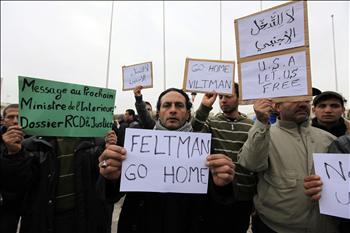
Several people have suggested to me that governments, such as Syria’s, that oppose Israel and the US, are less likely to see mass uprisings against them. The argument goes: “Yes, poverty and insecurity are the main drivers of the uprisings in Egypt and Tunisia, but the people in Egypt are also humiliated by Mubarak because he stands against what they see as just policies toward the Palestinians and other Arab causes by hewing so closely to the US.”

As of yet, the extent to which revolution in the Arab World is connected to foreign policy is unclear. It could be argued that the poorest Middle East countries with the strongest civil society are likely to see revolution. Those, like Syria’s, in which civil society, i.e. organized political parties, labor unions,  etc., are curtailed are less likely to see mass rallies and political trouble.  In short, the tougher regimes will tough it out. The economic situation for the bottom 50% of most Middle Easterners is going to get worse in the future due to rising commodity prices, inflation, and scarce resources. To stay in power, governments presiding over a large percentage of poor will have to become more repressive or find a way to increase economic growth.

In all events, it is clear that a new, more populist Middle East will be less pro-American and less likely to support Israel. Turkey is the bell-weather for what happens when government become more democratic in the Middle East. They find it more difficult to cooperate with Israel and the US on policies that dispossess Palestinians or hurt Muslims.

Syrian authorities are jubilant about Mubarak’s difficulties and the popular uprising in Egypt. It is common in opposition circles to suggest that Syrian authorities are panicked by the vision of popular revolt in Tunis and Egypt. I believe the opposite is true. Ever since Sadat made peace with Israel at Syria’s expense, Syrian authorities have hoped for regime change in Cairo. It has finally come. Israel has been able to disregard Syria since 1979. Perhaps Israel will have to give peace making with Syria a new look if Egyptians manage to bring down the Mubarak regime? Assad explains in an interview with the Wall Street Journal that he believes that unpopular foreign policy is a key to the revolutions.

Syria Strongman: Time for ‘Reform’
By JAY SOLOMON And BILL SPINDLE in Wall Street Journal

…  Mr. Assad said he will have more time to make changes than Mr. Mubarak did, because his anti-American positions and confrontation with Israel have left him in better shape with the grassroots in his nation.

“Syria is stable. Why?” Mr. Assad said. “Because you have to be very closely linked to the beliefs of the people. This is the core issue. When there is divergence…you will have this vacuum that creates disturbances.”

.Mr. Assad said he would push through political reforms this year aimed at initiating municipal elections, granting more power to nongovernmental organizations and establishing a new media law.

…Assad:

“I can talk about the region in general more than talking about Tunisia or Egypt because we are one region. We are not a copy of each other, but we have many things in common. So, I think it is about desperation. Whenever you have an uprising, it is self-evident that to say that you have anger, but this anger feeds on desperation. Desperation has two factors: internal and external.

The internal is that we are to blame, as states and as officials, and the external is that you are to blame, as great powers or what you call in the West ‘the international community’, while for them, the international community is made up of the United States and some few countries, but not the whole world. So, let us refer to the latter as the ‘greatest powers’ that have been involved in this region for decades.

As for the internal, it is about doing something that is changing; to change the society, and we have to keep up with this change, as a state and as institutions. You have to upgrade yourself with the upgrading of the society. There must be something to have this balance. This is the most important headline.

Regarding the west, it is about the problems that we have in our region, i.e. the lack of peace, the invasion of Iraq, what is happening in Afghanistan and now its repercussions in Pakistan and other regions. That led to this desperation and anger. What I tell you now is only the headlines, and as for the details, maybe you have details to talk about for days if you want to continue. I am just giving you the way we look at the situation in general.”…

His government already made adjustments to ease the kind of economic pressures that have helped fuel unrest in Tunisia and Algeria: Damascus this month raised heating oil allowances for public workers—a step back from an earlier plan to withdraw subsidies that keep the cost of living down for Syrians but drain the national budget. Tunisia, Algeria and Jordan have also tried to assuage protesters by lowering food prices….

“What pleases me is that this transition between the two [Lebanese] governments happened smoothly, because we were worried,” said Mr. Assad. “It was very easy to have a conflict of some kind that could evolve into a fully blown civil war.”…

“No, [the peace process] is not dead, because you do not have any other option,” Mr. Assad said. “If you talk about a ‘dead’ peace process, this means everybody should prepare for the next war.”

The Syrian leader acknowledged his government is likely to continue to be at odds with the U.S. on key strategic issues…..

Obama’s betrayal / As goes Mubarak, so goes U.S. might
By Ari Shavit in Haaretz

… Just as the officers’ revolts in the 1950s toppled Arab monarchies that were founded on colonial superpowers, the mass revolts of 2011 are toppling Arab dictators who rely on U.S. support. The Arab giant wants its freedom.

The second revolution that is occurring in front of our eyes is the collapse of the American empire. It could be that the American empire was evil.

But for 60 years the American empire kept the world stable, and provided relative quiet, peace and prosperity. The current U.S. president, Barack Obama, is undermining the American empire.

Obama’s betrayal of Hosni Mubarak is not just the betrayal of a moderate Egyptian president who remained loyal to the United States, promoted stability and encouraged moderation. Obama’s betrayal of Mubarak symbolizes the betrayal of every strategic ally in the Third World. Throughout Asia, Africa and South America, leaders are now looking at what is going on between Washington and Cairo.

Everyone grasps the message: America’s word is worthless; an alliance with America is unreliable; American has lost it. A result of this understanding will be a turn toward China, Russia and regional powers such as Iran, Turkey and Brazil.

The second result of this insight will be a series of international conflagrations that will result from the loss of America’s deterrent power. But the general result will be America’s rapid disappearance as a superpower…..

Chris Phillips writes: “Is Syria next”
January 28, 2011

….Whilst it is still far from certain that ‘regime change’ will occur in Egypt, many are already suggesting Syria,….
most crucially, Syria has far less civil society than either Egypt or Tunisia (or Jordan, Yemen and Algeria for that matter) and consequently it is harder to imagine how opposition would get organized. …Similarly, unlike in Egypt or Tunisia, all trade unions (which played a significant role in Tunisia) are controlled by the regime, and most content in mosques is loyalist and controlled…..A second scenario, as optimistically suggested by Brian Whitaker today, is that Bashar will use his relative popularity and reformist credentials to bring change himself before he is pushed.

Egypt And Tunisia Increase Political Risk as They Usher in An Era of Food Revolutions
by Ambrose Evans-Pritchard, Jan. 30 (Telegraph)

Political risk has returned with a vengeance. The first food revolutions of our Malthusian era have exposed the weak grip of authoritarian regimes in poor countries that import grain, whether in North Africa today or parts of Asia tomorrow.

If you insist on joining the emerging market party at this stage of the agflation blow-off, avoid countries with an accelerating gap between rich and poor. Cairo’s EGX stock index has dropped 20pc in nine trading sessions.

Events have moved briskly since a Tunisian fruit vendor with a handcart set fire to himself six weeks ago, and in doing so lit the fuse that has detonated Egypt and threatens to topple the political order of the Maghreb, Yemen, and beyond.

As we sit glued to Al-Jazeera watching authority crumble in the cultural and political capital of the Arab world, exhilaration can turn quickly to foreboding.

This is nothing like the fall of the Berlin Wall. The triumph of secular democracy was hardly in doubt in central Europe (news) . Whatever the mix of aspirations of those on the streets of Cairo, such uprisings are easy prey for tight-knit organizations known in the revolutionary lexicon as Leninist vanguard parties.

In Egypt this means the Muslim Brotherhood, whether or not Nobel laureate Mohammed El Baradei ever served as figleaf. The Brotherhood is of course a different kettle of fish from Iran’s Ayatollahs; and Turkey shows that an ‘Islamic leaning’ government can be part of the liberal world though Turkish premier Recep Tayyip Erdogan once let slip that democracy was a tram “you ride until you arrive at your destination, then you step off.”

It does not take a febrile imagination to guess what the Brotherhood’s ascendancy might mean for Israel, and for strategic stability in the Mid-East. Asia has as much to lose if this goes wrong as the West. China’s energy intensity per unit of GDP is double US levels, and triple the UK.

The surge in global food prices since the summer since Ben Bernanke signalled a fresh dollar blitz, as it happens is not the underlying cause of Arab revolt, any more than bad harvests in 1788 were the cause of the French Revolution.

Yet they are the trigger, and have set off a vicious circle. Vulnerable governments are scrambling to lock up world supplies of grain while they can. Algeria bought 800,000 tonnes of wheat last week, and Indonesia has ordered 800,000 tonnes of rice, both greatly exceeding their normal pace of purchases. Saudi Arabia, Libya, and Bangladesh, are trying to secure extra grain supplies.

The UN’s Food and Agriculture Organization (FAO) said its global food index has surpassed the all-time high of 2008, both in nominal and real terms. The cereals index has risen 39pc in the last year, the oil and fats index 55pc.

The FAO implored goverments to avoid panic responses that “aggravate the situation”. If you are Hosni Mubarak hanging on in Cairo’s presidential palace, do care about such niceties?

France’s Nicolas Sarkozy blames the commodity spike on hedge funds, speculators, and the derivatives market (largely in London). He vowed to use his G20 presidency to smash the racket, but then Mr Sarkozy has a penchant for witchhunts against easy targets….

The deeper causes are well-known: an annual rise in global population by 73m; the “exhaustion” of the Green Revolution as the gains in crop yields fade, to cite the World Bank; diet shifts in Asia as the rising middle class switch to animal-protein diets, requiring 3-5 kilos of grain feed for every kilo of meat produced; the biofuel mandates that have diverted a third of the US corn crop into ethanol for cars.

Add the loss of farmland to Asia’s urban sprawl, and the depletion of the non-renewable acquivers for irrigation of North China’s plains, and the geopolitics of global food supply starts to look neuralgic.

Can the world head off mass famine? Yes, with leadership.

Yedioth Ahronoth (p. 5) by Eli Shaked — The author is a former Israeli ambassador to Egypt.

Things do not look good for Israel and the moderate Arab states. The developments from here on are not going to be good for our peace with Egypt and stability in the region. ….The only people in Egypt who are committed to peace are the people in Mubarak’s inner circle, and if the next president is not one of them, we are going to be in trouble.

ElBaradei, Muslim Brotherhood Offer Political Path Out of Egyptian Confrontation

Robert Naiman, Truthout: “Egyptian Muslim Brotherhood leader Essam el-Eryan said today that Egyptian opposition groups have agreed to back former IAEA head Mohamed ElBaradei to negotiate with the government…

Egypt deploys troops along Gaza border
By YAAKOV KATZ The Jerusalem Post 01/31/2011

…..The Egyptians are cracking down on Hamas, a senior Israeli defense official said on Sunday.

Throughout the day, the IDF and Defense Ministry held consultations regarding the continued unrest in Egypt. Senior Israeli politicians and officials were in touch with Egyptian government officials, and contact was established directly between Israel and Egypts new vice president, Omar Suleiman

Israels concern is that the Muslim Brotherhood will use the ongoing demonstrations to garner public support and eventually take over Egypt. Israeli officials who were in touch with Egyptians on Sunday expressed confidence in Suleimans ability to take control of the military and prevent a regime change.

This is the end of Hosni Mubaraks presidency, but the situation could be brought under control by Suleiman, the senior defense official said. Defense Minister Ehud Barak spoke with US Secretary of Defense Robert Gates on Sunday to discuss the situation.

Relationship between CIA and Suleiman: Wash Post
By Jeff Stein | January 30, 2011;

Edward S. Walker, the American ambassador in Cairo at the time, described Suleiman as “very bright, very realistic,” according to the account of Mayer and others. The envoy said that Suleiman was aware of the flap potential of “some of the negative things that the Egyptians engaged in, of torture and so on.”

Walker added that Suleiman “was not squeamish, by the way.” At the same time, diplomats in the American Embassy were critical of CIA-funded Egyptian security projects, Walker told the British journalist Stephen Grey, including a “program to train Egyptian special operations forces in counterterrorism arrests.” The trouble, though, was that “too many people died while fleeing…It got to be a little too obvious, and the agency got very nervous about this,’” Walker told Grey.

Now, of course, the tables have been turned. It’s Suleiman and Mubarak who are nervous, and no doubt the CIA, too. But the two Egyptians have far more cause for worry than the CIA. The spy agency will always find a way — many ways — to stay at work in Egypt after Mubarak is gone. “I can’t see that there’s any way Mubarkak can reestablish himself,” Walker told SpyTalk on Sunday. “He’s wounded and discredited, and ultimately the military is going to look out for itself.”

As for Suleiman, “If he’s talking to the CIA station chief, I think they’re both talking about stability and how you guarantee it — what’s the best process,” Walker said. “I’m sure they’re doing everything they can to let him know that they’re with him, that we also want stability and a transition to a government that has popular support.”

When Mubarak goes down, in other words, Suleiman won’t be going with him. “I think that’s right,” Walker said.

As for the CIA, “They’re going to want to make sure that they have continuing access, that the relationship between the intelligence agencies is strong and survives this, so we can use it in the future.”

Former U.S. Ambassador to Israel Martin Indyk
argued Saturday that Obama would soon have to tell Mubarak to go, ideally after a transition plan has been worked out. “At this point, facing by far the biggest foreign policy crisis of his presidency, Obama cannot afford to backtrack,” Indyk, vice president for foreign policy studies at the Brookings Institution, wrote on MSNBC.com Saturday. “He will soon have to decide whether to tell Mubarak that the United States no longer supports him and that it’s time for him to go.”
The Worst of Both Worlds– in some minds, the issue is primarily about Israel
As the revolt in Egypt spreads, Barack Obama faces a familiar dilemma in the Middle East.
BY GARY SICK | JANUARY 29, 2011
…Now that the status quo is shaking, there are expressions of amazement that the U.S. government made its bed with such dictatorial regimes for so long. We coddled them and gave them huge sums of money while averting our eyes from the more distasteful aspects of their rule. How to explain this hypocrisy?

The facts are not so mysterious. It was an Egyptian dictator (Anwar Sadat) who made peace with Israel, leading to his assassination; and it was another dictator (Hosni Mubarak) who kept that peace, however cold, for the past 30 years. As part of that initial bargain and successive agreements, the United States has paid in excess of $60 billion to the government of Egypt and an amount approaching $100 billion to Israel. The investment may be huge, but since the Camp David agreement negotiated by President Jimmy Carter in 1978 there has been no new Arab-Israel war.

Some may quibble with the crude implication of a payoff or the collapsing of several generations of politics in the Middle East into this simple formula. But it has some validity. Here is how Vice President Joe Biden answered when PBS anchor Jim Lehrer asked him whether Egyptian President Hosni Mubarak was a dictator:

Look, Mubarak has been an ally of ours in a number of things and he’s been very responsible on, relative to geopolitical interests in the region: Middle East peace efforts, the actions Egypt has taken relative to normalizing the relationship with Israel.

And I think that it would be — I would not refer to him as a dictator.

Leslie Gelb, a former senior U.S. government official and president emeritus of the Council on Foreign Relations, put it this way:

The stakes are sky high. Egypt is the linchpin to peace in the Middle East. So long as Egypt refrains from warring against Israel, other Arab states cannot take military action by themselves…”….

So in some minds, the issue is primarily about Israel. As far as I can tell, the government of Israel has yet to declare itself on the wave of uprisings in the Arab world. But if this is an Israeli issue, then it is not just a U.S. foreign-policy problem but also a domestic one, especially in the run up to a presidential election year. The stakes, indeed, could be very high.

Tony Karon (Senior editor at TIME)

US officials forced to explain their support for Hosni Mubarak’s repressive autocracy over the past week have stressed Mr Mubarak’s cooperation with Israel and support for a US regional strategy highly unpopular with the citizenry of the Arab world. As the State Department spokesman, PJ Crowley, told Al Jazeera: “Egypt is an anchor of stability in the Middle East … It’s made its own peace with Israel and is pursuing normal relations with Israel. We think that’s … a model that the region should adopt.”

Washington has long expected that Mr Mubarak’s successor would not be as pliant. A May 2007 cable from the US embassy in Cairo released last year by WikiLeaks warned that: “Whoever Egypt’s next president is, he will inevitably be politically weaker than Mubarak, and … among his first priorities will be to cement his position and build popular support.”

The cable continued: “We can thus anticipate that the new president may sound an initial anti-American tone in his public rhetoric in an effort to prove his nationalist bona fides to the Egyptian street, and distance himself from Mubarak’s policies … We can also expect the new president to extend an olive branch to the Muslim Brotherhood … in an effort to co-opt potential opposition and boost popularity.”

And all this was before the people of Egypt had stepped up to demand a say in the matter. Except their message to America may be am even simpler one: this is not about you….

Haartz: Aluf Benn

Barack Obama will be remembered as the president who “lost” Turkey, Lebanon and Egypt, and during whose tenure America’s alliances in the Middle East crumbled….

Obama began his presidency with trips to Turkey, Egypt and Saudi Arabia, and in speeches in Ankara and Cairo tried to forge new ties between the United States and the Muslim world. His message to Muslims was “I am one of you,” ….But he did not imitate his hated predecessor, President George W. Bush, with blunt calls for democracy and freedom….

Obama apparently believed the main problem of the Middle East was the Israeli occupation, and focused his policy on demanding the suspension of construction in the settlements and on the abortive attempt to renew the peace talks. That failure led him to back off from the peace process in favor of concentrating on heading off an Israeli-Iranian war….The street revolts in Tunisia and Egypt showed that the United States can do very little to save its friends from the wrath of their citizens.

[Interesting anti-Obama spin. Perhaps one should say Obama will be remembered as the US president who allowed dictators in the Middle East to fall and gambled on democracy, whereas, Bush talked democracy and supported civil war, chaos, and dictators.]

An Arab revolution fueled by methods of the West
The Arab street suddenly uses ‘our’ methods: Facebook and Twitter – the tools of democracy we have invented – to present us with a situation of disorder.
By Zvi Bar’el

So what has happened so far? A corrupt president in Tunisia flees, to cheers from around the world. Protests erupt in Egypt, and gloom descends. Protests are held in Iran, and the world cheers. A prime minister is deposed in Lebanon, to fear and dread. An Iraqi president is overthrown in a military offensive, and it’s called democracy. Raucous demonstrations take place in Yemen, and they’re called interesting but not terribly important.

Why the different reactions? This is supposedly the new Middle East the West always wanted, but something still isn’t working out. This isn’t the Middle East they dreamed of in the Bush administration, and not what nourished Prime Minister Benjamin Netanyahu’s wildest dreams. A new, unexpected player has appeared: the public…. we need a revolution in the way the West views the region.

Officials: More private planes departing Egypt
2011-01-30

Cairo (DPA) — At least 45 small, private planes departed from Cairo airport on Sunday, officials said, mostly taking businessmen, diplomats and members of Egypt’s elite out fo the country. The private jets departed from Terminal 4, the non commercial section of the international airport in Egypt’s capital. Egyptians, Arabs and Westerners were said to be on the planes, which were either rented or privately owned. On Saturday, some of Egypt’s top businessmen fled the country in private planes, amid growing unrest in the country.

Shadid in NYTimes

“Miqati, a billionaire backed by Hezbollah to become prime minister of Lebanon, promised Wednesday to forge good relations with the United States and declared that he would not interfere with an international tribunal expected to name Hezbollah members in the assassination of a former prime minister.

Ousted Lebanese Leader Swallows Rivals’ Bitter Pill
By ANTHONY SHADID

BEIRUT, Lebanon — There is a hint of Shakespeare in it all, if Lebanese politics did not feel like the pulp fiction of Raymond Chandler, where the loftiest principles soon get mired in the muck of corruption, prevarication and opportunism cast in the sincerest of words.

But on Tuesday, the day that was his last as prime minister here, Saad Hariri faced one of the bitterest realities of his brief but tumultuous political career. By virtue of what he calls his principles as a man — and what his foes and a few friends call his failures as a politician — his country was delivered, at least symbolically, to the very movement that stands accused of killing his father on the Beirut seafront in 2005.

Betrayed, he called himself after the choice of Hezbollah, Najib Miqati, was named as the prime minister designate on Tuesday. A victim of his own lies, say his foes, who engineered his ouster by bringing down his government this month. Perhaps it was both, in a place one politician called “a chemical equation, not a country.”…..

“Feeling this kind of backstabbing is quite harsh,” Mr. Hariri admitted.

“But,” he added, “that’s politics.”

Those very politics may spell his return. “I have popular support,” he said in the interview and, by all accounts, he is right. His standing as the leader of Sunni Muslims means he remains a player in politics rigidly divided among the country’s sects. As his father’s son, he and the position he takes will remain deeply resonant in whatever deal is worked out over the tribunal. And even in defeat, he suggested there might still be negotiations ahead on some quintessentially Levantine deal that would bring him into Mr. Miqati’s government.

“I have to sit with allies and decide what is the final decision,” he said.

Or, in the verdict delivered by Hassan Khalil, the publisher of Al Akhbar, a leftist newspaper that aligns itself with Mr. Hariri’s foes: “In Lebanon, it’s never over for anyone. You cannot write off anyone or anything in this country.”

LEBANON: Further unrest looms as Mikati assesses STL
Wednesday, January 26 2011

EVENT: President Michel Suleiman yesterday appointed Najib Mikati as the new prime minister-designate.

SIGNIFICANCE: Mikati’s nomination represented a major success for the Hizbollah-led ‘March 8’ coalition, which managed to summon a majority in parliament for its preferred candidate with the switching of eleven MPs from one side to the other. March 8’s domination in the new political arrangement poses questions for the future of the UN Special Tribunal for Lebanon and sectarian stability.

ANALYSIS: … The development followed a deterioration in the Syrian-Saudi rapprochement, and official acknowledgment that they had failed to find a deal to calm Lebanese tensions surrounding the UN Special Tribunal for Lebanon (STL) investigating the assassination of former Prime Minister Rafik al-Hariri, which is expected to indict Hizbollah members . Regional attempts led by Qatar and Turkey to find a last-minute compromise solution also failed.

The March 8 coalition subsequently declared its unwillingness to accept a return of Hariri to power, and a media campaign began against him, including the publication of leaked recordings of Hariri’s testimony to the STL. The situation was exacerbated with the submission of the draft indictments to the pre-trial judge in the STL on January 17. Crowds of unarmed Hizbollah supporters gathered in some Beirut neighbourhoods early the next morning, sending a clear reminder of Hizbollah’s capacity to use street violence.

Mikati nomination. Hizbollah and its allies nominated Sunni politician Najib Mikati for the premiership. With Druze leader Walid Jumblatt’s decision to side with the ‘March 8’ coalition, in addition to the defection of four MPs from Tripoli, Mikati received 68 votes in the 128-seat parliament, and was yesterday appointed prime minister-designate and tasked with forming a government. The development was a major victory for Hizbollah: given the support Mikati relies on, and his ties to Syria, the first item on the new government’s agenda is likely to be discussion of the ending of cooperation with the STL…..

March 14 reactions. Violent protests erupted in various Sunni areas in support of Hariri. While Mikati satisfies the requirements of Lebanon’s sectarian system which specify that the prime minister must be a Sunni, sectarian tensions increased dramatically with the perception that Shia groups had determined the main Sunni role in government. …

March 14 has limited options for dealing with the new situation:

…The situation on the ground is therefore likely to calm down, at least for the time being.

· Participation in the government is also not an option, as inclusion would legitimise the Mikati government,…

It is therefore most likely that March 14 will stay outside of the government, in peaceful opposition, until Mikati’s government starts debating the cooperation protocol between Lebanon and the STL. A decision to withdraw the protocol would probably require March 14 to formulate a different political strategy, and renewed social unrest would be highly likely.

Mikati’s options. Mikati announced his willingness to form a national unity government, but March 14 rejected this proposal. Yet his strategy is to present himself as a compromise candidate, close to all contending parties. His most likely option is therefore to form a ‘National Salvation’ government of ‘independent’ figures, since the alternative — forming a March 8 government, or including prominent March 8 members — would be too provocative.

Yet despite his desire to appear as a compromise candidate, Mikati is still under March 8 control — …..

International response. Mikati’s successful bid for power is seen as a victory for Syria in Lebanon, with one of its allies back in power, Hariri ousted and Riyadh’s influence in Lebanon challenged as Saudi-Syrian relations deteriorate . Since Hariri could not capitalise on the international support for his candidacy, it appears that Syria has returned to its position as the main powerbroker in Lebanon…..

· The strongest reaction came from US Secretary of State Hillary Clinton, who warned that a Hizbollah-controlled government in Lebanon would affect its ties with Washington. The United States has warned against government change in Lebanon, arguing that such a development could threaten aid supplies.

· However, an acknowledgment of Mikati’s appointment came from France. The French Foreign Ministry ‘took note’ of the designation of Mikati, calling on him to form a government without outside interference. Similarly, EU foreign policy chief Catherine Ashton called on Mikati to form a consensus government and respect Lebanon’s international obligations.

· Moreover, despite strong statements by Saudi Foreign Minister Prince Saud al-Faisal prior to the nomination, Saudi officials have been silent on the recent developments, and their position is as yet uncertain.

Other regional reactions have been sparse, with little clarity over the outside backers of Mikati. There are rumours that France and Qatar were behind his candidacy, though these are not confirmed. Yet in the absence of a strong reaction from the regional backers of March 14, Syria could be said to have imposed a new situation on the ground.

Israel. A Hizbollah-controlled government might alter the rules of engagement with Israel, as the government is now seen as a clear tool in the hands of Hizbollah. Israeli officials have warned of the possible effect of the government change on the situation on Lebanon’s southern border; Israeli Vice-Prime Minister Silvan Shalom described it as a “very, very dangerous development”, dubbing the new government an “Iranian government on Israel’s northern border”. However, the victory of Hizbollah will not necessarily increase the likelihood of war, as both sides have no immediate interest in starting a conflict. Yet it will change the nature of the conflict if such a war does happen, as all governmental institutions would be seen as possible Hizbollah outposts.

CONCLUSION: The nomination of Mikati for premiership is a clear victory for the March 8 coalition. The main challenge for the new government will be to gain domestic legitimacy and international recognition. Yet it may struggle to do this given its likely decision to end cooperation with the STL, which would cause a new round of social unrest and international condemnation.

Palestine Papers: Admiral Mullen says Palestinian state is a U.S. ‘cardinal interest’ after raising troop deaths
by ALEX KANE on JANUARY 26, 2011

General David Petraeus backed away from uttering similar words, but it’s clearly a view that holds wide currency in the U.S. military establishment: ending the Israel/Palestine conflict is a core U.S. interest that affects the safety of U.S. soldiers. Haaretz picks up (though they bury it) that U.S. Admiral Michael Mullenechoes the “linkage” argument in a document published by Al Jazeera as part of the”Palestine Papers.”
Notes from a June 16, 2009 meeting quotes chief Palestinian negotiator Saeb Erekat as saying that Admiral Mullen told Mahmoud Abbas:

You’re the most important person in the Middle East. Arabs and Muslims have only one thing on their mind: Palestine. So, we want to help you establish a Palestinian state… I have 230,000 troops in Iraq & Afghanistan and I am bringing back 10 each week draped in American flags or in wheelchairs. This is painful for America. Because I want to bring them back home, a Palestinian state is a cardinal interest of the USA. Washington today is different from Washington yesterday.

This is the realist argument the Israel lobby goes beserk over.
Alex Kane blogs on Israel/Palestine and Islamophobia in the U.S. atalexbkane.wordpress.com. Follow him on Twitter @alexbkane.

US Loses Lebanon, Worries about Losing Egypt; Tunisians Ask Feltman to Go Home

What is happening to the US?

Tunisians objecting to Feltman's efforts in Tunisia

Arab News, one of Saudi Arabia’s leading papers which has been in circulation for 35 years, published this surprising opinion piece in favor of Lebanon’s new government. It recommends scuttling the Special Tribunal for Lebanon, Washington’s brainchild. By arguing that Rafiq Hariri would not support or continence “further bloodshed in his name,” it recommends a halt to further demonization of the Lebanese party, Hizbullah and using Lebanon as a battleground for regional influence.

It demonstrates significant disagreement within the Kingdom over the wisdom of marching behind America’s drumbeat.

Lebanon should reject Hariri tribunal

By LINDA HEARD | ARAB NEWS
Published: Jan 18, 2011

“… Disunity is Lebanon’s greatest Achilles heel, which is now being exacerbated by the UN-backed Special Tribunal for Lebanon, which is bent on opening-up old wounds with the potential to thrust the country into civil war.

There is no doubt that Lebanon’s former Prime Minister Rafik Hariri was a great man, who worked hard to rebuild his nation and bring his people together. His reconstruction of Downtown Beirut is a testament to that. His killing in 2005 was a terrible crime ..but allowing a foreign court to regurgitate that tragedy six years with potentially devastating consequences serves no purpose at all for Lebanon’s stability and economic future.

It does, however, benefit the US and Israel which are ready to cheer on the demonization of their enemy Hezbollah, which is the only entity blocking those powers from total domination over Israel’s tiny neighbor and giving them pause for thought to pursue their ambitions to bomb Iran’s nuclear sites.

Lebanon’s so-called unity government wasn’t perfect but it was largely workable. It fell apart when outgoing Prime Minister Saad Hariri (now caretaker prime minister) visited the US President Barack Obama. He subsequently confirmed his support for the tribunal’s findings and upcoming indictments against members of Hezbollah….

While it’s understandable that Saad Hariri is keen to bring his father’s murderers to justice, but he should not do so at the expense of peace. Whatever a foreign court comes up with will not bring his father back but may lead to further bloodshed in his name….

Hezbollah Ally Mikati to Head New Lebanon Government
January 25, 2011, Businessweek
By Massoud A. Derhally

Jan. 25 (Bloomberg) — Lebanese President Michel Suleiman asked Najib Mikati, candidate of the Hezbollah movement and its allies, to form a government as supporters of rival parties took to the streets in protest. Mikati won the backing today of 68 lawmakers to 60 for caretaker Prime Minister Saad Hariri after Suleiman canvassed their views in two days of talks.

….The U.S. “should be realistic and pragmatic” about Hezbollah’s role in a new government, said Rami G. Khouri…..

“Ultimately the question is: Will Mikati be able to bridge the differences between Saudi Arabia and Syria, the two traditional power brokers in the country?” said Josh Landis, director of the Center for Middle East Studies at the University of Oklahoma in Norman. “If there is no agreement between Syria and Saudi Arabia then there will be more trouble in Lebanon.”

Mikati is worth $2.5 billion, according to Forbes magazine.

Michael Young, “Lebanon’s False Choice Between Stability and Justice” (via Elliott Abrams)

…..Hezbollah, egged on by Tehran, will fight to ensure that any new Lebanese government distances itself from the special tribunal. But if the tribunal can prove its accusations, Hezbollah may be caught in a vise. If the party resorts to intimidation to stifle dissent and condemnation after the accusations come out, it could plant the seeds of its own destruction. Browbeating its domestic partners will only further isolate Hezbollah and rally other Lebanese communities against it. A Hezbollah leader lording over Lebanon will represent an invitation for an attack by Israel, which might see an opening to cripple the party if it is isolated. And this time, the Israelis have repeatedly warned that a war would be far worse than in 2006 and Shiite suffering much greater. Even among Shiites, patience with a militant organization that offers only perpetual conflict may wear thin, especially at a time when the community yearns for stability to consolidate its newfound political and economic standing in Lebanon….

Mona Eltahawi in the WashPost, concerned about Hillary Clinton’s statements supporting Husni Mubarak against the Egptian demonstrators, takes Washington to task for propping up the Mubarak regime.
“Unlike Tunisia, Egypt is a major U.S. ally. When Secretary of State Hillary Clinton said on Tuesday that the Obama administration’s “assessment is that the Egyptian government is stable and is looking for ways to respond to the legitimate needs and interests of the Egyptian people,” she showed once again how out of touch she is with popular anger at Mubarak. She also alerted Egyptians that Washington was as concerned about the protests and the potential “Egypt effect” as Mubarak must be.
Washington is rapidly losing friends in the region. As I have been arguing for some time, the US is pursuing bad policies which will only lead to its increasing isolation in the region. Turkey has turned away from Washington for its full throated support of Israel and ill-advised destruction of the Iraq state. Starving Iranians is unpopular and counterproductive. It is hard to understand why the US would designate Iran its most important enemy and foreign policy issue when Iran hardly threatens the US. Supporting Israeli dispossession of Palestinians is sure to lose the US friends and fuel further terrorism. Demonizing Hizbullah and Syria and pursuing economic warfare against them, rather than supporting international law on the Golan issue is wrong. See Cobban’s Arab world waking from 40-year sleep? for more on this.
..the administration has worked with pro-democracy groups to advocate for freer media and assembly. It has pushed for outside monitors to scrutinize elections in Jordan and Egypt. And it has encouraged social networks like Twitter and Facebook to spread the word about pro-democracy movements — the very networks that helped spread word of demonstrations in Tunisia and Egypt. “In giving us guidance as we develop our policies in the region, the president was adamant that we take stock of the brittleness and hidden risks of the status quo,” said Samantha Power, a senior director at the National Security Council who handles human rights issues.
State of the Union: These are the Middle East quotes from the State of the Union address by President Obama
  • “We saw that same desire to be free in Tunisia, where the will of the people proved more powerful than the writ of a dictator. And tonight, let us be clear: the United States of America stands with the people of Tunisia, and supports the democratic aspirations of all people.”
  • Nothing on Egypt
  • Nothing on Palestine/Israel
  • Iran: “Because of a diplomatic effort to insist that Iran meet its obligations, the Iranian government now faces tougher and tighter sanctions than ever before.”
A few readers comments over the last two days:
  • The parliamentary vote was 68 for Mikati; Hariri got 60. A clear win. Hariri mobs are now taking it out against the media. They attacked, shot at and destroyed cars for Al-Jazeera, NBN and OTV.
  • This time, HA got what it wants democratically and Hariri is inciting violence. Last week Hariri said that he would not take this to the streets because that’s what “thugs and people who are against democracy” do? Let’s see how the media will spin this one. The US is also showing its democratic colors and threatening to pushing all Lebanese if their parliament votes for a Opposition led government.
  • Listening to some of the speeches made in Tripoli today to incite the mobs in that city and their reactions! Scary stuff. Saudis did a great job there through Hariri. More qaida-esque groups will emerge from that city.
  • “Miqati’s willingness to go against Hariri and the latter’s outrage that he’s loosing the PM seat has a lot to do with the fact that they are business rivals. On the wider context, hariri is Saudi’s businessman in Beirut while Miqati is closely linked to Rami and other tycoons in Syria.”
  • “outrage in lebanon as a terrorist organization takes control of its government” …This is the CBS news opening line at the evening news tonight
  • Solidere shares (Hariri’s company) up 4.5% on the Miqati news. Egyptian stocks down 6.25% today

The Guardian’s story on how they got the Palestine docs:

Expelling Israel’s Arab population?
Israeli negotiators, including Tzipi Livni, proposed “swapping” some of Israel’s Arab villages into a Palestinian state.

The Right of Return

Erekat’s people offered returning 10 thousands Palestinian refugees each year for 10 years. Olmert responded with a agreeing to the return of a thousand refugees for 5 years, while Rice said we can send them to Argentina or Chille instead. Livni told Arakat that the 10k is Olmert’s personal opinion and that her position is no refugees period.
All documents are available here: http://www.ajtransparency.com/ar/search_arabic

If the latest batch of leaked cables demonstrate anything, it is that Israel over the last ten years has been intransigent and deaf to generous offers of peace and territorial compromise. Is it become the new Front for Steadfast Resistance?

Haaretz:

The ruling coalition in the Israeli Knesset expected to appoint Michael Ben-Ari, the first outspoken follower of Meir Kahane to be elected to the Knesset since the Kach Party was banned in 1988, to head the investigation into the funding of “leftist NGOs” and human rights groups.


MI6 ‘Drew Up Plan to Crush Hamas’

2011-01-25 – Telegraph
Adrian Blomfield

Jan. 25 (Telegraph) — British intelligence advised the Palestinian Authority to crush Hamas and other violent groups in the West Bank by detaining some of their leading figures, leaked documents have shown. In an effort to restore peace during the Second Palestinian Intifada against Israel, MI6 drew up a strategy in 2004 to help Yasser Arafat’s security forces neutralise “rejectionists” opposed to a Middle East peace deal….

MSNBC: Report: Syria among worst for rights abuses
2011-01-24 20

NEW YORK — Syria’s authorities were among the worse violators of human rights last year, jailing lawyers, torturing opponents and using violence to repress ethnic Kurds, Human Rights Watch said on Monday. The rights organization’s annual report …