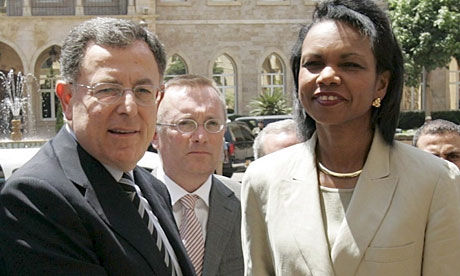
Wikileaks: “Syrian-Iranian Relations return to normal”; Jordan, Turkey, and US Seek Improved Iran Relations; Hariri Tribunal Delayed;

Hariri Tribunal to be postponed until next month in a move linked to a new US approach toward Iran. [Daily Star] Also read Ian Black’s: Rafiq Hariri tribunal: why many in Beirut have lost their thirst for justice and the Hariri Tribunal.

Erdogan becomes first Turkish PM to join Karbala mournings – He reaches out to Turkey’s Alevis … and to Shiis in neighboring states: Syrian, Iraqi and Iranian. Smart.

WikiLeaks: Syria told Iran it would stay out of war with Israel
08 Dec 2010

In one of the most startling Wikileaks disclosures of recent weeks, a document released on Wednesday reveals that Syria refused Iranian entreaties to fight alongside Iran against Israel if it were to strike Tehran’s renegade nuclear program. The statements in the document, dated December 20, 2009, were probably made by a Syrian diplomatic source who spoke with American Embassy officials in Damascus. The Assad regime told the Iranians not to expect Syria, Hizbullah or Hamas to take part in this war. According to the source, Syrian officials replied by saying that Iran was strong enough to develop its own nuclear program and fight against Israel.

S E C R E T SECTION 01 OF 04 DAMASCUS 000880
NSC FOR SHAPIRO/MCDERMOTT
SUBJECT: SYRIAN-IRANIAN SHOW OF SOLIDARITY MASKS TENSIONS
OVER IRAQ, YEMEN, AND WAR WITH ISRAEL
Classified By: CDA Chuck Hunter

¶2. (C) On the surface, the early-December visits of three Iranian officials — National Security Advisor Saeed Jalili on December 3, Vice President and head of the Environmental Department Mahammed-Javad Mahamadzideh on December 5-6, and Minister of Defense Ahmad Ali Vahidi on December 8-11 — represented a concerted reaffirmation by both countries of their strong security ties and their commitment to expanded relations. Set against a backdrop of rising international pressure on Iran over its nuclear program and an exchange of threats between Israel and Iran …

¶3. (S/NF) The public showcasing of these three visits contrasted with the secrecy with which Iranian Revolutionary Guard Commander/al-Quds Force Ghassem Soleimani conducted his. Reportedly accompanying Jalili, Soleimani returned to Damascus after a long absence, perhaps a reflection of lingering tensions between Iran and Syria that erupted after the February 2008 assassination of Hizballah military strategist Imad Mugniyah in the Syrian capital. XXXXXXXXXXXX spoke very reluctantly about Soleimani’s presence in Damascus, saying only that “he was here,” and “when he visits, it’s usually significant.” XXXXXXXXXXXX reported seeing Jalili and Soleimani at a XXXXXXXXXXXX meeting with Syrian officials that included FM Muallim, as well as unspecified members of Hizballah. “Soleimani represents the DAMASCUS business end of the resistance,” commented XXXXXXXXXXXX, also reluctant to discuss the sensitive issue of Iranian-Syrian-Hizballah military cooperation. Taken collectively, the Iranian visits over eight days were meant to dispel doubts that Syria would or could abandon its ties to Iran ……

¶5. (S/NF) Whatever Syrian rationale there may be for showcasing military ties to Iran, many Syrian observers are emphasizing the shifting balance of power in their bilateral relationship. According to XXXXXXXXXXXX Iran, not Syria, sought the visits as a sign of Syrian reassurance. “Be assured,” commented XXXXXXXXXXXX “they needed these visits far more than we did.” Summing up a view heard repeatedly around Damascus, “things in our relations with Iran are starting to return to normal” after a long period of Syrian dependence, XXXXXXXXXXXX asserted. He added, “U.S. isolation and the invasion of Iraq made it necessary to adopt such extreme measures. But now, things are moving back to equilibrium.” The Syrian government, said XXXXXXXXXXXX, perceived a note of panic in the Iranian requests and some were saying Syria’s renewed relations with Saudi Arabia, its deepening ties to Turkey, and even Washington’s desire to re-engage Syria had made Iran “jealous.”

¶7. (S/NF) While the Syrian government responded positively to Iranian requests for public statements of support on the nuclear issue and against Israel, it remained silent after the Iranian Minister of Defense’s arrival statement denounced Iraq, Saudi Arabia, Israel and the United States. By the time Vahidi arrived on December 8, press contacts noted, the Syrian government’s attitude had shifted to “let’s get this over with,” according to XXXXXXXXXXXX. Indeed, at the same time Vahidi was parading his 20-car motorcade around Damascus, several other visits were occurring, including one by the Turkish military commandant and President Sarkozy’s Middle East advisors, Nicolas Gallet and Jean-David Levitte…..

¶8. (S/NF) Going beyond atmospherics XXXXXXXXXXXX reported several disagreements between Jalili’s delegation and their Syrian counterparts. On Iraq, Jalili reportedly proposed a “joining of Syrian and Iranian efforts” to influence the upcoming Iraqi elections. “They (the Iranians) basically asked us to focus on co-opting Shia politicians and to drop our support for the Sunnis and former Baathists,” arguing that the center of gravity in Iraq lies with the Shia. On this issue XXXXXXXXXXXX reported, Syrian officials expressed great reluctance and continued to insist on the reintegration of former Iraqi Baathists into the political system…

¶9. (S/NF) On Yemen, Vahidi’s public remarks rebuking Saudi Arabia for interfering in its neighbor’s affairs drew sharp criticism from Syrian officials during the Iranian Defense Minister’s meetings XXXXXXXXXXXX Vahidi was clearly trying to drive a wedge between Damascus and Riyadh, but “it didn’t work,” he said. Asad stopped short of publicly contradicting the Iranian official during his visit, but he reassured Saudi King Abdullah’s son Abdul Azziz, in Syria to pay personal condolences after the death of President Asad’s brother Majd, that Syria fully supported Saudi Arabia’s efforts to defeat the Huthi separatists. “There weren’t any newspaper reports of Iranian ministers here (paying condolences),” noted XXXXXXXXXXXX.
¶10. (S/NF) More significantly, Syria reportedly resisted Iranian entreaties to commit to joining Iran if fighting broke out between Iran and Israel or Hizballah and Israel. XXXXXXXXXXXX said Iranian officials were in Syria “to round up allies” in anticipation of an Israeli military strike. “It (an Israeli strike on Iran) is not a matter of if, but when,” XXXXXXXXXXXX said, reporting what Syrian officials had heard from their Iranian counterparts. The Syrian response, he continued, was to tell the Iranians not to look to Syria, Hizballah or Hamas to “fight this battle.”…

¶11. (S/NF) Asked what advice Syria was giving Iran, XXXXXXXXXXXX replied that Syria, along with Turkey and Qatar, was preparing for an Israeli-Iranian military exchange in the near future. “Military officials tell me they have noticed Israeli drones snooping around our sites,” he explained, noting some Syrian officials saw Israeli reconnaissance as an indication that Israel might seek to disable anti-air radar stations as part of a plan to fly bombers over Syrian territory en route to Iran. “We expect to wake up one morning soon and learn the Israeli strike took place. Then we expect an Iranian response. At that point, we, Turkey, and Qatar will spring into action to begin moderating a 004ceasefire and then a longer-term solution involving both countries’ nuclear programs. That’s the best scenario….

¶12. (S/NF) Many Syrian and some diplomatic observers believe Syria is in the process of re-calibrating its relations with Iran and is seeking to avoid choices that would constrain the country’s flexibility as it faces an uncertain regional setting. Does, however, Syria’s instinct for self-survival and desire for less dependence on Iran represent anything other than a shift of emphasis as long as Damascus insists on maintaining its military relations with Iran, Hizballah, and Hamas? Some analysts here argue that Syria’s improved relations with Turkey, France, and Saudi Arabia afford Damascus a greater range of choices in dealing with the West, the Arab world, Israel, and Iran. This school asserts that better ties with the U.S. would further increase Syria’s range of options and its potential to move farther away from Iran. Even if Damascus and Tehran maintained some semblance of their political-military relationship, the extent of their ties would be constrained by Syria’s competing equities in deepening relations with others, including the U.S. Others argue that a wider range of options would only perpetuate Syria’s decision-averse orientation; if the Iranians can’t pin down Syria on matters of war and peace, then what chance would the United States have? Syria could pocket openings offered by Washington and simply use our gestures to play rivals off one another.

¶13. (S/NF) At the end of the day, it may be impossible to assess Syria’s intentions with any confidence until the regional context becomes clearer. In the meantime, the U.S. should take a modicum of quiet satisfaction that Syria is showing signs of wanting to moderate Iran’s influence in its affairs, even though expecting the relationship to end altogether remains unrealistic. If Syria’s improved relations with France, Saudi Arabia and Turkey can initiate cracks in the Syrian-Iranian axis, then perhaps discrete U.S.-Syrian cooperation could add further stress to these fault lines. A willingness to offer concrete deliverables as evidence of a U.S. desire for improved relations would force Syrian officials to calculate how far they would go in response, providing us with a more accurate measure of their intentions. At a minimum, increased Washington interest in Syria would increase Tehran’s anxiety level and perhaps compound Syrian-Iranian tensions, at a time when Syrian officials themselves may be unsure how they will react to unfolding events.

US embassy cables: US works to block Syrian bid to obtain chemical warfare components
2010-12-16 Guardian (GB):
SYRIA ARRANGING TO ACQUIRE CW EQUIPMENT FROM TWO INDIAN COMPANIES
Tuesday, 30 December 2008,
14:27 S E C R E T STATE 135048 SENSITIVE SIPDIS EO 12958 DECL: 12/23/2033 TAGS PARM, ETTC, SY, IN, PREL SUBJECT: SHIELD S04B-08: Classified By: ISN/CB …

2. (S//NF) BACKGROUND: The U.S. has obtained information indicating that a Syrian institution with connections to the country’s chemical and biological weapons programs is attempting to acquire Australia Group-controlled glass-lined reactors, heat exchangers and pumps from the Indian firms XXXXXXXXXXXX and XXXXXXXXXXXX . Both firms are believed to have received visits from the Syria institution in the past 3 months and may be close to concluding their respective deals.

3. (S//NF) BACKGROUND CONT’D: We would like to alert the GOI to this information. The GOI has a general obligation as a Chemical Weapons Convention State Party to never, under any circumstances, assist anyone in the development of chemical weapons. ….

— While they have legitimate commercial uses, glass or glass-lined chemical reactor vessels, heat exchangers and pumps can be used in the production of CW agents and therefore are controlled by the Australia Group (AG).

— We are concerned that the equipment in question is intended for, or could be diverted to, Syria’s CW program.

— The Syrian Research Council (SSRC) is a key entity behind Syria’s chemical warfare program and may be behind Syria’s biological warfare program as well.

….we believe Syria is an unreliable destination for dual-use exports, and Syrian end-user statements or other assurances are neither credible nor trustworthy….

Jordan’s king wants improved ties with Iran
Abdullah II accepts Ahmadinejad’s invitation to visit Tehran, says it’s ‘imperative to undertake practical steps for improving Jordanian-Iranian relations’
Associated Press,12.12.10, Israel News

Jordan’s King Abdullah II said Sunday he was seeking “practical steps” to improve his frosty relations with Iran, a contrast to his regime’s frequent criticism of Iran’s policies.

The call came in a closed-door meeting with Esfandiar Rahim Mashai, director of Iranian President Mahmoud Ahmadinejad’s office, Abdullah’s Royal Court said in a statement.

Abdullah has been one of Iran’s harshest critics in recent years, warning that its growing influence in the region could undermine him and other pro-American moderates.

The Royal Court statement said Abdullah accepted Ahmadinejad’s invitation to visit Tehran soon, but no date was set.

The Jordanian statement quoted Abdullah as saying it was “imperative to undertake practical steps for improving Jordanian-Iranian relations in the service of both countries, their brotherly people and joint Islamic causes and to consolidate security and stability in the region.” It gave no details of what steps might be taken.

As early as 2004, Abdullah warned of Iran’s growing influence in Iraq and the rest of the region.

In US cables released by WikiLeaks, US Ambassador to Jordan Stephen Beecroft quoted Jordanian officials describing Iran as an “octopus” whose tentacles “reach out insidiously to manipulate, foment, and undermine the best laid plans of the West and regional moderates.”

Iran’s “tentacles” include Qatar, Syria, the militant Hezbollah in Lebanon, Hamas in the Palestinian territories, an Iraqi government linked to Iran and Shiite communities across the Mideast, according to the cables.

WikiLeaks: will the civil war return to Lebanon? – The WikiLeaks revelations have inflicted epic calamity on pro-Western officials in Lebanon.
Peter Osborne, The Telegraph, 10 Dec 2010

Elias Murr (L), the defence minister has been caught red-handed conspiring with the United States of America to facilitate an Israeli invasion in 2008 Photo: AP

The Foreign Secretary had been accused of pandering to the US ahead of last May’s general election since his private conversations with state department officials became public. The accounts of conversations with members of Lebanese prime minister Saad Hariri’s government have revealed collusion with the state’s main enemy. Elias Murr, the defence minister has been caught red-handed conspiring with the United States of America to facilitate an Israeli invasion in 2008.

France Supplies Lebanon with Anti-Tank missiles, annoying US and Israel.

Patrick Seale: Syria won’t abandon Iran
Roee Nahmias
Ynet, 2.17.10

In special interview, British journalist Patrick Seale tells Ynet Israel deluding itself if it believes Damascus will sever ties with Tehran. Peace between Jerusalem and Damascus possible only in framework of comprehensive deal that will include Palestinians, he says, adding that ‘Netanyahu is doing the exact opposite of what is needed’,,,,

Seale does not see a concrete threat of a war between Israel and Syria, despite current Syrian President Bashar Assad’s belligerent rhetoric, but he does not rule it out either. He says the Israeli government is a cause for concern not only in the Middle East, but in the West as well. According to Seale, the settlement enterprise poses a grave threat to western interests. He claims a resolution to the Israel-Syria conflict is possible only if it coincides with a peace agreement between Israel and the Palestinians.

“Assad wants peace; he has said this a thousand times,” Seale says. “Full normalization (of Israel-Syria relations) can only transpire in the framework of a comprehensive agreement that will include the Palestinians. Don’t expect him (Assad) to abandon the Palestinians, or Iran for that matter.” ….

Israel leaves us no choice but to boycott
By Ali Abunimah
December 17, 2010

Palestinians have already given up so much since 1948. It’s up to Israel to end its campaign of ethnic cleansing for the peace process to move forward…..
Prominent Hebrew University demographer Sergio DellaPergola recently told the Jerusalem Post that Jews already constitute just under 50% of the population in Israel, the West Bank and the Gaza Strip combined. In effect, a Jewish minority rules over a majority population that includes 1.4 million Palestinian (second-class) citizens of Israel, 2.5 million Palestinians under occupation in the West Bank and another 1.5 million under siege in the open-air prison known as the Gaza Strip. All credible projections show that Palestinians will be the decisive majority within a few years.

This injustice is intolerable. Under Israel’s policies and the refusal of the United States to exert any real pressure, there will be no end to it, and the prospects for catastrophic bloodshed increase.

Absent any real action by the United States or other governments to hold Israel accountable, it is up to civil society to step in. ….

Israel Doesn’t Need the West Bank To Be Secure
By Martin van Creveld in Forward
December 15, 2010, issue of December 24, 2010.

When everything is said and done, how important is the West Bank to Israel’s defense?

To answer the question, our best starting point is the situation before the 1967 war. At that time, the Arab armed forces surrounding Israel outnumbered the Jewish state’s army by a ratio of 3-to-1. Not only was the high ground in Judea and Samaria in Jordanian hands, but Israel’s capital in West Jerusalem was bordered on three sides by hostile territory. Arab armies even stood within 14 miles of Tel Aviv. Still, nobody back then engaged in the sort of fretting we hear today about “defensible borders,” let alone Abba Eban’s famous formulation, “Auschwitz borders.” When the time came, it took the Israel Defense Forces just six days to crush all its enemies combined.

Since then, of course, much has happened. Though relations with Egypt and Jordan may not always be rosy, both countries have left “the circle of enmity,” as the Hebrew expression goes. Following two-and-a-half decades of astonishing growth, Israel’s GDP is now larger than those of Lebanon, Syria, Jordan and Egypt combined. As to military power, suffice it to say that Israel is the world’s fifth-largest exporter of arms.

Syria, Israel’s main remaining hostile neighbor, has never on its own been strong enough to seriously threaten Israel. While Damascus is getting some weapons from Iran, the latter is no substitute for the genuine superpower patron that Syria had in the old Soviet Union.

Overall, therefore, Israel’s position is much stronger than it was at any time in the past. So how does the West Bank fit into this picture?

One of the main threats that Israel faces today is from ballistic missiles. Yet everybody knows that holding on to the West Bank won’t help Israel defend itself against missiles coming from Syria or Iran. Even the most extreme hawk would concede this point.

As far as the threat of a land invasion, it is of course true that the distance between the former Green Line and the Mediterranean is very small — at its narrowest point, what is sometimes affectionately known as “Old” Israel is just nine miles wide. As was noted before, it is also true that the West Bank comprises the high ground and overlooks Israel’s coastal plain…..
it is crystal-clear that Israel can easily afford to give up the West Bank. Strategically speaking, the risk of doing so is negligible. What is not negligible is the demographic, social, cultural and political challenge that ruling over 2.5 million — nobody knows exactly how many — occupied Palestinians in the West Bank poses. Should Israeli rule over them continue, then the country will definitely turn into what it is already fast becoming: namely, an apartheid state that can only maintain its control by means of repressive secret police actions.

To save itself from such a fate, Israel should rid itself of the West Bank, most of Arab Jerusalem specifically included. If possible, it should do so by agreement with the Palestinian Authority; if not, then it should proceed unilaterally, as the — in my view, very successful — withdrawal from Gaza suggests. Or else I would strongly advise my children and grandson to seek some other, less purblind and less stiff-necked, country to live in.

Martin van Creveld is an Israeli military historian and the author of “The Land of Blood and Honey: The Rise of Modern Israel” (St. Martin’s Press, 2010).

“Israel does not know how to beat Hezbollah,” said Giora Eiland, national security adviser to former prime ministers Ariel Sharon and Ehud Olmert.

Remarkable State Dept press briefing footage regarding arrested civil rights advocate, Abdullah Abu Rahmah

Watch AP reporter Matthew Lee ask the state dept, day after day after day– through Wednesday– about the imprisonment of Bil’in nonviolent activist Abdallah Abu Rahmah.
The non-answers are stunning. (And the video , sandwiched between Clinton and Obama, cut for hypocrisy factor.)

Linkage and its discontents: What WikiLeaks reveals about Israel-Palestine
Posted By Matthew Duss Thursday, December 16, 2010 –

…..Consider: a report on a January 2008 meeting between a Congressional delegation and Egyptian intelligence chief Omar Suleiman notes, “The Israeli-Palestinian conflict remains the core issue; Suleiman contended a peaceful resolution would be a ‘big blow’ to terrorist organizations that use the conflict as a pretext. For this reason, President Mubarak is committed to ending the Israeli-Arab ‘stalemate.'”

In a January 2007 meeting, Dubai’s ruler Mohamed bin Rashid Al Makhtoum, told U.S. Undersecretary of State Nicholas Burns that a peace deal between the Israelis and Palestinians would be “the best thing” for the region, and would make radical groups like Hamas “everyone’s enemy.”

A cable from an April 2009 meeting at the U.S. Embassy in Amman reports, “While Jordanian officials doubt dialogue with the U.S. will convince Iran to withdraw its ‘tentacles,’ they believe they can be severed if Iran is deprived of hot-button issues that make it a hero to many on the Arab street, such as its championing of the Palestinian cause.”

In a July 2009 meeting between Gen. Petraeus and former Lebanese Prime Minister Fuad Siniora, “Siniora said that Lebanon was encouraged by and supportive of President Obama’s commitment to achieving a comprehensive Middle East Peace.” Siniora “said the U.S. administration’s recognition of the centrality of the Israeli-Palestinian conflict was an opportunity to push the Arab Peace Initiative forward and to finally achieve a resolution.”

In a February 2010 meeting between Sen. John Kerry and the Emir of Qatar, “Senator Kerry asked the Emir how the U.S. goes about changing its reputation. The Emir said first and foremost the U.S. must do everything in its power to find a lasting solution to the Israeli-Palestinian conflict.” ….

Square one for the US and Syria?
Stephen Starr, 14 December 2010

Relations were knocked back when a seemingly innocuous statement snow-balled into a something of much greater consequence last spring. In April the Israeli president, Shimon Peres, set off alarm bells by claiming – without evidence – that Syria was shipping SCUD missiles to Hezbollah.

….America’s plan to engage Syria appears to have failed.

In July 2009, amid warming rhetoric from both sides, reports emerged that Barack Obama’s White House intended to look favourably on case-by-case sanctions against Syria “as opposed to the prior administration’s policy”. According to the New York Times this was “another notable instance of the Obama administration opening the door to Syria on what it calls a basis of mutual interest and respect.”….

America’s fault?

Earlier this month a diplomatic spat threatened to further damage ties between the two countries.

Assistant Secretary of State for Near Eastern Affairs, Jeffrey Feltman, said in an interview that only “modest steps” had been taken in improving the US-Syrian relationship and that, “There is a cost to the potential in our bilateral relationship to what Syria’s friends are doing in Lebanon.

“Our interests in a comprehensive peace doesn’t mean that we are going to start trading our other interests in Iraq or Lebanon in order to get Damascus to like us better,” he told the Washington Post earlier this month.

An unnamed Syrian official reacted with venom to what was perceived in Damascus as neo-imperialism, saying: “Yes, Syria is concerned in the stability and security of Lebanon because this is a vital issue for the security and stability of Syria … We don’t need Mr. Feltman’s advice, because Syria exercises its independent decision making to serve the interests of its people and the stability and security of the region.”

Nor is Washington alone in sending out confusing signals.

In October, Syrian President Bashar Assad, launched a tirade against America via the Al Hayat newspaper saying: “Is Afghanistan stable? Is Somalia stable? Did they bring stability to Lebanon in 1983?” when referring to the US.

However, more recently Assad changed his tone, and is quoted as lauding Obama’s ‘peace efforts for the region’ following the visit of John Kerry to Damascus in November.

This back and forth rhetoric illustrates an ongoing gap in expectations that needs to be addressed. Washington wants Syria to stop funding and supporting Hezbollah but what is in it for Damascus? Washington wants it to move away from Iran but why would Syria do this? Has the US and Europe offered to press Israel on beginning talks over the status of the occupied Golan Heights? With over 400,000 Palestinian refugees in camps around Syria it has good reason to want to see an agreement regarding a Palestinian state.

One may ask what can Syria do, but the United States is in the position of power in this relationship and many in the halls of Syrian bureaucracy will be happy for the country to continue its downward economic spiral whilst it maintains the political status quo.

About the author: Stephen Starr is the founder and editor in chief of Near East Quarterly. Based in Damascus since 2007, his work has been published in the Los Angeles Times, Le Monde Diplomatique and the Guardian.

2,100-year-old temple ruins discovered in Syria
2010-12-11 20:41:45.464 GMT

DAMASCUS, Dec 11, 2010 (Xinhua via COMTEX) — Syria  nearthed ruins of a temple dating back to the Nabataean era (169 B.C.-106 A.D.) in Swaida, 106 km to the south of Damascus, Syrian official SANA news agency reported Saturday. Yaser Shaar, an archaeologist of the excavation team, said that the temple was built on the ruins of an older temple from the pre- Hellenistic period.

He added that the excavation also revealed floors from the Islamic period in a cave in the site, as well as remains of a stone cemetery engraved in rock, according to the report. The Nabataean kingdom was located between Sinai Peninsula and the Arabian Peninsula with the city Petra as a capital.

Sami Moubayed writes:

This week’s guest on Qabla An Nansa (Before We Forget) on Aldounia TV is Hersho al-Barazi, who assassinated Colonel Sami al-Hinnawi in Beirut in October 1950.

Our guest, Barazi, is the cousin of ex-Prime Minister Muhsen al-Barazi, who along with President Husni al-Za’im, was executed by Hinnawi in August 1949. In a classic case of revenge killing, the young Hersho Barazi hunted Hinnawi to Lebanon and gunned him down while boarding the tram, to avenge the death of his own cousin, less than one year after Hinnawi had been toppled in Syria. The Episode will run on Monday, December 20, at 7:00 pm Damascus time and be repeated next day, December 21, at 9:00 am.

Syria first bond issue – A first round win for the Ministry of Finance

Syria first bond issue – A first round win for the Ministry of Finance
By Ehsani
For Syria Comment
December 14, 2010

After three years of speculation, the Syrian ministry of Finance has finally concluded its first bond sale this Monday.  As an initial step, one Billion Syrian pounds ($21 million) in both 3 and 6 month maturities were auctioned. Although the amounts are relatively small, the auction was twice oversubscribed. In other words, buyers were prepared to buy twice what the amount that was on offer. The early talk was that the Ministry was looking to sell the 3 month bills at 1% and the 6 month maturity at 1.15%. The official auction results were out today. From the standpoint of the government, it was a resounding success:

The 3 months bill auction had bids totaling SYP 2.8 billion (one billion was for sale). The lowest bid was at 0.2% while the highest was 2.5%. Four bidders were the lucky ones who were able to lend to the government for 3 months at 0.4%

The 6 months bill auction had bids totaling SYP 2.1 billion (also one billion was for sale). The lowest bid was at 0.5% while the highest was 3%. Again, four bidders were the lucky ones. Clearly, those hoping to lend (buy the bills) at 2.5% and 3% did not have a chance.

Why is this important?

Syria aims to attract as much as $55 billion in foreign direct investment over the next five years. The country also needs to finance projects ranging from power generation to new ports and other infrastructure. The powerful ministry of finance is in charge of appropriating the funding requirements for a number of these projects as well as the general budget. The runaway population growth and the extensive subsidies program (though the trend has slowed of late) will make it hard for the state to meet its future obligations. This is of course made harder by a weak tax collection framework.

Most governments use bond issuance to plug the hole between revenues and expenditures. The temptation to borrow rather than tax or cut spending is irresistible for most governments. The recent sovereign bond crisis in Europe is a prime example.

Syria of course is rather unique in having both very little foreign and domestic debt. The minister of finance is known to be a proponent of this strategy for both political and economic reasons.

The powerful Mr. Mohammed Al Hussein only agreed to sell bonds if the borrowing rate was low enough. That he was able to secure a rate as low as 0.4% is truly remarkable. How did he achieve that?

By offering only $21 million at the beginning, he wanted to make sure that the auction will be fully subscribed. It was oversubscribed. It was picked with the full knowledge that the local commercial banks are flush with liquidity and therefore had few alternatives to invest the deposits on the liabilities side of their balance sheet. The Syrian banks cannot find enough worthy borrowers to lend all their deposits too. As a result, they have been forced to deposit their surplus funds at the Central Bank, which pays zero interest. While their loan assets have been growing, they still fall short of their deposit (liability) growth. It was this dynamic that the ministry of finance spotted as an opportunity. By paying anything above zero, it offered the banks a better option than the Central Bank and zero percent. The Minister, therefore, figured that he could pay as low as 0.4% and still end up successfully selling his bonds to the banks.

The role of the state owned banks:

While we don’t know the identity of the four bidders, it is safe to assume that the state owned banks may well have been the lucky winners. These institutions are flush with deposits also earning zero at the central bank. By bidding in these auctions, the ministry of finance (an arm of the government) was able to effectively borrow from another arm of the government (state owned bank) at very low rates.

Most government bond rates work as a benchmark for other rates in the economy. The 3 month government rate in most countries is usually close to the central bank policy rate. The banks set their prime lending rates generally around 3-4 percent over their cost of funds. That rate in the case of most Syrian banks is about 3.5%. In other words, the banks pay a blended rate of around 3.5% to attract deposits (many are in checking deposits earning zero interest). In order to make a profit while they provision for bad credit and write-offs, the banks end up lending to their customers at around 8-9%. The reason the margins are around 5.5% versus the 3-4% common in other countries is because Syrian banks don’t have enough products that earn fee income. The other reason is because Syrians have never enjoyed a local bond market to invest in profitably. This is why most Syrian banks were eager to see a local government bond market develop. The thinking was that they could invest their ample liquidity in such instruments and add to their bottom line.

In order to have profited from this new bond market, the banks needed to earn a rate in excess of their cost of funds or at least close to it. What they are asked to do instead here is to lend to the Syrian government at 0.4%-0.6% while they pay their own depositors an average rate of 3.5%. Similarly, while a Syrian corporate customer may have to pay as high as 8-9% to get a loan, the Syrian government ends up paying as little as 0.4%-0.6% to borrow for 3 and 6 months.

This situation is likely to prove unsustainable for many reasons:

While the government is able to sell $21 million at 0.4% for 3 months, would the private banks be willing to participate when the amounts become larger? Will these auctions end up being bid by the state owned banks who are either morally persuaded to participate or decide to make a financial decision that the private banks would not make.

Moreover, when it comes to selling 5 years bonds, for example, what are the chances that the private banks will be willing to part with their funds at such paltry rates as sovereign credit risk increases with such maturities?

The Syrian government would only be interested in tapping the bond market in big size (to fund infrastructure etc) if it can incur very little interest costs. While this is understandable (every borrower wants to pay as little as possible), investors generally demand a risk premium and an adequate return on capital. As the bonds get longer in maturity and larger in size, private banks will continue to question the current rate structure. Expanding the buyer base beyond the banks will also be a problem. Individuals will shun this market. They can get 5.5-6.0% on their time deposits at the local banks. Why would they decide to lend to the Syrian government for so much less? This means that a secondary market for these bonds is unlikely to develop; there will be few buyers and sellers.

For the moment, however, the ministry of finance has seemingly scored a win over the banks. It has cleverly identified that 0.5% is greater than zero. The banks can either choose to leave their funds at the central bank and earn zero or they could instead lend them to the Ministry of finance and get 0.5%. For the moment at least, the score is 1-0 in favor of the ministry, but how long can the Ministry of Finance enjoy such low borrowing rates thanks to Syria’s peculiar financial markets

Landis Debates Steven Heydemann: “Syria and Islamism.” BloggingheadTV

Just recorded this debate with Steve Heydemann, V.P., US Institute of Peace.

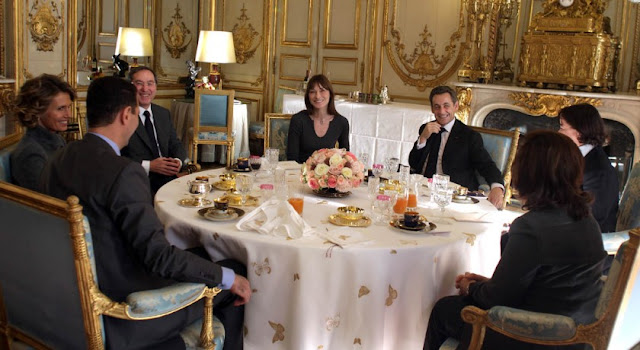
Assad in France: “There is no peace process; Europe’s stance cannot remain tied to the US role”e

As the US abandons the peace process in the Middle East with both Palestine and Syria, Sarkozy may see a greater role for France. Over thirty EU leaders (all retired) demanded that Europe step up its role in Middle East diplomacy.

AS “If the decision of the tribunal is based on evidence, everybody will accept its conclusions, not only Syria but also Lebanon, … If there is a decision based on a simple suspicion or political interference, then at that moment nobody will take the tribunal’s conclusions seriously,” Assad said ..AP” [Thanks to FLC]

President al-Assad met-French Intellectuals & Journalists
“Image of the Issues We View Differently”
(Dp-news – Sana)

PARIS- President Bashar al-Assad met at his residence in Paris on Friday a number of French elite intellectuals and journalists….

President al-Assad said, ” There is no actual peace process at the present time, given that the Israeli public, regardless of the stances of their government, are not ready for peace,” adding that it is necessary to work to prevent the deterioration of the situation in the region to avoid war, since the current circumstances are not favorable to achieve peace.

President al-Assad added, ”As things stand in the region, Europe’s stances on the peace process cannot remain tied to the US role, which proved its inability to move this process forward. Therefore, a balanced European role is needed towards all the parties involved in peace, and is capable of effectively participating in achieving just and comprehensive peace.”

President al-Assad said Syria attaches great importance to economic cooperation of regional dimension binding the Middle East and the neighboring countries to Central Asia and Europe, through establishing a network of strategic interests whose one of its natural results would be to serve stability and prosperity for the peoples of these regions.

The meeting was attended by Presidential Political and Media Advisor Dr. Bouthaina Shaaban and Syria’s Ambassador to France.

In a statement to SANA, head of the foreign policy department at Le Monde newspaper Alain Frachon described the meeting with President al-Assad as rich in ideas and deep analysis of the situation in the Middle East and Europe’s role and its weak effect on the political and economic level in the region.

“The meeting made us – as intellectuals and writers – understand and read Syria’s stance regarding regional and international situations,” he pointed out.

This was also affirmed by Parisian political sciences professor and researcher Bertrand Badie who described the meeting as “deep and vital,” adding that several issues were tackled during the meeting including the peace process in the Middle East, Iraq and Afghanistan with deep analysis.

For his part, historian Henry Laurens who specializes in the Middle East said that the meeting with President al-Assad resembled a “tour d’horizon” of Middle East issues and Syria’s position on the regional and international arenas.

Laurens asserted that the vision with which Syria moves politically and economically on the level of regional cooperation bolsters its role as a main player in the Middle East, underlining the deep analysis put forth by President al-Assad in this regard and his frankness regarding various issues.

Assad Walks from the Bristol Hotel in Paris to the President’s Palace some 150 meters away without an escort or security. Assad enjoys breaking the normal security protocals to demonstrate that he is not affraid of being assassinated and does not have enemies. When Nancy Pelosi visited Damascus before Obama’s election, Assad drove her around Damascus is his person car without security.


Turkey-Syria-Jordan-Lebanon Strategic Cooperation Council in the making …

“..Turkish Foreign Minister Ahmet Davutoglu said on Thursday that they were working on establishment of Turkey-Syria-Jordan-Lebanon Strategic Cooperation Council mechanism.

Davutoglu and Syrian Foreign Minister Walid Mualem held a press conference in Ankara.

Davutoglu said that Turkish-Syrian relations were improving and the two countries had a full cooperation, stating that they discussed the 2nd High-Level Strategic Cooperation meeting to be held on December 21. Recalling that 51 agreements were signed between Turkey and Syria last year, Davutoglu said that the 2nd meeting would focus on these agreements and projects.

“We believe this relationship is the one which will change fate of the region,” he said. Davutoglu said that they also discussed Lebanon and Iraq in their meeting. “Iraq’s stability is of great importance for Turkey and Syria,” he said.. ..”

Washington skeptical of France-Syria ties as two leaders meet
By Marc DAOU 09/12/2010, France24.com

Syrian President Bashar al-Assad will meet with French President Nicolas Sarkozy on Thursday during his two-day official visit to France. France24.com takes a look at a diplomatic relationship that the US does not necessarily appreciate.

Syrian President Bashar al-Assad arrived in Paris on Thursday to kick off a two-day official visit. It is the Assad’s first trip to France since November 2009. Though dialogue with Syria had been suspended by former President Jacques Chirac, relations between the two countries were renewed in 2008 by President Nicolas Sarkozy as part of his strategic pursuit of pragmatic diplomacy.

But the thaw in ties between France and Syria isn’t to everyone’s tastes, with recent diplomatic leaks illustrating Washington’s wariness.

Washington remains sceptical

The rapprochement has brought the Syrian president back onto the world stage after he had been isolated by the international community amid suspicions of Syrian involvement in the assassination of former Lebanese Prime Minister Rafik Hariri.

“Sarkozy realized that today, no country, no matter how big and powerful, can conduct diplomacy in the Middle East without dealing with Syria,” Syrian journalist Majed Nehmé told FRANCE 24. According to the French presidency, the shift in the French-Syrian relationship enabled the election of Lebanese President Michel Sleiman in 2008, with the support of Qatar and the establishment of official diplomatic ties between Lebanon and Syria.

But the friendship between France and Syria is viewed with a critical eye from across the Atlantic. The US has accused Syria of backing the pro-Iranian parties Hamas and Hezbollah. Meanwhile, diplomatic cables released by WikiLeaks and published in the French daily newspaper Le Monde show Washington’s skepticism about the effectiveness of France’s outreach to Syria. In the memo, a US diplomat wrote that France was convinced recent overtures toward Syria were making President Assad a more useful partner in the region but had a hard time coming up with concrete examples of that change.

The diplomat portrayed the rapprochement as a risk, since it had been implemented with no conditions imposed on Syria. “It should have been carried out more slowly,” said Georges Malbrunot, a journalist who covers the Middle East for the French daily newspaper Le Figaro. “The US, for example, instituted a system of give-and-take with Damas. In reality, France hasn’t gotten anything out of its relations with Syria,” Malbrunot said, “except maybe the opening of a Syrian embassy in Lebanon.”

The Lebanon question

Still, after receiving Assad in Paris in July 2008 for the first Mediterranean Union summit, Sarkozy became the first Western head of state to travel to Damas in six years when he visited in September of the same year.

The two leaders are expected to discuss the most pressing regional matters when they sit down to lunch at the Elysée Palace on Thursday. Other than the stalled peace talks between Israelis and Palestinians, the main issue on the table will likely be instability in Lebanon. France is counting on Syria’s help in using its influence on neighbouring allies to ease simmering regional tensions.

Wikileak: SUBJECT: FM KOUCHNER’S SEPT. 19-21, 2007 VISIT TO WASHINGTON
2007-09-18

¶5. (C) Lebanon: Kouchner surprised many by his quick plunge into Lebanese politics……Our partnership with France over Lebanon remains a top priority for the French, but we have divergent views on the stakes involved (the French fear a return to civil war more than a rolling back of gains made over the past two years to limit Syrian interference) and on tactics (the French prefer to press the Lebanese to seek a candidate of “convergence” and are reluctant to give the lead to the March 14 majority). Kouchner in particular is wedded to a process that accords parliamentary speaker Nabih Berri a prominent role in reaching a solution, partly due to longstanding ties between the two men. He does not seem nave about Berri, but has been prepared to accord him a key role that we do not think is deserved. In his last visit to Beirut, Kouchner challenged Berri to enter into dialogue with March 14 without preconditions. A frank discussion of the limits of our continued partnership is needed as well as our different views of the stakes and tactics to employ. The French concede that the presidential election process will play out until late November, which argues for Washington and Paris to stay in close and constant contact as the various Lebanese factions seek to play us off against the other.

WikiLeaks: Saudi Proposed Arab Force to Invade Lebanon; Makhlouf Sanctions; Mughniya Murder

WikiLeaks cables: Saudis proposed Arab force to invade Lebanon
Foreign minister wanted US, Nato and UN backing for offensive to end Iranian-backed Hezbollah’s siege of government
Ewen MacAskill in Washington, Tuesday 7 December 2010

Saudi Arabia proposed creating an Arab force backed by US and Nato air and sea power to intervene in Lebanon two years ago and destroy Iranian-backed Hezbollah, according to a US diplomatic cable released by WikiLeaks. The plan would have sparked a proxy battle between the US and its allies against Iran, fought in one of the most volatile regions of the world. The Saudi plan was never enacted but reflects the anxiety of Saudi Arabia – as well as the US – about growing Iranian influence in Lebanon and elsewhere in the Middle East…” [Guardian]

A WikiLeaks cable details a discussion that took place as pro-Iranian and pro-Syrian groups laid siege to Beirut and threatened the government of Lebanese prime minister

Fouad Siniora, seen here with US secretary of state Condoleezza Rice. Photograph: Ali Haider/EPA

The proposal was made by the veteran Saudi foreign minister, Prince Saud al-Faisal, to the US special adviser to Iraq, David Satterfield. The US responded by expressing scepticism about the military feasibility of the plan.

It would have marked a return of US forces to Lebanon almost three decades after they fled in the wake of the 1983 suicide attack on US marine barracks in Beirut that killed 299 American and French military personnel.

Faisal, in a US cable marked secret, emphasised the need for what he referred to as a “security response” to the military challenge to the Lebanon government from Hezbollah, the Shia militia backed by Iran and, to a lesser extent, Syria.

The cable says: “Specifically, Saud argued for an ‘Arab force’ to create and maintain order in and around Beirut.

“The US and Nato would need to provide transport and logistical support, as well as ‘naval and air cover’. Saud said that a Hezbollah victory in Beirut would mean the end of the Siniora government and the ‘Iranian takeover’ of Lebanon.”

The discussion came just days after Hezbollah and other pro-Iranian and pro-Syrian groups in Lebanon laid siege to Beirut, threatening the pro-western government of Fouad Siniora, after 17 months of street demonstrations.

Siniora survived, though only after making enormous concessions to Hezbollah. He was replaced by another pro-western leader, Saad Hariri, but Hezbollah remains a force in Lebanon, lionised by many Arabs after defeating Israel in the 2006 war along the Lebanese border.

According to the cable Saud argued that a Hezbollah victory against the Siniora government “combined with Iranian actions in Iraq and on the Palestinian front would be a disaster for the US and the entire region”. Saud argued that the present situation in Beirut was “entirely military” and the solution must be military as well. The situation called for an “Arab force drawn from Arab ‘periphery’ states to deploy to Beirut under the ‘cover of the UN’.”

Saud said Siniora strongly backed the idea but the only Arab countries aware of it were Egypt and Jordan, along with the secretary general of the Arab League, Amr Moussa.

No contacts had been made with Syria on any Beirut developments, Saud said, adding: “What would be the use?”

Saud said that of all the regional fronts on which Iran was advancing, Lebanon would be an “easier battle to win” for the anti-Iranian allies…..

US embassy cables: Israel warns of reprisals against Lebanon in case of rocket attacks
Thursday, 18 June 2009, S E C R E T SECTION 01 OF 03 TEL AVIV 001324
EO 12958 DECL: 06/18/2009
SUBJECT: GOI DISCUSSES LEBANON AND SYRIA WITH HOF
Classified By: Deputy Chief of Mission Luis G. Moreno, reason 1.4 (b) a nd (d)
Summary

1. (C) SUMMARY. On June 10, Fred Hof, Special Advisor for Regional Affairs in the office of Special Envoy Mitchell, held a series of meetings with GOI officials from the MFA and MOD to discuss the situation in Lebanon and Syria and the possibilities for progress towards opening negotiations with each. The Israeli officials expressed cautious optimism over the election results in Lebanon, but did not believe they would lead to major changes in the power balance in Lebanon, or serious reduction of Hizballah influence. However, both Amos Gilad, Pol-Mil Director in the MOD and Nimrod Barkan, Director of the MFA Political Research Division (INR equivalent), told Hof that the Lebanese election results took Syria by surprise, and were a blow for Syrian President Asad. The officials were split over the prospects for Israeli peace with Syria. Alon Ushpiz, Chief of Staff for the MFA Director General, believes Syria is only interested in a process that gives it international legitimacy. However, in a separate meeting, Gilad called Syrian/Iran ties a “marriage of convenience” which could possibly be broken with a peace agreement with Israel and incentives from the United States. On Ghajar and Sheba’a, there was consensus within the GOI that Ghajar can be resolved, but doing so will not have much utility, while Israeli will only agree to discuss Sheba’a within the context of Syria. End Summary….

7. (S) Negotiations with Syria may succeed, Gilad said, because Iran was a marriage of convenience for Syria. He believes Syria would much rather be close to their fellow Arabs and the rest of the international community, if given the chance. Gilad stressed that both the Iranians and the Arab Sunnis despise the ruling Alawite minority in Syria – he recalled that Sadat used to call the Alawites “pagans” – and said the Iranians would like to get rid of the Asad regime at the appropriate time. Gilad noted that Syria did not inform Iran of its nuclear reactor, which was built entirely with North Korean assistance, and did not notify Iran in advance of its proximity talks with Israel. In addition, he said, the Golan Heights have remained Israel’s quietest front, evidence that Syria can uphold its commitments as long its commitments are clear.

8. (C) While Syria may want peace, Gilad cautioned that it may be impossible for Syria to extricate itself from Iran and Hizballah, even if it tried. Hizballah is now an integral part of Syria’s defense concept, and is a more effective fighting force than the Syrian army. But in the end, Gilad stated, Israel only has two choices with Syria: war or peace.

Guardian (GB): WikiLeaks cables: Syria stunned by Hezbollah assassination
2010-12-07

Syrian officials were stunned by the mysterious assassination of a senior Hezbollah operative in Damascus two years ago, triggering a blame game between rival security services and frenzied speculation across the Middle East about who did it. US …

S E C R E T SECTION 01 OF 03 DAMASCUS 000804
E.O. 12958: DECL: 10/07/2009
TAGS: PTER PREL LE IZ IS SY
SUBJECT: IS NOW THE TIME TO RAISE HIZBALLAH WITH SYRIA?

Classified By: CDA Charles Hunter, Reasons 1.4 b and d.

¶1. (S/NF) Summary: Syria’s determined support of Hizballah’s military build-up, particularly the steady supply of longer-range rockets and the introduction of guided missiles, could change the military balance and produce a scenario significantly more destructive than the July-August 2006 war. If rockets were to rain down on Israeli civilians in Tel Aviv, Israel would still have powerful incentives, as it did in 2006, to keep Syria out of the conflict, but it might also face compelling reasons for targeting Hizballah facilities in Syria, some of which are in and around populated areas.

Syria’s current strategic mindset appears to assume Syria could avoid involvement in a new conflict, based largely on its 2006 experience. Syrian leaders also appear convinced that arming Hizballah will increase Syria’s leverage in bringing Israel to the negotiating table. As Washington weighs how to approach Syrian officials in upcoming engagement efforts, discussing Hizballah from the perspective of the regional strategic landscape may help to facilitate a “big picture” conversation in which we could challenge these assumptions and focus Damascus on the importance of taking cooperative steps with the U.S. now. Though raising this subject could well distract from a cooperative approach that shows signs of progress after months of investment, we believe sounding a warning, probably in a one-one-one meeting with President Asad, would be worth considering in pursuit of a broader, more strategic dialogue. End Summary.

———————————-
Is the Strategic Balance Changing?
———————————-

¶2. (S/NF) Syria’s determined efforts to re-arm Hizballah during and after the July-August 2006 war between Israel and Hizballah have consistently grabbed Israeli headlines, most recently with Israeli Chief of Staff Ashkenazi’s November 10 revelation that Hizballah possessed 320-kilometer range rockets. Jane’s Defense Weekly reported October 28 on Hizballah’s deployment of the first guided surface-to-surface M600 missile on Lebanese soil, with a range of 250 kilometers and circular error probability of 500 meters. Public estimates put Hizballah’s stockpile as high as 40,000 rockets and missiles, reinforcing assessments by some experts that this build-up may portend a shift in the military balance between Israel and its northern nemesis. Hizballah SecGen Nasrallah’s recent claims of possessing a capability to “destroy” the IDF may overstate the case for domestic and regional propaganda purposes, but reporting in other channels confirms Nasrallah’s bragging on November 11 that Hizballah can sustain fire on Tel Aviv and reach “all of Israel.” This capability, if fully used, would represent a quantum leap over the damage and psychological terror Hizballah rockets caused in northern Israel during the 2006 war.

¶3. (S/NF) There is overwhelming evidence that shows Syria provided not just logistical and other support in moving the weapons, but was the main source of the  weapons. Syria’s integration of Hizballah into its military doctrine, moreover, means that Hizballah operatives and facilities enjoy a growing footprint in Syria.

¶4. (S/NF) At least two potential consequences flow from Hizballah’s increased capabilities and Syria’s role in creating them: (1) If there is another war between Hizballah and Israel, it will be far deadlier than the 2006 conflict; (2) as in 2006, there would be compelling reasons for Israel to want to keep Syria out of any future war if possible, but there might be a countervailing need to hit Hizballah and perhaps targets in Syria, some of which are located in populated areas.

———————————
Agreeing to Disagree on Hizballah
———————————-

¶5. (S/NF) U.S.-Syrian discussions on Hizballah have tended to “agree to disagree” after hitting the wall of conflicting views on the legitimacy of armed resistance and Israeli occupation. Syrian officials, including President Asad, emphasize their political link to Hizballah and flatly deny that Syria is arming Hizballah. They then defend the right to armed resistance in response to prolonged Israeli occupation of Syrian and Lebanese territory. When convenient, Syrian officials claim they no longer have responsibility for Hizballah, noting “we are out of Lebanon.” President Asad and FM Muallim have also suggested that the challenge of disarming Hizballah would be solved after Syria and Israel signed a peace treaty. This agreement would lead naturally to a deal between Lebanon and Israel, thereby removing the rationale for  Hizballah’s resistance movement and setting the stage for the transition of Hizballah to a purely political party.

¶6. (S/NF) The Syrian government’s strategic view of relations with Hizballah is difficult to assess with high confidence. According to various contacts, President Asad appears to be focused on the possibility of a new conflict between Israel and Syria, but many suggest he believes that the red lines of the 2006 war would be preserved. According to this model, Syria could avoid direct involvement as long as Israel refrained from striking targets on Syrian soil. Syria also seems to be hedging its bets through improved relations with Turkey, France, and Saudi Arabia, which, Syrian officials probably hope, would object to Israeli attacks against Lebanon and/or Syria.

¶7. (S/NF) Asad nonetheless appears more convinced than ever that arming Hizballah is necessary for Syrian security and perhaps as a stick to bring the current Israeli government back to negotiations on the return of the Golan. Syrians remain resistant to the notion that Syria bears responsibility for managing a potentially explosive situation that could draw Damascus into a war neither sought nor winnable. They have ably deployed a force field of cognitive dissonance to resist arguments linking Syria’s arming of Hizballah and the future prospects of Syrian-Israel peace negotiations. Israel, they insist, remains the problem, and only a more active U.S. role can bring and sustain a resolution. According to the prevailing Syrian view, however, U.S.-Syrian relations must normalize before the U.S. can play the role of a credible honest broker.

—————————————-
The Cooperative Approach Shows Potential
—————————————-

¶8. (S/NF) As the interagency continues to plot future plans to engage Syrian officials and thinks about how to recruit other countries to support our efforts, we face a choice not only about the level of our engagement, but about the approach itself. Up to now, U.S. efforts have largely focused on developing a cooperative relationship on issues of mutual interest, such as Iraq and U.S. sanctions. Our four month pursuit of military-to-military cooperation on Iraqi border security represented, in effect, a first step toward establishing a broader and higher-level dialogue on Iraqi security issues, including Syrian support of foreign fighters. After the August 19 bombings Baghdad rendered implementation of this initiative impracticable, discussions in late-September shifted toward a possible CT dialogue. This new focus provides an alternative mechanism to continue discussions on Iraqi security issues such as foreign fighters. Syrian officials appear willing to go along with this approach, as long as the emphasis is on building bilateral relations first. After months of investment, our engagement efforts are close to enabling both sides to exchange positive gestures. This cooperation should help to the stage for more focused discussions on a broad range of issues and strategic choices about the future direction of the relationship.

¶9. (S/NF) During this process, U.S. officials have carefully placed markers on key issues, including human rights, IAEA compliance, Bank Aman, Lebanon (e.g., border demarcation), and Palestinians (pushing Hamas to accept the Quartet principles), and the new embassy compound. We have addressed these issues mainly in discussions with Vice Foreign Minister Miqdad and the Syrian Embassy in Washington (with less dialogue between Embassy Damascus and the Syrian MFA). Our view is that the cooperative approach will have more chance of success if we continue to use these channels to deal with such issues, until the relationship can sustain discussion at higher levels that will yield a higher probability of favorable progress.

¶10. (S/NF) Against this backdrop, sending U.S. officials to focus on Syrian relations with Hizballah could distract significantly from our efforts to build a cooperative foothold. There is unlikely to be common ground or any breakthroughs, and a new focus on Hizballah-related issues could further set back our efforts to re-energize the engagement process, not least by spurring the Syrians to demand a reciprocal change in U.S. behavior, e.g., lifting sanctions. Focusing our higher political-level discussions on the issue of foreign fighters provides a more familiar subject with a higher chance for initial progress.

——————————————— —
But Hizballah’s Arsenal Poses Urgent Challenges
——————————————— —

¶11. (S/NF) While the near-term chances for a successful dialogue on Syria’s strategic relationship with Hizballah are much lower, the stakes — the possibility of a regional conflict and significant obstacles to achieving comprehensive peace — are just as, if not more, urgent. Sharing our concerns about the dangers of Syria’s arming of Hizballah, probably best done privately in a one-on-one session with President Asad, could serve to establish the basis of a more frank exchange about Syria’s role, and enable us to challenge potentially dangerous Syrian assumptions as part of a wider strategic dialogue. Recent revelations about Syria’s role in weapons shipments create some urgency in turning Syrian attention toward ending these supplies and restraining Hizballah from making good on its provocative rhetoric.

¶12. (S/NF) We don’t expect these points immediately to change Syrian behavior or its relations with Hizballah, but we believe sounding this warning would put President Asad and others (such as Turkey and France) on notice that Syria’s actions have created a situation in which miscalculation or provocative behavior by Hizballah could prove disastrous for Syria and the broader region. This message could likewise underscore our belief that Syria needs to demonstrate a more active role in achieving peace with Israel and better relations with the United States. Even if a war between Israel and Hizballah does not materialize in the immediate future, we should try find a way to use our ongoing cooperative engagement with Syrian officials to help them recognize their overriding interest and responsibility in preventing this unappealing scenario altogether.
HUNTER

Tuesday, December 07, 2010 4:56 PM

If Syria’s improved relations with France, Saudi Arabia and Turkey can initiate cracks in the Syrian-Iranian axis, then perhaps discrete U.S.-Syrian cooperation could add further stress to these fault lines. A willingness to offer concrete deliverables as evidence of a U.S. desire for improved relations would force Syrian officials to calculate how far they would go in response, providing us with a more accurate measure of their intentions. At a minimum, increased Washington interest in Syria would increase Tehran’s anxiety level and perhaps compound Syrian-Iranian tensions, at a time when Syrian officials themselves may be unsure how they will react to unfolding events.

Guardian (GB): US embassy cables: Strains show in Iran-Syria ties,
Tuesday, 22 December 2009, 03:40 S E C R E T SECTION 01 OF 04 DAMASCUS 000880 NOFORN SIPDIS DEPARTMENT FOR NEA/FO, NEA/ELA, NEA/I NSC FOR SHAPIRO/MCDERMOTT PARIS FOR NOBLES LONDON FOR LORD EO 12958 DECL: 12/20/2029 TAGS PREL, IR, LE, IZ, TU, SY …

both Gilad and Barkan agreed that the elections were a blow to Syria, which was completely caught off-guard by the results. The Syrian presidential advisors on Lebanon, they said, are now in trouble……

Guardian (GB): US embassy cables: Hezbollah man’s murder fuels fear and loathing in Damascus, 2010-12-07
Thursday, 28 February 2008, 13:07 S E C R E T SECTION 01 OF 04 DAMASCUS 000146 SIPDIS SIPDIS STATE FOR NEA/ELA, EEB/TFS; TREASURY FOR LEVEY/GLASER; NSC FOR ABRAMS/SINGH/GAVITO EO 12958 DECL: 02/28/2028 TAGS ECON, EFIN, EINV, KCOR, PGOV, SY, LE …

4- feeling of the “street” is obtained from reading (arabic) “syrianews” and counting that 70% of the comments were anti.

5- one dissident xxxxxx “shouted and kissed” the press attache’s cheek upon hearing the news.

6- American Embassy “business contact” xxxxxxxxxxxx, a businessman xxxxxx argued so and so

7- A reporter for xxxxxx said he……

8- xxxxx a xxxxx (foreign?) correspondent working on his piece passed along that

9- a former xxxxx employee of Rami’s empire who had 10- xxxxx knowledge of Rami’s holdings

11- xxxxx supported the designation and said it was overdue and that “one a week for the next three months would pressure the syrians and force them to capitulate”. 12- XXXXXXXXXXXX admitted to Econoff that, after hearing about the designation on Al Jazeera, he had run his own name through Google to see what public information might connect him to Rami. Claiming to have no affection for the Makhlufs or the regime, he said he still could not imagine divesting XXXXXXXXXXXX and remaining in Syria. “I love the U.S.,” he explained, “but my entire life is in Syria. What am I supposed to do, take my family to the U.S. and get a job making 5000 dollars a month, or be my own boss and XXXXXXXXXXXX a better life in Syria?” XXXXXXXXXXXX would not put him in legal jeopardy, he finally shrugged his shoulders and said, “Whatever happens to Rami…happens to all of us.”

13- XXXXXXXXXXXX assessed Rami’s designation as an empty, desperate attempt by the outgoing Bush administration to punish a member of Bashar’s inner circle. A marketing expert XXXXXXXXXXXX asked, “What was the intended message (of the designation)? I looked and looked, but could find very little. The time for such an action was two years ago.” Unless the U.S. could sanction Rami’s Byblos Bank (five percent share) or convince the Emiratis to freeze Rami’s UAE-based assets, he concluded that the designation would have very little teeth and would be regarded by most Syrians as yet another “wayward arrow from the warped bow of George Bush.”

14- XXXXXXXXXXXX characterized Rami’s designation as a “mostly symbolic gesture” that would have little impact on the regime’s policies. XXXXXXXXXXXX said Bashar had already put some distance between himself and his cousin and Makhluf had moved a great deal of his personal assets to Dubai. XXXXXXXXXXXX conceded that most Syrians viewed Rami in a negative light and that his strong-arm business tactics had earned him many enemies. He nonetheless believed that a majority of Syrians, at least the few who had heard about it on BBC or read about it on the internet, would see the act as a last-ditch effort by the Bush administration to punish Bashar.

15- XXXXXXXXXXXX said he had had several run-ins with Makhluf XXXXXXXXXXXX during his tenure, but that Rami had learned “the hard way” from Bashar that there was a limit to how much he could get away with on the basis of his family ties. He predicted that Bashar would secretly welcome any U.S. sanctions against corruption, because corruption was rife in Syrian government and society and had undermined the President’s credibility with the Syrian people

Syria and America: The End of the Honeymoon Period
Saturday 06 November 2010
By Tariq Alhomayed

It seems that the American – Syrian honeymoon has come to an end, and to make matters worse, the Republican Party has gained control of the US Congress following this week’s mid-term elections. Damascus wasted two years of Obama’s presidency, failing to achieve anything; during this period the Syrians dealt with Washington in the same manner that they deal with certain Arab countries, and this is something that can be seen in their response to the statement made by US Assistant Secretary of State for Near Eastern Affairs, Jeffrey Feltman, in which Damascus called on Feltman to “recognize historical and geographical facts.”
Two years after Washington extended its hand to Damascus, the US is outraged by the Syrian behavior in Lebanon, with the Americans believing that Damascus is contributing to undermining security and stability there. This is something expressed by US Ambassador to the UN, Susan Rice, and Feltman himself reiterated this in his statement that provoked the Syrians. If we add a Republican-controlled Congress to this equation, then we can say that Obama cannot continue opening up to Syrian in this manner, especially as there have long been demands in Washington that the US reassess the manner in which it is dealing with Syria.
When we say Damascus has wasted opportunities, this can be seen in the number of times that US members of Congress have visited Syria, especially the Democrats, without making any progress worth mentioning.

Mughniyeh’s Death
Charge d’Affaires Michael Corbin, 02/28/2008

Contacts report that Syrian Military Intelligence (SMI) and General Intelligence Directorate (GID) officials are currently engaged in an internecine struggle to blame each other for the breach of security that resulted in Mughniyeh’s death.

Guardian: After 12 days of WikiLeaks cables, the world looks on US with new eyes
Reaction across the globe to the leaked US embassy cables has ranged from anger and bitterness to extreme indifference

Wikileaks: Bellemare “has no case” against Syria

http://213.251.145.96/cable/2008/05/08BEIRUT586.html
SUBJECT: LEBANON: JUMBLATT ON POSSIBLE NEW UNSCR, NATIONAL
DIALOGUE; RIZK ON UNIIIC EXTENSION
HESITATION OVER A NEW UNSCR, OPEN DISCUSSION ON 1559
NSC FOR ABRAMS/SINGH/YERGER/GAVITO

9. (C) Jumblatt said the Special Tribunal was “not enough” to intimidate Syria. Rizk chimed in to acknowledge that work on the Special Tribunal was “frightening to Syria until recently.” Both agreed that Syrian President Bashar Assad won’t care about the Tribunal in a year’s time. Rizk repeated his concerns that UNIIIC Commissioner Daniel Bellemare had stated to some that he “has no case.” Rizk said the U.S. can help by directing Ambassador Zalmay Khalilzad to ask the UN SYG to impress upon Bellemare the importance of his role as prosecutor for the Tribunal…..

Guardian (GB): US embassy cables: Syrian spy chief’s surprise appearance at US talks
2010-12-06
Wednesday, 24 February 2010, 14:08 S E C R E T DAMASCUS 000159 SIPDIS DEPARTMENT FOR P, NEA, S/CT EO 12958 DECL: 02/24/2020 TAGS PTER, PREL, PGOV, SY SUBJECT: SYRIAN INTELLIGENCE CHIEF ATTENDS CT DIALOGUE WITH S/CT BENJAMIN Classified By: CDA …

MAMLOUK DESCRIBES GID’S METHODS

5……Mamlouk repeatedly stressed his attendance at the meeting did not signal the commencement of security and intelligence cooperation between Syria and the U.S., but could be a starting point for “a blueprint for that which is not yet started.” Echoing Miqdad, Mamlouk said progress on political issues in the Syrian-U.S. bilateral relationship was “closely connected” to progress on possible cooperation on security and intelligence.

6. (S/NF) The GID Director said Syria had been more successful than the U.S. and other countries in the region in fighting terrorist groups because “we are practical and not theoretical.” He stated Syria’s success is due to its penetration of terrorist groups. “In principle, we don’t attack or kill them immediately. Instead, we embed ourselves in them and only at the opportune moment do we move.” Describing the process of planting embeds in terrorist organizations as “complex,” Mamlouk said the result had yielded been the detention of scores of terrorists, stamping out terror cells, and stopping hundreds of terrorists from entering Iraq. Mamlouk acknowledged some terrorists were still slipping into Iraq from Syria. “By all means we will continue to do all this, but if we start cooperation with you it will lead to better results and we can better protect our interests,” he concluded.

7. (S/NF) According to Mamlouk, Syria’s previous experience in cooperating with the U.S. on intelligence “was not a happy one.” He stated Syria hoped any future cooperation would be “on an equal basis.” Mamlouk specified this meant Syria should be allowed to “take the lead” on anti-terrorism efforts. Alluding to the “wealth of information” Syria has obtained while penetrating terrorist groups, Mamlouk declared “we have a lot of experience and know these groups. This is our area, and we know it. We are on the ground, and so we should take the lead.”

…. Miqdad stressed a “political umbrella” of improved U.S.-Syrian bilateral relations should facilitate counterterrorism cooperation….

13. (S/NF) Third, Miqdad stated convincing the Syrian people to support cooperation with the U.S. would hinge on progress on economic sanctions against Syria, including spare parts for airplanes and a plane for President Asad. The Vice Foreign Minister said the Syrians wanted these efforts “accelerated.” Miqdad specifically requested the USG reach out to Lufthansa Technik and “assure them of no negative consequences” if they cooperate with Syrian requests to have the purchase of spare aircraft parts approved. In response, Benjamin said the Obama administration viewed counterterrorism as a vital concern but, unlike its predecessor, it did not see counterterrorism as something that was separate from the rest of U.S. foreign policy or the sole driver of U.S. foreign policy. Rather, it was part of the fabric of policy, and the administration recognized that progress in bilateral relations would involve coordinated moves in a number of areas. Benjamin added the U.S. expected that the Syrian people would see the benefits of closer relations.

14. (S/NF) Miqdad also encouraged the U.S. to reconsider including Syria on the TSA’s list for enhanced screening, and praised U/S Burns for informing the SARG that the U.S. was prepared to lift its block on Syrian accession to the World Trade Organization.

Hariri investigation was bogged down by ‘insane’ bureaucracy, non-cooperation from world powers
Brammertz said it was obvious the 14 bombings were linked to the Hariri assassination
By Patrick Galey, Daily Star
Monday, December 06, 2010

BEIRUT: The preliminary United Nations probe into the death of former Prime Minister Rafik Hariri was hamstrung by “insane” internal bureaucracy and non-cooperation from world governments, according to leaked diplomatic documents seen by The Daily Star.

Successive cables sent from the US Embassy in Beirut and seen exclusively by The Daily Star also appear to show how previously unheard-of US surveillance data on Lebanon was requested by the commissioner of the United Nations International Independent Investigative Committee (UNIIIC)

In a 2006 discussion with former US Ambassador Jeffrey Feltman, UNIIIC Commissioner Serge Brammertz is said to have lamented burdensome UN processes which were hindering his investigation.

Brammertz told Feltman that “administrative delays with the UN’s bureaucracy have taken up 50 to 70 percent of his time in the last month and have significantly hindered the UNIIIC’s efficacy and progress,” a cable sent on July 7 said.

“Most of the delays appeared to be the result of a cumbersome UN bureaucracy, which seemed to affect everything from the UNIIIC’s hiring procedures to housing issues and even its food supply.”

The UNIIIC commissioner is said to have delivered successive anecdotes detailing a flawed and time-consuming hiring process and severe staff shortages in the investigation’s most critical stages.

“What’s the point of waiting five months to hire someone when the Commission only has five months to do its work?” Brammertz is quoted as saying.

Turning to the issue of international cooperation with investigator’s requests, Brammertz alleged that France – a long-time vocal supporter of the probe into Hariri’s death – had been particularly “flatly non-cooperative.”

“After Brammertz asked this country’s ambassador in Lebanon for access to interview a suspect in that country’s territory, the ambassador came back with all kinds of conditions about how the interview would take place, how the testimony could or could not be used, in order to comply with EU standards. Brammertz said, ‘I told him, if you were Syria, I would write in my report that you refused to cooperate with the investigation. He was shocked, of course, but it’s true. I’ve had better cooperation from Syria than some of the EU countries.’”

In an earlier meeting with Feltman on July 6, 2006 – 16 months after Hariri’s death and over a year after the investigation began – Brammertz is said to have advised that there was no legal basis for the four generals’ continued detention.

“Brammertz explained that, if any sort of international legal standards were applied, the four generals would be released immediately. At the same time, however, he acknowledged that doing so would be a political disaster for Lebanon,” a cable on the meeting read.

Brammertz, who succeeded Detlev Mehlis as UNIIIC commissioner, reportedly labeled three now-discredited witnesses – whose testimonies were used in the four generals’ incarceration – as completely unreliable. He suggested Mehlis had overstepped his jurisdiction in advising the four be detained.

“Brammertz said that much of his work, though, is focused on completing three ‘legacy projects,’ final appraisals of the testimony provided by Zuhair Mohammad Siddiq, Hussam Hussam, and ‘X,’ a ‘protected witness located in a Nordic country,’” Feltman’s cable said.

“As he prepared his final evaluation of each witness, Brammertz said he could discount most of the testimony from all three. Maybe 20 percent of Siddiq’s testimony was based on fact, Brammertz suggested, but his credibility as a witness is so low that none of his testimony would stand up in court. He described Hussam also as an unreliable witness, but suggested that he probably does have important information.”

Brammertz also apparently ruled out all of the Syrian government’s involvement in the crime – a startling confession given the relatively early stage of the investigations of the UNIIIC.

“Syria has five different state security apparatuses. I can’t imagine that an order came down from the president and worked its way through all the security services and until they killed Hariri,” Brammertz is quoted as saying. “If anything, you probably had one security service involved, and the order came from on high and, how high, we’ll have to figure out.”

In a separate cable detailing the arguments of Jamil as-Sayyed’s lawyer, the US Embassy advised: “That Brammertz is worried about [Lebanon’s] continued ability to detain the four generals is cause for us to worry as well.”

The cable continued: “Besides having a seismic effect on the political situation here, Sayyed’s release might well have security implications for us as a diplomatic missions. If Sayyed gets out, he is going to be angry and seeking payback, and he is going to see the United States as at least partly responsible for his interrogation by the UNIIIC and his long months in detention.”

Wikileaks: “General Rifi is convinced that Syrian authorities are directly responsible for all three crimes,” said a cable classified by Jeremy Feltman

Rifi alleged Ghamloush linked to Kassir, Hawi killings – cable
ISF chief told US ambassador suspect fled to Syria to live under protection of Syrian authorities
By Patrick Galey and Richard Hall, Dec. 4, 2010, Daily Star (Thanks to T_Desco for sending this)

An alleged Hizbullah operative linked by recent media reports to the death of former Prime Minister Rafik Hariri was named in 2006 as the prime suspect in the assassinations of journalist Samir Kassir and politician George Hawi, according to leaked diplomatic documents seen by The Daily Star.

In a 2006 meeting with US representatives in Beirut, Internal Security Forces (ISF) chief Ashraf Rifi said Abdel-Majid Ghamloush killed Kassir and Hawi before fleeing Lebanon to live in Syria under Syrian protection. Ghamloush was also accused of the attempted killing of ISF deputy intelligence chief Samir Shehadeh.

“General Rifi is convinced that Syrian authorities are directly responsible for all three crimes,” said a cable classified by US Secretary of State Jeremy Feltman and seen exclusively by The Daily Star. “Rifi said the investigation conclusively concluded that [Abdel-] Majid Ghamloush, a Lebanese citizen from the Shiite community in south Lebanon was responsible for the Hawi and Kassir assassinations.

“General Rifi believes the successful identification of a culprit was the motive for the assassination attempt on the life of ISF’s Deputy Chief of Intelligence Samir Shehadeh on September 5, 2006 just outside of [Sidon],” Feltman wrote. “Before the suspect could be apprehended, however, he successfully fled to Syria and is currently believed to be living there under the protection of the Syrian regime.”

Kassir and Hawi, both outspoken critics of Syria’s influence in Lebanon, were assassinated in separate June 2005 car bomb attacks in Beirut as part of the wave of political killings that shook the country beginning in 2004.

The ISF chief indicated that Hizbullah knew that both attacks were coming.

“Rifi also stated that some of the evidence indicated ‘several’ of the acts of political violence that were committed in late 2004 and throughout 2005 are connected. The general did not mince words when he stated that Syrian and Iranian involvement is a given,” Feltman wrote. “He did not directly implicate Hizbullah, but said the fact that a radicalized member of the Shia community from south Lebanon committed the crime indicates Hizbullah should have at least been aware of the plan.”
(…)

The STL, as well as the initial United Nations International Independent Investigation Committee (UNIIIC) probe, is mentioned on numerous occasions in cables seen by The Daily Star.

Some will fuel claims that the STL is politicized. In a cable dated July 6, 2007, Minister of Justice Charles Rizk appeared to ask Feltman to pass on Lebanon’s preferred choice of tribunal judges.

“Rizk would like us to whisper quietly to UN officials which four are Lebanon’s preferred choices out of the twelve judicial nominations,” it read.

Rizk reportedly told Feltman that he was trying to delay the release of the four Lebanese generals held in connection with the assassination, due to the “devastating impact their release would have on March 14 morale.”

In a cable dated June 20, 2006, UNIIIC Commissioner Serge Bremmertz reportedly expressed concerns that evidence against the jailed generals was not strong enough to justify their continued detention. It also alleged that the attorney of Jamil Sayyed planned to approach a host of party leaders with the offer that if Sayyed was released from prison, he would leave Lebanon within 24 hours.
The Daily Star, December 04, 2010

T_Desco writes about the Figaro article of Georges Malbrunot, 5 décembre 2010

Malbrunot: “Selon nos informations, le kamikaze, lui, serait saoudien.”

T_Desco writes: “I thought that Bellemare was supposed to be the source of that information, but that seems unlikely, given that he didn’t even share such details with the Americans. the main point is, in my view, that the suicide bomber was Saudi and that Salafi extremists played a direct role in the assassination. Malbrunot then goes on to paint the picture of a wild conspiracy, also involving Hizbullah, the Presidential Guard etc…

Added in the comment section by Why Discuss:

Was Ghamloush a technician, a efficient operative or an “idiot”, or all of that?

“Eid was apparently able to penetrate the secret network thanks to the gross mistake of a small fish in the operation: electronics expert Abd al Majid al Ghamloush, who worked for Hezbollah. Ghamloush, identified by the investigators as”an idiot”, was responsible for destroying the mobiles of the logistics team, but he used one of the phone to call his girlfriend.”

The technician’s error allowed Eid, according to CBC, to point to brothers Hussein and Mouin Khreis, both Hezbollah militants, who were allegedly at the scene of the assassination on 14 February 2005.

Guardian (GB): US embassy cables: Lebanon uncovered ‘Iranian-funded’ Hizbullah communications network
2010-12-05
Wikileaks: Wednesday, 16 April 2008, Beirut, Sison

……..10. (S) Hamadeh highlights the system as a strategic victory for Iran, since it creates an important Iranian outpost in Lebanon, bypassing Syria. He sees the value for the Iranians as strategic, rather than technical or economic. The value for Hizballah is the final step in creating a nation state. Hizballah now has an army and weapons; a television station; an education system; hospitals; social services; a financial system; and a telecommunications system. As a sign of its confidence Hizballah official Safa told Khoury and Rifi that any move against the FiOS system would be taken as &an Israeli attack8 and dealt with accordingly. When Khoury and Rifi pointed out that the people in the area might not accept this and might show hostility to Hizballah in this case, Safa replied, &We don’t care; we will accept hostile reactions.8 At that point, according to Hamadeh, the GOL decided it needed to inform its friends and make a decision on the next steps to be taken.

HAMADEH PREPARES INTERNAL CAMPAIGN

11. (S) Meanwhile, Hamadeh is preparing a &very strong8 internal campaign. This campaign, he said, has the potential to &destroy8 Aoun and mobilize Christians, as well as influence those Shia who are already beginning to worry about Hizballah. He is waiting for a March 14 meeting to discuss this campaign. Saad has apparently traveled to London and Geneva this week, and is expected to be back in Riyadh by 4/20. Saad has been out of Lebanon for some several weeks and it is not known when he will return. Hamadeh sees only two choices for the GOL: approach the UN Security Council directly, or take on Hizballah by cutting lines. But do the Lebanese security forces have the “guts” for that, or are they frightened by Safa’s statement that those actions would be considered an act of aggression, he wonders…..

Israel on Iran: So wrong for so long
By Justin Elliott in Salon.com

Officials at the U.S. Department of State, we learned from the secret cables released by WikiLeaks last week, have serious questions about the accuracy — and sincerity — of Israeli predictions about when Iran will obtain a nuclear weapon. As one State official wrote in response to an Israeli general’s November 2009 claim that Iran would have a bomb in one year: “It is unclear if the Israelis firmly believe this or are using worst-case estimates to raise greater urgency from the United States.”

So we thought this was as good a time as any to look at the remarkable history of incorrect Israeli predictions about Iran — especially given that the WikiLeaks trove is being used to argue that an attack on Iran is becoming more likely.

According to various Israeli government predictions over the years, Iran was going to have a bomb by the mid-90s — or 1998, 1999, 2000, 2004, 2005, and finally 2010. More recent Israeli predictions have put that date at 2011 or 2014…..

Should A Resurgent Syria Give Alarm?

The Washington Post runs two alarmist articles about Syria. Janine Zacharia claims “that U.S. interest in Syria was mostly limited to coaxing it to make peace with Israel.” She goes on to suggest that Syria is refusing to do this. She ignores Bashar al-Assad’s declaration that the Golan “is our Issue.” Somehow she manages to blame the failure of Israel to make peace with Syria on Damascus. After all, it is Israel that refuses to comply with international law on the Golan issue and not Syria. Assad has made it clear that he will change his relationship to Israel’s enemies – Hamas and Hizbullah – if Israel complies with UN resolution 242 and international law. Senator John Kerry recognized this and argued that the Golan issue was key andmust be returned to Syria.” For this obvious observation, Kerry has been attacked as an enemy of Israel and an Enemy of Peace in the Mideast.” Unfortunately, Zacharia promotes this interpretation that Syria is the enemy of peace. The Washington Post continues to move to the right. Anthony Shadid would never have been so partisan. [JL]

A Resurgent Syria Alarms U.S., Israel
Janine Zacharia: (worked as the Washington bureau chief for The Jerusalem Post. She also writes for The New Republic and makes regular appearances on MSNBC and PBS’s Washington Week. She speaks Hebrew fluently.)
(c) 2010, The Washington Post

BEIRUT – Syria’s fresh interference in Lebanon and its increasingly sophisticated weapons shipments to Hezbollah have alarmed American officials and prompted Israel’s military to consider a strike against a Syrian weapons depot that supplies the Lebanese militia group, U.S. and Israeli officials say.

The evidence of a resurgence by Syria and its deepening influence across the region has frustrated U.S. officials who sought to change Syrian behavior. But the Obama administration has so far failed through its policy of engagement to persuade the country to abandon its support for Hezbollah and sever its alliance with Iran.

“Syria’s behavior has not met our hopes and expectations over the past 20 months, and Syria’s actions have not met its international obligations,” Secretary of State Hillary Rodham Clinton told the Lebanese daily an-Nahar on Nov. 10. “Syria can still choose another path and we hope that it does.”

Israel has complained to the United Nations about long-range missiles and shorter-range rockets that are flowing freely from camps inside Syria to a transit site along the Syrian border with Lebanon and on to Hezbollah. But Israel has so far hesitated to take military action out of concern that such a strike could touch off a conflict even bloodier than the 2006 war between Israel and Hezbollah, said an Israeli military official, who spoke on the condition of anonymity because of the sensitivity of the matter.

In the past, U.S. interest in Syria was mostly limited to coaxing it to make peace with Israel and to end its rule in Lebanon. But now it is increasingly clear that Syria – with its pivotal alliance with Iran and its strategic borders with Israel, Lebanon, Turkey and Iraq – has the ability to shape regional developments on a broader scale.

The Obama administration’s efforts at dialogue with Syria have done little to stop the flow of weapons, end Syria’s practice of sheltering Palestinian leaders of militant groups, or counter Syria’s interference in Lebanon, which has undermined the U.S. effort to promote Lebanese independence from external actors.

Although President Barack Obama has named a new ambassador to Syria, his appointment is being held up on Capitol Hill by senators who say they do not want to send a new envoy to Damascus until the U.S. better articulates how having an ambassador there would help achieve U.S. goals.

Without a permanent top diplomat in the Syrian capital, U.S. envoys including Middle East peace mediator George Mitchell; the assistant secretary of state for Near Eastern affairs, Jeffrey Feltman, and Sen. John Kerry, D-Mass., have flown to Damascus to try to persuade Syrian leaders to take steps to improve relations with the United States, which hit a low point in 2005.

That year, President George W. Bush, in the wake of Saddam Hussein’s ouster in Iraq, warned Syria to stop the flow of foreign fighters across its border into Iraq, prompting fears in Damascus of a U.S. effort to topple Syria’s leadership. Massive anti-Syrian demonstrations in Beirut forced Syria to withdraw its troops from Lebanon. Syria’s relations with regional allies soured.

Today, there are clear signs that the country has emerged stronger than before.

While the United States maintains sanctions against Syria, American allies such as India and Turkey have inked trade deals with Damascus in recent months that undercut the American effort to change Syrian behavior through economic pressure.

Syria is playing a role in Iraq. In September, a parade of Iraqi politicians flocked to Damascus seeking advice on forming a government.

And Syria’s highly valued alliance with Iran remains strong, to the dismay of U.S. officials who, as the WikiLeaks cables show, have hoped to drive a wedge between Syria and Iran, in part to stop the flow of weapons to Hezbollah.

Nevertheless, Syria’s support of Hezbollah remains robust.

But it is in Lebanon that Syria’s regional resurgence has been felt most profoundly. And Lebanon is also where U.S. officials worry most that its pro-democracy allies are losing ground to pro-Syrian and Iranian elements.

Hadi Mahfouz, a Lebanese government official and writer, says Syria is more effectively managing Lebanese affairs from afar than when it had 15,000 troops inside the country. “It is immune from mistakes,” he said.

Wiam Wahab, a pro-Syrian Druze politician and former Lebanese cabinet minister, says Washington must resolve its differences with Syria if the United States wants to stymie Iran’s influence in Lebanon. “Does the U.S. prefer Syria or Iran” to be running affairs in Lebanon, he asked.

Many Lebanese, especially those in the Christian and Sunni communities, still oppose any Syrian role in Lebanese affairs.

Lebanon’s top security positions – the head of military intelligence and director of general security – are controlled by Syrian-approved appointees. The government can’t make many major decisions without first consulting with Damascus. Lebanon’s top leaders, including Prime Minister Saad Hariri, toe a pro-Syrian line.

But the clearest example of Syria’s restored influence may be Walid Jumblatt. Five years ago, Jumblatt, a well-known Druze politician whose party holds swing votes in Lebanon’s coalition government, marched with the pro-democracy March 14 movement against Syria’s occupation. He now describes that period as a momentary lapse of sanity.

“I feel much more comfortable now. I’m back to my roots,” Jumblatt said in an interview last month.

Jumblatt expresses gratitude that Syria re-established order at the end of the Lebanese civil war and suggests that Syria’s military may need to take over the country again if Hezbollah is indicted by an international tribunal investigating the killing of former Lebanese prime minister Rafiq al-Hariri and the country deteriorates into sectarian strife.

“It seems that, well, we cannot govern ourselves by ourselves,” Jumblatt said. “Lebanon is not a nation. It’s a bunch of tribes.”

News World Congress Politics Diplomacy Government and politics International relations AP

The Syrian boast that “it is skilled in negotiating with the Americans,” quoted in the following story by Michael Gordon, was probably made over a decade ago, when Hafiz al-Assad ruled Syria. Bashar al-Assad must believe the same thing, but so what? If this is the most damning quote Gordan can scrape together to suggest that Syria is flexing its muscle in Iraq, he has nothing new or damning. Syria has improved its relations with Maliki. Syria returned an ambassador to Iraq long before most of its neighbors did.desire to see Shiites take their rightful role in leading Iraq. It also joins the US in calling for greater Sunni power sharing in Iraq. Syria has given Baathist Iraqis refuge in Syria. This has saved many from being assassinated by Iraqi vigilantes that US troops have failed to restrain in Iraq. Afterall, the US has even been unable to keep vigilantes from massacring Iraq’s Christian community, which only gave passive support to Saddam Hussein. Syria has also given them refuge. Michael Gordon doesn’t have anything new against Syria. He just repeats the the 2009 Maliki accusation that Syria was behind a massive car bomb in Baghdad – an accusation made in the heat of the election campaign. There was no proof that Syria had a hand in or supported the bombing. Turkey and other neighbors discounted this accusation as politically motivated. [JL] Since this accusation was made, both Syria and Maliki have worked diligently to patch up their relations and move toward economic cooperation and health mutual cooperation. Syria is not undermining the Iraqi state. It is quite clear that Iraqi authorities believe that America’s ally, Saudi Arabia, is Maliki’s greatest detractor and the biggest danger to the US policy of supporting the development of central authority. Gordon does not suggest that Saudis are funding or arming al-Qaida in Iraq in order to pressure Maliki or undermine central authority, which is a good thing. Syria’s greatest sin during the long months it took Iraq to form a new government after the elections was to act as a go-between for Saudi Arabia and Iran – a positive contribution to regional diplomacy. [JL]

Meddling by Neighbors Adds to Iraq’s Woes
2010-12-05
By MICHAEL R. GORDON

….“The challenge for us is to convince Iraq neighbors, particularly the Sunni Arab governments, that relations with a new Iraq are not a zero-sum game, where if Iraq wins, they lose,” noted a Sept. 24, 2009, cable from Ambassador Christopher R. Hill, which was aptly titled “The Great Game, in Mesopotamia.” American diplomatic cables disclosed by WikiLeaks show that Prime Minister Nuri Kamal al-Maliki’s fears about outside interference are so great that he asked President Obama during a July 2009 visit to Washington to stop the Saudis from intervening. Saudi Arabia’s efforts to rally the Sunnis, the Iraqi leader complained, were heightening sectarian tensions and providing Iran with an excuse to intervene in Iraqi politics, according to an account of the Oval Office session Mr. Maliki shared with Ambassador Hill.

The suspicions have often been mutual. “I don’t trust this man,” King Abdullah of Saudi Arabia told John O. Brennan, Mr. Obama’s top counterterrorism adviser, according to a cable about a March 15, 2009, meeting at the king’s private palace in Saudi Arabia. “He is an Iranian agent.”

Jockeying for influence in Iraq by outside countries has been going on ever since Mr. Hussein was ousted, hardly surprising given Iraq’s strategic position in the Middle East, its vast oil reserves, its multisectarian population and the fact that it is a nascent, if unsteady, democracy largely surrounded by undemocratic neighbors.

The Iranians, who waged a bloody eight-year war with Mr. Hussein, have no desire to see a strong Iraq emerge from the ashes of his regime, especially one that has ties with the United States.

So they have sought to influence its politics by funneling cash to Iraqi political factions, ordering assassinations and shipping arms to militants, some of which an Oct. 23, 2008, cable from Dubai warned might be disguised as Red Crescent medical supplies. The Saudis, who see Iran as the principal threat in the region, have used their control of satellite television and deep pockets to support Sunni groups. Syria, which Iraqi leaders have repeatedly complained to American diplomats is dominated by a Baathist regime unduly sympathetic to the ousted Baathists in Iraq, has allowed insurgent fighters to sneak into Iraq. Even Turkey, which has good relations with the Iraqi government, has secretly financed nationalist and anti-Kurdish Sunni political parties.

Some leading Iraqi politicians have tried to cast themselves as the right ones to resist Iranian influence and help Iraq improve ties with its Arab neighbors.

Ayad Allawi, who leads the Iraqiya Party, has emphasized his relationship with Arab leaders while his supporters have cast Mr. Maliki’s Dawa Party supporters as fearful of interacting with the Arab world, the cables show. Mr. Maliki’s aides have presented themselves and their boss as being more savvy about resisting Iranian pressure than many of their rivals — if only the Americans can keep the Saudis in line.

Iran, by the United States’ reckoning, has done the most to try to shape Iraqi politics. A Nov. 13, 2009, cable sent by Ambassador Hill, which called Iran “a dominant player in Iraq’s electoral politics,” estimated that Iran’s annual support to political groups in Iraq was $100 million to $200 million. Some $70 million of that, the cable asserts, is directed to the Islamic Supreme Council in Iraq, a leading Shiite party that has also worked closely with American officials, and its former militia, the Badr Corps. ….

Like the Iranians, the Saudis have not hesitated to use their money and political influence inside Iraq, according to American diplomats. “For now the Saudis are using their money and media power (al-Arabiyya, al-Sharqiya satellite channels, and other various media they control or influence) to support Sunni political aspirations, exert influence over Sunni tribal groups, and undercut the Shia-led Islamic Supreme Council of Iraq (ISCI) and Iraqi National Alliance (INA),” Ambassador Hill’s “Great Game” cable noted. ….

In a December 2009 meeting with Jeffrey D. Feltman, an assistant secretary of state, Mr. Maliki, who lived in Syria for 16 years during Mr. Hussein’s rule, described the Syrian leaders as more difficult to deal with than the Iranians and recounted that the Syrians had boasted to him during his years in exile that they were skilled in negotiating with the Americans, according to a cable about the meeting.

Of all Iraq’s neighbors, Turkey has forged one of the best working relations with the Iraqi government and with Kurdish officials in northern Iraq.

Elias Murr: “If Israel has to bomb Shia areas, that is Hizbullah’s concern… The Lebanese Army Forces will stay on their bases …. and take over once Hizballah’s militia has been destroyed.”

Wikileak [21]: Elias Murr: “If Israel has to bomb Shia areas, that is Hizbullah’s concern… The Lebanese Army Forces will stay on their bases …. and take over once Hizballah’s militia has been destroyed. (Thanks to Friday Lunch Club)

S E C R E T SECTION  March/10/2008
NSC FOR ABRAMS/SINGH/YERGER

2. (S) Charge, Defense Attache and ODC Chief met with Deputy Prime Minister and Minister of Defense Elias Murr on March 10 at his home in Rabieh. The atmosphere of the meeting was cordial and friendly.

5. (S) As for the areas further north in Lebanon such as Keserwan and the Metn, Murr confirmed that Shia are renting in high numbers there because they feel that Israel is going to attack soon. Such action could take place as early as April 2008, he warned. ..

18. (S) Making clear that he was not responsible for passing messages to Israel, Murr told us,…if Israel has to bomb all of these places in the Shia areas as a matter of operational concern, that is Hizballah’s problem. According to Murr, this war is not with Lebanon, it is will Hizballah. ….. As such, Murr is trying to ascertain how long an offensive would be required to clean out Hizballah in the Beka’a. The LAF will move to pre-position food, money, and water with these units so they can stay on their bases when Israel comes for Hizballah–discreetly, Murr added. (S) Murr also gave guidance to Sleiman that the LAF should not get involved “when Israel comes.” …. that he promised Sleiman the political cover for LAF inaction. …..For Murr, the LAF’s strategic objective was to survive a three week war “completely intact” and able to take over once Hizballah’s militia has been destroyed. ……

[Ironically, Murr was encouraging Israel to destroy Hizbullah a month before Hizbullah sent its militia into West Beirut to take over Hariri outposts in May 2008.]

Lebanon defense minister ‘offered invasion advice for Israel’
Haaretz Daily Newspaper | Israel News

Syria’s Assad plays the security card
2010-12-02

CAIRO, Dec. 2 (UPI) — Syrian President Bashar al-Assad has resisted U.S. efforts to pry his regime away from its strategic alliance with Iran, but he seems to be conducting discreet diplomacy with Western Europe and with China.

In recent weeks Assad has dispatched his security chiefs to London, Paris and Rome to share intelligence on terrorist groups, according to Intelligence Online, a Paris-based Web site that covers global security affairs.

Whether this signals that Damascus, which over the past five years has painstakingly rebuilt its regional influence following its collision with the George W. Bush presidency, is preparing to put some distance between it and Tehran is far from clear.

But there has been persistent speculation that differences between Damascus and Tehran over Lebanon and the activities of Hezbollah are emerging.

Lebanon has traditionally been firmly within Syria’s sphere of influence, but Iran is seen to be driving to expand the Shiite crescent through Iraq and the Persian Gulf to Lebanon, where Shiites form the largest sect.

The coming weeks may shed some light on Assad’s murky moves, although most of what transpires within the Damascus regime is shrouded in opacity.

Still, Assad is determined to maintain Syrian domination in Lebanon, historically part of Greater Syria until the French peeled it off to establish what it intended to be a pro-Western Christian nation in 1943.

According to Intelligence Online, Assad sent Gen. Ali Mamlouk, the head of Syria’s General Intelligence service, to Rome Oct. 19 to sign an anti-terrorism cooperation agreement.

He was reportedly accompanied by Gen. Zohair Hamad, a senior officer of the GI’s external branch and a counter-terrorism specialist.

On Nov. 16 Mamlouk flew to London. On that trip he was said to have been accompanied by Gen. Thaer al-Omar, deputy director of the GI’s counter-terrorism branch, and Gen. Hafez Makhlouf, deputy director of its domestic branch.

Mamlouk handed Britain’s Secret Intelligence Service, better known as MI6, a list of British militant Islamists who have studied in Damascus.

Most were of Pakistani origin. Some had been apprehended trying to sneak into Iraq to join the insurgency there. Intelligence Online reported that Mamlouk offered to hand them over to the British.

It’s not known whether MI6, which throughout the turbulent 1980s regarded the Syrians as implacable foes because of their links to terrorist groups, accepted the offer.

But Mamlouk reportedly emphasized that Damascus was keen to cooperate on counter-terrorism and intelligence matters in exchange for MI6’s help to acquire advanced electronic surveillance systems.

The British government cloaked Mamlouk’s visit in secrecy. From there he flew to Paris Nov. 22 to prepare for a visit by Assad to meet President Nicolas Sarkozy.

The French, who governed Syria during the League of Nations Mandate between the world wars, have maintained links with Damascus over the years.

But they have also given sanctuary to opponents of the regime, most notably Abdul Halim Khaddam, longtime vice president who defected in June 2005, denouncing the regime and accusing it of assassinating Lebanese statesman Rafik Hariri in February that year.

In Paris, Mamlouk reportedly met Claude Gueant, Sarkozy’s troubleshooter and chief of staff who handles liaison with Damascus.

But while all this was going on, Assad was also apparently taking care of business with a different set of diplomatic partners to the east — which may turn out to be more important than his dealings in the West.

He sent Maj. Gen. Bassam Merhej, identified as director of Assad’s security and military bureau, to Beijing Nov. 23.

“His real destination was probably Pyongyang, with whom Syria has a nuclear cooperation program,” Intelligence Online reported.

That program suffered a major setback Sept. 6, 2007, when the Israeli air force destroyed a nuclear reactor being built by North Korea at al-Kibar in eastern Syria on the Euphrates River.

Merhej is reported to have replaced Maj. Gen. Mohammed Suleiman, who was assassinated Aug.2, 2008.

Merhej was accompanied by Col. Jihad Shehadeh of the army’s Corps of Engineers, who has been seconded to the Center for Scientific Study and Research, which is involved in Syria’s nuclear program, Intelligence Online said.

He was also accompanied by an Iranian, identified as Ali Zadeh, officially the cultural attache at the Iranian Embassy in Damascus but “in reality in charge of logistics for the Iranian nuclear program in Syria.”

Did the Hezabollah also “killed” Samir Kassir and Georges Hawi?

“Aujourd’hui, Libération affirme, en se basant sur “des fuites de personnes proches de l’enquête”, que les huit portables ont été “repérés lors des quatre autres attentats” qui ont suivi l’assassinat de Rafic Hariri. Il s’agit notamment de ceux qui ont coûté la vie au journaliste franco-libanais Samir Kassir, le 2 juin 2005, et à l’ancien chef du Parti communiste local, Georges Hawi, le 21 juin de la même année. Enfin, le quotidien affirme que l’enquête mènerait désormais jusqu’à un certain Haj Salim, qui est l’adjoint du chef militaire du Hezbollah, Imad Moughnieh, tué en février 2008 à Damas dans l’explosion de sa voiture.

Who is really the big boss in Lebanon?
By Michael Young, Daily Star
Thursday, December 02, 2010

Little attention was paid last week to an Al-Hayat interview with the Iranian ambassador to Lebanon, Ghadanfar Roknabadi, particularly what he had to say about Syria’s role in Lebanon.

The interviewer asked the ambassador whether, in the same way that Iran was “familiar” with Iraq, did not Iran consider that Syria was “familiar” with Lebanon “more than others were.” Therefore, just as Syria had accepted an Iranian solution in Iraq, would not Iran accept a Syrian solution in Lebanon? It was a subtle question, which left out the dreaded words “spheres of interest,” but the substance was clear. Would Iran concur that Syria was entitled to lead in Lebanon?

Roknabadi diplomatically, but firmly, brushed that thought away. Yes, neighboring countries were more familiar with Lebanese details, but then the ambassador added: “Don’t forget the deep civilizational and cultural ties between Iran and Lebanon. The matter of Syria as a neighbor is one thing, and the strategic relationship between Iran and Syria [is something else]; no one can deny Syria’s role, but the old civilizational and cultural ties between the Iranian and Lebanese peoples have established common ground between them.”

The response must have made officials in Damascus cringe. Not only did Roknabadi sidestep the question of a pre-eminent Syrian role in Lebanon, he placed it against the backdrop of the Iranian-Syrian relationship, as if to affirm that Tehran was the leading partner in any Lebanese arrangement. While the Iranians, along with Hizbullah, have continued to look toward a Syrian-Saudi solution to the deadlock in Beirut over how to deal with the Special Tribunal for Lebanon, one gets the distinct sense lately, particularly after the speech last Sunday of Hizbullah’s secretary general, Hassan Nasrallah, that any such deal is Iran’s and Hizbullah’s to accept or refuse

Iran and Syria are not about to divorce over Lebanon, or over anything else, but Roknabadi put the relationship into perspective. Iran is the dominant actor in Beirut….

Assad: ‘Golan Heights “is our issue”‘

Assad: ‘Golan Heights “is our issue”‘
By Meris Lutz, Los Angeles Times
December 2, 2010, Reporting from Beirut

Syria’s Assad seems to suggest backing for Hamas negotiable, leaked cables say
But even as President Bashar Assad appeared willing to reduce ties with the Palestinian militant group ruling the Gaza Strip, he brushed off pressure to alter the dynamics of his friendship with Iran.

Syrian President Bashar Assad described Hamas as an “uninvited guest” in his country in confidential conversations with American lawmakers, and appeared to suggest he would be willing to give up the alliance in exchange for incentives, according to several documents contained in the trove of leaked diplomatic cables posted online by the website WikiLeaks.

But even as Assad appeared willing to downgrade ties with the Palestinian militant group that rules the Gaza Strip, he brushed off pressure to change the dynamics of his friendship with Iran. He argued against his government putting pressure on Tehran over its nuclear program in exchange for a peace deal between Syria and Israel.

“Too many cooks spoil the meal,” he is quoted saying in a January 2010 cable.

The leaked cables shed new light on international efforts to forge a Syrian-Israeli peace accord and on private meetings involving the leader of Syria’s secretive government.

Assad shows himself in the leaked correspondence to be a shrewd negotiator. He told the American delegation visiting Damascus that he could help secure the Iraqi border against the flow of foreign fighters into Syria’s neighbor. But he said he wouldn’t do it “for free,” asking the U.S. to lift sanctions that banned the sale of commercial airplanes and their parts to Syria.

“In the U.S., you like to shoot [terrorists],” he said. “Suffocating their networks is far more effective.”

Diplomats and analysts view Syrian cooperation as crucial to ensuring the security of Iraq, Lebanon and Israel as well as isolating Iran.

Although Syria has forged strategic alliances with ideologically driven, Iranian-backed movements such as Islamic Jihad, Hezbollah and Hamas, Damascus continues to view the rise of political Islam as one of its primary internal threats. Hamas leader Khaled Mashaal has resided in Damascus since 2001, but such a blunt assessment of the group by Assad hasn’t been made public before.

“Hamas is Muslim Brotherhood, but we have to deal with the reality of their presence,” Assad told another group of American lawmakers in March 2009, according to an additional leaked cable, calling the Islamic movement an “uninvited guest” and likening it to the same Muslim Brotherhood his father, Hafez Assad, brutally uprooted from Syria in the 1980s.

In none of the dispatches does the younger Assad explicitly say that he would cut ties with Hamas, Hezbollah or Iran in exchange for the return of the Golan Heights, which was seized by Israel during the 1967 Middle East War. But he emphasized in the more recent meeting with U.S. lawmakers that the Golan Heights “is our issue,” according to the January 2010 confidential dispatch.

The documents also reveal an unsuccessful push by U.S. and regional leaders to persuade Israel to return the mountainous occupied region.

According to the documents, Sen. John F. Kerry (D-Mass.), chairman of the Senate Foreign Relations Committee, reportedly told the ruler of Qatar in February 2010 that Israel should “work the return of the Golan Heights into a formula for peace” with Israel.

Other regional leaders recognized Syria’s willingness to negotiate. Former Pakistani President Pervez Musharraf urged the U.S. to seek Syrian cooperation on Iraq and Lebanon. “If you want [Assad] to play ball, he needs comfort on other fronts — namely, the Golan Heights,” Musharraf told a high-ranking congressional delegation in April 2007, according to the WikiLeaks disclosures.

Israel has in recent years refused to negotiate a full withdrawal from the Golan. Israeli Prime Minister Benjamin Netanyahu told U.S. lawmakers that giving up the heights would only result in assurances that Syria would later “tear up,” according to a February 2009 cable.

Guardian

“With respect to Syria, Russian experts believe that Bashar’s regime is better than the perceived alternative of instability or an Islamist government, and argue against a U.S. policy of isolation. Russia has concluded that its arms sales are too insignificant to threaten Israel, or to disturb growing Israeli-Russian diplomatic engagement, but sufficient to maintain “special” relations with Damascus”

Guardian (GB): US embassy cables: Russia’s growing clout in the global arms trade
2010-12-01 21:33:28.650 GMT

A Syrian perspective

From Syrian Ambassador Imad Moustapha’s talk at the Contemporary Arab Studies at the University of Georgetown, on Monday November 29, 2010.

Two important developments took place in November that will leave an indelible impact on the peace process (or lack thereof) in the Middle East.

First, the US offered Israel an unprecedented bribe for simply agreeing not to undermine the prospects of resuming talks with the Palestinians for a mere 90 days. In return for extending the moratorium on building settlements in the West Bank–that excludes Jerusalem–the US administration has committed itself to providing Israel with both the wherewithal to further consolidate its occupation of Arab territories, and a guarantee to oppose any attempt to unilaterally declare a Palestinian state. In the long annals of US acquiescence to Israeli blackmail, this is a remarkably unique instance of amply rewarding the culprit for agreeing to partially abstain from breaking international law for a brief period of time.

Second, the Israeli Knesset passed a resolution that will prevent any Israeli government from evacuating the occupied East Jerusalem and Syrian Golan without a general referendum. Given the stark shift to the right in the Israeli body politic, one immediately realizes that the real purpose of this resolution is to render the possibility of freeing East Jerusalem or the Golan a practical impossibility.

The implications of both actions are grave and nefarious. They only reaffirm that the Israeli government lacks both the will and the capacity to make peace with any of its neighbors…..

Friday, 26 October 2007
Al-Akhbar

In an August 18, 2008 meeting with US Ambassador (Beirut) Michelle Sison, STL prosecuter Daniel Bellemare voiced his ‘concern’ for the lack of ‘assistance’ he was getting from the americans, something he relayed to the State Department … and he reiterated 3 specific queries:
(1) He wanted a clear ‘yes or no’ whether certain (US) Intelligence was to be submitted for his review …
(2) He asked to get US ‘investigators on loan’…
(3) He asked the US to ‘pressure the British to be more forthright…”
Moreover, Bellemare asked the Americans to financially support the STL …
He asked to have access to former Hezbollah members who ‘reside in the US’ …
He finally told Sison that he ‘will not travel to Syria, unless the Americans (or others) gave him a list of ‘Syrian officials’ to investigate … And then, if the Syrians become uncooperative, it would be easier for him to publically mention their ‘lack of cooperation’… Bellmare added that this should prode ‘other Syrians’ to come forth … Bellemare pointed to the importance of getting to the Syrians before year’s end (date at which ‘Chapter 7’ expires) …and the possibilty that some of these sought after individuals either ‘disappear or get eliminated’…

http://cablegate.wikileaks.org/cable/2009/08/09PARIS1162.html]

FM AMEMBASSY PARIS
RHEHNSC/WHITE HOUSE NSC WASHINGTON DC IMMEDIATE
INFO RUEHXK/ARAB ISRAELI COLLECTIVE IMMEDIATE
S E C R E T SECTION 01 OF 02 PARIS 001162

SUBJECT: WHY FRANCE CLAIMS SYRIA HELPED CONVINCE IRAN TO
FREE FRENCH PRISONER …

SYRIAN ROLE: THE SPIN
———————

¶2. (SBU) Since August 11, when a French Presidency press release first singled out Syria for appreciation, French government officials, journalists, and academics have pondered the “important” and “influential” role Syria played as “mediator” between France and Iran in the conflict surrounding the July 1 arrest by Iranian security officers of French citizen Clotilde Reiss…

SYRIAN ACTIONS: THE JURY IS STILL OUT
————————————-
MFA Syria Desk
Officer Patrick Durel on August 18 confirmed that President Sarkozy called Syrian President Assad August 5 to ask for his assistance …. Assad did not, however, name his interlocutor or interlocutors. “I’m doing what I can to help” was the message he sent to Paris, Durel explained.

NEW PUBLIC POSTURE FROM ASSAD?
——————————

¶4. (S/NF) Richier and Durel suggested that the GOF has sought to exaggerate the Syrian role deliberately, in order to demonstrate to Syria the praise they might win for playing a constructive role in the region, and in order to create tension between Syria and Iran. And the French believe they have succeeded on both fronts. As a sign that Syrians welcomed the praise they received for playing a helpful part in Reiss’s release, Durel cited the absence of a public denial by Assad. In the past, Assad disavowed such activity.

Durel explained, for instance, that Assad had agreed in private during July of 2008 to pass a message from Paris to Tehran about the dangers of the Iranian nuclear program, but he publicly denied having done so, declaring he did not want to play the role of intermediary. Moreover, according to Richier, the French believe their reference to Syrian intervention has sewn some discomfort among the Iranians, whom the French hear from various sources want them to “stop this stupid Syria business.” In advance of Assad’s August 19 visit to Tehran, the French continued to tout Syria’s role and encouraged him to raise the issue of Clotilde Reiss’s still-pending court case.

S E C R E T SECTION 01 OF 03 PARIS 000174
E.O 12958: DECL: 02/08/20
TAGS: PREL MOPS MARR FR IR AF NATO
SUBJECT: SECRETARY OF DEFENSE GATES’S MEETING WITH FRENCH FOREIGN
MINISTER KOUCHNER, FEBRUARY 8, 2010

¶1. (S/NF) SUMMARY: At the request of the French Ministry of Foreign Affairs, Secretary of Defense Robert Gates (SecDef) met with French FM Bernard Kouchner in Paris on February 8, 2010. Discussions included how to persuade the Chinese and others to support sanctions against
Iran, and the importance of targeting the Iranian government rather than the people….

¶2. (S/NF) Kouchner said that the U.S. and France were working well together in New York on an Iran sanctions resolution – all the problems now are with the Chinese. Kouchner had met Chinese FM Yang twice the previous week, but said that right now it was difficult to predict whether the Chinese would veto or abstain. He noted that the Chinese were furious over the U.S.-Taiwan arms deal, which would make it difficult to get a resolution passed in February….

¶4. (S/NF) SecDef urged Kouchner not to exaggerate the Chinese concern over Taiwan – they would need a little more time and, in the end, an abstention might be a good enough result for us. He added that we should urge the Saudis to weigh in with Beijing since China has more at
stake in its relations with Saudi Arabia than Iran. He commented that the Saudis always want to “fight the Iranians to the last American,” but that now it is time for them to get into the game.

¶5. (S/NF) Raising his concerns about bringing non-permanent UNSC members on board, SecDef reported that in Ankara he had impressed upon PM Erdogan the dangers of proliferation to other Middle East countries or an Israeli strike if the Iranian nuclear program couldn’t be
stopped. Kouchner expressed his doubts about Turkey’s desire for a constructive role in region, describing Erdogan’s comments to Ahmadinejad defending the Iranian nuclear program as dangerous…….

¶8. (S/NF) Further explaining the U.S. position, SecDef said that while our understanding of the Iranian leadership was opaque, we do know that they do not like to be isolated. The USG would soon be designatingseveral IRGC companies under the Iran Sanctions Act. His own view was
that it was important to get the UNSCR passed quickly, even if it were not as harsh as we might wish. Once a resolution is passed, he explained, it will offer a legal platform on which the EU and
individual states can impose harsher sanctions.

¶9. (S/NF) Kouchner agreed, but added that another problem was to get  he nine votes needed in the UNSC. He said that Lebanon was one of France’s prime targets in this respect, but he doubted that France would be able to bring the resolution to a vote during its presidency,
as February is a very short month. Gabon, which takes the chair in March, is a “good asset for France,” he commented. Audibert interjected that the Russians had supported deleting some sections of the draft UNSCR, but had approved including sanctions on the IRGC. Kouchner said that France had to proceed carefully since a French woman had been taken hostage in Tehran. He disparaged FM Mottaki’s duplicitous performance in Munich.

Media Pushes Narrative That Arabs Want War With Iran, Ignores Cables That Show Arabs Urging Restraint
2010-12-01 23:04:54.500 GMT

Media Pushes Narrative That Arabs Want War With Iran, Ignores Cables That Show Arabs Urging Restraint Over the weekend, the whistleblower website WikiLeaks began leaking hundreds of diplomatic cables sent by U.S. embassies and diplomatic staff …

S E C R E T PARIS 002743
SUBJECT: U/S BURNS’ JUNE 12 DINNER MEETING WITH FRENCH
POLITICAL DIRECTOR ARAUD

¶1. (U) June 12, 2007, 8:30 P.M.

¶3. (S) Summary: U/S Burns and Political Director Gerard Araud
met June 12 for a lengthy discussion of key bilateral issues,…
Iran/Lebanon
————
¶15. (C) Burns also reviewed how Iran violated UNSC
resolutions by providing arms to Hizballah in Lebanon, which
appears to be taking new steps to threaten Israel, and to the
Taliban in Afghanistan. Loras responded that, given that the
evidence on Hizballah arms in Lebanon is not verifiable,
France is not currently pushing Iran on this issue. Araud
added that France is trying to keep open its dialogue with
Larijani on Lebanon…….
¶16. (C) Araud stated that Sarkozy had told President Bush
that France would maintain its policy on Lebanon, minus its
exclusive Harriri focus. Sarkozy had also solicited
President Bush’s advice about talking with Syria. Araud said
Sarkozy responded that now is not the time, as Syria remains
very destructive. Burns told Araud that the United States
had been surprised at not having been consulted prior to
France’s recent call for a conference on Lebanon in Paris.
Araud contritely agreed that consultations in advance were
warranted. Returning briefly to a discussion of the renewal
of UNIFIL, MOD advisor Mondoloni revealed that the French
military would like to downsize its presence, but that
civilian leaders had emphasized to them that political
obligations were paramount. …

Israel tells the French that Turkey has helped Iran get weapons-related material for nuclear program (the French seem skeptical).

4. (S/NF) The French participants in the Strategic Dialogue
noted profound disquiet among the Israelis about Turkey,
Bereyziat said. He reported that the Israelis claimed the
Turks have allowed weapons-related material for Iran’s
nuclear program to transit Turkey, with Prime Minister
Erdogan’s full knowledge. The French replied that Israel
would need to have clear and concrete proof of such activity
before leveling accusations. The Israelis replied that they
are collecting evidence which they will eventually publicize…

T_Desco writes in the comment section:

The picture of a reasonable, thoughtful Syrian president that emerges from this interview stands in marked contrast to the caricature that one finds all too often in our media.

The Saudi ‘documentary’ ‘Murder in Beirut’ by Charlie Smith, Christopher Mitchell/ORTV includes a number of shots of the first page of a purported UN tribunal/investigation document. The text is very similar to the Follath/Der Spiegel article.
Interestingly, the author still uses the Mehlis estimate regarding the amount of explosives (“1000 kg”). Since June 2006 the estimate was increased to “at least 1,200 kg” (Third UN report) and then to “closer to 1,800 kg than to 1,200 kg” (Forth UN report in September 2006). At the same time, the text contains information about the Mitsubishi Canter van that was only disclosed in July 2007:
“The van was then shipped to the United Arab Emirates and transported to a showroom close to Tripoli in northern Lebanon in December 2004, where it was sold. The Commission has recently acquired information regarding the sale of the van to individuals who could be involved in the final preparation of the van for the attack on Rafik Hariri.” (§24, Eighth UN report, July 2007).
However, if reports by Al-Akhbar are correct, that information had already been acquired in April 2006 by the Lebanese investigation (interestingly, the first to suggest that the van was bought in Tripoli was Faisal Akbar in January 2006 in his later retracted testimony).

This leads us to three possibilities:

The document is
1. not genuine;
2. just sloppy regarding the amount of explosives; 3. genuine and was written between April 2006 and June 2006.
According to CBC, Wissam Eid’s report was filed “in the first months of 2006”. However, the air of certainty that apparently pervades the text does not seem to correspond to a report that just relies on circumstantial evidence:

“Lebanon/Hizballah Behind Hariri’s Assassination

In the weeks prior to the Harir (sic) murder, a number of Hizballah operational cells closely followed the movements of the former Prime Minister, collected accurate information on his movements and waited for the best opportunity to assassinate him. According to accumulated information, this activity was carried out by a compartmented unit in Hizballah headed by Selim Ayyash (alias Haj Selim).

… (PHOTO “A” ATTACHED), who is a senior operative with a rich ‘operational’ past, is from the Nabatiya area in South Lebanon, was born on 10 November 1963 and is currently living in the Shiite area of south Beirut. He is the commander of the classified unit that deals in secret and compartmented activity in the Lebanese arena. He is married to Fatima al-Hajj and they have three children.

… was the commander of the assassination squad. He was apparently responsible for procuring a white Mitsubishi Canter in late January 2005, far from Beirut, and in a way that precluded him from being identified as the procurer of the vehicle. Hizballah demolition unit specialists, who have a great deal of experience in preparing car bombs, turned the vehicle into a car bomb and armed it with 1,000 kg of varied explosives (TNT, C4, RDX).

The unit headed by … was in 2005 directly subordinate to the military commander of Hizballah, Imad Mughniyah. The connection between …

Eyad (DOB: 20 April 1960) (PHOTO “B” ATTACHED) a former operative of Hizballah’s external operations apparatus and in 2005, “.

The names are mostly blanked out, but remain visible in some of the shots. A few lines of a second page are also discernible through the paper (unclear/guessed words are marked with a “?”):

“Eyad was?
minutely? involved in all aspects and stages? of the operation. Selim”

further down:

“was present? at the Parliament building. This enabled Ayyash then to precisely time the explosion”

further down:

“Samir Kassir?” “(2? June? 2005)” “George Hawi (21”

“2005)?. In each case there were cell phones – later identified as tied to”

further down:

“town? of Rumin?” “PHOTO”
“Ghamlush?”

“training? in Iran prior to the assassination”.

The similarities to Follath’s article are striking:

“He is believed to be Abd al-Majid Ghamlush, from the town of Rumin, a Hezbollah member who had completed training course in Iran. (…)

Ghamlush’s recklessness led investigators to the man they now suspect was the mastermind of the terrorist attack: Hajj Salim, 45. A southern Lebanese from Nabatiyah, Salim is considered to be the commander of the “military” wing of Hezbollah and lives in South Beirut, a Shiite stronghold. Salim’s secret “Special Operational Unit” reports directly to Hezbollah Secretary-General Hassan Nasrallah, 48.

Imad Mughniyah (…) ran the unit until Feb. 12, 2008 (…).

The deeper the investigators in Beirut penetrated into the case, the clearer the picture became, according to the SPIEGEL source. They have apparently discovered which Hezbollah member obtained the small Mitsubishi truck used in the attack. They have also been able to trace the origins of the explosives, more than 1,000 kilograms of TNT, C4 and hexogen.

(…) And, once again, there was evidence of involvement by the Hezbollah commando unit, just as there has been in each of more than a dozen attacks against prominent Lebanese in the last four years.”

(m. emph.)

Note that Follath uses the correct(ed?) estimate of “more than 1,000 kilograms” of explosives.

Egypt Sought Spies in Iraq, Syria to Stop Iran, WikiLeaks Shows
2010-11-30 23:12:11.192 GMT

By Heather Langan
Dec. 1 (Bloomberg) — Egypt’s spy agency recruited agents
in Iraq and Syria to try to counter Iranian intelligence
operations, according to a U.S. diplomatic cable posted on the
WikiLeaks website.
“Iran must ‘pay the price’ for its actions and not be
allowed to interfere in regional affairs,” said Omar Suleiman,
head of the intelligence service and one of President Hosni
Mubarak’s closest aides, according to the April 2009 cable. It
gives details of a meeting between Suleiman and Admiral Michael
Mullen, chairman of the U.S. Joint Chiefs of Staff.
“If you want Egypt to cooperate with you on Iran, we
will,” Suleiman told Mullen, according to the cable. “It would
take a big burden off our shoulders.”
Egypt has “started a confrontation with Hezbollah and
Iran,” the cable cited Suleiman as saying. “We will not allow
Iran to operate in Egypt,” he said.
Egypt, a close U.S. ally, has accused Iran of using proxy
groups such as the Lebanese Shiite Hezbollah movement to
increase its influence in the Middle East. Egypt and Iran
haven’t had full diplomatic relations since 1979, when Egyptian
President Anwar Sadat gave refuge to the deposed Iranian shah,
Reza Pahlavi.
Suleiman told Mullen that Egypt “sent a clear message to
Iran that if they interfere in Egypt, Egypt will interfere in
Iran,” according to the cable, sent to Washington from the U.S.
Embassy in Cairo.
Suleiman added that the Egyptian intelligence service had
begun “recruiting agents in Iraq and Syria,” according to the
cable. He also said the U.S. shouldn’t limit its focus on Iran
to one issue at a time, such as the Islamic republic’s nuclear
program.