Ambassador Ford, after coming under attack from the neo-con right for being a “propaganda tool of Assad,” — see the Washington Post’s Jennifer Rubin, “Ambassador Ford: ‘Eyes and ears’ or a propaganda tool for Assad?”— has secured his popularity in Washington with his trip to Hama and latest statement. Demonstrators in Damascus have pelted the embassy with rocks and tomatoes. Ford has accused the Syrian government of supporting the demonstrators and Syrian authorities have accused Ford of supporting the opposition in Hama. It is worth reminding readers again that Peter Harling’s report for ICG is worth reading in its entirety.

Many readers continue to hope for a compromise and democratic opening under President Assad’s leadership.
Opposition members who are committed to the road of revolution, argue that the notion of compromise is a delusion. Only uprooting the regime root and branch, they argue, will resolve Syria’s problems.
As Observer writes in the comment section:
The regime is deeply rotting from the inside and nothing absolutely nothing can save it.
The opening statement of today’s [dialogue] meeting is also a recognition of the fact that it is impossible to return to the status quo ante. The purpose of the meeting is not to stop the change but to control it in a way that is favorable to the Clan: the inner circle of the Assad family. The dialogue is designed to favor neither Syria, nor the larger circle of the elite that includes the business class.
It is telling that none of the key figures in the regime were present. This indicates that if the dialogue should lead to positive results, the Clan will claim ownership and attach itself to the success. If it fails, the vice president will act as the fall guy. He and the participants can assume the blame and pick up the pieces. [Both Michel Kilo and Louai Hussain, two leading opposition figures that attended the first round of opposition talks held at the Semiramis last week, are both apparently boycotting this round because they do not believe it is serious.]
May I ask if anyone knows if there were economic elites, business leaders, banking officials, and most importantly pillars of the security services present at this conference? This is important to know as it gives weight to the value of this conference.
Meanwhile, the repression if it continues, will mean one thing only and that is that this conference and these meetings are nothing more than window dressing.
The compromisers point to Bashar’s launching of a “national dialogue.” They also look hopefully at V.P. Farouq al-Sharaa’s recent statement to al-Hayat that The national dialogue is for a pluralist system in which the ballot box plays a prominent role. They argue that it does not matter whether President Assad is presently playing for time in the belief that he can crush the uprising and preserve the prerogatives of the Baath Party. What matters, they insist, is that the committees for constitution change and a democratic opening have been set in motion. This is good enough at this early stage. When Assad discovers that he cannot regain his former control over political events in Syria, he will be forced to breath greater seriousness into the reform process, which as this point promises only to give the ballot box “a prominent role” and not a “preeminent role.” They insist that revolution will bring only greater bloodshed and misery to Syria, that the country cannot withstand another revolution as it will only bring revenge and ethnic cleansing.
Some even argue that they would be satisfied with a mixed system that allows the President to survive and name a portion of the deputies to the Parliament, while others are elected by a ballot, as is the case in Jordan and was the case in Egypt. I have featured two such arguments today from Ayman Hakki and George Ajjan.
A Note from Ambassador Robert Ford, by U.S. Embassy Damascus on Sunday, July 10, 2011
….we respect the right of all Syrians – and people in all countries – to express their opinions freely and in a climate of mutual respect. We wish the Syrian government would do the same – and stop beating and shooting peaceful demonstrators. I have not seen the police assault a “mnhebak” demonstration yet. I am glad – I want all Syrians to enjoy the right to demonstrate peacefully. On July 9 a “mnhebak” group threw rocks at our embassy, causing some damage. They resorted to violence, unlike the people in Hama, who have stayed peaceful. Go look at the Ba’ath or police headquarters in Hama – no damage that I saw…..
Gov’t-organized consultative meeting for national dialogue opens to discuss crisis in Syria
DAMASCUS, July 10 (Xinhua) — The government-organized consultative meeting which aims to bring in pro- and anti-regime figures to discuss the crisis in the country opened Sunday here amid low-show from the opposition’s prominent figures….
Press TV:
Vice president Faruq al-Shara opened the meeting on Sunday, saying it aims at triggering “Syria’s transition towards a multi-party democratic state,” AFP reported. The reformed state is where “everyone will be equal and able to participate in the building of the nation’s future,” he said.
Aboud writes:
The massive, massive funeral of Hadi Jandi, killed on Friday in Homs. “Protestor fatigue”? This was a massive, massive turnout.
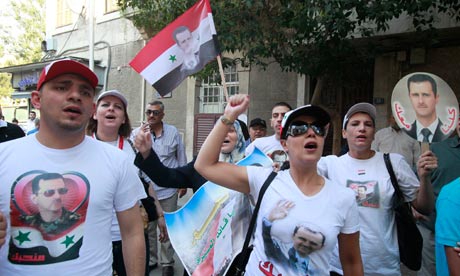
Hundreds of thousands of Syrians on Sunday raised the largest national flag in the world, 16 kilometers long and four meters wide, in Lattakia to show support for the gov.
“The Syrian Uprising” by Ayman Hakki
Most oppose the actions of the regime but are conflicted as to the best way to affect long overdue beneficial change. It is a historic fact that change is not always for the best in that part of the world, and a malevolent uprising is worse, not better, for Syria than its present corrupt authoritarian system….
Today Syrian Americans are well positioned to urge a rudderless administration to employ a carrot and stick approach to Syria, because we know that the stick alone won’t work. We must all resist asking for pressure and stopping at that. We must work diligently to secure Syria’s minorities’ interests before we even consider a plan to help empower Syria’s Sunni majority. Turkey and the West may be well suited to play this role. There may be better solutions for this thorny problem, but I can’t think of them. We’re all waiting for someone to articulate a vision that represents hope for change, a change free of reprisals and hatred. Then we’ll get behind that plan. Until such time we must resist the urge to reflexively and vengefully oppose the regime.
Syria: A Way Forward
by George Ajjan, July 02, 2011
….the turmoil that has engulfed Syria possesses a geographic and demographic profile opposite to that of Egypt – it was the urban middle class who turned out to reject the abuses of the Mubarak regime. Coptic priests said Mass in central Cairo while their middle-class Muslim neighbors stood guard. But there is certainly no communion being distributed in the poor towns where the Syrian youth has taken to the streets. By contrast, the multi-confessional middle class of Syria’s largest cities of Damascus and Aleppo has been unwilling to join the anti-government movement; rather, they have turned out at pro-regime counter-rallies, if only to show their support for stability….
Going forward, there are 3 main scenarios that can play out. First, the vicious cycle of protests and military crackdowns can continue for months on end,…. In other words, the country will die a slow and painful death with its problems only exacerbated.
In the second case, a foreign military coalition could intervene, mainly if Turkey – the political bridge between Syria and the West – concludes that the situation cannot be salvaged and gives the green light. ….
The third case is a “soft landing”, where all people of good conscience, Syrian or not, ought to place their hopes. In this scenario, the constitution would have to be amended to allow a multi-party system. Legislative elections would have to be held to give the protesters somewhere else to channel their energy – but within a year, not in some vague near-ish future to which the government’s latest lip service alludes. A true parliament would have to be created, in stark contrast to the circus of stooges and Baath Party hacks that Assad addressed when the crisis first erupted, which any clear-thinking Syrian ought to label a national embarrassment.
A reasonable compromise would be for a free, multi-party parliament to appoint a slate of ministers for those departments that directly impact the economy, e.g. Finance, Agriculture, Industry, Infrastructure, Tourism, Transportation, Energy, Education, etc. while the President would keep autocratic control of the military, security, and of course foreign policy. As such, Syrians would get stability and continuity in the areas where their President is perceived to be popular and effective, but they would have enough political freedom to begin to hold their government accountable to enact more responsive economic policies and tackle corruption.
For many seasoned observers of Syrian politics, the power sharing described above reads like a pipe dream. For others, it does not go nearly far enough. But those with “Assad must go” on their lips can spare the crocodile tears – it is a completely unrealistic proposition. Ceding control over domestic policies will be a hard enough pill for the Baath Party establishment to swallow, but it would be unthinkable for them to relinquish the military and diplomatic spheres without a fight to the death….If he can’t manage to deliver that much after 11 years, then quite frankly he’d be best described by the term he once infamously used to refer to the compliant rulers of Egypt, Jordan, and Saudi Arabia: a “half-man”.
Jerusalem Post: As Arab Spring roils, hunger emerges, 2011-07-10
The Arab Spring was supposed to bring democracy, peace and prosperity. But stalemates between governments and opposition forces are paralyzing economic life, exacerbating food shortages that were already in the making due to unfavorable weather and …
Reports of widespread hunger have emerged in recent weeks in Libya and Syria. On Wednesday, Yemen was officially added to the list of food trouble spots when a United Nation mission visiting Yemen called on the international community to quickly provide humanitarian aid to the impoverished country, pushed to the verge of starvation by five months of protests and armed insurrection….
The FAO’s food price index, which covers prices of a basket of commodities, rose 1% to 234 points last month, up 39% compared with the same time last year and just below the record 238 points hit in February….
Syrians too have suffered hunger due to a drought that has plagued the country’s northeast since 2006, described by the WFP as “the worst in decades.” Mass migration from Syria’s rural agricultural areas into cities has ensued. Some one million Iraqi refugees living in Syria are the most vulnerable to food shortage, as they are not allowed to work or own land to sustain themselves.
For Syrians struggling with less food in the markets, the problem was made worse by cuts in food subsidies and frozen wages after 2004. In the weeks before unrest broke out in mid-March, the Syrian President Bashar Assad government restored some of those subsidies and raised salaries for civil servants. But with the economy paralyzed, it’s not clear the government can afford to increase aid or distribute it.
The fighting, however, has been a major cause of hunger in Syria. In mid-June, government forces loyal to Assad blocked food from reaching Syrian villages near the border with Turkey, where thousands of internally displaced refugees had gathered fleeing government violence.
“This is a starvation war they’re waging,” Jameel Saib, a local eyewitness, told CNN, adding that refugees were forced to pluck fruit from trees in order to survive….
‘Syrian security member’s son killed’ Press TV
Unknown assailants have killed the son of a member of the Syrian security forces after kidnapping him and have dismembered his body, an informed source says.
Talking to Press TV, the source added that police have launched an investigation into the incident and have arrested a suspect in relation to the killing.
“There are now two possibilities; one is that the murder was in line with the tribal killings, and the second, that it was committed by armed men who are killing and slaughtering people in Syria these days,” the source further said.
Protest singer Ibrahim Kashoush had his throat cut
“One of many grim videos to emerge from the Syrian city of Hama purported to show the body of protester Ibrahim Kashoush after his throat had been cut by the security forces,” reported the British newspaper The Guardian on 5 July 2011 at 4:41 PM.
The slogans that the demonstrating crowds in Hama have repeated again and again are from a song which was composed by the locally based singer Ibrahim Kashoush — a folklore singer who chanted traditional Aradah tunes as protest songs, adding new lyrics he wrote himself to the old wedding and celebration melodies. His body was reportedly found dumped in the Assi River on Wednesday morning.
Feature: Unrest across Syria casts shadow on soap operas
English.news.cn 2011-07-09, by Hummam Sheikh Ali
DAMASCUS, July 9 (Xinhua) — It appears that Syria’s once- flourishing soap opera industry is losing its glory and sliding into a recession after Arab television networks and satellite channels declined to buy Syrian soaps in retaliation for Syrian actors’ positions towards the country’s current political crisis.
Since the eruption of protests in Syria in mid March, Syrian actors and actresses have shown conflicting attitudes towards the events, with some of them supporting the protests while others openly backing the Syrian government and attacking the protests as aiming to undermine the country.
Syrian actors complain that they have been boycotted by Arab TV satellite channels owned by wealthy Saudis and Qataris, whose governments are now maintaining cool relations with Syria. The reason, they said, is their overt backing of the Syrian government and the reforms announced by Syrian President Bashar al-Assad.
Abdul-Rahaman Abu al-Qassem, a prominent Syrian actor, confirmed to Xinhua that the Syrian drama industry has been ” greatly influenced by what is happening in Syria,” noting that most producers depend on the Gulf funds in this respect.
“Syria is subject to an unprecedented attack at all political and cultural levels… We are living under a total siege,” he said.
Syria has been wracked by nearly four months of protests demanding sweeping reforms. The turmoil has badly hit all sectors in Syria, including the drama industry.
Most Arab networks were once racing to buy Syrian soaps to be screened during the Muslims’ holy month of Ramadan due to their unparalleled popularity and daring subjects. Arab and Gulf viewers, in particular, used to be reportedly glued to TV screens during Ramadan to watch Syrian series that tackle subjects like gallantry, terrorism, love and other social topics.
During past surveys, Syrian series ranked number one as the most watched among Arab viewers, and even those in foreign countries.
Najdat Anzour, a renowned Syrian director, said in a statement obtained by Xinhua that there is a Arab political decision that has been taken covertly not to buy Syrian soaps or at least to purchase them at low prices in a way that reduces the value of those works.
Anzour said there are 25 Syrian soaps ready for Ramadan, adding that some works have been postponed to the next season as outlooks for this season are gloomy….Syrian
Syrian Government Offers ICRC Wider Access in Syria
GENEVA — The International Committee of the Red Cross (ICRC) said on Friday it had stepped up its humanitarian operations in Syria, in line with a deal for unlimited access negotiated two weeks ago.
The independent aid agency previously had been able only to make limited visits to a few cities affected by the crackdown on anti-government protests, but its president Jakob Kellenberger won assurances of unconditional access, it said.
In the past week, ICRC officials have visited the southern city of Deraa — where it said the main hospital reported it had treated more than 1,500 wounded since violence began — and the northern city of Idlib and Jisr Al-Shughur, a statement said.
Risky Business: Getting information out of Syria Human Rights Watch
Syria: Secret journey around a nation in revolt finds protesters are not flagging Telegraph
From: Ambassador of Syria to the U.S.
To the Syrian-American Community: July 6, 2011
Since the onset of the events in Syria, many members of the Syrian-American community have been distraught over developments on the ground. Some have taken a hard-line stance, refusing any dialogue with the Syrian government. Others have chosen to engage with the Embassy and myself to express their candid viewpoints on how to pull Syria out of the current crisis and onto a brighter future. Many have voiced their interest in engaging with both, the members of the opposition in Syria, as well as the government. We believe this is a productive position.
As such, I would like to take this opportunity to inform the Syrian-American community that whoever believes in constructive dialogue and would like to visit Syria to participate in the National Dialogue between the government and opposition and/or intra-opposition meetings is welcome, and encouraged, to do so. Rest assured that they will be treated with the utmost courtesy and will face no obstacles entering or leaving the country.
I look forward to the Syrian-American community emerging as a robust and influential member of the National Dialogue that will help bring about a
more democratic, peaceful, and secure Syria.
Sincerely, Imad Moustapha, Ph.D.
Ambassador of Syria to the United States
Washington summoned the Syrian ambassador AFP
Imad Mustapha was called in to meet with top State Department officials “to express a number of our concerns with the reported actions of certain Syrian embassy staff in the United States. We received reports that Syrian mission personnel under ambassador Mustapha’s authority have been conducting video and photographic surveillance of people participating in peaceful demonstrations in the United States.”
Syria: Economic Overviews
2011-07-06 22:16:05.755 GMT
Summary: The regime of Syria’s president, Bashar al-Assad, is not expected to hold on to power in its current form in the face of ongoing anti-regime protests. Its current method of repression and superficial reforms is unsustainable. Within the forecast period, sustained domestic, economic and international pressure is expected to cause a major overhaul of the current regime structure, possibly overseen by Mr Assad himself or after an internal coup against him. Relations with the West are likely to remain tense following Syria’s crackdown, and further US and EU sanctions may be imposed. Arab states are likely to remain quiet, fearing instability, but Turkey’s criticism will increase.
July 1 (Economist Intelligence Unit) — POLITICAL STABILITY: The Economist Intelligence Unit believes that the regime of Syria’s president, Bashar al-Assad, and his ruling Baath party will be unable to retain power in the face of ongoing anti-regime protests through its current method of heavy-handed repression and superficial reforms. Within the forecast period, sustained domestic, economic and international pressure is expected to bring about a major overhaul of the current regime structure. This could be done by Mr Assad himself; he could enact meaningful reforms to recast the regime in a more open style, satisfying a critical mass of Syrians and international critics, and eventually leading to the purging of unpopular security figures, notably his brother and regime enforcer, Maher al-Assad. However, Mr Assad appears weak in the face of the protests, and has shown no inclination to make such bold and decisive moves. Alternatively, sections of the army that are not from Mr Assad’s loyal Alawi sect, in conjunction with the merchant Sunni elite, which has been loyal until now, may decide that the president is too great a liability and stage a coup against the Assad family and the Alawi segments of the security and armed forces. A less likely possibility is that the security hardliners, led by Maher al-Assad, will launch a coup against Mr Assad themselves.
ELECTION WATCH: In a recent speech, Mr Assad announced that a new election for Syria’s parliament, the Majlis al-Shaab, would take place in August, the latest date allowed by the constitution after the previous four-year term expired in May. It is unclear whether the election will be held under the newly proposed political parties law and whether Article 8 of the constitution, which guarantees the Baath party and its allies two-thirds of the 250 seats, will be amended. Every seven years parliament proposes a presidential candidate who is then put to a referendum. Mr Assad was confirmed for his second term in 2007. If he stays in power and successfully reforms, it is likely that the nature of the presidential electoral process (the unlimited number of terms, the lack of a contest) will come under scrutiny.
INTERNATIONAL RELATIONS: Syria’s recent detente with the US and Western states has been ended by Syria’s crackdowns. Western states were initially cautious in condemning Mr Assad, but the continued repression has prompted substantial criticism. The EU has increased the number of regime figures subject to sanctions, bringing the total to 34, including Mr Assad. The US administration has expanded the existing economic sanctions on Syria, imposed by the administration of George W Bush, to include additional regime members, including the president. Facing growing isolation, Syria will rely on non-Western global allies for support, such as Russia and China, to veto any Western-led resolution condemning Syria’s actions at the UN Security Council.
POLICY TRENDS: The recent policy of gradually liberalising Syria’s centrally planned economy has stalled in the wake of the political unrest; its main architect, the deputy prime minister for economic affairs, Abdullah al-Dardari, was excluded from the new government formed in April. Mr Dardari’s successor as economy and foreign trade minister, Nidal al-Shaar, has a record that suggests he is in favour of economic reforms. owever, his initial priority will be to quell the unrest by implementing populist state-funded measures, such as reviving subsidies on fuel, although a complete dismantling of Mr Dardari’s reforms is unlikely.
ECONOMIC GROWTH: Central Bank of Syria provisional figures show that real GDP growth was 3.2% in 2010. Although the economy was boosted by increased oil production, growth in exports to Iraq and an expanding services sector, notably tourism, the continued weakness of the agricultural sector and increased food imports limited growth. The continuation of political unrest has caused us to revise down our growth forecast to 1.1% in 2011 and 3.2% in 2012, with any growth driven primarily by increased government spending and oil exports. Foreign investment is expected to drop as a result of the unrest, and the tourism sector will be hit badly. Business activity will be curtailed by disruptions caused by the protests, and the political uncertainty will lower private consumption (despite recently announced public-sector pay rises). In addition, any prolonged instability in Syria may persuade the Iraqi refugees living in Syria (estimated at between 500,000 and 1m) to return home, depressing consumption further.
INFLATION: We have revised down our forecast for inflation to 7% in 2011, as early signs show that the increase in global commodity prices and the increase in liquidity resulting from the hike in state employees’ salaries and tax cuts promised during March have not pushed prices as high as expected. Average inflation will drop to 5.5% in 2012, as commodity prices stabilise and the number of Iraqi nationals in Syria declines, lowering demand.
EXCHANGE RATES: The Syrian pound has been loosely pegged to the IMF’s special drawing rights since October 2007 and is tightly managed by the Central Bank. The authorities are unlikely to let the pound float freely, as they value exchange-rate stability. Recent unrest reportedly led to a temporary 15% depreciation of the pound against the dollar on Syria’s black market. (The black-market pound:dollar rate is usually in line with the official rate.) Concerns about the euro in 2011 will lead to a slight depreciation of the pound against the dollar, and we forecast that the official rate will average SP47.3:US$1 in 2011-12. Before the current crisis, the Central Bank had healthy foreign-exchange reserves (equivalent to about 12 months of import cover), leaving it relatively well placed to defend the currency.
EXTERNAL SECTOR: In 2011-12 we expect export earnings to grow modestly, to an average of US$12.5bn, although this is below the oil-price-related peak in 2008 of US$15.3bn. Oil production, which is increasing at small fields but declining at the larger, mature fields, rose by 2.9% in 2010. Several major oil companies have reported that production has been unaffected by the unrest, although there are reports of increased insurance premiums on tankers transporting oil from Syria’s ports, which might cause some delays in delivery. Output will pick up further in 2011-12, averaging 392,000 barrels/day. The impact of changes in oil prices on the trade balance is limited, because Syria’s imports of refined products are about equal in value to its exports of crude oil. Higher production in 2011, augmented by a rise in international oil prices to an average of US$101.5/barrel in 2011-12, will push up crude oil export revenue to an average of US$5.3bn in 2011-12, from US$4bn in 2010. We have revised down our forecast for the trade deficit, to an average US$1.4bn, or 2.2% of GDP, in 2011-12, as imports are expected to drop owing to the continued political unrest. Jul/06/2011
Syria’s rival hegemons
By CAROLINE B. GLICK in JPost
….In the long-term, the reestablishment of a Turkish sphere of influence in the Arab world in Syria, Lebanon, the Palestinian Authority and Egypt through the Muslim Brotherhood will be extremely dangerous for Israel. With its jihadist ideology, its powerful conventional military forces, its strong economy and its strategic ties to the US and Europe, Turkey’s rise as a regional hegemon would present Israel with a difficult challenge….
Richard N. Haass, “Arab spring has given way to a long, hot summer.” He says the Arab Spring has given way to a series of developments that are beginning to produce a region that is less tolerant, less prosperous, and less stable than what existed—and outsiders cannot do much to change the course of events…..
Arab publics emerging from the upheavals makes it more difficult for Arab governments to compromise. And while terrorist groups had nothing to do with the upheavals, they are in a position to benefit as governments with strong anti-terrorist records are weakened or ousted. Signs of exactly this are popping up in Yemen, and it only a matter of time before they do so in Libya.
Take all this together, and you see a series of developments that are beginning to produce a region that is less tolerant, less prosperous, and less stable that what existed. To be sure, the authoritarian old guard that still dominates much of the Middle East could yet be forced or eased out and replaced with something relatively democratic and open. Unfortunately, the odds now seem against this happening.
Please respect FT.com’s ts&cs and copyright policy which allow you to: share links; copy content for personal use; & redistribute limited extracts. Email [email protected] to buy additional rights or use this link to reference the article – http://blogs.ft.com/the-a-list/2011/07/06/the-arab-spring-has-stalled/#ixzz1RY9ynXwz
rab publics emerging from the upheavals makes it more difficult for Arab governments to compromise. And while terrorist groups had nothing to do with the upheavals, they are in a position to benefit as governments with strong anti-terrorist records are weakened or ousted. Signs of exactly this are popping up in Yemen, and it only a matter of time before they do so in Libya.
Take all this together, and you see a series of developments that are beginning to produce a region that is less tolerant, less prosperous, and less stable that what existed. To be sure, the authoritarian old guard that still dominates much of the Middle East could yet be forced or eased out and replaced with something relatively democratic and open. Unfortunately, the odds now seem against this happening.
Mideast Youth: Arab Spring Could Never Topple Saddam
2011-07-06
Some Western anti-war activists proclaimed the Arab spring inspired by Tunisia and Egypt, could have toppled Saddam Hussein and the invasion of Iraq by the U.S. in 2003 wasn’t needed. The recent developments in Syria show this is a futile …
Kiss Of ‘Democratic’ Death: Israel’s Plot To Take Down Syria II
08. Jul, 2011, by Jonathan Azaziah / Intifada Palestine, Part 2
Israeli singer Amir Benayoun sings for the Syrian revolutionaries
Susan Dirgham writes:
The Syrian Australian community is becoming quite active in support of the president and reforms. Last week there was a huge rally in Sydney, and different community groups are organizing one for Melbourne. Also a petition has gone around the community and hopefully it will be presented to the parliament by an MP. It is a protest against the foreign minister’s call for President al-Assad to be referred to the International Criminal Court. We have a foreign minister who, unfortunately, wants to big-note himself when he can. He can be very embarrassing. Read this letter to the Australian Foreign Minister.




 Middle East Channel – FP


