“SYRIA: Regime interests dictate regional policies,” by Oxford Analytica

Oxford Analytica's recent report on the Syrian Regime (copied below) seems accurate and should help bring the tribe of western analysts back around to the notion that the Syrian regime is here to stay for the short and medium term. For the last several years, most analysts have been swayed Washington rhetoric about regime change in the region and suppositions that Bashar al-Asad "just doesn't get" the new realities of the Middle East and War on Terror. Events have proven that Bush is the leader who "just didn't get it." The Bush posse is now being mugged by the hard realities of the Middle East and losing members rapidly. (Bolton announced his resignation today.) 

The Syrian regime's calculation that most Middle Eastern states do not govern "fully cooked" nations, but rather, preside over a concatenation of tribes and sects which must be managed with a strong hand – or played off, one against the other – has paid off for Asad. Washington gambled on its presupposition that the Middle East was ready for a democratic revolution and that its peoples, defined by national borders, are sufficiently cohesive, pro-Western, and secular to embrace that radical transformation. Now Washington presides over Lebanon and Iraq, two countries with little national cohesion and little ability to fend off outside manipulation, which stand at the threshold of civil war. Damascus, by contrast, has jealously protected its dictatorship. The price is economic and social stagnation, but the prize is that Syrians do not face the uncertainties of political collapse. The coming challenge for the Syrian regime, as Ehsani reminds us, will be to blow some economic change into a state consumed by fear and corruption, a tall order.


SYRIA: Regime interests dictate regional policies
Friday, December 1 2006
An Oxford Analytica In-depth Analysis

EVENT: Jordan's King Abdallah II warned on November 26 that civil wars could break out in Iraq, Lebanon and the Palestinian territories.

SIGNIFICANCE: The killing of Lebanese politician Pierre Gemayel has again focused attention on the interests and motives of the Syrian regime in the region. Syria is a potentially important player in the region's major problems, but there is a contradiction between the interests of Syria as a state and those of its regime. Amid talk of engaging with Syria over Iraq and other regional issues, an understanding of its motives and capabilities is critical.

ANALYSIS: The base of the Syrian regime has gradually narrowed under President Bashar al-Assad. When his father Hafez died in 2000, his lieutenants quickly united to select Bashar as the successor in order to maintain the status quo and avoid the risks of a competition for power between the men who controlled the various security and military organisations that sustain the regime in power.  

Key insights

·            The base of the regime has narrowed as Bashar has placed members of his family and clan in the key military and security posts, but it is strong enough to survive even if it is too weak to push through vital reforms.
·            Syria wants Washington to recognise that Damascus must play a pivotal role in dealing with Iraq, Lebanon, Palestine and other regional issues.
·            There are contradictions between the interests of the regime and the state — but it is the former that will prevail.
·            It is vital for the regime that the Hariri investigation is stopped, diverted or bargained away. As such, its overriding priority is to press for a change of government in Lebanon — and this will influence its approach to other regional issues. 

Bashar constrained. Bashar acts and speaks as someone wielding ultimate authority, but it is uncertain quite how much power he possesses. It appears that he can only act within certain limits imposed by the nature of the regime and the interests of its main military and security functionaries. He has weeded out some of the older figures from his father's era, and others, such as former vice-president Abdul Halim Khaddam, have gone into opposition and exile (see SYRIA: Regime defiant in face of outside pressures – January 25, 2006). The military and security organisations have been placed in the hands of his relatives or close associates of his extended family:

·                               His brother Maher has an oversight role in the security field and controls the armed units that protect the presidency and the regime.
·                               His sister Bushra, by some accounts the most intelligent and forceful member of the family, is married to Assef Shawkat, who commands military intelligence. This has caused resentment within the wider Alawi community, which under his father enjoyed greater access to power and resources. They will not move against Bashar as this would bring the whole regime down, but they are discontented.The limits of Bashar's power are shown by the way that he tolerates the activities of relations and friends and their allies in business. They blatantly use their connections to enrich themselves, often in alliance with members of the Sunni business community. This also causes discontent.

 Reform limits. Despite much talk of reform, Bashar has made very little progress, and Syria remains a sort of fossil regime from the 1960s when it was created

:·                               The large ministries run by technocrats are deeply conservative and the employees fear the consequences of change.
·                               State industries are grossly overmanned.
 ·                               There are many vested interests that the regime does not want to offend, particularly as its base narrows (see SYRIA: Unreformed economy suits regime stability – November 24, 2006).
·                               Bashar leads the Ba'ath Party but it is controlled by apparatchiks who benefit from the status quo.
·                               There have been some superficial reforms within the party, but it has long been shorn of ideology and has become a vehicle for rewarding loyalty with patronage (see SYRIA: Ba'ath congress proposes cosmetic reforms – June 16, 2005). Compared with Saudi Arabia, and even Libya, Syria has moved very little. This was shown very clearly in a recent conference in Damascus organised by Bashar's father-in-law, Fawaz Akhras, to show Bashar and the regime the potential benefits of reform. The many Syrian businessmen in the audience were deeply sceptical about whether the regime is capable of responding — other than on the basis of too little, too late.

Stasis. There is no effective organised opposition and none will be allowed to emerge. The Muslim Brotherhood remains influential but it ceased to function as grouping within Syria when it was ruthlessly suppressed in the early 1980s after it challenged the regime. Syrian society has become more overtly religious in recent years and, given a chance, the brotherhood might quickly re-establish itself (see SYRIA: Islamists to benefit from regime collapse – October 19, 2005):

·                               There is considerable discontent within the majority Sunni community at the power wielded by the Alawis and some of their Sunni friends but it rarely finds public expression.
·                               There are other exile figures such as Khaddam, but he had an unsavoury reputation when vice-president, and it is difficult see many flocking to his cause — even though he has set up a common front with the Brotherhood in exile. The regime is strong enough to survive but too weak and timid to use its power for the long-term benefit of its people. Economic problems are likely to get much worse and the eventual solution may be very painful. Syria will become a net importer of oil around 2010. On most measures of economic and human development the country is already behind most of the Arab regimes. The gap will increase.This regime may eventually fall apart, but not in the short or medium term without the intervention of some major cataclysm — such as a war with Israel — that the regime will seek to avoid. There may one day be a change of leader, but for the time being Bashar is well entrenched and there are no obvious challengers. If a change were to take place, his successor could be another member of his family or clan.

Regional aims. Syria's objectives in the region are clear, encompassing:

·                               the return of the Golan;
·                               an Arab-Israeli peace deal based on 1967 borders, which Syria plays a major role in bringing about;
·                               a Lebanon under Syrian influence; and
·                               an Iraq that does not pose a threat. Beyond that there is a vision of a strong Syria that returns to its rightful place at the heart of the Arab world and is recognised by the international community as an important player.

Regime interests. The methods used by the regime in meeting these objectives cause problems, and there often seems to be a contradiction between the interests of the Syrian state and those of the regime. This is best shown in Syria's attitude to the UN investigation into the Hariri assassination. The contradictions are exacerbated by Bashar's personality. One day he will make a well-argued and coherent speech expressed in moderate language and the next a tirade in which he seeks to articulate what he believes are popular feelings. They may be addressed to different audiences, but are these days heard by all. Some close to him suggest that he can get too caught up with the emotion of the moment and speaks when it would be wiser to wait or stay silent.

US engagement. It used to be said that there can be no war against Israel without Egypt and no peace without Syria. The return of the Golan has been a central aim since it was taken in the 1967 war. There is a genuine sense of betrayal about the US-sponsored negotiations in 2000 when Damascus thought it had obtained and made significant concessions. The Syrian army realises that it cannot defeat Israel militarily, and that the cost of launching a limited war on the lines of 1973 would be too high. Damascus knows that the route to the Golan lies through Washington, but it lacks the cards needed to extract assistance from what it sees as a pro-Israeli US administration.

Causing difficulties. In recent years it has tried the different tactic of using its ability to cause difficulties for Washington in other regional problems to force the administration to open a dialogue with Damascus. Washington has so far resisted, and has avoided repeating the mistake of UK Prime Minister Tony Blair's misconceived visit to Damascus in 2001. Washington learned in the Hafez era that those carrying concessions to Damascus are treated to a lengthy exposition of the Syrian case and leave without being offered anything in return. There was no doubt that Hafez was in charge and could deliver. He was respected. Bashar has yet to earn that respect. So far his achievements include a gradual increase in US sanctions, humiliation in Lebanon and the loss to Syria of its friends in Riyadh, Cairo and Amman.

Lebanon interests. Syria's tactics are best displayed in Lebanon. Following the Hariri assassination it was forced into a humiliating withdrawal, and key members of the regime appear to be threatened by the UN investigation. Since then it has struggled to delay and divert the UN inquiry and to look for opportunities to restore its influence in Lebanon by working with the Hizbollah and its traditional allies around the presidency. Events for once have played into Syria's hands:

·                               It received credit for the 'victory' of Hizbollah in the summer fighting with Israel — and the wave of emotion that spread through the Arab world.
·                               Bashar positioned himself as a champion of the new concept of 'resistance' to Israel, Washington and pro-US regimes in the region (see SYRIA:Temporary triumphalism masks increased isolation – September 1, 2006).
·                               Whether or not Syria had a hand in the recent political assassinations may never be known. However, its past tactics make it an instant suspect, and the killings have served its interests in both stymieing the UN inquiry and giving its allies the chance to force the government to admit Syria's allies and give them a virtual veto (see LEBANON:Gemayel assassination weakens Syria and allies – November 23, 2006).

Shia axis. The relationship with Iran dates from the 1980s when the two sides saw the Saddam regime as a common threat. It has been sustained by high-level visits and given substance through joint support of Hizbollah, economic cooperation and by their anti-US and anti-Israeli posture. It was given fresh impetus by Hizbollah's performance this summer:

·                               Syria positioned itself as a part of a new axis of power in the region that might embrace an Iraqi Shia government, a Hizbollah-dominated government in Lebanon and Shia communities elsewhere.
·                               Damascus hoped that Sunni groups, disenchanted with what they see as the supine attitude of Arab regimes to Washington and Israel, might join in. It was in this context that Bashar made a speech in August that managed to insult moderate Arab leaders, who were offended and anxious to retaliate. Syria may now be having second thoughts, as it sees the wave of emotion peter out. It has been making overtures to the moderate Arabs, but they want the impossible in return — some reduction in the relationship with Iran. Many in Syria, but not in the regime, point out that the majority community in Syria is Sunni, and that its interests do not lie in supporting a new Shia axis.

Iraq interests. Syria's tactics in Iraq were recently described as a senior US official as a mixture of incompetence and malevolence. There are 700,000 Iraqis in Syria, including people organising some of the insurgents. Insurgents linked to al-Qaida appear to enter Iraq through Syrian territory. Syria is a police state where the security authorities have great powers of surveillance and control, even allowing for the size of the Iraqi presence and the length and terrain of the border. However, the regime has an interest in sustaining the insurgency:

·                               It will ensure that Syria has a stake in any discussions in the future of Iraq and some control over which insurgent groups can best serve its interests.
·                               There is also a genuine desire to help the Iraqis throw out the US 'occupiers'.
·                               Syria will ensure that its actions do not bring US retaliation, but remain a serious irritant.

Hamas support. Syria provides sanctuary for Hamas political leader Khaled Meshal, and through him and its support for Hamas seeks to influence the scale of resistance in Palestine. Damascus believes that there can be no effective government in Palestine unless Syria agrees. It may have encouraged Hamas to maintain the rocket attacks from Gaza. It supports other rejectionist groups. The Jordanians have uncovered evidence of Syria trying to smuggle arms to Hamas, although Hamas appears to get plenty of weapons across the Egyptian border. Again, Syria is demonstrating to Washington, Europe and other Arab capitals that it is indispensable to any peace process — or to managing a prolonged period of non-peace.

Regime priority. Syria's handling of the Hariri investigation goes to the heart of the problems and contradictions of the regime. Its reactions clearly show that it is frightened of what the investigators may find. Leaks at earlier stages indicated that there could be evidence implicating Shawkat. It is hardly possible to get closer to Bashar, who cannot sacrifice his brother-in-law. Shawkat may be disliked by some of the family, but Bushra and her mother still have a powerful influence and will fight to protect him. Khaddam claims that Shawkat was acting under orders from Bashar, though there is no other evidence for this. It is of paramount importance to the regime that the inquiry is stopped, deflected or bargained away. The interests of Syria, state or people, will come a poor second to this objective, and Syria's approach to the other regional issues will be affected by it — but mostly in Lebanon.

CONCLUSION: This regime is here to stay at least for the medium term. It has the power to deal with the potential domestic threats and will stop short of provoking its external enemies from attacking it. Dealing with this regime will be uncomfortable, given the divergence between its interests and those of Syria as a state.

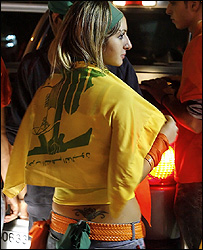
The Babes of Hizbullah

Are Hizbullah babes as photogenic as Hariri's?

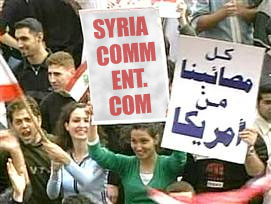
A debate has broken out among SC readers about whether the most recent crop of demonstraters are as telegenic as those of the March 14 crowd. Here are submissions highlighting the Babes of Hizbullah.

From al-Akhbar 27 May 2008 

 Hizbullah Babe 1
Sent by a kind reader

Sent by Alex
Sent by Alex. The Ar Sign says: "All our troubles are from America"

Addendum: Here are more pictures linked to another blog which raised the question of why there were not Hizbullah Babes!

Until yahoo moves the pictures, there are some protest babes here, here, here, here, here, here, here, here, and here.

Kim Ghattas of BBC called the March 14 demonstrations, "the Gucci Revolution" because of its well healed women. And here is the shot included in her article..

Babes of March 14:

Sent by Alex
Sent by Alex

D. B. Light wrote on his blog at the time:

The protesters may not be disproportionately female, but they certainly are young and media savvy and they know that it is in their interest to prominently display young and pretty women in the vanguard of their movement.

In many ways modern terrorism is a creation of the media world. Terrorists have long known how to capture the attention of the media and have used it to their advantage. What is encouraging here is that the forces of liberation have begun to exhibit an equally sophisticated understanding of what it takes to succeed in the modern media age.

Here is more:
The Babe Theory Of Political Movements.
Mar. 21, 2005 11:50 AM

“Lebanese Muslims outnumber Christians 2-1,” by Alistair Lyon

Lebanese Muslims outnumber Christians.
By Alistair Lyon, Reuters
November 13 2006

November 13 2006

Beirut – Lebanon's political system, which is once again in crisis, aims to share power equally between Christians and Muslims, but a survey published on Monday shows that Christians form only 35 percent of the population.

Private statistician Youssef al-Duweihi, a Maronite Christian, said his figures were based on identity registration records and electoral rolls throughout the country.

"This is scientific, not political," he told Reuters by telephone from his north Lebanon home. "I want to tell the Lebanese this is Lebanon and if there is a problem, resolve it."

According to his survey, published in the independent an-Nahar newspaper, Lebanon has 4,855-million people, of whom just over 35 percent are Christian, 29 percent Shi'a Muslim, 29 percent Sunni Muslim and 5 percent Druze.

Such figures are so sensitive in Lebanon that the last official census was conducted in 1932 during the French Mandate, which said Christians made up 55 percent of the population.

Duweihi, a mathematician, said his survey showed Lebanon's demography was at odds with the power-sharing setup. "It's time to discuss the political system and the electoral law," he said.

His figures appeared at a time of political crisis that pits an anti-Syrian majority coalition government against the Shi'a Hezbollah and Amal factions backed by a Christian group.

If Prime Minister Fouad Siniora's government falls, there may be calls for new parliamentary elections, reopening controversy over how to reform a Syrian-designed electoral law that most Lebanese leaders say should be scrapped.

The Taif agreement which ended the 1975-90 civil war modified the complex religious power-sharing system, set up at the birth of modern Lebanon in 1943. Taif gave Muslims and Christians equal representation in parliament instead of the 6 to 5 advantage Christians had enjoyed previously.

It stipulated that the president should remain a Maronite, the prime minister a Sunni and the parliament speaker a Shi'a, while calling for the eventual abolition of the system that distributes state posts among Lebanon's 17 recognised sects.

Duweihi's figures show the number of Lebanese entitled to passports, not the number actually residing in the country. Lebanon also hosts more than 400 000 Palestinian refugees and a substantial number of Syrian and other guest workers.

Abdo Saad, the director of the Beirut Centre for Research and Information, said Duweihi's results appeared "reasonable", but added that he did not know what methodology he had used.

Saad said he had had access to Interior Ministry figures in 2000, which showed Christians made up about 33 percent of the population, Shi'as 31,5 percent and Sunnis about 30 percent.

America Must Decide between Shiites and Sunnis

Robin Wright in the Wash Post writes:

The White House and the State Department are still wedded to the isolation of Iran and Syria, despite the growing momentum behind the idea of regional outreach, according to sources familiar with the discussions.

Her article: "U.S. Considers Ending Outreach to Insurgents," chronicals the terrible divisions in the Bush administration over how to move forward in Iraq. Whereas present US policy led by Ambassador Khalilzade in Baghdad is to bolster the Sunnis, some in the State Department have been proposing backing the Shiites and Kurds and jettisoning attempts to bring the recalcitrant Sunnis into a deal.

This is called the "80% Solution," and was proposed by the State Department's counselor Philip D. Zelikow, who resigned two days ago [See our own Charles Coutinho on this at his new blog "Diplomat of the Furture". Nevertheless, Zelikow's ideas have many backers, according to Wright. He proposes the US should abandon efforts to win over Iraq's Sunni population and settle for good ties to Kurds and Shiites. 

"State Department officials argued that intervening in Iraqi politics is increasingly counterproductive, particularly after elections for a permanent government last December. Reconciliation, they also argued, is now exceptionally unlikely and could actually jeopardize U.S. relations with Iraq's Shiites, who make up about 60 percent of the population, according to sources familiar with the debate."

Sunni Arab states are outraged by this line of thinking, which they claim will only cede Iraq to Iran.

Roula Khalaf, writing in the Finacial Times, [Nov 29, 2006] explains

"According to Jordanian officials, the message likely to have been delivered to Mr Bush on Wednesday by King Abdullah was that containing the civil war in Iraq was "not a matter of engaging with Iran and Syria", but rather involved more empowerment of Iraq's Sunni Arab minority that dominates the insurgency.

From the Sunni Arab regimes' perspective, the US invasion of Iraq handed the country to Shia parties allied to Iran, dangerously upsetting the balance of power in the region. Some Arab states – Saudi Arabia in particular – have launched their own dialogue with Tehran. "Saudi Arabia doesn't want to enter into a confrontation with Iran. But the Saudis have made clear that they will not accept that Iraq falls into the hands of the Iranians," says one person close to the Saudi government.

Nawaf Obaid, a Saudi security analyst and government adviser, wrote in the Washington Post on Wednesday that if the US left Iraq "one of the first consequences will be massive Saudi intervention to stop Iranian-backed Shia militias from butchering Iraqi Sunnis".

Nor are the pro-western Arab states clamouring to rehabilitate Syria. Indeed Saudi Arabia has virtually frozen ties after an August speech by Syria's President Bashar al-Assad ridiculed Arab leaders as "half-men".

Syria's role in Lebanon is the most immediate concern: Riyadh, Cairo and Amman want to shore up the pro-western Siniora government and derail Syrian-backed efforts by Hizbollah to bring the government down.

Here is an extract from Saudi advisor Nawaf Obaid's article:"Saudi Arabia Will Protect Sunnis if the U.S. Leaves," November 29, 2006; Wash Post, A23

Just a few months ago it was unthinkable that President Bush would prematurely withdraw a significant number of American troops from Iraq. But it seems possible today, and therefore the Saudi leadership is preparing to substantially revise its Iraq policy. Options now include providing Sunni military leaders (primarily ex-Baathist members of the former Iraqi officer corps, who make up the backbone of the insurgency) with the same types of assistance — funding, arms and logistical support — that Iran has been giving to Shiite armed groups for years.

Another possibility includes the establishment of new Sunni brigades to combat the Iranian-backed militias. Finally, Abdullah may decide to strangle Iranian funding of the militias through oil policy. If Saudi Arabia boosted production and cut the price of oil in half, the kingdom could still finance its current spending. But it would be devastating to Iran, which is facing economic difficulties even with today's high prices. The result would be to limit Tehran's ability to continue funneling hundreds of millions each year to Shiite militias in Iraq and elsewhere.

Both the Sunni insurgents and the Shiite death squads are to blame for the current bloodshed in Iraq. But while both sides share responsibility, Iraqi Shiites don't run the risk of being exterminated in a civil war, which the Sunnis clearly do. Since approximately 65 percent of Iraq's population is Shiite, the Sunni Arabs, who make up a mere 15 to 20 percent, would have a hard time surviving any full-blown ethnic cleansing campaign.

The Saudis are letting it be known that they will not accept the 80% solution. Neither do they back the Baker-Hamilton plan which recommends pulling American troops back to bases.

Lebanon

Lebanon may look like a side-show to the Iraq dilemma, but it is integral. Riyadh, Cairo and Amman want to shore up the pro-western Siniora government and derail Syrian-backed efforts by Hizbollah to bring the government down. Lahoud, Aoun and Nasrallah are determined to being it down for this reason. Lahoud said yesterday: the government led by Fouad Siniora is a puppet administration controlled by the United States and France. "This government is no longer legal because it is not representative of all the country's religions," Mr Lahoud told The Daily Telegraph. "It must be replaced, but what is holding it together is pressure from the United States and France.

Megan Stack writes in the Los Angeles Times, December 1, 2006, Lebanon builds up security forces, in order to take on Hizbullah. "The move is seen as a bid to counter Iran and ally Hezbollah. Some fear it may lead to a militia — and civil war."

The Lebanese government has nearly doubled the size of its security forces in recent months by adding about 11,000 mostly Sunni Muslim and Christian troops, and has armed them with weapons and vehicles donated by the United Arab Emirates, a Sunni state.

The dramatic increase in Interior Ministry troops, including the creation of a controversial intelligence unit and the expansion of a commando force, is meant to counter the growing influence of Iran and Hezbollah, its Shiite ally in Lebanon, Cabinet minister Ahmed Fatfat said in an interview this week.

The quiet, speedy buildup indicates that Lebanon's anti-Syria ruling majority, led by Prime Minister Fouad Siniora, has been bracing for armed sectarian conflict since the withdrawal of Syrian forces in the spring of 2005. It also reflects growing tensions across the region between U.S.-allied Sunni Muslims who hold power in most Arab nations and the increasingly influential Shiite-ruled Iran and Hezbollah.

Other than the Lebanese military, there seems to be a general proliferation of militant groups in Lebanon, reading themselves for combat. The main Christian militia of the Civil War, the Lebanese Forces was discovered to be rearming and training over the last week. Several militant Palestinian groups have been in the news recently because of their efforts at strengthening themselves with arms and men. It has been suggested that Syria is aiding this effort. Radical Sunni Lebanese groups have also been arming. (see the comment section two posts ago for coverage of these groups by T_desco and others) With the absence of central state authority, the paralysis of parliament, and the tug of war over the future of Lebanon spilling out onto the streets, Lebanese of every confession are preparing themselves for struggle of a more violent nature.

The US and Saudi Arabia are working together closely to support the Siniora government in Lebanon, which hangs on Sunni Lebanese support. The US has become increasingly dependent on Saudi support over the last several years, which will make it very hard for the US to pursue Zelikow's 80% solution in Iraq or the Baker-Hamilton Plan, even if many want to. There will be great pressure on Washington to fight the Shiite militias in Iraq, which will undermine Maliki's government further and exacerbate the civil war in Iraq.

Today the opposition demonstrations against the Siniora government began without violence.

“A Primer in Lebanese Politics,” by Uri Avnery

'Kill Them! Kill Everyone!
All of Them!'
A primer on Lebanese politics

by Uri Avnery
Nov. 28, 2006

During the first Lebanon war, I visited Jounieh, a town some 20 km north of Beirut. At the time, it served as a port for the Christian forces. It was an exciting evening.

In spite of the war raging in nearby Beirut, Jounieh was full of life. The Christian elite spent the day in the sun-drenched marina, the women lounging in bikinis, the men slugging whisky. The three of us (myself and two young women from my editorial staff – a correspondent and a photographer) were the only Israelis in town, and so we were feted. Everybody invited us onto their yachts, and one rich couple insisted that we come to their home as guests of a family celebration.

It was indeed something special. The dozens of family members belonged to the cream of the elite – rich merchants, a well-known painter, several university professors. The drinks flowed like water, the conversation flowed in several languages.

Around midnight, everybody was slightly drunk. The men got me into a "political" conversation. They knew that I was an Israeli, but had no idea about my views.

"Why don't you go into West Beirut?" one portly gentleman asked me. West Beirut was held by Arafat's PLO forces, who were defending hundreds of thousands of Sunni inhabitants.

"Why? What for?" I queried.

"What do you mean? To kill them! To kill everybody!"

"Everybody? Women and children, too?"

"Of course! All of them!"

For a moment, I thought that he was joking. But the faces of the men around him told me that he was deadly serious and that everybody agreed with him.

At that moment I grasped that this beautiful country, rich in history, blessed with all the pleasure of life, is sick. Very, very sick.

The next day I indeed went into West Beirut, but for another purpose altogether. I crossed the lines to meet with Yasser Arafat.

(By the way, at the end of the party in Jounieh my hosts gave me a parting present: a big packet of hashish. On the morrow, on my way back to Israel, after Arafat had made our meeting public, I heard over the radio that four ministers were demanding that I should be put on trial for treason. I remembered the hashish and it went sailing out of the car window.)

I am reminded of that conversation in Jounieh every time something happens in Lebanon. This week, for example.

Much nonsense is being spoken and written about that country, as if it were a country like any other. George W. Bush talks about "Lebanese democracy" as if there were such a thing, others speak about the "parliamentary majority" and "minority factions"' about the need for "national unity" to uphold "national independence," as if they were talking about the Netherlands or Finland. All these have no connection with Lebanese reality.

Geographically, Lebanon is a torn country, and there lies a part of the secret of its beauty. Snow-covered mountain chains, green valleys, picturesque villages, beautiful seashore. But Lebanon is also torn socially. The two schisms are interconnected: in the course of history, persecuted minorities from all over the region sought refuge between its mountains, where they could defend themselves.

The result: a large number of big and small communities, ready to spring to arms at any moment. At best, Lebanon is a loose federation of mutually suspicious communities, at worst a battlefield of feuding groups who hate each other's guts. The annals of Lebanon are full of civil wars and horrible massacres. Many times, this or that community called in foreign enemies to assist it against its neighbors.

Between the communities, there are no permanent alliances. One day, communities A and B get together to fight community C. The next day, B and C fight against A. Moreover, there are sub-communities, which more than once have been known to make an alliance with an opposing community against their own.

Altogether, a fascinating mosaic, but also a very dangerous one – the more so since every community keeps a private army, equipped with the best of weapons. The official Lebanese army, composed of men from all communities, is unable to carry out any meaningful mission.

What is a Lebanese "community"? On the face of it, it's all about religion. But not only religion. The community is also an ethnic tribe, with some national attributes. A Jew will easily understand this, since the Jews are also such a community, even if spread around the world. But for an ordinary European or American, it is difficult to understand this structure. It is easier to think about a "Lebanese nation" – a nation that exists only in the imagination or as a vision of the future.

The loyalty to the community comes before any other loyalty – and certainly before any loyalty to Lebanon. When the rights of a community or sub-community are menaced, its members rise up as one in order to destroy those who are threatening them.

The main communities are the Christian, the Sunni Muslim, the Shi'ite Muslim, and the Druze (who, as far as religion goes, are a kind of extreme Shi'ites.) The Christians are divided into several sub-communities, the most important of which are the Maronites (named after a saint who lived some 1,600 years ago.) The Sunnis were brought to Lebanon by the (Sunni) Ottoman rulers to strengthen their hold, and were mainly settled in the large port cities. The Druze came to find refuge in the mountains. The Shi'ites, whose importance has risen over the last few decades, were for many centuries a poor and downtrodden community, a doormat for all the others.

As in almost all Arab societies, the hamula (extended family) plays a vital role in all communities. Loyalty to the hamula precedes even loyalty to the community, according to the ancient Arab saying: "With my cousin against the foreigner, with my brother against my cousin." Almost all Lebanese leaders are chiefs of the great families.

To give some idea of the Lebanese tangle, a few recent examples: in the civil war that broke out in 1975, Pierre Gemayel, the chief of a Maronite family, called upon the Syrians to invade Lebanon in order to help him against his Sunni neighbors, who were about to attack his territory. His grandson by the same name, who was murdered this week, was a member of a coalition whose aim is to liquidate Syrian influence in Lebanon. The Sunnis, who were fighting against the Syrians and the Christians, are now the allies of the Christians against the Syrians.

The Gemayel family was the main ally of Ariel Sharon, when he invaded Lebanon in 1982. The common aim was to drive out the (mainly Sunni) Palestinians. For that purpose, Gemayel's men carried out the horrendous massacre of Sabra and Shatila, after the assassination of Bashir Gemayel, the uncle of the man who was murdered this week. The massacre was overseen by Elie Hobeika from the roof of the headquarters of Israeli Gen. Amos Yaron. Afterwards, Hobeika became a minister under Syrian auspices. Another person responsible for the slaughter was Samir Geagea, the only one who was put on trial in a Lebanese court. He was condemned to several life prison terms and later pardoned. This week he was one of the main speakers at the funeral of Pierre Gemayel the grandson.

In 1982, the Shi'ites welcomed the invading Israeli army with flowers, rice, and candy. A few months later they started a guerilla war against them, which lasted for 18 years, in the course of which Hezbollah became a major force in Lebanon.

One of the leading Maronites in the fight against the Syrians was Gen. Michel Aoun, who was elected president by the Maronites and later driven out. Now he is an ally of Hezbollah, the main supporter of Syria.

All this resembles Italy at the time of the Renaissance or Germany during the 30-Years War. But in Lebanon this is the present and the foreseeable future.

In such a reality, using the term "democracy" is, of course, a joke. By agreement, the government of the country is divided between the communities. The president is always a Maronite, the prime minister a Sunni, the speaker of the parliament a Shi'ite. The same applies to all positions in the country, at all levels: a member of a community cannot aspire to a position suited to his talents if it "belongs" to another community. Almost all citizens vote according to family affiliation. A Druze voter, for example, has no chance of overthrowing Walid Jumblatt, whose family has ruled the Druze community for 500 years at least (and whose father was murdered by the Syrians.) He doles out all the jobs "belonging" to his community.

The Lebanese parliament is a senate of community chiefs, who divide the spoils between them. The "democratic coalition" which was put in power by the Americans after the murder of the Sunni Prime Minister Rafik Hariri, is a temporary alliance of the Maronite, Sunni, and Druze chiefs. The "opposition," which enjoys Syrian patronage, is composed of the Shi'ites and one Maronite faction. The wheel can turn at a moment's notice, when other alliances are formed.

Hezbollah, which appears to Israelis as an extension of Iran and Syria, is first of all a Shi'ite movement that strives to obtain for its community a larger part of the Lebanese pie, as indeed is its due in accordance with its size. Hassan Nasrallah – who is also the scion of an important family – has his eyes on the government in Beirut, not on the mosques in Jerusalem.

What does all this say about the present situation?

For decades now, Israel has been stirring the Lebanese pot. In the past, it supported the Gemayel family but was bitterly disappointed: the family's "Phalanges" (the name was taken from Fascist Spain, which was greatly admired by grandfather Pierre) were revealed in the 1982 war as a gang of thugs without military value. But the Israeli involvement in Lebanon continues to this day. The aim is to eliminate Hezbollah, remove the Syrians, and threaten nearby Damascus. All these tasks are hopeless.

Some history: in the '30s, when the Maronites were the leading force in Lebanon, the Maronite Patriarch expressed open sympathy for the Zionist enterprise. At that time, many young people from Tel Aviv and Haifa studied at the American University of Beirut, and rich Jewish people from Palestine spent their holidays at Lebanese resorts. Once, before the founding of Israel, I crossed the Lebanese border by mistake and a Lebanese gendarme politely showed me the way back.

During the first years of Israel, the Lebanese border was our only peaceful one. Those days there was a saying: "Lebanon will be the second Arab country to make peace with Israel. It will not dare to be the first." Only in 1970, when King Hussein drove the PLO from Jordan into Lebanon, with the active help of Israel, did this border heat up. Now even Fouad Siniora, the prime minister appointed by the Americans, feels compelled to declare that "Lebanon will be the last Arab state to make peace with Israel!"

All efforts to remove Syrian influence from Lebanon are bound to fail. In order to understand this, it is enough to look at the map. Historically, Lebanon is a part of the land of Syria ("Sham" in Arabic). The Syrians have never resigned themselves to the fact that the French colonial regime tore Lebanon from their land.

The conclusions: First, let's not get stuck in the Lebanese mess again. As experience has shown, we shall always come out the losers. Second, in order to have peace on our northern border, all the potential enemies, and first of all Syria, must be involved.

Meaning: we must give back the Golan Heights.

The Bush administration forbids our government to talk with the Syrians. They want to talk with them themselves, when the time comes. Quite possibly, they will then sell them the Golan in return for Syrian help in Iraq. If so, should we not hurry and "sell" them the Golan (which belongs to them anyhow) for a better price for ourselves?

Lately, voices have been heard, even of senior army people, that hint at this possibility. It should be said loudly and clearly: Because of a few thousands of settlers and the politicians who do not dare to confront them, we are liable to be dragged into more superfluous wars and to endanger the population of Israel.

This is the third conclusion: There is only one way to win a war in Lebanon – and that is to avoid it.

“Will There be a Last Minute Compromise in Lebanon?” by Firas Maksad

Firas Maksad, Middle East analyst, for the Eurasia Group still believes there is room for a last minute compromise in Lebanon: He writes:

Firas Maksad
29 November 2006

Lebanon's pro-Syrian forces are gearing up to ramp up pressure on the government after an 11th hour initiative failed to break the deadlock.

Despite the negative headlines and the possibility of limited violence, however, the government's collapse remains unlikely, and a cash injection to shore up Prime Minister Foad Seniora is expected in the first quarter of 2007.

.

.

.

.

.

.

.


Hizbullah has effectively dismissed a last-minute proposition by former President Amin Gemayel that would give pro-Syrian forces one cabinet seat short of veto power and anti-Syrian forces one seat short of a two-thirds majority. With that move, the group has made clear that its chief aim is to secure its ability to cripple the Seniora government and impede the Hariri tribunal.

The governing anti-Syrian coalition has unequivocally refused to entertain this proposition, so a solution now depends on favorable regional dynamics that could facilitate an understanding between the patrons of both camps. The Saudi and Iranian ambassadors to Lebanon are still very active on that front and a decision by the international community to engage Iran or Syria would also contribute to defusing

tensions.

Taking to the streets is a risky option for Hizbullah. Accordingly, before moving on to mass protests, the group may announce several measures such as limited demonstrations on the outskirts of Beirut, a boycott of parliamentary committees by opposition MPs, and instigating labor associations to protest. Such a strategy would allow them to gradually turn up the heat without risking violence and completely shutting the door to compromise. A massive anti-government rally in Beirut could then be announced if a week-long pressure campaign does not bring about any compromise.

Yet even if street protests do commence, the collapse of the current government will remain unlikely. The government is weakened by the assassination of Pierre Gemayel and the resignation of Shia ministers, but it still retains the support of a solid parliamentary majority as well as the Sunni, Christian, and Druze communities. Furthermore, Hizbullah understands that it cannot form a new government if it forces the current cabinet's collapse–and that it would eventually have to return to negotiations. In this latter scenario, the current cabinet would remain as a caretaker government, leaving Hizbullah and the opposition right where they started.

Finally, a cash injection designed to prop up the Seniora government remains very likely in first quarter 2007. This is especially critical, given that a continuation of the current crisis may make it uncertain whether the 25-26 January Paris III donor conference convenes as planned. Financial support for Seniora is a strategic imperative, and Presidents George Bush and Jacque Chirac have both affirmed their commitment to prepare for the donor conference and to provide financial support to Seniora. The Saudis are of the same mindset and will be ready to provide around $2bn in aid, just as they did during this summer's war, to assure Lebanon's financial stability.

The next 48 hours will be critical and I am always glad to discuss further.

Regards, Firas

Three Camps on Gemayel Murder and Syria

Jordan's King Abdullah, who is about to meet President Bush and PM Maliki, insists that the US open a dialogue with Syria. According to the Washington Post, King Abdullah said that "The United States needs to look at the "total picture" and be ready to talk with all parties in the area — including Syria and Iran — about a wide range of issues." He warns that the region faces three civil wars. (see article copied below) Not surprisingly, Jordan believes the insipient Palestinian civil war deserves attention first. Not coincidentally, the cease-fire in Gaza announced by Israel came on the eve of Bush and Cheney's visits to the region, demonstrating how much influence the US still has over that conflict, perhaps the only dispute in the region where US authority is still strong.

In declaring the cease-fire, Israel and the US are hoping to shore up support from their friends in order to better avoid negotiating with their enemies: Syria and Iran. Thus it is significant that both Jordan and Egypt are insisting on wider negotiations, despite Washington's efforts to draft them into a Shiite-Sunni war.

Husni Mubarak says it is too early to say who was behind the assassinations in Lebanon, in an attempt to encourage engagement.  ?????: "?? ?????? ?????? ????? ???? ?????? ??????????" ?? ?????

We don't know what Saudi Arabia has asked Cheney for yet, but if Jordan and Egypt are asking for regional talks, it is a good bet that Saudi cannot be far behind, despite its struggle with Damascus for primacy in Lebanon. Michael Slackman of the NYTimes writes today that Saudi officials in Lebanon have met with Hezbollah’s general secretary, Sheik Hassan Nasrallah, hoping to orchestrate a compromise. There should be room for both Saudi and Syrian influence in Lebanon as there was during the 1990s. It is not optimal from a Saudi point of view, but at this point there is no victory for Saudi in Lebanon, which is headed for eventual economic crisis  if the two powers cannot come to agreement and force the Lebanese to some power-sharing arrangement that gives the Shiites a larger share of the pie and undercuts the Hariri investigation, which Damascus regards as a declaration of war against it.

Three opinions on the Gemayel murder 

At issue in the engage-Syria-debate is the question of who killed Gemayel. Three camps seem to be emerging.

1. The first is from the "I want regime change in Syria crowd." They see the Gemayel murder as Syria fulfilling a scorched earth campaign in Lebanon. They argue that Syria is a third rate power that can be swatted away with one hand if only Washington has the will and is not duped by the realists. They do not advocate a Lebanese solution to the assassinations other than to develop militias and fight. Walid Phares is a main proponent of this school of thought. He argues that the US must take action against Syria to defend the March 14 revolution in Lebanon and keep its promises. Otherwise, Syria will build a Tehran on the Mediterranean. In his latest op-ed he argues:

The answer is clear. The United States and the new Congress must be implacable in resisting the onslaught of terror and fascism in the Middle East. When cynical politicians, interest groups and apologist academics call for the appeasement of Iran and Syria, resist them. When a population is endangered and its leadership is being eliminated, assist them. Will the new Washington rise to the occasion?

The Wall Street Journal is pushing this argument. Today it published an editorial, " The New Middle East: The Bush administration, Syria and Lebanon," decrying the lack of resolve by the President. Here are the choice quotes:

The mistakes [of the Bush administration] include a decision not to respond to Hariri's murder by seeking regime change in Syria, as none other than the French were urging at the time… Predator strikes against terrorist bases in Syria were ruled out… The [summer] war was incompetently prosecuted by the Israelis, but a few more weeks of fighting might have destroyed the Shiite group as a military organization and thus spared Lebanon its current predicament.

The Administration has also failed to lend any meaningful support to the National Salvation Front, the leading Syrian opposition group, apparently because it includes members of the Muslim Brotherhood as well as former regime elements. But as Ammar Abdulhamid, a leading member of the NSF who is also a secular democrat, points out, "controversial figures will always be involved in opposition work. You can't look at [the NSF] as a change to the most wonderful democratic system in the world. But you do need to break the stalemate and introduce a new dynamic."

According to one Washington insider, non-Syrian Arab diplomats in Washington believe Syria is on the march: 

A lot of arab diplomats here (non syrian) think syria is sending a message to the US on Iraq: we will help you in Iraq but give us back Lebanon; that the Golan is secondary in their interests to the cash cow of Lebanon.   

2. The second opinion holds that if Damascus arranged the assassination, it may be premature to characterize the action as stupid.The question here is what Syria's priorities are — to open a dialogue with the US, or to achieve national security objectives of facilitating the return of suzerainty in Lebanon and blocking the international tribunal.The assassination of Gemayel could have been aimed as a warning to the March 14th Movement that it is pointless to resist the Syrian counterattack – that all of the Movement's leaders are vulnerable and that neither the US nor the UK can do anything to resist the incoming tide of restored Syrian suzerainty. 

If Syria is willing to jeopardize its Washington opening in order to take Lebanon back, it may also have calculated that President Bush was not serious about dialogue with Syria in the first place. Why else would Washington encourage the opening of the National Salvation Front in Washington or have Bolton continue to lead the charge to place the Syrian regime in the international dock, even before the publication of the final UN investigative report? Only the President can make foreign policy and he remains confident of victory in Iraq as does his vice President. The odds are that they are merely letting the squabbling functionaries in Washington jaw, jaw, jaw while the real men continue their war, war, war.

Damascus seems to have a very different view than Washington about who is winning in Iraq, Palestine, and Lebanon. 

Damascus would undoubtedly like to see the Bush administration take “regime change” off the table once and for all, but one must wonder just how badly the regime leaders are worried about it or pining for engagement with the US. They may have reached the conclusion that the US is in deep trouble in Iraq, is unable or unwilling to press Israel for enough concessions to effectively wave smelling salts under the nose of the Fahad Plan, reviving it from its deep swoon.

They may also have concluded that Washington has shot its wad in Lebanon. It tried the multilateral French approach, but no amount of American good behavior and legal maneuvering could seduce Europe and the international community into placing sanctions on Syria. Syria didn't buckle under pressure and produce a Musharraf-type coup. And when diplomacy didn't work, Washington called out its big gun and unleashed Israel on Hizbullah and the namby-pamby Lebanese government. But Hizbullah could not be defeated and the Lebanese government could not be given a backbone, so what is left for Washington? It can encourage the Hariris and Geageas to play Geronimo and go down fighting, but to what end? It would be as if King Solomon decided to cut the baby in half. In short, Bashar and company may be thinking that perhaps the Americans need diplomatic engagement with them at least as much as they need it with Washington. 

Many pro-American Lebanese suggest that they are already resigned to losing this round. President Bush's expression of support for Siniora, while being politely received, is also being discounted. The things the US said and things it failed to do during the July-August war left fewer and fewer Lebanese looking to the US for substantive help. As one US diplomat recently concluded, "Perhaps it's best that Lebanese really aren't counting on us for anything."

The test of Damascus' wager will be whether it accomplishes its national security goals of regaining suzerainty and scuttling the establishment of an international court. 

If Syria’s top national security objective is the opening of a dialogue with the USG, then it probably did not kill Gemayel.

3. The third argument is that Syria was not behind the murder at all. 

Ian Mather, writing in the Scotsman, quotes Ha'aretz's Zvi Barel to suggest that Syria may not have been behind the Gemayel assassination.  

Others, even in Israel, are not so sure that the Syrian government itself was involved, finding it hard to see how Syria could possibly benefit from the killing. Zvi Barel, Arab affairs analyst of the daily newspaper, Ha'aretz, said that Syria was in the midst of chalking up significant diplomatic points that could only be harmed if it were shown to be involved in another political assassination.

Damascus had just renewed full diplomatic relations with Iraq and was on its way to achieving a semi-official stamp of approval from Washington as a positive influence in Iraq. It was also on the verge of seeing the fall of Siniora's anti-Syrian government in Lebanon.

"With three such achievements," Barel wrote, "the last thing Damascus needed was a new accusation of political murder in Lebanon." He suggested it might have been a rogue action carried out by one of Syria's intelligence arms. "If that is true, it puts President Assad in an embarrassing position, with elements of his regime working behind his back."

Yet the most significant reaction was that of Bush, who stopped short of accusing Damascus of killing Gemayel. The inside word from Washington is that Assad is at last enjoying the resumption of what Syrian embassy spokesman Ahmed Salkini calls "unofficial contacts" with the US administration.

Patrick Seale in his November 25, Gemayel, Syria, Israel and the War in Iraq , gives the most powerful expression to the "It's not Syria" argument. He writes: 

There are two main theories about who killed Pierre Gemayel in Beirut on Tuesday – one points the finger of blame at Syria, the other at Syria's enemies.

Both theories are plausible. But, such is the murky nature of Lebanon's politics and the murderous intrigues of foreign powers that it would be exceedingly rash, in the absence of firm evidence, to plumb for one or the other.

As may be seen, Lebanon's unfortunate fate is to be a battleground between Syria and Israel for dominance in the Levant.

This past summer Israel, encouraged by the United States (and with the tolerance of Britain), mounted an all-out assault against Lebanon in an attempt to destroy Hezbollah and bring Lebanon into the Israeli-Western camp. The attempt failed.

Hezbollah and its allies – who include General Michel Aoun, a Christian leader who broke ranks with his community – have been pressing for the replacement of the Siniora government by a government of national unity, in which they would have what they consider their rightful place.

Their case is that only such a government can unify the country, heal the sectarian divide and rebuild Lebanon after Israel's devastating assault.

Syria's enemies argue vociferously that the killing of Pierre Gemayel, ahead of the publication of the Brammerz report, was a pre-emptive move by Damascus to derail the formation of a special international tribunal to bring Rafik Hariri's killers to justice.

Plans for the tribunal were finalised by the UN earlier this week but still need to be approved by the Lebanese government and indeed by the pro-Syrian President Emile Lahoud. Bringing down the Siniora government would clearly doom the tribunal futility.

This is the prime argument of the anti-Syrian camp which includes Sunni Muslims led by Sa'ad Al Hariri, bent on avenging his father; Walid Junblatt, leader of the Druze community, who has come out stridently against Syria's President Bashar Al Assad; and Gemayel's own Phalanges libanaises – partners in the "March 14 movement".

Denouncing Syrian and Iranian interference in Lebanon's affairs, they have no doubt that Pierre Gemayel's killers were acting on orders from Damascus.

Alternative Theory

There is an alternative theory, which is equally plausible, in which the more likely culprits are Israel and its local agents. Those who advance it ask who benefits from the crime. Certainly not Syria and its Hezbollah allies who, to their great embarrassment, now find themselves denounced once again as criminals before world public opinion.

This accusation of a new heinous murder comes just at a time when Syria was on the point of re-engaging with Europe and the United States and when Hezbollah was hoping to reap political rewards.

The murder of Pierre Gemayel has had the immediate effect of paralysing Hezbollah and throwing it on the defensive: it can no longer consider bringing its supporters out on the street in peaceful demonstrations, as it had planned and announced, to press its demand for a national unity government.

Similarly, the murder is a grave setback for Syrian diplomacy. It occurred when Syria's foreign minister, Walid Al Muallem, was in Baghdad where he announced the resumption of diplomatic relations between Syria and Iraq, after a breach of a quarter of a century.

At the same time, Iran called for a tripartite summit of Iranian, Iraqi and Syrian presidents to help end the appalling violence in Iraq.

By these moves Syria and Iran were signalling that Iraq's neighbours could not be excluded from an eventual settlement in Iraq; that they were able and ready to play a constructive role; and that they were, in fact, key players with whom the United States needed to engage if it was to find an honourable exit from the Iraqi quagmire.

Damascus and Tehran are also seeking to convey the message that peace in Iraq will necessarily require a withdrawal of US troops; that the Iraqi problem cannot be separated from other conflicts in the region; and that a global settlement will involve resolving the Arab-Israeli conflict on the basis of the creation of a Palestinian state and the return of the Golan Heights to Syria.

To the alarm of hardliners in Israel and in the United States, these ideas were beginning to make their way in American and European opinion. Calls for a global settlement were coming from many quarters, including last week from the leaders of Spain, France and Italy.

Even Britain's Prime Minister Tony Blair has seemed to distance himself from Washington in stressing the need for a "whole Middle East strategy", with priority given to the Palestinian-Israel conflict.

In these circumstances, it seems hardly likely that Syria – eagerly seeking dialogue with the West, emerging from isolation, and pressing hard for the US to re-launch the Middle East process – would put all this in jeopardy by ordering a squalid murder of a relatively unimportant Lebanese politician.

On the other hand, Syria's enemies – Israel and its Lebanese agents first among them – would have every motive to seek to check Syria's return to international respectability and to prevent the restoration of Syrian influence in Lebanon, even in a milder form than before.

These then are the rival theories. Both Israel and Syria have in the past resorted to murdering their political opponents. Israel continues to do so routinely in the Palestinian territories.

Which of the two is guilty this time? Hard evidence either way will not be easy to find. But until it is found, it would be wise to suspend judgment.

Leo Brincat, the Shadow Minister of Foreign Affairs of Malta and the Council of Europe Rapporteur for Lebanon, expresses an opinion typical of a growing European consensus that holds that even if Syria were involved in the murder, the US must engage Damascus because Washington has no stick big enough to stop the growing Syrian influence in Lebanon. Only a brokered deal between the two countries can limit potential chaos or civil war. He believes Washington must try to lock in the most favorable deal for Lebanon it can using diplomacy and carrots. Only this will protect the increased independence from Syria that Lebanon has gained over the last two years. He describes Syria as a strong regional power and not a weak one, as the neocons do. He writes:

I think that although the Lebanese hate the Syrians and would not want to turn the clock back they are going to have to make some compromise.

Unless it falls apart, Lebanon has got to find a modus vivendi with Syria…

The lesson from this messy scenario is that powerful states, even if perceived as or described as rogues, cannot simply be ignored, particularly if they have sharp claws. Simply ignoring these states is not an option.

Finally here are the thoughts of Kind Abdullah:
Jordan's King Abdullah Says Three Civil Wars Face Middle East
By Nadine Elsibai

Nov. 26 (Bloomberg) — Jordan's King Abdullah warned that the Middle East is facing a crisis, with the Palestinian territories, Lebanon and Iraq at the brink of civil wars.

“We could possibly imagine going into 2007 and having three civil wars on our hands,'' Abdullah said on ABC's “This Week'' program today. “It is time that we really take a strong step forward as part of the international community and make sure we avert the Middle East from a tremendous crisis.''

President George W. Bush will wrestle with the increasing sectarian violence in Iraq when he meets with Iraqi Prime Minister Nouri al-Maliki in Jordan Nov. 29-30 for talks held under Abdullah's auspices. Militant Iraqi Shiite cleric Moqtada al-Sadr has threatened to withdraw from the Shiite parliamentary coalition and the government if Maliki, a fellow Shiite, meets with Bush.

Abdullah said restarting the Israeli-Palestinian peace process is his top priority because the “emotional impact'' of the problem “can be translated to the insecurity and frustrations throughout the Middle East and the Arab world.''

Palestinians fired rockets today at Israel after a cease- fire agreement between Prime Minister Ehud Olmert and Palestinian Authority President Mahmoud Abbas went into effect, raising doubts about how long the truce can hold.

Palestinian `Core'

Abdullah said he hopes to address the “core issues'' of creating a two-state solution for Israel and the Palestinians in addition to offering help to the Iraqi people during his meetings with Bush. Abdullah also noted that Americans must look at the Middle East “in the total picture'' because “it's not just one issue by itself.''

“I keep saying Palestine is the core. It is linked to the extent of what's going on in Iraq. It is linked to what's going on in Lebanon. It is linked to the issues that we find ourselves with the Syrians,'' Abdullah said. “There needs to be a plan that brings all the parties together, and bring them today and not tomorrow.''

Lebanon faces a revival of sectarian conflict that may involve neighboring Sunni-dominated Syria, and Iranian-backed Hezbollah, a militant Shiite group that the U.S. has labeled a terrorist organization. The Nov. 21 assassination of cabinet minister Pierre Gemayel, a Christian politician who had been critical of Syria, further added to tensions.

Cracking Down

Senator Trent Lott of Mississippi, who will be No. 2 Republican leader in the Senate beginning in January, said Bush should “be very aggressive and specific'' in telling Maliki to crack down on Iraqi militias such as Sadr's during the meeting in Jordan.

“We're reaching a critical point,'' Lott said on the “Fox News Sunday'' program. Bush should consider withdrawing U.S. troops if Maliki doesn't take strong action, he said.

Lott also questioned whether Maliki's government can survive in the face of the mounting violence. Maliki's leadership has “not been encouraging, to say the least,'' Lott said.

The Bush administration is seeking partners in the Middle East to help stabilize the region. A panel created by Congress and headed by former Secretary of State James Baker III is pulling together recommendations for a possible shift in U.S. policy in Iraq, to be made public next month.

Senator-elect Bob Corker of Tennessee, a Republican, said on CBS's “Face the Nation'' that Bush should talk directly to Syria and Iraq in an attempt to resolve the Iraq war.

“We have to talk with all the players in the region,' Corker said, noting that, while Syria may have played a role in last week's assassination of Gemayel in Lebanon, and “they are our enemy in many regards, we have to engage people in the region.''

Siniora insists Cabinet approval of tribunal 'was not a provocation'

8 Syrian Students Face Trial for Starting Discussion Group

Syrian Youth for Justice
November 28th, 2006
Report #EN006/028-11-2006

The first trial for the eight youths who were arrested for founding a public discussion group on cultural issues

On Novermber 28th, 2006 the Supreme State Security Court (SSSC) of Syria held the first trial for eight youth arrested for founding a public discussion group on cultural issues, including current cultural and political issues in Syria.  These students came together based on common principles of secular and democratic principles.  They have been held incommunicado and without access to legal consel since their arrest over nine months ago.  

The SSSC has accused seven of the eight students of violating Article 278 of the Syrian Criminal Code for "subjecting the State to the risk of hostile acts," and Article 287 for "publishing false news that may offend the dignity of the State."  The eighth student, Ali Nazir Ali, was accused of violating only Article 287.  The student's lawyers were able to attend the court procedure, but parents and journalists were prohibited from entering the courtroom.  The eight youth have denied belonging to any party or organization and their lawyers insist that all charges are without merit.

We, as the Syrian Youth for Justice, demand the immediate release of these eight students or the transfer of their cases to a standard court to include a public procedure so that they may receive a fair trial under according to due process of law. 

Finally, we ask all local and international organizations to place pressure on the Syrian authorities to release these youths.  They are part of a precious group of Syrian youth dedicated to secular and democratic principles.

Syrian Youth for Justice.

The next report from Syrian Youth for Justice will provide detailed information on the exact activities of the eight arrested youth.

More information about the eight youth:

1. Husam Mulhim: 22 years old, second year student at the Faculty of Law at the University of Damascus.  He is also a poet and organized poetry readings and lectures at the university.

2. Omar Al Abdullah: 21 years old, young writer and second year student of philosophy at the University of Damascus.  He was first arrested for discussion youth issues in 2004 with a group of young students and held for 11 days.  He is the son of activist and writer Ali Al Abdullah, a former prisoner of conscience in Syria.     

3. Ali Nazir Ali: 22 years old, young writer and second year business student at the University of Damascus. 

4. Allam Atieh Fakhour: 27 years old, graduate of the Faculty of Arts at the University of Damascus.  Current graduate student of art and sculpture. 

5. Aiham Muhhamad Sakr: 30 years old, writer. 

6. Tarek Ghorani: 21 years old, associate engineer and writer. 

7. Maher Esper: 26 years old, writer.

8. Diab Surrieh: 21 years old, student and writer. 

Here is a note from a supporter of the Students who watched the trial.

Today, November 28, 2006, human rights activists, lawyers and families gathered in front of the Supreme State Security Court (SSSC) to catch a glimpse of eight arrested youth.  No one has heard any news from them for over nine months as they have been held incommunicado and without access to a lawyer since their arrests in the early part of this year.  After a long wait for the eight youth, a carload of soldiers and the prison transport arrived and escorted the students from the car to the courthouse as their crying mothers and fathers looked on.  Family members and others called to the youth as they were paraded in front of courthouse, shouting their names as they marched by.  No one has seen or heard from these young men since they left their homes as students nine months. Their hands were bound and they were escorted by armed guards. 

These young men were brought together by friendship and their desire to create dialogue and discuss cultural issues in Syria.  The eight youth belong to most of Syria's various ethnic and religious groups (including Sunni, Catholic, Allawi, etc) and share a commitment to secularism and democratic values. 

Leaving the courtroom after today's trial the students raised their arms, making a "V" sign for victory to the supporters looking on.  As the prison transport carried the young men away from the courthouse, supporters clapped their hands in solidarity and waved goodbye to these prisoners of conscience.  From the street the youth could be heard from within the metal doors of the paddy wagon, shouting in unison, not afraid of the consequences of speaking out and proud of the dignity and humanity of their work.

When Syrian authorities continue to arrest youth committed to secular and democratic ideals, pushing them away from public life and the institutions of civil society, this can only increase radical thinking and extremism in the country.  Instead of placing youth under arrest, the Syrian government should be encouraging these brave acts of expression from young, educated Syrians.

Ahmadinejad, Sadr and Asad demand US Withdrawal from Iraq

Washington's opponents in the Middle East are becoming more strident in their demands that the US withdraw its troops from Iraq quickly and completely. This is the starting point for bargaining over the future of Iraq. Due to the rapidly deteriorating conditions of Iraq's civil war, they believe that Washington will have little choice but to withdraw, whether or not it decides to engage in discussions with Iran and Syria. They undoubtedly fear that Washington will decide to reposition its troops into Kurdistan or to abandon Iraq to civil war, while keeping troops in isolated bases inside Arab Iraq in order to influence the outcome of future fighting in the region. Should Washington decide on a strategy of redeployment before stabilization, it could doom Iraq to prolonged civil war and act to prevent a pax-Irania from settling over the divided country. This question is at the heart of the neocon-realist debate now raging in Washington.

Iranian President Mahmoud Ahmadinejad said on Sunday that he was ready to help [the US]– if they left now: "The Iranian nation is ready to help you get out of that swamp on one condition … You should pledge to correct your attitude," he said on television.

"Go back, and take your forces to behind your borders."

Muqtada al-Sadr wants an immediate U.S. withdrawal and has threatened to boycott the government if Maliki meets Bush.

Issa Darwish, a writer and former deputy foreign minister, said: "Syria won't be bitten from the same hole twice," referring to a widespread Syrian feeling that it got nothing in return from the U.S. after it agreed to participate in the earlier 1991 Gulf war to push then-Iraqi leader Saddam Hussein from Kuwait.

"Why should Syria help the Americans to leave Iraq in honor (this time), if they are not ready to reciprocate?" he asked in a recent interview with The Associated Press.

Overall, political dialogue with Washington would be good for Syria, said Aymen Abdel Nour, a political analyst linked to the reform wing of the ruling Baath party in Damascus.

But he also warned it would come at a high price: Damascus would certainly demand that Washington help Assad regain the Golan Heights from Israel, stop efforts to isolate his regime and also put an end to attempts to implicate Syria in Hariri's death.

"Syria is talking about a package _ you either take or leave it," Abdel Nour said. He acknowledged, however, that this "might be difficult for the Bush administration to swallow."

Al-Mu’allim to meet EU foreign ministers soon

Al-Mu'allim to meet EU foreign ministers soon
Translation thanks to mideastwire.com

On November 23, Ibrahim Humaydi reported in the daily Al Hayat: "Informed sources told Al-Hayat yesterday that Syrian Foreign Minister Walid al-Mu'allim will take part in the meeting of the EU and Mediterranean countries' foreign ministers that is scheduled to be held in the Finnish town of Tampere on 27 and 28 November. These meetings are usually attended by the EU's 25 foreign ministers and their counterparts in Egypt, Algeria, Jordan, Lebanon, Morocco, Israel, Tunisia, Turkey and the Palestinian National Authority. Finnish Foreign Minister Errki Tumioja will chair this meeting before the EU's presidency is handed over to Germany at the beginning of next year.

"Diplomatic sources said the meeting "will discuss major issues related to the Mediterranean partnership and there will be a review of the developments taking place in the Barcelona process's five-year plan". They added that the ministers would also discuss at a working lunch "the situation in the Middle East" after discussing the cultural dialogue, Europe's new policy that is based on dialogue, and the process of financing projects south of the Mediterranean Sea. The Syrian minister visited Helsinki in August at his Finnish counterpart's invitation and the EU was informed of Damascus's agreement to receive technical assistance for the Syrian forces deployed on the borders with Lebanon. European ministers began contacting the Syrian foreign minister following the war between Hezbollah and Lebanon after the EU tried to follow America's policy of isolating Syria since the beginning of last year." – Al Hayat, United Kingdom