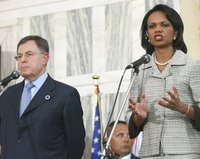
“Courting Syria,” by Itamar Rabinovich

Courting Syria

By Itamar Rabinovich
Haaretz, Nov. 24, 2006

A change in the United States' Middle East policy seems to be in the offing. The reasons for this expectation are the failure in Iraq and the defeat of President George W. Bush and the Republican party in the midterm elections, a failure that led to the immediate resignation/dismissal of Secretary of Defense Donald Rumsfeld.

The bipartisan committee headed by James Baker and Lee Hamilton that is examining U.S. policy in Iraq is about to publish its conclusions, and leaks indicate at least one central conclusion: "speaking to Iran and Syria" in order to change direction in Iraq. British Prime Minister Tony Blair, a close ally of Bush, even went as far as speaking not of "talks" with Iran and Syria but of "partnership" with the two. The issue of American-Syrian rapprochement took on an additional dramatic dimension this week with the assassination of Lebanese minister Pierre Gemayel, with sources inside and outside Lebanon pointing at Syria as the main suspect.

Iran and Syria have had an alliance of shared interests and cooperation since 1979. When Syrian President Bashar Assad came to power, the nature of this relationship changed. It is no longer an alliance among equals: Iran is now the patron and Damascus is the client. Iran, a country with resources, power and an imperial legacy, is trying to attain regional hegemony and nuclear weapons. Syria still exercises influence on players who are smaller and weaker than it (Lebanon, Palestinian organizations and to a certain degree Hezbollah), but for the most part it feels threatened by the U.S., Israel, its Lebanese rivals and in part France. Iran, on the other hand, offers Syria sponsorship and protection.

The Iranian challenge

Iran presents serious challenges to Washington. The immediate challenge focuses on Iraq. The American occupation and the downfall of Saddam Hussein released Iraq's ethnic demon and reinforced the Shi'ite majority. The violent conflict that erupted between the Shi'ites and the Sunni minority, with its historical hegemony, is one of the main factors preventing a sustainable order – or the appearance of such an order, and an American exit from Iraq that will not seem like an embarrassing failure. Shi'ite Iran is seen as a key both to calming the Iraqi Shi'ites and to imposing a sustainable order.

Less immediate, but more important, is the issue of the Iranian nuke. It is clear to everyone that the ayatollahs are determined to have nuclear weapons. The attempts to consolidate international sanctions against Iran have not succeeded to date, and the chances of success seem slight. An American or Israeli military operation against Iran seems to many in the U.S. to be a bad or impractical idea.

Beyond these immediate challenges, it is clear Iran is trying to become a regional power by nurturing Shi'ite communities in several Middle Eastern countries, disseminating its version of radical political Islam and using terror. Iran is threatening friends and allies of Washington, starting with Israel and including Egypt, Jordan and the oil-producing countries in the Persian Gulf.

Bush placed Iran on the axis of evil. But the message emanating from Blair's words, and perhaps from the Baker-Hamilton report as well, is that the attempts to threaten and isolate Iran have failed, and that trying to speak to Iran and to reach a deal on the above issues may be a good idea, even a necessity.

According to this logic, the U.S. would recognize the regime of the ayatollahs, promise not to undermine it, reach an agreement on the future of Iraq, try to keep Tehran from developing nuclear weapons and convince it to adopt a more moderate policy on Lebanon and Israel.

Syria is seen as a supporting actor in such a move. An understanding with Tehran would also lead to an understanding with Damascus. In such a case, Washington would cease its hostility toward Assad's government, and Assad would begin playing a more positive role in Iraq (closing the border to anti-American infiltrators), Lebanon (not rearming Hezbollah) and in the Israeli-Palestinian conflict (kicking Hamas and Islamic Jihad headquarters out of Damascus).

The chances of implementing a far-reaching step of this kind are not great. First, Bush will have to decide to take a dual risk: to agree in principle to a change in direction on such fundamental issues, and thus risk being humiliated because he both changed direction and failed. Second, he will have to choose a special envoy for the job. Baker is a natural choice. Would Secretary of State Condoleezza Rice accept this expropriation of the core foreign policy arenas?

And finally, there is the move itself. Will Iran really agree to suspend its nuclear policy? Does the U.S. know how to conduct negotiations with a regime that combines Muslim extremism with modern sophistication?

Taking Syria from Iran

Because of that, and in light of the possibility that the conflict with Iran will continue, becoming the central axis of Middle Eastern politics and U.S. policy in the region, a secondary question comes up: Would the U.S. try to distance Syria from Iran, and is there a chance of success?

The hegemonic alliance with Damascus is a central element of Tehran's policy. Syria provides Iran with access to the heart of the Middle East: Lebanon and the Israeli-Arab conflict. An American-Syrian understanding would affect three arenas: Iraq, Lebanon and the Palestinians. Tehran's prestige would suffer a severe blow. The conservative-moderate Arab countries would benefit from a shot in the arm, and American diplomacy in the region would chalk up an impressive achievement after a period of failures. But is this a realistic step?

Several topics would be on the agenda of such a step:

b The bilateral relations between the U.S. and Syria. These relations are presently at a nadir. Bush and his administration consider Assad and his government a hostile entity that is assisting the anti-American "rebellion" in Iraq, supporting Palestinian and Lebanese terror, and trying to destroy Lebanon's sovereignty and the stability of Fouad Siniora's government. President Assad and his regime, on the other hand, believe Bush's U.S. is trying to bring them down. An American-Syrian dialogue would start by restoring the relationship to its 1990 level. Syria would then seek an American promise not to undermine the regime, an improved atmosphere and an upgraded relationship.

b The Lebanese issue. Here we can anticipate problems. Syria considers Lebanon a strategic asset and a legitimate area of influence, while the U.S. is determined to protect Lebanese sovereignty and the 2005 anti-Syrian "revolution." Syria wants the investigation into the Hariri assassination shelved, while the U.S. is determined to resolve it. Bush is an ideological president who considers spreading democracy an important mission. The establishment of the Siniora government was a very significant achievement for him, as was the "expulsion" of Syria from Lebanon. For him, having the U.S. recognize Syria's "special status" in Lebanon would be difficult and embarrassing. Naturally, the decision to establish a special court to investigate the assassinations of Hariri and Gemayel are serious obstacles.

b The Golan Heights and relations with Israel. Assad wants the Golan back. Unfortunately, he must be seen as working toward this end, whether through negotiations or an armed conflict. The U.S. favors the principle of "land for peace" but has no desire to reward Assad, at least not at this stage. If an overall American-Syria understanding is reached, Bush will probably change his mind. However, at the moment the clear message from Washington to Jerusalem is that the U.S. is opposed to a renewal of Israeli-Syrian negotiations.

b Relations with Iran. Various Syrian spokesmen tell their interlocutors and the Western media that the alliance between Syria and Iran is not insoluble and that Damascus has been pushed into Tehran's arms out of a lack of choice, due to American hostility. These claims can be tested only by a U.S.-Syrian dialogue.

b The ongoing crisis in Iraq. The U.S. expects Syria first and foremost to hermetically seal its border with Iraq, and thus prevent the infiltration of weapons and fighters. More generally, it will want to see Syria as a partner in stabilizing Iraq, such that it can withdraw its forces without a sense of defeat and an authentic Iraqi government can function. Syria is interested in a U.S. withdrawal from Iraq and wants to see a friendly government across its eastern border. Syria currently considers the Iraqi arena a lever for counter-pressure on the U.S. and cooperation with Iran. But in the long run, the Iraqi chaos may threaten Syria's stability as well.

All the above indicate it will be relatively easy from Syria and the United States to reach an understanding on the bilateral issue and Iraq. The Lebanese and Israeli-Palestinian issues will be much more difficult to resolve.

Israel has a profound interest in these issues. A dialogue between Washington and Damascus would arouse questions and fears in Jerusalem. Despite the friendship with the U.S. and the Bush administration, Israel would feel profoundly uncomfortable when the Golan is placed on the agenda during an American-Syrian dialogue. Washington is now signaling to Jerusalem that it does not want Israeli-Syrian negotiations to begin, but what about the opposite? The lesson for Israel is clear. Time is not a neutral factor, passivity does not lead anywhere, and one who does not take initiative, even on a different front, will find himself ultimately reacting to the initiatives of others.

Prof. Rabinovich is the president of Tel Aviv University, and in the past served as the Israeli ambassador in Washington and the head of the negotiating team with Syria

Post Gemayel Prospects

It seemed clear before the Gemayel murder that President Bush was determined to thwart efforts to open up dialogue with Syria and Iran. The assassination will harden his resolve to isolate both countries and to "win in Iraq", as he insists he will. Instead, Washington seems intent on returning to the Palestinian problem to look for a way to defuse Arab passions and shore up Egyptian, Saudi Arabian and Jordanian support in confronting Iran and Syria.

This strategy is bound to fail. Saudi, Egypt and Jordan have little interest in combatting their neighbors. They can do nothing to help Washington win in Iraq. And Washington has proven that it is incapable of solving the Palestinian issue, let along fooling Arabs into thinking it is serious about pressuring Israel to withdraw from settlements. Bush's strategy will only further radicalize the region, exacerbate the blood letting in Iraq, and speed up the decline of its influence in the region.

The Wall St. Journal writes that an estimated 800,000 mourners, turned out in Martyrs' Square at the funeral of Gemayel in a show of force in support of the beleaguered U.S.-backed government.

Prime Minister Fuad Saniora went on national television Thursday night appealing to Hezbollah and its allies to resume a national dialogue broken off earlier in the month.

"Dialogue is the only and sure path that guarantees results," he said.

But his government was pressing ahead with one of the issues that prompted the crisis — the creation of a U.N.-backed international court to try suspects in the Hariri slaying, which Hezbollah opposes. A government official said Mr. Saniora called a Cabinet meeting for Saturday to approve the court…

After Mr. Gemayel's death, Hezbollah put off its threatened demonstrations for now, but will likely feel the need to respond with a show of strength after Thursday's funeral rally.

Business and industry leaders announced they would go on a two-day strike beginning Friday to pressure politicians from both sides to sit down and talk to settle the political crisis.

But the bitterness dividing the country was on vivid display.

Shadid in the Washington Post writes:

"They wanted it to be a contest, so let it be one," Samir Geagea, a Christian leader allied with the government, told the cheering crowd in Martyrs' Square. "We are not afraid one bit. We shall not give in. We shall not submit until the crimes stop."

"We are the true majority, and you are the illusion," said Hariri's son, Saad, who has inherited leadership of Lebanon's Sunni Muslim community and allied himself with Jumblatt and Geagea. "To them, we say, leave your illusions behind and return to the truth, return to the idea of sovereignty, return to national unity and return to Lebanon." [Shadid ends on a bleak note, raising the posibility of renewed civil war or the division of Lebanon.

Slackman in the NYTimes writes:

With the exception of Damascus, General Aoun seemed to generate the most hatred among those who gathered.

“He split the Christian line,” shouted Fadey Ghazehli, 21, after spitting on a picture of the general. “He used to say he would disarm Hezbollah. Now he is with Hezbollah.”

Taken together, the reaction to Mr. Gemayel’s death could be a strategic boost to the government coalition, analysts said. “Morally, the government coalition has had a lot of gains,” said Oussama Safa, general director of The Lebanese Center for Policy Studies, regarding the killing. “They defused the opposition. They revved up the March 14th coalition, which was dead.”

The WSJ qutoes Jumblatt:

Mr. Jumblatt said the assassination of Mr. Gemayel vindicates a message he took to Washington on a visit last month: Only pressure, not dialogue, can force Syria to moderate its behavior. The key, Mr. Jumblatt says he told Vice President Dick Cheney, Secretary of State Condoleezza Rice and Mr. Rumsfeld, the departing defense secretary, is the rapid establishment of a U.N. tribunal to judge Syrian officials and others implicated in Mr. Hariri's murder. 

"The main issue is the tribunal," he says. "There is no other issue. . . . This is why the Syrians are counterattacking in Lebanon. They want to topple the government because they know that somewhere they are responsible for the murder or murders."

Mr. Jumblatt says the U.S. has been right to try to promote democracy in the Middle East but wrong to snub the consequences — the rising clout of Islamist groups such as the Palestinian organization Hamas, which Washington denounces as a terrorist outfit. Without a Palestinian state alongside Israel, he says, the region will be doomed to an "an endless crusade" pitting Muslims against Israel and its supporters.

Democracy, he says, "is a risk worth taking . . . but the Arab world is becoming more and more radicalized because of Palestine."  Mr. Jumblatt, whose father and grandfather were assassinated, belongs to a clutch of veteran Lebanese politicians who have alternately fought and befriended each other for years and still command great influence, thanks to the loyalty of their various communities. The 57-year-old politician represents the Druze religious sect, an offshoot of Islam, whose members account for less than 10% of Lebanon's population.

These days, there are two basic, though highly unstable, camps in Lebanon: forces that back and are backed by Washington, and those, such as the Shiite Islamist movement Hezbollah, siding with Syria and Iran. The choosing of sides has led to some odd alliances.

Gen. Michel Aoun, a Christian former army chief who fled Lebanon in 1990 after armed clashes with Syrian troops and returned to Beirut last year, now stands with Hezbollah and other pro-Syrian groups. Mr. Jumblatt, who used to attend military parades in Moscow and was close to pro-Soviet Syria, has joined Syria's foes and blames Russian diplomats at the U.N. for initially stalling the Hariri tribunal.

"I don't hide my past," Mr. Jumblatt said in an interview in his ancestral mountain compound southeast of Beirut. "Yes, I've changed. I was pro-Syrian. OK. But I said, 'Enough is enough.'" Lebanon's politics, he says, "are a long, complicated story."

Mr. Jumblatt says he reminisced about the "good old times" with Mr. Rumsfeld when they met late last month at the Pentagon. When Mr. Rumsfeld visited Beirut in the early 1980s as an envoy for President Reagan, Mr. Jumblatt's forces shelled the airport. He was fighting at the time with a Christian militia run by Amin Gemayel, father of the cabinet minister murdered this week.

Mr. Rumsfeld, says Mr. Jumblatt, recalled the incident: "He told me: 'You were firing at me' . . . I told him: 'I'm sorry. At that time I was a warlord. Now I'm a democrat.'" Mr. Jumblatt says there was nothing personal, noting, "Our artillery was not very accurate." The Pentagon confirmed the meeting but declined to say what was discussed.

The former warlord says he now shares Washington's view that Iraq and the rest of the Middle East needed shaking up with a dose of democracy. "There was no way but for the Middle East to change," he says. But he faults Washington for ignoring the rise of Islamist groups as the only popular alternative to the region's dictatorial rulers. The U.S., he says, has to accept this and start dealing with Hamas and other groups inspired by Egypt's Muslim Brotherhood,
which the U.S. calls terrorists.

Scott McCleod of Time Magazine writes:

The regimes in Syria and Iran are bent on undermining U.S. policies, including support for Lebanese Prime Minister Fuoad Siniora, who came to office in last year's pro-democracy Cedar Revolution. But a key reason for the U.S.'s setbacks in the Middle East is it's chronic refusal to wholeheartedly address the root causes of conflict, such as the lack of a negotiated end to Israel's occupation of Arab lands, the failure to establish a Palestinian state and Western support for repressive Arab regimes. Instead, Washington labors under the fantasy that its political and military strength alone can win the day. With that approach fanning an unprecedented number of crises in the region, amid the largest long-term deployment of U.S. military forces in Middle East history, it is past time for Washington to learn from its mistakes.

Early-'80s Lebanon ought to have served as a cautionary tale heading off the U.S.'s more recent adventure in Iraq. In 1982, the U.S. backed an Israeli plan to invade Lebanon and destroy the Palestine Liberation Organization, kick out Syrian troops and install a pro-Western, Israel-friendly government led by Lebanese Maronite Christian leader Bashir Gemayel. Israel drove out the PLO, only to start negotiating with Yasser Arafat after a Palestinian uprising in the West Bank and Gaza trip a few years later…

Lip-service aside, the Bush Administration has largely ignored the 58-year-old Arab-Israeli conflict, which provides pretexts for wars, feeds political extremism and bolsters authoritarian regimes. Syria's price for good behavior in Lebanon and Iraq is the Golan Heights, occupied by Israel for nearly 40 years. Labor governments negotiated towards that end with Syria, but the current Israeli government insists that the Golan is part of the Jewish State…

This summer, Secretary of State Condoleezza Rice described Israel's pummeling of Lebanon as "the birth pangs of a new Middle East." A return to the old Middle East, more like it. Israel withdrew its forces from Lebanon, despite achieving few of its objectives. But U.S. support for Israel's bombardments gravely undercut the pro-American Siniora government to which Pierre Gemayel belonged and that now may not survive Hizballah's bid for greater power.  As I watch dramatic events in Lebanon yet again, the U.S. looks no more able to direct events than it was two decades ago when Pierre Gemayel's uncle lost his life and his father was deserted by Washington.

New York Newsday:

Internal strife within the Baker commission, outright opposition from President Bush and Tuesday's assassination of a cabinet member in Lebanon are complicating the prospect of U.S. overtures to Syria and Iran over Iraq, sources say.

Hoekstra drops visit to Syria

The current Republican chairman of the U.S. House of Representatives' Intelligence Committee is heading to Jordan and Lebanon next week in an effort to better understand issues in the volatile Middle East.

But Rep. Pete Hoekstra said he has dropped a planned trip to Syria from his itinerary following the assassination this week of anti-Syrian Lebanese Industry Minister Pierre Gemayel, who was gunned down in an assassination that many Lebanese blame on Damascus.

"With the assassination, this is a good time to just step back and not push the envelope," Hoekstra told the Ludington Daily News.

.

Flurry of Diplomacy to Build Alliance of Sunni Leaders;
Pressure Concerning Israel Could the Bloodshed Spread?

JAY SOLOMON
November 24, 2006; Page A1

WASHINGTON — As violence escalates in the Middle East, top U.S. officials are reaching out to traditional Sunni Arab allies in a bid to stabilize the region and build a coalition to contain Iran's Shiite regime.

Over the next week, President Bush is scheduled to visit Jordan, where he will meet with King Abdullah II and Iraqi Prime Minister Nouri al-Maliki. Vice President Cheney is flying to Saudi Arabia, and Secretary of State Condoleezza Rice is set to huddle by the Dead Sea with the foreign ministers of Saudi Arabia, Jordan and Egypt, among others. Issues on the U.S. agenda are expected to include how to bring order to Iraq and how to check Iran's nuclear program.

The visits highlight the administration's longer-term strategy to build a broad alliance of Sunni Muslim states to offset Tehran's growing regional ambitions. Since the spring, the U.S. has sought to increase cooperation between traditional Arab allies like Saudi Arabia and Egypt, including developing joint maritime patrols and a regional missile-defense shield for these countries.

In order to build such an alliance, however, the administration could be forced to shift its Middle East strategy in significant ways. Arab diplomats from ally countries are pushing Washington to be much more assertive in promoting peace between Israel and the Palestinians. They are also expected to advise the White House to scale back efforts to promote democracy in the region, arguing that they could lead to more extremism.

The flurry of diplomacy and Washington's outreach to long-standing Arab allies underscore the Bush administration's growing concern over Iran's influence. Iran announced yesterday it was proceeding with a plan to build nuclear reactors. But in seeking to contain Iran, many Middle East analysts warn, Washington could find itself in the middle of the long and bitter split between Sunnis and Shiites.

"The whole rhetoric of containing Iran could spark competing extremism" between anti-Iranian Sunnis and pro-Iranian Shiites, says Vali Nasr, a Middle East expert at the Naval Postgraduate School in Monterey, Calif. "Washington doesn't want to be seen as actively encouraging this."

In Baghdad yesterday, coordinated suicide car bombings and mortar attacks on the Shiite slum of Sadr City left at least 160 dead and hundreds more injured. Immediate reprisals against Sunni neighborhoods and against a revered Sunni shrine raised fears that the country was slipping further into civil war. (See related article.)

Regional leaders worry that bloodshed could spread to Lebanon, where political tensions have been rising in recent weeks. (See related article). Thousands of Lebanese took to Beirut's streets yesterday to protest Tuesday's assassination of Pierre Gemayel, a Christian cabinet minister who had sought to counter the political influence of Syria and Hezbollah, the Lebanese Shiite militia. Many in the crowd blamed Syria for the slaying, a charge Damascus denies, and accused Hezbollah of trying to topple Lebanon's democratically elected government.

Growing Power

The roles played by Iran and Syria in Hezbollah's rise are regarded as evidence of growing Shiite power across the Middle East. While Syria's population is majority Sunni, its ruling Assad family is from a Shiite sect. Many Arab leaders fear a powerful Shiite axis taking shape between Iran, Syria and Hezbollah.

Many Lebanese leaders have expressed concern recently that their country also could descend into civil war. Some contend that Mr. Gemayel's slaying is part of an effort by pro-Syrian forces to head off a United Nations investigation into the 2005 assassination of former Prime Minister Rafik Hariri. The initial U.N. investigation implicated senior Syrian officials, an allegation that Syria denies. This week, the U.N. Security Council passed a resolution establishing a tribunal to oversee the trial of anyone charged in that case. The Lebanese government has to consent to any trial.

How Mr. Bush responds to pressure on the U.S. to get more involved in ending the Israeli-Palestinian conflict could affect Washington's relations with its Arab allies in the region, as well as relations between Sunnis and Shiites. Arab diplomats say countries such as Saudi Arabia, Egypt, Qatar, Kuwait and the United Arab Emirates will find it difficult to publicly stand with the U.S. on Iran and on broad regional stability unless Washington pressures Israel on a peace initiative.

"The road to Baghdad runs through Jerusalem, and not the other way around," says one senior Arab diplomat in Washington.

There are signs that the White House may be coming around to this view. Philip Zelikow, a top policy adviser to Ms. Rice, said in a September speech that an "active policy on the Arab-Israeli dispute is an essential ingredient to forging a coalition that deals with the most dangerous problems" in the Middle East. A few days later, Mr. Bush told the U.N. General Assembly that he had asked Ms. Rice to lead a diplomatic effort to engage moderate leaders across the region to help Israelis and Palestinians resolve their differences.

Previously, neoconservatives in the Bush administration had argued that peace in Israel could only be achieved through the removal of dictatorial regimes such as Saddam Hussein's, which funded militant groups targeting the Jewish state. Many Arab allies of the U.S. oppose that approach.

Arab officials are expected to push the Israel issue during their upcoming U.S. visits. President Bush and his top lieutenants hope to use the discussions to continue efforts to bring together Sunni Arab states to offset the growing regional clout of Tehran's Shiite theocracy. Sunni leaders in Saudi Arabia, Jordan and other countries worry that Iran's rising influence could stir up their own Shiite minorities or other groups hostile to the U.S. and its allies.

Islam's split into Sunni and Shiite sects dates back to differences over who should succeed the prophet Muhammad after his death in 632. Sunni-based royalty and political parties have held power in most of the Islamic world since then, relegating Shiites to the political and economic minority. Iran's 1979 revolution brought to power a Shiite theocracy that rekindled regional Shiite political activism. Iran's influence increased when a Shiite-led government took over in Iraq after the 2003 ouster of Mr. Hussein, and through Iran's support of militant groups fighting Israel, including Hamas and Hezbollah.

Many Arab and U.S. officials were alarmed this summer by Hezbollah's military strength in its fight against Israel. Tehran has supported the group for decades with funds and arms. Hezbollah's main goal has been fighting Israel, which invaded Southern Lebanon in 1982 and occupied it until 2000. But Iran has also viewed the group as a deterrent to the U.S. and Israel. Today, Hezbollah, with its extensive social and political networks and military capability, behaves in many ways like a state within Lebanon.

Leaders of Sunni Arab states warn that wars in Iraq and Lebanon risk upsetting the regional balance between Sunnis and Shiites. They have also voiced concern that their nations could be dragged into the fighting on behalf of militias or terrorist groups that share their religion. Civil war in Iraq could force Saudis to fight "shoulder to shoulder with al Qaeda," said Jamal Kashoggi, an adviser to Saudi Arabia's Prince Turki al-Faisal, at a conference on the Middle East last week in Washington.

U.S. leaders will be traveling into the heart of the Sunni world. Mr. Cheney is set to arrive today in Riyadh, Saudi Arabia's capital, where he will discuss Middle East developments with King Abdullah. In a visit hosted by King Abdullah II of Jordan starting Nov. 29, Mr. Bush is scheduled to hold two days of meetings with Iraqi Prime Minister Nouri al-Maliki to discuss ways to stabilize Iraq.

On Nov. 30, Ms. Rice will kick off meetings with foreign ministers from Saudi Arabia and other Gulf Cooperation Council members, along with Jordan and Egypt. They are expected to discuss how to deter Iran from meddling in the politics of neighbor countries and from developing a nuclear arsenal, say officials involved in setting up the meetings. Arab leaders are likely to bring up the Israeli-Palestinian issue.

The visits come amid U.S. efforts to build a Sunni-based regional alliance. U.S. naval fleets have engaged in training exercises with several Persian Gulf countries. Last month, the U.S. conducted war games with Bahrain, Qatar, the U.A.E. and about two dozen other countries about 20 miles outside of Iran's territorial waters. The exercises were part of the Bush administration's Proliferation Security Initiative, which seeks to stanch weapons trafficking.

State Department officials such as John Hillen, assistant secretary for political-military affairs, have in recent months visited the six Arab countries that make up the Gulf Cooperation Council, or GCC, as well as Egypt, Lebanon and Jordan, to work on revamping the region's security framework. Saudi Arabia formed the GCC in 1981 to coordinate economic and security issues among Persian Gulf states. Other members include Oman, Qatar and the U.A.E.

Mr. Hillen is pushing a plan to better integrate the U.S. into the GCC's security architecture. The plan calls for helping GCC member nations to develop regional maritime-security and missile-defense initiatives, to share intelligence, and to improve air defenses. The Bush administration wants to incorporate all GCC countries into its antiproliferation program.

Mr. Hillen maintains that the initiatives shouldn't be viewed as anti-Shiite. "In fact, the vast, vast preponderance of U.S. efforts in the region are oriented on making sure a majority Shiite government led by a Shiite prime minister succeeds" in Iraq, he says.

[Balancing Act] 


.

.

.

Many Middle East analysts are skeptical that Washington's containment strategy for Iran can work. Few Arab governments have militaries capable of confronting Iran on their own, and many people in the region are sympathetic to Iran's confrontational stance toward the U.S. and Israel. Ultimately, these analysts say, Washington may be forced to choose between pushing the nuclear issue with Iran and working with it on stabilizing Iraq.

Conflicting Messages

The U.S. itself has offered conflicting messages. A coming report from an advisory group led by former Secretary of State James Baker and former Rep. Lee Hamilton is expected to urge the White House to engage both Iran and Syria to help ease violence in Iraq. Iran has allegedly armed and funded Shiite militias that are fighting Sunni insurgents in Iraq. The U.S. has alleged that Syria has allowed al Qaeda and other foreign fighters to cross into Iraq.

Mr. Baker has said he believes Iran and Syria share Washington's interest in preventing violence in Iraq from worsening, and perhaps spilling over its borders. Some counterterrorism officials believe Iran shares the U.S. goal of combating al Qaeda and other militant Sunni organizations, which have a history of targeting Shiite communities.

President Bush and other senior U.S. officials have repeatedly cast doubt on the utility of seeking help from either Iran or Syria. Mr. Gemayel's assassination could further diminish Washington's interest in talking with either nation. U.S. officials have implied that Syria was involved in Mr. Gemayel's shooting, citing its alleged targeting in the past of anti-Syrian politicians.

The greater fear is that a U.S.-led Arab coalition against Iran could bring the region's tensions to a boil. Lebanon is seen as particularly vulnerable, and Sunni and Christian political parties in Beirut are worried by Hezbollah's moves to gain power. Some fear Lebanon could slip into a sectarian civil war like the one that ravaged the country in the 1980s.

Other countries could also be vulnerable to rising Sunni-Shiite tensions, analysts say. Saudi Arabia's Shiite minority lives in some of the kingdom's most resource-rich areas and has increasingly sought to expand its political influence. Afghanistan and Pakistan have endured sectarian violence in recent decades. And countries like Kuwait, a major oil exporter, and Bahrain, which has close ties to the U.S., are trying to preserve the uneasy balance between their Sunni and Shiite populations.

Lebanese Assassination may Impair US Mideast Policy

Lebanese Assassination may Impair US Mideast Policy Zaman Online – Istanbul,Turkey … Joshua Landis, an expert on Syria from Oklahoma University, underlined that US president George W. Bush blamed Syria and Iran for the murder. …

The Gemayel Assassination

I appeared on the PBS News Hour to discuss the Lebanon situation across from Hisham Milhem this evening – Wednesday, November 22. The transcript is here.

Lebanon Struggles to Maintain Stability After Assassination
PBS – USA, Nov. 22, 2006
RAY SUAREZ: Hisham, Joshua Landis suggests both sides playing hands where the United States doesn't hold very many good cards, doesn't have very many good …

Commentary: The Lebanese Civil War is not over. The battle for control of Lebanon was never confined to parliament as it should have been in order to mark a true end to civil strife. Instead it has continued to be fought on the streets Beirut with assassinations and the blood of innocents. The murder of Gemayel reminds us that the struggle for Lebanon remains a blood sport. 

The targeted assassinations of Hariri, Gemayel, and many others by the Lebanese opposition demonstrates its efficacy and cold blooded precision.

By contrast, the scatter bomb has come to symbolize the misdirected efforts of the United States and its allies to retain Lebanon in a Western orbit. Israel failed to kill Hizbullah's leader Shaykh Nasrallah this summer, or to assassinate his lieutenants, as it said it would. Instead it laid down a bed of scatter bombs in southern Lebanon that continues to kill or maim primarily women and children. The pro-American Lebanese have been unable to protect their leaders or kill their opponents. Not so the anti-American forces in Lebanon. The superior firepower of the West has done little but stir up a hornets nest and underscore its impotence in the Lebanese theater of war. This is the hard reality of Lebanon.

If the situation continues along this path, the Lebanese government will be forced to bend to the opposition's demands and either call new elections or expand the cabinet to give Hizbullah and its allies veto power government decisions. [end]

I have not been posting because I am in Chicago visiting friends for Thanksgiving. I did not bring my computer for the first time in three years!

All the same, I have been busy talking with reporters, all of whom want to know if Syria is responsible. Here are a few of the news articles that have used quotes of mine in the last few days.

Gemayel's Killing Hits US Mideast Policy
Naharnet – Beirut,Lebanon
An early casualty may be the idea of dialogue with U.S. foes Damascus and Tehran. "It is going to be much harder," said Joshua Landis, a Syria expert and co-director of Peace Studies at the University of Oklahoma. …

Lebanon "certainly was the sort of crown jewel in the administration's Middle East portfolio, but they are going to have to regroup," said Schenker who served Bush as a Pentagon Middle East advisor.

Bilal Saab said the failure of the Saniora government would be a "setback for the Bush administration."

"The Americans believe that this government is capable of advancing U.S. interests — the flourishing of democracy in the region — and they see Lebanon an example of democracy taking its way," he said.

Landis was blunter. "Lebanon is the last success story. If it falls, it is the end," he said.

"The U.S. is going to use Lebanon as a battering ram," against Syria and Iran, Landis said. Syria meanwhile, "feels the tide is running out on America's imperial authority in the Middle East."(AFP)

Lebanon slaying dims chances of US overture to Syria
International Herald Tribune, By Sally Buzbee, Wed, Nov. 22, 2006
… since. "In some ways you can read this as upping the ante," said Joshua Landis, a Syria expert at the University of Oklahoma. Most …

Beirut aftershocks hit US Mideast policy
Khaleej Times – Dubai,United Arab Emirates, Wed, Nov. 22, 2006
… “It is going to be much harder,” said Joshua Landis…

Syria Is Prime Suspect, But Not the Only One, in Gemayel …
Voice of America – USA, By Gary Thomas, 22 November 2006

… Joshua Landis, a Syria expert and co-director of the Center for Peace Studies at the University of Oklahoma, says Gemayel's killing could have been done by …

Iran summit idea could assist US, analysts say
San Francisco Chronicle – CA, USA

Washington's in paralysis. They don't know what their policy will be," said Joshua Landis, a Syria expert at the University of Oklahoma. Given the fears that Iraq may collapse into complete chaos, said Landis, "Iraq and the neighbors cannot afford to wait two, three, four months for Washington to figure out who's on first, who's on second and what their Iraq policy is. So they're driving the situation right now."

While it's unlikely the White House is prepared to begin those talks without preconditions, such as Iran abandoning its nuclear program or Syria doing more to secure its borders, some analysts warn that America stands to lose even more if it simply stands by while Iran and Syria sit down with Iraq to discuss that tattered nation's future.

"You don't want that. America wants to be leading this policy and working together with these people," he said. "If this meeting doesn't happen, the next one will, unless America gets on the phone and talks to both of these capitals and says we're going to work something out with you."

Envisioning US Talks With Iran and Syria
New York Times, Michael Slackman, Nov. 19, 2006
… “Syria is quite realistic, if proud and stubborn,” said Joshua Landis, an assistant professor of Middle Eastern Studies at the University of Oklahoma.“It will accept serious American offers and insist that the problems be dealt with comprehensively.”

Focusing on Iraq, Afghanistan and the Israel-Palestinian conflict might be a realistic way for the United States to navigate with Iran and Syria. That is true partly because the Iranians and Syrians both understand, no matter how reluctant they are to express it publicly, that the United States can help them stabilize their regimes and help settle regional problems. “You can’t have a deal in the Middle East without the Americans, regardless of the judgment we carry,” said an Arab diplomat who spoke on the condition his name and nationality not be identified because of the sensitive nature of the topic.

But bolstering those regimes is a lot to ask of the United States….

In any event, Mr. Hadley said last week, America would never trade away its determination to stop Iran from obtaining a nuclear weapon in return for help in Iraq.

Curbing the Crisis in Lebanon
Voice of America, 16 November 2006

… This conflict, says Joshua Landis, Director of the Center for Peace Studies at the University of Oklahoma, focuses on two diverging views. "One is that Lebanon belongs with the West, with the United States.  And that's what's being upheld by the March 14 crowd.  The other is that the United States is bad for the Middle East.  It's brought war.  It's brought an Israeli invasion, and that Lebanon belongs with Syria, [it] belongs with the Arab nations, and belongs with Islam.  And that is the major dispute and it's the fundamental identity question that Lebanon has yet to resolve," says Landis.

“Talk To Syria Now, Says Syrian Jewish Maverick,” by Larry Cohler-Esses

Larry Cohler-Esses – Editor At Large
THE JEWISH WEEK OF NEW YORK
FRIDAY, NOVEMBER 24, 2006
 

In a surprising move, a leader of Brooklyn’s large, generally hawkish Syrian Jewish community has lambasted Israeli Prime Minister Ehud Olmert for refusing to talk with Syria, as pressure built on multiple fronts on Washington and Jerusalem to dialogue with Damascus.

Jack Avital, a longtime confidante of Ariel Sharon and chairman of the Sephardic National Alliance, told The Jewish Week last week he planned to publish an open letter to Olmert laying out his case against Israel’s rejection of such talks to the Syrian Jewish community.

“Maybe we should remind you,” he chides Olmert in the letter, “that if any Arab leader is sending signs of peace—maybe the slightest ones—you should respond. You should immediately check his sincerity and seriousness. You do not have the moral permission to avoid him. You must do it for the sake of those you may demand to sacrifice their lives in case war commences.”

The letter, notable for its unexpected source, is to be published in the Syrian Jewish community’s monthly magazine, Image. It comes as Syria’s leaders have issued repeated calls for peace talks with Israel without preconditions; as British Prime Minister Tony Blair has called for talks with Syria and Iran to stabilize the Middle East—breaking with his partner, President Bush; and as the congressionally mandated Iraq Study group, headed by Bush family counselor James Baker and former Rep. Lee Hamilton, prepares recommendations for Bush that reportedly include proposals to initiate contacts with Syria and Iran—proposals that may find a receptive ear in the new Democratic congress that will greet Bush next year.

Olmert and Bush have rejected talks with Syria, citing Damascus’ hosting of terrorist groups opposed to Israel’s very existence, such as Hamas and Palestinian Islamic Jihad. Their suicide attacks against civilians in Israel have killed hundreds. The U.S. and Israel have also demanded Syria end its support for Hezbollah, the radical Lebanese Shiite group against whom Israel fought a month-long war last summer. Israeli Consul General Arye Mekel said an end to Syrian support for these groups was a “precondition” for any peace talks. Bush, in addition, demands Syria’s cooperation in stabilizing Iraq, where U.S. troops are increasingly beleaguered.

But Syrian Ambassador Imad Moustapha indicated to The Jewish Week last week that any such actions by Damascus would be a product of peace talks, if successful—not a precondition for them.

“Once peace talks between Syria and Israel start, all issues will be on the table,” said the Washington envoy in an interview at the Syrian Embassy last week. “We repeat: We are offering full recognition and full relations in this peace process. They [the Israelis] have nothing to lose. We are very clearly saying, we want to talk to you; we want to have peace.”

He strongly distanced his country’s position from that of Iran, Syria’s ally, whose president has stated his desire to see Israel “wiped off the map.”

“We had excellent relations in the past with Iran,” Moustapha said when questioned about the alliance. “But it did not prevent us from seriously working on a peace agreement with Israel.” Moustapha referred specifically to U.S.-brokered talks in Shepherdstown, W.Va., in January 2000, when Israel and Syria came literally within meters of an agreement on the Israeli-occupied Golan Heights. President Clinton later faulted Israeli Prime Minister Ehud Barak for failing to respond to Syrian flexibility then. Clinton blamed Barak’s fear of domestic political costs.

Moustapha stressed that restarted negotiations should be part of a “comprehensive package” that would resolve each sides’ outstanding issues. For Syria, he said, these include Israel’s occupation of the Golan, taken during the 1967 Six-Day War; Israel’s retention of the Sheba Farms area claimed by Lebanon; and an independent state for the Palestinians.

Pressed on Israel’s grievances regarding Syrian support for Hamas, Palestinian Islamic Jihad and Hezbollah, Moustapha reiterated his country’s commitment to achieving “full” peace. “My response has been implying what you’re asking,” he said. “Israel’s leadership understands exactly what would be the outcome of a peace process with Syria.”

Assad Statements

The envoy’s comments echo those of his president, Bashar Assad, who has called for peace talks with Israel in at least six interviews with various media outlets since the end of the war in Lebanon this summer. “Syria is ready to open unconditional negotiations with Israel. We want a pacific solution for the crisis in the Middle East,” Assad told the BBC last month. But in interviews with Arab media outlets Assad has also warned that in the absence of talks, Syria was prepared to go to war.

In 2002, the Arab League adopted a Saudi initiative offering Israel “normal relations” in exchange for Israel’s full withdrawal from occupied territories, including East Jerusalem, and the “return of refugees”—a reference to Palestinians who were forced out of or fled their homes during Israel’s 1948 Independence War. Asked if the talks he envisioned would come under this umbrella, or be direct and bilateral, Moustapha replied, “They’re not mutually exclusive. There needs to be a Syrian-Israel peace track. But the conflict has always been about the Palestinians. There should be a comprehensive deal.”

In Avital and his supporters within the Syrian Jewish community, Moustapha has found surprising allies. Even as establishment Jewish groups supported Bush and Olmert, Avital compared Olmert to Israeli Prime Minister Golda Meir, who rebuffed a 1972 appeal for peace talks from Egyptian President Anwar Sadat.

Sadat launched the costly Yom Kippur War a year later, but reached a U.S.-brokered full peace with Israel in 1979 at Camp David.

“Look how much blood was spilled,” Avital lamented. “Three thousand soldiers because of Golda’s response. The same thing is happening now with Syria. Will they have to lose more soldiers now to make peace?”

Avital argued that Sharon, a frequent guest at his home, “today would probably reach out to Assad.”

The Syrian Jewish activist even seemed to endorse Moustapha’s stress on the need to include the Palestinians as part of a peace package. He called for immediate talks between Israel and Palestinian President Mahmoud Abbas.

“Approach the Palestinians, Mr. Olmert,” he appealed. “Approach them over the heads of Hamas.”

Asked if Israel should even talk with Hamas, if necessary, given that it controls the democratically elected Palestinian legislature, Avital replied gruffly, “Why not? This attitude, that the Arabs know only force, doesn’t work anymore.”

Avital lamented a recent Israeli bombing in Gaza that missed its intended target of rocket squads in an orange grove and instead killed 18 civilians asleep in their homes close by.

“The cost is just more revenge,” he said. “The Lebanon war, just bombing civilians, this bloodshed, leads just to more revenge. … When a kid sees how a soldier does not respect his father, how does he grow up? With hate.”

Out On A Limb?

It is unclear how much support Avital, a successful men’s clothing manufacturer, has for his activist stance among Syrian Jews—a wealthy, publicity-allergic and fiercely pro-Israel community whose large and handsome homes crowd the streets of Brooklyn’s Midwood neighborhood. For years those homes and community synagogues have been regular fundraising stops for Israeli politicians from the Likud Party and even further to the right.

One surprised Syrian Jewish political activist said, “His reputation is as an ultra-hawk. That letter to Olmert will cause shockwaves in the community. This is a community in which Bush is very popular, and Fox News is viewed as too liberal.”

But the activist, who would speak only on condition of anonymity for fear of what he described as Avital’s power and influence in the community, also noted that Avital has a history of “making overtures to Syria” with the community’s support.

“It’s his statements about peace with the Palestinians that are totally shocking,” he said.

In fact, Avital’s history with Syria, and the community’s support for it, dates back to at least 2000. When Syrian President Hafez Assad — Bashar’s father — died in June of that year, Avital organized a community memorial service for him attended by Moustapha’s predecessor as Syrian ambassador. The community’s chief rabbi, Shaul Kassin, blessed the service with his presence — the ultimate endorsement for a community in which the senior rabbis have the final word.

In a paid New York Times obituary notice, Avital and fellow Syrian activists Sam Domb and Jack Kassin — Rabbi Shaul Kassin’s son — declared their “heartfelt sympathy” for Assad’s family, described him as “a great leader” and wished Bashar “strength to continue his success.”

Avital said he acted then to show gratitude for the senior Assad’s 1992 decision to allow Syrian Jews still in Syria to emigrate freely after decades of restriction, and to even retain their property and assets in Syria, where they may today come and go.

“With the Arabs, if you do something for the father, they remember for a lifetime,” Avital explained.

The memorial service strengthened a previously casual relationship with the embassy, said Avital. When Moustapha arrived in Washington in 2002, he promptly reached out to the community and was put in touch with Avital, who invited him to a meeting with other Syrian Jews at which he asked his wary hosts one favor:

“I said, whenever you have a bar mitzvah, wedding, I want to be there,” Moustapha related. “Since then, I have attended four weddings and one bar mitzvah.”

In 2004, Moustapha took the relationship one step further: He invited Avital to organize a delegation of Syrian Jews to visit Syria, where they met with Assad and numerous other government, business and religious leaders. The delegation included members from some of the community’s most prominent families.

Avital was impressed. Assad, he recalled, “came to the door to greet us when we arrived for our meeting. He gave us very good respect, a warm embrace. People in the street gave us a warm welcome.” Their visit was front-page news in the government-controlled press and led the TV evening news. The delegation also visited the Jewish community’s ancient cemeteries and old, now unused synagogues. “They kept them so clean” despite the Jews’ absence, he recalled.

The State Department supported the visit strongly, said Avital, and the U.S. ambassador in Damascus threw a reception in the delegation’s honor.

But Malcolm Hoenlein, executive vice president of the Conference of Presidents of Major Jewish Organizations, which opposes talks with Assad, had words of caution regarding Avital’s lastest stand, “I don’t know that he speaks for anyone officially.

I think many of the Syrian Jews would take quite a different view. He’s invested a lot in the relationship. The question is what for? What’s his agenda?”

Syria Wants Clear US Commitment to Exit Iraq

So long as President Bush believes that the US is winning in Iraq, there will be no rapprochement with Syria. Syria's price will be too high. Syria is asking the US to make a clear statement about leaving Iraq. In other words, Syria is saying that if Bush will admit defeat in Iraq, Syria will help. And, by the way, Syria wants an expanded Lebanese cabinet, an end to the Hariri investigation, the Golan up to the water, and an independent Palestinian state in all the occupied territories. Thank You. 

President Bush in Vietnam

"President George W. Bush said Friday that the American experience in Vietnam contained lessons for the war in Iraq. Chief among them, he said, was that "we'll succeed unless we quit."

"The Maliki government is going to make it unless the coalition leaves before they have a chance to make it," he said of Iraq's prime minister. "And that's why I assured the prime minister we'll get the job done."

Nir Rosen's anatomy of a civil war. [Excellent: Gives a real sense of who Muqtada al-Sadr is.]

No posts for a few days: I will be leaving to Boston to attend the Middle East Studies Association Conference tomorrow, which will keep me from posting for. I will be speaking with Andrew Tabler on Syria's relations with the US Saturday evening at the Syrian Studies Association meeting at 7:00 pm. On Monday I will speak with Juan Cole, Asad Abu Khalil, Helena Cobban and Abu Aardvark on blogging: "Is it good for your career?"

In the article, Baker Met Syrian Envoys to Urge Cooperation Against Iraq Unrest By Janine Zacharia, Nov. 17, Syria's Ambassador to the US, Imad Mustapha explains what influence Syria has in Iraq that can be used to help the US. He explains that Syria can help bring the Sunnis and Muqtada al-Sadr toward a deal. In exchange, "We are just telling them there should be a very clear announcement about, a commitment for, withdrawal,'' Moustapha said. Here is a bit of the article.

Syria believes it can play an important role in restoring stability because many Iraqis, particularly the Sunnis, “have started looking at Syria as someone who can protect their interests,'' Moustapha said in the interview. He also cited Syria's close ties with anti-American Shiite cleric Moqtada al- Sadr, who he said frequently travels to Damascus, once for a two-week stay.

“Most of these guys feel disenfranchised today in Iraq, so we can have some leverage on them,'' he said…

Withdrawal Sought

Syrian officials told the Iraq Study Group that the U.S. needs to announce a readiness to withdraw troops if Iraq is to be stabilized.

“We are just telling them there should be a very clear announcement about, a commitment for, withdrawal,'' Moustapha said. “As long as certain Iraqis believe you are not planning to withdraw, they will continue to fight against you.''

Baker's spokesman, John Williams, while calling the Syrian account generally correct, noted that Baker “never asked'' the Syrians for help in advance of the 1991 war, and only explained to them why it would be in their interest to get involved.

U.S. engagement with Syria and Iran — an idea that is gaining traction among Democrats, in particular — is emerging as a possible element of the Iraq Study Group's recommendations. Such a proposal might set up a conflict with the Bush administration, which has shown little openness to engage in dialogue with the Syrian leadership…

“The last time the Syrians engaged with the Americans it was substantial, it was solid and we delivered,'' Moustapha said.

No `Revolution'

U.S. policy makers accuse Syria of meddling in Lebanon and sheltering Palestinian terrorists.

“I don't think we should expect a revolution in the administration,'' said Dennis Ross, who served as special Middle East envoy under President Bill Clinton. “They are six years in power. There is a certain set of attitudes. There is a certain approach.''

Secretary of State Condoleezza Rice reflected that skepticism in comments to reporters en route to Vietnam on Nov. 14. “There's no indication that Syria wishes to be a stabilizing force,'' Rice said.

Here is a bit of Nadim Shehadi's article in Chatham House's "The World Today," which I received in PDF. Namid adds in an email:

I have always been in favour of engagement with Syria and Iran and think it is absurd to ask the neighbours 'not to interfere'. This should have happened before, now may be the wrong time. Iran and Syria feel too strong and victorious after this summer's fiasco and this will be perceived by them as capitulation. 

IRAN-US CONFRONTATION IN LEBANON by Nadim Shehadi

After a test run in Lebanon, the choice for the US is between capitulation via Syria or escalation via Iran. October, 2006

CAPITULATING TO DAMASCUS

If the choice [of the US] is capitulation, then Syria could play a pivotal role. There is already talk of re-engaging Syria, the only state in the region that holds all the strings. Damascus hosts the political leadership of Hamas, led by Khaled Meshaal who is seen to be more in control of the issue of the captive soldier in Gaza. It has good relations and a strategic alliance with Iran, influence over Hizbollah, and links with Saudi Arabia, Egypt and Qatar. Syria also has influence in Iraq and could cause problems there.

Capitulation can come in various forms. US President George Bush and French President Jacques Chirac have been threatening Syria for the past three years, putting pressure on, getting it out of Lebanon, imposing sanctions, isolating it, calling for regime change and supporting the opposition.

If after all this, they cannot stomach the possibility of grovelling to Damascus asking for favours, they can always do it by proxy under the cover of an Arab initiative. This would be made up of Qatar and Saudi Arabia with their cheque books and Egyptian diplomacy. Syria would reap the benefits. This would be capitulation light but capitulation nonetheless, and it would be costly.

Syria will extract a very high price which may involve it regaining power in Lebanon, concessions over the Hariri investigation, changes of policy on the Iranian nuclear issue, Iraq, Palestine, the Golan Heights, an end to its isolation and lots of economic incentives. 

A deal with Syria for the sake of stability would also be costly if it is seen as a complete reversal of declared US policy and the collapse of its more recent justification of the Iraq invasion and the regional democratisation agenda. If the west went through all this to end up making a deal with another President Assad to resolve problems that he helped create, it might as well have done a deal with Saddam or Osama Bin Ladin in the first place. The US has heavily invested in this project and it would not be as easy to ‘redeploy’ or cut and run as it did in 1983. Iraq has already cost well over $200 billion. 

Israel would be more in favour of capitulation than the US.

It never took the US democratisation agenda seriously and wouldbe more comfortable dealing with a reliable dictator than thecomplexities of democratic neighbours. Both Syria and Israel have shown some enthusiasm for the resumption of bilateral talks and there is a significant lobby in the US calling for that. The more important dilemma from the Israeli perspective is that capitulation may allow Iran to continue developing its nuclear capacity and become a more serious problem in ten to fifteen Years. 

ESCALATION WITH IRAN

If it is too difficult for Israel to admit defeat by Hizbollah andtoo awkward for the US and its allies to grovel to Damascus,knowing how high the price is going to be, then the second choiceis escalation. Escalation is essentially going to be with Iran. Escalation light with Syria will not do, the two countries signed adefence pact before the hostilities, so an attack on Syria isconsidered to be an attack on Iran. The threat of sanctions is not credible and would have to be diluted to be politically feasible. Iran’s complex and deep-rooted relations with China, Russia, India, Turkey, Central Asia and most of the Arab world would render such actions all but ineffective. Sanctions or the attempt at sanctions would only gain time.

A military escalation or attack on Iran would be the only option, but this also has very serious consequences. It is possible that such a confrontation would cause a transatlantic rift similar to the one over the Iraq invasion. It would endanger Gulf security and as a result energy supplies would be at risk, Tehran has already indicated that the Strait of Hormuz would be threatened. Iran can also cause a lot of trouble in Central Asia and all these factors are of great concern to both Russia and China. Escalation can quickly acquire global dimensions and get out of hand. 

The collision can still be avoided with greater European intervention, resolving the outstanding border issues between Syria, Lebanon and Israel and making a serious move on the Israeli-Palestinian question. Washington has lost much of its credibility as an honest broker and it is time for Europe to provide a new direction.

Is Syria Asking Too Much?

Syria is demonstrating that it will and can be accommodating on the Palestine front. Syria is throwing Washington and Tel Aviv a bone in Palestine by pushing Hamas to work out differences with the PLO. Washington wants more bones before it will agree to talk to Syria, but it looks as if Syria will hold firm on the Lebanon front and stair down the US. And why not?

Last year a leading Syria told me that the attitude of the countries leaders was that if the US believed that it could use Iraq and Lebanon as a base from which to launch an anti-Syria campaign, Washington would be sorely disappointed.

"Why?" I asked.

He replied, "Because Iraq and Lebanon are not nations. They are like quicksand and they will suck America into a swamp of infinite factionalism and weakness. This is what happened to Israel in 1982, when it tried to use Lebanon as a base to isolate and then bring down the Syrian regime.

"If this is in fact the Syrian belief, and there is plenty of indication that it is, then Damascus must be feeling vindicated. Washington is in big trouble in Iraq, which is bound to get worse. Washington is also in big trouble in Lebanon. Polls demonstrate is has lost popularity since supporting Israel's failed campaign to demolish Hizbullah. Pro-Syrian Lebanese have been emboldened to try to bring down the pro-American government. In the US, the Democrats have dealt Bush a blow. 

The Syrian elite will undoubtedly be saying to itself, "time is on our side. The Americans are still insulting us and claiming that our negotiating price is too high, but they are sinking in a swamp. Today the quicksand is up to their chests. But tomorrow it will be up to their nostrils; then the price will not seem too high or unreasonable. We tried to warn them not to invade Iraq, but they would not listen. Another year in Iraq and they will learn manners."

Syria exerts backstage influence on Hamas
By Khaled Yacoub Oweis
, Nov 16, 2006

DAMASCUS (Reuters) – Syria has stepped up backstage diplomacy to press Hamas into sharing power to demonstrate that Damascus remains a key player in the Middle East, Palestinian officials and analysts say.Open to a rapprochement with the West, Damascus has been gently pushing its ally Hamas into solving differences with President Mahmoud Abbas on a new Palestinian government that have played into the hands of Israel, they said.

The political failure of Hamas would reflect badly on Syria, which has expressed readiness to resume talks with Israel as part of a Middle East peace deal and is keen to show the United States it remains central to the region's politics.

A new Palestinian administration could prompt the West to ease sanctions imposed after Hamas, whose charter commits it to the destruction of Israel, took power in March after elections. The group, whose leader Khaled Meshaal lives in Syria, has abandoned its insistence on heading a new government, but no one doubts it will remain a force to be reckoned with in Palestinian politics.Independent Palestinian lawmaker Mustafa Barghouthi, who is mediating between Hamas's leaders and Abbas, told Reuters that Syria wants to change a perception that the exiled leadership of Hamas is extremist."Syria does not want the Palestinian government to turn into a theatre of Arab disputes and is strongly backing Arab efforts to conclude a deal. We would not have reached so far without the exiled leadership," Barghouthi told Reuters in Damascus.

Camille-Alexandre writes: Jihad El-Khazen of al-Hayat asked Hamas' leader Mashaal if he worries Syria will “sell out Hamas” if a deal is made with the Americans. Khaled Mashaal replied confidently “no, there will be more Syrian support.”

Syria will not get satisfaction for its gesture on the Palestinian front. Here is how the Jewish Forward explains Bush and Olmert's negative view of talking to the Syrians: "According to the Bush administration’s view, Assad wants not only the Golan Heights but also stronger control over Lebanon.  There really isn’t a reward big enough to give Assad.”

Olmert Hugs Bush, Praises Iraq War
Right-click here to download pictures. To help protect your privacy, Outlook prevented automatic download of this picture from the Internet.

By Nathan Guttman in the Forward
Page A4

Israeli Prime Minister Ehud Olmert raised eyebrows this week when he praised the U.S. war in Iraq as a "great operation" that brought stability to the Middle East.

Olmert left the White House on Monday “very, very, very pleased,” as he described it, with the understandings that he and Bush reached on the Iranian nuclear threat. Both leaders stressed that the only way to deal with Iran is by international pressure and isolation, but the administration still expects Israel to do its share in improving the regional environment to facilitate such pressure.

A senior Israeli official said this week that though the opposition to engaging with Damascus “is not an ideology,” Israel doubts that talks with Syrian President Bashar al-Assad can be fruitful. According to the Bush administration’s view, Assad wants not only the Golan Heights but also stronger control over Lebanon. So, the Bush administration official argued, “there really isn’t a reward big enough to give Assad.”

Though Bush made it clear in his meeting with Olmert on Monday that he is not interested in engaging with Iran before it gives up its nuclear ambitions, Israeli officials still believe that the United States might change course regarding Syria, if the Baker-Hamilton report suggests it is a needed step in order to stabilize Iraq.

As part of the effort to line up Arab states against Tehran’s nuclear program, Israel is coming under increased pressure from America to achieve progress in talks with the Palestinians.

In a meeting last week, the Forward has learned, a senior Bush administration official told Israeli visitors that in order to form a strong coalition against Iran, movement must take place on the Israeli-Palestinian track.

The main goal of the administration now is to get American-aligned Arab states — Egypt, Jordan, Saudi Arabia and the Gulf countries — to join forces in isolating Ahmadinejad’s regime. According to sources, the senior American official said that what these countries — referred to in Washington lingo as “the Arab Quartet” — want to see is America making good on its promise to realize the vision of an independent Palestinian state. Where the Bush administration and the Arab Quartet countries differ is over the definition of success: The White House is promising effort; the Arabs want results.

This article is a must read in its entirety. Here is what it has to say about internal Jewish and Israel dialogue about giving land back to Palestinians as a basis for peace: 

In his meeting with Bush, Olmert did not present a new plan and — defying the administration’s expectations — he did not show any sign of being willing to move ahead on the Palestinian front. Yet within Olmert’s Cabinet, other ideas are brewing.

Israeli Foreign Minister Tzipi Livni is working, according to sources close to her, on a series of new steps to reinvigorate the peace process, provided that the new Palestinian government is acceptable to Jerusalem. Livni, who said more than once that “as a lawyer, I always prefer to write my own drafts than to put corrections into the other side’s draft,” fears that without an Israeli initiative, the Arab League peace plan might gain momentum as the only game in town.

In her speech at the General Assembly, Livni signaled her new ideas, conveying the message that the Israeli public is ready for a historic compromise. “Israel has made its choice,” Livni told the Jewish activists in the opening session, stating that there is a conflict between the Jewish right for all of the Land of Israel and the need to preserve Israel as a democratic state. “For both elements to live together, and not in contradiction, and to assure our security, we have to give up part of Eretz Yisrael.”

Livni’s message did not resonate well with the 3,000-strong crowd at the L.A. convention center. Only scattered applause was heard in the hall, in contrast to a much more enthusiastic response when the foreign minister spoke of the need to confront the Iranian threat.

The head of the Knesset opposition, former prime minister Benjamin Netanyahu of Likud, drew strong applause as he argued that compromise would only lead to a greater threat to Israel. On three occasions he compared Iran to “Germany in 1938.” Netanyahu warned against pressing Israel to make concessions to embolden efforts to isolate Iran. “It is not that the Palestinian conflict affects Iran — it is the other way round,” Netanyahu said.

Rep. Ileana Ros-Lehtinen, a Florida Republican who chairs the House Subcommittee on the Middle East and Central Asia agrees with Olmert that Syria is bad. She has a long article in the Forward, entitled, The Two Faces of Bashar Al-Assad, which ends:

While it is important for Israel to pursue peace with its neighbors, it is equally important that Israel’s partner in negotiations be credible and sincere in wanting to achieve a peace that is just and sustainable. Syria’s Assad does not fit that bill, and the international community should not fall for Assad’s phony calls to negotiate while in the same sentence he is threatening war.

Lebanon

Russia is delaying approval of the special U.N.-backed court to try suspects in the murder of former Prime Minister Rafik al-Hariri. It UN representative declared:

"We are somewhat bothered" that the plan had been approved by the Lebanese government but opposed by its president, Russia's U.N. ambassador, Vitaly Churkin, said when asked if Moscow questioned the legitimacy of the government's approval.

Before Russia could consent to the plan along with its Security Council colleagues, "We will look at how it all fits into the Lebanese Constitution," he said.

The United Nations and the Lebanese government have agreed that a tribunal to prosecute the suspected killers of former Prime Minister Rafik Hariri should have a majority of international judges, an international prosecutor and be located outside Lebanon, Secretary-General Kofi Annan said in a report Thursday. He told the U.N. Security Council that having more international than Lebanese judges in the mixed tribunal would help ensure its independence.

The headlines from Naharnet.com alone tell a story of deadlock and threats as Lebanon slides toward paralysis and economic exhaustion.

Poll: U.S. 'Big Loser' in Eyes of Lebanese after Isarel's War

Hopes Fade as Hizbullah Signals 'Civil Disobedience'

Lahoud Urges Formation of National Unity Cabinet to Avoid Protests

Berri Says Cabinet Meetings 'Unconstitutional'

Khamenei Tells Berri U.S., Israel Will be Defeated in Lebanon

Riad Salameh: Lebanon Inflation to Rise to 7% Due to Israeli Offensive

US Dialogue with Syria Ruled Out For Now

As Syria challenges the United States and its March 14 allies in Lebanon through continuing support of Hizbullah, Washington will refuse to reward it with dialogue on Iraq or the Golan. It is hard to see how the US is going to make substantial headway in Iraq. General Abizaid gives the US a window of 3 to 6 months to stabilize Iraq, beef up the Iraqi Army, and help PM Malki destroy the competing militias that threaten to drag it into civil war. If something is not done within six months, America's top commander in the field suggests, all out civil war will be unstoppable.

Robin Wright of the Washington Post spells out the dilemma for the US in her article "As Pressure for Talks Grows, Iran and Syria Gain Leverage" She quotes a number of experts, including yours truly, to explain how the Bush administration's political woes give the negotiating edge to Tehran and Damascus and complicate any U.S. outreach.

"Neither Iran nor Syria will do a favor for the U.S. without wanting something back — and what both countries want are things that the U.S. is not willing to give them," said Shaul Bakhash, a George Mason University expert on Iran.

Cooperating with the United States also carries dangers. "Syria and Iran both believe that the U.S. is tilting at windmills and will not lend their leverage to a venture which they see as doomed," said Joshua Landis, a University of Oklahoma specialist who recently spent a year as a Fulbright scholar in Damascus.

David Ignatius writes "that Iran will demand a price for any help it offers in Iraq. So will Syria, which is already positioning its proxies for restoration of Syrian influence in Lebanon. There will be a temptation to overreach, as the Syrians clearly are doing, and the prices demanded may be too steep for America to pay. But the essence of a negotiation is that, in the pursuit of mutual interest, the parties narrow their demands to ones that are achievable." 

Some analysts, according to Knickmeyer in the Washington Post, believe it may already be too late for Iraq. They paint a bleak picture of neighboring states getting sucked into sectarian strife.

"When the ethnic-religious break occurs in one country, it will not fail to occur elsewhere, too," Syrian President Bashar al-Assad told Germany's Der Spiegel newsweekly recently. "It would be as it was at the end of the Soviet Union, only much worse. Large wars, small wars — no one will be able to get a grip on the consequences."

In Damascus, a Syrian analyst close to the Assad government warned that other countries would intervene if Iraq descended into full-scale civil war. "Iran will get involved, Turkey will get involved, Saudi Arabia, Syria," said the analyst, who spoke on condition he not be identified further.

Between 2 percent and 5 percent of Iraq's 27 million people have been killed, wounded or uprooted since the Americans invaded in 2003, calculates Anthony H. Cordesman of the Center for International and Strategic Studies. "This is civil war," he said.

Syria ruled out of Iraq solution as State Department looks to Iran: Julian Borger in The Guardian, Nov. 16

The US state department's top official on Iraq policy said yesterday that America had ruled out negotiations with Syria on curbing the violence in Iraq, but was considering talks with Iran. David Satterfield was giving testimony to the Senate armed services committee, which was reviewing Iraq policy for the first time since the Democrats' election victory and the resignation of the defence secretary, Donald Rumsfeld. With respect to Syria, we do not believe that the issue involving Syria's negative behaviours toward Iraq, Hizbullah, Lebanon, Iran or Palestinian radical groups is a question of lack of dialogue or lack of engagement," Mr Satterfield said.

"With respect to Iran, we are prepared, in principle, to discuss Iranian activities in Iraq. The timing of such a direct dialogue is one we still have under review. His remarks appeared to conflict with the position taken by President George Bush – that the Iranians would have to bring a verifiable halt to the enrichment of uranium before talks could occur.

Syria’s official paper reported that the government is open to talks with the United States on stabilizing Iraq and the region, according to Agence France-Presse.

But the article questioned whether the position of the Bush administration had changed “to correct the errors committed” in the past.

“American, European, Japanese and Russian delegations have all said that Washington’s attitude of not talking to Syria was a mistake,” the article said.

On Monday, British Prime Minister Tony Blair called for talks with Iran and Syria to find ways to ease the conflict within Iraq and prevent it from spreading through the region, if they adopted a constructive approach. President Bush later reiterated his position that talks with those countries could only come after they give up what Washington sees as their support of terrorism.

Rice cool to talks with Iran, Syria 
Reuters, Nov. 15

US Secretary of State Condoloeeza Rice was sceptical on Tuesday about British Prime Minister Tony Blair’s plea for US talks with Iran and Syria, saying that neither appeared interested in helping stabilise Iraq or the Middle East.

"There is no lack of opportunity to talk to the Iranians. I think the question is: is there anything about Iranian behaviour that suggests that they are prepared to contribute to stability in Iraq and I have to say that at this point, I don't see it," Rice told reporters as she flew to Hanoi for the Asia Pacific Economic Cooperation regional summit.

Blair and former US Secretary of State James Baker have suggested that talks with both nations may be a way to curb violence in neighbouring Iraq.

The United States has accused Iran and Syria of helping to fuel the Iraqi insurgency. Both have denied doing this.

However, Rice did not rule out talks with Iran about Iraq, noting there is a channel between the US and Iranian ambassadors to Iraq "that, at some point, it could make sense to activate." But she made clear she saw little profit in such discussions.

"I will talk to anybody, anywhere, anytime, under the right circumstances if I think we can make progress," she said.

"But we have had, over the course of this administration, discussions with the Syrians, talks with the Syrians, envoys to the Syrians, and nothing has ever changed in their behaviour."

Syria Stops Taking in Palestinian Refugees 

With the exception of Syria, Arab countries have now closed their borders to Iraqi refugees. Despite Syria's policy of giving Iraqis safe haven, it has started refusing entry to Palestinians from Iraq. With an estimated 700,000 Iraqi refugees (and 2,000 to 3,000 more arriving every day) adding to the 450,000 Palestinian refugees already living in Syria, the country is quickly reaching its limits. Tanf Camp on Syria-Iraq border

Palestinians in Iraq are perceived by many Iraqis to have been favored by the Saddam Hussein regime. As a result, they have been and continue to be major victims of the war. Iraqi Palestinians are recipients of a collective "fatwa" (or death sentence) issued by several militia or sectarian groups, and their ethnicity – displayed on all their identification papers – is tantamount to committing a capital crime. Many have been kidnapped, tortured and killed.

Of the approximately 30,000 Palestinians in Iraq registered in 2003 by the UN Relief and Works Agency (UNRWA), the agency mandated to respond to the needs of Palestinian refugees, the UN and other organizations now estimate that there are only 5-6,000 left in Iraq. The remaining Palestinians have either been killed or fled the country. With all borders now closed to them, Palestinians forced back to Iraq will face an almost certain death.

372 Palestinians from Iraq are now living near the Al Tanf border crossing between Iraq and Syria in a makeshift refugee camp located in the no man's land in between both borders. They have been denied entry by the Syrian government and they refuse to return to Iraq. As a result, they have been living in increasingly desperate circumstances and uncertainty for the past six months.

Refugees International visited the Palestinian camp at the Al Tanf border crossing on November 8th and interviewed many of the families who lived there. All have stories of extreme violence and terror to share. "I left Iraq because I was so scared for my 18-year-old daughter," one mother told RI. "We decided to leave after one of her friends was kidnapped, gang-raped by 13 men, and killed. The killers then sent the video of the entire thing to her family. They told them all Palestinians would suffer the same fate."

This analysis is stollen from a fellow blogger:

Nasrallah seems confident that he will get what he wants soon – one way or another:

"This government will go and nothing associates us with it (government) after the resignations," Nasrallah late Monday told a crowd of about 6,000 residents who lost their homes in Beirut’s southern suburbs during the destructive Israeli war on Lebanon over the summer.

He was referring to the resignation of the six ministers, five of them from Hizbullah and Amal, hours after the national dialogue collapsed on Saturday.

"This country is ours. We sacrificed tens of thousands of martyrs, wounded, prisoners and disabled for the sake of safeguarding it

(Lebanon) as well as protecting its dignity and glory; and we will not give up (these sacrifices)," the daily As Safir quoted Nasrallah as saying.

A key figure emerging in the crisis is Speaker Nabih Berri. Surprising some observers, Berri has called the cabinet’s approval of the Tribunal "constitutional as long as more than two thirds (of the ministers) remain in the government." Whether this leaves the door open for genuine compromise could become clearer once Nasrallah makes his next move.

Speculation on what that might be has centered on the Parliament where Nasrallah controls around 60 of the 128 member body. If, as some speculate, the next act in the crisis would be for Shia, Amal, and Free Patriotic Movement MP’s to resign from Parliament, the country would almost certainly be thrown into chaos. This would make it impossible for Siniora’s cabinet to maintain any semblance of legitimacy and calls for new elections would almost certainly be in the offing.

Mid-East expert Walid Phares plays out this scenario:

The next move is to have Hezbollah, Amal, and their allies in the Parliament also resign, thus creating "conditions" for what they will coin as new elections and a collapse of the cabinet. Most of these moves have already been accomplished or are on the eve of being implemented.

The pro-Syrian President Emile Lahoud will declare the Government and the Parliament as "illegitimate," and call for early legislative elections. The latter, if they take place will be under the smashing influence of Hezbollah’s weapons (a show of force was performed in the summer) and of the cohorts of militias and security agencies. Result: a pro-Syrian-Iranian majority in parliament

Bernhard Zand of Deir Speigel has an excellent overview of the Lebanese situation, "Hezbollah Demands Influence in Lebanon."

Mona Yacoubian of the United States Institute of Peace has published a new report on "Syria's Role in Lebanon", based on a number of recent lectures held at the institute. November 2006.

Seth Wikas of WINEP has a new report: "The Golan Heights and Syrian-Israeli Relations: What Does Asad Want?

Conclusion: Asad is a careful leader, and it would be out of character for him to embark on any armed conflict with Israel unprovoked. Having seen the ravages of Israel Defense Forces bombardments during the summer war and the subsequent flow of refugees to Syria, Asad should be well aware of the price of a war with Israel. With Iran and Hizballah's fortunes on the rise, Syria is benefiting greatly. Asad has much reason to wait and see how Hizballah fares in Lebanon's internal power struggle. At the same time, he has emphasized in the past few months that the entire Golan Heights is a precondition for any peace agreement with Israel, and he has stated that Syria is giving its options for peace and war equal consideration.

Farid Ghadry, writing in the Israeli press asks for Israel's help in stopping dialogue with Syria and imposing a democracy on the country he was born in. (A number of readers have commented on this article two posts ago.)

George Ajjan has a fascinating and uproarious appreciation of Ghadry's (Reform Party of Syria's) strategy. He also gives his two cents on Ammar Abdulhamid's efforts to get Khaddam a fair hearing in Washington. He warns Ammar to expect a smear campaign from Frank Ghadry.

Mansour al-Atrash has Died at 80

Mansour al-Atrash, the son of Sultan Pasha al-Atrash and one of the earliest Druze members of the Baath Party died yesterday. It is with great saddness that I received this note from a good friend Talal al-Atrash yesterday, November 14, 2006. My condolences to him and the entire Atrash family, which has served Syria in so many ways. 
Dear Joshua,
.
My grand-uncle Mansour al-Atrash, son of Sultan Pacha al-Atrash, passed away today, 14 novembre 2006, at 6:30 am. He was 80 years old.
.
A big ceremony will be held in Sweida on Friday, in the city's stadium. Hundreds of thousands of Druze wll come from all over Syria, Lebanon, Jordan, and maybe from the occupied Golan Heights, as well as prominent Arab  personalities are expected to attend the ceremony that will be held before his burial. The same kind of ceremony that took place when Sultan and his brother Zaid, died in 1982 and in 1996.
.
He will be buried later during the day in Hushus, a wooden land planted by Sultan, that he owned, near his village, Qryaya.
.
Best regards, Talal
Talal took me and my 81 year old father to visit Mansour in Qryaya in April 2005. We sat in the madafa of Sultan Pasha and chatted for several hours. At first Mansour was distant. Ever the Arab nationalist, he was not eager to welcome Americans who had so recently invaded Iraq. My father, being of his generation, broke the ice and quickly established a common bond with him. He explaining how we had just been to Lebanon to visit a hospital next to the Palestinian refugee camps of Sabra and Shatila that my father had helped raise close to 1.5 milllion dollars for. As the Vice chairman of the board of ANEARA, he had also helped raise money to serve breakfast to close to 20,000 Palestinian children in Gaza schools each morning.
.
Mansour discussed my article about the 1947 Druze uprising against President Quwatli duing the first years of Syrian independence, when the Druze had demanded a measure of federalism in Syria and the right to administer their own affairs in the Mountains where they reside. The Druze were unsuccessful in retaining a large degree of autonomy, but they played a central role in bringing down the Shishakli dictatorship. Mansour remembered the events of the period with great clarity.
[Addendum: Sami Moubayed has written a proper obituary of Mansur entitled, "Missing the Pasha," which gives a much fuller biography of Mansur and his eventful life during Syria's turbulent years of democracy and coups.]
.
Mansur al-Atrash, a friend and close associate of Michel Aflaq, the founder fo the Baath Party. He became President of the Regional Command of the Party in 1965, but was ousted from office and arrested when Salah Jadid carried out his coup in February 1966. (Photo thanks to http://www.syrianhistory.com/)
.
When Mansour married a Christian woman, his father refused to speak to him for many years. Sultan Pasha eventually repaired relations with his son, who became the leading spokesperson for the Atrash family and the Druze community in Syria following Sultan Pasha's death.
.
 

Sultan Pasha al-Atrash: (1891-1982) Born in al-Qurayya village near Swaida. He partcipated in battles against the Ottoman Turks during the Arab Revolt. He raised the Arab flag over Damascus upon its conquest by Emir Faysal's troops on September 29, 1918. He led the Syrian Revolt against the French in 1925. After several early victories, the Revolt was suppressed in 1927 by the French mandatory troops, causing Sultan Pasha to flee Syria for exile, first in Transjordan (now Jordan) and then in the Hijaz in Saudi Arabia. He returned to Syria on being pardoned by the French in May 1937. He died in 1982.

“Why the Barak-Asad, Golan Deal Failed” by Swisher

Clayton Swisher, The Truth About Camp David: the Untold Story about the Collapse of the Peace Process, Nation Books: Yew York, 2004.

Clayton Swisher's book is excellent. Syria Comment readers will be particularly interested in the Syrian part of the Peace Process. I have gotten the author's permission to copy the chapters from page 61 to 130 here for everyone to read. It is in PDF format. They are the important Syria chapters and make compelling reading. Anyone who has read Denis Ross's book will also want to read Swisher's. He quotes most of the participants. Don't just satisfy yourself with the Syria part, however; the whole book is important and good reading.

The argument that emerges from these pages is that Clinton believed he could get Barak and Asad to close their differences by first ordering his aids to "find me a way to fudge it." The "it" here is the fact that Barak "was reluctant to deliver the Rabin deposit." The Rabin deposit was the understanding that Rabin had come to with Asad — Israel was prepared for "full withdrawal" to the June 1967 line if Syria was prepared to satisfy Israel's demands on full normalization of relations and on security guarantees.

Asad insisted that Barak accept the Rabin deposit and the principle of full withdrawal as the basis of reengaging in talks. Albright proposed to Asad that Barak would accept the Rabin deposit at a later date if the two sides could first agree on a number of issues which included water and security. It was on this basis that talks between Israel and Syria resumed under Barak.

Asad eventually agreed to Barak's water and security demands, but Barak got cold feet and would never commit to the 1967 borders. He wanted to give less. Asad would not accept less because he wanted no less than Egypt or Jordan had gotten. He had begun the negotiations on the understanding that both sides were discussing withdrawal to the 1967 borders. He had insisted all along that those were the only borders he would accept. Before setting out for Geneva to meet Clinton, he was led to believe that he would be satisfied on the border question. Once there, he was offered something less by Barak. As soon as he heard this, Asad insisted that Barak was not serious about peace between the two countries and left Geneva.

Swisher suggests that Barak may have decided by this time that he could not afford such a deal on the Golan if he hoped to conclude a deal with the Palestinians. Swisher does not belabor this point and gives a number of different actors' interpretations of the collapse of the talks. Some blame Clinton for being unwilling to pressure Barak. Others suggest Asad should have relented on the 1967 borders. What does seem to be clear is that Asad was determined on the 1967 borders from the beginning and had made it clear to all.

Here are some Amazon reviews

Highly recommended for any American who wants to know what happened., February 20, 2006

Reviewer: Utah Blaine (Somewhere on Trexalon in District 268) – See all my reviews

This book presents detailed, eye-witness accounts from all sides of the US/Israeli peace negotiations with the Syrians and Palestinians during the latter part of the Clinton administration. …

A significant fraction (roughly 1/3) of the book deals with the Syrian/Israeli peace process, the return of the Golan Heights to Syria, and the death of President Assad. The main point of interest in these discussions is that Israel could have peace tomorrow with Syria if the Golan Height were returned in toto.

The conventional wisdom in the US is that the US and Israel offered the Palestinians 90% of what they wanted, and were rejected. The conclusion is that since this offer was rejected, they have no partner for peace. The reality is considerably more complex. This book examines in detail, with accounts taken from participants on all sides, what was in fact offered to the Palestinians and why they rejected this offer. I challenge any reader who believes this conventional wisdom to read this book. Some of the negative reviewers below make very good points vis-a-vis Palestinian terrorism, Arafat's role in the second intifada, right of return, etc., but they miss the key issue of this book. To understand why the negociations failed and why the offer was rejected by Arafat, one must understand EXACTLY what was offered to the Palestinians. As described in great detail in this book, the Palestinians were offered far less than true statehood by the US and Israelis. They would have had a state in name (with a flag, an anthem, etc.), but the Palestinian state would be economically and politically subservient to Israel. They would not control their borders or their economy, their country would be divided by Israeli-only roads, and they would have a capital in a suburb of Jerusalem. This was not a process from which (from a US/Israeli perspective) a viable, independent, free Palestinian state would be formed, but one in which the Palestinians would accept Israeli political, economic, and military domination. Arafat quite rightly rejected this.

The second, and perhaps more chilling, aspect of this book is how the line dividing US and Israeli interests among the highest levels of the US government has almost totally disappeared. Why is Dennis Ross, a man described as more pro-Israel than the Israeli delegation and a servant of AIPAC, representing the US in these negociations? Surely there must have been someone who was slightly less one-sided in the State Department to take the role that Dennis Ross was thrust into?

Overall, this is a detailed, factual, balanced account of the US/Israeli peace negociations with the Palestinians and I recommend it to anyone with an interest in this issue. I look forward to reading more from Mr. Swisher.

Best book yet on Mideast peace process, September 7, 2004

Reviewer: M. Rosenberg "freddymac" (New York, NY United States) – See all my reviews
(REAL NAME)   

Talk about doing your homework. Clayton Swisher has interviewed virtually everyone involved in the Middle East peace process. And they told him very different things than we have all read before. That is why, as of this time, this is the most definitive book on why the Oslo process collapsed in 2000. Well-written, heavily footnoted, loaded with juicy nuggets, this is a book anyone even mildly interested in the Mideast will want to read. All I can say is "Bravo."

Blanford’s Hariri Book. Syria Talks Urged by Britain

Britain Urges US Talk to Syria

Tony Blair, according to the Guardian, is to urge the US administration next week to open talks with its great adversaries Syria and Iran, as a way to break the impasse in Iraq and the wider middle east.

He is due to give video link-up evidence to the independent bipartisan panel in Washington headed by James Baker, seen as the vehicle whereby George Bush can change course on Iraq. The evidence, on Tuesday, is regarded as a vital opportunity for the prime minister to influence thinking in Washington at a rare time of flux….

Mr Blair's senior foreign policy advisor, Sir Nigel Sheinwald, travelled to Damascus three weeks ago. It is thought the US administration was supportive of his visit, and Downing Street awaits a fuller response from Syria. 

Both Iran and Syria have an interest in preventing civil war in Iraq, since they oppose its break-up and do not want to see permanent sectarian warfare that might spread. Speaking separately to a British diplomat and a British business mission in recent weeks, Mr Assad affirmed that he wanted "to come in from the cold". But both sources formed a clear impression that, while this was what he personally would like to do, his freedom of action was limited by factions inside his government. One faction, emboldened by the success of the Lebanese-based Hizbullah militia against Israel this summer, argues this is a time to maintain pressure on Israel, not negotiate.

Mr Blair faces an uphill battle to persuade Mr Bush to include a big initiative on Palestine in any revised Iraq strategy. The resurgent Democrats are as supportive of Israel as the Republicans, and there is little support in Israel for talks with Syria, seen as Hamas puppet masters. Israel's prime minister Ehud Olmert is due in Washington next week. He rejected offers by Mr Assad after Israel's invasion of Lebanon to relaunch long-suspended peace talks…

Nick Blanford's new book, Killing Mr. Lebanon is reviewed by Rayyan al-Shawaf: The assassination of Rafik Hariri: Lebanon's Shakespearean tragedy. He writes that:

Blanford's insights into the secretive, mercurial Syrian regime are intriguing. Contrary to expectation, Bashar al-Assad's rise to power created a more sectarian atmosphere among the ruling clique than had been the case under his father, Hafez.

The Syrian Baath Party has always been based on a nucleus of loyal Alawites, a heterodox Muslim sect accounting for 11 to 15 percent of Syria's population and historically oppressed by the Sunni Muslim majority. Under Mr. Assad, the Baath regime has apparently further cemented its Alawite character. Hariri, a Sunni, was seen by the paranoid Assad and his acolytes as a threat not only to their control of Lebanon, but to Syria itself, where a Sunni majority chafes under minority Alawite rule.

Yet Blanford resists the temptation to depict Hariri as a saint, pointing out that "the trademark of the Hariri [prime ministerial] era was the domineering manner in which he ran the country as if it was an extension of his personal business empire."  

According to Blanford, Hariri worked hard to accommodate Syria's demands, …. Try as he might to allay Syrian fears, Hariri was rebuffed at every turn. A severely blinkered Assad became convinced that the former Lebanese premier had enlisted the aid of the Americans and the French to eject Syria from Lebanon.

Here is an extract from Blanford's book that gives us a good idea of Syrian-Lebanese realations in 1997, well before Bashar al-Asad became president. The depth of hostility and mistrust between the coterie of family members and close Alawite supporters that Bashar al-Asad relied on and the "Old Guard" supporters of Hariri such as Kanaan, Khaddam, and Shehabi was already obvious and palpable. Blanford writes:

Fares BoueizThe depth of hostility among the Alawites for Hariri and the older Sunni leaders in Damascus was made clear to Fares Boueiz, the [Lebanese] foreign minister, during an incident at the Islamic Conference in Tehran in December 1997. Boueiz’ relationship with his prime minister [Hariri] was going through one of its periodic low points because of what he considered unwarranted meddling by Hariri in foreign affairs. Boueiz was in Tehran with Hariri and Hrawi. Assad and a large delegation of military officials was also attending. As Boueiz walked down a corridor past the large salons where delegations were gathered, he heard a voice call behind him, ‘You hero! You are the man of courage!’ He turned to see Adnan Makhlouf, the head of Syria’s Republican Guard and cousin of Bashar, striding towards him, his arms outstretched. Makhlouf grabbed the startled Boueiz, kissed him on both cheeks and congratulated him for standing up to Hariri.

‘That son of a bitch is buying up the regime around me,’ Makhlouf grumbled, referring to Hariri. ‘He’s bought Khaddam, Shehabi and his dog Ghazi Kanaan.’

Boueiz, stunned by the outburst from the Syrian general, mumbled that his problems with Hariri were different and walked away.

‘These men Makhlouf was talking about were just 50 metres away in the next room. It told me how much the Alawites really hated them,’ Boueiz says….

It was the younger Alawite component of the Syrian regime that tended to favour Lahoud. This group allegedly was centred around Basil al-Assad before his death and included his siblings, Bashar, Maher and Bushra, the headstrong daughter and Assad’s eldest and favorite child. Also part of the group was Assef Shawkat, an ambitious military intelligence officer who used his charm and good looks to court and then marry Bushra al-Assad, overcoming the initial objections of the Assad family. Others included Mohammed Nassif, a senior intelligence officer, known affectionately as ‘uncle’ by the Assad children, and the powerful Makhlouf family headed by Adnan Makhlouf, the then head of the Syrian Republican Guard and brother of Anissa Assad, the president’s wife. Adnan Makhlouf’s son, Rami, a cousin of the Assad children, would become the most powerful businessman in Syria. Then there were members of the Shaleesh family, related to the Assads, who would later be accused of earning millions of dollars in weapons and oil smuggling to and from Iraq respectively.

Ammar Abdulhamid, laments the collapse of the West's anti-Asad policy. He points to the ugly underbelly of the regime and the "mysterious death of Ali Kanaan, the brother of Ghazi Kanaan.

Meanwhile, and according to Syrian officials, the country has no prisoners of opinion, the mysterious death of Ali Kan’an, the brother of the late and very much suicided General Ghazi Kana’an, was just another suicide, and the cancellation of a public conference attended by American religious leaders critical of the Bush Administration, who went to Syria “bearing a message of peace to the Syrian people” was meant to actually “encourage deeper bilateral dialogue” with Syrian counterparts. Oh yeah, this lot is engageable.