“Six Brutal Truths about Iraq,” By Gen. Odom

The following article by General Odom is the best I have seen on Iraq. The notion that the US could have created a functioning republic out of Iraq was a pipe-dream. Any attempt to resurrect it will extend and exacerbate the violence. Also read this excellent article by Hala Jaber, "Secret American talks with insurgents break down," to get an understanding of what price the US would have had to pay to placate the Sunni insurgents. In essence they wanted the US to join them in the war against the Shiites, something the US could not do. The Shiites want it the other way. There is no deal to be made, as Odem asserts. Syria and Iran are both insisting that only when the US is well on its way out will they play a constructive role. In the mean time, they are happy to see America struggle. Its arrogance is their opportunity. They are snapping up realestate in the "new" Middle East.

Six brutal truths about Iraq
COMMENTARY | December 11, 2006, The Hudson Institute

General William Odom, one of the earliest advocates of an immediate withdrawal of U.S. troops from Iraq, attacks some of the mythologies that are interfering with an honest debate about how to proceed in the Middle East and says the media have failed to recognize dramatic changes in the region.

By William E. Odom
[email protected]

Mythologies about the war in Iraq are endangering our republic, our rights, and our responsibilities before the world. The longer we fail to dispel them, the higher price we will pay. The following six truths, while perhaps not self-evident to the American public, are nevertheless conspicuously obvious to much the rest of the world.

Truth No. 1:  No "deal" of any kind can be made among the warring parties in Iraq that will bring stability and order, even temporarily.  

Ever since the war began to go badly in the summer of 2003, a mythology has arisen that a deal among Shiites, Sunnis and Kurds could bring peace and stability to Iraq. First, the parliamentary elections were expected to be such a breakthrough. When peace and stability did not follow, the referendum on a constitution was proclaimed the panacea. When that failed, it was asserted that we just had not yet found the proper prime minister. Even today, the Iraq Study Group is searching for this holy grail. It doesn't exist.

Truth No. 2:  There was no way to have "done it right" in Iraq so that U.S. war aims could have been achieved. 

Virtually every new book published on the war, especially Cobra II, Fiasco, and State of Denial, reinforce the myth – the illusion – that  we could have won the war; we just did not plan properly and fight the war the right way. The Washington Post, Wall Street Journal, New York Times, and most other major newspapers have consistently filled their opinion pages with arguments and testimonials to support that myth. (Professor Eliot Cohen of Johns Hopkins University offers the most recent conspicuous reinforcement of this myth in the Wall Street Journal, December 7, 2006.)

The fragmentation of the country, civil war, and the rise of outside influence from Iran, Syria, and other countries – all of these things might have been postponed for a time by different war plans and occupation polices. But failure would have eventually raised its ugly head. Possibly, some of the variables would be a bit different. For example, if the Iraqi military had not been dissolved and if most of the Baathist Party cadres not been disenfranchised, the Sunni factions, instead of the Shiites, probably would have owned the ministry of interior, the police, and several unofficial militias. The Shiites, in that event, would have been the insurgents, abundantly supplied by Iran, indiscriminately killing Sunni civilians, fighting the U.S. military forces, blowing up the power grid, and so on.

A different U.S. occupation plan might have changed the course Iraq has taken to civil war and fragmentation, but it could have not prevented that outcome.

Truth No. 3: The theory that "we broke it and therefore we own it," with all the moral baggage it implies, is simply untrue because it is not within U.S. power to "fix it." 

The president's cheerleaders in the run-up to the war now use this theory to rationalize our continued presence in Iraq, and in that way avoid admitting that they share the guilt for the crime of breaking Iraq in the first place.

Truth No. 4: The demand that the administration engage Iran and Syria directly, asking them to help stabilize Iraq, is patently naïve or cynically irresponsible until American forces begin withdrawing – and rapidly – so that there is no ambiguity about their complete and total departure.

Effective negotiations will be possible, even with Iran, but only after the U.S. withdraws.  And such negotiations must be based on a candid recognition that Iran will come out of this war with a much enhanced position in the Middle East. Until these realities are acknowledged, the planning staffs in the White House, the Pentagon, and the State Department will not begin addressing the most important tasks awaiting them in confronting the post-Iraq War world.

First among them is how to help the Arab Gulf states cope with a stronger Iran, one that has territorial claims on the Arab side of the Gulf. Second is dealing with the increased threat to Israel that comes from the U.S . defeat in Iraq, its own recent misguided war against Hezbollah, looming instability in Lebanon, and the large number of experienced al Qaeda cadres produced by the war in Iraq. Moreover, as the Sunni-Shiite split in the Arab world spreads from Iraq into neighboring Kuwait, Saudi Arabia, and Bahrain, not to mention Lebanon, the United States will be facing a dynamic it has little power to limit.

These new challenges will not be manageable by the United States alone. Europe will have to join with the United States in meeting them. American neocons who have sought to split the United States from Europe, as well as Europeans who tilt excessively in favor the Palestinians, will have to change their tunes if Israel is to survive the upheaval that the U.S. and the Israeli governments so eagerly perpetrated.

The media have not begun to recognize and explain the dramatic changes catalyzed in the Middle East by the war in Iraq. Most editors are not even willing to contemplate them, preferring to pretend they do not exist, probably because they bear some responsibility for creating them.         

Truth No. 5: The United States cannot prevent Iran from acquiring nuclear weapons.

The only sure way to stop Iran's program is to invade with ground troops and occupy the country indefinitely.  Both Iran and North Korea learned from Israel's bombing of the Iraqi nuclear facilities and have hardened their own to make bombing only marginally effective at best. Having squandered ground force capabilities in Iraq, the U.S. does not have sufficient forces to invade Iran, even if that made sense. And bombing would produce all the undesirable consequences of that action but not the most desirable one. Yet the Washington Post, the Wall Street Journal, and other newspapers editorialize as if this is not so. 

Truth No. 6: It is simply not possible to prevent more tragic Iraqi deaths in Iraq.

Many pundits and politicians – particularly those who howled for the invasion of Iraq in 2002 and 2003 — posture about human rights abuses that will occur if U.S. troops are withdrawn rapidly. The way to have avoided moral responsibility for these abuses was not to invade in the first place. At present, U. S. military forces in Iraq merely facilitate arrests and executions by Shiite officials in the police and some army units. These, of course, are mainly in reaction to the Baathist-led insurgency. This struggle will continue, with or without U.S. forces present, although the forms and tactics of the struggle will change after U.S. forces withdraw. An earlier withdrawal, one or two years ago, would probably have allowed this struggle to be fought to a conclusion by now. Our well-meaning efforts to prevent blood baths are more likely causing them to be bigger, not smaller.

The Iraq Study Group's recommendations could be used to dispel these myths and prompt a rapid withdrawal, but it remains to be seen if either the president and his aides or the Congress can or will use them for that purpose. The "one last big try" aspect of the recommendations, if pursued vigorously, will just make the final price the catastrophe higher. The media, by dispelling the foregoing list of myths, could make that less likely.
Right-click here to download pictures. To help protect your privacy, Outlook prevented automatic download of this picture from the Internet.
Lieutenant General William E. Odom, U.S. Army (Ret.), is a Senior Fellow with Hudson Institute and a professor at Yale University. He was Director of the National Security Agency from 1985 to 1988. From 1981 to 1985, he served as Assistant Chief of Staff for Intelligence, the Army's senior intelligence officer. From 1977 to 1981, he was Military Assistant to the President's Assistant for National Security Affairs, Zbigniew Brzezinski.


News Round Up (12 December 2006)

Rice warns Syria and Iran over Lebanon protests, AFP 12.12.06

US Secretary of State Condoleezza Rice warned Syria and Iran in an exclusive interview with AFP that the "future of Lebanon is not an issue for negotiation."

In an exclusive interview with AFP, Rice rejected mounting calls to deal directly with Damascus and Tehran as part of efforts to end the crisis in Iraq and said the two states should have no doubts about Washington's commitment to the embattled government of Lebanon.

Int'l Diplomacy

Merkel, Chirac urge Syria not to meddle in Lebanon / Reuters

‘France and Germany call for an end to all interference in the affairs of Lebanon,’ leaders say in joint statement
Full Story

"In no way is the US going to get into a situation where it is even a conceivable notion on the part of Syria or Iran that the future of Lebanon would somehow be compromised for other interests of the US," she said.

"I want to make it very clear that the future of Lebanon is not an issue for negotiation with anybody," she said.

Massive street protests organized by the Iranian- and Syrian-backed Shiite movement Hizbullah have been seeking to topple the government of Prime Minister Fouad Siniora for the past week.

The protracted deadlock has paralyzed the Western-backed government as opposition Shiite and Christian protesters have clogged the capital in an escalating campaign to force a new national unity administration.

"It's just extremely important that we be very clear: we understand who Lebanon's enemies are and those that are trying to bring down the Siniora government," Rice said.

"There is no way that the United States or the international community could ever countenance a reassertion of Syrian authority in Lebanon," she said

BERLIN: Chancellor Angela Merkel

on Tuesday defended Germany's attempts to involve Syria in efforts to resolve conflict in Lebanon and argued that an end to the Iraq conflict cannot come at the expense of neighboring countries such as Iran.

She defended German Foreign Minister Frank-Walter Steinmeier's recent visit to Damascus, which has been criticized by Israel.

Merkel told foreign journalists that she and Steinmeier "are completely of one opinion, Syria is simply there as a partner in the region, it is a country in the region, and it is important that one tells Syria what expectations one has of Syria."

At a later news conference alongside Israeli Prime Minister Ehud Olmert, Merkel tempered that by emphasizing her dissatisfaction with Syria's current stance.

"The signals that we are getting from Syria are anything but ones I would rate as optimistic," she said. "I think that everyone who wants to make a contribution must accept certain principles; I don't see at the moment that those principles are accepted, and that makes the situation very difficult."

Syria weathers through 2006 as US pressure continues, People's Daily Online (A good overview of the year)
Prince Turki al-Faisal, abruptly resigned his post after 15 months on the job and left the country, The Washington Post reported on Tuesday, citing U.S. officials and foreign envoys.

Al-Faisal told his staff he was leaving to spend more time with his family, the newspaper reported, citing Arab diplomats. His predecessor, Prince Bandar bin Sultan, held the job for 22 years.

A Saudi Embassy spokesman said he could not confirm the report.

Saudi Arabia has been a key ally to the United States and is the world's top oil exporter.

Diplomats in Riyadh noted in recent days that the health of his brother, Saudi Foreign Minister Prince Saud al-Faisal, was not good and he appeared slow or ill in recent public appearances.

That has fueled rumors that Turki would succeed his ailing brother in the foreign minister position, The Post reported.

"Lebanon's War of Words," Time Magazine by Andrew Lee Butters: "On Scene: With Hizballah raising the level of its anti-government rhetoric and prime minister Fouad Siniora virtually under siege, any chance for compromise in Beirut looks increasingly dim"

James Baker on Syria

Talking to Syria gives us an excellent opportunity to revitalize the Arab-Israeli peace process," Baker said. "The Syrians are the transit point for arms shipments to Hezbollah, and if you can flip the Syrians, you will cure Israel's Hezbollah problem. "

Baker went on: "The Syrians will tell you, as they told us, that they do have the ability to convince Hamas to acknowledge Israel's right to exist. . . . If we accomplished that, that would give [Israeli Prime Minister] Ehud Olmert a negotiating partner on the Palestinian track."

Abdul Aziz al-Hakim, perhaps the single most powerful Shiite political leader in Iraq, had this to say to Bush, according to the Wash Post's Hoagland:

Hakim's soft words on Iraq's harsh realities the most important suggestions the president heard last week. As offered by the black-turbaned cleric in a series of public appearances in Washington and as supplemented by his aides, his view goes like this:

U.S. forces and the feeble central government do too little to protect Shiites. We can do that job ourselves if your troops get out of the way. That will clear the way for U.S. withdrawals while leading to the informal division of Iraq into three distinct autonomous regions. That is the only acceptable alternative to a strong central government controlled by the Shiites, which may no longer be in reach.

The Baker-Hamilton study group ruled out partition in any form. But the report trails events on the ground, as Bush is likely to have heard in his third high-level meeting on Iraq when he hosted British Prime Minister Tony Blair on Thursday.

In recent weeks British commanders have reported to London that Hakim's Shiite political party, the Supreme Council for the Islamic Revolution in Iraq, or SCIRI, has completed a gradual takeover of Iraq's south. That leaves British forces with little ability to influence events — or reason to stay on much longer in any large numbers — the commanders add pointedly.

Nationally, Hakim has watched patiently as his Shiite rivals in Prime Minister Nouri al-Maliki's Dawa party and in Moqtada al-Sadr's organization have been chewed up in the meat grinder of Baghdad's barbaric sectarian conflicts, rampant corruption and U.S. inconsistency.

Hakim gave the impression in Washington of a man riding a wave carrying him inexorably toward where he wants to go. No one could say that about Bush during his crucible week.

Lebanon's Shiites Grapple With New Feeling of Power

– By Anthony Shadid in Washington Post
BEIRUT, Dec. 9 — As morning clouds hovered overhead Saturday, Fadil Ayyash wiped eyes that were bleary from just two hours of sleep over two days in the city-within-a-city that Hezbollah's protests in downtown Beirut have become.

The Brammertz Report will go to Kofi Annan on Tuesday, according to a diplomat at UN headquarters in New York. "Brammertz is expected to brief the UN Security Council on his report on Friday."

The deadline for Brammertz to submit his third report on the assassination is Friday. He presented two reports in 2006, while his predecessor, German prosecutor Detlev Mehlis, also presented two reports on the case in 2005.

A Lebanese judicial source said Monday that this week's report, like the two before it, "will be purely technical."

"This isn't the final report and Brammertz' mission has already been extended until mid-2007, so there will be nothing flashy in this report," the source added.

“Shi’ites and Shi’ism in Medieval Syria,” by Stephennie Mulder

Shi’ites and Shi’ism in Medieval Syria Sayida Zaynab Mosque Damascus
By Stephennie Mulder 
for "Syria Comment"
December 2006

Ibn Jubayr was not pleased.  Traveling through Syria at the turn of the thirteenth century, the Spaniard paused in his narrative to grumble.  “In these lands, the Shi’ites are an astonishing phenomenon.  They are more numerous than the Sunnis, and they have disseminated their doctrines everywhere.  They are divided into different sects, (including) the Rafidis…the Imamis (Twelvers), the Zaydis…the Isma’ilis, the Nusayris (Alawites) – these last are infidels because they attribute divinity to ‘Ali, may God be pleased with him – the Ghurabiyya, who claim that ‘Ali resembles the Prophet PBUH…as well as other sects one shrinks from enumerating. God has misled them and has misled many of his creations. We beg of God to protect us in (true) religion and seek refuge in Him from the deviations of the heretics!” Could it be true that there was a time when the land of Syria was dominated by Shi’is? 

Although we are used to thinking of this area as predominantly Sunni, during the Middle Ages, from about the tenth to the thirteenth centuries, Shi’ism was widespread. Despite Ibn Jubayr’s concerns, the various Shi’ite sects probably never achieved numerical majority in Syria.  But in this period, they were a highly visible and influential element of Syrian political and cultural life. The story of Shi’ism in medieval Syria is a fascinating, and little-known, tale.   In some areas, Shi’ism appears to have established itself at an early stage: al-Muqaddasi (d. ca.1000) reports that “…regarding allegiance to theological schools, the people of Syria are rightly guided, and upholders of authority and tradition (i.e., Sunni). The people of Tiberias, however, and half the population of Nablus and Qadas, and most of the people of ‘Amman, are Shi’a.”  In fact, in the tenth and eleventh centuries, the lands of Syria were controlled by a series of Shi’ite dynasties, among them the Fatimids, the Hamdanids, and the Mirdasids.  Unlike Egypt, where Shi’ite Fatimids ruled for a time, but where Shi’ties remained far smaller in numbers to Christians and Sunnis, in Syria the Shi’ite dynasties not only build powerful communities, but in many cities also ran things.

In southern Syria, Shi’ite control did not have the same outcome as it did in the area of north-central Syria and the Jazira (Mesopotamia).  Although the Isma’ili Fatimids controlled southern Syria until the mid-twelfth century, Shi’ism remained a marginal presence with few exceptions. Damascus had a community of Imamis (Twelvers); the Druze became entrenched in southern Lebanon and Syria in eleventh century; a split among Isma’ilis led to the creation of the Nizari Isma’ilis or Assassins, who settled in Syria and Iran.  But this was the extent of Shi’i success in southern Syria. In particular, large cities such as Damascus maintained a strong commitment to Sunnism and sheltered only a small minority of Shi’i inhabitants.   Nevertheless, because Damascus is the burial place of many members of the ahl al-bayt or family of the Prophet Muhammad, the city retained an important role in Shi’ite devotional practice; pilgrims both local and from distant lands traveled to Damascus to visit its shrines.  Still today, the graves of Sayyida Zaynab and Sayyida Ruqayya, the Shrine of al-Husayn in the Umayyad Mosque, and the cemetery of Bab al-Saghir in Damascus are the most venerated places of Shi’ite ziyara (visitation) in Syria, with an estimated one million visitors each year making the often-arduous journey from across the Islamic world. 

https://joshualandis.com/blog/wp-content/uploads/Hezbollah Pilgrims Bab al-Saghir Cemetery
Hezbollah Pilgrims at Bab al-Saghir Cemetery

Many of these sites are revered by Sunnis and Shi’is alike and are unique spaces of inter-confessional exchange and interaction.     

'Ashura_Shrine of al-Husayn_UmayyadMosque 

Procession of 'Ashura at Shrine of al-Husayn, Umayyad Mosque

In the Jazira and north-central Syria, the strength of Shi’ism was much more pronounced. In medieval Aleppo, the Shi’is were able to practice their religion freely, even after the return of the city to Sunni hands in the twelfth century.  When the Shi’i Hamdanids captured Aleppo in the mid-tenth century, prince Sayf al-Dawla made Aleppo his capital and built a glittering court, which included the most famous poets, philosophers, and litterateurs of the day.  He attracted the most illustrious Shi’i ulama to Aleppo from the Shi’i centers of Harran, Qum, Kufa, and Karbala’. In 977, the mosques of Aleppo used the Shi’ite formulas “Come to the best of works” and “Muhammad and ‘Ali are the best of men” as part of the call to prayer.  Sayf al-Dawla also founded one of medieval Aleppo’s most important Shi’i shrines, the Mashhad al-Muhassin (Mashhad al-Dakka), devoted to the stillborn son of al-Husayn.  It was destined to become one of the most beloved of Syrian pilgrimage sites. It has been enlarged and beautified repeatedly by Aleppo’s rulers and is still revered today. 

Two other Shi’ite dynasties succeeded the Hamdanids: the Mirdasids and the ‘Uqaylids. They ruled Aleppo until the Seljuks returned it to Sunnism in the twelfth century. In 1069, the Mirdasid prince Mahmud, sensing the political winds shifting in favor of Sunnism, ordered that the invocation of the khutba (Friday sermon) in Aleppo cease to honor the Fatimid Caliph; instead he name the Sunni Abbasid Caliph. The response of the attendees at Friday prayer was outrage: they snatched up their prayer mats and declared defiantly, “These are the mats of ‘Ali ibn Abi Talib.  If you want the people to pray, let Abu Bakr bring mats!” The Shi’ites were numerous in Aleppo and dominated positions of rank; By the second half of the eleventh century, Aleppo was among the most celebrated centers of Shi’i scholarship and culture throughout the Islamic world. 

The return of northern Syria to Sunni orthodoxy was slow and marked by a number of extraordinary statesmen who sought compromise between the sects. They struggled to find a middle way to preserve the prosperity and social concord of their city. The archetypal Sunni ruler Nur al-Din hesitated to enforce official Sunnism on the city. According to the twelfth-century Shi’ite chronicler Ibn Abi Tayyi’, Nur al-Din initially “conformed to the attitude of his father (‘Imad al-Din Zangi), showing great respect for the Aleppine Shi’ites, encouraging them to practice their prayer openly according to their rite in the eastern section of the great mosque. Their muezzins continued to call the faithful to prayer from the minarets of Aleppo, using the Shi’ite formula: ‘Come to the best of works!’”  The chronicler claims that in his father’s day, even the mosque of Aleppo’s famous citadel (the residence of the Sunni ruler) used the Shi’ite formula. To win the confidence of Shi’ites and demonstrate his respect for their ways, Nur al-Din made ziyara to the Shi’i shrine of al-Muhassin and inscribed verses on the wall in his own hand. The day that Sunni pressure forced him to prohibit the Shi’ite call to prayer, riots broke out in the city and threatened civil war. Only by restoring most Shi’ite privileges was civic peace restored.  

Al-Malik al-Zahir (ruled 1186–1216), the son of the great Sunni leader Saladin, also sought to establish a delicate middle ground between Sunni and Shi’ite in Aleppo. Despite his father’s strong commitment to Sunnism, al-Zahir understood that the welfare of Aleppo’s Shi’ite community was central to Aleppo’s greatness. To this end, he built one of the Ayyubid epoch’s architectural gems, the shrine to al-Husayn. Not only was it built at great expense, but it was also a monument with a message. Over the magnificent entrance portal two inscriptions call for conciliation between Syria’s diverse sects; the first praises the twelve Shi’i Imams and the second lauds the four Rightly Guided Caliphs of the Sunnis. 

Aleppo: Husayn Portal Inscription Praising Twelve Imams

Aleppo: Husayn Portal Inscription Praising the Twelve Imams

Remarkably, by investing so lavishly in an architectural project that clearly benefited Syria’s Shi’i population, al-Zahir was not acting alone. In fact, he was following the precedent set by the Sunni Abbasid caliph al-Nasir li-Din Allah. This caliph had patronized at least seven Shi’ite shrines, chief among them the tomb of the twelfth Imam at Samarra, which al-Nasir renovated and enlarged in 1209. Al-Nasir’s policies had an overtly political goal: to unify the Islamic community under the single banner of the Caliph in Baghdad, and thereby to strengthen the caliphate, which by the twelfth century had long been in decline.  To that end, he seems to have advocated a “politically correct” Sunnism that tolerated moderate sectarian differences.  To Syria’s and Islam’s great misfortune, al-Zahir and al-Nasir’s policies were not continued by their successors.

The Shi’is of Syria were persecute relentlessly in later ages. The Mongols slaughtered thousands of Shiites after sacking Aleppo in 1260. Egyptian Mamluks repeated the Mongol depredations some forty years later when they drove the Crusaders from Syria and sought to impose their own form of orthodoxy on the Syrian mosaic. Under the Mamluk Sultan al-Ashraf, the Shi’is were pursued with singular determination; the Druze and Nusayris (Alawis) were forced to conform to Sunnism; Masyaf Castle: Ismailithe Isma’ili fortresses were besieged and captured; the Twelvers were driven from Kisrawan in northwest Lebanon and settled in the Bekaa valley.  Many Shi’is, including scholars such as Muhammad ibn Makki al-‘Amili, known as Shahid al-Awwal, were forced to live in takiyya (dissimulation) because of the periodic intolerance of the Mamluk regime.   In later ages, despite occasional periods of greater openness, the Shi’is of Syria would never again achieve the prominence they knew from the tenth to the thirteenth centuries.  But for a time in the medieval era – much to the Spanish pilgrim Ibn Jubayr’s annoyance – Shi’ism seemed ascendant.  
Stephennie Mulder received her Masters degree in Near Eastern Studies from Princeton University in 2001.  She is a PhD candidate studying Islamic architecture at the University of Pennsylvania, where she is completing her dissertation on Sunni patronage of Shi’i shrines in medieval Syria.  She has traveled extensively in Syria for the past nine years while working as excavation ceramicist at the Islamic site of Balis on the Euphrates.  In 2005, she received a Fulbright-Hays Fellowship for her dissertation research and had the pleasure of living in Syria for a very happy year.  She still misses Qaimariyya street.      

Addendum (a bit taken from a Landis article): The Ottoman Turks, on conquering Syria in the 16th century, revived Ibn Taymiyya’s anti-Alawite injunctions in an effort to cleanse the region of Alawites and Shiites.  According to Muhammad Ghalib al?Tawil, the first Alawite to write a history of his community, Selim I, the Ottoman Sultan who conquered Aleppo in 1516, demanded a fatwa from the Sunni religious men of the city to fight the "infidel Alawites" and Shiites. He then brought 9,400 Shiite leaders to Aleppo under the pretext of carrying out peaceful negotiations, but instead detained and murdered them. As word of the massacre spread through the Shi’a community, thousands fled into the Alawite Mountains seeking safe haven. But Sultan Selim was not content merely to exterminate the religious leadership of the heterodox, he bent on their total destruction and led his army to the city of Latakia, where he slaughtered any Alawites he could find. According to al?Tawil’s mournful account of the period, "no traces of the Nusayris were left in Latakia except the graves of their ancestors."[1] Though Sultan Salim did not succeed in wiping out the Alawites, he did succeed in corralling them into the mountain regions along the Syrian coast and emptying the cities and principle towns of heterodox Muslims. Stories of Alawite suffering at the hands of the Ottomans are repeated among the Alawites to this day and provide the bedrock for continuing distrust between Alawites and Sunnis.[2]


    [1]Muhammad Ghalib al?Tawil, Tarikh al?`Alawiyyin, Beirut: Dar al?Nahas, 2nd ed., 1966, pp. 394?99 & 434?36. This book was originally published in 1925.
    [2]Moosa, Extremist Shiites, p. 269; Munir al?Sharif, al?Muslimun al?`Alawiyyun, Man Hum? Wa Ayna Hum? Damascus: al?Matba`a al?`Umumiyya, 2nd ed., 1966, p. 149.
postscript: I asked Stephennie for this short article last month when the National Salvation Front had raised the scare of massive conversions taking place from Sunni to Shi'i Islam. It was said at the time that this "Iranian influence" would "destroy the unity of Syrian society." A little history is always a good tonic for such anxieties.

“The Case For Engaging Syria,” by Joshua Landis

Should The United States Engage Syria?
A Saban Center Policy Forum Debate
with Joshua Landis, Univ. of Oklahoma and Ammar Abdulhamid, Nonresident Fellow, Saban Center for Middle East Policy
Saban Center Middle East Memo #10, November 17, 2006
Brookings Institute

Should the United States engage with Syria? The renewed interest in this question derives from concerns about Syria's alliance with Iran and Hizballah following the recent war between Israel and Hizballah, and a widespread view that the Arab-Israeli peace process needs to be revived. Hints from Syrian President Bashar al-Asad that he might be open to talks with the United States and Israel, and reports of Syrian assistance in foiling an attack on the U.S. embassy in Damascus, have encouraged consideration of the engagement option. In recent weeks, retired officials, such as former Secretary of State James Baker III and former Israeli Foreign Minister Shlomo Ben-Ami have urged engagement and dialogue with Syria. At the same time, senior officials in the Bush administration, notably outgoing Secretary of Defense Donald Rumsfeld, have expressed firm opposition.

The debate at the Saban Center's Policy Forum considered the following questions: What gains might the United States reasonably expect from engagement with Syria? Can the United States engage with the Syrian regime without compromising its goals in the war against terrorism? Is President Bashar al-Asad of Syria a viable partner for engagement and, if so, what lessons from previous attempts at dialogue might the United States employ in talking with him?

Joshua Landis: The Case For Engaging Syria

Syria's obstructionist behavior derives largely from the fact that the United States has historically allied itself with Syria's enemies. Rapprochement with Syria would change this context. Moreover, Syria's undefined international borders, as opposed to the Ba'thist state's ideology, is what fuels radicalism in Syria. An intrinsic component of a United States-Syrian rapprochement, then, would be a concerted US effort to press Israel to conclude a peace agreement with Syria and end the Israeli occupation of the Golan Heights.

Syria's support for Hizballah in Lebanon and Hamas in the Palestinian territories will remain unwavering until it regains the Golan Heights and there is a lasting Israeli-Syrian peace. Syria's continued support for groups such as Hizballah and Hamas has been a necessity for Syria, a weak power attempting to bolster its influence. However, Syria would no longer be able to justify its interference in Lebanese affairs or its support for Hamas and Hizballah following the return of the Golan Heights. Moreover, there is no reason why Israel cannot have a stable peace with Syria, in the same way as it has stable peace with Egypt and Jordan. Israeli-Syrian peace, brokered by the United States, would ultimately goad Syria to exercise positive influence over Hizballah and to act as a mediator for talks between Israel and the Palestinians. That would also deprive Hizballah of its main justification for maintaining a military wing and refusing complete incorporation into the Lebanese government. Syria could then be instrumental in pressuring Hizballah to integrate better into the Lebanese state.

Second, the United States should engage with the Ba'thist government in Syria because any hope of uprooting it is futile. Those who argue that President Bashar al-Asad is weak or foolish in his political calculations, need to explain Asad's insistence on maintaining close ties with and support for Hizballah and Hamas which look like quite shrewd calculations. This consistent support has given Damascus influence in Lebanon and the Palestinian territories. Asad rightly predicted the Iraqi reaction to the 2003 U.S. invasion. Given positive Syrian economic indicators, the United States would not succeed in pressuring Syria into changing its policies through economic means. Asad can comfortably wait out the final two years of President George W. Bush's term in office and wait to see what the attitude of the next U.S. president will be. Consequently, continued U.S. isolation of Syria, will not produce another Libya-style reversal, but only a continued, painful stalemate for the Levant.

The greatest contribution the United States could make to the future of the Middle East would be to facilitate the establishment of recognized international borders by pressing for a comprehensive Israeli-Arab peace. Resolving this conflict would contribute to Syria's democratization more effectively than anything the Bush Administration had yet attempted. With the Arab-Israeli dispute over, the basic ideology of the Ba'th Party will be redundant and "a real debate" between Syrians regarding the future of the country could then begin. The return of the Golan Heights would translate into more pressure on President Bashar al-Asad to end the system of one-party rule in particular and to renounce Ba'thism generally. Also, the return of the Golan Heights would help Syrian reformers and democrats because it will allow them to win back some of the credibility they have lost from their close alliance—real or perceived—with the United States. Ultimately, the return of the Israeli-occupied Golan Heights to Syria is the key to de-radicalizing the Middle East and depriving the current Syrian regime of an issue it has thus far successfully exploited to fend off calls for reform and democratization.

Ammar Abdulhamid's argument is here for why the US will be unable to engage "the policies taken by the al-Asad "clique," a corrupt group whose core motivation is simply to retain power," in a meaningful way.

“Concentrate on the Syrian-Israeli issue,” by Murhaf Jouejati

Murhaf Jouejati is one of the smartest Syria analysts in Washington. I think he is right that Syria's role in Iraq can only be minimal. Iraqis will have to agree on a solution first. Nevertheless, US engagement with Syria is crucial to fixing the Golan border dispute, which lies at the heart of troubled relations between Lebanon, Syria and Israel. Coming to an agreement on the Golan will also help to find a solution to Palestinian issue, which is much more difficult to solve. I will publish my Brookings talk above, in which I made a very similar argument to Jouejati.

Concentrate on the Syrian-Israeli issue 
By Murhaf Jouejati
December 07, 2006
Bitter Lemons International.com

There is not much Syria can do to stabilize Iraq. Iran has far more influence in Iraq than Syria ever will.

What are the implications for the Middle East if the Bush administration were to engage in a dialogue with Damascus? Would US-Syria talks contribute to the stabilization of Iraq?

At first glance, the proposition according to which Syria along with Iraq's other regional neighbors ought to be involved in the stabilization of Iraq sounds good. A dissection of the evidence, however, suggests that Syria is in a weak position to substantially improve the rapidly deteriorating security situation in Iraq.

On the one hand, Iraq's problems are for the most part homegrown. On the other hand, Syria does not have much influence over any of the warring Iraqi factions. The once exiled Shi'ite leaders that Syria hosted during the Saddam era are influenced more by Iran. The network of Sunni tribal chiefs Syria painstakingly put together in recent years is now next to marginal in terms of political influence. Iraq's Sunni insurgents take their marching orders not from Damascus but from al-Qaeda (and its local affiliates).

Remnants of Saddam Hussein's Baath Party continue to view their Syrian counterparts with much hostility. Furthermore, although Syria could potentially exert greater effort to seal its side of the Iraqi border, bribes from jihadist elements and fortune-seeking smugglers to underpaid Syrian border guards go a long way in trumping any such effort. In short, there is not much Syria can do to stabilize Iraq. Iran has far more influence in Iraq than Syria ever will.

This is not to say that Washington should continue ignoring Damascus. Syria wields much influence in the other trouble spots of the Middle East, Lebanon and Palestine. Syria exerts its influence in both areas in large part through its local clients Hizballah and Hamas, respectively. It is therein that Syria can affect events decisively.

That said, for Syria to change its jingoistic behavior as Washington demands, Damascus would need a good enough reason. This is especially so in view of the fact that America's anti-Syrian pressures, including the imposition of unilateral sanctions and the not-so-subtle hints at forced regime change in Damascus, have failed.

Instead of feeling vulnerable, the Assad regime now feels emboldened: Syria's Hamas protege won an electoral victory against the softer Fateh; its Hizballah protege won a military victory against Israel over the past summer; its Iranian patron, which at any rate proved to be a far better protector of the Assad regime's security than either Saudi Arabia or Egypt, continues to defy the US and its western allies; and the American electorate bloodied the nose of George W. Bush's Republican Party. Thus, in the absence of rock-solid benefits–like the return of the Golan Heights or, at a minimum, the resumption of Syrian-Israeli peace talks–Syria sees no real justification in either rethinking its regional strategy or in reshuffling its regional cards.

It is precisely on the Syrian-Israeli issue that a US-Syria dialogue can alter the political landscape of the Middle East. Should Washington pursue this route, a resumption of Syrian-Israeli peace talks leading to the Israeli return of the Syrian Golan Heights will have a hugely positive impact on the entire region. Peace between Syria and Israel weakens Hizballah, isolates Hamas, and neutralizes Iran. Peace between Syria and Israel allows Lebanon to breathe again. Finally, peace between Syria and Israel strips the Assad regime of its ability to justify the prolongation of emergency laws, in effect since 1963.
– Published 7/12/2006 © bitterlemons-international.org

Murhaf Jouejati is director of the Middle East Studies Program at The George Washington University, where he is also professor of international affairs and political science.

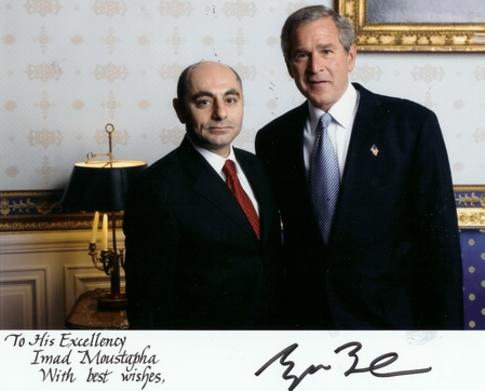
“What Motivates Syria,” by Imad Moustapha

Imad Mustapha explains Syria's stand on Iraq and cooperating with the US in the Washington Post. He insists that "Syria has the will and the capacity to assist in Iraq. This help is imperative to Syrian national interests. Syria can cooperate on security issues with the Iraqis and can give considerable support to their political process." He also admits Syria has no magic bullet when it comes to Iraq.

Imad Mustapha

What Motivates Syria?
By Imad Moustapha
Sunday, December 10, 2006; B07

U.S. engagement — or rather reengagement — with Syria has become a salient topic in almost every political debate on U.S. policy in the Middle East, particularly regarding Iraq.

But while commentators argue over whether the United States should engage Syria and whether Syria has the will to cooperate or even the capability to deliver intended outcomes, it appears that the Bush administration remains incapable of searching for a comprehensive approach to the strife in Iraq.

According to top officials in the Bush administration, engagement with Syria would yield no benefits. What is Syria's reaction to this viewpoint? Well, we believe that if U.S. officials continue to regard a dialogue with Syria as a matter of "dictating" — that is, telling Syria what it ought and ought not to do — then their predictions are correct.

Given such a "dialogue," Syria would have to agree with the Bush administration officials who say that nothing can be achieved by such engagement. It would be a waste of valuable time for both sides, and in the meantime the situation in Iraq would continue to spiral downward from disastrous to catastrophic.

But if the Bush administration comes to realize that truly engaging consists of an honest dialogue in which all parties are involved, then positive results will be possible — for Iraq, the United States, Syria and the entire region.

Contrary to what many in Washington believe, past Syrian-American collaboration has yielded many beneficial outcomes, a fact that several former U.S. officials could confirm. These include, among other things, Syrian cooperation on the Middle East peace process, on al-Qaeda and, yes, on Iraq.

What motivates Syria to engage on Iraq? Let us be clear: Syria is not looking for a "deal" with the U.S. administration on any issue. The situation in Iraq is a matter of paramount concern to Syria, particularly the unprecedented levels of death and destruction and the possibility of Iraq's disintegrating, which would have terrible repercussions for the entire Middle East.

Thus Syria has the will and the capacity to assist in Iraq. This help is imperative to Syrian national interests. Syria can cooperate on security issues with the Iraqis and can give considerable support to their political process. The visit of our foreign minister to Baghdad, and the resumption of diplomatic ties between Damascus and Baghdad after a 25-year lapse, clearly illustrates our commitment to a free, peaceful and unified Iraq.

But Syria recognizes that no magical solution exists to instantaneously achieve the desired objectives. A rigorous and comprehensive approach is required. This approach should include a reconsideration of U.S. policy in Iraq, starting with the recognition of the necessity to include all parties involved: neighboring countries and all factions of the Iraqi political and social spectrum.

No party should feel defeated or excluded. All stakeholders in the future of Iraq should feel that it is in their own interest to help stabilize the situation.

A solution should also include U.S. acknowledgment that the majority of Iraqis regard the occupation as only exacerbating the situation and causing further violence and instability. A U.S. plan for withdrawal should be on the table. Only such a step will prove to the various parties involved that the United States genuinely plans to return Iraq to the Iraqis.

Syria believes that engagement of all parties will ultimately become inevitable and the only route forward. Until this happens, all parties will continue to lose. Above all, if it does not happen, Iraq will continue to pay the terrible price for such lack of vision.

Muqtada al-Sadr's spokesman, Baha al-Araji, explains why Iraq has a "small" problem with Syria as opposed to "large" problems with Iran and Saudi Arabia in an interview published by Foreign Policy. He said:

We also have a small problem with Syria. Saddam’s regime was affiliated with the same school and political party that rules Syria. In Syria, there are many in the local Baath Party leadership who think that the situation in Iraq is a big loss for the Baath Party. Though the Syrian Baathist ideology differs from Saddam’s, there is still a desire [there] to see him reinstated. And this sense of party solidarity has led them to incite instability in Iraq in order to ensure that the occupiers—and the new government they support—fail.

Iraq:
Robin Wright of the Washington Post writes that

Vice President Cheney's office has most vigorously argued for the "80 percent solution," in terms of both realities on the ground and the history of U.S. engagement with the Shiites, sources say. A source familiar with the discussions said Cheney argued this week that the United States could not again be seen to abandon the Shiites, Iraq's largest population group, after calling in 1991 for them to rise up against then-President Saddam Hussein and then failing to support them when they did. Thousands were killed in a huge crackdown.

Previously, She had tracked the 80 percent solution, backing Iraq's Shiites and Kurds to the detriment of Sunni interests, to the State Department's counselor Philip D. Zelikow, who has resigned. The problem of this solution is that it cuts Saudi interests out of US planning. The important question that follows is to what extent the US will intercede to support the survival of Iraq's parliament, the center-piece of America's efforts in Iraq.

The logic of civil war is that it challanges the very existence of the American nurtured parliament and its leadereship. Protecting the survival of the parliament and making sure that politicians amenable to Washington lead it will be President Bush's objective. The Baker-Hamilton plan does not make success of the parliament a central concern. To the contrary, it implies that if the parliament cannot assume control of Iraq before 2008, it should be cut loose.

Saudi Arabia:

Saudi, Gulf States to Study Using Nuclear Technology
2006-12-10 09:50 (New York)
By Andy Critchlow

Dec. 10 (Bloomberg) — Saudi Arabia and five other Gulf Arab monarchies, that pump a fifth of world's oil, will study using nuclear technology for power generation, according to a communiqu‚ from a Gulf heads-of-state summit being held in Riyadh today.

"Nuclear technology is an important technology to have for generating power and the Gulf states will need it equally,'' Saud al-Faisal, Saudi Arabia's foreign minister, told reporters in a press conference following the meeting that was carried live on Arabic television channels. “It's not a  threat. We are not doing it secretly,'' he said.

The six Gulf Cooperation Council countries, including the United Arab Emirates and Qatar, will set up a commission to study the applications of nuclear technology, according to the  final summit communiqu‚ received by e-mail today.

The Arab Gulf states initiative comes as the United Nations Security Council pressures Iran to stop the production of enriched uranium. Uranium enriched to low levels can fuel nuclear reactors, while higher concentrations are needed for atomic weapons.

U.S. May Oppose
"There will be opposition from the U.S. and the Europeans because they will say oil-rich Gulf states don't need nuclear power,'' Anthony Harris, a former U.K. ambassador to the United Arab Emirates said in a phone interview from Dubai today.

The U.S. and European Union accuse Iran, which has the world's second-biggest oil and natural-gas reserves, of seeking  to develop nuclear weapons. Iran says its atomic program is aimed at generating electricity.

Gulf states, which are already linking their power supply networks for the first time, may need to build nuclear power plants to help meet surging demand for power from industries and booming economies that are being spurred by record high oil revenue.

The U.A.E., where demand for gas over the next 25 years, is already considering building coal-burning power plants and importing the fuel from Indonesia or South Africa as an alternative energy source to meet surging demand, Peter Barker-Homek, Chief Executive Officer of Abu Dhabi National Energy Co.
said in an interview on Nov. 28.

Saudi Arabia's foreign minister urged Israel to abandon its nuclear programme, saying it was the “original sin.''

–With reporting by Tarek Alissawi and Massoud A. Derhally in Dubai.

Encouraging Sectarian War as a Means to Bring Down Asad

Farid Ghadry of the Reform Party of Syria has responded to Sharaa's speech in his most recent circular. His advice is to drive the conflict between Syria and Washington forward on the presumption that Syria has reached the breaking point and that the Sunni insurgency in Iraq is preparing to turn against Syria. Ghadry stipulates that by opening up a sectarian war inside Syria, the regime will fall. He encourages Washington to facilitate this and to — "stir trouble amongst the Sunnis of Syria" — with the goal of causing the collapse of the Asad regime, preferably by a coup.

His reading of Syrian politics is that the Assad regime is on the run in Iraq and has overplayed its hand. He writes: "Assad fears that his policy against Iraq may be backfiring and he needs to complete a deal with the United States pronto so he can start dismantling all of the terrorist organizations he helped erect." But no deal should be offered in order to encourage the Sunnis of Iraq to launch their attacks which will threaten Syria with civil war. The second prong to the US attack should be the aggressive pursuit of the Hariri trial, which Ghadry believes will indict and convict no less a figure than Bashar al-Asad. He writes:

It is quite evident that the best interests of the United States are not served by opening a dialogue with Syria. Just the contrary, it behooves this administration to call Assad's bluff in light of the Iraqi Sunnis new posture and the pressure of the international tribunal hovering, as a sword, over Assad's neck. As David Schenker expressed on Kalam Al-Nass, a Lebanese popular TV show with Marcel Ghanem, the following idea: If the tribunal finds Assad guilty, the Europeans will have no choice but to stop any economic dealings with Syria. Assad has taken flight recently from the US Dollar to the Euro. And if Schenker is right, Assad will have no choice but to switch again.. this time to the Ruble maybe. That will mean the end of the Assad era.

The policy that suits the Syrian dissident community is continued pressure on the regime until internal security and army personnel decide it is time to save Syria from disaster and take matters in their own hands.

Ghadry believes the Saudis are supporting and funding this game plan by supporting the National Salvation Front or Khaddam – Muslim Brotherhood alliance. He writes:

The Saudis are hedging their bets just in case Iran becomes uncontainable by supporting Sunni puritanism as an alternative to Baschar al-Assad. It behooves the Saudis to play the proxy game by helping Lebanon, Syria, and part of Iraq fend off Iran, just in case, by creating a Sunni wall that extends from Lebanon (with the Hariris), to Syria (still testing the Khaddam and the Muslim Brotherhood combination), to Iraq.

Read the whole Ghadry article, here.

Ghadry is wrong that Iraqi Sunnis are strong enough to bring down the Asad regime or that they are inclined to attack Syria. We have no indication of that. On the contrary, the US constantly accuses Syria and the Iraqi insurgents of being in bed with each other.

The interesting aspect of Ghadry's policy recommendation is that he takes the neocon policy of "creative chaos" to its logical conclusion, which is to fan the flames of the sectarian war being waged in Iraq to bring down the neighboring regimes and break the Middle East wide open. He presumes that Washington will end up siding with the Sunnis in Iraq against the Shiites and harness Saudi Arabia to this task. This is a policy option still open to the US and being debated in Washington. It may also become a defacto policy if Washington "refuses" to change course and the sectarian militias end up dominating politics in Iraq or even bringing down the Maliki government.

The Baker-Hamilton proposal is crucial in this context, because it offers Washington a way to step back from escalation and to find a modus vivendi with Iraq's neighbors, if one is possible, that will avoid total sectarian war.

Whether the International Court will be an effective instrument to break Syria is also in doubt. A spat has broken out between Mehlis and Brammertz, the two lead investigators. Here is what T_Desco writes in the last comment section.

This is rich: Detlev Mehlis (who did great damage to the UN investigation by relying on dubious witnesses like Mohammed Zuhair Siddiq) has the nerve to attack Serge Brammertz !

Magazine report (i.e. Mehlis; t_d) accuses UN’s Hariri probe of foot-dragging

Berlin- A German news magazine report to be published Thursday accuses the Belgian United Nations special investigator into the assassination of Lebanese Prime Minister Rafiq Hariri of slowing down the probe. The weekly Stern magazine also alleges that the former UN investigator into Hariri’s killing, Berlin state prosecutor Detlev Mehlis, is convinced that Syrian President Bashar Assad was involved in the killing.

Mehlis gave his Belgian successor, Serge Brammertz, confidential witness testimony and other evidence on Assad’s role when he stood down in January 2006, said Stern, citing a secret UN document is says it obtained.

Stern says Mehlis urged Brammertz to summon Assad for questioning as a potential perpetrator, said the magazine in its report, a copy of which was obtained Wednesday, a day ahead of publication.
DPA

Report by Al-Akhbar and in German.

The Russians have also prepared the ground for a potential attack on the legality of the international Court that will preside over the trial. They have insisted that they will work with the court only if it is established completely constitutionally. Its constitutionality is still in doubt. The following appeared in the Herald Tribune.

Russia's deputy foreign minister said Sunday, the U.N.-created international tribunal to prosecute the suspected killers of former Lebanese Prime Minister Rafik Hariri must be legal and constitutional.

"Moscow's stand is obvious on the necessity of this court to be clean, legally and constitutionally," Alexander Sultanov told reporters in Damascus, following meetings he held with President Bashar Assad.

Sultanov, whose country is an ally of Syria, did not elaborate. His comments, however, came a day after Lebanon's U.S.-backed government voted to approve the tribunal, overriding the objections of the pro-Syrian President Emile Lahoud and the Syria-backed Hezbollah guerrilla group.

Lahoud and Hezbollah consider the vote to be illegitimate because it was held in the absence of six pro-Hezbollah ministers — five Shiite Muslim and one Christian — which they consider to be a breach of the constitution.

Russia had raised questions about the constitutionality of the agreement to establish the tribunal because of the differences between the Lebanese prime minister and president. But the U.N. Security Council agreed Monday that any constitutional issues should be decided by the Lebanese government — not the United Nations.

Why V.P. Sharaa’s Statement is Important

MKS asked in the comment section of the last post, "Josh – what is so important about this article by Sharaa that you and Alex thought it needed to be translated? Does Faruq al-Sharaa even still matter?" 

Answer from Joshua: Yes, Sharaa still matters. Sharaa has been an integral part of the new Asad regime. He has played "bad cop" to various "good cops." From 2003 to 2005, he was bad cop to Khaddam and Kanaan on the Lebanon issue (see this previous post of 2005, bottom of post). More recently he has played bad cop to Walid Mualem, particularly on the UN investigation of the Hariri murder.

Khaddam wanted to go soft on Lebanon in 2004, permitting a free presidential election during the fall of 2004. Sharaa was the architect of Lahoud's extension. At the time, he argued that the UN Security Council would not take action against Syria with 1559. He was wrong, but was not punished for this at the time, despite wide-spread belief by Syria's reformers that he should have been. He was the instrument by which regime leaders split the "old guard." He articulated the anti-Khaddam line within the old guard.


Sharaa also argued for a hard Syrian line on Iraq (Jihad and resistance) in contrast to Khaddam who wanted Syria to pursue a more flexible policy toward America. Sharaa believing that Saddam would put up more resistance than he did to the American invasion. When this didn't happen and Saddam fell without a fight, Syria was thrown back on its heals, and the US went on its Syria offensive, accusing Syria of aiding Iraq's Baathist dead-enders, taking in Saddam's WMD, and opening up a Ho Chi Min trail to assist the insurgents. As a result, Sharaa was taken off the Iraq portfolio and it was given to Khaddam. Khaddam tried to organize the Sunni tribal leaders in order to deliver them to the Americans and reopen a dialogue with Washington on the basis of delivering Iraqi Sunni cooperation for Lebanon. This strategy failed because Washington would not talk to its enemies, use diplomacy with the Syrians, or pay blackmail (whichever description you prefer).

Following the Hariri murder and the UN investigation into Syria's culpability, Sharaa and Asef Shawkat led a 5 man committee that was tasked with planning Syria's defense and strategy toward the investigation. Only when the aggressive Mehlis phase of the investigation had been undermined by the turning of Husam Husam’s testimony and the announced resignation of Mehlis was Sharaa kicked upstairs to VP and Mualem made Foreign Minister. Mualem was brought in show a change of Syrian course. He was tasked to play the good cop.

His appointment indicated to the UN that Syria would cooperate up to a point with the international investigation. President Asad wanted to find a graceful way to de-escalate the confrontation in Lebanon; he wanted to smooth relations with the International community. By replacing Sharaa with Mualem at the end of 2005, Asad was suggesting that Syria believed it had dodged the Mehlis bullet and needed a new foreign policy face to try to break out of its isolation.

The return of Sharaa as Syria’s spokesperson in yesterday's statement suggests that Syria’s regime leaders are taking him out of mothballs in order to initiate a "bad cop" phase. They may well believe that Washington is determined not to compromise on Lebanon and not to follow the Baker-Hamilton Plan recommendations. Bush and Olmert have made it clear they refuse to resume real dialogue with Syria. This may mean that Syria is pulling up its socks and preparing to push the confrontation up a notch in order to punish Washington for its refusal to engage Syria and give ground in Lebanon and on the UN investigation.

Syria thinks it has won these battles, or will win them, and that Washington is just being obtuse by not finding a gracefully retreat (as the Baker report recommends) and negotiating with Syria to save what it can of its Lebanon policy without subjecting Lebanon and the region to needless confrontation. My hunch is that Syria is preparing to play for keeps in Lebanon on the issue of bringing down the Siniora government, even if an escalation means further civil discord and risking violence that may spin out of control. It means blocking Hamas cooperation with Abu Abbas and blocking a prisoner exchange with Israel. It means obstructing American initiatives in Iraq and undermining the Malaki government. It means going to the mat with Saudi Arabia and tightening cooperation with Iran.

In effect, Sharaa is saying to the West, "if you want to play this game of chicken, you are foolish. We are not going to blink first or veer from our well known course. You will lose in this game. If you do not negotiate with us in good faith, Lebanon will burn, Palestine will burn, and Iraq will burn. We have the cards and we will play them.” This is why I found Sharaa's statement important. From Alex's comments, I think he shares this concern.

This is no time for the US and Syria to be escalating their conflict. The dangers of further radicalization in the region are real and America’s hand is weak. My hunch is that Syria will win on more fronts that it loses. “Win” is perhaps the wrong word to use. Everyone will be a loser, but Syria will lose less than Lebanon, Palestine or Iraq.


Compromising with Hizbullah in Beirut will not mean a “Tehran on the Mediterranean” as Hisham Melham insisted it would in his PBS News Hour interview with me. This is why I posted my “Babes of Hizbullah” article several days ago. Lebanon will not become Iran, as some claim will happen should ground be ceded to the Lebanese opposition. (See Helena Cobban's vociferous objection to this post on the grounds that it was sexist and exploitative. Also see her post at "Just World News," her site.)


Allow me to add one anecdote to explain why I believe Lebanon will not become a copy of Khomeini’s Iran. In 1982, when Israel invaded Lebanon forcing two-hundred-thousand Southern Lebanese to flee north, a Shiite Imam occupied the apartment on the first floor of a building in which lived a Lebanese woman friend of mine. I had been teaching at International College in Beirut, but had moved to Damascus before the invasion to attend the University of Damascus.


The Imam brought body guards and militia men with him; they became a powerful presence in the neighborhood (Saqiet al-Janzeer). They shut down the bars in the quarter and harassed my friend for living alone and for having male visitors to her apartment. She worried that Beirut would turn into Tehran. After some time, the Imam stopped enforcing his puritanical rules on the neighborhood and things returned to normal. The Shiites from the South adapted to Beirut rather than Beirut being transformed into Tehran.


There can be little doubt that finding a compromise with Hizbullah and Aoun will change things in Lebanon in a way that liberal, Western-oriented Lebanese will dislike, but perhaps negotiating a compromise will be less damaging to their interests than forcing a confrontation that will become ugly? Having Hizbullah take additional power by force will not serve anyone’s interests. 

V.P. Farouq al-Sharaa on the Baker Report & Iraq, Lebanon, and Palestine

Alex just sent me the following assessment of Syria's foreign policy by Farouq al-Sharaa, Syria's Vice President. Sharaa was Syria's Foreign Minister for many years until Walid Mualem took over a year ago and Sharaa was kicked upstairs to the Vice Presidency. This article in Sham Press (Ar) quoting Sharaa is long, but well worth reading in its entirety. Here is the English translation done by Alex and me for some of the more significant excerpts. Farouq al-Sharaa

The struggle for Lebanon will continue as long as they continue to attempt to isolate it from Syria.  We are all worried at the deteriorating relations with Saudi Arabia and Egypt… with Egypt it is not THAT bad, we still talk, and we can fix relations very quickly. But relations with Saudi Arabia and with France have been negatively affected by personality issues.

We are sorry that the most important European country is hostile to us. President Chirac is constantly on the phone calling world leaders to get them to vote against Syria at the UN or to try to convince them to cancel their planned visits to Syria.

It is wrong to call us extremists and to separate us from the “moderates” in the Arab world. Syria has stuck to the same basic principles for decades. I should know this. We defended Saudi Arabia and Kuwait in 1990 because we did not approve of the occupation of an Arab country. It was not a decision that had great popular support. Nevertheless, it was a principle – the same principle we apply to Iraq. We are the moderates, and the so called “moderates” are those who have submitted.

Our relations with Lebanon will be stronger than when we had our army in that country. You will see… history is ahead of us… the days, weeks, and months ahead will tell.

We like Aoun … Aoun’s statements have been honest, logical, and wise. We have agreed in principle to sending our Ambassador to Lebanon, when relations return to normal. we will also send Syrian consuls to every Lebanese city. 

Some of the European leaders visiting Syria simply repeat American demands verbatim, others repeat some of those demands, while still others are embarrassed to repeat them and they listen to our views. But most visits are too quick for an honest exchange of views that leads to understanding. Perhaps that is the point of these short visits. They don't want to try to understand our point of view.

As for the notion of an international conference on Iraq, many European countries have recommended it to us. We support the formula but only if we know what the intended outcome of such a conference is. It has to have reasonable objectives that we can agree to work for. 

We will not support just any political process in Iraq, we will support it only when it takes into account the interests of all the different groups in Iraq, when the Unity of the country is preserved, and when there is a time table for withdrawal (of US troops)

The US has failed terribly in Iraq. The Baker-Hamilton Report is an indication that the American people are waking up to the fact that they have been badly deceived by their government in Iraq. Some say that through dialogue with Syria and Iran, Iraq can be stabilized. We are not so arrogant as to believe that Syria can single-handedly solve the Iraq problem, which will have repercussions throughout the world. Perhaps not even all countries working together can help solve Iraq's problem, but it is incumbent on us to have the modesty to listen to each other and to try what we can.

We will not help any Iraqi leader who isn't against the occupation of Iraq or trying to end it. We told this to Allawi, to Jafari and to Maliki. We are against foreign occupation.

We do not expect much change in the American position. Some minor change, or a cosmetic change, or a tactical change. Although the public opinion in the United States is against the war, there are powerful groups in the US saying: "we will not leave empty handed after the 450 Billions we spent in Iraq."

As for Palestine, The Israelis have surrounded the Palestinians and blockaded them. They are starving a whole people and do not permit anyone to come to their aid. They hold an entire nation hostage. They complain about the Palestinians holding one Israeli soldier hostage. Have we come to the point where one Israeli hostage is worth an entire nation? This was not the custom even in the era of slavery. What have we come to?

Here is the complete article in Arabic
      ??? ???? ??????  ????? ????? ???
 ?? ????? ?? ????? ?? ????? ??? ???? ????? «????» ????? ????????? «?? ????? ?????». ???? ??? ?? «?????? ?? ????? ??????» ?? ??? ????? ???? ??? ????? ?????? ??????? ?? «???????? ????????» ??? ?????? ???? «??? ??????? ???????? ???? ???? ?? ????? ??????».  ????? ????? ???????? ??????? ?? ???? ?? ?????? ??????? ?? ????? ???? ????? ??? ??????? ?????? ?????? ?? ????? 1991 «??? ?? ?????? ?? ????? ????» ????? «??? ???? ???? ?? ??????? ???????» ??????? ?????.
 ???? ?? ???????? ?? ???????? ????? ??«?????? ?? ?????????»? ?????? ????? ???????? ?? ?????? ??????? ??? ????? ???? ????? ??????? ??? ???? ???????? ???? ?????? ?? ???? ?????.  ???? ????? ??? ?? «????? ???? ??? ??? ??????? ???????? ?? ??? ??????? ?? ??? ???? ????????» ?????? «??? ????????? ????????? ?????? ????? ???? ?????? ?????? ?????? ???????».   
???? ?????? ?? ???? ??????? ?????? ????? ????? ?????? ??????? ????????? «??????? ?? ????? ?? ?????. ?????? ??? ?? ????? ?? ?????? ??? ????? ??? ?????? ??????? ?? ????? ????? ?????????. ???? ???? ?? ????? ???? ???? ????? ??? ????? ???? ??? ??? ???? ?????? ?????? ??? ??? ?????? ??????? ??? ???????? ??? ????? ?????? ???? ????? ?? ?? ???????? ??? ?????? ??? ???? ??? ?? ???? ??? ???????? ??? ??????? ????? ?????? ??? ??????? ????????. ?? ???????? ?????? ??? ?????? ????? ?????? ????? ???? ??? ???? ?? ???? ???? ????? ????? ????? ???? ??????.
??????? ??????? ?????? ????????? ??????? ??????».  ???? «???? ?? ???? ????? ?????? ?? ????? ????? ??????? ???????? ?????? ?????? ?????? ???????? ???? ??? ??? ???? ???????? ?? ???? ???????? ???? ?????? ????? ???????». ????? «?????? ??? ?????? ?? ????? ??? ????? ????? ???? ??????? ????? ?????? ?? ?????? ?? ??????? ???????? ??? ????? ?? ???? ????? ???? ????? ???? ?? ????? ?????? ??» ??????? «???????? ???????? ?? ????? ??? ????? ?????? ??? ?????? ????? ?????? ???? ??? ??????? ???????? ???? ???? ?? ????? ?????.
 ???? ??????? ?? ?? ?????? ???? ????? ?? ????? ???????? ??? ?? ?????? ??????? ?? ????? ??????? ???????? ?? ?????? ??????? ?????? ?? ?????? ??? ?? ??????? ?????».  ???? ?????? ,1559 ??? ????? «???? ?? ?????? ??????? ??? ???? ???????? ??????? ????? ???????? ????. ???? ????? ?????? ????? ?????? ??????? ??? ???? ??? ????? ??? ??????? ???????? ??? ?? ??? ????? ???? ?????? ??????? ????? ?????? ???? ????? ???? ?????? ?????? ??????? ??? ????? ?? ????? ??? ?????? ?? ???? ?? ??????????».
  ?????? ?? «????? ?????? ????????? ???????? ??????? ?????? ?????? ????? ?? ??????? ???? ???? ??? ????????? ????? ?? ??» ?????? «???? ???????? ?????? ??????? ?????? ???? ????? ???????? ??????? ?? ????? ???? ?? ??????? ???? ???? ????? ?? ????? ??????? ?? ?????».  ?????? ????? «?????? ????? ????? ???? ??? ???? ???????? ?? ??? ??? ???? ??? ?? ???? ????? ????? ????????». ???? «??? ?????? ?? ???? ??? ??? ???? ????? ?????? ??????? ??? ????? ????? ??? ???? ?????? ??? ?? ???? ???? ???? ?????? ?? ??????? ???????? ???? ??????».  ???? «?? ??? ?????? ?? ???? ??????? ?? ???????? ???? ?? ????? ?? ??? ????? ?????? ????? ?????» ?????? «?? ??????? ?? ?????? ???????? ???? ????? ??? ???? ???? ?? ?????? ??? ?????? ??????? ??? ??????? ?? ??? ?????. ?? ?? ???? ??? ??????? ??? ?? ??????».
  ????? ????? ?? ???? ??? ??? ???????? «???? ????????? ?????? ?? ????? ??? ?? ??? ??????? ????? ??????? ??? ?????». ????? ????? «?????? ??? ??? ??????? ??? ????? ?????? ?????? ???? ???? ?????? ???? ?????» ??????? ???? ?????? ????? ???? ?? ????? ?? «????? ???? ?????? ???????».  ????? ????? ?????? ??????? ????? ?????? ?????? ????????? ?? ?????. ???? «????? ?? ??? ?????? ????????? ?????? ????????? ???????????? ?????? ???? ??????? ????????? ?????? ????? ???????? ???? ?? ?? ????? ????????? ?? ??? ????? ???? ??????».
   ???? ????? ?? ????? ?????? ???? ??? ???? ???????? ??? ?????? ???? ?? ??????? ???????? ????? ??? «??? ????? ??????? ??? ??? ?????? ??? ????????» ?????? ?? «????? ?????? ?????? ??? ??? ??? ??? ??? ?????????? ???? ??? ??????? ???? ?? ?? ?????? ??? ?? ?????? ?? ???????».  ????? ?? ????? «?????? ????? ??????? ?????? ??? ?? ?????? ?? ?????? ??? ????? ???? ?? ???? ??? ????? ?? ???? ?? ???? ??????. ?????? ????????? ??????? ???? ??????? ????? ???? ?? ????? ???? ???? ???????? ??? ????? ?? ???? ?? ???? ???? ?? ???? ??????? ????? ??? ?????» ?????? «???? ??? ??????? ??????? ????? ?? ??????? ????? ??? ????? ???????? ??? ?????? ?? ?? ???? ?? ?????? ?? ????? ??? ??????? ??? ?? ????? ???????».
 ???? ????? «????? ????? ??? ?? ????? ???????? ??????? ???????? ???????? ???????. ??????? ???? ???? ???????? ????? ??????? ?? ????? ??? ??????? ?? ???? ??? ????? ?? ??? ???????».
  ???? ?? «??????? ?? ???????? ???? ?????? ?? ????????? ???????? ?? ?????? (??????? ???) ?????. ??? ??? ???? ????? ????? ?????? ????? ???? ??????? ????? ??? ???? ??????? ??? ??????? ???? ?? ???????? ??? ???? ?????? ?? ??????? ????? ???? ????? ??? ?????? ???? ???? ?? ????? ??????? ????? ????? ?????? ??? ????? ?? ??? ???? ????? ??? ???? ????? ?????». ????? «?? ????? 1991 ?????? ???? ????? ??? ??????? ???? ?? ??? ?? ??? ????? ????. ??? ?????? ?????? ???? ??? ???? ???? ?? ??????? ??????? ?????????? ??? ??? ?? ?????? ?? ????? ???? ??? ????? ??? ????». 
 ???? ????? «???? ?? ????? ??? ??? ???? ??????? ??????? ??????» ?????? ?? «???? ????????? ???? ?? ????? ?????? ???? ?????? ?? ???? ????? ?????? ???? ?? ????? ???? ????? ???? ????? ??????». ????? ??? ?? «??? ???????? ?????????? ????? ????? ?????? ??? ???? ??? ?? ?? ??? ?????? ??? ??? ??? ????» ??? ??????? ???????.  ???? ????? ??? «?????? ??? ???? ???? ?? ??? ?????? ??? ????? ??? ?????? ????? ??????? ???????? ????? ??? ????? ??? ??? ???? ??????? ?? ??? ????? ????????? ?? ????? ??? ??????» ??????? ?? «?????? ???? ??? ??????? ??? ????? ??????? ??? ??????».
   ?????? ??? ????? ????? ??? ??????? ????????? ??? ????? «??? ???? ???? ???? ?? ????? ?? ????? ??? ???? ?? ????? ?? ??????? ??????? ???????? ???? ?????? ?????? ?? ???????? ??????? ???? ???? ?? ?????? ??? ?? ????? ????? ??? ?????? ??? ???? ??? ????? ?????? ???? ??? ??? ??????? ???????? ?? ??? ??????? ?? ??? ???? ????????». ???? «??? ????????? ????????? ?????? ????? ???? ?????? ?????? ?????? ???????» ??????? «??? ???? ?????? ?????? ??????? ?? ?????? ?????? ?????? ?? ????? ??????? ??????? ????? ??????? ?? ???? ?? ???? ?? ?? ?? ???? ???? ??? ??? ?????? ????? ??? ??????? ???. ?? ?? ??????? ?? ???? ????». ????? «?? ????? ??????? ?? ????????. ????? ??????? ???? ??????? ???? ?????? ??????? ???????? ???????? ??? ???? ????? ?? ??? ???????».
   ??? ???????? ????????? ?????? ????????? ??? ????? «?? ??????? ???????? ???? ?????? ?????? ???????? ???? ??? ??????? ???? ????? ???? ???? ?????? ????? ??? ?????? ????? ????????? ??? ?????? ????? ?????? ????? ???? ?? ????» ?????? ??? ?? «???? ????? ??????? ??? ??????? ?? ???? ??? ?????? ??????? ??? ????? ??????? ???? ???? ????? ??????? ?????? ????».  ???? ?? «??? ?????????? ????? ???????? ?????? ????? ???????? ??????? ????????? ?????? ????? ???? ????? ?? ??? ??????? ????? ???? ????? ?????? ??? ???? ????? ???????». ????? ?? «?????? ????? ?????? ????????? ??? ?? ?????? ????? ??????? ??? ????? ?? ???? ??? ???? ???? ?????? ?????? ???? ????? ????? ??????? ?? ???? ???????? ????? ??? ?? ???? ??? ??? ?????? ?? ??????». 
 ???? ?????? ?????? ?? ??????? ?????? ??? ???? ??????? ??? ????? ?? «???? ??????? ????? ???? ??? ??????? ??? ????? ????? ???????? ???????? ?????? ????????» ????? «???? ????? ????? ???? ??? ?????? ?? ??? ?? ???? ?? ??????? ????». ????? ??? ?? ????? «???? ?? ???? ????? ?????? ????????? ?? ?? ??????? ??? ?????? ????? ?????? ????? ??????? ???? ???? ?? ?? ??? ?????? ?????».
   ???? ????? ?? «????? ???? ?????? ???????? ?????? ?? ????? ??????? ??????? ??????? ??????? ???? ????? ?? ?????? ???????????»? ??????? ??? ??????? ????? ??? «?????? ?????????? ??????? ????? ?? ??? ?????? ??? ????? ?????? ?? ??? ??????? ???? ?? ???? ??? ?? ??? ????????».
   ?????? ????? ?? «???????? ??????? ???? ???? ????? ?? ????? ??????? ?? ?????? ??????? ?????? ????? ???????? ????? ????? ?? ???? ?????? ????? ??? ????? ???????». ???? ?? «????? ???? ???? ? ??????? ???? ???? ??? ??? ???????» ?????? ?? «???? ???? ???? ???????? ??????? ?????? ??????? ?? ??????? ???? ???? ????? ?????».???? ????? ?????? ???? ????? ????? ?????? ?? ???????? ??? ????? ????? ??? ??????? ??? ????? ?? «?????? ???? ?? ????? ?????? ????? ?????? ???? ?? ????? ????? ?? ?? ?????? ?? ??????. ???? ??????? ????? ?? ????? ?????? ?? ????? ?????? ???? ???? ????? ??? ?????? ???? ????? ?? ??????? ?????? ?? ??????? ??? ????????? ???????? ??? ?? ?????? ?? ???? ???????? ?? ??????». 
 ????? ????? ?? ????? ???????? ??????????? ?? ??????. ???? ?? ??? «??? ?????? ???? ?? ???? ?? ????? ??? ?? ?????? ??? ?? ??????? ????????? ??? ?????? ????? ??????? ???? ??? ?? ????? ??? ??» ?????? ??? ?? ????? ?? «?????? ?? ?? ??? ?????? ?????? ?? ???????? ?? ?? ???? ?????? ??? ?????»? ??????? «???? ??? ????? ?????? ??? ?? ??????? ??? ?????? ???????». 
 ???? «?? ???? ??????? ???????? ????? ??? ?????? ?????? ?????? ????? ????? ??? ???? ?????? ????? ???????? ?????? ??? ???????? ??????? ??? ???? ??????? ????????? ?????? ??? ??? ???? ???? ???????? ?? ??????».????? ??? ???? ?? ???????? ???? ???? ?? ???? «?????? ?????? ?????? ????????? ?? ??????» ??? ?????? ??????? ??? ????? «?? ??????? ?? ???? ?????? ?? ????? ???? ??? ?? ???? ???? ?????? ????? ???? ???? ??????? ?? ?????? ??? ??? ?? ???? ????????? ??? ???????? ???????».
??????? ?? ??????  ???? ????? «???? ?? ???? ??????? ?? ???????? ????????? ??? ???? ????????????? ???????? ??? ??? ????? ?? ???? ??????? ???? ????? ???????? ????? ?????? ??? ???? ??????? ?????? ??? ???? ???? ??????? ????? ??????? ???????» ????? ?? «????? ???? ????? ???????? ???? ???? ??? ????? ???????? ???? ?????? ?? ???? ??????? ????????? ????? ??? ??». 
 ???? ????? ?? ??? ???? ???? ??? ??? ?? ???????? ??????? ?? ???? ???????? ???? ???? ?????? ??? ???? ??? «?????? ???? ??? ?? ???? ??? 450 ????? ????? ?? ?????? ?? ?????? ??? ??????». ???? «????? ??? ??? ?? ???? ?? ?????? ??? ???????… ???? ??? ?????? ??? ?????? ?? ???? ?????? ?????? ???? ???? ????? ?????».». 

Leave Our Region Alone And The Winners Are……By EHSANI2

Prior to the invasion of Iraq, President Bush referred to the existing political order in the Middle East as “false stability”.

This writer agreed with this characterization. After all, the seeming stability was perfectly correlated with dictatorships. Unless one accepts that the region's dictators are a normal state of affairs, the calm that most Middle East countries enjoyed could not have been sustainable or "real".

Growing up in the Middle East, I know the conventional wisdom has been that the region’s dictators were more or less hand picked by the U.S. to serve the superpower’s own interests.

Surely, the Shah of Iran, the King of Saudi Arabia, Mubarak of Egypt, Saddam of Iraq as well as Assad of Syria could not have maintained their hold on power for this long had it not been for the U.S.'s implicit, if not explicit, help. Only when the U.S. yanked the rug from underneath these regimes would the region have a chance to prosper and advance, the thinking had always been.

On March 20th, 2003, the U.S. did indeed decide to pull the rug from under one of the key regimes that it had supported in the past.

The official, stated objectives of this invasion were to “disarm Iraq’s weapons of mass destruction, to end Saddam Hussein’s support for terrorism, and to free the Iraqi people".

Three and a half years later, of course, things could not have turned out any differently.

Iraq’s weapons of mass destruction were never found. Saddam’s support for terrorism (Al-Qaeda) was never proved. The Iraqi people were freed from Saddam but only to be thrown into the ensuing hell and mayhem that soon followed.

This writer wrote an article on this forum criticizing the U.S.’s stated reasoning behind the Iraq invasion. It was entitled "Spreading Democracy – Why the U.S. must tell the truth".

Lessons learnt:

The U.S. bet big.  They lost bigger.

Rather than being intimidated by the superpower next door, both Syria and Iran have worked tirelessly to fill the vacuum left by Saddam’s exit.

Soon following the arrival of America’s troops in the region, both Iran and Syria marshaled their resources and embarked on a well-orchestrated plan to thwart the U.S. mission. Were the U.S. to succeed in their first Middle East experiment, all signs pointed to Damascus and Tehran as being next.  As it turns out, instigating chaos and instability in a Saddamless Iraq was not difficult.  To the contrary, the ground was very fertile indeed.

The Middle East, and Iraq in particular, had its own experiment with occupying foreign forces in the past. At the height of the British Empire’s dominance, Iraq was thought to be critical in influencing the territory. As the Americans have recently discovered, traditional Arab hospitality does not extend to occupying Christian armies. Most people blame the U.S. support of Israel as one of the reasons for their failure in Iraq. The British, of course, faced a similar unwelcome before the State of Israel ever came into being.  This point is worth remembering when we hear today’s pleas for a Palestinian-Israeli peace as a prerequisite for a solution in Iraq.

One wonders what would have happened were a Moslem army to have invaded and occupied a country like Iraq. Perhaps other readers and commentators can expand on this topic.

The winners:

Regardless of how events unfold in the immediate future, the clear winners of this failed American experiment are the region’s dictators.

Given their mastery of ruling their populace by fear and intimidation, these leaders know full well that the only way they can be removed from power is through the help of implicit, if not explicit, foreign intervention. Without that, their own citizens are powerless to hold their own leaders accountable.

Had it not been for the U.S., Saddam would have stayed in power till his death. His two handsome sons would have surely been next in line. Not that Iraqis feel any better with him gone of course. 

Syria is no different. Assad senior handed the reign to his 34-old year son after a 30-minute amendment of the constitution. The odds are heavily in favor of Hafez Assad junior to be the country’s next President after the many years that the current healthy President is expected to enjoy as head of state.

Most readers of this forum seem to believe that the recent facts on the ground favor the Syria/Iran axis to win this confrontation with the U.S. It is all just a matter of time before the world’s sole superpower will decide to retreat and look for a graceful exit from the region’s treacherous waters, the majority opinion believes.

If readers of this forum represent a microcosm of Arab opinion, the people of the region are glad to see America humiliated in Iraq. Their own leaders are simply ecstatic. They have just received a new lease on life. America will never dare come to their region again. Calls for democracy have seen the Islamists fill the void in one country after another. The Palestinians chose Hamas. The Egyptian local elections brought the Moslem Brothers. Even tiny and traditionally liberal Bahrain has recently seen its own Islamists control Parliament. I think that it is now obvious to all that this pattern will be repeated over and over in every Arab country that experiments with its own style of democracy.

We, the people of this region, therefore have made our wishes clear to the international community:

“Leave us alone. We do not need your help. We are content to let our dictators rule us with an iron fist and rob us of our civil rights and dignity. We prefer the stability that comes with the use of force than the inevitable anarchy that will follow when our dictators are gone. Given the chance to vote and choose our own leaders, Islamists and Sharia rule will be the inevitable winnners . Our own dictators have long known and masterfully exploited this inherent tendency of ours. We know that we will never be able to get rid of our tyrants by ourselves. But this does not stop us from dreaming that we can do so without the help of others. The only winners of this saga have been our very own leaders. The failed American endeavour in Iraq has been a Godsend to them. Sadly, and as usual, the region's people have lost. Middle East style stability our people  may indeed keep. In return for this so-called stability however, they will have to give up their civil liberties, economic development, increased standards of living and the chance to elect their leaders and hold them accountable.