News Roundup (23 January 2008)

I hope everyone will continue to post to the letter from Alon Liel,  Chairman of the Israeli-Syrian Peace Society, posted below. It has stimulated very interesting dialogue. Alex will be posting a summary soon.
I begin this news roundup with a short announcement:
Serene Taleb-Agha [[email protected]] has begun a "a list for English-speaking residents of Syria, in particular expatriates from America, Britain, Canada, Australia, South Africa, etc. Dual nationals are welcome. We are here to network and share our experiences living in Syria." Here is the group:http://groups.yahoo.com/group/Anglos-In-Syria/

Hugh Macleod writes: "I wrote an analysis for San Fran Chron on the attack on the US embassy vehicle and how there appears to be a new strand of political violence emerging in Lebanon, that seems more the work of Al-Qaeda style fundies than hit squads taking out anti-Syrian figures . . 

The attack on a U.S. embassy vehicle that killed four people last week represents a dangerous widening of political violence that includes international targets, and shows how al Qaeda-inspired extremists are attempting to push the politically deadlocked country toward civil war, some analysts say.
…..
"Al Qaeda is now unleashed in Lebanon and they are here to stay," said Ahmad Moussali, professor of political science and Islamic studies at the American University of Beirut. "Al Qaeda thrives in civil war and chaos. International players should be very careful in Lebanon."
….
Just last month Gen. Francois Haj, the man tapped to take over Suleiman's role as army chief and head of operations against Fatah Islam, was assassinated by a car bomb. It was the first attack on a high ranking army officer in decades.

Meanwhile, U.N. peacekeepers in southern Lebanon have also been threatened and attacked by Sunni militants.

In a statement aired on Dec. 29, al Qaeda leader Osama bin Laden criticized Hezbollah for agreeing to the deployment of the U.N. Interim Forces in Lebanon following the end of the 34-day war between Israel and Hezbollah fighters in 2006. Bin Laden said the U.N. soldiers were on a mission to "protect the Jews."

Some analysts said bin Laden's message could have been interpreted as a rallying call by Sunni militants.

"Bin Laden's threats represent a kind of edict, guidelines which are adapted by groups that identify themselves with al Qaeda," said Amal Saad Ghorayeb, an expert on Hezbollah at the Carnegie Middle East Center in Beirut.

Ghorayeb compared the attack on the U.S. embassy vehicle to the Jan. 8 roadside bomb that exploded when two U.N. soldiers drove through Rmaileh, 21 miles south of Beirut, close to the Ain al-Hilweh Palestinian refugee camp, a hotbed for Sunni Islamist groups.

"Both were very clumsily planned and were not high value targets. It was an assassination attempt but not along the lines of previous assassinations," said Ghorayeb, referring to a string of well-planned assassinations of anti-Syrian figures in Lebanon since the 2005 killing by an explosion of former prime minister, Rafik Hariri. "It could well be an al Qaeda-inspired attack. There has been a resurgence of sorts. Fatah Islam were always clumsy."

BAGHDAD (AFP) — Syria and Saudi Arabia have reduced the flow of foreign insurgents crossing their borders to fight in Iraq, a US military spokesman said on Sunday.

"Syria and Saudi Arabia have taken a number of steps to reduce the flow of foreign fighters into Iraq," US military spokesman Rear Admiral Gregory Smith told a press conference in Baghdad.

"In early 2007, 110 foreigners were coming into Iraq from Syria every month. That is now reduced to 40 to 50."

Syria has introduced roadblocks and border patrols in a bid to crack down on fighters trying to cross into the war-ravaged country, while Saudi Arabia has tightened requirements for people applying for visas to Syria, Smith said.

Papers Paint New Portrait of Iraq's Foreign Insurgents

90 percent of foreign fighters entering Iraq during the one-year period ending in August came via Syria, a greater proportion than previously believed.

More North Africans were foreign terrorists than previously assessed." Although Saudi Arabia was by far the most common country of origin of foreign fighters, with about 40 percent of the total, a surprising share — 19 percent — came from Libya. Overall, about 40 percent were North African.

Based on information solicited in the longer Islamic State of Iraq forms, the Syrian role in the traffic appeared more that of entrepreneur than ideological partner and seemed to be a source of concern and suspicion for al-Qaeda in Iraq. Entrants were asked for names and descriptions of Syrians they had come into contact with, and were asked how they were treated. Many responded that the Syrians had demanded exorbitant sums of money, often exactly the amount the entrants were carrying.

Sex outside marriage is legal in Syria, lawyer says 

A Syrian rights activist urged couples who live together outside of wedlock – cohabiting – to sign a contract stipulating the rights of both parties.

The prevalence of this living arrangement – found mostly in the capital Damascus – was brought into the open after the state-owned newspaper Al-Thawra ran a story about cohabiting couples in 2006.  Ali told AlArabiya.net that the law does not prohibit sexual relationships between unmarried couples — as long as both are adult and single — and can thus be legally recognized.

Nasrallah's taunt gets under Israel's skin

Hizbullah's leader said on Saturday his party had the remains of Israeli soldiers killed in Lebanon during the 2006 war, saying the dead were left behind "in our villages and fields." "Your army left behind the remains of soldiers in our villages and fields," Sayyed Hassan Nasrallah said, addressing the Israeli people during a speech to tens of thousands of Shiites taking part in commemorations marking Ashura.

"They [Israeli army] were so weak on the field that they left behind remains not of one, two or three but a large number of your soldiers," Nasrallah added. "One body is almost complete," Nasrallah said. "What did the [Israeli] army say to the family of these soldiers and what remains did they give them?"

The Hizbullah leader's comments sparked outrage in Israel, which prides itself on doing everything to recover the remains of its soldiers from fields of battle and has in the past freed prisoners in exchange for remains of soldiers and civilians.

Israeli ministers on Sunday cursed Nasrallah as a "sewer rat" for boasting that his group had Israeli body parts. "Nasrallah has crossed all possible boundaries of inhumanity,"  Interior Minister Meir Sheetrit of Israeli Prime Minister Ehud Olmert's centrist Kadima party said ahead of a weekly Cabinet meeting.

Berri: Syrian-Saudi reconciliation key to Lebanon solution

"When [Arab League Secretary General Amr] Moussa came to see me before going to Damascus and asked me if I have any message for [Syrian President] Bashar Assad, I told him just tell him to reconcile with Saudi Arabia," Berri told The Daily Star in an exclusive interview Saturday.

He added that the rift was "Syria's mistake," the result of comments made by Syrian Vice President Farouk Sharaa, which soured relations. Hopes are high that the upcoming Arab summit in March in Damascus will serve as an ideal platform for a Saudi-Syrian reconciliation.

Berri said that "only the 10+10+10" equal distribution of Cabinet posts between the majority. The plan calls for neither majority nor opposition having the power to hinder the government or monopolize power and gives the president the swing vote in Cabinet as the arbiter.

He said the ruling coalition supported a 14+10+6 formula of seats. Berri said that "only the 10+10+10" equal distribution of Cabinet posts between the majority, the opposition and the president in a new government would meet with the requirements of the three-point Arab plan. The plan calls for neither majority nor opposition having the power to hinder the government or monopolize power and gives the president the swing vote in Cabinet as the arbiter.

The speaker said that the American strategic interests lie in ensuring Israel's security and the continued flow of oil, while everything else is "just details."  

Nasrallah electrifies faithful in Beirut's southern suburbs

Hizbullah's Al-Manar television station said one million people had turned out for the Ashura commemoration, in the Sfeir neighborhood of Beirut's southern suburbs.

The Hizbullah leader has rarely made public appearances since the 2006 war. His last public appearance was at the opening of a book fair in May in the southern suburbs of Beirut.

He also appeared at a massive victory rally in the southern suburbs in September 2006. He told the cheering crowds that his group was ready for a new conflict with Israel. "If Israel launches a new war against Lebanon, we promise them a war that will change the face of the entire region," Nasrallah said. – AFP

The reinvention of Lebanese Shiite history

Among its defects, the most potentially damaging is that Hizbullah threatens the Lebanese Shiite community by seeking to impose its exclusivist version of Shiite history. Shiites have left their imprint on Lebanon's history ever since the Middle Ages, albeit with varying degrees of political involvement. To presume that Lebanese Shiite history only really began when Hizbullah was established is unfair first and foremost to the Shiite community itself.

It is incorrect to say that Shiites were excluded from Lebanese political life.

A friend who attended this conference sent the following summation:

Analyses of the 9/6/07 Israeli strike on a Syrian facility near the Euphrates
Hosted by the Center for National Policy, 1/23/08

David Albright, Institute for Science and International Security

  • The Israelis believe they hit a nuclear reactor
  • Finding nuclear reactors through satellite imaging is very difficult; it is impossible to find nuclear weapons production facilities
  • Syria did not obtain plutonium from North Korea or any other country, but probably received nuclear assistance
  • The alleged Syrian nuclear reactor was not very developed; there is no Syrian fuel fabrication plant or processing plant
  • By attacking Israel showed no confidence in the international community's ability to control countries' nuclear activities
  • There is now a new building on the site; it is probably a warehouse, but it might have been constructed in order to cover up excavation of the remains of the previous building
  • It is unlikely that the new building is nuclear given the speed with which it was constructed

Robin Wright, Washington Post

  • Originally thought that the facility was a Lebanon-bound Iranian arms cache for Hezbollah
  • North Koreans were on the ground at the site and the Israelis attacked at night to avoid collateral damage
  • The U.S. and Israel shared intelligence before the bombing
  • Syria didn't invite the IAEA to inspect the site after the bombing, which makes their innocence suspect
  • After looking at satellite photos from 2001, it is confirmed that construction began under Hafez Al-Assad
  • The secret was held so closely that some of the Assad family members didn't know about the facility
  • In 35 years of reporting, she has never seen a mystery like this

Bonus fact: The Makhloof family (Bashar's mother's family) owns the Dunkin' Donuts franchise in Syria.

Conn Hallinan: Desert Mirage: What Was the Bombing of Syria Really About? Desert Mirage. By CONN HALLINAN. So what was that Sept. 6 Israeli bombing of Syria all about?

Inelligence

President George W. Bush hasn’t accomplished much on his voyage to the Middle East, but he did take the time to inflict another wound on the entire U.S. intelligence community—and on the credibility of anything he might ever again say about the world.

In the latest Newsweek, Michael Hirsh reports that, during a private conversation with Israeli Prime Minister Ehud Olmert, Bush “all but disowned” the agencies’ Dec. 3 National Intelligence Estimate on Iran. A “senior administration official who accompanied Bush” on the trip confided to Hirsh that Bush “told the Israelis that he can’t control what the intelligence community says, but that [the NIE’s] conclusions don’t reflect his own views.” [complete article]

"A Russian advantage that Syria would do well to exploit," By Vitaly Naumkin

Russia's approach to a Syrian-Israeli peace process is very much a function of developments in Russo-Syrian relations. Since the beginning of the 21st century, Russo-Syrian ties have been making good headway in quite a number of fields. Certainly, the traditional character of historical ties between Moscow and Damascus is playing a role. But one should also not ignore the pragmatism inherent in President Vladimir Putin's foreign-policy course, and in particular the promotion of interests of Russian companies in world markets, the Middle East included.

Moscow's decision, taken in early 2005, to write off $9.782 billion or 73 percent of Syria's $13.4 billion debt, the remaining $3.62 billion to be paid off in installments, was a great boost for the development of cooperation.

Naturally, Russo-Syrian relations are not based on economic interests alone, but also security interests. On the one hand, religious extremism and terrorism are significant threats in the region for Russia. Consequently, Moscow is building cooperation with the United States and other global and regional actors. Incidentally, the secular regime in Syria is a reliable partner in this regard.

On the other hand, the way the US is operating in the region, particularly in Iraq, often only provokes fresh outbursts of terrorist activity that require that Moscow follow its own balanced course. In addition, the crisis in the system of arms control, US reliance on forceful means of resolving conflicts and other crisis phenomena in the framework of international relations demand from Russia at least a partial restoration of its military potential lost in the 1990s. In this connection, the possibilities Syria can offer, to Russian ships stationed in the Mediterranean for example, are a weighty argument in favor of developing relations with Damascus.

This in no way implies that Moscow regards everything Syria is doing with unqualified approval. …

In Iran reversal, bureaucrats
triumphed over Cheney team

Senior officials at the Office of the Director of National Intelligence, the umbrella organization that coordinates the U.S.’s 16 spy agencies and that oversaw the report, say payback wasn’t a factor. They defend the report as a righting of the ship after the Iraq intelligence failures.

Hundreds of officials were involved and thousands of documents were drawn upon in this report, according to the DNI, making it impossible for any official to overly sway it. Intelligence sources were vetted and questioned in ways they weren’t ahead of the 2003 U.S. invasion of Iraq.

Thomas Fingar, 62 years old, is one of the lead architects of the Iran report. A veteran State Department official, Mr. Fingar helped lead the office that argued in 2002 that evidence of Iraq’s nuclear program was faulty. He is now a senior official at the DNI.

Of the backlash against the report, Mr. Fingar says, “A lot of it is just nonsense. The idea that this thing was written by a bunch of nonprofessional renegades or refugees is just silly.” [complete article]

Lebanon Delays $7 Billion Sale of Phone Companies
By Massoud A. Derhally

Jan. 22 (Bloomberg) — Lebanon's government postponed the auction of two mobile-phone companies, at which it hoped to raise $7 billion, because of a political stalemate over the election of a president, said Minister of Telecommunications Marwan Hamadeh.

“We had committed ourselves to this February, but we will not take a decision before a new president and a new government takes over,'' Hamadeh said in an interview from Beirut today. The ruling coalition has agreed to a delay of three months.

The government, which will retain a third of the shares in the two companies, MTC Touch and Alfa, plans to use revenue from the sale to repay part of its debt. Revenue from telecommunications accounts for about 40 percent of the state's income, Hamadeh said.

Sami Moubayed, "Damascus Wearing Make-Up"

A few months ago, I met with one of the organizers of Damascus-Capital of Arab Culture 2008. She wanted my advise on what can be done to promote Damascus. I made several suggestions, including honoring 365-Syrians in 2008. I advised against one thing, however, saying: “Don’t try to promote Damascus as a beautiful city. It is no longer beautiful. Say that it is magical. Say that it is historical. Say that it is great—but it is no longer beautiful!”

God proved me wrong today. Damascus under snow was AMAZING. I have been through winters in London, Paris, Berlin, Cairo, and Beirut. Each of these cities is magical in its own way, and I am no fool. I know that we are not as majestic or organized as London, nor are we clean and proper like Berlin, or charming and romantic like Paris. But from where I stand today, Damascus is more beautiful than “all of the above.”

The Damascenes have not seen so much snow in years. The snow exposed the beauty of Damascus; it covered all the distortions on the streets, the damage done to roads, buildings, and monuments. It almost erased the ugliness of bad planning, and the destruction left behind by mediocre architects.

What I saw today was Damascus 1950—my Damascus. We witnessed its remains in the 1980s both first hand, through bedtime stories from our elders, and via the magical poetry of Nizar Qabbani. We must not forget that there is a rising number of young Syrians around who simply, don’t know ‘that’ Damascus.

I just came back from a cold and enchanting walk in Salhiyah. It reminded me of London. I saw the statue of Yusuf al-Azma, the martyr of Damascus, covered with snow. I saw children in utter joy, with heavy clothing, building a snowman near the Central Bank. They were laughing like crazy. I heard the voice of Fayruz coming out of shops that managed to remain open, despite the blizzard. The Damascenes are rediscovering Fayruz, as she is about to perform at the Opera House on January 28—her first performance, in nearly 30-years. Other Syrians were listening to Um Kalthoum playing on Damascus Radio. She was singing Ruba’yat al-Khayyam, an eternal classic; another reminder of a bygone era.

Fayrouz, Damascus, Um Kalthoum, snow, and roasted chestnuts from one of the peddlers of Damascus. …………..

tishrin park

A letter from Alon Liel / Chairman of the Israeli-Syrian Peace Society

Dear Alex,

My name is Alon Liel. I am chairing these days the Israeli-Syrian Peace Society that I helped found exactly one year ago. I am an ex-Israeli diplomat and a university lecturer today, who strongly believes it is high time that Israel and Syria sign a peace treaty and normalize their relations.

I am writing you because I’ve been following “Syria Comment” and “Creative Syria” over the past year, and was impressed by the level and quality of discussion reached by your readers and writers.  Your topics are interesting, important, and very relevant to Syria, as well as to the region as a whole.

It is precisely at these turbulent times in our region, when Arabs and Israelis are once more engaged in a renewed wave of violence, that I wish to turn to your readers.  While most people today may feel that the continued suffering of so many is only further evidence of an impasse that can only be resolved by force, there are some who still believe otherwise. Not all the opportunities have been explored, not all the suggestions have been seriously contemplated.

Seeing the devotion and sincerity of your readers, I would like to introduce to them some of the ideas that were brought forth at past and recent opportunities, and ask for their opinion. As we believe that Syria is one of the key players in our war-torn region (perhaps THE key player), it could be of great benefit to receive honest and constructive feedback from Syrian citizens about existing and potential initiatives.  I understand that there may be an innate reluctance to interact with Israelis, even online, but I strongly believe that the best way to influence our future is to engage one another in open discussion, and to try to bring about ideas and solutions that are long overdue.

I’m attaching an article written by me some months ago and published in Bitterlemons (a Palestinian-Israeli journal), which outlines some of the ideas that were brought forth at our Track II discussions.  This can serve as a starter for the discussions I’m hoping to engage your readers in.  I want to also extend a very warm invitation to anyone visiting your blog, to also visit our own website (www.is-peace.org/EN), and to participate in discussions there as well.  We have so much to learn from one another, and perhaps it is time we do so.

Article Link: http://www.bitterlemons-international.org/previous.php?opt=1&id=169#690

Alon Liel.

Damascus, capital of Arab culture for 2008

Posted by Alex 

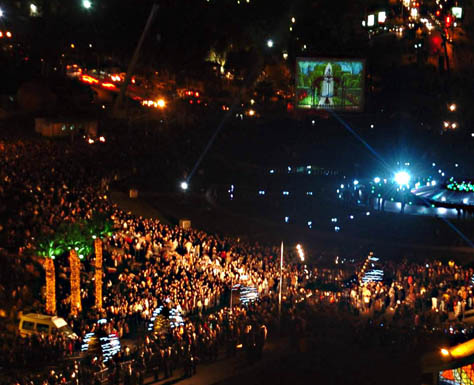
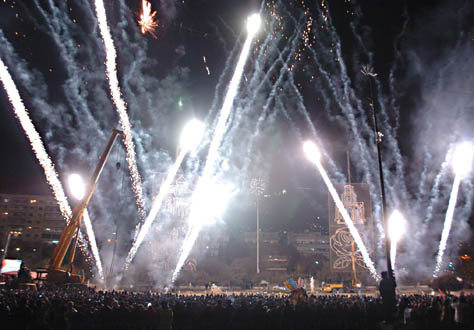
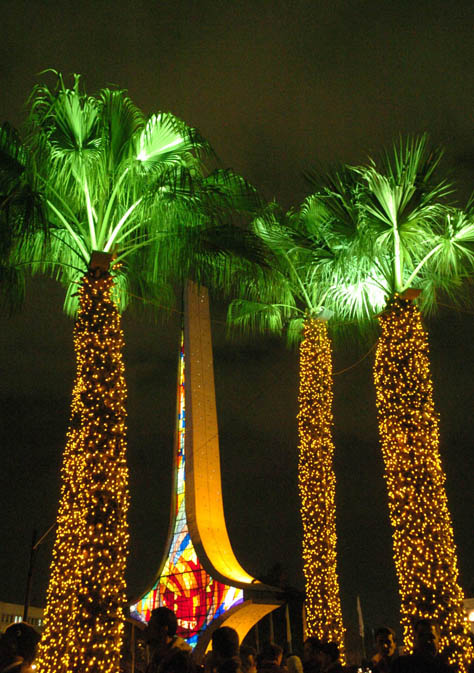
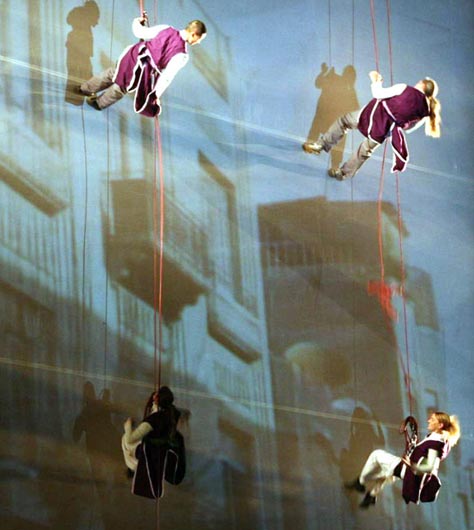
Damascus celebrated yesterday the official opening of festivities for "Damascus, capital of Arab culture for 2008"

For the first time in Damascus fireworks were used in those celebrations. In the past, security concerns prevented organizers of similar events from using fireworks.

President Assad made a speech that included the expected expressions of pride in Damascus and its history, culture, and significance in the Arab world. But the speech also included hints to the strategic direction the Syrian President intends to take Syria in the future.

Here are some quotes:

"The routes on which Paul, the Messenger walked have been flowered with amity that he planted , and Khaled is opening his arms at the eastern gate of Damascus embracing you …the Umayyads are looking to the horizon on the minarets of the Umayyad Mosque guarding John the Baptist…and Sallahuddin is mocking those who have been harboring evil to Damascus,"

"Here are the tombs of renowned philosophers , poets and artists from all over the Arab homeland form the tomb of Farabi to the tomb of Ersouzi …and from the tomb of Iben Arabi to the tomb of Nabulsi..from the tomb of Hussein Marwa to the tomb of Abdul-Karim Karmi and from the tomb of Jawahiri to the tomb of Nizar Kabbani,"

"Damascus, the capital of Arab culture means to be the capital of the Arab dignity .. gives us the strong sense of human and national pride and inexhaustible sense of the national pride, so Damascus is the capital of the resistance culture as an inherent feature of our Arab culture features … it is the culture of freedom and defense of freedom … it is the culture of creativity because our freedom is a condition of our creativity and creativity and freedom can not be separated… Damascus, the capital of the Arab culture is a great and deep lesson and indicates the dialog of cultures and their co-existence and is a symbol of the richness of life and an eloquent proof on the futility of idea of civilizations clash,"

"The Arab culture establishes a love relationship and openness with culture of the other .. Damascus is an example in that… it opens her heart to those who come carrying their hearts and close its doors in the face of those who approach carrying their swords… we are sons of one culture .. Our Arab culture is our home as a whole… under it we live equal in belonging to it .. proud to defend it .. creators in its domain .. living in it our deepest identity because it is the pattern of our presence, values, ideas and beliefs and spiritual creativity,"

Here are some photos from those celebrations. 

20080111-213313-copy.jpg

20080111-213407.jpg

20080111-213721.jpg

20080111-214009.jpg

20080111-222716.jpg

20080111-222622.jpg

“t_desco” Comments on “Al-Qaeda in Lebanon,” by Nir Rosen

Some comments by "Syria Comment" analyst "t_desco" on Nir Rosen's article, "Al-Qaeda in Lebanon,” by Nir Rosen

Rougier and the Saab/Ranstorp article, “Fatah al Islam, How an Ambitious Jihadist Project Went Awry” seem to be major sources. However, that article was probably based on “documents obtained from … interrogations of Fatah al Islam members” and it seems that Rosen also had access to the same documents:

“The origins of Fatah al Islam are nebulous, but based on meetings with Palestinian-faction leaders and security officials, as well as documents obtained from their interrogations of Fatah al Islam members, it is now possible to piece together the group’s history.”

Even Rougier does not claim that Fatah al-Islam was “created” by the Syrians and I don’t think that Rosen fully endorses his analysis because he immediately points out the major contradiction in it (without further comment).

Here is the paragraph in question:

Bernard Rougier suggests that the Syrians wanted to impede the Hariri strategy of controlling and enlarging an Islamist coalition that could be used to fight Hezbollah. To create division in the Hariri ranks, they inserted a Salafi jihadist group who wanted to fight Israel because it would divert Sunni support from Hariri. “Then it took on its own life. It had a magnetic effect on Islamists in the country,” said Rougier. He distinguishes the local agenda, which views the real enemy as Shias, from the jihadist agenda, which “views the real enemy as the West, and Shias are third or lower on the list.” However, Syria’s strategic ally is Hezbollah, and Syria would not introduce anti-Shia and anti-Hezbollah elements into Lebanon. (my emphasis)

One could add that the Syrians are probably doing what Rougier describes by putting their support behind Sheikh Fathi Yakan who (in contrast the takfiris in Fatah al-Islam) is acceptable to Hizbullah.

As I said, there are many contradictions in the text, but the following is by far the most important, in my view. It is probably based on the interrogation documents (and also happens to be the main flaw in the Saab/Ranstorp article), the idea that Fatah al-Islam became more radicalized in Nahr al-Bared:

“While Fatah al Islam’s original goals may have been to liberate Palestine, more radical jihadists influenced its leaders, shifting their focus toward global jihad.”

This is in direct contradiction to the following paragraphs:

On November 23 an armed patrol of different faction members was sent to the apartment (in Bedawi; t_d). … The men escaped to the Nahr al Barid camp. The security committee raided the other apartments, but the suspects had already communicated by radio and the others escaped. One Saudi was shot in the leg. When an armed Syrian comrade on a motorcycle attempted to rescue him, he too was shot and both were taken to a camp hospital. The Syrian had documents signed by Shaker al Absi. During interrogations by Palestinian security officials, the two admitted to being members of al Qaeda in Iraq who had come to Lebanon during the July war for training, recruitment, and jihad. Up to eighty men like them had entered Lebanon via Fatah al Intifada. They claimed to have come not to fight Israel but to assassinate seventeen Lebanese officials, including members of parliament, sheikhs, and members of the security forces.

A Fatah al Intifada commander handed the two men to the Lebanese army. Camp officials also found cameras, four computers, and scanners used to make fake identification documents. They found CDs with footage of training and members swearing oaths of loyalty to Osama bin Laden.” (my emphasis)

You don’t get more radical than this. And it was only three days later, on November 26, that Fatah al-Islam was founded, so this nice story that the group somehow became more radicalized is totally bogus.

[End]

Also see:

It's al-Qaeda, Stupid! By Bilal Y. Saab at PostGlobal

This time in Middle East relations, it is crucial to get it right and fast. Why? Because the stakes are so high.

Failure to have comprehensive peace between Arabs and Israelis is going to have consequences and repercussions of a magnitude we have never seen before. In other words, failure, at the risk of sounding too cliché, should not be an option….

By spilling over from Iraq into neighboring countries and gaining new safe havens, al-Qaeda could start working on its tactical and strategic objectives. On the tactical level, al-Qaeda would work on triggering wars between its adversaries and has already begun trying. The recent firing of rockets by al-Qaeda in Iraq from southern Lebanon into northern Israel is only one example. We have seen that scenario before, only with different actors: the 1978 and 1982 Israeli invasions of Lebanon were largely in response to Palestinian attacks from southern Lebanon. At the same time, al-Qaeda would assiduously work on causing a war between Syria and Israel and a round two between Hezbollah and Israel. The biggest prize for al-Qaeda, obviously, is to ignite a war between Iran and the United States – something al-Qaeda's Iraq leader, Omar al Baghdadi, has talked about in a recent message. On the strategic level, al-Qaeda would start planning for one of its most precious goals: taking the fight to Israel's backyard by actively supporting Palestinian radical jihadists in their war against the Jewish state.

So how do you stop these terrible scenarios from happening and how do you reverse the powerful trend of radicalization? Through peace. …At Annapolis, the Bush administration got it mixed up. There is nothing wrong in rallying the pro-U.S. Arab states to better contain the long-term threat of Iran, but the real and more imminent danger is not the Islamic republic, it is al-Qaeda.


(Saudi) Money can’t buy you love … or success

 Posted by Alex 


First, here is a collection of opinions pieces following President Bush' trip to the Middle East.

Mamoun Fandi, opinion writer in Saudi-owned newspaper Asharq Alawsat, wrote:

" … the solution is possible and easy between Syria and Israel. How nice it would be if one or more Arab leaders, with whom US President George Bush will meet during his forthcoming tour in the region, make quick arrangements now to invite Syrian President Bashar al-Assad and Israeli Prime Minister Ehud Olmert to meet with them in the presence of President Bush in Egypt or Abu Dhabi, for example. " …

"Those who are familiar with the secrets of Bush's visit to the region say that the main purpose of his tour is to visit the Kingdom of Saudi Arabia because of its importance in the Arab and Islamic Worlds and because of its significance in the world at a time when the oil price has touched $100 per barrel. This is in addition to the special relationshipå between President Bush and King Abdullah. President Bush has constantly praised King Abdullah as a man who honors his word and as a highly credible leader. If this is so, why the Arabs cannot exploit this relationship, which is based on mutual confidence between King Abdullah and President Bush, to promote their interests? What is needed is Arab coordination with Saudi Arabia and Syria to take advantage of this meeting to serve as the basis for solving the pending Arab issues. " …

"On the Syrian track, there will be no embarrassment at this historical juncture to arrange for a visit by President Al-Assad to Saudi Arabia, Egypt, or the UAE to coordinate positions about the Golan, Lebanon, and Iraq. The meeting of the Saudi foreign minister with his Syrian counterpart in Cairo recently could be understood as part of this coordination. Perhaps there was a deal for accepting a Syrian strategic role in Lebanon in return for the Golan and in return for Syria's disengagement from Iran that could lead to stability in Iraq and Lebanon."

Few days later, Zvi Bar'el, Haaretz' senior Arab affairs expert, wrote a piece titled "The Arabs should stop whining" in which Zvi wondered why the Arabs do no take Fandi's serious proposal:

 "Today, when the plane carrying U.S. President George W. Bush departs from glittering Dubai and lands in Riyadh, the substantive part of his visit to the Middle East will commence. If there is one place where discussion will get to the point without too much vision, dreams and fanfare – it's Riyadh. If there is a capital where things that are agreed to are also carried out – it's Riyadh.

Riyadh is a familial place where the Bush family, both father and son, has personal interests, and where they speak in terms that are clear to everyone: like money, property, investments and also security. If a solution can be found to the Palestinian problem, the Iraqi conundrum, the crisis in Lebanon and the relations with Iran – it will begin and end in this place. This is the country that drew pan-Arab hegemony to it; it is the one that dictates the basic rules, the red lines and the policies of compromise of the states in the Middle East. From a country that trudged along behind the Arab consensus, which is determined for the most part in Cairo and sometimes in Damascus, Saudi Arabia has been transformed into the initiator of policy.

It is toward Saudi Arabia that the Egyptian intellectual and researcher, Mamoun Fandy, directed his incisive article: "The Cards are in the Hands of the Arabs." The article appeared in the daily Asharq Al-Awsat, which is controlled by a Saudi prince who rules a large media empire in the Middle East. If the ties between Saudi Arabia and the United States are so close and warm, why are the Arabs unable to take advantage of this to further their interests, Fandy asks."

The White House added a Middle East Blog to its official website. The blog included highlights of the president's daily activities during his Mideast trip. This blog had a map of the Middle East as part of its graphic banner. It looked like this:

If anyone was confused regarding the opinions of Fandy and Bar'el, the White House map of the Middle East was clear. Forget the classic Middle East that we all knew in the past, according to this administration, the Middle East has been reduced to Israel and Saudi Arabia… the rest are irrelevant.

That is why during this trip Syria was boycotted and publicly criticized (this time for its interference in Lebanon). They forgot to inform the President that the avant-garde approach to expressing disappointment with the Syrians in 2008 is to focus on Syria's failure to interfere in Lebanon.

Qatar was also boycotted – unofficially perhaps, but since the much smaller Bahrain was visited by the president, but not Qatar … Qatar WAS boycotted – Qatar is not interfering in Lebanon or being "confrontational" like Syria, but the Qataris deserved to be boycotted because they did not join the Saudis, Jordanians and other "Arab moderates" in making life difficult for Bashar Assad the past five years.

The largest Arab country, Egypt, barely made it! … President Bush spent three hours in Egypt, not in Cairo but in the remote resort of Sharm elSheikh… away from the mostly unfriendly eighty million Egyptians.

When President Carter spent three days in Cairo (March 7th-10th 1979) he stood for hours in Sadat's convertible Cadillac smiling and waving to an endless lineup of Egyptians who wanted to see him and express their gratitude to him.

My family lived in Egypt at the time and at age thirteen I was one of those standing in the street hoping to get a glimpse of the visiting American president … Thanks to my "I LOVE New York" 70's style T-shirt, I did get a special wave then an OK sign from the president.

This time, President Bush did not want to get anywhere close to real Arab crowds (with the exception of the ones hand picked by his hosts). He did not want to know how much most of them dislike him. There was a demonstration in Cairo organized by a number of different Egyptian opposition groups in which a typical poster said "Kick out Bush the murderer"

Dubai officials felt that given President Bush's "popularity", nothing short of emptying the streets of their busy city can be sufficient to secure President Bush's passage. For the first time in decades, Dubai looked like a ghost town for the whole day. Estimated cost of shutting down Dubai for the president's visit: 120m USD of direct losses up to 1 Bn USD if you include indirect losses

Yet, President Bush' "popularity" did manage to impress the editor of Asharq al-Awsat, Mr. Tariq Alhomayed, who was somehow very confident in his ability to score a point against the Syrians as follows:

"American President George Bush danced the al Ardha* dance in Bahrain, enjoyed a comfortable stay in Israel, greeted the President of the Palestinian Authority (PA) Mahmoud Abbas with kisses and was warmly welcomed in Kuwait. He also gave a critical speech about Iran in Abu Dhabi in the presence of hundreds of citizens and officials, and the US president is due to receive further hospitality during his stay as a guest in Riyadh's al Janadriya Farm after which he will be hosted by Egyptian President Hosni Mubarak." …. "As for the warm reception that Bush received, the president is obliged to send a letter to both Syria and Iran saying, "Dear enemies, thanks to you; the threat that you pose over the region has led to warm hospitality!"

In addition, today Mr. Alhomayed who seems to be encouraged by President Bush's unprecedented support for Saudi Arabia, delivered new warnings to Syria:

"There must be an announcement to declare moving the Arab Summit from Damascus. This needs to be followed by a strict political position against Syria that should be escalated even on an economic level – should it refuse to desist in interfering in the affairs of independent Arab states. Additionally, its [Syria's] close ties with Ahmadinejad must be reviewed so that there may be a price paid for it."

One wonders if Mr. Alhomayed had the chance to read the results of a recent poll which found only 12 percent of Saudis view Bush positively _ lower than Iran's president or even al-Qaida chief Osama bin Laden _ and more think warmly toward Iran than America.

President Bush and Vice President Cheney should be alarmed by those numbers. Selling the Saudis twenty billion dollars of American arms after fabricating a well-timed confrontation with the Iranians in the Persian Gulf, convincing Saudi emirs to spend billions to help bailout American banks, dancing al Ardha with members of the Saudi royal family, and impressing the cigar-smoking young editor of the Saudi owned Asharq alAwsat is not how you deal with the chaos you created in the Middle East, and it is not how you can win the hearts and minds of the Arab people in the twenty first century.


I suggest the following schedule for the next American presidential visit to the Middle East: Two days in Egypt, two days in Israel/Palestine, two days in Saudi Arabia, and Two days in Syria.


“Al-Qaeda in Lebanon,” by Nir Rosen

Al Qaeda in Lebanon: The Iraq War Spreads
Nir Rosen in The Boston Review
JANUARY/FEBRUARY 2008

Just before 4:30 one afternoon last July, calls to prayer echoed from all the mosques in Ayn al Hilweh, a Palestinian refugee camp in the city of Sidon, south of Beirut. First built in 1948 for refugees from northern Palestine, the camp has grown into a ramshackle ghetto. Concrete and cinderblock line tight alleys with cobwebs of low-hung electrical cables. On the walls are layers of faded political posters—some for Hamas, some for Fatah, and still others for Saddam and even Hezbollah leader Seyid Hassan Nasrallah—marking the divisions among Palestinian resistance factions.

At the Shuhada, or martyrs’ mosque, a dozen men stood in paramilitary uniforms with walkie talkies, M4 Carbines, AK-47s, scopes, pistols, combat boots, long beards, and sunglasses. Unlike the hundreds of familiar, unkempt militiamen slinging old weapons in the camp, these men were professionals. They joined about two hundred others on the mosque’s second floor for a special prayer. They were burying Daghagh Rifai, a comrade in Usbat al Ansar, shot that morning by members of their rival faction, Fatah, after a string of attacks and retaliations. The men lined up with the others in orderly rows, placing their weapons on the floor between their legs. Some wore the salwar kameez typical in Pakistan and Afghanistan, a jihadist fashion statement. Following the prayer they gathered to gaze briefly at the corpse, wrapped in the green flag of Islam, not the Palestinian flag.

His comrades carried Daghagh’s body on an olive-colored military gurney; a procession of hundreds followed them around the corner and up an incline as camp residents watched from their doors or windows. When the silent marchers approached Lebanese soldiers at the camp’s gate on the way to the cemetery, the armed men stayed behind. They let relatives carry the body.

The new men in the camps were largely foreign jihadists, with the same weapons, tactics, and sectarian goals of Iraqi resistance fighters.

Ayn al Hilweh, the largest refugee camp in Lebanon, houses up to 75,000 people in 1.5 square kilometers of squalor. The camp is dominated by two main factions, the older, nationalist, and more secular Fatah, and Usbat al Ansar, which emerged in the 1990s. A balance of power keeps large-scale fighting from breaking out. But in the past decade the camps have seen a slow transformation: the waning of Yasser Arafat–style Palestinian nationalism represented by Fatah and other leftist nationalist groups such as the Popular Front for the Liberation of Palestine (PFLP) and the rise of Islamist groups like Usbat al Ansar, mobilized around religious, not national, identity, influenced by global jihad, and, some believe, with direct links to al Qaeda.

The balance of power among these groups is fragile, and in a camp to the north it has tipped. As Daghagh was being buried, another group, Fatah al Islam, joined by members of Jund al Sham, an offshoot of Usbat al Ansar, was fighting the Lebanese army from the refugee camp of Nahr al Barid. Unlike Usbat al Ansar members, though, most of the fighters were not homegrown and not focused on liberating Palestine. They were largely foreign jihadists, with the same weapons, tactics, and sectarian goals of Iraqi resistance fighters, and were perhaps the first sign that the war in Iraq is spilling into the region.

The battle last summer at Narh al Barid lasted for three months and left 163 Lebanese soldiers, 42 civilians, and up to 222 alleged militants dead. When it was over on September 4, the Lebanese army had destroyed a refugee camp housing 40,000 people in the name of the war on terror. How did Lebanon’s refugee camps become the new front?

Lebanon’s twelve Palestinian camps form an archipelago both inside and outside the state. Inside the camps Palestinian identity is shaped and maintained, and the main employers are the United Nations and resistance factions who compete and occasionally clash with one another. Outside the camp Lebanese factions and even neighboring countries have always used Palestinians to further their sectarian or political interests. Approximately 400,000 Palestinians are registered in Lebanon, survivors or descendants of the 800,000 souls forcibly moved from their land to make way for the Jewish state. Most Palestinians are Sunni Muslims, and Lebanese Sunnis used Palestinians as their militia during the Lebanese civil war (1975-1990). During that time Palestinians were victims of massacres by both Christian and Shia militias. In 1976 the Tel al Zaatar camp in Beirut was besieged by several Christian militias, with thousands massacred; the camp itself was eventually wiped out. In 1982 the Christian Falangist militia massacred Palestinians in Sabra and Shatilla. Beginning in 1985 and 1986 the Shia Amal militia besieged Palestinian camps, leaving thousands dead.

In recent years Lebanese leadership has consistently blocked Palestinian political integration and has indeed been unwilling to extend any rights at all. (The small minority of Christian Palestinians were granted citizenship long ago.) Lebanon has a Christian minority, but its political system, divided by an unwritten agreement, gives the presidency to a Maronite Catholic. During his three terms (1998-2007), President ?mile Lahoud repeatedly invoked the threat of tawtin, or the granting of citizenship to the Palestinians, to frighten Christians into backing the Syrian presence. Tawtin was an existential threat, Lahoud warned, because it would boost the number of Muslims in Lebanon.

Lahoud’s cynical policy impeded all efforts to alleviate poverty in the camps, and Palestinian clerics reacted quickly. They believed that Christians—not Syria—were responsible for Palestinian suffering. And if they were rejected in Lebanon because they were Sunnis, then, they argued, they should fight as Sunnis. Palestinian clerics began to mobilize support around Sunni identity, downplaying the Palestinian nationalism that had for years mobilized support for the PLO, and then Fatah and other leftist groups.

Radical Sunni groups in Lebanon benefited from this weakened Palestinian identity. Chief among the beneficiaries were Salafis, adherents of an anti-hierarchical Sunni movement which allows its members to do away with tradition, establish their own authority, and condemn those with other interpretations. Salafis seek the return to what they believe was Islam’s purest state, during the time of the Prophet Muhammad and the close companions who succeeded him (the salaf). Salafism is a muscular discourse and in its most extreme form sounds like anti-Shia racism. Most Salafis spread their message through theology and preaching, and refrain from political or military action. But a small minority believes that violence is necessary to achieve an Islamic state…. [Read the entire Al Qaeda in Lebanon]

Thousands of non-ID Palestinians to receive legal status
Lebanese government strikes quiet deal with Palestinian leaders
By William Wheeler
Special to The Daily Star
Wednesday, January 16, 2008

BEIRUT: The Lebanese government and Palestinian leaders have struck a quiet deal that would grant a new legal status to at least 3,000 Palestinians living in Lebanon without any identity documents, The Daily Star has learned. The plan was approved at a meeting last Friday that included representatives from the Interior Ministry, General Security, the United Nations Relief and Works Agency (UNRWA), the Lebanese-Palestinian Dialogue Committee (LPDC) and the Palestine Liberation Organization, PLO consul in Lebanon Mahmoud al-Asabi said.

General Security officials are working out the details of the new status, such as the rights and the type of identity documents those affected – known as non-ID Palestinians – will receive, Ambassador Khalil Makkawi, head of the Dialogue Committee, told The Daily Star on Tuesday. Palestinian advocacy groups have pushed for the new legal standing to allow those concerned to work and travel like other Palestinians.

"UNRWA welcomes any initiative to legalize the status of these people and improve their conditions," said UNRWA Lebanon chief Richard Cook.

Those involved with the process have not yet made public the coming change, as the official status of Lebanon's roughly 300,000 Palestinians remains one of the nation's most volatile political issues.

"We are trying to tackle this problem at a low key," said Makkawi, adding that authorities wanted to avoid any potential influx of non-ID Palestinians seeking the new standing. Makkawi's LPDC was established in 2005 during a renewed push by Prime Minister Fouad Siniora to establish diplomatic ties with the PLO and to address the glaring lack of rights among Lebanon's Palestinians.

The change in status will affect between 3,000 and 5,000 Palestinians, a number which includes a large percentage of single men who came to Lebanon in the wake of 1970's Black September clashes with the Jordanian Army or to fight for the Palestinian cause during the 1975-90 Civil War. Lebanese officials want to verify the names of the non-ID Palestinians with authorities in Egypt and Jordan, Makkawi said.

Many of these Palestinians received support from the PLO during the Civil War and did not need assistance until the PLO's ouster from Lebanon in 1982 and when the state started to reassert itself as the war drew to a close. The category of non-ID Palestinians also consists of the children born to fathers without proper documentation, because Lebanese law mandates that children born here inherit the legal status of their fathers.

The people in this group face obstacles in traveling within and outside Lebanon, owning property, graduating from school, marrying or gaining access to adequate health and social services, said a 2007 report from the Danish Refugee Council.

"In practice, most non-ID children attend UNRWA schools; however, due to their lack of identification, they can not be granted official diplomas," the report said.

The plight of this class gained attention following the 2001 shooting death of a young Palestinian man who fled from soldiers at a military checkpoint near the Ain al-Hilweh refugee camp in Sidon because he had false identification papers.

“Syria’s policy, post-Annapolis,” by H. Cobban

Syria's policy, post-Annapolis: Cobban interviews Director of the Syrian Foreign Ministry's Foreign Press Department Kanafani
Posted by Helena Cobban at JWN at January 16, 2008

The director of the Syrian Foreign Ministry's Foreign Press Department yesterday expressed disappointment with the outcome of the Arab-Israeli peace conference held in Annapolis, Maryland, in late November. Syria had sent its deputy foreign minister, Faisal Mikdad, to participate in the conference.  But the Foreign Press department head, Ms. Bushra Kanafani, told me in an exclusive interview yesterday that she was not sure where the process launched at Annapolis was now headed. 

Ms. Kanafani expressed pessimism that the Palestinian-Israeli negotiating track that was re-launched there was headed for success. "As we see it" she said, "the priority for Palestinians is not in these peace talks but to make a reconciliation among the Palestinians themselves."

At the time of Annapolis, Syria had scrapped plans to host a "summit conference" involving Hamas and many other anti-Fateh Palestinian movements.  That conference has now been rescheduled for January 23-25.  Ms. Kanafani was at pains to point out, though, that "its aim is to rebuild Palestinian national unity…  Mr. Abbas has been invited."

Regarding the Syrian-Israeli track, she expressed no expectation that anything would be happening in it any time soon.  A follow-up session that the Russians– who are members of the US-led "Quartet", along with the UN and the EU– had considered holding in Moscow in mid-January has not eventualized, and there are no other current prospects for any activity on the Syrian-Israeli track. ….

Syria astonished over Bush's statements on Palestinian right of return "According to the international law, the American president doesn't have a right to annul an international resolution that guarantees and preserves the right of return of the Palestinian refugees," SANA quoted a Foreign Ministry official as saying. The Palestinian right of return was stipulated in UN Resolution194, which was adopted in 1948 and calls for the return of the Palestinian refugees and compensation paid to those who choose not to go back.
.
2007 Year In Review: Oxford Business Group
Syria's economy had a good year and seemed to show that being the subject of US sanctions was not a major impediment to growth and investment.

News Roundup (15 Jan. 2008)

The car bombing of an American Embassy car, which killed at 3 Lebanese, did not hurt any Americans. It is reminiscent of a string of previous bombings except for this time America was the target. Did it have anything to do with George Bush's tour of the Middle East? Tim Butcher of the Telegraph things so. Read: Analysis: Beirut bomb evokes terrible déjà vu.

The American Ambassador had a goodbye party arranged for him at the Phoenicia Hotel today. That farewell reception was quickly cancelled. The vehicle was returning from the airport after dropping off a U.S. official.

For Iraqi Refugees in Syria, Art May Be Avenue to New Life
by Deborah Amos at NPR Listen Now [4 min 48 sec]

Syrian refugees in Iraq present a unique problem. The UNHCR is trying to help the nearly 1,000 Syrian refugees trapped in Iraq. They are an older lot. Or else they are children of old Baathists who belonged to the Akram Haurani and Michel Aflaq wings of the party that were forced to flee Syria in the 1960s. Muslim Brothers fled in the 1970s and 1980s. Quite a few have been murdered. (I am trying to get the exact number from the UNHCR.) Some have become homeless, as they have been driven from their apartments or lost their stipends and salaries. Most do not have any papers to allow them to travel.

Bush calls IAF strike in Syria an 'important preemptive action". During his visit to Israel last week, Bush and Israeli Prime Minister Ehud Olmert discussed the Sept. 6 attack in northern Syria, Defense News reported Monday, citing a Jerusalem official who was briefed on the talks.

Syria said on Sunday that it was waiting for the Arab League Secretary General Amr Moussa to resume his efforts on pushing forward an Arab initiative aimed at ending the ongoing presidential crisis in Lebanon.

    "The Arab plan is clear in its adoption of a no winner no loser stand which puts Lebanon on the road of health and stability because it will be the only winner," a foreign ministry official source was quoted as saying by the official SANA news agency.

Damascus slams Arab leaders for allowing Bush's 'criticism of Syria' A newspaper affiliated with the Syrian government on Monday slammed Arab regimes who tolerated U.S. President George W Bush's "criticism of Syria" in their own lands and what they branded "the indirect war" that Bush is drumming up.

Syrian analysts said Bush used the Arab countries' podiums during his multi-nation tour in the region to isolate Syria and orchestrate a war scenario against Iran.

The main strategic concerns of the visit is focused around enticing further hostility against Iran and securing the interests of "the Jewish community," read a front-page column in the Syrian Daily al-Thawra al-Islamiya. The newspaper added that Bush's plan for the Middle East has "clearly no intentions to implement peace."

Bassam Ishak, was about to leave for George Mason University in the United States when he was told by airport authorities. Syrian Human Rights Organisation, said one of its members, Bassam Ishak, was told by airport authorities that he was banned from travelling. A similar ban was recently slapped on seven human rights activists.

Syrian, Iraqi, Turkish irrigation ministers meet for first time…

Rami Khouri in "Best and Worst America This Week"  said "Washington's refusal to accept the verdict when groups like the Islamist Palestinian group Hamas were elected to power, left Bush open to accusations of hypocrisy… If you preach majority rule and the rule of law as a desirable global norm but refuse to respect it when Israeli interests are concerned, you come across as a hypocrite, at best, and a deceitful cheat, at worst…"

It’s not about Iran (Thanks War in Context)

As President Bush travels through the Middle East, the prevailing assumption is that Arab states are primarily focused on the rising Iranian threat and that their attendance at the Annapolis conference with Israel in November was motivated by this threat. This assumption, reflected in the president’s speech in the United Arab Emirates yesterday, could be a costly mistake.

Israel and the Bush administration place great emphasis on confronting Iran’s nuclear potential and are prepared to engage in a peace process partly to build an anti-Iran coalition. Arabs see it differently. They use the Iran issue to lure Israel and the United States into serious Palestinian-Israeli peacemaking, having concluded that the perceived Iranian threats sell better in Washington and Tel Aviv than the pursuit of peace itself.

Many Arab governments are of course concerned about Iran and its role in Iraq, but not for the same reasons as Israel and the United States. Israel sees Iran’s nuclear potential as a direct threat to its security, and its support for Hezbollah and Hamas as a military challenge.

Arab governments are less worried about the military power of Hamas and Hezbollah than they are about support for them among their publics. They are less worried about a military confrontation with Iran than about Iran’s growing influence in the Arab world. In other words, what Arab governments truly fear is militancy and the public support for it that undermines their own popularity and stability.

In all this, they see Iran as a detrimental force but not as the primary cause of militant sentiment. Most Arab governments believe instead that the militancy is driven primarily by the absence of Arab-Israeli peace.

This argument has been a loser in Washington, rejected by many and not taken seriously by others. The issue of Iran gets more traction inside the Beltway. [complete article]

Nobody believes anymore what Mr. Bush is saying”
By Michael Abramowitz, Washington Post, January 14, 2008

Shortly before President Bush showed up in the region last week, human rights activist Abduljalil Alsingace tried to deliver a petition to the U.S. Embassy complaining about the lack of democracy in his native Bahrain. He thought he might have some hope, given the strong language coming from the White House on the need for political reform in the Middle East.

But as he tells it, the U.S. Embassy was cool to his plans to deliver a petition, accepting his document only grudgingly after several days of negotiations. Then he was astounded to hear Bush’s description of Bahrain as an example of positive democratic reform. “All the wealth and power are with the royal family,” Alsingace said in an interview.

America's 'freedom agenda' is still valid
Taipei Times, Taiwan – Jan 11, 2008
By Ammar Abdulhamid

Former Syrian member of parliament and political prisoner Mamoun al-Homsi, Kurdish activist Djengizkhan Hasso of the Executive Council of the National Assembly of Kurdistan, and I recently met with US President George W. Bush in the Oval Office….

while talking to us, Bush did not try to mask his disdain for Syria's rulers, and he rejected the possibility of direct talks or any improvement in relations.

As such, the "positive body language" that Syrian Ambassador to the US Emad Moustapha said he detected during his brief encounter with US Secretary of State Condoleezza Rice during the Annapolis meeting was outweighed by Bush's negative verbal language during our meeting. And we all know where the buck stops.

For our part, we underscored the worsening human rights situation in Syria. Indeed, no sooner did our meeting finish, and with the world commemorating International Human Rights Day, the Syrian regime launched a massive campaign of arrests and intimidation directed against some of the country's most prominent dissidents. Though many were freed within hours, some remain in jail.

This episode also highlights the need for continued emphasis on human rights and promotion of democracy. Indeed, growing cynicism in this regard is a dangerous trend, because this is the one issue that still appeals to the people of the Middle East and can help immensely in the Western powers' battle to win hearts and minds in our region.

Electoral math: The history of a failing formula

Posted by Qifa Nabkicalculus2.jpg

Every four years, voters in the United States are given a glimpse of political strategizing in the form of the media’s ponderings about “electoral math”. Which states are crucial for which candidates? Where should campaign funds be spent? What are the must-win battleground states?

The Lebanese deadlock revolves around a similar piece of algebraic acrobatics: the debate on the makeup of the new cabinet.

Various scenarios have been proposed: we’ve seen 19-10-1, 12-10-8, 14-6-10, and enough other configurations to make one’s head spin. The latest formula is the Arab League’s proposal, to split the cabinet into three equal shares, with ten ministers going to March 14, ten going to the opposition, and ten hand-picked by the president. The beauty of this arrangement is that it would (theoretically) deprive all parties of a “blocking third” (which requires one third plus one vote). In order to veto any initiative – most importantly, the execution of UNSCR 1559 and the charge sheet for the Hariri Tribunal – any side would have to solicit the support of another party.

On the face of it, this arrangement would appear to be a dream deal for Syria’s allies. When March 14 announced its support of Suleiman for president, many commentators close to the opposition trumpeted it as a major victory for Syria. After all, Suleiman has a spotless record on Syrian-Lebanese ‘partnership’ and cooperation, and is a strong supporter of the Lebanese resistance. With the help of Suleiman, Syria would be able to secure the future of Hizbulah’s arms (at least in the short-term), deal a blow to the Tribunal, and potentially bring down the government in the event of another deadlock (according to the Constitution, the government must fall if over 1/3 of the Cabinet resigns).

By all accounts, however, the opposition is strangely not biting. Why? Is it simply because they distrust the full-throated support of Saad al-Hariri? In addition to Egypt and Saudi Arabia, the French and Americans have come out in force for the Arab League Proposal, and even Syria had to publicly ‘support’ it, and yet Beirut remains mired in the same muck.

Back to UN if Arab plan for Lebanon fails: French PM


RIYADH (AFP) — French Foreign Minister Bernard Kouchner said on Monday that Lebanon's political crisis would have to be taken to the United Nations if an Arab League effort to end the impasse failed.

"If it's not working with our friends of the Arab League, we will come back to the UN," Kouchner, who was accompanying French President Nicolas Sarkozy to Riyadh, told reporters.

"But we hope strongly that it will work," he said without elaborating on the possible resort to the UN.

Sarkozy told the Saudi Shura (consultative) Council on Monday that France "unreservedly supports" the Arab League plan, describing it as "fully compatible" with proposals made by France.

"Like Saudi Arabia, France will spare no effort to enable the Lebanese parliament to elect as soon as possible a president which the diverse components of the Lebanese nation will deem representative," he said.

The Arab League's three-point plan calls for the election of army chief Michel Sleiman as president, the formation of a national unity government in which no one party has veto power, and the adoption of a new electoral law.

Hizbullah is still insisting on a veto of its own, while Aoun is now championing a one-man one-vote, power to the people scenario, which makes one wonder whether he is the sole remaining obstacle to an otherwise satisfactory deal for the Syrians. Or do they know something about Suleiman's likely allegiances that the rest of us don’t?

Arab League Mediation in Lebanon Fails

Arab League Mediation in Lebanon Fails by HUSSEIN DAKROUB, AP:

BEIRUT: AP, Lebanon – The head of the Arab League said Saturday that he was leaving Lebanon after failing to get the country’s feuding politicians to agree on a plan to elect a new president and end the deepening political crisis.

After four days of talks, Amr Moussa said the situation in Lebanon was still “serious” and promised to return to Beirut in the next few days to continue his discussions with members of the Western-backed government and pro-Syrian opposition.

“I don’t want to give a dose of optimism, nor to describe the situation as pessimistic,” said Moussa. “There is still hope as long as we are working.”

The Arab League secretary general arrived in Beirut on Wednesday to discuss ways of implementing a plan unanimously endorsed by Arab foreign ministers last week calling for the election of army commander Gen. Michel Suleiman as president, the formation of a national unity government and the adoption of a new election law.

Many hoped Syria’s willingness to back the statement would soften demands by the opposition , led by the Syrian-backed militant group Hezbollah , that it receive Cabinet veto power before allowing Suleiman to be elected.

However, Parliament Speaker Nabih Berri, who is aligned with the opposition, postponed the presidential vote for a 12th time on Friday as the election deadlock entered its second month.

Saad Hariri, the leader of the parliamentary majority, said Saturday that Lebanon was going through “a very difficult and dangerous stage” and urged the opposition to help facilitate the presidential vote.

“The Arab initiative is very clear. What is important is to begin implementing it by electing a president because this election is the basis of the entire initiative,” legislator Saad Hariri said in an interview with Kuwait Television.

Egyptian President Hosni Mubarak warned Saturday that Arab countries would not be able to help Lebanon unless the country’s feuding factions reached a compromise to end the current crisis.

“What is left now is the Arab initiative, and if the (Lebanese) do not make it succeed, then I predict a dangerous situation for Lebanon, for (countries) surrounding Lebanon and for the region at large,” said Mubarak.

Tehran Times by By Hassan Hanizadeh, Jan., 13, Sunday, 2007:

Now it appears that the crisis over electing Suleiman as president is coming to an end, but the issue of the cabinet’s configuration still remains a major challenge facing all political groups in Lebanon.

The problem should be solved in such a way that the March 14 group will not be able to use its influence on the cabinet to prevent other Lebanese political groups from presenting national plans.

If a solution to the problem of the composition of the cabinet is not found before the presidential election, then Lebanon will definitely have no administration for a long time, and this is apparently what the March 14 group wants.

Endless wrangling about the cabinet’s makeup will only intensify the problem of the political vacuum in Lebanon. To solve the crisis, a cabinet must be formed that is not biased in favor of either side and is only concerned about the country’s national interests.

Syria blasts Bush's efforts in Middle East: Tehran Times

"It is perhaps too late to talk about peace in the last year of this U.S. administration. It will be preoccupied with elections,"" Assad was quoted as saying.

""Annapolis was a one-day event. It will all depend on follow-up efforts. We have to be optimistic, although cautious,"" Assad said in reference to the U.S.-sponsored Israeli-Palestinian peace conference in November.

The Syrian government daily Tishrin voiced an even stronger criticism of the president.

Bush is carrying ""rotten produce in his pocket to market in the region and [comes] with some chaotic ideas in mind to further support Israel, undermine the Arab forces of resistance, antagonize Arab-Iran relations and justify U.S.-Zionist [Israeli] hegemony,"" the paper said in an editorial, according to the Associated Press.

The paper said it was unlikely that Bush would ""achieve any tangible results"" on his trip that would ""whiten the U.S. Administration's black image."

LE MONDE 12.01.08 11h51 • 12.01.08 (Thanks to Friday Lunch Club) Outlines French diplomatic strategy
'un des efforts diplomatiques les plus marquants de la présidence de Nicolas Sarkozy, à savoir son ouverture au régime syrien de Bachar Al-Assad afin de l'inciter à contribuer à un dénouement de la crise politique au Liban, s'est soldé par un échec.

Anti-Israel Palestinian groups to hold Syria conference

DAMASCUS (AFP) — Hamas and other Syria-based Palestinian groups are to hold a conference later this month focused on Palestinian refugees and resistance against Israel, a spokesman said on Sunday.

"The national Palestinian conference will be held January 23-25 in Damascus under the banner of Palestinian rights and unity," conference spokesman Anwar Raja told AFP.

PA to Syria: Butt out:

The PA is up in arms over the decision of Palestinian opposition groups to assemble for a conference in which they are expected to discuss changes to Palestinian governing bodies.

Alternative to PLO
Palestinian opponents to Annapolis: We'll elect new president / Ali Waked
Palestinian 'opposition' to hold conference in Damascus next week to protest Annapolis conference. Senior Palestinian official: We're considering electing alternate governing body to PLO
Full Story

Rahman said that "every attempt to hurt the Palestinian leadership and its legitimacy encourages those who took power in Gaza to continue with their revolution.

"It is significant that the conference is in Damascus because it shows that Syria is supporting the revolution that Hamas carried out and that hurts the Palestinian cause and the pan-Arab cause," he said.

Abbas' aide also said that he rejects the Syrian claim that all Palestinians can hold conferences in the country. According to him, this is not true and it only adds to the injury which the act inflicts upon the Palestinian cause.

Rahman tried to quell Syrian anxiety and said that the "Palestinian Authority will not separately pursue an accord with Israel. Any accord will be carried out according to Arab strategy, which holds that Israel must withdraw from Arab territory that was conquered in 1967, which includes the Syrian Golan and Shebaa Farms. Thus, there is no reason for Syria's fears and there is no need for Syrian involvement in our internal affairs."

Alternative leadership?

Abbas' confidante noted that there is opposition to every regime and that "Syria also has opposition. Nonetheless, we want a relationship based on mutual respect and noninvolvement in the internal matters of the other party."

US beats a Middle East policy retreat
By Adam Morrow and Khaled Moussa al-Omrani

CAIRO – Recent months have witnessed several notable political reorientations in the Middle East, involving Iran, the Gulf states, Egypt and Lebanon. Several experts say the changes reflect a shift in Washington's regional strategy following recent policy setbacks.

"US policies in the region are either in retreat or undergoing re-examination," Ayman Abelaziz Salaama, international law professor at Cairo University, told Inter Press Service. "Washington's project for a new Middle East – launched in 2001 with the aim of redrawing the region to suit US interests – has failed." ….

Observer, a commentator on SC, writes of this article:

This article from Asia Times confirms that the era of US hegemony is at an end and the era of regional alliances with the big players — Iran, Turkey, and perhaps Israel — is beginning. In all of this the Sunni states of Jordan Egypt and the KSA are all losers. One card that the KSA is trying to hold is the Sunni insurgency in Iraq as they are trying to prepare them for the coming civil war, a proxy war with Iran. The rest of the GCC countries do not want anything to do with such a scenario as they have substantial Shia minorities. To achieve this the KSA will have to dissociate Syria from Iran and pay the price: this price will be

1. The head of Jumblat
2. The right hand of Hariri
3. The further empowerement of HA
4. The end of the tribunal
5. Continued military cooperation with Tehran as they help the Syrians in developing asymetric warfare capabilities
6. Huge investments in Syria

Observer adds in another comment:

3. Neither Syria nor Lebanon have even achieved the modicum of a nation state. In actuality, just a few years ago, one could argue that Syria was certainly moving towards becoming a failed state in that it had no power to protect its citizens, be a refereree among the protagonists, insure the minimum requirement for education and health. Only the departure from Lebanon has forced the regime to modernize back home. Otherwise the old guard was perfectly happy to remain in the status quo.

4. The tribunal is the sword of Damocles over the Syrian regime. It is left there hanging. It will be used only if and when the decision has been made collectively to replace the regime. It does not matter who killed Hariri. It is the blame for the killing that is important politically. So far, the Syrian administration has played its chess game very well indeed. Giving enough to reduce the pressure while holding on to all its cards. I would argue that it even enhanced its position and even played the Arab regimes against each other very well 5. The Arabs do not want a repetition of the Iraq debacle. Another disaster like this and all of their regimes will be severely weakened to say the least. They have come to realize that the US use of power has its limits. How to deal with the rise of Iran is the big question. Now that a US attack on Iran is out after the NIE publication, the conflict will evolve in two directions: an Israeli attack or subversion in both Iraq and Iran or perhaps both. In all of those situations, Iran is prepared. It has infiltrated all of the Shia communities on the shores of the Gulf and has built forward positions for its secret services in all of these countries. It is prepared to wage an asymetric war with the US and no one can afford to do anything during a recession. It will turn it into a worldwide depression.

6. The mission in Afghanistan is crucial to the success of NATO. If fracture about the nature of the mission continue to evolve, it is the future role of the US as the leader of the organisation that is at stake. The Europeans are waiting to see who occupies the White house next year. If it is a hawkish democrat or a republican do not expect much change, if it is a new generation of leaders, expect them to bail out of the mission.

7. Russia will continue to use the Iranian card on the one hand the energy transportation hubs on the other to foil the US in the region and to drive wedges between Europe and the US. If the Poles are pressured to accept the defence shield by the US, expect a Russian sale of very sofisticated weapon systems to Iran. Already the sale of the S-300 and the Tor-1 system has effectively allowed Iran to have a multilayered air defence system around its facilities.

8. The fact that the Arab League is now in the front on Lebanon means that both the US and to a lesser extent France are giving it lip service. The M14 have but themeselves to blame as they are slowly being abandoned. They accepted the initiative thinking that they can get their President and keep the majority in the goverment blocking HA and the opposition from consolidating their position with new elections and new electoral law. As I said before the devil is in the details and HA will not budge until and unless it has all of its demands met IN ADVANCE.

9. Syria has effectively returned in full force in Lebanon, notwithstanding what Michael Young says. It is back even better than when it had its tanks just as Britain would leave its colonies only to return with other means.

10. The news that the US used its airforce to bomb 40 insurgent strongholds simultaneously( over 10 minues) using B-1 and other aircraft just a few days after the confrontation in the strait of Hormuz is a signal to Iran about what the US can do with its high tech weapons. Expect in time an Iranian response about its asymetric capabilities.

Lebanon is a speck in all of this and Syria is comma.

(From BARRON'S)
   By Thomas G. Donlan
  The magazine Foreign Policy, published by the Carnegie Endowment for International Peace, delights in shaking up international bureaucrats and their political masters. It asks them each issue to stop and think, before they blurt and blunder again.
  An article in the January-February issue challenges the blurting and blundering American presidential candidates from 12 perspectives (and we offer a 13th). The magazine asked a dozen of "the world's leading thinkers" each to propose one new U.S. policy or political gesture that would improve America's standing in the world. 
    Yet here, we summarize all the suggestions of what the new president should do, according to the magazine. Longer versions are available in Foreign Policy
magazine and on its Website, http://www.foreignpolicy.com/. 
 
A Plateful of Resolution 
    — Open a diplomatic dialogue with Syria and end our threats of "regime change," because Syria has been blocking progress on many of the issues of importance in the Middle East. -Jessica T. Matthews, president, Carnegie Endowment for International Peace 

   — Visit dozens of world capitals, ask for advice and listen seriously, without trying to prove American dominance.
-Newt Gingrich, former speaker, U.S. House of Representatives 

 — Travel to Tehran and reopen relations with Iran on the basis of respect for its desire for a "legitimate regional role."
-Dmitri Trenin, deputy director, Carnegie Moscow Center