The Eighth Gate of Damascus

Posted by Alex 

Here are some rendered images and a press release from Emaar Syria. They are starting construction on their previously announced Eighth Gate commercial and residencial project.

Emaar Properties and IGO, the offshore investment and property development company, unveiled details of a joint venture that sets in motion plans to develop a mixed use furnished apartments, commercial and retail development in the Yafour area, approximately 15 minutes from the center of Damascus. The US$500 million project will recreate the luxury and style that are features of Emaar’s world-class Dubai developments.

The Eighth Gate project builds upon the ancient history of Damascus in its architectural style of ornately decorated buildings influenced by traditional Islamic design and pays homage to the city’s ancient roots. A signature tall gate marks the access to the main plaza.

Dating back to its ancient history, the city walls of Damascus have seven gates as access points. These gates have nurtured the rich culture of its people and were powerful emblems of the people of Damascus. Although only one of these monuments remains intact today, the city remembers how the striking structures have welcomed those who walked through the archways into the city century after century. The people of Damascus will soon be able to experience an Eighth Gate – one that retains the best of the past, but in a modern context.  

The Eighth Gate is strategically segmented into three zones:

The Commercial Center of The Eighth Gate offers a classical style piazza for convergence that encapsulates a myriad of functions. Anchored by the signature 35 storey office tower, the main plaza also embraces low rise commercial buildings and a 450,000sq ft retail mall inspired by the souks of old Damascus.

The next zone, The Waterfront, is characterized by a blend of low-rise furnished apartments development, high street shopping and dining landscape. Against this vibrant backdrop are two luxurious furnished apartments towers overlooking the waterfront and the main plaza.

The more intimate and private Furnished Apartments Zone is nestled in an environment that celebrates the innermost sense of community. This furnished apartments zone is augmented with interconnected courtyards and low-rise buildings inspired by Syrian housing archetypes.

The Eighth Gate builds a picture of striking authenticity and an intimate lifestyle experience. A place of prestige and comfortable living, poised to become the center of New Damascus.


“Once-Socialist Damascus Displays New Wealth, Glitz,” by Deborah Amos

Once-Socialist Damascus Displays New Wealth, Glitz
by Deborah Amos  on NPR's "All things Considered"

[Warning: quotes from Landis, Hamidi, Dardari, Rime Allaf, and Salloum (owner of Z bar).]

Listen Now [5 min 9 sec] add to playlist

Damascus stores now carry Western brand-name goods, unimaginable just a few years ago. 

Nezar Hussein for NPR

Damascus stores now carry Western brand-name goods, unimaginable just a few years ago.

The rooftop Z Bar in Damascus is one watering hole catering to the nouveau riche.

Nezar Hussein for NPR

The city's young and wealthy no longer flock to Beirut for their nightlife: The rooftop Z Bar is one glitzy watering hole catering to the nouveau riche.

All Things Considered, February 5, 2008 · Syria's ancient capital, Damascus, is booming. Economic reforms, high oil prices, investments from the oil-rich Gulf and Syria's withdrawal from Lebanon have all contributed to the renaissance.

Syria was forced out of Lebanon three years ago, following the assassination of former Prime Minister Rafik Hariri. Lebanon's capital, Beirut, was once a shopping haven for Syrian consumers. Now, Syria's government is encouraging Syrians to shop and play at home.

'Beirutization' of Damascus

Almost every week, another brand-name coffee shop opens in Damascus. New hotels are going up. Syrians can now put their money in private banks, and Western goods flood into the capital. Once a strict socialist economy, Syria is changing fast.

"A few years ago, nobody would have imagined Syria to be like this," says journalist Ibrahim Hamidi.

After the withdrawal from Lebanon, the government accelerated economic reforms, Hamidi says. Everything Syrians used to go to Lebanon to buy is now available at home.

"If you walk out on the street now, you see very fancy cars, fancy restaurants, young nouveau riche wearing very fancy watches, wearing famous brands," Hamidi says.

Syria's first modern shopping mall opened last year. ATM machines are new in Syria, and the goods here — electronics, clothing, kitchen appliances — are mostly imported.

Analyst Reem Alaf says some Syrians call this the "Beirutization" of Damascus.

"Beirut was always the great shopping experience — the capitalist dream that [Syrians] didn't have.

"In addition … over half of the population is under the age of 20. It's a very different generation that is looking for new things that the old Syria was not giving them," she says.

'Change Is Irreversible'

Vice Prime Minister Abdullah Dardari, who is in charge of transforming the economy, says that Syria is breaking out of the old socialist model.

"This country has changed — and this change is irreversible. The wheel is already set in motion," Dardari says.

Record oil prices have helped. Investors from the Gulf states, including Iran, have poured money into the country. Despite U.S. sanctions, European trade has increased. Dardari acknowledges that the break with neighboring Lebanon played a role.

"Before the political problems in Beirut, there was a clear decision: We should no longer push the Syrian affluent society to go to Beirut. … If they want to consume these products, let them consume them here," he says.

One place affluent Syrians go to consume is Damascus' rooftop Z Bar.

Evelyn Saloom opened Z Bar last summer — with red velvet walls, crystal chandeliers, a creative bartender, plus a Facebook page that announces upcoming events.

Saloom modeled her bar on Beirut's most famous watering holes.

"I always thought, 'Why do young Syrians go and spend their money in Lebanon? Why [do they] have to cross borders in order to enjoy a drink, have fun and dance?'" she says.

Syria has gone a long way to prove it doesn't need Lebanon anymore, and this is also new, says Saloom.

"What happened in Lebanon made Syrians improve internally. We have banks, we have insurance companies, [the] English language is now a must," she says.

Not All Are Benefiting Equally

But journalist Hamidi argues that the new era has not reached Syrians stuck in the old economy — for example, those in low-paid government jobs.

"Syria … is changing dramatically, but not for all Syrians. The wealthiest are getting wealthier, [the] poor are getting poorer and the middle class is shrinking," Hamidi says.

That's the result of a country rapidly transforming a 40-year history of economic control from the top. Josh Landis, an American academic who specializes in Syria, says China is Syria's model: Keep a tight lid on political opposition, open the economy and try to manage the growing income gap.

"The big question for the Syrian government is, can it keep a lid on it? Can they get the trickledown fast enough so that people don't give up hope, so the rising expectations don't explode in their hands?" Landis says.

“Exuding confidence, Syria’s Assad targets opposition,” by Oweis

Riad SeifANALYSIS-Exuding confidence, Syria's Assad targets opposition
By Khaled Yacoub Oweis
6 February 2008 Reuters News

DAMASCUS, Feb 6 (Reuters) – Syria is stepping up a campaign against dissidents in a sign of President Bashar al-Assad's increasing confidence that U.S.-led efforts to isolate his country have faltered.

In the last few weeks, 12 prominent dissidents have been rounded up in one of the biggest crackdowns since Bashar succeeded his late father, Hafez al-Assad, in 2000.

They face long jail sentences after leading a meeting two months ago of the Damascus Declaration umbrella grouping of democracy activists to galvanise opposition against Assad and the four-decade monopoly of the ruling Baath Party on power.

The meeting, which included Islamists and liberals, elected Fida al-Horani as head of its leadership council. Fida, daughter of late Baath Party leader Akram al-Horani, is now in jail.

Former parliament member Riad Seif, who hosted the meeting, was also arrested. Seif has cancer and spent almost five years in jail after leading what became known as the Damascus Spring, a brief period of free expression that was crushed in 2001.

U.S. President George W. Bush's administration has long tried to isolate Syria diplomatically because of its role in Lebanon and its support for Hezbollah guerrillas and militant Palestinian groups.

The Western isolation increased after the 2005 assassination of former Lebanese prime minister Rafik al-Hariri. France said late last year it was suspending diplomatic ties with Damascus until it did more to help resolve a stalemate in Lebanon's stalled presidential election.

But three weeks later Germany's foreign minister met his Syrian counterpart in Berlin, saying containment and isolation would not work. The Dutch foreign minister visited Syria last week and Austria's minister was due in Damascus on Wednesday.

Diplomats in Damascus expect most Western countries to continue to deal with Syria as a secular government with an important regional role and a shared agenda to curb Islamists.

SYRIAN CONFIDENCE

Germany has described the recent detentions of dissidents as intolerable and Britain's junior Foreign Office minister Kim Howells last month criticised the "deterioration in the human rights situation in Syria".

But their comments have had little impact.

A painter close to 78-year opposition leader Riad al-Turk was arrested a few days ago, raising fears that Turk, who spent 17 years in an underground solitary cell, could be next.

"The regime has shown again that it is very good at internal control and survival. It feels quite confident now," said one diplomat in the Syrian capital.

He said suppression was "not a long-term solution", but added that for the time being, global attention had been diverted from Syria.

"America is in an election year and allegations that Syria is helping rebels in Iraq have subsided. There is international fatigue with Lebanon and any possible convictions by the Rafik al-Hariri tribunal are years away," the diplomat said.

HARIRI SHADOW

Preparations are underway for an international tribunal to try suspects in the Hariri assassination.

Preliminary findings of a U.N. investigation had implicated high-level Lebanese and Syrian security officials in the killing. Damascus denied involvement and said any Syrian suspects would be only tried in Syrian courts.

Billboards have gone up on the highway from Damascus to Beirut with slogans asserting Syrian sovereignty, implicitly rejecting any outside role in the investigation.

Syria fears the court could be used by foes abroad to put it under pressure and officials say that political reform is not a priority while Damascus is braced for possible confrontation with the United Nations over the role of the court.

Dissidents, however, argue that public freedoms are Syria's best defence against external dangers, including any politicisation of the Hariri tribunal.

"External pressures are waiting around the corner. The way out of our predicament is dialogue, not more repression and arrests. These prisoners of conscience must be set free," human rights lawyer Haitham Maleh, who spent seven years in jail, said in a letter to Assad last week.

Syrian journalist Thabet Salem said the fact that several opposition figures operate from exile in Lebanon has contributed to Syria's hard line against all dissidents. But Damascus was also confident that Western criticism would be limited, he said.

"Syria realises that the West, in particular the United States, bases its dealings with Damascus ultimately on interests, not human rights," Salem said. (Editing by Dominic Evans)

“Syria: The Opposition and its Troubled Relationship with Washington,” by Joe Macaron

Syria: The Opposition and its Troubled Relationship with Washington
By  Joe Macaron
The Syrian opposition faces challenges on all fronts, including how to handle relations with the United States.
Carnegie’s Arab Reform Bulletin
February 2008, Vol. 6, Issue 1

The January 28 detention of Riad Seif is the latest development in a campaign of arrests against members of the National Council of the Damascus Declaration launched by Syrian authorities only a week after U.S. President George Bush met with Ma'moun al-Hamsi, Jenkiskhan Hasou, and Ammar Abdul Hamid at the White House in December 2007. The White House has condemned the arrests, but so far the U.S. Chargé d'Affairs in Syria reportedly has not broached the topic with the sole Syrian official with whom he meets, Deputy Minister of Foreign Affairs Faisal al-Mikdad. Although Washington at one point wished for a united Syrian opposition, it has decided to treat the opposition more as a human rights concern than a potential force for political change. Washington's meetings with representatives of the National Salvation Front, the Syrian National Council, Kurdish parties, and the Reform Party, have been confined to general discussions regarding the State Department's Middle East Partnership Initiative and the $5 million allocated to Syria.

Sources within the U.S. administration admit that Washington's ability to influence events in Syria is limited due to the lack of strong economic ties. In addition, U.S. officials have misgivings about engaging with some parts of the opposition, for example former Vice President Abdel Halim Khaddam, given his history in power. The White House has not yet authorized meetings with the Syrian Muslim Brotherhood, in order to avoid lending legitimacy to the organization's alternative project. For its part, the Brotherhood does not seem ready for such a dialogue, at least publicly.

The Syrian opposition, especially the National Salvation Front, has miscalculated in its dealings with Washington. It assumed incorrectly that the U.S. administration's contacts with the Syrian opposition marked the beginning of a path toward regime change in Damascus, and that calling for an international tribunal for the assassination of former Lebanese Prime Minister Rafiq al-Hariri would pave the way toward this goal. Thus the opposition linked its political fortunes to those of Lebanon. In addition, it is open to question whether opposition figures showed good judgment in meeting with a troubled U.S. president nearing the end of his term.    

Relations with the United States are only a small part of the problems faced by the opposition. Unity remains a major challenge. The cohesiveness of the National Salvation Front, for example, lies in the Muslim Brotherhood's need for the support of Khaddam, who has Arab and international contacts—a need the Brotherhood may already be outgrowing.

Inside Syria, the opposition is undergoing a difficult phase not only because of the recent arrests, but also because of the problems posed by the forthcoming elections and the statement of the National Council of the Damascus Declaration. The elections offer an opportunity for independents, leftists, civil society activists, and opponents of dialogue with the regime to buttress their position at the expense of traditional parties—thus maintaining the Declaration's intellectual vigor at the expense of its organizational capacity. As a result, the Damascus Declaration remains an elite-dominated opposition movement that lacks the popular base necessary to push for serious political reforms. It operates within a small arena devoid of self-criticism, without financial or media support and isolated within the Arab world.

The Syrian opposition is also undergoing a transition, moving toward a new set of political concepts and tools championed by a younger generation that has gained momentum through its cultural interaction with Lebanon. This generation seeks to define its identity and its approach to democratic change, relations with the West, and liberalism.

Another set of problems for the opposition relate to Syrian state security. State security's tight restrictions on the opposition's activities make it difficult for observers to determine the effectiveness of its leadership and organizational capacities and its ability to present a national project that goes beyond traditional narratives of the chaotic civil space. Worst of all, members of the Syrian domestic opposition and their family members face continuous threats to their safety and freedom from the state security service, as seen in the recent arrests. Opposition members face severe punishments when they communicate with the Muslim Brotherhood or foreign entities, or when they engage in political activities, especially with Syrian youth. The opposition is also likely to pay the price of the international and the Arab diplomatic standoff with Damascus in the upcoming period. 

Despite these problems, the space for expression of dissent in Syria is gradually broadening due to the opposition's efforts, a fact the authorities find difficult to accept. The Syrian regime deals with every issue, be it regional or domestic, as an existential issue and seeks to monopolize all public spaces and even private ones. Thus, while the Syrian Embassy flirts with Democratic candidates for the U.S. presidency, it accuses the opposition of committing treason by merely showing the world that there exists an alternative Syrian voice, albeit a weak and troubled one.

Joe Macaron is a journalist residing in Washington D.C.  Dina Bishara translated this article from Arabic.

Also see:

Human rights in Syria: How is it to live paralysed by fear?
by Nicolien den Boer*
23-11-2007

Being afraid for your own safety is one thing, worrying about the safety of your family can paralyse you with fear. This is why some human rights activists in Syria decide to throw in the towel. However, most activists continue to fight for what they believe even if both they and their families face threats, imprisonment and torture.
 
Syria map One evening Husam left a Damascus bar after having had one too many drinks. He took a taxi home and started to chat with the driver, who began criticising Syrian President Bashar al-Assad. Husam enthusiastically joined the driver in criticising the president. It was a lot of fun to secretly poke fun at the regime in the taxi, with the windows closed.

Suddenly the taxi took a wrong turn. Husam was taken to a police station, arrested and sentenced to several months in prison for insulting the president.

Human rights lawyer and activist Razan Zeitouneh tells the story in her Damascus home. Many Syrian human rights activists can tell similar anecdotes. Taxi drivers have a reputation for working for the Mukhabarat (the secret police), but your neighbour or fellow student can also turn out to be a secret agent. It is not easy to recognise them, which is why there is so much paranoia in Syria.
 
Like mushrooms

Syrian human rights activists are used to living in fear. During the regime of former president and dictator Hafez al-Assad many human rights activists were jailed for decades and often tortured. It seemed that things would change when his son Bashar succeeded him in 2000.

Bashar al-Assad 
President Bashar al-Assad started out in office by promising more freedom
The new president promised more freedom and democracy. Human rights activists started to collect petitions calling for more freedoms. They also held demonstrations, and new groups have sprouted like mushrooms. However, the Human Rights Watch organisation reports that in recent years activists have been rounded up in one wave of arrests after another. In 2006, seven young human rights activists were sentenced to up to seven years in jail.
 
Fear and concern
Razan Zeitouneh, who was arrested last year, says the human rights movement has been paralysed by fear. Her organisation, the Damascus Centre for Human Rights Studies conducts research into the situation in Syria. Ms Zeitouneh interviewed other human rights activists. She concluded that there were two dominant feelings: fear and concern about those close to you: "The fear returns every time you're arrested or someone close to you is arrested or tortured. But the fear also gradually fades away. However, concern about your family stays and can paralyse you completely."
 
It's a tried and tested method of keeping someone under one's thumb. Threatening a member of someone's family is like having the person in the hands of the police. 
"You've got to learn to live with the concern, because you never get rid of it. Your first step is to recognise it. You must let it become part of you. And you must understand that there are other emotions. This gives you the perseverance you will need to continue your work.
Practical protection
Human rights activist Ammar Qurabi, former member of an outlawed Syrian opposition party, says he has been arrested six times. On the telephone he proposes to meet in the busy lobby of a hotel in Damascus. Wouldn't he prefer a quieter place? "Why? I'm not afraid!"

In the lobby, Qurabi tells he is no longer allowed to leave the country. He knows no fear, he says with a smile, "Because the secret services are becoming bored with reading all of my e-mails and reports." His organisation reports on issues such as women's rights and the Kurdish minority in Syria. Incidentally, Qurabi enjoys a certain measure of protection because of his contacts with Amnesty International, among other organisations. He is known as a good international networker, creating a bit of security for himself. Yet another prison term for Qurabi would be guaranteed to make international headlines….. (continue)

Here is the latest from Human Rights Watch

Syria: Opposition Activists Tell of Beatings in Interrogation
Authorities Should Release All 12, and Investigate Allegations of Physical Abuse

“Al-Qaida in Lebanon,” by Fidaa Itani

In the ongoing debate about roots and goals of al-Qaida and Fatah al-Islam in Lebanon, Itani makes some important points. Most importantly, he suggests that Fatah al-Islam was not a Syrian inspired organization, as many Israeli (Barry Rubin: The Truth about Syria) and March 14th analysts insist. The Salafist movement had its roots in pre-Syrian controled Lebanon; it was given a further boost by connections to the Syrian Muslim Brothers during the civil war in opposition to the Syrian regime, it saw itself in competition to the Hizbullah, Syria's main ally in Lebanon, and Zawahiri and other al-Qaida leaders claim it as their own.

Al-Qaida in Lebanon (Thanks t_Desco)
By Fidaa Itani
Le Monde diplomatique/Middle East Online

Last year the Lebanese army besieged the Palestinian camp of Nahr al-Bared, where a previously unknown organisation, Fatah al-Islam, was dug in. These events, like attacks on the UN Interim Force in Lebanon (UNIFIL) reflect the appearance of radical Sunni Islamist networks – some linked to al-Qaida, which is now treating Lebanon as a key base, says Fidaa Itani.

“We were forcibly thrust into a battle that does not concern us. I would rather not have had to fight the Lebanese army,” said Shahin Shahin, a Fatah al-Islam military commander, to a negotiator during the siege of the Palestinian refugee camp of Nahr al-Bared by the Lebanese army. It was not then yet known that he was a son of Osama bin Laden and a high-ranking al-Qaida official. His misgivings about the fighting reflected his organisation’s ambivalence towards Lebanon — whether to see the country as a battleground on which to confront the United States and its allies, or just as a rear base for the training and transit of al-Qaida operatives.

Two days after the army gained control of the camp, on 4 September, the head of Lebanese military intelligence, Georges Khoury, acknowledged that the Fatah al-Islam combatants were members of al-Qaida. But the roots of the organisation in Lebanon reach deeper into the past. In the 1990s, Lebanese courts found Salafists guilty of forming terrorist cells linked to al-Qaida. The militants were Lebanese following the example of Salem al-Shahal, who started Lebanon’s first Muslimun (Muslim) and Shabab Muhammad (Youth of Muhammad) groups in Tripoli in 1974. Shahal tried to impose sharia in the city, starting by attempting to prevent young people going to the cinema. His influence spread to several Syrian towns, but at the time Salafist values lacked solid roots.

In those days the Sunnis were middle class traders, shopkeepers and civil servants, or illiterate country people. They expressed their support for Arab nationalism and the Palestinian struggle by joining Nasserite or leftwing movements. However, several Sunni groups moved closer to radical Islamism after Syrian troops occupied Lebanon in 1976, bringing repression with them. At the same time the influence of the Syrian branch of the Muslim Brotherhood started to increase, threatening the regime in Damascus with armed incursions by its military wing.

When the civil war in Lebanon ended in 1989, with the signature of the Taif accord, the Salafists, whose influence was still only limited, mainly targeted other Islamic organisations, al-Ahbash or the Association of Islamic Charitable Projects (AICP). These attacks were an opportunity for the Salafist groups to perfect their intellectual and missionary skills, recruiting in many towns and villages. They were particularly successful with middle-class graduates, as well as with students of theology who had been in Saudi Arabia and stayed in contact with radical ulema there. But the groups still lacked cohesion, the best known being al-Hidayah wal-Ihsan (Preaching and Charity), which was reorganised by the son of the movement’s founder, Dai al-Islam al-Shahal.

On 31 August 1995, one of these groups assassinated Sheikh Nizar al-Halabi, the head of the AICP, and caused a stir. It was the first time that a Salafist group had eliminated an opponent. Members of the organisation confessed to committing the murder and persisted in taking exclusive responsibility to the end. However, the Lebanese authorities and Syrian intelligence (which controlled the country) chose to pin the crime on Abdul Karim al-Saadi (aka Abu Mahjen), the Palestinian leader of Asbat al-Ansar, which was based in the Ayn al-Hilwah refugee camp, near Saida in southern Lebanon. In 1999 the same group, originally formed by veterans from the war in Afghanistan, was blamed for the assassination of four judges in Saida central court.

Point of departure

At this point links between the Salafists and al-Qaida started to develop. An organisation that was probably Chechen, and certainly connected to Bin Laden, asked Bassam Kanj (aka Abu Aisha) to help infiltrate Muslim combatants into Israel. In 1988, Kanj had given up his studies in the United States, and taken a crash course in global jihad in Afghanistan. Following the request from al-Qaida he set up the Dinniyeh organisation, but asked for two years’ grace to establish it as an anti-Israeli resistance force, alongside Hizbullah.

In May 2000, Russian negotiators, who were supervising the Israeli withdrawal from South Lebanon with the Syrians, gave the Lebanese and Syrian authorities a recording of a conversation between Kanj and Chechen mujahideen, which led to a Lebanese army raid on Dinniyeh on New Year’s Eve 2001. At the same time the Syrian authorities, operating on the other side of the border, arrested radical Islamists, confirming the network’s trans-national nature.

Al-Qaida waited till the US invasion of Iraq in March 2003, before openly calling for units to be set up in Lebanon. But al-Qaida also operates as a form of franchise, with a far from centralised organisation, leaving considerable freedom of movement to local units. It was well established by the end of 2005 when the Lebanese authorities first succeeded in catching the members of a network, subsequently referred to as the “Network of 13,” led by Hassan Nabaa, a Lebanese national. The group, which also comprised Saudis, Syrians, and Palestinians, supported al-Qaida and the Iraqi resistance movement, operating in Lebanon and Syria where it clashed on several occasions with the secret service, particularly in border zones. It is said to have shot down a Syrian helicopter.

The arrests prompted a controversy because the prisoners’ confessions contained details of their involvement in the assassination of the former prime minister, Rafik Hariri, on 14 February 2005. But there is doubt about how the confessions were obtained, and the group’s alleged link with the young Palestinian Ahmad Abu Adas, who claimed responsibility for the suicide attack on Hariri in an earlier video recording.

In Spring 2006, there was a split in Fatah al-Intifada, an organisation with close links to the Syrian regime that broke away from Yasser Arafat’s Fatah in 1983. About 70 of its members joined a Palestinian officer of Jordanian origin, Shaker al-Absi (Abu Ali), setting up Fatah al-Islam. The dissidents dispersed to Palestinian camps: Burj al-Barajneh (southern suburbs of Beirut), Ain al-Hilweh (Saida), Shatila (Beirut) and the two camps at Badawi and Nahr al-Bared, in the north. They were joined by some 50 militants led by Shehab al-Qaddur (Abu Hurayra), a Lebanese who spent most of his life undercover, after being arrested by the Syrians in Tripoli in 1986 when he was 14.

From the outset Fatah al-Islam was supported by the jihadist representative at Ain al-Hilweh, with the assurance of al-Qaida funding. Meanwhile some of its members received training from the military leader of the Jund al-Sham group, also located at the camp. This organisation was started in Afghanistan in 1999 by jihadists from the countries of al-sham (Syria, Lebanon, Palestine and Jordan) and adopted a radical stance.

The war of 2006

In July 2006 the 33-day war between Israel and Hizbullah erupted. The jihadist groups took advantage of the confusion to extend their influence. They also made use of the decision by the Islamic state in Iraq (instituted by al-Qaida) to expel any elements lacking specialist military skills or unable to blend in with the local population. Fatah al-Islam attracted many of these lost soldiers, prompting a hostile response by Fatah and other groups belonging to the Palestinian Liberation Organisation, which wanted to “cleanse” the Ain al-Hilweh camp. The Lebanese army, which had just deployed in force to the south of Litani following the end of the fighting between Hizbullah and Israel, was worried about leaving these jihadists only a short distance from the 12,000 strong UN Interim Force in Lebanon (UNIFIL). Fatah al-Islam decided to take refuge in the north, an area with a Sunni majority, considered friendly.

Several meetings paved the way for this move, not only with the local Salafists but also with members of parliament belonging to Saad Hariri’s Future Movement, concerned about Hizbullah’s growing influence. Al-Absi held talks with a Sunni MP from Tripoli, a doctor who once had leftwing sympathies and who expressed his fear that the Shia Hizbullah might turn on the Sunni. Al-Absi replied that, without entering into conflict with a force fighting Israel, he would not allow anyone to harm the Sunni.

So Fatah al-Islam established itself at Nahr al-Bared, publishing its first statement on 27 November 2006. Meanwhile a large number of combatants connected to al-Qaida passed back and forth through Lebanon, either via the official crossing-points or illegally across the Syrian border. Some dispersed, after a brief stay at Nahr al-Bared, to set up their own networks in areas with a high proportion of Sunni inhabitants. Recent recruits have come from other Arab countries, but also from Russia, Chechnya and Turkey.

At the end of 2006, Ahmad Tuwaijiri, a senior Saudi al-Qaida member, arrived in Lebanon. He met Fatah al-Islam leaders several times, as well as other Salafist groups. Funding flowed in, with public and private donations from Saudi Arabia and Kuwait offered by prosperous businessmen who want to help the jihad.

The various Salafist organisations were also keen to regroup, the better to resist the Shia threat. The political crisis in Lebanon and occasional clashes between Sunni and Shia, and between supporters of the parliamentary majority and opposition, created a favourable context.

The local members of al-Qaida took advantage of the Future Movement’s pressing need for militia to counterbalance Hizbullah. Although it appreciated the risks involved in dealing with fundamentalist factions, Hariri’s party nevertheless adopted this short-term expedient in its struggle with Hizbullah, Syria and Iran. Al-Qaida acted pragmatically, seizing the opportunity to raise funds to recruit dozens of additional combatants, organise more training sessions at Ain al-Hilweh, prepare plans for attacking UNIFIL in the south, and spy on the embassies of western and Gulf countries in Beirut.

A blind eye

Syria opted to turn a blind eye to such activities, leaving its opponents in the Future Movement to suffer the consequences. Syria increased pressure at home, disposing of many militants who subsequently took refuge in Lebanon.

In the first half of 2007, some 20 groups connected with al-Qaida were active, with visits by high-ranking operatives, the influx of combatants, and the departure of affiliated individuals for Europe (France, UK, Netherlands and Germany) once they had completed training. In partnership with Fatah al-Islam, al-Qaida set up a vast network that survived the fighting at Nahr al-Bared intact. It trafficked arms through Syria, purchased others from local dealers and seized PLO stockpiles at Nahr al-Bared.

The situation flared on the night of 19 May, when an intelligence unit of the Internal Security Forces decided to raid an al-Qaida group in Tripoli’s al-Mitayn Street. The men, who were also wanted by the Saudis, were giving technical support to the Iraqi mujahideen. But they were operating under the protection of Fatah al-Islam. Fighting very quickly spread to the camp at Nahr al-Bared. The conflict lasted 106 days, claiming the lives of 170 soldiers, 47 Palestinian civilians and 200 Fatah al-Islam combatants. Although more than 150 leaders and members of the organisation managed to slip away, 40 combatants were killed during the last few days of fighting, most of them executed with a bullet in the back of the head. The army occupied a deserted camp and prevented any civilian or humanitarian organisations from gaining access, even banning photographs in the vicinity. Army bulldozers flattened buildings, covering up any trace of fighting.

In June, a month after the fighting started, the Lebanese security forces discovered that Shahin was Saad bin Laden. He had managed to enter the camp a few days after the start of the battle and became popular with the combatants. The security forces had noticed his arrival in Lebanon a few months earlier. Saad, one of the most active leaders in the operations section of al-Qaida, had set up cells and support units all over Lebanon, in collaboration with al-Qaddur.

Despite the military setback at Nahr al-Bared the Islamist groups linked to al-Qaida have not cut back their activities in Lebanon. They are at work in the Palestinian camp of Ain al-Hilweh, the predominantly Sunni Beka’a valley and poor quarters of Beirut. When I met Shahin six weeks after the start of the fighting, he asked: “Do you really believe that we only have the 500 combatants encircled in Nahr al-Bared?” The assassination of political leaders, and attacks in Beirut and against UNIFIL, attributed to Fatah al-Islam in an army press conference on 4 September, confirm the scale of the organisation in Lebanon. The intelligence service provided further proof, following the arrest of more than 200 members of the Salafist and jihadist movement.

Commentators repeatedly ask why al-Qaida’s second-in-command, Ayman al-Zawahiri, never referred to the battle of Nahr al-Bared, simply blessing the 24 June attack on the Spanish contingent of the UNIFIL in the south. According to Shahin, al-Qaida was unhappy about becoming bogged down in the fighting inside the camp. It was also concerned at Fatah al-Islam’s political isolation, most of Lebanon’s political parties, including the Salafists, having withdrawn their support. The siege reduced al-Qaida’s margin for manoeuvre and prompted the army to carry out hundreds of raids and arrests.

Too high a price

However, as the political crisis in Lebanon grinds on, prompting all the factions to arm and train their combatants, al-Qaida may be able to lurk in the shadow of the largest Sunni group, the Future Movement, which is hiring combatants under the cover of private security companies. Hariri’s organisation has so far assembled about 2,400 militia, and plans to recruit 14,000 more in northern Lebanon alone. But the siege of Nahr al-Bared convinced part of Lebanon’s Sunni elite that an alliance with al-Qaida came at too high a price.

This fighting also prompted growing interest in the Sunni community for the Salafist cause. Christian soldiers damaged some of the mosques in the camp and desecrated copies of the Qur’an, particularly in Roumieh prison where the jihadists are being held. Several websites have appeared, openly proclaiming their support for al-Qaida and glorifying the martyrs of Fatah al-Islam. One writes: “Patience — al-Qaida is back in Lebanon: The end of Nahr al-Bared marks the start of al-Qaida.”

Exhausted by a local conflict with no prospect of a political solution, thousands of young Sunni envy the Shia, who have succeeded in monopolising resistance against Israel. They are pleased to see al-Qaida’s attacks in the West and its (albeit limited) success in Iraq. A new generation is returning to the mosques, drawn by Salafist and jihadist ideas, in the larger context of discredited Sunni authorities, including the Dar al-Ifta (a Sunni religious body), the Islamic solidarity funds and religious courts. These bodies are paying for their support for the Future Movement and for their corruption. There is a feeling of injustice and a lack of any hope of an issue to the conflict with Israel. Al-Qaida may play on both the fear of Shia and Hizbullah, the danger of the Sunni being sidelined, and on anti-US sentiment (whereas the government and official Sunni organisations are seen as Washington’s allies). Some think radical Islam holds the solution to these problems and are consequently prepared to follow al-Qaida.

But al-Qaida — though not necessarily all the groups claiming its support — seems to be treating Lebanon primarily as a rear base, a training camp and secure staging post on the road between Europe and Iraq. It is a place for technical innovation, where the organisation can develop new resources: small, radio-controlled aircraft carrying 30 kilo charges, remote-controlled explosive devices that can withstand the jamming system deployed on US armoured vehicles in Iraq, and even software so that al-Qaida leaders worldwide can communicate over the net and coordinate activities undetected by local intelligence services and the US National Security Agency.

Under these conditions, as Shahin explained, al-Qaida has nothing to gain from involving itself in Lebanon’s domestic strife.

It remains to be seen how the organisation will reconcile such relative neutrality with Zawahiri’s recent condemnation of UNIFIL and the attacks that followed. Will local groups claiming allegiance to al-Qaida agree to steer clear of Lebanese affairs? Whatever the answer, al-Qaida’s future in Lebanon looks secure. — translated by Harry Forster
Fidaa Itani/Le Monde diplomatique/Middle East Online

French version here (with four footnotes that are missing in this version).

Britain’s Treachery, France’s revenge / Photos

Posted by Alex 

Here are four photos from the private collection of www.mideastimage.com to accompany professor Meir Zamir's article "Britain's Treachery, France's revenge".

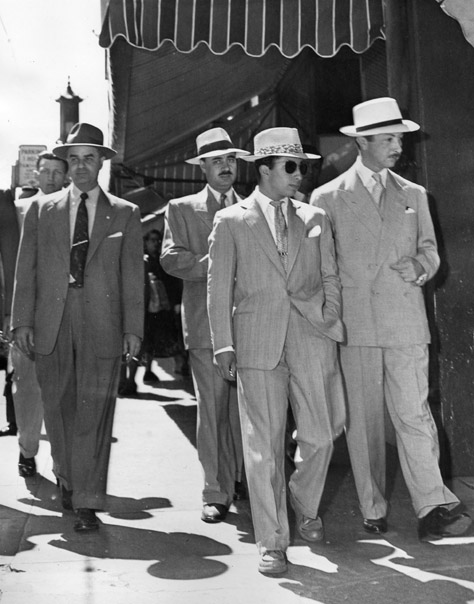
State Department photo of Faisal II, the young Hashemite King of Iraq with his maternal uncle the Regent Prince Abdul Ilah (a British ally) touring San Fransisco's China Town in 1952. The Hashemite Monarch might have been considered by the British as a possible King of their proposed Greater Syria & Iraq. This idea was also promoted by Nuri Al-Said, the strong prime minister of Iraq at the time who was also very close to Britain.

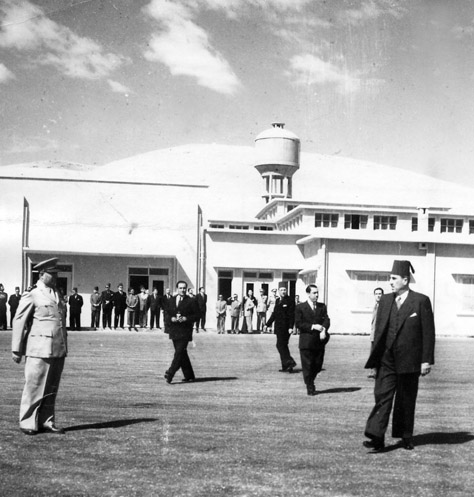
Syrian President Shukri Quatli (right) at the Damascus Mezze Airport in 1948 awaiting the arrival of Iraq's Regent Prince Abdul Ilah. On the left, Syria's Chief of Staff General Hosni Al-Zaim, who led an American sponsored coup d'etat against Quatli few months after this photo was taken (March 30th 1949). This was the first of a series of coups in the late forties and early to mid fifties. Syria was a democracy before this first coup.


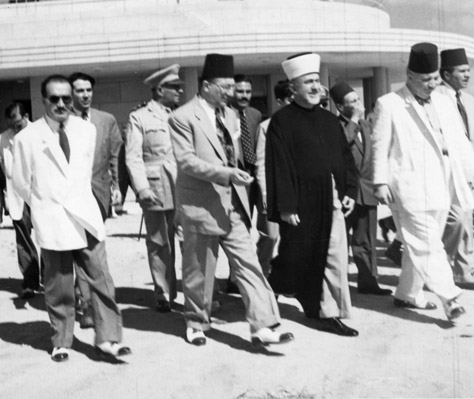
At Alexandria airport to attend an Arab meeting on Palestine. Riyad Al-Sulh, prime minister of Lebanon (white suit and Fez), accompanied by Haj Amin Al-Husseini, the mufti of Jerusalem who used to reside in Beirut. The Mufti was at the time the principal Palestinian resistence leader. Prime minister Al-Sulh may have been involved in Britain's plans for the area, according to Meir Zamir's article.

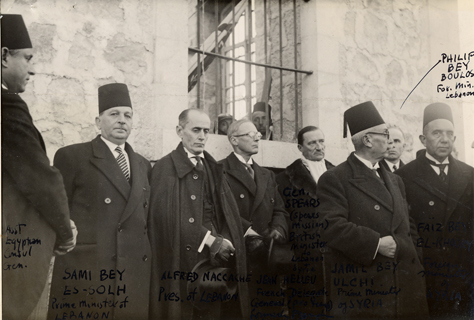
At the funeral of the Syrian President Sheikh Taj Al-Din Al-Hussieni in Damascus/Syria Jan, 18, 1943. The photo shows the key politicians and foreign diplomats who played a major role in shaping the future states of Syria and Lebanon just prior to the Independence of both states. From right to left: Faiz Bey El-Khoury, foreign minister of Syria. Philip Bey Boulos, foreign minister of Lebanon. Jamil Bey Ulchi, Prime Minister of Syria. General Spears, British minister to Syria and Lebanon. Jean Helleu, French delegate [pro-temp], formerly the French ambassador to Turkey. Alfred Naccach, President of Lebanon. Sami Bey El-Solh, Prime minister of Lebanon. And last, the assistant Egyptian general consul.

General Spears played a major role in British plans for attempting to move Syria and Lebanon out of French mandate and into British influence.


“Britain’s treachery, France’s revenge” by Meir Zamir

Meir Zamir has found 5 letters in the French archives in which President Quwatli of Syria promised to liquidate Syria's independence and give Syria to the Hashemites to rule as part of Greater Syria. This transaction took place as France was bombing Damascus and Quwatli feared that he would end up like Faysal before him in 1920, being driven from Damascus by the French. The British exploited his fears to get him to sign away Syrian independence and embrace Arab unity.
.
This is the import of Zamir's article in Haaretz. Here is the important paragraph:
On May 29, [1945] at the height of the French assault on his government's institutions, Quwatli finally gave in to the British and agreed to subject his country to British hegemony, in return for Britain's defense of Syria against the French. The following day General Paget issued the ultimatum to the French forces to observe an immediate cease-fire. The documents in the French archives show that the secret agreement was concluded hastily and consisted of seven letters: five from President Quwatli to Terence Shone, the British minister in Syria and Lebanon (to which Mardam was a cosignatory) and two from Shone to the Syrian president. Additional correspondence relating to the agreement was exchanged between Quwatli, Mardam and Shone between June 2 and July 2.

All five letters Quwatli sent open with the same sentence, in which the Syrian president swears on his honor, in his name and on behalf of the Syrian nation to establish Greater Syria; to grant Britain concessions for oil exploration in Syria and a preferential political, economic and financial status in the country; to adopt a foreign policy compatible with Britain's; and to allow Britain a role in establishing the Syrian army.

Quwatli ended up being the smarter of the conspirators. He got the British to kick the French out of Syria, but he stood resolutely against the Hashemites' and Britain's Greater Syria projects. It is hard to believe that Quwatli would promise to subsume Syria to a Hashemite led Greater Syria, even under the duress of the 1945 French bombardment.  
.
Read my article, "Syria and the 1948 Palestine War: Fighting King Abdullah’s Greater Syria Plan" to see how he fought against the Greater Syria project. The Palestinians paid dearly for Quwatli's fear that King Abdullah of Jordan would fulfill his dream of ruling Damascus and uniting Greater Syria by first conquoring the Arab half of Palestine with British help. Quwatli did everything he could to keep Abdullah from taking the Arab half of Palestine. This was the primary reason he built the Jaysh al-Inqath or Army of Salvation, usually entitled the Arab Liberation Army, made up of Arab voluteers. It was designed to help Syria guide and aid the Palestinian resistance against the Zionists while thwarting Abdullah's and Britain's plans to have Jordan do so.
.
Here is the full Zamir article:
.
Britain's treachery, France's revenge [Thanks to Basil Hakki at Middle East Open Forum for sending this along.]
By Meir Zamir – 01/02/2008
Haaretz Weekend edition

In the summer of 1944, when soldiers of Free France were still fighting alongside the British against the Nazis in Europe, the two colonial powers were engaged in a clandestine struggle in the Middle East. That summer, French intelligence scored a major coup over its British counterpart in the region. The French recruited a Syrian agent who had access to top-secret correspondence between Syrian leaders – among them President Shukri al-Quwatli and Foreign Minister Jamil Mardam (who later became prime minister) – and leaders of neighboring states. French intelligence also obtained reports sent by Syrian diplomats in London, Washington, Moscow, Paris and a number of Arab countries.

The identity of the Syrian agent is unknown, but cables transmitted between Beirut and Paris suggest that his recruitment involved large payments. The information he obtained was sent every week or two, in packages of 40 or 50 documents, from Damascus to French intelligence headquarters in Beirut, where they were translated from Arabic into French. An intelligence officer or a translator sometimes added notes. The French attached great importance to the speedy transfer of the translated documents, so much so that they allotted a special plane for this purpose. Extreme precautionary measures were taken to preserve the secrecy of the operation, and only a few officials were permitted to see the documents. There was also a ban on their transferal to the French Foreign Ministry. One copy was sent directly to the office of General Charles de Gaulle, who sometimes added his comments and issued appropriate instructions.

After the war the French sought to regain control of Syria and Lebanon, but Syria constituted a distinctive problem, in that its independence had been declared already in 1941, after joint forces of Britain and Free France liberated the country from the rule of the Vichy regime. From then until 1945, de Gaulle tried to force a treaty on Syria that would ensure France privileged status. After he understood that a Syrian-French agreement was not possible due to Syrian and British opposition, de Gaulle decided in April 1945 to send military reinforcements to Syria and Lebanon. This move, coupled with the harsh response of the French on May 8 in the city of Setif, Algeria, where French forces massacred thousands of Algerians who were demonstrating for their country's independence, badly rattled the Syrian president. Quwatli feared that he would suffer the same fate as Emir Faisal, who was expelled from Damascus by the French in July 1920.

At the end of May 1945, French forces attacked governmental institutions in Syria. On May 30, General Bernard Paget, the commander in chief of the British forces in the Middle East, issued an ultimatum to the French to hold their fire immediately and return to their barracks, or face a confrontation with far superior British forces. De Gaulle and the provisional French government had no choice but to comply. In the weeks that followed, with the tacit consent of the British, Syrian nationalists massacred scores of French citizens, and looted and destroyed the offices of French companies and French cultural, educational and religious institutions. Thus did French rule in Syria reach its violent and abrupt end.

In one of the most dramatic moments of the Syrian crisis, General de Gaulle told Duff Cooper, the British ambassador to Paris: "We are not, I admit, in a position to open hostilities against you at the present time. But you have insulted France and betrayed the West. This cannot be forgotten." On that same day, June 4, 1945, Cooper wrote in his diary: "He is genuinely convinced that the whole incident has been arranged by the British so as to carry out their long-planned policy of driving the French out of the Levant in order to take their place."

It now emerges that de Gaulle had concrete proof that "perfidious Albion" had struck again. That proof is contained in Syrian documents from 1944-1945, and some from 1947, which are preserved in the French archives and have now been made available to researchers. British Prime Minister Winston Churchill, Foreign Secretary Anthony Eden and the rest of the British diplomatic corps persisted in their denials. Britain, they asserted, had no surreptitious motives in Syria and Lebanon, and in fact had mediated between Syria and France in an effort to reach an agreement. Britain?s decision to intervene was the direct result of de Gaulle's aggressive policy, and his suspicions concerning Britain's role in the Levant bordered on paranoia and Anglophobia.

De Gaulle, for his part, was as good as his word: He never forgot and never forgave the British for one of the most galling and humiliating episodes he endured in his long career. In his memoirs he repeats obsessively his accusations against the British, for having betrayed France and exploited its passing weakness in order to dislodge it from a region in which it had religious, cultural and economic ties for hundreds of years. Britain, de Gaulle maintained, had generated the Syrian crisis deliberately in order to remove France from the Middle East, because France constituted an obstacle in its path toward creating an Arab federation under British hegemony. De Gaulle also accused Churchill of attempting to take advantage of the Syrian affair in order to oust him as head of the provisional French government.

Arab historians have described the crisis of May-June 1945 as a heroic uprising by the Syrian nationalists, who expelled the French from their country and thereby ensured its full independence. To this day, the Syrians mark the French departure in the form of a national holiday. But a perusal of hundreds of Syrian documents now available in French archives will oblige scholars to reexamine the history of the region, taking into consideration the secret alliance between Britain and Syria, which allowed Britain to exercise considerable control in Syria until 1948. Such a study may well have far-reaching implications for the history of the struggle to establish the State of Israel.

Vanquishing Syria

De Gaulle's feeling of betrayal was heightened by the fact that the officer who represented Britain in Syria and Lebanon during the war years was General Edward Spears, who had extricated de Gaulle from France at the last minute before the Nazi conquest. On August 5, 1944, Spears sent Riyad al-Sulh, the Lebanese prime minister, on a secret mission to Damascus. So strict was British security that Sulh learned the exact purpose of his mission only when he met with the British consul in the Syrian capital. The consul dictated to Sulh a proposal from His Majesty's Government to the Syrian government; Sulh was to convey the proposal to Saadallah al-Jabiri, the Syrian prime minister, who was also Sulh's father-in-law.

The British proposal included, among other points, Syria's unification with Transjordan and Palestine to create "Greater Syria." Syria would also have to accord Britain preferential status in military, economic and cultural matters and not sign any agreement with other countries without prior consultation with London. To persuade the Syrian leaders to agree to these terms, Britain was ready to commit itself to defend Syrian independence in the face of external aggression, continue the White Paper policy in Palestine and put a complete halt to "Jewish ambitions."

This clandestine British proposal to the Syrian government shows that, contrary to what has been believed until now, in August 1944 the British government gave its representatives in the Middle East the go-ahead to implement Iraqi Prime Minister Nuri al-Said's "Fertile Crescent Plan." This entailed forming Greater Syria by integrating Syria with Transjordan, Palestine and Lebanon. At a later stage, Greater Syria would be united in a federation with Iraq. The Christian minorities in Lebanon and the Jews in Palestine would enjoy autonomy.

The document elaborating the British proposal shows that after three years of objecting, Churchill and Eden finally accepted the approach of their representatives in the Middle East and adopted a strategy congruent with the surging force of pan-Arabism. The obstacles were formidable: Britain had to oust France from the Levant, violate its commitments to the Zionist movement just when the scale of the Holocaust in Europe was becoming apparent, and depose Jordan?s Emir Abdullah. In addition, Britain could be certain that its moves would anger the United States and the Soviet Union alike. Nevertheless, Churchill and Eden, and afterward Clement Attlee and Ernest Bevin, allowed a group of overconfident diplomats and army officers to drag them into a costly adventure, which was to put an end to British hegemony in the Middle East six years later.

Between August 1944 and May 1945, the major obstacle to the implementation of Britain's plans was the obdurate opposition of president Quwatli, who in the preparatory meetings for the establishment of the Arab League, supported the Egyptian-Saudi camp against Iraq. The British and Syrian documents present a clear picture of the pressure the British and the Iraqis applied on Quwatli. They led de Gaulle, who closely followed the British and Iraqi intriguing, to remark that the Syrian president was "the sole sincere politician in those countries." To Georges Bidault, his foreign minister, he noted the "duplicity" of the British government, which in London was still promising to persuade Syria and Lebanon to conclude treaties with France, while in Damascus its representatives were secretly trying to get the Syrian government to sign a treaty with Britain.

The final stage in this British campaign of intrigue, provocation and pressure was played out in May 1945, with the aim of coercing Quwatli to sign an agreement with Britain. The secret British efforts to expel France from Syria were coordinated by Colonel Walter Stirling (who sometimes operated in the guise of a correspondent for The London Times). In a report dated May 22, Stirling described a scene which could have come straight out of a Shakespearean tragedy: Even as Mardam was plotting to replace him, Quwatli was lying sick in bed, clutching a piece of paper on which the American consul general, George Wadsworth, had written – in the name of his government – an undertaking to back Syria's struggle to free itself from colonial rule. Quwatli declared to Stirling that the United States was the Arabs' best friend, whereas the British were egoistic and could not be relied upon for very long as they changed their position according to their interests.

On May 29, at the height of the French assault on his government's institutions, Quwatli finally gave in to the British and agreed to subject his country to British hegemony, in return for Britain's defense of Syria against the French. The following day General Paget issued the ultimatum to the French forces to observe an immediate cease-fire. The documents in the French archives show that the secret agreement was concluded hastily and consisted of seven letters: five from President Quwatli to Terence Shone, the British minister in Syria and Lebanon (to which Mardam was a cosignatory) and two from Shone to the Syrian president. Additional correspondence relating to the agreement was exchanged between Quwatli, Mardam and Shone between June 2 and July 2.

All five letters Quwatli sent open with the same sentence, in which the Syrian president swears on his honor, in his name and on behalf of the Syrian nation to establish Greater Syria; to grant Britain concessions for oil exploration in Syria and a preferential political, economic and financial status in the country; to adopt a foreign policy compatible with Britain's; and to allow Britain a role in establishing the Syrian army. Apparently Quwatli's immediate concern was that his commitment to the British remain absolutely secret, and Shone?s two letters to him undertook, on behalf of his government, not to divulge the existence of his letters.

In the years that followed, Quwatli and Mardam enjoyed the admiration of the Syrian public in particular and of the Arab world as a whole for having led Syria to full independence without any foreign presence. But the Syrian documents reveal the extent of British control in Syria and the various methods the British employed to ensure that Quwatli would toe the line. The British continued to exploit Damascus' fear of the return of the French and further heightened it by emphasizing the Zionist and Soviet threats, as well as the ambitions of Emir Abdullah to crown himself king of Greater Syria.

At the end of 1945, the new Labour government took advantage of Syria's fears of a possible change in British policy to ensure that Damascus would uphold its May 1945 undertakings to Britain. In pro-British Iraq, Nuri al-Said took steps to coordinate Syria?s foreign policy with that of Iraq in regional and inter-Arab relations. British officers were employed in the Syrian army, although officially it was claimed that they had been hired privately by the Syrian government. British intelligence also used Syrian agents for subversion against France in North Africa. However, the major obstacle to the Anglo-Iraqi-Syrian plan was not France, but the thrust of the Zionist movement to establish a Jewish state in Palestine.

In the service of Britain

In June 1945, in a debate in the French Consultative Assembly on the Syrian crisis, Bidault warned the British: "Hodei mihi, cras tibi" (in Latin: It is my lot today, yours tomorrow). Indeed, in the following years French intelligence did its utmost to exact a high price from Britain in the Middle East. The French were not motivated purely by revenge, but also by the ambition to restore their influence in the Levant, particularly in Lebanon, and counter British subversion in North Africa. The Syrian Foreign Ministry's documents, which the French received from their agent in Damascus, afforded them ample opportunity to act against the British in the Middle East, as well as against the governments of Quwatli-Mardam in Syria and of Sulh in Lebanon. In the period 1945-1948, the most effective French weapon against Britain in the Middle East was its support for the struggle of the Zionist movement. In a meeting held on October 6, 1945, with Marc Jarblum, head of the Zionist organization in France, de Gaulle stated that "the Jews in Palestine are the only ones who can chase the British out of the Middle East." On November 10, in a visit to Paris, David Ben-Gurion, head of the Jewish Agency, was told by foreign minister Bidault that France supported the Zionist cause.

Syrian documents recently uncovered shed new light on events that led to the establishment of the State of Israel and call for a reexamination of certain basic beliefs concerning British policy in Palestine from 1945-1948. The British proposal to Syrian leaders in August 1944 and the secret Anglo-Syrian agreement of May 29, 1945, reveal that Britain had assured Syria – a country not previously known to have been under British hegemony – that it would limit Jewish immigration and thwart the emergence of an independent Jewish state in Palestine. The agreement also reveals that by the summer of 1945, Britain had already formulated a Middle East policy based on an Iraqi-Syrian alliance, which included a plan for the formation of Greater Syria, which was to include Palestine. That policy patently could not accommodate the creation of an independent Jewish state in any part of Palestine.

Hundreds of Syrian diplomatic documents covering the period June-December 1945 provide details of negotiations between Syria and other Arab states and Britain's new Labour government on the Palestine question. It becomes apparent how the future of Palestine played a key role in inter-Arab rivalry and how the British government invoked the Zionist threat to ensure that the Syrian leaders abided by their secret undertaking to Britain.

Neither American warnings, Soviet threats, pressure by the kings of Egypt and Saudi Arabia, nor criticism by Syrian representatives in Washington and Paris were able to detach Quwatli and Mardam from their commitments to support British policy. Whenever Quwatli, under Saudi and Egyptian pressure, sought to free himself from the grip of the British, they played the French and Zionist cards, while the Iraqi government drew on pro-Iraqi Syrian politicians, particularly in the Aleppo region, to withstand the pressure. And always hovering in the background was the dreaded Emir Abdullah and his ambitions for the Syrian crown. Each time it seemed that Quwatli was no longer heeding "British advice," British agents in Syria or Transjordan, including Colonel Stirling, gave large sums of money to tribal sheikhs in the Syrian desert in return for their
declared allegiance to Emir Abdullah.

The British exploited the Zionist aspirations for a Jewish state in Palestine not only to threaten the Syrians, but also to induce them to cooperate. Indeed, following the secret Anglo-Syrian agreement, Quwatli and Mardam began to assume direct responsibility for ensuring that Palestine would become an integral part of Greater Syria, controlled by them from Damascus. Subsequently, in addition to rejecting the Zionist thrust for a Jewish state, the Syrian leaders also rebuffed the demands of the mufti of Jerusalem, Haj Amin al-Husseini, for an independent Palestinian state under his control. Thus, for example, Mardam warned the British that France was using the mufti, who received political asylum in France in 1945-1946, to subvert the Syrian and British interests. In 1947-1948, Quwatli and Mardam clashed repeatedly with the mufti, particularly over the appointment of Fawzi al-Qawuqji as head of the Arab Army of Salvation.

De Gaulle and Truman

The Syrian documents enhance understanding of two significant events on the road to Israel's establishment: President Harry S Truman's letter of August 31, 1945, to British prime minister Attlee, demanding that Britain allow the immigration of 100,000 Jewish refugees from camps in Europe to Palestine; and the well-known speech by Soviet foreign minister Andrei Gromyko in the United Nations on May 14, 1947 endorsing the establishment of a Jewish state.

Ten days before Truman sent his letter, de Gaulle visited the United States for a first meeting with the president. De Gaulle attached considerable importance to the visit, as France desperately needed the United States' support for the restoration of its Great Power status in Europe and in its overseas colonies, particularly in Indo-China, and for solving its pressing economic problems. The Syrian crisis had greatly damaged France's standing in the United States, so it was vital for de Gaulle to prove to the Americans that Britain, which had conspired with the Syrians to expel France from its mandated territories, was the real culprit.

It can be assumed that to ensure secrecy, de Gaulle would have revealed details of the Anglo-Syrian agreement only to president Truman. In any event, from August 22-24 the two leaders held three meetings. On the 24th, the Syrian ambassador to Washington, Nazim al-Qudsi, reported to Damascus that he had been urgently summoned to the State Department and asked to present his government's response to the question of whether Syria had agreed to unite with Iraq and whether the Syrian government was colluding with the British government to this end.

Puzzled, the Syrian diplomat, who knew nothing about any such agreement, immediately transmitted the American request to Damascus. The denial by Syrian Prime Minister Faris al-Khuri did not allay American suspicions. On August 25, al-Qudsi reported that he had learnt that the United States would support the Jewish cause in order to prevent total British control in the Middle East. Six days later, President Truman sent his famous letter to the British prime minister.

In the following months, al-Qudsi reported on extremely hostile statements by American officials against the British and Syrian governments. Secretary of state James Byrnes stated that the British wanted to expel the French from Syria and Lebanon only to take over the oil resources. An American official wondered whether the United States had recognized Syria?s independence only to see it come under British control, adding that "Britain, at this stage, is the true master of your country." Another diplomat declared that "Britain's intervention was intended to subjugate you and your economy, which is to say, it only seeks to colonize you." A further report reveals the Americans' opinion of what they viewed as ruinous British policy in Palestine. According to one diplomat, the British were responsible for the chaotic situation there, and he cautioned his Syrian interlocutor that Britain was exploiting the Jewish-Arab conflict in order "to achieve control in all the Arab states."

The Syrian diplomatic correspondence reveals also the intense Anglo-American rivalry over the exploitation of the Syrian economy. The British used their influence there to further the interests of British companies, at the expense of American firms. Terence Shone, now the British ambassador to Damascus, went so far as to warn Mardam against allowing American banks to operate in Syria, as "that would constitute capitalist colonial exploitation of the Syrian economy."

The Syrian government's refusal in 1947-1948 to grant a permit to the Trans-Arabian Pipeline company – Tapline – to lay an oil pipeline from Saudi Arabia through Jordan and Syria to the Mediterranean coast in Lebanon only increased American anger. Externally, it appeared that the Syrian government was acting in line with secret decisions made by the Arab League to boycott the Americans and the British because of their Palestine policy. In fact, the Syrians' refusal was tacitly encouraged by the British. In any event, Truman held the British government responsible and constantly pressured Bevin to compel Syria to grant Tapline the necessary permits.

What did Ben-Gurion know?

The French were more than happy to supply president Truman with new proof of British scheming, particularly in Palestine. But did France inform the Soviet Union of the secret Anglo-Syrian agreement or of the British intention to forge an anti-Soviet regional alliance with the participation of Iraq, Syria and Turkey – a plan they also learned about from the British-Syrian correspondence? If the Soviets had known of this, they would certainly have done their utmost to foil the British designs in the region overall and in Palestine in particular. A comparison of the British-Syrian and Soviet-Syrian correspondence indeed reveals a recurrent pattern: Issues secretly raised by the British with the Syrians were referred to by the Soviets within days. For example, when the British demanded that their armed forces remain in Syria even after the French evacuation, the Soviet representative in Damascus, Daniel Solod, immediately protested. When the British invited the Syrian government to send delegates to a secret conference in London to discuss the defense of the Middle East against external threats, a Soviet official in Moscow protested to the Syrian representative, Faiz al-Khuri. These and other examples suggest that France kept the Soviets abreast of British activity in the Middle East and North Africa.

A more intriguing question is whether the French passed on information from their Syrian source to the heads of the Jewish Agency, David Ben-Gurion and Moshe Sharett. Was Ben-Gurion?s almost prophetic ability during 1945-1948 to foresee regional and international developments and prepare the Yishuv (the Jewish community in Palestine) for a military confrontation with the Arab states based on prior knowledge of British and Arab secret intentions? Did his distrust of Britain's role in Palestine, portrayed by historians as "obsessive" and "paranoid," derive, like de Gaulle's suspiciousness, from accurate intelligence? Was Ben-Gurion?s belief that the British were involved in a secret conspiracy with Arab leaders to prevent the establishment of a Jewish state based on information provided by the French? And did his fateful decision to declare the establishment of the State of Israel on May 14, 1948 – and later to impose major operational decisions on his generals – stem from secret information he received from the French about the Arabs' military plans?

Initial research was carried out in the last two months in three archives (the Ben-Gurion archives in Sde Boker, the Haganah archives in Tel Aviv and the Central Zionist Archives in Jerusalem), and Ben-Gurion's diaries, particularly his war diaries for December 1947-July 1949, were also consulted, with the aim of discovering whether information from the Syrian documents was made available to Ben-Gurion and whether he knew its exact origin. Also examined were the modes by which intelligence information was transmitted and those who were possibly involved on the Israeli side.

Within the framework of this article only a few of the findings can be cited. For example, on October 15, 1944, Ben-Gurion met in Beirut with General Paul Beynet, the French delegate general in Syria and Lebanon. Their meeting was probably arranged by Eliyahu Eilat (Epstein), who had met Beynet on September 6, a month after French intelligence learned of the secret British plan to expel France from Syria and Lebanon and foil the establishment of a Jewish state. Ben-Gurion recounts his meeting with General Beynet at length, particularly the emphasis he laid on the importance of a Jewish state for the existence of a Christian Lebanon.

On November 23, 1944, Ben-Gurion wrote in his diary that he had sent a letter with Captain Blanchard to Marc Jarblum, the representative of the Zionist Organization in France. Blanchard was an intelligence officer who had served with the forces of Free France in Syria and Lebanon during the war. In 1945, together with Tuvia Arazi, an intelligence officer and a liaison between the Jewish Agency and Free France, he accompanied Ben-Gurion to some of his meetings with French officials in Paris. Blanchard continued to be involved in the secret contacts between France and the Zionist movement or Israel in the following years. Ben-Gurion was in Paris in May and June 1945, when the Syrian crisis erupted. His diary entries show clearly that he endorsed wholeheartedly the French charges against the British. If Britain was ready to go to such extremes against France in Syria and Lebanon to ensure its regional status, it was obvious to him that it would be ready to impose its own solution on the Yishuv as well. In a diary entry on June 8, he noted that the French were seeking the cooperation of Jewish groups in order to undermine security in Palestine and that emissaries of the underground breakaway militias Etzel and Lehi had visited Beirut.

By September, it had become apparent that the Labour government did not intend to modify British policy in the Middle East. The French learned this from the Anglo-Syrian correspondence. On October 1, Ben-Gurion sent his well-known directive from Paris to Moshe Sneh, the head of the Haganah, instructing the defense forces to cooperate with Etzel and Lehi in armed resistance against British rule. The establishment of the united resistance movement was seen at the time as an extreme measure and was strongly criticized by some of Ben-Gurion's colleagues, as this ended a quarter-century of close cooperation between the Zionist movement and Britain. Ben-Gurion remained in Paris throughout nearly the whole of 1946 and early 1947, directing the struggle against the British from his temporary headquarters in the Royal Monceau Hotel on Avenue Hoche.

Other important discoveries relate to the three agreements the Jewish Agency entered into in 1946 with Egyptian Prime Minister Ismail Sidqi; with Emir Abdullah; and with the Maronite Church on a compromise solution for Palestine based on partition. These agreements can be better understood if one takes into account that all four parties involved were adversely affected by the Anglo-Iraqi-Syrian deal of 1945. The French provided details of the Anglo-Iraqi intrigues to the Egyptians and the Maronite church. As for Emir Abdullah, he may have heard about them from officials of the Jewish Agency, with which he had maintained close ties since the 1930s.

The British withdrawal

The Syrian documents reveal the close ties that were formed between Lebanese Prime Minister Riyad al-Sulh and Brigadier Iltyd Clayton, whose official position was liaison officer to the Arab League in the British Middle East Office in Cairo. From 1946-1948, Sulh played an important part in the meetings of Arab leaders concerning Palestine, while Clayton had a key role in the British intelligence service in the Middle East after World War II.

The Syrian documents also show that in the summer of 1947, the Syrian leaders were concerned about some of Sulh's improved relations with France and his collaboration with the mufti, who then resided in Beirut. The Syrian ambassador in London, Najib Armanazi, who spoke with General Spears, informed Mardam that Sulh?s policy was being coordinated with the British. In another report, Armanazi informed Mardam that Clayton had received a "carte blanche" to promote the Greater Syria plan, which was "still on the table." After meeting Sulh in Beirut, Mardam reported to president Quwatli that Sulh's activities were indeed being coordinated with the British. At the end of September 1947, a Haganah intelligence agent reported that Riyad al-Sulh and the mufti, with tacit British support, were planning to foment protests and strikes by Arab Palestinians in early October against the emerging partition plan. The report added that armed bands would be allowed to cross the border from Lebanon and attack Jewish settlements in the Galilee. It is noteworthy that in September and October, Brigadier Clayton was in Lebanon, where Arab League meetings took place to formulate joint Arab diplomatic and military policy in Palestine. Arab affairs experts who were advising Ben-Gurion doubted the agent's reports, but another expert on the subject, Jewish Agency representative Eliahu Sasson, who arrived in New York from Paris on the eve of UN discussions on partition, warned that these activities were being coordinated with the British.

In the next two weeks, Ben-Gurion placed the Yishuv on alert; forces were mobilized and sent to the Galilee, and Jewish settlements were fortified. Some historians have viewed this as an overreaction and a sign of panic, while others see it as merely a military exercise intended as a warning to the British. But if we take into account the information obtained by the French from their Syrian source on the close collaboration between Sulh and Clayton, which they had surely conveyed to Ben-Gurion or to the Haganah, Ben-Gurion's reaction is more readily understandable.

At the end of 1947 and in the early months of 1948, the French continued to send reports of Sulh?s collaboration with Clayton, in some cases via Morris Fischer, a Yishuv intelligence officer who served with the forces of Free France in Syria and Lebanon until 1945, and was afterward appointed Jewish Agency representative in Paris. (He became nascent Israel's first ambassador to France.) For example, on January 13, Fischer reported that Clayton had reached a secret agreement with Sulh on the withdrawal of the British forces from the Galilee to Haifa, to give the Arab Army of Salvation freedom of maneuver.

These examples, and others not cited here, do not by themselves necessarily constitute unequivocal proof that the French shared information they gleaned from the Syrian documents with the Israelis. However, if we take into account the secret Anglo-Syrian agreement, the intense French hostility toward the British in the aftermath of their expulsion from Syria and Lebanon, and the close collaboration between France and the Zionist movement during 1945-1948, this possibility appears quite reasonable. In any case, the Syrian documents uncovered so far in French archives will oblige historians to reassess British policy in the postwar Middle East in general, and in Palestine in particular.

It might be appropriate to conclude with the remark of the French consul general in Jerusalem, René Neuville, who declared in June 1948, at the height of the Jordanian Arab Legion's siege of Jerusalem: "There are those who pull the trigger and those who pull the strings.?

Meir Zamir is a professor of Middle East history in the Department of Middle Eastern Studies at Ben-Gurion University of the Negev.
All rights reserved by the author.


“Sy Hersh: Syrian Facility Bombed by Israel not Nuclear”

Sy Hersh confirms: Syrian facility bombed by Israel was not nuclear (Click to see video of CNN interview with Hersh)

A Strike in the Dark
by Seymour M. Hersh

David Edwards and Muriel Kane
Published: Sunday February 3, 2008

After Israel bombed a Syrian military facility last September, the United States and Israel both claimed the target had been a Syrian nuclear facility under construction.

RAW STORY's Larisa Alexandrovna was alone at the time in reporting that the actual target was a cache of North Korean No-Dong missiles, dating back to the 1990's, which Syria was convert for use as chemical warheads.

In a follow-up report, Alexandrovna added that Vice President Dick Cheney was suspected of being behind leaks to the press of misleading claims of a nuclear basis for the incident.

A third story in Alexandrovna's series reported that the US and Israel were refusing to cooperate with an attempted investigation by the International Atomic Energy Agency, but that the IAEA had concluded on the basis of satellite imagery that the target was unlikely to have been nuclear.

However, the US/Israeli version continued to dominate most accounts of the incident. As recently as December, the Sunday Times was still insisting that "Israel's top-secret air raid on Syria in September destroyed a bomb factory assembling warheads fuelled by North Korean plutonium."

Now veteran investigative journalist Seymour Hersh has weighed in on the matter. Hersh appeared on CNN's Late Edition on Sunday to discuss his upcoming article, "A Strike in the Dark," which will appear in the Feb. 11 issue of the New Yorker.

Hersh writes in that article, "Whatever was under construction, with North Korean help, it apparently had little to do with agriculture — or with nuclear reactors — but much to do with Syria's defense posture, and its military relationship with North Korea. And that, perhaps, was enough to silence the Syrian government after the September 6th bombing."

"This is a wonderful sort of a complicated story," Hersh told CNN's Wolf Blitzer. "Here Israel bombs another country, basically an act of war. … They don't say anything publicly about it. The Israeli great ally, the United States, says nothing. Syria doesn't say much about it. They complain, but they're very muted too. … Nobody talks about it."

Hersh went on to say that even though nobody was talking publicly, "there was tremendous sotto voce stuff. In other words, the Israeli government, the American government were leaking, telling newspaper people, particularly in America, but also in Europe, all sorts of wonderful, grandiose details about what happened."

Hersh finally concluded as a result of his investigation that "when you began to look at each part… they sort of fall apart." He is not even convinced the plant was even a chemical warfare facility but believes it may have been a missile plant. "Israel may indeed have some evidence that's overwhelming," Hersh stated. "But without that sort of evidence, what they've done is, they've simply bombed another country."

Hersh's best guess as to the motivation of the bombing was partly Israeli politics and partly that "it's a message for the Iranians that we're coming."

Israeli-Syrian Peace: From Dialogue… to Details & Diplomacy

Posted by Qifa Nabki 

Thanks to all of the excellent participants on Syria Comment for generating a stimulating debate about the prospects and shape of a future Israeli-Syrian peace deal.

The comment board, as of this moment, is nearing 300 posts, amounting to 75,000 words, which is equivalent to a printed book over 200 pages long. While not all of the musings may be ready for print quite yet, the sheer volume and quality of many of the exchanges demonstrate that there is a real desire on both sides of the border for a solution to this decades-old problem.

Of course, the debate contained many dissenters, perhaps best characterized by the posts of Joe M. and AnotherIsraeliGuy:

Joe M. said:
For there to be peace, Israel must recognize its crimes (including the crime of its existence), it must admit to them, and it must repent. In my view, the best way for this to happen is similar to the history of South Africa. Until Israel allows Palestinians the rights of citizenship in their own land, there will not be peace. There will not be peace with Egypt, Syria, Lebanon, Jordan… In the mean time, there will be periods without war, but there will not be peace.
It is up to Israel. Just as it was up to the whites of South Africa. The Jews have all the moral and political responsibility.

AnotherIsraeliGuy said:
…There will not be peace until the Arabs stop living in denial and understand that history has no rewind button.
But don’t worry, we Israelis can wait. Let’s talk again after 50 years of Hamas rule in Gaza and 50 years of Muslim Brotherhood rule in Syria and Egypt and 50 years of Hizballah rule in Lebanon. There is no hurry. I am sure the Arabs will be in a much better position then. We waited 60 years for peace, we can wait another 50.

 There were also many who expressed a cautious hopefulness, but pointed out the problems in Dr. Alon Liel’s proposal:  

ALEX said:
From all those discussions, I can summarize the most common objections to your plan in two lines
1) Peace Park implies partial Syrian sovereignty over the Golan.
2) Syrians Can’t allow their government to sell their friends or neighbors for their own selfish benefit.
To you those are the evil “Hamas” “Iran” and “Hizbollah” .. to the Syrian people they are really Half the Lebanese people, half the Palestinians, and … the 71 million Iranian people who consider Syria their best friend in the world.

AUSAMAA SAID:
…what Israel really needs is Peace with the Arabs, not Peace with Syria. Israel has Peace agreements with Jordan and Egypt, but then what? Can an Israeli tourist walk Amman or Cairo streets with any sense of security?
So trying to do it by piecemeal is not a solution and would never produce results as long as the conflict is not put into its correct context. Land for Peace, yes, but with a full resolution to the main issue being the Palestinians. Peace with justice and without hegmony. That is what is needed. Peace, not Peace Treaties.

YAMAN SAID:
Mr. Liel’s attempt to guide the region to peace may be well-intentioned. But it certainly suffers from a few fatal flaws:
1) It links Damascus’ regional interests and activities as if they were based exclusively on territorial sovereignty over the Golan Heights, which is in fact not the case since Damascus’ activities are influenced more by its positioning in a regional and international power dynamic rather than questions of territorial sovereignty.
2) In pursuing a road to “peace,” it asks of Damascus precisely what those on the road to war and isolation are asking: the isolation of Damascus from its regional allies (such as Iran, key Palestinian organizations, etc); a change in Syria’s “regional orientation,” which is a euphemism for the abandonment of what it perceives as its interests and independence; a false Syrian sovereignty which does not allow Syrians to live in the Heights, a Syrian military presence (something which Israel has never done, and nobody has ever dared to ask it to do) in the Heights, or even Syrian control of the natural resources on its own land.
3) Finally and furthermore, the only difference Liel’s approach has to that of the hawkish camps is that it seeks mostly non-violent means of eclipsing Syrian independence and sovereignty by bringing it under the wing of US and Israeli control (to serve the interests of those two powers), rather than a mostly violent military confrontation. These are superficial differences at best which might mean no loss of life in the immediate future, but are certainly not a resolution to the current situation.

 With these considerations in mind, several of the participants began debating particulars, and an important discussion emerged between Alon Liel, Shai, Alex, Sami D., and others. While most everyone seems to agree that what is needed is a “comprehensive peace”, it is still possible to detect two different approaches to the problem, on the Syrian/Arab side. The first is expressed by Sami D., who believes that Dr. Alon Liel’s proposal (which is much more progressive than the mainstream Israeli line) is still highly unrealistic. This approach makes it very difficult to imagine a Syrian-Israeli peace that is not accompanied by a complete solution to the Palestine-Israeli conflict. 

Sami D. said:

Almost the entire presentation of Mr. Liel requires that Syrians commentators accept the Israeli propaganda portrayal of the conflict, which necessitates a reversal of cause and effect: That Israel came in peace, but that the Palestinians and Arabs are the aggressors, perhaps out of “their anti-Semitism.” Not only that, but a continuation of Israeli theft of water resources is expected to be respected and abetted by Syria!! “The Syrian window of opportunity is wide open” indeed, and has been since the beginning, to bow to Israeli conquest and US hegemony. And Syria might just do that, an indication of weakness.
The Israeli window of opportunity for real peace, on the other hand, has also been open for quite some time. Israel has the opportunity to make real peace by stopping its conquest and quest to dominate the region, on behalf of itself and the United States. Another important thing on the path of peace is for you Mr Liel, as for genuine peace-loving Israelis to, at minimum, respect the intelligence of the adversary.
Exchanging Israeli control and domination for a different means to achieve the same Israeli control and domination, using the required Orwellian language (“nature reserve” and “not depriving” Israel of Syrian water, etc) is not only an affront to peace, but an insult to the intelligence of the Syrians people. You make no obligations on Israel to stop any of its aggression, even basic gestures like ending its denial of Palestinian rights. In other words, what you propose is occupation in sheep’s clothing.
To achieve real peace there has to be basic parameters that both sides will agree on: Namely, basic human rights and international law – nothing novel about that. Occupation and subjugation of another people must end, land must get returned to its owners, resource theft ceased, right of return for refugees granted. We can’t dismiss these basic parameters as “impractical” or “not pragmatic” just to allay Israeli people’s insecurity, real or imagined, while in the process watching Israeli state conquer and take other people’s land and resources – the original reason of its supposed insecurity.

 Alex presents a slightly more hopeful approach, content to make headway toward a “comprehensive peace” through the example of a successful Syrian-Israeli deal. He addresses the obstacles below: 

 Alex said:

I understand Israel’s fears from Ahmadinejad’s Iran. He is not very friendly, and Iran is a powerful nation hwhich is in the process of acquiring nuclear technology. But I share Halevy’s opinion that dealing with Iran should not be through the use of force or even through sanctions. You should try to gain Iran back as a friend. You can… but only when you also try to gain, Syria, Lebanon and the Palestinians as friends… comprehensive peace, not separate deals. I’m afraid Israel is not close to agreeing with this suggestion.

…
Kicking Mashaal out of Damascus has one probably outcome … relations between Syria and the Palestinians will deteriorate. Syria worked for decades to become perhaps the most trustworthy Arab country in the minds of the Iranian and Palestinian people, and Israel is asking Syria to “drop those cards”…

So what will Israel get instead of “flipping Syria”?
1) Hizbollah will easily convert itself into a political party and turn its weapons to the Lebanese army…

2) Hamas will accept to moderate its views. It will practically agree to not interfere even if it officially does not accept Israel’s right to exist. Hamas will agree to a 50 year truce for example if Israel agrees to respect UN resolutions 242 and 338.

The Iranian threat has been highly exaggerated. It is more likely that there is a need in Washington and Israel to teach the Iranians a lesson for their daring to openly challenge both countries.

Confidence building measures:
Both countries need to produce some CBM’s. Syria is not the only side which needs to reach out.

The Syrians can try this one:

Organizing a large event to honor Syria’s Jews. Large numbers of Syrian Jews would be invited to Syria to participate in the festivities. it will show Israelis that Syria is proud of its Jews even though they are now outside. Syrian Jews would be very happy to come back to Damascus and Aleppo for few weeks to participate in such a festival.

Israel can simply start to use a different tone from the one used in Washington the past few years. There are no closed doors but … Treating Syria as an equal is a prerequisite to a successful start, or finish, of the peace process… Keep that part in mind and you will know how to get Syria more motivated.

________________________________________________________________________ 

In an effort to further instrumentalize this productive dialogue, I would like to challenge Syria Comment contributors to weigh in on the following questions:

1) If the only viable peace is a comprehensive one, do you believe that Syria should lead or follow? In other words, is it even useful to begin talking about a Syrian-Israeli deal, or must those details wait until the Middle East has transformed completely? (AIG and others would like to see democratic Arab regimes before peace, and Sami D. would like to see Israeli atonement and recognition for crimes committed against the Palestinians, before a regional deal is reached.) What do you believe?

2) Confidence Building Measures (CBM’s): A few CBM’s have been raised; can people suggest others that would help to pave the way for bolder policy initiatives?

3) Peace Park: The Israelis remind us that it was our idea in the first place. The Syrians don’t seem to think much of it. What do you say?

4) Hamas & Hizbullah: Alex and others have suggested that Hamas and Hizbullah can be moderated (or will moderate themselves) once a peace deal is reached. Do you believe this? How will this work?

“Lebanese diva arouses emotion, controversy in Syria,” by Oweis

Lebanese diva arouses emotion, controversy in Syria
Mon 28 Jan 2008
By Khaled Yacoub Oweis: Reuters

DAMASCUS, – Legendary Lebanese singer Fairouz performed to a sell-out crowd in the Syrian capital on Monday, defying politicians who criticised her for going to what they consider enemy territory.

The Arab diva, who burst onto the music scene on Damascus Radio in 1952, returned to the Syrian stage after an absence of two decades, and moved many of her fans in the Opera House audience to tears.

She played the lead role in "Sah al-Nom", a musical satire about a careless ruler who is challenged by a poor woman, and received a standing ovation. The show was performed as part of cultural celebrations in the ancient city of Damascus, chosen as the 2008 Arab Capital of Culture.

"Fairouz transcends politics. In Damascus she has been always treated as an empress," Syrian sculptor Mostapha Ali told Reuters.

Fairouz, who is in her 70s and is a cultural icon of the Arab world, aroused controversy by accepting the invitation from the Baathist government in Damascus at a time of increased tension between Syria and its neighbour Lebanon.

Lebanese Druze leader Walid Jumblatt accused Fairouz of playing into the hands of Syrian intelligence services he blamed for a series of political assassinations in Lebanon.

Another Lebanese member of parliament said Fairouz should not perform for "Lebanon's jailers", a reference to Syrian dominance and military presence in Lebanon for most of the period from 1976 until Syrian troops withdrew in 2005.

A group of Syrian political activists also called on Fairouz to boycott Damascus, pointing to a renewed crackdown on dissidents. Just one hour before the play began, intelligence officers arrested leading opposition figure Riad Seif.

Ten other dissidents were charged earlier in the day with undermining the state, and could face long prison sentences.

Syrian political commentator Ayman Abdelnour said Fairouz performed for the Syrian people, not its rulers.

"The Syrians consider Fairouz one of their own. Before they studied geography and went to school they learned about Syria's rivers and mountains from listening to her songs," Abdelnour said.

Fairouz has not responded to the criticism. She last performed in Syria in the 1980s, during the iron rule of President Hafez al-Assad, father of current President Bashar al-Assad, when Syrian troops were still in Lebanon.

The gaunt, enigmatic Fairouz with her trademark long red hair is considered a national treasure in Lebanon. When she returned to Lebanon's Baalbak cultural festival in 1998 for the first time since the 1975-1990 civil war, Beirut's Daily Star newspaper described her return as "catharsis on a national scale".

"The high point of my life was when broke through a crowd in London and kissed Fairouz's hands," said leading Syrian painter Fadi al-Yazigi, who has sought to organise joint exhibitions with Lebanese artists to counter political tension between the two countries.

The late Egyptian composer Mohammad Abdelwahab called Fairouz "our ambassador to the stars". She is Lebanon's biggest artistic export and her recent collaboration with her son Ziad has appealed to a more international audience.

The musical she performed on Monday was composed by her late husband Assi al-Rahbani and re-arranged by Ziad, whose musical creations have ranged from political musicals to jazz.