News Round Up (15 April 2008)

The potential deal between Turkcell and Syriatel, Rami Makhlouf's company, is the one to watch to judge whether Washington's latest Syria sanctions have international teeth. If the Turks push through with the deal, Washington will just be gumming on the perimeters of Syria's economy.

Turkcell continues talks on Syriatel stake
By Ercan Ersoy, 14 April 2008

ISTANBUL, April 14 (Reuters) – Turkish mobile operator Turkcell is still in talks for a majority stake in Syriatel, despite fresh U.S. sanctions against the Syrian operator's owner, the Turkish company said on Monday.

A source familiar with the deal told Reuters that the talks were taking longer than expected because some Turkcell executives had U.S. passports. But Turkcell said that "any possible U.S. citizenship held by management" would not affect the process. Turkcell, Turkey's largest mobile operator, is listed in Istanbul and New York.

In February, the United States froze the assets of Syriatel owner Rami Makhlouf under economic sanctions aimed at stepping up pressure on Damascus. Washington said Makhlouf benefited from corruption in the Syrian government, and the measures against him forbid U.S. citizens or entities from doing business with him.

"The talks on the Syrian matter continue," Turkcell told Reuters in a statement on Monday. "We are aware of the situation between the United States and Syria. But since Turkcell is a Turkey-based company and there is no legal restriction on the purchase of Syriatel, the situation does not have any impact on the talks," it said.

Turkcell CEO Sureyya Ciliv told Reuters in late February that he had expected to complete talks with Syriatel in a month and Makhlouf said around the same time that talks with the Turkish operator were continuing. Kuwait's Mobile Telecommunications Co (Zain) said last month it was also interested in Syriatel, saying then that it was still an open competition.

Makhlouf, the cousin of Syrian President Bashar al-Assad, owns 69 percent of Syriatel. Gulf investors and Syrian shareholders own the rest of the company, which controls HITS-Unitel, a Yemeni cellphone operator. Turkcell CEO Ciliv said in February that Syriatel had 3.4 million subscribers and a 54 percent market share.

On Monday Turkcell stock fell 4.5 percent in Istanbul, bringing its losses since April 9 to 12 percent, compared with a 3 percent fall on the main index <.XU100>. Analysts attributed the fall to an initial public offering for fixed-line operator Turk Telekom due in May, which they expect will draw funds out of Turkcell in favour of the newly listed company. (Editing by Quentin Bryar; Editing by Erica Billingham)

Arab world sees U.S. in poor light, poll shows
By Sue Pleming, Reuters (Thanks to FLC)

….83 percent had an unfavorable view of the United States and 70 percent had no confidence in the superpower……

Over 80 percent of respondents identified the Arab-Israeli conflict as a key issue but just over half — 55 percent — did not believe there would ever be a lasting peace between the Israelis and the Palestinians despite U.S. efforts…….

In the Lebanese conflict, only 9 percent expressed sympathy with the majority governing coalition supported by Washington while 30 percent backed the opposition led by the militant group Hezbollah, which the United States opposes……

In the conflict between Hamas and Fatah, only 8 percent said they sympathized most with Fatah and 18 percent were more partial to Hamas, while 37 percent said they backed both."

New “Pro Israel, Pro Peace” Political Group Launches: JStreet Hopes to Prod Washington MidEast Policy Towards Center
Laura Rosen in MoJo, here (Thanks to FLC) or Some Jewish Liberals Seek New Lobbying Group: Wash. Post

"…One of JStreet’s Israeli organizers in Washington, former Israeli peace negotiator Daniel Levy, says Israeli leaders need pressure from Washington to have domestic cover to make concessions that could contribute to the peace process. “I think there comes a point when, if the Israeli leadership actually wants to see this thing resolved, it’s clearly easier to say yes to the president of the United States, rather than to the [Palestinian Liberation Organization],” Levy told me. “You need to have to have the president of the United States to help carry you there.”

Lee Smith, writing in The New Republic, makes the argument that Barack Obama’s policy of engaging with dictators is particularly ill-suited for Syria. While not reflexively rejecting a policy of engagement, Smith argues that Syria presents a unique case in which non-engagement is actually working to our advantage right now. (Thanks to PMED)

President Carter:

"I think there's no doubt in anyone's mind that, if Israel is ever going to find peace with justice concerning the relationship with their next-door neighbors, the Palestinians, that Hamas will have to be included in the process," said Carter, who won the Nobel Peace Prize in 2002.

From Tony Karon

The inevitability of talking with Hamas is already widely recognized in U.S. policy circles, and especially in Israel. Already, the Israelis negotiate secretly over issues such as the fate of Corporal Gilad Shalit, prisoner exchanges and a cease-fire with Hamas through intermediaries such as Egypt. And a poll published by the Israeli daily Haaretz in February showed that two out of three Israelis support direct talks between their government and Hamas — an option publicly advocated by such high-profile Israeli leaders as former Mossad chief Ephraim Halevy and former foreign minister Shlomo Ben Ami. And just as some Israelis are recognizing that Hamas cannot be eliminated, so too do some Hamas leaders appear to realizing that Israel isn't going to be militarily defeated, either.

Into the Lion's Den
By Hussein Agha, Robert Malley
New York Review of Books
Volume 55, Number 7 · May 1, 2008

There are choices. Regional and international actors can acknowledge that without a Palestinian consensus, the quest for peace is an illusion. They can face the fact that without Syria, the hunt for a stable endgame will remain elusive. Or they can compound wishful thinking with wishful thinking and hope that Olmert and Abbas somehow will find strength amid their frailty; that a peace agreement somehow will be reached; that violent opposition somehow will not torpedo it; that the regional polarization somehow will not interfere; that popular support somehow will be mustered; and that the deal somehow will be implemented. In that case, they would not be following a strategy. They would be pursuing a perilous chimera.

"Syria will not break ties with its allies but might act in more subtle ways. Neither Hamas, Hezbollah, or Islamic Jihad is a Syrian proxy. But they depend on vital support from Damascus and can read the regional map. Today, they feel winds in their sails. They sense a rejectionist popular mood and believe that with Syrian and Iranian help they can steer it toward their goals. A resumption of Israeli–Syrian talks and an eventual agreement would send unmistakable signals that those winds are shifting, the map changing, and their strategic depth narrowing. In the event of a peace agreement, Damascus knows it will have to rein in its militant allies and stop supporting their military activities. Inevitably, Hamas, Hezbollah, and Islamic Jihad will reconsider their options. They are unlikely to modify their ideology. But they could be forced to alter their behavior, a result more practical and, one would think, of greater import."

The second Iraq Security Conference Just Ended in Syria

Officials from countries neighboring Iraq have ended two days of security talks in Syria during which they agreed that protecting the Iraqi border is a joint task.

The meeting came ahead of wider discussions on Iraqi security due in Kuwait on April 22.

A Monday statement says the participants underlined their "respect of Iraq's unity, sovereignty and independence" as well as their commitment to preserving Iraq's "Arab and Islamic identity."

The statement also says the officials praised "positive cooperation" between Iraq and its neighbors in "fighting terrorism" and efforts to "improve the security situation" in Iraq.

Who was present: An Iranian delegation comprising senior managers of Iran's interior and foreign ministries attended. Turkey, Syria, Jordan and Kuwait will be present, but Saudi Arabia did not attend. Representatives from Egypt, Bahrain and the permanent members of the United Nations Security Council, the Organization of the Islamic Conference, the Arab League, the European Union and G8 also were present.

In the first Iraq security conference, held in the Egyptian resort city of Sharm el-Sheikh on May 3-4, 2007, neighboring countries agreed on joint responsibility for the security of Iraq borders.

Two Indonesian terror suspects on caught entering Malaysia on false passports had been en route to Syria where they planned to link up with militant groups, police said Tuesday. (AP)

History brings tourists to Syria BBC

SYRIA: Lebanon Intransigence Increases Isolation 
Thursday, April 10 2008 Oxford Analytica 2008

EVENT: Saudi and Egyptian leaders met yesterday to discuss the Lebanon crisis.

SIGNIFICANCE: The recent Arab summit in Damascus highlighted the gap between Syria and fellow Arab states, especially Saudi Arabia, on Lebanon. Syria refused to buckle to pressure to facilitate an agreement between its Lebanese supporters and the anti-Syrian opposition, despite the widespread boycott of the summit. Relations with Riyadh have reached a new low.

ANALYSIS: A small country with a weak state, Lebanon has long been accustomed to having its politics shaped by struggles between much stronger external actors. The most recent example of this is the political deadlock between the anti-Syrian camp currently in government (the March 14 movement), and pro-Syrian opposition, over the presidency

Proxy battleground. Washington, as well as Arab states that boycotted the summit at the end of March, hold Syria responsible for the intransigence of opposition politicians. Washington has many problems with Syria: Damascus hosts a number of Palestinian militant groups, allegedly does too little to prevent jihadis crossing its border to fight in Iraq, and — most significantly — refuses to abandon its military and political alliance with Iran:

* United States. Washington reads the Lebanese political scene as a microcosm of wider regional politics: it strongly supports the pro-Western, liberal March 14 movement, which it sees as a democratic trend-setter blocked by the pro-Syrian, pro-Iranian opposition bloc. As a result, it sees efforts to put pressure on Syrian influence in Lebanon as part of a much wider regional struggle to contain Syria and Iran.

* Syria. For Damascus, 'resistance' to neo-colonial conspiracies to remake the Middle East has become a key component of political discourse. Syria has long claimed to retain a commitment to the greater Arab cause that other states in the region have forgotten. Additionally, Damascus has no intention of allowing Washington to influence events in neighboring Lebanon, which, from a Syrian perspective, is little more than a tiny Taiwan to their powerful China. Consequently, Damascus has little concern for the best interests of the Lebanese polity Even if there is no open fighting in Lebanon, the country remains as much a battlefield for external powers as it was during the civil war.

Saudi relations. Only half the 22 Arab League heads of state of the attended the conference. Lebanon boycotted the event entirely; Saudi Arabia, Egypt, and Jordan sent only low-level delegations. As part of its efforts to isolate Syria and loosen its grip on Lebanon, Washington had exerted pressure on many Arab leaders to boycott the gathering.

Syrian Foreign Minister Walid al-Mouallem declared that the summit was a success — despite its manifest inability to discuss anything of substance — and that Washington had failed to divide the Arabs.

However, Syria's differences with Saudi Arabia go beyond US influence on bilateral relations, originating in the February 2005 murder of Rafik al-Hariri, former Lebanese prime minister and Saudi favourite. Since then, events and fundamental differences of approach have exacerbated tensions even further:

* Lebanon. Saudi Arabia has been critical of both Syria and Hizbollah, including making negative comments about the latter during the July 2006 war. Syrian President Bashar al-Assad retaliated by calling those who criticized Hizbollah — essentially Saudi Arabia and Egypt — "half-men".

* Palestine. Saudi Arabia has thrown its weight behind the Palestinian National Authority of President Mahmoud Abbas; Syria continues to support Hamas and other militant factions.

* Media war. Last August, Syrian Vice-President Farouk al-Shara commented that Saudi foreign policy was "ineffective" and "semi-paralyzed". Riyadh countered with harsh accusations in the Saudi media that that Syria had betrayed the Arab cause, while Okaz newspaper said that Syria had pursued a policy of systematic murder in Lebanon for the last 30 years.

* Diplomatic war. Shortly after the Okaz comments, the Saudi ambassador to Lebanon was obliged to leave the country after receiving a string of anonymous death threats. Riyadh later recalled its ambassador to Syria, ostensibly for bureaucratic reasons, but it has yet to nominate a replacement in what represents a calculated snub to Damascus.

At a press conference timed to coincide with the opening of the Damascus summit, Saudi Foreign Minister Saud al-Faisal publicly blamed Syria and its supporters in Lebanon for blocking a solution to the political crisis.

Syria and Iran. One reason for Syria's lack of haste to rejoin the ranks of the other Arab states is its alliance with Iran. While Saudi Arabia and the Gulf states are increasingly haunted by the specter of a resurgent Iran, Syria's long-standing ties with Tehran put it in an entirely different position). Syria's alliance with Iran is built on three main factors:

* Political convenience. The 'axis of resistance' formed by Syria, Iran, Hizbollah and Hamas is essentially a bloc of all the groups which have been demonized by Washington since September 11, 2001. The axis has its historical origins in Syria and Iran's common interest in opposing Iraq during the 1980s.

* Military cooperation. A mutual defense pact was signed between Damascus and Tehran in June 2006, though this was primarily a symbolic affair.

* Economics. Iran accounted for 400 million dollars of the 800 million of investment from non-Arab sources in 2006. Vast numbers of Iranian pilgrims visit Syria, bringing valuable custom. A joint Iranian-Syrian company now manufactures Iranian car models in Syria.

The United States and Israel demand that Syria sever its ties with Iran as part of a future peace deal, to prove its sincerity. Damascus counters that its relations with Tehran did not hinder peace talks with Israel in the 1990s. It also believes Iran to be more ideologically flexible — and more rational — than Washington gives it credit for.

However, in the meantime, the Syria-Iran alliance continues to poison Syria's relations with Saudi Arabia. While it provides Syria with reassurance, it only serves to entrench its present isolation and is structurally unconstructive for its foreign policy. The alliance constrains Syria's room for maneuver in the diplomatic arena and — apart from enhancing Syria's ability to act as a potential 'spoiler' in the region — does not give Syria any viable exit routes from its current predicament, leaving it with little option other than to maintain the status quo indefinitely.

Outlook. Syria values its influence in Lebanon more than its good standing with other Arab states. It also believes that its alliance with Iran compensates for poor relations with Saudi Arabia and Egypt.

However, ties with Tehran only serve to dig Syria deeper into an already well-entrenched position. While Lebanese politicians await some dramatic international intervention to break through the impasse, Syria seems to be hunkering down for the long haul.

CONCLUSION: Syria has no intention of being rushed into a settlement in Lebanon. Damascus has sufficient material and political resources to withstand external pressures to reach a solution. Given the minute level of bilateral trade, US sanctions on Syria and individual regime members can be effectively ignored. Short of the military option, in the short term Washington has few other means to coerce Syria. The regime believes that US policy will change dramatically after the presidential election and that all it needs to do is wait until then — at which point its free hand in Lebanon will be restore

Ehud Olmert on the Damascus road
By Spengler, Asia Times, May 15, 2008

The only practical way to defeat irregular forces embedded in a civilian population is to destroy the states that back them. That is why America overthrew Saddam Hussein, and also why Israel is considering a pre-emptive war on Syria on the model of 1967….

The Arabs are a failing people. It is not only the triumph of globalized Western culture over traditional society that threatens them, but the ascendancy of Asia. Last week's food riots in Egypt and elsewhere in the Middle East bring the point home. Arabs are hungry because Chinese are rich enough to eat meat, and buy vast quantities of grain to feed to pigs and chickens. If the rise in Asian protein consumption portends a permanently higher plateau of food prices, the consequences are dire for populations living on state subsidies, from Morocco to Algeria to Cairo to Gaza. A people that have no hope also have nothing to lose.

This week's edition of Bitter Lemons is on: Ramifications of Syrian-Israeli tensions

Two Palestinian views

Palestine is being affected by the ongoing regional rivalry between Iran and the United States that started with the Iraq invasion.

The Syrians will not sell out the Palestinian cause.

Two Israeli views

  • Through an Iranian prism by Yossi Alpher

    A successful Israeli-Syrian negotiating process could improve the prospects for an Israel-PLO agreement.

  • Syria's role  by Moshe Ma'oz

    Ostensibly, Israel can continue its conflict with Syria for a long time provided it can settle its dispute with the Palestinians soon.

Did Chirac know?

Posted by Alex 

French daily Le-Figaro published its investigation into the disappearance of Zuheir al-Saddiq, star witness in the probe on former Lebanese premier Rafiq Hariri's murder. I translated the relevant parts to English, below. I am not a professional translator. Please refer to the original article for reference.

disparition du faux témoin de l'affaire Hariri
(Disappearance of the false witness of the Hariri affair)
Georges Malbrunot
Le Figaro
11/04/2008

Some months after the assassination of [late Lebanese prime minister Rafiq] Hariri in February 2005, his entourage came in contact with a man, [Assadiq] who claimed to have important secrets and to be the chauffeur of a Syrian General. During Assadiq's pre-screening in Saudi Arabia, those close to Saad Hariri, the heir to his father, undertook the task of briefing Assadiq. At the time Detlev Mehlis, the German persecutor in charge of the Hariri investigation, had difficulties … There were many testimonies but none that implicated Syrians. The pro Hariri people who were collaborating closely with the Mehlis commission wanted to attribute to Assadiq information gathered by others. There was a need for a place to conduct the interrogation. In the name of friendship which bonded Jacques Chirac with Rafiq Hariri, the [French] ex-president accepted that the UN investigators come to France to question the suspect and that Assadiq be pre-screened by French authorities.

Did Jacques Chirac realize that it was a setup? … not sure.

However, as soon as his initial interrogation commenced, the DGSE (Direction Générale de la Sécurité Extérieure, France’s foreign intelligence agency) realized what Assadiq was, and handed this hot potato to the DST (Direction de la Surveillance du Territoire, a directorate of the French National Police operating as a domestic intelligence agency). Assadiq was then guarded by French elite intervention team, équipe RAID (Recherche Assistance Intervention Dissuasion] which quickly asked to be relieved from their responsibility of protecting him since he was “uncontrollable”. According to a person who is familiar with his file, “the false witness” ended up telling the policemen that “he had been paid to say what they wanted him to say so that the investigation moves in the desired direction”.

At the end of 2005 Assadiq called his brother Imad and informed him that he has become a millionaire. The man became an embarrassment. But what can be done about him? …Several hypotheses are possible for his disappearance. The false witness left at his own initiative, the Syrians recuperated him in a clandestine operation, the French have hidden him so that they can later hand him over to international justice.

The most obvious hypothesis is otherwise. An intelligence expert who has followed the affair stated that “those who brought him to France, that is the Hariri camp, have neutralized him by sheltering him”… was this done without French involvement?

“it is technically possible that the French did not have a role in his departure” adds a police officer, since no charge had been laid against him and Assadiq was free in his movements and he was not under permanent  surveillance. In fact, according to a diplomatic source “France, since last September, did not want him anymore, the Hariri clan cutoff his living allowances to make him leave, but today those close to Saad Hariri are keeping him clearly under their radar”.

By placing him in a secret location his manipulating protectors wanted to avoid being discredited by their client at the international tribunal.

Full article

————

Meanwhile, the internet is rich in thousands of links to articles and opinion pieces from 2005, 2006, 2007, and even 2008 that continue to dedicate a paragraph to the initial Mehlis report which was based on Saddiq's testimony … "Syria implicated" in Hariri's murder.

Here are screen shots of a few samples.


114.jpg

113.jpg

111.jpg

112.jpg

115.jpg


“Syria Sees Influx of Arabic Language Students,” by Peter Kenyon

Listen Now [4 min 45 sec] add to playlist

Peter Kenyon, NPR

Ashley Milco of Chicago (left) and Kara Francis of Wilmington, Del., are two of the growing number of Americans venturing to Syria to study Arabic.

Weekend Edition Saturday, April 12, 2008 · Syria may be a largely closed society, but students from Europe and America are flocking there to study Arabic. They're drawn by the inexpensive tuition and housing rates, as well as the relative purity of the Syrian dialect, which is considered close to classical Arabic.

At Damascus University, not far from the heart of the capital, students gather in small groups or study alone. Snatches of conversations in English, German, French, Italian and Japanese, in addition to Arabic, resound outside the school's Higher Language Institute. With the increased demand for Arabic speakers in the United States and elsewhere since 2001, Syrian language programs expect their enrollment of foreign students to keep rising.

Many of these young men and women are finding Syria to be a far different place than the rogue state and sponsor of terrorism it might have been depicted as back home.

"I love it," says Anis Turner, a British student who arrived in Damascus seven months ago. "It's a beautiful, beautiful city. Some people, maybe from the West, when they come here they think it's a bit chaotic, but Syria for me is the safest country I've ever been in. I feel safer in Damascus than I do feel in London."

American students Kara Francis and Ashley Milco initially signed up for regular classes in Arabic, but they switched to a tutor because they felt it helped them learn the fairly difficult language more rapidly. Both are pleased at the complete lack of anti-Americanism among the Syrians they have met so far.

"Every time I tell a Syrian that I'm American, they just get really excited and happy," says Francis, 25.

Politics are usually discussed, she adds, but not for long.

"You know, they say that they don't like [President] Bush, and I tell them I don't either," she laughs. "Syrians can't really talk about their own politics very much. So the topic of conversation moves away from politics to things like family and schooling."

But the difficulties that young Syrians face is an eye-opener for foreign students. If Syria was hoping that these language programs would amount to a charm offensive among impressionable young Western students, the reality is quite a bit more complicated. Francis says living in Syria, while exciting, has given her a more sobering view of the country than most visitors get.

"I think it's easy to idealize this place before you come, and it's easy to walk around as a tourist, especially, and think that it's great, it's lovely, the old city is charming, the people are so friendly and welcoming," she says. "But if you spend a little bit longer here you see the really kind of — the bad things about this place. You see the poverty — you see the way the regime's policies have trickled down to the populace."

Francis, who left an entry-level journalism job in Washington, D.C., to pursue her language studies, says she has mixed feelings about the country.

"I'm conflicted, because I really want to like it. I really want to enjoy being here. But it is hard, and I think it's irresponsible when journalists and other people come and walk away and talk about how wonderful it is," she says. "I think it's being here as a woman. That's certainly a difficult thing to get used to. And seeing how Syrian men treat you as a foreign woman, that's difficult."

“A Bloody Era of Syria’s History Informs a Writer’s Banned Novel,” by R. Worth

Robert Worth, the New York Time's new man in Lebanon (7 months now) has written a wonderful profile of Khaled Khalifa, one of Syria's leading men of letters. It brings out the complexity of Syrian society.

A Bloody Era of Syria’s History Informs a Writer’s Banned Novel
By ROBERT F. WORTH
April 12 2008, The New York Times

Photo by Bryan Denton for The New York Times

Caption: "Banning books is normal for us here, it's funny, even a little absurd. It's not like Europe — 'Ooh, I've been censored'" KHALED KHALIFA

PEOPLE still talk about what happened here in the 1980s as “the Events,” as if they were too awful to describe. The Syrian military’s bloody struggle with militant Islamists left at least 10,000 dead in the city of Hama, and produced a trauma the authorities do not like to hear discussed.

So when Khaled Khalifa decided to write about it in his latest novel, “In Praise of Hatred,” he knew he was touching a taboo subject. The book, a Balzacian tale full of romance and murder that ranges from Afghanistan to Yemen to Syria, was promptly banned when it was first published here in 2006.

Last month, the novel, republished in Beirut in 2007, became a finalist for the International Prize for Arabic Fiction, a new award modeled on Britain’s Man Booker Prize. It is now being translated into English and other languages.

All that has given Mr. Khalifa, who is better known here for his television screenplays, a new prominence as one of the rising stars of Arab fiction, and a rare public voice on a largely forbidden topic.

“If I had won the Booker, the regime would have had a huge problem,” he said with a barrel-chested laugh. “I think the culture minister breathed a big sigh when I lost.” (The top prize went to an Egyptian novelist, Bahaa Taher, the éminence grise of Arab letters.)

A bearish man with a boiling corona of steel-gray hair, Mr. Khalifa, 44, has a clownish humor that undercuts his large literary ambitions. He smoked, drank and plowed through a table full of appetizers during a late-night interview at Ninar, a Damascus restaurant popular with Syrian artists and intellectuals, his long answers interrupted by bursts of raucous laughter.

THE novel, he said, took him 13 years to write, and draws on his early years growing up in Aleppo. There he watched the conflict between the Islamists and the security forces of Syria’s secular Baath Party become steadily more violent, with what he calls a “culture of elimination” developing on both sides.

“The main thing I wanted to get at was the struggle of two fundamentalisms,” he said. “I remember that heaviness, that feeling of death dominating the whole city. You were always surrounded by armed men who agreed on only one thing: If you’re not with us, you’re against us.”

Although the novel is centered on a single Aleppo family, it encompasses the broader global story of political Islam over the past three decades. Some real people make appearances, including Abdullah Azzam, a leader of the Afghan jihad against the Soviet Union and a mentor of Osama bin Laden.

But Mr. Khalifa insists he has no interest in social realism or didactic fiction. Political ideology infected the work of too many Arab writers in the 1960s and ’70s, he said. His own aims are purely aesthetic, and his heroes are William Faulkner and Gabriel García Márquez. He chose to write about “the Events” not to make a political point, but to give artistic life to the increasingly brutal realities of the world he grew up in.

“In Praise of Hatred” is narrated by a young woman, and its title comes from an observation she makes about the way hatred filters from the violent streets outside into her own quiet life: “Hatred possessed me. I was excited by it, I felt it was saving me; it gave me a sense of superiority I had been seeking for a long time.”

Mr. Khalifa said he knew the book was crossing what are universally called “red lines” in the Arab world, and he was frightened when it came time to publish.

Not for the first time, he added. His second novel, “The Gypsy Notebooks,” includes material about Syria’s Baath Party. It was banned for four years, not by the government, but by the Union of Arab Writers, which “tries to be more royal than the king,” he said, with a disparaging chuckle.

The subject of censorship provokes an irreverent outburst from Mr. Khalifa.

“Banning books is normal for us here, it’s funny, even a little absurd,” he said with an impish smile. “It’s not like Europe — ‘Ooh, I’ve been censored!’ ” He fluttered his hands in mock anxiety. A book is not better just because it has been banned, he said. And Western talk of censorship seems to strike him as a little moralistic.

“Here, we know people in the censorship office,” he went on, laughing, in phrases studded with profanity. “So you might call them: ‘Why the hell did you censor my book?’ And he’ll respond, ‘Why the hell did you have to write about this?’ ”

In fact, Mr. Khalifa hints that he has made some compromises. (“We don’t want to live outside Syria, and we know how to avoid this.”) The Alawites, for instance, the religious minority to which the ruling Assad family belongs, are described in his latest novel as the “mountain people,” and a military leader who resembles the feared brother of former President Hafez al-Assad is left unnamed.

The book also scarcely mentions Hama, the city where the deadliest battle between the Syrian military and the Islamists took place, in 1982. Instead, it is set largely in Aleppo, which had its own share of violence during those years.

“For me, Aleppo was the main struggle, because the violence there happened over a long period of time, not overnight, like in Hama,” he said.

Literary celebrity is new to Mr. Khalifa. He spent much of his 20s living in his middle-class family’s home in Aleppo, a miserable time during which he wrote fiction from midnight to 6 a.m., when the house was quiet. His mother gave him the equivalent of a few dollars for cigarettes and coffee every day. His first novel, “The Guard of Deception,” was not published until 1993, when he was almost 30.

Four years later his first television screenplay was broadcast, and he moved to Damascus and got an apartment of his own. He started doing television work as a way to make money (“I needed a way to pay for alcohol”), but he is now one of the writers who have helped Syrian TV serials rival Egyptian shows in their popularity across the Arab world.

HE tries to focus on fiction now, writing all afternoon at home or at the Journalists’ Club, a local hangout. He is a well-known figure in the Damascus art scene; he got up several times during the interview to greet fellow writers or actors with hugs and kisses on the cheek as they arrived at Ninar. His cellphone buzzed, and once — recognizing the number — he answered it in Arabic with a familiar “What’s up, jerk?”

He is not married (“I have been lucky,” he said) and when he commented on the beauty of a woman passing the table, a translator tut-tutted him, drawing a big Falstaffian grin in response.

But the frivolity dropped when Mr. Khalifa returned to the subject of his novel.

“Syria has a long history as a cosmopolitan and commercial place; its traditions are tolerant and diverse,” he said. “This is what prevented the victory of the Islamists in the 1980s.”

The violence of that period eroded those traditions, he said, tincturing the whole society with intolerance and brutality. “We haven’t had a setback like this in 1,000 years,” he added. And though the Muslim Brotherhood, the group that led the armed rebellion in the 80s, is banned, Islamic fundamentalism “has grown and penetrated our society, especially among the young.”

“All this has harmed Syrian society so much,” he said sadly. “If what happened in the 1980s were to happen again, I think the Islamists would win.”

Upping Diplomatic, Judicial, Economic and Military Pressure on Syria is Unlikely to Work

Bushra al-Assad, the President's sister and wife of security chief Asef Shawkat, has not asked for refugee status in France, authorities told As-sharq al-Awsat newspaper. The Kuwaiti newspaper "Assiyaseh" and National Salvation Front boss Abdel Halim Khaddam have been insisting that the Syrian presidential family is a daggers drawn and that Bushra is seeking political asylum in France while her husband, Shawkat, is under house arrest in Damascus. 

The following paragraph is taken from one of those "intelligence circulars" that companies pay lots of money for:

Syria initiated secret contacts with the Bush administration  last month under the auspices of Turkey. The Syrian side that met with  American envoys in Ankara was headed by military intelligence boss  Assef Shawkat, brother-in-law of president Bashar al Assad.  But in proposing to withdraw Syrian support from Hezbollah in Lebanon for  two years in return for a freeze on preparatory work for the future  International Penal Tribunal on the assassination of Rafic Hariri  Shawkat was accused by the regime’s stalwarts in Damascus of overstepping  his powers. If accepted, his proposal would have been tantamount to  breaking Syria’s strong ties with Tehran. Disavowed, Shawkat is being  gradually eclipsed by the chief of the Presidential Guard and  brother of the president, Maher al Assad. Rivalry has long simmered  between the two. An inquiry into the assassination of the head of Hezbollah’s  external security chief, Imad Mughniyeh in Damascus on Feb. 12 was  assigned to a close associate of Maher, Hafez Makhlouf, who is also  a cousin of president al Assad on his mother’s side. Another figure close  to Maher, general Mohamed Mansoura, alias Abu Jassem, chief  of the Political Security department, could shortly replace Bassam  Abdul-Majid as interior minister. General Amine Charabi, head  of the “Palestine” section – known as section 253 – at the Military  Intelligence department, has been assigned to monitoring the work of the  future International Penal Tribunal. The key figure in Syria’s  counter-espionage service, Charabi will see that Damascus hires the best  lawyers to defend Syrian suspects.  

As far as I can tell, this speculation is based on fabrications presented by Khaddam and Assiyaseh. These rumors seem to be part of a concerted effort to increase psychological, diplomatic, judicial, economic and even military pressure on Syria in order to keep the Lebanon issue on the front burner. Previously, the US and Saudi Arabia sought to use the Arab Summit as leverage to force Syria to abandon Hizbullah. Syria accepted the rubbishing of the summit in order to stand by Hizb and the Lebanese opposition. After all, nothing positive was being offered Syria to put the squeeze on the Lebanese opposition and to allow March 14 to take Lebanon out of Syria's sphere of influence. Hizbullah is too valuable to Syria. Despite their best efforts Washington and Saudi have failed to convince Syria or Hizbullah to allow for a pro-March 14 government to function in Lebanon.

Pretending that the Assad family is at daggers drawn is but a method to prevent all sides from engaging with Syria. It would be natural for European and Arab countries to re-engage Syria if Washington's efforts fail. Failure is exactly what Washington seems to be looking at. But, if foreign capitals can be made to believe that Damascus is in disarray and the Assad household on the verge of collapse, the calculus of engagement changes. Foreign dignitaries will stay away from Damascus.

Israeli military maneuvers and daily articles about the likelihood of war between Israel and either Hizbullah or Syria augment the psychological pressure on Syria and will delay thinking about engagement. So do reiterations that the international tribunal is making political connections between Syria and Hariri's assassins. The international tribunal seems is the only card the US still has up its sleeve, but little suggests that there is much more than circumstantial evidence linking Syria to the assassins.

The Lebanese opposition have offered a new deal to the March 14th bloc to resolve the presidential crisis. Both Nabih Berri and Michel Aoun are offering to elect Michel Suleiman as President and to drop their demand for a larger share of cabinet members if the March 14 group agrees to carry out elections according to the 1960 electoral law. The Daily Star writes: 

The Free Patriotic Movement leader MP Michel Aoun was quoted as proposing on Friday that the commander of the Lebanese Armed Forces, General Michel Suleiman, lead an interim Lebanese government that would oversee the 2009 parliamentary elections. George Arraj of the Liberal Tigers group, a faction that separated from the National Liberal Party, told reporters that he discussed with Aoun on Friday the idea of Suleiman heading an interim government.

Meanwhile, Parliament Speaker Nabih Berri told As-Safir newspaper on Friday that the opposition was ready to forego bargaining over the shape of the next government if the March 14 Forces agree to adopt the 1960 electoral law in the 2009 parliamentary elections.

Berri said he recently told former President Amin Gemayel the opposition is ready to "forgive the majority regarding the unity government issue" in return for a written commitment that the majority would not mind adopting the 1960 law.

Berri said that opposition groups Hizbullah and Amal have been open to all sorts of proposals regarding the electoral law.

"Despite the fact that we prefer larger electoral constituencies, we have decided to accept the 1960 law in order to satisfy Bkirki and to secure the rights of Christians," Berri said. "Those who object to the 1960 law want to secure 46 MPs without having to head to election."

"They want to guarantee that MP Saad Hariri would have the largest parliamentary bloc. They can only do that through the 2000 electoral law," Berri added.

The 2000 electoral law, which also governed the 2005 elections, gives the anti-Syrian March 14 Forces the upper hand in electoral constituencies in Beirut and the North.

The opposition earlier proposed adopting the 1960 electoral law in the next parliamentary elections, but the ruling coalition has turned down the opposition's demand. 

????? ?????? ??«????? ??????»: ???? ????? ?? ????? ???? ????.. ??? ?? ??? ????

????: «????? ??????»

«????? ??????»???? ????? ?????? ????? ??????? ????????? ???? ????? ??? ???? ?????? ????? ???? ????????? ???????? ????? ?????? ??? ????? ?????? ?? ?????? ?? ???? ?? ????? ???? ????? ??????? ??? ?????? ?? ?? ????? ???. ????? ??? ??????? ???????? ??? ??? ???? ??«????? ??????» ?? ??? ????????? ???? «???? ???? ????? ??? ?????????». ?????? ??? ??????? ??? ?????? ???? ????? «?????? ?? ??? ????»? ??? ???? ?????? ?? ????? ??? ?????.

????? ????????? ????????? ??? ?????? ???? ????? ???? ????? ??? ??????? ???????? ???? ????? ??? ????????. ????? ?????? ??? ???? «?????? ???» ?? ??? ????????? ????????? ?? ????? ???? ??? ????? ???????? ???? ???? ??? ??? ???? ??? ???? ???? ???? ???? ???????? (?????) ?????? ???????? ???? ??? ??? ???? ?? ???? ?????????? ???????? ???????? ?? ???? (????) ??????.

«?????? ???» ?? ??? ????????? ????????? ?? ????? ???? ??? ????? ???????? ???? ???? ??? ??? ???? ??? ???? ???? ???? ???? ???????? (?????) ?????? ???????? ???? ??? ??? ???? ?? ???? ?????????? ???????? ???????? ?? ???? (????) ??????.

«?????? ???» ?? ??? ????????? ????????? ?? ????? ???? ??? ????? ???????? ???? ???? ??? ??? ???? ??? ???? ???? ???? ???? ???????? (?????) ?????? ???????? ???? ??? ??? ???? ?? ???? ?????????? ???????? ???????? ?? ???? (????) ??????.

«?????? ???» ?? ??? ????????? ????????? ?? ????? ???? ??? ????? ???????? ???? ???? ??? ??? ???? ??? ???? ???? ???? ???? ???????? (?????) ?????? ???????? ???? ??? ??? ???? ?? ???? ?????????? ???????? ???????? ?? ???? (????) ??????.

«?????? ???» ?? ??? ????????? ????????? ?? ????? ???? ??? ????? ???????? ???? ???? ??? ??? ???? ??? ???? ???? ???? ???? ???????? (?????) ?????? ???????? ???? ??? ??? ???? ?? ???? ?????????? ???????? ???????? ?? ???? (????) ??????.


The National Salvation Front, led by Abdal Halim Khaddam and Ali Sadraddine Bayanouni, is lauching a satalite TV station to be named, "The New Syria."
It will reveal "the crimes of the Syrian Regime" and explain the goals and the direction ahead for the opposition front.

Shortly after an office for the NSF was opened in Washington a year ago, word began to spread that Khaddam was not financing it with his own money and that it was being maintained with only $10,000 a month, which wasn't enough money to pay for salaries. The Washington lobbyest who was retained left the organization after 3 months and supposedly began to work for the Palestinian Authority instead. Khaddam's was unwillingness to spend large amounts of money led many to believe that he was not really committed to the effort and had little faith in it.

Now, it seems, a new effort is being made to get the office moving with new money is being committed to the effort. The following story in Arabic explains:

09/04/2008

????? ???? ?????? ?????? ??????? ???????? ?? ????? ????? ???? ?????? ???? "????? ???????" ???? ???????? ???????? ??? ?? ???? ??????? ????? ???? ????? "??? ????? ?????? ??????" ??? ????? ????? ??????

??????? ???? ??????? ??? ?????? ???? ?????? ?????? ?????? ?????? ??????? ???? ??? ????? ????????? ??????? ????? ?????? ??????? ???????? ???????? ?? ?????? ?????? ??? ?????? ??? ????? ????? ?????? ?? ??????? ????? ?? ?????? ???????? ????? ????? ???? ??????? ????? ????? ?? "??? ????? ??????"? ???????? ??? ????? ?? "??? ????? ???? ??? ??????"? ??? ????? ??????? ?????? ???? ?? ?????? ?????? ??????? ?????? ???????? ??? ????? ??????? ????????

The Economist Intelligence Unity writes:

The Ministry of the Interior has announced that a new system for rationing the supply of subsidised diesel heating fuel for households would go into effect from April 12th. The system will entail the holder of the household ration card to obtain the monthly allocationÔÇöbased on an annual ration of 1,000 litres per householdÔÇöfor a period of 15 days at the subsidised price of SP 7 (15 US cents) per litre. This price is about 10% of the price paid for diesel in neighbouring countries, and the heavy subsidy has fostered smuggling on a large scale. The rationing so far appears to be restricted to consumption of diesel for domestic use. Considerable amounts of diesel are also consumed for road transport and for agricultural machinery. It has also not been made clear whether households will be entitled by buy more diesel once they have used up their monthly ration, and, if so, at what price. Earlier plans for a gradual increase in diesel prices across the board, linked to compensation payments for poorer households, seem to have been dropped.

The government has also increased gasoline prices for the second time in five months. The new gasoline price of SP 40 (83 US cents) per litre went into effect on March 22nd. This marked an 11% increase on the previous price of SP 36/litre, which came into force in November 2007 following a 20% price hike. The latest increase was broadly in line with the rise in world oil prices over the intervening period, Syria relies on imports for about 20% of its annual consumption of some 2.5bn litres/year of gasoline. However, this only represents about one-sixth of Syria's total petroleum products consumption, and gasoline prices in Syria are relatively high (the new price is equivalent to about US$3.1 per US gallon). By contrast, diesel accounts for some 50% of petroleum products consumption.

Resurrecting the Wall of Fear: The Human Rights Situation in Syria By Robert Grace

Over the past several months, Syrian authorities have engaged in a harsh campaign of repression against leading dissidents and human rights activists. The crackdown, overshadowed by developments elsewhere in the region, has received scant media coverage in the U.S. and Europe. To shed light on recent developments in the Syrian political scene, USIP recently convened a public discussion on human rights in Syria, featuring the Institute's Radwan Ziadeh, Mona Yacoubian, and Steven Heydemann, and Joe Stork of Human Rights Watch. This USIPeace Briefing summarizes their presentations and the subsequent discussion.

USIP Senior Fellow Radwan Ziadeh's account of the current situation in Syria underscored that the regime often uses national security concerns as a pretext to silence all forms of dissent. Placing recent repression in historical context, Ziadeh noted that government repression of political and human rights activists has come in several waves in the past decade.

Axis of adventure: Syria

Damascus has had a corner in conversions for 2,000 years, since Saul of Tarsus saw the light and metamorphosed into St Paul the Apostle. I too underwent a transformation on the road to Damascus, not Pauline exactly, but definitely opinion-changing. My revelation was Syria.

Finding Common Ground in an Uncommon Nation
By Edward O'Connell and Cheryl Benard

RAND researchers Cheryl Benard and Ed O'Connell have been to the far points of the Muslim world as a part of developing the think tank's Alternative Strategy Initiative, which addresses the effects of extremism and sectarianism on those too often are hiding in plain sight: youth, women and refugees. But after a recent trip to Syria where they found themselves happening one night upon an unsettling and perception-busting TV program, they went back there to find out how a director in a country known for defending terrorism could produce "entertainment" that portrayed quite the opposite. They tell Malibu Magazine their story.

Oxford Business Group: The World Bank's Knowledge Economy Index, released at the end of March, showed that Lebanon had fallen 16 places in the global rankings to 66th out of 140, and had slumped four rungs on the Middle East and North Africa (MENA) ladder to eighth out of the 17 regional countries surveyed.

Malek Jandali, Composer & Pianist, has just released a new album named, "Echoes from Ugarit." Give it a listen at his site. http://www.malekjandali.com/ The theme song is an arrangement of the oldest song in the world, based on music notations discoverd in Syria.

This is what Malek writes about it:

Introduction:
Ugarit, Syria is the birthplace of alphabet and music notation. Excavations of the ancient Phoenician city, Ugarit, in what is now modern Ras Shamra north of Latakia on the Mediterranean coast of Syria, uncovered cuneiform tablets that date back to approximately 3400 BC. This is the oldest music notation in the world! The interpretation of the music notation of Ugarit is a challenge and several "reconstructions" have been published.

Carter May Meet Hamas Leader Mashaal

Jimmy Carter to Meet With Hamas Leader in Syria
Tuesday , April 08, 2008
By Joseph Abrams, Fox News

NEW YORK CITY —
Former President Jimmy Carter is reportedly preparing an unprecedented meeting with the leader of Hamas, an organization that the U.S. government considers one of the leading terrorist threats in the world.

The Arabic-language newspaper Al-Hayat reported Tuesday that Carter was planning a trip to Syria for mid-April, during which he would meet with Khaled Meshal, the exiled head of the Palestinian terror group Hamas, on April 18.

Deanna Congileo, Carter’s press secretary, confirmed in an e-mail to FOXNews.com that Carter will be in the Mideast in April. Pressed for comment, Congileo did not deny that the former president is considering visiting Meshal.

“President Carter is planning a trip to the Mideast next week; however, we are still confirming details of the trip and will issue a press release by the end of this week,” wrote Congileo. “I cannot confirm any specific meetings at this point in time.”

Meshal, who lives in Syria to avoid being arrested by the Israeli government, leads Hamas from his seat in Damascus, where he is a guest of Bashar al-Assad’s regime.

The State Department has designated Hamas a “foreign terrorist organization,” and some groups hold Meshal personally responsible for ordering the kidnapping of Israeli soldier Gilad Shalit. State Department spokesman Sean McCormack once said of the prospect of meeting with Meshal, “That’s not something that we could possibly conceive of.”

Some Carter critics called the latest reports typical of the ex-president.

“It’s about par for the course from President Carter, demonstrating a lack of judgment typical of what he does,” said John Bolton, former U.S. Ambassador to the United Nations. “To go to Syria to visit Hamas at this point is just an ill-timed, ill-advised decision on his part.”….. Read rest

Ambassador Crocker on Syria's Role in Iraq

Syria plays an ambivalent role. We have seen evidence of efforts to interdict some foreign fighters seeking to transit Syria to Iraq, but others continue to cross the boarder. Syria also harbors individuals who finance and support the Iraqi insurgency.

Naji writes in the comment section:

The best commentary on yesterday’s Senate hearings came, as usual, from the inimitable Maureen Dowd in her column in today’ NYT:

[…]

Many words hovered Tuesday in the Senate — including some pointed ones by the woman and two men vying to be commander in chief. But the words seemed trapped in a labyrinth leading nowhere.

The Surge Twins were back, but the daylong testimony of David Petraeus and Ryan Crocker before two committees seemed more depressing this time. As the Bard writes in “Macbeth”: “From that spring whence comfort seemed to come, discomfort swells.”

They arrived on the heels of the Maliki debacle in Basra, which made it stunningly clear — after a cease-fire was brokered in Iran — that we’re spending $3 trillion as our own economy goes off a cliff so that Iran can have a dysfunctional little friend.

[…]

You know you’re in trouble when Barbara Boxer is the voice of reason.

“Why is it,” she asked, “after all we have given — 4,024 American lives, gone; more than half-a-trillion dollars spent; all this for the Iraqi people, but it’s the Iranian president who is greeted with kisses and flowers?”

She warmed to: “He got a red-carpet treatment, and we are losing our sons and daughters every single day for the Iraqis to be free. It is irritating is my point.”

Ambassador Crocker dryly assured the senator from California that he believed that Dick Cheney had also gotten kissed on his visit to Iraq.

Brother Accuses France of Killing Siddiq: US Accuses French and Swiss of Breaking Spirit of Sanctions

France Accused Of Killing Witness In Hariri Probe-AFP

DAMASCUS (AFP)–The brother of a Syrian witness in the probe on former Lebanese premier Rafiq Hariri's murder accused France of involvement in killing the man, in a Syrian newspaper interview published on Wednesday.

"The French authorities helped facilitate the disappearance of Mohammed Zuheir al-Saddiq with the aim of his being liquidated by another party or they liquidated him themselves," charged Imad al-Sadiq.

"My brother was under the protection of French authorities," he told Al-Watan newspaper, which is close to the Syrian government.

Saddiq, who lives in Damascus, accused "Lebanese parties", including Telecommunications Minister Marwan Hamadeh, of having plotted "with the French to kill (my) brother."

"The assassins want the finger of blame to be pointed at Syria, on the basis that it was the only party to benefit from his disappearance."

French Foreign Minister Bernard Kouchner said on Tuesday that the witness, a former intelligence officer, had disappeared from his suburban home in the French capital.

"But I do not know under what conditions and if there was a police presence to watch him," he said.

Saddiq, who was under an international arrest warrant requested by a Lebanese prosecutor, was detained in October 2005 in a Paris suburb in connection with the February 2005 assassination of Hariri.

France refused to extradite him to Lebanon because it hadn't been given guarantees that he wouldn't be liable to the death penalty there if convicted of a crime.

Saddiq's family says it has had no contact with him for two months.

Newspaper reports in 2006 quoted him as saying that Syrian President Bashar al-Assad and his then Lebanese counterpart, Emile Lahoud, ordered the Hariri assassination in a massive Beirut car bombing.

A political crisis that has rattled the country since the murder is widely seen as an extension of the regional confrontation pitting the U.S. and its Saudi ally against Iran and Syria.

Addendum: (2 hours after posting) Syria has not arrested anyone, and certainly not a Saudi, in connection with the Mughniyeh murder. The Fars News agency and Jerusalem Post are muckraking here. And as MSK points out in the comments, all diplomats, including Saudis have immunity.

Syria arrests Saudi in Mughniyeh probe from Jerusalem Post

Syria has arrested a Saudi official in connection with the assassination of top Hizbullah commander Imad Mughniyeh, Iran's semi-official Fars news agency reported Tuesday.

Imad Mughniyeh.
Photo: FBI Website

The agency quoted an Iranian source as saying a high-ranking defense official in Saudi Arabia's embassy in Damascus was arrested by Syrian security forces.

The source said Israel masterminded the assassination, but the operation itself was carried out by locals with Syrian, Jordanian and Palestinian citizenships. These men bought or rented apartments near Mughniyeh's place of residence in Damascus and surveyed his activities from there, the source said.

The Saudi official, he said, was connected to a Syrian woman in whose name were registered the two explosives-laden cars used to kill Mughniyeh.

Fars also claimed that the results of the Syrian inquiry should have already been published, and blamed the delay on pressure from Gulf states including Kuwait and Saudi Arabia.

Switzerland shrugs off Jewish group's attack on Iran deal: US Claims Swiss and French Violating Spirit of Sanctions  

GENEVA (AFP) – Switzerland shrugged off a renewed attack over a gas supply deal with Iran Wednesday, after a Jewish group took out full page ads in international and Swiss newspapers charging that the country is funding terror.

Industry leaders and the government reiterated that international laws and regulations were respected in the deal and that the allegations by the Anti-Defamation League (ADL) "did not correspond to the facts".

Advertisements headed, "Guess who is the world's newest financier of terrorism? Switzerland," appeared in the International Herald Tribune, The Wall Street Journal and The New York Times on Tuesday.

In Switzerland, the advertisements in newspapers Le Matin Bleu, Le Temps, and Neue Zuercher Zeitung charged: "When you finance a terrorist state, you finance terrorism."

Explaining the move, the ADL said it is "concerned that Iran's profits from the energy deal could help the regime to accelerate and complete its nuclear weapons program".

It could also "provide tens of thousands of additional missiles to Hezbollah and Hamas, two terrorist groups and sworn enemies of Israel who routinely benefit from Tehran's largesse," the ADL said.

The deal, signed during Swiss Foreign Minister Micheline Calmy-Rey's visit to Tehran mid-March, had earlier come under sharp condemnation from the United States and Israel.

Financial details were not disclosed but the contract between Iran's state gas firm and Switzerland's Elektrizitaets-Gesellschaft (EGL) Laufenburg reportedly envisages Iran supplying 5.5 billion cubic metres (194 trillion cubic feet) of gas annually from 2011.

A Swiss foreign ministry spokesman stressed Wednesday that the state of Switzerland is not involved in the deal.

But he said the contract "is in full conformity with the existing UN sanctions against Iran", as well as the US Iran Sanctions Act.

He also pointed out that there are at least 10 other countries with major energy deals with Iran, including Japan, France and Italy.

While he would not comment on specific elements in the advertisements, he said that "all those reproaches in those paid ads do not correspond with the facts".

Swiss industry leaders too, were unfazed by the criticism.

EGL spokesman Bogdan Preda said Wednesday he had no further comment on the issue, other than to reiterate that the deal "respected all national and international agreements".

The president of Swiss energy group Axpo, of which EGL is a member, Heinz Karrer, told tabloid Blick that it is "incomprehensible" that Switzerland is seen to be financing terrorism, pointing out that "many other countries" also obtain energy from Iran.

Head of the Economie Suisse business umbrella group Gerold Buehrer also told the newspaper that he "stood behind the deal at the beginning", and that he "still stands behind it".

The US embassy in Bern said at the time that it believes the deal "violates the spirit of the sanctions" imposed on Iran by the UN Security Council in a bid to try to force Iran to give up its programme of uranium enrichment and cooperate further with the International Atomic Energy Agency (IAEA).

Even Calmy-Rey's visit itself was keenly watched, with Swiss politicians and observers criticising her for wearing a headscarf in Iran.

"Just like an oppressed woman!" charged the headline of the tabloid Le Matin, which splashed a picture of Calmy-Rey with the scarf on its front page.

Calmy-Rey justified her action by saying that "I have always been told that when you are a guest, you respect local customs."

Observer recomends: "The politics of dependency" from conflincts forum.

France Lets Key Witness in Hariri Trial Escape: Kushner Sorrowful

France "loses" Mohammad Suhair Siddiq, a key witness in Hariri trial 

French Foreign Minister Bernard Kouchner said Tuesday that Syrian national Mohammad Zuhair Siddiq, apparently a key witness, had "disappeared" while under close watch in France. "I'm sorry for that, and I don't know the conditions for his disappearance," French Foreign Minister Bernard Kouchner said.

I’m certain that al-Siddiq did disappear and I feel really sorry about it,” Kouchner told AlArabiya News Channel on Tuesday, replying to a question about Mohammed Zuheir al-Siddiq, the Syrian key witness in Hariri’s murder.

Al-Siddiq gave detailed information about the Hariri killing to the panel of U.N. investigators probing the February 2005 assassination. He was later accused by Lebanon of being himself a suspect to the murder and asked France to repatriate him. Paris refused to send him back to Beirut, saying he may face the death penalty in Lebanon.

The former Syrian army officer was arrested in France in October 2005 and placed under house arrest. He was later released but remained under the protection of French security forces. Kouchner said he was “the first to be sorry'.

Naji writes in the comment section:

Al-Kataeb claimed on their web-site a few days ago that they had exclusive information that Siddiq and his family somehow made it to Abu Dhabi…??!! …perhaps he snuck out in one of those crates they are using to ship the Louvre there…??!!

I don’t know if you remember the NewTV kid who went to Paris and got an interview with the Siddiq and then got arrested and spent a month cooling his heels in jail upon his return to Beirut, but he did a report a couple of days ago on the high security he found around the Siddiq in Paris when he was interviewing him… Basically, the guy could not go ANYWHERE without at least 3 secret agents accompanying him and the kid had to interview him with them sitting one on either side of the Siddiq and the third blocking the exit…!! Even if he did get away from his guards, and with today’s paranoia at airports and border crossings, it is indeed a cause for concern if such a high-profile witness/admitted-accomplice in the crime of the century could make it across… and with his family…!!?? So, make your own conclusions about how he managed to get away

Summit Redux gives everyone a chance to snub

Egypt is now talking about convening a special Lebanon Summit in Cairo but is worried that Syria will boycott it and thereby "snub" fellow Arab leaders. Egypt and Lebanon refused to attend the last Arab summit in Damascus a week ago.

"Egyptian Foreign Minister Ahmad Abu al-Gheit warned Syria against boycotting a possible Arab foreign ministers' meeting to address the strained ties between Beirut and Damascus. Gheit told Future News television late Monday Syria must shoulder its responsibilities as it resides over the Arab summit.  He said no date has been set for the meeting called by Siniora.

Economy:

US exports to Syria have continued to grow, while imports from Syria continue to shrink, leaving a trade deficit in America's favor of USD 250 million last year. In 2005 by contrast, Syria had a trade surplus of USD 168 million with the US. 90 percent of Syria's imports from the US are Corn and Soybeans. The dominant Syrian export to the US is fuel oil.  

Idaf has linked to a number of recent economic reports on Syria in the comment section. (Thanks Idaf)

Official Report on the increase in prices of basic consumer products 2007/2008

Syrian wheat production will witness a major 30% drop in 2008. It seems that Egypt and Jordan will face more political problems this year as they had been relying on imports of Syrian wheat with preferential rates for years. The angry and hungry Egyptians seem to have reached the tipping point

A decades-late anti-monopoly law is finally issued in Syria:
President Bashar al-Assad on Saturday issued Law No. 7 on Competition and Prevention of Monopoly: Assistant Minister of Economy and Trade, Ghassan Eid, indicated that the law will meet the urgent need for competition control in the light of transition to the Social Market Economy which will gradually lead to liberation of the prices, allowing a growing role for the private sector in the current comprehensive economic development in Syria. He also indicated that the new law will also meet the urgent need to ensure the prices actual subjugation to free equal competition which is unaffected by market forces monopoly practices that may harm the economy and consumer at the same time.

Official Report: GDP grew to 6.5 percent in 2007 and Exports grew to 770 Billion SP –
Some interesting breakdowns (the English version is yet to be published):

????? ??????? ??? ??????? ???? ???????? ?????? ?????? ??????? ???? ?? ?????? ?????? ??????? ?? ???????? ???? ??? ??? ???? ??? ?????? ?????? ???????? ????? ?????? 5?6 ?????? ???????? ??????? ???? 2000 ????? 1?5 ?? ????? 2006 ?????? 6?0 ?????? ?? ??? 2000.
????? ????? ?????? ???? ????? ?????? ????????? ??? ?? ???? ??????? ???? ??????? ?????? ?? ?????? ?????? ???????? ???? ?????? ?? ????? 2007 ??? 23 ?????? ???? ???? ??????? ????? 18 ?????? ???? ???? ??????? ????? 14 ?????? ????? ?????? ??????????? ????? 13 ?????? ?? ???? ????? ?????????? ????? 12 ?????? ???? ???? ????? ???????? ????????? ????? 7 ?????? ????????? ????????? ????? 7 ?????? ??????? ???????? 4 ?????? ????? ??????? 2 ??????.

????? ?????? ????????? ????????? ?????? ?????????? ?????? ??????????? ??????? ????????? ???????? ??? ????? ??? ??? 2007 ????? 400 ????? ???? ????? ???????? ??? ?? ???? ????? ????????? ?? ??????? ???? ??? ?? ??? ???? ?????? ?? ????? ??? ?? ????? 22 ??????? ????? ??????? ??? ??? ?????? ???? ????? ??? ?????? ??????????? ???????? ???????? ?? 600 ????? ????? ??? 2006 ??? 750 ????? ????? ??? 2007.

???? ?? ??? ??????????? ?? ??? 2007 ??? 2?68 ?????? ?? ????? ????????? ????? 2001-2005 ??????? ??????????? ???????? ????? ?? ?? ???? ?? ????? 2007 ?? ?????? ?????.

??? ????? ??? ???????? ??????? ?? 250 ????? ???? ????? ??? 2004 ??? ???? ?? 500 ????? ???? ????? ??? 2006 ?????? ?? ????? 2007 -600 ????? ???? ?????.. ???? ????? ???????? ??????? ???????? ?? ????? ?????? ????? 770 ????? ???? ????? .

?????? ????? ??? ????? ?????? ?????? ????? ?? 52 ?????? ??? 2005 ??? 54 ?????? ??? 2006 ????? 36 ?????? ??? 2000.

???? ??? ??????? ?????? ??? 9 ????? ??? 2007 ???? ?????? ???????? ??? 66 ????? ?? ????????? ???? ??????? ?????? 6 ????? ?????? ??? 330 ????? ?? ????????? .. ??? ???????? ??? ??????? ??????? ?? ??????? ??????? ??????? ???? ??? ?? ????? ??????? ????????? ?????? ???????? ??????? ?????? ????? ????? 30-9-2007 ???? ??? 265 ????? ???? ?????.

?????? ??? ??????? ??????? ??? 2006 ???? ??? ??????? ?????? ????? ????????? ??????? ??? ?? ???? ??????? ??????? ????? ??? 2007 ???? 89 ???? ????? ?????????? ?????? ????????? ??????? ?????? ???? ???? ?????? ?????? ?? ?????? ?????? ???????? ????4 ?????? ????? ????.

???? ?????? ????? ?? ????? ??? ??????? ???????? ??????? ?????? ??????? ?? 3?12 ?????? ??? 2004 ??? 13?8 ?????? ??? 2006 ????????? ??? 3?8 ?????? ???? ????? ????? ?? ??? 2007 ??????? ???? ????? ??????? ?? ?????? ?????? ???????? ??? 2?17 ?????? .

???? ????? ???? ????????? ?????? ???? 2006 ?? ????? ???? ?? 12 ???? ????? ???? ?????? ??? ?????? ???? ????? ??????? ??????5?4 ?????? ????? ???? ???????? ?? ???? ??? ???????? ?? ?????? ?????? ???????? ?????? 1?78 ?????? ?????? ???? ??????? ??????? ??? ?????? … ???????? ?? ???? ?????? ?? ?????? ??????? ??? ?????? ????? ????? 1?31 ???? ????? .

??? ??? ??????? ?????????? ???? ?????? ????? ?? ?????? ?? ??? ?????? ???????? ??? ??? ???? ??? ???? ?????? ???? ???????? ??????? ????????? ???????? ??? ????? ??????? ????? 15 ??? ????? ?????? ???????? ??? ????? ?????? ?? ???????? ???????? ?????? ?? ????? ????? ??????? ?????? ??????? ?????? ?????? ???????? ????? ????? ?? ???? ???????? ?????? ??? ?????? ???? ?????? ????? ??????? .

?? ????????? ?????????? ???? ?????? ??????? ????? ?? ?????? ??????? ??????? ???????? ????????? ???? ????? ??? ????? ????????? ?????? ?????? ??????? ???????? ????? ??????? ???????????? ????????? ?????? ?????? ??? ?????? ????? ?? ????? ??????? ?????????? ??????? ???? ?? ??? ???? ???????? ????????? ??? ???????? ???????? ???????? ??? ?????? ???????? ??????? ????????? ????? ???? ????? ??? ?????? ??????? ?????????? ???????? ???? ?????.

???? ????? ?? ?? ???????? ?????? ??? ?????? ???????? ?? ???????? ??????? ?????? ??? ?????? ????? ????????? ??? ????? ??? ?????? ?? ???????? ?? ??? ??????? ??? ?? ????? ??????? ?? ????? ??? ??? ??? ?????? ??????? ???? ????????? ????????? ?? ???????? ???? ??? ???? ?????? ??? ?????? ??? ??? ?? ????? ??????? ????????? ???? ???????? ?????? ??? ????? ?? ?? ??? ??? ??????? ?????????? ????? ????? ?????? ??? ??? ??????????? ???????? ??? ???? ??????? ???????? ??????????? ??? ??????? ?????????.

????? ????? ??? ??????? ?????? ???????? ????????? ????????? ??????? ????? ????????? ??? ??? ?????? ?? ????????? ??????? ????? ????? ????????? ??? 8 ?????? ?????? ??????? ????????? ?????? ??? ???? ??????? ??????? ??????? ??????? ??????? ???????? ???????? ????????? ???? ???????? ???? ??? ??????.

In spite of US sanctions, General Motors sees growing activity in Syria
31 March 2008 (from The Syria Report)

How do you manage to sell GM cars in Syria, which is under US sanctions?

All of our sales transactions comply with US sanctions and the Syrian Accountability Act. The General Motors vehicles that we sell in Syria are manufactured outside the US. GM has plants all around the world and we source the cars from Australia, Brazil, Korea, Sweden, China, etc. The Cadillac BLS, for instance, is produced in Sweden. 

All of our sales transactions comply with US sanctions and the Syrian Accountability Act. The General Motors vehicles that we sell in Syria are manufactured outside the US. GM has plants all around the world and we source the cars from Australia, Brazil, Korea, Sweden, China, etc. The Cadillac BLS, for instance, is produced in Sweden. 

How many models are you selling?

Currently we offer 4 different types of vehicles but we are adding one new model every year. We have just been appointed agents for GMC, one of the GM Group brands, and we will be introducing this year the GMC Terrain, a compact SUV produced in South Korea. 

So the sanctions are not really an issue for you?

Of course they are. We are working closely with GM’s management to continue to execute operations in Syria, while at the same time remaining within the limits set by the Syrian Accountability Act; however working in Syria currently is a real challenge. To give you a very practical example, we can’t even ship service manuals for our cars because of the sanctions. We hope the SAA can be lifted after when the Executive order expires this May 2008. The sanctions are not simply an issue for individual entities marketing US products, but the sanctions are hurting the US economy as well. General Motors is a highly valued brand; we are number three in the market even with the limitations imposed by the US government. GM could be number one in the Syrian market but, now the US brands are losing market-share rapidly due to the foreign manufacturers mainly, Chinese manufacturers, capturing lost opportunity for GM and additional US manufactured brands.  The Middle East is GM’s second most profitable region in the world, and the third fastest growing region globally for GM brands.

The Mandaean Diaspora in Damascus
Thara Magazine online, Damascus

In a field outside Damascus, a large gathering is taking place. In the center, eight men swathed in white cloth with full grey-white beards stand in rows and recite verses from a strange script in thick hand-written books. In front of them, smoke curls up from small wooden fires, and olive branches are scattered around. It looks like a scene from the Old Testament- the robes, the sacraments, and the low murmur of an unfamiliar language. Around them though, the mood is much less somber. Children chase each other around while glamorous women in Gucci sunglasses share drinks and gossip. Elsewhere, teenagers beat rhythms on tablas and sing along while families picnic on checkered blankets.

This is the weekly meeting of the Mandaeans, an ancient sect from the south of Iraq and Iran, also known as Sabeans. There are around 7,000 Mandaeans living in Damascus now, all refugees from the war in Iraq. As a small religious minority, they have been particularly vulnerable to violence, and have suffered acutely from the rise of sectarianism and religious extremism. Many have been tortured, raped, killed or subject to forced conversions because of their faith. The exodus from Iraq has increased as the situation in Iraq has deteriorated- it is thought that the Mandaeans in exile now outnumber those remaining in their ancestral homelands….. (Continued)

“The Jews of Syria,” By Robert Tuttle

Published by Alex, 

The Jews of Syria
By Robert Tuttle
Originally Published by Syria Comment
October 24, 2005

Robert Tuttle is a freelance writer living in New York. He was a Fulbright student in Syria from 1994 to 1997 and speaks Arabic. The story on Syria's Jews was written as a master's project for Columbia University Graduate School of Journalism. Robert kindly agreed to let me publish his excellent article on Syria Comment. It deserves to find many other publishers. He can be reached at [email protected]

On a Sunday night in February 1975, the CBS news magazine 60 Minutes broadcast what would become one of the most controversial episodes ever aired. Titled “Israel’s Toughest Enemy,” Mike Wallace traveled to Syria just a year after the Yom Kippur War and was permitted to film interviews with members of Syria’s then roughly 4,500-strong Jewish community.

In the United States and internationally, pro-Israel groups had portrayed Syria’s Jews as persecuted minority, who lived in ghettos, whose movements were restricted and who faced constant risk of arrest. Their identity cards were stamped with the words Mossawi, a polite Arabic expression for Jew, in big red letters.

“I knew it was a deeply controversial subject,” said Wallace, “And the Israelis particularly were raising a lot of money on the plight of the Jews in Syria and I wanted to find out for myself, so we went there.”

What Wallace discovered in Syria surprised him. He found that Jews were indeed subject to special surveillance and restrictions not imposed on other Syrians. But “having said that all,” he noted in his broadcast, “It must be added that today life for Syria’s Jews is better than it was in years past.”

The broadcast included interviews with a Jewish pharmacist who claimed that assertions of mistreatment were mere “Zionist propaganda” and a Jewish school teacher who said she could never become true friends with an Israeli.

In the days and weeks following the broadcast, CBS received a barrage of letters from viewers and Jewish groups, complaining that Wallace presented an inaccurate picture of Syria and that the Jews featured could not have possibly expressed themselves freely. The American Jewish Congress called the program “inaccurate and distorted” and filed a complaint with the National News Council, a defunct organization that followed up complaints on the accuracy and fairness of news reporting.

The attention generated by the segment prompted 60 Minutes to re-air the broadcast the following June and return to Damascus to film a follow-up segment.

While filming the second segment, Wallace met Dr. Nassim Hasbani, a young, distinguished Jewish physician who ran a successful medical practice in the heart of Damascus. A member of a seven-man committee that governed Jewish affairs, Hasbani was one of just a handful of leaders who spoke publicly for the community.

Hasbani told Wallace that Jews were living well in Syria. He showed Wallace his new ID card, one without the word Mossawi stamped on it.

“The government said to us, they want to give us the card identity like all Syrian people,” he said, “Without religion. And this is for all the people.”

Then Wallace asked Hasbani a pointed and somewhat awkward question.

“Dr. Hasbani,” he said, “If all the Jews of Syria were told they could leave the country, go to the United States, or Mexico, or Israel, or wherever – how many of them would go?”

“I think,” Hasbani replied, “That not more than five percent to, to Israel. And perhaps if they want to leave to the United States, to Brazil, to other… other country, perhaps the number is 20 or 30 percent.”
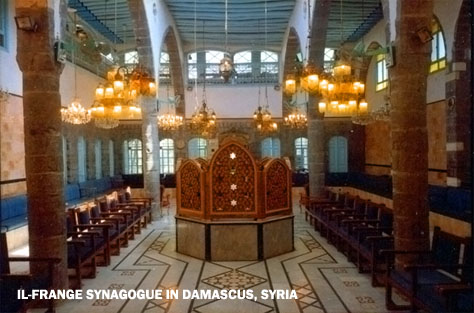
ll_frange.jpg

Il-Frange synagogue in Damascus 

jobar.jpg

2000 year old jobar village synagogue (outside Damascus)
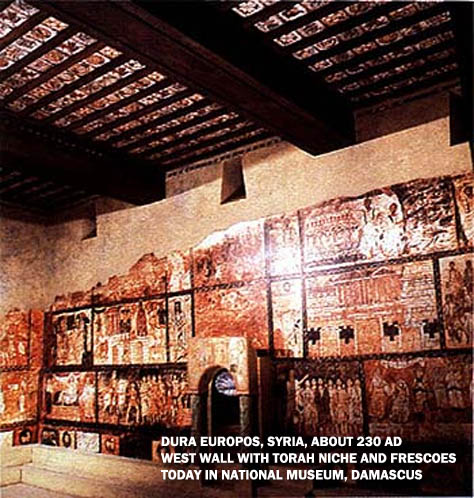
dura-europos.jpg

Dura Europos (syria), 230 AD 

A decade and a half later, Syria’s Jews were granted permission to freely emigrate abroad. Within a few short years, almost the entire community had left the country, a little less than half for Israel. Out of approximately 30,000 Jews who lived in Syria in 1947, less than 50 remain today, according to community leaders in the United States. All but a handful of those live in Damascus.

Today, most Syrian Jews live in the close-knit neighborhoods of south Brooklyn, in single-family homes located in a few-square mile area around where Ocean Parkway and the thriving market street of Kings Highway intersect. The area, in no way, resembles centuries old Jewish quarters of Damascus, Aleppo and Qamishli, but Syrian Jews have recreated bustling new neighborhoods. Walk down any street in South Brooklyn and one hears neighbors chatting with one another in Arabic. Shops sell items like rolled apricot paste, lentils and fava beans, all familiar ingredients in Syrian cuisine.

This is where Hasbani now lives in a modest home he rents with his wife. Now in his sixties, Hasbani is no longer an energetic doctor he was nearly 30 years ago. After moving to the United States in the early 1990s, he stopped practicing medicine and tried unsuccessfully to open a few businesses. He lives on meager savings and suffers a heart problem that limits his movement.

Hasbani prefers to speak in Arabic and smiles wryly when recounting his brief moment of fame on American television. In a community that generally shuns publicity, Hasbani is outspoken, passionate and animated.

In the highly emotive debate over the Arab-Israeli conflict, the true story of Syrian Jewry was more complicated than either Wallace or his critics fully appreciated, Hasbani said.

On the one hand, critics of 60 Minutes were correct to doubt Hasbani’s rosy portrayal of Jewish life in Syria. In a country considered Israel’s most formidable enemy, Syrian Jews had long been subject to special restrictions, mistrust and, at times, outright persecution. In the northern city of Aleppo, Synagogues were burned and vandalized shortly after the United Nations voted to partition Palestine in 1947. In 1949, a bomb was placed in a Damascus Synagogue killing 12 people. During the 1967 Arab-Israeli War – in which Syria lost control of the Golan Heights overlooking the Galilee – armed Palestinian fighters broke into the homes of Jews and pointed guns at family members. No one was shot but the incident was a reminder to the community of its vulnerability.

For most of Syrian history after 1947, Jews could not travel outside their country except on rare occasions and travel within Syria required permission. The Jews who did leave Syria escaped covertly through Turkey or Lebanon. Most continued onto the United States or Israel. Those who were caught were imprisoned.

Hasbani said that his glowing portrayal of Syria was intended to win favors from Syrian authorities. Yet, he added, the 60 Minutes broadcast was not totally false either. Conditions were beginning to improve for Syria’s Jews and would continue to improve in the months and years after Wallace’s visit.

For a man who says he spent most of his years at Damascus University’s Medical School lying about his religion, and whose own brother was stabbed to death by a person who bragged he killed a Jew, Hasbani is surprisingly nostalgic about the land of his birth.

“I live in the past,” he said, which is evident from the reams of newspaper clips, photos and other memorabilia he saves from his time in Syria.

He carefully unfolded a wrinkled old identity card with the word Mossawi written across it. He displayed a photo of himself posing with his family next to Edward Djerijian, American Ambassador to Syria from 1988 until 1992, at the ambassador’s opulent Damascus residence.

But among the assortment of memorabilia, the Syrian doctor is particularly fond of a small stack of folded newspaper clips that show him and other Jewish leaders shaking hands with the late Syrian President Hafez al-Asad.

Asad, who rose to power in a coup in 1970 and remained in authority until his death thirty years later, is regarded by much of the world as an oppressive dictator who permitted virtually no dissent and crushed it violently when it emerged. Along with the late Egyptian President Anwar Sadat, he launched a daring, if largely unsuccessful, surprise attack against Israel in 1973 in an effort to wrestle back control of the Egyptian Sinai Peninsula and Syrian Golan Heights. Both territories were captured by Israel in the 1967 Six Day War. But unlike Sadat, who combined bold military action with bold peacemaking by traveling to Jerusalem four years later to address the Israeli Knesset, Asad remained wedded to the struggle against Zionism.

He opposed the 1978 Camp David Treaty between Egypt and Israel, and was cool toward the Oslo accord between Israel and the Palestinians signed 15 years later. He also criticized Jordan for signing peace treaty with Israel in 1994 and backed the Lebanese militia Hezbollah in its fight against Israeli forces in South Lebanon and a myriad of Palestinian groups opposed to the Oslo process. Although the Syrians did participate in on-and-off American-mediated negotiations with Israel, coming remarkably close to a final settlement toward the end of Asad’s life, publicly they remained decidedly stand-offish in their approach toward the negotiations. In 2000, when Syrian Foreign Minister Farouq al-Sharaa met with then Israeli Prime Minister Ehud Barak during negotiations in Shepherdstown, West Virginia, he refused to publicly shake hands with the Israeli leader.

Many of Syria’s Jews, however, remember Asad differently.

“For us, of course, he was like the Messiah,” Hasbani said. Before him “you could not walk for four kilometers [without permission]. You could not buy and sell [property]. Walking in the street, you were afraid to say I am a Jew. There were [Jewish] schools. But there was someone from the government sitting on your head, and capable of doing whatever he wanted.”

Asad, Hasbani said, was different from past Syrian leaders in that he was the first president to truly pay attention to the concerns of Syria’s Jews.

“When we met with him in 1976, people [the Jews] rose,” Hasbani said. “When you sit with the president, people outside would not dare to do anything to you. He who is against you can do nothing to you because he saw the president receiving you and taking pictures with you.”

Such sentiments about a man long regarded as Israel’s most formidable enemy might surprise some people who follow the pulse of the Middle East. But they are quite typical among the approximately 3,000 Syrian Jewish émigrés who left for Brooklyn and Israel more than a decade ago.

Many complain bitterly about the abuses and discrimination they suffered in Syria during the decades before they were permitted to leave. Like Jews everywhere, many also profess sympathy for the state Israel and its policies. But, in almost the same breath, many credit Asad, the man who built his public persona on upholding Arab honor in a gallant struggle against the Jewish state, as the man most responsible for granting them their freedom.

“Before Hafez al-Asad, the people were scared to say, I am Jewish,” said Jack al-Boucai, a Syrian Jewish businessman who owns a cell phone store on Kings Highway. “So when he helped in making the situation improve, I saw him as being good for us.” Boucai spoke in Arabic.

The 1976, Asad met with Jewish community leaders including Hasbani; Ibrahim Hamra, Chief Rabbi of Damascus; and the late Salim Totah, head of the Syrian Jewish community. Hasbani recalled telling Asad about the bomb that was placed in a Damascus Synagogue in 1947.

“President Asad didn’t know about it,” Hasbani said. “When I told him, he was astonished. ‘Who did it, the government?’ I told him not the government, some lowlife.”

The meeting turned was historic, Hasbani said. In the months and years that followed, most restrictions on Jews were lifted. The Mossawi stamp was eventually removed from all forms of identification, although not as quickly as Wallace may have been led to believe from his interview with Hasbani. Domestic travel restrictions on Jews were lifted. Businesses that had previously been closed to Jews, such as import-export, were opened. Jews could buy and sell property and the community began to prosper.

The only restriction that remained on Jews was a prohibition against free Jewish emigration abroad with family members, a rule that remained in effect until 1992. But there were exceptions. Following a meeting between Asad and American President Jimmy Carter in 1977, the Syrian president began to permit around two dozen Jewish women each year to join grooms-to-be in the United States to correct a gender imbalance in the community.

The Syrian president’s increasing leniency toward Jews probably stemmed, in part, from international pressure applied on his regime by the United States, other foreign governments and the international media. Indeed, Syria’s Jews became something of diplomatic bargaining chip that the Syrian government could play when it wanted better relations with the United States or an improved negotiating position with Israel.

What is more, after Asad lifted restrictions on the community, many hardships persisted. Jews caught trying to escape continued to be imprisoned. Many complain that they continued to face harassment from Syrian intelligence officers and other low-level officials.

One member of the community recalled visiting the Department of Motor Vehicles in Aleppo to renew his driver’s license, armed with a presidential order rescinding the requirement that Mossawi be stamped on all Jewish identity documents. The official behind the desk told him he could not renew the license at that moment because he did not have his Mossawi seal. When the man protested, brandishing the presidential order, he recalls the official telling him: “‘I’m not going to stamp it in red. I’m going to stamp it in purple.”

But whatever hurdles Jews continued to face, the late president’s image remains largely untarnished in the eyes of many in the Syrian Jewish community. Although Asad was known as a micromanager of his countries affairs, few Syrian Jews blame him, even indirectly, for difficulties suffered during his 30 years of power.

The story of Albert Fouerti is revealing. Fouerti came to the United States in the early 1990s, during the final wave of Syrian Jewish emigration to the United States. He is shy but becomes passionate and animated when speaking about his life. He spoke mostly in Arabic.

Fouerti once owned a factory that made children’s clothes but today manages a small thrift store along McDonald Avenue in Brooklyn. Coming to America was not joyous.

In 1949, two of his sisters were evacuated to Israel along with other Jewish children following the Damascus Synagogue bombing. Fouerti’s family planned to join the two girls, but shortly after the children were evacuated, Syria closed its doors on Jewish emigration. For the next twenty years, Fouerti’s family was unable to communicate with the girls.

In the early 1970s, Fouerti obtained permission to travel to Great Britain so that his son, who was ill, could receive medical treatment. During the visit, he secretly made arrangements, through the Israeli embassy, to fly one of his sisters to London so he could see her. The other sister was ill and could not travel.

The two siblings were reunited but the visit was fleeting.

“I must come back,” he remembers thinking. “I have no choice.”

Fouerti returned home and told his mother about the reunion. Nearly twenty years passed before the Syrian government finally allowed Jews to emigrate. As Syrian Jews began to sell their homes and businesses and leave for America, Fouerti applied for passports for his entire family so they could travel to the United States. His wish, he said, was to witness the reunion of his elderly mother with her two lost daughters.

Days later, the Syrian authorities granted the family passports. But one of Fouerti’s sons was denied for unknown reasons. Fouerti did not want to leave his son behind so, for two years, he returned to the office of the secrete police chief in charge of Jewish affairs.

“Every day, I visited him in the office,” he said. “I knew what he was doing. He was just giving me a hard time.”

Finally, in late 1994, after most Syrian Jews had already left, Fouerti’s son was finally granted a passport and the family began to make travel arrangements. Then, just days before their scheduled departure, as his sisters waited in Brooklyn, Fouerti’s mother died suddenly.

Later, on his way to the airport, Fouerti stopped at the Jewish cemetery and peered down at her grave. “I said mom, I’m sorry. I can’t help you to see your children,” he said. “The last picture I see in Syria is my mother.”

Fouerti was deeply bitter. “I feel no one can let me forget what happened to me,” he said. “Why did they do that to me? Why?”

But after an emotional recounting of his experience, he became calm.

“I miss Syria. I miss my friends. But I am scared,” he said. “Our only problem [in Syria] was with the Mukhaberat [secrete police]. We lived with Muslims, Christians. We were like one family. They loved us.”

President Asad, Fouerti said, could not possibly have known about the harassment he and some other Jews suffered. “He was good with Jewish people,” he said. “He gave us our freedom… He should put this person [head of Jewish affairs] in prison. He damaged the reputation of Syria. If he [Asad] knew, he would not have let them.”

Surprisingly, some Syrian Jews are almost apologetic about the restrictions placed upon them by the Syrian government.

“I lived with Syria,” said Hasbani. “I ate and drank, whatever they did not give me, it would be perfectly fine. In my view, I don’t ask for all my rights because [they] will not give me all my rights because I have feelings for Israel which is the enemy of Syria.”

In 1987, two Jewish brothers from the Swed family were arrested for secretly visiting family members in Israel, which was illegal for all Syrian citizens. The brothers spent the next five years in prison until they were pardoned by President Asad in 1992. The Sweds’ plight became a major focus of concern for Jewish groups around the world and a personal crusade for a Canadian activist named Judy Feld Carr.

Hasbani saw the situation of the Sweds differently. Traveling to Israel was a capital offence, he said, and had the Sweds not been Jewish, they would likely have been executed.

“What kind of heroism did the Sweds show?” he asked. “They were in Syria then went to Argentina and from there they went to Israel then went back to Syria. Israel is an enemy state. Why did they go there? Do they want Hafez al-Asad to say welcome back?” (The Sweds actually traveled to Italy, not Argentina).

Another member of the community added that the Sweds trip put the whole community in jeopardy. “If you are a lamb, you cannot play with lions,” he said.

When Asad died in 2000, three pro-Likud Jews of Syrian origin – a prominent Syrian-Jewish rabbi named Jack Kassin, Hassidic community leader Jack Avital, and another businessman named Sam Domb – placed an ad in the New York Times offering their condolences, although Domb later complained to The Jewish Week that Kassin had added his name without consent. Kassin was invited to attend the funeral but a Syrian official informed him that his security could not be guaranteed because of threats posed by Asad’s brother and rival Rifat, according to The Jewish Week.

Asad’s cult of personality did not end with his passing. His son and successor, Bashar, is not held in the quite the same esteem as his father. A British-trained optometrist, some Syrian Jews privately said they consider Bashar young and inexperienced, overly reliant on what are often unscrupulous advisors. But most also said they were confident that he would eventually be able to carry on his father’s legacy.

“It appears that he took his father’s track,” said Hamra, the former chief Rabbi of Damascus who now lives in Israel. “Thank God the stability in Syria remained. His existence in the government and the permanent stable situation in Syria are a proof of his success. It will take time to become as wise as his father.” Hamra spoke in Arabic.

Another Syrian Jew added: “Asad is the best bet for America and for everyone. If he was strong enough and could manage, he would do a lot of good things. He is the best thing for America and Israel, no matter what he talks.”

In contrast to the refined, diplomatic style of his father, Bashar has made a few remarks that have sparked sharp condemnation from world leaders. He was widely criticized for making what many perceived as an anti-Semitic comment to the Pope in 2001. “They tried to kill the principals of all religions with the same mentality in which they betrayed Jesus Christ and the same way they tried to betray and kill the Prophet Muhammad," Asad was quoted as saying.

While the remark sparked widespread outcry from Jewish groups in the United States and Israel, some Syrian Jews said they consider the whole controversy to be frivolous, the result of inexperience or poor advising.

“I don’t think he’s anti-Semitic,” said one member of the community. “He say something to please the people around him.”

Hasbani agreed. “Alak,” he said of Asad's remark, a colloquial Syrian expression meaning “nothing important.”

Such words would likely come as welcome news to Damascus’ embattled government. Not since America’s disastrous intervention in Lebanon in 1982 have relations between the United States and Syria been as strained as they are today. A member of the U.S. Department of State’s list of nations that support terrorism, Syria is currently under intense pressure to prevent insurgents from crossing its border into Iraq, stop interfering in the affairs of neighboring Lebanon, and cut all support for groups fighting Israel including Hezbollah and Hamas.

Just last year, President Bush signed into law the Syrian Accountability Act, which imposed a range of mostly symbolic sanctions on Syria. He threatened new sanctions if the Syrians did not change their behavior. In September, the United States and France won passage of United Nations Security Council Resolution 1559, demanding that Syrian troops leave Lebanon.

The recent assassination of former Lebanese Prime Minister Rafik Hariri in a fiery explosion in downtown Beirut sent relations to yet a new low. Although Syria condemned the killing, many in Lebanon and abroad strongly suspect the involvement of Syrian intelligence agents.

His assassination prompted mass anti-Syrian protests – as well some pro-Syrian rallies – on the streets of Beirut. The United States and France, joined by Russia and a number of Arab states, renewed their calls for an immediate Syrian pullout from Lebanon in time for Lebanese Parliamentary elections in May. At the time of this writing, Syrian soldiers had begun to decamp and withdraw across the border.

In the midst of all this, Syria’s unusually outgoing Ambassador to the United States, Imad Mustapha, has been on a public relations campaign trying to smooth over some of the rougher edges of his country’s image. He has appeared on television regularly and, since assuming his post two years ago, has reached out to groups and legislators long at odds with Syria. Last January, he escorted former Democratic Presidential candidate and drafter of the Syrian Accountability Act, John Kerry, to Damascus for a meeting with Syrian President Asad.

Over the past year, Mustapha has been making rounds in South Brooklyn’s Syrian Jewish neighborhoods, introducing himself to members of the community, making friends, and encouraging Syrian Jews to visit their country of origin. Last year, he accompanied a delegation of prominent Jews of Syrian origin, some with close ties to members of Israel’s Likud government, on a visit to Syria. There, the group held a meeting with President Asad and toured prominent Jewish sites around the country.

Mustapha said he is aware of the links that some Syrian Jews have with Israel and he hopes that his recent outreach in the community might eventually help lead to the restarting of negotiations between his country and the Jewish state.

“We don’t expect [Syrian Jews] to do anything vis-à-vis the Syrian-Israeli conflict, but we are realistic,” Mustapha said, speaking under a large portrait of President Bashar al-Asad that hangs in the Syrian embassy. “We understand what’s happening. They have contacts with other Jews from Israel and at least, at least, they can tell them the true story about us. So yes, they can play a role, not a direct role, an indirect role.”

In the meantime, the ambassador has been trying to counter a rising chorus of so-called neoconservatives calling for the overthrow of regimes across the Middle East. Despite the continuing instability in Iraq, foreign policy pundits like Richard Perle, former chairman of the U.S. Defense Advisory Board and a confidant to Secretary of Defense Donald Rumsfeld, have said openly that Syria is an appropriate second target for regime change: part of a grand strategy to democratize the Middle East.

Many Syrian Jews prefer not to delve into serious political matters, saying they would rather leave issues of war and peace to the wisdom of kings and presidents. But those who did speak made clear that regime change, in Syria’s case, would be unwise. Some said they hold little sympathy for Syria’s policies, particularly its support for groups like Hezbollah and the Palestinian group Hamas. But they also argue that, while the United States may need to prod and push Syria to change some of its ways, attempting to undermine Asad’s secular government would be a mistake. Bashar al-Asad, they argued, is a source of stability in a turbulent region and a potential peacemaker.

“I think that his [Hafez al-Asad’s] son wants to make the country better,” Fouerti said. “I think he likes the Jews. If there is peace, it’s good for Israel and Syria.”

Hasbani, for his part, does not hide sympathies in the Arab-Israeli dispute.

“My heart is Jewish,” he said. “I cannot say that I am not Jewish and I love the Jews, regardless of Syria. And I love Israel much more than Syria, for sure, even though I lived, ate and drank in Syria.”

But Hasbani is also remarkably understanding of Syria’s predicament. He spoke about the country’s current difficulties with the United States with the cold eye of an independent observer giving an objective analysis. “I am speaking theory,” he said repeatedly, as though the opinions he expressed were not his own but rather were grounded in common sense.

The nationalist persona that Hafez al-Asad created for his country, Hasbani said, makes complying with the wishes of United States or engaging in the kind of dramatic peacemaking that characterized the late Egyptian President Anwar Sadat’s efforts almost impossible for Bashar.

“They make themselves out as holding up the Arab Nation,” he said. “It supports them.”

But Syria’s government is also flexible and pragmatic, Hasbani said. When faced with stark choices of bending to the will of the United States or facing isolation or worse, the Syrian government will opt for safety over posturing. The United States, he said, cannot rule out the use of force against Syria but it must be careful.

“If America wants to pressure Syria,” he said, clinching his fist. “It must put pressure, tighter and tighter and tighter, economically and politically. If [Syria] continues to help Hezbollah, Hamas, Islamic Jihad and others, and America sees that as against its interest, [the United States] needs to strike them, but without occupying Syria: essential centers for aircraft and so forth, just to show the Syrians that the temperature has risen. Then its possible Syria will back off.”

But there is a second option, Hasbani said, leaning back in his chair.

“They can create reconciliation between Israel and Syria,” he said. “If there were reconciliation between Syria and Israel, and there was a peace agreement, that was official and guaranteed by the United Nations, in that case, Syria will no longer be able to support Hamas and Hezbollah. They will come with Syrians to the dinner table.”

How to create such reconciliation is, of course, a question that has plagued successive U.S. administrations. During the 1990s, a settlement between Syria and Israel, two of the Middle East’s most intractable enemies, seemed at imminent. Then Secretary of State Warren Christopher was shuttling between Jerusalem and Damascus on an almost weekly basis, but the negotiations consistently stumbled on the question of the strategic Golan Heights. Syria demanded a full return of the territory in exchange for a peace treaty. Israel wanted to retain control of, at least, some of the Golan for security reasons.

A few months before Hafez al-Asad’s death, U.S. President Bill Clinton met with the Syrian leader in Geneva in a last ditch effort to broker a settlement. The talks failed and Asad died. Shortly thereafter, the Camp David talks between the Israelis and the Palestinians also broke down and the second Intifada erupted.

The deterioration of the peace process was something that Rabbi Hamra had not anticipated when he made a highly publicized but surprise aliyah from Brooklyn to Israel ten years ago.

“Everything indicated that the peace was on the door,” he said, sitting in the Brooklyn home of his daughter. “We imagined that we could work in Syria and spend the weekend in Israel or visa versa.”

A solid-looking man with a bushy black beard, Hamra resembles a lumberjack. He lives in Israel but travels to the United States regularly to visit some of his children.

Hamra became head of the Syrian Jewish community in the late 1980s, after the then leader Totah passed away. Hamra said he met with Asad four times during his life and once organized a march to the Presidential Palace in support of the president’s predictable reelection. He became an international figure during his time in Syria.

“I had interviews with many countries, I mean journalists from Spain, Argentina, Brazil, America and Europe,” he says. “I received many senators and congressmen.”

By the end of the 1980s, a movement to free Syrian Jewry was actively lobbying the American government to pressure Damascus to allow Jewish citizens to emigrate. In 1992, Syrian Jewish leaders, including Hamra and Hasbani, met with Asad and the Syrian president ordered restrictions lifted on Jewish emigration, although not directly to Israel. Hamra spent the next two years traveling between the United States and Syria until 1994 when he moved to Israel.

Sitting at his daughter’s home, Hamra glimpsed at the television. Al-Jazeera – a popular source of news in many Syrian Jewish households – was reporting that Palestinian Leader Yasser Arafat was dieing in a Paris hospital bed.

Hamra met Arafat once. Shortly after moving to Israel, he received a letter from then Prime Minister Yitzhak Rabin, who had just been nominated to share the Nobel Prize with Arafat and Israeli Foreign Minister Shimon Perez.

“He felt that many people in Israel deserve the Prize and [I was] one of them,” he recalled the letter saying. “I would be very happy if you could come with me. I chose you among 30 people… As I remember I met Arafat at that time.”

When Hamra first moved to Israel, he saw himself as an emissary of peace, expecting that a final settlement of the Arab-Israeli dispute was imminent. That changed five years ago when the second Intifada erupted.

“Everything returned to the old situation, like in the beginning with more hostility,” he said. “Personally, I was not influenced by the failure of the peace process. But the whole region was influenced by it. I was influenced by the fact that I am a person who calls for the peace.”

The Syrian Jewish community in Israel, he said, was shaken by the deteriorating security situation, unaccustomed to the threat of suicide bombers and violence.

Hamra remains decidedly apolitical, saying he simply dreams of the peace he expected a decade ago. He still thinks of his home and friends in Syria and the vision he had of traveling between Syria and Israel on weekends.

He heard about Syrian Ambassador Mustapha’s outreach in the Brooklyn community. “I wish I could talk to him,” he said, and paused. “But I do not know how positive he will be. I do not know if the fact that I am from Israel will put him in an embarrassing situation. And I do not wish that… Perhaps if the Intifada never took place and things remained the same, it would be normal to contact him.”

Perhaps, Mustapha said, but in the meantime communicating with Hamra would be problematic.

“An Israeli citizen is a different case,” he said. “I’m not saying I don’t meet with him. I’m saying that Syria is publicly inviting Israel to rejoin the peace process. The minute that Israel says yes, we will. We will start meeting with them and engaging with them.”

Mustapha became acquainted with Brooklyn’s Syrian Jewish community through his wife. While a student at Damascus University, she was friends with a Syrian Jewish woman named Salim al-Boucai, the daughter of the Brooklyn businessman Jack al-Boucai.

Jack al-Boucai immigrated to the United States a decade ago but said he maintains strong connections with officials in the Syrian government. Until two years ago, he said he would travel regularly to Syria to import brass and copper decorations that now adorn his small store.

Mustapha, who sought to strengthen relations between the embassy and the Syrian expatriate community, telephoned Boucai and introduced himself.

“He asked me if I needed anything,” Mustapha said. “I said yes. I would like to meet with the Syrian Jewish community. And after a little while they came back to me and said, if I would be interested in visiting with them, they would like to meet with me at their community center in Brooklyn.”

Boucai, Rabbi Kassin, Hassidic community leader Avital and others, spent a day with the ambassador, taking him on a tour of the neighborhoods. Mustapha said he had never had contacts with Syrian Jews before, including in Syria.

“They are like us,” he said, “Their food, their habits, their social customs, they are like us. We, us and them, are different from the Americans… This taught me a lesson.”

The visit ended cordially.

“For the final time, they asked, can we do anything for you,” Mustapha said. “I said yes, actually you can. Whenever you have a wedding or a barmitsfa, invite me, I want to come.”

Shortly after that meeting, the ambassador was invited to a Syrian Jewish wedding held at the Waldorf-Astoria Hotel in Manhattan. There he was approached by an elderly man from a prominent Syrian Jewish family in Mexico called the Sabas.

“He says to me, ‘I’m 72 or 73 years old, I have a dream.’ I said to him, what’s your dream? He said, ‘I want to visit Aleppo. This is the birth city of my parents.’ I didn’t hesitate. I immediately said to him consider you dream come true.”

After the wedding Avital, a personal acquaintance of Israeli Prime Minister Arial Sharon, telephoned Mustapha and asked him about organizing a visit to Syria.

“He [Avital] had a curiosity about Syria,” Boucai said. “He would love to visit Syria so he requested permission to visit Syria and they welcomed him… nothing official just personal.”

A delegation of a dozen Jews of Syrian origin visited Syria in the spring of 2004, accompanied by Mustapha.

Some American Jewish leaders disapproved of the trip. "It is wrong for American Jews or any Americans to help sanitize the Syrian regime by visiting Syria," said Morton Klein, president of the Zionist Organization of America.

The group toured the country, visiting a Jewish cemetery near Damascus, the markets of Aleppo and meeting with members of the tiny Jewish community that still lives in the country. During the visit, the group met with President Asad and presented him with a gift: a traditional Jewish Shofar or rams horn. When the meeting was over, Hasbani said the group asked the president if he would invite them back to Syria.

“He said no,” Mustapha said. “They were surprised. He said to them, ‘I can’t invite you back. I can’t invite Syrians back to Syria. You are always welcome.’”

Mustapha recalled the men’s reaction.

“They were so amazed,” he said. “We were still inside the Presidential Palace, we had not left, and they came to me and said, ‘We are so amazed. Back in America they told us, this is an evil guy. Don’t go and meet with him. But look at the way he treated us. He was so sincere with us.”

Repeated calls to Avital for and interview went unreturned.

A few months after Avital returned home, Boucai invited the ambassador to his son’s wedding. Over 500 people attended the ceremony, the majority of them immigrants who had come to the United States a decade ago, Boucai said.

“When Dr. Mustapha came to the wedding, he said he was coming to congratulate [us],” Boucai said. “He made a small speech; he made a very beautiful speech. I sent a video of the wedding to Syria, to the people in Syria, so they could see it. And the people in the community were very happy about the reception.”

The Ambassador, Boucai said, offered his services to the community. If anyone wished to renew his or her passport or return to Syria for a visit, Mustapha was willing to help.

Few Syrian Jew have returned to Syria permanently, but many say that they would like to visit, if only to see the homes in which they once resided, the Synagogues in which they worshiped or the graves of their ancestors. A small, but growing minority are returning to do business and reestablish old ties. Boucai counts at least 10 individuals who are trading with Syria or own businesses there, up from five a few years ago.

Yousef Jajati is one such individual. Jajati replaced Hamra as head of the community in 1994 and was one of the few Jews to remain in Syria throughout the 1990s. He said he traveled frequently to Europe and the United States.

The small number of Jews who remained in Syria since all travel restrictions were lifted worship at a single Synagogue in Damascus and no longer have a full-time Rabbi. But, Jajati said, they enjoy freedoms that members of the community could not have imagined thirty years ago. In the mid-1990s, Jajati became the first Jew living in Syria to speak before the World Jewish Congress. During his trips abroad, he mingled with leading political figures in the United States and Europe including ardent critics of Syria like U.S. Representative Tom Lantos, who invited Jajati to his office.

The Jajatis owned what was widely considered the smartest clothing store in Damascus. The family sold the business but still owns a factory in the Jewish Quarter that is managed by one of Jajati’s sons: Khalil. The Jajatis transferred the retail end of the business to New York, where they sell their Syrian-made clothes wholesale to such high-end stores as Porta Bella.

Jajati met with Syrian President Bashar al-Asad shortly after he was sworn in as president in 2000.

“I hope and wait for the day that you go to Jerusalem and sign a peace treaty,” he recalled telling Asad. “Bashar said, ‘Speak with your friends in the Israeli government, with [then Israeli Prime Minister Ehud] Barak.’ I said you are my friend, not Barak.” Jajati spoke in Arabic.

Before the meeting was over, Jajati recalled Bashar telling him: “I really was sad that the Jewish community left and I would have preferred them to stay and I hope they return.”

One year later, Jajati moved to New York, where most of his children reside. But he says he remains proud of his Arab identity and loyal to his country of birth. If negotiations between Israel and Syria resume, he said that he is willing to play a role.

“I hope that Syria appoints me to carry out negotiations with Israel,” he said, “To represent my country.”

It is easy to dismiss Jajati’s glowing comments about Syria and its president. He, after all, continues to maintain strong business links to the country and would naturally want to remain on good terms with its government. It is much harder to explain why individuals who suffered during their time Syria and cut their ties with the country long ago, like Hasbani, Hamra, Fouerti, would continue to speak fondly about the country and its leader.

Some might argue that Asad’s cult of personality is the legacy of the regime. Syria is country where the president’s photo adorns every store front and is plastered on billboards, where deference to authority is the norm. But such a view overlooks two very real benefits Asad provided Syrian Jews: stability and relevance.

The years proceeding Hafez al-Asad's rise to power were time of immense chaos in Syria. A succession of coup d'états resulted one repressive regime after another. For Jews, instability brought some of the worst abuses and there was always the uncertainty about the future. Asad, by contrast, quickly consolidated his power, exiling or imprisoning rivals.

Ironically, the very power that made Asad feared was also the power that gave him the leverage to improve the status of those Syrians who had been most marginalized, including Jews.

Asad was himself a member of a minority group: the Alawis. Concentrated in the mountains near the Syrian coastal city of Latakia, the Alawis had been victims of a long history of persecution, said Patrick Seale, author of the leading biography of Hafez al-Asad and personal acquaintance of the late Syrian leader.

“They were very poor and downtrodden,” Seale said. “They were thought of as collaborationists with the French,” the former colonial rulers of Syria. Many Alawi men served as tenant farmers for Sunni landowners and Alawi women sometimes worked as domestic servants.

The Alawi faith is somewhat secretive but it is known to blend Shia’a Islam with aspects of Christianity. Many Muslim clergy initially questioned Asad’s own Islamic credentials.

Some Syrian Jews said they believe that Asad’s minority status may have inspired sympathy for their plight. “The Asads were a family oppressed like any Jews,” said one member of the community.

Seale is more circumspect. The late Syrian president’s policies toward Jews probably stemmed more from a general opening up that accompanied his rise to power. But, he added, “He [Asad] had a feeling for downtrodden peasantry particularly. His regime was made up of country boys, not just Alawis, but Sunnis, Druze and Ismailis.”

Asad made the struggle against Israel a central plank of his leadership, but Israel never posed a mortal threat to his regime and never were Syrian Jews ever implicated in spying for Israel. Asad’s only true threat, in fact, came from the outlawed Muslim Brotherhood, who staged an insurrection in the city of Hama in 1982, which Asad violently suppressed.

“The Jews in Syria never had a spy,” said Hasbani. “They also never had a problem with Israel or another country. Their only problem was that some of them wanted to leave. The President understood that.”

In a hierarchical society like Syria, where a resident of Damascus could go an entire lifetime without catching a glimpse of the president except on television, a public meeting with Asad was the highest of honors. That is why Hasbani’s newspaper clips of Asad shaking hands with Syrian Jewish leaders are significant. Those photos made Jews relevant in Syrian society, he said, and gave the community a level of respect it had never enjoyed before. In effect, Asad brought Syrian Jews into the national tent.

But all this begs a question: if life was so good under Asad, why did nearly all of Syria’s Jews leave when given the opportunity?

Most left behind successful businesses and expensive homes in order to start over all again in Brooklyn or Tel Aviv. Most Syrian Jews received housing and financial assistance from local Jewish and civic organizations for one year after their arrival, but many continued to struggle. Hasbani, once a respected doctor, has watched his life sink into anonymity in a country that he himself characterized as being impersonal and lonely.

Some Syrian Jews like Hasbani said that fear of the future prompted the mass departure. Although Asad had treated the Jews of Syria well, there was no guarantee that his predecessor would do the same.

Jajati attributed the exodus to inertia. By the time the Syrian president lifted restrictions on emigration, most Syrian Jews had already escaped Syria for Brooklyn or Israel, where they had established thriving new communities. As life slowly drained out of the ancient Jewish neighborhoods of Damascus, Aleppo and Qamishli, the remaining families saw few reasons to remain.

Then there was the Syrian government’s own dithering that might have contributed to the mass flight of Syrian Jews. Asad opened the door for Syrian Jews to leave in 1992 and then, for reasons no one entirely understands, the door was shut a year later and then reopened shortly after that. Many of those who had not left, when first given the opportunity, felt that if they did not leave immediately, the door would close again, said Hasbani.

Fouerti explained his reason for leaving with a simple metaphor. “If you have a bird and locked it in a cage and later opened the door, it will fly away,” he said. “I had one choice: to go see the outside.”

Yet living on the outside, Syria’s Jews continue to look back in. Much like Palestinian-Israelis, they straddle the very dividing line of the Arab-Israeli dispute. Although this awkward position has caused many to suffer pain and torment, it has also provided them with unique insight into a conflict that has festered for far too many years. Syrian Jews will likely never play a role in resolving who gets what part of the Golan Heights. But they may someday be able foster a warm peace.

“If there is peace between Syria and Israel, and I am sure there will be peace, we will bring them together,” Fouerti said. “We must be a bridge between Israel and Syria.”

News Round Up (7 April 2008)

Syrian Pres Says Ready To Help Lebanon Overcome Crisis
AFP – 2008-04-07  

SAssad Berriyria "stands ready to provide all possible help which the Lebanese could request, to guarantee security and stability in Lebanon," Assad said, according to the official SANA news agency.

Assad made the remarks during talks with Lebanese parliament speaker and opposition leader Nabih Berri.

The Syrian president also expressed support for "an internal Lebanese dialogue" saying such talks between Beirut's feuding politicians would help resolve the crisis that has plagued Lebanon for more than a year.

After the two-hour meeting, Berri told reporters that Syria was putting "no conditions" on the inter-Lebanese talks which he has been trying to organise.

Berri said the visit to Damascus had provided him "with a new boost to launch a dialogue in Lebanon aimed at electing… General Michel Sleiman to the Lebanese presidency" — a reference to the Lebanese army chief.

Berri's spokesman Ali Hamdan had earlier said that the speaker intends to gather Lebanon's political leaders for talks before April 22 when parliament is due to convene for a fresh attempt to elect a president.\

Naharnet writes:

High-ranking Syrian officials have informed Moussa that the Arab initiative could be implemented following approval of three suggestions:

1- Formation of a neutral, transitional government.
2- Agreement on the 1960 electoral law.
3- Agreement on a consensus president.

From Beirut to the Beltway writes: "It pains me to see that Berri's latest call for dialogue is not being met with across the board rejection from March 14. We have heard a few voices, but it looks like at least Jumblatt and Gemayel are willing to humor Berri… How the hell are you going to "win this war" while keeping Berri in charge of you?"

Run on Rice Prompts Exporters to Pare Sales Rivaling Credit Market Seizure

From Cairo to New Delhi to Shanghai, the run on rice is threatening to disrupt worldwide food supplies as much as the scarcity of confidence on Wall Street earlier this year roiled credit markets.

Rice, the staple food for half the world, rose 2 percent to a record $20.910 per 100 pounds in Chicago today, double the price a year ago and a fivefold increase from 2001. It may reach $22 by November.

Ehsani alerted me to the rice crisis and explains: "The reason I sent you that rice story was because its price went up 200% in Syria over the past two weeks from syp 20 to syp 70. Egypt decided to stop its exports." Rice merchants report a dramatic fall in sales as consumers shift to alternative grains, such as the old Syrian staple, burghal.

Persistant rumors that Asef Shawkat has fallen from grace continue to be recycled in the press. This time they have surpassed Assiyassa and other rumor mills to be picked up by Ya Lubnan, the Jerusalem Post, etc. Last Friday I spoke to a journalist at a world class radio station for over an hour about this story. He said he only needed to confirm that Shawkat had not been seen in public for a few weeks in order to go with the story. I said that I did not believe it because we have heard this rumor for over two years and it has never been true. When I see some proof, I will believe it. Here is naharnet:  Khaddam: Assef Shawkat Under House Arrest, and here is The Jerusalem Post –

Israeli intelligence experts downplayed media reports on Sunday that Syrian President Bashar Assad had fired his intelligence chief and placed him under house arrest due to his failure to prevent the February assassination of Hizbullah arch-terrorist Imad Mughniyeh.

Of course, one of these days it will be true, just as the little boy who cried wolf eventually did have a wolf eat one of his sheep. In the mean time, it is a story that is invoked by opponents of Syria in the hope that the presidential family will begin knocking themselves off and to bolster those who argue that Western powers need not engage Damascus.

Ready for everything but peace
By Zvi Bar'el

Two important headlines appeared in the official Syrian press last Thursday. A day after the big scare that engulfed the Israeli media, which reported on the possibility of war with Syria, the calling up of armored divisions and the movement of large military units that could not be explained, Bashar Assad had different worries: He issued an important decree on the supervision of construction irregularities in Syria.

Another report dealt with the great success of the Arab League summit in Damascus. Editorials in Syria discussed peace between Israel and the Palestinians, U.S. policy in the Middle East, and the need for an Arab embargo on Israel, which is not willing to adopt the Arab peace initiative. War between Syria and Israel? An Israeli attack on Syria? Readiness for a conflagration this summer? Not a word.

In Israel, on the other hand, there was fear and trepidation. Once more the magic word is whispered: miscalculation. In other words, if Assad doesn't comprehend Israel's moves, or Israel fails to understand Assad's moves, or Hezbollah does not understand Israel's intent, suddenly a shot is fired, a shell, a counteraction, and suddenly, with no intention, there is a regional war. So the generals and political advisers are rushing to calm things down, rushed messages are issued to and from Damascus: Everything to make it clear that there is no – definitely no – room for worries. Maybe it will be a different war, but not one of miscalculation. Not this time.

The question isn't whether Syria is sufficiently strong to embark on a war with Israel, or whether Israel is prepared to respond, because Syria had gone to wars with Israel when it seemed it was not ready for them. And Israel, too, went to war a year and a half ago when it was not prepared. Israel's deterrent force also is not enough, because if Syria had really moved divisions to the border, that would have signaled that Israel's deterrent strength does not have an effect on it.

The point is the ease with which the mercury rises in the war thermometer between the two countries; even worse is the absence of a real mechanism for preventing such a miscalculation. The reason for this lies in the Israeli paradox that stems from a serious absence of common sense. It argues that as long as Syria is very weak it poses no threat, so there is no need to make peace with it. But if Syria is really a threat and is planning war, what is the meaning of the panic that miscalculation may lead to war? The other side of that paradox states that only when Syria is powerful and threatening is it worthwhile to make peace.

The main problem is that this paradox only examines relations between Israel and Syria through the prism of battle and not through a diplomatic prism. Peace with Syria is perceived as a tactical step, and the most important aspect is to avoid any miscalculation. If an alternative means were available, a hotline between Damascus and Jerusalem, for example, then there would be no need for peace. But to withdraw from the Golan Heights for a hotline, that is surely too heavy a price to pay.

The result is that Israel is seeking an appropriate tactical return for peace with Syria. Peace in and of itself is simply not "worth it." Peace with an Arab state that also affects Hezbollah, controls events in Lebanon, has close ties with Iran and close allies like Turkey, is party to the Arab initiative and will announce in advance any military maneuver it plans to carry out, and would invite Israeli observers – peace with such a state is considered by Israel as an empty peace.

Israel first wants a strategic change in the Middle East – that Iran breaks ties with Syria, that the Hamas leadership is evicted from Damascus, and that Hassan Nasrallah converts to Judaism. Only then will it "grant" Syria peace. Peace with Syria according to Israel needs to be a not-very-significant by-product, instead of the means by which strategic change is brought about.

This Israeli dream will not come true. Instead, every Arab or Israeli newspaper could rally a panel of Israeli generals that will make it clear that war with Syria is not going to happen. Nor is peace, God forbid. At most, there will be some kind of miscalculation. After all, as the deputy chief of staff said, we are ready for any eventuality. Except for that of peace.