As Paris Boosts Assad, US Adds Sanctions (10 July 2008)

Paris Summit Offers Boost to Syria’s Image

“This is an invaluable opportunity for Assad to improve his relations with the West, particularly France,” said a European diplomat in Damascus.

He added that “Sarkozy too will benefit from the visit”, explaining that the French president is keen to play a more important role in the Middle East.

A Syrian analyst on international relations commented, “France wants to play a role in the Middle East, but this role can be played only through Syria, which is crucial to the Middle East.”

Syria: US Has Vital Role In Middle East But Needs Guidance
2008-07-09  (New York)

DAMASCUS (AFP)–Syrian President Bashar al-Assad, speaking ahead of a weekend visit to France, said a U.S. role in the Middle East was vital for peace but Washington doesn't understand the region and needs guidance. The U.S. "is a world superpower which maintains privileged relations with Israel. No European country can replace the U.S. The European role is complementary," Assad told French journalists. "The problem is that the United States does not understand what is going on in the region. Because of the positive relations which France has with this country, it may be able to help the U.S. understand the region better."….

Treasury Targets Rami Makhluf’s Companies

The U.S. Department of the Treasury today added Syriatel, Syria's largest mobile phone operator, and Ramak, a chain of Syrian duty free stores, to its Specially Designated Nationals and Blocked Persons List. All property and interests in property of these entities are blocked as a result of the direct or indirect ownership interest of at least 50 percent by Rami Makhluf in each entity.

"Rami Makhluf uses his access to high-level Syrian Government insiders to enrich himself at the expense of the Syrian people," said Adam J. Szubin, Director of the Office of Foreign Assets Control (OFAC). "We will continue to target Makhluf and his commercial empire as well as others who follow in his footsteps."

Makhluf was designated on February 21, 2008 pursuant to Executive Order 13460, which targets individuals and entities determined to have contributed to, or to have benefited from, the public corruption of senior officials of the Syrian regime.

Makhluf, a maternal cousin of Syrian president Bashar al-Asad, has exploited his relationships with Syrian regime members to amass his commercial empire. Makhluf has manipulated the Syrian judicial system and has used Syrian intelligence officials to intimidate business rivals.

Pursuant to E.O. 13460, any assets in Syriatel's or Ramak's names held in the United States or within the possession or control of U.S. persons are blocked, and U.S. persons, therefore, are prohibited from engaging in business or transactions with Syriatel or Ramak.

l’Orient-le jour's Scarlett HADDAD gets a long interview with Assad.

Q : Comptez-vous envoyer Rustom Ghazalé comme ambassadeur au Liban ?
R : (Bachar Assad éclate d’un grand rire). Nous n’avons rien annoncé de tel.

Q : Les affrontements entre alaouites et sunnites au Liban-Nord constituent-ils une menace pour la sécurité de la Syrie, et sous ce prétexte, celle-ci pourrait-elle revenir militairement au Liban ?

R : Nous n’avons aucune intention de revenir militairement au Liban. Pour entreprendre une action militaire dans un pays, il faut qu’il y ait eu une agression. Or cela ne se produira pas entre le Liban et la Syrie. Il est certain qu’il y a au Liban des politiciens à la vision limitée qui croient que tout problème au Liban s’étendra à la Syrie. À long terme, tout trouble au Liban, qu’il s’agisse d’un conflit entre alaouites et sunnites, entre sunnites et chiites ou entre musulmans et chrétiens, a des répercussions en Syrie. Mais ce qui se passe actuellement au Liban-Nord ne s’inscrit pas dans ce cas de figure. Des extrémistes reçoivent un financement de certains politiciens libanais pour donner l’impression de l’existence d’un conflit confessionnel au Liban. Mais une grande partie des sunnites du Liban-Nord ne veulent pas de ces problèmes. Nous sommes, en tout cas, conscients de la situation. Mais nous n’avons pas l’intention de prendre la moindre décision à ce sujet. Ces extrémistes nuisent au Liban, non à la Syrie…..

"There Are No Negotiations Between Syria and Israel": Interview with Mohsen Bilal, Syrian Minister of Information.

M. Bilal: There are no negotiations. This is an exploratory phase, looking at the possibility of renewing talks to create a platform for eventual negotiations. There is an indirect exchange of messages through the Turkish mediator — whom we trust to sound out the Israeli government — because Israel changes its methods frequently, and we are accustomed to the non-fulfilment of its promises. …..

Analyze this: Are (pipe) dreams of peace with Syria receding with the Kinneret's shoreline?
Jul. 9, 2008
Calev Ben-David , THE JERUSALEM POST

"Without additional water resources peace will be very difficult to achieve with Syria and maintain with our other neighbors." ……..

Israel Demands France and Italy Disarm Hizbullah

The Israeli defense minister also told Mr. Kouchner that Israel expected him to help to stop the arms transfer from Syria to Hezbollah, and that UNIFIL, which is operating in Lebanon, needs to increase its opposition to Hezbollah's buildup and fortifications.

Meanwhile, Foreign Minister Tzipi Livni,warned during a tour of Israel's northern border with Italian Foreign Minister Franco Frattini that, "An opportunity has now arisen to disarm Hezbollah, and we must not miss it. If we don't do it now, it will be much more difficult later."

Ms. Livni and the Italian foreign minister agreed steps should be taken to fully implement U.N. Security Council Resolution 1701. The Italian foreign minister said he hoped that now, after a new government has been formed in Lebanon, it would be possible to speak with it.

"The implementation of Resolution 1701 is the only solution and the best option for resolving the situation in this region," Ms. Livni said.

Opposition leader Binyamin Netanyahu also met with the Italian foreign minister. In their conversation, Mr. Netanyahu protested that the Italian automobile company Fiat recently announced its intention to open a plant in Iran.

"Italy should act to prevent Fiat from building another plant in Iran," said Mr. Netanyahu.

Report from ICG, here (Via FLC)

"…If Jordan, Syria and Lebanon can be faulted for unfriendly treatment of refugees at border crossings and lukewarm assistance once they have entered, they should, nonetheless, be credited for having agreed to receive so many Iraqis in the first place and allowing them to stay at great cost to their own societies. By contrast, it is difficult to give the Iraqi government any credit at all. Flush with oil money, it has been conspicuously ungenerous toward its citizens stranded abroad. No doubt there are senior former regime figures among the refugees, but this does not excuse callous neglect of overwhelmingly non-political people who loyally served Iraq rather than any particular regime….

The approach of the international community, especially states that have participated in Iraq’s occupation, has been equally troubling…. the U.S., whose policies unleashed the chaos that spawned the outflow, has clearly failed in its own responsibilities: downplaying the issue, providing far less assistance to host countries than needed and admitting to its own shores merely a trickle of refugees and only after unprecedented security checks to which asylum seekers from other nations are not subjected…"

Egypt begins pumping natural gas into Syria as part of giant pipeline project (AP)

Egypt has begun pumping natural gas to Syria by a pipeline running through Jordan as part of a giant project to export Egyptian gas to the Middle East and eventually to Europe, Syria's oil minister said Thursday.

Sufian Allaw said the new pipeline would provide Syria with 88.3 million cubic feet (2.5 million cubic meters) of gas daily, increasing gradually to 212 million cubic feet (6 million cubic meters) per day over the next nine years. He said the pipeline is vital to Syria, especially its electricity sector as 40 percent of power generating stations in Syria are run by burning gas.

He said it would relieve current gas shortages in Syria.

Under the Arab Gas Pipeline Project signed in 2001, Egypt is to supply Jordan, Lebanon and Syria with natural gas for 30 years. The project costs more than US$1.2 billion, with a total pipeline length of 750 miles (1,200 kilometers), about half of it inside Syrian territories.

The first phase linking Egypt with the Jordanian Red Sea port of Aqaba was finished in 2003, with the pipeline passing under the Gulf of Aqaba to avoid crossing Israeli territory. Two years later, the second-phase extension of the pipeline reached the Jordanian town of Rihab north of the capital Amman.

Egypt has been exporting nearly 99 billion cubic feet (2.8 billion cubic meters) of gas a year to Jordan under a 15-year deal.

The third phase brought the pipeline to Syria's Deir Ali power station south of Damascus, Allaw said, according to Syria's official news agency SANA.

An extension to Lebanon is supposed to open later this year, followed by an extension to Turkey's border, where the pipeline will be connected to the planned Nabucco Pipeline for the delivery of gas to Europe, under a deal reached in 2006 between Egypt, Syria, Jordan, Turkey, Lebanon and Romania.

Syria's oil production has declined in recent years and Damascus is trying to compensate by relying more heavily on natural gas. The country's daily gas consumption is estimated at 477 million cubic feet (13.5 million cubic meters) per day. Its daily production of natural gas was estimated at 494 million cubic feet (14 million cubic meters) in 2007.

Egypt has potential natural gas reserves of 62 trillion cubic feet (1.7 trillion cubic meters), the 18th largest in the world, and is aiming to become one of the world's top 10 natural gas exporters in the next four years.

Egypt began providing Israel with natural gas in February under a deal by which it will sell Israel 60 billion cubit feet (1.7 billion cubic meters) a year for a period of 15 years. The deal raised controversy at home, with some in the Egyptian opposition saying the gas was being sold at below-market rates.

Elsy Melkonian gets the scoop on Syrian-Belatusian relations! for the new "What's On," magazine. That's Belarus.

The first in a series of slick green and shiny public buses rolled out into the streets last month. Niveen Wahish let them take her for a ride.  Read more…    

Camile Al-Asaaf is the General Manager of the Internal Transportation Company that manages local transport infrastructure. He spoke with What’s On about the local transport system and the integration of the Green Machines into the transport plan:

How many new buses are there?

Right now about 350. We have a contract with China to supply us with a total of 650 buses. The buses are for use in all cities of Syria. Currently they are operating in Damascus, Aleppo, Homs and Lattakia.

Are the new buses environmentally friendly?

Well not so much as they do run on diesel (mazote). However, they are certainly better than the old ones.  We are planning on ordering buses in the future that are more suitable for the environment but the need for new transport was really great and we had to provide the most suitable solution quickly.

Will they totally replace the old buses?

To meet the transport requirements in Damascus alone we need approximately 1200 buses. So right now we need to use the new and the old together.

Are the new buses meeting the transport need?

Yes, it seems people are very happy, but of course there are always improvements to be made. We have been doing a study of the buses and in approximately one month we will put out a tender for 1000 new buses. In this tender we will list some modifications and features that the new buses are lacking, for example: we want them lower to the ground, we want ramps for getting on and off for older people, people with babies or disabled passengers, and we want additional ticket machines in each bus.

Traffic is a continual problem here. Is there a solution?

Yes there are a number of things we can do to reduce the overcrowding on our streets. We are planning on making bus only lanes on the streets. Once we have acquired our target of 1600 buses we will redirect the ‘service’ buses into the countryside, leaving these new buses to run the public transport in the city. This will reduce the amount of vehicles inside the city, as well as easing the flow of traffic without the stop-start-stop because of the ‘service’ traffic. We hope that the addition of the bus lanes will encourage people to take the bus to work rather than driving.

What is the future of public transport in Syria?

The Ministry and the Governor of Damascus are focusing on the Metro project, to build an underground rail line to bring people into the city from the countryside.  Once this project is finalized it will take approximately ten years to be completed…so we really need the bus system to work well!

video YOUTUBE
–Assad during the reception made to the participants in " Woman For Peace " March … ????? ????? ????? ???? ?? ??? … ????? ????? ?? ????????? ????? ?????????? ?? ????? ???? ?? ??? ??????
Asma Al-Assad during the reception made to the participants in " Woman For Peace " March
(more)

CNN's New Beirut correspondent, Cal Perry has gotten special access in Syria and covers a number of stories. Here  are a few. All can be found at the CNN site, here.

Exclusive look at Syrian army 2:48 updated Fri, July 4, 2008

CNN's Cal Perry accompanies the Syrian army on an exclusive trip to Syria's shared border with Iraq.

Ruins of Palmira :52 updated Fri, July 4, 2008

During an exclusive embed with the Syrian army CNN shot this video of the incredible ruins of Palmira.

Exclusive look inside Syria 3:16 updated Fri, July 4, 2008

CNN's Cal Perry is the first journalist to be taken to the border area by the secretive Syrian military.

Assad: “Bush Cannot Make Peace;” Economist on Syria’s Economic Outlook

Syria sees no Israel peace before Bush quits (Reuters) 

PARIS: Syrian President Bashar al-Assad has told a newspaper his country is unlikely to make peace with Israel while U.S. President George W. Bush remains in office.

However, in an interview published on the website of Le Figaro daily on Monday, Assad said he was betting that the next U.S. leader would get more involved in the peace process.

Assad said Syria and Israel were looking for common ground to start face-to-face negotiations, adding that it was vital to find the right country to mediate such talks.

"The most important thing in direct negotiations is who sponsors them," Assad told Le Figaro, saying that the United States had an essential role to play.

"Frankly, we do not think that the current American administration is capable of making peace. It doesn't have either the will or the vision and it only has a few months left," he said.

"When we have established a common foundation (for negotiations) at indirect talks with Israel, perhaps we could give some trump cards to the new administration to make it get more involved," he added…….

ANALYSIS / Israel, Syria already have outline for direct talks Ha'aretz, Zvi Bar`el

Israel and Syria, via Turkish mediation, have already outlined an agenda for direct talks, if and when they occur. And a Turkish official involved in the negotiations told Haaretz that the time has now come for such talks.

"We expect the next discussions to be direct ones between Israeli and Syrian military officials regarding security arrangements and a buffer zone," the Turkish official said. "They can no longer be procedural discussions in which we serve as a 'mobile phone.' Now, direct talks are needed. It would be ridiculous for us to start shuttling maps from room to room. Talks might also begin, simultaneously or subsequently, on the meaning of normalization."

Asked when, and at what level, the next meeting will take place, he responded: "After the Mediterranean meeting we'll know more."

Will next week's summit of Mediterranean leaders in France give the signal for direct talks by providing an opportunity for a public handshake between Prime Minister Ehud Olmert and Syrian President Bashar Assad? In an interview with Le Figaro this week, Assad was evasive. He said that American involvement is necessary for direct talks, and this is inconceivable as long as George W. Bush remains president. But at the same time, he said that if French President Nicolas Sarkozy demonstrates enthusiasm for Israeli-Syrian negotiations, Assad will be happy to involve him.

The main fear now is that after Israeli and Syrian representatives have agreed on an agenda in Turkey, the long waiting period until a new American administration is sworn in may halt the momentum that has been created. Syria, which is interested in moving forward with the talks as long as Israel has a premier who is also interested in talking, might view active involvement by Sarkozy as a suitable interim solution. If that is indeed what Assad decides, it is reasonable to assume that he will not refrain from meeting Olmert at the summit, and will thereby set the next steps in motion.

Syria has recently seen its diplomatic status in the region rise due to its involvement in the Doha summit, which produced the breakthrough that is soon expected to result in a new Lebanese government. It is now seeking to use its influence to effect a reconciliation between Fatah and Hamas. In short, Damascus aspires to paint itself as at least as important as Egypt and Saudi Arabia in resolving regional problems. The Syrians recognize the weakness of Israel's current government, but their assessment is that by talking with Israel now, they could at least obtain an agreed outline of a peace treaty, even if its implementation would have to wait for another Israeli government. Such an agreement in principle would give the next American administration a reason to change its policy toward Syria and end sanctions against it.

For Paris to step into Washington's shoes as an Israeli-Syrian mediator, Assad must first pay his dues in Lebanon. France expects that after the new Lebanese government is established – possibly by the end of this week – Assad will announce the opening of a Syrian embassy in Lebanon, ending Syria's long-standing refusal to recognize Lebanon as an independent country. …..

FROM THE ECONOMIST INTELLIGENCE UNIT: OUTLOOK FOR 2008-09

POLICY TRENDS: An economic debate continues between the government's more fiscally prudent elements, led by the deputy prime minister for economic affairs, Abdullah al-Dardari, and those factions that are concerned about the impact of rising prices on disposable incomes. Reductions in fuel subsidies, implemented in early May 2008, have not resolved this debate, because increased world oil prices and a 25% rise in public-sector salaries have offset the fiscal benefits. Furthermore, the introduction of a value-added tax, while finally agreed, has been delayed until 2009. In 2009 the policy debate will increasingly focus on the need to diversify the economy away from oil and encourage investment.

INTERNATIONAL ASSUMPTIONS: World GDP growth is expected to average 3.8% in 2008-09 (at purchasing power parity exchange rates), down from an estimated 4.9% in 2007, largely as a result of a sharp slowdown in the US economy in 2008. We have further revised up our oil price projections, asbuoyant demand in emerging markets will offset the projected slowdown in the OECD. We now forecast that the price of the benchmark dated Brent Blend will average around US$115/barrel over the outlook period.

ECONOMIC GROWTH: Although Syria maintains that growth in 2007 was 6.5%, we estimate it at 4.3%, because investment growth and exports were not as strong as previously thought; the IMF is even more downbeat, estimating 3.9%. We expect the Syrian economy to slow further to an annual average of 3.9% over the outlook period, largely owing to falling oil output. The agricultural sector is also expected to remain depressed this year, after another poor harvest. These negative trends will be only partly offset by continued expansion in the services sector, boosted by solid growth in tourism and demand for goods and services, in part from the large Iraqi refugee population.

INFLATION: We expect inflation to continue to rise in 2008–to an average of around 16.8%–owing to significant reductions in fuel subsidies in March and May and to a 25% increase in government salaries and pensions. However, it is possible that the shock caused by these sudden changes could drive inflation even higher than our current forecast. In 2009 flat oil prices and a slight easing in non-oil commodity prices will help to bring down inflation, to around 10.2%, and any significant return of Iraqi nationals to their homeland could lower it even further by reducing demand pressures. We estimate that annual average inflation in 2007 was at least 12.2%, even though the official consumer price index data currently shows flat prices for the first three quarters of 2007 (full-year data are not yet available).

EXCHANGE RATES: A new exchange-rate regime–a peg to a basket of currencies based on the IMF's special drawing rights–has been in place since October 2007, resulting in a marked appreciation of the pound against the dollar. Despite the change, however, the authorities are expected to keep close control of the currency, placing a high priority on exchange-rate stability. The dominant position of the state-owned banks and the Central Bank's control over foreign-currency transactions (even as some laws are relaxed) mean that the regime is well placed to protect the value of the pound. As a result, we forecast that the pound will appreciate further against the weak dollar in 2008 to an average of SP46.4:US$1. Next year, however, we expect the rate to be fairly stable.

EXTERNAL SECTOR: We expect Syria's merchandise export earnings to rise in 2008, owing to the increase in oil prices, which will temporarily offset the negative impact of falling oil production and reduced wheat exports owing to a poor harvest. However, by 2009 oil prices will be working against Syria, which we estimate will be importing around US$4m worth of oil a day, net. Non-oil exports are continuing to benefit from strong regional demand and the relaxation of foreign-exchange controls, which has led to more exports being officially recorded. Import spending growth will remain strong over the outlook period, partly because of the ongoing process of tariff liberalisation, but also because of healthy demand for capital goods related to some large infrastructure and construction projects. With all these factors taken together, the trade account surplus will narrow over the outlook period from about US$1.5bn (2.7% of GDP) in 2008 to US$146m next year.

SYRIA COUNTRY BRIEFING FROM THE ECONOMIST INTELLIGENCE UNIT

Syria maintains that growth in 2007 was 6.5%, the Economist Intelligence Unit however, estimates it at 4.3%, because investment growth and exports were not as strong as previously thought; the IMF is even more downbeat, estimating 3.9%. We expect the Syrian economy to slow further to an annual average of 3.9% over 2008-09, largely owing to falling oil output.

The agricultural sector is also expected to remain depressed in 2008, after another poor harvest. These negative trends will be only partly offset by continued expansion in the services sector, boosted by solid growth in tourism and demand for goods and services, in part from the large Iraqi refugee population. 

Growth in private consumption is likely to weaken in 2008-09, not only because of lower disposable incomes (owing to cuts in fuel subsidies and higher inflation), but also because the impact of the influx of Iraqi refugees on consumption levels will start to wane as many run down their savings, some return and visa restrictions limit the number of new arrivals. We expect that investment will continue to expand steadily, provided that there is no deterioration in the regional political environment.

Syria will continue to attract investment from the Gulf Arab countries, Russia and Iran. Import growth will also remain relatively strong in 2008-09, averaging 4.5% a year, reflecting the steady expansion in domestic demand and non-oil exports (many of which use imported inputs). Despite healthy growth in non-oil exports, the ongoing decline in oil production and thus oil export volumes will prevent the export sector from making a positive contribution to growth.

Palestinian president calls for national dialogue, leaves Syria … International Herald Tribune

Watfa al-Ghanem shows her identification card, which states that she was born in 1880, in her home in the village of Al-Sheirat in the Syrian city of Homs February 29, 2008. Al-Ghanem, 128, who has been married once and has four children, said that she has farmed for more than 100 years. REUTERS/Khaled al-Hariri (SYRIA)

Small Wars Journal The Syria Card

A wave of Islamic insurers gears up to woo Syrians, By Julien Barnes-Dacey: As the secular government eases its firm control over society, Islamic firms are increasingly cropping up…..

Haaretz–  Gideon Levy: Israel prefers bombing Iran to peace with Arab world The dread of the implications of an attack on Iran may be exaggerated. We might succeed again. And what if we do not? But then again, what if we do?

The Observer Turkish coup plot awakens fear of violent nationalism Evidence of conspiracy to overthrow pro-Western Islamist government lays bare resentment of country's secular elite….

The following helpful overviews of this week's press debates comes from the POMED Wire, or Project on Middle East Democracy.

Or an Israeli Attack?  This week, after an anonymous Pentagon officialwarned that Israel may carry out an attack on Iran's nuclear facilities, the questionlooming over Washington is if and when an attack my take place and whether the U.S. would support such action.  Although the State Department and some in Israel dismissed the claim, debate continued, outlining the likely consequences of an Iranian retaliation, for the United States, Iraq, and Iran itself.  Many see America's options as limited andadamantly argued that diplomatic talks with Iran and Syria could improve the situation.

Democracy Promotion and Radical Islam:  In examining efforts to promote democracy in the region, some argued that success may depend on cultural prerequisites and international support.  Many argued that good governance weakens public support for terrorists in the region, while oppressive authoritarian regimes lead to radicalization of the local population

Syria's Aleppo Has 11 Projects Worth $109 Million, SANA Says
2008-07-07
By Massoud A. Derhally

July 7 (Bloomberg) — Syria's northern city of Aleppo has about 11 projects underway valued at 5 billion Syrian pounds ($109 million), the government-run SANA news agency reported, citing the region's investment authority. The projects are industrial, transport and tourism related and will create 426 jobs, the news service reported.

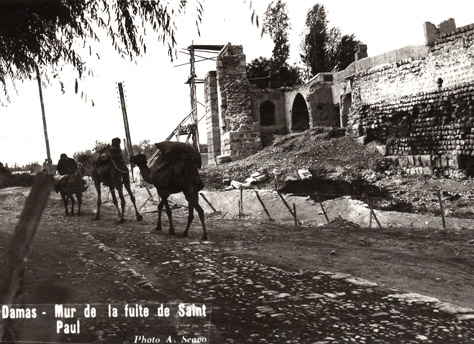
Syria marks ‘year of St Paul’

Published by Alex

DAMASCUS (AFP) Predominantly Muslim Syria has launched a celebration to mark 2,000 years since the birth of Saint Paul, who converted to Christianity on the road to Damascus and helped spread the new religion to the non-Jewish world.

A mass was attended by both Christians and Muslims in the capital of officially secular Syria, with other events being organised over the next 12 months with the help of the tourism ministry.

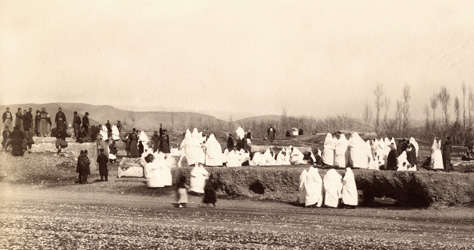
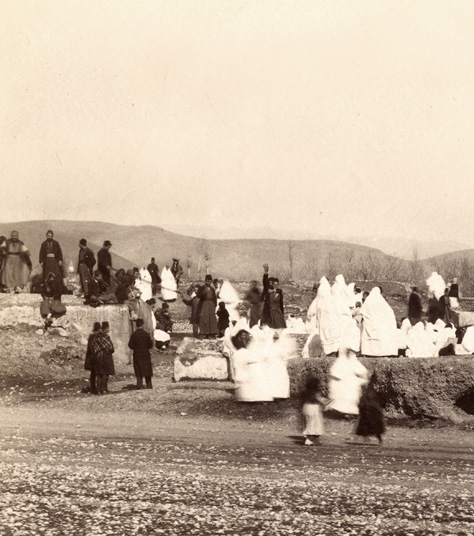
The following nineteenth-century original photos are all part of the private collection of Middle East historical photos available at www.mideastimage.com

tarsusstpauls-gate.jpg

Photograph of St. Paul's gate in the wall of the city of Tarsus in Cilicia in northern syria, now in southern Turkey, the birth place of Saul of Tarsus [Sa'ul Hatarsi], 5 A.D.- 67 A.D.; a Hellenized Jew, who's conversion on the Road to Damascus was to change the course of history, and introduce a Semitic faith to the non-Semitic world of the Gentiles, through his missionary travels to the world beyond the Aramaic and Hebrew speaking east " The Apostle to the Gentiles".


tasus-st-pauls-house-1898.jpg

Photograph of St Paul's House and St Paul's well to the left taken by
travelling missionary in 1898, in the city of Tarsus in Cilicia.


bab-kaysan-bonfils-1872.jpg

Photo (Bonfils, 1872) of Bab Kaysan, one of the Gates of Damascus leading to the Christian quarter, but next to the  Jewish quarter, where St. Paul is believed to havemade his escape, in a basket, on his second visit to Damascus, after returning from his mission to the Arab Nabateans after his conversion on the way to Damascus. The Gate  has not been in use since the 16th. century occupation of Damascus by the Ottomans.

annania-church-hakim.jpg

The underground chapel, at Ananias house where Paul remained after his vision was restored by Ananias at the house of Judas in Damascus. He was baptized by Ananias. The Church and the house are located in the Christian quarter of east Damascus. Photograph by Suleiman Hakim 1890. (See it today)


bab-kaysan-scavo.jpg

Post card of the Chapel of St. Paul during its construction at Bab Kaysan in 1939. (See it today)


st-pauls-conversion-site-outside-damascus-full.jpg

st-pauls-conversion-site-outside-damascus-ii.jpg

Photograph, by Bonfils 1870, of Christian men and women of Damascus visiting  Kawkab, 18 Km. south-west of Damascus, at the spot on the road between Jerusalem and Damascus where it is believed Saul of Tarsus is thought to have been hit by a bolt of Lightning and blinded.


Prison Riot, Golan, Syria Heads East

Syria prison riot draws conflicting accounts 

BEIRUT (Reuters) – Syrian authorities said on Sunday they had restored order at a military jail near Damascus after a riot, but dissidents said the protest was not over and that dozens of prisoners had been killed.

The riot broke out on Saturday at Sidnaya prison, a huge complex 30 km (19 miles) northwest of the capital Damascus that houses thousands of criminals, political prisoners and soldiers convicted of violating military rules.

"Several prisoners convicted of extremism and terror crimes created chaos… The issue required the interference of anti-riot units to restore calm," the Syrian state news agency said.

The agency did not say whether there were any casualties. The Syrian Observatory for Human Rights, an organisation based in London, said Syrian security forces had killed dozens of prisoners during the riot.

The Observatory said Islamist prisoners, many of whom have been held at Sidnaya for years without trial, started the riot. It quoted witnesses as saying a hospital was filled with the wounded.

Syrian dissidents based in Beirut said prisoners were still rioting and that security forces remained heavily deployed around the prison and the hospital.

The Kurdish Coordination Committee, an umbrella group of Kurdish opposition parties in Syria, said the prisoners were only demanding better living condition.

"Syrian prisons are among the worse in the world. We do not think the demands of the protestors exceeded asking for better conditions and other humanitarian demands," a statement by the group said.

Syria, which has been ruled by the secular Baath Party since 1963, holds thousands of Islamists and other political prisoners, including writers and human rights advocates. International human rights groups say random arrests and torture are common.

The Baath Party, which put down an uprising by the Muslim Brotherhood in 1982 in the city of Hama, has shown limited tolerance toward Islamists in recent years, with Washington accusing the Damascus government of allowing Islamist fighters to infiltrate into Iraq from Syria.

In The Telegraph, here (Thanks Friday Lunch Club) Adm. Mullen: "Israeli plans Iran attack 'will fail to d…

"The Americans had spies in Iran until they were rounded up in 2003 and now they do not have much by way of humint [human intelligence] on the ground. The Israelis have better information. But the Americans went away from the meetings unconvinced that the Israelis have enough intelligence on where to strike, and with little confidence that they will be able to destroy the nuclear programme."  

Lebanon's Premier May Announce New Cabinet as Early as Tomorrow
By Massoud A. Derhally

July 6 (Bloomberg) — Lebanese Prime Minister Fouad Siniora may announce the country's new cabinet as early as tomorrow after the country's political factions agreed on the distribution of portfolios in the new government, his top adviser said. "We are now talking about the details of the portfolios and the names'' of the people who will head the ministries, Mohammad Shateh said in a telephone interview from Beirut today. Siniora may form the government “as early as tomorrow or Tuesday,'' he added…..

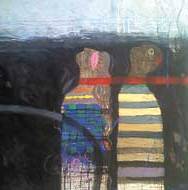
Nihad Güle, Des êtres de lumière

D’après le critique d’art Ghazi Ana, Nihad Güle a commencé sa carrière en travaillant sur les espaces de « l’abstraction lyrique », s’appuyant sur la mémoire visuelle de l’enfance. Aujourd’hui, Nihad Güle se tourne vers l’expressionnisme et le personnalisme. suite

Israel has been reluctant to withdraw from the Golan [Sunday Telegraph] because of its strategic position above Syria, while many Israelis have been so taken with its wild beauty that they have built wineries and boutique hotels. The Golan front has also been quiet for years, providing little incentive to resolve the conflict.

"The Golan Heights is considered our Tuscany. Israelis fell in love with the Golan – and it's a very easy conflict for us. That's why it's so difficult to convince Israel to withdraw," Mr Liel said.

Syria, which demands the return of all of Golan, has promised to allow Israelis to continue to enter the western part without visas, though the future of Israeli businesses and towns there is uncertain.

More seriously, the Golan provides more than half of Israel's drinking water and in this year of drought, the biblical Sea of Galilee – known in Israel as Lake Kinneret – is already at dangerously low levels, making Israel reluctant to give it up.

But Turkey is already said to have promised to supply more water to Syria, and possibly to the rest of the region, by drawing on the Euphrates, Tigris or Seyhan rivers. Syria has also demanded the building of a desalination plant in exchange for letting Israel continue to draw drinking water from the Golan. …

"…Alon Liel, a former director of Israel's foreign ministry, said the prospect of a peace agreement with Syria was growing, though it might require a new American president before a deal could be agreed…

"They are asking not only for the Golan Heights but a change in Washington that will break the Syrian isolation internationally," said Mr Liel. "But I also think they will not do it unless they are assured they have an alternative to Iran."
Congress Delivers Promised Israel Aid Bump Despite Budget Deadlock

By Nathan Guttman

While almost all federally financed programs were denied any funding increase for the coming year, aid to Israel from the United States will increase thanks to a legislative loophole and some deft maneuvering by pro-Israel lobbyists.

   Read more…

Syria heads east in effort to boost its foreign investment
By Julien Barnes-Dacey in Damascus
Published: July 7 2008 03:00 | Last updated: July 7 2008 03:00

Western isolation has forced Syria increasingly to look eastwards for its economic future. As the country pushes through much-needed reforms, Bashar al-Assad, the president, is focusing on links with rising economic powers such as India and China."

Even as Syria is looking to restore ties with the west, reflected in improved diplomatic relations with France, a forthcoming Assad trip to Paris and renewed peace talks with Israel, Damascus has been careful to foster its relations with other powers.

Mr Assad travelled to India last month, the first time a Syrian leader has visited the country in 30 years.

Safi Shujaa, director of the Syrian Economic Centre, says that "Syria is going seriously to the east", citing international political isolation from the west and economic advantages from the east as the main motivations for the shift.

This decision has taken place even as the country undergoes urgent economic reform in the face of a -stagnant economy and dwindling oil revenues. In recent years Syria has liberalised foreign trade, dropping tariffs and import restrictions, and introduced a more favourable investment climate seeking greater foreign capital for the budding -private sector.

Liu Bo, a commercial attaché at the Chinese embassy in Damascus, says that these reforms have been directly responsible for the increased Chinese engagement. He says that exports to Syria increased by 37 per cent in 2007, while China has pumped $741.52m (€472.5m, £374m) of investment into the country…..

DAMASCUS, July 3 (Xinhua) — Syrian President Bashar al-Assad said on Thursday that his country would intensify efforts to regain the Palestinian unity, the official SANA news agency reported. Assad made the remarks while meeting with the politburo leader of the Palestinian Islamic Resistance Movement, or Hamas, Khaled Meshaal. Syria supports the Palestinian negotiating stance and the return of their legitimate rights, on top the establishment of an independent Palestinian state with Jerusalem as its capital, Assad asserted.

Meshaal thanked Assad for the aid offered by Syria to the Palestinian people and its efforts to regain unity among the Palestinians and lift the siege imposed on Gaza, SANA reported.

Bashar al-Assad Walking the Tight-Rope

(Written and Posted by Qifa Nabki)

As long as the Syria-Israel talks remain veiled in secrecy, there will be plenty of speculation, rumor-mongering, and head-scratching on the subject of how President al-Assad will guide his country to a peace agreement while not relinquishing Syria's strategic alliances. 

Former top Israeli diplomat reportedly says Syria ready to cut Iran ties

By Haaertz

A former senior Israeli diplomat has asserted that Syria is willing to cut its close relations with Iran in return for financial and military backing from the United States, the Sunday Telegraph reported.

Alon Liel, a former director general of the foreign ministry, told the British newspaper that Syrian President Bashar Assad is increasingly open to a peace deal with Israel which would greatly weaken Iran's influence in the Middle East.The Sunday Telegraph reported that Liel, who has been engaged in low-key "second track" discussions with Syrian representatives for many months, has said the prospect of an agreement with Syria was growing, though a new U.S. president might be necessary before a deal could be finalized. [continue]

Syria says no direct contacts yet
Published: Saturday, 5 July, 2008, 01:22 AM Doha Time

PARIS: Syria’s foreign minister said yesterday it was premature to talk of direct peace negotiations with Israel, a day after the Jewish state called for face-to-face discussions to start soon.

A third round of indirect talks between the long-standing foes took place in Istanbul this week and ended with an agreement to hold a fourth round of negotiations in Turkey in late July, a Turkish government source said on Thursday.

“It’s premature to answer this question,” Syrian Foreign Minister Walid Muallem said when asked when direct talks could be held. He confirmed that both sides had agreed to hold a fourth round of indirect talks, but did not say where or when. [continue]

Iran, Syria ink telecommunications deal

Tehran Times Economic Desk

DAMASCUS – During the visit of Iran’s minister for Information and Communication Technology to Syria, the two sides signed an MOU on telecommunications.
The MOU was inked on the sidelines of the 4th International Information and Communications Security Assembly in Damascus.

The sides made agreement on reducing the roaming tariffs and increasing the telecommunications capacity to 120 channels from the current 60 channels.

The officials of the countries have also separately held talks with Iraq’s Ministry of Communications officials in a bid to create Iran-Syria direct link of optical fiber network via north of Iraq.

Syria tells UN: Israel burying nuclear waste in Golan Heights

By The Associated Press

Syria has complained to the United Nations about a series of alleged Israeli wrongdoings in the Golan Heights, including burying nuclear waste and discriminating against the region's Druze residents.

The complaint was made in a report Syria handed to a UN fact-finding committee comprised of Senegal, Sri Lanka and Malaysia's ambassadors.

The report came after Syria held a third round of indirect negotiations with Israel in Turkey last week. A Turkish government source said Thursday that both sides had agreed to hold a fourth round of indirect negotiations in Turkey in late July.

Syria listed in the report a number of alleged Israeli violations of the Golan's Druze inhabitants' human rights.

In addition the nuclear claim, Damascus charged that Israel confiscates the Israeli ID cards of Druze students who return from studies in Syria, and that residents of the Golan continue to serve prison terms in Israeli jails, some for dozens of years. 

Karim Makdisi (of AUB) has an engaging piece in CounterPunch on the amusing subject:

On Soccer and Politics in Lebanon

By KARIM MAKDISI

Amidst the torturous negotiations to form a ‘national’ unity government in Lebanon—and the rhetoric employed by both March 14 and opposition members alike about building a strong ‘nation’ to bind all of Lebanon’s communities—Lebanon’s national soccer team recently completed the last of six qualification round matches for the 2010 World Cup. The results have been nothing short of disastrous, with consecutive ‘home’ and ‘away’ defeats to Saudi Arabia (1-4, 1-2), Uzbekistan (0-1, 0-3), and Singapore (1-2, 0-2), and fourteen goals conceded in the process. Far from being a trivial sporting matter, the manner of Lebanon’s defeats illustrates the Lebanese political class’s chronic lack of imagination and willful neglect of a genuine nation-building project that could transcend sectarian or clientalist considerations. [continue reading]

Prisoner Swap; Golan; Negotiations

Prime Minister Fouad Siniora said on Tuesday that a prisoner swap between Israel and Hizbullah constituted a "huge failure" for the Jewish state and a "national success" for the Lebanese party. "The release of the prisoners, thanks to the German mediator … is a huge failure for the policies of Israel," Siniora said in a public/official statement. "The success of Hizbullah in the negotiations led by a third party is a national success for the party and for the struggle of the Lebanese because it secured national goals which Israel always refused to respect."

Lebanese youths decorate a street in Sidon with posters of Lebanese prisoner Samir Kantar. A prisoner exchange deal with Hezbollah will go ahead only once Israel receives information on an airman who went missing in Lebanon in 1986. (AFP Mahmoud Zayat)
.
Hassan Nasrallah, the leader of Hezbollah, said “I congratulate all Lebanese on this achievement and I hope that all the Lebanese consider it their achievement. If it is completed, Lebanon will be the first Arab country in the Israeli-Arab struggle to close the detainee file after liberating the land.''
.
Walid Jumblatt said the prisoner exchange was not linked to the issue of Hizbullah's weapons. He said: "We don't want to provoke Hizbullah sensitivities.

Israeli Prime Minister Ehud Olmert said his government was forced to agree to the prisoner swap deal with Hizbullah out of its desire to uncover the fate of the two Israeli soldiers

When Arabs were asked to identify the leader they admire most (in an open-ended question), the number one answer overall in a recent poll, (and especially in predominantly Sunni countries such as Egypt, Morocco, and Jordan) was Hasan Nasrallah, Hezbollah’s leader. The Palestinian problem continues to rank as "most important" problem among non-Palestinian Arabs.

France is a captive to its ties with Syria by Michael Young in the Daily Star – He blames Lebanon's woes on France and suggests that Kouchner is impeding the Hariri court to help Syria.

The French approach to Lebanon has been characterized by remarkable incompetence in the past eight months, and by the absence of any discernible strategy. After trashing Resolution 1559 last November by pleading with Syria to permit a Lebanese presidential election (one the Elysee Palace had thought to follow up with a triumphal Christmas visit to Beirut by Sarkozy), the French stepped back when Assad rebuffed them. Humiliation was swiftly swallowed, however, after the Doha agreement, when the Syrians received the visit of Sarkozy adviser Claude Gueant, their reward for briefly failing to obstruct the Lebanese Constitution.

France: The Gate of Europe: Tishreen, Damascus (Translation thanks to mideastwire.com)

On July 2, the state-controlled daily Teshreen carried the following editorial by Chief Editor Issam Dari: “It is impossible to mention France without mentioning its revolution, which changed the course of history. We cannot talk about France without coming across its scientists, scholars, innovators and leaders who enriched the human culture and raised the slogan of freedom and entrenched the meanings of independence and patriotism.

“We cannot but mention the founder of the fifth French Republic, late President Charles De Gaulle, who has become a headline for resisting the Nazi occupiers and a school to fight for freedom and independence and a model to be pursued in steadfastness in the face of pressures, dictates and calls for “realism”.

“When General De Gaulle led the French resistance from London and through the radio and while he was subjected to pressures and dictates from Winston Churchill, he said: “I was too weak to surrender.” De Gaulle did not surrender. France gained its independence and freedom and De Gaulle established the fifth republic. That was a profound lesson that affirms that freedom does not come from surrendering to the fait accompli, and that no matter how immense the pressures are, they can never force righteous people to surrender.

“We recall General De Gaulle while France is close to commemorating its Independence Day. President Bashar al-Assad will visit Paris, a first visit in many years – upon the invitation of President Nicolas Sarkozy.

“Syria is placing much hope on a balanced French policy in the Middle East, and on an active French role in the issues of the region, in what pushes the peace process forward and entrenches security and stability. Syria realizes that France is Europe’s gate and that, along with Germany, they constitute the dynamo for the European Union, which maintains good relations with the Arabs and huge interests that require this union to carry out its influential and effective role in finding solutions to the crisis – which if continued – will negatively affect the interests of the European and Arab sides equally…..

Prime Minister Ehud Olmert said on Thursday peace talks between Israel and Syria, now mediated by Turkey, would have to be conducted face-to-face "very soon."

"With the Syrians, we are talking seriously and in my estimation very soon the negotiations will have to be direct. They will not be able to continue in the mode in which they are currently being held," Olmert told an economic conference in the southern resort city of Eilat.

U.S. Ambassador Richard Jones said Thursday that Washington would not intervene over Israel's renewed negotiations with Syria, calling it a private Israeli matter. Jones said that the U.S., like many Israeli officials, were wary of establishing contacts with Damascus, but would not opposed the renewed negotiations.

Analyze This: Laying down the law on the Golan:

A Golan returned to a Syrian regime headed by the likes of Bashar Assad, who serves as valuable partner of Iran, an invaluable supporter of Hizbullah and Hamas, and a brutal oppressor of his own people, would never pass muster with the Israeli people – whether or not it actually comes to a vote.

"The Necessary Steps for a Responsible Withdrawal from Iraq"

Rep. James McGovern (MA-03), who wrote the preface, said the report provides "a road map for the next administration and Congress to follow". According to McGovern, the report outlines "what it would take to leave – what is required in terms of a cease-fire, reconciliation, recovery and security when the day comes for our troops to begin coming home." The report was authored by a Massachusetts- and Washington-based "task force" working with an advisory group of 14 international experts. These met together in a March workshop at Harvard University’s Weatherhead Center for International Affairs.

We welcome reviews and commentary on the Task Force findings. Sincerely, Charles Knight, Project on Defense Alternatives, Commonwealth Institute, for the Task Force Organizing Committee.  [email protected] 617-547-4474

Salma Al-Shami write about a Syria play she saw in NY City: [[email protected]]

Hi again, Josh,

A couple of months ago I saw an incredible play called Damascus that was featured as part of the "Brits Off Broadway" series in NYC. It's written by Scottish playwright David Greig, and I was truly impressed by how many of the subtle nuances of Syrian culture he was able to pick up on and write into his characters and plot. The story follows Paul, a salesman who has come to Damascus on Valentine's Day to sell English language textbooks to an indifferent dean of a school and his beautiful assistant Muna. Paul's plane back home keeps getting delayed, and in the meanwhile, he develops relationships with Muna and Zacharia, the young hotel porter who is girl-and-party-obsessed. In the background is Elena, a Ukrainian pianist who acts as a Greek chorus, narrating the moral and theoretical backdrop of the scenes. As the synopsis of the play concludes, "In Damascus, a city of transformations, Paul grapples with language and love, meanings and misconceptions. And as his flight home is delayed by a bomb at Beirut Airport, he begins to wonder, will he ever leave?"

Greig offers all types of social commentary, weaving in elements of what happened to the pre-Ba'ath intelligentsia (the "old generation") after the rise of the party, of the Palestinian narrative and its effects on the thinking and thought processes of Damascines, of the nature of gender relations etc…
In any case, it's an excellent and quick read. I was able to track a copy of the play down from the UK. Don't know if it's available in the US, but if it sounds like something you'd be interested in reading and can't find it here, I'll happily loan you my copy of it.
Here's a link to an interview that features Greig talking about his play and about his experiences working with young Syrian playwrights. http://www.theatrevoice.com/listen_now/player/?audioID=501 

Best,
Salma
2008-07-02 11:21:16 –

LONDON (AP) – The British government has added the military wing of Hezbollah to a list of terrorist groups banned in Britain.
Home Office minister Tony McNulty said in a Wednesday statement that the entire military section of the organization has been listed as a proscribed group under British terrorism laws.
The department says that Hezbollah's social and political work in Britain would be unaffected. But the ban will place tight limits on any fundraising _ particularly if funds are suspected to be intended for military action.

Individuals can be prosecuted for becoming a member of a proscribed group under British laws.

Revue de presse: Politique extérieure
M. Walid EL-MOUALLEM, Ministre des Affaires étrangères, a indiqué que tout progrès sur le volet syro-israélien des négociations ne devrait pas se faire au détriment du volet palestinien ou bien être utilisé à son encontre. suite

Revue de presse: Actualité nationale
Des sources bien informées ont déclaré à Al-Hayat que le gouvernement syrien publierait des rapports périodiques sur le niveau de la corruption dans le pays et ce à la lumière de l’approbation du Conseil des Ministres du Traité international sur la lutte contre la corruption qui nécessite des engagements précis de la part de Damas. suite

Bangkok Post | Spectacular SYRIA:  Forget everything you have ever heard about Syria; it is a surprising country. Anyone who has been there can tell you the ancient ruins are beautiful, the food delicious, and the natural scenery very attractive. The nightlife is lively and the daylife intriguing. What more could you want on a holiday?

Syrian-Israeli Talks, More Iran

Turkey: Direct Israel-Syria Talks Imminent
by Ben-Yechiel

(IsraelNN.com) Direct peace negotiations between Israel and Syria are imminent, according to a Wednesday report in the Arabic language newspaper Al-Hayat. In the report, Turkish officials announced that the direct talks will follow the upcoming round of indirect talks between the two countries.

Yoram Turbowitz and Shalom Turgeman, advisors to Prime Minister Ehud Olmert, arrived in Ankara on Tuesday to discuss the possibility of launching direct talks with the Syrians. The next round of indirect talks, the fourth, is slated to begin in two weeks' time.

Israeli and Syrian negotiators will decide on a start date for the direct negotiations, as well as the composition of the negotiating teams, in about a week and a half, after Syrian President Bashar Assad returns from a scheduled trip to Paris. Assad will be attending a conference in the French capital, alongside Israeli Defense Minister Ehud Barak.

The Turkish sources were quoted as saying that France also plans to mediate in the talks, primarily with regards to the Shebaa Farms land dispute.

Assad called the political climate in the Middle East Earlier this week "positive," and called on the EU to intensify its involvement in the peace talks with Israel.

"The political climate in Israel is generally positive. We must give the different political processes a new push in order for them to proceed in the right direction," remarked Assad in a Damascus meeting with Norwegian Foreign Minister Jonas Gahr Store, reported Sana, the Syrian government news agency.

Optimism is taking wing in the Middle East: The Israelis and Syrians have been negotiating and Israel and Hamas are two weeks into a cease-fire. But is the Arab-Israeli conflict moving toward a resolution? A closer look at the situation reveals myriad and contradictory interests at work, making it unlikely that there will be a comprehensive peace in the Middle East soon…..

But what is Syria's stake in all this? Why do the Syrians all of a sudden appear flexible and moderate? ……

For all his eagerness to rejoin the international community, however, Mr. Assad will not budge without first trying to extract a few concessions. Principal among these is an assurance that the UN tribunal charged with bringing to justice the killers of former Lebanese Prime Minister Rafik Hariri will not implicate the Syrian regime. ……. Assad does not believe he can elicit such a guarantee from the current US administration, and brazenly announced that there will be no Syrian-Israeli agreement in 2008.

• Rayyan Al Sawaf is a freelance journalist in Beirut, Lebanon.

[Landis comment: Who would have guessed that Rayyan al-Shawaf was Lebanese?! Contrary to Sawaf's brazen assertion, Syria is not dealing on the Hariri trial. It has never asked for a deal on the Hariri trial nor has it brought it up in negotiations. To do so would indicate Syria's guilt. Syria insists it is innocent. Shawaf is making up his claim that Syria insists on bringing the trial into the negotiations with Israel or intends to do so with a new administration. Assad's supposition that a deal with Israel will not be signed while Bush is president is not proof — nor does it even suggest — that Syria is searching for protection from the trial. US guarantees for both countries will be at the center of negotiations, but they won't be about the Hariri trial. If we take Camp David as a model, both countries will be looking for bucket loads of money and security benefits from the US. That is why the US must be a participant to the negotiations and an eventual deal. Both countries are counting on the US paying a royal ransom to stop Syria's military support for Hizbullah and Hamas. This is not about Hariri.] 

Spy Games in Iran
By: David Ignatius | The Washington Post

The United States appears to be running some limited covert operations across the Iranian border. But according to knowledgeable sources, this effort shares the defect of broader U.S. policy toward Iran — it is tentative and ill-coordinated, and it undermines diplomacy without bringing serious pressure on the regime….

The covert program illustrates the larger dilemma facing the Bush administration and its successor — what to do about an aggressive and increasingly confident Iran? The Iranians make little effort to hide their own covert-action campaigns — including extensive financial and military support for Hezbollah in Lebanon and Hamas in Gaza. The Iranians have used Syria effectively as a platform for these intelligence operations, from political action to paramilitary operations to clandestine terrorism…

Saudi Arabia has taken a tougher stand to oppose what it sees as Iranian meddling in the region. There are reports out of Syria, for example, that the Saudi military attaché in Damascus was expelled a few months ago after the Syrians uncovered what they believed was a plot to pay $50 million in subsidies to members of a prominent Syrian tribe. One source said the money was simply intended to support the kingdom's longtime tribal friends rather than organize political opposition to President Bashar al-Assad. But the Saudis have made no secret of their desire for regime change in Syria…"

The Odds are Against an Attack on Iran By: Rami G. Khouri | The Daily Star
I expect the U.S. and Israel to finally accept the reality that a military strike, no matter how punitive, would only temporarily set back Iran's nuclear capability, because the technological knowledge is already in Iran's hands and cannot be destroyed with bombs.

Softer Tone From Iran Has Experts Guessing
By: Helene Cooper | The New York Times
Iranian officials on Tuesday continued their long history of befuddling Western diplomats, as two top officials sounded conciliatory notes about the prospects of eventually breaching the impasse between the West and Tehran over the country’s nuclear ambitions.

U.S. States Continue to Divest from Businesses Tied to Iran By: Brian Radzinsky | World Politics Review

Eleven U.S. states have adopted legislation to divest public pension funds from companies with financial ties to Iran's petroleum, defense, and nuclear sectors in an attempt to persuade Iran to give up its uranium enrichment program and alleged sponsorship of terrorism. Almost 20 more states are considering similar legislation to supplement existing federal and international sanctions.

This is the first time that state investments have been leveraged for nonproliferation goals. During the 1980s, anti-apartheid activists urged state and local authorities and some universities to divest holdings from companies invested in or doing business with South Africa. During the 1990s, humanitarian activists persuaded Massachusetts to divest from companies "doing business with" Myanmar. More recently, almost 30 states passed legislation to divest from companies with investments in or engaged in trade with Sudan. The Iran case is unique, however, because divestment legislation explicitly references Iran's alleged sponsorship of terrorists and its uranium enrichment program…..

WorldPublicOpinion.org conducted an 18-nation public opinion poll on the Israeli-Palestinian conflict released yesterday. The poll finds that in 14 nations people mostly say their government should not take sides in the Israeli-Palestinian conflict.  Just three countries favor taking the Palestinian side (Egypt, Iran, and Turkey). No country favors taking Israel’s side, including the United States, where 71 percent favor taking neither side.

Israel Still Paying for its Defeat By: Jeff Jacoby | The Boston Globe
Two years after its war with Hezbollah, Israel is still paying for its defeat.

From Triumph to Torture By: John Pilger | The Guardian
Israel's treatment of an award-winning young Palestinian journalist is part of a terrible pattern.

Palestinians, Refugees, Turks, Aleppines, Arar, Bloggers

"Everybody is happy about a food drop. I am watching. A blind lady is being helped by a small boy. People are jumping to catch food."

A Food Drop
David Deng Aleu, age 16
Sudanese, Kakuma refugee camp

This illustration is from Sybella Wilkes, One Day We Had to Run!: Refugee Children Tell Their Stories in Words and Paintings, (Brookfield, Connecticut: The Millbrook Press, 1994) All rights reserved.

Today Sybella Wilkes is the spokesperson for the UNHCR in Damascus. She wrote the following heartbreaking story. She is extraordinary. Many journalists have sung her praises to me, explaining how she helped them with their stories on Iraqi refugees and got them set up in Syria.
Sybella Wilkes ‎[email protected]

Seaside break in Syria proves too much for young Palestinians
By Sybella Wilkes and Covadonga de la Campa
30 Jun 2008
Source: UNHCR, Reuters, and AlertNet are not responsible for the content of this article or for any external internet sites.

The views expressed are the author's alone. AL TANF, Syria, June 30 (UNHCR) – It seemed like a good idea. Take a group of Palestinian children to the seaside to help them escape the monotony and hardship of their lives in limbo on the arid Iraq-Syria border.

But it all proved a bit too much for most of the children taken to the Syrian city of Tartus on the Mediterranean Sea earlier this month from the Al Tanf camp, where they and their families have lived for months after fleeing their homes in the violence-plagued Iraqi capital of Baghdad.

The sudden freedom of movement, the cool sea breezes, the abundant food and drink and the other laughing kids showed these nine children what they were missing and what they would miss once again when they returned to Al Tanf at the end of their week's holiday.

They are among a group of more than 750 Palestinian refugees who have been stuck for up to two years in Al Tanf, unable to enter Syria and unable to go back to Baghdad. They live in a tiny strip of no man's land where they must be on the alert for snakes and scorpions and endure the terrible heat, hoping that some country will come forward and offer them resettlement.

 It soon became apparent that all but one of the children given special permission by the Syrian government to go to the coast were too traumatized to appreciate and enjoy their short break from reality with other youngsters at a summer camp in Tartus.

"These kids have gone through such a hard time, and the change in environment has had an impact on them. They are closed, hurt by their lives. They are not used to interacting with the world, with so many other children," said camp superviser Feras Shihabi, who works for the UN Relief and Works Agency for Palestine Refugees in the Near East (UNRWA).

The camp staff did not push the Palestinians to join in the week's activities, including swimming, dancing, singing, clown shows and daily parties. Eight of them preferred to stay inside darkened bedrooms, missing their families.

"I am here for such a short time. What is the point of enrolling in activities when I am going back to Al Tanf again?" asked Sarab, who felt that the camp gave a false sense of optimism.

Fellow refugee, Naba, said that if she joined in, it would make life that much harder when she had to go back to Al Tanf. "My life is not happy, I need to leave this summer camp right now," she said, adding: "The first day I was happy, but by the second day I was not happy. We are not adapted to this happy life and need to stay strong for our hard life."

Hussam Muktar, an Iraqi who works for the UN refugee agency as an outreach worker, said he felt the pain that the children were living through. "Al Tanf is like a prison – and no child will ever thrive in a prison. They cannot go forwards because they are not allowed into Syria or anywhere else. They cannot go backwards, because they and their families are threatened in Iraq."

In contrast, other Palestinian refugees taking part in the camp – including 24 children who live an easier life at the UNHCR-run Al Hol camp in northern Syria – made the most of their holiday, with many learning to swim in the crystal blue sea. After a few days they began avoiding their compatriots from Al Tanf, unable to relate to their anger and depression.

When Muktar visited the summer camp, some of the Al Tanf children opened up after hearing his Iraqi accent, but they were still too withdrawn to look him in the eye.

"If you look at these children, even though they are the same age as all the other children at the summer camp, their eyes, their body language tells you that they have suffered more than any child should suffer. It hurts to see the trauma in their every movement," Muktar said.

UNHCR provides assistance to Palestinian refugees in Iraq and Syria. Together with UNRWA, it has been looking for solutions for the border refugees at Al Tanf and nearby Al Waleed.

"It is clear that we need to relocate all the Palestinians that are stranded on the Iraqi border. We can meet their material needs with food, water and shelter, but the fact remains that the environment will never be suitable for human habitation," said Philippe Leclerc, UNHCR's deputy representative in Damascus.

UNHCR, UNRWA and the Palestinian Red Crescent care for the Palestinians in Al Tanf, while UNHCR, Islamic Relief and the International Committee of the Red Cross (ICRC) share the load in Al Waleed.

The inhabitants of the two border camps have endured fires, flooding and harsh extremes of temperature. An estimated 15,000 Palestinians remain in Baghdad, compared to some 30,000 in early 2003. They have fled to escape militia threats, kidnapping and killings. A few hundred have been resettled in third countries.

By Sybella Wilkes and Covadonga de la Campa
In Al Tanf, Iraq-Syria Border More . . .

the POMED Wire On Monday (6/23) Sen. Edward Kennedy (D-MA) introduced Senate resolution S.3177, calling on the President to appoint a White House Coordinator for Iraqi Refugees.  The Coordinator would be responsible for crafting and coordinating a policy to deal with the resettlement and humanitarian needs of Iraqi refugees.

Trial Sheds Light on Ethnic Groups Living in Turkey  (Thanks to Farhan Siddiqui)
Tuesday, June 10, 2008
ISTANBUL – Milliyet

A new study estimates that there are roughly 870,000 Arabs living in Turkey: This group lives mainly in the cities of Siirt, ??rnak, Mardin, Diyarbak?r, ?anl?urfa, Hatay, Adana and Istanbul.

A report commissioned eight years ago by the highest advisory body in the land investigates how many Turks, Kurds and people of other extractions are living in Turkey. The report comes to light as part of the trial for the murder of three Christian misionaries.

The smallest ethnic groups include: Roma people with a population of 700,000, about 60,000 Armenians, 20,000 Jews, 15,000 Rums (Greeks with Turkish citizenship) and a very few number of Assyrians live in Turkey.

Although some sources say the population of Alevis in Turkey ranges between 5 and 25 million, it is approximately 8.75 million, according to the MGK report. …… (Read More)

Coup Attempt in Turkey?

Turkish police arrested 24 people, including two retired generals and the head of Ankara's main business lobby, on suspected links to a group of alleged coup plotters.

Retired generals Hursit Tolon and Sener Eruygur were detained early today in Ankara, a spokesman for the Ankara police said in a telephone interview. The spokesman said authorities had to break down the door of Tolon's home. Ankara Chamber of Commerce chief Sinan Aygun was also taken into custody, said Melih Cuhadar, a spokesman for the chamber.

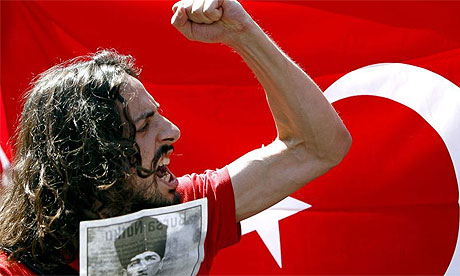
The sweep came on the day prosecutors presented an indictment to the Constitutional Court to close down Prime Minister Recep Tayyip Erdogan's Justice and Development Party. They claim Erdogan wants to dismantle the secular state set up by Mustafa Kemal Ataturk and make Turkey more like Iran.

Great journeys: Istanbul to Aleppo by train
By Vicky Frost. The Guardian, July 1, 2008

In the first part of her overland journey into the Middle East, Vicky Frost boards the Toros Express in Istanbul bound for Aleppo

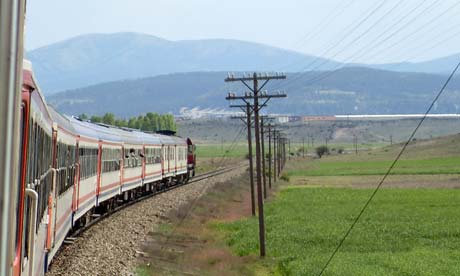
Train from Istanbul to Aleppo in Syria

Rolling along … the Toros Express travels through the Turkish countryside from Istanbul to Aleppo. Photograph: Vicky Frost

It must be an extremely odd life, perched behind the counter of a tiny train station kiosk in central Turkey. Quiet, quiet, quiet … then a bedraggled looking crowd of ravenous passengers rushing towards you at top speed, jumping down from gently aging carriages and legging it across the platform to load up with bread, sausage and hard-boiled eggs. Then 15 minutes later … quiet, quiet, quiet again.

Every Sunday morning the optimistically named Toros Express leaves Istanbul's magnificent Hydrapasa station for Aleppo in northern Syria, where it's due to arrive 30 hours later. Not a journey for those in a rush, admittedly — but as we sat happily picnicking on our kiosk spoils on the cabin sofa, watching the olive groves, pistachio trees and herds of cattle whizz past the window, there was a certain romance to proceedings; although not a sniff of a buffet car, despite a rather hopeful knife and fork sign at the end of the carriage. Beyond it? The snake of train track leading back to Europe.

As the sun set, we stuck our heads out of the window like dogs in a hot car, peering at the front of the train as it wound through the Turkish countryside. Farmers waved from their fields, the light began to fade, and I began to think that the train is a remarkably civilised way to travel (not to mention, of course, cheap. Even including the Istanbul travel agents' booking fee, tickets were only £60 each). We cracked open our bottle of raki, lay out our super-clean, starched bed linen, and settled in for the night.

Five hours late, the train rolled into Aleppo. We rolled into a cab, and, finally, into our hotel. The city has been gradually renovating its beautiful 17th-century houses, transforming them into boutique hotels and restaurants. Our room at the Mandaloun (mandalounhotel.com, doubles around $100pn) opened out on to a central courtyard and a fountain, the richly tiled floors were cool beneath our heavy, train-lagged feet, and – most importantly of all — nothing was actually moving. And we didn't have to sleep in (albeit ingeniously designed) bunk beds.

Tell people you are visiting Syria and most first reactions are: Why? And then: Isn't it a bit dangerous? I am certainly not going to try and excuse the ruling regime — and if you view visiting Syria as endorsing that, you may wish to travel elsewhere. But — and this does not change the first point — Syria is not a dangerous place for travellers; it is surprisingly secular, the people are enormously welcoming, and, as a woman, I experienced little of the hassle of Turkey.

The country is also home to what is an almost embarrassing number of historic sights: Aleppo's imposing citadel rises above the centre, giving views beyond the old city to the suburbs and industry beyond. Essentially, the ethos here seems to be — here's the sight, have a look around. No barriers, no roped-off areas, no handrails, and, frankly, no safety. But adventure; lots of that. And space. With visitor numbers low, you can stand alone in the citadel's 13th-century great mosque, or sit high up next to its domed roof and gaze over the ruins with only the occasional figure emerging from arched doorways or behind crumbling walls to break the spell…..

[Getting There: EasyJet fly Luton-Istanbul from £51.98 inc all taxes. The Toros Express leaves Istanbul's Haydarpasa station early on Sunday mornings, due to arrive on Monday afternoon, but invariably rolling up around eight in the evening. Book via the Tur-ista agency in Istanbul ([email protected]).]

An article in yesterday's New York Times criticized the Bush administration for failing "to develop a comprehensive plan to address the militant problem" along the Afghan-Pakistan border, where Osama bin Laden is reportedly rebuilding the al Qaeda terror network.

In Case of Extraordinary Rendition Victim Maher Arar, U.S. Gets Away with Torture
Center for Constitutional Rights. Posted July 1, 2008.

Citing national security, a federal court rules that Maher Arar, who was kidnapped at JFK and sent to Syria by the U.S., had no due process rights.

June 30, 2008, New York — A federal Court of Appeals ruled against Center for Constitutional Rights (CCR) client Maher Arar's case against U.S. officials for their role in sending him to Syria to be tortured and interrogated for a year under the extraordinary rendition program.

Maher Arar is not available to comment in person, but is issuing the following statement: "The Court's 2-1 ruling is outrageous. It basically legitimizes what was done to me, and permits the government to use immigration law as a disguise to send people to torture without regard for due process."

The court ruled that Mr. Arar's constitutional claims that it was a violation of due process to lock him up for two weeks, obstruct his access to a lawyer and a court, and then to ship him to Syria for the purpose of having him interrogated under torture could not be heard in federal court for two reasons: It concluded that adjudicating the claims would interfere with sensitive matters of foreign policy and national security, and that Arar, as a foreigner who had not been formally admitted to the U.S., had no constitutional due process rights with respect to the government's interference with his access to a lawyer and the decision to send him to Syria to be tortured. …..

Bipartisan Campaign Seeks Presidential Executive Order to Ban Torture
Jim Lobe

Syria sets Arab world record with at least five bloggers and cyber-dissidents detained

(GIF) [Reporters Without Borders is worried by the lack of news about Hammam Haddad, a Damascus University student and author of magazine and Internet articles, since his arrest on 5 May in the capital without any reason being given. He is the fifth Internet user to be detained in Syria in the past year.

“This arrest turns Syria into the Arab world’s most repressive country towards people who post news and information online,” the press freedom organisation said. “It is an additional attempt to intimidate and silence dissidents and bloggers.”

Activist Mohammad Badi Dak Al Bab, a member of the National Organisation for Human Rights in Syria->http://nohr-s.org/], was meanwhile sentenced to six months in prison yesterday on a charge of “attacking the prestige of the state” under article 287 of the criminal code for posting an article entitled “Damascus, capital of Arab culture”on the organisation’s website. Bab, who has been held in Adra (20 km northeast of the capital) since 2 March, was previously detained from 2000 to 2005.

A blogger, Tariq Biassi, 22, is being held in a Damascus security camp. He was sentenced on 11 May to three years in prison under articles 285 and 286 of the criminal code for “publishing false information” and “undermining national sentiment” for posting a comment critical of the government on a website.

He was one of the first people to fall victim to new government provisions regarding the Internet. Telecommunications minister Amr Salem, decreed on 25 July 2007 that website owners should, for security reasons, keep the personal data of those posting articles and comments online…..

Israel shuts crossings to Gaza after alleged attack

Israel has shut down cargo crossings into the Gaza Strip following an alleged rocket attack by Palestinian militants into southern Israel. Local authorities have yet to find any remnants of the rocket, which Israel say was detected by radar on Monday night. Hamas claim Israel are simply looking for excuses to break the terms of the ceasefire that came into effect last month. Egyptian authorities today opened the Rafah crossing for two days to allow access for those stranded at the border, and for Palestinians needing medical attention.

Donating Books to Syria: Advice from Mr. Abed

Abed Books Arrive at Kalamoon


(Photo:Abed books arriving at Kalamoon University)

I wrote to Haytham Abed to ask his advice on donating books to Syria.

Readers will remember that he is the subject of the previous post; he has donated hundreds of books to Kalamoon University and is now organizing donations to other Syrian universities as well. Here is the kind response from "Ayyoub" Haytham Abed, ya sabour.

Dear Prof. Landis:

The process of getting the books to Syria is not easy. First, one must get the books and prepare a list of all the books. Send this to the university. Get their approval, then the university must get the approval of the Ministry of Higher Education in Syria (this task took about 3 months). Once the approval is received, then the person donating the books must contact, by phone, the U.S. Department of Treasury, Office of Foreign Assets Control (Syria Sanctions). This is the easy part, the person at the Dept. of Treasury is friendly and helpful. He will walk the donor through the Dept. web site, type in the name of university and start the search. In less than a minute you will get an answer, which was that the University of Kalamoon was not on the list of sanctioned institutions. I got the green light from the U.S. government and was ready to ship.

The list of books must be certified by the Syrian Embassy in Washington D.C., That process was very civilized also; Ambassador Mustapha was helpful and supportive. A letter must be given by the donor called "Deed of Donation", an IRS Tax exemption letter must be obtained ( I got that from Syrian American Association in the Bay area).

A commercial invoice must be prepared detailing the number of books, weight, value, etc..Then the search for a shipping company was impossible. Finally I found a ship to Marseilles, France, then to Lattakia. All the books must be boxed, each box must be labeled "University Books, Gift, No commercial value". Boxes must be placed on shipping pallets and shrink wrapped.

The books sat in a Marseilles warehouse waiting for some document (The French were impossible). After many telephone calls to France, the books were shipped to Lattakia. They sat at the port in Syria for 2 months, blocked by the Ministry of Culture in Lattakia, because we did not bother to get their permission.

However, the Syrian Wasta method worked sufficiently well and the books arrive at Kalamoon university 2 weeks ago. In all, the process took me one year!! Having said that, I must admit that I made several mistakes due to ignorance. I believe, I now have learned all the short cuts. So if anyone else would like to contribute, I suggest they e-mail me or call my cell:

925-9984939

I am now trying to set up book collection points on the East Coast and in California and have a long list of requested books from both Kalamoon University and the University in Aleppo.

I hope I did not bore you with these details.
With my best regards,

Haytham H. Abed
925-9984939
[email protected]

My books will get to Syria

Books for Syrian Universities – Mr. Haytham Abed

I just received the following kind letter from Haytham Abed. This is the first time I have heard from him. He refers to this story: Syria's Private Universities, written in 2007. I salute him for his initiative and philanthropy. What a wonderful idea. Thank you, Mr. Abed.

From: Haytham Abed [email protected]
Sent: Sunday, June 29, 2008
To: Landis, Joshua M.
Subject: Thank you

Dear Prof. Landis:

For the past few years I have enjoyed your regular mail, comments, reporting, current Syrian news analysis and book reviews. Your honest views are refreshing.

One particular article you sent me about your visit, last July, to Kalamoon University changed my life. It made me proud and a better person. In that article you talked about the university library with no reference books.  I contacted Dr. Sami Moubayed and offered him my book collection (about 450 books all in English) covering the M.E., World history and current affairs.

Also, I offered to supply the university with text and reference books. Dr. Moubayed came back with a list of what the university needs and I was able to send them a total of 2000 books covering Chemistry, Physics, Algebra, Psychology, Economics, Accounting, Management, Business Law, Marketing, Calculus, Sociology, History , Political Science, Government, English Literature, Art, Medical, Computer Science..etc.

The books arrived last month at the university. Now, I am working with several professors from different universities around the US to collect books and send them to different private uni. in Syria including Kalamoon. All that because of your article. Thank you Joshua!

With my best regards,
Haytham H. Abed