“The Christians are Leaving” by Salim Abraham

Assyrians, the indigenous people of the Middle East, leave home

On a sizzling summer afternoon in 1974, my mother was trailing behind me, running hastily home to escape one of the stone battles that raged between neighbourhoods in Syria’s northeastern city of Qamishli.

Once we crossed the sand bridge that separated the Assyrian quarter from the rest of the city, we were out of the slingshots’ range.

This one was the last battle youngsters from the Assyrian quarter fought against Khanika, a neighboring Kurdish quarter, as the government soon tightened its policing of neighbourhoods.

The weapons in the battle were giant slingshots (called stone canons) and ghee can lids; the ammunition was stones. It was like a real war with trenches dug along the frontlines of the fighting neighbourhoods.

At the time, I was seven years old. I didn't understand what was going on; why such wars broke out. The only thing my mother told me was: "It's a fight between us and the Kurds."

I don’t remember the logic behind those fights and how they were planned or started. But I do recall that the Assyrian quarter was vibrant and buzzing with life and robust youngsters ready to defend it and shut it off to intruders.

See who the people in this photo are, here

“It was the most active period of my life,” recalls Ashour Ileya, 47, an Assyrian plumber who lives in the Assyrian quarter. “It was like we were doing something big, like defending our community.”

Then, more than 400 Assyrian Christian families lived in the neighbourhood’s mud houses, which sprawl into the eastern part of the city. Now, only 30 Assyrian families live there and only two churches are still standing.

Almost all Ileya’s friends and most of his relatives have left for the U.S and Europe. He is waiting for his American visa to be issued as well.

The overall population of Qamishli was around 90,000 in the mid 1970s, according to official statistics. Assyrians were estimated to represent more than half the city’s population. Today, Christian Assyrians represent slightly more than 20% of the city’s 300,000 people.

The country’s Assyrians are concentrated in the al-Jazeera region, about 400 miles northeast of Damascus. The region, the largest among Syria’s 14 provinces, includes Hasaka, al-Malikeya and Qamishli. They also exist in Iraq, Lebanon, Turkey and Iran in varying numbers.

The Assyrians once dominated the Middle East. In the seventh century B.C, their empire stretched from today’s Iraq through southern Turkey to the Mediterranean. They were among the first converts to Christianity and are divided into several churches, including the Catholic Chaldean, the Syriac Orthodox and Catholic and the Church of the East.

The Christian exodus from the Middle East came to light after the news of Iraqi Assyrians escaping the violence in their war-torn country following Saddam Hussein’s fall in 2003 made it onto the international news agenda. Almost half their population fled Iraq, leaving behind only around 700,000.

But the Arab leaders remained silent to their plight. The most recent Arab summit in Damascus, in March 2008, took no notice of their dilemma. The final communiqué did not make any mention of the plight of either the Assyrians or the Arab Christians despite growing evidence that their very existence in the Middle East is targeted.

In Lebanon, once a majority Christian country, Christians represent only 34% of its population of four million people, according to the World Christian Database. The database, which bases its work on church estimates, says Arab Christians’ percentage in the Palestinian territories has also dropped from 5.3% in 1970 to 2.5% of 3.7 million Palestinians today.

In Jordan, a country of 5.4 million people, the Christian population dropped from 5% in 1970s to about 3% now, according to a U.S State Department report. But, in Egypt, the number of Copts – Egyptian Christians – range from 5.6 million, according to Egyptian government estimates, to 11 million people, according to Coptic Church estimates. Nonetheless, they complain of discrimination in the most populated Arab country of 80 million people. One example of this is that the government still restricts the building of churches in Egypt.

The Christian flight from Syria occurred in part for economic reasons. In the mid-1980s, the U.S and the European nations imposed crippling 12-year-long economic sanctions on the country after a British court accused Syrian officials of being involved in an attempt to plant a bomb aboard an Israeli El Al plane. Syrians stood in long lines in front of government-run retail stores to get bread, vegetables, fruits and even napkins and grease. At the time, the Assyrian quarter was changing face. The stream of water that used to flow from Jagjag, the river which splits Qamishli into two parts, ran permanently dry. And the neighbourhood’s Assyrian population was dwindling, too. It was losing a few families to the West each year, where they hoped to find a more prosperous life. Many of them were selling their homes to pay smugglers to get them out of the country. Yet, the neighbourhood still kept its livelihood, with about 250 families living there and a football team named after Faris al-Khouri, the only Christian prime minister in Syria’s history who held the post for one year until October 1945.

But gloomier days for the Assyrians of Syria were yet to unravel. In October 1986, 22 members of the Assyrian Democratic Organisation – founded in 1957 in Qamishli to promote Assyrian rights in Syria – were arrested for opposing the government’s official policy of Arabisation. They were released after six months in detention.

The clampdown prompted many more Assyrians to leave the country. A former ADO official, wishing to remain anonymous and now living in Canada, who was detained during the crackdown on his party’s leadership, said: “The impact was immense on us. We were tortured physically and psychologically. I was a pioneer against our people’s immigration from the country. The detention experience has turned me into immigration promoter.”

An agricultural engineer, he owned a vast farm with hundreds of trees, apple, apricot and vine, in a village thriving on the banks of Khabour River, several miles northwest of Hasaka city. He blagged his way out of the country only months after he was released in 1987.

Had he stayed, he would have been turned into an informant for the security apparatus, the Mukhabarat, he said.

In Syria, freedom of worship is maintained and Syriac, the language of Assyrians believed to have been spoken by Jesus Christ, is allowed to be taught in church schools. Yet, the government does not recognize their ethnic identity as Assyrians. It refers to them only as Christian Arabs.

The Assyrians exodus from the entire Middle East also has psychological reasons deeply rooted in history. Their communities in the Middle East have been oppressed by rulers in both the distant and recent past.

In 1914, the Ottomans slaughtered about 1.5 million Armenians, 750,000 Assyrians and 350,000 Pontiac Greeks and drove hundreds of thousands of Christians out of their homelands. The religious and ethnic tensions in the predominantly Muslim region continued for decades.

In 1933, the massacre of 3,000 Assyrians at the hands of the then-Iraqi government in Simile, a small Assyrian town near Mosul, prompted the displacement of about 34,000. Colonel Bakker Sedqi, a Kurd, led the campaign.

Survivors of those massacres helped build Qamishli and Hasaka in 1925 and about 36 villages, purely ethnic Assyrian, along the Khabour River, in 1936.

As I grew older, I learned that those stone battles witnessed as a seven-year-old, between the Assyrian quarter and Khanika, were a reflection of old grudges. Assyrians have suffered throughout history at the hands of Kurds, as well as Turks, Iranians and, sometimes, Arabs.

But the construction of Qamishli marked the end of their suffering. It became a safe heaven for them and a place to maintain their culture and way of life.

However, government policies of Arabisation and discrimination against ethnic minorities, including Kurds, as well as economic crises are pushing these minorities – especially Assyrians – to abandon their homes they built brick by brick.

Looking at the four-story building rising above his home with new inhabitants, Ileya, the plumber, wondered why his community has dwindled so quickly.

“Nothing is left for us,” Ileya has said over a glass of beer in his home in the Assyrian quarter, “not even those stones we fought with.”  

Lebanon’s Christians Are Back — ICG: by Peter Harling

Peter Harling: Director, Iraq-Syria-Lebanon Project
International Crisis Group

The New Lebanese Equation: The Christians’ Central Role, Middle East Report N°78, 15 July 2008

executive summary

After decades during which they saw their influence consistently decline, Lebanon’s Christians are in a position to once again play a decisive political role. The May 2008 Doha agreement, coming in the wake of Hizbollah’s takeover of West Beirut, provides the Christian community with the opportunity to regain an important place on the political map and to advance demands that have long been ignored. Already, Christians have obtained key positions in the new government, which was formed on 12 July. But the Doha agreement goes well beyond.

The Doha accords have ushered in three significant changes. First, they led to the election as president of Michel Suleiman, the former army commander. As a result, the Christians recovered the institution to which they are constitutionally entitled but whose effective powers had considerably diminished since the crisis began in 2004. The new president is likely to be courted by political actors of all stripes, each seeking to shape decisions he will face at his term’s outset. These include initiation of a dialogue on a national defence strategy (which, ultimately, will have to include the question of Hizbollah’s weapons), preparation of the 2009 parliamentary elections and the definition of new relations between Syria and Lebanon founded on mutual respect for sovereignty.

Secondly, the Doha agreement paves the way for a more Christian-friendly electoral law. Up until now, the electoral map was such that the vast majority of Christian candidates had to enter into alliances with the main Muslim parties. Most Christian politicians, it follows, were elected thanks to Muslim votes. Not any more. Post-Doha, Christian parliamentarians for the most part will be elected in predominantly Christian districts. That means they will have real leverage and be able to adjudicate between the two principal Muslim poles, the one dominated by the Sunni Future Movement, the other by the Shiite Hizbollah. Because Lebanon’s political system broadly allocates ministerial seats in accordance with various parties’ parliamentary weight, the Christian vote will be decisive in the establishment of a novel balance of power – unless, of course, violence or massive irregularities prevent the holding of elections or undermine their credibility.

Thirdly and lastly, Christians will be in a position to revitalise old demands which the rest of the political class generally has disregarded. President Suleiman mentioned these in his inaugural address and Michel Aoun, the community’s self-proclaimed leader, also made them the focus of his effort to build a large Christian coalition. Among these demands are long overdue and ever deferred administrative reforms (eg, decentralisation), empowering the presidency, ensuring better Christian representation in senior civil service positions, rejecting the naturalisation of Palestinian refugees and facilitating the return of displaced and exiled co-religionists. Never before have these claims – which have long obsessed members of the Christian community – been as central a part of the political debate as they are today. Because powerful Muslim actors will need to ensure the loyalty of Christian politicians, and because such politicians’ leverage thereby will be strengthened, some of these longstanding demands could well be realised in the end.

For Lebanon’s Christians, these represent potentially momentous changes. The formula devised in 1989 to end the fifteen-year civil war shifted the balance of power in a way that clearly disfavoured them: the president was stripped of several prerogatives while the number of parliamentary seats allocated to Christians was brought down from 60 to 50 per cent. The ensuing period was characterised by Syria’s military occupation and the systematic repression of pro-independence Christian movements. Already weakened by a substantial wartime exodus, the Christian community was both leaderless and adrift, contributing to a sense of dispossession that, to this day, shapes its outlook in profound ways.

Syria’s 2005 withdrawal enabled the return and release of key Christian leaders together with the reassertion of core demands. But the Christian political scene split into two camps. On one side, Samir Geagea’s Lebanese Forces and Amine Gemayel’s Phalanges banked on the end of all residual Syrian influence, joined forces with former pro-Syrian actors (a majority of Sunnis and Druze) and called upon the international community to help restore a sovereign Lebanese state. This latter goal would be achieved, in particular, by setting up an international tribunal charged with investigating former Prime Minister Rafiq Hariri’s murder, imputed to Damascus, and by pressing for Hizbollah’s disarmament. On the other side, General Aoun’s Free Patriotic Movement challenged the political system as a whole, breaking its isolation by forging a controversial understanding with Hizbollah, Syria’s main Lebanese ally.

The first camp defined the priority as genuine sovereignty through which would emerge a strong state capable of carrying out Christian demands. Aoun’s camp, by contrast, argued that its ties to a powerful actor, flexible on all issues other than its armed status, was the optimal way to address the community’s immediate and vital concerns. It also claimed that the emergence of an unchallenged Christian leader (read: Aoun as president) would allow a complete overhaul of the political system.

The tug of war between the two principal Christian camps is hardly over. Much will depend on the 2009 parliamentary elections which will be a test of their respective power and determine the country’s next government. In that sense, the Christian electorate – whose political preferences are by far the least predictable of all – will play a decisive role. Assuming it can play its role deftly, it will be in a position to promote policies it has long advocated. More importantly, it will be in a position to ensure that the country’s political conflicts are resolved within and not in spite of its institutions – through ballots rather than bullets. After one full-blown civil war and another near-miss, that would be no small achievement.

Failed Responsibility: Iraqi Refugees in Syria, Jordan and Lebanon, Middle East Report N°77, 10 July 2008

EXECUTIVE SUMMARY

A refugee crisis was feared before the coalition invasion of Iraq in 2003, but it came later than anticipated, and on a greater scale. It started not because of the military action, but two years later, when American efforts to rebuild the country faltered, …. While the security situation in Iraq shows progress, the refugee crisis will endure for some time and could worsen if that progress proves fleeting.

… Host countries must provide adequate services and protection. But donor countries and Iraq bear the greater responsibility to assist both the refugees and the host countries…..

While initially welcoming of their Iraqi brethren, Syria and Jordan soon began placing tough restrictions on refugee entry. Moreover, by either design or default, they provided few basic services and opportunities for employment, adequate health care or children’s education. Despite some overt signs of refugee opulence, notably in Amman – stirring envy and resentment among the local population – the result has been growing pauperisation of Iraqis, whose savings are being depleted, while alternative sources of income, whether from local employment or family remittances, are likely to dry up. With little to lose and nothing to look forward to, refugees could become radicalised and more violent; crime, which already has reached worrying levels in host countries, could rise. The principal host countries, whose socio-economic capacities are being stretched, will bear an increasingly costly burden; this, in turn, could exacerbate tensions between host and refugee populations.

If Jordan, Syria and Lebanon can be faulted for unfriendly treatment of refugees at border crossings and lukewarm assistance once they have entered, they should, nonetheless, be credited for having agreed to receive so many Iraqis in the first place and allowing them to stay at great cost to their own societies. By contrast, it is difficult to give the Iraqi government any credit at all. Flush with oil money, it has been conspicuously ungenerous toward its citizens stranded abroad. No doubt there are senior former regime figures among the refugees, but this does not excuse callous neglect of overwhelmingly non-political people who loyally served Iraq rather than any particular regime.

The approach of the international community, especially states that have participated in Iraq’s occupation, has been equally troubling. Western nations have been happy to let host countries cope with the refugee challenge, less than generous in their financial support, and outright resistant to the notion of resettlement in their midst. Although it has contributed more than most, the U.S., whose policies unleashed the chaos that spawned the outflow, has clearly failed in its own responsibilities: downplaying the issue, providing far less assistance to host countries than needed and admitting to its own shores merely a trickle of refugees and only after unprecedented security checks to which asylum seekers from other nations are not subjected…..

…For the vast majority of refugees, returning home is the only viable solution, but that will not happen soon. In the meantime, the international community – especially countries that bear responsibility for the war and the post-war chaos – has an obligation to do more both to assist refugees in host countries and to welcome additional Iraqis on their own soil.

This is a humanitarian tragedy, but it is more than that. Rich in oil, Iraq today is bankrupt in terms of human resources. It will take decades to recover and rebuild. Because most refugees come from what used to be the (largely secular) middle class, their flight has further impoverished Iraq and potentially deprived it of its professional stratum for a decade or more. The period of exile should be used to teach refugees new skills to facilitate their eventual social reintegration and contribution. There is every reason to assist host countries in that endeavour.

News Round Up (15 June 2008)

Paul Salem cautioned that "having an embassy doesn't mean [that Syria] won't interfere [in Lebanese affairs]… The US has an embassy in Iraq and it occupies Iraq."

Beirut cool on Syria embrace: The National, By Nicholas Blanford

…But an exchange of embassies still leaves numerous other outstanding issues to be resolved. The most pressing demand of anti-Syrian Lebanese politicians is the demarcation of Lebanon’s border with Syria.

The border was drawn up by French military geographers in 1920 and generally follows the peaks of the Anti-Lebanon mountain chain. But its path has never been clearly marked on the ground with border pillars, giving rise to numerous local disputes between Syrian and Lebanese landowners. A report put out by an anti-Syrian advocacy group last year claimed that Syria still occupies at least 460sq km of Lebanese territory along the border….

Haaretz editorial on the meaning of Assad's Embrace by France

….The disdainful attitude shown by Israel with regard to Assad's leadership ability, at the inspiration of the Americans, apparently came to an end, along with the conclusion of George W. Bush's term.

Assad demonstrated control of the situation, and with perfect timing brought about the establishment of a unity government in Lebanon a few days before he was invited to attend the Bastille Day military parade. In the eyes of the Europeans, he is perceived today as a leader who can mediate between them and Iran, who can make decisions and put them into effect. The aim is to get him to lead Syria in a direction that fits both his own interests and those of the West. ….

The price for not having peace with Syria became clear in the Second Lebanon War, and it is likely to become clear in the third and fourth war in the region. An improvement in relations with any of the Arab countries contributes to Israel's security more than any reservoir of weapons that Israel has at its disposal.

Israeli activists push for peace with Syria  …. Under the banner "Peace with Syria", members of the Israel-Syria Peace Society held a meeting at the Dan Panorama on Monday evening, only hours after the Syrian president made his remarks in France.

"We need to change the image of Syria as an enemy to one of a neighbor," said Prof. Moshe Maoz, one of the event's keynote speakers. "This is an issue of interests on both sides, and it is in both of our interests to negotiate a peace agreement."

"A peace deal with Syria would have to include the Golan Heights," Liel said. "But we have to understand what we'd be getting in return. The Golan is not just for peace with Syria, the Golan Heights is the key to peace with the Lebanese and the Palestinians, and other Arab states that will take the Arab world away from Iran, and in effect, isolate Iran."

"However," Liel continued, "if we don't make peace with Syria, they will fall deeper and deeper into their relationship with Iran, and with Hizbullah, and with Hamas." The crowd was responsive to all the speakers, and organizers said this was a positive sign. But their real test, one organizer told The Jerusalem Post, was to "get the message to people on the street, this is what we are truly hoping to do."

Robert Fisk: Day of jackals as Paris marks the

The Caliph of Damascus celebrated the overthrow of the French king yesterday. Bashar al-Assad looked quite at home, standing in his pale blue suit, wearing those inevitable Baathist sunglasses, occasionally clapping the precision drill of the French regiments in front of him, some of whom spent decades repressing Arab nations.


The 1st Regiment of Spahis must surely have been of interest. Was it not this same French army which overthrew the first independent Arab government of Syria in 1920, coldly executing the minister of defence every bit as brutally as their predecessors chopped off Louis XVI's head? But Bashar looked every inch the self-confident President of Syria. As well he might.

Who could have imagined, just six months ago, that the man accused of Rafiq Hariri's murder – now hated by ex-president Jacques Chirac – would be standing a few metres from President Sarkozy of France, basking in the warmth of Parisian hospitality. Were there not a few soldiers in the Bastille Day parade who remembered the murder of 58 of their comrades at the French military headquarters in Lebanon in 1983 and that the French, at the time, blamed Bashar's father, Hafez, for his supposed complicity? But there were no end of cruel Arab regimes represented on the podium yesterday.

There was Sarkozy's co-host at the Mediterranean summit, President Hosni Mubarak, whose secret police regularly use electricity on their prisoners and whose prison guards force inmates to rape each other.

And there were the representatives of Algeria, whose policemen used to pump water into their prisoners till they burst; and Tunisia, where about a third of the population are paid spies for the secret police. And Morocco, where journalists are locked up for offending our latest plucky little king; and Israel, whose gentle treatment of all Palestinian prisoners has to be seen to be believed.

No wonder the French flics and "force de renseignement" and the Arab "mukhabarat" and any number of other dark figures littered the pavements around the Place de la Concorde yesterday. No one, it seems, can forget The Day of the Jackal, although tens of thousands of Arabs might have concluded that there were jackals enough on the podium alongside M. Sarkozy.

The French commentariat had bought the presidential line, prison hook and definitely sinker. "A winning gamble," one of Le Figaro's grovelling writers called it. The French admired Bashar's wife, Asma – a woman whose intelligence and elegance far surpass that of Madame La Presidente Carla, whose purple and red outfit matched the uniforms of the Foreign Legionaires. But the French still haven't learned the secret of Syrian foreign policy. Like the visa hunters in Casablanca, the Syrians wait. And wait. And wait. And in the end, there comes, inevitably, an invitation to Bastille Day.

The Syrians Take Paris
By Andrew Lee Butters, Time Magazine

Not so long ago the Syrian First Couple were personae non gratae in Western capitals. But now Syria is back in style…. The invitation to Paris is ostensibly a reward for the the start of indirect peace talks between Syria and Israel (through Turkish mediation.) But it's also recognition that attempts to isolate Syria have failed, and that the West needs Syrian help for resolving some of the biggest problems in the Middle East. For its part, Syria wants to come even further out of the cold. While in Paris, President Assad told French television that in the event of direct talks under American sponsorship, there could be peace between Syria and Israel within two years. So on the Fourth of July 2010, will Bashar be celebrating Independence Day in Washington?….

The Assad regime only wants a package deal, a grand bargain between Syria and Iran on the one hand, and America and Israel on the other, that would settle the cold war for the Middle East. This means that the United States would have to give up once and for all its project for a "new" Middle East, and its penchant for regime change. That might happen on its own in November if Barack Obama becomes president. But a package deal would also have to solve the Iranian nuclear issue, map out the future of post-American Iraq, solve the Syrian-Israeli conflict, the Lebanese-Israeli conflict, and the Palestinian-Israeli conflict all in one go. Would any American president, or any world leader, be able to pull that off in two years? Despite President Assad's rosy prediction, it's hard to imagine him shaking hands in the Rose Garden anytime soon. But at least he'll always have Paris.

[Landis Analysis]

Meanwhile Stratfor, the Texas based "intelligence" service, is putting out more total fantasy. For 6 months now, it has been pushing the notion of a coup in Damascus and that Asef Shawkat, the president's brother-in-law, is in jail or house arrest. He appeared on state TV last month, long after the last Stratfor brief explaining that he was under arrest for trying to overthrow the government with a hundred odd officers in the army and intelligence services. Here is the silly report
Subject: [STRATFOR] Syria: Alleged Coup Plot Leads to Military Reshuffle …

Syria: Alleged Coup Plot Leads to Military Reshuffle

Strategic Forecasting
11 July 2008 

Summary

A Stratfor source in Syria reported July 11 that the top levels of Syria’s army and intelligence service underwent a reshuffle in the past week. The move came after Maher al-Assad, Syrian President Bashar al-Assad’s younger brother and head of the Republican Guard, learned that elements within Syria’s security apparatus were plotting a coup d’etat for August, the source said. The reshuffling was to be expected, particularly as Syria prepares for a major shift caused by its talks with Israel……

America’s Role in Israel-Syria Talks

Here are excerpts from a significant position paper written by a group of academics, diplomats, and politicos, among them Robert Malley, Ambassador Edward Walker, and Thomas Dine (former executive director of AIPAC).

For nearly 60 years the United States has tried to encourage peace and reconciliation between Israel and all of its neighbors. Only recently have there emerged new policy priorities—the “global war on terrorism,” the invasion and occupation of Iraq and support for Lebanese independence—that have complicated a commitment deeply rooted in American national interests. While the Bush administration hopes to bequeath to its successor serious progress on the Israeli-Palestinian track of the peace process, it has signaled no such ambition with respect to the Israeli-Syrian track.

Indeed, the announcement of Turkish-mediated Israeli-Syrian peace talks was greeted with less than enthusiasm by the Bush administration. “That Israel has been able to open somesort of indirect conversation about these matters with the Syrian government, with thegood offices of Turkey, is a good thing,” said Assistant Secretary of State David Welch. “I mean, I’m not saying it’s not. And we hope it prospers. But where we’re making the major investment right now is on the Palestinian track.”

The Israeli-Palestinian track is indeed the “main event” of the Arab-Israeli peace process. Moreover, Syria has presented problems for Washington with respect to Iraq (both before and after the 2003 invasion) and more recently in Lebanon. Indeed, Syria and its Lebanese allies (led by Hezbollah) have thoroughly frustrated the emergence of a pro-American Lebanon; something President Bush had hailed as a dividend of regime change in Iraq. The administration sees the Syrian regime as murderous and duplicitous; as a state sponsor of terrorism, an ally of Iran, a conduit for foreign fighters to Iraq, and an enemy of Lebanese democracy and independence.

The Israeli view of the Assad regime differs little in substance from Washington’s, and President Bush was applauded in the Knesset when he declared, “Some seem to believe that we should negotiate with the terrorists and radicals, as if some ingenious argument will persuade them they have been wrong all along.” Still, Israel cannot afford to operate in accordance with the view that diplomacy aims for conversion and repentance.

  • Peace treaties with Egypt and Jordan have produced little in the way of warmth and nothing in the way of apologies for past behavior, but they have gone far toenhance Israel’s national security.
  • Likewise, no serious Israeli expects Palestinians to insert the phrase, “We were wrong all along” into a treaty of peace setting the terms for a sustainable two-state solution.
  • Just as the United States seeks common ground with a regime in Pyongyang easily as noxious as any on earth, so Israel is exploring the possibility of peace with a country that has, at times, been the bitterest of its enemies.

From Israel’s perspective the potential benefits of peace with Syria are great:

Syria would no longer provide support for armed action by Hamas and other militant Palestinian groups against Israel;

  • A treaty with Syria would clear the way for formal peace with Lebanon;
  • A treaty with Syria would mean the end of arms shipments to Hezbollah;
  • Comprehensive peace on all tracks would trigger normalization with the entire Arab world in accordance with the Arab Peace Initiative; and
  • Iran’s posture in the Arab-Israeli arena would be weakened and Syria’s relationship with Iran would be stripped of its anti-Israeli content.

    […]

Iran’s overt hostility toward Israel and Syria’s close relationship with Tehran makes the
current round much more than a technical discussion of how to reconcile Syria’s desire for a specific boundary with Israel’s security, water, and normalization concerns.

  • Unless Iran itself enters into a détente with the United States, Israel, and the West in general, it will not be possible for Syria to be at peace with Israelunless the Damascus-Tehran relationship undergoes a fundamental change.
  • In the 1970s Egypt’s relationship with the Soviet Union changed fundamentally. Yet while Anwar Sadat had somewhere to go—the United States—President Bashar Al Assad faces the road to Washington blocked by harsh words and economic sanctions: obstacles largely of his own making.
  • Sadat—the unchallenged ruler of a legitimate government—was himself not inclined to dive blindfolded into a potentially empty pool when he dismissedthe Soviets. Assad—who rules a markedly weaker state than Egypt—will want someplace safe to land if he has to break from the embrace of an Iran still hostile toward Israel. That someplace would be the United States.

    […]

As a practical matter, therefore, the question of what to do about Israeli-Syrian peace talks may well fall squarely on whoever occupies the Oval Office on the afternoon of January20, 2009. We think the following factors are worth considering:

  • As Iraq shows signs of gradually stabilizing, American-Syrian talks might yield agreements producing substantial benefits for the government in Baghdad while helping to relieve Syria of the enormous Iraqi refugee burden it is carrying.
  • If there is a degree of genuineness in this Turkish-Syrian-Israeli initiative, the parties can conduct their respective “due diligence” processes and tackle some technical negotiating details without American assistance between now and early 2009…
  • Contrary to the apparent beliefs of the Assad regime, a new American president—Republican or Democrat—will not automatically sign up to the proposition that the United States should dive into Israeli-Syrian talks forthwith and approach the bilateral relationship with Damascus with a blank slate. Iraq and Lebanon will be inherited issues. If Syria wants a positive relationship with
    Washington, cooperation over Iraq and an accommodation over Lebanon are essential. The new administration would do well to define what it wants, when it wants it, and what it is prepared to give in return. In short, tough-minded and disciplined diplomacy should come back into vogue—it is a tool of American power that no American commander-in-chief should be reluctant to use.
  • If Damascus proves unwilling to be helpful with Iraq and determined to restore its suzerainty over Lebanon, it will be difficult for any American administration to obtain the requisite domestic political support to play an active role in helping Syria, through facilitation and mediation, recover the lands it lost to Israel in 1967.
  • The dilemma for which Damascus holds an important key is that notwithstanding its bad relationship with Washington, a comprehensive Arab-Israeli peace is essential to American national security interests. As the United States tries to rebuild its image, influence, and prestige in the Arab and Muslim worlds, the quality of its efforts to bring about a comprehensive peace between Israel and all of its neighbors will be of transcendent importance. While no American need ever apologize for the special relationship between the United States and Israel and while no one need ever doubt the depth and permanency of America’s commitment to Israel’s security, it is important that the United States be seen as striving for peace and justice in the Arab-Israeli context. Without sacrificing any legitimate national security interest, Syria—if it wants a good relationship with Washington and if it wants a vital American role in its discussions with Israel—can help make it possible for the next president (and even this one) to pursue a peace whose achievement would disappoint only Osama bin Laden, his disciples, like-minded extremists, and Iran.

Therefore, success of the Turkey mediated Israeli-Syrian talks would promote vital US interests in the region. If the current US administration is not prepared to facilitate and join them, we urge the next president to do so as soon as possible after he takes office.

– July 7, 2008

Marshall Breger, Nathan Brown, Thomas A. Dine, Frederic C. Hof, Scott Lasensky, Ambassador Samuel Lewis, Robert Malley, Ambassador Robert Pelletreau, Steven L. Spiegel, Ambassador Edward S. Walker.

Iran Warns Syria Against Peace with Israel

Assads in Paris


ANALYSIS / At Paris summit, Assad has all the answers to Mideast conflict
By Zvi Bar'el and Barak Ravid, Haaretz, 14/07/2008

…….A few hundred meters away, a new star was born: Assad. He was the man with all the answers to regional conflicts. He solved the Lebanese conflict at the last minute; Hamas and Islamic Jihad are his guests and therefore are subservient to the well-known rules of hospitality. In the peace process with Israel he is considered the good guy.

France had fully renewed relations with Assad, and Washington watched with frustration how its policy of sanctions against Syria was taking a nosedive.

No wonder Syrian Foreign Minister Walid Moallem was very happy, even though he looked drawn and pale. Every half hour he came down the elevator with one high-level visitor to Assad, and took another one up. Cypriot President Demetris Christofias was there, and United Nations Secretary General Ban Ki-moon disappeared into Assad's room and came out smiling embarrassedly a while later.

"Did you see Terje Larsen's face?" a member of the Syrian delegation asked a Haaretz reporter. "When he went in it was white and when he came out it was red. He must have gotten an earful from Assad."

Terje Roed-Larsen, responsible for implementing UN Resolution 1559 calling on Syria to withdraw from Lebanon, said some angry things about the peace process with Assad, which he saw as giving in to terror. Larsen is frustrated but his boss is happy.

Then came Assad's press conference. Things went fine in the elevator. The Syrian security detail was not quite together and allowed an Israeli reporter to reach the floor where the briefing was taking place. The cream of the Lebanese and Syrian press corps was wandering around waiting for Assad. No one fled when they heard the words "Israeli journalist."

A few years ago Syrian journalists would clam up or leave; this time, it was as if peace had already broken out. But the Syrian security men had not heard about it.

A short time later one of them "with all due respect" asked the reporter to leave. "This is only for Syrian journalists," he said. To the retort that Lebanese journalists were present, he responded: "Syria and Lebanon are one country."

He had apparently not heard Assad's announcement that a Syrian embassy was to open in Lebanon.

Hussein Shariatmadari, an advisor to Iran's supreme leader and editor-in-chief of Kayhan, warns Syria of the negative impact 'peace' will have on relations with Tehran….  He said that Iran does not recognize the Jewish State and does not look favorably on a Muslim country like Syria or Turkey carrying out negotiation with it….

???? ?????????? ???? ????? ????? ????? "?????" ????????

???- ???????.??

??? ?????? ?????? ?????? ?????? ??? ???? ??? ?????? ?? ?? ????? ?? ????? ???? ??? ????? ???????? ????? ?? "????? ???????? ??????" ??? ????? ?????? ????? ?????? ?????? ?? ????? "?? ????? ????? ????? ???????? ??? ???? ?????? ????? ???? ???????? ??? ????? ?? ?????? ???????? ????".

?? ???????? ????? ???? ??????????? ???? ?????? ?????? ?? ????? "?????" ????????? ???????? ???? ???? ???????? ?? ??????? ???? ?? ???????? ??? ???? ?????? ??? ????? ?? ??????? ??? ???? ?? ??????? ??? ?????? ????????? ?????? ????? ?????? ??????? ?? "??? ?????" ?? ????????? ??????? ??????????? ??? ?????

Syria basks in diplomatic breakthrough
By Sami Moubayed

DAMASCUS – "Our telephone number is 202-456-1414. When you are serious about peace, call us." These were the words of former United States secretary of state James Baker in June 1990 when he suspended dialogue with Yasser Arafat, claiming the Palestine Liberation Organization was still committed to armed war with Israel and thereby not interested in peace. …..

…From France's perspective, in the past two months the following has been achieved:

  • The election of a president for Lebanon, after a vacuum that had existed since November 2007. France – the former colonial power in Lebanon – remains very much committed to Lebanon and was sincerely worried about Lebanese affairs, unlike the Americans, who used Lebanon for political reasons to achieve other ends (like Iraq) since 2005.
  • French credibility was restored in the eyes of ordinary Lebanese – even the Shi'ites among them – thanks to Sarkozy's even-handed policy of standing at arm's length from all parties and talking with everyone – Hezbollah included.
  • The French balance in the entire Middle East was restored after things became too personal in 2005-2007, due to Chirac's links with the Hariri family. France now returns to Syria, both politically, culturally and economically. One immediate result of the rapprochement is a contract for a French firm to build two cement factories in Syria, worth US$1.2 billion. Another is serious talk about granting a French firm the right to construct a metro in Damascus. [Landis adds: France is also discussing supplying Air Syria with Airbus planes to replace the antiquated Boeing jets for which Syria is unable to purchase spare parts because of sanctions.]
  • From the Syrian perspective, the following are important:

    Syria sidelined all of the anti-Syrian candidates running for the presidency and secured the election of Michel Suleiman, a man who is a friend of both Damascus and Hezbollah. It got its way when saying that it would not allow an anti-Syrian statesman to become the new master of the Baabda presidential palace. Suleiman is a staunch supporter of resisting Israel and will not tolerate any force being used to disarm Hezbollah. He is also a non-sectarian figure who believes in excellent relations with Syria and is on the payroll of neither the Americans nor the Saudis.

  • Greater representation has been given to the Hezbollah-led opposition in the 30-seat cabinet created by Siniora this weekend. They received 11 seats – thereby granting them veto power to obstruct any anti-Hezbollah legislation pushed for by the anti-Syrian March 14 coalition of political parties. Hezbollah got three portfolios – but only one will be occupied by an actual Hezbollah member – Labor Minister Mohammad Fneish.
  • Syria patched up with France without having to change a single policy it had been preaching since 2005. Nor did the Syrians have to make any concession with regard to Lebanon, such as cuddling up to Siniora or March 14, or working against Hezbollah's interests, or abandoning Iran. …
  • Spotlight on Israel and Syria at Paris summit
    By Tony Barber in Paris for Financial Times
    Published: July 14 2008 03:00 | Last updated: July 14 2008 03:00

    The European Union and its Mediterranean neighbours launched a new platform for their relationship yesterday at a summit boosted by a promise from Lebanon and Syria to open embassies in each other's capital.

    Leaders of more than 40 countries attended the inaugural session of the Union for the Mediterranean, a project conceived by Nicolas Sarkozy, the French president, as a way to bridge differences between the EU and the states of north Africa and the Middle East.

    As the ceremonies got under way at the majestic Grand Palais in Paris, the spotlight fell on Ehud Olmert, Israel's prime minister, and Bashar al-Assad, Syria's president, whose countries, bitter enemies since 1948, have held three rounds of indirect talks since March with Turkey as mediator.

    It was the first time an Israeli and a Syrian leader had been seated in the same room, but the new union's plenary session was carefully choreographed so that Mr Assad and Mr Olmert neither exchanged words nor shook hands.

    Moreover, Mr Assad made it plain that he saw no prospect of direct peace talks with Israeli leaders at least until George W. Bush, the US president, left office. He told French television after the summit that it would take up to two years to reach a Syrian-Israeli peace deal….

    "We can say that Lebanon has moved from being a zone of turbulence, a war zone, to a more pacified zone where the Lebanese, and only the Lebanese, have the right to determine their own future," Mr Assad said after talks with Michel Suleiman, Lebanon's president….

    Assad in Paris

    Assad sits out Olmert speech at Paris summit
    By AMY TEIBEL, Associated Press Writer Sun Jul 13, 6:00 PM ET

    PARIS – Syria's president sat out the Israeli prime minister's speech to a Paris summit Sunday in an apparent rebuff just hours after Ehud Olmert urged Damascus to open direct peace talks, Israeli officials said.

    Syrian leader Bashar Assad also did not shake hands with Olmert at a meeting of more than 40 European, African and Middle Eastern states in the French capital to launch a new Mediterranean union aimed at closer cooperation in the region.

    "We are not seeking symbols," Assad said on French television, adding he avoided a handshake with Olmert because the two nations are still only in indirect peace talks.

    Nevertheless, Assad agreed to sit down with Olmert at the same table in a historic first for the enemy states: Never before had the leaders of the two countries been so close.

    Syria's Assad steals show at Paris summit: Reuters

    It seems only yesterday that Syrian President Bashar al-Assad was persona non grata in the West.

    But Assad was the star of the international show this weekend, invited by French President Nicolas Sarkozy to attend a Euro-Mediterranean summit in Paris with 40 other leaders, including Israeli Prime Minister Ehud Olmert, and even to stay on for Bastille Day, a rare mark of French distinction.

    Sarkozy showered Assad with praise for helping resolve Lebanon's political crisis for now, a policy that in any case was to Syria's advantage, and for starting indirect peace talks with Israel.

    The French president also sought Assad's help in using his good relations with Iran to resolve the stand-off over Tehran's nuclear ambitions, and with Palestinian Hamas militants to secure the release of a captured Israeli soldier in Gaza.

    So are things finally looking up for Syria?

    "This is a real win-win for Syria," said one EU diplomat, speaking on condition of anonymity.

    "Syria was the only country in the region with whom the EU didn't have a partnership agreement — and now it is the one that gets the special treatment."…..

    On a domestic level, Assad's autocratic regime is being legitimized by the West despite its crackdown on dissidents…..

    FROM PARIAH TO STATESMAN

    "The Syrians are trying to have the best of both worlds," said Philip Robbins, a Middle East expert at Oxford University.

    "On the one hand there is no sign they are severing their relations with Iran, Hamas or Hezbollah, and on the other hand they have been quite successful in improving their relationship with the French and Western countries.

    "Three years ago Bashar was embattled … he and the family came really under pressure after Hariri's killing. Now their position has improved," Robbins said.

    More importantly, analysts say, the U.N. tribunal that could prosecute elements of the Syrian leadership its investigators identified as responsible for Hariri's assassination has been made to look irrelevant.

    "It's a non-subject in French-Syrian relations," a French official said. "France has nothing to say on the subject — it is the international community through the Security Council that has taken this matter in hand." 

    European officials dismissed criticism that Europe has upgraded Assad from pariah status without securing a real change in behavior…..

    "If the Israelis have decided to talk to the Syrians, we have no cause to shun them, despite the past and certain unacceptable acts that, believe me, I haven't forgotten," French Foreign Minister Bernard Kouchner told Le Parisien daily.

    A senior official in Sarkozy's office added: "The head of Hamas lives in Damascus. To think we can do anything without including the Syrians is to not want to do something."…..

    Israel `Extremely Serious' About Peace With Syria, Olmert Says
    By Gwen Ackerman

    July 13 (Bloomberg) — Prime Minister Ehud Olmert said Israel is “extremely serious'' about reaching a peace accord with Syria, ahead of a summit in Paris today at which he will have his first encounter with Syrian President Bashar al-Assad.

    The Mediterranean summit / Sarkozy in the role of Bush
    By Zvi Bar’el

    The “handshake roulette” between Prime Minister Ehud Olmert and Syrian President Bashar Assad, which has been keeping the Union for the Mediterranean and the Middle East preoccupied for weeks, will stop today. But even if a Syrian handshake does take place with an Israeli lame duck, or cooked goose, it will produce no thrill. French President Nicolas Sarkozy has been working on the real thrill for almost two months: bringing Assad back into the international fold and replacing the U.S. president as the intermediary in the peace process.

    Now that a Lebanese government has been formed, Assad and Sarkozy will be free to discuss the peace process with Israel, the international trial of the suspects in the 2005 assassination of former Lebanese prime minister Rafik Hariri, and advancing the Israel-Palestinian negotiations.

    It’s a two-way deal: Assad will push the peace process with Israel and Sarkozy promises to make a state visit to Damascus in September or October. Assad will see to the functioning of the Lebanese government and open an embassy in Lebanon, and Sarkozy will send a delegation of high-level business people and legislators to Syria in August. A deal to sell Airbus planes to Syria is also in the offing. American sanctions on Syria are clearly breaking down.

    Turkish Prime Minister Recep Tayyip Erdogan made a last-minute decision to come to the conference, despite concerns that the Union for the Mediterranean will leave his country at sea, far from the warm shores of the EU. Turkey, also an intermediary in the Syrian-Israeli process, will push in two directions at the conference: toward direct talks, and bringing in Washington as a partner. A Turkish source told Haaretz Saturday that he did not discount the presence of an American representative at the coming round of talks.

    “The Americans must accept that we are part of the solution not only in Lebanon but also in Iraq and Palestine,” Assad told Le Monde diplomatique. The Americans apparently realize that if they don’t hurry, Sarkozy will take the whole pot.

    According to Arab press reports, Egyptian President Hosni Mubarak, the conference’s co-chairman, has invited Assad to dinner. Yes, this inter-Arab conflict must also be solved if Egypt wants to advance negotiations between Israel and Hamas. So must the bad blood between Saudi Arabia and Syria, after the Hariri assassination in 2005 and Assad’s calling the Saudis “half men” for not sufficiently supporting Hezbollah in the Lebanon war. And Mubarak and Saudi King Abdullah are not on speaking terms. If feathers can be smoothed over dinner, Assad can receive Arab approval and Sarkozy can chalk up another success in the face of American feebleness.

    In Le Point, here

    "…Damas joue sur tous les tableaux: Le pas de deux entre l’Iran et l’Occident ferait-il partie d’une subtilité orientale ou d’une duplicité syrienne ? Car Damas joue sur tous les tableaux…"

    In Le Nouvel Observateur, here: "Nicolas Sarkozy se rendra en Syrie "avant la mi-septembre 2008"

    Le président syrien Bachar al-Assad a par la suite confirmé l'échange prochain d'ambassadeurs entre Damas et Beyrouth….

    U.S. PoliciesWeaken Influence In The Middle East
    By Farooq Mitha: [email protected] 
    Tampa Tribune 07/10/2008, Page A09

    Regional players in the Middle East are finding their own way to a future of peace and coexistence, but much of this is happening without a pivotal role for the United States. The United States, once seen in the region as a necessary party to peace and the beacon of democratic values, now seems to be moving towards the sidelines with decreased credibility. Failed policies and planning, from the war in Iraq, to the handling of Israeli-Palestinian talks, and the political crisis in Lebanon have left the United States out of touch with the changing realities in the region and have stagnated democratic reform……

    Paris 2008, Paris 1998

    (Post by Alex) Here are the first photos from Paris.

    arriving_paris.jpg

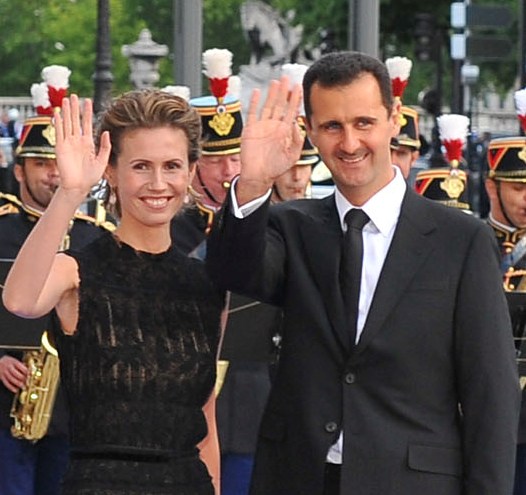
    Syrian President Bashar Assad arriving to Paris with his wife Asma. 

    basharsarkozy3.jpg

    President Assad with French President Nicolas Sarkozy after first round of talks.

    assad_suleiman.jpg

    President Assad meeting with Lebanese President Michel Sleiman in Paris. 

    4way_summit.jpg

    Four-way summit of Syrian President Bashar Assad, French President Nicolas Sarkozy, THe Emir of Qatar, and Lebanese President Michel Sleiman.

    hafezchirac.jpg

    And for those who believe that the situation in the Middle East goes through cycles, here is a photo from Paris 1998. President Hafez Assad, on a "rare visit" to France, asked the French President to mediate between Syria and Israel, since the United States was only interested at the time in Palestinian Israeli talks.

    A year later, the Americans got interested again in the Syrian track.


    A Good News Cycle for Syria

    This news cycle is turning out to be very favorable to Syria. The formation of the new Lebanese government is being taughted as the salvation of the small, fragmented country from civil war. Syria is given some credit for this. Assad's trip to Paris is depicted as a major turning point and official end to the West's isolation policy (if not America's, but then Washington is in disarray). Israel is tearing its hair and claiming that Hizbullah's role in the new government is proof that the Jewish state lost the 2006 summer war.

    Before Syria congratulates itself for learning how to spar in the information wars, one must consider that it has entered a honey-moon period that will, in all likelihood, be very brief. The main reason Syria is getting good press is because the normally hostile Lebanese and Saudi press, which dominates the news cycle, is on holiday. Everyone is being polite to honor the formation of the new Lebanese government. The usual Lebanese critics will raise their voices as soon as the opposition uses its new presence in the cabinet to veto a government decision; Syria will be blamed. US critics and the Bush administration are reluctant to rain on Sarkozi's parade or to criticize him for hosting Assad – after all, it would only highlight the failure of Washington's Syria-Lebanon policy.

    Here are some representative headlines:

    Country Saved from the Brink of a renewed Civil War 

    Lebanese Form National Unity Government: Washington Post,

    Divided Lebanon forges new future: BBC News, UK

    Voice of America: The majority bloc agreed to support the opposition's proposal to include a pro-Syrian politician, Ali Kanso, in the newly formed cabinet. The new cabinet gives the opposition the posts of foreign minister and deputy prime minister while the ruling bloc will be in charge of the ministry of finance and other key posts. Prime Minister Siniora…. "Today, through this national unity government, we have decided to manage our disputes through democratic institutions and dialogue, and not through force and intimidation," he said.

    Lebanon's President Michel Suleiman (L) meets Parliament Speaker Nabih Berri (C) and Prime Minister Fouad Siniora at the presidential palace in Baabda, east of Beirut July 11, 2008. (Xinhua/Reuters Photo)

    BEIRUT, July 11 (Xinhua): The 30-member cabinet consists of 16 minister of the ruling majority, 11 ministers of the opposition and three ministers named by the president in line with a Doha accord reached in May which saved the country from the brink of a renewed civil war.

    France brings Syria's Assad out of the diplomatic cold
    Turkish Press

    Boycott lifted as France hosts Syria's president
    The Guardian

    San Francisco Chronicle: Hezbollah gains political clout in Lebanon's new, interim Cabinet

    Ynetnews: Nobody thinks we won

    Recent cabinet session on Hizbullah proves we lost Second Lebanon War
    Roni Sofer

    Don’t measure the results now, one of Prime Minister Ehud Olmert’s associates asked on August 14, 2006 – a moment after Israel agreed to sign the ceasefire agreement. Yes, it may not look good now, he said, while explaining and praising the diplomatic achievement inherent in Resolution 1701, but we will be able to measure the results over time.

    “The test will be whether Hizbullah is disarmed, whether the sovereign Lebanese government will control all of southern Lebanon, and whether the Lebanese army will be deployed along the border fence. This is what you will be seeing, and you will realize that the price we paid brought results,” he said. ….

    The next round, if we believe the intelligence assessments of all branches, is only a matter of time. This pro-Iranian arm is just waiting for the moment Tehran will utilize it to escalate tensions in the area, or for the moment Bush or Olmert decide on a military move against Iran’s nuclear threat.

    ‘Nothing happens the way Olmert plans it’

    Two years have passed since the war, and we saw Foreign Minister Tzipi Livni telling her Italian counterpart that the multinational force’s mandate must be expanded. She told him that we are very concerned about the arms smuggled via Syria and about Hizbullah’s growing hold on southern Lebanon. In other words, Livni said, Resolution 1701 is not being implemented, or alternately, its implementation on the ground does not deliver the goods.

    Two years have passed since the war, and if you ask our politicians – either on the Center, Right, or Left of the political spectrum – by now nobody thinks we won. Not even Olmert’s people.

    “Olmert said that the evidence of our victory is the fact that Nasrallah is forced to continue hiding in the bomb shelter,” said someone who already saw four governments formed and toppled. “So what will Olmert say now that Nasrallah has veto power on Lebanese government decisions, while possessing three times as many missiles compared to what he had before the war? All the power that was invested, all the victims who died in the war, the price paid by the home front in the north – all of that happened, and Hizbullah just became stronger. This is not a draw, like former Army Chief Halutz claimed. This is a defeat.”

    “The problem with Olmert,” one of his ministers told us following the last cabinet session, “is that nothing happens the way he plans it. It didn’t happen in the Lebanon War – Hizbullah is still there, more powerful both militarily and politically. Yes, Olmert really wants peace with Syria, but can you see Assad giving it to him when the PM barely has two months left before the Kadima primaries?”

    Georges Corm:

    La Syrie et Israël ont négocié directement au début des années 1990 dans le cadre du processus de Madrid sans résultat concret, même s’il a été dit par les deux parties qu’elles étaient très près d’un accord.

    Israël et les Etats-Unis pensent par ce jeu pouvoir séparer la Syrie de l’Iran, ce qui n’est pas très réaliste, mais la Syrie ne peut manquer l’occasion de montrer qu’elle est ouverte à une reprise des négociations et desserrer ainsi la pression des Etats-Unis et des gouvernements européens sur elle.

    Israël, de son côté, face aux timides pressions pour trouver une issue à la situation des Palestiniens, fait une fuite en avant en se déclarant prêt à négocier le retrait du Golan syrien occupé et annexé. Les gouvernements israéliens l’ont déjà fait à plusieurs reprises dans le passé.

    The raging anger that lies below the surface
    Syrians have long been a touchstone of Arab public opinion.
    Anthony Ham, Damascus
    The Age

    THE REGULARS of al-Nawfara Coffee Shop, one of the grand old cafes of Damascus, were uncharacteristically quiet. The shouted conversations and the click of backgammon pieces had fallen silent. All eyes had turned to the television, where Hassan Nasrallah, the spiritual and political leader of Hezbollah and sworn enemy of Israel and the West, held court, his speech booming out into the surrounding streets. Live from Beirut, less than 100 kilometres from where we sat, the charismatic Nasrallah vowed to confront America and defend Lebanon with his blood and called on his supporters to do the same.

    People nodded in agreement. Some applauded. When the speech ended, the cafe returned to normal. Tourists, including Americans, arrived to hear Abu Shady, the last remaining storyteller in the Arab world, take to his throne. From here, every night, he playfully welcomes visitors in English and tells tales of fire and brimstone and Romeo and Juliet-style epics of thwarted love from centuries past. Waiters warmly greeted the new arrivals with the standard, but heartfelt Syrian greeting: "Where are you from? You are welcome in Syria."

    Here, on the streets of Damascus, the complexities and apparent contradictions of the Arab world's relationship with the West are everywhere on show. Founded on the twin pillars of anger at the outside world for its policies towards the Middle East and a genuine, gracious hospitality towards the representatives of that same world, the message from Syria is nonetheless a simple one: there will be no peace in the region until the ordinary people of the Arab street believe that justice has been done.

    For decades, Syria has been a touchstone of Arab public opinion. Ruled since the 1960s by the secular Baath Party, it has stood at the vanguard of opposition to Israel, harboured all manner of exiled Palestinian opposition groups, terrorist and otherwise, and resisted all overtures from the US in the latter's search for

    Assad Insists on Syria’s Central Role in the Region: France Agrees: US Divided

    US policy is at a crossroads. As the world adjusts rapidly to important new Syrian foreign policy initiatives, the Bush administration remains pig-headedly hostile to Syria. Damascus has played an central role in braking Lebanon's gridlock. It helped produce agreement on both a Lebanese president and government; it has also been carrying out the most promising dialog with Israel that we have witnessed in almost a decade.

    It is beyond doubt that Syria is a key player in regional politics. Washington, however, still wants to pretend that it is not.

    Having participated in a few government briefings in the last few months, I have been struck by the shift in attitude toward Syria within most government agencies. The problem is at the top. President Bush and the National Security Council are shaping Syria policy, not State or Defense, both of which seem to understand that they can reap real rewards through cooperation. The White House is determined to stick to its ideologically driven policies until the bitter end, sacrificing US soldiers in Iraq and business investment in Syria. And for the same of what? Stopping peace between Syria and Israel?

    Raed Rafei of the LA times writes: Syria: Back on the world stage, with a fury…..

    … In an article that appeared Thursday [Here is French copy Rencontre avec Bachar Al-Assad: mercredi 9 juillet 2008, par Alain Gresh] on the website of the publication and that was translated into English in the Monthly Review, Gresh quoted Assad as accusing the current U.S. administration of obstructing peace: 

    The biggest obstacle to peace is the White House. This is the first time a U.S. administration has advised Israel not to make peace.

    Syria and Israel held indirect peace talks recently through Turkish mediation. But the prospects of quick breakthroughs remain slim. The West is trying to persuade Damascus to loosen its ties with Tehran, an unlikely prospect.

    Asked about Iran, Assad described his country’s strong links to the Islamic Republic as a relationship between two equal allies:

    We have been isolated by the United States and Europe. The Iranians have supported us, and yet I'm supposed to tell them: I don't want your support — I want to be isolated! We don't need to agree on everything to have relations. We see each other regularly for discussion. The Iranians do not try to change our position — they respect us. We make our own decisions, as in the time of the Soviet Union. If you want to talk about stability, and peace in the region, we must have good relations with Iran.

    Talking about threats to peace in the region, Assad also criticized the way Americans have led their war on terrorism:

    Terrorism is a threat to all humanity. Al Qaeda is not an organization but a state of mind that no border can block out…. I fear for the future of the region. We must change the soil that nurtures terrorism. This requires economic development, culture, an education system, tourism — and also an international exchange of information on terrorist groups. The army alone cannot solve this problem, as the Americans are trying to do in Afghanistan.

    U.S. refusal to negotiate with his country was counterproductive, he said: 

    They must accept that we are part of the solution not just in Lebanon but also in Iraq and Palestine. They need us to combat terrorism in order to achieve peace. They cannot isolate us, nor can they solve the region's problems by manipulating such words as "good" and "evil," "black" and "white." You need to negotiate, even if you do not agree on everything.

    Assad's official visit to France to take part in Bastille Day celebrations comes as a sign of international recognition after the signing of a peace agreement among Lebanese rivals in Doha in May. For the last few years, Syria had been accused by the international community of creating instability in Lebanon. But relations between the two countries are back on track with the presidents of both countries scheduled to meet in France.

    In an earlier interview published Monday in the French daily Le Figaro, Assad expressed his hopes for the next U.S. administration: 

    Frankly, we do not think that the current American administration is capable of making peace. It doesn't have either the will or the vision and it only has a few months left…. We are betting on the next president and his administration. We hope that it will be rather an advantage to have a change of president in the United States.

    In an interview with the Arab daily Al Hayat published today, French official Claude Gueant said permanent solutions to Middle East's problems would not be possible without Syria's participation.

    — Raed Rafei in Beirut

    Lebanon Gets a Government

    Beware Syrians Bearing Duty-Free: Urs Fruehauf in Damascus has alterted me to the ExportLawBlog.com where Clif Burns explains the delicacies of banning Rami Makhlouf's Syrian duty free and Syriatel.

    Makhlouf is President Assad's cousin. Any US citizen with a prepaid sim card bought from Syriatel will be breaking the law. US embassy staff will now be changing their sim cards to the network owned by Mikati and company. They will also refrain from purchasing nice perfumes or other good deals on their way home. After all, OFAC has designated Makhluf as an SDN based on the novel (and dubious) theory that Makhluf’s leveraging of his family relationship to al-Assad to obtain improper business advantages for himself in Syria threatens the security of the United States.

    Syria calls off fees applied to Arab travelers and Lebanese trucks. (The Daily Star) "Sources believe that Damascus reversed the decision after Jordan and Saudi Arabia slapped similar taxes on all Syrian trucks.

    ON LEBANON

    Qifa Nabki writes: The Lebanese are hours (or minutes?) away from a new cabinet. Now that Jumblatt and Geagea have gotten over their mini-tantrums, all that is left is the issue of Qanso, which Berri has set about trying to solve.  This will mean that Suleiman will visit Paris as the head of a formed government, and he will likely meet with President Assad while he is there….

    IC asked:

    It is interesting to see how many ministers aoun got compare to his allies. his party got 5 (all cabinet ministers), amal got 3 and Hizbullah just got 1. very strange when you look at it like that

    QN Answered:

    I think that Hizbullah gave their ministers to Aoun for three reasons:

    a) The Hizb is slowly dipping its toes into cabinet politics. It doesn’t want to jump in head first, because it is still benefiting from the image of being outside the dirty game of politics.

    b) Given that this will be a short-lived cabinet, it wants to minimize any possibility of tarnishing its image before the important elections in 2009. If they had 5 or 6 ministers in the cabinet, there would be many opportunities for them to get embroiled in sticky little political messes, whether they are over telecommunications or the electricity plant, etc.

    c) Hizbullah doesn’t really need ministers to maintain its agenda or its constituency. All the Shi`a are basically going to vote Hizbullah/Amal in the next election. The real swing vote is among the Christians (especially the Armenians). This is why they gave so many seats to Aoun (who has a sizable bloc anyway). They want to hold on to his supporters, to make sure they come out in droves to vote.

    It was a smart bet on their part, I think. By giving 5 seats to Aoun they were effectively saying to the Christians: “We are equal partners, you and us.”

    The cabinet, headed by premier Fouad Saniora, groups 30 ministers from the seven major sects in a nation made up of 18 religious communities.

    Maronite Ministers: Ziad Baroud, Nassib Lahoud, Tony Karam, Gebran Bassil and Mario Aoun.

    Greek Orthodox ministers: Issam Abu Jamra, Elias Murr, Ibrahim Najjar and Tareq Mitri.

    Catholic ministers: Elie Skaff, and Youssef Takla and Raymond Audi.

    Druze: Talal Arslan, Ghazi Aridi and Wael Abu Faour.

    Sunnis: Fouad Saniora, Bahia Hariri, Mohammed Safadi, Tammam Salam and Mohammad Shatah and Khaled Qabbani

    Shiites: Mohammed Fneish, Ali Qanso, Ibrahim Shamseddine, Mohammed Jawad Khalifa, Fawzi Salloukh and Ghazi Zoayter.

    Armenians: Jean Ogassapian and Alain Taborian.

    Israeli-Syrian Negotiations: The Need For A Bold Move: Alon Ben Meir

    Syrian prison riot shrouded in silence
    Christian Sci Monitor, 2008-07-10

    ….. By Tuesday. the violence had ended, but prisoners and guards remained in a standoff, with more than 300 soldiers held hostage, reported Beirut-based media watchdog Menassat.

    "The demonstration started after prisoners demanded an improvement in their living and health conditions, also demanding prison officials provide greater access to information about their trials and convictions," human rights groups working on the issue told MENASSAT.

    Reports from these sources say the rioting has ended but that a tense standoff is still taking place between the prison authorities and the prisoners after the latter managed to take a number of hostages, including the prison director.

    Syrian authorities will not reveal the number of fatalities and injuries nor the timeline of events that led to the fighting. …..

    Syria software pirate lives by own code of ethics: Abdul-Rahman Mahaini says he hacks into programs because U.S. sanctions block their sale in his country. But he is not above helping Western clients.
    By Borzou Daragahi
    Los Angeles Times: July 11, 2008

    DAMASCUS, SYRIA — Small, thin and pale, with a reddish beard, Abdul-Rahman Mahaini estimates that he has stolen millions of dollars' worth of software, hacking his way into the most complex programs in the world.