“Template for peace is inclusion” by Paul Keating

Template for peace is inclusion (Many thanks to Enlightened for bringing this to our attention)
Paul Keating – Former Australian Prime Minister
August 25, 2008, smh.com.au

We are living through one of those rare yet transforming events in history, a shift in the power in the world from West to East. For 500 years Europe dominated the world; now for all its wealth and population it is drifting into relative decline.

Will our understanding of this transformation, and our acceptance of its equity for the greater reaches of mankind, lead us to a position of general preparedness of its inevitability, or will we cavil at it in much the same way as Europe resisted the rise of Bismarck's creation at the end of the 19th century?

We can see, with this the 29th Olympiad, the questioning of China and the resentment at its pretensions about being one of us. Even becoming one of us!

The Western liberal press featured, generally in critical terms, the world-long torch relay, juxtaposing all that it represents and is good about it with what it sees as China's democratic defects, viewing it almost exclusively through the prism of Tibet.

Saying, almost, that the aspirations of this massive nation, a quarter of humanity, a legatee of a century of misery, dragging itself from poverty, is somehow of questionable legitimacy, because its Government's attitude to political freedoms and in specific instances, human rights, are not up to scratch. Ignoring the massive leaps in progress, of income growth, of shelter, of the alleviation of poverty, of dwindling infant mortality, of education, of, by any measure, the much better life now being experienced by the great majority of Chinese.

The Western critic feeling the epicentre of the world changing but not at all liking it, seeks to put down these vast societies on the basis that their political and value systems don't match up to theirs.

Henry Kissinger made the point recently when he said, "We cannot do in China in the 21st century what others thought to do in the 19th – prescribe their institutions for them and seek to organise Asia."

And he went on to pose the question: do we split the world into a union of democracies and non-democracies, or must there be another approach key to regional and historic circumstance?

There is a view that should China become a democracy, a real one, many tensions in the global system would go; that democracies find peace with other democracies; that the former political-military state first turns itself into a trading state and as wealth and opportunity rise so, too, do democratic values.

But what we must remember is that even if all the states of the world became democratic, the structure of the international system would remain anarchic.

The greatest challenge we face, whether for managing incidents or easing the new economic tectonic plates into place, will be to construct a truly representative structure of world governance which reflects global realities, but which is also equitable and fair.

For two Clinton presidential terms and two George Bush terms, the world has been left without such a structure; certainly one able to accommodate Russia and the great states such as China and India.

Instead Clinton and Bush left us with the template of 1947; the template cut by the victorious powers of World War II, the one where Germany and Japan were left on the outside, and still are 60 years later, and in which China and India are tolerated and palely humoured.

Sixteen critical years have already been lost. And it is not as if we are dealing with a world where things are the same now as they were 16 years ago. The world is dynamic: 16 years ago China was not a world power; today it is. Sixteen years ago, Russia was collapsing; today it is growing and strongly.

We are now sitting through, witnessing, the eclipse of American power. Yet for those 16 critical years, two American presidents did nothing to better shape the institutions of world governance.

And there has been no help from the old powers; Tony Blair's Britain and Jacques Chirac's France. After all, they had box seats to the event, courtesy of being on top in 1947.

But Blair's contribution was not anything new or free-thinking, rather he thought being an American acolyte was all that was required. Chirac was simply incapable of adding any strategic value to the equation.

The fact is we are again heading towards a bipolar world. Not one shaped by a balance of terror like the old one, but certainly not a multipolar one – in fact, one heavily influenced by two countries; the United States and China.

Russia's economy, while growing in strength from the burnt-out wreck it was in 1990, will not be in the league of that of the US or of China.

But Russia will still be wealthy; wealthy enough to continue to field its massive arsenal of nuclear weapons. So whether you attribute to Russia full "pole" status or not, you can certainly attribute to it huge strategic standing.

It is more the pity then, that following that unexpected epiphany in 1989, the Clinton administration rashly decided to ring-fence Russia by inviting the former Warsaw Treaty states of Poland, Hungary and the Czech Republic to join NATO.

By doing so, the US failed to learn one of the lessons of history: that the victor should be magnanimous with the vanquished.

At some time the US will be obliged to treat Russia as a great sovereign power replete with a range of national interests of the kind that other major powers possess.

In the meantime, the great risk of this sort of adventurism is that with NATO's border now right up to western Ukraine, the Russians will take the less costly military option of counter-weighing NATO's power by keeping their nuclear arsenal on full operational alert.

This posture automatically carries with it the possibility of a Russian nuclear attack by mistake. The years of Russia's economic poverty, certainly since the collapse of its economy in the first half of the 1990s, has meant the Russians have allowed their surveillance and early warning systems to ossify. To compensate, they are keeping their nuclear arsenal on full operational alert.

This leaves the rest of the world relying more on the generals, the battlefield commanders and intelligence assessors to restrain a nuclear response than it does the Russian President or his Government. This means that while the Cold War is over, the risk of a mistaken pre-emptory response has increased.

Many people will think and some will say that with communications and the globalisation of economic wealth being what it is, an outbreak of a major conflict seems more and more remote. That global interdependence and the shrinking of the world makes war a decidedly unproductive way of resolving foreign policy differences.

People should be reminded that that was said at the time of the last great intensification of trade between Britain, France and Germany along with the growing US economy before 1914.

The lesson is that when the strategic bits go wrong, the economic bits soon follow. Certainly not the obverse: when the trade goes well, the strategic wrinkles get ironed out.

The structure of the international system is anarchic. Was anarchic; remains anarchic. This condition cannot be remedied but structures to mitigate its most violent manifestations can be put into place.

Against this backdrop remains the open question about "the West" and its fibre. The question that was resoundingly answered by that generation who suffered the Depression and the Second World War and who delivered us into a new era of peace and prosperity.

Is our culture a culture made compliant by too much coming too easily; producing a state of intellectual and spiritual lassitude which can only be shaken by the gravest threats, be they economic, environmental or indeed, strategic?

As that pendulum swings from West to East, are the motivations for the West's former primacy swinging with it? Has the bounty of science and industrialisation with its cornucopia of production and wealth encouraged us too far away from simpler requirements and concern for the needs of all?

As societies, have we taken our eye off public affairs for way too long?

Can we, all of us, assimilate, adjust ourselves to a constancy of peace and prosperity without lessening our regard for those enlivening impulses of truth and goodness.

A new international order based on truth and justice founded in the recognition of the rights of each of us to live out our lives in peace and harmony, can, I believe, provide the only plausible long-term template.

The old order of victorious powers, of a compromised United Nations, a moribund G8 with major powers hanging on to weapons of mass destruction, is a remnant of the violent 20th century. It cannot provide the basis for an equitable and effective system of world governance.

Just as world community concern has been ahead of the political system on issues such as global warming so, too, world community concern needs to galvanise international action to find a new template for a lasting peace, one embracing all the major powers and regions.

The philosopher Immanuel Kant said some day there will be a universal peace; the only question, he said, is will this come about by human insight or by catastrophe, leaving no other outcome possible.

Humankind demands that that proposition be settled in the former and not the latter.

Paul Keating was prime minister from 1991 to 1996. This is an edited extract of a speech delivered to the Melbourne Writers' Festival on Saturday.

Syria at the Olympics

AFP PHOTO / HASSAN AMMAR: Syrian Ahed Joughili competes during the 105 kg category of the men's weightlifting at the 15th Asian Games in Doha, 06 December 2006 at which he won the gold medal in his class.

Eight Syrian Olympians at Beijing

Eight Syrian athletes took part in the Beijing 2008 Olympic Games, competing in shooting, swimming, track and field, triathlon and weightlifting events. Politics overshadowed their sporting performances, however, when Syrian swimmer Bayan Jumah pulled out of her event after being scheduled to compete against an Israeli athlete.

Syria’s 2008 Olympic team included its largest swim team ever, represented by Jumah, Souhaib Kalala and Saleh Mohammad. Fadwa Albouza and Majed Aldin Gazal competed in track and field events, Oma Tayara in the triathlon, Ahed Joughili in weightlifting and Roger Dahi in shooting.

Juma, the swim team’s only female athlete, pulled out of the women’s 50m freestyle event after being scheduled to swim against an Israeli opponent in the first round. For the other team members, Kalala finished fourth in his first round heat of the men’s 100m backstroke, while Mohammad finished 19th in the men’s 10km marathon.

In track and field, Albouza finished eighth in her first round heat of the women’s 100m hurdles. Gazal finished 14th in the men’s high jump first round heat, while Oma Tayara finished 49th in the men’s triathlon.

Ahed Joughili finished 13th in the men’s 105 kg weightlifting event while Dahi finished 41st in the men’s skeet shooting event

Syria first competed in the summer Olympics in 1948. Its medal haul since that time includes one in each colour; gold, silver and bronze. Ghada Shouaa won Syria’s only gold medal the heptathlon in the 1996 Games in Atlanta. She remains one of only two women in the Arab world to claim Olympic gold and one of only three in the wider Middle East. She also represented Syria at an international level as a basketball player.

Joseph Atiyeh claimed silver for Syria in the freestyle wrestling 100kg division at the 1984 Los Angeles Olympics, while Naser al-Shami won bronze in heavyweight boxing at the 2004 Athens Games.

Photo: Ghada Shouaa (Arabic: ???? ????‎) won Syria's first and only Olympic gold Meal at the 1996 Summer Olympics winning the heptathlon.

If Syria is not a rising star at the Olympics, it is a comer in the world of cuisine. As QN reminds us, the old adage is "“The second best source of Arabic cuisine is the Lebanese restaurant. The best source is the Syrian kitchen.”

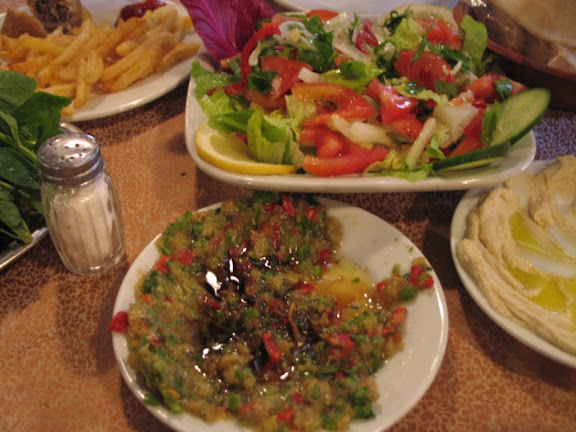
Matthew Teller from the Observer went on one of these culinary tours of Syria. His article is.. delicious!

The foodie road to Damascus Syria is known for its deserts and ancient ruins, but now its cuisine is starting to draw visitors too. Matthew Teller is a delighted convert.

After decades out in the cold, shunned by Western travellers and overshadowed by its faster-moving neighbours, Syria is – slowly – starting to gain the recognition it deserves as a vibrant, fascinating country. If you’ve never visited, whatever you’ve heard about the place is quite likely to be wrong. Political rhetoric notwithstanding, there’s a more tangible air of menace in Guildford.

And as the country opens up to outsiders, ways to explore it multiply. I had visited Damascus before, but this time I was going to experience it through the eyes of Anissa Helou, chef, broadcaster and writer on the cuisines of the Mediterranean. A Londoner for 20 years, Anissa grew up in Beirut but remembers idyllic childhood summers spent in the Syrian highlands. Now she has returned to launch small-group culinary tours, taking ingredients, cooking styles and methods of production as a starting point to explore and understand this much-misunderstood country.

Admiring Damascus’s historical monuments, or taking time to appreciate the architecture, was firmly off the agenda. Instead, we began by exploring the souks. I watched as Anissa strode through the crowded lanes, casting to left and right, stopping to watch an old man cooking omelettes, pausing to ask a passer-by how she prepares her vegetables, picking out oranges from a pile on a barrow. I followed her into the back lanes, where we discovered a half-hidden factory making sugared almonds: a single, bare room lined with great copper drums for turning the toasted nuts in syrup.

The manager, Qusay Sukkari (sukkar is the Arabic word for sugar so, delightfully, this was Mr Sugary the Sweetmaker), welcomed us and explained the process, but apologised for having none of the product to sample. No matter, we said, and nipped round the corner to buy qatayif – sweet pastries filled with cream, deep-fried to a crunch and drenched in treacle. Old-fashioned calories still matter in Syria.

We spent the day working our way through the different areas of the souk, buying zaatar – a fragrant blend of thyme, marjoram and sesame – in the Souk al-Bzouriya (the ’seeds market’), sampling boiled sweets and sipping fresh mulberry juice. Then we headed over to the Souk al-Tanabel (’lazybones market’), which sells only pre-prepared vegetables: the stalls are piled with bags of sliced carrots, cored squash and ready-chopped herbs – convenience food, Syrian-style.

Eating is, obviously, a major part of a culinary tour, and we ate in a succession of fabulous restaurants. Particularly memorable was Al-Khawali, housed in an eye-popping 14th-century palace in the heart of the Damascus souk, concealed from the street’s bustle by beautifully carved wooden doors. Inside, floors of patterned marble led to an airy internal courtyard, with tables laid around a central fountain dotted with jasmine and citrus trees. Anissa ordered a clutch of meze – small, sampler-style dishes that included alangi (stuffed vine leaves) and exquisite shanklish, a tangy sheep’s cheese dusted with pepper and thyme. We dipped and nibbled our way through about eight meze dishes, plus mains of tender grilled lamb: the food – formal, sophisticated, charming – suited the ambience perfectly.

Old Town, a rather unimaginatively named restaurant in Damascus’s Christian quarter, was another highlight, serving pungent, fiery muhammara – a spicy dip of chopped walnuts and red pepper – and succulent chicken kebabs.

The tour continued in Aleppo, some four hours north, where we met the vastly knowledgeable Hassan Khouja, a researcher from the Académie Syrienne de la Gastronomie (such a body does exist), for a meal at Bazar ash-Sharq, a restaurant hidden in vaulted cellars just outside the old city walls. Hassan claimed this was the best kitchen in Aleppo. Its kibbeh nayeh, raw lamb chopped with spices and bulgur wheat – one of the most difficult meze dishes to get right – was superb: soft, moist and earthily flavourful. As we tucked into Aleppan meatballs with quince, Hassan talked about Syria’s culinary roots, and how Aleppo’s location on the east-west Silk Road historically drew in both Persian and Turkish influences, most notably with the mixing of savoury and sweet in the city’s trademark spicy kebabs with sour cherries.

Damascus, on the other hand, far to the south and cut off from eastern influence by the desert, always looked more to Lebanese mountain cuisine, for subtler combinations of herbs, beans and vegetables in meze dishes and salads.

The difference was still tangible: the zaatar we bought in Aleppo was sharper and more peppery than that in Damascus, and while our Damascene sweet treats were candied apricots and local ice cream – egg-free and beaten by hand – in Aleppo we were offered elegantly crafted confections of spun sugar with Iranian pistachio nuts.

As well as opening world-class restaurants, Syria is also starting to take a leaf out of Morocco’s boutique-hotel book. The lanes of Damascus’s Bab Touma district shelter a number of upmarket conversions of 17th- and 18th-century courtyard town houses. At Beit al-Mamlouka – the first and still one of the most stylish – all eight bedrooms were taken when we visited, but the engaging owner, May Mamarbachi, nonetheless served us tea in the orange-scented courtyard and showed us around, pointing out original features and inviting us to return.

While I plumped for a simple room above the workshop of Syrian sculptor Mustafa Ali, Anissa stayed first at the Dar al-Yasmin, another heritage conversion featuring marble fountains and beautiful pointed arches, then moved to the Talisman, a small hotel converted from a wealthy merchant’s residence on a dusty lane in the old Jewish Quarter. The Talisman’s French owners have deliberately overlaid the traditional Syrian architecture with a ragbag of design elements: Indian trinkets hang beside Cairene lamps, while a Moroccan red wash covers the walls – gaudy rather than chic.

More endearing was the Mansouriya Palace, down a narrow alley near the medieval Bab Qinisreen gateway in Aleppo’s old quarter. Within another serene mansion of white marble, its courtyard shaded by Seville orange trees, lie nine suites, each over-themed to the point of kitsch. The Hittite Suite comes complete with stone lions flanking the bed and a bath and sink carved from single blocks of marble, while the Ottoman Suite is dominated by a four-poster bed decked in swags of heavy silk.

But the real discovery remained the food. Bypassing Syria’s famous ruins for an indulgent week of near-continuous eating and snacking in the company of Anissa, whose knowledge and enthusiasm are boundless, turned out to be a great way to get under the skin of this often hard-to-fathom country. Food is one field where Syria excels, and it deserves to be celebrated.

Photo: The ubiquitous yummy Kabab

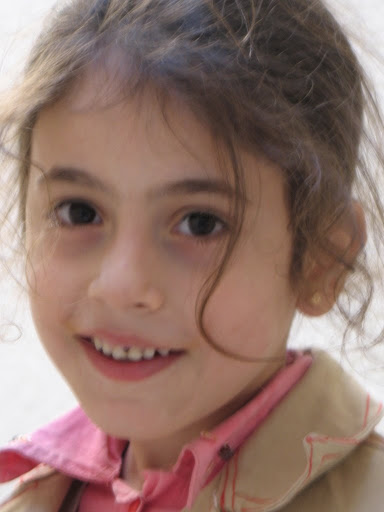
This shot … well, a Syrian school girl.

Biden on Syria

Biden on Syria: Qifa Nabki rounded up Biden quotes on Syria and the region:

“There are plenty of reasons to mistrust Assad, but there could be real benefits to hard-headed diplomacy. Syria is the common denominator of many problems – in Lebanon , the Palestinian territories, and to a lesser extent Iraq. They are Iran 's closest ally. But it is also a fundamentally weak and isolated regime. We should work to break up its marriage of convenience with Iran. If Syria could be encouraged to act less irresponsibly it could have a real impact in the region.” (August 8, 2007)

It is a mistake not to let Israel, if it wishes to, if it sees an opportunity to go out and explore possibilities with the Syrians. If I’m in Damascus, what’s in my best interest? My best interest is to be free of Iran’s yoke, on the good side of the equation with the oil-producing Sunni states, and able to deliver for my people what appears to be a victory by having a settlement on the Golan. Now, whether that can be accomplished remains to be seen, but it should be explored." (March 20, 2007)

For more on what Biden thinks of various Middle East issues, see this helpful page at Jewish Virtual Library

Yoav Stern writes in Haaretz: Assad: Next round of Syria-Israel talks will be 'decisive'

The next round of indirect negotiations between Damacus and Jerusalem will be "decisive," Syrian President Bashar Assad told reporters over the weekend.

Responding to a query as to whether progress had been made during the talks, Assad told reporters: "As of now, we have not reached anything tangible."

The Turkish-mediated negotiations, which were meant to resume this week in Istanbul, have been postponed till next week.

Assad told an Arabic-language television station based in Russia that Syria was not sure Israel was even interested in peace. "I can't say at all that we have confidence [in Israel]."……

In an article posted yesterday on the Asia Times Web site, Syrian political analyst Sami Moubayed, wrote that the concern in Jerusalem is "playing nicely into the hands of Syria, which is using it to strengthen its ties with an old and resurrected friend, send messages to a traditional foe [Israel], and pressure the United States into changing course over Damascus."

U.S. Syria expert Joshua Landis wrote in his blog Syriacomment.com that "Syria's bad negotiating position is leading it to look for more weapons and to try to grow more teeth before returning to the table with Israel," adding, "Both Assad and Hezbollah are hoping to get new weapons systems from Russia and greater diplomatic backing." But despite the preoccupation with weapons, he asserts that all eyes are on the peace process.

Russia baulks at selling missiles to Syria
By Isabel Gorst in Moscow, August 22 2008, FT

Published: August 21, 2008

The president of Syria spent two days this week in Russia with a shopping list of sophisticated weapons he wanted to buy. The visit may prove a worrisome preview of things to come. Although Russia has long supplied arms to Syria, it has held back until now on providing the next generation of surface-to-surface missiles. But the Syrian president, Bashar al-Assad, made clear that he was hoping to capitalize on rising tensions between Moscow and the West when he rushed to the resort city of Sochi to meet with his Russian counterpart, Dmitri A. Medvedev.

The list of ways a more hostile Russia could cause problems for the United States extends far beyond Syria and the mountains of Georgia…..

“If Russia’s feeling churlish, they can pretty much bring to a grinding halt any kind of coercive actions, like economic sanctions or anything else,” said Peter D. Feaver….

Syria becomes oil importer as production continues to decline
Saturday, August 23

LONDON — Syria's crude oil production, once the basis of its economy, is falling.

The London-based Oxford Business Group said Syrian oil production would fall by 7.9 percent in 2008. By 2009, OBG said, oil production in Syria would not exceed 350,000 barrels per day.

"Oil has been the mainstay of the Syrian economy for over four decades, but production passed its peak of 610,000 barrels per day in 1995 and is now falling even more rapidly than had been forecast," OBG said in a report.

The report said Syria, in contrast to previous forecasts, has failed to meet domestic fuel demand. OBG said Syria must begin to import light crude oil for gasoline in 2009.

Addendum: Idaf writes:

With regards to the Oxford Business Group’s report on oil imports in Syria, the increasing investments in oil exploration in Syria during the past year may suggest a less dramatic change in Syria’s oil export/import status. Syria Report reported last week the following on oil output in two Syrian fields:
Tanganyika Announces Sharp Increase in Output Rates
Oil output at the Tishrine and Oudeh fields increased significantly in the first half of this year, according to Tanganyika Oil Company.

However, there’s a welcome sudden interest by the Syrian government in renewable energy sources during the last few months. Some of the interesting headlines include:

Alternergie to Build Syria’ First Solar Power Plant
Alternergie, a German firm active in renewable energies, has been awarded a contract by the Ministry of Electricity to build the country’s first solar electricity plant at a cost of EUR 50 million.
The government recently assigned four sites to be used as wind farms, each with a capacity of 100mw and a cost of SYP 7.7bn (EUR 100m). The first wind station is also expected to be opened in Hassia on 555 hectares in an arid and year-round windy area. The government also recently introduced a program to subside the purchase of solar panel hot water heating systems. The greater uptake of solar water heaters is expected to help cut Syria’s household electricity consumption which totals around 50 percent of all consumption.
The ministry of electricity will distribute energy saving light bulbs for free. In addition new building codes and standards for heating and isolation and new legislations for wind energy production.

In addition, state run banks have recently started providing new loans with very low interest rates for businesses willing to install solar electricity systems.

In the business of peace: U.S. billionaire pursues his dream of Mideast peace
By Akiva Eldar
Haaretz

Between meeting in the Knesset with Deputy Prime Minister Haim Ramon and visiting his friend, President Shimon Peres, S. Daniel Abraham felt like pouring his heart out. The 84-year-old billionaire, who visited Israel earlier this month, says that for the last seven years, since meeting Saudi Crown Prince Abdullah bin Abdul Aziz Saud – who has since been crowned king – he has not known peace. Abraham’s eyes become dewy as he talks about the meeting in Riyadh. That was when he heard the great news: 22 Arab countries had agreed to recognize Israel within the June 4, 1967 boundaries, and were offering it normal neighborly relations, as part of what became known as the Arab Initiative. Abraham recalls that he was moved to tears and told the prince that, being a Jew, he was at loss for words to describe how wonderful it was to hear such a declaration from an Arab leader of his standing…

The Role of Israel in the Georgian War
August 17, 2008
by Brian Harring

….Israel began selling arms to Georgia about seven years ago, following an initiative by Georgian citizens who immigrated to Israel and became weapons hustlers.

They contacted Israeli defense industry officials and arms dealers and told them that Georgia had relatively large budgets, mostly American grants,  and could be interested in purchasing Israeli weapons.

The military cooperation between the countries developed swiftly. The fact that Georgia's defense minister, Davit Kezerashvili, is a former Israeli who is fluent in Hebrew contributed to this cooperation. “We are now in a fight against the great Russia," he said, "and our hope is to receive assistance from the White House, because Georgia cannot survive on its own. …..

New Cold War or Merely Jockeying for Position? What Does Syria Want?

[Landis analysis]

The Russian move into Georgia has begun a tectonic shift in the region. It has emboldened Syria, Hizbullah and Iran to push harder against Israel and the US in an attempt to capitalize on recent set backs in the Balkans, Lebanon, and Afghanistan.

Hizbullah's and the Lebanese opposition's success in rolling back the influence of the March 14 coalition in Lebanon has emboldened Syria to push its advantage.

The peace talks with Israel, which Syria is counting on, have stalled due to US opposition and Israel's conviction that Syria is asking too high a price for the Golan. The notion that Syria is weak and unable to deliver a shift in the regional security balance has led to its isolation over the last 6 years and to the failure of peace talks under president Clinton. An Obama advisor, Daniel Kurtzer, has recently asked Syria to make deeper concessions to Israel in order to move the talks to another level. The implicit threat in such advice is that the Obama team of policy makers will follow the Bush administration in shunning the Syria-Israel negotiation track, unless Syria is forthcoming. In short, the democrats agree with Israel that Syria is too weak and demanding too high a price from Israel. Israel recently acquired new promises from Washington for technology transfers and missile improvements that improve Israel's defense posture. This has emboldened it to demand deep Syrian concessions in the peace negotiations. (see Ahram article below)

Syria's bad negotiating position is leading it to look for more weapons and to try to grow more teeth before returning to the table with Israel. Both Assad and Hizbullah are hoping to get new weapons systems from Russia and greater diplomatic backing. Israel cannot afford to sit idly by as Syria and Hizbullah flex their muscles. They are raising the military bar themselves, suggesting that they are not frightened to use force and next time they strike, it will be much more devastating and effective than it was in 2006. If Syria can up the ante, so can Israel. Yesterday, Israel threatened that if it bombs again, Lebanon will be smashed in its entirety – the North and Beirut will not be spared. It is in this context that Hizbullah threatens today that "Israel will no longer exist on the map," when it strikes back.

This is a new war of words. For the time being the diplomatic jockeying is tactical and not a game changer. All eyes remain on the peace process. Nevertheless, the increasingly bellicose rhetoric is not propicious for peace. We will have to see if all sides can climb down from their new and hardened stands to make compromises that will lead to a peace deal. There is little chance of the peace process advancing during the next year of elections and reorganization in the US. In the mean time, both Israel and Syria will be elbowing each other.

[end of analysis]

News Round Up:

Under Moscow's wing
Events in Georgia have had some surprising repercussions in the Middle East, leaving Syria looking perkier than usual
James Denselow, Guardian
Friday August 22 2008

James Denselow 

Israel's involvement with the Georgian military has been somewhat overlooked in light of more blatant US support, such as the airlift of some 2,000 Georgian troops from Iraq at the start of the conflict. However Misha Glenny spotted it, writing in the New Statesman that Prime Minister Putin warned President Shimon Peres to "pull out your trainers and weapons or we will escalate our co-operation with Syria and Iran" – after which Israel dutifully complied.

Hizbullah's leader, Hassan Nasrallah also spotted it and subsequently mocked Israel's withdrawal, claiming that "the entire front line of the [Israeli] army's brass stepped down because of the [Lebanon] war. Gal Hirsch, who was defeated in Lebanon, went to Georgia and they too lost because of him."

The Russians are indeed emboldened by their sweeping victory which has highlighted the impotence of both the US and Nato. Jonathan Spyer, in the Jerusalem Post, described Russian action as throwing down "a direct challenge to the US-dominated post Cold-war international order" and expressed concern over Moscow's willingness to supply Syria with the S-300 long-range anti-aircraft missile system, a defensive measure that has the potential to impede Israeli airstrikes such as the one that targeted a suspected Syrian nuclear site last September.

Then the BBC reported yesterday that Syria's President Assad met with President Medvedev at the Black Sea resort of Sochi to discuss "deals on anti-aircraft and anti-tank missile systems".

Like any customer visiting his main arms dealer, Assad praised Russian actions in Georgia, explaining that "we understand the Russian stance and the Russian military response as a result of the provocations which took place. We appreciate the courageous decision taken by the Russian leadership in responding to the international initiatives and the start of withdrawing its forces".

Assad also signalled his willingness to have Russian Iskander missiles (which according to GlobalSecurity.org are capable of overcoming the enemy's anti-missile defences and hitting targets at a distance of 280 kilometers) situated on Syrian territory, although he refused to commit to any timeline for such a deployment.

The Syrians have survived six years of Isolation led by Washington and Tel Aviv following 9/11, an isolation that has only shown recent signs of ending. If a small country like Syria can survive years of western isolation then the Russian bear empowered with petrodollars and a stable, if undemocratic, leadership, will surely feel more confident in throwing its foreign policy weight around.

The Times reported that Russia's activism, particularly in arms dealing, was sparking fears of a Middle East "Cold War". …. (read the rest)

U.S. to Syria: Do not meddle in Russia-Georgia conflict

Senior U.S. officials severely criticized Syria on Thursday after Syrian President Bashar Assad voiced his country's support of Russia in its military conflict with Georgia, saying that Syria should keep out of issues that don't pertain to them.

The officials suggested that Syria refrain from meddling in the affairs of other nations, "such as Georgia," Channel 10 reported Thursday. They added that Syria should remain focused on its own problems in the Middle East and keep trying to achieve peace in the region.

Israel threatens to target 'entire Lebanese state' in next war (AFP)

Hizbullah Responds:

Hizbullah to Israel: Expect Huge Surprises Soon

Hizbullah threatened "earth shattering" retaliation against Israel which the group accuses of killing its top commander Imad Mughniyeh in a car bombing in Damascus last February.

"Retaliation is coming soon," Hizbullah official in south Lebanon Sheikh Ahmad Mrad said in remarks published by the daily Al Akhbar on Friday. "Retaliation is going to be earth shattering and there will be huge surprises," he vowed. "Resistance weapons will stay in the hands of Hizbullah until Palestine is liberated," Mrad pledged. He declared that Hizbullah would go deep into Palestine and vowed that "Israel will no longer exist on the map."

In Haaretz, here (Thanks to Friday Lunch Club)

"…Earlier Thursday, Assad backed Russia's military action against Georgia at talks with President Dmitry Medvedev on Thursday
…According to Russian media, Assad offered to host the Russian missiles as a response to a deal signed by Washington and Warsaw this week to deploy elements of a U.S. missile defense system in Poland, which has aggravated Moscow's relations with the West. Assad's visit is likely to become an additional irritant for Washington. In the past, the United States has more than once warned Moscow against selling arms to its longstanding ally Syria….."
Jason Koutsoukis in Damascus
August 23, 2008
THE visit to Moscow by the Syrian President, Bashar al-Assad, has received saturation coverage in Syria, with the media reporting the trip as a move to strengthen already close relations between the nations.

Israeli media described Mr Assad's two-day visit to Moscow as a "weapons shopping trip", but the Syrian Government broadcaster carried a statement yesterday morning angrily denying the reports.

Israeli and Russian media reported yesterday that he had offered to host Russian Iskander missiles on Syrian territory.

The reports said Mr Assad had made the offer in response to a deal signed by Washington and Poland this week to deploy elements of a US missile defence system in Poland. The Syrian statement, shown on Damascus television last night, said the reports were groundless.

Syria's Al-Watan newspaper, a self-described independent political broadsheet, reported that Russia's Foreign Minister, Sergei Lavrov, had told Mr Assad that Russia was ready to help Syria build a defensive shield. But it said Mr Lavrov had not indicated that Russia was willing to supply Syria with weapons that could be used to attack another country.

"We are indeed prepared to sell only defensive weapons which do not violate the regional balance of power," Mr Lavrov was quoted as saying.

Russia's acting ambassador to Israel, Anatoly Yurkov, was even more direct.

"Why in the world would we need to deploy our missiles [in Syria]? Against whom? We have no enemies in the region," he told the Israeli news site Ynet.

Al-Thawra, the official newspaper of the ruling Ba'ath party, carried a front-page headline trumpeting Mr Assad's visit. It reported that President Dmitry Medvedev had emphasised Russia's warm friendship with Syria, and pledged to help Syria regain control of the Golan Heights, seized by Israel in the 1967 Six-Day War.

Israel's US missile shield
Aug. 21, 2008, al-Ahram
While Israel appears the beneficiary of US interests in the Middle East region, its place is ultimately as one pillar under a US strategic umbrella, writes Galal Nassar

During his visit to the US last month, Israeli Defence Minister Ehud Barak announced that Washington would soon link Israel to two advanced missile detection systems that would strengthen Israel's preparedness against any Iranian threat. Following his meeting with US Defense Secretary Robert Gates, Barak also announced that Israel and the US were at an advanced stage in talks on upgrading Israel's Arrow-II ballistic shield, though they disagreed over whether it should incorporate an American interceptor missile. He told reporters that Washington would also increase Israel's access to its Defence Support Programme (DPS) satellites that can detect missile launches, adding that the US and Israeli governments "see eye to eye on the need to keep all options on the table, though we may not agree on each and every detail. It's important the Americans understand our position, and I think that they understand it a lot better after this visit."

Click to view caption
Missiles


The Pentagon has also agreed to install a powerful radar system in Israel in the coming months. Israeli officials described the system as capable of tracking an object the size of a baseball from about 4,700 kilometres away; it would enable Arrow to engage an Iranian Shehab-3 ballistic missile about halfway through what would be its 11 minute flight to Israel.

According to Al-Ahram Weekly sources, after heavy pressure on the part of the Israeli defence minister, Washington agreed to include Israel in the US global satellite defence system, capable of spotting missile launches on a constant rather than per-request basis. They also said that Israel has been seeking assurances of logistical support from Washington in the event that the Israeli army is forced to launch an assault. In addition, Washington will help finance and upgrade the Iron Dome antiballistic shield, which will strengthen Israel's protection against Qassam missiles, and it will also finance a new phase in the Arrow project. The new Arrow III antiballistic system would be capable of shooting down missiles at greater atmospheric heights. Informed sources told the Weekly that all these secret talks, arrangements and agreements ultimately aim to include Israel in the American missile shield. …. (read the rest)

Sami Moubayed writes: "Overall, however, the crisis is playing nicely into the hands of Syria, which is using it to strengthen its ties with an old and resurrected friend, send messages to a traditional foe (Israel, and pressure the United States into changing course over Damascus.

Although the "great red army that defeated Hitler" was never a match for the American one that ended World War II and helped bring down the Soviet Union, it was always an influential player in the complex web of Middle East politics, and seemingly signals one thing: the Russians are back, and the Syrians are making the best out of it.

Lysander wrote in the last comment section:

I want to address some points by AIG et al regarding the notion that a new cold war would benefit Israel more than Syria.

A true cold war scenario (if one were to actually happen) is of no benefit to Israel at all. Its influence over American politics has grown by leaps and bounds over the past 10 years in the absence of any Russian threat and being able to say its ‘protecting’ the west from mighty Syria is unlikely to add to that.

By contrast, the realist camp will argue that to persuade Syria…and Iran…to leave the Russian camp concessions will have to be made. Such concessions are hardly necessary if Syria is alone. But in a global competition Syria has options. I would not dismiss this effect. I doubt Sadat could have possibly gotten the Camp David deal were it not for America’s desire to place Egypt firmly in the American camp. Does anyone disagree? Zbig Brzerzinski was NSA in Carter’s tie. He is Obama’s advisor now.

AIG is correct that Western tech and trade would be much better for Syria. Alas, that option doesn’t exist. Until recently, Syria had a large target sign on its head and can count itself lucky America was too distracted in Iraq. So Assad’s choices are Russian help or nothing. Russian tech is definitely better than nothing. Otherwise, nobody in Israel would care about Russian rearmament of Syria and yet they clearly do.

Outside of Syria, it presents new found leverage to America’s “moderate” allies (Egypt, Saudi Arabia)

Again I would add that cold war is hardly inevitable. The Russians would love to cooperate with the west. They have no wish to aquire a Syrian dependent. But with any push to get Georgia in NATO and insistence on the missile shield, Russia will find a way to retaliate.

P.S. I would add that the same is triply true for Iran. Also, Assad may very well have miscalculated, not by picking the wrong horse. But by discovering the horse wont let him ride. Russia may very well rebuff Syria’s request for closer relations, which means Assad will have annoyed the west but gotten nothing in return.

Still, no reward without risk and if the missile shield in Poland moves forward its not a bad risk.

Syria’s Response to the Russian-Georgian Conflict

For Syria, Russian Revenge Can Taste – Oh So Sweet
By Tarek Barakat
For Syria Comment, 20 Aug 2008

While the full ramifications of the Russian-Georgian war might be months or years away before they are fully identified.  We can take one very key and undeniable fact from it already. Russia is back!!!

Moscow has utilized a foolish gamble by Georgian president Mikheil Saakashvili to its advantage by moving quickly and unequivocally in protecting its strategic assets in the Caucuses.  Sending a strong message to the US and EU to keep NATO off its backyard or else.  Washington and Brussels were unwilling to risk angering Russia over a disposable non-NATO member, especially when considering that Russia is Europe’s primary oil and gas supplier.

This essay is not about the Missile Shield or the strategic struggle between the US and Russia, it is about how Russia’s invasion of Georgia may change the power balance in the region, in particular for Israel, Iran and Syria. Israel is risking Russian revenge over its alleged support of the Georgian army and Syria may gain from rising Russian international influence and will to punish those who opposed it.

Yesterday, General Anatoly Nogovitsyn, deputy chief of staff of the Russian Military, accused Israel of arming Georgian troops with “eight types of military vehicles, explosives, landmines and special explosives for the clearing minefields."  More technicl details on some of the equipment can be found here.

General Nogavistyn comments come a day before Syrian President Bashar al-Assad's visit to Moscow, which starts today. While Moscow’s peace conference planned in October is a key agenda point, you can rest assured that Mr. Assad is keen on leveraging Russian anger at Israel to pave the way for Syria to acquire modern Russian arms. Although some Russians may want to punish Israel by arming Syria, we shouldn’t expect a dramatic shift in regional power any time soon. Just as the US & EU know where the red lines are drawn, Russia too understands that it can only go so far in assisting Iran & Syria before enraging the US & Israel. Syria too has much to lose if it puts all of its eggs in the Russian basket. Syria's main foreign policy goal over the last several months has been to re-engratiate itself with Europe and to prepare the way for mending its relationship with the US once the new administration occupies the White House.

In order not to anger the West, Syria is likely to restricted its Russian purchases to defensive weapons systems, as it has done for some time. Russia might also use its grudge against Israel to pressure the latter not to torpedo the Moscow Peace Conference (which is yet to be confirmed).  But overall, Syria will most certainly benefit from Russia’s new assertiveness. Only Damascus’s next moves will show how it decides to exploit the new US – Russian struggle.

[End]

Nur al-Cubicle sends this quote on Assad's support for Russia's invasion of Georgia:

Syrian President Bashar al-Assad denounced the “attempts” on the part of Western countries to “isolate Russia”. “We completely support Russia. Georgia sparked the crisis yet the West accuses Russia”, said Assad in an interview with the Russian daily, Kommersant. “The war initiated by Georgia was a extreme attempt to encircle and isolate Russia […] as the Americans continue their Cold War policies.”

Via La Repubblica

Reuters:

Assad, whose army is largely equipped with Russian-designed military hardware, said Israel’s role would only encourage countries like Syria — a U.S. foe and ally of Iran — to step up cooperation with Russia.

“I think that in Russia and in the world everyone is now aware of Israel’s role and its military consultants in the Georgian crisis,” Assad told Kommersant.

“And if before in Russia there were people who thought these forces can be friendly then now I think no one thinks that way.”

Syria-Russia deal threatens Mid East 'Cold War'
The Times (GB)
2008-08-20

A New Cold War Would Threaten Israel's Security By: Frida Ghitis | World Politics Review
The new global strategic landscape reflected by the Russia-Georgia conflict could mean a more challenging environment for Israeli security.

Russia weighs increasing military aid to Arab world

Syrian President Bashar Assad is scheduled to leave for Russia on Thursday for a two-day visit that has been described by analysts as important at a time when Moscow may be considering closer ties with the Arab world.

Syrian media have described Assad’s visit to Moscow as “a working visit” to discuss closer ties in a variety of unspecified areas.

A number of reports in recent months have mentioned large arms deals between Russia and Syria, including advanced anti-aircraft missile systems.

Russian and Syrian analysts have said that Israel’s military assistance to Georgia has paved the way for a particularly successful visit for the Syrian president, whose country has taken a clear stance on the side of Moscow in the recent conflict in the Caucasus.

“The significant military assistance provided by Israel to Georgia in its war against Russia will affect in the future – and probably in the near future – ties between Russia and Israel, and Russia’s attitude toward Arab states,” a Russian analyst said in an interview to Syrian television. “Russia will re-examine its ties with Israel, and it is not unlikely that Moscow will now decide to increase its military assistance to Arab countries in conflict with Israel, including Syria.”

Russia has held up the transfer of certain weapons systems to Syria and Iran as a result of U.S. and Israeli pressure, but now there is hope in Damascus that the situation will change in their favor, and Russia will authorize the arms sales.

What Did We Expect? By: Thomas L. Friedman | The New York Times
President Mikheil Saakashvili of Georgia gave Russian Prime Minister Vladimir Putin an excuse to exercise his iron fist.

Russia Never Wanted a War By: Mikhail Gorbachev | The New York Times
The planners of the crisis in Georgia clearly wanted to make sure that Russia would be blamed for worsening the situation.

Another Boost for Syria The Economist

The Syrian president, Bashar al-Assad, has been on a diplomatic roll since his triumphant appearance in Paris on Bastille Day. He has had further opportunities to display his statesmanship this month with visits to Iran and Turkey, and a visit by Lebanon's new president, Michel Suleiman, on August 13th and 14th was crowned with the announcement of a widely applauded agreement to establish diplomatic relations.

Obama Adviser Kurtzer Advises Syria to Do More for Peace

Obama Adviser Offers Some Advice to Damascus
Daniel Kurtzer Says Israel-Syria Negotiations Should Be Moved Along
By ELI LAKE
the Sun | August 20, 2008

WASHINGTON — The next president, whether Republican or Democrat, will make a Syrian-Israeli peace agreement a priority only if the two sides, meeting now in Turkey, make substantial progress before the inauguration.

That is what a foreign policy adviser to Senator Obama told Syria's foreign minister last month while on a visit to Damascus. While the trip was not connected to the Obama campaign, Daniel Kurtzer nonetheless provided Foreign Minister Walid al-Moallem with some advice of his own.

"I urged him to move ahead in the Israel-Syria negotiations as much as possible so that whoever is the next president would not start from too far down the track," Mr. Kurtzer, a former American ambassador to Israel, said yesterday in a phone interview. "I did not say anything about Obama or McCain. I said whoever is the next president is not going to want to inherit a process that isn't going anywhere."

Mr. Kurtzer was in the Syrian capital for a conference co-sponsored by the Law Society of England and Wales and the American Bar Association and arranged by the British Syrian Society. That last group is chaired by Dr. Fawaz Akhras, a London-based cardiologist and the father of the Syrian president's wife, Asma al-Assad. The parley was underwritten by a number of Syrian corporations and also by Petro-Canada, a Canadian oil concern.

The First International Lawyers Conference was held at the Four Seasons Hotel in Damascus between July 6 and 8; on July 22, Mr. Kurtzer joined the presumptive Democratic nominee for the Israeli-Palestinian Arab leg of his Middle East tour.

The adviser said he attended the event in part because he is on the board of the American Bar Association's Rule of Law Initiative, which works with jurists in countries that lack transparent and independent judiciaries. "We felt it was worthwhile," he said. "There was no hesitation on the part of foreign experts to say what's needed is to improve the rule of law, including independence of the judiciary. There was a little bit of push-back from the Syrians, but there was a debate among the Syrians."

"None of us thought we were being used or abused," he added. "But we will see over time."

The purpose of the conference, according to its program, was "not only to raise awareness on legal issues but also to assist members of the legal profession in Syria in the development of contacts and links with lawyers in other parts of the world."

A spokeswoman for the Obama campaign, Wendy Morigi, said: "Senator Obama values the expertise of Ambassador Kurtzer, but he is not a paid adviser, nor is he authorized to conduct talks with any government. Ambassador Kurtzer's trip was part of an ABA delegation on legal reform and had no connection with the campaign."

Mr. Kurtzer said he informed the campaign of his trip to Damascus and described his role as someone who gives advice to the campaign and the candidate from time to time on the Middle East. In this capacity, he was at the Illinois senator's side in Israel last month. "I don't do politics, I do policy," Mr. Kurtzer said.

A Levant expert with the Foundation for the Defense of Democracies, Tony Badran, said the conference Mr. Kurtzer attended in Damascus was part of a Syrian campaign to build up good will with the West. "The British Syrian Society is closely connected to the family" of President al-Assad's father-in-law, he said.

Mr. Badran said the conference was similar to efforts last month by a nongovernmental organization, Search for Common Ground, and the International Crisis Group to bring what he called "official-unofficial Syrian intellectuals to come to Washington and lobby on behalf of the regime."

"They failed to meet with anyone in the administration," he said. "But it's not a secret that the Syrians are openly banking on Barack Obama. It's not surprising that they would build bridges in advance and do this through the window of the peace process."

President Bush's Syria policy toward has been bifurcated: While Secretary of State Rice invited the Syrians to the Annapolis peace conference in November, the administration in the past has accused the Syrians of letting Al Qaeda-affiliated jihadists enter Iraq and more recently of attempting to build a nuclear reactor with the help of North Korean engineers.

The deputy communications director for the McCain campaign, Michael Goldfarb, quipped yesterday: "If one of Senator Obama's advisers has been to Damascus, we just wonder how many have been to Tehran."

Ms. Morigi responded, "That's ridiculous. Of course no advisers have been to Tehran."

The New York Sun reported in February that a supporter of Mr. Obama, Zbigniew Brzezinski, and a finance chairman for Senator Clinton's presidential campaign, Hassan Nemazee, met with Mr. Assad in Damascus as part of a delegation sponsored by the RAND Corporation. When Secretary of State Powell visited Damascus over the objections of many Bush administration conservatives after the invasion of Iraq, in 2003, Senator McCain said in interviews that the visit was appropriate.

[end]

Syria News has an article (in Arabic) on International Lawyer's meeting in Syria.

Syria Today has an interview with Riad Daoudi, "Real reform of Syria’s judiciary is essential to create a favourable investment climate."

 Addemdum:

McCain and allies making plays to erode Obama Jewish support by attacking Kurtzer trip to Syria
| Permalink

Jewish support is vital to the Obama campaign. Jewish donors play a major role in his fund-raising efforts and Jewish voters live in key battleground states–Florida and Pennsylvania in particular–that can make a difference.

The Obama team gets hit on two Jewish voter fronts on Wednesday
:

*The Republican Jewish Coalition (RJC) called on Obama and the Democratic Party leadership to remove former President Jimmy Carter as a Democratic National Convention speaker because of what they called his "anti-Israel" bias.

"In April 2008, despite strong protests by Israeli leaders, the U.S. State Department and several Democratic leaders, Carter met with Hamas leader Khaled Meshal in Syria," the RJC said.

*Obama foreign policy advisor Daniel Kurtzer –on a trip to Syria unrelated to the Obama campaign–met with Syrian officials, the New York Sun reported. In reaction to this, the McCain
is holding a press conference call Wednesday afternoon with former New York City Mayor, Rudy Giuliani and Randy Scheunemann, McCain 2008 Senior Foreign Policy Adviser to discuss Kurtzer.

*Before the call started, Obama's Tommy Vietor shot off a memo about McCain and Syria.


Below are some areas of interest that you may want to ask Mayor Giuliani about on today's McCain campaign attack call:


McCain Visited Syria In 1984 And Met With President Hafez Assad, Whom McCain Acknowledged At The Time Was Engaged In State-Supported Terrorism. In 1984, after visiting Syria as part of a Congressional delegation, McCain wrote in the Arizona Republic about the trip: "Key among the meetings was a 75-minute session with President Hafez Assad of Syria. He projected an aura of confidence and the satisfaction of a general who had just achieved a decisive victory which indeed he had upon the withdrawal of U.S troops from Beirut to ships offshore. Assad behaved in a friendly manner throughout our discussion. I had to remind myself during the meeting that this outwardly attractive man presides over a brutal regime which has perpetrated numerous atrocities against even the Syrian people and presently is engaged in an active program of state-supported terrorism and intimidation." [Arizona Republic, 3/4/84]

IDAF’s Observations on his Month-long Trip Around Syria

IDAF's Observations on his Month-long Trip Around Syria
For Syria Comment

My Dear Friend Ehsani (who wrote up his own observations of Aleppo in the previous post),

While I fully agree with many points you raise, I think that you also agree that what you described is just part of the picture… a considerable part nonetheless. The economic lens you use is solid, however, one would need to apply a social one at the same time to get the full picture.

I would argue that the grim picture you paint is not the complete one, neither of Aleppo nor of Syria in general. During our three hour chat in the “packed” fancy cafe in Aleppo (which charges $4.5 for a cup of chilled coffee, similar to what Starbucks charges in places like Dubai) we discussed positive and negative changes in the city compared to a year ago. It might be indicative to note that the number of those fancy cafes and restaurants in Aleppo and Damascus has tripled compared to a year ago (they are always packed, despite the fact that they charge outrageous prices compared to the average Syrian income).

This year I managed to get a long good vacation in Syria (around 30 days). In a less romantic –and less socialist- take on ‘The Motorcycle Diaries’, I managed to break my earlier record and drove close to 2500 KM in less than 10 days around 7 of the country’s 13 muhafazat (governorates). I avoided “autostrads” (highways) and opted instead for the curvy and mostly mountainous village routes. I can confidently claim that I formed a semi-comprehensive picture of the developmental status through observation and talking to people in the western side of the country (which holds the majority of the country’s population). Those I talked to included remote villagers who were Sunnis, Christians, Alawis and Ismailis as well as urban Syrians in cities including Damascus, Aleppo, Homs, Hama, Idlib, Lattakia and Tartous. This mini-research can complement the indicative anecdotal experiences posted here by Ehsani and other commentators.

To say that the changes occurring in Syria are only positive would be ludicrous. Similarly, to portray the situation in only negative terms is equally misleading. As expected in any country going through dramatic changes on the economic and social levels, reality is a mixed picture of the good, the bad and the ugly as Averroes wisely suggests. For example, the most impressive developments I noticed were on the infrastructural level. They included hundreds of miles of modern highways under construction around the country. Many are nearing completion and almost ready to be put in service (mostly done by mega Kuwaiti companies).

Similar modern transportation and infrastructure improvements are being undertaken in the eastern parts of Syria including bridges over the Euphrates. In addition, urban planning is becoming more systematic. For example, traffic within the cities has improved noticeably (especially in the most crowded roads in Aleppo, as Ehsani can confirm). There is now a new ruthless traffic law and a policeman or two literally on every corner. Taxi drivers will now refuse to drive you if your refused to put your seatbelt on (otherwise they would have to pay a fine of 2000 lira on the next corner, or pay triple the bribe they can afford). Brand new fuel-efficient and less-polluting public busses are running around the large cities instead of the old fuel-guzzling and carbon-spitting dinosaurs. The Damascus airport is one huge round-the-clock expansion workshop. A brand new train system is now connecting the major cities and even expanding to Turkey. Based on my first-hand experience, the new train carriages are similar to those in Europe (however, the railway is not as quit).

Just 50 KMs outside Aleppo in Idlib governorate, Turkish businessmen are trying hard to purchase every piece of land they can get their hands on as there’s a new Syrian-Turkish Free Trade Zone about to be built in the area. The smart landowners are refusing to sell so far until the new highway is finished. In Tartous, the brand new shiny corniche is packed with fancy cafes and families on picnics. The Dubai-like cafes and night spots on Latakia’s corniche could easily be confused with those in Beirut sea-side. Driving around the mountains, one could not but notice the large number of brand new 4 and 3 stars hotels mushrooming in addition to the smell of the new asphalt connecting the remote villages.

Damascus has defiantly had the lion’s share of the development and investments. I insist that I’m pleasantly surprised with the cleanliness of the touristic neighborhoods in Damascus (including the old city). The city received a comprehensive make-over in preparations of the Arab League Summit earlier this year and in preparation for the “Arab Capital of Culture” year-long festival. Cultural events are packed (Ziad el-Rahbani’s series of concerts with his 50 man orchestra inside the ancient Damascus castle was simply out of this world). The earlier remarks by Observer and those of Ford Prefect are largely representative of the scene in Damascus. As for mega real estate projects, they are mainly taking shape around Damascus and along the coast (as promised Ehsani, I’ll email you some information on the new mega projects on the coast of Tartous).

My point from the above text is the following: Stating that infrastructure is not improving all around Syria is misleading. The whole country feels like an enormous development project. It will take years to transform it from a 1960s socialist Greece, repressive Spain or under-developed Turkey into a clean modern EU tourist heaven. Meanwhile, many painful social changes will take place, including the fluctuation of corruption levels and the economic injustice for those segments of society who will slip between the government safety nets. One notable example is an example based on the removal of oil subsidies noted by Ehsani.

The government announced the removal of heating oil subsidies and instead introduced a 2 level support system: A coupon system where the poorest segment of families will get the oil virtually for free. The second is that each family in Syria (rich or poor) will get one ton (1000 litters) of heating oil per year in old subsidized prices (similar to prices in the last 40 years). This virtually includes every family with a family certificate (daftar ‘a’ilah), which includes almost every single person in the country. A ton of heating oil (which costs around 600 dollars in new market prices in Syria) a year is enough. Every family will pay only $180 instead. You want more you can buy it at market prices. This was also coupled with the introduction of sever punishments for smugglers (up 10 years in prison and huge fines). I drove along the villages on the Lebanon border in Tartous and Homs and noticed an unprecedented number of boarder patrols (”hajjaneh”) on the back of trucks fully camouflaged. However, some segments in society are still overlooked in the subsidies and the government is adjusting accordingly. Of course, businesses who used to get the fuel virtually for free are adapting accordingly which will lead to inflation and increase in prices. In turn this should lead to more increases in salaries until things get close to the regional or global average.

Now back to pollution, corruption and development in Aleppo. Based on my observation, I’d say that large cities like Damascus and Aleppo have been divided into areas of urban development for prioritization. The more attractive the neighborhoods to business and tourists, the cleaner you’ll find it and the faster its infrastructure is developed. For example, by the end of my vacation, a new sewage system was being installed in the higher-end residential neighborhoods in Aleppo, the streets have been widened and redesigned in those areas. A hole in the street would get fixed in 2 days in these neighborhoods compared to maybe 2 weeks in the less touristy ones.

However, I drove in the less advantaged Jalloum and Farafrah neighborhoods in Aleppo and I can say that they are much, much cleaner than they were at the end of the nineties. The standard of the roads is of course less than that in the richer parts of the city. But creative solutions are being put in place. During the last 25 years, has anyone dreamed that the old Quweiq river of Aleppo would be revived after Turkey blocked it in the 60s? The river is now gushing with a relatively good level of water derived from the Euphrates dams.

With regards to corruption and taxes, one indicative example in Aleppo this year is the closure of the largest restaurant compound in the highend part of the city which was usually packed day and night for the last 15 years. According to rumors, the mega businessman who owned it refused to pay the huge taxes he owes the governorate of Aleppo. Other rumors say that he refused to pay the appropriate bribe to one of the big guys this year to overlook the taxes. I believe the truth is in both rumors. The businessman probably wanted to continue not paying taxes and thought he was powerful enough to not pay that senior official the new increased annual bribe. This is probably the case for most businesses in the country. The culture of paying taxes is lacking. One would bribe a senior official with a similar “fee” to gain his loyalty rather than pay the government taxes he owes.

The tax system is indeed broken and fixing it will be no walk in the park. The disgruntled businessmen in Aleppo you talked to Ehsani in the prestigious “Nadi Halab”, will only get further disgruntled when the  tax system is fixed. I still believe that the solution will require a major cultural shift and massive awareness campaigns. If everyone in the country was to know that Rami Makhloof is paying X millions in taxes (even if he wasn’t) then most people would find it easier to adjust. Ehsani, you might want to expand on this?

The bottom line is that Ehsani’s well-thought analysis and observations paint a large part of the picture. Others’ observations complement it. The full picture is not as grim and not as rosy as many of us would like to think. It’s a mixed one, similar to social and economic development everywhere else in the world.

IDAF
[End]

Report: Syria test fires series of long-range missiles
By Yuval AzoulayHaaretz

Syria has recently test launched a series of surface to surface missiles and rockets, Channel 2 news reported Monday.

The test launch was detected by Israel's radar systems, including the Oren Yarok (green pine) and Oren Adir (magnificent pine) radars which activate Israel's Arrow anti-ballistic missiles, Channel 2 reported.

Ehsani’s Observations Following a Two Week Visit to Aleppo

Impressions following a two week visit to Aleppo
By Ehsani2
For Syria Comment
Aug. 18, 2008

Since August of 2006, It has been my custom to write up my personal observations following each extended trip to Syria.

In August, I stayed in my native city of Aleppo for two weeks, I will restrict my observations to what I saw and experienced in the country’s second largest city.

I will spare the readers any mention of geopolitics, Lebanon, Iran, Israel or the U.S.A. I will instead focus on the daily lives of Aleppo residents from my daily interactions with friends, relatives, Iraqi refugees, taxi drivers, police officers, real estate tycoons and day laborers. Readers of this forum should also be happy to learn that I also met with IDAF (a regular and astute contributor to Syria Comment) for a 3-hour coffee session at one of the city’s “fancy” outlets (more on this later).  

The main areas of interest that I will try to cover in this post are real estate values, education, job opportunities, income levels, price inflation, corruption, and public services.  

Real Estate:

As every Syrian knows by now, real estate values have been on a tear recently. Since 2005, prices of residential units have at least doubled. Land prices have risen even more. Those who have inside knowledge of imminent zoning changes have enjoyed close to six-fold increase in the value of their land holdings. There are several reasons for this trend: 

1-      Syrian money was frightened out of Lebanese banks following the Hariri assassination and withdrawal of Syrian troops from Lebanon. Much of it returned to Syria.

2-      US economic sanctions on Syria and the resulting risk of keeping funds outside the country for fear of having them blocked or frozen.

3-      Lower Syrian interest rates on domestic bank deposits.

4-      The lack of investment opportunities outside of real estate.

5-      General price inflation and the need to hedge through real estate assets.

6-      Supportive demographics.

7-      Overseas investments in the sector.

While this list is not exhaustive, I think that it helps explain the general background behind the outsized rise in values across the country.   

Where does the sector go from here?

I think down, and here is why:

There are two ways to determine whether real estate prices are over valued. One method relies on price/rental income calculation and the other uses median income/price ratio. At the height of the U.S. housing mania, house prices reached 26 times their rental income. During the same peak, median U.S. house prices were at four time’s median income. Using my own calculations, Syrian house prices are currently close to 43 times their rental income. In other words, rather than buying a house, one can rent it for 43 years at prevailing prices and rents for the same property. Buying real estate with such valuations is ….  well, let’s settle for the word “risky.” This is not to say that real estate values cannot rise further. I am suggesting that they are overvalued and may have seen their peak. 

Income levels and corruption: 

A junior traffic policeman makes SYP 9,000 ($USD 196) per month. There is no way for a head of a household with such a meager income to avoid the temptation of bribery. An intriguing observation is how skinny junior traffic officers are when compared to their heavier colleagues who ride motorcycles (presumably the senior officers grab the lion’s share of the bribery pie). 

Low incomes have made corruption a way of life for the average Syrian. The country’s armed services are no exception. New cadets who ask to be with their families for few days are asked what they can pay to be granted such a privilege. Their direct army supervisor simply awards the family break to those who pay the most among the group of cadets he supervises. My own relative is the source of this account. His sergeant assembled the entire platoon and offered weekend furloughs to the highest bidders. The prevailing price for a weekend home leave is 5,000 PS. No effort was made to keep the process secret. 

Job opportunities:

This is by far the biggest problem facing the nation. The official Government figures vastly understate the unemployment rate. Having talked extensively to civil organizations dealing with the city’s youth, I was told that close to 40 percent of university graduates cannot find jobs. The public sector has implemented a hiring freeze for years now. The private sector cannot possibly generate enough jobs for the ever increasing labor force. Capital is tied up in empty land and real estate. This does not do much for job creation.  

Inflation:

A number of people with inside knowledge have privately admitted to me that the Government mishandled the way in which it lifted the subsidy on heating oil. Rather than moving gradually, it was hiked by 350% in one shot. This shock was compounded by the rapid inflation in world commodity prices, which broadsided Syrians at the same time. The ill timing of the move delivered a major blow to the average person’s budget. Without exception, every single business has suffered since the rise in the price of heating oil several months ago. Salaries were increased by government decree, but the loss of income has been pervasive and demoralizing to the broad mass of Syrians.  

Public Services:

The proud historical city of Aleppo has never been dirtier. The daily garbage collection system is embarrassing and disgraceful. Late at night, people are seen placing small plastic bags at street curbs in front of their buildings. By the time they are collected, at least 3 different groups have opened these bags to search for things they might find useful. Wild cats compete with the poor for garbage scraps. The garbage containers that occupy many street corners are giant disease containers. The way they get emptied leaves them with spilled liquid and piles of fallen garbage nearby. In the scorching summer heat, the smell of the left over refuse adds insult to the injury of the smog. 

Government budget:

The tax and spend system is totally broken. No one wants to pay taxes because the government does not provide adequate services. The fall in revenues means that the government is indeed unable to provide the needed services. A vicious circle is quickly set in motion. No highway taxes are collected and No meaningful real estate taxes are collected despite vastly higher valuations. Even when an attempt is made, the taxman’s salary is low enough that a bribe is sure to score a hit and be highly effective.  

Conclusion:

Part of the rise in real estate values is due to non-economic factors. The feel-good attitude that has resulted from the sharply higher values of real estate has masked a deteriorating economic outlook for Syria. The country suffers from an acute shortage of job creation. Nothing is being done about this. Foreign investments in real estate will do little to address the country’s unemployment problem. The country’s youth will jump at any opportunity to leave the country for better economic prospects. This opportunity is clearly not available for most. In the meantime, more people seem to see value in quitting school and learning a trade at an ever younger age.  

The taxation system is broken. The Government budget is under severe strain. This has negatively impacted all government services from education to health care to garbage collection. Most importantly, the government is also unable to pay its civil servants adequately. Bribery inevitably fills the void. Everything can be obtained at a price. Government employees are left to fend for themselves. They see their direct superiors guilty of the act and they soon learn that they must do the same or fall even further behind. A culture of “kull-mean-ido-elloh” — every man for himself — is evident everywhere and no one seems to want to stop it.

Some readers will take issue with my memo. Many will see it as “too dramatic” and “biased”. I had a lengthy telephone conversation with Dr. Landis before I wrote this note. He is privy to a lot more details than I have written here. My dear friends Ford Prefect and Observer have recently written their own observations of Syria after visiting the country. I realize that they offered a much rosier picture than the one I portray. I hope that I am wrong and that they are both right. My friend Idaf is also sure to take issue with many of my observations as we were both in Aleppo at the same time. Again, I hope that the future proves him correct.

News Round Up (18 Aug. 2008)

Egypt and Saudi promise better relations with Syria: Alex writes:

Amr Moussa says he is expecting some promising developments that might lead to improved relations between Egypt/Saudi Arabia and Syria.

Mubarak and King Abdullah met and they claim that now that Syria is willing to have an ambassador in Lebanon, they might feel a bit more generous with Syria.

How sweet, and honest, of them.

???? ?????? ????? ????? ??????? ??? ????? ??????? ??????????? ?????? ?????? ??? ?? ?????? ??????????. ???? ???????? ??? ??????? ??????? «?????? (?????) ??? ?????? ??????»? ???? ?? ????? «?????? ?????? ??? ??? ??? ???? ??? ??? ???????? ??????? – ??????? ???? ???? ??? ?????? ??????». ????? ???? «?????? ??????? ????? ??? ????? ???????»? ??? ??? ?? ?? ??? ??? ???? ???? ?? ??????? ??? ??????? ??????? ?? ??? ????? ?? ??? ????.

Iran and Syria, in the role of Russia
Itamar Rabinovitch / Haaretz

Now that the fighting in Georgia has died down, policy shapers and pundits in the West are free to analyze the maneuvers and results, and draw lessons. The picture that emerges is a dismal one. Vladimir Putin's Russia exercised brutal force with the object of bringing a rebellious neighbor to its knees. The United States, which encouraged Georgian President Mikheil Saakashvili to defy Moscow, did not give him any real support. Former Soviet republics and satellites will now think twice before confronting Russia, or will be tempted to seek shelter beneath the cover of the U.S., NATO or the European Union. Oil is now much less likely to reach the Caspian Sea without Russia's involvement.

The Georgian crisis will have specific repercussions on the Middle East. There is less of a chance that the United States and Russia will be cooperating to stop Iran's nuclear program. There is a greater chance that Russia will wage a more ambitious and aggressive policy, including selling advanced weapons systems to Iran and Syria. There will also be a host of indirect repercussions. In this context, there is a striking similarity between the Russian move in the Caucasus, and Iran and Syria's move in Lebanon.

On May 7, an armed struggle broke out between Hezbollah and the so-called March 14 coalition, led by Lebanese Prime Minister Fouad Siniora. The crisis was prompted by Siniora's refusal to put up with Hezbollah having its own nationwide communication network, another blatant blow to the Lebanese government's sovereignty. Hezbollah beat its rivals in the violent conflict, but refrained from extracting a military achievement, opting instead for political gains.

On May 23 a political compromise was reached in Doha, Qatar, enabling a new government led by Siniora, and letting the elected president, General Michel Suleiman, enter his post. In addition, Syria agreed, with French mediation, to establish diplomatic relations with Lebanon, thereby obliquely recognizing it neighbor's independence and sovereignty. That understanding paved the way for Bashar Assad's invitation to the July 13 conference of the new Union for the Mediterranean, as an honored guest of France. …..

In early 2009, Israel will have to choose between a political response (from an Israeli standpoint, an agreement with Syria; from an American standpoint, dialogue with Syria and possibly Iran), and preparing to meet more serious challenges than the ones we faced in the summer of 2006.

The writer served as Israeli ambassador to the United States.

A third Syrian airline, The Damascus Pearl, is being established under the ownership of the Makhlouf family, the family of Assad's mother


????? ???? ???? ????? ???? ???? ??? (????? ?????) ?????? ?? ?? ?????

Syria: Maybe This Time for DSE
Oxford Business Group
The long delayed opening of the Damascus Stock Exchange (DSE) is again back on the table, though Syrian market watchers may be taking the news that trading will start within a few months with a pinch of salt. On August 11, Abdallah Dardari, Syria's deputy prime minister for economic affairs, said the Damascus bourse would be launched before the end of the year, whether or not all of the technical requirements had been put in place.

"Before the end of this year, even if it means trading on a chalk board, I told them they have to start dealing," Dardari said in an interview with Business International Middle East.

While this might sound like a firm commitment from one of the most senior ministers in the Syrian government, similar declarations of intent have been made annually since 2005, when the parliament ratified a series of regulations clearing the way for a stock market to be set up.

First scheduled for early 2006, the opening of the exchange was again announced for early and then late 2007, and again for the first half of this year. While few reasons have been given for the repeated postponements, Syria has struggled to gain access to the necessary technology to operate a modern stock market. This has mainly been due to the US embargo on Syria, first imposed in 2004. This has limited Syria's access to high tech computer equipment, including that needed to serve as the backbone for the stock exchange.

An example of this was the refusal by the Scandinavian exchange Nordic OMX, which was taken over by the investment arm of the government of Dubai in 2007, to provide the required technical assistance.

Today, with the apparent dawn of a new era of rapprochement following Damascus' opening of peace talks with Israel, improving ties with a number of Arab neighbors, its support for the forming of a national unity government in Lebanon and the warm welcome President Bashar Al Assad received from European leaders when he attended the Mediterranean Union summit in Paris in mid-July, this could change.

According to Faud Lahham, a management consultant who has advised on the stock exchange project, the Syria's market regulatory body – the Syrian Commission on Financial Markets and Securities – was in talks with both Jordan and Dubai about using their technology for the DSE.

Perhaps less optimistic than Dardari, Lahham told the Financial Times on July 7 that the stock market was on course to open at the beginning of 2009, with around 30 companies set to be listed……

One company that may be listed on the Damascus exchange is national flag carrier Syrian Air. Announcing plans for the airline to buy 50 aircraft from Airbus on August 13, Dardari said the restructuring and re-equipping of the company could be a preliminary to an initial public offering on the Damascus stock market.

Syria lures investment as Gulf countries ignore US sanctions
Massoud Derhally for Bloomberg
Monday, 18 August, 2008,

Foreign investment into Syria from the Gulf was about $750mn last year and may have exceeded $2bn annually over the past five years, said Abdallah Dardari, the country's Deputy Prime Minister for Economic Affairs

DAMASCUS: Abdallah Dardari, Syria’s Deputy Prime Minister for Economic Affairs, has said his country is luring record foreign investment, mostly from oil-rich Arabian Gulf states, and that US sanctions have had a limited impact.

“I don’t think the US has managed to damp foreign direct investment,” Dardari said in an interview in Damascus last week. “Sanctions have failed, especially when they are unilateral.”….

Dardari said that funds from wealthy Arab states are compensating for a drop in oil production, helping push economic growth to about 6% this year, he said…..

Dardari’s growth forecast may prove optimistic, with the Economist Intelligence Unit estimating that growth will slow to 2.4% this year, from 4.3%, because of falling oil production and a poor harvest.

Oil output has declined to 385,000 bpd from a peak of 590,000 bpd in 1996.

Revenue from oil dropped to less than 4% of gross domestic product last year from 17% in 2004, Dardari said. Non-oil exports exceeded $12.5bn, compared with less than $1bn in 2000, spurred by regional demand for items such as textiles, pharmaceuticals, cotton and agricultural produce.

Rising inflation is also a challenge, forecast to accelerate to 16.8% in 2008 from 12.2% last year because of reductions in fuel subsidies and a 25% increase in government salaries and pensions, according to the EIU.

Reducing some of the fuel subsidies “has cooled an overheating economy in the first half of 2008 which helped reduce inflation rates contrary to what everyone thought,” Dardari said. “Raising the price of diesel reduced inflationary expectations and everyone realized the market will stabilise.”

To boost investment, in January of last year, Syria introduced a law allowing foreign investors to own or rent land and take profits out of the country in any currency…..

The government is also in the process of formulating a thorough value added tax regime that will be ready by the end of the year, Dardari said. The VAT will increase the government’s revenue with a limited impact on production and investment, according to the International Monetary Fund…..

Syria Receiving $3 Billion in Remittances, Central Banker Says
By Massoud A. Derhally

Aug. 13 (Bloomberg) — Syria is receiving at least $3 billion a year from citizens living abroad and is considering its first sale of treasury bills to drain funds from the banking system, the central bank governor said.

“People are banking more, remittances are coming back and so financial institutions are looking for ways to use this liquidity,'' Adib Mayaleh said in an interview in Damascus today. Treasury bill sales would be “a way for us to control liquidity.''….

Clouds over Lebanon and Syria
The establishment of normal diplomatic relations between Syria and Lebanon is seen as a positive, but Syria's real intentions are still at issue.
Sunday, August 17, 2008
By Fady Noun in Spero News.

The Lebanese have received peacefully the news of an upcoming exchange of ambassadors between Lebanon and Syria, following a decision placed at the opening of the joint statement published at the end of the meeting between presidents Bashar el-Assad and Michel Sleiman (August 13-14). But no one is celebrating it. … Everyone wants to believe the good news, everyone wants to believe in the magic wand of the Doha agreement, but everyone is also asking how long these good relations will last. … Mr. Moallem has spoken of "privileged relations" between Lebanon and Syria, an expression that refers directly to an agreement of cooperation, coordination, and friendship imposed on Lebanon in 1991…

Syria continues to be a concern, notably because of its lack of transparency. This includes the country's refusal to mark the boundaries of the region of Shebaa, which is preventing Lebanon from reclaiming by diplomatic means the part of its territory occupied by Israel. Hezbollah's weapons and the organic relationship between Hezbollah and Iran, through Syria, are still a problem, in the eyes of many Lebanese….

KNAISSEH, Lebanon — For years, residents of this Lebanese village have slipped in and out of Syria over a border that was never officially marked. Even after Syria set up sand barricades in 2006 to stop smuggling, they found ways to make the journey.
Last week, after agreeing to establish diplomatic ties for the first time in their complex history, the leaders of Lebanon and Syria announced that they will resume work on officially demarcating the border.

But the residents of Knaisseh say such talk means little to them.

"They could build walls. We would still find a way to cross to the other side," said Fadlallah Khodr, a shepherd and father of 10 who lives in Knaisseh. "It is a matter of survival. Half of my family lives on the other side. I cross there on a daily basis, to see them and to shop."

The villagers say any move toward formalizing the border would disrupt their lives. Like Khodr, many here have family and friends in Syria, and marriages between Syrians and Lebanese are common. The nearest major city, Homs, is a 30-minute motorbike trip away in Syria, closer than any large village on the Lebanese side.

Response to 9/11 Offers Outline of McCain Doctrine
By DAVID D. KIRKPATRICK, August 16, 2008 , NYTimes

…. In a marathon of television and radio appearances after 9-11, Mr. McCain recited a short list of other countries said to support terrorism, invariably including Iraq, Iran and Syria.

“There is a system out there or network, and that network is going to have to be attacked,” Mr. McCain said the next morning on ABC News. “It isn’t just Afghanistan,” he added, on MSNBC. “I don’t think if you got bin Laden tomorrow that the threat has disappeared,” he said on CBS, pointing toward other countries in the Middle East….

As American troops massed in the Persian Gulf in early 2003, Mr. McCain grew impatient, his aides say, concerned that the White House was failing to act as the hot desert summer neared. Waiting, he warned in a speech in Washington, risked squandering the public and international support aroused by Sept. 11. “Does anyone really believe that the world’s will to contain Saddam won’t eventually collapse as utterly as it did in the 1990s?” Mr. McCain asked.

In retrospect, some of Mr. McCain’s critics now accuse him of looking for a pretext to justify the war. “McCain was hell-bent for leather: ‘Saddam Hussein is a bad guy, we have got to teach him, let’s send a message to the other people in the Middle East,’ ” said Senator John Kerry, Democrat of Massachusetts…..

Lamia ShakourLamia Youssef Shakour has been named the new Syrian Ambassador to France. Amb. Shakour is the daughter of Gen. Youssef Shakour who also served as Ambassador to France. Shakour has worked for the UN in New York and presently directs the United Nations Human Settlements Programme in Kuwait. Mrs. Lamia Chakkour, Chief UN-HABITAT Kuwait.

For an interesting interview with Israel's Foreign Minister on the Georgia situation and whether Israel's soft stand toward Russia will win Russian good will in not arming Syria. http://www.cjp.org/page.aspx?id=182308

News Round Up (12 Aug. 2008)

Middle East expert Joshua Landis sees U.S. policy in the region at a “crossroads.”
Interview by Daniel Luban | Posted August 12, 2008
Right Web,

Landis … describes the Syrian regime as making an unprecedented push to normalize relations with the West. But neoconservative hardliners in Washington continue to resist any engagement with Syria, presenting the possibility that this window of opportunity will be lost…..

Syria is engaging in a major charm offensive. And significantly, they’ve been courting people like [former American Israel Public Affairs Committee president] Thomas Dine to help set up meetings in Washington. This is new! For Syria to reach out to the Israelis not just through the negotiations in Ankara but through the Jewish community in the United States is a potential game-changer in many ways.

But it hasn’t worked—not yet. Where we are now is at a crossroads. There is a moment of opportunity right now to change the entire strategic architecture of the region which could be missed—and probably will be missed.

For instance, we just had a Syrian delegation that came to Washington, and initially Riad Daoudi, legal counsel for the Ministry of Foreign Affairs and lead negotiator in the Israel talks, was supposed to meet with [U.S. Assistant Secretary of State for Near East Affairs] David Welch. For reasons that remain a little murky to me, that fell through. A friend in the State Department told me that part of the reason was that it was just too much for the Bush administration to absorb. Washington had just announced that it was going to meet with the Iranians in Geneva, which had caused a firestorm of protest, and they could deal with only one meeting with one ‘axis of evil’ power at the same time. These are the sort of opportunities that are being lost….

JL: The real debate in Washington right now is about whether you can “flip” Syria, meaning to use the Golan as an incentive to tear Syria away from Iran and Hezbollah. The alternative policy, the more sane and feasible policy, is to try to bring Iran, Syria, and Hezbollah along together.

Hezbollah and Syria and Iran are not stupid. They know exactly what Washington is trying to do, and they’re not going to be flipped, ….

Barak: Hezbollah getting stronger UPI.

"We are seeing a significant strengthening by Hezbollah in the past few years," Barak told Ynetnews. "We're monitoring any possibility of a shift in balance (of power) due to the Syrians supplying Hezbollah with advanced weapons systems."

Barak made the comments Tuesday while attending live-ammunition training exercises by the Israeli military forces in the occupied Golan Heights near Syria, the Israeli Web site Ynetnews.com reported.

In Haaretz, here (Thanks FLC)

"…During the interview, Barak also said the 2006 Second Lebanon War – in effect, carried out to stop Hezbollah armament – had actually strengthened the Lebanon-based militant group.

The defense minister said the the six years prior to the war had actually been some of the quietest on Israel's northern border, despite the growth in Hezbollah's military capabilities.

"Sharon and his leadership were wise not to respond to Hezbollah's strengthening," Barak said. "We went to war unprepared and unjustified."

Visiting President of the European Parliament (EP) Hans-Gert Poettering Monday said Syria is "important and pivotal" in achieving regional … Poettering also expressed appreciation of the development in Syria in all fields, adding that the completion of the partnership pact between Syria and the EU will contribute to economic cooperation.

Prime Minister Ehud Olmert said on Thursday he was prepared to bring about a peace agreement between Israel and Syria during his term in office, according to a report in the magazine Paris Match.

Syria's Stock Exchange to Open in 6 Months, Deputy Premier Says
By Massoud A. Derhally

Aug. 12 (Bloomberg) — Syria plans to open its first stock exchange in the next six months in an effort to boost investment in the Arab country's economy, Deputy Prime Minister for Economic Affairs Abdallah Dardari said.

“Before the end of this year, even if it means trading on a chalk board, I told them they have to start dealing,'' Dardari said in an interview in Damascus today. “We gave them a temporary new building and the green light to buy the software but then the company said there are U.S. sanctions.''

The U.S. imposed sanctions on Syria in May 2004, including a ban on trade transactions with the Commercial Bank of Syria, the country's largest bank. The U.S. government has accused Syria of aiding Iraqi militants and pursuing weapons of mass destruction and destabilizing Lebanon. OMX AB, the Nordic bourse operator acquired by Nasdaq Stock Market Inc. and Borse Dubai this year, refused to sell Syria the software, Dardari said.

The ruling Baath Party, which came to power in 1963, began moving toward a market economy in the 1990s, allowing private banks and insurance companies to operate for the first time. About 25 companies are expected to list on the Damascus Securities Market when it opens, according to Dardari. Ratib Shallah, the president of the Federation of the Syrian Chambers of Commerce will head the exchange.

Syria first announced plans to establish the bourse in July 2006.

To contact the reporter on this story: Massoud A. Derhally in Damascus at [email protected]

Lebanese president's upcoming visit to Syria carries tough mission

(Xinhua) — Lebanese President Michel Suleiman is faced with a tough mission during his upcoming two-day official visit to Syria, local analysts said. …

Future TV station owned by majority leader Saad Hariri hosted on the eve of the Lebanese president's visit to Damascus, former Syrian Vice President Abdul Halim Khaddam and a number of Syrian opposition leaders who are in exile.

This move was seen as a sign of disagreement on Suleiman's visit, observers said.

Moreover, a political bureau member of pro-government Christian Phalange party told Al-Akhbar daily that the Syrian invitation to the Lebanese president was "not positive, because there was no invitation sent to Premier Fouad Seniora to participate in the meeting as well."…

Syria Opposition Members claim that Syrian security forces have arrested several suspects in the assassination of Mohammed Suleiman, a senior aide to Syrian President Bashar Assad, earlier this month.