Israel Peace Negotiator Quits; Hamas Leader Leaves Damascus

Syria's peace talks with Israel hang by a tread.

Addendum: Hamas denies political chief Meshaal quit Syria for Sudan
02/09/2008 13:44 DAMASCUS, Sept 2 (AFP)

The Palestinian Islamist movement Hamas on Tuesday denied that its political supremo Khaled Meshaal had moved from his self-imposed exile in Syria to Sudan.

“The movement totally denies media reports saying that Khaled Meshaal has left Syria for Sudan,” a Hamas official said in a statement received by AFP. “These reports are false.”

Meshaal visited Sudan in early August to express solidarity with President Omar al-Beshir after the chief prosecutor of the International Criminal Court requested an arrest warrant for the Sudanese leader over alleged war crimes. However, Hamas said Meshaal had since returned to Damascus.

The Kuwaiti newspaper Al-Rai on Tuesday, quoting unnamed Palestinian sources, said Meshaal had “moved to Sudan from Syria” allegedly because of the relaunch of indirect peace talks between Syria and Israel. According to the report, which was picked up by Israeli media, there was “an undeclared agreement between Syrian authorities and Meshaal stipulating that the latter should leave Syrian territory.” 

Hamas leader Meshal ‘leaves Syria for Sudan’
By Haaretz

Kuwaiti newspaper Al Rai reported Tuesday that Hamas political leader Khaled Meshal has left Damascus to live in Sudan at Syria’s request, in a move stemming from Syria’s desire to advance indirect peace talks with Israel.

The paper quoted Palestinian sources stating that the move was part of a secret deal between Meshal and the Syrian authorities. Meshal has been based in Damascus since his expulsion from Jordan some ten years ago.

Israeli sources believe that the move signals a serious desire on Syria’s part to advance the negotiations.

Israel and Syria announced in May that they were holding indirect peace talks under Turkish auspices. Since then, senior officials in Jerusalem have stated that Syria has carried out a number of measures that reflect that it is taking talks with Israel seriously.

One of Israel’s key demands in the negotiations is that Syria break off its contacts with Palestinian militants groups, in particular Meshal’s Hamas. 

Report: Israel-Syria indirect peace talks delayed
JERUSALEM, Sept. 1 (Xinhua)

The fifth round of indirect peace talks between Israel and Syria was postponed due to the resignation of the lead Israeli negotiator, local daily The Jerusalem Post reported Monday.

Yoram Turbowitz, who heads the negotiating team on the Syrian track, has resigned from the position of Prime Minister Ehud Olmert’s chief of staff, and thus lost his legal authority to conduct negotiations on behalf of Israel, said the report.

As a result, the fifth round of the Turkey-mediated talks, originally scheduled on Thursday, has to be postponed as Turbowitz waits for Attorney General Menahem Mazuz to grant him legal permission to continue to lead the team, according to the report.

Yet the delay has caused Syrian and Turkish officials to speculate over Israel’s intentions, reported the Israeli Army Radio, with some claiming that the decision came in the wake of Syrian President Bashar al-Assad’s recent visit to Russia and his statements on Syria’s intentions to buy Russian missiles.

In response, sources at Olmert’s office told the broadcaster that the only reason for the delay was bureaucratic, and Israel is “committed to continuing the talks with Syria and they will be renewed as soon as possible.”

Israel and Syria announced in mid-May that they had started peace negotiations under the auspices of Turkey, some two weeks after a bribery probe against Olmert went public, which led to speculations that such a move was aimed to divert the public attention from the scandal.

The key issue between the two neighbors remains the strategic Golan Heights, which Israel seized from Syria in the 1967 Six Day War and annexed in 1981. Syria demands the return of the entire highland, yet polls have shown that the Israeli public strongly oppose a full withdrawal.

Competing with the Syrian government itself and wining hands down

By Ehsani

Imagine boarding a domestic flight from the city that you happen to live in, walking into the airport’s duty free store and walking out of the airport at your destination without any questions asked.

Now imagine visiting a local liquor store to buy a bottle of your favorite scotch and hearing the store owner ask if you prefer your scotch from the official government distribution agency…. or from the airport!

The decision is made easier of course when you find out that the airport scotch is priced some $7 below that of the government’s.

Welcome to Syria’s duty free shops – RAMAK

syria-sept-2007-090.jpg

The website may not strike you as fancy. I can assure you that this is not the case when you visit the company’s stores. Those branches are strategically located near the Jordanian (massive building), Lebanese and Turkish borders. This is in addition to those at both Aleppo and Damascus airports. I have particular advice for those who intend to travel to Syria and who would like to find out what can be imported into the country: Ignore the following advisory and forget brining anything with you.

Cigarettes, perfumes, spirits, lotion, watches and the latest cordless phones are readily available for Syrians and none-Syrians alike.

Local restaurants themselves stock their supplies of spirits directly from their local friendly duty free store.

How do they do that? They all magically know someone who knows someone that works at the duty free.

How does that someone actually manage to routinely take a case of scotch out of the airport's duty free and directly deliver it to the city’s restaurants? This writer cannot answer this question.

Back in 2006, the company’s Managing Director sounded very optimistic about his company’s future. 

The growth potential of Syria and the international buyers passing through Syria were thought to bring the company many buyers. The above article quotes Mr. Mualla as saying that “we can specify our own nationals, Syrians, as great buyers in all categories, especially perfumes and cosmetics”.

Syrians did indeed prove to be great buyers. One would have thought that Mr. Mualla was referring to “travelling Syrians”. Some three years after this interview, Ramak’s business is indeed thriving. Syrians do not need to travel to buy the company’s products. A pack of cigarettes from the Airport is priced just under $1.00.  

The poor loser in this enterprise is inevitably the Syrian government’s coffers. The official government agency (GOTA) is priced out of this game. As a result, the government ends up forgoing all the tax revenues that usually come from tobacco and spirits sales.

Ramak is effectively competing with the Syrian government itself and wining hands down.  

News Round UP (1 Sept. 2008)

Paris Working for Quadripartite Summit in Damascus to Discuss Lebanon, Naharnet

Paris is trying to sponsor a quadripartite summit in Damascus grouping leaders of France, Syria, Turkey and Qatar to discuss the Lebanon situation and the Middle East peace process, the daily Asharq al-Awsat reported Sunday.
It said Paris wants the summit held during President Nicolas Sarkozy's forthcoming visit to Damascus for talks with his Syrian counterpart Bashar Assad.

The proposed summit also is to include Turkish Premier Recep Tayyip Erdogan and the Emir of Qatar Sheik Hamad Bin Khalifa al-Thani, according to the Paris-datelined report.

The proposed summit would consider the Lebanon situation, the Syrian-Israeli talks through Turkey, the Palestinian-Israeli talks and regional topics, the report added.

It quoted informed French sources as saying Sarkozy would not be accompanied by an expanded economic and business delegation during his visit to Syria because "the two states are still in the stage of setting up political relations."  

Making peace with Syria
BY Alain Gresch
September 1, 2008, IHT

President Nicolas Sarkozy's visit to Damascus this month confirms the failure of his policy of isolating the regime of President Bashar al-Assad.

That policy began at the end of 2004, when Presidents George W. Bush and Jacques Chirac formed a common front, following the UN Security Council's Resolution 1559 of Sept. 2 of that year, which called for the withdrawal of Syrian troops from Lebanon and the disarmament of all militias – meaning mainly Hezbollah. Some months later, after the assassination of the Lebanese prime minister, Rafik Hariri, on Feb. 14, 2005, the Syrians were forced to withdraw from Lebanon and the UN set up an international commission of inquiry. The future of the Syrian regime looked increasingly uncertain. Bush and Chirac decided to crack down harder, boycotting it politically and punishing it economically. For the Bush administration, Syria was a part of the "axis of evil."

Three years – and a war – later, their policy has collapsed. This is partly because of Lebanon and partly because of their misreading of Syria's policy. In Lebanon, the clash was never between the "good guys" and "bad guys," it was between two alliances representing roughly half of the population. Hezbollah was allied with General Michel Aoun, the main leader of the Christian Maronites – something which didn't fit into Bush's vision. Any political solution means compromise and will have to take into account this balance of power; otherwise things will have to be resolved with guns (and the strongest, Hezbollah, will win).

So what was Syria's policy? To avoid taking military control of Lebanon again in the way it had done in the 1990s or in the beginning of this decade; to prevent Lebanon from being transformed into an opposition front against the Syrian regime (as some of the pro-Western Lebanese coalition wanted); and to keep the Lebanon question open (including the arming of Hezbollah) as a bargaining chip with Israel.

When these aims were realized with the Doha agreements between the Lebanese majority and the opposition, Damascus endorsed them without reservation.

Assad told me this summer that he wants to make peace with Israel. He is afraid for the future of the region, which is growing more socially conservative and sliding toward terrorism. To stop the country from becoming a fertile ground for terror, he said, you need development, culture, an educational system and dialogue. And you absolutely need peace. This is a fundamental difference from Iranian policy.

In May, Israel and Syria announced the opening of indirect negotiations, with the Turkish prime minister, Recep Tayyip Erdogan, as intermediary.

"After eight years of paralysis," Assad said, referring to the end of negotiations between the two countries in 2000, "after the war on Lebanon, after two attacks on Syria, there is no trust. We are probing Israel's intentions, we don't trust them and perhaps they don't trust us."

"We want to make sure that the Israelis are ready for peace." he said. "Ready to return the whole Golan."….

Syria economy: Outlook – Reducing subsidies and reforming taxation
29 Aug 2008
COUNTRY BRIEFING FROM THE ECONOMIST INTELLIGENCE UNIT

Syria has been gradually reforming its centrally planned economy, a process that has been led by the deputy prime minister for economic affairs, Abdullah al-Dardari. The rise in global commodity prices, at a time of declining oil production, has highlighted the weakness of the Syrian economic system and enabled fiscally prudent reformers finally to make some progress on issues such as subsidies and taxation. Fuel subsidies were reduced in May, but higher oil prices and a 25% rise in public-sector salaries have largely offset the fiscal benefits, leaving open the debate on reform of the public finances.

Although the introduction of a value-added tax (VAT) has been approved in principle, its implementation, which has already been delayed, appears unlikely until well into 2009. The policy debate in 2009 will increasingly focus on the need to diversify the economy away from oil and to encourage investment—including through the opening of the Damascus Stock Exchange.

The Economist Intelligence Unit expects Syria's fiscal deficit in 2008 to remain substantial, at around 5.1% of GDP, down from an estimated 7% in 2007. The ongoing deficit is attributable to increases in public-sector salaries and higher government purchase prices for crops, offset by a substantial reduction in fuel subsidies and by grants that Syria is receiving from some Gulf states in reward for supporting the Doha agreement.

One factor helping to reduce the deficit in 2008 will be earnings from the telecommunications sector, as the government's share of mobile-phone revenue increases to 50% and as third-generation (3G) services are introduced In 2009 fuel subsidies will remain a fiscal burden, as Syrian crude production—especially of lighter-grade and more lucrative oil—continues to decline, averaging 374,000 barrels/day (b/d) over 2008-09. However, an increase in the non-oil tax take, which will be boosted by the introduction of a 10% VAT rate, will result in a slight narrowing of the deficit to 4.4% of GDP. Revenue could be boosted further if the government licenses a third mobile-phone operator.

The likely fiscal impact of the government's public-sector reform plans, which include the transformation of state-owned enterprises into autonomous companies with their own budgets, is mixed. Although state revenue would fall, these firms would be required to pay corporation tax and would no longer receive state subsidies, probably resulting in a net positive impact.

The governor of the Central Bank of Syria, Adib al-Mayaleh, is leading efforts to introduce monetary reform. Since late 2007 the Syrian pound has been pegged to a basket of currencies based on the IMF's special drawing rights (SDR). The Central Bank has begun to issue Treasury bills on a trial basis, and these instruments are expected to be used to finance development projects and ultimately the fiscal deficit. Mr Mayaleh has additional plans to launch a local bond market, increasing the number and sophistication of monetary tools available to the Central Bank and helping to contain the inflationary impact of budget deficits.

Moreover, since the beginning of 2008 the Central Bank has been actively reducing the restrictions on foreign-currency transactions. Although designed specifically to facilitate investment, the measures should also help to develop and modernise the banking sector.

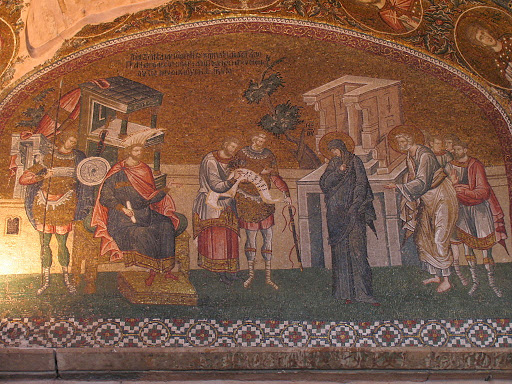
Photo: Quirinius, Governor of Syria enrolling Mary and Joseph for taxation. Bigger version here of the Byzantine mosaic c. 1315. This was the first census that took place while Quirinius was governor of Syria. –Luke 2:2 Josephus regarded Augustus' insistance on taking a census for the purposes of taxation and conscription as the beginning of a Zealot movement that encouraged armed resistance to the Roman empire, culminating eventually in the First Jewish-Roman War.
Damascus emerges from isolation (30 August 2008)
Middle East Economic Digest, James Gavin

After being abandoned by its Arab allies and economically isolated by US sanctions, President Bashar al-Assad's regime has made a remarkable comeback in recent months…. "On one side, Israel is seeing what it can do to isolate Iran, and to find out to what extent Syria will move against Hezbollah," says Joshua Landis, …

Jimmy Carter Conspicuously Absent From Podium

By Brett Lieberman and Nathan Guttman
Forward

Former president Jimmy Carter’s controversial views on Israel cost him a place on the podium at the Democratic Party convention in late August, senior Democratic operatives acknowledged to the Forward. …

Although Carter says limiting his presence at the convention was his idea, denying him a speaking opportunity ends a two-year struggle for the party over how to deal with the controversial former president. Since Carter published a book in November 2006 accusing Israel of practicing apartheid against the Palestinians, Democrats have been trying to distance themselves from the former president and to convince Jewish activists that he does not represent the party line.

Carter’s status at the convention was an issue for the Democratic leadership going back to the early preparation stages, a party official said. The solution to what one Democratic official referred to as “the Carter problem,” however, was not found until the final run-up to the Denver convention. …

Jewish Democrats approved of Carter’s limited presence at the convention, as they have argued that embracing the former president could tarnish the party in November. “You can’t give him a podium, because people will draw the conclusion” that the Democratic Party supports Carter’s views on the Middle East, said Rep. Jerrold Nadler of New York….

Among some of Jewish delegates to the convention, however, denying Carter a speech but offering him a video tribute was not nearly sanction enough.

“He hasn’t shown respect to Israel and many of the Jewish constituencies here based on the things he has done,” said Nan Rich, a Florida state senator who left the hall in protest before Carter’s appearance onstage…. And though Rich chose to protest Carter’s inclusion, she was among the critics who appreciated the decision to minimize his role. “It shows the party gets it and Barack Obama’s campaign gets it,” she said. Read more…

Hezbollah warlord was an enigma:
By Borzou Daragahi, Los Angeles Times
August 31, 2008

Imad Mughniyah, alleged mastermind of infamous terrorist attacks, was one of the most hunted men in the world. His death is as mysterious as his life………

Turkish PM Erdogan to visit Syria: Erdogan said in Ankara that the fourth round of indirect talks between Syria and Israel was finished and the fifth round of talks was underway.

Russia threatens to supply Iran with top new missile system as 'cold war' escalates, Telegraph,

Russia is deploying the threat to sell a "game changing" air defence system to Iran as a high stakes bargaining chip in its new "cold war" with America, The Sunday Telegraph has learned.  

Russia Claims It Has Sphere of Influence in the World

Kouchner worries about lingering hatred among feuding Lebanese parties
By The Daily Star          
Wednesday, August 27, 2008

The French Foreign Minister was satisfied with the outcomes with his visit to Lebanon and Syria, but had expressed concern about "hidden tensions among Lebanese groups. You Lebanese need minimum of three decades to erase all the hatred that built up between feuding groups through the years," As-Safir newspaper quoted Kouchner as saying. …

Moussa said the league has led mediation efforts between Lebanon and Syria for over a year. "Our role in Lebanon is well known, and we have worked with Syria, which applied at last what many were demanding."…

EADS denies Airbus in plane talks with Syria. "We are not currently discussing any deal on Airbus planes with the Syrian airline or authorities," an EADS spokesman said.

Iraq Signs Oil Deal With China Worth Up to $3 Billion: The first major oil deal Iraq has made with a foreign country since 2003. The United States Embassy in Baghdad had no immediate comment on the oil deal.

Georgia says cutting diplomatic ties with Russia

Italy to Spend $5 Billion to End Colonial Dispute With Libya
By Steve Scherer

Aug. 30 (Bloomberg) — Italian Prime Minister Silvio Berlusconi pledged $5 billion over 25 years to Libyan leader Muammar Qaddafi in compensation for the occupation of the country in the 30 years before World War II. 

Italy will pay $200 million per year to Libya in the form of investments in infrastructure. The money will finance the construction of a coastline highway that runs about 1,600 kilometers (994 miles) between the Egyptian and Tunisian borders. "It's a full moral recognition of the damage done to Libya during Italy's colonial period,'' Berlusconi said after arriving at the airport in the Libyan city of Benghazi, where the two leaders met to sign the accord. "This will end 40 years of misunderstandings.''

Syria arrests two Kurdish leaders: 

Talal Mohammad of the banned Wifaq party, an offshoot of the Kurdish Workers Party (PKK), which is also active in Turkey and Iraq, was arrested without warrant in northeastern Syria last week and not heard from since, according to the National Organisation of Human Rights in Syria. 

Authorities earlier arrested Mashaal Tammo, an official in Future Movement, which like all opposition parties in Syria is banned. Future Movement advocates democracy and equal rights for Syria's one million Kurdish minority.

Syrians writers and intellectuals are pleading with Syrian authorities to arrest them rather than kidnap them
By: Ibrahim Yousef, 8/25/08

The Courts and Mr. Arar: Editorial, New York Times
Published: August 31, 2008

We were deeply disheartened in June when a federal appeals court panel dismissed, on flimsy legal grounds, the civil rights lawsuit brought by Maher Arar. Mr. Arar, a Syrian-born Canadian, was a victim of the Bush administration’s notorious policy of “extraordinary rendition” — the outsourcing of interrogations to governments known to use torture.

Fortunately, the dismal 2-to-1 ruling will not be the final word. This month, the United States Court of Appeals for the Second Circuit, in Manhattan, took the rare step of scheduling a rehearing of Mr. Arar’s case before all 12 of the court’s active members. Even more unusual, it acted before a formal appeal was filed.

The court offered no explanation. But it is clear that some members are troubled by the panel’s brush-off of Mr. Arar’s claims — and the idea of again placing the Bush administration’s abuses beyond the reach of American law. ….

Canada, which first raised erroneous suspicions about Mr. Arar, has done the honorable thing. It apologized to him and agreed to pay him $10 million for its role in his nightmare. Mr. Arar deserves justice from this country. A strong decision allowing his case to proceed would strike an important blow for the rule of law and accountability.  (related article: Justice Dept. Investigating Deportation to Syria, June 6, 2008)

Syria & Lebanon Should Hold Simultaneous Talks With Israel

by Qifa Nabki

Syria's peace talks with Israel have reached a breakthrough or a dead end, depending on whom one chooses to believe. 

Whatever the reality is, it looks likely that the talks have entered a temporary holding pattern to be sustained over the next several months while various regional and international uncertainties are resolved: the identities of the incoming American president and Israeli Prime Minister, the status of Iranian relations with the West, the security situations in Iraq and Palestine, etc.

I have argued over the past few months that Syria would do well to include Lebanon in its current talks with Israel. The presence of Lebanese negotiators alongside Syrian ones in Turkey would send several positive signals to various parties, which might compel positive responses in return.

1. It would demonstrate to the Americans that these talks are not merely a publicity stunt designed to hoist Syria out of its isolation, but rather that they would have an important bearing upon an American ally (Lebanon's Saniora government). 

2. It would further emphasize the idea that Syria recognizes Lebanon's sovereignty and is not negotiating on its behalf or behind its back.

3. It would send the signal to the Israelis that Syria has decisive clout with its allies in Lebanon, and can make them come to the table and negotiate with Israel when the conditions are right.

These positive signals might produce some fruitful results, namely:

a) Curbing criticism of and resistance to Syria/Hizbullah in Lebanon's political arena, if it is felt that the status quo will dramatically shift within the next few years following a peace deal. In other words, all of the fanfare about Hizbullah's weapons might be swept under the table again if the party's opponents can envision a stage at which Syria would pressure Hizbullah to conform to new political realities.

b) The Americans might seize this development as a face-saving way to sponsor the talks, given that one of their foremost regional allies is committed to it.

c) Reinvigorating the talks and putting them on the front page again, where they have the best chance of succeeding.

There is no reason for President Bashar al-Assad to introduce this tactic at the current moment, when it will likely be ignored by the Bush administration. However, it is conceivable that either Obama or McCain would be more open to exploring the potential of these talks than George W. Bush, and a Syrian gesture of this nature would make it far easier for the Americans to switch tack.

Both the French and Israelis have called for Lebanon to engage in direct talks, with the usual brush off by Lebanon's leaders, who know better than to pursue such a track without a Syrian green light. Since the road to peace leads through Lebanon, however, Syria would do well to begin paving the way for an eventual settlement by bringing its neighbor on board, even if only in a limited capacity.  

Flooding in Damascus: Mosquitoes Cheer

Damascus Flood Aug. 2008

Photo thanks to Nabil Midani

Bush’s Policy of No Dialogue with Syria is Costing US Lives

Bush's Policy of No Dialogue with Syria is Costing US Lives
By Joshua Landis
for Syria Comment, 29 August 2008

Washington's latest refusal to talk to Syria does not make sense. There is no hope of changing Syria's behavior by the refusal to talk. On the contrary, it is costing the lives of US soldiers.

General Petraeus wanted to travel to Syria last December in order to restore intelligence sharing between the two countries. He believes that by working with Syria on joint policing of the long Syria-Iraq border, lives of his soldiers will be saved. Petraeus's people are convinced that dialogue will help stop foreign fighters from penetrating into Iraq; cooperation will reduce the number of suicide bombers and US dead. This is not complicated. Petraeus was refused permission to visit Syrian.

Syria is eager for this cooperation. It welcomed renewed intelligence sharing at the famous Sharm al-Shaykh meeting between Rice and Muallem in May 2007. Syria was prepared to receive two top US generals in Damascus to find ways of catching infiltrators. Muallem asked that the US re-assign an ambassador to Damascus as a token of the renewed cooperation between the two countries. (The US withdrew its ambassador in 2005, following the Hariri assassination. The UN is pursuing an investigation into his murder.) Rice could not send a new ambassador to Syria or restart official communication between the two countries. Damascus demurred in its willingness to receive clandestine generals.

Petraeus's officers are likewise forbidden from contacting their Syrian counterparts in order to work on joint security measures and to catch the 30 or so jihadists believed to be getting across the desert border into Iraq. Likewise, State Department officials are forbidden from talking to their Syrian counterparts. This policy of silence precludes an easy and obvious method to reduce the deaths of American and Iraqi soldiers.

One could justify this higher death rate among American soldiers, if Washington had a reasonable chance of winning political concessions from Syria. Unfortunately, Washington has no workable plan for gaining Syrian concessions.

Yesterday, the White House restated US policy to preclude dialogue with Syria unless Damascus decides "to play a positive role, stay out of the internal affairs of Lebanon, stop supporting terrorists and be a productive player on the world scene." Syria cannot do this without US help.

Syria supports both Hizbullah and Hamas as instruments to pressure Israel to give back the Golan, territory Israel conquered from Syria in the 1967 War. By refusing to support Syria's peace talks with Israel, Washington ensures the Golan will not be returned and that Syria continues to support its allies in reconquering occupied territory. So long as Washington refuses to be a productive player itself, it cannot expect Syria to be one. The White House could save US soldiers' lives through intelligence sharing with Damascus. Why it refuses to do so is a mystery.

[End of Landis Analysis]

News Round Up:

US refuses to follow France's lead and talk with Syria
August 28, 2008

WASHINGTON (AFP) — The United States refuses to follow France's lead and will not talk to Syria until it decides to take a "positive role" in international affairs, State Department spokesman Robert Wood said Thursday.

Wood declined to comment on French President Nicolas Sarkozy's announcement Wednesday that he would visit Damascus on September 3-4, after welcoming Syrian President Bashar al-Assad to Paris last month.

The spokesman, however, restated US policy that precludes any dialogue with Syria unless it decides "to play a positive role, stay out of the internal affairs of Lebanon, stop supporting terrorists and be a productive player on the world scene."

"Today, it has not been" the case, Wood added.

"Until Syria plays a positive role in the region, it is going to continue to isolate itself," he said.

Washington continues to blacklist Damascus as a state sponsor of terrorism.

On announcing his trip to Damascus, Sarkozy rejected the idea of isolating Syria, preferring to take "another route, more risky it is true, but more promising: open dialogue leading to tangible progress."

Making a diplomatic comeback after years of ostracism, Assad was among more than 40 leaders who on July 13 in Paris inaugurated the new Mediterranean union, Sarkozy's flagship project to bolster cooperation between Europe, the Middle East and north Africa.

Sarkozy's predecessor Jacques Chirac severed ties with Syria in response to the 2005 assassination of Lebanon's ex-premier Rafiq Hariri, after accusing Damascus of involvement in the murder. Syria has denied the allegations.

[Landis Comment] The following Washington Times editorial arguing that the US should not advance the peace process that both Syria and Israel say they want, would seem to be based on misapprehensions. One can only presume it is an effort by the Washington Time's editorial board to justify the latest refusal of thee Bush administration to allow open dialogue with Syria. President Clinton in his memoirs said it was not Assad who "sabotaged" the peace process; rather, he wrote that Barak got "cold feet." The problem was that from Israel's point of view, Syria was asking for too much land. The price was not right. Getting to the right price is something Washington should be helping with, not hindering.

EDITORIAL: An Israel-Syria 'deal'?: Washington Times

…….. Maybe there is a geopolitical sea change taking place in Damascus. If so, the Assad government has thus far hidden it very skillfully. In March 2000, President Clinton put the prestige of his office on the line in the hope that Mr. Assad's father was ready to make a peace agreement with Israel. Hafez Assad showed by his actions that he was not, and then proceeded to sabotage Israeli Prime Minister Ehud Barak's efforts to withdraw from southern Lebanon. We shouldn't be deluded again.

US sanctions could derail Airbus deal with Syria
By Khaled Yacoub Oweis
Reuters, August 28, 2008

DAMASCUS- Airbus is finalising a deal that could secure it a multibillion-dollar order from the Syrian government, but U.S. sanctions could torpedo the purchase, sources familiar with the talks said on Thursday.

Habib Feqih, president of Airbus Middle East, is in Damascus to sign the cooperation framework agreement, which involves the possible lease and purchase of a total of 54 aircraft between now and 2028, and help by Airbus to restructure Syria's flag carrier Syrianair, the sources told Reuters.

But the U.S. sanctions, imposed on Syria in 2004 for its support for anti-American groups, could complicate any Airbus sale to Syria, if not make it impossible, since the planes use American components, an industry executive said.

"I cannot see a way for Airbus to sell planes to Syria. I do not think it would be able to obtain export licences for the U.S. manufactured parts," he said.

A way around the sanctions could be if a limited number of aircraft were to be purchased by another airline or operator outside Syria, and then leased to a Syrian company, the executive added.

Under such a lease, the lessor would also provide the crew and take care of maintenance and insurance. Sham Wings, Syria's only functioning private airline, has leased at least one aircraft, a medium bodied McDonnell Douglas.

Another source said the cooperation agreement would amount to little if no legal way could be found to conform to the sanctions, with French officials assuring the United States that Airbus had no intention of breaking them.

"Someone has to convince the American government to make an exemption for a deal with Syria to go through. Airbus has a huge business in the United States," the source said…

Syria Issues Listing Rules for Its Bourse, Al Watan Says
By Nadim Issa
Bloomberg, August 28, 2008

The Syrian Commission on Financial Market Securities ratified the rules and regulations required to list on the Damascus Securities Exchange, Al Watan reported, citing a statement by the commission.

In order for companies to list they have to be established for over three years from the start of their activities, have an average net profit of at least 5 percent in the past two years and their paid up capital should not be less than 300 million Syrian pounds ($6.5 million), the Syrian newspaper reported.

In the secondary market, the companies' capital should not be less than 100 million pounds and they have to be established for over two years from the start of their activities, the newspaper reported.

For non-Syrian companies to list, they have to get the approval of the commission; have an average net profit of at least 5 percent for the past three years and be listed in their country for over two years, Al Watan reported.

Russia's case on Georgia territories: Like Kosovo or not?
By Robert Marquand
The Christian Science Monitor, August 28, 2008

In the wake of Russia's recognition of two separatist Georgian republics Tuesday, Moscow is moving swiftly in another war – how to define and present its legal case to the world. One chief area of this battle is Kosovo, the Serbian province that declared its independence in February – something Moscow had long warned would "legitimize" the separation of territories such as South Ossetia and Abkhazia in Georgia.

Yet hours after Russia recognized the independence of those republics Tuesday, Foreign Minister Sergei Lavrov turned the tables. Taking a new legal tack, he called any parallels between Kosovo and Georgia "irrelevant," and offered an interpretation of events that essentially makes Georgian President Mikheil Saakashvili a worse war criminal than former Serbian president Slobodan Milosevic.

Despite strong warnings from then-President Vladimir Putin leading up to Kosovo's declaration of independence, the US and 20 of 27 European Union nations have since recognized Kosovo's new status.

Now, much of the world's media is explaining how Kosovo led to Russian tanks in Georgia. This week, Russia recognized South Ossetia and Abkhazia, something that took the West a nine-year process of careful negotiation, minority rights clauses, and statebuilding to do in Kosovo partly because of due diligence over Russian warnings about a "Kosovo precedent."

Russia looking for China's backing….

Europe must stand up to Russia says UK
By Julian Borger and Ian Traynor
The Guardian, August 28, 2008

Britain yesterday raised the stakes in the scramble to contain Russia, pledging support for Moscow's regional rival, Ukraine, and calling on the international community to stand up to Russia's campaign to redraw the map of Europe and make it pay a higher price for its actions in Georgia.

David Miliband, the foreign secretary tipped as a future Labour party leader and potential prime minister, went to the Ukrainian capital, Kiev, to deliver a speech aimed at flying the flag of western democracy on Russia's doorstep, while seeking to avert a new crisis boiling over on the Crimean peninsula, home to an ethnic Russian population and Moscow's Black Sea fleet.

The speech represented the strongest criticism of the Kremlin from a leading European government official in years, delivered in a country that is Russia's neighbour and which Russians view as the cradle of their civilisation.

Miliband declared a turning point had been reached in Europe's relations with Russia, ending a nearly two decade period of relative tranquility. He said Tuesday's decision by the Russian president, Dmitry Medvedev, to recognise Georgia's breakaway regions of Abkhazia and South Ossetia represented a radical break and a moment of truth for the rest of Europe.

"[Medvedev's] unilateral attempt to redraw the map marks a moment of real significance," the foreign secretary said. "It is not just the end of the post cold war period of growing geopolitical calm in and around Europe. It is also the moment when countries are required to set out where they stand on the significant issues of nationhood and international law."

"The Georgia crisis has provided a rude awakening," the foreign secretary said. He responded to Medvedev's boast that he was not scared of a new cold war, saying: "We don't want a new cold war. He has a big responsibility not to start one.

Miliband arrived in Kiev at a time when Ukrainian officials are jittery over concerns that Russia could orchestrate a conflict over its Black Sea fleet, which is based in the Crimean port of Sevastopol, under a lease agreement with Ukraine.

Ukrainian officials say Russia has been distributing passports to ethnic Russians living in Crimea, as it did in South Ossetia, and fear that a row over the use of the base may be employed to stir up separatist sentiment as a precursor to calling for a referendum on seceding from Ukraine. Viktor Yushchenko, the Ukrainian president, has riled Moscow by suggesting that Russia should pay a higher rent for Sevastopol and could be subject to more stringent conditions on its use. Miliband urged the Ukrainian government to "stick to the letter" of the lease agreement.

In bilateral meetings yesterday, Ukrainians pressed for British support in their bid to begin membership proceedings for both the EU and Nato. They are looking for positive signals from an EU-Ukraine meeting next month, and hope to be offered a membership action plan at a Nato ministerial meeting in December. Miliband signalled that Kiev had Britain's backing.

"My visit is designed to send a simple message: we have not forgotten our commitments to you," he told Ukrainians, asserting that the relationship between Moscow and Kiev could not be that of "master and servant".

In the harshest criticism of Russian conduct since the Caucasus crisis erupted three weeks ago, he accused the Kremlin of shredding the rulebook governing international relations and of "torpedoing" the work of the UN security council.

"Over Georgia, Russia has moved from support for territorial integrity to breaking up the country in three weeks, and relied entirely on military force to do so. In between, it signed a ceasefire agreement which included international mediation as the way forward. If her word is not her bond then she will not be trusted by anyone … Russia needs to ask itself about the relationship between short-term military victories and longer term economic prosperity." Miliband said the west must now "raise the costs to Russia of disregarding its responsibilities". In particular, Europe should hit back on the oil and gas market, with measures aimed at loosening Russia's powers as a monopoly seller.

"Europe needs to act as one when dealing with third parties like Russia," he said. To do that, the EU should invest in gas storage facilities, build up an internal market and negotiate as a single entity, rather than cutting separate deals.

Russia, Miliband said, "must not learn the wrong lessons from the Georgia crisis: there can be no going back on fundamental principles of territorial integrity, democratic governance and international law."

But the foreign secretary argued against isolating Russia. "Russia is too enmeshed in the world economy. It would be counterproductive," he said. The approach should be one of "hard-headed engagement". For example he opposed Russia's expulsion from the G8 group of industrialised countries, but instead called for the G7 (the group minus Russia) to hold discussions when necessary without Russia.

Last night G7 foreign ministers issued a joint statement condemning Russia's recognition of Abkhazia and South Ossetia, and deplored Moscow's "excessive use of military force in Georgia and its continued occupation of parts of Georgia".

While Miliband delivered his broadside in Kiev, his French counterpart, Bernard Kouchner, warned that Ukraine and Moldova, which also has a pro-Russian breakaway region, Transnistria, could become the next targets of a newly assertive Russia.

Yushchenko, who met Miliband yesterday, said Russian actions in Georgia were unacceptable. "What has happened is a threat to everyone, not just for one country. Any nation could be next. When we allow someone to ignore the fundamental right of territorial integrity, we put into doubt the existence of any country."

The Biden factor in US-Iran relations
By Kaveh L Afrasiabi
Asia Times Online, August 28, 2008

Senator Barack Obama's choice of Senator Joseph Biden as his running mate for the Democratic ticket for the US presidency is a good omen for troubled US-Iran relations and will likely translate into positive developments on that front in the event Obama moves into the White House.

Biden, who has chaired the Senate Foreign Relations Committee, has been a strong advocate of engagement with Iran and a vocal opponent of any military action against Iran as a result of the nuclear standoff. He has participated in a number of forums sponsored by Iranian expatriates in the US, and has denounced some anti-Iran measures, such as the US's labeling of the Iranian Revolutionary Guards Corps as a terrorist outfit.

With Iran looming as one of the major foreign policy issues in the presidential elections, Biden brings a measure of legitimacy to Obama's call for direct dialogue with Tehran, a position soundly rejected by his Republican rival, Senator John McCain.

The trouble with McCain's position on Iran, however, is that it does not sit well even with the Iran policy of the George W Bush administration, in light of the recent meeting of Iran's chief nuclear negotiator, Saeed Jalili, with US Under Secretary of State, William Burns, in Geneva. This meeting marked a clear turnaround from the previous US policy of setting stringent preconditions, such as the suspension of Iran's uranium-enrichment program, for any direct contact.

At the same time, the downside of having a clearer position on Iran is that it is not particularly favored by the strong pro-Israel lobby in Washington that tilts in favor of McCain. It is therefore possible that Biden's selection may cost Obama a share of the Jewish vote, particularly if between now and November hostilities between the US and Iran escalate. In the absence of any breakthrough in the Iran nuclear stalemate and the ongoing tensions in Iraq, that is not hard to imagine.

In turn, the chances are that, faced with the prospect of a Jewish backlash, the Obama-Biden ticket may harden its stance towards Iran, just as Obama did during his recent trip to Israel, when he stated categorically that he was in favor of keeping all options open (such as an attack on Iran) and that he would not tolerate an Iranian nuclear weapon.

The danger is that Biden might now sing the same tune and escalate his rhetoric against Iran, rather than remain consistent with his earlier positions that prioritized diplomacy almost to the exclusion of hard power.

This is an important issue that could be addressed in the near future, in light of a key article in the Washington Post by Michael Rubin, a staunch pro-Israel pundit at the American Enterprise Institute, indirectly criticizing Biden for his soft Iran positions, as well as his connections to Iran lobbyists.

It is almost a sure bet that Biden and Obama will show sensitivity to such subtle attacks on them and will try damage control by using more strident rhetoric against Iran. Equally possible is that Biden will resist pressure from Obama and his team and refrain from sounding bellicose against Iran, in which case we must anticipate a bifurcated Obama administration, should the Democrats win the presidential contest, with vice president Biden leaning more in the direction of soft power diplomacy toward Iran than the new president in the Oval Office.

However, should Iran respond well to the Democratic victory through a more flexible nuclear posture that would be amenable to reaching a compromise, then the Biden factor will definitely weigh in positively, both in the area of confidence-building as well as substantive progress in the divisive issues that remain between the US and Iran.

From Tehran's point of view, the replacement of hawkish Vice President Dick Cheney with the dovish Biden would be welcome news reflecting the beginning of an overdue adjustment of US foreign policy toward Iran. …….

Obama has shown only a superficial understanding of the Middle East in general and Iran in particular and this is a weakness that can be remedied by giving Biden considerable room to maneuver. Should the Obama team put a tight leash on Biden when it comes to Iran, it would mean sacrificing the potential for a breakthrough with Iran that Biden brings to the ticket. This is not to underestimate the difficulties in coordinating a unified and homogenous Iran policy between Obama and Biden.

Simply put, the Democratic ticket has no better chance to provide a serious change in US foreign policy than by charting a less-bellicose and more-conciliatory approach toward Iran. This is likely to be reciprocated by Tehran's leaders, including Ahmadinejad, who is still waiting for a response to his letters – one to Bush and the other to the American people.

Ahmadinejad's missive to Bush is unlikely to draw a response, but the chances are good to excellent that such an overture toward the US's first African-American president will elicit a productive response.

Should McCain be the next president, we should expect nothing more than business as usual in the troubled waters of the US's ties with Iran.

Make a Deal with Iran
By Nikolas K. Gvosdev
The National Interest Online, August 27, 2008

Senator Joseph Biden (D-DE), the presumptive Democratic nominee for vice president, last year listed both Iran and Russia as threats to U.S. interests. Unfortunately, he did not offer a way to prioritize the challenges posed by Tehran and Moscow. Senator John McCain (R-AZ), for his part, has shifted his public statements in recent months, giving greater attention to Russia as a challenge for Washington and the West, and de-emphasizing (at least in his speeches) the threat posed by Iran.

Leaving aside whether their assessments are correct, let’s address a different question. How does one’s stance on Iran (or Russia) affect other foreign- and domestic-policy promises? Both Senators McCain and Obama have made a series of statements about what they would do as president. Among both their laundry lists: bring down the cost of energy—both to help American consumers but also to deprive “rogues” of petrodollars; help Europe diversify its energy supply so as to reduce dependence on Russia; bring Ukraine and Georgia into NATO; make progress in stabilizing Iraq and Afghanistan—both to permit the withdrawal of U.S. forces and to prevent chaos; and deter Iran from acquiring a nuclear weapon.

To achieve all of these goals—not just the last one—the next president needs a major breakthrough on Iran—one that would end the standoff that has lasted since 1979.

OPEC president Chakib Khelil has repeatedly noted that one of the factors keeping oil prices higher than they ought to be is the perception among traders and speculators that a clash between Iran and the United States—especially a prolonged military confrontation—is likely. Khelil recently observed that oil should be trading at about $70 per barrel, rather than the significantly higher prices we’ve seen in the last several months….

And with all of the concern about the concentration and consolidation of Eurasia’s energy resources by Russian firms and transport routes, Iran is the only feasible alternative to supplying Europe’s thirst for natural gas. Iran has an estimated 974 trillion cubic feet of natural-gas reserves, the second largest in the world. Pipeline projects like NABUCCO, designed to give European consumers feasible alternatives to other routes owned or controlled by Russia’s GAZPROM, are only cost-effective if some of Iran’s natural-gas bounty is committed.

Iranian energy flowing westward to European markets would balance Russian influence—not remove it altogether—but would guarantee that the Kremlin’s ability to wield a potential “energy weapon” would be lessened significantly.

And speaking of the Eurasian space, any fundamental reorientation of the region away from its traditional trade and economic links to Moscow can only occur if the Iranian “doorway” to central Asia and the Caucasus is unlocked and unbarred. Landlocked countries like Kazakhstan and Uzbekistan would benefit from having high-speed land links to Iran’s Persian Gulf ports.

The stabilization of both Iraq and Afghanistan would also be served by a rapprochement with Tehran. India has recognized this with its new transport policy of linking central-Asian states via Afghanistan to Iran—….

Finally, the United States would like to see Iran cease and desist its efforts to produce nuclear weapons.

Iran has presidential elections scheduled for 2009. It may be useful to recall that Mahmoud Ahmadinejad was elected in 2005, not on a platform of developing nuclear weapons or destroying Israel, but instead by promising to tackle corruption and deliver economic growth. If, prior to the forthcoming election, the United States and its European allies laid out a very specific and detailed program that included actual projects and the projected benefits to the Iranian people—rather than more generic assurances about goodwill and some small nickel-and-dime measure …

The United States is not in a position to “dually contain” both Iran and a resurgent Russia—if Washington decides that Moscow must be contained rather than engaged. ….As we have seen, Iran can “limp along” based on its trading links with Asia—especially India and China…..

Druse women join pilgrimage into Syria for first time
By Brenda Gazzar
The Jerusalem Post, August 28, 2008

Noflea Shker, a Druse resident of the Golan Heights, was nearly at a loss for words Thursday. She was about to cross the border into Syria, where she would see aunts and uncles for the first time in 25 years, her mother, who she had not seen in five years, and her seven-month-old grandson for the first time. "It's an indescribable feeling," said Shker, her eyes brimming with tears while she waited to disembark from a bus at the border crossing.

But Najwa Hamzi Amasha, another Druse resident, made no attempt to hide her disappointment at the rejection by Israel of her repeated requests to cross – she would not be meeting her siblings in Syria; she hasn't seen them in nearly three decades.

"The Jews of Sweden come to visit Jerusalem, their homeland, and their families," she said. "Why don't they let us – and we are 40 kilometers away – visit our families?" …..  "We want there to be continuous visits to our homeland, to our country, to our families," said Amasha, a widow with four grown children.

Thursday's crossing was the first time in more than eight years that the visit had taken place amidst open, albeit indirect, peace talks between Israel and Syria…. The Druse of the Golan Heights – who consider themselves to be Syrian and long to be reunited with their families across the border – perhaps more than anyone wish to see a peace agreement signed between the countries. ….

… "God willing, our president, Bashar al-Assad, will achieve peace… and the Golan Heights will be returned… The life of occupation is not a life." …

Meanwhile, at the Kuneitra crossing, 28-year-old Fida el-Shaer from Majda al-Shams decided to try her luck at getting permission to visit her family in Syria, although her request had already been denied. About one hour after she was escorted in by army officials only to be denied again, el-Shaer, who had broken into tears earlier in the day, remained outside the crossing in the stifling August heat. Asked why she was still waiting, she responded: "I have hope that maybe they'll still let me through. Without hope, one's soul would break."

Has the US Missed a Chance for Arab – Israeli Peace?

A Syrian-Israeli Breakthrough?
David Ignatius
Washington Post
August 27, 2008

DAMASCUS — Of all the wild cards in the Middle East deck, this one may be the most intriguing: Syrian President Bashar al-Assad appears ready for direct peace talks with Israel, if the United States will join France as a co-sponsor.

That’s the word from senior advisers to Assad, who spoke with me here this week. The same assessment comes from top French officials in Paris. A direct meeting would raise the Syrian-Israeli dialogue to a new level; so far, it has been conducted indirectly, through Turkey.

The Syrians would like to see a clear signal from the Bush administration that it supports the peace process and that the United States is prepared to join the French as “godfather” of the talks. But Syrian officials are pessimistic and say they doubt that the administration, which has sought to isolate and punish Syria, will change its policy in the few months it has left. That would disappoint some of Assad’s advisers, who prefer to move quickly, rather than wait for a new U.S. administration to organize its foreign policy priorities.

The prospect for direct Syrian-Israeli negotiations will come into clearer focus next week when French President Nicolas Sarkozy is scheduled to visit here for talks with Assad. That meeting follows Assad’s trip to Paris last month for a summit of Mediterranean nations. At that gathering, the Syrian leader sat around the same table with Israeli Prime Minister Ehud Olmert, but the two apparently didn’t talk directly.

The French diplomatic engagement with Syria has already helped break the logjam in Lebanon, opening the way finally for election of a president and a new government. The new Lebanese president, Michel Suleiman, visited Syria this month to discuss opening formal diplomatic ties; Damascus had rejected such discussions in the past, regarding Lebanon as part of “Greater Syria.”

Sarkozy’s chief diplomatic adviser, Jean-David Levitte, has briefed U.S. national security adviser Stephen Hadley regularly about the French diplomatic moves, but U.S. public statements have been cautious.

Syria wants an American role in the negotiations partly as a guarantee that Israel will withdraw from the Golan Heights to the border that existed before the June 1967 war. The Syrians have received private assurances through Turkish mediators that Israel will indeed withdraw as part of an overall peace deal, and that disputes about borders, water rights and other technical issues can be resolved through formulas explored in U.S.-backed negotiations during the 1990s.

Syrian officials caution that Washington shouldn’t expect any quick, decisive break in its alliance with Iran. Instead, they say, Syria aims to broaden its relationships to include Turkey, France, Russia and even the United States and Israel, in addition to Iran. Officials here speak of a role for Syria as a potential bridge to Iran rather than as a new means of isolating it.

The Syrians certainly would like to be less reliant on Iran. The relationship has been strained since the indirect dialogue with Israel was announced in May, in part because of an Iranian regional rivalry with Turkey.

“If you force Assad to choose — to leave the alliance with Tehran first [as a condition for U.S. support for the peace talks], he’ll never do it,” cautions a French official. “You have to offer a slow choice. He will gradually discover he doesn’t need the alliance with Iran.”

Assad’s trip to Moscow last week, in which he discussed arms sales and military cooperation with Russia, raised concerns that Syria was slipping back into its old Cold War alignment. But officials here say the trip was driven in part by Assad’s concern that Syria could get squeezed in any future conflict between Iran and Israel — and Syria’s desire for Russian protection. In this sense, a strategic relationship with Russia might be an alternative to Syria’s current dependence on Iran, some Syrians argue.

Another card for Assad is his ability to pressure Hamas to restrain attacks in Gaza and the West Bank, sources here say. That would address a chief U.S. concern, which is Syrian support for Hamas, Hezbollah and other groups the United States views as terrorist organizations.

Israelis have been wondering for many months whether the peace feelers from Damascus are real. They may have a chance to find out soon, if the Bush administration decides to join France in sponsoring a meeting that would test everyone’s sincerity. Often enough in the Middle East, potential diplomatic breakthroughs prove to be illusory. But that’s no reason not to give this one a try — and soon.

Sarkozy to visit Syria on September 3: PARIS (AFP) — French President Nicolas Sarkozy said Wednesday he would go to Syria on September 3, the latest step in the two states' bid to normalise ties severed after the 2005 murder of Lebanon's former premier Rafiq Hariri.

Syrian FM: No headway in peace talks with Israel
The Associated Press
Monday, August 25, 2008

DAMASCUS, Syria: Syria’s foreign minister said Monday that no headway has been achieved in several rounds of indirect negotiations with Israel.

Walid al-Moallem said the talks mediated by Turkey “regrettably” have not progressed enough for the two parties to hold direct negotiations but added both Israel and Syria were “serious” about solving outstanding issues.

Jihad Makdisi for a smart "official" debate on Syria-Lebanon relations: Youtube – http://www.youtube.com/watch?v=boyI9YzrkKY

Syria-Israel talks focused on border: Moualem: Reuters
By Khaled Yacoub Oweis

DAMASCUS (Reuters) – Indirect peace talks between Syria and Israel are focused on the thorny issue of how much Syrian territory is under Israeli occupation, Syrian Foreign Minister Walid al-Moualem said on Monday.

In the first official comment on the content of the talks, which began in May under Turkish mediation, Moualem said the two sides were seeking agreement on land Syria controlled before Israel occupied the Golan Heights in the 1967 Middle East war.

"We feel that the two sides are serious about solving the lingering issues that are being discussed. Foremost is determination of the June 4, 1967 line," Moualem told reporters after meeting his French counterpart Bernard Kouchner.

Nearly a decade of U.S.-supervised negotiations between Syria and Israel collapsed in 2000 over the extent of a proposed Israeli withdrawal from the Golan, a water-rich plateau.

Syria argued then that it was in control before the 1967 war of parts of the eastern shore of the Sea of Galilee, on the edge of the Golan, and that these parts should be returned to Syria.

Israel captured the whole eastern shore along with the surrounding plateau in the war. The shoreline has since receded.

Moualem would not be drawn on the exact territorial lines Syria considers its borders. Control of the shoreline has been a major point of contention between the two sides, especially as Israel uses the lake as its main reservoir.

The late Syrian President Hafez al-Assad, father of the current president, seeking to prove the land belonged to Syria, told former U.S. President Bill Clinton he used to swim in the Sea of Galilee before 1967. He refused to sign a deal he considered fell short of liberating the whole of the Golan.  Continued…

Russia recognizes Georgia's two secessionist regions: In the Guardian, here:

"…Declaring that if his decision meant a new cold war, then so be it, President Dmitri Medvedev signed a decree conferring Russian recognition on Georgia's two secessionist regions. The move flouted UN security council resolutions and dismissed western insistence during the crisis of the past three weeks on respecting Georgia's territorial integrity and international borders…"

Jordan sends humanitarian aid to South Ossetia: The aid was promised by King Abdullah II during his Sunday meeting with Russian President Dmitry Medvedev.

Bush condemns Russia's "irresponsible decision." According to the BBC:

US President George Bush warned his Russian counterpart, Dmitry Medvedev, that his “irresponsible decision” was exacerbating tensions in the region.

Syria, Iran warm to Russia as US tensions grow: The Associated Press
By Sam Ghattas

Syria's President Bashar Assad has publicly stepped up his outreach to old ally Russia in recent days, seeking aid to build up Syrian military forces and offering Moscow help in return — in an apparent effort to exploit a new Russian-American rift.

U.S. officials have noticed: Secretary of State Condoleezza Rice warned Mideast leaders this week that they should worry about Syria's efforts to gain more sophisticated weapons.

Syria's long-term aim, however, remains unclear, in part because Assad also continues to pursue peace efforts with Israel — a key U.S. and European goal — even as he makes overtures to Russia that are sure to antagonize the West. Syria has a long history of apparently contradictory diplomatic moves as it maneuvers to find options and balance its interests.

Yet the latest Syrian moves feed directly into larger Western fears that the Russian-American standoff — prompted by Russia's invasion of Georgia — could lead Russia to provide more military and diplomatic aid to a host of countries and militant groups the United States sees as troublesome.

"The Russian move into Georgia has begun a tectonic shift in the (Mideast) region," said Joshua Landis, a Syria expert in the United States. "It has emboldened Syria, Hezbollah and Iran to push harder against Israel and the U.S."…..

Syria and Iran: an Alliance of Convenience: Huffington Post, by Alon Ben-Meir

UNIFIL: Extensive smuggling continues on Lebanon-Syria border

Kouchner Visits Syria

www.chinaview.cn 2008-08-26 04:17:56  

by Jia Xiaohua 

DAMASCUS, Aug. 25 (Xinhua) — French Foreign Minister Bernard Kouchner paid a short visit to Syria on Monday in preparation for an upcoming visit of French President Nicholas Sarkozy early next month. 

During his hours stay, Kouchner held talks with Syrian President Bashar al-Assad and his Syrian counterpart Walid al-Muallem on a wide range of issues, particularly those in Lebanon, Iran and Iraq, in addition to bilateral relations.

According to the official SANA news agency, Assad underlined in his meeting with Kouchner the importance of adopting dialogue and diplomacy as the only way to solve conflicts, stressing that ending the Israeli occupation of the Arab lands is the guarantee for achieving permanent peace and security in the Middle East.

Kouchner told Assad that France, as rotating head of the European Union, wants Europe to play its role and assume responsibly in the Middle East.

At a joint press conference with Muallem following the talks, Kouchner reasserted that his country is willing to play a role in pushing forward peace process between Israel and Syria.

It was good that Syria and Israel were conducting indirect peace talks through a Turkish mediation, Kouchner said.

Meanwhile, Muallem said it is not time to go into direct talks with the Jewish state, saying "there has not been enough progress" for direct negotiation.

"But we feel that both sides are serious about solving the pending issues that are being discussed. Foremost is determination of the June 4, 1967 line," Muallem said, in the first official comment of the content of the talks.

On the Lebanese file, Kouchner said he had expressed concerns to Assad about the conflicts in the city of Tripoli in northern Lebanon, where dozens of people were killed in deadly sectarian clashes.

He also expressed happiness that Syria and Lebanon would exchange ambassadors before the end of the year.

Kouchner, who just wrapped up a visit to neighboring Lebanon, said in Beirut that he would tell Syrian officials during his stay in Syria that "the future relations between France and Syria highly depends on the nature of Lebanese-Syrian ties."

Syrian president highlights dialogue as only way to solve conflicts

DAMASCUS, Aug. 25 (Xinhua) — Syrian President Bashar al-Assad underlined on Monday the importance of adopting dialogue and diplomacy as the only way to solve conflicts, the official SANA news agency reported.

Assad made the remarks while meeting with visiting French Foreign Minister Bernard Kouchner, stressing that ending the Israeli occupation of the Arab lands is the guarantee for achieving permanent peace and security in the Middle East. ….

Syria-Israel talks focused on border: Moualem
By Khaled Yacoub Oweis | August 25, 2008

DAMASCUS (Reuters) – Indirect peace talks between Syria and Israel are focused on the thorny issue of how much Syrian territory is under Israeli occupation, Syrian Foreign Minister Walid al-Moualem said on Monday.

In the first official comment on the content of the talks, which began in May under Turkish mediation, Moualem said the two sides were seeking agreement on land Syria controlled before Israel occupied the Golan Heights in the 1967 Middle East war.

“We feel that the two sides are serious about solving the lingering issues that are being discussed. Foremost is determination of the June 4, 1967 line,” Moualem told reporters after meeting his French counterpart Bernard Kouchner.

Nearly a decade of U.S.-supervised negotiations between Syria and Israel collapsed in 2000 over the extent of a proposed Israeli withdrawal from the Golan, a water-rich plateau.

Syria argued then that it was in control before the 1967 war of parts of the eastern shore of the Sea of Galilee, on the edge of the Golan, and that these parts should be returned to Syria.


Jumblatt: "… Israel will fail if it aggresses Lebanon… (Thanks to "friday-lunch-club")

Obama as quoted n Haaretz, here: (Thanks to "friday-lunch-club")

"My job as president would be to try to make sure that we are tightening the screws diplomatically on Iran, that we've mobilized the world community to go after Iran's program in a serious way, to get sanctions in place so that Iran starts making a difficult calculation," Obama said in response to a voter question at a campaign event in Iowa. "We've got to do that before Israel feels like its back is to the wall," he said. .."

Maliki insists that there will be "no security agreement between the United States and Iraq without an unconditional timetable for withdrawal". … in McClatchy's, here.

"…..Maliki said that the United States and Iraq had agreed that all foreign troops would be off Iraqi soil by the end of 2011. "There is an agreement actually reached, reached between the two parties on a fixed date, which is the end of 2011, to end any foreign presence on Iraqi soil," Maliki said. But the White House disputed Maliki's statement and made clear the two countries are still at odds over the terms of a U.S. withdrawal…."

Maliki Demands All U.S. Troops Pull Out by 2011: BAGHDAD, Aug. 25 — Prime Minister Nouri al-Maliki demanded a complete U.S. military withdrawal from Iraq by 2011 as he embarked Monday on an attempt to win support among Iraqi leaders for a draft security accord with the United States.
(By Amit R. Paley, The Washington Post)

Analysis: Shifting Middle East alliances
By Claude Salhani
Aug. 25 (UPI) —

Alliances in the Greater Middle East are written in sand, not stone, and as the winds blow and the sands shift, so do alliances. Today the prevailing wind appears to be blowing from Moscow. 

Russia's aggressive response in Georgia has unleashed what Joshua Landis, co-director of the Center for Middle East Studies and a specialist on Syrian affairs at the University of Oklahoma, calls "a tectonic shift in the region." "It has emboldened Syria, Hezbollah and Iran to push harder against Israel and the U.S. in an attempt to capitalize on recent setbacks in the Balkans, Lebanon and Afghanistan," Landis writes on his Syria Comment blog at www.joshualandis.com/blog.…

One of the first "casualties" of Russia's muscle-flexing will be a drastic shift of alliances in the Caucasus/Greater Middle East region…. the United States might find it serves its national interest to cut Tehran some slack and have the Iranians on the same side when trying to thwart Russia's efforts to expand its zone of influence in the Caucasus/Middle East region. The nukes Iran so badly craves might after all serve to deter the Russians, ironically enough…..

They Can Only Go So Far By: Francis Fukuyama | The Washington Post

Various writers have suggested that we are now witnessing a return to the Cold War, the return of History or, at a minimum, a return to a 19th-century world of clashing great powers. Not so fast….

today's authoritarian governments have little in common, save their lack of democratic institutions. Few have the combination of brawn, cohesion and ideas required to truly dominate the global system, and none dream of overthrowing the globalized economy.

If we really want to understand the world unfolding before us, we need to draw some clear distinctions among different types of autocrats. First, there's a big difference between those who run strong, coherent states and those who preside over weak, incompetent or corrupt ones. ….

If today's autocrats are willing to bow to democracy, they are eager to grovel to capitalism. It's hard to see how we can be entering a new cold war when China and Russia have both happily accepted the capitalist half of the partnership between capitalism and democracy…

In lieu of big ideas, Russia and China are driven by nationalism, which takes quite different forms in each country. Russia, unfortunately, has settled on a version of national identity that is incompatible with the freedom of the countries on its borders; I'm afraid that Georgia will not be the last former Soviet republic to suffer from Moscow's sense of wounded pride. But today's Russia is still very different from the former Soviet Union. Putin has been called a modern-day czar, which is far closer to the mark than misguided comparisons to Stalin or Hitler. Czarist Russia was a great power with limited ambitions that became an integrated member of the European state system of the 18th and 19th centuries even as it crushed the weak states on its borders and deprived its own people of liberties. It is in this direction that I expect post-Putin Russia will evolve.

China's nationalism, on proud display at the Olympics, is much more complex. The Chinese want respect for having brought hundreds of millions of citizens out of poverty in the past generation. But we don't yet know how that sense of national pride will translate into foreign policy. Apart from the flashpoint of Taiwan, China doesn't feel the type of intense grievances that Russia nurses over the shrinking of its empire or NATO's expansion into the former Soviet bloc. And Beijing will have its hands full maintaining domestic stability when the inevitable economic slowdown occurs.

China's problem today, unlike in imperial times, is that it doesn't have a well-articulated sense of what the country represents in the larger world. …

Kadima premiership candidate: I would recognize Syrian sovereignty over the Golan Heights

Kadima premiership candidate Meir Sheetrit said on Sunday that he was willing to recognize Syrian sovereignty over the Golan Heights, but only under a plan which required that the land be leased for 20 years prior to being transferred.

“I am in favor of recognizing Syrian sovereignty,” Interior Minister Sheetrit said. “But only on the condition that they lease it for 20 years, just to make sure that they’re serious.”

“We must not gamble the fate of the country,” he said. “We have a responsibility to choose somebody with the experience necessary to lead the government and the nation.”

BEIRUT — Jordan is the great survivor in the Arab World, so when it starts shuffling its diplomatic cards, it means there is something going on worth watching. More specifically, when the Jordanian Intelligence Department chief holds political talks with a top Hamas official — as just happened — we should anticipate important changes ahead in the Arab world.
.
Unlike Israeli and American officials who are mostly ignorant of trends in large swaths of the Arab world, the Jordanian monarchy, government and intelligence service have their ear to the ground and excellent insights into sentiments in their and surrounding societies.
.
(Image shows Jordan’s King Abdullah II and Queen Rania in May. [Balkis Press by Newscom])
.

DE BORCHGRAVE: Unwinnable insurgencies?
Arnaud de Borchgrave
Tuesday, August 26, 2008

…. To turn Afghanistan into a viable economy beyond the clandestine multibillion-dollar opium-poppy-to-heroin traffic requires billions more in aid, which isn't available in the donor-fatigued national parliaments of the coalition. The outgoing NATO commander said at least 400,000 troops would be required to control Afghanistan, a country the size of France with 30 million people. Current deployment: 60,000.

Lebanese Sovereignty continued

The tangled relations between Lebanon and Syria prompted a debate in the comment section over sovereignty that may interest some readers.

Qifa Nabki – A Lebanese contributor – took issue with my optimistic view of Syria's recognition of Lebanese sovereignty 

Dear Joshua

Good post, especially the anecdote about Ambassador Moustapha and your subsequent analysis.

I agree that the latest signs are encouraging, but would still point out the obvious, namely that there are two ways to read them. The skeptical view regards the Syrian-Lebanese relationship as essentially unchanged, and the establishment of diplomatic ties and demarcation of borders as mere window dressing. The view that you express presents the relationship as changing in substantive ways. How does one determine which view is correct? At the end of the day, the proof of Syrian intentions vis-a-vis Lebanon will be in the muhallabieh.

Even if one chooses to be optimistic (as I do), there is still the problematic caveat which reserves for Damascus its security interests and sphere of influence in Lebanon. If Syria’s ruling regime is the sole arbitrator of what these interests and influence encompass, then the relationship between the two countries will be placed on a slippery slope once again.

In my opinion, the best way to improve the relationship is by directly addressing some of the principal sources of resentment, like the Lebanese prisoners in Syria, and the demarcation of all borders. These issues, however, are small potatoes compared to the damage that the relationship will sustain if Syria uses Hizbullah to turn up the heat on Israel again, with all of Lebanon paying the price.

In 2009, Lebanon will hold what may be the first relatively free and fair elections in its history. If all goes well, the Syrian Ambassador to Lebanon should be treated as a guest of honor by the new Lebanese PM, if only for having purposely and faithfully relinquished his historical ‘right’ to know the man’s identity in advance.

Joshua responds:

Dear QN, You write:

“These issues, however, are small potatoes compared to the damage that the relationship will sustain if Syria uses Hizbullah to turn up the heat on Israel again, with all of Lebanon paying the price.”

Syria will undoubted encourage Hizbullah to turn up the heat on Israel if peace talks go no where. What else can it do? The only reason Israel is talking to Syria today is because Olmert couldn’t destroy Hizbullah by force of arms. Without Hizbullah, there would be no talks or hope of Syria getting back the Golan, I fear.

This all means that Syria will try to keep that card an ace.

That, you will say, suggests that Syria really has no regard for Lebanese sovereignty. I would argue that what it really means is that Syria places its own national interests above those of Lebanon and that Lebanon is too weak to deny Syria Hizbullah.

We get back to the old question of how Lebanese should try to deal with it annoying Syria problem.

Lebanese should support Syria’s cause of getting back the Golan as best they can, rather than trying to thwart it, as Geagea et al do.

They, of course, believe Syria wants to own Lebanon and unify, which helps explain why they would prefer to side with Israel to defeat Syria. I think we have proven that this is a losing strategy for Lebanon.

Supporting Syria’s claim to the Golan may also be a losing strategy, but, at least, many Israelis still say that they will return it under the right circumstances.

best, Joshua

Qifa Nabki:

Dear Joshua

I don’t think Geagea and company are trying to “thwart” Syria’s cause of getting back the Golan. Nobody in Lebanon sits at home dreaming up ways to make sure that Syria never sees its Golan again. The people you’re talking about are motivated, as you say, by fears of Syria’s designs on Lebanon, but this does not mean that they have “side[d] with Israel to defeat Syria.”

In my opinion, the problem with your formulation of the relationship is that something that represents a threat to Syrian interests is characterized as “thwarting” the Syrian cause, while something that threatens Lebanese interests is acceptable because Syria’s interests have to come first.

I’m happy to accept the rules of the game if we are engaging in a cold, calculating realpolitik, but then why all the moral indignation when Lebanon’s politicians strike back to protect their own country?

I’d venture to say that for most Lebanese, the Golan is not a cause they they feel strongly enough about to actively support or actively thwart. They, like Syrians, have their own interests in mind, not those of their neighbor. This being the case, I think that we should not paint one side out to be spoilers and collaborators, just because some of their members don’t see eye to eye with the other side’s project.

In any case, I am in agreement with you that everybody will be far better off if Syria and Lebanon’s leadership are on the same page, vis-a-vis Israel. That’s why I’ve argued time and again that Lebanon should be included in the current negotiations.

Akbar Palace (An American Jew)

Professor Josh,

How about improving the lives of Syrians? …  Your post and comments are Proof Positive of how the Arab-Israeli conflict has been hijacked by Arab despots to keep Arab societies backward, seething, destitute and broken.

Do you think this blog is your small contribution to getting the Golan back? Is getting back the Golan the only issue Syrians are concerned with, or is this the only issue Syrian LEADERS are concerned with?;)

Thanks.

Joshua:

Dear QN,

I understand Lebanese outrage at Syria. I think I know why Geagea and Junbalat do what they do. Geagea and the Gemayyels, etc. did side with Israel against Syria when Israel was a real player in Lebanon during the 1980s. I understood that as well. If they could convince the majority of Lebanese to join them in siding with Israel, it would make great sense. Israel is much richer than Syria, has good relations with the West, and could get Lebanon all kinds of special trade agreements, tariff breaks, capital inflows, etc. The only problem was that they failed to get Lebanese to go along with them because of the Arabism issue.

I think you will have a hard time finding me outraged at their treason, largely because I do not think their opinions or behavior are treason anymore than I think Hizbullah’s behavior and alliance with Syria constitute treason. There may be people writing on this blog who believe that, but I do not.

My argument is that they will lose and bring further trouble on Lebanon’s head. The best way for Lebanese to attenuate Syria's policies of interference in Lebanon is for Lebanese to support Syria in its efforts to have the Golan returned. The sooner border disputes between Israel and its neighbors can be settled, the sooner Lebanon's border and sovereignty disputes are likely to be settled. Both Syrians and Palestinians use their on going struggle to liberate their lands from Israeli control as an excuse to violate Lebanese sovereignty. This may be morally wrong in the world of international law, but in the darker world on national interest, Syria and the Palestinians see it as their only option.

I agree with you that Syria should include a Lebanese representative at the table with it during talks with Israel. I also know Syria well enough to know that if that representative argues against linking Lebanon to Syria’s foreign policy agenda, Syria will exclude them. Many Lebanese do not believe it is in their country’s interest to be in Syria’s sphere on influence.

QN: "Dear Joshua, You are the oracle of realism."

Idaf (An Aleppine working in the Gulf)

Joshua,

I enjoyed your realistic analysis of the Syrian views on Lebanese sovereignty. I also enjoyed your exchange with QN. From my interactions with Syrians from all backgrounds during the past couple of years, I will make the following generalizations on how Syrians today view Lebanese sovereignty:

The majority of Syrians today have bitter taste when you mention the word "Lebanon" (similar to what the majority of "Lebanese" had (still has?) for years when the word "Syria" was mentioned). This is due to the anti-Syrian demagogic media campaign that lasted for around three years by the Lebanese and Saudi media. With the exception of the racist campaign during the 90s in Kuwaiti media against Iraqis (which was limited only to Kuwait), that hysteric anti-Syria campaign was unprecedented in the Arab media history in terms of magnitude and kind. It had an overarching supremacist tendency with a derogatory flavor towards every thing Syrian. Ordinary Syrians were bitterly insulted and this is taking its time to heal (one should note that Hassan Nasrallah singlehandedly healed most of this already with his continuous gestures to Syrians since the "thank you Syria" speech on March 8 2005 till today). For the overwhelming majority of Syrians, this offensive campaign was uncalled for. The ordinary Syrians had nothing to do with anything that took place in Lebanon. Moreover, they didn’t even know what the security apparatus did there (many might’ve had an idea but were in denial). All they knew for certain was that close to 15,000 of their sons sacrificed their lives to stop the bloodshed in that "sisterly" country. However, things are interestingly on the contrary with regards to how Syrians view the Lebanese people. Even the most vocal and pride-injured Syrian will deal with any Lebanese person (regardless of the background) as "just another Syrian". This was clear in the way those same Syrians reacted to the Lebanese people during the 2006 war on Lebanon.

Because of the bitter feelings I described above, most ordinary Syrians I met during the past couple of years wanted nothing to do with Lebanon anymore (even many of those who used to believe that Lebanon is a stolen part of Syria). The adage you keep hearing from those Syrians when the subject of Lebanon’s problems came up was "???? ???? ????" (a saying that indicate a mix of indifference and glee) or the lighter one you hear from the older women "???? ????? ??????" ("god bless them and keep them away from us"). These sentiments indicate a shift in view of Lebanon as a country among ordinary Syrians. It is now viewed as a troubled area that is better kept away from Syria. Partly because of the political headaches it brings, but also in part because of the genuine fear that Syrians have of the infectious nature of the sectarianism in Lebanon.

I agree with Joshua that the exception for the above description is the older generation of Syrians who still remember going to the sea-side "Syrian cities" Beirut and Tripoli to visit their relatives. It is virtually impossible to persuade that generation that this is no more a Syrian land carved out by the imperialist French to separate their families and lands. One should note that this was the majority view of the people in the region since early 21th century according to the first ever poll in modern Arab history.

Finally, in both countries, you still have groups of people that ideologically believe that Syria and Lebanon are one. You have the Islamists with their Khilafa and Bilad el-Sham view of the region. You also have the secular SSNP members who still believe and work towards a unified country that includes Syria and Lebanon (among others). They are probably the only secular group in the two countries that is vocal and ideologically driven towards this goal as its followers belong to every single sect in the two countries. The Arab nationalists (including the Baathis) are becoming less ideological in their views of the two countries.

I would add the following to the "sphere of influence" comment by Joshua: Regardless of the shape or form of the regime in Damascus, Syria will ALWAYS strive to have a level of influence in Lebanon equal to or greater than the political influence of any other regional or external country. In other words, Syria’s influence in Lebanon will match or exceed the influence exercised either by Israel, Saudi, US, France, Iran, etc. For Syria, regardless of who is in control in Damascus, it is not about Lebanon, it’s a matter of Syrian national security. The external powers will always strive to increase their influence in Lebanon not just for gaining control of this country, but geopolitically, it has been always a matter of exploiting Lebanon to undermine Syria as well.

For Lebanon to reduce Syria’s influence, it has to try to minimize all others. With the current political structure in Lebanon that invites external influence by design from multiple players, this is a very tough objective to achieve. Lebanon’s best bet to reduce Syria’s influence is to establish a strong secular state that is perceived as representative by the overwhelming majority of Lebanese AND one that is perceived by Syria as a friendly one. This could reduce the influence of all external powers in Lebanon, including the Syrian one. As long as the rulers of Damascus see the influence of another county grow in Lebanon they will be forced to increase their own. It is both a matter of regime survival for non-democratic regimes in Syria as well as a Syrian national security imperative for any democratic or non-democratic Syrian governments alike.

Why Discuss: (A Canadian Lebanese, brought up in Egypt, who lived many of his working years in the Gulf)

QN, Josh

Whether they want it or not, all lebanese will have to hang on to Syria if they want to solve the overlooked and sensitive issue of the 500,000 palestinians refugees in Lebanon. Without Syria and Hezbollah, there will be no way Lebanon can have a solution for the refugees. When the syria-israeli talks will become serious, Lebanese anti-syrian leaders will have to swallow their pride and ask Syria to include the Lebanese issues in the negotations, or maybe they would still dream that the international community will negotiate for them?.  The question will be : What price Syria will ask for that?

Another Israeli Guy:

QN, I am surprised you are surprised by the Landis view on Lebanon. If the Syrian regime were not made of ruthless SOBs they would not be in power. And keeping the regime in power is important because otherwise Syria becomes like Iraq, that is the axiom of this blog. So what if Lebanon has to suffer for the “cause”?

I just don’t think though that Syria will be able to make Hizballah go to war on its behalf anymore even when the peace talks fail as of course they will. The cost of war for Lebanon is just too large even if it entails a “divine victory” and Hizballah know this. I hope Hizballah and Aoun win the 2009 elections decisively. That will really help Israel and create a huge headache for Syria.

Addendum: by Love you Alex

Idaf, Why-Ask, and Professor Landis are all spot on in their analysis:
  1. No one in Syria even the ideologues want to occupy and remove Lebanon from the map.
  2. Syria has strategic interest in Lebanon and Lebanon has Syria as a strategic depth and land passage to the lucrative markets of Iraq and the gulf.
  3. Syria and Lebanon need each other and have mutual benefits in a unified front in their negotiation with Israel. Syria wants the Golan (its land stolen by Israel) back, and Lebanon needs to guarantee that the Palestinian do not get Lebanese nationality and are able to go back to northern Galilee.
  4. No matter who is in government, Syria needs to insure that pro-Syrian elements no matter where they come from have the upper hand in Lebanon, so Lebanon does not become an easy passage to Israeli tanks to encircle Damascus and a base of operation for fundamentalist elements to destabilize Syria.
Finally:
Syria deserves credit for saving Lebanon, After Lebanon slipped into a civil war, Syria, under the auspices of the Arab League and the consent of the United States, entered Lebanon, ended the civil war and reunited the country by enforcing the Taef agreement, Syria also supported the Lebanese resistance in their successful bid to liberate the south from Israeli occupation. All while hosting tens of thousand of Lebanese of all denominations as refugees.

Those supporters of Israel (AIG) have to get off their high horse when it comes to morality. They should pay attention to Israel racist project, exporting Arabs and importing Jews to create a for Jews only democracy. Israel has cleansed 480 Christian and Muslim Arab Villages and continues today chasing them into their refugee camps.

Lebanese Sovereignty: Where Does Syria Stand?

[Landis analysis]

The Following news story by Sam Ghattas (copied below) on the changing ideological and strategic policy of Syria toward Lebanon is spot on.

I add an anecdote that convinced me that Syria's elite has accepted the notion of Lebanese sovereignty and jettisoned the rigid Arabism of their fathers.

A year ago, I spent a classic summer day in the Ghouta – the farming and orchard region extending beyond Damascus. My hosts were the Azme family – one of Syria's Sunni elite. Their forefathers include Yusif al-Azme and Bashir al-Azme. The first led the small Syrian army under King Feisal when it sought in vain to defend Syrian independence from French invaders. He was killed. Bashir al-Azme served as Prime Minister in the early 1960s.

Ambassador Imad Moustapha and his wife Rafif included me in their invitation to while away a Friday in the Ghouta as guests of the Azmes. Around a simple wooden table, spread with home made confections and shaded by a grape arbor, about 12 of us debated the issues of the day.

The issue that predominated was Lebanon-Syria relations. The Syrian withdrawal from Lebanon was only two years in the past and the UN investigation into the Hariri assassination was ongoing. Several of the older generation around the table explained that Lebanon would come back to Syria with its tail between its legs. Lebanon needed Syria and was an indivisible part of it both culturally and economically. The matriarch of the family explained how she and her mother would travel to Lebanon for a meal with friends and relatives every week, how the "families" married back and forth, and how socially the two peoples could not be separated. I short, there was a lot of nostalgia and patriotism.

Imad Moustapha, however, led the counter argument. He kept insisting that national identity is plastic and ever changing. Perhaps in the past, "Lebanese saw themselves as one people with Syrians," he said, but today that reality is no longer. He pointed out that not longer does one segment or sect among Lebanese want anything but independence. He reminded everyone that even Hizbullah had not asked for Syrian troops to remain in Lebanon in 2005. The Shiite organization thanked Syria for its help stabilizing Lebanon during the Civil War even as it waved goodbye to Syrian soldiers. "The old days are over," he kept on insisting, "we must embrace the new reality, which is that Lebanon is a separate and sovereign country. They don't want us."

In fact, Ambassador Moustapha kept insisting on this point and drawing out the debate at such length that Rafif, his charming wife, had to take him by the hand and gently remind him of other worthy topics of conversation for fear that he would bore his hosts!

Conclusion: What this story told me is that in Syria's halls of regime power Lebanese sovereignty was a hot issue. Ambassador Moustapha was belaboring his point because he was rehearsing debates and arguments that were preoccupying Syria's leadership. many of Syria's policy makers were arguing that Damascus had to find a new and different modus vivendi with Beirut that accommodates the Lebanese desire for autonomy and independence.

The notion that Syria has one choice — to accept Lebanese sovereignty — prevails today. This does not mean that Syria does not insist on security requirements from Lebanon. It does. Syria belives Lebanon lies within its sphere of influence. This is quite different from insisting that the two are one country or even one people. Most countries adopt a "sphere-of-influence" argument about their neighbors. The US did not accept Cuba hosting Soviet bases, for example.

[News Summary]

Syria shift on Lebanon suggests hard-liner softens
By SAM F. GHATTAS – AP

BEIRUT, Lebanon (AP) — Syria's diplomatic recognition of Lebanon marks a symbolic turning point in the two neighbors' often turbulent history, and may have bigger significance for the Middle East and the chances of an overall peace deal with Israel.

By doing something Damascus has resisted for decades, Syrian President Bashar Assad is seen as being ready to make concessions and boost stability in the region, provided he remains a force in Lebanese politics.

At the same time, Syria and Israel are in indirect peace negotiations — another apparent sign that Syria is rethinking its approach to the big Middle East issues.

Lebanese have lived for much of the past 30 years under Syrian military and political domination. Just three years ago, the country was in turmoil over the assassination of a prominent former prime minister and the suspicion Syria was behind it. So Lebanese tend to be skeptical about the motivations behind Assad's newfound willingness to exchange ambassadors and demarcate the ill-defined border between the two countries.

But Edmond Saab, executive editor of An-Nahar, a leading daily which is seen as anti-Syrian, reads a positive message in Assad's move — "that he desires peace and that Syria is a factor of stability and not a threat … It is a country that knows what it wants and goes for it."

What Syria wanted was assurance that it will still have influence in Lebanon through its allies and that its back will remain relatively secure — the Lebanon border is only a 20-minute drive from Damascus.

It got all that with the creation last month of a new government in Beirut that gives Syrian-and Iranian-backed Hezbollah significant power. The new president, Michel Suleiman, is also considered relatively friendly to Syria, having been army chief for 10 years when Damascus controlled Lebanon.

Once those changes were in place, Damascus was open to a historic turnaround.

Ever since Lebanon was created by the region's French rulers in 1920, Syria had refused to acknowledge its sovereignty, leaving the Lebanese with a permanent feeling of living on borrowed time. Now Syria has agreed to recognize that sovereignty…..

Biden in 2007 interview: I am a Zionist
Barack Obama's new running mate praises Israel In 2007 interview with 'Shalom TV'
Yitzhak Benhorin, 08.23.08, 18:15 / Israel News

WASHINGTON – Calling Israel "the single greatest strength America has in the Middle East," Senator Joe Biden also revealed a Jewish connection in an interview last year.

– Senator Joe Biden, who was chosen by Democratic presidential hopeful Barack Obama to be his running mate in the upcoming US elections, has previously declared himself to be a Zionist. Calling Israel "the single greatest strength America has in the Middle East," he also revealed a Jewish connection in an interview last year.

During the interview conducted by the Jewish 'Shalom TV' Biden said, "I am a Zionist. You don't have to be a Jew to be a Zionist." He also revealed that his son is married to a Jewish woman, of the Berger family from Delaware, and that he had participated in a Passover Seder at their house. He added that "probably my most poignant Seder memory is not with the Bergers, but what happened right after I came back from meeting Golda Meir (in 1973). I had predicted that something was going on in Egypt. And I remember people talking about what it meant to them if Israel were actually defeated."

Biden presented himself as a friend to Israel, which he referred to as the US' greatest Middle East ally.

"Imagine our circumstance in the world were there no Israel. How many battleships would there be? How many troops would be stationed?" he asked.

He also called comments about Israel's connection to the war in Iraq "insulting", explaining that "if tomorrow, peace broke out between Israelis and Palestinians, does anybody think there wouldn't be a full-blown war in Iraq?"

Regarding the terror attacks in Israel, Biden said the Sept. 11 attacks made American parents feel what Israeli parents have been feeling. "The difference between now and before 9/11," he said, "is that many Americans can taste what it must feel like for every Israeli mother and father when they send their kid out to school with their lunch to put them on a bus, on a bicycle or to walk; and they pray to God that cell phone doesn't ring." ….

Dangerous talks with Syria
Aug. 24, 2008
By UZI DAYAN and JONATHAN SPYER , THE JERUSALEM POST

The current indirect talks between Israel and Syria are highly unlikely to result in a peace agreement. The talks, far from playing any positive role for Israel, are mistaken both in terms of our values and in terms of our practical interest. They are being conducted by an irresponsible government with no public mandate, and are already causing real harm. We should be working to isolate the Syrian regime, not rehabilitating it.

From the point of view of values, the government’s approach is fundamentally mistaken. The Golan Heights were taken in a just war in 1967, a war which was provoked by an extremist and reckless Ba’athist regime in Damascus. Our presence is both legal and essential. The Golan Heights must be retained under Israeli sovereignty. …..

Maj. Gen. (res.) Uzi Dayan, a former head of the National Security Council, is a Likud Knesset candidate. Jonathan Spyer is a Senior Research Fellow at the Global Research in International Affairs Center, IDC, Herzliya.

POMED includes the following notices in its Weekly News Wire: http://pomed.org/blog/ 

Diplomacy between Lebanon and Syria? Violence continued in Lebanon last week after a two-day visit between Lebanese President Michel Suleiman and his Syrian counterpart, Bashar Assad.  With regard to a renewed diplomatic effort, some questioned whether Syria willrecognize Lebanon's independence and sovereignty, pointing to its promise to officially exchange ambassadors and to investigate the disappearances of hundreds of Lebanese who went missing during Lebanon's civil war, while others look to Syria's refusal to demarcate the border at Shebaa Farms. Also last week, Hizbullah and representatives of Lebanese Salafist groups signed an agreement to ease sectarian divisions. Meanwhile, some connected the recent violence with Lebanon's weak state and a population that has turned to religion because the state cannot provide for their basic needs.

Terrorism: Take a look at a new publication from the Center for American Progress and Foreign Policy magazine entitled "The Terrorism Index."  The Index surveys foriegn policy experts for their broad assessment of U.S. efforts in the War on Terror.  More than 100 experts give their insight into U.S. policy toward Iraq, Afghanistan, Pakistan, and Iran, and the survey's results are also compared with policy statements from the 2008 Presidential candidates.