News Round Up (12 Sept. 2008)

[Landis comment] An article by Khairi Janbek published at the Washington Post Global site (and copied at the bottom of this post) is full of mistakes and old canards. One is that the Syrian Muslim Brotherhood is the only opposition and it favors the regime in order to preserve stability. It doesn't favor the regime and states that Syria could weather political change just fine. But it is not powerful as Janbek implies and could not destabilize the regime if it decided to.

A standard canard repeated by Janbek is that "the prospect of peace with Israel … will actually call into question the legitimacy and ultimately the longevity of the regime." The legitimacy of the regime is not based on Syria's war with Israel, if it were the regime would have been swept away long ago as it has failed to win a war with Israel. The legitimacy of the regime is based on its ability to bring stability and security to Syria. The devastation of Iraq has only confirmed the importance of stability and danger of civil war for most Syrians. Peace with Israel will only strengthen the legitimacy of the regime because it will be good for the economy and help further stability — economic and political.

INTO THE OPEN by Rhonda Roumani in the National [landis: Anything on Syria by Roumani is excellent, as this article is.]

After three decades of working in secrecy, a controversial group of Syrian female preachers has begun to emerge from the shadows. Rhonda Roumani enters the world of the Qubeisiat.

[photo: The Qubeisiat now run the majority of Syria’s private elementary schools. Adel Samara for The National]

Khurbet East Oil FieldGulfsands Petroleum's new wells in Syria are producing in excess of 11,500 barrels of 25.7 degree API oil per day (bopd), with production from three vertical and two horizontal wells.

Andrew West, Chairman of Gulfsands said: “Khurbet East is the first new oil field to go into commercial production in Syria in some time and we are therefore very pleased with the initial results so far.  It is especially pleasing that the individual producing wells, production facility and trucking operations are producing at even better rates than we expected prior to our commencement of first oil in mid July. With total field production to date now in excess of 260,000 barrels of oil, we have achieved another significant milestone for the Company….

Israel asks U.S. for arms, air corridor to attack Iran
By Amos Harel and Aluf Benn, Haaretz Correspondents

The security aid package the United States has refused to give Israel for the past few months out of concern that Israel would use it to attack nuclear facilities in Iran included a large number of "bunker-buster" bombs, permission to use an air corridor to Iran, an advanced technological system and refueling planes. ………..

Syrian officials said over the weekend that full Syrian sovereignty over the Golan Heights is not subject to negotiation. As of now, Syrian President Bashar al-Assad remains entrenched in his position.

He has conditioned the holding of direct negotiations on having the United States accompany the talks. From his perspective, American support is essential, mainly for economic reasons. In order to end his increasing economic dependence upon Tehran, he needs American financial support.

In the past, Mr. Olmert contacted President George W. Bush, updating him Israel's talks with Syria. However, the chances of an agreement being reached between Israel and Syria before Mr. Olmert ends his term are nil.

Report: US To Take Part In Israel-Syria Talks

The next round of talks between Israel and Syria will be held in Istanbul in about two weeks at the presence of a senior American delegate, according to another London-based Arabic language newspaper, al-Sharq al-Awsat reported Saturday.

According to the report, the American representative will act as an observer in the talks.

State officials denied the report on an American observer being sent to the talks. A source in Jerusalem said, "We are not aware of such a plan."

A senior source in Damascus refused to address the report directly, telling the newspaper that "Syria is not dealing with the arrival of an American observer to the indirect talks."

Pat Lang comments on the Haaretz article:

"Needless to say, this reponse came from the military and Gates. Cheney must be enraged by his lack of control over this.

Until the Russian intervention in Gerogia, the Israelis had been trying to devise an alternative to an Iraq route. The alternative was to use Georgian airfields as staging points. They were undeterred in this scheme by the prospect of overflying SE Turkey to get to Georgia. The Russians have frightened them out of that idea. Even the Likud knows that Russia is more important than Georgia, or Iran…"

US policy post 9/11 has increased terrorism according to Walid Moualim. Reuters –

Lebanese factions to meet over future of Hezbollah military wing
Reuters, September 9, 2008

Lebanon's President Michel Suleiman invited rival leaders on Tuesday for talks next week that were set to focus on the fate of the military wing of Hezbollah.

The talks, set to start at the presidential palace on Sept. 16, were stipulated in a Qatari-brokered deal that ended the country's political crisis in May.

Hezbollah's weapons emerged as a main divisive issue after the group used some of its military muscle to defeat its foes in street fighting in Beirut and other areas in early May.

The Western-backed majority coalition says Hezbollah should be disarmed after Israel pulled out of Lebanon while the group and its allies, backed by Syria and Iran, say the weapons were needed to defend Lebanon against "Israeli threats". ….

Hezbollah has thousands of highly trained guerrillas, equipped by tens of thousands of rockets capable of hitting Israel, as well as anti-tank and anti-ship missiles. It is widely believed that the group had rearmed and even strengthened its military might since the 2006 Second Lebanon War despite a UN ban……

North Lebanon reconciliation struck through joint efforts
By Suzan Haidamous
Chinaview.cn, September 9, 2008

BEIRUT, Sept. 9 (Xinhua) — Efforts carried out by Lebanese leaders have ended a long time tension and fighting which have haunted the Lebanese northern city of Tripoli and the surrounding region between Sunni and Alawite sects since 1979, Khodor Talib, apolitical analyst said in As-Safir daily on Tuesday.

"In one hour, a new page was turned, ending 80 days of bloody clashes in Tripoli," Talib was quoted as saying. 

Leaders of Sunni and Alawite sects signed a reconciliation agreement Monday night in Tripoli, following recent sectarian fighting in which at least 23 people died.

Clashes between the two sects have been reported since 1975-1990 civil war in Lebanon. …. Saad Hariri, himself a Sunni, has been in Tripoli since Saturday, trying to reconcile the city's feuding two sects.  

North Lebanon reconciliation struck through joint efforts
By Suzan Haidamous
Chinaview.cn, September 9, 2008

BEIRUT, Sept. 9 (Xinhua) — Efforts carried out by Lebanese leaders have ended a long time tension and fighting which have haunted the Lebanese northern city of Tripoli and the surrounding region between Sunni and Alawite sects since 1979, Khodor Talib, apolitical analyst said in As-Safir daily on Tuesday.

"In one hour, a new page was turned, ending 80 days of bloody clashes in Tripoli," Talib was quoted as saying. Leaders of Sunni and Alawite sects signed a reconciliation agreement Monday night in Tripoli, following recent sectarian fighting in which at least 23 people died.

Clashes between the two sects have been reported since 1975-1990 civil war in Lebanon. …. Saad Hariri, himself a Sunni, has been in Tripoli since Saturday, trying to reconcile the city's feuding two sects.  

The Sizzling Art Scene in Syria: [Landis writes: I received this email from a friend about the high prices of art in the Ayyam gallery. See original Timeblog post by Butters]

I went to this Ayyam gallery several times to see why this art is so expensive compared to the rest of the Syrian market especially that these artists are usually young unknowns and some of them were still in art school.

First, they do a great job at marketing to the Syrian upper class (the owners are old socialites) and they somehow planted in every well-to-do Syrian that they need to have in their house at least one painting of their promoted artists (dahoul, fayoumi, ….).  And you know how the "me too" works in Damascus.  It became a show-off game.

Second, the filled a niche of big size art for the newly built mansions. Most paintings are huge 1.5m x 1.8m and they won't fit in most Damascus apts.

Third, they monopolised the artists and controlled the supply.  The paid each of their artist a yearly salary + commission and all their output is owned by the gallery (I do not know how they enforce this).

Fourth, they tapped into the nostalgia of the Syrian expats especially in Europe and the gulf who for them paying $10k or $20k is just a rounding exercise.

An art collector who has been buying Syrian art for a long time echoed the same comment in the article which is that most of it was a "lesser version", although bigger, "of something you've seen before".  Also, most of it (except for Ourabi) has no local context which begs the question why buy a borrowed art at these expensive prices unless you are trying to fill a big empty wall with something modern and nice.

Austrian Arrested In Syria Over Dissident Claims – Rts Grp
2008-09-09 12:48:08.170 GMT

DAMASCUS (AFP)–Syrian authorities arrested an Austrian of Syrian origin as he attempted to fly out of Damascus airport over claims he has contacted a Syrian dissident, a human rights group said Tuesday.  "Mithal Muhanna was arrested on Aug. 18 at Damascus airport, in line with a decision by the general intelligence service… as he prepared to return to Austria after spending his holidays in Syria," the National Organization for Human Rights in Syria said.   Muhanna, who is originally from the central district of Hama, was granted Austrian citizenship 30 years ago.

"He has made several trips to Syria in the past without being worried and takes no part in political activity," the statement said. "The Syrian security services accuse Muhanna of being in contact with a dissident Syrian diplomat, Mohammed Luai al-Hamwi, who works at the Syrian embassy in Austria and who, in July, joined a Syrian opposition party based in Germany, the Party of Modernity and Democracy in Syria," the statement said.

The NOHRS president, Ammar Qorabi, called for his immediate release, saying his arrest was illegal because it was made without a judicial warrant and under emergency powers which have been in place for 45 years.

Syria blocks 160 websites: rights group
AFP, September 9, 2008

DAMASCUS (AFP) — Syrian authorities have blocked access to 160 dissident websites since 2000 as part of a drive to censure the press and control Internet use, a free speech organisation said on Tuesday.

Security services have stopped access to "160 sites run by Kurdish political parties, opposition groups, newspapers — particularly from Lebanon — human rights, Islamic and civil society organisations," said the Syrian Centre for Media and Freedom of Expression.

"The campaign … is on the increase," SCMFE president Mazen Darwish said.

"It is the start of a policy of censuring the press and aims to control Internet users," who are increasingly using this forum to comment on Syrian politics."

Several sites have recently been blocked, said the group, mentioning Akhbar Suria, which published photos showing where Hezbollah military chief Imad Mughnieh was assassinated by a car bomb in Damascus in February.

Iran demands U.N. response to Israeli "threats"
Reuters, September 9, 2008

UNITED NATIONS (Reuters) – Iran demanded on Tuesday a "resolute and clear response" from the United Nations to what it called dangerous threats against it by Israel, and said Tehran would not hesitate to respond to any attack.

A letter from Iran's U.N. Ambassador Mohammad Khazaee to U.N. Secretary-General Ban Ki-moon described comments by two Israeli ministers as "vicious threats … in blatant violation of the most fundamental principles of international law."….

Khazaee said remarks attributed to Pensioners Affairs Minister Rafi Eitan by German magazine Der Spiegel this week "yet again put on display the aggressive and terrorist nature of the Israeli regime."

Der Spiegel quoted Eitan as saying in an interview that while the era of Israel hunting down former Nazi officials abroad was over, "that's not to say that such operations are a thing of the past." Asked to explain, he was quoted as saying, "It could very well be that a leader such as Iranian President Mahmoud Ahmadinejad suddenly finds himself before the International Criminal Court in The Hague."

Last week, Defense Minister Ehud Barak said in an interview with Al Jazeera television that Israel was serious about using "any option" if diplomacy did not curb Iran's nuclear program. "These dangerous threats of resorting to criminal acts … require a resolute and clear response on the part of the United Nations, particularly the Security Council," Khazaee said….

Italy and Syria strengthen political and economic ties, 2008-09-11 

Rome – Syria Thursday marked another step in its improving relations with the West by signing an agreement with Italy aimed at boosting political, economic and cultural ties.

'Co-operation between Italy and Syria has resumed through intense dialogue,' Italian Foreign Minister, Franco Frattini, said at a joint news conference in Rome with Syrian counterpart, Wallid Moallem.

Frattini stressed how a memorandum of understanding he signed with Moallem, seeks to establish 'permanent bilateral relations' between the Rome and Damascus foreign ministries.

Thursday's agreement, including a two year-long commitment to work together in the technical and financial fields, was part of Syrian President Bashar al-Assad's intention to establish a 'strategic partnership with Italy,' Moallem said. …

EU may resume Syria partnership talks, Ynetnews

Cheney: Russia Arming Hezbollah Via Syria

Pressures and contradictions…the unpredictable nature of Syria's foreign policy; An Observation
by Khairi Janbek; Friday, September 5, 2008
Post Global – Washignton Post Blog

The spinning compass of Syria's foreign policy…what direction next?…. – the problem is that these policies appear contradictory:

Arab Champion but Pro-Iranian: Syria is maintaining a strong alliance with Persian, Shi'a Iran. Some analysts go so far as to suggest that Damascus is becoming merely an appendage to the Iranian foreign policy in the region. At the same time Syria as a whole is an Arab, majority Sunni state run by a secular Ba'ath regime in Damascus, ….

Peace with Israel and Partnership with Hizbullah and Hamas: ….

US, Russia or Both: Syria insists that the US should extend its patronage to the Syrian-Israeli peace negotiations; in fact, some analysts argue that peace with Israel is Syria's only means of improving relations with the US. Meanwhile, knowing only too well the increased tension between the US and Russia over Georgia, President Bashar al-Assad while in Moscow offered to host Russian missiles on Syrian territory, …..

There is one constant however to new Syrian policy. While the security of the country is firmly held in the grasp of the President's brother Mr. Maher al-Assad and his brother-in-law Mr. Asef Shawkat, the maternal side of the President's family, the Makhloufs, are primarily pressing for the liberalization of the Syrian economy…..

… However, Syria is not China and its brittle economy is starving for foreign investment. That investment most likely will come by way of Washington but could also come by way of both Beijing and Moscow. How much Syria is willing to trade its political structure for more economic success is still an unknown quantity.

To forecast the future direction of Syrian international policy, two issues need to be taken into account: Iran's regional influence and Syrian domestic politics.

So far, Iran has ignored the Syrian-Israeli peace negotiations, due to its firm belief that Syria will never get what it wants from Israel, namely the whole of the Golan Heights ….

Secondly one must ask: Is peace with Israel a favorable option to the regime in Syria? The legitimacy of the Ba'ath regime is based upon its opposition to Zionism and the US as well as its socialist economic structure. This latter positioning is already greatly challenged by the endogenous pressure to liberalize the Syrian economy. Thus peace with Israel and closer ties with the US could call into question the raison d'etre of the Ba'ath regime's existence. Moreover, the contemporary phenomenon of a Syrian Arab renaissance, with the final dropping of the Arab unity fig leaf, could be definitively disenfranchised.

Presently, the al-Assad regime may consider itself lucky that the only organized and effective opposition comes from the Muslim Brotherhood, which one could argue accepts Mr. Assad as the lesser evil to greater chaos; but the Brotherhood could change its position and challenge the regime's monopoly on power if al-Assad were to reach peace with Israel. Losing the unifying force found in Israel as a common enemy coupled with rising economic openness could reveal latent rifts in Syrian society. A probable end to this crisis would see al-Assad's empire divided and his power usurped by the division of the country into a loose federal structure: an entity in the north centered around Aleppo for the various ethnic and religious communities; an entity from Homs towards the south; a Sunni entity centered around Damascus; an entity on the Mediterranean and the Alawite mountains, for the Christians and the Alawites; as well as an entity in the south of the country, centered around Horan, for the Druze and other minorities. So President Bashar al-Assad's willingness to truly make peace with Israel must be assessed in light of these risks. It is, therefore, difficult to believe that he will authentically pursue peace under such prospects.

Given these issues, the components of Syria's contradictory foreign policies are almost mutually exclusive. For al-Assad, the prospect of peace with Israel rather than being a plus for a newly emboldened and strong Ba'ath party, will actually call into question the legitimacy and ultimately the longevity of the regime. In light of recent events in Georgia, Syria may be even more compelled to disengage from peace negotiations with Israel and its policies of westward engagement.

Khairi Janbek, 49, worked as Deputy Director at the Royal Institute for Interfaith Studies in Amman, Jordan. He was Special Advisor at the Jordan Institute of Diplomacy, Press Secretary to the Former Crown Prince of Jordan, and private advisor to Prince Hassan bin Talal of Jordan. He has been a columnist at Jordan's political, economic and cultural weekly, The Star. 

Also from Post Global


If Americans only new: West Bank Water Usage:

 Of the water available from West Bank aquifers, Israel uses 73%, West Bank Palestinians use 17%, and illegal Jewish settlers use 10%.

While 10-14% of Palestine’s GDP is agricultural, 90% of them must rely on rain-fed farming methods. Israel’s agriculture is only 3% of their GDP, but Israel irrigates more than 50% of its land.

Three million West Bank Palestinians use only 250 million cubic meters per year (83 cubic meters per Palestinian per year) while six million Israelis enjoy the use of 1,954 million cubic meters (333 cubic meters per Israeli per year), which means that each Israeli consumes as much water as four Palestinians. Israeli settlers are allocated 1,450 cubic meters of water per person per year.

Israel consumes the vast majority of the water from the Jordan River despite only 3% of the river falling within its pre-1967 borders. Israel now diverts one quarter of its total water consumption through its National Water Carrier from the Jordan River, whereas Palestinians have no access to it whatsoever due to Israeli closures.

“There is no reason for Palestinians to claim that just because they sit on lands, they have the rights to that water.” – Mr. Katz-Oz, Israel’s negotiator on water issues.
Patrick Seale on the Damascus Summit

Rescuing Peace in the Middle East

By Patrick Seale

(posted by Alex) 

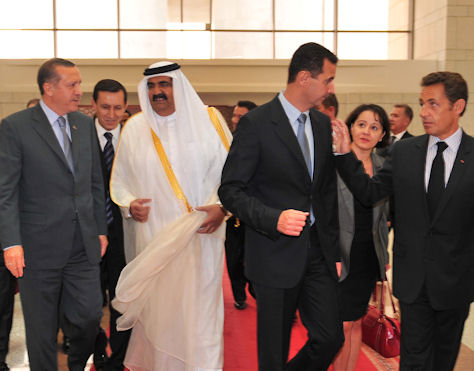
The four leaders who met in Damascus this past week have this in common: they recognize the extreme danger of the present situation in the region, and the unwelcome fact that U.S. President George W Bush, far from acting to resolve conflicts, is largely responsible for the prevailing tensions.The mini-summit in the Syrian capital brought together President Nicolas Sarkozy of France, Turkey’s Prime Minister Recep Tayyip Erdogan, the Emir Hamad bin Khalifa al-Thani of Qatar, and their host, Syrian President Bashar al-Asad.

These four leaders are not seeking to expel the U .S. from Middle East peace-making. On the contrary, they concede that a U.S. role will ultimately be indispensable.  But they feel the urgent need to step into the vacuum created by American failure and wrong-headedness — a vacuum likely to last well into 2009, until the next U.S. President gets into his stride and Israel resolves its current political turmoil.

summit-in-damascus.jpg

Among the many potential flashpoints in the region, which might explode into violent conflict at any moment, are Israel’s unresolved conflicts with Hamas in Gaza and with Hizballah in Lebanon, and the unsettled state of Iraq. Overhanging the entire region is the threat of a clash between Iran on the one hand and Israel and/or the U.S. on the other. It is obvious that any such clash would be immensely damaging to the security and prosperity of the entire Gulf region.

Fear about the regional fall-out from these many conflicts continues to inspire Qatar’s highly-active diplomacy. This small but rich Gulf emirate has won a brilliant reputation as a peace-maker. It has successfully mediated between Lebanon’s warring factions; it aspires to play a similar role in Yemen; and it has sought to ease tensions between Iran and the Arab Gulf. Behind the scenes, it has also tried to encourage a dialogue between Israel and the Arabs.

The four leaders meeting in Damascus are determined to keep current talks going between conflicting parties and, more ambitiously, to formulate a credible regional ‘peace agenda’, which the next U.S. President and the next Israeli Prime Minister will not be able to ignore.

Sarkozy — a self-declared ‘friend of Israel’– is concerned that time for a regional settlement is running out, in part at least because of Israel’s relentless expansion into Palestinian territory and Iran’s nuclear programme.

According to sources close to him, he is convinced that the creation of a Palestinian state, a Syrian-Israeli peace treaty and a deal with Tehran over its nuclear ambitions are the only guarantees of Israel’s long-term security. Without progress on all three fronts, Israel would, he believes, be condemned to live in a hostile environment for the foreseeable future and have to fight endless wars. Its very existence would then be in danger.

Turkey’s Prime Minister Erdogan, on good terms with both Israel and Syria, is well-placed to host the Syrian-Israeli talks which have been taking place in Ankara – so far only indirect talks, but likely to progress to direct negotiations once agreement is reached on the basic principles of a peace settlement, and once a new American president, committed to peace, takes office.

Erdogan is also deeply concerned about the situation in the Caucasus and the Black Sea. He fears that the U.S. may overplay its hand in Georgia and the Ukraine and draw Turkey, a NATO member of long-standing, into an unwanted confrontation with Russia — which happens to be Turkey’s main trading partner, supplying three-quarters of the gas it consumes and nearly a third of its oil.

Erdogan has secured Sarkozy’s backing for his so-called Caucasus Stability and Cooperation Pact – an ambitious project which would include Turkey and Russia as well as Georgia, Armenia and Azarbaijan. If such a pact could be formed, it would be a triumph for Turkish diplomacy.

Syria is an unavoidable player in Middle East peace-making, as France, Turkey and Qatar have recognized. It has a central role to play in Lebanon, in the Arab-Israeli conflict, in its strategic relations with Iran and in its influence in Iraq. But, trapped in outdated policies, largely dictated by pro-Israeli neo-conservatives, the U.S. continues to cold-shoulder and sanction Syria.

It is no accident that, instead of being in Damascus last week – where the real action was taking place — Secretary of State Condoleezza Rice was far away in Libya, making it up with the erratic Colonel Muammar al-Qadafi.

President Bashar al-Asad is acutely aware of the dangers Syria will face if the chance of peace is missed. Peace, he knows, is an essential precondition for the creation of the modern and prosperous Syria he dreams of. But, in seeking peace – and the return of the Golan Heights seized by Israel in 1967 — he is not ready to sacrifice his relations with Iran or his backing for the resistance movements in Lebanon and Palestine — until, as he puts it, ‘the facts of [Israeli] occupation themselves change.’

Syria remains committed to the search for a comprehensive peace which must include the Palestinians as well as Syria and Lebanon. Iran is another player which cannot be excluded from any regional settlement, such is the major role it is playing in Iraq, Syria, Lebanon and the Palestinian territories.  

There is clearly a great deal of work for would-be peace brokers to do until the United States, under a new President, takes up the task, criminally neglected for so long by George W Bush. 

_______________________________________

Patrick Seale is a leading British writer on the Middle East, and the author of The Struggle for Syria; also, Asad of Syria: The Struggle for the Middle East; and Abu Nidal: A Gun for Hire. 


News Round UP (9 Sept. 2008)

Dealing in Damascus, Rami Khoury
Daily Star, Sept. 8, 2008

[Photo by Ahmad Shamma]

….This week’s Damascus meeting testifies dramatically to the changing Middle East, which has become incredibly complicated in view of the many conflicts that are now entangled in a single large regional dynamic. It also points to greater changes ahead, because of Syria’s contradictory position on some core issues related to Iran, Lebanon and Israel.

The most striking common denominator in this gathering comprises the roles of France, Qatar and Turkey as important new diplomatic mediators in the Middle East, filling the large gap left by the United States, which has increasingly marginalized itself by its own mistakes and biases. The United States, Europe — and the UN to a lesser extent — have dominated diplomacy on Israel-Palestine, Syria, Lebanon, and Iran, but they have systematically failed to achieve breakthroughs. The 2006 Israel-Hizbullah summer war reminded everyone of the terrible carnage that will surely occur when simmering tensions erupt into war. The Iraq war revealed how conflict in one area spills over into and destabilizes other parts of the region. Last year’s brief war between the Lebanese army and the Fateh el-Islam radical Salafist group pointed to the new terror threats the entire region faces.

The vacuum created by the United States’ diplomatic auto-demotion is being filled quickly, so that the regional conflicts do not erupt into active warfare. Qatar, Turkey and France are the main players offering to mediate; others also seek roles, including Saudi Arabia, Egypt and Jordan. The focus on Damascus now is solely because Syria has its hands in almost every major conflict in the region — Lebanon, Iraq, Iran, Palestine, Israel, for starters. It must be engaged and placated to an extent, to prevent a deterioration that results in widespread war and destruction.

Syria’s reasonable demands can be met, such as regime survival, territorial integrity, a return of its occupied Golan Heights, and no political intrigues or military threats emanating from Israel or Lebanon. Wider goals of dominating Lebanon and Jordan are not reasonable and will be resisted. Many Lebanese understandably remain unsure how far the major international and regional players will go to preserve Lebanon’s sovereignty, should Syria try to regain control or major influence there.

The two big players watching the Damascus talks are Iran and Hizbullah, and this is where Syria’s position seems untenable. Syria cannot realistically claim it is interested in negotiating permanent peace with Israel while also maintaining its strong alliances with Iran and Hizbullah. A Syrian-Israeli peace is a strong possibility in the coming two years, and if it happens it will trigger Lebanon-Israel peace talks, and major changes in Hizbullah’s strategy and behavior in Lebanon. Syria cannot credibly make peace with Israel while supporting those who resist and fight Israel.

The prevalent international view is that today’s diplomacy aims to separate Syria from Iran. That is unlikely to happen in the short run, but certain to happen in the longer run. The Syrian-Iranian strategic relationship is an unnatural one, and is also untenable for very long in the face of possible Syrian-Israeli ties.

Syria is bargaining to regain its land, and its place in the heart of the Arab world, rather than remain it its quarantine ward. The prospects of peace with Israel, a secure Assad-led regime, normal ties with the major Western and Arab states, and large injections of development aid have all the trappings of a deal that must appeal to Damascus. Syria will work towards this goal slowly and steadily, according to the established rules of bazaar bargaining — without making abrupt and major concessions, or humiliating its many partners. It will change slowly, and also will seek to have others change with it.

The most intriguing thing going on in Damascus is not about Syria alone; it is rather that events in Damascus could be a harbinger of what could soon take place in Iran — where they also know carpets, and when to strike a reasonable deal before the good buys, and your bargaining power, disappear.

WSJ's Bret Stephens: Democratization and Its Discontents
2008-09-08 21:00:17.870 GMT

"Yes, Leezza, Leezza, Leezza," leched Libya's Moammar Gadhafi last week on the eve of his meeting with the U.S. secretary of state in Tripoli. "I love her very much."

Posterity will surely not record whether the dictator's feelings were reciprocated. But it will remember that Ms. Rice, who began her tenure as secretary with a ringing call for freedom and democracy, is ending it on a more genial note when it comes to the world's despots.

"For 60 years," she said in Cairo in June 2005, "the United States pursued stability at the expense of democracy in the Middle East — and we achieved neither." Yet the U.S. rapprochement with Libya is nothing if not the triumph of the stability agenda over the freedom one. Just ask Libyan democracy activist Fathi El-Jahmi (on whose behalf Sen. Joe Biden has made honorable exertions), assuming you can find him in whatever dark cell Mr. Gadhafi has him in.

But let's give Ms. Rice her due. Her return to the realpolitik of onetime mentor Brent Scowcroft is earning rave reviews. In Time magazine, reporter Scott Macleod lauded her visit to Libya as "an unqualified success" and "an example of how violent disputes in the troubled region can be settled through diplomacy rather than war." Former Clinton administration official James Rubin is over the moon over Ms. Rice's move to establish a formal U.S. interests section in Tehran. Her efforts to bring about an Israeli-Palestinian peace deal are also being lauded, as is her diplomatic outreach to Syria and North Korea…..

Washington is getting what so far seems to be a crummy return on its pro-democracy investments. The Bush administration made a notable push for Palestinian democracy and wound up electing Hamas, which will almost certainly win next year's presidential election should it choose to contest it. It pushed the Syrians out of Lebanon, only to get a weak and divided democratic government that crumbled in the face of Hezbollah's (and Syria's) violent provocations.

It looked on as Pakistan democratized its way out of Pervez Musharraf's autocratic — and relatively clean and competent — hands and into Asif Ali Zardari's dirtier and clumsier ones. It supported Georgia's Mikheil Saakashvili as he blundered his way into a war with neighboring Russia. In Iraq, it has discovered that Prime Minister Nouri al-Maliki is a man in the mold of Charles de Gaulle: firm, astute, nationalistic — and not particular eager to be seen as America's man, much less George W. Bush's….

Time will tell whether Iraq is able to maintain its democracy. But it stands a better chance of survival than Egypt's pressure-cooker regime, the Saudi gerentocracy, Iran's theocracy or Libya's cult-of-personality state. ….

So let's grant that in normalizing relations with a WMD-free Libya, Ms. Rice has chalked up one of the few wins of her desultory tenure — so long as we also grant that turning one dictator would never have happened had we not turned out another.

Nasrallah reaches out to Future, wants dialogue 'today'
The Daily Star, September 08, 2008

BEIRUT: Hizbullah leader Sayyed said Sunday that Lebanon's national dialogue should get under way as soon as possible, exhorting all sides in the country to take part in a discussion that is expected to focus on his party's weapons. Hizbullah is ready "today before tomorrow" to enter into dialogue with other parties, he said in a speech broadcast by Hizbullah's Al-Manar television.

Denying accusations that he and his Shiite party were hostile to Sunni organizations like parliamentary majority leader Saad Hariri's Future Movement, he insisted he was ready to meet with the Beirut MP.

"Even if the security situation means that Hariri and I can't meet personally," he said, "this does not necessarily mean that senior officials from both parties can't."

YNET: Israeli leaders have threatened to assassinate Nasrallah. Hariri's father was assassinated in a truck bombing that has been blamed on Syria, a Hezbollah ally. Nasrallah said the reconciliation would help Hezbollah fight Israel.

Lebanon and Syria have vested interests in each other's success
By The Daily Star, Tuesday, September 09, 2008, Editorial

Over the past week, a number of Lebanese politicians have been harping about ominous warning signs emanating from neighboring Syria that seem to indicate that Damascus seeks to resume its security antics in Lebanon. But a much more serious and tangible threat is brewing next door, and the Lebanese will need to act quickly to avert potentially disastrous consequences. Lebanese politicians might be well-intentioned in pointing out the implicit threats made by President Bashar Assad in his recent remarks on Lebanon, but the real danger, to borrow a phrase from a former US president's election campaign, is the economy, stupid.

Syria's impending economic crisis is the quiet menace that threatens to seriously destabilize both that country and this one. Despite several daring efforts by Assad's economic team, the country's economy is poised on the verge of meltdown, with rapidly declining oil reserves, soaring inflation and a job market that is unable to keep pace with growing demand for employment. Lebanon will not be able to insulate itself against the consequences of economic disaster in Syria, so the two nations share an interest in acting as partners to avert the impending catastrophe.

The only way that the two countries can achieve that is for both of them to act in tandem in turning the tide – both economically in Syria and politically in Lebanon. ….

Syrian economy opens _ will its politics follow? by ZEINA KARAM

Young Syrians sit at the Costa coffee house in downtown Damascus, Syria, Wednesday, Sept. 3, 2008. Today's Syria, at least on the surface, is starkly different from the bland socialist country it was few years ago. But as it transforms itself economically, many are wondering whether the country can break with its hard line, rigid reputation as it emerges from the shadows of its past and change politically, too, at the same pace. (AP Photo/Michel Euler)

In Syria, even the ‘little freedoms’ are now disappearing
The National

In Syria, even the ‘little freedoms’ are now disappearing
The National

…..Much has changed for the better in Syria since I was last there in January. There is a thriving cultural scene, more respect for law and order and, at least for some, a renewed sense of optimism, a sense that Syria is slowly shedding its pariah state image.

Yet, unfortunately, some important things have still to change. There are still many prisoners of conscience in Syrian jails, and the riots at Sidnaya prison in July resulted in several deaths. There was no official transparency in dealing with that, not even towards the relatives of prisoners, many of whom are still in the dark as to whether their loved ones are safe. The low tolerance of dissent and the sense of isolation one feels inside the country, thanks to censorship of the internet and the Western press, is also unchanged.

Many activists told me that they feel under increased pressure every time the international community presses Syria on an issue, be it the Hariri assassination investigation or the more recent nuclear reactor controversy. And it does not matter which issue they are campaigning for – even if it is in line with government policies, such as women’s rights.

Syria urges Arab ministers to discuss US sanctions, DPA

Foreign ministers of the Arab League gathered in Cairo on Monday for talks expected to centre on the Palestinian situation and the crisis in Darfur. Chaired by Saudi Arabia Foreign Minister Prince Saud al-Faisal, the session was due to begin in the evening.

Among those participating are Palestinian President Mahmoud Abbas and Arab League Chief Amr Mussa. The ministers also planned to discuss a unified Arab position to free the region from nuclear weapons.

According to diplomatic sources, Syria wants the ministers to take up the issue of US sanctions preventing Syria and Sudan buying or renting commercial planes.

Syria said such actions violated international civil aviation treaties, international law and the United Nations Charter.

Ahmadinejad enacts Iran-Syria preferential trade agreement- MNA
September 8, 2008

TEHRAN– Iran’s President Mahmud Ahmadinejad here on Monday gave the go-ahead to the Iran-Syria preferential trade agreement approved by Majlis (Iran’s Parliament). According to the approved agreement, the sides vowed to strengthen economic relation, increase trade volume, transform the preferential agreement to a free trade treaty, and to boost bilateral trade, ISNA reported.

 A Preferential Trade Agreement is a trading deal which gives preferential access to certain products from the participating countries. This is done by reducing tariffs, but not by abolishing them completely.

Iraq Palestinians head to Iceland
BBC, September 8, 2008

About 30 Palestinians living in a refugee camp in the desert region along the Iraqi-Syrian border are due to leave for resettlement in Iceland. The UN refugee agency says the group, mostly women and children, has been living under canvas for the past two years in extremely harsh conditions. There are about 2,300 Palestinians encamped in the desert region unable to gain entry to Syria. Iceland takes 25-30 refugees per year, mostly vulnerable women and children.

Al Qaida No. 2: Iran waging 'crusader' war against Islam
Reuters, September 9, 2008

Al Qaida deputy leader Ayman al-Zawahri accused Iran of taking part in a Western "crusader" war against Islam, in a video aired by al Jazeera television on Monday.

The video also included apparently recent footage of senior al Qaida figure Mustafa Abu al-Yazid, casting doubt on a report that he was killed on the border between Pakistan and Afghanistan last month.

In another segment of the video, Zawahri attacked Iran's Supreme Leader Ayatollah Ali Khamenei, questioning the Islamic Republic's anti-Western stand.

The leader [of Iran] collaborates with the Americans in occupying Iraq and Afghanistan and recognizes the puppet regimes in both countries, while he warns of death and destruction anyone who touches an inch of Iranian soil," Zawahri said. …

Difficult Decisions for Assad, but Syrian Art Sizzles

Syrian Art Sizzles, by Andrew Lee Butters for Time's MidEast blog:

Syrian artists — or at least some of them — are poor no more. Middle Eastern art in general is the latest emerging scene in the contemporary art world, and Syria is moving to the center of it. In the past two years, prices for the artists that Samawi represents have risen 500 to 1,000 percent. Paintings for his top artist, Safwan Dahoul (pictured above), command as much as $200,000. Ayyam Gallery sells most of its works for around $10,000 to $20,000, has a branch in Dubai, is opening one in Beirut, and an exhibition — "Damascus Calling" — at an international art show in New York this October. …..

Difficult decisions loom for Syria's Assad
By Khaled Yacoub Oweis – Analysis
Reuters, 8 Sept. 2008

DAMASCUS (Reuters) – After basking in international limelight, Syrian President Bashar al-Assad faces difficult decisions that could change the political landscape of the Middle East.

Peace talks with Israel and cooperation on Lebanon have helped bring the once international outcast in from the cold, culminating in a visit last week by French President Nicolas Sarkozy, the first Western head of government to visit Syria since the 2005 killing of Lebanese statesman Rafik al-Hariri.

But Assad, shaped by his late father's lifetime of struggle with Israel, is facing pressure to change old alliances with Iran and militant groups, and take specific action on Lebanon to dispel the impression that Syria still refuses to accept the sovereignty of its smaller neighbor. …. Syria has asked France for help on stalled peace talks with Israel. …. "Assad wants to keep talking with Israel without committing to anything. It is understandable since Israel has also not given him anything," one diplomat in the Syrian capital said.

"But Syria cannot keep on dancing with everybody without kissing anyone. Assad has shown no signs of burning bridges with Iran. Hamas is an easier card to play," he added.

Damascus demands the return of all the Golan. Israel, in turn, wants Syria to scale back ties with Iran and cut links to the Palestinian Hamas and Lebanon's Hezbollah, which could mean expelling the Hamas leadership from Damascus and cutting an alleged supply line to the Lebanese Shi'ite group from Syria.

Hamas has denied an Arab press report that its exiled leader Khaled Meshaal was moving to Sudan, but the group stands to lose politically if a peace deal is signed between Israel and Syria….. Syria favors moving to direct talks only after a new U.S. administration comes to office. Assad said an American role was necessary but Turkey will continue to be a main mediator.

"BEHAVIOUR PROBLEM"

….. Syria's proposed economic association agreement with the European Union faces opposition from Britain if Damascus does not cut its alleged support to infiltrators into Iraq. The agreement needs approval of all European Union members to pass.

"Syria is still seen as having a behavior problem, and a new U.S. administration will not change this. One way of doing so is to deliver on (opening) embassies with Lebanon, start physical work on the demarcation of the border and stop backing insurgents in Iraq," another diplomat said.

Assad recently agreed to open diplomatic relations with Beirut and border demarcation, but these issues are mired in committees. Sarkozy made it clear that French rapprochement would not last without specific Syrian action.

Leading Syrian journalist Thabet Salem said the lure of returning the Golan and the economic benefits of peace — Syria's economy has woefully underperformed for decades — would drive Syrian rulers to change their external posture.

"Syria always puts its interests first," Salem said. "The issue is not whether Syria can disengage from Iran, Hezbollah or Hamas but if Israel does not give back the Golan and the talks fail. We're then back to point zero.

“Egyptian anger at Syria and Qatar” (Al-Akhbar Lebanon) Mideastwire.com

Cairo is angry at the Syrian and Qatari movements. The sources revealed to Al-Akhbar that Cairo was not pleased at Syria and Qatar’s attempts to enter on the line of the prisoner exchange deal being brokered by the Egyptians between the Palestinian Hamas movement and the Israelis.

…The official stressed: “We were never against Damascus. But, on the other hand, we never supported its project and attempts to impose its control and hegemony on Lebanon or to spread the Iranian Shi’i project in the region”…”

“Awakenings elements seeking asylum outside of Iraq…” (Az-Zaman)  Mideastwire

…“The commander of the Awakening forces in Diyala stated that thousands of his elements were about to seek asylum in the West along with their families, for fear of being killed or kidnapped by the militias and the governmental troops in light of the Iraqi authorities’ decision to pursue and disarm them. The commander of the Awakening forces in the Diyala province, Ala’a Hamad Sultan al-Nadawi, warned of the bleak fate of his fighters if the government does not handle the unemployment problem that will emerge following its decision to allow only a few elements to join its security forces with thousands of others left without a job. ….

Accord aims to end north Lebanon bloodshed AFP

A reconciliation accord due to be signed later Monday between Alawites and Sunnis in northern Lebanon's capital of Tripoli aims to restore state control in the port city and put an end to bloodshed…..

UN to demand Israel pay Lebanon $1 billion by Roee Nahmias

UN Secretary-General Ban Ki-moon will demand that Israel pay Lebanon $1 billion in compensation over damages caused during the Jewish state's 2006 war against Hizbullah, Lebanese media reported Saturday….

Why Did Violence Plummet? It Wasn't Just the Surge. By: Bob Woodward | The Washington Post
In Washington, conventional wisdom translated these events into a simple view: The surge had worked. But the full story was more complicated. At least three other factors were as important as, or even more important than, the surge. These factors either have not been reported publicly or have received less attention than the influx of troops. …

Israeli Police Suggest Indicting Olmert By: Isabel Kershner | The New York Times

The Israeli police on Sunday recommended indicting Prime Minister Ehud Olmert on charges including bribe-taking, fraud and breach of trust.

Tzipi Livni: Grasping the Nettle By: Dominic Moran | ISN Security Watch
Israeli Foreign Minister Tzipi Livni is favored to assume the role of prime minister, but victory on 17 September guarantees nothing. …

Zvi Bare'l in Haaretz, here (via FLC)

"….Better yet, Israel, which has always made sure to enlist the U.S. against Syria and made an essential contribution to sanctions against Syria, has broken through a new road for itself and shown the U.S. policy of sanctions to be an empty vessel…."

Hokayem and Young on the Assad-Sarkozy Summit

Emile Hokayem, who now works and writes for the National in the EAU sent this note out recommending his own and Michael Young's articles on the recent summit in Syria. Rather then criticise Bush for failing to push the peace process, as many on this site have, they criticise Sarkozy for opportunism, vanity and egotism, suggesting that he is selling out Lebanese sovereignty for the limelight. Here is the note followed by the articles:

Dear colleague, I am writing to share with two pieces that take a different perspective than the mainstream commentary on French President Nicolas Sarkozy's visit to Damascus.&The first one is Michael Young's excellent "Beware, the Friends of Bashar are here."

The second is my column for the National: "Sarkozy courts Syria but who will benefit other than Assad?"

Some may be tempted to dismiss these arguments as unnecessary Lebanese panic, and others as a reflection of our much-suspected "neoconservative leanings" (a baseless claim and always a convenient way to discredit an opinion instead of weighing its merits). I hope due consideration will be given to them.&It is my conviction that Nicolas Sarkozy's opening to Assad, in its timing and manner (and not necessarily its principle), has been a tactical and strategic mistake born of misplaced expectations and wrong readings of Syrian intentions. But despite all the misgivings about Bashar al-Assad, one has to admire his ability to come back in the game by shrewdly manipulating Western actors, governments and non-governments alike.&And if you think I am fundamentally wrong, I would love to hear why.

Best regards, Emile Hokayem

Beware, the Friends of Bashar are here
By Michael Young
Daily Star staff
Thursday, September 04, 2008

very long ago, you will remember, there was the Friends of Lebanon group of states, whose declared aim was to defend Lebanese sovereignty, territorial integrity, political independence, democratic institutions, and what have you. Meeting today in Damascus is a new fraternity, the Friends of Bashar. It includes the emir of Qatar, the prime minister of Turkey, and the French president, Nicolas Sarkozy, and their aim is to ensure that the Assad regime remains in power and breaks out of the international and regional isolation imposed on it after the assassination of the former Lebanese prime minister, Rafik Hariri.

Sarkozy has proven to be the most destructive of opportunists here. After having negotiated a mediocre agreement in Georgia that allowed Russia to pursue its military actions there under the guise of defensive measures, yesterday in Damascus the French president waded into the Shebaa Farms imbroglio, with the same ostentation and shallowness. Sarkozy's true purpose was plain on Tuesday when he declared that peace in the Middle East "went through France and Syria," and that his aim was to see Syria "regaining its place in the concert of nations."

Months ago, after Michel Sleiman's election, the French set some conditions for their opening to Syria, particularly the establishment of diplomatic relations between Damascus and Beirut. We're still waiting. This was largely a pretense. Sarkozy never had any intention of turning those conditions into obstacles blocking French overtures to Bashar Assad, because he is so keen to fill some role in Arab-Israeli peacemaking. Lebanon is an irritant on that front. The Syrians want their peace talks with Israel to be a highway to Washington; Sarkozy is willing to broker that rapprochement if France is given a seat at the negotiating table too; however Syria will only play seriously on the peace front if it can reimpose its hegemony over Lebanon; therefore France will look the other way as Assad rebuilds in Beirut what he was made to abandon in 2005.

For the moment the United States refuses to go along with this, and has informed the French it would continue isolating Syria. But that may be nearing its end because the Bush administration is nearing its end. A new administration, whether Republican or Democrat, will probably alter US policy toward Syria, and those in Lebanon concerned with their country's sovereignty should take heed. President Michel Sleiman has traveled to France, then to Damascus, and this week flew to Qatar to yet again thank Emir Hamad for sponsoring the Doha agreement. However, a visit to Washington at this stage is necessary, because Sleiman needs to urgently offset the influence of the Friends of Bashar.

Sleiman apparently intends to fly to Washington in the near future. However, the president has no desire to transform this into leverage against Syria, nor would that be sensible at this stage. George W. Bush is leaving next January, so whatever he commits to might only last that long. However, and by the same token, Sleiman would make a mistake if he failed to use the trip to prepare for when Bush is gone. If the point is just to get a White House photo-op, then Sleiman might as well ask that his picture be taken with a cardboard effigy of Bush, because the US president is not only a lame duck, he's now virtually a dead one.     

Where Sleiman would gain is by building up networks of relations in the US Congress, in the presidential campaigns, and in the think-tank community, which has been active, reprehensibly so, in encouraging American policymakers to open up to Syria. In fact, Bashar Assad has had a battery of promoters and objective allies in such places as the United States Institute of Peace, the Brookings Institution, the Carnegie Endowment, and the International Crisis Group, to name only them, all of which have urged engagement of Damascus, all of which have willfully ignored or papered over Syria's role in the Hariri assassination.

However, is Sleiman willing to go through with such an effort? Who in his entourage might be able to follow up on his contacts with the Americans? These are all questions the president will need to answer before embarking on his American tour, unless his plan is to avoid making the journey count for very much. And if that is indeed the case, then we would have to assume that little has changed in the Syrian-Lebanese relationship since 2005, with Lebanon's foreign policy still regarded by decision-makers in Beirut as a dispensation of the Assad regime.

Sleiman, if he hopes to plot a course even mildly independent from Syria, must make his American trip work. But the Syrians have a head start. The Friends of Bashar have repeatedly shown how little concerned they are by Syrian behavior in Lebanon – or more accurately, how little concerned they are by Syria's pursuing its destabilization of the country while imposing red lines on elected officials, on ministers, and on military and security appointees. Sleiman needs to guarantee that he has enough pull in the US so that come next year, if a new administration talks to the Assad regime, Lebanon will not once again be Syria's meal.  

Why is it so difficult to be optimistic? Perhaps because Sleiman has a lot going for him politically, but still seems too timid by half. Because he seems so keen to market Syria to the world, as he did last week when he urged the international community to "open up" to Damascus, without anyone having requested such altruism. And because the Friends of Bashar are doing their damnedest to save the skin of a man who has never shown any sign of recognizing Lebanese independence, while the Lebanese don't seem to have a clue as to who will save their skins. 

Michael Young is opinion editor of THE DAILY STAR.

Sarkozy courts Syria but who will benefit other than Assad?
Emile Hokayem
September 05. 2008


The foray of the French President Nicolas Sarkozy into Middle East diplomacy has been called many things: a pure act of vanity by an intensely egotistic person; opportunism in a void created by US diplomatic weakness; and boldness by a visionary statesman in time of regional uncertainty. Given Sarkozy’s polarising persona, it is no wonder that opinions are so divided.

Despite scepticism in the US, Europe and the Arab world about the wisdom of his visit to Damascus, Sarkozy justified himself by noting that the Syrian President Bashar al Assad was following up on his promise to open an embassy in Lebanon. He also appreciated that Mr Assad was asking France to co-sponsor direct peace talks with Israel and hoped Syria would use its influence to talk Iran out of its nuclear ambitions.

The result could place France at the heart of Middle East politics. And for someone dazzled by the spotlight, he scored a diplomatic coup with the four-party summit that included the leaders of Turkey and Qatar. Many will welcome Sarkozy’s visit to Damascus, but there are indeed legitimate questions about the timing and manner of his opening to Syria, which had been shunned for the past three years for its interference in Lebanese affairs. His warm embrace of Assad displayed a curious mix of cynicism and naivety that has not been a characteristic of French diplomacy until now.

His rapprochement with Syria breaks with years of French cautiousness as a result of Syria’s occupation of Lebanon and its suspected role in the 2005 assassination of the former Lebanese prime minister Rafik Hariri. Many Lebanese and their western allies now wonder what remains of France’s previous attachment to their fate.

Indeed, France has taken a risky road. By throwing its weight behind Assad, it is wagering that Syria would value its relationship with France enough to make tangible concessions. But it is unclear what those concessions would be. Already Sarkozy has given Assad a recognition with a high profile visit and an opening to the European Union that the French themselves had so far blocked. As many sceptics of unconditional engagement had warned, Syria’s reaction to the French opening proved that engagement itself is perceived by Damascus as a victory.

As for Syrian “concessions”, they are meagre achievements at best. In the absence of delineation of borders, of Syrian compliance with UN resolutions about arms transfers, and of a revocation of treaties imposed on Lebanon in the 1990s (demands that Sarkozy too quickly softened), the symbolic announcement of an embassy in Beirut does little to end Syrian interference in Lebanon. French diplomacy may have also misread Syrian calculations. By reaching out to Paris and indirectly negotiating with Israel, Syria seeks in reality to tie the hands of the next US president. Indeed, the US, not France, can offer Syria what it really wants: recognition of its regional ambitions, including a dominant say in Lebanese affairs. Such an arrangement, reminiscent of the international acquiescence of Syrian domination in the 1990s, would turn back the clock on the peaceful achievements of the 2005 Cedar Revolution.

Mindful of that, Syria is already courting Democratic officials and foreign policy experts in Washington, dangling before them the prospect of peace at the expense of any discussion of Syria’s past behaviour. By disingenuously insisting that the US is the only obstacle to peace with Israel and suggesting that the international tribunal looking into the Hariri and other assassinations is an unnecessary complication, Damascus hopes to send the policy of isolation into oblivion and emasculate the tribunal. Once its isolation is lifted, Syria probably reasons, the international community would not risk losing its political investment in Syria for the sake of bringing to justice Syrian suspects. In the medium term, Syrian calculations have little to do with France’s agenda. In the next year, Syria will be watching the outcomes of elections in the US, Lebanon and Israel before making its next move. It may not get what it wants but it has certainly succeeded in shaping a radically different environment.

And it may have won an unlikely ally. Israel, concerned about Hezbollah’s growing power in Lebanon, longs for the days of a return address. With Syria out of Lebanon, there is too much uncertainty for Israel, as the 2006 war demonstrated. If Syria were to abide by a strategic understanding that would stabilise its northern front, Israel may have no qualms about the return of Syrian influence next door.

Assad did not help quell concerns about predatory Syrian behaviour when he compared Georgia, which Russia invaded after claiming it posed a threat to Russian interests, to Lebanon. Sure enough, Assad claimed in his talks with Sarkozy that Sunni fundamentalism, not Syrian interference, was the real threat to Lebanese stability and by extension, to Syria, paving the ground for a possible Russian-style ‘peacemaking’ mission. For someone accused of supporting armed groups in Lebanon, this warning was worrying.

French diplomats say that considerations regarding Iran also drive the rapprochement. Instead of trying to wedge Damascus away from Tehran, long the rationale of those pushing for engagement, Sarkozy has crowned Assad as his intercessor with Tehran. He is overestimating how much leverage Syria really has. Syria does not shy away from making presumptuous claims about its regional influence. People close to the Syrian regime credit Syria with stabilising Iraq and freeing the British sailors seized by Iran in 2007, no less. A Syrian analyst also claims that only Syria can change Iran’s nuclear course, an argument that Sarkozy himself echoed yesterday.

This may be an overly pessimistic reading of Sarkozy’s Syria policy, it is up to French diplomacy to dispel these concerns – and urgently so.

[email protected]

Economic News About Syria (6 Sept 2008)

Inflation makes life ‘unbearable’
Phil Sands, Foreign Correspondent
The National – September 06. 2008

DAMASCUS // For years Abu Mohammed struggled to make ends meet, working as a painter, fruit seller or water carrier to put food on the family table. But soaring prices have made his daily battle for survival ever harder.

“A year ago I could pay for all the basics with 7,000 Syrian pounds [Dh440] a month,” he said. “Today I need double that. Today I need 14,000 pounds just to get by.”

Although the cost of food, fuel and housing has risen dramatically in Damascus, household incomes for the majority of Syrians has not. Official government figures for 2007 recorded an inflation rate of less than six per cent, a number rejected by independent economists here who estimate that real living costs rose by up to 30 per cent.

Whatever the actual numbers, inflation is beginning to bite hard and the poorest members of society, such as Mr Mohammed, 47, are bearing the brunt.

He said that in 2006 he could feed, house and clothe his wife and seven children without outside help. Now he relies on handouts from a community mosque in Blackstone, where he lives, 8km south of Damascus.

“Life is getting unbearable,” he said. “The cost of living is all I talk about with my neighbours; it’s a constant worry, it’s the only thing on my mind. It’s the only thing Syrians think about.”

A poor harvest has pushed down supplies of food, while an influx of Iraqi refugees has added to demand.

The resulting rise in prices has forced Mr Mohammed into an increasingly desperate position. Each afternoon he goes to the local market to buy damaged fruit and vegetables that are sold cheaply.

Sometimes, he said, he sifts though rubbish dumps for pieces of scrap metal that can be sold to salvage yards.

“We have one meal a day because that’s all I can afford at the moment,” he said. “We eat meat perhaps twice a month. I’m ashamed to tell you my daughter fainted in school, because I hadn’t fed her properly. She was too embarrassed to tell her teachers it was because she was hungry……

In a recent survey of 1,000 Damascus residents by the Syrian Economic Centre, 70 per cent said their financial situation had “deteriorated seriously” during the past two years…..

The International Monetary Fund has praised the Syrian authorities for their handling of the situation and for resisting the temptation to simply print more money. A 2007 International Monetary Foundation report said that “barring policy missteps or a deterioration in the regional environment, the near-term outlook for growth and inflation looks favourable”.

But with oil reserves running dry, the government can no longer afford to bankroll huge national subsidies, something economists warn is a potential time bomb for the Syrian economy.

“There is no easy way to deal with this problem; it’s going to be painful,” said Nabil Sukkar, managing director of the Syrian Consulting Bureau for Development and Investment. “If we don’t remove subsidies, there will be a growing deficit, and that will cause inflation. If we remove subsidies, salaries will have to be raised and there will be inflation.”….

“Inflation is dangerous for the Syrian economy, as it’s dangerous for all economies; the problem is we are heading towards a threatening level. We should take steps to cope with it before it gets out of control. Difficult decisions are going to have to be made.” ….

In his illegally built house in Blackstone, just south of Damascus, Mr Mamard said he feared his situation was only going to get worse. “I walk out of a shop, and the next time I go in the prices have gone up.

“If they remove the subsidies I don’t know how I will pay for things. My wife has diabetes, and I can’t really afford the medicine as it is. I don’t know how we will get by.”

[Read the whole article]

Syria stands at economic crossroads
By Lina Sinjab
BBC News, September 3, 2008

This socialist state has introduced a range of new laws which have opened Syria to international and private business.

In the past year, cappuccino culture has arrived, with the opening of international coffee chains.

Many of the customers in such cafes have studied and worked abroad – and are bringing now their experiences back home.

"This country is seriously booming," says one of a group of young women in western clothes. "Everyone dresses up, the places are new, the roads are clean. We are not going to be third world for the rest of our life."

Part of the new strategy is to use business to improve relations with other countries in the region and in the West.

"It is a way for Syria to break the isolation, because by attracting investment you are having foreign companies that have interests in Syria and they will have to defend their interest in Syria," says economics commentator and Syria Report editor Jihad Yazigi.

"It's a circle. More investments improve political relations and political relations attract more investment and more investments"

Rising prices

Syria has been a socialist country led by a single party for decades. 

Deputy Prime Minister Abdullah Dardari, who is spearheading the economic reform programme, says the changes present opportunities and challenges.

"They are a challenge for social equity, for stability and they are challenge to the status quo," he says.

"What we need to have is the culture of an open and integrated economy, people to believe in the opportunities that this new economy offers them and move away from depending totally on the state for finding jobs."

But most people in Syria are yet to feel the effects of foreign investment.

In a food market in Damascus, people are haggling over the price of vegetables.

"My husband is a civil servant and yet we cannot afford to live any more. We have to prioritise our purchases," one shopper tells me.

In May, the government cut fuel subsidies, leading to a 300% increase in the cost of diesel, with a huge knock-on effect for prices.

International effect

In downtown Damascus, you can now dance the night away in an open-air rooftop bar that would not be out of place in any European capital. It costs about $20 (£10) to enter, which is half the average weekly wage in Syria.

But liberalisation of the economy has brought international jobs and increased some salaries in the private sector.

Business student Omar drinks his tequila, and wonders how people can afford places like this.

"For me I do some work, I can afford it, but I don't save money, that's the thing," he says.

The waiters make about £25 a week. For Amaar Mohammed, it is one of his two jobs.

At the end of his shift in the early hours of the morning, Amaar transforms from nightclub waiter to school teacher.

"Life is becoming harder. You have to work hard to survive. I'm working just to buy a simple home. I don't dream of anything else," he says.

"Syria has never deviated from this strategy, and if the peace process was obstructed and frozen, it is the responsibility of Israel's subsequent governments and the administration of President Bush, which cancelled the word ‘dialogue’ from its dictionary.”

“Sarkozy’s gamble”

“No one can claim that French president Nicholas Sarkozy’s visit to Damascus today has a Lebanese goal,” Sateh Noureddine, a regular columnist for Lebanon’s independent leftist newspaper As-Safir, wrote on September 3. “But no one can claim that Lebanon is not part of that visit that aroused so much controversy in Beirut.”

Resolving the Lebanese crisis was a mandatory condition for normalizing relations between Paris and Damascus, he wrote.

“It is difficult not to jump to the conclusion that Sarkozy has decided to return to the old western and international tradition, which considered Damascus to be the gate to Beirut.”

That tradition used to mean that any western official had to seek permission from Damascus before visiting Beirut and then pass by Damascus on his way back, Noureddine wrote.

“Yet there is nothing to corroborate this impression, especially as there are many Lebanese developments that justify Paris’s desire to open up to Damascus.”

France wants to find an alternative to imposing isolation and siege on Syria, which have proven to be fruitless, he wrote.

Syria: Economic Overviews
Economist Intelligence Unit, September 3, 2008

The president, Bashar al-Assad, is expected to remain in power in 2008-09. He will continue to rely on the strength and loyalty of the security services, which will keep opposition forces weak and ineffective.

  • Ongoing talks with Israel and an easing of tensions in Lebanon will give Mr Assad the opportunity to reduce Syria's political isolation, but he is unlikely to end its strategic alliance with Iran.
  • Economic policy will be dominated by conflicting views on how to respond to high global oil and commodity prices in the context of fiscal deficits.
  • Syrian oil production will decline slightly over the outlook period, which will reduce export volumes and government spending and thereby curb economic growth. * After having appreciated significantly against the dollar this year (because of the US currency's weakness), the Syrian pound is expected to stabilise in 2009.
  • The current-account surplus is forecast to widen to US$1.4bn, or 2.6% of GDP, in 2008, before narrowing to 0.9% of GDP in 2009, as a result of rising imports.

DOMESTIC POLITICS: There is little prospect of any serious challenge to the president in 2008-09, and substantive political reforms are unlikely.
Mr Assad's control of the country is supported by key elements in the security services and by the ruling Baath party. The core of the elite is
drawn from Mr Assad's minority Alawi sect, and is acutely conscious that to move against him would risk endangering the Alawi hold on power. For
this reason, the rumours that emerged in a German newspaper, Die Welt, of an attempted coup in February are unlikely to be correct. However, the mysterious assassination in August of a close ally of Mr Assad's in the military, Mohammed Suleiman, was a reminder that there are tensions below the surface of the regime. Since assuming power following the death of his father, Hafez al-Assad, in 2000, Mr Assad has stepped up repression of local opposition groups and activists, and has appointed his own close allies to key posts. This has increased his control, albeit at the cost of narrowing his power base.

INTERNATIONAL RELATIONS: Since May 2008 Syria's international isolation has begun to ease, largely because of its support for the May 2008 Doha agreement between the opposing factions in Lebanon and its agreement to normalise diplomatic relations with Lebanon, as well as its engagement in the current indirect talks with Israel being brokered by Turkey. The early fruits of these developments have included loans and grants from Gulf Arab states, an invitation to Mr Assad to attend the launch of the Union for the Mediterranean in Paris in July and an imminent visit to Damascus, the Syrian capital, by the French president, Nicolas Sarkozy. However, Syria's diplomatic links with the region's heavyweights, Egypt and Saudi Arabia (whose leaders boycotted the March 2008 Arab League summit in Damascus), have remained strained. A rapprochement with the US would also be difficult, although it could become more likely towards the end of the outlook period if Barack Obama becomes US president and implements his stated policy of dialogue with enemy states, including Syria. However, Syria still considers Lebanon to be within its sphere of influence and Mr Assad is therefore likely to get entangled in controversy again in the run-up to the 2009 Lebanese parliamentary election. A further threat is the UN investigation into the assassination of a former Lebanese prime minister, Rafiq al-Hariri, which is expected to implicate senior Syrian officials.

POLICY TRENDS: Syria has been gradually reforming its centrally planned economy, a process that has been led by the deputy prime minister for economic affairs, Abdullah al-Dardari. The rise in global commodity prices, at a time of declining oil production, has highlighted the weakness of the Syrian economic system and enabled fiscally prudent reformers finally to make some progress on issues such as subsidies and taxation. Fuel subsidies were reduced in May, but higher oil prices and a 25% rise in public-sector salaries have largely offset the fiscal benefits, leaving open the debate on reform of the public finances. Although the introduction of a value-added tax (VAT) has been approved in principle, its implementation, which has already been delayed, appears unlikely until well into 2009. The policy debate in 2009 will increasingly focus on the need to diversify the economy away from oil and to encourage investment–including through the opening of the Damascus Stock Exchange.

INTERNATIONAL ASSUMPTIONS: World GDP growth (at purchasing power parity exchange rates) is expected to average 3.6% in 2008-09, down from an estimated 4.8% in 2007, largely because of a sharp slowdown in the US economy in 2008. Oil prices will remain high as buoyant demand in emerging markets offsets the slowdown in the OECD, although they will remain well off their peak. The Economist Intelligence Unit now forecasts that the price of the benchmark dated Brent Blend will fall from an average of US$110/barrel this year to US$91/b in 2009.

ECONOMIC GROWTH: Although the government estimates that growth in 2007 was 6.5%, we put it at 4.3% and the IMF is even more downbeat, estimating it at 3.9%. The most recent Quarterly Bulletin from the Central Bank of Syria does not include an estimate for 2007 GDP, whereas the previous bulletin did. This implies that the figures are being re-examined, and we would expect a downgrade. We expect the Syrian economy to slow further this year, bringing growth down to 2.4%, owing to falling oil output and a particularly poor harvest. These negative factors will be only partly offset by continued expansion in the services sector, boosted by solid growth in tourism and in demand for goods and services, in part from the large Iraqi refugee population. We forecast that growth will recover to 3.7% in 2009, assuming that the current drought does not continue.

INFLATION: We expect inflation to continue to rise in 2008–to an average of around 16.8%–owing to significant reductions in fuel subsidies in March and May and to a 25% increase in government salaries and pensions. However, it is possible that these changes could drive inflation even
higher than we currently forecast. In 2009 a decline in oil prices and an easing of non-oil commodity prices will help to bring down inflation, to
around 10.2%, and any significant return of Iraqi nationals to their homeland could lower it even further by reducing demand pressures. We
estimate that annual average inflation was about 12.2% in 2007, even though the official consumer price index shows that prices were flat over
the first three quarters of 2007 (full-year data are not yet available).

EXCHANGE RATES: The Syrian pound has been pegged to a basket of currencies based on the IMF's special drawing rights (SDR) since October 2007, resulting in a marked appreciation against the US dollar. Although the new regime is less rigid than the previous peg to the dollar, the authorities are unlikely to let it float freely, placing a high priority on exchange-rate stability. The dominant position of the state-owned banks
and the Central Bank's control over foreign-currency transactions (even as some laws are relaxed) mean that the regime is well placed do this. The
dollar has recovered slightly from its lowest point against the pound (SP45.8:US$1), but we do not expect any substantive change over the next
year, and the 2009 average is forecast to be SP46.7:US$1.

EXTERNAL SECTOR: We expect Syria's merchandise export earnings to rise by 19% in 2008, owing to an increase in oil prices, which will offset the
negative impact of falling oil production and reduced wheat exports resulting from a poor harvest. In 2009, in spite of a better harvest, a fall in oil prices will lead to a 1% drop in export earnings. However, because Syria is now importing almost the same volume of refined products as it exports in crude oil, the overall effect of oil price shifts on the trade account will be minimal. Non-oil exports are continuing to benefit from strong regional demand and the relaxation of foreign-exchange controls, which has led to more exports being officially recorded. Import spending growth will remain strong over the outlook period, partly because of the ongoing process of tariff liberalisation, but also because of healthy demand for capital goods related to some large infrastructure and construction projects. With all these factors taken together, the trade surplus will narrow over the outlook period from about US$1bn (1.9% of GDP) in 2008 to about US$160m next year.

Where the poor are concerned, Syrian media has nothing to report
By RAHUDA ABDOUSH
Menassat, July 15th, 2008 

More than 2 million Syrians live below the poverty line of two dollars a day. But you would never know it from the Syrian media. Media analyst Ruhada Abdoush explores how Syria's poor are perceived, and ignored, by the media establishment. …….

Media analysts are quick to point out that privately-owned newspapers such as al-Watan or Baladona also act as if there are no social or economic problems in Syria…..

Turning to the electronic media, with websites such as Thara, Marsad Nisa’ Souriya and al-Jamal, the qualitative gap with the rest of the media is clear. This is due perhaps to the publishing freedom electronic media enjoys, or maybe because of the gravity with which they address issues of public interest and social awareness experienced by most Syrians.

Still, even in the electronic media the treatment of the poor mainly touches on domestic violence and its relation to poverty and unemployment.

TV drama to the rescue

Examining the TV stations, both local and satellite Syrian broadcasters  avoid any programs dealing with the livelihood of the disenfranchised in their news or analysis, relying instead on ornamentation and state slogans about government steps to address their plight.

That is unless Syrian TV dramatic series are considered as credible news sources.

Ironically, Syrian TV drama series do manage to portray characters that are indeed deprived both socially and economically. As an example, writer Fouad Humeira's popular series, Deer in a Forest of Wolves, which aired on Syria's second channel two years ago, often cut away to poor people in their homes wrestling with their dreams and their hardship.  

It is a trend that has been found in recent Syrian drama series through writers such as Dalah Al-Rahbi and Reem Hanna, both of whom have made the point that the poor deserve as much attention as the more economically well-off in Syrian society. 

Syrian media expert Hala Al-Atasy told MENASSAT that the media landscape in Syria is like "an island isolated from its surroundings."….

WSN Editor Broader Middle East, Manuela Paraipan,

Walid Jumblatt: The West tried to grab Georgia, fix it and introduce it to NATO. The Russians have a good relationship with Syria, and I think it will further improve. This is why I am keen to see Lebanon in the non-alignment agreement instead of somewhere in the middle following a similar line to the foolish policy of Georgia.

Walid Jumblatt: We never had a state because we have no sense of citizenship. We always claimed we are Lebanese, but Lebanon is divided along confessional lines. When my father was leading the leftist parties – the national movement – he tried to change the system of Lebanon. However, the so-called progressive environment, the Baathists and the reactionist environment of the Arab world were all against having a secular state in Lebanon. When he was powerful, at one point people from certain circles – like Kissinger – said that Kamal Jumblatt was an extremist-leftist and he was eliminated. In 1975, the Americans allowed the Syrians to come to Lebanon, and they killed my father.

The West tried to grab Georgia, fix it and introduce it to NATO. The Russians have a good relationship with Syria, and I think it will further improve. This is why I am keen to see Lebanon in the non-alignment agreement instead of somewhere in the middle following a similar line to the foolish policy of Georgia.

Walid Jumblatt: We never had a state because we have no sense of citizenship. We always claimed we are Lebanese, but Lebanon is divided along confessional lines. When my father was leading the leftist parties – the national movement – he tried to change the system of Lebanon. However, the so-called progressive environment, the Baathists and the reactionist environment of the Arab world were all against having a secular state in Lebanon. When he was powerful, at one point people from certain circles – like Kissinger – said that Kamal Jumblatt was an extremist-leftist and he was eliminated. In 1975, the Americans allowed the Syrians to come to Lebanon, and they killed my father.

….. Its impossible for the United States to move peacefully. It is just impossible, with all the corporations ruling the country. Furthermore it is a competition between the United States, China and others as to who will control more of the wealth of this planet, and the planet is being systematically destroyed by the United States……."

 Republic of Blowback By: Ken Menkhaus and Karin von Hippel | International Herald Tribune

American diplomatic, intelligence and military activity designed to reduce Islamic radicalism and the threat of terrorism in Somalia have instead helped to catalyze a much more powerful, popular, shockingly violent and stridently anti-American jihadist movement.

News Roundup (6 Sept. 2008)

Israeli official denies U.S. supervisors will take part in Israel-Syria peace talks
By Barak Ravid and Yoav Stern, Haaretz Correspondents, 06/09/2008

A senior European official visiting Israel told the London-bed Arabic language newspaper Al Sharq al-Awsat that an American observer was scheduled to take part in indirect peace talks between Israel and Syria to be held in Turkey in two weeks, the paper reported Saturday.

An official in Jerusalem, however, told Haaretz the report was untrue and that he had no knowledge of any U.S. involvement in the peace talks, currently being held indirectly under Turkish mediation.

The report, however, included confirmation by an Israeli source that a U.S. official was in fact to act as an observer in the upcoming talks.

The report marks the first time the possibility of U.S. participation in Israel-Syria talks has been brought up since the collapse of U.S. mediated negotiations in the Shepherdstown summit, held in West Virginia in 2000.

The talks, led by then prime minister Ehud Barak, failed to yield any concrete results, but both Syrian and Israeli officials did vow to return to negotiations as soon as possible, but have yet to fulfill that vow.

Syria has said in the past that any successful negotiations would need the participation of American supervisors, and could only be held after President George W. Bush leaves office.

An official in Damascus told Al Sharq Al-Awsat that due to Syrian suspicions towards the United States, it is not clear whether Syria will ask for them to help in negotiations.

U.S. State Department official John Sullivan told Al-Sharq Al-Awsat that the United States supports continued Israel-Syria talks, but said he could not confirm whether or not U.S. supervisors would participate in any future round of negotiations.

Daily Star Editorial: Will Israel and America spurn yet another Arab overture?

"…The Israeli people would do well to reflect on exactly what that means, and they should start by asking themselves what kind of Israel they want. Is it really worth it to keep occupying other people's land and killing Arabs for a country that then has to cope with the inevitable backlash of its own violence by installing sirens in every city to alert them that it's time to get underground in their bunkers? Or do they want to live in peace with their neighbors? The choice is theirs to make."

Reports of Abbsi's arrest in Syria not yet verified – Najjar
By Nicholas Kimbrell
The Daily Star, September 06, 2008

BEIRUT: Amid speculation on Thursday and Friday that Fatah al-Islam chief Shaker al-Abssi had been detained in Syria, Lebanon's Justice Minister said that if the reports were verified, Lebanon might act to have Abssi extradited. Ibrahim Najjar, the newly appointed justice minister, told The Daily Star that he could not confirm the reports. "I have just asked yesterday about this news, [and] I have to wait and see," he said.

"We need to be sure," he added, "first, that Shaker al-Abssi is in custody, and second, that the Syrians have released such a statement."

When asked if Lebanon may seek extradition of Abssi, if he has indeed been arrested, Najjar said: "If the news is verified and the implementation of the bilateral convention [for normalization between Lebanon and Syria] goes through, then we might ask that he face justice in Lebanon … if all the prerequisites are verified."

A news feed by Naharnet on Thursday reported that Syrian officials had notified visiting French President Nicolas Sarkozy this week that Abssi had been detained.

According to Naharnet, "Sources, speaking on condition of anonymity, said contacts were under way between security agencies in Damascus and Beirut to determine whether Abssi would be extradited to Lebanon or tried in Syria."

Dubai-based Al-Bayan reported Thursday morning that Abssi had crossed into Syria where he has been in custody for a month and half.

Shaker al-Abssi led Fatah al-Islam in their 15-week war against the Lebanese Armed Forces (LAF) in the Nahr al-Bared refugee camp outside the northern city of Tripoli in the summer of 2007.

The battle took the lives of hundreds of civilians and Fatah al-Islam fighters, as well as 171 LAF soldiers.

After rumors that Abssi had been killed in the fighting, he was reported to have mysteriously escaped the camp.

France working to secure release of abducted Israeli soldier
World Jewish Congress, September 5, 2008

France has passed on a letter for the abducted Israeli soldier Gilad Shalit, who was seized by Palestinian militant groups in Gaza two years ago. It was brought by French president Nicolas Sarkozy, who attended a summit with the leaders of Syria, Qatar and Turkey in Damascus. The letter from Shalit's father is to be delivered by the Emir of Qatar to the Damascus-based leader of the Hamas movement, Khaled Meshal. French diplomats were quoted as saying that Syrian president Bashar al-Assad had been "happy to help" in the Shalit case "but he does not want to be seen as an official, designated middleman". “This is an issue I want to say very little about," Sarkozy told the AFP news agency in Damascus. "What I am interested in is results." On Wednesday, a senior Hamas figure in Gaza, Mahmoud Zahhar, was reported as saying Egyptian-mediated talks for Shalit's release had stalled. He said Israel was continuing to reject Hamas's demands over a proposed prisoner exchange. Hamas, which seized control of the Gaza Strip in June 2007, is seeking the release of hundreds of Palestinian prisoners held in Israeli jails.

Peres proposes direct talks with Syria
By Guy Dinmore
Financial Times, September 5, 2008

Syria and Israel should hold direct talks in Jerusalem or Damascus, Shimon Peres, the Israeli president, proposed on Friday.

Mr Peres, who holds a largely ceremonial role as president, extended an invitation to Syria’s Bashar al-Assad with Mahmoud Abbas, the Palestinian president, beside him as they debated the prospects for peace at the annual Ambrosetti conference on the shores of Italy’s Lake Como.

Sarkozy in Syria

An Israeli partner is needed
05/09/2008
By Haaretz Editorial

Yesterday's four-way summit in Damascus was one of this region's most important diplomatic events for some time. It is not merely Bashar Assad's newfound standing because of the French attitude to Syria, but a new strategic opportunity.

However, Syria's changed international position is in itself significant. After all, Syria has ridiculed the sanctions imposed on it by Washington, and it is doubtful whether any international player will now seriously demand the implementation of Security Council Resolution 1559, passed four years ago, which serves as the basis for the international community's demand that Hezbollah be disarmed.

But this time Israel cannot be angry with the French. After all, it did an about-face as well when it began an indirect dialogue with Syria, which is meant to turn into direct talks at a later stage. In this Israel diverged from the normal framework, under which its relations with the countries in the region are coordinated with the United States. This is even more blatant in the case of Syria, as Israeli lobbying significantly affected American attitudes toward Damascus.

However, beyond the settling of scores between Jerusalem, Washington and Paris, the dialogue with Syria has opened a serious new window of opportunity. Assad claims to have presented a number of practical proposals for continuing negotiations, and has announced that he would like to hold direct talks after the U.S. elections. By this he is openly exhibiting his expectations that the Americans will be partners. No less important is the businesslike tone of his comments about Syrian contacts with Israel. It is encouraging that in addition to the French president, the ruler of Qatar and the prime minister of Turkey – the country that has hosted the indirect talks – have highlighted the negotiations with Israel in their talks in Damascus.

Of course, the concerns and suspicions raised by the opponents of dialogue with Syria should not be ignored. Most importantly, it is important to evaluate the price Israel will have to pay for an agreement with Syria. But there will be time for this when the direct negotiations begin and the Israeli public, which recognizes that Israel will have to withdraw from the Golan Heights, learns what it will get in return.

In the meantime, it seems that if there is an obstacle to the talks, it comes from the Israeli side. Prime Minister Ehud Olmert, who initiated the dialogue, is about to end his tenure, so the status of the person responsible for the negotiations is unclear. This situation has already broken the talks' continuity. Every effort must be taken to ensure that this break will be short, because it is vital that the meetings keep their momentum.

But removing bureaucratic obstacles slowing the dialogue is not enough. This is the time to demand from Kadima's candidates for prime minister, and from its coalition partners, to take a clear public stance on the results this dialogue might produce. Are they thinking about continuing the process begun by Olmert? Can Israeli citizens expect a future of positive diplomatic results that will end the long war against Syria and its partners in Lebanon? The answer to both these questions needs to be affirmative if the Kadima and Labor candidates want the public's support.

Peres proposes direct talks with Syria
By Guy Dinmore in Cernobbio, Italy
September 5 2008 15:50 | Financial Times

Syria and Israel should hold direct talks in Jerusalem or Damascus, Shimon Peres, the Israeli president, proposed on Friday.

Mr Peres, who holds a largely ceremonial role as president, extended an invitation to Syria’s Bashar al-Assad with Mahmoud Abbas, the Palestinian president, beside him as they debated the prospects for peace at the annual Ambrosetti conference on the shores of Italy’s Lake Como.

Drawing comparisons with the visit to Jerusalem by Egypt’s Anwar Sadat in 1977, followed by the late King Hussein of Jordan, Mr Peres said that if President Assad visited Israel or invited the Israeli prime minister to Syria then “we shall see a major change”.

Richard Holbrooke, a former senior US diplomat who was moderating the debate, pressed Mr Peres on whether he had formally extended an invitation. Mr Peres indicated that he had made a gesture, although he quoted Mr Assad as expressing the view that negotiations would not take place while the present US administration was in place…..

“We are on the waiting list,” Mr Peres said, alluding to the presence in Damascus this week of Nicolas Sarkozy, the French president, and Turkey’s mediating role.

Raed Rafei in Beirut reporting for LA Times Blog writes:

Beyond political statements, the French-Syrian talks had a business dimension.

Sarkozy and Assad signed seven agreements on cooperation in the fields of petroleum, gas, electricity and railways, according to the official Syrian news agency, SANA. The agreements involve big French companies such as Total, the oil multinational, and aircraft manufacturer Airbus.

In an article published recently by the Washington-based Middle East Times, Andrew D. Bishop wrote that economic interests may well be behind France’s overtures toward Syria:

“Sarkozy's kind words and gentle moves toward Damascus are perhaps meant to open doors to fresh markets for France's corporate mammoths. … Assad is seeking to revamp his country's economy, and Sarkozy intends on lending him the hand he needs.”

France’s Total has signed three oil and gas agreements with Syria during the visit of French President Nicolas Sarkozy to the country. (Tehran Times)

Syria in talks to buy Airbus jets
By Andrew England in Damascus and Ben Hall and Peggy Hollinger in Paris
September 3 2008 22:14 | Financial Times

President Nicolas Sarkozy began a two-day visit to Damascus on Wednesday as the French government confirmed that “exploratory discussions” had taken place with Syria over its desire to buy Airbus passenger jets.

Bashar al-Assad, the Syrian president, is hoping that Mr Sarkozy’s visit – the first by a western leader for several years – will help secure his tentative return to the international fold.

But the preliminary talks about the potential sale of Airbus aircraft to Syrianair will add to sensitivities over Mr Sarkozy’s initiative, particularly in Washington. The US has a trade embargo against Syria and Airbus jets contain many US-made components.

Airbus, in partnership with Northrop Grumman, is still hoping to win a $35bn (€24bn, £20bn) deal to supply air-to-air refuelling tankers to the US airforce and any controversy over potential sales by the company to Syria could bolster supporters of rival bidder Boeing.

An Airbus spokesman said: “We are always in discussion with any potential customer. But there is no proposal and no deal and we cannot comment on any early stage of discussion.”

But a senior French official said: “These are exploratory discussions. One of the elements will be to know, when the moment comes, what will be the position of the US. But we are not at that stage as far as I know.”……….

Sarkozy warns Iran it risks Israeli attack
http://www.reuters.com/article/worldNews/idUSL446781520080904?feedType=RSS&feedName=worldNews
By Francois Murphy and Emmanuel Jarry
Reuters, September 4, 2008

DAMASCUS (Reuters) – French President Nicolas Sarkozy warned Iran on Thursday it was taking a dangerous gamble in seeking to develop nuclear weapons because one day its arch-foe Israel could strike.

Western powers accuse Iran of seeking the atom bomb under the cover of a civilian nuclear program but Tehran denies the charge, insisting it only wants to master atomic technology in order to generate electricity.

The United States and Israel have not ruled out military action if the dispute cannot be settled through diplomacy.

"Iran is taking a major risk in continuing the process to obtain a military nuclear capacity," Sarkozy told a meeting in Damascus with the leaders of Syria, Turkey and Qatar.

"One day, whatever the Israeli government, we could find one morning that Israel has struck," Sarkozy added.

"The question is not whether it would be legitimate, whether it would be intelligent. What will we do at that moment? It would be a catastrophe. We must avoid that catastrophe," Sarkozy told the meeting in comments broadcast on television.

Speculation about a possible attack on Iran's nuclear facilities has risen since Israel staged an air force exercise in June which was reported to be a simulation of a strike against Iran…

The Lebanese ruling majority accused Syrian President Bashar Assad of interfering in Lebanese internal affairs and not recognizing Lebanon's sovereignty, local press Naharnet reported Friday. (China)

A statement issued by the ruling majority on Thursday night said Assad has no right to ask the Lebanese president to send Lebanese army units to northern Lebanon, and such a request is an "interference in Lebanese internal affairs, and result from non-recognition of Lebanon's sovereignty and independence."

The statement also said such an request is "an insult to Lebanese president."

Assad Thursday said at a press conference that he had told the Lebanese president during the latter's visit to Damascus to send more troops to northern Lebanon to stop clashes between Sunnis and Alawites in Tripoli and some villages of Akkar province.

During the past three months, clashes between the two sects in northern Lebanon have left more than 23 people killed and hundred others wounded.

'Commandos nearly exposed in Syria'
By DAVID HOROVITZ
Jerusalem Post, September 5, 2008

Aware that some members of both the American and the Israel intelligence community were not entirely convinced that President Bashar Assad was building a nuclear facility in the summer of 2007, Israel in mid-August sent 12 members of the Sayeret Matkal commando unit into Syria in two helicopters to collect soil samples outside the nuclear site. But the commandos' mission was almost exposed when a Syrian patrol drove past the landing site where the helicopters were parked.

This is one of the dramatic revelations contained in a new book by Israeli journalist Ronen Bergman that is being published next week in the US…………

Tripoli – US Secretary of State Condoleeza Rice met with her Libyan counterpart on Friday after she arrived here on a landmark visit to discuss ways to boost cooperation between the two countries.

Rice and Libyan Foreign Minister Abdul Rahman Shulqum expressed satisfaction over improving bilateral relations. They discussed economic cooperation between the two countries, especially in the oil sector. "We tackled several important issues during the meeting, like Iraq, Palestine, Lebanon, US-Syrian relations and Syria's role in the Arab world," Shulqum told the official JANA news agency.

Shulqum said Rice commented "on the progress of the relations between our countries and that presence of a deep political dialogue." During her five-hour visit, Rice is scheduled to meet Libyan President Moamer Gaddafi before she holds a press conference.

She has also been invited to visit the house where the Libyan leader's adopted daughter died in a US air raid on Tripoli in 1986.

The Middle East Waits for America

Syria details its stance on peace talks
By Yoav Stern and Barak Ravid – Haaretz

yrian President Bashar Assad revealed details on the peace process with Israel yesterday, presenting Turkey with a document of principles, one of whose points discusses the desired extent of the withdrawal from the Golan Heights. The Syrian leader also said indirect negotiations with Israel were on hold until the latter chooses a new prime minister. He said direct talks would have to wait until a new U.S. president takes office.

But Israeli and Turkish sources said they expect the talks to be resumed by the end of the month. "We want the support of all states, basically France, Qatar and Turkey, in order to be assured that the next [Israeli] prime minister follows the same direction [Ehud] Olmert followed in his readiness for a complete withdrawal from the occupied territories for peace to be achieved," Assad said. He was speaking at a press conference at a four-way summit in Damascus this week, attended by French President Nicolas Sarkozy, Turkish Prime Minister Recep Tayyip Erdogan, and the Emir of Qatar, Sheikh Hamad bin Khalifa Al Thani.

Assad said Syria gave Turkey a document with six points that detail its position of departure in the negotiations. He said his country is now waiting for Israel to present a document of its own to the Turkish intermediaries.

"Any direct talks would also have to wait until a new American administration is in place," Assad added.

According to State Department spokesman Robert Wood: "Overall what we'd like to see out of Syria is for it to play a much more productive role in the region. It hasn't until now. We'd like to see it not meddle in the affairs of the sovereign government of Lebanon."

In an interview with French television, Assad ruled out any recognition of Israel before a peace agreement. "But when there is a peace accord, of course there will be reciprocal recognition. This is natural," he said.

The Syrian leader also said he would not break off ties with Hezbollah and militant Palestinians, a key Israeli demand.

A.P. Sept 4

Mr. Assad did not disclose details of the Syrian proposals, and little information has emerged from four rounds of indirect talks with Israel over the past year. "We are now discussing a document of principles which talks about general principles of the peace process which will be the basis for direct negotiations," Mr. Assad explained.

He said Syria outlined six points on the issue of the "withdrawal line," a reference to the extent of an Israeli withdrawal from the Golan Heights and a major sticking point over which direct negotiations collapsed in 2000. Israel captured the Golan Heights from Syria in the 1967 Mideast war.

Mr. Assad said the Syrian points were given to the Turkish negotiators "as a deposit." When Israel gives its own proposals to the Turkish side, then the two sides could move to direct negotiations "after a new American administration convinced of the peace process is in place," he added. Mr. Assad has previously said American sponsorship of future negotiations was necessary, but after November's U.S. elections bring a new administration to office.

Christian Science Monitor: Joshua Mitnick 

Middle East analysts concede that substantive progress from the indirect talks hosted by Turkey has been modest at best.

"It will not happen in the present circumstances except as part of a larger reorientation of Syrian policies. For that, you need a US administration that is in the game," says Itamar Rabinovich, a former Israeli ambassador to the US and a top negotiator in Israeli-Syrian talks during the 1990s. "For now, everyone is keeping the ball in the air and trying to improve their position."

The Syrian side is trying to publicize that there are no big reasons that there can't be an agreement in the near future," says Rime Allaf. …. She added, however, that the US and Israel shouldn't expect a radical realignment of Syria's ties with Iran. Syria is unlikely to cut ties with Hamas, as well. "It is naive to image that just because Israel and Syria sign a peace deal the relations between Syria and Iran to come to a standstill." ……

"The blueprint is known. [Israeli President Shimon Peres] said the other day. You need 24 hours to sign," says Moshe Maoz, a political science professor from Hebrew University in Jerusalem. "The question is whether the parties are ready."

Time Magazine: France's Fling with Syria, Sep. 4, 2008 | By Bruce Crumley / Paris

"There has long been a view within French diplomatic circles that Bashar al-Assad really wants to end Syria's habit of trouble-making and re-enter the community of nations, but until recently had been undermined by the older elements of the regime left over from his father's days," says one French official involved France's evolving relationship with Damascus. "He's not perfect, and there are still real problems with human rights and the treatment of political prisoners in Syria. Still, there are enough signs of change and a willingness to work together that we can't let that kind of opportunity pass by."

Whereas Chirac had relied on Saudi Arabia as his primary Arab interlocutor, Sarkozy appears to have turned to Qatar as the key intermediary to re-establish contacts and prepare visits and exchanges between Paris and Damascus. ….

Still, he notes that despite the signs of wanting to improve its behavior, no one is naive enough to believe Syria can be entirely trusted yet. "This is an exercise in confidence-building, and demonstrating there's more to gain by being a part of the solution rather than the problem," he notes. "It's a long work in progress."

Sarkozy interview:  "The Road to Peace in the Region Passes Through Both Our Countries"
The Syrian daily Al-Watan published an interview with French President Nicolas Sarkozy today, in advance of his visit to Damascus.(1)
MEMRI

Interviewer: "What message would you like to communicate to the Syrians on your first visit there as president of France?"

Sarkozy: "My first message to the Syrian people is one of friendship. Throughout history, our countries have maintained close and warm ties, although it must be admitted that these were sometimes fraught with complications. Nevertheless, in spite of the difficulties that have attended these ties, the friendship between our people has never been severed. This is a most precious asset, and we must guard it at any cost…

"This visit is taking place under special circumstances, for our countries intend to turn over a new page in our relations. This new page is very dear to my heart, since within its framework Syria has been gradually making choices that the world expects from it – [and] in this way it will reinstate its position among the nations. By visiting Damascus, I would like to convey to the Syrian authorities how crucial it is for them to continue on this course. Syria is an important country, capable of making an indispensable contribution to the settlement of problems in the Middle East, and it is essential that its role in the region should be positive.

"I envision a future in which [we] follow the course of cooperation between France and Syria. True, we are independent countries, and at times each of us has its own private interests. However, I am convinced – as I mentioned to [Syrian President] Bashar Al-Assad on July 12, when he arrived in Paris – that the road to peace in the region passes through both our countries."

France Must "Regain Its Place on the International Chessboard"

Interviewer: "Some publicists have been discussing strategic ties between Paris and Damascus. Are we in a position today to speak of France's forceful return to the Middle East chessboard?"

Sarkozy: "Since I was elected president of France 15 months ago, I have wished for France to regain its place on the international chessboard. As for the Middle East, a region close to my heart, I want my country to assume the highest responsibility in serving the cause of peace. To this end, we must gain the trust of all sides. Accordingly, I have instituted several significant reforms in our Middle East policy – including even breaking away from [the Middle East policy of previous French president Jacque Chirac].

"I have acted in the same way with regard to Israel as well, since the intensity of the friendship between France and Israel is no different from that between France and Israel's Arab neighbors, or from our steadfast commitment to the establishment of a Palestinian state.

"I treat Syria the  same way as well: From my point of view, the main thing is to create an opening for dialogue – but it must be a determined dialogue, which will enable genuine progress.   

"Our return to the Middle East was also heralded by the Mediterranean summit, held July 13-14 in Paris, which proved to be a great success. All but one of the leaders of the countries that lie north and south of the Mediterranean attended the opening of this great cultural project, which I believe signifies that France, and certainly Europe, has returned to the region. 

"In a July 12 joint French-Syrian declaration, France committed to take steps essential to the ratification of the cooperation agreement between Syria and the European Union."

"We Are Working On The [Syria-E.U.] Cooperation Agreement" …….

DJ Sarkozy Heads To Syria To Rebuild Top-Level Ties After Freeze
September 3, 2008

PARIS (AFP)–… Sarkozy said on the eve of his visit to Damascus that peace in the Middle East "passes through" Syria and France. "As I told President Bashar al-Assad when he came to Paris on July 12, the path of peace in this region passes through our countries," Sarkozy told Syria's al-Watan daily, which is close to government circles. "Syria can provide an irreplaceable contribution to solving Middle East issues. It is important that Syria plays a positive role in the region," he said, according to an advance copy of the interview.

Syria 'informs Sarkozy it is holding Lebanon's most wanted man'
DPA, 04 Sep 2008

Beirut – Syria informed French President Nicolas Sarkozy it has arrested Lebanon's most-wanted terrorist suspect, Fatah al-Islam leader Shaker al-Abssi, the Lebanese website Naharnet said Thursday. It quoted what it called "reliable Syrian sources" as saying Abssi was in Syrian custody and that contacts were under way between security agencies in Damascus and Beirut to determine whether he be extradited to Lebanon or tried in Syria.

The report came hours after the United Arab Emirates daily al- Bayan quoted a senior official of a pro-Syrian Palestinian faction as saying Abssi was picked up after illegally entering Syria.

Abssi mysteriously fled the northern Lebanese refugee camp of Nahr al-Bared during a crackdown by the Lebanese army last September after troops crushed a Fatah al-Islam rebellion.

The 15-week battle in and around the camp resulted in the deaths of more than 400 people, including 162 troops.

On June 21, 2007, Abssi and 15 other Fatah al-Islam members were charged by Lebanese state prosecutor Saeed Mirza with carrying out bus bombings on February 13 that year in the village of Ain-Alaq.

Al-Abbsi was also charged with bombing two buses on the eve of a Cedar Revolution rally planned to mark the second anniversary of the assassination of former Lebanese prime minister Rafik Hariri.

Some Lebanese and Syrian officials have cited links between Fatah al-Islam and al-Qaeda.

In 2004, a Jordanian military court convicted al-Abssi and Abu Musab al-Zarqawi in absentia for the 2002 murder of Laurence Foley, a US diplomat who was gunned down in front of his Amman home.

Al-Zarqawi, who later became leader of al-Qaeda in Iraq, was killed in a US airstrike north of Baghdad in 2007.

Lebanese Defence Minister Elias Murr has repeatedly said that he wants al-Abssi "dead or alive."

Sarkozy wound up a two-day visit to Syria Thursday with a four-way summit, including Turkey and Qatar, which aimed at boosting the roles of France and the European Union in Middle East diplomacy.

Sarkozy, whose country holds the rotating EU presidency, hopes France and the EU can rank alongside the United States as peacemakers, notably between Israel and Syria.

Lebanese officials expressed hopes the visit would help chances of achieving peace in the Middle East region.

France started talks with Syria, after Syrian President Bashar al- Assad announced he was embarking on indirect talks with Israel and eased his stands towards Lebanon, which helped end an 18-month political crisis in the country.

Syria was Lebanon's power broker until 2005 when Hariri was assassinated. Hariri's allies and their western backers blamed Syria for the assassination, but Damascus has denied all the charges.

Assad: 'Possibility of peace' with Israel
http://www.iht.com/articles/ap/2008/09/02/europe/EU-France-Syria-Israel.php
The Associated Press
IHT, September 2, 2008

PARIS: Syrian President Bashar Assad said Tuesday that indirect negotiations with Israel have brought "the possibility of peace," though the two countries still have quite a way to go toward that goal.

Syria's foreign minister said last week that the talks had not made enough headway for the two sides to hold direct negotiations. In an interview with France-3 television, Assad said officials were working to make them happen.

"Today there is a possibility of peace," Assad said. "But nonetheless, we cannot say that we are close to achieving peace. We are preparing for direct negotiations. When we reach that step, we will be able to say that we are approaching peace.

"Today, we can only say that we have opened the door to peace," he said, ….

Despite his comments about potential peace, Assad said he believes that Israel "could try to launch different attacks, maybe against Iran, and maybe also against Lebanon, and of course it could launch an attack on Syria." He said such attacks would have "catastrophic results."

….. "Of course we have to wait for the new administration to know what its orientations are," he said. "Afterward we can speak of direct negotiations."…..

A US role in Syrian-Israeli peace
By Robert Pelletreau and Edward S. Walker
Boston Globe, September 2, 2008

….. The United States stands to gain a great deal from an Israeli-Syrian agreement. Having served as US ambassadors to five Middle East countries, we are convinced that a comprehensive Arab-Israeli peace is essential to American national security interests. …… The Bush administration should start this process. If it can dispatch the third highest person in the State Department to participate in a meeting with Iranian officials, it can certainly encourage the talks between Israel, its friend and ally, and Syria. …

Syria impacts many American interests. Chief among them currently is Syria's engagement in Iraq and stabilizing the Iraq-Syria border. As Iraq shows signs of gradual stability, American-Syrian talks in parallel with Israel-Syria talks might yield agreements producing substantial benefits for Baghdad while helping to relieve Syria of the enormous Iraqi refugee burden it is carrying.

Additional American interests include Hezbollah's role in Lebanon and in the Israeli-Arab conflict, and Iran's ability to undercut American efforts on the Israeli-Palestinian peace track, the core challenge of the Arab-Israel peace process.

If an Israeli-Syrian agreement is reached, the United States will emerge as one of the winners, along with Israel and Syria. Iran and Hezbollah will be the losers…..

But such an agreement cannot be achieved without the United States.

…. An Israeli-Syrian agreement must necessarily pull Syria out of the Iranian orbit. Such an outcome would significantly improve the chances of reaching a comprehensive peace between Israel and all of its neighbors. An agreement would bring considerable additional benefits to the United States and to Israel, including:

  • Iran's posture would be weakened.  
  • Syria would no longer provide support for armed action by Hamas and other militant Palestinian groups.
  • It would clear the way for Israel's formal peace with Lebanon.
  • It would end arms shipments to Hezbollah.
  • It would strengthen Lebanon's independence, supporting an exchange of Syrian-Lebanese ambassadors and official delineation of Syria-Lebanon boundaries.
  • Comprehensive peace on all tracks would trigger Israel's normalization with the entire Arab world in accordance with the Arab Peace Initiative.

    The Bush administration should open the diplomatic tool box for the Israeli-Syrian talks as it seems to be doing for Iran and North Korea. If it chooses not to, the next occupant of the Oval Office should pursue a peace whose achievement would mark the way toward broader peace and reconciliation in the region and disappoint only extremists and their sponsors.

  • BBC MidEast: President Al-Asad Says he will not Abandoning "Resistance"
    2008-09-04
    Text of report by Lebanese Hezbollah Al-Manar TV on 4 September

    [Exclusive interview with Syrian President Bashar Al-Asad by an unidentified correspondent in Damascus, date not given]

    [Correspondent] Your excellency the president, before the Franco- Syrian summit was to be held, we heard many reports of concessions that Syria will make to France. With regard to the Iranian file, the picture has become clear, but there are those who speak of Syrian concessions over the resistance movements, especially those in Lebanon and Palestine. How do you view these reports, and are they true to begin with?

    [Al-Asad] The fact that I am giving an interview to Al-Manar television should be an answer in itself [laughs]. No, this matter was not brought up. I believe that this issue has become clear for many countries. We are not a state that offers gifts. We are a state that speaks the language of interests. We ask any other state to present its interests to us so that we would look for common interests.

    We do not see an interest in abandoning the resistance. Our position has always been clear and in our political discourse, we always reaffirm our firm position for resistance against occupation, wherever it may be and whatever the occupation -be it in Iraq, Lebanon, or Palestine. Our position is firm and has not changed. Syria has not changed this political discourse and it does not appear that it would change unless the state of occupation changes.

    Europe focuses on the Iranian nuclear file. As for Syria's position, it is a long-standing one [opposed] to weapons of mass destruction and their proliferation, including in Israel. Therefore, the position on the Iranian file is within the context of the Syrian position; we do not consider it separate from the Syrian file [as heard]. Therefore, the Western perspective is limited to a single file, while the Syrian perspective underscores the need to see the big picture when dealingwith the Iranian nuclear file. I am not saying that differences exist; rather, some aspects of these two perspectives converge while others diverge. They do not pay attention to the Israeli issue, while we are concerned with the Israeli issue and Israeli nuclear weapons.

    [Recording skips to Al-Asad apparently responding to an unheard question]

    This administration does not work for peace and does not believe in it. How, then, can it believe in sponsoring the parties to peace? It does not see the whole picture. We distinguish between a mediator and a sponsor. Turkey is now playing the role of a mediator in indirect negotiations, which is similar to the role James Baker played prior to the Madrid Conference, when he shuttled between Syria and Israel in a bid to reach a common ground on which to launch the peace process from Madrid.

    The same is happening today, but the two sides are in Turkey while the mediator is shutting between two different hotels in Istanbul. We will wait for the next US Administration to see what its directions would be. The US Administration is essential to the peace process, which cannot [move forward] without it regardless of whether or not we agree with it or like this reality. We have stated this position clearly to the United States. France can help in this sponsorship and so can Europe or any other interested state because, for while the US role is important and fundamental, it does not cover all aspects of the sponsorship. At the same time, any other role cannot substitute for a US role.

    [Correspondent] So matters are on hold until a new US Administration arrives?

    [Al-Asad] Definitely: We have stated this clearly, and – strangely enough -everyone agrees with us on this point.

    [Correspondent] Thank you your excellency.

    Originally published by Al-Manar Television, Beirut, in Arabic 1437 4 Sep 08.  

    “Arab-European Summit in Damascus"
    Mideastwire.com, September 3, 2008

    "Damascus welcomes its great guest Mr. President Nicolas Sarkozy,” Syria’s government-controlled newspaper Teshreen editorialized on September 3. “It confirms the desire of the Syrians to establish excellent and advanced relations with the great country France.”

    The French president’s visit is aimed at restoring warmth to relations and opening a new page.

    "We as Syrians, who are passionate about freedom and long for peace and the stability and prosperity and development and progress it provides, are placing many hopes in the European Union,” the paper said.

    "France, and the entire world, namely the United States, realizes that Syria was honest in its peace approach, and that when it engaged in the peace process in Madrid in 1991, it was honest and loyal to peace,” Teshreen added.

    Assad’s reckless behavior
    By Farid Ghadry (Head of Syria Reform Party in Washington DC)
    Ynet News, September 2, 2008

    Bashar Wins a Big One, September 4, 2008
    by Scott MacLeod | Time Blog

    Maybe Bashar al-Assad is a chip off the old block, after all, judging from the diplomatic pageant in Damascus today. There he was, despite the Bush administration's vigorous five-year campaign to isolate Bashar, hosting an international summit on the Middle East being covered live on satellite channels including the BBC.

    Not so long ago, the Syrian president and his regime seemed to be hanging by a thread. Trained as an ophthalmologist with little or instinct or stomach for politics, Bashar had come to power upon the death of his father Hafez in 2000 quite by accident, literally–the auto crash that killed his elder brother, the heir apparent in the Assad Dynasty…..

    Thursday's scene of the four leaders on global television represents another defeat for the Bush administration's policies. It's policy toward Syria has now completely collapsed. If the Cheney strategists had their way, Bashar would have been removed from power, Syria would be a U.S.-friendly democracy, Lebanon would have become another jewel of the Middle East's democratic crown and the leaders of Hamas and Hizballah would be in Guantanamo Bay or worse. Instead, Bashar has put himself, Syria and its allies back at the center of events, as Washington watches it all from afar.

    You can almost hear Hafez saying, "Way to go, kid!"

    Next Hariri report 'in November,' not this month: Daily Star – An assistant spokesman for Ban said: "The Security Council has decided [Bellemare] should present his report every six months instead of three." "The forthcoming report is expected by the end of November," he said.

    Syria's embassy in Lebanon by yearend

    Arar in New York Times: The former leader of the Royal Canadian Mounted Police blamed political interference in the United States, not mistakes by his force, for the rendition from New York to Syria and subsequent torture of Maher Arar, a Canadian engineer. In the interview Mr. Zaccardelli said: “I feel very comfortable in stating what we did was, we made some mistakes. But what we did in no way influenced the American decision to send him to Syria.” Nor, he said, were his American counterparts to blame. “It’s clear to me that that decision went beyond the law enforcement agencies,” he said, adding, “a decision at a higher level, at a political level of some sort, had to have been taken.”

    How Arab Normalization is Undermining the Boycott Movement
    By Wassim Al-Adel
    a London-based Syrian blogger http://maysaloon.blogspot.com/
    Source: The Electronic Intifada, 29 August 2008 

    ………..To gain an insight into how the Arab boycott has been weakened one need only look at the situation in Syria, the headquarters of the once highly influential Central Boycott Office. The changes since 2000 have been astonishing as we see products and companies which would have been banned outright only a short time before now made widely available. This is due in part to the slow but steady liberalization of the economy. In Damascus, the skyline is scarred by the enormous Four Seasons hotel, introduced by the billionaire Saudi Prince Walid bin Talal, and with branches throughout the world — including Jerusalem. In the trendy Abu Roumaneh district, the first official Kentucky Fried Chicken in the country has been opened and is a favorite haunt of the Damascene well-to-do (in sharp contrast with its image in the West as a fast food chain for the lower-income working classes). The launch of KFC was handled by the huge Kuwaiti group Americana, which handles other fast food chains throughout the region and accentuates the strong Gulf influence behind this effort to erode the boycott. The fact that KFC was once boycotted by the Central Boycott Office appears to be conveniently forgotten now. In both examples we see a silent collusion between the government and Arab big business at the expense of the boycott and resisting the occupation. ………..


    Along the Road to Damascus, lessons in conflict resolution.

    By Camille Alexandre Otrakji for Syria Comment

    In his speech at the Democratic party convention, former President Bill Clinton told the American people that Barack Obama will work for an America "with more partners and fewer adversaries".

    One of the main objectives of Syria's long-term regional policy is stability. Syria's approach to achieving stability is identical to President Clinton's simple aspiration for America. Syria seeks to convert current adversaries into new friends, not to "flip" against the existing ones.

    Is it doable? Can Syria have its cake and eat it too? Can Syria convince potential future friends like Israel and the United States to understand Syria's desire to maintain close ties to Iran, Hizbollah, and other popular Arab resistance movements?

    To answer those questions one needs to first look at two of Syria's closest allies: Qatar and Turkey.

    Qatar has an American military base. The emir of Qatar has received Israeli officials in the past, including President Shimon Peres and Foreign Minister Tzipi Livni, and his Aljazeera TV channel reported the news of those meetings to the whole Arab world. The emir, however, is also very friendly with Iran. He is trusted by leaders of Hizbollah, and most of all he is Bashar Assad's closest Arab ally and friend.

    Qatar's ability to talk to all parties helped the small Gulf emirate achieve what the Saudis could not achieve: an agreement that ended the complex and bitter standoff between Lebanon's various parties.

    Despite considerable European and American support, the Saudis had no chance of reaching such an agreement. They repeated Syria's old line "we stand at an equal distance from all the Lebanese parties," but in reality they stood much closer to their Lebanese allies while heavily criticizing the Shiite movement and Syria's allies. Moreover, the Saudis had no chance of achieving success in Lebanon because they decided to stop talking to Syria.

    Turkey is an important member of NATO. The Turkish army conducts joint military exercises with the Israeli army. Turkey wants to be part of Europe. Yet Turkey's leaders meet with the Iranian president whenever there is a need. They support the Palestinian cause, and they, in addition to Qatar, are among Syria's main strategic partners in the Middle East.

    Turkey's unique position allowed for the first Syrian Israeli talks to be sponsored by a country other than the United States. Both Syria and Israel expressed their gratitude to Turkey.

    Therefore, it is not impossible to be everyone's friend.


    Independent foreign policy: 

    One of the main reasons that Syria has not yet concluded a peace treaty with Israel and often finds itself at odds with U.S. policy in the Middle East, is Syria's rejection of the narrow scope of the settlement proposed by Israel and the United States as well as Syria's refusal to become an exclusive American client like Egypt, Saudi Arabia and Jordan.

    While the so called "moderate Arab states" rely essentially on the United States, Syria prefers to derive its support from several smaller allies: Turkey, Qatar, Iran, and the popular Arab resistance movements are among them. This arrangement allowed for an independent Syrian foreign policy that maintained the country's main objective of stability despite frequent challenges and changes in the Middle East and worldwide.

    Syria had to shift its support many times in the past. But long term allies of Syria are the ones who proved to be independent and reliable.

    syria-table.jpg
     

    A New Regional Order: 

    Tariq Alhomayed, editor of Saudi Arabia's largest newspaper – Asharq Alawsat – today described the Damascus summit as "the summit of contradictions". He can not see what can possibly bring together the unlikely partners attending the Damascus summit.

    Two weeks earlier, Israeli Arab affairs analyst Zvi Bar'el explained the link between the four summit participants:

    "The two elderly leaders, Abdullah at 84 and Mubarak at 80, are seeing the region they used to lead slipping out of their grip and into that of new players – mavericks over whom they have no sway, bright new stars in the Middle Eastern skies. These include Syrian President Bashar Assad, who is half their age; Turkish Prime Minister Recep Tayyip Erdogan, who is repositioning the former Ottoman Empire into power; and Iranian President Mahmoud Ahmadinejad, who is blazing like a menacing meteor over the Arab Middle East. The cardinal Middle Eastern conflicts – between Israel and the Palestinians, within the Palestinian Authority, between Syria and Lebanon, between Syria and Israel, the Iraqi conflict, the Iranian threat – they have all changed hands and are now under new management.""…But the change in the Middle East goes deeper than a personnel turnover in the ranks of those running the strategic regional game. A new Middle Eastern regional order is in the making."

    The attendees of the Damascus summit are the winners that Zvi Bar'el referred to in his article. They won partly because they recognized all the natural, and not so natural, powers on the ground. They talked to everyone and did not try to isolate or destroy anyone.

    Lebanese March 14th leaders tried in many ways to convince French President Sarkozy to not talk to Syria. The American administration and the King of Saudi Arabia tried repeatedly to convince the Turkish leaders to boycott Syria. Saudi Prince Bandar traveled to Iran to see what he can do to convince that country to drop its alliance with Syria. Saudi foreign minister Saud Al-Faisal traveled to Europe trying to stop any European Syrian talks.

    Those who lost a large part of their ability to influence events in the Middle East (The American administration, Saudi Arabia and Egypt) are precisely the countries that refused to talk to their adversaries and preferred instead to attempt to weaken or destroy them.

    Today, President Assad will host the French President, the Turkish prime minister, and the Emir of Qatar and will be holding a four-way summit in Syria.

    Nicolas Sarkozy who started by promising Presidents Bush and Chirac to continue boycotting Syria, is by now more of a subscriber to the same problem solving approach of the other three leaders he will meet with in Damascus. He is equally happy working with President Bush, Prime Minister Olmert, and, indeed, President Assad. Sarkozy is slowly reversing his predecessor's failed Middle East policy which focused all its energy on isolating and punishing Syria.

    The Damascus summit will extend the following message to those who are not at the summit: once you are ready to share the same vision, there will be many more solutions and far fewer conflicts.

    Damascus survived for over seven thousand years to become the world's oldest continuously inhabited city. The Syrians learned enough lessons in stability and conflict resolution.


    ____________________________________________________________________ 
    Camille Alexandre Otrakji is the founder of creativesyria.com and mideastimage.com