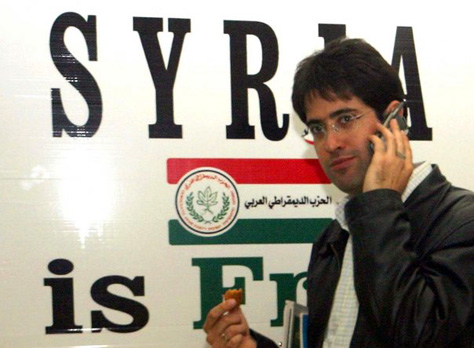
“Listening to Syria” by David Lesch

David Lesch with President Bashar al-Asad

David Lesch with President Bashar al-Asad

“Listening to Syria”
by David W. Lesch
Written for Forward
Published by Syria Commentwith the permission of Sami Moubayed

Having met with Syrian President Bashar al-Asad on a regular basis over the last five years, most recently on October 19, I have personally seen how he has grown into the position, and he is now brimming with a confidence bred by weathering a number of storms and experiencing some success. Yet only in the last month has the Bush administration begun to explore high-level diplomatic contacts with Syria after years of trying to isolate Damascus. Even this seems to have come to an abrupt end with the US raid against purported militants across the Iraqi border in Syria.on October 26, perhaps, as some have suggested, a parting shot by the Bush administration (or elements within seeking to derail the tentative US-Syrian dialogue established by Secretary of State Condoleeza Rice, those “elements” usually meaning Vice President Cheney’s office).

For a lengthy period I seemed to be the only American talking to President Asad; as such, Washington often called on me to share my impression and analysis of him and Syrian policies.  To an array of officials from the State Department, Pentagon, intelligence community, and the Bush administration, I essentially repeated three main themes, all of which were summarily ignored when communicated upward:

 Do not underestimate Asad.  He is genuinely popular in his country and in the region, and one does not survive in Syrian politics as he has without being clever and capable. Like it or not, he will be around for a long time.  Unfortunately, from the beginning, Washington viewed Asad with a disdainful attitude bordering on mockery.  The views expressed by members of Congress surrounding the passage of sanctions on Syria in 2003-2004 were needlessly condescending.  They emerged not only from ignorance, but also a collective group-think in the post 9/11 and Iraqi invasion environment that made Syria an easy target for Washington officialdom eager to bolster its tough, anti-terrorist credentials.  As a result, Asad was virtually dismissed.  His regime was deemed unacceptable, even irrelevant.  Despite Asad’s clear calls for a better relationship with the US and a resumption of peace talks with Israel, isolation and pressure on Damascus followed.

Do not take on Syria in Lebanon because you will lose.  To me this was a no-brainer.  Syria views Lebanon within its sphere of influence.  It cannot lose it to potential hostile forces, much as the US would not allow Soviet nuclear missiles in Cuba.  Simply put, Syria has the knowledge, assets, and willingness to do what it takes to win in Lebanon.  The US does not, and history-as in the 1980s-has shown this to be the case.  Feeling under siege through Lebanon, Syria fought back, and it has such an overwhelming advantage there that it won despite some policy errors of its own.

Do not ignore Syria diplomatically; they are too central to too many problems in the region-and if they are not, they will make themselves central to the solution.  The Bush administration altered the equation on Syria, i.e. traditionally such issues as Syria’s support for Hamas and Hizbullah as well as its relationship with Iran would be dealt with as a result of Syrian-Israeli peace negotiations.  Under Bush, negotiations would not even begin until Syria relented on these and other issues.  Syria was not going to give up what little leverage it had before talks even began-no one in their right mind would willingly do this; on the contrary, it now had every incentive to hold fast and, if possible, build up some leverage to earn a seat at the diplomatic table, in other words, to be taken seriously.  The French, Turks, and even the Israelis have already recognized Syria’s centrality to a multitude of issues in the region.  The US is still hedging.

Bush’s first presidential campaign advocated a humble foreign policy, which means in part having the willingness to listen.  Much of Bush’s foreign policy problems were due to arrogance at the top, that only they, guided by a flawed neo-conservative policy paradigm, had the esoteric insight to frame decision-making.  And access to the top seemed to be predicated on intellectual support for an already existing agenda.  The misguided policy toward Syria-and subsequent missed opportunities-is a prominent case in point.

If “the top” had listened to cogent information percolating upward and from abroad, a lot of mayhem could have been avoided. Despite the US raid in Syria, Damascus will be cautiously assessing the potential new direction emanating from Washington and communicating its position.  Hopefully the new administration has the strength to listen.

David W. Lesch is Professor of Middle East History at Trinity University in San Antonio, TX.  His latest books include The New Lion of Damascus: Bashar al-Asad and Modern Syria (Yale University Press, 2005) and The Arab-Israeli Conflict: A History (Oxford University Press, 2007). 

OIL: Comment sent by Mark on the possible oil find in Latakia:(Thanks for this enlightening summation. A little expertise goes a long way. JL )

A few comments on the post by Joshua “Major Oil Strike in Latakia” and the above quoted SANA article. N.B. I’m an Engineer who has worked for a Major International Oil Company for some 27 years.

“…produced almost one thousand barrel of good oil brand which had surfaced to the as drillings were being made for building pillars in the site.” “Oil started shooting into the air.” Most oil reservoirs buried shallow enough to be reached by foundation piling would be severely biodegraded and contain only immobile heavy oil (a quick Google search reveals http://www.oiltracers.com/oilbiodegradation.html if you want more information about biodegraded oil). Also there would be no reservoir pressure above hydrostatic pressure at such a shallow depth. Thus these reports should be viewed with skepticism. Crude oil would not flow much less shoot into the air. A possible scenario is the piling could have hit a pipeline or underground storage tank. An alternative scenario is the piling could have penetrated an accumulation of leakage/seepage oil (from a pipeline or storage tank).

“Oil … drillingsstarted … on Saturday … Minister … said in a statements … had already finished oil studies of the oil well and the black material discovered in it.” This statement needs to be discounted. Wells actually don’t get drilled that fast and studies actually don’t get done that quick. However the need for a quick political win may be sufficient for a preemptive statement by a Minister.

“Russians are in the process of signing a deal for lots 4 & 5 in the north of Syria, about which expectations are also high” One must calibrate what “high expectations” are. Oilmen are natural optimists, and will say most anything while in the process of striking a deal. The chances of finding an economic sized discovery in an area without an offset oil discovery are not that high. As far as I know the East end of the Mediterranean is not one of the more prospective areas of oil exploration. The simple reason that us oilmen are exploring that area is that most of the prospective basins of the world have already been explored and exploited. This is simply an outcome of the “Hubbert Peak Theory” first presented in 1956.

News Round Up Follows:

David Miliband to visit Syria
By Ian Black
The Guardian, 12 November 2008

Miliband is due in Damascus next week as part of a wider Middle East tour at a time that western diplomatic efforts are focused on how to keep the faltering regional peace process alive…

But Barack Obama has made clear that he will change tack and seek to talk to the Syrians, who are delighted at the prospect. Miliband, in the role of transatlantic bridge-builder, will be encouraging him to do so…

Iraq, Syria to increase security cooperation
The Associated Press, 12 November 2008

Iraq says it will increase border security cooperation with Syria as the two countries seek to overcome tension caused by a recent U.S. commando raid inside Syrian territory launched from Iraq.

Visiting Iraqi Foreign Minister Hoshyar Zebari says after a meeting with Syrian President Bashar Assad that the two sides have tried to “overcome” the crisis that followed last month’s attack….

Syria’s official news agency says Assad reiterated his wish to strengthen ties with Iraq on all fronts.

Syria to host Iraq security meeting despite U.S. raid
By Khaled Yacoub Oweis
International Herald Tribune, 12 November 2008

The Syrian government will host a U.S.- backed security conference on Iraq as planned later this month, despite a threat to cancel it because of a U.S. raid on Syria in October, diplomats said on Wednesday.

Invitations were issued to countries including the United States, France, Iran, Iraq and its other neighbours shortly before the October 26 U.S. strike, they told Reuters.

“There had been a lot of doubt whether the conference would take place. The United States, Britain and other governments have not yet replied, mainly due to the uncertainty,” one of the diplomats said.

Syrian Foreign Minister Walid al-Moualem confirmed after meeting his Iraqi counterpart Hoshiyar Zebariin the Syrian capital on Wednesday that the conference would convene in Damascus on November 22…

The United States pushed for the meeting in 2006 as part of its drive to get Arab countries to engage on Iraq. Syria agreed to host it every year as part of a new policy to defuse tension with the Shi’ite-led government in Baghdad….

Iran test-fires new missile, Israel within reach
By Zahra Hosseinian
Reuters, 12 November 2008

Iran said it test-fired a new generation of surface-to-surface missile on Wednesday and that the Islamic Republic was ready to defend itself against any attacker.

Iran’s latest missile test followed persistent speculation in recent months of possible U.S. or Israeli strikes against its nuclear facilities, which the West suspects form part of a covert atomic weapons program, a charge Tehran denies.

U.S. President-elect Barack Obama, like outgoing U.S. President George W. Bush, has not ruled out military action although he has criticized the Bush administration for not pursuing more diplomacy and engagement with Tehran…

Baroud backtracks on cooperation with Syria after March 14 balks
The Daily Star, 13 November 2008

Interior Minister Ziyad Baroud’srecent visit to Syria have raised controversies over the revival of Syria’s security role in Lebanon, which forced the minister to reformulate the outcomes of his visit. Baroud said he did not “call for coordination with Syria that would be similar to what had been experienced.”

“What I meant is that there is a chance to present our demands to Syria … and listen to their views,” Baroud said in an interview on Wednesday.

He stressed the fact that the joint statement issued after his talks in Damascus “referred to a follow-up committee that would not proceed with its assignment unless approved by Cabinet.” The March 14 Forces voiced “strong reservations” on Wednesday over the formation of security cooperation committees between Lebanon and Syria…

Analysts says Fatah al-Islam ‘confessions’ aimed to bully Syria’s foes in Lebanon
By Michael Bluhm
The Daily Star, 13 November 2008

Syria was trying to bully its antagonists in the March 14 coalition by airing on state television “confessions” of alleged Fatah al-Islam members last week linking the group to March 14’s Future Movement, a number of analysts told The Daily Star on Wednesday.

The suspects said in the broadcast that they had carried out a deadly car bombing in Damascus on September 27 and had received money from the Future Movement of parliamentary majority leader Saad Hariri. Hariri, who has denied the allegations, asked Arab League chief Amr Moussa on Tuesday to form a fact-finding commission to look into the charges. Fatah al-Islam militants fought the Lebanese Armed Forces for more than three months last summer at the Nahr al-Bared Palestinian refugee camp near Tripoli…

Syria and Lebanon have recently established formal diplomatic relations, and Damascus might also be wielding the confessions as a tool to force Lebanese officials to give ground on the agendas put forthby their Syrian counterparts, said retired General Elias Hanna, who teaches political science at Notre Dame University.

In particular, Syria might be trying to push the Lebanese to sign off on the resurrection of joint security committees, a fixture during the Syrian military’s presence in Lebanon from 1976 until 2005, said Shafik Masri, professor of constitutional law. Lebanese Interior Minister Ziyad Baroudvisited Damascus on Monday and agreed there only that Syrian proposals for security cooperation would require Cabinet approval. In any case, airing the confessions represented a clear breach of security and judicial protocol, Masri added…

Strike anywhere at al-Qaida
By Paul Cruickshank
The Guardian, 12 November 2008

On Monday, the New York Times revealed that in the spring of 2004, Donald Rumsfeld, then the US secretary of defence, signed a secret order providing the US military with a mandate and fast-track approvals mechanism to launch raids against al-Qaida terrorists in countries outside the “conflict zones” of Iraq and Afghanistan. The order, it was reported, identified more than a dozen countries where al-Qaida operatives were present, including Syria, Yemen, Somalia and two close allies in the “war on terrorism”, Pakistan and Saudi Arabia.

The disclosures by senior American officials came in the wake of two controversialraids by US special forces in South Waziristan in Pakistan in September and in Syria in October, which reportedly targeted al-Qaida-linked militants orchestrating attacks in Afghanistan and Iraq respectively. Both the Pakistani and Syrian governments condemned the raids, stated that innocents had been killed, and accused the US of violating the UN charter.

What should be made of the revelations? Some Bush critics will no doubt argue that the administration that brought you extraordinary rendition, secret CIA detention and enhanced interrogation techniques has once again, in its finaldays, been unmasked as pursuing a clandestine programme that not only flouts international treaties but is also deeply counterproductive to winning the war for hearts and minds in the Muslim world. The more sardonic critics may ask why Britain was not also included on the “hit list”. According to MI5, 2,000 British residents actively support al-Qaida, and 30 major plots are being hatched at any one time…

Official: 8th century church discovered in Syria
By ALBERT AJI – 1 hour ago

DAMASCUS, Syria (AP) — Archaeologists in central Syria have unearthed the remnants of an 8th century church, an antiquities official said Thursday.

A Syrian-Polish archaeological team recently discovered the church in the ancient city of Palmyra, said Walid al-Assaad, the head of the Palmyra Antiquities and Museums Department. He did not say specifically when the church was discovered or the exact date the church was built.

He said the church is the fourth and largest discovered so far in Palmyra — an ancient trade center that is now an archaeological treasure trove.

Syria blames Israeli bombs for uranium traces

Syria blames Israeli bombs for uranium traces
By ALBERT AJI – 2 hours ago

DAMASCUS, Syria (AP) — Syria’s foreign minister suggested Wednesday that Israeli bombs may be the source of uranium traces that diplomats at the U.N. nuclear agency said were found at a suspected nuclear site.

Walid al-Moallem said the diplomatic leaks about the traces found at the site, which was targeted by Israeli warplanes in September 2007, were politically motivated and aimed at pressuring Syria.

“No one has ever asked himself what kind of Israeli bombs had hit the site, and what did they contain?” said al-Moallem, adding that the United States has used bombs containing depleted uranium in Iraq and Afghanistan.

“These media leaks are a clear-cut signal that the purpose was to pressure Syria. This means that the subject is not technical but rather political,” al-Moallem said at a news conference with Iraqi Foreign Minister Hoshyar Zebari.

The Israeli Foreign Ministry had no comment….

Cautionary Optimism
Oxford Business Group, 11 November 2008

Reforms to the Syrian economy, in particular the opening up of its financial sector, have led to an expansion of the base of local and foreign investments, the prime minister told a conference in Damascus.

Prime Minister Mohammad Naji Al Otari told the Syrian Banking and Investment Conference, held from October 31-November 2, that economic, legislative, financial and administrative reforms have opened up the banking sector, making it one of the primary forces for development in the Syrian economy.

While much progress has been made, further reforms are continuing, including more autonomy for the Central Bank of Syria, strengthening the regulatory and monitoring controls for the country’s banking system and providing the necessary infrastructure for the financial sector, the prime minister said…

Moment of Truth for Shiite Party Over Pact
By HAMZA HENDAWI
The Associated Press

The fate of an agreement that would keep U.S. troops here for three more years rests with Iraq’s largest Shiite party, which must choose between its two main partners: the United States and Iran.

Most lawmakers are waiting for that party, the Supreme Islamic Iraq Council, to take a position on the agreement, which parliament must approve by the end of the year. Only then will smaller groups, including Prime Minister Nouri al-Maliki’s own Shiite party, commit to the deal or oppose it.

For the moment, all the parties are off the hook. Government spokesman Ali al-Dabbagh said Monday that the government is still not satisfied and wants more talks on specifics.

But once both the Iraqi and American governments declare a draft final, it will be the moment of truth for the Supreme Council…

“We are generally supportive of the agreement,” said a Supreme Council lawmaker, speaking on condition of anonymity because of the sensitivity of the subject. “But we are in a very tight spot. If we say yes, people will say we are traitors. And if we say no, they will say we are Iranian stooges.”

Another Supreme Council lawmaker, also speaking on condition of anonymity for the same reason, said, “It is stupid to make an enemy of America.”

“Yes, Iran is a friend and an ally. But the agreement is in the national interest and we will accept it even over Iran’s objections,” the lawmaker said….

Was the U.S. Right About Syria Nukes?
By Andrew Lee Butters
Time, 11 November 2008

Given the Bush Administration’s track record, no one ought to have been surprised when much of the Middle East raised a skeptical eyebrow in response to Washington’s claim that the Syrian site bombed by Israeli warplanes in September of 2007 was part of a clandestine nuclear-weapons program. …. It turns out, however, that the Bush Administration may well have been right about the Syrian site. Diplomats from the International Atomic Energy Agency (IAEA) told the press on Monday that the U.N.

The findings at the Syrian site have yet to be declared in any official IAEA documentation, but whatever the conclusion of the IAEA’s investigation, the deepening suspicions toward the Assad regime are coming at an increasingly complicated moment in relations between Damascus and Washington. Late last month, U.S. special forces launched a raid into eastern Syria targeting an alleged al-Qaeda weapons smuggler. In response, the Syrian government shut down an American school and cultural center in Damascus, and forced American Fulbright scholars based at Syrian institutions to leave the country. On Sunday, the New York Times reported that the most recent raid was simply one of dozens that had been conducted on Syrian territory by U.S. special forces under secret orders signed by then Secretary of Defense Donald Rumsfeld…

Lebanon and Syria tussle over Islamist militants
By Ferry Biedermann
Financial Times, 11 November 2008

Lebanon and Syria have become embroiled in a bitter war of words that runs counter to their recent political rapprochement and centres on mutual accusations of support for militant Islamist groups.

Syrian television last week broadcast what it said were the confessions of members of the Lebanon-based Fatah al-Islam faction, admitting responsibility for a bomb attack in Damascus in September that killed 17. The Lebanese authorities yesterday said they had arrested five of the militants on suspicion of involvement “in terrorist acts”.

The controversy arises from televised claims by the militants that they had been financed by Lebanon’s anti-Syrian Future movement. The movement, led by Saad Hariri, son of murdered former prime minister Rafiq Hariri, is Lebanon’s main Sunni political party…

Damascus, meanwhile, has repeatedly accused Salafi groups of involvement in violence in Syria. President Bashar al-Assad has sent about 10,000 troops to the border in what Syria says is an attempt to contain them.

Syria and Lebanon on Monday agreed to examine the possibility of better border controls between the two countries. The Lebanese minister of interior, on a visit to Damascus, agreed with his Syrian counterpart on the establishment of a joint commission to set up the mechanisms for co-ordinating the policing of the border and co-operation in the fight against terrorism…

ADC on Anti-Arab remarks of Emmanuel’s father

I just received the following email from the ADC:

The American Arab Anti-Discrimination Committee urges you to take immediate action by using the contact info below to express your disappointment to President-Elect Obama and Congressman Rahm Emmanuel for the detestable anti-Arab remarks Emmanuel’s father made this past week.

ADC wrote a letter to Congressman Emmauel and President-Elect Barack Obama asking the congressman to publicly repudiate the derogatory comments his father made. Benjamin Emmanuel was quoted by numerous Israeli and American publications as saying  “Obviously he will influence the president to be pro-Israel. Why wouldn’t he be? What is he, an Arab? He’s not going to clean the floors of the White House.”

There should be no place for such demeaning rhetoric and these comments are contrary to the very type change the President-Elect promised he would bring to America. 

Contact President-Elect Obama by fax at 202.228.5417 or through this online contact form .

Contact Congressman Emmanuel by fax at 202.225.5603 or via E-mail at [email protected]

Here is some language I wrote up the a few days ago that may be useful in formulating a response:

The anti-Arab remark made by Rahm Emanuel’s father is not consistent with the spirit of change and ethnic equality that President Elect Obama promises to bring to the White House. Arab Americans have put great hope in his election. They believe that they have a part to play in building a new and more equal America.

A public statement by Rahm Emanuel explaining that he does not approve of his father’s remark would go a long way in reassuring us that the president elect and new administration value Arab Americans. We all hope to move beyond the divisiveness of the past to create a future of mutual respect. By distancing himself from his father’s remark, Rahm Emanuel will demonstrate that he does not share his father’s opinion of Arabs and will help the new administration act as an honest broker in the Middle East and at home.

“Syria stops aid vessel unloading Iraq refugees’ rice” by Oweis

Syria stops aid vessel unloading Iraq refugees’ rice 11 Nov 2008, Reuters
By Khaled Yacoub Oweis

DAMASCUS, Nov 11 (Reuters) – Syria prevented a World Food Programme vessel carrying rice for Iraqi refugees from unloading at the country’s main port on Tuesday because, the government said, its cargo failed tests.

The order to stop the 8,000 tonne Bmc Genesis at Latakia comes at a time of heightened tension between Syria and Iraq in the wake of a U.S. raid on Syria from Iraqi territory that killed at least eight people.

Iraqi refugees — reliant on food aid distributed jointly by the WFP, a U.N. division, and the United Nations High Commissioner for Refugees — said they have stopped receiving rice, the main part of their rations.

Around 194,000 Iraqi refugees in Syria get food aid. A United Nations official in the Syrian capital confirmed that distribution of rice has stopped, but declined to say why. A Syrian official in Latakia said the decision to stop the vessel was purely technical.

“The percentage of cracked rice in the cargo was higher than allowable under Syrian standards. The ship was ordered not to unload,” he said.

Bmc Genesis, which flies the Indian flag, arrived at Latakia last week. WFP has paid around $11,000 a day in demurrage since.

Several thousand more tonnes of rice imported by WFP had been sitting at the docks but not allowed to leave the Mediterranean port. A second official said that this rice was “unfit for human consumption”. The WFP in Damascus declined to comment.

CALAMITY

At a United Nations assistance centre in the poor suburb of Douma north of Damascus hundreds of Iraqi refugees gathered to receive their bi-monthly rations of 25 kilograms (55 pounds) of rice per refugee.

“This is a calamity. Winter is coming and for us Iraqis rice is the main stable,” Ahmad Amran said.

“They said problems with shipping were behind the cut and that we will be contacted once rice comes, but when?” a second refugee said.

One outside source said the WFP did not wish to publicise the row in the hope that it would be soon solved diplomatically with the Syrian government.

Syria has repeatedly asked Iraq to help care for the estimated one million Iraqi refugees it hosts.

Relations between the two countries have been strained by U.S. and Iraqi allegations that Syria was turning a blind eye to Islamist fighters infiltrating Iraq. The Oct. 26 raid by the United States on eastern Syria raised the stakes.

The attack killed a top smuggler of foreign fighters to al Qaeda in Iraq, a U.S. official said.

The Damascus government said the raid killed eight Syrian civilians and responded by shutting down an American school and a cultural centre in Damascus. An Iraqi official said Baghdad did not accept “this kind of aggression”.

Iraqi Foreign Minister Hoshiyar Zebari starts a visit to Syria later on Tuesday aimed at stabilising ties.

Iraqi foreign minister in Syria for talks, International Herald Tribune
Iraq’s foreign minister is visiting Syria for the first time since a cross-border U.S. raid on a Syrian village last month.Minister Hoshyar Zebari will discuss a U.S.-Iraqi security pact that would see U.S. troops in Iraq for three more years. Syria has been critical of the draft deal.

Syria says eight civilians were killed in the Oct. 26 raid by helicopter-borne U.S. troops who crossed into Syria from Iraq. American officials say the raid targeted a top al-Qaida figure.

Zebari arrived in the Syrian capital Tuesday and will meet with President Bashar Assad Wednesday.


He’s expected to try to ease Syria’s concerns over the proposed Iraqi-U.S. security pact.

IAEA Irked at “Premature” Syria Nuclear Disclosures

Here is an interesting blog posting from Moon of Alabama mocking the nuclear story. I am unable to assess this, but the sorce is smart.

IAEA Irked at “Premature” Syria Nuclear Disclosures
By Mark Heinrich
November 11, 2008

VIENNA (Reuters) – The U.N. nuclear watchdog criticized on Tuesday diplomatic disclosures that it had found uranium traces at a Syrian site under investigation, saying this was an effort to prejudge the agency’s conclusions.

It was a rare open expression of irritation within the agency about news leaks, which some say risk putting a political spin on its technical findings in probes of nations suspected in the West to be illicit nuclear proliferators.

Several diplomats tracking the International Atomic Energy Agency said on Monday that particles of processed uranium turned up in some test samples IAEA inspectors took at the site. These were not enough to draw conclusions about any undeclared nuclear activity but warranted further investigation, they told Reuters.

IAEA spokeswoman Melissa Fleming confirmed the agency was drafting a report on Syria and had put it on the agenda of the agency’s November 27-28 governors meeting — both firsts, in what diplomats said hinted inspectors had found something serious.

But she said the IAEA’s evaluation of findings from a June visit to the site, which Washington says was a secret nuclear reactor almost built before it was bombed by Israel in 2007, was not finished and a public verdict was unwarranted until then.

“We regret that people are trying to prejudge the IAEA’s technical assessment. We are, however, accustomed to these kinds of efforts to hype and undermine the process before every meeting of the IAEA board (of governors),” Fleming said.

The IAEA did not challenge the substance of Monday’s revelations about the uranium traces.

A diplomat close to the agency said its concern was that the leaks could not reflect the full picture and that circulating highly confidential information before an official report could discourage Syrian cooperation with the IAEA.

SYRIA MUM

Syria’s ambassador to the IAEA did not return messages asking for comment. There was also no comment from Damascus. It has dismissed U.S. intelligence pointing to a nascent plutonium-making reactor at the site as fabricated….

Traces Of Uranium found in Syria: Moallem Says No More Searches

Diplomats: Uranium found at suspect Syrian site
International Herald Tribune, 10 November 2008

Samples taken from a Syrian site bombed by Israel on suspicion it was a covert nuclear reactor contained traces of uranium combined with other elements that merit further investigation, diplomats said Monday.

The diplomats — who demanded anonymity because their information was confidential — said the uranium was processed and not in raw form, suggesting some kind of nuclear link.

But one of the diplomats said the uranium finding itself was significant only in the context of other traces found in the oil or air samples taken by International Atomic Energy Agency experts during their visit to the site in June.

Syria has a rudimentary declared nuclear program revolving around research and the production of isotopes for medical and agricultural uses, using a small, 27-kilowatt reactor, and the uranium traces might have originated from there and inadvertently been carried to the bombed site. But taken together, the uranium and the other components found on the environmental swipes “tell a story” worth investigating, said the diplomat…

The leaked information came shortly after the IAEA Director Mohammed ElBaradei announced he would release a formal, written report on the subject, Reuters reported. The IAEA had no immediate comment.

“It isn’t enough to conclude or prove what the Syrians were doing, but the IAEA has concluded this requires further investigation,” a diplomat with ties to the organization said. …

‘America’s Role Is Central’: INTERVIEW WITH SYRIA’S FOREIGN MINISTER
Spiegel Online, 10 November 2008

“This truly is the time to come to a comprehensive peace,” Syrian Foreign Minister Walid al-Moallem tells SPIEGEL …

Part 2: ‘We Don’t Want Syria to Experience What Iraq Has’

SPIEGEL ONLINE: American sources say that Syria knew in advance of the commando operation. Is that true?

Moallem: This is a fabricated story by the Americans. It has nothing of truth to it. They were confused, and they were late with their own statement from Washington. And then they leaked this story to the media. It is totally untrue.

SPIEGEL ONLINE: If it is untrue, then why didn’t the Syrian army respond? Why didn’t you protect your citizens?

Moallem: Frankly, we did not expect such an aggression. We don’t understand why (it happened) — especially now that Syria is exerting enormous efforts to tighten its side of the border. Anyway, we are not Georgia. We were seeking wisdom not to escalate the situation.

SPIEGEL ONLINE: The situation would improve even further if Damascus gave the International Atomic Energy Agency (IAEA) access to all the facilities in Syria it wants to inspect.

Moallem: Seven months after an aggression against a Syrian military position near Deir al-Zor, Israel went to the IAEA and claimed that Syria intended to build a nuclear reactor. This is totally untrue. We have allowed inspectors to visit the site. They spent three days there, they took samples and analyzed them. I assure you: They did not find the materials needed to build a reactor — graphite, for example. They came to Damascus fulfilling a memorandum of understanding between Syria and the agency in which we allowed them to visit the site once.

SPIEGEL ONLINE: The IAEA would like to see three other sites as well.

Moallem: We do not want Syria to experience what Iraq has experienced. You remember the big American lies before the war in Iraq. Now they want to see this location, then they want to see three other locations and then, maybe, another four. We are not ready to repeat this. This will harm our national security…

U.S. Sends ‘X-Band’ Missile-Detecting Radar to Israel to Confront Iranian Threat

JERUSALEM, Israel —  The U.S. is providing Israel with high-powered X-band radar capable of detecting missile launches up to 1,500 miles away — and sensitive enough to detect small- and medium-range missiles being fired from Iran and Syria. The radar will grant Israel about 60-70 seconds more warning time when missiles are launched. The system’s massive range means targets as far away as southern Russia can be monitored.

Exploratory Oil excavation Drilling Start in Lattakia  — Ooops 🙂
SANA (Syria Arab News Agency) 20 September 2008

Lattakia – Oil excavation drillings started in the Syrian coastal city of Lattakia on Saturday following the construction of the Oral Touch Drilling Machine last week.

Minister of Petroleum and Mineral Resources Sufian Allaw said in a statements to reporters in the city that Syrian and foreign experts had already finished oil studies of the oil well and the black material discovered in it.

He added that drilling works in the experimental well could reach down to 3500 meters underneath along with continuous analyses and supervision of the discovered materials to see whether there are oil-carrying stones or any other probabilities such gas or oil.

The Minister said that in case oil has been discovered then drillings will not be done inside but outside the city by way of horizontal or slant drilling.

The discovered site last year produced almost one thousand barrel of good oil brand which had surfaced to the as drillings were being made for building pillars in the site. By Ahmad Fathi ZAHRA. © SANA (Syria Arab News Agency) 2008

“Heartbreak with Palestine” by Sami Moubayed

…..Another question in the survey was: “Who is your favourite former Arab leader?” I expected answers such as Jamal Abdul Nasser or Arafat — those who had worked hard for the sake of Palestine. Surprisingly, the highest number of votes (75 per cent) went to Shaikh Zayed Bin Sultan Al Nahyan. Young Syrians voted for him because he built a country from scratch, provided jobs and authored a success story for the nation. Lowest on the list were Arafat and Nasser — precisely because of their commitment to revolution and armed resistance, which led the Arabs nowhere. ….

…Given that the October 26 raid was an unauthorized and illegal attack, killed innocent civilians, resulted in negative diplomatic fallout, and likely increased rather than decreased the threat of terrorism in Iraq, it would appear to be a great opportunity for the Democrats to attack the Bush administration for its dangerous and reckless action.

Yet, even in the course of the final dramatic week of the presidential campaign, neither Barack Obama nor Joe Biden uttered a word of criticism. And, despite contacting the offices of every single Democratic member on both the House and Senate Foreign Relations Committees, I was unable to find any criticism from and of these leading Congressional Democrats either.

The raises the serious possibility that, even under an Obama administration and an expanded Democratic Congressional majority, such militaristic policies may continue. This is particularly disappointing given that many observers had hoped that Syria would be the focus of a likely early diplomatic victory of an Obama administration. ….

Secret Order Lets U.S. Raid Al Qaeda
By ERIC SCHMITT and MARK MAZZETTI
New York Times, 9 November 2008

The United States military since 2004 has used broad, secret authority to carry out nearly a dozen previously undisclosed attacks against Al Qaeda and other militants in Syria, Pakistan and elsewhere, according to senior American officials.

These military raids, typically carried out by Special Operations forces, were authorized by a classified order that Defense Secretary Donald H. Rumsfeld signed in the spring of 2004 with the approval of President Bush, the officials said. The secret order gave the military new authority to attack the Qaeda terrorist network anywhere in the world, and a more sweeping mandate to conduct operations in countries not at war with the United States…

Mideast Negotiators Vow Talks Will Go On
By Matthew Lee and Amy Teibel
Washington Post, 10 November 2008

Israeli, Palestinian and international negotiators pledged Sunday to continue peace talks launched last year by President Bush, even though the quest for peace will certainly outlast his administration.

But future talks will be held in an increasingly uncertain terrain, with the prospect of a hawk coming to power in Israel’s parliamentary elections in February and deeply divided Palestinian factions controlling the West Bank and the Gaza Strip. It is also unclear how high Mideast peacemaking will figure on President-elect Barack Obama’s agenda.

…..”I believe that the Annapolis process is now the international community’s answer, and the parties’ answer, to how we finally end the conflict between the Palestinians and the Israelis,” Secretary of State Condoleezza Rice told reporters after the talks.

….”Abu Mazen has warned against the possibility of Israel using this transition period in Israel and the U.S. to accelerate settlement activity and attacks and incursions,” Erekat said.

Foreign Minister Tzipi Livni, Isreal’s chief peace negotiator, is running evenly with hawkish former prime minister Binyamin Netanyahu in polls to become the next prime minister.

Netanyahu’s spokeswoman, Dina Libster, indicated Sunday that he would not continue the Annapolis process if he won.

“The process as it has been until now is not helpful, and there is no point in continuing with it,” she said…..

It is also unclear whether Obama will prioritize the Mideast peace process, at a time when he must handle an economy in crisis and wars in Iraq and Afghanistan.

Quartet envoy Tony Blair urged Obama on Sunday to carry on with the process, saying, “The single most important thing is that the new administration in the United States grips this issue from Day One.”

Syria pleased to show itself and its rich history
By Judith Fein
The Boston Globe, 9 November 2008

The flaps of the Bedouin tent were open, and the father, dressed in a long, gray robe and sporting a red and white kaffiyeh, grinned and waved for us to enter.

“Where are you from?” he said as his family gathered around him.

“The United States,” we answered.

“Ahlan wa Sahlan, welcome!” the family called out. They ushered us into their desert abode where we leaned on overstuffed pillows and were served tea.

In the souks of Aleppo, where locals shop for everything from camel meat to spices, clothing, and kitchenware, vendors and shoppers called out “welcome” and a man pressed hard candies into our hands.

And at the Umayyad Palace Restaurant here in the capital, the owner gave me an oval piece of black meteorite with one of Allah’s names inscribed on it. “It’s for safety and protection during voyages,” he said. Were we really in Syria, a country not high on Americans’ destinations wish lists?…..

Analysis: How Damascus could leave Teheran isolated…
By AMIR MIZROCH
The Jerusalem Post, 10 November 2008

Syria’s Bashar Assad, derided as the son even his own father didn’t want to succeed him, is turning out to share many of Hafez’s wily and cautious traits. Despite a series of recent blows to his homeland security (the killings of Hizbullah terror chief Imad Mughniyeh and Syrian military adviser Muhammad Suleiman, and the IAF’s destruction of his nascent nuclear plant), Assad junior is managing to keep a steady hand on the reins of power.

Assad Jr. is plainly looking to the long-term. He has accounts to settle with several players in the region, but for the moment he’s playing it cool. And for this, and his indirect talks with Israel, the West, and notably France, have rewarded him with greater acceptance.

Assad may have slammed Israel on Sunday as “not serious” about peace, but he does not want to abandon the talks. Far from wanting to return to pariah status, he wants to parlay his newly acceptable status into a warmed relationship with Washington…..

– A Mujahideen Bleed-Through From Iraq? A Look at Syria
The Jamestown Foundation, Volume 5, Issue 36 (October 22, 2008

Al-Qaeda’s organizational goal in Iraq was to acquire contiguous territory from which to spread its influence and operatives, as well as those of its Islamist allies into the Levant, the Arabian Peninsula, and Turkey. Having been weaned as an insurgent in Afghanistan, Osama bin Laden has consistently refused to commit large al-Qaeda resources to jihads lacking country-wide maneuver room or Pakistan-like contiguous safe haven. The U.S.-led invasion of Iraq, therefore, opened a chance for the above-described expansion by al-Qaeda and its allies that would not have been possible under a Saddam-controlled Iraq.This is the first of four articles that will assess the initial stages of the penetration of the Levant by al-Qaeda and other Islamist groups. This piece will look at Syria, and will be followed by analyses of the bleed-through from Iraq into Lebanon, Jordan, and Israel. The quartet of articles will seek to assess the validity of the recent claim by the state-run Syrian newspaper Al-Thawara that because of the war in Iraq “the [Levant] region is throbbing with terrorists.” (quoted in Christian Science Monitor, September 29).

After crushing the Syrian Muslim Brotherhood (SMB) at the city of Hama in 1982 – killing up to 20,000 people and leveling a quarter of the city – President Hafiz al-Assad adopted the traditional and traditionally unsuccessful tack of Arab tyrants of trying to use government largesse to co-opt Syria’s remaining Islamists and thereby moderate their message. ….


“The Syrian regime fell – as have others – in[to] the famous illusion that they can toy with the terrorist fundamentalist bear at the beginning of the day and then get rid of it or put it back in the cage at the end of the day! This is an illusion that is repeated and always repeated in the Middle East region….

Having now tightened up Syria’s borders with Iraq under pressure from Washington and the French government, Bashar al-Assad is now running a country-size hotel for a variety of ill-tempered Islamist guests (al-Akhbar [Beirut], September 30; NOW Lebanon, September 27). In addition to long-term tenants Hamas, Hizballah, and the secular Palestinian fraternity, Syrian security has to keep tabs on newer and not fully domesticated guests: a growing Syrian Muslim Brotherhood organization; a militant “official” clergy that is stoking greater Islamic fervor at the grassroots level; more than a half-million Iraqi refugees; a multinational assortment of veteran mujahedeen stranded in Syria after leaving Iraq; and would-be fighters who got to Syria but were prevented from entering Iraq. Among the veteran fighters are a contingent of Syrians who have returned from Iraq and Afghanistan – some commentators are calling them the “Syrian Afghans” –with military skills they can impart at home and in other countries of the Levant (al-Hayat, September 28).All told, President Bashar al-Assad – a man not as skilled as his father or as able to control the regime’s security services – is faced with a growing Islamist threat to the stability of his regime. ….


A Mujahideen Bleed-Through From Iraq? Part Two – A Look at Lebanon
Volume 5, Issue 38 (November 5, 2008)

By Michael Scheuer

11/05/2008 – Lebanon always has been a country whose people are more loyal to family, clan, tribe, and faith than to the concept of Lebanon as a united nation-state. Since 2003, this existing internal divisiveness has been sharpened by the U.S.-led invasion and occupation of Iraq and the U.S.-led international effort to drive Syria out of Lebanon. The former opened a role for Lebanon as part of the path for would-be jihadis traveling to fight in Iraq. The latter – together with the 2006 Hezbollah-Israel war – forced the precipitate decline of effective governmental authority in Lebanon, allowing jihadis to use the country for transit and basing. This made it a target for aggressive expansionist efforts by Saudis and other Salafis and encouraged the rapid growth of internal violence between political and religious factions. Overall, the Iraq war and Syria’s departure from Lebanon gave al-Qaeda and its Islamist allies an unprecedented opportunity to infiltrate their influence and manpower into Lebanon, as well as help strengthen the Sunni Salafist trend in northern Lebanon. ….

As in Syria, the growing al-Qaeda and Saudi-backed Salifist movement in Lebanon’s north and its Palestinian refugee camps clearly is in part a product of the militant bleed-through from Iraq. But, as in Syria, Salafism’s Lebanese growth is occurring in already fertile soil: Lebanon’s Sunni north has been slowly radicalizing for much of this decade – Tripoli’s Sunni leaders long viewed Hezbollah as the “Resistance,” but now regard it as the “party of evil” – and the eviction of Syrian forces has substantially reduced Beirut’s ability to limit the growth of Salafism (Middle East Times, June 30). Bin Laden’s operatives and Saudi intelligence will continue to push these trends, thereby once again demonstrating just how closely aligned are the interests of al-Qaeda and Riyadh outside the Arabian Peninsula.This said, al-Qaeda still has considerable work to do in Lebanon. While Ayman al-Zawahiri said in April 2008 that Lebanon is now “a Muslim frontline fort,” Lebanese Salafists will for the foreseeable future be more concerned with securing increased political power and communal autonomy in the country than in flocking to support the worldwide Sunni jihad. …


SYRIA: Secret world of sexy women’s lingerie
By Khaled Hijab
Los Angeles Times, 9 November 2008

“Look within your culture to discover the unexpected. What it might be hiding from you can give you a shock.” That is how designer Rana Salam ended a talk about her book of undergarments, “The Secret Life of Syrian Lingerie,” at American University of Beirut.

“Secret Life” takes readers on a tour of the hidden intimacies and gaudy traditions of an outwardly rather conservative Arab country. …

Made with Chinese toys and other accessories, the collection of underwear Salam gathered includes bras and G-strings decorated with coconut shells, television remote controls, glow-in-the-dark toys and singing birds as well as edible lingerie with a variety of flavors.

Salam called them works of art. She said she visited the factories as attempt to “get into the brains of these designers, to know where all the creative ideas are coming from.” As she put it, “These are people who lack basic education about design but tend to produce one of the most creative pieces of work my eyes ever witnessed.” …

Major Oil Strike in Latakia?

The Syrian rumor mill is buzzing with news that there has been a major oil strike in Latakia. Workers were digging a very deep foundation for an unusual building, according to my source who asked to go nameless – as always. oil started shooting into the air.

People in Syria are excited, needless to say. They believe it is a major find. It has boosted hopes that Syria’s oil production, which has been shrinking for years, can be revived.

A Norwegian company is close to signing a deal for off-shore exploration in a large tract of coastline extending from Tartus to Tripoli in Lebanon. The Russians are in the process of signing a deal for lots 4 & 5 in the north of Syria, about which expectations are also high.

If it is true that a substantial oil field has been found under Latakia, it may take considerable pressure off Damascus, help boost government revenues, and creat some welcome buzz for the Syrian economy. We will see how reliable my sources are. The discovery is very new. Monday 10 Nov. 2008 12:00 SCT

Rumsfeld’s secret raids on Syria

Rumsfeld’s secret raids on Syria by Matthew Weaver, Guardian, Monday November 10 2008

Was the controversial US attack on Syria a sign that US troops are still marching to the secret orders of the former defence secretary

The US military has made several undisclosed attacks against Al-Qaida in Syria, Pakistan and elsewhere under a secret order signed by the former defence secretary Donald Rumsfeld in 2004, according to the New York Times today.

It claims the order gave the US military broad authority to attack al-Qaida anywhere in the world, including countries not at war with the US.

Last month’s raid on Syria, in which eight people were killed, was cited as an example. The attack, which enraged the Syrians, was described as the first by the US on Syrian soil for years. But the New York Times claims there have been others raids into Syria under the so-called “Al Qaida Network Exord”, or executive order, as well as attacks in Pakistan.

The story, sourced to more than six unnamed officials, appears to back claims made by a former Bush administration official to Jonathan Freedland, who also said the US has made several raids on Syria, but Damascus has just kept quiet about it.

According to the New York Times, Rumsfeld’s order streamlined the approval process for such missions to take place. (But up to 12 raids were still vetoed by senior officials.)

Perhaps the order itself will be vetoed by Barack Obama under his bid to “unpick the most egregious acts of the Bush administration“. But given that, as Jonathan Steele wrote, Obama has refused to repudiate the so-called war on terror, maybe not.

“Anti-U.S. sentiment grows in Syria after raid,” by Brooke Anderson, San Fran Chronicle

Abu Kamal, Syria — The U.S. incursion into Syria late last month put this eastern border town near Iraq on the world stage and many of its residents on edge.

Saoud Rak Khalif contemplates the site where his brother was killed during the U.S. strike on Oct. 26. (By Brooke Anderson / Special to The Chronicle)

Saoud Rak Khalif contemplates the site where his brother was killed during the U.S. strike on Oct. 26. (By Brooke Anderson / Special to The Chronicle)

“At the beginning of the war, we were scared. Then we got used to it. Now we’re scared again – and angry,” said Yusef Tara, who spoke to a reporter near the site of the Oct. 26 U.S. commando raid against an alleged al Qaeda in Iraq hideout that Damascus says killed eight civilians.

In this tightly controlled police state that had been trying to change its image and end years of global seclusion, protest groups are now allowed to stage anti-American rallies. And even though YouTube is banned, video footage of four U.S. helicopters carrying out the raid is making the rounds on cell phones.

The anti-American sentiment is in sharp contrast to months of toned-down rhetoric against the Bush administration as the two countries edged toward serious talks.

“This is the first time in Syrian-U.S. bilateral relations since 1945 (the year diplomatic relations were established) that the Americans attacked Syria,” said Sami Moubayed, a political analyst in Damascus, Syria’s capitol. “The raid makes it difficult for bilateral relations.”

[Landis Comment] Sami is, of course, correct that this is the first time that the US military “attacked” Syria. But, it is worth pointing out that it is hardly the first time that the US has used force to change things in Syria. During Syria’s independence era, Washington was involved in a number of coups that changed the course of Syrian politics. In 1949, the CIA supported two coups. The first – the Zaim coup – replaced Syria’s parliamentary democracy with a dictatorship that the US believed would sign a peace agreement with Israel, open a new Aramco pipeline crossing Syrian territory, help settle Palestinian refugees in the Euphrates region, and arrest members of the communist party.

In 1956, the US also supported a coup attempt designed by the British and Iraqis to overthrow Syria’s parliamentary system. The purpose in supplanting the democratic parliament, which had been restored in 1954, with a dictator was because Syria’s politicians were signing treaties with the USSR, the only country to sell Syria advanced military arms. According to Patrick Seale, the CIA helped train some 300 Alawite commandos belonging to the SSNP (Antoun Saade’s “Greater Syria” party) in the mountains of Lebanon to act as a militia – much like the Cuban refugees in Florida would later be trained by the CIA to overthrow Castro with disappointing results. The Syrian secret police rolled up the conspiracy and condemned many of Syria’s pro-Western politicians to death in absentia. Thus, the Americans helped drive Syria into the arms of Nasser and the UAR. Ironically, the SSNP, which the US cultivated and trained for much of the 1950s, ended up being a pro-Syrian party which now infuriates the US for pushing Syria’s agenda in Lebanon. It has retained much of its militant ways.

[Correction] Bob Malley has not been asked to visit Egypt and Syria by Obama. A few days ago SC re-printed a story – “In First Mideast Policy Initiative, Obama Sends Adviser To Egypt, Syria,” By David Bedein, Middle East Correspondent, which was printed in the Bulletin, A Philadelphia paper. The story was completely false. This is the second invented story by the Bulletin that SC has reported on. Live and learn. David Bedein of the Bulletin has fabricated a story. Here is a note from one of Malley’s assistants.

A quick word to stress that the story about Rob Malley visiting Egypt and Syria to deliver a message from the president-elect are a pure fabrication. The “aides” quoted in the piece are equally fictional. I would greatly appreciate if you could post this to correct the record.

Syria’s Assad says Israel must prove it wants peace, Damascus AFP, 9 Nv. 2008

…”Peace for Israel is a tactical act and not a strategic choice,” Assad said in an address to a meeting of Arab lawmakers in Damascus.

“Israel must provide proof of its desire for peace because it is the Israelis who are occupying our land and aggressing our people,” he said, adding that Syria would never make any concessions to the Jewish state.

Indirect negotiations between the two neighbours — which technically remain in a state of war — were resumed in May under Turkish mediation but have been on hold since July.

The two sides held four rounds of discussions but a fifth round scheduled for October was postponed at Israel’s request amid political turmoil following the resignation of scandal-hit Prime Minister Ehud Olmert.

Direct negotiations were frozen eight years ago after Israel baulked at Syrian demands for the return of the whole of the occupied Golan Heights, right down to the Sea of Galilee, its main water source.

“Up until now, Israel has been using the peace slogan for internal political purposes and world opinion believes these Israeli manoeuvres,” Assad said, calling on Israel to withdraw to the pre-1967 war borders.

“Syria decided to resume the peace process… because we are committed to achieving a fair and comprehensive peace,” he said, but added that “Our rights cannot be the subject of compromise.”

Assad has said that the negotiations need “international patronage” chiefly from the United States, despite the chilly state of diplomatic relations between Damascus and Washington.

The Arab peace initiative cannot be an alternative to holding direct talks with the Palestinian Authority and Syria.

Foreign Minister Tzipi Livnia  told Ynet just hours prior to her departure for Sharm el-Sheikh, Egypt to attend Sunday’s Quartet conference marking the one-year anniversary of the Annapolis peace summit. “We’ve seen some progress in the talks with the Palestinians (since Annapolis), but there are many more issues on the table,” the Kadima chairwoman said. “The process will continue, and I prefer to continue negotiating until we reach an agreement that coincides with Israel’s security interests.”

Israeli spies linked to murder of Hezbollah chief,

Two brothers seized in Lebanon are accused of a role in the death of a Hezbollah chiefUzi Mahnaimi in Tel Aviv Two brothers held in Lebanon as Israeli spies are linked to a team responsible for the assassination of a notorious terrorist leader, Lebanese security sources have claimed.

Ali Jarrah, 50, a Lebanese citizen, and his brother Youssef, from Marj in the Bekaa valley, were arrested last week by the Lebanese army, which charged them with espionage. A third suspect has also been held, sources close to the investigation said. All three face the death penalty.

The spy ring has been linked to the assassination of Imad Mughniyeh, a leading figure in Hezbollah, the Lebanese Shi’ite militia, who was killed in a bomb blast in Damascus in February. Hezbollah’s leader, Sheikh Hassan Nasrallah, blamed Israel for the attack and vowed to take revenge…..

… According to some reports, Jarrah was first picked up in the southern suburbs of Beirut by Hezbollah security men on July 7, after being suspected of having had a role in Mughniyeh’s assassination.

Hezbollah is said to have finally handed Jarrah to the Lebanese authorities after questioning him for nearly four months.

According to Lebanese security sources, the brothers are distantly related to Ziad Jarrah, one of the hijackers of United Airlines Flight 93, which crashed into a Pennsylvania field on September 11, 2001, killing everyone on board. Their families come from the same town in the Bekaa valley.

Syria’s Assad says US should withdraw from Iraq AFP

DAMASCUS (AFP) — Syrian President Bashar al-Assad on Sunday called on the United States to pull its troops out of Iraq, saying they posed a threat to neighbouring states.

“The presence in Iraq of American forces of occupation is a permanent threat to neighbouring countries and an element of instability in the region,” Assad said in a speech to Arab parliamentarians in Damascus.

Assad also slammed a security accord being negotiated between Washington and Baghdad, saying it was “aimed at making Iraq a base for attacks on neighbouring nations.”

Thomas H. Kean and Lee H. Hamilton, former co-chairmen, 9/11 Commission in Washinton Post Op-ed

P resident Obama’s top priority must be to keep America safe. But to do so, he must break a promise he made to his supporters. During the campaign, he pledged an immediate, phased withdrawal of U.S. troops from Iraq, which he said would be completed by mid-2010. Although conditions in Iraq have improved dramatically over the past year — thanks largely to the surge in U.S. troops that he opposed — stability is still fragile. If our enemies perceive any weakness, they will take advantage to attack us not only in Iraq but elsewhere.

Candidate Obama said that we must pull out of Iraq in order to engage fully in what he has called “the central front” in the war on terror, Afghanistan. But a defeat in Iraq would make victory in Afghanistan far less likely. The new president will find out soon enough that the only thing worse than breaking a campaign promise is keeping one that would endanger American lives.

Kurish groups decry the new Syrian law limiting land sales within 25 kilometers of the border. They see it as part of a larger effort to deprive Kurds of their civil and national rights which they say will backfire, causing ever greater social discontent in Syria. (That is the gist of the following article by An-Nidaa “The Clarion” or “The Call.”

????? 8/11/2008 www.annidaa.org/

????? ????? ?????? ?? ??? ???? ???? ??? ?????? ??????? ?? ?????? ?????? ?????? ?? ???? ???? ??????? ????????? ??? ??????? ?????? ?? ??? 1962 ???? ???? ???? ????? ?? ??????? ?? ???????? ?????? ???????? ??? ????? ???? ??????? ??????? ???????. ???? ??? ???? ????? ?????? ??????? 49 ???? 2008 ??????.


?? ??? ??????? ??????? ?? ????? ??? 1962 ???? ???? ??? ?????? ??????? ???? ???????? ?? ????? ?? ???? ??? ?????? ????? ?????? ???? ????? ?? ???? ??? ????? ????????? ??????? ?????? ??????.


???? ??? ?? ??????? 49 ??????? ???? ” ?????? ????? ??????? ???????? ?????????? ???? ????? ?? ?????? ????  25 ?? ?? ?????? ??????? ????? ?? ???? ?????? ??? ??????? ???? ?? ???? ????????”.

???? ???? ???(B.B.C)

???????? ?? ????? ????? ?? ??????? ??????? ???? 18 ?????? ?? ????? “??????? ????? ??????? ????? ??? ?????? ???????? ?? ???????.

????? ??????? ????? ??????? ???????? ?? ??????? ?????? ???? ???

????? ?????? ???? ??? ??? ??????, ???? ??? ????? “??????? ?????? ??????”, ??????? ??”??????? ?????? ??????? ??? ???????”, ?????? “???? ???????? ?????????? ???? ??????? ???????? (???????) ???? ????? ???? ??????? ?????? ?????? ????? ???????? ????? ? ????? ????? ???????? ?????? ??????? ?????? ????????? ???? ???????? ?????? ???????? ?? ??? ?????”.

???? ????? ??????? ?? ???? ?????? “???? ????? ??????? ?? ????? ??????? ??? ??? ???????? ??? ?? ???????? ?????????? ???????? ??????? ?????? ???? ??????? ??????? ?? ??????? ??????”.

???? ????? ?????? 161 ????? ?? ????? ??????? ???? ?????? ??? ??? ????? ???????? ??????? ?? ??????? ????? ??????? ?????? ???

Ali Khan – “Dispatch from Damascus 8”

Damascus 8 (8/11/2008)
by Ali Khan
(See another of Ali Khan’s dispatches)

Photo by Damascusmoon: The Four Seasons Hotel seen from the Tekkiyya Sulaymaniyya

Photo by Damascusmoon: The Four Seasons Hotel seen from the Tekkiyya Sulaymaniyya

Dispatch from

I apologise in advance if this Dispatch contains any errors or spelling mistakes etc. I am sitting in a small room with dim lighting in Western Beirut with a chap from Chile snoring loudly in the next room. I feel that it is important to stick to my regular routine of sending out a Dispatch every Saturday particularly after all the encouragement I have received from all of you. But, more about Beirut in a later dispatch.

Last weekend was Halloween as I am sure you all know. I did not know but was reminded of it by posters plastered all over the Campus about various parties. One particularly conspicuous poster announced a party at “Jet Set” in Cham Palace, one of the up market hotels in Damascus. I did not pay much attention to these as I had an exam coming up and was sure that my neighbors would definitely not appreciate or understand why I wanted sweets in the wee hours of the night. I did notice in class that the Americans and the Italians were more animated and boisterous than usual, if that is at all possible, and later they told me they were going to have a ‘massive’ party in Bab Touma.

In the afternoon, I was phoned by a friend who invited me out to dinner that evening. I knew that it would be an enjoyable evening and most importantly a much needed change from my usual routine. Furthermore I was sure that my friend was not going to surprise me with a raucous dinner party for Halloween. In the evening, suitably attired, I walked towards the Four Seasons Hotel. The restaurant is on a side street next to the Four Seasons. As one of my friends here says: “Eat at that hotel once and go hungry for four seasons.” I felt slightly strange walking along the cobbled road in Souk Medhat Pasha in a blazer, a scarf and polished shoes. I made the effort though normally of course polishing shoes is delayed as long as possible. Even though I drew no unwanted attention, I wondered what someone from a few centuries would make of me rushing along trying to avoid the insane drivers as they tried to overtake each other with only a few centimeters to spare on either side. As a caveat; I have noticed that even in the Hamidiyya, cars are allowed to pass at night and I think it would be a huge step with traffic was altogether banned in the old city apart from perhaps service vehicles at night. The whole area would benefit tremendously. I have often seen tourists gazing up at houses or admiring a shop window only to be honked at by a screeching taxi or a GMC from Saudi Arabia. Normally, they are so shocked that the car honks again to snap them out of their daze. Anyway, I felt odd in those clothes and having worn kurta (long Indian shirts which go down to the knee) and pyjama (the accompanying trouser) in India and occasionally a gallabiya in Damascus it was hard for me to fathom why anyone would want to wear tight fitted clothes, which can often also prove to be very unflattering. To those of you who think that this is a roundabout way talking about myself, no I have not put on weight. I genuinely feel slightly saddened by the disinterest verging on disdain that most people of my generation have for traditional clothes, whether it is here or in India or even in the West.

It was a nippy evening and so I hurried towards Jisr al-Rais (The President’s bridge) while the Four Seasons loomed in the distance. As I got nearer I noticed that the area was increasingly more ‘manicured’ and there were little gardens and patches of grass that all looked a bit out of place in the center of Damascus. Particularly because the neighboring Barada River, actually more of a trickle, accentuates the alieness of the Four Seasons and its environs. Today the Barada looks more like a sewer than a river and is muddy and stinky. As I walked past the hotel, which is a huge Pharaonic looking stone structure, I got a glimpse of the opulent lobby with its controlled lighting, huge chandeliers and liveried doormen. The cars outside were all either Corps Diplomatique with there distinctive number plates or were the latest models of BMWs, Mercedes, Range Rovers and Jaguars amongst many other famous makes. I also spotted the odd four by four with Lebanese number plates. As I turned the corner, I saw a shop with a big sign saying Raymond Weil. Alongside the hotel there were many designer boutiques and there was also an open air café with people puffing away on nargilehs and sipping tea. Further down the road there was a immense billboard advertising Audemars Piguet watches. Next to it was a smaller billboard for some sort of cream or gloss, which I couldn’t decipher. A bit strange nonetheless because the ladies of Damascus really do not need any encouragement to buy make up. This was all a bit alien to me and different from the Damascus I have come to know and love. I turned into the street and the first thing I saw was a sign inviting people to sample Indian fare in the ‘Restaurant Taj Mahal.’ I think there must be very few cities in the world where Indians, or Pakistanis, or Bangladeshis have not opened a restaurant.

The street was lined with expensive cars and opposite the Indian restaurant, there was a rather seedy looking nightclub. The restaurant I was meant to meet my friends in was further up the street. It seems that all the better restaurants of Damascus have two names. One is in English and the other in Arabic. The one I went to is called Platinum but locally is more famous as Yamak. Why anyone would name their restaurant with a name beginning with the letter P confounds me because most people here always pronounce ‘P’ as ‘B.’ In fact there is café near my house called the Grand Papaya café and most of the locals call it the Grand Babaya. I was a bit early, so instead of waiting inside I hung around outside with the valet parking boys. The manager came out and looked at me as if I was completely and utterly loony for wanting to stand with them. That look then transformed to one of pity. As I stood there, I noticed that there was a café cum bar next door called the Orient Club. Damascus was the last place that I was expecting to see a Halloween party so visible, loud and open. I knew that the Romans would be having a their do somewhere in Bab Touma but normally their parties are well hidden from public view. There were throngs of young people outside dressed as devils, trolls, witches, mythical animal and others had even more bizarre costumes, some of which looked like they had been copied from a Goya painting. As I was watching these people I heard a clamour behind me and I turned around to find a group of young Syrian men and women, all immaculately turned out coming out of the luxurious condos next to the restaurant. The guys, with their gelled back hair and bomber jackets and the women, with halter tops, more make up than is probably produced by L’Oreal and glitzy handbags with prominently displayed labels for all to see. They paused outside the restaurant while they decided where to go. It was bizarre to listen to their conversation because it was liberally interspersed with English and English slang. Apparently the Orient club would be too “boring” (not with the costumes I had seen) and so they decided to go to someone’s house party in Abou Roumaneh, which is the area with most of the consulates and embassies. Next they had to decide whether to take one of the guys BMWs or the one of the girl’s Mercedes. Must have been a tough choice because they talked about it for a few minutes.

I suppose the elite in any part of the world are all predictable and somewhat similar in their attitude, behaviour, habits and tastes. I am glad that my trip to that part of town was just for the evening and that my Damascus is a world away from all this. Having been in Beirut for the last couple of days and obviously having seen Damascus more extensively, not to mention my last two years in India, I cannot help but think that the best way to learn, appreciate and explore another culture or country is by interacting with the working classes of that particular place. Obviously I do not mean this in a voyeuristic manner or even absolutely! It is of course better to explore all aspects of any society but personally I think that my experiences have been richer, more informative and fulfilling by keeping away from places like the Four Seasons.

Finally everyone arrived and I must admit I too am guilty for enjoying the pleasures of good food. The fish was displayed in a cabinet as we entered the restaurant. Apparently, a fresh haul of fish is brought everyday from Tartus, the coastal town in the Western part of Syria. The host ordered generously. We passed time snacking on almonds, raw carrots and musabbaha, which is hoummous with tahina and whole chickpeas covered in olive oil, while the main food arrived. To start with we had shrimps, lightly sautéed with herbs and then small batter fried fish similar to the pescaditos in Barcelona. It is not quite fried fish because the fish is eaten whole and most of the bones are chewable. The pièce de résistance was a whole fish, I think it was sea bass, baked in salt with no spices or seasoning apart from a hint of garlic and a mixture of olive oil and lemon juice. They brought out the entire fish before cracking open the hardened salt with a hammer. I must admit it was one of the most incredible fish dishes I have ever eaten. Despite my cold I tasted the fish and it just melted in my mouth. Dessert came uninvited. The manager sent a huge platter of fruit and a tray of baklava and ma’amool.

When we had finished we parted ways and I walked back towards the old town. Sometimes I wonder what it would feel like and what the city would be like if the gates of the old town were shut every night like they were for so many years right up to the last century. It was reassuring to be back in familiar surroundings, though I must admit, despite my earlier comments I thoroughly enjoyed the evening.

I have successfully finished level 3 at the University and will start Level 4 on Tuesday inshallah. I will try and send out a write up about Beirut and my travels in Lebanon at some point in the middle of this week. Until then, ma’as salaam.

Yoav Stern discusses his coverage of Syrian affairs

Posted by Alex – a note sent by Yoav Stern
Haaretz reporter, Yoav Stern.

Haaretz reporter, Yoav Stern.

Let me begin with technicalities, in which I’m sure you won’t be interested.

When I write a news item, I write it in Hebrew. The item you see in English is translated, and the translation process can sometimes cause inaccuracies.

A good example is the story about Jihad Makdissi and his letter to Alex.

Reading the content carefully, you’ll see that such an inaccuracy did take place here. Those things happen, unfortunately, but I don’t think that in this case the damage is that big.

As for the selective quotes in Haaretz from Ambassador Mustapha’s interview on Syria Comment, I think that he was extremely cautious in choosing his words in the interview. It is understandable when you’re a diplomat, especially in such a sensitive position, but this means that you’re taking the risk of not saying anything that stands out.

I was trying to get the most interesting and new statements from the interview, and not quote again the known Syrian positions on peace which everyone now knows by heart. But in any case, the item you’ve read in English is done by the news editor (and this is why I’m not signed on it) and is different from what I’ve written in Hebrew.

A more interesting question is the one about how to describe Alex and Sami Moubayed.

Covering Syrian (and other Arab states) affairs for an Israeli journalist is a very challenging task, not to say impossible, if you don’t want to quote SANA and Tishreen every day.

But imagine what would happen to a Syrian or even a foreign visitor in Damascus if I pick up the phone and call him from here in Israel to chat, just like a diligent journalist should do.

If one wants to keep the Syria – Israel story alive, and it is alive, very alive, behind closed doors, one goes for other possibilities.

A very important channel that has developed gradually over the past years is Syria Comment. Where else can you see Israelis and Syrians, officials, semi officials, academics and just civilians, exchange views like they do here?

I think that the interview Ambassdor Mustafa gave Alex is a good example for the level of interest on the Syrian official side in the possibilities of forwarding messages through this channel. The letter of Mr. Makdissi is even a better example. And for this reason, Alex, I would describe you as someone “close” in his views and analysis to the Syrian regime.

The same goes for Sami Moubayad. Yes, I know he is “an independent writer, historian, professor, and political analyst”, like he himself has written to you. But following Syria for the last 5 and half years or so, through the media, I realized that senior analysts from Damascus represent the regime views, informally, better than any one else.

It can be Sami Moubayed in Asia Times, Imad Fawzi Shoueibi with Arabic BBC, Samir At-taki in Al-Jazeera int’l or others. And it is probably for this reason that all media call them again and again and ask them to comment on the events.

I can only respect what Sami Moubayed says in his letter to you. Still, when he writes his article next week in Asia times, I would still describe him as an analyst who’s views (on foreign policy / Israel / peace process) represent the Syrian regime views.