Hariri Tribunal Revives Speculation and Spin

[Landis Analysis]

Ban Ki Moon’s announcement March 1 will be the opening day for the international tribunal to judge the accused killers of Rafiq Hariri has set off another paroxysm of speculation and spin about what the trial could mean for Obama’s Middle East diplomacy, Syria’s future, and whether Israel will be pushed by the international community to give back the Golan.

I have copied two articles below. One appeared in Atlantic Magazine by Joshua Hammer, a previous Newsweek correspondent who has written a moving memoir about his younger brother, Tony, a troubled teenager who traveled to Israel to work on a kibbutz and fell in with an ultra-orthodox Jewish sect. A second, “A Season in Bethlehem” is the story of one West Bank town’s two-year disintegration. Although Joshua is not a newcomer to the Arab-Israeli conflict, he gets lost in the new terrain of the Syria-Lebanon conflict. His effort to bring us up to date on the status of the Hariri investigation goes seriously astray because he takes sides at the expense of the facts. 

The first part of the article does a good job of capturing the fear of the investigators and takes us into the super-heated world of Lebanese conspiracy theories about possible deals the Great Powers are making to conceal the truth about Syria’s guilt and to protect Assad from the evidence which must surely implicate him in the Hariri murder — at least that is what we are told people in the region believe. The problem is that Hammer buys these theories. In order to substantiate them, he recounts the dramatic evidence laid out in the first UN investigator, Mehlis. Where he goes wrong, however, is that he accepts the Mehlis’ narrative that has been thoroughly discredited. Josh recounts that the evidence provided to March 14 people by junior Syrian operatives such as Husam Husam and Saddik as if it were the truth.  Consequently we are treated to the story of how top Syrian officials met in hotels to hatch the murder plan, get the white van loaded with explosives, and force an unsuspecting Lebanese simpleton to act as the suicide bomber.

This narrative, although compelling, complete, and vivid, was discredited when Hussam Hussam went on Syrian TV to recant and explain that he was coached on the story to suit March 14 operatives in exchange for money, a new citizenship, and his freedom. On watching Hussam on TV and discovering that he was a young, rural Kurdish hairdresser in Beirut, who had been recruited by the Syrian mukhabarat, it seemed obvious that he could not have known the sensitive and top level secrets he pretended to divulge to Mehlis.

After all, would Syria’s top spy masters tell this most junior gum shoe where and how they had hatched the plan to kill Hariri? Would a Kurdish hair dresser have been privy to the fact that Syria’s super secretive Alawites met on such and such a day and in what room in the Meridian hotel in downtown Damascus? Would he know how the White Mitsubishi van bomb had been prepared? All of this was so improbable. It was crazy of Mehlis not to smell a rat.  

Saddik also turned out to be untrustworthy. He claimed to have been promised money in exchange for his testimony. Even after the testimony of these prime witnesses was shown to be highly suspicious if not completely manufactured, Mehlis continued to insist that he was no sucker and that his report was good.

So why did the UN’s next investigator — Serge Brammertz — drop the Mehlis narrative implicating Syria’s top intelligence leaders? Hammer eviscerates Brammertz. He calls him an ambitious Belgian lawyer who was not only a careerist but willing to bite the hand that fed him. Hammer quotes one “UN insider” to explain that “The UN has a culture of destroying your predecessor and starting from scratch, and Brammertz succumbed to that.” Of course, Hammer quotes a UN person who says that Saddik was a nut case, but he doesn’t mention Hussam Hussam, who was more important to the discrediting of the Mehlis narrative. Hammer also suggests that Brammertz was sensitive to shifting political currents and was willing to suppress evidence in order to allow the secret hands of the great powers to make a deal to save Syria from regime change and the “Iraq Syndrome” or civil war and internal chaos.

All of this heavy breathing by reporters and expansion on conspiracy theories cannot obscure the fact that we do not know what the investigation or trial will reveal. Brammertz said that a criminal network was behind the murder. What we don’t know is if the criminal network had links to Syria’s leadership or if the investigation has evidence of these links. In the meanwhile there will be lots of speculation and spin.

I am also copying Blanford’s CSM article on the same topic. It is much more cautious although he quotes many of the same experts.

Perhaps the most interesting bit of news we learn from Blanford is that Andrew Tabler has accepted a position as a fellow at the Washington Institute for Near East Policy. This is a major coup for WINEP, which has been without a Syria Scholar ever since Seth Wikas left to become an analyst at the U.S. Treasury Department, working in the Terrorism and Financial Intelligence group.

Tabler knows Syria well and helped found Syria Today, Syria’s first English language magazine and has served as editor-in-chief or guest editor of the magazine for many years. Possibly, his serving as a fellow at WINEP means that it will be adopting a new, more pro-dialogue policy toward Syria during the Obama presidency. During the Bush years, WINEP was very anti-Syria and militated against opening dialogue with Damascus.

How a murder investigation could snarl Mideast peace
By Nicholas Blanford | The Christian Science Monitor, December 6, 2008

Syria is the prime suspect in former Lebanese Prime Minister Rafik Hariri’s assassination. But many say an internationaltribunal could cause it to turn away from engaging with the West and Israel. 

While his assassination sparked a politicalawakening in this country, the eventual findings into Rafik Hariri’smurder investigation have the potential to undo progress on several fronts throughout the Middle East.

Syria stands at the nexus of many of the interconnected disputes throughout the region and in recent months has shown new willingness to talk with the West and engage in indirect peace talks with Israel.

But it is also the chief suspect in the death of Mr. Hariri, a powerful former Lebanese prime minister whose murder triggered an international outcry that forced Damascus to end its political control over its tiny neighbor.

Now suspicions are arising that a deal being is being concocted in which Syrian leaders could be spared prosecution in exchange for progress on peace with Israel, loosening its close ties to Iran, and an end to meddling in the affairs of neighboring Lebanon and Iraq.

“Many Syrians believe that a peace treaty with Israel would be concluded in exchange for guarantees from the West that top echelons of the regime would not be targeted in the tribunal,” says Andrew Tabler, a fellow at the Washington Institute for Near East Policy and author of an upcoming book on Syria.

Last week, United Nations Secretary-General Ban Ki Moon announced that a tribunal to judge the accused killers would begin operating in the Netherlands on March 1.

“The tribunal is the first among a growing list of foreign threats” that face Syria, says Mr. Tabler. Other than the UN probe, he cited the International Atomic Energy Agency’s investigation into a suspected nuclear reactor in north east Syria bombed by Israel in 2007.

Syria says it has nothing to do with Hariri’s death and the subsequent murders and attempted assassinations of other prominent Lebanese, some of them politicians and journalists critical of Syria.

In its latest progress report issued Tuesday, the UN commission investigating the Hariri assassination said it has uncovered new evidence that expands the list of suspects.

The current mandate of the UN commission runs out at the end of December, but it has asked for a two-month extension to cover the transition period leading to the launch of the tribunal.

Although the UN commission is playing down the chances of trials beginning soon, the probe’s move to The Hague has heightened expectations that the investigation is drawing to a conclusion.

The investigation owes its existence chiefly to the US and France. Both countries helped push it through the UN in 2005, hoping that the threat of international justice would compel Syria to stop interfering in Iraq and Lebanon and drop its support for militant anti-Israel groups. In recent months, Syria has patched up its previously poor relations with France and received a visit last month from David Milliband, the British foreign secretary. In May, Syria and Israel announced that they had begun indirect peace talks brokered by Turkey, which if successful could alter the geopolitical map of the Middle East.

“The threat of the tribunal has had an influence in changing Syria’s behavior in Lebanon and Iraq and in opening peace talks with Israel,” says Paul Salem, director of the Carnegie Endowment’s Middle East Center in Beirut.

With Syria coming in from the cold, the UN investigation has gone from being a source of pressure on Damascus to a potential threat to Middle East stability if it concludes Syria was involved in Hariri’s death and top officials are indicted.

The UN insists that the investigation is unstoppable and the truth behind Hariri’s death will emerge.

In October 2005, four months after the UN probe was launched under the stewardship of Detlev Mehlis, a German prosecutor, the highly detailed first progress report heavily implicated top Syrian and Lebanese officials in the murder. Mr. Mehlis’ two successors as chief investigators have adopted a more sober approach, issuing perfunctory reports that are sparse on detail, to the irritation of Lebanese critics of Syria who feared the probe had lost momentum.

“There is a lot of suspicion that a dealis being worked out on the tribunal and what makes it even more suspicious is that the Syrians appear to be openly confident about the results of the investigation,” says Ousama Safa, head of the Lebanese Center for Policy Studies.

Certainly, Syria’s view of the investigation has improved following the sensationalist original report, which was a “script for an Agatha Christie novel,” says Sami Moubayed, a Syrian political analyst.

“The probe was politicized in a dramatic way under Detlev Mehlis,” he says. “That is when the Syrians were worried because there was a feeling back then that even if Syria was innocent, it would be incriminated for the Hariri murder.”

He added, “Based on what we have [seen] after Mehlis, the Syrians are not worried.”

Getting Away With Murder?
by Joshua Hammer
The Atlantic, December 2008

……In the nearly four years since [Hariri was killed], the UN team has carried on its work in fear. Unsolved car bombings and other attacks have killed or maimed two dozen prominent Lebanese opponents of Syria. The first team leader, German prosecutor Detlev Mehlis, stepped down from his post and fled Beirut in January 2006; after implicating senior Syrian officials in Hariri’s murder, he had been informed by Western intelligence officers of two assassination plots against him. This past January, Wissam Eid, a high-ranking intelligence official in the Lebanese Internal Security Forces, was killed by a car bomb east of Beirut. He’d been working closely with the UN commission. “Things got very tense after that,” a UN insider who had left the investigation earlier this year told me, when we met at a café in downtown Beirut. “Morale dropped away. People got scared…”

…The Mehlis report to the United Nations, a preliminary assessment submitted in October 2005, deeply implicated the Assad regime. It chronicled the rising antipathy between Hariri and high-ranking Syrian officials, including Assad himself, as Hariri followed an increasingly independent course for Lebanon. According to a Syrian source inside Lebanon, identified in the report as a former Syrian intelligence agent, antipathy coalesced into a murder plan two weeks after the adoption of the Security Council resolution that demanded Syrian withdrawal from Lebanon. The agent claimed that “senior Lebanese and Syrian officials” met at the Meridien Hotel in Damascus,…

…. Brammertz reopened the crime-scene probe, discovered one of the suicide bomber’s teeth—Mehlis’s team had been unable to recover any of the bomber’s remains—and carried out definitive DNA testing. He also made headway, the UN insider told me, in tracing the cell-phone traffic and in naming the spotters who had tracked the route of Hariri’s convoy. And he investigated and debunked alternative theories of the crime—for instance, that Hariri had been killed by al-Qaeda. Brammertzleft in January 2008, to become chief prosecutor at the InternationalCriminalTribunal for the Former Yugoslavia. “Brammertz was tired; he realized it was time to go,” the UN insider told me. When I asked whether Brammertz’s conclusions had differed significantly from Mehlis’s, he replied, “Mehlis’s approach was sensationalist, but what Brammertz found more deeply confirmed Mehlis’s conclusions.” …

…“You cannot talk to dictators,” Jumblatt told me as he put on his leather motorcycle jacket and mounted the bike. “You cannot appease dictators, like Sarkozy is doing. You can only kill them—like they have been killing us … But nobody at this moment is willing to make the Syrian regime fall down.”

News Round UP (6 December 2008)

The Baby, the Bathwater, and the Freedom Agenda in the Middle East
By Michele Dunne
The Washington Quarterly, January 2009

The Arab World’s Dirty Secret: Racism
By Mona Eltahawy

Changing the Rules: The Syria Attack
By CONN HALLINAN in Counterpunch, Dec 4, 2008

….A number of hawks in the Bush Administration, in particular Deputy National Security Advisor for the Middle East, Elliot Abrams and Vice-President Dick Cheney, have long advocated “regime change” in Syria. According to the Financial Times, the Bush Administration has discussed who should replace Assad, and National Security Advisor Stephen Hadley was put in charge of the operation. Cross border attacks were seen as a way to make Assad look “weak,” thus encouraging a military coup.

Abrams has long been close to Benjamin Netanyahu, who may be Israel’s next prime minister and who is implacably opposed to negotiations with either Syria or the Palestinians. A Netanyahu policy paper titled “A Clean Break” and authored by Cheney’s national security advisor, David Wurmser, advocates war with Syria. According to Israeli diplomats, during the 2006 war between Israel and Lebanon, Abrams encouraged Tel Aviv to attack Syria.

So was this a hit by the hawks? An attack on Syria would not only derail the delicate negotiations over Golan, it would also fire a shot across the bow of the EU. Jonathan Freedland of the British Guardian says that the raid was to remind “those uppity Europeans who’s in charge.”

The Syrians are being very careful about how they react to the attack. While Damascus announced it would close a U.S. school, it has done little more than issue verbal protests. Syrian Foreign Minister al-Moallem told Der Speigel that Damascus has no wish to “escalate the situation,” nor give the U.S. an excuse to widen the attack. “We are not Georgia,” he added.

Whether it was Special Forces out of control—unlikely—or a high level effort by hawks in the Bush Administration to torpedo efforts to reduce tensions in the region—likely—,once again the U.S. has committed what in any other era would be considered an act of war. Princeton international law scholar Richard Falk called the raid a “serious violation of international law” and charged the Administration with “a unilateral expansion of the scope of the right of self-defense.”…..

This show’s diplomacy is for real – and it’s worth a hundred Milibands
By Simon Jenkins
The Guardian, 28 November 2008

Two weeks ago the foreign secretary, David Miliband, visited Syria to plead with its dictator, Bashar al-Assad, to help rescue Britain’s decade of catastrophic diplomacy in the region and to help with the so-called Middle East peace process. The latter has been a genetic obsession of British ministers for half a century.

As a result, Britain just now needs Syria more than Syria needs Britain. Yet Miliband uttered the usual Foreign Office phrases about all sides “pushing ahead with the peace process”, and withdrawing support for Hamas and Hizbullah, as if such hoary bromides made the slightest difference.

Like Tony Blair, ensconced in his luxury suite in Jerusalem’s American Colony hotel, Britain’s language is still soused in post-imperial supremacy. If Britain wants to be taken seriously here it should start by getting out of Iraq, stop calling everyone “unacceptable” and end economic sanctions imposed at the bidding of the White House…..

Hillary Clinton’s Disdain for International Law — Part II
By Stephen Zunes Special to Salem-News.com, Dec-04-2008

…..Israel

Regarding Israel, Senator Clinton has taken a consistently right-wing position, undermining the efforts of Israeli and Palestinian moderates seeking a just peace that would recognize both the Palestinians’ legitimate national rights and the Israelis’ legitimate security concerns. For example, she has defended Israeli colonization of occupied Palestinian territory, has strongly supported Israel’s construction of an illegal separation barrier deep inside the occupied territory, and has denounced the International Court of Justice for its near-unanimous 2004 decision calling on Israel to abide by international humanitarian law.

Indeed, Senator Clinton has consistently put the onus of responsibility on the occupied Palestinians rather than their Israeli occupiers.

Senator Clinton was also an outspoken supporter of Israel’s massive military assault on the civilian infrastructure of Lebanon and the Gaza Strip in 2006, which took the lives of at least 800 civilians. She claimed that the carnage was justified since it would “send a message to Hamas, Hezbollah, to the Syrians [and] to the Iranians,” because, in her words, they oppose the United States and Israel’s commitment to “life and freedom.” Despite detailed reports from Amnesty International and Human Rights Watch noting that there was no evidence to suggest that Hezbollah used Lebanese civilians as human shields, Senator Clinton has repeatedly insisted that they did, in an apparent effort to discredit these human rights groups and absolve Israel of any responsibility for the enormous civilian casualties inflicted during the assault.

Senator Clinton’s statements were challenged by her opponent in the 2006 Democratic primary for Senate in New York, union activist Jonathan Tasini, who pointed out that “Israel has committed acts that violate international standards and the Geneva Conventions.” Her spokesperson, however, dismissed Tasini’s concerns about Israeli violations of international humanitarian law as “beyond the pale.” Senator Clinton’s supporters also denounced him as “anti-Israel,” even though he is a former Israeli citizen who has lost close relatives in the Arab-Israeli wars and to Palestinian terrorism, his father fought with Zionist forces in the Israeli war of independence, and has repeatedly referred to himself as a “friend of Israel.”

Clinton even continues to defend Israel’s decision to launch the devastating 2006 war on Lebanon even though an Israeli government report released last year acknowledged it was a major setback to Israeli security. (See my article: U.S. Role in Lebanon Debacle)

Syria

Senator Clinton has also aimed her militaristic sights at Syria. In a typical example of her double-standards, she was a co-sponsor of the 2003 “Syrian Accountability Act,” which demanded — under threat of sanctions — that Syria unilaterally eliminate its chemical weapons and missile systems, despite the fact that nearby U.S. allies like Israel and Egypt had far larger and more advanced stockpiles of chemical weapons and missiles, not to mention Israel’s sizable arsenal of nuclear weapons. (See my article: The Syrian Accountability Act and the Triumph of Hegemony)

Included in the bill’s “findings” were charges by top Bush Administration officials of Syrian support for international terrorism and development of dangerous WMD programs. Not only have most of these particular accusations not been independently confirmed, they were made by the same Bush Administration officials who had made similar claims against Iraq that have since been proven false. Yet Senator Clinton naively trusted their word over independent strategic analysts familiar with the region who have challenged many of these charges. Her bill also called for strict sanctions against Syria as well as Syria’s expulsion from its non-permanent seat Security Council for its failure at that time to withdraw its forces from Lebanon according to UN Security Council resolution 520.

This could hardly be considered a principled position, however, since she defended Israel’s 22-year long occupation of southern Lebanon that finally ended just three years earlier which was in defiance of this same resolution, as well as nine other UN Security Council resolutions. Nor had she ever called for the expulsion of Morocco, Turkey or Indonesia from the Security Council when they held non-permanent seats despite their violations of UN Security Council resolutions regarding their occupations of neighboring countries.

Despite the fact that Syria is far weaker than it was 20 years ago when it was being generously armed by the Soviet Union, Senator Clinton insists that it is now “among the most difficult and dangerous [countries] in the world” and that it somehow poses “direct threats to … neighbors … and far beyond the region.” She also offered her “strong support” for Israel’s unprovoked air strikes in northern Syria in September. She has echoed the administration’s charges that Syria is a major supporter of Hamas, even though the bulk of the Islamist Palestinian group’s foreign support has come from Saudi Arabia and Iran, not the secular regime in Damascus. And, despite Syria’s longstanding opposition to Sunni extremists and Iraqi Baathists — the major components of the insurgency fighting U.S. forces in Iraq — she has also accused Syria of backing anti-American forces in that country.

In short, it appears that the State Department under Hillary Clinton will not be unlike that of the State Department under Madeleine Albright, where — as with her successors in the Bush administration — U.S. foreign policy was based upon militarism, confrontation and unilaterialism. This is not what most voters were expecting in electing Barack Obama as president. As a result, the anti-war movement must continue to challenge U.S. foreign policy under an Obama administration just as vigorously as we did under the Bush administration.

Obama’s New Foreign Policy Team Looks Toward Syria
Peace Efforts Would Run Parallel To Israeli-Palestinian Negotiations
By Nathan Guttman, Thu. Dec 04, 2008

…..The call for promoting the Israeli–Syrian track is among several key recommendations in an extensive report compiled by two leading think tanks in Washington. The report, “Restoring the Balance: A Middle East Strategy for the Next President” was prepared by the Council on Foreign Relations and the Saban Center at the Brookings Institution and calls for a robust diplomatic effort by Obama to include three parallel tracks: talks with Iran; promoting Israeli–Palestinian peace, and supporting the Israeli–Syrian talks.

“The Syrian track represents an opportunity that the Obama administration should develop,” said Martin Indyk, director of the Saban Center. “We do not advocate a ‘Syria first’ approach, but a ‘Syria also’ approach.”

In the past, Palestinians have been concerned about promoting the Syria track, fearing it would distract Israelis and Americans from their issue, but this opposition has now weakened since reaching out to Syria is seen as beneficial to moderate Palestinians. “Peace with Syria can accelerate the Israeli–Palestinian peace track if it is done in the right way,” said Asali of the pro-Palestinian group. He stressed that if an agreement would include an end to Syrian support of the Hamas, it would strengthen the Palestinian leadership that is seeking a two-state solution.

Dealing with the Israeli–Palestinian front may turn out to be the most difficult challenge for Obama’s new team. Many believe that conditions are not ripe, with Israeli elections scheduled for February and continued Palestinian friction between Hamas-ruled Gaza and the West Bank, governed by Fatah. But Obama doesn’t seem to share this view. He he vowed during the campaign to take on Israeli–Palestinian peacemaking “from day one.”

“So far, all indications are that he is doing exactly what he said he promised,” said a Washington insider with close ties to Obama’s team.

One of the plans being revisited is the Arab Peace Initiative of 2002 that calls on full normalization of ties between the Arab world and Israel in return for a two-state solution. An Arab diplomat told the Forward that Arab leaders are now preparing a letter to Obama in which they will urge him to adopt the plan and move promptly toward a final status solution to the conflict. The diplomat did not rule out the possibility that Arab states will agree to move faster toward normalizing ties with Israel if they feel the new administration in Washington is taking serious steps to solve the Palestinian problem.

Whether the new administration should push for a truce among Palestinians also was debated this week in Washington. Middle East scholar Shibley Telhami argued that it should be a priority. “You cannot move forward as long as the Palestinians remain divided and there is violence,” said Telhami, the Anwar Sadat chair for Peace and Development at the University of Maryland. Telhami was one of the contributors to the report dealing with recommendations for the next administration.

In the meantime, Maen Areikat, a senior Palestinian negotiator, said that Fatah is prepared to establish an independent state in the West Bank instead of waiting for moderates to retake control in Gaza. While visiting the capital, Areikat told the Washington Times that while his group prefers reaching an agreement with Hamas, “the PLO is mandated to continue negotiations” on its own.

The future of American involvement in the process will also be affected by Obama’s nominations to the remaining top foreign policy posts, including the special envoy to the region. Speculation is abundant. Dennis Ross, the veteran peace negotiator and an early Obama backer, was seen as the leading candidate for the post, although now his chances seem to have dimmed since he is seeking a broader Middle East portfolio. Another front-runner is former ambassador Dan Kurtzer, who has taken a critical view of peacemaking efforts by Ross in a book he published last year. Washington sources also said Martin Indyk has a chance of filling the post of a senior envoy and that his close ties to the Clintons might improve his chances with the new secretary of state.

Restoring the Balance: A Middle East Strategy for the Next President
Brookings Institute, 3 December 2008

Restoring the Balance: A Middle East Strategy for the Next President is the final product of an eighteen month Saban Center at Brookings-Council on Foreign Relations project.

Syria: Clinton nomination proves Obama wants Mideast peace
By Roee Nahmias
Israel News, 3 December 2008

Syria commended US president elect Barack Obama’s appointment of Hillary Clinton to the office of secretary of state, and an official Syrian source told the Qatari al-Watan daily that the appointment highlights the new administration’s commitment to achieving peace in the Middle East.

In the report published Wednesday, the source stressed the importance of Clinton’s nomination to the resuscitation of the Israeli-Syrian peace talks, stressing that former US President Bill Clinton had invested a great deal of effort in the process.

The Syrian official also commended Hillary Clinton for her commitment to “render the US a power for positive change” in the world by cooperating with the international community to solve global crises. He stressed that dialogue between Damascus and Washington was the only way to achieve positive change in the Middle East.

According to the source, Syrian Foreign Minister Walid al- Moalem has determined that two major issues would guide his country in its dialogue with the US: The removal of its name from the blacklist of countries that support terrorism, and the rescinding of the Syria Accountability Act, passed by the Bush Administration.

The daily also reported that Syrian President Bashar Assad stated recently that Washington has begun to send “clear signals” to Damascus, by which it plans to return a US ambassador to Syria in the beginning of 2009.

UN agency backs nuclear aid for Syria one year after bombing of reactor
Tehran Times, 3 December 2008

The International Atomic Energy Agency, on the heels of an investigation that found undeclared processed uranium in Syria, has approved nuclear assistance to the regime of President Bashar Assad.

The IAEA vote came a week after the United Nations agency acknowledged finding traces of processed uranium at a site in northeastern Syria bombed by the Israel Air Force in September 2007. The report was accompanied by an appeal from IAEA director-general Mohammed El Baradei for Syria to demonstrate nuclear transparency.

The United States said the IAEA finding supported Washington’s assertion that Syria had nearly completed a North Korean-designed plutonium production facility. Such a facility was said to be capable of rapidly producing enough fissile material for a nuclear warhead.

UN finds new clues in Hariri case
BBC, 2 December 2008

The UN body investigating the killing of former Lebanese Prime Minister, Rafik Hariri says fresh evidence could help identify new suspects in the case.

The commission also says it has uncovered evidence of a connection between Mr Hariri’s killing and other acts of political violence in Lebanon.

An earlier report suggested Syria might have been implicated in the killing, a claim Damascus vehemently denies.

Mr Hariri and 22 others were killed by a massive truck bomb in Beirut in 2005.

Syria-based Iraqis protest against Iraq-US pact
AFP, 3 December 2008

Almost 2,000 Syria-based Iraqis staged a protest on Wednesday against the Iraq-US military pact, saying that the agreement would place Iraq under US domination.

Men, women and children took part in the demonstration in the Sayeda Zeinab suburb south of Damascus nearly a week after the Baghdad parliament ratified the pact.

“We denounce the security agreement, a shameful and dishonourable agreement of American occupation,” read one banner outside a shop in the mostly Shiite neighbourhood.

“Iraqis in Syria denounce this disastrous agreement,” read another.

One demonstrator carried a placard reading: “This disastrous accord puts Iraq under American control.”

After months of wrangling, the Iraqi cabinet on November 24 ratified the agreement, which is now due to be formally endorsed by the country’s presidential council.

The agreement would replace a UN mandate which expires at the end of December and allow US forces to remain in Iraq until the end of 2011.

Last month Syrian Information Mohsen Bilal said the pact rewards the US occupation of Iraq.

According to the UN High Commissioner for Refugees, some 4.7 million Iraqis have been uprooted since the US-led 2003 invasion. Around 1.5 million sought refuge in Syria and around half a million in Jordan.

Sayeda Zeinab is popular among Shiites from Iran, Lebanon and Iraq who go there on pilgrimage to pray at the tomb of Zeinab, a grand-daughter of the Prophet Mohammed.

Lebanese Christian leader demands solution to pending issues with Syria
Xinhua, 2 December 2008

Samir Geagea, head of the Christian Lebanese Forces (LF) party, said on Tuesday that Lebanon should follow up the pending issues in the relations with Syria, local Naharnet website reported.

Addressing a banquet on the occasion of the 30th anniversary of Free Lebanon Radio, Geagea said it is in Lebanon’s great interest to have the best of relations with Damascus.

“When it comes to Lebanon’s security, a lot is required from Syria is this regard,” said the leader of the LF, which was the strongest Christian militia during the 1975-1990 civil war.

He also stressed that some facts can not be ignored, including the flow of funds and arms through the borders, as well as the situation in the Palestinian refugee camps.

Syria is accused by pro-government leaders of smuggling weapons to Hezbollah via its borders with Lebanon, and of sponsoring fundamentalist militants inside and outside the Palestinian refugee camps.

Geagea said that if the Lebanese leaders who are to visit Syria can not find solutions to the issues, “then there is no point in normalizing relations.”

He called for demarcation of the Lebanese-Syrian borders as soon as possible.

Geagea reiterated that if Syria was proved not to be responsible for the assassinations in Lebanon, “I would be the first to apologize to Syria.”

Pro-government leaders in Lebanon have been accusing Syria of masterminding the assassination of former Prime Minister Rafik Hariri in 2005, and several political leaders afterwards, accusations denied by Syria.

In October, Syria and Lebanon signed a joint statement on formally launching diplomatic ties for the first time since their independence from the French colonial rule in the 1940s.

Experts urge Obama to negotiate with Iran, advance Syria peace
By Natasha Mozgovaya
Haartez.com, 2 December 2008

The Saban Center for Middle East Policy in Washington, D.C. released a report Tuesday that calls on the U.S. to hold direct negotiations with Iran without preconditions.

Entitled “Restoring the Balance – A Middle East Strategy for the Next President”, the report, compiled over 18 months, states that the Iraq war benefits Iran strategically more than any other state, and the Islamic Republic is nearing a nuclear weapon faster than experts have asserted in the past, and that the U.S. must pursue talks with them.

“If you’re moving on the Israeli-Palestinian front, in Tehran they might feel they’re left behind, and react with terrorist attacks. This time is really important to engage them in making the new order, to make clear we’re not trying to isolate them, but to engage them”, the report states.

Former United States Ambassador to Israel and Brookings Institution member Martin Indyk called for Obama to pursue talks with Iran, saying “they are willing to engage and we must find a way to engage them more seriously.”

The report also calls for advancing the Arab-Israeli peace process on both the Palestinian and Syrian tracks.

In regard to Syria, Indyk said “in contrast to the Palestinian track we have a commitment of the leader [in Syria] who has proven himself to be brash and quite decisive, who needs to establish his own legitimacy and regain what his father lost – Golan Hights, and give up what his father gained – Lebanon.”

Indyk added that it’s possible to create symbiosis between the two dimensions the paper proposes – resolution of the Israeli-palestinian conflict, and engagement with Iran, “so they potentially benefit from each other”. “Time is not working in favor of this solution and it’s important that President-Elect Obama starts working on it as soon as possible. This is clearly a priority for him and we feel it should be.”

According to Richard Haass, head of the Council on Foreign Relations, the Middle East will remain the most unstable region of the world for the United States to deal with.

He emphasized that in spite of the fact that the new U.S. government is being formed at a time when the image of the United States is suffering abroad, “Obama is in a “unique position” for a new start in a region.”

Iran sees no sign of U.S. policy change with Obama
Reuters, 1 December 2008

Iran said on Monday U.S. President-elect Barack Obama’s comments about its nuclear program were an indication Washington’s stance toward Tehran had not changed.

The remarks by Foreign Ministry spokesman Hassan Qashqavi, quoted by the ISNA news agency, were the latest by an Iranian official playing down the prospect of improved ties between the two old foes when Obama takes office in January.

Obama has said he would harden sanctions on Iran but also held out the possibility of direct talks. After his election win last month, he called for an international effort to stop Iran developing a nuclear bomb, saying it was “unacceptable.”

Qashqavi said future relations between Iran and the United States, which severed ties with the Islamic Republic shortly after its 1979 revolution that ousted the U.S.-backed shah, would depend on Washington.

“One of Obama’s conditions for the establishment of ties with Iran has been the cessation of Iran’s uranium enrichment which in itself is indicative of lack of change in Washington’s perspective toward Iran,” he said according to ISNA.

Echoing that line, Iranian Deputy Foreign Minister Hossein Sheikhuleslam, also quoted by ISNA on Monday, said “nothing has changed with the coming of Obama.”

The United States is spearheading a drive to isolate the Islamic Republic, the world’s fourth-largest crude producer, over nuclear work the West suspects is aimed at making bombs…

Conflict Zone
by Eli Lake
The New Republic, 26 November 2008

What will be Barack Obama’s policy towards the Middle East? During the campaign, this was a question that flummoxed partisans of both the Israeli and Palestinian causes. There was enough conflicting evidence of his intentions to lead everyone to believe that they would have a friend in the White House.

But now, we have actual foreign policy appointments to look at. And, guess what? They haven’t clarified the direction of his administration. In fact, there’s a chance that we will be in store for at least four more years of muddle. His administration could be split by the same internal debates that divided the Bush administration.

During the Bush administration, the State Department was the source of every call for envoys, roadmaps, summits, and efforts to revive the peace process. And for most of the Bush era, these calls were rejected by the White House and Pentagon–which believed that the Israeli-Palestinian struggle was a symptom of deeper pathologies within the Islamic and Arab world, and not the underlying cause of Middle Eastern terrorism. Within the Obama administration, this dynamic is likely to be reversed. It may be the White House–and, more specifically, the likely national security advisor, James Jones –that will be the passionate proponent of peace processing. Or, as he told the newsletter Inside the Pentagon last month, “‘Nothing is more important” to regional security in the Middle East than resolving the Israeli Palestinian conflict…

Israel alarmed by EU bid to reopen Orient House as part of peace plan
By Barak Ravid
Haaretz.com, 1 December 2008

Titled “The EU Action Strategy for Peace in the Middle East: The Way Forward,” the document proposes various steps the EU should take in 2009 on both the Palestinian and the Syrian tracks, with emphasis on the former. However, its proposals are liable to result in a clash with whatever new government Israelis elect in February, whether headed by Tzipi Livni or Benjamin Netanyahu.

The EU, it states, must encourage the newly elected American government to be actively engaged in Israeli-Palestinian talks.

In addition, the document states, the international community must closely monitor implementation of the first stage of the road map peace plan, which requires Israel to freeze settlement construction and remove West Bank roadblocks, and the PA to fight terror.

Regarding the so-called core issues of the conflict – borders, security, Jerusalem and refugees – the document proposes three main lines of action.

“A key part of building the Palestinian state involves resolving the status of Jerusalem, as the future capital of two states,” it declares. Therefore, “the EU will work actively towards the re-opening of the Palestinian institutions, including the Orient House.”

Orient House, which once served as the PA’s de facto Foreign Ministry, was closed in August 2001 following the deadly terror attack on Jerusalem’s Sbarro restaurant. Since then, successive Israeli governments have refused to reopen it, as it symbolized Palestinian claims to sovereignty in East Jerusalem.

On security, the document expresses EU willingness to play a role in Israeli-Palestinian security arrangements, mainly by sending policemen, soldiers or civilians to help train Palestinian security forces or to supervise implementation of a final-status agreement.

Regarding the refugees, the document says an “agreed, just, fair and realistic” solution must be found, adding that the EU would be willing to help establish and operate an international mechanism to compensate and rehabilitate Palestinian refugees.

The document praises the PA for having greatly improved security in the West Bank, and therefore concludes that Israel must transfer additional large swathes of this territory to Palestinian security control. “During the coming period, Palestinian security presence should be expanded beyond cities,” it says.

In addition, it notes, the EU “expects a complete freeze of all settlement activities including natural growth, including in East Jerusalem … The EU will continue to send clear messages to Israel and examine practical ways to exert more influence on these issues, including on goods from settlements.”

Turkey sets sights on new export markets
Today’s Zaman, 1 December 2008

Foreign Trade Minister Kür?ad Tüzmen has said Turkey aims to diversify its export markets in response to shrinking demand from European markets.

“There is stagnation in the world markets to a certain degree, and Turkey’s exports have been affected negatively by this fact, but we are diversifying our export markets, particularly at a time when demand from European markets is decreasing,” Tüzmen said on Sunday in Ankara. “We are planning to brace for the shrinkage in European markets by entering new export markets.”
Tüzmen said Turkey will see the benefits of entering new export markets, especially in the long run.

The minister said exports to countries such as China, India, Iran, Iraq and Syria as well as countries in the Gulf region, North Africa and Central Asia would continue to grow in the near future, adding that acting in solidarity with its neighbor countries against the global crisis would have positive effects. Tüzmen also noted that a recent formal visit from China to Turkey brought a new series of business contracts signed between Turkish and Chinese firms amounting to $261 million.

He also noted that the stability in foreign exchange rates will also benefit Turkish exporters. “There is a new balance in foreign exchange rates; $1 will remain around YTL 1.50,” he said. “Turkish exporters should not lose hope and show the courage to enter new markets.”

Meanwhile, Turkish Union of Chambers and Commodity Exchanges (TOBB) President Rifat Hisarc?kl?o?lu said it was of the utmost importance to seek opportunities in new export markets. “The current importers from Turkey are struggling with the crisis. We need to enter in the markets of the countries that are less integrated with the world,” he said, referring to Syria and Iraq, which he said will come out of the economic crisis with few losses.

Hisarc?kl?o?lu said the world was going through an uncertain period and that no one knew the way out of the crisis. Speaking in a conference yesterday in Elaz??, Hisarc?kl?o?lu asserted that the crisis was transitioning from developed countries to developing countries, increasing its effects on the non-financial sector.

He noted that things were getting worse in the Turkish economy and that growth was slowing. He said consumer confidence was declining and that sectors were suffering from stagnation. “Unemployment is also likely to increase because of poor growth rates in the coming months. These developments are all threatening to the economy,” he said, adding that the Turkish business world expected the government introduce an economic package as soon as possible.

Despite all of this, Hisarc?kl?o?lu stressed that Turkey saw the negative effects of the crisis later than other countries thanks to the measures taken by the government. “We learned many lessons from the 2001 crisis,” he added.

The Danger of Holdovers
By David S. Broder, Wash Post
Thursday, December 4, 2008; Page A21

One hopes that Obama will not forget the lesson John Kennedy learned about handoffs. In his case, it was not so much a question of personnel as policy, specifically the Bay of Pigs adventure.

The idea for an American-supported invasion of Cuba by a CIA-trained group of anti-Castro rebels was hatched during Dwight D. Eisenhower’s final months in office. When the new president was briefed on the plan, he raised questions but ultimately was persuaded to give it a try.

It blew up in his face, and, in the end, he was forced into the humiliating position of bargaining with Fidel Castro for the release of the defeated forces. Some scholars argue that Moscow’s reading of the fiasco led to its boldness in erecting the Berlin Wall and attempting to place missiles in Cuba.

There may be nothing at all similar to the Bay of Pigs invasion on the secret books of Gates’s Pentagon. If there were, we would not know. But we do know that Special Forces units are operating in Iraq and in the Afghanistan-Pakistan border area, and we have been told that they have been deployed on anti-terrorism missions in many other countries.

When and if Gates brings such missions to his new White House boss, he will presumably come as an advocate. The Kennedy example suggests that Obama and his advisers should be very skeptical in their questioning.

Bush to Olmert: Why are you giving Syria the Golan for nothing?
By Aluf Benn, Haaretz, 30/11/2008

WASHINGTON – U.S. President George Bush believes that Israel is offering Syria the Golan Heights without getting anything in exchange, according to sources briefed on his White House meeting with Prime Minister Ehud Olmert last week.

After Olmert updated Bush on Israel’s indirect talks with Syrian President Bashar Assad, the U.S. president demanded, “Why do you want to give Assad the Golan for nothing?” the sources said.

“It’s not for nothing,” Olmert insisted. “It’s in exchange for a change in the region’s strategic alignment.”

Bush persisted: “Why should you believe him?” And to that, Olmert did not reply.

The Bush administration has long had reservations about Israel’s talks with Syria and refuses to play any active role in them. Infuriated by Syria’s involvement in anti-American terror in Iraq, as well as its undermining of Lebanon’s fragile democracy, Bush preferred to invest his diplomatic capital in Israeli-Palestinian talks, while eschewing contacts with the Syrians.

Olmert tried to explain the strategic importance that Israel attaches to the talks with Syria, describing the Middle East as being defined by two axes: an extremist “horizontal axis” running from Iran via Syria to Hezbollah and Hamas, and a pragmatic “vertical axis” running from Turkey via Syria to Israel, Jordan and Egypt. Syria, Olmert argued, sits at the intersection of these two axes. Thus should it switch its allegiance to the “vertical axis,” this would greatly weaken the extremists and strengthen the pragmatists.

Olmert also believes that Bashar Assad has moved much closer to Iran than his father Hafez ever did. Today, he said, Damascus is locked in an Iranian “bear hug” that threatens the very existence of its secular regime. That, combined with Syria’s dismal economy, creates an opportunity to flip Assad into the moderate camp, the premier argued.

U.S. President-elect Barack Obama favors American dialogue with Syria, and would presumably agree to take an active role in Israeli-Syrian talks. Aaron Miller, a veteran of former president Bill Clinton’s peace team, published an article in The Washington Post Saturday in which he urged Obama to adopt a “Syria first” strategy.

We got to know our enemies, we learned to negotiate with them,… our attitudes changed. We no longer saw our prisoners as the stereotypical al-Qaeda evildoers we had been repeatedly briefed to expect; we saw them as Sunni Iraqis, often family men protecting themselves from Shiite militias and trying to ensure that their fellow Sunnis would still have some access to wealth and power in the new Iraq. Most surprisingly, they turned out to despise al-Qaeda in Iraq as much as they despised us, but Zarqawi and his thugs were willing to provide them with arms and money. I pointed this out to Gen. George Casey, the former top U.S. commander in Iraq, when he visited my prison in the summer of 2006. He did not respond.

Perhaps he should have…. A year later, Gen. David Petraeus helped boost the so-called Anbar Awakening, in which tens of thousands of Sunnis turned against al-Qaeda in Iraq and signed up with U.S. forces, cutting violence in the country dramatically.

Selling Syria to a Skeptical American Audience:
Imad Moustapha, Syria’s ambassador in Washington, says a recent U.S. raid stifled a diplomatic opening
By Thomas Omestad in US News and World Report
Posted November 28, 2008

Are militants moving from Syria into Iraq?
Are there al Qaeda operatives in Syria? Probably, but they are our sworn enemies. When we know about them, we will immediately attack them or arrest them. We have done everything possible to try to secure the Syrian-Iraqi border. We told the United States we cannot do this alone. We offered it security arrangements, cooperation, intelligence sharing. The U.S. categorically refused to engage with us, always saying, “It’s your responsibility.”…..

Aoun declares ‘new page’ in relations with Damascus
The Daily Star, 4 December 2008

Free Patriotic Movement (FPM) leader Michel Aoun on Wednesday predicted a “bright future” for ties between Lebanon and his former foe Syria after talks in Damascus with Syrian President Bashar Assad. “We are turning a new page where there is no victor and no loser. This is a return to normal relations,” Aoun told a news conference on the first day of a visit to the Syrian capital.

“Our discussions hold the promise of a bright future” for the two countries, he said of his meeting with Assad, voicing confidence that any problems between Damascus and Beirut would be resolved.

In one of the closing rounds of the 1975-1990 Civil War in Lebanon, Aoun as the head of a disputed Christian government, waged a fierce “war of liberation” against Syrian forces deployed in the country…

On the Syrian side, Assad political adviser Buthaina Shaaban said that Aoun’s visit represents “a new era between Syria and Lebanon that will serve the interests of the two countries and the two peoples.”

Aoun also told reporters he hoped for a rapid solution to the issue of Lebanese “missing” in Syria, whom support groups in Beirut number at 650 but whom Damascus denies holding…

“US Signals it plans to return an ambassador to Damascus,” says Assad

US plans to return an ambassador to Damascus UPI, Dec 3

Syrian President Bashar Assad stated that Washington has begun to send “clear signals” to Damascus with plans to return a U.S. ambassador to Syria in early 2009.

U.S. President-elect Barack Obama’s choice of Hillary Clinton as secretary of state should help build peace in the Middle East, an official Syrian source says.

Damascus: Ready for business. Photo by Ketan Gajria, 2008: Shopkeeper near Bab as-Sarouja market across from Madhat Basha

Damascus: Ready for business. Photo by Ketan Gajria, 2008: Shopkeeper near Bab Srijeh market across from Madhat Basha

“The Two Emigrants ?????????,” Reviewed by Ketan Gajria

The Two Emigrants  ?????????: Review of a play currently showing in Damascus
by Ketan Gajria  (kindly sent to SC by Ali Khan)
December 1, 2008

Early this week one of my teachers from the Institut Français du Proche-Orient (IFPO) invited us to what he had called “the best play currently showing in Damascus.” Through his contacts in the Syrian theater, he was able to arrange a private showing for the students of the Institut to be performed on a Friday evening. He promised it would be an experience that we wouldn’t forget.

That Friday I received instructions from the Professor to gather with the rest of the class in advance of the play at “Maqbarat al-Dehdah,” a cemetery for Syrian war martyrs. After arriving at the graveyard, our teacher led us deeper into the area surrounding this necropolis, down dark alleys further and further away from the main road. You see, in order to arrange a private showing of the play on a Friday, which is a Syrian holiday, the only available space for the performance was in the “Maljah,” or local shelter. We arrived outside an anonymous, non-descript brick building where a small crowd had already gathered. Apparently this private showing was to be attended by a few non-students as well. After several minutes of waiting in the chilly night air, the door of the shelter creaked open and a scruffy, bearded man in a cheap olive-drab suit beckoned us to enter. The entrance opened directly to a long, cement staircase enveloped in darkness which stretched downward below to the ground, and we did our best to cram ourselves in and as we waited for our permission to advance further into the shelter. After several more minutes we were made to continue down the stairway before taking a sharp left past graffiti adorned walls into an empty cement room devoid of lighting, which then led into another room lit only by a single tungsten bulb. As we entered the room the first thing I noticed was the soft tune of a French song playing in the background, the kind that wouldn’t be out of place at a Parisian café. To my left was a beaten-up pull-away bed occupied by a second man with an equally-scraggly beard who was thumbing through a novel and apparently paying no attention to us whatsoever as we shuffled past him. At this point I began to wonder if I had correctly understood the meaning of the word “Maljah.” The word comes from a three-letter root (“lah-jah-ah”) which is used not only to describe those seeking shelter, but also for those seeking refuge. Therefore, “Maljah” in addition to shelter, can also describe a house for refugees. I was beginning to think that this private showing had been arranged with little or no budget and that this unfortunate man was going to have to put up with French students invading his house to watch a play which we had been told was a lengthy 160 minutes long.

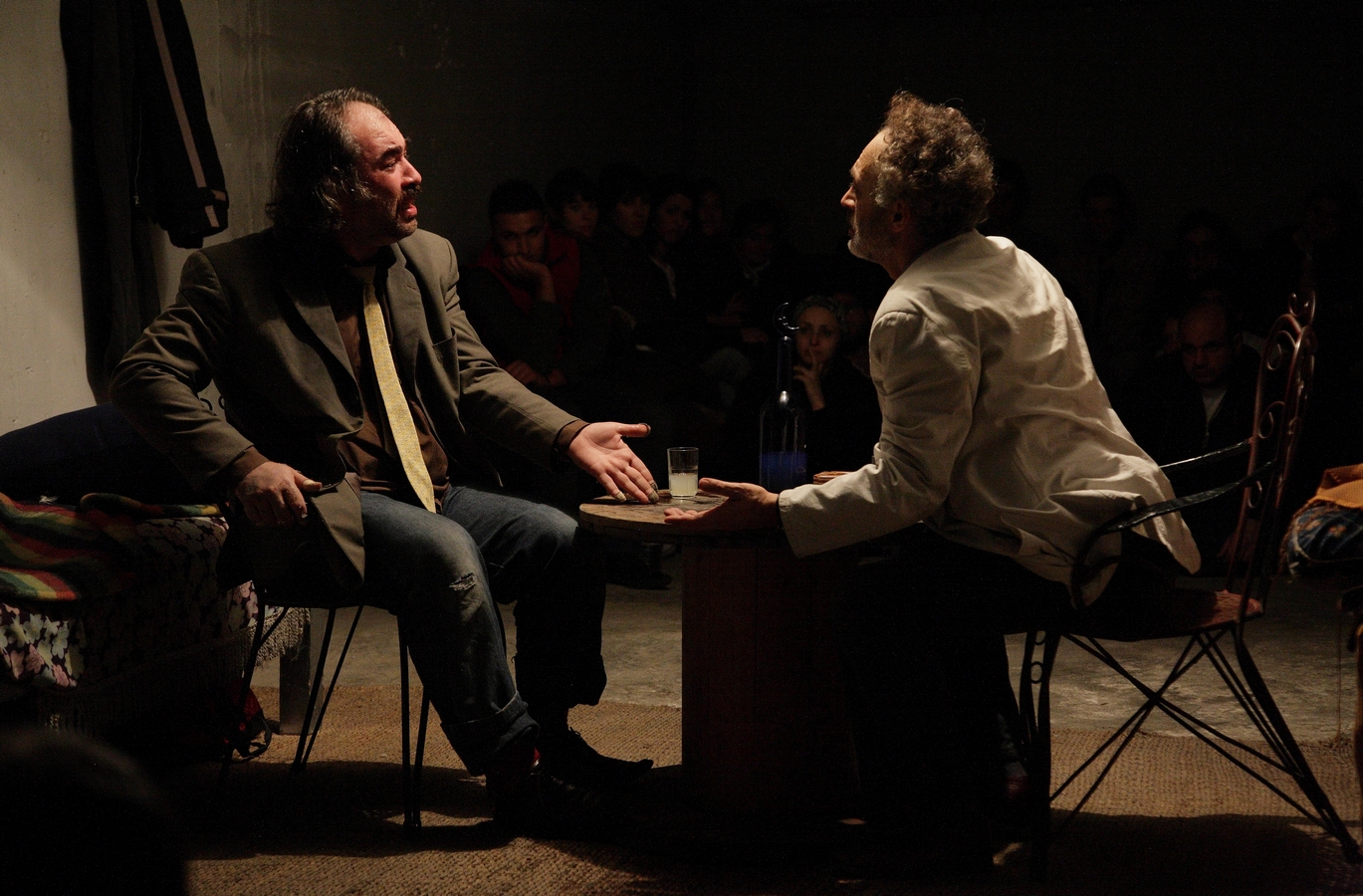
I quickly realized that my assumptions had been totally off-track. We were split into two groups and seated opposite each other on a set of couches in the corners of the room, both facing this old man who seemed to remain oblivious to our presence. I then realized that the living room which we had walked through, and what we were now facing, was in fact the stage for our play. To be more accurate, the room we were in was the stage, meaning the audience and the actor (the old man on the couch) were existing in the same space without separation. Quite brilliant actually, as you will see. I also figured out, finally, what the meaning of “Maljah” meant in this place. We had descended into a bomb shelter. As this dawned on me, a second light suddenly lit up and a second man, obese and drenched in sweat, stormed into the room. And thus began the play.

The Two Imigrants

“The Two Emigrants” takes place in a single-room as a continuous conversation between two impoverished laborers who room together on the basement floor of an urban building, a setting which is essentially identical to the location in which we had gathered for this private showing. In these 160 minutes, which are unbroken and without intermission, the men discuss their lives, the society in which they live, and their hopes for the future. The older man is a failed writer who considers himself the more educated of the two, but is petrified by his fear of an omnipresent “authority” and has yet to complete a single work. The obese man in contrast, is illiterate, slow to understand and quick to misinterpret, but dreams of earning enough money to escape the country they live in and to return to his unnamed homeland. Their conversations touch on topics of their daily lives and struggles and their Joyce-worthy paralysis in achieving their goals, all the time surrounded by the constant specter of a totalitarian government whose purely-physical absence does nothing to diminish its effect on how these men behave and think.

The mood of the play is a constant alternation between moments of comedy interspersed with unsettling eruptions of violence, frightening uncertainty, and despair. Despite the differences in the education of the two men, the conversation between them allows each one to slowly expose the other’s hypocrisies, lies, self-deceptions and delusions of future success, hope, and escape. As the play winds down, it becomes clear that the men are prisoners of a society that won’t allow them to succeed, and the only power they have is the decision to destroy their own dreams. Although the original script seems to have origins in Eastern-European, leftist literature, it has likely been adapted to describe the conditions of the Arab worker who travels away from his home and family to earn money and give them a better life, only to find that fortune is unattainable and his return is impossible.

The Two Imigrants

The Two Imigrants

While the play itself was quite good, the talent involved in putting it all together did quite a bit to restore my hope in the future of the Syrian theater. The two actors are, without exaggeration, truly excellent in their roles and demonstrated the utmost professionalism. One of the Institute teachers who attended the showing informed me that both actors had done some work in Syrian television, but were unsuccessful and had only played a few small roles. Watching the countless, indistinguishable soap operas that run on television, one would think that there is barely any talent amongst Syrian actors, who are often doing little more than yell indecipherable phrases and overact even the simplest moments. However, watching these two actors perform 160 minutes straight, it is seems that it may be television that does not suit the talented actor rather than there being a lack of skilled performers. Furthermore, at the end of the play, the actors went “backstage” in the adjacent room to bring out the crew that made the play possible. The direction and the technical credits, despite the play’s low budget, provided a completely enveloping and convincing experience. The single set, even in its extreme simplicity, evolves as the play progresses as a reflection of the characters discussions, with lighting cues occurring at just the right moments (and it must be added that a long section of the play takes place in near-total darkness lit only by a candle), in addition to a clever use of multi-directional audio cues representing the unseen inhabitants of the rest of the building and the city outside, and even the physical break-down of the apartment as pipes burst out leaking and the electricity comes and goes. Due to all these clever flourishes, I was surprised at the end when the crew turned out to be just two men, one of them presumably being the director. It is perhaps the only four-man play I have ever seen, but had I not seen this crew, I would never have known it.

As it seems, there is indeed a promising artistic culture in Damascus, underground though it may be (in more ways than one), and I must admit that seeing this play produced a measure of respect for Syrian dramatic arts in me that hadn’t been present before. However, we still have to ask ourselves, how many Syrians are going to see plays such as “The Two Emigrants”? Is its audience a cross-section of Syrian society, including Damascenes as well as viewers from the villages, or is it (more likely) attended almost exclusively by Damascus’ upper-middle class? The messages in the play are important for all Syrians to consider. In truth however, my concern is that these messages will go largely, if not exclusively, unheard.

Article and photographs by Ketan Gajria, Monday, December 1st, 2008: Ketan Gajria is an American student and graduate of Tufts University who is currently studying in the yearly-program at the Institut Français du Proche-Orient (IFPO) in Abou Roumanneh. The “The Two Immigrants” (?????????) is currently playing in Damascus.

Ketan at Indian-themed party in Damascus
Ketan and friend at Indian-themed party in Damascus

Also see Ketan’s blog: Ketan Sessions


“Giving Back the Golan Will Not Be Easy,” by Shai

Golan by Shai

Golan by Shai (Click to enlarge photo)


Giving Back the Golan Will Not Be Easy
By Shai, Nov. 30, 2008;

*Shai is an Israeli Advocate of Peace who frequently writes on Syria Comment

This weekend my wife and I, and some friends, decided to head up north for a short holiday.  This is a beautiful time of year, when everything is green outside, but not too much rain.  After spending a day in Tzfat (Safed), a spiritual center for Jewish Kabblah, and a serene town with a thriving artist colony, we decided to go visit the Golan.  We drove up through the northern part of the Heights, passing by Kal’at Namrud (Nimrod Fortress), Majdal Shams, Mas’ade, very nice Druze villages, at the foothills of the awe-inspiring Hermon mountain.  For Israelis, this is the tallest mountain in the country, and the only place we can go skiing.  We then headed south along the Heights, and ascended Mt. Bental, which overlooks Quneitra.

There is a cafe up there, on Mt. Bental, which is run by Kibbutz Merom Golan, just underneath.  The cafe is called, oddly enough, “Coffee Anan”.  Probably as some tribute to the previous UN secretary general, but more specifically because of its Hebrew meaning, “Cafe in the Cloud”.  The view is tremendous.  All of Syria, it seems, lies beneath the mountain and stretches endlessly to the east and to the north.   One can see the UN station in the neutral-zone, separating the Israeli-controlled Golan from the Syrian plateau.  Also in view are old and new Quneitra.  One cannot, of course, visit the old one, but its ruins are clearly visible to all – a historic reminder to the terrible battles that ensued here in 1967 and 1973.  When we were there it was quite misty, and as the cafe name suggested, we befittingly often found ourselves above the clouds.  It was almost an enchanted feeling, and very beautiful and relaxing.

It was also quite surreal.  Here we were, sipping nice warm coffee, while contemplating what has, is, and will be happening on these very hills.  The cafe, funny enough, has on its walls framed pictures of different tourist sites in Syria, with articles and information written below it in Hebrew, English, and Arabic.  It wasn’t clear to me whether the owners were hopeful about peace with Syria with, or without, returning the Golan. There are people up there, after all, who believe in “peace-for-peace”.

I took the opportunity to ask some of the young men and women who were running the place what they thought will happen with the Golan, whether they believed it will be returned to Syria.  One or two shied away from a direct answer, but one girl, probably 22 or 23 years old, said quite confidently “It’ll never happen”.  Hoping to better understand her, I reminded her of the ongoing indirect talks over the past 5 years, as well as very clear suggestions made by previous Prime Ministers in Israel as to that effect.  But she remained resolute, and repeated “It’ll never happen”.  At the risk of pushing the limit, I tried another approach – my pseduo-psychologist one…  “But surely,” I said, “even if you are absolutely certain that the Golan will remain Israeli forever, isn’t there any part of you, on the conscious or subconscious level, that questions it?”  “No,” the nice girl responded, “I believe that what I think is what will happen, so I don’t allow myself to think anything else…”  That summarized it for me quite well.  And in a way, it made sense.

This young girl was born and raised on the Golan.  This is the only home she knows.  Israel annexed the Heights in 1981, so she was born in a place her country considered its own (unlike the West Bank or Gaza, which were never annexed).  This girl knows the Golan better than she does Tel-Aviv or Jerusalem.  To her, the “courageous” pro-peace and anti-peace activists matter less than the land she and her parents have been working over the past forty years.  Talks of peace, when accompanied by land giveaways, her-land giveaways, are a bigger threat than the enemy himself.  To this girl, giving back the Golan is as foreign a notion as, say, giving Florida back to the Indians would be for the average Floridian.  History is irrelevant, when facts-on-the-ground are not only well established, but indeed well personal.  Could I blame her for feeling this way?  Would I feel any different, were I in her shoes?  Probably not.

We do know that there are also Golan residents that have voiced different opinions.  Some are ready to move “back” into Israel, should peace ever become a real-possibility.  They are ready to pay the personal price, in return for a safer future for their children, and for those of all of Israel.  While still a minority, it seems they are a growing one.  What will make it easier for Israel to give back the Golan one day are two facts about its Jewish residents:  First, there are only some 16,500 of them, unlike the 260,000 living in the West Bank.  Second, most have not moved to the Golan for the same religiously-motivated reasons as have the settlers in the Palestinian territories.  Ending the physical occupation of the Golan will not entail, quite likely, overwhelming religious interference by leaders and Rabbis across the country.  In fact, the religious party Shas has herself suggested in the past a readiness to give back land territories, in return for peace.  It never exhibited this “flexibility” when it came to matters of Jerusalem.  But the Golan has been, and will be, different.

Personally, I must admit giving back the Golan will not be easy for me either.  Though I do not feel nearly the same kind of attachment to this land as its residents do, I too have managed to fall in love with it, as anyone who has ever been up there would.  On this visit, I told my wife and our friends that although I will be saddened the day we return the Heights back its owners, I will be happy to return here again and again, even if I first have to obtain a Syrian visa…  On the emotional level, and we must come to understand this (whether we agree with it, or not), giving back the Golan will be, to most if not all of its residents, like the severing of an important limb in their body.  The fact that some politician may one day suggest that this limb was actually “transplanted” into their body, and was never theirs in the first place, will not help their personal trauma nor their pain.

But before this is possible, before Syria can peacefully attain control of the Golan, most Israelis will have to believe it is worth it.  History lessons, and UN resolutions, will not convince the people who are still fearful of Syrian tanks rolling off the Heights, on their way to Tel-Aviv.  That it was always Syrian territory, also before 1967, will not encourage Israelis to vote for a peace agreement, if they remain suspicious of Syria’s alliances with Iran, Hezbollah, and Hamas.  It is this emotional realm, that Syrians and Israelis will have to traverse, and it is here that the “battle for peace” will have to take place.  The sooner we understand this, the sooner the nice young girl we met up at “Coffee Anan” will begin to question her innate and understandable reluctance to leave her home, for the sake of peace.

IMF Report on Syria: Non- oil exports increased 23.5 percent

The Umayyad Mosque in Damascus by Alamy in WSJ

The Umayyad Mosque in Damascus by Alamy in WSJ

IMF economic report on Syria in full, here. Per capita income is $2150 per year. This means the average Syrian is earning about $179 a month or SYP 8200. On the whole, it is a positive report. Read Derhally’s good summary below.

Syria’s Economy May Slow as Result of Links to Gulf, IMF Says
By Massoud A. Derhally

Nov. 27 (Bloomberg) — Syria’s economic growth may slow next year because investment from the oil-rich Persian Gulf states may fall as a result of the global credit crisis, the International Monetary Fund said. The fund forecasts 5.2 percent growth this year compared with 4.2 percent last year. It didn’t provide a forecast for 2009.

Syrian Deputy Prime Minister Abdallah Dardari in August predicted 6 percent growth this year and 7 percent next year. “Syria is likely to be affected by a regional slowdown resulting from global financial linkages with other countries in the region, notably with the Gulf,” an IMF team that visited Syria during October said in a report on its Web site. Still, “worsening international financial conditions” have not affected the financial industry directly because of caps on banks’ foreign exposure and their “limited integration with the global system.”

Foreign investment into Syria from the Gulf was about $750 million last year, the government says, and may have exceeded $2 billion annually over the past five years, according to Dardari. That’s now at risk as the global credit crisis causes borrowing conditions to worsen. Amlak and Tamweel, Dubai’s two largest mortgage lenders, will be taken over by U.A.E. government-owned Real Estate Bank as the global financial crisis squeezed their access to credit and slowed lending to prospective buyers. The Abu Dhabi-based lender will be merged with the Emirates Industrial Bank to form a combined entity called Emirates Development Bank.

Diversification

A decline in Syria’s oil production is likely to continue, the IMF said. Oil revenue fell to 4.9 percent of GDP last year from 7.3 percent in 2006. Syria’s crude production has fallen to about 380,000 barrels a day, from a peak of 600,000 barrels a day in 1996, according to BP Plc’s Statistical Review of World Energy. The country is diversifying away from dependence on oil.

Non- oil exports increased 23.5 percent last year to $11.2 billion from $9.1 billion the year before, spurred by regional demand for textiles, pharmaceuticals, cotton and agricultural produce. They are forecast to reach $13.4 billion at the end of this year.

Non-oil GDP growth is estimated to have been about 6 percent last year compared with 6.9 percent in 2006 as unfavorable weather conditions affected agriculture, the IMF said. Non-oil GDP is forecast to remain at about 6 percent in 2008. Growth of non-oil exports and tourism receipts may “slow down moderately as a result of the weakening of the regional outlook,” the IMF said. “The oil balance is envisaged to deteriorate further on account of declining output and expanding domestic consumption.” ….

Syria’s medium-term outlook is expected to improve as the global and regional slowdown comes to an end and the world economy begins to recover, the IMF said. “This positive assessment would be contingent on perseverance in advancing fiscal and structural,” changes, the report said.

Qantara.de – Taking the Back Alley toward Change

The policy of privatisation and opening up the markets in Syria is bringing substantial social problems in its wake – but at the same time an almost imperceptible relaxing of political repression. Antje Bauer reports from Damascus…

More and more goods, particularly from the Asian region, are flooding onto the formerly insular Syrian market, crowding out small indigenous enterprises. This can also be seen in the textile industry, the country’s second most important export sector after oil.

Adil Rishi operates a small textile factory before the gates of Aleppo; he sells his goods to the neighbouring Arab states. “The Chinese imports are hurting our business,” he admits. …

The government’s partial withdrawal from the market is driving unemployment upward. Officially, the unemployment rate is eleven percent, but off the record it’s estimated to be more like 20-25 percent. The same low wages now have to go toward meeting increasing costs, with ever fewer subsidies available to fill the gap. Large portions of the population are facing poverty. At the same time, a new class of wealthy Syrians is emerging.

“The network of social solidarity is ripping, since it was wholly based on the role of the State, and nothing has risen up to replace it,” explains Samir al-Taqi, director of the government-associated think tank “Orient Centre for Economic Studies” in Damascus. “This is a major problem, and I think that Syria will soon be facing huge challenges on this front.” …..

The transformation from a state-controlled but unproductive economy to one that is at least partially privatized, and is under pressure to renew itself, was in any case unavoidable. In Syria this change is being made with sufficient care to at least cushion somewhat the impact of the deep-reaching social fault lines that shook the formerly socialist states of the Eastern Bloc. A positive side effect is that the economic opening is having the effect of loosening the government’s grip on society.

“We who live here and read the newspaper and watch television can tell that something has changed in the past few years,” comments Ibrahim Hamidi,…

By contrast, the regime still reacts with knee-jerk repression against the opposition. Just recently, twelve signers of the “Damascus Declaration,” which called for a multiparty system, democracy and the repealing of the emergency laws that have been in effect since 1963, were each sentenced to two-and-a-half years in prison – a judgment that was interpreted in Syria as “especially mild.”

In the course of 45 years of dictatorship by the Assad dynasty, Syrians have been forcibly depoliticized, and the left-wing, secularized democrats in particular find little support amongst the population.

“Following independence, Syria had a very active political life. But by now the grass-roots basis for political activities is smaller than ever,” laments Yassin Haj Saleh, who signed the Damascus Declaration. Against this backdrop, the Muslims could prove to be more of a political threat, profiting from the conservative social trend in Syria. ….

…Privatization is picking up its own momentum, which is in turn affecting other areas of society. A policy of sanctions and threats, like the one the USA in particular has practiced toward Syria in recent years, jeopardizes this development. That’s why even a dissident like Yassin Haj Saleh declares that:

“It would be good if the West would invest here to strengthen the economy. And if the Syrian-European partnership agreement would be signed. This kind of involvement would give the West some leverage to influence the Syrian regime’s behaviour at home and in the region.” by
Antje Bauer

Tourists Warm Up to Syria by Brooke Anderson in Wall STreet Journal

…tourists, many of them European, have been warming to Syria for some time. Part of the appeal has been the charm and relative ease of getting around in a place that hasn’t turned into the type of mass tourism destination that other Arab countries like Morocco or Egypt have become. Syria offers inexpensive and reliable public transportation and its tourist attractions are not thronged with crowds….

Stephen Wagner, a 27-year-old paramedic student from Leipzig, Germany, and a fan of Middle Eastern culture, recently spent nearly three weeks traveling through Syria. Friends told him it was an easier place for foreigners to visit than other Arab countries — with no tourist traps and fewer hassles from street vendors. “I was in Morocco in the spring, but I found it too aggressive toward tourists, with people always trying to sell things,” Mr. Wagner says. “I heard Syria was completely different. And it’s true.”

Spaniard Luis Olivares, who also made a recent trip to the country, adds: “I like the hospitality and the fact that it’s easy to move around here.”

Drawn by a handful of new, boutique hotels in Damascus, an Old City that officials are slowly restoring, and an overseas-marketing campaign, the number of foreign visitors has risen by 50% this year compared with last year, according to the Syrian ministry of tourism.

[syria coppersmith] Photo: by Alamy : A coppersmith at work in Aleppo

At just over seven million visitors in 2007, the boost is helping Syria catch up with some of the region’s more established tourist destinations, like Egypt, which drew 10.6 million visitors last year, according to the World Travel & Tourism Council, a London-based trade group.


Beit Al-Joury courtyard
Most Damascene houses are set round a courtyard with a fountain.

Long-isolated Syria warms to tourism, By Katie Hunt
BBC

It took Mamoun Al-Halabi almost four years to transform a damp and dilapidated Ottoman house on a narrow lane in Damascus’s old city into a chic, five-star hotel.

To prevent damage to the ornate 17th Century wall paintings he made his workers use toothbrushes. His wife scoured Syria to find antique furniture and fittings and commissioned local craftsmen to replicate centuries-old woodwork and chandeliers.

Once finished, he spent six months sleeping in each of the 10 rooms to iron out any problems guests might have encountered.

“It was like a tunnel. You didn’t know when you would come out,” he says, gesturing at the tranquil sun-dappled courtyard, babbling fountain and the opulently decorated rooms beyond.

But his efforts paid off. He says the hotel has been almost fully booked since it opened a year ago. Beit Al-Joury is one of 10 boutique hotels to have opened in Damascus’s old city in the past two years. Many more are in the pipeline as upwardly-mobile Syrians, such as Mr Al-Halabi, take advantage of the country’s newly liberalising economy.

Itamar Rabinovich’s “new” book is ‘The View from Damascus: State, Political Community and Foreign Relations in Twentieth-Century Syria’, (MESH) here
“….The accent of the essays dealing with foreign relations is on two themes: Syria’s transformation under Hafez al-Asad from a weak state to a powerful regional actor, and the evolution of its relationship with Israel from the pure hostility of earlier decades to the mix of conflict and negotiations since 1991.The volume’s concluding essay is taken from a forthcoming monograph written for the Saban Center at Brookings and dealing with the trilateral relationship between Washington, Jerusalem and Damascus during the past eight years. It was written with an eye to the unfolding policy debate in the United States and Israel….”

IAEA Broadens Probe of Syria, WSJ:
Jay Solomon, 2008-11-29

The United Nations nuclear watchdog, the International Atomic Energy Agency, is broadening its probe of Syria’s suspected nuclear program and pushing for information from its alleged collaborator, North Korea, as well as from Israel, officials said this past week.

Despite signs that the U.S. and Israel aren’t in a punitive mood toward Damascus, the suspected nuclear program is emerging as a major international issue.

The IAEA is asking North Korea and Israel for more information as part of its probe into Syria. Above, IAEA Director Gen. Mohamed ElBaradei.

The IAEA’s probe places the incoming Obama administration in a difficult spot diplomatically. President-elect Barack Obama has indicated his desire to engage Syria, but he also backs global antiproliferation efforts.

Israeli jets destroyed a suspected Syrian nuclear facility in September 2007. U.S. intelligence agencies said that at the time, the facility was weeks from being operational. Syria has denied it was building a nuclear reactor, and suggested that uranium particles found there by U.N. inspectors in June came from Israeli bombs.

Earlier this week, the IAEA sent a letter to Jerusalem seeking clarification on whether Israeli bombs could have been the source of the uranium particles, U.N. officials and Western diplomats said. An Israeli official declined to comment.

The Central Intelligence Agency has alleged that North Korea was the principal designer and builder of the Syrian facility, known as Al Kibar.

A senior U.N. official close to the investigation said the IAEA is hoping to learn more through the disarmament talks between North Korea, the U.S. and other powers. North Korea’s alleged role in exporting nuclear technologies to third countries is a principal focus of the talks.

Damascus has refused to allow the IAEA to visit at least three other sites suspected of being linked to the Al Kibar complex. It has so far ruled out additional visits to Syria by agency officials.

 … U.N. officials said the investigation has been hampered by the August assassination of Syrian Brig. Gen. Mohammed Suleiman, the IAEA’s principal contact in Damascus. The officials said Gen. Suleiman oversaw the IAEA’s access to suspected Syrian sites, as well as briefings by Syria to the IAEA inspectors. “We don’t have a new source” of contact inside Syria, said the senior U.N. official.

Another snag was cited by IAEA Director General Mohamed ElBaradei this week. He said the agency has had trouble obtaining commercial satellite images of the Syrian site in the weeks after the Israeli attack, perhaps because someone bought them up. “It is regrettable, and indeed baffling, that imagery for this critical period…was not available,” Mr. ElBaradei told the IAEA’s board of governors on Wednesday.

Israel has neither confirmed nor denied its role in the Syria attack. A U.N. official said investigators found no traces of depleted uranium — the normal form of uranium found in munitions — at Al Kibar, but said he couldn’t rule out that other forms of uranium may have been used in the Israeli bombs dropped on the site.

U.N. officials said the IAEA hasn’t found evidence so far that uranium from a North Korean nuclear facility at Yongbyon was diverted to Syria. The IAEA hasn’t ruled out that the uranium could have come from a separate North Korean site, and is looking into whether it came from a third country…..

Raghida Dergam in al-Hayat Counter those who recommend a Syria First policy to peace

…… On the one hand, [Israeli Defense Minister Ehud Barak’s] view is that Lebanon should be sacrificed and returned to Syria, and that the international tribunal to try those implicated in political assassinations should be dropped, under the pretext of separating Syria from Iran for strategic purposes. At the same time, he is effectively doing what he really wants, which is to waste time discussing Syrian-Israeli negotiations in order to prevent any progress in Palestinian-Israeli peace talks.

It became common among the circle of people who surrounded presidential candidate Barack Obama to “buy” the idea of giving priority to Syrian-Israeli negotiations through Turkey at any cost. These people should give up this dangerous idea, because there is no leaping over the Palestinian issue and no rift between Syria and Iran, and because negotiations between Syria and Israel should not be used to end the isolation imposed on Damascus. If Syria is truly honest about turning over a new leaf with Lebanon, one in which it would respect the country’s independence and sovereignty and would cease using it as a battlefield for the armed Palestinian factions that take their instructions from Damascus, then such a development would be welcome. However, Syria’s history with Lebanon does not portend such a qualitative shift, as Damascus is fully convinced that Lebanon remains its strategic depth. If, on the other hand, it has changed its mindset and its methods as a result of ongoing developments, then the coming Obama administration should be given clear guarantees in that respect.

Until then, Lebanon, rather than the ghost of indirect negotiations between Syria and Israel, remains the way for Syria to end its international isolation. Indeed, the real target of international resolutions concerned with Lebanon is Syria, as these resolutions have demanded that Damascus stop interfering in Lebanon’s affairs, stop the flow of weapons to militias in Lebanon that are opposed to the army and to the state, stop refusing to demarcate its borders with Lebanon, and stop trying to freeze the international tribunal. If Syria’s intentions with Lebanon are dishonest, then Syria will remain under observation, regardless of how much it and others believe that it has overcome pressures and reached safety by the mere fact that Obama was elected……

“Start With Syria” by Aaron David Miller

Aaron David Miller offers up good sense for a second day in his “Start with Syria” article. He writes:

A [Syria] deal would begin to realign the region’s architecture in a way that serves broader U.S. interests. The White House would have to be patient. Syria won’t walk away from a 30-year relationship with Iran; weaning the Syrians from Iran would have to occur gradually, requiring a major international effort to marshal economic and political support for Damascus. Still, an Israeli-Syrian peace treaty would confront Hamas, Hezbollah and Iran with tough choices and reduced options….

Read the entire article below with comments by our own Qifa Nabki and an important caveat from Ahmad Salkini of the Syrian Embassy in Washington who councils the West not to expect Syria to cut its relations with Iran.

Start With Syria
A Middle East Deal Obama Could Build On
By Aaron David Miller
Wednesday, November 26, 2008; Page A13

President-elect Barack Obama will be bombarded with recommendations about how to approach Arab-Israeli peacemaking. One piece of advice he should not take is to make Israeli-Palestinian peace his top priority. There’s no deal there. But there is a real opportunity for an Israeli-Syrian agreement, and Obama should go for it.

There are, of course, strong arguments for making Israeli-Palestinian peacemaking a priority. The Palestinians deserve a state of their own, and an Israeli-Palestinian agreement is not just key to a comprehensive Arab-Israeli peace but to Israel’s long-term survival as a Jewish democratic state.

A new president eager to repair America’s image abroad may be tempted to try for an agreement, but he should avoid the sirens’ call. No conflict-ending agreement is possible now, nor is one likely to be anytime soon, and the stakes are too high for America to harbor illusions that would almost certainly lead to yet another failure. The gaps separating the two sides on the core issues (Jerusalem, borders, refugees and security) remain too wide, the current leaders are too weak to bridge them, and the environment on the ground is too complicated to allow for sustainable negotiations.

In Palestine, dysfunction and confusion reign. The Palestinian national movement is riven with geographic and political divisions between Hamas (itself divided) and Fatah (even more divided). There is little chance of creating a united Palestinian house that can take control of the guns and offer up a viable and unified negotiating position that any Israeli government could accept. Weak leadership and unstable coalition politics prevail in Israel, too. And Israeli settlement activity, which continues unabated, rounds out a nightmarish picture that ought to scare away any smart mediator.

It would be folly to go for broke, given these conditions. The notion that trying and failing is better than not trying at all might be an appropriate rallying cry for a college football coach; it isn’t a suitable foreign policy principle for the world’s greatest power. The well-intentioned old college try, which was President Bill Clinton’s mantra at Camp David in July 2000, reinforced by his advisers, myself included, proved costly. And we had much better conditions in 2000 (if still not the right ones) than the new administration faces.

The more compelling argument is for a major push on another negotiation: between Israel and Syria. Here, there are two states at the table, rather than one state and a dysfunctional national movement. A quiet border, courtesy of Henry Kissinger’s 1974 disengagement diplomacy, prevails. And there are fewer settlers on the Golan Heights and no megaton issues such as the status of Jerusalem to blow up the talks. Indeed, the issues are straightforward — withdrawal, peace, security and water — and the gaps are clear and ready to be bridged.

For a president looking for a way to buck up America’s credibility, an Israeli-Syrian agreement offers a potential bonus. Such a deal would begin to realign the region’s architecture in a way that serves broader U.S. interests. The White House would have to be patient. Syria won’t walk away from a 30-year relationship with Iran; weaning the Syrians from Iran would have to occur gradually, requiring a major international effort to marshal economic and political support for Damascus. Still, an Israeli-Syrian peace treaty would confront Hamas, Hezbollah and Iran with tough choices and reduced options.

None of this will be easy. An Obama administration, and particularly the new president, would need to be in the middle of things. It would be excruciatingly hard, time-consuming and expensive to satisfy Israel and Syria’s economic and security needs, and a final agreement would most likely involve U.S. peacekeepers. More important, the United States would need to push the two sides further than they are now willing to go, on the extent of withdrawal from the Golan Heights in Israel’s case, on normalization and security in Syria’s. But with Israeli and Syrian leaders who are serious, and with a new administration ready to be tough, smart and fair in its diplomacy, a deal can be done.

So, Mr. President-elect, go ahead and try to buck up the Israeli-Palestinian cease-fire, train Palestinian security forces, pour economic aid into Gaza and the West Bank, and quietly nurture Israeli-Palestinian negotiations. But don’t go for the endgame — you won’t get there. Instead, invest in an Israeli-Syrian peace, and, afterward, you might find, with a historic success under your belt and America again admired for its competence, you will be better positioned to achieve the success you want in Israeli-Palestinian negotiations, as well.

Aaron David Miller, a public policy fellow at the Woodrow Wilson International Center for Scholars, has worked as a Middle East adviser for Democratic and Republican secretaries of state. His most recent book is “The Much Too Promised Land.” The Agenda is an occasional series on policy issues facing the Obama administration.

[Comment by Qifa Nabki in Beirut, sent to SC by email] 

I was talking to a hard-core Aounist last night… he feels certain that the Hizb will have no problem with peace. He said: “Already, Hizbullah functions as a security blanket for Israel. We used to see Palestinian guerillas everywhere in the south. They have vanished. After peace, Hizbullah will easily continue being what it has already become: a national defense.”

After a deal, as Miller writes, the security architecture of the region will change so dramatically, it’s hard to see why the Americans are not supporting it. They have to take the long view… stop trying to stick it to Bashar about Iran and Hizbullah and just read the writing on the wall.

West should capitalise on Syria’s good offices with Iran
Published in the Financial Times: November 24 2008 02:00 | Last updated: November 24 2008 02:00

From Mr Ahmed Salkini.

Your editorial “Dallying with Syria” (November 20) misses the point on the emerging Syrian-west relationship, the Syrian-Iranian relationship, and on-the-ground dynamics in our region.

The re-engagement process between the west with Syria has nothing to do with “peeling off Syria from its alliance with Iran”, and everything to do with addressing problems in our region. Syria lies geographically at the heart of three conflict areas, Iraq, Israel, and Lebanon. Mere political pragmatism dictates involving Damascus in any solution for these issues. Helping the Lebanese end their political stalemate, co-operating with the Iraqis and sending an ambassador to Baghdad, and partaking in indirect talks with Israel only prove that while other countries watch from the sidelines, Syria is fully immersed in peaceful resolutions on all three fronts.

Regarding Iran, approaching Syria with the premise of breaking its ties with Iran is a non-starter. Not even Israel asked us for this in our indirect talks.

Instead, the west should capitalise on Syria’s good offices with the Iranians to help bridge their differences and misunderstandings. Such an approach will return much higher dividends to all parties than a doctrine, proven bankrupt, of “peeling” or isolating.

Ahmed Salkini, Spokesman,
Embassy of Syria, Washington, DC, US

How not to negotiate with Syria
By ITAMAR RABINOVICH
The Jerusalem Post, 25 November 2008

The “Syrian track” – Israel’s negotiation with Syria, actual and potential, about the resolution of their conflicts – is very much in the news now. Prime Minister Ehud Olmert would like to have a fifth round of these indirect negotiations with Damascus under Turkish mediation. He would like to upgrade them into direct negotiations and possibly reach a breakthrough that could be seen as part of a legacy. His opponents and the opponents of Golan withdrawal have argued that even if he has the legal authority, he does not have the moral authority to commit Israel to far-reaching concessions in the twilight of his tenure.

More quietly, the foreign policy team of President-elect Barack Obama and Secretary of State Designate Hillary Clinton are drawing scenarios for the new administration’s Middle Eastern policy. Some of them are known to favor the Syrian track over the Palestinian option. Their argument is two-fold:

1. The Syrian track is more likely to produce an early success. The Syrian-Israeli conflict is simpler than the Israeli-Palestinian one and the authoritative address missing in Ramallah is available in Damascus.

2. Syria is Iran’s closest ally in the Middle East and its springboard to the region’s core area. By reviving a trilateral American-Israeli-Syrian negotiation, Washington would acquire greater leverage (positive or negative) in its dealing with Teheran, one of its prime concerns in the Middle East. (This, it should be emphasized, has defiantly not been the Bush Administration’s view or policy.)

IT WAS against this backdrop that Haaretz published earlier this week the gist of a document prepared in Israel’s defense establishment that advocates an Israeli-Syrian deal, even at a “painful price” (namely full withdrawal from the Golan heights that Syria insists on as a sine qua non). The authors of the document argue that a Syrian-Israeli agreement holds the key to dealing with the challenges presented to Israel by Iran and by Iran and Syria through Hizbullah in Lebanon. These gains justify, so they argue, the painful concession of withdrawing fully from the Golan.

For both the American and Israeli advocates of this “geo-political” approach to a Syrian deal, Syria’s disengagement from Iran would be one of its key components. As former ambassador Martin Indyk has aptly put it, the emphasis has shifted from “territories for peace” to “territories for strategic realignment.” 

This formula may or may not work if and when a full-fledged negotiation involving all three parties (the US, Israel and Syria) is launched in the early spring of 2009, after the Obama Administration is installed and a new Israeli government emerges from the February 10 election. But one thing is certain: With Syria, early public discussion of an idea to be raised in the negotiation is likely to undermine it.

THIS WAS one of our early lessons in the Israeli-Syrian negotiations of the 1990s. At one point we thought of long-term leasing as a potential magic formula for mitigating the territorial issue. We did not build high expectations for it, but we thought it was worth trying. At that point one of the numerous Israeli politicians who used to pronounce on the unfolding peace process proposed it in public. It took no time for the Syrians to shoot it down. This was not an isolated case and the lesson was clear – if you have a new good idea, keep it for the privacy of a confidential negotiation.

A second lesson, hardly an earthshaking discovery, was that you must not appear too eager for the deal. This immediately raises the price. From this perspective, whoever leaked the document to Haaretz has weakened Israel’s hand in the negotiation with Syria.

This does not mean that a negotiation of this importance can or should be conducted in total secrecy, and that a signed and sealed deal should be delivered to a stunned public. Public diplomacy is an essential part of any negotiation and conflict resolution. But so is secret diplomacy.

If the Israeli-Syrian conflict is to be resolved, and if Damascus is to build a new relationship with Washington as part of the same process, it would take leadership and statesmanship to make it happen. Secret diplomacy (for the parties to establish the fundamentals of the deal) and public diplomacy (to prepare the ground for painful concessions and anticipated gains) would have to be sequenced carefully if the process is to succeed against many odds.

The writer, former chief negotiator with Syria and ambassador to Washington, is the author most recently of The View from Damascus (Valentine Mitchell, London and Oregon, 2008).

IAEA overrides U.S., clears Syria nuclear aid plan
By Mark Heinrich, November 26, 2008 

VIENNA (Reuters) – The U.N. atomic agency approved a contested Syrian bid for nuclear aid on Wednesday, overcoming U.S.-led resistance to the project while Damascus is under investigation for covert activity that could lead to atom bombs. 

The United States, Canada and Australia mounted last minute objections to a compromise deal on the project but finally joined a consensus in favor since they could not have won if they forced a rare vote by International Atomic Energy Agency governors, diplomats in the closed meeting said…..

Lebanon seeks defense cooperation with Iran
Tehran Times, Nov 26, 2008

TEHRAN – Lebanese President Michael Suleiman on Tuesday expressed his country’s interest in bolstering defense cooperation between Beirut and Tehran.

In a meeting with Iranian Defense Minister Brigadier General Mostafa Mohammad Najjar at the Defense Ministry’s permanent defense fair in Tehran, Suleiman, a former Army chief, insisted on the need to strengthen the Lebanese Army’s defense power in countering terrorism and likely foreign invasions.

Iran’s defense minister said, “The Islamic Republic of Iran is ready to expand and deepen defense cooperation between the two countries to improve Lebanon’s security and to increase Lebanon’s national and defense capabilities.”

Najjar described the Lebanese people’s courageous endeavor during their 33-day war with Israel in 2006 as the symbol of “perseverance and resistance” against Israel in the Muslim world.

The Lebanese leader also told Najjar that “Iran and Lebanon have great affinity and share common stance on many regional and international issues….. 

The following article copied in Arabic explains that Bashar al-Assad is the winner of the Istanbul based, Turkish-Asian Center for Strategic Studies prize for outstanding “Statesmen of strategic vision.”

?????????? ?????? ??????? ???? ?????? ????? ????? “?????? ????????????”

??? ?????? ?????? ??????? ???????? ???????????? ?? ??????? “?????” ?????? ???? ????? ????? “?????? ???????????? ???? ??????” ???? “?????? ????? ???? ???? ???? ????? ?????????? ?????? ??????? ??????? ??? ???? ?? ????”.

???? ???? ?????? ?????? ????? ?? ???? ?????? ???? ???????? ?? “????? ??? ???? ?????? ?? ???? ???? ?????????? ????? ??????? ?? ??????? ??????? ?????? ?????? ??????? ??????? ???? ?? ??? ?????? ????? ????? ??????? ?? ????? ?????? ??????? ?? ??????”.
????? ????? ??? ??? “??? ????????? ??????? ????????? ??? ????? ??? ????? ????? ???? ?????? ?????? ?????? ??????? ??????”, ????? ??? ?? “?????? ?????? ??? ?? ???????? ??????? ??????? ????? ????? ?????????? ?? ??????? ??????? ??????? ???????? ?? ???? ???????”.
????? ???????? ??????? ??????? ???? ?? ??????? ????? ??????? ?????? ????? ?? ???? ????????.
??? ????? ??? ??????? ????? ??? ?? ?????? ????? ??? ?? ????? ??????? ???????? ???? ????? ??? ????? ?? ??????? ??????? ??????? ???? ??? ??????? ??? ????? ?? ???????? ??????? ?????? ???????.
???? ???? ?????? ?????? ??? ?? ?????? ????? ?????? ??? ????? ??? ????? ???? ????? ??????? ?????? ??????? ???????????? ????? ?????? ????? ?????? ?????? ?? ?????? ??????? ????????”

IAEA: West can’t deprive Syria of N-tech
Presstv, 25 November 2008

The UN nuclear watchdog warns the West against impeding Syria’s efforts to construct a nuclear reactor over ‘political considerations’.

In a statement released by his office, Director of the International Atomic Energy Agency (IAEA) Mohamed ElBaradei said if Syria’s request for technical help for building a nuclear reactor were rejected over “political considerations”, the body would lose its credibility among the developing nations which seek peaceful nuclear energy.

“All the equipment that is provided is relevant to the project, and is of an innocuous nature. None of it requires any (nuclear) safeguards,” ElBaradei was quoted by Israeli daily Haaretz as saying.

He made the remarks as the International Atomic Energy Agency’s Technical Assistance and Cooperation Committee (TACC) held its annual meeting in Vienna to discuss Syria’s demand for technical assistance, AFP reported Tuesday.

The project which would last from 2009 to 2011, “did not parachute out of the sky,” said ElBaradei, adding that “We have been working with Syria since 1979 … on different aspects of the feasibility to introducing nuclear power… Thirty years.”

Denying nuclear aid due to unproven allegations “is not part of our lexicon, it’s not part of our statute,” the UN official reiterated.

Israel and its Western allies have accused Damascus of having planned to construct a secret nuclear reactor. Israel bombed a desert site last September, alleging that the place had been a secret under construction reactor.

They argue that it would be “highly inappropriate” for the watchdog to share sensitive technical information with Damascus while the country is still under investigation for allegations.

EU, Syria to initial Association Agreement next month
Chinaview.cn, 26 November 2008

The European Commission and Syria announced here Tuesday that they are set to initial the Association Agreement in Damascus on Dec. 14 after they agreed on all issues regarding the update of the draft document, which was reached in 2004.

“Following thorough and constructive discussions, on November 25, the Syrian delegation and the Commission services agreed on all issues regarding the update of the Agreement, taking into consideration developments since its initialing in October 2004,” said a joint statement issued by the European Commission and the Syrian delegation led by Deputy Prime Minister for Economic Affairs Abdullah Al Dardari…

Sami Moubayed, in Gulf News, here (Via FLC)

“…He wants to stand as a pan-Lebanese leader, representing all sects, and this explains his alliance with Druze figures like Talal Arslan, Sunnis like Omar Karameh and Salim Hoss, and Shiites like Nasrallah and Parliament Speaker Nabih Berri.

A newfound axis that Aoun is creating with both Syria and Iran is also frightening to the March 14 Coalition. Last month, he visited Tehran, marketing himself as the only leader who can protect Hezbollah in Lebanon.
In striking contrast, Geagea was visiting President Hosni Mubarak in Cairo and meeting Lebanese President Michel Suleiman in Riyadh, showing just how polarised Lebanese Christians had become….”
Syria: Increasing Mobility
26 November 2008, Oxford Business Group

Russian mobile phone operators are the latest to express an interest in entering the Syrian market, though they will have to wait until new legislation is passed by the parliament to further open up Syria’s telecommunications sector.

On November 20, Russia’s Communications Minister Igor Shchyogolev said Damascus was considering inviting bids from a Russian cellular operator for the third mobile phone network licence, which could be offered next year.

“They have an idea to add one more mobile operator there. The participation of Russian companies in the Syrian mobile market is possible,” he said following a meeting of the Russian-Syrian Intergovernmental Commission in Moscow.

Spokespersons for the three leading Russian mobile phone companies – MTS, Vimpelcom and MegaFon – contacted by the Reuters news agency all said their firms would be interested in any opening in the Syrian market.

“Syria is one of the regions we are interested in, and we will certainly examine any offer,” said Yelena Prokhorova, spokeswoman for Vimpelcom, Russia’s second largest cellular operator.

While apparently keen, Russian companies, along with up to 10 other companies reportedly interested in entering Syria, will have to bide their time for now.

On November 2, Syrian Telecommunications Minister Imad Sabouni said draft legislation intended to restructure the sector was being considered by a ministerial committee before being tabled before the parliament.

Until this legislation was approved, Syria would not call for tenders for a third mobile phone network, Sabouni was quoted as saying. He said that his ministry was working on drafting regulations to allow a new competitor in the market.

Not only will the new legislation lay the groundwork for a third mobile operator, but it will also end the Syrian Telecommunications Establishment’s (STE) monopoly on landline infrastructure, and turn the STE into a state-owned company, rather than an agency which is both the landline operator and sector regulator. A new sectoral regulatory body is planned.

One of the reforms being considered is changing the terms under which Syria’s two existing mobile phone operators work. Both locally-owned Syriatel and MTN-Syria, a subsidiary of South Africa’s MTN, have a 15-year build-operate-transfer (BOT) agreement that requires them to pay the STE an increasing percentage of their total income – 30% for the first three years, 40% for the following three and 50% for the remaining term of their contracts.

Ha’aretz: Israel asks Bush to explain its ‘special relationship’ with U.S. to Obama (Via Turcopundit)

Israeli officials concerned Obama may push arms control that could weaken Israel’s strategic deterrence.

Aluf Benn: Obama’s challenge will be to persuade Netanyahu to advance peace

Obama T-shirt From the “Axis of Evil”

Posted by Alex
By Mona Eltahawy

Look what was hanging outside a shop in Damascus’ Old City. Shops close by were full of t-shirts, key chains and posters of Hezbollah leader Hassan Nasrallah, Imam Ali, Hafez, Basel and Bashar al-Assad but Nabih Al Saghir’s Rainbow Stores wore its love clearly on the store door.

Obama T-shirt in old Damascus (photo by Magdi Abdelhadi, BBC News)

Obama T-shirt in old Damascus (photo by Magdi Abdelhadi, BBC News)

Obama T-shirt in old Damascus (photo by Magdi Abdelhadi, BBC News)

Obama T-shirt in old Damascus (photo by Magdi Abdelhadi, BBC News)

I bought a couple of the t-shirts and had a chat with Nabih Al Saghir, owner of Rainbow Stores.

“I was sitting with my son; he asked me “who do you think will win”. I told him for sure “McCain”. He said I think Obama will win and because he felt that way he wanted to make a t-shirt for Obama.

I told him I wasn’t sure how people would react here in Damascus, we love peace and we pray for peace and god willing you will be right.

We didn’t expect it to be so popular.

Obama’s younger age worked in his favour but we didn’t think it would be possible. America has a problem with the world so maybe it will choose Obama to solve its problems with the second world and the third world.

Most people wanted Obama, maybe because he is of African origin, but he is American first and last but we had a feeling that Obama would represent change for the better for America.

We love America – its industry is good, people from all over the world are there, and maybe that’s why we love it. Many of our friends are there. I have several friends and relatives who live there. And I’ve met Americans through my work and I’ve got to know them.

They’re very simple people.

There is a demand for the (Obama) t-shirts. Not too many Syrians. Some of them were surprised we had the courage to hang an Obama t-shirt outside. I heard some comments. One person today asked if I got permission to hang the t-shirt outside the store. I heard him asking my son. He warned my son I’m an annoying person but I must ask you if you got permission.

My son said no we didn’t ask for permission but we have democracy!

Most buyers are Europeans. And young Americans here to study or in Jordan or here as tourists. They were very surprised. This is the second interview with the media.

The market is full of pictures of Hezbollah leader Hassan Nasrallah

Nasrallah is another issue. Obama has nothing to do with Nasrallah. We want to support Nasrallah with all we have but he’s another issue.

Are they alike? Obama helps the poor. And Nasrallah does too.

We are the ones who always suffer. It makes us happy that someone (like Nasrallah) fights back and whose army is well trained and disciplined.
My message to Americans would be to care about people of other countries.

My message to Obama would be give the world a chance to see you, to meet you and talk to you. So that he sees clearly the poor countries of the world. We hope for cooperation between us.”

“A New U.S. Policy For Syria,” by Seth Kaplan

A New U.S. Policy For Syria: Fostering Political Change in a Divided State
By Seth Kaplan (see his site)
Middle East Policy, Fall 2008, pp. 107-121

[The following are excerpts from Seth Kaplan’s 14 page article in MEP] Mr. Kaplan is a business consultant to companies in developing countries as well as a foreign-policy analyst. He has a new book: Fixing Fragile States: A New Paradigm for Development (2008). He suggested I post some excerpts from his well crafted article in order to stimulate a discussion on Syria Comment. Here we are:

… How should [Syria] reform?

The changes with which Bashar has tinkered since he succeeded his father as president in 2000 are far too modest to address the multifarious problems confronting the country. Meanwhile, the Iraq experience has vividly shown that attempts to introduce sweeping political and economic reform can easily awaken savage identity conflicts, conflicts that haunt almost every Arab state.

Like Iraq (and many other Middle East states), Syria is a divided polity with weak formal institutions that have little history behind them and that are stable only to the degree that they are backed by a formidable security apparatus. If Syria does experience a hard landing, social unrest is a certainty and sectarian violence a high probability.

Is there, however, a middle path between Bashar’s piecemeal reforms and Bush’s preference for abrupt political transformations, a third way that can satisfy powerbrokers in both Washington and Damascus? This essay argues that there is. Moreover, it contends that a middle path may well be the only realistic option if Syria is to overcome its worsening economic and sociopolitical situation, maintain long-term stability, and move towards a more open and accountable system of governance.

Effecting a program of significant reform, however, will demand three things: the patience to introduce change gradually, incrementally and cautiously, so as to avoid instability; the flexibility to alter Western-style democracy and development to fit Syrian conditions; and the readiness to work with, not against, Bashar or some other leading figures within the regime.

A FRAGMENTED SOCIETY

Syria is a state both young and old, divided by conflicting interpretations of its past. The modern state — an artificial creation that dates only to the Anglo- French partition of the region following World War I — has inherited a unique blend of geographical, ethnic, religious and ideological heterogeneity that complicates all efforts to construct a cohesive whole from its disparate parts. A brief recital of the history of what “Syria” has been illustrates the diversity of the modern state’s inheritance.

Syria has been the home of historic pan-Arab nationalism, where the first short-lived modern Arab state was based; of Greater Syria, the ancient bilad al-sham (literally, “the land of the left hand”2) that encompassed the whole Levant for centuries;….

…. many Syrians have also repeatedly sought an identity in pan-Arab, Greater Syrian or Islamic causes, further impeding any attempt to construct a nation-state on Syrian territory….

…a complex mosaic of almost two dozen distinct religious and ethnic groups that were traditionally so highly autonomous and self-administering that the government of the Ottoman Empire was limited to simple tax collecting.

So rich and varied a history is not an unalloyed blessing. The state’s very diversity dominates its political dynamics, limiting policy options, inhibiting risk-taking, and making any government highly defensive. Decades of stability have only partly compensated for the sectarian handicaps that hinder its capacity to develop a lasting identity….

THE DANGERS OF A HARD LANDING

There is a deep division inside Washington over the best policy toward Damascus. For most of its time in office, the Bush administration has refrained from direct contact with Syria, imposing new sanctions in 2004, withdrawing the American ambassador in 2005, and seeking at various times to isolate, overthrow or simply bully a regime that has repeatedly opposed U.S. interests in the region. Although the administration has pursued a more ambiguous approach since 2007, it still has sought to isolate the country and to pressure it to change its behavior….

Barack Obama advocates “direct bilateral talks” with Syria so as to “directly present the Syrian regime with a clear choice: fundamentally alter its policies and enjoy the political and economic benefits of closer integration into the world community or face greater isolation and tougher sanctions.”….

Skeptics of engagement … point out that past dialogue with Syria failed to prompt policy changes in Damascus and see no reason that engagement would have a different outcome today. But, in fact, there are two good reasons to give some form of engagement another chance. In the first place, Damascus may be somewhat more receptive today. It recognizes that Syria’s social cohesion and economic stability are weakening and threatening the regime’s hold on power. Second, those same social and economic trends are increasing the dangers of a hard landing for Syria.

The United States and its allies could, in fact, find themselves with more leverage over the Syrian regime than in the past if they offered the right mix of carrots and sticks. France, for example, has recently been trying to use a combination of threats and incentives to change Syria’s behavior in Lebanon. At best, a hard landing would shake the fragile bonds that hold Syrian society together, producing the kind of political turbulence seen in the pre-Asad era.

At worst, a hard landing would ignite the sociopolitical tensions that lie beneath Syrian society, fueling a protracted civil war along Lebanese lines or propelling Syria into a rapid downward spiral toward sectarian bloodshed along the lines Iraq experienced in 2006-07, after the United States dismantled that country’s own Baath regime. These scenarios would be disastrous for the Syrian people, but they would be profoundly damaging, too, for American interests in the region.

Instability in Syria would endanger the progress made in recent months in Iraq and threaten to destabilize Lebanon and possibly even Jordan and southern Turkey, two of the most pro-Western countries in the region. It might also offer extremists another base to expand their operations and another pressure point on the already spiraling energy markets.

Recent events have underlined the Syrian government’s ability to significantly shape the regional climate, for both good and ill. The revelation that Syria may have been pursuing a nuclear-weapons program, together with its longstanding ties to Iran and its leading role as a conduit for weapons to Hezbollah and for terrorists to Iraq, show the dangers of completely isolating Syria from the West. On the other side of the coin, the news that Syria is participating (albeit half-heartedly) in Turkish-mediated indirect peace talks with Israel highlights Syria’s potential to contribute positively toward Middle East peace, while underscoring the likelihood that a Syria beset by sectarian divisions would be either unwilling to participate in peace talks or unable to deliver on any agreements it might make. Both sides of the coin are shown in Syria’s recent role in Lebanon, where it first blocked and then facilitated the election of a new Lebanese president. If the United States has powerful reasons to help Syria avoid the dangers of a hard landing, how should it do so while also encouraging significant political change within the country?

One alternative, overthrowing the existing government by military force, can presumably be discounted in light of Bush’s Iraqi adventure. Another possible strategy, engineering Asad’s overthrow by Syrian opposition forces, is unrealistic, given the multifaceted weaknesses of the opposition.

This leaves just one option: some sort of tactical engagement that seeks to change the existing regime’s behavior. American policy makers need to face up to the fact that their hopes of seeing Syria enact reform (and avoid a hard landing) are likely to be realized only if the West can convince the existing regime, or a substantial part of it, to undertake that reform itself. This is not all bad news. After all, if the security forces and a significant proportion of the elite were to support rather than oppose the changes, then the stabilizing elements of the Baath regime, such as its social-welfare programs and strong security apparatuses, could be used as a basis of a new, transition-minded government.

How such a transformation takes place will matter almost as much as what kind of transformation it is. The best scenario would see a gradual process whereby the existing, interlocking relationships between the elites of Syria’s identity groups evolve through negotiations that generate a broad consensus on how the country can introduce a more pluralistic and accountable system of government.

The Asad regime, partly out of weakness, actually has encouraged an environment in which such cooperation and compromise have taken place for many years. If Bashar or a successor regime were to formalize these relationships by bringing them within the framework of an SNSC while avoiding actions likely to promote friction between elites (such as favoring one group over another), many of the troubles experienced by transitioning regimes elsewhere in the region might be avoided.

In contrast, the hasty introduction in Syria of a completely open democratic system in which elites jockey through the media for position and compete for a handful of top government jobs — the system that is practiced in Lebanon and, since the U.S. invasion, in Iraq — would only undermine existing relationships and inflame animosities among both the elites and the groups they represent.

What, though, are the chances that the current regime will support reform rather than doggedly oppose it? Bashar has repeatedly promised to introduce substantial change, but he seems to favor an Egyptian model of instituting only limited reforms that leave the political system dominated by the ruling party and the president’s cronies, with a toothless opposition in parliament acting as window dressing. Therefore, while the United States and its European allies should offer Bashar substantial incentives to launch a serious campaign of reform, including access to foreign markets, large dollops of aid and all sorts of technical assistance, it should also proclaim its willingness to offer the same deal to any regime that comes to power in Damascus, irrespective of the new group’s previous level of involvement with the Asad government.

Indeed, the West might well find potential allies among those who were previously powerful figures within the regime but whose personal authority has diminished in recent years as Bashar has narrowed his father’s power base, alienating many of the non- Alawite elite. Considering Syria’s lack of natural resources, weak economy and history of dependence on external benefactors, the marginalized members of the elite may prove particularly receptive to Western financial incentives.

Furthermore, the concept of a SNSC should help the West persuade at least some members of Syria’s elite to support a program of reform. The SNSC format offers representatives of the elite a special role during the extended process of transition, thereby reassuring them that they will continue to enjoy at least some measure of power and influence for the foreseeable future. Washington has tended to focus only on political tools with which to push and prod Syria. However, if Washington were to work with the European Union, it would also have some useful economic, financial and technical means at its disposal to convince whatever government rules in Damascus to embrace political and economic reform.

For example, Washington in cooperation with the EU could offer Syria technical assistance in introducing institutional reforms and access to foreign markets and aid in return for Syria’s adherence to a strict timetable for progress. Even Bashar recognized that Syria needs Western carrots to buy off domestic resistance to change, and he sought to use “international economic agreements, particularly an association agreement with the EU, as a lever for impelling greater transparency and spurring policy reform.”

The United States should encourage the European Union to reopen discussion on this agreement (which was put to one side when relations worsened over the issue of Lebanon) as part of a larger effort to effect change. The agreement offered free trade and help in “defining and starting the implementation of an economic modernization strategy” and “formulating and implementing an institutional modernization strategy and action plan” in return for a specific set of reforms.

Such a program would fit nicely into a comprehensive package from the West that would include asking Damascus to introduce the SNSC and a timeline for some preliminary moves toward a more open political and more effective judicial system, so as to lay a firmer base for the gradual transformation of the state. As certain milestones were reached, the West could also include membership in the World Trade Organization (Syria applied for membership in 2001) as part of a broader package of incentives in return for more reform…..

Nukes, Obama Policy Advice, the New Team

Shop in Damascus, Syria by atsjebosma on flickr

Shop in Damascus, Syria. Photo by atsjebosma, posted on flickr

US, IAEA chief clash over Syria By GEORGE JAHN

VIENNA, Austria (AP) — The chief U.N. nuclear inspector said Monday that Syria had a right to his agency’s help in planning a power-producing atomic reactor, in what diplomats described as a rejection of U.S.-led efforts to block the aid.

The clash reflected tensions between Mohamed ElBaradei, the head of the U.N. nuclear agency, and key Western nations over whether Syria should be given potentially sensitive nuclear guidance at a time when it is being investigated.

Russia, China and developing nations also back the aid project, said diplomats who spoke on condition of anonymity because of the sensitivity of the International Atomic Energy Agency talks.

U.S. State Department spokesman Sean McCormack said it was “totally inappropriate, we believe, given the fact that Syria is under investigation by the IAEA for building a nuclear reactor outside the bounds of its international legal commitments.

“And then for the IAEA to be involved in providing technical information concerning nuclear activities would seem to be contradictory, if not ironic,” McCormack said. 

IAEA chief says no basis for denying Syria help on nuclear plant
By Simon Morgan
AFP, 24 November 2008

The head of the UN atomic watchdog said on Monday that the IAEA has no legal right to deny Syria help in a nuclear power project, as called for by a number of western states.

“A state has the fullest right of membership until proven otherwise,” Mohamed ElBaradei told a meeting of the International Atomic Energy Agency’s (IAEA) technical assistance and cooperation committee at a closed-door meeting here.

“People and countries are innocent until proven guilty,” he said in comments, a recording of which were obtained by AFP. “And we continue to act on that basis…”

Norks May Have Shipped Syria U Fuel
By James Acton
Armscontrolwonk.com, 21 November 2008

….A source summarized for us some of the information the IAEA has that didn’t make its recent report on Syria as well as its working hypotheses. Specifically, it appears that the uranium found in Syria may have come from fuel imported from North Korea. But, all in good time…

Number one, our source stressed that the composite overhead imagery the IAEA has of the site is very good, both in terms of its resolution, frequency and reliability—five states apparently contributed images.

Onto the uranium…

Syria’s Reactor: Can the IAEA Act Effectively?
By Patrick Clawson and David Schenker
The Washington Institute on Near East Policy, 21 November 2008

“within the context of any U.S.-brokered deal, Washington should ensure that tangible and irreversible Syrian concessions coincide with — if not precede — Israeli territorial withdrawals……..The IAEA can change this perception by acting decisively on Syria during its next meeting. And in the process, it just might generate enough credibility regarding IAEA effectiveness to forestall an airstrike — Israeli or American — against Tehran’s nuclear facilities…”

US: Syria should not mimic Iran nuclear probe block
Middle East News, 21 November 2008

A senior United States diplomat in Vienna called on Syria on Friday to answer the International Atomic Energy Agency’s (IAEA) questions about an alleged secret nuclear programme, and not to follow Iran’s path of stalling a probe of its nuclear activities.

‘Syria is not Iran, and we do not seek to make Syria into Iran,’ Gregory Schulte, the US ambassador to the IAEA in Vienna, said in a statement. ‘But this requires Syria to cooperate with the IAEA,’ he said. …’The Director General’s report reinforces the assessment of my government that Syria was secretly building a nuclear reactor in its eastern desert and thereby violating its IAEA safeguards obligations,’ Schulte said. Although the IAEA report did not draw any conclusions, it said images taken before and after the bombing ‘are similar to what may be found in connection with a reactor site.’ ….

A senior official close to the IAEA has said that while he could not rule out this scenario, the uranium found was not of the type normally used in missiles. …

An Israeli-Palestinian agreement: Forget about it
Aaron David Miller in Jpost:

… a conflict-ending agreement between Israelis and Palestinians may no longer be possible. … So what to do? My days of giving advice to Israelis and Palestinians are over. I would, however, respectfully suggest to President-elect Barck Obama, in my capacity as an American who doesn’t want to see America fail again, that he recognize there’s no deal in this negotiation now. Manage it as best you can: help support an Israeli-Hamas ceasefire, train PA security forces, pour economic aid into the West Bank and Gaza, even nurture Israeli-Palestinian negotiations on the big issues, but don’t think you can solve it; you can’t.

Instead, go all-out for an Israeli-Syrian agreement which is doable and will enhance American credibility to confront Hamas, Hizbullah and Iran over time with tough choices, and improve America’s regional standing. Then, perhaps, your chances on the Israeli-Palestinian track may be better. In the interim, I’m afraid sadly that the bottom line for Israelis and Palestinians is not a good one: Israelis will have their state, but Palestinians will never let them completely enjoy it.

Agence France Presse (AFP)     November 23, 2008

Israel should pursue peace talks with Syria next year to help contain perceived threats from Iran’s nuclear program and Hamas, says an internal Israeli government report, which also highlighted the need to halt Palestinian democracy. Compiled by Prime Minister Ehud Olmert’s National Security Council (NSC) and published in part by an Israeli newspaper on Sunday, the report argues for “paying the heavy price” of an accord with Syria – the return of the
Occupied Golan Heights in line with international law. 

Defense establishment paper: Golan for Syria peace, plan for Iran strike
By Barak Ravid
Haaretz.com, 23 November 2008

A defense establishment paper recommends making contingency plans to attack Iran, reaching an agreement with Syria that includes leaving the Golan Heights and preventing new elections in the Palestinian Authority, even if this means a confrontation with the United States.

The paper will be presented to the cabinet next month as part of the National Security Council’s annual situation assessment. Additionally, it warns of a possible collapse of the PA, which would effectively kill the two-state solution.

“Iran’s threat to Israel’s survival” is at the top of the paper’s list of threats, followed by the “strategic threat” of long-range missiles and rockets owned by various countries in the region….It also recommends close cooperation with the U.S. to prevent a deal between Washington and Tehran that would undermine Israel’s interests.”

the paper recommends “preventing elections in the PA, even at the cost of a confrontation with the U.S. and the international community.” Israel should support moderate factions in Lebanon in next year’s scheduled parliamentary elections…

 The paper proposes various steps to strengthen Israel’s ties with moderate Sunni Arab countries, and especially Saudi Arabia. “Israel must examine ways to expand its dialogue with Saudi Arabia on various shared interests,”

The paper says Israel has a limited “window” in which to act before Iran obtains nuclear arms and regional hegemony. Israel must therefore establish a military option against Iran, in case other countries abandon the struggle. The defense establishment advises the cabinet to “work discreetly on contingency plans to deal with a nuclear Iran.”

Israel and Syria: Tactical Peace
by David Wurmser in JINSA publication: Before founding Delphi, Dr. Wurmser was senior advisor to Vice President Dick Cheney, focusing primarily on Middle East and proliferation issues.

Clinton Faces a Familiar List of Overseas Problems
By JAY SOLOMON
Wall Street Journal, 22 November 2008
 

As secretary of state, Hillary Clinton would seek diplomatic solutions to problems her husband and President George W. Bush largely failed to solve, from North Korea’s nuclear program to the Arab-Israeli conflict and the U.S. standoff with Iran.

Sen. Clinton’s international stature would help gain the attention and cooperation of world leaders, say current and former U.S. diplomats. Even the former first lady’s critics acknowledge that her tenacity and attention to detail could make her an effective chief American diplomat.

Still, Sen. Clinton’s foreign-policy doctrine, as outlined during the presidential campaign, is considerably to the right of President-elect Barack Obama’s. The two could form an effective good-cop, bad-cop combination, supporters say. Others fear a reprise of the ideological battles between the White House and State Department that marked President Bush’s administration…

Richard Haass, a Scowcroft protégé and former State Department official, could be tapped for a senior National Security Council, State Department or intelligence position. Mr. Haass currently runs the Council on Foreign Relations.

Other prominent Republicans with close ties to Mr. Obama — including former Secretary of State Colin Powell, who endorsed the Democrat in the final days of the campaign, and Indiana Sen. Richard Lugar, a senior member of the Senate Foreign Relations Committee — share Mr. Scowcroft’s philosophy…”

Emanuel’s Record on Israel Is More Dovish Than the Headlines Suggest
By Nathan Guttman

A close examination of Rahm Emanuel’s voting record during three terms as a congressman from Illinois, and his involvement with Middle East issues during the Clinton administration, paints a complex picture of the next president’s gatekeeper. Though known for close ties with the Israelis, Emanuel had never given them a free pass and has consistently supported a dovish policy toward the Israeli-Palestinian conflict.

Ahmad Chalabi in the New York Times

…There are still those in Washington’s corridors of power who want to reduce Iraq to being an American puppet state, like Jordan or Egypt, nations governed through a corrosive mix of covert intelligence and military support spoon-fed to a permanent oligarchy. Iraq will not accept this….

The ‘Good War’ Isn’t Worth Fighting
By RORY STEWART
The New York Times, 23 November 2008

“…The financial crisis is a more immediate threat to United States power and to other states; environmental catastrophe is more dangerous for the world. And even from the perspective of terrorism, Pakistan and Saudi Arabia are more lethal….President-elect Obama’s emphasis on Afghanistan and his desire to send more troops and money there is misguided. Overestimating its importance distracts us from higher priorities, creates an unhealthy dynamic with the government of Afghanistan and endangers the one thing it needs — the stability that might come from a patient, limited, long-term relationship with the international community…..

A sudden surge of foreign troops and cash will be unhelpful and unsustainable. It would take 20 successful years to match Pakistan’s economy, educational levels, government or judiciary — and Pakistan is still not stable. Nor, for that matter, are northeastern or northwestern India, despite that nation’s great economic and political successes.

We will not be able to eliminate the Taliban from the rural areas of Afghanistan’s south, so we will have to work with Afghans to contain the insurgency instead. All this is unpleasant for Western politicians who dream of solving the fundamental problems and getting out. They will soon be tempted to give up…”

Hezbollah Seeks to Marshal the Piety of the Young
By ROBERT F. WORTH
New York Times, 20 November 2008

…. “You are our leader!” the boys chant in unison, as a Hezbollah official walks to a podium and addresses them with a Koranic invocation. “We are your men!”

This is the vanguard of Hezbollah’s youth movement, the Mahdi Scouts. Some of the graduates gathered at this ceremony will go on to join Hezbollah’s guerrilla army, fighting Israel in the hills of southern Lebanon. Others will work in the party’s bureaucracy. The rest will probably join the fast-growing and passionately loyal base of support that has made Hezbollah the most powerful political, military and social force in Lebanon.

At a time of religious revival across the Islamic world, intense piety among the young is nothing unusual. But in Lebanon, Hezbollah — the name means the party of God — has marshaled these ambient energies for a highly political project: educating a younger generation to continue its military struggle against Israel. Hezbollah’s battlefield resilience has made it a model for other militant groups across the Middle East, including Hamas. And that success is due, in no small measure, to the party’s extraordinarily comprehensive array of religion-themed youth and recruitment programs…..

Assad awards convicted murderer Kuntar Syria’s highest medal
AP, 24 November 2008

Syrian President Bashar Assad has awarded former Lebanese prisoner Samir Kuntar the country’s highest medal for spending nearly three decades in an Israeli jail. He was imprisoned in 1979 after he was convicted of one of the grisliest attacks in Israeli history – killing a man in front of his four-year-old daughter, and then killing the girl herself by crushing her skull. Kuntar and four Hezbollah guerrillas were freed in July in exchange for the bodies of Ehud Goldwasswer and Eldad Regev, two Israel Defense Forces soldiers captured by the militant Hezbollah group in 2006. Their capture sparked a 34-day war between Israel and Hezbollah.

U.S. alone critical of Syria at Iraq conference
By Khaled Yacoub Oweis
Reuters, 23 November 2008

The United States stood alone at a conference on Sunday in accusing host Syria of sheltering militants attacking Iraq, while other countries adopted a more conciliatory tone, delegates said.

“The American diplomat’s speech was blunt and short. The United States was the only country at the conference to criticise Syria openly,” one of the delegates said. … Syrian Deputy Foreign Minister Ahmad Arnous said Syria was a “victim of terrorism” and that it would not allow any attack on any individual living in its territory, the delegates said. “Arnous chose not to respond directly to the U.S. charge, but emphasised that Iraq’s stability was in the interest of Syria,” …

Guardian: 2025: the end of US power, says report US intelligence says incoming president will inherit country unable to ‘call the shots’ alone

Over the last few months, Israel and Syria—through Turkish mediation—have resumed some sort of peace talks. Despite the volume and frequency of these overtures at the moment, this round of “peacemaking” will not break precedent; meaningful progress is highly unlikely. Instead, it fits a pattern of previous such efforts—overtures which led nowhere or even ended in the opposite, namely escalation (as in 1995-1996 and 1998-1999). Neither the Israeli nor the Syrian government is currently positioned to enter real peace talks. But each, for its own reasons, has a great momentary interest in talking about talks with great vigor. ….

Scowcroft Protégés on Obama’s Radar
By YOCHI J. DREAZEN and SIOBHAN GORMAN
The Wall Street Journal, 24 November 2008

Many of the Republicans emerging as potential members of the Obama administration have professional and ideological ties to Brent Scowcroft, a former national-security adviser turned public critic of the Bush White House.

Mr. Scowcroft spoke by phone with President-elect Barack Obama last week, the latest in a months-long series of conversations between the two men about defense and foreign-policy issues, according to people familiar with the discussions.

The relationship between the president-elect and the Republican heavyweight suggests that Mr. Scowcroft’s views, which place a premium on an Israeli-Palestinian peace accord, might hold sway in the Obama White House…