Syria – magic ruins and 1001 nights, and a few other things

Martina Schmitz (German) and her husband Markus have a passion for traveling to interesting and very remote places in Asia, Africa and the South Pacific. This year, Syria was on top of their list thanks to a trip that Martina’s aunt had made to the country last year.

Martina is a trained art historian and an archaeologist with an equally keen passion for music and art. Markus is a swiss lawyer based in Zürich. I have had the pleasure of knowing both in the Mid 1980’s when attending graduate school in New York. Having just returned from close to three week stay in Syria, I had urged both Martina and Markus to share with me their perspective and impressions of their trip. Set below is their report which I had decided to share with Syriacomment readers.

Ehsani2

Syria – magic ruins and 1001 nights, and a few other things

The tourism potential of Syria is immense. 5 sites on the UNESCO list and more than 15 lined up for it. Diverse landscapes from the dark stones of Bosra to the Fertile Crescent near Apamea to the deserts of Palmyra and mountains of the Dead Cities, it is all there. You can hear Aramaic, the language spoken at the times of Jesus; you can take a look at one of the first alphabets of mankind from Ugarit. Ancient monuments (I mean, really ancient, not just Roman) take turns with Islamic monuments, Christian monasteries and churches of all denominations, beautiful mosques and shrines, biblical places like St. Paul’s hiding place, castles of the crusaders, beautiful old merchant houses. You also find great souvenirs in the souks, authentic local products like soap from Aleppo or Zatta spices or the ubiquitous Sheeshas, all not made in China! And visit the legendary Baron Hotel in Aleppo which once accommodated Agatha Christie and T.E. Lawrence. Conclusion: This country has the stuff tourism longs for! Just don’t look for a decent foreign language bookshop or access to Facebook. And of course, no Coke ads or McDonalds yet. Thank God, you won’t find hardly any advertisement except Syria Tel. You are travelling in a fairyland and in a one-party one-family state. You feel totally safe, you travel without any stress, and hardly anyone bothers you. Although there are tourists in Syria, they are still few and far between. After 9/11 and the Iraq war, the tourism industry is trying hard to recover. European tourists in Syria still amount to only 1 million visitors annually1. Compare to Venice on a spring weekend: 150.000 tourists (this is true), or annually 20 million in 2007. In Syria, you are in another world.

The itinerary of a family trip through Syria2

We started out in Damascus (3 nights), visited Bosra from there, then went to the mountains to see the monasteries of Thekla and Sergius & Bacchus (1 night), briefly visited Tartus and continued to Hama (1 night), with stops at Krak des Chevaliers and Saladin’s castle, then Aleppo (3 nights), visited St. Simeon monastery from there, then ventured to the East with a brief stop at Assad Dam (1 night in Deir ez Zor), visited Rasafa in the desert and Dura Europos on the banks of the Euphrates and continued to Palmyra (2 nights) before terminating our trip in Damascus (1 night).

Damascus

Being the first stop on our trip, the ancient city of Damascus was of course an overwhelming experience. The old town is absolutely stunning and has a high tourist potential. It is breathtaking to walk these historic alleys. The things to see are numerous and very heterogeneous. But just flowing through the old town with the stream of people is an adventure in itself. There are things to see from all layers of history: The Street called Straight right out of the bible, Umayyad mosque, Roman city wall, Ottoman mosques and caravansaries, old Damascene Palaces like Dadah or Azem, Khans like Al Jumruk and the Souk Al-Hamidiyya, the Bimaristan Nuri Hospital from the heydays of Arabic culture, the amazing National Museum and the Hejaz train station, you can just keep on naming sights – and we did not even start to venture out of the old city like into Al Midan or Salihiya.

Fresh almonds in the souk

Fresh almonds in the souk

At the moment, you can see and feel that tourism is slowly restarting after the complete breakdown of 9/11. You see small groups of European (Italian, German, Swiss, French, Scandinavians) culture tourists and also some Americans strolling through the old city. There are some really nice boutique hotels around and more are opening. The Talisman 1 and 2 of Damascus will soon be joined by a Talisman 3 Hotel in Aleppo. Talisman 1 was very beautiful (highly recommended by us for any traveller to Damascus). The restaurants in the old town are numerous and of good quality. We’ve had some of the best Mezze here, in great places like Narcissus Restaurant, Beit Jabri or Cham House Restaurant.

Story teller in Damascus

Story teller in Damascus

The city has this 1001 nights feeling for the European tourist – and you can certainly sense where Venice got the inspiration from! People are distant, but very friendly. There is practically no hassle if you don’t want it. It is not like in Morocco or Egypt. If you seem interested in buying, the merchant starts haggling, but if not, he leaves you alone. No one runs after you with carpets or whatever, like in Morocco. We saw very few beggars. We saw women of all kinds, fully veiled and very modern. People looked at us, recognized our tourist status but left us in piece. With some shop owners, those who spoke English or French, we talked a bit. If you speak one or two phrases in Arabic, you receive a smile. With J., our excellent guide, we had serious and lengthy discussions. He was recommended to us by my aunt, she employed him as a guide last year. He was educated in Germany (East Germany in the early 80s), is very knowledgeable about history, but was also quite willing to talk about politics and religion. We talked A LOT about Middle Eastern Politics. Of course he would not lash out at the government but he was open and critical of certain aspects. So our experience in Syria was not at all only ancient, but we covered a lot of recent grounds as well.

A very special experience was the visit to the Shiite memorial for Mohammed’s granddaughter Zeynep outside of Damascus, on our way to Bosra. We decided for a quick stop and this turned into a truly memorable experience. To see the Shiite women in their religiosity, sadness and ecstasy was a very impressive moment for my daughter and me. We had been to mosques and of course to the Umayyad Mosque in Damascus, but never to a Shiite sanctuary. This visit left a lasting impression on us.

Aleppo

After travelling through western Syria for a week, we arrived in Aleppo. We were instantly fascinated by this ancient city. Like Damascus, this city offers so much to the tourist, it is simply ideal for a city trip. Our hotel was the Beit Wakil in the old town, a classic boutique hotel with a lot of taste and very austere rooms (great atmosphere – we loved the old radios). We immediately ventured into the souks we had heard so much about. It was a true oriental experience. If it smells good, you are in the soap souk. If it smells strong, you are where the spices are sold. Suddenly you enter the souk where fabrics are sold. Or artificial flowers. Or a Khan full of shoes. An alley full of slaughtered sheep. After a while, you are near the big mosque. You find pistachios and sweets. Have a tea.

Aleppo's legendary Baron Hotel

Aleppo's Legendary Baron Hotel

The mosque, as in Damascus, is – contrary to western belief – a much more casual place than a Christian church. If you play by the rules, cover up and take off your shoes. My daughter and I sat inside with the women for quite some time. Women chat (with somber voices) kids play (quite wild running). Once you feel accustomed to the environment, it can even be a pleasant experience. We blended in, we didn’t disturb, we enjoyed.

We pass churches of so many denominations I cannot recall. By chance, we enter the Maronite Cathedral of Aleppo in Al Jdeida. We sit in the back and listen to the priests perform an ancient ritual. Fascinated by the sound of the singing. So different, so peregrine, so sincere. We loved it.

Back in the souks. It’s easy to get lost or to loose parts of your family. Don’t worry, you find them again. Have a nut. Smell perfume. Feel the silk. Look. Glance into eyes of women in veils passing by. Smile at kids. Come back next day.

Another day and a trip to St. Simeon. Early enough have the place almost to us. Then come the schoolchildren. They are all very eager to try the few words they know in English. Hello, how are you? Back to Aleppo, a visit to the Baron Hotel. We have read so much about this venerable hotel, of course we want to see it and have a drink there. We like it so much that we stay for lunch (which was excellent). It is an old hotel in dire need of a renovation – but it is a museum! Let it stay just like it is. You can just feel Agatha Christie and T.E. Lawrence sitting in the dining room.

Friday afternoon: the souks are empty, only a few shops are open. Some alleys are dark or closed altogether. A magic experience. You can hear distant sounds of the city, steps in the dark, some generators running. Was James Bond ever filmed here, or Jason Bourne? Great scenery, movie material.

Delicious food. One of the best restaurants was Beit Sissi (yes, named after Elisabeth of Austria) or also Khan Zeman. Mouthwatering.

Damascene Restaurant

Damascene Restaurant

Farewell from Aleppo. The souks are awake again. Flowing with the stream once more to one of the old Khans to take a look. A little man waves us up a staircase. Suddenly we are in another world, on top of the souks. A bizarre landscape with the towering citadel, the vaulted domes of the souk and hundreds of satellite dishes. In the distance, the new city, as far as one can see. Sounds reach us from below, and steam, and laughter. We can look down into the souks and watch and listen and smell. A magic farewell.

The concrete legacy

I fell in love with Syria 100 years ago when I studied the archaeological sites. I many ways, finally going there for the first time was like a déjà vu. I wish, though, I had seen it before someone (?) ruined especially the rural architecture with concrete. In fact, I will sign up with anyone who launches a concrete hate group on Facebook. All over the country we saw unfinished concrete buildings, even whole villages or quarters (like Palmyra). I felt like Asterix in “The mansions of the Gods”. Look that one up. That’s how large parts of Syria look like. And nowhere on our trip, as hard as we looked, did we see people working on these unfinished buildings except one (1) worker who was plastering a concrete wall. We are serious. We saw many people working but not on these ghost towns or ghost quarters. It seemed to us as if recently there must have been an incredible building boom that somehow got stuck. We asked our guide, we asked our driver, we asked other people we met. No one could give us an explanation why these building projects were not continued or finished. It remains a mystery to us. Sadly, a lot of the charm of the villages in the country has been lost due to this building frenzy.

Aliens in the shape of plastic bags

I joined the I Hate Plastic Bags group on Facebook before the trip but now I have all the more reason for it. I have seen other countries where there is no concept of recycling or collecting plastic bags, where poor people use them as food containers for their daily rice or soup. One country where these bags just lie around after use was Vietnam. But Syria was a lot worse. In fact, of the many villages we drove through, not a single one was without a serious littering problem. The bags were everywhere, myriads of them. It is not just an aesthetic problem. These bags don’t rot for a long time, and sheep die after swallowing them. There seemed to be no serious trash problem in the cities. We even saw see garbage collectors. And little trash in the alleys. The cities were clean compared to how the countryside looked; especially the inner cities with the historic sites were being taken care of. But the countryside looked pathetic. Unfinished concrete houses, plastic bags, concrete, plastic bags, concrete, plastic bags. The few communal sites, like the roundabout we saw on the way to Dura with a fountain and the usual Assad father and sons portraits, looked like leftovers from the Soviet Era. It had this desolate look and seemed unused for decades. And of course full of plastic bags. I can imagine that a concept like communal effort (everybody get together and pick those bags up) does not apply to Syria but it does apply to the communist or socialist countries I knew here in Europe. Therefore, I don’t understand why Syria, being a tightly run one-party one-family country, can’t solve this problem. Everybody get up and pick up the trash. Invent a national trash-pick up-day. What’s the problem? Am I too romantic?

Just like Indiana Jones

I have never seen more beautiful archaeological sites and excavations as in Syria. I was in awe over Bosra, Apamea, Rasafa, Dura and Palmyra. I have never seen more picturesque settings. The Dead Cities in the stunning landscapes of the Belos Mountains, the beautiful mosaics of Philippopolis, the perfect Roman theatre of Bosra, the aesthetic colonnades of Apamea, the staggering crusaders castle Krak des Chevaliers, the mystic desert city of Rasafa and the one-of-a-kind view over the Euphrates from Dura. But of course I have not seen all there is. There are tons of other sights to see (Zenobia, Mari, Ebla, Zenobia, Qualaat al Rahba, Qasr al-Heir ash-Sharqi, just to name a few).
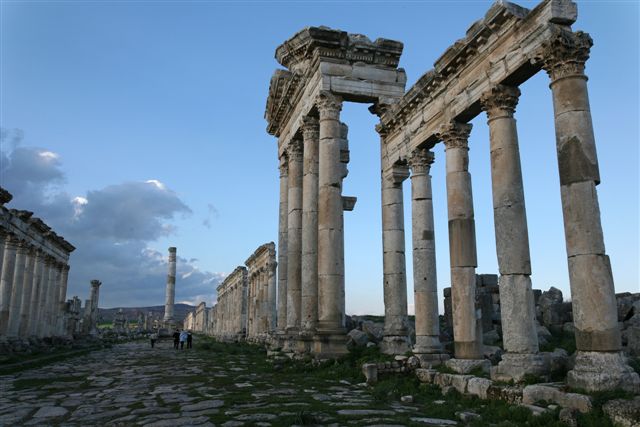
Apamea Ruins

Apamea Ruins

But what I saw was incredible. And we certainly have never seen more beautiful ruins all for ourselves. These ruins were waiting only for us four to visit them! No sweaty tourists, no hordes of souvenir sellers, no bad restaurants at the exit gates. No buses, no loud tour groups with little flags waving, no parades of German, Swiss or Italian culture tourists. No Americans. OK, there are some other tourists but there are so few you can easily avoid them. If there is a group ahead of you, slow down, have a Nana somewhere. They will leave soon, and the site will be quiet again and all yours.

The only place with a veritable tourism industry outside of Damascus and Aleppo is Palmyra. A little in Bosra, less at the Krak and Saladin fortresses, hardly anything in the Dead Cities. In other excavations like Dura, Apamea, Rasafa, Zenobia, chances are you will be on your own. But even in Palmyra you can have large parts of the excavations for yourself. Go for sunrise, before the buses come, or in the afternoon when they have left. Go for sunset, when the architectural reliefs come to life in the golden sun. Go at night when the site is lit. Take it in slowly, and meander into the ancient city.

So I found my personal ruins. Forget Rome, Pompeii, Athens or Delphi. Syria is much better. OK, I have not been to Egypt but I hear it’s crowded. I have not been to Iran but I have to wear a veil there. I have been to the Taj Mahal and had to get up at 4 am to get a halfway undisturbed view of the monument. It’s spoiled by tour groups after 5 am! In Pompeii, one load after the other poured in from the cruise ships. They touched the murals and even tried to scratch off paint. A fairground, a carnival. They yelled and smelled.

In Syria, everything was different. I remember Dura Europos – one highlight of our trip, an intriguing site to visit Syria’s east. The Hellenistic/Roman fortress city lies high overlooking the Euphrates: a magic view into Mesopotamia and a feeling of timelessness. The gate keeper, us four and a few archaeologists digging on the northern edge of the citadel. Except of what is in the Damascus National Museum, most of the town is still unearthed, thank God, and let’s leave it this way. What’s been underground for so long is safe for a few more years – and safe from tourist gawkers or Bedouin diggers.

And I remember how Rasafa appeared at the horizon of the desert, magically, windy, sandy. The little ticket booth, freshly painted, the gate keeper and us. The wind was so strong, we had to cover our faces Bedouin style. Lawrence of Arabia. Striking Rasafa, an ancient, long-abandoned city, once was a giant worshipping place for over 100.000 people, with a now ruined basilica for one of the stars among the early Byzantine martyrs, Roman soldier Sergius. For over a thousand years, Rasafa was a stopover for caravans to the orient. A bustling market town with Souks, filled with pilgrims and merchants who met in the middle of the desert. What remains today is a giant ruined city of sand colored stones rising out of the featureless desert – and the stories in our heads. And it’s worth it.

We’ll be back, Inshallah.

Written by Martina Schmitz

Photographs by Markus Hugelshofer

News Round Up (19 April 2009)

So long as the US stops the flow of arms to Syria, Hamas, and Hizbullah without stopping Israel from expropriating Palestinian and Syria land, the Arab goose is cooked. Obama’s Washington remains vigilant and decisive in its efforts to thwart Arab resistance to Israel’s expansion. The question is whether Obama can put together a policy that will also push forward the Arab Peace plan. If he cannot, all the promise will be unfulfilled.

Clayton Swisher’s report on Palestinian expulsions from Sheikh Jarrah in East Jerusalem Youtube (3 minutes) do not reasure us, although he does get a few words in with a US State Department official who was sent to monitor the expulsions.

Following its departure from an Iranian port, the Cypriot-flagged ship Monchegorsk was detained in Limassol, Cyprus in January, above, after U.S. intelligence suggested it was ferrying arms to Syria.

Following its departure from an Iranian port, the Cypriot-flagged ship Monchegorsk was detained in Limassol, Cyprus in January, above, after U.S. intelligence suggested it was ferrying arms to Syria.

WSJ, 2009-04-17 – by Jay Solomon

The Obama administration is pushing for a formal censure of Iran and Syria at the United Nations over an arms-smuggling case that U.S. officials see as highlighting the risks that Iranian weapons shipments pose to regional stability.

…The move …could impede the ability of Iranian shipping firms to deliver arms to militant groups such as Hezbollah in Lebanon and Hamas in the Palestinian territories, U.S. and other Western officials said…. Last month, a U.N. committee ruled that both Iran and Syria violated a Security Council resolution that bans Tehran from both importing and exporting weapons…..

Syria has charged that the U.N.’s actions amount to a double standard, because no efforts have been made to prevent American arms from reaching Israel. Damascus has also said the U.N. is seeking to block Syria’s right to defend itself against Israeli aggression….”

Senator George Mitchell meets with Israeli Prime Minister Benjamin Netanyahu.

U.S. Envoy’s Two-State Push Meets Israeli Skepticism
Associated Press

JERUSALEM — Stark differences between U.S. and Israeli policy toward peace talks with the Palestinians emerged clearly Thursday in the first meetings between President Barack Obama’s Mideast envoy and top leaders of the new Israeli government.

The envoy, George Mitchell, stated clearly that Washington is aiming for creation of a Palestinian state. But Israelis avoided mention of Palestinian statehood, and the new foreign minister said past Israeli concessions have led to violence, not peace.

Mr. Mitchell met Thursday evening with Prime Minister Benjamin Netanyahu, who has yet to unveil his policy on peace efforts but has spoken of shifting the emphasis to stimulating the Palestinian economy instead of supporting the process accepted by the U.S. and Israel up to now.

Mr. Mitchell made the administration’s goals clear to reporters while standing next to Avigdor Lieberman, the Israeli foreign minister, after their meeting.

“U.S. policy favors … a two-state solution, which would have a Palestinian state living in peace alongside the Jewish state of Israel,” Mr. Mitchell said.

In a statement, Mr. Lieberman questioned the basic premise that compromises by both sides would eventually lead to a peace accord.

“The historic approach has so far not brought any result or solution.”….

Has Israel won the 60 year war? (This article may convince you it has.)

MideastPulse

“..Rahm Emanuel told an (unnamed) Jewish leader; “In the next four years there is going to be a permanent status arrangement between Israel and the Palestinians on the basis of two states for two peoples, and it doesn’t matter to us at all who is prime minister.”

He also said that the United States will exert pressure to see that deal is put into place.”Any treatment of the Iranian nuclear problem will be contingent upon progress in the negotiations and an Israeli withdrawal from West Bank territory,” the paper reports Emanuel as saying. In other words, US sympathy for Israel’s position vis a vis Iran depends on Israel’s willingness to live up to its commitment to get out of the West Bank and permit the establishment of a Palestinian state there, in Gaza, and East Jerusalem.

U.S.-Israel Divide Emerges On Palestinian Peace Talks (The Washington Post)

JERUSALEM, April 16 — Stark differences between U.S. and Israeli policy toward peace talks with the Palestinians emerged clearly Thursday in the first meetings between President Obama’s Middle East envoy and top leaders of the new Israeli government.

New Liberal Jewish Lobby Quickly Makes Its Mark (By Dan Eggen, The Washington Post)

When a group of Jewish liberals formed a lobbying and fundraising group called J Street a year ago, they had modest hopes of raising $50,000 for a handful of congressional candidates….

Ben-Ami said he has no expectation that J Street will become as large as AIPAC, but he believes it can become influential enough to change the parameters of the U.S. debate over Israel policy. The group’s budget is slated to double to $3 million in its second year, he said, and J Street is preparing to launch an education arm focused on U.S. college campuses. …

Andrew Tabler in the Jerusalem Post – “Analysis: Why Mitchell is bypassing Damascus.” Andrew Tabler criticizes his old rivals, Sami Moubayed and Abdulsalam Haykal, for being “close to the Syrian regime” and for participating in a general Syrian over-optmism about Obama’s willingness to engage Damascus. ( For several years, Tabler edited “Syria Today,” the first English language magazine in Syria. Moubayed and Haykal started Forward which became “the other” English language magazine in Damascus.) Even though Tabler has graduated from his low paying job in Syria to a more lucrative post writing for the premier pro-Israeli think tank in Washington, he still cannot pass up a chance to send a zinger in the direction of his old Damascene competitors.

Tabler takes President Assad to task for “refusing to talk about cutting ties with Hizbullah, Hamas and Tehran.” He also takes umbridge at the way Assad criticizes Israel and recommends that the US not rush into engagement with Syria before Damascus gives up the allies it hopes will help pry the Golan from Israel.

Excerpts from the Middle eade Policy Survey thanks to “friday-lunch-club”

Mitchell’s trip to the Middle East this week does not include stops in Lebanon or Syria. On Lebanon, the Administration is treading warily in advance of its June Parliamentary elections. Although the US would prefer to see the current pro-Western government retain power, they are prepared for an Opposition victory, despite its likely enhancement of the already formidable power of Hezbollah [Although they will not follow the example of the British government which earlier this month decided to begin dealing with the “political arm” of Hezbollah — a move which surprised and infuriated Secretary Clinton]. They are even prepared for the formation of a national unity government, for as one State Department official says wryly, “To be Lebanese is to be expert in the art of compromise.”

Policy toward Syria will continue to evolve at a slow pace, say key US officials. “You will not see a `roll out’ of a Syria policy like we are doing with Iran,” explains one key US official. Even the return of the US Ambassador [who was withdrawn after the assassination of former Lebanese Prime Minister Rafik Hariri in 2005] is not considered imminent. “That move is still a couple of steps away,” says one well-placed official

Foreign Policy

“Egyptian Foreign Minister Ahmed Aboul Gheit said Wednesday that his Israeli counterpart, Avigdor Lieberman, is not welcome in Egypt. “His feet will not step on Egyptian soil as long as he maintains his positions,” Aboul Gheit told Russia Today TV. Lieberman sparked outrage in Egypt last year when he criticized its president, Hosni Mubarak, in a speech before the Knesset, saying that the Egyptian leader could “go to hell.”

The Economist

“… This blaze of Egyptian accusations underlines the frustration felt by the government of President Hosni Mubarak, which has borne withering opprobrium due to its refusal to open crossings into Gaza to relieve the besieged Palestinian territory. Egypt’s discomfort peaked during Israel’s 22-day assault on Hamas in Gaza earlier this year, when Hizbullah’s leader, Hassan Nasrallah, charged Mr Mubarak with complicity with the “Zionist regime” and dramatically called on Egyptian officers to save their country’s honour. Egypt has remained isolated in Arab public opinion as Mr Mubarak has subsequently cracked down on cross-border smuggling and struggled to strong-arm Hamas into sharing power with its secular rival, Fatah, by using the opening of the border as a lure.

Some of Egypt’s charges may be true. In a televised speech, Mr Nasrallah admitted that one of the arrested men was a party member engaged in logistical work to help “our Palestinian brothers”. But the Hizbullah leader, who has a reputation for frankness, said that no more than ten of the alleged plotters had any link to his party, and denied any intent to harm Egypt. “If aiding the Palestinians is a crime, then I am guilty and proud of it,” he said.

His deputy, Naim Qassem, said Hizbullah’s people had clear instructions not to take any action against Israelis in Egypt. He posed a rhetorical question. “How can Israel have the right to receive weapons and intelligence from all the world, while one small effort to lift the oppression of the Palestinians or supply basic necessities to keep their struggle going is condemned?”

This logic still appeals to many in the region. But just as Mr Nasrallah’s unsubtle call for Mr Mubarak’s overthrow annoyed even some of the Egyptian president’s foes at home, the revelation of Hizbullah intrigue raises questions about the group’s intentions. Though implicated in past acts of international terror, Hizbullah in recent years has declared itself concerned solely with Lebanese affairs, increasingly so as Lebanon’s general election due in June approaches. Its critics in Lebanon now have new cause to complain that the party risks enmeshing their country in regional squabbles they want no part of.”

Syria seen keen on new peace talks with Israel
Tue Apr 14, 2009 7:17am EDT
By Khaled Yacoub Oweis – Analysis

DAMASCUS (Reuters) – Encouraged by President Barack Obama’s overtures toward Washington’s adversaries, Syria is pushing to restart peace talks with Israel, diplomats and political analysts say.

Damascus has intensified its quest to relaunch the Turkish-mediated talks, diplomats in the Syrian capital said, despite the formation last month of a right-leaning Israeli government that has shown little interest in a U.S.-backed two state solution to the conflict with the Palestinians.

“The Syrians are sensing that (Israeli Prime Minister Benjamin) Netanyahu does not want a peace deal with the Palestinians and that he could restart the Syrian track as a way of deflecting pressure,” one senior Western diplomat said.

“They have dealt with Netanyahu before. More importantly they expect the Americans to try to salvage their policies in the Middle East by backing the Syrian track,” he added.

Obama sent two senior officials to Damascus last month to talk to Syria, in a break from a policy of isolation under his predecessor.

George W. Bush showed no enthusiasm for the indirect talks between Syria and Israel, which were formally suspended in December following the three-week Israeli offensive on Gaza.

The Bush administration also expanded U.S. sanctions on Damascus and criticized Syria’s human rights record, its role in Iraq and Lebanon as well as its alliances with Iran and militant groups in the Middle East.

One of the Obama administration officials who visited Damascus said Washington wants to see “forward momentum” on Syrian-Israeli talks, but the United States refrained from committing to any involvement.

Syria regards direct U.S. support to negotiations as a pre-requisite for a deal and the best guarantee that Israel would adhere to any peace arrangements.

Syria and Israel held almost 10 years of direct U.S. supervised negotiations that centered on the Golan Heights.

Israeli occupied the Golan in the 1967 Middle East War, displacing 100,000 Syrian residents in the water-rich territory. Around 40,000 people now live in the Golan, roughly divided between Israeli settlers and remaining Syrian population.

The talks collapsed in 2000 when Syria’s late President Hafez al-Assad, father of the current president, Bashar, turned down an Israeli offer to withdraw from the Golan but keep a narrow strip on the northeastern shore of the Lake of Galilee, which Assad regarded as Syrian territory.

Assad defined the occupied Golan as the territory Syria held on June 4, 1967, before the war broke out, including the northeastern shore of the lake, Israel’s main water reservoir.

Bashar has stuck to his father’s position, rejecting other geographical definitions, including one drawn by colonial France and Britain in 1923 that keeps Syria away from the water.

Assad said Syria and Israel were close to moving to direct negotiations before Israel launched its invasion of Gaza, and Syria had expected Israel to agree through Turkish mediators on the Golan boundary based on the 1967 line.

CALCULATIONS

Frederic C. Hof, who U.S. officials say is expected to join the team of Middle East Envoy George Mitchell, said it was far from certain that re-launching talks would achieve Syrian, U.S., or Israeli aims.

While Damascus seeks the return of the Golan, Israel and Washington want to see Assad separated from Iran, Lebanon’s Shi’ite movement Hezbollah and the Palestinian group Hamas, whose exiled leaders live in Syria.

Hof said in a report published by the United States Institute of Peace that American involvement in the negotiations was crucial for Syria to consider altering its alliances.

The report envisages a phased Israeli withdrawal to the June 4 line with intricate water, zoning and joint access arrangements to alley Israeli security, environmental and water supply concerns.

Cautioning that Syria would keep holding the alliances card close to its chest, Hof said Damascus could make “the requisite adjustments” to its ties with Iran and Hezbollah only if a peace treaty goes smoothly.

Syria has indicated that it was prepared to discuss a wide range of issues as long as Israel agrees to withdraw to the June 4 line, although Damascus remains wary of appearing to sell out its militant allies.

“Assad has let be known that the support of his people for a deal on the Golan might not extend too long into the future and the best solution would be for the United States to pursue a comprehensive Middle East peace covering the Palestinian and Syrian tracks,” one European diplomat said.

“It is far from certain that the United States will do this and it is still in a long policy review toward Syria, but one thing is clear, Assad wants to negotiate now a peace with Israel that would change the Middle East.”

Asked about the possibility of a deal with Netanyahu, with whom Syria negotiated with in his first term as Israeli premier in the 1990s, Assad told Qatar’s al-Sharq newspaper that Syria has a strategy for concluding peace and “whoever commits to them does not form a problem for us.”

The UNHCR just wrapped up an exhibition of Iraqi artists in Damascus, writes Frederick Deknatel for the UNHCR news site. It is part of a larger project promoting Iraqi refugee artists in Syria.

Syria prison breaks the mould with rehab scheme Middle East On-Line

50 prisoners participating in unique art therapy rehabilitation programme at facility in northern Syria.

Ehsani writes: American households have lost close to $11 trillion in net worth since the start of this economic crisis. This includes losses to their home values, stocks, pensions and mutual funds. This total is equivalent to 275 years of income for 20 million Syrians. In other words, American households lost in 2 years what Syrians are expected to make in 275 years. Or, the average American lost in wealth what an average Syrian is expected to make in 16 years of income. Sobering trivia. This is how economists spend their time!

Imad Moustapha and National Day – The Golan

Syria on the Potomac, Fri, 04/17/2009. Foreign Policy’s “the Cable” prepares to go to “National Day” celebrations held by the Syrian Embassy:

It’s not quite the same thing as returning a U.S. ambassador to Damascus. But the Obama administration is sending a delegation to Syrian National Day celebrations to be held tonight at the Mandarin Oriental Hotel.

It’s the first time the U.S. government has sent officials to grace the event in six years. The top U.S. diplomat attending tonight’s festivities is Obama’s recently nominated assistant secretary of state for Near Eastern Affairs, Amb. Jeffrey Feltman, along with other less senior officials.

The Lebanese embassy received an invitation to the event as well, if only yesterday, a Washington Middle East hand heard….

But the Obama administration appears to be proceeding cautiously and without great haste towards greater engagement with Damascus.

Steven Clemons writes:

Yesterday evening, I wanted to pay my respects to a fellow blogger and lover of the arts, Imad Moustapha – who also happens to be the Ambassador of Syria to Washington. I got a snapshot at that Mandarin Hotel party of what incredible impact Barack Obama has had in Washington….

Wolf Blitzer, anchor of CNN’s Situation Room, stayed for a great long time and met not only Moustapha and his entourage but many others at the party. And then — punctuating the change in the DC game — Acting Assistant Secretary of State for Near Eastern Affairs and former US Ambassador to Lebanon Jeffrey Feltman was there, along with State Department Middle East watcher Nicole Shampaine and Frederic Hof — who is staffing George Mitchell’s Middle East efforts.

Amazing actually. This is a dramatic change in tone and posture since the departure of the George W. Bush administration.

Others at the party were the Boston Globe‘s Farah Stockman, CNN’s Elise Labott, Ambassador of Yemen to the US Abdulwahab Abdulla Al-Hajjri, Middle East Institute President and former US Ambassador to Pakistan Wendy Chamberlain, Algerian Ambassador to the US Abdallah Baali, New School professor Alon Ben-Muir, former Colin Powell State Department Advisor and now AAAS International Programs czar Norman Neuriter and his AAAS international policy colleague Vaughn Turekian, and many other interesting journalists, think tank types, and then those trade association, lawyers and consultants looking to cash in on the rapidly changing Syria-US tone.

Lesch and Assad

Lesch and Assad

David Lesch was also there. See the wonderful write up of him in the LA Times:

Syria: How an American scholar made friends and influenced a leader
By Borzou Daragahi

San Antonio professor David Lesch, who led yearly trips to Syria for students learning Arabic, struck up a friendship with President Bashar Assad. ‘He values my opinions and ideas,’ he says….

“He is very low-key, he is a very amiable, very humble individual, not intimidating at all,” Lesch says….

Read Shai’s and Yossi’s account of their trip to the Golan. Shai and Yossi are Israelis that met commenting on this blog. They have been part of the SC family for two years now. They have patiently endured insults from those who don’t know them and become much respected by most regulars on SC. Here is an opening bit from Yossi’s blog:

I picked Yossi up in the morning in Haifa, and we drove straight to the Golan (about 1.5-2 hours away). We already had our morning-coffee at the beach-highway cafe “Maxim” (where in October 2003, a 29 year-old female lawyer from Jenin blew herself up, killing some 21 Israeli Jews and Arabs), so we were all “tanked” up.

One thing worth noting, on the way up, is just how natural the ride feels. In the past, I still remember a distinct separation between the Heights and the valley below. Perhaps it was the old Bailey-bridges we’d cross, or the quality of the roads that connected the Golan to the rest of Israel. But today, the bridges are modern, as are the roads. We left Haifa, and “suddenly” found ourselves on the Golan. Just like that….

We asked ourselves, why is it that after nearly 3 decades of annexation, with zero security issues (no Hamas, no Qassams, no Intifadas, etc.), absolutely gorgeous landscape and (still) relatively inexpensive real-estate, only some 26,000 Jews reside on the Golan? It is a question I hope Dr. Yigal Kipnis will help us answer….

Ali Khan “At the Hamam”

“At the Hamam” – Dispatch from Damascus 20 (15/04/09)
By Ali Khan
Photos by Ketan Gajria

Ali Khan writing a dispatch in his Damascus room.

Ali Khan writing a dispatch in his Damascus room.

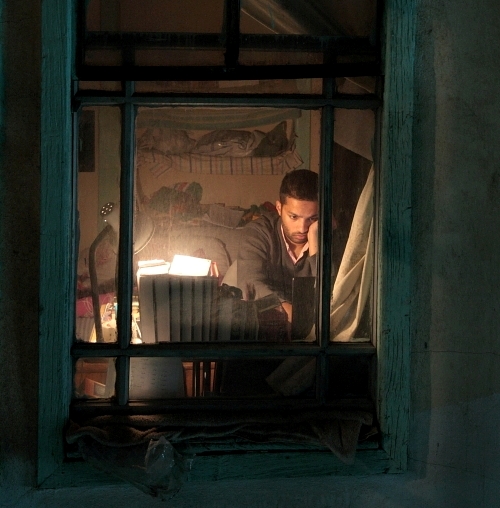
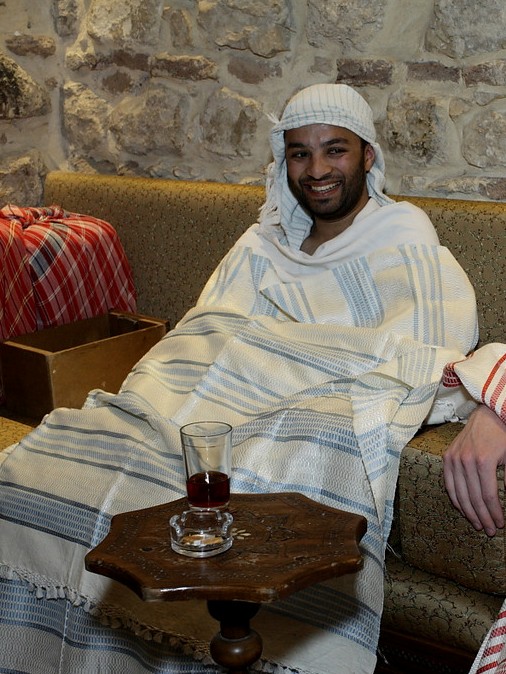
I had been delaying going to the hamman for a long time. However, this month at university was slightly more challenging than usual and so after the exam I decided it was a good time to visit. We all met at my house and after a few phone calls and a short discussion on the merits of the various hammams we decided to go to the Hammam Al Malik Al Zahir. The hammam is next to the Umayyad Mosque and so we strolled over, enjoying the balmy spring weather but secretly dreading the advent of the hot weather. Unfortunately for us but I suppose fortunately for Syria, tourists season has begun and we had to negotiate our way through hoards of colour coordinated backpacks and baseball caps. At the northwest corner we walked through a pack of Iranians, men in round collar shirts with suits and women in flapping chadors. A few of the younger ladies stopped to look at crockery and cutlery displayed in a shop but judging by the number of shopping bags they were already carrying, they had shopped enough. The group was going to Seyyida Ruqayya’s shrine because it was Thursday night and they were going to partake in the recitation of the Dua-e Kumail. Imam Ali taught the Prayer to Kumail ibn Ziad Nakha’I. Kumail was a disciple of Imam Ali and some traditions even state that several esoteric truths of the faith were also revealed to him. He was killed at the age of ninety by Hajjah ibn Yusuf Thaqafi. My great uncle wrote that the central theme of the Dua “is the unshakeable belief that Allah has promised to forgive all sins except the sin of setting up equals to Himself, whenever any of His creatures tormented by conscience turns towards him in a spirit of penitence, and whosoever seeks forgiveness from his Lord is given not only forgiveness but also prosperity and security in this world and the Hereafter.” Independent of religion, the Arabic prose of the prayer is majestic and reaffirms for me the sublime yet vast nature of the language.

Zahariyya Library

Zahiriyya Library

We turned into a side street and entered a small door next to the Zahiriyya Library. It was already dark outside and there was warm yellow glow around the door. We probably looked very lost and as I wandered over to the fountain to grab a handful of the multi-coloured pastilles, a bear of a man, in an extremely tight t-shirt and a pink sarong walked over to us and pointed to a corner where we could sit. The sitting area was elevated slightly. There were long benches along the walls with cushions on the seat and drawers below to store out clothes. The mosaic beneath the water in the fountain sparkled in the light of the chandelier as it swayed gently because of the wind coming in through the door. The dome above us was covered in red, green and gold decorative motifs. Above us was another balcony with wooden rails and one of the workers bobbed in and out of sight as he said his evening prayers. There were little tables and wooden cabinets with the traditional inlay work of mother of pearl in various nooks and crannies. In one corner was a barber applying the finishing touches of some kind of facemask on a customer. I strained to see his face in the mirror and saw his face covered in a lime green paste. His eyes were accentuated by the green treatment and he looked like a frog that was very pleased with itself. Later, it turned out that he was not one of the Syrian shabab but an East Asian tourist.

The hammam was designed and built by Ibn al Hussain al Akiki in 985 AD and then was bought by Saeed ibn al Zahir Baybers, a Mamluk king in 1277. The house attached to the hammam was converted to a Madrassa.

The man who had seated us earlier came over with a pile of sarongs and asked us to change our clothes. We looked around and seeing the confused look on our faces he said that we had to change there. There were many other people in the foyer, children were running around the fountain and the workers had gathered around the refrigerator, which had a big Pepsi logo. The man opened the sarong and held it up while we changed and in a deft movement he wrapped me in the sarong when I took of my trousers. We were then ushered into the actual hammam. On our right were people, wrapped up in towels, smoking argileh and drinking tea, having finished with their hammam session. We walked into the anti-room of the main hammam and another man with a green sarong came and handed us each a bowl with olive oil soap, shampoo and a sponge. We then walked through another door and I caught one my friends grimacing at the sight of old hairy men in wet red sarongs sitting around chatting loudly while in one corner a man lay on the floor and one of the attendants, with tattoos on his arms, pounded his back. We went further in and found a quiet corner. Ketan, who had been to a hammam earlier explained how the whole process functioned. The main chamber had a vaulted roof with little rooms one either side separated by small arched doors. Along the walls were water basins with hot and cold water. We found the steam room, which was just about big enough for the three of us but I think only about one and a half of the Syrians we had seen earlier would have been able to sit comfortably in it. After a short while it became a bit uncomfortable and so we trooped out, only to find a middle aged Syrian man rubbing soap on his tummy. Unfortunately he had also decided to discard his sarong and was wandering around in a white pair of Y fronts. Not the prettiest sight! Meanwhile a group of Iranian men had wandered in were rubbing soap on each other. I heard one of them mutter that he did not want the ‘tattooed man’ to touch him. We sat around for a while and went back to the steam room and then we hesitantly proceeded to wait in line for the massage. By then I think we all were getting a bit sick of the clammy air and we left. In the next room the same man held up a fresh sarong as we discarded the wet ones.

Outside a group of young Khalijis, people from the Gulf countries had wandered in. They always look very conspicuous, not only because they are generally darker than Syrians but also because their sense of dress is very loud. Most of them wore leather motorcycle jackets with the Ferrari, Lamborgini, Maserati and Rothmans logos and some of them also wore huge designer sunglasses, even though it was nighttime and they were inside and this coupled with their gelled, or I should say glued, hair made them look like very menacing giant flies. We clip clopped in our wooden sandals to our corner and a man came and swaddled us in towels and tied one on our heads. Finally, he opened pink and blue stripped togas, for lack of a better word, and added that as the final layer. He then brought us tea and tried to make us believe that we had ordered an argileh though we successfully managed to dissuade him. On the opposite side of the room a young man had just walked in with his very young son and was trying to persuade him to take of his clothes but the little boy kept saying that his mama had already given him a bath that day. Eventually he relented and one of the attendants tied a little sarong on him and brought him miniature wooden clogs. By now we had dried off and finished our tea. The barber came to inquire whether we needed any services but we politely refused.

On the way back home we came across a huge procession in Bab Touma. I had forgotten it was Easter. A marching band led the procession and the tune they were playing seemed very familiar. Later I realised that the statue of Jesus and the Virgin Mary was being carried along Straight Street to the theme song of Francis Ford Coppola’s film God Father. Another friend had told me that he had also heard the same tune at a funeral but I had refused to believe him. Behind the musical band were troupes of young girls and boys dresses in scout uniforms. Apparently the scarves around their necks signified the Church they came from. The adults watching the procession had come out in their Sunday best or at least the Syrian version of it. The men seemed to have added extra gel and the ladies seemed to have searched their closets for the most risqué clothes they had. Hidden amongst them I spotted a handful of old ladies dressed in black and wearing headscarves with a thin lace veil covering their face. We met up with a couple of other friends. One of them had been to a Jewish Passover and had sung songs in Arabic with his hosts, most memorably one in which they counted from one to thirteen because each number had a particular significance. Another friend had gone to Mustapha Ali’s gallery to attend a Flamenco concert. I think it suffices to say that there is still a lot of room for improvement as far as the performing arts are concerned in Syria. As I walked home that night my friend mentioned to me that even though the many people in world identify Syria with conflict and violence, not that they do not exist at all, that night we had seen Christians, Jews and Muslims practicing their faith within the four walls of the old city without impinging or intruding on the others. She added that obviously it would be naïve to believe that there is complete harmony amongst the three faiths here but for one evening, we did see that it is possible to co-exist peacefully with one another.

Happy Easter and until Next week Ma’as Salaama!

Ali Khan at the Hamam al-Malik al-Zahir

Ali Khan at the Hamam al-Malik al-Zahir

Hizbullah and Elections

Qifa Nabki give us a fine analysis of the meaning of Hizbullah’s election campaign:

hizbposter3Everything suggests a shift of strategy by the Hizb towards emphasizing the themes of good governance, national unity, gradual reformism, and fighting corruption, while placing the military resistance on the back burner. In this context, one wonders whether the oft-asked question regarding the price for Hizbullah’s “integration” into Lebanese politics is a stale and irrelevant one, as it seems increasingly as though the Hizb is not waiting for anyone to make them an offer. Take a look at the campaign posters (above and left). The party’s famous Kalashnikov logo has been deliberately faded to contrast it with a bold-faced LEBANON, beneath three scratched-out titles: “your Lebanon,” “our Lebanon,” “their Lebanon.” It’s a strong message, and one which immediately brings to mind Saad al-Hariri’s promise to refuse joining a government of national unity after the elections…. (read the rest)

Lebanon’s Hezbollah savors increasing legitimacy
By Borzou Daragahi
As some Western nations seek contacts, Hezbollah’s No. 2, cleric Naim Qassem, says the group has ‘convinced the West it is a popular, authentic and important movement that cannot be ignored.’

To defeat Hezbollah, the US Defense Department has spent millions of dollars since the 2006 War. “I’ve organized five major games in the last two years, and all of them have focused on Hezbollah,” said Frank Hoffman, a research fellow at the [US] Marine Corps Warfighting Laboratory in Quantico. From Wash Post.

“Lebanon’s sovereignty, democracy, prosperity and stability
are a priority for all of us,” insists U.S. Ambassador to Lebanon Michele Sison.

Raad

Raad

Hezbollah’s Head of Loyalty to the Resistance bloc MP Mohammad Raad takes US Ambassador Sison to task for insisting that Hizbullah represents a threat to Lebanon. He insists this does not jive with her call for independence and sovereignty. “Who is Sison to say that Hizbullah represents a threat to Lebanon and the region?” Raad asked, adding that Hizbullah was a threat to “all the Israeli schemes, plans and projects against Lebanon.”

Abu Muqawama explains why he believes Hizbullah has overreached in the Egyptian affair. Egypt is cracking down.

Damascus Stock Exchange plans to widen the 2 percent share-price limit: Damascus Exchange Trading Volume to Stay Limited Until End 2009
2009-04-13 – By Nadim Issa

April 13 (Bloomberg) — The Damascus Securities Exchange won’t have major trading volume until the end of 2009 because of the limited number of listed companies and investors, said Mohammad al-Jleilati, chief executive officer of the bourse.

Volume will remain low until the exchange reaches around 20 listed companies compared with seven now traded, al-Jleilati said by phone from Damascus. Less than 200 investors have opened accounts with brokers in Syria since the exchange started trading, he added.

The exchange, which started trading shares March 10 and is open twice a week, has since struggled to attract liquidity. Brokerages say the share fluctuation limit, set at 2 percent per trading day, has curtailed volume and are hoping the regulation will be revised.

The DSE planned to widen the 2 percent share-price trading band as soon as market conditions permit, al-Jleilati said.

“There is no problem with the trading limit since the listed companies are witnessing a rise in their prices every trading day,” Jleilati said. “None has declined since the opening of the bourse.”

He added that shareholders also are unlikely to sell their holdings until they collect dividends approved at general shareholder meetings in March and April, further limiting trading.

Four companies rose today to the limit of their trading band, while Bank of Syria & Overseas, Bank Audi-Syria and Banque Bemo Saudi Fransi didn’t trade. The value of shares traded in the ten transactions executed on the four companies reached 925,690 Syrian pounds ($19,800), according to the exchange’s daily bulletin.

Can the US put Pressure on Israel? Stephen Walt in FP.

“….This idea appears to be gaining ground. Several weeks ago, a bipartisan panel of distinguished foreign policy experts headed by Henry Siegman and Brent Scowcroft issued a thoughtful report calling for the Obama administration to “engage in prompt, sustained, and determined efforts to resolve the Arab-Israeli conflict.” Success, they noted, “will require a careful blend of persuasion, inducement, reward, and pressure…” Last week, the Economist called for the United States to reduce its aid to Israel if the Netanyahu government continues to reject a two-state solution. The Boston Globe offered a similar view earlier this week, advising Obama to tell Netanyahu “to take the steps necessary for peace or risk compromising Israel’s special relationship with America.” A few days ago, Ha’aretz reported that the Obama Administration was preparing Congressional leaders for a possible confrontation with the Netanyahu government. .. [he provides a number of ways to pressure Israel]

Imad Moustapha’s interview on CNN this week:Embedded video from CNN Video

Jerusalem Post: Syrian envoy prefers Lieberman to Livni. 2009-04-12

LEBANON-SYRIA: Wretched conditions for Syrian workers: Syrians in Lebanon remain the last unregulated labour force
By Brooke Anderson

BEIRUT, 13 April 2009 (IRIN) – Rights and labour groups say almost all the estimated 300,000 Syrians working in Lebanon have no official status, often endure dangerous conditions, and earn about US$300 a month doing jobs shunned by most Lebanese.

In 2006, the Labour Ministry issued just 471 work permits to Syrian nationals, meaning the remainder worked unregistered. According to 2008 research by Beirut-based InfoPro, over 75 percent of Syrians in Lebanon work in construction, 15 percent are cleaners and bin men, and 10 percent hawkers.

About 15 percent of Syria’s workforce is in Lebanon. They often either live on the construction site where they work or share tiny flats with a dozen other workers.

René Matta, general manager of Matta Contracting, a Lebanese company whose workforce is 70 percent Syrian, said Syrian labour in Lebanon “should be more organised, so that people aren’t oppressed”…..

Many Syrians in Lebanon have been attacked, robbed, beaten and sometimes killed over the past four years.

Despite the recent opening of an embassy in Beirut, few Syrian labourers in Lebanon think their labour rights and personal safety will be protected any time soon.

Fear

“If something happened to me, who would I complain to?” asked Eide, an 18-year-old Syrian construction worker who has been living and working in Lebanon for 10 months. Eide said he lives in daily fear of attack by anti-Syrian Lebanese gangs: “It’s not unusual for Lebanese to ask for our ID cards on the street and then take our money because we’re Syrian.”….

Nadim Houry, senior researcher for Human Rights Watch (HRW) in Beirut, … “It’s part of Lebanon’s history,” said Houry. “Syrian workers have become scapegoats because they’re perceived as weak. There is an issue of discrimination in Lebanon towards those of lower socio-economic status. They look down upon poor people from rural areas. It’s a sort of socio-economic racism.”

In its 2 January edition, Al-Akhbar, one of the few Lebanese newspapers to regularly cover the issue, reported that a Syrian worker was robbed at gunpoint by a member of the Lebanese military in civilian clothing. In late December 2008, the same newspaper reported a Syrian had been killed during a robbery near Byblos. In the same month, a Syrian worker of Kurdish origin was found hanged in his own shoe shop in Bar Elias in the Bekaa Valley, eastern Lebanon.

Many incidents go unreported. In interviews with 10 Syrian workers at construction sites throughout Beirut, all said they had been victims of robberies and occasional beatings by Lebanese; all said it had been because they are Syrian; none said they had reported the incidents to the authorities.

“I don’t have any Lebanese friends. I never have,” said one Syrian construction worker. “Why should I? They don’t like us.”

News Round Up (12 April 2009)

Easter in Damascus - Parade from Bab Touma to Bab Sharqi by John Wreford

Easter in Damascus - Parade from Bab Touma to Bab Sharqi by John Wreford

So much for Lebanon’s so-called Cedar Revolution…” by Qifa Nabki, who discusses Michael Young

Edging in from the cold?
Apr 9, 2009 by Michael Petrou
Macleans.ca – Canada’s only national weekly current affairs magazine.

Edging in from the cold? George W. Bush never included Syria on his list of countries making up what he described as an “Axis of Evil,” but it was clear that he considered the regime of Bashar al-Assad a security threat that needed to be isolated and punished. In April 2002, shortly after his Axis speech and at a time when the United States still seemed willing and able to take down hostile regimes, Bush said the time had come “for Syria to decide which side of the war against terror it is on.” He later accused Syria of sponsoring Palestinian terror groups, assassinating politicians in Lebanon, and doing little to prevent jihadists from crossing its border with Iraq to attack American troops there. Bush pulled the U.S. ambassador out of Syria in 2005. He imposed wide-ranging sanctions on the country. And in October 2008, as one of his last major acts while still in office, he approved a helicopter raid on a Syrian village near the Iraq border where a senior al-Qaeda operative was purportedly sheltering.

Now, only three months into his presidency, Barack Obama has radically reversed his predecessor’s policy of isolating Syria and is instead reaching out to Assad as part of a broader U.S. policy of engaging with America’s enemies, including Iran. In March, the United States sent two senior envoys—State Department official Jeffrey Feltman and Daniel Shapiro of the National Security Council—to Syria for talks. Imad Moustapha, the Syrian ambassador to Washington, has been received at the State Department after being shunned for years. And a State Department spokesman said Syria can play “a positive role in the region by trying to help bring peace and stability to the Middle East.”

Assad, for his part, says he would like to meet Obama and is open to resuming indirect peace talks with Israel, which were suspended during the war in Gaza. He’s sat for a series of interviews with Western newspapers. A photo of one such interview, helpfully made available by the Syrian government press office, depicts Assad rocking back casually, a warm and delighted smile on his lips. The image is the Middle Eastern dictator’s equivalent of a sweater vest, and the message is the same: trust me.

Part of this apparent thaw between Washington and Damascus is driven by necessity. The peace talks Israel opened with Syria in 2007 made America’s cold shoulder policy less tenable. But there’s more to it than that. American policy-makers see Syria as a lever that just might readjust the balance of power in the Middle East by weakening Iran and undermining Israel’s enemies. Syria is Iran’s primary ally and gives Iran a foothold on Israel’s doorstep through Hezbollah in Lebanon, and Hamas in Gaza. Peeling Syria away from Iran would help isolate Iran, a regime Israel considers a mortal threat, and would cut off support to militias with which Israel has fought three wars in the last three years.

“The ultimate goal is to change Syria’s behaviour on a variety of issues—on its interference in Lebanese internal affairs, on its support for Palestinian terrorist groups that oppose the Palestinian Authority, on, most importantly, acting as a land bridge between Iran and Hezbollah, where Hezbollah gets all its arms,” said Elliott Abrams, a senior fellow for Middle Eastern studies at the Council on Foreign Relations, in an interview with Maclean’s. “Those are the ultimate United States goals, and there is a view that this really requires a kind of strategic reorientation on the part of the Syrian regime, away from Iran and Hezbollah and toward the West.”

These were America’s goals when Bush was president as well. In fact, as a deputy national security adviser to the former president, Abrams played an important roll in shaping this strategy. But at the time, Bush believed Syria could be muscled into co-operation, and he probably nursed a faint hope that the regime might be overthrown outright. Looking back at this policy today, Abrams says the United States succeeded in isolating Syria for a time, but accomplished little strategically. “In the narrowest sense, the efforts to isolate them succeeded,” he says. “If you go more deeply than that and say, ‘Well, that’s fine, but what did that achieve? Did you get them through that policy to change their conduct?’ Then the answer is no.”

According to Joshua Landis, co-director of the Center for Middle East studies at the University of Oklahoma, Obama is now engaging Syria because Bush’s efforts to isolate and confront the regime failed. “George Bush had run his non-engagement policy into the ground,” he says. “Non-engagement wasn’t working. We’ve got to go back to realism.” Landis cautions that while realism suggests the United States should talk to Syria, it’s not realistic to expect Syria to turn away from Iran. Imad Moustapha, Syria’s ambassador to Washington, has told him as much. Syria and Iran share too many interests—in Lebanon, in Iraq, and regarding Kurdish minorities in both their countries.

Similarly, Landis says, Syria won’t sever ties with Hezbollah. The militia and political movement affords it substantial influence in Lebanon, a country Syria considers part of its sphere of influence (if not a de facto province), and one that it needs as a gateway to the wider world. The drive from Damascus to Beirut and the Mediterranean Sea is a short one through Lebanon. Without this outlet, the Syrian capital is snookered behind Lebanon’s coastal strip.

Magnus Norell, a specialist on Hezbollah and a visiting fellow at the Washington Institute, agrees that Syria is unlikely to be “flipped,” or made to turn against Hezbollah. Lebanon is simply too important to Damascus. He thinks the most that can be hoped for is that Syria reins in some of the more radical Palestinian organizations it arms and sponsors, including Hamas. Landis believes something similar is possible with Hezbollah. Syria won’t cut its ties to the movement, but perhaps it will try to persuade Hezbollah that it is not in its best interests to go to war with Israel. These would be positive steps, but they hardly constitute a strategic realignment of the Middle East.

Why, then, is President Obama investing energy and political capital reaching out to Syria? Why is Israel open to talking to Damascus, even as it fights wars with Syria’s proxy militias? It is a measure of just how intractable many of the conflicts in the Middle East are that the one between Israel and Syria—despite the problems outlined above—arguably remains the easiest to solve. Peace between Israel and the Palestinians will require painstaking negotiations about borders, degrees of sovereignty, and refugees. Lebanon will not make peace with Israel until Syria does, and the situation is complicated by the fact that it is Hezbollah, not the Lebanese government, that controls Lebanon’s border with Israel.

The outlines of an agreement between Israel and Syria are comparatively more straightforward. They hinge on the Golan Heights, which Syria lost during the Six Day War of 1967. The fact that the current frontier between Israel and Syria is quiet leads many in Israel to think they could safely withdraw from the Golan without facing the rocket attacks that marked their withdrawals from both southern Lebanon and the Gaza Strip. Twice before, in 1996 and 2000, the two countries have come close to a deal.

“There have always been and there are now people in the Israeli military who think this is something that is quite attractive to look at,” says Elliott Abrams. “Because if there were a deal with Syria,…..

The daily star:

They don’t want to face the prospect of having to deliver these to an ‘opposition’ controlled Parliament and government….. “David Hale said that most of the new arms, including 41 howitzers, 12 Zodiac boats, 12 Raven air vehicles, one Cessna and 10 M60s, would be delivered in May and April…..In addition, it reported that Hale said the US would not deal with Hizbullah regardless of the parliamentary poll results. …..Concern in Lebanon has grown following statements by US State Department officials that US assistance to Lebanon will be reevaluated after the June 7 elections, which will decide who runs the next government. But officials in Washington reaffirmed their commitment to boost the LAF…”

Syrian International Bank for Trade Jumps 15% in Damascus Debut
2009-04-06 By Nadim Issa

April 6 (Bloomberg) — International Bank for Trade & Finance surged 15 percent as it traded for the first time on the Syrian bourse. United Group JSC and Arab Bank-Syria also gained.

IBTF, a Damascus-based lender that is 49 percent owned by Jordan’s Housing Bank for Trade & Finance, listed shares last week. They closed at 977.5 Syrian pounds ($20.75) today. The closing price will serve as the so-called reference price, Omar Ghraoui, chief operating officer at Bemo Saudi Fransi Finance, said today by phone from Damascus.

The Damascus Securities Exchange, open twice a week, started trading shares March 10 and has since struggled to attract liquidity. Once a reference price is set shares can fluctuate as much as 2 percent per trading day. The fluctuation limit is impeding trading and the brokerages are hoping the bourse will change the regulation, Ghraoui said last month.

“The same problem is occurring every trading session where we are seeing lots of buy orders but not enough sell orders,” Ghraoui said.

United Group added 1.9 percent to 214.5 pounds today, while Arab Bank-Syria rose 2 percent to 878 pounds. The remaining four listed companies on the bourse did not trade. The shares of Al-Ahliah Vegetable Oil Co. are expected to be listed “very shortly,” Ghraoui said.

Damascus Securities Exchange Posts Record Daily Trading Value
2009-04-09 11:51:08.618 GMT

By Nadim Issa
April 9 (Bloomberg) — The Damascus Securities Exchange traded a record 2.53 million Syrian pounds ($54,150) worth of shares today, the most since the bourse opened on March 10. More investors are opening accounts with brokers and trading was led by demand for Banque Bemo Saudi Fransi stock, said Sufian Haikal, operating manager at Cham Capital LLC, a Damascus-based brokerage company, by phone today. Seven stocks are listed on the exchange including Bank of Syria & Overseas, Bank Audi-Syria, International Bank for Trade & Finance, Arab Bank-Syria, United Group JSC, Al-Ahliah for Transport and Banque Bemo Saudi Fransi.

Syriatel Mobile Telecom: “For Syria there are ongoing negotiations…and we will have a presence (there) in the near future,” Barrak said. Kuwait’s Mobile Telecommunications Co. plans to spend up to $5 billion on new acquisitions by 2011.

Syria’s Mufti Outlaws Smoking, Water Pipes, Al-Hayat Reports
2009-04-06
By Massoud A. Derhally

April 6 (Bloomberg) — Syria’s highest authority on Islamic law has banned cigarette and water-pipe smoking, Al-Hayat reported. Grand Mufti Ahmad Badr Eddin Hassoun also banned the purchase and sale of tobacco products and renting shops to retailers that sell tobacco, the Saudi-owned newspaper reported. Smokers in Syria spend $600 million a year on tobacco, or about 8 percent of their income each to purchase 3 kilograms (6.6 pounds) to 6 kilograms of cigarettes each, the newspaper reported, citing Syria’s General Organization for Tobacco. As many as 15 percent of Syria’s 23 million people smoke, Al-Hayat said, citing a study by the organization.

Interview with Italian Foregn Minister Frattini, “Everyone wants to talk with Bashar el Assad. ISRIA (Thanks to “friday-lunch-club” )

“…Everyone wants to talk with Bashar el Assad. “Mrs. Clinton and Senator Kerry told me that when we met”, Frattini confirmed. After France legitimised the Syrian Rais during last year’s July 14th festivities, efforts to open up to Damascus have multiplied. Barak Obama’s arrival in the White House has strengthened that strategy, extending it to include Iran, becoming a key interlocutor in the solution to the Afghan question; so much so that the State Department has expressed its desire to participate “completely” in all negotiations on Teheran’s nuclear programme (Iran’s perennial coldness is cause for concern, as witnessed yesterday with the inauguration of its first plant for the production of nuclear fuel in Isfahan). Does Syria deserve so much legitimacy? Frattini is cautious, but optimistic. “There are three elements that give us cause for hope”, he explains, “Assad’s willingness to dialogue with Israel; his pressure on the Arab League to avoid ruptures with Israel; and the beginning of normalisation with Lebanon”. Words, yes, statements, but “before this there weren’t even those”. The most visible signs regard Lebanon: the announcement of a Syrian diplomatic mission in Beirut, “even though there is no ambassador yet”, the minister specifies, and Assad’s “new pragmatism”. And yet the Lebanese are worried: Hezbollah has veto rights in the government and its power is increasingly solid —especially its military power. “Syria has to do more”, Frattini admits, “It has clarify its borders with Lebanon and control weapons trafficking southward to the Israeli border”, where our troops are engaged on the UNIFIL mission….”

Hezbollah’s political evolution
Mohanad Hage Ali
Guardian, Friday 10 April 2009

The democratisation of the party and its engagement in public life should be an example to other militant Islamic groups

Hezbollah – the party of God, in Arabic – was notorious throughout the 1980s for being an extremist militant organisation involved in a string of kidnappings targeting westerners in the 1980s. But since the early 1990s, the Lebanese Shia fundamentalist group has slowly engaged in the Lebanese post-civil war political process, while retaining its military wing, the Islamic Resistance, to fight Israel’s occupation of South Lebanon.

Last Week, the party’s leader, Hassan Nasrallah, announced its candidates for June’s parliamentary elections. In his slate are three new candidates, including an academic, Ali Fayyad, a PhD holder who runs the party’s think tank, and Nawaf al-Musawi, a French-educated old guard who runs Hezbollah’s external relations.

This “intellectual” slate, as one Lebanese columnist dubbed it, marked yet another change in Hezbollah’s political evolution from a secluded shadowy organisation into a larger party concerned with its public image……

SYRIA: List of top 100 businessmen signals another turning point – LA times

For the Arabic see all4syria.info

……Gaining access to the financial records of Syria’s most powerful men constitutes a major feat of investigative journalism.

“[The list] took nearly a year to compile,” Al-Iqtisadi executive editor Hamoud Mahmoud told Syria-news.com. “It took a lot of research to get all the information, which is being published for the first time.”

The list includes short biographies of 100 businessmen from 39 families, along with indicators of their wealth, such as the number of companies in their name and the estimated value of their investments in Syria and abroad.

Most of the individuals on the list made their fortunes in manufacturing, trade and car sales.

“The magazine tried, via the Iqtisadi100, to give the major businessmen their rightful recognition and increase transparency in the business sector, which carries the Syrian economy towards a new economy,” Mahmoud said.

Still, there are holes.

Mahmoud told Syria-news.com and confirmed to Babylon & Beyond that it was nearly impossible to get exact numbers on many wealth indicators because the Ministry of Finance refused to share information from their own list of the largest taxpayers in Syria based on an agreement between the businessmen and the ministry.

“Some of [the businessmen] did not even want to tell us how many people they employed, because they were not paying taxes on them,” Mahmoud told Babylon & Beyond.

Despite the difficulties he and his news team encountered, Mahmoud is optimistic about Syria’s new direction. “In the last few years, they have amended the tax laws and issued new ones” holding businessmen more accountable, he said.

Israel is profiting from Egypt-Hezbollah quarrel – Haaretz “friday-lunch-club”)

“…Nasrallah’s address once again highlights his willingness to gamble, to the point of direct conflict between his organization and the country until recently considered the leader of the Arab world. Nasrallah has been insulting Mubarak since the 2006 Second Lebanon War, when Hezbollah found out that Cairo was pressuring the Olmert government to continue its military attack on Hezbollah. The Egyptian response, for now, is somewhat hesitant, despite the firm steps it has taken on the ground. The most senior official to mention the affair as of last night has been a representative of the general prosecution in Cairo. So far, only anonymous officials have been quoted, warning that Mubarak would not allow Hezbollah to turn his country into a second Lebanon. Weekend editorials in the Egyptian press called Nasrallah an “Iranian agent.” In terms of practical steps, the past two days have seen reports of the uncovering of a rocket factory in Egyptian Rafah, the arrest of smugglers on the Israeli border and the capture of a man attempting to smuggle $2 million to Hamas in the Gaza Strip. …

Israel, which can regard the events with some satisfaction, is keeping a low profile. Hezbollah’s penetration into Egypt, now facing a close race for Mubarak’s successor, leaves no doubt as to Iran’s intentions. This may result in increased security coordination between Israel and Egypt against arms smuggling into the Strip, and will apparently also dictate Cairo’s continued cool stance toward Gaza.”

Israel: the age of permanent war? By Tom Ricks in FP

Is the west thwarting Arab plans for reform?
(Thanks to Massoud Derhally)
By David Gardner, Photomontage by Charlie Bibby
The Financial Times – April 10 2009

….The minute the Brothers began to develop an agenda independently from the Palace, however, King Hussein changed the rules, enacting new electoral laws to guarantee majorities in parliament of Bedouin loyalists and tribal grandees. As the peace Jordan signed with Israel in 1994 grew ever more unpopular, moreover, so the king rolled back his democratic reforms, limiting change to largely meaningless changes of government (he ran through 56 prime ministers in 46 years).

This episode nonetheless remains important, and transcends Jordan. King Hussein’s volte face meant an opportunity was lost to develop new forms of legitimacy – democratic legitimacy – by one of the few Arab leaders who had any reserves of this precious commodity left. Yet in the following two decades, there would be repeated attempts – from Khatami’s Iran to post-Saddam Iraq, from Erdogan’s Turkey to King Abdullah’s Saudi Arabia – either to synthesise Islam and democracy or tilt towards forms of modernity the region’s religious heritage could sustain.

The Islam and modernity debate, which accompanied the collapse of the Ottoman empire after the first World War, has emerged again nearly a century later. But there is an important difference. Few Muslims now invest much hope in the democratic western powers (essentially the US, Britain and France) that back the rulers who oppress them, even if, against the odds, they still admire “western” values, science and culture. There is no endemic or intrinsic conflict between Christians and Muslims. Rather, the root of the problem is that a majority of Muslims is convinced that the west – interested only in a stability based on regional strongmen, the security of Israel and cheap oil – is engaged in a war against Islam and is bent on denying them the freedoms it claims for itself….

Democracy, in this unpromising context, could open a long period of illiberal politics that may be inimical to stability. Yet the west’s only realistic choice is to foster, or at least not actively obstruct, the right of Arabs to decide their own future, in whatever form they wish. That form will be heavily influenced by Islamism. Yet the west should be able to see the similarities between Islamism (or Islamic revivalism) and 19th-century nationalism in Europe. Both started as a sort of forced march into the future and then they detoured in sinister and destructive ways: fascism then and the jihadi cult of death now. Any sane policy would be devoted to preventing the evolution of a lethal form of radical Islam, in no small part by finding space for a thoughtful Islamism to emerge.

That is no longer easy. The freedom agenda proclaimed by George W. Bush has been discredited. Yet the insight brought to the west so violently by al-Qaeda on September 11 2001 and subsequently – that tyranny breeds terrorism and instability, infantilises politics and holds back development – is no less valid. Not the least of the challenges facing Barack Obama is to rescue that insight before it is too late….. [this is an excellent article and should be read completely.]

Farid Ghadry’s Leadership of the Reform Party of Syria Expires

Farid Ghadry’s “term” expired as President of the Reform Party of Syria March 2009, so “he is completely out,” one person explained to me. The bank has foreclosed on his house in Washington DC, which has not sold, permitting him to remain as a renter.

The following email was circulated by the RPS: “For Immediate Release March 27, 2009”

Today expires the two-term presidency of Farid Ghadry of The Reform Party of Syria.

Mr. Ghadry has served the party over the last two terms. During his tenure, Mr. Ghadry helped energize the Syrian opposition and took bold decisions that broke from past Syrian oppositionist actions.

“I have had the privilege of serving RPS over the last two terms and will continue to support the organization in any capacity I can. My hope is that a new, progressive leadership of Syrians can take responsibility and dedicate itself to a democratic, secular and a free Syria.”

RPS executive committee will meet soon to vote for a new president. Mr. Ghadry will retain temporary stewardship until a new president is voted by RPS Executive Committee.

Oriental Goods shop, Sahat Al-Hatab, Aleppo. by Ketan Gajria, 2009

Oriental Goods shop, Sahat Al-Hatab, Aleppo. by Ketan Gajria, 2009

Ray Close on the Golan

Golan

Golan

Current Israeli leadership Doesn’t Seriously Consider Returning Golan, Writes Ray Close in an email.

I was the CIA Station Chief in Saudi Arabia from 1970 to 1977. During the height of intensive shuttle diplomacy following the Yom Kippur War, Henry Kissinger made one of his frequent visits to Riyadh to brief King Faisal. While he and the King were conferring at the Royal Palace, a small group of us met for dinner at the home of a senior Saudi royal counselor. Among the eight persons present were two of the king’s sons, Prince Saud al Faisal (Princeton ’64, now Foreign Minister) and Prince Turki al Faisal (recently Saudi ambassador in Washington, and once a freshman member of the Princeton class of ’67 before transfering to Georgetown University). The only other American present beside myself (Princeton ’51) was Harold (“Hal”) Saunders (Princeton ’52), at that time the senior advisor on Middle East Affairs attached to the NSC. (Hal later succeeded Joe Sisco as Assistant Secretary of State for NEA, and now heads the Kettering Foundation.)

After dinner, Hal Saunders produced a largescale map of the Golan Heights, and invited us all to gather around him as he unfolded it on top of a grand piano. Hal started by explaining the latest Israeli proposal for the location of the ceasefire line that was to separate Israeli and Syrian forces. It had been prominently delineated on the map in a broad green felt-tip pen, as I clearly remember. After Hal explained that the line had been drawn personally by Moshe Dayan, he pointed out the location of various Jewish settlements that had been established after the Six-Day War in June, 1967, which the Israelis insisted would have to be on their side of the new ceasefire line dividing the Golan Heights.

Hal then told us of an exchange between Henry Kissinger and Golda Meir that had taken place that same morning over breakfast at the King David Hotel in Jerusalem. Henry had said to the Israeli Prime Minister: “Golda, it’s those damn settlements that are causing us all the trouble”. To this, Mrs. Meir had responded: “Henry, why do you think we put them there?”

It was not a jest.

I think that anecdote confirms that there have been times when the Israeli Government deliberately encouraged Israeli civilians to take physical possession of critically important geographic locations simply to create valuable bargaining chips for future use in a larger strategic politico-military game. I can think of no other plausible explanation for such cynical dismissal of courageous and dedicated pioneers.

I wonder how many of the 25,000 settlers living on the Golan today realize that 35 years ago the much-revered Golda Meir once ruthlessly characterized their forerunners as nameless pawns? However, I also wonder how any realistic person today can possibly believe that the current political leadership of the State of Israel is sincere when they hint that they might consider returning the Golan Heights to Syria as part of a negotiated peace bargain.

News Round Up (8 April 2009)

The Nexus of Economy, Diplomacy, and Reform
Joshua Landis April, 2009
Arab Reform Bulletin – Carnegie Endowment for International Peace

The winds of change coming out of Washington have rekindled talk of liberalization and reform in Damascus. The Obama administration’s abandonment of a regime change approach to Syria has emboldened officials in Damascus to speak out about economic vulnerabilities—and the impact of U.S. sanctions—with refreshing candor. Long delayed economic reforms,  particularly the launching of Damascus’s stock exchange, have been pushed through. President Assad has also promised to put political liberalization back on his agenda because he no longer believes Western powers seek to destabilize Syria.

Deputy Prime Minister Abdullah Dardari, who coordinates economic planning in Syria, broke with the government’s party line on the economy in a recent interview with Reuters. Rather than repeating bromides about how Syria’s economy would not be affected by the world downturn, he warned Syrians that they would indeed face tough times. He explained that “Syria’s foreign trade makes up 70 per cent of GDP and this means that the country’s dependence on external factors is very large.” Mohammed al-Hussein, Syria’s finance minister, took Dardari’s warnings one step further, saying that 2009 would be a “difficult” year. The country’s banks were secure, but the industrial, transport and tourism sectors would suffer, he predicted.

Projections of an economic downturn are loaded with political significance in Syria. During the Bush administration, Syrian officials kept up a brave front in order to counter thinking in Washington that economic pressures would enable Israel and the United States to drive a better bargain on the Golan. U.S. sanctions were unimportant and ineffective, Syrian officials scoffed. Abdullah Dardari began to promise in 2005 that by 2010 he would have Syria’s economy purring along at 7 percent growth, the magic rate at which most economists believe Syria will begin to dry up its growing pool of unemployed laborers and youth. Damascus could afford to wait out Washington without abandoning its precious regional assets or “cards” that, if played wisely, it believed would win back the Golan and allow Syria to project its influence in the larger Middle Eastern arena.

So when Dardari admitted that Syria would fall far short of 7 percent growth, foreign analysts took note. More importantly, Dardari as much as confessed that U.S. sanctions were taking a toll on Syria. In a shot across the bow of Syria’s foreign ministry, he demanded that “the U.S. should lift its economic sanctions on Syria before relations improve between the two sides.” “The lifting of sanctions will likely have a positive effect on increased foreign investment,” he explained and would “remove a psychological barrier” to companies that now hesitate to put money in Syria. Only $700 million in foreign direct investment came to Syria last year; 2009 is likely to see even less.

According to Dardari, Syria’s infrastructure must undergo massive improvements on the order of $50 billion over the next ten years in order to grease the wheels of commerce and keep its main industries (textiles, cotton spinning, plastics, cement and canning) from being done in by cheap imports. Syria’s manufacturing sector has been battling on a number of fronts for the past few years, well before the current global crisis. For decades, it avoided competition from imports thanks to a program called “national protection.” High tariffs on imports gave local producers a false sense of security as they sold inferior products at high prices. But recent economic reforms have opened Syria’s doors to a wide array of new imports; tariffs between Arab states have been eradicated altogether, forcing Syrian manufacturers to compete with inexpensive imports for the first time.

Among notable recent developments was the launching of Syria’s stock exchange, which opened on March 10 after years of delays. Six companies were listed but only one traded a total of 15 shares on the first day. Volume was disappointing throughout the first weeks because fewer than 100 accounts have been registered with the five approved financial brokers. More importantly, cumbersome restrictions have been placed on the exchange to prevent “speculation” and promote “investment.” Securities cannot be sold on the same day of purchase and a 2 percent daily price movement limit has been imposed on stocks in an overzealous attempt to protect investors. These are some of the kinks that must be worked out, but Syrians were enthusiastic about having a working bourse after fifty years of socialism.

President Bashar al-Assad assured Syrians in March that the pace of reform would pick up now that Syria is “less affected by difficult international circumstances.” What is more, he suggested that reforms would not only be economic, but also political. When asked to elaborate, Assad responded: “For example by expanding political participation, creating another chamber in addition to the parliament, such as a freely elected senate with a legislative role to give more space to the opposition, by further liberalizing the political media and the Internet to promote dialogue, and finally by enacting a law regulating political parties. But all that will come about gradually, at our own pace.” Most Syrians may not hold their breath for political change, but they are gratified by the new climate of engagement with the United States, hoping that it will have important economic repercussions and perhaps bring some relaxation of the political atmosphere.

addendum: The following paragraph was cut from the original version for space, but I add it here because it may be of interest to SC readers.

Syria’s economic woes as explained by Abdullah Dardari were music to the ears of analysts at some think thanks. The Washington Institute for Near East Policy published an article entitled, “Global Economic Crisis Boosts Utility of U.S. Sanctions on Syria,” recommending that the US recalibrate sanctions to get the most out of their “powerful negative impact on the Syrian economy.” President Assad is unlikely to be swayed by bad economic times, however. In an interview published on March 9 he explained how he had learned not to “overreact to events” from his father. In particular he mentioned being impressed by how his father remained calm during the economic crisis of 1987, when “the economy was on the verge of collapse.” “Calmness and patience,” and “not being rushed in expecting results” are the “key to everything else,” he maintained.

Syria’s 100 richest businessmen via All4Sryia.info

Ambassador Imad Moustapha

Ambassador Imad Moustapha

U.S. alters course on Syria
Eli Lake in the Wash-Times, via Friday Lunch Club

“…The Obama administration has signaled a sea change in U.S. policy in its early talks with Syria, seeking Damascus’ help in bringing Hamas into negotiations with Israel as well as an agreement enlisting Syrian forces to help seal Iraq’s western border from al Qaeda, the Syrian ambassador to Washington said Monday.

In another change from the policies of the Bush administration, the Obama team has not insisted that Hamas leader Khalid Mashaal be expelled from Damascus, Ambassador Imad Moustapha told reporters and editors of The Washington Times….Mr. Moustapha said relations between the two countries have warmed enough that Syrian officials participated in a regional meeting Monday with Deputy Secretary of State Jim Steinberg

Mr. Moustapha said U.S. officials,…They “are telling us, ‘we will never ask you to kick Khalid Mashaal out from Syria,’ ” the ambassador said, referring to the political leader of Hamas who has been based in Damascus since Israel tried and failed to assassinate him in Jordan in 1997. …
Mr. Moustapha said U.S.-Syria talks are still in an “exploratory” phase but that the two sides are close to agreement on Iraq. Any such agreement, he added, must prohibit American forces from conducting raids inside Syrian territory.

“We will not allow the so-called hot pursuit into Syria,” Mr. Moustapha said.

In October, U.S. Special Forces raided the Syrian village of Sukkariyeh, just over the Iraqi border, in an effort to apprehend a senior al Qaeda financier named Abu-Ghadiya. The Syrian government said that the raid killed defenseless villagers, including 11 women and children.

“They killed them Rambo-style from their helicopters,” Mr. Moustapha said. He said there have been other U.S. incursions from Iraq. “Time and again, the Americans did infiltrate into Syria,” Mr. Moustapha said. …

The ambassador said he is confident that with the change in administrations, an agreement is close regarding Iraq. Syria is ready to make such a pact “operational,” he said.

“We will cooperate with the United States,” he said. “It is in our interest.”

……Another State Department official said, however, that the U.S. government, in talks with Syrian officials, also has explored ways in which Syria could moderate Hamas’ behavior…”

Obama Gradually Changes Course
By Rami Khouri,
Wednesday, April 08, 2009
Arab Media Watch and Daily Star: Analysis

President Barack Obama’s speech to the Turkish Parliament on Monday, April 6, was another milestone in what appears to be his continuing attempt to steer the American ship of foreign policy in new directions. He made some important new statements and changes in style, while repeating some silly old bad habits and simplistic insults. If he intended to address the Islamic world and signal a more humble, realistic policy towards majority-Islamic countries, he gets high marks for intent and execution, and medium marks for substance…..

O’S AMATEUR HOUR
By RALPH PETERS, Fox News’ strategic analyst and the author of “Looking for Trouble.”
April 8, 2009 —
New York Post

…Obama’s embrace of Turkish Prime Minister Recep Tayyip Erdogan (now orchestrating show trials of his opponents) was one step short of going to Tehran and smooching President Mahmoud Ahmadinejad. ….

Lebanon’s Mikati Will Only Accept Premiership With Consensus
By Massoud A. Derhally

April 8 (Bloomberg) — Former Lebanese Prime Minister Najib Mikati, a likely candidate for the premiership after elections in June, will only accept the position if there is consensus on his candidacy.

“If I am not nominated by the Sunni majority then I will not agree to be prime minister,” the Sunni Muslim Mikati said in a telephone interview from Beirut today. “I will not accept the candidacy unless there is consensus regarding my candidacy by all the Lebanese.”

Lebanon’s June 7 elections will determine whether the pro- Western March 14 coalition rules the country for the next four years or if the March 8 alliance that includes the Shiite Muslim Hezbollah and its allies takes over.

A poll of about 4,000 people by the Beirut Center for Research and Information gave Hezbollah and an allied Christian party led by Michel Aoun a victory of two or three seats in the 128-seat Majlis al Nuwab, or Assembly of Representatives. The poll was conducted between February and April.

Parliamentary seats are distributed equally between Christians and Muslims under an agreement negotiated in Taif, Saudi Arabia, which ended Lebanon’s 15-year civil war in 1990. Elections are held every four years. ….

Qifa Nabki has this to say about whether Mikati will be the next PM:

I recently spoke with a Hizbullah ex-minister and asked him whom he thought the opposition would nominate as premier if it won the election.

“Difficult to say,” he replied.”But it will have to be a consensus candidate.”

“What about Najib Miqati? He seems to be fairly neutral.”

(Indeed, Miqati is one of the most talk-about potential PM candidates these days).

The minister leaned back in his chair and was silent for a moment.

“I’ll give you my own personal opinion. This is not the official position of the Hizb. It’s just what I think.”

“Ok.”

Another pause. Then he leaned forward and said softly:

“If Hariri turns it down, Miqati will be the PM. If Hariri accepts it, Miqati won’t be the PM.”

Translation: if the opposition wins the election, they may try to use the offer of the premiership to prevent Hariri from staying out of the government. Then again, Hariri probably knows this, which may be why he is playing hard to get. Yes, it’s byzantine and highly cynical, but this is Lebanon.

syria: ‘Economy grew 6.5% in 2007-08’
08 April 2009

The Syrian economy grew 6.5 percent in 2007 and 2008, showing that the government’s policies were effective, newspapers quoted Prime Minister Mohammed Naji Otri as saying.

“Certain economic indicators reflect the correctness of our plans. GDP registered 6.5-percent growth in 2007 and 2008. These figures inspire optimism and show we are on the right track”, he reportedly told a meeting of engineers, without giving a breakdown of the figure.

Syria is suffering less than other countries from the global economic crisis, although it will lead to a fall in exports and in remittances home from expatriate workers, he said.

Otri said banks operating in Syria had assets of 700 billion dollars and the government was looking at ways of investing the money in major development projects.

“We are going to confront the global financial crisis by doing more construction”, he said.

The premier pledged to support the public sector and deal with its problems.

“No public sector worker will be dismissed”, Otri pledged, noting: “200,000 new workers join the labor market each year” and population growth was accelerating.

Major investment projects to be launched early next year included the creation of 180 hectares of farmland at Hassake in the Northeast and a project to transfer water from the Euphrates to Central Syria to enable the creation of petrochemical industries, he explained.

An Economy Ministry study published in February forecast that the credit crunch would cause a 30-percent drop in foreign investment in Syria this year and a fall in remittances from Syrians working abroad, worth 850 million dollars in 2008.

Syria has launched a major reform policy granting the private sector a bigger role in the economy including setting up a stock exchange, where dealing began last month.

Still Waiting for Change
Words Obaida Hamad & John Dagge, Photos Phil Sands
Syria Today

… Most seasoned Syria observers, however, remain highly cautious. Despite the apparent volte-face in US policy towards Damascus, they question what has fundamentally changed in the country’s long, complicated relationship with America.

“The Obama administration is not planning any revolutionary change in US policy toward the Middle East,” Joshua Landis, co-director of the University of Oklahoma’s Center for Middle East Studies, said. “Rather, it appears to have set its sights on preserving the status quo and seeking to attenuate radicalisation through engagement and the proffering of small carrots, such as repaired diplomatic relations with Syria and the incremental lifting of sanctions.”…

…Syrian analysts, both inside and outside the country, play down the likelihood of any major breakthroughs in the points of difference dividing Damascus and Washington.

Rime Allaf, an associate fellow at Chatham Ho
use in London, said the choice of President Obama’s last two envoys indicates “he is more willing to play by George W. Bush’s rules than to turn over a new page”….

“There are some files between the two sides that will not be easily solved, areas in which neither side wants to surrender its position,” Hamidi Abdullah, a Syrian political analyst based in Damascus, said. “America’s position regarding the national resistance of Hezbollah in Lebanon and Hamas in the Palestinian Territories will not change. America has been supportive of Israel since its creation and that is not going to change.”…

“It seems probable that the US is predicating the return of a US ambassador to Damascus on a favourable outcome to the June 7 elections in Lebanon,” Landis said….

arwan Kabalan, a Syrian political scientist who teaches media and international relations at Damascus University, said US attention on Syria is a means to an end; Obama’s real concern is Iran, rather than a better relationship with Syria in itself, or a settlement of the Arab-Israel dispute.

“The Americans have never been serious about peace,” Kabalan said. “They were always satisfied with conflict management. They have never wanted to think of it in terms of conflict resolution.”

Kabalan said US interests in the modern Middle East have moved away from the Levant and now are centred in the Gulf.

“The Arab-Israeli conflict has been going on for the past 60 years and it can go on for another 60 years,” he said. “US interests are no longer in this area of the Middle East, they have moved to the Gulf, to a nuclear Iran, to oil, Iraq and Pakistan.”….

The Syria Accountability Act (SAA) of May 2004 is the most comprehensive sanction. It prohibits the export of most goods containing more than 10 percent US-manufactured components to Syria. In order to remove this sanction, the president must certify before Congress that Syria has made significant progress:

* towards the peaceful development of stable relations with Lebanon
* towards a peace treaty with Israel
* to stop arming Hezbollah
* to stop providing sanctuary to Hamas
* to renounce weapons of mass destruction….

Syria and Lebanon – Thy neighbor’s trade
Executive Magazine (April 2008 No.117)
Cross-border commerce a product of history and geography
By Brooke Anderson

The economies of Syria and Lebanon have been closely intertwined since before they achieved independence from France in the 1940s. Now, with the two countries having recently opened embassies in one another’s capitals for the first time, an increasingly open and private-sector economy in Syria and a period of relative regional stability, there is now more potential than ever to take advantage of trade opportunities. These include not just goods, but services, expertise and labor – aHistorical economic tiesll of which illustrate Syria and Lebanon’s interdependent relationship.

Lebanon began its trade relationship with Syria in 1926 when it became an independent republic under French control. That same year, the Port of Beirut opened and Lebanon became Syria’s gateway to the world.
When Lebanon and Syria achieved independence from France in 1943 and 1946 respectively, the two countries continued a mutually beneficial economic relationship wherein Syria took advantage of Lebanon’s services, technical expertise and modern banking system, and Lebanon was able to make use of Syria’s labor force.

This complementary relationship was reinforced further in 1958. That year, Egypt and Syria merged to form the United Arab Republic, which led to the nationalization of Syria’s economy, leading many Syrian entrepreneurs to relocate to – or at least deposit their money in – Lebanon.

Lebanon’s civil war, from 1975 to 1990, marked the end of an era for the small eastern Mediterranean country’s reputation as the “Switzerland of the Middle East,” so-called because of its renowned top-quality banks in a stable climate. Still, during this time Syrians continued to use Lebanon’s banks because of their reliable services and secrecy policies.

Following the end of the war in 1990, Lebanon’s need for help with its reconstruction created a boom in need for Syrian labor. Throughout the 1980s and 1990s there were as many as a million Syrian laborers in Lebanon in any given period. At the same time, while wealthier Syrians waited for economic reform in their country, they used Lebanon’s renowned financial services and shopped at Beirut’s high-end retail stores to purchase items not available in Syria.

That all changed in February 2005 when Lebanon’s former Prime Minister Rafiq Hariri was assassinated. Syria was implicated in the assassination, but denies any involvement. Violent attacks on Syrian workers caused most of them to flee Lebanon, Syrians withdrew billions of dollars from Lebanese banks and Syrian shoppers abandoned their weekend trips to Beirut during a period of nationwide anti-Syrian sentiment.

The following years saw a thaw in Syrian-Lebanese political relations. Business has returned, but not at the same rate as before. Today, there are an estimated 300,000 Syrian workers in Lebanon, less than half of the pre-2005 level. Syrians who brought their business back home in 2005 have kept it there for the most part, mainly because luxury retailers and private banks in Syria have improved their quality and services to a level comparable to that of Lebanon.

With Syria’s ongoing economic opening and Lebanon beginning to warm-up politically to its next door neighbor, it appears that the two countries are in a good position to return to their traditionally mutually beneficial economic relationship.

“Even during the most difficult of times, trade relations slowed down, but then improved. This cannot stop. After… 2005, the only way left to go is up,” says Syrian political analyst Sami Moubayed.

Politics and geography of trade

When it comes to trade between the two countries, Syria is at a definite political and geographic advantage. With a 375 km border with Syria that constitutes the only route for overland trade — the 79 km border to the south has been closed since 1948, when Israel became a state — Lebanon is dependent on Syria for its trade with most of the world. Transit through Syria represents 60 percent of Lebanon’s trade.

“Syria has traditionally resorted to trade pressure, whenever relations were [tense] between the two countries, to affect the political flow between Syria and Lebanon,” says Moubayed. “There are no other outlets from Lebanon, except the sea, or Israel, for ground trade. When pressure of this sort is applied, it certainly affects political events, always in Syria’s favor, however.”

In 1950, for example, Prime Minister Khaled al-Azm would shut the border, to pressure Lebanon into changing political dialogue, or positions, knowing that if the borders with Syria were sealed, its trade with the outside world would suffer.

More recently, in 2005 and 2006, Syria shut its borders with Lebanon, again to put political pressure on its smaller neighbor. Still, goods usually reach their intended recipient somehow, regardless of political pressure.

“It’s a myth that the Syrian-Lebanese border is or can be closed to goods from the other side of the border,” says Samer Abboud, assistant professor in the department of political science at Susquehanna University in Pennsylvania. “The border is quite porous and will remain so even if there is full trade liberalization and improved transportation networks.”

Nevertheless, currently there is some hope that better political relations will open the door for joint development projects.

“While private investment continues to grow in Syria, what’s missing are bilateral projects,” says Jihad Yazigi, editor of the Damascus-based economic bulletin, the Syria Report. “It’s not enough to open the borders if you don’t have strong government commitments. At the government level, there’s little coordination. Even in the West, there’s government involvement in bilateral projects. For big projects, private business can’t do much.”

For example, Yazigi suggests, “With daily power outages in Lebanon and Syria, we need more power plants.” Or, “Maybe the two countries could find a way to share water better.” He believes, “The two countries need to debate publicly.”

“Despite the obstacles – transport, financing, long border crossings – inter-Arab trade represents almost 20 percent of total Arab trade, when oil is factored out,” noted Abboud. “This is a very high figure and speaks to the already existing trade between countries that need to be supported through infrastructural and institutional developments.”

Getting goods across the border

At any time of the day or night, cars and trucks can be seen lined up at the official Syrian-Lebanese overland border crossings and in the Bekaa Valley, flare lights signal communication between smugglers.
No matter how cumbersome the process of trade between Lebanon and Syria, the two countries continue to meet the demand for one another’s products – be it at one of the three official border crossings, using the unofficial crossings or catering to the niche markets on either side of the border.

For Lebanese consumers, that often means clothing, agriculture, oil and other products that are less expensive in Syria.

But in the past several weeks this has been changing, with oil and some agriculture prices in Syria surpassing those of

Volume of official Syrian-Lebanese bilateral trade

1997: $77 million

2000: $190 million

2003: $277 million

2006: $354 million

Source: World Bank.

Lebanon – a sign of the times for both countries.

“Some prices of goods in Syria are higher than in Lebanon. The situation is completely different after 2000. Usually, Lebanon is the free market and Syria is the closed market. Now that is changing,” says Syrian economist Samir Aita.

Syrians are buying Lebanese goods, including everything from Portland cement, Lebanon’s biggest export to Syria, to Western products that can’t be found in Syria. There is a thriving black market of American products that are illegal due to the United States’ sanctions imposed on Syria.

Most of these items tend to be electronics, such as computer parts, which can be “re-exported” from Lebanon at an extra fee. “We (the Lebanese) don’t do this for free,” says Beirut-based Hussein Zeaiter, assistant professor of business and economics at the Lebanese American University.

“Illegal trade is probably higher than official trade,” estimates Abboud. “Illegal trade patterns have always existed between the two countries. While there is a host of trade in illegal goods – drugs and weapons – most of the actual trade is in basic products that are just taken across the border on a daily basis in cars and taxis and goes unreported or under-reported by officials. Export receipts are also a huge problem on the border.”

He adds that, “there have been few attempts to regulate it because the illegal trade functions almost as its own economy with powerful networks controlling large swaths of trade, or, on the micro-level, border officials being bribed to look the other way.”

Swapping labor for expertise
Throughout their history, Lebanon and Syria have been able to use the other’s workforce to their mutual advantage. Lebanon has benefited from Syria’s cheap laborers, who have been willing to do jobs that most Lebanese refuse to do, which in turn eases Syria’s high unemployment rate. At the same time, Syria has benefited from Lebanon’s well-educated entrepreneurs and bankers who have helped Syrian private investors before and during the country’s economic opening.

“Lebanon has been an important place for services to Syrians,” notes Aita. “But in the last three to four years, Syria has been working to capacity.” As for Lebanon’s traditional role as Syria’s banker, he sees Syria beginning to hold its own in that sector.

“A lot of top management bankers have been coming from Lebanon to Syria,” Aita says. “But this is diminishing. Now, there is a lot of Syrians working at Lebanese banks.” Syria’s unprecedented growth rate last year of 6.5 percent and its own construction boom, combined with Lebanon’s continued anti-Syrian sentiment and a trend toward favoring Egyptian workers, has meant a continued steady decline in Syrian laborers in Lebanon.

“Mistakes on both sides meant that Syrians are no longer going to Beirut for shopping and services the way they did in the past,” Aita says. “And now there’s less need for Syrians to go to Lebanon.”

It does indeed seem that Syria is no longer closed economically. However slowly, the dynamic is changing. Aita concludes by saying, “Lebanon’s role as Syria’s banking hub will disappear in three to four years. Both countries will have to rethink their roles toward themselves and each other.”
[end]

US Treasury: Treasury Designates Iranian Proliferation Network 2009-04-07

Syria Unlikely to Resume Nuclear-Weapon Program, Expert Says
Tuesday, April 7, 2009, By Chris Schneidmiller, Global Security Newswire

The new most popular destination in Aleppo is the “Zmerud”, a restaurant with a karoake bar. It is extremely popular and financed by a San Francisco based Syrian expat who runs a hugely successful printing business, Lahlouh.

Muslim Brotherhood Breaks with Khaddam and NSF

The Muslim Brotherhood has withdrawn from the National Salvation Front led by ex-Vice President Abdal Halim Khaddam.
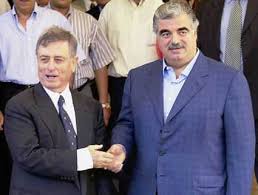
Assharq Alawsat and Levant News. Also see al-Akhbar‘s coverage. The article begins

Bayanouni: Yes, There are differences but we remain in touch

Khaddam: The Brotherhood is in touch with the regime through the Security Committee

A Syrian Baathi: This is a positive step that deserves to be rewarded

Khaddam is accusing the Brotherhood of doing nothing to oppose the Syrian regime.

The article explains that the differences between Khaddam and Bayanouni became clear during the Israeli invasion of Gaza. The Muslim Brotherhood announced during the conflict that it supported the resistance to Israel and stood by its brother organization, Hamas. It also declared an end to its opposition activities in Syria, because Syria was supporting the resistance. In essence, the Muslim Brotherhood was obliged to close ranks with Syria behind its Palestinian counterpart.

Khaddam supported Saudi Arabia and Egypt, who opposed Hamas. He also supports the March 14 coalition in Lebanon, who are opposed to Hizbullah, which supports Hamas’ efforts to resist Israel.

Khaddam and Hariri

Khaddam and Hariri

[Landis addition] The alliance between Bayanouni and Khaddam was concluded in 2005 for strategic reasons that no longer make sense. Bayanouni thought that Khaddam would be able to split the Syrian Baath Party and bring secular Syrians over to the side of the opposition.

Khaddam may also have promised that he could bring the support of Saudi Arabia a and the March 14 Coalition in Lebanon to the side of the Muslim Brotherhood. At the time, it seemed that President Bush was serious about destabilizing the Assad government. The formation of both the National Salvation Front and the Damascus Declaration — efforts to unify the splintered opposition in Syria — were both motivated by the belief that the Syrian regime would give way to US pressure.

Khaddam saught to make the Muslim Brotherhood acceptable to Washington, but in vain. Ultimately, the US government, although allowing the NSF to open offices in Washington DC, would embrace neither Khaddam or the Brotherhood. Because of Khaddam’s failure to split the Baath Party, win US or Saudi support, or destabilize the Syrian regime, his usefulness to Bayanouni is not obvious. In fact, it would seem that Khaddam has become a millstone around Bayanouni’s neck, for he is disliked by many Islamists as a 30 year ally of Hafiz al-Assad. Also, with Obama pursuing engagement with Syria, the opposition must return to the difficult work of educating average Syrians and bringing them into the fold of the opposition. The Brotherhood’s alliance with Khaddam only muddies their message to the young.

The Gaza operation underlined how the two elements of the NSF sit on opposite sides of the larger political divide of the Middle East.

????? ??????? ???????? ????? ?? ???? ?????? ?????? ??????? ????????

????? ????? ?????? ???????? – ????? 05 ?????/ ????? 2009

?????????: ??? ???? ?????? ???? ???? ?????
????: ??????? ????? ??????? ?? ?????? ??? ???? ?????
???? ????: ???? ??????? ????? ???????