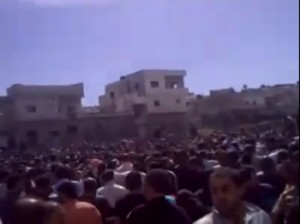
Deraa: The Government Takes off its Gloves: 15 Killed

The government is cracking down on the people of Deraa. The gloves are off. 15 killed.

Deraa is very poor and Islamic – it optimizes everything that troubles Syria – a failed economy, the population explosion, a bad governor and overbearing security forces. It is an explosive brew. Even if the government can contain violence to Deraa for the time-being, protests will spread. The wall of fear has broken. Apathy of the young has turned to anger. Youtube, Aljazeera and cellphones have changed the game and given the people a powerful weapon to fight authority. The country is under intense pressure and ready to explode. There is too much unemployment and too little freedom.

We saw the first direct sectarian slogans yesterday among the opposition that until now has stuck to a moderate message of dismantling emergency law, promulgating a new party law, and winning freedom. But on Thursday, the demonstrators abandoned their gentler slogans and chanted: “No Iran. No Hizbullah. We want a Muslim who fears God.”

?? ????? ??? ??? ???? ???? ???? ???? ????
See the video on Youtube

This slogan invokes the Muslim Brotherhood complaint of the 1970s and 1980s, when extremists called for an end to Alawite rule and accused Syria’s Alawites of being unbelievers and non-Arabs or Chrypto-Iranians – “Shu’ubiyyun,” – a term originally applied to non-Arab Muslims, mainly Persians, who resisted Arab claims to be the prime inheritors of the prophet. It was used by the Muslim Brotherhood in the 1970s to discredit the Syrian regime and by Saddam Hussein against Iraqi Shiites. Saddam demanded that Iraqi Shi‘ites abandon their shu‘ubi tendencies and reverence for Iranian religious leaders and embrace an authentically Arab Islam. By claiming that “We want a Muslim who fears in God” and “No Iran.”

The use of this slogan by protesters reawakened all the old fears of the regime. The government in taking the Omari mosque in Deraa and placing the claimed cache of captured arms on display – is hitting back and accusing the opposition of being driven by al-Qaida and the Taliban who take orders from America.

Addendum: (Wednesday evening March 23) Several people have written to correct me on interpreting this phrase and the level of sectarianism:

1. The correct translation is “No Iran. No Hizbullah. We want a Muslim who is afraid of God.” Someone who is said to be “afraid of God” in the wider context of Syrian society means someone who is virtuous and morally righteous, not necessarily religious. This phrase is quite often used in marriage context, i.e “I would like to find my daughter a young man who is afraid of God”. The underlying logic behind this meaning stems from the belief that anyone who fears God, will not be able to commit the sins that evoke his wrath, hence will always be morally righteous. On a related note, there is widespread support across a vast swathe of Syrian society for any sort of movement which can bring about much needed political reform and basic freedoms, but whether there will be the same level of support for a revolution or an uprising is a different matter. Many wealthier urbanites are at best apathetic and would prefer stability to freedom, which may explain why the uprising have been largely a rural affair thus far.

2. Sir, They are looking after a trusted Muslim human being who fears God and willing to protect them from the killers !! They meant a SYRIAN ruler that disallows the killing of his own unarmed civilian because of his fear of God , and It has nothing to do with the long gone MB…

3.What is shocking Josh is that you say the demos turned sectarian because in one demo you heard some people Chanting sectarian slogans. This is ridiculous. It is obvious that there is sectarianism in Syria and you are going to hear that type of slogans from time to time. But what is obvious is that the vast majority of the slogans are actually NOT sectarian. You are very good at communication and you know very well the impact of your blog. It is a pity you do not make more serious efforts at portraying a picture as close as possible to the truth.

Farouk al Sharaa, the Vice President, has made the strategy clear. He stated:

??? ???? ?? ?????? ?? ?????? ?????? ???????? ??????? ?? ??? ???????? ????????? ??? ????? «??? ???? ????? ?????? ???????? ?????? ??????? ??????? ???? ???? ????? ????????? ??? ??????? ??????? ??????? ?????? ???? ????? ????????? ?? ??????
????? ???? ???? ???? ??????».

As for the question about our position on the spread of Islamic political currents in the light of regional development, Sharaa stated, “We are not opposed to the Islamic currents that are rational and broadminded which understand their true roots, but as for al-Qaida and the Taliban which take their instructions from America, and pretend that they are against it, they are condemnable.”

The gloves are coming off on both sides and things will become much more sectarian and violent.

The government will stress its slogan of the last 30 years: “Stability and Security.” Implicite will be the question: “Do Syrians want to become like Iraq? Do they want their country to be torn by civil war and religious strife?”

The opposition says that Syria is different from Lebanon and Iraq and will not crumble along religious or regional lines. They insist the regime is offering the Syrian people a false choice between chaos and dictatorship. They argue that allegations of Islamism and religious intolerance are invented. They insist the government will destabilize Syria to make it’s predictions come true.

Video of Syrian mukhabarat making arrests in Daraa

In war, truth is the first casualty. Or as Sun Tzu’s wrote, “All warfare is based on deception”.

Key to a successful revolution in Syria must be the splitting of Syria’s elite. This is made up of the Alawis officers, who dominate the security forces and military, and the great Sunni merchant and industrial families, who dominate the economy as well as Syria’s moral and cultural universe.  If the Alawi and Sunni elites stick together, it is difficult to imagine how widespread but scattered popular revolts can overturn the state.

News Summary Follows:

Wednesday, March 23, 2011 ???? ????  – ?????

????? ????? ????? ?? ????? ?????? ????? ??????
23/03/2011
??? ???? ???? ????????? ????? ?????: ?? ??? «?????? ?????? ???? ????? ??????» ?? ????? ??????? ?? ????? ???? ??? ??? ???? ????? ?? ?????? ????? ??????? ????? ?????? ??? ????? ????? ??? ??????? ?? ????? ??????
??? ???? ?? ?????? ?? ?????? ?????? ???????? ??????? ?? ??? ???????? ????????? ??? ????? «??? ???? ????? ?????? ???????? ?????? ??????? ??????? ???? ???? ????? ????????? ??? ??????? ??????? ??????? ?????? ???? ????? ????????? ?? ??????
????? ???? ???? ???? ??????».

Syrian forces kill 6 in mosque attack: residents
Reuters
Protesters gather near the Omari Mosque in the southern old city of Deraa Reuters
By Khaled Yacoub Oweis Khaled Yacoub Oweis – 1 hr 57 mins ago

DAMASCUS (Reuters) – Syrian forces killed at least six people on Wednesday in an attack on a mosque in the southern city of Deraa, site of unprecedented protests challenging President Bashar al-Assad’s Baathist rule, residents said.

Assad, a close ally of Iran, key player in neighboring Lebanon and supporter of militant groups opposed to Israel, has dismissed rising demands for fundamental reform in Syria where his Baath Party has held a monopoly on power for 48 years.

Those killed included Ali Ghassab al-Mahamid, a doctor from a prominent Deraa family who went to the Omari mosque in the city’s old quarter to help victims of the attack, which occurred just after midnight, said the residents, declining to be named.

YouTube footage showed what purported to be the street in front of the mosque before the attack, with the sound of gunfire audible and a person inside the mosque grounds yelling: “Brother don’t shoot. This country is big enough for me and you.”

Before security forces attacked the mosque, the focal point of the Deraa protests, electricity was cut off and telephone services were severed. Cries of “Allah Akbar (God is the greatest)” erupted across neighborhoods as the shooting began.

“Syrian authorities think they can kill non-violent democratic protesters with impunity,” exiled Syrian rights defender Haitham al-Manna told BBC television from Paris.

An official Syrian statement said: “Outside parties are transmitting lies about the situation in Deraa,” blaming what it described as armed gangs for the violence.

The statement said doctor Mahamid, who was killed while he was in an ambulance that had arrived at the scene to rescue the injured, was “assaulted by an armed gang.”

“Security forces confronted the armed gang near the Omari mosque, shooting several of its members and arresting others. A member of the security forces was killed,” the statement said.

It said the armed gang “stocked weapons and ammunition in the mosque and kidnapped children and used them as human shields.” State television showed guns, grenades and ammunition it said were found in the mosque, but activists said the protest was peaceful and there had been no weapons.

The attack brought to 10 the number of civilians killed by Syrian forces during six days of demonstrations for political freedoms and an end to corruption in the country of 20 million.

Based on reports from Syrian human rights organizations and relatives, Amnesty Internationalhas compiled the names of 93 people who were arrested between 8 and 23 March in Damascus, Aleppo, Banias, Dera’a, Douma, Hama, Homs, Latakia, Ma’aratan Nu’man and al-Malkiyah and remain detained in unknown locations. The real number of those arrested is likely to be considerably higher. According to one Syrian human rights organization, around 300 people had been arrested in Dera’a in the five days before last night’s attack.

Government statement

???????? ??????? ?? ???? ???? ?????? ????? ? ????? ???? ?????? ?????? ? ??????? ?????? ???????? ?? ??????? ????? ?????
The armed gangs in Daraa stored weapons and ammunition inside the Omari mosque and they used children whom they kidnapped from their parents as human shields.

Jerusalem Post: For all his faults, Assad is the devil we know, 2011-03-23

Since the Yom Kippur War of 1973, one of the strongest arguments some Israelis make against withdrawing from the Golan Heights and making peace with Syria is basically, “if it ain’t broke, don’t fix it.”

Of all of Israel’s borders including, the so-called peaceful ones with Jordan and Egypt, the border with Syria has always been the quietest. Yes, Israel fought a major war there in 1973, but since then, the border has been peaceful, with only a rare terror or criminal infiltration.

As Israel watches the ongoing demonstrations in Syria against President Bashar Assad, its greatest concern for the moment is the uncertainty that change in Syria would bring to the region. Israel has gotten used to Assad and he is almost predictable. A new regime, led by a new actor, would likely be unpredictable and when considering the large arsenal of long-range Scud missiles Syria has stockpiled over the years and the accompanying chemical warheads, Israel needs to be considered.

In recent weeks, since the ongoing upheaval began in the Middle East, starting with Tunisia and Egypt and carrying on to Libya, Yemen, Bahrain and now Syria, Israel has found itself in a new reality in which uncertainty prevails. Who will take over in Egypt as the new president and what will happen to the peace treaty? What will happen in Bahrain, and will Iran continue to solidify its grip over the Gulf states? With regards to Syria, the Israeli defense establishment cannot say that the writing was not on the wall.

It is no secret that Syria is in an economic crisis, lacking basic resources such as water, oil and produce. Assad has for years rejected opportunities to do business with the West – particularly Europe – and with runaway inflation and high unemployment he is now paying the price. But when Israel looks at Syria it also sees the possible development of a new enemy, far more radical and extreme than the Assad they are familiar with.

Haaretz: IDF: Syria may provoke Israel to distract from domestic unrest
2011-03-23

The Israel Defense Forces is readying for the possibility that Syria might create a provocation along the northern border to divert attention from the growing protests against President Bashar Assad’s regime. Nevertheless, the defense establishment …

Protesters march in south Syria for fifth day
By Khaled al-Hariri

DERAA, Syria, March 22 (Reuters) – Hundreds of people marched in southern Syria for a fifth straight day on Tuesday, protesting against the government of President Bashar al-Assad and shouting “Freedom, freedom. Peaceful, peaceful.” Protesters gathered near the Old Omari mosque in Deraa and in the nearby town of Nawa in the strategic Hauran plateau, close to the border with Jordan, catching a wave of Arab unrest that has toppled leaders in Tunisia and Egypt.

“We want bread, but also freedom,” said a resident of Deraa, where wheat yields fell by a quarter last year due to a drought that has hit the rest of the country of 20 million people. Security forces killed four protesters when the demonstrations erupted in Deraa on Friday, and an 11-year-old child died after inhaling tear gas. ….

PBS News: News Wrap: At Least 7 Killed in Syria as Army Deploys to Stop Unrest

Protest Spreads in Syria Despite Firing of Governor of Restive Southern Province
2011-03-22, By Associated Press

Protest Spreads in Syria Despite Firing of Governor of Restive Southern Province

March 22 (Washington Post) — DAMASCUS, Syria — Protests spread in southern Syria Tuesday as hundreds of people marched to demand reforms in a previously peaceful village, witnesses and activists said.
Troops and protesters faced off in a nearby city outside a mosque where demonstrators have taken shelter.

The government sought to contain the first serious intrusion of the Arab world’s political unrest by firing the governor of the southern province of Daraa, where security forces killed seven protesters in the main city of Daraa over the weekend.

The governor’s dismissal failed to quell popular anger and the protests reached the village of Nawa, where hundreds of people marched demanding reforms, an activist told The AssociatedPress.

Smaller protests have been held in Jasim and Inkhil, near Daraa, and other Syrian cities including the capital, Damascus, and the Kurdish city of Qamishli.

Fear barrier crumbles in Syrian “kingdom of silence”
22 March 2011
Reuters News, By Khaled Yacoub Oweis

DAMASCUS, March 22 (Reuters) – The preacher of the Saladin Mosque was reflecting on the joys of Mother’s Day, his sermon straying far from dramatic protests now gripping Syria, when a young man jumped up to the pulpit and grabbed the microphone.

“Why are you talking about this in these circumstances? Tell us about the political situation!” shouted the youth, before secret police arrested him and hurried him away.

The scene at the mosque in the lower income Damascus district of Ruknaldin, recounted to Reuters by worshippers who witnessed it on Friday, was striking in a country where pliant citizens have endured government-dictated sermons for decades. In Damascus, as in the provinces, a barrier of fear which had blocked dissent is breaking down. Uprisings across the Arab world have not stopped at the door of one of its most hardline administrations.

For the first time, placards other than those glorifying Syria’s ruling elite and the “historic achievements” of the Baath Party are being raised in the towns of the strategic Hauran plain south of Damascus. A single word is etched on them — “Freedom”…..

Economist: The Arab Awakening Reaches Syria

There are signs the crisis in Deraa could be solved. A group of prominent locals has presented a list of demands to the government. These include the end to emergency law and the dismantling of the local security office, but not the removal of Mr Assad. Friday’s protesters had different motives in different parts of the country. In other areas, such as quiet Damascus, many disbelieve the news leaking out or prefer to turn a blind eye. Some activists want to pull back, viewing the situation as a dangerously unarticulated barrage of anger. Dormant opposition figures are complicating matters by trying to enter the fray. …

In Daraa today: Youtube, Shouting freedom freedom and turning the secret service vehicle upside down.

Standing up to the west isn’t enough to save Assad
2011-03-21…..

David Hirst in the Guardian: Standing up to the west isn’t enough to save Assad

There is a growing feeling that it could escalate into something much bigger and more decisive, with the regime’s own reactions – now consisting of the usual brute force with a novel, nervous admixture of conciliation – constituting the key factor as to whether it does or not.

A note from a Syrian friend visiting Damascus over the weekend

I took a day trip from Beirut to Damascus, had lunch and dinner there and just got back to Beirut. I will rush you some quick observations as I am a bit tired and haven’t yet caught up with the 2M+ email I got since I was gone.

– My overall impression: I am a bit concerned but not worried at all.

When I left Beirut, I was expecting the worse. Since I can only travel as a US citizen, I was bit concerned that with a last name of Atassi (with the stupid Atassi declaration that included all Atassis inside and outside Syria without my consent), the worries of some strangers coming to Syria as agitators, that I might be subjected to some not so easy time.

Nothing. It was the smoothest trip I ever had. The border guards were the most courteous, no-question-asked officers I have ever seen.

* There were no patrols, troop movements, security check points, or anything, I repeat, anything that might tell me there is a crises in Syria anywhere. Absolutely positively everything looked normal and very calm. This is from the Syrian Borders to the Mazze, to the Four Seasons Hotel.

* Along the Mazzeh autostrad, traffic was busy, coffee shops and restaurants were busy, and buses were full of people. Life couldn’t look more normal. It was the Damascus I knew.

* At the end of the Mazzeh Autostrad, I was expecting to see people with families chillaxing on the grassy areas, like they always do during the summer. They were actually there, chillaxing, may with arjile and children were playing.

* Unlike what I read in some reports before I left today, the Government did not give the people two days off to sort through the issues of Daraa. So let me get you the scoop on this. The 21st of March, Mother’d Day has always bee an official holiday in Syria since the days of the father. So Monday is off. They gave the people, Sunday (today) off to make it a long weekend (with the weekend in Syria being Friday and Saturday.) By the way, today’s off is what we call in the US administrative leave (Ijazeh Idarieh) – meaning employees will have to take today off and will be deducted from their annual leave time.

* The Four Seasons Hotel was full of people, but not packed as in the summer days. Being a Holiday and tomorrow being Mother’s Day, many people did nt venture outside to party as they usually do, I was told.

* I asked the local about the latest events. No one is worried my all had the attitude of why-are-you surprised. I was shocked. Everyone I talked to seems to have been expecting this Daraa events all along. The reason? I did not know that the Daraa issue was festering for a while now – even before Egypt. Apparently many Wahhabis have infiltrated the city – especially from Jordan and have been preaching hatred against the Alawites (here we go again, Alawites vs a group of Syrians) and in the last month or so there have been some arrests, beating, and you-know-what-they-do when they catch these salafis.

* So people in Damascus (and only those I talked to) wish that the government finally crush them once and for all. One friend told me (not sure how true) that Bashar got the told-you-so from some senior intelligence officers when he insisted early on to treat the Salafis with utmost caring under the circumstances. Apparently they wanted to deal with them in their usual ways and he overruled them. Not sure how true this is, but it is what I heard.

* So I asked about the demonstration in Damascus and Banyas and elsewhere. Apparently few are concerned with those and they considered them “no big deal” ?? ???? ?????.

So, life is normal and the Syrians I met with did not seem to be concerned that things will get worse. I did hear, though, and repeatedly that Bashar needs to change. ANd in fact, I did her exactly what Mouris said earlier that Bashar needs to announce term limit, and that he will not run for re-election, and that he needs to rescind the emergency law, allow other parties to participate and he needs to let loosen teh terrible laws against the private market.

Whether Bashar will head the advice or not is unknown. But all of the people I talked to seem to think this this is not as big as we think.

WIKILEAKS- thanks to FLC
S E C R E T TEL AVIV 003079

SUBJECT: ISRAEL FM LIVNI SAYS ISRAEL DISAPPROVES OF CURRENT DRAFT OF UN RESOLUTION

3. (S) With media representatives present, FM Livni opened the meeting by cautioning everyone not to believe what the newspapers write: “Israel is not satisfied with the draft UN resolution (1559) as it stands.” After the media reps departed the room, Livni reiterated to the Assistant Secretary that Israel — like Lebanon — does not approve of the current draft of the resolution. Over the next hour and a half, FM Livni made repeated, impassioned appeals to the Assistant Secretary not to allow the draft UN resolution to address the long-standing Shebaa Farms territorial dispute. First, she argued that Shebaa Farms is a territorial dispute between Lebanon and Syria. As such, Israel has no right to be involved in it, and does not wish to have it placed on its bilateral agenda with Lebanon. She argued that IF/IF Shebaa Farms were returned to Lebanon in any kind of post-conflict resolution — and Israel were implicated in the return — then Syria might attack Israel, arguing that Israel had no right to hand the territory over to Lebanon. 4. (S) FM Livni also returned to what she said were the GOI’s initial objections to addressing the Shebaa Farms issue in the first place — that return of any disputed territory as part of a resolution to the current conflict would be tantamount to rewarding aggression. Hizballah, she claimed, would grow stronger,… Asking for five minutes to lay out the Israeli position on Shebaa Farms, Livni continued: “In past discussions between Israel and the U.S., it was clear that Shebaa Farms would be the end of a process — full implementation of (UNSCR) 1559. Now, it is being put as something to start with! I am so fed up with weak leaders who want to get something good without implementing their deals.” She wondered aloud what would happen next — perhaps Hizballah would press for return of the West Bank? Pounding the table, Livni said, “Surely the U.S. and other Western governments are not naive enough to believe Hizballah’s statements that it exists because of Shebaa Farms. Iran is the reason why Hizballah exists. Iran, Syria, the Palestinians and Hamas are watching us. We will be sending the wrong message. They will see that they get something by killing Israelis. I do not care about Siniora’s ‘blah blah’ about how this is something for him. If Shebaa Farms are returned to Lebanon, Hizballah will merely take up another cause. It exists solely to advocate for and execute the destruction of Israel….” One could, she said, imagine a scenario in which Shebaa Farms were returned, and then the weak Siniora government decides not to take action on any of its “obligations,” including complete execution of UNSCR 1559. 6. (S) Livni stressed that prior to the outbreak of the fighting, there was a series of UNSCRs that concerned Lebanon: 425 (Israel’s withdrawal behind a UN-mandated line), 1559 (disarmament of militias) and 1680 (calling on Syria to delimit its borders with Lebanon). Accepting Assistant Secretary Welch’s clarification that expectations laid out in 1559 were not “obligations” set on Lebanon’s government, Livni nonetheless argued that .. Shebaa Farms will be dealt with only after 1559 is fully implemented.”….

9. (S) The Assistant Secretary shared with Livni the results of his August 4-5 meetings in Lebanon Specifically, he told FM Livni that: — Berri sees himself as able to represent Shia interests, and is willing, but does not feel obligated, to do so. He is providing considerable help to PM Siniora, who relies upon him to keep the Shia in line with the GOL. Berri indicated his willingness to be an intermediary to Hizballah … — Jumblat claimed that the IDF is not making much headway against Hizballah and needs to keep up pressure on the group. All of the Assistant Secretary’s interlocutors understood that it is helpful to have Hizballah “militarily pressured.”… — Like the Israelis, the Lebanese are not happy with the lead role France has appointed itself in organizing the MNF. — All said that they cannot ask for or approve a multinational force under a Chapter 7 mandate, but can accept one if it is imposed on Lebanon. They are planning for the deployment of the Lebanese Armed Forces (LAF) immediately upon withdrawal of the IDF — even if the MNF is not yet in place. Berri implied that Hizballah would agree, and volunteered to personally lead a vanguard of 10,000-15,000 troops into the south. …. PM Siniora and wants the bulk of Muslim MNF troops to be Sunni. — All accept that there should be no arms in the area of operations except those held by the LAF and MNF. .. — All agreed that Iran and Syria want to continue the fight.

Costa Coffee Closes Most Outlets in Syria: Costa Coffee, a global chain of cafés, has closed most of its outlets in Damascus, citing operational losses.

U.S. Reacts to Fear of Iran’s Rising Clout

White House Eyes Islamist State While Strategizing in Libya, Bahrain, Yemen and Syria; But Its Approach Could Backfire
WASHINGTON—White House concerns that Iran’s hand is being strengthened by recent events in the Middle East is central to its response to the turmoil, say U.S., European, and Arab officials.

President Barack Obama’s decision last week to use military force against Libyan leader Moammar Gadhafi’s forces was made in part by his administration’s fear that Western inaction could further embolden Tehran, these officials say.

Sunni-majority Saudi Arabia and Iran’s Shiite government are locked in a battle for regional influence.

U.S. military planners are also concerned Iran could benefit from an overthrow of the monarchy in Bahrain, home to U.S. naval operations that help control the Persian Gulf’s oil flow.

In Yemen, too, Washington’s closest Arab allies, in particular Saudi Arabia, are worried the potential overthrow of President Ali Abdullah Saleh could strengthen Iran in the region.

Riyadh briefly invaded Yemen last year to contain a rebel movement, known as the Houthis, which shares Tehran’s Shiite faith and Arab states allege has received funding and arms from Iran.

“Everything the U.S. is doing to respond in the Middle East is colored by how this could hurt or help Iran,” said a European official who has met with senior U.S. officials in recent weeks. “This might be an overreaction, but it’s how people are viewing things.”

Many Middle East analysts warn that Washington’s Iran strategy could backfire. Tehran and its allies have been saying the Obama administration’s varying approach to each uprising in the region is hypocritical, in particular its lukewarm condemnation of the Bahrain government’s recent crackdown on a largely Shiite protest movement.

An overthrow of Bahrain’s Sunni monarchy would likely produce a government more aligned with Tehran’s interests.

“I ask some in the Arab and Islamic worlds: Why have you remained mum over the tyranny against our people in Bahrain,” Hassan Nasrallah, the head of Lebanon’s Hezbollah party and a close Iran ally, said on Saturday. “Is it only because they are Shiites?”

Iran’s leadership has sought to cast the Middle East’s democratic wave as one that targets pro-American governments. But the turmoil has also rekindled a protest movement in Iran—the antithesis of a pro-U.S. government—that flared in 2009 following allegations that national elections were rigged. The White House has sought to cast Tehran as hypocritical—urging on protests in Arab nations, but suppressing them at home.

Over the weekend, Mr. Obama offered his strongest rhetorical support yet for Iran’s youthful opposition movement.

“So far, the Iranian government has responded by demonstrating that it cares more about preserving its own power than respecting the rights of the Iranian people,” Mr. Obama said in a video message that was beamed into Iran and translated into Persian to commemorate Nowruz, the Persian New Year. “These choices do not demonstrate strength, they show fear.”

The U.S. Treasury Department last month for the first time imposed sanctions on Iranian officials solely for their alleged role in human-rights abuses and for playing a role in the crackdown on political dissidents.

The Obama administration is pushing the United Nations’ Human Rights Council in Geneva to censure Iran for its alleged abuses and establish the first U.N. human rights investigator for the Islamic republic in a decade.

Another front in the U.S.’s Middle East approach is Syria, which has been engulfed by political protests in recent days. The Obama administration has aggressively sought to split Syrian President Bashar al-Assad away from his longstanding alliance with Tehran. And it has sought to rekindle peace talks between Syria and Israel over the disputed Golan Heights territory, so far with little luck.

U.S. officials said they are now closely tracking a growing protest movement that has focused on the southern Syrian city of Deraa, which is now viewed as the greatest political challenge to Mr. Assad’s 11-year rule. Human rights-groups said at least half a dozen activists have been killed since Friday. And U.S. officials, while cautious in predicting Mr. Assad will fall, believe the protests could force the 46-year-old leader to limit his cooperation with Tehran.

On Sunday, Syrian Foreign Minister Walid Moallem broke with Iran and formally supported Saudi Arabia’s role in quelling the unrest in Bahrain. Riyadh is seen as the principal Arab power capable of providing Syria with crucial economic and political support if Syria’s protest movement swells.

The Persian Gulf remains the most important flash point in the proxy battle between the U.S. and Iran. “We do expect Iran will attempt to take advantage of events for its own purposes,” said Ben Rhodes, U.S. deputy national-security adviser for strategic communications. “Iran has a long history of attempting to meddle in the affairs of other countries.”

The Obama administration has faced criticism for not more forcefully condemning the move by Bahrain’s ruling Khalifa family and Saudi Arabia to deploy troops against largely Shiite protestors.

Saudi Arabia’s monarchs have told the U.S. they won’t accept a new government in Bahrain that could fall under Iran’s sway.

On Monday, Bahrain’s foreign minister threatened to cut ties with Lebanon over the Hezbollah leader’s criticism of the recent military operations. And Bahrain’s leaders have intensified their claims that Iran is trying to topple their government.

“Iran’s behavior and contacts with some nations and organization about the international affairs of the Kingdom of Bahrain is a clear intervention,” Sheikh Khalid bin Ahmed al-Khalifa told reporters Friday. “I’d like to remind all of you of the incident that had taken place in Iran last year or even before that,” referring to the 2009 protests.

Demands of the Deraa Leaders includes:
Release of those imprisoned, replacement of the Governor and security, investigation and punishment of those who shot demonstrators, end emergency law, free market in land sales, without intelligence oversight.

Syria’s Opposition Divided. Demonstrations Have Different Goals

Steven Starr, a freelance reporter in Damascus and founder of the Near East Quarterly, makes a good point about the lack of any known leadership among the opposition and the diverse regional motivations for the demonstrations. The differing motivations and goals driving each of the protests suggest a lack of coordination. The government can restore control, this would suggest, if it doesn’t defeat itself by responding with too much force and if it listens to the people. This report suggests ongoing trouble: One Reported Shot Dead On Third Day Of Syrian Protest just as a delegation from Damascus arrived in the city to offer condolences for the four deaths the day before. Protesters demanding freedoms and an end to corruption set fire to the headquarters of the ruling Baath Party in the Syrian southern city of Deraa on Sunday.

Here is video of the demo

WALID AL MOUALEM is making friends with the Saudis… asserting that the movement of GCC troops into Bahrain is legal.

The second note, which is copied below in Arabic, is from a friend in Deraa whose entire family is there.  He explains how the demonstrations evolved as a protest to the 15 school children who were arrested for writing slogans that they had learned on al-Jazeera from the Egypt coverage.  He argues that the stupid actions of the governor and security exacerbated the situation, but that few want revolution and many fear disorder and chaos. All the same, he insists that no one wants the situation to return to what it was. Everyone wants change, but they want orderly change. The tribal customs of Deraa require protest for the arrests and particularly the killings, but, he suggests, the tribes also have concrete demands that can be fulfilled and negotiated. Their demands are not revolutionary, he insists. Khalid Oweis writes that revolutionary slogans have been a prominent part of the Deraa protests. He writes:

On Saturday, thousands of mourners called for “revolution” at the funeral of two of the protesters. Officials later met Deraa notables who presented then with a list of demands. It included the release of political prisoners, dismantling of secret police headquarters in Deraa, dismissal of the governor, public trial for those responsible for the killings and scrapping of regulations requiring permission from the secret police to sell and buy property.

Halabi writes: “Don’t you think that the people want freedom and end of corruption not fidya [blood] money?”

The demonstrations in Banyas were driven by a prominent family who was a client of Abdal Halim Khaddam, the ex-Vice President who went into opposition in 2005 and lives in Paris.

Another friend writes:

i believe that this is hard to stop and reverse. C… does not agree with me. i have been on the facebook page. there is no doubt that an Islamic current is underneath this whole movement. but they are clever. they have Egyptians advising them. but it is starting to draw none Islamists as well. i do stick to my original narrative that it is mostly about lots and lots of young hopless jobless men that see this as their Woodstock moment. corruption and rami is clearly a lightening rod. you see it in the comments. poverty breeds hatered towards the have from the have not. we are clearly entering this phase now. Khaddam’s site is also reinvigerated. they see their moment too. Tomorrow its the Kurdish new year day…the movement is pushing them to join too. i basically see this starting with islamists (hama hama), bringing the youth in the streets who see it as a chance to becomes heroes from zeros and now to bring in the kurds. my best friends in syria think damascus should hit very hard. i have been advocating the opposite. i am sure the same argument is going on at the palace itself.

Steven Starr writes:

There are talks of opposition but what opposition? The opposition I know of are at war with each other more than with anyone or anything else.

What happened in Damascus last Tuesday and Wednesday was and remains separate from what took place on Friday. The Tues. and Wed. events were instigated by HR people who have had long-time issues with the authorities. This was a ‘genuine’ rights issue.

What happened in the south and on the coast were also separate from each other (the south because of boys beaten up for writing graffiti complaining against rising prices, the coast because of the closure of an Islamic school). This was a ‘general concern of the people’ issue and will have much more legs and appeal than the former above.

It is being reported internationally as being one unified event, if I can say that, which is reductive and perhaps even dangerous.

Is there some sort of link in terms of a general unhappiness with the authorities? Probably. Does it justify wholescale change? Most probably not.

I think, though the daily situation is very difficult for many Syrians, (some) people need to be careful in what exactly it is they are calling for. They need to think through and understand what they want as much as they want to be understood themselves.

?? ???? ???? ?? ????? ?? ??? ????? ???? ?? ????? ?????

???? ??????? ???? ???? ????? ??? ???????? ??????? ?? ?????? ???? ?? ????? ????? ???? ????? ????? ?????? ?? ?????? ??????? ?? ???????? ?? ??????? ?? ???? ????? ??? ??????? ????? ???? ?? ????? ???????? ???????? ???? ?? ????????? ?????? ?????? ?? ????????? ???????? ?? ??? ????? ???? ??? ??? ??? ???? ??? ??? ??? ?????? .

????? ??? ????????? ???????? ?? ?????? ? ??????? ?????? ?? ?????? ???? ???? ??? ?? ????? ????? ??? ??? ?????? ?????? ??????? ??????

????? ??? ?????? ?? ?? ??? ?? ?? ????? ?????? ?????? ?????????? ?? ?????? ????? ???????? ???? ???????? ?????? ????????? ??????? ???????? ?? ?????? ????? ??????? ???????? … ???

???? ?????????? ???????? ??? ???? ???????? ???? ???????? ???? ????? ??? ?????? ?? ???? ?? ???????????? ?????? ??????? ???? ?????? ??? ??????? ??????? .-????? ?????? ???? ???? -..?????? ???? ????? ?????? …..??? ??? ????(?????) ?? ??? ???? ???? ??? ?????? …. ??????? ??????? ?????? ?????? ??? ???? ??? ????? ?? ?????? ?? ?????

??? ????? ?????? ?? ??? ??? ????? ???? ?????? ?????? ???? ??? ????????? ????????

?????? ????? ?? ?????? ?????? ????? ????? ?????? ?????? ?????? ???????? ???? ???? ????? ???? ?????

??? ?? ??? ??? ??????? ??? ??????? ?????? ????????? ???? ????? ?? ????? ?????? …

?? ??? ????? ???? ???? ?????? ?? ???????? ??????? ???????? ?? ???? ??? ??? ???? ???? ????? ??????

???? ????????? ?? ???? ??? ???? ?????? ??????? ?????? ?? ???? ?????????

??? ??? ??????? ???? ??? ????? ????? ?? ?? ??? ?? ???? ????? ??????? ??? ???? ??????? ?? ????? ?? ??? ?? ???? ?? ??? ????? ??????? .

??? ??????? ????? ?????? ?? ?????? ???????? ???????? ???? ????? ????? ???? ???? ????? ?? ???? ????? ???? ??? ?????? ??? ??? ???? ????? ????? ??????? ?? ??????? ???? ?? ??? ???? ?????? ????? ???? ????? ??? ???? ???? ??????? ????? ?????? ??????? ???? ????? ???????

???? ?? ???? ?????? ??? ??????? ??????? ???????? ??????? ?? ???? ???? ???? ?????? ??????

????? ???? ????? ????? ?????? ?? ???????? ???????? ???????? ?????? ?? ???

????? ?? ??? ???? ???? ?????? ?????? ???????? ?????? ??????? ????? ??? ???? ???????? ?? ?????? ????? ???????? ????????

??????? ?? ??? ????? ?????? ???? ???????

??????? ???? ????? ?????? ????? ????? ????? ??????? ?????? ?????? ??????

?? ???? …..

Alawis are changing their profile photos on Facebook to Bashar’s.

Syria to release children who sparked anti-government protests

Demonstrations erupted in the southern city of Deraa after 15 children were arrested for writing freedom slogans inspired by Egypt, Tunisia unrest.
By Reuters and Haaretz Service Tags: Israel news Syria

Syrian authorities said on Sunday they will release 15 children whose arrest helped fuel protests in the southern city of Deraa during which security forces killed four civilians.

An official statement said the children, who had written freedom slogans on the walls inspired by the uprisings in Tunisia and Egypt, will be released immediately.

Here is a good precise of the talks I recently gave in Maine and DC

Syria’s relationships key to Middle East peace
knox.VillageSoup.com
By Andrew Benore | Mar 19, 2011 (Photo by: Andrew Benore)

Joshua Landis discusses Syria at the monthly meeting of the Mid Coast Forum on Foreign Relations. … Joshua Landis said promoting peace between Syria and Israel is important for the United States if it wants to “preserve its broad interest in the Middle East and good relations with Arab allies…. “The democratic revolution now spreading across the Arab world is fraught with opportunity and danger for the U.S.,” Landis said. “If the U.S. does not solve the Arab-Israeli conflict it will increasingly be forced to choose between friendship with Israel and its longtime allies in the region.”

He said Turkey is a “bellwether for this trend.”….Golan is the key to Syria’s friends and enemies.

Friends of Syria include Iran and Russia, Hezbollah, the PLO and Hamas. “All of these are countries that are willing to arm it or help it in its struggle with Israel in an attempt to pressure Israel to give back the Golan,” Landis said.

Enemies of Syria in the Arab world are America’s allies, Landis said. They include Egypt, which signed the Camp David agreement. Landis said the recent uprising in Egypt was labeled “The end of the Camp David regime” in Syrian media.

Demonstrations Grow

Momentum is building for the opposition. The demonstrations are getting bigger with each day. They started out gathering between 100 to 300. Today’s demonstration was well over 1,000 in Deraa. The New York Times is reporting that 20,000 joined the funeral march in Deraa. The killing of four in Deraa is new. Many Syrians claim that this is the first time President Assad has drawn blood with the shooting of demonstrators. The Kurdish intifada of 2004 in the Jazeera ended with the death of many but that occurred following the successful constitutional referendum in Iraq and was blamed on external factors. To many Syrians, this time seems different.
It is unclear where this can lead as the opposition has no leadership and Syria has no organized parties. All the same, we are in a new era. If demonstrations grow to the point that security forces are overwhelmed, the situation could change rapidly. Not all regions or cities of Syria would behave the same. The top brass of the armed forces are unlikely to abandon the leadership as they did in Tunisia or Egypt; all the same, loyalties would be divided for many. The next few days will be telling. The Deraa demonstrations were sparked by the arrest of 15 children for scrawling anti-regime graffiti. It is quite possible that they government can yet regain control of the momentum and protest movement. Syria lacks an organized internal leadership that can plan and administer continued demonstrations. There is a sophisticated, even if small, leadership abroad which could coordinate events on Facebook from afar.

Al-Jazeera coverage of the demonstrations of March 18 and 19. (in Arabic)

Dera’a Protesters calling for freedom – “Thousands of people attending the funerals of Akram al-Jawabra and Hussam Abdelwali Ayash were surrounded by large numbers of security men who fired tear gas at the mourners to disperse them”” the BBC and Reuters report.

(Reuters) – Thousands of mourners called on Saturday for “revolution” at the funeral of protesters killed by Syrian security forces, in the boldest challenge to Syria’s rulers since uprisings began sweeping the Arab world.

Security forces responded by firing tear gas to disperse crowds in Deraa, a region south of the capital where at least 10,000 people demonstrated on Saturday at the funeral of two protesters, among at least four who were killed on Friday.

“Revolution, revolution. Rise up Hauran,” chanted the mourners in Deraa, administrative capital of the Hauran plateau, as they marched behind the simple wooden coffins of Wissam Ayyash and Mahmoud al-Jawabra.

“God, Syria, Freedom. Whoever kills his own people is a traitor,” they said. Some of the mourners left a mosque and headed for the center to protest.

The two were killed when security forces opened fire on Friday on civilians taking part in a peaceful protest demanding political freedoms and an end to corruption in Syria, which has been ruled under emergency laws by President Bashar al-Assad’s Baath Party for nearly half a century.

A third man killed on Friday, Ayhem al-Hariri, was buried in a village near Deraa earlier on Saturday. A fourth protester, Adnan Akrad, died on Saturday from his wounds.

Deraa was less tense by late afternoon, with security forces using less force after a meeting at the main Omari mosque between the authorities and prominent figures in the city.

An activist who was at the meeting said officials were presented with a list of demands, most importantly for the release of political prisoners. Among them were 15 schoolchildren arrested in Deraa this month after writing slogans on walls, inspired by revolutions in Egypt and Tunisia that swept their autocratic leaders from power.

The list demands the dismantling of secret police headquarters in Deraa, dismissal of the governor, a public trial for those responsible for the killings, and scrapping of regulations requiring permission from the secret police to sell and buy property.

“If they do not respond the protests will only escalate,” the activist told Reuters.

An official statement said the interior ministry had formed a committee to investigate the “regrettable events” in Deraa.

The city is home to thousands of displaced people from eastern Syria, where up to a million people have left their homes because of a water crisis over the past six years. Experts say state mismanagement of resources has worsened the crisis.

The Hauran region, once a bread basket, has also been affected by diminishing water levels, with yields falling by a quarter in Deraa last year.

ARRESTS OF CHILDREN FUEL RESENTMENT

Protests against Syria’s ruling elite, inspired by revolts in the Arab world, have gathered momentum this week after a silent protest in Damascus by 150 people demanding the release of thousands of political prisoners…. In a move seen as an attempt to address the discontent, Assad issued a decree on Saturday shortening mandatory army conscription from 21 months to 18 months.

The long conscription period has generated discontent, especially among youth who resent state tactics to bring them into service, such as random ID checking, and the withholding of food aid from families whose members escape conscription.

Time: Arab Spring: Is the Revolution Starting up in Syria?
2011-03-20

Has the wave of popular revolts rocking the Arab world finally reached Syria, one of the region’s most policed states, a country its young president boasted was “immune” from calls for freedom, democracy and accountable government? Or were the …

Egypt crowd attack ElBaradei at voting station – They call him an “American agent.” He is unable to vote.

What is at stake in Egypt’s referendum – a good summary by Gary C. Gambill
The Jurist (University of Pittsburgh Law School)
19 March 2011
Chris Phillips – ‘Syrian protesters killed in Deraa

PBS report on Syria today – PBS NewsHour

Syria News reports that the Syrian government has declared it will carry out a transparent investigation of the police in Deraa and the killings, promising to punish those guilty of wrongdoing.

????? ??????? ??????? ??? ????? ??????? ????????? ??? ???????? ????? ?? ??????? ?? ???? ?????? ?? ??? ????? ???? ???? ????? ????? ???? ??? ??????.

????? ???? ????????? ??????? ??? ????? ?? “??????? ??????? ????? ?????? ???? ??????? ????????? ?? ??? ???????? ???????? ???? ??? ?? ???? ???? ??? ????? ???????? ??? ???????? ????? ?? ??????? ?? ???? ??????”.

????? ??? ??? ???? ????? ???? ???? ??? ?? ????????? ?? ????? ???? ????? ?????? ?? ?????? ?????? ??? ??? ????? ?????? ??? ????? ??? ???????? ??? ?????? ?????? ??? ????? ?????? ?????? ?????? ??????? ?????????? ?????? ???????, ???? ???? ????? ??????? ??????? ??????? (????).

??? ???? ????? ???? ????? ???? ??? ?? ???????? ???????? ?????? ?? ?????? ???? ????? ??? ????? ???? ??? ????? ????????? ?????????? ?????? ????? ????? ????? ?? ??????.

????? ????? ?????? ?? ?????? ????? ??? ?????? ????? ??????? ?????? ?????? ?????? ????? ??????? ??????? ?????? ???????? ??? ??????? ??? ?????? ???? ?????? ????? ?? ??????.

????? ???? ?? ???? ??????? ?????? ???? ????? ???????? ??? ???????? ?? ??? ???????? ? ???? ???? ??????? ???? ???? ????? ???????? ????? ?????? ?? ???? ??? ???????? ??????? ???????? ?? ????? ??? ????????? ????? “?????? ???”.

?????????

Canadian Prime Minister Stephen Harper suggested that outside powers hoped their intervention would be enough to turn the tide against Gaddafi and allow Libyans to force him out.

“It is our belief that if Mr. Gaddafi loses the capacity to enforce his will through vastly superior armed forces, he simply will not be able to sustain his grip on the country.”

Three to Five Killed in Deraa Demonstration; Unrest Spreads

The three to five demonstrators killed in Deraa. This is a turning point – to what, one cannot say.

5 protesters killed in Syria, activist says; amateur video shows unrest around country
By BASSEM MROUE and ZEINA KARAM | Associated Press

Syrian security forces launched a harsh crackdown Friday on protesters calling for political freedoms, killing at least five people and marking the gravest unrest in years in one of the most repressive states in the Mideast, according to accounts from activists and social media……

On Friday, Syrian forces used water cannons, batons and gunfire to beat up protesters in Daraa. The violence began when a large group of people emerged from the Al-Omari mosque, marching and shouting slogans against corruption and calling for more political freedoms.

A human rights activist told The Associated Press that security forces cordoned the main hospital in Daraa where some of the wounded were being treated, preventing families from visiting the victims. He cited hospital workers, but spoke on condition of anonymity for fear of government reprisals.

The government’s TV channel and news agency said “infiltrators” in Daraa caused “chaos and riots” and smashed cars and public and private property before they attacked riot police. It said a similar demonstration in the coastal town of Banyas dispersed without incident.

Amateur video footage posted on YouTube and Twitter showed large groups of protesters in several cities, but the authenticity of the footage could not be independently confirmed….

A YouTube video claiming to be shot in Banyas showed several thousand demonstrators gathering around an old stone building with a Syrian flag fluttering from its roof. A cluster of men stood on its balcony with a loudspeaker. Amid chants of “Freedom!” and “There is only one God!,” one man shouted out a list of protesters demands ranging from freedom of expression to allowing Muslim women with face veils to attend school.

Syrian forces kill three protesters in southern city
Reuters, Friday, March 18, 2011 3:16 PM EDT

Syrian security forces killed three protesters in the southern city of Deraa Friday, a resident said, in the most violent response to protests against Syria’s ruling elite since revolts swept through the Arab world.

A video aired on Facebook showed what it described as demonstrators in Deraa shouting slogans earlier in the day against Syrian tycoon Rami Makhlouf, a cousin of Assad’s who owns several large businesses.

The demonstrators were taking part in a peaceful protest demanding political freedoms and an end to corruption in Syria, which has been ruled under emergency laws by President Bashar al-Assad’s Baath Party for nearly half a century.

Smaller protests took place in the central city of Homs and the coastal town of Banias, home to one of Syria’s two oil refineries, activists said. A crowd briefly chanted slogans for freedom inside the Umayyad Mosque in Old Damascus before security forces closed in on them.

Syrian authorities have stepped up arrests of dissidents since the Arab uprisings began in January, and have a history of crushing dissent. In 1982, Assad’s father sent troops to put down an rebellion in the city of Hama, killing thousands.

In Deraa Friday, several thousand people chanted “God, Syria, Freedom” and slogans accusing the president’s family of corruption, the resident said.

He said Hussam Abdel Wali Ayyash, Akram Jawabreh and Ayhem al-Hariri were shot dead by security forces who were reinforced with troops flown in by helicopters. Scores of demonstrators were wounded in the attack in the old quarter of Deraa near the border with Jordan.

After prolonged clashes during the day, the city appeared quieter at nightfall, with a heavy security presence, the resident, who declined to be named, told Reuters.

An official statement said “infiltrators” tried to take advantage of what it termed as a gathering in Deraa by burning cars and trying to cause chaos, which required intervention by security forces. The statement did not mention any casualties.

?? ???? ??????? ??????? ?????? ?? ?????

16-03-2011

???? ????? ??????? ?????? ??? 3/2011 ???? ??? ?????? ??? ?????.

???? ???? ??????? ???? ?????? ?? ????? ???? ?????? ??? ??????? : ???? ???????? ?? ???? ??? ??? ????? ??? ??? ????? ????? ???? ????? ????? ????? ?????? 1.5%? ????? ?????? ??? ??????? ??? ?????? ??????? ?? ??? ??????? ???????? ???? ?????? ???? ????? ??????? ????? ???? ?? ??? ??????? ???????? ??????? ?? ?????? ??? ?? ????? ??????? ??? ???? ????? ??? ??????? ?????? ?????? ???????? ????? ????? ???? ??? ????? ???????? ????? ???? ????? ??????? ??? ???? ??? ??????? ????? ?????? ?????? ?? ???? ??????? ?????? ?????? ??? ??????

Damned if We Do and Damned if We Don’t

I received the following email from a Syrian friend, which summarizes a debate a number of Syrian friends have been having. I suspect it mirrors the sort of debate that many other Syrians have been having. He writes:

I have been on the sideline of this debate….. Let me try to summarize my position about Syria even if it is contradictory.

1. Like C…., I consider myself in the “proceed-with-caution-because-Syria-is-not-ready-for-democracy” camp. There are many reasons for this approach. If we take into consideration that the government is an insecure one (or so it thinks). One does not have to be a rocket scientist to know why it is as cautious and scared as it is. Furthermore, Syria is a very weak country with many enemies. Most of its enemies are VERY powerful.

Assad the father made Syria; he convinced Syrians that their country was much stronger than it actually was. Syrians outwardly fell for this line of thinking, but deep down, they are insecure and fearful. We have little confidence in ourselves. This is why we do not like to pick fights with others. So if one of us were running the system in Syria today, who would you want as an enemy, the millions of state workers and dependent peasants who have been the beneficiaries of the system for 50 years or the few enlightened elitists who are thinking liberty, freedom, and democracy? Let us be frank here: the current regime does have considerable legitimacy with the millions of ignorant citizens who are scraping by and the dependent class of citizenry. They just do not know any better.

Furthermore, one cannot rush into fast and radical reforms in a society that is so illiberal, that still abuses the rights of its women and children, and that allows men to inherit twice as much as women. We still do not allow women to serve as judges or to pray when they are menstruating. We suffer from a profound lack of mutual trust, without which civil society cannot take root.

In such a backward, illiberal, and distrusting society, pushing for fast-acting reforms will likely spell disaster. Today’s Iraq is no better than it was in 2003, despite spending billions on the the ingredients of democracy. The notion that when one removes a tyrannical regime a democracy will automatically pop up to replace it is naive and false.

2. I consider myself in the G…. camp of “it’s the economy stupid”. No question about it, if Syria is to implement a solution for its shocking economical problems today, it will be too late. A solution to have any affect today should have been implemented 20 years ago. There are no economic solutions that can act fast enough to deal with Syria’s immense problems adequately. The economists and financial planners today should be busy formulating plans to face the problems twenty year from today. The train has left the station, but Syrians have not even begun packing for their trip. We are a hopeless case, no matter what we do today. The situation is even more laughable to people like G…. who really understand Syria’s economic problems.

3. I also consider myself in E….’s camp. He argues that Syria’s political system under the Ba’ath is of a piece and hopelessly unable to reform itself. It is not the top guy, it is not the middle guy, and it is not the bottom guy that needs to go. They all, collectively and individually, must depart. You want a good political system, throw out the old one kit and caboodle, all of them, and start fresh. This camp argues that those who created the problem cannot be the ones to solve it – sons and daughters included — although many of them have the best intentions in the world. They have proven their failure for almost half a century. You cannot get juice from a turnip. Here is why: people will not change unless they see dramatic change on top. It took an Ataturk to prove to the Turks that the Ottomans were gone.

Syria’s problems, like those of other Middle Eastern countries, are existential. Time is running out. I worry that we are damned if we do and damned if we don’t.

Demonstrations in Damascus Challenge Regime

Tayyib Tazini, my professor at the University of Damascus when I was a Fulbrighter in the early 1980s and one of the leading intellectuals in the Arab World, was arrested for demonstrating for prisoner rights and released on Wednesday with 4 others. 25 or so remain behind bars. There have been three days of small demonstrations, challenging the regime and forcing it to hurt the people and crack down. Popular anger will grow.
Stateless Kurds in the Northeast were ordered by the government to be treated as Syrians by government employees, which means they can hold legal jobs, go to high school and university, and ride on public buses and sleep in hotels. These are things that need a Syrian identity card, which over 200,000 Kurds born in Syria do not possess.

Continuing small demonstrations in Damascus have the opposition promising that momentum is on their side. The Syrian government is trying to get ahead of the demonstrators, but is increasingly caught flat footed. Instead, the government is cracking down more harshly, feeding the outrage of the Twitterati and hardening the determination of the opposition. Dignity, human rights, and jobs are simple concepts that speak to the youth of Syria. Complex ideologies like Marxism, Socialism, and Islamism are out. Dignity and rights are in. They are mobilizing a generation that has been difficult to get interested in politics for the hardened opposition of Syria, much of which live in exile.

Barack Obama’s cautious role in the Middle East and willingness to reduce US interference in the region is allowing the Arab people to come to the fore. This dignity movement would not have emerged under President Bush. He made it too easy for local governments to argue “treason” and foreign intervention. Arab governments were often right in making this argument.

On economic news, one friend writes:

Yesterday, the government-owned textile company announced big losses due to over producing products that no one wanted to buy. Here is another government-owned meat packing company. The rumours are that the company has been cheating consumers with the quality of the meat and that the “ameen” has been stealing from it. 40 years of losses, stealing, mismanagement and waste. I cannot believe that this nonsense continues. No national outcry. No national plan to rectify this sad state of affairs. This is just two of them. There are 240 other similar stories under the umbrella of the public sector. To keep 2 million people working the other 21 million and the national treasury end up footing the bill.

The Syrian Government Promises to Subsidize New Hires in Private Sector to Create Jobs

If a private sector company hires an employee for 5 years, the Syrian government is promising to pay the employee’s salary for the first year. [Many critics claim this may turn out to be a nightmare policy, which will only add a new layer of corruption and tempt Syrians to sign fake contracts with employers. The real problem, they insist, is to create a business environment that makes starting a business and investing more secure and profitable.  Others argue that such job creation incentives are common in the West and should be applauded. They government is stimulating the private sector, helping to train young job seekers, and providing new opportunities.]

?? ???? ????? ??????? ?????? ??? ??? ????? ????????? ???? ???? ??????? ??? ???? ???? ????? ?????? ?????? ??????? ?????? ?????????? ????? ??? ????? ?? ???? ?????? ??????? ?? ??? ??????? ??????? ????? ?????? ?????? ???????? ?? ??? ??? ?????? ?????? ?????? ????? ????? ??????? ?????? ?????? ?? ????? ?????? ????? ????? ??? ?? ????????? ???? ??? ?????.??? ??? ?????? ??? ???? ??????? ?????? ???????? ??????? ????? ???????? ?????? ??? ?????? ?????? ????? ???? ??? ????? ????? 50 ??? ???? ??? ???? ????? ??????? ??????? ???? ????? ??????? ???????? ?????? ??????? ??? ???????? ?? ???? ???????? ??????? ?????? ??????. ??????? ????? ??? ???????? ?? ?????? ???????? ??? ?????? ??????? ??????? ?????? ?????? ?? ??? ??????? ?????????? ??????? ???? ????? ??? ?????? ?????? ??????? ?? ???? ?????.

Israel Navy Seizes Iranian Arms Shipment, Honest reporting, 2011-03-15

Israel Navy Seizes Iranian Arms Shipment March 15, 2011 14:08 by Pesach Benson Israeli naval commandos intercepted a boat carrying Iranian weapons bound for Gaza. According to the IDF Spokesperson blog, the “Victoria” left the Syrian port of … Netanyahu Says Weapons Found on Captured Ship Came From Iran…..

Israeli Prime Minister Benjamin Netanyahu said that weapons found on a ship that the navy stopped 200 miles from Israel’s coast came from Iran, which he said was trying to arm the Gaza Strip. Netanyahu said that the ship was stopped according to international law. The prime minister’s statement was sent to journalists by text message.

Netanyahu said he was not surprised that Saudi Arabia had dispatched forces to Bahrain …”I think they are concerned with a possible Iranian takeover of Bahrain, “Saudi Arabia is working to protect its own interests. But there is a very large global interest in making sure the world’s oil wells, that the largest reserves of the world’s oil supply do not fall into Iranian or pro-Iranian hands,” he said.

32 protesters held for hurting Syria’s ‘image’: NGO
(AFP) – 18 hours ago

DAMASCUS — Syria on Thursday charged 32 demonstrators with attacking the reputation of the state a day after they joined a rally calling for the release of political prisoners, a rights group said.

The 32 protesters, including rights activist Suhair Atassi, were detained on Wednesday at a Damascus rally organised by the relatives of political prisoners to petition for their release.

“The Syrian authorities on Thursday charged 32 activists who took part in protest outside the interior ministry with attacking the reputation of the state, provoking racism and sectarianism and damaging relations between Syrians,” the Syrian Observatory for Human Rights said.

The rights group listed the names of 25 detained demonstrators, including Atassi and four relatives of opposition figure Kamal Labwani, who is serving a 12-year jail sentence.

It said security services broke up the sit-in “by force.”

Syrian rights groups have repeatedly urged the authorities to free prisoners of conscience and to stop arbitrary detention of political opponents and civil society activists.

They have also called for a law on political parties “to enable citizens to exercise their right to participate in managing the affairs of the country.”

On Thursday five protesters detained at Wednesday’s rally were freed, a rights group said amid international calls for more to be released…..

HRW quoted one released activist as saying security services had asked those arrested for their Facebook passwords.

THE OBAMA ADMINISTRATION ADAPTS ITS ISRAEL TALKING POINTS FOR BAHRAIN AND SAUDI ARABIA, Posted on March 16th, 2011, Race for Iran

Today, the White House confirmed, see here, that it was “aware, obviously, of the invitation” extended to Saudi Arabia to invade Bahrain.  But U.S. government officials continue to decline to say what Secretary of Defense Gates said or did not say to his Bahraini interlocutors 36 hours before Saudi Arabia’s military offensive.  And, U.S. government officials have refused to call for the removal of foreign troops from Bahrain.

For many in Iran, and indeed for Shia throughout the Persian Gulf, this is painfully reminiscent of American silence when Iraq invaded the Islamic Republic in 1980.  And, as it became clear that the United States was supporting Saddam Hussein in his war of aggression against Iran, it seems increasingly likely that the Obama Administration will be seen as supporting the use of armed force against a Shia majority population in Bahrain.

In this regard, it is telling that the Obama Administration refuses to call for democracy in Bahrain.  According to the White House spokesman, President Obama, in phone conversations with Saudi King Abdullah and Bahraini King Hamad, “stressed the importance of a political process as the only way to peacefully address the legitimate grievances of Bahrainis and to lead to a Bahrain that is stable, just, more unified and responsive to its people.”…

Wikileak: “Israel is not inflicting enough damages on Hezbollah .. Israel needs to occupy South Lebanon!”
Document Beirut 2403: Excerpts by Friday Lunch Club.

July 16, 2006/ ambassador Jeffrey Feltman in a late night meeting with Terje Roed Larsen & Geir Pederson, in Larsen’s suite at the Phoenicia Hotel. Pederson later left the meeting to join other members of the UN delegation in Beirut and to prevent the interpretation that the US & UN were in cahoots….

Larsen said that he had an excellent meeting with Siniora and Berri who was overwhelmed by a inert desire to ‘seize the opportunity’ but was held back by the popular mood… Larsen was adamant to restrict his ‘initiative’ to Berri & Siniora, and did not wish the incorporation of the ‘naive ones like Michel Aoun and Saad Hariri.’

Walid Jumblatt & Marwan Hamadeh were clearly concerned with Israel’s MO of ‘surgical bombardment’, and hoped that it continues with it war until they inflict quasi destruction of Hezbollah’s infrastructure, even if this entailed the occupation of south Lebanon. Jumblatt stressed that publicly he was going to call for a cease fire but that he sees in the continuation of hostilities an opportunity to destro Hezbollah.

In that meeting, over a bottle of wine, 3 bottles of Corona & Vodka (the origin of which led to a long argument between Jumblatt and an overwhelmed room service waiter), the Druze leader went through an encapsulation of March14′ thinking.

Jumblatt was not happy to see that Israel has not destroyed enough of Hezbollah’s infrastructure and capabilities… and complsined that a cease fire would give Hezbollah a victory. He frankly conveyed that he prefers the continuation of the hostilities..

Ambassador Feltman asked Jumblatt what does Israel needs to do to inflict maximum damage on Hezbollah: jumblatt replied that Israel is fighting a conventional war … What is needed is an invasion of south Lebabon, cleaning the area to allow the redeployment of the LAF … .Jumblatt concluded that there are only two possible outcomes: total victory or total defeat of Hezbollah, no gray zones!

Reinoud Leenders, “Regional Contagion in the Middle East: For ‘good’ or ‘Worse’? – March 2011

Although predicted by few, the current upheavals in several Arab countries reinvigorate commonplace perceptions of the countries and peoples in the Arab world and the Middle East at large as constituting a densely intertwined, interconnected and bounded region. Yet it is much less clear under what conditions the region’s “sound chamber” resonates loud calls for democratic change, as is the case today, or, in contrast, when it plays the tunes of authoritarianism. Syria may provide some important clues.
read further at: http://home.medewerker.uva.nl/r.e.c.leenders/bestanden/Regional%20contagion.pdf

Excerpts: Full document will be available soon on wikileaks’ & Al Akhbar’s sites simultaneously.
Document number 2504 – thanks to Friday Lunch Club

July 31, 2006/ meeting between Ambassador Jeffrey Feltman & Fuad Siniora Siniora says that he ‘understands’ Israel’s conditions that it cannot accept a cease fire until the deployment of verifiable and credible forces in South Lebanon… Siniora added that the implementation of his ‘seven points’ plan & the deployment of a multinational peace force capable of ‘enforcing it’, … will afford Israel with what it ‘always longed for’ & was not capable of achieving: A peacful northern border…

Siniora said that the Lebanese & Israeli governments are getting overly wrapped up in details and are losing sight of their common goals: 1) Peace & Security for Israel, 2)disarming Hezbollah… Siniora believes that Iran & Syria are the only beneficiaries of prolonged negotiations When asked by Feltman about his assurance that Hezbollah will either surrender its weapons to the LAF or redeploy north of the Litani river, Siniora said that he is not ‘100% sure’, but that through his negotiations with Hezbollah via Shia’ emissaries or via Nabih Berri, he leans towards believing that Hezbollah will do just that [Siniora & his adviser Muhamad Shattah were in high spirits after meeting French official Douste Blazy, certain that France accepted to lead a multinational force in South Lebanon ] As he has done before, Siniora stressed to Feltman the importance of ‘breaking Hezbollah’s monopoly on Shebaa Farms’ and that time has come to replace the US with Iran in the ‘guilty box’ facing Arab and Lebanese public opinions. This can be achieved through placing the Farms under temporary UNIFIL custody…”

U.S. Lawmaker Rejects Aiding Lebanese Army if Hizbullah is ‘Calling the Shots’

A high-ranking Republican legislator has said that the U.S. Congress should cut off funding for the Lebanese army if Hizbullah plays “even a minor role” in Premier-designate Najib Miqati’s government. Representative Steve Chabot of Ohio, chairman of the House of Representatives’ Foreign Affairs Subcommittee on the Middle East and South Asia, told The Daily Star in an interview published Friday that Congress should not donate U.S. taxpayer money to Lebanon if the assistance winds up under Hizbullah’s control

Fuel Subsidies to be Cut April 1? Syria Eyes Western Intervention in Libya with Caution. Denies Giving Military Aid to Qaddafi

The head of Egypt’s military council expressed his hope to meet President Assad soon and to open a new page of Egyptian Syrian relations. Also, el-Baradei said during an interview on ON TV that Egypt’s relations with Israel were the master-slave type and he would never allow that again. For Syria, it is all about the Golan.

The Arab League unanimously called today on the United Nations Security Council to impose a no-fly zone on Libya, Secretary General Amr Moussa told a news conference in Cairo. Two countries — Syria and Algeria — had reservations about the decision because they feared that foreign influence in Libya might be open ended. Syria views the Arab revolutions largely in terms of which new governments are likely to line up with Syria to pressure Israel to give back the Golan. So far Egypt and Tunisia are distancing themselves from Israel. The prospect the Libya may fall under Western influence as the price of getting ride of its terrible leader has Syria worried.

Here’s a tweet from an influential Libyan: “To the govts of #Algeria & #Syria: the #Libyans will remember your actions against us & when your people turn against you we fight with them.”

Syria has issued this statement denying all allegations that Syria has two fighter jets in Libya and a ship on the way to help Qaddafi. The Syrian Foreign Ministry denies that Syria has any military presence in Libya and reports that allegations to the contrary are false.

???? ????

??????? ? ????? (12/3/2011)

????? ??? ????????? ???? ?????? ??? ?????? ????????? ??????? ? ???? ???? ???? ?????? ?????? ??????? ?? ??? ????? ?????? ?? ????? ? ????? ??? ????? ????? ???? ????? ????? ?????? ??????? ??????? ?? ???? ??????? ????? ?? ????? ???? ???? ??????.

???? ????? ???????? ?? ????????? ??????? ??????? ?? ??? ????????? ????? ?? ????? ? ?? ???? ??? ??? ??????? . ??? ???? ??? ???? ?? ???? ????? ???? ??? ??????? ???????. ? ????? ????? ??? ???? ? ??????? ??????? ??????? ???? ? ???? ????? ?????? ?????? ? ?? ??????? ??????? ???? ???? ????? ???? ????? ???? ??????? ???????? ??????? ? ?? ??? ????????? ????? ?? ????? ? ?? ?????? ????? ?? ??????? ???????

??????? ??????? ?? ????

Syria’s Ambassador to the US defends the Vanity Fair article in the WSJ:

Instead of targeting Vogue’s profile on Syria’s first lady, the anger and indignation emanating from Bari Weiss and David Feith’s op-ed “The Dictator’s Wife Wears Louboutins” (op-ed, March 7) should be directed toward matters of grave proportions, such as the recent killing of nine boys in Afghanistan by the U.S. military, the hundreds of thousands of dead Iraqis as a result of the U.S. invasion, or the “war crimes and crimes against humanity” committed by Israel in Gaza (as reported by the United Nation’s Goldstone Report).

Indeed, such vitriol on behalf of Ms. Weiss and Mr. Feith begs the larger question: Why does the Journal turn down op-ed submissions on the aforementioned momentous topics, and instead devote so much space for an op-ed that finds as a grievance the first lady’s “manicured toes”? One possible explanation: Vogue succeeds in showing a side of Syria that the editors at the Journal don’t want, or refuse, to see: “a country that’s modernizing itself, that stands for a tolerant secularism in a powder-keg region, with extremists and radicals pushing in from all sides,” as a Western ambassador observes in the article. Make no mistake, this is what angered the authors, not red soles on a first lady’s feet.

Imad Moustapha, Ph.D., Ambassador of Syria to the U.S.

Those unhappy about Western institutions engaging with Syria will also be dismayed at several other events taking place this spring.

  • Harvard’s Alumni Association is sponsoring a conference in Damascus on March 17, at the Four Seasons Hotel. The university’s vice provost for international affairs, Prof. Jorge I. Dominguez, will deliver the Harvard guest address.  I will be sorry to miss it, but the guest list is long and illustrious. A number of fellow Alumni will be there. I know that Rami Khouri will be covering it.
  • In April, the First Lady will be sponsoring the “Cultural Landscapes Forum” beginning on Sunday April 10.  Many French, British, German and Italian officials will be giving talks to celebrate Syria’s heritage, museums, and archeology. Both Frédéric Mitterrand, France’s Minister of Culture, and  Henri Loyrette, the Director of the  Musée du Louvre will be giving talks.

Aleppo Chamber of Commerce comes out swinging against cutting fuel subsidies

On April 1, the Syrian government plans to cut fuel subsidies which cost the state billions of Syria pounds every year. The subsidies encourage smuggling and overuse. Turkey, Lebanon and Jordan all pay much more for fuel products than Syria so much of the subsidies go to helping neighbors. Syrian industry is helped by the subsidies. The looming fuel price rise is about to go into effect, and the Aleppo Chamber of Commerce is fighting back. Faris Shihabi, the head of the Chamber argues that 100,000 textile workers may lose their jobs. Aleppo has always been the home of Syria’s thriving textile business. He argues against having a 3 tier pricing system that will hit the larger manufacturers hardest. Aleppo is spinning this price hike as an attack on the city’s industrial base. Two other factors are hitting Syria’s textile industry. Higher cotton prices due to the drought and lower import taxes on foreign competition due to liberalization and economic agreements with neighbors. Already several textile businesses have collapsed. The pressures on the budget will mount in the coming years…….at some stage a devaluation will become unavoidable — or the government will have to resort to printing money. Either Syria must cut cut subsidies, raise taxes, borrow,  print money or devalue its currency. )

?????? ????? ??????? ?? ??? ???? ????????? ?? ?????? 17% ???? ??? ??? ??????

08-03-2011

??? ????? ???? ????? ???? ????????? ?????? ??? ?????? ????? ??????? ??? ???? ???? ????? ??? ???? ??????? ??? ?????? ??????? ???? ????? ??????? ??????: ?? ????? ??????? ????? ????????? ??????? 47.7 ????? ???? ????? ?? ????? ???????? ???????? ?????? ?? ????? ??????? ???? ?? ????? ????? ?? ??????? ????????? ??? ??? ??????? ?????? ????? ??????? ?? ?????? ??? ????? ????? ?? ????? 2010 ?????? 250000 ??? ???? ????? ??????? ?????? ?????? 31/8/2010 ?? 20705 ?.? ????? ?????? ?????? ???? ?????? ?????? 1/9/2010 ?? 9000 ?.?? ???? ??? ??? ?????? ???????? ???? ?????? ?????? ??? ?????? ????? ??????? ?? 250000× (9000_ 20705)= 2.937.500 ????? ?.?? ??? ???? ??? ????? ??? ????? ????? ????? ??????? ?????? 47.705 ????? ????? ?? 2937/ 47.705 = 6.1% ??? ????? ????? ??????? ?????? ????? ??????? (??? ????) ?? ??? ?????? ?? 700000× (20750 _ 9000)=8.225.000 ????? ????? ??? ???? ??? ????? ??? ????? ????? ????? ??????? ?? 8.225 / 47.705 = 17% ?? ???? ?????? ????????? ????????? ??????? ??? ??????? ????? ????? ?????? ????? ?????. ??????? ?????? ??????? ???? ???????? ???? ??????? ????? ??? ??? ?????? ???????? 2.9 ????? ?.? ????? ?? ?????? ??????? ?? ?????? ???? ???????? ??? 16 ????? ?.? ???? 2010? ????? ????? ?? ???? ???? ?? ??? ????? ?? ????? 2011.

?????? ??????? ?? ???? ??????? ???????? ?? ??? ???? ?????? ???? ?????? ?????? ????? ????? 100 ??? ????? ??? ????? ????? ?????? ?????? ?????? ???????? ??? ??????? ??????? ???? ????? ?? ???? ???? ??????? ?? ?????? ??????? ???? ??????? ??????? ?? ????? ????? ????? ?? ????? ?????? ????? 100%? ???? ??????? ??? ?????? ??????? ????? ??????? ??????? ????? ??? ???????.

??? ???? ??????? ??? ?? ?????? ???? ??????? ?? ????? ?????? ????? ????? ??????? ???? ??? ?????? ???????? ?????? ????????? ???? ?? 50 ?? ?????? ?????? ?? ??????? ??? ????? ????? ??????? ????? ??????? ??????? ??????? ??? ??????? ?????? ????? ?? ????? ??????? ??? ????? ?? ?????? ??????? ???????.

???? ?? ???? ????? ???? ??????? ?????? ????? ???? ???? ??????? ???? ???? ??? ???? ?????: ?????? ??? ???? ????????? ??? ???? 50 ???? ?????? ??? ????? ????? ???? ???? ??????? ?? 10000 ???? ?????? ?????? ???? ?????????? ?? ??? ????? ?? 69.9%? ??????? 22.2% ?? ?????? ?????????.

??????? ??? ???? ????????? ?? 51 ??? 200 ?? ?????? ??? ????? ???? ???????? ???????? ????? ???? ?? ??? ??????? ??12500 ???? ?????? ?????? ???? ?????????? ?? ??? ????? ??25.2%? ??????? 39.1% ?? ?????? ?????????.

???????? ??? ???? ????????? ???? ?? 201 ?? ?????? ??? ????? ????? ???? ?? ??? ??????? ??? ????? ??????? ????? ???? ?????? ?? ???? ???????? ????? ???? ?????????? ?? ??? ????? ?? 4.6% ??????? 36.1% ?? ?????? ?????????

???????? ?????? 2011. .????? ????? ??????

Population surge in Syria hampers country’s progress
Phil Sands, Mar 6, 2011, The National

With 500,000 people added to the country’s numbers every year, the huge growth rate severely hampers efforts to tackle widespread poverty and raise living standards for Syria’s more than 20 million citizens.

….The government is putting together a strategy to slow the rate of population expansion but those plans are not expected to be drawn up before the end of this year, at the earliest, and will take years to implement or take effect. In the meantime, development experts are warning Damascus can ill afford to wait if attempts to rein in a booming populace are to succeed.

Mohammad Akram Alkech, the dean of the Higher Institute for Population studies at Damascus University, said: “Until today there is still no clear or official policy to use family planning in order to contain the growth rate.” He said such a “hands off” policy towards population growth was no longer viable.

“There have been a few laws and piecemeal measures that are supposed to stop women just being seen as machines for producing babies but that is not a comprehensive policy and will not be effective,” he said. “By the time the growth rate is reduced through that method, there will be 100 million people in Syria and it’ll be too late.”

In Syria’s parched farmlands, echoes of Egyptian woes, Thu Mar 10, 2011
By Khaled Yacoub Oweis

TISIA, Syria, March 10 (Reuters) – Under rainless clouds covering Syria’s strategic Hauran plateau, grave digger Khalil al-Meqdad toils for 12 hours a day to feed his eight children.

“I barely make enough money to buy bread. I keep sinking in debt,” Meqdad said, as he stuck his shovel in the volcanic soil that made Hauran a Middle East bread basket when rain was plentiful during Ottoman times.

With its faded vineyards, pomegranate tree groves and historical sites, Hauran is hundreds of miles from the political upheaval shaking the Middle East, and Syrian officials say the unrest will not spread to their country.

But Meqdad’s lot is similar to the masses who toppled Tunisia and Egypt’s presidents and who are taking to streets in Yemen and elsewhere, driven by frustration with falling living standards and perpetuation of corrupt autocratic systems they consider an affront to their dignity.

Syria, a country of 20 million people, has been ruled by the Baath Party since it took power nearly 50 years ago, imposing emergency law still in force and banning any opposition.

Since the uprisings in Tunisia, Egypt and Libya in the last three months, officials have insisted that the government, a self-declared champion of Arab rights and foe of what it describes as Islamic extremism, is “close to the people”.

They say gradual economic liberalisation, since President Bashar al-Assad succeeded his late father 11 years ago, has changed Syria, pointing to banks, insurance companies and private schools, in contrast to decades of nationalisation. But parallels with Egypt, which failed to translate economic reform into rising living standards, are hard to ignore…..

See this An Interview With Gary Gambill, by Qifa Nabki. At his site.

Nicholas Noe responds to it on his site, here

ElBaradei Says Israel-Egypt Relation Is That of Master-Servant, 2011-03-09 By Nadeem Hamid

March 10 (Bloomberg) — Egyptian opposition leader Mohamed ElBaradei, who earlier said he would seek to run for president, said he favors a strong ties with Iran and that the relationship with Israel is that of master-servant. He spoke with Egypt’s ONTV channel.

Jerusalem Post: Shalom predicts collapse of Iranian, Syrian regimes, 2011-03-11

The protests in Syria and Iran, and intensified sanctions against the latter, will succeed in bringing down the regimes of Iranian President Mahmoud Ahmadinejad and Syrian President Bashar Assad, Vice Premier Silvan Shalom told The Jerusalem Post

Hezbollah on Offense, March 8, 2011
Nicholas Blanford, Bilal Y. Saab in National Interest

The spate of popular uprisings in the Arab world has overshadowed all other “traditional” problems in the Middle East. That is why when Sheikh Hassan Nasrallah, Hezbollah’s secretary-general, recently called upon his fighters to be ready to invade Galilee in case Israel wages war against Lebanon, it attracted little attention.

His threat to dispatch Hezbollah units into Galilee is the first public articulation of a tactic Hezbollah fighters have privately hinted at since the end of the last conflict in August 2006. It bolsters Nasrallah’s previous carefully phrased warnings of what Israel can expect from Hezbollah in the next war. They include a vow in February 2010 to rocket Tel Aviv’s Ben Gurion airport if Israel bombs Beirut’s Rafik Hariri International airport. And a declaration by Nasrallah three months later that Hezbollah can and will attack shipping along Israel’s entire coastline if the Israeli navy shells Lebanese infrastructure.

Now, with his vow to send fighters into Galilee if Israel invades Lebanon, Nasrallah is announcing that Israel can no longer take for granted its long-established doctrine of fighting wars solely on the soil of its neighbors.

This tit-for-tat approach is a cornerstone of Hezbollah’s military strategy. The group claims it serves as deterrence during times of peace and as a plan to be implemented in the event of war.

Hezbollah’s statements and actions since 2006, therefore, suggest that the next war with Israel is not likely to be one based on defensive “resistance” on Lebanese territory as in the past but one of offense, penetrating deep into Israel. Israel’s home front will become a front line for the first time since 1948.

????? ????: ????? ???? ???????? ???? ?????

???? ??? ????? ????? :

????? ??? ????? ?????? ???? ?????? ????????? ?????? ?? ???? ?????

???????? ??? ????? . ??? ?????? ???? ???? ?????? ???????? ?? ?????

???????? ?? ????? ?? ??????? ???? ?? ????? ? ????? ??????? ?????

?????? ???????? ????? ?? ???????? ?????? ???????? .

??? ??? ?????? ??? ?? ?????? ?? ????????? ??????? ?????? ?? ??? ??????

Jordan’s king accords unlimited powers to anti-corruption panel, 2011-03-07

Amman (DPA) — Jordan’s King Abdullah II on Monday told the country’s anti-corruption watchdog that it would have a free hand in ridding all the government’s institutions from corruption, including the royal court.

“There are no red lines for the panel’s work, because no corruption should be entitled to protection in this homeland,” the monarch said during a meeting with head and members of the Anti- Corruption Department.

“All the country’s institutions, including the royal court, should be subject to the scrutiny of the department, and those found guilty should be sent to the courts,” he added.

Al Akhbar, a newspaper with a ‘casual’ association with PM designate Mikati had this: “US Sources informed Lebanese officials that the new strategy towards Lebanon is based on the premise of preventing President Najib Mikati from forming his government, and to allow economic, political and diplomatic pressures to take their tolls, … rendering him unable to commit to a  joint strategy with the components of March 8. The hoped for result is to, either give March14 (13 really) a ‘blocking third’ or declare forfeit. US sources said that the Lebanese-Canadian Bank episode is but an ‘appetizer.'”

Search on for Syrian opposition activists missing in Lebanon, Mar 6, 2011

Beirut – Lebanese authorities began a search Sunday for four Syrian opposition activists who went missing shortly after passing out fliers in Beirut calling for a demonstration to oppose Syria’s government. The four brothers were taken in by Lebanese security for questioning shortly after passing out the fliers in front of the Syrian embassy, reported a Lebanese security source Sunday. It was not immediately clear when they had been detained.

Thanks to Friday lunch Club

A new Turkish satellite has Israelis eyeing the end of a U.S.-backed blackout on high-resolution commercial photography of their turf from space.The GokTurk satellite due in orbit by 2013 will sell images of objects more detailed than 2 meters across — currently the finest grain available when it comes to pictures of Israel, thanks mainly to U.S. legislation from the 1990s. Turkey’s leap into the aerospace market treads on Israeli security sensitivities given the former allies’ recently strained ties. Unlike with other nations that have fielded commercial satellites, Israel has little leverage over Ankara. “We try to ensure that we are not photographed at high resolutions, and most [countries] accommodate us,” a senior Israeli defense official said. “Should we request this of the Turks? We won’t ask for it. There is no one to talk to.” ……..Turkey, whose Islamist-rooted government froze relations with Israel after its deadly raid on a Gaza aid ship last year, has shown no interest in veiling the Jewish state from GokTurk. “We decide how to use the images taken by our satellite,” an unnamed Turkish official told the newspaper Today’s Zaman…. The Israeli official said such measures helped prevent “sensitive material falling into the hands of terrorists”. Israel also frets about its nuclear facilities and other secretive projects becoming too open to public scrutiny……”

UK Tourists on the Road to Damascus

February 20 (Press Association) — Syria is seeing a surge in interest from British holidaymakers, according to latest figures. There was a 486% rise in internet searches for hotels in the Syrian capital Damascus last month compared with January 2010, Hotels.com said. This made Syria the fastest-rising destination last month, with the Spanish island of Menorca in second place (up 466%) and Medina in Saudi Arabia third (up 457%)…

Syria: Weapons Intercepted
By REUTERS, March 11, 2011

Syria said Friday that its security forces seized a large shipment of weapons, explosives and night-vision goggles this week in a truck coming from Iraq. The official news agency SANA said the shipment, intercepted at the Tanaf border crossing on Monday, was intended “for use in actions that affect Syria’s internal security and spread unrest and chaos.” It did not say how many weapons were seized, but published pictures showed dozens of grenades and pistols as well as rifles and ammunition belts.

“Why Syria is Unlikely to be Next…. for Now,” by Bassam Haddad

Bassam Haddad, who is in Beirut, will respond to comments in the “comment section” today. A good chance to discuss the likelihood of change in Syria and limits of stability. I thank Bassam in advanc

Why Syria Is Unlikely to be Next . . . for Now
Bassam Haddad March 9, 2011 for Arab Reform Bullitin

As millions of Arabs stir their respective countries with demonstrations and slogans of change and transition, certain Arab states have been generally spared, including some oil rich countries and Syria. Syria stands out as a powerful regional player without the benefit of economic prosperity and with a domestic political climate that leaves a lot to be desired. Some say it combines the heavy-handedness of the Tunisian regime, the economic woes of Egypt, the hereditary rule aspects of Morocco and Jordan, and a narrower leadership base than any other country across the Arab world. Why, then, is all relatively quiet on the Syrian front?

We can delude ourselves by resorting to facile explanations related to the threat of severe coercion facing a potential uprising in Syria—which certainly does exist. But the reality of the matter is more complex. To begin with, one must account for the unexpected: a clumsy incident involving a disproportionately brutal reaction against civilians, even in Syria, will spin structural variables out of control.

“Syria is not Egypt”

Any cursory review of the Syrian press, or the press on Syria, reveals that many Syrians empathize with the grievances of their rebellious Arab brethren and share many of them. This includes those who actually protested in small numbers and were harassed and/or beaten on Friday, February 4th, the planned “Day of Anger” in Syria, and during the few days prior. Other sporadic incidents took place in the past few weeks, but none rose to the level of an explicit anti-regime demonstration, as happened in Egypt and elsewhere. This puts Syria in stark contrast with Egypt.

Egyptian protesters grew in courage gradually as civil society snatched gains such as degrees of freedom of the press, freedom of speech, and freedom of organization and contestation by truly independent political parties, not least among whom is the Muslim Brotherhood, even if by proxy. On the other hand, Syrian civil society does not enjoy nearly the same measures of liberty. Syrian President Bashar al-Assad was correct in saying that Syria is not Egypt in a January 31 Wall Street Journal interview. The reverse is equally true.

As repressive as the government of former President Hosni Mubarak might have been, Egypt’s public space was much more open than that of Syria. Independent papers, parties, and political activists have proliferated in Egypt for the better part of the past decade, gaining adherents and mobilizing supporters via various forms of networking. With time, the components of, and room for, collective action have broadened considerably. Between 2004 and 2010 more than 6,000 small- and medium-sized protests took place throughout Egypt, most of them labor protests. Over the past decade in Egypt, these led to a level of individual and group empowerment—as well as re-politicization of the society—from which Syrians are quite removed.

In addition, while social polarization and poverty are increasing in Syria and social safety nets are deteriorating, the overall socioeconomic conditions are nowhere near those endured in Egypt. Furthermore, the heterogeneity of Syrian society (in terms of politics, region, community, sect, and ethnicity) exacerbates divisions among those affected and discourages cohesion among the opposition. Snowballing demonstrations that would dramatically raise the cost of brutal reaction in Syria are thus unlikely for the time being. As matters stand today, the calculus of the ordinary Syrian does not favor going to the streets – absent an unexpected incident of regime brutality, of course.

…Nor is it Tunisia or Libya

Individual and group decisions are not motivated solely by social connectivity, legal permissiveness, and collective action. Otherwise, Tunisia’s revolt would have not seen the light of day, as Tunisians dwelled in a security atmosphere intolerant of independent organization and collective action, much like Syria’s today. But Tunisia’s state, regime, and government did not overlap nearly as much as those of Syria do, and certainly the Tunisian coercive apparatuses and army were not as closely knit around the heights of power as they are in Syria. As a result, expecting the Syrian army/security services to jettison al-Assad as their Tunisian counterparts did to Ben Ali is simply a non-starter.

At the same time, despite the existence within both the Libyan and Syrian regimes of a will and rationale to fight for survival, state-society relationships in Syria are much thicker than those of Libya, where detachment at the top has reached delusional levels. For instance, the Syrian regime has promoted a new cross-sectarian business class often with considerable roots in traditional city quarters. If something is afoot in Syria, however, it is likely to come from the northern cities.

The “Resistance” Factor

Discussions of Syria’s vulnerability to internal protests often posit Damascus’s resistance status to explain why Syria will be spared: i.e., that because of Syria’s confrontational stance toward Israel and the United States’ brutal policies in the region, the regime enjoys a form of Arab nationalist legitimacy. In particular, Syria’s support for Hezbollah and Hamas is considered a unique and legitimate tool for manifesting such confrontation to imperialism. After all, President Bashar al-Assad polls quite well throughout the region compared to other Arab leaders, and enjoys significant popularity among various segments of Syrian society.

Still, overemphasizing the regime “resistance legitimacy” is problematic on two counts: first, even in Egypt, where Mubarak was viewed as a U.S. protégé and Israel’s accomplice, the demonstrators did not make that point a major issue. Second, the region is entering a new era in which Syria’s confrontational stance might become less unique, as Egypt and other Arab governments take more independent positions and withdraw from the strong U.S. orbit.

It is difficult to make blanket predictions due to the constant dynamism of the factors involved. While Syria’s confrontational positions regarding Israel and the United States might be increasingly popular in the region, the citizens of democratizing Arab states will want governments that are more responsive to them regarding domestic as well as foreign policies. The Syrian government will face this growing demand in due time. For now many factors weigh against revolution in Syria, barring an extraordinary event such as an excessively violent regime reaction to a demonstration or other incident. Observers would be wise not to hold their breath.

Bassam Haddad is Director of the Middle East Studies Program and teaches in the Department of Public and International Affairs at George Mason University. He served as founding editor of the Arab Studies Journal and is co-founder of Jadaliyya e-zine.

Also see Steven Heydemann and Reinoud Leenders
: “Resilient Authoritarianism in the Middle East: Lessons from Syria and Iran & Implications for Democracy Promotion,” Policy paper Hivos/UvA, March 2011.

….Promoting and assisting judicial reform, pertaining to, for example, Syria’s administrative courts may underpin reformists and help bend authoritarian politics in directions compatible with greater respect for political rights and civil liberties. What is critical to such efforts, however, is to ensure that they do not become regime reinforcing, but create meaningful constraints on the arbitrary exercise of authoritarian power.

Other strategies that exploit or foster cracks within ruling coalitions, strengthen the position of reformists within regimes, and foster the emergence of interest groups able to imagine that their interests are no longer entirely dependent on the persistence of an existing authoritarian regime could well prove to be a potent addition to existing strategies of democratic reform…..

….Work with civil society organizations should not be abandoned, …. addressing the obstacles to civic collective action, improving democratic practices within CSOs, and targeting regime regulation of civic sectors as a factor that Western governments take into account in their relationships with authoritarian regimes would all be positive steps in this direction.

Regime legitimacy, fed by nationalist agendas, needs to be taken seriously in foreign-led democracy promotion. ….it may be appropriate to designate third parties who, from a nationalist perspective, are less circumspect or who may enjoy credentials congruent with the Iranian and Syrian regimes’ nationalist platforms. In turn, pro-democracy activists in both countries stand a better chance to succeed if they challenge the authoritarian regimes’ virtual monopoly on nationalist appeals by incorporating in their programs their own nationalist alternatives. In such attempts it is essential that nationalist themes are reconciled with values and convictions compatible with greater pluralism, political rights and civil liberties. ….

A rejoinder:

Jerusalem Post: Shalom predicts collapse of Iranian, Syrian regimes
2011-03-11

The protests in Syria and Iran, and intensified sanctions against the latter, will succeed in bringing down the regimes of Iranian President Mahmoud Ahmadinejad and Syrian President Bashar Assad, Vice Premier Silvan Shalom told The Jerusalem Post

Ibrahim Hamidi traveled with President Assad to the Jazirah to inaugurate plans for bring water 1258 million cubic meters from the Tigris to irrigate northeastern Syria. He explains how it is to work.

????? ???????? ????????? ?????????? ?????? ????????? ?? ??? ?????
??????, 10 ???? 2011

????? ???????? ?? ????? ??????.jpg
?????? (???? ???? ?????) – ??????? ?????
????? ???????? ?? ????? ??????.jpg

???? ????? ?????? ???? ????? ??? ?????? ?????? ??? ???? ???? ??? ?????? ?????? ????? ????????? ?????? ??? ???? ?? ???? ??? ???? ?????? ???? ???? ?????? ??? ???????? ?? ??????? ???????? ???? ????? ????? ???????? ???????? ????????? ??????? ????? ?? «????? ?????» ?? ?????? ???????.

??????? ???????????? ???? ???? ??? ?????? ?????? ????? ?? ?????? «?? ??????» ??? ??? ?????? ???? ??? ??? ????? ????? ?? ??? ????? ??? ????? «????????? ????????? ??????????» ?????? ?????? ??????? ??? ??? ????? ?? ?????? ?? ??????? ????? ???? ????? ?? ??? ??????.

????? ?????????? ??? ??????? ?????? ???? ??? ?? 1250 ????? ??? ???? ?????? ?? ???? ??? ???? ??? ??????? ???????? ???? ???? ??? ?? ???? ?? 200 ??? ????? ?? ??????? ?????? 125 ????? ??? ???? ?? ???? ?????? ?????? ??? ??? ?? ?? ?????? ?? ??????? ????? ??????. ???? ??? ???? ?? ????? ????? ?????? ?? 50 ??? ?? ??? ??? ????? ?? ?????? ????? ?? ??????? ?????? ?? ????? ??? ????? 2.7 ????? ??. ??? ???? ??????? ??????? ???? ????? ?? ????? ????? ?? ????? ?????? ??? 400 ??? ????? ?????? ??? ????? ??? ???? ??? 30 ????? ??? ???? ??????…….

News Round UP (7 march 2011)

A number of ex-Syrian military hired on in Libya and remain fighting for Qaddafi. This has created numerous accusations that Syria is officially supporting Qaddafi. There is no proof of this, but it has caught on in Twitterland and places like neoconservative journal, Commentary (See Quote below).

One Syrian friend wrote:

The headlines are: “Al-Jazeera: Two fighter jets shot down in Libya by revolutionists today had Syrian pilots!”

Could this be true!? How stupid if it is!! Can’t verify it but Al-Jazeera has enormous credibility now. Most Arabs are now of the opinion that: “If Al-Jazeera says it then it’s true”.

Angry young Arabs (and Syrians) are going mad about this on Twitter/Facebook. If it is true, then Syria should expect a lot of shit online after Libya settles down.

Joshua,
Nice post today. A neo-Pan Arabism is thriving in the virtual world among the 70% of the population in the Arab world. It’s driven by a freedom/dignity, not anti-Israel sentiments. Millions of young Arabs in Egypt and Tunisia are now considering themselves as the guardians of freedom in the Arab world and they are the ones that are shaping public opinion today.

Because of stupid things such as detaining young bloggers or rumors such as the Syrian pilots bombing revolutionists in Libya, Syria is currently getting a large dose of hate sentiments from young angry Arabs. This could escalate and spill-over to inside the country. Somebody in the Syrian government should take note and take concrete actions to alter public opinions.

Syrian Pilots Shot Down in Libya?
Michael Rubin, Commentary, 03.06.2011

The civil war in Libya has become essentially a tribal conflict, with Qaddafi’s Qadhadfa tribe versus everyone else. For example, Al-Jazeera is reporting that Qadhadfa officers have executed 20 officers from the Firjan tribe who had refused to fire on their fellow Libyans. As Qaddafi has lost the support of the Qadhadfas’ long-time allies, there have been increasingly frequent reports that he is turning to mercenaries to help put down the Libyan people.

Overnight, these reports have taken a new twist: Al Jazeera is reporting that free Libyan forces have downed two Syrian planes in Ras Lanuf, about 400 kilometers west of Benghazi. Unconfirmed reports had earlier suggested that the free Libyans had downed two Sukhoi SU-22s, which is what the Libyans train on in Syria.

If these reports are true, it is time for President Obama to bring home Robert Ford, his recess appointment as ambassador to Syria. Successful engagement requires sincerity of both partners. Obama may be sincere, but it is clear that Syrian President Bashar al-Assad is not….

Now David Feith is jumping on board the “We-are-outraged-at-Vogue” club. His WSJ article decry’s Vogue for puffing Asma al-Assad because she is married to the son of Hafiz al-Assad who “killed 20,000 Syrians to put down an uprising in Hama.” This is just a tad ironic coming from the son of Douglas J. Feith, who helped propel the US to invade Iraq where over 100,000 Iraqis have been killed and 4 million turned into refugees.

He supervised the Pentagon Office of Special Plans, which “disseminated alternative intelligence assessments on the Iraq and al Qaida relationship, which included conclusions that were inconsistent with the consensus of the Intelligence Community, to senior decision-makers.” Feith helped convince president Bush that Iraq would be easy and that Saddam had links with al-Qaida.

The Dictator’s Wife Wears Louboutins
Vogue magazine missed the trend: Middle Eastern tyrants are out this season.
By BARI WEISS AND DAVID FEITH

Maybe it takes a fashion dictator to know a fashionable dictator. How else to explain Vogue editor Anna Wintour’s decision this month to publish a 3,000-word paean to that “freshest and most magnetic of first ladies,” Syria’s Asma al-Assad?

That’s right. As Libyans braved fighter jets and machine-gun fire in their drive to overthrow the tyrant Moammar Gadhafi in Tripoli, the queen of Condé Nast thought it was in good taste to feature the beautiful wife of Syria’s Bashar al-Assad. Apparently Vogue missed the trend: Dictators are out this season.

The Assad family—first Hafez and now his son Bashar—has ruled Syria since 1970. In that time, they’ve killed 20,000 Syrians to put down an uprising in Hama, provoked civil war in Lebanon and then occupied the country to “keep peace,” built a secret nuclear-weapons facility modeled on North Korea’s, and established Damascus as a hub for terrorists from Hezbollah to Hamas and Islamic Jihad. All part of keeping their countrymen under foot for 40 years……

13 Jailed Syrian Human Rights Activists Hunger Strike
2011-03-07

Thirteen jailed Syrian human rights activists, including lawyers Haytham Maleh and Anwar Bunni, are staging a hunger strike at Adra prison, near Damascus, the Syrian Observatory of Human Rights announced Monday.

“We have launched a hunger strike because we demand an end to political detention and injustice, as well as the recovery of stolen civil and political rights,” said the activists in a joint statement published by the rights monitor.

Syrian President Pardons Petty Criminals, Old, Sick
Monday, Mar 07, 2011

DAMASCUS (AFP)–Syrian President Bashar al-Assad Monday pardoned criminals serving time in jail for minor crimes as well as some elderly and ill prisoners, official Syrian news agency Sana reported.

The pardon comes on the eve of the 48th anniversary of Syria’s ruling Baath Party coming to power on March 8, 1963.

The presidential decree, which contains various caveats, “applies to those who committed minor offences before March 7 as well as to the elderly and sick,” Sana said.

“The decree does not apply to political detainees,” said Abdel Karim Rehaoui, president of the Syrian Human Rights League, which estimates that several thousand people could be included in the pardon.

Friend in America writes (in comment section):

A dynamic around the world is unfolding. It has to do with the future of the political power of central governments, particularly in countries with authoritarian rulers. Events in Tunisia and Egypt and those in process in Libya, Bahrain and possibly Yemen mark the end of 20th century political power (or as typified by Gaddafi and Saddam Hussein, ugly 17th century political power). Those power structures have been cracked by the rise of what will be called the new political power of the 21st century, which is characterized by the internet, YouTube, Facebook, WikiLeaks, etc. People who have never met each other now share their grievances and discover they have opinions in common. Bonds are made. The new means of communication has encouraged political demonstration and facilitate coordination of diverse groups which central governments are challenged to control.

21st century political power has broken the #1 20th century tool used by authoritarian governments to control their population – fear and isolation. Why did the young in Syria not mount large demonstrations on the “days of rage?” Because the communications between themselves is not as well developed as in Egypt, Tunisia or Bahrain, and the young adults feel isolated. Fear remains strong in Syria. There are many reasons to commend President Assad and his wife, but no one should think that respect for the first family and a claimed “universal hatred of Israel” will ever temper the despair that drives a man to pour petrol over his head and set fire to himself or the public outrage that ensues.

Syria has 3 to 5 years but the train is leaving the station. Syria can be the leader in peaceful reform. It was tried in Lybia 5 years ago but the conservatives close to Gaddafi put a stop to it.

General Collings (Quoted in NYTimes) said that while he was posted in Egypt senior Egyptian military officials told him of a corruption scheme in which Mr. Mubarak handed out cash to the generals leading each branch of the armed forces — army, navy, air force and air defense force. “There was a systematic process by which money was given and distributed through the top ranks of the regime,” General Collings said.

A former high-ranking Egyptian officer confirmed General Collings’s account. He spoke on the condition of anonymity because of concerns for his safety.

Economics:

The Vat Tax which was scheduled to come on line this year has now been delayed indefinitely, or until the “appropriate Time and Conditions.” We must presume this is because of the revolutionary fervor in the Arab World.

The next big test for the government is coming up on April 1. That date is when fuel subsidies are scheduled to be lifted – a decision that was made before Tunisia blew up. If it is carried out, it will hit industry very hard. Industry is a big beneficiary of subsidized energy. The fuel subsidies are very expensive for the Syrian government and cannot be sustained for long. A few months ago, I was told that Abdullah Dardari was sure they would be eliminated. Of course this was pre Tunisia.

Some of the leading banks in Syria are down close to 16% from highs in February because of the popular revolts. Since trading limits have been extended to 3% from 2%, some of these stocks are falling 3% a day.

Other economic News is supplied by Syria Report put out by Jihad Yazigi

  • Agriculture: Syrian President Lays Foundation Stone of USD 3 billion Tigris River Project

The Syrian President on March 7 laid the foundation stone of the Tigris River project, a USD 3 billion scheme that is expected to revive water supply and agriculture production in the north east.

  • Syrian Companies Banned from Recruiting Foreign Nationals with no Working Permits

The Syrian Government has issued a decision requesting all state and private sector companies and institutions in Syria not to work with any foreign national without him or her having proper working and residence permits, according to a local daily.

Syria economy: Company law is tweaked
(Economist Intelligence Unit) — FROM THE ECONOMIST INTELLIGENCE UNIT
2011-03-05

On February 16th Mr Assad signed a new company law, updating legislation that had been passed as recently as 2008. The economy and foreign trade minister, Lamiya Assi, said that the law needed to be revamped in light of issues that had arisen since the revisions were made three years ago. The new law, passed by Legislative Decree 29, incorporates many of the features of the previous law, but adds a number of new elements. One of these, which was highlighted by Ms Assi in an interview with Al Watan, a privately owned daily newspaper, is to allow public-sector companies to change their status to joint-stock companies, subject to the approval of the prime minister and on condition that the company has been profitable in each of the three years preceding such a conversion. This could pave the way for privatisation through listing some of the stock of such companies on the Damascus Securities Exchange. However, the government still adheres to a stated policy of ruling out privatisation for the time being. Ms Assi also said that the new law made a distinction between various forms of closed joint-stock companies, allowing some to be defined as private (implying that shares are not traded) and others as public. She said that under the earlier law there were about 360 family-owned companies that were not properly defined.

Economics Minister Mohammed al-Hussein Establishes Investment Company

???? ????? ???? ???? ??????? ?????? ??? /3332/ ????? 5/3/2011 ??????? ????? ??? ???? ????? ??????? ????????? ??? ???:

06/03/2011 ???? – ??????????

1- ??????? ???? ?????? ???? ??????? ??????

2- ??????? ???? ???? ????? ???? ??????? ?????

3- ??????? ???? ??? ????? ???? ??????? ?????

4- ??????? ???? ???? ???? ??? ?????? ??????? ?????

5- ??????? ???? ??????? ???? ??? ???? ??????? ?????????? ??????? ?????

6- ????? ???? ???? ???? ??? ???? ????????? ?????

7- ????? ???? ???? ???? ??????? ???????? ?? ????? ??????? ?????

???? ??????? ???? ??????? ?? ?????? ????? ???????? ???????? ??? /81/ ????? 30/9/2010 ??? ????? ?????? ????? ?????? ??????? ??????? ? ????? ???? ??????? ????? ????? ?????? ???? ?????? ?????? ???? ????? ??? ???? ????? ??? ???? ?????? ?? ??? ???????? ??????? ?????? ??????? ?? ????… ????? ????? ?????? ??????? ????? ???? ???? ????? ????… ??? ??????? ?? ????? ?????? ????? ????????? ?????? ?? ???? ????????… ??? ???? ??? ?? ?????? ?????? ??????? ?????? ?????? ?????? ????? ??? ?????? ??????? ???????? ?????? ?????? ?????? ????? ???? ????…

Time: The Youth of Syria: The Rebels Are on Pause
2011-03-06

Anonymity or an assumed name can be a protective cloak, but, in Damascus, those methods can’t shield against eavesdropping plainclothes police or their informants, omnipresent in cafes, workplaces, and on street corners. Syria is the kind of place …

The Revolutions – What do They Mean?

Asma al-Assad’s glowing write up in Vogue was met by outrage in all the usual places. Max Fisher and Jeffrey Goldberg, big supporters of Israel, castigated Vogue for its profile of Syria’s first lady.  They express horror at seeing a positive write up of Syria.  Doubtlessly, they would be gratified to see a positive report of Israel’s first lady even though Israel has killed, wounded, and imprisoned without trial many more of its subjects in the last 10 years than Syria has. The fact is that Asma al-Assad is doing good things in Syria. Reporting on them is correct. If Israel’s first lady is doing something constructive for her country, the homeless, orphans, or the undeserved, she should get credit for it, regardless of how badly the Israeli government treats its subjects in the Occupied Territories.

The battle over interpreting the Great Arab Revolt of 2011 is raging. I quote three interpretations below. Buthaina Shabaan argues that it is a revolt against the American  and Israeli imposed order in the Middle East. Fuad Ajami claims that the Arab people have finally shaken off their own psychological chains in order to embrace freedom.

Leon Hadar, who I admire, argues that this is the end of Pan-Arabism in his Burying Pan-Arabism | The National Interest.he writes:

Egypt and the Arab world may be entering a post-Pan-Arabist stage in which new national identities and sub-regional groupings (that includes non-Arab entities like the Kurds, the southern Sudanese, and the Berbers of North Africa) will project their growing power…..

Greg Gause takes issue with Hadar’s statement that Arabism is dead, which echos Ajami’s famous statement following the 1967 War. Greg writes:

Burying something that has been dead for decades is not very interesting. What is interesting is the contagion effect in the Arab world, which demonstrates that things still do travel across borders in the Arab world in a way that is different from other groupings. Did Arabs take to the streets during the protests in Iran in 2009? When AKP won the last two elections in Turkey? Intellectuals noticed those things, but when Tunisians went to the streets successfully, Egyptians followed, then Yemenis, Bahrainis, Jordanians, Algerians…That has to mean something, even if it does not mean that Abd al-Nasir is coming back.

Like Greg, I am skeptical of pronouncements of the death of Arabism. Arabs feel an affinity for each other, they share a history and language; it is hard to believe that their sense of commonness will die. Most Syrians cling to their Arab identity; many claim it is more important than their Syrian identity and argue that they are Arabs first and Syrians second.
All the same, in the last few decades the rise of local nationalism has been powerful and is reshaping the way people think. If I had a piaster for every time I have heard young Syrians disparage Arab nationalism and claim that Arabs don’t help each other, are selfish, divided, and ghaddaariin – deceitful, treacherous – I would be rich. But such anger at fellow Arabs and the selfish politics of the Arab leaders is symptomatic of the disillusionment felt by a spurned lover.  Political ideas still spread from one end of the Arab World to the other with tremendous speed and force.

In analyzing the forces behind the revolutions, American analysts take solace in the fact that al-Qaida and Islamism is largely absent from the front lines of protest. They argue that the call for democracy and individual rights is pro-Western, not pro-Islamist. All the same, few doubt that parties such as the Muslim Brotherhood will play a greater role in places such as Egypt and Tunisia.

The new Day of Rage being called for by the Facebook website “The Syria Revolution of 2011”  is generating interest from journalists who want to know who created it, who has signed it, and whether it will spark protests. In the past, Syrian youth have been largely apolitical and apathetic. The reasons for this are many:  they have been too preoccupied with material pursuits, fed up with Syria’s traditional opposition parties, too divided, or too frightened of Syria’s uncompromising security forces. The present agitation for revolution is waking many young Syrians out of their slumber and causing them to see that mass action can make a difference, even against the most determined state. Still, there is little history of group action or unity in Syria. Most organized opposition leaders live in exile. Over twenty of my facebook friends have signed on to the protest – all live outside Syria. Some have created moving YouTube testimonials to encourage revolt among Syrians. It will take time, however, for Syrians to change, but they will.

News Round Up

Syria: Why is there no Egypt-style revolution?
By Lina Sinjab BBC News, Damascus

As Syrians eagerly follow developments in the Middle East, they are – for the first time in almost four decades – also loudly discussing the politics at home.

Everyone in Syria seems to be watching and waiting; people from all sections of society and every political stripe.

“One thing everyone agrees on is that change should be fast and tangible, it cannot wait,” says Kais Zakaria, a 35-year-old dentist.

There are signs that the wave of change in the Middle East is having an effect here….

“There is a wide gap between the government and the people in Syria,” says Mr Zakaria, while sipping his coffee and surfing the news at a downtown internet cafe. “We need to regain trust in the government… To start with, we need better living conditions and fair distribution of the country’s wealth,” he adds.

At a nearby fruit and vegetable market, buyers and sellers are fighting over food prices. No one is satisfied. “I can barely get my bread,” one of the sellers shouts above his customers. “I fought the Israelis in 1973, and now I am humiliated by the police. “Why should I take it?”

Bashar al-Assad greets crowds in Damascus, 15 February (Sana handout via AFP) President Assad’s supporters were out in force during a recent religious celebration

Cosmetic changes?

The government has taken several measures in the wake of Tunisia and Egypt to reduce the cost of basic goods, especially food. There have been grants for the poor, and reports that civil servants have been instructed to treat citizens with respect. But Syria suffers from corruption that goes all the way up the system….

But many here believe that, without the rule of law, any change will be cosmetic…..

Still, there is the sense on the streets of Damascus that demonstrations will not be seen in the capital anytime soon. There were calls last month for a “day of rage” – mainly organised by exiled opposition groups – but no-one showed up. The absence of any real opposition inside the country and fear of the security services were blamed for their lack of success.

So far, there have been few calls for President Bashar al-Assad to step down. Although Syria faces similar problems as Egypt and Tunisia, the young president enjoys popularity here.

“We need political reforms, fair and free elections, and we need to be part of building our country,” says Mr Zakaria.

President Assad’s second term will end in 2014. And this year, Syria is due to hold municipal and parliamentary elections. Many people now believe there is a golden opportunity for change and for a peaceful transition to a democratic system…. Read the rest

Oxford Analytica: Excerpt:

Syria is the most stable of the republics, albeit for the ‘wrong’ reasons. The core of the regime is the Allawi community in alliance with other minorities and parts of the majority Sunni community. It is a secular regime and few Syrians want to challenge a system whose collapse could lead to Lebanese-style inter-communal strife. The army and security services, dominated by Allawi, are loyal and will fight to retain power and crack down on major unrest. The regime for years has postponed decisions about making essential economic and social reform but it will now have to change its approach as revolution sweeps through its neighbourhood.

The Syrian Style of Repression: Thugs and Lectures
By Rania Abouzeid / Damascus Sunday, Feb. 27, 2011

The plainclothes not-so-secret police, or moukhabarat, arrived early, more than 40 minutes before the protest was due to start at 5 p.m. opposite the three-story Libyan Embassy in Damascus last Wednesday. They milled about in clumps of four or five, their black leather jackets and hard stares giving them away as much as the walkie talkies…

Gary Gambill’s Syria problem
By Nicholas Noe

Gary Gambill has two pieces out on the Syria issue…. I have always admired Gary’s ability to synthesize information. The core problem is that he has never visited Syria or Lebanon and his analysis therefore suffers – especially when getting down to an almost anthropological level about Allawi-Sunni matters. To talk credibly at this level of detail, you need to have a feeling, a touch, with the subject matter ……

Program Announcement: The Beirut & Damascus Exchanges June-July 2011

The Exchange is an effort by Mideastwire.com and its partners to promote engagement and understanding through a variety of city-focused, student conferences in and around the Middle East. The first Exchange was launched in June 2008 in Beirut, Lebanon. Now, several years on, over 150 students from 40 different countries have participated, with many going on to work as diplomats in their home countries, for NGOs serving the region and as social entrepreneurs. This year, we are offering the Beirut Exchange June 12-26 and the Damascus Exchange July 2-16 (in partnership with The Syria Report).


Syria Must Simplify Tax to Lure Investors, Former Minister Says

By Lina Ibrahim, 2011-03-02

Syria should change its “complicated and confusing” tax policy to attract foreign investments and stop the outflow of local capital, a Syrian economist and former lawmaker said.

Hussein al-Qadhi, who served as the country’s industry minister in 1980, said the government should speed up the introduction of a sales tax, originally planned for 2008, and simplify the tax code. This would involve reducing current rates, phasing out customs fees and improving transparency, he said.

“Although the tax system is not the sole reason that hinders investment and development, it is the main one,” al- Qadhi said at a lecture in Damascus yesterday.

The Finance Ministry forecast in a report published on its website that tax revenue in the 2011 budget will reach 454.5 billion Syrian pounds ($9.7 billion), up from 400.5 billion in 2010.

How To Understand the Arab Revolutions

Buthaina Shaaban
BBC MidEast: Arab protests “against Western support for oppression” – Syrian official
2011-02-21

Text of report by Syrian government-owned newspaper Tishrin website on 21 February. [Article by Syrian Presidential Adviser Buthaynah Sha’ban: “The People Want To Overthrow [American Support for Settlement-Building”] the democratic revolution spreading in the Arab land is, deep down, a blatant response to the American usurpation of the Arabs’ freedom in Palestine and Iraq and to the unlimited support that the ugliest and racist occupation in the history of mankind received and continues to receive from them at the expense of the dignity and freedom of the people of Palestine, who are being ethnically cleansed out of their lands before their very eyes and with the support of the United States for more than 60 years and to this day….

The dawn of Arab democracy has broken and it is being made by the Arab masses with their own blood, hands, and visions. The Israeli crimes and its wars against the Arabs were the embers that lit up the revolution on the local fronts. The West must not be surprised when hundreds of millions of Arabs, from the [Pacific] ocean to the [Arabian] gulf, shout out in the future: “The people want to cleanse Palestine of the settlements.” What will Elliott Abrams, Condoleezza Rice, and Hillary Clinton say then? Would they also claim that the American support for the
occupation and the settlements is aimed at rendering the two-state solution a success?

How the Arabs Turned Shame Into Liberty Fouad Ajami – Wall Street Journal

The crowd hadn’t been blameless, it has to be conceded. Over the decades, Arabs took the dictators’ bait, chanted their names and believed their promises. They averted their gazes from the great crimes. Out of malice or bigotry, that old “Arab street” — farewell to it, once and for all — had nothing to say about the terror inflicted on Shiites and Kurds in Iraq, for Saddam Hussein was beloved by the crowds, a pan-Arab hero, an enforcer of Sunni interests….

To understand the present, we consider the past. The tumult in Arab politics began in the 1950s and the 1960s, when rulers rose and fell with regularity. They were struck down by assassins or defied by political forces that had their own sources of strength and belief. ….. The new men were pitiless, they re-ordered the political world, they killed with abandon; a world of cruelty had settled upon the Arabs. Average men and women made their accommodation with things, retreating into the privacy of their homes. In the public space, there was now the cult of the rulers,…

Yet, as they aged, the coup-makers and political plotters of yesteryear sprouted rapacious dynasties; they became “country owners,” ….. the wives and the children of the rulers devouring all that could be had by way of riches and vanity.

Shame — a great, disciplining force in Arab life of old — quit Arab lands. In Tunisia, a hairdresser-turned-despot’s wife, Leila Ben Ali, now pronounced on all public matters; in Egypt the despot’s son, Gamal Mubarak, brazenly staked a claim to power over 80 million people; in Syria, Hafez al-Assad had pulled off a stunning feat, turning a once-rebellious republic into a monarchy in all but name and bequeathing it to one of his sons.

These rulers hadn’t descended from the sky. They had emerged out of the Arab world’s sins of omission and commission. Today’s rebellions are animated, above all, by a desire to be cleansed of the stain and the guilt of having given in to the despots for so long. …

As Regimes Fall in Arab World, Al Qaeda Sees History Fly By
By: Scott Shane | The New York Times

For nearly two decades, the leaders of Al Qaeda have denounced the Arab world’s dictators as heretics and puppets of the West and called for their downfall. Now, people in country after country have risen to topple their leaders — and Al Qaeda has played absolutely no role.

the past few weeks have the makings of an epochal disaster for Al Qaeda, making the jihadists look like ineffectual bystanders to history while offering young Muslims an appealing alternative to terrorism.

From the SSRC weekly news

Western news agencies have discussed the creation of a page on the Facebook website entitled, “The Syrian Revolution Against Bashar Assad, 2011”, which has around twenty-five thousand members so far. Several sites have published a statement in the name of Syrian intellectuals criticising the racism of a Syrian officer who threatened a number of young Syrians demonstrating in front of the Libyan embassy in Damascus. Syria has evacuated more than 2,500 Syrian citizens who were blockaded in Libya’s Benghazi airport. The Israeli media has reported the Israeli Prime Minister’s rejection of President Assad’s invitation to recommence negotiations.

Pro-Israel writers are going ape over the Vogue piece on Asma al-Assad. Of course they see nothing wrong with puffing Israeli leaders.

Vogue Defends Profile of Syrian First Lady
Max Fisher is an associate editor at The Atlantic

Jeffrey Goldberg: Best Line From That Nutty Vogue Piece
2011-02-28

“Syria is known as the safest country in the Middle East, possibly because, as the State Department’s Web site says, ‘the Syrian government conducts intense …

U.S. lawmaker, Syria’s Assad working to renew peace talks with Israel – Haaretz Daily Newspaper | Israel News

Prime Minister Benjamin Netanyahu, who has been briefed on Kerry’s talks with Assad, opposes the plan, since he does not believe Assad is serious about making peace with Israel. …

The Saudi Tadawul All Share Index had the biggest drop in the world in overnight equity trading, dropping 6.8 percent. The Saudi stock market has lost 18 percent since the fall of President Zine El Abidine Ben Ali in Tunisia. Saudi stocks have fallen 12 days in a row, the longest losing streak since 1998 (Bloomberg). Just out from the blog ZeroHedge.com: Silver Hits Fresh Post Hunt Brother High Of $34.43 On News Saudi Has Sent Tanks To Bahrain
Submitted by Tyler Durden on 03/01/2011 07:12 -0500
Middle East Newspaper Saudi Arabia
“If RIA Novosti’s update on the Middle East escalation is correct, the Middle East’s worst kept secret, that Saudi Arabia would interfere militarily in Bahrain before the country fell, has just been confirmed. From RIA: “Saudi Arabia has sent dozens of tanks to Bahrain, where anti-government protests continue for about two weeks, Egypt’s Al-Masry Al-Youm newspaper said on Tuesday. Eyewitnesses reported seeing “15 tank carriers carrying two tanks each heading towards Bahrain” along the 25-km King Fahd causeway, which links the small island nation of Bahrain to Saudi Arabia.” And while nobody expects the DXY to do much if anything on this news, now that the dollar is irrelevant in the FX realm, the same can not be said about silver. Silver just hit $34.43 minutes ago, the highest print in the last 31 years.” Source-www.zerohedge.com.

The Arab world’s impending triple crisis
Friday, 25 February 2011 12:58 by nafeez mosaddeq ahmed

As early as 2015, the average Arab will be forced to survive on less than 500 cubic meters of water per year, a level defined as severe scarcity

….The converging effects of population growth, climate change, and energy depletion are setting the stage for a looming triple crisis.

The region accounts for 6.3% of the world’s population but only 1.4% of its renewable fresh water. Twelve of the world’s 15 most water-scarce countries – Algeria, Libya, Tunisia, Jordan, Qatar, Saudi Arabia, Yemen, Oman, the UAE, Kuwait, Bahrain, Israel, and Palestine – are in the region, and in eight, available fresh water amounts annually to less than 250 cubic meters per person. Three-quarters of the region’s available fresh water is in just four countries: Iran, Iraq, Syria, and Turkey.

Water consumption in the region is linked overwhelmingly to industrial agriculture. From 1965 to 1997, Arab population growth drove demand for agricultural development, leading to a doubling of land under irrigation. Demographic expansion in these countries is set to dramatically worsen their predicament.

Although birth rates are falling, one-third of the overall population is below 15 years old, and large numbers of young women are reaching reproductive age, or soon will be. The United Kingdom’s Ministry of Defence has projected that by 2030 the population of the Middle East will increase by 132%, and that of sub-Saharan Africa by 81%, generating an unprecedented “youth bulge.”

The World Bank’s Water Sector Assessment Report on the Gulf countries, published in 2005, predicts that these demographic pressures will likely cause the availability of fresh water to halve, exacerbating the danger of inter-state conflict. Competition to control water has already played a key role in regional geopolitical tensions, for instance, between Turkey and Syria; Jordan, Israel, and the Palestinian Authority; Egypt, Sudan, and Ethiopia; and between Saudi Arabia and its neighbours, Qatar, Bahrain, and Jordan.

A halving of available water supplies could turn these tensions into open hostilities. Indeed, while economic growth, accompanied by greater urbanisation and higher per capita incomes, has translated into greater demand for fresh water, the population movements that have resulted are now exacerbating local ethnic tensions.

As early as 2015, the average Arab will be forced to survive on less than 500 cubic meters of water per year, a level defined as severe scarcity. Shifts in rainfall patterns will certainly affect crops, particularly rice. A “business-as-usual” model for climate change suggests that global average temperatures could rise by 4° Celsius by mid-century. This would devastate agriculture in the Middle East and North Africa, with crop yields falling by 15-35%, depending on the strength of carbon fertilisation……

Education failures fan the flames in the Arab world
23 February 2011 by EFA Editor

By Kevin Watkins, director, Education for All Global Monitoring Report

This is the region with the world’s highest youth unemployment rate. One in four young people are out of work. In Tunisia the youth unemployment rate is 31%; in Egypt it is 34%.

Not only is joblessness rife, but young people also have to wait an exceptionally long time before finding their first job. Economists have even coined a term for the lengthy transition from education to work – ‘the waithood’. The average delay amounts to three years in Morocco and Iran, and over two years in Egypt.

These delays are a source of deep frustration. Unable to secure economic independence and the social status that comes with employment, young people are forced to delay marrying, forming their own families and buying homes.

Looking beyond the social consequences of youth unemployment, there is an immense economic cost. One estimate for the Middle East and North Africa puts the cost at 6% of GDP – more than governments spend on education. You can question the methodology behind the figure. But the high levels of economic waste associated with mass youth unemployment are beyond dispute.

The plague of jobless growth

Behind the headline unemployment data there are some worrying patterns. Many Arab states have combined high economic growth with low levels of youth employment creation. For example, Jordan has been growing at over 6% a year without registering a significant cut in youth unemployment.

The same pattern of jobless growth for young people is evident in other countries – and it could be about to get worse. Young people in the Middle East have been “missed by the boom, and hurt by the bust.” Youth are often last in line for new jobs, because the jobs are being filled by migrant workers, and because the growth sectors are often capital-intensive rather than labor-intensive. Gender inequality in labor markets is another barrier to opportunity: unemployment rates for female youth are 50% higher on average than for males.

The corollary of failed job-creation in the formal sector is the growth of the informal sector. In Egypt, more than 70% of first time labor-market entrants were forced into informal employment, where they face low pay, instability and limited job security. This has far-reaching consequences. Once young people enter the poor quality job market they seldom escape its gravitational pull, partly because they are unable to generate new skills.

Education failures feed the youth unemployment crisis….

Posted on 23 February 2011 by EFA Editor