The Final Declaration of the Syria Conference for Change
Today, Syria is witnessing the most difficult and painful days; however, it is also witnessing the birth of a new dawn of freedom quenched by the blood and sacrifice of the Syrian youth demonstrating peacefully in the ground. This puts the burden of urgent action on the shoulders of all Syrians, living all over the world, to work along side their brothers and sisters in and outside Syria to build a new future for their country.
Therefore, a number of patriotic Syrians, from all different backgrounds, came together and called for the Syria Conference for Change. Invitations were sent to a wide variety of political and populist Syrian activists with the purpose of stopping the blood shed of our people and to take a decisive stand towards the events in their homeland and towards the insistence of the oppressive regime on using the military and security forces in rejecting the just demands of the people of freedom and democracy.
The Syria Conference for Change took place in Antalya, Turkey, May 31 – June 3, 2011, in solidarity with the Syrian Revolution and to search for solutions that would save Syria from oppression and place it on the road to freedom and dignity. As such, participants agreed to the following:
1- Participants are committed to the demands of the Syrian people in calling on the Syrian president to step down, in demanding the toppling of the regime, and in supporting the great, peaceful revolution of the Syrian people towards freedom and dignity.
2-Participants call on president Bashar al-Assad to resign immediately from all of his duties and positions and to hand over authority to his vice-president in accordance with constitutional procedures until the election of a transitional council which will draft and implement a new Syrian constitution that shall call for free and transparent parliamentary and presidential elections within a period not to exceed one year from the resignation of president Bashar al-Assad.
3- Participants assert their continuous support of the Syrian revolution until it achieves its objectives while emphasizing peace, patriotism, the unity of Syrian soil, the unequivocal rejection of foreign military intervention and national unity of Syrian revolution – one that does not represent any partisan direction nor does it target any particular group of Syrian society.
4- Participants affirm that the Syrian people are of many ethnicities, Arab, Kurd, Caldean, Assyrian, Syriac, Turkmen, Chechen, Armenian and others. The conference establishes the legitimate and equal rights of all under a new Syrian constitution based on national unity, civil state and a pluralistic, parliamentary, and democratic regime.
5- Participants commit to exert all efforts towards achieving a democratic future of Syria which respects human rights and protects freedom for all Syrians, including the freedom of belief, expression and practice of religion, under a civil state based on the separation of legislative, judicial and executive powers, while adopting democracy and the ballot box as the sole medium of governance.
6- Participants are committed to the hard and serious missions of ensuring economic prosperity, scientific and cultural advancements under the umbrella of justice, peace and security.
7- Participants call on all Arabs, the Organization of Islamic Conference, the Arab League and the International Community to take legal and ethical responsibility in order to stop the violation of human rights and crimes against humanity committed against unarmed civilians, and to support the ambition of the Syrian people of freedom and democracy.
The conference concluded with the election of a follow up consultative body through a slate-vote.Voting lists were selected by a group of participants. The consultative body shall appoint an implementation body which, in turn, will establish and implement an action plan to coordinate all activities supporting the Syrian revolution for a peaceful change.
“….The Syrian Observatory for Human Rights also said authorities released a leading opposition figure Saturday. Ali Abdullah of the Damascus Declaration Group had been jailed since 2007 and was <b> among hundreds of political prisoners freed this week after Assad issued a general amnesty.</b>w
Assad also created a committee that he said would pave the way for a national dialogue, hoping the concessions would satisfy the revolt, which is posing the most serious challenge to the Assad family’s 40-year rule. What began as a disparate movement demanding reforms has grown into a resilient uprising seeking Assad’s ouster.
Assad has invited officials from 12 outlawed Kurdish parties to meet him, said Mohammed Moussa of the Kurdish Leftist Party, whose group was invited. He said the meeting is expected in the coming days…. Antalya, June 2nd, 2011
____
Organizers of the Conference for Change in Syria spoke to the press on Friday after sharing their final declaration following the three-day meeting that brought together opponents of the Assad regime.
Antalya (Turkey), June 4 (Anadolu) Members of the Syrian opposition say that they would get in touch with international institutions in order to stop the ongoing bloodshed in Syria.Following the “Change in Syria Conference” held at Antalya’s Falez Hotel yesterday, members of the Advisory Committee elected at the conference, Ghassan al-Mufleh, Salim Mounem and Riad Ghannam, held a press conference and read out a document published at the end of the conference.Reading out the document, Salim Mounem said that the conference was held in order to extend support to the revolution in Syria after the Syrians made protests against the government.The demands of the Syrian people were brought onto the agenda.We demanded Syrian President Bashar al-Assad to resign.According to Syrian laws, the vice-president must assume the powers of al-Assad.Once the vice-president assumes the office, a new parliament must be established within 15 days.Parliamentary elections must take place within a year.If this basic demand is not met, the revolution will continue until the existing order is demolished, the Antalya document said….
Ghassan al-Mufleh thanked the Turkish government and nation for hosting them in Antalya and also thanked the media for making the conference heard in the world.Asked if the new Syrian state would be secular following the end of the current administration, Riad Ghannam said that there was no contradiction between Islam and democracy.”We can all be democrats and Muslims,” Ghannam underlined.President al-Assad has done nothing in the past 20 years.He took a decision in the last minute and issued an amnesty for those in prison.While some individuals were taken out of prisons, hundreds of others were placed in such prisons, Ghannam also said.The Antalya conference in Turkey provided a forum for 80 per cent of the Syrian opposition.Meanwhile, the election of a nine-member administrative committee by the Advisory Council was postponed to a future meeting.
Syrian opposition groups took their campaign to Belgium on Saturday where they demanded an end to the crackdown led by President Bachar al-Assad.
Around 200 activists gathered at a Brussels hotel for a two-day conference after Turkey hosted a similar meeting earlier this week.
The aim of the conference, said organiser Bassem Hatahet, was to send al-Assad the message that “if he is really a leader, he should stop his crimes, and that if his forces continue to imprison and torture protesters, there must be a regime change.”
Hatahet said several different opposition groups and representatives from Syrian society were taking part in the conference. A statement would be issued at the close of the meeting on Sunday.
Following the conference in the Mediterranean resort of Antalya on Wednesday and Thursday, opposition groups urged al-Assad’s immediate resignation and the holding of parliamentary and presidential elections within a year.
Large crowds attended on Saturday the funerals of 50 people killed by security forces during anti-regime protests in Hama the previous day, human rights activists said.
More than 1,100 civilians have been killed and at least 10,000 arrested in a brutal crackdown on almost daily demonstrations in Syria since March 15, rights organisations say.
More than 70 Syrians were killed over the weekend in the largest anti-government protests yet against President Bashar Assad’s regime, with around 50 killed in the city of Hama alone, according to a Syrian human rights group. A Kurdish source says …
The opposition’s main focus at this point is to enlist world public opinion to get Western countries, particularly the United States, to take a firm line against Assad and his regime. Syrian opposition forces are disappointed that the United States has not demanded Assad’s ouster the way it did with former Egyptian President Hosni Mubarak.
A source in Washington told Haaretz that this stems in part from Russia’s strong support of Assad, as well as uncertainty over what would replace the current regime in Syria, where no independent government or economic institutions exist. There have been a number of unconfirmed reports from Syria on the arrest of senior Syrian officers who refused to have their units use force against demonstrators. The opposition assumes that if Washington demanded Assad’s departure, the Syrian army could shift its stance.
Hama lights on fire. The internet is cut off. Syria witnesses the biggest day of the crackdown as protests are animated by the death of Hamza Ali al-Khateeb. Many insist that no one will believe the Syrian government’s version of Hamza’s death unless there is an international investigation team allowed into the country. Syria will refuse such an idea; it will argue that to permit foreigners access will begin the country down the slippery slope of foreign investigative teams for every conflagration. But with the protest movement gathering renewed steam following the Antalya opposition meeting and gathering international outrage at brutality, the Syrian government finds itself increasingly isolate and with few options.
Picture 2 Syrian activist accounts say dozens of people were killed in the central city of Hama on Friday when Syrian military forces and pro-regime loyalists opened fire at a large protest rally against the rule of President Bashar Assad and the Syrian regime’s continued crackdown on pro-democracy demonstrators.
A member of the Syrian activist group the Local Coordination Committees in Syria (LCCSyria) told Babylon & Beyond that the group had names of 24 people killed in Friday’s protests in Hama. The Associated Press reported that 34 people were killed in the city on Friday. Snipers were positioned on the rooftops of buildings in various Hama neighborhoods and the death toll was expected to rise, according to activist reports.
Syria shut down most of its Internet and mobile data connections early Friday, adopting a strategy used by other governments in the Middle East during critical points of the uprisings.
But the attempt to gain an advantage over the opposition groups by unplugging or partially blocking the Internet, which has played a key role in the protests, could backfire. In some cases, most notably in Egypt, the move appeared to prompt more angry protesters into the streets.
“You are reaching a point of no return when you do this kind of stuff,” said Earl Zmijewski, a vice president at Renesys …
Syrian women living in Jordan adorn their faces and clothes with the national flag during a protest to demand that Syrian President Bashar Assad step down from power.
Human Rights Watch has called on the UN Security Council to impose sanction on Syria and to hold the government accountable to the International Criminal Court,
The regime of Syrian leader Bashar Assad will not survive and will eventually collapse under the pressure of demonstrations in his country. This is the assessment of Israel’s military establishment – and this view is gaining strength. A senior …
Here a transcript ( edited for comprehension ) of live Twitter messages posted by @ProfKahf who attended the Antalya conference (Thanks for posting in comment section)
Antalya conference is electing a 31-member working-group to continue coordination among the conference workshops.
Will the “Tribe List” or the “Kid List” win the vote – who [will] continue Antalya conference work?
Antalya conference :
List 1 includes Ikhwan , Kurdish , Christian , Alawite , human rights organization chiefs
List 2: includes new names , emerging activists
It’s just a vote for a conference working-group, nothing more, but it was a thrill anyway.
Lists were compiled and you voted for the Whole Shebang ( one list or the other ).
total votes caste: 253
List1 : 203
List2: 50
Immediate breakdown, with color pie graphics projected on Antalya conference hall screen.
Oddly, some folks found out they were on a List just 5 minutes before the vote (eg. me , Mariam Jalabi).
Antalya conference Sloppy process
Mariam & I were on (losing) Kid List.
Goodwill all’round . Khawla Yusef, Sondos Soleiman, Melhem Drooby, Ammar Qurabi, on winning list
Young activsts were promised 10 seats
List1 ended up with only 3 , including @Mohammad_Syria who withdrew to protest level of youth inclusion
AND again, it’s only a conference WORK group. The young gen’ers were saying “ we are who will end up doing the actual work anyway”
You know, people are always gonna say stuff like this when you have a conference, and If you don’t have it, you’re also damned.
Beauty vibes , solidarity (which is not the same as no diffs) predominate at this conference ,despite differences.
New blood @ Antalya #Syria conference, says
“ Regarding List 1: Fine , let well-known “Opposition Faces” be the slap to the regime ; we will do the work.”
The call came after a New York Times report that an online video showed a 13-year-old boy, arrested at a protest on April 29, who it said had been tortured, mutilated and killed. UN seeks probe after Syrian boy’s torture-killing Tue, 31 May 2011 19 …
By now you have probably heard about Hamza Ali al-Khateeb. He was the 13-year-old Syrian boy who tagged along at an antigovernment protest in the town of Saida on April 29. He was arrested that day, and the police returned his mutilated body to his family a month later. While in custody, he had apparently been burned, beaten, lacerated and given electroshocks. His jaw and kneecaps were shattered. He was shot in both arms. When his father saw the state of Hamza’s body, he passed out…..
All governments do bad things, and Middle East dictatorships do more than most. But the Syrian government is one of the world’s genuinely depraved regimes. Yet for all these years, Israel has been asked to negotiate with this regime, compromise with this regime and trust that this regime will someday occupy the heights over it in peace…..
That’s why it’s necessary, especially at this moment in history, to focus on the nature of regimes, not only the boundaries between them. To have a peaceful Middle East, it was necessary to get rid of Saddam’s depraved regime in Iraq. It will be necessary to try to get rid of Qaddafi’s depraved regime in Libya. It’s necessary, as everybody but the Obama administration publicly acknowledges, to see Assad toppled. It will be necessary to marginalize Hamas. It was necessary to abandon the engagement strategy that Barack Obama campaigned on and embrace the cautious regime-change strategy that is his current doctrine.
The machinations of the Israeli and Palestinian negotiators are immaterial. The Arab reform process is the peace process.
“There are already 3 armies based near the city of Dera’a. But the government didn’t use them to attack the city. Why not? Because they contain many young men from around the country, including many young Sunni men, who wouldn’t want to attack the people.Instead they brought Maher’s special army all the way from Qatana. It is the special army that is loyal to him.” (Qatana is located a short distance west of Damascus.)”
me: So the story of the 4th and 5th Divisions ‘fighting’ is now gone. The 5th Division didn’t even enter into the city? Funny as the last I heard, the 4th and 5th divs had a major battle in Dar’a!
me: That is what happens when people use rumors to support their own ideas. Or else the 4th Division is now responsible for Dar’a, Baniyas, Tall Kalakh, Ar Rastan, Talblisi, Al Mu’azamiyah???? Quite a stretch for a single unit.
Two friends have given feedback on the second day of the Syrian Opposition meeting in Antalya.
Syria: Opposition Drafts Declaration in Antalya
Both were impressed by the constructive nature of the second day. George Washington was not born, they conceded, but hard decisions were made.
The Muslim Brothers and Islamists were under intense pressure to accept the notion of a secular government where religion and state would be separate. They resisted this most of the day but ultimately conceded at the eleventh hour. We do not have the statement or wording on this “secular” statement. But the MB accepted to not contest the separation of state and religion in the conference statement. I will publish as soon as I can get the wording of the conference statement.
According to some, Amr al-Azm (son of Sadiq) Amr Miqdad (presumably from the large Deraa family), and Muhammad al-Abdullah all played an important role in mediating and facilitating the discussion. They worked very hard to get the secular statement accepted.
The young guys were impressive. “Anyone in Damascus who doesn’t take these guys seriously is stupid,” my source explained. They are no where near where they should be, but for a first meeting this was impressive.” There were many arguments between the young, new leaders and the old, established leaders who have been in exile for decades. The young leaders had no patience for the committees and bureaucracy of the older generation. They are getting communication lines in place, developing networks between towns and did not have time for the endless haggling of the older generation.
About 70 Kurds showed up which surprised everyone. Also the number of tribal leaders was impressive. They were wearing heir dish dashers and kafiyyas.
“People have just had enough of being treated like shit. They want to be treated like real human beings – this was what it was all about,” one person explained. They have given up on talking with the regime. They don’t want the Assad family anymore.
Another important accomplishment was the establishment of an executive board and an election. They voted on a 31 member executive body, nine of whom will be full time. Two different lists of 31 people were presented, then they voted on which of the two lists would be picked. There was a lot of argument about who would be on the lists. It looks like they have agree on the people.
When the National Salvation Front was constructed in 2006, ex-V.P. Abdal Halim Khaddam waltzed in and took charge without a proper election. It was not a democratic opposition. At the very least, this opposition effort is proceeding by some sort of democratic procedure and there are elections.
Another aspect of the meeting that people liked was that the organizers of the conference excluded Farid Ghadary, Abdal Halim Khaddam, and Rifaat al-Assad because they are too tainted. The conference came out with a statement refusing foreign intervention and proclaiming the integrity and inviolability of Syria’s boarders. “Everything must be done to preserve Syria’s unity and territorial integrity,” their statement read.
“I want those people in Damascus to feel threatened,” said one friend. “This meeting is more impressive than anything the Baath has accomplished in the last 40 years. When have they ever had a real election? This is a start. There was a real young group of people working on the road to Damascus”
They issued a statement that Alawis should feel safe. No group would be targeted.
The Antalya group will start their own Facebook page tomorrow.
Syria’s opposition has called on President Bashar al-Assad to resign immediately and hand over power to Farouk al-Sharaa, vice-president, to secure the country’s transition to democracy, writes Abigail Fielding-Smith in Beirut.
Opposition members meeting in Turkey rejected foreign intervention in the effort to end Mr Assad’s rule, and stressed the movement did not “aim to undermine any sect”.
“The delegates have committed to the demands of the Syrian people to bring down the regime and support the people’s revolution for freedom and dignity,” a statement issued by the conference said.
The conference – an unprecedented meeting of disparate activists from inside and outside Syria – also elected a 31-member consultative council to support the uprising, which started two and a half months ago.
Separately, Hillary Clinton, US secretary of state, on Thursday called on the international community to take tougher action on the Syrian authorities’ repression of the protests, urging countries to “get on the right side of history”.
Russia and China have objected to a draft UN Security Council resolution condemning the crackdown in Syria, which Human Rights Watch has said could have involved “crimes against humanity”.
Syrian opposition groups called Thursday for President Bashar al-Assad’s immediate resignation, in a joint declaration at the end of a two-day meeting in Turkey.
The statement, read out in the Mediterranean resort of Antalya, urged the “immediate resignation of President Bashar al-Assad from all functions he occupies.”
It urged the holding of “parliamentary and presidential elections within a period that will not exceed one year” following Assad’s resignation.
The dissidents vowed “to do whatever it is up to them to bring down the regime” in Syria, welcoming the declaration with applause.
Fears over crackdown
UN genocide prevention experts warned the Syrian authorities Thursday over “apparently systematic and deliberate attacks” on unarmed civilians.
Putting new UN pressure on President Bashar al-Assad’s regime over his crackdown, UN secretary general Ban Ki-moon’s special advisors on prevention of genocide and responsibility to protect civilian populations said they were “gravely concerned” at the growing death toll from the “violent suppression” of protests.
“We are particularly alarmed at the apparently systematic and deliberate attacks by police, military, and other security forces against unarmed civilians taking part in the last two months of protests,” said the advisors Francis Deng and Edward Luck.
“The systematic and widespread attacks that are alleged to have taken place in Syria appear primarily to have targeted the civilian population,” they said in a joint statement.
“This underscores the need for an independent, thorough, and objective investigation into all alleged violations of international human rights law,” the experts said.
Syria has refused to let a UN human rights mission into the country to investigate the crackdown which is said to have left hundreds dead. The UN Security Council is negotiating a resolution which would condemn the violence.
Just a day after President Bashar Assad announced a general amnesty for political prisoners, a varied group of Syrian opposition members are meeting to create what one report referred to as a “‘roadmap’ for a peaceful and democratic transition in Syria.” The group is comprised mostly of exiles, including members of the banned Muslim Brotherhood.
Syrian-American academic Dr. Mohja Kahf, a professor at the University of Arkansas, is live-tweeting the event, which is taking place at a resort in Antalya, Turkey.
Syrians attend the Antalya conference, flanked by images of Syrian martyrs
Late Wednesday, she wrote of the event: “Antalya:This is not your daddy’s old opposition conference #Syria New groupings forming, young faces,fresh energies.”
Dr. Kahf also tweeted that the members of the meeting would be holding a day-long hunger strike in solidarity with their fellow Syrians.
Also on Twitter, @abulyas was quick to point out that the conference was not an “opposition conference,” noting:
“#Antalya conf isn’t “opposition” conf. It brought many independent Syrians from the world united in purpose to end Syrian regime #march15?
Though the conference attendees are united in their cause, the conference has not been without its disagreements. Dr. Kahf noted a conversation she witnessed in the hotel lobby:
“Younger generation that is carrying this rev:don’t care abt old lines of diffs:Ikhwan,secularists” -lobby conversation Antalya conf #Syria.”
An article in NOW! Lebanon notes a young/old divide as well. There have also been reports that some Syrian opposition members refused to attend the conference, as well as some expressions of disappointment on Twitter from Syrians in the country.
Opposition leaders have been meeting for the past two days in Antalya, Turkey, to support the anti-government uprising in Syria. At the end of the conference Thursday, they issued their demands.
“The delegates have committed to the demands of the Syrian people to bring down the regime and support the people’s revolution for freedom and dignity,” said the statement issued by 300 pro-democracy activists and opposition leaders.
On Thursday, as activists conducted workshops on social networking and drafted their demands in a resort hotel, scores of Assad supporters gathered outside, some wearing T-shirts featuring a picture of the embattled president.
“We love Bashar,” they chanted on CNN.
Turkish police could be seen out in force in Antalya, ensuring that several hundred pro-government demonstrators could not reach the conference.
“What would post-Assad Syria look like? That’s the $50-million question,” Amr Al Azm, who helped draft the opposition statement, told CNN. “We’ve been able to begin to address what the alternative would like like … we’ve provided a road map,” said Al Azm, a Syrian American history professor at Shawnee State University in Ohio who was in Turkey on Thursday.
He is an unlikely opposition leader. Until March, he was a senior consultant on a project headed by Assad’s wife, Asma, that was supposed to reform Syria’s culture ministry.
“What changed for me was the violence, the unprecedented level of violence that seemed random and almost uncontrolled,” Al Azm told CNN. “There are people that I actually know that have had their fingernails pulled out.”
Large anti-government protests were expected again in Syria on Friday after prayers.
In the affluent neighbourhoods of central Damascus, the crackdown on Syria’s anti-government protests feels far away.
Young Damascenes sit in western-style cafés in Shaalan, drink Italian coffee, smoke traditional water pipes and casually browse the internet on their laptops. “There is no problem here,” is a common refrain among locals. “It will all be over in one or two months.”
The centre of the Syrian capital has, along with the business city of Aleppo, remained relatively quiet in a more than two-month uprising against the regime of Bashar al-Assad, president.
Outside of Damascus, brutal attacks have escalated. Syrian forces killed at least 13 civilians in the town of Rastan on Thursday, human rights campaigners told Reuters, raising the death toll in the central province of Homs this week to at least 56 civilians.
Even within the relatively calm capital, signs of tension are everywhere.
Driving through the city’s central Merjeh Square on a Friday, the usual day of pro-democracy protests, security men loiter on the street corners, dressed in riot gear and carrying batons. Plain-clothed intelligence men – the Mukhabarat – wait in buses with clubs and guns.
Others, drawn from the state’s large civil service, are sent to the city’s mosques to mix with worshippers and shout pro-regime slogans at the end of Friday prayers. More wait outside, ready to disperse any demonstrations as soon as they begin.
The regime is anxious to make sure protests do not spread to the capital. The middle classes and business community have benefited from the limited economic reforms introduced by Mr Assad since he took over in 2000 and still prefer stability, even if under a repressive regime.
“The regime knows that if they lose Damascus they are finished,” says Samir, a 30-year-old protester in the capital, who speaks in hushed tones in a quiet café. Mobile phones are switched off in case they are bugged and suspicious glances are cast at men sitting on neighbouring tables.
But the regime may already be too late. Barely half a mile from the city centre, thousands of people have taken to the streets in the middle class district of Midan every Friday since early April. “People from all walks of life and from all parts of the city are coming to Midan to protest,” says Samir. Youths and middle class doctors mix with Midan locals, he says, and the crackdown elsewhere in the city means numbers in Midan are growing…..
The Syrian business community’s passive approach to the popular protest movement against the ruling Ba’ath party is depriving the uprising of crucial support that could help secure the overthrow of the regime, analysts say.
Many assert that as long as businessmen in Aleppo and Damascus, the industrial and commercial hubs, do not join the opposition the regime will continue to believe it will survive with a brutal crackdown.
“The . . . business community has long been attached to the regime because there aren’t lots of economic opportunities outside the government,” said Marcus Marktanner, a professor of economics at the American University of Beirut.
The limited economic reforms introduced since Bashar al-Assad inherited power from his father in 2000 have not radically changed the socialist-style economy, burdened by a complex bureaucracy and laws unfriendly to foreign investment.
But businesses involved in textiles – the country’s leading industry, two-thirds of which is based in Aleppo – food processing, car trading and electronics have benefited from government credits and trade privileges in recent years.
Lahcen Achy, a scholar at Carnegie Middle East Center, said the textile and garment sector had received government assistance. “They are now waiting to see what will happen and do not want to lose the regime support,” he added.
Analysts say the reforms have created an imbalance, leaving out rural areas and urban suburbs while a new wealthy class directly or indirectly linked to the regime has benefited.
The sense of deprivation has been exacerbated by an increase in global food prices and the country’s severe drought which has shrunk the share of agriculture in gross domestic product from 24.2 per cent in 2006 to 17.1 per cent in 2010, according to the Economist Intelligence Unit.
Some of the towns most hit by the drought have been bastions of pro- democracy protests, including Deraa in the south, Deir Ezzor in the east and Banias and Al-Hasakah in the north-east.
“With the increase in food prices, the Syrian emperor was seen naked,” said Mr Marktanner. “People who have serious problems in feeding their families know food prices won’t go down and the regime cannot do anything about it.”
Syrians have watched more overt signs of wealth appear in the capital and in Aleppo in the form of luxury cars and international clothing brands.
The business community has also been frustrated by the regime’s intervention in economic activities and the Assad family’s growing monopoly on big projects. One of the first places that protesters in Deraa, the flashpoint of unrest, burnt down was SyriaTel, the country’s leading mobile telecommunications company run by Rami Makhlouf, a tycoon and cousin of the president.
But businessmen still appear to value the political stability that the Assad family has brought since the 1970s. The regime’s argument that the alternative to secular rule will be Salafists, radical Sunni Muslims, seems to have worked well so far in keeping business in check.
“Syrian businessmen think a fall of the regime in Syria is closer to the Libyan or Iraq scenarios than Tunisian or Egyptian scenarios while alternatives to the status quo remain unclear,” said one analyst.
WASHINGTON (AP) — The United States implored hesitant Arab countries and U.N. powers Russia and China to join the international condemnation of Syrian President Bashar Assad’s regime, saying Thursday that they would be better off “on the right side of history.”
Repeating the president’s ultimatum of last month that Assad should either lead a reform process or leave power, Secretary of State Hillary Rodham Clinton said the Syrian leader was clearly blowing his chance by pressing on with a brutal crackdown on demonstrators and political opponents.
Expectations that his government can change are “if not gone, nearly run out,” she said in Washington.
A surge of sectarian violence in Cairo — 24 dead, more than 200 wounded and three churches in flames since President Hosni Mubarak’s downfall — has turned Christian-Muslim tensions into one of the gravest threats to the revolution’s stability. But it is also a pivotal test of Egypt’s tolerance, pluralism and the rule of law. The revolution has empowered the majority but also opened new questions about the protection of minority rights like freedom of religion or expression as Islamist groups step forward to lay out their agendas and test their political might.
Around the region, Christians are also closely watching events in Syria, where as in Egypt Christians and other minorities received the protection of a secular dictator, Bashar al-Assad, now facing his own popular uprising.
“The Copts are the crucial test case,” said Heba Morayef, a researcher with Human Rights Watch here, adding that facing off against “societal pressures” may in some ways be ever harder than criticizing a dictator. “It is the next big battle.”
But so far, there is little encouragement in the debate over how to address the sectarian strife. Instead of searching for common ground, all sides are pointing fingers of blame while almost no one is addressing the underlying reasons for the strife, including a legal framework that treats Muslims and Christians differently.
Christians, who make up about 10 percent of the 80 million Egyptians, say the revolution has plunged them into uncharted territory. Suppressed or marginalized for six decades here, Islamists entering politics have rushed to defend an article of the Egyptian Constitution that declares Egypt a Muslim country that derives its laws from Islam. Christians and liberals say privately they abhor the provision, which was first added as a populist gesture by President Anwar el-Sadat. But the article is so popular among Muslims — and the meaning so vague — that even many liberals and Christians entering politics are reluctant to speak out against it, asking at most for slight modifications.
“Our position is that it should stay, but a clause should be added so that in personal issues non-Muslims are subject to the rules of their own religion,”….
many liberals argue the sectarian conflicts prove Egypt should establish a permanent “bill of rights” to protect religious and personal freedoms before holding elections that could give power to an Islamist majority. It would “remove the sense of angst that exists today in Egypt,” said a spokeswoman for Mohamed ElBaradei, a liberal presidential contender.
First impressions of the Opposition Meeting in Turkey sent by a friend”
Syrian opposition activists walk past a poster of President Bashar al-Assad with his face crossed off during the opening session of a three-day meeting in Turkey to discuss democratic change.The writing on poster reads: 'The blood of the martyrs will make this throne unbearable for you. Get out!'
1- logistics were very poor. Little if any organization. no clear written agenda.
2- they all realized that the first objective must be to push ahead and save time.
3- Kurds and Islamists made up over half of the total. Tribal leaders were also present.
4- By far the most impressive were the young activists. They were connected to the demonstration movement on the ground in Syria. They had contacts.
5- There was little infighting. Most members of the opposition were rather guarded.
6- While one can accuse the attendees of being politically immature, it would be a huge mistake to underestimate them.
7- The events in Daraa and elsewhere are not driven by Salafists as the government claims.
8- When some were asked about the possible large loss of lives should the regime fight back, the response was to point to Algeria which gave up one million people to get rid of the French. In other words, they are mentally prepared.
9- While Damascus may not take this group seriously enough, their determination is very strong. They will not go away easily.
10- To many, Bashar al-Assad’s first speech was the moment that he lost a huge number of the young activists.
ANTALYA, Turkey—Syrian opposition activists meeting here offered a glimpse of the challenges ahead, trying to pave a political future as Syrian President Bashar al-Assad relies increasingly on violence in order to cling to power. The meeting represented a first instance of cooperation among historically disparate opposition groups and personalities since Syria’s protests began in mid-March.
But common histories of exile among Syrians living in Europe, the U.S., Australia, New Zealand, as well as elsewhere in the Middle East, were overwhelmed by differing visions on how to push the opposition movement forward…..
Syrian security officials also tried to disrupt the conference taking place in this Turkish city some 280 miles from the Syrian border. In Antalya, activists said a handful of pro-regime supporters flown in from Syria harassed people as they arrived at the airport. The pro-regime group tried to enter the conference hotel on Wednesday, activists said, but were held back by Turkish police.
Molham al-Drobi, a representative for Syria’s Muslim Brotherhood at the conference, said a general amnesty for political prisoners announced Tuesday that would apparently lead to the release of thousands of imprisoned Brotherhood members was meant to “intercept and overshadow” the conference.
One area of agreement among the 200 opposition members in attendance was the need to improve logistical support for street protesters—and pressure for greater international diplomatic support—which could eventually oust Mr. Assad.
But there was no consensus on a political process to start to plan for a transition away from Mr. Assad’s authoritarian rule.
Syrian opposition activists walk past a poster of President Bashar al-Assad with his face crossed off during the opening session of a three-day meeting in Turkey to discuss democratic change.The writing on poster reads: ‘The blood of the martyrs will make this throne unbearable for you. Get out!’
Several young activists said they almost pulled out of the conference late Tuesday because they weren’t consulted on the formation of a 31-person committee to eventually lead the implementation of a support strategy for the protest movement. But others said it was significant enough that so many opposition activists were meeting face-to-face for the first time in this uprising, with one activist calling it a “getting-acquainted party.”
“The platform for us is agreed upon: to bring down the regime,” said Ammar Abdulhamid, a Washington-based activist. “Every single person here is in consensus on this,” he said, sitting in the corner of a hotel lobby where men huddled, women planned a fast in solidarity with their relatives in Syria, and children ran around wearing “Free Syria” caps and pins. Chiefs of Syria’s large Bedouin tribes roamed in traditional robes. “We know it’s a logistical nightmare,” Mr. Abdulhamid said. “But there seems to be a consensus.”
Those who flew in from Syria are risking permanent exile to ensure that the catalysts of the uprising take part in the dialogue on how to break the three-month stalemate between protesters and the regime.
“There are broad parameters we have—anything [opposition groups abroad] organize in terms of support along those lines is OK, anything that violates it is not,” said Ahmad al-Raad, one of two young men at the meeting who helped to administer the Syrian Revolution group on Facebook. Those include that the demonstrations remain peaceful; a rejection of external military intervention; and rejection of any political dialogue before violence against protesters halts and tens of thousands of detainees are released.
Human Rights Watch on Wednesday released a report on Deraa, the southern cradle of Syria’s protests, in which it condemned Syria for “crimes against humanity” and urged the United Nations Security Council to take responsibility for holding accountable people involved in the crackdown.
Activists in touch with Western diplomats here say they received assurances the U.N. Security Council will meet Thursday to pass a resolution condemning the regime’s violence and urging it to allow human-rights inspectors. They said they expect Russia to abstain from using its veto.
A more complicated scene developed overnight at the hotel as both Kurds and members of the exiled Muslim Brotherhood turned up in larger numbers than expected after an earlier decision by both groups not to join the conference. Some 65 Kurds at the meeting made Syria’s ethnic Kurdish community, the largest anti-regime constituency currently in Syria, the best-represented here. There appeared to be divisions among the Kurds on their positions, while Syria’s Brotherhood—about 40 of its members attended—deliberated all day on whether its members in attendance officially represented the party.
ANTALYA, Turkey — …On Wednesday… about 300 Assad opponents gathered at a hotel to try to give structure and voice to a movement that has been leaderless and disparate. Because most activists in Syria were prevented from attending the conference by security concerns, and given the history of squabbling within the exiled Syrian community, it was unclear whether the effort would succeed….
“These are people who could never have met in 100 years without pulling guns and knives,” said Amr Al-Azm, a Middle Eastern history professor and Syrian exile who was among the attendees. “That they are sitting in the same room talking in a civilized way is huge. If nothing else comes of this conference, that’s an important thing.”
For several days, the staging of the conference seemed in doubt as several leading figures — including activists in Syria — questioned its goals and motives. But as a consensus emerged over the goals, organizers expressed satisfaction that a diverse array of the forces opposing the government had showed up.
Lending credibility to the proceedings were several young protest organizers — including one still limping from a bullet wound — who managed to sneak into Turkey from Syria. The cyberactivists who distribute videos of the protests to the world were there, hunched over laptops and tweeting furiously. So too were members of the older generation of exiles, an eclectic assortment of academics, businessmen, leftists and liberals who have spent most of their lives abroad.
And finally, the graying veterans of the Muslim Brotherhood — who fled Syria after the last major uprising against the government three decades ago — turned up in force. They made sure their presence was noted by arriving late for the opening ceremony, noisily chanting “God is great.”
A high priority for attendees is the creation of a committee, to be elected Thursday, that can serve as the voice of the opposition in dealings with world powers, especially the United States. Despite more than 1,000 deaths resulting from the government’s campaign to suppress the protests, no world leaders have called for Assad’s departure. Activists say they are aware that fear of the unknown may be holding leaders back in Washington and elsewhere from criticizing Assad.
President Obama has condemned the Syrian government’s use of violence and has called for Assad to embrace reforms or step aside. That stance differs from the one the United States has taken in Libya, where the U.S. military has participated in a NATO-led bombing campaign and provided critical support to rebel forces.
“We have to show the world that the Syrian opposition is organized and is ready to present an alternative,” said Molham al-Drobi, head of the Muslim Brotherhood delegation.
Not on the agenda for the conference is the formation of any kind of structure that will resemble a government in exile.
Nor do the delegates want the committee to assume leadership of the revolt on behalf of those protesting inside Syria. “This uprising is leaderless. No one can speak on behalf of the revolution,” said Radwan Ziadeh, one of the organizers and director of the Washington-based Syrian Center for Political and Strategic Studies.
A road map for change
One top priority for the conference is to formulate a road map for the departure of Assad, a goal everyone can agree on. Most delegates seem to pin their hopes on a split within the army, but they are vague about how to bring that about.
Activists in Syria were suspicious at first that some of the opposition exiles would advocate negotiations with Assad, something protesters long ago rejected. But after delegates jumped on chairs and chanted, “The people want to topple the regime!” during the welcoming reception, those concerns apparently dissipated.
The conference does not aim to offer prescriptions for what a post-Assad Syria would look like.
Many secular activists expressed concerns at the strong showing of the Muslim Brotherhood, even though Brotherhood leaders said they would not seek a prominent role on the committee.
Some Kurdish groups boycotted, and a scuffle in the hallway between an Arab and a Kurdish delegate highlighted the tensions that could erupt among Syria’s diverse religious and ethnic constituencies if the minority Allawite-led government falls. Some delegates pointed fingers and whispered that others were beholden to the government, or perhaps affiliated with the loathed former vice president Abdul Halim Khaddam, who fell out with Assad in 2005 but was not invited to attend.
With expectations set low, some were declaring the event a success. Osama al-Samman, 25, a cyberactivist who runs an operation set up to disseminate protest videos, said he originally attended only to send reports on the conference back to the activist network inside Syria. But he ultimately decided to join as a delegate.
“My two criteria for success are that the conference supports the revolutionaries inside Syria and that it calls for the fall of Assad,” he said. “That has been achieved. Anything else is a bonus.”
Russia asked NATO countries not to promise military intervention to Syrian activists: “It is not in the interests of anyone to send messages to the opposition in Syria or elsewhere that if you reject all reasonable offers we will come and help you as we did in Libya,” Lavrov, 61, said yesterday during an interview in Moscow. “It’s a very dangerous position.” Bloomberg
The protesters declare that they will not be cowed but as the regime tightens is repressive policies, there is often no other choice but to shrink into the shadows Syria’s Embattled Dissidents Grapple with Government Hackers, Wiretappers and …
Eight people were shot dead in Hirak, a city in the south which is under siege, including an 11-year-old girl. Rights groups estimate the death toll from Syria’s uprising at near 1,000.
“Four of seven major Alawite clans (Nuwaliya, Kalbiya, Haddadiya, Khayyatiya), nonetheless issued statements dissociating themselves from the Assads.”
This cannot be true. I have always admired Mohja Kahf’s poetry and outspoken courage. She is a founding member of the National Initiative for Change.” But I don’t know where she would have gotten this intelligence?
Alawite tribes hardly have any integrity anymore and don’t have “leaders” who can speak for “the clan” in order to dissociate them from the Assads. In naming her first clan, Mohja goes wrong. She names the Nuwaliya clan. There is no Nuwaliya tribe or clan. She undoubtedly means the Numaylatiya tribe.
The last head of the Numaylatiya was Ali Sulayman al-Ahmad, the brother of Bedawi al-Jabal and son of Sulayman al-Ahmad, the great ash-shaykh al-`allama’. Sulayman was at his most powerful during the years of the French Mandate, when he refused to be drawn into French plans to have the Alawi religion declared a separate religion from Islam.
Shaykh Sulayman was no dupe of the French and traditional separatist tribal shaykhs. When French troops first entered Latakia they appointed him chief judge of the Alawi state. But when they asked him to announce that the Alawis were not Muslims, Shaykh Sulayman resigned and told the French, “We are Alawi Muslims. Our book is the Quran. Our prophet is Muhammad. The Ka`ba is our qibla, and our religion is Islam.” [`Abd al?Latif al?Yunis, Mudhakkirat al?Duktur `Abd al?Latif al?Yunis, Damascus: Dar al?`Ilm, 1992, p. 63.] He was given the title of “servant of the Prophet’s Household” (Khadim ahl-il-bayt).
In 1938 Shaykh Sulayman was recognized as a Syrian nationalist hero by the Sunni governor of Latakia, Ihsan al?Jabri. Dignitaries from Lebanon, Damascus, and Iraq attended the celebration held at the Shanata theater in Latakia. An anthology of Shaykh Sulayman’s poetry and writings was published for the occasion by `Abd al?Latif al?Yunis. It was the biggest celebration Latakia had ever seen. Most of the Alawi tribal leaders opposed the holding of the celebration. They tried to dissuade Sulayman from acting as a dupe of Ihasn al-Jabri and the Sunni nationalists. Yunis writes that the “reactionaries and feudalists” did everything in their power to put a stop to the celebration claiming that the entire affair was being masterminded by Governor Ihsan al?Jabri and the nationalists. They called for a boycott of the ceremonies and “threatened and menaced its supporters in the most malicious way.” Their efforts were in vain, however, for Shaykh Sulayman refused to be talked out of his golden jubilee.
The only trouble came in the morning when a Christian sitting in the back of the hall yelled out something about “sectarianism” and the “Christian minority” making all sorts of “inappropriate insinuations.” In response the editor of an Islamic journal jumped to his feet and proclaimed:
“The word `minority’ is a vicious attempt by the colonialists to sew dissension in our ranks. We are one people. There are no differences between us. Our brothers the Christians preceded us in this country, and they have a greater right to be here than we. Therefore, there is no minority or majority among us; we are all one Arab people.”[Ibid., p. 62.]
How familiar this tension and these slogans seem today.
Not one great Sunni theologian attended Shaykh Sulayman’s celebration however. Syrian religious scholars were not prepared to accept the Alawis as true Muslims.
There was considerable tension within the Alawi community over the notion of unity with Syria in 1936, which was mandated by the Franco-Syrian treaty of that year. Part of this tension was the fear that Sunnis would discriminate against Alawis in their courts, as had happened in the past. Under Ottoman law, Alawis were refused the right to give testimony in court because they were not considered to be Mulisms or People of the Book.
One infamous case was decided in 1932 and caused an uproar within the Alawi community. A Sunni who had produced children with both a Sunni and Alawi wife died. A conflict ensued between the Alawi and Sunni children over the proper distribution of the inheritance. During the trial the lawyer of the Sunni children argued that the Alawi half?brothers should receive nothing because they were not Muslim. The Sunni judge decided in their favor and awarded not a piaster to the Alawi children. Because of this precedent, the shaykhs in the Alawi territory were fearful that political unity in 1936 would undermine their separate judicial system and expose them to the prejudices of Hanafi law. The treaty sparked demands by Alawi shaykhs to have their religion accepted by the Syrian state as Islam.
In the next two years from 1936 to 1939, Alawi religious leaders published a number of pamphlets declaring that Alawis were Shiites and that any Alawi who did not recognize Islam as his religion and the Quran as his holy book would not be considered an Alawi according to the Shari`a and that the Alawis belonged to the Ja`fari madhhab. They quoted suras from the Quran to demonstrate that they accepted the oneness of God and assured Syrians that they added nothing to Him and worshiped only Allah. The titles of these works leave little doubt about their content. Some of the titles are: “Under the Banner `There is No God but God;'” “Decidedly, religion with God is Islam;” “The Alawis between Muslims and Islam;” “The Alawis are Shiites;” “The Alawis are Shiites of the House of `Ali: Declaration of the Beliefs of the Alawis.” [ See, Hashim Uthman, Al?`Alawiyyun bayn al?Ustura wa al?Haqiqa,” Beirut: Mu’assasat al?`Ajami, 1980. Others are mentioned in [Muhammad Ghalib al?Tawil, Tarikh al?`Alawiyyin, Beirut: Dar al?Nahas, 2nd ed., 1966, pp. 43?45; and Moosa, Extremist Shiites, p. 416.]
Only in 1952 under Adib Shishakli did the Syrian government make its first tentative move to recognize Alawi shaykhs as legitimate Muslims by issuing a decree declaring it lawful for those of them “that wished” to “dress in religious clothing in the manner of the Ja`fari madhhab (school). [Al?`Alawi, Al?`Alawiyyun, pp. 43?49.]
Shiite scholars were no less reluctant to admit the Alawites into their ranks. The first delegation of thirteen Alawite boys to go to Najaf to study at the great Shiite university was not until 1948, and then, none of the students managed to complete their studies. The students claimed that “they were treated very badly by some of the men of religion as soon as they arrived. They were told that they had to enter into Islam and perform the ritual ablutions of repentance (ghusl al?tuba). In addition, they were castigated for being extremists (ghulat). [Ibid., p. 39.] The first sign of progress for the Alawite claim to belong to the Shiite faith came in 1956 when the Ayatollah al?Sayyid Muhsin al?Hakim of Najaf delegated a Shiite living in Lebanon to study the Alawites. He wrote a report which portrayed the Alawites as true Shiite Muslims, although he was dismayed that they were lax in regarding Islamic religious duties and had no mosques. In the same year the Mufti of Syria agreed to license Alawite shaykhs to teach their faith and to wear the religious garb which the Syrian government had authorized them to wear four years earlier. [Moosa, Extremist Shiites, pp. 415?417.]
Shaykh Sulayman taught his daughter how to read and write, and she later became the first women doctor in the muhafaza of Latakia. This was an amazing accomplishment because “the popular masses and even the elite of Alawite society did not look favorably on such a forward looking practice. Education for women in the region was considered a crime and sacrilegious; it was viewed to be foreign to tradition and religion.” [Yunis., pp. 49 & 56.]
Shaykh Sulayman’s (oldest son?), Dr. Ahmad Sulayman al-Ahmad, was a dissident who led the Democratic National Party. He was not believed to be particularly religious.
When Shaykh Sulayman died, his son, Ali Sulayman al-Ahmad inherited the leadership of the Numaylatiya. He was the last leader of the tribe. When he died in the 1990s, the leadership of the Numaylatiya passed to no one.
Hasan, a son of Ali and a PhD from Germany in Computer Science, was asked to step into his father’s role as head of the `ashira. He refused the position, claiming that he did not want to accept zakat (money) as part of the mashyakha.
As far as I know, no one became head of the Numaylatiya after Ali. If there is a clan leader, someone please correct me. It may be that the Assad government has discouraged the emergence of strong tribal leaders within the Alawi community. But the disappearance of tribal and communal leaders is a phenomenon that transcends the Alawi community. The Druze have no replacement for their Paramount Shaykh, Mansour al-Atrash, who died a few years ago.
Anyway, tribal affiliation has become quite weak among many Alawis during the last several generations. Many Alawis of the Banyas and Latakia plains have no tribal affiliation at all. For others, even in the high mountains, it means very little. To have one of their shaykhs denounce the Assads would not have a decisive influence on most Alawis. But more than that, Mohja would have to name these clan leaders for us to assess them or even believe that they exist. It is not clear whether an Alawi “clan” could be an operative social unit in today’s political context.
If we have any Alawis reading, who can enlighten us about tribes and clans withing the Alawi community, I would love to hear from them.
Hamza al-Khatib’s death has become a rallying point for anti-government protesters. In France philosopher Bernard Henri Levy has written to Le Monde about the need to save Syria. Australia’s foreign Minister is insisting that Assad “should be tried.” In the US, every TV station has taken up the subject of what should be done. Andrew Sullivan posted this story on his blog,
which a Syrian friend studying in Europe sent to me. He writes:
It breaks my heart that so many members of my family back in Syria are pro-regime. As Christians and middle/upper middle class, they have much to lose if the government is destabilized. But how can you sit by when this kind of evil is perpetuated in your name? Its just awful.
The Syrian government has made a half-hearted attempt to defend itself by arguing that there was no torture and that that the mutilated body was a result of natural decomposition because it had been unidentified for a month. “There are no marks on the surface of the body that show violence, resistance or torture,” claimed a state coroner. State TV said the teenager’s father and family were invited to meet President Assad, and they were quoted as saying he “engulfed us with his kindness and graciousness”. A man who identified himself as Hamza’s father said: “The president considered Hamza his own son and was deeply affected.”
Syria’s problem is that torture has been endemic in its prisons. Who is likely to believe government testimony? Here is the Human rights Watch report on Deraa.
June 1, 2011 This 54-page report is based on more than 50 interviews with victims and witnesses to abuses. The report focuses on violations in Daraa governorate, where some of the worst violence took place after protests seeking greater freedoms began in various parts of the country.
Hamza al-Khatib Hamza al-Khatib’s death has become a rallying point for anti-government protesters. Kevin Rudd said incidents such as the alleged torture and murder of a 13-year-old boy by security forces had robbed Mr Assad of any legitimacy.
President Assad invited the boy’s family to meet him and promised an inquiry, state television said. Hamza is also being called a martyr by the Syrian authorities……
State TV said the teenager’s father and family were invited to meet President Assad, and they were quoted as saying he “engulfed us with his kindness and graciousness”. A man who identified himself as Hamza’s father said: “The president considered Hamza his own son and was deeply affected.”
The boy went missing after a demonstration at an army barracks near Deraa in the south at the end of April. Activists say he was captured and tortured to death, and that his mutilated body was handed back to his family four weeks later.
The government says he received three fatal gunshot wounds during the protest and died on the spot, but there was a delay in handing over his body because he was not identified. Syrian state TV aired a programme about the teenager on Tuesday night in which a judge said death was due to “a number of bullet wounds without any indication of torture or beating on the body”. Coroner Akram al-Shaar blamed the state of the body on decomposition, adding: “There are no marks on the surface of the body that show violence, resistance or torture.”
WASHINGTON (AFP)–U.S. Secretary of State Hillary Clinton said Tuesday that Syrian President Bashar al Assad “has not engaged seriously in any kind of reform efforts. Every day that goes by, the position of the government becomes less tenable and the demands of the Syrian people for change only grow stronger,” the chief U.S. diplomat said.
Syrian businessmen back opposition conference: Inclusion of business community at conference in Turkey shows cracks in its support for President Bashar al-Assad
Lauren Williams in Beirut
guardian.co.uk, Monday 30 May 2011 16.30 BST
Opposition figures are gathering in Turkey to debate how they can break the rule of the Syrian president, Bashar al-Assad. Photograph: Benoit Tessier/Reuters
Key business figures in Syria are aligning themselves with opposition groups before a conference in Turkey on Tuesday in a sign that Syria’s traditionally pro-regime business elite may be beginning to break ranks with the government of President Bashar al-Assad.
About 300 opposition figures are expected to arrive in Antalya, southern Turkey, for the three-day Syrian Conference for Change, designed to establish dialogue between opposition groups with a view to establishing a transitional council.
However, as a bloody crackdown against anti-regime protests continued, with Syrian activists reporting troops had bombarded a town in the central province of Homs with artillery on Sunday, it is clear sharp divisions exist among the fledgling opposition.
Until now, the Syrian uprising has largely manifested itself at street level with support from activists abroad as disaffected and marginalised classes call for personal freedoms and an end to corruption and poverty at the hands of the elite.
Organised by the Egypt-based National Organisation for Human Rights, the Turkey conference is being privately funded by three Syrian businessmen – Ali and Wassim Sanqar, brothers who are luxury car distributors based in Damascus, and Ammar Qurabi, chairman of the national organisation and UAE-based satellite channel Orient TV.
Orient TV’s Damascus bureau was closed after a bid to forcefully buy out the channel by the president’s cousin Rami Makhlouf, who is on the US sanctions list and controls an estimated 60% of the Syrian economy through stakes in various companies.
The Sanqar brothers also ran up against Makhlouf when a law was changed allowing him to acquire sole distribution rights for their company’s lucrative Mercedes dealership.
The Sanqar brothers declined to comment on their role at the conference, but Ammar Abdulhamid, the exiled Syrian dissident and head of the Washington-based Tharwa Foundation, said the inclusion of business personalities was “a significant development”.
“We have a number of other businessmen and entrepreneurs here. The business community is slowly coming around to realising the need to support the future of Syria,” he said.
On the eve of the conference, divisions were apparent. Organisers admitted they were rushed. Others, while calling for unity, privately complained of inadequate planning and consultation. Kurdish groups are boycotting the conference.
In London, an exiled nephew of the president claimed the conference was a front for Islamist extremism. Ribal al-Assad, head of the London-based Organisation for Democracy and Change, announced he would hold an alternative conference based on “freedom, democracy and religious pluralism”.
The son of Rifat al-Assad, who led the 1982 Hama massacre of up to 20,000 people following an uprising by the Muslim Brotherhood, has attracted the ire of dissidents after failing to acknowledge his father’s role in the siege.
“I can assure you that none of these people represents the Syrian opposition,” he said. “They are individuals that only represent themselves.”
He said some former brotherhood members were posing as moderates.
Long suspected of holding political ambitions, Assad said his only personal role was to “play a small part in bringing freedom, democracy and human rights to my country”.
A pro-democracy activist and organiser, Radwan Ziadeh from the National Initiative for Change, denied the claims, saying the conference represented both secular and moderate Islamic groups.
But he acknowledged the need for religious Syrian society to be present. “We know Syrian society is very conservative. Moderate Muslims must be present.”
He said leadership alternatives in Syria had been repressed. “Everyone knows that the Syrian uprising is leaderless. We need to establish some sort of balance to move ahead.
“The intended outcome is for a united opposition established on the principles of greater co-ordination inside and outside Syria.”
He stressed that although Turkey sanctioned the conference, no state representatives would be present but said that any party formed should seek assistance from the Arab League and other international organisations.
“We can divide the cake later on, for now the focus is on the humanitarian issue in putting pressure on regime that has killed over 1,100 people and detained more than 11,000.”
Patrick Seal said on BBC today that the conference in Anatalya is to find leaders who can move into discussions with Bashar al-Assad. Watching the hundreds of refugees pouring from Syria across the northern border of Lebanon, the Turkish government is now so fearful of a repeat of the great mass Iraqi Kurdish refugee tide that overwhelmed their border in the aftermath of the 1991 Gulf war that it has drawn up its own secret plans to prevent the Kurds of Syria moving in their thousands into the Kurdish areas of south-eastern Turkey….
In an article published in Asharq al-Awsat, a group comprised of 12 Kurdish political parties in Syria (National Movement of Kurdish Parties in Syria) announced that they intend to boycott the opposition summit. The group stated that ‘any such meeting held in Turkey can only be a detriment to the Kurds in Syria, because Turkey is against the aspirations of the Kurds, not just with regards to northern Kurdistan, but in all four parts of Kurdistan, including the Kurdish region of Syria.’…
Kado stressed that ‘we, the Kurds in Syria, do not trust Turkey or its policies, and that is why we have decided to boycott the summit.’ Kado also said part of the reason for the boycott was the attendance of the Muslim Brotherhood.
But other reasons have also surfaced. Two weeks ago the National Movement of Kurdish Parties in Syria announced its own plan to resolve the current crisis in Syria. The Kurdish initiative, which outlined a comprehensive plan for democratic change and fundamental reform at all levels, was largely ignored by non-Kurdish groups.
Abdul Baqi Youssef, a leading member of the Kurdish Yekîtî Party in Syria, told AKNews that they do not know who supports this conference or what its goals are. Nor, he said, did the conference organisers make any contact with the Kurdish Movement during the preparations for the conference.
This feeling of lack of inclusion in the process and not receiving any support from other opposition groups in Syria on its own proposal could also be contributing factors in the decision not to attend the Antalya summit….
Kurds are not the only ones sceptical of the conference. Ribal al-Assad, the Director of the Organisation for Democracy and Freedom in Syria and cousin of Syrian President Bashar al-Assad, has criticised some of the ‘Syrian opposition’ involved in the proposed meeting for not being genuine representatives of the Syrian people and called for the ‘evil agenda’ of the conference to be ‘exposed to the international community.’ He says that ‘[a]ny meeting of the Syrian opposition must include a broad coalition of groups that genuinely believe in freedom, democracy, and religious pluralism.’….
On May 27, the Saudi owned Elaph website carried the following report: “A group of Syrian activists issued a statement where they rejected the conference that the Syrian opposition factions had called for holding in Turkey on May 31. They also rejected that any other conferences that could be held outside Syria in order to discuss the internal situation.
“The statement that was launched by civil activist, Bassam al-Kadi, and that was carried over the Internet read: “Any conference held outside Syria is rejected on our part… It does not represent any one of us and it rather constitutes a violation of the rights of all the Syrian people…” The statement also categorically rejected all the so-called dealers with foreign countries, in addition to rejecting these conferences and their participants…
“The Journalist and Civil Activist, Bassam Al-Kadi, told Elaph that the Syrians who came up with this statement and those who signed it are aspiring for a “free, democratic, safe, and stable” Syria. He added that they oppose the idea of an external interference. He added: “The people are the ones who always pay the price rather than the regimes. We reject the transformation of some well-known figures to “democratic fighters” in the name of the Syrians. We reject all the talk on the presence of some sides that represent the Syrian people or some of them.”
“…And concerning the expected conference of the opposition in Antalia, Al-Kadi revealed that one of the objectives of this conference is to deal with foreign countries, no matter who these countries are. He added that…the conference organizers are trying to take advantage of the rebelling youths in the streets today. He told Elaph: “We have seen and heard this scenario before and we have witnessed its results in Libya.” …Al-Kadi also spoke about the Syrian media and held it responsible for 60 percent of the problems that are currently taking place on the Syrian arena. He said: “The Syrian media has failed miserably during the past two months.”….
BAGHDAD—Iraq says it is working to curb weapons smuggling into Syria across the two nations’ border as the Assad regime struggles with violent demonstrations against its government. Iraq long has accused Syria of turning a blind eye to al-Qaida weapons and fighters streaming across its northern border to assist Iraq’s Sunni-led insurgency. But Syria now says deadly traffic is coming from Iraq. Iraqi spokesman Ali al-Dabbagh said Wednesday that security committees are looking to prevent any trafficking of weapons and militants between the two countries. He acknowledged “infiltrators from both sides”—an unusual admission by Baghdad that Iraqi fighters are hurting Syria’s security.
Al-Watan writes that the government has decided to
1. Not remove article #8 (establishing the Baath Party as the ruling party) from the constitution for now, it is up to the next elected parliament to modify the constitution… “if you defeat us during those elections, then go ahead and modify it”
2. The role of the Baath is to monitor not to govern anymore… etc
Beirut — In yet another incredibly dangerous turn in the Middle East, “liberal interventionists” are once again joining forces with “hawkish” neoconservative voices to advocate for the collapse of the Syrian regime — sooner rather than later
Unlike in the run-up to the disastrous Iraq War, however, this Neo-LiberalCon consensus is gaining the advantage with seemingly few, if any, credible alternatives posed, save for a weak attempt by the Obama administration to pose a “grand bargain” for the Syrian regime that really boils down to four not-so-grand words: “reform or die fighting.”….
Syrian army helicopters fired on anti-government demonstrators today as government forces continued a crackdown on protests that began in mid-March. Helicopters fired on people in the towns of Talbiseh and Rastan, injuring at least 16, said Ammar Qurabi, head of Syria’s National Organization for Human Rights. Al Jazeera news channel reported at least two protesters were killed in Rastan. At least seven civilians were killed in the nearby city of Homs, including a woman and a child, Qurabi said. A securityofficer was also killed Homs, where government forces aren’t allowing anyone in or out of the city, Qurabi said.
The endgame for Syria’s bloody junta: Damascus gambles on international vacillation. But the people know their heroism will win the day
Burhan Ghalioun guardian.co.uk, Monday 30 May 2011
As part of the democratic revolution that has swept the Arab world, Syria’s youth ignited a popular uprising on 15 March that has significantly altered the political landscape. It has also added a bright new page to the history of the Syrian people complementing previous uprisings for national liberation and independence. Events since have revealed two fundamental truths. First, the failure of the current regime to formulate a serious plan for reform that goes beyond a cosmetic overhaul of the existing system; the reinforcement of its self-seclusion and its political and intellectual stagnation. Second, the Syrian people’s intention to persist in their struggle until they achieve their demands for freedom and the establishment of a democratic authority of their choosing – whatever the cost.
One of the characteristics of the regime’s impotence is that it has substituted the necessary discourse on reform with an increasing use of violence, intimidation and torture in areas where the citizens have expressed an undaunted will to continue in their opposition to the existing system….
It is paramount that we act swiftly and decisively to erode and completely isolate the Syrian regime – until it is compelled to lay down the tools of excessive violence it is using against the peaceful protesters and opens up serious channels of negotiation under Arab or international auspices. This must be done with a view to abandoning the current formula for rule that is predicated on the monopolisation of power, corruption and a brutal security apparatus. It must be done with a view to moving towards a multiparty democratic system that guarantees the rights of all Syrians and ensures their freedoms and the future of their children…..
Residents armed with automatic rifles and rocket-propelled grenades put up fierce resistance, activists said. State media said four soldiers were killed.
Most of the opposition to autocratic President Bashar Assad has taken the form of peaceful protests by unarmed demonstrators, though authorities have claimed throughout the uprising that it was being led by armed gangs and propelled by foreign conspiracies.
Two activists in the area said residents of two towns under attack in central Homs province since Sunday had taken up arms against troops and members of the security forces.
He said many people are armed in Syria and over the past years weapons have been smuggled into the country from Lebanon and Iraq.
Monday’s accounts by the two activists, however, were the first credible reports of serious resistance by people who have taken up arms. It is not clear how widespread such resistance might be elsewhere in the country, but the government has claimed that more than 150 soldiers and policemen have been killed since the unrest began.
May 18, 2011Here are two interesting articles from Friday’s Arabic papers, via Mideast-wire. I wonder, who are the ‘youths’ that have been meeting Assad and will now organize ‘dialogue conferences’?
There is a growing sense among Syria experts that change is inevitable. At least, that was the mood among analysts gathered for a recent discussion at the Carnegie Endowment for International Peace. Tamara Wittes, the deputy assistant secretary of state for Near Eastern affairs, represented the U.S. government there.
At its meeting next week, the I.A.E.A. board of governors must decide whether to formally declare Syria in noncompliance with the nonproliferation treaty. Doing so will place the matter before the U.N. Security Council, opening the way for sanctions.
In Washington, there is a growing sense that Assad’s rule is coming to an end.
So far, the U.S. and its partners have been unable to get the Security Council to condemn the violence. The resolution under consideration was drafted by Britain and other countries, but diplomats are trying to persuade Russia not to block it…..
“One way or another, change is coming. And it’s very important for us, all of us, therefore, to focus on how that’s going to happen. Because how it happens is as important — in fact, in some ways at this point, more important — than when. Change is inevitable,” Wittes said.
U.S. Strategy
So the U.S. needs to start making plans, says Andrew Tabler of the Washington Institute for Near East Policy.
“The U.S. has to think about a strategy for bringing about what kind of government it would like to see in Syria after the Assads go,” Tabler says.
NEW YORK — In a major turnaround, Syria is pledging full cooperation with U.N. attempts to probe strong evidence that it secretly built a reactor that could have been used to make nuclear arms, according to a confidential document shared with The Associated Press on Sunday.
If Syria fulfills its promise, the move would end three years of stonewalling by Damascus of the International Atomic Energy. Since 2008, the agency has tried in vain to follow up on strong evidence that a target bombed in 2007 by Israeli warplanes was a nearly built nuclear reactor that would have produced plutonium once active.
Syria’s sudden readiness to cooperate seems to be an attempt at derailing U.S.-led attempts to have Damascus referred to the U.N. Security Council amid already strong international pressure on the Syrian leadership to end its crackdown on pro-democracy demonstrators.
‘Perfect storm’ looms for world’s food supplies Posted: 31 May 2011 07:01 AM PDT AFP reports: Oxfam called on Tuesday for an overhaul of the world’s food system, warning that in a couple of decades, millions more people would be gripped by hunger due to population growth and climate-hit harvests. A “broken food system” means that the price of some staples will more than double by 2030, battering the world’s poorest […]
Egyptian general admits ‘virginity checks’ conducted on protesters Posted: 31 May 2011 10:00 AM PDT CNN reports: A senior Egyptian general admits that “virginity checks” were performed on women arrested at a demonstration this spring, the first such admission after previous denials by military authorities. The allegations arose in an Amnesty International report, published weeks after the March 9 protest. It claimed female demonstrators were beaten, given electric shocks, strip-searched, threatened with […]
PARIS, May 31 (UPI) — The Group of Eight summit exposed not only the financial weakness of the old industrial powers when faced with the challenge of the Arab Spring but also the crisis in its Middle Eastern alliances that is forcing the United States to choose between its immediate interests and its values.
On the face of it, all seemed generosity as the G8 leaders announced that some $20 billion would be available over the next three years to support new democratic governments of North Africa. However, the money won’t come directly from the indebted G8 members but from international institutions like the World Bank and the European Investment Bank. And the small print of who was to pay for what and how was left vague.
This sounds like serious money but the International Monetary Fund estimates that eight times as much — some $160 billion — is needed as the fledgling new governments in Egypt and Tunisia grapple with a collapse of their tourist trade, strikes and soaring food and import prices. Egypt’s bread subsidies, which the government cannot afford but dare not remove, could alone swallow the money that G8 mentioned……
There is a kind of collective guilt hanging over the G8, the knowledge that two decades ago their predecessors did a wretched job of helping Mikhail Gorbachev’s perestroika to modernize the old Soviet Union and an even worse one of helping steer Boris Yeltsin’s Russia to prosperity and democratic stability.
That sense of historic guilt is compounded by the worrying suspicion that democracy may not the best route to prosperity for countries emerging from dictatorships. Few say it out loud, but the Chinese example of economic success and political autocracy is a potent one.
And most of the Asian tigers like Taiwan and South Korea went through a phase of dictatorship while building the economic base from which they later introduced democratic reforms. In the case of Egypt and Tunisia, there is the further concern that democracy may well empower Islamic parties.
This is the argument that Saudi officials have been making for years, long before the revolution in Tunisia. They tried to warn U.S. President Barack Obama’s predecessor, George W Bush, that the neo-con “democratization” project for the Middle East after the invasion of Iraq would either fail, empower Iran or breed the wrong kind of Islamic governments.
This is the best piece of writing on Syria since the uprising began. Read it.
Hello Dr. Landis,
Thanks for taking my call today, and sorry for interrupting your meal with your kids. I hope the hot dogs were good. …. I can tell you more about myself later, but I’d prefer that you not mention me or my name to anyone (hope I don’t sound too paranoid… feeling especially vulnerable these days). If you want to post this piece as a blog entry, please just post it as “From Damascus”.
I’m pasting below the text of what I’ve written. I don’t have the background in political analysis that seems to be the forte of many who post on your site. Instead, I focus on the face-to-face encounters that I have in Syria now, that is, the words and experiences coming from the Syrians I connect with. I have found these last few months that one can expend all his time and energy just trying to find out “what is really going on,” and at the end of the day there is so much conflicting information and perspective, not to mention a war of information and reports, that you can still wind up scratching your head in confusion, even if you’re right here in Syria. Because of this, I find it better to just offer a personal glimpse of interactions with people on the ground here.
Protest in Deraa as shown on Syrian TV
Themes in this article:
— the new phenomenon of Dera’an separateness
— the challenging experience of Shia minority in the Dera’a muhafiza
— effects of the suppression on the entire muhafiza, not just the city
— identity as geographical, not only tribal/sectarian
— new Damascene attitudes toward Dera’ans
— Christian passivity and approval for the suppression
— conservative trends in Sunni society vs. denial of Salafist presence
— Alawi movement from prior measured criticism of the regime to a new, fanatical patriotism
— reaction of Lebanese Shia, effect on large, extended family groups that span the Lebanon-Syria border
— Hizbullah’s rapidly declining popularity among opposition Syrians
— experience of opposition-oriented Syrian AUB students in Lebanon, threats
Syria in Fragments: Divided Minds, Divided Lives By an American in Syria
for Syria Comment
May 29, 2011
About a week ago I sat with a good friend from the muhafiza (governorate or county) of Dera’a. The raw account of events in Dera’a that he presented to me bore striking contrast to the opinions of people outside that area, people of Damascus, confused people trying to weigh the injustices vs. necessity of the military action in Dera’a.
Details of our conversation that might have been news at the time I spoke with him are now known by most readers at this late date: electricity, water, mobile phone service, land line telephone service, all cut off; rooftop water tanks, common in this area, are shot by military personnel; anyone who moves in the streets is shot. Furthermore, people who have used their own generators to provide power to their homes are visited by the military and the generators are promptly confiscated.
This friend (let’s call him Adham) has a sister and brother who both live in the city of Dera’a with their families. For weeks, they have had no word from them. They don’t even know if they or their children are alive. Adham’s brother was working in Damascus when the occupation of Dera’a began. He was unable to return home to his family. He cannot communicate with or receive any news from his wife or children. He has traveled recently to the city, hoping that after these weeks he would finally be allowed to reunite with his family, but has been prevented from doing so by the military that is keeping the city sealed off.
News that does trickle out of Dera’a seems to be coming from people who have Jordanian cell phones that sometimes find coverage in the area. People are using their car batteries to charge their cell phones, among other devices.
Many Damascenes continue to look me in the eye and tell me that “There’s nothing happening in Syria! Everything is fine!” Consider that Adham’s village in the muhafiza of Dera’a is closer to Damascus than it is to the city of Dera’a, and yet his family is without cell phone service, or even land-line service. Phone service of all types has been cut off from the entire muhafiza. When he comes to work in Damascus, he and his family have no way of checking on each other. This treatment is having the effect of galvanizing oppositional sentiment in the muhafiza and the growing sense of Dera’an separateness.
*See Alex’s correction to this simplistic map of Syrian religions copied below
Adham is an atheist whose family is of Shia background. Being an atheist and coming from a Shia family, he is in no way sympathetic to Sunni Islamism. Therefore, it’s telling when he affirms that “there are no Salafiin in Dera’a. I can say for sure that any group of such people that exists is very, very small.”
Rather, he explains that the government’s siege has been effective in unifying the muhafiza of Dera’a against it. By treating the entire muhafiza as criminal, the sentiments of most of its inhabitants (not just those inside the city of Dera’a) have turned against the regime. It’s interesting that identity runs not only along religious, ethnic, and tribal lines, but also along geographical lines, in that the people of Dera’a—not only the city, but the entire muhafiza—are viewing themselves as a unit, separate from those who comprise the leadership of Syria. “I can say that 90% of people in the entire muhafiza are against the government,” Adham says. Rather than viewing the uprising as one of sectarian character, he explains that “my brother’s family in the city of Dera’a has Christian neighbors. There are many Christians in the city of Dera’a and in other villages who have joined in the protests.”
Dera’a is becoming a unit—I hesitate to say almost separate from Syria—not only in how people there are beginning to view themselves as separate from the state (an understandable effect after feeling attacked by the state), but in the way many other Syrians are reacting to Dera’ans. Adham tells me that in the hospital where he works in Damascus, he is experiencing a new, unmistakable resentment and coldness from his coworkers. “They say nothing, but I can see in their faces that they blame us for the current situation in Syria.” He says that he doesn’t feel safe responding to the opinions voiced by people in his workplace. He believes that people’s opinions are misled and mistaken, but if he defends “his own” Dera’ans, he fears reprisal.
“One Alawi girl who works in the hospital was very happy about the army entering the city. She said, ‘They must destroy the entire city and should kill everyone demonstrating.’” Her comments reflect the result of the government’s successful campaign to demonize the protesters; many people simply believe that there is an insidious cancer of extremism growing inside Syria, that threatens all life, security, and humane values, and that drastic measures are needed to thoroughly wipe it out.
In stark contrast to Adham’s understanding of the situation, I witnessed unreserved approval for the government crack down on a Thursday a week after the siege on Dera’a began. I visited some close Christian friends in Damascus who we can call Samer and Najwah. It was impossible not to broach the subject of the situation in Dera’a, knowing that the next day, Friday, would likely produce significant casualties. This household however, grimly viewed the army’s cordoning off and occupation of the city as necessity. I couldn’t help but begin to argue with them that even if there was a poisonous “Salafi” threat in the town, the siege and suppression would mean the suffering, trauma, and even killing of many innocent people as well. If some people from that area had indeed called for the establishment of an Islamic emirate (and it’s no surprise that some there would be oriented this way), I was just not convinced that the entire city, the many thousands protesting there, were all seeking such a goal.
For Najwah, however, the city of Dera’a has become a single entity containing one kind of people: bad. For her, the terrorist persuasion of the people in that community now justifies virtually any action against them. From her attitude, I felt that if the city was to be wiped off the map, she wouldn’t mind. I began to mention reports of the more grisly examples of violent killings there. “Good!” was her angry response.
I tried to think back and remember if I’d ever been in a country where serious atrocities were taking place and had looked in the eye of someone who rejoiced in them. I couldn’t, and I realized that I was witnessing the kind of passive approval for massacre that one reads about in history books, when individuals or groups become convinced of the evil of another and of the necessity of wiping them out. Najwah is not an evil woman, but the people of Dera’a have become completely vilified in her mind, and she fears them.
The son of Samer and Najwah is soon going to go and study in Europe. Samer has a Syrian friend there who will help their son get established when he arrives. A detail that Najwah seemed to have misplaced is that this man is from Dera’a! Samer told me, “He called me from Germany and asked me if I would try and obtain permission to give a generator to his family in Dera’a. So I called someone in the military and asked if I could take a generator to them. They told me ‘No, it is not allowed.’” After having heard the anti-Dera’a emotion in the house, I was surprised. “Wait, you called someone in the military and asked if you could help someone in Dera’a?” I asked. “I’m really impressed!”
“Hey man,” Samer responded, “I’m not without feeling.” Najwah entered the room and caught my last sentence about helping someone in Dera’a. She looked at her husband with a shocked expression and demanded an explanation which he rapidly unwound while I contemplated the fact that she wasn’t already aware of his attempt to intervene on behalf of this family. She seemed angry, so I asked her “What do you think about the fact that when your son goes to Europe, the man who will be helping your family is from Dera’a?” She looked bewildered and stuttered confusedly, “He is…not from Dera’a…he is in Europe…” Najwah didn’t want me to shatter the delicately constructed reality she was clinging to; dismantling it would mean surrendering to confusion and losing anything solid to hold on to, anything that makes sense. As I left, I told Samer, “I would never say that you are without feeling.”
I departed from this home and Damascus and set off to spend the weekend in an almost exclusively Sunni town where people are unabashedly expressing anti-regime sentiment. Upon arriving, I sat in the living room of a family no less close to me than Samer and Najwah. I was met by a barrage of emotion, words laced with livid rage toward the regime and those supporting its campaign in Dera’a. “What’s wrong with those Christians in Damascus?! Who are they?! Don’t they care about human rights?!” I tried to reason with this family, hoping to elicit some empathy regarding the fear that minorities often have, but to little avail. Interestingly, this is a liberal family, full of agnostics who regularly mock Islamist figures and thinking. Their commitment to the protesters, like Adham’s, is based on their belief in freedom, equity, and rights for people. They do not see a Salafist element in Syrian society or in the protests. Furthermore, they are unable to understand why the Christian community is so pro-regime at this time. Being of Sunni background has insulated them from the pressures felt by other groups.
I had a violent argument with one of the daughters in the family, who I’ll call Na’ima. “Have you ever thought of what it feels like to belong to a minority group in a region where ‘otherness’ is often not valued, and where historically, belonging to ‘the other’ often involved the threat of violence?” I reminded Na’ima of the origins of the Druze, when they fled the massacres of their native Egypt for the protection of the mountains of the Levant. I posited that Alawis operate with the same “never again” persecution complex that underpins Jewish Israeli injustices against Palestinian natives. I brought up the obvious example of Iraq and mentioned that the near annihilation of Christians there is still more than a “recent memory” for Syrian Christians who fear that the similar removal of their own dictator will leave them as vulnerable as were the Iraqi Christians after Saddam was vacated. And I even mentioned that life is looking troubled and uneasy for Christians in post-Mubarak Egypt, where there is supposedly less sectarianism than Syria and where Christians comprise a greater percentage of the total population.
(For some examples of this, these are links to articles sent to me by Egyptian Christian friends in Egypt:
Many of the Egyptian Christians I’m in touch with took part in the revolution and were very happy to see Mubarak go, but are now increasingly worried about their security and sectarian relations.)
Finally, I said to Na’ima,
“Don’t you remember about a year ago when I came to a wedding for someone in your family, here in your village? I was surprised to see an all-Muslim wedding with men and women dancing together. I told you that I knew that male-female dancing was common at Christian weddings, but that at all the Muslim weddings I’d ever attended, I had only ever seen men dancing together. You told me that in the past, this kind of dancing was very common in your village, but that through recent decades, rural culture has moved in an ever more conservative direction, and that now, the only weddings in your village in which one can see men and women dancing together are the weddings of your family. You told me a year ago that it was clear that fundamentalism was growing. No one used to wear the niqab, but now many women in your village are wearing it. In fact, you complained about these trends in society and expressed worry about future prospects of losing certain freedoms. If you, a liberal family of Sunni background, observe these trends and experience a certain amount of discomfort regarding them, can you not understand how much more troubling these times are to minorities, a time when Christians are rampantly killed next door in Iraq, and when Gulf-based sheikhs regularly disseminate hateful anti-Alawi rhetoric? Even if you’re right in asserting that the Syrian protest movement is secular and purely about securing rights, since you have noted the rise of fundamentalism in your own society and village, is it absurd to consider the possible emergence of so-called ‘Salafi’—in other words, violence-sanctioning—groups?”
But empathy was on short supply. In fact, the animosity I was hearing expressed toward Christians, even on the part of such non-religious Sunnis, was surprising, and almost resembled the kind of prejudice that the Syrian minority community is fearing. What surprised me most was the way that Na’ima referred to many Christians who are close friends of hers, both in Damascus and in her village. It was as though these people had become her enemies overnight, and I felt that my status as a foreigner only tenuously separated me from similar designation.
Back in Damascus, I wanted to visit one of my friends, an Alawi woman from Homs. I’ll call her Nisreen. Nisreen couldn’t represent a stronger antithesis to Na’ima. I’m finding that Alawi people who used to criticize the government six months ago now defend it at every turn. Whenever I call Nisreen, my ear is assaulted by a track she has selected to play (the waiting music before the recipient of the call answers), a clip of a speech of Hafez al-Assad about all the virtues and glory of the “watan.” Even most people who stand by Bashar acknowledge the uncontested brutality of Hafez, so it’s very strange that at a moment when statues of the father are falling around Syria, young, educated Alawis would display his words as an emblem of what they stand for today.
I sat with Nisreen at the restaurant table, anticipating that our views would differ, but also expecting that we would be able to understand each other and find some area of common agreement. It soon became apparent to me, however, that the chasm that separated our respective understandings of current events was too great to be bridged. Nisreen views the outside media as players in a malevolent scheme to destroy her country. She believes that they hate Syria.
There is a large billboard being displayed right now next to the Rotana café on Shariya Abu Roumaneh just above the Jesr Rais that is divided into two halves: the first half is dark, red, and blood splattered with a message saying “No to Fitna;” the second contains images of beauty and a mosque and church side by side with positive messages including “Yes to a Shared Life.” The item of interest here is that on the “Fitna” side there’s an image of the Al Jazeera logo inside a circle with a line through it.
Thanks to Casey Hogle for this photo
I would share some of Nisreen’s critical view of the media; Al Jazeera has disappointed me during the unrest in Syria with exaggerations, strong bias, unprofessional content, and just plain bad writing. But I’m also aware that despite their exaggeration of certain events (in favor of the protesters) there are a lot of abuses perpetrated by the government here that do not make it to the news. When I mention this to Nisreen, as well as the fact that the Syrian news that she digests is even less objective, she becomes hostile. In her view, the whole world is conspiring to destroy her revered nation state.
She begins by showing that there really aren’t many protests; it’s all a fictional campaign by outside media. Next, what people are calling protests are just mobs of vandals who have been paid to destroy property and create chaos. After that, any protests that are real are made up of violent people who want to create an Islamic state. Most of the deaths are Syrian security forces killed by terrorists while trying to peacefully protect neighborhoods from thugs. I tried to talk with Nisreen about the discontent experienced by many Syrians due to the mafia structure of the state’s economic system, decades of mukhabaraat brutality and antagonism, the lack of education and work opportunity, and in general, hunger. She shot each one of these down, offering strange explanations and justifications for every conceivable example I could provide of mistakes of the government. It was maddening to hear her defend 100% of the regime’s actions, values, and leadership, and after an hour of arguing, I wanted to pull my hair out.
What I learned from this encounter is that when pressure of the kind we’re facing now begins to build, people turn to their “imagined communities,” to the groups based around their smallest circle of identity. Most of the Alawi I know have entirely stopped criticizing the government and now stand fully behind the regime.
I am also learning that such conflicts can divide even the closest friends. Nisreen is one of my closer friends here, but as close as we have been, and as much faith as I put in the human commitment to friendship and the ability to reach across boundaries, I have experienced a rude awakening regarding the strain that times of conflict and conspiracy can create between people. On the one hand, only 5 minutes of conversation with Nisreen can now drive me almost insane as she presents the regime as an angelic victim of every manner of conspiracies and lies.
On the other hand, I become incensed at Na’ima’s inability to sympathize with the minorities and understand their fears. Her zealous anti-regime sentiments seem to drown out her ability to see the nuance of complexity in the situation or to listen to the variety of perspectives along the spectrum of opinion. Spending time with either Nisreen or Na’ima has become unpleasant, as I can’t bear to listen to their comments of judgment and lack of understanding for the other. When I open my mouth in defense of those they blame, I can almost feel a rift growing between us, because in their minds, so much is at stake. I am still somewhat neutral; this dynamic has greater effects on the relationships between Syrians.
Amidst the new voicing of patriotism and all this rhetoric about unity, Syrians are terribly divided. People like Nisreen are not trying to empathize with those who are protesting, to understand their difficulties and motivations, but instead cling to easy explanations that vilify them. And people like Na’ima are writing off the sectarian fears being experienced by many, without trying to understand their experience. These fears may or may not be justified, but they are certainly not absurd. The real tragedy that I observe is that different groups are not working to understand each other. This is the main problem of Syria today: Syrians do not understand each other. If only they could reach across the divide a little and consider the fears and concerns of the other side.
Even those who deny Islamist motivations for the protests can see that relations between groups can be strained, if not before now, then particularly during these politically volatile circumstances. Though Adham doesn’t believe that there is any Salafi element propelling the uprising in Dera’a, he acknowledges that an anti-Alawi sentiment is growing among the Sunni community, as would understandably be the case when the people watch an Alawi-controlled military roll tanks into their communities. “There are already 3 armies based near the city of Dera’a. But the government didn’t use them to attack the city. Why not? Because they contain many young men from around the country, including many young Sunni men, who wouldn’t want to attack the people.Instead they brought Maher’s special army all the way from Qatana. It is the special army that is loyal to him.” (Qatana is located a short distance west of Damascus.)
Adham doesn’t believe in God, so religion plays no role in his siding with the protesters of Dera’a. But because current events are fueling an increasing anti-Alawi attitude, complications have arisen for his family, which is Shia. Alawi beliefs do not closely resemble those of the Shia, and it is easy to see that Alawism is outside the fold of any commonly understood Islamic orthodoxy (though it’s sad that this matters so much to so many, and that belonging to such a sect means being a recipient of prejudice and bigotry). But among the poorly-educated Sunni majority of the muhafiza of Dera’a, many are not aware of the distinction between Shi’ism and Alawism, and do not draw lines between the Shia and the Alawi. The fact that Alawi are quickly becoming vilified for the people of Dera’a has placed Adham’s family in hot water recently, and the heads of the family are working overtime on local public relations and image management.
The complexities don’t stop there. While Dera’an Shia are trying to convince their neighbors that they are not Alawi, members of Adham’s family are experiencing another animosity on the international front. Adham has a cousin who lives in Belgium. He works there with Lebanese members of their same extended family. (It’s a large family group or clan that spans both sides of the Syrian-Lebanese border.) The Lebanese relative recently came to Adham’s cousin in Belgium and told him, “There’s no more business between you and me. We hate all you from Dera’a who are trying to ruin everything.” What is this Lebanese relative so upset about? Consider for a moment: The family is Shia. It makes sense that the Lebanese side, being Shia, would therefore be very supportive and loyal to Hizbullah. The protest movement in Syria is generally against the al-Assad government, which is the biggest sponsor of Hizbullah, its link to Iran, and without which Hizbullah would become near-powerless. Lebanese who love Hizbullah, therefore, are likely to view the Syrian protest movement as a direct attack, and this feeling is strong enough to divide families.
Another outcome of this situation is that Hizbullah has inadvertently been drying up its support among mainstream Syrian society. About a year ago I remember a young Sunni man telling me that he hated Hizbullah. “Because they are Shia?” I asked him. “Not at all,” he responded, “it’s because they are so close to our government here in Syria, and our government is so evil.” Hizbullah generally enjoys the affections of most Syrian people, but what I have come to realize is that loving Hizbullah is part of demonstrating one’s patriotism as a Syrian. Syrian national identity is intertwined with resistance to Zionism—the threat that justified the emergency laws all these years, right? And Hizbullah is the most thriving aspect of resistance that can be showcased today. So, supporting Hizbullah is less about a direct connection to Palestinian suffering and more about accepting the entire parcel of pre-packaged Syrian nationalist identity. Expressing affection for Nasrallah is just one of the many ingredients in the complicated recipe of proving that Syrian blood runs in one’s veins. This explains the tremendous irony that the most fervent support for Hizbullah that I have encountered comes from Christians, ever close to the regime these days.
All of this makes it understandable that revolutionary Syrians, desiring to cast off all the trappings of the cult-like Ba’ath system, would consequentially reject Hizbullah.
This becomes even easier when we add the fact that the majority of protesters are Sunni. Hence, some of the chants we heard early-on from Dera’an protesters: “No Iran, no Hizbullah, we want a Muslim ruler who fears God.” But Hizbullah has accelerated the expending of its popularity by coming out and denouncing the Syrian protest movement with verbal condemnation for the protesters. This was a move designed to demonstrate their allegiance to the Syrian regime, their primary support, but perhaps another layer to it is that Hizbullah doesn’t have anything to gain by seeing the growth or development of Sunni Islamism in the area—if the protests do in fact portend a new wave of Islamist energy.
My friend Samer is always liberal with the praise he sings for Nasrallah and Hizbullah. I confronted Samer recently, saying
“Don’t you find it at all ironic that you decry Islamism in Syria and support the regime’s campaign of suppression against the protesters because you believe them to be Islamists that will ultimately assault Christian communities with violence, while you simultaneously support an Islamist movement next door in Lebanon?”
He went on for a minute about Israel…
“But you must recognize that all Islamist movements on some level hold as a long term objective the establishment of an Islamic state, akin to the ‘Islamic emirate’ you were distressed to hear a few voices in Baniyas and Dera’a calling for. How do you as a Christian feel about a Hizbullah that in the future could become the major ruling power in Lebanon, displacing the only Christian-dominated Arab government?”
Samer replied simply,
“Look, I am Hizbullah’s number-one supporter as long as they oppose the injustices committed by Israel, but as soon as they try to take over Lebanon, I will be the first one against them.”
I described above a Lebanese reaction to Adham’s cousin working in Europe. The Lebanese response to the Syrian movement has further ramifications for Syrians living in Lebanon. Some Syrian students I know who study at the American University of Beirut explained to me how they are being threatened at the university. Discussions dealing with current events in the region have taken place in some of their classes, and some students have wanted to write papers expressing opinions and proposals for changes in Syria. Syrian students who side with the protesters have come under fire in Lebanon, by other Syrians as well as by some Lebanese. One student told me that a young Lebanese woman in his class who belongs to the Syrian Social Nationalist Party (Hizb al-Suri al-Qawmi al-Ijtima’i—a party that operates in Syria and Lebanon that holds that Lebanon should not be an independent country, but part of Greater Syria) threatened him that if he submitted a paper critical of the current Syrian regime, she would write a report on him and turn it in to the Syrian embassy in Lebanon.
This Syrian embassy is known as a doorway for a resurgence of Syrian mukhabaraat activity in Lebanon that had previously diminished after Syria pulled out of Lebanon following Rafik Hariri’s assassination in 2005. Many of the vendors selling flowers and trinkets in strategic locations of Beirut are believed by many Lebanese and Syrians to be planted by the mukhabaraat, and many Syrians in Lebanon still look over their shoulders when speaking. It’s sad that opinion would be censored (self-censored or peer-censored) on an American university campus. Another Syrian student at AUB was recently arrested as he tried to reenter his country from Lebanon.
It is interesting to see, as with Adham’s cousin, how people caught in regional conflicts can carry their respective sides abroad, perpetuating tension, and on a more sinister level, as with the Syrian AUB students, how power structures can continue to meddle with lives removed from the motherland. Toward the beginning of the recent uprising in Libya, one might remember the news stories about Libyan students in the U.S. who were threatened that if they didn’t turn out for the pro-regime demonstrations in Washington, they would lose their scholarships. The Syrian mukhabaraat has an even longer arm. Syrian Americans in the U.S. are sometimes visited and informed that if they don’t make a show of support for President Assad, bad things will happen to their families back in Syria. “You can check out any time you like, but you can never leave”: when a nation’s process of coercion-maintained corruption is so endemic from the top to the bottom of the system, even living on the other side of the world is sometimes not enough to allow one to escape the mafia-cult, not as long as one has something of value or someone vulnerable still within their reach.
This speaks to the ongoing controversy over the freshly gushing patriotism and the question of the real level of support still enjoyed by the Syrian regime. The lesson is: whether a mafia or cult, outpourings of support for the leader cannot be considered entirely authentic or credible, since, just as with affirmations of conviction in a religion that proscribes death for apostasy, “a ‘yes’ is never truly a ‘yes’ unless ‘no’ is truly an option.”
I recently happened to encounter a busload of French tourists, still traversing the landscape of ancient ruins, oblivious to the newborn, infant landscape of rapid social change, and the seriousness of danger and abuse arising from its afterbirth. “There doesn’t seem to be much happening here, everything looks safe,” seems to be the conclusion of a number of outsiders.
But Adham, after meeting with me in my home and unloading on me the tension and grief surrounding his family’s situation in Dera’a, became nervous when preparing to walk out the door. “There are a lot of mukhabaraat in the street near your house. Because you are a foreigner, I am afraid of being arrested and questioned about my visit to you, because you are probably under surveillance.”
Correction to Maps by Alex
Interesting post but the maps are a bit too far from reality. A few examples:
1) religion: Christians in Deir Ezzore?
No, they are found almost everywhere in Syria, both in cities and villages. They represent all segments of Syrian society. But not in Deir Ezzore as the map shows. On the other hand, the area between Damascus and Homs (and villages east and south of Homs such as Fayrouzeh, Sadad, Zaydal …), near Hama (such as city of Mehardeh), in Horan, mount Hermon, Hassake … Damascus, Latattakia …
2) Languages: Armenian is in Kassab, near lattakia, Aleppo, and north eastern Syria … not in Deir Ezzore as the map shows. The only thing Armenian in Deir Ezzore is the Armenian monument for the Armenian victims of the 1915 genocide …. 1.5 million of them.
Assyrian (not Aramaic) is near Hassakeh and Qamishli and Malkieh. There are also present in Sadad, Maaloula …etc. Then you have Ashouri in Wadi el-khabour (near Hassakeh)
3) Arabic dialects: Northern Mesopotamian Arabic (jezrawi) is only confined to Hassakeh, Qamishli, Derbasieh, amouda, and other towns in north eastern Syria. The countryside is bedouin Arab and they have their own dialect. More over, Aleppo and Edlib to the west has nothing to do with that dialect.
Iraqi Arabic is mainly in the cities along eastern part of the valley of the Euphrates … Abu Kamal … Deir Ezzore and vicinity … Raqqa (though it has bedouin too)
The EU lays off hundreds of Syrians as it suspends all aid programs for Syria. In a sweeping decision to punish the government for its violent crackdown on the protest movement, the EU will cease all all aid and shut down energy programs and development. Royal Dutch Shell is being pressured to quite the country as well. The construction of a 724-mw combined cycle electric plant near Deir al-Zor will come to an end. Who will be hurt more: the regime or the people? Perhaps European politicians calculate that it doesn’t matter because in the end there will be plenty of pain to go around. The object seems to be to bring Syrian economy to a standstill in the hope of bringing down the government.
In the meantime, Tunisia and Egypt are being promised 40 billion dollars. G-8: Nations, Banks to Give $40B for Arab Spring. A clear carrot and stick is being established to encourage regime-change in Syria.
As the crisis in Syria continues, many observers are beginning to say that if the protesters cannot overthrow the regime, the economy will. With political uncertainty at a suffocating level, the Syrian pound has fallen against the U.S. dollar. As a result, Syrians are feverishly hauling their money out of banks — about 8% of all banks deposits have been withdrawn — and shifting it into more stable foreign currencies. GDP was predicted to grow at a steady 6% this year. Now, predictions are closer to a negative 3% contraction. “I think the crackdown on protesters will succeed in the next two months,” a senior western diplomat in Syria says. “But in six months time, the economy will have taken such a battering that [President Bashar al-]Assad will have lost the support of the majority of Syrians.”
The economy had been key to Assad’s popular standing before the uprising. Portraying himself as a political and economic reformer, Syria’s President spent the last five years moving away from the socialist, centrally planned economy that has failed Syrians. With a team of economic liberalizers, Assad began to open up the economy to the private sector, encourage free trade and reduce subsidies. Tourism started to boom and foreign investment began flooding in. Suddenly, middle-class Syrians were able to afford new cars and houses. Consumerism developed as cheap foreign products, like Chinese TVs and heaters, entered the market. The espresso-drinking urban business class grew.
Now, however, the pillars of the new Syria are collapsing. Today, people are not buying cars. Actually, nobody is spending at all in Syria. People are working fewer hours and there are widespread layoffs — some companies have stopped paying salaries. In three months, Syria’s economy has gone from growth to slump even as the government is desperately trying to pay off its disobedient citizens with subsidies — money it does not have.
Tourism, which possibly accounted for up to 18% of the entire economy, was the first to go. A year ago, sandal-clad and camera-wielding hordes of European tourists would shuffle through the cobble-stoned souk of Old Damascus, who patronized the businesses of cocky young Syrians, many of whom speak five languages to cater to the flow of foreigners. Now the tourist touts sit on small plastic stools and drink sweet tea in their shops full of dusty carpets and silver trinkets. “The Old City is still safe, but it’s empty,” one shopkeeper said as he tried to sell a box of old coins from Syria’s eastern deserts, a once-popular souvenir here.
Most travel insurance companies have blacklisted the country; and Middle East tour groups are now avoiding Syria altogether, even choosing to fly from Turkey to Jordan, rather than busing through the country as they used to do. The shopkeepers of Damascus say many tourist companies have closed and the boutique hotels of the capital and Aleppo, the country’s largest city, are empty. “We will have to close soon,” one said.
The next economic support to go will be foreign investment. With dwindling oil reserves, the Syrian government has been betting on foreign investment to pay for more than half of all government spending over the coming years. Would-be investors are now waiting to see if the situation stabilizes or, increasingly, are simply taking their money elsewhere. A Qatar-based company recently scrapped plans for a $900 million project to build power plants here. “The prospects do not look good at all,” a leading Damascus economist said on condition of anonymity. “There is a deep sense that the crisis is ongoing and business is at a standstill.”
Worst of all, according to many in the Syrian business community, the government has backtracked on its liberalizing reforms in a last-ditch attempt to mollify the protesters, who complain of unemployment, corruption, low wages and high prices. On Tuesday, the Treasury announced it would further subsidize gas oil by 25%, the latest in a string of government measures, including generous salary increases for public-sector workers and reintroducing subsidies on food and fuel prices. “It is not feasible for the government to adopt a socialist economy again. They simply don’t have the money,” the Damascus economist said. “All economic moves have been short term emergency measures, there has been no strategy.”
Panicked by the protests, President Assad sacked his government in April in a move that one dissident in Damascus described as “a pretense to democracy.” The dismissals included Deputy Prime Minister for Economic Affairs Abdullah al Dardari, the architect of the economic liberalization. Although Dardari’s longer-term policies were not always popular among the poor, the English-speaking minister opened the economy to foreign trade and private banks brought credit into the country.
A European business analyst working in Syria says that while the unrest has hurt the economy, the government backtracking on economic policy could cripple Syria. “There is now an uncertainty over future policy. People want to know if they invest now they can be sure for 20 years,” he says. Assad’s emergency measures mean oil prices and inflation rates are now unpredictable. “When investors don’t have certainty, because you just sacked all the economic reformers, they won’t invest,” he adds. The analyst says that it is possible there could be rolling blackouts in Syria as the government is unable to attract foreign investment for new electricity plants.
Unlike in Egypt, where the educated middle class used their knowledge of the Internet and the media to help oust President Hosni Mubarak, in Syria it is the poverty-stricken masses that have led the protests while the growing business classes have sat tight. Soon, however, many of Syria’s business class — who are generally undecided on the anti-Assad demonstrations — will start to feel the pinch when they can’t afford to send their kids to schools or pay for hospital bills. The Damascus economist says that would be the beginning of the end for Assad. He says: “The business community does business with [Assad] cronies in government. They are willing to take some losses, but at one point they will demand reforms.
Regulatory watch: Syria
Economist Intelligence Unit – Business Middle East
1 June 2011
EU suspends aid. The Council of the EU on May 23rd announced that it has decided to suspend aid programmes for Syria in light of the ongoing repression of peaceful protests. This could potentially inflict serious damage on Syria’s economic prospects, as the EU has been one of the most important sources of finance for development projects for a number of years, even though the two sides have yet to sign an Association Agreement, the standard framework for economic co-operation between the EU and Mediterranean Basin states. The EU stated that it had decided to suspend all preparations in relation to new co-operation programmes and to suspend ongoing programmes under the Euroepan Neighbourhood Initiative and Mésures d’Accompagnement (Meda) instruments. EU members states would be reviewing their own bilateral aid programmes, and the EU Council asked the European Investment Bank (EIB) “to not approve new EIB financing operations in Syria for the time being”.
The statement said that the EU will consider the suspension of further assistance to Syria “in light of developments”. It also stated that signing of the Association Agreement is now not on the agenda. The agreement had been initialled in 2004, but plans to sign it the following year were scrapped owing to a worsening in relations over Syrian actions in Lebanon. As relations improved from mid-2008, the EU sought to revive the Association Agreement, whose principal feature is the lifting of trade barriers. However, the Syrian government objected to the insertion of fresh clauses about human rights, and a plan to sign the agreement in late 2009 was cancelled. There has been little progress since.
The lack of an Association Agreement has not been a bar to EU development assistance. The EU has provided more than €1.1bn in finance to Syria, with most of this being disbursed over the past decade. Energy has been a major beneficiary, with €615m of loans provided by the EIB for the construction of power stations and transmission and distribution systems. It is not clear what impact the EU’s latest action will have on Syria’s largest new power station project, involving the construction of a 724-mw combined cycle plant near Deir al-Zor by a consortium of Italy’s Ansaldo Energia and Metka of Greece. A signing ceremony was held in early February for loans provided by the Saudi Fund for Development and the Kuwait-based Arab Fund for Economic and Social Development, which together are financing about one-third of the estimated US$950m costs. The EIB has also been listed by the government as a major source of finance for the project, but the proposed loan from the bank could come into question as a result of the EU Council’s decision.
The EU is an important trading partner of Syria and a significant source of economic aid. In 2009 the EU accounted for 30% of Syria’s exports (mainly oil bought by Germany, Italy and France) and 23.5% of Syria’s imports. However, Iraq has recently emerged as the largest buyer of Syrian goods, accounting for 26% of total exports in 2009, and Turkey’s share of the Syrian import market has grown rapidly on the back of a free-trade agreement, reaching 7.6% in 2009. There is a risk that the unrest will hamper trade with these two countries.
DEAUVILLE, France (AP) — Rich countries and international lenders are aiming to provide $40 billion in funding for Arab nations trying to establish true democracies, officials said at a Group of Eight summit Friday.
Officials didn’t fully detail the sources of the money, or how it would be used, but the thrust was clearly to underpin democracy in Egypt and Tunisia — where huge public uprisings ousted autocratic regimes this year — and put pressure on repressive rulers in Syria and Libya.
The overall message from President Barack Obama and the other G-8 leaders meeting in this Normandy resort appeared to be warning autocratic regimes in the Arab world that they will be shut out of rich-country aid and investment, while new democracies are encouraged to open their economies….
Tunisia’s government said it was asking the G-8 for $25 billion over the next five years, and Egypt says it will need between $10 to $12 billion for the fiscal year that begins in July to cover its mounting expenses…..
LONDON (Dow Jones)–Royal Dutch Shell PLC (RDSB.LN) is coming under pressure in the Netherlands to withdraw from Syria because of the Syrian government’s violent reprisals against pro-democracy demonstrators. Dutch non-governmental organization IKV …
Murat said:” …better one is to bankrupt the country through on-going economic paralysis. This will hit the elite classes where they will feel it – their pocketbook. Once their financial security is threatened, they will quickly get rid of Bashar”
I disagree with that ’stategy’ and in general on the described dangers of bankruptcy of the Syrian government.
This is the assumption Israel has for Gaza: We squeeze then economically and they will turn against their leaders.
The same assumption they had in 2006 : We harass them until they turn against Hezbollah.
Unfortunately this may work in western democracies, but in the middle east it can be the exact opposite!
None of the Arab leaders who fell were under any sanctions. In the contrary they were pampered by the Western countries, not for their democratic achievements, but because they has submitted to Number One Rule of the western countries: DO NOT THREATEN ISRAEL.
In Syria, this rule has been rejected by the Assad and the country has been burdened by sanctions for decades.
My view is that if more economical hardship is felt in Syria because of new sanctions, the Syrians will spontaneously regroup around their president and put the blame on the opposition and on the western countries.
So in the long run, these sanctions will have the exact opposite effect.
In addition, it will allow countries like Russia, China and Iran to find a open ground for more economical influence and sustained presence.
So the bankruptcy and isolation of Syria may reinforce Bashar Al Assad control of the country.
He still have at least one strong ally: Russia that is now courted by the western countries to save them from the Libya quagmire.
Contrary to the US, Russia does not dump its long term allies when they are in trouble.
Demonstrators in the mainly Kurdish city of Qamishli in Syria's northwest hold a banner saying "army and people are one" in a protest on Friday.
It’s the economy stupid.
Most analysts are coming to the conclusion that the Syrian economy must collapse before the military will turn on the government or split. There are growing signs that economic pressure is mounting on the regime.
About 20 top businessmen met with the President last week. They all beseeched President Bashar al-Assad to rescind the requirement that private banks boost their capital requirement to 300 million dollars from 30 million by the end of the year. When the president heard the demand of the businessmen, most of whom are shareholders in the banks, he seemed to agree and promised that something would be done to push back the onerous new requirement.
Unfortunately for the bankers, this directive has found no echo at the Central Bank, which must happen for it to become official. As of this writing, the Central Bank has not complied with any of the decisions which were allegedly made at the palace. Indeed, reports suggest that the Central Bank director was nonplussed by the president’s desire to please Syria’s business leaders, when they are being asked to meet the runaway costs of government.
When banks were first permitted to open their doors in Syria, they were required to put up only 30 million dollars in capital requirements. Twelve banks started operating, due to these modest costs. It was not long, however, before the government instructed the banks that a significant capital increase would be required. The Central Bank wanted capital holdings boosted to 300 million. The banks agreed to fulfill this by 2015. Not long ago, a directive was issued from the Central Bank requiring the augmented capital be met by November 2011. This was a significant challenge for the banks. The bankers have told Syria’s financial leaders that they will raise the new capital requirements with their boards, but have no assurance that permission will be granted to increase capital within Syria due the the new political uncertainties.
Large banks in Syria earn about 20 million dollars in profits a year. Recently the government raised interest rates by 3%. This means that if they do not raise their lending rates, their current yearly profits will be wiped out. They are faced with the dilemma of having to increase their capital requirements by 10 times while their profits have been wiped out. The banking system faces a double whammy of having to increase capital requirements while interest margins are being squeezed dramatically.
Considerable confusion reigns at the top of Syria’s financial community. The government needs money urgently to pay for the military costs of the continuing uprising and most importantly to pay for the salary hikes instituted at the beginning of the uprising. The most glaring development over the last week has been the restoration of the fuel subsidies which can only be funded through significant borrowing. Numbers close to 1.5 billion dollars have been cited as the cost this year.
How long the government can hold out before the country’s finances begin to give out is anyone’s guess. If the stalemate between the protestors and the government continues as it is today, senior businessmen suggest that bankruptcies will begin to cascade in about six months. This figure may be over-dramatized in order to win relief from the government demands, but business leaders are worried and feeling the pressure.
READER OPINIONS
Murat writes:
Peeling away the Sunni military, while possible, is an improbably road to success. A better one is to bankrupt the country through on-going economic paralysis. This will hit the elite classes where they will feel it – their pocketbook. Once their financial security is threatened, they will quickly get rid of Bashar. This course will be protracted and therefore very bloody, but, if implemented relentlessly, will succeed. As in all matters, follow the money…
From a Christian Businessman:
Dear professor Landis, Through the years I really enjoyed your analysis and the comments you had on Syria. I am a Christian Syrian who lived abroad for the last 20 years. Three years ago I moved to Damascus, Syria with some extended investments and money borrowing, started my own company and I can say today very proudly I might have a reliable business with 27 people working for the compnay.
Till last month, I really appreciated what Syria had to offer in terms of stability and possible business opportunities. Unfortunately, with the latest problems in Syria, I was disappointed to read your continuous lopsided analysis. Yes I agree the early demonstrations were genuine, innocent and spontaneous – however it rapidly deteriorated to become very violent and devastating. Some of the people who work for me come from Doma and Suwaida; who are my reliable source of information – they were telling about so many violent incidents and how militant the demonstrators were.
The lastest mantra the demonstrators are shouting got nothing to do with democracy, freedom or reforms. It is about regime change and bringing chaos. Yes I agree, there is serious corruption in the country that the president needs to tackle – however he was and still not given a fair chance to execute. I am extremely worried about the fate of the Syrian minorities, if the country goes into turmoil. I cannot help but become think about this since most of the rhetoric is about martyrdom and going to heaven after Friday prayers. The anxiety that I have, and which is shared by so many Syrians, is exacerbated further with some isolated attacks that occurred on churches during the Good Friday (before Easter). Now, before anybody jumps and accuses that these attacks were organized by some rogue government elements, I wanted to say living in Syria and being a Syrian – it is so easy to spot an undercover agent in Syria – they are not that clever in disguising themselves.
As for many small business owners like me, we are faced with tough choices in letting some of our employees go with seriously devastating outcome to our businesses, where bankruptcy is looming on the horizon for me due to accumulated unpaid debts. I really do not want the freedom that the US brought to Iraq nor to hear Obama’s pre-election campaign rehearsals.
Furthermore, US has no moral grounds to stand as Chomsky called it “state that defies international laws and conventions, does not consider itself bound by the major treaties and conventions, World Court decisions.”
One last request, please can you pause for a moment and consider the other angle of what is happening today in Syria?
Observer writes:
I do believe that the country has entered into a low level civil war. The regime continues to point to armed elements killing security personnel. The regime is talking about a concerted effort to make it subservient to Israeli dictates. The best way for the regime to lend credence to the above is to open the country to outside observers and journalists and to allow for the UN to come in and to conduct an investigation. Meantime, the Egyptians have moved entirely away from the previous subservience to Israel by promoting a unity among the Palestinians and opening the Rafah crossing. In Jordan there are calls to rescind the Wadi Araba accord with Israel. The Arab revolts are going to bring genuine re orientation from the people towards Israel an entity that has never been and will never be accepted by the majority of the people of the ME as an exclusive home to a particular group at the expense of other groups.
I also believe that the current borders will not be permanent. It is impossible on the long run to continue to have entities like Syria and Lebanon and Iraq based on a false and weak national identity. Like Italy, there will be regions that will demand a separation first in administrative and then in financial and economic areas and eventually in political arenas.
Belgium and Northern and Southern Italy are very good examples of what will happen.
This regime is finished. When it announces that an Islamic emirate has been proclaimed in Homs and that the emir raised the Israeli flag, it clearly is sending a message to its own constituents that want to believe its propaganda and nothing else. ….
There is no such thing as a Syrian National Identity.
The struggle against Israel has been in many respects effective. The strategy of subjugating the region to the will of Zionism has failed with the final death of the project occurring in Iraq and in Lebanon with the help of Syria. Yet the regime has maintained a fine balance between defiance to Israel and helping regional stability that includes Israel to maintain its grip on power. The state of emergency was justified repeatedly as a necessary tool to fight Israel and yet it was used mainly to have a family with the support of some in the country based on sect and interests to control the entire country.
The deal between the people and the regime is broken and it was based on a desire for stability and hope for a better future in return for allowing the current regime to stay. This deal has been repeatedly broken by the graft and corruption and mismanagement and hateful policies enshrined by the regime through the late President. After 10 years of stalling on reforms the current President is either a willing partner in the repression or a figure head. I do not know the answer to this dilemma.
The timid reforms with the introduction of banking and some free trade that happened after 2005 were forced on the regime after the Lebanon debacle and were designed to allow for the few to enrich themselves further and to advance their own agenda at the expense of the huge number of disenfranchised Syrians. The permission given to have satellite dishes was also forced on the regime as the world opened up to new realities and a globalized world. Likewise the introduction of the internet was an absolute necessity for the regime to remain in contact with the world. Yet all of those openings have permitted ever more increase in hope for a better future and the example of Tunisia showed that these regimes have accumulated power for one reason: power over the people. Bernard Lewis noted that many of the regimes in the ME after Sykes Picot were a threat to their own populations only. Syria has been a punching bag for Israel for some time now. It is only after HA showed how to deal!
with Israel that the Syrian armed forces changed tactics and organization. Israel also has lost a great deal and will continue to do so as the myth of invincibility is shattered and the myth of carrying the battle to the opponent’s land is also shattered.
when I offer partition of the country I do so as a challenge to the status quo. If the people cannot live together under a unified national identity then either partition or autonomy is the answer. Forcing them to stay together when there is now so much hatred and violence will not work. I fear for the Alawite sect for they have been taken hostage by the Assad and Makhloof families who bound their fate to that of this community. After all, 10% of the population cannot hope to control the rest of the country without consent from the people. It is only a matter of time before this aberration is destroyed. It will happen either as internal rotting of the system or another much more violent explosion or both.
As I said reform IN the system is no longer possible as the people have moved to reform OF the system including its departure or a profound change of its nature.
In any case, Egypt is reaffirming itself at the center of Arab politics with Sudan and Palestine and shortly with Libya and Tunisia. This if it continues spells the doom of Iranian influence as an Arab identity appeals to Arabs before a Persian one and if the MB and Islamists have a place in the next elections, even the Islam card will not be exclusive to Iran.
Syria is bound to have the Egyptian influence affect its outcome.
On a global scale this is just a harbinger of things to come as we face a food and energy shortage. Wheat production peaked and is in decline, consumption of oil is outpacing new discoveries and many oil rich countries have to use a significant amount for their domestic use.
On Syria, an initial statement of support by King Abdullah for President Bashar al-Assad has been followed by silence, along with occasional calls at Friday Prayer for God to support the protesters. That silence reflects a deep ambivalence, analysts said. The ruling Saudi family personally dislikes Mr. Assad — resenting his close ties with Iran and seeing Syria’s hand in the assassination of a former Lebanese prime minister, Rafik Hariri, a Saudi ally. But they fear his overthrow will unleash sectarian violence without guaranteeing that Iranian influence will be diminished……
There are also suspicions that the kingdom is secretly providing money to extremist groups to hold back changes. Saudi officials deny that, although they concede private money may flow…..
“We are back to the 1950s and early 1960s, when the Saudis led the opposition to the revolutions at that time, the revolutions of Arabism,” said Mohammad F. al-Qahtani, a political activist in Riyadh.
NEWS ROUND UP follows
This Friday saw a number of demonstrations and at least 8 killed. Most talk is of the Turkey opposition meeting. One organizer, Ausama Monajed, puts the best face on the opposition’s lack of leaders. He argues that leaderslessness is a good thing because it reverses the Middle Eastern penchant to place the man above the party and to focus on the leader and not the platform. He writes, “This is the dawn of a new age in Syrian politics, it’s not only the regime that’s being rejected, but traditional politics based on personalities and ideologies rather than issues and platforms.” One can only pray that we are witnessing a new dawn and not more Arab divisiveness and backbiting.
Picture 4 Syrian security forces opened fire on anti- government protesters in several cities and arrested demonstrators on “Homeland Protector Friday,” a day on which activists had called on the Syrian army to stand with the people, according to activist accounts…..
The human rights lawyer said security forces had used live ammunition at demonstrations on Friday in the Sunni stronghold city of Homs in central Syria, in the area of Marqeb in the coastal city of Baniyas, and in Zabadani.
An eyewitness in Homs told The Times there was a heavy security presence there and that security forces in civilian clothes had fired at demonstrators. More than 2,000 people were protesting, he said.
On the Antalya meeting, Ausama Mounajed writes:
This will be a major test for the Syrian opposition groups and their ability to remain relevant to the current goings-on in the country. Success will be premised on their ability to court the support of protest leaders and committees acting inside the country. This is the dawn of a new age in Syrian politics, it’s not only the regime that’s being rejected, but traditional politics based on personalities and ideologies rather than issues and platforms. The Regime that the protesters want to topple is not only made of the Assads, the army and security generals and the Baath Party, there is an entire style, mentality and approach that is being rejected here. Opposition groups and figures have a chance now to reinvent themselves, while the Assads and their establishment do not. The activists understand that, but let’s see if the traditional opposition figures have managed to do so as well.
As such, the conference comes as referendum on the opposition’s ability to rejuvenate itself and rise to the challenges at hand, it’s not an indicator of where the revolution is going. The revolution has only one way to go: forward until the Regime is toppled. Its ability to do so might be hampered somewhat by the inability of the opposition to play a positive role, but the overall progress made and the course itself will not be reversed.
27/5 Tass 532 DEAUVILLE, May 27 (Itar-Tass) —— Russia does not favor sanctions against Syria but Syrian President Bashar al-Assad must ensure democratic transformations, President Dmitry Medvedev said on Friday. “I had a telephone …
A draft statement by G8 leaders on Friday said “we will consider action in the United Nations Security Council” if Syria does not stop using force against protesters.
LONDON (Dow Jones)–Royal Dutch Shell PLC (RDSB.LN) is coming under pressure in the Netherlands to withdraw from Syria because of the Syrian government’s violent reprisals against pro-democracy demonstrators. Dutch non-governmental organization IKV …
“In a shift in strategy,” Syrian protesters have “moved their daily demonstrations…to the evening, in the expectation that security forces will be more reluctant to shoot at them and have a more difficult time identifying them for arrest, activists and organizers said.” Activists say that demonstrations “occur every evening in cities and towns across the country,” but they are attracting “far fewer participants than those held after Friday Prayer.” The new tactics, says the Times, “underline the evolution of the nine-week uprising, which has shown growing signs of resilience as it has weathered a ferocious crackdown.”
that Iran is backing Syria in its crackdown against protestors because it is a key ally in the region. If the Assad regime were to fall, he argues Iran would have to find other ways to support Hezbollah and it could inspire Iranian dissidents to resume their own protests. Therefore, Singh urges the international community to take tough actions against Tehran to thwart its influence in the region.
DALLAS – Former President George W. Bush said Thursday that he wasn’t surprised by the recent uprisings in the Middle East, but warned that patience will be needed as it takes time for freedom to “take root.”
“I think we live in exciting times and I’m not surprised that freedom continues to march forward,” Bush said. “And the reason I’m not surprised, is because I believe and many in this room believe, deep in the soul of every man, woman and child on the face of the earth is the desire to be free.”
Bush made brief remarks while introducing former Secretary of State Condoleezza Rice at a one-day conference hosted by the George W. Bush Institute.
“It is clear that it takes time for freedom to take root,” Bush said. “So while these are exiting times, these times also require a degree of patience.”…
Rice told the audience of about 300 — including professors, activists and officials from pro-democracy organizations — that fledging reforms in the Mideast need to be nurtured, adding, “This is no time for the United States of America to lose its nerve.”
“The message should be freedom is always worth it. It’s hard. You’ve begun your journey. We will be with you,” Rice said.
…..She said that fledgling democracies in the Mideast — Iraq, Lebanon and the West Bank of Palestine — need to be strengthened, as do healthy political forces in places like Egypt and Tunisia. Monarchies like Jordan and Morocco, should be pushed toward constitutional power, she said.
She said that “even in troubled Bahrain and conservative Saudi Arabia, there are seeds of reform.”
Some governments, she said, like Syria and Iran, won’t make the transition to democracy on their own. “The world will be better off without Bashar Assad and the mullahs in Iran,” she said to applause.
Bitter Lemons: Edition 15 Volume 9 – May 26, 2011
Turkey and the Arab revolutionary wave
• Young Turks and the Syrian spring – Rime Allaf
The high-level diplomatic hand that Turkey extended to Syria had no effect.
• Syria and the zero conflict policy – Murhaf Jouejati
Turkey stands to lose a lot should Syria falter.
…The popular unrest in Syria and the Assad regime’s bloody clampdown on pro-democracy protestors could lead to the unraveling of Turkey’s “zero conflict” policy with its neighbors, as Syria is the linchpin of that policy.
After decades of animosity, Turkish-Syrian ties thawed in 1998, when Turkish threats of military action forced Syria to expel PKK leader Abdullah Ocalan from his safe haven in Damascus. Since then, Turkey has transformed the relationship from one of military confrontation to its closest economic partnership today. Bilateral trade has more than tripled, reaching $2.5 billion in 2010, and the two countries have introduced a visa-free travel regime for their citizens. In February, they began the construction of a joint dam at their frontier and announced projects to set up a joint bank, inaugurate a cross-border express rail route and link their natural gas networks. In northern Syria, Aleppo–Syria’s second largest city–has been connected to Turkey’s southeastern Gaziantep province through new border, rail, and road connections, leading to an economic boom, with Turkish tourists and trade pouring in.
Turkey stands to lose a lot should Syria falter. Syria represents a strategic land route to the rest of the Middle East and its markets. Should anything obstruct that route, Turkey’s trade with Jordan and with Lebanon and access to oil in the Gulf would be compromised. Turkey also fears the potential influx of Syrian refugees, to say nothing of the challenge that Syria’s PKK-friendly Kurds may pose. Over and above that, the greatest challenge Turkey faces is the damage to its international reputation and growing influence in the region…..
What this says about Turkey’s “zero conflict” policy is that, although lofty in its goals, it has limited utility with authoritarian regimes when under fire. In light of this, the Turkish leadership is said to be optimistic about a new, open, democratic Syria, however messy that transition might be….
The opposition meeting scheduled to take place in Turkey in four days (May 30) has brought out divisions among leaders of the Syrian uprising. A meeting of some 400 opposition members in Washington on Tuesday also brought some unity. The opposition is divided over the proper role foreign governments should play in bringing down the Syrian regime. Some believe that only foreign action – primarily sanctions as presently articulated – will destroy the Syrian government. One advocates an Israeli role in the destruction of the regime.
A growing divide between those inside the country and outside is developing as well. This is suggested by Burhan Ghalioun’s refusal to go to the Turkey meeting of the opposition. [See translation of his reasons below]
Some 400 Syrian American opposition members gathered in Washington DC on Tuesday 24 May for a first-of-its-kind day of lobbying, rallies, and planning sessions to support freedom and dignity for the people of Syria who are struggling against their government for self-determination. [see more about this meeting at Mideast Report by Tic Root]
Authors at the Washington Institute of Near East Policy propose ways they believe that Sunni soldiers can been persuaded to defect from the Syrian Army. They recognize that so long as the military remains loyal to the president and government, the opposition cannot succeed. Because they do not envisage Alawite officers turning on the regime, they list ways to convince “Sunni members of the Syrian military [to] oust the ruling family.” They advocate that “Washington should begin an active dialogue with the members of the National Initiative for Change.” The principle authors of this program are Radwan Ziadeh, Ausama Monajed, Ammar Abdalhamid, Najib Ghadbian. See more here.
Radwan Ziadeh, 35, US-based head of the Damascus Centre for Human Rights. Ziadeh is a human rights lobbyist, author of 13 books and visiting scholar at George Washington University in the US, where he fled to in 2007 after being threatened with arrest. He has been monitoring deaths and human rights abuses during the protests, including in his home town of Daraya close to Damascus. He has tried, with limited success, to bring the opposition and activists together through a new alliance, the National Initiative for Change.
Anas Al Abdeh, Chairman of the Movement for Justice & Development in Syria and Chairman of the Secretariat of the Damascus Declaration in Diaspora, said that “Europe, and France in particular, has a responsibility to apply direct and strong pressure on the Syrian regime.”
Ausama Monajed laments that Western government are not exploiting the opportunity at hand to divide Syria from Iran and Hizbullah when “protesters have increasingly adopted an anti-Iranian and anti-Hizbollah line.”
Burhan Ghalioun, a leading Syrian opposition intellectual, refuses to go to Turkey Opposition meeting, claiming it will be used by foreign interests. He wrote this on Wednesday, May 25, 2011
To my brothers who ask me about the reasons for not attending the Conference in Antalya, I say that I understand the thirst of youth to address a political revolution ……. My answer is that if I had confidence that this conference would serve these goals, I would not hesitate in joining them. But it does not. It is a collection of many of those who want to benefit from and exploit the revolution to serve private agendas, including, unfortunately, foreign agendas. Unfortunately, very few of those participating are really interested in serving the revolution or sacrificing for it. That is estimation of the meeting at least. The announcement of the meeting was a surprise to me because those who announced it were in contact with me. I had promised them that we were working to develop an initiative with those within Syria though a common initiative. We recognize that the slow pace of progress created difficulties and open the door to such initiatives such as these that are weak and full of unpleasant surprises.
Burhan Ghalioun, 65, professor of political sociology at the Sorbonne, Paris – One of Syria’s respected intellectuals in exile, the academic Ghalioun has become a very public face of the uprising through numerous television and radio interviews. The author of 20 works, including The Arab Malaise, he is known for his strong opinions expressed in a calm, logical manner. He insists the leadership must come from the young people on the ground, but they require the outside help of people such as himself to keep media attention.
Here is a question from a reporter that underscores the divisions among Syrian opposition leaders
Who is the core of the Syrian opposition? I noticed that there are some divergence inside them. For example, Anas Al Abdeh, president of the London-based Movement for Justice and Development said that “Europe, and France in particular, has a responsibility to apply a direct and strong pressure on the Syrian regime so that it will halt the killing of innocents” . At his side were two other opposition leaders, Sarkis Sarkis of the Arab Socialist Movement, and Abdulhamid Alatassi of the Syrian Democratic People’s Party.
At the same time, Farid Ghadry, leader of the opposition Reform Party of Syria said that “The Syrians are waiting to see who is on their side…This is an opportunity for Israel, the only democracy in the Middle East, to do something.”He also said that Israelis should remain in the Golan even though it must return to Syria. How do you assess these different proposals? It seems that the oppositions are seeking for more foreign supports than winning over the domestic merchant and middle class.
Sarkis Sarkis Arab Socialist Movement, member of the Damascus Declaration and member of the National Democratic Rally in Syria
Abdulhamid Alatassi Representative of the Syrian Democratic People’s Party in France and member of the Secretariat-General of the Damascus Declaration in Diaspora
Anas Alabdeh Chairman of the Movement for Justice & Development in Syria and Chairman of the Secretariat of the Damascus Declaration in Diaspora
“Could the U.S. waste another historic opportunity in the Middle East! Over the last few weeks, protesters have increasingly adopted an anti-Iranian and anti-Hizbollah line, the question is why western leaders are ignoring the opportunity at hand?”
Interview with Joshua Landis, Director of the Centre for Middle East Studies and Associate Professor of Middle Eastern Studies at the University of Oklahoma.Reports mention financial sanctions, and, as far as I understand, these would come in the form of asset freezes and travel bans on the government figures, am I correct?
Syria’s anti-government protesters are battling against internal divisions and growing frustration as the movement against President Bashar al-Assad’s regime, now in its third month, appears to have reached a stalemate…..
There is disagreement about whether or not to negotiate with the government, what tactics to adopt for the street protests, and even whether the demonstrations began too soon.
“Maybe we should have waited and got better organised before we took to the streets,” said one protester in his 20s in the central city of Homs. A middle-aged woman whose son is out protesting said she offered to send him to Egypt to learn from activists but “he and his friends were so enthused by the revolutions in Egypt and Tunisia they couldn’t wait”.
But others said they had to take the opportunity presented by the initial victories of the Arab spring.
Many in urban centres are disconnected from a mainly rural uprising, and tribal groups have their own specific codes, requiring revenge for bloodshed, said a diplomat in Damascus.
When on 13 May the government said it would open a national dialogue – a pledge that looks increasingly insincere – opposition figures took different stances.
Older veteran figures such as Louay Hussein, an Alawite writer who met presidential emissaries, advocated negotiations.
But others, such as Razan Zeitouneh, a 35-year-old lawyer and activist, rejected any form of contact.
“I am adamantly opposed to dialogue before all violence is stopped and all political prisoners are released,” she said.
This disorganisation has alienated some of those who would have joined the protest movement. Two months of action have polarised Syrians.
…Those advocating change encompass all ages, levels of education and religions but predominantly young men are taking to the streets. “I fear people see young men in tracksuits or look at people coming out in rural areas and don’t see it as a movement that they relate to,” said the middle-aged woman….
KPCC Video and Photo, Southern California Public Radio – Interviews with Syrians on both sides of the revolutionary divide in California. This film should be seen in tandem with reading this article about the same people.
“You can’t ignore the timing,” said Albright. “Syria is politically weaker than it was six months ago, and it might be easier to muster the votes at the [IAEA] board to refer this to the Security Council.”
Albright is a weapon inspector who now heads the Institute for Science and International Security, a Washington arms control watchdog. “This is laying down the gauntlet against Syria.”
One of President Assad’s rare progressive initiatives, an effort to open Syria’s economy has come to a halt under domestic protests and international sanctions, threatening to add to the country’s political woes DAMASCUS, Syria — Syrian President …
Envisioning Syria’s Political Future – Obstacles and Options Tuesday 14 June 2011 18:00 to 19:00 Location Chatham House, London Participants Ammar Abdulhamid, Syrian Human Rights activist, author, dissident and founder of The Tharwa Foundation …
The New Yorker’s Steve Coll looks at the past decade of oppressive rule by the Assad regime and argues that the time for Washington to negotiate has passed. The Damascus Spring of 2001 was so called because Syrian democrats hoped that President …
[JURIST] The US Court of Appeals for the District of Columbia Circuit [official website] on Friday unanimously ruled [opinion, PDF] to uphold a $413 million judgment against Syria for assisting in the the murders of two US contractors. In 2004, two …
Washington can take several concrete steps to help bring the Syrian crisis and the Asad regime to a peaceful end.
Assad is now caught in a dilemma: He can continue relying on his fellow Alawite security chiefs and the minority system they dominate to persecute the predominately Sunni protesters, or he can enact deep political reforms that could convince the protesters to return home but would end the Alawite-led system on which he so heavily relies. Either way, the Assad regime as it has existed for more than four decades is disintegrating.
Now, to follow through on his bold declaration last week, Obama and his advisers must plan for a Syria without the Assad regime as it currently exists. To do so, Washington should try to push Assad from power while pulling in a new leadership.
…..Obama must go even further than he did in his speech last week and publicly state that Assad must go. ……
Sanctions are another way to weaken Assad’s already loosening grip on power. ….
The United States could also exploit the vulnerability of Syria’s oil sector, …. Washington should press EU member states to …ban …. the Commercial Bank of Syria,…..The bank is known to keep a portion of its approximately $20 billion in hard currency reserves in short-term accounts at European banks. ……
Furthermore, the United States could invoke some combination of the remaining tenets of the Syria Accountability and Lebanese Sovereignty Restoration Act. (The act was first enacted by Congress in 2003 to sanction Syria for its pernicious meddling in Iraq and Lebanon, support for terror groups, and pursuit of weapons of mass destruction.) Those tenets include a ban on U.S. investment in Syria, a ban on the travel of Syrian diplomats beyond a 25-mile radius of Washington and New York, and a downgrading of diplomatic relations.
…a united front would show Arab allies, most notably Saudi Arabia and Egypt (both of which have no love for Assad), that Washington is serious about its “push” strategy and could entice them to actively join the anti-Assad bandwagon. Also, a concerted, multilateral effort against the Assad regime would help strip away Russian and Chinese objections to a UN Security Council resolution …
…. Syrian military officers (some of whom are Sunni) as well as the army’s enlisted rank and file (which is largely Sunni) could be convinced to question seriously Assad’s ability to survive. This would help raise the possibility of Sunni members of the Syrian military stepping in to save the country by ousting the ruling family.
As the United States works to push Assad from power, it should also be looking to pull in new political forces to replace him. Above all else, Syrians themselves must be at the forefront of any regime change in Damascus. Washington should, therefore, begin an active dialogue with the members of the National Initiative for Change,…
Washington should focus on bringing about a government led by the country’s Sunni majority, which would naturally create considerable tension with or a break in Syria’s alliance with Shiite-dominated Iran…
The Obama administration could fashion an Arab consensus by portraying a change in Syria as fatal for Iranian interests in the Levant. Despite Saudi-American tensions in recent months, there would be much sympathy with this approach in Riyadh, helping to unlock Gulf skepticism. What bothers the Saudis is that they see an Obama administration without any discernible strategy to contain Iranian power. An American initiative to use the Syrian crisis as a means of countering the influence of Iran and Hezbollah could reverse this sentiment. It would likely also earn considerable support from Egypt, which views Iran as a major spoiler on the Palestinian front.
* Qatar real estate firm halts large project in Damascus
* UAE engineering company pulls out of protest hotspot Homs* Economy seen shrinking 3 pct after 4 pct growth in 2010
* Capital flight detected since street turmoil began
AMMAN, May 26 (Reuters) – Political unrest has stymied three major Gulf investment projects in Syria and harmed efforts to attract capital needed to boost the economy after decades of Soviet-style controls, business figures say.
Decree on Adding Additional Marks to Exam Results of University Students May 26, 2011 http://www.sana.sy/eng/21/2011/05/26/349006.htm DAMASCUS, (SANA)- President Bashar al-Assad on Thursday issued Decree No. 203 for 2011 which provides for …


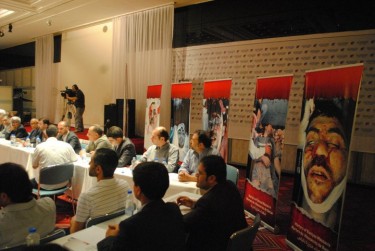


 Hamza al-Khatib’s death has become a rallying point for anti-government protesters. In France philosopher Bernard Henri Levy has written to
 This is the best piece of writing on Syria since the uprising began. Read it.
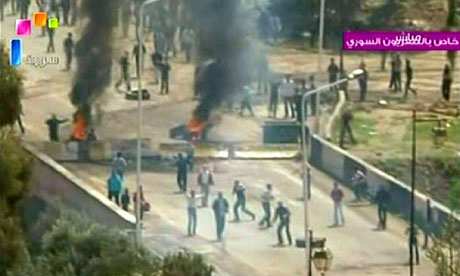 Protest in Deraa as shown on Syrian TV


