How the Opposition Plans to Take Down the Syrian Regime (Joshua Landis & Ausama Monajed)
Posted by Joshua on Monday, June 20th, 2011
Cracking the Syrian Regime (Joshua Landis & Ausama Monajed)

Cracking the Syrian Regime (Joshua Landis & Ausama Monajed)
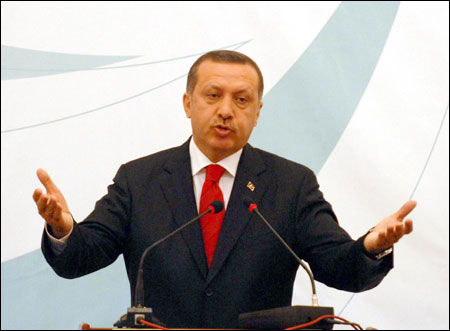 Syria-Turkey relations are at the forefront of the crisis today. Turkey could act as a shield for Syria in the face of growing EU and Washington criticism. Erdogan is trying to fashion Turkey’s role as the shield to Syria. He fears that once the West launches down the road of intervention, Turkey’s plan to become leader of a “Northern Alliance” if not the larger Middle East, will be dashed. It someone is to spearhead change in the region and direct the coarse of democratization, Erdoghan wants it to be Turkey. Having just won a third term as Prime Minister, Turkey’s actions in Syria are likely to become the measure of his next several years. It will certainly be a challenge for his zero-problems-with-neighbors policy.
Bashar al-Assad is promising that his Monday speech will address all the important reform issues and will satisfy Turkey’s demands for reform.
Evidently, Turkey has asked Syria to license the Muslim Brotherhood as an official and legal party. Syria refused.
Dow Jones says that Syrian opposition activists have set up a “National Council” to struggle against the Damascus regime. This seems to be untrue. The names of Abdallah Trad el Moulahim, Haitham el-Maleh, Souhair al-Atassi and Aref Dalila, as well as Sheikh Khaled al-Khalaf and Mamoun el-Homsi were mentioned in the article. They are denying it.
With foreign reporters allowed into Jisr ash-Shaghour for the first time a new picture is emerging that contrasts sharply with the report of the refugees in Turkey. Zaman has this:
…..It was only after spending a night in a nearby village that they were able to enter Jisr al-Shughour, a town they described as ‘ghost town’. Their first stop in town was a building used as army headquarters. ….The reporters said that the town smelled of blood and smoke, whilst almost all the social and public facilities such as post offices, hospitals, banks, the court house and security buildings had been destroyed, pointing to heavy clashes that had clearly taken place between the two sides.
The countless number of bullet holes on the walls of the intelligence building where 72 soldiers lost their lives, the blood stains which marked the spots where soldiers died, and the horrifying traces of the soldiers who were beheaded are still fresh.
One of the residents of Jisr al-Shughour told reporters that a military intelligence officer’s head had been exhibited in the town for three days after he was beheaded by the members of an armed opposition group. Adding to the sheer horror of the clashes is the remains of dead soldiers who were killed by armed groups that line the River Asi.
There have also been reports suggesting there was a demonstration of affection by the people of the town towards the army soldiers and the senior army officers whilst they were in Jisr al-Shuhgour, which reporters find very hard to believe. Most of the town’s people who accompanied the military convoy told their stories, mostly in tears and begged soldiers to help them find their missing relatives……
The number of people who joined the convoy eventually reached around 2,000, where at one point some villagers sacrificed a sheep and made a feast for the group. However, the town is still in danger as members of armed opposition groups, who lead normal lives during the day, disguise themselves and stage attacks at night. Therefore, people are still fearful.
The Syrian army is keeping a large area under control as members of armed opposition groups are fleeing outside of town. Some villagers told the reporters that some of those who had escaped to Turkey after the incidents might be members of these armed groups….. Hundreds of people have been killed during pro-democracy protests in Syria since January 2011….
Assad to speak for his and Syria’s future
Sunday, June 19, 2011, MURAT YETK?N
A speech that is expected to be delivered by Syrian President Bashar al-Assad today could change the course of events for his unrest-shaken country and his own future, Turkish official sources told the Hürriyet Daily News yesterday.
The sources also said that if Assad failed to announce a series of reforms needed to normalize Syria, he would “miss a big chance” to be able to keep his power safe and from now on he “would have great difficulty convincing Ankara” of his sincerity…..
LA Times [Reg]: Syria planning change to constitution, Baath Party official says
2011-06-20
Reporting from Beirut— An impending proposal to amend Syria’s constitution would end the ruling Baath Party’s monopoly on political power while retaining its central role, a high-ranking official in Damascus said. According to the Baath Party …
Turkey says Syria only has a few days left to get its act together
18 Jun 2011, Zaman
Turkey has delivered a blunt message to the Syrian leadership, saying the regime’s willingness to undertake sweeping reforms in the unrest-laden country will determine the position of Turkey in the coming days, if not weeks, diplomatic sources told Today’s Zaman.
The Turkish response to Syria will be shaped by how the regime responds to unrest engulfing the country and whether or not the promise of switching to a multi-party system to reflect the diversity and pluralism of Syrian society will materialize, the same source said, speaking on condition of anonymity.
According to an incremental plan, Turkey will start supporting tougher UN resolutions if the regime fails to live up to the expectations of the international community. The strongest message yet to the Syrian leadership was conveyed by Foreign Minister Ahmet Davuto?lu, who spoke with Syrian President Bashar al-Assad’s special envoy, Hassan Turkmani, earlier this week. “We underlined that Turkish support to Syria hinges on the willingness of the Syrian government to adopt sweeping reforms in the country. We detailed our suggestions before and even relayed a written proposal to Damascus on how they should proceed to stabilize the country,” the source explained.
The limits of Turkey in Syria – Zaman
The Arab Spring, which some suggest was inspired by democratization in Turkey, has reached Turkey’s borders with protests that have been going on for months in Syria. One would wish that the Arab Spring would consist of all the positive associations of the word “spring.” This, however, is not the case. …..
Now, let us discuss Turkey’s Syria policy. Turkey has always believed that Bashar al-Assad’s regime is sincere in its advertised reform promises. Admittedly, Assad has exerted serious efforts to this end. However, the Baath nomenclature, which is effectively a minority dictatorship, has not allowed Assad to implement these reforms as advised by Turkey. Having failed to overcome the pro-status quo resistance in his close vicinity, Assad has apparently chosen to surrender to them in recent years. Turkey was late to correctly assess this situation and it intensified its advice and recommendations to Assad when the protests broke out in Syria. By then it was significantly late to adopt a clear stance against Damascus. Nevertheless, the current situation suggests that Turkey is now pursuing a correct policy. However, what Turkey can do other than stepping up the dose of its criticisms against the Syrian regime and opening up its borders to Syrians who are fleeing from persecution and death threats is unfortunately very limited. If we were to analyze the reasons for this, we can say the following:
First of all, Turkey is still unable to predict what will happen in Syria after Assad. Therefore, it faces a very difficult task. Ankara thinks that Damascus is trying to gain time, on the one hand, and it wants to believe that Assad is sincere about his reform promises, on the other. Yet, it also knows that the cases of Egypt and Tunisia are worrying the Assad family. The Assad family does not want an end like that of Mubarak, and it is uncertain who can assure them in this respect, which adds to the fog of uncertainty for Turkey.
Despite the fundamental differences in their regimes and ideologies, Iran and Syria have been maintaining an uninterrupted strategic partnership since the Iranian revolution of 1979, and this proximity between Syria and Iran poses further obstacles and risk for the steps Turkey may take. Turkey believes that Iran is seriously messing things up in Syria and is seriously bothered by such efforts. Turkey is concerned that Iran will not be warm to any regime that would introduce more democratization in the country and, therefore, will perturb things even further. On the other hand, the uncertainty about the identity of the Syrian opposition is blurring Turkey’s vision. Unable to estimate the magnitude of the incidents in Syria, which does not allow the press or independent observers to conduct any investigations in the country, Turkey does not even want to encourage the Syrians to seek asylum through promoting the refugee camps in the border region, despite the fact that these camps have received much international admiration. Therefore, it allows only limited media access to the refugee camps established along the Turkish-Syrian border.
On the other hand, Turkey is well aware of the fact that it is not as easy as some media organizations suggest to create a buffer zone in Syrian territory. It knows that the establishment of such a zone is very unlikely without an international mandate. Even with an international mandate, Turkey is worried by the possibility of such a zone triggering anti-Turkish sentiment among Arabs in the region. Given the fact that certain groups have already dubbed Turkey’s foreign policy neo-Ottoman without much evidence, Turkey is well justified in its concerns. Furthermore, its negative experience with respect to the case of Libya is forcing Turkey to adopt a cautious approach even to cross-border humanitarian operations. It knows that even the distribution of foodstuff, medical supplies and other forms of humanitarian aid may create concerns in the regimes of particular countries. This is indeed what happened to Turkey with respect to Libya. Some Western intelligence agents had placed the foodstuff, medical and other aid supplies from Turkey into the pockets of the dead pro-Gaddafi soldiers in order to give the impression that Turkey was supporting Gaddafi against the rebels. As a result, anti-Turkish protests were held in Benghazi and some rebel-dominated regions.
What Turkey can do with respect to Syria is unfortunately limited. The international community must take all sorts of diplomatic measures so that the innocent people of this beautiful country have the free homeland and democratic administration they deserve.
German Defense Minister Thomas de Maiziere ruled out participation by Berlin in any NATO operation in Syria to stop a bloody crackdown on protesters, in an interview to be published Monday.
“Russia’s Permanent Representative to UN: Saboteur members in Syrian opposition seek chaos in Syria” Cham Press
Person in the News: Recep Tayyip Erdogan
By Delphine Strauss in Financial Times
Syrian elite and army continue support for Assad by Reel News, on June 15, 2011
Syria, pawn in power play by world’s major powers? Yes. By James M. Dorsey
Saturday, 18 June 2011
“Mr. Assad doesn’t as a result of Russian and Chinese attitudes and Western indecision. He can focus wholly on cracking down on protesters who have demonstrated remarkable resilience. For now, little on the horizon suggests that this will change.”….
Accordnig to the Financial Times a Turkish official said:
“We still hope that things could be contained, that things could be brought under some kind of control – we hope that could be the case,” said a foreign ministry official, but he added: “Everyone is running out of time.”
A Turkish journalist on Al-Arabiya on Wednesday threatened Syria … if you do not submit to the demands of the people and the international community, Turkey will start to coordinate with Nato for firm action.
Pressure on Syria’s Assad intensifies as protests persist
BEIRUT — Tens of thousands of Syrians poured onto the streets of cities around the country Friday to press their demand for the resignation of President Bashar al-Assad, amid signs that his government is starting to crack under the strain of more than three months of unrest and growing international pressure. In a now-weekly ritual since demonstrations erupted in mid-March, Syrians spilled out of mosques after Friday prayers chanting slogans calling for the government’s downfall. Just as predictably, Syrian security forces opened fire on them, killing at least 18 people and wounding dozens more, according to the Local Coordination Committees, a group that organizes and monitors protests. Read full article >>
(Liz Sly)Syria’s Chief of Staff Turkmani is still in turkey. he was supposed to be back yesterday. It looks like this will now be tomorrow.
Lebanese army moves into Tripoli after sunni – alawi clashes resulted in 3 dead. Maybe Syria should set up a refugee camp on the boarders just in case!
An independent report by turkey of the presence of armed MBs in jisr, as-Safir
Syria Missed a Golden Opportunity
Fouad Ajami (“Syria: Where Massacre Is a Family Tradition,” op-ed, June 13) alleges that I “made it” my “calling to argue that the young Syrian ruler was, at heart, a reformer eager to sever his relations with Iran and Hezbollah.”
He’s wrong. I never believed or asserted—publicly or privately—that Bashar al-Assad was a political “reformer” or that he was “eager” to achieve anything but regime survival. However, Mr. Assad’s interest in regime-survival was precisely why there might have been a path forward, a possibility that was well worth exploring: Syria desperately needed economic help to prevent a powder keg of demographic pressure from exploding, and we wanted peace with Israel and an end to Syria’s coziness with Iran and terrorist organizations.
Secretary of State James Baker, Secretary of State Henry Kissinger, and Sen. Chuck Hagel all supported engagement, as did European leaders, because the previous policy of isolation had failed. And history showed that Syria had occasionally taken positive steps when engaged by the West—most notably in supporting the first Gulf War following Secretary Baker’s 12 visits to Damascus.
I always insisted that actions, not words, are what count. I don’t regret testing Syria’s intentions, but I do regret that Syria missed an historic opportunity and earned our condemnation. Now Mr. Assad’s deplorable actions may well result in the end of his reign, and he’ll have no one to blame but himself.
Sen. John F. Kerry
WSJ [Reg]: U.S. Seeks to Refer Syrian Leader to Criminal Court, 2011-06-17
WASHINGTON—The Obama administration is gathering information on alleged human-rights abuses by Syrian President Bashar al-Assad’s security forces for possible referral to the International Criminal Court in the Hague, senior U.S. officials said … The U.S. is also exploring ways to more directly target Syria’s oil and gas revenue, which are seen as a key financial lifeline for Mr. Assad and his inner circle….
Turkey breaks with Syria over crackdown, 17 Jun 2011 10:00 AM PDT Borzou Daragahi reports:
Turkey on Thursday signaled a diplomatic shift to further distance itself from longtime ally Syria, welcoming defecting Syrian officers and announcing plans to deliver relief assistance to beleaguered pro-democracy protesters across the border. The shift against Damascus, where President Bashar Assad has undertaken a bloody crackdown against peaceful demonstrators, comes after months of waffling …
Foreign Minister Ahmet Davutoglu, architect of Turkey’s “zero problems with neighbors” policy that prioritized good relations with Middle East governments, all but announced the abandonment of that guideline to reporters Thursday after a meeting with Turkey’s ambassadors and national security team in the capital, Ankara.
“Our region demands a serious and urgent reform process,” Davutoglu told reporters, according to the semiofficial Anatolia news agency. “Regional people’s demands are normal, rightful and legitimate. Meeting those demands will make our region a more stable, more democratic and more prosperous region. We are ready to do our utmost to help our region complete this transition process in a healthy way.”
…Unnamed officials in Ankara were quoted as saying the Turkish military was considering establishing a humanitarian “buffer zone” inside Syria….
“One thing for sure is that the Syrian troubles are forcing the Turks to reconsider the tenets of their foreign policy,” said Henri J. Barkey, a Turkey specialist at Lehigh University and the Carnegie Endowment for International Peace…..
Surprising many, Turkey has also even spoken of the possibility of foreign military intervention and warned Assad that Ankara might endorse United Nations Security Council action against his regime.
“We are approaching a situation where international intervention is not totally out of the question,” said Unluhisarcikli, of the German Marshall Fund. “Turkey doesn’t want to be caught by surprise and wants to be prepared for such a possibility.”
Erdogan, analysts say, is enraged that Assad didn’t heed his advice to curtail violence and embark on reforms, humiliated that for years he has been talking up the Syrian president to partners in the West as the man to reform Syria.
“Erdogan is [angry] at Bashar for not listening to him, the big brother,” Turkey specialist Barkey said. “There is a danger for Bashar that Erdogan may personalize this.”
Hilary Clinton in ash-Shark a-Awsat, the Saudi owned News Paper published in London
First, there should be no doubt about the nature of the protests in Syria.
Like Tunisians, Egyptians, Libyans and others across the Middle East and North Africa, the Syrian people are demanding their long-denied universal rights and rejecting a government that rules through fear, squanders their talents through corruption, and denies them the dignity of having a voice in their own future. They are organizing themselves, including the local coordinating committees, and they are refusing to back down even in the face of revolting violence.
If President Assad believes that the protests are the work of foreign instigators — as his government has claimed — he is wrong. It is true that some Syrian soldiers have been killed, and we regret the loss of those lives too. But the vast majority of casualties have been unarmed civilians. By continuing to ban foreign journalists and observers, the regime seeks to hide these facts.
Second, President Assad is showing his true colors by embracing the repressive tactics of his ally Iran and putting Syria onto the path of a pariah state.
By following Iran’s lead, President Assad is placing himself and his regime on the wrong side of history. He will learn that legitimacy flows from the consent of the people and cannot be forged through bullets and billyclubs.
President Assad’s violent crackdown has shattered his claims to be a reformer. For years, he has offered pledges and promises, but all that matters are his actions. A speech, no matter how dutifully applauded by regime apologists, will not change the reality that the Syrian people, despite being told they live in a republic, have never had the opportunity to freely elect their leaders. These citizens want to see a real transition to democracy and a government that honors their universal rights and aspirations.
If President Assad believes he can act with impunity because the international community hopes for his cooperation on other issues, he is wrong about this as well. He and his regime are certainly not indispensable.
A Syria that is unified, pluralistic, and democratic could play a positive and leading role in the region, but under President Assad the country is increasingly becoming a source of instability. The refugees streaming into Turkey and Lebanon, and the tensions being stoked on the Golan, should dispel the notion that the regime is a bulwark of regional stability that must be protected.
Finally, the answer to the most important question of all — what does this mean for Syria’s future? — is increasingly clear: There is no going back.
Syrians have recognized the violence as a sign of weakness from a regime that rules by coercion, not consent. They have overcome their fears and have shaken the foundations of this authoritarian system.
Syria is headed toward a new political order — and the Syrian people should be the ones to shape it. They should insist on accountability, but resist any temptation to exact revenge or reprisals that might split the country, and instead join together to build a democratic, peaceful and tolerant Syria.
Considering the answers to all these questions, the United States chooses to stand with the Syrian people and their universal rights. We condemn the Assad regime’s disregard for the will of its citizens and Iran’s insidious interference.
The United States has already imposed sanctions on senior Syrian officials, including President Assad. We are carefully targeting leaders of the crackdown, not the Syrian people. We welcomed the decisions by the European Union to impose its own sanctions and by the UN Human Rights Council to launch an investigation into abuses. The United States will continue coordinating closely with our partners in the region and around world to increase pressure on and further isolate the Assad regime…..
CNN: Syrian tycoon’s fall from grace may herald new pledges of reform, 2011-06-17
Syria’s richest man has rarely sounded contrite. But Rami Makhlouf — a confidant and cousin of President Bashar al-Assad — looked distinctly subdued when announcing that he was selling his holding in Syria’s mobile phone network, Syriatel, to help …
Silence on Syria
By Editorial – Washington Post
2011-06-16
June 15 (Washington Post) — IT HAS been four weeks since President Obama delivered an address on the Middle East in which he said it would be “a top priority” of his administration to oppose violent repression and support democratic transitions across the region, using “all of the diplomatic, economic and strategic tools at our disposal.” He singled out Syria, where the regime of President Bashar al-Assad has gunned down hundreds of peaceful protesters, choosing what Mr. Obama called “the path of murder.”
Syria’s Nightmare
Editorial, New York Times, Published: June 17, 2011
With thousands of Syrians being slaughtered, jailed or forced to flee their country, President Obama and other leaders need to find better ways to punish and isolate President Bashar al-Assad and his cronies….
We applaud Mr. Erdogan for doing the right thing and urge him and the entire international community to keep ratcheting up the pressure. The only way to end Syria’s nightmare is for Bashar al-Assad to go.
Turkey considers need for ‘buffer zone’ within Syria for refugees Posted: 16 Jun 2011, Press TV reports:
Turkey may send its military forces into Syrian soil to establish a “buffer zone,” should the current unrest in Syria skyrocket into a refugee crisis that would pose a threat to Ankara, a report says. The report, published in the Turkish daily Post on Thursday, warned of the prospect of a civil war in […]
Hatay hotels fully-booked ahead of Jolie’s arrival
“..Dozens of local and international journalists have arrived in Hatay to cover the story of Jolie’s visit to the Syrians refugee camps.
Ray Takeyh says that Iran is heavily invested in the survival of Assad’s regime; if the “House of Assad” goes, Iran is likely to have an antagonistic power next door.
The Influence of Syria: Video – Op-Ed columnist Thomas L. Friedman discusses what a democratic Syria could mean to the Middle East.
Guardian (GB): In unending turmoil, Syria’s Assad turns to family
2011-06-16, ELIZABETH A. KENNEDY Associated Press= BEIRUT (AP) —
Syria’s President Bashar Assad, beset by a popular upheaval that won’t die, appears to be turning more and more to a tiny coterie of relatives, the backbone of a family dynasty that has kept …
CFR: Khalilzad: Democracy Promotion in Egypt, Syria Highest Priority, 2011-06-16
Amb. Zalmay Khalilzad, former U.S. ambassador to Afghanistan, Iraq, and the United Nations, discusses democracy promotion in the Middle East following the Arab Spring with Mark Lagon, Adjunct Senior Fellow for Human Rights at the Council on Foreign …
Op-Ed Contributor: Arab Spring, Kurdish Summer
2011-06-18, By Sebahat Tuncel
(New York Times) — Istanbul TURKEY often presents itself to the world as a model Muslim democracy, but it is in fact denying basic democratic rights to almost 20 percent of its population. The Turkish prime minister, Recep Tayyip Erdogan, was re-elected on Sunday by a large margin, and he now faces a major domestic challenge. Despite Turkey’s impressive economic growth and increasing international profile during Mr. Erdogan’s eight years in power, his government has ignored the country’s most important and politically explosive issue: Turkey’s oppressed Kurdish minority.
Kurds have been struggling for freedom and autonomy in Turkey for decades — often in the face of violent state repression. We will no longer accept the status quo. We are demanding democratic freedoms, the right to speak our own language in schools and mosques and greater political autonomy in Kurdish-majority regions.
Al-Qamishli: Demonstrators call for the end of the regime
KURDWATCH, June 14, 2011—
Nation-wide protests on June 10, 2011, again resulted in numerous dead and injured. As in previous weeks, the demonstrations in al-Qamishli, ?Amudah, Darbasiyah, Ra?s al-?Ayn (Serê Kaniyê), and ?Ayn al-?Arab (Kobanî) were largely peaceful. Demonstrators everywhere, including Ruknaddin, a predominantly Kurdish-inhabited district of Damascus, demanded the overthrow of the regime.
Al-Qamishli: Kurdish parties refuse dialogue with Bashar al-Assad
KURDWATCH, June 11, 2011—
After much hesitation, the parties of the Kurdish Patriotic Movement in Syria, which is an association of the eight parties of the Political Council, the two parties of the Democratic Alliance, and the Democratic Union Party (PYD), decided not to meet with President Bashar al-Assad at this time. In a statement issued on June 8, 2011, the parties wrote that they would have agreed to »an initiative for a meeting with the president that aimed at developing a political solution to the country’s current crisis«, but not under the current political conditions.
This decision by the political leadership was due in large part to pressure from the Kurdish population in Syria and in the Diaspora, including party members. After initially agreeing to the meeting with Bashar al-Assad, the Kurdish parties were intensely criticized from all sides. The Governor of al-Hasakah province invited the parties to travel to Damascus on short notice on June 4, 2011 for a meeting with the president. Originally they were to take part in talks in two groups, and the government had also invited fifteen other Kurdish public figures. The Kurdish parties, however, made their participation contingent on having the representatives of all parties, and only these representatives, meet together with al-Assad. The Governor of al-Hasakah province accepted this request.
When the parties of the Kurdish Patriotic Movement in Syria met on June 3, 2011, they decided to accept the invitation from Damascus. The Kurdish Freedom Party in Syria (Azadî) was the only party that wanted to discuss the situation with its party board before agreeing to a meeting. The Kurdish Patriotic Movement then told the government that the meeting would have to be postponed a few days.
The Kurdish Future Movement in Syria did not participate in this meeting. In a statement on May 28, 2011, they stated that they were canceling their membership in the Kurdish Patriotic Movement as well as in the Kurdish Political Council in Syria because the other political parties had been too hesitant in supporting the dissident demonstrations.
On June 5, 2011, the speaker of the Kurdish Democratic Union Party (Yekîtî) in Syria stated that his party would not take part in the meeting with Bashar al-Assad, »as long as the repression of peaceful demonstrations has not been stopped, the military has not been pulled out of the cities, the siege of the cities has not ended, and the right to demonstrate has not been guaranteed«. Moreover, the party speaker stated that the party did not want to have a dialogue with the Syrian regime without the approval of the allies in the national democratic Syrian Opposition.
Ultimately, the Kurdish Coordinating Committee, which is made up of the Kurdish Union Party in Syria (Yekîtî), the Kurdish Freedom Party in Syria (Azadî), and the Kurdish Future Movement in Syria, rejected the offer to participate in a dialogue with Bashar al-Assad. In a statement issued on June 7, the committee demanded a general dialogue with the entire Syrian opposition in the form of a national conference. Moreover, according to the three parties, before a dialogue can take place it must be ensured that Syria will have a new modern constitution in which »no party or ethnicity is discriminated against« and in which »the political and ethnic diversity [of Syria] is accepted«.
Iraq: Syrian Refugee Camp Opened, June 18, 2011 1609 GMT
A camp designed to hold up to 4,000 Syrian refugees was set up in the northern Iraqi province of…
Morocco: King Outlines New Draft Constitution
Syria’s Pandoran Box: Bashar Assad’s Missed Opportunity
By ELAINE HAGOPIAN
In 1971, I was a Fulbright Hays Faculty Grant recipient based in Beirut doing research on the impact of the Palestinian/Israeli conflict on Arab Nationalist States. I was returning with a Palestinian friend from Damascus to Beirut after one of my interview excursions in Syria. We were joined by a group of three Syrian freelance workers in the Damascus to Beirut Service (transportation by ancient used Mercedes-Benz cars and the cheapest way to travel). As we approached Chtuara in the Beka’a Valley of Lebanon, the car broke down. It was clear that we would be in for a long wait. The three men stared at each other in deep frustration and mental anguish. We entered a local café to get something to eat and to wait out the repairs. My friend and I sat at a table and ordered some food and water. I noticed that the men ordered nothing. I understood immediately that they did not have funds to purchase food. They were going to Beirut to pick up some goods to take back to Syria to sell. They were expecting to get to Beirut, pick up the goods, and return by Service to Damascus the same day, a trip of some 60 miles taking about two hours each way including border customs checks. It was clear that they would have to spend the night in Beirut since repairs would delay us for hours. My heart sank for them as I looked at their tired eyes, unshaven faces, and frayed clothes.
I did something I knew would offend their dignity – a cultural trait deeply embedded in Arab psyches, but especially among the poor. The thought that they would go without food for more than 24 hours and would have to sleep outdoors in Beirut overcame my understanding of how important dignity is to hardworking but poor Arabs. I asked the waitress to serve them some simple dishes and bottled water. Immediately, they rejected the food and glanced over at me….

Two Alawis at the beginning of the 20th century
The following article was first published on Syria Comment in August 2006. It is written by a Syrian Alawi friend who wrote under the pseudonym, Khudr. He authored it in response to President Bush’s pressure on Syria following the invasion of Iraq and killing of Rafiq Hariri. At the time, the US administration was casting about for a Syrian who could replace President Bashar al-Assad. Washington hoped to end Syrian influence in Lebanon, gain Syrian support for its occupation of Iraq, and extend its agenda for “Reform of the Greater Middle East.”
In particular, Bush policy makers were looking for an Alawi general who could overthrow Bashar al-Assad and replace the Assad family, while maintaining stability.
Today, Syrian opposition leaders believe a key to bringing down the regime is to divide the Alawi community. Bassma Kodmani has suggested that “Alawite leaders have sought to establish contacts with Sunni imams to seek guarantees for the community in return for abandoning the Assad regime. This, rather than defections in the army, could herald the unraveling of the regime’s powers of suppression.”
Mohja Kahf has similarly written that “four of seven major Alawite clans (Nuwaliya, Kalbiya, Haddadiya, Khayyatiya), issued statements dissociating themselves from the Assads.” (See my response to this: “Did Four Alawi Clans Dissociate themselves from the Assads, as the Opposition Claims? Not likely.”)
What do Sunnis intend for Alawis following regime change?
by Khudr
for Syria Comment
August 30, 2006
….. Radical change in Syria can be achieved only with the help of the Alawis themselves. Excluding a full-fledged mass uprising or a foreign invasion, Alawi rule can be terminated only if it is approved by Alawi Syrians or if they stand aside.
Why don’t Alawi Syrians terminate Assad’s rule?
It is no exaggeration to say that many Alawis are not happy, to say the least, with the present regime. The reasons that are usually given for this discontent are the following:
There are also other important reasons that are rarely spoken of:
In our fathers’ youth, cities at the foot of the Coastal Mountains, such as Tartous, Banias, Jabla, Latakia, were transformed from purely Sunni communities with some Christian inhabitants to organized multi-sectarian modern cities (of course relatively speaking). During our generation these nice cities have become run down and dirty places due to corruption, bad-planning, and patronage. We have watched them become a playground for the cowboys of the present generation, the Assad clan in Kurdaha, sometimes called the Shabbiha.
3. Our fathers’ support for Hafiz al-Assad was driven largely by their resentment against the wealthy bourgeoisie of Syria. The Baath Party claimed to oppose this wealthy class which seemed to monopolize trade and land. Most Syrians believed that they had acquired their advantages and wealth through nefarious and often violent means under the Ottomans. The Baathist movement won much of its legitimacy among the rural poor because it claimed to stand up for the little guy against the feudalists. The followers of Rifa`at al-Assad used to recount to us in the seventies how they admired him because he would pick up a dirty, used tuna can from the floor and drink tea from it.
Not any more. I wonder what those people would say about him now that he eats his foie gras with golden utensils in his multi-million dollar villas in France and Spain? An earlier generation of Alawis honestly admired the Alawis who took power. I still have not met a single person who has the slightest admiration for Rami Makhlouf or Asaf Shawkat, for example. Unfortunately, in our day, the Alawi rulers and their children are becoming the epitome of the bourgeoisie that we were taught to despise.
4. It is a fact that Alawis still control the important positions in the security systems in Syria. However, it is also a fact that this control serves only a small circle at the top of the pyramid and is becoming less and less beneficial or responsive to the poor members at the base.
5. Seeing that most of the leading members of the Assad regime have made full-fledged alliances with Sunni families. Many have done this through marriage, such as the president himself or Muhammad Nassif’s daughters; others have done it through monopoly enterprises, such as Maher al-Assad, Bahjat Suleiman, Asaf Shawkat, and many others. The regime has lost its claim to representing the Alawi sect or to defending its rights. The claims that Hafiz and his generation have used to gain our fathers’ support and admiration are largely gone.
6. The direction Syria is now heading in does not look good. The last thing Alawis want or need is to have a group of people leading Syria to catastrophe in their name, while they get so little advancement out of it. All of Syria accuses the Alawi sect of being responsible for the lamentable state of affairs.
So why then don’t Alawis do anything about the situation? Why are we silent? Why doesn’t an Alawi Army General carry out a coup?
Reasons general to all Syrian citizens:
1. The culture of fear has been deeply planted in every Syrian person regardless of their sect or race.
2. We have been deeply conditioned to mistrust and be suspicious of everyone, making it extremely hard for any two Syrians to work together, not to mention organize in a group. To see how deep this problem has become, look at how much the Syrians in the Diaspora are fragmented even when they are away from the regime and its influence. No two Syrian expatriates are able to organize a cultural gathering, not to mention a political party. No sooner does a new party emerge than its members, who are from the same sect and race and background, start to split apart into uncountable factions.
3. The external animosity of the United States paralyzes internal movements, organized to act against the regime, no matter how well intentioned they are. No one wants to risk a serious move against the regime while there is an enemy at the door. The United States has not shown any signs that it is interested in improving Syria’s internal situation or helping Syria. What the U.S. is asking for clearly and loudly are changes in external policies, period. Most of those policies are not attractive to the Syrian opposition. The regime is popular on most of these issues, such as the occupation of Palestine, the Golan, or Iraq.
A coup-d’etat at this moment risks being labeled “made in America” even if it does not have the slightest connection to America.
The present sentiment in the Syrian street is anti-American. This means that any opposition that seeks support from the Syrian street will be anti-American and will be spurned by the West, as happened with Hamas. Any opposition that seeks external support will lose the street, as is the case with Khaddam. We are in a tricky situation; the regime understands this well and has exploited with skill.
4. The organization of the Army and security forces was masterminded by the late president Hafiz Assad to prevent coups similar to those that rocked Syria during the three decades after Syrian independence. The Syrian forces capable of carry out a coup-d’etat – the Army, Special Forces, Police Force, and Security Apparatuses – are all burdened with a complex command structure, purposefully designed to frustrate plotters.
Lateral communication is absolutely forbidden between units; all communications between units must travel through a cumbersome vee, first ascending up the command structure to the top level of one unit before descending down again through the ranks of the other unit. Most importantly, the many units and departments have an interlocking command structure so that no entity is autonomous. They cannot act without several other departments knowing about it. For example, any air force unit is under the influence of aerial-security (Mukhabarat Jawiyyah), army-security (Mukhabarat Askariyyah), the morale-guidance headquarters (Idarat el Tawjih al-manawi), military police, air force headquarters, army general headquarters, the Republican Guards, and the Palace. Officers with loyalties to theses various branches of security are sprinkled liberally throughout the security forces. This command structure makes the military practically useless against foreign enemies but extremely effective at guaranteeing internal stability. Any attempt to rebel is quickly thwarted by the stultifying array of conflicting loyaltiesand can be dealt with on the spot.
5. Most Syrians, as unhappy as they are with the present regime, see no point in changing the regime without a solid alternative. The opposition has yet to present a clear vision for the future that would inspire people to risk the few joys of Syrian life that they have, security being at the top of the list. Vague and generalized talk about democracy and a better life are the only promises made by present regime-change advocates. They aren’t reassuring.
6. We have to admit that corruption has insinuated itself deep into the souls of almost every Syrian. It is highly questionable that any form of regime-change is going to achieve real economic or social change, without being preceded by a long process of grass roots reform and cultural revival.
We do have a corrupt leadership, but even an honest leadership would find it impossible to overcome the pervasive culture of bribery, disrespect for hard work, and indifference to public interest that is shared by state, and indeed, private sector employees. Most Syrians’ sense of virtue has become so crooked that fooling a customer is defined as cleverness, “shatara.”
Can change really be enforced from the top down? The regime changers avoid this thorny question, but it must be aired and debated. Are we willing to act, think, and work differently when the regime is changed?
Reasons specific to Alawi Syrian citizens:
The main reason that prevents Alawis from being active in supporting any regime change plans is their fear of the “other.” Those who propose regime change without explaining to us what the end of Alawi rule will mean for thousands of ordinary Alawis will get no where.
There are two sorts of “others” in Syria:
a. First are the Sunni religious and Kurdish opposition leaders who say bluntly and clearly: “We want to end the Alawi rule”.
b. Second is everyone else, who says shyly and elliptically: “The monopoly over top army and security posts by one sect should end.”
Not a single Syrian intellectual, political leader, or plain good-will writer, has ever dealt with the following fundamental question:
What exactly are your plans for the Alawis after we give up power?
Why do answers to this question have to be vague and general? What are your plans for the tens of thousands of Alawis who work in the army and other security apparatuses? What are your plans for the republican guard and the special forces that are staffed primarily by Alawis? Are you going to pay them pensions if you decide to disband their forces? Or will they be fired and dumped on the streets, humiliated, and ostracized as were the Sunnis and Baathists of Iraq were following the American invasion? Do you have any idea of the impact on security such dismissals would engender? Will you be satisfied with a scenario by which these forces remain in their positions in exchange for their giving up political power?
What are your plans for the tens of thousands of Alawis who work as government employees in many non-functional establishments? Are you going to close these establishments? Do you have any idea of the social impact of such closures? Are you going to stop improvement projects in the coastal area as all past Sunni governments have done since independence?
Are you going to reverse confiscation laws to return land taken from Sunni landlords and distributed among tens of thousands of farmers?
Are you going to demand that security officials stand trial for their actions during the last 35 years? What is the highest rank that you are going to hold responsible? Are you going to ask for trials for past deeds? How about the present leading elite? Who exactly are the people you want to hold responsible? And If you do bring them to trial, are you going to hold the Sunni elite to the same standard? Will Sunni families who have benefited from the regime through monopolies and sweet-heart deals, such as the Nahhas family in Damascus and the Jood family in Latakia, be treated as Alawis are?
These questions should be answered not only by opposition intellectuals, but also by every non-Alawi Syrian. What do you want to do with us if we give you back political power? Are you really willing to live side by side with us, to cherish Syria’s diversity, and consider the past 40 years merely another failed episode in our long history of failed revolutions.
A change for the better must include all sectors of Syrian society, including Alawi Syrians. Because Alawis control all the main security forces of the state, regime change will not happen without assuring them that they too will have a place in Syria’s new future. Without such assurances, there will be no Alawi Musharif, nor will any other army General carry out a coup d’etat that will bring anything other than chaos to Syria.
Syrians refuse to speak openly and honestly about our most important challenges; so much is kept in the dark. But this is no time for “shatara” or dissembling. We must confront and discuss religious and communal issues directly and honestly. If Sunnis really want regime change, then they have to address the Alawi issue head on. Unless the answers to these questions are cleared up by all concerned, Alawis, no matter how dissatisfied and disappointed with the present leadership, will not entertain the idea of regime change; they will not relinquish the ramparts of power.
 Rami Makhlouf Will Not Remain a Weight on the Country or the President, al-Iqtisadi –
This article explains that the President’s cousin and owner of Syria Tel will donate his profits from Syria’s mobile phone provider to charity. He does not say he has plans to give up control of the company.
Powerful Syrian Leaves Business, in Major Concession
By THE NEW YORK TIMES, Published: June 16, 2011
One of Syria’s most powerful men announced Thursday that he was stepping down from his roles at several major businesses, including the mobile phone monolith Syriatel, a development that is a major concession to antigovernment protesters.
The businessman, Rami Makhlouf, is closely entwined with the Syrian government. His cousin is President Bashar al-Assad, his brother is Mr. Assad’s intelligence chief. Widely reviled as corrupt, Mr. Makhlouf became a focus of antigovernment protests.
“…But a news conference in Damascus on Thursday, Mr. Makhlouf said he was halting his business activities and directing profits from his 40 percent stake in Syriatel to charity.”
Ehsani gives a back-of-the-envelope estimate of Syriatel’s worth:
Syriatel has 67 million shares outstanding. The current share price is syp 915. This values the company at $1.3 Billion. From the shares outstanding, it looks like shareholders own 38%. This leaves Rami with 42%. We don’t know who owns the 38% fully. The profit per share for 201 was syp 126.41 per share. This means that the company’s profit for 2010 was $180 million. If the entire 40% of profits were taken out of the company, it will amount to $72 million a year ????? ????? ?? ??????? ???? ?????? ??????? ????? ???? ????????? ???? ??????? This was the other part of the statement. I am not sure whether the citizen will be getting the land at cost or will be getting what it gets to build it at cost. Either way, he does indeed own a substantial amount of land. The “percentage” of that total in either case is?
Correction by EIU: [Added next day]
Ehsani — I think your back of the envelope should give Makhlouf 62%, if private shareholders have 38%.
We were afforded a glimpse into the ownership structure of Syriatel in 2002-03 during the dispute with Orascom Telecom. Briefly, Makhlouf claimed in early 2002 that OT had breached contract, and a Damascus court in April that year ordered in favour of Makhlouf and his investment vehicle Drex Technologies, registered in the British Virgin Islands. OT hit back securing a freeze on the worldwide assets of Drex; it got a further injunction freezing Drex’s Arab Bank account in Austria. The two sides eventually settled in July 2003, with OT coming out with compensation from Drex. Meanwhile the Drex shareholdings were transferred to Ramak, a Makhlouf family holding. Orascom’s view was that Makhlouf brought them in to do the heavy lifting at the start of the operation, with capital and know-how, and then cooked up a dispute to clear the way for a takeover. Orascom managed to get out without losing too much, as I think they were aware of the risks of dealing with Makhlouf. I recall a telephone call with Rami at the time in which he claimed that “the problem with Naguib is that he doesn’t pay…”
Back to the present, both Syriatel and MTN perform important functions as one of the biggest sources of budget revenue to the state other than oil, as they are contracted to hand over 50% of turnover to the government.
Ehsani Replies to EIU:
My 38% number came from the syriatel website where Rami is quoted as saying that shareholders in the company could have made their best investment as their holdings have reached SYP 23.3 Billion. Given that the entire market capitalization of the company is SYP 61.3 billion (67 million shares times 915 pounds per share), I figured that the shareholders own 38% (23.3/61.3). This does leave 62%. Rami claimed that he will give up 40% of the profits which is his share in the company. I am not sure who owns the other 22%. It is important to note that we don’t even know who those 38% “shareholders” are in the first place.
EIU:
For what it’s worth Syriatel does have a little section on its site for shareholders, apparently defined as those who subscribed to the IPO of 7m shares (10%) in 2004. Of course the IPO was not covered by any regulated capital market oversight, and Syriatel has not listed on the DSE.
EHSANI:
Syriatel has not listed on the DSE because it still operates as a BOT (build, operate and transfer). It still does not have an official license. The idea was to wait for the third company to be approved and offered a license before Syriatel does too. Many of the companies that wanted to bid in the auction pulled out when they were unhappy with the terms. Etisalat of the U.A.E is still interested if the government modifies these terms. When and if this happens, the BOT of Syriatel can then also be transferred into an official licenced company that can list on the DSE.
There was much anticipation and confusion about Makhlouf’s announcement:
Al-Arabiya channel announced Thursday afternoon that Rami was giving away all his lands and money.
ANB reported that Rami gave a press conference denying any of this.
During the board meeting that SyriaTel held last Thursday, Rami Makhlouf was reported to sound very upbeat. He said, “I would never sell my shares as rumored.”
IDAF, who watched Makhlouf Speak on Syrian TV, wrote me:
“I am now watching the press conference on Syrian News channel. It is true. He did announce giving up his shares in the article and other “give aways.”
Rami just said: Anthony Shadid misquoted me gravely. We didn’t have an interview. It was a chat over lunch and he took my words out of context. Now watching the press conference on Syrian News channel.
“Syriatel shares I’m giving away to benefit 30,000 citizens. Other project give aways will benefit 10s of thousand more.” He also said that a specific portion of the Syriatel shares will go to Syrian martyrs. He didn’t specify if all martyrs or just the pro regime ones…. “I didn’t have to do this. And no one asked me to do it.”
“The value of the give aways are in the billions [of Syrian pounds.]” RM
He’s not bad. soft spoken. Down to earth. I’m sure many will feel sorry for him.
I asked a number of friends if they believed that the regime was “offering up one of their own” with the statement by Rami Makhlouf. This is how they responded:
Ehsani writes:
If they “confiscated” his holdings in real estate, Syriatel, Gulfsands, Duty Free and the different banks, like Byblos, maybe. But giving away profits does not strike me as “offering up one of their own.”
Another writes:
I think Rami Makhlouf is being offered up. He is the Rifaat of the regime in the 80s. It would have been more than enough a couple of months ago when people didn’t want to “bring the regime down” but wanted Rami’s head in Daraa. Let’s see the response tomorrow. Loyalists are angry that the opposition is stealing one of syria’s independence heroes (sheikh Saleh Alali) and using him in sectarian light as a name for tomorrow’s Friday. I think the tide is changing towards the regime’s liking. Now that Erdogan is free from elections, he’s more open to work with Bashar too as it seems.
This said, Rami is framing this as an initiative from himself personally. He insisted that “no one asked me to do this and I don’t have to do this”. He said that he had major satisfaction from financial success but he is feeling even more satisfaction personally from doing this. He also said that he will never allow himself to be “a burden on Syria”.
Another writes:
They are NOT offering one of their own as if this is some kind of a cult. There is a new reality on the ground.
I believe this is the new Syria. The regime is shaken up pretty badly. They are not that stupid. The status quo is unsustainable even if they win on the ground. The hardliners have lost and the reformers are winning. Established business-as-usual processes are being refitted.
Plans to divest Rami were always there, and there was never the right time to do so. Enter today. Even Rami got the message – loud and clear.
Next? I really believe his name will be eventually removed from the sanction list. Did he abuse power? Sure. Was he a ruthless killer? No. Did he employ thousands of Syrians? Sure.
Most people are fixated on Ramo as the root cause of evil. Wrong answer. He is a symptom of a chronic power abuse.
And speaking of chronic conditions, this is where Syria is today. It just overcame the acute stage of the disease called the Middle East.
Ehsani writes:
The problems of Syria are not just Rami. People think that he stole all their wealth and their incomes. Suppose Rami stole $10 BILLION. If he returned ALL that back tomorrow, each person in Syria will be entitled to $434. A family of 5 will make $2170. I guess that is a substantial sum for some people. But, remember that this is a one shot check. What then? The real issue in Syria is the lack of economic growth. Only real growth will lift living standards year in and year out. People think that if Rami goes, their fortunes will suddenly look up. Wrong.
Another writes:
I do not agree with Joshua’s assertion that Syria’s future will boil down to economics.
My cousin in Switzerland said his business (micro robotic) went down to zero for 9 months in 2008, and Lebanon always loses one or two tourist seasons hear and there but survives…
I believe Syria will bounce back stronger if proper reforms are implemented. We have a house in Yaafour that we are building and we are going ahead uninterrupted… so are many building projects in Yaafour.. illegal building is booming as well (can not find construction workers..)
Idaf writes:
Yes. My friend works in a major UAE construction business with major project in Syria. They are pushing forward with their business and it is harder to find construction workers with all the illegal business taking place.
Syria economy: Vulnerable?
June 16 (Economist Intelligence Unit) —
Is the economy the Achilles heel of the Assad regime? On balance, probably not, as long as oil exports continue to flow.
The regime of the Syrian president, Bashar al-Assad, has confronted the protest movement with brute force, mixed with relentless propaganda and promises to enact political reforms. The strategy has paid off to the extent that the opposition has failed to take control of any of the towns where protests have occurred, and the major cities of
Damascus and Aleppo have not been seriously affected. However, the costs have been considerable, both in human terms, with more than 1,500 people killed, and on the economic front. How well placed is Mr Assad to deal with the economic consequences of his crackdown?
One of the central advantages that Mr Assad enjoys is the heavy state bias to the Syrian economy. The government and public-sector enterprises account for the bulk of urban employment, and farmers are heavily dependent on state-run purchasing organisations. This means that millions of Syrians, whether they like it or not, have a considerable stake in the survival of the regime, as can be seen in the periodic displays of mass loyalty, such as the unfurling of a 2.3-km long national flag on June 15th along one of the main thoroughfares in Damascus. The private sector has made some advances under Bashar al-Assad, but remains dominated by business groups with good connections to the regime, the most prominent of which is Rami Makhlouf, a maternal cousin of the president.
All about oil
The uprising has impaired the state’s ability to perform its role as dispenser of patronage, but the regime is far from being financially crippled…..
Matters have moved further in the government’s favour since 2009 as oil production actually increased by 10,000 b/d last year to 385,000 b/d, thanks largely to the development of new fields by Gulfsands Petroleum, a UK-listed firm in which Mr Makhlouf has a minority (indirect) interest. In a further boon to the government, natural gas production also rose significantly, by 37.3% year on year, in 2010 to 7.8bn cu metres.
As long as oil operations continue to be unaffected by the unrest and are not targeted by sanctions, the government has in the oil and gas sector a solid basis for sustainable fiscal and balance of payments operations. The government has made its task more difficult by cutting diesel prices, and thereby reversing much of the earlier subsidy cuts, but it has a reasonable chance of softening the blow through securing supplies of cut-price fuel from Iran, which has a major stake in the survival of the Assad regime.
Foreign exchange squeeze
More troubling for the government is the risk of a run on the local currency as a result of a loss of confidence in the system by private deposit-holders and the drying up of foreign exchange flows from business visitors and tourists. The latter flows have been rising rapidly in recent years, as Syria has attracted Arab visitors during the summer months and as foreign business people have recognised the potential of the country as an investment prospect. The central bank data show inflows of services income under the heading travel as reaching to US$3.76bn in 2009, equivalent 22% of total current-account receipts. These flows are likely to be much reduced in 2011. However, the impact will be mitigated by the likely fall in private-sector imports (which have risen sharply in the past few years, reaching US$11.8bn in 2009). The central bank has hiked interest rates as a means to woo back deposits, and the government claims that this has paid off, and the government also has the cushion of foreign exchange reserves that are sufficient to cover 12 months of imports. A relatively good harvest in prospect this year means that Syria will probably be self-sufficient in wheat.
Economic conditions are certainly going to get much tougher for the Syrian regime, but not to the extent that some opposition activists have claimed.
The Socio-Economic Crisis in Syria
By Paul Rivlin, Dayan Center
…..While high oil prices, substantial foreign exchange reserves, and manageable levels of domestic and external debts have helped maintain a degree of macro-economic stability, this is now breaking down. In April, the International Monetary Fund lowered its estimate of Syria’s 2011 economic growth rate from 5.5 percent to 3 percent. The International Institute of Finance forecasts that GDP could contract by as much as 3 percent in fiscal 2011. Economic growth was decelerating prior to the current conflict: GDP fell from 6 percent in 2009 to 3.2 percent in 2010 and the balance of payments current account deficit tripled to almost $2 billion in 2008. The IMF forecasts a further deterioration in its 2010 report on the Syrian economy but the outlook is now much worse.
The worsening economic situation coupled with the abandonment of liberalization will alienate the middle classes without necessarily generating support among the masses. This may prove to be as big a threat to the regime as the protestors that it has been killing.
US says It is in contact with Syrians seeking change
16 June 2011, Agency France Presse
The United States is stepping up contacts with Syrians inside and outside the country who are seeking political change, the State Department said Thursday.
Recalling that President Barack Obama had called on Syrian President Bashar al-Assad to lead change or “get out of the way,” spokeswoman Victoria Nuland said Assad appeared to have “made this choice in the negative.” She denounced the Assad government’s “revolting” attacks on Syrian citizens and said the United States was working at the United Nations and with its allies to isolate the regime.
Damascus Still Has Gay Girls by Daniel Nassar for NPR [This is a wonderful article. Please read it.]
In Search of Leverage with Syria
By David Schenker and Andrew J. Tabler
June 14, 2011 – WINEP
The misperception that the United States lacks levers against the Asad regime may be fueling Washington’s reluctance to take further action….. To force Asad to step down or cause his regime to fragment, the United States should seek with its allies to increase the economic pressure and international isolation faced by the regime and to support domestic challenges to it. To achieve these effects, Washington has a number of unilateral and multilateral levers available, whether economic or diplomatic…..
the Obama administration should prod the chief buyers of Syrian oil — Germany, Italy, France, and Holland — to stop purchasing the regime’s heavy crude. It should also pressure multinational energy companies operating in Syria — Royal Dutch Shell, Total, Croatia’s INA Nafta, India’s Oil and Natural Gas Corporation (ONGC), Canada’s Tanganyika, SUNCOR, and Petro-Canada, and China’s National Petroleum Corporation (CNPC) and Sinochem — to exit the country….
Elite defections could play a key role in pressuring the regime to either cut a deal with the country’s Sunni majority or leave power. To date, the most effective U.S. sanction levied against Syria has been the Makhlouf designation. Along those lines, Washington should impose costs on other Syrian businesspeople who continue to back the regime.
One way to do so is to lengthen the list of U.S. Treasury Department designations aimed at businesspeople close to the regime, many of whom are the exclusive importers of a wide variety of goods on the Syrian market…..
Washington should urge Syria’s leading trade partner, Turkey, to adopt trade sanctions (excluding food and medicine, as the United States does). It should also press Persian Gulf states — particularly Qatar, Kuwait, and Saudi Arabia — to curtail their business investments in Syria, which have been a lifeline for the cash-strapped Asad regime in recent years. …
Hasten the unraveling of the Syrian military. In conjunction with Turkey and Jordan, the United States should pursue incentives-based information operations in Syria, encouraging military officers to defect or, at minimum, avoid complicity in regime crimes against the people. The more quickly the military unravels, the fewer atrocities that will be perpetrated…
Align with the Syrian people. Statements by senior U.S. officials in support of the Syrian people … The broad international revulsion at Asad’s tactics, combined with the changes sweeping the region, provides new opportunities to act against the Asad regime.
Who will take on Assad? – The Economist – Jun 16th 2011 |
Outsiders cannot intervene militarily in Syria. But its rulers should not be given a free pass….
the best-placed people to make Mr Assad give ground are local—the Turks, the Gulf Co-operation Council with Saudi Arabia and Qatar to the fore, and the usually toothless but perhaps slowly stirring Arab League, which endorsed NATO’s intervention in Libya.
If he were sensible, Mr Assad would, under such neighbours’ pressure, agree to open talks with the gamut of liberals and socialists, secular-minded Syrians and Islamists, including the banned Muslim Brothers and the signatories of the admirable Damascus declaration, which united opposition calls for reform in 2005. As a precondition, all political parties and the media would be set free, and open elections promised within, say, a year. As things stand, Mr Assad will surely reject all such ideas out of hand. But the tide may be turning. If he refuses to budge, the Syrian people will bring him down in the end—on their own, and bloodily.
Still Bubbling: In Syria’s Third-biggest City People Fear for the Future
June 18 (The Economist)
…. You cannot tell how many people in Homs are fully on the protesters’ side. Many are too frightened to give an opinion. Officials of the ruling Baath party organise noisy pro-Assad rallies to match those of the protesters. Some Christians, who make up a large minority in Homs, have joined the demonstrators, while others resent the turmoil they have caused. Most of the city’s Alawites, the minority sect to which Mr Assad belongs, have remained loyal to the regime.
But the protesters seem to be gaining ground. At first a lot of people backed them because they stood against poverty and corruption. But it was the bloody brutality of the official reaction that has driven people into the opposition camp. “I saw a teenage boy shot through the eye,” says a university student who carried the boy to the mosque and prayed over him as he died.
Anti-regime committees have sprung up all over the city, with a medley of people—plumbers, students, doctors, the unemployed—working together. But almost everyone is fearful of what may come next. Some people are buying guns to protect themselves and their families. As they become more desperate, they could yet turn them on the regime.
Fleeing Syrians report rapes, killings
THE TIMES, AFP
17 June 2011
The Australian
YAYLADAGI, TURKEY: Refugees arriving in Turkey came with new horror stories of advancing Syrian troops raping and mutilating women. Syrians who fled to the Red Crescent tent camp in Yayladagi on the Turkish border said two women in the field hospital there had been raped. One also had her face slashed and the other had her breasts cut off.
They said Syrian forces in the Mamal al-Suker area of the flashpoint city of Jisr al-Shughour had assaulted the women and thrown acid over the men. One refugee said 12 women had been brutalised with a bottle in Mamal al-Suker and four of them had later had their throats slit. “They are raping the women and torturing the families,” said a refugee in the Yayladagi camp who asked to be identified only as “K”.
“Twelve women were raped and one had her breasts slit,” she said. “I came here with my mother. I had nothing to do with what was happening. None of my family went to the protests. They were coming to our houses, raping the women and killing people. The Shabiha (government militia) can do anything.” The refugees said advancing forces loyal to President Bashar al-Assad were pursuing a scorched-earth policy as they pressed towards the border: burning crops, killing livestock and shelling even half-built houses in an apparent attempt to drive the population out. The bodies of two women were dumped on the road outside the border village of Khibret al-Jooz in an apparent attempt to sow fear among the hundreds of refugees who have sought safety there…..
Allegedly threatened by Syria, Saad Hariri prefers to stay in his appartment in Paris. Le Monde, Menacé par Damas, l’ex-premier ministre libanais Saad Hariri serait réfugié à Paris

Would’ve been funny if international media had reported on the long flag demonstration on Mezzeh Autostrade with: “We can’t indepently verify the following video uploaded to youtube, but allegedly a mass demonstration took place in Damascus today.”
Regarding coverage, if you don’t allow journalists in, don’t cry wolf when you’re not getting the mediaspace you think you deserve. In any case, this demonstration was a step in the right direction. 2300 m flag representing 23 million people. A show of unity at its core…..
Another commenter:
The great Syrian flag parade got plenty of coverage in the west — even on my local rag, the Vancouver Sun. As one of our other Canucki-residents, Syrian Almighty Knight, will attest, the flag even got coverage in Quebec — even on the dreadful CBC which was so unkind to Mr Almighty Knight in the past.
SYRIAN refugees arriving in Turkey came with new horror stories of advancing Syrian troops raping and mutilating women. …. The overwhelmingly Sunni Muslim refugees chanted slogans against Mr Assad’s mostly Alawite security forces and its Shia Muslim backers in Iran and Lebanese Hezbollah. One chant went: “No Iran. No Hezbollah. We want someone who believes in God.”
In Damascus, the regime mounted an orchestrated show of support, when thousands gathered to unfurl a national flag that was 1.6km long.
The pro-Assad demonstration along Mezzeh Autostrad in Damascus underlines that the majority of Syrians seem to be sticking by the government’s side. The regime is not only Alawi. Christians and minorities continue to show support for stability. So do many Sunnis. Certainly this is true of the middle class and upper middle class, who have the most to lose if the country trends toward greater civil strife. Their comfortable lives will be destroyed. Mezzeh Autostrad is the center of middle and upper-middle class Syrian society in Damascus. Of course, no one knows what the true percentages of support for either side are.
Another factor contributing to the loyalty of the Sunnis for the regime is the wide-spread worry about “foreign conspiracy.” Listen to this recent khutab by al-Buti, Syria’s senior Sunni cleric. He describes the “plan” that “has already begun” to destroy Syria and divide it and turn it into an endless battlefield of attack and counter-attack. The implication is that the US and Israel are behind this plan.
The Syrian opposition itself is deeply divided over the notion of foreign intervention. The leadership at the Antalya meeting took a strong and united stand against any foreign intervention. The secular activists who live in the West are, however, trying to drum up support among Western governments for greater and more punishing economic sanctions, such as a blockade on Syrian oil and gas exports.
But this lobbying is not welcomed by all opposition elements. See this post at the blog, “Syrian Revolts,” which is rather critical of the Activists in the West who have taken money from Washington and who advocate greater involvement by Western governments in bringing down the Assad regime. Even in Turkey, there is opposition to Erdogan’s government joining the West in its efforts to undermine the Syrian government. Here is what one Turk wrote me today:
“I am a Turkish, but I really don’t understand what Prime Minister Erdo?an want to do. Turkish government is coming near US imperialist policies to the Middle East. What a pity. I think all Syrians should protect national unity and values of Syria. We both -Syrian and Turkish- reject foreign interference to Syria…”
I have asked several Turkish friends if they believe their government might allow a Syrian insurgency to organize and operate from Turkey, particularly if Western government pressure it to do so and offer to pay for it. They all said, “no” and explained that anxiety about the Kurdish situation, possible Syrian support for the PKK, and the fear of getting sucked into a Syrian civil war would preclude this.
The most obvious future for Syria is that the present situation continues for much longer than we think it can. The West, exhausted by foreign wars, economic overstretch, and the enormity of taking on Syria, will refuse to commit itself to the rebel cause militarily. All the same, it may add to the economic pressure on Syria by slowly ratcheting up sanctions. Even if the Assad regime can repress the uprising, it is hard to see how it can re-integrate Syria back into the international community and attract tourism and foreign investment again with the growing list of sanctions that have been imposed on it and its top statesmen.
The economy is likely to be the government’s Achilles heel. Syria doesn’t have Iraq’s or Libya’s oil, making the economic outlook very different. Bankruptcy could lead to a tipping point, once the government is unable to pay salaries, etc…. Could growing economic pressure lead the nation’s elites to abandon the regime? This is clearly the hope of the opposition.
Here is a report describing the situation in Aleppo from a local correspondent:
The train system has been shut down. It was deemed too dangerous to travel on as it stops at too many stations. Traveling by car is also very hard. Flying between Aleppo and Damascus is now the only form of travel that most people are comfortable with.
With Aleppo residents shunning nonessential travel, Latakia’s hotels are offering steep discounts to lure vacationers. A large duplex which was priced at syp 13,000 a night last year is now to be had for syp 1800 on a special offer. The Meridian in Lattakia has an offer for syp 2000 a night with breakfast.
Given that the conflict reached Maaret Al nuaman (40 minute drive), the residents of Aleppo feel that things have moved closer to home. The check points at the entrance to the city now experience delays of up to 45 minutes at times as cars wait for their turn to be checked. Women avoid venturing out alone past 6 pm. Only restaurants inside the city are seeing business. Those located on the outskirts have seen a significant hit as most residens prefer to stay away from such locations at night.
There have been a number of small attempts to start anti government marches. Other residents and the security services have quickly moved to disperse any small crowds before they grow in size.
A christian gentleman that we both know was due to get married on July 9th, but he was caught last month after having written online against the regime. After he was questioned and released, he resumed his writings. He was arrested again last week and is yet to be released. His wedding is now in serious doubt.
NEWS ROUND UP FOLLOWS
EU Likely To Adopt New Syria Sanctions At EU Council-
BRUSSELS -(Dow Jones)- The European Union is set to adopt a third round of sanctions on Syria over the government’s crackdown on protesters there in time for the June 24European Council, EU diplomats said Thursday. The new sanctions push comes at a time when the EU and U.S. have been seeking to ratchet up pressure on Syria through the United Nations Security Council but have seen their efforts stymied by Russia, among others. At least two countries have circulated a list of names to be targeted, diplomats said. One list includes 12 individuals and firms or other entities connected to them…. However no decision is expected to be made until EU heads of government gather for the quarterly European Council on Friday. The EU has already slapped a travel ban and an asset freeze on 23 top Syrian officials, including President Bashar Al-Assad.
UN chief tells Syria’s Assad ‘to stop killing people’
(PTI) — UN chief Ban Ki-moon today urged Syrian President Bashar al-Assad’s regime “to stop killing people,” as pressure mounted on Damascus over its widening crackdown in the north.
The Soldier Who Gave Up on Assad to Protect Syria’s People
By Rania Abouzeid Jun 13, 2011
TIME speaks to a colonel who says he defected from the Assad regime after seeing its forces allegedly open fire indiscriminately on fleeing citizens ….. the 22-year military veteran says he burned his uniform in disgust more than a week ago, …. “I defected from the Syrian Arab army and took responsibility for protecting civilians in Jisr al-Shoughour,” he says. “I was late in taking this decision.” His lower lip quivers. He struggles to maintain his composure. After a long pause and several deep breaths, the man with the thinning salt-and-pepper hair resumes: “I feel like I am responsible for the deaths of every single martyr in Syria.” ….
Letter to president Asad from Adonis: (In Arabic, Al-Safir) Thanks Idaf
The Socio-Economic Crisis in Syria – Paul Rivlin
Tel Aviv University Notes
….Unlike Egypt, where the urban upper-middle class played a major role in bringing down Mubarek, many of Syria’s urban-dwellers have experienced improvements in their standard of living in recent years. In the countryside, most of the population has experienced rapidly increasing fuel and food prices, drought and falling living standards. As a result of liberalization, Syrian markets have been flooded with foreign goods and that has made manufacturing less profitable. The poor in smaller towns have been driving the protest movement as the result of economic pressures and it was these sections of the population that Assad sought to win over when in April he announced higher wages for civil servants, new jobs, more subsidies, and the creation of a social fund.
The protests have caused other problems. The trucks that transport goods through Syria to the Arabian Peninsula have slowed to a trickle, cutting off a valuable source of revenue in border taxes. Consumer confidence
has declined and so has demand in the economy. In order to pay higher wages and cover the cost of higher salaries without new sources of income, the government has announced it will increase the state budget deficit.
The apparent end of liberalization means that structural problems will persist. With the root causes of Syria’s economic malaise not dealt with and no prospect of significant capital inflows, it is hard to know how economic growth can be restarted….
Syria’s finances under scrutiny
By Abigail Fielding-Smith in Beirut, Roula Khalaf in London and an FT reporter in Damascus, June 14 2011
Syria could by the end of the year be forced to look for outside aid to keep its economy afloat, analysts warn, as the country reels from three months of protests and a huge military crackdown.
As troops advanced on the northern town of Maarat al-Numan on Tuesday, observers increasingly questioned the health of Syrian finances.
With the tourism sector devastated by the unrest, foreign investment on pause and government spending rising to help ease the discontent, analysts say foreign exchange reserves at the central bank are being depleted as the government tries to stem pressure on the local currency. The Syrian pound slipped about 15 per cent against the dollar in April and sells for less than the official rate on the black market.
“The reserves are certainly doing a lot of work propping up the Syrian pound but the exact level of depletion since the crisis began is impossible to say,” says a western analyst in Damascus.
High oil prices have boosted revenue from Syria’s limited oil exports, which, combined with a relatively good year for agriculture after several seasons of drought, may prevent dramatic economic contraction. Oil revenues bring in an estimated $7m-$8m a day. Opposition figures say they would like companies to stop buying Syrian oil to raise economic pressure on the regime.
But the combination of lower revenues from other parts of the economy and the additional spending burden means Syria “could run out of money”, according to Chris Phillips, chief Syria analyst at the Economist Intelligence Unit.
Analysts say the regime could survive on foreign reserves and domestic bank lending for a while – one of the lower estimates is six months – but would then probably have to turn to oil-rich Gulf countries for help.
Whether they would come to the rescue is uncertain. Opposition figures say Qatar, one of Syria’s closest friends in the Gulf, has been distancing itself from the regime. But both the United Arab Emirates and Saudi Arabia appear afraid of giving up on President Bashar al-Assad for fear of an unknown alternative.
Tour operators say hotel occupancy in Aleppo and Damascus is close to zero. The unrest has slowed trade and disrupted manufacturing.
Commerce, even in the relatively calm capital, is down about 50 per cent, according to local economists. “It’s a time of crisis now,” says one prominent businessman in Damascus. “This generation is not used to a crisis, so everyone is cutting back and spending less.”
Meanwhile, the regime has overstretched itself on spending commitments in efforts to quell the unrest.
Before the crisis broke out this year the regime had wanted to reduce fuel subsidies and liberalise the state-led economic model. But after the unrest in the region began, the regime decided to raise heating oil allowances, diesel subsidies and civil servants’ salaries, and cut food taxes.
Local economists estimate that the pay rise to civil servants alone could cost the government S£50bn ($1bn) – or about 6 per cent of the annual budget
Even with optimistic growth forecasts, the budget deficit is likely to be 7.7 per cent – almost double the 2009 figure.
Syria is not well connected to international lending markets and domestic banks have limited capital. Cutting spending seems politically unfeasible, international investment seems to be on hold, and printing money risks hyperinflation.
“Their only option will be to raise capital from foreign (sovereign) lenders,” says a western analyst in Damascus.
Mohammed al-Jleilati, the minister of finance, insisted last week that the economy was “strong and healthy”, claiming Syria was self-reliant in food and sitting on foreign currency reserves worth $18bn.
However, according to Mr Phillips, “the goal at the moment seems to be stay in power whatever the costs, the costs to both the population and the economy”.
Marc Lynch: Expellus Assadum!
011-06-15
As the violence in Syria grinds on with no resolution in sight, a chorus of voices is predictably rising demanding that the Obama administration do more to hasten the exit of Bashar al-Asad. Their impatience is understandable, as is the outrage …
The Arab League has started to speak out about Syria, to the fury of Damascus. [From the Guardian]
The league’s Egyptian secretary general Amr Moussa (left) said:
Though their views differ, Arab states are all worried, angry and actively monitoring the current crisis in Syria. What we are hearing and monitoring, about many victims falling, indicates great tumult in Syria … The situation in Syria should not be left in this state.
Continuation of the status quo could lead to what may not be desired … for Syria.
Syria’s representative to the league, Youssef Ahmadm described Moussa’s comments as “unbalanced” and politically motivated.
Days before leaving his post Moussa calls for a kind of foreign intervention in the Syrian affairs, when the Libyan blood, shed by Nato air strikes as a result for a [UN] security council resolution, based, regrettably on an Arab demand in which Moussa’s efforts immensely contributed, isn’t dry yet.
9.23am: Syria’s sectarian tensions in Jisr al-Shughour and beyond are mapped out by the New York Times’s Beirut bureau chief, Anthony Shadid.
Jisr al-Shoughour, where the government used tanks and helicopters to crush what it called “armed terrorist gangs,” sits in a landscape as complicated as anywhere in Syria. It is a Sunni town with an Alawite town less than a mile to the south, interspersed with Christian and more Sunni settlements…
Syrian officials have suggested that militant Islamists have manipulated popular grievances and warned that the government’s collapse would endanger the relative security of Christians and other minorities there. Opposition activists have played down sectarian divisions, which they describe as a government ploy to sustain its four decades of rule. If anything, they say, the government has stoked tensions in a cynical bid to divide and rule.
I have just been forward what appear to be Syrian state documents leaked by the governor of al-Qunaitera, in south-west Syria, which suggest that the regime fully orchestrated the “Nakba Day” raids of Palestinian refugees into the Israeli …
Syria slaps travel ban on Prez cousin
AFP and Reuters Damascus/Amman, June 13, 2011
A Syrian official inquiry into deaths among anti-government protesters has barred two top officials from going abroad, one of them a cousin of President Bashar al-Assad, state media said on Monday. Ateb Najib, a cousin of the president and head of security in Daraa, where protests against the government erupted in mid-March and Faisal Kulthum, the town’s former governor, were both banned from foreign travel. “Immunity is not accorded to those who commit crimes and… The law must be applied,” state media quoted the commission of inquiry as saying.
TIME MAGAZINE Exclusive: Grand Jury Investigates CIA Abuses, Considers ‘War Crimes’ and ‘Torture’ in Connection with Abu Ghraib’s ‘Ice Man’
Former colleague and TIME contributor Adam Zagorin breaks news here on Battleland with exclusive reporting that details the latest federal action into the infamous death of the “Ice Man” at Iraq‘s Abu Ghraib prison in 2003: It has been nearly a decade…FULL ARTICLE AT TIME MAGAZINE
Azmi Bishara moderates his Syria views
Jerusalem Post: Gantz: ‘Assad doesn’t know what tomorrow will bring’
2011-06-13
IDF Chief of Staff Lt. Gen. Benny Gantz on Monday said that the Middle East “is changing before our eyes and the Syrian president also does not know what tomorrow will bring and it is up to Israel and the IDF to adapt to new realities [in the region …
The Soldier Who Gave Up on Assad to Protect Syria’s People,
By Rania Abouzeid / Outside Khirbet al-Jouz, Syria Monday, June 13, 2011, Time
The Syrian colonel sits cross-legged on a patch of moist soil, wearing a borrowed plaid shirt and pale green trousers, surrounded by dozens of men who had fled the besieged northern Syrian city of Jisr al-Shoughour to an orchard a few hundred meters from the Turkish border. He says his name is Hussein Harmoush and shows TIME a laminated military ID card indicating his name and title. Everyone around calls him moqadam — Arabic for his rank. A colonel with the 11th Armored Division of the army’s 3rd Corps, the 22-year military veteran says he burned his uniform in disgust more than a week ago, starting with the rank designated on his epaulets, then the rest of it.
“I defected from the Syrian Arab army and took responsibility for protecting civilians in Jisr al-Shoughour,” he says. “I was late in taking this decision.” His lower lip quivers. He struggles to maintain his composure. After a long pause and several deep breaths, the man with the thinning salt-and-pepper hair resumes: “I feel like I am responsible for the deaths of every single martyr in Syria.”….
Harmoush, a native of the Syrian city of Homs, some 160 km from Damascus, the capital, says his orders were clear. His division was told to leave its base in Homs and “sweep the towns,” starting at al-Serminiyye and continuing 5 km north to Jisr al-Shoughour. “We were told that we were doing this to capture armed gangs, but I didn’t see any. I saw soldiers indiscriminately shooting people like they were hunting, burning their fields, cutting down their olive trees. There was no resistance in the towns. I saw people fleeing on foot to the hills who were shot in the back.”
According to Harmoush, the soldiers headed toward nearby Jisr al-Shoughour. More soldiers joined them. Soon, Harmoush says, he had 120 men under his command, including a lieutenant called Mazin who joined him along with his unit. They were there after June 5, the day hundreds of people who had gathered in a public garden were shot. “In Jisr al-Shoughour, we decided to defend the people until the last moment, but we had light weapons, rifles. They had tanks. We set up traps, an ambush. That brought us some time to evacuate civilians.”
At one point, he recalls, about three dozen soldiers approached the defectors, claiming they wanted to join them. Instead, they opened fire on the defectors, killing many. “I tell you, I wouldn’t have made that mistake,” he says bitterly of the decision to let them join. “Shouldn’t have made it, but things were crazy. The shelling was so heavy, the civilians were all around us — I didn’t have time to think. So some of the soldiers were martyred, others fled into the hills, and some came over near the Turkish border.”
For the past few days, Harmoush and a handful of his men have been helping residents of Jisr al-Shoughour trek across the hills toward the safety of the Turkish border. His own family is now safely in Turkey. He won’t divulge whether he still has his weapon, nor if there are other defectors among the refugees in the fields, although many residents say there are. Harmoush is grateful for the opportunity to help his people but is haunted by some of the atrocities he says he has witnessed committed by the Syrian security forces.
WSJ(6/15) Turkish Premier Scolds Syria
2011-06-14 (From THE WALL STREET JOURNAL)
By Ayla Albayrak in Istanbul and Nour Malas in Abu Dhabi Turkey’s Prime Minister Recep Tayyip Erdogan pressed Syrian leader Bashar al-Assad to put an end to violence Tuesday, in the two leaders’ first telephone conversation since their once-close relations appeared to sour a week ago. The phone call came as Syria’s military extended its crackdown to new cities and as refugees continued to cross the country’s northern border into Turkey. There were 8,500 Syrians in Turkish camps as of Tuesday afternoon, Turkey’s Deputy Prime Minister Cemil Cicek said in televised remarks. Mr. Cicek said Syria’s increasingly isolated leader had initiated the phone call to congratulate Mr. Erdogan on his party’s victory in elections Sunday.
Egypt’s Secret Military Trials Erode Activists’ Trust
“It’s estimated that at least 7,000 people — including protesters, bloggers and dissidents — have been jailed by the army since Mubarak stepped down.”
Today, the Independent reports:
There is growing concern that the religious tensions sparked by the Syrian uprising will be imported into this part of Turkey which has a delicate demographic balance between Sunnis, Alevis and Christians. the Turkish government began to ease a block on media access to the refugees, a policy that had prevented most refugees from giving their accounts of what is happening in Syria. A foreign ministry official said the government must protect refugees’ identities, or they could be harmed on their return to Syria.
I translate video clips of the current protests, demonstrations and other videos related to them. The link below leads to a youtube “channel” I created (thesyrianinterpreter), and to which I upload & re-upload protests’ videos (42 translated vids so far). Then, I add English subtitles to them, to the clips/videos I think ‘everyone’ should be able to understand.
The Honored Dead: A Story of Friendship, Murder, and the Search for Truth in the Arab World
After three years’ work, my book launches today – a nonfiction noir mystery set in the Arab world, published by Random House, and available now at www.josephbraude.com. The book is called The Honored Dead: A Story of Friendship, Murder, and the Search for Truth in the Arab World. It’s an entertaining summer read and a colorful tour of North Africa that Kirkus calls “one of the most affecting, sympathetic accounts of Arab culture in recent memory.”
Publicizing books is extremely difficult, so if you’d care to help me spread the word, I’d be very grateful. Purchases on Amazon via my Web site today will help draw attention to the book online by boosting its ranking. It would be enormously valuable as well if you would share a link to the Web site, www.josephbraude.com, on Facebook……
Syria’s opposition takes dose of realism
By Roula Khalaf, Middle East Editor, Financial Times: June 15 2011
Syria’s opposition is stepping up its lobbying efforts to secure a tougher international stance against the Damascus regime and encourage army officers to join the pro-democracy movement.
After visiting London this week a delegation of opposition figures is set to hold meetings in Russia, a friend of the Syrian regime that has blocked a UN Security Council resolution condemning the brutal crackdown against the three-month uprising, and Turkey, which the opposition sees as the best place to launch an initiative that could accelerate a political transition.
While Libya’s rebels were quick to attract international intervention, and even Yemen’s popular revolt drew Gulf neighbours in with a mediation plan, Syrians have essentially found themselves on their own.
Opposition activists say they know no one will intervene militarily, even if western officials describe the crackdown as savage and barbaric. But Syrian protesters have also been deprived of support from Arab states, most of which are staying on the sidelines, afraid of what might follow the possible demise of President Bashar al-Assad.
Syria’s opposition faces an uphill battle on several fronts. Activists leading the lobbying delegation say they are realistic, both about the credibility they have yet to impose and about their own goals.
The Syrian uprising has been leaderless, with protests organised by activists and students in local communities that are only now connecting with each other and unifying their messages and slogans. Many organisers have been jailed and others have been forced to go underground.
Until a few weeks ago there was no such thing as a Syrian opposition. The Muslim Brotherhood, the Islamist group that is thought to still have sympathy on the ground, was destroyed in the 1980s by Mr Assad’s father and has only regrouped abroad since then. Beyond the Islamists, there are a few nationalist and leftist parties with little popular support, a Kurdish minority divided into more than a dozen parties, and a disparate collection of human rights and political activists.
As protests have spread in Syria, opposition activists abroad have been trying to unify their ranks, and have so far organised two conferences financed by sympathetic businessmen, and elected a 31-member council that includes the Brotherhood and the Kurds. Some of those members are now leading the lobbying effort, though they openly say they are not leaders of the opposition.
Najib Ghadbian, a Syrian academic at the University of Arkansas, says the council is co-ordinating with two main committees that have emerged inside Syria and is trying to agree a representative local leadership.
Like others in the opposition, Mr Ghadbian says there is no magic solution for Syria: the regime will go only if it fractures from within. Cracks have appeared in the lower ranks of the military but not yet reached a senior military or diplomatic figure.

 Deeply sectarian
Jun 14th 2011, 23:57
by The Economist online
The director of the Center for Middle East studies at the University of Oklahoma explains why Syria faces a long struggle
[This is not my title. I wouldn’t have chosen it. The struggle in Syria has not yet become and overt sectarian struggle as happened in Lebanon or Iraq. The interview does capture my thinking about how the struggle enveloping Syria may unfold.]
 What happened in the initial attack on Jisr al-Shagour? Many of the stories that were reported by both sides seem to have been filled with falsehoods and exaggeration. The real story is not the fake Gay Girl in Damascus – a juicy distraction that has dominated the airwaves for the last two days – but the way so many journalists cannot check their stories before deadlines because they are not permitted into Syria and don’t understand Arabic. The Syrian government doesn’t even try to add English subtitles to its version of events and Youtube recordings, making them useless to the thousands of foreign reporters who cannot understand Arabic. The result is bad reporting that often relies on one side of the story.
There is little evidence of wide-scale mutiny of Syrian soldiers. No solid evidence that they shot at each other, and some evidence that the young men of Jisr set a trap for Syrian soldiers with simple weapons and dynamite. Individual soldiers do seem to have deserted. Some turned up in Turkey. They seem to have been instructed to exaggerate the defections and to follow a common narrative of soldiers shooting each other in a large conflagration at Jisr. This story is hard to verify, making it seem dubious.
Contrary to the claims of Syrian authorities, 120 Syria soldiers do not seem to have been killed. A single mass grave turned up 10 dead soldiers. Four had their heads cut off. This would seem to have been done by the militia of Jisr, which had some success in fighting the soldiers initially sent to pacify them.
On the question of a scorched earth policy, both sides are claiming that the other is burning crops and threatening innocent civilians with retribution and the destruction of their farms if they side with the enemy. The Syrian government issued these interviews with people from Jisr. My last few posts have linked to accounts from refugees in Turkey that insist that the Syrian authorities are burning crops to punish local inhabitants of Idlib province from giving assistance to the assistance.
The refugees in Turkey told stories of revolt, mutiny and mayhem. Government stories that 120 members of the police and military were killed were explained by the opposition as security forces shooting themselves. The Syrian government then published tapped phone calls of activists in Jisr that it collected on the eve of the initial combat. If they can be taken at face value, the activists establish a plan to send all the women and children of the city to Turkey. They were instructed to tell foreigners that Syrian military personnel shot each other. When enlisted men refused to shoot on unarmed demonstrators, their Alawi officers mowed them down – that was the story to be told to the Western press.
Meanwhile, the men of Jisr organized an ambush. One phone call between two activists goes over how to bury the dead; they discuss whether to bury them in a one grave or divide them up an bury them two by two, so as to better conceal the fact that the opposition had abandoned passive resistance in order to take up arms. They discuss how not to be photoed during prayers so as not to give the regime a pretext to claim that they were Salafists. They wonder how to combat tanks with dynamite. Above all they are anxious to get their story out to the West in the most favorable light so as not to reveal they they have established an armed insurgency and to blame any killings on the Syrian army.
The Syrian army has exaggerated the number of its dead in order to justify ever harsher repression of the inhabitants of Jisr and Idlib province. The governent is thrashing about in a failed effort to stop the demonstrations from spreading. Syrian authorities have utterly failed to get out their version of events and have lost the media contest to demonstrate that they stand for anything good. The West is entirely convinced that “the people” stand with the opposition and favor revolution. Government attempts to explain to Western authorities that they stand with the people and are serving anything other than bloody-mindedness with the repression of the revolt, have been such a failure that Rim Haddad, the head of the government’s media effort has been fired.
Ausama Monajed, A leading Activist resident in London, writes (9 June 2011):
Despite all talk of army defections, we really have to remember that, until recently at least, they remained minor and would not pose a serious threat to the regime. In the few instances when the number of defectors amounted to few dozens, defectors simply tried to play a protective role of the local population rather than going on the offensive. We don’t know what’s happening in Jisr Ashoughour at this stage. The eyewitnesses we contacted don’t seem to support the theory that a major defection has taken place. In this light, the troops-buildup in the northern region could be construed as theatrics meant for domestic consumption. The more tension, the great the fear, the less likely that people will take to the streets in Damascus and Aleppo.
See the excellent article – “Syria on the Boil, US Warship in Black Sea” by Amb. M K Bhadrakumar in the Asia Times, excerpted below.
NEWS ROUND UP (End on my comments)
Turkish PM Backs Pressure on Syria
By Andrew Woodcock,2011-06-13
June 13 (Press Association) — The newly re-elected prime minister of Turkey has given his support to a British-backed effort to put pressure on neighbouring Syria through a resolution at the United Nations Security Council, it was
revealed today. Recep Tayyip Erdogan assured David Cameron of his backing for the move in a phone call last night, in which the Prime Minister congratulated him on securing a third successive election victory for his Justice and Development Party. More than 5,000 Syrians have fled across the border intoTurkey from the town of Jisr al-Shughour as the Damascus regime cracked down on unrest which it claims cost the lives of 120 members of the security forces last week.
Elite Syrian troops backed by helicopters and tanks seized control of the town yesterday in the most significant use of force since protests began in mid-March. Townspeople who reached the Turkish border said that elements of the security forces had mutinied against the Government forces in Jisr al-Shughour on June 3 rather than obey orders to turn their guns against unarmed civilians….
Army uncovers mass grave in northern Syria: witnesses
2011-06-12
DAMASCUS, Jun 12, 2011 (Xinhua via COMTEX) — Syrian army troops uncovered Sunday a mass grave near a security detachment in the violence-hit area of Jisr al-Shughour in northern Syria, local witness said.
According to the witness, the mass grave is believed to contain the remains of 120 police and security men, who were allegedly killed by armed groups in the northern area.
He said more than seven decomposed and decapitated bodies had been exhumed from the mass grave in which marks of torture and distortion were seen. He added that security agents got a confession from Ahmad Rafa, a detainee who has admitted that he, along with another 25 armed men, attacked security and army forces and caused the massacre.
Earlier in the day, Syria’s official SANA news agency said that army units have entered the area of Jisr al-Shughour and began cleansing the national hospital of the elements of armed groups. SANA said the army units have entered the area after dismantling explosives planted by gunmen on roads and bridges, adding that “severe” clashes broke out between the army units and gunmen inside Jisr al-Shughour and its surroundings. It added the army arrested a large number of gunmen and confiscated machine guns from them.
Witnesses in the scene said the army entered under heavy gunfire by armed groups, adding that the army has arrested a large number of gunmen and many others fled the area. They said the hospital has been damaged from inside with smashed windows, adding that the gunmen have set up their own sand barricades and tired to guard against the entry of the army that has been surrounding nearby villages since Friday. A torched ambulance is seen in front of the hospital.
Syrian Troops Find Headless Bodies in Mass Grave
By Andrew Osborn, 2011-06-12
June 12 (Telegraph) — A MASS grave containing the bodies of at least 10 soldiers was discovered by Syrian troops last night in a town stormed by government forces in the north of the country. At least four of the corpses in the grave, found outside the military police headquarters in the town of Jisr al-Shughour, near the Turkish border, had been decapitated or struck on the head by an axe, according to those present. The government claimed the bodies, all still in uniform, were evidence of an attack by “armed gangs” on security forces, which it said claimed 120 lives last week. But residents and some defecting soldiers who have fled over the border claimed the dead were local recruits shot by officers for refusing to open fire on peaceful protesters.
U.N. Says Assad Not Taking Ban Ki-Moon’s Calls: Al Jazeera Link, 2011-06-10
US Calls For Stepped Up Pressure On Syria’s Assad, 2011-06-10
WASHINGTON (AFP)–The United States and its allies are looking to increase pressure on Syrian President Bashar al Assad to step down or allow for a peaceful transition, a State Department spokesman said Friday. “[Assad] has refused to reform, refused even to make any gesture towards reform other than empty rhetoric,” Mark Toner said, as Syria expanded its military crackdown on pro-democracy protests, killing at least 22 people. “We will continue to look at ways we can up the pressure on him. What’s important here is that we make it clear to him that there’s growing pressure against his actions,” he told reporters.
“Political analysts in Middle East affairs have accused Ankara of playing a double game — claiming to support the Damascus government in order to have greater influence in the Middle East, while at the same time supporting and providing a safe haven for armed gangs seeking to incite revolt in Syria.
Iranian analyst Hadi Mohammadi says that the United States has now formed operational headquarters in southern Turkey close to the border with Syria to direct the riots in the Arab country after its attempts to cause unrest in southern Syria were unsuccessful.
Mohammadi said that the United States has assigned Turkey to carry out its anti-Syria plan. It has hence provided aid to the Turkish Army to assist Syrian dissidents in crossing into Turkey and settle in tent villages set up in Turkey’s Hatay Province. “
Syria on the Boil, US Warship in Black Sea
Amb. M K Bhadrakumar, Asia Times, June 13, 2011
…..The US is stepping up pressure on Russia’s Black Sea fleet. The US’s provocation is taking place against the backdrop of the turmoil in Syria. Russia is stubbornly blocking US attempts to drum up case for Libya-style intervention in Syria. Moscow understands that a major reason for the US to push for regime change in Syria is to get the Russian naval base in that country wound up.
The Syrian base is the only toehold Russia has in the Mediterranean region. The Black Sea Fleet counts on the Syrian base for sustaining any effective Mediterranean presence by the Russian navy. With the establishment of US military bases in Romania and the appearance of the US warship in the Black Sea region, the arc of encirclement is tightening. It is a cat-and-mouse game, where the US is gaining the upper hand.
Ostensibly, the regime headed by Bashar al-Assad is repressive since almost everyday reports are coming out that more bloodshed has taken place. But the Western reports are completely silent as to the assistance that the Syrian opposition is getting from outside. No one is interested in probing or questioning, for instance, the circumstances in which 120 Syrian security personnel could have been shot and killed in one “incident”.
The Western, Saudi, Israeli and Turkish involvement in Syria’s unrest is almost crystal clear but that is beyond the zone of discussion when we speak of “Syria on the boil”. In short, Russia has lost the information war over Syria. Henceforth, its dilemma will be that it will be seen as being obstructionist and illogical when a laudable democratization process is unfolding in Syria and the “Arab Spring” is straining to make an appearance.
Moscow has made it clear that it will not brook a resolution at the United Nations Security Council over Syria, no matter its wording or contents. It also voted against the Western move at the International Atomic Energy Agency (IAEA) last week to open a Syria nuclear file – similar to the Iran file – at the UN Security Council.
Moscow’s dilemma is that it cannot openly explain its side of the US’s geopolitical agenda toward Syria. Any such explanation will expose the hollowness of the US-Russia reset, which the Kremlin under President Dmitry Medvedev assiduously worked for. But Washington is not going to let Russia off the hook either. It is certain to tighten the noose around Assad’s neck.
Put simply, the US wants Russia to leave Syria alone for the West to tackle. But Russia knows what follows will be that the Russian naval base there would get shut down by a pro-Western successor regime in Damascus that succeeds Assad.
The stakes are very high. Last year, the deputy head of Russian military intelligence was killed in mysterious circumstances while on an inspection tour of the naval base in Syria. His body was found floating on the Mediterranean off the Turkish coast. To be sure, many intelligence agencies are deeply embroiled in the Syrian broth.
First and foremost, a regime change in Syria has become absolutely critical for breaking Israel’s regional isolation. The US-Israeli hope is that the back of the Hezbollah can be broken only if the regime of Assad is overthrown in Damascus and the Syrian-Iranian alliance is ended. Again, a regime change in Syria will force the Hamas leadership to vacate Damascus. Hamas chief Khalid Meshaal has been living in Damascus under Assad’s protection for several years.
En rejoignant l’Alliance atlantique, Nicolas Sarkozy a déclenché une mécanique meurtrière en Libye qui est en train de tourner à une veillée guerrière incompréhensible à l’encontre de la Syrie. Cette façon de prendre fait et cause pour cette croisade moderne est contraire aux intérêts de la France.
…… Laissons les peuples arabes développer leur « printemps ». Et faisons attention, au nom de la protection des populations civiles, à ne pas instrumentaliser l’ONU pour choisir tel peuple, tel interlocuteur qui nous plaît. Ce n’est pas à nous d’imposer notre vision de la démocratie aux peuples arabes. C’est à eux de la faire émerger.Roland Dumas :
Sen. Graham: Military Force Against Syria Should Be On Table
2011-06-12
Out of the Shadow of Fear
A rare inside look at Syria, a land where the regime rules with a murderous impunity.
Newsweek
The Fall of the House of Assad – By Robin Yassin-Kassab | Foreign Policy
As Islamists Flex Muscle, Egypt’s Christians Despair
BY YAROSLAV TROFIMOV, JUNE 11, 2011 Wall Street Journal
QENA, Egypt—Five weeks after the fall of the Egyptian regime, Ayman Anwar Mitri’s apartment was torched. When he showed up to investigate, he was bundled inside by bearded Islamists.
Mr. Mitri is a member of the Christian Coptic minority that accounts for one-tenth of the country’s 83 million people. The Islamists accused him of having rented the apartment—by then unoccupied—to loose Muslim women.
Inside the burnt apartment, they beat him with the charred remains of his furniture. Then, one of them produced a box cutter and performed what he considered an appropriate punishment under Islam: He amputated Mr. Mitri’s right …
Syrians, not Westerners, will topple Assad The regime is mortally wounded — but British military force cannot finish it off
Malcolm Rifkind, 13 June 2011, thetimes.co.uk
One of my least pleasant experiences as Foreign Secretary was meeting President Hafez al-Assad in Damascus in September 1995. The father of Syria’s current dictator was a cold, ruthless despot. He occasionally smiled with his lips but never with his eyes. He had much blood on his hands. The Hama massacre of 1982 resulted in an estimated 20,000 deaths and has been described as the single deadliest act by any Arab government against its own people in the modern Middle East.
His son, Bashar al-Assad, is not yet in that league but soon may be. The current army assault on Jisr al-Shughour, a town of 50,000 people only 12 miles from the Turkish border, is merely the latest brutal attack by the Syrian military on its own people since the popular uprising began in March.
The Syrian Government is doing what Gaddafi would like to do. We are witnessing the worst killing and repression since the Arab Spring began and, in Syria, it is likely to get much worse. Libya is calm, if only in comparison. Why then does the world seem silent as peaceful Syrian civilians are mown down? Where are the Nato planes? Why does the UN Security Council not act?
The case for diplomatic pressure and economic sanctions against the regime is unanswerable. If the Security Council cannot agree, Britain, the US and the EU should act unilaterally with all the sanctions at their disposal, such as freezing assets and banning the regime’s leaders from travelling.
A military response, however, as is happening in Libya, is not possible, nor would it be sensible. The Arab League would be hostile, the Russians and Chinese would veto it and military strikes by the United States or Britain, without the legitimacy conferred by the UN Security Council are impossible since the ill-conceived Iraq war.
In any event, a no-fly zone and air strikes similar to those being used in Libya would be pointless in Syria. Libya is very unusual in having a vast territory but with a small population living, almost exclusively, close to the main highway running from Tripoli to Benghazi along the northern coast. It is all desert; there are few mountains or valleys. There is no hiding place for Gaddafi’s tanks or artillery on the road between the main towns and cities.
Syria, in contrast, has a large population of around 22 million throughout a country of largely hilly terrain. The Syrian Army is well over 200,000 strong and Nato air power would have little impact except as part of an all-out war.
There is also the not insignificant fact that with operations ongoing in Afghanistan and Libya, neither Britain nor France has the aircraft or the munitions that would be required to be involved in a third conflict in the region.
While these considerations will bring some comfort to the regime in Damascus it is difficult to see how it can survive in the longer term…….
‘A Gay Girl in Damascus,’ Comes Clean
By Melissa Bell and Elizabeth Flock, 2011-06-12
June 12 (Washington Post) — In recent days, the world has followed closely the saga of Amina Araff, the blogger who presented herself online as “A Gay Girl in Damascus” and who drew attention with her passionate writings about the Syrian government’s crackdown on Arab Spring protesters. Those writings stopped suddenly last Tuesday, and a posting to the blog, ostensibly written by a cousin, said she had been hauled away by government security agents. News of her disappearance became an Internet and media sensation. The U.S. State Department started an investigation. But almost immediately skeptics began asking: Has anyone ever actually met Amina? Two days after her disappearance, images presented on her blog as being of Amina were revealed to have been taken from the Facebook page of a London woman. And on Sunday, the truth spilled out: The gay girl in Damascus confessed to being a 40-year-old American man from Georgia……
Britta Froelicher, wife of ‘A Gay Girl in Damascus,’ talks about being caught in her husband’s ‘hurricane’
By Melissa Bell
Man Behind Syrian Blogger Hoax: Something ‘Innocent … Got Out Of …
Jun 13, 2011 … Tom MacMaster said he created an online character and suddenly he didn’t know how to end it. In an interview with NPR, he said that if his … Got Out Of Hand’
Nikolaos van Dam: Tragically, a bloodbath may now be inevitable
Saturday, 11 June 2011, Telegraph
The latest actions of the Syrian regime yesterday indicate that all this is bound to lead to further bloody confrontation. The leadership knows that it is in danger, but it simply will not give up peacefully.
After all, it has seen what happened in Egypt, where Hosni Mubarak faces jail or perhaps even the death penalty.
So who is controlling the situation? It is clear that Bashar al-Assad doesn’t have his own army and security people under control, and indeed, maybe never did. Bashar was parachuted on to the top of the regime to prevent disunity among the officers and ensure continuity, taking over from his father, Hafez, but that doesn’t mean he has much power. He is not the one who issues the orders to shoot and kill; it is those who for tens of years have got used to acting with violence and intimidation. It was telling that a few weeks ago, the President’s spokeswoman said Assad had ordered that there should be no more shooting, but it simply went on. He was apparently not in charge. But that does not mean that as president he is not fully responsible.
The situation is very different to Egypt, where the military is, more or less, still in place after the downfall of Mubarak. In Syria, the military is much more closely linked to the president. If he goes, his inner circle goes, albeit not without bloody confrontation. The leadership faces a major dilemma: reform could end this conflict, but they realise that any real reform will in the end lead to the disappearance of the present regime and the monopoly of the Baath Party.
The Syrian government is trying to start a national dialogue but I haven’t seen any signs yet to suggest that the opposition wants to talk, unless certain preconditions are being met. The regime, after all, started this violence, and now it seems to be receiving it back. The regime reported that 120 of its forces died in Jisr al-Shughour at the hands of armed gangs, while some witnesses have suggested that it was in fact fighting between the military and its own defectors. If the violence at Jisr al-Shughour was because of defections then the regime really is in trouble.
The biggest danger to the regime is from within the armed forces. There will be some in the military who simply completely disagree with the atrocities which are taking place. Events may encourage them to plot against the regime and that could lead to the bloodiest confrontation yet.
Nikolaos van Dam is a former Dutch ambassador and has written extensively about Syria. The fourth edition of his book ‘The Struggle for Power in Syria’ has just been released.
CFR.org: After Assad, Democracy In Syria?
by Elliott Abrams, 2011-06-10
Posted on Friday, June 10, 2011 by Elliott Abrams The bloody war that the Assad regime is waging against the people of Syria will end in the downfall of the regime. Whether that will take months or years is impossible to say; how many peaceful …
Belfer Center: “Syria Can Prove that Sanctions Do Work”, 2011-06-10
“Syria Can Prove that Sanctions Do Work” Op-Ed, Financial Times June 9, 2011 Author: Joseph S. Nye, Harvard University…..
Sanctions’ sceptics trot out a familiar litany, from the failure of a trade embargo to topple Fidel Castro in Cuba to the failure of sanctions to remove Saddam Hussein in Iraq. But evidence suggests such measures can be effective. A careful study by the Peterson Institute of 115 uses of economic sanctions by major countries between 1950 and 1990 concluded that, in about a third of cases, they helped those wielding them achieve their goals. The research shows they were most likely to be successful when this objective was modest and clear, the target was in a weakened position, economic links were significant, sanctions were heavy, and the duration was limited — conditions which partly apply in Syria today.
Even such positive statistics miss the more important question, namely what the alternative might be. The probability of success via sanctions may be relatively low — as is probably the case in Syria — but the relevant issue is whether it is higher than any alternative. Military power is sometimes effective, but its costs are also often high too, particularly in regions such as the Middle East.
Analysis: In Syria, army will be the key
By JONATHAN SPYER, 06/14/2011 01:59
If the opposition can split the military, the prize will be control over the republic and the result will be impossible to predict.
In the aftermath of the taking of Jisr al-Shughour by the Syrian army, it has become clear that the direction of events in Syria depends largely on the cohesiveness of Bashar Assad’s security forces.
If the army remains largely united behind the leadership of the dictator, the brutal repression of the protests looks set to continue.
Erdogan victory speech: A middle eastern leader – hurriyet
…In his victory speech, which has come to be nicknamed the “balcony speech,” as he addressed his followers from his party headquarters’ balcony, the prime minister did not mention even once Europe, the European Union or the West.
Well aware that he will be watched by international audiences, he preferred to address the world as a Middle Eastern leader, rather than a European or Western leader.
He started his speech by saluting “all friendly and brotherly nations from Baghdad, Damascus, Beirut, Cairo, Sarajevo, Baku and Nicosia.”</b>
Later on he said, “The hopes of the victims and the oppressed have won,” and, “<b>Beirut has won as much as ?zmir. West Bank, Gaza, Ramallah, Jerusalem have won as much as Diyarbak?r. The Middle East, the Caucasus and the Balkans have won, just as Turkey has won.”
Now that elections are over, Turkey must evaluate if it will stay on the side of Bashar al Assad or move in a confrontation that may undermine turkish investments in Syria and may also antagonize other arab countries (like Egypt) who sees with annoyance that Erdogan is seeing himself as leader of the region.
“Erdogan se voit comme le leader de la Turquie, mais aussi de toute la région”
My opinion is that he will back off from criticizing the Syrian government, he has too much to loose.
Why Syria will get away with it
By Gideon Rachman
As Syrian tanks prepared to advance on Jisr al-Shughour late last week, Robert Gates, the US defence secretary, launched an offensive of his own. In a speech in Brussels, he dismissed most of America’s European allies as a useless bunch of timewasters. I paraphrase – but not much.
Mr Gates pointed out that while all Nato countries had voted to intervene in Libya, most had chosen not to participate in the actual fighting. Even those European countries that are taking part began to run short of munitions just 11 weeks into the fighting – forcing an exasperated America to step into the breach. More broadly, a situation in which the US accounts for 75 per cent of the military spending in Nato was “unacceptable” and unsustainable. If it is not rectified, Mr Gates predicted, Nato faces a “dismal” future.
The conjunction of the Gates speech and the Syrian civil war is very telling. It explains why a 20-year experiment with the idea that western military force can put the world to rights is coming to a close.
Just a few weeks ago, that would have seemed a surprising conclusion. Supporters of “liberal interventionism” hailed the decision to bomb Colonel Gaddafi’s forces in Libya as evidence of a longed-for new era, in which dictators can no longer feel free to massacre their own people.
However a western failure to intervene, as the Syrian army brutalises and kills its own citizens, is likely to be a more accurate guide to the future than the Libyan campaign…
Money is not the only problem, however. Over the past 20 years it has become apparent that swiftly agreed-upon military actions can lead to entanglements that last for many years. There is still a Nato mission in Kosovo and an EU military mission in Bosnia, more than a decade after the fighting ended in both places.
As for Afghanistan – that conflict has now lasted almost twice as long as the second world war. Western governments are also only beginning to come to terms with what may soon be required in Libya. Against this background, there are very few takers for yet another military venture – this time in Syria.
Idlib province, which is only 45 minutes from Aleppo is the eye of the hurricane. The government is poring troops into the region to make sure it remains under firm control. Syria cannot afford to lose territory where an insurgency or rebel army might emerge. Damascus will do everything it can to preclude the formation of a Benghazi, which would allow foreign intelligence agencies and governments to begin arming and training a rebel army, as happened in Libya.

Aleppo is coming out to protest today in Bab al-Neirab and a few other highly conservative neighborhoods. Sources say that activists have been trying to get protests of 10,000 off the ground in Aleppo but have been beaten back badly by regime force.
There is growing pressure on Western governments to take a stand against the Syrian regime and do something. But what can they do? Sanctions hurt the people. The notion of mobilizing for regime-change in Syria is too daunting. It is too much to get one’s mind around. Only the US army forced out Saddam Hussein. It is now hunting Qaddafi in Libya. Strong regimes in which the military remains loyal are very difficult to overturn.
A Syrian security officer who fled with the civilian refugees told the Hürriyet Daily News, “It was not the protesters who killed the soldiers; it was the commanders who killed them. Then most of the soldiers ran away with the protesters then.”
“We received a phone call from the center, and they ordered us to shoot and kill all the protesters,” said Ahmad Gavi, 21, a Syrian soldier who fled to Turkey following the deadly clashes in Jisr Al-Shughour.
“Five soldiers who refused to follow this order were killed immediately in front of me. Then commanders and some soldiers started to shoot each other,” Gavi said. “There were 180 soldiers at the security check post and 120 of them were killed.”
“Erdo?an personally attacked Assad’s brother, Maher Assad, for the brutal clampdown and said that Syria, unlike Libya, is seen as akin to a Turkish domestic affair”. “Sadly, they don’t behave like humans,” Erdo?an said, referring to Maher Assad and his team, which has been ferocious in crushing the dissent.
“Now the barbarity… Now think [soldiers] pose [for a photo] in such an ugly way at the bedside of women who they killed… that these images cannot be digested,” Erdo?an said.
Turkey calls events in Syria “savagery’
Latest Update: 06.10.11, 13:44 / Israel News
PM Erdogan says Syrian forces ‘not acting in humane manner,’ suggests Istanbul could support UN Security Council decision against Damascus. US Defense Secretary Gates questions Assad’s legitimacy
Turkey’s prime minister has described Syria’s crackdown on protesters as “savagery” and accused the country’s president of taking the situation “too lightly.”
Recep Tayyip Erdogan said in an interview on ATV television late Thursday that some images coming out of Syria were “unpalatable” and suggested Turkey could support a UN Security Council decision against Syria. His comments were carried by the Anatolia news agency Friday….
Erdogan said: “They are not acting in a humane manner. This is savagery.”
Gates questions Assad’s legitimacy
US Defense Secretary Robert Gates said on Friday the legitimacy of Assad’s rule was open to question after the killing of protesters by security forces.
“I would say the slaughter of innocent lives in Syria should be a problem and a concern for everybody,” Gates told a seminar in Brussels.
“Whether Assad still has the legitimacy to govern his own country, I think is a question everyone needs to consider,” he said. If it fails, and I’m sure it will, Syria will tidy up house and the Turkey/Iran/Syria axis is over.
The top UN human rights official, Navi Pillay, said on Thursday that more than 1,100 people may have been killed and up to 10,000 detained since March in protests against Assad’s rule, and urged Syria to halt its “assault on its own people”…..
Fox News: It’s Time to Bring an Assad’s Regime In Syria to an End
2011-06-10
Believe it or not, there are protestors the Syrian regime has no desire to target. They are the hundreds of Palestinians bussed by the government to the Israeli border in a cynical effort to deflect attention from its campaign of murdering its own …
Syria must be treated as an urgent international priority. Stronger statements from the U.S., EU and others pointedly calling for Assad’s removal, the only possible option to resolving the crisis at this point, are needed as well as serious consideration of additional diplomatic, economic, and other measures that can help bring about an end to the regime and set the stage for a new era for the Syrian people….
Kenneth Bandler is the American Jewish Committee’s Director of Media Relations.
Always good to read Patrick Seale, who knows Syria so well and is always prescient, smart and wise.
Q&A: Patrick Seale: author of The Struggle for Syria and Asad: The Struggle for the Middle East shares his views on Syria’s current crisis. By Dalia Haider for Syria Today
Time to Talk? Challenges to starting a political dialogue that can bring an end to Syria’s crisis.
By Dalia Haidar & Muhammad Atef Fares
After two months of protests and violence that has left hundreds dead across Syrian towns and cities, the government announced in May that it was time to talk.
Bouthaina Shaaban, President Bashar al-Assad’s political and media adviser, told the New York Times that the government was “gaining the upper hand” in quelling protests, which authorities mainly blamed on unidentified “armed criminal elements”.
On May 31, President Assad issued a decision forming a committee to set up a basis for a national dialogue, according to SANA.
A way out
Despite taking the initiative to engage the opposition, the Syrian government seems to have a long way to go before reaching a political solution. Halting military and security action is just the first step, opposition figures say….
READERS COMMENTS
Syrian Commando
Turkey’s stability is finished, in a year’s time its economic growth will halt. It will only make gains if the UNSC resolution is passed.
Shami
Turkey will gain the most in post Asad Syria. She is the natural ally of democratic Syria.
EHSANI2
Dr. Landis:
The site named Revolution Intelligence that you posted on is indeed extremely concerning and dangerous. From the main page, one can click on the arkan al nizam (pillars of the regime) tab on the left. It lists of 54 people. Particularly noteworthy are the names that appear under the heading of financiers for the so-called shabbiha. It lists some of the most established business people in Syria: Imad Ghreiwati, Mourtada Aldandashi, Saeb Nahhas and Ayman Asfari in particular come to mind. That the people behind this website list such names and claim that they finance the Shabbiha is beyond dangerous.
This so-called revolution is likely to soon morph into a war on the haves in the country. Every wealthy business man and industrialist is likely to be targeted soon. It is conceivable that we start to see their factories and businesses become a target of arson and attacks.
The final chapter of this tragedy will likely point to economics as main driver to what has transpired in front of our eyes since March. Many in the opposition side are already referring to the past 5 years as a “war on the poor”. The lifting of the subsidies while the rich were getting richer is likely to be seen as the straw that broke the camel’s back.
 The number of Syrian refugees fleeing the country’s north into Turkey has surpassed 2,000 while reports suggest that as many as 30,000 Syrian troops are massed near the town of Jisr al-Shughour, whose 60,000 citizens have largely left en masse. The stories coming out of the refugees paint a grisly picture of soldiers refusing orders to shoot on unarmed people and being shot for insubordination. The Syria government insists that armed rebels killed the troops.
 Syrian Refugees in Turkey
Reports from the town, (NYTimes) which remained without electricity, water and Internet access, were difficult to confirm. Rami Abdelrahman, a Syrian activist based in Britain, said that by late Friday morning all of his contacts in Jisr al-Shoughour and the surrounding area were “cut off.” Earlier in the day he spoke to residents there, who described a campaign of destruction against Jisr al-Shoughour and a cluster of nearby villages by the army. “They are burning fields all around,” he said.
Meanwhile, Russia appears likely to veto French and British efforts to table a Security Council resolution condemning Syria’s ongoing crackdown. (MidEast Channel FP) This Friday is named the “Friday of the Tribes” in an effort to bring along the Arab tribes, many leaders of which turned up at the Antalya opposition meeting last week.
This site – named Revolution Intelligence – is a worrying new phenomenon. It has a military theme and allows anonymous writers to inform on people they believe to be government informers or regime loyalists. It is not clear whether it is designed to encourage retribution or assassination, but I suppose it could. Just another indication of the darkening clouds that are gathering for Syria. A Lebanese Christian friend brought this site to my attention and remarked:
We’re clearly heading towards a kind of “civil war” there…. And the lists of that sort are a good fuel for such a conflict, believe an old Lebanese!! 😉 (seriously; the people named in these lists will dearly defend their skin, no?!; and besides, when you open the door to deletion, anyone can accuse anyone, his neighbor with whom he had a quarrel for a car parking, his doorman who did not wash the ca properly, the shopkeeper whom he suspects of looking at his wife… etc etc… J, and society becomes unlivable!!…). More than this, this site depicts a “mindset” in the opposition; a kind of “3aql amni” that resembles a lot the “3aql amni wa mukhabarati” that we find in the regime’s circles..; Strange and fascinating mimetism… it augurs of the worse once these guys takes power….
But you also touch a good point: I heard Haytham Mannah saying today “we don’t want any foreign interference besides a moral support; physically, we are capable of putting this regime down, with time and courage, and we have to if we want to stay free after”; nicely put. BUT… how without “troops”? And this is where tricks such as this kind of listing will play: people will begin turning against each other, on micro-levels, suspicion inside the ruling circles will grow, defiance also, and cracks will begin?
But I guess there’s more: if you noticed, Antalya was heavily attended by (among others) tribal leaders from the “3ashayer”; these are exactly the people who have the manpower to fight!! And these have been first antagonized by the Deraa wound, and now in Rastan, Hassakeh,Raqqa, and elsewhere… if they join in mass, along with Brothers that seem to near the point of taking arms, the “revolution army” is there… is it a coincidence that tomorrow has been labeled “Jom3at el-3asha’er”???!!….
After Golan clashes, is Israel rethinking the Assad (or Palestine) file?
by Daniel Levy
…For the peace rejectionist government of Prime Minister Netanyahu, the survival of an embattled, desperate, and thoroughly discredited Assad regime apparently hits that Goldilocks sweet spot — just the right outcome. Is this a calculation that still makes sense for Israel after Sunday’s clashes on the Golan?
Syria to hold advisory meeting with opposition in 10 days: offic 2011-06-09 11:19:21.503 GMT
DAMASCUS, June 9 (Xinhua) — A Syrian official said an advisory meeting with the opposition and non-partisans is expected to be held in ten days, the Syrian daily al-Watan reported Thursday.
According to the unnamed source, the meeting will be a preparatory step towards a comprehensive national dialogue that sets the headlines of Syria’s political and economic future.
“The meeting is open for anyone who likes to take part in, on condition of having no foreign agenda,” the source was quoted by al-Watan as saying.
Syrian President Bashar al-Assad has nominated Vice-President Farouk al-Sharaa and his assistant Mohammad Nasief, Vice-President for Cultural Affairs Najah al-Attar and Presidential Advisor Bouthaina Shaaban to take part in the dialogue with Syrian opposition figures inside Syria in order to reach a political solution to the country’s crisis.
The opposition, inside Syria, insists the killing of protesters must end, political prisoners be released and the right of expression and demonstration be guaranteed before any dialogue could begin.
“The meeting must aim at saving Syria from the current crisis,” Michel Kilo, a prominent dissident told Xinhua via phone.
Kilo, one of the four activists meeting with Shaaban one month ago, said “this is a political crisis which must be tackled through political means,” adding that Shaaban told him the Syrian president had ordered troops not to fire on pro-reform demonstrators.
The Balance of Power Is Shifting: The Tide May Slowly Be Turning Against President Bashar Assad
June 11 (The Economist) — A MONTH ago seasoned watchers of Syria reckoned that the regime’s ferocious crackdown would keep the lid on dissent, albeit with President Bashar Assad’s legitimacy badly impaired. Now the prevailing wisdom is changing. Rather than subside, the protests are spreading and intensifying. Having started in the south and spread to coastal cities such as Banias, they moved to Homs, Syria’s third-biggest city, and the surrounding central districts. More recently they have gripped Hama, the country’s fourth city, famed for its uprising in 1982, when 20,000 people may have been killed by the then president, Hafez Assad, the present incumbent’s father. After starting in the rural areas, the unrest has hit cities all over the country. And the death toll, well past 1,200, has begun to rise more sharply. On June 3rd, at least 70 people are reported to have been killed in Hama alone.
The first of two big questions is whether the revolt will get going in Damascus and Aleppo, the capital and Syria’s second city respectively, which have been relatively but by no means entirely quiet. The second big question is whether the security forces, on which the regime was founded when Assad père took over in 1970, will stay loyal. If the army’s middle and lower ranks, drawn mainly from the country’s Sunni majority, which comprises some 75% of the population, begin to turn against the senior ranks where the Alawite minority (10%, including the Assad family) predominates, the regime could begin to fall apart. The events of June 5th in the town of Jisr al-Shughour, near the north-western border with Turkey, suggest that this may be starting to happen…..
Refugees from north of Syria in Turkey are not allowed to talk to the press. Le Monde
A syrian dissident says that it is because Erdogan is afraid Bashar will unleash on Turkey the kurdish PKK.(sic)
…..Hors de question également de parler avec les réfugiés qui viennent de franchir la frontière : ils sont immédiatement pris en charge par des unités de gendarmerie, qui dirigent les personnes valides vers le camp, les blessés vers des hôpitaux, où la consigne est de ne pas admettre la presse.
..”Le gouvernement turc ne veut pas trop parler de ce qui se passe ici parce qu’il a peur qu’Assad lâche sur la Turquie les rebelles kurdes du PKK (Parti des travailleurs du Kurdistan)”, avance un dissident syrien installé à Antakya, parlant sous couvert de l’anonymat.
Syria crisis: Turkey refugees fear for Jisr al-Shughour
Other refugees tell much the same story. A group of three unemployed men aged 19, 25 and 30 respectively: The oldest of the group said that the people were simply demanding better economic conditions. “We try only to get enough food to survive. Nothing else,” he said. “Most people have to steal to live. We only want a better life because we are hungry. “If the government provided us with jobs then we would have no problem with it.”
CNN: France 24 files complaint over its own Syria story, 2011-06-09
A French television network said Thursday it has filed a complaint with the Paris public prosecutor alleging identity theft and impersonation related to an interview it broadcast Tuesday with a woman the network identified as Ambassador Lamia …
First lady struggles to live up to promises
By Lina Saigol in London, Published: June 9 2011 20:00 | Last updated: June 9 2011
Last January, Asma al-Assad stood up in front of an audience in Damascus and called on the people of Syria to play a more active role in society.
Speaking at The First International Development Conference, Syria’s first lady said citizens needed to become more vocal about the country’s social and economic challenges and she pledged to give NGOs more freedom.
Eighteen months later, Syrians are more than heeding her calls as thousands of protesters take to the streets daily demanding civil liberties and freedom in the face of a brutal government crackdown that has seen more than 1,000 people killed in 12 weeks.
It is not the outcome Mrs Assad had hoped for when she married President Bashar al-Assad aged just 25 in 2001 with high hopes of empowering Syrians and helping rehabilitate the country after years of sanctions.
“Asma genuinely wanted to do good for her country, but she married into the mob,” one family friend says.
With a penchant for designer clothes, Mrs Assad seemed to represent the epitome of secular western-Arab fusion, leading many Syrians to believe she and her husband would be more tolerant than her late father-in-law’s totalitarian regime.
Soon after her marriage, Mrs Assad set up the country’s first ever rural development NGO and another body aimed at enhancing youth employability and entrepreneurial spirit.
Aided by the connections of her London-based father, Dr Fawaz Akhras, she also tried to internationalise these efforts, but they have suffered in recent weeks.
Dr Akhras, a founder and co-chairman of the British Syrian Society, helped her establish the Syrian Heritage Foundation, a British-registered charity set up last year to promote and advance education in the arts, culture and heritage of Syria and the Levant.
Readers Comments:
Off the Wall:
Posting this video, and discussing it and any attempt at analysis discredits a lot of the serious discussions we have been trying to have here, to which you have also contributed. I am confident that the truth about events in Latakia will emerge much sooner than it used to regardless of any attempt by any side to suppress the truth. At this stage, who is trying to instill sectarian violence in Syria is less important than stopping it dead in its place.
Let me be blunt, I am proud of the courage many Syrians are showing. It is relatively easy to participate in a demonstration for the president, being protected by agents, and even supplied, such as the case in Aleppo, with musical band and entertainment. But it takes courage to participate in a demonstration with political demands that challenges the status quo, known for being the one of the most repressive in the Arab world. I like courage, for it tells everyone that Syrians can no longer be pushed around or fooled. Courage is motivated primarily by recognition of ones rights, and belief in the justice of ones cause. Syrians asking for freedom, for the right to object and/or agree have both motivations, hence comes their courage. The numbers belie the official press that it is only very tiny groups of infiltrators.
However, Syrians, of all stripes, are likely to show even more of the same courage when confronted with an existential threat such as attempting to saw sectarian violence. And based on what I have been hearing, many in Latakia are confronting gangs and banding together despite of the stressful condition. Everyone I talked to is saying similar thing and they are willing to work with authorities to fight the gangs, no matter who these gangs are. Their priority again is to stop sectarian division dead in its place.
The video you are pushing here was initially presented to entice fear and to ferment hatred. Neither emotion induces courage. They only breed blood lust, and manufacture rage against innocent people. Is this what you want?, the death of courage and the victory of blood lust….? I hope not.
Nafdik
I agree that we are facing a possibility of civil war. But we should be clear why this is the case. The reason civil war is a possibility is that because we have one party who wants freedom and the other that is willing to create genocide to avoid them reaching their goal.
Shami:
This hatred towards the Syrian Muslims will not solve your problem. Assad will be toppled sooner or latter. The Muslims are your eternal neighbors not the Assadian moukhabarat.
You have to face the reality as it is,the syrian muslims are the less extremist people in the world, especially those of Hama ,Aleppo,Homs,Latakkia and Jisr.
It shows how corrupt are the minds of islamophobic christians and pro shia theocracy people here. We have our own culture and history wich is different from that of Asad and his moukhabarat ,different from that the shia extremist minorities and different from the islamophobic sentiment of some christians.
You belong to Khomaini who got weapons from Israel secretly. And Ali Abass Shabiha were not Peshmerga from Iraq. It happens that many people you praise have long beards! But they belong to the theocracy of Qom.
The future is ours ! And you will taste the reality of Tadmor prison by yourself inshallah.
Of course once we finish with asad ,we will have something to settle with the SSNP and shia extremist theocrats in Lebanon.Their end is that of this regime.This is the reason of their support and the hatred that emanate from them here.
One shoe of an honest person worth all asad criminal gang and cronies. The future is ours !
abughassan said:
I do not know how anybody can seriously deny the fact that Syrians have suffered a great deal due to oppression and corruption. The regime carries much of the blame but many others were part of the problem by being willful participants. the regime did not survive for 40 years just because it was brutal,it received a lot of help and made a lot of friends (sometimes for the wrong reasons).people who rightfully oppose the regime and the transformation of Syria into a Kingo-republic need to remember that Syria is still a third world country and read about how fragile and unstable Syrian governments were prior to 1970.
They also must keep in mind how Lebanon became a tribal circus and how Iraq was converted into a sectarian shooting range despite elections and the glamor of western democracy (compare that to the safety Syrians enjoyed for 40 years). We all know how oppressive and brutal Saddam Hussein’s regime was (ironically,it was still better than the shia-ruled majority government today).
France and England’s sudden affection with the well-being of the Syrian people is nauseating knowing their despicable colonial history and how they divided the Middle East and created Israel,yet,many Syrians feel “grateful” for the lip service they receive from those countries….
Usama said:
If it makes you feel any better I think Tadmor prison was one of the few good things Rif`at did for Syria. 30 years of peace and quiet. Why do you hate the SSNP exactly?
ziadsoury said:
Usama,
My friend was killed in Tudmor. He was 16 years old. He had nothing to do with the MB. All what the parents were told: SORRY wrong person. How many kids like my friend were in there by mistake? How many innocent people died in that massacre? I wonder how many people were tried and convicted by a legal court. Zero ….and And you call that a good thing?
Nour said:
Shami, You remind me of the person who said “I am against sectarianism and against the Shia.”
Shami said:
Nour, I said extremist shias whose religion tell them to hate and to curse. They are divinized here by those who hate the moderate and middle way Islam of the syrian people.
I have no hatred at all towards the moderate Shias that are able to be integrated into the mainstream body and to respect their environment.
This is also valid when i attack the islamophobic Christians. Does that mean i’m anti christian? Both of these haters exists and both of them cultivate hatred towards their environment. So they hold an historical problem with the dominant culture. This is their choice and i have to right to answer.
The sectarians are those who cultivate a marginal culture which is constucted as anti thesis of the dominant culture with a lot of pasions, irrationality and hatred. Those kind of people would be happy if 20 000 millions Syrians die.
Be sure ,that no normal people are capable of killing thousands in some days other than these marginal minorities who feel bad in their environment and who cultivate a centuries old hatred towards it.
This is a known fact …that doesn’t mean that the Syrian people will massacre 10000’s of innocents as did asad in Hama ,Aleppo and in all parts of Syria,this is impossible because our culture is different, this is the difference. They are the same kind of people of those who collaborated with the Mongols and Crusaders in the annhilation of the umma.
You don’t feel the suffering of the Syrian people ,because you belong to Asad, Khomaini, Zakaria Butros not to the common culture in Syria ,Palestine or Lebanon.
Nour said:
Shami:
When you speak of a “dominant culture” in your country, then you are dripping with sectarianism. You seem to think anyone who is not “Sunni”, according to your own understanding of what “Sunni” is, is sectarian. You seem to think that the “Sunni” majority, which you believe is the sector that subscribes to your own view of society and life, should rule and impose their “culture” on the others because it is the “dominant” culture. This is nonsense. The Syrians are one people and one society. There is no “dominant” culture and “recessive” culture in Syria. Do you seriously believe that you have different social values, customs, and traditions than the rest of the Syrians? Do you seriously believe that you are of a different social psyche? If so, then Syria would suffer greatly if it were to fall into the hands of people who subscribe to this line of thinking.
Op-Ed Contributors: How Tyrants Endure
2011-06-10
WHY do certain dictators survive while others fall? Throughout history, downtrodden citizens have tried to throw off the yoke of their oppressors, but revolutions, like those sweeping through the Arab world, are rare.
Despotic rulers stay in power by rewarding a small group of loyal supporters, often composed of key military officers, senior civil servants and family members or clansmen. A central responsibility of these loyalists is to suppress opposition to the regime. But they only carry out this messy, unpleasant task if they are well rewarded. Autocrats therefore need to ensure a continuing flow of benefits to their cronies.
If the dictator’s backers refuse to suppress mass uprisings or if they defect to a rival, then he is in real trouble. That is why successful autocrats reward their cronies first, and the people last. As long as their cronies are assured of reliable access to lavish benefits, protest will be severely suppressed. Once the masses suspect that crony loyalty is faltering, there is an opportunity for successful revolt. Three types of rulers are especially susceptible to desertion by their backers: new, decrepit and bankrupt leaders.
Newly ensconced dictators do not know where the money is or whose loyalty they can buy cheaply and effectively. Thus, during transitions, revolutionary entrepreneurs can seize the moment to topple a shaky new regime.
Even greater danger lurks for the aging autocrat whose cronies can no longer count on him to deliver the privileges and payments that ensure their support. They know he can’t pay them from beyond the grave. Decrepitude slackens loyalty, raising the prospects that security forces will sit on their hands rather than stop an uprising, giving the masses a genuine chance to revolt. This is what brought about the end of dictatorships in the Philippines, Zaire and Iran.
In addition to rumors of Zine el-Abidine Ben Ali’s and Hosni Mubarak’s health concerns, Tunisia and Egypt suffered serious economic problems that kindled rebellion. Grain and fuel prices were on the rise, unemployment, particularly among the educated, was high and, in Egypt’s case, there had been a substantial decline in American aid (later reinstated by President Obama). Mr. Mubarak’s military backers, beneficiaries of that aid, worried that he was no longer a reliable source of revenue.
As money becomes scarce, leaders can’t pay their cronies, leaving no one to stop the people if they rebel. This is precisely what happened during the Russian and French revolutions and the collapse of communist rule in Eastern Europe — and why we predicted Mr. Mubarak’s fall in a presentation to investors last May.
Today’s threat to Bashar al-Assad’s rule in Syria can be seen in much the same light. With a projected 2011 deficit of approximately 7 percent of G.D.P., declining oil revenue and high unemployment among the young, Mr. Assad faces the perfect conditions for revolution. He may be cracking heads today, but we are confident that either he will eventually enact modest reforms or someone will step into his shoes and do so.
Contagion also plays an important part in revolutionary times. As people learn that leaders in nearby states can’t buy loyalty, they sense that they, too, may have an opportunity. But it does not automatically lead to copycat revolutions. In many nations, particularly the oil-rich Gulf States, either there has been no protest or protest has been met with violence. In Bahrain, for example, 60 percent of government revenue comes from the oil and gas sector; its leaders have therefore faced few risks in responding to protests with violent oppression.
This is because resource-rich autocrats have a reliable revenue stream available for rewarding cronies — and repression does not jeopardize this flow of cash. Natural resource wealth explains why the octogenarian Robert Mugabe shows no sign of stepping down in Zimbabwe and the oil-rich Col. Muammar el-Qaddafi has given little hint of compromise from the start in Libya. As NATO bombs fall on Tripoli, however, Colonel Qaddafi is discovering that he needs to convince remaining loyalists that he can re-establish control over Libya’s oil riches or they, too, will turn on him. Sadly, if the rebels win, they are also likely to suppress freedom to ensure their control over oil wealth.
Regimes rich in natural resources or flush with foreign aid can readily suppress freedom of speech, a free press and, most important, the right to assemble. By contrast, resource-poor leaders can’t easily restrict popular mobilization without simultaneously making productive work so difficult that they cut off the tax revenues they need to buy loyalty.
Such leaders find themselves between a rock and a hard place and would be wise to liberalize preemptively. This is why we expect countries like Morocco and Syria to reform over the next few years even if their initial response to protest is repression. The same incentive for democratization exists in many countries that lack a natural reservoir of riches like China and Jordan — a bad omen for authoritarian rulers and good news for the world’s oppressed masses.
Bruce Bueno de Mesquita and Alastair Smith are professors of politics at New York University and the authors of “The Dictator’s Handbook.”
 Syria is slipping toward civil war. The announcement today that 120 Syrian officers have been killed in Jisr al-Shughour indicates how dire the contest between the opposition and government forces has become. This weekend over 100 Syrians were killed by government troops.
None of the reporters I spoke to today believe Syrian reports of a massacre. The LA Times puts the word in quotation marks. Other reporters stated to me that the government has offered neither proof nor pictures of killings in Jisr al-Shaghour. Opposition leaders argue that the claim is being manufactured by the government in order to justify escalating security measures. Some claim that security forces are killing military deserters.
The NYTimes quotes one resident:
a 28-year-old who gave his name only as Omar, said clashes continued on Monday between “tens of soldiers” who had defected to defend the town, on one side, and members of military intelligence and plainclothes security agents on the other.
Regardless of the truth, which will emerge soon enough, the government has met with no success in quelling the revolt despite an escalating death rate and an ever more ruthless crack down.
CNN reports, however that the Muslim Brotherhood is getting armed and going on the offensive:
An opposition member who lives outside Syria but has sources inside the country who have proved reliable in the past said the clashes over the past three days in Jisr Al-Shugur, Khan Shaykhun and surrounding villages were between members and supporters of the Islamist group the Muslim Brotherhood and the Syrian security forces.
He said that 90 security members and 23 opposition members were killed Monday. In addition, nine tanks were destroyed and two helicopters were downed, he said.
He said the weapons had been taken into the country from Turkey, whose border is about 20 kilometers away. The wounded, he added, were being taken to Turkey for treatment.
The man, who has asked not to be identified for fear of reprisal, said Muslim Brotherhood supporters have long opposed the Syrian regime and were taking advantage of the uprising to settle their score. He further expressed concern that the brotherhood could hijack the peaceful secular uprising.
Defections: I have refrained from posting the grisly videos that show the horrors of what is going on in Syria. Two videos have been frequently posted – one showing the hanging of a soldier in Hama and the other of Syrian security forces standing over the dead displayed on a roof top. But this video from a lieutenant who has defected and tells what happened in Daraa is proof of a defection.
[Addendum: Next morning] Many people in the comment section ask me for proof that the defector shown in the video is genuine and not an actor posing as a defector to undermine military moral. I cannot do this. Here is one comment:
With all my respect, the video of the defector is fake. He looks very similar to the one who had been shown on channels more than month ago as a republican guard. His name is different. He said that he witnessed ALL the crimes and massacres of the regime from Deraa province up till the north! I mean, he was everywhere and all the time, and witnessed everything! Just check the video again @ 1:33, 1:43, 1:59, 2:04, 3:59, 4:07. In all these minuets, the guy looks at a paper in his hand downwards to have the names that he had to mention.]
Here is another story from a soldier from Tel Kalakh. This is important because it could catch on. In all likelihood, there will be growing defections as the fighting gets worse. The army could possible split along sectarian lines if things get much worse. The Syrian government will be doing all it can to make sure that no Syrian territory falls out of its control. This would provide the opposition with a “Bengazi” which would allow the formation of a resistance base and construction of an opposition army. It would also provide defecting military elements with a safe haven to which they could flee and find protection. As it is today, defectors must go into hiding or go abroad in order to avoid arrest or worse.
The Interior Minister has promised a swift and stern crackdown. Ibrahim Shaar, announced:
“We will deal with the attacks very firmly and according to the law, and we will not go quite on any attack that targets the security of the country and its citizens.” (Syria News)
On TV, he said,
“The armed attacks targeted public and private buildings in various regions and lately there were similar attacks in Jisr Al-Shugur,” Interior Minister Mohammed Ibrahim al-Shaar said in a short statement on state television. “The state will deal with sternness and force within the law and we will not remain silent when it comes to any armed attack.”
Ex-V.P. Abdalhalim Khaddam accused the Antalya opposition leaders, who met last weekend and who refused to permit him to attend, of being too soft and naive. “What you have to have is a complete transformation of the government,” he said. They concentrated on the personalities and not the regime and government structures. If the opposition talks about keeping V.P Sharaa as an interim head of government, they are naive and missing the real picture, he insisted.
The Gay Girl in Damascus – A very talented and brave Syrian blogger, Amina Abdallah, has been detained without notification or due process by the Syrian security forces. I pushed her wonderful blog about a month ago, here.
Economy
The economic situation continues to deteriorate in Syria. Almost all hotels in Aleppo are closed, according to one informant. The government is not allowing the owners to officially close them before proving that they are in financial distress. But that is surely a technicality that can only delay the firing of hundreds of hotel employees. Owners can simply not afford to keep them on without paying guests.
Public Sector banks are asking people to pay the principle payments of their loans. People are not paying at all. It would seem that people are testing the government systems. al-Iqtisadi reports (in Arabic) that
“The government will soon issued a decree that will exempt between 4,000 5,000 industrialists who have received loans and banking benefits and who have not paid their loan payments for two cycles. They will reschedule their debt so that the bank will forgo the accumulated interest due on the loan.”
The government is doing this is because if a borrower defaults for two loan payments, one is obliged by law to write off the loan as in default. This is why the need to reschedule. It allows the Syrian accountants to keep the loans on the books and hide the default. What are the liabilities of the consolidated balance sheet of the public sector, including the public banks? We do not know.
Syria’s Unrest Impacts Economy Across All Sectors: The unrest gripping Syria has taken its toll on the economy and GDP growth is expected to be well in the red this year.
News Round Up
Syria, Claiming 120 Officers Killed, Hints at Retaliation
By LIAM STACK and J. DAVID GOODMAN,
Published: June 6, 2011
CAIRO — Syria’s state news agency reported Monday that “armed gangs” had killed 120 police, security personnel and civilians in multiple attacks in a northwestern town, and that residents were “pleading” for the army to intervene. The reports could not be independently verified, but regardless of whether the numbers are inflated, they appear likely to presage an even harsher crackdown on anti-government protesters.
The reported number of dead ballooned over the course of the day — from 28 to 40 to 80 to 120 — as state media described escalating violence in the town of Jisr al-Shughour by the unspecified armed fighters, including an ambush of police, the bombing of a post office and gunfire from rooftops.
By the end of the day, state media said police and security forces were clashing with hundreds of armed men who had taken control of some areas of the town. But the state broadcaster showed no images from the town, despite scrolling text on Syrian television that spoke of a “massacre.”
Protesters could not be immediately reached in the area, but opposition activists repudiated any suggestion that antigovernment protesters had mounted such attacks. “I have seen no evidence of organized violence by protesters against the regime,” said Wissam Tarif, a Syrian human rights activist currently outside the country. “Protesters do not have weapons they could even use against tanks and helicopters, which the regime is using.”….
Syrian forces battle gunmen, 80 killed: state TV
(Reuters) – Syrian forces fought hundreds of gunmen in a northwestern town and 80 security force members were killed, state television said on Monday, in the first report of a major clash in the uprising against President Bashar al-Assad.
The television said armed groups set government buildings ablaze in the town of Jisr al-Shughour, stole five tonnes of dynamite and were firing at civilians and security using machineguns and rocket-propelled grenades.
“The security forces have managed to end a blockade over one of the neighbourhoods (in Jisr al-Shughour) that was seized by the gunmen for a while and are now battling them to end the blockade on the other neighbourhoods,” it said.
“The gunmen mutilated some of the bodies and threw some into the river. The people in Jisr al-Shughour are urging the army to intervene speedily,” it said.
Activists earlier said a security operation had been under way in the town since Saturday in which they said at least 37 residents and 10 police were killed.
Authorities have prevented most international media from operating in Syria, making it impossible to verify accounts of the violence from activists and officials.
Protests against Assad have grown despite reform gestures dismissed by the opposition and a continuing crackdown that has killed at least 1,100 people since the uprising against Assad broke out in mid March.
Residents said the wave of killings in Jisr al-Shughour erupted on Saturday when snipers on the roof of the main post office fired at a funeral for six protesters killed during a demonstration a day earlier.
Angry mourners set fire to the post office after the shooting, said one Jisr al-Shughour resident, a history teacher who gave his name only as Ahmad. The Syrian state television said eight security members were killed when armed gunmen attacked the post office building.
It said at least 20 security members were killed in an ambush by “armed gangs,” and another 37 were killed in an attack on a security post. It did not report residents’ deaths.
Jisr al-Shughour, a town of 50,000 people, lies on a road between the coastal city of Latakia and Syria’s second city of Aleppo, which have seen little protests against Assad so far. The town is of Sunni majority but activists said there are Alawite and Christians villages in the area.
Rights campaigners say some deaths of soldiers or police during the uprising have been the result of the killing of security forces trying to defect or refusing to obey orders.
UN urged to act following deadly weekend in Syria
AMNESTY INTERNATIONAL, 6 June 2011
Amnesty International has condemned Syrian authorities’ brutal treatment of protesters following one of the bloodiest weekends in months of pro-reform demonstrations, with more than 120 people reportedly shot dead.
The call came ahead of a key UN Security Council vote expected this week on the violent repression in Syria.
“As the death toll in Syria reaches staggering new heights, it is imperative that the UN Security Council – which has so far been silent on this issue – votes to condemn the killings,” said Philip Luther, Amnesty International’s Deputy Director for the Middle East and North Africa.
“It must also take decisive action and refer the situation in Syria to the International Criminal Court. Those responsible for the brutal crackdown of pro-reform protesters must no longer be allowed to get away with murder,” he added.
Amnesty International has the names of 54 people reported to have been shot dead by the security forces on Saturday and Sunday. In the north-western town of Jisr al-Shughur, 43 people were killed on Saturday, including some attending a funeral procession.
A number of soldiers were also reportedly killed, but it is unclear in what circumstances.
On Friday, at least 69 people, were killed in the central town of Hama when security forces opened fire on “Children’s Friday” protests in honour of the dozens of children killed in the recent unrest.
Friday’s nationwide protests took place in some 200 locations and may have had the largest numbers of protesters to date.
READERS COMMENTS:
MajedKhaldoun
I am really disappointed, pro regime are saying tha syrian protesters life is O.K. to sacrifice and kill,while soldiers who are killing the protesters ,their life is regarde at a higher level, Human life is equal, soldiers were entrusted by the people to defend them they turn around and kill the people, those soldiers betrayed the trust,their life is as important as the civilian ,the difference is betrayal of trust.
Further this is a revolution, after demonstrating peacefully,for long all they get is bullets from criminal security officers, there will be a time when people will have to defend themselves,and they have full right to do so, and yes they defend thenselves and therefore there will be cASUALTIES FROM THE OPPRESSION AND CRIMINAL SOLDIERS WHO BETRAYED THEIR PEOPLE,,TO CRY FOR THE DEATH OF THOSE , DOES NOT MAKE SENSE, IT IS THE REGIME ARROGANCEAND INTRANSIGENCE who shpild be blamed, the regime is dictatorial, and the people are asking for their legitimate right of freedom.
SYR.Expat
Submitted on 2011/06/05 at 3:44am
Have been reading this blog lately and I am finally feeling compelled to enter the fray given the latest developments.
The video showing the hanging of a security officer in Hama is very disturbing indeed. This type of barbaric behavior is unacceptable and inexcusable. Islam forbids this type of extra-judicial killing and the mutilation of bodies. Anyone condoning this type of “justice” is beyond sick.
The same applies to the killing (hundreds) ad torture (thousands) of unarmed demonstrators by the shabiha and security forces. Anyone condoning their actions is also beyond sick.
Our country is heading towards an ugly civil war in which there will be no winner, just destruction, mayhem, and grief. We need to stop this from happening.
The blame and responsibility for what is happening in Syria rests first and foremost on the shoulders of the government and the Baath party. They got us to where we are and they have the keys to the solution.
However, the opposition gets a share of the blame. “Silmieh” means “silmieh.” And while one cannot rule out agent provocateurs working for the government to try to undermine the protests, there are elements within the opposition who are engaging in all sorts of criminal activity and that’s unacceptable.
The government and opposition need to be proactive in bringing peace back to the streets. We cannot allow Syria to go the way of Iraq or Libya.
I demand a stop to the killing of protesters and security personnel. I demand a stop to torture. We need to break the cycle of violence and prevent sectarianism from rearing its ugly head.
Atheist /ex christian Syrian [posted several weeks ago]
I read a lot of the comments here ,and let me say it is sadly mostly pointless.
I think the real issues in Syria is the sectarian elephant in the room that most people try to ignore or mask by propaganda ,nobody in Syria really believe the story of the Israeli-salafists united army that emerged out of a extra dimension to try to subjugate Syria and all that crap ,the issues at hand is a sectarian one and i’ll try To explain Syria’s sectarian alignment regarding this ” revolution” from my neutral position(excuse some of the generalizations but i have no time for political correctness) :
|-Sunnis:
They are anti-regime and fall into:three categories:
1-the Secular well educated that yearn for a free democratic Syria ,and those are usually upper middle class,and not really affected by the Syrian Mazooot Stock Market(sic).
2-Moderate Muslim those are usually middle class who are slipping because of the current economical situation to lower classes ,they use to be non-political ,anti-regime for the usual Arabic reasons with a pinch of a justified and non justified sectarianism but were not really vocal about it ,and used to live by the rule “El7i6 el7i6 ,w ya rab elsetrah”,they faced for the first time in their lives the loss of dignity in their homes because they could not afford to buy Mazoot to heat their families this winter , and they are the main bulk of the demonstrations.
3-Extremist Muslim :who watches Safa and Alwisal and think that if the Alawites are gone,there will be roses and teddy bears everywhere,like 1, a minority.
pro-regime:
1-the 0.1% ultra rich who depend on the regime to provide a “legal” cover for their cartels, usually they live in Malki and Mezzah Autostrad and frequent 500_pounds_for_a_cup_of_coffee cafes and the similar high society hypocrisy centers.
2-the 1% ultra poor who usually are not educated and really buy into Ad-dunia crap about global conspiracy and what not.
||-Christains ,Druzes ,Ismaillis:
They are usually pro-regime not because they benefited from it like Alawis did but because they are afraid of the following:
1-Losing the liberty to hold their rituals and losing the protection they enjoyed under the regime, have absolutly no trust in the Muslim brotherhood or any Islamist party, and don’t believe the meek and mild image they try to mask themselves with, and believe they are just trying to “ytmaskan 7ata ytmakan”, to impose a shariah law to fight Israel in a some glory Armageddon(despite what you think , what those minorities claim to uphold about Israel publicly is just trying to push and assert their Arabism -they see as a alternative for Islamism- but in reality they don’t give a rat’s a$$)
2-In the likely event of a civil war ,they are the most likely ones who suffer the most, because unlike Sunnis and Alawites they are highly decentralized and thus it is impossible for them to form a Beshmerga like protection militia like the former two will likely do. They saw what happened to the Christian Iraqis ,and they are ready to cooperate with the devil to avoid their fate.
|||-Alawites:
Very very very pro-regime, ready to follow him to 9th depth of hell, for the following reasons:
1-Share 1 with Christians.
2-Religious masked tribalism ,emboldened by centuries of persecution,
3-Morbidly afraid from a revenge campaign ,like what the Shiite did in post-Saddam Iraq .
4-Fear of losing their newly founded respect (aka fear),and return to being just backward country peasants , to quote Ibrahim Almakhoos (once a foreign minister)in a conversation with Micheal Kilo :
??? ?????? ???????? ?????? ??????? ???????!
5-fear of losing -in a lot of cases- the family’s only business and only income and that is: the army, Mukhabarat, Tashbi7,,,,
Marcus
Amina
URGENT! PLEASE HELP SPREAD THE WORD
A very talented and brave Syrian blogger, Amina Abdallah, has apparently been snatched by the Syrian security forces. Please read the latest post on her blog and PLease pass the news as we need to keep her in the NEWS which hopefully will stop the bastards from harming her. http://damascusgaygirl.blogspot.com/2011/06/amina.html – A Gay Girl in Damascus: Amina
jad said:
It’s the 80s all over again: -The army is marching toward Jisr Alshghour to surround it now and they are asking people to go hide in the basements. I hope that Jisr Alshghour wont be the second Hama….Why violence always reveal in our region? -People in the streets of Damascus are calling to impose the emergency law…AGAIN!
DJ Israel’s Barak Says Syrian President “Will Fall”
JERUSALEM (AFP) – Israeli Defence Minister Ehud Barak said on Monday that Syrian President Bashar al-Assad may be encouraging unrest on the Israel-Syria frontier in a futile effort to save his regime.
“We have no choice, we have to defend our border and Assad, in my opinion will fall in the end,” said Barak a day after hundreds of protesters from Syria tried to cross into the Israeli-controlled Golan Heights, prompting troops to open fire.
“It may be something that the Syrians are encouraging, it may be that they are pleased with it, they may think it distracts attention,” Barak told Israel public radio.
Syrian state television said 23 people were killed and some 350 wounded by Israeli gunfire, with all of the casualties falling on the Syrian side of a no-man’s land.
But the Israeli army said there were 10 dead, all of whom were killed when a number of Syrian landmines exploded in Quneitra after being set off by Molotov cocktails hurled by the protesters.
Barak said Israel would continue to defend its borders and that Assad would not be able to use the confrontations to avoid the consequences of massive popular uprisings rocking Syria.
“I think he will fall, he’s lost his legitimacy, he may be able to stabilise for another six or nine months, he will be very weakened.”
No End in Sight: President Bashar Assad Is Floundering in His Efforts to Snuff Out the Rebellion
2011-06-02
June 4 (The Economist) — NOW in its third month, Syria’s uprising show no signs of abating.
Day 81: The Syrian Revolution is in full swing
GROUND ACTIVITIES
– All Syrian cities and neighbourhoods disadvantaged, oppressed or prosecuted by the regime have risen. Those who have not are either well to do and do not care, or are regime benefactors.
– Ground networking is growing stronger, and coordination committee leaders have taken to the air
ANTALIA INITIATIVE
– The Conference and Declaration are milestones on the road to the liberation of Syria.
– The elected consultative body need to liaise with human rights groups, to push for more sanctions and a strong UN resolution for investigation of crimes against humanity.
– The consultative body needs to lobby with EU and US leaders for declaring the regime illegitimate and call for the president to step down.
– The consultative body needs to seek a broader and stronger base of representation of both, the exile and ground forces.
Such can be achieved by calling for a “Part II conference”, perhaps in a major European city
The goal would be to form a transitional coalition government in Exile.
Gulfsands Drops After Syrian Well Fails to Find Commercial Oil
2011-06-02 By Eduard Gismatullin
June 2 (Bloomberg) — Gulfsands Petroleum Plc headed for its biggest decline in more than two years after saying it suspended work at an exploration well in Syria, which failed to find commercial quantities of oil. Gulfsands fell as much as 34.75 pence, or 13 percent, the biggest intraday drop since Oct. 27, 2008, and traded down 11 percent at 236.25 pence at 9:03 a.m. local time.
Habib is affiliated with the Anglican Communion and is the director of the Coptic Evangelical Organization for Social Services, as well as a researcher of Islamist movements.
He wrote numerous articles about the Muslim Brotherhood and their role in the political arena, as well as several books discussing Copts and religious movements in Egypt and the relation between politics and religion including his book, “Political Christianity in Egypt.”
His decision to join the leadership of a party representing the ideologies and principles of the Muslim Brotherhood outraged and shocked the Coptic community.
“The problem is that the Christian community has a completely distorted image of the Islamic movement because of the former corrupt regime and its media,” he said.
As a result, most Copts believe that the role of Islamic movements in society and politics will deprive Copts of their basic rights, he added.
Most Copts consider Al-Qaeda the only model that represents Islamic groups, according to Habib.
He accused the former regime, which he described as “a tyrant secular regime,” of “hijacking” and exploiting Copts to fight against the Islamic movement in the political arena.
“After the January 25 Revolution, Copts are again being exploited by the secular elite against the Islamic movement.” This increases the rift between Copts and Muslims and compromises national unity, he added.
Habib pointed out the hypocrisy in exploiting the Coptic group to support the secular movement, “although [Copts] are a conservative group that don’t adopt or represent secular ideas or principles.”
He said that this was one of the main reasons he decided to join the FJP.
“This is the beginning of communication and building a bridge between Copts and the Islamic movement. … The gap and rivalry between Copts and the Islamic movement in general is an unnatural phenomenon and if it continues it will represent a danger to society.”
The FJP is an opportunity for Habib to overcome this danger and unite the Egyptian people, Muslims and Christians, and focus on building a new Egypt.
“The Brotherhood is what we call the pillar or the spinal cord of the Islamic movement,” he said. “It’s rooted inside the Egyptian community and has a great effect on it.”
Habib rejected calls for scrapping Article 2 of the constitution, which states that Islam is the religion of the state and that Islamic jurisprudence is the principal source of legislation.
“The majority of the Egyptian society identifies itself as an Arab Islamic society that considers Islamic legislation the frame that regulates the state and the political system,” he said.
“We need to deal with this reality and respect the people’s will.”
Syria Warns of Penalties Over ‘Unregistered’ Satellite Phones
2011-06-06 By Inal Ersan
June 6 (Bloomberg) — Syria warned owners of satellite telephones in the country of unspecified penalties if their devices are not registered locally, the state television reported. Owners of such devices should seek permits, it said.
Unrest in Syria Inspires New Wave of Kurdish Activism:
DJ Syria To Form Committee On Political Parties – SANA
2011-06-05, DAMASCUS (AFP)–
Syrian Prime Minister Adel Safar on Sunday ordered the creation of a committee tasked with drafting a law on political parties, the official SANA news agency said.
Bipartisan Coalition in House Seeks Support for Syrian Democracy
2011-06-06, Rep. Doug. Lamborn (R-CO) News Release,
Today, Congressmen Doug Lamborn (CO-05) and Ted Deutch (FL-19)
introduced H.Res. 296 expressing solidarity and support for the people of Syria as they seek to exercise universal rights and pursue peaceful democratic change. This resolution is similar to one introduced in the Senate. “The House and Senate need to send a unified message of support to the people of Syria. As part of the movements for reform sweeping the Middle East, it is clear the Syrian people are seeking to exercise universal rights and pursue peaceful democratic change. It is also clear the Assad Regime has taken part in extrajudicial killings, torture, mass arrests, the promotion of Hezbollah, and more. It is time we stand up for the people of Syria and condemn these human rights abuses.”- Congressman Doug Lamborn (CO-05)
“This Syrian regime has been engaging in the wholesale slaughter of its own people right under the nose of the international community……

|
Director: Center
for Middle East Studies and Associate Professor, University of Oklahoma 405-819-7955 |
|
Email:
[email protected]
Follow @joshua_landis
Co-Editor: Matthew Travis Barber - University of Chicago PhD Candidate Email: [email protected] | |