Does the US Getting into a Fight with Syria Help the Syrian Opposition or the Regime?

“Bashar al-Assad is not indispensable and the United States has no interest in his regime staying in power,” US Secretary of State Hillary stated on Monday after Syrian crowds pelted the Damascus Embassy with stones, calling Ambassador Ford a “dog.”

A Syrian policeman walks in front of the damaged U.S. Embassy compound on July 11 after pro-government protesters stormed the facilities in Damascus.

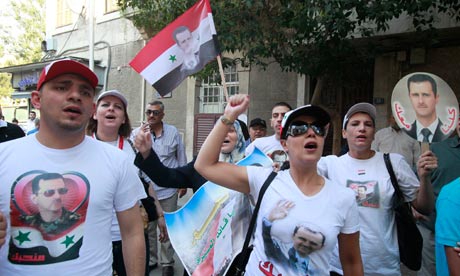
While Clinton turned up the rhetorical head a notch, President Assad must taken satisfaction in the dust up with the great conspirator. From the outset of the uprising four months ago, the Syrian regime has been accusing Washington of orchestrating its troubles. According to reports from Syria, the pro-regime public has been galvanized by Ambassador Fords actions in Hama. They see it a proof that the US is acting as the puppeteer and takes an active role in the uprising. His trip to Hama to demonstrate US support for the demonstrations was the sort of provocation, Damascus authorities had been waiting for.  Now it is a US-Syrian confrontation. World news programs have ramped up their coverage that had been flagging. I cannot tell you how many calls I received today compared to the last week of comparative quiet.

What is unclear is whether the Syrian opposition will gain from this controversy. Will the increased international news coverage and augmented US role in this Syrian drama prove to be a boon for the opposition? Will it make up for any damage the opposition suffers from local accusations that it is but a spearhead of a vast imperialist-Zionist conspiracy?

Certainly, Ford’s credibility is restored in Washington. Even Republicans will have to laud him as a local hero. Only yesterday they branded him an Assad propaganda tool. The State Department will also look good. But are these antics helping the Syrian opposition or Assad? Answer the poll in the upper left hand corner of this page.

Pro-Assad demonstrators in front of the US embassy in Damascus

Wash Post – Liz Sly

DAMASCUS, Syria — Supporters of the Syrian government pelted the U.S. embassy with rocks, smashed windows and raised their national flag in place of the American one on Monday, a day after the U.S. ambassador here delivered an extraordinary rebuke to the Syrian government on Facebook….

A U.S. embassy official said about 10 of the protesters broke into the embassy compound and destroyed the main entrance. Three of them climbed onto the roof. No embassy staffers were hurt. Syrian government supporters smashed windows at the U.S. Embassy in Damascus, raised a Syrian flag and scrawled graffiti calling the American ambassador a “dog” in anger over the envoy’s visit to an opposition stronghold, witnesses said.

The official, who spoke on condition of anonymity, accused the Syrian government of facilitating the attack and of being slow to respond after the embassy appealed for help….

News Round Up

The Syrian Revolution and the Unofficial Cast System By Mu’taz

…Owning a foreign maid is perceived to be as prestigious as owning a Hummer or a fancy home. …. What is disturbing about the revival of this discrimination is its association with the growth of the economical disparity between the rich and the poor. Moreover, this renewed discrimination is growing in spite of the improvement in  education level and unprecedented communication with the rest of the free world.  What is interesting is that people who were  victims of discrimination in the past became victimizers. The Alawites moved up in the ranks and joined the elite class.  The wealthy upper class in Damascus and Aleppo solidified their first class status with the help of Bashar Assad. He was appreciated compared with his father who didn’t have the best relations with merchants at the beginning of his presidency.  Now it is the people of Houran and the rural areas who constitute the new second class……

FIVE QUESTIONS For David Lesch: How The Stalemate In Syria Will Finally Break Down – Business Insider [This is smart]

Syria expert talks U.S. strategy, reform, and regime schizophrenia.

Meir Javedanfar The competition between Iran and Turkey over influence in Syria.
Despite close relations, both Ankara and Tehran have found themselves pulling in different directions in Damascus.

Damascus Vibrations: How Iraqis view the Syrian Uprising,  Jul 02, 2011
By Sami Moubayed

For a variety of overlapping reasons, the situation in Syria is very alarming to Iraqis from every end of the political spectrum.

For starters, approximately 1 million Iraqis currently live in Syria, all of whom fled the mayhem in their country in 2003. They are worried that if security breaks down in Syria, or if the state can no longer accommodate them, they would have to unwillingly return home – where a very uncertain future awaits them.

A country that now has refugees on the border with Turkey will have a hard time absorbing refugees on its own territories – and certainly not Iraqi refugees.

Iraqi Christians living in Syria are particularly afraid of the sectarian rhetoric emerging from radical groups inside Syria. They fled their country precisely because they were targeted by radical Islamic groups and are worried that a similar scenario could be repeated in Syria.

Iraqi Ba’athists are also worried about the status of the Ba’ath Party in Syria. Demonstrators have been on the streets throughout rural Syria and in many towns within its interior, demanding an end to one-party rule and cancelation of Article 8 of the Syrian constitution, which designates the Ba’ath as “leader of state and society”.

These Iraqi Ba’athists are still very much committed to Ba’ath Party rule and they are horrified by the fact that perhaps soon, Ba’ath Party supremacy will end in a country that gave birth to their doctrine back in 1947. Ba’athist Syria welcomed them with open arms in 2003, but that wouldn’t necessarily apply to a country in which the Ba’ath no longer has the upper hand.

Hardline Iraqi Shi’ites are also alarmed, seeing the demonstrations on the Syrian street as part of a Western-engineered “conspiracy” aimed at punishing Syria for its alliance with Iran and Hezbollah in Lebanon. They are very worried that if the regime collapses in Syria, or is reformed beyond recognition, then this would spell out a slow breakdown in the Syrian-Iranian-Hezbollah trio that has dominated the Arab world for more than 10 years.

That alliance was a source of inspiration to radical Iraqi groups like the Mehdi Army, whose leader Muqtada al-Sadr often looked towards Hezbollah leader Hassan Nasrallah for leadership and guidance, enjoying excellent relations with the Syrians. They fear the rise of radical Sunni groups within Syria, like the outlawed Muslim Brotherhood, would certainly work to obstruct what its leaders have often described as a “Shi’ite crescent” linking Iran, Syria, Lebanon and Iraq.

As far as they are concerned, the Brotherhood, through an alliance with Turkey’s Prime Minister Recep Tayyip Erdogan, is now coordinating with the West over how to end to Iranian influence in the Arab world. The believe this is why Erdogan began dialogue with Hamas in Palestine back in 2004 – to counterbalance the influence of Hezbollah in the eyes of Muslim Sunnis around the world.

If the Brotherhood is empowered by whatever scenario unfolds in Syria, then this would have immediate vibrations in Iraq among groups allied to Sunni Islamic groups, like the Iraqi Accordance Front and the Iraqi Islamic Party, being the Iraqi branch of the Brotherhood.

TRIPOLI (Reuters) – France’s defense minister said it was time for Libya’s rebels to negotiate with Muammar Gaddafi’s government, signaling growing impatience with progress in the conflict.

In Iran, sanctions aim at shipping lifeline (Washington Post)

TEHRAN — On June 30, the Danish shipping giant Maersk startled Iran’s trade officials by abruptly pulling out of the country’s three largest ports. Company officials said little about the decision, but the timing was striking: A week earlier, the Obama administration had declared the ports’ operator to be an arm of Iran’s Revolutionary Guard Corps, a group linked to terrorism and weapons trafficking. Other shipping companies followed suit, and soon Iran was scrambling to find alternative ways to import food and other critical supplies. Now Iranian officials are warning of economic pain in the months ahead — precisely the effect that U.S. officials were hoping for.

Nokalaos van Dam, “The Struggle for Power in Syria: Politics and Society under Assad and the Baath Party.”

Nokalaos van Dam has issued a new edition of his excellent book:

The Struggle for Power in Syria: Politics and Society under Assad and the Baath Party. There is something to cheer about.

I’ll give you an idea of what is new in the fourth edition, as compared with the third (published in 1996):

The Preface to the fourth edition (p xiii) gives some preliminary guidance.

Chapters 9 and 10 have been updated, so as to include the takeover of Bashar al-Asad as president.

This new edition concludes that the Syrian regime as it exists since the death of President Hafiz al-Asad has retained the same characteristics which in the past were so essential for its survival and continuation. It also makes some observations about what amounts to approximately half a century of Alawi-dominated Ba’thist rule in Syria, including the period of President Bashar al-Asad.

A new Chapter 11 has been added on Syrian Ba’thist memoirs. It contains various new sections not published before, for instance the memoirs of Mansur al-Atrash, the fifth part of Mir’at Hayati by Mustafa Talas, new material of Marwan Habash, Nur al-Mudi’ Murshid (on the Murshidiyin and Rif’at al-Asad) and others.

The Tables (pp 84-87) on the sectarian and regional composition in the Syrian Regional Commands of the Ba’th Party have been updated until and including the Ba’th Party Congress after the takeover of Bashar al-Asad in 2000.

Several end-notes give additional information on Regional and Central Committee membership chosen in 2005.

The Conclusion has been fully updated, just as has Chapter 9. The analysis of the prospects for the future are still fully valid today and have not really been overtaken by events. Of course it does not include the present demonstrations. Any attempt to do so would make the book out of date tomorrow. Fine tasters with a preference for detail should not forget to read notes 12, 13 and 31 of Chapter 9. They contain some updates on the mainly Alawi power elite.

The Biography is updated and contains a special section on Works in Arabic on Hafiz al-Asad and family (pp 227-230). It also includes the article for Syria Comment of 14 April 2011: Syria: the dangerous trap of sectarianism.

Those who read Chapters 7 and 8 on the confrontation between the Ba’thist regime and the Syrian Muslim Brotherhood can get a good background to better understand the present day events in Hama and elsewhere (such as Jisr al-Shughur).

I am a great admirer of this book. I wrote a review of the third edition in the “International Journal of Middle East Studies,” in which I wrote:

Only a few important books have been written on contemporary Syria; and Nikolaos van Dam’s Struggle for Power in Syria is one of them.

Syria Closes in on Four Months of Uprising with No End in Sight.

Ambassador Ford, after coming under attack from the neo-con right for being a “propaganda tool of Assad,” — see the Washington Post’s Jennifer Rubin, “Ambassador Ford: ‘Eyes and ears’ or a propaganda tool for Assad?”— has secured his popularity in Washington with his trip to Hama and latest statement. Demonstrators in Damascus have pelted the embassy with rocks and tomatoes. Ford has accused the Syrian government of supporting the demonstrators and Syrian authorities have accused Ford of supporting the opposition in Hama. It is worth reminding readers again that Peter Harling’s report for ICG is worth reading in its entirety.

Many readers continue to hope for a compromise and democratic opening under President Assad’s leadership.

Opposition members who are committed to the road of revolution, argue that the notion of compromise is a delusion. Only uprooting the regime root and branch, they argue, will resolve Syria’s problems.

As Observer writes in the comment section:

The regime is deeply rotting from the inside and nothing absolutely nothing can save it.

The opening statement of today’s [dialogue] meeting is also a recognition of the fact that it is impossible to return to the status quo ante. The purpose of the meeting is not to stop the change but to control it in a way that is favorable to the Clan: the inner circle of the Assad family. The dialogue is designed to favor neither Syria, nor the larger circle of the elite that includes the business class.

It is telling that none of the key figures in the regime were present. This indicates that if the dialogue should lead to positive results, the Clan will claim ownership and attach itself to the success. If it fails, the vice president will act as the fall guy. He and the participants can assume the blame and pick up the pieces. [Both Michel Kilo and Louai Hussain, two leading opposition figures that attended the first round of opposition talks held at the Semiramis last week, are both apparently boycotting this round because they do not believe it is serious.]

May I ask if anyone knows if there were economic elites, business leaders, banking officials, and most importantly pillars of the security services present at this conference? This is important to know as it gives weight to the value of this conference.

Meanwhile, the repression if it continues, will mean one thing only and that is that this conference and these meetings are nothing more than window dressing.

The compromisers point to Bashar’s launching of a “national dialogue.” They also look hopefully at V.P. Farouq al-Sharaa’s recent statement to al-Hayat that The national dialogue is for a pluralist system in which the ballot box plays a prominent role. They argue that it does not matter whether President Assad is presently playing for time in the belief that he can crush the uprising and preserve the prerogatives of the Baath Party. What matters, they insist, is that the committees for constitution change and a democratic opening have been set in motion. This is good enough at this early stage. When Assad discovers that he cannot regain his former control over political events in Syria, he will be forced to breath greater seriousness into the reform process, which as this point promises only to give the ballot box “a prominent role” and not a “preeminent role.” They insist that revolution will bring only greater bloodshed and misery to Syria, that the country cannot withstand another revolution as it will only bring revenge and ethnic cleansing.

Some even argue that they would be satisfied with a mixed system that allows the President to survive and name a portion of the deputies to the Parliament, while others are elected by a ballot, as is the case in Jordan and was the case in Egypt. I have featured two such arguments today from Ayman Hakki and George Ajjan.

A Note from Ambassador Robert Ford, by U.S. Embassy Damascus on Sunday, July 10, 2011

….we respect the right of all Syrians – and people in all countries – to express their opinions freely and in a climate of mutual respect. We wish the Syrian government would do the same – and stop beating and shooting peaceful demonstrators. I have not seen the police assault a “mnhebak” demonstration yet. I am glad – I want all Syrians to enjoy the right to demonstrate peacefully. On July 9 a “mnhebak” group threw rocks at our embassy, causing some damage. They resorted to violence, unlike the people in Hama, who have stayed peaceful. Go look at the Ba’ath or police headquarters in Hama – no damage that I saw…..

Gov’t-organized consultative meeting for national dialogue opens to discuss crisis in Syria

DAMASCUS, July 10 (Xinhua) — The government-organized consultative meeting which aims to bring in pro- and anti-regime figures to discuss the crisis in the country opened Sunday here amid low-show from the opposition’s prominent figures….

Press TV:

Vice president Faruq al-Shara opened the meeting on Sunday, saying it aims at triggering “Syria’s transition towards a multi-party democratic state,” AFP reported. The reformed state is where “everyone will be equal and able to participate in the building of the nation’s future,” he said.

Aboud writes:

The massive, massive funeral of Hadi Jandi, killed on Friday in Homs.  “Protestor fatigue”? This was a massive, massive turnout.

Hundreds of thousands of Syrians on Sunday raised the largest national flag in the world, 16 kilometers long and four meters wide, in Lattakia to show support for the gov.

“The Syrian Uprising” by Ayman Hakki

Most oppose the actions of the regime but are conflicted as to the best way to affect long overdue beneficial change. It is a historic fact that change is not always for the best in that part of the world, and a malevolent uprising is worse, not better, for Syria than its present corrupt authoritarian system….

Today Syrian Americans are well positioned to urge a rudderless administration to employ a carrot and stick approach to Syria, because we know that the stick alone won’t work. We must all resist asking for pressure and stopping at that. We must work diligently to secure Syria’s minorities’ interests before we even consider a plan to help empower Syria’s Sunni majority. Turkey and the West may be well suited to play this role. There may be better solutions for this thorny problem, but I can’t think of them. We’re all waiting for someone to articulate a vision that represents hope for change, a change free of reprisals and hatred. Then we’ll get behind that plan. Until such time we must resist the urge to reflexively and vengefully oppose the regime.

Syria: A Way Forward
by George Ajjan, July 02, 2011

….the turmoil that has engulfed Syria possesses a geographic and demographic profile opposite to that of Egypt – it was the urban middle class who turned out to reject the abuses of the Mubarak regime. Coptic priests said Mass in central Cairo while their middle-class Muslim neighbors stood guard. But there is certainly no communion being distributed in the poor towns where the Syrian youth has taken to the streets. By contrast, the multi-confessional middle class of Syria’s largest cities of Damascus and Aleppo has been unwilling to join the anti-government movement; rather, they have turned out at pro-regime counter-rallies, if only to show their support for stability….

Going forward, there are 3 main scenarios that can play out. First, the vicious cycle of protests and military crackdowns can continue for months on end,…. In other words, the country will die a slow and painful death with its problems only exacerbated.

In the second case, a foreign military coalition could intervene, mainly if Turkey – the political bridge between Syria and the West – concludes that the situation cannot be salvaged and gives the green light. ….

The third case is a “soft landing”, where all people of good conscience, Syrian or not, ought to place their hopes. In this scenario, the constitution would have to be amended to allow a multi-party system. Legislative elections would have to be held to give the protesters somewhere else to channel their energy – but within a year, not in some vague near-ish future to which the government’s latest lip service alludes. A true parliament would have to be created, in stark contrast to the circus of stooges and Baath Party hacks that Assad addressed when the crisis first erupted, which any clear-thinking Syrian ought to label a national embarrassment.

A reasonable compromise would be for a free, multi-party parliament to appoint a slate of ministers for those departments that directly impact the economy, e.g. Finance, Agriculture, Industry, Infrastructure, Tourism, Transportation, Energy, Education, etc. while the President would keep autocratic control of the military, security, and of course foreign policy. As such, Syrians would get stability and continuity in the areas where their President is perceived to be popular and effective, but they would have enough political freedom to begin to hold their government accountable to enact more responsive economic policies and tackle corruption.

For many seasoned observers of Syrian politics, the power sharing described above reads like a pipe dream. For others, it does not go nearly far enough. But those with “Assad must go” on their lips can spare the crocodile tears – it is a completely unrealistic proposition. Ceding control over domestic policies will be a hard enough pill for the Baath Party establishment to swallow, but it would be unthinkable for them to relinquish the military and diplomatic spheres without a fight to the death….If he can’t manage to deliver that much after 11 years, then quite frankly he’d be best described by the term he once infamously used to refer to the compliant rulers of Egypt, Jordan, and Saudi Arabia: a “half-man”.

Jerusalem Post: As Arab Spring roils, hunger emerges, 2011-07-10

The Arab Spring was supposed to bring democracy, peace and prosperity. But stalemates between governments and opposition forces are paralyzing economic life, exacerbating food shortages that were already in the making due to unfavorable weather and …

Reports of widespread hunger have emerged in recent weeks in Libya and Syria. On Wednesday, Yemen was officially added to the list of food trouble spots when a United Nation mission visiting Yemen called on the international community to quickly provide humanitarian aid to the impoverished country, pushed to the verge of starvation by five months of protests and armed insurrection….

The FAO’s food price index, which covers prices of a basket of commodities, rose 1% to 234 points last month, up 39% compared with the same time last year and just below the record 238 points hit in February….

Syrians too have suffered hunger due to a drought that has plagued the country’s northeast since 2006, described by the WFP as “the worst in decades.” Mass migration from Syria’s rural agricultural areas into cities has ensued. Some one million Iraqi refugees living in Syria are the most vulnerable to food shortage, as they are not allowed to work or own land to sustain themselves.

For Syrians struggling with less food in the markets, the problem was made worse by cuts in food subsidies and frozen wages after 2004. In the weeks before unrest broke out in mid-March, the Syrian President Bashar Assad government restored some of those subsidies and raised salaries for civil servants. But with the economy paralyzed, it’s not clear the government can afford to increase aid or distribute it.

The fighting, however, has been a major cause of hunger in Syria. In mid-June, government forces loyal to Assad blocked food from reaching Syrian villages near the border with Turkey, where thousands of internally displaced refugees had gathered fleeing government violence.

“This is a starvation war they’re waging,” Jameel Saib, a local eyewitness, told CNN, adding that refugees were forced to pluck fruit from trees in order to survive….

‘Syrian security member’s son killed’ Press TV

Unknown assailants have killed the son of a member of the Syrian security forces after kidnapping him and have dismembered his body, an informed source says.

Talking to Press TV, the source added that police have launched an investigation into the incident and have arrested a suspect in relation to the killing.

“There are now two possibilities; one is that the murder was in line with the tribal killings, and the second, that it was committed by armed men who are killing and slaughtering people in Syria these days,” the source further said.

Protest singer Ibrahim Kashoush had his throat cut

“One of many grim videos to emerge from the Syrian city of Hama purported to show the body of protester Ibrahim Kashoush after his throat had been cut by the security forces,” reported the British newspaper The Guardian on 5 July 2011 at 4:41 PM.

The slogans that the demonstrating crowds in Hama have repeated again and again are from a song which was composed by the locally based singer Ibrahim Kashoush — a folklore singer who chanted traditional Aradah tunes as protest songs, adding new lyrics he wrote himself to the old wedding and celebration melodies. His body was reportedly found dumped in the Assi River on Wednesday morning.

Feature: Unrest across Syria casts shadow on soap operas
English.news.cn 2011-07-09, by Hummam Sheikh Ali

DAMASCUS, July 9 (Xinhua) — It appears that Syria’s once- flourishing soap opera industry is losing its glory and sliding into a recession after Arab television networks and satellite channels declined to buy Syrian soaps in retaliation for Syrian actors’ positions towards the country’s current political crisis.

Since the eruption of protests in Syria in mid March, Syrian actors and actresses have shown conflicting attitudes towards the events, with some of them supporting the protests while others openly backing the Syrian government and attacking the protests as aiming to undermine the country.

Syrian actors complain that they have been boycotted by Arab TV satellite channels owned by wealthy Saudis and Qataris, whose governments are now maintaining cool relations with Syria. The reason, they said, is their overt backing of the Syrian government and the reforms announced by Syrian President Bashar al-Assad.

Abdul-Rahaman Abu al-Qassem, a prominent Syrian actor, confirmed to Xinhua that the Syrian drama industry has been ” greatly influenced by what is happening in Syria,” noting that most producers depend on the Gulf funds in this respect.

“Syria is subject to an unprecedented attack at all political and cultural levels… We are living under a total siege,” he said.

Syria has been wracked by nearly four months of protests demanding sweeping reforms. The turmoil has badly hit all sectors in Syria, including the drama industry.

Most Arab networks were once racing to buy Syrian soaps to be screened during the Muslims’ holy month of Ramadan due to their unparalleled popularity and daring subjects. Arab and Gulf viewers, in particular, used to be reportedly glued to TV screens during Ramadan to watch Syrian series that tackle subjects like gallantry, terrorism, love and other social topics.

During past surveys, Syrian series ranked number one as the most watched among Arab viewers, and even those in foreign countries.

Najdat Anzour, a renowned Syrian director, said in a statement obtained by Xinhua that there is a Arab political decision that has been taken covertly not to buy Syrian soaps or at least to purchase them at low prices in a way that reduces the value of those works.

Anzour said there are 25 Syrian soaps ready for Ramadan, adding that some works have been postponed to the next season as outlooks for this season are gloomy….Syrian

Syrian Government Offers ICRC Wider Access in Syria

GENEVA — The International Committee of the Red Cross (ICRC) said on Friday it had stepped up its humanitarian operations in Syria, in line with a deal for unlimited access negotiated two weeks ago.

The independent aid agency previously had been able only to make limited visits to a few cities affected by the crackdown on anti-government protests, but its president Jakob Kellenberger won assurances of unconditional access, it said.

In the past week, ICRC officials have visited the southern city of Deraa — where it said the main hospital reported it had treated more than 1,500 wounded since violence began — and the northern city of Idlib and Jisr Al-Shughur, a statement said.

Risky Business: Getting information out of Syria Human Rights Watch

Syria: Secret journey around a nation in revolt finds protesters are not flagging Telegraph

From: Ambassador of Syria to the U.S.
To the Syrian-American Community: July 6, 2011

Since the onset of the events in Syria, many members of the Syrian-American community have been distraught over developments on the ground. Some have taken a hard-line stance, refusing any dialogue with the Syrian government. Others have chosen to engage with the Embassy and myself to express their candid viewpoints on how to pull Syria out of the current crisis and onto a brighter future. Many have voiced their interest in engaging with both, the members of the opposition in Syria, as well as the government. We believe this is a productive position.

As such, I would like to take this opportunity to inform the Syrian-American community that whoever believes in constructive dialogue and would like to visit Syria to participate in the National Dialogue between the government and opposition and/or intra-opposition meetings is welcome, and encouraged, to do so. Rest assured that they will be treated with the utmost courtesy and will face no obstacles entering or leaving the country.

I look forward to the Syrian-American community emerging as a robust and influential member of the National Dialogue that will help bring about a

more democratic, peaceful, and secure Syria.

Sincerely, Imad Moustapha, Ph.D.
Ambassador of Syria to the United States

Washington summoned the Syrian ambassador AFP

Imad Mustapha was called in to meet with top State Department officials “to express a number of our concerns with the reported actions of certain Syrian embassy staff in the United States. We received reports that Syrian mission personnel under ambassador Mustapha’s authority have been conducting video and photographic surveillance of people participating in peaceful demonstrations in the United States.”

Syria: Economic Overviews
2011-07-06 22:16:05.755 GMT

Summary: The regime of Syria’s president, Bashar al-Assad, is not expected to hold on to power in its current form in the face of ongoing anti-regime protests. Its current method of repression and superficial reforms is unsustainable. Within the forecast period, sustained domestic, economic and international pressure is expected to cause a major overhaul of the current regime structure, possibly overseen by Mr Assad himself or after an internal coup against him. Relations with the West are likely to remain tense following Syria’s crackdown, and further US and EU sanctions may be imposed. Arab states are likely to remain quiet, fearing instability, but Turkey’s criticism will increase.

July 1 (Economist Intelligence Unit) — POLITICAL STABILITY: The Economist Intelligence Unit believes that the regime of Syria’s president, Bashar al-Assad, and his ruling Baath party will be unable to retain power in the face of ongoing anti-regime protests through its current method of heavy-handed repression and superficial reforms. Within the forecast period, sustained domestic, economic and international pressure is expected to bring about a major overhaul of the current regime structure. This could be done by Mr Assad himself; he could enact meaningful reforms to recast the regime in a more open style, satisfying a critical mass of Syrians and international critics, and eventually leading to the purging of unpopular security figures, notably his brother and regime enforcer, Maher al-Assad. However, Mr Assad appears weak in the face of the protests, and has shown no inclination to make such bold and decisive moves. Alternatively, sections of the army that are not from Mr Assad’s loyal Alawi sect, in conjunction with the merchant Sunni elite, which has been loyal until now, may decide that the president is too great a liability and stage a coup against the Assad family and the Alawi segments of the security and armed forces. A less likely possibility is that the security hardliners, led by Maher al-Assad, will launch a coup against Mr Assad themselves.

ELECTION WATCH: In a recent speech, Mr Assad announced that a new election for Syria’s parliament, the Majlis al-Shaab, would take place in August, the latest date allowed by the constitution after the previous four-year term expired in May. It is unclear whether the election will be held under the newly proposed political parties law and whether Article 8 of the constitution, which guarantees the Baath party and its allies two-thirds of the 250 seats, will be amended. Every seven years parliament proposes a presidential candidate who is then put to a referendum. Mr Assad was confirmed for his second term in 2007. If he stays in power and successfully reforms, it is likely that the nature of the presidential electoral process (the unlimited number of terms, the lack of a contest) will come under scrutiny.

INTERNATIONAL RELATIONS: Syria’s recent detente with the US and Western states has been ended by Syria’s crackdowns. Western states were initially cautious in condemning Mr Assad, but the continued repression has prompted substantial criticism. The EU has increased the number of regime figures subject to sanctions, bringing the total to 34, including Mr Assad. The US administration has expanded the existing economic sanctions on Syria, imposed by the administration of George W Bush, to include additional regime members, including the president. Facing growing isolation, Syria will rely on non-Western global allies for support, such as Russia and China, to veto any Western-led resolution condemning Syria’s actions at the UN Security Council.

POLICY TRENDS: The recent policy of gradually liberalising Syria’s centrally planned economy has stalled in the wake of the political unrest; its main architect, the deputy prime minister for economic affairs, Abdullah al-Dardari, was excluded from the new government formed in April. Mr Dardari’s successor as economy and foreign trade minister, Nidal al-Shaar, has a record that suggests he is in favour of economic reforms. owever, his initial priority will be to quell the unrest by implementing populist state-funded measures, such as reviving subsidies on fuel, although a complete dismantling of Mr Dardari’s reforms is unlikely.

ECONOMIC GROWTH: Central Bank of Syria provisional figures show that real GDP growth was 3.2% in 2010. Although the economy was boosted by increased oil production, growth in exports to Iraq and an expanding services sector, notably tourism, the continued weakness of the agricultural sector and increased food imports limited growth. The continuation of political unrest has caused us to revise down our growth forecast to 1.1% in 2011 and 3.2% in 2012, with any growth driven primarily by increased government spending and oil exports. Foreign investment is expected to drop as a result of the unrest, and the tourism sector will be hit badly. Business activity will be curtailed by disruptions caused by the protests, and the political uncertainty will lower private consumption (despite recently announced public-sector pay rises). In addition, any prolonged instability in Syria may persuade the Iraqi refugees living in Syria (estimated at between 500,000 and 1m) to return home, depressing consumption further.

INFLATION: We have revised down our forecast for inflation to 7% in 2011, as early signs show that the increase in global commodity prices and the increase in liquidity resulting from the hike in state employees’ salaries and tax cuts promised during March have not pushed prices as high as expected. Average inflation will drop to 5.5% in 2012, as commodity prices stabilise and the number of Iraqi nationals in Syria declines, lowering demand.

EXCHANGE RATES: The Syrian pound has been loosely pegged to the IMF’s special drawing rights since October 2007 and is tightly managed by the Central Bank. The authorities are unlikely to let the pound float freely, as they value exchange-rate stability. Recent unrest reportedly led to a temporary 15% depreciation of the pound against the dollar on Syria’s black market. (The black-market pound:dollar rate is usually in line with the official rate.) Concerns about the euro in 2011 will lead to a slight depreciation of the pound against the dollar, and we forecast that the official rate will average SP47.3:US$1 in 2011-12. Before the current crisis, the Central Bank had healthy foreign-exchange reserves (equivalent to about 12 months of import cover), leaving it relatively well placed to defend the currency.

EXTERNAL SECTOR: In 2011-12 we expect export earnings to grow modestly, to an average of US$12.5bn, although this is below the oil-price-related peak in 2008 of US$15.3bn. Oil production, which is increasing at small fields but declining at the larger, mature fields, rose by 2.9% in 2010. Several major oil companies have reported that production has been unaffected by the unrest, although there are reports of increased insurance premiums on tankers transporting oil from Syria’s ports, which might cause some delays in delivery. Output will pick up further in 2011-12, averaging 392,000 barrels/day. The impact of changes in oil prices on the trade balance is limited, because Syria’s imports of refined products are about equal in value to its exports of crude oil. Higher production in 2011, augmented by a rise in international oil prices to an average of US$101.5/barrel in 2011-12, will push up crude oil export revenue to an average of US$5.3bn in 2011-12, from US$4bn in 2010. We have revised down our forecast for the trade deficit, to an average US$1.4bn, or 2.2% of GDP, in 2011-12, as imports are expected to drop owing to the continued political unrest.    Jul/06/2011

Syria’s rival hegemons
By CAROLINE B. GLICK in JPost

….In the long-term, the reestablishment of a Turkish sphere of influence in the Arab world in Syria, Lebanon, the Palestinian Authority and Egypt through the Muslim Brotherhood will be extremely dangerous for Israel. With its jihadist ideology, its powerful conventional military forces, its strong economy and its strategic ties to the US and Europe, Turkey’s rise as a regional hegemon would present Israel with a difficult challenge….

Richard N. Haass, “Arab spring has given way to a long, hot summer.” He says the Arab Spring has given way to a series of developments that are beginning to produce a region that is less tolerant, less prosperous, and less stable than what existed—and outsiders cannot do much to change the course of events…..

Arab publics emerging from the upheavals makes it more difficult for Arab governments to compromise. And while terrorist groups had nothing to do with the upheavals, they are in a position to benefit as governments with strong anti-terrorist records are weakened or ousted. Signs of exactly this are popping up in Yemen, and it only a matter of time before they do so in Libya.

Take all this together, and you see a series of developments that are beginning to produce a region that is less tolerant, less prosperous, and less stable that what existed. To be sure, the authoritarian old guard that still dominates much of the Middle East could yet be forced or eased out and replaced with something relatively democratic and open. Unfortunately, the odds now seem against this happening.

Please respect FT.com’s ts&cs and copyright policy which allow you to: share links; copy content for personal use; & redistribute limited extracts. Email [email protected] to buy additional rights or use this link to reference the article – http://blogs.ft.com/the-a-list/2011/07/06/the-arab-spring-has-stalled/#ixzz1RY9ynXwz

rab publics emerging from the upheavals makes it more difficult for Arab governments to compromise. And while terrorist groups had nothing to do with the upheavals, they are in a position to benefit as governments with strong anti-terrorist records are weakened or ousted. Signs of exactly this are popping up in Yemen, and it only a matter of time before they do so in Libya.

Take all this together, and you see a series of developments that are beginning to produce a region that is less tolerant, less prosperous, and less stable that what existed. To be sure, the authoritarian old guard that still dominates much of the Middle East could yet be forced or eased out and replaced with something relatively democratic and open. Unfortunately, the odds now seem against this happening.

Mideast Youth: Arab Spring Could Never Topple Saddam
2011-07-06

Some Western anti-war activists proclaimed the Arab spring inspired by Tunisia and Egypt, could have toppled Saddam Hussein and the invasion of Iraq by the U.S. in 2003 wasn’t needed. The recent developments in Syria show this is a futile …

Kiss Of ‘Democratic’ Death: Israel’s Plot To Take Down Syria II
08. Jul, 2011, by Jonathan Azaziah / Intifada Palestine, Part 2

Israeli singer Amir Benayoun sings for the Syrian revolutionaries

Susan Dirgham writes:

The Syrian Australian community is becoming quite active in support of the president and reforms. Last week there was a huge rally in Sydney, and different community groups are organizing one for Melbourne. Also a petition has gone around the community and hopefully it will be presented to the parliament by an MP. It is a protest against the foreign minister’s call for President al-Assad to be referred to the International Criminal Court. We have a foreign minister who, unfortunately, wants to big-note himself when he can. He can be very embarrassing. Read this letter to the Australian Foreign Minister.

Ambassador Ford Goes to Hama

Reader Comment by Abughassan:

This Friday was not very satisfying for the demonstration organizers. Most demos were small and almost none reported in Aleppo and Damascus proper. Reports about large demos in cities other than Hama and Homs were largely untrue and some were totally fake. My cousin denied seeing or hearing any demos in Latakia; another cousin in Aleppo confirmed that Friday was quiet. Security forces kept a low profile but that did not help increase the number of demos. We may be seeing some demonstration fatigue.

Ambassador Ford escorted into Hama by demonstrators demanding the fall of the regime. Youtube

Guardian (GB): US calls Syrian charge of incitement ‘rubbish’, 2011-07-08

Associated Press= WASHINGTON (AP) — The Obama administration has fired back at President Bashar Assad’s regime for accusing an American ambassador of attempting to destabilize Syria by visiting anti-government protesters in a besieged city. State … “The presence of U.S. ambassador in Hama without previous permission is obvious proof of the implication of the United States in the ongoing events, and of their attempts to increase
tensions there, which damage Syria’s security and stability,” the foreign ministry statement said….

Hama after the demonstrations. Youtube video of many burning cars and buses in the downtown region. Youtube

A Bab Touma, Damascus, Pro-Bashar Demonstration help in July 8

The person who sent me this photo writes: “They lost the plot in Hama it seems. Throwing flowers on the convoy?! Syrians sitting on the sidelines object to this. I was just passing by a huge pro demo in Bab Touma and took this photo. Thousands of people called to move the demo in front of the US embassy. They started car pooling and moving in masses. Anti-Americanism is on the rise in Syria thanks to the ambassador!”

FP Passport: Is this the anthem for the Syrian revolution? “Yalla Erhal Ya Bashar” (It’s time to leave, Bashar), seems to be the standout song of the Syrian uprising so …

Syrian Christians concerned about instability at home
July 07, 2011, By Brooke Anderson, The Daily Star

Saydnaya church, 27 kilometers north of Damascus, is second only to Jerusalem for Christian pilgrimage.

BEIRUT: As an increasing number of Syrians take to the streets to demand sweeping government reforms, many Syrian Christians are still hesitant to do so – afraid of an uncertain future as a minority that has until now been safe under the current secular government.

“To be honest, everybody’s worried,” Yohana Ibrahim, archbishop of the Syriac Orthodox Church in Aleppo told The Daily Star on a recent visit to Beirut. While he supports the demands for reform being made by the protesters, he emphasizes that he would not want the instability that potentially could come with a change in government and he hopes a national dialogue can soon be reached.

He says: “We don’t want what happened in Iraq to happen in Syria. We don’t want the country to be divided. And we don’t want Christians to leave Syria.”

This is perhaps why many of Syria’s Christians have remained largely silent since the popular uprising began just over three months ago. Most of the protests have taken place after Friday prayers in rural areas, with only minimal turnout in Damascus and Aleppo, the two largest, majority Sunni cities, where also the majority of Syria’s Christians reside.

Syria’s Christians comprise about 10 percent of the country’s population of 20 million. Most are concentrated in the country’s large cities, while there are also sizable communities on the coast and in the Hauran region, where the uprising began in March. So far, very few have been prominent in the uprising, which activists say has caused the deaths of more than 1,400 civilians as a result of a violent government crackdown.

Many people believe the community’s relative absence from protests is due to the stability they enjoy under the Alawite-run secular government, which has shown favoritism toward the country’s urban business elite – including secular Muslims and Christians – while taking a hard line against Islamist movements over the past 40 years.

“I’ve met Syrian Christians who’ve defended the regime because it’s not Islamic, but I think this could backfire on them,” says Imad Salamey, associate professor of political science at the Lebanese American University. “If they link themselves to a dictatorial regime that is largely disliked by the Syrian people, then some might think this will justify reprisals against them.”

Others are sympathetic to the idea that Syrian Christians are simply scared of chaos and persecution if the ongoing protests lead to Islamist overthrowing the secular Baath party government, similar to events in Iraq.

“It is the devil we know better than the devil we don’t know, I don’t blame them,” says Hind Aboud Kabawat, a Syrian Christian who divides her time between Toronto and Damascus, and who won the 2007 Women’s Peace Initiative award.

“It is not pleasant to see the Iraqi Christian refugees leaving Iraq after thousands of years of living in Iraq, or seeing Iran after the toppling of the Shah to have the Mullah.”

Historically, in a region of unrest, Syria has been a place of stability and sanctuary for Christians. Tens of thousands fled there to safety following the 2003 U.S.-led invasion of Iraq. And Christian holidays are nationally recognized in Syria.

Still, Kabawat seems to see it as being in Syrian Christians’ long-term interest to support the protesters. “Remember, if you are a real good Christian you have to side with the oppressed and not with the oppressors,” she says….

????? ?????? ????????? ???? ???? ????? ??????? ?????? … ????? ????? ??? ?????? ?? ??????
???? ????? ?????? ?? ????? ?????? ????? ?????? ??????? ??? ?????? ??????? ????? ..
????? ???? ??? ??????? ?? ?????? ???????? ??? ???? ?????? ???? ?? ??? ???? ” ?????? “? ?? ????? ?? ?????? ????? ????? ???? ?? ??…????? ?????? ??? ?????? ?? “?????”. ????? “????????? “? ?? ?? ???? ?? ???? ????? ??? ????. ??? ?????? ???? ?? ????? ??????? ????? ?? ???? ???????? ?? ?????? ??????: ???? ??? ” ??? ”  ?? ” ????? “?. ????? ??????? ??????? ?????????? ??????? ?????????? ???????? ??? ???? ???????… ????? ?? ??????? ?? ???????! ????? ???? ???? ??????????? ???? ??? ??????? ??????? ???? ?? ???? ????? ????? ???????: ??? ??????? ?? ????… ??? ?? ???? ??????? ?????? ?? ???????… ?????? ??? ??????? ????? ???????: ??? ??????? ?????? ??? ????? ????

Syrian Businessman Is Moving Wealth To Evade Sanctions, Treasury Says
2011-07-08 WSJ

The U.S. Treasury on Friday warned financial institutions to monitor for suspicious transactions involving Syrian officials–in particular, President Bashar al-Assad’s cousin, Rami Makhlouf, who is allegedly trying to hide his businesses ties and …

Zionists Chair Syrian Opposition Meeting in France
Local Editor, Manar (Thanks to The Passionate Attachment)

Key Zionist philosopher Bernard-Henri Levy; former French Minister of Foreign Affairs, and major advocate of the war against Iraq Bernard Kouchner; member of the youth movement in the Israeli right wing Likud party Frederick Ansel; and former Knesset member and Israeli Defense Minister Ehud Barak’s advisor Alex Goldfarb who was not questioned by anyone for claiming to be a Syrian opposition member and spokesman of “Democratic change in Syria” assembly; were basic participants in the Syrian opposition conference in Saint-Germain in France.

This “Zionist” atmosphere did not bother the attendees, which Muslim brotherhood representative in Paris, Moulhem Droubi, was among. One young Syrian girl “Souraya” interposed saying: “In this hall there is not one Syrian. In this hall, I only see Zionists.” However, she was immediately interrupted and dragged out by the French security under the eyes of the police.

According to the Lebanese daily As-Safir reporter in France Mohammad Ballout, Frederick Ansel responded to the young girl saying: “Unfortunately, some Arabs still regard Zionism as an insult, although it is a source of pride and honor.”

The Syrian opposition conference on Monday included speeches that called for toppling down the regime, and attacked Iran and Hezbollah, while completely ignoring occupied Palestine and the occupied Golan Heights.

Some speakers condemned “Iran and Hezbollah’s interference in Syria.”

Abughassan writes in the comment section:

The nature of political Islam and the history of MB added to the fact that Syria is a third world country with a diverse population all make it critical that a collapse of law and order is not permitted. The lesser of two evils is accepting a peaceful and gradual change of regime. Those who want another Iraq in Syria will be the first to blame “others” if things deteriorate into a status of total chaos and bloodshed. Cool heads,not hot blood,is what Syria needs today.

Samara writes

“Jr, the destroyer”. I like that. Hopefully he will destroy all the criminals who call themselves the MB, and the so called peaceful protesters who are killing and destroying our country.

Revlon Writes:

Lieutenant; Amjad Mohammad Al hameed, recent defector, provides account of war crimes commited in Rastan, last months:

– He is a tribe member
– Water, power and telephone lines disconnected.- Shelling of civilian neighbourhoods for three days.
– House searches, looting, and killing of civilians, including a baby girl.
– Piling up bodies and seriously wounded in containers.

This is the real dialogue that junior is conducting on the ground with Syrians people.

From the Turkish Press:

Iran’s role in Syria? Zaman

Turkey-Syria-Iran Triangle being redrawn?

Ron Paul condemns U.S. regime change promotion in Belarus or in “any other sovereign nation”
Statement on H.R. 515, the Belarus Democracy Reauthorization Act of 2011

Mr. Speaker, I rise in opposition to the “Belarus Democracy Act” reauthorization. This title of this bill would have amused George Orwell, as it is in fact a US regime-change bill. Where does the United States Congress derive the moral or legal authority to determine which political parties or organizations in Belarus — or anywhere else — are to be US-funded and which are to be destabilized? How can anyone argue that US support for regime-change in Belarus is somehow “promoting democracy”? We pick the parties who are to be supported and funded and somehow this is supposed to reflect the will of the Belarusian people? How would Americans feel if the tables were turned and a powerful foreign country demanded that only a political party it selected and funded could legitimately reflect the will of the American people?

However, representative of the so called “Salvation Front” headed by former Syrian vice-president Abdul Halim Khaddam, Ashraf Al-Moqdad called for “urgent assistance of Western countries,” and defended the participation of racist Zionist figures saying: “We are ready to meet with anyone in order to stop the bloodshed in Syria. The Syrian regime had conducted negotiations with Israel directly and indirectly. Then why can’t we meet with French officials who want to help the Syrian people? ”

For his part, Zionist Journalist Bernard Henri-Levy called in a statement the Security Council to refer the Syrian regime to the international tribunal. While Bernard Kouchner went further by saying that the international community should intervene militarily in Syria.

“We went to Libya, and we feel great injustice for leaving the Syrians alone,” he said, calling on “Arab spring” countries to end diplomatic relations with Syria.

Iran grooms Iraq to replace Syria? The National

Why Iraq may become Iran’s new best friend. There is a debate at the highest levels about how far Iran may go to spare its ally, Syria, from a free fall, Tareq Alhomayed, of the , wrote in a leader article. “I asked an analystwell-versed in Syrian issues about the Iranian role and he said that there are indications that Tehran is preparing Iraq to replace Syria as its closest ally in the region, in case the regime in Damascus falls.” This is seen in an increase in violent operations undertaken by militias backed by Iran in Iraq, especially in Sunni areas, with the approach of the US withdrawal.

Syria’s angel of death gives insight into terror
Jonathan Jones, 9 Juli 2011, Guardian

Jonathan Jones: Framing the debate: The footage showing a lone gunman shooting randomly before turning his fire on the cameraman is too raw not to be real

The angel of death has been caught on camera. That is what a gunman randomly shooting from a dark doorway looks like in raw and terrifying video footage that has surfaced this week on YouTube. Wearing military-looking khaki and firing quite randomly at people in a Syrian city, “without any reason and no demonstrations”, the figure embodies the stories of ruthless state violence emerging from a country where conventional reporting is all but impossible.

You look at death, and death looks at you. The cameraman – apparently using a mobile phone to grab these images in the heat of the moment – nervously and jerkily photographs a vertiginous collage of building facades, balconies and a fleeing crowd on the street below before homing in on the sinister military figure who is shooting from a doorway on a balcony just below his elevated viewpoint. But no sooner does the camera see the assassin than the assassin sees the photographer: and shoots. The last part of the video is a brown abstract mist as we hear moans against continuing shots and yells.

News Round Up (7 July 2011)

Middle East Channel – FP

City of Hama tests will of Syrian regime; at least 16 dead after protests Activists in Syria’s city of Hama have set up dozens of checkpoints and are using barricades of burning tires and trash bins to block the path of security forces. The city has emerged as a potentially serious challenge to the Syrian regime, as the town has been the site of the largest Syrian protests yet. The government’s decision to withdraw its military from Hama last month has turned the streets over to protesters, where residents say they are working in small and large groups to clean up the city and organize for its defense. At least 16 people were killed by security forces in the last two days in and around the town after peaceful demonstrations broke out on Friday. “There’s no easy solution to Hama,” said Peter Harling, a Damascus-based analyst with the International Crisis Group in an interview with the Los Angeles Times. “The regime made significant progress in terms of convincing people in Syria and abroad that there was an armed component to this protest movement and that its security forces were very much focused on that component…Hardly two weeks later, the regime gets embroiled in the exact opposite, once again undermining its own case.”

Hama Relatively Quite, Al-Watan:

July 7 – The security forces have removed the roadblocks and burned tires from the roads, while a prudent calmness is prevailing over the city.

U.S. Ambassador to Syria in Hama to Show Support for Protesters
2011-07-07, By Flavia Krause-Jackson

WASHINGTON (Reuters) – The U.S. ambassador to Syria has traveled to the restive city of Hama to show solidarity with protesters as Syrian security forces step up efforts to isolate the area, the State Department said on Thursday.

Ambassador Robert Ford has met with about a dozen Hama residents during his trip, and hopes to stay in the city through Friday when more protests are planned, State Department spokesperson Victoria Nuland said.

“The fundamental intention … was to make absolutely clear with his physical presence that we stand with those Syrians who are expressing their right to speak for change, who want a democratic future and who are expressing those views peacefully,” Nuland said.

Nuland said the U.S. embassy in Damascus had informed the Syrian government that an embassy team — without naming Ford himself — planned to travel to the city and that they were allowed to pass through a military checkpoint to get there.

She said Ford had reported “a very warm welcome” and visited a hospital that has been treating people injured in earlier confrontations between protesters and Syrian security forces…..

Opposition Builds in Syria’s Capital, a Key Battleground Wall Street Journal, By Nour Malas, 7 July 2011

Protests in the capital haven’t exploded like in other large cities Homs or Hama, where tens of thousands have demonstrated around public squares. …

Damascus has seen small protests since the early weeks of the four-month-long uprising, both in the belt of underdeveloped suburbs around the city and in urban neighborhoods aside from the capital’s wealthiest districts. The military has locked down at least nine suburbs at various points and parts of Douma, Daraya and Moadamiyeh remain under a security siege, residents and activists say.

In the past few weeks, protests have become larger, closer to central Damascus and as frequent as nightly. This past week, two separate protests marched through central Baghdad Street, not far from the parliament building.

With pervasive security and intelligence surveillance making it difficult to organize, activists have turned to less-overt expressions of dissent. Unlike calls for a nationwide general strike—which have fallen flat in Damascus and Aleppo—they hope boycotting products and places will allow more people to support the protesters….Protests are expected to grow in August, when people gather at mosques for prayer daily—rather than weekly—during the Muslim holy month of Ramadan.

For now, protesters have abandoned attempts to gather at the capital’s two large squares, Omayyad Square and Abassin Square, after a march toward Abassin in April was violently dispersed by security forces….

“Damascus is likely to be the last place where there will be large scale antiregime protests,” the diplomat said. “The regime’s continued strong grip on [Damascus and Aleppo] also sends a powerful symbolic message to Syrians and outsiders that the regime is still in control of the country.”

The capital’s long-held loyalty to Mr. Assad is pronounced in a growing number of portraits and posters of the president around the city. Pro-regime rallies have also grown in recent weeks.

Some say antiregime protesters are still limited to disgruntled residents of cramped, lower-class neighborhoods even when they march through the boutique-lined streets of al-Shaalan. Others say surprising constituencies have joined. Unable to gather in public squares, secular activists and even Christians have found sanctity in mosques as a place to gather for protests.

“My Christian and Communist friends and classmates come to the mosque with me every week, just to protest after,” a university student said. “They don’t know how to pray, but they ask me what to do when we’re on the way.”

Popular Protest in North Africa and the Middle East (VI): The Syrian People’s Slow-motion Revolution
International Crisis Group, Executive Summary. Full Report
Middle East/North Africa Report N°1086 Jul 2011
EXECUTIVE SUMMARY

The Syrian uprising has defied conventional expectations and patterns established elsewhere in the region from the outset. It happened, first of all, and to many that in itself was surprising enough. The regime was not alone in believing in a form of Syrian exceptionalism that would shield it from serious popular unrest. Once the uprising began, it did not develop quickly, as in Egypt or Tunisia. Although it did not remain peaceful, it did not descend into a violent civil war, as in Libya, or sectarian affair, as in Bahrain. To this day, the outcome remains in doubt. Demonstrations have been growing in impressive fashion but have yet to attain critical mass. Regime support has been declining as the security services’ brutality has intensified, but many constituents still prefer the status quo to an uncertain and potentially chaotic future. What is clear, however, is the degree to which a wide array of social groups, many once pillars of the regime, have turned against it and how relations between state and society have been forever altered.

The regime’s first mistake in dealing with the protests was to misdiagnose them. It is not fair to say that, in response to the initial signs of unrest, the regime did nothing. It decreed an amnesty and released several prominent critics; officials were instructed to pay greater attention to citizen complaints; and in a number of localities steps were taken to pacify restive populations. But the regime acted as if each and every disturbance was an isolated case requiring a pin-point reaction rather than part of a national crisis that would only deepen short of radical change.

Over the past decade, conditions significantly worsened virtually across the board. Salaries largely stagnated even as the cost of living sharply increased. Cheap imported goods wreaked havoc on small manufacturers, notably in the capital’s working-class outskirts. In rural areas, hardship caused by economic liberalisation was compounded by the drought. Neglect and pauperisation of the countryside prompted an exodus of underprivileged Syrians to rare hubs of economic activity. Cities such as Damascus, Aleppo and Homs witnessed the development of sprawling suburbs that absorbed rural migrants. Members of the state-employed middle class, caught between, on the one hand, low salaries, shrinking subsidies and services and, on the other, rising expenses, have been pushed out of the city centre toward the underdeveloped belt that surrounds Damascus. The ruling elite’s arrogance and greed made this predicament more intolerable. Meanwhile, promises of political reform essentially had come to naught.

Much of this has been true for a while, but the regional context made all the difference. That the Syrian public’s outlook was changing in reaction to events elsewhere might not have been manifest, but telltale signs were there. Well ahead of the mid-March 2011 commencement of serious disturbances, the impact of regional turmoil could be felt in the behaviour of ordinary Syrians. In what had long been – or forced to become – a depoliticised society, casual discussions suddenly assumed a surprisingly political tone. What the regime used to do and get away with came under intense and critical public scrutiny. Subtle expressions of insubordination surfaced. Previously routine – and unchallenged – forms of harassment and extortion by civil servants met unusual resistance on the part of ordinary citizens, emboldened by what they had seen in Tunisia, Egypt and beyond. More broadly, Syrians – who like to imagine themselves as the Arab vanguard – increasingly were frustrated at being left on the sidelines of history at a time when much of the region was rising up.

Taking small steps to coax the population, the regime also repressed, often brutally and indiscriminately. That might have worked in the past. This time, it guaranteed the movement’s nationwide extension. Wherever protests broke out, excessive use of force broadened the movement’s reach as relatives, friends, colleagues and other citizens outraged by the regime’s conduct joined in. Worse still, the regime’s strategy of denial and repression meant that it could not come to terms with the self-defeating social and political consequences of its actions.

The regime also got it wrong when it tried to characterise its foes. Syrian authorities claim they are fighting a foreign-sponsored, Islamist conspiracy, when for the most part they have been waging war against their original social constituency. When it first came to power, the Assad regime embodied the neglected countryside, its peasants and exploited underclass. Today’s ruling elite has forgotten its roots. It has inherited power rather than fought for it, grown up in Damascus, mingled with and mimicked the ways of the urban upper class and led a process of economic liberalisation that has benefited large cities at the provinces’ expense. The state abandoned vast areas of the nation, increasingly handling them through corrupt and arrogant security forces. There is an Islamist undercurrent to the uprising, no doubt. But it is a product of the regime’s decades of socio-economic neglect far more than it reflects an outside conspiracy by religious fundamentalists.

True, areas with strong minority concentrations have been slow to rise up; likewise, Damascus and Aleppo have been relatively quiescent, and the business community has remained circumspect. But the loyalty these groups once felt for the regime has been under threat for some time. Most, in one form or another, have suffered from the predatory practices of a ruling class that, increasingly, has treated the country as private property. Even Allawites, a minority group to which the ruling family and a disproportionate share of the security services belong, long have had reason to complain, chafing at the sight of an ever-narrowing elite that does not even bother to redistribute wealth to its own community.

That leaves the security apparatus, which many observers believe constitute the regime’s ultimate card – not the regular army, distrusted, hollowed out and long demoralised, but praetorian units such as the Republican Guard and various strands of the secret police generically known as the Mukhabarat and disproportionately composed of Allawites. The regime seems to believe so, too, and has dispatched its forces to engage in ruthless displays of muscle, sometimes amounting to collective punishment. Over the years, these forces undoubtedly have served the regime well; in recent months, too, they have shown no mercy in efforts to crush the protest movement.

But here as well appearances can be deceiving. From the outset of the crisis, many among the security forces were dissatisfied and eager for change; most are underpaid, overworked and repelled by high-level corruption. They have closed ranks behind the regime, though it has been less out of loyalty than a result of the sectarian prism through which they view the protest movement and of an ensuing communal defence mechanism. The brutality to which many among them have resorted arguably further encourages them to stand behind the regime for fear of likely retaliation were it to collapse.

Yet, the sectarian survival instinct upon which the regime relies could backfire. The most die-hard within the security apparatus might well be prepared to fight till the bitter end. But the majority will find it hard to keep this up. After enough of this mindless violence, this same sectarian survival instinct could push them the other way. After centuries of discrimination and persecution at the hands of the Sunni majority, Allawites and other religious minorities concluded that their villages within relatively inaccessible mountainous areas offered the only genuine sanctuary. They are unlikely to believe their safety is ensured in the capital (where they feel like transient guests), by the Assad regime (which they view as a temporary, historical anomaly), or through state institutions (which they do not trust). When they begin to feel that the end is near, Allawites might not fight to the last man. They might well return to the mountains. They might well go home.

This report, part of a series on the popular movements in North Africa and the Middle East, is the first of two that will look in detail at Syria’s uprising. It focuses chiefly on the inception and makeup of the protest movement. The second, to be published shortly, will focus on the regime’s response.

Syrian national dialogue aims at pluralistic state: vice president
English.news.cn 2011-07-07

DAMASCUS, July 7 (Xinhua) — Syrian Vice President Faruq al-Shara said the forthcoming national dialogue is aimed to positively affect the Syrians and develop the political, economical structure to reach a pluralistic and democratic state.

The dialogue has become a popular demand and a national need that would contribute in solving the recent crisis, Faruq al-Shara said in an interview with the London-based Arabic al-Hayat newspaper published on Thursday.

He said the objective of the dialogue is also to turn the page of the past and open a new one for the future, adding that the recent opposition meetings held to figure out an outlet to the crisis, were positive, especially those that concentrated on the national unity and rejected foreign intervention.

The consultative meeting for the national dialogue will be held in capital Damascus on Sunday as a prelude for the national dialogue conference that would supposedly lay foundations for the transition of Syria towards a democratic state.

According to private al-Watan newspaper, the meeting would discuss three substantial issues, namely, laying down the bases for the national dialogue conference through presenting a clear vision for Syria’s economic, political and social future, reaching an agreement on the demanded constitutional amendments, and the endorsement of three draft laws that would introduce radical changes in the public life.

Invitations have been sent to some 244 figures, including opponents of the Syrian government, to participate in the two-day meeting that would tackle the current situation in Syria and the proposed constitutional amendments.

However, some Syrian opposition figures told Xinhua via phone on Wednesday that they will not take part in the forthcoming consultative meeting, saying the Syrian authorities didn’t consider their suggestions earlier about creating a suitable climate for national dialogue and still resort to security handling instead of political solution to the crisis.

Al-Sharaa to Al-Hayat: The national dialogue is for a pluralist system in which the ballot boxes play a prominent role
by Ibrahim Hamidi – al-Hayat, Thursday, July 7, 2011, Damascus –

The Syrian Vice President Farouk al-Shara said in an interview to Al-Hayat that the national dialogue in Syria aims at «changing» the general climate and affecting positively the mood of citizens. The participants will discuss developing the basic political, economic and social structure until reached a «pluralistic and democratic system in which the ballot boxes and fair elections have a prominent role »….

Asked about the criteria upon which the participants were invited to the «consultation», Al-Sharaa said that ….The Committee conducted extensive contacts wherever necessary, until finally it was decided that the invitees will be divided into three categories “in balance most close to reality”: One third of the invitees included the Baath party and the parties of the Progressive National Front. Another third consisted of the opposition from various social strata, currents and spectra, and a third consisting of independents». In response to another question Al-Sharaa said that the independents in the dialogue have increased in number, but the overall envisaged picture will not change because a proportion of independents would be closer to the ideas and concerns of the opposition, whereas the other part will be closer to the ideology of the party (Baath Party) and the « National Front ». The participation of young people and taking great interest in their concerns was also taken taking into account. Responding to a question, Al-Sharaa pointed «Had President al-Assad been convinced otherwise, he would have issued all what is required with a signature without waiting for the outcome of the dialogue». Observers have interpreted inviting young people as a desire to reflect the tendencies of the street…..

The dialogue committee had invited opposition figures on the basis of their party affiliation such as the invitations that were sent to Hasan Abdul-Azim in his capacity as General Coordinator of the National Democratic Change and Luay Hasan the coordinator of the meeting “Syria for all in the shadow of a Democratic Civil State to attend the consultative meeting or send a representative, the thing which was regarded by observers as a recognition of the opposition.

Asked about the reason for not inviting figures from the Muslim Brotherhood to the dialogue and his opinion concerning Islamic movements, Al-Sharaa clarified «Islam is a great religion for all mankind and is spread across the globe. It embraces the basic human rights that were only adopted by Europe and America two hundred years ago. It is a religion that no one can monopolise or have exclusivity on, or register as his private property. since the 1980’s, America and Israel have been trying to link Islam with terrorism, and the Islamic resistance against the Israeli occupation to terrorism. Thus, we believe that true Islam does not accept to be dragged behind the foreigner in order to serve the enemy’s goals, neither does it accept seeking power from the foreigner. Therefore it is no surprise that our relations with the Muslim Brotherhood in Egypt during the reign of former Egyptian President Husni Mubarak were good, whereas we were at bad terms with the Egyptian regime. Furthermore, our relations with the Muslim Brotherhood of Jordan are based on our common keenness to support the resistance in Palestine, in spite of the misunderstanding between Hamas and the Jordanian Kingdom.

Asked about his assessment of the meetings that were held recently by dissidents and independents such as the “Syria for All” meeting and the Independent Parliamentarians conference, VP Al-Sharaa told Al-Hayat: “I see, as many do inside Syria and abroad, that the latest meetings by the opposition, including independents and neutral people, have been positive or contain positive points, particularly the meetings that focused on the country’s unity and rejected help of foreign powers”.

Syria postpones parliamentarian elections: report
English.news.cn 2011-07-07

DAMASCUS, July 7 (Xinhua) — Syria’s parliamentarian elections have been postponed to an indefinite time to allow the crystallization of a political pluralistic life based on new legislation, including the laws of parties and elections, in addition to the impending constitutional amendments, private al- Watan newspaper reported Thursday.

Quoting unnamed high-ranking sources, al-Watan said the parliament will convene next month to endorse new laws and constitutional amendments that would include an article, providing that the Baath party is the leader of the state and the society.

In another development, the paper quoted sources at a dialogue body recently formed by President Bashar al-Assad as saying that some of the invitations sent to opposition figures to attend the consultative meeting for the national dialogue, have been turned down.

The consultative meeting for the national dialogue will be held in the Syrian capital of Damascus on Sunday as a prelude for the national dialogue conference that would supposedly lay foundations for the transition of Syria towards a democratic state.

The sources said the body was keen that all opposition figures attend the meeting and has exerted enormous efforts in that direction, adding “the absence of some figures would never affect the decisions of reforms.”

Invitations were sent to some 244 figures, including opponents of the Syrian government, to participate in the two-day meeting that would tackle the current situation in Syria and the proposed constitutional amendments. Al-Watan said most of them have confirmed their participation.

EU lawmakers call for more sanctions on Syria
Thu Jul 7, 2011

STRASBOURG, France, July 7 (Reuters) – European Union lawmakers called on Thursday for EU member states to impose more sanctions on Syria’s government to force it to end a crackdown on pro-democracy demonstrators.

In a resolution on recent upheaval in North Africa and the Middle East, legislators in the European Parliament also said the EU should help Turkey and Lebanon set up a humanitarian aid corridor to assist refugees fleeing the violence in Syria.

“The Council (of EU governments) should continue to extend targeted sanctions to all persons and entities linked to the (Syrian) regime with the view to weakening and isolating them, paving the way for democratic transition,” the lawmakers said.

All’s ‘Fare’ in War by Philip Giraldi — Antiwar.com

The US Senate has already approved a bill that will cut off aid to the Palestinians if they seek statehood and the White House has let it be known that countries that support the Palestinians will not be viewed in favorable terms

by Washington when it comes time to renew trade agreements. Netanyahu also promoted his negative assessment of the Palestinians during a recently completed charm offensive in Europe, a tour that was tactically supported by every United States Ambassador along the way, even though the US is not in any way threatened by the creation of a Palestinian state. Throughout , Israel and the United States have made every effort to distort and defame both the Gaza Flotilla and the drive for Palestinian independence. The pressure exerted on the European governments to stop the flotilla and vote against Palestinian statehood has been both enormous and largely invisible. And it has been an effort fully coordinated between the United States and Israel.

WHY DOESN’T THE U.S. DO MORE TO BACK THE UPRISING IN SYRIA?
An Interview with Andrew J. Tabler by Lara Setrakian, ABC NEWS,  July 7, 2011

Andrew Tabler’s….. solution involves beefing up sanctions, in particular on Syria’s energy sector, and working with the opposition inside Syria and abroad in order to ratchet up the pressure on Assad. ….Tabler says the recent experience in Libya has soured global opinion on the use of military intervention to defend civilians against a regime’s violence. The NATO operation in Libya is in its fourth month and Libyan leader Moammar Gadhafi maintains a grip on power despite daily bombing runs on his defenses. Tabler says a military operation in Syria could face the same problems.

“It is unclear exactly what could we do militarily that would actually knock out the regime. Would it require just missile strikes? I think it would require more than that. So what would it be? Would it be an invasion? Are we prepared to invade Syria?” he asked skeptically…..

After 41 Years, Syria Begins to Imagine a Future Without an Assad in Charge By: Nidaa Hassan | The Guardian
A new idea of national identity free of oppression is driving the protests, which initially called for reforms rather than revolution.

Paris Says Russia Reviewing Syria Stance
Reuters

Witness Saw Teen Beaten in Syrian Jail
By JAMAL HALABY and BASSEM MROUE, 2011-07-07 21:27:20.521 GMT

(AP) — Inside a filthy detention center in Damascus, eight or nine interrogators repeatedly bludgeoned a skinny teenager whose hands were bound and who bore a bullet wound on the left side of his chest. They struck his head, back, feet and genitals until he was left on the floor of a cell, bleeding from his ears and crying out for his mother and father to help him.

Ibrahim Jamal al-Jahamani, a fellow prisoner who said he witnessed the brutal scene in Syria in May, heard the interrogators demand that the 15-year-old proclaim strongman Bashar Assad as his “beloved” president.

The youth, later identified as Tamer Mohammed al-Sharei, refused. Instead, he chanted an often-heard slogan from anti-regime street protests calling for “freedom and the love of God and our country.”…

Florida’s Syrians and Libyans organize for change in their home countries, even if that means never going back, By Jeff Gore,  Orlando Weekly: July 7, 2011

It was near the end of April when Dena Atassi, a 26-year-old Syrian-American teacher and Orlando resident, posted a graphic video to Facebook. “Watch Syria’s Secret Services dressed like street thugs as they get ready to beat peaceful protesters to a bloody pulp,” she wrote. “These devils will get what’s coming to them – maybe not from the Syrian people, but from the Lord who created them and the people they unjustly harm.”….

like many other Americans of Middle Eastern descent in recent months, Atassi has become a telecommuting activist of sorts – she says she puts in an average of six hours per day “working on Syria.” This includes translating first-aid tips into Arabic (she had noticed from YouTube videos that some protesters didn’t know to put pressure on wounds), organizing rallies and fundraisers, and getting the latest developments in Syria from a distant relative in Dubai who smuggled 150 smart phones to key organizers in the country. Atassi is convinced that the Syrian government is too busy with dissent within its own borders to worry about her activities in Orlando …..

News Round Up (5 July 2011)

POMED

On Saturday, President Bashar al-Assad fired the governor of Hama in an effort to calm the protesters, after more than 100,000 protesters gathered.  According to a state-run news agency, SANA,  protesters viewed Assad’s move to fire Governor Ahmed Abdul-Aziz as an attempt to “weed out” weak links in his ruling system. A “better-organized” antigovernment movement dismissed new refroms from the Syrian government, including a national dialogue.

U.S. Urges Change in Syria: Secretary of State Hillary Clinton said “the Syrian Government is running out of time” for dialogue and reform, the recent opposition meeting was insufficient, and the regime must stop violence and begin reforms. Ambassador Robert Ford described the opposition meeting as “positive.” State Department Spokesman Mark Toner reiterated the importance of Ford’s presence in Syria. In addition, Mark Toner said that the U.S. wants the Assad regime to continue to engage in dialogue with the opposition.  And Spokesperson Victoria Nuland said that Turkey should continue to leave its borders open and create a buffer zone for refugees. The Guardian reported the State Department has been “discreetly encouraging discussion” of an unpublished roadmap for reform, circulated at the opposition meeting.

Controversy over Kucinich’s Visit to Syria: The Washington Post and Yaser Tabbara criticized Rep. Dennis Kucinich (D-OH) for meeting with President Bashar al-Assad and ostensibly lending his regime legitimacy. Kucinich defended himself, while he appeared to support reforms led by Assad rather than an “unknown, unstable future,” and called for a withdrawal of forces. The White House said Kucinich’s trip was not authorized by the administration, and a State Department spokesperson said his visit was at the invitation of the Syrian government.

Analysts Discuss Syrian Tipping Points: Hugh Macleod and Annasofie Flamand described Aleppo as crucial for the protest movement. Paul Notar discussed the regime’s declining ability to use the Palestinian issue as a vent for domestic political anger. The New York Times described the growing success of youth opposition groups. NPR reported that while Syrians do not want civil war, sectarian tensions are high.

U.S. Admiral Samuel Locklear reportedly said that NATO is trying to kill Muammar Gadhafi, and a small force of ground troops may be necessary after his removal.

Israel’s MI chief sees hope for Assad yet – JPost

Military Intelligence chief says Syrian president promoting worthwhile reform packages, retaining loyalty of army; also notes Iranian role in ‘Nakba’, Naksa’ Day border riots as well as Tehran’s influence over Egypt’s Muslim Brotherhood
07.05.11

Military Intelligence chief Major-General Aviv Kochavi said Tuesday Iranian influence was growing in Middle Eastern countries experiencing unrest or upheaval – such as Egypt and Syria.

“Assad understands today that his solution cannot only come from military responses, and that is why he is turning to reform,” Kochavi told the Knesset’s Foreign Affairs and Defense Committee, referring to the protest-plagued president of Syria.

In Egypt, meanwhile, Tehran is trying to influence the outcomes of elections by tightening relations with the Muslim Brotherhood, the MI chief added.

“We must not belittle the reform package Assad has begun to promote. These reforms regard the improvement of wages, subsidies, and the opening up of more jobs,” Kochavi said.

He added that Bashar Assad’s army has so far remained loyal because soldiers have retained the belief that the suppression of protests is a legitimate way to prevent total rioting.

‘How the Syrian regime is ensuring its demise’

(Robert Malley & Peter Harling, Washington Post) “The Assad regime is counting on a sectarian survival instinct, confident that Alawite troops – however underpaid and overworked – will fight to the bitter end. The majority will find it hard to do so. After enough mindless violence, the instincts on which the regime has banked could push its forces the other way. Having endured centuries of discrimination and persecution from the Sunni majority, Alawites see their villages, within relatively inaccessible mountainous areas, as the only genuine sanctuary. That is where security officers already have sent their families. They are unlikely to believe that they will be safe in the capital (where they feel like transient guests), protected by the Assad regime (which they view as a historical anomaly) or state institutions (which they do not trust). When they feel the end is near, Alawites won’t fight to the last man in the capital. They will go home. The regime still has support from citizens frightened of an uncertain future and security services dreading the system’s collapse. But the breathing space this provides risks persuading a smug leadership that more of the same – half-hearted reforms and merciless efforts to break the protest movement – will suffice. In fact, that will only bring the breaking point closer.It is, even now, hard to assess whether a clear majority of Syrians wish to topple the regime. What is clear, however, is that a majority within the regime is working overtime to accelerate its demise.”

Syria completes draft law on media freedoms
AFP/ Bulent Kilic, 06/07/2011, DAMASCUS, July 6 (RIA Novosti)

Syria vows to ‘overcome protests’ within two months

A special committee, set up in Syria in late May to draft a law on the country’s media, has finished its work, a committee member told RIA Novosti.

The law will soon be considered by members of the national dialog, and a public discussion will follow. If adopted, the law would make Syria the fourth country in the region where authorities scrapped information ministry, after Iraq, Tunisia and Egypt.

“Up until now, a journalist can be sent to prison for an article, which, for example, is seen by censors as “undermining people’s morale. The new law guarantees media freedom. Its second article states that the media enjoys “independence and freedom.” It [media freedom] is limited only by the constitution,” the source said.

The law will set up a special court to deal with all cases related to the media’s freedom and responsibility.

The media law is part of broad political reforms, announced by the Syrian authorities after protests broke out in the south of the country in early March and later spread to other regions.

Human rights groups say more than 1,350 protestors have been killed by security forces since the uprising began. Official reports, which blame “armed terrorists” for the violence, put the death toll at 340 police and servicemen.

Meanwhile, the U.S. Department of State accused the Syrian government and security forces of “repression and harassment of peaceful demonstrators and opposition members” and called on Syrian authorities to end arrests and withdraw security forces from protest-hit cities.

“We urge the government of Syria to immediately halt its intimidation and arrest campaign, pull its security forces back from Hama and other cities, and allow the Syrian people to express their opinions freely so that a genuine transition to democracy can take place,” State Department spokeswoman Victoria Nuland said.

US set to step up Syria sanctions

By Daniel Dombey and Anna Fifield in Washington and Roula Khalaf in London

The US is shifting away from earlier fears that the departure of the Syrian regime of Bashar al-Assad would fan instability across the Middle East and is preparing to ramp up sanctions against Damascus, particularly in the energy sector.

Although the Obama administration has publicly called for President Assad to embrace reform or “get out of the way”, after more than three months of brutal repression of popular protests, officials are signalling that there is no meaningful prospect of the Syrian leader carrying out reforms and that the only solution could be his departure.

They are also putting greater emphasis on the geopolitical benefit of political change in Damascus, which would be a significant blow to Iran, Syria’s close ally. “Clearly the Iranians see Syria as pivotal,” said a senior administration official. “As that regime comes under greater pressure, it leads to greater concern in Iran.”

“It is increasingly clear that President Assad has made his choice,” Hillary Clinton, US secretary of state, wrote in a recent article in the Arabic language Asharq Al-Awsat newspaper. “But while continued brutality may allow him to delay the change that is under way in Syria, it will not reverse it.”

US officials are seeking to broaden sanctions already in place, highlighting the oil and gas sector as the main target, in the hope of driving a wedge between Mr Assad and the country’s merchant class. The theory is that such measures can demonstrate to Syrian business people, who Washington regards as powerful and well connected to the security apparatus, that Mr Assad can no longer deliver the stability they seek.

This week the US also imposed measures against Syria’s Political Security Directorate.

Still, the Obama administration remains reluctant to declare publicly that Mr Assad has lost legitimacy and should leave office, for fear that such a declaration would cast a spotlight on the US’s limited ability to eject the Syrian leader and so distract attention from human rights abuses.

US officials also privately maintain that countries such as Turkey will have much greater influence than Washington over the final outcome in Syria. They say a pronouncement that Mr Assad should go by Recep Tayyip Erdogan, Turkey’s prime minister, could have a devastating effect on the Syrian leader.

But while Turkey, which has developed close ties to the Syrian regime in recent years, has become more critical of Mr Assad, diplomats say it is not willing yet to give up on him. Instead it is raising the pressure on him to implement credible reforms.

The hardening of the US position comes as the Syrian regime seeks to regain the initiative, allowing a group of intellectuals and opposition activists to hold a meeting in Damascus this week and insisting in official statements that it is serious about introducing political reforms.

The government has also allowed a handful of foreign journalists into the country and has been putting forward its own narrative of events – that the violence is being perpetrated not by its own forces firing at protesters but by armed groups attacking the Syrian military. Diplomats say there have been armed elements in the uprising but most protesters remain peaceful.

Over the past few weeks, moreover, the Syrian army has been withdrawing from some cities and towns, where protests are continuing. Opposition activists say the government is losing control of these areas, which include the city of Hama. But diplomats say it could be attempting to test the ground and see whether it can tolerate some demonstrations, which would help slow both domestic and international pressure.

Ihab Makhlouf Resigns from Board of Listed Company (Syria Report)

Ihab Makhlouf has resigned from his position as vice-Chairman of the Board of Al-Aqeelah Takaful Insurance, a few weeks after the European Union imposed a freeze on his assets and on those of several other Syrian personalities, as well as on “legal persons and entities associated with them,” according to a filing by the company.

New Board, Sanctions, Raise Questions about Future of Cham Holding (Syria Report)

Yesterday Cham Holding, Syria’s largest corporation, elected an entirely new board of directors. However, the company did not elect a new chairman. The move comes only a few weeks after the company, along with its previous chairman, was put under sanctions by the United States.

Syria: An Uprising, Not a Revolution, By Yazan Badran

Syria: An Uprising, Not a Revolution

By Yazan Badran for Syria Comment

It has been four months, give or take, since the beginning of the protest movement in Syria. Many pages have been written about the nature of this conflict, from many points of view–pro and contra. Aside from the propaganda being hailed from every side, there has been precious little investigative or analytical work being done. And even then, it inevitably wanders down the sectarian narrative as if that’s the only possible explanation for the uprising, and the subsequent stalemate. I personally believe that while the sectarian issue is of great importance to the discussion, it should not be the dominant line of discourse.

This is one attempt to explore a different facet to the conflict. It is by no means a comprehensive analysis, but an attempt to highlight an area that has not been sufficiently discussed with regards to its importance to the developments on the ground.


Narratives and struggles

Since the very beginnings of the uprising, its most delicate task was how to define itself to the rest of the country. And in that regard, it has failed miserably. The uprising completely forfeited the ground and left the discourse to be run by everybody else; the regime, the opposition and the outside players. It is a catastrophic failure, even for a decentralized, disorganized popular movement.

There are three main facets to the struggle, and they represent the three main narratives:

Class struggle

It is what I believe the true propagator and the most essential element in the fomenting and even the survival of the uprising. It is also the most evident. But, ironically, it is the least-highlighted and discussed.

The overwhelming majority of those protesting represent the most alienated, impoverished and, indeed, humiliated populations in Syria. They are those who have been completely and utterly starved out by the last 10 years. Their humiliation and dehumanization does not happen in the political sphere but rather on the level of their daily bread. Their struggle is against the cruelest realities of the “modernization era” of Syria.

This is a narrative, and indeed, a struggle, that should’ve been actively carried over by the truly revolutionary elements in the uprising. A vanguard of sorts, the responsibility of which, would have been to propagate this line of discourse so as to better represent, defend and define the uprising. To establish a consciousness of this struggle as a class-struggle that involves the impoverished and the alienated regardless of religion or sect. The lack of such vanguard meant that those demonstrating, those who make up the physical component in the uprising were left with no voice of their own. One need only to observe how successful and important the role of such vanguard was in the Egyptian revolution, to know what catastrophic effect its lacking had on the Syrian uprising. (Union activists in Egypt had a great role in mobilizing the working class, and keeping them mobilized even after the fall of Mubarak. The demonstrations in Cairo and elsewhere greatly benefited from the simultaneous strikes that took place all over the country, where in many parts the workers took over their factories.)

Sectarian struggle

The sectarian narrative has been a very useful propaganda tool for both sides. The Syrian regime has stuck to this narrative since the very early days of the uprising. It advertised sectarian vengeance and hatred, both indirectly, and indeed sometimes in less-ambiguous terms, as the main catalyst behind the protests. While only a small, negligible minority in the uprising (or the correspondent elements in the opposition) have attempted to directly invoke sectarian language, other elements in the opposition as well, inadvertently or otherwise, still managed to succumb to this narrative. In their attempt to expose what they viewed as a sectarian element to the regime’s crackdown, they have exposed their own narrow-minded and simplistic understanding of the nature of this uprising.

The main consequence of the dominance of this narrative is to pit the natural allies within the proletariat against each other, and to let them disintegrate into petty sectarian fights, instead of focusing on their real enemy. It is not unusual, nor is it original. In fact, throughout history, this has been the most effective tool in preempting and responding to any revolutionary intent.

Political struggle

It is the middle ground that the established opposition feels more comfortable with. Frightened by the disastrous consequences and possibilities resulting from the regime’s reliance on a sectarian discourse, and unwilling, or incapable, of leading the uprising in truly revolutionary fashion, the opposition has also struggled to propagate a political discourse that they, as representatives of the middle class, are more familiar with. (regardless of how “leftist” the Syrian opposition may seem, their narrative represents the interests of the middle-class/petite­bourgeoisie).


A Personal Perspective

I come from two distinct backgrounds. My maternal and paternal families, albeit being both Alawis, are quite different in how they came about. In fact, I would go further and say that both families represent a certain arch-type within Alawi society, and between these two lies the overwhelming majority of Alawis. I, myself, was consciously shielded from both families by my parents. Which is why I can attempt to look at it from an objective perspective, and why I find myself outside of both.

My mother’s is a small landowning family that used to reside in the area around Jisr al-Shughour. They were forcibly resettled in the west (Mashqita) during the Safarbarlek (World War I), and later moved to Latakia. In Latakia, they were a poor urban family supported by my grandfather, a conscript in the Army of the Levant, under the French mandate. Their development, in one generation (that of the 60s~70s) into one of high social standard, wealth and impeccable education, is a story that, while remarkable, could also be found in many other Alawi (and other minority sects as well) families of that era. They represent a once burgeoning and becoming middle class of professionals educated between western and eastern Europe.

My father’s side, on the other hand, was a family of great religious prestige but little wealth. My grandfather, his father, and especially my grandmother’s father were renowned Sheikhs in their locales. Throughout the same period, they advanced in a very different way to my maternal family. They now represent a class of low-income government clerks, army personnel and such. I won’t go into the reasons of why two families with the same opportunities could develop so differently, but what I want to say is that they both represent a larger phenomenon seen throughout Alawi society, and indeed within other sects as well.

Needless to say, secular values are stronger in the former and more traditional tribal ones are stronger in the latter.

Apart from individual sympathizers, both families stand firmly against the uprising. And while my mother’s family moves slowly towards a coherent defense of their best interests, siding with a political discourse, my father’s family, bizarrely, slides to an extreme and sometimes violent posture against the protesters and all their demands.

This is the sectarian narrative in its utmost success. A family struggling with economic realities of alienation and dehumanization defends its status-quo with all means possible. This is where the uprising fails. This is true not only for Alawis, mind you, but for many other sects within this struggle. The specific dynamics of how this works for Alawis were discussed in an excellent piece on this very blog a few weeks ago.


Conclusion

As I said, this is not an attempt at a comprehensive analysis of the crisis, but one that tries to shed light on parts of it that are drowned by the propaganda machine of both sides and a sensationalist media that only amplifies this propaganda.

As it should be obvious by now, and as I have mentioned before on this blog, I personally would’ve wanted to be part of a truly revolutionary change. Destructive as it may be on the short term, it has always been the catalyst of real progress. And while a revolution is still brewing in the country, this isn’t one yet. As it stands, with the failure of the proletariat to realize itself and the vicious sectarian out-pour, it seems that the political struggle is the only valid ticket out of this crisis. This will turn the uprising into a bourgeoisie revolution, akin to the revolutions that brought democracy to Europe. Nevertheless, the problems afflicting the working class, which were at the core of this uprising, will not be solved, and with the economy being the worst hit, they will most probably deteriorate further. Thus, there is a greater need today to reorganize these classes for the betterment of their conditions and to avoid the dangers of sectarian intra­struggles that have threatened and will threaten to tear them and the nation apart.
>
_______________________________________________
Posted by Camille Otrakji

An interview with Bassam Alkadi, President of the Syrian Women Observatory

An interview with Bassam Alkadi, President of the Syrian Women Observatory
___________________
Posted by Camille Otrakji for Syria Comment.


Bassam Alkadi is President of Syria’s main women rights organization. A relentless fighter for human rights in Syria. Although he has been fired from his job, arrested, jailed and forbidden from traveling, he continues to be driven by logic and not revenge. He rejects dialogue for the sake of dialogue. Instead calling for dialogue that follows some prerequisite, even if partial, implementations of some of the announced reforms announced by the Syrian government.

In this interview he shares his with us his concerns and fears of the conflict in Syria as well as his hopes for a new democratic, secular Syria.

Q1. In your view, if free parliamentary elections were to be held later this year, which of the parties would win popular support? Would it be the Baath, the Syrian National Socialist Party, the Communist Party, new parties …?

Bassam: This proposition is flawed from the get go. We can’t talk about “free parliamentary elections” as of today. For elections to be “free,” all necessary tools and mechanisms must have been made available for all parties for an adequate period of time prior to holding any such election. How can the vast propaganda and media machines of both the Ruling Party and of the Islamists be effectively countered? Any such elections will not be “free” in a meaningful way until the anticipated new democratic laws (Party Law, Media Law, and Free Assembly Law) have been in effect for at least a full year.
Anything less and elections would be limited to only the blindly pro-regime and the blindly anti-regime camps.

Q2. What would be a reasonable time frame for the anticipated reforms presented by President Assad in his third speech? And do you support the President’s preference of involving representatives of the people in formulating these reforms, as part of a National Dialog initiative? Or do you have a different model that you would prefer?

Bassam: Absolutely, I support the regime’s declared intention of involving true representatives of the Syrian People. Elitists, and Opposition figures have proven themselves to be failures and irrelevant for quite some time now, but especially so during the current crisis. Proving this particular point may require a dedicated article, even though it is easily provable.
The real leaders of the Street (Loyalists and Opposition) are the ones that count, when it comes to National Dialog.

Further, the reforms that have been launched since the lifting of the State of Emergency, really need years to be fully realized and implemented, and any talk otherwise by Western leaders can only be interpreted as pushing [the country] toward more and more tension. Let those who are pushing present a workable plan for realizing even a quarter of the promised Reforms in a full year, if they think they can.

Having said that, significant implications of those reforms can be made visible before too long, even if incomplete. This would be very important as a confidence building measure.

Q3. As president of the “Syrian Women Observatory” which monitors and promotes Women’s rights in Syria, and which is dedicated to non-violence, and one who used to meet with Western NGOs and diplomats, you recently wrote a letter expressing your anger and distrust of the real motives behind the close follow up by the US and the EU, of events in Syria. You are also a critic of Turkish intervention in Syria’s affairs. Do you believe that Syria today is still capable of maintaining its independent foreign policies, and how?

Bassam: I object to describing what the West is doing (especially the US, French, British, and German governments) as “close follow up”. On the contrary, their intervention is a deliberate provocation of the crisis with one goal, and that is to coerce the Syrian People to adopt the Libyan Scenario, or to force the regime to surrender to the West’s political agenda. They [the West] have not only ignored facts on the ground, but have recently started exerting open pressure on the Syrian People, by punishing state-owned institutions and companies that tens of thousands of Syrian families depend on for their livelihood.

Yes, Syria is capable of maintaining its independence. The regime today has to conduct critical surgery at its most fundamental levels. This, in a way, is the beginning of its demise as the regime that once was; the end of it as a system, but not necessarily the end of any individuals. One problem which the regime seems to have recently recognized is its need to employ public and open diplomacy, instead of its previously preferred secrecy and non-transparency. Public Opinion is now more important than ever before, and can only be addressed through open and public diplomacy.

Q4. Can Syria remain (or become) a secular country if the Middle East (including Israel) witnesses a continued strengthening of extremist religious influence in political decision making as well as in society?

Bassam: Syria has never been a secular country. And it has never been a religious state in traditional perceptions either.

The Syrian street today, away from the manifestation of the anger that drives some to shout extreme sectarian slogans, is more aware than ever of the danger of the religious extremists.

More importantly, any country cannot ignore the forces of civil society, and if the Syrian civil society previously used the state of emergency and other issues as an excuse to avoid involvement, after this crisis it doesn’t have any excuse not to get involved. Let civil society (the truly civil one) face the religious extremists, then any system will be forced to take that into account.

The type of relationship [between leadership and people] in any country does not turn into a regime and its herd unless the civil society and its organizations relinquish their responsibilities, whatever the reasons and justifications.

Q5. You called on others to renounce violence as a means to create a healthy society and you are one of the first Syrians who condemned the violence since the beginning of the recent events in Syria. Through your experience in dealing with issues of violence, how it is possible in these circumstances that all the parties involved can adopt the statement of renouncing violence and using the language of dialogue as the only means to reach solutions, keeping in mind that you personally refuse to sit at the negotiating table today. What is the solution?

Bassam: After walking in the streets of many Syrian cities, and through my vast relations with the real people, I know very well that the overwhelming proportion of them renounce violence in all its forms. Without accepting this fact of our society, we would not be here today; Syrian society would have exploded into a devastating civil war over a month ago.
Armed militias (religious radicals and others) are a small, but highly dangerous, minority. Hence I publicly supported ‘precise surgical operation’ by the regime against those militias.

Dialogue does not mean people sitting at one table in a hotel! It is rather the outcome of a number of measures and mechanisms that allow people to define their forces, crystallize their thoughts and perceptions, and then elect their representatives. This is how dialogue can be a dialogue and not just talk.
When this takes place, neither I, nor the majority of the Syrian street today, would refuse to sit at the table for dialogue.

What is happening today, what was announced, has nothing to do with a table for real dialogue. It is rather an attempt by some to reserve seats on the next train instead of the real people of Syria being empowered to build the train of their future.

Give me the laws for associations, political parties and truly democratic media, and immediately amend the law of demonstrations today, and you’ll see an entirely different picture of Syria within a short time. A picture that does not only frighten the regime, but it frightens the “opposition” to the same extent.

Q6. what is your personal vision for the future of Syria? What are the solutions that can be put forward to the current complex state of affairs?

Bassam: Ending the crisis today is not directly related to shaping the future of Syria.

In my opinion the future of Syria is simple: A democratic civil state that is both secure and stable. This is what many people, even within the regime, are well aware of as our only hope.

Exiting the crisis today will not be possible without a basket of actions and mechanisms that allow people to move from the current fragmentation and marginalization, to the state of civic participation. This is not an illusion. Forces of the Syrian street did not learn to speak like as intellectuals, and did not learn to organize the way the elite do. Therefore it is urgently in need of help to grow.

Here I particularly want to point out the real danger threatening the protest movement today, which is the danger of disintegration. They went through three and a half months of non-focused movement, under the real slogan expressing their anger and feeling oppressed, and not by the  slogan heard more directly (down of the regime), even if some of the Syrians living in exile claimed otherwise. Moreover, the regime did not recognize them and did not provide them with a mechanism for the advancement of their movement in a civil manner. Finally, there are multiple forces, internal and external, seeking to exploit this situation. All this reduces the movement’s ability to get organized, get rid of the impurities and to advance toward a well-organized and sustainable civil movement. Thus it (the disintegration) might allow each of the other forces (including: criminals, insurgents, thugs, bullies, or shabbiha ..) to take the leadership platform of this movement, and In that event, it will be really too late to the extent that we may have to pay a heavy price.

_________________________________________
Many thanks to Jad and Averroes for their help in conducting and translating this interview. The original Arabic text follows.
_________________________________________
.

???? ??????? ???? ???? ???? ?????. ???? ????? ?? ??? ???? ??????? ?? ?????. ??? ?? ?????? ??????? ??? ?????? ?? ???????? ???? ?????? ??????? ?? ?????? ?????? ???? ?????????.

?? ???? ?????? ?? ??? ??????? ?????? ?? ??? ???? ??? ?????? ??? ????? ??????? ?????? ??? ?????? ?? ??? ??????? ???????

?? ??? ???????? ?????? ?????? ?? ?????? ?? ????? ???? ?? ????? ?? ??? ????? ?????????? ????? ????? ??????? ?????.

???????? ???? ?? ??? ???????? ???????? ??? ?? ??? ???? ?? ??? ?????? ?? ?? ??????? ???????? ?????? ?? ??????? ??? ????? ????? ??????? ??????? ??? ????? ? ????? ?????? ?????? ?????????? ????? ???????? ????? ??????
????: ???? ?? ??? ?????? ????? ?? ??????. ??? ???? ?????? ?? ???????? ???????? “???” ?????. ??? ??? ?? ???? ??? ?? ?? ????? ?? ??????? ???????? ???????? ??? ??????. ???? ???? ????? ?????? ????? ???????? ?????????? ??? ?? ?????? ??????????? ????? ?????? ??? ?? ????? ??????? ??????? ??? ?????
?? ???????? ?? ???? ?? ???? “???” ??????? ?????? ??? ???? ??? ??? ????? ??? ????? ?????? ????????? ??????? ????????? ????????.
??? ???? ????? ??? ???????? ????? ?????? ???? ???? ??????? ???????? ???????? ?? ???????? ???????. ??????? ?? ????? ????.

?? ?? ?????? ?????? ??????? ????????? ???????? ??? ????? ????? ?????? ?? ????? ??????? ??? ???? ????? ?????? ?????? ????? ????? ?? ????? ??? ????????? ??? ?? ???? ????) ?? ???? ???? ??? ???? ?????? ?????????)?
????: ??? ????? ???? ???? ?????? ??? ????? ????? ?????????. ?????? ??????? ???????? ????? ????? ??????? ??? ???? ???? ?? ??? ??????. ?????? ????? ??? ??? ???? ???. ??? ???? ?? ????????.
??? ??? ??????? ?? ???? ?? ???? ????? ?????? ??????? ??? ??? ???? ?????? ??? ????? ?? ??????? ???? ???? ?????? ?????? ???? ??????? ??????. ???? ???? ??? ????????? ?? ????? ?????? ????? ??? ??? ?? ??? ???? ??? ?? ????? ??? ?????.
???? ?????? (?????? ??????) ?? ???????? ????????? ???????? ???? ?????.
?????????? ???? ????? ??? ??? ???? ??????? ??? ?????? ?? ???? ??????? ??? ??????. ????? ??????? ???????? ?? ??? ??? ?? ???? ?? ???? ???? ?????? ??? ?????? ?? ??????. ???? ?????? ?? ???? ??? ?????? ??? ??? ????????? ?? ??? ????? ???? ?? ??? ??? ????? ????.
?? ???? ??? ???? ?????? ??? ?????????? ???? ?? ???? ?????? ??? ???? ????. ???? ??? ??? ????? ?? ???? ?????? ????? ????????.


????? ?????? ???? ????? ???? ???? ????? ?????? ?? ????? ? ???????? ?????? ??? ????? ?? ?????????? ?????? ??????? ??? ??????? ???? ?????? ????? ?????? ????? ???? ?? ???? ???? ???? ?? ??????? ???????? ???? ???????? ??????? ??? ???? ?? ????? ????? ?? ??? ?? ?? ???????? ??????? ????????? ???????? ???? ????? ?????? ?????? ?????? ?? ?????? ???????? ?? ????? ?? ????? ????? ????? ??? ???????? ??? ??????? ???????? ???????? ?????

????: ????? ???? ??? ????? ?? ???? ?? ?????? ???? ???????? ????????? ????????? ??????????? ??????????? ???? “?????? ?????”! ?? ?? ????? ????? ?????? ???? ???? ?? ????? ????? ?????? ??? ???????? ??? ??????? ?????? ?? ????? ?????? ??? ????????? ???????? ????????. ??? ?? ?????? ?????? ??????? ??? ?????? ?? ????? ????? ?????? ??????? ??? ????? ?????? ?? ???? ?????? ????? ????? ?????? ???? ??????? ????? ?????? ????? ???? ????? ???????.

???? ????? ????? ??? ???. ?????? ?????? ???? ????? ??? ????? ?????? ?????? ????? ?? ?????? ?????. ??? ?? ???? ???? ????? ??????? ?? ????? (?? ????? ?? ?????? ????? ???????? ?????? ???????? ???? ?????? ??????).
??????? ???? ???? ?? ?????? ?? ??? ????? ????? ??? ?????? ??????????? ???????? ??? ??????? ???? ????? ??????? ???? ??? ????? ???? ??? ?????? ??????????? ???????. ?????? ????? ???? ???? ???????? ??? ???? ??????? ???? ??????????? ???????.

?? ?? ?????? ?? ???? ?? ?? ???? ????? ????? ????????  ??? ??? ????? ?????? ??? (??? ??? ???????) ???? ?????? ????? ????? ????????? ???????? ?? ??? ?????? ??????? ????? ?? ??? ?????? ??????????
????: ????? ?? ??? ???? ???? ???????. ????? ?? ??? ???? ???? ????? ????????? ?????????. ??????? ?????? ?????? ????? ?? ?????? ????? ?? ?????? ???? ???? ????? ??? ?????? ?????? ?????? ??? ???? ?? ?? ??? ??? ?? ?? ??? ????????? ????????.
???? ????? ?? ?? ???? ?? ?????? ????? ??? ??????? ??????. ???? ??? ??????? ?????? ?????? ????? ????? ????? ??????? ??? ??? ???? ???? ?????? ?? ??? ?? ????? ??. ?????? ??????? ?????? (?????? ???) ?? ?????? ????????? ???????? ??????? ?????? ????? ?? ???? ???? ??? ??? ??? ????????.
??????? ?? ?? ??? ???? ????? ????? ??? ????? ????? ??????? ?????? ???????? ?? ??????????? ??? ???? ??????? ?????????.

???? ?????? ??? ?? ???????? ???? ????? ?????? ?????? ????? ???? ???? ?? ??? ???????? ?????? ??? ????? ??????? ?? ?????? ?? ???? ????? ?? ??????? ?? ????? ????? ??? ?? ?????? ?? ?? ??? ?????? ?? ?????? ??????? ???? ?????? ???? ??? ????? ??????? ??? ?????? ?????? ????? ?????? ??? ???? ?? ??? ??? ?????? ?????? ??? ????? ?????? ????? ??? ?? ?????
????: ?? ???? ?????? ???????? ?? ?????? ?? ???? ?? ????? ?????? ???????? ??????? ?? ????? ?????????? ???? ???? ?? ?????? ??????? ???? ???? ????? ????? ??????. ????? ??? ??????? ??? ??? ??? ?????? ?? ???? ??????? ?????? ?? ????? ??? ???? ?? ??? ?? ??? ????? ?? ???? ???.
???????? (??????? ??????) ??? ????? ?????? ????. ????? ???? ???? “????? ?????? ?????” ?? ?????? ?? ?????.
??????? ??? ???? ????? ??? ????? ????? ?? ????! ?? ?? ????? ????? ?? ????????? ???????? ???? ???? ???? ????? ??? ???? ?????? ?? ????? ??????? ?????????? ?? ????? ???????. ????? ????? ?????? ????? ???? ???? ????.
??? ??? ??????? ?? ???? ??? ???????? ?? ?????? ?????? ?????? ????? ?????? ??? ????? ??????.
??? ?? ???? ?????? ??? ??? ?????? ????? ??? ????? ?? ?????? ???? ??????. ?? ?? ?????? ???? ????? ?? ?????? ?????? ??? ?? ????? ????? ????????? ?? ???? ???? ???????? ???????.
????? ?????? ?????? ?????? ?????? ????????? ???? ???? ????? ??????? ????? ?????? ????? ???? ?????? ???? ?? ????? ???? ??? ????. ???? ?? ???? ?????? ????? ?? ???? “????????” ?????? ????.

?? ?? ????? ??????? ??????? ????? ????? ??? ?? ?? ?????? ???? ?? ?????? ????? ?????? ?? ????? ?????? ???? ???? ???? ???????
????: ?????? ?? ????? ???? ?? ????? ?????? ??????? ?????.
????? ?????? ????? ?? ????: ???? ????? ????????? ????? ??????? ???. ???? ?? ??? ???????? ?? ?????? ???? ???? ??????? ????? ???? ????? ????? ??????.
??? ?????? ?? ?????? ????? ??? ???? ???? ???? ????????? ???????? ???? ???? ????? ????????? ?? ???? ?????? ???????? ???????? ??? ???? ???????? ???????. ???? ??? ????. ???? ?????? ?????? ?? ????? “??????” ??? ????????? ??? “???????” ?????? ??????. ????? ?? ????? ???? ??? ?? ??????? ??? ??????.
???? ??????? ???? ??? ??? ??? ??? ????? ??? ???? ???? ?????????? ?????? ??? ??? ??????. ?????? ???? ???? ?? ?????? ??? ???????? ??? ???? ???? ?? ??? ???? ???? ?? ?????? ??????? (????? ??????) ??? ?? ??? ??? ???????? ?? ????? ??? ????
???? ?????? ?????? ???? ???? ????? ???? ?????? ??????? ?????? ????? ????? ???? ???? ??? ??????? ??? ????? (?????? ???????)?
?? ??? ???? ???? ??? ?????? ??? ??????? ??????? ?? ??????? ??????? ??? ???? ????? ????? ???? ??? ????? ????????? ?????. ???????? ?? ???? ??? ??? ????? (???? ???????? ????????? ?? ???????? ?? ???????..) ?? ?????? ????? ??????? ?? ??? ??????. ??? ??? ???? ??? ????? ???? ?? ?????? ??? ?? ?? ???? ??? ???? ?????.

Vacation

I am off for a week of vacation, Back to posting Thursday July 7. Best, Joshua

“The squeeze on Assad,” by the Economist

The squeeze on Assad
The regime of Bashar Assad is tottering. His fall would probably trigger a short-term surge in violence, but a better government would emerge
The Economist, Jun 30th 2011 | DAMASCUS | from the print edition

Patience, weapon as well as virtue
IT WAS the biggest meeting of its kind for decades: under the watchful eye of President Bashar Assad’s security goons, 150 dissidents, veteran opposition figures and former political prisoners met in Damascus on June 27th to denounce the regime’s brutality and demand a peaceful transition to democracy. The street protesters dismissed the conference as a compromise with the regime. They want no truck with it. “We hate the government,” says one young man who was detained and tortured. “That’s all that counts now.” Other demonstrators parody Muammar Qaddafi’s threat to hunt down opponents “alley by alley”. “Alley by alley, house by house,” they chant, “We want your head, O Bashar.” But the Damascus meeting, and uprisings in towns such as Hama and Deir ez-Zor, shows that Syria’s opposition has gone from being a few scattered groups holding spontaneous, isolated protests in March to become a nationwide force.

More than 100,000 people now demonstrate every Friday and the regime cannot rein them in, though it has closed roads to restive towns, reinforced the borders and restricted access to the internet. Demonstrations have been held in at least 150 towns and villages in all corners of the triangle-shaped country. Malls and souks are deserted. Cafés are half-full, the smell of cardamom coffee and cherry tobacco spicing the habitués’ anxious questions.

Will Syria end like Egypt and Tunisia? It seems unlikely, at least in the short run. In those countries the army sided with the protesters, whereas in Syria it has not. Might Syria follow Libya’s example? So far, there are no signs of a regional split. What about Iran, which brutally and successfully crushed a revolt in 2009 and which is a close Syrian ally? Even that is different. Iran is run by an elected government (though the poll was rigged), not a single family. It has endless oil reserves; its sectarian divide is minor and its security forces more sophisticated. Syria’s have so far killed 1,500 people, ten times as many as in Iran. Most significantly, the Assad regime—half a dozen family members call the shots—has acted erratically. Bashar, the president, swings between brutal crackdowns and vacuous concessions. That does not bode well for a dictator under pressure.

In contrast, Syria’s opposition is becoming more coherent, as well as more widespread. It is centred on a youth movement based outside the capital. Its detractors are right when they say that few articulate leaders have emerged, no formal structures exist and many of the demonstrations have taken place outside big cities.

But this is no peasant revolt. It has the support of large parts of the Sunni Muslim clergy. University graduates and longstanding dissidents, on the fringes at first, now march alongside day labourers. Political parties are being revived, including a Liberal Party which was stillborn six years ago. The city of Hama—site of a massacre of protesters ordered by Mr Assad’s father in 1982—slipped briefly out of official control in May. In recent days the security forces seem to have withdrawn from the city altogether.

The protesters are resilient partly because they are organising themselves into many small groups. Activists are setting up cells of about 20 people, connected to each other by only one leader. Some networks rely on the anonymity of the internet. But with only about a fifth of Syrians online, traditional bonds are more important. Tribal, professional and collegiate relationships of trust are harder to shut down than phone lines.

But if their organisation is loose, the protesters show a remarkable unity of purpose. They want what everyone in the Arab spring wants: elections, freedom of speech and assembly, protected status for minorities, an end to the regime’s repression. Some organisers have asked eminent economists for advice on market reforms. They show political sophistication by talking of a “civil” democracy, not a “secular” one. To many Muslims, secular means godless and wayward.

If the demonstrators were to topple the government, they could draw on capable technocrats to form an interim administration. Among them is Abdullah Dardari, a former deputy prime minister and senior United Nations official, who is liked from Washington to Riyadh. He was Mr Assad’s chief economic reformer until he was fired soon after the protests started—a target for the regime’s hardliners and a scapegoat for its failings.

In the past the Assads have relied on public indifference as well as outright repression. Syrians used to look at neighbouring Lebanon and Iraq and conclude that stability mattered more than freedom. But the killing of so many countrymen this year is changing that view. “We have become citizens, when once we were sheep,” says a middle-class Damascene. Fear of the security forces, which once kept millions at home, is ebbing. No authoritarian state can survive a sustained decline in its authority—and the government’s writ is shrinking visibly. The police no longer issue speeding tickets or parking fines. Unlicensed traders in the souks—once chased away—now occupy prime spots. Illegal construction is rampant. “Everyone is adding a new floor to their house,” says a home owner. “Officials no longer object.”

Above all, the killings and detentions are failing to cow the protesters. Torture victims have become protest organisers. At an underground meeting in June, one of many victims of the regime described being doused in cold water before being electrocuted by cables attached to his genitals. His aim—to inspire, not scare, the protesters—seemed to be achieved.

The momentum of change may accelerate soon. Ramadan begins in early August and many Syrians will then start to visit their mosques, rallying points for the demonstrations, daily, rather than weekly. The protest leaders think this may prove a turning point: “Friday every day,” they say.

Many Western observers are sympathetic to the protesters but sceptical of their strength and coherence. What matters more is the regime itself. Its power is fast eroding. It could collapse under the weight of its own failings.

Brick wall ahead

The immediate threat comes from the economy. Business activity is down by about half, according to entrepreneurs and analysts. A company selling car-engine oil has seen sales drop by 80%. “And this is not a luxury product,” says one of the owners. Most firms have sacked employees or cut pay or both. According to rough estimates, unemployment has doubled this year from about 10%. Officials worry that grain supplies are low and food shortages could come soon. Trade is down between 30% and 70%, depending on where you are, and that was before a new round of sanctions imposed by the European Union, Syria’s biggest trading partner. Foreign investment, on which Syrian growth has been built in recent years, has dried up. In a recent speech, Mr Assad talked about the threat of “economic collapse”.

Public finances are in deep trouble. The president has raised government salaries and various subsidies to appease the populace. He cannot afford to do this. The government will probably print the money to meet its promises, so runaway inflation is likely, further fuelling popular anger as cash deposits become worthless.

Capital flight is rampant. Drivers on the roads into Lebanon talk of clients going from their bank in Damascus straight to one in Beirut, carrying large bags. According to one estimate, $20 billion has left the country since March, putting pressure on the Syrian pound. To slow capital flight, the government has raised interest rates. A phone company controlled by the Assad family sent out messages urging people to put money back into their accounts.

But a run on the banks cannot be ruled out. Over the past few years, about 60% of lending in Syria has been for people to buy their own cars. Many can no longer keep up with payments. A leading financier says, “If one of the smaller banks defaults, we all go down.” Some branches are even displaying millions of dollars—in bundles of notes piled head high—to reassure worried customers. Some keep enough cash in the vaults to repay almost half their depositors on the spot.

“We are heading for a brick wall,” says a man responsible for several percentage points of GDP. With the regime bust, the elite is likely to be asked to bail it out. Rami Makhlouf, Syria’s richest man and the president’s cousin, said as much during a recent press conference. Having pledged to give up part of his wealth, he added: “I call upon Syrian business leaders to follow this example because our nation is in need of support. The time has come for giving rather than taking.”

But Syria’s captains of industry are asking whether they must “go down with the ship”, as one puts it. Some are taking their children out of private schools in Damascus to send them abroad. One prominent businessman who long flaunted his closeness to the president has given a Western ambassador a list of his supposed disagreements with the regime. “For my file,” he says. Another has been donating blood to support the protesters. In Homs, the country’s third city, businesses have started paying protesters’ expenses.

The central compact of the Assad regime is breaking down. The president’s family is from a minority Muslim sect, the Alawites, who are rank outsiders in Syria, accounting for around 10% of the population. His father seized power in 1970 and struck a bargain with the richest merchants, who are mostly from the Sunni majority, who make up 75%. In return for political support, the regime pledged to protect their wealth. The merchants got rich but few warmed to the Assads or their Alawite cronies, who have behaved like mafiosi, demanding a slice of every pie. Now a growing number of merchants believes the regime has become bad for business. They think that rather than ensuring stability, it is the main cause of instability, deliberately stoking sectarian tensions to scare people off the street.

Other parts of the Assad coalition are wobbling, too. Christians, numbering around 10%, have long backed the regime, calculating that they are better off with the Alawites than they would be under majority Sunni rule. But that too may be changing. Christian leaders who were fervently backing the regime a month ago are now more cautious. They still fear being targeted if civil strife erupted. But it is no longer clear the Alawites would protect them. Some Christians have joined protests.

Syria’s sizeable Kurdish minority (about 10% of the population) is also trying to work out who would best serve their interests. The regime has offered to return the citizenship which it took away from some of them in 1963. Iraqi Kurdish leaders, including President Jalal Talabani, whose people across the border have won autonomy, have been giving advice. Some Syrian Kurds are demonstrating against the regime—though they (and the protest leaders) are wary of making the opposition seem like an ethnic uprising.

Even the Assads’ own Alawite minority is not guaranteed to support the regime. If there were a civil war they would no doubt stick together. But Alawite families provide some of the most prominent dissidents, including a poet called Adonis, Aref Dalila, an economist, and Louay Hussein, a writer and activist. Although the Assads have looked after their own relatives, most Alawites remain desperately poor. Some villages in their home region near the Turkish border do not have running water. Their leaders are said to have quietly contacted Sunni imams to seek security guarantees in return for abandoning the Assads.

Reform, repression or regional war?

Indeed, the only people the regime can really count on seem to be the security forces. The top brass—mostly staffed by Alawite loyalists—has given no hint of switching sides. And now that they have spilled so much blood, their options are limited. Even so, months of cracking down are taking a toll. In some hotspots troops are short of rations and depend on local people for food. Expanding operations further will be difficult. A number of units are being kept out of the fight because they are not trusted, especially ones filled with Sunnis. Manaf Tlass, a senior commander in the elite Republican Guard and son of a former defence minister, is staying home for unknown reasons.

According to some analysts, only a quarter of the total armed forces of roughly 400,000 is well equipped and ready to fight—and of these, only half, or 50,000 men, is really reliable. Twice that number is demonstrating each week. So far, the regime has been lucky in that the uprisings have been sequential, moving from one place to the next. If the protesters rose up at once, the regime could lose control. That is beginning to happen.

So what next? One possibility is that the regime might change course and try to reform. It has made a number of promises to protesters, such as new laws on political parties, elections in August and a reduction of the privileged status of the ruling Baath party. It has called a “national dialogue summit” for mid-July to talk about these. But such promises sound insincere. It is not clear who might attend the summit (the opposition says the crackdown must stop first). The president has been talking about political reform for a decade. Given the bloodshed, his promises would almost certainly be too little, too late—even if they were fulfilled, which they may not be. The regime seems incapable of opening up. Amnesties are followed by waves of arrests. The president’s cult of personality has grown since the protests started. Reform would anger the security services, his only loyal allies. “They are playing for time and trying to take the wind out of the demonstrations,” says one observer in Damascus. But “the system cannot be reformed,” says a former top official, bluntly.

So might the regime go the other way, attempting harsher crackdowns and targeting churches and mosques—perhaps through proxies—to divide and rule the sects? A growing number of citizens are arming themselves. Future tussles with the security forces are likely to result in many more deaths. But a violent meltdown is not inevitable. The Alawites seem unlikely to start a civil war. They are a small minority and would probably withdraw to their mountain redoubt if under existential threat. They might seek to provoke communal or religious clashes. But Syria has seen no big communal clash since 1862, when Muslims burned down Christian houses in Damascus. You might think that Syria could see an Islamist takeover. But, when the Muslim Brotherhood was a legitimate political party in the 1950s, it got only 3-6% of parliamentary seats. Even government insiders—with an interest in playing up the threat—estimate that the brothers would get at most 15% today.

Perhaps the regime could try to start a regional war to distract from problems at home? It could attack Israel directly or via its ally Hizbullah in Lebanon. It could ask for more Iranian support than it already gets, even at the risk of drawing in Saudi Arabia on the side of the opposition. The region’s main faultlines would then be starkly exposed: Arabs v Persians, Jews against the rest. But the Middle East is always full of such talk. It rarely amounts to much (though when it does the consequences are terrible). Iran, Israel, Hizbullah and Saudi Arabia all stand to lose a great deal from an all-out conflict in Syria. The Assad regime has long seen its backing for the Palestinian cause as a source of prestige at home and in the region. But among other Arabs (including many Palestinians), the Syrian regime is coming to be seen as toxic, not just for its brutality but for what many think has been its cynical manipulation of the Palestinian issue.

Patience, weapon as well as virtue
Lastly, might the Syrian regime split or change from within? Sunni officers staged three coups in quick succession after independence in 1946. The chances of that happening again are small. Among the Assads, Bashar’s is the most acceptable public face. There seems little mileage in ditching him. The Assads have been anticipating coups for 40 years and have cleverly compartmentalised the security forces.

So perhaps the best outcome would be some form of negotiated transition under international auspices. Turkey, a one-time ally of the Assads, is working on a deal that would save the family face and give the Sunnis more power. Ahmet Davutoglu, its foreign minister, is due to visit Syria soon. Russia, which has a naval base near Tartus, is also taking a keen interest. A bargain could be struck if (when?) the regime loses control over parts of the country. Protesters might take over one or more cities like Hama. Some villages and valleys are already barricading themselves in.

A Syrian denouement may not yet be imminent but the regime is tottering. The extraordinary endurance of demonstrators week after week is paying off. Patience has been the key to many challenges to the ancient thrones of Damascus. On a visit 150 years ago Mark Twain wrote wryly of the three-millennia-old city: “She has looked upon the dry bones of a thousand empires, and will see the tombs of a thousand more before she dies.”