Bernard Gwertzman (CFR consulting editor) interviews Joshua Landis


POSTED BY ALEX.

Joshua Landis, a leading expert on Syrian affairs, says Secretary of State Condoleezza Rice’s meeting last week with the Syrian foreign minister produced little of substance. He says the chief reason for this is U.S. determination to press Syria to go along with the special tribunal on the assassination of former Lebanese Prime Minister Rafik Hariri in 2005, in which Syria is widely believed to have played a leading role. He says the plans for a tribunal have also complicated Saudi Arabia’s efforts to draw Syria away from Iranian influence.

Last week Secretary of State Condoleezza Rice met with the Syrian foreign minister, Walid Moualem,at the conference on Iraq held at Sharm-el Sheikh. The president of Syria, Bashar al-Assad, said later that the United States was continuing to blame Syria for everything. The implication was nothing much had changed in relations. Is that accurate?

Yes. It was another milestone for Syria coming out of isolation. The United States has pulled out its ambassador and refused to send any senior representative to Syria since [former Prime Minister of Lebanon] Rafik Hariri’s murder in 2005. When [House Speaker Nancy] Pelosi went a few weeks ago to visit Syria, President Bush criticized her very harshly. But now that Rice has met the Syrian foreign minister, it’s another chink in this wall of isolation that America had established.

At the same time, its significance is limited because the real purpose of the Sharm-el Sheikh meeting, for most observers, was to see if there could be a dialogue established between Iran and the United States. That did not happen, and in a sense, Syria was the fallback for the United States. Rice did this for domestic reasons, largely, because the pressure from the Democrats is that there has to be dialogue, that America has to begin preparing a new strategy in Iraq, which would include dialogue with both Iran and Syria. The administration clearly doesn’t want to pursue the implications of that. They’re opening dialogue with Syria, in a sense, to throw a bone to the Democrats and to the American people.

[The administration’s] heart is not in it. And as President Assad said, this was not a breakthrough. I think we have to take his word at this, and we see the evidence for that in the fact that Rice today published an editorial in the Lebanese paper, An-Nahar, the organ of the pro-American March 14 coalition [set up after Hariri’s assassination]. She’s reassuring her Lebanese allies that America will not let them down.

At the time of the Sharm-el Sheik meeting, I remember Michael Young wrote an editorial saying, “Don’t sell out Lebanon for the sake of better relations with Syria.” In other words, don’t give up on this trial of who killed Hariri for the sake of Syria. And so that seems to be what’s happening, the United States is reassuring its Lebanese supporters that they’re going to pursue having this tribunal under Chapter Seven of the Security Council rules.

That allows for coercive force to be applied.

What would that tribunal really decide? What are its ground rules?

There are two UN resolutions already on the investigation into the murder. They proclaim that the murder of Hariri was an act of international terrorism, and that requires all members called before the investigation to cooperate under Chapter Seven. So there already was groundwork describing the murder as an act of international terrorism. That’s the most important aspect. This lends support to further action by the United States to establish a tribunal under the same laws. There has been resistance to this by a number of European legal advisers, because they do not like these special courts.

The UN secretary-general seems rather determined to go ahead with this; he talked about going back out to the region again. I guess they’d like to get the Lebanese government itself to call for this tribunal but they’re hamstrung by domestic politics in Lebanon, right?

Yes. So this has led to criticism on the part of the Lebanese opposition and others who say that Lebanon is offshoring its judicial system. Hezbollah and other opponents of the government say this is taking your dirty laundry elsewhere, and it’s not going to help Lebanon build its sovereignty because it’s delegating its sovereignty to this international court. They threaten that it could lead to civil disorder in Lebanon.

Have the Syrians been saying much about this lately?

Syria is opposed to the tribunal.

And they still deny they had anything to do with the assassination.

They deny totally. And what’s been happening in the inter-Arab diplomacy over the last several months is that Saudi Arabia has tried to broker a deal. Syria and the Lebanese opposition say “We don’t like this court because it’s clearly political.” Saudi Arabia has asked them, “Okay, how would you rewrite the mandate of the court in order to make it nonpolitical?” The king of Saudi Arabia asked Bashar al-Assad to “send him some language.” Syria’s president did not send the language. He asked for Prince Bandar [former Saudi ambassador to the United States] to be sent to Syria and he would talk to him about it. The Saudis did not send Bandar. In a sense, they came to loggerheads over this, and where Saudi Arabia stands on this is, of course, a very important issue, because Saudi Arabia is America’s ally, and many observers believed that Saudi Arabia was breaking from the United States on this issue when the Saudi king embraced Bashar al-Assad at the Arab League meeting in Riyadh and called the U.S. occupation of Iraq “illegal.” What’s at stake in the long run is how the United States and Saudi Arabia are going to approach containing Iran.

What does Saudi Arabia want with Syria?

What Saudi Arabia proclaimed at the Arab League meeting seemed to indicate that it was looking to bring Syria back into an Arab consensus, and to contain Iranian influence in the Arab world by breaking Syria’s isolation and trying to woo it away from Iran. This Hariri court stands in the way of that, and Syria has, in a sense, been trying to cut a deal, saying “We can offer you help in Iraq and help with the Palestinian issue, and move away from Iran slightly, if we drop this Hariri investigation.”

Do you think the foreign minister told that to [Secretary of State] Rice? I can’t believe that.

I don’t know if he told that to Rice, but I think that’s the clear dynamic that’s going on between Saudi Arabiaand Syria. In order to containIran, Saudi Arabia understands it needs Arab unity, and most important in that Arab unity is Syria, because Iran’s reach into the Arab world is through Syria. Hezbollah is armed through Syria. The arms come largely from Iran, but arms cannot be sent through the airports, or by ships, because Israeli intelligence will stop them. Therefore, the only way they can get arms intoLebanonis over the mountains and through the valleys of the border of Syria.

So Syria plays in a very important role in this, and as long as the Golan Heights issue with Israel is pending, as long as the United States is trying to isolate Syria, Syria is going to be on the side of Hezbollah and Iran. This is the grand bargain that’s sort of being floated all the time. It’s going to be a conduit for Iran influence in the region. Iran is going to have great influence, and this “Shiite crescent” that people have talked about, Iran allied with a Shiite Iraq, Syria, Hezbollah, is going to be operative.

Is that why Saudi Arabia wants to woo Syria?

If Saudi Arabia wants to shut that off and contain Iran, it needs Syria on its side. America has been pursuing a policy of divide-and-rule in the Arab world, getting moderate Arabs—Jordan, Egypt, and Saudi Arabia—to align with Israel and turn decisively against Iran, Syria, and Hezbollah. This is not attractive to Saudi Arabia. That’s why we saw this split at the Arab League meeting in Riyadh, and Saudi Arabia in a sense announcing to the United States, “We’re not on the same page, and we’re not willing to pursue this divide-and-rule because it won’t work.” On the other hand, this court issue is standing in the middle of this, and Saudi Arabia has an interest in defending Lebanon and Hariri.

Publicly, they’re in support of the tribunal, yes?

They are. And they’ve been trying to get a compromise mission worked out, where Syria would accept the tribunal with some watered-down language, or else sacrifice a few of its underlings, essentially admitting that it was at fault, thereby protecting the president. Syria has not budged on this issue, and it has maintained its innocence. It has refused to enter into any of these compromise positions. That leaves Saudi Arabia in a very tough position. Either it sacrifices Lebanon in order to get Syria, or it stands with Lebanon and the United States and continues this isolation of Syria.

Yesterday, in the [Israeli] Knesset committee meeting, the National Security Council head Ilan Mizrahi told the Foreign Affairs and Defense Committee that Syria’s move to restart the peace process was authentic, but he says it’s not clear whether they want peace, or whether they just want the peace process. What do you think Syria wants with Israel?

Syria clearly wants the peace process. It’s a win for them because it helps them get out of isolation. I think Syria also wants the peace, so it could get the Golan Heights back, and it’s made it very clear that the only way it will sign off on a peace is if it gets all of the Golan Heights back to the 1967 borders. And this second-track diplomacy [informal talks that were held in the past year] that we saw between Ibrahim Suleiman, a Syrian-American, and Dr. Alon Liel [former director general of the Israel Foreign Ministry] stated that they were willing to create what they call a peace park on most of the Golan. Clearly in those talks, Bashar wants sovereignty; he won’t accept less than the Golan Heights, because Egypt got all of the Sinai and Jordan got all their land [in the deals they made with Israel]. Israel has to trust Syria in order to do that, because Syria of course somewhere down the line could say, “We’re changing the rules of the game” and move troops up. But in the meantime, for Syria the peace negotiations are a win-win, because if they don’t end up with a resolution, Syria has broken out of isolation. If they end up with a resolution, Syria gets the Golan.

Well, to get to Golan, wouldn’t they also have to kick out the Hamas office in Syria?

Yes, they probably would. They would have to change their position toward Israel, and stop supporting Hezbollah, and stop supporting radical Palestinian groups. And this is obviously the trade.
Hariri Tribunal set for May 22?

It is being reported now on Elaph and other outlets that the announcement of
the Hariri tribunal will take place on May 22nd. The report also mentions that the investigation has concluded with some "dangerous evidence". 

“Sufism and Salafism in Syria” by Itzchak Weismann

This is the second article in a series on Salafi and Sufi influences on Islam in Syria. Article one is here. 

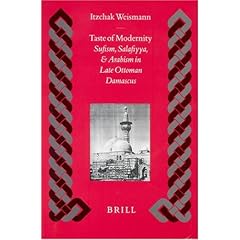
Itzchak Weismann is the best authority on Sufism in Syria during the 19th and 20th centuries. He is a professor at the University of Haifa and has written, Taste of Modernity: Sufism, Salafiyya, and Arabism in Late Ottoman Damascus (Leiden: Brill, 2000)

Weismann writes: Here are a few lines about this complex issue of Salafi-Sufi relations in Syria.

As long as one views Sufism as excessive reverence to the shaykhs, popular practices at saints’ tombs, etc., then it is possible to assert that Salafis are anti-Sufi. These forms of Sufism are not absent from the Syrian scene, although they have lost much of their vigor in the face of modernity. However, in the last two centuries the Syrian Sufi scene has been dominated by another type of Sufism, which stresses its commitment to orthodoxy and is active in the public sphere. This is mostly the case of the Naqshbandi, but also Shadhili and Khalwati brotherhoods.

Similarly, as long as one identifies the Salafiyya with the radical brand of Islam, then Salafis are undoubtedly anti-Sufi. The group that led the uprising of the 1970s and early 1980s belonged to this radical camp and was inspired by the teachings of Sayyid Qutb. But this is the minority among Islamists. Most Syrian Salafis, from their arrival on the scene in the late 19th century to the present, have been moderate Islamists and respectful of “correct” Sufism. [JL adds: This was the case of Said Hawa, one of Hama's most important Islamists in the post WWII era, about whom Weismann has written two great articles. Hawa disapproved of the warlike wing of the MB, arguing that Jihad could not be carried out against the unbelieving regime until Syria society had been properly educated and was prepared to push it aside. To this end, he argued that Sufism had an important role to play in mobilizing the Syrian people. Its tariqas needed to be used to provide an alternative network of schools to promote activism, resistance against the un-godliness of modern society, and orthodox belief. He accused the anti-Sufi Salafists of dividing Syrians and Islamic society. To unify Muslims, Hawa argued, the Muslim Brotherhood must be inclusive and unite all the important Islamic movements of  Syria under one organization.]Muhammad Abdu (Photo of Muhammad Abdu)

Moreover, and this is the main point, in Syria the Salafiyya has been usually allied with orthodox Sufism and with ulama who adhered to this type of Sufism. The early representatives of the Salafi trend in the Syrian cities originated in an orthodox Sufi background; many of them remained loyal to Sufism, though they wished to remold it into the spiritual-ethical aspect of Islam. The Muslim Brothers, too, were under strong Sufi influence, and particularly the northern branches of Aleppo and Hama were actually founded by activists affiliated with the Naqshbandiyya. In a way, they transformed the tariqa into a social movement in line with the requirement of the modern situation. They were thus more loyal than their Egyptian colleagues to the legacy of Hasan al-Banna, who kept Sufism part of the Muslim Brothers’ call.

As for today, the present head of the Syrian Islamic opposition, ‘Ali Sadr al-Din al-Bayanuni, comes from such a Sufi orthodox background. On the other hand, Ahmad Kuftaru, who faithfully served the regime for more than four decades, was also a Sufi shaykh of the Naqshbandiyya. But Kuftaru showed himself ready to adopt the Salafi discourse to the point of giving up most Sufi practices, and even the mere concept of Sufism. It would perhaps be correct to say that the Salafi discourse is the hegemonic religious discourse in today’s Syria, but this is an inclusive Salafism that has ample room for Sufism.  Best, Itzchak.  Email: [email protected]

Here are four articles written by Weismann that I have posted to the web. All are excellent and reveal different aspects of the long relationship between Sufism and Salafism in Syria. I have also added a recent article by Oliver Scharbrodt that explains Muhammad Abduh's Sufi beginnings in Egypt. Abdu, along with Jamal al-Din al-Afghani, was the founder of the modernist Salafi movement that began in Egypt and was expanded in Syria by his student, Muhammad Rashid Rida (1865-1935). It is a wonderful article and demonstrates the intellectual creativity and plasticity of Sufi thought, a plasticity Abdu was forced to renounce later in life in order to conform to the orthodoxy of Salafism.

  • Oliver Scharbrodt, "The Salafiyya and Sufism: Muhammad Abduh and his Risa¯lat al-Wa¯rida¯t (Treatise on Mystical Inspirations)," Bulletin of SOAS, 70, 1 (2007), 89–115.
  • Itzchak Weismann, "Sufi Brotherhoods in Syria and Israel – A Contemporary Overview."  
  • Itzchak Weismann, "The Politics of Popular Religion: Sufis, Salafis, and Muslim Brothers in Twentieth-Century Hamah," International Journal of Middle East Studies, vol. 37, 1 (2005).
  • Itzchak Weismann, “Sa‘id Hawwa: The Making of a Radical Muslim Thinker in Modern Syria,” Middle Eastern Studies 29 (1993), 607-611.
  • Itzchak Weismann, “Sa‘id Hawwa and Islamic Revivalism in Ba‘thist Syria,” Studia Islamica 85 (1997), 131-154. Said Hawa(photo of Sa'id Hawa)
  • The "Overview" article is a survey of Sufi orders, explaining which have survived the great changes of the 20th century and which have not. It also places the new Qubaysi tariqa for women, begun by Munirah al-Qubaysi, which has received so much attention, in context. (On the Qubasiyyat, read Ibrahim Hamidi and Katherine Zoepf

    Abstract of THE POLITICS OF POPULAR RELIGION: SUFIS, SALAFIS, AND MUSLIM BROTHERS IN 20TH-CENTURY HAMAH, Itzchak Weismann, International Journal of Middle East Studies (2005), 37: 39-58

    With the advent of the 20th century, Sufism found itself under increasing attack in many parts of the Muslim world. In previous centuries, mystical movements had played a prominent role in the struggle for the revival of Islam and occasionally, where governments were weak or nonexistent, also in actual resistance to European encroachment. In the wake of the increasing consolidation of the state and the spread of Western rationalism, however, Sufis came to be regarded as a major cause of the so-called decline of Islam and an obstacle to its adaptation. In the Arab world, this anti–Sufi feeling was generally associated with the Salafiyya trend. The Salafi call for a return to the example of the forefathers (al-salaf al-salih) amounted to a discrediting of latter-day tradition, which was described as cherishing mystical superstition as well as scholarly stagnation and political quietism. Under the burden of this critique, and as a response to the general expansion of education and literacy, Sufism has been forced to assimilate new ideas and to make room for a new form of organization; the populist Islamic association. These developments culminated in the establishment of the Society of the Muslim Brothers.

    On the splintering of the Muslim Brotherhood following Hama read Chris Kutschera,Wither the Syrian Muslim Brothers?, 1988.

    Addendum: Bernard Haykel, a professor at New York University, who is also working on Salafi movements, writes this on the relationship between Sufism and Salafism:

    As a rule of thumb, Salafis of the Wahhabi/Hanbali theological variety are anti-Sufi because they consider Sufism, in both its beliefs and practices, to consist of reprehensible innovations (bida`, sing. bid`a). 

    Unlike Salafis, the Muslim Brothers have historically not been doctrinaire about theological matters–but rather what I would call "broad mosque opportunists"–and therefore can be accepting of Sufism (as well as others, including Shiites).  However, those Brothers who have adopted Wahhabi views, and a good number have done so, are likely to be theologically doctrinaire and opposed to Sufism and Shiism. 

    The Brotherhood types who are in the Wahhabi fold evince hatred and animosity to both Sufism and Shiism of the 12ever/Imami kind, and there isn't even a debate about the Alawi-Nusayris who fall beyond the pale of Islam as far as the Wahhabis/Salafis are concerned. 

    The Salafis of the Muhammad Abduh variety no longer exist, as far as I can tell, and certainly are not thought of by others as Salafis since this term has been appropriated/co-opted fully by Salafis of the Ahl al-Hadith/Wahhabi variety.  In short, Salafis (if understood to be staunch Ahl al-Hadith/Wahhabi types) are viscerally opposed to Sufism and most forms of Islam that are not identical to their own–how many openly practicing and self-identifying Sufis are there in Najd? I know of one in Ha'il. Having said this, these staunch or doctrinaire Salafis are not of one kind, but rather come in different types with respect to questions of strict madhhab affiliation and political engagement or quietism. 

    As you can see, the answer is complicated.  I would not agree that Syria's Sunnis are all Sufis today, nor are they all or even 50% Salafi–besides what do these labels really mean when it comes to politics?  I would hazard that inasmuch as Sufism has been allowed deliberately to flourish by the Asad regime, those who choose to oppose Bashshar al-Asad are likely to be anti-Sufi and possibly, but not necessarily, identify as Salafi.  Not sure if any of this helps answer your question. Best wishes, Bernard (Joshua responds: "Yes it does. Thanks.")


    Joshua Landis will be in Paris for 5 days at a conference and will not be able to post until after May 17, alas.

    Eliott Abrams Says Rice’s Push For Mideast Peace Is ‘Just Process’

    | Forward, Fri. May 11, 2007

    Eliott Abrams Says Rice’s Push For Mideast Peace Is ‘Just Process’. 

    At a regular gathering of Jewish Republicans, sources said, Abrams described President Bush as an “emergency brake” who would prevent Israel from being pressed into a deal; during the breakfast gathering, the White House official also said that a lot of what is done during Rice’s frequent trips to the region is “just process” — steps needed in order to keep the Europeans and moderate Arab countries “on the team” and to make sure they feel that the United States is promoting peace in the Middle East…

    Nationally syndicated columnist Robert Novak accused Abrams of preventing the administration from having a “coherent Middle East policy” which would engage Iran and Syria in an attempt to stabilize Iraq. “I do know that there are a number of Israelis who would like to engage Syria,” Hagel told Novak. “They have said that Elliott Abrams keeps pushing them back.”

    Foreign ministers, ambassadors and former Americans officials as saying they believe Abrams “is making policy in the Middle East.” Israel, according to sources close to decision-makers in Jerusalem, also sees Abrams as the leading policy figure in the administration on Middle East issues, a status that has led Olmert to keep an open channel of communications with Bush’s senior adviser. According to the sources, Abrams is also a leading voice in trying to convince American Jews to be more supportive of the war in Iraq….

    Assad Rules out Cooperation with Hariri Tribunal if Sovereignty Threatened

    Assad Rules out Cooperation with Hariri Tirbunal if Sovereignty Threatened

    Syrian President Bashar Assad on Thursday ruled out cooperation with the international tribunal that would try ex-Premier Rafik Hariri's suspected assassins if it threatened Syria's sovereignty and independence. "We consider that the international tribunal concerns only Lebanon and the United Nations and that we are not directly concerned," Assad said in a speech to the newly elected parliament.

    "Any cooperation requested from Syria which could compromise our national sovereignty is rejected."

    "Syria is cooperating with the commission (investigating Hariri's murder) but not with the tribunal. There is a difference between cooperation and abandoning our independence," Assad told parliament.

    "We have cooperated with the international commission of inquiry and we reiterate our readiness to cooperate with it as long as it respects our laws and our sovereignty," he added.

    Assad also said that the current Israeli government was weak and is not prepared for a just peace with the Arabs.

    "Israel is not ready on the official and popular level for a just and comprehensive peace, which requires strong leadership that can take decisive decisions, in addition to a mature public opinion that can push its government in that direction," he said.

    "Both are not available now in Israel, particularly in the presence of a weak government which is unable to take a strategic decision (for peace), the Syrian leader said.

    But, he cautioned, "we have to be careful" because "in the history of Israel, weak governments are able to wage war."(AFP-AP-Naharnet)

    Assad said that Syria supported what the Lebanese agreed upon and Lebanon's peace was Syria's.

    Bashar al-Assad will deliver a speech at the opening session of the new Syrian Parliament 

    Rice: Syria Should Allow Creation of International Tribunal

    Ban Ki-moon will meet next week with members of the Security Council to discuss what steps the Council would take on the tribunal. It said the Council could act to break the deadlock on the court before the end of May after Ban was convinced that the tribunal wouldn't be formed locally.

    Sarkozy Underlines to Hariri France's Support for Tribunal

    “In response to Condoleezza Rice: political lessons which she forgot,” By Dr Imad Fawzi Al-Shu'aybi, Ad Diyyar, May 10 (Translation thanks to mideastwire.com)

    Dr Imad Fawzi Al-Shu'aybi, the director of the Center for Strategic Data and Studies in Damascus, wrote in the pro-opposition daily Ad Diyyar: “Ministers usually don’t write articles because their job is to act and not to talk, let alone if it is a foreign minister whose job is to stay silent and work in the backstage. [To foreign ministers], the press should remain a mere tool used to issue quick statements through which they would be able to deliver their messages or raise the level of political tension. However, things get more complicated if the issue is about the foreign minister of a superpower like is the case with Condoleezza Rice.

    “The Lebanese daily An Nahar chose to post [Rice’s article] as its main editorial to allow the aforementioned minister to address her message against Hezbollah and all those who are against the current Lebanese government. This government is in such a difficult position that it needs international ministers to come to Lebanon to support it at times, and at others, an article that will revive its faltering team. However, this is not the issue… The issue is that through her article, Ms. “Condi” wanted to threaten that she was pursuing her plan to have the international tribunal resolution issued through Chapter 7.

    “This has two interpretations: she either wanted to send a message which was hard for her to send through the diplomatic channels to the permanent members of the Security Council, telling them that the situation could no longer be tolerated and that she wanted them to settle their reluctant position regarding the ratification under the aforementioned chapter, or a message to the Lebanese forces among others, telling them that she decided to shut the door and not to adopt the middle-ground formula of issuing the resolution under Chapter 6 and with a Lebanese concord.

    “For your information Ms. Condi, one of the first principles of politics which you used to teach in college, is never to close the door… We teach our children in college that the policy of the “half-open door” and the policy of “never close the road before your enemy and always keep a way out for him…”, are the best crisis management policies. Managing crises is not conducted by closing doors and turning our backs on the main parties in the conflict. Ms. Condi, in political science, turning one’s back on the key forces and shutting the window of dialogue or compromise with them, pushes [things] towards an explosion.

    “And just as a reminder, professor and colleague, the explosion starts with a resolution or a blocked horizon but can’t be extinguished with a resolution. Managing the crisis through an explosion could have massive repercussions on the option of compromise in the overall package of regional-international issues in which you are involved… Ms. Rice, you are defeated in Iraq and in South Lebanon… Your project is collapsing… and not even your Creative Chaos can succeed without burning you with its flames like what is happening in Iraq… and like what happened to your ally in Lebanon. Yes, you are defeated but no one wants to break it to you.

    “You can withdraw with the highest level of media commotion… We have no problem with it. This gives you the chance to exit while defeated, while saving face… However, the problem resides in implicating those who believe you in Lebanon or in provoking a resolution that will block the way before all choices and chances of concord, in what would force you to seek a strategy to exit Lebanon instead of a strategy to exit Iraq. Ms. Rice, the first rule about political and military action says: “Do not open two fronts at the same time, let alone if you are defeated on the first front and in shock on the second…”

    Bush extends unilateral sanctions against Syria

    Brammertz Report update (Thanks to t_desco)

    Brammertz’ Report ‘Concluded’ After Koleilat Grilling: Naharnet, Asharq Al-Awsat

    Qoleilat ’sheds light on who killed Hariri’: The Daily Star

    Comments: In his latest press conference, Brammertz did not rule out the possibility of a conncetion between the Al-Madina and the Hariri case, but he stressed that the evidence gathered so far did not suggest a strong link concerning the motive of the crime, according to this report by Al-Akhbar.

    Later Monday, Rice responded with another public indication that Assad may soon have a partner for cooperation, telling Charlie Rose:

    "If there is to be a better relationship, of course, we can't have a situation in which the Syrians are permitting foreign forces to come across that border and kill Iraqis and kill Americans. And so that would — it would be a good step to have cooperation about border security for Iraq."

    The Secretary of State does not choose her vocabulary carelessly. "Cooperation" has become the new buzzword she is using when talking about Iraq-Syria border security. The US may "take this one step at a time," but Syria watchers can expect the next step to be a pretty big one.

    Michael Young dissapointed in America for Rice meeting with Syrians. America moves forward to the past, Thursday, May 10, 2007

    … The Syrians will not really give anything up to the Americans or anybody else, whether in Lebanon, on the Palestinian front, in eventual talks with Israel, or in their relations with Iran. Why should they? Assad's door is being scratched so frantically that he has little incentive to surrender the leverage that brought this about.

    The Syrian president has two priorities: saving his regime by undermining the Hariri tribunal and reimposing Syrian hegemony over Lebanon.

    The US has emerged as a fairly futile superpower, at least in the Middle East. For those of us who thought that the ousting of a tyrant like Saddam Hussein might usher in an era of pluralist change in the region, the disappointment is doubly felt.

    Kamal Labwani Sentenced to 12 Years in Prison

    Kamal Labwani convicted to 12 years in prison.  A Syrian dissident, Labwani has been jailed for 12 years in the harshest sentence against an opposition activist since Bashar al-Assad became president of Syria in 2000. Kamal Labwani, founder of the opposition Democratic Liberal Gathering in Syria, was convicted on Thursday of having contact with a foreign state "to encourage it to attack Syria." Labwani was arrested in November 2005 after holding talks with White House officials on a tour of the US and Europe. 
    .
    Read Labwani's interview with Joe Pace published on Syria Comment (August 6, 16, 21, 2005). It is excellent, lengthy, and should be read in its entirety. Here are some excerpts:
    .
    Background info:

    Kamal was a member of Riad Seif's civil society forum, which formed during the famous, but short lived, Damascus Spring (2000-2001). Both were arrested at the outset of the Damascus winter in 2001. He was released from prison last summer after completing his three year sentence and has recently started a new political party–or "union" as he calls it; parties are banned. In early August, some 200 people came to his house in Zebidane to discuss the founding charter, but the police closed down an entire neighborhood to prevent people from reaching his house and they stayed there for some 14 hours. According to Kamal, they warned him that Islamists who were displeased with his Liberal Democratic Union might murder him…and of course, Syrian security is in no position to prevent such a barberous act.

    The founding document is an interesting read for those who can read Arabic. Go to http://www.kamalm.com/ and click on "jideed." It is the most comprehensive, detailed charter of any opposition movement. I asked Kamal at one point why he went so far as to specify the structure of the bicameral legistlature, to which his response was, "we're preparing for the day when the regime falls. We're letting them know that we're thinking past their collapse and planning for the future. Its a type of pyschological warfare."

    Could you give me the background on you’re new party? What are its guiding principles?

    We have a union and not a party in the popular sense of the word. The union is based on three principles: democracy, liberalism, and secularism. The opposition is fractured and we are trying to unite it and the only thing that people are united on is those three principles.

    You mentioned that you wanted you’re project to include all of the parties. How much of the opposition and the Syrian public are committed or receptive to liberalism?

    I was probing society in order to determine the true magnitude of support, but it’s difficult because there is no freedom of discussion. But from my discussions, I can say that about 70% of Syrians are receptive to liberalism and maybe from a background that would make them receptive to liberalism. At the very least, 70% would be receptive and accepting of these ideas if we are able to convey them, if we are able to reach the people and dialogue with them. The political forces that exist today are ancient inheritances… They have not produced anything new. During Damascus Spring we tried to form new currents like the movement for civil society and the forums but they were crushed. The state planted its supporters in the movements and they failed.

    But even among those forces that exist today, 50% are willing to leave their organizations and work with us in a new environment. And this is what’s encouraging us—getting two hundred people on board is no easy task. In a country dominated by oppression, many organizations have only five or ten real members.

    The entire project? The founding document calls for civil marriages, complete equality for women including equal inheritance, and separation of religion and state. Don’t you think those points might meet with opposition amongst the religious masses?

    I think that 50% of society—i.e. the women—will endorse these ideas because they have a direct interest. No one refuses a right that is offered to them. None of them are going to refuse equal inheritance. I’m speaking about the women because they are oppressed; you’re speaking about the men. Nonetheless, I suspect half the men would endorse these ideas and if half the men and all the women do, we have 75% support.

    In terms of the secular component, everybody is beginning to recognize the need for a separation of religion and state after witnessing the terrible events in Iraq and Lebanon. Otherwise we will be divided along sectarian lines because we are a country of many sects and ethnicities.

    And when we say that the religious figures shouldn’t be in power we don’t want to promote atheism or undermine religion.

    Pace: You say that people recognize the need for secularism. How do you reconcile that with what appears to be an Islamic resurgence in Syria?

    Labwani: The Islamic resurgence is happening for several reasons. One part of the resurgence is a protest to despotism. Another is a protest to sectarian discrimination because the regime is sectarian. Another is a response to the failure of Marxist and Nasserist ideologies. But this resurgence is not antagonistic to our project. We are not the antithesis of the resurgence; on the contrary, we want to absorb it into our project. We are able to do this—we have met with many devout people and they accepted the project. I think that a lot of those people that you are talking about consider religion a source of morals and values. They will be with us, not on the other side. It was originally part of my idea to bring them into this project, to find mutual interests and find the values shared by Islam and modern liberalism. This political and cultural project is extremely important and I will focus much of my efforts on this point.

    Without this project it will never be possible to rid ourselves of cultural and intellectual backwardness that constitutes the groundwork for terrorism and extremism. This is the essence of the project: bringing these sorts of groups into the political arena where they are part of civilization and respect other viewpoints. Even Europe couldn’t advance until Christianity underwent a transformative reformation. In Europe, the Christians were responsible for the Inquisition and countless executions prior to the advent of liberalism. If we can reconcile Islam and liberalism, Islam will be more urbane, tolerant, and averse to violence.

    We’ve been unjustly frightened by them. They are ready to endorse these acceptable things. Those who are extremists stake out a radical position because they have been wronged and deprived of everything.

    What sort of complaints, apprehensions, or demands have the religious groups you’ve met with displayed in response to the founding charter?

    They have accepted that the government should not be religious in character and that the president be elected irrespective of his religion. They have accepted that the parliament will be the source of legislation, not the Qur’an. They have deep convictions about the authority of the Qur’an, but they don’t want to impose it on people because we have other religions in Syria like Christianity. Even the Muslim Brotherhood—its leader, Bayanuni said that the Qur’an is to them the source of legislation, but they would not impose it in any constitution.

    Of course, there are people who oppose secularism. This secular regime has brutally oppressed those sorts of people, so they are against secularism as part of their opposition to the current regime. But once we achieve a secular democracy that ensures the right of expression, the right to participate in politics, civil rights, provides work opportunities, etc—I think that they will defend this system, not fight it. The greatest mistake was the marriage of despotism and secularism because opposition to this regime—to many people, at least—entails opposition to secularism.

    Having an assembly is one thing, but how can you pressure the regime to even listen to your demands? Does foreign pressure have a role in implementing your agenda?

    The strategy is to dislodge the regime. The regime is very weak, but the power of society is even weaker. Our confrontation with the authorities will be symbolic: we will violate every taboo and cross every red line that they have drawn. We have recently reached a stage in which we can expand the opposition’s activities and speak about almost whatever we wish with the press without fear. We have surpassed that prohibition, at least. We’re trying to reach the street, but on that issue they are still playing games with us.

    We are trying to create a framework for a new form of government and the regime is afraid of this; this is why it has returned to its use of oppressive tactics like refusing to let people meet in their own houses. It will cease to be effective in the foreseeable future because we expect one of the following: either a spontaneous, violent reaction from the street like what happened in Qamashli, or international pressures, or even events within the regime. This is the sort of regime where if you apply pressure on it, its inner elements will prove incapable of cooperating with one another and it will implode. So the combination of foreign pressure and social pressure along with the internal congestion this regime suffers from will open up an avenue for change. We can’t say exactly where the avenue will open up; it’s like putting pressure on a water bottle. 

    What’s the role of foreign powers in assisting reform?

    The foreign role is very important. We cannot overcome this crisis peacefully without international guarantees. Foreign pressure is decisive—it will determine whether Syria is marred by chaos or whether it undergoes a peaceful transition of power. And this role will be important for at least ten years to come because at present we are incapable of forming a complete awareness that incorporates all of the movements. So I think that the sincere Syrians internally should work with sincere external powers to help Syria transition from despotism to democracy. The absence of either side will doom this project.

    Specifically, what sort of foreign pressures do you advocate?

    All sorts of pressures. Unfortunately, economic pressures would be felt by the people because the regime is shielded by its corruption. Military pressure is dangerous but possible if it focused solely on the symbols of the regime. The most important thing is that the pressure be applied directly to those in power.

    How do you apply pressure on the regime without negatively impacting the people?

    The names of every person who violates human rights, like officers, should be put on a blacklist along with the symbols of corruption. And their assets should be tracked down. This is legal, natural, and part of the job of the international community. Any person who violates human rights should be tried in an international court, which we should be able to appeal to. The United Nations is entitled by law to interfere with a country’s internal affairs to combat oppression and servitude. Dictatorship is the last form of servitude.

    Diplomatic isolation is another option; diplomatic relations should be conditioned on respect for human rights. The European Union is trying to get its economic agreement passed with Syria in order to save this regime from American pressures and they have not stipulated clear conditions regarding human rights. So perhaps the international community can place enough moral pressure on the regime to prompt change. Everyone saw in Lebanon how the United Nations managed to quickly achieve an agenda that the Lebanese themselves were incapable of for years. The Syrian army immediately withdrew and they held elections. But right now there isn’t any real pressure being placed on Syria, especially from the European front.

    There’s a difference between pressures placed on the regime—i.e. penalties imposed when it violates human rights—and direct assistance to the opposition—i.e. material or organizational support. What sort of the latter do you want from the international community?

    The first thing is monitoring the regime’s behavior and highlighting its infractions in the press. The press would provide us a forum to reach the people which is very important because the oppression here prohibits us from transmitting our ideas to the street. The foreign press is much more capable and its use will strengthen us.

    The second form of assistance is material support—relationships with the embassies, with international organizations, help in publishing and disseminating, etc. Maybe we could reach a stage where we received financial support, though this is dangerous because it could corrupt the organizations. If we did accept money it would have to be public, transparent, and with the knowledge of the regime.

    I think those three things—the pressure, the press support, and material support—would be enough to turn the opposition into a significant force in society. And the combination of those three would drastically facilitate the dislodging of this regime.

    What are you’re thoughts on the Syrian opposition in America, such as Farid Ghadry’s party [Syrian Reform Party]?

    In politics, everyone tried to preserve their own interests and they have a right to pursue their interests. But they are different from us—their circumstances and their demands differ. We are living inside the country so our demands are oriented towards internal affairs. They are interesting in being able to come and go freely and in investing. They may be duplicitous because they have two different loyalties—one to Syria and one to America. We might be able to work together and they might be able to help us, especially if they can influence US decision making and we would be willing to welcome them, but on the condition that the program comes from the inside.

    Does Farid Ghadry’s party have any base or support in Syria?

    None whatsoever. He doesn’t have anyone inside the country and anyone who did cooperate with him would be accused of treason and arrested. His party has called for military invasion of Syria, so nobody is going to work with him. 

    What do you think is the real purpose of America’s project to remake the region?

    I think that America wants to make important changes in the region, especially towards democracy. But they are no longer able to present any evidence to convince people that they are serious in their desire to promote democracy.

    If America wants to convince people that it’s serious about its desire to promote democracy, democracy needs to be its first priority. Their first demand cannot be Iraq, followed by Israel, followed by Lebanon when 18 million people are suffering inside of Syria. The US presents 15 demands and not a single one has anything to do with the internal situation. The first, second, third, fourth, and fifth demands need to be directed towards internal politics.

    You cannot expect the people to be allies in your efforts to fight terrorism when you are supported the foul acts of the regimes that you have supported for 40 years. I cannot forget who America counts as its allies—Mubarak’s regime, the Hashemites in Jordan, and even the Syria regime, which, in many regards, is an ally of America. If American doesn’t change its policy, people are going to remain skeptical.

    The only way for America to regain its credibility is to change its policy and to demonstrate that it is interested in and cognizant of the afflictions that the Syrians are suffering from. Syrians need to see official statements to this end.

    Is the US embassy doing anything to support civil society or dissidents in Syria?

    Not at all. The group that is working on that agenda is extremely weak. They deal with us through a single person who barely speaks Arabic and is incapable of initiating anything. Basically, all they do is jot down notes on the latest news of the opposition, the sort of news that they could just as easily obtain from a newspaper. They have demonstrated no willingness to coordinate or cooperate with the elements of civil society. The US is not counting on the opposition to play any internal role.

    Syria has been left out of the US’s agenda to promote democracy in the region—the US hasn’t exerted pressure on the regime to respect human rights nor has it given any funding from the Middle East Partnership Initiative (MEPI) to Syrian civil society. Why do you think Syria is the exception?

    Maybe they are afraid that if they give people money, they will expose them to danger. There is a law that sentences people to a minimum of three years for accepting foreign money and the emergency law imposes the death penalty for such an offense. Maybe the Americans are afraid of subjecting someone to that sort of punishment.

    Some opposition figures say that moral support from America would actually undermine their credibility by enabling the regime to dismiss them as traitors. Do you think moral support from America is potentially counter-productive?

    It would make sense to call me a traitor if I was from the outside, but I spent my entire life here and I don’t need a certificate of good behavior. If I was to cooperate with the Americans and benefited from its pressures it would be for the popular interest and no one would accuse me of being an American agent. I want the American pressures to increase because we profit from them. It’s only natural that we would look to the superpowers of our day to help motivate change.

    We cannot deny that American foreign policy has undergone tremendous changes in the aftermath of September 11. We have recognized those changes but the people still have not. I am prepared to work with the international community for the sake of bringing democracy to America and this is not something that warrants accusations—on the contrary, it will enhance our power to serve the people’s interests.

    How did the Lebanon withdrawal impact the opposition and the credibility of the regime? Did it encourage people to mobilize?

    The withdrawal influenced people morally but that wasn’t reflected materially because the regime began to clamp down even more internally to compensate for its loss of Lebanon.

    How did the Iraq war impact the opposition?

    There were two divergent effects. In the beginning, the fall of Saddam had a huge effect and gave people hope. But when the situation in Iraq deteriorated, it had the opposite effect: people began to fear for the future. Even when the greatest powers intervened in Iraq they were unable to achieve stability, which indicates a real problem.

    This society doesn’t understand that there is another force intent on ensuring instability in Iraq. The whole world is conspiring against the Iraqi people to foster instability so that the American project fails—all of Iraq’s neighbors and even some of America’s allies. Even the Europeans are contributing to this. For this reason, the Iraqi people are paying a tremendous price. And this left a negative mark on the Syrian opposition.

    Some people contend that the West has much to fear from democracy in the Arab world because the Islamists would win. How do you address this concern?

    That concern is exaggerated because elections aren’t going to occur tomorrow. Elections are the last, not the first step, in the transition to democracy. The first step is freedom of speech and political parties and only when there is an informed public opinion will there be elections. But that requires a year or two. In that time period, the Islamist parties will not dominate; if you give us freedom, you have nothing to fear from the ballot box. 

    “The Difference Between Wahhabis and Muslim Brothers,” by David Commins

    This is the first part in a series of articles I will post on the relationship between Salafism and Sufism in Syria. The idea to commission different experts to write on this subject is a result of the questions raised by commentators on this earlier post on Islam in Syria, here (read the last 15 comments of the post).

    Background: Today, the US administration is debating whether it can or should use the new Syrian opposition party – the National Salvation Front (NSF) – as leverage against the Assad regime in Syria. Is it a genuine democratic option? The NSF was created last year to combine the forces of ex-Vice President Abdal Halim Khaddam, who was a Baathist, and the Muslim Brotherhood in Syria, whish is led by Ali Sadreddine Bayanouni. The new front and its leaders claim to embrace democracy, pluralism, and the rule of law.

    One of the main arguments made by the Syrian Muslim Brotherhood for why they should be trusted as pluralists is that they distinguish themselves from the intolerant Wahhabis of Saudi Arabia. They claim that they do not endorse and never did endorse the break-away branch of the Muslim Brotherhood, which led the violence of the late 1970s leading up to the Hama uprising of 1982. Another claim they make for why Islamic parties in Syria should threaten neither Syrian minorities nor western governments is that most Syrian Muslims are Sufis. Salafis in Syria, they argue, also embrace Sufism, something Salafis in the Gulf do not do. Because Sufism is a tolerant and peaceful brand of Islam, they insist, Syrian Islamists will be tolerant and peaceful.

    But how true are these claims? Is the Syrian Salafist movement substantially different from the Wahhabi Salafists of Saudi Arabia? Do they embrace Sufism, and does that mean they are more tolerant and pluralist than other Muslims? These are some of the questions I have asked a number of scholars to address. The first of these scholars is David Commins.

    David Commins, a professor at Dickinson College in Pennsylvania, has written two excellent books on Salafism in Syria and Wahhabism in Saudi Arabia. He explains the different attitudes on Sufism between the Salafis of Syria, who were influenced by their Egyptian counterparts and the Wahhabi Salafis of Saudi Arabia.

    David Commins writes:

    It seems to me that different tendencies have claimed the salafi mantle in modern times, so divergences between Syrian Muslim Brothers and Saudi Wahhabis are not surprising.  Nor would it be surprising if there were different tendencies within the Muslim Brothers on matters such as Sufism and the standing of Shia as believers.

    Regarding the specific issue of Sufism in the longer view: The Wahhabi salafis regard Sufi practices as illegitimate innovations and those who cling to them they consider infidels.  Their position on Sufi practices is not identical to that of Ibn Taymiyya, whose own Sufi affiliation with the Qadiri tariqa George Makdisi discussed.  The salafis in late Ottoman Damascus led by Jamal al-Din al-Qasimi disapproved of certain Sufi practices but did not condemn Sufism entirely.  The Syrian salafis certainly held a more favorable view of the Wahhabis than did most Muslims of that era, primarily due to their common interest in purifying ritual practices of what they considered ritual innovations.  The religious scholars of Damascus who opposed the salafis considered themselves defenders of proper Muslim ways and claimed the salafis were the same as Wahhabis (in their view, doctrinal extremists akin to Kharijites), but we need to view that charge in the context of a religious controversy and acknowledge points where Syrian salafis and Wahhabis differed.  They disagreed on adherence to legal schools: Wahhabis follow the Hanbali school while Qasimi did not believe in strictly following a single legal school.  They disagreed on politics: Qasimi strongly endorsed constitutional parliamentary government, while Wahhabis have no qualms with hereditary monarchy.  As for how the Wahhabis viewed the Syrian salafis, I have not come across specific evidence.  There is indirect evidence of cooperation in the published correspondence between Qasimi and the Baghdad scholar Mahmud Shukri al-Alusi, where the two men mention cooperating with Najdi contacts striving to bring to light works of Ibn Taymiyya.

    As for the Muslim Brothers, it is important to recall that Hasan al-Banna referred to the Brothers as a salafi message and a Sufi truth.  In this light, that Syrian Muslim Brothers have maintained Sufi allegiances is not surprising.  I think the key point to keep in mind is that ‘salafi’ assumes different forms in different places and times.  There is certainly consistency in the emphasis on the authority of Islam’s founding generations, but the texts from Islam’s early centuries are rich enough to justify different views on the standing of individuals as believers or infidels (takfir), legal school affiliation, Sufism, and political systems.  If there is debate in contemporary Syria on what qualifies as salafi and the correct salafi position on Sufism, that should not be surprising as debate, not uniformity, is the norm in the history of Islamic thought.

    It may be helpful to readers to have what I consider a very broad sketch of some basic differences between the Brothers and the Wahhabis that are rooted in the origins, one in interwar Egypt, the other in eighteenth century Najd.  To that end, I am attaching a couple of pages (slightly modified) from my book that compares Hasan al-Banna and Wahhabi thought in a few key areas.  References are in the book. 

    David Commins, The Wahhabi Mission and Saudi Arabia. I. B. Tauris (February 2, 2006). From pp. 141-143.

    Hasan al-Banna shared with the Wahhabis a strong revulsion against Western influences and unwavering confidence that Islam is both the true religion and a sufficient foundation for conducting worldly affairs.  Nevertheless, significant differences separate the Najdi movement from the modern revivalist agenda because the former stemmed from Muhammad ibn Abd al-Wahhab’s distinctive views on doctrine whereas the Muslim Brothers were a reaction against European domination and cultural invasion.  On the central Wahhabi doctrine of monotheism, Banna held that only the open proclamation of apostasy, denying well-known beliefs and religious obligations, and deliberately twisting the meaning of the Quran rendered the believer an infidel.  While he agreed with the Wahhabis on the need to purify religious practices of illegitimate innovations, he saw nothing wrong with visits to the tombs of holy men as long as one did not seek their intercession.  As a youth, he had been active in a sufi order and although he would later criticize sufism’s ‘corrupt’ aspects, he maintained that its emphasis on asceticism and mindfulness of God made it an essential part of Islam.  In fact, he exhorted Muslim Brothers to practice individual and group dhikr, a ritual ‘mentioning’ of God, to strengthen the believers’ mindfulness of God and the Prophet’s example.  Dhikr is a hallmark of sufi practice and considered by the Wahhabis an illegitimate innovation. More generally, Banna’s keen desire for Muslim unity to ward off Western imperialism led him to espouse an inclusive definition of the community of believers.  Thus, he would urge his followers, ‘Let us cooperate in those things on which we can agree and be lenient in those on which we cannot.’  Banna did not share the Wahhabi view that most Muslims were idolaters.

    Banna also differed from the Wahhabis in his political ideas.  He lived during Egypt’s phase of constitutional parliamentary government and his writings reflect that context’s influence.  He maintained that constitutional government meshed with Islamic principles because it ensured a ruler’s accountability to the people.  He lamented the failure of the Egyptian constitution of his day to establish Islam as the fundamental basis for public life, but did not regard constitutionalism as contrary to Islam.  Wahhabi doctrine does not support constitutional rule.  Whereas Banna denied the legitimacy of hereditary monarchy in Islam, Wahhabi ulama have supported the Saudi monarchy.    

    A salient element in Banna’s notion of Islam as a total way of life came from the idea (current since the mid-nineteenth century) that the Muslim world was backward, and the corollary (current since the early twentieth century) that the state was responsible for guaranteeing decent living conditions for its citizens.  He argued that the government had the duty to minimize unemployment, guarantee a minimum wage and health care for workers, and ensure the fair distribution of wealth.  Such notions are alien to Wahhabism. Other assumptions of the modern state permeated Banna’s outlook. He considered public education a critical vehicle for bolstering Muslim society against Western influences (which did not exist in eighteenth-century Najd).  Muslim schools would teach pupils about Islam and encourage them to eschew foreign ways.The central area of accord between the Brothers and the Wahhabis is their moral zeal and rejection of Western ways that threaten to erode piety and undermine Muslim custom.  Western influences arrived in Saudi Arabia much later than Egypt, but when they did, the Wahhabis exhibited a similar revulsion toward them and agreed with the Muslim Brother view of European culture as one of godlessness, immorality, and excessive individualism. It is true that Muhammad ibn Abd al-Wahhab and Hasan al-Banna would have seen eye to eye on the ruler’s responsibility to eliminate immoral habits. They would also have concurred on the duty of the ruler (or the state) to appoint (or employ) pious believers to responsible positions to ensure proper observance and enforcement of religious duties and principles.

    In the face of foreign forces that seemed to have the power to totally overwhelm every bastion of Muslims’ lives—economic, political, cultural, and moral—the Muslim Brothers’ assertion that Islam was not just a religion but an entire way of life represented a logical stance of resistance.  The irony is that the position entailed reshaping Islam into religious nationalism and incorporating a notion of backwardness that made sense only in the context of the modern confrontation with the West.  Briefly, to save Islam, Muslims had to change it.  This reflects the different historical circumstances surrounding the appearance of the Muslim Brothers and Wahhabism.  It is common for writers on Muhammad ibn Abd al-Wahhab to assert that he sought a social renewal of Arabia, but that characterization is never given specific substance, unless one considers ritual correctness and moral purity to constitute such renewal.  The problem with such generalizations is they encourage facile comparisons with Islamist movements, when in fact Najd’s eighteenth-century reformer would have found key elements in Hasan al-Banna’s writings utterly alien.  In sum, the twentieth century alliance between Wahhabis and Muslim Brothers had a narrow base in religious doctrine, but a shared commitment to combat powerful secular forces seeping into Muslim societies.

    For readers interested in the early twentieth century debate on Wahhabism in Damascus, here are some useful sources:

    Mustafa al-Shatti, al-Nuqul al-shar`iyya fi al-radd ala al-wahhabiyya (Damascus, 1900).

    Ata al-Kasm, al-Aqwal al-murdiya fi al-radd ala al-wahhabiyya. (Cairo, 1901)

    Ahmad al-Mu’ayyad al-Azmi, Jala’ al-awham `an madhahib al-a’imma al-`azam wa al-tawassul bi-jah khayr al-anam alayhi al-salah wa al-salam (Damascus, 1911).

    Abd al-Qadir ibn al-Sayyid Muhammad Salih al-Kaylani al-Iskandarani, Al-Nafha al-zakiya fi al-radd ala shubuh al-firqa al-wahhabiyya (Damascus, 1922)

    Muhammad Tawfiq al-Suqiya, Tabyin al-haqq wa al-sawab fi al-radd ala atba` Ibn Abd al-Wahhab (Damascus, 1922)

    Abu al-Yasar al-Dimashqi al-Maydani (Muhammad Bahjat al-Bitar), Nazara fi risalat al-nafha al-zakiya fi al-radd ala shubah al-firqa al-wahhabiyya (Damascus, 1922),

    Ahmad Fawzi al-Sa’ati, al-Insaf fi da`wat al-wahhabiyya wa khusumihim li-raf` al-khilaf (Damascus, 1922)

    The Qasimi-Alusi correspondence is in Muhammad ibn Nasir al-`Ajmi, al-Rasa’il al-mutabadala bayna Jamal al-Din al-Qasimi wa Mahmud Shukri al-Alusi (Beirut, 2001).

    News Roundup (8 May 2007) Rice Says Yes to Chapter VII Tribunal

    US Secretary of State urges establishment of Hariri tribunal in Lebanese newspaper editorial

    (AP)–U.S. Secretary of State Condoleezza Rice has urged the establishment of an international criminal tribunal to bring to trial those responsible for the killing of former Lebanese Prime Minister Rafik Hariri. In a front-page editorial published in the leading Arabic-language newspaper An-Nahar, Rice warned the U.N. would act on its own if the Lebanese parliament failed to give the go-ahead for the establishment of such a court.

    Lebanon’s parliament must approve its establishment, but the process has been deadlocked amid deep political divisions. Although it is supported by the U.S.-backed government, the opposition led by the pro-Syrian and pro-Iranian Hezbollah has balked at supporting its establishment. The editorial was apparently aimed at assuring the U.S.’s allies in Lebanon that there was no change in policy after Rice’s meeting with Syria’s foreign minister last week.

    The parliamentary impasse prompted the anti-Syrian parliamentary majority to demand that the U.N. Security Council impose the tribunal on Lebanon, but the Security Council has so far refrained from taking such a decision. “The special tribunal for Lebanon will help end this sad era of impunity,” Rice wrote in the editorial, titled ‘A tribunal for Lebanon: time to end impunity for murder.’

    Although Rice’s position wasn’t new, its publication in a leading Lebanese daily ensures widespread dissemination of the U.S. view. Rice wrote the tribunal wouldn’t only help uncover those responsible for the killing, but help strengthen security and stability in the country. She added the U.S. believes the “best option” would be for the tribunal to be approved by the Lebanese parliament. If that proves impossible, then the international community “consistent with its pledge to help the Lebanese people achieve their vision of a free and democratic Lebanon will use every means at its disposal to further the pursuit of justice and to put an end to the current campaign of assassinations.”

    Rice added the “enemies of truth have resorted to subterfuge and intimidation to prevent the establishment of the tribunal” to deprive the Lebanese of justice. She also criticized the opposition’s campaign to unseat the government of Prime Minister Fuad Saniora. Hezbollah is on the U.S. list of the terrorist organizations.

    EHSANI2 added: Dr. Landis,

    Yesterday, Mr. Assad downplayed the significance of the Rice-Mouallem meeting, claiming that it was not a breakthrough. As the story above shows, Secretary Rice has chosen the An-Nahar to give a very clear signal about her country’s intentions. This sure sounds consistent with what your friend told you in the post above. There are also reports that Brammertz has already started sending some of his investigators home as his report is almost complete.

    As one Lebanese friend keeps telling me: "If the U.S. will lose Lebanon to Syria, it should pack and leave the region once and for all. If it cannot win in a nation of 4 million people with over 50% who support it, what chance does it have in the wider Arab world?" The U.S. needs to show a victory somewhere. If Bashar beats them in Lebanon, it would send a huge message in the region. Rice is trying to tell people that this will not happen. Let us see what the next 4-6 weeks bring. (we keep waiting for the next 4-6 weeks.)

    Rice Says U.S. Is `Not Looking to Leave Iraq': Charlie Rose

    Ehsani Writes: "I just watched a charlie rose interview with Rice. She left absolutely no doubt that the tribunal will take place. Asked if there was an exit strategy in Iraq, she said that "we are not looking to leave Iraq" till we have done our work and make sure that Iraq's neighbors do not meddle with its affairs."

    DAMASCUS, Syria: Syrian President Bashar Assad on Monday said last week's talks between his country's foreign minister and U.S. Secretary of State Condoleezza Rice were not a "breakthrough," instead accusing the Bush administration of making Damascus a scapegoat for the failures in Iraq.

    Thursday's talks on Iraq's deteriorating security situation between Rice and Syrian Foreign Minister Walid Moallem were billed as a diplomatic turning point for the Bush administration, which has long refused to talk to Damascus.

    But Assad would not go as far to say the talks were the end to poor relations between the two countries, saying it is difficult to make progress over Iraq's security when there are "bad political relations."

    "It's too early to say it's a breakthrough. …We are still waiting to see how they (the U.S.) want to start," Assad said during an interview with NBC'S "Today" show.

    The Rice-Moallem talks — held on the sidelines of an international conference on Iraq's future at Egypt's Red Sea resort of Sharm el-Sheik — were the first Cabinet-level talks in years between the countries.

    NBC interview with Assad by Ann Curry. President speaks about US allegations it is supporting Iraqi resitance.

    Syrian ambassador says the U.S. 'obsessed' with military solution in Iraq By ANDREW DeMILLO, AP, 8 May 2007

    Syria's ambassador said the Bush administration is obsessed with seeking a military solution for Iraq at the expense of diplomacy, and noted it might be too late for the White House to bring stability to the strife-torn country.

    "The situation has deteriorated to a level that, to be honest, we don't know how it can be salvaged from further deterioration," Syrian Ambassador Imad Moustapha said during a Monday night speech at the University of Arkansas Clinton School of Public Service.

    Moustapha spoke after the first cabinet-level talks between Syria and the United States last week, and said the United States is not focusing enough on the political process in Iraq but is "obsessed with a security solution."

    He added: "every day that passes without some attention to finding a solution will make it more and more difficult."

    Iraq's embattled prime minister has been leaning on the U.S. to engage Syria and Iran, arguing they could help lessen the violence in neighboring Iraq. Washington accuses Syria of looking the other way while fighters from many countries cross its border join the ranks of al-Qaida and other insurgent groups in Iraq.

    Compounding Iraq's problems, Moustapha said, is the fact that most of the 1.5 million Iraqi refugees who have fled into Syria are middle-class workers such as teachers, lawyers and doctors.

    "The middle class is staying out," Moustapha said. "Without the middle class, you can't have a state."

    "This is why we're saying probably now it's too late after four years of disasters," Moustapha said.

    Syria still wants to help and believes that the United States could still solve the problems in Iraq.

    "We believe this is an opportunity for the United States to change its attitude toward the region and start engaging us and the rest of the region," Moustapha said.

    Moustapha said he was hopeful that last week's talks on Iraq between Secretary of State Condoleezza Rice and Syrian Foreign Minister Walid Moallem were a starting point for a new relationship between the two countries.

    "Across the political scene in Washington, attitudes are starting to change toward Syria," Moustapha said.

    Hezbollah rejects forming tribunal under Chapter 7, DPA, May 6, 2007

    Hezbollah leader Sheikh Hassan Nasrallah said late Sunday that a proposed international tribunal to try suspects in the 2005 assassination of a former Lebanese prime minister Rafik Hariri must first be ratified by the Lebanese Parliament.

    The leader of the Lebanese Shiite movement said that Hezbollah rejects any imposed United Nations Security Council decision to form an international tribunal in the Hariri case without first receiving approval in the politically divided country.

    Nasrallah meant that the UN should only approve the tribunal after parliament ratification, not just by agreement with the Western- backed Beirut government. For months, Hezbollah has calling for the Lebanese government to step down.

    ‘We consider any resolution issued by the Security Council (on the tribunal) illegitimate and illegal and without value because it violates the Lebanese national interest,’ he said in an interview with Iran’s Arabic-language al-Alam state television station.

    ‘We hope that things don’t get there.’

    NSC Chairman: Syrian call for peace talks with Israel ‘authentic’, By Shahar Ilan, Haaretz, 07/05/2007

    National Security Council (NSC) Chairman Ilan Mizrahi said Monday that “Syria’s call for dialogue with Israel is authentic.”

    Speaking to the Knesset Foreign Affairs and Defense Committee, Mizrahi added that it is difficult to determine whether Syria is interested in peace, or just a peace process.

    The NSC chairman briefed the committee on the process of the strengthening of Islamic extremism, saying Al-Qaida is establishing itself in Lebanon – among other reasons, in order to play a role in a potential future power struggle in the country. At the same time, the organization is active in Egypt's Sinai peninsula, and is trying to gain a foothold in Jordan, Mizrahi said.

    UN Chief in Syria says Assad not preparing for war, Jerusalem Post, May. 8, 2007

    Says more military activity in Israel than in Syria; Israeli defense officials reject assessment; NSC head: Peace overtures genuine.

    “Within my area of responsibility, there is no military buildup,” Jilke told the Post in his first interview since taking up the post in February. “From my point of view there is nothing on level of strategic interest that could or would lead to concern [for Israel].”

    Jilke said Syria was repairing trenches and positions along the border with Israel, but that within the areas of limitation, Syria had only amassed 40 percent of the permitted forces. There was more military activity on the Israeli side of the border, he said.

    “We are much below the allowed figures,” Jilke said. “There is a peaceful atmosphere and there is no intention to prepare for war.”

    "Talk to Syria," By Dennis Ross, New Republic Online, May 7, 2007

    …. If Syrian President Bashar Assad is willing to talk, shouldn't Israel engage Syria and see if a war can be averted? (For some, there is the possible added benefit that discussions with Syria might also be useful for weaning Syria away Iran and for imposing limits on Hezbollah and Hamas.) …

    The lesson here is that the Bush administration needs to think far more carefully about its position on talks with the Syrians. Rather than simply telling the Israelis "no," it should work out a coordinated game plan with the Israelis, including common red lines for the talks. It should coordinate with the Lebanese to reassure Prime Minister Fouad Siniora's government about the purpose of the talks — and then give them regular briefings on what takes place in them. Ultimately, the Bush administration has very little interest in an Israeli-Syrian war. Maybe it is time for it to shape an approach to negotiations and not allow either the United States or Israel to be driven into talks in a way that reduces our respective leverage. That would be an act of effective statecraft.

    "Divide and Rule: U.S. Blocks Israel-Syria Talks," by Stephen Zunes

    Foreign Ministry conducting project to prepare to renew talks with Syria

    Foreign Minister Tzipi Livni is currently conducting staff work to prepare for the possibility of a renewed peace process with Syria, sources in the Foreign Ministry told Haaretz.

    No conclusions have yet been presented to Prime Minister Ehud Olmert, as the project is not finished. However, a ministry source said, “If the prime minister decides that he wants to hear it, we have a prepared plan – from the operational aspect as well.”

    Damascus moves to center stage By Sami Moubayed

    DAMASCUS – Fifty years ago, alarmed that Syria was becoming dangerously close to the Soviet Union, US president Dwight Eisenhower authorized a series of operations aimed at isolating, weakening and eventually overthrowing the regime of president Shukri al-Quwatli.

    The Central Intelligence Agency tried to pull off two coups in Damascus. Both of them failed. The US then pursued a policy of

    funding the Syrian opposition. US intelligence reports on Syria during the years 1956-58 are hauntingly similar to press reports coming out of Washington in 2005-07 – only the word "Soviet" is replaced by "Iranian".

    Why Israel is after me," by Azmi Bishara, LA Times, 3 May 2007

    Amman, Jordan — I AM A PALESTINIAN from Nazareth, a citizen of Israel and was, until last month, a member of the Israeli parliament.

    But now, in an ironic twist reminiscent of France’s Dreyfus affair — in which a French Jew was accused of disloyalty to the state — the government of Israel is accusing me of aiding the enemy during Israel’s failed war against Lebanon in July.

    Israeli police apparently suspect me of passing information to a foreign agent and of receiving money in return. Under Israeli law, anyone — a journalist or a personal friend — can be defined as a “foreign agent” by the Israeli security apparatus. Such charges can lead to life imprisonment or even the death penalty.

    The allegations are ridiculous….

    These trumped-up charges, which I firmly reject and deny, are only the latest in a series of attempts to silence me and others involved in the struggle of the Palestinian Arab citizens of Israel to live in a state of all its citizens, not one that grants rights and privileges to Jews that it denies to non-Jews….

    Addendum: Posted Later in the day

    Saudi Terror Cells Held Al-Qaida Links Through Syria, 2007-05-08

    RIYADH, Saudi (AP)–One of the seven recently exposed Saudi  terrorist cells used Syria as a base for coordinating with al-Qaida in Iraq and held  training camps in the Yemeni desert, a newspaper owned by Saudi royal family said Tuesday.

    The Al-Watan paper report provided new detail on the what Saudi authorities have described as the biggest terrorist plot ever uncovered in the kingdom. The government in April announced a monthslong sweep had netted 172 militants, some of who had trained abroad as pilots and planned attacks on government and military targets inside Saudi Arabia. The militants were said to have been organized in seven cells. "One of the uncovered cells used Syria as a 'safe house' for meetings and coordination with active elements of al-Qaida in Iraq," Al-Watan claimed.

    “Battling the Lion of Damascus: Syria’s Opposition” by Seth Wikas

    BATTLING THE LION OF DAMASCUS
    Syria's Domestic Opposition and the Asad Regime
    By Seth Wikas, WINEP Policy Focus no. 69 May 2007 By Seth Wikas

    **********************************************

    Policy Focus no. 69
    May 2007

    Download a free PDF of this new paper

    **********************************************

    Last month, Syria's nationwide parliamentary elections passed with little fanfare, as much of the population showed apathy toward a process they view as undemocratic. Despite the unusually open display of skepticism among the people, the country's organized opposition movements could do little more than call for a voter boycott. Indeed, the domestic opposition today is a loose, disorganized, and heavily persecuted movement. What are its prospects for success in the battle against the Asad regime — which, as the "lion of Damascus" in more ways than one, seems to be solidifying its grip on internal power?

    In this new Washington Institute Policy Focus, Syria expert Seth Wikas takes a comprehensive look at the opposition's past victories and more recent setbacks. Drawing from his months of research while living in Damascus, he offers an on-the-ground perspective on the challenges that opposition members face in attempting to organize and speak out despite vigorous regime suppression. He also outlines the major regional developments that have allowed the regime to further divide and dilute the various factions arrayed against it. Throughout, he sheds light on past and potential missteps — from strengthening already potent Islamist factions to mismanaging initiatives aimed at funding worthwhile opposition efforts — that U.S. policymakers must avoid if they hope to help rather than hinder the Syrian opposition.

    Lebanese Certain Chapter VII Tribunal Will Pass UN Vote End of May

    An adviser to to Lebanese Prime Minister Siniora was in New York City on Thursday. A friend explains that according to this adviser, the White House is not happy with Siniora for refusing to sign the chapter VII request. The Lebanese held talks with South Africa, which is a temporary member of the security Council, but not with Qatar because the Lebanese believed it will not vote for a chapter VII resolution in any event. 

    According to the advisor, behind the scene negotiations are almost concluded. Chapter VII will be signed by the end of May. Moreover, this adviser has made it clear that Brammertz is ready to divulge much more evidence in his report due in mid-June. The Lebanese government feels that Brammertz has been too stingy with his evidence, claiming that he has the goods on Syria but has chosen not to announce it.

    In sum, according to the adviser NOTHING will stop chapter VII. The end of May is the likely date for the Security Council resolution.