Patraeus – Syria Door to Foreign Fighters; Murr – No Evidence yet of Syria Support for Fatah Islam

Transcript of The Times interview with General Petraeus (Excerpt on Syria's role)
From Times Online
June 20, 2007

What about al-Qaeda?

As they were run out of Euphrates river valley they moved east. There will be big fights in some of these areas. An awful lot of their foreign fighters come through Syria. Eighty or so foreign fighters come through a month. That does not sound like much but every one of those is a potential suicide bomber. We think that 80 to 90 per cent of suicide bombers are foreign fighters.

What about the leadership in Iraq?

"It is still led by foreigners called al-Qaeda Senior Leadership (AQSL). Our assessment is that this is the central front for al-Qaeda. They have a global war of terror, and Iraq is the central front. Whether you like it or not. That is something that the leaders of the intelligence community in the West and our joint special operations commander agree on and that is why he is here two thirds or three quarters of his time. It is certainly one very important consideration in looking at Iraq."

Fath el Islam: fighters have seen action in Iraq, and some, of Saudi origin, thought they were fighting Israel. Read this Le Monde article (in French) here. (Via GPC)

t_desco wrote in last comment section:


“In a newspaper interview published earlier Thursday, Murr vowed to defeat the militants. He also cautioned the country’s politicians against concluding the Fatah Islam militants have links with Syria, saying it was too early to tell, according to Nahar Ash-Shabab, a weekly supplement of Lebanon’s leading An-Nahar newspaper.

“Does the government so far have an official confession about the links of these (Fatah Islam militants) or some of them to Syria? So far, there is no answer, and we have to wait for the next days,'’ Murr was quoted as saying.
…

Murr said a number of militants were arrested in Tripoli before the fighting erupted in Nahr el-Bared, including members of Fatah Islam, al-Qaida and a group that attacked the Lebanese army in the northern region of Dinniyah in 1999.”
AP

“Murr said in a newspaper interview published earlier that some of the fighters arrested were members of al Qaeda. “There is a section of them which belongs directly to al Qaeda,” Murr told An-Nahar newspaper.”
Reuters

IMF Report: “The Syrian economy did remarkably well in 2006”

The following IMF report is consistent with much anecdotal evidence and the readily apparent consumer and building boom going on in Syria. Government bureaucracies remain inefficient. Everyone is preparing for the stock market and companies are getting educated about going public. Alison Brooks, the woman from whom I am renting my apartment and who recently sold the financial education company that she ran for 20 years in Britain, has been approached by a number of firms to consider offering financial education classes here. Many Lebanese and Egyptian firms are putting in bids because the few good Syrian economists are overstretched and cannot fulfill the demand for financial expertise. The six public banks that dominate Syrian banking have no formal human resource development or training departments. The lack of training and financial know how is tremendous. There is a huge need for education and technical know how. An EU funded Syrian Bank Training Center has been set up in Damascus to offer training and expertise. Damascus has the feel of the wild West as banks and newly licensed financial intermediaries, brokers, dealers, investment managers and consultants scramble to get in on the ground floor.

The Arab European University – one of Syria's new private universities – is establishing a set of new courses in business administration. A teacher at the university told me that the university could not find local professors to teach the needed courses and went to Beirut to recruit Lebanese. The Lebanese professors asked for $4,000 a month and got it. That is a king's ransom to Syrian professors, but indicative of the new salaries being offered. One must remember that there are almost no taxes.

There are perhaps only 20 or so companies preparing to go public and of these, I am told, only about 6 or 7 have already established modern book keeping that completely separates corporate from family finances.

Syrian Arab Republic
IMF Article IV Consultation
Mission Preliminary Conclusions
May 16, 2007

1. The Syrian economy did remarkably well in 2006. Despite an unsettled regional environment, the economic recovery that started in 2004 remained on track. Non-oil GDP grew at a brisk pace (tentatively estimated at 6-7 percent), job creation picked up steam driving unemployment below 10 percent, private investment gathered momentum, and exports made strong gains, particularly in some Arab markets. The surge in the volume of investment approvals hints at brightening investment prospects with companies jockeying to position themselves in the fledgling market. Not only was Syria able to raise the living standards of its own citizens, it also offered shelter, food, medicine, schools, and hospitals to the 1½ million Iraqis that sought refuge in Syria. Despite the large demand shock this represented, inflationary pressures have been fairly contained thanks to tighter credit policy and fiscal discipline.

2. This economic revival owes much to the reform impetus initiated 2-3 years ago and sealed by the adoption of the ambitious 10th 5-year development plan. Broad-based reforms have made significant changes in the economic and financial landscape. The exchange rate has been effectively unified and virtually all restrictions on access to foreign exchange to finance imports have been eliminated. Most economic sectors have been opened to private enterprise, boosting the contribution of the private sector to non-oil GDP above 80 percent. A dynamic private banking sector is now leading financial sector growth, and the Damascus stock exchange is set to open early next year after being closed for 40 years. A new investment law has liberalized the investment regime further, created a one-stop-shop for investors, and put foreign and domestic investors at par. Complex, opaque and prohibitive taxation has been replaced by more efficient and equitable taxes and tax administration has been modernized to support the new tax legislation. In addition, law number 51 enacted in October, 2006 unified tax incentives for investment. The local industry has been exposed to greater international competition through several rounds of tariff cuts—which brought the average tariff rate to 14½ percent down from close to 20 percent three years ago and the maximum rate from 225 percent to 60 percent; a reduction in the number of prohibited imports; a relaxation of import licensing procedures; and a simplification of customs clearance. Strides are being made in building the regulatory frameworks to govern the new market economy, most notably in the banking, insurance, and capital markets, and in housing and real estate. Last but not least, improvement in the efficiency of the taxing system and strict fiscal discipline ensured a timely adjustment to a large and precipitous loss of oil revenues.

3. Notwithstanding the progress in the reform agenda the remaining challenges are still daunting. According to the latest projections of oil production, government revenues from oil, which have fallen more rapidly than initially anticipated, are projected to decline by a further 5 percentage points of GDP in the next 10 years, while the net oil import bill could reach US$6 billion (about 7-8 percent of GDP) ten years from now. Macroeconomic instability will heighten and the growth momentum will falter if the government will to undertake the difficult fiscal reforms ahead wanes and if the structural reform drive is not sustained and accelerated. Under this scenario, time could be bought by drawing down the large stock of international reserves. This would support the nominal exchange rate for a few years, but monetary financing of the widening budget deficit will fuel inflation and crowd out the private sector through an appreciation of the real exchange rate, dampening the economy's growth potential. Once international reserves are exhausted, a forced adjustment through an inflation-cum-depreciation spiral would become unavoidable. An additional cumulative fiscal adjustment of some 10 percent of GDP in the next 10 years is needed to avert this scenario.

Analysis of recent economic developments is increasingly constrained by data weaknesses. These have been amplified in the recent past as the acceleration of structural reforms has severely tested the ability of a weak statistical infrastructure to cope with the changes. The situation in Iraq added to the challenge. The main drivers of the ongoing economic revival, namely exports, private investment, and private sector activities in general are not adequately surveyed. Pervasive subsidies and weak accounting standards in public enterprises (PEs) are a major challenge to the weak methodological framework underlying the compilation of the national accounts and introduce a significant margin of error in growth estimates. The move to a new CPI, although based on a more representative consumer basket, has unfortunately introduced uncertainty about the level of inflation and its trend. Revisions to weak customs data—to account among other things for the intensification of shuttle trade with Iraq—have blurred the picture as to the underlying strength of the non-oil current account balance.

5. Economic analysis and macroeconomic management are complicated in this statistical vacuum, and the authorities are encouraged to be vigilant in monitoring the state of the economy, particularly inflation and foreign trade. Utmost priority should be given to mobilizing the needed expertise to upgrade statistics. Pending tangible improvements in the quality of the data, research units at the Deputy Prime Minister's Office, the Ministry of Finance (MoF), the Central Bank, and the State Planning Commission should not be constrained by the use of "official data" and should be encouraged to work closely together to fill in the data gaps with economic analysis and consistency checks among the key sectors (fiscal, monetary, external, and real sectors) to come to a reasonable understanding of current developments. Given the data weaknesses, the mission's assessment is only tentative.

I. Recent Developments and Near-term Outlook

6. Staff estimates growth of non-oil GDP at around 6-7 percent in 2006. Given a 6½ percent drop in oil production, this would be consistent with an overall growth of 4½ -5 percent. Growth appears to have been mainly driven by private consumption and non-oil exports and may have been supported by some strengthening of private investment. Private consumption was boosted by employment and wage gains, a good harvest (particularly for olives whose production doubled); and the boom in real estate and rental prices, which translated into a significant wealth effect for property owners; amidst the influx of Iraqis. The strong performance of non-oil exports, which are estimated to have increased by about 30 percent in 2006, reflects the surge in exports to Arab countries, which were boosted by stronger demand as well as the granting of free access under the Great Arab Free Trade Area.

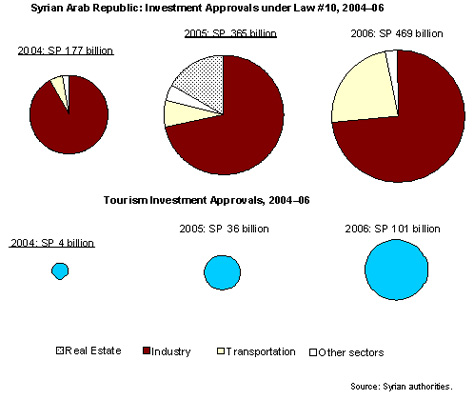
7. The improved business climate might be supporting a steady growth in private investment, but a real take-off does not seem to have materialized yet. Nonetheless, the impressive volume of approved projects under Law No 10 in 2006—which reached SP 470 billion (US$9.2 billion and 26 percent of GDP) more than 2½ times the level in 2004—and their diversity augurs well for growth prospects in the near- to medium-term. 1 Almost three-fourths of the volume of these investments are in increasingly diversified industrial projects (including cement, steel, food processing, pharmaceutical, textile, and power generation), and another 20 percent are in the transport sector. Investment in the much publicized real estate projects (consisting of commercial, recreational, and other services associated with government housing projects) represented only about 15 percent of the total approved projects in 2005 (SP 60 billion) and their social returns—which are feared to be low in some circles—may actually be quite high if they are part of a well diversified investment strategy. The share of foreign direct investment (FDI) is estimated to have remained fairly stable at about 20 percent.2 Diversity in the investment strategy is also evidenced by the equally strong growth in investment approvals in tourism. Prospects in that sector are strengthening, with the ministry of tourism now preparing to launch mega projects, based on the success it achieved in attracting investors' interest in smaller projects.


sar-inv.jpg


8. The build-up of inflationary pressures since mid-2005 seems to have abated in recent months. While average inflation increased from 7.2 percent to 10 percent in 2006, trend inflation as measured by the increase in the price level in March 2007 compared to March 2006 has come down to 4 percent, bringing average inflation to below 8 percent. Half of the increase in inflation in 2006 is attributed to an increase in food prices, which may have reflected weather-related shortages plus stronger domestic demand as well as demand from neighboring countries hit by similar inclement weather. The increase in the dollar price of imported non-fuel commodities together with some pass-through of the exchange rate depreciation at end-2005 may have been additional contributing factors.

9. The large influx of Iraqis put strong pressures on the economy. The number of refugees grew by 40 percent in 2006 to about 1.5 million (8 percent of the Syrian population). In addition to contributing to inflationary pressures, including notably in rental and real estate prices, the surge in refugees strained government expenditures, particularly on energy and food subsidies, and spending on health and education.

10. Credit policy played a useful role in controlling domestic demand. State banks were instructed to slow their lending to the private sector, which helped cool the credit boom experienced in 2004-05. The actual pace (18½ percent), while still fast, reflects the process of financial re-intermediation related to the nascent private banking sector, whose loan portfolio increased by more than 100 percent, accounting for almost half of the credit growth in 2006. The increase in net lending to the public sector contributed the largest share in the increase in money. Administered deposit interest rates, which turned negative during most of 2006, are now back to positive territory, thanks to the deceleration of inflation.

11. Timely and significant fiscal adjustment largely offset the decline in oil revenues, thereby containing the fiscal deficit. Over the last three years, fiscal policy had to contend with a loss of oil revenues in excess of 10 percentage points of GDP. This has reflected both a sharp contraction of oil production from about 480 thousand barrels per day to about 400 thousand and a galloping growth in domestic demand (an annual average rate of 10½ percent) owing to a decline in the prices of refined products in real terms, increased smuggling to neighboring countries, and the impact of the Iraqi refugees. A cumulative improvement in the non-oil budget deficit of 7 percentage points of GDP narrowed the non-oil budget deficit to about 10 percent of GDP, strengthening significantly the medium-term prospects of fiscal sustainability.

12. The quality of the fiscal adjustment was commendable. During the last three years, corporate income tax rates have been lowered drastically—with the top marginal rate coming down from 65 percent in 2003 to 28 percent in the latest amendment—and tariffs rates have been reduced significantly. Tax administration improvements together with higher growth fully compensated for the cut in rates and helped maintain a stable tax intake as a percent of GDP and increase its total volume. The bulk of the fiscal adjustment has been contributed by caps on investment spending and an increase in dividend payments from profitable public companies, mainly in telecommunication, which boosted nonoil revenues by close to 3 percentage points of GDP during 2004-06. The compression in capital spending is largely believed to have represented cuts in wasteful spending, and at 9 percent of GDP, its level in 2006 is still fairly high. The creeping rise in current expenditures reflected mainly the increase in subsidies to loss making PEs and pension and social assistance payments.

13. The growth outlook for 2007 remains favorable. The critical mass of reforms implemented in recent months, the continued direct and indirect support of aggregate demand from the Iraqi presence, and favorable growth prospects globally and in the region are expected to continue to underpin private consumption and non-oil exports, as well as a possible strengthening of private investment. These factors could sustain the growth momentum at about the same pace as in 2006. Any slowdown of capital inflows associated with the Iraqis will dampen aggregate demand directly and through second round effects, including an unwinding of the wealth effect induced by the real-estate boom. However, a normalization of the political situation in Iraq could open a large market for Syrian products.

14. To keep inflationary pressures in check, macroeconomic policies should remain appropriately tight. The current level of benchmark interest rates is appropriate and state banks' lending should remain in line with the monetary objectives. Fiscal policy should aim to reduce the overall budget deficit to about 5 percent of GDP mainly by phasing out petroleum price subsidies and further rationalizing of expenditures. Civil service wage policy, which leads wage policy in the rest of the economy, has a major role to play in curbing inflation, by ensuring that wage increases do not run ahead of productivity gains.

II. Building for the Future

15. Syria needs to continue to grow faster but it also needs to grow better in the coming years. The growth acceleration in the past two years seems to have been largely driven by private consumption, with an initial impulse originating from the influx of Iraqis. For this growth to strengthen and solidify, it is important that the sources of growth be rebalanced toward investment and durable gains in external market shares. Stronger investment growth and higher productivity are the bedrocks of high and sustainable growth in the long run.

16. To rebalance growth, Syria should continue to strengthen its macroeconomic policy frameworks and to accelerate structural reforms. Policies geared toward accelerating reforms and preserving financial stability could validate investors' expectations and strengthen savers' confidence about returns on Syrian assets. A positive synergy—such as the one witnessed in the rapid take-off of private banking—between an increased willingness on the part of savers to invest their funds in Syria rather than abroad or in idle foreign currency, and an increased willingness of investors to take the risk of starting new projects could turn the promise from the large increase in investment approvals into a reality.

17. The remainder of this statement focuses on: (i) policies to protect fiscal solvency, (ii) a more explicit monetary policy framework in the context of the unified exchange rate regime to anchor price stability, and (iii) key structural reforms.

Fiscal sustainability

18. The timely adjustment to the secular trend decline in oil revenues in the past three years is highly welcome. Looking forward, there is a need to sustain this effort as oil revenues continue to dwindle. Addressing all the pockets of inefficiency in public spending associated with technical losses and across-the-board subsidies to consumers, producers, and public employment will achieve durable fiscal savings while enhancing the supply side of the economy. A large share of the freed up resources could be channeled to finance targeted support to the most vulnerable segments of society and to productive expenditures on basic infrastructure, higher education, and research and development. This will complement private investment by enhancing its potential returns.

19. In this regard, a comprehensive public expenditure review is essential. It should focus on: (i) settling the inter-enterprises arrears among PEs and stopping any such accumulation in the future as this practice dampens incentives for sound and transparent financial management and leads to a lack of accountability; (ii) reviewing the efficiency and effectiveness of expenditures in major sectors such as education, health, and public transportation with a view to reprioritization and deep reforms; and (iii) reviewing the social protection system—the current system is mostly based on rationing (coupons) and on inequitable and inefficient price subsidies. It needs to be reformed toward means-tested targeted transfers.

20. Phasing out the inequitable petroleum price subsidies (PPS), whose cost exceeds 15 percent of GDP, is a key pillar of fiscal reform. Beyond large fiscal savings, it would provide significant efficiency gains, improve equity, entail a smaller negative fiscal impulse, and contribute to BOP adjustment. We are encouraged to know that some preparatory work is being done to launch this reform, and urge the authorities not to delay it further. Each day the public coffers loose SP 750 million (i.e. close to US$15 million, three times the annual budget devoted to promoting tourism) on a policy that has lost all purpose, while so many legitimate claims on public money remain unfulfilled.

21. Stepping up preparations to introduce a VAT is needed to ensure that the VAT is phased in on time to help offset the future drain on oil revenues. The mission agrees that an ill-prepared launch could damage the credibility of this new tax, and indeed many steps, including the adoption of a tax procedures code and an integrated IT system, have yet to be completed. However, preparation could move much faster, if the authorities were to choose a simple design, an option that would very much be in line with the new vision driving tax policy reform toward simpler taxes and lower rates. A uniform rate with very few exemptions lowers the compliance costs on taxpayers and the burden on the tax administration and closes loopholes, which create opportunities for corruption. Concerns about social equity are best addressed by excises on luxury goods, well targeted spending programs, or by enhancing the progressivity of income taxes.

22. The authorities view the PE reform as an important element in the reform program. For that the authorities issued:

•

“Bush Weighs Reaching Out To Muslim Brothers,” byu Eli Lake

Bush Weighs Reaching Out To Muslim Brothers
BY ELI LAKE – Staff Reporter of the Sun
June 20, 2007

WASHINGTON — The Bush administration is quietly weighing the prospect of reaching out to the party that founded modern political Islam, the Muslim Brotherhood.

Still in its early stages and below the radar, the current American deliberations and diplomacy with the organization, known in Arabic as Ikhwan, take on new significance in light of Hamas's successful coup in Gaza last week. The Egyptian Muslim Brotherhood is widely reported to have helped create Hamas in 1982.

Today the State Department's Bureau of Intelligence and Research will host a meeting with other representatives of the intelligence community to discuss opening more formal channels to the brothers. Earlier this year, the National Intelligence Council received a paper it had commissioned on the history of the Muslim Brotherhood by a scholar at the Nixon Center, Robert Leiken, who is invited to the State Department meeting today to present the case for engagement. On April 7, congressional leaders such as Rep. Steny Hoyer of Maryland, the Democratic whip, attended a reception where some representatives of the brothers were present. The reception was hosted at the residence in Cairo of the American ambassador to Egypt, Francis Ricciardone, a decision that indicates a change in policy.

The National Security Council and State Department already meet indirectly with the Syrian Muslim Brotherhood through discussions with a new Syrian opposition group created in 2006 known as the National Salvation Front. Meanwhile, Iraq's vice president, Tariq al-Hashemi, is a leader of Iraq's chapter of the Muslim Brotherhood. His party, known as the Iraqi Islamic Party, has played a role in the Iraqi government since it was invited to join the Iraqi Governing Council in 2003.

These developments, in light of Hamas's control of Gaza, suggest that President Bush — who has been careful to distinguish the war on terror from a war on Islam — has done more than any of his predecessors to accept the movement fighting for the merger of mosque and state in the Middle East.

Should Mr. Bush ask his diplomats to forge new channels to the Muslim Brotherhood it would also be a recognition of the gains their parties have made in elections in the last three years. In Egypt, Iraq, and the Palestinian territories, Islamist parties trounced their secular rivals. In part this was because these parties offered an uncorrupt alternative to the more secular parties in power, but some advocates inside the administration also say it reflects a tangible momentum for parties that seek to create Islamic republics. One State Department official yesterday said, "Our policy has to change from more democracy, fewer headscarves."

Nonetheless, administration officials this week also stressed that no decisions have been made as to a new initiative. One leading European Islamist, Tariq Ramadan, who is the grandson of the founder of the Muslim Brotherhood, is being denied a visa to assume a professorship he has been offered at Notre Dame University. The policy debate inside the administration is also contentious, with law enforcement agencies such as the FBI skeptical that the Muslim Brotherhood is not clandestinely more involved in supporting violent jihad than the organization's emissaries let on.

A State Department spokesman for the Bureau of Near East Affairs, David Foley, confirmed the meeting Wednesday to discuss a new approach to the Muslim Brotherhood. "We do these seminars, they help inform the policy making process. I am not suggesting someone would decide on a new policy on the Muslim Brotherhood as a result of this," he said. "This is the kind of consultations we often do. When there are alternative views, let's hear both sides. We are certainly willing to listen to voices from the outside."

Making the case today for outreach is Mr. Leiken, who co-authored with Steve Brooke a paper for the March-April issue of Foreign Affairs titled, "The Moderate Muslim Brotherhood." That paper argues that Ikhwan has drawn contempt from violent Islamists such as Al Qaeda for its general disavowal of armed struggle. Tracing its history to its founding, the paper says the group today, particularly in Egypt, is genuine in its desire to participate in democratic politics.

Mr. Leiken said yesterday that there are two reasons why America should begin to rethink its prohibition of meeting with the brothers. "A new policy begins to combat some of our isolation in the Muslim world. I see the Muslim brotherhood, particularly in Egypt, as having what the communists used to call a two-line struggle, between moderate and dogmatic factions. Our outreach would help the moderates. That would strengthen those forces who are most willing to recognize the fact of Israel's existence and more democratic."

Mr. Leiken is a Harvard graduate and longtime expert on Latin America who broke with the hard left in the 1980s to oppose the Sandinistas in Nicaragua and who became associated with Social Democrats such as Penn Kemble and Joshua Muravchick. He said he thinks diplomacy with Ikhwan could help us help them to moderate Hamas. "It is conceivable that the Egyptian Muslim Brotherhood, aware Gaza could serve as an index, will try use its influence to get Hamas to be constructive," he said. The Egyptian government has used the Muslim Brothers for at least 10 years as a back channel to Hamas.

Mr. Leiken's Foreign Affairs paper and classified study for the National Intelligence Council has gotten the attention of senior National Security Council officials and Secretary of State Rice, according to two administration officials.

"The NIC asked me to provide an analysis of the Muslim Brotherhood and I was happy to oblige," Mr. Leiken said.

Arguing against a new policy on the brothers today will be a Hudson Institute expert on Islam, Hillel Fradkin. Mr. Fradkin declined to comment on his presentation ahead of the meeting. A colleague of his at the institute who has also taken a skeptical view of the brothers, Zeyno Baran, did say she was worried about a new direction by the Bush administration.

"The thinking is that to deal with terrorism, we need to deal with Muslims who will take care of their communities so there will not be people here and there doing terrorism," she said. "So we treat the brotherhood like an umbrella organization, like the Council on American Islamic Relations or the Islamic Society of North America. You make them partners. They might Islamize the Muslims, but it's okay because they can think or do what they want as long as they are not violent. That is the misunderstanding and mistake."

The issue of the Muslim Brotherhood has also come up in the presidential contest for 2008. At the May 3 debate of Republican contenders for the presidential nomination, a former Massachusetts governor, Mitt Romney, included the Muslim Brotherhood as a component of the "worldwide jihadist threat."

"This is about Shia and Sunni. This is about Hezbollah and Hamas and Al Qaeda and the Muslim Brotherhood. This is the worldwide jihadist effort to try and cause the collapse of all moderate Islamic governments and replace them with a caliphate," he said in response to a question about what he would do to capture Osama bin Laden.

One of the more contentious issues with the Muslim Brotherhood is whether the group was connected to the 1981 assassination of an Egyptian president, Anwar Sadat. This reporter was told by leaders of the group last year that the ex-president's killers were from a breakaway faction known as the Islamic Group and that his murder was not condoned by Ikhwan. Sadat softened the government policy against the brothers in the early 1970s, allowing them to organize in universities, a decision many of the Brotherhood leaders in Cairo credit with laying the foundation for their gains in the 2005 parliamentary elections.

Bush and Olmert Downplay Syria Talks

Two items below: Memri puts together the evidence supporting claims that Fatah al-Islam is controlled by Syria. Olmert and Bush downplay talks with Syria at the joint news conference.

Syrian Efforts to Deny Fath Al-Islam Affiliation With Syrian Intelligence

Memri, June 20, 2007
No. 365
By H. Varulkar*

Introduction

Following the exposure of an affiliation between Fath Al-Islam and Syrian intelligence during the interrogation of Fath Al-Islam members, Syrian and pro-Syrian elements and media have been making efforts to deny this affiliation. Fath Al-Islam leaders with connections to Syria have suddenly disappeared, to be replaced by new leaders, claimed to be connected to Al-Qaeda. In addition, one of the organization's new leaders and a pro-Syrian Lebanese source have stated that Fath Al-Islam is under the command of Al-Qaeda, a claim that was firmly denied by the organization's previous leadership. (Read it all)

Amnesty International: Iraqis Flee to Syria to Escape Violence

Talking to the press prior to their private meeting President Bush and PM Olmert said:

Q And I would like to ask you, the Prime Minister of Israel calls for negotiation with no precondition with Syria; so does President Assad of Syria, and he asks for U.S. mediation. Will you do it?

PRESIDENT BUSH: They can handle their own negotiations with Syria. If the Prime Minister wants to negotiate with Syria, he doesn’t need
me to mediate.

Q Do you think it’s a good idea?

PRESIDENT BUSH: It’s up to the Prime Minister. I haven’t had a chance to talk to him about that. I don’t know if you’re putting words
in his mouth, or not. But I’m looking forward to having a discussion about Iran and Syria and the neighborhood. But this man is plenty
capable of conducting his own negotiations without mediation.

PRIME MINISTER OLMERT: I will answer your question, right? We have been very, very attentive to the needs of the — humanitarian needs of Gaza and we will continue to provide everything that is necessary in order to meet these humanitarian needs. Israel will not be indifferent to the human suffering in Gaza. Israel will be different from the Palestinians, themselves, because the reality is that all this suffering is caused by Palestinians against their own people. What the Hamas was doing in Gaza is absolutely atrocious and intolerable. And I’m sure that many who had some hopes that maybe Hamas can be more reasonable and more restrained I think lost these hopes because of what they have been doing to their own people — killing innocent civilians, pulling out from hospital beds Fatah people that were wounded and dropped them off fifth story building to kill them in the street, and terrible other things.

We will not be indifferent. We already are taking care of many of the Palestinians in Gaza during the last few days, and we will continue to deal with it as it comes. Of course, they are not interested in staying in Israel, they want to be amongst Palestinians, and they will be treated in this manner.

Q So you will let them go?

PRIME MINISTER OLMERT: So as I said, we will check every single case and we’ll see how we can help them and I’m sure that we will help them.

As for Syria, I’m afraid that you may have not have understood correctly what the Syrian leader said. The Syrian leader said that he is against any preconditions from the Israeli side, but he’s certainly for preconditions from the Syrian side. One of the preconditions is that he wants President Bush to work more than he does already in regional issues and to be the mediator. And the President said correctly, this is not the — I think — the job for the President of the United States. He’s got many other things to do. And I don’t think, if someone wants to speak directly, he needs the involvement of America in order to allow these negotiations to take place. I am not certain that the understanding of the President of Syria can lay the foundations for immediate discussions between Syria and Israel.

Here is the Jerualem Post coverage, "Bush, PM downplay hope of Syria talks":

Olmert said unequivocally that the US had never told him not to negotiate with Damascus.

"The US never said not to hold talks with Syria," he said. "and we've never asked for their permission. Israel will not ask permission to conduct peace talks if it feels it's right, nor defend itself if it feels it's necessary."

For his part, Bush said that Israel could decide for itself whether it wants to negotiate with Syria, that all options are still on the table regarding Iran, and that despite setbacks in Gaza, his vision of a two-state solution is still viable and should be pushed forward.

At a brief press conference in the White House's Oval Office before meeting with Olmert, Bush said the US had no intention of interceding between Syria and Israel.

"If the prime minister wants to negotiate with Syria, he doesn't need me to mediate," Bush said. "It's up to the prime minister. This man is plenty capable of having negotiations without me mediating."

Syria has let it be known in recent days that it would be interested in negotiations with Israel under a Quartet or US umbrella, something that Olmert said Tuesday was unacceptable. Syria's request for such a framework has been interpreted in Jerusalem as an effort to escape international isolation.

"The Syrian leader said that he is against preconditions from the Israeli side, but he is certainly for preconditions from the Syrian side. One of the preconditions is that he wants President Bush to get more involved then he already is in regional issues," the prime minister said.

Al-Qaida Arrests in Lebanon

t_desco reports in an earlier discussion thread:

Brammertz resigns from Hague court to concentrate on Hariri probe. dpa

Al-Akhbar and the Daily Star report that the Bar Elias cell had planned to use the car bombs in an (Iraqi style?) attack on “a crowded festival … in the Bekaa town of Zahle” (Daily Star), anticipating that it would be blamed on Syria (Al-Akhbar).


From Naharnet, As-Safir

“The military official said Abu Omar is believed to have left the ranks of Esbat al Ansar and is now a member of a splinter faction called Jund as-Sham.”

I think we can assume that the earlier reports about him killing a member of Jund al-Sham were wrong.

14 Charged with Setting Up Terrorist Cell as Qaida Believed Swelling

The daily As Safir on Tuesday said Lebanon’s military prosecutor Judge Jean Fahd has charged 14 people with setting up a terrorist cell in east Lebanon’s Bekaa Valley town of Bar Elias.
It said among the detainees were a Saudi, two Syrians and six Lebanese.
…

In a related event, As Safir branded as “invasion” the spread of the Islamic paramilitary al-Qaida organization in Lebanon.
…

The arrests came a few days after three detainees, apprehended in Bar Elias, testified that they belonged to al-Qaida. A statement by the General Directorate for State Security had said the detainees also confessed to rigging three vehicles with explosives.

Lebanese troops had discovered the booby-trapped cars during a raid on a hideout in Bar Elias.

As Safir said the three detainees were “very dangerous.”

An Nahar newspaper had identified them as Fahd Bin Abdulaaziz al-Meghamis, from Saudi Arabia, and Syrians Ahmed Mohammed Osseili and Mohammed Abdul Rahim Abdul Rahim.

As Safir said Lebanese military experts were surprised at the way the bombs had been “very delicately assembled” and at the use of “unfamiliar digital techniques.”

Lebanese security forces were only able to dismantle the rigged cars with the help of Meghamis, the daily said.

A big amount of 500-Euro bills, apparently planned to be spent on recruiting young men with “terrorist tasks aimed at destabilizing security,” was found and confiscated from the Bar Elias network, according to As Safir.

It said further evidence that al-Qaida was swelling in Lebanon came from another source — the alleged confessions made to the police by Saudi detainee Abdullah Beeshi, who was arrested a few hours after the Feb. 13 Ain Alaq bus bombings.

As Safir said Beeshi, who left Saudi Arabia for Iran towards the end of July 2006 upon instructions from two al-Qaidi members, met with Abu Mohammed, a Kurdish-Iranian, in the presence of Saudi Abdul Rahman al-Yehyi in an Iranian city.

About one month later, Beeshi traveled to Lebanon, where he was met by Abu Baker, a Lebanese, upon arrival at Rafik Hariri airport, As Safir reported.

It said Abu Baker escorted Beeshi to the house of sheikh N.R. in the northern port city of Tripoli, where Yehyi, who goes by his nom de guerre of Talha, was waiting for him.

The daily said Talha had landed in Lebanon two weeks ahead of Beeshi.

At that meeting Beeshi was introduced to the brother-in-law of Fatah al-Islam’s leader Shaker Abssi as well as to Saudi Abu Rishaj, who was recruiting young Saudis to join Abssi’s terrorist group at the northern refugee camp of Nahr al-Bared, according to As Safir.

It said that while preparations were underway to send Beeshi to Iraq, the Saudi detainee, together with Abssi’s brother-in-law, identified as Syrian Hani al-Sankari, were “transporting weapons and explosives” provided by Abssi, who was hiding in Nahr al-Bared, to Talha.

As Safir said only three hours after the Ain Aalq twin blasts, authorities arrested Beeshi and Sankari as they tried to cross into Syria through the northern border crossing at Abboudieh.

However, the paper said, in contrast to earlier belief that the two men had been arrested in connection with the Ain Alaq bomb attack, investigation showed that Beeshi and Sankari were not linked to the bus bombings.

It said testimonies of four other detainees uncovered their involvement in the Ain Alaq assault.

“Alawi Identity in Syria,” M.A. Thesis by Torstein Worren

Fear and Resistance: The Construction of Alawi Identity in Syria
By Torstein S. Worren
Master thesis in human geography at the University of Oslo – February 2007:

Download PDF-version
/ Abstract / External link (University of Oslo)

Dear Mr. Landis

Being a fan of your blog, I thought I should send you the result of my two-year research master's programme in human geography at the University of Oslo, Norway.

The thesis deals with how the Alawis of Syria construct their identity discursively, based on a social constructivist theoretical framework and also based on fieldwork in Syria. There is nothing new or groundbreaking, but it attempts to organise what is largely known about how they see themselves and their world. The analysis (chapters 5,6, and 7) is divided according to their construction of history and theology, social and cultural differences, and politics.

 I was hoping you would make it available through your blog or could publish a link in order to spread it to the academic community since there is fairly little research done in English on the Alawis of Syria that does not deal with the Alawi political elite. My point of departure has been 'normal' Alawis.

Keep up the good work.
Regards
Torstein S. Worren
Oslo, Norway
https://exchange.ou.edu/exchweb/bin/redir.asp?URL=http://torstein.worren.info

Abstract

The Alawi minority of Syria – the sect of president Bashar al-Asad and his father and former president Hafiz al-Asad – figures in the media and academic writings as ‘an extreme Shi'a sect.' Although there are deep religious cleavages between the Alawis and Syria's Sunni Muslim majority, this thesis argues that religion is only one aspect of how Alawis construct their collective identity in the Syrian context.

First-time visitors to Syria will experience a tolerant and heterogeneous country where people of different religions live side by side. This is maintained by the Official Discourse of the regime, which forcefully imposes the notion that Syria 's heterogeneity is a blessing and that Syrians get along irrespective of religion. Yet, Alawi collective identity is formed in an antagonistic relationship to this Official Discourse, and above all, to the Sunni discursive hegemony. Their identity is constructed in several different dimensions, but what their history, culture, and politics have in common are that they are all constructed in a relational way to the Sunni majority.

Their history is connected to the present by the hatred they believe that the Sunnis nurture for them, meaning that the persecution and massacres of the past are still part of the present day. Culturally, they portray themselves as opposites to the Sunnis and see themselves as more similar to the Christians than to other Muslims. And politically, the fact that so many key figures in the regime are Alawis actually makes the Alawis feel even more threatened because it only gives those who hate them yet another reason to do so. Alawi discourses are therefore centred on fear: a fear of the future based on history and history's contemporary reincarnation in the form of Islamic extremism.

Using discourse theory and based on fieldwork in coastal Syria , this thesis argues that Alawi identity is constructed in direct opposition to the Sunni majority, where the Sunnis become ‘The Other' that restricts ‘Us.' This means that while they define themselves as Muslims, arguably the greatest dilemma in their identity construction, they also define themselves as everything that the Sunnis are not. Yet, having no public arenas for their struggle to challenge the Sunni religious monopoly, their oppositional discourses take the shape of hidden transcripts out of sight from the majority.

[End]

Here is the Table of Contents (I have omitted the theoretical chapters)

4. The Context. 38 People and history. 38
The Alawis. 43
The ‘secular’ state and the Official Discourse. 49
In conclusion. 52

5  Constructing History. 53
In the beginning, there was the name?. 53
Origins and beliefs. 55
The Golden Age. 57
The Decline and Trauma. 58
Domination and resistance. 60
The Regeneration. 61
Antagonism and discourse. 63
The Islamic Discourse. 64
The Critical Discourse. 66
In conclusion. 67

6   Constructing Society. 69
‘Us’ and ‘Them’ 69
Inter-sectarian relations. 72
Relations between Alawis and Sunnis. 75
Relations between Alawis and Christians. 77
Hegemony and disguise. 78
In conclusion. 82

7    Constructing Politics. 84
Proving history right 84An ‘Alawi’ regime?. 87
The durability of fear 91Political circumstances and their impact 94
Alawi support for the regime. 96
In conclusion. 97

8   Conclusions. 99
The Sunni hegemony. 99
The Islamic Discourse and the Critical Discourse. 101
From discourse to identity. 102
In conclusion. 103 

References. 104 Online References. 107

News Round Up (19 June 2007)

Russia starts delivery of advanced fighter jets to Syria (Addendum: This story has been denied by Russian authorities)
The Associated Press

Tuesday, June 19, 2007 Click here to find out more!

MOSCOW: Russia has started delivery of top-of-the-line fighter jets to Syria under a new deal estimated to be worth US$1 billion (€746 million), a newspaper said Tuesday — but the report was quickly denied by the state arms trader.

The business daily Kommersant said that Russia had begun delivering five MiG-31E jets under a deal apparently negotiated during Syrian President Bashar Assad's trip to Moscow last autumn.

Commenting on the report, Russia's Foreign Ministry spokesman Mikhail Kamynin said in a statement that "all of Russia's deals in the sphere of military-technical cooperation comply with international law and Russia's obligations under various treaties and United Nations resolutions." He would not elaborate.

But Sergei Chemezov, head of state arms-trading monopoly Rosoboronexport, flatly denied the Kommersant report. "Russia has no plans to deliver fighter jets to Syria and Iran," Chemezov said at a Paris air show, according to the Interfax news agency.

Russia has shrugged off U.S. and Israeli criticism of its previous weapons deals with Syria and Iran, saying the deals complied with international law.

The contract with Syria will be the first export deal for the MiG-31E, a heavy twin-engined interceptor fighter capable of flying at nearly three times the speed of sound and simultaneously shooting several targets at ranges of up to 180 kilometers (over 110 miles) away.

The aircraft was designed in the 1980s for tackling low-flying cruise missiles and other difficult targets and remains the mainstay of Russia's air defenses. "In the Soviet Union, the MiG-31 was considered a key component of defenses against a possible U.S. attack," Kommersant said.

The newspaper said that Russia had also agreed to provide Syria with an unspecified number of MiG-29M fighters — a version that features a significantly improved range, has an improved radar and carries a broader array of weapons compared to basic MiG-29 model.

The delivery of new fighters to Syria which has a fleet of older MiG jets will dramatically improve its air force capability.

Moscow was the main weapons supplier to Syria during the Soviet era, and the two nations have moved recently to reinvigorate their economic, military and political ties. In 2005, Moscow agreed to write off nearly three-quarters of Syria's US$13.4 billion (€10 billion) debt in a bid to boost ties and win broader clout in the region.

Iran could finance the new fighter jets deal under a defense cooperation treaty with Syria, Kommersant said.

Israel claimed that Hezbollah fighters used Russian missiles during a 34-day war in Lebanon last year. It said that Russian arms were sold to Syria and Iran, which sent them on to their Hezbollah proxies. Russian officials dismissed the accusations. 

June 19, 2007 NEW YORK TIMES
Ain Al Hilwe Journal AIN AL HILWE REFUGEE CAMP, Lebanon — On a recent afternoon, with the smoke still rising from buildings burned in fierce fighting here between Islamist militants and the Lebanese Army, a man calling himself Abu Omar gave a tour of his squalid neighborhood.

Abu Omar, a militant Islamist, is among the most charismatic leaders in the camp, loved by his supporters but detested by those who say militants bring nothing but destruction to the Palestinians.

An old woman stopped him. "Thank God you are safe," she said, hugging and kissing him three times on each bearded cheek. "My house is completely burned," she said.

"Don't worry about it," he replied as he took her hands. "We will fix it or get you a new one. Do not worry. Everything will be fixed."

The fighting was a sign of just how fragile Lebanon has become. As the Lebanese Army battled militants in the Nahr al Bared refugee camp in the north, gunfire broke out between the army and militants here in this camp, near Sidon. Abu Omar says the fighting started after a soldier provoked a "brother."

"He was telling him that 'we are defeating you in Nahr al Bared, we are burning you,' " Abu Omar said. "Then he started shooting toward him; the brother went home, brought his gun and started shooting back."

The government disputes that version of events, but by either account, the camp is a tinderbox, and Abu Omar, whose real name is Chehadeh Jawhar, is an apt symbol of the weakness of the Lebanese state.

Even before the current political crisis, with pro-American factions struggling to keep power from pro-Syrian and pro-Iranian parties, Lebanon was a nation without institutions, a place where power was divided among religious sects. It was a state that gave Palestinians free license to live in 12 refugee camps within its borders. Within the camps' confines, they were immune from the country's rules, laws, police and oversight, but condemned to a life of degradation and second-class status.

For those like Abu Omar, with a militant political agenda, the arrangement created 12 different places to set up shop and 12 bases to run to, hide in and conduct operations. Abu Omar lives on Emergency Street, a free-wheeling alley of martial faith surrounded by squalor. He takes visitors into his basement.

With a shrug of his shoulders, he pointed to a corner in the darkened room where he has stored TNT, plastic explosives and guns. He smiled, then opened boxes and black school backpacks, rummaging through a potpourri of ammunition, makeshift land mines and detonating wires.

The explosives stored in his basement were similar to those that have been used to destabilize Lebanon since the assassination of the former prime minister Rafik Hariri in February 2005. There is no way to know if the basement was the source of any of those bombs.

An explosion recently ripped through a tire shop on Emergency Street as Abu Omar and other militants were extracting TNT from a 107-millimeter shell, apparently to use in making a bomb, according to Lebanese security officials who spoke on condition of anonymity, because they were not authorized to speak to the news media.

Abu Omar and two other militants were wounded, and two others died.

"Victory is not required from us," he said in an interview before the explosion. "What is required is to be ready for a jihad in the name of God, ready to reinstate Islam's rule and Muslim caliphate. It is normal, if the army shoots at us, we will shoot back at them — normal." Abu Omar, 37, was once a fighter with the mainstream Fatah faction of Yasir Arafat, the former Palestinian Authority president. An electrician turned arms smuggler, he said he left the group when he said he felt its leaders "were minimizing" the Palestinian cause. "Palestine is not only for Palestinians, Jerusalem is not only for Palestinians," he said. "It is for all Arabs and Muslims."

He says he has been wanted by the Lebanese government since 1991 for scores of felonies. "Crimes that cannot be counted," he boasted. "It is normal, normal."

A senior Lebanese military official confirmed that Abu Omar is wanted in connection with numerous killings and bombings.

He cannot leave the camp. Not, at least, through the front gate in daylight. He says he is now a member of Esbat al Ansar, a group listed by Washington as a terrorist group. In the camp, he built a house, married and had eight children.

The military official said Abu Omar is believed to have left the ranks of Esbat al Ansar and is now a member of a splinter faction called Jund as-Sham.

Abu Omar struts through the camp like a sports star, or the mayor. He stopped at his mother's house. She had just returned from a pilgrimage to Mecca, Saudi Arabia. He hugged and kissed her; she thanked God for his safety. His sisters showered him with yet more kisses. "We miss you," they said.

Taxi drivers and their customers passing by also stopped to give thanks that he had survived the battle. More residents and neighbors joined the line.

But caught between the army and Abu Omar and his supporters are those who simply struggle to get through their days, and see in the militant groups the seeds of their own devastation.

"They burned the houses, they burned our houses," said a Palestinian refugee who gave his name as Abu Iyad for fear of reprisal. He said his perfume shop and his house, both on Emergency Street, had been set on fire. "If the army gives me a uniform, I will shoot at them now," he said.

"We want to get rid of all these problems," said Mustapha Razi, another refugee. "If my brother is creating problems, I want to get rid of him."

But they know they can't, and that the army can't either. If fighting erupts again, they all said they would do what they did a few days ago: flee.

Abu Omar says it is unlikely those clashes would resume. But if they do, he said, civilians outside the camp are fair game. "If the army shoots at us again, we will shoot at civilians in Sidon."

And off he walked to visit his mother and sisters.

Brothers to the Bitter End By: Fouad Ajami | The New York Times
Some see the situation in the Palestinian terrirtories as a tolerable situation, maybe even an improvement, envisioning a secularist Fatah-run state living peacefully alongside Israel and a small, radical Gaza hemmed in by Israeli troops. It’s always tempting to look for salvation in disaster, but in this case it’s sheer fantasy….

'West Bank First': It Won't Work By: Robert Malley and Aaron David Miller | The Washington Post
Having embraced one illusion — that it could help isolate and defeat Hamas — the Bush administration is dangerously close to embracing another: Gaza is dead, long live the West Bank….

Running Guns to Gaza: A Living in the Desert
By MICHAEL SLACKMAN
June 19, 2007 NEW YORK TIMES

RAFAH, Egypt, June 17 — The Hamas military takeover of Gaza last week was partly fueled by caches of weapons smuggled through tunnels below this gritty Sinai border town. Two days spent with smugglers here suggest that to stanch the flow of weapons, Egypt will have to address the economic and social concerns of the region, and not rely solely on its security forces.

"There are two things here," said Ibrahim Sawarka, a Bedouin who used his tribal name, not his family name, for fear of retribution from the police. "There is poverty, and there is smuggling."

In more than a dozen interviews shortly after Hamas solidified its grip on Gaza, local residents said that the Palestinian territory was a primary market for goods in a region short of jobs and other economic opportunities.

They said, almost without exception, that the business of ferrying weapons was more about profit than ideology. Working with small construction tools like jackhammers, people here said they dug a tunnel to Gaza in about six months. The shoulder-width passages were often strung with lights and a mechanized pulley system — like a tow rope at a ski lift — to deliver the merchandise.

One person said that most of the weapons smuggled into Gaza were Russian- and Chinese-made. Others said that the guns, often AK-47s, may have come from Sudan and moved through Egypt.

In the last two years, since Israel withdrew its forces and settlers from Gaza, Egyptian officials said they had increased their policing of the border, blowing up tunnels when discovered and arresting people connected with smuggling. But local Bedouins, nomadic desert tribes, said that instead of digging tunnels from inside homes, they started outside to avoid the Egyptian authorities' linking them to an individual.

Israel installed a 25-foot wall of concrete and iron along the border that extends 10 feet underground. But the tunnels are typically 20 to 65 feet deep. Israel also used sonar and other sensors to hunt for the tunnels, occasionally setting off charges in the ground to collapse undiscovered tunnels. They also urged the Egyptians to do more, which they did.

"Of course the tunnels are one of the largest sources for weapon smuggling into Gaza," said Emad Ghad, with the Ahram Center for Political and Strategic Studies in Cairo. "The Egyptian authorities try, and they have uncovered some of the smuggling. They announced a case about six months ago. But the number of Egyptian forces allowed does not allow for the capacity needed to control the border."

In the days since the Hamas takeover of Gaza, smugglers say the increased Egyptian security presence has forced them to lie low for now.

But no matter how much the authorities crack down, people here say the outlaw culture can never be overcome without economic development. Unemployment in the region is among the highest in Egypt.

Many of the Bedouins said they also worked to smuggle people into Israel, often women from Eastern Europe, looking to work in the sex industry.

To discuss their situation, Mr. Sawarka and some neighbors gathered at a relative's house in Mahdiya village, in Rafah city. They complained about the isolation and discrimination they felt as Bedouins, a circumstance they say leaves no alternative but to work as smugglers.

Smuggling has long been a part of the Bedouin life, but weapons smuggling to Gaza began in earnest with the start of the first Palestinian intifada 20 years ago, people here said.

"Why do you think that people resort to smuggling?" said Abdalla el-Shaer, a resident of Rafah who said his brother was killed more than a year ago, fighting for Hamas in Gaza. "If the country provides employment opportunities, no one will smuggle weapons. With no other opportunity, they smuggle weapons."

In the expanse of rocky, rolling desert that extends past the dusty, rundown center of this town, there is a subculture of poverty and relative wealth that illustrates both the lack of resources provided to people from the region and the allure of what smuggling can bring. Unlike southern Sinai, with its upscale Red Sea resorts, the north has long been ignored. Homes do not even have fresh running water.

Officials also say that a small group of Bedouins from the area carried out three bombing attacks on southern Sinai resorts. The Bedouins reject the authority of the state because they feel brutalized and discriminated against. And the state continues to press the Bedouins because they question their loyalty to the state, because of their smuggling and because of a fear that a strain of radical Islam has taken hold.

"Security cannot be the sole solution to any problem, no matter how small," said a general with the Egyptian Interior Ministry who spoke on the condition that he not be identified. "It is the social problems that create security problems, and not the other way around."

The region's former representative in Parliament criticized the government. "There is only security," said El-Kashef Muhammad el-Kashef. "The government does not play its second role of resolving such issues as unemployment and discrimination."

Forty miles from Rafah lies Wadi Amr, a village set in a bleak desert landscape. It is home to about 3,000 people, including many, like Jedeeiya eid Musleh, 67, who live in huts made of twigs and scrap metal. Mr. Musleh lives with two sons; a third is in prison for drug running, he said. They have nothing but a few cushions on the ground beneath a lean-to, and their hut.

"Anyone who has the chance to smuggle will do it," said a neighbor, Salim Lafy Ali Tarabeen, 30, as he sat beside Mr. Musleh. Mr. Tarabeen, who also was using his tribal name, carries two cellphones, one with a local number, the other with an Israeli number. At one point he received a call from a friend who said he was in an Israeli jail for smuggling weapons.

Not far from Mr. Musleh's hut was a large one-story house with four white Toyota pickup trucks parked out front. "You have seen how poor people live, now you will see how the smugglers live," said Ahmed Muhammad Hussein, who is working to help improve the Bedouins' social conditions. The house was filled with men in fresh clean clothing. Large bowls of rice and mutton were served for lunch.

The Bedouins' problems are one factor in a region that has been tense since the day in 1982 that Rafah was cut in half by the peace treaty that had Israel return the Sinai to Egypt. Israel occupied the peninsula after the 1967 war. As the border was fortified with walls and guards, families were split and the challenge of crossing from one side to the other became an act of defiance.

Over time, Rafah became one of the most heavily policed areas in Egypt because authorities wanted not only to stop the flow of weapons to Gaza, but also to stop the flow of Hamas's radical ideas to Egypt. The huge security presence meant that even the beach was closed, cutting off a major source of recreation and stoking tension between local residents and the authorities.

Today, as a result of the Hamas takeover of Gaza and fears of refugees pouring into Egypt, there are even more troop carriers in Rafah. High-ranking officers set up card tables to rest their walkie-talkies and to drink tea as they monitor the scene. There have been reports of some people crossing from Gaza into Egypt, and officials said they had sent some people back to Gaza and taken others to the regional capital of El Arish.

For now, the Bedouin men who said they are smugglers say it is too risky to conduct business, because the security is so tight. But they still manage to drive the area, easily avoiding checkpoints, and are planning a protest for next month to demand their rights.

Mona el-Naggar contributed reporting.

Let Hamas govern
Samir El-youssef
June 18, 2007 THE GUARDIAN

Hamas is the actual power in Gaza now. The Palestinian president's response, dissolving the government of unity, declaring a state of emergency and then appointing a new government from which Hamas is totally excluded is hopeless and it would lead to nothing but destroying Palestinian democracy and farther bloodshed.

Hamas won the Palestinian parliamentary elections of 2006 and it's about time that Abbas and the Fatah leadership admit defeat and hand over power – government as much as foreign policy, security forces and civil services – to the elected party. It was originally their failure to do so which has led to the current situation. Instead of dragging Palestinian society into protracted civil war, Abbas must leave office and most urgently work to re-create Fatah as a national opposition party and an alternative governing body to the inexperienced and unsure Hamas.

When the National Liberation Palestinian Movement, otherwise known as Fatah, emerged in the mid 1960s, it was meant as a resistance organization against Israeli military occupation. But it was also a young Palestinian opposition to traditional Palestinian leadership and Arab regimes' attempts to subordinate Palestinian cause and grievances to their own uses. For nearly three decades, against all odds and in spite of frequent defeats and shortcomings, Fatah succeeded to be the leading party of the national Palestinian movement ultimately delivering universal recognition of Palestinian right for self-determination and sovereign statehood.

Fatah's staggering failure, however, came after the Oslo accord. Instead of transforming itself into a proper party of state and government it remained a broad and chaotic movement with no clear vision or political program, united by no other than clannish and cronies' loyalties and the, now demised, charismatic leadership of Yasser Arafat. It failed to establish independent state and government institutions thus turning the increasingly impoverished and insecure Palestinian society into a discontented dependent of a corrupt and chaotic system. Most of all its peace negotiations and treaties with Israel failed to put an end not only to the Israeli military occupation – which what Palestinians hoped to see – but even the expansion of Jewish settlements.

Though this is largely the responsibility of Israel, it was Fatah's leadership that was seen as too weak to stand up to the Israelis. Hamas won the last year elections not because it presented voters with a coherent and hopeful set of policies – the current confusion of its leaders attest to that. But because after more than a decade of Fatah's rule, social and political conditions in the West Bank and Gaza have deteriorated back to what they were under military Israeli rule.

Reporters of current events have been warning of the risk of Hamas establishing in Gaza a mini Islamic state or even a Taliban enclave. This is a danger which cannot be overlooked. But nor can it be confronted by further fighting and bloodshed. Fatah and its secular siblings in the PLO must act honestly and prudently; Hamas must be given its lawful right to govern, while Fatah and the other secular Palestinian factions must reunite behind a strong, honest and, preferably, new leadership. They must expel the corrupt and the lawless and work on a political vision and agenda that would allow them to regain the lost trust of traditional and new voters. Fatah still has the experience, the resources and the connections to rebuild itself as a strong national opposition, an alternative party of Palestinian state and government, to the confused and immature Hamas.

Rather than wasting their time calling for international intervention or making another Mecca agreement, such as the one which has brought the doomed government of unity, regional and international supporters of peace must help Fatah to become an effective democratic opposition.

Bush and Rumsfeld 'knew about Abu Ghraib'
By David Usborne in New York
Published: 19 June 2007 THE INDEPENDENT

The two-star Army General who led the first military investigation into human rights abuses at Abu Ghraib prison in Iraq has bluntly questioned the integrity of former US Secretary of Defence, Donald Rumsfeld, suggesting he misled the US Congress by downplaying his own prior knowledge of what had happened.

Major General Antonio Taguba also claimed in an interview with The New Yorker magazine published yesterday that President George Bush also "had to be aware" of the atrocities despite saying at the time of the scandal that he had been out of the loop until he saw images in the US media.

The White House issued a response denying the claim, however. "The President said over three years ago that he first saw the pictures of the abuse on the television," Scott Stanzel, a spokesman, said.

In the extensive interview, Maj-Gen Taguba insisted that at the very least Mr Rumsfeld "was in denial" at a congressional hearing in May 2004, when he said he had only become aware of the extent of the abuse – and seen some of the shocking photographic evidence – one day before. The Secretary told members of Congress that the images published in the media were "not yet in the Pentagon".

Mr Rumsfeld had summoned Maj-Gen Taguba to the Pentagon on the eve of the hearing, which took place one week after first US media reports of the abuse surfaced in The New Yorker and on CBS News. Yet the General had begun his investigation several months earlier, in January 2004, and had circulated his finished report to Pentagon managers – with pictures and a video – several weeks before seeing Mr Rumsfeld. "The photographs were available to him – if he wanted to see them," Maj-Gen Taguba said.

As for the Secretary's congressional appearance, he claimed: "Rumsfeld is very perceptive and has a mind like a steel trap. There's no way he's suffering from CRS – Can't Remember Shit. He's trying to acquit himself."

Mr Bush has since conceded that the abuse at Abu Ghraib is the one thing he regrets about the war in Iraq. The photographs that became public at the time – and sparked worldwide condemnation – showed US jailers humiliating inmates who were naked, hooded, on leashes or piled into a human pyramid.

Maj-Gen Taguba said that other material not yet publicly disclosed or mentioned in subsequent trials included a video showing "a male American soldier in uniform sodomising a female detainee". The first wave of images he received also included images of sexual humiliation between a father and his son.

The General said he was ordered to limit his inquiry into the conduct of military police at the jail even as he became convinced they had a green light from higher up. "Somebody was giving them guidance but I was legally prevented from further investigation into higher authority. I was limited to a box." He adds: "Even today … those civilian and military leaders responsible should be held accountable."

The General also tells the New Yorker that he became a victim of his own dedication to finding the truth when he was subsequently forced to retire early. In early 2006, he said, he received a phone call from a higher-ranking colleague telling him he was expected to retire by January this year, after more than 30 years of service. His conclusion: he was being punished for that first investigation.

"They always shoot the messenger," Maj-Gen Taguba told Seymour Hersh of The New Yorker. "To be accused of being overzealous and disloyal – that cuts deep into me. I was being ostracised for doing what I was asked to do."

Palestinian incompetence, Western hypocrisy
By Rami G. Khouri
Monday, June 18, 2007 INTERNATIONAL HERALD TRIBUNE

It's hard to know who appears more ludicrous and despicable, the Palestinian Fatah and Hamas leaderships allowing their gunmen to fight it out on the streets of Gaza and the West Bank, or an American administration saying it supports the "moderates" in Palestine who want to negotiate peace with Israel.

U.S. Secretary of State Condoleezza Rice phoned Palestinian President Mahmoud Abbas on Thursday to underline American support for "moderates" committed to a negotiated peace with Israel, such as Abbas. She also called leaders of "moderate" Arab states to rally their support for Abbas against Hamas.

Surrealistically, this was happening when Hamas forces were routing Fatah's security forces to take control of all public facilities in Gaza, and Abbas was proving that the sort of Arab "moderation" he represents has little anchorage in reality any more.

Abbas declared a state of emergency and dismissed the Palestinian government, but the facts on the ground are that the Palestinian government is a fiction, and his state of emergency is a state of imagination. The "moderation" of Abbas and his Fatah movement was a noble nationalistic cause three decades ago. But Fatah's own incompetence and creeping corruption – especially after taking control of the West Bank and Gaza after the Oslo accords of 1993 – have turned the movement into an embarrassment that is little more than a pathetic poster child and crippled errand boy for the U.S. State Department.

Even in this moment of utter failure and complete humiliation – his presidential compound in Gaza occupied, his guards dispersed, his government nonexistent, his orders meaningless, his people sanctioned and starved – the quintessential Arab moderate Mahmoud Abbas found himself being defined in public by the American secretary of state primarily in terms of his willingness to negotiate peace with Israel.

Nevertheless, he persists, somewhat heroic and moving at one level, but overall a tragic and hapless figure whose ineptitude is matched by his irrelevance – except in the eyes of the American government that uses him as a convenient prop for its make-believe diplomatic games in Palestine.

Even the Israelis long ago gave up on Abbas and his sclerotic Fatah movement, which has spawned the same sort of local militias and militant gangs that plague many other dysfunctional Arab countries.

The first lesson of this Palestinian catastrophe is about the Palestinians themselves, who must endure a fate that reflects the quality of their own leadership.

Fatah dominated the Palestinian national movement since its inception over 40 years ago and forged a unified national movement, with realistic diplomatic goals based on a two-state solution that garnered great international support. All this was systematically wasted and negated in the past decade. Gaza looks like the ravaged Somali capital Mogadishu, because its political turmoil is slowly mirroring the Somali legacy of a disintegrating state replaced by feuding warlords.

Hamas shares some of the blame for this also, but much less than Fatah, because Hamas has only shared power for just over a year, and then only barely, because of the international financial boycott. We don't know if Hamas will do a better job than Fatah, because it has not had the time to prove itself. Perhaps we will find out in the months ahead.

Another lesson we should draw from this situation is the devastating impact of Israeli, American and British hypocrisy, which has proved to be the historical midwife of Palestinian incompetent and violent self-rule.

As long as Israel and its Western backers persist in their shameful double standards – demanding Palestinian moderation while accepting Israeli colonization and settlements; promoting Arab democracy while trying to strangle to death a democratically-elected Palestinian government; pressuring the Palestinians to negotiate agreements while wholeheartedly backing Israeli unilateralism that shuns negotiations – a credible, legitimate Palestinian government can never take root.

All concerned must collectively break this cycle of Israel's brutal occupation and colonization, Palestinian domestic incompetence and self-destruction, American-British-led Western hypocritical complicity, and detached Arab ineptitude. The combination of these four dynamics persisting for years on end has been a catastrophe for all, resulting in radicalization and an increasing resort to militancy on all fronts.

Two things are needed to get the Palestinians out of this tragic fighting pit they have allowed themselves to become.

The first is to acknowledge that they reached this low point through a combination of their own pedestrian politics and the low-grade morality of many others.

The second is to engage the Palestinians primarily on the basis of their own rights and needs, rather than only as the expedient instruments of Israeli demands and American fantasies. If not, what you see is what you get.

Rami G. Khouri is director of the Issam Fares Institute at the American University of Beirut and editor-at-large of the Beirut-based Daily Star. This article was distributed by Agence Global.

Revue de presse : Relations France Syrie 17 juin 2007

  1. Selon des sources diplomatiques françaises, M. COUSSERAN a toute la liberté de se rendre à Damas
  2. M. SARKOZY et la nouvelle politique française au Liban
  3. Damas affiche une certaine prudence vis-à-vis des signes ambigus venant de Paris

“Letter to Our President” by Anonymous

I frequently receive letters from readers of Syria Comment to post anonymously. Almost always, I decline. SC would quickly become inundated if I did. It is not SC's purpose to become a posting board for letters to the president. This letter was sent to me by a good friend, to whom I owe a favor and whom I respect a great deal. I could not say no. It is also representative of many of the letters I receive and is thus representative of one type.

Here is the note that introduced the letter:

Josh, a friend of mine sent me this letter to be posted on Syria-comment. He prefers not to disclose his name. If you think he should, I will let you contact him directly. 

I wrote to my friend to ask if I could use their name as the person who forwarded it to me. Here is the reply:

The minute my name will be mention, they will come and ask me who is this friend???? etc….. I don't want any problem.

You know it is sensitive when it comes to the President, even if I find this letter to be full of hope and lots of complements to our president, but nevertheless, you remember the joke: they cut and they count later. Cheers. 

With that, I publish the following letter from anonymous.

Letter to our President
By Anonymous
June 8, 2007

My President.

It is been now several weeks and Damascus is still having big celebrations for the election: dancing, singing, posters everywhere, party tents on every corner of Damascus celebrating for the Syrian President. I did ask myself:  why are we spending all this money and energy for a leader when the majority of the Syrian people believe that he is a good leader and already have confidence in him?

Why, in the week of exams, are students stressed with studying not able to sleep as Damascus turned to a city of noise with no consideration of
anybody, even hospitals or schools? I did vote for the President.  I like my President because he represents the young, open generation.

I like the idea that he opened banks, liberalized the economy and increased trade. I commend my President’s initiatives for Peace, and I appreciate his efforts to make the city a better and prettier place.  I like the fact my President has surrounded himself with good economic advisers who are
respected as good citizens.

So, why waste all this money and energy for the election? Even if I had a choice between many candidates, I would never pick an Islamic extremist, or a communist.  I would never vote for a corrupt official.  I would never vote for one of the rich businessmen who will only use the office to make more money.

If I had the ability to choose between several candidates then definitely I would choose my President.  He went to school with my generation and he shared our same childhood experiences. He traveled and saw the western world, and he supports the ambitions of women, the minorities, plus he
champions music and arts.

I support my President for marrying an honorable human being who is devoted to charity and nonprofit organizations in Syria.  I like my President
calling for peace, in nominating good ambassadors who love Syria and make us, as expatriates, proud when they defend our beloved country in the
western media.  I will support my President in making all political trials open, allowing any citizen to attend without any harassment.

I support my President in opposing the war in Iraq. I support him for encouraging the Syrian people to open their houses to the Lebanese refugees
during the last Israeli bombardment in Lebanon.

Now, we all showed much love to our President, and support, and of course love to our Syria, so it is time to start the agenda for the next seven
years. Thus, I would ask all those who opened the celebration tents and spent all this money to go back to work, make more investments in the country and hire more young people, train them and give them the skills they deserve to make Syria competitive.

We do need to go back to work, study, and make our days at work productive, to be better citizens and take care of our city like we care for our homes.

We need our President to examine our Multi-Party Law and make it happen.  We should also cancel the Emergency Laws, because we showed to the world that with all the pressure we went through recently, Syrians still showed loyalty, sincerity and love to Syria.  So why do we need these Emergency Laws?

We need our President to release the political prisoners, as Syria will look better and stronger if we cultivate a society with different points of view
and different ideas, all expressed with a love for our Syria. We need our President to crack down on corruption, to increase salaries of government employees so that they will be less tempted by corrupt practices to make ends meet each month.

We need our President to keep hiring qualified people around him, and fire the corrupt ones, to hire Ministers who have good track records and who will keep improving.  And Ministers should be fired if they act not for the benefit of the Syrian people, but for the benefit of their bank account.
We need our President to increase investment in education and decrease spending on high-level government luxuries like cars, villas etc.

We need our President to re-open all the magazines that the security services shut down, in order to have more free media and free expression. We
need our President to protect our environment, so that our children can enjoy fresh air and green trees for generations to come.

Mr. President, we have a fresh term to start this month, and we need our Syria to be the Syria we always dreamed of, the way Syria should be. We have you as a leader, and the Syrians have shown you their loyalty with their unconditional love and their genuine love, so it is time to all of us
to work together as a team to build our SYRIA under our Syrian flag. The sky is our limit.

Palestine and Lebanon: The US in Quicksand

"If America thinks it can fight us from Iraq and Lebanon, it will fail. They are not nations. They are quicksand. Syria is strong; it has a government. and must hold firm because time is on its side. America will sink and be eaten." This was what Syrian officials told me in 2005 when their government was under great strain, having just pulled out of Lebanon.

It was the highpoint of US strength vis-a-vis Syria. The first UN report investigating the murder of Rafiq Hariri had just be published, implicating Syria. Most American analysts were predicting that the Syrian regime was on its last legs and would crack within months. Some officials suggested there would be a coup; others believed that Assad would make a Qadhafi-like about-face to save himself.

It was hard to square the contradictory perceptions of the region's condition. Syrian officials believed Bush did not understand Middle East realities. Westerners insisted that Bashar did not understand the "new reality." Syrians gambled that the US position in Lebanon would collapse as surely as Israel's in 1982, following the invasion of Lebanon. The Middle East remained a place divided by sect and ethnicity, unprepared for democracy, the Syrian regime concluded. The US believed this Syrian assessment was merely self-serving. The regime was a house of cards. It would collapse when confronted by international pressure and the weight of US and Israeli military superiority in the region. Washington concluded that a new Middle East was aborning. 1982 was long in the past. The Cedar revolution had given a fresh foundation to Lebanese politics and created a national platform which could sustain US ambitions to transform the region and pressure Syria. Anyway, Americans insisted, the US would never make the mistake President Reagan had committed in 1983 when he withdrew US marines from Lebanon after the barracks' bombing. America had new will, new might, and clarity of leadership.

Today, it looks as if the Syrians were correct in their regional analysis. Robin Wright uses the quicksand analogy in her article, quoting Ellen Leipson that the present situation is “close to a nightmare for the administration.” It is a "morass" that "just gets deeper," she explains.  

Nothing is ever so simple, however. The US may rally and find a way to breathe new life into the PLO if the PLO can capture the West Bank. Israel and Washington should be chastened to the point that they will turn on the money spigot in a meaningful way. If they can flood the West Bank with enough dollars to make a difference, the US position will be retrieved momentarily. Of course, such a rally, cannot be sustained, for the US and Israel are in no mood to make meaningful political concessions to any Palestinian leadership.

Lebanon accuses Syria of assassinating another member of parliament, which may or may not be true. It follows on Lebanese accusations that Syria is the mastermind of Fatah al-Islam. This last accusation is less plausible. Syria authorities cannot be displeased that the Palestinian situation is blowing up in March 14 hands, but much of the problem is of Lebanese making. Keeping the Palestinians in camps, forbidding them to hold jobs in the official Lebanese economy, and restricting their educational possibilities has produced an subculture of despair. 

The Lebanese government has neglected to police people coming into the country, allowing jihadists to collect in the camp, many coming from Saudi Arabia. The SITE Institute has an excellent overview – “The Rise of Fatah al-Islam.” It ties the organization to Saudis and suggests that much of the leadership and recruitment was put together by the Jihadi community, which has no connection to Syria. The jihadists have explained that their strategy is to spark conflict between Syria and Lebanon in an effort to weaken both governments, leaving a void into which they can expand. A number of the commentators on this site even speculate that Islamists may be behind much of the past violence in Lebanon. There is no way to know whether this is true, but it cannot be dismissed.

I am copying two articles below, one by Robin Wright and another by Ellen Knickmeyer, both of which explain how US policy is floundering. The Knickmeyer article explores the extent to which Saad Hariri has backed Salafists in Lebanon, thus permitting an environment in which Jihadists have had free rein. Accusations that the Future Movement or the US have supported Fatah Islam are not credible without proof. So too are the accusations that Syria is secretly running the organization. The notion that Syria has done a lousy job of stopping jihadists from traveling to Lebanon across its borders does not mean that it runs the organization or has played a role in organizing it. Every country has done a lousy job of stopping jihadists from traveling to Lebanon, including Lebanon's allies, such as Saudi Arabia. The blame for the number of foreign nationals who have joined Lebanese and Palestinian residents in the Jihadi community in Lebanon must ultimately be shouldered by Lebanon's immigration and security services. Getting full control over these services and reforming them has not been easy. Eventually, Lebanon will have to rescind the 1969 Rabat Agreement that guaranteed Palestinian immunity in the camps, just it will have to come to agreement with Hizbullah. 

The French invitation to Hizbullah to come to Paris may provide a new opening for such an agreement. Let's hope the US does not try to pop this trial balloon and instead welcomes it. Sarkozy has positioned France well to become a mediator. By embracing Israel and at the same time claiming that he wants to engage Hizbullah and Syria, he is opening a new chapter.

For U.S. and Key Allies in Region, Mideast Morass Just Gets Deeper
By Robin Wright
Washington Post Staff Writer
Sunday, June 17, 2007; Page A16

The Middle East is in flames. Over the past week, war erupted among the Palestinians and their government collapsed. A Shiite shrine in Iraq was bombed — again — as the new U.S. military strategy showed no sign of diminishing violence. Lebanon battled a new al-Qaeda faction in the north as a leading politician was assassinated in Beirut. And Egyptian elections were marred by irregularities, including police obstructing voters, in a serious setback to democracy efforts.

U.S. policy in the region isn’t faring much better, say Middle East and U.S. analysts.

“It’s close to a nightmare for the administration,” Ellen Laipson, president of the Henry L. Stimson Center and former vice chairman of the National Intelligence Council, said in an interview from Dubai. “They can’t catch their breath. . . . It makes Condi Rice’s last year as secretary of state very daunting. What are the odds she can get virtually anything back on track?”

Each flash point has its own dynamics, but a common denominator is that leaders in each country — Palestinian President Mahmoud Abbas, Iraqi Prime Minister Nouri al-Maliki, Lebanese Prime Minister Fouad Siniora and Egyptian President Hosni Mubarak — are each pivotal U.S. allies.

“The people we rely on the most to help are under siege, just as we are,” said Bruce Riedel, a Brookings Institution fellow and former National Security Council staffer. “Three of the four leaders may either not make it [politically] through the end of the summer or find themselves irrelevant by then.”

The broad danger is a breakdown of the traditional states and conflicts that have defined Middle East politics since the 1970s, said Paul Salem of the Carnegie Endowment for International Peace’s Beirut office. An increasing number of places — Iraq, Lebanon and the Palestinian territories — now have rival claimants to power, backed by their own militaries.

Also, once divided by the Arab-Israeli conflict, the region is now the battleground for three other rivalries: the United States and its allies pitted against an Iran-Syria alliance in a proxy war regionwide, secular governments confronted by rising al-Qaeda extremism, and autocratic governments reverting to draconian tactics to quash grass-roots movements vying for democratic change.

Extremists are scoring the most points. “Gaza is the latest evidence that most of the trends are pointed in the wrong direction. It’s yet another gain for radical forces. It’s another gain for Iran. It’s another setback for the U.S., Israel and the Sunni regimes,” said Richard Haass, president of the Council on Foreign Relations and State Department policy planning chief during President Bush’s first term. “The United States has not shown that moderation pays or will accomplish more than violence.”

A second danger is that conflicts now overlap. “You can’t look at Lebanon or Iraq or the Palestinians or Syria or Iran and try to deal with them separately anymore. You could have 10 years ago. Now they are politically and structurally linked,” said Rami Khouri of the American University of Beirut.

Khouri said the United States deserves a good share of the blame for a confluence of disasters spawning pessimism and anger across the region.

On the Palestinian breakdown, he said, “It’s hard to know who appears more ludicrous . . . the Palestinian Fatah and Hamas leaderships allowing their gunmen to fight it out on the streets of Gaza and the West Bank, or an American administration saying it supports the ‘moderates’ in Palestine who want to negotiate peace with Israel.”

U.S. officials counter that the Palestinians have demonstrated a sense of national identity and are not likely to want to split the West Bank and Gaza. Because the West Bank is the center of the conflict with Israel, a peace process remains viable, they say.

In Iraq, the second attack on Samarra’s mosque and the failure of the Baghdad security plan to lessen the death toll shows that U.S. influence and power is slipping away, Laipson said.

“The best that we can hope for is that, come autumn, the administration will be able to persuade Congress to support a much-reduced U.S. presence and avoid simply pulling out,” Haass added. “If we can do that, it will at least give the Iraqis more time to try to discover a national political identity and reduce the chance that Iraq will be seen simply as an American foreign policy disaster.”

In Lebanon, a beleaguered government faces a triple threat. The Army entered the fifth week of fighting a few hundred Fatah al-Islam extremists, who held out in a Palestinian refugee camp despite a U.S. infusion of arms and ammunition. The car-bomb killing of anti-Syria parliamentarian Walid Eido has deepened fears that Syria is seeking to reassert control after its 2005 withdrawal. Hezbollah is still blockading Siniora’s government — both politically and physically.

“What’s consistent about all three is wanting to get rid of the Siniora government. It’s not coordinated, but it will stretch the government to its limits,” Riedel said.

U.S. officials counter that Siniora has proven surprisingly resilient, despite Syrian attempts to restore its control. In Egypt, the detention of hundreds of activists, including candidates for parliament’s upper house, reflects the deteriorating state of democracy efforts. “Arab regimes are regrouping now that the U.S. push for democracy seems to have come to an end,” said the Carnegie Endowment’s Salem.

But even former Bush administration officials blame Washington for the region’s latest woes. “The U.S. bears responsibility, both for things it’s done, particularly in Iraq, but also for things it’s not done, which is where the peace process comes in,” Haass said. “The president never developed his idea of a Palestinian state. He never used his leverage to help Egypt get launched on a trajectory of greater openness.”

The United States finds itself active in more Middle East theaters than ever but with less ability to influence events, said Robert Malley of the International Crisis Group. “It is very much now manipulated in places that it once thought it could manipulate.” 


Radical Group Pulls In Sunnis As Lebanon's Muslims Polarize
By Ellen Knickmeyer
Washington Post Foreign Service
Sunday, June 17, 2007; A16

TRIPOLI, Lebanon — Surrounded in the first hours of their battle with Lebanese forces in this northern Lebanese city, fighters of the Fatah al-Islam group shouted desperately from the windows of their hideouts. "God is great!" one resident, housewife Aziza Ahmed, recalled the fighters yelling. "Come be holy warriors with us!"

Mohammed al-Jasm, a 28-year-old unemployed Lebanese Sunni, received his summons by cellphone on May 20, his family believes.

Chunky and unmarried, twice-failed in shopkeeping ventures and increasingly prone to spending his idle hours with fundamentalist friends, Jasm took his gun and rallied to the Sunni group, his brothers said.

He soon made a forlorn cellphone call to his mother: I'm wounded, he told her.

Within hours, Jasm was dead, his body gouged by bullets, his jowly, bearded face pressed into the filthy street. A sister keeps an image of his body captured on a cellphone camera.

To his family, Jasm and a handful of other young Lebanese Sunnis who responded to Fatah al-Islam's appeals died hapless recruits in a conflict that leaders on all sides are promoting between the Muslim world's Sunni majority and Shiite minority.

In Lebanon, the polarization is felt ever more keenly. A governing bloc led by the Sunni-dominated Future Movement of parliamentary majority leader Saad Hariri and Prime Minister Fouad Siniora is locked in an eight-month-old standoff with the Shiite movement Hezbollah, led by Hasan Nasrallah and backed by Iran and Syria. Both sides are arming.

In January, Siniora's administration received pledges of $7.6 billion from the United States, Europe and Persian Gulf states, including millions of dollars in military aid. The Bush administration is trying to strengthen Sunni countries it considers moderate, among them Egypt, Jordan and Saudi Arabia, to counter Shiite entities such as Iran, Syria and Hezbollah.

In Tripoli, residents say they have watched the expansion of groups dedicated to the more strident forms of Sunnism, especially since Hezbollah's war with Israel last year. This growth includes politicking by leaders of the Salafi sect, a fundamentalist stream of Sunni Islam that traditionally rejects politics as an impious Western concept.

At the same time, prominent figures in the Salafi community here have served as intermediaries between their flock and Hariri. In the mosques, "our preachers call upon the people to become part of the political process," said Daii al-Islam al-Shahal, a member of a prominent Salafi family in Tripoli and founder of a group he describes as dedicated to charity, education and preaching.

"There's a relationship between ourselves and Sheik Saad when it's needed," Shahal said. "The biggest Sunni political power is Hariri. The biggest Sunni religious power are the Salafis. So it's natural."

Hariri denies that promoting Sunni political power trickles down to support for armed groups. "We sponsor culture and education, not terrorism," he said in an interview in Beirut. "I am the son of Rafiq al-Hariri — we never had blood on our hands and we never will."

"I am concerned about Iranian intervention in the affairs of other countries," Hariri added. "But that doesn't mean that we will sponsor Sunni radicalism. Radicalism is not the answer."

The U.S.-led invasions of Afghanistan and Iraq have fed Sunni militancy, and U.S. and European leaders are inciting it anew in the building confrontation with Iran and Hezbollah, said Alistair Crooke, former Middle East adviser under European Union foreign policy chief Javier Solana.

With U.S. and European governments encouraging the alignment of Sunnis against Shiites, "it should not be surprising that in November a group of Salafis could think it would be important to come to Lebanon to defend their Sunni people against a growing threat," Crooke said. Fatah al-Islam was founded by Shaker al-Abssi, a Jordanian of Palestinian origin, who arrived in northern Lebanon late last year after serving a prison sentence in Syria.

Abssi reportedly embraces the ideology of Osama bin Laden and seeks to promote Islamic fundamentalism among Palestinians in Lebanon before eventually attacking Israel.

Mustafa al-Jasm, Mohammed's 40-year-old brother, said the younger man was drawn to Fatah al-Islam by the heated rhetoric accompanying the sectarian divide in the region. Some clerics, he said, "are telling Sunnis, 'You have nothing to do here. You might as well go fight Iran, for our Sunni brothers there.' "

"Saad Hariri and all of his Future Movement, the only sect they have in their hand is the Sunnis, and they used religious speech to pump them up," said Mustafa, a bookkeeper in an auto repair shop here. "The tension built, like a bomb waiting to explode. And my brother was part of that."

Across the bare, uncarpeted living room, one of three shared by the 14-member family, Mohammed's 19-year-old brother, Taya, agreed, unsmiling.

"I put the blame on Saad Hariri and Nasrallah — this is how they have spread their quarrel to the people," said Taya, who wore a polo shirt and baseball cap rather than the beard and checkered kaffiyeh scarf favored by his dead brother.

In another tenement in the same neighborhood of al-Tabineh, the father of a 26-year-old man killed by Lebanese forces in the first week of fighting with Fatah al-Islam insisted there be no such blame in a time of crisis for his sect.

"Shut up!" Riad Mohammed roared, raising the back of his hand, when the slain youth's kerchiefed grandmother ventured a quiet rebuke of Saad Hariri.

"The Sunni people must stand together now," the father insisted.

The short trip up the narrow concrete steps to their apartment made clear what the family looked for in a leader. Their son's thickly bearded face was first, scowling from a photocopied sheet declaring him a martyr. An image of Saad Hariri and Siniora followed, next to a poster of Saddam Hussein with sunlit clouds surrounding his head. "God bless Osama bin Laden," someone had scrawled one flight up.

After sectarian strife in Tripoli earlier this year unrelated to the clashes between Lebanese forces and Fatah al-Islam, Hariri and his political allies rewarded Sunnis who had fought and honored the families of those who had died. Such patronage has long been a part of Lebanon's largely feudal system of clan loyalty.

Abed al-Rahman al-Helo, 30, the owner of an electrical shop in al-Tabineh, was one such fighter. In January, rival demonstrators shot him through the chest in a street battle between Sunnis and minority Allawites, members of a mostly Syrian sect that is doctrinally close to Shiism. The fighting in Tripoli was sparked in part by Shiite-Sunni clashes in Beirut at the same time that left four people dead.

Two lawmakers from Hariri's Future Movement visited Helo in the hospital, he said.

"They were telling me, 'Don't be afraid. We're proud of you. We have our heads up high because of you,' " Helo said.

The Lebanese government paid 80 percent of his hospital bill and Future took care of the rest, he said, but added that he had refused the $200 Hariri's bloc offered for his pharmacy bills, deeming it insultingly low.

Relatives of Bilal al-Hayek, a 28-year-old tow-truck driver shot dead in the same clash, said they had received $5,400 in separate payments from a Future Movement official in Tripoli.

After Hayek's funeral, Hariri summoned the family to Beirut, said Nazha and Fatima, the dead man's sisters. Hariri received them with ceremony, telling them that Hayek and the others killed in the sectarian brawl were "brothers and martyrs," the sisters said.

But the violence sparked by the more radical Fatah al-Islam group seems to have made Sunni leaders more cautious.

Mustafa al-Jasm said none of the families of those who died alongside Fatah al-Islam had received any support from Hariri or other Sunni politicians.

Special correspondent Alia Ibrahim contributed to this report.

Arab League states split on support for Abbas over Hamas
By Yoav Stern, Haaretz Correspondent, and News Agencies

The Arab League member states found themselves divided Saturday over their response to the Hamas takeover of the Gaza Strip and the crisis in the Palestinian Authority.

Syrian sources told an Arabic language newspaper that Ismail Haniyeh of Hamas, fired by PA Chairman Mahmoud Abbas of Fatah following the Hamas action in Gaza, had been democratically elected.

The sources emphasized that Syria supports both "factions of the Palestinian government – that of Fatah and that of Hamas."

Israel and the West have announced full support for Abbas, as have Egypt, Jordan and Saudi Arabia

Where is Olmert's Seriousness about Peace? Tishreen, June 11, 2007

On June 11, the state-controlled daily Teshreen carried an article by Ahmad Suwwan who said: "Israeli Prime Minister Ehud Olmert said: "I realize that any peace agreement with Syria will force me to return the Golan Heights to the Syrian sovereignty, and I am ready to shoulder my responsibilities to establish peace between us."

“This is what Israeli newspaper Yediot Aharonot quoted Olmert as saying. If this really is Olmert's position, why doesn't he implement, or at least announce his readiness and commitment to implement, the resolutions and principles that constitute the terms of reference for the achievement of a just, lasting, and comprehensive peace in the region, beginning with a clear and public announcement of readiness for full withdrawal from the Golan in return for a just, lasting, and genuine peace based on the land-for-peace principle?

“Not only had Olmert refused to discuss the return of the Golan to the motherland, Syria, but he also asked his ministers – in what he described as instructions and orders – not to talk about initiatives to revive the peace process on the Syrian track! We will not discuss the timing of Olmert's new position, but we would like to ask an important question: Is it true that Israel is ready and qualified to resume the negotiations and revive the peace process? And is it true that Olmert can captain the peace ship on the Israeli side?…

Syria was always ready for the revival and activation of the peace process from where it left off. Syria sees in peace a strategic objective because peace helps it regain its land, rights, and people in the occupied Arab Golan. Syria, therefore, rejects negotiation for the sake of negotiation.

“For Syria, negotiation is a means to achieve the objective of peace; namely, the end of the occupation and the restoration of the Golan. Syria also rejects secret or out-of-the-spotlight negotiations because peace is a sacred and honorable thing and Syria does not fear or feel ashamed to negotiate before the eyes of its people and the world public and all circles, organizations, and countries. Syria used every opportunity to call and appeal for the achievement of peace on the basis of right and justice. This is something that cannot be hidden or covered.

“So the Israeli worn-out tune about "direct or indirect" secret negotiations is fabricated by Israel, and sometimes by the United States, or by both of them to suggest that there is a deal on peace. Syria totally rejects this because peace needs no deals as much as it needs a courageous political will.

"Facts and information indicate that such a will is not available to the Israeli leadership, as it was not available to any of the governments that came after Rabin's announcement in 1996 that he pledged to US President Clinton to fully withdraw from the Golan. Since then the peace process on the Syrian track has been moving in a vicious circle.” – Teshreen, Syria 

Are Outside Actors Funding Sunni Islamist Groups in Lebanon's Camps? (Anrew Exum writing for Jamestown Foundation)

When fighting broke out between the Lebanese Armed Forces (LAF) and the Sunni Islamist militant group Fatah al-Islam on May 20, the main concern was that the fighting would somehow spread from the Nahr al-Barid refugee camp north of Tripoli to other Palestinian camps across Lebanon. Many reasoned that if the LAF was unable to defeat Fatah al-Islam without incurring mass civilian casualties, refugees and militant groups in the other camps might rise up and attack the LAF in response. On June 3, those fears were realized as militants from the Jund al-Sham group, claiming allegiance to Fatah al-Islam, began exchanging gunfire with the LAF in and around the Ain al-Helweh refugee camp outside Sidon. Although the fighting there has abated after the establishment of an uneasy truce, further conflict is likely to ensue. The armed militant groups in the Ain al-Helweh camp and elsewhere represent a serious threat to stability in Lebanon and the broader region. Even more ominously, these groups appear to be armed and manipulated by external sponsors for their own ends.

Over 200,000 Palestinians registered with the United Nations Relief and Works Agency for Palestine Refugees in the Near East live in 12 camps spread throughout Lebanon, the largest of which are Nahr al-Barid (30,439 refugees) and Ain al-Helweh (45,004). The first stirrings of jihadi ideologies in the camps originated with the second Israeli invasion of Lebanon in 1982 (Bernard Rougier's Everyday Jihad is the best source on the history of Islamist extremism in the Palestinian refugee camps). Since then, Islamist splinter groups have lived in uneasy co-existence with the official Palestinian authorities in the camps, who themselves have been more or less lawless since the withdrawal of Syrian military intelligence in 2005.

Whereas Fatah al-Islam is the best known Islamist group in the Nahr al-Barid camp, in Ain al-Helweh that distinction belongs to Usbat al-Ansar, the rejectionist organization from which the even more radical Jund al-Sham group splintered in 2002. This past week, Usbat al-Ansar was one of the four armed Palestinian groups which contributed to the 40-man "peacekeeping" force deployed in Ain al-Helweh to help keep order (Daily Star, June 7; L'Orient-Le Jour [Beirut], June 7). This, notes French expert Bernard Rougier, is one of the ironies of Usbat al-Ansar: despite being a group dedicated to the destruction of the Arab political order, they clearly have an interest in maintaining the status quo within Ain al-Helweh (Le Monde, June 6).

Since the emergence of Fatah al-Islam as an armed jihadi threat earlier this spring, Lebanon's Sunni-led March 14 coalition has been forced to answer charges from the Hezbollah-led opposition and others that it—as well as its Saudi and Jordanian allies—has been funding Sunni Islamist groups like Fatah al-Islam in an effort to counter the strength of Hezbollah's weapons and manpower. Links between Fatah al-Islam and the Syrian regime that emerged following the recent clashes made those accusations easier to counter; with respect to the armed groups in Ain al-Helweh, however, the accusations have been both more frequent and harder to disprove. Bahia al-Hariri, sister to the slain prime minister Rafiq al-Hariri and the March 14 minister of parliament for Sidon, has been forced to defend against charges that she and her allies have supported Jund al-Sham (Daily Star, June 7; an-Nahar [Beirut], June 5). A piece of evidence surfaced, however, showing that $100,000 was paid this last week to Jund al-Sham by the Palestinian Liberation Organization with money received from Bahia al-Hariri (Daily Star, June 7). This money was allegedly given as compensation for the dislocated families of Jund al-Sham members, but it may have been part of a wider peace deal. In the end, it is unclear how much money and support is currently allotted to these Palestinian militant groups and from whom. Jordanian, Saudi and Syrian sources are all suspected to be supporting militant groups in the camps, as are parties within Lebanon. All of these actors have used proxies to fight their rivalries.

Lebanese sometimes describe their civil war of 1975-1990 as "the war of the others" because copious groups and states outside Lebanon contributed to the violence. The phrase "of the others" suggests that the Lebanese themselves were not at fault, when in fact the author of the original phrase, Lebanese journalist Ghassan Tueni, had written of "a war for the others." The Lebanese, he argued, were responsible for allowing their country to become a battlefield for outside interests. If the fighting in the Palestinian camps between the LAF and militant groups continues apace or intensifies, the Lebanese themselves will again play a role in this deepening spiral of violence.

Andrew Exum is a Soref fellow at The Washington Institute for Near East Policy, focusing on contemporary Middle Eastern insurgencies and counter-insurgency strategies. He served in the U.S. Army from 2000 to 2004 and lived in Beirut until recently. 

"About 60 Iraqi families show up every day, carting children who are missing limbs, gravely ill with untreated leukemia or bowed to 90-degree angles because Iraqi hospitals lacked the expensive braces to combat spinal disabilities …"
From McClatchy's Middle East Diary, here

Several new publications focus on Syria:

“A Critique of ‘Promoting Fatahland, while punishing Hamastan,'” by Daniel Levy

The victory of Hamas over the PLO in Gaza underscores the bankruptcy of US policy throughout the Middle East. Divide-and-rule is not working, only engagement with US adversaries can stem escalating radicalism in the region.

The conviction that Washington can re-arrange the realities of the Middle East through force was disproved in Iraq long ago, but Washington has closed its eyes to this plain truth. It has broadened the war into neighboring states and continues to seek a win by arming allies and pushing them to forward to battle.

As a result, US allies have reached the breaking point in Iraq, Lebanon, Afghanistan, Pakistan and Palestine. Radicalism is on the rise throughout the region. Al-Qaida rejoices as civil strife spreads and failed states multiply. The longer Washington persists in its policy of confrontation, the less leverage it will have at the bargaining table. Rather than strengthen America's position in the Middle East, Washington's violent policy is cutting the ground from underneath it.

Daniel Levy, the Director of the Prospects for Peace Initiative and a Senior Fellow at the Century Foundation and New America Foundation has written an excellent analysis of the situation in Palestine on his blog at: www.prospectsforpeace.com. He explains the dangers and folly of continuing to pursue the Western policy of  "Promoting Fatahland, while punishing Hamastan.

Here is an excerpt from Levy's analysis:

What Next on Palestine: Time to Get Real

Hamas is now in control of Gaza after a cruel, if somewhat surprisingly easy, military victory over Fatah. The images coming out of the Palestinian territories have been harsh to say the least and neither side looks good to put it mildly. The spillover to the West Bank, thus far, has been limited to sporadic Fatah-revenge attacks against identifiable Hamas targets. President Abbas has declared a state of emergency and the disbanding of the unity government. These actions appear to be within the remit of his power, but only for a limited time period, after which Parliamentary approval would be required (and tricky given that the PLC is majority Hamas and that so many members are now in Israeli prisons). Abbas could call elections, that would be even more high-risk. Those who always viewed the political Islam of Hamas and responsible government as incompatible think they have been vindicated. They are wrong.

The situation is bleak, if predictable. The unity government arrangement was always a fragile one. The core group within both Fatah and Hamas who supported a national political accommodation between the factions were fighting a rearguard action against rejectionists from within their respective ranks from day one. The hopes for a functioning unity government were dealt a mortal blow when outside actors led by America and Israel, with the support also of certain Arab states and the complicity of Europe, all worked to undermine the government and strengthened those elements within Fatah striving to violently collapse the government.

Naturally, everyone is now looking for a way out and for a ray of hope in this desperate situation. That is a healthy human instinct, but the emerging plan articulated over the last days from many quarters and in danger of becoming entrenched, is a fantastical one – divorced from reality and far too similar to the previous failed policies that helped create this disaster. The emerging plan is known variously as promoting Fatahland, while punishing Hamastan, or West Bank first, or feed the West Bank/starve Gaza. There is no detailed elaboration of the plan yet, but its outline would look something like this:

Use the new reality as an opportunity to drive home the division between the West Bank-Fatahland and the Gaza-Hamastan.Visibly demonstrate to the Palestinians that Fatahland is a happy place with an advancing peace process, while Hamastan is a dark and hopeless place excluded from this march of peace. Ultimately, so the story goes, the Palestinians embrace the Fatah alternative. Hamas peacefully accepts the consequences or is militarily defeated and we all live happily ever after.

This vision may feature in next week’s Washington talks between President Bush and Prime Minister Olmert. The most sophisticated version of this approach, far more sophisticated than what today’s politicians are likely to come up with, appears in a Washington Post oped by Martin Indyk.

And in truth, it does sound attractive and it is understandable that many people including people of good will and members of the peace camp would begin to mobilize around this plan. It kills two birds with one stone – we are not only provided with a supposedly workable policy for supporting the goodies against the badies, but also given a pathway back to the peace process, as part of the plan would be for Olmert to negotiate with Abbas and perhaps, agree to further withdrawals and/or confidence building measures in the West Bank. A complex and difficult to understand situation suddenly is presented with great clarity and deemed amenable to attractive solutions.

As is clear from the above, I think this approach is wrong-headed and more of the same failed policies, rather than a departure from them. I want to explain why that is and what the alternatives might be. (Read the rest.)