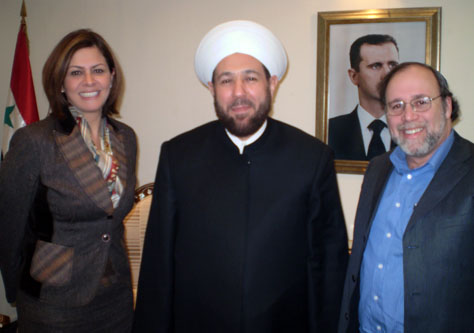
News (4 June 2008)

Diplomats: 3 suspect Syrian nuke sites off limits
By GEORGE JAHN – AP

VIENNA, Austria (AP) — Syria has told fellow Arab countries that it will not permit an International Atomic Energy Agency probe to extend beyond a site bombed by Israel, despite agency interest in three other suspect locations, diplomats told The Associated Press on Tuesday.

The agency's main focus during its planned June 22-24 visit to Syria is a building in the country's remote eastern desert that was destroyed by Israeli jets in September.

IAEA chief Mohamed ElBaradei announced Monday that Damascus has agreed to an agency check of U.S. assertions that target was a plutonium-producing reactor that was near completion, and thus at the stage where it could generate the fissile material for nuclear arms.

The U.N. agency is also interested in following up on information that Syria may have three other undeclared atomic facilities. Diplomats and a nuclear expert told the AP on Monday that at least one of the sites may have equipment that can reprocess nuclear material into the fissile core of warheads….

The diplomats said Syrian atomic energy chief Ibrahim Othman told the Arab delegates his country could not open secret military sites to outside perusal as long as Syria and Israel remained technically in a state of war….

Olmert Tells AIPAC Peace With Syria Could Transform Middle East
2008-06-03 20:59 (New York)
By Jonathan Ferziger

June 3 (Bloomberg) — Israeli Prime Minister Ehud Olmert told American Jewish leaders he hopes renewed contacts with Syria will lead to peace talks that could transform the Middle East.

Olmert spoke late today at the annual policy conference of the American Israel Public Affairs Committee in Washington, a pro-Israel lobby. He said he expects to conclude a peace agreement with the Palestinians this year and called for tougher international sanctions against Iran to stop its development of nuclear weapons.

Economist Intelligence Unit
03 Jun 2008 (T13:20)  COUNTRY VIEW
OUTLOOK FOR 2008-09

  * The  president, Bashar al-Assad, is expected to remain in power in 2008-09. He will continue to rely on the strength and loyalty of the security services, which will keep opposition forces weak and ineffective.
  * The  start  of  talks with Israel and a reduction, at least temporarily, in tensions in Lebanon may give Mr. Assad  the  opportunity  to  reduce  Syria's  political  isolation, but he is unlikely to end its strategic alliance with Iran.
  * Economic  policy  in  2008  will be dominated by conflicting views on how to respond to high global oil and commodity prices in the context of a growing fiscal deficit.
  * Syrian  oil  output  will  fall  over  the  outlook period, which will reduce export volumes and government spending and thereby curb economic growth.
  * The  Syrian  pound  is  forecast  to  appreciate against the US dollar this year (largely because of dollar weakness),  but  to  depreciate  in  2009,  as  the Central Bank of Syria responds to concerns about export competitiveness.
  * The  current-account  surplus is expected to remain large in 2008, at around 2.6% of GDP (US$1.4bn), before narrowing in 2009 to 1.8% owing to falling oil export volumes.

DOMESTIC  POLITICS:  There  is  little  prospect  of  any  serious  challenge  to the president in 2008-09, and substantive  political  reforms are unlikely. Mr Assad's control of the country is supported by key elements in the  security  services  and by the ruling Baath party. The core of the elite is drawn from Mr Assad's minority Alawi  sect,  and is acutely conscious that to move against him would risk endangering the Alawi hold on power.

Since  assuming  power following  the  death  of  his father, Hafez al-Assad, in 2000, Mr Assad has stepped up repression  of local opposition groups and activists, and has appointed his own close allies to key posts. This has increased his control, albeit at the cost of narrowing his power base.

INTERNATIONAL  RELATIONS:  The agreement among Lebanese factions to appoint a president and the announcement of indirect  Syrian-Israeli  talks  in  Istanbul,  Turkey,  offer  some  opportunity to address Syria's continuing international  and  regional  isolation. Nonetheless, Mr Assad's sporadic efforts to improve Syria's diplomatic links–particularly with the regional heavyweights, Egypt and Saudi Arabia–are likely to face ongoing problems over his stance on Lebanon, long seen by Syria as within its sphere of influence, and the UN investigation into the assassination of a former Lebanese prime minister, Rafiq al-Hariri. The regional isolation was demonstrated clearly  in  March 2008 when half of the heads of state invited to the first ever Arab League summit to be held in the Syrian capital, Damascus, did not attend.

POLICY TRENDS: An economic debate continues between the government's more fiscally prudent elements, led by the deputy  prime  minister  for economic affairs, Abdullah al-Dardari, and those factions that are concerned about the  impact of rising prices on disposable incomes. Reductions in fuel subsidies, implemented in early May 2008 have not resolved this debate, because increased world oil prices and a 25% rise in public-sector salaries have
offset  the fiscal benefits. Furthermore, the proposed introduction of a value-added tax has been delayed until 2009. In 2009 the policy debate will turn to the need to diversify the economy and encourage investment.

INTERNATIONAL ASSUMPTIONS: World GDP growth is expected to average 3.7% in 2008-09 (at purchasing power parity exchange rates), down from an estimated 4.8% in 2007, largely as a result of a sharp slowdown in the US economy in 2008. The Economist Intelligence Unit has substantially revised its oil price projections, as buoyant demand in  emerging  markets  will  offset  the  projected slowdown in the OECD. We now forecast that the price of the
   benchmark  dated  Brent  Blend will average around US$106.5/barrel over the outlook period. We have also raised our  forecasts for food prices in 2008 and are expecting an increase of 40%, although prices will ease slightly in 2009.

ECONOMIC GROWTH:  Although  Syria maintains that growth in 2007 was 6.5%, we have revised our estimate down to 4.3%  because  investment  growth  and  exports  were not as strong as previously thought; the IMF is even more downbeat,  estimating  3.9%. We expect the Syrian economy to slow further to an annual average of 3.9% over the outlook  period,  largely  owing  to  falling  oil  output.  The agricultural sector is also expected to remain depressed  this year, after another poor harvest. These negative trends will be only partly offset by continued expansion in the services sector, boosted by solid growth in tourism and demand for goods and services, in part from the large Iraqi refugee population.

INFLATION: We expect inflation to continue to rise in 2008–to an average of around 16.8%–owing to significant reductions  in  fuel  subsidies  in  March  and  May and to a 25% increase in government salaries and pensions. However,  it  is  possible that the shock caused by these sudden changes could drive inflation even higher than our  current  forecast.  In  2009  flat oil prices and a slight easing in non-oil commodity prices will help to bring  down  inflation,  to  around 10.2%, and any significant return of Iraqi nationals to Iraq could lower it even further by reducing demand pressures. Although official full-year inflation data are not yet available for 2007,  an  annual average of at least 12.2% (up from 10% in 2006) seems plausible based on current information.

The  official  consumer  price index (CPI) is only currently available for the first three quarters of 2007 and apparently  shows  flat  prices  over  that  period.  However, this does not seem to mesh with regional trends, anecdotal  reports  of  price  increases  and some recent statements by Syrian officials (for example that food price  inflation in 2007 was 26%). This is why our estimate for inflation in 2007 is likely to diverge from the official data, unless they show a dramatic increase in CPI for the final quarter of 2007.

EXCHANGE  RATES: A new exchange-rate regime–a peg to a basket of currencies based on the IMF's special drawing rights–has  been  in  place  since  October  2007, resulting in a marked appreciation of the pound against the dollar.  Despite  the  change,  however,  the  authorities  are expected to keep close control of the currency, placing  a  high  priority  on  exchange-rate stability. The dominant position of the state-owned banks and the Central  Bank's control over foreign-currency transactions (even as some laws are relaxed) mean that the regime is  well  placed  to  protect  the  value of the pound. As a result, we forecast that the pound will appreciate further  against  the  weak  dollar  in 2008. Next year, by contrast, we expect a modest depreciation, owing to concerns about the competitiveness of Syria's non-oil exports (and some strengthening of the dollar against the
euro).

EXTERNAL  SECTOR: We expect Syria's merchandise export earnings to rise in 2008, owing to the sharp increase in average  oil  prices, which will offset the negative impact of falling oil production and reduced wheat exports owing  to  a  poor  harvest.  Non-oil  exports  are  continuing  to benefit from strong regional demand and the relaxation  of  foreign-exchange  controls,  which  has  led  to more exports being officially recorded. Import spending  growth  will  remain  strong over the outlook period, partly because of the ongoing process of tariff liberalisation,  but  also because of healthy demand for capital goods related to some large infrastructure and construction  projects.  As  a result, the trade account surplus will narrow over the outlook period from about US$1bn (2% of GDP) in 2008 to US$0.7bn next year.
   -0- Jun/03/2008 21:17 GMT

Youth held for past year because of comments posted online 
Reporters without Borders

Reporters Without Borders firmly condemns the detention of Kareem Arbaji, a young business consultant, for the past 12 months because of comments he posted on the online discussion forum Akhawia (www.akhawia.net/). The arrest of Arabji, who is due to appear in court on 8 June, has only now been drawn to the organisation's attention.

"Arbaji's arrest means that a total of three cyber-dissidents are being held in Syria," Reporters Without Borders said. "His detention for the past year is further evidence of the government's systematic repression of online freedom. He was arrested on 7 June 2007, but that was not the first time he was summoned for questioning about his online activities. We call on the authorities to stop hounding Internet users."

Aged 31 and a graduate in accountancy from Damascus University, he was managing a business consultancy when he was arrested in the utmost secrecy on 7 June 2007. He is currently being held in a military prison in Saydnaya, north of the capital.

During a hearing on 20 March, he was charged with spreading false information under article 286 of the criminal code, which punishes "any person who disseminates information considered false or exaggerated and which is liable to undermine national morale."

Two other cyber-dissidents are currently being held in Syria on the same charge. They are writer and poet Firas Saad, who was arrested in November 2006 for criticising the government on the website Al Hiwar Al Moutamaden, which means "Modern Discussion," and blogger Tariq Biassi, 22, who was arrested in July 2007 because of an online comment very critical of the government.

Participants in the Akhawia (www.akhawia.net/) discussion forum often criticise the authorities. The government systematically filters opposition websites and Akhawia is on its blacklist. Another 100 websites were blocked in December 2007. Under regulations that took effect in July 2007, website owners are required to keep the personal data of everyone who posts articles and comments on their sites.

Landis comment: The Lebanese are kissing and making up. As Qifa Nabki observed, It is not surprising that Junblat is first off the block in the reconciliation department. I was told by good Syrian sources that Amal fighters were prepared to wipe out Junblat's military base in a march on the Jabal to set the ground for an Arslan take over of the Druze Mountain had not Junblat head them off at the pass by declaring defeat and pleading for mercy for his people the day after Hizbullah took West Beirut.

Lebanese Shiites don't want Iranian-style regime – Qabalan 
Daily Star, 3 June 2008

The vice president of the Higher Shiite Council, Sheikh Abdel- Amir Qabalan, said on Monday that Lebanese Shiites were not in favor of Iran-style "rule of the jurisprudent."

"Shiites don't want to change the regime in Lebanon, and we also don't favor a rule of the jurisprudent in Lebanon," Qabalan said. "We hide nothing from the Lebanese, we love Iran, but the rule of the jurisprudent cannot be applied in Lebanon."

Meanwhile, Grand Mufti Sheikh Mohammad Rashid Qabbani called for a "new start" in Lebanon, which can be achieved by "erasing the painful scars and failures of the past"

Amal, PSP ink joint statement calling for reconciliation
By Anthony Elghossain (Thanks QN)
Daily Star staff
Wednesday, June 04, 2008

Amal, PSP ink joint statement calling for reconciliation

BEIRUT: Officials from the Amal movement and the Progressive Socialist Party (PSP) met Tuesday in Parliament and issued a joint statement calling for broader reconciliation in Lebanon.  Alongside other party officials, Amal MPs Ali Hassan Khalil and Ali Bazzi and PSP MPs Akram Chehayeb and Wael Abu Faour attended the meeting, which concluded with the declaration of a four-point statement.

Israel Court Condemns Student Ban
BBC, June 3, 2008 

The Israeli Supreme Court has called on the government to reconsider its almost total ban on Palestinian students leaving the Gaza Strip to study abroad.

En Syrie, Bachar el-Assad redistribue le pouvoir
Georges Malbrunot
03/06/2008 | Mise à jour : 21:43 |Le Figaro

En écartant son beau-frère, le général Assef Shawkat, l'homme fort de Damas envoie un signal à la communauté internationale.

Dans la plus grande discrétion, le pouvoir vient d'être redistribué entre les membres du directoire familial qui gouverne la Syrie d'une main de fer. La principale victime de ce jeu de chaises musicales est le beau-frère du président Bachar el-Assad, le tout puissant Assef Shawkat, patron des Renseignements militaires, qui est soupçonné par la communauté internationale d'avoir trempé dans l'assassinat de l'ancien premier ministre libanais, Rafic ­Hariri, en 2005.

«Assef a été mis en quaran­taine près de Lattaquieh», révèle un connaisseur du système syrien. Celui qui avec l'aval de Bachar , avait placé ses hommes à la tête des autres services de sécurité «paie pour deux échecs». Le premier concerne le bombardement israélien du site nucléaire syrien, le 6 septembre, près de Deir Ez-Zor (Nord-Est), rendu possible grâce à des photographies, prises au sol, par des Kurdes, qui auraient travaillé pour le Mossad israélien. «Des gens se sont approchés du site, poursuit l'expert, or c'est le service de Shawkat qui était responsable de sa protection». Première conséquence de cette faille, le poids des Renseignements militaires dans l'appareil sécuritaire a décliné au profit des Renseignements généraux du général Ali Mamlouk : «Ce sont des gens plus présentables, pour avoir commis moins de basses œuvres hors de la Syrie», ajoute la source. Le président syrien a également décidé d'«encadrer» son beau-frère en le flanquant d'un numéro 2, Ali Younès, qui lui rend compte directement…..

Syrians like the candidate’s approach to diplomacy.
3 June 2008, City Journal
Bashar feared another civil war in Lebanon
By Abdul Hamid Ahmad, Editor in Chief
Published: June 02, 2008, Gulf News
Opening an embassy needs good relations between the two countries and we were forced to put off this step as relations with Lebanon deteriorated in the past few years, says Bashar Al Assad, Syrian President…..

“Lebanese and Syrian Leaders as Seen by a Harvard Graduate Student,” by Kiernan

Here is part of the travel brief written up by a Harvard Middle East Studies grad student who traveled to Lebanon and Syria as part of a 30 person Harvard trip that was organized by some enterprising students at the Kennedy School of Government. During the preparation phase of the trip, I spoke with one of the organizers about the Syrian leg. Here is the account that Kieran sent to Colonel W. Patrick Lang who writes the excellent blog: Sic Semper Tyrannis. Col Lang is a retired senior officer of U.S. Military Intelligence and U.S. Army Special Forces. Here is part of the post, but read it all at Lang's blog.

Kieran sent me this letter account of his travels in the Levant some days ago and has today allowed me to post it.  pl

Johnharvardstatue7_4 "Recently I had the opportunity to travel as part of a student-organized delegation of 30 Harvard graduate students (mostly from the Kennedy School, though I'm at the Center for Middle East Studies) to Lebanon and Syria. We met with most of the major players, with whom we engaged in generally quite freewheeling debate. I imagine that the kind of discussions we had were quite rare simply because students have a certain freedom (and allow a certain freedom to the other party) that politicians, diplomats, journalists, and certainly citizens of the countries concerned do not. We were also there at a very historic time for Lebanon (May 19 – June 1), just after the Doha agreement. I thought you might be interested in hearing a few of my impressions……

A couple of days later we travelled to Damascus to meet Bashar al-Assad and his wife Asma in the visitors' palace on a mountain overlooking Damascus. Bashar spoke with us for three hours, all Q&A. He impressed the whole group with his willingness to actually answer the questions asked, his ability to provide logical defenses of his positions, his command of English, and his forward-looking mindset. A number of anti-Syrian Lebanese in the group walked away shaken by the experience. We were furthermore surprised that, in contrast to almost every other politician we met, we were not searched or put through any kind of physical screening. Only one (massive) bodyguard attended him and he seemed to be present more to pass the microphone around.

I asked him why he had not allowed the IAEA in to inspect the 'nuclear facility' in order to disprove US-Israeli allegations. He responded that there was no use – Saddam opened his sites up to inspectors but the US attacked anyway. He indicated that he does not believe in dignifying these kinds of allegations, or in setting the precedent of allowing weapons inspectors to run around his country. I told him I thought he underestimated the value of public relations – he was standing on a point of principle, but this would have real costs in terms of Syria's image in the media. He replied that he did not think so: the Western media would paint him as a bad guy in any case, and moreover in his view the key strategic decisions are taken without regard to public opinion (he again used the invasion of Iraq as an example).

Someone else asked him about his worst and best case scenarios for the region during the next 5 years. He said that the worst case scenario was a US or Israeli attack on Iran, which would have repercussions everywhere. The best case scenario was a US president committed to seeking peace accords with Syria and the Palestinians ("a genuine commitment, not like Annapolis"). I got the impression from this (and later from a sly 'yes we can' from his wife) that they saw a significant difference between Obama and McCain. Nonetheless, when explicitly asked about this, he replied that his country had learned to be skeptical of US campaign rhetoric.

As to the Syria-Israeli talks Assad said that the intention was genuine but that he doubted Olmert's ability to actually reach an agreement.

On Lebanon he was reluctant to discuss the details of Lebanese politics, though he was clearly pleased by the Doha agreement. He was ready to establish normal ties in principle (embassies and border demarcation) but sounded reluctant to do so with the government of Fuad al-Siniora. We (especially the Lebanese among us) pushed him hard on this issue, but it was not clear whether or not he appreciated the importance of Syria making a symbolic gesture of reconciliation. He considers Walid Jumblatt an enemy of the state.

The only point at which he became emotional was in discussing the regime's fight against Islamists during the early 80s, responding to a question about Hama. He talked about the various atrocities committed by the Islamists, then saying "what would you do with these people?"

When asked about Alawi dominance of key levers of power and the impact of that on political reform, he responded obliquely, talking about the new party law designed to end the Ba'ath Party's dominance of political life. When we pointed out that the problem was not just in the Party but in the military-security apparatus, his response became vaguer still. It was clear we were not getting anywhere on this issue.

Overall, Assad performed extremely well. Still, he could get off easy as the darker side of Syrian involvement in Lebanon is (somewhat) plausibly deniable. It struck me that one reason he may have consented to such an extended discussion in such a freewheeling format is practice for him in the hope of eventually making the transition to a more conventional or at least Western-style politician, giving press conferences and such.

After three hours his wife Asma showed up. If they were not in love it was a hell of a good act. After chatting informally for a bit and taking photos he left, and she sat in his place. She is beautiful, charming, and thoroughly English. She is also extremely intelligent and had a remarkable grasp of the minutiae of domestic social and economic policy that he himself did not exhibit. It occurred to me that a woman in her position may be in effect a second president. She discussed the importance of education as the key strategic domestic issue. She also mentioned that she was personally key in shaping the new companies law, which aims to shift the emphasis from the development of existing large enterprises to small and medium businesses, including startups.

After our return to Lebanon we met with Walid Jumblatt, who frankly appeared to be somewhat in pieces. In addition to a generally stoned demeanor, he gave answers which ranged from completely inscrutable to impolitically frank to obviously evasive. I tried hard to pin him down on the issue of the impact of US domestic politics on his 'bets' in Lebanon. After interrupting him about four times, steering him back to the issue from long lectures about nothing in particular, I asked him "do you think the US will trade Lebanon? [to Iran and Syria]" and got what I think was an honest "I don't know." He pushed what I find an implausible conspiracy theory of Syrian involvement in the death of Mughniyeh. His old dog lay loyally -or listlessly- at his feet the whole time. He said that Nasrallah and Hezbollah are fascist organizations and drew tired comparisons to 1930s Germany. His position towards the opposition was uncompromising, though I personally wouldn't be surprised to see him back as a Hezbollah ally in a few years if the US does not continue its strategy of confrontation in the Middle East. He was very pessimistic overall, though it was not clear if this was due to the broader strategic situation or the very humiliating defeat he had recently been handed by Hezbollah.

We met for two hours with Siniora, who seemed to be genuinely excited to see us but unfortunately proved to be very boring, lacking charisma or a sense of interactivity and choosing to lecture us about Lebanese history despite our protestations that we were familiar with it. He confirmed his technocrat image. In contrast to other March 14th figures he seemed quite optimistic and full of energy. He admitted that he personally had been against the two decisions that precipitated the crisis of the last few weeks, confirming reports that it had been Jumblatt behind them. Of all the orange juice served to us by the various figures we met, his was of the lowest quality.

We later met Saad Hariri at his Qoreitem palace, who, when I asked why he did not take the premiership, replied that he could do much more outside the government. He somewhat gauchely added, "Siniora is me!" When asked, he said that he did not believe the US would strike Iran, but that there would be a war perhaps 5 years hence, much bloodier than that which could be had now. Another question centered on his role in SecurePlus, a private security company that effectively constituted a militia, which was routed a few weeks ago. Saad admitted his connection to the company but denied that it was a militia. Saad had the demeanor of the playboy, lacking in finesse and genuine charisma, but full of confidence regardless. His orange juice was the highest quality. The security surrounding his palace was incredible, consisting of multiple checkpoints, barricades, and armed men everywhere. Pictures of Rafiq Hariri were displayed in abundance, including, as usual, in the central chair during the meeting.

Amin Gemayel was not particularly forthcoming, and seemed badly out of touch. When pressed for details on a number of points he was completely at a loss. He seemed to resort to stock politician phrases even in personal conversation. My impression was of a man losing vitality. I tried to push him on the question of what a real 'national defense strategy' would be, seeking some common ground between him and Hezbollah. He replied that he envisaged a 'Swiss model' of every citizen owning a gun. Incredulous, I asked him if that would really deter Israeli or Syrian aggression. He responded evasively, citing the importance of various UN resolutions. When I cornered him privately after the session, he said that in the 1970s they had tried to acquire Crotale air defense systems but were thwarted by Israeli pressure, indicating that similar factors were at play today.

Overall, none of the March 14th figures seemed to think there was any realistic prospect for Hezbollah's peaceful disarmament in the short to medium term. Geagea seemed to be the furthest from admitting this fact, while Jumblatt, Siniora, and Hariri were closest. Only Siniora and to some extent Hariri seemed upbeat about the Doha agreement, which struck me as odd considering that the agreement effectively redistributed seats from Sunnis to Shiites and Christians. This reinforced my feeling that the Doha agreement represented some kind of Saudi-Syrian reconciliation, considering Hariri's (and by extension Siniora's) very close ties to the Saudis.

The March 14th people unanimously condemned the actions of Hezbollah and its allies, and the phrase 'attempted coup' popped up repeatedly. Nonetheless, the general mood amongst the population was upbeat. There was broad satisfaction at the election of Michel Suleiman as President and the formation of a unity government. There was happiness too at the return of normal life to downtown Beirut, with the removal of the opposition protest camps. I had the feeling that Hezbollah and its allies could translate these developments into major political gains if they take the initiative to sustain political movement after a year and a half of paralysis. The upcoming elections in summer 2009 are the major political event towards which all the parties are working. 

We spent two days with Hezbollah. The first day involved being shown around the south by various low-level Hezbollah people. We were shown various scenes of Israeli atrocities (Qana, Khiyam) and presented with the families of martyrs at Bint Jbeil. The quality of the PR was exceptionally low and the propaganda exceedingly unsubtle, although our guide was a very lively and interesting woman with a show on Al-Manar. The reaction of our group was overwhelmingly negative, many feeling that the various tragedies and massacres were being very callously exploited.

The second day began with a tour of the Wa'ad rebuilding projects in the Dahiye. We were shocked by the speed and scale of the project – dozens of large residential buildings at various stages of construction, where last summer I saw only rubble. More than one person in our group contrasted the Hezbollah program with the US government's response to Katrina. People passing in cars and minibuses honked and cheered when they saw our group checking out the construction sites. [An aside to show just how out of touch the diplomatic community is: at a diplomatic party the night before a number of embassy people from various countries were assuring me that Hezbollah was not doing much construction.] Seeing the "Hezbollah stronghold" in person dispelled for many in the group the images the phrase conjures. There were no gunmen in the streets and many women walked around in tight jeans and revealing shirts. We met for several hours with Nawaf Musawi, Hezbollah's 'foreign minister' and a member of the politburo. He was very impressive – fiercely intelligent, an excellent debater, and a flexible thinker……

Nukes, Golan, Lebanon and the Shifting Balance (3 June 2008)

Assad to Announce from Baabda Exchange of Ambassadors
Beirut, 03 Jun 08, Naharnet

Syrian President Bashar al-Assad has reportedly decided to postpone an official visit to Lebanon that was scheduled for mid-June until the end of his Arab tour.

The daily As Safir said Tuesday Assad’s visit will be a turning point in the history of Lebanese-Syrian relations where the Syrian president is expected to announce from the Presidential Palace in Baabda normalization of relations between the two neighboring countries, including the exchange of ambassadors.

Citing well-informed Lebanese sources, the daily said Damascus, which had sent an invitation to Free Patriotic Movement leader Michel Aoun to visit Syria, has decided to convey similar invitations to a number of Lebanese leaders.

The sources said Aoun accepted the invitation and promised to visit Damascus once Assad ends his Lebanon trip.

Assad, who arrived in Abu Dhabi Sunday, is due to visit Kuwait on Tuesday.

He also visited Dubai, where he met with the emirate’s ruler Sheikh Mohammad bin Rashed al-Maktoum, who is also UAE vice president and prime minister.

The two leaders discussed “the peace process in the Middle East” and the situation in the Arab world, WAM said. They hailed the recent Lebanese reconciliation accord and the launch of a peace process in Lebanon.

Barak says Golan is not Syria's top priority
Jerusalem Post

Israel's Defense Minister Barak said that the Syrian government is much more concerned with ensuring the continuity of [President Bashar] Assad's regime; blocking the international tribunal on the Hariri murder; pursuing international recognition of Syria's "special" role in Lebanon; and receiving badly-need aid from Western countries, similar to what Egypt has received over the years.

Returning the Golan, Barak said, comes after those other four issues in Syria's priorities.

Barak added that Israel had initially requested secret and direct talks with their Syrian counterparts, whereas Damascus had insisted upon indirect and overt talks. In any case, he estimated, it is highly unlikely that any agreement would be concluded by the end of the 2008 calendar year.

Mofaz: Giving Golan Heights to Syria would mean Iran on our borders: Jerusalem Post

Syria's Assad wants US to sponsor Israel peace talks

ABU DHABI (AFP) — Syrian President Bashar al-Assad said on Monday that indirect peace talks with Israel would eventually need "international sponsorship" from the United States.

"The success of these negotiations is dependent on Israeli intentions and political changes in the world," he was quoted as saying by the United Arab Emirates's official WAM news agency while on a visit to Abu Dhabi.

"During later stages, the negotiations will need international sponsorship, particularly that of the United States in their role as a superpower with strong and special relations with Israel."

He said the current Turkish-brokered indirect talks were at a "preliminary stage."

Peace Fills a Vacuum
Intent on isolating its foes, the United States has instead ended up marginalizing itself.
By HUSSEIN AGHA and ROBERT MALLEY
Op-Ed Contributors, NYT
June 3, 2008

IN the last few weeks, three long-frozen conflicts in the Middle East have displayed early signs of thawing. Israel and Hamas may be inching toward a cease-fire that would end attacks by both sides and, perhaps, loosen the siege imposed on the impoverished Gaza Strip. The factions in Lebanon, after a long period of institutional paralysis and a near civil war, have reached a tentative political agreement. And eight years after their last negotiations, Israel and Syria have announced the resumption of indirect peace talks.

That so many parties are moving at the same time in so many arenas is noteworthy enough. That they are doing so without — and, in some cases, despite — the United States is more remarkable still.

The Gaza deal is being brokered by Egypt. Qatar mediated the Lebanese accord. Turkey is shepherding the Israeli-Syrian contacts. All three countries are close allies of the United States. Under normal circumstances, they would be loath to act on vital regional matters without America’s consent.

Yet in these cases they seem to have ignored Washington’s preferences. The negotiations either involved parties with whom the United States refuses to talk, initiated a process the United States opposes or produced an outcome harmful to its preferred local allies.

The region is in a mess, and Washington’s allies know it. They privately blame the United States and have given up waiting for the Bush administration to offer them a way out.

By acting as they did, Egypt, Qatar and Turkey gave the true measure of America’s dwindling credibility and leverage after American debacles in Iraq, the Palestinian territories and Lebanon. They are willing to take matters into their own hands and overlook American ambivalence about their doing so.

Intent on isolating its foes, the United States has instead ended up marginalizing itself. In one case after another, the Bush administration has wagered on the losing party or on a lost cause.

Israel wants to deal with Hamas because it — not America’s Palestinian partners — possesses what Israel most wants: the ability to end the violence and to release Cpl. Gilad Shalit, the Israeli soldier held by Hamas. Israel has come around to dealing with Syria because Damascus — not America’s so-called moderate Arab allies — holds the crucial cards: Syria has a clear strategy of alliance with Iran; it supports the more powerful forces on the ground in Lebanon; and it provides refuge to opposition and Islamist forces in Palestine.

Likewise, America’s Lebanese friends had to give in to Hezbollah’s demands once it became clear that the support of the United States could not undo their country’s balance of power. Meanwhile, the process President Bush seems to care about most — that elusive Israeli-Palestinian track — is also the least likely to go anywhere.

The United States has cut itself off from the region on the dubious assumption that it can somehow maximize pressure on its foes by withholding contact, choosing to flaunt its might in the most primitive and costly of ways. It has pushed its local allies toward civil wars — arming Fatah against Hamas; financing some Lebanese forces against Hezbollah — they could not and did not win. And it has failed to understand that its partners could achieve more in alliance than in conflict with their opposition.

How much more powerful would Mahmoud Abbas, the Palestinian president and leader of Fatah, have been if, at the head of a national unity coalition, he could deliver a truce and Corporal Shalit to Israel while simultaneously broadening the support he needs to sell a peace agreement? How much stronger would Prime Minister Fouad Siniora of Lebanon and his colleagues have been had they agreed two years ago to the very power-sharing accord they were forced to swallow last month?

Many questions surround these three still-incomplete deals. They could collapse or move in unintended directions. They may end up serving a quite different purpose, like constraining Syria’s, Hezbollah’s or Hamas’s ability to retaliate in the event of an American or Israeli attack against Iran. On all this there is understandable uncertainty.

But for now at least, there’s no great mystery about where the United States stands. At a critical time in a critical region, it is quite simply missing in action.

Hussein Agha is the author, with Ahmed S. Khalidi, of “A Framework for a Palestinian National Security Doctrine.” Robert Malley, the director of the Middle East Program at the International Crisis Group, was a special assistant for Arab-Israeli affairs to President Bill Clinton from 1998 to 2001. 

U.S.-Iran regional power plays shift
By Scott Peterson | Staff writer of The Christian Science Monitor
from the May 30, 2008 edition

Istanbul, Turkey – A string of events across the Middle East is shifting the US-Iran regional power play. The Iran-led “axis of resistance” arrayed against the US, its Western allies, and Israel may appear ascendant, but new chances for peace could also redefine the game in the US’s favor…..

On the peace track, Israel declared that Syria would have to cut ties with Iran, Hezbollah, and Hamas to regain the Golan Heights, occupied by the Jewish state since 1967. Syria rejected that demand outright, and instead on Wednesday signed a new defense agreement with Tehran.

“It won’t be like the Israelis want, which is a complete break. That is completely out of the question [for Syria],” says Mr. Khouri, a former editor of Beirut’s Daily Star newspaper. “But an adjustment is very likely, because a Syria-Israel peace will axiomatically mean that a Lebanon-Israel peace will … follow very quickly, and that would have huge implications for Hezbollah’s rationale as an armed resistance movement.”

Iran offer to United Nations

News of the Syria-Israel talks came as an Iranian offer addressed to United Nations Secretary-General Ban Ki Moon, dated May 13 and called a “proposed package for constructive negotiations,” was made public.

The proposal said Iran was willing to start talks on issues from its nuclear program to a “just peace … in regions that suffer from instability, militarism, violence, and terrorism,” according to an unofficial translation. Iran would cooperate to “assist the Palestinian people to find a comprehensive plan” that was “sustainable, democratic, and fair” – effectively a peace deal with Israel, without using either word in the text.

“It’s a significant departure in foreign policy. I think they are serious,” says a political scientist in Tehran, who asked not to be named. “There is a sense of compromise [from Iran, born] primarily out of self-confidence. They think that they won in Lebanon; that they won in Iraq to a large degree. There is deadlock on the nuclear issue [so] it’s a good time to be a little more soft and compromising.”

Iran may also be looking beyond the US election, this analyst says. “This is part of an overall approach that may be a prelude … to show the next president that Iran could be worked with,” he says. “If you are serious and treat Iran with dignity … there could be windfalls in other areas as well.”

Analysts in Beirut and Tehran say Iran is not likely to prevent a Syrian peace with Israel, in the same way that – despite continuous lambasting of Israel – Iran has often stated that it will not undermine any peace deal acceptable to Palestinians.

“Peace with Syria would break up the current strategic situation because it would isolate Iran and silence Hezbollah,” Israeli infrastructure minister Benjamin Ben-Eliezer told Israel public radio on Tuesday. “We are talking about a true peace, an end to hostilities, an opening of the borders, and Israel is ready to pay the price for such a peace and coexistence with Syria.”

But the weak government of Israeli Prime Minister Ehud Olmert is not likely to be able to deliver.

“The only way to divide Tehran from Damascus is to give Damascus back all of the Golan Heights,” says Toby Dodge, an expert with the International Institute for Strategic Studies in London. “Then things start to look much, much different. And that series of victories for Hezbollah, Damascus, and Tehran start to look less triumphant.”

But noting that Iran serves as Syria’s strategic depth, Mr. Dodge says he “would be surprised if [Syria] did get peeled away” from Iran.

Even if Syria were willing, “it’s down to the Israeli government to be secure in itself, not just in its political sense, but in its existential sense, to do that deal,” adds Dodge. “And I see no Israeli government [now] that can do that.”

Three parallel tracks

Beyond that, Hezbollah’s top priority is domestic politics, Syria’s is the Golan, while Iran aspires to regional dominance.

“You have three parallel … tracks, Hezbollah, Syria, and Iran. They are all mutually dependent and mutually supportive, but all have independent aspirations,” says Dodge. “The axis is created through a unity of common interests. And if you were sitting in Washington … you would seek to work against the axis by seeking individual and not collective interests.”

President Bashar al-Assad said Syria’s ties with Iran would not weaken, telling British parliamentarians this week that “if Israel could question Syria’s relations with Iran, then Syria could question Israel’s ties with other countries, particularly the United States,” a source familiar with the Damascus meeting told Reuters.

Still, Iran has moved fast to reinforce the resolve of the “axis of resistance.” In Lebanon this week, Iranian Foreign Minister Manouchehr Mottaki said the Qatar agreement, which essentially granted Hezbollah veto power over decisions of the pro-West government, showed “greatly weakened” US influence.

In Tehran, Iran’s defense deal with Syria on Wednesday pledged “mutual support regarding territorial independence,” and called for withdrawal of “foreign and occupation forces, which are the source of insecurity and instability in the region.”

President Ahmadinejad told Syria’s visiting defense minister, Hassan Turkmani, that Syria “will not abandon the front line until the complete removal of the Zionist threats.”

Iran’s supreme religious leader, Ayatollah Ali Khamenei, echoed that theme, telling visiting Hamas chief Khaled Meshal that the “Zionist regime is at its lowest ebb,” thanks to Palestinian militancy.

And in Lebanon this week, Hezbollah leader Sheikh Sayyed Hassan Nasrallah marked the eight years since Israel’s withdrawal, noting that negotiations “did not return to Lebanon a single inch of land” – only armed resistance brought “victory.”

“There are two dreams; a Lebanese dream and an American dream,” Mr. Nasrallah said. “The Lebanese dream speaks about a calm and peaceful summer and the American dream speaks about a hot summer,” he added. “Come and let us realize our dreams, and not the dreams of our enemies.”

Keep expectations low for a Golan deal
By Hasan Abu Nimah
Tuesday, June 03, 2008: Daily Star

Syria says wants nuclear energy under Arab umbrella
Reuters
Tuesday, June 3, 2008; 7:57 AM

DUBAI (Reuters) – Syria is not seeking nuclear weapons but wants to have access to atomic energy for peaceful purposes through a collective Arab project, President Bashar al-Assad said in remarks published on Tuesday.

The Dubai-based Gulf News also quoted Assad as saying that the United States should have sought an investigation of a Syrian facility suspected of housing a secret nuclear plant before it was destroyed in an Israeli air raid last September.

“Acquiring nuclear energy for peaceful purposes is an international trend that all countries are rightfully pursuing. In Syria, we want this to be done within an Arab context, which was discussed and agreed during the Arab Summit in Riyadh,” he said during a visit to the United Arab Emirates…..

News Round Up (2 June 2008)

IAEA inspectors to visit Syria this month: "It has now been agreed that an (IAEA) team will visit Syria during the period June 22-24," El-Baradei told the agency's 35-member board of governors here. "I look forward to Syria's full cooperation in this matter."

He did not say whether Syria would allow inspectors to examine the al-Kibar site bombed by Israel in the country's remote northeast desert.

A Western diplomat said the Vienna-based U.N. watchdog, which also has a long-running investigation into Iran's shadowy nuclear programme, wanted to inspect not just al-Kibar but two other sites with possible nuclear links.

ElBaradei had said on May 7 that he hoped to be able to shed light "in the next few weeks" on whether the Syrian facility was a nuclear reactor that should have been declared to the IAEA under Damascus's nuclear Non-Proliferation Treaty obligations.

Tzipi Livni: terrorist-hunter secret of woman tipped to lead Israel
London Times

Livni, who unlike her parents supports a Palestinian state, would be no soft touch as prime minister. “While Tzipi is willing to give up the West Bank to the Palestinians, she is a hawk when it comes to Syria and Iran,” said a leading political commentator. “She is against withdrawal from the Golan [Heights], and once prime minister she will want to bomb Iran’s nuclear facilities.”

The battle for Lebanon
By Elie al-Hajj
May 29, 2008

The battle for Lebanon is a battle between a relatively rich minority; numerically that is, among Lebanon’s four million people and a poor majority. The minority controls the political and economic fortunes of the country. On the other hand, the majority refuses to be dominated. The Lebanese divide is political and economic, not religious or sectarian; though, Lebanon is home to 18 different religious sects, all recognized in the Lebanese constitution. ….

Nuclear Syria, why not?
By Ahmad Mustafa, Special to Gulf News
June 1, 2008

Landis Comment: The following WSJ article seems to indicate that some right wingers are coming around to the need to negotiate with Hizbullah. Hizbullah's success in Lebanon, although being spun as "weakness," has convinced many that Hizbullah has shown considerable restraint in dealing with Lebanon's confessional mosaic. Far from being an unreasonable organization, it is interested in power sharing, can be reasoned with, and is not much different from the IRA. Although, Hizbullah's restraint perplexes Daniel Freedman, who believes that the Shiites should have tried to "conquer" Lebanon. His sneering tone is not attractive or helpful, but more important is his analysis, which is that the West must come to terms with Lebanon's Shiite leaders rather than kill them.

The US very intelligently refused to treat the IRA as a terrorist organization despite British insistence that it be proscribed as an evil criminal gang. Fortunately, the the US insisted on viewing the Irish Catholic struggle as political and not criminal. The result was successful diplomacy that helped resolve the dispute and transformed Ireland into one of the happier countries in the world with one of its zippiest economies. There is no reason Lebanon can not follow suit. Rashid's insistence that Lebanon's Shiites just want to "humiliate the Sunni enemy" is silly. Freedman's insistence that "the political process will gradually change [Hizbullah's] stated ideological aims" is smart.

Anyway, what other choice does Washington and Tel Aviv have but to negotiate with Hizbullah? War didn't work to destroy it. The build up of the Lebanese army as an instrument to disarm it failed. Only diplomacy is left.

The Axis of Weakness
By DANIEL FREEDMAN
FROM TODAY'S WALL STREET JOURNAL EUROPE
June 2, 2008

In a Middle East full of dissenters and conspiracy theorists, there are usually at least ten interpretations of any noteworthy event. So perhaps most remarkable about Hezbollah's recent power play in Beirut is how uniform commentary has been. The conventional wisdom is that the deal to give Shiites more control in the central government is a victory for the Iran-Syria-Hezbollah axis and a defeat for Saudi Arabia, France and the United States, who support the Cedar Revolution.

But why, at the moment of Hezbollah's big military victory — when it had taken parts of Beirut and proved the army would not stand in its way — did it not finish its coup? The Lebanese government's attempt to shut down Hezbollah's telecoms network and remove a Hezbollah-friendly army commander from Beirut airport miserably failed. Why did Hezbollah only demand a new political settlement? Why wave the white flag when your opponents have laid down their arms? This doesn't add up.

Perhaps then Hezbollah's temporary seizure of Beirut wasn't so much a sign of the strength of the Iran-Syria-Hezbollah axis as of its weakness. The "Party of God" may realize the axis with Tehran and particularly Damascus is not quite as strong as it appears. Seen in this light, the decision to secure tangible political gains while it still has military strength makes sense.

Syria's ongoing negotiations with Israel must worry Hezbollah. Any peace agreement that nets Damascus the Golan Heights would have to include a promise to abandon Hezbollah. If these talks don't bring a deal immediately, the fact that Damascus entertains the idea of cutting ties with Hezbollah must concentrate minds in South Lebanon.

Another sore point is the February assassination of Imad Mughniyah in Damascus, a key Hezbollah leader. Most fingers pointed at Israel. But there is another theory that the Syrians may have killed Mughniyah as a sign to Jerusalem of their sincere intentions.

The pressure on Syria to abandon Hezbollah is rising and coming not just from the West. The March Arab League summit in Damascus was boycotted by half of the leaders. This snub was not only a blow to Syrian prestige. It also showed how isolated Damascus is in the Arab world — a world it once hoped to lead. It was a signal that its gambit of creating a new regional alliance with Iran comes with a heavy price tag.

While Iran has no plans of making peace with Israel or abandoning Hezbollah, it would be difficult for Tehran to keep Hezbollah alive without Syrian help. If Damascus closed its border to Lebanon, it would cut off a key route for Iranian arms smuggling to Hezbollah. And Iran's financial support for the Shiite group is in the end no match for the kind of money Saudi Arabia can pour into Lebanon to counter Tehran's influence. Riyadh has indicated that it will increase its support for its Sunni allies in Lebanon.

Hezbollah may have also learned a lesson from recent events in Iraq, where the Iranian-backed militia headed by Muqtada al-Sadr has at least for now abandoned its fight and started negotiations with the government. Apparently, Iranian support was not enough to keep up al-Sadr's war.

Why should it be different in Lebanon? Although Hezbollah portrayed its recent war with Israel as a victory, it wasn't. The fight did serious damage to Hezbollah's military capabilities. And the Shiite group lost legitimacy among the Lebanese people for the way it acted, both in disregarding Lebanese lives and starting an unnecessary war.

The once dominant sentiment among all Lebanese that "everyone can get along because we are all Lebanese," is waning. Sunni citizens are increasingly wary of Hezbollah. The Shiite group therefore faces the prospect of a hostile Israel on one side, a Syria that is no longer its ally on another, and a third column of opponents within: Lebanon's Sunnis together with Druze and Christian populations who have their own problems with the Shiites.

Sensing the tide in Lebanon might be turning against it, it used the government's attempted crackdown as an excuse to take parts of Beirut to scare its opponents into accepting a new political reality. This new reality gives Shiites, and therefore Hezbollah, more power in the central government.

So perhaps what we are seeing is the beginning of the gradual transformation of Hezbollah into a predominately political actor. It won't be easy and it will take time. Just like Northern Ireland, where it took the IRA 10 years to decommission their arms.

Some people argue that given Hezbollah's ideological commitment to an Islamic Lebanon such a transformation could never happen. Well, in the Middle East, everyone promises never to negotiate with their enemies, but everyone has their price. The PLO promised to never recognize Israel. Israel promised never to recognize the PLO. And so on. While the PLO certainly didn't start off negotiating in good faith, the political process helped gradually changing their stated ideological aims. The same could potentially be true for Hezbollah.

If Hezbollah really is on the brink of what could turn out to be a seismic change, the U.S. should do everything to encourage this process. It should accept a greater role for Shiites in the Lebanese government as long as Hezbollah agrees to start, however gradually, decommissioning. Israel should also be allowed to negotiate seriously with Syria.

Much more is at stake than easing frictions at the Israeli-Lebanese and Israeli-Syrian borders. Iran is on the verge of becoming a nuclear power. Separating Tehran from Damascus and Hezbollah would isolate and weaken the Islamic Republic at this crucial time. If we fail to do this, the conventional wisdom — that the recent Lebanese developments were a victory for the Iran-Syria-Hezbollah-axis — may unfortunately turn out to be right.

Mr. Freedman was the foreign policy analyst for Rudy Giuliani's Presidential Committee.

Liberalised Syria banks "on sound track" – report
By Khaled Yacoub Oweis

DAMASCUS, May 26 (Reuters) – Liberalisation is spurring rapid growth in Syrian banking but state banks still dominate the sector since it opened to private investment four years ago, a report by the Syria Report online newsletter said on Monday.

Syria, which has taken limited steps to open its economy after decades of nationalisation, now has nine private banks compared with six banks owned by the state. Another nine private banks are setting up in the country, the report said.

"The arrival of new players seems only to encourage an ever expanding market. Although a lot remains to be done, the liberalisation of Syria's banking sector is now on a sound track," said Syria Report, a Paris-based independent newsletter covering Syrian economics and finance.

The Baath Party government revamped investment laws last year but kept a 49 percent ceiling on foreign ownership of banks. The central bank is working on issuing treasury bills for the first time and Syrian businesses are now allowed to receive loans from foreign banks.

State banks held 82 percent of assets at the end of 2007 compared with 87 percent a year before. The government and a huge array of companies it owns still do business "almost exclusively" with state banks, although nothing in the law forced them to do so, the report said.

Total assets rose 12 percent last year to $34 billion, still 40 percent that of neighbouring Lebanon, which has a solid banking tradition and a financial secrecy code. Private Syrian bank assets rose 59 percent in 2007 compared with 5 percent growth in the balance sheet of state banks.

But a small capital base and restrictions on lending have kept loans by private banks small at $1.5 billion at the end of 2007, although the figure is almost double that of 2006, the report added.  Continued…

Syria's Assad dismisses Israel demands over Iran
By Khaled Yacoub Oweis, Wed May 28, 2008

DAMASCUS (Reuters) – President Bashar al-Assad dismissed on Tuesday Israeli demands for Syria to abandon an alliance with Iran as a requirement for a peace deal. Assad told British MPs that the Baath Party government intended to maintain its "normal relations" with Iran while it conducts indirect talks with Israel to regain the occupied Golan Heights, a source familiar with the meeting told Reuters.

IHT: U.S. could impede merger between MTN and Reliance
2008-05-26 08:56 (New York)

The South African telecommunications giant MTN Group and its Indian peer, Reliance Communications, said Monday that they were in exclusive talks for a tie-up – a deal that symbolizes the growing economic clout of emerging markets, but could still hit a wall with U.S. regulators.

Combining Reliance Communications and MTN Group would create a juggernaut with 115 million customers, more than most European mobile phone businesses have and more than every U.S. one has. Getting funding for a full-fledged deal could be complicated, though, because of economic sanctions imposed by Washington on the countries where MTN does business, including Iran.

A merger or takeover of MTN, which has a market capitalization of $38.2 billion, is expected to require any partner to raise tens of billions of dollars in cash. A problem may arise, though, because the U.S. banks that arrange and finance many of the world's largest corporate transactions may be restricted from the deal.

The obstacle, at least for regulators in Washington, lies in the fact that MTN has a sizable and fast-growing presence in Iran, Sudan and Syria.The U.S. Treasury Department's Office of Foreign Assets Control, or OFAC, which was created in 1950 to freeze Chinese and North Korean assets when the Chinese entered the Korean War, monitors bank activities in sanctioned countries closely.

MTN's business in Iran is new but growing quickly. At the end of 2007, MTN had six million subscribers in Iran and 3.1 customers million in Syria, where the United States has some financial restrictions……

Syria: Taxing Times
Oxford Business Group
May 26, 2008

Syria is to impose a flat rate value added tax (VAT) next year as part of the government's ongoing programme to open up the economy and boost state revenues, though the exact details of what the tax will cover and what goods and services will be exempt have yet to be decided.

On May 17, Mohammed Al Hussein, Syria's finance minister, announced that a 10% VAT would be introduced in 2009. Basic food items would not be included in the new scheme, he said, though it was possible that other rates could be applied to certain categories.

The move is particularly bold since the Syrian public is already struggling with rising costs and shortages in the marketplace. While a recent report by the International Monetary Fund (IMF) predicted consumer inflation would come in at 7% this year, spiralling fuel and food prices may well see this ceiling broken.

Popular or not, the Syrian government needs to increase its revenue base. With oil stocks dwindling, Hussein said that earnings from oil now represented just 20% of state income, down from around 70% at the beginning of the decade. …..

"VAT could play a catalytic role in nurturing a taxpaying culture, due to the built-in incentive to comply with it. If well designed, VAT could yield 1.8% of GDP for each five percentage points for the rate," the IMF said in its 2006 report.

However, in its 2007 report, the fund warned that an ill-prepared launch could damage the credibility of the new tax, and said a number of steps, including the adoption of a tax procedures code and an integrated information technology system, had to be completed before such a tax could be implemented successfully.

The fund also called for any VAT to be imposed on almost all goods and services, saying that instead of limiting its coverage to a few sectors to shield the poor from price increases, adopting near universal coverage and providing targeted spending programmes and progressive income taxes would be a better approach.

The decision to impose VAT will in some measure offset the reductions in private income tax announced in 2003 and amended in 2006. The cuts, which saw the highest rate of income tax lowered from 63% to 28%, were intended to serve as an incentive for private sector companies and individuals to pay taxes, as well as to stimulate economic growth and investment.

According to figures released by Hussein, the tax cuts and reductions in Customs duties on many goods have achieved the desired result. Tax revenues for 2007 amounted to $6.43bn, or 17% of gross domestic product (GDP), up from just $3.5bn in 2000, he said.

In his May 17 briefing, Hussein predicted a deficit of $3.82bn for the 2008 budget, some 9.8% of GDP, though he said the government hoped to bring this down to around 7%.

While highlighting the need for more sources of revenue, Hussein's prediction was wide of the mark projected by the IMF in a report issued earlier the same month, which had suggested the government aim for a deficit of 5%. The Syrian government may not be as optimistic as the IMF about its ability to trim expenditures and increase income, or may be anticipating a greater outlay for the year than had previously been expected.

Oil subsidies bill posts sharp increase in first quarter (From the Syria Report): Mahrukat, the state-owned company in charge of distributing oil products, posted a net deficit of SYP 104 billion in the first quarter of this year, a dramatic 3-digit percentage surge from a year earlier. Read

“An Economic Plan for Syria’s Future,” by Ehsani

An Economic Plan for Syria's Future
By Ehsani
For Syria Comment: June 1, 2008

Jay Solomon of the WSJ quotes Ambassador Imad Mustapha today as saying: "Peace between Syria and Israel can be achieved, but it requires the full commitment of the U.S.  Syria is genuine in its desire to have the best relationship with Washington".

U.S. Strategists think that Syria's openness to talks is driven by its need to reduce diplomatic and financial pressures from the Bush administration — not a real commitment to a settlement. Washington charges Syria with covertly developing nuclear technologies and undermining pro-Western governments in Lebanon and Iraq.

One noteworthy paragraph in the Solomon article states that:

"Private American representatives who have met with Syrian President Bashar Assad in recent months said he is intent on lifting U.S. financial sanctions as part of a broader peace agreement with Israel. They also said the Syrian leader would like to see his nation's economy more directly integrated into the global economy".

Over the past two years, I have maintained that Syria's economic performance has been largely disappointing. The fiscal situation has steadily deteriorated thanks to an expanding population, a generous subsidy program, and an inadequate tax base. Economic growth has not kept pace with growth in the labor force. Syria's dwindling oil production and export earnings have finally forced the Government to lift some of the subsidies that are draining the state treasury, but this is not enough.

When the U.S. decided to punish Syria's leadership with economic sanctions, many dismissed the tactic as ineffective. In reality, these measures have been having a devastating effect on key sectors of the economy. Just this past week, the Syrian civil aviation system has come to a virtual halt as Syria's national airline had to idle its fleet due to a lack of spare parts for its Boeing planes. Syria is hemmed in. Buying Europe's Airbus has not been possible thanks to economic sanctions. The Russian planes have suffered from safety problems and a lack of spare parts.

The country's energy industry has suffered a similar fate. In order to keep up with massive demand, the country needs billions of dollars in investments in new power generating plans. The sanctions have made this very difficult in spite of the Government's effort to tap investors from the Gulf region. Late this week, Mr. Rami Makhlouf decided that he would not sell his 69% stake in Syriatel "for now". It would seem that President Assad's cousin is making a virtue of necessity. Turkcel decided to halt the negotiations to acquire Syriatel following the application of intense pressure from the U.S. Treasury.

That the Syrian President is intent on lifting the economic sanctions on his country is an implicit admission that the sanctions are having an effect on the
country's economic outlook.

The truth of the matter is that even without the sanctions, the pace of economic reform in Syria has been painfully slow. After repeated promises to launch a securities exchange, the project is yet to see the light of day. The team in charge of the project has failed to deliver. One must either question the competency of those in charge or question the leadership's commitment to this project.

Syria will not be able to turn the corner economically unless it fully embraces the concept of privatization. The government must get out of the business of running failing businesses. The red ink and constant bleeding at these state owned enterprises must stop. The socialist dreamers perched at the apex of the ruling party must admit the failures of their 45-year experiment. 

The government has placed hiring freeze on new employment as it attempts to staunch further bleeding of its coffers. At least 250,000 jobs have to be created every year to absorb the swelling ranks of Syria's population. Only the private sector can provide these jobs, but so far, the government refuses to unleash the full capabilities of the market. Consequently, it hobbles along, tethered by bad management, foreign sanctions, and the lack of decisive leadership at the top. 

Syria must privatize and start its stock market at the same time. The newly privatized companies will be the first candidates to list on the exchange and
will add much needed liquidity to the market. Money that is now pouring into largely unproductive real estate deals should be directed toward industry. If private capital is allowed to take over state industries, employment will rise and not fall. Profitability and accountability will be restored. Businesses that cannot compete will disappear; those that can will thrive. Resources will be more efficiently employed through the free working of the market place, rather than mis-allocated by the whims of clueless government planners.

Syria's leadership must embrace a new economic course with urgency. The economic sanctions have not helped but neither have the government's own policies.

The President himself must take ownership of this critical issue. He must explain to the nation his own economic vision and how he plans to execute it.
The time has come to pick a new economic czar for the country that believes in privatization and free markets. This person must be introduced to the nation during a press conference with the President making the following introduction:

"Dear fellow Syrians: The time has come for our nation to join the global market place in order to raise the living standards of our people. While we have made some strides in this direction by embracing the concept of socialist market economics, we must do more. 

Governments do a lousy job of running businesses. This task must fall to the many able entrepreneurs of our nation. Socialism is an experiment that has not worked. It is time that we admit this and make a clean break from the past. 

I picked Mr. X to be the top economic policy maker in the country. He will report to me directly and will carry out my vision as I outline it tonight. Our first task will be to set up a privatization committee that will oversee the sale of the state owned businesses. The working of this group will be fully transparent. Independent international advisers will be retained by the government to help ensure that the state sells its assets at the highest possible price. Every effort will be made to address the employment situation. It is my conviction that economic growth will accelerate as the state moves assets into private hands.

Higher economic growth will lead to more employment and more jobs. Dismantling a system that has been in place for the past 45 years is not going to be easy. We will not be deterred as we make this historic transition together. May God bless the Syrian Arab Republic and its people. "

Can a Syrian-Israeli Peace Agreement Be Reached?
By Joshua Landis
Interviewer: Bernard Gwertzman, Consulting Editor
Council on Foreign Relations, May 22, 2008

Joshua Landis, who writes the blog Syria Comment and is regarded as a leading Syria specialist, says a prospective Syria-Israel peace agreement is "very feasible" but is skeptical whether it can be achieved quickly. For there to be a deal, Landis says, Israel would have to return all of the Golan Heights, and Syria would have to rein in Hezbollah and stop aiding Hamas. Landis adds that it will be a "bitter pill" for Syria to stop supporting militant Palestinian groups…..

Landis interview translated into Arabic at al-Jamal

By Lina Sinjab
BBC News, Damascus

Damascus street scene

Syria suffers political isolation and domestic economic stagnation

Syria is changing its legislation in order to attract its large number of expatriates back to the country, bringing their skills and capital with them.

President Bashar Assad himself lived in the UK for many years before coming to power in 2000 after the death of his father.

Measures include economic incentives and exemptions from military service. The latter was one of the main reasons expatriates would not even come back to the country to visit their families.

Baha Issa, in his 30s, lived for more than 15 years in the UK and Dubai. He has now left his job as a communications officer for Microsoft to work at the newly established Sham Holding company in Syria. …..

A matter of a few dozen meters
By Akiva Eldar in Haaretz
May 31, 2008

Dan Meridor, who was Yitzhak Shamir's confidant, told Channel 10 this week that Shamir, too, was completely serious about the possibility of an accord with Syria. He says that in 1991, Shamir asked the Americans to add Syria to the Madrid Conference. Meridor also says that Uri Saguy, who was then head of Military Intelligence, convinced Shamir that the first Gulf War had shifted the regional balance of powers and created ideal conditions for negotiations with Syria. But then Shamir had to make way for Yitzhak Rabin.

Though he hasn't been in uniform for some time, Saguy never abandoned the Syrian channel. From time to time, he gets on a plane, in his current capacity as the defense minister's adviser on Syrian affairs, and meets with the people whom Assad, Sr., and then Assad, Jr. entrusted with the Israeli portfolio.

The Syrians are very familiar with his positions. They've read the interviews he gave Haaretz in the past year. In one, Saguy said that at the Shepherdstown talks with Syria in January 2000, then prime minister Ehud Barak got cold feet and missed a historic opportunity for peace with the neighbor to the north.

In the current contacts with Damascus, Saguy persuaded the senior political echelon to forgo the hopeless demand that Syria commit from the outset to cut off its ties with Iran. He reminded them that in the negotiations in 2000, Barak and then U.S. president Bill Clinton did not make this demand of the Syrians. They were satisfied that Syria's representative at the talks, then foreign minister Farouk Shara, did not object to the Shepherdstown document containing a commitment from each of the parties "to abstain from cooperation with a third party in a hostile alliance of a military nature."

Nor did the Syrians protest the section stating each party would ensure its territory "will not serve the military forces of a third party, under circumstances that would adversely affect the other party's security." Hence, if it weren't for its stubborn insistence on a few dozen meters on the eastern bank of the Kinneret, it's quite possible that Israel would now be holding a peace contract mandating that Syria prevent the infiltration and presence of organizations that threaten Israel….

German Paper Speculates About Syrian Nuclear Facilities

German Paper Speculates About Syrian Nuclear Facilities
BBC Monitor Euro
2008-05-31 12:45 (New York)

Text of report Clemens Wergin, "Even more secret nuclear facilities in Syria?", in right-of-centre daily German newspaper Die Welt on 30 May

Berlin: On 6 September 2007 Israeli fighter jets destroyed a lone building in northern Syria. According to the Israelis and the Americans, it housed a secret nuclear facility, which had been built with North Korean assistance and given the code name Al-Kibar by the Syrians. Die Welt has learned from Western security circles that this was not the only place where the Syrians carried out secret nuclear activities. Thus, US authorities apparently have information about two more nuclear facilities in Syria, about which they have also by now told the International Atomic Energy Agency [IAEA]. This was also reported by the Washington Post yesterday.

IAEA Director Muhammad al-Baradi'i had long been accusing the Americans of not cooperating with the IAEA on Syria. This has by now changed. At the end of April Al-Baradi'i received relevant information about the Syrian nuclear programme from the United States. "According to this information, the reactor was not yet functioning and no nuclear material had yet been inserted," Al- Baradi'i said at the time. Apparently, however, the United States has also passed on information about other development facilities in Syria. Security circles say that, following information from the United States, at the
beginning of May the IAEA sent a letter to the Syrian leadership, asking them to allow the IAEA access to two additional facilities.

This reportedly caused great excitement among the Syrian leadership, who have been pretending the need for technical clarifications since then so as not to let the inspectors into the country, which they are obliged to do in line with the Non- proliferation Treaty, which Syria signed.

Already when the IAEA expressed interest in visiting Al-Kibar, Syria obviously sought advice from its Iranian allies, who have been stalling the IAEA for years when it comes to their nuclear activities.

According to information obtained by Die Welt, Iranian experts had lorry-loads of earth excavated at the site of the bombing and all remaining building evacuated so that potential samples would no longer show any traces of nuclear activities. New soil was then brought along and a new building the size of the destroyed one was built, which is now declared as a missile-defence base so as to limit access by IAEA inspectors. These activities have been documented and published by the Americans. However, so far it has not been publicly known that they seem to be based on suggestions by Iranian experts. Iran had taken similarly-radical measures at its own nuclear research facility in Lavizan so as not to permit the IAEA to make any conclusions as to nuclear tests carried out there.

Pictures released by the US administration seem to confirm that Al-Kibar was a plutonium reactor of the North Korean type. Security circles said that the timing of the Israeli attack was connected with intelligence service reports about a shipment of nuclear material from North Korea to Syria. As soon as a reactor is put into operation, it is too late to bomb it because its destruction would harbour the risk of nuclear contamination.

If the accusations are substantiated, the dimension of North Korean help for Syria would surpass even the nuclear smuggling network of Pakistani nuclear scientist Abdul Qadeer Khan, who had delivered sensitive know-how to North Korea, Libya and Iran. It would be the first time that a country illegally sold technology for a complete military nuclear facility.

According to information obtained by Die Welt, the secret nuclear programme is known only to President Bashar al-Asad's closest circle and is headed by Ibrahim Uthman, director of the Syrian Nuclear Energy Commission.

Originally published by Die Welt, Berlin, in German 30 May 08.

WASHINGTON, May 30 (UPI) — U.S. officials asked U.N. inspectors to expand their search for secret nuclear plants in Syria, hinting Damascus may have a bigger program than once thought. U.S. officials have identified at least three possible sites and forwarded the information to the International Atomic Energy Agency, which is negotiating with Syria for permission to conduct inspections, The Washington Post reported Friday.

News Round Up (31 May 2008)

I have just returned from a week in China following several days in Washington DC. I will write a bit about this soon. First a bit of a round up to catch up.

I want to thank Alex and Qifa Nabki for holding the fort so well while I was traveling. Their postings and the discussions they have generated have been fascinating. Thanks guys.

Disappointing Column
Time magazine
May 30, 2008
Posted by Joe Klein 

David Brooks has been on a roll lately, column after column filled with smart, independent thinking. Not today. Using the guise of "realism," Brooks essentially sings from the neoconservative hymnal on the problems the next President will face in dealing with Iran. Now, no one thinks this will be easy–for the reasons I described in my print column last week. But it is not impossible. Indeed, there was real cooperation between the U.S. and Iran when it came to removing the Taliban from power in 2001….. 

…. One way to get Iran to think twice about hegemony is to peel Syria away from its close, and uncomfortable–if you talk to Syrian officials–alliance with Iran. Brooks is just wrong about this:

You’ll spend hours, as the Bush administration has, wondering whether Syria’s Bashar al-Assad can be turned in a more Western direction. Nobody can make an educated guess about that because no outsider understands Assad’s mind.

The real why the Administration is "wondering" so much is that it foolishly decided to stop talking to Assad after the assassination of Rafiq Hariri in early 2006. As one prominent Republican foreign policy expert told me, "It's the stupidest [flaming] thing I've ever seen in American diplomacy." Assad has sent signals far and wide, to all comers–including me, in a 2005 interview–that he wants to rejoin the community of nations.

In the 2006 war between Israel and Hizballah, Syria sent several positive signs–first, it lifted all visa requirements for U.S. citizens trapped in Lebanon. Then, it contacted the State Department and offered to provide a motorcade of buses to evacuate U.S. citizens from Beirut and bring them to Damascus–a two-hour ride. There was no State Department response (indeed, the State Department never responded to my inquiries about this Syrian initiative). "Do you people really think that we want to be this close to the Iranians?" A prominent Syrian official asked me at the time. "We're trying to send you a signal."

The Bush Administration has been stone blind to signals from those the President, an international infant, considers to be bad guys. In fact, it is impossible to say just what sort of situation the next President will face until the Bush cancer is excised from the White House and a new team begins to explore the middle east for the diplomatic possibilities that may well have been ignored, quashed and generally stomped on by this sad, overmatched Administration.

Iran-Syria sign defence pact … "So much for 'flipping' Syria" (Via "friday-lunch-club")… in AFP, here

TEHRAN (AFP) — Iran and its close ally Syria have signed a new defence cooperation pact, Iranian media reported on Wednesday, just a week after news broke that Israel had begun indirect peace talks with Damascus.

"The two countries pledge their mutual support regarding territorial independence and integrity in terms of international and regional authorities," the state-run IRNA news agency reported….

The United States, which has forces in Iraq and several oil-rich Gulf monarchies, has said it hopes the revival of the Israel-Syria peace track could help isolate archfoe Iran. Syria has however rejected an Israeli demand that it breaks its three-decade alliance with Iran and end support for Lebanese and Palestinian militant groups as a condition for progress in the talks.

Barak Ravid in Haaretz, here (Via "friday-lunch-club")

"….Last week, Israel's ambassadors in key European capitals received a classified telegram pointing out that the recent contacts by leading European figures are the first signs of the breakdown of Syria's isolation.

Haaretz received a copy of the content of the telegram, which was authored by the deputy head of the Western Europe division at the Foreign Ministry, Rafi Barak. The note also included instructions for diplomatic activities in those capitals.

"It must be explained to the Europeans that the negotiations have still not begun and therefore they must be careful and measured in contacts vis a vis the Syrians," the note read.

Barak added in the note that the Israeli diplomats should ask the Europeans to treat Syrian requests carefully, "until we can tell if they are serious [in their intentions]." "The Europeans need to be reminded that Syria continues to smuggle weapons to Hezbollah, supports Hamas and Islamic Jihad and is not disengaging from Iran. All these are issues of great concern for Israel, and they are still on the table, unresolved."

Assad accuses the Saudis of 'conspiring' to topple his regime … In Al Akhbar, here (In Arabic)

In L'Orient Le Jour, here. "Jeffrey Feltman offered me the presidency on condition that I break my understanding with Hizbullah …" Michel Aoun with Scarlett HADDAD.

Jerusalem's Talks With Damascus Highlight Tensions
By JAY SOLOMON in the Wall Street Journal
May 23, 2008

The Israelis "don't seem to understand that our interests and their interests in Lebanon aren't aligned," one senior U.S official working on the Middle East said. "In the short-term, the Israelis want to remove a threat on their border. But they don't care about" the fate of Lebanon's government. The State Department's point man on the Middle East, Assistant Secretary of State David Welch, said widening the Middle East peace dialog could be a "good thing" for the region. But he also stressed that Washington has "reservations about the foreign-policy behavior of Syria, and its internal politics as well."

Stuck in Syria, With No way Home 
By Jonathan Finer and Jennifer Rikoski
Washington Post, Sunday, June 1, 2008; Page B02

DAMASCUS: On our last day in Syria, our interpreter, Sameer, asked us a favor.

"Please tell my brother not to go back to Baghdad," he said. "He'll be killed."

Sameer, 29, had spent 17 months as a translator for the U.S. Army in his native Iraq before fleeing the country two years ago after someone nailed a death threat to his family's door. He is in the final stages of a Byzantine process that we hope will lead to his resettlement in Texas. But his older brother, Duried, has been waiting for an interview with the international agencies that determine Iraqi refugees' fates. He is running out of patience, hope and money.

"I can survive here maybe three more months," Duried later told us over tea in Sameer's small apartment, echoing a sentiment we heard from dozens of Iraqis in Syria. "After that, I cannot even pay rent. Honestly, what choice do I have?"

Damascus is the epicenter of the Middle East's gravest humanitarian disaster since the Palestinian refugee crisis of 1948. We traveled there this spring to learn more about the plight of Iraqi refugees and the international community's tepid response. Unlike its neighbors, who have imposed strict visa requirements, Syria has done little to discourage the flow of migrants across its border and hosts an estimated 1.4 million Iraqis — almost two-thirds of the post-invasion diaspora. With no legal status or right to work, their prospects are bleak. The wealthy and well-connected found their way to richer countries, and Syria's dysfunctional relations with the West have hamstrung efforts to provide assistance. ….

The U.S. Department of Homeland Security (DHS), which screens Iraqis selected for resettlement in the United States, is also woefully shorthanded. For months, the Syrian government refused to grant DHS the necessary entry visas for its staff, complaining that the Americans planned to resettle only Iraqis who "collaborated" with the war effort. In November, Syria finally admitted a 10-person DHS team — on the condition that all refugees first go through UNHCR, keeping the process painfully slow. Only 974 Iraqi refugees entered the United States in April, according to the State Department — well short of the pace required to meet this year's target.

When he announced a massive relief and resettlement effort for Iraqi Kurds in 1991, the first President Bush called such a project part of the "American tradition" to "do everything in our power to save innocent life." Today, his son's near silence stands in stark contrast — fueled, it seems, by a desire to avoid acknowledging the implication that Iraq is still many years from stability. …

Half Full or Half Empty: Assessing Prospects for Peace in Lebanon
By Alistair Harris, May 2008
USIPeace Briefing

On the surface, peace has broken out in Lebanon, bringing to an end the 18-month political impasse between the governing March 14th coalition and opposition March 8th parties. Following a week of sectarian violence in Beirut, Tripoli and the Chouf mountains—the worst since the end of Lebanon’s 15-year civil war in 1990—the opposing sides agreed to undertake talks in Qatar to resolve their longstanding political stalemate. The Qatari-sponsored Doha Accord that broke the logjam paved the way for the May 25 election of former Army Commander Michel Suleiman as a consensus president, to be closely followed by the formation of a national unity government and the adoption of a revised election law. The re-invigoration of Lebanon’s political institutions, the opening of parliament and ending of the presidential vacuum are welcome signs of a return to what passes for normalcy among Lebanon’s confessional elites; they are not however a return to the status quo ante. For many months Arab League Chairman Amr Moussa, like French Foreign Minister Bernard Kouchner, had tried to cajole the Lebanese belligerents into a compromise deal based on the much-vaunted concept of "no victor, no vanquished". These efforts failed. The fact that Doha succeeded where others did not is a clear indicator that there were indeed winners and losers. Therein lies the potential for future conflict.
The Opposition’s Long Game

New Lebanese President Michel Suleiman, center, meets with Lebanese Prime Minister Fuad Saniora, right, and Lebanese Parliament Speaker Nabih Berri, at the Presidential palace. (AP Photo)

The Hezbollah-led opposition has played a masterful hand. With the Doha Accord-stipulated cabinet division of 16 ministers for the government, 11 for the opposition and 3 selected by the president, Hezbollah has achieved its goal of securing a veto on cabinet decisions by ensuring it can use its "blocking third" to quash decisions with which it disagrees. This, coupled with the violent events that erupted on May 7, 2008 and no mention of Hezbollah’s weapons in the Doha Accord, confirm that there will be no discussion of disarming Hezbollah’s resistance fighters in the immediate future.

There have been claims that the dramatic takeover of West Beirut by the opposition forces of Hezbollah, Amal and the allied Syrian Socialist National Party was a clever trap set by March 14th and their U.S. and Sunni allies. According to this argument, by crossing the red line of using their weapons against fellow citizens, the Hezbollah-led resistance has been de-legitimized in the eyes of the Lebanese. Yet whether this logic holds depends on very differing perspectives. Through its actions Hezbollah has confirmed that it is not only the pre-eminent armed force in Lebanon, capable of routing the amateurish fighters of Saad Hariri’s Al-Moustaqbal (“The Future") movement in a matter of hours, but also that it is equally capable of increasing its political share at the cabinet table. While Hezbollah’s impressive military arsenal remains intact and evidently unassailable militarily, it has also ensured sufficient political capital to veto any Lebanese government decision. Set against these realities, U.S. Secretary of State Condoleezza Rice’s statement that the Hezbollah militia had been weakened by recent events looks decidedly optimistic…..

Tower of Babble Rabble
By ARNAUD DE BORCHGRAVE, UPI Editor at Large

Former White House Press secretary Scott McClellan is excoriated for stating the obvious….

….Feith also had a big bone to pick with President Bush. His recently published memoir — "War and Decision: Inside the Pentagon at the Dawn of the War on Terrorism" — charges Bush with confusing and conflicting signals following the embarrassment of not finding any weapons of mass destruction in Iraq. Bush then focused "almost exclusively on the larger aim of promoting democracy." This new pitch, says Feith in a Wall Street Journal op-ed adaptation of his book, "compounded the damage to the president's credibility, (as he was seen) distancing himself from the case he had made for removing (Saddam) from power."

 Feith points out that, beginning with his first major Iraq speech before the United Nations on Sept. 12, 2002, Bush delivered nine major Iraq talks with 14 paragraphs per speech on Saddam's record as an enemy, aggressor, tyrant and imminent danger, and only three paragraphs on promoting Iraqi democracy. But from September 2003 to September 2004, Feith says Bush gave 15 major speeches with an average of 11 paragraphs per talk on democracy.

 "The stunning change," Feith added, "appeared to confirm his critics' argument that the security rationale for the war was at best an error, and at worst a lie."

For Israelis, Golan is home, not a bargaining chip
The strategic plateau is a linchpin in recently renewed Israeli-Syrian peace talks.
By Joshua Mitnick | Correspondent of The Christian Science Monitor
from the May 30, 2008 edition

In the world's eyes, this grassy, barren plateau is no different from the West Bank and Gaza Strip: territories occupied by Israel that should be relinquished in return for normal relations with Arab states. Captured from Syria in 1967, the Golan Heights is the linchpin for recently renewed Israeli-Syrian peace talks.

But to Israelis, the Golan is a peaceful part of their country, even a popular vacation spot. A movie at the "Golan Magic" tourist center in this Jewish settlement shows emerald grazing fields rather than the minefields left from war. The audience is sprayed with mist as a preview of waterfall hikes in the Golan's lush canyons.

"Even more than the West Bank, people have grown up thinking of the Golan as part of Israel," says Gershom Gorenberg, author of "The Accidental Empire," a book about the Jewish settler movement. "It's not dangerous to live there…. The whole set of images associated with the West Bank is not there."

Unlike the West Bank or Gaza Strip

Though the world considers the 32 Israeli communities in these highlands illegal settlements, the Golan occupies a different place in Israel's national psyche than the West Bank does. Israelis visit the Golan more than in the West Bank and even Arab neighborhoods in Jerusalem, which Israelis claim as their capital.

Now that the Golan is back on the bargaining table, Israeli residents there bristle at being compared with the hard-line religious-nationalist settlers of the West Bank and of the former Jewish communities in the Gaza Strip. ….

Syrian Israeli Peace Process

Posted by Qifa Nabki

There is a new topic over at Creative Forum, and many of Syria Comment's regulars have weighed in. The theme of discussion is:

The Syrian-Israeli Peace Process 

Question: "Syria and Israel have embarked upon peace negotiations. How optimistic or pessimistic are you about their chances of success? If you had to lay out the terms for an acceptable deal, taking into consideration expectations and worries of Syria's allies, as well as other regional powers, what shape would it take?"

There are many noteworthy contributions; here is just a little sampling:

Alon Liel: "In 2000, it was still possible to trade the Golan for a peace agreement with Syria without discussing the overall regional situation; today, eight years later, that simple bilateral equation seems totally inadequate. Since then, Syria has allied itself with Iran, and with other reactionary terrorist forces of the Islamic world. Detaching it from the extremist embrace will be difficult—difficult, but not impossible…"

Ayman Hakki: "Syrians and Israelis love to talk politics, and that’s why this peace initiative is being discussed, but at heart they are mercantile people who share a y-chromosome that resonates to the music of cha ching."

AnotherIsraeliGuy: "As for Syria, it is unlikely that it is interested in peace with Israel. It is much more interested in a peace process only and with peace (or at least a cease fire) with the US. As the self proclaimed leader of the Arab resistance, Asad has much to lose from a peace deal with Israel."

Abufares: "My first concern is the consequences of a Syrian Israeli peace treaty on the Palestinians. They must not pay for our peace in any shape or form. Then I certainly would not accept a humiliating peace, not for myself nor for my enemy. “Give to Ceasar what belongs to Ceasar!” The Golan Heights must be returned to Syria."

Offended: "If I am to conjure up a physical metaphor to the conflict between Syria and Israel; I can only think of it as a devastating oil spill that is spread miles and miles across an exquisite seaside. It’s disastrous by all means. But while the proprietor of the oil carrier and the GreenPeace activists are stomping the snots out of each other, the spill grows bigger and bigger. And this is indeed what we’ve got in our hands at the moment: a terrible mess that requires nothing less than the efforts of all those involved to contain it."

Shai: "On Wednesday, May 21st, 2008, the ground shook in the Middle East. Two separate and significant conflicts suddenly and simultaneously headed in the right direction – that of peace. The warring Lebanese factions meeting in Doha at last reached an agreement, after 18 months of great tension, and Israel and Syria announced the restart of formal peace talks, after 8 years of near-silence… Is there room, therefore, for optimism? Certainly there is."

Nour Chammas: "The Syrian position has been clear and consistent throughout; namely that they have adopted peace as a strategic choice and that the Golan will be returned to Syria one way or another. Syria has consistently maintained an open door for any potential negotiations over a just peaceful settlement with respect to the return of its occupied land and the preservation of its national rights."

Be sure to read the rest of the articles, leave comments, and don't forget to vote!

Give up the gun, go for EMBAs

By Sami Moubayed  (posted by Qifa Nabki)

Gulf News (May 27,2008) 

Three weeks ago, I went to Beirut where everybody was talking of a hot summer and expecting war between Israel and Hezbollah.

Apart from talk of this looming military confrontation between these two parties, residents of Beirut assured me that despite the incredible tensions that have plagued Lebanon for months now, a domestic clash – a prelude for a civil war – was on nobody's agenda.

One friend scoffed, "The Future Movement doesn't even hold arms; they hold EMBAs from American University of Beirut (AUB), not machine guns!"

A neutral analysis of the mid-May conflict puts blame on both Hezbollah and March 14 for resorting to arms, a tactic which, as per the agreement reached at the Doha Conference, they have now promised to refrain from adopting.

I have always argued that disarming Hezbollah is close to impossible, regardless of whether or not its members have a legitimate right to bare such arms.

Napoleon Bonaparte's famed assertion, "I can no longer obey; I have tasted command, and I cannot give it up!" applies to Hassan Nasrallah. Someone with his ambition and character cannot and will not resort to becoming head of a parliamentary bloc in the Lebanese Parliament.

Ideally, since he can neither assume the post of minister or deputy or president, if disarmed, he could best exercise his power by nominating ministers and public officers, a modern-day za'im.

Nasrallah is uninterested in the materialistic world where he can go into retirement and spend the rest of his years in Switzerland. The man, selfless in every sense, is committed to a lifetime combating Israel and promoting, protecting, and empowering the Shiites of Lebanon.

Nasrallah is here to stay in spite of the grumbling of some world powers and regional players. A majority of Lebanese people support him (and his weapons) while those who don't are completely incapable of disarming him.

The United States cannot send United Nations policemen to arrest Nasrallah. Even Israel could not militarily manage to topple him in 2006. The Lebanese government could not disarm or even provoke the Hezbollah leader.

Nasrallah does not and need not take orders from Damascus: the Syrian influence in Beirut has waned, and hence Syria's favour is no longer as necessary to help him pursue his interests.

Nasrallah might, however, step down if given orders from Ayatollah Ali Khamenei of Iran, which funds and provides the religious decree for Hezbollah to operate.

Nasrallah's ambition does not end with the liberation of the occupied Sheba'a Farms, just like it did not end with the Israeli withdrawal of 2000. Sources close to Nasrallah often say, "His ambition is Palestine: Anything short of that is unacceptable to him."

But what about the arms of 'the other?' More alarming than the appearance of armed men loyal to Hariri on the streets of Beirut was how easily they surrendered. There is nothing worse or more dangerous than an amateur militiaman who is neither steadfastly committed to his cause nor certain of his target.

Sa'ad Hariri, who is now recalculating the entire ordeal, must re-read the history of Beirut leaders to understand the nature of their relationships with weapons.

For example, in 1976, Tamam Salam created a militia – a common practice during the civil war – called Pioneers of Reform to fight Yasser Arafat's armed men, who had stormed the house of Tamam's father and ex-prime minister Saeb Salam.

When Saeb heard of his son's action he summoned the future parliamentarian and AUB graduate and angrily asked, "What is this you are doing? Use of arms, my son, is a double-edged sword. You will either kill or be killed! Are you willing to carry the burden of someone's blood?"

Tamam disarmed his short-lived militia and spent his days doing charity work for the residents of Beirut.

Whereas in Tripoli, Omar Karameh, another educated statesman from AUB, created his own militia called the Al Farouk Omar Bin Al Khattab Phalange during the war. His brother, prime minister Rashid, was enraged.

He summoned Omar and said, "We have always had faith in the state and its arms, not on the militias! Having blood on your hands is difficult Omar. Go and disband what you started!"

Omar Karameh, who became prime minister in 1992, complied.

Today, Sa'ad Hariri is a prime minister-in-waiting, likely to succeed Fouad Siniora. He must follow the advice of men such as Saeb Salam and Rashid Karameh and see to it that his followers hold EMBAs, rather than machine guns.

Time has yet to tell whether holding an EMBA and a machine gun are mutually exclusive phenomena in Lebanon. Indeed, Samir Geagea and Walid Junblatt, two veteran warlords, are graduates of AUB.

One reader, who studies in Lebanon, proved my point as she described to me of her journey out of Lebanon during the mid-May battle: "On Thursday, I was trying to escape, crossing the Masnaa borders by car, with the gun shots in the air and the chaos taking over.

"I looked over at a huge crowd whose members were gathered around burning wheels and cars. I recognised most of them: they were among my most brilliant young peers at the university with me.

"I couldn't help the tears running heavily down my face. I could not imagine those young men – Lebanon's future – were so foolish to think of killing their own brothers! And for what? It wasn't not for Lebanon!"

—

Sami Moubayed is a Syrian political analyst. This article appeared in Gulf News on May 27, 2008.

Why Reform is an Urgent call to Secular Arabs:

(posted by Alex) 

By Hind Aboud Kabawat

Senior Researcher in Public Diplomacy/ the Center of Religion and DiplomacyGeorge Mason University.
April 2008

When I was a child growing up in Syria, it was considered bad manners to ask friends and neighbours about their religion. Or, at least, that was the code of conduct encouraged by my mother and father and, indeed, it was my parents' belief that we were first and foremost members of the human community, then heirs to the traditions of a thousand-year-old Arab-speaking culture and finally proud citizens of a free and independent Syria. But one's religion was a private family affair and should in no way interfere with the ability of Syrians, from all backgrounds and classes, to enjoy harmonious relations. And, indeed my own family was eminently ecumenical. Since my respective sets of grandparents belonged to different Christian denominations, I was baptized in two churches to keep both families happy.

p1120257_2.jpg

Hind Kabawat with Sheikh Ahmed Hassoun, Syria's Grand Mufti and Rabbi Marc Gopin, Professor of World Religions, Diplomacy and Conflict Resolution at George Mason University.

The spirit of kinship with all religions was a fundamental tenet in my family, and in many others. But, for much of the history of the region, it was not always a tenet shared by everyone.

The present culture of sectarian and religious conflict in the region has, however, exceeded the historical norm. Whether the Middle East can enjoy religious peace and tolerance will depend on whether mosque and state and church and state can be kept apart.

I personally believe it can.

Secularism, of course, has been one of the basic foundations of the Baath, and other nationalistic parties party in Syria in addition to the former Baath regime in Iraq. In many ways, Baath secularism worked well. Look no further than post-Sadaam Iraq to see what can happen when sectarian replaces secularism as the basic motivating force in the political discourse. But the secularism of the one-party autocracies of the Middle East has a fundamental flaw. A one party rule provides no mechanism for people to peacefully express and resolve their differences. Such repressive political culture almost always becomes a victim of its own political rigidity.

One of the arguments employed to justify one-party rule is this: given free and open elections, the radical Islamists would prevail and impose on the rest of us—minorities and secular Muslims—a repressive religious theocracy where basic human rights would be infringed upon. For many, this is a compelling argument. But I believe it ignores the potential effect, overtime, of mass media, the internet, and mass education in transforming the existing rigid and non tolerent attitudes of many segments of Middle Eastern societies into much more vibrant, cosmopolitan and sophisticated communities.

In order for those instruments of change to have their desired effect, it is essential that regional sectarian violence and sectarian motivated political confrontations in Iraq, Lebanon and Palestine, must stop.

The transformation of the political discourse, and the call for a more open, democratic, inclusive and secular political system in teh Middle East has been often due to the efforts of Christian and other minority communities who were instrumental in the developement of secular political movements and parties in the Levant, and helped in creating a tolerant society and environment during my father's generation .
Will Arab societies in the Middle East be able to transform themselves peacefully to democracies without becoming, unwittingly, Taliban-like Muslim theocracies? Well, for those of us active in the reform movement in the region, it is through building, brick by brick, the foundations of a vibrant civil society where open debate, a free media, an independent judiciary and a military that answers to its civilian masters, not the other way around, prevails. From our perspective, unless Arab societies move in such a direction, they will never be able to compete successfully with societies in the West and the emerging East.

Sure, some states in the region have been blessed with the economic windfall of oil revenues. But surely common sense—and sound planning—demands that Arab societies in the Middle East plan for a post-oil-based economy. And some of us—Syria, for example—are already there. To succeed, harnessing the intellectual and entrepreneurial talents of our people, not windfall profits from oil, will be the basis of a sustainable economic future. And a more advanced economic society—and the prosperity it will generate–will not emerge in a repressive political climate.

Those advocating such reforms in the region are sadly subject to a good deal of harassment from authorities. It seems that a disproportionate percentage of reformers, and prisoners of conscience, are secular Christians and Muslims. Does this imply that the concerns of the liberal Muslims and Christians differ from the concerns of other groups?   Not at all. But they possibly realize more than most the consequences for all of us if extremists were to take control of our societies. Religious and social freedoms as well as women's rights and the rule of law will be threatened, and the region's stability will be at risk.

Relations between followers of different religions in Syria were quite cordial. When my youngest brother was born, my parents named him Omar. Not a big deal at the time. But thirty years or so later, new friends often ask me why my brother has such a "Muslim" name. But the answer was simple. To my parents, and to most Christians at the time, a Muslim name did not carry any negative connotation.

As I noted at the beginning of this article, Muslims, Christians and Jews lived, most of the time, in harmony during hundreds of years of Ottoman rule. And when I was growing in the region, we cherished our Muslim compatriots and Muslim culture of the wider Syrian community. There was no contradiction between being a "good Christian" and being a "proud Syrian" and an "Arab patriot." All these elements contributed much to our cultural, religious and political identity.

Just how important "Muslim Culture" is to me as a Christian became apparent last year when I traveled to Mostar, a small town in Bosnia, in the former Yugoslavia, where I visited the famous Mostar bridge, which had been destroyed in the civil war, itself a testament to what happens when religious differences become inflamed.

While visiting a number of Bosnian churches and mosques, I was overcome with emotion and nostalgia for my Syrian Culture and the memory of my grandparents. The architecture and ambience seemed the same. It was like I had been transported back in time and place.

There is, however, one notable difference. Unlike the former Yugoslavia, Syria has been spared the tragedy of a society disintegrating on the basis of religious and sectarian difference. That must never happen. And it will not happen if we can, together—all shades of Muslims and Christian—build a secular, open, tolerant society. Those peacefully advocating for such a society should not be "rewarded" for their efforts by being imprisoned and denied some of their basic human rights.

Syria, which has achieved a leading political role in the region, and earned widespread support and even affection for its principled positions among the Arab people, could enhance further its image and acquire additional respect, internally, regionally and internationally, if it becomes more tolerant of sincere and patriotic reform activists and thinkers.