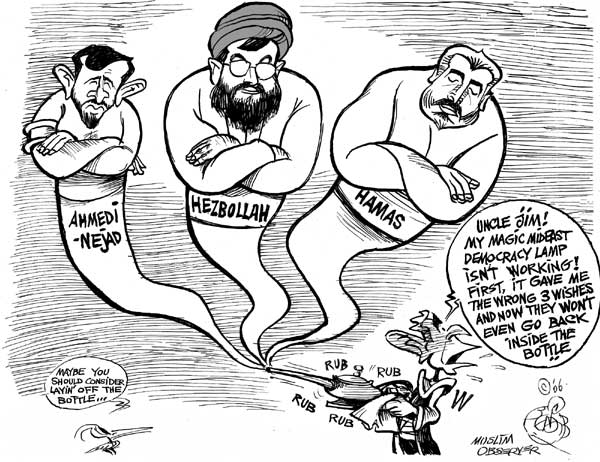
News Round UP (May 16, 2009)

Gul: Syria is Turkey’s door to the Middle East. Assad talks with Gul included the situation in Iraq in addition to talking over means to support the Iraqi government in its endeavors to reach national reconciliation and the withdrawal of all the foreign soldiers.

Gul: Syria is Turkey’s door to the Middle East. Assad talks with Gul included the situation in Iraq in addition to talking over means to support the Iraqi government in its endeavors to reach national reconciliation and the withdrawal of all the foreign soldiers.

Syria Looking for Improved Relations with Obama Administration
Council on Foreign Relations
by Joshua Landis, May 15, 2009

??? ????? ???????? ????????? :??????? ???? ???? ????????? ???????? ???????? ????? ??? ????? ?
????? ???? ?????
??? (???? ?????)
16/ 05/ 2009

Israel’s Secret War With Iran
The Mossad has stunning achievements to its credit, yet the mullahs remain a threat.
By RONEN BERGMAN Wall Street Journal, MAY 16, 2009 (edits by FLC)

” ……The Israeli intelligence community is now learning this lesson the hard way. It has penetrated enemies like Syria, Iran, Lebanon, Hezbollah and Hamas. Yet despite former Prime Minister Ehud Olmert’s willingness to authorize highly dangerous operations based on this intelligence, and despite the unquestionable success of the operations themselves, the overall security picture remains as grim as ever.

In 2002, then Prime Minister Ariel Sharon appointed his friend and former subordinate, Gen. Meir Dagan, director of the Mossad. Gen. Dagan found the organization lacking in imagination and shying away from operational risks. Mr. Sharon, who knew Gen. Dagan from his days as head of a secret assassinations unit that acted against Fatah in the Gaza Strip during the 1970s, told the general that he wanted “a Mossad with a knife between its teeth.” Gen. Dagan transformed the Mossad from top to bottom and made the organization’s sole focus Iran’s nuclear project and its ties to jihadist organizations. He put tremendous pressure on his subordinates to execute as many operations as possible. Moreover, he built up ties with espionage services in Europe and the Middle East on top of Israel’s long-standing relationship with the CIA.

In tandem with Gen. Dagan’s Mossad revolution, other Israeli military intelligence has also made outstanding breakthroughs. The Shin-Bet (Israel’s internal intelligence service), in cooperation with the military, has made huge strides in its understanding of Palestinian guerilla organizations.

The results have been tremendous. During the last four years, the uranium enrichment project in Iran was delayed by a series of apparent accidents: the disappearance of an Iranian nuclear scientist, the crash of two planes carrying cargo relating to the project, and two labs that burst into flames. In addition, an Iranian opposition group in exile published highly credible information about the details of the project, which caused Iran much embarrassment and led to International Atomic Energy Agency inspections.

On July 12, 2006, thanks to precise (?) intelligence, the Israeli Air Force destroyed almost the entire stock of Hezbollah’s long-range rockets (Huh?)stored in underground warehouses. Hezbollah was shocked.In July 2007, another mysterious accident occurred in a missile factory jointly operated by Iran and Syria at a Syrian site called Al-Safir…. In September 2007, Israel destroyed a nuclear reactor built by Syria and aided by North Korea in Dir A-Zur — In February 2008, Hezbollah’s military leader, Imad Mughniyah, was killed in Damascus. In August of that year, Gen. Mohammed Suliman, a liaison to Hamas and Hezbollah who participated in the Syrian nuclear project, was assassinated by a sniper…..

In December 2008, Israel initiated operation Cast Lead, which dealt Hamas a massive blow. Most of its weapons were destroyed within days by Israeli air strikes. (Israel also knew where the Hamas leadership was hiding, but since it was in a hospital Mr. Olmert refused to authorize the strike.(NOW THIS IS REALLY FUNNY!)) In January 2009, Israeli Hermes 450 drones attacked three convoys in Sudan that were smuggling weapons from Iran to the Gaza Strip.

These are all excellent achievements, but did they change reality? Mostly not.

Even worse, the heads of Israeli intelligence are now losing sleep over recent information showing that attempts to delay the Iranian nuclear project have failed. Despite some technical difficulties, the Iranians are storming ahead and may possess a nuclear bomb as early as 2010. Hezbollah, although weakened by the 2006 war and Mughniyah’s assassination, has become (JUST NOW?) the leading political force in Lebanon. ……the trafficking of weapons and ammunition into the Gaza Strip continues. Hamas’s standing among Palestinians has strengthened. ….”

George Mitchell prepares for possible Syria visit AP

“President Barack Obama’s special Middle East envoy is laying plans to visit Syria as a way to push forward talks between the Arab world and Israel, U.S. officials said Friday. Former Sen. George Mitchell and his team have applied for Syrian visas for an as-yet unannounced trip that could come within a month….

Obama and the Middle East
By Hussein Agha and Robert Malley, New York Review of Books, May 14, 2009

The time will come for the US to unfurl a grand diplomatic initiative. Not now. The most urgent task is to prepare the way for that day by countering the skepticism that has greeted and torpedoed every recent American idea, good or bad—from Secretary of State William Roger’s 1969 plan to the road map. The time is for a clean break, in words, style, and approach.

For many in the US, the notion of such radical change often is reduced to the question of whether or not to talk to Hamas. That is a diversion. The challenge is whether Obama can speak to those for whom Hamas speaks. They are the people who have lost faith in America, its motivations, and every proposal it promotes.

The broader point is this: a window exists, short and subject to abrupt closure, during which President Obama can radically upset Palestinian, Arab, and Muslim preconceptions and make it possible for his future plan, whatever and whenever it might be, to get a fair hearing—for American professions of seriousness to be taken seriously. It won’t be done by repackaging the peace process of years past. It won’t be done by seeking to strengthen those leaders viewed by their own people as at best weak, incompetent, and feckless, at worst irresponsible, careless, and reckless. It won’t be done by perpetuating the bogus and unhelpful distinction between extremists and moderates, by isolating the former, reaching out to the latter, and ending up disconnected from the region’s most relevant actors.

It won’t be done by trying to perform better what was performed before. President Bush’s legacy was, in this sense, doubly harmful: he did the wrong things poorly, which now risks creating the false expectation that, somehow, they can be done well….

…For the new president, the starting point should be recognition of some uncomfortable, brutal realities. These include the depth of inherited anti-American animus; of cynicism toward old plans and tired formulas; of popular estrangement from the regional leaders on whom Washington has come to depend; and of popular attraction to militant activists, militant behavior, and a radical worldview….

….

Senior al Qaeda leader in Syria sanctioned by US Treasury
By Bill RoggioMay 14, 2009 11:00 AM

A senior al Qaeda leader based in Syria who recruits and facilitates the entry of foreign fighters into Iraq has been sanctioned by the US Treasury Department.

Sa’ad Uwayyid ‘Ubayd Mu’jil al Shammari, an Iraqi member of al Qaeda who operates from inside Syria, has been designated as a terrorist under Executive Order 13224. The designation allows the US to freeze his assets, prevent him from using financial institutions, and prosecute him for terrorist activities.

“We will continue to aggressively implement the international obligation to target al Qaeda-linked terrorists, like Abu Khalaf, who threaten the safety of Coalition Forces and the stability of Iraq,” said Undersecretary for Terrorism and Financial Intelligence said in a Treasury press release issued today.

Shammari, who is better known as Abu Khalaf, is known to recruit suicide bombers from North Africa and aids in setting up their travel arrangements into Syria and ultimately Iraq. “The facilitator recruited a few suicide bombers, who attempted to travel to Iraq,” the Treasury press release stated.

Khalaf also helped al Qaeda suicide bombers based in the Persian Gulf region travel to the Levant to conduct suicide attacks. The Levant consists of the countries that border the Mediterranean Sea and includes Turkey, Syria, Lebanon, Israel, and Egypt. He is believed to operate in Tal Hamis in Syria and Tal Wardan and the ‘Awinat village in t Rabiah district in Iraq.

US targets Syrian al Qaeda network

Syria has long supported or looked the other way as al Qaeda and Sunni insurgents used the country as a transit point and safe haven for fighters entering western Iraq. More than 90 percent of the suicide bombers who have entered Iraq since the insurgency began in 2003 have entered Iraq via Syria…….

Will the Parties Honor Their Planks?
What Palestinian Refugees Need From Lebanon’s Elections
By FRANKLIN LAMB in CounterPunch, May 12, 2009

Wavel Palestinian Refugee Camp, Bekaa Valley.

“My work here is very difficult. To be honest with you there isn’t a single day when I don’t leave work completely depressed, sometimes in tears. The amount of abuse of Palestinians in Lebanon is at a level that you cannot even imagine unless you live here. At the end of the day I go home and sit. And think. How is this possible? I think of these Palestinians and feel they are so pale and patient and ‘moderate’ compared to what I feel. I tend to keep quiet but what I feel inside is shocking and I am not comfortable describing it. This place is close to exploding.”

–European NGO social worker who assists children of NON-ID Palestinians in Ein el Helwe Refugee Camp

Beirut’s Casino de Liban north of Beirut at Maameltein, perched above the Mediterranean north of Jounieh, was offering as late as 3 a.m. Saturday morning May 9, 2009, 2 to 1 odds that US President Barak Obama will drop out of the sky a la C. Rice and H. Clinton in an 11th hour ‘hail Mary’ to score a last minute goal for Israel. Another US ‘quick drop-in’ to shape the ‘US Ruling Team’ into a ‘US Wining Team’ during President Obama’s upcoming visit to the region.

Will he and will it work?

Hard to say, but the likes of David Hale, Michele Sison, Jeff Feltman, Madeleine Albright, Susan Rice, Alenjandro Wolf (from the sidelines) David Welch, John Burns and David Shapiro—various USAID and other officials do not appear to have built up their squad sufficiently and the election is in less than one month away. Signs of desperation are wafting down from Mount Lebanon and Awkar, site of the US Embassy.

Soon George Mitchell and his expanding entourage will give it a go and maybe, according to this morning’s rumors, President Obama himself, dues ex machina, since the State Department knows he is way more popular among Arabs and Muslims than is current US policy.

As Lebanon wonders if the much admired ‘gifted one’ will appear, the US coaching staff insists that it has been trying not to interfere in the internal affairs of this independent, democratic and sovereign country and explains during carefully culled media interviews, that before the election, none of them will engage or even dialogue with Lebanon’s Hezbollah led Resistance or with Hamas. Some here believe that after the election they may be obliged to seek meetings with both.

The job of recent visiting American officials has been to convince Lebanese voters that PM Fuad Sinioria’s Campaign slogan: “Our policy is to negotiate; theirs is to deter,” (emphasis mine) as he runs for Parliament from the voter and cash rich Hariri home base in Sidon, will deliver votes. The problem is that many Lebanese feel Lebanon is far better off with deterrence against Israeli aggression than what Human Rights Ambassador Ali Khalil calls “fake negotiations carefully designed in Washington and Tel Aviv to achieve nothing”.

Arriving Americans campaign advisors are also expressing alarm over the number of alleged Israeli spies that are being caught—on average of one a week since last January. The US concern appears not to be that there are an awfully lot of Israeli spies in Lebanon, but rather the fact that since the July 2006 War Hezbollah and the Lebanese Internal Security Forces (ISF) seem to be working well together and have revamped the ISF unit into Lebanon’s first effective spy snatching outfit.

The implications of this Opposition-Majority cooperation are sobering for the White House. If Hezbollah can so …..

Binyamin Netanyahu’s delicate balancing act with Barack Obama
James Hider, The Times of London, May 16, 2009

…Mr Netanyahu has talked about granting autonomy to the Palestinian Authority in the West Bank, accompanied by massive economic investment to raise standards of living, which would bring down violence.

Mr Obama cannot be seen to endorse such a vision publicly. Washington has reiterated its commitment to a two-state solution and insisted that peace talks should be resumed. Mr Netanyahu, bowing to such pressure, said in a meeting this week with Hosni Mubarak, the Egyptian President, that he expected negotiations to resume in the coming weeks. He cannot, however, yield too much to America without losing the support of his religious-nationalist coalition.

The United States and Britain are also keen on capitalising on an Arab League peace initiative, presented seven years ago, which would see the entire Arab world make peace with Israel if it returned lands seized in the 1967 Six-Day War. Israel argues that key clauses would allow millions of Palestinian refugees to return to their homes in what became Israel in the 1948 war, destroying its identity as a Jewish state.

There have been leaks that the Arab plan has been watered down to make it more palatable to Israel, although, with so much bargaining ahead, all sides are keeping silent about what concessions they might be ready to make.

Mr Obama and Mr Netanyahu will agree on one thing — the need to confront Iran’s nuclear ambitions….

…the two leaders may instead focus on further isolating Iran from its key ally Syria, which has expressed an interest in resuming peace talks with Israel under US auspices. …

In response to Bashar Assad’s statement according to which Syria was keen to resume Middle East peace talks just as soon as it had someone it could deal with on the Israeli side, Deputy Foreign Minister Danny Ayalon (Yisrael Beiteinu) said the Syrian president was “lying”. “He does not want peace. For peace he would have to offer normalization and openness, and this may result in the collapse of his regime,” Ayalon, a former ambassador to Washington, told a cultural forum in Beersheba Saturday. “Assad does not want to open Syria to the rest of the world because he is a tyrant. He wants to pursue a process that will end his isolation and ease the international community’s pressure.” According to Ayalon,…”You can’t wish for peace and at the same time support and arm Hizbullah, Hamas and Islamic Jihad,” he added.

“Who Killed Hariri? The Simplest Theory” By t_desco

Who Killed Hariri? The Simplest Theory
By t_desco
For Syria Comment
May 15, 2009

The recent release of the four Lebanese generals by the Special Tribunal for Lebanon (STL) led journalists like Nicholas Blanford and Georges Malbrunot to discover new “intriguing questions” and to speculate about possible motives for the assassination.

I would like to point out that – without having to resort to speculation – it is possible to establish that members of the Nab’a/Taha cell, described in Malbrunot’s article as being allegedly involved in the assassination, had a personal motive for killing Rafiq Hariri: revenge. Hariri executed Salafi mujaheddin in 2004, who were close to them.

Badih Hamadeh belonged to the Dinniyeh group (1). So did Hassan Nab’a (2), emir of the cell that included the man who claimed the attack in a video statement, Ahmad Abu Adas (3). And so did Ahmed Salim Miqati (2), leader of another cell to which Adas was indirectly linked (4).

Prime Minister Hariri signed the execution order for Badih Hamedeh. Hariri’s predecessor as Prime Minister, Salim Hoss, had refused to sign their execution orders because he objected to the death penalty on moral grounds(5).

Hassan Nab’a’s brother Khader, also a member of his cell, was reportedly linked (6) to the assassination of al-Ahbash leader Nizar al-Halabi in 1995 for which three men were hanged in March 1997, among them Afghan veteran Ahmed al-Qassam (7). Two years later, four Sidon judges were killed in revenge (8).

The Dinniyeh group was founded by Afghan veteran Bassam al-Kanj, who died in clashes with the Lebanese army in the mountains of Dinniyeh in January 2000 (9). Ahmed Miqati escaped to the Palestinian refugee camp of Ain al-Hilweh (10), whereas Hassan Nab’a fled to Syria (11). Both Miqati and Nab’a were reportedly in contact with Abu Musab al-Zarqawi (12), who knew the latter from Afghanistan (13).

In July 2002, Badih Hamadeh shot and killed three intelligence officers, who had wanted to ask him about his links to the Dinniyeh group (1). Ahmed Miqati sheltered him in Ain al-Hilweh (10), but members of other extremist groups, fearing for the safety of their operations in the camp, handed him over to the authorities (14). The Dinniyeh militants reacted by placing a bomb in the Sidon mosque of Sheikh Maher Hammud who had delivered Hamadeh to the authorities (15).

The smoke from from the car bomb that killed Rafik Hariri on 14 Feb 2005

The smoke from from the "car bomb" that killed Rafik Hariri on 14 Feb 2005

Ahmed Miqati reappeared in 2004 when a plot by his cell was uncovered that intended to blow up several targets in downtown Beirut, including the Italian embassy (16).

Some observers like Nicholas Blanford and Jihad al-Kazen have speculated that this may have been the first attempt to kill Hariri because he liked to meet journalists in a café just opposite the Italian embassy building (17).

It is interesting that, according to some reports, the Palace of Justice was also on the list of targets (16). The trial of Badih Hamadeh, his fiancée and her mother was held at a military tribunal in Beirut (10).

On February 1, 2006, Al-Balad received a telephone call from a man claiming to speak on behalf of al-Qa’ida. The caller announced that a security target would be bombed in retaliation for the arrest of the Nab’a/Taha cell (subsequently a small bomb exploded at the Fakhreddine barracks in Beirut). He also demanded the release of Badih Hamadeh’s fiancée and her mother (18). The call was traced to a public phone booth in Ain al-Hilweh (19).

In October 2007, Fida’ ‘Itani published in Al-Akhbar what was said to be the testimony of a Saudi member of Nab’a’s cell, Faisal Akbar (20). He first confesses to having taken part in the filming of the videotape containing the claim of responsibility by Ahmed Abu Adas. Then he retracts his testimony. Concerning the video by Adas, he declares that Hassan Nab’a had told him that Hariri was responsible for signing the execution orders in the Nizar al-Halabi case. He also explicitly mentions Badi’ (Hamadeh) (21).

The statement read by Ahmed Abu Adas does cite the intention to “avenge” the deaths of “martyrs who were killed by security forces” in Saudi Arabia as one of the reasons for the attack (22). Unfortunately, I was unable to find a complete transcript of the statement.

In the final part of Faisal Akbar’s testimony, he also describes a file found on the computers of Khaled Taha and other members of the cell as a sophisticated bomb-making course by Isma’il al-Khatib (23), indicating the existence of a link between the Miqati/al-Khatib cell and the Nab’a/Taha cell.

Ahmad Abu Adas worked at a computer shop owned in part by Sheikh Ahmed Al-Sani, a member of the Miqati/al-Khatib cell, in the summer of 2004 (4). Ahmad ‘Isaam al-Saani’a was among those arrested when the plot was uncovered in September 2004 (24). It is possible that at that time Adas was already in contact with extremist groups in Ain al-Hilweh and at Al-Huri mosque, where he sometimes led prayers and where he met Khaled Midhat Taha (25).

Coincidentally, Al-Huri mosque is also the place where Ahmed al-Qassam, Khalid Hamid and Munir Abbud clashed with the Ahbash some years earlier (7), before they were arrested and executed for the assassination of Nizar al-Halabi.

When Bassam al-Kanj visited Lebanon in 1994, he met with several Afghan veterans, among them Ahmed al-Qassam who introduced him to Abu Obeida (26), the deputy leader of Usbat al-Ansar, the same Abu Obeida (Jihad Mustafa) whom Ahmad Abu Adas visited in Ain al-Hilweh years later, according to the first Mehlis report (27). Ahmed al-Qassam went on to serve as liaison between Bassam al-Kanj, the nucleus of the Dinniyeh group in Tripoli and Beirut and Abu Obeida’s group in Ain al-Hilweh until he was executed in 1997 (28).

In conclusion, it is important to stress that while this group did have a motive, that does not automatically mean that they did it, or that this motive was the reason why they did it.

Sources:

1.

“The Badih Hamadeh Affair

When three military intelligence officers came to his home in Saida on July 11, 2002, to interrogate him on his alleged involvement in the clashes that pitted jihadist Islamists against the army in the Diniyeh region of northern Lebanon (…), Badih Hamadeh killed them and went to hide in Ain al-Helweh. In the camp, he joined the group of Lebanese militants – the “Diniyeh group” – that had settled in the Tawari’ neighborhood, at the northern end of the camp, with Usbat al-Ansar’s support.”

(Bernard Rougier, “Everyday Jihad”, Harvard University Press, Cambridge and London 2007, p.152)

2.

“A fourth group was described by the MLCC (Mount Lebanon Criminal Court; t_d) as “holding leading positions in the armed gang” and was identified as (…), Ahmad Miqati, (…).

A fifth group was described by the MLCC (Mount Lebanon Criminal Court; t_d) as having been trained in the use of firearms but not with having taken part in the clashes. They were identified as (…), Hasan Nab’a, (…).”

(Lebanon: Torture and unfair trial of the Dhinniyyah detainees, Amnesty International, AI Index: MDE 18/005/2003, 7 May 2003)

3.

???? ?????? ???? ??????? ??????? ??«??? ???» ????? ?? … ??????? ????????: ?????? ??? 13 ????? ?? «???????» …????? ???????? ???? ???????

????? ?????? – 07/04/07//

(Google-cache only)

Nibras Kazimi, “Six Degrees of Terrorism: Tentative Link Between Zarqawi’s Al-Qaeda and the Hariri Assassination,” 7 April 2007

4.

“81. (…) The Lebanese investigation further revealed that Mr. Abu Adass had been employed at a computer shop in the summer of 2004, which was owned in part by Sheikh Ahmed Al-Sani, who was a member of the Ahmed Miqati and Ismaíl Al-Khatib network.”

(Detlev Mehlis, Report of the International Independent Investigation Commission Established Pursuant to Security Council Resolution 1595. 19 October 2005)

5.

“Three executed at dawn in Lebanon, first in six years (…) Capital punishment was rare in Lebanon until a 1994 law effectively renewed the practice. Whereas only three convicts had been hanged in the past 35 years, the law cleared the way for 14 fresh executions. Execution orders were then stopped when Lahoud first took office in 1998 because then prime minister Salim Hoss was an opponent of the death penalty and refused to sign any such orders.”

(AFP, 17 January 2004)

6.

“After a missile attack on Israel from south Lebanon on December 27, 2005, the Organization of al-Qaeda in Iraq, or the Land of the Two Rivers, issued an audio-recording for its leader, Abu Musab al-Zarqawi, in which he claimed responsibility for the attack and said it was ordered by al-Qaeda’s leader, Osama bin Laden.

Among the names announced by Lebanese authorities, four of the suspects were Lebanese nationals. (…) Among the Lebanese were Khader and Malek Nab’a, who are relatives of the suspects in the Dinnieh incidents of 2000 (see the indictment in Lebanon-based al-Nahar newspaper, July 11 2000).

In addition, Khader Nab’a is associated with the appearance of the Salafi-Jihadist movement in Lebanon, when the leader of the al-Ahbash religious sect, Nizar Halabi, was assassinated in 1995.”

(Murad Batal al-Shishani, “Al-Qaeda’s Presence in Lebanon“, Terrorism Focus Volume 3, Issue 4, 31 January 2006 , Jamestown Foundation)

7.

“The Lebanese public first heard Abu Mahjin’s name at the end of 1995, several months after Shaykh Nizar al-Halabi was assassinated on August 31. The security forces arrested five young men, three Lebanese nationals and two Palestinians. Before taking violent action, these men had been harassed by the Ahbash in the mosque of Beirut’s Arab University, in the heart of the popular Sunni neighborhood of Tariq al-Jidaydeh, where Islamist groups usually control street politics. (…) The tribunal also issued death sentences for three of the five men arrested. The sentence was carried out on March 24, 1997: the three Islamists – a Palestinian, Munir Abbud, and two Lebanese men, Ahmad al-Qassam and Khalid Hamid – were hanged at dawn in the courtyard of Rumiyyeh Prison.”

(Rougier 2007, p.119, 120)

Note: The mosque of Beirut’s Arab University = Al-Huri mosque.

8.

“In the Usbat al-Ansar network, for instance, members of a “military wing” took the initiative, on June 8, 1999, to machine-gun four judges while they were in session at Saida’s Palace of Justice, probably to avenge the execution of four (sic; t_d) Islamists sentenced in 1997 after the murder of Nizar al-Halabi, the leader of al-Ahbash.”

(Rougier 2007, p.103)

9.

cf. Rougier 2007, Chapter 7, Underground Jihad in Sir al-Diniyeh, p. 229ff.

10.

Abu Obeida (Badih Hamadeh; t_d) Pleads Guilty to Murdering 3 Soldiers, Tells How

Fundamentalist activist Abu Obeida has pleaded guilty to killing three Lebanese army soldiers in Sidon and described to a Beirut military tribunal how he carried out the tripartite murder in the presence of his Palestinian fiancée and her mother. (…)

“I then ran into the garden, climbed over the fence and sprinted to the Ein El-Hilweh camp, where Ahmed Mikati and Saadeddine Seiss sheltered me in a mosque,” said Abu Obeida, who, if convicted, could be executed by a firing squad.

Mikati and Seiss are the leaders of the so-called Dinniyeh group of fundamentalists who flood (“fled”; t_d) north Lebanon’s Dinniyeh mountains after an Islamic anti-government insurrection that the army crushed in the first week of 2000. Mikati and Seiss are standing trial in absentia.

Abu Obeida’s fiancée, Sohair Saeed, and her mother Nayfeh Qanwan, both pleaded not guilty to a charge of helping Abu Obeida shoot the three troopers at the midnight of July 11-12. The court adjourned until Sept. 17 for defense hearings.”

(Naharnet, Beirut, 23 September 2002)

11.

“Arrestation de membres proches d’el-Qaëda venus de Syrie ?

Les services de sécurité libanais ont arrêté 18 salafistes qui seraient liés au réseau el-Qaëda, dont certains membres pourraient être liés à l’assassinat de Rafic Hariri. Dans un reportage diffusé jeudi par la LBC, et dont les informations ont été reprises par le quotidien koweïtien al-Raï al-Aam, les membres de deux groupes salafistes qui se sont infiltrés au Liban via la Syrie ont été arrêtés au cours des derniers jours par les Forces de sécurité intérieure. […]

Il s’agit de Hassan Mohammad Nabaa, « l’Émir » du groupe (le chef dans le jargon salafiste). Ce dernier avait pris part aux événements de Denniyé en 2000, avant de fuir en direction de la Syrie. Son frère a été arrêté lors des manifestations de dimanche dernier à Achrafieh. […]

Les mêmes sources ont en outre révélé que les deux personnes les plus dangereuses de ce groupe, Bilal Zaaroura et Khaled Taha, seraient toujours en fuite. Ces derniers sont entrés au Liban en décembre dernier. […]”

(L’Orient-Le Jour, 11 Février 2006)

12.

“Tre dei dodici estremisti salafiti fermati nei giorni scorsi a Beirut hanno ammesso l’ appartenenza al commando suicida che agì in Iraq. Li guidava Ahmad Salim Miqati, uomo che i servizi segreti ritengono legato ad Al Zarkawi.”

(Terroristi arrestati: «Colpirono a Nassiriya», Fiorenza Sarzanini, Corriere della Sera, 25 settembre 2004, Pagina 8.

Testimony of Nab’a cell member Faisal Akbar, translated by Nibras Kazimi:

(Faisal Akbar:) “A: (…) The letters, which you have shown me, and that I have recognized them, are letters from the brothers in Usbet al-Ansar in the Ain al-Helwah Camp to Abu Musaab al-Zarqawi, through Rashid, (while) the letter addressed to “the Hajji”, which is an alias for Abu Musaab al-Zarqawi, and the letter to Abu Laith al-Nejdi, who was martyred (later), these two letters (belong) to Rashid.”

(Nibras Kazimi, Narrative of a Conspiracy, Part 4)

13.

“Q: Where did you meet Rashid and how and when?

(Faisal Akbar:) A: I met Rashid who is in your custody and now I found out that his name is Hassan Naba’a, in Afghanistan during the year 2000 in one of the training camps and we stayed together for approximately five months, then Abu Musa’ab al-Zarqawi sent him to Lebanon to organize groups to prepare the ground for the jihad in Lebanon, so Rashid arrived and he was called at the time “Abu Muslim”.

(Nibras Kazimi, Narrative of a Conspiracy, Part 4)

14.

cf. Rougier 2007, The Badih Hamadeh Affair, p.152ff.

15.

Arafat loyalists fight hardliners linked to al-Qa’ida

By Robert Fisk at the Ein al-Helweh refugee camp, Sidon, Lebanon

(…)

The Jaamat men have threatened to turn the camp into a bloodbath. Indeed, when another of their members, Badi Hmadeh, was turned over to Lebanese police last month, its leader, Ahmed Miqati, warned he would transform the camp into “another Afghanistan”. The trouble is, these few armed and very strict Muslims could provoke a great deal of killing. (…)

As for the men of the Jaamat al-Noor, they have told their friends that they do not recognise Syria, Lebanon or Palestine, that “we live in Allah’s wide dominion and implement his decree”. Their wives wear the chador. Their homes are decorated with pictures of Mr bin Laden. In protest at the arrest of Badi Hamadeh, they left an explosive device in Sidon – inside the city’s al-Quds mosque.”

(The Independent, 16 August 2002)

Palestinian Fanatics Threaten to Turn Lebanon into ‘Pool of Blood

(…) “We have addressed a warning to Hammoud for his betrayal two weeks ago,” said Osbat Al Noor’s statement, referring to a bomb found at the bottom of the rostrum that Hammoud uses to deliver his sermons at Sidon’s Al Quds mosque, two days after Abu Obeida’s arrest.

“It seems, however, that this warning was not enough to stop Maher Hammoud from conspiring with several factions in the camp to turn over the Dinniyeh group,” the statement said. “We declare that we will turn Ein El-Helweh and the whole of Lebanon into a pool of blood if the conspirators press ahead with their plots,” the statement threatened.”

(Naharnet, Beirut, 12 August 2002)

16.

“Lebanon’s Minister of the Interior Elias al-Murr said Isma’il al-Khatib was among 10 people arrested on 22 September, apparently for alleged links to al-Qa’eda and an alleged plan to attack the Italian and Ukrainian embassies, the Palace of Justice and other government security buildings in Beirut.”

(Lebanon: Amnesty International demands independent investigation into death in custody and end to incommunicado detention, Amnesty International, 30 September 2004, AI Index: MDE 18/011/2004)

17.

“Without knowing it, Elias Murr thwarted the first, or original plot to assassinate Rafik Hariri, which had it succeeded, would have done away with the country’s entire future, by striking at the Beirut Central District, the symbol of Lebanon’s recovery.

The Italian Embassy in Lebanon faces the Parliament building at Nejmeh Square and is next to St. George Eastern Orthodox church and the Etoile coffee shop where PM Hariri used to meet friends and journalists upon exiting Parliament. If a ton of explosives had gone off there, the destruction would have been devastating, right in the heart of the capital, and would have killed hundreds.”

(Jihad al-Khazen, The International Investigation and Old Security Files, Al-Hayat, 2 November 2005)

Note: In an apparent misreading of the Mehlis report, the article wrongly states that Ahmed Abu Adas was “part of” “the Ahbash”.

18.

“Blast near Lebanese army post after al Qaeda warning

By Nadim Ladki

BEIRUT (Reuters) – A bomb exploded near a Lebanese army barracks in Beirut early on Thursday, shortly after a purported threat by al Qaeda to attack security installations in Lebanon.

Security sources said the night blast slightly wounded a soldier, wrecked a car and blew out windows in nearby buildings.

They said a local newspaper had received a telephone call from someone claiming to speak on behalf of al Qaeda and declaring that a security target would be bombed in Beirut in retaliation for the arrest last month of 13 group members (the Nab’a/Taha cell; t_d). (…)

Al-Balad newspaper reported in its morning edition that it had received a telephone call in which a man claiming to be al Qaeda’s representative in Lebanon gave the authorities two weeks to release two women detainees.

“The caller threatened to launch three qualitative military operations simultaneously and clash with the security forces if the two women … are not freed,” al-Balad said in a report.

The women are the fiancee and her mother of an al Qaeda member (Badih Hamadeh; t_d) who was recently executed for killing three military intelligence agents.”

(Reuters, February 2 2006)

19.

Two Suspected Qaida Members Held Over Army Barracks’ Bomb

Military Examining Magistrate Rashid Mizher questioned two alleged al-Qaida network members suspected of detonating a bomb near an army barracks in Beirut two weeks ago.

Khalil al-Sowda and Abdel-Rahman al-Jasser, both Palestinians, are also suspected of hurling hand-grenades near Lebanese army checkpoints outside the Palestinian Ain al-Hilweh refugee camp in the outskirts of Sidon. (…)

An army statement issued later Thursday said investigators traced the call made to al-Balad newspaper to a public phone booth in the Palestinian refugee camp of Ein el-Hilweh. The camp near the southern port city of Sidon is known to be a hotbed for fugitives and Islamic extremists.”

(Naharnet, Beirut, 16 February, 2006)

20.

???? ???? ???? ?? ???????? ??? ????? ??????

???? ??????

???? ???? ???? ?????? ????? ????? ?????? ??? ???

???? ??????

http://www.al-akhbar.com/ar/node/50181

??????? ???? ????? ??????? ??????? ?????????? ?????? ????????

???? ??????

http://www.al-akhbar.com/ar/node/50301

??????? ???? ?????? ?? ????????? ????? ??? ?? ????

???? ??????

http://www.al-akhbar.com/ar/node/50501

Translated by Nibras Kazimi, Narrative of a Conspiracy, 5 November 2007

21.

“Q: What did you see on television when Ahmed Abu Ades appeared, and what do you remember of him?

(Faisal Akbar:) A: I remember watching him on the Aljazeera channel, in a film cut up into two or three segments, reading a statement (on behalf) of the Nusra wel Jihad group, taking responsibility for the Hariri assassination. I don’t remember all the reasons, but I remember some of them that revolved around the revenge for the martyrs of the haramein (Translator’s Note: the holy cities of Mecca and Medina), and it was widespread among us that Hariri had signed the execution (orders) for some of the Salafist mujaheddin in Lebanon. (…)”

“(Faisal Akbar:) A: No one was with us, and Rashid said at the time, after the film was played on Aljazeera, that “Hariri was implicated and responsible for signing the execution (orders) for the mujaheddin in the Nezar al-Halabi case” and I hadn’t known about this matter until Rashid told me about it.

(…)

A: I certify to you that what I mentioned now is honest and true, and what Rashid had mentioned about the execution of the mujaheddin in the Nezar al-Halabi case is what I learnt from him. As for what (I meant) by widespread, are the executions in general, which Hariri signed, and they concern past Lebanese mujaheddin like Badi’ or Wadi’.”

(Nibras Kazimi, Narrative of a Conspiracy, Part 4)

22.

“To support our brother mujahidin in the land of the two holy mosques and to avenge their righteous martyrs who were killed by security forces of the Saudi regime in the land of the two holy mosques, we resolved, after relying on Almighty God, to carry out fair punishment against the agent of this regime and its cheap tool in Greater Syria, the sinner and maker of illegal money, Rafik Hariri, through the implementation of a resounding martyrdom operation.”

(Nicholas Blanford, Killing Mr Lebanon, London, Tauris 2006, p. 141)

23.

(Faisal Akbar:) “A: (…) As for the studies that were saved on the computers of the guys, these are modern combat studies, like the seminar of the martyr Isma’il al-Khatib on assembling electronic circuits to attach to explosives, and seminars on making explosives, and seminars on advanced communications equipment.”

(Nibras Kazimi, Narrative of a Conspiracy, Part 4)

24.

?? ?????? ???????? ????? ??????? ??????? ????? ?? ????? ???35 ???? ?? ????? ???? ???????? ???????? ?????? ????? ??????? ?????? ????????? ????????? ??????????? ?? ?????

???????? – ???????? 04 ????? ???? 2005

25.

“174. (…) Khaled Midhat Taha, another religious associate of Mr. Abu

Adass’s, (…). Mr. Taha met Mr. Abu Adass when they were students at

the Arab University where they used to meet in the University’s mosque.”

(Mehlis I, October 2005)

26.

“During his 1994 stay in Lebanon, Basim al-Kanj had met demobilized Afghan veterans who had returned to their homeland. Thanks to one of them, Ahmad al-Qassam, whom he had met in Peshawar – and who was executed on March 24, 1997, for having participated in the assassination of Nizar al-Halabi, the head of al-Ahbash – he met Usbat al-Ansar leaders for the first time in the Ain al-Helweh camp. He met the group’s emir, Abu Mahjin, and his lieutenant, Abu Ubayda, also known as Jihad Mustafa, the head of the clandestine organization’s military wing.”

(Rougier 2007, p.233)

27.

“80. (…) According to Mr. Abdel-Al, he obtained information about Mr. Abu Adass’s background, (…) the fact that he often went to Ein al Helwa, (…) and that he visited Abu Obeida (deputy to the leader of Jund al Sham).”

“197. (…) the Al-Ahbash Security Service had seen Mr. Abu Adass before the assassination in the Ain Al-Hilweh Palestinian camp together with Abu Obeida the deputy leader of the terrorist group Asbat al Ansar.”

(Mehlis I, October 2005)

28.

“After Basim al-Kanj left for the United States in 1995 (to establish the “Boston al-Qa’ida sleeper cell”; t_d), Ahmad al-Qassam appointed people close to him to develop ties with Abu Mahjin’s group. Umar Yi’ali commuted between Tripoli and Ain al-Helweh, (…). Ihab al-Banna (…) also went back and forth between Ain al-Helweh and the capital to maintain ties with Usbat al-Ansar. After Ahmad al-Qassam was executed in 1997 for the assassination of Shaykh al-Halabi, Basim al-Kanj, who was now settled in Beirut (he returned to Lebanon in 1996; t_d), asked Ihab al-Banna to become the main liaison with Ain al-Helweh. Banna went to the camp at least once a month to give religion lessons to Abu Ubayda (…).”

(Rougier 2007, p.235)

Ire over US Sanctions Causes Policy Review in Damascus

Moallem Discusses with Feltman and Shapiro

Moallem Discusses with Feltman and Shapiro

Ire over US Sanctions Causes Policy Review in Damascus

The Syrians are upset with the way sanctions were reimposed by President Obama. The current administration’s use of language identical to that used by President Bush, without any phrases to soften the hostility and without referring to dialogue, progress, or anticipated improvements angered Syrian policy makers. Many are becoming ever more convinced that the Obama administration cannot bring about real change and is falling back on the use of sticks and the intimidation techniques that President Bush favored. Officials have suggested that Damascus is reviewing its policies and does not know where the US-Syrian dialogue goes from here. No one whats to talk about the promised Mitchell visit as yet. They are still trying to digest the implications of the Feltman-Shapiro visit last week.

The scheduled agenda for Feltman’s and Shapiro’s visit in Damascus last week was to implement a wide ranging agreement on intelligence sharing and security cooperation in Iraq, which included joint patrols and other arrangements that could finally end border disputes and put an additional dent in infiltration across the long Syrian-Iraqi border. Today, no communications exist between officials on the two sides of the Iraqi-Syrian border, which often leads to security breaches, misunderstandings, and recriminations from both sides that the other is at fault for placing politics above security, ideology above the lives of common people, and posturing above peace.

On Lebanon, the Americans expressed unsolicited gratification that the election preparations and campaigning was proceeding in an atmosphere of freedom and security.

On the Golan and possible Peace talks with Israel, it is too early to say what will happen. Netanyahu has only reiterated his refusal to give up the Golan.

A Syrian who has good contacts with the government in Damascus wrote me the following about the way Obama renewed sanctions:

Really inexplicable. Obama had the chance to protect his troops in Iraq without further delay, and to really change the dynamic of US-Syria relations by immediately sending an ambassador to Damascus and starting intelligence sharing. I do not know whose idea it was to test Damascus and to throw a spanner in the works. Soon negotiations will lose momentum and relations will fall back into the quagmire of the Bush Syria-policy. I am not sure how US interests are served by this continuing dance of recriminations and insults which do nothing but perpetuate mistrust and ill-will.

Another said:

“How dare they send Feltman and Shapiro to announce that they are renewing sanctions and then explain that we should think nothing of it — that it is routine — and expect that we will just turn the page and get on with implementing the broad security and intelligence sharing plan that was to be the substance of our meetings.

Another Syrian official explained:

“Yes, we expected the sanctions to be renewed, but why use the identical language that Bush used? Why not say something to reflect the progress made in out discussions and our mutual intentions of changing our relationship? Obama could have said something like: “We renew sanctions but hope that by the end of a year we will be able to revise our relations and will have made considerable progress on a number of differences we have with Syria.”

An American-Syrian explained:

“Syria is not changing. They think that they can give zero to the Americans. What has Syria really done for America? Nothing. Syrian officials believe that America needs Syria and has been wrong to treat it so badly these last eight years that they should renounce sanctions and change their ways for free. The world does not work like that. This is a golden opportunity for Syria. It is slipping from Syria’s hands because of pride and obtuseness.

The following article in Syria-News quote Turkey’s Foreign Minister saying that Syria is genuinely interested in peace negotiations with Israel and should be given the benefit of the doubt.

Gul

Gul

???:????? ???? ????? ?? ??????? ?????? ????? ?? ???????? ??? ?????

??????? ????????

????? ??? ????? ??????? ??????? ??? ?????????

??? ?????? ?????? ??? ???? ??? ????? ????? “???? ???? ????? ?? ??????? ???? ????????? ??? ????????”, ????? ??? ?? “?????? ????? ???? ????? ???????? ??????? ?? ???????? ??? ?????”.

????? ??? ?? ?????? ?? ????? ?????? ?? “????? ???????? ????? ??? ??? ???????? ??? ??????? ?????? ??????? ??? ??? ??? ??? ??? ????? ????????? ??? ???????? ???? ???? ?????”.

????? ????? ???????? ????? ??? ??????? ??????? ?? ??????? ?????? ??? ???????? ?????? ????? ??? ?? ?????? ????? ??? ??????? ?????????? ??? ??? ????? ????? ??????.

???? ???????? ??????? ????????? ??? ?????? ?????? ?? “??? ????? ??? ?? ??? ??? ??????? ???? ?????? ?? ?????? ???????? ????? ?????? ???? ?????? ??? ?????? ???? ???? ??? ???? ???? ??????? ??? ????? ???????”.

??? ?????? ?? ??? ?????? ?????? ??? ????? ?????? ?????? ??????? ?? ???? ????????? ???????? ?? ?????? ?? ??????? ??? ???????? ???????.

????? ????? ??? ??? ???? ?? ??? ??? ????? ??????? ??????? ????? ??????? ?? ?????? ???????? ???????? ?????? ????????? ?????? ???????? ??? ????? ??????, ? ???? ???? ???? ????? ?????? ???? ??? ????? ????? ???????? ?????? ?????? ??? ?????? ??????? ??? ???????.

Maariv via the Pulse via FLC

“US President Barack Obama’s two envoys returned from Damascus last weekend with the impression that Syria is still not ready to withdraw its support for terror,” Maya Bengal wrote in Ma’ariv today:

Syria criticizes renewal of US sanctions
By ALBERT AJI

DAMASCUS, Syria (AP) — Syria rejected the Obama administration’s decision to renew economic and diplomatic sanctions against Damascus and urged Washington to abandon “foolish policies,” a state-run newspaper reported Sunday….

Syria’s Tishrin newspaper said U.S. policies of isolation, blockades and sanctions adopted by the former U.S. administration “have put the United States in an intractable impasse.” It said Washington can reverse this path if it stepped up its role in promoting peace, security and stability in the Middle East.

The United States should get rid of “foolish policies and replace them with openness, dialogue and discussions through transparent practices, the foremost of which is an open and final reversal of the policy of sanctions against states and peoples,” the newspaper said in a front-page editorial.

Syria Must Take ‘Immediate’ Action on Iraq Fighters, U.S. Says
2009-05-11
By Viola Gienger

May 11 (Bloomberg) — The U.S. called on Syria to take “immediate and decisive action” to stop the transit of foreign fighters into neighboring Iraq, where a spate of bombings made April the deadliest month since September.

Acting Assistant Secretary of State Jeffrey Feltman and White House adviser Dan Shapiro raised the issue with Syrian officials during their meetings in Damascus last week, State Department spokesman Ian Kelly said today.

“We continue to have very deep concern about this issue of the flow of foreign fighters going into Iraq via Syria,” Kelly told reporters in Washington. Syria should improve screening at the Damascus airport and increase security on the border with Iraq and cooperation with Iraqi officials, he said….

The death toll was 40 percent higher than in March, AFP said last week. Still, data compiled by Washington’s Brookings Institution from U.S. Defense Department reports show the level of violence remains well below that of two years ago.


Syria denies country is route for al-Qaida

2009-05-13

DAMASCUS, Syria, May 13 (UPI) — Syrian officials are denying a news report that al-Qaida has resumed sneaking fighters into Iraq through Syria. Officials said the published report in a U.S. newspaper that the smuggling resumed was false and indicated U.S. confusion about security matters in Iraq, the Kuwaiti news agency KUNA reported Wednesday.

Terrorist Traffic Via Syria Again Inching Up
By Karen DeYoung

Last October, as the Bush administration was touting a dramatic drop in the number of suicide bombings in Iraq, four young Tunisian men left their homes for Libya and then headed to Syria. There, they were met at the Damascus airport and taken to a safe house. Six tedious months passed until their handlers felt that it was safe to move the men again. In April, they were smuggled across the Iraqi border; within days, two were dead, among the suicide bombers who have killed at least 370 Iraqis in a wave of attacks over the past several weeks.

The third Tunisian disappeared. The fourth was captured and, according to a senior U.S. military official, provided interrogators with this account of their travels.

His statement, combined with what other sources had previously indicated to U.S. and Iraqi intelligence, confirmed what American officials had suspected: After a long hiatus, the Syrian pipeline operated by the organization al-Qaeda in Iraq is back in business.

The revival of a transit route that officials had declared all but closed comes as the Obama administration is exploring a new diplomatic dialogue with Syria. At the same time, Washington remains concerned by Syrian activities — including ongoing support for the militant groups Hezbollah and Hamas, as well as activities involving Iraq.

On Wednesday, acting Assistant Secretary of State Jeffrey D. Feltman and National Security Council official Daniel Shapiro arrived in Syria for their second visit since Barack Obama’s inauguration as president. Two days later, however, Obama renewed U.S. sanctions against Syria, accusing Damascus of supporting terrorism in the Middle East and undermining Iraqi stability.

“I think it sends the message that we have some very serious concerns,” Robert Wood, a State Department spokesman, said of the sanctions renewal. Feltman, he added, was “in Damascus to talk about . . . how we can get Syria to change its behavior and see if it’s willing to really engage seriously in a dialogue, be a positive role in the Middle East. Up until now, Syria hasn’t played that positive role.”

Saudi Arabia Must Come Off the Sidelines in Iraq
Michael Wahid Hanna |12 May 2009
World Politics Review

At a recent forum on U.S.-Saudi relations in Washington, D.C., current and former Saudi officials decried the previous U.S. administration’s Middle East policies. …On his recent trip to the region, U.S. Secretary of Defense Robert Gates reiterated his appeal to Riyadh and Cairo to appoint ambassadors to Baghdad….

The Saudi-Iraqi border represents yet another opportunity for mutually beneficial cooperation. The border has been a main entryway for takfiri extremists into Iraq, and Saudis represent (.pdf) a high proportion of those foreign fighters. While infiltration has decreased with the improvements in security, increased coordination and joint planning would improve the effectiveness of border patrols and further stem the flow. That, in turn, would help to blunt the dangers posed to Saudi Arabia and the broader Arab world by the return of seasoned and radicalized fighters…

“The critical juncture will be what comes out of the Obama-Netanyahu meeting,” Abdullah said.

“If there is procrastination by Israel on the two-state solution or there is no clear American vision for how this is going to play out in 2009, then all the tremendous credibility that Obama has worldwide and in this region will evaporate overnight if nothing comes out in May. Reuters

An assured Assad in Financial Times, May 10 2009
By Roula Khalaf and Anna Fifield

“The Syrians now believe they are the centre of the Middle East,” quips Andrew Tabler…
US officials fear that Syria might be overestimating the change of tone of the Obama administration and misreading its intentions. To stress that point, a day after a senior US envoy was in Damascus at the end of last week, the administration renewed its unilateral sanctions against Syria, citing the regime’s support for terrorism and weapons trade.

“We want to see a change in Syria’s outlook, away from being a spoiler and more towards being a constructive problem solver, at least willing to deal with some of the problems in the region,” says one US official. “It is not that we want them to cut off relations with Iran but to recognise that the west can offer things that Iran can’t – like economic prosperity and peace with Israel.”

by Ali Gharib in IPS

Under centrist Prime Minister Ehud Olmert, Israel had been in Turkish-mediated peace talks with Syria until they were broken off during the Israel Defence Force’s brutal three-week incursion into the Gaza Strip.

“They had spent a lot of energy doing the Olmert thing in Turkey,” Landis said. “No one believed anything would happen under Olmert, but the idea was you get momentum and create things. [Now] the Syrians feel like they’re being played and they’re getting asked to do a strip tease, and they’re not going to get anything but knowing glances from Israel.”

Indeed, the young right-wing government of Israeli Prime Minister Benjamin Netanyahu gave even less than a “knowing glance” over the weekend.

“Remaining on the Golan will ensure Israel has a strategic advantage in cases of military conflict with Syria,” Netanyahu told reporters on Thursday. He reaffirmed that he didn’t intend to withdraw from the strategic plateau during a cabinet meeting Sunday.

With the Golan Heights off the table, resumption of meaningful talks is unlikely.

Thaw with Syria Hits Stumbling Blocks
By Ali Gharib

WASHINGTON, May 11 (IPS) – U.S. President Barack Obama issued a statement on May 8 calling for the renewal of sanctions on Syria, which were set to expire on Monday. The declaration came at the end of a busy week in which both high-level U.S. officials and the Iranian president visited the Syrian capital, Damascus.

Though Syria has recently sought engagement with the U.S. and Israel, the executive order extending sanctions is only the latest in a series of significant stumbling blocks to peeling off one of Iran’s closest regional allies.

The renewed sanctions came on the heels of two-high profile visits to Damascus – first by Iranian President Mahmoud Ahmadinejad and then U.S. diplomat Jeffrey Feltman and Daniel Shapiro of Obama’s National Security Council – which exemplified the West’s sometimes-faltering efforts to pull Syria away from Iran’s influence.

Obama cited Syria’s support for terror, its weapons programmes, and its “undermining” of U.S. goals in Iraq – collectively “the unusual and extraordinary threat to the national security, foreign policy, and economy” of the U.S. – as reasons to extend the George W. Bush-era sanctions for one year.

Two weeks earlier, Representatives Mark Kirk of Illinois and Eliot Engel of New York wrote a letter to the White House urging Obama to “act quickly” and renew the sanctions.

According to the Washington Report on Middle East Affairs, which compiles statistics, Kirk received the most campaign donations from pro-Israel political action committees of any House member, 62,000 dollars in total, in the 2007/2008 cycle. Engel was the second largest Democratic recipient in the House in that period, with 36,500 dollars.

But the extension of sanctions does not mean that the possibility of U.S. engagement with Syria is disappearing. Indeed, there were indications that Obama’s Mideast envoy, George Mitchell, would be visiting Syria next month.

Rather, the sanctions appear to be a reinforcement of the status quo.

“This is the clearest sign that negotiations between Damascus and Washington are going, if not badly, at least slowly, despite statements by both sides that progress is being made,” wrote Oklahoma University professor Joshua Landis on his blog, Syria Comment.

“It tells us that despite the rhetoric about a ‘new U.S. relationship’ to Middle Eastern countries, Washington still believes that it must keep its foot on Syria’s economic throat in order to win concessions.”

Mending ties will take time
By Sami Moubayed, Special to Gulf News
Published: May 11, 2009, 23:14

The big news is that US President Barack Obama has renewed sanctions on Syria, imposed by his predecessor, George W. Bush, in 2004. The order, numbered 13,338, was due to expire on May 10.

The renewal came after Acting Assistant Secretary, Bureau of Near Eastern Affairs, Jeffrey Feltman and National Security Council official Daniel Shapiro visited Syria, followed immediately by Iranian President Mahmoud Ahmadinejad.

Foreign Minister Walid Al Mua’allem met with the official US envoys, who were making their second trip to Syria since Obama came to office last January, and said that the talks had been “constructive.”

During a meeting with his Iranian counterpart, President Bashar Al Assad defended Syria’s alliance with Tehran as “strategic”, saying that the common vision shared since 2005 was “correct.” Syria had no intention of abandoning its allies, or changing its policies vis-à-vis the resistance in Lebanon or Palestine, the Syrian president said.

US-based Syria expert Joshua Landis said at the time, “This is the clearest sign that negotiations between Damascus and Washington are going, if not badly, at least slowly despite statements by both sides that progress is being made.”

Others also analysed Feltman’s visit and the renewal of sanctions and said these developments served the interests of the anti-Syrian March 14 Coalition in Lebanon. Some pointed to a visit by Israeli officials to Washington, where they had extensive talks with the American Israel Public Affairs Committee, while sanctions were being renewed on Damascus.

Let’s not get carried away here purely for the sake of creating media excitement. Renewal of sanctions is a routine process that was expected, and does not affect the Syrian-US commitment to continue searching for common ground in the Middle East.

Terrorist Traffic Via Syria Again Inching Up
Pipeline to Iraq Back In Business After Lull

Syria Sentences Kurd Dissident To 3-1/2 Years Jail by Khalid Oweis
Mishaal al-Tammo, 52, was found guilty of `weakening national morale` after a five session trial at the Palace of Justice.
Syria Sentences Kurd Dissident To 3-1/2 Years Jail
May 11, 2009

A Syrian court sentenced a Kurdish dissident to 3-1/2 years in jail on political charges on Monday, the latest in a string of convictions against opponents of the government, which is mending its ties with the West.

Mishaal al-Tammo, 52, was found guilty of “weakening national morale” after a five session trial at the Palace of Justice in the Syrian capital attended by diplomats from Europe and the United States.

“This trial is a persecution of the culture of diversity,” Tammo said in a statement released by his Movement for the Kurdish Future.

“Oppressive state security does not take into account that I am not Arab, that I belong to the Kurdish nation,” he added.

Tammo, a campaigner for the rights of what he had described as a dispossessed Kurdish minority in Syria, was arrested in the north eastern province of Qamishli in August. Political pamphlets were found in his car.

Chief among his causes are the plight of tens of thousands of Kurds who were denied citizenship following a 1960s census and a ban on teaching Kurdish language.

A rights group, the Syrian Observatory for Human Rights, said the conviction ran counter to a right of free expression enshrined in Syria’s constitution and international conventions the state had signed.

Mohannad al-Hassani, a member of Tammo’s defence team, said the judge refused to allow any witnesses to appear on behalf of his client.

Dr. Shaykh Mahmoud Ahmad Kaftaru, son of the deceased Grand Mufti of Syria, was freed by Political security after holding him in detention for 13 days. Read the following article in Arabic.

????? ??????? ????? : ???? ???? ??????? ????? ????? ???? ?????? !
????? ???? ?????
??? ( ???? ?????)

MI Chief: Gaza smuggling continues, despite Egypt’s efforts
By Yuval Azoulay

Military Intelligence Chief Amos Yadlin said on Tuesday that despite Egypt’s increased patrol along its border with the Gaza Strip, the smuggling of weapons into the coastal territory has not been stymied.

Yadlin told the Knesset Foreign Affairs Committee that Egypt has made impressive efforts along all of its borders, including with Sudan, but has been unable to stop Bedouins living in Sinai from cooperating with militants in the Gaza Strip.

“The situation is better than before, but the Gaza Strip has still not been hermetically sealed to smuggling,” Yadlin told lawmakers.

SYRIAN ECONOMY

Syria to Give Foreign Investors Stock Exchange Access (Update1)
2009-05-11, By Nadim Issa

May 11 (Bloomberg) — The Syrian Commission on Financial Markets & Securities may let foreign investors trade in the country’s stocks in a week, Chief Executive Officer of the Damascus Securities Exchange Mohamad Al-Jleilati said.

Brokerages, who until now have been able to trade on behalf of clients, may be allowed to trade shares on their own account as well, Jleilati said in a phone interview from Damascus today. “We are also looking into the possibility of allowing the brokerage companies to buy and sell shares in listed companies but they have to abide by certain rules,” he said.

Trading on the exchange began in March. Seven companies are listed on the market, which opens for two days a week. Syria is looking for alternative sources of revenue to boost the economy as oil reserves dwindle. For brokers to qualify for buying shares on their own account they will have to sell them in less than three months and won’t be entitled to participate in shareholder meetings or have voting rights, he said. The exchange will also allow listed companies to split their shares, thereby decreasing their nominal value from 500 Syrian pounds each to 100 pounds, he said. Syria will lower the amount in initial share offerings to 25 percent from 45 percent to encourage family-owned companies to list on the bourse, Jleilati said.

Government Approval

The commission will propose the rule changes that still require government approval, he said. The exchange will keep its daily price-fluctuation limit on stocks at 2 percent this year, Jleilati said. Trading volume on the stock exchange reached 705,782 Syrian pounds ($15,000) today. International Bank for Trade & Finance dropped 1.9 percent to 1,112 pounds, while the remaining seven listed companies climbed to their 2 percent trading limits, according to the daily bulletin on the exchange’s Web Site.

Ehsani2 did some math to show that the brokerage firms working at the Syrian Stock Exchange will soon go bankrupt unless the 2% change cieling is eliminated and teh market is opened for 5 days a week rather than the 2 it is opened for at present. He was motivate by this article in Syria News decrying the lack or volume and revenues being generated by the exchange.

Ehsani writes:

Let us suppose that the daily turnover on the DSE reaches $5 million a day to reach the levels of Beirut’s exchange. If the DSE trades 5 days a week (it now only trades twice a week), total annual trading volume will be around $1.25 billion. Since brokerage firms normally end taking 0.1% of revenues exchanged, the total revenue among all 6 brokers is $1.25 million =====> or
$200k per firm. Assuming 10 people work per brokerage firm ===> $20k per broker……..
This is the best case scenario.

Remember, of course, that rather than $5 million a day, the DSE is doing only $50k a day. Also remember that it is open only twice a week. At this rate, total volume will be $5.6 million a year. At 0.1% profits, total revenue among all 6 brokers come out to be $ 5.6k =======> or $939 per firm. Assuming each firm employs 10 brokers ===> $93 per broker …..PER YEAR……..

Lancement du Club des entrepreneurs franco-syrien

Une conférence-débat, organisée à la Chambre de commerce et d’industrie de Paris le mardi 12 mai avait pour thème « La République Arabe Syrienne, retour sur la scène économique internationale : atouts et opportunités ».

Tax Cut in Syria

???? ??????? ??? ??? ???? ?????? ?????? ?? ????? ????? ?? ??????

??? ???? ??????? ??? ???????? ????? ????? ??? ????? ????? ???????? 68 ? 69 ?? ??????? 24 ???? 2003 ???????? ?????? ??????? ????????? ??? ??????? ???????? ???? ???? ?????? ?????? ?? ????? ????? ?? ???? ???? ???? ??? 6010 ????? ????? ??? ???? ?????? ??????? ???????.

An assured Assad in Financial Times, May 10 2009
By Roula Khalaf and Anna Fifield

“The Syrians now believe they are the centre of the Middle East,” quips Andrew Tabler…
US officials fear that Syria might be overestimating the change of tone of the Obama administration and misreading its intentions. To stress that point, a day after a senior US envoy was in Damascus at the end of last week, the administration renewed its unilateral sanctions against Syria, citing the regime’s support for terrorism and weapons trade.

“We want to see a change in Syria’s outlook, away from being a spoiler and more towards being a constructive problem solver, at least willing to deal with some of the problems in the region,” says one US official. “It is not that we want them to cut off relations with Iran but to recognise that the west can offer things that Iran can’t – like economic prosperity and peace with Israel.”

SYRIAN BA’THIST MEMOIRS: Review by Nikolaos van Dam

Nikolaos van Dam

Nikolaos van Dam

SYRIAN BA’THIST MEMOIRS: Extended Book Review Essay
by Nikolaos van Dam

Thanks to ????????????? ???????????? ??? ??????????????????? – Kulluna Shuraka’ fi al-Watan and Ambassador van Dam for permission to republish this article, originally appeared, 9-11 May 2009. A pdf version is also available on the All4Syria.info site.

Books Reviewed

  • General (al-‘Imad) Mustafa Talas, “Mir’at Hayati” (The Mirror of my Life), 4 Parts, Damascus: Dar Talas, 1991-2004, 3740 pages.
  • Muhammad Ibrahim al-‘Ali, “Hayati wa al-I’dam” (My Life and Execution), 3 Volumes, 1700 pages, Damascus, 2007.
  • Muhammad Haydar, “al-Ba’th wa al-Baynunat al-Kubra” (The Ba’th and the Great Disunity) (n.p, 1998, 238 pages).
  • General (al-‘Amid) Walid Hamdun, “Dhikrayat wa Ara'” (Memories and Views) (Damascus, 2007, 400 pages).
  • General (al-Liwa’) Muhammad ‘Umran, “Tajribati fi al-Thawrah” (My Experience in the Revolution), (n.p., 1970, 445 pages).
  • General (al-Fariq) Amin al-Hafiz, “Al-Inqilabat fi Suriya kama yaraha Amin al-Hafiz” (The Coups in Syria as Seen by Amin al-Hafiz) (Interviews by Ahmad Mansur, Al-Jazeera, 2001).
  • Marwan Habash, “Harakat 23 Shubat… al-Dawa’i wa al-Asbab” (The 23 February Movement, its Motives and Reasons), “Muhawalat ‘Usyan al-Ra’id Salim Hatum fi al-Suwayda’ Yawm 8 Aylul 1966” (The Revolt Attempt of Major Salim Hatum in al-Suwayda’ on 8 September 1966), “Harb Huzayran” (The June War; its Preludes and Facts) and various other articles in Kulluna Shuraka’ fi al-Watan, and other media, 2002-2009.

Introduction

When I was preparing my thesis on sectarianism, regionalism and tribalism in political life in Syria more than 35 years ago, I had the pleasure to intensively study “with a magnifying glass” every Ba’th Party document or other relevant publication which I came across. I often had to read in between the lines in a continuous effort to discover something relevant. From a large quantity of various sources I put many little pieces together in an effort to get a precise and reliable picture of an essential part of Syrian political and social history. The fact that my subject was considered to be taboo in Syria at the time did not make my research easier, but only whetted my academic appetite and added to my fascination. Having interviews with key personalities was essential, just as reading memoirs could be of the utmost importance. Looking back, I think the final results of my study still firmly stand today, be it that some important memoirs have now been published which would have made my work much easier, had they been available before. Because they provide a much more detailed and precise picture, giving a much clearer and more all round view about developments, events and personalities. But they provide no reason to alter my historical and socio-political analysis of developments in Syria. My analysis has only been confirmed by these memoirs.

Over the last four decennia various memoirs have been published by prominent Syrian and other Ba’thists who were leading the Ba’th Party organization in Syria during crucial periods: during and after the Ba’thist takeover of 8 March 1963, the “23 February Movement” of 1966, the “Corrective Movement” of 1970 and onwards. Some of the most important writings in this respect include (chronologically): “al-Tajribat al-Murrah” by former Ba’th National Command Secretary General Dr. Munif al-Razzaz (Beirut: Dar Ghandur, 1967) (1), who was the first Ba’thist leader to disclose a lot about the secretive inner workings of the Syrian regime. Sami al-Jundi‘s small book “al-Ba’th” (Beirut: Dar al-Nahar, 1969) was also important in the period of its publication, because so little had been published at the time yet. Although Jundi’s book remains interesting as far as some details are concerned, it has in the meantime been overshadowed by several newer works and other memoirs. (2)

Muhammad ‘Umran

General Muhammad ‘Umran‘s book “Tajribati fi al-Thawrah” (My Experience in the Revolution), published during his exile in Lebanon in 1970, is not really a kind of memoirs, but nevertheless contains relevant autobiographical details, as well as important analyses of Syrian internal events in the 1950s and 1960s. Only one volume was published, however, because ‘Umran was assassinated in Tripoli in 1972 before he had been able to publish the, probably, more sensitive second volume which he had announced under the title of “Fi al-Istratijiyat al-Thawriyah wa al-Tatbiq” (On Revolutionary Strategy and Practice). ‘Umran’s work is also relevant because it is the only personal book published by one of the five founding leaders of the Ba’thist Military Committee which took over power in Syria in 1963.

Additionally, Muhammad ‘Umran’s book is important in the sense that he himself corrects the picture usually provided of him by his former rivals (being repeated afterwards without any criticism by others), as a man with mainly Nasserist inclinations, having no clear ideological vision, let alone solid Ba’thist ideas. ‘Umran was generally considered by rival party members to be an opportunist with strong sectarian inclinations, being secretively active behind the scenes, showing a behavior which reflected an (Alawi) “batiniyah” attitude. But reading his “Tajribati fi al-Thawrah” justifies – in my opinion – the picture of a much more sophisticated politician with solid Ba’thist ideological ideals. Some people in Damascus turned out to be surprised at the time by its higher level of sophistication.

Mustafa Talas

More than 20 years later, in 1991, Syrian Minister of Defense General (al-‘Imad) Mustafa Talas (born in 1932 in al-Rastan, near Homs) started publishing his memoirs inMir’at Hayati” (The Mirror of my Life). Whereas previously it had been taboo to write about issues such as sectarianism or the secret intricacies of inner party history and its intrigues, this now became possible inside Syria. This was not only because of Talas’ position (although it certainly made it much easier), but also because speaking about such issues was not considered extremely sensitive anymore. Nevertheless, what was permitted for a select group of Ba’thists in power or close to the regime, remained prohibited to others. Other memoirs (or other kinds of publications or statements) which only slightly hinted at sensitive phenomena could be strictly forbidden within Syria, and people could still be imprisoned for it for very long periods.

In an interview in 2007, Mustafa Talas called upon all officials, both military and civilian, to write down their memoirs “because this is the only means to teach the generations the lessons gained from contemporary life.” (3) It is doubtful, however, whether others in Syria who are in a different position are permitted to write similar books.

In my view Mustafa Talas’s memoirs are indispensible to anyone wishing to seriously study the history of the Ba’thist era in Syria in great detail and depth. The memoirs give detailed pictures of the situations behind the scenes and of the secretive Ba’th organization and their leading personalities. Some essential details, thus far unpublished, are provided.

Mustafa Talas was Minister of Defense for over 30 years (1972-2004) and personally took part in many important developments within the Syrian Armed Forces and the Ba’th Party since its early days.

He worked on this oeuvre for more than 10 years (between 1991 and 2004), and in an interview in 2007 expressed his intention to publish on the two remaining decennia (1988- 2008), which would then complete this work.

It has become a monumental and impressive document consisting of four parts with a total of 3740 pages. Every part concentrates on a specific decennium.

Part 1 (1948-1958) (824 pages, including a useful index not available in the subsequent volumes) deals in detail with Talas’s early youth, the Military Academy, the Ba’thist Qatana revolt (1957), the unification with Egypt (1958), and many other topics. Next to giving a well studied analysis, Talas also provides many vivid descriptions, including those of his early days in the Military Academy, where he was together with Hafiz al-Asad, who was both respected and feared, also because he could, by way of disciplinary action, thrust his forehead (yantah) against those of his opponents in such a tough way that they would never want to experience this again (I, pp. 307-309). Because of this story the book was reportedly not particularly welcome in Damascus on initial publication, although later on it turned out to be no problem.

Part 2 (1958-1968) (932 pages) describes the secretive life of the “exiled” Syrian Ba’thist officers in Egypt during the Egyptian-Syrian union, and the formation of their secret Ba’thist Military Committee which later took over power in Syria. Talas introduces some Military Committee members hitherto not generally known. He further covers the separation of Syria from Egypt in 1961, the “Free Officers Movement” and their abortive coup in Aleppo in 1962, the Ba’thist 8 March Revolution 1963, the suppression of the Muslim Brotherhood insurrection in Hama (1964), many intricacies of the internal Ba’thist power struggles, including the expulsion of Military Committee leader Alawi General Muhammad ‘Umran, the 23 February 1966 Movement, and the abortive 8 September 1966 coup of the ruthless Druze Major Salim Hatum, who tried to topple the regime by inviting the party leadership for a meal (walimah) in al-Suwayda’ with the aim of taking them hostage, or even killing them. Talas reports that Hatum had tried to set up a similar trap before in October 1965, but then failed as well (II, pp. 612-614) . (4) Talas compares Hatum’s effort with the slaughtering of the Mameluks by Muhammad ‘Ali in 1811. The volume closes with a critical analysis (also as regards the Soviet Union) of the causes of the June War in 1967 and its consequences.

Talas describes how Salah Jadid after 1967 tried in vain to regain control over the Ba’th Party organization in the army. He also notes “with grief” that “never in his life he shall forget the words of Prime Minister Dr. Yusuf Zu’ayyin: Praise be to God, al-Qunaytarah has fallen but the regime has not” (II, p. 874).

Part 3 (1968-1978) (1460 pages, two volumes) deals with the power struggle between Alawi Generals Hafiz al-Asad and Salah Jadid, and the suicide of National Security Chief ‘Abd al-Karim al-Jundi (all three co-founders of the Ba’thist Military Committee). It also covers the Corrective Movement of Hafiz al-Asad (1970), foreign and inter-Arab relations, the October 1973 War, the “Wars of Attrition”, Syrian military intervention in Lebanon, the Israeli invasion in Lebanon (1978), various Ba’th Party congresses, Camp David, the Palestinian resistance movement, and a variety of other topics.

The book has had to undergo an amusingly minor type of censorship in Part III, p. 1086, where President Hafiz al-Asad is quoted as having asked about an officer of Rif’at al-Asad’s Saraya al Difa: “Where is that donkey (himar) from?” With a small piece of paper glued over it, the original word “donkey (himar)” has been altered into “officer (dabit)”, making the text more respectful towards the speaker.

All these details make Talas’s book not only very informative, but now and then also very entertaining.

Part 4 (1978-1988) (528 pages) deals with Syria’s relations with both Iran and Iraq (including Iraqi-Syrian unification efforts and internal Iraqi Ba’th affairs including some interesting encounters with then Vice President Saddam Husayn and President Ahmad Hasan al-Bakr), the Muslim Brotherhood mass killing of Alawi recruits at the artillery academy near Aleppo (1979), “lessons learnt” from the Iraq-Iran war, the assassinations of presidents Anwar al-Sadat and Bashir al-Jumayyil, the Sabra and Shatila massacres, the abortive coup of Colonel Rif’at al-Asad against his brother Hafiz al-Asad (1984), and many other subjects.

Most of Talas’s work focuses on developments in which he himself personally participated. These are by far the most valuable parts of his work. Other sections are more like a kind of history writing concerning developments in which he was not himself a direct actor, but in which Syria nevertheless played a direct or indirect role. The analyses of Talas are generally valuable, particularly because they come from an insider, although a few sections, by referring to newspapers, tend to have a journalistic character.

Muhammad Ibrahim al-‘Ali

The memoirs of the former commander of the National Guard and later the People’s Army, Muhammad Ibrahim al-‘Ali, “Hayati wa al-I’dam” (My Life and Execution), are equally important and indispensible for those who want to obtain an in-depth understanding of Syrian Ba’thist history and its inner workings. They were privately published in Damascus between 2005 and 2007 (in several editions), and should make fascinating reading for those who are fond of detail and already have a solid background knowledge of the developments and issues concerned. The books are not always chronologically ordered, nor are they systematically organized. They also contain minor repetitions.

The first volume (638 pages) is almost exclusively devoted to the Arab nationalist “Free Officers Movement” (Ba’thists, Nasserists and others) and their abortive coup in Aleppo in 1962. It has the character of a very detailed documentary study, which was originally planned as part of a wider Ba’thist history project about the Arab nationalist movement in Syria. It starts in the form of a lengthy interview taken by former Regional Command member George Saddiqni. Many of the participating officers, including Muhammad Ibrahim al-‘Ali himself, were later to play a central role in the various Ba’thist regimes, and already had developed strong personal links amongst one another in this period, some of them going through the same dangers and fate of being imprisoned together. Muhammad Ibrahim al-‘Ali was himself sentenced to death because of his role in the 1962 coup. As the date of his execution was scheduled on 9 March 1963, the Ba’thist Military Committee leaders, including Hafiz al-Asad, decided to carry out their coup a few days earlier than originally planned, in order to save Muhammad Ibrahim al-‘Ali from being executed (I, p. 157).

The second volume (528 pages) gives a fascinating insight into Muhammad Ibrahim al-‘Ali’s difficult early youth in the countryside surrounding Hama, where his Alawi parents suffered the harsh conditions of poverty under Ottoman rule, and feudalism which suppressed the peasants. The book then proceeds through various stages of Muhammad Ibrahim al-‘Ali ‘s military career and his early, not unrisky, experiences as member of the Ba’th Party. Of particular interest are his account of the bloody Nasserist coup (18 July 1963) of Colonels Jasim ‘Alwan and Muhammad Nabhan (ex-Ba’thist Alawi), and the internal disputes within the Ba’th regime, involving President Amin al-Hafiz and Muhammad ‘Umran (1963-1966).

The third volume (534 pages) deals with the coups of 23 February and 8 September 1966. The latter coup is described in even more detail than by Talas, as Muhammad Ibrahim al-‘Ali was personally taken hostage by Major Salim Hatum.

The abortive revolt in Qatana by Druze Major Muhsin al-‘Aqabani in Summer 1966 (who was linked with Hatum) is mentioned by both Muhammad Ibrahim al-‘Ali (III, pp. 198-202) and Walid Hamdun (“Dhikrayat wa Ara'”, 1997, pp. 93-94), but no clear explanation is given as to the background of the al-‘Aqabani revolt.

Neither Muhammad Ibrahim al-‘Ali nor Talas makes a clear distinction between the secret military organization led by Druze General Fahd al-Sha’ir, which was linked to the deposed National Command (led by Dr. Munif al-Razzaz) , and the group of Major Salim Hatum. Both originally operated separately from one another and were not aware of each other’s existence until shortly before September 1966. Marwan Habash provides the most detailed account in this respect. (5)

Muhammad Ibrahim al-‘Ali further deals with the June 1967 War, the Syrian military intervention in Jordan (1970) on behalf of the Palestinians (rarely described by direct insiders in such detail), the suicide of ‘Abd al-Karim al-Jundi, the deposal and imprisonment of former Chief-of-Staff General Ahmad al-Suwaydani (which turned out to be for almost 25 years), various important Ba’th Party congresses and the final supremacy of Hafiz al-Asad in 1970 and afterwards. General Hafiz al-Asad is portrayed as a strong and solid statesman, with a principled personality, prepared to, short of being deposed himself (as he refused to accept in 1970), be unconditionally loyal to the party.

Both Muhammad Ibrahim al-‘Ali and Mustafa Talas are familiar with all the key political and military players in Syria, which makes their memoirs all the more valuable and interesting. Muhammad Ibrahim al-‘Ali ‘s habit of visiting his comrades almost continuously, gives his memoirs added value. Because of his position as commander of the National Guard, he considered it to be “his duty to know what was going on in the party, the state and society” (III, p. 108). He has been described by others as the man “who never sleeps” and always turns up everywhere. Muhammad Ibrahim al-‘Ali ‘s habit to continue having simultaneous contacts with various rivals within the regime sometimes led to suspicions of him siding with one party or the other: for instance with Salah Jadid and later with Rif’at al-Asad against Hafiz al-Asad. (Walid Hamdun, “Dhikrayat wa Ara'”, 2007, p. 104).

Mustafa Talas writes that Muhammad Ibrahim al-‘Ali frequented his office to such an extent that he finally closed his doors to him. Muhammad Ibrahim al-‘Ali was, according to Talas, underappreciated by other leading officers, with the exception of Hafiz al-Asad (IV, p. 346).

Most interesting is Muhammad Ibrahim al-‘Ali’s relationship with the sect of the Murshidiyin and his apparently crucial role in helping abort the revolt of Rif’at al-Asad against his brother president in 1984 (II, pp. 241-274). Muhammad Ibrahim al-‘Ali, by coincidence, had started to cultivate a strong relationship with the Murshidiyin in 1963, who had been discriminated against since the hanging of their leader Salman al-Murshid in 1946 in the era of President Shukri al-Quwwatli. Muhammad Ibrahim al-‘Ali helped bring about the lifting of discriminatory measures against the Murshidiyin, who could be considered as a sect separate from the Alawis in general. Rif’at al-Asad relied on members of the Murshidiyin to such an extent that they became the backbone of his Saraya al-Difa’. Rif’at’s revolt in 1984 against President Hafiz al-Asad was therefore made toothless when the 3000 Murshidiyin military were requested by president al-Asad to withdraw from it, at the suggestion of Muhammad Ibrahim al-‘Ali. Without these men, Rif’at’s tanks and other armored vehicles could not come into action, because the Murshidiyin occupied key positions in it. Muhammad Ibrahim al-‘Ali’s account of the event is confirmed by Talas (IV, pp. 345-349).

As a result of showing his loyalty to president Hafiz al-Asad in such a crucial manner and period, Muhammad Ibrahim al-‘Ali was later appointed as member of the Central Committee of the Ba’th Party as a token of high appreciation.

Both Talas’ and Muhammad Ibrahim al-‘Ali’s memoirs describe a situation in which the Ba’thist military and civilians, particularly in the period 1963-1970, lived with strong mutual suspicions and deep mistrust. Faced by the real danger of a military coup which could occur at any moment, there were real threats of being personally killed or imprisoned until the end of life. Former Ba’th Party comrades and friends turned out, on various occasions, to become the most deadly enemies. The Ba’th regimes did not only severely suppress non-Ba’thist opposition but also internal Ba’thist rivals.

When having to choose which to read first: the memoirs of Mustafa Talas or those of Muhammad Ibrahim al-‘Ali, I would prefer to start with the work of Talas. It is better organized and gives a more structured and analytical account. With regards to the three volumes of Muhammad Ibrahim al-‘Ali’s work, I would give priority to parts two and three. I am not normally eager to read such very long books, but for these works I am glad to have made an exception.

Walid Hamdun

The memoirs of another Ba’thist General, former Deputy Prime Minister and Regional Command member Walid Hamdun (1937-2006), were posthumously published under the title “Dhikrayat wa Ara'” (Memoirs and Opinions) (Damascus, 2007, 400 pages). His work is not of the same caliber as the memoirs of both Talas and Muhammad Ibrahim al-‘Ali and they are less detailed. He also writes about developments in which he did not really participate himself. Hamdun’s book is nevertheless useful if one wants to have the view of an inside observer concerning the positions of his party comrades like Muhammad Ibrahim al-‘Ali in internal Ba’thist developments, for instance between Hafiz al-Asad and Salah Jadid in the late 1960s; or for vivid descriptions of personalities like Salah Jadid and Rif’at al-Asad. Hamdun also writes interestingly about his personal experiences during the Syrian military intervention in Jordan (1970), during the October War 1973 as commander during tank battles on the Golan and with the Syrian military in Lebanon (dealing also with illegal interventions of Rif’at al-Asad there). Also of particular interest are Hamdun’s experiences with the Muslim Brotherhood opposition in Hama. Allegations made by an American magazine that he had 49 Israeli prisoners killed during the October War are strongly refuted by him as untrue and pure propaganda against the Syrian army (p. 145). According to Talas, Hamdun’s book contains exaggerations and mistakes. (6)

Muhammad Haydar

“Al-Ba’th wa al-Baynunat al-Kubra” (The Bath and the Great Disunity) by former Deputy Prime Minister and Regional Command member Muhammad Haydar (n.p, 1998, 238 pages), provides a refreshing analytical synopsis of Ba’thist history in Syria from its early beginnings till 1970. He explains the dynamic interaction between its organization inside Syria, Iraq and the pan-Arab level. Muhammad Haydar was personally involved in various key developments and he provides many interesting autobiographical details. He gives an original and clear picture of the various internal ideological currents and the personalities involved. He noticeably labels the Qutriyin as being “hostile towards Marxism, both in thought and composition” (p. 157), although “they [according to Haydar] had been entrusted by the Military Committee after 23 February 1966 with the task of bringing the Marxist Ba’thist slogans of the Six National Congress into practice”. But taking the study of former Minister of Education Sulayman al-Khashsh (one of the Qutriyin) and Antun Maqdisi, al-Marksiyah, ‘Ard wa Tahlil, (Marxism, and Exposé and Analysis) (Damascus, 1968) as a reference, I do not really detect a hostility towards the subject of Marxism.

Haydar (himself Alawi) provides fascinating descriptions of various Ba’thist key personalities, for instance of the way Salah Jadid dealt with irregular inner party contacts when these did not suit him because they might undermine his authority (p. 154), and also gives examples of the oversensitivity of Jadid towards anything which could have given the slightest hint of sectarian behaviour (pp. 152-157). The Ba’thist period of 1963-1966 is labeled by Haydar as the “epoch of General Muhammad ‘Umran”. In 2000 Haydar was indicted by a national state security court for acts which “weaken the national feeling” (Id’af al-Shu’ur al-Qawmi).

Amin al-Hafiz

Other former Syrian politicians have been asked to air their views on television, such as former Syrian President General Amin al-Hafiz, who was interviewed in Baghdad by Ahmad Mansur for al-Jazeera in “Shahid ala al-Asr”, in a series of 13 broadcasts in 2001 titled “Al-Inqilabat fi Suriya kama yaraha Amin al-Hafiz” (The Coups in Syria as Seen by Amin al-Hafiz) .(7) Amin al-Hafiz does not add much new in these interviews, but nevertheless provides some interesting details. He refutes the claim (made in the memoirs of Akram al-Hawrani (8), the Lebanese press and other publications) that the Druze Ba’thist Colonel Hamad ‘Ubayd had been responsible for the severe bombardments of the city of Hama during the Muslim Brotherhood revolt in April 1964, which was at the time seen as a reprisal or blood revenge (thar) for the earlier bombardments of the Jabal al-Duruz in the era of Adib al-Shishakli. Apparently “someone else” was responsible, also for the bombardment of the famous Sultan Mosque in Hama and the assassination of a son of the al-‘Azm family. But al-Hafiz adamantly refused to mention his name. Four years later Talas disclosed in his memoirs that it was (Alawi) Major ‘Izzat Jadid who had been responsible, at least for bombarding Hama, including the Sultan Mosque (II, p. 534, 2005). When ‘Izzat Jadid afterwards reached out his hand in order to help Hama Muslim Brotherhood leader Marwan Hadid out of the rubble, he was reportedly bitten in it.

The al-Jazeera interviews confirm the picture frequently ascribed to Amin al-Hafiz by his rivals and opponents, such as Mustafa Talas and Muhammad Ibrahim al-‘Ali, notably that of a very straightforward military officer who is lacking the more sophisticated characteristics needed to be a good politician and statesman, let alone president. The higher ranking Amin al-Hafiz was at the time apparently used as a front man for the junior Ba’thist Military Committee officers. Amin al-Hafiz is occasionally described by Mustafa Talas as Abu ‘Abduh “al-Jahsh” (the “donkey”), showing his disdain for the former president. Muhammad Ibrahim al-‘Ali notes that Salah Jadid once told him: “Put books around him [i.e. Amin al-Hafiz], in front of him and behind him; cause a situation in which he will bump into books wherever he goes, in order to perhaps make him read” … “His political horizon was zero.” (Muhammad Ibrahim al-‘Ali III, p. 119).

Also the remarks of Amin al-Hafiz about his discussions in 1963 with President Nasser are interesting. Apparently President Nasser gave the green light to Colonel Jasim ‘Alwan to carry out his 18 July 1963 coup in Syria, even though he was told beforehand that the chances for success were very dim; and so it turned out to be by their failure and bloodshed. Amin al-Hafiz also mentions that President Nasser, during the Non-Aligned Summit in 1964, provokingly addressed Muhammad ‘Umran on the issue of Alawi sectarian military domination in Syria.

Finally, Amin al-Hafiz corrects various earlier publications about the Israeli spy Elie Cohen: Al-Hafiz never met him in Argentina, as is often alleged (also by Mustafa Talas, though “be it only once”: II, p. 573). Cohen’s intelligence information about Syria “turned out to be worthless during the June 1967 War”, as it was more than two years after he was executed in Damascus. The often “romanticized” picture of Elie Cohen is cut down to size by both Amin al-Hafiz and Mustafa Talas, as well as by Marwan Habash. (9)

Marwan Habash

Other Ba’thists have written about their experiences in the electronic media or have given interviews, like Nabil Shuwayri and former Prime Minister Dr. Yusuf Zu’ayyin. (10)

Most remarkable and very rich in detail are the writings of former Minister and Regional Command Member Marwan Habash who published various series of articles in Kulluna Shuraka fi al-Watan and other media, in particular between 2002 and 2009, among which: “Harakat 23 Shubat… al-Dawa’i wa al-Asbab” (The 23 February Movement, its Motives and Reasons) and “Muhawalat ‘Usyan al-Ra’id Salim Hatum fi al-Suwayda’ Yawm 8 Aylul 1966” (The Revolt Attempt of Major Salim Hatum in al-Suwayda’ on 8 September 1966), and “Harb Huzayran: al-Muqaddimat wa al-Waqa’i'” (The June War: its Preludes and Facts).

Marwan Habash unveils many interesting details not published before. They deal with important developments in Syria in which the Ba’th Party played a central role. Habash deals extensively with the June 1967 War, including its prelude and aftermath and the proposal of Salah Jadid to change the Syrian Armed Forces Command because of its defeat. This proposal was rejected by one vote in the majority against it. Habash also reports that then Minister of Defence Hafiz al-Asad proposed, in a joint military operation with Iraqi forces stationed in Jordan, to depose King Hussein during his confrontation with the Palestinian commando organisations in Jordan in September 1970. After Iraq rejected the idea, Syria intervened on its own. (11) Habash describes his ordeal in Syrian prisons for almost a quarter of a century (1970-1993), being among the longest serving political prisoners in Syria. When interviewed by Human Rights Watch about his feelings when being imprisoned, Habash answered: ” Yesterday went by fast, today is very long, and tomorrow is very far away; and the characteristic they have in common is their killing monotony.” Habash writes about the personal torture which he himself and other imprisoned prominent Ba’thists had to undergo for long periods of time from former party comrades like, in particular, Naji Jamil, ‘Adnan Dabbagh, ‘Ali al-Madani and ‘Ali Duba, and notes that the treatment of other prisoners was worse. Habash also describes the fate of others, like Nur al-Din al-Atasi and Salah Jadid. He provides the text of Jadid’s highly personal letter to his daughter (who was born after he was imprisoned), shortly before he died in prison after 23 years in captivity. (12)

Habash gives his detailed insights on the internal history of the Ba’th Party from its early beginnings, the role of Michel ‘Aflaq and Salah al-Din al-Bitar, Iraq, his early youth in the Golan (born in Jubata al-Zayt in 1938) and his role in the Qunaytarah party branch, as well as on many other topics. His writings (more than 50 articles, covering some 300 pages in small print) would deserve to be better accessible.

The reliability of memoirs: the same events remembered differently

Sometimes articles by Syrian Ba’thist authors have been published in a different form: not really as memoirs, but nevertheless containing valuable detailed elements about Syrian history under Ba’th rule. Various publications describe the same events from different angles and the mentioned texts do not always tell the same story. Some authors explicitly dispute the different or “deviant” versions of their former comrades, be it in their analyses or sometimes only in minor detail, particularly when their personal role is involved. It is not surprising that the role of the author is often portrayed by himself as more prominent than when his role is described by comrade colleagues or adversaries.

As a result, sometimes contradictory reports are provided, creating some uncertainty as to the real series of events. Muhammad Ibrahim al-‘Ali, for instance, writes about the coup of 23 February 1966 that he himself played a pivotal role in gaining control over the 70th armored brigade south of Damascus (which provided the military backbone of the regime at the time). But Marwan Habash (who at the time was Head of the Ba’th Party Organizational Bureau) maintains that Muhammad Ibrahim al-‘Ali did not play any role at all. Muhammad Ibrahim al-‘Ali’s claim that he was the person who conveyed the watchword for the 23 February coup is also disputed by Marwan Habash, as such a watch word, according to Habash, did not exist. (13)

But Mustafa Talas (“Mirat Hayati”, II, p. 680), confirms that Muhammad Ibrahim al-‘Ali had been given the task to overpower an infantry battalion of the 70th brigade. A substantial role of Muhammad Ibrahim al-‘Ali therefore seems credible, although a centrally agreed watchword may not have existed.

What to do if writers contradict one another, or have rather different versions? A point in case is the suicide of National Security Chief ‘Abd al-Karim al-Jundi. Mustafa Talas and Muhammad Ibrahim al-‘Ali give slightly different accounts of the suicide of al-Jundi, and former Regional Command member Muhammad Haydar gives yet another (“Al-Ba’th wa al-Baynunat al-Kubra”,1998, p. 180). They all heard the fatal shot themselves, but in the presence of a different combination of persons. Although the main lines are the same in all presented accounts here, there are some differences about who really was a personal witness of events and where.

Muhammad Ibrahim al-‘Ali notes that he was personally present in Hafiz al-Asad’s office when the latter spoke with ‘Abd al-Karim al-Jundi who during that telephone conversation committed suicide. Al-Asad apparently heard the shot (Muhammad Ibrahim al-‘Ali III, p. 335).

Muhammad Haydar notes on the other hand that ‘Ali Zaza, Head of the Military Intelligence Branch, was the one with whom ‘Abd al-Karim al-Jundi was speaking by telephone, when he (Haydar) heard al-Jundi shoot himself (p. 180).

Mustafa Talas, finally, notes that he heard the shot when he was in the office of Hafiz al-Asad, who spoke through an internal line with General ‘Ali Zaza, who in turn spoke with al-Jundi (III, p.116).

Marwan Habash notes that ‘Abd al-Karim al-Jundi told ‘Ali Zaza: “Report to General Hafiz that I leave the country up to him.” (14)

Muhammad Ibrahim al-‘Ali does not mention anyone else but himself being present in the office with Hafiz al-Asad when the shot fell. He notes that afterwards both Muhammad Haydar and ‘Abd al-Halim Khaddam entered the office of the Minister of Defense and reported about their visit to ‘Ali Zaza, where they had come to know that ‘Abd al-Karim al-Jundi had committed suicide.

Mustafa Talas writes, however, that he was the one who was in Hafiz al-Asad’s office, and that Muhammad Ibrahim al-‘Ali, Muhammad Haydar and ‘Abd al-Halim Khaddam were at that moment with ‘Ali Zaza, and came to the office of Hafiz al-Asad later on.

Mustafa Talas, however, is not mentioned in the account of Muhammad Ibrahim al-‘Ali here at all.

Taking as a point of departure that all mentioned authors wrote their stories in good faith, it just shows that human memory is not always perfect, however much the authors themselves may be convinced of the authenticity of their respective versions.

As most of the main participants of the Syrian Ba’thist period 1963-1970 have already reached an advanced age, or have died, this era is also coming to a close as far as the publication of their personal memoirs and observations is concerned.

+++++

(*) Nikolaos van Dam is the author of “The Struggle for Power in Syria: Politics and Society under Asad and the Ba’th Party” (London & New York: I.B. Tauris, 1996, to be reprinted in 2009), downloadable in Arabic from www.nikolaosvandam.com. This article is an extended version of his ‘Book Review Essay: Syrian Ba’thist Memoirs’, published in: Syrian Studies Association Newsletter, Vol. 14 No. 2 (2009), pp. 22-25, https://ojcs.siue.edu/ojs/index.php/ssa.

See also: “Language Atlas of Syria” reviewed by Nikolaos van Dam & “The Struggle for Power in Syria” by Van Dam reviewed by Josh Landis.

(1)- Also published in “Al-A’mal al-Fikriyah wa al-Siyasiyah”, Mu’assasat Munif al-Razzaz lil-Dirasat al-Qawmiyah, n.p. 1986, Vol. 2, pp. 5-308.

(2)- See also: Jalal al-Sayyid, “Hizb al-Ba’th al-‘Arabi” (Beirut, 1973), Fa’iz Isma’il, “Ma’a Bidayat al-Ba’th” (Damascus, 1980), Muslih Salim, “Man Yasna’ al-Aqdar” (novel) (Damascus, 1975), and others (see: “The Struggle for Power in Syria”).

(3)- http://www.jablah.com/modules/news/article.php?storyid=2288.

(4)- Marwan Habash also refers to a third abortive attempt by Salim Hatum in:

“Muhawalat ‘Usyan al-Ra’id Salim Hatum fi al-Suwayda’ Yawm 8 Aylul 1966” (2/4), Kulluna Shuraka fi al-Watan, 8 June 2008.

(5)- Marwan Habash provides many interesting details not published before in: Muhawalat ‘Usyan al-Ra’id Salim Hatum fi al-Suwayda’ Yawm 8 Aylul 1966″ (1/4), Kulluna Shuraka fi al-Watan, 7 June 2008. See also: Nikolaos van Dam, “al-Sira’ ‘ala al-Sultah fi Suriya”, Arabic electronic edition, pp. 82-88, www.nikolaosvandam.com.

(6)- Qaws Qazah, “Mustafa Talas: Ba’d 75 ‘Aman: Radin ‘an Kulli ma Qumtu bihi“, Jablah, 9 June 2007.

(7)- On-line at al-Jazeera.

(8)- (to be downloaded with internet explorer).

(9)- Marwan Habash, “Heikal wa Cohen … wa al-Iftira’ ‘ala al-Haqiqah“, Kulluna Shuraka’ fi al-Watan, 23 April 2009.

(10)- See the detailed interview with Nabil Shuwayri, “Suriyah wa Hutam al-Marakib al-Muta’aththirah: Hiwar ma’ Nabil Shuwayri, Rafiq ‘Aflaq wa al-Hawrani” (99 pages); Yusuf Zu’ayyin: Yusuf Zu’ayyin yaftah Khazanat Asrarihi ba’d 40 ‘Aman; and the interviews about Michel ‘Aflaq by Ghassan Sharbal with ‘Aflaq’s son Razzan and leading Lebanese Ba’thists ‘Abd al-Majid al-Rafi’i, Elias Firzili, Jibran Majdalani, Basharah Marhij and Ma’in Bashur, in al-Hayat, 5-12 July 2008: “Awdah ila Qissat al-Qa’id al-Mu’assis lil-Ba’th.

(11)- Marwan Habash, “al-Qiwa al-Taqaddumiyah wa al-Tadakhkhul fi al-Urdunn“, Kulluna Shuraka’ fi al-Watan, 30 March 2009.

(12)- Marwan Habash, “Ma Yuqarib Rub’ Qarn fi al-Mu’taqal“.

(13)- Marwan Habash, “Min Tarikh al-Hizb: Harakat 23 Shubat 1966 … al-Dawa’i wa al-Asbab (8/9), Kulluna Shuraka’ fi al-Watan, 22 July 2008.

(14)- Marwan Habash, “Abd al-Karim al-Jundi: al-Thawrah wa Khaybat al-Amal“, Kulluna Shuraka’ fi al-Watan, 16 February 2009.

Syria Eats Sanctions but Looks to Mitchell Visit for Understanding

Syrian President Bashar al-Assad (R) and his Iranian counterpart Mahmoud Ahmadinejad review an honor guard at Al-Shaab presidential palace in Damascus, Syria on the eve of Obamas announcement that he was renewing sanctions. Mitchell is headed for Damascus so forward momentum is being maintained. Louai Beshara / AFP / Getty

Syrian President Bashar al-Assad (R) and his Iranian counterpart Mahmoud Ahmadinejad review an honor guard at Al-Shaab presidential palace in Damascus, Syria on the eve of Obama's announcement that he was renewing sanctions. Mitchell, Obama's special envoy, is headed for Damascus so forward momentum is being maintained despite the slow progress on negotiations and disapointment of renewed sanctions. Louai Beshara / AFP / Getty

Syria shrugs off US sanction renewal as ‘routine’

DAMASCUS (AFP) — Syria on Saturday dismissed a US decision to renew economic sanctions on Damascus for another year as a “routine” measure, even as the two countries are engaged in a dialogue to improve ties.

On Friday, the White House said President Barack Obama renewed the sanctions imposed by the previous administration amid continuing concerns about Syrian support for the Palestinian Islamist group Hamas and Lebanon’s Hezbollah.

It is also accused of turning a blind eye to insurgents entering Iraq through its border.

“The president felt it was necessary to take these measures. These are not new sanctions,” State Department spokesman Robert Wood told reporters in Washington.

“We have some very serious problems with the government of Syria. And we hope to be able to try to work out those differences, but a lot of it is going to be up to Syria,” Wood added…..

ABC News: Syria Criticizes Renewal of US Sanctions

Syria rejected the Obama administration’s decision to renew economic and diplomatic sanctions against Damascus and urged Washington to abandon ‘foolish policies,’ a state-run newspaper reported Sunday. The State Department announced Friday that…

Israel PM rules out land for peace with Syria

JERUSALEM (AFP) — The new Israeli government will not cede the strategic Golan Heights for the sake of peace with Syria, a senior official quoted Prime Minister Benjamin Netanyahu as telling his cabinet on Sunday.

The announcement comes after heated debate among ministers about the wisdom of pursuing the indirect contacts with Syria via Turkey launched by the former government of Ehud Olmert.

The return of the strategic plateau seized by Israel in the 1967 war is a non-negotiable Syrian demand.

“I have no intention of bringing Israeli forces down from the Golan,” Netanyahu was quoted as saying. “Everything that has taken place up to this point has no relevance.”

Hale suggests Mitchell may visit Lebanon and Syria
May 10, 2009

US Deputy Assistant Secretary of State David Hale indicated that US special envoy to the Middle East, George Mitchell, may visit Lebanon and Syria during his next visit to the region, pan-Arab daily Al-Hayat reported on Sunday.

Hale, according to the newspaper, told Lebanese officials he met over the past two days, that Acting Assistant Secretary of State Jeffrey Feltman’s visit to Damascus demonstrated his country’s ongoing dialogue with Syria but he affirmed that there was “no new or significant progress in the relations between the two countries.”

He also told Lebanese officials that US President Barack Obama’s administration was concentrating its efforts on the Palestinian-Israeli peace process, on European and international efforts exerted on this issue and the difficulties related to the contradicting signals being sent by new Israeli Prime Minister Benjamin Netanyahu.

Despite U.S. Outreach, Syria Affirms Iran Ties
By Andrew Lee Butters Thursday, May 07, 2009, Times Mag.

…The buzz in Washington [several months ago] was that a peace deal between Syria and Israel could give the U.S. leverage as it challenges Iran on a host of regional controversies, especially its nuclear weapons program. But more recently, Washington appears to have grown pessimistic — so much so that President Obama’s Middle East envoy, Sen. George Mitchell, didn’t even visit Damascus on his otherwise comprehensive tour of the region last month. The old-school rhetoric of the Ahmadinejad visit may be a further sign that expectations of an early breakthrough may have been unrealistic….

Syrian officials, however, insist that they have no intention of signing a separate peace with Israel that leaves Iran in the cold. Instead, they have been calling for a grand bargain that addresses the key points of contention between Iran and Syria on the one hand, and Israel and America on the other. In that context, a Syrian- Israeli deal would merely be a step in a larger process, a “cold peace” involving demilitarization and recognition but no normalization of relations between the two countries, and certainly no Anwar Sadat-style visits by Assad to Jerusalem. Indeed, Syria’s Foreign Minister has suggested that such an interim peace deal wouldn’t even require the Syrians to stop sheltering the Hamas leadership in Damascus.

Washington isn’t taking the bait….

…Instead of offering a grand regional bargain, Feltman has approached relations with Syria as a series of separate points of contention — support for insurgents in Iraq and for Hamas and Hizballah, attempts to overthrow the Lebanese government, hiding a possible nuclear weapons program. The U.S. demands progress on these issues as the price for easing Syria’s isolation by returning a U.S. ambassador to Damascus, ending economic sanctions and sponsoring direct peace talks between Syria and Israel. So far, Syria’s record in solving these problems has been mixed. The Syrians have helped seal the border with Iraq to prevent jihadist infiltration, but, according to U.S. officials, have dragged their feet almost everywhere else.

It’s way too soon to pronounce the Syrian track dead, because the going was always going to be painstakingly slow. Bashar al Assad, who is essentially president for life, operates a different time-frame from his term-limited American counterparts. The Assad regime will bask in the limelight of international diplomacy, but will also delay as long as possible the day of reckoning on which it has to chose between Iran and the U.S. And with Washington preparing to open talks with Tehran, Damascus may be hoping that day never arrives.

US Pursuing Cautious Engagement with Syria in Wake of Lebanese Elections
Joyce Karam, Al-Hayat, 06/05/09

…One of the most pressing issues today is the role of Syria in Lebanon, and the repeated calls from the Obama administration and Feltman himself to the Syrian leadership to avoid any meddling in the Lebanese affairs and implement UN resolutions 1701 and 1559 by securing its border and ending the flow of arms to Hizballah. Yacoubian expects the Lebanese situation to dominate Feltman talks especially that the visit comes four weeks ahead of the Lebanese Parliamentary elections on June 7. Yacoubian says that the message from the US to the Syrians is to secure non-interference from Damascus in Lebanon’s elections, and prevent another cycle of political violence.

The Syrians on their part and according to the spokesperson of the Syrian Embassy in DC Ahmed Salkini, maintain that “the Lebanese elections should take place within their legal framework, and without and violence”. Salkini adds that “we advised our friends and allies in Lebanon to ensure, in case they win, that they establish a unity government that includes the other side -one that is in accordance with the Doha Accords…we also asked the Americans to offer their friends and allies in Lebanon the same advice in case they win.”

A success of US efforts and Feltman’s visit in leading up to safe and democratic Lebanese elections might be a “turning point” in Syrian-US relations according to Yacoubian. The expert who previously worked as an analyst at the State Department Bureau of Intelligence and Research (1990-1997), expects a “major milestone” for the US-Syria relations following the Lebanese parliamentary elections, only though if they “go of well without any meddling” from Damascus.

The milestone as Yacoubian points out could come in the shape of returning the US ambassador to Damascus after having been recalled in February 2005 and following the assassination of former Lebanese Prime Minister Rafiq Hariri. Another signal of Washington openness on Syria might be by including Damascus as one stop on Middle East envoy George Mitchell future itineraries. US officials confirm that Mitchell will visit “at one point” Lebanon and Syria, and they reiterate the administration’s determination to seek “comprehensive peace between Israel and its neighbors”. The Syrian government, however, and according to diplomatic sources, has asked US officials and congressional delegations to review the sanctions imposed on it since 2003 in the Syrian Accountability Act, a legislation that Shapiro helped in drafting as a former congressional aide to Senator Bill Nelson.
US officials have emphasized that any review of sanctions will primarily depend on the Syrian government taking measures mentioned in the Act, mainly ending its support to militant groups like Hamas and Hizballah, respecting Lebanon’s sovereignty and independence, and controlling the flow of fighters into Iraq.

Netanyahu: Israel will never withdraw from Golan
By Barak Ravid, Haaretz Correspondent

Prime Minister Benjamin Netanyahu told a group of Russian-language reporters Thursday that Israel will never withdraw from the Golan Heights.

“Remaining on the Golan will ensure Israel has a strategic advantage in cases of military conflict with Syria,” Netanyahu said during a briefing he gave to the reporters.

Mark Gopin on his excellent blog advises Syria not to take Netanyahu’s bait:

The problem is that those in Israel who do not want a new Middle East, who want and need a fierce Arab opposition in order to hold on to all the historic land of Israel are driven by ideology to elicit from the Arab world as much inflammatory and violent positions as possible. That is why Netanyahu chose today, the day that America is renewing sanctions on Syria, to pronounce that he will never give back the Golan. For sixty years there have been Israelis like him who hope and count on Arab anger, Arab rage, Arab violence. The greatest threat to his position is Arab nonviolence and Arab statesmenship and diplomacy. It would be very helpful to Netanyahu right now if Bashar takes some action to support militarily Hamas or Hezbollah because it would prove to the West that there is no Arab peace partner. But I say, don’t take his bait. Forge ahead with the Western relationship. Obama’s people are the greatest hope in sixty years for America to join the rest of the Quartet and the rest of the world in a forceful insistence on a real path to a real Palestinian state as the ultimate and most important solution to Middle Eastern, Arab and Muslim problems. Syria and the Syrian people can only benefit from that path.

Norman writes:

I saw this response to the sanctions in the comment section of Haaretz. It is woth posting:

Are these 3 sanctions the only sanctions against Syria?!

– prohibit arms exports to Syria: No problem as Syria can rely on their long term supplier Russia.

– block Syrian airlines from operating in USA: No problem as I don`t think there were that many Syrian airlines operating in USA before anyway.

– deny Syrians suspected of being associated with terrorist groups access to the U.S. financial system: well a citizen of any national (not only Syrian) suspected of being associated with terrorist groups are banned in the US and denied access to all US systems (financial or otherwise) anyway.

So these look like “token” sanctions and shouldn`t affect the progress in US-Syria relationship. I am sure the top US diplomats (who visited Syria yesterday) would have told the Syrian officials about the up coming sanction renewal: “Oh BTW, tomorrow will renew the yearly sanctions against you, don`t worry about it, these are just formalities and should be abolished by next year anyway…blahblahblah

Analysis: Pope’s visit puts focus on Mideast Christians

By John L. Allen Jr., CNN, John L. Allen Jr. is the senior correspondent for the National Catholic Reporter and senior Vatican analyst for CNN.

AMMAN, Jordan (CNN) — Given the delicate balancing act with Muslims and Jews facing Pope Benedict XVI in the Middle East, it can be easy to forget there’s also a third faith with antique roots in the region wanting some attention from the pontiff: Christianity.

After two days devoted largely to outreach to Muslims, Benedict finally focused on his own Christian flock on Sunday, celebrating Mass in a soccer stadium in downtown Amman. The event drew Christians not only from Jordan, but also from Iraq, Lebanon, Syria, Egypt and other countries in the neighborhood.

The Christians of the Middle East certainly could use the shot in the arm. At least demographically, Christianity today stands on the brink of extinction in the land where Jesus Christ lived, and where the faith first took hold.

In 1948, Christians represented 20 percent of the population in what is now Israel and the Palestinian territories; today they’re less than 2 percent, some 150,000 believers amid seven million Israelis and four million Palestinians. The pattern holds all across the Middle East, with Christians fleeing traditional strongholds such as Lebanon, Iraq and Egypt in massive numbers. As recently as 1975, estimates were that 25 million Arab Christians called the Middle East home; today the best guess is 12 million…….

Turkish-Syrian ties no strategic shift
Published: May 08, 2009

WASHINGTON, May 8 (UPI) — Though improved in recent years, a strategic alliance between Turkey and Syria does not reflect a troublesome shift in regional foreign policy, an analyst said.

Both countries approached the brink of war in 1998 following Ankara’s displeasure with Syrian support for the outlawed Kurdistan Workers’ Party.

Ankara and Damascus, however, signed a bilateral agreement in 2002 that allows both countries to coordinate their military activity.

Turkey, a NATO member, and Syria conducted their first-ever joint military exercise April 27, coordinating border forces during a three-day operation.

Both governments, meanwhile, signed a bilateral agreement on technical military cooperation in the defense sector the same day.

That effort is, in part, a reflection of the move by Syrian President Bashar Assad to ease at least some of the isolationist policies in his country.

While the joint efforts point to a growing shift in regional alliances, there is little to suggest it is part of a broader strategic alignment, Bilal Saab, a research analyst at the Saban Center for Middle East Policy, writes for Jane’s Foreign Report.

The cooperation makes sense as Ankara gets Arab help in controlling its Kurdish problem while Damascus can assert its position in opposition to Israel while easing border concerns with Iraq.

“Turkish-Syrian relations have come a long way since 1998, but they still fall short of a strategic alliance, lacing as they do the requisite parallel political visions for, and positioning in, the Middle East,” Saab concluded.

??????? ???? ????? ???? ??? ????????? ??? ???? ??? all4syria.info

Rami Makhlouf holds the reins at two holding companies through Shadi Karam

???????? ?????? ??????? ???? ????? ??????? 3% ??? ??? ??????? ???????? all4syria.info

Syrian spend half their income on cloths and food. 3% goes to culture and education

The Power of the First Impression By ELLIOTT ABRAMS in WSJ

When President Obama meets Israeli Prime Minister Netanyahu, behind the diplomatic niceties, their encounter will have profound implications for confronting the threat of a nuclear Iran.


Hamas Claims U.S. and Europe are Reaching Out

By Marc Perelman/Beirut Friday, May. 08, 2009

The idea that there can be no Israeli-Palestinian peace that bypasses Hamas has lately emerged as conventional wisdom among a broad range of Washington foreign policy experts — and it appears that the U.S. and some of its key European allies may be quietly in agreement. A senior Hamas official has told TIME that Western powers publicly committed to boycotting Hamas, which is officially designated a terrorist organization by the U.S. and European Union, have nonetheless initiated discreet contacts with his organization. Osama Hamdan, the organization’s top leader in Lebanon, said in an interview in Beirut that Hamas had in recent weeks established “solid, direct contacts” with four European Union countries, and that there had been unofficial talks between Hamas and the team of President Barack Obama’s Middle East special envoy, George Mitchell. Hamdan refused to elaborate.

“We are not aware of any contact between Hamas officials and staff of Senator Mitchell,” Acting Assistant Secretary of State for Public Affairs Robert Wood said in response to a query from TIME on Hamdan’s claim. And State Department spokesman Darby Holladay declined to comment on alleged contacts with Hamas, but stressed that the U.S. has not changed its policy of refusing to deal with the organization until it agrees to recognize Israel, renounce violence and endorse past Israeli-Palestinian agreements. (Hamas continues to refuse to make those concessions.) (See pictures of life under Hamas in Gaza)

Hamdan declined to identify the European countries with which he claimed Hamas has held talks, but said they were “significant” nations, and described the discussions as substantial. “I think there is a shift in [the Europeans’] position [on boycotting Hamas],” said Hamdan, who was recently elected to the organization’s top political body. “It’s not enough, but it’s encouraging? I think if that shift happens, this will help create stability and maybe peace in the region.”….

Hamdan makes clear, however, that the only shift Hamas has so far seen from Washington is a “very, very slight” change in the language emanating from the White House, and no substantial change on the ground. Still, he boasted, “maybe Obama himself and the whole Administration know the facts and the reality of the Palestinian situation? And one of those important facts is that [Mahmoud Abbas] is not in charge anymore? If they need leaders, real leaders, they can talk to Hamas.”

Hamas’ diplomatic game may actually have been helped by the election in Israel of a government that has refused to explicitly back a two-state solution to the conflict. That has allowed Hamas to argue that Israel is the party not ready for peace, and that Abbas’ recognition of Israel has not gained the Palestinians anything….

Obama Sanctions Syria

US keeps Sryria in Chokehold

US keeps Sryria in Chokehold

Obama renewed President Bush’s sanctions on Syria. This is the clearest sign that negotiations between Damascus and Washington are going, if not badly, at least slowly despite statements by both sides that progress is being made. It tells us that despite the rhetoric about a “new US relationship” to Middle Eastern countries, Washington still believes that it must keep its foot on Syria’s economic throat in order to win concessions.

I copy below the official Presidential rational for renewing the sanctions on Syria put out by the President’s office today. (See the interesting debate by commentators under the last post. They discuss the merits and efficacy of US sanctions on Syria.

What has Syria done for Obama?

  • Lebanon: Syria helped to negotiate a truce among Lebanon’s warring factions: the Doha agreement.
  • It pushed forward Michel Suleiman for President to fill the presidential void that had paralyzed Lebanon for more than a year.
  • Palestine: Both anti-Israel resistance groups, Hizbullah and Hamas, have reached out to the US, claiming to want engagement and expressing willingness to compromise on key issues. Syria has great influence on these groups and has aided with this outreach.
  • Iraq: Syria has been largely successful in stanching the flow of fighters into Iraq across long border.
  • It was among the first Arab governments to reestablish full relations with the Malaki government and to send an ambassador to Iraq. It has established good relations with every sector of Iraqi society, whether Kurdish, Sunni, or Shiite.
  • Syria wants intelligence sharing on al-Qaida and Iraq, but it has not handed over Iraqi Baathists resident in Syria to the US.

What has Syria refused to do for Obama?

  • Syria will not agree to concessions on the Arab peace plan, i.e. stating that Syria will give all resident Palestinians citizenship as part of a Palestinian-Israeli deal. (This is symbolic because Syria is the Arab state that has granted Palestinians the most privileges. They have all the rights of Syrians except citizenship, i.e. they can hold all government jobs, go to schools, access subsidized medical care, etc. There is little doubt Syria wold give Palestinians citizenship, but not outside the context of a deal.
  • Syria will not stop arming Hizbullah and Hamas before it gets back the Golan
  • Syria will not cut relations with Iran or down-grade them.
  • Syria will not hand over Iraqis who have taken refuge in Syria.

What has the US done for Syria?

  • Send Feltman and Shapiro to Damascus twice.
  • Stop insisting on a checklist of conditions before talking.
  • Softened its rhetoric on Iran and Syria.
  • Not made too much of a fuss that Britain and Europeans have opened relations with Hizbullah
  • Distanced itself from Israel a bit — see this story: “Jerusalem worried over breakdown of U.S.-Israel cooperation under Obama,” Haaretz, Aluf Benn

What has US refused to do?

  • Send an ambassador to Damascus
  • Stop supporting Hariri coalition in Lebanon’s elections
  • Reduce economic Sanctions or lift them altogether
  • Renew intelligence sharing over Iraq and al-Qaida
  • Pressure Israel to negotiate with Syria on the basis of land for peace
  • State that Israeli settlements on Palestinian land are “illegal” rather than simply “unhelpful.”
  • Admit that Hamas is a legitimate organization that represents Palestinians and must be included in a peace deal
  • Admit that Arabs have a right to resist occupation of their land

Read this Financial Times By Anna Fairfield in Beirut: (Anna got the story first! Congrats Anna)

US renews sanctions against Syria May 8 2009

The Obama administration has renewed its sanctions against Syria for another year, citing a continuing “national emergency” facing the US from Syria’s support for terrorist organisations and weapons trade.

The sanctions were extended after Jeffrey Feltman, a senior state department official, held “constructive” talks on Thursday during his second visit to Syria in as many months, as part of a drive to improve relations with Damascus.

The sanctions, which were introduced by the Bush administration in 2004, will remain in place for another year, a state department official told the Financial Times.

The order mainly affects weapons trade, Syrian Air, and the property of people with links to anti-Israeli groups including Hamas, Hizbollah and Palestinian Islamic Jihad.

It was introduced to crack down on Syria’s suspected support for terrorism and terrorist leaders, and alleged support for insurgent groups in Iraq.

“The national emergency with respect to Syria remains in effect because Syria continued to not meet its international obligations. We continue to have serious concerns about Syria’s actions,” the US official said.

Amid tentative steps towards détente with Syria, some members of Congress had been lobbying President Barack Obama to renew the order…..

But Joshua Landis, a Syria expert at Oklahoma university, said that renewing the sanctions sent the wrong signal.

“It was promulgated by the Bush White House, which believed that it could break Syria through a combination of economic, judicial, military and diplomatic pressure. Intimidation did not work,” Mr Landis wrote in a posting on his Syria Comment blog.

“Obama has promised that he will change the nature of US relations in the region. If he renews the Bush sanctions it will be a step in the wrong direction. What impression will it leave in Damascus or on the Arab street? Certainly not a good one,” he wrote.

Mr Feltman met Walid Moallem, the Syrian foreign minister, in Damascus on Thursday and said they had “constructive” talks. Mr Moallem, however, stressed it was still early days. “This is a time when US intentions towards Syria will be put to the test,” he said.

The Obama administration’s efforts to improve ties with Syria are still at a “fact finding” stage, diplomats say, but are picking up speed.

Underscoring Washington’s difficult relationship with Syria, Mahmoud Ahmadi-Nejad, the Iranian president, was feted during a visit to Damascus on Tuesday….

Obama’s sanctions send a message to Lebanon’s Feb. 14 coalition that America still has its back. A friend writes: “Just as Feltman and Shapiro touched down in Damascus for their second trip, US Assistant Secretary for Near Eastern Affairs, David Hale, flew to Beirut and reaffirmed the US commitment to Lebanon’s sovereignty and independence. “The aim of my visit is to reaffirm the message delivered by Clinton to Michel Suleiman from his counterpart Obama.”

Here are the stories from the wires:

US envoy in Syria tries to repair relations The Associated Press
Washington committed to seeking Syria-Israel deal Reuters

“We conveyed … President Obama’s sincere commitment to pursue Arab-Israeli peace on all tracks, including on the Syrian-Israeli track,” senior State Department official Jeffrey Feltman said after meeting Syrian Foreign Minister Walid al-Moualem in the Syrian capital.

US Talks In Syria Intensify CBS News

The Obama administration believes engaging the Syrian regime will weaken Syria’s strategic alliance with Iran, but Syrian officials have repeatedly dismissed the idea, saying Damascus was more than willing to be a bridge between Washington and Tehran.

Assad, following his talks with Iranian President Mahmoud Ahmadinejad on Tuesday in the Syrian capital, defended his country’s alliance with Iran as “strategic,” saying the vision they shared over the past years was “correct.”…

Damascus, which has great influence over two of Israel’s main enemies — Hezbollah in neighboring Lebanon, and Hamas, whose leaders are based here in Damascus, has indicated that it seeks no further quarrel with Washington, even saying it would like the new administration to mediate stalled Syrian-Israeli peace talks to restore the Golan Heights, to end sanctions, and allow inflow of Western investment and technology….

Changes to peace plan for Palestine rejected by Syria, Irish Times ?

In addition to Syria, Qatar and Lebanon are likely to reject any softening of the full-withdrawal-for-peace formula and the stance on refugees. …

Here is a copy of the Presidents order issued today explaining why he has renewed sanctions on Syria.

Continuation of the National Emergency with Respect to the Actions of the Government of Syria

Presidential Documents, 21765, Federal Register
Vol. 74, No. 88, Friday, May 8, 2009, Title 3
—The President, Notice of May 7, 2009

On May 11, 2004, pursuant to his authority under the International Emergency Economic Powers Act, 50 U.S.C. 1701–1706, and the Syria Accountability and Lebanese Sovereignty Restoration Act of 2003, Public Law 108–175, the President issued Executive Order 13338, in which he declared a national emergency with respect to the actions of the Government of Syria. To deal with this national emergency, Executive Order 13338 authorized the blocking of property of certain persons and prohibited the exportation or re-exportation of certain goods to Syria. On April 25, 2006, and February 13, 2008, the President issued Executive Order 13399 and Executive Order 13460, respectively, to take additional steps with respect to this national emergency.

The President took these actions to deal with the unusual and extraordinary threat to the national security, foreign policy, and economy of the United States constituted by the actions of the Government of Syria in supporting terrorism, maintaining its then-existing occupation of Lebanon, pursuing weapons of mass destruction and missile programs, and undermining U.S. and international efforts with respect to the stabilization and reconstruction of Iraq.

Because the actions and policies of the Government of Syria continue to pose an unusual and extraordinary threat to the national security, foreign policy, and economy of the United States, the national emergency declared on May 11, 2004, and the measures adopted on that date, on April 25, 2006, in Executive Order 13399, and on February 13, 2008, in Executive Order 13460, to deal with that emergency must continue in effect beyond May 11, 2009. Therefore, in accordance with section 202(d) of the National Emergencies Act, 50 U.S.C. 1622(d), I am continuing for 1 year the national emergency declared with respect to certain actions of the Government of Syria.

Federal Register / Vol. 74, No. 88 / Friday, May 8, 2009 / Presidential Documents
This notice shall be published in the Federal Register and transmitted to the Congress.

THE WHITE HOUSE,
May 7, 2009.
[FR Doc. E9–11047
Filed 5–7–09; 1:00 pm]

Damascus Bourse Should Let in Overseas Investors, Broker Says
By Nadim Issa
2009-05-07

May 7 (Bloomberg) — The Damascus Securities Exchange must allow international investors, remove trading limits and open for more than two days a week, said Rashad Halwani, head of trading at the Damascus-based brokerage IFA Financial Services SA.

“The fluctuation limit of two percent and the limited number of days for trading are two major reasons which are restricting trading on the bourse” said Halwani in a telephone interview from Damascus.
Halwani said the value of transaction for the seven listed companies on the exchange today reached 524,200 Syrian pounds ($11,200) while Bank of Syria & Overseas didn’t trade.

The Syrian Commission on Financial Markets & Securities is reviewing whether to open the exchange to international investors in an effort to increase trading.

Obama Should not Renew Executive Order Sanctions on Syria this Weekend

The usual groups in congress are petitioning President Obama to renew Executive Order 13338 of May 11, 2004 Blocking Property of Certain Persons and Prohibiting the Export of Certain Goods to Syria. (This order blocks Syrian Air, weapons, and property of those people who aid Syria’s occupation of Lebanon, help Palestinian groups other than the PLO, and so on.)

Hey, maybe sanctions on Syria will make them go away?

The JTA blog – “Captial J, inside the Beltway” – publishes a copy of the congressional letter to Obama asking him to renew the executive order that is due to expire this Sunday, May 10. I will make a few comments about why this is a bad decision following the letter:

Kirk, Engel wants Syrian order renewed By Eric Fingerhut · May 6, 2009

Two members of Congress are urging President Obama to renew an executive order placing sanctions on Syria. In a letter to the president, Reps. Mark Kirk (R-Ill.) and Eliot Engel (D-N.Y) note that the order — which limits Syria from exporting certain goods and freezes the assets of a number of Syrian nationals close to the Bashar Assad regime — will expire on May 10. The order was initially issued in 2004 and renewed last year by President George W. Bush. The full letter is after the jump:

President Barack Obama

The White House
1600 Pennsylvania Avenue, NW
Washington, DC 20500
Dear Mr. President:

We are writing to express our concern about the upcoming expiration of Executive Order 13338, originally issued in 2004 and renewed last year by President George W. Bush. As you know, E.O. 13338 was established and renewed in response to Syrian support for terrorism, harboring of terrorist leadership, the pursuit of weapons of mass destruction, and support for insurgent groups in Iraq.

The E.O. places sanctions on Syria, including limiting the export of certain goods. The E.O. also freezes the assets of a number of Syrian nationals close to the Assad regime who are responsible for Syrian interference in Lebanon and for other destructive behaviors. Without your renewal, the order will expire on May 10, 2009.

Unfortunately, it remains Syrian policy to continue a destabilizing agenda in the region. As General Petraeus told the Senate Armed Services Committee on April 1, 2009, “The al-Assad regime in Syria continues to play the dangerous game of allowing or accepting extremist networks and terrorist facilitators to operate from and through Syrian territory…[including] hosting Hamas leadership, supporting the shipment of armaments to Hizballah, [and] cooperating with AQI operatives.”

Syria remains under investigation by the International Atomic Energy Agency for its nuclear activities and has repeatedly refused to cooperate with the agency. Syrian influence is also still felt in many areas of Lebanon. Weakening sanctions now, just before the Lebanese parliamentary election in June, would embolden Syria’s attitude toward Lebanon and potentially cause certain factions to question the new Administration’s resolve regarding Lebanon’s independence.

We urge you to act quickly to renew Executive Order 13338.

Sincerely, Eliot L. Engel and Mark Steven Kirk

Renewing executive order sanctions sends the wrong signal. It was promulgated by the Bush White House, which believed that it could break Syria through a combination of economic, judicial, military and diplomatic pressure. Intimidation did not work.

Obama has promised that he will change the nature of US relations in the region. If he renews the Bush sanctions it will be a step in the wrong direction. What impression will it leave in Damascus or the Arab street? Certainly not a good one. Obama established a new tone in his relations with Middle Eastern countries with his interview on al-Arabiyya, his video to Iran, and his speech in Istanbul. He has yet to take concrete action to back up this promising rhetoric with action.

If Obama renews sanctions on Syria it will show that there is no serious departure from President Bush’s policies and no real change.

Could Obama believe that renewing sanctions will help Syrian-US relations or that Syria will be intimidated into changing its policies? I doubt it. Syria refused to be intimidated under Bush when the pressure was infinitely greater. Syria will not allow its relations to hinge on the use of the stick. What is more, its regional and economic relations have already been adjusted to account for the sanctions.

Obama might argue that he cannot lift sanctions until Syria has stopped backing Hamas, Hizbullah, etc. But this is silly. Syria knows that it has many outstanding issues with the US. it is not foolish enough or unwise enough to think it is home free if executive order 13338 is not renewed.

Syria can help the US. It wants proper intelligence sharing in Iraq and better security. It has made no secret of its interest in having the US end its occupation of Iraq, but that is Obama’s objective. no serious policy differences divide Syria and the US on Iraq. Not having intelligence sharing between the two is almost criminal. Damascus wants elections to go smoothly in Lebanon and has every interest in encouraging stability there. In Palestine, Syria can play an important role in helping to bring Hamas into dialog for peace. Hamas and Egypt do not trust each other; it is natural that Syria should be an intermediary between Washington and Hamas. On Iran, the Syrians can also help once the elections are over.

As Syrian officials have been insisting, in foreign relations Syria and the US should be able to agree on 70% of the issues that concern them both. By renewing sanctions, Obama will be sending the wrong message to President Assad, who is eager to work with him on many fronts and turn the rhetoric of change into action.

What is Feltman Doing in Damascus?

Felman’s Trip to Damascus Remains a Mystery. We are told he is there to buy Syria into dialogue with Israel, to warn the Syrians on the Lebanon vote, and that Feltman doesn’t know why he is being sent.

The truth may be “none of the above.” Obama may be sending a message to the Israelis and AIPAC as much as to Syria. He may want Israel to understand that it cannot make an end run around the president by going to congress or the American Jewish community. During the week that AIPAC is meeting in Washington and senior Israeli statesmen are in town, Obama may simply be saying, “I am in charge of US foreign policy. I can engage Syria if and when I want.”

U.S. links Syrian ties to Lebanese vote
May 6, 2009

WASHINGTON, May 6 (UPI) — A visit by top U.S. officials to Damascus is expected to couple the Lebanese parliamentary elections with Syrian efforts at engagement, analysts said.

Presumptive Assistant Secretary of State for Near East Affairs Jeffrey Feltman and National Security Council Senior Director Daniel Shapiro left Washington for Damascus on Tuesday “to discuss issues of mutual and regional concern,” the U.S. State Department said.

The visit has dual objectives as Washington seeks to reverse the isolationist policies of previous U.S. President George W. Bush and Damascus pursues its own engagement strategy.

Feltman and Shapiro, who visited Damascus earlier in the year, are expected to press the issue of the Lebanese parliamentary elections in June as a test for the Syrian commitment of non-intervention following years of heavy-handed tactics in Beirut.

Mona Yacoubian, a former State Department official with the non-partisan U.S. Institute of Peace, tells the pan-Arab al-Hayat news agency that the Lebanese elections may be a “major milestone” for U.S.-Syria relations if they proceed “without any meddling” from Damascus.

Syrians, for their part, have pledged to respect the sovereignty of their southern neighbor but hoped Lebanon would be able to form a unity government regardless of the victor for the sake of regional solidarity.

Lebanon holds parliamentary elections June 7. The March 8 coalition, which includes the Lebanese Hezbollah, is expected to secure a majority over the pro-Western March 14 slate. Hezbollah has pledged, however, to seek a unified government.

Lora Rosen in the Cable: “Behind the scenes of the Peres-Obama meeting” (The entire post is “must” reading)

….The NSC’s Shapiro is currently accompanying Jeffrey Feltman, the State Department’s acting (and nominated) assistant secretary of state for Near Eastern affairs, on their second trip to Damascus, Syria. Sources say that Feltman, a former U.S. ambassador to Lebanon, was mystified by the trip to Damascus being scheduled now, before the June 7 Lebanese elections, and wondered how the decision was made. Neither Feltman nor Shapiro responded to a query on the Damascus trip. Asked about the trip Wednesday, State Department spokesman Robert Wood said he had no more details. “We will engage in dialogue when and where we feel it’s appropriate,” Wood said. “But we think it’s time for both countries” — Syria and Iran — to “become part of the solution.”

Eli Lake, in the Wash-Times Via FLC

“…President Obama’s efforts to curb the spread of nuclear weapons threaten to expose and derail a 40-year-old secret U.S. agreement to shield Israel’s nuclear weapons from international scrutiny, former and current U.S. and Israeli officials and nuclear specialists say.

Assistant Secretary of State Rose Gottemoeller, speaking Tuesday at a U.N. meeting on the nuclear Non-Proliferation Treaty (NPT), said Israel should join the treaty, which would require Israel to declare and relinquish its nuclear arsenal. “Universal adherence to the NPT itself, including by India, Israel, Pakistan and North Korea, … remains a fundamental objective of the United States,” Ms. Gottemoeller told the meeting, according to Reuters. She declined to say, however, whether the Obama administration would press Israel to join the treaty. …

Iranian leaders have long complained about being subjected to a double standard that allows non-NPT members India and Pakistan, as well as Israel, to maintain and even increase their nuclear arsenals but sanctions Tehran, an NPT member, for not cooperating fully with the International Atomic Energy Agency (IAEA), the U.N. nuclear watchdog. …”What the Israelis sense, rightly, is that Obama wants to do something new on Iran and this may very well involve doing something new about Israel’s program,” said Henry Sokolski, executive director of the Nuclear Nonproliferation Policy Education Center, a Washington think tank.

Bruce Riedel, a former senior director for the Middle East and South Asia on the White House National Security Council, said, “If you’re really serious about a deal with Iran, Israel has to come out of the closet. A policy based on fiction and double standards is bound to fail sooner or later. What’s remarkable is that it’s lasted so long.” Mr. Riedel headed the Obama administration’s review of strategy toward Afghanistan and Pakistan but does not hold a permanent administration position and has returned to private life as a scholar at the Brookings Institution.

Elliott Abrams, deputy national security adviser for the George W. Bush administration, said that administration resisted international efforts to pressure Israel on the nuclear front. “We did not want to accept any operational language that would put Israel at a disadvantage and raise the question of whether Israel was a nuclear power,” he said. “That was not a discussion that we thought was helpful. We allowed very general statements about the goal of a nuclear-free Middle East as long that language was hortatory.” ….

Mr. Netanyahu, whose meeting with Mr. Obama on May 18 will be the first since both took office, raised the issue of the nuclear understanding during a previous tenure as prime minister. Israeli journalists and officials said Mr. Netanyahu asked for a reaffirmation and clarification of the Nixon-Meir understanding in 1998 at Wye River, where the U.S. mediated an agreement between Israel and the Palestinians. Mr. Netanyahu wanted a personal commitment from President Clinton because of concerns about a treaty that Mr. Clinton supported to bar production of fissile materials that can be used to make weapons. ….The Bush administration largely dropped the treaty in its first term and reopened negotiations in its second term with a proposal that did not include verification.

The Obama agenda

Mr. Obama has made nuclear disarmament a bigger priority in part to undercut Iran’s and North Korea’s rationale for proliferation. His administration has begun negotiations with Russia on a new treaty to reduce U.S. and Russian arsenals. ……David Albright, president of the Institute for Science and International Security, a Washington think tank, said such a treaty would be the first step toward limiting the Israeli nuclear program. “The question is how much of a priority is
this for the Obama administration?” he said. John R. Bolton, a former U.N. ambassador and undersecretary of state, said Israel was right to be concerned. “If I were the Israeli government, I would be very worried about the Obama administration’s attitude on their nuclear deterrent,” he said. “You can barely raise the subject of nuclear weapons in the Middle East without someone saying: ‘What about Israel?’ If Israel’s opponents put it on the table, it is entirely possible Obama will pick it up.”

Walt in Foreign Policy:

Andrew Sullivan wonders “why can’t Israel just declare that it’s a nuclear power?” Good question. I’ve never had much problem with Israel having a nuclear arsenal myself — if I were Israeli, I’d want one too. Nor am I surprised that they don’t want their neighbors to follow suit, because that’s basically been our position too. The United States would clearly prefer to be the only country with nuclear weapons; the problem is that it’s difficult-to-impossible to maintain a nuclear monopoly in perpetuity without fighting a lot of preventive wars. And the same goes for Israel too.

As for Israel’s policy of nuclear ambiguity — “we will not be first to introduce nuclear weapons into the Middle East, but we will not be second” — it was probably an effective ploy for awhile. ….

Minister of Finance, Hussein does not expect foreign investment to increase ?????: ?? ????? ????? ?? ???? ????????? ??????? ?????? ??? ????? Syria News

It will suffer with the general economic crisis. There is also considerable anecdotal evidence for the decline of foreign remittances from the million Syrians working in the Gulf, some of whom have lost their jobs and will increase unemployment figures in Syria…..

??? ???? ??????? ???? ?????? ?? “???? ????????? ??????? ??????? ????? ??????? ??????? ??? ????? ????? ?? ???? ????????? ??????? ?????? (??? ?????) ??? ?????? ??????? ???? ????? ??? ??????? ???????? ??? ?????????”.

????? ??????? ?? ????? ?????? ????? ??? ??? ????????? ??? “??? ??? ???? ??????? ????? ??????? ??????? ????? ???? ????? ????????? ??? ?? ???? ?? ???? ??????? ?????? ??????? ??????? ??? ????????? ??????? ?? ?????”.

????? ?????? ????? ??? ?? ????????? ??????? ??????? ?? ????? ??? 787 ????? ????? ??? 2007 ??? ??? ?????? ??????? ???? 50% ? ?? ??? ?? ???? ?????? ????????? ???? ???? ????? ?? ???? ??? ????? ?????? ?? ??????? ???? ????????? ??? ??? ?????????…..

??? ?????? ????????? ??????? ??? ?????? ?? “????? ?????? ???????? ????? ??????? ??????? ??? 1-1-2005 ??? ?????? ???? ???????? ????? ????? ?????? ?? ?????”.??

????? ?????? ?? “????? ???? ????? ??? ??????? ??????? ?? ??????? ????????? ??? ??? ??????? ?????? ??? ?????? ???????? ??????? ?????? ???? ?? ???? ?????? ???? ??? ?????????? ???? ?? ??????? ??????? ?????????? ???????? ???? ?????????? ??????? ??????? ?????? ??????? ??????? ???? ?? ???? ?? ?????? ???????????”……..

????? ???? ?????? ????? ???? ??? ??? 1944 ?? ??? 44 ????? ??? ?????? ?????? ??????? ??? ????? ???????? ???????? ????? ?? ????? ????? ????? ?????? ?????? ??????? ???????? ??? ????? ????? ?????? ??????? ??????? ????????”.

New Book: “Off the Straight Path” Illicit Sex, Law, and Community in Ottoman Aleppo (Syracuse University Press, 2008).

Author:
Elyse Semerdjian, Associate Professor of History, Whitman College

Description:
The legal treatment of sexual behavior is a subject that receives little scholarly attention in the field of Middle East women’s studies. Important questions about the relationship between sexuality and the law and about the societies enforcing that relationship are rarely addressed in the current literature. Elyse Semerdjian’s “Off the Straight Path” takes a bold step toward filling that gap, offering a fascinating look at the historical progression of Islamic law’s treatment of illicit sex.

Semerdjian provides a comprehensive review of the concept of zina, sexual indiscretion, exploring the diverse interpretation of zina crime as presented in a variety of sources from the Qur’an and hadith to legal literature. She then delves into the history of legal responses to zina within the specific community of Aleppo, Syria. Drawing on a wealth of shari ‘a court records, Semerdjian brings to life Syrian society during the Ottoman period. With vivid detail, she describes specific women’s lives and experiences as their cases are presented before the court. Semerdjian argues that the actual treatment of zina crimes in the courts differs substantially from sentences prescribed by codifed Islamic jurisprudence. In contrast to the violent corporal punishments dictated in the Islamic legal code, the courts often punished crimes of sexual indiscretion with nonviolent sentences, such as removal from the community. Employing exceptional insight, “Off the Straight Path” presents a powerful challenge to the traditional view of Islamic law, enabling a richer understanding of Islamic society.

Syria and Washington, the Likely Path Ahead

Syria and Washington, the likely Path Ahead
by Joshua Landis, Syria Comment, May 6, 2009

Washington seeks to corner Syria into deciding between the gun and the olive branch. The only problem is the prize is getting to talk to Israel – not very enticing at a time when Israel’s leaders insist that they will give up no land to Syria. Instead Israel demands that Syria flip its regional alliances as a sign of seriousness. Syria insists on the return of the entire Golan in exchange for cutting military support to Hizbullah and Hamas and triming its rhetoric. Israel believes it can defeat — or perhaps it has defeated — Hizbullah and Hamas. It asks, “why give back the Golan for nothing?”

A deal between Syria and Israel does not seem promising.

My guess is that Syria will grudgingly go down the road of accepting US sponsored reconciliation with Israel — not because it believes Israel will give it a pot of gold – the Golan, but rather, in the hope that the United States will shell out some trinkets. The trinkets will be the easing of US sanctions and more normalized relations with Washington, normal enough that is, that other nations will be able to trade and invest in Syria without inhibition.

Syrians do not believe that Netanyahu is a pragmatist, capable of ceding the Golan for peace. They assume that whatever process Washington devises will be Kabuki theater – designed to keep Israel and the US from outward conflict. In contrast to the jaundiced Syrians, some American diplomats may actually believe that they can clinch an historic agreement by putting the squeeze on both sides.

Other US diplomats may simply believe that getting the Syrians to trim their “resistance” sails and play nice in Lebanon – even for a few years – is improvement enough for the reward of normalized US-Syrian relations. If Israel doesn’t go along, Washington will be effectively punishing it by retreating from Bush’s hard line on Damascus and by normalizing relations – or, rather, somewhat normalizing them. The US and Syria will never have “normal” relations so long as the Golan is not returned and there is not an accommodation for the Palestinians. All the same, Washington can return to the sort of modus vivendi it had worked out under Bush-the-father and Clinton — “We will pretend to broker peace and you pretend to restrain hotheads and resistance; we will share intelligence; we will both encourage regional stability.” It is not a perfect deal, but it sure beats “creative chaos.” What is more, it allows all sides to kick the ball down the road. Everyone can claim that success is just over the horizon and that they are engaged in the important work of avoiding war.

News summary:

Al Khaleej Via FLC

Feltman and Shapiro in Damascus to push for Israeli-Syrian talks in exchange for a visit by Mitchell

Feltman and Shapiro in Damascus to push for Israeli-Syrian talks in exchange for a visit by Mitchell

“…Feltman said he had found some ‘common ground’ with Damascus. He also said there must be some momentum on indirect peace talks between Syria and Israel which have been suspended since Israel’s incursion into Gaza last December to counter attacks by militants on the Jewish state. ‘This visit is really a test to see whether Syria is interested in a different relationship with us,’ said a US official, who spoke on condition of anonymity…”

US to propose Syria restart talks with Israel, 05.06.09, YNet, (Roee Nahmias)

The UAE-based al-Khaleej newspaper reported on Wednesday that two American envoys were sent to Damascus on Tuesday to propose the Syrians restart peace negotiations with Israel.

Western diplomatic sources told the paper that if the response is positive, the US government will decide on the next step and may even send its special Mideast envoy George Mitchell to Damascus.

U.S. demands Israel negotiate with Syria May 5, 10:45, By Richard Shulman, (Arutz-7, 4/26)

The U.S. had urged Israel and Syria to resolve their differences. Israel replied that it could not sit down with a regime that supports Iran, Hizbullah, and Hamas.

The State Dept. retorted that Israel and Syria need peace, so they must talk.

After that, Foreign Min. Lieberman said he would be willing to negotiate, but without a precondition or ultimatum from Syria that first Israel should agree to cede the Golan Heights to it, and without much hope of resolving anything .

Israel wants peace. Syria does not; it wants conquest. Its old doctrine calls for incorporating Lebanon, Israel, the Territories, and Jordan. Its new doctrine allies itself to Iran’s attempt to foist Radical Islam on the whole Mideast and beyond. Such a doctrine does not permit diplomatic resolution, just conquest or defeat…..

Leaders of Iran and Syria Vow to Back ‘Palestinian Resistance’, New York Times

Two American diplomatic envoys, Jeffrey Feltman and Daniel Shapiro, left Washington on Tuesday for Syria, their second visit in less than three months, to explore ways to ease tensions between the United States and Syria, the State Department said. Mr. Ahmadinejad and Mr. Assad made little specific mention of American diplomatic efforts at a news conference after their meeting.

But Mr. Ahmadinejad boasted that unnamed countries, which he said had tried for years to put pressure on Iran and Syria, now say they need support from the two countries to solve regional problems.

“Those who one day called Iran and Syria part of ‘the axis of evil’ now want to develop relations with Iran and Syria,” he said.

He also contended that the Syria-Iran alliance had achieved “victories” in preventing “the big powers’ offensive to dominate the region.”

“Syria and Iran have been from the very beginning united and in agreement to stand on the side of the Palestinian resistance,” Mr. Ahmadinejad said, adding, “We see that the resistance will continue until all occupied territories are liberated.”

Mr. Ahmadinejad and other Iranian officials have been sending mixed messages in response to President Obama’s calls for dialogue — at times taking a moderate tone, and at others talking a tough line.

AIPAC speakers portray Ahmadinejad as a ‘gift’ by Phil Weiss

Two pro-Israel speakers at the AIPAC policy conference said yesterday that Mahmoud Ahmadinejad, the bete noir of the lobby, is also a boon to the lobby; for if the Iranian President is not reelected next month, AIPAC’s case against Iranian nukes will be damaged…..

Ken Pollack of the Saban Center of the Brookings Institution: “….And if we get somebody who basically is pursuing the exact same policies [as Ahmadinejad] but doing so in a less inflammatory manner, that may make things even more difficult… to get countries on board with the kind of sanctions and kind of pressure [we need to bring to bear]… Without Ahmadinejad it will be an even more challenging task.”

Syria’s Foreign Minister, Walid Moualim went to Amman to invite King Abdullah to visit President Assad in Syria. King Abdullah responded that he would visit as soon as possible. (in Arabic) Here is a Jordanian version of the visit, which suggests that Syria was rude to Jordan by not attending the Arab summit held in Amman in April, convened before the King’s historic visit to Washignton.

Daily Star: Hariri spoke about the possibility of becoming the next Lebanese prime minister if the Feb 14 alliance wins the parliamentary majority, saying, “When we reach that stage we will decide. I will announce my decision then.” – The Daily Star

Qifa Nabki on Lebanon’s Elections in Foreign Policy “Why Hezbollah is not the new Hamas.” By Elias Muhanna

The end of Lebanon’s Cedar Revolution, by Nicholas Noe

…even though some in the Obama administration might want to continue US support [if March 8 wins], a decidedly less engagement-friendly Congress holding the purse strings would probably put up a strong fight over continued assistance – a fight that the administration would be hard pressed to join, given its need to expend political capital on the more important Iranian, Syrian and Israeli-Palestinian arenas.

Were this to come to fruition, the results for Lebanon and quite possibly for wider US and European interests could be disastrous, pushing the country further into the arms of purported regional foes….

Joe Biden

Joe Biden

Barack Obama hints at tougher line on Israel
The Times of London, May 5, 2009 by Tom Baldwin

The Obama Administration has signalled a tougher approach towards Israel ahead of fresh talks on the Middle East peace process by insisting it must endorse the creation of an independent Palestinian state….

“Israel has to work toward a two-state solution,” declared Vice-President Joe Biden today in a speech to the annual conference of a powerful pro-Israel lobby group in Washington. General James Jones, Mr Obama’s National Security Adviser, is also said to have told a European foreign minister that — unlike the Bush Administration — the White House was now ready to be “forceful” with Israel.

“The new Administration will convince Israel to compromise on the Palestinian question,” General Jones was reported to have written in a confidential telegramme. “We will not push Israel under the wheels of a bus, but we will be more forceful toward Israel than we have been under Bush.” General Jones is due to travel to London next week for talks with British officials and Mr Netanyahu’s security adviser, Uzi Arad…..

MJ Rosenberg, in IPF’s The Pulse, Via FLC

“…The inclination in Israel will be to ignore Khaled Meshal’s pledge to end the rocket fire and to abandon its territorial ambitions within the pre-’67 lines. But the Hamas’ chief’s interview with the New York Times is a very big deal. And if Israel — and the United States — are smart, they will seize the opportunity.

Frankly, I can’t see Prime Minister Netanyahu doing that. He was the prime minister who personally ordered Meshal’s assassination by poison in Jordan during his last term in office. That act, which almost killed both Meshal and the peace process, demonstrated rather starkly how Netanyahu felt about Meshal.

But, hey, if the intended victim of that assassination attempt is willing to let bygones be bygones, maybe Bibi will too.

The main thing is to pay attention. Both Israel and the Bush administration ignored the Saudi initiative praying it would go away — and it pretty much did. Here is an opportunity to bring Hamas into the peace process while simultaneously preserving a key role for the Fatah moderates.

If stopping the rockets from Gaza was so significant a priority that it was worth going to war over (and taking the lives of 1,400 Palestinians, mostly innocent), it should be important enough to take a chance and explore what Meshal may be offering.

Or is taking risks for peace been ruled out in favor of more war. …”

Obama outreach to Muslims worries Israelis, By AMY TEIBE

JERUSALEM (AP) – A solid majority of Jewish Israelis worry that President Barack Obama’s outreach to the Arab and Muslim world will come at their expense, a new poll showed Monday.

Israelis also strongly back stopping Iran’s nuclear program, even if Israel has to attack Iran without American approval, according to the survey.

Aleppo Hit by Crime Wave
By an IWPR-trained reporter (23-Apr-09)

Spate of murders and armed robberies are linked to economic downturn.

Serious crime is on the rise in Syria’s industrial capital, Aleppo, against a backdrop of soaring unemployment resulting from the global financial crisis.

Residents are calling for the authorities to tackle increased job losses and inner-city deprivation – factors they say are behind the crime wave.

Since the beginning of the year, local armed gangs have committed a series of high-profile crimes – most of them in broad daylight – in the northern city’s fashionable and upper class neighbourhoods.

Twenty-seven people have been murdered since January 1, according to a March 26 report in the pro-government newspaper Al-Watan.

Around 20 armed robberies occurred in the heart of the city in the first three months of the year, reported the pro-government website Syrian Days.

In February, armed men raided a popular downtown market, shooting and killing a local merchant. That same month, burglars robbed a local factory, and a 15-year-old boy shot and killed five members of his family in their home before taking money and gold from the house.

In March, two armed men raided a store selling gold trinkets, killing one customer and injuring another. Also in March, a former member of parliament and his wife were shot to death in their upmarket home by robbers…..

Muslim Brotherhood Leader Retires to Set Example for Mubarak
2009-05-05 By Daniel Williams, Bloomberg

May 6 (Bloomberg) — Mohammed Akef, leader of Egypt’s Muslim Brotherhood, chuckles when asked if his decision to step down as head of the country’s largest opposition group might set an example for President Hosni Mubarak.

“You know that Egypt has no such thing as former leaders,” said Akef, 81, who announced his retirement in March.
“Only dead leaders.”…

…Formally banned from politics, the organization has about 1 million members in Egypt, its officials say. Activists are frequently rounded up by police and thrown in jail for periods ranging from a few hours to months or years.

The group holds 88 seats in Egypt’s 454-member parliament, making it by far the biggest opposition bloc. Legislators identify themselves as brotherhood members and are selected by the group’s leadership; they are officially designated as independents.

Having given up violence 40 years ago, the organization now limits street activities to occasional peaceful protests. In January, leaders in Alexandria used a network of mosques and a Web site to mobilize tens of thousands of activists to protest Israel’s invasion of the Gaza Strip. It was the largest demonstration mounted against the war.

“Why should we change? We have achieved our goals,” Akef said in his Cairo office overlooking the Nile River. “We mobilize, carry out social and charitable work. As for power, that’s after this corrupt regime falls.”….

Egypt’s Christian Farmers Protest Cull
By MARGARET COKER, MAY 5, 2009, WSJ

Egypt ordered the slaughter of thousands of pigs amid concerns about the flu outbreak, despite evidence it isnt spread by animals to humans.

Egypt ordered the slaughter of thousands of pigs amid concerns about the flu outbreak, despite evidence it isn't spread by animals to humans.

Egypt pressed ahead Monday with plans to kill all pigs in the country, amid rising concerns there that the animal considered unclean by Islam may cause a swine-flu epidemic.

Officials in the majority Muslim nation say they are targeting the estimated 250,000 pigs raised by Egypt’s minority Christian community as a public-health measure, despite international scientific opinion that the animals don’t spread the disease to humans. But what was intended to be a vigorous response to the global flu scare has instead highlighted gaps in Egypt’s public-health policy and acted as a lightning rod for religious tension.

[Egypt ordered the slaughter of thousands of pigs amid concerns about the flu outbreak, despite evidence it isn’t spread by animals to humans.] Reuters

Egypt ordered the slaughter of thousands of pigs amid concerns about the flu outbreak, despite evidence it isn’t spread by animals to humans.

On Monday, government veterinarians visited Christian neighborhoods to mark animals for the cull, a process that could take a year due to the lack of slaughterhouses authorized by religious authorities to handle pork.

“I don’t see the logic in the government decision. Our pigs aren’t sick but they want to kill them anyway,” said Hala Morcos, managing director of Maison Morcos, one of Egypt’s largest pork manufacturers. “They are killing our capital.”

Egypt hasn’t diagnosed any cases of A/H1N1, but it has a poor record of handling health crises. More than two dozen Egyptians have died of bird flu since it hit the country three years ago. The latest fatality was in April. Cairo’s crowded neighborhoods, where families live closely with farm animals, offer a fertile environment for illness to spread.

The order last Wednesday to kill the country’s pigs satisfies a widespread cultural belief that pigs and their farmers, who double as Cairo’s main garbage collectors, are a blight on society. The announcement came on the heels of a health conference held outside Cairo by Islamic scholars, who likened swine flu to heavenly retribution against an unfaithful world.

Hamas and Hizbullah Reach out to Obama

The New York Times interviews Khalid Mishaal, who reiterates Hamas’ desire to fit into a two state solution without formally recognizing Israel. On Hizbullah, Gary Gambill explains that there is no compelling reason for the Obama administration to try any “disarm Hizbullah quick” schemes. The present arrangement is working well enough, he argues.

Islamic Jordanians hold posters of Hamas Ismail Haniya (R) and Khaled Meshaal during a sit in to show their solidarity with Palestinians living in Jerusalem, in Amman April 16, 2009.

Islamic Jordanians hold posters of Hamas' Ismail Haniya (R) and Khaled Meshaal during a sit in to show their solidarity with Palestinians living in Jerusalem, in Amman April 16, 2009.

Leader Says Hamas Will be ‘Part of the Solution’
By TAGHREED EL-KHODARY and ETHAN BRONNER
Published: May 4, 2009, New York Times

DAMASCUS, Syria — The leader of the militant Palestinian group Hamas said on Monday that its fighters would stop firing rockets at Israel for now and reached out in a limited way to the Obama administration and others in the West, saying the movement was seeking a state only in the areas Israel won in 1967.

“I promise the American administration and the international community that we will be part of the solution, period,”

the leader, Khaled Meshal, said in the course of a five hour interview with The New York Times spread over two days in his home office here in the Syrian capital. Speaking in Arabic in a house heavily guarded by Syrian and Palestinian security agents, Mr. Meshal, 53, gave off an air of serene self-confidence, having been reelected a fourth time to four-year term as the head of the Hamas political bureau, the top slot in the movement. His conciliation went only so far, however. He repeated that he would not recognize Israel, saying to fellow Arab leaders, “There is only one enemy in the region and that is Israel.”….

…. On the two-state solution sought by the Americans, he said, “We are with a state on the 1967 borders, based on a long-term truce. This includes East Jerusalem, the dismantling of settlements and the right of return of the Palestinian refugees.” Asked what “long-term” meant, he said 10 years.

Apart from the time restriction and the refusal to accept Israel’s existence, Mr. Meshal’s terms approximate the Arab League peace initiative and what the Palestinian Authority of President Mahmoud Abbas says it is seeking. Israel rejects a full return to the 1967 borders as well as a Palestinian right of return to Israel itself.

Regarding recognition of Israel, Mr. Meshal said that the former Palestinian leader, Yasir Arafat, and Mr. Abbas had granted such recognition but to no avail. “Did that recognition lead to an end of the occupation? It’s just a pretext by the United States and Israel to escape dealing with the real issue and to throw the ball into the Arab and Palestinian court.”…

The Hizbullah paradox
By GARY C. GAMBILL
The Jerusalem Post
4 May 2008

Since the withdrawal of Syrian forces from Lebanon in 2005, the American foreign policy establishment has been preoccupied with securing the disarmament of the militant Lebanese Shi’ite Hizbullah movement. Unfortunately, experts who cater to the above have yet to advance a plausible strategy for achieving this goal.

A sheik, right, congratulates Maj. Gen. Ali Hajj, center, after his release from prison, as his wife Samar, left, reacts, in front of his house in Beirut, Lebanon, Wednesday, April 29, 2009.
Photo: AP

While no one advocates forcible disarmament of Hizbullah, many have long maintained that intensified foreign and domestic coercive pressure on the group will encourage its demilitarization. In fact, Israel’s 2006 military campaign against Hizbullah and an abortive attempt by Lebanon’s governing coalition to shut down its telecommunications network last spring (both encouraged by Washington) only strengthened Shi’ite support for the movement. So long as it enjoys the firm solidarity of the country’s largest sectarian group, aid to Lebanese security forces (while advisable on other grounds) cannot produce a counterforce politically capable of challenging Hizbullah.

Others have argued that removing Hizbullah’s declared pretexts for “resistance” will facilitate public pressure for its disarmament. However, while past concessions by Israel (e.g. withdrawing from south Lebanon in 2000, releasing all remaining Lebanese prisoners last summer) chipped away at Hizbullah’s pool of grievances, they also served to sanctify and legitimize its militia. There is little reason to believe that a unilateral Israeli withdrawal from the disputed Shebaa Farms enclave will persuade Lebanese Shi’ites to accept (let alone press for) Hizbullah’s disarmament.

The conventional wisdom that Syria or Iran can be induced to solve the Hizbullah problem by fiat is also problematic. Coercing or persuading Damascus to cut off Hizbullah’s arms supplies may gradually weaken the strategic threat posed by its arsenal, but it won’t appreciably degrade the group’s capacity to fend off the state and rival militias. Iran has a much more intimate relationship with Hizbullah, but its deeply unpopular clerical regime may not be politically capable of getting tough with the Shi’ite world’s most admired public figure even if it were strategically disposed to do so (which it clearly isn’t).

A fourth hypothetical path to disarmament centers on domestic reform to alleviate the Lebanese Shi’ite community’s longstanding political and economic subordination, thereby reducing its perceived need for the protection and leverage of a militia. Then-Senator Barack Obama alluded to this catalyst at the height of the Lebanon’s political crisis last spring, calling for “electoral reform, an end to the current corrupt patronage system, and … a fair distribution of services, opportunities and employment.” However, this kind of change will be difficult to effect and take years to complete. In the meantime, a credible reform process will bolster Hizbullah’s stature as guardian of Shi’ite communal interests.

THIS IS NOT to say there isn’t a viable path to Hizbullah’s disarmament. While Hizbullah Secretary-General Hassan Nasrallah may be as zealously anti-Zionist as the Palestinian leaders of Hamas and Islamic Jihad, his Lebanese constituents have no significant territorial dispute against Israel and lack the kind of existential antipathy felt by many Palestinians. Shi’ite Islam is more accepting of sectarian heterogeneity than Sunni Islam and less oriented around the ideal of Arab-Islamic unity – traits that bode well for eventual acceptance of a Jewish state in Palestine. The overwhelming majority of Lebanese Shi’ites support Hizbullah’s refusal to disarm because they consider its militia vital to their security and political clout – instrumental considerations that can, in principle, be changed without a major diplomatic breakthrough in the Mideast peace process. However, the first step in finding a way forward is recognizing that “disarm Hizbullah quick” schemes aren’t likely to work (and could make things considerably worse). Those who passionately insist otherwise are selling something (usually a broader policy agenda).

Fortunately, there is no compelling reason for the Obama administration to roll the dice. The deployment of UN peacekeepers in south Lebanon after the 2006 war effectively sealed off Hizbullah’s access to the battlefield, while the enormous destruction Israel rained upon Lebanon has rendered unprovoked cross-border attacks politically unthinkable. So long as Hizbullah is actively engaged in the political sphere (and periodically reminded of the apocalypse to follow any armed provocations against Israel), this nearly three-year state of non-belligerency could prove to be remarkably durable.

The writer is the editor of Mideast Monitor and publishes widely on Lebanese and Syrian politics, terrorism, and democratization in the Middle East.

NYT: Op-Ed Columinst: The Mellow Doctrine
2009-05-04

“On a recent visit to Damascus, Martin Indyk, a former U.S. ambassador to Israel , was intrigued to find Walid Muallem, the Syrian foreign minister, asking him w ith concern whether there was “some sort of understanding” between the United St ates and Iran.”

The Four Generals and Mideast Impunity
BY: RAMI G. KHOURI | THE DAILY STAR

It is too early to say whether the release Wednesday of the four Lebanese security services generals who had been held in jail for four years on suspicion of involvement in the assassination of former Prime Minister Rafik Hariri will have a positive or negative impact on the political scene in the country…..

The big picture and the key question for me remain very clear: Will people, political movements or governments forever be able to kill and coerce with impunity in the Arab world?

Syrian Shares Rise as Arab Bank-Syria Gains; Volume Remains Low
By Nadim Issa, 2009-05-04

May 4 (Bloomberg) — Investors in Syria traded shares in all eight companies listed on the Damascus Securities Exchange for the first time since the bourse opened in March.

Arab Bank-Syria as well as the other seven listed companies climbed by their maximum daily limit of 2 percent. Twenty-five transactions took place as shares valued at 1.54 million Syrian pounds ($32,700) were traded.

“Even though all the companies listed on the bourse moved to their upward 2 percent fluctuation limit, the volume is still low,” Hakam Tarabein, senior financial analyst at Damascus- based Pioneers for Financial Services-Syria, said today by phone from Damascus. “We don’t expect volume to rise in the coming few weeks unless there are more listed companies.”

The exchange, which started trading shares March 10 and is open twice a week, has struggled to attract liquidity.

Brokerages say the share fluctuation limit has curtailed volume and are hoping the regulation will be revised.

CNN: The worst place in the world to be a blogger
2009-05-04

Report: bloggers in Burma, Iran and Syria work under most oppressive conditions – The Committee to Protect Journalists lists the 10 worst places to blog from – Group: Burmese blogger serves 59-years in prison for posting cyclone video – In Saudi

Leading political prisoner goes on trial in Syria

Reuters North American News Service
Khaled Yacoub Oweis
May 04, 2009

DAMASCUS, May 4 (Reuters) – One of Syria’s leading dissidents, already serving a jail term for political crimes, faced a military trial on Monday on fresh charges of making statements that “weaken national morale”

Walid al-Bunni, a 46-year physician, was jailed for 2-1/2 years in October along with 11 other dissidents after holding a large meeting to revive opposition to 46 years of Baath Party rule in Syria.

According the indictment, al-Bunni is charged with making “false statements that weaken national morale”.

It said he told a fellow inmate, in jail for car theft, Iran was exerting influence on Syria and Syria had contributed to a political crisis in Lebanon. “I did not say any of this, and even if did, would I say it to such a swindler?” al-Bunni, wearing a striped blue prison uniform, told the court.

The trial was attended by diplomats from the European Commission and France, which have stepped up contact with Syria after several years of tense ties, and backed efforts to reach a peace deal between Syria and Israel. The judge, a brigadier general, said a second session of the court would sit next week.

Al-Bunni kissed his wife from behind bars before he was taken away from the courtroom, where pictures of Syrian president Bashar al-Assad and his father, the late President Hafez al-Assad, hung from behind the bench.

Mohannad al-Hussani, al-Bunni’s lawyer, said although the judge had given his client an opportunity to tell his side of the story, which was not common in political cases, there was no guarantee he would be found innocent.

Hussani compared his client to Kamal al-Labwani, another leading dissident who was also sentenced last year to 2-1/2 years in prison on top of a 12-year term he was already serving for weakening national morale.

“Labwani’s charges were also trumped up,” said Hassani.

“The authorities must stop treating political prisoners this medieval way and realise that they are principled people who strived to preserve national unity.”….