Is Syria to Blame for the Bombings in Iraq?

Iraqi Prime Minister Maliki has accused Syria of being behind the car bombs that have killed several hundred Iraqis.

The Guardian reports, based on a dossier provided to them by Iraqi authorities, that a conspiracy involving leaders of Islamic militant organizations [al-Qaida], Iraqi Baathists and the Syrian government hatched a plan “to topple the [Iraqi] government,.” “They elected a leader and made a unified front.” This is explosive stuff.

Oddly, reporters from the New York Times, Washington Post, and LA Times have not picked up on this plot or the Iraqi intelligence dossier. The US papers, although they report on Maliki’s blaming of Syria, concentrate on the confusion and back-biting taking place within Iraq, due to upcoming elections and the ongoing power struggle between parties and between sectarian groups.

The LA Times writes, for example: “Some believe political blocs in the central government could be sponsoring attacks in an attempt to bring down Iraqi Prime Minister Nouri Maliki.” But it seems that at this stage no one knows and everyone is speculating.

Syrian authorities insist that they want stability in Iraq for economic reasons and have no interest in destabilizing the Maliki government, which they recognized before most other countries and with which they have signed all sorts of economic agreements. Most important of these is a new oil pipeline which could bring billions of dollars of revenue to the Syrian economy.

Syria’s enemies argue that Syria is behind the bombings because the Syrian regime “exports violence” by its nature and thrives on destabilizing others. They also argue that the Syrian regime likes Sunnis more than Shiites in Iraq. These accusations do not make much sense and seem to contradict the obvious national interests of Syria.

These national interests are to improve relations with its neighbors, cooperate with Iran in Iraq, and grow its economy as a transit hub in concert with Turkey, Iran, and Lebanon.

Yes, Syria has given refuge to many Iraqis, including ex-Baathists and Sunni opponents of the Maliki government. This does not mean, however, that Syria supports efforts to kill Iraqis or subvert and overturn the government in Iraq. Enemies of the Syrian regime will try to make hay out of Maliki’s accusations in order to stop Syria’s re-integration into regional and international affairs. Until there is some proof of Syrian complicity, it is foolish to join in the finger pointing.

Syrians face automatic additional secuity checks at US airports

“Passport-holders from Cuba, Iran, North Korea, Libya, Syria, Sudan, Afghanistan, Lebanon, Somalia, Iraq, Yemen and Algeria” automatically face additional screening at US airports. This is revealed in a government document recently posted to the internet.

Today the Cairo Institute for Human Rights Studies released its second annual report on the state of human rights in the Arab world for the year 2009.  The report, entitled Bastion of Impunity, Mirage of Reform, concludes that the human rights situation in the Arab region has deteriorated throughout the region over the last year.

Shai – our resident optimist and peace maker – writes:

Netanyahu: “Any historic peace agreement I bring will be based on support from majority of public”

The Knesset is gearing up to vote on Wednesday on an amendment to a law requiring a referendum ahead of any Israeli territorial withdrawal. The amendment is expected to be approved, as the government has already approved it by ministerial committee.

This should not frustrate anyone.  Netanyahu knows that he can receive much more support from the people of Israel, than he can from his own government or the Knesset.  Menachem Begin couldn’t even convince the “moderate” Ehud Olmert – who voted AGAINST return of the Sinai to Egypt – but he got through to most Israelis.  The public acts on emotions, the politicians on self-interest.

I believe Netanyahu is starting to prepare the public in Israel for an “Historic peace agreement”.  He won’t waste his time on the politicians. Read This

‘Israel can’t hold referendum on land it doesn’t own’
By JPOST.COM

There was no official Syrian response to a Knesset vote that paved the way to continue legislative work on a bill that would mandate national referenda before any territorial compromise was made in the Golan or Jerusalem, but sources in Damascus said that the law reflected the “extreme tendencies of the Israeli parliament.”

The bill was approved by an overwhelming majority of 68 to 22.

The Syrian sources told the BBC-Arabic radio station that “Israel has already annexed the Golan Heights after conquering the area and as far as we are concerned [the referendum law] makes no difference; every action that Israel would take in the Golan Heights is illegitimate.

“Israel cannot hold a referendum on land that it does not own,” the sources said.

Yehuda Harel, a resident of Kibbutz Merom Golan near the Syrian-Israeli border, told Israel Radio that the people living in the Golan “continue as usual” and would do so even without the referendum law.

Harel, an activist and one of the heads of the “Israel is with the Golan” campaign from the 1990s, is one of the founding members of the kibbutz, which was established on June 14 1967. Merom Golan is one of the Israeli communities nearest the border and is only five kilometers west of the Syrian town of Kuneitra.

“The law signifies the consensus over the Heights. We are calm and unworried,” Harel said. He added that in his opinion, Israelis would not change their mind regarding the Golan Heights even if negotiations with Syria would proceed and reach an advanced point. “Polls, people we meet and the amount of people who come to live here prove that the Heights are a part of Israel,” he said.

Harel also said that news reports concerning the Golan Heights have no influence on the residents’ day-to-day lives and “have no basis in reality. It’s like the weather, it changes every few months but has no influence over us.”

He said Syria would one day forgo its demands and “as it has recognized that the Alexandretta is Turkish and pulled its forces out of Lebanon, it will recognize the Golan [is Israeli].”

He rejected a notion of returning the land to Syria but leasing the territory from Damascus for a long term in any future peace deal, saying “we will not rent the Golan from any foreign party.” “If a referendum will be held we have no doubt what the results would be, and since the Syrians too know what the results would be, the sheer legislation of a referendum will prevent the necessity to hold it.”

Baghdad bombings kill at least 127
Residents lash out at leaders, fear more carnage in vote run-up
By Ernesto Londoño, Washington Post, Wednesday, December 9, 2009
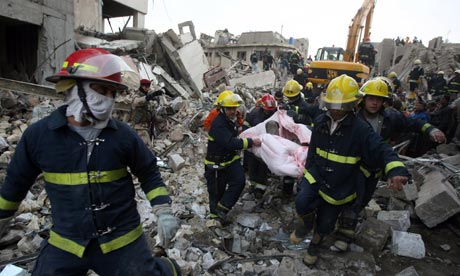
….In a statement Tuesday afternoon, Maliki blamed the attacks on “remnants” of Saddam Hussein’s Baath Party and on al-Qaeda in Iraq. The prime minister accused the attackers of “gloating in the blood of our innocent” and attempting to “abort our democratic experiment.”

Lawmakers scheduled a special session for Thursday to review the government’s response to the latest attacks and its investigations into bombings in August and October that left key ministries in ruins and killed more than 250 people.

As U.S. troops sharply downscale their presence in Iraqi cities in the summer, Maliki hailed the first phase of their withdrawal as a “victory” for Iraq and many Iraqis took to the streets to celebrate their new sovereignty. Days later, Maliki’s government said it would start dismantling the concrete walls that reminded Iraqis daily of the dangers that had come to shape their lives.

The recent carnage has given those celebrations a retrospective air of hubris and led Iraqis to fear that their country may not yet be on the mend…..

BAGHDAD — Four large bombs exploded near education facilities, judicial complexes and other targets in Baghdad on Tuesday, killing at least 127 people and triggering recriminations against the Iraqi government and its security forces. Nearly 500 people were wounded, according to Iraqi police officials.

The blasts, which occurred minutes apart shortly after 10 a.m., fueled fears that elections, now scheduled for March 7, as well as the ongoing withdrawal of U.S. forces, will usher in a new phase in the battle for control of Iraq. Although that fight is now unfolding primarily in the political arena, many Iraqis fear that a rise in violence and political instability could again turn politicians into combatants.

Iraqi officials accused the Sunni insurgent group al-Qaeda in Iraq of responsibility for Tuesday’s carnage, the latest in a campaign of powerful bombings apparently designed to undermine the Shiite-led government, which insurgents deride as a byproduct of the U.S. occupation.

Al-Qaeda in Iraq has little support among residents, but the anger and sense of impotence apparent here Tuesday suggested that the insurgents have succeeded in portraying the government as feeble and incompetent.

“Everyone knows that the interior minister doesn’t speak to the prime minister because of political problems,” Shiite lawmaker Nasar al-Rubaie said during a televised parliamentary session in which lawmakers chastised security commanders and key ministers. Prime Minister Nouri al-Maliki and Interior Minister Jawad al-Bolani lead slates vying for seats in the upcoming elections.
ad_icon

“How can we provide security for Iraqis with security ministries that respond to political parties?” Kurdish lawmaker Mahmoud Othman demanded.

The Baghdad security command, which reports to Maliki, provided a lower death toll, saying that 77 people died in the explosions. Two of four statements it issued about the bombings lambasted media coverage. It described journalists with one Western agency as “liars” and said it would sue an Iraqi television station for “defamation, abuse and incitement to violence.” ….

Iraqis, notoriously hardened after years of sanctions and war, lashed out at their leaders for failing to keep the populace safe.

“We don’t care who ends up leading us as long as it’s safe again,” said Delal Mahdi, a woman who was passing the Karkh courthouse. “At this point, even if it’s an Israeli, as long as he’s a good person, we would agree.”…

“These people are a failure,” the woman’s father, Jamal Mutar, fumed. “All they want to do is cover up their failures.”

LA Times on Iraq

It was not known who was responsible for the bombings. Some believe political blocs in the central government could be sponsoring attacks in an attempt to bring down Iraqi Prime Minister Nouri Maliki. Others believe that dissidents, including some army and police officers resentful of the political order installed by the United States, are intent on overthrowing the system.

The Guardian: Baghdad Car Bombs Blamed on Syria and Islamists by Iraqi Government

Iraq and Syria have remained at diplomatic loggerheads since the bombings in August. Both countries withdrew their ambassadors after Iraqi officials accused Syria of harbouring enemies who had vowed to direct and fund a bombing campaign in the run-up to a general election, which is scheduled for 6 March….

Iraqi officials have offered only scant support for their accusations. However, they appear to fervently believe that Damascus has at least given implicit consent to a subversive campaign that was allegedly plotted on Syrian soil.

A dossier prepared by Iraq’s security forces and shown to Syrian and Turkish intelligence officials, including the Syrian spy chief, Ali Mdouk, [Mamlouk?] in late August, centres on a meeting that allegedly took place on 30 July in the Syrian town of Zabaniyi.

Details of the dossier, which was presented to the Syrians by the chief of intelligence for Iraq’s interior ministry, Hussein Kamal, were made available to the Guardian before Tuesday’s attack.

It suggests the meeting was penetrated by intelligence agents, who reported that it was chaired by two well-known Ba’athist figures. Also in attendance were former Iraqi army officers and representatives from militant groups who were active in Iraq’s Anbar province throughout the blood-soaked years of 2006-07, including Jaish al-Mohammed, the Salaheddin Army and the Islamic Army of Iraq. “They agreed then to topple the government,” the report said. “This was the first time these groups had worked closely together. It was a critical event. They elected a leader and made a unified front.”

The official Iraqi version of events is that an unlikely co-operative of secular Ba’athists and militants who eschewed any form of government in favour of a return to Islamic law conspired from 30 July to pool their resources and wreak havoc during the pre-election period.

According to a senior Iraqi intelligence official, the original targets had been bridges spanning Baghdad’s rivers, rather than government ministries.

“They wanted to attack four bridges on the same day – the first day of Ramadan,” the source said. “But they found out we were following them and they changed their plan and their method. For them, it was a case of my enemy’s enemy is my friend.”

He said the insurgents initially planned to draw from an arsenal of about 2,000 artillery and mortar shells stored in a cache near Baquba, north of Baghdad. “But we found that,” he said. “That’s why they abandoned the bridge plan. They instead switched to ammonium nitrate bombs hidden in trucks and water tankers.”…

Europe Rejects a Plan for Jerusalem
By ISABEL KERSHNER in NYTimes

Israel expressed satisfaction on Tuesday that the European Union did not accept a Swedish proposal to explicitly recognize Palestinian claims to East Jerusalem as the capital of a future state.

US Chastises Turkey for reaching out to Iran

….The U.S. official said following their meeting that they have a problem with Turkey reaching out to Iran “and they can only play that potential role, useful role, if their message is consistent with that of the rest of the international community and ours, which is that we want to engage Iran.” …. Turkey PM: Israel can not bomb Gaza then hold drill in Turkey. Turkey has also denied a U.S. request to transfer more Turkish troops to Afghanistan, were they already have 1750 soldiers stationed.

Comment / On peace with Syria, Israeli leaders only talk the talk
By Elie Podeh in Haaretz

The ritual “track dance” is in full swing: the Syrian track first – no, the Palestinian track first. A future scholar researching the history of the main contacts between Israel, Syria and the Palestinians starting in the 1990s will discover a marvelous cyclical pattern: Whenever the Palestinian track reached a dead end or a breakthrough beckoned, the Israelis began talking about the Syrian track, and vice versa.

What the two tracks have in common is that no breakthrough has really occurred in either. The reasons for this are many and varied, but there is no denying that Israel bears much of the responsibility. The Barak, Sharon and Netanyahu governments seem to have preferred making noises about peace to doing anything about it. The Olmert-Livni government seems to have been the only one that took steps toward reaching an agreement, behind the scenes via Turkey.

Making do with noises about peace has a number of advantages. Psychologically, it gives our leaders, and perhaps some of our citizens, the feeling that Israel really wants peace, while the other side just talks about it. Politically, it doesn’t cost anything.

There’s nothing new in that the Syrian arena is more amenable. The Syrians are not as internally divided as the Palestinians, there is apparently “someone to talk to” there, and the issues and possibilities for resolving them are familiar. Some of them have already been agreed on. So why has the Syrian track been pushed aside? The answer is to be found in the inability of Israeli prime ministers to make a clear decision about withdrawing from the Golan Heights.

They fear the electoral implications of such a move because of the Golan’s special status in Israeli public opinion. Unlike Judea and Samaria, an ideological question is not at issue, and different pretexts are given for not negotiating with Syrian President Bashar Assad: His government bankrolls terror attacks, it’s in a strategic alliance with Iran, Hezbollah and Hamas, all he wants is to dip his toes in the Kinneret, and so on.

Without belittling the importance of these matters, it should be stressed that if Anwar Sadat’s positions had been scrutinized like this, there would have been no peace deal with Egypt. His first demands included not only Israeli withdrawal from all Egyptian territory it had conquered, but also a solution to the Palestinian problem. This linkage made the negotiations so difficult that Sadat walked out.

The Egyptian precedent teaches us several things about the Syrian track: First, Israel will not receive any advance concessions that could be used as bargaining chips in negotiations. Even if Syria is not prepared to formally cut its close ties with Iran, Hezbollah and Hamas, a serious diplomatic move would drive a wedge through this axis, with a significant affect on the regional balance of power. Second, tough initial bargaining positions do not necessarily reflect the final positions. Significantly, the Syrian position, unlike the initial Egyptian one, does not call for a solution to the Palestinian problem.

Israeli politicians mouth lofty slogans about the importance of peace with Syria, but they aren’t prepared to face up to the price to be paid. Instead, they pose preconditions. Israel’s situation in the Middle East is at rock bottom. Beyond the familiar regional threats, Turkey has moved away and the regimes in Egypt and Jordan have to defend themselves against public opposition to peace with Israel. We need from our decision makers a more active and effective policy, as well as cooperation with moderate elements. The Syrian arena, unlike the Palestinian one, offers an abundance of opportunities for bold and creative leadership, but that has not been forthcoming.

The writer teaches in the Department of Islamic and Middle Eastern Studies at the Hebrew University of Jerusalem.

Syria seeks to grill Lebanese officials in Hariri case
BEIRUT | AFP – December 09, 2009

A Syrian court has asked 25 Lebanese figures, including the police chief and top prosecutor, to appear for questioning over the murder of their country’s ex-premier, a Lebanese official said on Wednesday.

“The foreign ministry last night received from the Syrian embassy in Beirut 25 letters addressed to various (people) sought for questioning in connection with (Rafiq) Hariri’s murder,” the official told AFP on condition of anonymity.

The request came as Hariri’s son and political heir Saad Hariri, who was recently appointed premier, prepares to make his first official visit to Syria, Lebanon’s neighbour and former powerbroker.

There have been widespread accusations in Lebanon, including from the younger Hariri himself, that Damascus was behind the 2005 assassination. A UN commission of inquiry said it had found evidence to implicate Syrian and Lebanese intelligence services but there are no suspects in custody.

Syria has consistently denied any involvement in the crime.. Those called for questioning include police chief Ashraf Rifi and prosecutor general Saeed Mirza, as well as several MPs and journalists.

The Syrian court acted after former Lebanese security services director Jamil Sayyed filed a lawsuit in Damascus in October in connection with his detention for four years over Hariri’s murder. The Hague-based tribunal was set up by a UN Security Council resolution in 2007 to try suspects in the murder of Hariri.

Sayyed was freed last April along with three other generals after a the tribunal ordered their release on grounds there was insufficient evidence to indict them.

“We filed the lawsuit in Syria because the Lebanese justice system and the Special Tribunal for Lebanon decided they had no jurisdiction in the matter,” said Sayyed’s attorney and son, Malek. He added that those sought for questioning had allegedly lied, along with five Syrian witnesses, about his father’s alleged involvement in Hariri’s murder.

Israel Must Unpick Its Ethnic Myth
BY: TONY JUDT | FINANCIAL TIMES

If the Jews of Europe and North America took their distance from Israel, over time even Washington might come to see the futility of attaching American foreign policy to the delusions of one small Middle Eastern state….

The Syrian government is now using Google Earth to fine those who build without permits.
DJ Lebanese PM Hariri Keen On Improving Ties With Syria
2009-12-08 15:31:15.664 GMT

BEIRUT (AFP)–Lebanese Prime Minister Saad Hariri said Tuesday his government was keen on improving its ties with Syria, strained since the killing of his father, Rafiq Hariri, in 2005. “The government wants to raise brotherly ties between Lebanon and Syria to a level in line with the two countries’ historical ties and mutual interest,” Hariri told Parliament.

He said relations between the two neighbors must be “based on trust, equality and mutual respect for each other’s sovereignty and independence so that neither country feels threatened by the other.” Hariri, who in the past has implicated Syria in his father’s killing, has never had any official contact with the Syrian regime of Bashar al-Assad. But he indicated last week that he planned to visit Damascus soon, which in 2005 was forced to withdraw its troops from Lebanon after a 29-year presence. Presenting his cabinet’s policy statement to lawmakers before a vote of confidence due later this week, Hariri also reiterated Hezbollah’s right to its arsenal in order to protect the country from Israeli aggression, despite
opposition by some members of his majority coalition. “The government insists on the right of Lebanon, its government, its people, its army and its resistance [Hezbollah] to liberate” all occupied territory and to defend Lebanon from any aggression.

Hezbollah, which is supported by Syria and Iran, has two ministers in Hariri’s 30-member cabinet.

Michael Young, “Syria Exports Trouble,” provides a characteristic rant on how all regional and Lebanese troubles come from Syria. Here are the money shots:

…Assad had surrendered nothing to warrant the embrace….Assad has been getting away with murder, literally….Syria continues to export instability in defense of its regime and interests, and the reality is that no one is doing anything about it–not the United States, the United Nations, the Arab states or the European Union….Syria has also benefited from Obama’s impatience to leave Iraq…..Prime Minister Nuri al-Maliki publicly blamed Syrian-backed Iraqi Baathists….Syria has not only used Hamas against Israel, it has also pushed the movement to thwart Egypt’s ability to act as principle Arab mediator between Israelis and Palestinians……The Saudis believe that one way to contain Hezbollah’s power, and therefore Iran’s, is to endorse a Syrian resurgence in Lebanon…..Everyone is knocking at his door while Hariri lies forgotten.

Etisalat Eyes Syria, Lebanon and Libya
Emirates Telecommunication Company, or Etisalat, plans to invest in telephone services in Syria and Lebanon as the governments of those countries begin selling off their state-owned telecoms assets in coming months….

Bus Bomb? Syrian-Israel Peace Talks? SSNP, Turkey is Warned, Washington is Broken

US Ambassador: The word is that the name of a candidate for Ambassador to Damascus has been sent up to the White House. No one seems to be willing to say who it is, but there is some gossip that suggests Jacob Walles, the former Consul in Jerusalem, may be named to the post.

Peace Talks: Israeli and Syrian diplomatic announcements about their respective readiness to discuss peace have all the hallmarks of cynical  maneuvering rather than the sincere desire to make peace. Israel wants Syria to engage in direct talks with no promise of return of the Golan. Syria wants Israel to resume talks where Clinton and P.M. Barak left off in 2000, otherwise there can be only indirect talks. Netanyahu won’t give up the Golan and Syria will not accept less than the whole Golan. There is really not much to talk about under the circumstances but neither side wants to be blamed for refusing to negotiate.

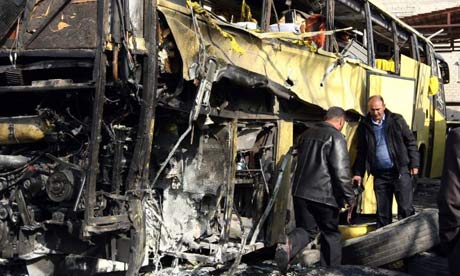
Explosion: Phil Sands does it again — real reporting. He does some hard journalism to argue that an exploding tire – not terrorism – just as Syrian authorities reported, was the most likely source of the deaths on a Syrian bus last week.

When it comes to reporting on Syria, foreign journalists and analysts somehow feel at liberty to speculate with no restraint. I remember how David Shenker suggested that Syria had bombed itself when a small extremist cell tried to attack the US Embassy in 2006. Others suggested that Syria killed Mughniya to please the US or that it staged the extremist shoot out at an abandoned UN site in Mezzeh in 2004 because it wanted to look as if it suffered from extremism to garner world sympathy. It is funny that most of these pundits make fun of Arabs when they resort to conspiracy theories to explain Western behavior, but cannot see their own absurdity when they resort to the same device to explain Arab behavior. Some will argue that Syria brings this skepticism on itself because it refuses to allow journalists to operate within Syria freely. Phil has called an auto engineer to explore the likelihood that an exploding tire could set off a bus fire and do the sort of damage we saw in the case of the Syrian bus explosion of last week.

In Syria, the dust settles, the story holds
Phil Sands, Foreign Correspondent
December 07. 2009, The National

The wreckage of an Iranian pilgrims’ bus after an explosion last week on the outskirts of Damascus. Phil Sands for The National

DAMASCUS // If you read, watched or heard any of the recent news reports out of Syria, you probably know that Sunni extremists set off a bus bomb in the Shiite neighbourhood of Saida Zeynab on Thursday, killing at least three people and raising fears of rising sectarian tension.

The Syrian authorities denied the explosion was a bomb, but ironically explained the fatalities had been caused by an “overinflated tyre”. The various news reports naturally mentioned this denial, but did so in a way that made it clear nothing of the sort could have been true.

Photographs of the damaged coach, the windows smashed, its side torn and blackened from fire, emphasised the point this was not the result of an accidentally popped tyre.

The only problem with all of these accounts is that there may not have been a bomb after all. The explosion, in fact, could well have been caused by an overinflated tyre.

“It’s well known within the industry for people to be killed from over inflating tyres,” explained a senior engineer at a leading tyre manufacturer in the UK.

He spoke on condition of anonymity because his company, a global brand that makes tyres for cars, lorries and aircraft, did not want its name associated with a fatal incident it had not been involved in.

The engineer, who said he had heard of the Damascus explosion, stressed it was impossible to know with certainty what had taken place without visiting the site. But, he said, tyre explosions could be extremely powerful.

“Coach or lorry tyres are not like those on cars,” the engineer said. “They have plies inside them, metal reinforcement that lets them keep their shape. And you put a lot of pressure in these tyres, say 90 pounds per square inch, that’s three times more than a car, it’s a lot of pressure.

“If you put too much air in, or if the tyre is old and weak and not properly maintained, it can explode, and those metal plies are probably going to go flying.”

Eyewitnesses to the explosion reported hearing a bomb go off, something the engineer thought could well have been a tyre. “A lorry tyre bursting at 120 PSI [pound-force per square inch] or something makes a hell of a bang; it sounds like a bomb,” he said.

Thursday’s blast left parts of the bus badly damaged, its windscreen smashed and engine burned. A van some 15 metres away had a piece of shrapnel-like debris punched through its window and there were three confirmed deaths.

However, while significant, the scale of destruction did not measure up to that caused by the car bombings so common in neighbouring Iraq; those bombs sometimes throw heavy engine blocks 30 to 50 metres, blow craters into concrete roads or demolish the walls of surrounding buildings. Windows in the immediate vicinity get broken.

When the Syrian security forces finally allowed journalists onto the blast site in Saida Zeynab, it was clear there was no crater. A taxi parked alongside the coach, on the same side as the explosion, had some of its windows smashed, but not all of them. There was even some unbroken glass in the immediately adjacent tyre workshop.

And the coach itself, while damaged, was far from torn to pieces. Most of the bodywork was intact, the engine and chassis appeared to be in place, even the seats above the site of the explosion, while misshapen, were still there.

Fire damage was significant but, in light of the British tyre engineer’s comments, it seems possible that flying metal debris could, for example, have punctured the fuel tank or fuel lines resulting in a blaze….

A growing number of media outlets and commentators rushed to speculate that this must be a sectarian conflict. There was talk of “destruction”, “these militants” – as if the bombing had been confirmed – and even a wild suggestion Syrians felt themselves about to be enveloped in “carnage”.

Syria’s public relations machine did little to tamp down the hysteria. Their spokespeople briefly mentioned an overinflated tyre, offered no extra details and summarily dismissed any further questions.

One critical point the speculative stories failed to address was just why the Syrian authorities would claim a bombing had been an accident. Syria repeatedly justifies its harsh suppression of all internal dissent on the grounds of a domestic threat from violent Islamic extremists. A bomb would fit that narrative perfectly, whereas a blown tyre does not.

Thursday’s explosion might well have been a militant attack, as was widely implied. But, utterly implausible as it may at first sound, there are reasons to believe the Damascus bomb of December 3 may not have been a bomb at all….. Under those circumstances, the claim that the explosion came from a burst tyre does not sound so ridiculous as it undoubtedly does at first glance.

Haaretz: ‘Syria drops demand for Israeli pledge to quit Golan Heights’
2009-12-07, Haaretz, By Barak Ravid

The Syrian government is no longer demanding an Israeli commitment to withdraw …

ERDOGAN SAYS ISRAELI GOVERNMENT CONFUSED ON FOREIGN RELATIONS
2009-12-07–MARK BENTLEY

Syria Steps, an on-line newspaper, (article copied below) reports that a small opinion poll carried out among Syrian economics students at universities in Damascus, Aleppo, and Latakia demonstrates that”

42% of students want a government job for the security. 33% want to work for a bank or insurance company.

12% chose as their first choice of employment a company run by Rami Makhlouf because of its superior salary and benefits. Interestingly, of those who said they preferred to work for a Makhlouf company,  almost none came from Aleppo at 2% of the total. Damascenes made up 52% and Latakians 40% of the students who wanted to work for a Makhlouf company.

What are the possible explanations for this Aleppine disregard for Makhlouf?

  1. Most obvious is that Aleppo has its own economy and Makhlouf companies do not enter onto the Aleppine college student radar so much. Makhlouf companies are headquartered in Damascus so Damasacenes talk about them and are aware of them. In Latakia, the high concentration of Alawites may be important to public awareness of the Makhlouf companies. They feel connected to them, unlike the Aleppines, for whom they are not important.

Other industrialists with high recognition for whom Syrians students wanted to work are Muhammad Hamsho (Apple Computer) in Damascus, Ghassan Karim in Aleppo, and Wahib Mar’ai (iron and steel) in Latakia.

Most respondents explained that they despaired of getting a job on graduation but allowed as how it was nice to dream about it.

??? ???? ???? ???????? ???????? ????? ??? ??????
?????? ????? ?? ??????? ???????? ..?????? ????? ??????? ?? ????? ????
05/12/2009

????- ??????????:

??? ??? ?? ???? ??? ????? ?? ???? ???????? ????????? ???? ?????? ?? ??? 200 ???? ?????? ?? ????? ??????? ?? ????? ???????? ???????? ?? ?? ?? ?????? ???? ???? ????????? ??? ????? ?? ?? ???? ?? ???? ???? ????? ??? ????? ???? ?? ????? ??? ???? ??? ???? ?????? ??????? ????? ????? ????????? ???? ??? ?????:

42% ?? ?????? ????? ?? ??????? ?????? ??????? ???????? ?????? ?????? ????? ???? ?????? ??? ?????? ?????? ?????? ???????..

?? ??? ??? 33% ?? ????? ?????? ??????? ?????? ??????? ?? ??????? ??????.. ???? ?????? ??????? ?????????.

???? 12% ?? ?????? ????? ?????? ????? ?? ???? ????? ???? ????? ????? ??? ?????? ???? ????? ???? ??? ?????? ?????? ???????? ????? ???? ????? ?????? ?? ????? ?????.

??????? ?? ???? ????? ????? ?????? ??? ?????..????? ?? ???? ????? 52% ? 40% ?? ???????? ? 2% ?? ??? .

?????? ?????? ??????? ??? ????? ?????? ?????? ??? 13% ??? ????? ??? ????? ???? ???? ????? ?? ???? ????? ???? ?? ??? ??????? ????? ????? ???? ?? ????????.

??? ?????? ??????..????? ??????? ?????? ??????? ?????? ??? 62% ?? ?????? ??????? ?????? ??????? ????? ?????.. ???? ????? ?? ????? ???? ????? ????? ???? ?????? ???? 11% ??????? ???? ??? ????? ??????? ?????? ??????? ???????? ???????? ???????? .

??? ?????? ??????..??? ???? ????? ???????? ?????? ?? 32% ??? ?????? ?? ?????? ??? ?????? ??? ?????? ????? ????? ??????? ??? ??? ????? ??? ???? ????? ??? ??? ??????? ?????? ???? ???? ????? ????? ?????? ???? ???????? ?? ????????????…?? ??? ????? ??????? ???????? ???????? ?????? ??????? ?????? ??? ??? ?????? ???? ?????? ???? ??? ?? ??? ???? ????? ???? ???? ?????? ??????? ????? ????? ?? ????? ????? ?? ?? ????? ?? ??????.

??? ?? ???????.. ???? ???????? ???????? ?? ???? ????? ?????? ??? ?? ????? ?????? ??? ???? ??? ????? ???? ???? ???? ?? ??????? ???? ?????? ????.. ??? ??? ?????? ?????? ?? ???? ???????? ???????? ???? ?? ?????? ????? ??? ??? ????? ?? ?? ???? ?????? ????? ???? ???????? ????????? ????? ????? ????? ????? ?????? ?? ??????? ????? ???? ????? ???????? ???????? ??? ??????? ???????? ?????? ??????? ???? ???????.

??? ?? ???? ?? ???? ????? ?????? ????? ?? ???????? ?? ??????? ????? ??????? ??? ????? ??? ?????? ???? ?? ???? ?? ????? ???????.

BBC Via FLC (Thanks)

…. Instead, when he visited Turkey in April he found a country that under the leadership of Mr Erdogan and his Islamist-inspired AK party has seen a rise in anti-Western rhetoric and “nationalism imbued with Islamism”, according to Soner Cagaptay, director of the Turkish Research programme at the Washington Institute for Near East Policy.

Although Turks have a much more favourable view of Mr Obama than they did of President George W Bush, only 14% of Turks have a positive view of the US – the lowest rating among 25 countries polled by the Pew Research Center this spring….

Last week, Turkey’s Foreign Minister Ahmet Davutoglu rejected criticism of his country’s improving ties with countries like Iran. He told the BBC that his country was attempting to have “zero-problem” with its neighbours.

This approach has allowed Turkey to rise as a considerable regional power and, until recently, this gave Ankara the ability to mediate between West and East, and between countries like Israel and Syria…. As it grows closer to countries like Syria, it is alienating Israel, and while it defends Iran’s nuclear program, it raises alarm bells in Washington.

Mr Obama is likely to be firm in expressing displeasure about the exclusion of Israel from the military exercise or his worry about the rise of anti-Western sentiments in Turkey. But he may also seek to explore whether Washington can still reap any benefits from Turkey’s improving ties with some of Washington’s foes and its ability to talk to them, in particular Iran.

But the US wants Turkey to use its ties with Tehran to deliver tough messages, not just sign gas and trade deals, which Mr Erdogan did when he visited Iran last month….. So in public, the US administration insists it is not worried about the developing trends in Turkey…..

But speaking at a conference last year, before becoming an Obama administration official, Mr Gordon said that while Turkey was still a stable partner, “current trends augur that it could just as easily become a more nationalist country that resents its rejection from the EU and isolates itself from the West”.

He concluded by advising the next administration, of which he was soon to become part, that it “should make sure that Turkey stays on the right path, because it would be sad to discuss four years from now why we lost a valued ally”.

Since that conference, the situation has only deteriorated, so it is most likely that Mr Gordon is still concerned with making sure that Turkey “stays on the right path”.”

SSNP News: Contributed by Nour

In a largely attended ceremony commemorating the 77th year since the founding of the Syrian Social Nationalist Party, President of the Party, Dr. Ali Haidar, declared in a policy speech the inception of the Social Nationalist state across the Syrian homeland, with Jerusalem as its capital. President Haidar further clarified “not East Jerusalem, not West Jerusalem, but Jerusalem, all of Jerusalem, is our capital and every grain of soil from Jerusalem is to us the holiest of holies. He further stated that “we did not raise the slogan of “Jerusalem the capital of our Syria” in order to outbid anyone from the children of our nation in our love of this city, but to respond to the suggestion of the enemy in making Jerusalem the eternal capital of “Israel.” Jerusalem, just like all other Palestinian cities, will never be anything but Syrian in its origin, its inclination, and its fate.”

President Dr. Ali Haidar presented a plan for the realization of the Social Nationalist state, divided into three main parts. First, the rise of the national state with its capital Jerusalem. Second, the formation of a state civil law and the organization of national life. And third, the organization of the national economy on the basis of production. Each of those parts is followed by a series of subparts in what is a deliberate, organized plan of action to achieve what is “the highest goal of transforming the Syrian Social Nationalist state from a reality in our living sentiments to a living reality on its own.”

With respect to Sham (Syrian Arab Republic), President Dr. Ali Haidar stated that Sham has been successful in breaking its international isolation, and in “building good and promising political economic relations with Turkey, with our hope that it is not at the expense of our national rights [meaning the surrender of Cilicia and Alexandretta].” He further stated that Sham’s success in its foreign policy “should not be at the expense of its internal files which are in need of being addressed” and they include “the Shami economy” as well as “the need for the modernization and development of many of its laws, which will fortify its internal front in order to confront its external dangers.” President Dr. Ali Haidar also called on Sham to support and embrace all “resistances” in the nation, and to transform them into “a single all-encompassing resistance, and to regard resistance as a culture, a course, and a way of life, which is the more profitable strategic choice and which !
has proven its success in the preservation of our national rights.”

Why Discuss writes:

Jamil Sayyed is now suing in the Syrian courts the false witnesses (5 of them of Syrian nationality) in relation to the Hariri affair. His request for proper justice after 4 years of illegal detainement have been rejected by the TSL and the Lebanese justice system. The Syrian tribunal will request several high profile Lebanese personalities, ex ministers etc… as well and Detlev Mehlis to present themselves to this tribunal to be heard.

Sayyed : La justice syrienne convoque Hamadé, Khachan, Rizk, Sabeh, Rifi, Hammoud et d’autres…
07/12/2009

Assassinat Hariri

Le Tribunal spécial pour le Liban lui a fermé ses portes pour cause d’incompétence à juger les faux témoins et la justice libanaise refuse de donner suite à ses plaintes répétées : qu’à cela ne tienne, l’ancien directeur général de la Sûreté générale, Jamil Sayyed, s’adresse à la justice syrienne et obtient, au moins à cette étape du parcours, gain de cause. Dans un timing qui ne peut pas être innocent à la veille de la visite prévue du Premier ministre Saad Hariri à Damas et alors que le procureur général du TSL, Daniel Bellemare, est encore au Liban, le général Sayyed a annoncé hier que la justice syrienne a émis des mandats d’arrêt contre « les faux témoins et leurs complices » portant la nationalité syrienne et elle a délivré des commissions rogatoires pour entendre « leurs nombreux complices présumés libanais et étrangers, dont le député Marwan Hamadé, le conseiller en information du Premier ministre Hani Hammoud, le directeur !

général des FSI Achraf Rifi, le procureur général Saïd Mirza et d’autres politiciens et journalistes ».

Si la plupart des personnes citées dans la nouvelle publiée par le bureau d’informations du général Sayyed ont refusé de la commenter, le député Marwan Hamadé qui se trouve à Rambouillet a déclaré à L’Orient-Le Jour qu’il se « félicite de l’intégrité de la justice syrienne connue pour son respect des droits de l’homme notamment à l’égard de ses propres citoyens et surtout de ses intellectuels ». Reprenant une expression libanaise, il a ajouté dans une boutade : « C’est comme si les victimes sont satisfaites, mais le tueur, lui, ne l’est pas. » Prié de commenter le timing de cette nouvelle à la veille de la visite annoncée de Saad Hariri à Damas, Hamadé a déclaré : « Il s’agit d’un complot contre cette visite et contre le gouvernement d’union nationale. »

Dans les détails de l’information, les avocats de Sayyed en Syrie lui ont annoncé que le magistrat syrien chargé de statuer sur la plainte qu’il a déposée contre les faux témoins et leurs complices, dans l’affaire de l’assassinat du Premier ministre Rafic Hariri, a émis des mandats d’arrêt contre l’ancien vice-président syrien Abdel-Halim Khaddam et contre Mohammad Zouhair Siddiq. Le juge syrien a aussi délivré des commissions rogatoires pour informer les personnes de nationalité libanaise et autres, dont le nom figure dans la plainte, de la nécessité de se présenter devant la justice syrienne pour être entendues.

La liste des Libanais

Toujours selon le général Sayyed, ces commissions rogatoires ont été communiquées à la justice libanaise au cours de la semaine dernière. Elles comportent les noms des anciens ministres Marwan Hamadé, Hassan Sabeh et Charles Rizk et l’ancien député Élias Atallah. Les noms des magistrats Saïd Mirza, Sakr Sakr et Élias Eid figurent aussi sur la liste aux côtés de ceux du général Achraf Rifi, de Wissam Hassan, Samir Chéhadé, Houssam Tannoukhi et Khaled Hammoud. De même, les journalistes Farès Kachan, Hani Hammoud, Hassan Sabra et d’autres sont aussi convoqués devant la justice syrienne, en plus de l’ancien chef des SR Johnny Abdo, du jounaliste koweïtien Ahmad Jarallah, propriétaire du quotidien as-Siassa, et de l’ancien président de la commission d’enquête internationale Detlev Mehlis et son adjoint Gerhard Lehmann. Le journaliste syrien résidant au Liban, Nohad al-Ghadri, et les faux témoins syiens installés au Liban, Akram Chakib Mrad et Ibrahim!

Michel Jarjoura (ce dernier a été interdit de quitter le territoire libanais sur décision personnelle du juge Mirza, contrairement à la loi, selon le bureau d’informations du général Sayyed) font aussi l’objet de commissions rogatoires, ainsi que le « faux témoin » israélien d’origine palestinienne, Abdel Basset Bani Aoudeh, installé en Suède.
Le général Sayyed a précisé que sa plainte devant la justice syrienne est « personnelle et pénale ». Elle n’est donc pas politique et l’État syrien n’y participe pas, tout comme il n’a, pour l’instant, porté plainte contre aucune des personnes dont le nom figure dans les mandats d’arrêt ou dans les commissions rogatoires. Le général Sayyed a ajouté que l’État syrien aurait pu le faire après le scandale des faux témoins Mohammad Zouhair Siddiq et Houssam Houssam. Il a insisté sur le fait qu’il ne s’agit donc pas d’un procès syrien. Il est intenté par un citoyen libanais (lui-même) devant la justice syrienne, compétente du fait que cinq des personnes accusées ont la nationalité de ce pays. Sayyed a rappelé qu’il a tenté de porter cette plainte devant le TSL mais celui-ci s’est déclaré incompétent pour juger les faux témoins. Il a même fait appel à la justice libanaise qui a refusé de réagir. Il n’a donc plus eu d’autre choix que de s’adresser!

la justice syrienne. Sayyed a répété que cette plainte n’a aucune portée politique et il a ajouté qu’il est prêt à la transférer de Syrie au TSL au cas où celui-ci change d’avis au sujet de ses compétences. Il a enfin précisé qu’il peut retirer sa plainte si les personnes en question décident d’assumer leurs responsabilités au sujet de sa détention illégale et de la fabrication de faux témoins…

Interrogé par la chaîne LBC, le ministère des Affaires étrangères a nié avoir reçu les commissions rogatoires. Le ministère de la Justice a lui aussi affirmé n’avoir rien reçu, « à moins, ont précisé les sources du ministère, que les commissions rogatoires soient directement transmises au parquet. Ce qui serait une erreur de procédure, toujours d’après le ministère. De son côté, le procureur général près la Cour de cassation, Saïd Mirza, a refusé de démentir ou de confirmer la nouvelle, se contentant de déclarer à la LBC qu’il consultera son courrier aujourd’hui même…

Jamil Seyyed is now suing in the Syrian Justice the false witnesses (5 of them of syrian nationality) in relation to the Hariri affair. His request for proper justice after 4 years of unjustified detainement have been rejected by the TSL and the Lebanese justice system. The Syrian tribunal will request several high profile lebanese personalities, ex ministers etc… as well and Detlev Mehlis to present themselves to this tribunal to be heard.

Netanyahu: Israel ready for Syria talks
December 7, 2009, JERUSALEM (JTA)

Israel is ready for direct negotiations with Syria, Prime Minister Benjamin Netanyahu said. Netanyahu on Monday told the Knesset Foreign Affairs and Defense Committee that he recently informed French President Nicolas Sarkozy of Israel’s desire to enter into new negotiations without preconditions, such as the Syrian demand before sitting down to talks that any negotiations end in a return to 1967 lines.

The prime minister also said that he told Sarkozy that he would prefer that France take over the mediator’s role from Turkey.

Netanyahu also discussed the threat to Israel from Lebanon to the north.

“If in the past we considered Hezbollah as a sideline militia, today Hezbollah is the real Lebanese army,” he reportedly said. “Hezbollah has replaced the Lebanese army as a significant force; it is arming and organizing as a real army. The Lebanese government and Hezbollah are becoming interwoven in each other – and they will suffer the consequences of any violation against Israel.”

Eyal Zisser in the Daily Star

“… He was prepared to accept most of Hizbullah’s conditions. When Hariri found himself immersed in personal quarrels with Aoun, he resolved them by making additional concessions. And he began hinting that he might be prepared to put aside his hostility with Syria. Hariri considers Syria responsible for the murder of his father, Rafik Hariri. Still, he indicated that he might be willing to open a new page between the two countries.

Thus it appears that the March 14 camp’s June 2009 electoral victory was only partial and short-term, one clash in a long battle far from finished, a battle over the path Lebanon takes and the future of the country……

… As a matter of fact, between the end of the 2006 war and the fall of 2009 Hizbullah almost tripled the number of missiles at its disposal. In November 2009, it was estimated that the organization possessed 40,000-50,000 missiles of the type it had used against northern Israel during the 2006 war……

It may be assumed that the new government formed in Lebanon is based upon a balance of fear between Hizbullah and its opponents, especially Hariri and the Sunni community he heads. It may also be assumed that a tense calm will continue to prevail along the Israeli-Lebanese border in the absence of either side having any interest in disturbing the quiet…..

The present moment may be merely an intermission between two episodes in the struggle within Lebanon, and in the conflict between Israel and Hizbullah. Either or both fronts could explode at any time.”

YaLibnan

“An Nahar Sources: The US administration is trying to embarrass Lebanon by setting impossible conditions before granting $100 million in military aid. One of the conditions is disarming Hezbollah.”

American Jews eye Obama’s ‘anti-Israel’ appointees
By Natasha Mozgovaya, 04/12/2009

Every appointee to the American government must endure a thorough background check by the American Jewish community.

In the case of Obama’s government in particular, every criticism against Israel made by a potential government appointee has become a catalyst for debate about whether appointing “another leftist” offers proof that Obama does not truly support Israel.

A few months ago, boisterous protests by the American Jewish community helped foil the appointment of Chaz Freeman to chair the National Intelligence Council, citing his “anti-Israel leaning.”
Advertisement

The next attempt to appoint an intelligence aide, in this case, former Republican senator Chuck Hagel, also resulted in vast criticism over his not having a pro-Israel record.

American Zionists are urging Obama to cancel Hagel’s appointment because of what they call a long and problematic record of hostility toward Israel.

The president of the Zionist Organization of America, Morton A. Klein, described Hagel’s nomination as such: “Any American who is concerned about Iran’s drive to obtain nuclear weapons, maintaining the Israeli-U.S. relationship and supporting Israel in its legitimate fight to protect her citizens from terrorism should oppose this appointment.”

Republican Jews have also protested Hagel’s appointment, citing an incident in 2004 when Hagel refused to sign a letter calling on then-president George Bush to speak about Iran’s nuclear program at the G8 summit that year.

In August of 2006, Hagel refused to sign a letter requesting the UN declare Hezbollah a terrorist organization.

In a speech at the conference of self-declared “pro-peace, pro-Israel” lobby J Street, Hagel spoke about his views on the issue of Israel and the Middle East.

“The United States’ support for Israel need not be – nor should it be – an either-or proposition that dictates our relationships with our Arab allies and friends. The U.S. has a long and special relationship with Israel, but it must not come at the expense of our Arab relationships,” Hagel said.

The latest round of heated debate has been over the nomination of Hannah Rosenthal to head the Office to Monitor and Combat Anti-Semitism in the Obama administration.

Rosenthal, who is the daughter of a Holocaust survivor, served as a Health Department regional director under the Clinton administration, and held positions in different left-leaning Jewish organizations.

Between 2000 and 2005, Rosenthal was the head of the Jewish Council for Public Affairs; she was also the executive director of the Chicago Foundation for Women. In recent years, she has served on the advisory board of the J Street lobby.

The president of Americans for Peace Now lauded Obama’s appointment of Rosenthal. Even Anti-Defamation League chairman Abraham Foxman came out in support of Rosenthal’s appointment.

“This appointment signals the continued seriousness of America?s resolve to fight anti-Semitism,” Foxman said in a statement.

Shortly after the announcement of Rosenthal’s nomination, conservative Jewish web sites began to attack her, some of them declaring that Obama appointed an anti-Israeli to fight anti-Semitism.

Rumors brewed that she had accused Israel of systemically strengthening anti-Semitism. Bloggers argued that her appointment would cause Jews and Israelis to cast doubt on Obama and his relationship with Israel.

In one of her articles, Rosenthal criticized conservative voices in the Jewish community who she accused of taking over the discourse regarding the Israeli-Palestinian conflict.

“It’s a scary time, with people losing the ability to differentiate between a Jew, any Jew, and what’s going on in Israel,” Rosenthal said.

In an interview with the new online Jewish magazine, Tablet, Rosenthal said that she loves Israel.

“I have lived in Israel. I go back and visit every chance I can. I consider it part of my heart. And because I love it so much, I want to see it safe and secure and free and democratic and living safely,” Rosenthal said

Here is a synopsis from a comment by Stephen Walt on this issue:

“These are fine sentiments, but isn’t it odd that she has to defend her qualifications for a position in the U.S. government by saying how much she “loves” a foreign country? For an American official in her position, what matters is that she loves America, and that she believes anti-semitism is a hateful philosophy that should be opposed vigorously. Whether she loves Israel or France or Thailand or Namibia, etc., is irrelevant. (And yes, it’s entirely possible to loathe anti-Semitism and not love Israel).

But the real lesson of all these episodes is the effect of this litmus test on the foreign policy community more broadly. Groups in the lobby target public servants like Freeman, Hagel, and Rosenthal because they want to make sure that no one with even a mildly independent view on Middle East affairs gets appointed. By making an example of them, they seek to discourage independent-minded people from expressing their views openly, lest doing so derail their own career prospects later on. And it works. Even if the lobby doesn’t manage to block every single appointment, they can make any administration think twice about a potentially “controversial” choice and use the threat to stifle open discourse among virtually all members of the mainstream foreign policy community (and certainly anyone who aspires to public service in Washington).

The result, of course, is the U.S. Middle East policy (and U.S. foreign policy more generally) is reserved for those who are either steadfastly devoted to the “special relationship” or who have been intimidated into silence. The result? U.S. policy remains in the hands of the same set of “experts” whose policies for the past seventeen years (or more) have been a steady recipe for failure. If a few more Americans read Ha’aretz, they might start to figure this out.”

Idaf writes:

Mr. Whitaker is a 130 years late. Abdul Rahman Al-Kawakibi‘s conclusions in his book “Nature of Despotism” is sadly as true today as it was 130 years ago. To quote him: “The greatest disaster is our loss of freedom . . . freedom to speak out and publish, freedom to carry out scientific research”

A good paper on his work and its echoes in today’s Arab world here:

“More than a century before it was showered by outsiders with mantras about “freedom agendas” and “good governance,” the Arab world had a figure for whom these concepts represented imperatives for stanching the decline of the Arab-Muslim realm and restoring its position in the world. Arabs seeking a homegrown blueprint for human, political, social, and civil rights need not search very far. Al-Kaw?kib? offered a strategy for reform that rested on a penetrating analysis of tyranny and its ramifications for polity and society. A lifelong advocate of freedom of expression and freedom of association, al-Kaw?kib?’s commitment to the principles of liberty and justice was as unflinching as it was unequivocal”

“Jordan is a model that works, whether we like it or not,” – Rami Khouri

“Jordan is a model that works, whether we like it or not,” explains Rami Khouri. He is probably right and this is in the face of the king’s recent dissolution of parliament. Democracy has few real proponents in the Middle East today.

Laith Shubeilat, a moderate Islamist, described Jordan as a police state in which no real opposition was permitted. “I am an Islamist, but I have never had a platform relating to religion, only one asking for liberties, democracy,” he said, accusing the West of hypocrisy in backing a “dictatorship”. Shubeilat, jailed several times, said five men had beaten him up in October after he criticised the king’s behaviour.

Both Khouri’s and Shubeilat’s conclusions say a lot about the present state of the Middle East. I have added two articles by Patrick Seale below because, paired with Alistair Lyon’s article, they lay bare the state of play in the Levant today. One cannot but agree with Shubeilat’s conclusion about Western hypocrisy. Despite all the Washington institutions that are ostensibly designed to “promote democracy” in the Middle East, Washington has few real proponents for the reason that Khouri expresses.

Jordan king to keep democracy on back-burner
By Alistair Lyon, REUTERS

AMMAN – Jordan’s King Abdullah, having dissolved an elected, if unlamented, parliament midway through its term, will probably shy away from genuine political reform, despite promises of a clean vote next time round.
The 110-member assembly’s abrupt demise last month drew little outcry, perhaps a reflection of widespread public perceptions of malpractice in the 2007 polls that produced it.

The 47-year-old monarch, who came to the throne in 1999, has not explained why he dissolved what most Jordanians viewed as a tame lower house prone to venality and self-interest.

However, some economists suggest the assembly was removed to allow the government to push through an austerity budget to curb runaway spending and enact investor-friendly laws by decree.

Many advocates of reform expect no drastic change.

“In recent years, changes of parliament or cabinet are just part of the entertainment business in Jordan,” said Taher Kanaan, a former deputy prime minister, with a wry shrug.

The king has told the government to forge a new electoral law ahead of an election that would be a “model of transparency and justice” — a tacit admission of the frailties of the last one, which returned mostly tribal loyalists and businessmen.

Parliament, which rejected a tax reform bill in August and sought higher taxes on banking, mining and telecom sectors, might have obstructed a budget aimed at slashing the deficit to 3.9 percent of gross domestic product in 2010 from 7.3 percent.

Jordan’s six million people face a contracting economy after several boom years fuelled by an inflow of foreign investment and money transfers from Jordanians working in the Gulf Arab region. The good times tempted the government to spend freely.

“DESTABILISING THE ECONOMY”

“Now they realise they can’t go on this way and that it is destabilising the whole economy,” former finance minister Michel Marto, chairman of the Housing Bank for Trade and Finance, said.

Public debt is due to hit a record $14 billion this year, nearing a legal limit of 60 percent of GDP, as recession reduces local revenue and foreign aid. Unemployment is about 13 percent.

Still, Marto said, the economy is far healthier than in 1989 when debt reached 180-200 percent of GDP and the dinar crumbled.

That crisis sparked riots that prompted the late King Hussein to revive parliament, lifting a state of emergency in place since 1967. Islamists won 34 of the assembly’s 80 seats in the 1989 election, contested in a frenzy of political debate.

The introduction in 1993 of a new voting system, combined with carefully tailored electoral districts, ensured they never replicated their success. Representation was tilted towards rural, pro-monarchy tribal constituencies and away from mostly Palestinian-populated cities where Islamist sentiment is strong.

That bias has been kept in place, partly for fear of opposition to Jordan’s 1994 peace treaty with Israel and the kingdom’s close alignment with the United States.

“The paranoia about political Islam resulted in a setback to democracy exemplified by the electoral law, which is divisive and bases political competition more on tribal sentiments than on political programmes,” Kanaan said. “This is a bad thing.”

Islamists won only six seats in the 2007 election, down from 17 in 2003 — a decline that some analysts say reflects a loss of popularity, not just the handicaps of the electoral system.

Laith Shubeilat, a moderate Islamist, described Jordan as a police state in which no real opposition was permitted.

“I am an Islamist, but I have never had a platform relating to religion, only one asking for liberties, democracy,” he said, accusing the West of hypocrisy in backing a “dictatorship”.

Shubeilat, jailed several times, said five men had beaten him up in October after he criticised the king’s behaviour.

The government has four months to set fresh elections, but politicians say the constitution allows the king to delay them.

Nawaf Tell, a Foreign Ministry official who heads Jordan University’s Center for Strategic Studies, ruled out bold moves toward democracy as long as the Middle East conflict festers.

“Institutional political reform cannot be launched in a sustainable, consistent track unless there is real progress on the ground on the Palestinian issue,” he told Reuters.

The numerical weight of Palestinians in Jordan and their uncertain future may pose tricky problems, but Arab states have often used the conflict as a pretext to defer political reform.

Violence in Lebanon, Iraq and the Palestinian territories makes Jordanians think twice before agitating for change.

Many sympathise with anti-Israeli groups such as Hamas and Hezbollah, but al Qaeda suicide bombings of three Amman hotels in 2007 reinforced fears of bloodshed spilling into the kingdom.

“Now public opinion appreciates security and does not take it for granted any more,” Tell said.

If Jordanians do indeed value stability over democracy, there may be little incentive for King Abdullah to promote wrenching reforms or confront an entrenched establishment wary of modernisation that might upset its patronage networks.

“When you look around the Arab world, there are not a lot of calm, stable societies,” said Beirut-based analyst Rami Khouri. “Jordan is a model that works, whether we like it or not.”

The Palestinians Should Negotiate
by Patrick Seale, 4 Dec 2009

Israel’s 10-month partial freeze of new settlement building on occupied Palestinian territory, as announced by Prime Minister Benyamin Netanyahu on 25 November, has been rejected by the Palestinians as a basis for peace negotiations. They want a total freeze.

This is the stated position of Mahmud Abbas, President of the Palestinian Authority, and of his chief negotiator, Saeb Erekat. It must be hoped that this is not their last word.

On the morrow of Netanyahu’s announcement, Erekat declared: “Without a settlement freeze, there can be no credible negotiations and no credible peace process. Settlements are not only illegal under international law. They pose the greatest threat to the two-state solution and run counter to the formula of ‘land for peace’ on which the entire Middle East peace process is built. And without East Jerusalem as its capital, there can be no viable Palestinian state.”

At this particular moment in international affairs, is this a sound tactical position to adopt? The question must be posed whether, by rejecting talks on the basis of Netanyahu’s partial freeze, the Palestinians might not be in danger of missing an important opportunity.

If, however, the Palestinians hold to their present position, they will undoubtedly be blamed for blocking a resumption of final status talks. They also risk losing invaluable American and international goodwill. In ten months’ time, Israel will feel free to resume full-scale construction, claiming that it has no partner for peace.

In the circumstances, the Palestinians might be wiser to call Netanyahu’s bluff and announce their readiness to enter into negotiations at once, as the Obama administration is urging them to do.

Netanyahu’s partial freeze is, of course, only a temporary suspension of new construction on the West Bank. Building will proceed on some 3,000 housing units, whose foundations have already been laid. Excluded from the freeze are public buildings within existing settlements, such as schools and synagogues, as well as the Separation Wall and other security structures. Arab East Jerusalem is excluded altogether. Settlement building there is proceeding apace.

No objective observer can claim that Netanyahu’s partial freeze is anything but a cynical manoeuvre. It positively stinks of bad faith. It is aimed at easing American pressure on his government and at keeping his governing coalition intact — and it appears to have been successful on both counts, at least temporarily.

The United States has welcomed Netanyahu’s decision as a move in the right direction while, at home, no far-right faction has defected from his government, although he has faced some predictable howls of protest from diehard settlers.

But this is surely not the end of the matter. U.S. President Barack Obama may have back-tracked somewhat from his initial call for a total settlement freeze; he may have made some tactical mistakes along the way; he may have been distracted from the Middle East conflict by other pressing matters such as health reform and Afghanistan, not to mention U.S. unemployment and the world financial crisis. But it is worth remembering that he remains totally committed to a two-state solution

The U.S. position was spelled out by Secretary of State Hilary Clinton on the same day as Netanyahu’s announcement, and was repeated word-for- word by Special Envoy George Mitchell when he met the press later that day. This is the key phrase in the Secretary’s statement:

“We believe that through good-faith negotiations, the parties can mutually agree on an outcome which ends the conflict and reconciles the Palestinian goal of an independent and viable state, based on the 1967 lines, with agreed swaps, and the Israeli goal of a Jewish state with secure and recognised borders that reflect subsequent developments and meet Israeli security requirements.

“Let me say to all the people of the region and the world: Our commitment to achieving a solution with two states living side by side in peace and security is unwavering.”

It is striking that this important statement contains a reference to the 1967 borders. Mitchell, in turn, spelled out America’s position on Jerusalem. “United States policy,” he declared, “remains unaffected and unchanged. As has been stated by every previous administration which addressed this issue, the status of Jerusalem and all other permanent status issues must be resolved by the parties through negotiations.” He added that “the United States also disagrees with some Israeli actions in Jerusalem affecting Palestinians in such areas as housing, including the continuing pattern of evictions and demolitions of Palestinian homes.”

The Palestinians should take heart from these statements. They should heed Mitchell’s words when he says that America’s goal is to re-launch negotiations on permanent status issues as soon as possible, beginning, he suggested, with a resolution of the issue of borders.

Mitchell spelled out that the United States has in mind multi-track negotiations: high-level direct talks between the parties; parallel talks with the U.S. about key issues; and lower-level direct talks to work out details.

The Palestinians should not remain passive. They should make the most of the emergence of Obama — an extraordinary phenomenon in American politics which is unlikely to recur anytime soon. They should grasp the U.S. initiative with both hands. At the same time, they should seek the active backing of the entire Arab world for their negotiations. The Israelis needs to be reminded on a daily basis of the tremendous benefits which would flow to them from the implementation of the Arab Peace Plan, including normalisation with all 22 Arab states.

In some significant ways, the log-jam in Israeli-Palestinian relations appears to be thawing. Israel’s Defence Minister Ehud Barak has spoken of the need “to arrive at a process that will yield two states for two people, to bring an end to the conflict, and to establish a Palestinian state without harming our interests.” Statements of this sort suggest that there is some new thinking inside the Israeli cabinet, some realisation that Obama means business.

Meanwhile, the Fatah leader Marwan Barghouti may soon be released as part of a prison swap. He is expected to make a bid for Palestinian leadership. The Gaza leader Ismail Haniya has offered to stand down in the interest of inter-Palestinian reconciliation. Hamas has moderated its stance and seems ready to accept a permanent settlement based on the 1967 borders.

Although he is challenged by enemies on all fronts, including within his own movement, Mahmud Abbas should conquer his evident depression and act. He should announce that he is ready to start negotiations with Israel immediately, under active American sponsorship.

Patrick Seale is a leading British writer on the Middle East, and the author of The Struggle for Syria; also, Asad of Syria: The Struggle for the Middle East; and Abu Nidal: A Gun for Hire.

Copyright © 2009 Patrick Seale – distributed by Agence Global

What’s Really Wrong with the Middle East?
by Patrick Seale Released: 23 Nov 2009

Order Now

_____________Order Now

British journalist Brian Whitaker has written a provocative and disturbing book about the Middle East. His title is the one I have put at the head of this article. His book is not kind to the Arabs, since it exposes the profound contradictions and weaknesses in their society. But it should, nevertheless, be translated into Arabic as a matter of urgency and be required reading by Arab elites from the Atlantic to the Gulf.

His aim, he says, is to stimulate debate. If the Arab world is to catch up with the rest of the developed world, it would do well to ponder Whitaker’s conclusions and heed his recommendations.

Whitaker has travelled widely in Arab countries and was Middle East editor of the Guardian newspaper for seven years. He evidently knows the region intimately. His strength, in researching this book, is that he has not restricted himself, as most journalists do, to seeking the views of political leaders and government officials, but has instead moved outside the strictly political sphere to interview a great many thinkers, academics, students, opinion-formers, bloggers, and ordinary people in many countries across the region. He has looked beyond Arab regimes to society as a whole. That is the originality of his book.

So, in a word, what does he say is wrong with the Middle East? In chapter after chapter, he dissects the “stultifying atmosphere where change, innovation, creativity, critical thinking, questioning, problem-solving… are all discouraged.” And that is not the end of it. To this list he adds “systematic denial of rights that impinge on the lives of millions: discrimination based on ethnicity, religion, gender, sexuality or family background; inequality of opportunity, impenetrable bureaucracies, arbitrary application of the law; and the lack of transparency in government.”

Whitaker’s first powerful chapter deals with the failure of education in the Arab world — which he says is central to the region’s problems. If change is to be meaningful, he declares, it must begin in people’s heads. He quotes the 2004 Arab Human Development Report in saying that teaching methods in the Arab world — especially rote learning — “do not permit free dialogue and active, exploratory learning and consequently do not open the doors to freedom of thought and criticism.” On the contrary, “the curricula taught in Arab countries seem to encourage submission, obedience, subordination and compliance.”

The result is a “knowledge deficit,” hampering the development of a well-educated, technically skilled workforce.

Whitaker’s recommendation is that “Arab countries need to reform their educational systems and prepare themselves for the future.” But, he adds pessimistically, “the high value placed on conformity in Arab societies is suffocating change.” His controversial conclusion is that “the Arab countries cannot develop knowledge-based societies without radical social and political change.”

Another of Whitaker’s targets is asabiyya — solidarity between members of a family, clan or tribe. Such solidarity can provide security and protection for individuals but the reverse of the coin is that (in the words of the Arab Human Development Report) it “implants submission, parasitic dependence and compliance…”

Whitaker argues that the obsession with kinship in the Arab world undermines the principles of meritocracy and equality of opportunity. Nepotism hampers economic development and places Arab countries at a disadvantage in relation to those parts of the world where such practices are less prevalent.

His conclusion is that “Arabs cannot emerge into a new era of freedom, citizenship and good governance while their society continues to be dominated by the obligations of kinship, whether at a family or tribal level…” This, he affirms, is the central challenge the Arabs face today.

Another of Whitaker’s provocative chapters deals with the relationship between citizens and their governments. The typical Arab regime, he declares, is both authoritarian and autocratic — authoritarian because it demands obedience and autocratic because power is highly centralised and concentrated around the head of state.

He acknowledges that there has been much talk of reform and modernisation in Arab countries to keep pace with the rapid world changes, but he remarks gloomily that “actual reform, as opposed to mere talk of it, has been far more limited… Much of what passes for reform is just window-dressing for the sake of international respectability.”

One of Whitaker’s most controversial chapters is entitled “The politics of God,” and deals with the tide of religious fervour that has swept across the Middle East during the last thirty or forty years. Religion, he argues, is one response to what has become known as the “Arab malaise.” For millions of believers, religion provides a comfort zone of certainty and hope in a world of doubt and despair.

He quotes his sources as suggesting that the lurch towards religion began with the Arabs overwhelming defeat at the hands of Israel in 1967. But further impetus to the trend was given by the success of the mujahideen in driving out Soviet forces from Afghanistan, and by the success of Hizbullah in driving Israel out of Lebanon in 2000 after 22 years of occupation. The idea took root that military success was achievable when inspired by religion.

Religion, Whitaker notes, provides a sense of identity, of belonging and of solidarity in the face of threats from outside. But he warns that treating religion as a badge of identity can lead to a heightened emphasis on its outward, physical aspects at the expense of spirituality and ethics.

Moreover, as the religious tide swept across the Middle East, more extreme versions of Islam gained in prominence, more rigid in their interpretations of scripture and less tolerant of alternative views. This has sometimes bred growing intolerance, and even acts of violence like the occasion when, in 1994, the 82-year old Egyptian man of letters, Naguib Mahfouz, was stabbed in the neck outside his house. He survived, but his right arm was partly paralysed.

Equal rights, Whitaker argues, cannot exist without freedom of religion. In the Arab countries, this is probably the biggest single obstacle to positive change. In his view, freedom of religion requires a state which is religiously neutral. Separation of religion and state is therefore essential, he believes, to any serious agenda for reform.

Whitaker’s book contains a lively discussion of corruption and illegal commissions in Arab society, as well as the phenomenon of wasta, that is to say the use of connections, influence or favouritism. There is also a long and well-informed section on the Arabic media, which is too rich to be summarised in a line or two.

Whitaker wants the Arabs to break free from a culture of dependence and helplessness and for westerners, in turn, to break free from their history of colonial rule and military intervention, so that both sides can set their relationship on a productive footing of inter-dependence.

This book will anger some and excite others. It is one of the most ambitious attempts in recent years by a western writer to analyse what is really wrong with the Middle East.

Eli Lake in the Wash-Times Via FLC

“… Chalabi, who cultivated neoconservatives and the George W. Bush administration when he was an exile drumming up support against Saddam Hussein, told The Washington Times that he is a big fan of Mr. Obama.

…..Mr. Chalabi also has his eyes on the wider region. In his letter to Mr. Obama, he asked for support “to develop a concordat among the modern states of Iraq, Syria, Turkey and Iran” – a region known in Islamic geography as “al Iqleem al Rabi’i” or “the fourth territory.” Mr. Chalabi’s letter to Mr. Obama said such an alliance “will be the rock on which extremism in the Muslim world will shatter.”

ARIEL ILAN ROTH in Foreign Affairs: Associate Director of National Security Studies at the Johns Hopkins University’s Krieger School of Arts and Sciences

“……. Israelis know better than anyone else that the trick to developing a nuclear weapon as a small power is to drag out the process of diplomacy and inspections long enough to produce sufficient quantities of fissionable material. Israel should know: in the 1960s, it deliberately misled U.S. inspectors and repeatedly delayed site visits, providing the time to construct its Dimona reactor and reprocess enough plutonium to build a bomb. North Korea has followed a similar path, with similar results. And now, Israel suspects, Iran is doing the same, only with highly enriched uranium instead of plutonium….

Bus Explosion in Damascus Sets off Wild Speculation

An explosion on a bus in Damascus sets off wild speculation.

Notice how the slight difference in photos used to compliment both the following stories helps substantiate two very different conclusions — one that the explosion was an accident that occurred in the empty bus while it was in the station undergoing repairs, the other that it was a terrorist attack possibly planned by Sunni (al-Qaida’esque) extremists out to kill Shiites and stir the sectarian pot in Syria. Also notice how the talented Chris Philips of the Guardian is able to work this last conclusion into a political message for president Assad, suggesting that because authoritarian surveillance has failed to stanch terror, the president should adopt Western logic to conclude that the full tonic of democracy and freedom will restor stability and quite to Syria.

SYRIA: Damascus explosion an accident, authorities say
December 3, 2009 |  LA Times


Syria-bus-ap

Observers are puzzled by a mysterious explosion aboard a bus in Damascus.The state-run Syrian Arab News Agency is reporting that an explosion that killed three people including a bus driver and two mechanics occurred when the bus’ tire burst, releasing a “strong wave of pressure.”

Footage from the accident aired on television showed the bus engulfed in flames.

The agency quoted Interior Minister Said Sammour as saying the bus was empty at the time of the explosion, undergoing repairs,  and that there was no evidence of terrorism.

But the story took a few twists and turns through the day.

Though Tehran and Damascus are allies, some of Syria’s Sunni Islamic fundamentalists say Iranian Shiites are preaching on their turf.

Early media reports said dozens of casualties had occurred in a bus explosion at a gas station near the Sayeda Zainab mosque, a popular Shiite Muslin pilgrimage site just south of Damascus that draws tens of thousands of Iranians.

Right after the blast, the Arab news channnel Al-Arabiya carried the headline, “Explosion targeted Iranian pilgrims.”

The Al-Jazeera network reported that “scores” of people had been injured.

And Press TV, Iran’s state-controlled English-language television channel, said on its website that Iranians had been killed in the blast, before taking  the story down.

Last year, 17 people died as a bomb exploded on the road leading to the shrine. The bombing was blamed on Sunni militants.

Al-Jazeera points out that the explosion coincided with a meeting between Syrian President Bashar Assad and  Saeed Jalili, the secretary of Iran’s Supreme National Security Council and the country’s top nuclear negotiator.

— Los Angeles Times

Explosion shakes Syrian security
By Chris Philips, guardian.co.uk, Thursday 3 December 2009 13

A bus blast that killed three may allow Damascus to crack down, but it calls into question the effectiveness of its rule by force
Syrian bus bomb

It is not clear what caused the bus blast that killed three people in southern Damascus. Photograph: AFP/Getty Images

The explosion that ripped through a bus of Iranian pilgrims in Damascus, killing at least three people, will send shock waves through Syria. Until recently Syrians were used to seeing such blasts on their television screens rather than on the streets of their own cities, which they considered a rare stable point in the Middle East.

The explosion will remind Syrians of a bomb attack last September and the assassination of Imad Mughniyah in 2008. All of this adds to a growing sense that Damascus is no longer immune from the carnage regularly seen in neighbouring Iraq and Lebanon.

Though the circumstances around the latest blast remain unclear, with officials describing this as an accident caused by a burst tyre and one report claiming it was caused by a gas canister in a passenger’s luggage, fingers on the street will automatically point to militant Sunni Islamist groups. Syria’s Shia population is small, barely 13%, most of whom are not very religious Alawis, yet it was in one of Damascus’s few Shia regions, near the Sayyeda Zeinab shrine, where the explosion took place. As with last year’s bomb in the same region, the presumed suspects will be al-Qaida-inspired groups trying to stir up fitna (discord) between Syria’s Sunni and Shia communities. The fact that it was Iranian pilgrims that were killed supports the idea that Sunni militants are responsible – possibly an attempt to send a message against the Syria-Iran alliance at a time when Saeed Jalili, Iran’s chief nuclear negotiator, was in Damascus for talks.

Yet the timing for the attack is strange, as it does not reflect Syria’s recent successes in international relations. The 2008 bomb attacks were widely suspected to have ties to either Saudi Arabia or Saad Hariri’s Future Movement in Lebanon at a time when the Syrian president, Bashar al-Assad, had strained relations with both. However, following a detente with Riyadh which culminated in Saudi Arabia’s King Abdullah visiting Damascus recently, and the formation of a new Lebanese government including pro-Syrian elements, which many expect will lead to Hariri himself visiting Assad’s capital, the motives for an external backer of Islamist militants have decreased.

It seems most likely then that these militants will be locally based, operating independently of former external supporters. This would be supported by the seemingly low-tech nature of the attack. There is an element of karma here, given that the Syrian government previously facilitated many such groups in their passage to fight the insurgency in Iraq. Damascus may now find it has opened a Pandora’s box of Islamist militants who question either Sunni Syria’s alliance with Shia Iran, or its attempted rapprochement with the west, or both.

In spite of the destruction, however, the Ba’ath regime can actually use explosions such as this to its advantage in the short term. It can portray itself as a fellow victim of al-Qaida-type terrorism to western powers in its attempts to continue an international rehabilitation. At the same time, it can use the threat of future attacks to justify its tight grip on its own population, boosting a security presence and further stifling opposition.

In the long term, however, the regime has a developing problem. Whether this explosion proves to be a terror attack or not, the perception that its iron-fisted approach to governing can protect Syria’s civilians from the carnage of its neighbours is being challenged. Internal militant groups do exist, and are willing to strike. Three explosions, alongside Israel’s raid on a suspected nuclear facility in 2007 and the US attack over the eastern border from Iraq in late 2008 openly question the Ba’ath regime’s claim to provide “autocratic stability”.

Given that the traditional rule by force is proving unable to adapt to this new climate, perhaps Assad should look into gradually developing more of a rule by consensus.

Syria angry over inaction on Israel
Dec. 2, 2009

DAMASCUS, Syria, Dec. 2 (UPI) — Syrian Foreign Minister Walid al-Moallem criticized the U.N. Security Council for not doing enough to end Israeli settlement activity.

The minister in a letter to a U.N. committee on Palestinian issues complained Israeli violations were nearly a daily occurrence, the official Syrian Arab News Agency reports.

Moallem criticized the international community for its inability to curb what he described as flagrant violations of international law.

His comments were echoed by Turkish President Abdullah Gul, who told the Jordanian al-Rai newspaper that Ankara would not stand for Israel’s current course of actions.

“We must solve our regional problems without resorting to major powers outside the Middle East,” he added, noting regional problems require regional solutions.

Moellem added that Damascus felt there was a solution to regional problems in various peace summits sponsored by Middle East states and U.N. resolutions, particularly Resolution 497 that says Israeli claims to the Golan Heights region are invalid.

Mistral Warship Offer Symbolizes New Franco-Russian Strategic Partnership
Jamestown Foundation by Vladimir Socor

….The French government wants to sell one or, better, several vessels of this class to Russia for billions of dollars, generating jobs at ailing French shipyards, and for drawing Russia into an as yet ill-defined “common security space,” which would bypass NATO and the EU and potentially override their common policies (EDM, September 18, November 2)….. French officials are now also starting to speak about a Franco-Russian “modernization partnership.” This seems designed for France to emulate Germany’s officially declared “modernization partnership” with Russia and to catch up with Germany in Russia’s estimation at least politically, if not in overall capability. During Putin’s visit, French energy companies announced intentions to join Gazprom’s Nord Stream and South Stream projects. For its part, Renault is prepared to rescue Russia’s insolvent automobile producer AvtoVaz


Israel decries proposed E.U. stance on East Jerusalem

JERUSALEM — Israel on Tuesday criticized a proposed statement by the European Union recognizing East Jerusalem as the capital of a future Palestinian state — part of the country’s growing resistance to efforts to pressure it into reaching a peace deal with the Palestinians in the absence of dir…

EU envoys: Israel trying to sever East Jerusalem from West Bank
By Barak Ravid
HAARETZ, 02/12/20

A classified report drafted by European consuls in East Jerusalem and Ramallah slams Israeli policy in East Jerusalem and recommends that the European Union take steps to strengthen the Palestinian Authority’s status in the city. It also advises taking various measures to protest Israeli policy in the city, as well as sanctions against people and groups involved in “settlement activity” in and around it.

The report, a copy of which was obtained by Haaretz, is updated annually by EU representatives to the PA. This year’s report was completed on November 23 and presented to EU institutions in Brussels a few days ago.

Due to the sensitivity of the document, the EU has never before published it, and in previous years Israel pressed the EU hard not to do so, for fear the publication would further undermine the European public’s already negative view of Israel.

Senior Foreign Ministry officials said this year’s report “left a harsh impression” in Brussels and helped Sweden promote its plan to have the EU formally recognize East Jerusalem as the capital of a Palestinian state.

Israel stripped thousands of Jerusalem Arabs of residency in 2008
By Nir Hasson
HAARETZ, 02/12/2009

Last year set an all-time record for the number of Arab residents of East Jerusalem who were stripped of residency rights by the Interior Ministry. Altogether, the ministry revoked the residency of 4,577 East Jerusalemites in 2008 – 21 times the average of the previous 40 years.

In the first 40 years of Israeli rule over East Jerusalem combined, from 1967 to 2007, the ministry deprived only 8,558 Arabs of their residency rights – less than double the number who lost their permits last year alone. Thus of all the East Jerusalem Arabs who have lost their residency rights since 1967, about 35 percent did so in 2008.

According to the ministry, last year’s sharp increase stemmed from its decision to investigate the legal status of thousands of East Jerusalem residents in March and April, 2008. The probe was the brainchild of former interior minister Meir Sheetrit (Kadima) and Yaakov Ganot, who headed the ministry’s Population Administration.

The ministry said the probe uncovered thousands of people listed as East Jerusalem residents but were no longer living in Israel, and were therefore stripped of their residency. Most of those who lost their residency for this reason did not just move from Jerusalem to the West Bank, but were actually living in other countries, the ministry’s data shows.

Those deprived of their residency included 99 minors under the age of 18.

Attorney Yotam Ben-Hillel of Hamoked: Center for the Defense of the Individual said the 250,000 Arab residents of East Jerusalem have the same legal status as people who immigrated to Israel legally but are not entitled to citizenship under the Law of Return.

“They are treated as if they were immigrants to Israel, despite the fact that it is Israel that came to them in 1967,” he said.

A resident, unlike a citizen, can be stripped of his status relatively easily. All he has to do is leave the country for seven years or obtain citizenship, permanent residency or some other form of legal status in another country, and he loses his Israeli residency automatically.

Once a Palestinian has lost his residency, even returning to Jerusalem for a family visit can be impossible, Ben-Hillel said. Moreover, he said, some of those whose residency Israel revoked may not have legal status in any other country, meaning they have been made stateless.

“The list may include students who went for a few years to study in another country, and can now no longer return to their homes,” he said.

Sami Moubayed writes:

Dear AUB Alumni and friends,

I am pleased to announce that the Damascus Chapter of the AUB Alumni Association will be holding its Annual Dinner on December 10, 2009 at Khan As’ad Pasha in the heart of the Old City. The event starts at 8:30 and will be attended by AUB President Peter F. Dorman, his first official trip to Damascus since becoming head of AUB in March 2008.

Tickets will be available on sale as of tomorrow at the following: Guess Store (Malki) or through Ms Rama Tarabishy (0988-811-112, email: [email protected]) Ticket price: 2,500 SP. All proceeds will go to the Syrian Students Scholarship at AUB.

Vanity Fair, here from FLC

“… the truth about Prince may be orders of magnitude stranger than fiction. For the past six years, he appears to have led an astonishing double life. Publicly, he has served as Blackwater’s C.E.O. and chairman. Privately, and secretly, he has been doing the C.I.A.’s bidding, helping to craft, fund, and execute operations ranging from inserting personnel into “denied areas”—places U.S. intelligence has trouble penetrating—to assembling hit teams targeting al-Qaeda members and their allies. Prince, according to sources with knowledge of his activities, has been working as a C.I.A. asset: in a word, as a spy. While his company was busy gleaning more than $1.5 billion in government contracts between 2001 and 2009—by acting, among other things, as an overseas Praetorian guard for C.I.A. and State Department officials—Prince became a Mr. Fix-It in the war on terror. His access to paramilitary forces, weapons, and aircraft, and his indefatigable ambition—the very attributes that have galvanized his critics—also made him extremely valuable, some say, to U.S. intelligence….”
(Continue, here)

Syrian government reacts angrily to National Geographic article
18 november, 2009
The Syrian government has reacted angrily to an article published in the National Geographic magazine, calling it ‘condescending and inaccurate’.
The National Geographic magazine

The National Geographic has defended its article on Syria

The article, written by correspondent Don Belt, described Syria as “a place where you can dine out with friends at a trendy café, and then, while waiting for a night bus, hear blood-chilling screams coming from a second-floor window of the Bab Touma police station”.

The article deeply offended Syria’s government, and the Syrian ambassador to the US issued a point-by-point rebuttal.

Mr Belt argues that the article is an accurate account of life in Syria and the perception of those who live there.

World Update’s Dan Damon brought together Don Belt and Ahmed Salkini, spokesman for the Syrian Embassy in Washington.

Obama’s Speech, Syria’s Central Banker, Aleppo

EHSANI on Obama’s Afghanistan speech:

President Obama made a decision to send 30,000 more troops to Afghanistan. According to the country’s budget director, each soldier costs just over $1 million a year. The total of 100,000 troops is going to cost the US treasury $106 billion.

Afghanistan’s entire GDP is $12.5 billion. Its population is 31 million. This leaves each Afghan with a yearly income of $400.

This means that each US soldier costs 2500 times the income of the average Afghan. Put another way, an afghan needs to work for 2500 years to make what one US soldier will cost the taxpayer in a year.

I cannot but think that there must be another way to deal with this country.

If the White House is so wary of the Taliban, I am sure that they can convert most of them to Catholicism if they offered each of their members a million dollars a year.

On another note, this surge is supposed to start reversing in July of 2011. Supposedly this will take place after the U.S. soldiers train the Afghan forces. Something tells me that once the US forces start leaving, members of this so-called Afghan forces will be akin to dead men walking. The Taliban boys will be marking on their calendars that 07/2011 date and starting their countdown tonight.

International calling

Adib Mayaleh

Adib Mayaleh, governor of Central Bank of Syria

By Brian Caplen | The Banker, 28 October 2009

Syria’s banking sector has made great strides in the past two decades, but is still dominated by small regional banks. Now the country’s government is looking to major global names to take its economy forward. Writer Brian Caplen

Syria has been steadily liberalising its economy for the past two decades, with much of this effort focused on the banking sector. The time when six state-owned banks dominated the economy is long gone and private banks have become a central feature of the banking scene. Now the government is hoping to attract a major international bank to its shores and is proposing to raise foreign ownership limits and capital requirements to catapult the economy into a new era.

“Syria used to be a state-controlled, Soviet command style economy,” says Adib Mayaleh, governor of Central Bank of Syria (CBS) in an interview at the IMF/World Bank annual meetings in Istanbul last month. “Twenty years ago the Syrian economy started opening up. In the banking sector as little as five years ago there were only state banks. From 2005 we started with private banks, allowing foreign investors 49% stakes.”

Now the plan is to raise the limit to 60% and raise the minimum capital requirements for all banks to $200m, more than double existing amounts, with a three-year grace period for banks to comply.

Big is beautiful

At the moment the banks with foreign participation have mainly regional shareholders from Bahrain, Kuwait, Jordan and Lebanon. “We want to attract the major international banks with large capital,” says Mr Mayaleh.

“Under the existing rules we cannot develop the economy as we would like. Our banks are fairly small and we need big international banks with more capacity to build up and support the economy.”

Such a move would give a big push to private banking as, even after the reforms, state-owned banks still account for more than 80% of assets and 75% of deposits.

Mr Mayaleh is an advocate of gradual liberalisation, which, he says, has served Syria well as an alternative to the ‘big bang’ treatment that was tried and proved contentious in formerly state-run economies in eastern Europe. He notes of the IMF’s recent conversion to gradual reform: “It’s [the IMF’s] new idea! I’m glad they joined me.”

He agrees that reforming the banking sector in Syria has been easier than in other sectors where there are labour issues and huge restructuring needs to take place. Private banking was “new” to Syria (private banks had been abolished in 1963) and could be started afresh.

Interest and exchange rates have also been liberalised. In the 10th five-year plan (2005-10), two of the targets listed were “developing the monetary sector and guaranteeing the full independence of the CBS; developing the banking and financial sector as well as financial policies and launching the securities market”. The Damascus Stock Exchange began operating in March with banks dominating in the initial stocks traded.

A simple structure

Mr Mayaleh says that in 2005 there were four pages of instructions concerning interest rates, this has now been reduced to four lines. At one stage Syria had 17 exchange rates but now it has a single rate and taking money in and out of the country has become much easier.

In a policy document called ‘Four Years of Reform in Monetary Policy’, issued by the CBS and covering the period from 2005 to the second quarter of 2009, it says: “CBS has come a long way concerning monetary policy reform, especially in relation to the exchange system and exchange rate policy; it has [used] the political stability in Syria as solid ground for the reform process and as a cornerstone of the stability of both the monetary and the banking sector.”

One negative development for the economy was when the country became a net oil importer in 2006. Revenue from oil used to account for 17% of gross domestic product but this is now down to 4%, with output dropping from a peak of 590,000 barrels a day in 1996 to 385,000 today.

Agriculture is an important sector but as Mr Mayaleh says it is highly dependent on climatic conditions. Tourism, by contrast, he describes as “the new oil” with visitors increasingly attracted to Syria’s historic sites. “In Syria you can see the history of the world, we have great treasures,” he says.

According to a Dow Jones newswire report, Syria plans to raise money on the international and local markets for infrastructure and energy projects. In conjunction with the European Investment Bank, $2bn will be raised externally, says the report.

Aleppo, Syria: my kind of town

Head to the Syrian city of Aleppo for exoticism, medieval shopping malls and deep-fried falafel, says Gail Simmons.
By Gail Simmons
01 Dec 2009


From the old Orient Express terminus to the Whirling Dervishes who perform in some of the city’s restaurants it’s still possible to recapture that oriental romance Photo: GETTY

Why Aleppo?

An alluring mix of medieval and modern, Aleppo, in Syria, vies with the capital, Damascus, as the world’s oldest continuously inhabited city and is home to Arabs, Kurds, Albanians, Circassians and many others. Syria is officially a secular country and is tolerant of all religions – reflected in Aleppo’s ethnic and religious make-up, which includes a sizeable Christian population.

What do you miss most when you’re away?

The exoticism of the city, from the old Orient Express terminus to the Whirling Dervishes who perform in some of the city’s restaurants. Aleppo, like most cities, is surrounded by high-rise sprawl, but it’s still possible to recapture that oriental romance in the old town.

What’s the first thing you do when you return?

Take a hammam (Turkish bath) in the medieval Hammam Yalbouga, Syria’s grandest bathhouse, where you are stripped, steamed, pummelled and scrubbed by burly attendants.

Where is the best place to stay?

One of the converted Ottoman houses in the old city. I like the Mandaloun Hotel (00963 21 228 3008; www.mandalounhotel.com; doubles from £58), with simple yet comfortable rooms set around a covered courtyard. Or splash out at the exquisite Mansouriya Palace (363 2000; www.mansouriya.com; doubles from £208), tucked away in the old city. With nine individually themed suites, it’s Aleppo’s best boutique hotel.

Where would you meet you’re friends for a drink?

I like fresh mint blended with ice and lemonade at a pavement café beside the Citadel as the sun goes down. Or for a proper drink, the Baron Hotel (211 0880), an early 20th-century time warp in the European quarter, where Agatha Christie and T E Lawrence stayed (you can still see the latter’s bill).

Where is your favourite place for lunch?

Any of the old city’s falafel stalls. You can watch the falafel being mixed and deep-fried, then eat it warm served with hummus and salad and wrapped in pitta bread.

And for dinner?

The best restaurant in Aleppo, and one of the finest in Syria, is Sissi House (212 4362; www.sissihouse.com) The old, wood-beamed building is set around a covered courtyard in the Christian quarter and serves some of the best food – and wine – in Syria.

Where would you send a first-time visitor?

To the Citadel. On a hill surrounded by a now empty moat and reached by a huge arched ramp, this medieval Arab fortress dominates the city. Inside you can explore the streets, mosque, Ayyubid Palace, bath complex and terrifying dungeon. It’s a city within a city and, along with Krak des Chevaliers, one of the great castles of the Middle East.

What would you tell them to avoid?

Talking politics with locals.

Public transport or taxi?

The ubiquitous yellow taxis are cheap and plentiful, with meters so you can see how much your journey costs if your Arabic isn’t up to much.

Handbag or moneybelt?

Syria is one of the world’s safest countries, with virtually no petty crime, so a handbag is fine.

What should I take home?

Aleppo soap is world famous. It’s made from olive oil and bay leaf, its recipe virtually unchanged for two millennia, and still handmade in the city. It’s reputed to have medicinal properties, too.

And if I’ve only time for one shop?

Don’t think shop, think souk. Aleppo has the longest covered souk in the Middle East, a stone-vaulted labyrinth where you can get lost among the stalls selling Aleppo soap and everything else under the sun. It’s like a vast, medieval shopping mall.

* Gail Simmons is a journalist and travel writer specialising in the Middle East (www.travelscribe.co.uk)

Will India’s Proposal to Invest Billions in Iran Undermine US Sanction Drive? Is Turkey the Winner?

Newsweek calls Turks ‘real winners’ of Iraq war
Monday, November 30, 2009
WASHINGTON, D.C. – Anatolia News Agency

Turkish Foreign Minister Ahmet Davuto?lu’s ‘zero problems with neighbors’ policy has boosted the country’s influence in the region, Newsweek reports. AA photo

In an article titled “Triumph of the Turk,” Newsweek’s Owen Matthews and Christopher Dickey have written that Turkey was the real winner of the war of Iraq.

“The U.S.-led invasion of Iraq in 2003 could be viewed as a last-ditch attempt by the world’s sole remaining superpower to impose order on the region. Instead, the net result was to create a power vacuum, leaving Iraq too weak to counterbalance its neighbors and threatening to destabilize the whole map,” the authors wrote in the Dec. 7 international edition of the magazine.

“Turkey did its best to stay out of that fight, refusing even to let U.S. forces cross Turkish soil for the 2003 invasion. Still, it’s the Turks – not the Iranians, as many observers claim – who are now emerging as the war’s real winners,” Matthews and Dickey wrote. “In economic terms, Turkey is running neck and neck with Iran as Iraq’s biggest trading partner, even as most U.S. businesses sit helplessly on the sidelines. And in terms of regional influence, Turkey has no rival.”

The writers commented that Prime Minister Recep Tayyip Erdo?an was working to consolidate that strength as he asserted Turkey’s independence in a part of the world long dominated by America.

“Next week, he’s in Washington to meet with President Obama, but only a few weeks ago he stood shoulder to shoulder with his ‘good friend’ Mahmoud Ahmadinejad in Tehran and defended Iran’s nuclear program,” Matthews and Dickey wrote.

The writers claimed that Turkey’s longtime NATO partners are worried about Turkey’s stance about Iran, the souring of its ties with Israel and its support for Sudan’s president, Omar al-Bashir.

The weekly quoted Philip Gordon, Obama’s point man on Turkey at the State Department, as saying that there are “more points of disagreement than of agreement” between Washington and Ankara.

“What scares Washington most is the suspicion that Ankara’s new attitude may be driven less by the practical pursuit of Turkey’s national interest than by thinly concealed Islamist ideology,” the writers commented. “In Turkey, the cumulative anti-U.S. resentment peaked in 2003 when the Bush administration pressed Ankara to let U.S. forces invade Iraq through Turkish territory – a plan that was derailed only at the last moment by a parliamentary revolt. That was the low point of Turkey’s relationship with the United States. But it was also the start of Turkey’s rise to economic recovery and regional influence, and the beginning of a new kind of relationship with Washington.”

Added Matthews and Dickey: “Indeed, Turkey’s new standing in the region has a chance of transforming the country into something far more valuable to Washington than a subservient tool or proxy. The Turks say they’re seeking to become what Turkish Foreign Minister Ahmet Davuto?lu calls a ‘partner to solve the region’s problems.’….

Read the Leverett’s on Iran at their newish site “Race for Iran”

Beware the winds of December
Alastair Crooke, in AsiaTimes

“While America has been absorbed by the Afghan election imbroglio, a less-noticed event slid into place in the Middle East. It is less dramatic than President Hamid Karzai’s near removal; but this event tilts the strategic balance: Turkey finally shrugged off its United States straight-jacket; stared-past any beckoning European Union membership; and has fixed its eyes toward its former Ottoman Asian and Middle Eastern neighbors.

Turkey did not make this shift merely to snub the West; but it does reflect Turkey’s discomfort and frustration with US and EU policy – as well as resonate more closely with the Islamic renaissance that has been taking place within Turkey.

This “release” of Turkish policy towards a new direction – if successful – can be as significant as the destruction of Iraq and the implosion of Soviet power was, 20 years ago, in “releasing” Iran to emerge as one of the pre-eminent powers in the region.

In the past months, a spate of new agreements have been signed by Turkey with Iraq, Iran, Syria and Armenia, which suggest not just a nascent commonality of political vision with Iraq, Iran and Syria, but more importantly, it reflects a joint economic interest – the northern tier of Middle East states are in line to become the principal suppliers of natural gas to Europe – thus displacing Russia as the dominant purveyor of gas to central Europe. In short, the prospective Nabucco gas pipeline to central Europe may gradually eclipse the energy primacy of Saudi oil.

What is mainly symbolic in the prospective passing of the baton of energy “kingpin” – at least for Europe – from Saudi Arabia to the “northern tier”, however, is given substance, rather than symbolic form, in the simultaneous weakening of the “southern tier” – Saudi Arabia and Egypt – both of which have become partially incapacitated by their respective succession crises and domestic preoccupations.
The weakening of the “southern tier” comes at a sensitive time. The region sees the drift of power from erstwhile US allies, Egypt and Saudi Arabia towards the northern tier, and, as is the way in the Middle East, is starting to readjust to the new power reality.

This can be most clearly seen in Lebanon today, in the growing procession of former US allies and critics of the Syrian government, making their pilgrimage to Damascus. The message is not lost on others in the region either.

The US administration sees these changes too. It additionally knows – as writers on the elsewhere have made clear – that any sanctions on Iran over its nuclear program ultimately will fail. They will fail not only because Russia and China will not play ball but precisely because the much touted “moderate alliance of pro-Western Arab states” is looking increasingly to be a paper tiger: the “moderates” are not seriously going to confront Iran and its allies…..

recent article by the veteran and well-connected Israeli columnist, Alex Fishman, in the Hebrew language newspaper, Yediot Ahronoth, perhaps offers some insights into how Israelis may be speculating about such issues when he warns about “the approaching December winds”. These winds, Fishman tells us, will bring more and new revelations – not about Iran’s nuclear ambitions – but about Syria’s nuclear projects: the departure of Mohamed ElBaradei from the chair at the International Atomic Energy Agency (IAEA), he states, will open the door to new IAEA demands to inspect two suspected nuclear sites in Syria.

Fishman notes that, following the surfacing last month in Germany of stories that Israeli special forces had been on the ground covertly in Syria, no one should be surprised if more evidence and photographs of the nuclear reactor, destroyed by Israeli air attack in September 2007, come to dominate the headlines in the Western press this December.

The “star” turn in this prospective public relations campaign is to be evidence proving a direct Iranian nuclear connection and finance for Syria’s alleged nuclear project.

Fishman suggests that it suits “Israel’s internal as well as foreign PR efforts” for the time being to play along with talk of peace between Israel and Syria; but that both the December campaign against Syria’s alleged Iranian nuclear cooperation in the Western press, and the playing along with the Syrian peace track “are directly linked to negotiations” that the US is conducting with Iran. Fishman concludes that these could end in confrontation with Iran – “and also lead to a military strike”, in which case, “whomsoever is in the Iranian camp will also get a pounding” – a reference to Syria….

India proposes to invest $6.5 billion in Iran gas fields
WPR Via FLC

“India today proposed to invest $6.5 billion to develop gas fields in Iran and sought more liquefied natural gas (LNG) from that country. At the same time, India asked Iran to honour the 2005 LNG import deal and ensure secured supplies of gas through the Iran-Pakistan-India pipeline.

In the first high-level contact in two years, India told the visiting Iranian deputy oil minister and National Iranian Oil Co (NIOC) managing director, Seifollah Jashnsaz, that it was keen to buy five million tonnes of LNG a year besides the ones signed in 2005, sources said.

India also asked Iran to give the ONGC Videsh-led group rights to develop the gas field it discovered in the offshore Farsi block. It sought 20-25% stake for the overseas investment arm of Oil and Natural Gas Corp (ONGC) in the Phase-12 of the gigantic South Pars gas field in the Gulf….”

and, Russia vows quick completion of Bushehr atomic power plant Russia’s energy minister pledged yesterday a quick completion of Iran’s first nuclear power station, Iran’s state broadcaster Irib reported, weeks after Moscow announced the latest delay to the Bushehr plant. Russia said in mid-November that technical issues would prevent its engineers from starting up the reactor at Bushehr by the end of the year as previously planned. “Russia will complete the Bushehr nuclear power plant at the earliest (possible) time,” Irib quoted Russian Energy Minister Sergei Shmatko as saying after talks with Iranian Oil Minister Massoud Mirkazemi in Tehran. “The quick completion of the Bushehr power plant is the most important issue for both the Iranian and Russian atomic energy organisations and technical steps in this regard are under way based upon the scheduled plans,” he said. Shmatko, who also held talks with other senior Iranian officials, said the Bushehr project had become “a symbol of co-operation between Iran and Russia and nobody dares to hurt it,” Irib added.

Angry at Turkey, energy-rich Azerbaijan may spurn West
Saturday, November 28, 2009
Michael Mainville
BAKU – Agence France-Presse

On a windswept hilltop looking down at the Azerbaijani capital Baku, Turkish flags flutter over a monument that testifies to decades of close ties between the two nations. Surrounding an obelisk bearing the Turkish crescent and star, stone blocks carry the names of dozens of Turkish soldiers who died while fighting for Azerbaijan’s independence before it was absorbed into the Soviet Union in 1922.

For Turks and Azerbaijanis, who share close ethnic and linguistic roots, the monument is a symbol of what officials in both countries frequently describe as “brotherly” relations.

So it came as a shock when Azerbaijan – angry over Ankara’s efforts at reconciliation with Azerbaijan’s archrival Armenia – removed the Turkish flags flying over the monument in October. After some soothing words from Ankara, the flags soon returned. But anger at Turkey is running deep in Azerbaijan, and tensions are threatening not only a partnership that has been crucial for both countries, but also Western interests in an area of great strategic importance.

Diplomats and analysts say resentment in Azerbaijan is aimed not only at NATO member Turkey for pursuing ties with Armenia, but also at the United States and Europe for pushing Ankara towards a deal.

That could see Azerbaijan turn away from nearly two decades of looking to the West, threatening vital energy supplies to Europe and sowing further instability in the volatile South Caucasus region between Russia and Iran.

“It’s not only Azerbaijan whose interests are put at risk by this ‘abruptive,’ not carefully prepared… rapprochement between Turkey and Armenia,” Azerbaijani Deputy Foreign Minister Araz Azimov told AFP in an interview.

The interests of Europe and the United States also stand to suffer, he said, while warning that “reactions from Azerbaijan will be even more harsh” if Turkey ratifies a deal to establish diplomatic ties and open its border with Armenia.

Karabakh dispute

At the center of the dispute is the mountainous southwestern Azerbaijani region of Nagorno-Karabakh, where ethnic Armenian separatists, backed by Yerevan, seized control from Baku during a war in the early 1990s that left 30,000 dead.

Negotiations between Armenia and Azerbaijan over the region have been stalled for years and tensions remain high, with frequent fighting and deadly shootings along a fragile cease-fire line.

Turkey closed its border with Armenia in 1993 in solidarity with Azerbaijan over the Karabakh conflict, and Baku insists the border should not re-open until the region’s status is settled. The United States and Europe had pushed for Ankara to reach a deal with Armenia earlier, making it appear that Baku’s interests have been set aside, said Vladimir Socor, a regional expert with the Washington-based Jamestown Foundation.

“Azerbaijan is justifiably irritated with Western policy on this issue,” he said. “Azerbaijan correctly feels that its own security concerns and the Karabakh issue are simply not being taken into account to a sufficient degree, if at all, by the United States and by the major European powers.”

Socor said that by ignoring Azerbaijan’s interests, Western powers are jeopardizing years of effort to gain influence in the strategic Caucasus region and to tap the vast energy reserves of the Caspian Sea.

Since gaining its independence with the Soviet collapse in 1991, Azerbaijan has been at the heart of Western efforts to transport oil and gas from the Caspian to Europe, decreasing Western reliance on Russian supplies.

Baku is the starting point for two major pipelines carrying oil and gas from the Caspian, through Georgia and Turkey, to hungry European consumers. Efforts are underway to expand the network into Central Asia, and Azerbaijan is also considered a key potential supplier for the European Union’s flagship Nabucco gas pipeline.

But in the wake of the Armenia-Turkey deal, Azerbaijan has threatened to seek alternative export routes and in recent months has signed new supply deals with both Russia and Iran.

Azimov, the deputy foreign minister, said the West needs to realize that pushing for a deal between Turkey and Armenia without taking Baku’s interests into account will have consequences. “The question that needs to be asked is: Are we important? And if we are, then issues have to be solved in a way providing for all interests,” he said.

Among the Azerbaijani public, emotions are running high and analysts say the government will be under pressure to make sure Baku’s demands are not ignored.

Near to the hilltop memorial to slain Turkish soldiers, pensioner Ismael Mammedov expressed the frustration – and confusion – that many Azerbaijanis are feeling over Ankara’s move. “I don’t understand this, Turkey and Azerbaijan are supposed to be like brothers,” said Mammedov, 69, whose 22-year-old son was killed during the Karabakh war. “How can they abandon us?”

Canada bill clears way to sue foreign torturers
(AFP)

OTTAWA — An opposition lawmaker unveiled Thursday proposed legislation that would allow victims of torture to sue the perpetrators, including foreign states and officials, in Canadian courts.

“Our present legislation criminalizes torture, war crimes, crimes against humanity and genocide — the most heinous acts known to humankind,” said opposition Liberal MP and former justice minister Irwin Cotler.

“But Canadian law does not allow a civil remedy for the victims of such horrific acts.

“This legislation will: address the evil of such international crimes; target the impunity of those states and officials that perpetrate these crimes; remove the state immunity that operates to shield the perpetrators of such crimes; and finally allow Canadian victims to secure justice.”

Canada’s right-wing government and three opposition parties have yet to state positions on the proposed law, but individual members of all four parties have vowed to support it.

Maher Arar, a dual Canadian-Syrian citizen, claimed he was tortured in Syria after US authorities arrested him in New York in 2002.

Israeli agents operating at international airports
Saturday 28th November, 2009

Israeli spies have been found to be posing as airport security guards at international terminals, subjecting unsuspecting travellers to illegal interrogations and strip searches.

A television network covering southern Africa recently aired a report, after an extensive undercover investigation, that revealed an elaborate Israeli secret service operation is being carried out at Johannesburg International Airport.

The report claims black and Muslim travellers are being subjected to illegal interrogations and strip searches by Israeli intelligence service, the Shin Bet, who are purportedly employed as security guards by Israeli airline El Al, but pose as officials of airport security.

The racial profiling is so extensive one former agent says he has conducted 40,000 of the interrogations. An Israeli human rights organization says similar operations are being carried out at most major airports around the world.

The South African government has been investigating the claims made by Carte Blanche, southern Africa’s leading television investigative news program which is beamed to 45 countries and has won more than one hundred awards. A team of Israeli diplomats has been flown to Johannesburg after South African authorities issued an ultimatum demanding that Israel resolve the issues surrounding the security guards by the end of this month, or the guards would all be deported.

At least one El Al official, has already been deported as a result of the investigations which are continuing. Curiously that official was in fact revealed to be an employee of the Israeli embassy, despite performing duties for El Al security. He was also found to have had a diplomatic passport…..

One person targeted for special treatment was Virginia Tilley, the chief researcher at South Africa’s Human Sciences Research Council which recently released a report accusing Israel of apartheid in the Palestinian territories. “The decision was she be checked in the harshest way because of her connections,” Garb told the Carte Blanche news program. He said Ms Tilley’s luggage was taken from her and documents in her possession were photo-copied and forwarded on to the Shin Bet in Israel. …

Hezbollah cuts Islamist rhetoric in new manifesto
Mon Nov 30, 2009, Reuters

“Lebanon’s Hezbollah group announced a new political strategy on Monday that tones down Islamist rhetoric but maintains a tough line against Israel and the United States.

The new manifesto drops reference to an Islamic republic in Lebanon, which has a substantial Christian population, confirming changes to Hezbollah thinking about the need to respect Lebanon’s diversity.

Hezbollah chief Sayyed Hassan Nasrallah, who read the new “political document” at a news conference, said it was time the group introduced pragmatic changes without dropping its commitment to an Islamist ideology tied to the clerical establishment in Iran. “People evolve. The whole world changed over the past 24 years. Lebanon changed. The world order changed,” he said via a video link.

Stressing a history of struggle against Israel, the 32-page document said Hezbollah had to remain alert and wary of Israel: “Israel represents a constant threat and an impending danger to Lebanon.” Nasrallah, reading from the document, said U.S. “arrogance” prevented Hezbollah and other Arabs and Muslims from forging a friendship with the United States, Israel’s chief ally. “The American administration’s unlimited support to Israel … places the American administration in the position of the enemy of our nation and our peoples,” he said.

Nasrallah said Hezbollah needed to keep its arms, despite opposition from Western-backed political groups in Lebanon. “The (resistance) is a permanent national necessity that should last as long as the Israeli threat, and in the absence of a strong, stable state in Lebanon,” he said, quoting the document…..
Attacks by Hezbollah, which is backed by Iran and Syria, were instrumental in Israel’s decision to withdraw from south Lebanon in 2000 after a 22-year occupation….
Nasrallah said Hezbollah has become a global model of how to fight occupation. “Our problem with them (the Israelis) is not that they are Jews, but that they are occupiers who are raping our land and holy places,” Nasrallah said.

Dubai Blues and Iraqi families Suffer in Syria

Reports are circling on Wall Street that Dubai’s debt may be as high as $120 billion (almost double initial estimates) and that Dubai’a ruler was “too proud” to admit the extent of the debt crisis. The Sunday Times has bad commentary on Dubai’s bust. This cartoon went along with the bad taste of the article.

brookes

SYRIA: Karrad, “If I stop working, how can we survive?”


Photo: Dana Hazeen/IRIN
Karrad (right) and his brother Hussein hope to have a better future in a third country

DAMASCUS, 30 November 2009 (IRIN) – Karrad, 16, and his family fled the sectarian violence in Iraq following the US-led invasion in 2003 and came to Syria in 2005. Although the Syrian government provides Iraqi children with free education in its public schools, Karrad and his brother Ali, 12, cannot go to school because they are the breadwinners. Karrad told his story to IRIN:

“I arrived with my parents and three brothers in Syria in 2005. As we were Shiites living in a Sunni neighbourhood [in Iraq], we used to receive many threats, which forced us to leave the country. My father used to work in the Iraqi security forces. In 2007, he went for a visit to Iraq and disappeared. We went back to look for him but we could not find out what happened to him.

“I was in grade six when we left Iraq in 2005 and have not been back to school since then. I did a number of jobs in Syria. [Initially] at a factory, then at a restaurant and grocery store among others. My brother Ali, 12, is working too.

“Then I started to have fights and arguments with my mother because she wanted our third brother, Hussein, to work too. I was against this. He was only 10 years old. Who will employ him and what can he do? It is enough that Ali and I are working. I wanted Hussein to remain in school.


Photo: Dana Hazeen/IRIN
Karrad says he wants to work hard to be able to keep his youngest brother Hussein at school

“After those things my mother decided to leave us. In March 2009 she took my youngest brother, Mohammed, 6, and left the house. She phoned us after two months to say that she had reached Greece. We haven’t heard from her since then.

“I live now with Ali and Hussein in this house. We don’t have any relatives here and nobody asks about us, including my relatives in Iraq. Ali and I work now in a real estate office while Hussein goes to school. I work from 9am to 9pm and earn SYP3,000 [about US$65] per month while Ali works from 9am to 7pm and earns SYP2,000 [about $43] per month. I have been in this job for about one-and-a-half years. Although the working hours are long I am happy because the people treat us well. We spend the day cleaning and making coffee and tea.

“We receive SYP8,500 [$184] from the UN Refugee Agency [UNHCR] every month but this amount goes for rent and electricity and water bills.

“I wish I could go back to school but if I stop working, how can we survive? I did not even think what I wanted to become in the future. All I think about is how to take care of my brothers.

“We struggled after our mother abandoned us because we are very much attached to our youngest brother Mohammed.

“All we hope for now is to be resettled in a third country because we don’t seem to have any future … neither in Syria nor in Iraq.”

Star-Ledger: Syrian rabbi’s supporters still shocked by money
2009-11-30

In the sweltering July rain, a white-bearded rabbi emerged from the federal courthouse in Newark and shuffled through a gantlet of news cameras. Saul J. Kassin, charged with money laundering in this summer’s epic federal sting, is the 88-year-old …

Swiss Minarets, Syrian Vulture, Israel Imports Syrian Books, Hamas Bans Women Dancers

Swiss Ban Building of Minarets on Mosques
By NICK CUMMING-BRUCE and STEVEN ERLANGER
Published: November 29, 2009

GENEVA — In a vote that displayed a widespread anxiety about Islam and undermined the country’s reputation for religious tolerance, the Swiss on Sunday overwhelmingly imposed a national ban on the construction of minarets, the prayer towers of mosques, in a referendum drawn up by the far right and opposed by the government.

Walter Wobmann, president of the committee “Yes for a Ban on Minarets,” gave a thumbs-up in Egerkingen, Switzerland, on Sunday.
Marcel Bieri/Keystone, via Associated Press

The referendum, which passed with a clear majority of 57.5 percent of the voters and in 22 of Switzerland’s 26 cantons, was a victory for the right. The vote against was 42.5 percent. Because the ban gained a majority of votes and passed in a majority of the cantons, it will be added to the Constitution.

The Swiss Constitution guarantees freedom of religion, but the rightist Swiss People’s Party, or S.V.P., and a small religious party had proposed inserting a single sentence banning the construction of minarets, leading to the referendum.

The Swiss government said it would respect the vote and sought to reassure the Muslim population — mostly immigrants from other parts of Europe, like Kosovo and Turkey — that the minaret ban was “not a rejection of the Muslim community, religion or culture.”

Eveline Widmer-Schlumpf, the justice minister, said the result “reflects fears among the population of Islamic fundamentalist tendencies.”

While such concerns “have to be taken seriously,” she said in a statement, “The Federal Council takes the view that a ban on the construction of new minarets is not a feasible means of countering extremist tendencies.”

The government must now draft a supporting law on the ban, a process that could take at least a year and could put Switzerland in breach of international conventions on human rights.

Of 150 mosques or prayer rooms in Switzerland, only 4 have minarets, and only 2 more minarets are planned. None conduct the call to prayer. There are about 400,000 Muslims in a population of some 7.5 million people. Close to 90 percent of Muslims in Switzerland are from Kosovo and Turkey, and most do not adhere to the codes of dress and conduct associated with conservative Muslim countries like Saudi Arabia, said Manon Schick, a spokeswoman for Amnesty International in Switzerland.

“Most painful for us is not the minaret ban, but the symbol sent by this vote,” said Farhad Afshar, who runs the Coordination of Islamic Organizations in Switzerland. “Muslims do not feel accepted as a religious community.”…

In a recent televised debate, Ulrich Schlüer, a member of Parliament from the S.V.P., said minarets were a symbol of “the political will to take power” and establish Shariah, or religious law…..

????? ???? ?? ???? ???? ???? ???? ??? ???? ??????
????? ???? ?????
???? ???? – ????? ??????
29/ 11/ 2009
?????? ????? ????? ????? ??????? ???????? ??????? ?????? ????? «??? ???? ??????»? ??? ?? ?????? ??????? ????????? ?????????? ????? ???????? ?????????? ??????? «???»? ???????? ?? ???? ????? ?????? ?????? ??????? ??????? (???? ??????) ???????? ??????? ?????? ??? ?????? ?????? (????? ?????). ????? ?? ??????? ????? ??????? ?? 12 ????? ?????? ???????? ??? ?????? ????? ????? ???????…

The US was Hell Bent on Invading Iraq….cared little about… international allies.
AP [Thanks to FLC]

“… Several nations had hoped to stall the invasion of Iraq to allow U.N. weapons inspectors more time to search for evidence that Iraq had weapons of mass destruction – the key justification for the war. No such weapons were ever found. Yet Bush’s inner circle cared little about what international allies thought and refused to halt plans to invade in March 2003, Greenstock said. He said even Blair was unable to persuade Bush, winning only a brief hiatus of two weeks…”

Bill would allow import of books from Syria, Lebanon
By Jonathan Lis, Haaretz

Books translated in “hostile countries” will soon be allowed to be sold in Israel, after the Ministerial Committee for Legislation decided yesterday to support a bill overturning a World War II-era law aimed at blocking information from enemy states.

This will allow the Arabic translations of best-selling children’s books like “Harry Potter” and “Pinocchio,” as well as Arabic versions of prominent Israeli authors, to be sold here.

Until now, Arabic translations of popular children’s books and works by authors like Amos Oz, Yoram Kaniuk and Eshkol Nevo were not available in Israel, because they were printed in hostile countries like Syria and Lebanon. This was because a 1939 British-Mandate era law prohibited literature from being imported from enemy states.

Given the relatively low readership of Arabic-language books in Israel, and the resulting low returns on translations, almost none have been produced in Israel.

The present bill, initiated by MKs Yuli Tamir, Yariv Levin and Zeev Bielski, aims to make literature in Arabic more readily available.

Tamir (Labor) said yesterday, “This would be an important law, one that ensures the freedom of literature and culture of all citizens. Every citizen is entitled to read literature in his mother tongue. This law would end the absence of children’s books and belles-lettres for Arabic readers.”

Hamas Bans Women Dancers, Scooter Riders in Gaza Islamic Drive
2009-11-3o, By Daniel Williams

Nov. 30 (Bloomberg) — The Islamic Hamas movement banned girls last month from riding behind men on motor scooters and forbade women from dancing at the opening of a folk museum. Girls in some schools must wear Islamic headscarves and cloaks. Signs of Hamas’s creeping Islamization are everywhere in Gaza, the Mediterranean coastal enclave that Hamas has run by itself since 2007. Gaza is already politically divided from the West Bank, the Palestinian territory administered by the secular Fatah movement. “Ruling by itself, Hamas can stamp its ideas on everyone,” said Mkhaimar Abusada, a political science professor at Gaza’s al-Azhar University. “Islamizing society has always been part of Hamas strategy.”

Avi Shlaim in conversation with Shlomo Sand
Frontline Club, November 12, 2009 [Thanks to War in Context]

Shlomo Sand, author of Invention of the Jewish People, and Avi Shlaim, author of Israel and Palestine, in conversation about their new books at a packed Frontline Club yesterday. Chaired by Jacqueline Rose, author of The Last Resistance….[Watch youtube]

News Round Up (28 November 2009)

Check out the following LRB review that goes over the debate Ehsani and Omar Dahi just had on neoliberal economics on Syria Comment.

We simply do not know!
Review of Animal Spirits: How Human Psychology Drives the Economy, and Why It Matters for Global Capitalism, by George Akerlof and Robert Shiller
John Gray in London Book Review

Vol. 31 No. 22 · 19 November 2009, pages 13-14

Read the comment at the end. Ricardo and Malthus went over this ground many moons ago. A debate with some legs….

AFP/ here: “The UAE will not extradite a former Syrian spy accused of misleading a UN probe into the murder of former Lebanese premier Rafiq Hariri, Gulf News reported on Friday, citing an official source. There is no case for extraditing Mohammed Zuheir al-Siddiq as he is not wanted by the court in Syria, the source said. Siddiq was initially seen as a leading witness in the UN probe but was discredited later for giving false testimony…”

????? : ??????? ?? ????? ????? ?? ?????? ????? ????? ????????

Assad: “Reform in Syria is dependent on the development of culture and the minds of Syrians.”

Mouths filled with hatred
By Larry Derfner, Jerusalem Post, 27 Nov 2009

Father Samuel Aghoyan, a senior Armenian Orthodox cleric in Jerusalem’s Old City, says he’s been spat at by young haredi and national Orthodox Jews “about 15 to 20 times” in the past decade. The last time it happened, he said, was earlier this month. “I was walking back from the Church of the Holy Sepulchre and I saw this boy in a yarmulke and ritual fringes coming back from the Western Wall, and he spat at me two or three times.”

Wearing a dark-blue robe, sitting in St. James’s Church, the main Armenian church in the Old City, Aghoyan said, “Every single priest in this church has been spat on. It happens day and night.”

Father Athanasius, a Texas-born Franciscan monk who heads the Christian Information Center inside the Jaffa Gate, said he’s been spat at by haredi and national Orthodox Jews “about 15 times in the last six months” – not only in the Old City, but also on Rehov Agron near the Franciscan friary. “One time a bunch of kids spat at me, another time a little girl spat at me,” said the brown-robed monk near the Jaffa Gate.

“All 15 monks at our friary have been spat at,” he said. “Every [Christian cleric in the Old City] who’s been here for awhile, who dresses in robes in public, has a story to tell about being spat at. The more you get around, the more it happens.” […]

BBC: Woman’s touch
By Lina Sinjab, 2009-11-28

BBC News, Damascus Syria appears to be undergoing a religious revival, most visible in the growing numbers of women wearing the hijab, or Islamic headscarf, and in part led by conservative women preachers. The most influential conservative female religious figure in Syria, 70-year-old Munira Qubaisia, is said to have at least 75,000 followers, and they are growing in number.

Her preachers, known as Anseh, tend to come from the educated upper classes. They arrive at their meetings in expensive black cars, well dressed and well spoken, with an air of authority that leaves audiences spellbound.

Veiled women at demonstration in Dascus

Some religious women see the hijab, or headscarf, as a symbol of power

“They helped me; they made me feel more confident. I managed to walk in the streets without fear of men surrounding me and I can even tell people that they are doing wrong,” says Umm Muhammad, a former Qubaisia devotee.

Her husband, however, was not happy with the situation.

“I don’t mind her going out and doing something useful, but she started to change and wanted me to change as well,” says Abu Muhammad, who works as a taxi driver.

A religious conservative in his mid-40s, he says that when his wife joined the Qubaisiat she became more rigid and focused on what he considered to be superstitious details rather than established tradition.

“I agree,” says Um Muhammad, who has since left the group. “I admired the way they work and help people in the community but I couldn’t stand the way they want to control our minds and decide for us what is good and what is bad. If you violate the rules and don’t obey the order of the Anseh, it is considered blasphemy.”….

Peak Oil: Syria turns to private sector to ease electricity
2009-11-29

After years of battling to increase the output …  Electricity ministry officials say the Syrian-Kuwaiti firm Marafeq is likely to win bidding to build the country’s first private power plant in decades for about 200 million euro.

The company, a joint venture between Cham Holding owned by Syrian business Rami Makhlouf, and the Kuwaiti conglomerate Al-Kharafi, is expected to generate 240 megawatts, which is much needed to reduce the severe shortfall in supplies.

Syrian electricity output falls short of demand by up to 1,000 MW…

Turkey’s shifting diplomacy
By Alastair Crooke, New York Times, November 28, 2009
Op-Ed Contributor

BEIRUT — While the United States and Europe have been struggling to find a path forward in the Israel-Palestine conflict, Afghanistan and Iran, the strategic ground upon which their assumptions about the region rest has begun to shift dramatically.

Most significantly, Turkey has finally shrugged off the straightjacket of a tight U.S. alliance, grown virtually indifferent to E.U. membership and turned its focus toward its former Ottoman neighbors in Asia and the Middle East.

Though not primarily meant as a snub to the West, this shift does nonetheless reflect growing discomfort and frustration with U.S. and E.U. policy, from the support of Israel’s action in Gaza to Iran to the frustrated impasse of the European accession process. It also resonates more closely with the Islamic renaissance that has been taking place within Turkey.

If Turkey continues successfully down this path, it will be as strategically significant for the balance of power in the region as the emergence of Iran as a pre-eminent power thanks to the collapse of the Soviet Union and the later destruction of Sunni dominance in Iraq by the U.S. invasion.

In recent months, a spate of new agreements have been signed by Turkey with Iraq, Iran and Syria that suggest a nascent commonality of political vision. A new treaty with Armenia further signals how seriously Ankara means its “zero problem” good neighbor policy.

More importantly, however, the agreements with Iraq, Iran and Syria reflect a joint economic interest. The “northern tier” of Middle Eastern states are poised to become the principal supplier of natural gas to central Europe once the Nabucco pipeline is completed — thus not only displacing Russia in that role but gradually eclipsing the primacy of Saudi Arabia as a geostrategic kingpin due to its oil reserves.

Taken together with the economic stagnation and succession crisis that has incapacitated Egypt, it is clear that the so-called moderate “southern tier” Middle Eastern states that have been so central to American policies are becoming a weak and unreliable link indeed.

Political players in the region can’t but notice the drift of power from erstwhile U.S. allies Egypt and Saudi Arabia toward the northern tier states, and are starting to readjust to the new power reality. This can most clearly be seen in Lebanon, where a growing procession of former U.S. allies and critics of the Syrian government, including Prime Minister Saad Hariri, Walid Jumblat and, reportedly, some of the March 14 movement’s Christian leaders, are making their pilgrimage to Damascus. That message is not lost on others in the region.

If the Obama administration is not fully cognizant of these developments, its awareness will surely be raised as it attempts to mobilize the world for a new round of punitive sanctions against Iran.

These sanctions are likely to fail not only because Russia and China won’t go along in any serious way, but precisely because the much touted “alliance of moderate pro-Western Arab states” is turning out to be a paper tiger.

Given the shifting balance of power, the “moderates” are in no position to seriously confront Iran and its allies. Hopes that the recent Saudi bombing of the Houthi rebels in Yemen would incite sectarian Sunni hostility toward Shiite Iran have not been realized. On the contrary, the Saudis’ action has been clearly seen in the region as a partisan and tribal intervention in another state’s internal conflict.

In Turkey, Prime Minister Recep Tayyip Erdogan has not only embraced the legitimacy of Mahmoud Ahmadinejad’s election, but has insisted as well on the right of Iran as a sovereign nation to enrich uranium. Unlike Western leaders, he doesn’t at all seem inordinately worried about Iran’s course.

The U.S. and Europe are going to have to grapple with the pending replacement of its “southern tier” allies in the Middle East by the rising clout of the “northern tier” states. It would be best to make this adjustment sooner rather than later. None of the issues that matter to the West — the nuclearization of Iran, Israel’s security, the future of energy supplies — can be solved by ignoring the emergent reality of a new Middle East.

Alastair Crooke is a former British intelligence agent in the Middle East and the author of “Resistance: The Essence of the Islamist Revolution.”

FT [Reg]: Syria’s inimitable cuisine
By Mary Taylor Simeti, 2009-11-28

A colourful display of pickles in Damascus.

….. We had a lovely dinner in the airy courtyard of the Yasmeen d’Alep, not to mention a peek at the brand new and super-luxurious Mansouriya Palace . In Syria nothing is over the top because there is no top….

We also ate, of course, magnificently and uninterruptedly. Specific dishes come to mind: among the many mezze or starters, a salad of green olives dressed with pomegranate molasses served at the Club d’Alep; the brain fritters and the perfectly cooked Swiss chard at Smeroud in Aleppo; the spicy lamb in a sour cherry sauce made for us by the chef Marie Gaspard Samra, who gave us a cooking lesson and dinner at her house; the lamb with burghul and chickpeas at Naranj in Damascus; or the candied apricots stuffed with pistachios and dipped in chocolate that I bought from the elegant Damascus chocolate shop, Ghaouri.

Yet, at the end of the trip, what remains most precious to me is the sense of having been the guest of a gastronomic tradition of great integrity, cultivated through many centuries and with great passion. According to my guidebook, Syria is nearly self-sufficient in terms of food production. Everything we ate was fresh, local, rigorously seasonal and rich in flavour, whether it was served at the upscale and excellent Smeroud, or at the unexpectedly good roadside “Tourist Restaurant” on the way from Palmyra to Aleppo, or at the tiny ful shop where we joined the local clientele in breakfasting on a dried fava bean soup spiked with olive oil, lemon juice and marvellously aromatic Aleppo red pepper…..

A Memoir-Novel of Tadmur Military Prison, reviewed by S. Taleghani

???????Book Review: A Memoir-Novel of Tadmur Military Prison
Mustafa Khalifa. Al-Qawqa’a [The Shell]. Beirut: Dar al-Adab (http://adabmag.com/books) , 2008. [This review is based on the Arabic original]

The book is also available in French: Moustafa Khalifé. La Coquille: Prisonnier politique en Syrie. Traduction Stéphanie Dujols. Arles: Actes Sud, 2007.

By Shareah Taleghani in Syrian Studies Association Newsletter 14.2 (2009) Spring Issue , edited by Steven Tamari

In 2001, following the release of several hundred political prisoners, the Syrian government ordered the closure of its most notorious detention center—Tadmur Military Prison. Located in the desert near the ancient site of Palmyra and originally built by the French Mandate authorities, Tadmur has been described as a “kingdom of death and madness” by Syrian poet Faraj Bayraqdar and the “absolute prison” by dissident Yassin al-Haj Salih. The abject conditions of torture, daily degradation, and arbitrary execution which prisoners experienced there were the subject of intense scrutiny by both international and local human rights organizations throughout the 1980s and up until its doors were finally closed almost eight years ago. The site of a massacre of suspected members of the Muslim Brotherhood in 1980, Tadmur, according to a 2001 report by Amnesty International, was and is “synonymous with suffering”.

In the recent proliferation of contemporary Syrian prison literature, most narrative accounts of prisoners’ experiences of surviving the conditions of Tadmur have been circulated in the form of testimonials and memoirs. Aside from a website dedicated to testimonies of former Tadmur prisoners, Muhammad Salim Hammad’s prison memoir Tadmur: Shahid wa-Mashhud [Witness and Witnessed] recounts in linear and chronological fashion his experience of detention and torture at the prison as a suspected member of the Muslim Brotherhood. Faraj Bayraqdar’s own poetic prison memoir Khiyanat al-Lugha wa al-Samt [The Betrayals of Language and Silence] (2005) dedicates an entire chapter to what he calls “Tadmuriat”—brief, disjointed fragments of descriptions of terrifying events and moments he witnessed while detained at the infamous prison—moments that appear to escape the possibility of representation because they are “beyond surrealism”.

Ali Farzat

Ali Farzat

Mustafa Khalifa’s recently published work al-Qawqa’a [The Shell] (2008) is one of the first novels dedicated to the story of a detainee’s imprisonment in Tadmur. Detained himself from 1982 to 1994, the author presents the story of a seemingly apolitical protagonist who returns to his homeland after studying film in Paris and is arbitrarily detained. Musa is arrested upon arriving at the airport, brutally tortured at an interrogation center of the military security service, mistakenly placed with detainees who are members of or suspected members of the Muslim Brotherhood, and then sent to the “desert prison”. He will not learn what precise crime he had been accused of until close to the time of his release.

Like many prisoners, Musa discovers and masters the skill of oral composition and memorization. He has no paper and no pen. But throughout his detention, in his mind, he composes his diaries, memorizes them word by word and sentence by sentence, and retains each entry in his memory until he is eventually able to record them on paper after his release. Except for the very beginning, the novel is composed of these dated entries—some just a day or two apart and some separated by several months. Each entry contains parenthetical observations—editorial comments or additions that the narrator makes to his own memorized composition, seemingly at a later point in time.

Musa is never sentenced by a court, and he is never placed on trial, but he will spend twelve years in the desert prison. He is however, sentenced to silence by his fellow detainees, when he is overheard telling his torturers that first, he is a Christian and then declaring himself an atheist and therefore in no way affiliated with the Muslim Brotherhood. Ostracized completely by the rest of the inmates in his mahja’ (dormitory or communal cell), he describes himself as withdrawing into his shell. The subtitle of the novel is “diary of a secret observer” (yawmiat mutalassis). Musa is constantly “peering” or “creeping out of” his shell; he listens attentively, meticulously observes, and diligently records all of the horrors he witnesses in the prison.

From the beginning of his enforced sojourn in detention, his life is threatened not only by the brutality of daily forms of torture and degradation, but by the Islamist extremists in his cell who believe that he should be executed as an unbeliever. Rescued and then protected by the moderate pacifist Shaykh Darwish and a physician who treated the wounds afflicted by his torture, Dr. Zahi, he nonetheless remains isolated for ten years. No one will speak to him because he is impure—this silencing imposed not just by his jailors but by his fellow inmates mimics the muting of thousands of political prisoners who passed through Tadmur and other sites in Syria’s infamous carceral archipelago who have never been able to tell their stories.

Nonetheless, Musa speaks through his diary, and in doing so, he introduces his reader to a gruesome lexicon of torture and detention. He tells of the “reception” the prisoners receive upon their arrival t o the prison: each is forced to drink the putrid filthy water from a sewage drain. Those who resist are beaten to death. Those who drink are treated to more torture or “hospitality” as the guards call it. Day after day, the torture continues. Daily activities can bring arbitrary death. He describes the “breather” or break where prisoners are routinely whipped, lashed, and beaten. He recounts how prisoners were not allowed to raise their eyes towards their jailors. He recollects the warden coming into the cell and randomly executing fourteen of his cellmates because of a threat he received in the outside world. He witnesses the weekly execution and trials of inmates in the courtyard through a tiny hole he discovers in the wall of his communal cell.

He also methodically describes daily aspects of prison life—surviving the baths, illicit prayers, the confining, airless dimensions of the mahja’, the brutal shaving of prisoners heads and faces, the secret forms of communication between prison cells, the innovative modes prisoners use to treat the sick and wounded when deprived of medical care, and the myriad forms of resistance that detainees develop despite the ever looming threat of death. Musa will remain in complete isolation from his cellmates for ten years.

After nearly a decade, he is once again confronted by an extremist calling for Musa’s trial, judgment, and execution by the other prisoners; finally, he breaks his silence and vocally confronts his would-be executioner. From that moment, he becomes intimate friends with Nasim—an inmate who was detained as a hostage due to his brother’s affiliation with the Muslim Brotherhood. Like others, Nasim will eventually suffer a breakdown; his dissent into madness occurs when three brothers are executed after their father was promised that the youngest would be spared.

Abruptly, in twelfth year of detention, Musa is transferred from the prison back to the military interrogation center. He learns that his influential uncle has been attempting to obtain his release. But before he is actually freed, he will be interrogated in three different branches of the security services because he refuses to confess to belonging to any political organization, to write a thank you letter to the Syrian president for his release, or to renounce involvement in politics. After his release, Musa returns to his family home that he inherited from his father and lives with his niece and her family. Despite family pressure to marry and to work, he does neither. He isolates himself from the world around him. Eventually, he learns that Nasim as well as others he was imprisoned with have been released. Nasim, however, has never recovered from his breakdown, and takes his own life in front of Musa after a brief reunion of former cellmates.

At the end of the novel, there is no sense of celebratory liberation for Musa. Instead, noting that he has never truly been released from prison, he describes himself as having lost the ability to communicate, as perceiving an insurmountable abyss between himself and all others, and as carrying a grave within himself. Rather than creep out of his “shell” to watch and record what is happening around him, he remarks: “I do not want to look outside. I close its holes in order to turn my gaze entirely to the inside, to me, to my self”.

Narrated in stark, simple language, the basic plot of The Shell, along with the framing device of a prison journal, will be familiar to readers of prison literature. Khalifa’s direct, documentary style lacks elements of formal experimentation seen in other recent works of Syrian prison literature such as the fragmented, stream of consciousness narration in Hasiba ‘Abdalrahman’s prison novel Al-Sharnaqa [The Cocoon] (1999) or Malik Daghastani’s Duwar al-Hurriya [The Vertigo of Freedom] (2002). However, the absence of experiment with form in the text does not detract from impact of the narrative on the reader. The history of Tadmur Military Prison, the stories of the human lives detained and lost inside its walls, are still in the process of being written, and Mustafa Khalifa’s The Shell marks a significant contribution to the beginning of that process.

*Shareah Taleghani is a PhD candidate in modern Arabic literature in the Dept. of Middle Eastern and Islamic Studies at New York University. She is completing her dissertation on the relationships between contemporary Syrian and Arabic prison literature, human rights discourse, and literary experimentalism.

Syrian Studies Association Newsletter 14.2 (2009) Spring Issue .