Why Syria Must Burnish its “Resistance” Credentials in the Face of Obama’s Inaction on Settlement Expansion

Both David Lesch and Ian Black explain that in Washington and European capitals policy makers are wondering where to go next with Syria as President Assad burnishes his “resistance” credentials, despite Obama’s recent conciliatory decision to return an ambassador to Damascus.

It is little wonder, however, that Syria is stressing “resistance” of late. President Obama has shown no ability to discipline Netanyahu. Despite sulking in his tent like Achilles, Obama has done little to counter Netanyahu’s insistence on expanding settlements. Israel’s Prime Minister has also rejected suggestions that he re-start negotiations over the Golan and peace with Syria. Consequently, Syria has little choice but to reaffirm its intention to resist. Assad’s embrace of Ahmadinejad two weeks ago, his interview on Hizbullah’s TV channel, and his insistence at the Arab League summit in Libya this weekend that the PLO reject talks with Israel and that Arab governments rescind their moldering peace offer to Israel cannot come as a surprise to Washington.

Scott McConnell, writing in the American Conservative, compares Obama’s ineffectiveness and lack of action to President George H.W. Bush and James Baker’s “effectiveness” in 1992, when they attempted to hold back loan guarantees as a means to slow settlement activity. The only problem with McConnell’s argument is that George H Bush and James Baker failed miserably. The following graph of Israeli settlement growth indicates that settlement growth in the West Bank continued unabated and rose at a constant rate during the 1990s, despite Bush’s threat to stop loan guarantees and despite the peace process he launched. Neither threats, which were hollow and quickly rescinded, or the peace process and discussions of relinquishing the occupied territories caused Israelis to slow expansion or to believe that they would not retain the territory and its settlements.

The Syrian effort to beef up Hizbullah and to broaden its alliances with Iran makes sense within the context of its pursuit of peace with Israel. Only by counterbalancing Israel can it to hope for peace.

Syria’s main problem vis a vis Israel is that it is too weak. It needs to get stronger to be taken seriously. It can do this in a number of ways, some of which are: building up Hizbullah, acquiring nuclear capability, developing better weapons, using Iran to scare Israel, upgrading its economy and relations with important powers such as Turkey, Saudi Arabia, Russia, and France. Syria must pursue all of these.

Israel upped the ante with the 2006 Lebanon war and Gaza campaign, signaling that it can raise the level of pain to previously unimagined levels for those who oppose it. Without nukes (presumably Israel destroyed its effort to develop this option) Syria must go for low tech missiles which is the most effective and cost efficient deterrent available to it.

Without these things, Syria would be forgotten. The Golan would fall from the table – it almost has, anyway.

The main proof that Syria’s strategy is smart, if not a success, is Hillary Clinton’s speech at AIPAC. She said:

“Both sides must confront the reality that the status quo of the last decade has not produced long-term security ….

Finally, we must recognize that the ever-evolving technology of war is making it harder to guarantee Israel’s security. For six decades, Israelis have guarded their borders vigilantly. But advances in rocket technology mean that Israeli families are now at risk far from those borders. Despite efforts at containment, rockets with better guidance systems, longer range, and more destructive power are spreading across the region. Hizbollah has amassed tens of thousands of rockets on Israel’s northern border. Hamas has a substantial number in Gaza. And even if some of these are still crude, they all pose a serious danger, as we saw last week.”

Had Syria not helped to build up Hizbullah or had Hizb been destroyed in 2006 – there would have been no Turkish talks in 2008 and Syria would have lost whatever negotiating power it had. The only reason Israel and the US still talk about flipping Syria is because of its relationship to Iran and Hizbullah. From a purely balance-of-power point of view. Iran’s pursuit of Nukes increases the likelihood of Syrian–Israeli peace. No that Obama has pushed health-care through congress and looks as if he might tangle with Israel and the question of Arab-Israeli peace, Syria must push the question to the forefront. One way to do this is to bear his teeth and raise the flag of resistance, a third intifada, and possible rekindling of war between Hizbullah and Israel.

Syria cannot changes its posture toward Israel until Israel relinquishes the Golan. Assad has said this a number of times. He will only discuss altering his relations with Hizbullah and Hamas once the Golan is returned and not before. To do otherwise makes no sense.

From Assad’s point of view, the 1990s and the Oslo process was a decade in which Syria was played by Israel. By opening up Golan discussions, Israel bought Syrian compliance in Lebanon and Palestine for eight years. Syria helped tamp down resistance to Israel from both Hamas and Hizbullah during the 1990s. Lebanon experienced a renaissance. But Syria received little in return. Syrians believe that the Israeli prime ministers who followed Yitzhak Rabin did not want peace if it meant returning the entire Golan and only wished to continue the process because it was useful for other goals. They were using the Golan as a lure to keep Syria complacent and to put pressure on Palestinians to cede more land.

Supporters of Israel argue that prospects for peace are strongest when the US favors Israel and there is no light visible between their policies. This argument is not born out by the facts or history. By making Israel so much stronger than its opponents, Washington is dooming prospects for peace. It is time for the US to distance itself from Israel and to stop providing it with money, arms, and unlimited diplomatic support.

Line graph of Israeli settlement growth created from the Israeli  Bureau of Statistics.

Both sides of the fence
By David W. Lesch Monday, March 29, 2010
Foreign Policy
Syrian President Bashar al-Asad is not unlike his father. Hafiz al-Asad was a foreign policy pragmatist who went against the grain on occasion based on perceived national interest. He was able to steer a foreign policy course for Syria where it could play on both sides of the regional and international fences. Syria is the only country in the Arab world that can do so in any meaningful way. On the one side of the fence Syria has been a cradle of Arab nationalism, yet it supported non-Arab Iran against Iraq in the Iran-Iraq war of the 1980s. It was the leader of the Arab confrontation states traditionally arrayed against Israel, yet it has engaged in direct and indirect negotiations with the Jewish state for almost three decades, coming tantalizingly close to a peace agreement in 2000. It was a client state of the Soviet Union during the superpower Cold War, yet it sent troops to fight alongside American forces in the US-led UN coalition to evict Iraq from Kuwait in 1990-91. This foreign policy hopscotch can be frustrating to those countries that would like to see a more consistent policy path emanating from Damascus, but it is exactly the ability to do this that has allowed Syria to muddle through various crises in the recent past as well as provide what otherwise is a relatively weak state some leverage and utility. …..

…There are those who say that the US may have overplayed its hand with Syria too soon. Syria also has to be careful not to overplay its hand. Maybe Bashar feels the Obama administration is too disorganized and weak right now to worry about making positive impressions, but this might not always be the case, especially if the US president’s perceived standing improves due to the passage of the time-consuming health care legislation. Bashar worked hard to finally be taken seriously in Washington and in the region, but straddling the fence can be dangerous too if you don’t know when to-or can’t-get off of it when the time is right.

Assad keeps Europe waiting
An increasingly confident Syria is playing hard to get in its relations with the EU
By Ian Black in Damascus
guardian, Tuesday 30 March 2010

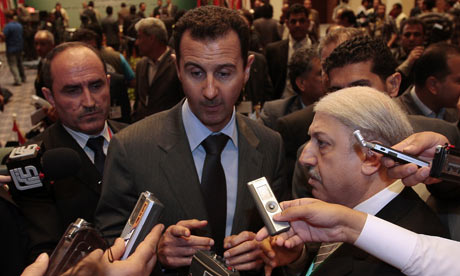
Syria’s president, Bashar al-Assad, after the Arabl League summit on 28 March

The Syrian president, Bashar al-Assad, talks to reporters after the closing session of the Arab League summit this week. Photograph: Mohamed Messara/EPA

European Union diplomats in Syria work in a handsome stone house in the leafy Abu Rummaneh quarter of Damascus, guarded by machine gun-toting policemen at the gate. Their well-appointed offices are strewn with glossy brochures about the links between the EU and this Arab republic – testimony to valuable assistance programmes and ambitions for a mutually beneficial long-term relationship.

Yet there is unease about the way things are heading. Last October, after a decade of negotiations, the two sides were poised to sign an “association agreement” covering political and economic issues, trade and investment, modelled on those already concluded by the EU and its eight other “Mediterranean partners”.

Lebanon, Jordan, Israel, the Palestinian Authority, Egypt, Tunisia, Algeria and Morocco have all put their relations with Brussels on a formal footing; maverick Libya is conspicuously absent from this “ring of friends”. But Syria balked at the 11th hour, insisting it needed more time. The reasons tell an interesting story about President Bashar al-Assad and the view from Damascus.

The official line is that Syria has undergone significant changes since the text was initialled in 2003. A revised version took some of them into account: British and Dutch demands for special statements on human rights and weapons of mass destruction were defeated and the language used now is standard to all EU-Med association agreements.

Still, economic conditions have fuelled fears that the free trade requirements could endanger Syrian industries, though tariffs on EU goods are to be cut over long periods. Crushing competition from the Turkish textile market has served as a warning.

“We are reviewing the relevance of the text to the Syrian economy today,” explains Abdullah Dardari, the deputy prime minister and architect of recent economic reforms. But there is much more to it than that. “Even a free trade agreement must be built on political understanding and trust,” he says. “An EU foreign policy that respects Syrian and Arab rights creates more confidence – and makes the lives of technocrats and economists easier.”

Beyond the crunchy detail of the agreement’s 144 articles there is a litany of complaints that Syria deserves better. Europe’s passivity in the face of the US-led war in Iraq – with British participation – is a big one. Others include the EU, led by France, blaming Syria for the 2005 assassination of the former Lebanese prime minister Rafiq al-Hariri, support for Beirut’s “cedar revolution” and Syria’s ejection from Lebanon after nearly 30 years.

Yet another is Europe’s failure to challenge US policies towards Israel and the Palestinians, especially its refusal to talk to the Islamists of Hamas, Syria’s protege – which, like Lebanon’s Hizbullah, is considered a terrorist organisation on both sides of the Atlantic but a “resistance movement” in Damascus.

“Nobody is in a position to lecture us on human rights,” insists another official, echoing Assad at his most combative. “The Europeans should have an independent position vis-a-vis Syria.”

The western media is considered hostile too. Journalists who ask about the prospects for political change in Syria get angry answers about the boycott of Hamas, the invasion of Iraq or Israel’s war on Gaza. More thoughtful responses explain that the president’s priorities are boosting the economy, creating wealth and raising educational standards so his country can take its place in a globalised world.

Syrians have also noticed, like others before them, that the EU is less than the sum of its parts. “We used to have a Europe file but we’ve split it into separate countries – France, Germany and the UK,” said Samir al-Taqi, the influential head of the Orient Centre for International Studies. “Europe no longer behaves as a unit and you get policies of the lowest common denominator.”

And the Qatari and other Gulf Arabs flocking to Syria’s newly liberalised financial and investment sector – the Damascus stock exchange is just a year old – do not share European concerns about Assad’s domestic or foreign policies.

Worse, for Brussels and its representatives in Abu Rummaneh, is the sense that Syria cares more about its slowly improving relations with the US. Not a week goes by without some senior administration official or congressman arriving from Washington, often invited for a flattering one-to-one at the presidential palace. The US ambassador was withdrawn after the Hariri killing, but a newly appointed one is eagerly awaited.

Americans and Europeans are both wooing Syria because of its strategic position in the Middle East – its role in any peace process, its co-operation in fighting jihadi terrorism and stabilising Iraq and its capacity, if excluded, for troublemaking, as Iran’s main Arab ally and supporter of “resistance movements”. “For Syria the carrots are just not tempting enough,” argues Rosa Balfour of the European Policy Centre in Brussels. “It can ignore Europe because its political role is so important.” The gloomy conclusion is that, despite reassuring noises, the agreement with the EU may not be signed any time soon.

The feeling in Damascus is that Syria has come through a tough period and survived to realise that it still holds cards that others badly want it to play. “Five years ago things looked really bad for this regime – with Lebanon, Iraq, Bush and the neocons,” says a Syrian intellectual who is privately critical of Assad. “Now look. Are these guys very smart or is it just that the rest of the world really needs them?”

One buried, more jailed after Kurd celebration in Syria
News of the killing by security forces surfaces, underscoring worsening conditions for the minority.
By Borzou Daragahi
March 30, 2010

Mohammad Haider’s family buried him quietly, without a funeral, as they had been instructed by Syrian authorities.

The Syrian Kurd’s body was returned March 23, two days after security forces opened fire on a Kurdish New Year’s celebration in northern Syria sponsored by a political party, human-rights groups said. The killing, which surfaced Monday, underscored worsening conditions for the minority.

Syrian Kurds, who live in the north near the border with Turkey, have a long and fraught relationship with the state. In recent years, Syria has begun tightening its suppression of Kurdish identity.

Kurdish language, customs and even traditional folk dances have been increasingly discouraged or banned. Among these cultural rites is Nowruz, the ancient New Year’s celebration observed by Iranians, Kurds and other groups in the region.

In recent years, Nowruz has become a trigger for violence between Kurdish activists and Syrian security forces, leading to a number of deaths and increased scrutiny of the Kurdish community.

According to Human Rights Watch, Syrian forces this year demanded that the event’s organizers take down Kurdish flags and pictures of Abdullah Ocalan, the Kurdish political leader imprisoned in Turkey. The organizers refused, and some began throwing stones at the security forces, who responded by firing into the crowd, killing at least one person and wounding others.

Normalizing Relations
President Obama’s speeches signal a desire to treat Israel like any other country. Now events have converged to test his resolve.
By Scott McConnell
May 01, 2010 Issue
The American Conservative

President Obama has probably studied the first President Bush’s standoff with Israel. Then as now, the issue of contention was Israeli settlement-building in the West Bank and Jerusalem. George H.W. Bush was hopeful about moving toward a comprehensive peace between Israelis and Palestinians. In the last days of the Reagan presidency, the Palestine Liberation Organization had finally laid down the only significant diplomatic card in its possession, accepting UN Resolutions 242 and 338, recognizing Israel’s right to exist within its 1967 borders and limiting its aspirations to a Palestinian state on the West Bank and Gaza. In May 1989, Secretary of State James Baker addressed AIPAC’s annual Washington conference. After praising Israel’s commitment to democracy and role as a strategic partner, Baker went on to say, “Now is the time to lay aside, once and for all, the unrealistic vision of a greater Israel. … Forswear annexation. Stop settlement activity. Allow schools to reopen. Reach out to the Palestinians as neighbors who deserve political rights.” AIPAC’s delegates gave Baker a chilly reception. Relations between Israel’s Likud Party Prime Minister Yitzhak Shamir and President Bush were frosty as well. Bush believed Shamir had lied to him about settlements in East Jerusalem, which the United States (and every other country) considered occupied territory. The embryonic peace process stalled.

But after driving Saddam Hussein from Kuwait, Bush and Baker returned to the Palestine issue. In May 1991, Israel asked the administration for a $10 billion loan guarantee. The funds were to be used to settle immigrants from the former Soviet Union. At the time, Israel was building settlements at breakneck pace, and Baker and Bush both labeled them an obstacle to peace. Shamir was confident Israel’s clout in Congress would force the president to relent and turn over the money. Bush worked to ensure no funds could be used for construction beyond Israel’s 1967 borders. When AIPAC held an “education day” in Congress to press for the loans with no strings attached, Bush went public with a denunciation, depicting himself as “one lonely little guy” battling thousands of lobbyists. Some American Jews were bothered by the language, but the country was supportive, backing the president by two- and three-to-one margins. Bush stuck to his guns through the following summer, when Israeli voters tossed out Likud and elected Yitzhak Rabin’s Labor Party by a decisive margin. He then released the loan guarantees. The peace process, which came tantalizingly close to producing a two-states-for-two-peoples agreement by the end of Bill Clinton’s presidency, would begin.

A principal lesson is that an American president can prevail in a showdown with Israel over settlements. But the Bush-Shamir dispute also highlights the centrality of the settlement issue……

Moshe Ya’alon, Israel’s Vice Premier, Explains How Netanyahu “Maneuvers” to Avoid Agreement

The following is the translation of Yedioth Ahronoth’s interview with Moshe Ya’alon, aka “Bogi,” Israel’s Vice Premier (nominally, the second in command in Israel’s government) and former former Chief of Staff of the Israel Defense Forces.  [Thanks to O.N.]

Moshe Ya’alon says that the Israeli government doesn’t really mean what it says about a two-state solution. Whatever it says and does to allegedly advance peace with the Palestinians is all maneuvers. “Nobody in the forum of seven (the inner cabinet – O.N.) thinks that we can reach an agreement with the Palestinians,” Bogi tells Yedioth, “And I say so out of knowledge.” So why maneuver? Bogi replies: “Because in the political establishment there are pressures. Peace Now from within and other elements from without. So you have to maneuver. But what I’m saying now has to be given over to the Americans, and I hope that they will understand.”

So there you have it: Peace Now and the American administration are applying pressure and the Netanyahu government is “maneuvering.”

If Ben-Gurion Were Alive Today, He Would Vote Likud
Yedioth Ahronoth, 26 March, 2010
by Yuval Karni

Gestures, statements, negotiations—nothing will come of it in the end. That is the bottom line as far as Vice Prime Minister and Minister for Strategic Affairs Moshe (Bogi) Yaalon is concerned. The former Mapainik, who has become a right-wing marker in the government, looks at the lame efforts to resume the negotiations with the Palestinians and at the gestures made by Prime Minister Netanyahu—from the announcement of the two-state solution to the decision to freeze construction in the settlements—and suggests that we not become confused. It is all maneuvers. “And I say so out of knowledge,” Bogi says. “Nobody in the forum of seven thinks that we can reach an agreement with the Palestinians.”

Q. So why all these games of make-believe negotiations? It’s possible to announce that we will not reach an agreement, and that is all.
“Because in the political establishment there are pressures. Peace Now from within and other elements from without. So you have to maneuver. But what I’m saying now has to be given over to the Americans, and I hope that they will understand.

“Some of what we have to do is maneuver with the American administration and the European establishment, which are also nourished by Israeli elements, which create the illusion that an agreement can be reached. If the leader of the opposition gets up on stage and says that she is in favor of peace, unlike the prime minister who is against peace, then honestly. Come off it.”

Q. If everything is stuck with the Palestinians, why not turn to the Syrian channel? Maybe it would be easier there?
“Why do you say that everything is stuck? The country is being built up, the economy is thriving, there are investments in infrastructure and in education, settlement, water projects, alternative energy. What is stuck here? The country is blossoming. I know this defeatist attitude, because we have heard it from the politicians from the previous government, who say that time is working against us. I say that time works for those who make use of it. The founders of Zionism knew how to make use of time, and we in the government know how to make use of time.”

Q. Make use of time or drag things out?
“Who wants to drag anything out? I come with clean hands. From my perspective, I would even be willing to divide the country, but today I would not be willing to have such a compromise in light of what I have seen. So we have to make use of time in order to keep on building.”

Q. Are you willing to withdraw from the Golan Heights in exchange for peace with Syria?
“One of our moderate reflexes in recent years has been that the moment we talk about negotiations, we start looking right away for a place to withdraw from. How many years was the Golan Heights under Syrian sovereignty? Nineteen. It has been with us for longer. Why is it taken for granted that in order to obtain peace, we must withdraw? As far as I am concerned, there is no discussion of this at all. No discussion. Every withdrawal has only tempted the Arabs to become more encouraged and lift up their heads.”

The Americans Do Not See It?
Over the past two weeks, Israel has been dealing with a crisis with the American administration. Netanyahu hoped that his visit to New York and Washington, and the meeting he succeeded in getting for himself with the president in the end, would help him soften Obama. He knew that he would reach the White House after receiving thunderous applause at the AIPAC conference, and hoped that this would influence Obama to meet him halfway. In the end, the prime minister received loud acclaim from Jewish community leaders, but the president did not get the hint, did not let up on the pressure, and demanded clear answers and commitments in writing, since he no longer trusts Netanyahu’s verbal declarations. The feeling of distrust deepened, and it appears that the gap has gotten worse.

Yaalon also admits that there is a problem. Mainly of the Americans. Anti-Israel positions have managed to trickle into the core of the administration, and in his opinion, there are some things that they just do not understand.

“True, there is a crisis right now,” Yaalon says, “but the relationship between us is deep, strategic, based on common values, goals and challenges, including with jihadist Islam. This crisis is minor.

“There are people in America who see the Israeli-Palestinian conflict as the main cause of instability in the Middle East, and this perspective has support in the administration, but what can we do? The instability is not our fault. We have nothing to with what is happening in Yemen, Algeria, Lebanon, Iraq. The Middle East has been in conflict for hundreds of years, between Sunnis and Shiites, between Persians and Arabs, between pragmatists and fundamentalists. The main conflict today is between jihadist Islam and the West, and in this, both we and the United States are partners.”

Q. The feeling is that a crisis of trust has been created.
“Since the government began, there has been open and fruitful dialogue with the administration. We put everything on the table. The prime minister has said several times that we do not want to rule the Palestinians, and today there are two Palestinian governments: Hamastan in Gaza and Fatahland in Judea and Samaria.

“We need to see what has happened here in the past seventeen years: the idea of land for peace has failed. We got land for terror in Judea and Samaria and land for rockets in Gaza. What, the Americans do not see it?

“There are disagreements among friends as well, and as friends, we must clarify them in dialogue, even if it looks like a crisis. We will get through it, and we will continue our deep strategic relationship.”

Q. Does Obama want to overthrow Netanyahu?
“Ask him. I don’t know. I know that they are coming to us with demands that have no precedent, and that is one of the administration’s mistakes.”….

The minister in charge of dealing with strategic threats is convinced that in the end, Israel will annex some of the territories. “The prime minister reiterates all the time, and also brought a decision to the security cabinet that says clearly, that immediately after the freeze, we will continue to build in Judea and Samaria as we did before.”

Q. Construction will resume on September 26?
“That is the security cabinet’s decision. One of my concerns is that this temporary freeze will become permanent, and the additional problem is that the subject is on the table at all. It is a distorted perspective that the settlements are an obstacle to peace.”

Q. So why did you give in and have the freeze?
“You can call it giving in, but if all the members of the forum of seven supported it, then things are a go. We had to do a diplomatic maneuver, and we went with the lesser of the evils.”

Q. A situation could be created in which we cannot build in the territories because of the peace process. What then?
“We will cross that bridge when we get to it. With a heavy heart, I agreed to the freeze because it leaves the subject of the settlements on the table, and the people of Israel is the least united on the subject of the settlements.”

Q. Will we evacuate settlements in the end?
“I do not accept that. What has happened to us in recent years obligates us to stop with everything connected to withdrawal.”

Q. Would you rather that the settlers be under Palestinian rule?
“Creative solutions can be found. If we are talking about peace, why can Jews not live in Judea and Samaria? I believe that they can, and that in the end, they will live under Israeli sovereignty.”

Q. Why not annex territory and put facts on the ground right now?
“We will get to that. At least in the settlement blocs.”…..

Q. Construction will resume on September 26?
“That is the security cabinet’s decision. One of my concerns is that this temporary freeze will become permanent, and the additional problem is that the subject is on the table at all. It is a distorted perspective that the settlements are an obstacle to peace.”
Q. So why did you give in and have the freeze?
“You can call it giving in, but if all the members of the forum of seven supported it, then things are a go. We had to do a diplomatic maneuver, and we went with the lesser of the evils.”
Q. A situation could be created in which we cannot build in the territories because of the peace process. What then?
“We will cross that bridge when we get to it. With a heavy heart, I agreed to the freeze because it leaves the subject of the settlements on the table, and the people of Israel is the least united on the subject of the settlements.”
Q. Will we evacuate settlements in the end?
“I do not accept that. What has happened to us in recent years obligates us to stop with everything connected to withdrawal.”
Q. Would you rather that the settlers be under Palestinian rule?
“Creative solutions can be found. If we are talking about peace, why can Jews not live in Judea and Samaria? I believe that they can, and that in the end, they will live under Israeli sovereignty.”
Q. Why not annex territory and put facts on the ground right now?
“We will get to that. At least in the settlement blocs.”………

US ambassador votes against Palestinian “right to self-determination” at the UN. [The US vetoes this in order to prevent the UN from eventually voting to recognize a Palestinian state, which Palestinians are pushing for.]
Thursday 25 March 2010

The UN Human Rights Council on Wednesday….. voted nearly unanimously in favour of the right of the Palestinian people to self-determination, with 45 countries voting in favour and only the United States voting against. No countries chose to abstain. … Despite Washington’s much-hyped tiff with Tel Aviv, the US stood behind Israel at Wednesday’s council meeting.

US ambassador Eileen Donahoe said: “We are deeply troubled to be presented once again with a slate of resolutions so replete with controversial elements and one-sided references that they shed no light and offer no redress for the real challenges in the region.” Ms Donahoe insisted that her country supported a two-state solution even though it had opposed the resolution in support of the Palestinian people’s right to self-determination.

PLO ambassador Ibrahim Khraishi pointed out that the two-state solution is predicated upon exactly that right. [see Just world News on this item]

Israel to continue building in east Jerusalem
By AMY TEIBEL (AP) – 49 minutes ago

JERUSALEM — Israel insisted Friday it would continue building in contested east Jerusalem, taking an uncompromising stance against U.S. pressure following a tense visit by Prime Minister Benjamin Netanyahu to Washington.

The refusal to change long-standing Israeli policy signaled that a high-profile rift between the U.S. and Israel remained wide, with stalled Mideast peace talks caught in the middle.

“The prime minister’s position is that there is no change in Israeli policy on Jerusalem,” Netanyahu’s office said in a statement…..

Listen to the Arabs
By PARAG KHANNA
I.H.T. Op-Ed Contributor, March 25, 2010

We also fail to understand the Arab strategic reality. If Arabs are supposed to be lining up with the United States and Israel to contain the hegemonic ambitions of Iran’s Mahmoud Ahmadinejad, then why did Syria host a “war council” of Iran and Hezbollah in Damascus last month? And why is Qatar exploring gas fields jointly with Iran?

The fact is that most Arabs prefer a modus vivendi with Iran — just as many tacitly collaborate with Israel on matters of mutual interest.

Rather than seeing themselves as trapped between Israel and Iran, the most common Arab objective seems to be to limit excessive American influence in their region.

Americans widely believe that the Arab world was elated by the election of President Obama over a year ago. That is so, but not because the Arabs want strong American leadership in their region; they’d prefer to run their own affairs with minimal American interference. From engaging Hamas to negotiating with Iran, Arab states are taking matters into their own hands. And that’s good…..

Parag Khanna is a senior research fellow at the New America Foundation and author of “The Second World: How Emerging Powers are Redefining Global Competition at the 21st Century.”

Assad Interview on al-Manar – 24 March 2010

In this interview with Hizbullah’s TV station (copied below), President Assad invokes his speech of November 10 2005 given at the University of Damascus, in which he argued that Syria and the region had only two choices: resistance or chaos. “Resistance is the least costly option,” he explained. At the time, the Mehlis investigation into the Hariri murder was at its climax and President Bush and the UN security council were pressuring Damascus to make Syrian officials available to Mehlis’ unrestricted interrogation. Syria refused.

Ultimately, the UN and Syria struck a deal to send five officials – none from the president’s family – to Vienna for interviews. The sensational accusations of Syrian culpability in the murder made by Mehlis quickly fell apart when his main witnesses recanted; they claimed to have been pressured or paid to provide false testimony to Mehlis. The mishandling of the investigation led to Mehlis’ replacement by more sober and less adventurous investigators. The four Lebanese generals and security officials that Mehlis arrested have all been released. No charges were ever brought against them.

Today Syria faces none of the pressure it did in 2005. Obama’s policies have been good for Syria – not because engagement has been warm or because Obama’s promises to end the Arab-Israeli conflict have been fulfilled – they have not; Syria has thrived because the US has largely ignored it — a big improvement over the Bush administration, which wrongly believed that Assad was weak and could be brow beaten into complying with American’s pro-Israel policies. Syria is no longer depicted as the “low hanging fruit,” of the region, rather, it is referred to as a “central player.” Assad receives weekly visits from Western dignitaries and leading statesmen.

All the same, the great expectations that Obama inspired as a candidate have not been fulfilled. The newly designated Ambassador to Syria gave uninspiring testimony to congress last week in which he underlined the many policy differences separating Syria and the US, the biggest of which was Hizbullah and Syria’s support for groups that resist Israel’s illegal occupation of Arab land. He argued that “the United States wants a just and comprehensive peace in the Middle East,” but Syria is positioned to “play the spoiler” because it continues to support terrorists. Much of his testimony was boilerplate and probably necessary for the confirmation process in the face of a very pro-Israel congress. All the same, it underlines how little US policy has changed under Obama. After watching Obama’s capitulation to Israel and hearing congress’ fawning support for Netanyahu’s building campaign in East Jerusalem, no one in the Middle East believe that Washington is genuinely interested in “a just and comprehensive peace.” To reiterate these tired and righteous phrases is simply to grand stand in front a world population that has grown inured to hypocrisy and empty rhetoric.

The context that is most important for understanding Assad’s speech is the state of US-Israeli relations. The Biden visit and  AIPAC meeting in Washington this week revealed a triumphant and expansionist Netanyahu who is unchastened by Obama’s tentative efforts to show disapproval of Israel’s building campaign in East Jerusalem or the West Bank. Netanyahu proved that he has the US congress on his side. The peace process is going no where. Assad simply recognized this. He was polite about both the Obama administration and the ambassador designate. His statement that resistance is being forced on Syria is simply an expression of basic reality.

Syria had hoped that the US would be able to bring Israel to the negotiating table and exert some pressure on it to disgorge the Golan. Assad has given every assurance that Syria is willing to make generous security and water guarantees to Israel in exchange for its land. Israel is not interested. The status quo has been working fine for Israelis, and the US is unable or unwilling to alter that status quo.

Indeed, Israel has successfully diverted America’s and the world’s attention from the Arab-Israeli conflict, where it should be, to Iran. For some largely inexplicable reason, Washington has decided that Iran is its greatest foreign policy challenge and a risk to world peace that must be stopped. While the fear of Iran is being ginned up, the Arab-Israeli conflict, a problem that the US can actually do something about, will be set aside and ignored.

With this speech, Assad is recognizing this state of affairs. It means that his country will likely be pushed into greater conflict with Israel and the US. In a showdown, he will stand with Iran. The Arab League will be discussing the withdrawal of the Arab Peace Initiative during its meeting in Libya this weekend. What else can the Arabs do? The vast majority of Arabs are glad that Syria is keeping the pilot light of Arab resistance lit.

— the speech follows —

Al-Manar’s Interview with Syrian President Bashar Assad
24/03/2010 Al-Manar’s Interview with Syrian President Bashar Assad
Interview conducted by Amr Nassif

Introduction: … Mr. President welcome to Al-Manar Television.

AL-ASSAD Welcome to Syria.

Q: To start with Mr. President, Syria went through lots of crises during the last few years by adopting a policy of challenge and steadfastness, knowing that such policy could have caused Syria to pay heavy prices. I wanted to ask you about the margin of “adventure” in the Syrian decision to face the challenge.

AL-ASSAD There are two kinds of adventures; one that is imposed and another that is by choice. As Syrians, we’re not adventurers but we live in the Middle East which is historically a complicated region. This region in particular has been a coveted spot for thousands of years, because it’s the center of the world where strategic interests underlie. Whether you wanted to make a policy or a war, in either case it’s an adventure. But as I have just said, it’s an imposed adventure. However, we have to differentiate between adventure and gambling. When we assume that the best and easiest solution is to put our future and capabilities in the hands of the big powers with the belief that they will resolve our problems, this is gambling. From our previous experience, the big powers always complicate the problems for various reasons that are in most cases out of evil intent. But even if we assume good intentions, problems will get complicated because they do not belong to this region. We didn’t accept to be part of a gamble that would put Syria, its policies, and its interests in a foreign scheme. This is what happened recently when the project of the New Middle East was raised. This project included Iraq and Lebanon, and Syria was supposed to be part of it. They sought to lure it into this project, but it turned it down. Thus, Syria had to pay a price. This is consistent with a speech I made in 2005, when I said that the price of resistance was less than the price of chaos, and that gambling will lead to chaos and therefore to the ultimate price. Between the high price and the ultimate price, we will choose the first, especially when there is no such thing as a low price or no price at all.

Q: Mr. President, you stressed on several occasions that Syria was against the policy bargains and deals. The problem is that the other side, and I mean the United States, is a regime that only believes in pressure and deals. Yet, the relation between the US and Syria is ameliorating. How did you reach this equation of committing not make deals with a party that only acknowledges deals?

AL-ASSAD At the end, they failed. I’m not only talking about the United States but all the supporters of the previous scheme, supposing that the creator of this scheme was (US former President George W.) Bush. We don’t want to combine between the former and current US administrations. Of course, there are differences. Therefore, when we talk about the United States, some think that the same project is still ongoing. This is not true. At that time, the former United States administration, Israel alongside some European states including France, the UK, and other allies in Europe, the world, and the region, they all worked to complete this project. But they failed and they had to start searching for a new way to deal with the realities on the ground. Personally, I think they have started to learn lessons but they haven’t necessarily learned the lessons. Even if they have learned the lessons, nothing necessitates that the lesson they have learned still remains, because when new people come to power, they might not read the history and therefore, make the same mistakes. That’s why this mistake is made continuously.

But, of course, we’re committed to specific principles that represent our interests and convictions and we won’t abandon them. The way we deal with this is by explaining facts and realities, but at a certain stage, they adopted a policy of terminology such as terrorism, democracy, good and evil. They created a whole world for us, and unfortunately, or maybe out of good luck, they fell in their own trap and lived in a world of illusion. However, our approach was more realistic. So now, they want to join this world regardless of whether there are difference in our points of views or not.

Q: When you distinguished between the Bush administration and Obama’s, was it because you don’t want to burden Obama’s shoulders with Bush’s mistakes, or you really believe they are different?

AL-ASSAD No, there are clear differences, first in the proposals reflected in their speeches and second, we don’t hear dictations anymore. We have different viewpoints, this is normal, but we don’t hear dictations anymore. We can’t say yet that there exist results of an American policy, but there are some institutions in the US that don’t want President Obama to succeed for one reason or another. That’s why we have to differentiate between the two men in order for us to be objective.

Q: Allow me to describe the speech of the US Ambassador to Syria Steven Ford before the US Senate Committee on Foreign Relations on March 16, 2010 as very severe. He said that he was not a prize for Syria and that Syria hasn’t changed as it remains a source of concern for Washington. He also spoke about the necessity to exert direct pressure on your political decisions and talked about some mistakes in Syria’s calculations with Hezbollah. Perhaps the most dangerous thing he talked about was the danger of Syria being dragged into a confrontation with Israel, even unintentionally. How do you describe these words?

AL-ASSAD He said so in Congress and before becoming Ambassador. When he comes to Syria to present his credentials and become Ambassador, we can deal with all these words through our known stances. I don’t have to explain these stances because they are announced. But at the same time, I can say that any Ambassador represents his country’s policy. A fine Ambassador with a bad policy is worthless. The result will not be good.

However, a good policy could impose upon a bad Ambassador to achieve good results for the best interests of both countries. Government policies determine policies and their outcome, not an Ambassador and certainly not his speeches. Still, I’m not in a position to comment on an Ambassador’s speech. When he arrives, we will comment on any stance he takes in the framework of his new mission here. With regards to conviction, he has the right to convince and so do we.

Q: Let’s look at the issue of bargaining from another perspective. Perhaps, there are no deals but some talk about prices. Can we say that one of the prices that Syria paid to ameliorate its relations with the West and the Arabs was accepting diplomatic relations with Lebanon and opening embassies especially that some Lebanese sides actually thanked France for the role it played in this issue. Is this a price?

AL-ASSAD Some sides insist they have achieved some of their policies in the past five years. In fact, they haven’t achieved anything. They only entered Lebanon into mazes. I’m not specifying these sides, I’m talking in general. Now, these powers want to convince others that they have achieved something, anything even an embassy. I actually proposed the embassy in 2005. It was not a Lebanese proposal. None of our former or future allies had suggested it before I did. I raised the issue in a meeting for the higher Lebanese-Syrian joint committee in the presence of Speaker Nabih Berri, then President Emil Lahoud and then PM Omar Karameh. But when the circumstances in Lebanon took a negative turn, we decided to disregard the issue. But I can say that the embassy proposal was Syrian. In all cases, if there was no Syrian conviction, the embassies couldn’t have been established. Everyone knows that when we feel a move is imposed on us or is the result of an attempt of interference, we would immediately reject it. The proof for these forces claiming that their policies, or foreign pressure, have established the embassy, we say that there is a much more important example.

Few countries have raised the issue of the embassies, but a lot of states are now raising the issue of demarcating borders. Our response has always been a clear no. This is a Lebanese-Syrian matter that should be resolved between the two countries. But when a request is made from outside these two countries, we do not act. Now, with the visit of PM Saad Hariri to Syria, we’ve started discussing the issue again. Before that, it was closed since there were no relations between the Syrian and the Lebanese governments. Today we are building these ties. But I’m talking about the principle. If they succeed in imposing the demarcation of the border through foreign pressure, they would be right. But if they fail, the world ought not to believe them.

Q: There’s another issue that some Lebanese always raise when talking about the Lebanese-Syrian relations. It’s the Syrian refusal to provide Lebanon with an official document stating that the Shebaa Farms is Lebanese. They wonder why this Syrian “obstinacy?”

AL-ASSAD It’s simply because you can’t give a document that you don’t have. There are some measures that should be adopted to obtain such document. I mean legal and judicial measures that specify the ownership of properties, which country was given these properties before and after Independence, Lebanon or Syria? When these measures are finalized, we start demarcating the border. But giving this document for political reasons doesn’t seem to be rational.

More to follow…

“Nationalist First, Islamist Second: The Armenian Issue Shows the Limits of the Erdogan Government,” by Firat Demir

“Nationalist First, Islamist Second: The Armenian Issue Shows the Limits of the Erdogan Government,”
by Firat Demir
for Syria Comment, March 23, 2010

The Armenian issue (together with the Kurdish problem) continues to trouble the Erdogan government. In a recent series of speeches, PM Erdogan once again proved that he is not a safe bet for those who want a full fledged democracy in Turkey.

The Erdogan government appears to be tilting towards extreme nationalism, a troubling tendency which has plagued the country for more than a century. Whether Erdogan’s intolerant nationalism is part of his underlying nature or a temporary populist ploy to gain votes in the approaching national elections is of less importance than the fact that his government has started making the same mistakes as did his predecessors.

Turkish PM threatens to expel 100,000 Armenians over genocide vote
Adam Gabbatt and agencies, guardian.co.uk, Thursday 18 March 2010 14.52 GMT

Turkey’s prime minister has threatened to expel 100,000 Armenian immigrants after the US and Sweden agreed to describe first world war killings of Armenians by Ottoman Turks as genocide.

Turkey threatens to expel 100,000 Armenians
Story from BBC NEWS, Published: 2010/03/17 17:39:36 GMT

Turkey’s prime minister has threatened to deport 100,000 Armenian migrants, amid renewed tensions over Turkish mass killings of Armenians in World War I.

Recent resolutions in the US and Sweden have called the killings “genocide”.

Recep Tayyip Erdogan told the BBC that of 170,000 Armenians living in Turkey “70,000 are Turkish citizens”.

“We are turning a blind eye to the remaining 100,000… Tomorrow, I may tell these 100,000 to go back to their country, if it becomes necessary.”

Thousands of Armenians, many of them women, work illegally in Turkey. Most do low-skilled jobs such as cleaning.

The Prime Minister who is the lawyer of the Committee of Union and Progress

Taraf, 20.03.2010

The Prime Minister criticized Cengiz Candar (of Radikal newspaper) who asked for a public apology for the PM’s earlier deportation threats to Armenian illegal immigrant workers [translation by Firat Demir]:

“These claims [of Armenian Jenocide] are baseless and cannot stain our history…I am calling on those journalists and others who try to give us humanity lessons: Be Turkey’s and the Turkish Nation’s lawyer first. … I am calling on those who advice me to apologize: We know who to apologize very well. Whose lawyer are you?”

The Prime Minister

Ahmet Altan, Taraf, 20.03.2010 [translation by Firat Demir]

There is a very rude and impolite question sentence that Tayyip Erdogan uses when he gets angry with the criticism of  journalists.

“Who are you?”

He gives the impression that he thinks that only he has the right to ask this question in such a tone.

I think he doesn’t consider the possibility that the same question might be asked of himself as well.

“Alright, who are you?”

Which of the crowded Erdogan portraits that we sometimes approve with admiration, and sometimes criticize with surprise corresponds to the real Erdogan?

Is the Erdogan who follows the “zero problem with neighbors”  policy and who is creative and bright and is respected by the world You?

Or, are you the unreliable politician who first signed the protocols with the Armenians and then withdrew them?

Are you the brave leader who initiated the Kurdish opening?

Or, are you the scared, timid man who reversed his course and could not continue the [Kurdish] opening as soon as he saw the events following the Habur incidence?

Are you the tolerant Muslim who says that “we love the created because of the creator” and who embraces every race, faith and tribe?

Or, are you the nationalist who threatens the poor Armenian woman who works for 400 liras [$265] in Istanbul with deportation, and who forgets the Prophet Mohammed’s farewell speech as soon as his Armenian policies hit road blocks?

Are you the brave law loving leader who started the Ergenokon trial and went after the gangs within the state?

Or, are you the gang-loving politician who attempts to be the lawyer of the “Committee of Union and Progress” gang, same as Deniz Baykal who said that he is the lawyer of Ergenokon?

….

Are you the great leader who resisted and did not waiver in the face of coup attempts?

Or, are you the coup-lover who defends and excuses the murders of the Committee of Union and Progress junta?

Are you the intellectual who had the courage and history knowledge to call Dersim [incidence] a massacre?

Or, are you the history-ignorant one who defends the murders that the Committee of Union and Progress committed together with the German army, claiming that “Muslims don’t commit Genocide”?

Who are you?

News Round Up (21 March 2010)

Thanks to Greg Gause for setting the record straight on the “nature of the Syrian regime” in this rebuttal of Steven Cook of the Council on Foreign Relations. Cook explained “What the Neocons Got Right” in a short article for Foreign Policy last week. The three things they got right, Cook argues were: “Syria, Iran, and democracy.” His first line on Syria reads:

Syrian President Bashar al-Assad regime’s is all about: violence, repression, and duplicity. For all their faults, the neocons can read recent history pretty well, and they understood that endless shuttle diplomacy of various U.S. secretaries of state (with the exception of James Baker) brought the region no closer to peace and did nothing to alter Damascus’s strategic posture.

Here is Gause: [By the way, I am using his new book on the Gulf in my fall class: “Foreign Relations in the Middle East.” It is excellent.]

Strikeout: How Cook fails to bring the neocons back
Posted By F. Gregory Gause, III Wednesday, March 17, 2010
Foreign Policy

…. First, Syria. Cook contends that the neocons were right about the true nature of the Assad regime, that it would never make peace with Israel and always be hostile to the United States. He argues that all during the Syrian-Israeli negotiations of the 1990s, Damascus never laid out what it was willing to give Israel for the return of the Golan Heights. This is just wrong. The memoirs of both Dennis Ross and Martin Indyk, neither known as defenders of the Syrian regime, make clear that in fact the Syrian side gave a quite detailed outline of how they defined “peace” with Israel and what they were willing to give to get back the Golan.

Gregs New Book

Greg's New Book

Those who followed those negotiations closely at the time will recall that these elements were leaked to the press, first in less detailed form to the international Arabic daily Al-Hayat and later in a fuller form to the Israeli daily Maariv. This was later leaked by the Israeli government itself, which was responding to domestic critics who accused it of being ready to give away the store to Damascus. The leak about a draft of a proposed Syrian-Israeli treaty that had been agreed to by both sides was meant to show how well and hard then Prime Minister Ehud Barak had bargained. Both Indyk and Ross show Barak to have been all over the place on the Syrian negotiations, pushing for a quick conclusion, then backing off at Shepardstown (having to be coaxed off his airplane, in fact, to join the negotiations), and then begging President Clinton to meet with Assad — even though Barak had nothing new to offer on the maddeningly minor territorial compromise he was demanding.

In the end, both Ross and Indyk blame Syria for backing away from peace with Israel, arguing that the elder Assad was pressured domestically not to take the final step. This does not ring true with me, as the Assad regime was not known for its gentle consideration of domestic criticism. More likely, Assad just decided that the Israelis were not serious. But neither Ross nor Indyk say that Syria failed to set out in detail what it was willing to offer in exchange for the Golan.

More generally, Cook gets the dynamics that drive Syrian foreign policy wrong. He forgets that Damascus was willing to ally with the U.S. in the Gulf War of 1990-91 and that with the end of the Cold War, it slowly but surely accommodated itself to American unipolar leadership in the Middle East. It hedged its bets, to be sure, by maintaining its ties to Iran (which had their origins in the two regimes’ common antipathy toward Saddam Hussein) and never gave up its desire to dominate Lebanon. But its overt anti-Americanism of the post-2003 period was a response to the neo-con-inspired hubris of American policy after the fall of Saddam, characterized by loose talk about further regime changes in the region. Damascus was balancing American power, which is not a particularly unexpected foreign policy reaction. It is hard to understand why Bashar al-Assad engaged in indirect talks with the Israelis through Turkey for years (until they were scuttled by the Gaza conflict of late 2008-early 2009) if the neocons were right about the nature of the Syrian regime. ….

Syria’s quiet revolution
To understand the real impact of Lebanon’s 2005 Cedar Revolution, look across the border at neighbouring Syria
By Sakhr al-Makhadhi
guardian, Sunday 21 March 2010

Five years after the Cedar Revolution promised to change Lebanon forever, the country is back to its old ways. The political earthquake that followed the assassination of former Prime Minister Rafiq al-Hariri may have left Lebanon looking almost untouched, but in neighbouring Syria it has had profound, and unexpected, effects.

One million people marched through the streets of Beirut, in the biggest demonstration Lebanon had ever seen. It was 14 March 2005 – the date which gave its name to the anti-Syrian political movement founded in its wake. But five years on, many of March 14’s founding politicians have disowned the group and switched sides, and some of those who remain have apologised for their earlier angry statements.

This U-turn of an entire political class has left today’s Lebanon looking almost identical to the Lebanon of 2005. Syrian troops may no longer be on the streets (they left the capital Beirut years before their complete withdrawal in 2005), but little else has changed. A Syria-friendly member of the Hariri family is back in power, Rafiq’s son Sa’ad, who visited Damascus in December to make his peace with President Bashar al-Assad. And the Hizbollah-led opposition is back in government.

If you want to understand the real impact of the events of March 14, look across the border at Syria. Lebanon’s neighbour is changing more every month than it did in an entire year back in the 1990s.

As George Bush almost immediately sought to blame Assad for the 2005 killing, many were predicting the fall of the regime in Damascus within months. Later that year the interior minister committed suicide, and the vice-president defected.

Five years on, those expecting regime implosions have been proven wrong. Assad is stronger now than he has been at any point during in his 10 years in power. Socially and economically, though, Syria is almost unrecognisable.

Syria is now officially a “social market economy”, ending decades of socialism. Private banks have started appearing on the Syrian streets, many offering credit cards for the first time. Institutions from neighbouring countries dominate, although a recent decision to allow foreign companies to hold a majority share in their Syrian subsidiaries may encourage large western banks to enter the Syrian market. Imports now flow in freely, and the long-awaited stock market is finally (albeit very slowly) getting off the ground.

The results of this economic revolution are astonishing. While the global economy contracts, Syria expands. Real GDP was up 4% last year, according to the IMF. And inflation halved, from 14.5% in 2008 to 7.5% last year.

The US is realising it has failed to hold back this Syrian gold-rush. It imposed an economic embargo in the wake of the Hariri assassination, which looks like it could finally be eased this summer. Assistant secretary of state Jeffrey Feltman admitted: “So you ended up at a point when we isolate – we were the ones isolated. It was no longer Syria being isolated. It was the United States that was being isolated.” Remarkable words from the man who was George Bush’s ambassador to Beirut at the time of the Cedar Revolution.

The EU, too, knows it can no longer ignore Syria’s emerging economy. In 2004 it was about to sign an association agreement with Syria. This would have allowed a degree of free trade between the two economies. But as international political pressure on Syria mounted, it put the deal on hold, infuriating Syria. Last October, the EU suddenly offered to finalise the agreement but an economically emboldened Syria says it wants to wait and see.

Five years ago, doors were being closed in the faces of Syrian businessmen. Now, Arab states, America and finally the EU are trying to get their hands on this untapped market. But those Damascene entrepreneurs aren’t so sure they want foreigners to have easy access to their home territory. They are already struggling to compete against cheaper, higher-quality imports from Turkey, following a free-trade deal with Ankara. The EU association agreement would mean handing a bigger chunk of their market over to foreigners.

But not all foreigners are bad for Syrian business. The country is awash with tourists, even a few Americans, following the New York Times’s decision to name Damascus as one of its top 10 destinations for 2010. The country, whose economy has traditionally been dependent on tourism, received another boost when the US lifted its warning against travel to Syria last month. To cater for the influx of western visitors, around 70 traditional courtyard houses have been converted into hotels, breathing new life into the Old City of Damascus, which was on the verge of collapse earlier in the decade.

In January, Syria’s First Lady, Asma al-Assad, announced that she wanted civil society to play a bigger role in Syria. NGOs, she said, would be given more freedom, and even legal protection. The president’s London-born wife was speaking at a conference that itself would have been unthinkable five years ago. Former British foreign office minster Lord Malloch-Brown was one of the keynote speakers at the event where some local NGO leaders dared to get on stage and publicly challenge the government to do more.

This new social and economic optimism is drawing back thousands of Syrian expats. The length of military service has been reduced, and it is easier for Syrians born abroad to gain exemption. There’s a Beirutisation of parts of Damascus, with the English language more common than Arabic on the upmarket streets of Shaalan. Private universities have been established, and they’re teaching – for the first time – in English.

It wasn’t Lebanon that changed following the so-called Cedar Revolution, it was Syria.

See Helena Cobban’s summary of Yezid Sayigh’s lecture delivered at the Palestine Center in Washington DC on Hamas and Fayyad. It is excellent. Hats off to both Sayigh and Cobban.

The concluding paragraph of a Fareed Zakaria in the latest Newsweek “Bibi’s Bluster”: (Thanks Ghat)

“Meanwhile, the central problem persists: Israel rules more than 3 million Palestinians who will never become citizens of Israel and yet do not have their own state. As they multiply, Israel’s status as a democracy becomes more and more complex; the country looks more and more like an island of rich Israelis set in a sea of Palestinian serfs.”

Kurdish sources write that three Kurds were shot dead my Syrian security officers during Nayrouz festivities.

Edward Djerejian in Haaretz, the director of the Baker Institute, was Baker’s assistant secretary for Near Eastern and South Asian affairs. Before that he was ambassador to Syria, and afterward, ambassador to Israel.[…]

“Obama cannot remove himself from the Israeli-Palestinian conflict because this issue affects the United States’ core national security interests,” continued Djerejian. “The Arab-Israeli conflict, and especially the Palestinian issue, remains one of the most contentious and sensitive issues in the entire Muslim world. Osama bin Laden exploits the plight of the Palestinians, as does [Iranian President Mahmoud] Ahmadinejad … This has a direct influence on the United States, which is expending its blood and treasure fighting insurgencies in overwhelmingly Muslim Iraq and Afghanistan.

“We would be naive to think that resolving the Israeli-Palestinian conflict will eliminate the problems of terrorism and radicalization in the Islamic world, but it will go a long way toward draining the swamp of issues that extremists exploit for their own ends.”

Hillary Clinton: “Paying Off” in Politico

“In an interview with the BBC’s Kim Ghattas today, Secretary of State Hillary Clinton said the toughness of the U.S. reaction to the Israeli government’s East Jerusalem housing announcement last week is “paying off” as the U.S. now expects negotiations between the Israelis and Palestinians to resume.

She also said that contrary to some reports, the U.S. is not interested in forcing a shuffle in Israeli Prime Minister Benjamin Netanyahu’s governing coalition. She said, however, that it’s Netanyahu’s responsibility to “make sure that he brings in everyone else” to pursue negotiations with the Palestinians. “It’s not something that the United States can or is interested in doing,” she said.

Ghattas: You took a risk in escalating the tone with Israel last week, I understand the relationship is solid but the Israelis could have said we never promised restraint on settlments in east Jerusalem,- is the risk paying off?

Clinton: I think we’re going to see the resumption of the negotiation track and that means that it is paying off because that’s our goal. Let’s get the parties into a discussion, let’s [get] the principle issues on the table and let’s begin to explore ways that we can resolve the differences.

Ghattas: Is the pressure on the Israeli prime minister meant to be a moment of clarity, either he delivers on his commitment to peace, or his right wing coalition falls?

Clinton: We’re not taking any position and we have no particular stake in who the Israelis choose to govern them.They’re a democracy and they make that choice. I think that different parts of govern make action or statements that are not in the best interest of the government as a whole and I think what the Prime Minister has said repeatedly is that his government and he personally are committed to pursuing these negotiations and he just has to make sure that he brings in everyone else, that’s his responsibility it’s not something that the United states can or is interested in doing…”

Telling Israel – and ourselves – difficult truths By Henry Siegman[A must read]

For all the anger and indignation of the White House and Department of State over the humiliation of Vice President Joseph Biden by Prime Minister Benjamin Netanyahu’s government during Biden’s visit to Israel, it is difficult to deny that we virtually invited that treatment. Secretary of State Hillary Clinton told Netanyahu it was the substance, not only the timing, of the announcement of new Israeli construction in East Jerusalem that the U.S. found so objectionable. Presidential advisor David Axelrod added that it was Netanyahu’s attempt to deceive us about the purpose of this construction that is particularly offensive. For the massive Jewish incursion into Arab East Jerusalem is a deliberate effort to prevent a peace agreement and a two-state solution. No Palestinian leader can sign a peace accord that denies a Palestinian state its capital in Arab East Jerusalem.

US silencing Palestinian journalist Mohammed Omer
Haymarket Books,
19 March 2010

Effectively canceling a planned speaking tour, the US consulate in the Netherlands has put an extended hold on the visa application of award-winning Palestinian journalist and photographer Mohammed Omer, scheduled to speak on conditions in Palestine, on 5 April in Chicago.

In 2008, Omer became the youngest recipient of the prestigious Martha Gellhorn Prize for Journalism, for his firsthand reportage of life in the besieged Gaza Strip. As his prize citation explained, “Every day, he reports from a war zone, where he is also a prisoner. He is a profoundly humane witness to one of the great injustices of our time. He is the voice of the voiceless … Working alone in extremely difficult and often dangerous circumstances, [Omer has] reported unpalatable truths validated by powerful facts.”

Upon attempting to return to Gaza following his acceptance of the Gellhorn award in London, Omer was detained, interrogated and beaten by the Shin Bet Israeli security force for over 12 hours, and eventually hospitalized with cracked ribs and respiratory problems. He has since resided in the Netherlands and continues to undergo medical treatment there for his subsequent health problems.

The US consulate has now held his visa application for an extended period of time, effectively canceling a planned US speaking tour without the explanation that a denial would require. In recent years, numerous foreign scholars and experts have been subject to visa delays and denials that have prohibited them from speaking and teaching in the US — a process the American Civil Liberties Union describes as “Ideological Exclusion,” which they say violates Americans’ first amendment right to hear constitutionally protected speech by denying foreign scholars, artists, politicians and others entry to the United States.

Syria, Italy pledge to deepen standing dialogue, boost cooperation
10:34, March 19, 2010

President Assad reiterated his doubts about achieving peace since there is no partner on the Israeli side. He warned against the perpetuation of the status quo. And called on EU to participate in  finding plausible solutions for the issues in the region.

He said: “the current israeli government can’t be relied upon as a partner for peace, as long as it continues policies like settlements, changing identity of east Jerusalem and violation of Holy Sites”, he stressed that “Syria is serious about achieving just and comprehensive peace based on UN resolutions and indirect negotiations through the Turkish mediator”

About his talks with the Italian president, he said:

“we’ve discussed the peace process and agreed that peace in the middle east will reflect on the EU and the entire world in terms of peace and stability. I’ve warned against the conditions staying as they are, and I’ve called at Italy and European country–given their geographical proximity, historical relations and their understanding of the region affairs– to participate in looking for solutions for regional issues”, he also stated that the catastrophic living conditions the Palestinian people are suffering from were the core issue of discussion: “I’ve called on the EU to intensify their efforts to lift the oppressive siege off the Palestinians, and to exert pressure on Israel to end its occupation of Arab lands that had been occupied in 1967, and to remove settlements…”, he stressed that settlements and occupation “present a real impediment to peace and push the region towards more tension and wars…”

News Round Up (March 19, 2010)

All indications are that Obama and Netanyahu will try to patch up conditions for resuming proximity talks (which are a farce – read this) and smooth over their disagreements in anticipation of the AIPAC meeting this weekend, however, the larger issue of settlement expansion remains unresolved. Has the US agreed that Israel can build in East Jerusalem? Should Washington follow a policy of “Don’t ask and Don’t Tell” on settlement expansion as it does on Israeli nuclear weapons? These issues will fester – but for the first time, the US military took a stand, blaming some of its difficulties in advancing US policy on Iran, Afghanistan, Iraq and the War al-Qaida, on Israeli intransigence and the ill will it stirs up among Arabs and Muslims. Will the AIPAC leaders still be able to focus the meeting on the Iran issue, as was they intended? Oh, and by the way, the US Department of Justice has been formally asked to begin regulating the American Israel Public Affairs Committee (AIPAC) as the foreign agent of the Israeli Ministry of Foreign Affairs.

The Quartet of four nations that monitors the Arab-Israeli peace process, has come out with a somewhat fuzzy statement on Jerusalem, although it leans toward consensus on condemning Israeli expansion.  It does, however, make a firm statement on upholding international law and the two state solution. It is hard to see how Israel will get around this legal issue to scuttle the two state solution.  With the divestment movement showing some life after the Berkeley student vote and the EU’s decision to consider products manufactured on occupied territory to be  non-Israeli and excluded from import agreements, the legal problems for Israel become more complicated. This problem is bound to grow in the future as Israel contravenes more international laws, pursues policies detrimental to the US, and faces the “rise of the rest.”

Israel supporters and Obama detractors are out in force, trying to blame him for the diplomatic flap. Their talking points – Obama chose to make in issue of Jerusalem expansion which is legal and which previous administrations (Bush) recognized as permissible; Obama isn’t hard on dictators, but is hard on its only Mid East friend, Israel.  I quote a few below.

Finally, Fawaz Gerges has an excellent article on the Iraqi election results, arguing that fragmentation based on sect trumps party platforms and nation. It is doubtlessly informed by his experience as a Lebanese. Lebanon has proven that democracy cannot always solve national fragmentation – particularly when the fragmentation is re-enforced by religious differences that harden communal identities, when societies have only superficially adopted enlightenment concepts of secularism and division between church and state, and when neighboring states and great powers have penetrated society and political parties deeply, helping to preserve the fragmentation. This is perhaps the leading reason that Lebanese society has been obliged to accepted an overlord or Sultan through much of its history – an overlord that can keep the squabbling sectarian differences from expanding into civil war and total chaos.  Gerges’ article raises the question of whether Iraq will be able to emerge as a viable nation with a power-sharing solution or whether it will settle into a Lebanese pattern and be forced to accept an overlord. Of course, Iraq, like Lebanon, is in a key strategic position and will tempt its neighbors to challenge each other for over-lordship. The sects and the divisions between them will be their playground. This reality of fragmentation and national weakness makes authoritarianism rational. It seems better than civil war and marginally less humiliating for its citizens than being subjugated by a foreign power. Is this why Middle Easterners challenge their kings and presidents in such small numbers?

Obama should table a Middle East peace plan
By Philip Stephens
March 18 2010,

Enough of charades. The Israeli government of Benjamin Netanyahu is not interested in two-state solutions. For all his expressed eagerness to negotiate, Mr Netanyahu is unwilling to countenance a viable Palestinian state. His administration wants process, not substance – talks instead of a deal.

If any good is to come from the public humiliation of Joe Biden, the US vice-president, during his recent visit to Israel, it resides in the removal of residual doubts about Mr Netanyahu’s objectives. The Israeli prime minister has clarified things. ….Mr Netanyahu’s administration is fast closing down the already slim chance of a two-state solution. The expansion of settlements will soon make the difficult impossible. Mr Obama may have one last chance to advance the cause of peace. To grasp it he must present his own plan.

The Quartet Statement on Palestine
Washington, DC
March 19, 2010

…..The Quartet reiterates its call on Israel and the Palestinians to act on the basis of international law and on their previous agreements and obligations – in particular adherence to the Roadmap, irrespective of reciprocity – to promote an environment conducive to successful negotiations and re-affirms that unilateral actions taken by either party cannot prejudge the outcome of negotiations and will not be recognized by the international community. The Quartet urges the government of Israel to freeze all settlement activity, including natural growth, to dismantle outposts erected since March 2001, and to refrain from demolitions and evictions in East Jerusalem. The Quartet also calls on both sides to observe calm and restraint and to refrain from provocative actions and inflammatory rhetoric especially in areas of cultural and religious sensitivity. Noting the significant progress on security achieved by the Palestinian Authority in the West Bank, the Quartet calls on the Palestinian Authority to continue to make every effort to improve law and order, to fight violent extremism and to end incitement. The Quartet emphasizes the need to assist the Palestinian Authority in building its law enforcement capacity.

Recalling that the annexation of East Jerusalem is not recognized by the international community, the Quartet underscores that the status of Jerusalem is a permanent status issue that must be resolved through negotiations between the parties and condemns the decision by the government of Israel to advance planning for new housing units in East Jerusalem…..

Recognizing the significance of the Arab Peace Initiative, the Quartet looks forward to closer cooperation with the parties and the Arab League and urgers regional governments to support publicly the resumption of bilateral negotiations, ….

2nd mystery ‘hit’
2010-03-19, New York Post:

In a possible sequel to the Dubai assassination, Israeli spy planes flew uninvited and unannounced over Budapest the same day a Syrian man was shot to death in his car, Hungarian media reported yesterday. Two Israeli air force Gulfstream V-type …

The Biden Incident
by Charles Krauthammer

Why did President Obama choose to turn a gaffe into a crisis in U.S.-Israeli relations?

And a gaffe it was: the announcement by a bureaucrat in Israel’s Interior Ministry of a housing expansion in a Jewish neighborhood in north Jerusalem. The timing could not have been worse: Vice President Biden was visiting, Jerusalem is a touchy subject, and you don’t bring up touchy subjects that might embarrass an honored guest.

But it was no more than a gaffe. It was certainly not a policy change, let alone a betrayal. The neighborhood is in Jerusalem, and the 2009 Netanyahu-Obama agreement was for a 10-month freeze on West Bank settlements excluding Jerusalem.

World Citizen: Is Obama Anti-Israel?
By: Frida Ghitis | World Politics Review

Does President Barack Obama harbor anti-Israel sentiments? The question has gnawed at supporters of Israel ever since then-Sen. Obama became a credible presidential candidate.

LA Times [Reg]: No way to treat a friend
2010-03-19

It is nice to see a real display of emotion from the normally dispassionate Obama administration. Unfortunately, if predictably, its ire is directed not against America’s enemies but against one of our closest friends. Vice President Joe Biden, in …

“Off with his head” says the Red Queen ….Politico Thanks FLC

“…. Looks to me like the dog’s being walked back, veteran Middle East peace negotiator Aaron David Miller writes. “The administration is keeping its powder dry (for now). They will push Bibi hard when it comes to the issue of an agreement — which is a decent strategy,” he said. “Unless he has given her a real nothingburger of a response in the call yesterday. Unless they want …regime change instead of behavior modification, this could be the smartest thing (the live to fight another day strategy) that they’ve done on this issue.”

The Israeli media is giving Netanyahu a very hard time over the answers he provided Clinton, an Israeli reader said. “He is taking [Israeli Defense Minister Ehud Barak [to Washington Sunday] with him to ensure that A) He gets some meetings and B) to possibly avoid a new round of hostilities with the administration. In their [Israeli media] words, he again is all about buying some time for no apparent reason or objective.”

Iran’s Opposition Seeks More Help in Cyberwar With Government
By NAZILA FATHI, NYTimes, March 18, 2010

At a time when the Obama administration is pressing for harsher sanctions against Iran for its nuclear program, democracy advocates in Iran have been celebrating the recent decision by the United States to lift sanctions on various online services, which they say only helped Tehran to suppress the opposition.

But it is still a long way from the activists’ goal of lifting all restrictions on trade in Internet services, which opposition leaders say is vital to maintaining the open communications that have underpinned the protests that erupted last summer after the disputed presidential election. In recent months the government has carried out cyberwarfare against the opposition, eliminating virtually all sources of independent news and information and shutting down social networking services.

The sanctions against online services — provided through free software like Google Chat or Yahoo Messenger — were intended to restrict Iran’s ability to develop nuclear technology, but democracy advocates say they ended up helping the government repress its people. “The policies were contradictory,” said Ali Akbar Moussavi Khoini, a former member of Parliament who now lives in Washington, where he pressed for the change.

The new measure will enable users in Iran to download the latest circumvention software to help defeat the government’s efforts to block Web sites, and to stop relying on pirated copies that can be far more easily hacked by the government.

But the government’s opponents say they need still more help in getting around the government’s information roadblocks.

“The Islamic Republic is very efficient in limiting people’s access to these sources, and Iranian people need major help,” said Mehdi Yahyanejad, the founder of one of the largest Persian-language social networking Web sites, the United States-based Balatarin. “We need some 50 percent of people to be able to access independent news sources other than the state-controlled media.” ….

Iraq’s fragmented democracy
Far from a triumph, Iraq’s national elections have created a constitutional and leadership vacuum as sectarianism prevails
Fawaz Gerges in Guardian

Sect, ethnicity, and tribe trumpeted other loyalties, including the nation.

For the foreseeable future, Iraqi politics will be toxically fragmented along sectarian, ethnic, and personality lines, though fear of all-out civil war is unwarranted. A week after the balloting, prime minister Nouri al-Maliki’s State of Law coalition and the cross-sectarian Iraqiya coalition, headed by ex-premier Iyad Allawi, were projected to win roughly the same number of seats – about 87 each – in Iraq’s 325-member parliament.

The Iraqi National Alliance (INA), a grouping of Shia religious parties closely linked to Iran, is set to come a close third with 67 seats, while the powerful main Kurdistan alliance of President Jalal Barzani and Massoud Talabani led as expected in Erbil, the autonomous Kurdish region, with 38.

Far from a triumph for democracy, the results threaten to plunge Iraq into a constitutional and leadership vacuum. With Maliki and his main rival, Allawi, falling short of the 163 seats needed to govern alone, they will probably need to ally with one or two blocs to form a coalition government – a complicated negotiating process fraught with security risks and that might last months, putting sectarian leaders back in the driving seat.

After the last parliamentary poll in 2005, sectarian violence erupted as political leaders clashed for more than five months in an effort to form a government. Tens of thousands of civilians were killed, plunging the country to the brink of all-out civil war.

Although the security situation has improved today, the next few weeks will test Iraq’s fragile institutions to breaking point. Unless Iraqi political leaders build a reformist, cross-sectarian government, they could squander precious security gains made over the last three years.

Early signs are not reassuring…..By honouring its commitment to withdraw American troops from Iraq, the Obama administration will begin the process of repairing the damage done by its predecessor and building a new relationship based on mutual interests, not domination. Iraqis must take ownership of their country, security and their future.

Women’s Wear Daily

START PACKIN’: Anna Sui will be off to Syria Friday with her friend Keith Johnson for an upcoming episode of his Sundance Channel show “Man Shops Globe.” The pair plan to scour the grand souks in Aleppo and Damascus, which are supposed to be “more untouched” than those in Istanbul and Cairo, Sui said. Keen as the designer is to visit the land of “Lawrence of Arabia” creator T.E. Lawrence, she also has a few things on her wish list. “Dream items? I remember in the Iris Apfel show, she had some harem jewelry from the 19th century with parts that trembled. There were a lot of rococo pieces with hand-set diamonds. I like it when diamonds are not perfect — when they are hand-chipped,” Sui said. “I think Iris got them in Turkey, but maybe they have them there.” — Rosemary Feitelberg

Syrian Economy; Israel – US Clash

on the Clash between Israeli and US Interests – This is pretty dramatic. Thanks to “Pulse”
Fox News: Syria’s Economy
2010-03-18

Damascus is abuzz with activity, from international investors carrying out due diligence on business opportunities and infrastructure projects, to diplomats passing through to see if Syria can’t help unblock the peace process. Syria remains on the …

Syria’s Banking Sector Grew by 14 Percent in 2009
Syria Report

Syria’s commercial banks held total assets of SYP 1.96 trillion at the end of 2009, a year-on-year increase of 14.4 percent, according to data from the Central Bank of Syria. Read

Syria: Public Investment Planned
17 March 2010

Details from the draft stages of Syria’s forthcoming 11th Five-Year Plan suggest that the government intends to place a renewed emphasis on public investment in the coming years.

Speaking to official Syrian news agency SANA towards the end of last month, the deputy prime minister, Abdullah Al Dardari, said the new plan would focus on investment in infrastructure and energy security. “We have signed several contracts worth $5bn to produce 5000 MW of electric power by the end of 2013, increasing the generation of electric power in Syria during the next five years by 70%,” Al Dardari said.

Earlier reports state that the new plan is expected to be ready by next March, and will set ambitious targets of 8% annual GDP growth, and a reduction in unemployment to 4%. By comparison, recent growth levels before the global crisis were averaging between 5% and 6%, while unofficial estimates for unemployment are between 10% and 12%. his profile.

The Syrian government appears keen to extend the public-private partnership model (PPP) to other areas of infrastructure investment, with the government sponsoring the country’s first PPP conference last October in Damascus, where Al Dardari told potential investors that Syria would require in the order of $50bn of infrastructure investment over the next five years.

The Syrian government has been working alongside the World Bank’s International Finance Corporation for the past few months in preparation for the country’s first independent power project (IPP) – a 250 to 350-MW plant to be located 60 km north of the capital, Damascus, on a 20 to 25-year build-operate-transfer concession. According to regional press, two bids for the power plant have been shortlisted since September 2009: one led by Marafeq, a joint venture of locally based Cham Holding including participation from several Kuwaiti firms, and the other a joint venture between Finland’s Wartsila and Greece’s Terna Energy.

As it currently stands, Syria lacks a domestic legal framework for PPP contracts. However, recent changes to banking regulations requiring private banks to up their minimum capital from $33m to $220m seem designed to improve the nascent sector’s capacity to fund large-scale infrastructure projects. The first such project to be run by Syria’s domestic private banking sector saw a $340m syndicated loan, involving 16 local and international financing partners, made available to French cement producer Lafarge for the construction of its new Syrian plant late last year.

The book-runner on that loan was Bank Audi Syria, whose deputy chairman and general manager, Bassel Hamwi, recently told local press that hurdles remained in the movement toward PPPs. Noting that the key concern for business was return on investment, Hamwi described the speed at which the government moves ahead in structuring and implementing projects as “crucial”. “The worst thing that could happen is for investors to put in the funds and their return on equity plummets,” he said.

The issue is indeed a genuine concern for the banking sector: currently 10% of bank capital must be deposited at the Central Bank, where in the absence of a treasury bill market or certificate of deposit system it currently earns no interest. As a result, banks must work their remaining capital especially hard to ensure a return on equity for investors. While PPPs would offer a potentially rewarding return on investment for that capital, the government must first build confidence in the sector, ensuring that such contracts proceed smoothly.

Gulfsands Jumps 21 Percent in London Trading After Approach
By Brian Swint

March 18 (Bloomberg) — Gulfsands Petroleum Plc, a U.K. oil and gas explorer with operations in the Middle East and the U.S., surged to a record in London trading after receiving a takeover approach.

Gulfsands jumped as much as 21 percent to 313 pence, the highest intraday price since the shares were first sold to the public in April 2005. The stock gained 5.3 percent yesterday.

“The board of directors of Gulfsands Petroleum notes the recent movement in the company’s share price and confirms that it has received a preliminary approach that may or may not lead to an offer for Gulfsands,” the London-based company said in a statement. It didn’t identify the potential buyer.

Gulfsands reported a first-half profit in September after a jump in production at its Khurbet East Field in Syria. It won approval to develop another field in the country in January.

Gulfsands in September denied that it was in talks with China’s Sinochem Corp. about a takeover. Sinochem, China’s biggest chemicals trader, announced a 532 million pound ($811 million) bid for Emerald Energy Plc in August. Emerald and Gulfsands each hold a 50 percent stake in the Khurbet East oil field.

Syria: timing of accord depends on EU ‘flexibility’
(AFP)

DAMASCUS — Syria said on Tuesday it will soon restart talks with the European Union on a stalled partnership agreement, but that its timing will depend on the flexibility shown to Damascus over certain points.

“A European delegation will travel to Damascus to negotiate the points in the agreement that raise Syrian concern,” Foreign Minister Walid Muallem said at a news conference with visiting EU foreign policy chief Catherine Ashton.

“The date for signing the agreement will depend on the two parties, and on the degree of flexibility shown during the forthcoming negotiations,” he added, without elaborating on points of concern to Damascus.

The association agreement had been due to be signed last October, but was deferred after President Bashar al-Assad said Syria wanted “to revise” certain clauses.

At the time The Netherlands insisted on including a separate document from its EU partners linking the agreement to Syrian respect for human rights.

Muallem said that both sides “share the same points of view. They want an agreement based on equality, respect for sovereignty and independence, and non-interference in internal affairs.”

Wahab’s attack is part of Syria’s campaign against the president
March 18, 2010, Ya Lubnan

Wiam Wahab’s call for the resignation of the president was obviously not a personal opinion as he stated during his visit to MP Michel Aoun at Rabiyeh, but was reportedly part of a campaign against President Michel Suleiman orchestrated by Syria’s allies in Lebanon according to local observers.

Former minister Wahab a staunch ally of Syria on Wednesday attacked President Michel Suleiman and called on him to resign for allegedly failing to govern the country.

According to An-Nahar newspaper sources, the campaign against Suleiman and several government institutions is organized by a number of political allies of Syria who intend to form a new “radical” group that aims to “impose fresh conditions” on Lebanon’s pro-government leaders in light of regional developments that would help Damascus once again, to hold the upper hand over Lebanon.

The campaign has reportedly begun with Suleiman’s visit to the U.S. It intensified when the President announced the establishment of a National Dialogue Committee and called for the resumption of all-party talks to discuss the defense strategy.

Syria’s allies are reportedly targeting the following issues:

  • The timing of the dialogue talks which came right after the summit in Syria between the Iranian President Mahmoud Ahmadinejad , Syrian president Bashar al Assad and Hezbollah chief Sayyed Hassan Nasrallah
  • The deletion of the word “resistance” from a clause in the final statement, following the dialogue talks.
  • The so-called “security agreement” with the United States.
  • April 2009 US Embassy request for information on Lebanon’s telecommunications grid…..

“Israel is empowering al Qaeda, Petraeus warns” by Paul Woodward

David Schenker – Linkage: Iran, Settlements, Health Care & Israel?
Steve Clemmons at Washington Note

Late yesterday afternoon, I participated in an hour long Alhurra discussion program with … David Schenker who directs the Program on Arab Politics at the Washington Institute for Near East Policy.

The topic was the state of play in US-Israel relations after Vice President Biden’s visit and Israel’s alleged “insult” during his trip with the announced approval of 1600 new settlements in East Jerusalem.

During one of my times at bat during the interesting show, I suggested that Israel’s continued settlement expansion was directly helping Iran and enhancing its pretensions and goals in the region. The Washington Institute’s David Schenker responded that he really didn’t see a linkage between the settlements and Iran’s position. He stated that Iran really wasn’t all that welcome throughout the broader Middle East today and that its nuclear activities were making other Arab states nervous.

In part, he is correct about Sunni Arab antipathy towards Iran but neglected to note that officially, all of the other major Arab states are as furious about Israel’s settlements creep as the Obama national security team. But that’s not the issue that most caught my attention in this exchange.

Schenker, who offered some interesting insights on the show, went on to assert that while he saw no linkage between Israel’s settlement expansion and a boost to Iran’s regional posture, he suggested there was a linkage between US-Israel relations and getting Obama’s health care reform passed.

What?? Play that again.

So, David Schenker sees no linkage between what a huge number of observers see as Israel wrecking chances for a credible two state track — and the use of this grievance by Iran in its support of transnational Arab networks in the region, but nonetheless sees linkage between President Obama’s fragile health care reform position and the state of US-Israel relations?! Schenker’s view was that Obama couldn’t afford to have a testy, strained relationship with Israel because it would cost him support in Congress for his health care legislation.

If he is right, then the relationship with Israel has gone too far indeed.

The truth is that I believe that Schenker is wrong on both counts.

There is a linkage between Iran’s ability to compete for the position as true defender of the Islamic faith and the controversial settlements, and on the other front, there must not be a connection between the fragile coalition Obama is building to try and achieve health care reform and the state of the US-Israel relationship.

Any US Congressperson or Senator who actually explicitly withdrew or withheld support for health care reform because of loyalty first to Israel and its needs would invite serious questions about his or her patriotism and oath to the US Constitution and American people.

I support Israel’s right to exist, see it as an important ally, and believe that we should support its security — but not at the continued expense of Arab interests in the region and certainly not at the expense of core American interests at home. The interests of Arab states and Israel must be balanced and mutually pursued. Not to do so is a false choice for the U.S., but even worse would be the practice of punishing American taxpayers and their pursuit of key social reforms in favor of Israel’s interests.

I enjoyed the exchange with David Schenker and others — but whereas David has every right to assert that he does not see a linkage between settlements and Iran’s interests (though I disagree), I think that his second assertion that Obama might lose the health care battle by not keeping the Israel-tilting Members of Congress was hopefully wrong-footed.

If he’s accurate, then it’s time for political change in Congress again — but this time with a different filter.

Check out just-concluded two day conference in Damascus of leading Sunni clerics from Syria and Shia clerics from Iran. Intended as a direct reply to those who claim that there can be a new geopolitical order in the region, based on exploiting longterm Sunni v Shia conflict, and even aligning Sunni Arabs with Israel against “greater threat” to the regional security from Iran. Over 1,000 attended the two day event.

The Gulf in the Persian Gulf
While Israel fears a nuclear Iran, Saudi Arabia is more concerned with resolving the Palestinian problem
By Judith Miller, March 18, 2010

Israel, understandably, is fixated on what most of its leaders consider an existential threat: Iran’s attempt to acquire a nuclear bomb.

Saudi Arabia, too, is concerned about Iran’s growing influence in the Arab Middle East and the possibility that it will soon have nuclear weapons.

But the two nations are talking past each other yet again.

For the Saudis, concern about Iran’s nuclear ambitions, which Riyadh sees as a longer-term threat, has taken a back seat to its concern about the lack of perceived progress in solving the Israel-Palestinian struggle.

Riyadh’s growing unease about the effect of this protracted conflict on the kingdom and on Iran’s hegemonic ambitions was conveyed to Adm. Michael G. Mullen, chairman of the Joint Chiefs of Staff, in meetings in the region last month with senior Saudi and other Arab officials, according to a senior U.S. military official.

Initially, the kingdom’s concern about the plight of the Palestinians was mostly lip service. While Saudi Arabia and other Arab oil states bankrolled the Palestine Liberation Organization and rhetorically endorsed the Palestinians’ right to a state of their own and a theoretical return to the lands of Palestine, Jerusalem in particular, the lack of a settlement and the perpetuation of the status quo following the 1973 Arab-Israeli war jeopardized neither vital Saudi nor Arab interests.

Today, however, concern about the rise of militant Palestinian Hamas, Palestinian political disarray and the growing political despair of Palestinians under Israeli occupation — if not those in the refugee camps of Jordan, Syria and Lebanon — seems widespread within the kingdom, for practical, self-serving reasons. The Saudi government has come to see the festering wound of Palestine as a primary source of the radicalization of its own population and, hence, of the extremism that threatens the kingdom’s stability and plays directly into Iranian hands.

Because Saudi Arabia is overwhelmingly young — more than 75% of Saudis are under 30 — most of the country’s citizens have no memory of a time when an Arab-Israeli peace seemed not only possible but likely. The 1991 Madrid peace conference, the 1993 Oslo accords, the Arab-Israeli handshakes on the White House lawn — all are now ancient history. Instead, Saudis, and young Saudis in particular, see Israelis not as potential partners in peace but as brutal occupiers.

The Arab media and the exponential growth of the Internet have reinforced among Saudis a sense of humiliation, injustice and outrage over Israel’s incursions into Lebanon and the Gaza Strip. Al Jazeera and the thousands of websites that Saudis avidly monitor have brought the once-distant suffering of Palestinians directly into their living rooms, giving their plight an immediacy and resonance it once lacked.

Everyone I talked to on a recent trip to Riyadh — from princes to merchants to bloggers — mentioned the Palestinian cause, rather than Iran, as their top foreign policy concern (an impression supported by recent opinion polls). Saudi royals and government officials know well that Al Qaeda and other “jihadi” groups exploited the Palestinian cause not only to help recruit the Saudi “muscle” for the 9/11 attacks — 15 of the 19 hijackers were Saudis — but also for subsequent attacks on the kingdom itself.

Between 2003 and 2006, this most rigid, fundamentalist of Muslim regimes was forced to battle its own homegrown Islamic extremists — confrontations that profoundly shook the kingdom. Last year, a homegrown extremist nearly killed Prince Mohammed bin Nayif, the deputy interior minister, in a suicide-bomb attack.

Brig. Gen. Mansour Turki, spokesman for the Interior Ministry, which runs a well-regarded de-radicalization program, called the “humiliation” of Palestinians under Israeli occupation a “major factor” in the radicalization of Saudis and asserted that Israel’s war in Gaza helped prompt some of the former Saudi detainees held at Guantanamo Bay who had graduated from the kingdom’s de-radicalization program to return to Al Qaeda- related activities. ……

The law has teeth: building on judicial decisions
Momentum should be built up toward outlawing Israel’s policy in major parts of the world
By Chibli Mallat – Daily Star – Thursday, March 18, 2010

….European judges ruled that goods manufactured in Israeli settlements in the West Bank were not “made in Israel.” This is more significant than the tons of paper devoted to condemnation of Israeli policy in sundry diplomatic places, including recently by the EU new High Representative for Foreign Affairs and Security Policy of the European Union, Catherine Ashton. The law has teeth, which all political declarations in the world lack. Israel may not go bankrupt because preferential trade has been denied to a small portion of its manufacturing industries, but the message of Israel’s boundaries stopping at the line of 1967 is powerful one.

Coming together with the Goldstone Report and the increasing fear by Israeli high officials and military officers of travelling to Europe lest they get arrested, the judicial momentum should be built up toward outlawing Israeli governmental policy in major parts of the world…..

UC Berkeley students ask for Israel divestment
By Matt Krupnick
Contra Costa Times, 03/18/2010

BERKELEY — UC Berkeley student leaders voted early Thursday to drop the student Senate’s investments in companies doing business with Israel.

The Senate, meeting into the early hours of the morning, voted 16-4 to divest itself from Israel and to ask the University of California system to do the same.

It was not immediately known whether the Senate had any such investments. But the UC system invests millions in funds that include General Electric and United Technologies, which supply Israel with military equipment, said Emiliano Huet-Vaughn, a student senator who cowrote the bill.

The UC system, he said, should not support a country that has committed human-rights abuses in the Gaza Strip. The 10-campus university has divested itself of tobacco- and Sudan-related funds.

The students’ action was condemned by the Los Angeles-based Simon Wiesenthal Center, which called the vote hypocritical and troubling, citing violence by Palestinians. A UC spokesman said the university had not yet seen the resolution and could not comment.

Elliot Abrams and local neoconservatives to Israeli public: Obama intends to topple Netanyahu
March 18, 2010

BSO [Hebrew]: Blame for creating the crisis is all the Obama administration’s, says Abrams. Obama had no real reason to create it. Therefore if this crisis continues, it will be a strategic mistake that harms the US-Israel relationship. We asked Abrams why he thinks Obama decided to create this crisis, and here is his very surprising answer:

Elliott Abrams [English]: The administration was very hostile to the Netanyahu government. They were hostile before he did anything. So what argument you can make is that they really don’t like dealing with the Netanyahu government and that they want to see if they can get rid of it and bring down the coalition.

U.S. Army Says Israeli Colonies Threaten American Security
William Pfaff on 2010/3/17

Paris, March 16, 2010 – The relationship between the United States and Israel has always rested on a number of pretenses, politically useful to politicians on both sides, but because they are untrue, certain eventually to prove destructive to both countries.

The destruction has now begun….

Ambassador Ford Hearings; Petraeus’s Testimony; Hof in Damascus to Discuss Peace

“Ford’s Manifesto”
An-Nahar [Translation thanks to mideastwire.com]
By Rajeh Khoury, March 17, 2010

On March 17, the pro-parliamentary majority An-Nahar carried the following opinion piece by Rajeh Khoury: “Did the Administration of President Barrack Obama ever hear of what was known as “secret diplomacy” in the history of the relations between countries? It is apparent and certain that the Administration does not have the sufficient knowledge about the way to deal with some countries of the Middle East especially with Syria where the relations have deteriorated over the past five years. When one reads the talk of American Ambassador Robert Ford who will arrive to Damascus, one discovers immediately that, during his testimony in front of the committee of external affairs in the Congress, he has placed sticks in the wheels of his delicate and sensitive task, which is supposed to adjust things with President Bashar al-Assad.

“It was completely obvious that Ford carries with him to Syria a series of demands and conditions that implicitly summarize a desire to submit Damascus to the American conditions that have been repeated constantly in the past years only to be faced with a rejection and stiffness on the part of the Syrian regime. The American ambassador cannot [possibly] confine the talk about an honest and direct dialogue that he wants to have with Damascus by issuing a series of conditions that include a sort of lightness vis-à-vis Syria by repeatedly saying that Syria must step away from Iran and halt its support for Hezbollah in the south of Lebanon, and the Hamas Movement in the Gaza district, in addition to preventing the infiltration of terrorist elements into Iraq. If the opening up to Syria does not take into consideration Al-Assad’s statement that “he who wants us must accept us the way we are,” then Ford will fail in knocking on Damascus’s gates.

“…It was quite interesting what the American ambassador said during his testimony that “we must see if the Syrians are genuinely interested in negotiating a peace treaty with Israel,” because there is a need for him [Ford] to see if the Israelis are genuinely interested in any peaceful settlement in the region… And we do not know what Ford means when he promises the Congress that he will communicate with Damascus through “more than governmental circles” in order to spread the American message and to get in touch with the Syrian youth, thus implying that there is a gap in the system in Syria and that the Syrian youth will move internally. This will not be an easy thing as the Syrian regime knows very well how to “care” for its interests and relations with its citizens…

“The American Administration could have adopted what was always known as the secret diplomacy in a way that allows the new ambassador to say what he wants to the officials in Damascus when he meets with them, instead of having his testimony at the Congress published as a manifesto of conditions that will definitely not facilitate his mission with Bashar al-Assad…” – An-Nahar, Lebanon

ANALYSIS-Syria’s link to Hezbollah clouds honeymoon with US
By Khaled Yacoub Oweis, 18 Mar 2010

* Syria balances regional ties and US relationship
* US says Damascus must stop backing Hezbollah
* Opening to Turkey crucial to Syrian strategy

DAMASCUS, March 18 (Reuters) – Emboldened by its strong ties with Iran and Turkey, Syria is ignoring U.S. demands that it stop backing Hezbollah, despite the risk that this will spoil its rapprochement with Washington and raise regional tensions.

Syria’s support for the armed Lebanese Shi’ite movement is at odds with its stated aims of improving relations with the United States and resuming peace negotiations with Hezbollah’s arch-foe Israel, diplomats and political analysts said.

Damascus has also sought to reinforce its alliance with Iran and expand links with Turkey, which hosted indirect peace talks between Syria and Israel until they broke down in 2008.

A stronger Hezbollah and increased regional clout could bolster Syria’s hand in any resumed negotiations with Israel, several analysts said.

President Bashar al-Assad told the Swedish daily Svenska Dagbladet last month that peace with Israel could be signed within six months “if things moved in the right direction”.

Yet a few days earlier, the 44-year-old leader had welcomed Hezbollah leader Hassan Nasrallah and Iran’s President Mahmoud Ahmadinejad to Damascus and proposed that Turkey, Syria and Iran form an Islamic bloc to counter Israeli and U.S. influence.

“You have to hand it to the Syrians. One day they host Nasrallah and Ahmadinejad and the next day they talk about their readiness for peace with Israel,” one diplomat in the Syrian capital said.

“They cannot, however, sustain this indefinitely. The United States may decide to end the rapprochement and the hype about a regional war could turn into a reality,” the diplomat added.

SHADOW OF 2006 WAR

Syria says it lends Hezbollah only political support and denies U.S. and Israeli accusations that it has helped the group re-arm since its 2006 war with Israel in Lebanon.

Damascus says Hezbollah cannot be expected to disarm as long as Israel continues to occupy Shebaa Farms, a tiny, well-watered slice of land that Syria and Lebanon say is Lebanese territory.

Syrian commentator Ayman Abdel Nour said Israel’s failure to defeat Hezbollah in 2006 had made Syria more immune to Israeli threats, and that Syria would not sacrifice the guerrilla movement for the sake of better ties with the United States.

Nour said Syria’s blossoming economic opening to its former adversary Turkey could help offset economic damage from U.S. sanctions that were imposed in 2004 partly because of Syrian support for Hezbollah and the Palestinian Islamist Hamas group.

“The political reading of the regime is that Syria’s continuity is tied to Middle East forces, mainly Turkey and Iran. Washington is no longer considered fearsome,” Nour said.

“Hafez al-Assad used to say that a good relationship with the United States was vital but coming too close to America was also harmful,” he added, referring to the late Syrian leader.

The younger Assad may be walking a tightrope, however. Talk of war in the Middle East has revived in recent months as Iran pursues a nuclear programme viewed by Israel as its deadliest threat. Tehran says its nuclear work is purely peaceful.

Washington has said its rapprochement with Damascus is not open-ended and that it wants to see real Syrian policy changes.

U.S. President Barack Obama opened channels after taking office 14 months ago, but also renewed sanctions. In February he named an ambassador to Damascus after a five-year absence.

Robert Ford, the ambassador-designate, told the Senate Foreign Relations committee at his confirmation hearing on March 16 that a regional war could erupt if Syria did not stop what he termed its supply of long-range weapons to Hezbollah.

“If Hezbollah has rockets that can hit farther into Israel, it complicates every one’s calculations and raises the risk of a miscalculation and the risk of conflict,” Ford said.

“We do not see how it is in Syria’s interest for new fighting to break out in Lebanon. Fighting that could escalate and even drag in Syria itself,” he added.

Ford said U.S. sanctions would not be lifted as long as Syria backed Hezbollah, but acknowledged that Damascus had helped cut the flow of foreign fighters across its territory into Iraq, a major U.S. demand for the last five years.

Another diplomat in Damascus said U.S. officials had made it clear during their meetings with their Syrian counterparts that the issue of Hezbollah’s weapons was “a ticking bomb”.

“The Israelis did not want to broaden the war in 2006,” he said. “Their calculations now may be different with Hezbollah possibly strong enough to hit Tel Aviv.”

Ford told lawmakers

Opponents of the appointment complained in a March 5 letter to U.S. Secretary of State Hillary Clinton that “engagement for engagement’s sake is counterproductive” when dealing with states such as Syria. Ford said, however, that direct access to the Syrian government could help undermine Syria’s traditional role as a spoiler.

Syria has been on the list of state sponsors of terrorism for more than 30 years. Its ties to Hamas and Hezbollah, meanwhile, are problematic for Washington. Ford said it was vital to convince Syria that its troubled partnerships weren’t serving the interest of peace. “I do not think that the Syrians will change their policies quickly,” he said. “Finding avenues of cooperation with Syria will be a step-by-step process that will require patience and steady commitment to our principles.”

Obama Choice for Syria Envoy Seeks ‘Straight Talk’
March 16, 2010, Businessweek
By Peter S. Green

March 16 (Bloomberg) — The U.S. needs to deliver “straight talk” to the Syrian leadership on stabilizing Iraq and cutting links to Hezbollah in Lebanon, President Barack Obama’s nominee for ambassador to Damascus said today.

“Bad news just doesn’t flow upwards over there,” Robert Ford, a career diplomat, told the Senate Foreign Relations Committee at his confirmation hearing as he explained why the U.S. wants to send an ambassador for the first time in five years.

Ford said Syria should shut down remaining foreign fighter networks feeding militants into Iraq and realize that Iraq has a sustainable, constitutional government that won’t be overthrown.  “If confirmed, unfiltered straight talk with the Syrian government will be my mission priority,” he said.

Ford said he would tell Syria it must cooperate with international nuclear inspectors and that U.S. sanctions won’t be dropped unless Syria stops supporting Hezbollah in Lebanon and arming it with rockets and other weapons used against Israel. “I am under no illusions as to how big a challenge this will be,” Ford told lawmakers….

“If we are to succeed in stabilizing the region, we must persuade Syria that neither Iran nor Hezbollah share Syria’s long-term strategic interest in a comprehensive Middle East peace,” Ford said. “Indeed, we must see whether the Syrians are truly interested in negotiating that peace agreement with Israel.”

Senior U.S. diplomat in Syria in effort to restart peace talks
By DPA

Senior United States diplomat Fredric Hof on Thursday met with Syrian officials in Damascus to discuss “a true and lasting peace in the region,” an official familiar with the talks said.

Washington and the European Union have frequently said they seek a “comprehensive peace” in the region, including between Israel and Syria. Syria is a close ally of Iran, and hosts political leaders of hard-line Palestinian factions, including Hamas, in Damascus.

Hof, a deputy to U.S. President Barack Obama’s Mideast peace envoy, George Mitchell, would aim to create “a true and lasting peace in the region, especially following the parliamentary elections in Iraq that took place earlier this month,” an official close to the talks told the German Press Agency DPA, speaking on condition of anonymity. A delegation of “various specialists” joined Hof for the discussions with Syrian diplomats, the official said…..

Peace With Current Israeli Govt “Impossible”-Syrian Pres
2010-03-18

DAMASCUS (AFP)–Syrian President Bashar al-Assad said Thursday that peace in the Middle East was “impossible” because of the actions of the government of Israeli Prime Minister Benjamin Netanyahu. “The establishment of peace in the Middle East is impossible because of the absence of an Israeli partner,” Assad told reporters after talks with visiting Italian President Giorgio Napolitano.

Israel’s pursuit of settlement construction and its occupation of Arab territory conquered in 1967 were the “real obstacle” to peace and pushed the region toward “more wars and tension,” Assad said.

He said Syria “seriously wants to establish a just and comprehensive peace…through Turkish-sponsored indirect negotiations” with Israel but can’t engage in such talks because of the current climate.

Netanyahu’s government “cannot be considered a partner as long as it responds to calls for peace with settlements and the Judaisation of [Muslim] holy sites” in the occupied West Bank including east Jerusalem, Assad said.

He urged Italy and the European Union to put pressure on Israel. ….

Netanyahu offers ‘to build trust’ – [or “Don’t Ask, Don’t Tell”]
BBC

Israeli Prime Minister Benjamin Netanyahu has proposed a series of “trust-building measures” to revive peace talks with the Palestinians.

Mr Netanyahu outlined the steps in a telephone call with the US Secretary of State, Hillary Clinton, although details have not yet been made public.

His office said they represented a “real effort” to aid US peace efforts. Washington presented him with several demands last week after the approval of plans for new homes in East Jerusalem…..

‘Cannot cancel’

The Washington Post earlier reported that the Israeli leader would tell Mrs Clinton that he could not cancel the Ramat Shlomo expansion plan, but would assure her that it would not happen “any time soon”.

The newspaper was told by the Israeli ambassador to the US that Mr Netanyahu would also promise not to publicise further construction plans for Jerusalem….

Petraeus’s prepared testimony to the Senate Armed Services Committee Thanks to FLC

“…. Insufficient progress toward a comprehensive Middle East peace. The enduring hostilities between Israel and some of its neighbors present distinct challenges to our ability to advance our interests in the AOR. Israeli-Palestinian tensions often flare into violence and large-scale armed confrontations. The conflict foments anti-American sentiment, due to a perception of U.S. favoritism for Israel. Arab anger over the Palestinian question limits the strength and depth of U.S. partnerships with governments and peoples in the AOR and weakens the legitimacy of moderate regimes in the Arab world. Meanwhile, al-Qaeda and other militant groups exploit that anger to mobilize support. The conflict also gives Iran influence in the Arab world through its clients, Lebanese Hizballah and Hamas….”

Gen. David Petraeus weighed in cautiously to the U.S.-Israel dispute today, telling Senators that he “absolutely” backs the efforts of U.S. Middle East peace envoy George Mitchell to re-launch Israeli-Palestinian peace talks, and that the Israeli-Palestinian conflict challenges the ability of the United States to advance its interests in the region.

“I keep a very close eye on what goes on” on the Israeli-Palestinian issue, though it’s not officially part of Centcom’s area of responsibility, Petraeus told the Senate Armed Services Committee Tuesday “because of its impact on that part of Centcom that is the Arab world……

“Isn’t the issue not the issue of settlements as much as it is the existence of the state of Israel,” McCain said in the long run up to his question. “Its neighbors with some exceptions have dedicated themselves to the extermination of Israel …. So maybe you could put it all into the larger context of what needs to be done to reduce tensions on the U.S.’s closest ally and friend in many respects. And what needs to be done to defuse” tensions.

McCain then threw in a softball question that eased Petraeus’ discussion of the matter, by asking Petraeus, and isn’t it true that you greatly support Sen. Mitchell’s efforts.

“Absolutely true,” a relieved sounding Petraeus said emphatically.

Later, Sen. Joe Lieberman (I-Conn.) asked Petraeus if he was making contingency plans for a military conflict with Iran, though Lieberman acknowledged it was not the preferred option and that the U.S. would try sanctions first.

“I want to reinforce the fact that previously you said in exercise of your responsibility at Centcom, you are working on actual military plans with regard to Iran,” Lieberman said.
Petraeus responded, “Sir, again, that is probably best for a closed session. As you know, we get paid to prepare for [all sorts of] contingencies. It would be irresponsible [not to.] I try to be responsible.”

“I know how responsible you are,” Lieberman said. “So I assume that means you are working on plans. Let me go to Iraq.”

In his prepared testimony, Petraeus listed the Israeli-Arab conflict as a first-order “cross cutting challenge to security and stability” in the Centcom area of responsibility [AOR]…..

“Additionally, progress on the Israel-Syria peace track could disrupt Iran’s lines of support to Hamas and Hizballah,” he wrote. “Moreover, our development of a cooperative Regional Security Architecture, which includes a regional network of air and missile defense systems as well as hardening and protecting our partners’ critical infrastructure, can help dissuade aggressive Iranian behavior.”

Check out just-concluded two day conference in Damascus of leading Sunni clerics from Syria and Shia clerics from Iran. Intended as a direct reply to those who claim that there can be a new geopolitical order in the region, based on exploiting longterm Sunni v Shia conflict, and even aligning Sunni Arabs with Israel against “greater threat” to the regional security from Iran. Over 1,000 attended the two day event.

Foxman takes a swing at Petraeus
March 18th, 2010
Eli Clifton @ lobelog

The Anti-Defamation League (ADL) blasted General David Petraeus today, calling his Senate testimony, “”dangerous and counterproductive.”….

Trial of Top Syrian political Prisoner Begins
Reuters, Friday, 19 February 2010

DAMASCUS – A top political prisoner on Thursday challenged Syrian authorities’ right to try him for “weakening national morale”, the same charge he has spent his professional life as a lawyer campaigning against.

The trial of Mohannad al-Hassani, who has defended leading Syrian opposition figures, began behind closed doors on Thursday in a small office at the Palace of Justice opposite the towering walls of Old Damascus. He was arrested in July last year.

Diplomats from several Western countries waited outside the door. France, whose prime minister was due to visit Syria on Friday to sign economic deals, was absent. “Generalities do not indict. You cannot say that I made statements bad for Syria. Specify the statements and how they… weakened national morale,” Hassani told the judge, according to a transcript of the session released by his lawyers.

The judge said Hassani, who also heads an organisation defending human rights, had attended trials at state security courts without being the lawyer representing the defendants and had been seen taking notes. “I did not sneak in. It is my job as a lawyer and as a human rights monitor to attend. Transparency is a main requisite of any justice system,” Hassani replied.

The pro-government Damascus Bar disbarred the soft-spoken lawyer in November for creating an organisation to defend human rights without its approval and for attending trials without permission. Syria’s ruling Baath Party took power in 1963, banned opposition and imposed emergency law which remains in force. International support

International human rights organisations, lawyers unions, and the European Parliament condemned Hassani’s arrest.

“The defence of human rights requires no authorisation under any circumstances. A justice that does not accept to be seen when it sits cannot consider itself to embody justice,” said Christian Bournazel, head of the Paris Bar.

Hassani, 44, has long argued that weakening national morale was a “medieval” charge invented by Syria’s first military ruler, Hosni al-Zaim, in 1949, and had no place in a state operating in the 21st century.

Syrian authorities do not comment on specific political cases. But President Bashar al-Assad said repeatedly that the political prisoners have violated the constitution and were being treated according to the rule of law. Syria’s constitution underwent a major change in the 1970s, during the rule of Assad’s father, the late Hafez al-Assad, when a clause was added that designated the Baath Party as “leader of the state and society”. After the trial’s session, Hassani was allowed several minutes with his family and friends before being sent back to Adra prison north of the Syrian capital. The second session of his trial is expected to be set next week. He is being held in a ward with 70 prisoners convicted of rape and sexual crimes. Unlike the other prisoners, he is not allowed a mattress to sleep on, exercise or access to the prison’s library and activities, his family said…..

“Why Doesn’t Washington Give Syrian Internet Users a Thumbs Up Too?” by Laura Pitel

Why Doesn’t Washington Give Syrian Internet Users a Thumbs Up Too?

Laura Pitel, a reporter at The Times of London
Exclusive for
Syria Comment
March 18, 2010

.

What’s going on at the US Treasury? Last week it announced that it would be easing sanctions that limit the export of online communication tools to Iran, Cuba and Sudan.

Great news, you might think. But to those who have been following recent developments in this field, the list was missing two big names: North Korea and Syria.

While the wider debate around the value of sanctions has been going on for decades, discussion about their relevance (and viability) in the field of information technology picked up pace earlier this year.

It had long been the case that, under legislation designed to punish hostile regimes, the Treasury’s Office of Foreign Asset Control (OFAC) banned American companies from providing software and services to anyone in Iran, Syria, Cuba, Sudan and North Korea. This included operating systems, internet browsers and messaging services to embargoed countries’ citizens.

Google, Microsoft and Cisco were among the technology firms affected by the OFAC restrictions, which covered downloadable products such as Google Chrome and Google Earth. Web-based services, such as Gmail and Google, were still available in embargoed countries.

In January, Sourceforge, a website offering “open-source” software developed and shared by internet users across the world, reluctantly became the latest company to bar access to people living under the five blacklisted regimes after coming under increasing commercial pressure to comply with sanctions.The ban, which was rolled out from January 16, came just days before Hillary Clinton gave a high-profile speech on the importance to the US government of a global internet “where all of humanity has equal access to knowledge and ideas.” The timing of Sourceforge’s announcement was no coincidence. The contrast between Clinton’s words and the reality faced by tech companies was seized upon by angry citizens of the embargoed countries as a shining example of US hypocrisy. [See Syria Comment’s article by Idaf on this.]

The irony of criminalising the supply of simple communication tools to Iranian and Syrian internet users, many of whom play an active role in agitating against the regimes being targeted, was not lost on experts in the field of sanctions law.

“If the sanctions were strictly interpreted we would do something that would make the Iranian government very happy,” Clif Burns, a lawyer at Bryan Cave, Washington, DC, and an Adjunct Professor of Law at the Georgetown University Law Centre, told me. “Providing communications for ordinary Iranians is an irritant to the Iranian government.”

And as Jillian York, project coordinator at the Berkman Centre for Internet Society at Harvard University, pointed out, restrictions on US companies seemed to contradict the Obama regime’s actions during the Iranian elections.”It seems hypocritical of the government to request Twitter to delay maintenance operations for Iranians on the one hand, then prevent those same Iranian dissidents from accessing certain software, including potential anonymity or circumvention tools,” she said.

So, in many ways, the announcement on March 8 that some of the barriers to US technology companies would be eased was unsurprising, given the recent rhetoric. From now on, they can freely offer “internet-based communication services – such as instant messaging, chat and email, and social networking.” Other types of communications software must be considered on a case-by-case basis.

But why, just weeks after Barack Obama nominated the first US ambassador to Damascus in five years, has Syria been left out?

In a story published the day before the Treasury’s official announcement, The New York Times claimed that existing sanctions did not bar the export of internet services to Syria and North Korea. This seems unlikely – all of the biggest technology companies in the United States have been denying products and services to Syrian and North Korean citizens for years.

It is possible that the government decided that benefits of relaxing the rules for Syria would not outweigh the costs? Did it weigh up the potential benefits of access to new, fast-growing markets to American technology companies and the potential fallout on the domestic front? Compared to Iran, Syria’s internet community is small, with a penetration rate of about 17 per cent of the population, as opposed to 32 per cent in Iran.

But the tactics of the Obama administration towards the two countries are also quite different. It is approaching Syria from the top end with the resumption of diplomatic relations and tentative top-level talks. In Iran, there is talk of increasingly aggressive sanctions against the regime, while quietly easing the rules stigmatising the country’s politically active Twitter-users and bloggers.

Seen in this light, the logic behind tightening Iran’s sanctions on the one hand and relaxing them on the other seems a lot less odd. Obama is trying to crack the whip at the top, where regime stakeholders will be hurt, while giving the thumbs-up to opponents of the regime at the grassroots to network and freely communicate.

The reality is that this latest OFAC announcement is little more than that: a message of encouragement. Compared to Ahmadinejad’s widespread programme of surveillance and censorship, a few restrictions on US technology exports are very small fry. As the aftermath of last summer’s disputed elections showed, knowing how to negotiate the online obstacles put in place by the regime is a standard weapon in the arsenal of many young, tech-savvy Iranians. Bypassing the US Treasury restrictions was well within their grasp.

Removing OFAC restriction sends a message from Washington to internet-users in Iran: we’re on your side. But removing them still sends a message to internet-users in Iran: we’re on your side. Syria’s community of online political activists may be tiny compared to Iran’s but they pay a high price for their actions. Do they not deserve a thumbs-up, too?

Given that all other US sanctions against Syria have proved futile, the current technology export rules can do little more than alienate a generation of young, outward-looking citizens that the Obama administration should be trying to impress. If Secretary Clinton truly believes in a world with no online borders, freedom of expression and equal access to information, she can lift these counterproductive barriers to freedom of speech.

————

Note: A few weeks after its initial announcement, Sourceforge lifted the blanket ban on users in embargoed countries. It has now delegated responsibility for deciding if a project contravenes export regulations to the individual project administrators instead.

* Syria Comment thanks Laura Pitel for this story.

Mearsheimer and Bacevich on Petraeus and the Clash of US-Israeli Interests

Taking Sides
John Mearsheimer
London Review of Books, 17 March 2010

In the wake of Vice President Joe Biden’s ill-fated trip to Israel last week, many people would agree with the Israeli ambassador Michael Oren’s remark that ‘Israel’s ties with the United States are in their worst crisis since 1975… a crisis of historic proportions.’ Like all crises, this one will eventually go away. However, this bitter fight has disturbing implications for Israelis and their American supporters.

First, the events of the past week make it clear in ways that we have not seen in the past that Israel is a strategic liability for the United States, not the strategic asset that the Israel lobby has long claimed it was. Specifically, the Obama administration has unambiguously declared that Israel’s expansionist policies in the Occupied Territories, including East Jerusalem, are doing serious damage to US interests in the region. Indeed, Biden reportedly told the Israeli prime minister, Binyahim Netanyahu, in private:

This is starting to get dangerous for us. What you’re doing here undermines the security of our troops who are fighting in Iraq, Afghanistan and Pakistan. That endangers us, and it endangers regional peace.

If that message begins to resonate with the American public, unconditional support for the Jewish state is likely to evaporate.

Right after Biden’s remarks were reported by the Israeli newspaper Yedioth Ahronoth, Mark Perry, a Middle East expert with excellent contacts in the US military, described a briefing that senior officers working directly for General David Petraeus, the head of Central Command, gave on 16 January to Admiral Michael Mullen, the chairman of the Joint Chiefs of Staff. The central message Petraeus sent to Mullen, according to Perry, was that ‘Israeli intransigence on the Israeli-Palestinian conflict was jeopardising US standing in the region… and could cost American lives.’ Apparently, Mullen took this message to the White House, where it had a significant impact on the president and his chief advisers. Biden’s comments to Netanyahu appear to reflect that view.

Israel’s supporters in the United States have long defended the special relationship between the two countries on the grounds that their interests are virtually the same and therefore it makes sense to back Israel no matter what policies it adopts. Recent events show that claim to be false, however, which will make it hard to defend the special relationship, especially if it is putting American soldiers at risk.

Second, the Obama administration has gone beyond simply expressing anger over the 1600 housing units that Israel announced it would build in East Jerusalem just after Biden landed at Ben-Gurion Airport. According to press reports that have not been challenged, Secretary of State Hillary Clinton has demanded that Netanyahu reverse his government’s decision approving that construction. This demand is unprecedented; the United States has often complained about settlement building, and Obama asked Israel to freeze temporarily the construction of new settlements in 2009, but it has never asked Israel to reverse a building plan that the government has already approved.

Israel will surely fight tooth and nail against Clinton’s demand, and so will the main groups in the lobby. The Netanyahu government is filled with hard-line opponents of a two-state solution, many of whom also believe that East Jerusalem is an integral part of Israel, and it is hard to see how Netanyahu’s coalition could survive if he agreed not to build those 1600 housing units. Yet Obama has powerful incentives to stand his ground as well. After all, he backed down last year when Netanyahu refused his request that Israel completely freeze settlement building in all of the Occupied Territories – including East Jerusalem – and that act of spinelessness has cost him dearly in the Arab and Islamic world. More important, we now know that the president and his lieutenants believe that new construction in East Jerusalem threatens American lives, which makes it even harder to see how he could back down without suffering political damage.

Still, it is hard to imagine the Obama administration engaging in a serious fight with Israel over the fate of those 1600 housing units, given that the lobby wields extraordinary influence inside the Beltway. The president is also not inclined by temperament to engage in public brawls and he has so many other problems on his plate that he surely does not want to get bogged down in a costly fight with Israel and its American supporters. In the end, there is likely to be a rather muted, protracted dispute between the two sides over those housing units and the many others that the Netanyahu government plans to build in East Jerusalem. This ongoing conflict will be a constant reminder to Americans that Israel and the United States have conflicting interests on a very important issue.

The third reason that this crisis is so troublesome for Israel and the lobby is that it forces the latter to choose sides in a public way. There is little doubt that almost all of the mainstream organisations of the lobby will back Israel to the hilt and blame the Obama administration for the crisis. This tendency to defend Israel no matter what it does is reflected in the recent comments of Abraham Foxman, the head of the Anti-Defamation League. He issued a press release about the Biden visit in which he said he was ‘shocked and stunned at the administration’s tone and public dressing down of Israel on the issue of future building in Jerusalem’. It was, he said, ‘a gross overreaction to a point of policy difference among friends’. He will have plenty of company in the weeks ahead from his fellow hard-liners in the lobby, who will not miss an opportunity to defend Israel and lambast Obama and his advisers.

Siding with Israel against the United States was not a great problem a few years ago: one could pretend that the interests of the two countries were the same and there was little knowledge in the broader public about how the Israel lobby operated and how much it influenced the making of US Middle East policy. But those days are gone, probably for ever. It is now commonplace to talk about the lobby in the mainstream media and almost everyone who pays serious attention to American foreign policy understands – thanks mainly to the internet – that the lobby is an especially powerful interest group.

Therefore, it will be difficult to disguise the fact that most pro-Israel groups are siding with Israel against the US president, and defending policies that respected military leaders now openly question. This is an awful situation for the lobby to find itself in, because it raises legitimate questions about whether it has the best interests of the United States at heart or whether it cares more about Israel’s interests. Again, this matters more than ever, because key figures in the administration have let it be known that Israel is acting in ways that at best complicate US diplomacy, and at worst could get Americans killed.

The crisis will undoubtedly simmer down over the next few weeks. We are already hearing lots of reassuring rhetoric from the administration and Capitol Hill about ‘shared values’, ‘unbreakable bonds’ and the other supposed virtues of the special relationship. And the lobby is hard at work downplaying the importance of the crisis. For example, Congressman Gary Ackerman, a fervent supporter of Israel, described recent events as a ‘mini-crisis, if even that’. Michael Oren is now denying – rather late in the game I might add – that he ever said that relations between Israel and the United States are at a 35-year low. He claims to have been ‘flagrantly misquoted’. And to show how Orwellian the lobby can be, Israel’s supporters are also trying to make the case that Biden too was flagrantly misquoted and indeed, he never told Netanyahu that Israel’s policies were putting American troops at risk.

This concerted effort to rewrite history and generate lots of happy talk about the special relationship will surely help ameliorate the present crisis, but that will only be a temporary fix. There will be more crises ahead, because a two-state solution is probably impossible at this point and ‘greater Israel’ is going to end up an apartheid state. The United States cannot support that outcome, however, partly for the strategic reasons that have been exposed by the present crisis, but also because apartheid is a morally reprehensible system that no decent American could openly embrace. Given its core values, how could the United States sustain a special relationship with an apartheid state? In short, America’s remarkably close relationship with Israel is now in trouble and this situation will only get worse.

Gen. Petraeus discovers the Holy Land
His belated recognition that U.S. and Israeli interests aren’t always intertwined will surely discomfit some
By Andrew Bacevich [An ex-military officer whose son, Andrew, was killed in Iraq in 2007]

Gen. David Petraeus, commander of United States Central Command, may or may not have asked to add the West Bank and Gaza to the 4.6 million square miles of land and sea comprising his Area of Responsibility (AOR).

Writing in Foreign Policy magazine’ s “Middle East Channel,” journalist Mark Perry reports that he did. Petraeus, leaving himself plenty of wiggle room, says it’s not so.
This much is certain, however: Gen. Petraeus, easily the most influential U. S. officer on active duty, has discovered the Holy Land. And his discovery is likely to discomfit those Americans committed to the proposition that the United States and Israel face the same threats and are bound together by identical interests.
With regard to the plight of the Palestinians, Petraeus says that this is emphatically not the case. Here, he believes, U. S. and Israeli interests diverge — sharply and perhaps irreconcilably.

In a lengthy statement offered to the Armed Services Committee earlier this week, Petraeus ticked off a long list of problems in his AOR — AfPak, Iran, Iraq, Yemen — and then turned to what he called the “root causes of instability.” Ranking as item No. 1 on his list was this: “insufficient progress toward a comprehensive Middle East peace.” Petraeus continued:

The enduring hostilities between Israel and some of its neighbors present distinct challenges to our ability to advance our interests in the AOR. Israeli-Palestinian tensions often flare into violence and large-scale armed confrontations. The conflict foments anti-American sentiment, due to a perception of U.S. favoritism for Israel. Arab anger over the Palestinian question limits the strength and depth of U.S. partnerships with governments and peoples in the AOR and weakens the legitimacy of moderate regimes in the Arab world. Meanwhile, al-Qaeda and other militant groups exploit that anger to mobilize support. The conflict also gives Iran influence in the Arab world through its clients, Lebanese Hizballah and Hamas.

These judgments are not exactly novel. Indeed, they are commonplace, even if they remain in some quarters hotly contested. What is striking is that Petraeus, hardly a political naif, should have endorsed them — and that he chose to do so at a moment when U. S.-Israeli relations are especially fraught.

What are we to make of this?

It seems increasingly clear that a thoroughgoing reappraisal of the U. S.-Israeli strategic partnership is in the offing. Much of the credit (or, if you prefer, blame) for that prospect belongs to John Mearsheimer and Stephen Walt, authors of the famous (or infamous) tract “The Israel Lobby.” …..

To pretend that this divergence of interests does not exist or does not matter — or to sustain the pretense that the fraudulent “peace process” holds out any real prospect of producing a solution — is the equivalent of allowing a sore to fester. The inevitable result is to allow infection to spread, with potentially fateful consequences.

Here in the ninth year of the Long War, with U.S. policy toward the Islamic world one long record of folly and miscalculation, what we need is more candor, not less.

How long the United States can tolerate the denial of Palestinian self-determination is one question demanding urgent attention. Yet behind that question there lurks an even larger one: Is the progressive militarization of U.S. policy in the Greater Middle East — entrusting ever more authority to proconsuls like Gen. Petraeus and flooding the region with American troops — contributing to peace and stability? Or is it producing precisely the opposite result?…