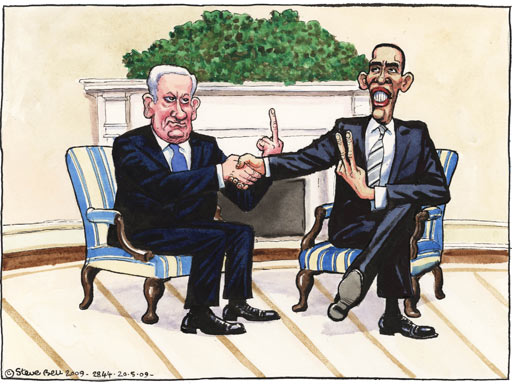
US and Israel Agree; Missile Controversy Plays Out

Daniel Shapiro

Maariv: Secret US-Israeli agreement on construction in East J’lem
Didi Remez | April 26, 2010 at 07:49 | Categories: Diplomacy, Jerusalem
Secret agreement on construction in capital
Ben Caspit, Maariv, April 26 2010 [Hebrew original here]

Israel and the US have reached secret agreements about construction in Jerusalem. Both sides agreed to leave the agreements between themselves and not make them public, and if they should be leaked nevertheless, deny them vigorously. The purpose is in order not to create difficulties for Prime Minister Binyamin Netanyahu in the coalition, and particularly in the Likud party.

The agreements indicate that contrary to Israeli boasting, Netanyahu’s answer to Obama regarding Jerusalem was not “No.” It was something in the middle, a little closer to the far end (a freeze) than the close one (continued construction at full tilt). The most accurate translation for this agreement is “Yes, but.” It is possible that Netanyahu has learned something from the bad old days of Shimon Peres, during which he got the nickname “Yes and no.” Now it is Netanyahu’s turn.

The agreements were made in a very long series of meetings and discussions between the parties. Attorney Yitzhak Molcho worked for Netanyahu. Working on the American side was mostly Dan Shapiro, the director of the Middle East department at the National Security Council.

As far as anyone knows, the parties agreed that no construction freeze would be announced. On the contrary, Netanyahu may continue to announce that he did not agree to a freeze. But in reality, Netanyahu agreed to delay the Ramat Shlomo project by at least several years and not to issue any new construction tenders in Jerusalem.

He also promised “to do as much as the law allows and use his full authority as prime minister to prevent unnecessary Israeli activity in the Arab neighborhoods in East Jerusalem. These agreements do not include the procedures that are already being carried out, such as, for example, the Shepherd Hotel in East Jerusalem.

Another agreement between the parties is that if Netanyahu should encounter a particularly severe crisis or heavy pressure, or if these agreements should be leaked, there will be a tendency to let him approve a small number of symbolic construction projects in secret coordination with the Americans so that it will continue to look as though he did not give in.

MF Revises Upward Estimates for Syria’s GDP Growth (Syria Report)
The International Monetary Fund has revised upward its estimate and projections for Syria’s Gross Domestic Product growth.

Agriculture: Wheat Crop to Rise Again on the Back of Good Rain Levels (Syria Report)
Syria’s production of wheat is expected to increase by some 10-15 percent during the 2010/11 crop as rainfalls during February were good, a report from the US Department of Agriculture said.

Bulgaria Writes Off Most of Syria’s Debt
2010-04-25

The Syrian state news agency says Syria and Bulgaria have signed a deal to write off most of Damascus’ outstanding debt to the European nation. The SANA news agency says Prime Minister Naji al-Otari inked the agreement with his Bulgarian counterpart, Boiko Borisov, on Sunday. Syrian Finance Minister Mohammad al-Hussein told reporters that Bulgaria agreed to write off $54 million of Damascus’ debt. He said the two sides will study ways to repay the remaining $17 million. Al-Hussein said that with Sunday’s agreement, Damascus has settled all of its foreign debt, the bulk of which dated back to the 1980s.

End Israel’s U.S. Allowance So Both Can Gain: Celestine Bohlen
Commentary by Celestine Bohlen

March 31 (Bloomberg) — The crisis in U.S.-Israeli relations isn’t going away. If anything, it keeps getting worse, precisely because it has exposed and crystallized a gap between the goals, expectations and even the national interests of these old allies.

The basic relationship may still be “rock solid,” as U.S. Secretary of State Hillary Clinton put it recently, but it is being tugged in opposite directions. Maybe now is the time to take money out of the equation.

Israel will get $2.7 billion in military aid from the U.S. this year — or 18 percent of Israel’s military budget. By 2013, that will lock into an annual level of $3.15 billion for five years. It also has almost $4 billion outstanding in available U.S. loan guarantees, left over from $9 billion extended at former Prime Minister Ariel Sharon’s request in 2003.

That makes Israel the largest recipient of U.S. aid in the world, if you don’t count Iraq and Afghanistan. It also benefits from some of the easiest terms: Unlike other recipients, which must buy 100 percent American, Israel can spend about one quarter of its U.S. military aid at home, which amounts to a significant boost to its defense industry.

The problem with this kind of largess is that it muddies the picture, both for Israel and the U.S. The best thing for the relationship would be for the U.S. to cut Israel’s allowance.

U.S. Pressure

Under that scenario, Israel could pay less heed to U.S. pressure and do what it thinks it must for its own national security. Many would argue that Prime Minister Benjamin Netanyahu is doing that anyway. The difference would be that the U.S. wouldn’t be there to help pay for it….. The problem isn’t that Mr. Assad is not getting the U.S. message. It’s that he sees no need to listen.

The Palestine Peace Distraction
Announcing a comprehensive plan now—one that is all but certain to fail—risks discrediting good ideas, breeding frustration in the Arab world, and diluting America’s reputation for getting things done.
By RICHARD N. HAASS

President Obama recently said it was a “vital national security interest of the United States” to resolve the Middle East conflict. Last month, David Petraeus, the general who leads U.S. Central Command, testified before Congress that “enduring hostilities between Israel and some of its neighbors present distinct challenges to our ability to advance our interests.” He went on to say that “Arab anger over the Palestinian question limits the strength and depth of U.S. partnerships with governments and peoples . . . and weakens the legitimacy of moderate regimes in the Arab world.”

To be sure, peace between Israelis and Palestinians would be of real value. It would constitute a major foreign-policy accomplishment for the United States. It would help ensure Israel’s survival as a democratic, secure, prosperous, Jewish state. It would reduce Palestinian and Arab alienation, a source of anti-Americanism and radicalism. And it would dilute the appeal of Iran and its clients.

But it is easy to exaggerate how central the Israel-Palestinian issue is and how much the U.S. pays for the current state of affairs. ….

Alas, neither would terrorism fade if Israelis and Palestinians finally ended their conflict. Al Qaeda was initially motivated by a desire to rid the Arabian Peninsula of infidels. Its larger goal is to spread Islam in a form that closely resembles its pure, seventh-century character. Lip service is paid to Palestinian goals, but the radical terrorist agenda would not be satisfied by Palestinian statehood.

What is more, any Palestinian state would materialize only amidst compromise. There will be no return to the 1967 borders; at most, Palestinians would be compensated for territorial adjustments made necessary by large blocs of Jewish settlements and Israeli security concerns. There will be nothing more than a token right of return for Palestinians to Israel. Jerusalem will remain undivided and at most shared. Terrorists would see all this as a sell-out, and they would target not just Israel but those Palestinians and Arab states who made peace with it.

The danger of exaggerating the benefits of solving the Palestinian conflict is that doing so runs the risk of distorting American foreign policy. It accords the issue more prominence than it deserves, produces impatience, and tempts the U.S. government to adopt policies that are overly ambitious……

Also needed are efforts to repair U.S.-Israeli ties. The most important issue facing the two countries is Iran…..

Mr. Haass is president of the Council on Foreign Relations and the author of “War of Necessity, War of Choice: A Memoir of Two Iraq Wars” (Simon & Schuster, 2009).

Read Matt Duss’ response to Haass at the Wonk Room

Impose solution for Middle East, Abbas asks Obama
By Catrina Stewart in Jerusalem
26 April 2010

In a speech to the Fatah leadership, Mahmoud Abbas pointed out the contradiction inherent in the posture that President Obama has assumed. On the one hand Washington has been pushing the line that a resolution to the Israeli-Palestinian conflict represents a vital American interest, yet at the same time Obama says, “we can’t want it […]

U.S. messages to Syria may not be getting through
Monday, April 26, 2010
Editorial in Washington Post

BASHAR AL-ASSAD is proving to be an embarrassment for the Obama administration. In pursuit of President Obama’s policy of “engagement” with U.S. adversaries, the State Department has dispatched several senior envoys to Damascus for talks with the Syrian dictator. It has also nominated a new ambassador and repeatedly expressed the hope for a step-by-step improvement in relations. So far Mr. Assad has responded by holding a summit with Iranian President Mahmoud Ahmadinejad and Hezbollah leader Hassan Nasrallah, at which he publicly ridiculed the U.S diplomatic initiative. In secret, he has stepped up an illegal and dangerous transfer of weapons to Hezbollah’s forces in Lebanon.

Most recently, Mr. Assad has been accused by Israel of handing Scud missiles to Hezbollah, which would allow the Iranian-sponsored group to attack every major city in Israel with one-ton warheads. If it occurred, the transfer would, as the State Department said last week, “pose an immediate threat to both the security of Israel and the sovereignty of Lebanon.” So the administration has found itself in the awkward position of simultaneously defending the engagement policy, urging the Senate to confirm ambassador-nominee Robert Ford — and appearing to threaten Damascus with military action.

Syrian Scuds and US Treaties: The Relentless Battle for Lebanon
Joe Macaron
Huffington Post, April 26, 2010

….The scud missile controversy did not pop out of nowhere in the last couple of weeks; it was a story in the making since January at least. In fact, at first, “scud” was not the buzz word. Other warfare names were floating around then like “Surface to Air Missile SA-2,” which can be carried and launched by a single person. A scud is around 37 feet and 11,000 pounds. As Jeff White of the Washington Institute of Near East Policy explains, “this is not a Katyusha which you can haul out into a farmer’s field and fire off with a garage door opener.” (And Arabs are big on the notorious Soviet-made and inaccurate Scud; they love inaccuracy sometimes. It was used by Egypt, Iraq, and Yemen. This is why the story is perfect to terrify Israel. Plus, even Iranians have them!)

What got us to here in the first place? I would argue that it is simply February Madness. Let’s recap. The story starts on February 26, 2009, when tAssistant Secretary of State for Near East Affairs Jeffrey Feltman invited Syrian Ambassador Imad Mustapha to the State Department for a cordial two-hour meeting. Now, it was by no means easy for these two men to bond; there’s a lot of the historical baggage between the Syrian academic (whose diplomacy is driven by emotions,) and the US intellectual (whose diplomacy is shaped by his experience in Lebanon).

After exactly one year, on February 26, 2010, Feltman summoned Mustapha, again informing him about US concerns over the transfer of weapons to Hezbollah. This meeting was surrounded by two telling events: Israeli Defense Minister Ehud Barak was in Washington warning about the situation in Lebanon, while, on the same day, the first straw of the US-Lebanese security treaty controversy spiraled out of control in Beirut, challenging the residual US influence in the country. It seemed a cold war was about to start…..

US leaked warning on Hezbollah Scud possession
Roee Nahmias, 04.25.10 / Israel News,Ynet

Western sources tell Kuwait newspaper Americans leaked suspicions that Shiite group acquired Scud missiles from Syria so that UN will deploy forces along Lebanon-Syria border. Source close to Hezbollah: It will fight plan with all means at its disposal

Officials in the US administration were the ones who leaked suspicions that Hezbollah had acquired Scud missiles from Syria, in order to “lay the groundwork for a proposal to the UN Security Council, to put together a resolution on the deployment of UN forces along the Syrian-Lebanese border,” the Kuwaiti Al-Rai newspaper reported Sunday.

Al Jazeera: Smoking ban burns Syrian businesses
2010-04-26

Syria is the first Arab country to enforce a ban on smoking in all public places, including cafes and restaurants.The decree was signed last November by Bashar al-Assad, the Syrian president, who is also a qualified medical doctor, …

In post-oil Syria, things are looking up
By Sarah Birke, April 25, 2010

Reform is bringing benefits to the country — both in terms of economic growth and political openness. In the midst of a transition from a centrally planned economy to a “social market,” Syria’s economy is faring well…. “A wealth gap is one of the problems of economic liberalization and has happened in countries from Indonesia to Russia,” said Sukkar.

Western tourists walk in Old Damascus, March 2009. With a host of unique sites drawing high end tourists and Arab capital pouring in to build hotels and resorts, Syria’s tourism sector is shaking off decades of underinvestment. (Khaled al-Hariri/Reuters)

A BBC Poll released a week ago shows that the global view of Israel continue to go downhill. According to the poll, the least favorably viewed nations on earth are Iran (15%), followed by Pakistan (16%), North Korea (17%) and Israel (19%). Notice that the difference is probably within the margin of error. Positive ratings of Israel dropped by 7 points in the US last year, down to 40.

Why are US Analysts Surprised that Syria Arms Hizbullah?

US analysts are constantly astonished that Syria does not cut off Hizbullah in order to reward Washington and Israel. What do they think that Obama will do for Syria, I wonder? Most seem to believe that the US should be able to buy the Golan from Syria for an extra point in GDP growth. US sanctions and enmity are the price Syria pays for continuing its resistance to Israeli occupation of its land.


The Obama administration is returning an ambassador to Damascus and reengaging with Syria, but it is doing this to advance US interests. Neocons try to make out that the return of an ambassador is a favor to Syria, when in actuality it is driven by US interests. Washington wants to be able to gain intelligence and have some small influence on Syria, which returning an ambassador will provide it. Syria is clearly gratified to have relations return to what they were before President Bush decided to invade Iraq with thoughts of regime change in Syria, but relations between the two countries will not be normal or good. The US has made it clear that relations will remain bad so long as Syria resists the occupation of its land.  Returning an ambassador will only restore the bad relations that existed previous to the Bush administration, when relations became horrid. The US insists on punishing Syria as a supporter of terrorism.

Washington has been very clear about its insistence on maintaining economy sanctions on Syria. It is not pressuring Israel to give back the Golan Heights — at least it has made no statement about the illegality of Israel’s occupation or the right of the 300,000 Golanis, whose parents or who were themselves expelled from the Heights in 1967 in complete disregard for international law. Yes, Obama talks about re-starting the peace process, but he doesn’t seem very serious about it. Mitchell is given the run around by Netanyahu, who has Obama by his congressional short hairs. Obama seems more intent on claiming that it wants a peace process than actually getting one started.

In the long run, Syria concludes that its only reliable strategy for getting the Golan back and bringing Israel into fruitful negotiations is by evening up the balance of power. This, of course, will not be done in a few years or even a decade. But the US will not remain the only world superpower for ever. Syria is counting on the strategic environment changing markedly in the future. Who knows, Israel may conclude that it will trade the Golan for peace before the decade is out – if so, Syria wants to be in a position to be able to offer Israel something in return. To do that, Syria must keep Hizbullah strong and must keep hope for resistance alive – not only in the hearts of Palestinians, but also in the hearts of the broader Arab and Islamic World, the two sources of assistance and ideological backing Syria can count on. The governments of Egypt, Jordan and Saudi Arabia have made peace with Israel, but their people have not. They are horrified by what they see on TV and feel a deep sense of injustice and humiliation for the powerlessness they must endure in not being able to right the wrongs they believe that Israel and the US do to the Palestinians. President Obama and the US military establishment recognize the strategic necessity for peace between Israel and the Palestinians, Lebanese and Syrians. They recognize that it is costing the US money and lives, but the political price for changing that reality is too costly.

The real way to encourage peace is by allowing the balance of power between Israel and its Arab neighbors to come into equilibrium. This is the first principle of realism. American analysts swear by this principle in every corner of the globe but the Middle East. When it comes to Israelis and Arabs, Washington somehow has convinced itself that only by skewing the balance of power in Israel’s favor, will peace materialize. Somehow the Jews are different from the rest of humanity. They operate by special laws of international relations that are explainable by some holocaust psychosis. Because Israelis have suffered more than others, the logic goes, they will only feel secure enough to make peace when they can completely dominate their neighbors and are an unassailable powerhouse. There must be no “light separating Israel and Washington.” This  argument is hokum through and through. It was invented and maintained by people who are happy with the status quo and happy to see Israel keep the Golan and Palestinian land. It has resulted in constant failure to negotiate peace. Why wouldn’t it. Israel does not need to return land or cut a deal. It pays no price for its expansionism.

It doesn’t really matter whether one approves or disproves of this state of affairs — it is the present reality. The US does not offer Syria a chance of getting back the Golan. It does promise to lift economic sanctions if Syria ceases to resist Israel and acquiesces to the permanent annexation of the Golan by Israel. Syria has made it very clear that it will not negotiate away the Golan. That leaves the region in constant upheaval. It is the source of deepening hatred on all sides.

New Round Up follows

The Mitchell visit to Israel Via FLC

“… Middle East peace envoy George Mitchell wrapped up a three day trip to Israel and the Palestinian Authority ……invited Palestinian President Mahmoud Abbas to meet President Barack Obama in Washington next month,….. Israeli Defense Minister Ehud Barak is flying back with Mitchell to Washington, Ynet reported. Mitchell is expected to return to the region on Friday….”

Haaretz: Israel must topple Assad in next conflict with Syria proxies
2010-04-25

Share | Israel must topple Assad in next conflict with Syria proxies By Oded Tira Tags: Hezbollah, Syria, Israel news Syria, according to recent reports, is supplying Hezbollah with Scuds and other missiles that possess a range covering all of ..

Miss Me Yet? The Freedom Agenda After George W. Bush
Wall Street Journal: 2010-04-23

Dallas No one seems to know precisely who is behind the “Miss Me Yet?” billboard—the cheeky one featuring a grinning George W. Bush that looks out over I-35 near Wyoming, Minn. But Syrian dissident Ahed Al-Hendi sympathizes with the thought. In …

Egypt Dismisses Israel’s Scud Warning
AFP

Egyptian Foreign Minister Ahmed Abul Gheit dismissed as “laughable” on Saturday US and Israeli fears that Syria has been supplying Lebanese militant group Hezbollah with Scud missiles. “These allegations are lies and are laughable,” Abul Gheit told reporters in Beirut as he began an official visit. “Egypt stands by Lebanon under all conditions and in the face of all threats,” he added….

Josh Rogin – FP Cable

When U.S. Ambassador to Lebanon Michele Sison met with Lebanese officials on Wednesday, she had a mission: She was there to urge Lebanon to help avoid a new outbreak of violence between Israel and the Shiite militant group Hezbollah.

Sison, an affable and well-liked career Foreign Service officer, was given the difficult task of both urging the Lebanese to do what they can to avoid an eruption of war and convincing them that U.S. and Israeli concerns about alleged Syrian arms transfers over the Lebanese border should be taken seriously.

Arab press reports cited anonymous sources as saying Sison showed Lebanese Speaker of Parliament Nabih Berri and Prime Minister Saad al-Hariri photos of truck convoys, evidence of increasing and escalation weapons shipments to Hezbollah. More shockingly, the reports said that she told Lebanese officials the United States had stopped Israel from launching an imminent strike against the convoys. Neither of those details is true, according to multiple administration sources.

State Department spokesman P.J. Crowley told The Cable that the idea American waived Israel off of a strike on Syrian weapons transfers is “totally false,” but declined to describe the specifics of the meeting. Another U.S. official described the Arab press reports as “bullshit.”

Two administration officials close to the issue, however, said that the meeting did in fact take place, but no photos were shown and the United States did not halt an imminent Israeli strike.

“The Israelis weren’t ready to shoot anything. There was never a point where they said, ‘We are going to strike something,'” the official said, adding that at some point Israeli action could of course be a possibility — albeit a disastrous one.

Regardless, the controversy surrounding Sison’s meeting reflects the extremely high tensions in the region following reports of new Syrian weapons transfers, including possibly SCUD missiles, to Hezbollah — tensions the Obama administration is trying to tamp down.

Sison’s message was the same message the U.S. is sending to all the parties, which is, “A war now is not in anyone’s interest,” the official said.

The administration is still not clear that any SCUDs have been transferred, but there is an acknowledgement that Syrian weapons transfers are increasing in both quantity and quality.

“It’s a deterrence game and each side is building up its deterrence capability,” this official said, adding that as both the Israelis and Hezbollah prepare for war, the seriousness of any actual outbreak of fighting is keeping both sides from initiating battle — for now.

“In a way, the deterrence is working,” the source added, noting that the downside risk of the arms buildup is that any miscalculation that begins an open conflict would precipitate a large-scale war that whose consequences would be impossible to predict.

According to this official, who stressed that they were only conveying their personal analysis, not the overall administration position, Hezbollah is still seeking revenge for the 2008 Israeli assassination of its military leader Imad Mughniyeh, and sees some spectacular attack on Israel as a way to achieve that.

But Hezbollah, now accountable to the Lebanese people due to its role in the government, doesn’t want to be seen as firing the first shot that could lead to devastating retaliation from Israel. So the group is trying to goad the Israelis into starting the conflict, the official believes.

The Israelis are aware they are being goaded, the official said, and are doing their best to resist while warning Washington that at some point violence might be unavoidable. “The Israelis know that once they strike, that’s all the excuse that Hezbollah needs to wage a full-scale war,” the official explained.

As for why Syria seems to be playing such an unhelpful role, “that’s the million-dollar question,” the official said. The Obama administration genuinely does not understand Syrian intentions and there are three basic theories within the administration as to why Syrian President Bashar al-Assad would continue to escalate arms shipments to Hezbollah despite U.S. warnings.

According to one school of thought, this is Assad’s way of playing hardball with the Israelis in advance of Israeli-Syrian negotiations. No one wants to negotiate from a weak position, so he is amassing chits that he can bargain away later.

An opposing theory is that Assad has no interest in engaging with the Americans or negotiating with Israel at all. This line of thinking concludes that he is simply paving the way for eventual conflict with Israel.

The third, more nuanced analysis portrays Assad as a man in a bind. He has himself so tied up with Iran and Hezbollah that perhaps he can’t disengage as easily as those in the West think he can. Also, Assad has always been a gambler and may have simply become entangled in his own web of deals with so many competing interests.

“We do not understand Syrian intentions. No one does, and until we get to that question we can never get to the root of the problem,” the official said. “Until then it’s all damage control.”

Meanwhile, the administration is trying to explain to the Syrians how foolish the weapons transfers are, if they are really happening, while telling the Israelis to be patient and arguing that the only beneficiary of a new Israeli-Hezbollah war would be Iran, which would seize upon a new conflict to deflect international pressure over its nuclear program.

And what about Hariri, who said the SCUD allegations were “reminiscent of the weapons of mass destruction allegations against Saddam Hussein” and “a pretext for threatening my country”?

“Hariri is terrified that another war is going to break his country apart and if that means denying the weapons transfers or whatever, he’s going to do it,” our official speculated. “He’s desperately trying to save his country from utter decimation.”

Saudi Arabia sets up nuclear energy science center
Top oil exporter witnesses sustained growth in demand for power
April 19, 2010, Daily Star

KHOBAR, Saudi Arabia: Top oil exporter Saudi Arabia said it would set up a scientific center for civilian nuclear and renewable energy to meet rising demand for power and desalinated water, state news agency SPA said on Saturday.

Fast growing power demand is forcing Saudi Arabia to look at all sources of energy, the kingdom’s deputy minister of electricity, Saleh Alawaji said last month.

Ackerman rips critics of Obama on engagement: “Shameless nonsense!”

Calling the last administration’s record in the Middle East a “spectacular disaster,” Rep. Gary Ackerman (D-N.Y.), chairman of the House Middle East subcommittee, came out guns blazing today to ridicule hawks who criticize the Obama administration’s efforts to engage Syria as appeasement.
“And from the policymakers and supporters of the previous Administration, who in decency ought to have slunk off in shamed silence for having watched fecklessly as this disaster—like Iran’s steady march toward nuclear weapons-capability—unfolded under their watch, what do they have to say today?” Ackerman charged at the subcommittee’s hearing on U.S. policy to Syria today at which Assistant Secretary of State for Near Eastern Affairs Jeffrey Feltman testified:
“Appeasement! Appeasement!” they cry, attempting to evoke the days leading to World War II.

This charge is grotesque. Apart from the indecency of comparison with the unique horror and evil of Nazi Germany, the cheap demagoguery of the word utterly fails to capture what the Obama Administration is actually doing. Where, one might ask, is the long list of concessions from America to Syria? Where is the surrender and sell-out of allies? Where is the retreat in the face of challenge? A few airplane parts? A few inconclusive meetings?

The string of defeats and failures that brought us to the current impasse occurred, let us not forget, during the previous Administration. The seeming limits of American power were brutally exposed well before Barack Obama was even elected to his high office.

Appeasement? Shameless nonsense. And more empty words.

It is true that the Obama Administration is pursuing a different policy than the spectacular failure of its predecessor. But that’s just good sense. Everywhere but Washington, not repeating mistakes is considered a good, or even a very good thing.

But Ackerman does have one criticism of the Obama administration: it doesn’t explain itself very well. “Nothing explains itself,” Ackerman said. “Nothing sells itself.”

If you want people to understand that our policy with Syria is not predicated on compelling major changes in Syrian behavior in the short-term, that has to be explained.

If you want people to understand that our policy of sanctions and political pressure will be sustained until there are changes in Syrian behavior, that has to be explained. If you want people to understand that dispatching an American ambassador to Syria is a tool to send and receive messages and to gather political intelligence for our own use, that has to be explained. If you want people to understand that trying diplomacy with Syria is not a betrayal of either our values or our friends, that has to be explained.

That is why we are here today. To make things clear. ….

Israel Rebuffs U.S. on Building By: Jay Solomon and Charles Levinson | The Wall Street Journal

Israeli Prime Minister Benjamin Netanyahu conveyed to the White House this weekend his rejection of a U.S. call for a total Israeli construction freeze in East Jerusalem, calling into question the path toward Middle East peace.

Commentary: Blindness to the Real Syrian Problem
2010-04-22

Cliff May wonders whether Dianne Feinstein is dumb or just pretending to be. Feinstein on the shipment of missiles to Hezbollah and the potential for war, pronounces: “There’s only one thing that’s going to solve it, and that’s a two-state …

Israel Billionaire Tshuva Strikes Gas, Fueling Energy Expansion
2010-04-21 Business Week
By David Wainer and Calev Ben-David

(Bloomberg) — Isaac Tshuva uses sugar packets on a table in the lounge of his Leonardo City Tower Hotel in Tel Aviv to mark the spots of three natural-gas fields off Israel that he said will fuel global growth of his energy business. The Israeli billionaire, owner of New York’s Plaza Hotel, said his Delek Group Ltd. and partners including Houston-based Noble Energy Inc. are now homing in on more deposits after last year announcing a record find in waters off Haifa, Bloomberg BusinessWeek reports in its April 26 edition.

“The amounts we’ve found are going to provide much of Israel’s energy needs for the next two decades,” said Tshuva, 61, who grew up in a one-bedroom apartment in Netanya with 10 family members after immigrating from Libya in 1948. Source close to leadership in Damascus responds to Israeli threats, tells Kuwait newspaper Syria continuously upgrading military capabilities….

Hezbollah: We possess arms that can hit deep in Israel.
By Roee Nahmias in Yediot Aharonot

Syria has threatened to “send Israel back to the era of prehistoric man” if the Jewish state attacks it with unconventional weapons.

A source close to decision-makers in Damascus was quoted by Kuwaiti newspaper al-Rai on Saturday as saying that “If Israel uses unconventional weapons, we’ll respond in a similar fashion.”

Earlier this week, an Israeli minister told the Sunday Times that Syria would be “sent back to the Stone Age” if Hezbollah launches ballistic missiles.

The Syrian official said Damascus has upgraded its military capabilities and has prepared for a number of possible scenarios in case a war against Israel breaks out.

“Despite the fact that Syria has been outside the cycle of war since 1973, it did not sit idly by for even one day and is still working to develop its capabilities via missiles,” he was quoted by the Kuwait paper as saying.

The official said Syria has drawn lessons from Hezbollah’s “success” during the Second Lebanon War and has since then developed “advanced methods of warfare.”

‘War could break out tomorrow’

The Syrian source said Damascus’ wartime strategy is based in part on the possibility of opening a broad front against Israel – from Rosh Hanikra to the Golan Heights.

In addition, said the official, Syria is capable of launching 60 ballistic missiles deep into Israeli territory if the Jewish state will “dare to try and undermine Damascus’ sovereignty.”

“Syria can also launch 600 short-range tactical missiles into Israel in one day,” he said, while detailing plans to attack Israel’s coastline if a war breaks out.

In this framework, he said, Syrian forces would employ sea-to-surface missiles against Israeli civilian and military targets, including ports.

The official did not address claims that Syria was transferring Scud missiles to Hezbollah in Lebanon.

Hezbollah political bureau member Ghaleb Abu Zainab said during an interview with NBN television on Friday that his group does not need Scud missiles to defend Lebanon.

“The resistance possesses arms that can reach deep into Israel,” Abu Zainab said, adding that Hezbollah is completely ready to confront the Jewish state.

Kais Salman

According to Abu Zainab, Washington and Jerusalem are using their accusations of the Scud transfer to attempt to divert attention away from Israel’s “violations” in the Palestinian territories.

Syrian art market rides wave of reform
Improvements in the Syrian economy inspire an art market renaissance.

Contemporary art from Syria finds favor with international buyers

As Syria becomes more integrated into the international market, the country’s arts scene is also changing. With the help of galleries and auction houses, more Syrian artists are selling their work to foreign buyers.

Damascus
By Mark Archer in Financial Times: April 24 2010

….It was difficult to take leave of Damascus, a city in which the historic mingling of different peoples and civilisations seems to have left it remarkably hospitable. One of the best evocations of its appeal comes from Mark Twain, who invoked his visit in The Innocents Abroad: “She measures time not by days and months and years but by the empires she has seen rise and crumble to ruin … Damascus has seen all that ever occurred on earth and still she lives. She has looked upon the dry bones of a thousand empires, and will see the tombs of a thousand more before she dies.”

There is change afoot in Syria under its reformist president Bashar al-Assad and his telegenic wife, who was formerly a hedge fund manager in London. The economy is being overhauled and there are plans to expand its tourist industry. But it’s reassuring to think that the special charm of Damascus should remain unaltered by even the best-intentioned reforms.

11 heritage hotels open in Damascus Old City
English.news.cn

Saadallah Agha al-Qalaa, the Syrian tourism minister, has said that the tourists’ number has increased 71 percent in comparison with the year 2009, pointing out that Syria will witness important tourist investment project in the year, earlier reports said.

Al-Qalaa said that these projects give a chance for millions of tourists to get acquainted with Damascus’ heritage.

In a statement released on April 15, the Syrian tourism minister said that Syria occupies the third position in the world tourism growth due to canceling visas with some countries such as Turkey and Iran and enhancing relationships with Arab and foreign countries.

“Syria’s National Day Celebrations at the Library of Congress”, by Ford Prefect

Syria’s National Day Celebrations at the Library of Congress
Written by Ford Prefect for Syria Comment

“Out beyond ideas of wrongdoing and right-doing, there is a field. I will meet you there.”
Jalal Ad-Din Rumi. (Listen to this poem, translated by Coleman Barks, here)

And that “field” was the magnificent Library of Congress, which on April 23 played host to celebrations for the National Day (April 17) of Syria – a lovely evening of Syrian culture, architecture and music, organized by the Syrian embassy and overseen by Rafif Moustafa, the ambassador’s wife who planned every aspect with great care.

The event attracted over 400 attendees, including members of Congress, senior Hill staffers, Administration officials, ambassadors and diplomats, academics, journalists, members of the Syrian American community, and guests.

Syrian National Day at the Library of Congress, April 2010

Politics and rhetoric aside, the evening focused on Syria’s breathtaking architecture against the backdrop of the premiere venue in the US capital. In a refreshing change of pace from recent allegations toward Syria and frequent discussions over the country and its politics, guests at the event mingled and chatted about Syrian arts and culture over cocktails and delicious Middle Eastern bites.

The evening began with opening remarks from Dr. James Billington, the 13th Librarian of Congress. Dr. Billington highlighted Syria’s rich heritage and its important role as a cultural pacesetter throughout history. Dr. Nasser Rabbat, professor of Islamic architecture at the Massachusetts Institute of Technology (MIT), then took the audience on a pictorial journey through Syria’s spectacular history of architecture, from Aram to Phoenicia, from Seleukia to Roman Syria, and from the Arab and Islamic bilad-al sham to Syria today. Perhaps most surprising to learn was that for over 4,000 years, Syrian builders have synthesized past and contemporary traditions to arrive at an architecture that is unique, specific and highly identifiable to that part of the world.

Following the presentations, rising Syrian star Kinan Azmeh and soprano singer Dima Orsho took the audience on a musical journey that started with a haunting piece hailed as the oldest song in the world. In the early 1950s, clay tablets dating back to 1400 B.C. containing text from the “Hurrian” language were discovered in the ancient city of Ugarit, known today as Ras Shamra, Syria. These clay tablets contained a complete hymn of words and music to the moon god’s wife, Nikal. Here is a modern interpretation of that piece by Syrian American Pianist Malek Jandali.

Syrian musicians Kinan Azmeh and Dima Orsho

Kinan and Orsho both exemplify emerging Syrian talent. The New York Times has hailed Azmeh as a “virtuoso” and the LA Times has called him “engagingly flamboyant.” Kinan is a graduate of New York’s prestigious Juilliard School and Damascus University’s School of Electrical Engineering and is currently finishing his doctoral work at the City University of New York. Orsho, born in Damascus, received her Masters of Music degree in opera performance from The Boston Conservatory and has appeared in operas and concert halls all over the U.S., Europe and the Middle East.

Their performance was a treat for audiences saturated with today’s synthesized music. Listening to music aged more than 3,400 years was not only satisfying but also unique and stunning to the ear. Their masterful blending of oriental rhythms with modern “jazzy” melodies has earned this duo worldwide respect and recognition in the field of music. The audience showed their appreciation with an enthusiastic standing ovation!

Finally, as the night came to a close, I reveled in the success of this cultural event in bringing people together beyond the ideas of rightdoing and wrongdoing. Just a few steps away from the U.S. Capitol building, people came together to admire the unique place Syria holds as a contributor to history and culture.

Written by Ford Prefect for Syria Comment

Missiles and More

Has Syria Really Delivered New Missiles to Hizbullah?
Mark Hosenball

U.S. national-security officials say they have no confirmation of Israeli claims that Syria has delivered or is in the process of delivering new, longer-range Scud missiles to the radical Lebanese Shiite group Hizbullah. Although Syria may have begun making preparations to do so, U.S. intelligence reporting indicates that no such shipments have actually occurred, two senior U.S. officials tell Declassified, requesting anonymity when discussing sensitive information. According to the officials, the U.S. government’s assessment is that Israelis’ public complaints were a ploy to deter the Syrians from going ahead with the deliveries—a strategy that’s working so far, the U.S. government believes….

… Asked whether U.S. government experts believe that Israel made a fuss about the alleged missile shipments—and exaggerated how far the Syrians had gone—in order to send Damascus a message against carrying out the transfer, a senior Obama administration official says simply: “Yes.” And Damascus appears to have heeded the warning, the official confirms. Another senior U.S. official cites Israel’s September 2007 airstrike against a suspected but uncompleted Syrian nuclear facility. In the opinion of many U.S. experts, the official says, Israel’s military would have already taken action to neutralize the threat if there were hard evidence that Hizbullah had obtained Scuds”

Bloomberg

“It’s important to make the case to Syria why the path they’re on is so dangerous,” Feltman said. “Syria is not Iran,” he said, noting that Syria is a secular state and that the Obama administration doesn’t see the Syria-Iran alliance as immutable. Citing “growing rapprochement” between Syria and Saudi Arabia, Feltman said, “the Syrians try to hedge their bets.” It’s in the interests of U.S. allies, including Israel, Iraq and Lebanon, that the U.S. improves relations with Syria in an effort to change its behavior.

Reuters

“…While the United States suspects some kind of transfer may have occurred in Syria, two U.S. officials said there were “no indications” any Scud rockets were transported into Lebanon, which would sharply escalate the risk of a conflict.

“We don’t think Scuds of any shape or size have been moved to Lebanon,….. in this case, surely they (the Syrians) realize that transferring this kind of weapons system to Hezbollah — and especially to Hezbollah in Lebanon — could lead to serious consequences,” the official added….

U.S. officials voiced confidence that Scuds crossing the Syrian-Lebanese border would be detected. The large rockets cannot be readily broken down into small parts for transport, the officials said…”

Wall Street Journal’s article by Jay Solomon and Charles Levinson concluded with the following paragraph. [Ross is playing Abrams role. He totally undermined Rice by acting as the Israel channel. Ross will make a laughing stock of Mitchell, if allowed.]

“U.S. officials said Mr. Netanyahu’s government has been communicating much of its position through the White House’s senior Middle East adviser Dennis Ross, at times bypassing special Mideast peace envoy George Mitchell. That decision has been interpreted by some in the administration as an attempt to sideline Mr. Mitchell in favor of Mr. Ross, who has advocated U.S. cooperation with Mr. Netanyahu, rather than confrontation. Mr. Ross has publicly taken positions in line with Mr. Netanyahu’s government, particularly the centrality of stopping Iran’s nuclear program as a means to underpin Mideast peace efforts.”

At a nixon center lunch today, Martin Indyk (who was the featured guest along with Sam Lewis), said that Obama and Netanyahu see the ME peace-Iran linkage in opposite ways: Obama sees progress in the peace process was vital in the confrontation with Iran, while Bibi saw confronting Iran as giving him the leeway to make progress in the peace process.

Improving the U.S.-Syria Relationship
Department of State| April 22nd, 2010

After remarks with Estonian Foreign Minister Urmas Paet today, Secretary Clinton took questions from the press. In response to a question about Syria, the Secretary said:

“[W]e have expressed directly to the Syrian Government, including calling in the representative of their embassy in Washington to express in the strongest possible terms, our concerns about these stories that do suggest there has been some transfer of weapons technology into Syria with the potential purpose of then later transferring it to Hezbollah inside Lebanon.

“I think that the larger question as to what the United States will do with respect to Syria is one we’ve spent a lot of time considering and debating inside the Administration. Where we are as of today is that we believe it is important to continue the process to return an ambassador. This is not some kind of reward for the Syrians and the actions that they take, which are deeply disturbing not only to the United States and not just to Israel but to others in the region and beyond. But it’s a tool. It’s a tool that we believe can give us extra leverage, added insight, analysis, information with respect to Syria’s actions and intentions.

“We would like to have a more balanced and positive relationship with Syria, as do other of its neighbors from Egypt to Saudi Arabia. We would like to see Syria play a more constructive role and engage in an effort to resolve its outstanding conflict with Israel. We would like to see Syria refrain from interfering in and potentially destabilizing theGovernment of Lebanon. So we have a long list of areas that we have discussed with the Syrians, and we intend to continue pushing our concerns.”

Syria providing ‘wider array’ of missiles to Hezbollah: US
(AFP)

WASHINGTON — Syria is providing a “wider array” of missiles to Hezbollah, a US diplomat said Friday, stopping short of accusing Damascus of supplying Scuds to the Lebanese Shiite militia.”We are concerned with the broadening nature of cooperation between Syria and Hezbollah,” said a senior State Department official, who asked not to be named due to the sensitivity of the matter.

Damascus is “providing a wider array of missiles to Hezbollah,” the diplomat added, but refused to accuse Syria of delivering the high-grade weapons to Hezbollah.

Read the Secretary’s remarks to the press or more about the her travel to Estonia, where she is attending the NATO Informal Foreign Ministerial April 22-23 and meeting with senior Estonian officials to discuss our bilateral relationship.

8% of Syrians’ income goes on smoking……..

Saudis tighten China energy ties to reduce US dependence

“… The partnership between Saudi Arabia and China is part of a broader strategy by the world’s largest oil exporter to tap Asian markets and extend global influence. It also helps Saudi Arabia reduce reliance on the U.S., which since World War II has protected Saudi security in return for stable oil supplies, said Ben Simpfendorfer, Hong Kong-based chief China economist at the Royal Bank of Scotland Plc.

“China’s rise has provided Saudi Arabia with an excuse to knock on Washington’s door and to say, you are not our only partner,” he said…”

Schumer criticizes Obama’s pressure on Israel; Extolls blockade of Gaza

“…At the same time that is happening, there is prosperity with the more moderate Palestinian Authority in the west bank, and Hamas in Gaza is being squeezed and people there are doing very badly. Not only because Israel has blocked off the border and not let anything into Gaza, and I support Israel in doing that, and it may be tough on the Palestinian people, but when they vote for Hamas they are going to have to suffer the consequences.”

News Round Up (22 April 2010)

Obama Official Defends U.S.-Syria Engagement After Scud Reports
April 21, 2010

April 22 (Bloomberg) — A top State Department official defended the Obama administration’s policy of engaging with Syria against criticism from Congress following allegations that Syria transferred missiles to Hezbollah terrorists.

Jeffrey Feltman, the U.S. assistant secretary of state for Near Eastern affairs, faced questions yesterday at a House panel hearing from Democrats and Republicans who questioned the logic of President Barack Obama’s efforts to talk with a regime the U.S. accuses of weapons proliferation, links to terrorist groups and ties to Iran.

Representative Dan Burton of Indiana, ranking Republican on the House Foreign Affairs subcommittee for the Middle East and South Asia, compared sending an ambassador to Damascus to appeasing Adolf Hitler before World War II. President George W. Bush withdrew the last U.S. ambassador in 2005, following Syria’s alleged involvement in the assassination of former Lebanese Prime Minister Rafiq Hariri.

It’s “rewarding Syria for kicking the U.S. in the teeth,” Burton said, referring to the administration’s decision in February to name career diplomat Robert Ford as ambassador to Damascus, after a reported meeting between leaders of Syria, Iran and Hezbollah.

Feltman defended the decision, saying the Obama administration believes diplomacy can change Syria’s behavior. “An ambassador is not a reward; it’s a tool,” he said.

Syrian President Bashar al-Assad is already listening to the leaders of Iran and Hezbollah, Feltman said, and he “needs to listen to us, too.”

Sending Ambassador

Ford hasn’t been confirmed by the Senate, and House members said they would share grave concerns with their Senate colleagues about the wisdom of sending an envoy to Damascus.

Feltman said that refusing to send Ford wouldn’t further U.S. goals; it would make influencing Syria harder.

Syria’s government “says it wants to live in peace in the region,” Feltman testified. A senior U.S. envoy in Damascus would in time have a chance to persuade Syria that “it’s in Syria’s interest” to seek peace with Israel, respect the sovereignty of neighboring Lebanon and uphold human rights of its people, he said.

Feltman declined to answer in open session whether the U.S. has evidence to confirm Israeli claims that Syria has been smuggling long-range missiles to Hezbollah in southern Lebanon. Israeli President Shimon Peres on April 13 accused the Arab country of supplying the militant group with Scuds, ground-to- ground missiles with a range of hundreds of miles.

‘Have to Review’

“If these reports turn out to be true, we have to review” the full range of efforts to reverse Syria’s actions, Feltman said.

Representative Dana Rohrabacher, a California Republican, told Feltman he doesn’t “think your approach has any merit at all.”

Feltman said that, while a change isn’t possible overnight, the administration can send a strong message through diplomatic channels.

“It’s important to make the case to Syria why the path they’re on is so dangerous,” Feltman said. “Syria is not Iran,” he said, noting that Syria is a secular state and that the Obama administration doesn’t see the Syrian-Iran alliance as immutable.

Citing “growing rapprochement” between Syria and Saudi Arabia, Feltman said, “the Syrians try to hedge their bets.” It’s in the interests of U.S. allies, including Israel, Iraq and Lebanon, that the U.S. improves relations with Syria in an effort to change its behavior.

Also yesterday, Representative Eliot Engel, a New York Democrat, and Representative Mark Kirk, an Illinois Republican, introduced a resolution in Congress calling for tightening restrictions against Syria, strict enforcement of sanctions related to the transfer of weapons to Hezbollah and a reevaluation of the decision to send an ambassador to Damascus.

Obama Syria outreach under fire amid Scud reports
By Andrew Quinn

WASHINGTON (Reuters) – President Barack Obama’s outreach to Syria came under fire on Wednesday as a congressional panel questioned the rapprochement amid charges that Damascus has sought to arm Lebanese Hezbollah guerrillas with Scud missiles….

“Do we actually have a policy toward Syria, and is it in our best interest? What are we doing?” Democratic Representative Eliot Engel asked, urging a tougher U.S. stance against Syrian President Basher al-Assad over weapons transfers and other issues.

U.S. Assistant Secretary of State for Near Eastern Affairs Jeffrey Feltman said the United States was seeking answers on the missile charges and took the issue extremely seriously.

“All options are going to be on the table looking at this,” he said — while repeating the need to expand diplomatic dialogue with Damascus.

Israeli President Shimon Peres has publicly accused neighboring Syria of sending Scuds to Hezbollah, a Lebanese Islamist militant group. Syria has denied the charge and said Israel might be using the accusation as a pretext for a military strike.

Feltman declined to say whether the United States had confirmed that any transfers had taken place, saying he was unable to address these concerns in a public hearing.

But he said the United States had repeatedly warned Syria about transferring ballistic missiles and was pushing hard to stop any such shipments from taking place.

“If these reports turn out to be true we’re going to have to review the full range of tools available to us in order to make Syria reverse what would be an incendiary, provocative action,” he said.

Some U.S. officials have expressed doubt that any Scuds were actually handed over in full to the guerrilla group, although they believe Syria might have made a partial transfer of weapons parts, documents or funding.

“SPIT IN OUR FACE”

The missile allegations have complicated Obama’s efforts to forge a rapprochement with Syria, which his administration sees as crucial to Middle East peace efforts and to stabilize the nascent democracy in neighboring Iraq.

The United States has agreed to return an ambassador to Damascus after a five-year absence. But the designated envoy, Robert Ford, still awaits confirmation by the full Senate and Feltman conceded some senators may feel reluctant to move forward given doubts about Syria’s intentions.

“It’s like they just spit right in our face,” said Republican Representative Dan Burton, citing a raft of moves by Syria that he said were inimical to the interests of the United States and allies including Israel.

Feltman insisted it was time to return the ambassador, saying Washington needed a direct line to Syria’s leadership as it makes decisions that could have serious regional implications.

“Syria has made mistakes before,” Feltman said. “We need to be making our message to him loud and clear and directly.”

Hezbollah, a Syrian- and Iranian-backed Shi’ite Islamist group, is on the U.S. terrorism blacklist but is part of Lebanon’s unity government. The group fought a war with Israel in 2006 and has strong support in mainly Shi’ite south Lebanon.

Lebanese Prime Minister Saad al-Hariri on Wednesday denied that Hezbollah had received long-range Scuds from Syria.

Feltman said the United States had significant leverage with Damascus, including the current inclusion of Syria on the U.S. “state sponsors of terrorism” list and continued U.S. sanctions against the country.

“They don’t like any of that. But frankly the ball is in their court,” Feltman said. “They would like to see us move away from those things. Well, for that to happen they’ve got to take some actions that correct the troubling behavior.”

US says Syrian missile transfers to Hezbollah could lead to war in the Mideast
By MATTHEW LEE, 21 April 2010, Associated Press

WASHINGTON (AP) – The Obama administration’s top diplomat for the Middle East says the U.S. has warned Syria numerous times in recent weeks that transferring ballistic missiles to Lebanon’s Hezbollah militia could lead to war in the region….

Feltman told a congressional committee that Syria’s leadership needs to understand the risks of arming Hezbollah, which he said “could affect war and peace in the region.”

Politico

Amid recent reports that Syria intended to transfer Scud missiles to the Lebanese militia group Hezbollah, U.S. officials to date have been careful to say they do not know for a fact that the missiles were actually transferred to Lebanon, while Israeli officials have said they believe that they were.

U.S. reticence on the matter may be both because it doesn’t know where the missiles are, and to avoid giving pretext for any possible Israeli military attack on Lebanon.

But today, Sen. Dianne Feinstein (D-Ca.), chair of the Senate Select Committee on Intelligence, says she thinks there is a “high likelihood” the missiles were sent to Hezbollah in Lebanon. “I believe there is a likelihood that there are Scuds that Hezbollah has in Lebanon. A high likelihood,” Feinstein told the AFP.

“The rockets and missiles in Lebanon are substantially increased and better technologically than they were and this is a real point of danger for Israel,” she continued.

Her remarks come as Assistant Secretary of State for Near Eastern Affairs Jeff Feltman, a former U.S. Ambassador to Lebanon, is due to testify on U.S. policy to Syria before the Middle East subcommittee of the House Committee on Foreign Affairs Committee this afternoon. …

Kerry today said the intelligence on what Syria transferred and where it is is still incomplete. “I think it’s safe to say we’re inquiring and trying to get more information about it. I wouldn’t comment on what it is, or isn’t, at this point in time,” Kerry told the AFP. “There are concerns about rocketry in general, and clearly Hezbollah has been rearmed, but I don’t think there’s clarity as to which weapons yet, with specificity, and where. Where is very important in this question.”…..

From Ma’an.

43 percent are for 2SS but binational state sentiment is growing, at 34 percent, up from 20 percent less than a year ago, and 30 percent say peace process is dead.

The Scud Issues Has Legs – State Dept Summons Syrian Diplomat

Ford Prefect – a Syrian – writes:

The US administration and policies towards peace in the Middle east are genuine and pragmatic – but they will not succeed without Syria’s help.

It’s time for Syria to embark on a public relation campaign – aligning its objectives for peace and security in the region with those articulated by the Obama administration. It’s more important now than ever for Syria to restore its image of a country that is transforming itself into a modern state. Although Syria has a long road ahead of it, Syria today is by far a different one from the one just 10 years ago.

Not too many people in the US, including those in Congress, know the basic facts of Syria’s transformation. Syria today is not an aggressive state. It harbors no evil intention to anyone – Israel included. Its leadership is young and open-minded while recovering from the remnants of 30 years of mismanagement and inefficiencies. Its economy is expanding. There are private schools, private universities, private radio stations, private banks, and private websites. More private enterprises are employing Syrians with advanced degrees in engineering and management than at any time since Syrian independence.

Syrian arts from poetry to painting are literally bursting with talents. Galleries showcasing the work of Syrian artists are everywhere. Syrian TV and movie productions are so busy under heavy demands that they are now producing at over capacity.

Today, someone up there on the food chain in Syria is quietly transforming every public Syrian institution into a modern 21st century with the help of leading global experts and organizations. From education to healthcare to tourism to social services – no institution will be left untouched. This is happening behind the scenes, slowly but aggressively.

Syria today needs to live in peace more than ever and it will demonstrate that while the West was struggling with religious freedom, protection of minorities, and passing laws of “affirmative action”, Syria’s definition and practice of secularism has been a permanent part of its fabric. And as America reminisces with its uni-colored, white Anglo-Saxon founding fathers, modern Syria was born on shoulders of Sultan Al Atrash (Druze), Fares Al Khoury (Christian), Saleh Al-Ali (Alawite), Ibrahim Hanano (Kurd), and Hashem Atassi (Sunni) to name just a few.

As more and more people in the US and in Israel begin to understand the Syrian people for what they are, the better chances we have to fulfill the wish for a lasting peace in the Middle East. The time is now for Syria to demonstrate its commitment to peace and its leadership in the Middle East.

Plotting The Next Mideast War
by Bret Stephens in WSJ

…One of the more easily imaginable consequences is that a war in Lebanon could very quickly involve Syrian and Iranian participation. So the next question is: How might that play out?

Here Israel could conceivably reap certain advantages, which in turn calls into question whether Israel might not want a wider war over Lebanon after all. Today, Jerusalem’s two supreme strategic objectives—preventing Tehran’s nuclear bids from reaching fruition while also preventing any further deterioration in the relationship with Washington—are very far from being in synch. But in a scenario in which Israeli cities are hit by Hezbollah’s Scuds, Israel would have ample justification and cover to strike back at the ultimate source of those missiles—not just Damascus, but Tehran. As Rahm Emanuel likes to say, a crisis can be a terrible thing to waste.

And that raises a final question: What does the Obama administration do? So far, it hasn’t helped matters by giving the impression of a clear wedge between Israel and the U.S. Nor has the administration’s assiduous courtship of Damascus done anything other than embolden Mr. Assad’s taste for adventure. Is the president capable of learning from his Mideast failures so far? That one’s worth $64,000.

In 1967, a series of seemingly minor events, tactical misjudgments, and particularly an Arab perception that the West would not honor its international commitments or come to Israel’s defense triggered a war the consequences of which have defined the Middle East ever since. We are adrift in those same waters today.

Why Syria Needs to Get a Grip
by Steven Heydemann, vice president, Grants and Fellowships program, and special adviser, Muslim World Initiative, U.S. Institute of Peace.
Foreign Policy (The Middle East Channel)

Engagement of Syria, whether by the U.S., Saudi Arabia, or France, is based on a gamble. By giving Syria’s leaders options other than Iran and Hizballah, and by holding out the prospect of long-term regime security, engagement creates incentives for Syrian moderation. In theory. Thus far the bet has not paid off. Instead, Syria’s leaders have pocketed their gains and raised the stakes, strengthening Hizballah’s arsenal and deepening its strategic ties with Iran.

Should the U.S. put engagement on hold in response? Should Ford’s appointment be delayed in the Senate? As tempting as these options might appear, they should be avoided. There is little to be gained and much to be lost by slowing either Ford’s confirmation or his departure for Damascus. Indeed, Syria’s recent trajectory makes this a critical moment for the U.S. to have an ambassador on the ground in Damascus. To be sure, American leverage over Syria is limited. Expectations for what Ford can accomplish must be realistic. Yet even under these conditions, American diplomacy is unnecessarily hamstrung by the continued absence of an ambassador. As regional tensions escalate, the U.S. will need all the resources it can muster to avoid another round of conflict. Diplomatic representation in Damascus is not a reward for good behavior, but rather the return of an important instrument of political leverage which could help to prevent the problems already on the horizon. And there is always a chance, however slight, that a “good ambassador” can help to curb Syria’s triumphalism, not least by communicating directly to the Syrian leadership that engagement is not an open ended commitment, and cannot remain a one-way street….

The Syrian mood could be heard in President Assad’s response in an interview with al-Manar to Ambassador Ford’s March 16confirmation hearings: “A fine ambassador with a bad policy is worthless. The results will not be good.” These comments were preceded by the “resistance summit” of late February in Damascus between President Assad, Iranian President Mahmoud Ahmadinejad, and Hizballah Secretary-General Hassan Nasrallah, during which Assad ridiculed U.S. efforts to weaken Syria’s alliance with Iran. During that summit Syria’s Foreign Minister, Walid Muallem, signaled a significant shift in Syrian security doctrine, committing Syrian forces in the event of renewed conflict between Israel and Hizballah. This week, senior Israeli officials went public with reports that Syria has begun supplying Hizballah with Scud missiles, potentially extending the range and accuracy of its already formidable arsenal. The administration has responded to these reports by summoning a senior Syrian diplomat to the State Department yesterday to condemn “in the strongest terms the transfer of any arms, and especially ballistic missile systems such as the SCUD, from Syria to Hizballah.”

These moves, which have escalated tensions between Israel, Syria, and Lebanon, bear the classic hallmarks of a triumphalist mindset, recognizable from America’s own post-Cold War experience: an exaggerated sense of capabilities, unrealistic expectations, and an increased tolerance for risk. This is a highly combustible combination, all the more so because it follows nearly a full decade in which President Assad struggled, initially to secure his own position against internal rivals, and then, after February 2005, against extraordinary diplomatic and economic sanctions led by the U.S. that sharply curtailed his room for maneuver. Now, finally emerging from those dark days, Syria’s newly confident leaders have little appetite for either moderation or compromise. This is evident not only in the strategic realm, but in the economic and political arenas, as well. Over the past year, the Syrian regime has deepened its repression of local dissidents. And late last year, Syria “postponed” signing a long sought after Association Agreement with the EU that would have required Syria to address European concerns about human rights.

The triumphalist mood of Syria’s leaders admittedly reflects how much conditions on the ground have changed over the past couple of years, especially since Lebanon’s Parliamentary elections of June, 2009….

Diplomatic representation in Damascus is not a reward for good behavior, but rather the return of an important instrument of political leverage which could help to prevent the problems already on the horizon. And there is always a chance, however slight, that a “good ambassador” can help to curb Syria’s triumphalism, not least by communicating directly to the Syrian leadership that engagement is not an open ended commitment, and cannot remain a one-way street.

Steven Heydemann is Vice President of the Grants and Fellowships program and special adviser to the Muslim World Initiative at the U.S. Institute of Peace.

How War Could Start The Center for New American Security’s Andrew Exum warns, “everyone hold your breath. Because this is how wars start.” He writes, “the next Israel-Lebanon war starts when either a) Hizballah or Israel does something stupid or b) Hizballah acquires ‘equilibrium-breaking’ weaponry like powerful long-range rockets or anti-aircraft weaponry. Israel might decide, in the event of the latter, that it must act preemptively and that the very fact that Hizballah possesses such weapons is casus belli enough.”

So Much for Obama’s Syria Outreach The Wall Street Journal’s Charles Levinson and Jay Solomon say the move “threatens to alter the Middle East’s military balance and sets back a major diplomatic outreach effort to Damascus by the Obama administration. … Syria and Hezbollah both denied the charges. But the allegations already are affecting U.S. foreign policy: Republicans pressed on Capitol Hill to block the appointment of a new American ambassador to Damascus.”

‘Fueling the Middle East Arms Race’ The Guardian’s Simon Tisdall explan, “From an Israeli perspective, the balance of terror in the Middle East just tipped dangerously. … To many in the region, Israel’s undeclared and internationally uninspected arsenal, including hundreds of nuclear warheads, looks considerably more threatening than a few truckloads of North Korean-made Scuds. While this remains the case, there is no reason to believe the headlong Middle East arms race will stop.”

Washington Summons Syrian Diplomat over Hizbullah Arms Transfer

The United States has summoned a senior Syrian diplomat and demanded an “immediate” end to arms transfers to Hizbullah, criticizing any such shipments as an impediment to peace.

“The most senior Syrian diplomat present in Washington today, Deputy Chief of Mission Zouheir Jabbour, was summoned to the Department of State to review Syria’s provocative behavior concerning the potential transfer of arms to Hizbullah,” department deputy spokesman Gordon Duguid said in a statement.

He said the United States condemns the transfer of any arms, “especially ballistic missile systems such as the Scud, from Syria to Hizbullah.”

“We call for an immediate cessation of any arms transfers to Hizbullah and other terrorist organizations in the region,” he added.

“Syria’s designation as a state sponsor of terrorism is directly related to its support for terrorist groups, such as Hizbullah.”

The diplomatic quarrel is likely to put a damper on President Barack Obama’s administration’s year-long campaign to engage Syria, a former U.S. foe, and energize its thwarted push for a broad Arab-Israeli peace, particularly between Israel and the Palestinians.

U.S. Senator John Kerry, chairman of the Senate Foreign Relations Committee, visited Damascus April 1, and after a meeting with President Bashar al-Assad he described Syria as “an essential player in bringing peace and stability to the region.”

Obama in February appointed the first U.S. ambassador to Damascus in five years, a move Kerry said was “evidence that engagement with Syria is a priority at the highest levels of our government.”

The Senate approved envoy Robert Ford as the new ambassador last Tuesday.

But a day later, Washington expressed alarm to Syria over its possible sale of Scud missiles to Hizbullah militants, warning it would put Lebanon at “significant risk.”

Washington expressed renewed concern Saturday over possible Scud missile supplies to Hizbullah, a Lebanese Shiite militant group backed by Syria and Iran. The United States has labeled Hizbullah a terrorist organization.

Duguid warned Monday that such arms transfers “can only have a destabilizing effect on the region, and would pose an immediate threat to both the security of Israel and the sovereignty of Lebanon. …

Scuds for Hizbollah? The regional balance is at stake
Emile Hokayem in the National

….Ultimately, the real victim of a war fuelled by the missile crisis would be Lebanon. It faces massive destruction by Israel, civil conflict if Hizbollah goes after its domestic opponents and possibly a return of Syrian forces if the world once again outsources the Lebanese mess to Damascus. It happened in 1976, and it could happen again.

Syria to spend $1bn to upgrade railways
2010-04-20 08:56:20.797 GMT

Georges Mokabari, director general of the Syrian Railways General, has announced plans to spend more than $1bn by 2020 on rehabilitating its railway network, Meed has reported. The investment includes rehabilitating about 1,450 kilometres of railway lines and building eight new lines comprising 1,350km, he said. Once the upgrade of the existing lines and construction of the new lines is complete, the Syrian railway network will have 3,845km of lines and will be able to transport about 5.3 million passengers a year, the magazine reported.

How to React to a Reactor
By Andrew J. Tabler
ForeignAffairs.com, April 19, 2010

In his confirmation hearing in March, Robert S. Ford, the U.S. ambassador-designate to Syria, listed five issues that will be at the core of the Obama administration’s engagement with Damascus. Four were familiar: the United States wants Syria to prevent jihadi fighters from entering Iraq, end its support for Hezbollah, return to peace talks with Israel, and respect human rights at home.

But the fifth issue was a new one: Ford argued that Washington should insist that Syria end its foot-dragging on the International Atomic Energy Agency’s investigation into its nuclear activities. For nearly two years, Syria has refused to cooperate with the IAEA’s probe of a suspected nuclear reactor that was destroyed by Israel in September 2007. Now the IAEA may request a rare “special inspection” of Syrian sites, making the country’s nuclear defiance the international community’s main point of contention with Damascus — eclipsing even the investigation into Syrian officials’ involvement in the assassination of former Lebanese Premier Rafik Hariri.

Indeed, the international community cannot afford to let Syria’s proliferation attempts go unaddressed…

News Round Up (19 April 2010)

The American School in Damascus has been given permission to open again. It was shuttered in reaction to a deadly cross border raid that killed a number of Syrians and was launched by President Bush in his last weeks in power. It’s opening is a direct response to the reappointment of a US ambassador and warming relations. The Scud scare set off by Israel’s President seems to be a tempest in a teapot, designed to shift attention from Israeli’s rejection of Obama’s peace efforts to Hizbullah’s supposed efforts to destroy Israel. It may be successful for about a week, but most reports are now defusing the tension and claiming that Israeli intelligence only suspected the transfer and has no evidence. Read Alistair Lyon’s report from Beirut for Reuters. He makes clear that most experts see no reason for Hizbullah to bulk up with Scuds. They are awkward big missiles that take too long to launch and would be vulnerable to Israeli attack. Hizbullah has already acquired more dexterous and nimble Iranian-made Fateh-110s.

Jihad Yaziji in his estimable “Syria Report” informs us that the average Syrian salary rose 3.6 percent last year to SYP 11,133, or to about $230. Foreign investment should also be made easier with a number of new laws meant to ease the way for industry and capitalism. New labor laws make it easier to terminate employees. A new law on leasing should open up new opportunities, which could be very big as leasing has a major impact on developing economies.

Khaddam – Syria’s long serving ex-Vice-President who left Damascus for Paris in 2005 in order to team up with the Muslim Brotherhood and start an opposition party called the National Salvation Front — is again breaking with his sponsor. This time it is the Hariris, who lent him their 20 million dollar villa in the center of Paris from which he was to rally Syrians. Rafiq Hariri, it should be added, lent Jacques Chirac a 180 square meter duplex on the Quai Voltaire in Paris as recompense for supporting his causes. Khaddam promised that he would bring down the Assads within six months. Needless to say, he failed to deliver; the Hariris now want their house back. Khaddam claims that he was given the villa as compensation for the assets he lost when the Baath party accused him of corruption and requisitioned his numerous properties and beautiful villa by the sea on the outskirts of Tartous.  22 members of Khaddam’s extended family were also forced to leave Syria and their properties.

Leah Caldwell explains why a Syrian shaykh and his wife were arrested after appearing on al-Jazeerah in her article,  Defining the Boundaries of Acceptable Speech in Syria.

Finally Iraq: Syria is trying to develop its friendships among Iraqis to influence the formation of a new government. To this end, a new Iraq policy group has been established. By giving refuge and protection to so many Iraqi groups, Syria will build up influence among them, much as it did among Palestinians. This is another reason why the US needs to engage Syria and get its ambassador to Damascus. Read the article by Phil Sands.

News Round up follows:

Syria guards its role in new Iraq via FLC
By Phil Sands for the National

Syria has set up a new Iraq policy group to ensure its interests are safeguarded and that Iraq remains stable as US troops withdraw, according to officials and analysts in Damascus. They said the move is part of an organised effort by the Syrian authorities to take a positive and active role in Iraqi politics, at a time when intense negotiations to form a new government in Baghdad are under way and with US influence there on the wane.

Saudi Arabia and Iran, two major regional powers bordering Iraq, have been a focal point for talks between competing Iraqi factions since the March 7 elections. Damascus, a crucial player in regional politics, is keen not to be overshadowed by Tehran and Riyadh.

“The Syrian government has taken a decision since the [Iraq] election to be involved in the establishment of the Iraqi government,” said a Syrian official, on condition of anonymity.

He compared Syria’s potential standing in Iraq to its position in Lebanon. …..

Critics accuse Damascus of playing both sides, stoking hard-line Islamist sentiment to oppose the US presence next door while trying to suppress the same trends at home.

As part of a diplomatic re-engagement with Syria, launched by the Obama administration, a series of US delegations have held talks with their counterparts in Damascus on the issue of Iraqi security, hoping to enlist them in stabilisation efforts. The Syrian government’s decision to set up a new Iraq policy forum is, in part, a response to that, according to the Syrian official.

“Our role in Iraq is not simply coming from a Syrian perspective, it is also a reflection of western and American requests,” he said. “The Americans and the Europeans have asked for our help to fix the situation in Iraq and to pave the way for a US withdrawal. ….Now Iran is involved in Iraq, so are Saudi Arabia and Syria. The time of America trying to put Iraq into its pocket is now over.”

The 2003 invasion of Iraq and subsequent regional developments, particularly the assassination of Rafik Hariri, a former Lebanese prime minister, two years later, placed huge pressures on the Syrian president, Bashar Assad. For a time there was even talk of a Washington-enforced regime change in Syria.

These hostile conditions gave Damascus every incentive to work against the Americans in Iraq, and to centre its strategic policy on the goal of having US troops withdrawn……

Damascus can also argue it is the only outside party able to access all strands of Iraqi opinion, with close links to radical Shiites, radical Sunnis and the various shades in between.

There are unconfirmed reports in Syria that the Iraqi prime minister, Nouri al Maliki, has given assurances that a personal rift between him and Mr Assad would be patched up were he to be re-elected. Relations between Baghdad and Damascus have been frozen since Mr al Maliki accused Syria of harbouring the insurgents behind a string of bombings last year……….

Negotiations are ongoing and have involved heavy regional shuttle diplomacy.

“This time the Iraqi government is being formed with a view to its place in the region,” the Syrian official said. “It is being formed in part in Tehran, in Riyadh and Damascus. But it is surely not being formed in the White House.”

Scud missiles would be odd choice for Hezbollah
By Alistair Lyon, Special Correspondent

BEIRUT, April 18 (Reuters) – Long-range Scud missiles, which Israel has accused Syria of sending to Hezbollah in Lebanon, seem unlikely weapons of choice for a nimble guerrilla outfit, although they might pack a psychological punch.

“Hezbollah need to float like butterflies, sting like bees. They don’t need something that lumbers along like an ox,” British defence analyst Charles Heyman said…..

The Scud scare fits into the wider context of a decades-old conflict pitting Israel against Syria, which seeks the return of the Golan Heights occupied in the 1967 war, argued Joshua Landis, a Syria specialist at the University of Oklahoma…..

Uzi Rubin, a founder of Israel’s Arrow anti-missile programme and now a private consultant to the Defence Ministry, voiced surprise at reports of Scuds reaching Hezbollah.

“This is a nonsense move. What do they need Scuds for?” he asked.

“They already have the (Iranian-made) Fateh-110, which has a similar range and, being a solid-fuel rocket, is far less cumbersome. Okay, so Scuds weigh a tonne while the Fateh-110 is half a tonne. Nothing to stop them firing two Fateh-110s.”

The guerrillas rained mostly short-range Katyusha rockets on northern Israel during a 2006 war in which nearly 1,200 people, mainly civilians, were killed in Lebanon. Hezbollah killed 158 Israelis, 43 of them civilians hit by rocket attacks.

Israel failed to stop the Katyusha strikes, but analysts say it swiftly knocked out Hezbollah’s larger missiles.

“Early in the Lebanon campaign, the Israelis were able to target and destroy Hezbollah’s intermediate and medium-range missiles,” Beaver said. “It’s hard to hide a Scud. It requires an erector launcher, refuelling trucks, a panoply of equipment.”

Heyman said Scuds would be easy meat for Israel’s military. “Within three or four minutes of a launch, the whole area would be an inferno of high explosives from counter-battery fire.”….

Syria Enacts Business Friendly Labour Law (Syria Report by Jihad Yaziji)
The Syrian President enacted on April 12 a new, modern and business-friendly labour law that eases constraints on employers but also provides clearer guidelines on the rights of employees.

Economy: Syria’s Average Monthly Salary at SYP 11,133 (Syria Report by Jihad Yaziji)
The average salary in Syria have risen 3.6 percent last year to SYP 11,133, according to a recent survey by the Central Bureau of Statistics.

Khaddam Seized Hariri’s House in Paris.. Nazek Hariri Goes to the French Court to Kick him Out
Jouhina.News,

A dispute occurred between Nazek Hariri, the widow of the late Lebanese Premier Rafik Hariri, and Abdulhalim Khaddam, the ex-Vice President of Syria, after Mrs. Hariri asked him to leave her Palace in Paris, the electronic daily “Al-Intikad” reported. Hariri’s family gave Khaddam this house as a “temporary” residence till his ‘heroic’ coming back home with the help of Bush’s administration achieved, the thing never happened.

The newspaper according to French and Arabic sources in Paris confirmed that Hariri family who bought the palace for 20 million Euro from Onassis, the well-known Greek billionaire, hosted Khaddam temporarily for free but Khaddam is refusing to leave it.

Khaddam claims that Hariri family gave him this palace in exchange for the properties he lost in Syria. He claims also that there was an agreement between him, Hariri family and ex President Chirac where he was paid $7 millions in exchange for part of his properties on the Syrian coast, and he was promised more, according to al-Intikad.

Close sources confirm that Khaddam is now paying for his deeds especially after the recent reconciliation between Syria and Saudi Arabia which makes Syria and Hariri closer ending up with a visit by Hariri to Damascus. Sources also confirm that since Sarkozy became the President of France in 2007 the French authorities restrict Khaddam’s movements and prevent him from appearing on media and bar him from political activities.

Syria’s periodicals and online news sites are flourishing
Sami Moubayed in Gulf News
April 2010

The Syrian sheikh in his fateful TV appearance

Defining the Boundaries of Acceptable Speech in Syria
The Syrian sheikh in his fateful TV appearance
By Leah Caldwell

It is unlikely that observers of the Arabic-language media were shocked by the arrest of Syrian religious figure Sheikh Abdul Rahman Kuki at the hands of the Syrian security apparatus on October 22, 2009 (1). Yet upon analysis, Kuki’s case provides unique insight into the contours of acceptable discourse in Bashar al-Assad’s Syria, even when the statements occur outside of its borders.

Sheikh Kuki had recently appeared on the Al Jazeera program al-Ittijah al-Muakis (The Opposite Direction), where he had a vitriolic exchange with his Egyptian debate partner on a highly contentious issue: the proposed banning of the niqab by the late Sheikh of al-Azhar. Mohamed Tantawi. Human rights groups and Al Jazeera have asserted that the content of this debate led to the Syrian government’s arraigning of Kuki in a Damascus criminal court on the following charges: undermining the authority of the state; insulting the president of the republic; and inciting sectarianism (2) (3)…..

Sheikh Kuki kicks off the debate by reading from a prepared statement in which he commends all Muslims who wear the hijab and niqab for their refusal to abandon their “religion, dignity, and principles” by cooperating with the “Zionist-American” proposal coming from the “so-called” Shaykh of al-Azhar. If this seems ruthless, the invective only intensifies throughout the debate as both parties (and the moderator) succeed in instigating each other.

Sheikh Kuki further attacks the Sheikh of al-Azhar on a personal level and then asks: “What is the field of [the sheikh’s] battle? . . . The field of his battle is Islam and his first enemy is the hijab, chastity, and the niqab. Has the sheikh launched a battle or any statements against the Jews? Never. Against corruption? Never. Against prostitution and drunkenness? Against depravity? Against tight jeans?”…

yet what follows in the remainder of the debate suggests that Kuki’s tirade against the Sheikh of al-Azhar was not the primary catalyst for the Syrian government’s reaction…..

Leah Caldwell is completing her Master’s in Middle Eastern Studies with a focus on Syrian media at the University of Texas at Austin. She writes on Arab media issues. The exchange on Al Jazeera is available on Youtube: http://www.youtube.com/watch?v=IZzYPgjor5E&feature=player_embedded

A Difficult Balance: The French Relationship with Syria
By Dalia Haidar in Syria Today

When French President Nicolas Sarkozy warmly greeted Syrian President Bashar al-Assad in front of the international media in Paris in July 2008, Syria’s international isolation was in many ways at an end. Change regarding Syria had been in the air – in the preceding 18 months Damascus had hosted a number of international delegates including former EU Foreign Policy Chief Javier Solana and US Speaker of the House of Representatives Nancy Pelosi. But the particularly friendly and public welcome Assad received from Sarkozy, coming in the wake of Syrian efforts to end a political crisis in Lebanon which saw armed factions do battle in the streets of Beirut, marked a definitive milestone in a rapid transformation of Syria’s regional and international standing.

The change in policy from Paris, which was criticised in some European and US political circles, opened the door to a new phase in Franco-Syrian ties. It also marked the end of a cold period between Damascus and Paris following the assassination of former Lebanese Prime Minister Rafik Hariri, a close friend of then serving French President Jacques Chirac. Chirac held Syria responsible for the murder, a charge Damascus has always denied.

Two months after Assad’s visit to France, Sarkozy made his first trip to Syria, participating in a four-way mini summit with the leaders of Syria, Turkey and Qatar which addressed the indirect peace negotiations taking place between Syria and Israel at the time. The latest visit came in February when French Prime Minister Francois Fillon touched down in Damascus, signing a bundle of economic agreements during his stay.

“We are trying to match the different positive dynamics,” Eric Chevallier, French ambassador to Syria, told Syria Today. “Today, we believe that we have really entered a new phase in our relationship, one that can be positive for both sides.”…

“I don’t see the underpinning of the French-Syrian relationship at the political level,” Peter Harling, project director of Iraq, Lebanon and Syria at the International Crisis Group, said. “There are strong historical and economic components, as well as a personal one, but a sustainable friendship can only be built on political common ground. Beyond becoming a visible player, France still lacks a clear strategic vision for the region. Syria remains somewhat cautious as a result.”….

The most tangible results of renewed Franco-Syrian ties have been in the economic arena. In mid-2008, French energy firm Total extended its Production Sharing Agreement in Syria until 2021. In November last year, French building materials group Lafarge announced it had secured the financing needed to proceed with a SYP 27.6bn (USD 600m) cement factory – the largest in the country – complete with the biggest cement compressor in the world. The French development bank AFD also recently established an office in Damascus, while Fillon departed the country after signing 11 cooperation agreements aimed at bolstering ties in agriculture, civil aviation, culture and administrative cooperation. According to the French Embassy in Damascus, the volume of trade between both countries exceeded SYP 46bn (USD 1bn) last year, shared equally by both sides. It is a figure which could skyrocket, at least in the short term, if Paris ever decides to fill a Syrian order for as many as 14 French-manufactured Airbus aircraft.

But even on the economic front, many Syrians question the strength of the relationship. Detractors point to the fact that Damascus has not been able to secure the delivery of any Airbus aircraft. US sanctions have held up the sale of the aircraft due to the fact that 10 percent of their components are made in America. Pushing ahead with the sale is certain to raise the ire of the US and potentially jeopardise future US civilian and military contracts with the European Aeronautic Defence and Space Company (EADS) which manufactures Airbus aircraft.

“The Syrians expected France would raise the issue with officials at the highest political levels in the US, which is not what happened initially,” Harling said.

France, however, argues its options are limited.

“What are our options?” Chevallier said. “We could break the rules, but if we do that we will not only enter into a legal battle with the US, but we will not be able to secure the necessary components we need to build the planes.”

Muhammad Khatami, a former president of Iran, has apparently been banned from leaving the country. Mr Khatami was planning to attend a conference on nuclear disarmament in Japan but was prevented from leaving Iran, say his aides.

An Empire Decomposed: American Foreign Relations In the Early 21st Century
Remarks to the Foreign Affairs Retirees of Northern Virginia
Ambassador Chas W. Freeman, Jr., USFS (Ret.)
Arlington, Virginia, 24 March 2010

Dual loyalty or a conflict of interest? (Foreign Policy)

Stephen Walt and Robert Satloff disagree about the potential problems of high-level officials having strong allegiances to foreign countries, Israel in particular.

Obama’s Pressure on Israel Spurs a Jewish Group for Sarah Palin
By Special to the Sun | April 15, 2010
This, from the undead New York Sun. Several unnamed “journalists and academics” have formed the new group.

NEW YORK — President Obama’s recent demarche designed to increase pressure on Israel is having one immediate impact in the Jewish community — it is hastening the formation of an organization called Jewish Americans for Sarah Palin.

Plans for the new group are set to be announced on Sunday by a Philadelphia-based journalist and activist named Binyamin Korn, a former executive director of the Zionist Organization of America. The announcement is unlikely to make big news, as the group is embryonic, with an advisory committee of several journalists and academics.

Its aim, however, is to take advantage of the growing alarm within the Jewish community at what Mr. Korn, in an interview this week with the New York Sun, called an “escalation of rhetoric” criticizing the Jewish state. The group also hopes to counter suggestions — by, among others, such opposite figures as the widely read Atlantic magazine blogger Jeffrey Goldberg and the left-of-center, anti-Israel publication Counterpunch — that Mrs. Palin’s support for Israel is animated by “end of days” theology that believes an in-gathering in Israel will precede the apocalypse and the destruction of the Jews.

Mr. Korn dismisses such talk, saying that there is “a wide range of views about religion within the Jewish Community and an even wider range of views about religion in the Christian community” and that “whatever motives Governor Palin may have or may be imputed to her are entirely within the mainstream of American discourse . . .” He said his group was encouraged by a defense of Mrs. Palin in an op-ed piece in the Wall Street Journal by the most famous neo-conservative, Norman Podhoretz, who wrote that he would “rather be ruled by the Tea Party than by the Democratic Party” and “would rather have Sarah Palin sitting in the Oval Office than Barack Obama.”

What Jewish Americans for Sarah Palin is saying, Mr. Korn said, “is that the most articulate person in the public arena today in opposition to the Obama administration’s shift in policies against Israel is Sarah Palin.” He called her “very direct,” particularly on the controversy of Jewish settlements in Judea and Samaria, on terrorism policies, and on the emerging Obama doctrine.

Mr. Korn said his organization, which has not yet been incorporated, has had “no contact with Governor Palin or her campaign” and has no relation to her political action committee, known as SarahPAC. “We would be gratified if Governor Palin considers this a contribution to her efforts to influence American life,” Mr. Korn said. “We hope that she will feel we are supporting her, even though she is clearly not a candidate for any office at this time.”


EXCLUSIVE: AIPAC CUTOUT, THE STORY OF THE WASHINGTON INSTITUTE FOR NEAR EAST POLICY

By M.J. Rosenberg – for TPM, April 11, 2010

I already wrote once about Bob Satloff and the Washington Institute for Near East Policy. It is, and always has been, an extension of AIPAC, created by AIPAC. Stephen Walt takes on the issue of it’s ersatz independence here

In my piece yesterday, I pointed out that I was in the room when the plan for WINEP was first drawn up. I was working at AIPAC and it was Steve Rosen who cleverly came up with the idea for an AIPAC controlled think-tank that would put forth the AIPAC line but in a way that would disguise its connections.There was no question that WINEP was to be AIPAC’s cutout. It was funded by AIPAC donors, staffed by AIPAC employees, and located one door away, down the hall, from AIPAC Headquarters (no more. It has its own digs). It would also hire all kinds of people not identified with Israel as a cover and would encourage them to write whatever they liked on matters not related to Israel. “Say what you want on Morocco, kid.” But on Israel, never deviate more than a degree or two.

So why does it matter?

It matters because the media has totally fallen for this sleight of hand and WINEP spokespersons appear (especially on PBS) as if WINEP was not part of the Israel lobby. ….

WINEP is the voice of AIPAC. Satloff is a predictable neocon. Just label these people correctly. Put Satloff on, but up opposite Jeremy Ben Ami of J Street (not the State Department).

News Round Up (18 April 2010)

Analysis: Israel fears US wants to impose peace
By STEVEN GUTKIN (AP)

JERUSALEM — Israel’s hardline government is deeply worried that the U.S. will try to impose a Mideast peace deal, that the Palestinians might declare statehood unilaterally and that Washington could be moving to end tensions with Syria.

These fears underscore how the current differences between the U.S. and Israel go far beyond a still unresolved diplomatic row over Israeli settlement building. Instead, there is a deepening chasm between the visions of Israeli Prime Minister Benjamin Netanyahu and President Barack Obama, raising questions about the strength of the U.S.-Israeli alliance despite mutual pronouncements that the bond is unshakable. JRL117

Netanyahu fears Israel could be forced into unwanted concessions and its enemies’ hands will be strengthened. His government is pushing to keep the focus firmly on threats from Hezbollah, Hamas and — particularly — Iran and its disputed nuclear program.

Obama, in contrast, is speaking about the promises of peace and has taken a new unusual step, publicly characterizing Israeli-Arab strife as harmful to U.S. interests — which many interpreted as a prelude to taking action to push through a peace.

A forum of Israel’s top seven ministers met three times this week to try to find ways to warm the chilly relationship with the Obama administration, but failed to agree on any specific measures, such as stopping Jewish construction in east Jerusalem, officials said on condition of anonymity because the meetings were closed.

Israeli officials have been phoning U.S. congress members for help in repairing the ties that were damaged last month when Israel announced a massive new Jewish housing project in east Jerusalem during a visit by U.S. Vice President Joe Biden. Palestinians hope to make that part of the city their future capital.

Israel still has not given its response to a series of demands Obama reportedly made in a tense meeting with Netanyahu in Washington on March 23. This has led to speculation that Netanyahu might be seeking to buy time in the hope that Obama would be less inclined to pressure Israel in the run-up to November’s U.S. congressional elections, in which Jewish American support is key.

US sources say unclear if Syria sent Scuds to Lebanon YNET

WASHINGTON – The United States does not believe Syria transferred long-range Scud missiles to Hezbollah, but has no doubt that Damascus had the intention to deliver missiles to the terror organization, US officials told the Reuters news agency on Saturday. “We think the intent is there,” a senior US official said. But the official and two others briefed on the case said it was unclear whether the missiles, which could hit deep inside Israel, were actually handed over in full to the group. The officials spoke on condition of anonymity because of the sensitivity of the matter.

Another official said doubts were growing that Syria had delivered the Scuds in full and allowed them to transit to Lebanese territory: “We don’t believe it happened.”  “It’s unclear at this point that a transfer has occurred … and the United States has no indications that the rockets have moved across the border,” a third US official said.

Such comments come in contrast with remarks made by White House Spokesman Robert Gibbs on Wednesday, who said the US administration was “deeply concerned” with the alleged weapons transfer, which he said could undermine stability in the Middle East.

Obama to Sarkozy: I’ll keep up pressure on Israel, Palestinians
By Barak Ravid
Haaretz, April 16, 2010

U.S. President Barack Obama has told French President Nicolas Sarkozy that he is determined to keep the pressure on Israel and the Palestinians to renew peace talks and implement confidence-building measures. Obama made his comments despite potential political damage at home ahead of the mid-term congressional elections in November.

According to a Western diplomat familiar with the details of the Sarkozy-Obama meeting two weeks ago in Washington, Obama said the administration’s latest moves were not meant to cause a crisis with Israel, but to create an atmosphere that would allow the peace process to proceed. Obama made clear that he was pressuring both Israel and the Palestinians.

However, Obama said he was skeptical about Prime Minister Benjamin Netanyahu’s ability and willingness to advance the peace process. The source said the U.S. president was disappointed that Netanyahu was unwilling to distance himself from his right-wing governing coalition.

Obama said he was aware that he was paying a political price domestically for pressuring Israel, especially in relations with the Jewish community. But he added that he was willing to do so.

Republicans have criticized Obama for pressuring Israel since Netanyahu’s visit to Washington a few weeks ago. Evidence of political pressure on Obama includes a letter signed by 76 Republican and Democratic senators sent Tuesday to Secretary of State Hillary Clinton.

The Times (GB): Israel warns Syria over Hezbollah attacks
2010-04-17

Israel has delivered a secret warning to Syrian President Bashar Assad that it will respond to missile attacks from Hezbollah, the militant Lebanese-based Islamist group, by launching immediate retaliation against Syria itself. In a message, sent …

The following three news items from Abdalnour’s all4syria website are:

  • A Legal trial between the Hariri family and Khaddam to evict him from his Villa in Paris.
  • An Agreement to Ease Getting Visas for Syrians to France
  • The American School in Damascus will be Opening Soon

????? ?? ???? ????? ??? ????? ??????? ????? ??????? ?? ????? ??????

????? ??????? ????? ?????? ?????? ?? ?????? ????????? ?? ????? ???? ?????? ????? ??????? ?? ????? (???????) ?????????? ???????? ?????? ????? 20 ????? ???? ???? ????. ???? ???? ????? ?? ????? ??????? ????? ?? ??? ????? ??? ?? ????? ????????? ?? ?????? ?? ????? ????? ???? ????? ?? ??????? ??? ?????? ??? ???? ?? ???? ???? ?????? ????? ????? ??? ???????? ??? ?????? ?????? ????? ?????? ????.

??????? ?????? ?????? ??? ????? ?????? ?????? ????????

??? ?????? ??????? ????????? ?????

Jordan is talking, but is anyone listening? By Curtis R. Ryan on ForeignPolicy.com

Syria: New study on the situation of stateless Kurds

Reliable figures available for the first time.

(Berlin, April 15, 2010)—In a study published today, KurdWatch reports that there are 154,000 registered stateless Kurds (ajanib) living in Syria. This group has been living without Syrian citizenship since 1962 and thus without fundamental civil rights. In 1962 the Syrian government ordered a special census in the primarily Kurdish settled al?Hasakah province and revoked the citizenship of 120,000 Kurds.

»This is the first time it has been possible to research reliable data that is independent of the official statements of the Syrian government,« said Siamend Hajo, project manager of the Internet portal KurdWatch.org, which operates from Berlin. »Our figures are from the year 2008. To this day, the Syrian government refuses to publish them.« The number of unregistered stateless people (maktumin) is unknown. KurdWatch assumes that 160,000 Kurds are affected. »We assume that a total of more than 300,000 stateless Kurds live in Syria,« Hajo continues.

The 26?page study »Stateless Kurds in Syria—Illegal invaders or victims of a nationalistic policy?« outlines the discrimination currently facing registered as well as unregistered stateless Kurds. For example, stateless Kurds require special permission for simple administrative procedures such as marriage registration and are forbidden to stay in a hotel without prior consent. First and foremost, however, stateless people are confronted with significant restrictions to their political rights, their ownership rights, and their right to education and the free choice of profession.

With reference to the decree of 1962 that ordered the census, the report analyzes the census implementation and specifies the coalitions of interest responsible for its passage. »Here as well our study breaks new ground,« said Siamend Hajo. »The background information we publish in a condensed format was previously scattered and only available in Arabic.«

Policies toward the stateless Kurds have not changed under Bashar al?Assad. The Syrian president who took office as a reformer almost ten years ago has repeatedly announced a solution to the problem of the stateless. Thus far, however, nothing has happened.

KurdWatch.org is an independent Internet portal that reports on human rights violations against the Kurdish population in Syria. [www.kurdwatch.org]

Syria in China’s New Silk Road Strategy
By Christina Y. Lin
Jamestown Foundation

While the international community is fixated on Iran’s nuclear program, China has been steadily expanding its political, economic and strategic ties with Syria. Since Syrian President Bashar al-Assad visited China in 2004 on the heels of the 2003 U.S. intervention in Iraq, there have been increased economic cooperation and more recently, a flurry of high-level exchanges on political and strategic issues. On April 5, while at the 7th Syrian International Oil and Gas Exhibition “SYROIL 2010” to attract local, Arab and foreign investors, Syrian Minister of Petroleum and Mineral Resources Sufian al-Allaw told the state-run Xinhua News Agency that he expects more contracts and cooperation with Chinese oil companies (Xinhua News Agency, April 5). This is in tandem with growing political and economic cooperation in the electricity, transport and telecommunications sectors dominated by Chinese enterprises such as CNPC, ZTE, Huawei and Haier (China’s largest white goods manufacturer) (Xinhua News Agency, March 31, 2008; The Syrian Report, May 11, 2009)………….

“Down With Dictatorship!”
2010-04-17 AmSpec Blog:

As part of the Obama Administration’s ongoing campaign to appease enemies and alienate allies, the President has decided to send an ambassador to Damascus for the first time since 2005. Laura Rozen’s Politico report this week on the battle in the …

Aga Khan Helps Ravaged Syrian City Aleppo Regain Ancient Glory
By Daniel Williams

April 16 (Bloomberg) — It’s hard to know which of history’s episodes was worse for Aleppo, an ancient fortress city in Syria’s north. Perhaps it was in the year 1400, when Tamerlane, the invading Mongol-Turkic chieftain, piled thousands of skulls at the town gates to persuade inhabitants to give up.

Or maybe the earthquake of 1136 that killed tens of thousands of inhabitants, or the massacre of Muslims by more Mongol invaders in 1260 or the 19th-century assaults by cholera and plague.

“What is Behind the Syria Scud Scare?” By Joshua Landis on Foreign Policy

The US has been engaging Syria

The US has been engaging Syria

What is Behind the Syrian Scud Scare?
By Joshua Landis Thursday, April 15, 2010
ForeignPolicy.com

Reports in U.S. and Israeli papers on Wednesday, alleging that Syria delivered Scud missiles to Hezbollah, has set off a firestorm about the limits of engagement and the danger posed by Syria and nonstate actors in the region. Yet the ensuing debate has ignored the broader context of which this episode is but a symptom: namely, that the continued lack of resolution to the decades-long conflict between Syria and Israel has been allowed to fester.

This new development could not have been better timed to throw a monkey wrench into Washington’s engagement process with Syria and President Barack Obama’s efforts to reanimate the stalled peace process in the region. Robert S. Ford, the first ambassador named to Damascus in five years, is in the midst of his confirmation process. A key committee in the Senate has recommended his confirmation, but the ultimate vote among the full Senate has yet to take place. There are many who would like to stop it, not the least because Obama seems ready to push forward efforts to resolve the long-festering Arab -Israeli conflict. On Tuesday, he declared that solving the dispute was a “vital national security interest of the United States” because it is “costing us significantly in terms of both blood and treasure.”

In the short term, the White House’s desire to help broker a Middle East peace means getting an ambassador back to Damascus and engaging with Syria. In the long term, it means convincing Israel to return the Golan Heights, a large swath of land that Israel conquered from Syria in 1967 and annexed in 1981 (Israeli Prime Minister Benjamin Netanyahu has vowed not to return it). Obama’s urgency to solve the Arab-Israeli dispute is causing some pro-Israeli groups to push back with the claim that the president is unfairly blaming Israel for the lack of movement on peace talks. Meanwhile, a Syrian Foreign Ministry source says that:

Israel is launching a campaign of statements alleging that Syria is supplying Hizbullah Party in Lebanon with SCUD missiles…Syria, while strongly denying these allegations, believes that Israel aims through them at adding more fuel to the tense atmosphere in the region and to create a climate that paves the way for a potential Israeli aggression in order to evade the requirements of just and comprehensive peace.

Has Syria supplied Hezbollah with Scud missiles? The short answer is that we don’t really know. The story was first announced by Israeli President Shimon Peres, who told journalists earlier this week, “Syria claims that it wants peace, while simultaneously delivering Scud missiles to Hezbollah, which is constantly threatening the security of the state of Israel.” The Wall Street Journal went further than the Israeli press by claiming that “U.S. officials” as well as Israelis have alleged that Scuds have been transferred from Syria into Lebanon.  The Washington Post, however, took a more cautious stand. It quoted a U.S. official briefed on the matter to say, “I don’t think we know whether they’ve gone over or not.” The New York Times followed suit by explaining that “American and French officials have both said that they were aware of the Israeli concerns but did not know whether the missiles had actually been delivered.”

A little history can help remind us how difficult it is to detect Scuds, which are easily concealed in a truck. During the 1990-1991 Gulf War, Israeli intelligence kept providing the U.S. Air Force (USAF) coordinates for emplacements of an even larger form of Scud (modified for extended range by the Iraqis). Thiry-nine of these wobbly rockets were fired at Israel while 41 were targeted at Saudi Arabia. All of the Israeli data, assessed by Mossad to have high validity, turned out to be worthless. When this proved to be so, every intelligence resource the USAF had was dedicated to finding the Scuds being fired at Israel and Saudi Arabia. With very few exceptions, the missiles were located only when their launching gave them away. Because satellite intelligence on Scuds is unreliable, this is undoubtedly why both French and U.S. intelligence officers are loath to confirm Israeli claims about the Scuds.

The larger question, however, is not whether Syria has delivered Scuds to Hezbollah. Syria has been rebuilding Hezbollah’s missile supplies ever since they were largely exhausted during Israel’s 2006 incursion into Lebanon. It will continue to do so as long as Israel refuses to trade land for peace. Syria says it will no longer have any reason to arm Hezbollah once it gets the Golan back and can sign a peace agreement with Israel.

Syria understands that the reason Israel will not return the Golan Heights is because of the terrible imbalance in power between the two countries. So long as there is no peace, Syria will feel compelled to arm itself and its allies. Only this week at the Nuclear Security Summit in Washington, we were reminded that Israel has hundreds of atomic warheads that can be delivered by missile, plane, and submarine. What’s more, Washington continues to supply Israel with large amounts of military aid and cutting-edge military technology. Israel accuses Syria of trying to change the balance of power by introducing Scuds to Lebanon, but from Syria’s point of view, it is Israel that has skewed the regional balance.

Israeli officials, when faced with the Golan question in private or at conferences, explain that the reason Israel refuses to strike a deal with Syria is that the country is too weak. It has nothing to give Israel in exchange for the Golan, which has been Israel’s quietest border for 35 years. In the face of this debilitating weakness, Syria will do what all weak states do: find powerful allies and try to arm itself. It must also rely on nonstate actors, such as Hezbollah and Hamas. In short, it will struggle to right the balance of power. Some commentators have argued that  Syria ought to simply renounce its current path, make a rapproachment with the West, and by doing so get back the Golan and normalized relations. But the notion that Israel would give Syria back the Golan if it renounces Hezbollah and Iran is naive. The Palestine Liberation Organization renounced violence some time ago and has little to show for it.

King Abdullah of Jordan has recently warned that an Israel-Hezbollah-Lebanon war may be “imminent” if peace is not advanced. And Secretary of State Hillary Clinton made a similar point at the recent AIPAC meeting when she urged both sides to make peace:

Both sides must confront the reality that the status quo of the last decade has not produced long-term security.… We must recognize that the ever-evolving technology of war is making it harder to guarantee Israel’s security. For six decades, Israelis have guarded their borders vigilantly. But advances in rocket technology mean that Israeli families are now at risk far from those borders. Despite efforts at containment, rockets with better guidance systems, longer range, and more destructive power are spreading across the region. Hezbollah has amassed tens of thousands of rockets on Israel’s northern border. Hamas has a substantial number in Gaza. And even if some of these are still crude, they all pose a serious danger, as we saw last week.

It is thus clear that the only long-term solution to Scuds or the more serious problem of nuclear proliferation in the region is peace. A Syrian-Israeli peace is not impossible — President Bill Clinton got close in 2000. President Obama can still do it. If he cannot, we will be hearing much more about the spread of missile technology as well nuclear technology.

Joshua Landis is the director of the Center for Middle East Studies and associate professor at the University of Oklahoma. He is the author of the blog Syria Comment.

Here is the latest announcement from the Syrian Embassy in Washington

The government of Syria categorically denies the recent spurious allegations emanating from Israel regarding the supply of Scud missiles to Hezbollah.  This disinformation campaign aims at misleading the world’s public opinion.

The Embassy of Syria in Washington finds that these allegations are an attempt to:

1- Raise the level of tension in the region.
2- Justify a possible Israeli offensive and conflagration of violence.
3- Shatter any prospects for a future comprehensive peace proposal.
….

Why Having a US Ambassador in Damascus is Important

Ford

Ambassador Ford

Senate panel approves US envoy to Syria (AFP)

In a victory for President Barack Obama’s efforts to engage Syria diplomatically, a key US Senate committee has approved the nomination of veteran diplomat Robert Ford to be ambassador to Damascus.

The Senate Foreign Relations Committee, where the nomination encountered no significant resistance in a hearing last month, approved the choice in a voice vote on Tuesday. It was unclear when the full Senate, which must confirm US ambassadors, would take up the matter.

Economy: State Department Eases Travel to the US for Syrian Nationals (Syria Report)
Travel to the United States should be easier for Syrians after a number of measures were announced by thse State Department and the US Embassy in Damascus. Read

Ifad writes:

“I just experienced this firsthand. I’m applying for a US visa and the form DS-157 (which has an extra 10 pages that only nationals of the 5 “evil” countries are required to fill, including detailed information of countries you’ve visited in THE LAST 10 YEARS. The one I have been filling in the last 10 years whenever I apply for US visa) has disappeared from their website. I contacted the consulate and they confirmed that that’s not a requirement anymore.

I will see if I get the visa in less than the usual 4 months waiting period! That’s the real test.

Syria walking tour: feet first into history
Gail Simmons joins a new walking tour of Syria and steps back more than 4,000 years in time.

Hariri Says U.S. Can ‘Easily’ Find Solution to Stalled Peace Process ‘if it Wanted to’

Mainstream Jewish Group Becomes First to Openly Criticize Obama U.S. Mideast Policy
Submitted by James Besser on Wed, 04/14/2010 – thejewishweek.com

The World Jewish Congress has become the first mainstream Jewish organization to speak out against the Obama administration’s recent treatment of Israel, scheduling full-page ads to appear in tomorrow’s editions of the Wall Street Journal and Washington Post that criticize Washington for placing the Mideast impasse on Jerusalem.

The “open letter” from WJC president Ronald Lauder to President Obama says that “our concern grows to alarm” in noting that while the Palestinians “refuse to negotiate,” “the thrust of this administration’s Middle East rhetoric seems to blame Israel for the lack of movement on peace talks.”

Lauder, a philanthropist and former diplomat, told me he believes the current public rift between the U.S. and Israel is the worst in memory, and he hopes the ads will “galvanize” the Jewish community into action.

He noted that before going forward with the ads, he consulted the 22 members of the WJC executive board, and received overwhelming support to go forward.

“We’ve never done something like this before,” Lauder said in terms of the WJC publicly criticizing a U.S. president’s Mideast policies. But he added that he feels his letter speaks to the concerns of large numbers of American Jews, many of whom have supported Obama but are now deeply concerned about his Mideast stance and reports that he may seek to impose a peace agreement on Israel and the Palestinians….