Israel Pays High Price for Attack on Turkish Flotilla with Aid for Gaza

Israel has, in effect, arrested all of the flotilla members. This means that Israel is free to spin to the news media with little correction from the other side. All the same the damage for Israel is mounting.

  • The Greek government has decided to discontinue the joint military exercise currently under way and to postpone the visit to Athens of the Head of the Israeli Air Force General Staff, which was to take place tomorrow.
  • The Turks have withdrawn their ambassador and their Foreign Minister says that relations are irreparable.
  • Netanyahu had to cancel his Washington visit that was to be a photo opportunity and “kiss and make up” session.
  • Israel’s actions were the subject of an emergency U.N. Security Council meeting. It is incumbent on Washington to thwart Israel’s international isolation and to veto anti-Israel resolutions.
  • Obama will try to distance the US from Israel in due course. What choice does he have? Israel is increasingly a millstone around America’s neck.
  • Toni Karon in Time magazine points out that the Chinese exacted a high price for joining the US in sanctioning Iran. “The Chinese government won undertakings from Washington to exempt Chinese companies from any U.S. unilateral sanctions that punish third-country business partners with the Islamic Republic.” Negotiations will now become harder and more costly for the US as the world largely sees the US effort to punish Iran to be driven by Israeli concerns. Iran hardly threatens the US.

See Jonathan Cook: 3 Facts You Need to Know About the Israeli Attack on Peace Activists on the Gaza Flotilla and analysis by Issandr El Amrani, How Israel sets the TV agenda

El Amrana writes:

“For a couple of hours this morning AJE was going from one Israeli official or commentator for another, the IDF has scheduled several press conferences, as did the Prime Minister’s office and the Foreign Ministry. They controlled the news cycle by having their message dominate the airwaves in those early hours, the TV stations — starved for content since there was a communications blackout from the flotilla ships and Israel’s military censor was no doubt squashing other aspects of the story — were running the Israeli viewpoint non-stop.”

Israel’s latest brutal blunder By Stephen M. Walt

This latest act of misguided belligerence poses a broader threat to U.S. national interests. Because the United States provides Israel with so much material aid and diplomatic protection, and because American politicians from the president on down repeatedly refer to the “unbreakable bonds” between the United States and Israel, people all over the world naturally associate us with most, if not all, of Israel’s actions. Thus, Israel doesn’t just tarnish its own image when it does something outlandish like this; it makes the United States look bad, too. This incident will harm our relations with other Middle Eastern countries, lend additional credence to jihadi narratives about the “Zionist-Crusader alliance,” and complicate efforts to deal with Iran. It will also cost us some moral standing with other friends around the world, especially if we downplay it. This is just more evidence, as if we needed any, that the special relationship with Israel has become a net liability.

In short, unless the Obama administration demonstrates just how angry and appalled it is by this foolish act, and unless the U.S. reaction has some real teeth in it, other states will rightly see Washington as irretrievably weak and hypocritical. And Obama’s Cairo speech — which was entitled “A New Beginning” — will be guaranteed a prominent place in the Hall of Fame of Empty Rhetoric.

How might the United States respond?………

Israel’s official Explanation

DEPUTY FM AYALON: Good morning, everyone. I want to report this morning that the armada of hate and violence in support of the Hamas terror organization was a premeditated and outrageous provocation. The organizers are well-known for their ties to Global Jihad, Al-Qaeda and Hamas. They have a history of arms smuggling and deadly terror. On board the ship we found weapons that were prepared in advance and used against our forces. The organizers’ intent was violent, their method was violent,…… The maritime blockade on Gaza is very legal and justified by the terror that Hamas is applying in Gaza. …… Thank you very much.

Issandr El Amrani has done some digging on the charge that Israel began to spread around several days before its bloody attack on the flotilla that IHH is linked to al-Qaida. Apparently most of the allegations about the IHH stem from an article written by a certain Evan Kohlmann, a self-proclaimed terrorism expert, back in the 1990s. Issandr notes that the IHH is legally recognized in many countries, works with other NGOs, and has consultative status with the UN.

UN: “Members of the United Nations Security Council on Monday urged Israel to lift its economic blockade of the Gaza Strip, in an emergency session to discuss the deadly Israel Navy raid on a convoy of international activists sailing to the coastal territory.

Assistant Secretary-General Oscar Fernandez-Taranco said in his briefing to the UN’s most powerful body that Monday’s bloodshed would have been avoided if repeated calls on Israel to end the “counterproductive and unacceptable” blockade of Gaza had been heeded…

Adam Shapiro, cofondateur du Mouvement de solidarité internationale, qui a participé à l’opération navale, revient sur l’assaut israélien.

Q – Comment s’est déroulé l’assaut israélien contre la flottille ?

R – Selon nos informations, Israël a lancé l’assaut autour de trois heures du matin, heure locale. Un millier de soldats ont été déployés, ainsi que des navires de guerre, des hélicoptères et des avions. L’assaut a d’abord été lancé contre le bateau turc de passagers (Mavi Marmara, NDLR) qui comptait quelque 600 personnes à son bord. Les soldats y ont été lâchés à partir d’un hélicoptère. Selon nos informations, les soldats ont commencé à ouvrir le feu dès qu’il ont touché le pont.

Ya-t-il eu des avertissements ?

Le seul avertissement lancé par les autorités israéliennes était de faire demi-tour.

Le général Ashkenazi a déclaré que des activistes étaient armés.

Les bateaux ont été méticuleusement inspectés avant de quitter leur port de départ. Ils ont obtenu le feu vert pour partir, donc aucune arme n’avait été trouvée à bord. D’après nos informations, certains passagers, après que les Israéliens ont ouvert le feu, ont tenté de se défendre avec des bâtons et des barres de fer. Maintenant, je n’étais pas personnellement sur le bateau, je ne peux rien confirmer à 100 %. Mais les vidéos ne montrent aucun militant armé. Et Israël n’a avancé aucune preuve que les militants étaient armés. Et c’est à Israël d’apporter une telle preuve si elle existe.

Vous attendiez-vous à une réaction israélienne d’une telle violence ?

Nous sommes des activistes expérimentés, nous n’en sommes pas à notre première mission sur mer ou sur terre. Nous savions que les Israéliens allaient tout faire pour nous arrêter. Nous savions que des armes mortelles pourraient être utilisées par les Israéliens. Mais cela nous semblait peu probable. Les autorités israéliennes avaient déclaré que les commandos d’élite seraient envoyés sur cette opération. Si les soldats qui ont participé à l’assaut sont effectivement des commandos d’élite, alors on ne peut que conclure que l’ordre de tirer leur a été donné, car ce type de soldat ne cafouille pas.

Avant l’assaut, Israël avait dénoncé la mission comme étant un acte de provocation et mis en doute son caractère légal.

La flottille a été arrêtée dans les eaux internationales. Nous étions encore loin des eaux israéliennes ou de Gaza. Et nous avions eu l’autorisation de naviguer de la part des ports de départ. Quand les Israéliens nous ont arrêtés, nous étions dans la légalité. Par ailleurs, Israël part de l’hypothèse que son blocus de Gaza est légal pour dire que notre mission ne l’est pas. Or les Nations unies, la Croix-Rouge et beaucoup d’autres organisations ont dit que le blocus de Gaza est illégal car ce blocus est une punition collective, ce qui est illégal selon le droit international.

De nombreuses voix se sont élevées, au sein de la communauté internationale, pour fermement condamner l’assaut israélien. Que pensez-vous de ces réactions ?

De cette tragédie, nous espérons que naîtra un début de prise de conscience de la part de la communauté internationale sur la réalité du Moyen-Orient, en ce sens qu’Israël se présente toujours comme la victime alors qu’il est l’agresseur. Aujourd’hui, le potentiel existe pour une intifada globale visant à soutenir les droits des Palestiniens et à condamner l’occupation brutale israélienne.

State Dept Statement by Philip J. Crowley
Assistant Secretary, Bureau of Public Affairs
Washington, DC – May 31, 2010

The United States deeply regrets the tragic loss of life and injuries suffered among those involved in the incident today aboard the Gaza-bound ships. We are working to ascertain the facts, and expect that the Israeli government will conduct a full and credible investigation.

The United States remains deeply concerned by the suffering of civilians in Gaza. We will continue to engage the Israelis on a daily basis to expand the scope and type of goods allowed into Gaza to address the full range of the population’s humanitarian and recovery needs. We will continue to work closely with the Government of Israel and the Palestinian Authority,….

Flotillas and the Wars of Public Opinion
By George Friedman for Stratfor

On Sunday, Israeli naval forces intercepted the ships of a Turkish nongovernmental organization (NGO) delivering humanitarian supplies to Gaza. Israel had demanded that the vessels not go directly to Gaza but instead dock in Israeli ports, where the supplies would be offloaded and delivered to Gaza. The Turkish NGO refused, insisting on going directly to Gaza. Gunfire ensued when Israeli naval personnel boarded one of the vessels, and a significant number of the passengers and crew on the ship were killed or wounded.

Israeli Deputy Foreign Minister Danny Ayalon charged that the mission was simply an attempt to provoke the Israelis. That was certainly the case. The mission was designed to demonstrate that the Israelis were unreasonable and brutal. The hope was that Israel would be provoked to extreme action, further alienating Israel from the global community and possibly driving a wedge between Israel and the United States. The operation’s planners also hoped this would trigger a political crisis in Israel.
A logical Israeli response would have been avoiding falling into the provocation trap and suffering the political repercussions the Turkish NGO was trying to trigger. Instead, the Israelis decided to make a show of force. The Israelis appear to have reasoned that backing down would demonstrate weakness and encourage further flotillas to Gaza, unraveling the Israeli position vis-à-vis Hamas. In this thinking, a violent interception was a superior strategy to accommodation regardless of political consequences. Thus, the Israelis accepted the bait and were provoked.

The ‘Exodus’ Scenario

In the 1950s, an author named Leon Uris published a book called “Exodus.” Later made into a major motion picture, Exodus told the story of a Zionist provocation against the British. In the wake of World War II, the British — who controlled Palestine, as it was then known — maintained limits on Jewish immigration there. Would-be immigrants captured trying to run the blockade were detained in camps in Cyprus. In the book and movie, Zionists planned a propaganda exercise involving a breakout of Jews — mostly children — from the camp, who would then board a ship renamed the Exodus. When the Royal Navy intercepted the ship, the passengers would mount a hunger strike. The goal was to portray the British as brutes finishing the work of the Nazis. The image of children potentially dying of hunger would force the British to permit the ship to go to Palestine, to reconsider British policy on immigration, and ultimately to decide to abandon Palestine and turn the matter over to the United Nations.

There was in fact a ship called Exodus, but the affair did not play out precisely as portrayed by Uris, who used an amalgam of incidents to display the propaganda war waged by the Jews. Those carrying out this war had two goals. The first was to create sympathy in Britain and throughout the world for Jews who, just a couple of years after German concentration camps, were now being held in British camps. Second, they sought to portray their struggle as being against the British. The British were portrayed as continuing Nazi policies toward the Jews in order to maintain their empire. The Jews were portrayed as anti-imperialists, fighting the British much as the Americans had.

It was a brilliant strategy. By focusing on Jewish victimhood and on the British, the Zionists defined the battle as being against the British, with the Arabs playing the role of people trying to create the second phase of the Holocaust. The British were portrayed as pro-Arab for economic and imperial reasons, indifferent at best to the survivors of the Holocaust. Rather than restraining the Arabs, the British were arming them. The goal was not to vilify the Arabs but to villify the British, and to position the Jews with other nationalist groups whether in India or Egypt rising against the British.
The precise truth or falsehood of this portrayal didn’t particularly matter. For most of the world, the Palestine issue was poorly understood and not a matter of immediate concern. The Zionists intended to shape the perceptions of a global public with limited interest in or understanding of the issues, filling in the blanks with their own narrative. And they succeeded.

The success was rooted in a political reality. Where knowledge is limited, and the desire to learn the complex reality doesn’t exist, public opinion can be shaped by whoever generates the most powerful symbols. And on a matter of only tangential interest, governments tend to follow their publics’ wishes, however they originate. There is little to be gained for governments in resisting public opinion and much to be gained by giving in. By shaping the battlefield of public perception, it is thus possible to get governments to change positions.

The precise truth or falsehood of this portrayal didn’t particularly matter. For most of the world, the Palestine issue was poorly understood and not a matter of immediate concern. The Zionists intended to shape the perceptions of a global public with limited interest in or understanding of the issues, filling in the blanks with their own narrative. And they succeeded…..

The Turkish Flotilla to Gaza

The Palestinians have long argued that they are the victims of Israel, an invention of British and American imperialism. Since 1967, they have focused not so much on the existence of the state of Israel (at least in messages geared toward the West) as on the oppression of Palestinians in the occupied territories. Since the split between Hamas and Fatah and the Gaza War, the focus has been on the plight of the citizens of Gaza, who have been portrayed as the dispossessed victims of Israeli violence.

The bid to shape global perceptions by portraying the Palestinians as victims of Israel was the first prong of a longtime two-part campaign. The second part of this campaign involved armed resistance against the Israelis. The way this resistance was carried out, from airplane hijackings to stone-throwing children to suicide bombers, interfered with the first part of the campaign, however. The Israelis could point to suicide bombings or the use of children against soldiers as symbols of Palestinian inhumanity. This in turn was used to justify conditions in Gaza. While the Palestinians had made significant inroads in placing Israel on the defensive in global public opinion, they thus consistently gave the Israelis the opportunity to turn the tables. And this is where the flotilla comes in.

The Turkish flotilla aimed to replicate the Exodus story or, more precisely, to define the global image of Israel in the same way the Zionists defined the image that they wanted to project….

The Geopolitical Fallout for Israel

It is vital that the Israelis succeed in portraying the flotilla as an extremist plot. Whether extremist or not, the plot has generated an image of Israel quite damaging to Israeli political interests. Israel is increasingly isolated internationally, with heavy pressure on its relationship with Europe and the United States.

In all of these countries, politicians are extremely sensitive to public opinion. It is difficult to imagine circumstances under which public opinion will see Israel as the victim. The general response in the Western public is likely to be that the Israelis probably should have allowed the ships to go to Gaza and offload rather than to precipitate bloodshed. Israel’s enemies will fan these flames by arguing that the Israelis prefer bloodshed to reasonable accommodation. And as Western public opinion shifts against Israel, Western political leaders will track with this shift.

The incident also wrecks Israeli relations with Turkey, historically an Israeli ally in the Muslim world with longstanding military cooperation with Israel. The Turkish government undoubtedly has wanted to move away from this relationship, but it faced resistance within the Turkish military and among secularists. The new Israeli action makes a break with Israel easy, and indeed almost necessary for Ankara.

With roughly the population of Houston, Texas, Israel is just not large enough to withstand extended isolation, meaning this event has profound geopolitical implications.
Public opinion matters where issues are not of fundamental interest to a nation. Israel is not a fundamental interest to other nations. The ability to generate public antipathy to Israel can therefore reshape Israeli relations with countries critical to Israel. For example, a redefinition of U.S.-Israeli relations will have much less effect on the United States than on Israel. The Obama administration, already irritated by the Israelis, might now see a shift in U.S. public opinion that will open the way to a new U.S.-Israeli relationship disadvantageous to Israel…..

Opinion in Europe will likely harden. And public opinion in the United States — by far the most important in the equation — might shift to a “plague-on-both-your-houses” position.

While the international reaction is predictable, the interesting question is whether this evolution will cause a political crisis in Israel. Those in Israel who feel that international isolation is preferable to accommodation with the Palestinians are in control now. Many in the opposition see Israel’s isolation as a strategic threat. Economically and militarily, they argue, Israel cannot survive in isolation. The current regime will respond that there will be no isolation. The flotilla aimed to generate what the government has said would not happen. …

Israel is now in uncharted waters. It does not know how to respond. It is not clear that the Palestinians know how to take full advantage of the situation, either. But even so, this places the battle on a new field, far more fluid and uncontrollable than what went before. The next steps will involve calls for sanctions against Israel. The Israeli threats against Iran will be seen in a different context, and Israeli portrayal of Iran will hold less sway over the world.

And this will cause a political crisis in Israel. If this government survives, then Israel is locked into a course that gives it freedom of action but international isolation. If the government falls, then Israel enters a period of domestic uncertainty. In either case, the flotilla achieved its strategic mission. It got Israel to take violent action against it. In doing so, Israel ran into its own fist.

Israel Wins Twice

“Israel Wins Twice”

But the wins cancel each other out, alas.

Hamas’ leader Khalid Mashaal has agreed to recognize Israel and stop all resistance to the Jewish State if it accepts to return to its internationally recognized borders and comply with international law, permitting the two state solution in line with 1967 borders. Here is the story by Derhally:

Hamas Chief Says Resistance Stops at End of Israeli Occupation: Hamas would end its resistance if Israel retreated to the 1967 borders before the Six Day War and ended the occupation of Palestinian lands, the group’s political leader Khalid Mashaal said. (View the Charlie Rose show during which Mashaal say this)

The second win was the banner headline in Israel’s Ma’ariv which read: Netanyahu: “I Won”. The article stated:

Netanyahu is pleased by the fact that the Americans failed, so he said, to twist his arm and that ultimately, in the duel between him and the Obama administration, he was the one who emerged with the upper hand. We did not make concessions on our red lines and they failed to make us fold and to drag us to places we didn’t want to go, said Netanyahu, according to people who heard him speak.

By this Netanyahu means that the Obama administration will not unduly pressure Israel to comply with international law, the two state solution, and the cessation of settlement expansion. Khalid Mashaal’s concession will be meaningless. Of course, President Obama will continue to insist that US policy is the fulfillment of international law and the two state solution, but he will do precious little to enforce it. Why? Elections.

Ma’ariv quotes an unnamed source in Washington:

“The Democratic Party’s coffers are empty. Many Democrat members of Congress and Senators have complained that if the hazing of Israel were to continue, they would be unable to obtain donations from Jews and were liable to lose the elections,” ….

In 2002, when the Arab League states announced that they were prepared to recognize Israel and end all hostilities if it accepted UN resolution 242 and allow for a Palestinian state in the Palestinian land it occupied in 1967, Israel ignored it. Today, Israel will ignore Mashaal’s statement.

Addendum: See A Day in November by Uri Avnery. He asks: “What will happen the day after the elections?”

Optimists believe that on that morning, a new era will start. No further elections are planned before November 2012, when Obama’s first term expires. For an entire year, at least, he will be free to act.

That is a “window of opportunities”. A wide-open window. During this time Obama can realize his hope of bringing peace and retrieve the position of the US in the Middle East. As an added bonus, he will also be able to vent his accumulated fury against Netanyahu.

According to this forecast, in this one year, from the end of 2010 to the end of 2011, the final act of the drama will be enacted. Obama will present an American peace plan, the pressure on the Israeli government will intensify, Israel will finally have to choose between peace and territories, peace will at long last be on its way.

But there is also an opposite forecast: Obama will continue to disappoint, as he has disappointed until now. He will already be thinking about the next presidential election and continue to be afraid of AIPAC.

This forecast has a lot going for it. When I was very young, my father admonished me never, but never, to yield to blackmail. He who pays a blackmailer once will continue to pay to his last day. A blackmailer never lets go of his victim.

(In the course of my life I have tried to adhere to this advice. My technique is this: when somebody tries to blackmail me, threatening to do me some harm, I imagine that he has already done so. This way, the threat loses its sting.)

AIPAC is blackmailing Obama, and until now it has been successful. It will go on doing so after November. Obama should face up to the idea and decide: no more.

Will he have the courage to do so? I don’t know. I hope.

Bashar al-Assad Interview on Charlie Rose

Charlie Rose interviewed President Bashar al-Assad in Damascus this week. The interview was broadcast on Thursday, 27 may 2010. This is the transcript copied below.
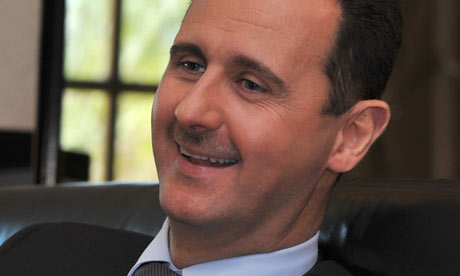
Charlie Rose: I am not the only American who has been here recently.  Senator John Kerry, the chairman of the Senate foreign relations committee was here on Saturday and recently as well.  Is something happening in the relationship between Syria and the United States?

Bashar al-Assad: When President Obama came to power, there’s some improvement, at least in the atmosphere.  Obviously there are a lot of concrete things happening, moving forward slowly, but the main interest of this administration now and of Senator Kerry is about how can we re-launch the peace process?  President Obama is interested in the peace process in general, but the talk with Senator Kerry was about the Syrian track.  And I think the main — the crux of the problems in this region is the lack of peace.

Charlie Rose: It is also said that he came here, in a sense, as an emissary of the president. What is it you want to say to the president of the United States about your view of the region, your own strategic sense of what’s possible?

Bashar al-Assad: If I’m going to talk about the region — and you know this region is the heart of the world geographically, politically — you have to talk about the role of a great power, and first of all, the United States. I think the main issue in this region is the occupation, or when you talk about conflict, you have to go to the reason. The reason we have that we have occupied land. At the same time you have Security Council resolutions that mention very clearly the need of Israel to withdraw from these lands. This is the way peace is taught. I think, if I’m going to talk to him, I’ll explain to him all the details in our region, but I will urge him to move faster in order to reach peace in the region.

Charlie Rose: But you have said in an interview recently with Italia newspaper that you have a strategic vision.  But it seems that America is engaged in a trial and error.  What did you mean?

Bashar al-Assad: We are wondering about what strategy the United States has towards the different conflicts, whether Iraq, Afghanistan, peace process, and any other main conflict.  I’m talking about different administrations, not only this administration.  The question we ask to many officials is, “What’s your strategy?”  They only put the title of stability.  Stability is the final — it is the goal of all of — the final stage or the final angle solving all the other problems.  So, the United States administrations have been failing, failing, and failing in solving the problems.  Why?  And this is related to what I said that the region has changed.  They have to adopt a different approach to our region.  They cannot adopt the same approach.

Charlie Rose: With respect to U.S.-Syria, what would you like to see the United States do?

Bashar al-Assad: In the peace process?

Charlie Rose: In the relationship with Syria.

Bashar al-Assad: You cannot separate the two things because if they want to play the role of the arbiter, they cannot play that role while they are sided with the Israelis.  They have to be an impartial arbiter.   They’re not, and they were never impartial arbiters since the beginning of the peace process.   They have to gain the trust of the different players.  If you don’t have good relations with Syria, how can Syria depend on you as an arbiter?  So, you have to improve the relations.  So, I told the American offshoot that we have to start from improving relations.  If you talk about putting Syria on the terrorism act — terrorism list, they have the Syrian Accountability Act in the Congress.

Charlie Rose: Which they just reconfirmed.

Bashar al-Assad: Exactly.

Charlie Rose: With some modification.

Bashar al-Assad: There was the veto of Syria joining the WTO, but it was lifted, so that’s why I said — there are some improvements , but there are still very, very — we have a long way to go in that regard.  So, I would like the United States to be fair and to be unbiased in order to achieve —

Charlie Rose: Senator Kerry — has said that Syria is a high priority for this administration.  Have they convinced you of that?

Bashar al-Assad: Well, we’re waiting for the results.  Without the results — I trust Senator Kerry to start with.  I talked with Senator Kerry, and I think he’s genuine, and I met him five times.  Not the first meeting or the second meeting.  I met him five times under very difficult circumstances, so what he said — he said what he meant — what he means.  But, at the end, he’s not the one who’s going to implement.  You have the administration and you have the Congress; anyone could put obstacles.  So, I think we are looking for the results.  Today, I’m convinced about what he said, but I’m convinced that President Obama wants to do something positive in that regard, but I’m not confident that the institution will allow President Obama to do what he wants to do with Syria and in other subjects and issues.

Charlie Rose: You seem to be saying that President Obama has the right ideas, but you’re not sure that he can act on them.

Bashar al-Assad: Not because he cannot but because you have institutions in the United States, you have your political system.  It’s not only the president.  If it’s only the president, we could blame the president.  We say that he didn’t do what he had to do.  But you have the institutions and you have the Congress, so it’s not only the ambassador to Syria.  He was about to come, but the Congress, the Republican in the Congress, opposed it recently, so the president has to stop.  So, that’s why I said it’s not that the president doesn’t want to or he cannot do something.  It’s about the whole political system that you have in the United States, and you know more than me about it.

Charlie Rose: But you consider it an act of respect for Syria that they confirm a Syrian ambassador from the United States.

Bashar al-Assad: Yeah, but the ambassador is to help your country, not to help my country; I have my ambassadors do that.   So, this is not to help the Syrians.  This is help to the United States.  They have ambassadors anywhere in the world.  I’m saying that this is something to deliver to Syria, but I’m just giving an example about a step he wanted to take to improve the relation but somebody opposed it because of the political system that you have.

Charlie Rose: How do you see Syria, Turkey, Iraq, Iran, the northern tier in —

Bashar al-Assad: The northern tier of Iran and Iraq.  Normally you should have good relations with your neighbors, something we’ve learned from our experience in the last decades.  We’ve been in conflict, Syria and Turkey, Iraq and Turkey, and other countries.  What did we get?  Nothing.  We’ve been losing for decades.  We have learned here in the last decade that we have to turn the tide, so everybody is going for good relations with the other, even if it doesn’t have the same vision or they — even if they disagree about most of the things, not some things.  So, this relation, Syria/Iraq, we are neighbors.  Syria/Turkey, we are neighbors.  We’ll affect each other directly.  Iran is not my neighbor, but at the end, Iran is one of the big countries in the Middle East, and it’s an important country, and it plays a role and affects different issues in the region.  So, if you want to play a role and help yourself and save your interests, you should have good relations with all these influential countries.  That’s why this relation, I think, is very normal.

Charlie Rose: There are those in America that would like to believe America can do something that will put some distance between you and Iran, that they can make you less close.

Bashar al-Assad: They contradict themselves.  They talk about stability in the region.  Stability starts with good relations.  You cannot have stability and have bad relations.  This is — second, what is the argument? Why do they need to have Syria be away from Iran?  They have conflict Iran so what does it mean to put Syria away from Iran?  Sometime they talk about the relation between Syrian and Iranian relation and the peace.  That’s not true.  That’s not realistic because Iran supported our efforts to achieve, to get back our land through the peace negotiations in 2008 when we had indirect negotiations in Turkey.

Charlie Rose: Let me underline that.  You believe that Iran, even though it says that it does not recognize Israel’s right to exist, when you, through Turkey, were trying to negotiate with the Israelis, the Iranians were supportive of that.

Bashar al-Assad: Exactly.

Charlie Rose: And so you’re saying actions speak louder than words.

Bashar al-Assad: Exactly.  That’s what I mean.  I feel that they said it inwards, they say publicly we support you.  They said it twice during negotiations informally.  So you cannot see with one eye.

Charlie Rose: Yes.

Bashar al-Assad: So that’s what’s happening.  They see only want to, they hear only what they want to.  They ignore the other stand, the same government.

Charlie Rose: Do you think America misunderstands Iran?

Bashar al-Assad: They misunderstand the region definitely.  And that’s sometimes normal because it’s different culture very far from me.  But after the 11th of September, at least after the 11th of September, we should learn what’s happening behind the ocean.  It’s not about what you think.   It’s about what we think.  You have to understand the society, the culture in this region and in the rest of the world, but this region because it’s complicated more than before.

Charlie Rose: What is it we don’t understand, those in Washington, about the region, about the culture, about Syria’s role, about Iran?

Bashar al-Assad: They don’t understand that we want peace.  But if you want peace, doesn’t mean to — if you want to sign a peace treaty doesn’t mean that we accept to sign capitulation agreement.  That’s what they don’t understand, the difference between capitulation agreement.  That’s how I’m talking about the perception in our region, how we see it, and peace treaty.  Peace treaty means having all your rights.  This is the second about Iran very clear issue, nuclear issue.  It’s about Iran having the right to have peaceful nuclear reactor.  You cannot deal with Iran through the Security Council through threats and the evidence that they didn’t understand is the recent agreement between Turkey, Brazil and Iran.  And I told the official that I met recently from Europe after that agreement that this is going to be the proof that they didn’t understand this region because Turkey and Brazil succeeded in getting what the world has been asking for during the last year in a few weeks because they understand this region and they adopted different approach which is direct, not strict, not imposing.

Charlie Rose: Their interpretation of what happened between Iran and Turkey and Iran and Brazil is that it’s just another effort by Iran to delay sanctions —

Bashar al-Assad: We disagree.

Charlie Rose: — so they can get on with building nuclear capacity.

Bashar al-Assad: You mean about the 1,200 kilogram?

Charlie Rose: Yeah.

Bashar al-Assad: The whole part agreement.  Actually —

Charlie Rose: This agreement was intended to delay sanctions and nothing more.

Bashar al-Assad: Iran didn’t talk about sending or making agreement, sending uranium abroad.  The five countries as one asked for this and so that’s what Iran did.  You can keep saying whatever they do, whatever Iran does, you have suspicion about Iran but the international relation is about, it’s not about trusting, it’s about mechanism.  You have mechanism and this mechanism is in the agency, IAEA agency, and you have the NPT treaty, Non-Proliferation Treaty.

Charlie Rose: Right.

Bashar al-Assad: That’s what you can depend, not the trust.  You do not have to trust.  Trust is something personal. But if you talk about relation, international relation, it’s about mechanism and you have the mechanism.  So whether it trusts Iran or doesn’t trust Iran, it’s not the issue.

Charlie Rose: But it is the issue that if Iran had nuclear ability or a nuclear weapon, it would destabilize the region.

Bashar al-Assad: That’s why we need the mechanism of the EAIA.  Their role is to make sure that this is civil, not military program.

Charlie Rose: But they say that the Iranians have misled them.  The IAEA says Iran has misled us and did not give us the information we needed.

Bashar al-Assad: That happened when they moved the file from the EAIA to the Security Council.  But before that, at the very beginning of the issue, remember, there was camera, cameras by the EAIA was set up inside nuclear reactors.  So when the problem started politically because of Bush’s intentions, bad intention toward Iran, this is where the problem started.  Now I think they have to do two things to take it away from the Security Council because if you treat Iran — if you take any action against Iran, there will be no solution.  I think it’s going to be more —

Charlie Rose: The Security Council imposes sanctions, you think what?

Bashar al-Assad: Iran said publicly a few days ago that if they don’t accept this agreement and they go to the Security Council, they will withdraw from the agreement.  And if they withdraw from the agreement, this means the problem will be more complicated, and that there means there will be no solution.

Charlie Rose: So therefore we should be supportive, not engage in sanctions from the UN Security Council.

Bashar al-Assad: Of course.

Charlie Rose: Do you believe Iran wants nuclear weapons?

Bashar al-Assad: No, I don’t.  No.

Charlie Rose: Why not?

Bashar al-Assad: Because what do you do when you have nuclear bomb?  Can you use it?  You cannot.  Is it deterrent?  No, it’s not.

Charlie Rose: Is that what they said to you?

Bashar al-Assad: Yeah, definitely.

Charlie Rose: President Ahmadinejad says to you, the president of Syria, “I do not want nuclear weapons”?

Bashar al-Assad: Every official in Iran said that.

Charlie Rose: And you believe them.

Bashar al-Assad: Of course I believe, because would they do with it?  They cannot leave.  I mean, what they aim to have it.

Charlie Rose: Then why are they engaged in sort of — in the appearance of some, the IAEA, deception?  And they discover these centrifuges inside mountains that they didn’t know about.

Bashar al-Assad: It’s not deception.  That’s how you define it in the West.  Actually, the five plus one country weren’t — they didn’t come, didn’t come to Iran with good intention.  They started with saying you have to stop your program.  I have the right to have secret program.  Why to stop it?  You say you are suspicious, doesn’t matter if you’re suspicious or not, what the mechanism.  You should adopt the EAIA.  They started making political pressure.  And this is where it started — the problem started, not because Iran started to deceive.  If they wanted to deceive, they wouldn’t have allowed them to have cameras inside the reactor.

Charlie Rose: But you do believe that if Iran had a nuclear weapon, it would destabilize the region.

Bashar al-Assad: We are against any nuclear weapons in the region.  We have Syrian draft in the Security Council since 2003, about freeing the Middle East from any WMDs, of course, including Israel.  But we cannot talk about Iran destabilizing the region if they have — if you presume they’re going to have nuclear bomb, something I don’t believe in.  Why ignoring Israel?  Israel started this problem — Israel is the only country who has nuclear bomb in the region, not Iran.

Charlie Rose: If Israel has nuclear weapons, everybody else has not rushed in to have nuclear weapons in the region.

Bashar al-Assad: I don’t know.  I mean, when you have — actually, you have reaction.  But in Syria, we don’t believe that you should have nuclear weapons in order to deter Israel because I don’t think it’s easy for anyone to say that I’m going to use nuclear weapons.

Charlie Rose: If the United States says to you, we do not approve of your support of Hamas and especially Hezbollah, and we want you to reduce that level of support, what do you say?

Bashar al-Assad: Well, the argument, they only want.  Doesn’t matter if they want, what the reason.  How can they convince me that I should decree the support?  First of all, our support is political because Hamas is a Palestinian organization.  The Palestinians have occupied land.  They have the right to have their own state.  They don’t have.  They have the right to have their own land back after ’67, something they haven’t had yet.  The same for Hezbollah.  The Israeli airplanes are violating the air space of Lebanon on daily basis every few hours, not every day, every few hours.  So they have the right to defend their country.  Back my answer because they asked me that question many times, that instead of adopting this cherry picking approach, once you talk about Hamas, once you talk about Hezbollah, why do you have the room — the elephant in the room.  So let’s talk about the peace.  This elephant is the occupation and the Israeli aggression.  When you don’t have Israeli aggression, when you don’t have occupation, forget about all these problems.  It will be solved ultimately.

Charlie Rose:

But are you saying that if in fact there was an agreement teen the Palestinians, if they were unified, and there was an agreement, that you would be less supportive of Hezbollah and Hamas.

Bashar al-Assad: We support cause, what the cause, the cause that they have occupied land.  If they don’t have occupied land, what is support?  I don’t have anything to support.  They have their own right.  I support somebody who has the right, but it doesn’t — I mean he has a right, but they don’t give it back to him.  So that’s what we support.  We support their cause.  When they have states, maybe they have another cause.  At that time, we’ll talk about something different.  But today, we support their right to have their own independent state.

Charlie Rose: But you were saying you support Hezbollah and Hamas at the level you do because there is no Israeli-Palestinian agreement.

Bashar al-Assad: Israel should have stopped violating the air space, should stop launching aggression from time to time against Lebanon or against Syria.  That’s their right.  That’s what we support.

Charlie Rose: The United States, it is said that Senator Kerry believes that you and Syria have supplied scud missiles to Hezbollah.

Bashar al-Assad: This is very good story, anecdotal story by Israeli.  They are very good in making —

Charlie Rose: The story came from the Israelis.

Bashar al-Assad: From the Israelis, yeah.

Charlie Rose: And is it true?

Bashar al-Assad: We told them, what evidence do you have?  If you want to say that you have smuggled — because they’ve been repeating this story from time to time, for years, not for a month.  And everyone we say, you are scanning the borders between Syria and Lebanon every hour for 24 hours.  And you cannot catch any big, big missile, scud or any other one, this is not realistic.  This is Israeli allegations.  These are for pretenses, national statement.  That’s what you can call it, Israeli.

Charlie Rose: But my impression is that Senator Kerry came here on Saturday to say the United States believes this to be true, and the United States believes, according to its own intelligence source that’s weapons have gone.  New scud missiles have gone to Hezbollah from you.

Bashar al-Assad: We can only talk about this and discuss it with them when they came to us with the evidence.  Why to base your debate on rumors.  U.S. took the time.  So say do you have evidence, or you only heard?  Well, if it’s you only heard, we don’t have to waste our time.  You have evidence, you say it to your intelligence, you say the Israeli intelligence, bring these evidences, bring me the pictures, bring me all the information to discuss.  Why, if you’re telling me that we believe this is your problem if you believe.  I don’t have to waste my time with what you believe or not.  We’re not reality.  Hezbollah is a strong organization.  It’s not weak at all.  They have missiles — everybody knows —

Charlie Rose: In fact, they have said that their missiles, they have better and more advanced missiles than they’ve had before.

Bashar al-Assad: How did they know?  When Israel attacked Lebanon in 2006, they didn’t know about the bunkers that they have in the south of Lebanon just few kilometers away from the Israeli forces.  How could they know about the advancement that they have?  These are rumors.  They are afraid and worried about what Hezbollah is doing.  Hezbollah, like any other organization, it’s a war.  When you have a war, everybody will make his position better and stronger.  That’s normal.  But I have politician.  We don’t waste our time with condemning or blaming or saying that Hezbollah having this and having that.  This is reality.  You have this reality; you have to deal with it.  How do deal with it, go toward the peace.  That’s the solution, not waste the time talking about what kind of missile and how many missiles.  This is just waste of time.  Realistically, solve the problem through the peace process.  That’s why we are talking about peace and we are working for peace in order for all these problems.  And Israel should know only peace can protect Israel, not creating this propaganda and making up false stories or divisive stories.

Charlie Rose: May I just make sure that I understand this?  If Senator Kerry suggested that he believes and the United States believes that you were supplying weapons to Hezbollah, new scud missiles, you are saying, “Absolutely not. We are not doing that.”

Bashar al-Assad: I said no, but at the same time I told him we waste our time with this.  When you have evidence, come to us.  If they have evidence, we can discuss that, but we don’t discuss it.

Charlie Rose: Do you think it would be the wrong thing to do, that it would be destabilizing to do that, supply weapons to Hezbollah?

Bashar al-Assad: I think what is destabilizing is the Israeli aggression on our region.  They attacked Syria many times; they attacked Lebanon.  They’ve been attacking the Israeli — sorry, the Palestinians on a daily basis.  That’s what destabilized the region. They don’t withdraw from the occupied land; that’s what destabilizing the region, not Hezbollah and any other organization that defends themselves.

Charlie Rose: If the United States comes to you and says, “We want to do things in the region. We want to be a positive force, and we’re prepared to do this.  We’re prepared to encourage it and we’ll do this,” and we ask you to stop being so supportive of Hezbollah and Hamas, because we believe that they’re engaged in certain terrorist activities; we ask you to stop supporting them.  You are saying that’s not going to happen.

Bashar al-Assad: It’s like if you talk about a chapter in a book. You tell me to read that chapter. I have to read the whole book to understand this chapter. So, in the meantime until peace, I would say of course we’ll be ready to — we would like to see this region free of armament, free of conflict, free of everything, but that will not happen only through talking about one factor while you have the main important factor, which is the occupation, is in place.  So we have to solve it as a package, and this package should be peace.  There’s no other way.  It’s just a waste of time, so we have to go in this way, through the peace.

Charlie Rose: There is this whole sense of Syria and its identification and its relationship to the aforementioned Iran Hezbollah/Hamas, that it is — it’s part of this resistance that gives Syria power and legitimacy.

Bashar al-Assad: You can have this legitimacy as long as you adhere to your rights and to your principles. That’s the political legitimacy you can have.  While supporting the resistance, they have the perfect support anyway, whether we support it as a government or not.  They have the support of the public in this region.  That’s why they are strong, not by the government.

Charlie Rose: Some find it interesting that your allies are Islamist, in one case of theocracy, and yet Syria is a secular state.

Bashar al-Assad: That’s true.  And that’s what they don’t understand.  This is one of the things that they don’t understand in the West, especially in the United States, because if I support you, it doesn’t mean I’m like you or I agree with you.  That means I believe in your cause.  There’s a difference.  Maybe if we don’t have this cause, we have different debate with them or different relations.  While now they have a cause and support the cause, we don’t support organization.  We support the Palestinian cause, and Hamas is working for that cause, and the same for Hezbollah.  Hezbollah is working for the Lebanese cause, so we support that cause, not Hezbollah, but Hezbollah is one of the means.  So, that’s what they have to understand in the West.

Charlie Rose: Speaking of Lebanon and Hezbollah, the withdrawal of Syrian troops, tell me how you felt about that.

Bashar al-Assad: At that time, of course, it wasn’t, let’s say, positive feelings. I’ll put it in that word, because of the reaction in Lebanon after the Hariri assassination and they accused Syria. Today that Syria is different. We were very cooperative with the different delegation that came for the investigation of the Hariri assassination, and it was proven today that there’s nothing to do with Syria. And that changed —

Charlie Rose: The investigation is not over, or it has not been —

Bashar al-Assad: No, no, not over, but from the very beginning we were very sure about — but now the [unintelligible] people know this reality, that Syria has nothing to do with this assassination.  I’ve believe Syria’s influence in Lebanon has always been strong because of the geo-political position, not because of the army.  The army in Lebanon didn’t do anything, wasn’t involved in politics.  Few politicians, few officers and civilians to be involved.  The Syrian influence and the Syrian clout feels as strong as it was so we don’t have problem.  We don’t look at it as it undermined Syria.

Charlie Rose: So you do not feel like you need to reintroduce Syrian troops to Lebanon?

Bashar al-Assad: No, no.  Well, actually we had been withdrawing our troops before the conflict, since 2000.

Charlie Rose: So no Syrian troops in Lebanon.

Bashar al-Assad: We withdrew 63 percent of our troops before the conflict started in Lebanon.  That was our intention.

Charlie Rose: Mr. Harari the prime minister has been here a number of times.

Bashar al-Assad: Yeah.

Charlie Rose: You have a very good relationship.  You’ve exchanged ambassadors.

Bashar al-Assad: Yeah.

Charlie Rose: What do you say to him about his father when he comes?

Bashar al-Assad: The first meeting I told him we have to be as frank as you can even if you think that we were behind the assassination.  That’s it.  But we didn’t talk about the issue.  That was —

Charlie Rose: You basically said you’ve got to be frank and tell me what you think even if you think that Syria was behind it.

Bashar al-Assad: Yes, exactly.  If you want to build the relation you have to be fully frank with each other.

Charlie Rose: The relationship with Turkey is very good.  Turkey was serving as an intermediary between negotiations between you and the Israelis.

Bashar al-Assad: Yeah.

Charlie Rose: It came that close in which you would get back the Golan Heights, yes?

Bashar al-Assad: This is very important.  What we have now as reference is mainly the United Nations or Security Council resolution.  It’s very important reference but it’s not defined.  It talks about the land occupied in ’67 but how can you define this land?  Israel talking about a different line, how can you define this line, I mean?  We wanted in that inquisition to define the line through one point and Israel wanted to define its security requirements.  So if we define these two things and we move to the direct negotiation, whenever you have arbiter this arbiter can play its role only through this paper, not like what happened in the ‘90’s when some politicians, some of them with a good will spoiled the process with good will but with enthusiasm but less with a lack of knowledge.  And others, self-serving politicians, spoiled it for their own interests.  Now we had this paper, anyone who wants to play a role, any mediator, any official, any arbiter, should play it through this paper and this is where we can succeed, not to have 19 wasteful years.

Charlie Rose: You’re prepared to start those negotiations over.

Bashar al-Assad: Of course we are ready.  We don’t think it’s time for peace.  It’s always time for peace.  We don’t say it’s now time or it’s not time for peace.  It’s always time for peace.

Charlie Rose: You broke the negotiations off because of the Gaza invasion.

Bashar al-Assad: Syria and Turkey — because Olmert deceived Prime Minister Erdogan four days before the invasion.  Prime Minister Erdogan called me on the phone and Olmert was in the other room having dinner and we started talking about the final deals of that paper.  And after one hour or actually more than one hour of discussion with Prime Minister Erdogan and even discussions with Olmert, he told me, Prime Minister Olmert told Erdogan that I’m going back to Israel and I will let you know about my final answer in a few days.  And the answer was attacking Gaza.  That’s where the Turks felt deceived and we felt the same.

Charlie Rose: But you’re prepared to start over?

Bashar al-Assad: Of course.

Charlie Rose: Through Turkey.

Bashar al-Assad: Through Turkey.

Charlie Rose: And is the goal a Syrian-Israeli agreement?  Or have you now said it has to be a larger agreement for the Middle East?

Bashar al-Assad: It has to be comprehensive.  The Syrian-Israeli agreement could be important step, but it’s not the final step because there is big difference between talking about peace treaty and peace.  Peace treaty is like a permanent ceasefire.  It’s not comprehensive.  There’s no maybe you have embassy, but you actually won’t have the trade.  You won’t have normal relations because people will not be sympathetic to this relation as long as they are sympathetic with the Palestinians: half a million who live in Syria and half a million in Lebanon and another few millions in other Arab countries.  So comprehensive peace on the Syrian-Lebanese and Palestinian tribe this is going to be the real peace where you have normal relations.  This is where we can bury the hatchet, not only to have peace treaty.  So that’s how we see it.

Charlie Rose: Do you think it will happen soon?

Bashar al-Assad: From our point of view, it could happen soon if you have another partner because this is about — actually the peace process about two parties.  And if you ask me, I will say yes.  If you have partner, it will happen soon. But today, we don’t have this partner so far.  At this moment, we don’t have a partner.

Charlie Rose: You don’t think Prime Minister Netanyahu wants to make a deal.

Bashar al-Assad: Again, it’s not about him.  It’s about the whole government.  Can he lead the government toward peace?  Is he strong enough to lead this government toward peace?  Because you know, it’s a coalition now.  It’s coalition.  You do not have — he doesn’t have the majority to say I’m going in that direction.  So in reality, nothing is happening yet.  So why do we waste the time expecting.  He’s been for now in his position for a year and nearly a year and a half, something like this.  And he couldn’t do anything in peace.  So I don’t know if you have the will or he has the power.  We don’t know.

Charlie Rose: On the other side of the Palestinians, and they are not unified.

Bashar al-Assad: Yeah.

Charlie Rose: There’s Fatah, Hamas.  Can they be unified?

Bashar al-Assad: Of course they can.  If you help them, they can be unified.  And they have to be unified.  Without unification in the Palestinian really you cannot have peace.  You need this unification.  It’s not about who is going to sign the treaty.  At the end if you want to implement the treaty, you need unification.  You need unified policy.

Charlie Rose: And what do you think the possibilities are that Hamas, if there is unification, will support, will support a recognition of Israel and an agreement between the Palestinians so that they will no longer say we refuse the right of Israel to exist.

Bashar al-Assad: And they said that in very clear way when they talked about two-state solution, Hamas.

Charlie Rose: So Hamas is —

Bashar al-Assad: And they —

Charlie Rose: But are they prepared to renounce their charter?

Bashar al-Assad: I wouldn’t answer on their behalf.  But what I know publicly now that they talked about the two-state solution, and they talked about the line of ’67.  What do you conclude?  We can conclude that they are ready.  But how, is that the question.  Maybe in different ways than what the authority is it doing today.  Maybe they have their own way.

Charlie Rose: Do you believe Israel wants peace?

Bashar al-Assad: I think people who elect such extremist government, they don’t want peace.  But as in politics, I will say let me see what’s going to happen in reality.  I don’t believe, but that doesn’t mean we have to stop working for peace.  If I don’t believe that they want peace, we have to help them believe in peace.  They have to learn that only peace can protect their country.

Charlie Rose: What is the biggest thing that’s necessary to make a breakthrough in your judgment?

Bashar al-Assad: You should ask yourself what happened first.  Occupation, occupation happened first before the aggression, not vice versa.  After — in ’48, after ’48, ’67, in different stages.  So definitely, the one who occupied the land should withdraw because my land is like my property.  And if you have a thief who takes your property, you don’t make compromise.  You tell him first give me back my property, my things.  Then we can discuss any compromise.  You are don’t discuss the compromise with the thief before having your things returned.  So that’s how we see it.  So the beginning is to end the occupation.  Then you will have [unintelligible] technically.

Charlie Rose: But in the conversations, everything should be on the table, and there should be no preconditions at all.

Bashar al-Assad: We don’t have any conditions.  There is only one condition which is international condition, which is the Security Council resolution on which the whole peace process based in 1991.  So we don’t have any condition, but we have rights.  And rights we don’t discuss.  It will go back.

Charlie Rose: Do you believe this region is going to a place where it does not need to look for solutions from the West?

Bashar al-Assad: In the past, we used to think that everything will happen in the West and to be implemented here.  Then you will have the solution ready.  And you won’t have any conflict.  This is really delusional.  Actually the reality is that you have to do your own job.  But you need the support from the West.  But if you don’t have the support, we don’t wait for the West.  We are going to go.  This is our problem.  We are going to go forward to solve our own, but we are not going to wait for the West.  But if they support us, that will make the solution better and faster.

Charlie Rose: Is that what you’re saying to Senator Kerry, we cannot wait for you to get involved?  We have to move on our own to try to figure out a way to find —

Bashar al-Assad: I don’t remember if I talked about this with Senator Kerry.  But I said it everywhere.  Whenever we talk about this, this is our position.  We said it very clearly that we don’t want.

Charlie Rose: Let me focus again on the dynamic of this region. There is Egypt, which has traditionally had the largest army and the most powerful force. There’s Iran, which has emerged as a regional power after 1979. There is now Syria and Turkey having a very interesting relationship. Some say Syria’s moving more to the East. How do you see the new forces shaping the region?

Bashar al-Assad: The criteria has changed in the positive. They used to say Egypt is a big country, Syria is a small country, but it’s playing a role which is bigger than your size. Of course —

[speaking simultaneously]

Charlie Rose: — beyond its weight.

Bashar al-Assad: Yeah, exactly. Qatar is a very small country. Nobody put it on the political map for inclusion. Actually the criteria has changed. Now we have the will, the vision, and the geopolitical position. We have these three.  Qatar has will and has vision. Turkey has the three criteria, the geopolitical position, big country, strong economy, will and vision. It was a strong and it was big 10 years ago, but they didn’t have the will and same vision, so it didn’t play that role, Turkey. So, the criteria have changed. Today you have Iran, you have Turkey, you have Syria, and you have Qatar.    If you want to talk about cooperation, for example, regarding the peace, we had a meeting in Istanbul, me and Erdogan and the prince of Qatar, and it was about the peace, because Turkey and Qatar are partners with Syria in the peace issue. So you have a different map regarding different issues. We had a meeting with Iran regarding defending our rights regarding the Israeli aggression, regarding the issue in Iraq. Regarding Iraq, there’s cooperation between Syria, Turkey, and Iran. So you have different [unintelligible]. But all of them in the same region, so this is the new dynamic that we have that depends on every subject.

Charlie Rose: And Russia, where does Russia fit in?

Bashar al-Assad: I cannot tell now because this is the first visit by any president, Soviet or Russian, to Syria during the last 66 years, since the start of the Revolution with Russia.  It seems to me that Russia is working to regain its own position but in different way, not like the Cold War during the ‘60’s, ‘70’s and ‘80’s.  I think in a new way through having new allies, good relations, strong relations.  After he left Syria, he went to Turkey.  He signed the [unintelligible] treaty to open the borders between the two countries.  Now if you want to look at the space from our perspective, Syria-Turkey, then Turkey-Russia so the relations, strong relations between Russia and Turkey will influence, directly and indirectly, the relation between Syria and Russia in parallel with the direct relation between Syria and Russia.  So this is your graphic space.  You have to look at it as a map that will affect each other.  What about — the effect of these Russian relations recently is too early to judge.  I don’t know yet.  Economically it will definitely affect the region very soon and the economy will affect the politics.  How much?  This is something we will have to wait to see.  But it will tell you about a new map being created and forged in this region.  As you call it, a new dynamic.

Charlie Rose: The United States has always believed that Syria did not do enough to prevent foreigners from coming through your border with Iraq and that it was a huge issue for them.

Bashar al-Assad: The borders are not envelopes to be sealed.  You can control, you can monitor something like this so they’re not realistic.  This is the second time they’ve mentioned Syria smuggling or helping terrorists to be smuggled inside Iraq.  It’s like shooting yourself in the foot because when you help the terrorists in Iraq, they will attack you from in Syria.

Charlie Rose: Exactly.

Bashar al-Assad: It’s known that Syria was the first country, maybe in the world, before all the Arab and Middle Eastern countries and before Europe definitely and before the United States that started fighting with the terrorists and the extremists in the ‘70’s.  Actually that started before, in the ‘50’s, but it wasn’t, I mean, the main conflict and when we defeated them was in the ‘70’s and early ‘80’s.  And so we’re not that stupid to go and support terrorists anywhere in the world because terrorists work like the Internet.  You cannot control them.  They don’t recognize borders.  If you have terrorists in Iraq, it’s like having them in Syria.  If you have them in Lebanon or in Turkey or in Jordan, it’s like having them in Syria.  So it cannot.  This is not realistic.  Second, I think terrorists — I mean third.  Helping terrorists in Iraq means helping the chaos.  And chaos is contagious.  When you have chaos in Iraq means you are going to have chaos in Syria.  It’s going to become more violent, more sectarian, division later.  And this division is going to be like going — will affect the region from Morocco in the West to Indonesia in the East.

Charlie Rose: So if I would talk to the Americans today, they would say to me there were many things that could you have done that you didn’t do.  Yes, you can’t close your border, but you allowed too many —

Bashar al-Assad: Let me give you the other example.  In 2004, or maybe ‘5, I’m not sure, a delegation, big delegation, from the Pentagon from the State Department, from the army and the intelligence came to Syria to ask for cooperation.  And we told them, send us delegation to see what kind of cooperation we can have on the borders, the same delegation, that delegation left Syria, and they didn’t come back again.  We have the same issue recently in the autumn, last autumn.

Charlie Rose: Yes.

Bashar al-Assad: When they asked for cooperation and I said we are ready to have cooperation to control or to monitor the border in Iraq, until today, we haven’t received delegation.  And I think — did I say Senator Kerry about, and I told Senator Kerry about this.

Charlie Rose: What did he say?

Bashar al-Assad: He cannot answer because he had to go back to see what’s happening.  So that’s not true that we are not ready.  We would like to have this monitoring.  But monitoring the border needs two sides, need the Syrians and the Iraqi side.  And the prime minister of Iraq came to Syria, and he asked me for this cooperation.  Said we are ready to start, try to do it –Syria and Iraq, including the United States.  But if you go to the border, and if you look at the Iraqi side, you won’t see any soldier, any police, anybody.  It’s empty.  So if they want to control the border, they have to do their job with the Americans or Iraqis.

Charlie Rose: Do you think that the American withdrawal from Iraq will go well and on time?

Bashar al-Assad: This is not our debate.  This is wrong debate that has been circulating in the media during the last two years, especially in the United States, whether to leave or not to leave.  Actually the question is how to leave, how to leave with the political process.  The answer will be through what political process are you going to launch and support in Iraq?  Then when you leave, it’s going to be better.  The situation will be better at that time.  You can be committed.  Now, any time — of course we support the idea and the principle that the United States should leave Iraq.  But that doesn’t mean we make it better or worse.  It’s worse.  It’s going to be bad if you leave.  So what we are worried about, if the United States is going to support or launch a good political process where they can reconcile all the Iraqis, then they will have constitutions and the new institutions.  And this is where we’re going to say thank you.

Charlie Rose: But they would like to have your help in doing that.

Bashar al-Assad: We are ready.  We are helping the Iraqis now.  We told the Iraqis already to — for any help.  But there is not a real dialogue between Syria and the United States regarding Iraq.

Charlie Rose: There is no dialogue between Syria —

Bashar al-Assad: Between Syria and the United States regarding Iraq.  They only talk about borders, and they only talk about terrorists, because they deal with the terrorists like playing a game on the computer where you have terrorists, and they have to shoot him.  That’s how they deal with the terrorist issue.  They don’t understand that terrorism fighting means having the atmosphere, the normal situation, fighting the chaos.  You cannot fight the chaos while you have political anarchy.  You should have normal government with the police, with the army, with the normal situation, normal political situation.  This is where you don’t have chaos, this is where terrorists fail.  They cannot do anything.

Charlie Rose: So what is your big challenge today?

Bashar al-Assad: The biggest challenge is how can we keep our society as secular as it is today.

Charlie Rose: As secular.

Bashar al-Assad: Secular — the society, not the government.  It is secular.  You have diversity, very rich diversity in Syria we are proud of.  But at the end, you are part of this region.  You cannot stay unrelated to the conflicts from the conflicts surrounding you.  If you have sectarian Lebanon on our west and sectarian Iraq on our east, and you don’t have the peace process solved on our southern border, and you have the terrorists dominating the region, and let’s say growing with leaps and bounds, you will be affected some day.  You will be — you will pay the price.  So it’s not about being passive and saying I’m going to protect myself.  How can you be active and expand what you have to the other?  So the challenge is the extremism in this region.

Charlie Rose: But the extremism some people believe — those people who are never secular, who in fact find in religion a cause.

Bashar al-Assad: They always use religions to assume — to assume the mantle of religions or Islam, whatever, in order to have followers.  They only assume it.  I don’t think they are convinced about what they are doing.  Some of them, they are ignorant.  They believe it.  They think they are helping the religion this way.  But at the end, it’s not about those, about — it’s about the others.  How can they influence because, I mean, you always have extremists in everything.  In politics, in religions, in Christianity, in Islam, in Judaism, in every religion, you have extremism.  But it’s about how much can they influence the society.  As long as we have open-minded people, you don’t worry about them, they are going to be isolated.  So I’m not worried about what meant to be the few to convince the other, only about how much the other can protect himself from them.

Charlie Rose: But as I listen to you say that, it seems an incongruity between saying that and looking at who you have great relations with and who you support in the region.

Bashar al-Assad: That’s why I say it’s not about who is like you and who is not.  It’s about the cause.  They have cause they have to support.  And this is the second — there’s not extremist if you —

Charlie Rose: Hezbollah is not extremist?

Bashar al-Assad: No, it’s not.  They support peace.  If you want peace, they support peace.  They believe in Islam as — to be the government in their country.  This is their freedom of — this is — I mean, they are free to think whatever they want.  But they never try to implement it by force.  This is where you cannot blame a rebel as an extremist.  The extremist wants to force you to go in certain way.  And sometimes they attack you, and sometime they kill you.  This is extremism, not to have your idea, your idea, of course we’re going to have different ideas, different currents, political currents and treaty currents.  That’s normal.  And this is the diversity that we have.  But they are not extremists because they never try to implement by force their doctrine.

Charlie Rose: If Israel would retreat to its ’67 boundaries, would you encourage Iran, Hamas, Hezbollah to recognize their right to exist and reach a full agreement with them?

Bashar al-Assad: If you talk about a treaty, part of the treaty will be this recognition and signing the treating are the governments. And when you talk about the peace, you talk about Syrian track/Lebanese track means Syria and Lebanese governments, and Palestinian track, Palestinian government. When the governments recognize Israel and Israel is committed to the treaty, I think the whole mood, the whole atmosphere on the popular level will change, for everybody will go in that direction.  But the recognition that you’re talking about will come from the government, not from the people.  The people will reflect their recognition by normal relations, by trade, by tourism, as I said, and any other kind of relation.  If Israel is committed, I’m sure the people will be very positive in that action. That takes time. To be realistic, that will not happen overnight. Conflict for 60 years, a treaty is not enough to change it overnight.  It takes time. It needs procedures.  You start building the trust after the treaty, so, how to win the trust, that will take time.  But I’m sure normal relations will be dominating between Israel and neighboring countries. There’s no doubt about this. Whether Hezbollah, Hamas, or any other one.  At the end, they are organizations; they have people, they have grassroots.  The grassroots part of this society will be affected, so of course it will.  And we’ll encourage it. Of course we’ll encourage it, because we always ask for peace.

Charlie Rose: People say, and this is about you over the presidency, you are your father’s son. That today you have emerged as your own person.  Do you feel that?

Bashar al-Assad: In my house, I’m the son of my father, but in this position, from the very first time, I should be the president who has taken the responsibility of everything.  And if I was the son of my father in the way they mean it, I wouldn’t have succeeded in dealing with the very difficult circumstances.  So, I wouldn’t look at myself in either way. I look at myself as somebody who has a responsibility, who did what he’s convinced about, and is convinced that this is for the sake of his people.

Charlie Rose: Do you believe you have consolidated your power so that you can take more risks now?

Bashar al-Assad: No, I didn’t consolidate my power. I have more support by the public. That’s what I have during the last few years.

Charlie Rose: And how do you think you gained that?

Bashar al-Assad: I think because they believe that I work according to a national agenda. That doesn’t mean I was fully right. I’ve made mistakes, I’ve made mistakes. But if you made mistakes according to a good will and based on national agenda, nobody will blame you. They will support you because you are human and you’re going to make mistakes. So, that’s how I, again — because I said everything — every decision we have to take should be 100 percent Syrian; not 90 percent: 100 percent. And that’s what did it. That’s how I gained the support. That doesn’t mean that they agree with me in everything. Support is different from agreeing with. They don’t agree. We agree about different issues, but they support means the trust. Even if you go towards peace when we started negotiations in Turkey, doesn’t mean everybody supported that negotiation. Maybe this time, maybe the wait, maybe the timing; you have different point of view. But at the end, they trusted you that you are going for a good thing, whether you fail or not, but at the end you have good will and they trust you. That’s how you get it.

Charlie Rose: It’s a pleasure to see you in Damascus. Thank you very much, as always.

Bashar al-Assad: Thank you.

Charlie Rose: All right, thank you.

President Assad Interview with La Repubblica Translated in Full

Syrian President Bashar al-Assad, seen here on May 8, has said in an interview with La Repubblica that the United States has lost its influence in the Middle East peace process despite the hopes raised by President Barack Obama

Alix Van Buren interviewed President Assad for La Repubblica, Italy’s premier Newspaper. Here is the full translation in English.

Is a new Cold War looming?

“The Russians never believed the Cold War ended. Neither did we. It only changed shape. It has evolved with time. Russia is reasserting itself. And the Cold War is just a natural reaction to the attempt by America to dominate the world”.

Assad: “Vedo un nuovo Medio Oriente
Siria pronta a trattare sul Golan”
dai nostri inviati ANDREA BONANNI e ALIX VAN BUREN

“We cannot wait any longer,” says Bashar al-Assad, the President of Syria. “President Obama’s America had raised expectations regarding a new Middle East policy. But now, the clock of history is striking a new hour. An agreement between the Middle Eastern powers is redesigning the regional order”. Sitting on a black leather sofa in his presidential study, Bashar al-Assad draws what he defines as the outlines of a new geopolitical scene.

He warns: “This is not a turnabout: we want good relations with Washington. Rather, it is about recognizing reality: the failure by America and Europe in solving the problems of the world, in our region.

“From this failure, there emerge necessarily other alternatives: namely, a new geostrategic map which aligns Syria, Turkey, Iran, and Russia, which are brought together by shared policies, interests, and infrastructure. One strategic region is taking shape which connects the five surrounding seas: the Mediterranean, the Caspian Sea, the Black Sea, the Arab Gulf and the Red Sea. That is to say: the center of the world”, he explains. And adds: “It is not about renouncing peace: if Israel will return the Golan, we cannot say no. But only a comprehensive agreement, which includes the Palestinians, will guarantee real peace. And peace, sooner or later, will come”.

Mister President, are you outlining a new strategic front as an alternative to a West the influence of which you see in decline?

“I draw a lesson from the mistakes of the past. America and Europe had said “We will solve the problems”. And we waited. Now, we don’t believe any longer in the role of other countries. If someone wants to help, welcome. But the solution is up to us. We must move ahead”.

If Israel were ready to sign a treaty with Syria would you accept? Or do you want an agreement expanded to the Arab world?

“That is an excellent question. Many officers in the West do not understand the difference. If Israel is ready to return the Golan, we can not say no to a peace treaty. However, only a comprehensive solution can guarantee true peace. An agreement limited to Syria and Israel will leave the Palestinian issue unresolved. Rather than peace, it will be a truce. With some five million Palestinian refugees scattered around the Arab world, tension will remain strong. There is popular solidarity with the Palestinians. They will keep fighting for their rights”.

Israel asks that you sever your relationship with Iran, in exchange for an agreement. Instead you are talking about new alliances with Tehran. Is that not a contradiction?

“First of all, let me clarify: peace is a matter that concerns only Syria and no one else. This is my land, my issue. Iran has nothing to do do with my negotiations, nor did it ever oppose them. Therefore, why should I distance myself from Tehran as long as it supports peace? Israel is perfectly aware of the conditions of an agreement. That is what they told Moratinos, the Spanish Foreign Minister”.

What did they tell him?

“Not longer than a few days ago, they said literally these words: “We know that peace with Syria will not happen without the return of the Golan, up to the very last centimeter”.

But isn’t it damaging, mister President, to be too uncompromising?

“Let’s put it this way: if someone stole something from you, would you want all of it back, or would you be satisfied by regaining only part of it? We can accept many compromises: on matters of security, on the relationship. But on the land, no: there is no compromising over the land”.

And what about America? Have you given up on hopes of regaining the Golan through an American mediation?

“America, now, has no influence, because it is doing nothing. However, it remains the only great power. If, and when, it will want to be part of the negotiations, it’s role will be decisive in the final stage, when a guarantee by the international community is needed”.

An initial phase of negotiations has already begun through the proximity talks between Israel and the Palestinian Authority, mediated by George Mitchell, the American Special Envoy. Don’t you regard that as an important step forward?

“Everybody knows that those talks will lead to nowhere. The Arabs know it, the Palestinians know it, even the Americans. In Washington, they say it behind closed doors: they do not trust this Israeli government, which can not make peace”.

In the meanwhile, what signals are you receiving from Obama’s White House?

“I would like to draw a distinction between President Obama, who has authority, and the United States as a State. The President has good intentions. The climate between us has definitely improved: the veto was lifted to our access to the World Trade Agreement. Sanctions were partially softened, though they were reconfirmed. Yet there are institutions such as Congress, lobbies, that weigh in our relationship sometimes in a positive way, other times in a negative way. And, in the end, it is results that matter”.

Yet America and Israel accuse you of having provided Scud missiles to Hezbollah, your Lebanese ally. Is it so?

“Of course not, it is not so. Does anyone believe in those accusations? No one, not even the Americans. It is propaganda by Israel, which hasn’t provided the slightest evidence. The point is that Israel has a problem of image. Its image was tarnished these past two years, by its treatment inflicted on Palestinians, by its military offensive and its embargo against Gaza, by its refusal to freeze settlements, or to adhere to American and Arab peace initiatives. The accusations hurled against us are meant to be a distraction to slow down the relations between America and Syria. In the meanwhile, we continue to work for peace. Sooner or later, it will come”.

What makes you so sure about it?

“Listen, it will not happen in the near future. Israel, right now, is not ready for an agreement. It can not do it. The Israeli society has moved too far to the right. It is a process that initiated back in 1967; then, it deepened with the rise to power, simultaneously, of the right in America and Israel: with Bush and Sharon.

Besides, there is the need for a true leader, one capable of leading the society. Not just an employee, whose only interest is to be re-elected every four years”.

Then, what is the reason for your optimism?

“It is because Israel has lost one of its most important deterrents. From the very beginning, it relied on military strength. They always repeated “it doesn’t matter if they don’t like me: It is important that they fear me”. Well, notwithstanding Israel’s military might, the Arabs don’t fear it any longer”.

Mister President, does the picture that you are depicting justify a re-evaluation of your strategic alignment with Washington?

“If you are talking about strategies, the fact is that America follows an empirical approach,  that of “trial and error”. I, instead, have a strategy, and it is led by our interests. My relationship with the United States must be seen through that lens”.

So what does your world look like, as seen through that lens?

“I see an epochal change not limited to the Middle East. Countries such as China and Brazil will no longer wait for America to assign them their roles. In our region, I see what many do not see or want to understand: the rise of new alliances inspired by shared interests; Policies, interests and infrastructures coincide. It is a new map, strengthened also by territorial contiguity. You will find regional and emerging powers [participating]”.

Which powers are you referring to?

“Syria, Iran, Turkey. But also Russia. These are all countries that are linking themselves to one another, even physically, through gas and oil pipelines, railways, roadways, systems for transporting electricity. One large perimeter links five seas: the Mediterranean, the Caspian Sea, the Black Sea, the Arab Gulf and the Red Sea. We are talking about the center of the world. From South to North and from East to West, any one who wants to move has to cross this region. That is why this region has been plagued by wars for thousands of years”.

Are you saying that now one must deal with a triple alliance: Syria, Iran, Turkey?

“Precisely. There must be a good relationship between us as neighbouring countries. That is the lesson we draw from history: what did 80 years of conflicts with Turkey bring us? They led to nothing. Instead, look at the results today. If it weren’t for this new relationship between Syria, Iran and Turkey, what situation would Iraq find itself in? What about the region more generally? It would be much worse than it is today – believe me”.

Yet one of the first moves undertaken by the front that you are describing, namely the diplomacy blitz by Turkey and Brazil regarding the Iranian nuclear program, raised skepticism in America and Europe. How do you explain that?

“I am skeptical about that skepticism. It raises the suspicion that the West is motivated by a different agenda, that it doesn’t want to solve this issue. The region is following these developments with anxiety because the measures that will be imposed on Iran will be imposed on others as well. You see, the future of energy is nuclear, besides the renewable sources. One day, I will have nuclear energy, at least to produce electricity. It is my right, guaranteed by the Non Proliferation Treaty”.

Iran today is regarded as a serious threat by the international community. And the harsh repression of its domestic opposition following last year’s elections hasn’t certainly changed that belief. Don’t you think that the alarm of the West is justified?

“Some accuse me of having struck an alliance with the devil. But it is not so. My alliance is with a country which is important in the region, and that is what matters. It is a neighbour. And one must have good relations with its neighbours, that is, if you want to solve a problem”.

But can one cooperate with a neighbour that denies the very existence of Israel, and keeps advocating its destruction?

“In politics, many things are said. But it is the actions that count. If Iran truly wanted the destruction of Israel, then why did it support our peace negotiations in 2008 with Israel, mediated by Turkey? Actually, the Iranians are more moderate than many want to see”.

What is Russia’s part in all of this? President Medvedev just came to Syria. It was the first visit by a Russian Head of State since the time of the Bolsheviks. Is there further news on the horizon?

“Medvedev’s visit will help you to understand the magnitude of the change. Everyone wants to play a role in this region. Russia too has its interests. If you follow its movements, you will understand the message. After his visit to Damascus, Medvedev went to Turkey, where he signed contracts for billions of dollars, he lifted visa requirements between the two countries. We did the same with Turkey”.

Yet Moscow will also deliver you new weapons, while America is providing Israel with a new anti-missiles system. Is a new Cold War looming?

“The Russians never believed the Cold War ended. Neither did we. It only changed shape. It has evolved with time. Russia is reasserting itself. And the Cold War is just a natural reaction to the attempt by America to dominate the world”.

Did you challenge America in Lebanon? Do you believe you won the Battle for Lebanon?

“The terms that you are using are not my own, nor do they correspond to my way of thinking. Other people talk about challenges and battles, only because Lebanon was divided in two camps: one used to support the United States, and the other one used to support the other option which is against Israel. We can only win if we have good relations with every Lebanese. As you see, it is not a war of influence between Syria and the United States”.

Mister President, you received two visits by the Lebanese Prime Minister Sa’ad al Hariri. Did you discuss with him, in private, about the assassination of his father, the late Prime Minister Rafik al Hariri, of which you are accused?

“I am always a frank person. I told him, “You have to be frank with me, even if you believe that we did it, or that we were involved. Be frank about it”“.

And what was his reply?

“He came as a Prime Minister, and when dealing in his official role as a Prime Minister of Lebanon, the issue is no longer personal. It becomes a national issue. He has to express an official position. He has to wait for evidence (by the Special Tribunal)”.

And what is the verdict that you expect from the Special Tribunal?

“Our cooperation is our best defence, our means to prove that Syria is not involved. I am convinced that we are innocent”.

[End Interview]

See previous interviews with President Assad by Alix Van Buren: March 2005, Dec. 2006, March 2009,

News summary

Syria’s Assad says US has lost Mideast peace influence
AFP, 24 May 2010

The United States has lost its influence in the  Middle East peace process despite the hopes raised by President Barack  Obama, Syrian President Bashar al-Assad said in an interview published  Monday.

Assad was quoted as telling the Italian daily La Repubblica that  Washington “has no influence because they don’t do anything for peace.  But they remain the greatest power.”

“Obama raised hopes but we cannot wait any more,” he said, adding  that a “new era has been born” in the Middle East including an  understanding between its major powers that was reshaping the region.

He pointed to a similar phenomenon throughout the world, with  countries such as China and Brazil refusing to wait for the United  States to “hand out roles”.

Assad said there had been a realisation that the United States and  Europe had failed to resolve the problems of the Middle East, noting  that Russia was trying to rebuild its own role in the region.

On relations with Israel, the Syrian leader said that if Israel was  ready to return the Golan Heights to Syria “we would not be able to say  no to a peace treaty”.

But he added that any deal would have to include a complete solution  of the Palestinian issue and that he thought Israel was “not ready for  an accord at the moment”.

Washington Just Lost the Middle East in a Big Way
Sharmine Narwani Senior Associate, St. Antony’s College, Oxford University
Posted: May 24, 2010 03:21 PM

It’s official. There is no longer any serious “cost” for defying the United States in the global arena. Unable to win wars or deliver diplomatic coups – and struggling to maintain our economic equilibrium – Washington has lost the fundamental tools for global leadership. And no place does this impotence manifest more vividly than the modern Middle East.

Our pointless and protracted wars in Afghanistan and Iraq will be the last time we will launch a major battle in the region. That massive show of flexing brawn over brain burst a global perception bubble about our intentions, capabilities and reason.

This credibility was compromised further with our irrational support of Israel’s attacks on Lebanon and Gaza in 2006 and 2008/9 respectively. And by the double standards employed over Israel’s violations of international law and its illegal nuclear weapons stash – particularly when viewed against the backdrop of our startling rhetoric over Iran’s nuclear program.

But nothing highlights our irrelevance more than two recent developments:

1) The US’s inability today to convene even perfunctory peace talks between Israelis and Palestinians, let alone push through a negotiated solution – and this after 19 years of a “US-sponsored” peace process.

2) The US’s inability to achieve a resolution with Iran over its nuclear program. The only breakthrough in this long-winded effort to tame Iran’s nuclear aspirations was struck by Turkey and Brazil last week.

In short, the US seems incapable of resolving even a traffic dispute in the Middle East. It is Qatar that stepped in to broker a deal between Hezbollah and the Lebanese government in 2008, and is knee deep in negotiating a solution to the conflict in Darfur. Syria helped gain the release of prisoners in Iran and Gaza. And now Turkey and Brazil have cajoled Iran into accepting an agreement that the US, France, England, Germany, Russia and China could not…..

The Iran Nuclear Fiasco
After pushing for the nuclear swap deal with Iran since last October, we did an about turn and scorned the very same “confidence building” measure we had touted while simultaneously accusing Iran of bad intentions and negotiations trickery.

And we openly sneered at the valiant effort of two important UN Security Council member states – one a NATO-member and the other the largest economy in our Latin American backyard – to troubleshoot on behalf of the global community. The very next day, we childishly chose to undermine this important breakthrough by announcing an agreement on UN Security Council draft sanctions against Iran.

The fact is that no-one other than England, France, Germany and Israel seems to want us to win this fight anymore. This is increasingly being viewed as a David vs Goliath standoff, with Iran as the David, and its nuclear energy program a sacrificial lamb that is meant to appease our substantial ego as the world’s remaining superpower.

Pundits and analysts are even starting to argue for making room for a nuclear Iran – all thanks to our unwavering scrutiny of this issue: here and here.

Indian External Affairs Minister S. M. Krishna said in Tehran two days after the nuclear swap deal was struck: “India praises Iran for fighting for its interests… We are both developing nations and we should make use of each other’s capabilities and experiences in order to make progress.”

These so-called “Middle States” like Brazil, India and Turkey are regional economic and political hegemons with collective clout – certainly more so than the waning authority of our European partners who are dealing with weak economies and uninspired geopolitical thinking, much like our own. …..

U.S.-Syria Relations: Rollercoaster Diplomacy
By George Baghdadi for CBS
May 24, 2010 7:55 AM

This story was filed by CBS News’ George Baghdadi in Damascus. Click here to read more on Syria in “World Watch”.

Syrian President Bashar al-Assad may be rightly baffled by Washington’s jumbled, somewhat indecisive approach to renewed engagement with his country.

One the one hand, the Obama administration has given some clear signals suggesting it wants better ties with the Arab state in the heart of the Middle East. On the other, the White House has made some moves which suggest exactly the opposite.

Washington’s ties with Damascus have been strained by Syria’s three-decade alliance with Iran and U.S. allegations of meddling in the affairs of Iraq, Syria’s neighbor to the east.

Syrian support for the Lebanese Shiite group Hezbollah and Palestinian Islamist movement Hamas, which rules Gaza, have also proved a stumbling block. Both factions, considered terrorist organizations by the U.S. government, are seen in Syria – and the wider Arab world — as legitimate resistance movements and political parties.

Former President George W. Bush imposed economic and diplomatic sanctions on Syria in May 2004.

The U.S. Embassy in Damascus has been without an ambassador since February 2005, when the Bush administration recalled Margaret Scobey in response to the assassination of Lebanese Prime Minister Rafik Hariri. Syria’s foes in Lebanon accused Damascus of being behind the bombing, allegations Syria has repeatedly denied.

Since taking the oath, President Obama has cautiously sought to improve ties with Syria, and U.S. lawmakers have made a flurry of visits to Damascus.

Deputy Foreign Minister Fayssal al-Mekdad, a leading figure in Syrian foreign policy, also visited Washington.

Sen. John Kerry wrapped up an undisclosed two-day trip to Damascus this weekend for talks with Assad to try and breathe some life into the stumbling peace process, “as part of his capacity as the chairman of the Senate Foreign Relations Committee,” according to one U.S. Embassy official in Damascus.

The source refused to go into the specifics of the discussion.

Syrian Foreign Minister Walid Mouallem welcomed the visit, which was not made public earlier by the Syrian state-run media, and said Damascus would do whatever it could to help push peace in the Middle East.

The visit was another positive signals from the U.S.

Earlier this month, despite the sanctions, the U.S. government approved a plan to upgrade Western aircraft in Syria’s passenger jet fleet, which includes American-made Boeing 747 and French Airbus 320 jets — both of which require U.S. parts. That was another encouraging step.

Perhaps most symbolically, Obama nominated in February career diplomat Robert Ford to be America’s first ambassador to Syria in five years, though his appointment has yet to be confirmed by the U.S. Senate.

However, hopes of rapprochement between the U.S. and Syria were dashed this month by a blunt charge from Mr. Obama himself.

“Syria still poses an unusual and extraordinary threat to the national security, foreign policy, and economy of the United States,” said the U.S. leader as he renewed the sanctions for another year.

The statement suggests Syria has fallen from the pages of Mr. Obama’s good books and that the relationship with Washington may be coarser for some time.

The positive momentum took another hit later when Israel claimed Damascus was sending advanced weaponry to Lebanon’s Hezbollah militants — Scud missiles which could theoretically increase the group’s ability to strike targets anywhere inside the Jewish state.

Damascus has strongly denied the allegations and suggested Israel was searching for an excuse to start a new war in the region.

Lebanese Prime Minister Saad Hariri has also dismissed the accusations, comparing them to claims that Iraq had unconventional weapons before the American-led invasion in 2003. The U.N. has also refuted the charges.

However, 12 Republican senators, in a letter to Secretary of State Hillary Clinton last week, claimed that Ford’s appointment would be a concession, even a reward. They suggested “prompt punitive” action against Syria instead.

It’s no secret what the Americans want from Syria, but it’s harder to guess what cards Assad might be prepared to put on the table.

Syrian officials say they will not make concessions for free. The West, they argue, should not expect much as Damascus will not break its alliance with Iran, nor will it abandon Hezbollah or Hamas before it hears an offer on a comprehensive peace deal between Arabs and Israelis.

“The West should realize that the region has changed and that the language, policies and approaches that it used to use before have become unacceptable,” Assad told French Foreign Minister Bernard Kouchner, who arrived in Damascus Saturday night.

“If the West wants to see stability and security in our region, it should start playing an effective role in curbing Israel and stopping its extremist and grave attitude,” added the Syrian leader.

Lebanese PM presses Obama on Mideast peace deal
By DARLENE SUPERVILLE (AP)

WASHINGTON — Lebanese Prime Minister Saad Hariri on Monday told President Barack Obama that the “clock is ticking” on Mideast peace and that failure to reach an agreement will lead to more violence and extremism in the region.

On his first official White House visit as premier, Hariri said he told Obama during an Oval Office meeting that Lebanon is hopeful about his efforts to secure a lasting peace between the Palestinians and Israelis. The two sides recently began participating in indirect peace talks.

But the prime minister said he told Obama about a “pervasive frustration and skepticism” in the Muslim world regarding the issue and that the “clock is ticking … against all those who believe in a just peace.”……..

Kerry met with Mr Assad on Saturday to discuss bilateral and regional issues. One source told Ibrahim Hamidi of al-Hayyat that bilateral ties are “improving”

???? ???? ???? ????? ????? : ???????? ???????? ?? ???

??????, 24 ???? 2010

???? – ??????? ?????
???? ????? ????? ????? ??????? ??»??????» ??? ?? ?????? ???? ????? ?????? ???? ???? ?????? ???????? ?? ???? ?????? ???????? ???????? ??? ???? ??? ??? ?? ???? ??? ??? ??? ???????? ???????? ???????? ?? ????? ??????.
???? ?????? ???? ?????. ?????? ??????? ??????? ?? ??????? ???? ???? ???? ???????? ???? ?????? ?????????? ???????? ?????????? ?? ????? ????????? ???????? ????? ????? ??? «????????? ???? ????? ?????? ???????? ???????? ???? ?? ?? ????» ??? ???? ???????? ????? ??? «?????? ????? ???????? ?? ???????».
????? ?????? ?? ????? ????? ???? ???? ??? ?? ????? ???????? ???? ?????????? ??? ????? ?????? ????? ??? ?????? ???? ??? ?? ??????? ????????? ?? ???? ?? ?? ??????? ???? ???? «?? ???? ????? ??????? ??? ?????? ?????? – ???????? ????? ????? ?????? ???? ???? ??????? ?????????» ???????. ????: «???????? ???? ??? ?????? ?????? ?????? ??????».
??? ???? ???? ????? ?????????? ????? ?? «??????» ?? ??? ???? ?????? ???????? ?? ???????? ???????? ????? ????? ????? ???? ?? 31 ????? ?????? ??????? ??? ???? ??? ?? ???????? ??? ?????? ????? ???? ????? ??? ??????? ????? ?????? ?????? ?? ?????? ?? ????? ??????.
????? ?????? ????? ???????? ???????? ??? ???? ?????? ???????? ????? ?????? ????? ???????? ?????????? ??? ???? ?????? ?????? ??? ?????? ????? ????? ???? ????? ?? ????. ????? ???? ?????? ?? ???? ????? ???????? «??? ??????». ??? ????? ??? ????? ??? ?? ??? ???? «????? ?????» ??? ??????? ??? ????? ?????? «??? ??????».
???? ???? ????? ???? ??? ??? ??»??????» ?? ???? «????? ????» ?????? ???? ??? ?????? ?? ??????? ????????? ??? ????? ?????? ?????? «??????» ?????? ?????? ?????? ???????? ??? ???? ???? «??????» ???????? ??? ?????? ?????? ?????? «?????» 747 ?????? ?????? ??????? ???? ????? ?? ?????? ?? 2008? ???? ?? ?????? ???? ??? ??? ????????? ????? ?????.

Spat over Iran may further strain relations between allies U.S., Turkey
By Janine Zacharia, Monday, May 24, 2010, Wash Post

Henri Barkey said, “For the Turks, [the Iran nuclear deal it proposed] might be a Pyrrhic victory.They look great in the Third World because they thumbed their nose at the United States. But they are really screwing up their relationship with the U.S.”….

Iran’s agreement to ship 2,640 pounds of its low-enriched uranium out of the country was heralded in Turkey as a sign of Ankara’s diplomatic prowess. Turkey, which aims to keep tensions in the Middle East low and improve economic and diplomatic ties with Iran, also saw the deal as a way to avert a further confrontation with the West and as a preliminary step toward bringing Iran back to the negotiating table.

“People in Washington think we’re just trying to undermine the efforts of the U.S. and other allies at the U.N. Security Council, which is quite far from the truth. Actually, we know that this is not a solution to the overall problem. We have no such claim,” a Turkish official said. “What we are trying to do is to create a sort of a basis to attract the Iranians and bring them back to the table to discuss the overall nuclear issue.”

Still, U.S. officials said the deal fell short because Iran did not agree to freeze uranium enrichment and because it would still retain enough low-enriched uranium for a bomb if it decided to enrich the material to a higher level….

News Round UP (23 May 2010) Kerry in Damascus

John Kerry in Damascus … Again
POLITICO via FLC

Sen. John Kerry (D-Mass.), chairman of the Senate Foreign Relations Committee, is in Syria this weekend, his second trip there in just two months.

From Kerry spokesman Frederick Jones:

“Senator Kerry traveled to Syria this weekend. This is his third trip to Damascus since becoming Chairman of the Foreign Relations Committee in January 2009, and his fifth trip to Damascus as a senator. Chairman Kerry planned to speak with President Assad about a range of issues critical to the stability of the region. Senator Kerry has consistently said that while the United States has serious, long-standing disagreements with Syria, in particular its support for Hezbollah and other terrorist groups, Syria can play a critical role in bringing peace and stability if it makes the strategic decision to do so. Since becoming Chairman of the Foreign Relations Committee, Senator Kerry has emerged as one of the primary American interlocutors with the Syrian government.”

A Tale of Two Trilateral Meetings
By Ahmed Salkini

A momentous trilateral meeting took place in Istanbul on May 9th that brought together Syrian President Bashar al-Assad, Turkish Prime Minister Recep Tayyip Erdogan, and the Emir of Qatar Sheikh Hamad bin Khalifa Al-Thani. Syria’s detractors in the US were conspicuously silent regarding this trilateral meeting while going to great pains dissecting the significance and implications of the one held several months ago between Presidents Assad and Ahmadinejad, alongside Hezbollah’s Secretary General. The reason for this silence is simple. …The underlying theme was a vision for peace, stability, and security in the region.

Among several topics, they agreed that Iraq’s sovereignty must be maintained, and that its future government should espouse a unified Iraq. The three leaders also discussed Gaza and the ongoing, brutal Israeli blockade, as well as the failure of the international community to meet its responsibilities and pledges to the besieged people of Gaza. However, the most significant outcome of this meeting was Syria reaffirming its commitment to renewing indirect peace talks with Israel, while Turkey reaffirmed its own role as mediator…

Yet, the current government in Israel, without equivocation, inexorably rejects these international demands. Their president declared this week from Moscow that a peace agreement with Syria will not include returning the Golan, as his foreign minister echoed: “Syria must be made to understand that it has to relinquish its demand for the Golan Heights.”…. [A paragraph from James Denselow’s article, copied below, was accidentally included here when I initially published. It was not written by the author of this article — Joshua Landis]

CORRECTION:  A Russian head of state visited Syria in 1967

Saïd Sukkar [[email protected]] wrote me

Dear Joshua Landis

In your Article headed “Will failure to solve the Arab-Israeli conflict mean a new Cold War in the Middle East” you said “President Dmitry Medvedev visited Syria on Monday, the first ever visit by a Russian or Soviet head of state.” This, I am afraid, is not an accurate Statement.

In late June, early July 1967, ex Syrian President, Shukri Quwatli, passed away in Lebanon and the Lebanese Government accorded him the full honours of a Head of State Funeral all the way to the Syrian Borders. Syria took over from the Borders BUT Syria’s sitting Head of State at the time, Nureddin Atassi, did not attend Quwatli’s funeral because he was at the Airport receiving Soviet President Podgorny.  See this article:

Lebanon and Syria Agree to Back Hizbollah
By: Phil Sands | The National

Syria and Lebanon have agreed they will present a united front of opposition to Israel and support for Hizbollah, when the Lebanese prime minister, Saad Hariri, travels to Washington next week.

Rebuilding the ‘box’ around Syria
U.S. diplomatic overtures haven’t worked; it’s time to get tougher again with Damascus.
Firas Maksad
May 18, 2010

When the Obama administration came to power, it began to dismantle the diplomatic “box” that had been built around Syria, a box meant to isolate it for its destabilizing behavior in Lebanon, Iraq and the Palestinian territories. Administration officials argued that the international will to pressure Syria no longer existed and that an attempt at distancing it from Iran was worthwhile. The United States’ gentler approach has included sending senior officials to Damascus, refraining from public criticism of President Bashar Assad and his government, and nominating a U.S. ambassador to Syria for the first time in five years. But such engagement has proved its limits, and it’s time to put the box back together…………

Addendum: In today’s LA Times, Ahmed Salkini, the spokesman for the embassy of Syria published this response to Maksad:

Boxed

Re “Rebuilding the Syria ‘box,’ ” Opinion, May 18

The most surprising element of Firas Maksad’s commentary was not the message it conveyed but the logic of the argument.

The writer claims that “engagement [with Syria] has proved its limits” and that “it’s time to put the box back.” Yet he fails to explain the logic behind replacing what he perceives as a “limited” policy with one proved to have failed. Assistant Secretary of State Jeffrey Feltman is among many officials and politicians to declare that isolating Syria undermined America’s own efforts to further its goals in the region.

Syria is committed to renewing indirect peace talks through Turkish mediation, while Israel rejects them. This is a time for stepped-up American diplomacy to achieve a just and comprehensive peace in the region that would include Maksad’s own Lebanon.

This is what a sincere “advocate for Lebanon” would promote.

Ahmed Salkini, Washington

How Western Engagement Thwarts Israeli-Syrian Peace
Commentary Magazine, 2010-05-20

Syrian President Bashar Assad’s candid interview this week with Lebanon’s As-Safir paper ought to be studied by anyone who still believes in either the possibility of Israeli-Syrian peace or the utility of Western engagement with Syria. …

President Assad’s interview with As-Safir has been translated by Nick Noe. See here. Also read Qifa Nabki’s commentary on it.

FACING A CROWD: A Palestinian woman whose house has been occupied by Jewish settlers argued with Israelis who came to celebrate Jerusalem Day in the mainly Arab neighborhood of Sheikh Jarrah, East Jerusalem, Wednesday. (Ahmad Gharabli/Agence France-Presse/Getty Images)

ECONOMIC NEWS

Syria News Quotes Dardari that the next economic five year plan for Syria forcasts that economic growth will readh 8% and unemployment with reach 4% if 130 billion dollars are invested, 77 billion of which is to come from the private sector.

“??? ???? ????? ??????? ??? ????? ???? ??? ??? ??? 8? ????? ????? 4? ???? ?? ????? 130 ????? ????? 77 ??????? ???? ??? ?? ???? ?? ?????? ?????.

Syria Economy to Grow 5% in 2010, Bank Governor Says
By Massoud A. Derhally and Alaa Shahine

May 21 (Bloomberg) — Syria’s economy will grow 5 percent this year, the governor of the country’s central bank said. “Growth will come from the finance, services and tourism industries,” Syrian Central Bank Governor Adib Mayaleh said in an interview late yesterday at a conference in Beirut. Inflation probably will fall to 3 percent this year from 4 percent in 2009 and more than 15 percent in 2008, Mayaleh said. …

Syria’s economic growth will rise to 5 percent in 2010 from 4 percent last year, the International Monetary Fund said in a forecast on its website. The current account deficit is expected to narrow to 4 percent this year from 4.5 percent in 2009 and inflation will reach 5 percent in 2010, the IMF said.

Syria earned about $5.2 billion in revenue from 6.1 million tourists last year, when 12 percent more visitors arrived than in 2008, SANA news agency said last month, citing Tourism Minister Saadallah Agha al-Qalaa.

47% of Syrian state employees have only completed primary school. (This figure has been being cast around from a recent study, but it doesn’t actually mean much if one doesn’t know what they are employed to do. See the following article in Arabic.

47 ?????? ?? ????? ????? ?????? ???????
????? ???? ?????
???? ?????
20/ 05/ 2010

???? ????? ?? ??? 47.5 ?????? ?? ???????? ?? ????? ?????? ????? ??????? ???????? ?? ???.

Guardian (GB): Russia shows US how to deal with Syria
by James Denselow in the Guardian, 2010-05-19

While the US remains unwilling or unable to reach out to Damascus, the Russians have no such worries, prompting concern that the first visit of a Russian leader to Syria since 1917 could trigger a new Middle Eastern cold war ….

This has been a busy month so far for the Syrians. The US Congress blocked Obama’s attempt to appoint Robert Ford as ambassador following reports of Syrian Scud missiles being transferred to Hezbollah, and on 3 May Washington renewed economic and …

… Yet, crucial to understanding the situation today, is how in 1970 Assad played upon the ideas of Syria’s “strategic importance” to make simultaneous overtures to the US and the Soviets. In the words of historian Eberhard Kienle, he succeeded “in inducing them to outbid each other”. Such a dual strategy was reflected by Assad signing an agreement on economic co-operation with the Soviets while pursuing a western-orientated policy of infitah (economic opening up).

Today, Assad the younger is once again reaching out in all directions to pursue what he sees as Syria’s interest. This pragmatism should be acknowledged by an institutionally obstinate US that must by now realise that its policy of non-engagement has simply brought it no reward over the past six years, whether it is in weakening Syria’s relations with Hamas, Hezbollah and Iran or improving the country’s human rights record.

Syrian-Russian relations, which go beyond arms deals to a range of trade and cultural ties, are not a challenge to the US but rather should be a prompt to Washington to accept that almost a decade of policies have failed and that a new course must be adopted.

majedkhaldoun writes in the comment section:

Israelis are horrified that Russia is selling Syria a few MIG 29 fighters, but lets not forget that Iraq had 13 of them, in 1991, five of which were shot down by F15s and eight of which were flown to Iran, where they remain. Israel is negotiating with the US for F35 stealth fighters which are much more advanced than the F15s or F16s that are already superior to MIGs.

Bilal Saab in Janes Weekly

….The risks of the use of force are far greater today than they were in 2006. Hizbullah, according to Israel’s own intelligence estimates, is much better armed today and more widely dispersed than it was in 2006, and its secretary general, Hassan Nasrallah has vowed to hit deep inside Israeli territory. Unlike in 2006, the balance of terror caused by Hizbullah heavily weighs in Israel’s strategic thinking today. Moreover, Hizbullah’s patrons, Syria and Iran, have publicly stated that they would intervene militarily in the event of an Israeli attack.

Therefore, unlike in 2006 when Hizbullah was practically alone on the battlefield, Israel may have to potentially prepare for a multi-front war if it decides to engage Hizbullah militarily, with Syria to its north east, Hizbullah to its north, Iran by air and sea, and possibly Hamas from the Gaza Strip. Lacking strategic depth, Israel will be very careful to avoid such a scenario, especially at a time when its relationship with its most important ally, the United States, is going through a difficult period…..

Gary Sick writes about Washington’s response to the Brazil-Turkish brokered deal for Iran:

Well, that didn’t take long. In my previous note (yesterday, below) I wondered if we were smart enough to declare victory and take yes as an answer from Tehran. Today, Secretary of State Hillary Clinton, testifying before the Senate Foreign Relations Committee, announced that a new package of sanctions against Iran had been approved by the major powers and would be sent to the UN Security Council later in the day.

In case anyone overlooked the significance of this action, which followed by one day the announcement by Brazil and Turkey of the successful conclusion of their negotiations with Iran, she added: “I think this announcement is as convincing an answer to the efforts undertaken in Tehran over the last few days as any we could provide.”

Take that, Tehran! But it turns out that this lifted middle finger was not limited to Iran. Only hours before Clinton’s announcement, the foreign minister of Turkey held his own press conference. Obviously unaware of what was about to happen, he described in some detail not only the tortuous negotiation process with Iran, but his perception that he was acting directly on behalf of the United States.

Prince Turki’s speech to diplomats in Riyadh seems to be almost screened out of US media. Here is a report in extenso from:

Agence France Presse: “RIYADH (AFP) – An “inept” United States cannot fix Afghanistan’s problems and should simply focus on “chasing the terrorists” there, former Saudi intelligence chief Prince Turki al-Faisal said on Saturday. The ex-ambassador to the United States also challenged Washington to produce results in just-started Middle East peace talks, and accused US Secretary of State Hillary Clinton of undermining efforts to make the region nuclear-free.

Turki said Arab states have given Washington four months to show progress in US-guided Palestinian-Israeli peace talks. “The Arab world has given Obama until September to get things done,” said Turki. “It is not enough to talk the talk. He has to walk the walk. “If he does not succeed… then I (will) ask President Obama to do the morally decent gesture and recognise the Palestinian state that he so ardently wishes to exist. “He can then pack up and leave us in peace and let the Palestinians, Syrians and Lebanese negotiate directly with the Israelis. No more platitudes and good wishes and visions, please.” Turki also faulted the US and European approach in trying to halt Iran’s alleged efforts to build a nuclear weapon. “The discussions on Iran’s nuclear ambitions started off on the wrong foot. The carrot and stick approach does not work,” he said. For one, he said, the US and Europe have had double-standards in dealing with Iran on the one hand, and other nuclear countries on the other. “You cannot ask Iran to play on one level while you allow Israel, India, Pakistan, and North Korea to play on other levels.” Turki said a successful strategy toward Iran requires even-handedness, a “universal nuclear security umbrella” for the countries in the area, and “a good military option” against any regional country which does not cooperate. He said Clinton had undermined efforts to move toward a regional nuclear-free zone, after the UN Security Council’s five permanent members recently expressed support for the idea. “Alas… Clinton then voided the issue of its value by stating that the conditions do not yet exist for establishing the zone,” he said. “Why, then, did she join the other members of the P5 in issuing their statement?” Turki said he hoped Obama “will find the way to correct his secretary of state’s nullification of making our area free of weapons of mass destruction.” Turki also warned of rising violence in Iraq after the pullout of US troops next year, warning both internal and external groups seek to carve up the country. “Imagine what will happen once internal strife and fighting escalates” following the US pullout, he said. Without a UN Security Council effort to protect Iraq’s current borders, the consequence could be “regional conflict on a scale not seen since the Ottoman-Safavid wars of the 17th and 18th centuries,” he warned.

South Lebanon: “…this regional face-off has reached a new balance of mutual deterrence …”
Rami Khouri in Daily Star

“… The Israel-Hizbullah war of summer 2006 was the most violent and destructive incident in the period that followed the withdrawal, and has since triggered significant military and other preparedness measures on both sides of the border. This is perhaps the most militarized and politically confrontational border in the world, with armies from every concerned quarter. Israel and Hizbullah are the main antagonists, but also present in the immediate area or nearby are the Lebanese Army, United Nations peace-keeping troops from many countries, Syria’s armed forces further eastward, and, by proxy, interested state parties in the United States, Iran and Saudi Arabia. ….

Obama Proves He Loves Israel Via FLC

“According to US State Department figures, direct military aid to Israel was $2.55bn in 2009. This is set to increase to $3.15bn in 2018.

A White House spokesman reaffirmed what he called the administration’s “unshakeable commitment” to Israel’s security – adding that Mr Obama recognised the threat posed by missiles and rockets fired by Hamas and Hezbollah.

Middle East and North Africa Region Recovers at a Good Pace
By David Morgan
Thursday, 20 May 2010 00:43

The Middle East and North Africa region is growing out of its downturn at a good speed, says the International Monetary Fund in its latest World Economic Outlook report….

GDP in the countries of the region is projected to grow at 4½ percent in 2010, edging up to 4¾ percent in 2011.

As in other regions, recovery prospects vary substantially across MENA economies.

In the group of oil exporters, the strongest performer is Qatar, where real activity is projected to expand by 18½ percent in 2010, underpinned by continued expansion in natural gas production and large investment expenditures.

In Saudi Arabia and Kuwait, GDP is expected to grow at about 3¾ percent and 3 percent, respectively, this year supported in both cases by sizable government infrastructure investment.

In the United Arab Emirates, growth in 2010 is projected to be subdued at 1¼ percent, with property-related sectors expected to contract further.

In the group of oil importers, Egypt’s GDP is projected to grow 5 percent in 2010 and

5½ percent in 2011, helped by stimulative fiscal and monetary policies. Morocco and Tunisia will continue to grow at rates of 3¼ to 4 percent in 2010 and 4½ to 5 percent in 2011, assuming exports, tourism, remittances, and foreign direct investment continue to improve….

OneMideast.org Written up by Blanford, CNN and All4Syria

To promote Arab-Israeli peace, Arabs and Israelis argue against it
The OneMideast project formally debuted online Wednesday at a time when hopes for Arab-Israeli peace are dim. The website asks Arab and Israeli participants to jump into tough issues in hopes of provoking new solutions.
By Nick Blanford, Christian Science Monitor, May 19, 2010

The website, OneMideast.org, asks Arab and Israeli participants to jump into tough issues in hopes of provoking new solutions.
(screengrab from OneMideast.org)

Beirut, Lebanon — Most grassroots peace efforts in the Middle East try to build on areas of mutual agreement, but one group of Israelis and Arabs has taken a different tack – looking for arguments against peace between Israel and Syria.

The OneMideast project, which formally goes public on Wednesday, is making its debut at a time of high tension between Syria and Israel, with gloomy prospects of resumed peace talks and very real fears of another war roiling the region. The effort drew together two teams of 10 Arabs – most of them Syrian – and 10 Israelis, each of whom who were asked to come up with a list of objections to peace between Israel and Syria.

“The dominant paradigm of peace process initiatives is to begin by searching for common ground, postponing discussion on problematic areas,” says Elias Muhanna, a Lebanese political analyst and author of the Lebanese affairs blog Qifa Nabki. “OneMideast turns this model on its head, beginning with the stickiest issues, and trying to see if they really are as insoluble as they seem.”

Grew out of heated exchanges

The idea developed a year ago from the heated daily exchanges in the comments section of the Syria Comment blog authored by Joshua Landis, director for Middle East Studies at the University of Oklahoma. As with many blogs dealing with contentious Middle East affairs, Syria Comment attracts devoted Arab and Israeli readers whose variant views provoke stimulating and sometimes impassioned arguments.

“As each new Israeli and Syrian would find the site and begin discussion, often they would start with the repetition of accusations and casting of blame, then little by little a shared humanity would emerge as would a shared interest in finding a way out of the cyclical insults,” says Mr. Landis.

Israel and Syria are in an official state of war, which makes personal contacts between Israelis and Syrians problematic. But the Internet allows citizens from both countries to penetrate the political wall separating them – and a dialogue to flourish.

“We want people to know that dialogue is possible, and that the Web offers new opportunities to learn firsthand about the human beings on the other side,” says Yoav Stern, an Israeli commentator and journalist.

Requirements for peace
The requirements for a peace deal between Syria and Israel are well known. Syria’s main stated priority is the full recovery of the Golan Heights, the volcanic plateau that was seized by Israel in the 1967 Arab-Israeli war. Israel’s chief priority is to ensure that Syria no longer poses a threat, either directly or through supporting radical groups such as Palestinian Hamas and Lebanon’s militant Shiite Hezbollah.

Although achieving a peace deal between the two countries theoretically is far less complicated than the Israeli-Palestinian track, there have been no direct bilateral negotiations for 10 years. The continuing impasse encourages grassroots efforts such as OneMideast to broaden the debate from the diplomats to the peoples of both countries.

The project began when some Israeli contributors to Syria Comment proposed a separate discussion to further explore the arguments raging on the blog.

Camille-Alexandre Otrakji, a Syrian and founder of Creative Syria, offered to build a private website dedicated to the dialogue – OneMideast.org.

“This site is designed in a totally symmetrical way that does not give any side more time or space [by limiting the lines allowed for each side’s arguments and counterarguments] and therefore no one can complain that their side was the victim of biased moderation, like they do in other discussion forums, in the media or elsewhere,” Mr. Otrakji says.

The forum gathered a mix of academics, students, journalists, analysts, engineers, and business executives. The Syrian members were asked to come up with a list of objections to peace with Israel from the Syrian perspective. The Israeli members were asked to do the same from their point of view. The results were then swapped and both sides wrote two or three counterarguments. The results were posted on the website.

Sparring on Golan Heights
One of the Israeli objections accuses Syria of supporting terrorism against Israel. Among the three counterarguments, one notes that Syria’s support for groups like Hezbollah and Hamas is because Israel illegally occupies the Golan Heights.

“This support can change its form under a peace treaty guaranteeing the security of Syria and Israel,” it says.

A Syrian objection asserts that what was taken by force – the Golan Heights – can only be taken back by force. One of the Israeli responses says that the “objection sounds familiar because we Israelis have heard it from our own demagogues…. Those who said it were wrong.”

A second phase to the project is in the pipeline, says Otrakji, in which a large sample of political science students will be questioned on the list of objections to allow an analysis of the popularity of these arguments and counterarguments.

“This will help decisionmakers in Syria, Israel and elsewhere who are involved in the quest for a solution for that complex conflict,” Otrakji says.

Notes Landis, of the University of Oklahoma, “The cost of not finding a way out of this conflict is very high.”

The Israeli army has gradually come around in recent years to supporting a peace deal with Syria that includes the return of the strategic Golan. But, says Mr. Stern, the Israeli commentator, the Israeli public is losing interest in peace with a country that it views as a supporter of terrorism.

“Nevertheless, losing hope is bad, very bad,” he says, “and so we keep hoping that the atmosphere can eventually change.”

Here is an article in French about the site

????????? ????? ?? ???? ??? ?????? ?????? ???????????

?? ?? ?? ???????
19/ 05/ 2010
???? ????? “?????????” ?????????? ?? ?????? ?????? ??????????? ????? ?????? ??? ???? ????????? ?????? ?????? ????? ???? ????? ???????? ??? ???????? ???? ???? ????? ??????.

????? ??????? ?? ????????? ??????? ??????? ??????? ????? ????? ?? ??????? ?????? ????? ?????? ?? ????? ????? ???? ?? ????? ??? ???? ????????. ???? ????? ?????? ????? ????? ????? ?????? ??? ???????? ??? ????? 20 ???? ?????? ??? ????????? ?????? ???????????.

???? ?????? ??????? ?????? ??????- ??????????? ???? ???????? ??? ???? ????? ?????? ????? ?? ???????? ??????? ????? ?????? ???? ????? ????? ?? ????? ???????. ??? ?? ??????? ?? ???? ?? ????? ??????? ?????? ??????? ???? ????? ?????? ???? ???? ???? ??? ???? ?? ???? ??? ?? ???? ?????

One commentator on All4Syria uses the name of Mr. Zouher Hamad, a General in the Syrian Secret Service, and claims to be watching this terrible site…. which is a form of treason and breaks Syrian law. This is, of course, nonsense. Syria’s security chieftains do not write on websites under their name. The idea is intriguing, however.

???? ??? 2010-05-19 13:34:24
??? ??? ?????? ?????? ??????? ?? ???? – ??????? ?????? .
????? ?????? ???????? ????????? ?? ????? ?????? ??????? ?????? ?????? ???????
??? ?? ????? ????? ???? ?????? ?????? ?????? ?? ?????? ???? ??? ??? ?????? ??????? ?? ??? ???????

All4Syria website claims that the Syrian Ambassador to Canada has been recalled over the issue of OneMideast.org. In the comment section of the article, a number of commentators cast doubt of the connection between the end of the Ambassador’s five years of exemplary service and this new academic effort. [This is nonsense. JL]

??? ??? ???????? : ????? ????? ?????? ?????? ?? ????
????? ???? ?????
????? ???????? – ???? ?????
20/ 05/ 2010

??? ????? ????? ?????? ?????? ??????? ?? ?????? ????? ???? ??? ???? ??? ?? ???? ???? ??? ????? …….?????? ???? ??????? ?? ????? ???? ???? ???? ????? ???????? ??????? ?????????? ???? ???? ?? ?????? ??????? ??? ?????? ??????? ?????? ??????????? ????????? ????? ?? ??????? ???????????? ????? ???? ?????? ??? ???? ?? ??? ??? ???? ???????? ???????? ????? ???? ?????? ?????? ?? ???? .
??? ??? ????? ??? ???? ???? ????? ?????? ?? ???? ???? ??????? ?? ???? ??? ????? ???? ??? ?????? , ??? ??? ?????? ??? ??? ????? ?????? ????????? ??????? ????? .

From France 24 in Arabic

?????? ??????????? ???????? ??? ????????
????? ?????? ????? ???????? ?????? ?????? ??? ?????? ???????????? ????? ????? ??????? ???? ???? ??? ???? ?????? ??? ???? ??? ????.
????????? ????? (??)

???? ?? ?????? ????? ????? ???? ???? ???? ???????? ???? ?? ????… ???? ??? ???? ??????? ???? ???????? ???? ???? ?? 17 ???? / ???? ??? ??? “??? ???? ????”? ????? ??? ???? ???????? ???? ????? ???? ???? ??? ???????? ?????????????.

???? ?? ????? ??? ??????? ??????? ??????? ??? ?????? ????? ??????? ??????? ????? ?? ??? ?????? ???? ?? ???? ?????? ?????? ??? ??????? ??? ??? ???? ???????? ?????? ?????? ?????? ????? ????? ???? ???? “??? ???? ????” ???? ?? ??????? ?? ???? ????? ?????24 ??? ???? “???? ??? ?????? ?? ???? ?????? ??? ???????? ?? ???? ????? ????? ???? ?? ?? ??? ?????????”.

?? ??? ?????? ?? ????? ???? ?????

???????? ???? ???????? ????? ????? ????? ?????????? ?? 20 ????? ???? ???? ?????? ??? ????????? ??? ??????? ??????????? ????? ?????? ???? ???????? ??? ?? ????? ???? ??? ????? ?????? ?????? ????? ???? ??? ???????? ????? ?? ??????? ??? ???? ??????? ??????? ??? ??????? ??????? ??????? “?? ?? ??? ?????? ?? ????? ???? ?????” ???? ???? ?????? ??????? ???? ?????? ?? ????? ?? ??????.

????? ?????? ??? ???? ??????? ?? ???? “???? ???? ?????? ???? ????? ??????? ?? ???? ??????”? ????? ?? ??????? ????? ?? ???? ??? ???? ??????. ??? ?????? ?????? ??????? “??? ???? ????”? ??? ?? ???? ?????? ????? ????? ?? ?? ????.

??? ???? ???? ??? ????? ?? ????? 2007? ??? ??? ??????? ????? ?? ????? “?????” ??????????? ?? ?????? ???????? ??????? ???????? ?????? ????? ????? ??? ?? ???????? ????????? ?? ?????? ????? ????? “????? ?????” ?? ????? ??????? ????? ???? ????????? ????? ?????? ??? ????????? ??? ????? ?????? ???? ?????. ??? ?????? / ????? 2009 ??? ????? ?????? ????? ?? ??? ???????? ?? ???? ???????? ??? ?????? ??? ????? ????????? ???????? ???? ????????? ??????? ??? ??????? ?? ??? ???? ???? ??? ????? ??? ???? ???????.

“??? ??? ????? ????? ?????”

?????? ??? ???????? ??????? ?? ????? ????? ??? ??????? ???????? ??????? ?? ????? ??? ????? ???????? ??? ??????? ???? ????? ????? ???????? 8 ???? ?? ???????? “???????” ??? ??????? ??? ????? ??? ??? ????????? ????? ????? “???? ????? ?????? ???? ???? ???? ??? ????? ?? ??????? ??? ???????”.

???? ??? ?? ??? ?? ??? ???????? ??????? ???? ?????? ????? ????? “??? ??? ????? ????? ?????” ????? ??? ???????? ????? ?????? ?? ???? ???? ????? ??????? ?? ???????????? ????? ??????? ?? ?????? ????? “??????? ?????” ???? ????????. ??? ??????? ???? ???????? ?????? ??? ????? ????????? ?????? ??? “??? ???? ????” ??? 10 ?? ????????? ???????? ?10 ??????????? ??? ???????? ?????? ??? ???? ??????? ? ????? ?????.

??? ??? ??? ??????? ?????? ?? “?????” ?????? ????? ?? ????????? ??????? ??? ?????? ????? ??????? ??????? ???? ????? ???? ?? ??? ?????? ????? ??????? ????? ?? ???????.

???? ?? ??????? ?? ???? ???? ?? ??? ???? ??? ?????? ??? ???? ??????? ???? ??????? ???? ?? ??????? ??? ????? ???? ?????? ?????? ????? ?????? “?? ????? ?? ??? ?????? ?????? ?? ????” ???? ????? ????? ????? ??? ?????? “????? ?????? ??? ??????? ????? ??? ???? ?????? ?????? ??????”.

Press Release for OneMiddleEast in Arabic

???? ??????
?? ????? ????

????? ???? ??? ?????? ?????????? ?????? ??? ?????? ??????? ?????? ? ??????????

??? ??? ?? ???????? ???????? ? ???????????? ?????? ??? ?????? ???? ????? ? ????? ??? ?? ??????? ???????? ???? ????? ???????? ??????.

??? ???? ??? ?????? ???? ??? ???? ?????? ??? ?????? ?????? ?????? ? ?????????? ? ?????? ?? ??????? ???? ????? ???? ?????? ??? ????? ? ???????. ? ?? ???? ??? ?????? ????? ???? ? ?????? ? ????? ????? ?? ???? ?? ??? ??????.

?? ????? ?? ??? ??????? ? ???? ???? ????? ??? ??? ????? ????? ??????? ?? ????? ???????? ???????? ???? ???? ??? ????? ????? ?????? ??? ????? ? ???????? ??? ????? ???????? ?????????? ? ????? ????? ??? ??? ?????? ??????? ?? ??????? ?????????? ? ???????? ? ??????? ? ???????? ?? ?? ????? ? ?? ?? ?????? ????? ? ??????? ?? ????.

???? ??????? ?????? ?? ???????? ??? ???????? ?? ?? ??? ?????? ????? ????? ?? ??????? ???? ???? ???? ???? ??? ????? ?????? ???????. ??? ???? ?? ??????? ????? ????????? ? ??????? ?? ????? ????? ?? ?? ???? ???? ???? ??? ?????? ??????? ? ????? ?? ??? ????? ???????? ???? ??????? ???????? ???? ????? ?????? ??? ????. ? ?????? ??? ??????? ????? ????? ??? ??????? ???????? ? ?? ???? ?? ???? ??? ????? ???? ????? ?????????? ???????? ?? ????? ?????. ? ?? ?? ???? ??? ?????? ??? ???????? ? ???? ?????? ?????? ??? ???????.

?? ????? ??? ??????? ????????? ??????? ?????? ??????? ?? ?????? OneMideast.org ?????? ?????? ?? ???? ????? ?? ??????? ??????? (Podcasts).

?? ??????? ???????? ??? ??? ????? ????? ???? ?? ???????? ?? ????? ???????? ? ????? ????? ?? ??????? ???? ???????? ???? ?? ??????? ??? ????? ? ?????? ??????? ? ???? ????? ?????? ??? ??????.

OneMideast.Org Written up by Ian Black and Joe Macaron

Syrian and Israeli bloggers try to resolve their differences online
Onemideast.org – a Website run by academics and activists aims to improve communication and negotiation between warring lands
Ian Black, Middle East editor
The Guardian, Wednesday 19 May 2010

Israeli tanks on manouevre on the Golan Heights, which it captured from Syria in the 1967 Six Day War. Photograph: Jim Hollander/EPA

Syrians and Israelis are crossing one of the Middle East’s great divides to co-operate – in cyberspace – to explore ways to advance peace between their countries.

The groundbreaking OneMideast.org website aims to bring together prominent Israelis and Syrian bloggers, academics and experts seeking ways to break the stubborn impasse in negotiations.

It will host the first Syrian-Israeli public online dialogue of its kind – a remarkable step for two countries which have been in a state of war for more than 60 years. The border between them – a UN-monitored ceasefire line on the heavily fortified Golan Heights, occupied by Israel since 1967 – is closed. Nationals from each country are banned from visiting the other; there are no direct communications. But the authorities in Damascus have tolerated previous ad hoc internet exchanges and are thought to be happy with the launch of this permanent platform.

“It is the first time there’s been an organised effort on a specific issue between two enemies, and not only between Syria and Israel,” said Camille Otrankji, a Canadian-Syrian who is helping run the website. “This is an experiment. We hope it will take things a step further.”

Yoav Stern, an Israeli organiser of the site, sparked intense interest in both Syria and Israel when he reported on Syrian blogging in Ha’aretz, Israel’s leading liberal Hebrew-language daily. “We are used to looking at each other in demonic terms,” he said. “This is different.”

For the last year, academics, political analysts, journalists, businesspeople and consultants from both sides have been debating the issues in a private online forum. They produced a list of all possible objections to peace from both sides and voted for the 20 most commonly encountered in Syrian and Israeli societies. The group then produced effective counter-arguments to each of them.

Despite the emnity between the neighbours, negotiations between them have come tantalisingly close to a deal three times during the last 20 years before obstacles emerged to scuttle the process. Syrian officials say that 85% of the problems, including crucial security arrangements, were solved in negotiations with four Israeli leaders from Yitzhak Rabin to Ehud Barak. Turkey mediated four more rounds of inconclusive talks in 2008.

Still, many analysts believe Syria would never sign a peace agreement with Israel even if it secured the total return of the Golan Heights — unless it was part of a comprehensive peace settlement that included the Palestinian issue.

Syria is nervous about unofficial peace initiatives, such as one involving a retired Israeli diplomat and an American-Syrian businessman who proposed turning the Golan into a nature reserve. “We are making sure that these are not negotiations,” insisted Otranjki. “This is a communications exercise.” The organisers want to avoid the experience of Syria Comment,

a respected US-based specialist website that has been targeted by pro-Israeli bloggers seeking to pressure the Obama administration not to continue its cautious dialogue with President Bashar al-Assad.

The next step is for OneMideast.org to invite experts and opinion formers from both countries to discuss the peace process and to submit constructive feedback for publication on the site.Israeli media reported yesterday that Assad had turned down an offer from the Israeli president, Shimon Peres, under which Israel would return the Golan if Syria severed its ties with Iran, Hezbollah and Hamas.

Avatar-like Syrians and Israelis Set Groundbreaking Rules for Web Diplomacy
Joe Macaron
Huffington Post, May 18, 2010

Computer-generated actors, Syrians and Israelis, are coming together in unlikely times of warmongering. They are reopening a dim flashlight of discussions, yet this time on the virtual world of endless possibilities where the invisible hand of censorship cannot reach. They do not need a passport to move around in disguise for secret talks and they believe their story is worth telling.

On the front page of the website, OneMideast.org, you find the Grand Mosque of Damascus, the Carmelite Monastery in Haifa, the Aleppo Synagogue, and the Minaret in the Old City of Jaffa in a choreography of religious and touristic photos reflecting an ideal yet sober initiative launched by ten Syrian expats unrestricted by the official tone in Damascus along with ten Israelis who feels at exile in their own country.

The bipartisan group defines itself as an “online discussion arena intended for raising and debating ideas central to the Arab Israeli peace process” and affirms in a press release that the initiative is “seeking to propose solutions to break the impasse of the stalled peace process” and its role is “facilitating dialogue that would otherwise be impossible through traditional means of communication”.

The website unfolds in two parts, Israeli objections to peace with Syria and Syrian objections to peace with Israel, reflecting the popular mood on both sides in a communication exercise that offers a new approach to this conflict instead of the mundane common ground setting at traditional peace conferences. The group has a separate undisclosed online forum for simulation of tactics and ideas to come up with counterarguments that are more complex and touch the core of the conflict. ….

This online interaction started in June 2007 when Syrian Canadian blogger Camille Otrakji launched an initiative to keep the memory of the Golan Heights in the 40th anniversary of its occupation by Israeli troops, which was covered by Haaretz and prompted a traffic of over 5,000 Israelis on “Creative Syria”. Since then, Israeli intellectuals and figures have been attempting to approach Otrakji by email but he replied back by referring them to another site, Syria Comment, run by Joshua Landis. This ended up having a space for Syrians and Israelis to comment, resulting in what could be an indirect public dialogue…..the Lebanese American blogger Elias Mhanna, who runs Qifa Nabki website, represents his own Lebanese point of view in this complex online discussion. Mhanna talks about a personal rapport that was established over the years between members of the group “even if we never met, there are good intentions between us, we all want a reasonable peace deal”….

Also, check out the new blog at Mideastwire by Nick Noe. Here is a sample post:

US Pours More Money into Israeli Military

“US to Put $205 Million Towards Israeli Rocket Defense System – The US Department of Defense has said it would allocate $205 million to Israel to complete its development and deployment of a defense system designed to protect civilians against incoming short-range rockets and mortars. The system, dubbed Iron Dome, is expected to become operational by the end of the year. Washington said the funding was a gesture that the US was committed to safeguarding Israel’s security needs. The aid is in addition to the $3 billion in annual US defense aid to Israel. Most of that money must be spent in the United States, while the additional aid can be used to pay for the Israeli-built Iron Dome. The $205 million is reportedly the sum Israel spent so far on developing the one-of-a-kind system. When deployed, it will drastically reduce the threat of Kassam rockets fired at Israeli towns from the Hamas-held Gaza Strip and Katyushas fired from Lebanon.”

Medvedev’s Visits to Syria and Turkey – News Round Up (14 May 2010)

Russia sells Syria warplanes, air defence systems: official

(AFP) – MOSCOW — Russia is supplying Syria with warplanes, armoured vehicles and air defence systems under existing contracts, ITAR-Tass news agency quoted the head of the country’s state military agency as saying.

Mikhail Dmitriyev, head of the Federal Service for Military-Technical Cooperation, said Russia was selling Syria MiG-29 fighter jets, Pantsir short-range air defence systems and armoured vehicles.

Turkey Installs Anti-Aircraft Batteries Near Syrian Border
Thursday May 13, 2010 by Saed Bannoura – IMEMC & Agencies

Turkey has installed Anti-Aircraft Hawk Missiles at a village close to the Syrian border in an attempt to prevent Israeli war jets from violating Turkish Airspace in case of an attack against Iran or Syria.

A Turkish paper reported that Turkey will not allow Israel to use its Airspace to attack Iran, Syria or any other country, and will act against any such violations.

The Anti Aircraft batteries were installed in Kayeel village, south of Turkey and located close to the Syrian b14 Mayorder.

Speaking on condition of anonymity, a Turkish military official stated that the batteries are meant to protect Turkey and its Airspace against any violations, including American or Israeli war jets should Israel or the United States decide to attack Iran or Syria.

Why Russia’s Dmitry Medvedev is visiting Syria
By Claire Duffett, Christian Science Monitor

…..In a joint press conference Monday evening, Mr. Medvedev, the first Russian head of state to visit Syria, said that Russia’s commitment to Syria was consistent despite “changes in the world.” President Assad, for his part, was quoted as saying that his country would “never forget how [Russia] stood by us during the battle for the Golan [Heights]” with Israel. He also requested Moscow’s continued support in demanding that Israel return the land it seized during the 1967 Six-Day War…. In addition to lauding their unwavering bond, the two leaders have used Medvedev’s visit to discuss increased economic ties. Russian gas giant Gazprom is expanding its presence in Syria with additional oil exploration and Russian Energy Minister Sergei Shmatko accompanied Medvedev to discuss the project. The leaders also entertained possible atomic energy development. …

“US-Syrian relations have been deteriorating for some months now, and Syria is losing hope in any peace deal, and that means that there’s gong to be conflict between Syria and Israel,” says Joshua Landis, a professor at the University of Oklahoma. “Syria’s strategy is going to be to try to isolate the US in the Middle East, and to hang Israel around America’s neck.”

Russia seeks to become regional player in Middle East
Phil Sands, May 12. 2010, the National

DAMASCUS // The Russian president, Dmitry Medvedev, yesterday criticised the United States for not doing enough to foster peace in the Middle East, warning that the regional situation was “dangerous” and could slip out of control….

Russia says may build nuclear power plant in Syria
Tue May 11, 2010
By Denis Dyomkin

DAMASCUS (Reuters) – Russia may help build a nuclear power plant in Syria, Russian Energy Minister Sergei Shmatko told Reuters on Tuesday as the Kremlin moved to strengthen ties with a Soviet-era ally in the Middle East.

Repairs to Syrian planes to go ahead: The US has authorized the German company Lufthansa Technik to upgrade the engines of Syria’s Airbus 320 and Boeing 747 planes which were grounded in Germany while undergoing repairs.

Drawing the Poverty Line By Dalia Haidar – Syyia Today

CBS News: Israel: Syria Replaces Iraq in “Axis of Evil”
2010-05-12 09:35:29.899 GMT

Home World TOKYO, May 12, 2010 Israel: Syria Replaces Iraq in “Axis of Evil” Israeli Foreign Minister Avigdor Lieberman Says North Korea, Syria, and Iran Forging Dangerous Coalition Font size Print E-mail Share 0 Comments Israeli Foreign Minister …

Israel and Palestine: The two sides move crabwise as indirect negotiations begin
May 13th 2010 | JERUSALEM | From The Economist print edition
I never said freeze

THE long-awaited “proximity talks” between Israel and the Palestinians have started, but if the American State Department had not publicly announced them, few people would have noticed. …. Building would not, he insisted, be frozen anywhere in Jerusalem.

Turkey, Russia Sign Agreement on Oil Pipeline
Turkey, Russia sign deals on nuclear power plant, pipeline to carry Russian oil to Europe

The two leaders also signed an agreement to work on a pipeline project that would pump Russian oil from the Black Sea port of Samsun in northern Turkey to the Ceyhan oil terminal on the Mediterranean in southern Turkey, where an oil refinery would be set up. From there, the oil would be shipped to Europe.

The goal of the project is to bypass Turkey’s Bosporus strait to alleviate the congested oil tanker traffic through the narrow waterway that bisects Istanbul en route from the Black Sea to the Mediterranean.

Russia’s gas exports have made it the second largest trading partner of Turkey. Both sides have recently been working to improve their diplomatic relations and trade ties.

“By taking these steps, Turkey is taking its position as an energy hub to a much different level,” Erdogan said. “The solidarity with Russia on this issue is of utmost importance.”

On Wednesday, Turkey and Russia also agreed to mutually lift entry visa requirements for visits of up to 30 days in an effort to boost tourism and business. About 3 million Russian tourists visit Turkey annually.

Sex tape opens bright future for Turkey
Opposition leader Deniz Baykal’s resignation after a sex scandal removes the main impediment to democratic modernisation
Stephen Kinzer,  guardian.co.uk, Tuesday 11 May 2010

Turkey is steadily strengthening its position as a regional power. Syria’s president, Bashar al-Assad, travelled to Turkey last week to discuss prospects for a new approach to Middle East crises. Russia’s president, Dmitry Medvedev, also turned up in Ankara, and proclaimed that the two countries had reached the point of “strategic partnership”. The Turkish prime minister, Recep Tayyip Erdogan, has joined with President Luis Lula da Silva of Brazil to shape a new compromise between Iran and the west on nuclear issues; Iranian officials welcomed it as “a good proposal for us” and said they were “optimistic we can reach an agreement”.

Republicans block Syria envoy confirmation motion Laura Rozen

Senate Republicans blocked a unanimous consent motion to confirm Obama’s nominee to be ambassador to Syria this afternoon. Coburn has objected to 108 Obama nominations (and still counting).

Why Syria will keep saying ‘no’ to Washington
The US must get real leverage before talking to its better-prepared and a tougher-minded adversary, Syria.
By Bilal Y. Saab / May 11, 2010

Washington’s strategy of selective engagement with Syria has not produced any tangible results. The question is: Why does Damascus continue to do the opposite of what the Obama administration wants it to?

There are two reasons:

First, Washington still lacks real leverage in its talks with Damascus. To make things worse, Syria currently enjoys a relatively comfortable position in the region, partly because of Washington’s lack of a coherent Syria policy but also because of its own efforts to develop its military alliance with Iran, enhance its political relations with Turkey and Iraq, and restore its power-broker role in Lebanese politics.

The second, and perhaps more important, reason why President Obama’s strategy has failed is because Syria is not interested in what Washington is currently selling.

Israel’s fated bleak future
By John J. Mearsheimer
May 9, 2010, Chicago Tribune

President Barack Obama has finally coaxed Israel and the Palestinians back to the negotiating table. He and most Americans hope that the talks will lead to the creation of a Palestinian state in Gaza and the West Bank. Regrettably, that is not going to happen. Instead, those territories are almost certain to be incorporated into a “Greater Israel,” which will then be an apartheid state bearing a marked resemblance to white-ruled South Africa.

….. The best Obama can hope for is to push forward the so-called peace process, but most people understand that these negotiations are a charade. The two sides will engage in endless talks while Israel continues to colonize Palestinian lands. The likely result, therefore, will be a Greater Israel between the Jordan River and the Mediterranean Sea.
But who will live there and what kind of political system will it have?

Israel Accelerates planning for future settlements :

[S]ince the construction freeze was introduced, several major neighborhood plans for settlement where either approved or advanced in the relevant planning committees. Those plans include together thousands of housing units in extremely sensitive places, and some of them were pending for years while consecutive governments avoided advancing them. When negotiating the construction freeze, the U.S. administration did not listen to Israeli voices who repeatedly warned of the shortcomings in a construction freeze that did not include a planning freeze. The result, as anticipated, is severe, and its first signal arrived less than a week after the moratorium was declared: The West Bank planning committee approved a plan for a new neighborhood of 360 housing units in the Talmon settlement, deep in the West Bank. The plan retroactively Koshered 60 illegal houses already built and allowed the erection of hundreds of new ones. The plan was pending for years and the settlers have failed time and again to have it approved. In the same way other plans were advanced since the moratorium was declared, most of them far from the 1967 line and others in East Jerusalem.

The settlers are preparing for the day after the construction freeze; the day of the de-freeze. And when that day comes, they are certain a construction boom of significant scale will commence.

Hizballah Prepares for the Next War
By Nicholas Blanford / Jezzine, South Lebanon Monday, May. 10, 2010

….”The next war is coming, 100%, but we don’t know when,” says Ali, a thickly muscled university student. “We have big plans for it. God willing, you will see the end of Israel.” (See pictures of Lebanon in crisis.)Like all Hizballah fighters interviewed for this article, Ali requested anonymity, as he was not authorized to talk to the press. Although Hizballah and Israel both insist they do not want another war, neither side has disguised its preparations for that possibility. Since the end of its latest bout with the Israeli military, in July and August 2006, Hizballah has built new defensive lines and firing positions, the fighters say, in the hills flanking the Bekaa and along the rugged, mountainous spine running up the middle of southern Lebanon.

….But the resolve of the Hizballah combatants remains unshaken by Israeli threats…. Although last month’s Israeli claims that Syria transferred Scud ballistic missiles to Hizballah remain unsubstantiated — and some military analysts are skeptical, given the rocket’s size and cumbersome logistical requirements — the group is believed to have acquired Syrian-manufactured M-600 guided rockets. The M-600, a copy of an Iranian rocket, can carry a 1,100-lb. (500 kg) warhead a distance of 155 miles (250 km), and its guidance system allows Hizballah to target Israel’s Defense Ministry in Tel Aviv from hidden bases in the northern Bekaa Valley. (Read “Israel Claims Iran Weapons Intercept.”)

Hizballah’s possession of the M-600 is “just the tip of the iceberg,” Brigadier General Yossi Baidatz, Israel’s top military intelligence analyst, told a Knesset committee on Tuesday, May 4. “Hizballah currently has an arsenal of thousands of rockets of all kinds and ranges, including solid-fueled rockets, with a longer range and more accurate,” he said.

Besides seeking new weapons systems, the Shi’ite militia is also finding innovative ways to utilize older armaments, such as the guerrilla-standard RPG-7 grenade launcher and the recoilless rifle, a near obsolete antitank weapon. “The RPG-7 is old but still a good weapon,” says Ali. “It’s how you use them that counts. We are always studying new combat techniques.”

Israel’s heavily armored tanks are to receive a newly developed defense system that fires mini-interceptors to destroy incoming antitank missiles. Hizballah fighters, without revealing details, say they are training to overcome such sophisticated defenses by “swarming” Israeli tanks with low-tech antitank weapons.

Hizballah’s battle plans may also include having fighters infiltrate Israel to carry out raids and sabotage missions — a move that would be unprecedented in the Arab-Israeli conflict. Israeli doctrine is to fight its wars in the territory of its enemies rather than on its home front. Says Ali: “God willing, we will go into Palestine next time.”

Despite the mounting tension, Israel’s pledge — and vast capability — to inflict catastrophic damage on Lebanon and the scale of Hizballah’s arms buildup functions as a kind of mutual deterrence that has brought the usually volatile frontier its longest period of calm in 40 years.

NBC/ here

“… U.S. and Israeli intelligence sources tell NBC News that Hezbollah actually obtained the UAVs from Iran and that Iranian soldiers are stationed just across the border to help operate them. At an airshow in Iran earlier this year, an aviation official showed off Iran’s UAVs to NBC News.”When you turn on the engine, it takes off and flies,” Abbas Fallah of Iran Aircraft Manufacturing told us. “It’s so easy!” We asked Fallah if the UAV was a “weapon of mass destruction.” “I don’t think so!” he laughed.

Iranian officials have both taken credit for supplying the UAVs to Hezbollah and denied it… (sort of “Drone Ambiguity”, similar to Israel’s policies…) U.S. and Israeli intelligence believes Iran gave Hezbollah a half-dozen UAVs which feed live video and have sophisticated guidance systems……. “The danger is that Hezbollah will now have the capability to inflict greater damage on Israel by more precise targeting,” says Joseph Cirincione, a weapons expert at the Carnegie Endowment for International Peace. “Israel cannot simply take those attacks.”

Already Israel’s vastly superior military is embarrassed that a terror group’s little unmanned spy plane has been able to penetrate Israeli airspace — twice.

WSJ(5/12) Russia, In Internal Report, Signals Shift
2010-05-11 23: WALL STREET JOURNAL
By Gregory L. White

MOSCOW — Russia outlined, in a confidential report, a shift toward a more pragmatic foreign policy aimed at building closer ties with the U.S. and Europe to help modernize its outdated industries. The program detailed a shift away from the more confrontational line the Kremlin had taken in past years. It singled out the Obama administration for praise for its more cooperative approach to Moscow.

A Russian official confirmed the authenticity of the document, which was addressed to President Dmitry Medvedev by Foreign Minister Sergei Lavrov. It was earlier reported by Russian Newsweek, which ran the document’s full text on its website. A Kremlin spokesman said the program, dated February, hasn’t been officially approved. But some elements, such as a deal with the U.S. to reduce nuclear weapons, have already been implemented. Its spirit was reflected Sunday, when U.S. and European troops for the first time marched alongside Russian forces during Moscow’s annual military parade marking the end of World War II.

“It’s a document that reflects the mainstream in today’s Russian political leadership,” said Dmitry Trenin, director of the Carnegie Moscow Center. The report also includes insights into Moscow’s relationships with former Soviet republics. It calls for taking advantage of the global financial crisis to acquire industrial and energy assets in the Baltics, Belarus, Ukraine and Central Asia — all areas where Russian influence is a sensitive political issue.

On many issues, the Kremlin hasn’t lined up completely with the West. On a visit to Syria on Tuesday, Mr. Medvedev suggested Moscow might be interested in nuclear-energy deals there. The U.S. has opposed any nuclear cooperation with Syria until Damascus allays international concerns a suspected nuclear-weapons program destroyed by an Israeli strike in 2007. On the issue of Iran’s nuclear ambitions, U.S. officials say Russia has largely come around to supporting Washington’s efforts to tighten sanctions on Tehran. But the report leaked Monday names Iran as a potential flash point for renewed conflict with the West in the event of a military strike against Iranian nuclear facilities, which Moscow staunchly opposes.

DJ Israel’s Lieberman: North Korea Shipping WMDs To Syria
2010-05-11 12:11:11.687 GMT

JERUSALEM (AFP)–Israeli Foreign Minister Avigdor Lieberman Tuesday accused nuclear power North Korea of supplying Syria with weapons of mass destruction. Lieberman’s office quoted him as telling Japanese Prime Minister Yukio Hatoyama at a meeting in Tokyo that such activity threatened to destabilize east Asia as well as the Middle East. “The cooperation between Syria and North Korea is not focused on economic development and growth but rather on weapons of mass destruction” Lieberman said.

In evidence he cited the December 2009 seizure at Bangkok airport of an illicit North Korean arms shipment which U.S. intelligence said was bound for an unnamed Middle East country. Lieberman said Syria intended to pass the weapons on to the Lebanese Hezbollah militia and to the Islamic Hamas movement, which rules Gaza and has its political headquarters in Damascus……

Missed Engagement: BY GARY ACKERMAN | MAY 10, 2010, Foreign Policy

In Congress, vitriol and partisan attacks are dominating the debate over the next U.S. ambassador to Syria.

Nuclear agency set to focus on Israel

The latest pressure is putting the Jewish state in an uncomfortable position. It wants the international community to take stern action to prevent Iran from getting atomic weapons but at the same time brushes off calls to come clean about its own nuclear capabilities. Additionally, Amano, in a letter obtained Wednesday by the AP, has asked foreign ministers of the agency’s 151 member states for proposals on how to persuade Israel to sign the Nuclear Nonproliferation Treaty…..

Turkish Fm on Tripartite Summit of Turkey, Syria and Qatar
Monday, 10 May 2010

Turkish Foreign Minister Ahmet Davutoglu said on Sunday that Turkey, Syria and Qatar condemned the statements aiming to escalate tension in the region. … “The participants exchanged views on some very fundamental regional matters. The three countries primarily reaffirmed their support to both restoration of a fair and permanent peace between Palestine and Israel based on related UN resolutions and establishment of an independent Palestinian state,” he said…..

Saudi Arabia reiterates stand on nuke-free Mideast: The Kingdom has reiterated the importance of keeping the Mideast region free of nuclear weapons and has said stability and security never come through the acquisition of weapons of mass destruction….

WSJ(5/11) Column: What Is Happening To Turkey?
2010-05-10, (WALL STREET JOURNAL)
By Bret Stephens

Istanbul — Last week I asked Bernard Lewis where he thought Turkey might be going. The dean of Middle East historians speculated that in a decade the secular republic founded by Mustafa Kemal Ataturk might more closely resemble the Islamic Republic of Iran — even as Iran transformed itself into a secular republic. …..

Reading the news about Turkey from afar, it’s easy to see what Prof. Lewis means. Since coming to power in 2002, the ruling Justice and Development Party (AKP) of Prime Minister Recep Tayyip Erdogan has dramatically recast the traditional contours of Turkish foreign policy. Gone are the days when the country had a strategic partnership with Israel, involving close military ties and shared enemies in Syria and Iran and the sundry terrorist groups they sponsored. Gone are the days, too, when the U.S. could rely on Turkey as a bulwark against common enemies, be they the Soviet Union or Saddam Hussein’s Iraq.

Today, Mr. Erdogan has excellent relations with Syrian strongman Bashar Assad, whom the prime minister affectionately calls his “brother.” He has accused Israel of “savagery” in Gaza and opened a diplomatic line to Hamas…

So why do so many Turks, including more than a few secularists and classical liberals, seem mostly at ease with the changes Mr. Erdogan has wrought? A possible answer may be self-delusion: Liberals were also at the forefront of the Iranian revolution before being brutally swept aside by the Ayatollah Khomeini. But that isn’t
quite convincing in Turkey’s case.

More plausible is Turkey’s economic transformation under the AKP’s pro-free market stewardship. Inflation, which ran to 99% in 1997, is down to single digits. Goldman Sachs anticipates 7% growth this year, which would make the country Europe’s strongest performer — if only Europe would have it as a member. Turks now look on the EU with diminished envy and growing contempt. One time arch-rival Greece mostly earns their pity.

Chief among the beneficiaries of this transformation has been the AKP’s political base: an Islamic bourgeoisie that was long shut out of the old statist arrangements between the country’s secular political and business elites. Members of this new class want to send their daughters to universities — and insist they be allowed to do so wearing headscarves. They also insist that they be ruled by the government they elected, not by the “deep state” of unelected and often self-dealing officers, judges and bureaucrats who defended the country’s secularism at the expense of its democracy and prosperity.

The paradoxical result is that, as the country has become wealthier and (in some respects) more democratic, it has also shed some of its Western trappings. Mr. Erdogan’s infatuations with his unsavory neighbors undoubtedly stems form his own instincts, ideology and ego. But it also reflects a public sentiment that no longer wants Turkey to be a stranger in its own region, particularly when it so easily can be its leader. Some Turks call this “neo-Ottomanism,” others “Turkish-Gaullism.” Whichever way, it is bound to discomfit the West.

The more serious question is how far it all will go. Some of Mr. Erdogan’s domestic power plays smack of incipient Putinism. The estrangement from Israel is far from complete, but an Israeli attack on Iran might just do the trick. And it’s hard to see why Mr. Erdogan should buck public opinion when it comes to Turkey’s alliance with the U.S. when he’s prepared to follow public opinion in so many other matters.

Most importantly, will the Erdogan brand of Islamism remain relatively modest in its social and political ambitions, or will it become aggressive and radical? It would be wrong to pretend to know the answer. It would be insane not to worry about the possibility.

Israel ready for peace with Syria
11.05.2010, 13:21


Israelis ready to sign a peace agreement with Syria but will not give up the Golan Heights, Israeli President Shimon Peres said addressing students at the Moscow State Institute of International Relations. Mr. Peres said that if Israeli troops leave the Heights, Hezbollah militants will immediately deploy its weapons there with thousands of missiles targeted against Israel. Commenting on the settlement of the Israeli-Palestinian conflict, Peres said he approved a peaceful solution to it but added that Tel Aviv wants solid security guarantees.

BBC MidEast: Asif Shawkat identified as deputy chief of staff on Syrian TV
2010-05-09

Syrian Satellite Television leads its main evening newscast at 1730 gmt on 6 May with reports on the marking of Martyrs’ Day in Syria.

The channel reports that on this occasion President Bashar al- Asad visited the Martyrs Monument, where he placed a wreath after a 21-gun salute and the playing of the national anthem.

The channel reports that President Al-Asad shook hands with the high- ranking officials greeting him. Among those greeting him was Lt- Gen Asif Shawkat, who was identified as deputy chief of staff. This is the first official Syrian mention of the title and comes after Shawkat’s absence from the media scene for the past few months.

Shawkat had served as the head of the military intelligence until July 2009, when he was appointed as deputy chief of staff.

The channel adds that President Al-Asad held a lunch banquet in honour of the children of the martyrs on this occasion, which Shawkat attended as well.

Originally published by Syrian TV satellite service, Damascus, in Arabic  6 May 10.

Peace Now: Construction for largest East Jerusalem settlement has begun
Anti-settlement group says renovations within former police station did not require municipal building permits – official approval that could torpedo the new peace negotiations.
By Haaretz Service

The Israeli anti-settlement group Peace Now said Sunday that renovation work has recently begun for the construction of 14 housing units in an old Israel Police station in East Jerusalem, where plans are in the works for the largest Jewish neighborhood in that part of the city.

Some 50 Jewish families currently live in six buildings in Ras al-Amud, where an American Jewish millionaire has purchased land for Jewish settlement.

The plan calls for the construction of 104 housing units on the land where the former headquarters of the Judea and Samaria police was housed before it was moved to a new building in Area E-1.

The plan involves high-end housing and the complex will include a swimming pool, mini “country club,” community library and parking spaces. A synagogue, kindergartens and a mikveh (Jewish ritual purification bath) are also planned for construction there.

A foot bridge will connect the new settlement with existing ones on the other side of the road. The settlement of Ma’aleh Zeitim across the street currently houses 51 families and in its second phase of development, which is currently being completed, another 66 housing units are being built.

When the two neighborhoods are completed and linked, a Jewish settlement of more than 1,000 people will be situated in the heart of Ras al-Amud, a neighborhood comprising 14,000 Palestinians

Fatah: Israel planning mall in East Jerusalem

Published yesterday (updated) 11/05/2010 20:03

Jerusalem – Ma’an – Israel is planning to build a shopping mall in East Jerusalem on three dunums of land owned by the Palestinian Authority Ministry of Endowments, behind the US Consulate, Fatah Jerusalem Affairs official Hatem Abdul Qader said Tuesday.

The land’s trustee was handed down administrative orders, including eviction notices, from the director of the Israel Lands Administration, claiming the land as government owned rather than residential, Abdul Qader said.

The new building plan, filled as 4832 A in Israel’s Jerusalem Municipality, was ratified by all the necessary Israeli municipal departments and is prepared for implementation, he said.

The land tipped for evacuation and confiscation belongs to Ash-Sheikh Shams Ad-Din Al-Yamalli, and the land has been owned by the Islamic Waqf for over 400 years, the Fatah official added, and is being rented by three Palestinians.

Turkish ambassador to Syria: Relations developing tremendously…” (Thanks to mideastwire.com)

On May 7, the Saudi-owned London-based Al-Hayat daily carried in its paper edition the following article by its correspondent in Damascus Ibrahim Hamidi: “Turkish Ambassador to Damascus Omar Onhon told Al-Hayat that Syria and Turkey have succeeded in building a strong partnership and that their bilateral relations should be taken as an example for good neighbor and regional cooperation. The ambassador was quoted by Al-Hayat as saying: “The relations we have with Syria are to be an example for the Middle East states…… This relationship is very important for the stability of the region and I can tell you that we are in agreement over most issues and share the same views over most developments. But this does not mean that we have formed an axis against any third party. Quite the contrary. Nonetheless, this region has always faced many problems and it is very healthy that the two nations get closer and resolve their problems peacefully….”” – Al-Hayat, United Kingdom

Human Rights Award Goes to Imprisoned Syrian Lawyer
2010-05-07 14:16:17.480 GMT

Geneva (dpa) — Muhannad Al-Hassani, a Syrian lawyer currently in prison, was awarded the Martin Ennals Award for Human Rights Defenders, the committee announced Friday. Al-Hassani, president of the Syrian Organization for Human
Rights, “has bravely defended human rights and challenged the oppressive legal framework imposed by the Syrian government,” the prize’s jury said in its statement.

Syrian-Qatari Holding Signs Definitive Agreement to Develop Syria’s First World-Class Medical Center in Damascus
Mon, May 10, 2010,

The project is the first of its kind in Syria and based on international standards Under the supervision of some of the best Syrian doctors practicing in the USA.  A significant rallying point for Syrian doctors living abroad. …The Medical City will be located in Damascus, in the West Mazzeh area……

…”The Heart Center, for instance, will provide the highest level of skills and expertise to treat a wide variety of cardiovascular diseases, utilizing the most advanced technologies available” says Dr. Kholoki, interventional cardiologist…..

The economic occupation of the Syrian Golan Al-Marsad – The Arab Centre for Human Rights in the Golan, December 2009.

Introduction ……………………………………………………………………………7
Section 1 : Annexation and Settlements – Paving the Way for Economic Exploitation .. 9
1.1 The occupied Golan – A Brief Geographical Overview …………………….10
1.2 The 1967 War and its Outcomes – The Road to Annexation ……………..17
1.3 Annexation – The Undermining of the Legal Status of the occupied Golan.. 21
1.4 The Settlements …………………………………………………………….33
Section 2 : The Business of Colonisation – The Untold Cost of the Settlement Industry.. 54
2.1 Economic Motivations Behind the Settlements …………………………..55
2.2 Economic Sanction and Restrictions Imposed on the Local Population…58
2.3 The Right of Sovereignty over Natural Resources ………………………..85
2.4 The Illegality of Settlement Products ………………………………………….87
Section 3 : Active Acquiescence – Settlement Products and the Failings of Europe.. 90
3.1 EU-Israel Trade Relations – A Brief Overview ……………………………91
3.2 Human Rights and EU-Israel Relations …………………………………..105
3.3 An Overview of Corporate Complicity …………………………………….114
3.4 Companies Linked to Settlement Production in the Golan ……………..117

“Middle East Art” by Brook Anderson and Don Duncan

A wonderful video on Syrian art by Don Duncan

See the WSJ article this weekend booming art sales in the Middle East by BROOKE ANDERSON and DON DUNCAN

“Will failure to solve the Arab-Israeli conflict mean a new Cold War in the Middle East,” By Joshua Landis

Will failure to solve the Arab-Israeli conflict mean a new Cold War in the Middle East
By Joshua Landis Tuesday, May 11, 2010

Is a new Cold War taking shape in the Middle East? It is not hard to understand why skeptics believe it may be. President Dmitry Medvedev visited Syria on Monday, the first ever visit by a Russian or Soviet head of state. Syrians are excited. They are hoping that Russia will resume its old role as armorer and advocate of those states prepared to “defend Arab rights” and resist U.S. hegemony.

When Barack Obama first became U.S. president, Syrians were hopeful that he would break the mold of U.S. policy and carry through with his promise to finally end the Arab-Israeli conflict based on land for peace. To Syrians, this means they will get back the Golan Heights, which Israel captured in 1967; it means a two-state solution for the Palestinians. For the past several months, Syrian authorities have been telling anyone who will listen in Washington that the one thing they want from the United States is help getting back the Golan. If Syria gets back its land, it will modify its alliances and end its enmity toward Israel, allowing for a new relationship with the United States. Today, that hope seems to be all but dashed.

It is in this context that we can understand the events of the last few months that have ended with renewed threats of war between Israel and Syria, the rapid deterioration of U.S.-Syria relations, and Syria’s effort to strengthen a system of alliances that it hopes will right the terrible imbalance in power between it and Israel — an imbalance which the United States supports and which Syria blames for Israel’s intransigence. Israeli Prime Minister Benjamin Netanyahu claims that “the Golan will remain in our hands.” His refusal to stop expanding settlements in East Jerusalem and the West Bank in the face of U.S. urging suggests that the two-state solution for the Palestinians is doubtful.

Syrians are convinced that the Obama administration will cave into Israeli pressure to soft-pedal the peace process and put the best face on the status quo. With congressional electioneering in full swing and the presidential election not far behind, all signs are that Obama is feeling compelled to patch up frayed relations with Israel. This will be done at Syria’s expense. Hence, Israel and the United States joined voices in accusing Syria of supplying long-range missiles to Hezbollah. Also last week, Washington renewed sanctions on Syria. Why? Because U.S. officials said Syria continues “to pose an unusual and extraordinary threat to the national security, foreign policy, and economy of the United States.” The renewal of sanctions only reminded Syrians of how intractable U.S.-Syria enmity is and how dependent any improvement of relations will be on a Syria-Israel peace. This is why Syrian authorities have put so much hope in peace with Israel. They believe that if Syria can negotiate peace and get back the Golan, all other problems, such as the U.S.-Syria relationship and sanctions, will fix themselves with minimal tinkering.

So what are Damascus’s options in the face of Obama’s climb down and Israel’s refusal to trade land for peace?

Damascus insists that it will not give up its claim to the Golan or its right to resist occupation. This means arming Hezbollah and Hamas. Getting Russia on board Syria’s efforts to resist will be key, as Russia is the most likely country to help with more sophisticated missiles and anti-tank weapons, as well as anti-aircraft defense. From Syria’s point of view, it must improve its ability to defend against Israel’s periodic incursions and raise the cost of Israeli refusal to return the Golan.

Syria is doing everything it can to build up what it is calling a “northern alliance” between Turkey, Iran, Iraq, and Syria. This is the primary building block in Syria’s strategy for countering Israel’s overwhelming military superiority. Rapidly improving relations with Turkey are at the heart of the alliance and breaking out of Syria’s narrow dependency on Iran. In the last two years, all visa requirements between the Turkey and Syria have been dropped, and trade has increased rapidly. In an effort to expand improving economic ties into the world of defense, Syria recently held military exercises with Turkey. It is no surprise that Medvedev will follow up his two-day Syria visit with a Turkey stopover. Assad has just concluded a tripartite summit in Istanbul with Prime Minister Reccep Tayyip Erdogan and the emir of Qatar. A spokesman at the Russian Embassy in Damascus told AFP, “We are seeking to recover lost ground with old friends.” On the agenda of Russia-Syria talks are the Mideast peace process, Iran’s nuclear program, and the bilateral arms trade between the two countries.

Russia is seeking to beef up its role in the region. It is helping rebuild the port of Tartus as a docking and repair station for the Russian fleet. It has also won contracts to play an expanded role in Syria’s gas and oil industry. A bevy of Russian businessmen are accompanying Medvedev to Damascus.

Syria is looking to Russia for help in deterring the United States and Israel. “After the USSR collapsed and Moscow voluntarily left the Middle East, the balance of power shifted in favor of Israel and the United States,” Samir Ismail, director of the Center for Strategic Studies at Damascus University, told the Russian news service, Ria Novosti. “The return of Russia, one of the poles of world policy, will bring balance, safety, and stability to the region,” he insisted. “Russia is a key player” and it “should force Israel to resume the peace process,” Samir added.

So where does this leave the United States? Syria must try to raise the cost of Washington’s support for Israel. It can do this in two ways: by attacking regional governments that ally with America as traitors to the “Arab cause,” and radicalizing their people by stressing the extent to which the United States is the enemy of Arabs and Muslims and sides unfairly with Israel. Syria will have to force the United States to decide as frequently as possible which side it is on. It will hang Israel around America’s neck and work to isolate both in the region.

America’s leading allies have been Saudi Arabia, Jordan, and Egypt. The Saudis have shown some signs of distancing themselves from Washington and have reached out to both Russia and China to hedge their bets. Saudi-Syrian relations reached a low point during Israel’s invasion of Lebanon in 2006, when Syria accused Riyadh of supporting Israel against Hezbollah and called Saudi leaders “quasi-men.” Since then, Syria and Saudi Arabia have patched up their relations by agreeing not to allow differences over Lebanon to come between them. Saudi Arabia has shifted its attention away from Lebanon and toward Iraq, where it can cooperate with Damascus on stabilizing a post-American government. Both governments stood together in favoring Ayad Allawi as leader of a new Iraqi government. Syria has supported Saudi actions in Yemen. Jordan has also worked to improve relations with Syria. King Abdullah has warned the United States that it must pressure Netanyahu to stop settlement expansion for fear that war will break out.

Egypt’s relations with Damascus have been the most resistant to improvement. The two countries traded nasty accusations during Israel’s invasion of Gaza in 2008. Egyptian President Hosni Mubarak, in bringing a bunch of Hezbollah operatives to trial recently, has shown that Syria and Hezbollah threatened Egyptian state security. This was a blow to Syria. All the same, Syria will continue to paint Mubarak as a traitor and Israel-lover who is willing to starve the Palestinians. This is not good for the Egyptian president, who has extended an olive branch of sorts to Syria by speaking up in favor of Syria’s accession to the World Trade Organization and by championing a nuclear-weapons-free Middle East. Syria will work to isolate the United States in the Middle East.

Russia will fish in the troubled waters of the Middle East. American isolation can only redound to its advantage. The Arabs and Iran will look to Russia for arms. Russia can also be gratified by the deterioration of Turkey’s relations with both Israel and the United Stats. It will continue to look for ways to frustrate U.S. efforts to add teeth to its sanctions regime against Iran.

So long as America’s No. 1 foreign-policy goal in the region is to hurt Iran and help Israel, Russia will be drawn back into the region and a new Cold War will take shape. Washington’s failure to realign relations with Iran and Syria dooms it to repeat its past. But this time Israel will be more of a millstone around its neck as it thumbs it’s nose at international law and human rights. China also presents a new and potent challenge.

Gamal Abdul Nasser claimed that in the Middle East there was a role in search of a hero; he tried to fill it at great cost to Egypt. So long as the Arab-Israeli conflict remains unresolved, however, that role will exist. Iran and Syria are trying to fill it today. They claim to defend Arab and Muslim rights in the face of Israeli expansion and U.S. imperialism. If they are to have any success, they will need a larger power to champion their efforts. And Russia is the obvious candidate — that is, until China is prepared to throw its weight behind Middle East peacemaking. Syria is well aware that neither Russia nor China can dare challenge the United States or Israel for at least a decade, but Syria and Iran seem prepared to play for time. The alternative to taking the long view for Syria is the loss of the Golan and national humiliation.

Joshua Landis is director of the Center for Middle East Studies and associate professor at the University of Oklahoma. He is the author of the blog Syria Comment.