Syrian Revolution 2011 Facebook page Administrator, Fidaaldin Al-Sayed Issa, Interviewed by Adam Almkvist

Interview with Fidaaldin Al-Sayed Issa, administrator of the Syrian Revolution 2011 Facebook page
By: Adam Almkvist
Translated for Syria Comment by Adam Almkvist


Fidaaldin Preaches about the Aqsa Mosque and Palestine

[Note from Joshua Landis: Syria Comment published an article about Fidaaldin entitled: The Man behind “Syria Revolution 2011? Facebook-Page Speaks Out. This is Fidaaldin’s blog]

Interview:

It was when the content of the Facebook page Syrian Revolution 2011 was sabotaged when its administrator, whose identity had hitherto been concealed, posted a video in which he condemns what he believes is a hacker attack. Shortly after, the video, which is now posted on Youtube, is removed when the problem turns out to be caused by a technical error. The identity of the administrator identity turned out to be Fidaaldin Al-Sayed Issa, a Swedish citizen living in Eskilstuna, a medium-sized town close to the capital Stockholm. The Facebook page that Issa administers has over 170 000 members and has been identified as the most influential social networking tool in the mobilization of protestors against the Syrian regime.

As a follower of Syrian affairs, and fellow Swedish citizen, I decided to track Issa down and ask him a few questions. After some initial complications I managed to acquire his mobile phone number; what follows is an excerpt from a telephone interview in which Issa discusses the organization of the opposition, the recurrent efforts by the regime to discredit his name, and the imperatives and strategies of the opposition network.

Issa, who is called “the Imam” by members of the Eskilstuna Mosque congregation because of his knowledge of Islam, is currently studying for a PhD in Innovation and Product Design at Mälardalen University and is active in the NGO Sweden’s Young Muslims. He was born “in an Arab country” (he does not want to tell me which) and moved with his family to Sweden at a young age.

Is it correct that you are the administrator of the Facebook page Syrian Revolution 2011?

I’m the spokesperson of network that consists of at least 250.000 members and in which the Facebook is one part. We preside over 7-8 different social networking outlets.

Do you know anything about the nationalities of the members of the Facebook page?

We cannot know exactly where people are coming from because the people in Syria log in through “proxy servers” which means that it might look like they are in South Africa when they are in fact in Syria. We have analyzed the IP addresses of our users and about 35% are Syrian residing in Syria, 50% are from the Syrian Diaspora around the world and the remaining 15% are other Arabs in other Arab countries.  [Joshua writes: Of my 108 friends who have joined Syria Revolution 2011, 18 are none-Arab US citizens.]

The Syrian Revolution 2011 has been called the most “influential” in the mobilization of the anti-regime supporters. Would you agree?

We keep a wide focus. The Facebook page is indeed the most influential but it is only the multimedia section of the wider activities of the network which also consists of people on the ground in Syria. We guide young people down there. When we called for a Friday demonstration, people take to the streets – everyone follows. We determine the dates of the demonstrations with the help of people on the ground.

What does the internal organization of the network look like? Who is pulling the strings?

From the very beginning we have worked together in a democratic manner. We have different committees and different departments dealing with different aspects of our activities. I work with the multimedia part. The Facebook page is run by around 10 members while about 350 people are working in the network, around 250 in Syria and 100 around the world. We have people down there filming, collecting information on deaths, etc. Our business is not just about organizing the protests, but also to act as an information platform – a source – where media, such as Al-Jazeera, BBC, CNN, Al-Arabiya can retrieve information.

How has your activism affected your own situation? You risk never to able to return to Syria, right?

As an activist, I have had many problems with the regime. They have named my name on television several times, they say that I’m no longer a Syrian, that I have betrayed my country. They have phoned me and sent letters saying that they know where I live, what my wife and my son’s names are. But all that will not prevent me and my brothers to stop demonstrating. I’m not afraid, I’m sure that what we do will help our country and our children in the future. They say I belong to groups that I don’t, that I’m a Salafi and what not. We are tired of these lies, the kind of lies we’ve been hearing for 48 years. I’m just a Muslim, that’s all. My father was himself a Syrian activist and, therefore, our family was thrown out of the country 35 years ago.

How do you see the situation unfolding?

Everyone is sad at the moment, everyone is angry. When you see your Mom or Dad, brother or daughter getting killed, frustration will mount. We want the regime to listen to the people; we want elections and new solutions. People down there are positive and determined. They will go out on the street again and again until the government listens to their demands. Before, you were afraid to say what you wanted, afraid to tell the truth, now the barrier of fear has been crossed. We are happy that after 48 years of tyranny and injustice, people have had enough, they have woken up. First it was mostly students and young people but now old people, women, housewives, Christians, Muslims – everyone wants change.

*Adam Almkvist is a freelance journalist and as a project assistant for the Syria Research Project at the Center for Middle Eastern Studies at Lund University, Sweden

US closer to declaring Assad’s rule in Syria illegitimate

US closer to declaring Assad’s rule in Syria illegitimate
By Bradley Klapper,Matthew Lee, The Associated Press

WASHINGTON — The U.S. is edging closer to calling for an end to the long rule of the Assad family in Syria. Obama administration officials say the first step would be to declare for the first time that President Bashar Assad has forfeited his legitimacy to rule. That would be a shift from U.S. statements demanding that Assad stop a brutal crackdown on peaceful protesters. Those stopped short of saying he had to go.

Assad retains considerable international support, and it is not clear how much backing the U.S. would have in suggesting regime change. It is also unclear how far the U.S. would be willing to back up its words with action.

The officials spoke on condition of anonymity to discuss highly sensitive internal planning

Copyright © 2011 The Canadian Press. All rights reserved.

Erdoghan warned that Syria was about to enter the “Halabja and Hama” phase.

Addendum: Mitch writes:

I spent 3 hours reading Western Journalists on what is going on in Syria, and this is what I found:

“But she added that claims by the Syrian authorities that armed groups are responsible for some of the deaths were not unfounded. She said cars full of unidentified men routinely open fire on civilians and security forces alike.” (Blanford)

“He said Assad still had a chance to make amends” (Bradley Klapper)

“Damascus, the capital, seemingly tranquil, and Aleppo, a key conservative bastion, has been relatively quiet.”(Anthony Shadid)

“In the village of Hala outside Deraa, Muslim inhabitants told their Christian neighbours to join the demonstrations against the regime – or leave.” (Robert Fisk)

It is quite clear, by my selective quoting, that my original position is correct. The Syrian regime is completely correct in all its actions.

Can I be a major journalist yet?

Isn’t that what Shadid did? Makhluf was talking about the armed insurgents the West ignores. Shadid was talking about his beloved peaceful protestors. So he took Makhluf’s words against the real Islamic threat and made it sound like they were against everyone.

And Prof. Landis bought this theory.

Or am I to believe the Hizb Ul-Tahrir supporters in northern Jordan want a pro-democracy Syria. Or the Hizb Ul-Tahrir supporters in northern Lebanon (than Blanford or Shadid fail to mention who they are) are pro-democracy.

Homsi writes:

i would like to clarify something about Homs as its in the news all the times now days as a second Deraa , i dont know what was happining in Daraa but it was obvouse that Daraa was an angry city in general

Homs is much bigger than Daraa as you know and its much much diverced for some one reading the news (even state TV) woud think that the city is boilgn just like Daraa ,that is not true

The demonstrations took place in the conservative parts of the city, the places that you would not walk with your sister or any other female that is not wearing hijab without feeling that you are making something wrong, those places are meanly a tribal areas who settled in this part of the city with the exeption to BAB el sbaa (near where i live)

The vast majority of Homs is against ‘the revolution’ but the problem is that  areas like al-jhaldia and bayada alone are 100 000 people and they are all from two or three tribes, meaning that in on funeral you will find 5000 people minimum

We are so glad that the army is in the city (i cant call my family however i feel better because i know the army and the security force are in the area)

Homs the main city is very calm (with the exeption of bab el sbaa) but if you ask any one they will tell you that the people in bab el sbaa who caused troubles came from outside and no one knows them). Thank you all

Observer writes:

Either Bashar or chaos. The same talk came from Ghadafi when he stated that the stability of Israel and the region passes through him. He also added that he is a bulwark against illegal immigration to Europe as well.

I posted before that the regime needs to be uprooted from its deepest root unless it seriously and rapidly institutes real and meaningful reforms.

Those on this blog that troll for the regime’s point are all doom and gloom.

I see that the Checks and the Slovaks parted ways in 93 and nothing happened and that Yougoslavia broke up and even though it was very bloody due to the folly and criminality of Milosevic life seems to go on and many of these countries will continue to learn to live in peace over time. I also see that South Sudan achieved independence and Bangladesh separated from Pakistan and none is the worse for it in the long run.

I do wish that the various sects and ethnic groups opt for independence and freedom; after all the situation in which the Alawites find themselves is a major dilemma for them and the rest. They are now put in the stark choice of either supporting the Mafia in control or risk losing everything in a civil war. In reality they should separate and declare their independence after all France tried that route before and sowed the seed of discord a long time age with the various sects and minorities.

Staying together in a shot gun forced marriage will destroy the children surely and the grand children as well as we have seen in Lebanon and Iraq. Break it up peacefully before it breaks up violently.

What are we trying to preserve in this current Syria? Corruption, nepotism, brutality, oppression, sectarian hatred, failed state institutions, cultural death, dismal education, barbaric health care system?

Abu Ghassan writes:

Any further moves by the US on Syria will probably increase the chances of an actual civil war instead of helping the opposition. The regime forces will not simply resign and ask for mercy as soon as the US declares Bashar as being illegitimate. Libya is ruined in part because of careless western policies added to the brutality of the regime and the abundance of oil in Libya. Syria does not have oil but it is a significant prize politically as long as Israel and Iran remain at odds and as long as there is no peace in the middle east.

I am confident that our president,Obama,is fully able to make life harder for the regime and ordinary citizens alike,however,the best course now is staying out of this internal strife while refusing to reward the regime.

Security Council urged to speak out on Syria
10 May 2011, The Star

New York: Western nations have launched a new bid to get the UN Security Council to condemn Syria for its deadly crackdown on opposition demonstrators, diplomats say.

Syria’s refusal to let a UN humanitarian assessment team into the protest city of Dara’a was raised by Britain at a Security Council meeting yesterday.

Britain is leading lobbying for a Security Council resolution warning Syria over its crackdown, diplomats say.

In parallel, Western nations are stepping up a campaign to stop Syria getting a seat on the UN Human Rights Council at a vote next week.

But efforts to pressure Syria are being held back by opposition from Russia, China and other countries on the 15-nation Security Council, who say the French-British-US coalition staging air attacks in Libya has gone beyond its UN mandate.

Syria again angered its critics by refusing to let a UN humanitarian team into Dara’a on Sunday. Hundreds are feared to have died in the city, which has become a symbol of the protests against President Bashar al-Assad.

The UN announced on Thursday that Syria had agreed to let a UN team into Dara’a, after UN Sscretary general Ban Ki-moon appealed directly to Assad.

According to human rights groups, more than 600 people have been killed and 8 000 have been jailed or disappeared across Syria in eight weeks of protests. – Sapa-AFP

Fadi Writes:

The Syrian tv just aired interviews with people in the souks around daraa. They said the army was giving them bread and foodstuff and that water was never cut off but electricity was cut for 3 days. They said that telecommunications is still disrupted in many areas. In general people were not angry or bitter. Some women were happy saying that the demonstrations started rightly for peaceful demands in the begining but then some armed groups took control of the city and people were afraid to go out at night. All seemed believable. The question remains: why not the media in and the UN commission go in earlier today?

Young protest leader sees civil war emerging in Syria
Blanford – Christian Science Monitor

A Syrian schoolteacher who has become a protest leader in the town of Tel Kalakh, near the Lebanon border, tells the Monitor in a rare interview that he expects civil war in Syria.

http://www.csmonitor.com/World/Middle-East/2011/0510/Young-protest-leader-sees-civil-war-emerging-in-Syria/%28page%29/2

Among those crossing the river on Monday was a young schoolteacher who in recent weeks has emerged as the leader of the protest movement in the mainly Sunni-populated town, which lies just two miles north of the border.

He and other residents struck mixed tones of fear and defiance as the Syrian authorities continued a punishing nationwide campaign of arrests and shootings against key centers of unrest to suppress a two-month uprising that threatens to topple the regime of President Bashar al-Assad.

Syria 101: 4 attributes of Assad’s authoritarian regime

Calling himself Nisr min Tel Kalakh (the Eagle of Tel Kalakh), the young opposition leader, who could not be named for security reasons, says that he hopes the uprising remains peaceful. But he predicts that the intensifying crackdown by the Syrian security forces will plunge the country into an armed civil war.

“We are all expecting for Syria exactly what happened in Libya – a revolution against the regime, an armed struggle against the regime. It will happen soon,” he says, in perhaps the first interview of an underground opposition leader based inside Syria with a Western reporter. Until then, he adds, the protesters are willing to die for their cause.

“We will defend ourselves by baring our chests to their bullets and fighting with our bare hands. Our cause is righteous. Even if we lose 2 or 3 million people, we are willing to put up with that high price to get what we want,” he says.

Escape route

Dozens of residents of Tel Kalakh have used the narrow causeway in the past two weeks to enter Lebanon, where they have sought shelter with relatives and friends. Some spend just the day in Lebanon before making the short journey back to their homes in the evening. One resident telephoned “Nisr,” the young leader, inside Tel Kalakh and he agreed to meet for an interview. Thirty minutes later, he appeared on the opposite bank of the Kabir River.

Sign up for our daily World Editor’s Picks newsletter. Our best stories, in your inbox.

After discreetly slipping some money into the hands of two unarmed but uniformed Syrian border soldiers on watch at the crossing, he scrambled down the steep bank and stepped gingerly across the causeway spanning the river to the Lebanese side.

A man standing on the Lebanese bank of the river hailed the two Syrian soldiers and jeered, “Why don’t you come over here and we’ll take your picture.”
One of the Syrian soldiers yelled curses before the pair disappeared from view.

Minutes later, sitting in a dusty armchair in a nearby garage and surrounded by local well-wishers, “Nisr” said he was the first to rally people in Tel Kalakh for antiregime protests and since then had become the leader of the opposition in the town.

Junblatt still betting on Bashar and Syria ….

???? ?????? ?? ?????? ????? ???? ?????? ??????? ??? ????? ?? ??? ?? ?? ?????? ??? ??? ?? ??? ??????? ???????. ????????? ????? ?? ???????? ???? ????? ??? ??? ??????.

?? ????? ?????? ?? ??? ?? ??? ??? ???? ?? ?????? ???? ????? ?? ??????? ??????? ?? ???????? ???? ??????? ?????????? ???????: ??? ??????? ????????? ??? 77 ????? ????? ?? ??? ???. ????? ??? ?? ??????? ????? ??? ????? ????? ???? ???? ?????? ???. ???? ?? ???? ?????? ??????? ?? ?????? ??? ?????? ????? ?? ???? ?????? ????? ????. ????? ????? ??????? ??? ?????? ??? ???? ??? ??????? ??? ??? ????? ??? ?????? ?????? ?????? ??? ???? ??? ????? ?????? ???? ?? ???? ?? ???? ??? ?????? ??????? ??? ???? ?? ????? ????? ????? ?????? ?????????? ?? ?? ?????? ??? ???? ???? ???? ???? ?? ????. ???? ?? ?? ??? ???? ???? ????? ??? ??????? ???????? ?? ?????? ?????

CouncilEuroUnion: Declaration by the High Representative on behalf of the European Union on restrictive measures against Syria
2011-05-09

“The EU has decided to impose restrictive measures against Syria and persons responsible
for the violent repression against the civilian population in Syria.
These measures include an embargo on arms and equipment that may be used for internal
repression, as well as an asset freeze and a travel ban targeting a list of thirteen individuals.

JORDAN TO BE PART OF GCC, AL JAZEERA SAYS
2011-05-10

Shadid just spoke about his trip to Syria on “Here and Now” on NPR this afternoon. He says that the goal of his trip was to interview Makhlouf and that he had spent a lot of time trying to make it happen; when he was there, he was told Shaaban could talk to him too.

(Reuters) –

A stalemate on the battlefields of Libya and a political deadlock on the U.N. Security Council have left Western powers with a stark choice — covertly aid the rebels or leave them in the lurch.

Analysts and U.N. diplomats warn that if the United States, Britain, France or their allies were to exploit loopholes in, or secretly circumvent, a sanctions regime they themselves engineered in February and March, it could prompt Russia or China to adopt a similar stance on the sanctions against Iran.

Russia and China, both veto-wielding permanent members of the 15-nation Security Council, have become increasingly critical of the NATO-led operation to protect civilians in OPEC-member Libya, which they have suggested appears to be killing more civilians than it is intended to protect.

The Security Council’s Libya sanctions committee could move to exempt the rebels from measures intended to punish Gaddafi’s government, but one envoy said the “political atmospherics have changed.” Russia and China, which reluctantly abstained on a vote to approve military action, have run out of patience and are unlikely to support any adjustments of the sanctions.

“The problem for the West is that several key players on the council now feel that the authority they granted was abused and they’re not inclined to help the West extricate itself,” said David Bosco of American University in Washington.

U.N. diplomats told Reuters that Russia and China, which complain that NATO is going beyond its U.N. mandate to protect civilians and really wants “regime change” and Gaddafi’s ouster, have made clear that they would block any attempt to aid the rebels by exempting them from the U.N. sanctions.

Asked what options the Western powers and their allies have to help the rebels, a council diplomat said on condition of anonymity: “Covert aid. That’s really our only option now. Or hope that a political solution to the impasse emerges that will lead to Gaddafi’s departure. That would change everything.”

“Makhlouf Says Syria Will Fight Protests Till ‘the End'” by Anthony Shadid

Rami Makhlouf and the arrogance of power. Buthaina Shaaban, in yesterday’s interview with Shadid, managed to evoke a bit of humility while explaining that the Syrian regime was winning in the struggle with the opposition. Rami Makhlouf cannot conceal the puffery of power. He threatens Israel and the region. Syria’s enemies will make hey out of this. It is true that if Syria collapses into civil war the entire region will suffer, but to use it as a threat against the very same people from whom you are asking indulgence and understanding is not a wise psychological tactic.

Ally of Assad Says Syria Will Fight Protests Till ‘the End’
By ANTHONY SHADID in NYTimes – May 10, 2011

DAMASCUS, Syria — Syria’s ruling elite, a tight-knit circle at the nexus of absolute power, loyalty to family and a visceral instinct for survival, will fight to the end in a struggle that could cast the Middle East into turmoil and even war, warned Syria’s most powerful businessman, a confidant and cousin of President Bashar al-Assad.

The frank comments by Rami Makhlouf, a tycoon who has emerged in the two-month uprising as a lighting rod for anger at the privilege that power brings, offered an exceedingly rare insight into the thinking of an opaque government. Beset by the greatest threat to its four decades of rule, the ruling family, he suggested, has conflated its survival with the existence of the minority sect that views the protests not as legitimate demands for change but rather as the seeds of civil war.

If there is no stability here, there’s no way there will be stability in Israel,” he said in an interview Monday that lasted more than three hours. “No way, and nobody can guarantee what will happen after, God forbid, anything happens to this regime.”

Asked if it was a warning or a threat, Mr. Makhlouf demurred.

“I didn’t say war,” he said. “What I’m saying is don’t let us suffer, don’t put a lot of pressure on the president, don’t push Syria to do anything it is not happy to do.”

His words cast into the starkest terms a sentiment the government has sought to cultivate — us or chaos — and it underlined the tactics of a ruling elite that has manipulated the ups and downs of a tumultuous region to sustain an overriding goal: its own survival.

Though the uprising has yet to spread to Syria’s two largest cities — Damascus, the capital, seemingly tranquil, was bereft of any military buildup this week, and Aleppo, a key conservative bastion, has been relatively quiet — the protests have unfurled across much of the rest of the country, building on longstanding neglect of the countryside and anger at corrupt and unaccountable security forces. While the government offered tentative concessions early on, it has since carried out a ferocious crackdown, killing hundreds, arresting thousands and besieging four cities.

“The decision of the government now is that they decided to fight,” Mr. Makhlouf said.

But even if it prevails, the uprising has demonstrated the weakness of a dictatorial government that once sought to draw legitimacy from a notion of Arab nationalism, a sprawling public sector that created the semblance of a middle class and services that delivered electricity to the smallest towns. The government of Mr. Assad, though, is far different than that of his father, who seized power in 1970. A beleaguered state, shorn of ideology, can no longer deliver essential services or basic livelihood. Mr. Makhlouf’s warnings of instability and sectarian strife like Iraq’s have emerged as the government’s rallying cry, as it deals with a degree of dissent that its officials admit caught them by surprise.

Mr. Makhlouf, a childhood friend and first cousin of Mr. Assad whose brother is the intelligence chief in Damascus, suggested that the ruling elite — staffed by Mr. Assad’s relatives and contemporaries — had grown even closer during the crisis. Though Mr. Assad has the final say, he said, policies were formulated as “a joint decision.”

“We believe there is no continuity without unity,” he said. “As a person, each one of us knows we cannot continue without staying united together.”

He echoed an Arabic proverb, which translated loosely, means that it will not go down alone.

“We will not go out, leave on our boat, go gambling, you know,” he said at his plush, wood-paneled headquarters in Damascus. “We will sit here. We call it a fight until the end.” He added later, “They should know when we suffer, we will not suffer alone.

Mr. Makhlouf, just 41 and leery of the limelight, stands as both a strength and liability of Mr. Assad’s rule, and in the interview he was a study in contrasts — a feared and reviled businessmen who went to lengths to be hospitable and mild-mannered. To the government’s detractors, his unpopularity rivals perhaps only that of Mr. Assad’s brother, Maher, who commands the Republican Guard and the elite Fourth Division that has played a crucial role in the crackdown. Mr. Makhlouf’s name was chanted in protests and offices of his company, Syriatel, the country’s largest mobile phone company, were burned in Dara’a, the poor town near the Jordanian border where the uprising began in mid-March.

The American government, which imposed sanctions on him in 2008, has accused him of manipulating the judicial system and using Syrian intelligence to intimidate rivals.

Asked why he believed he was sanctioned, he replied, “Because the president is my cousin, or I’m the cousin of the president. Full stop.” He suggested that anger at him arose from jealousy and long-standing suspicions that he serves as the family’s banker.

“Maybe they are worried about using this money to support the regime,” he said. “I don’t know. Maybe. But the regime has the whole government, they don’t need me.”

He said he was aware of the anger, but called it “the price I have to pay.”

More than just an icon of outrage, Mr. Makhlouf represents broader changes afoot in the country. His very wealth points to the shifting constellation of power in Syria, as the old alliance of Sunni Muslim merchants and officers from Mr. Makhlouf’s Alawite clan gives way to descendants of those officers benefiting from lucrative deals made possible by reforms that have dismantled the public sector.

He serves as an instrument, too, in Mr. Assad’s vision of economic modernization, where Syria serves as a crossroads of regional trade and a hub for oil and gas pipelines that link Iraq and the Persian Gulf to the Mediterranean and Europe. Cham Holdings, a vast conglomerate with a portfolio of $2 billion, in which Mr. Makhlouf owns a quarter of the shares outright, is at the forefront of that faltering scheme.

Turkey’s recent anger at Syria’s crackdown has fed feelings of betrayal in the government because Turkey was viewed as a centerpiece in that vision. Concerns are growing, too, over the uprising’s economic impact, deepened by Syria’s growing isolation and flight of capital — a legacy that may very well prove more threatening to the government than the protests.

Mr. Makhlouf suggested that economic reform would stay primary.

“This is a priority for Syrians,” he said. “We have to ask for economic reform before speaking about political reform.” He acknowledged that change had come late and limited. “But if there is some delay,” he added, “it’s not the end of the world.”

He warned the alternative — led by what he described as Salafists, the government’s name for militant Islamists — would mean war at home and perhaps abroad.

“We won’t accept it,” he said. “People will fight against them. Do you know what this means? It means catastrophe. And we have a lot of fighters.”

Syrian Regime Says it is Witnessing the end of the Story; Opposition Calls Meeting in Cairo

Radwan Ziadeh

As Syria Activists Scatter, Exiled Opponents to Meet
BY NOUR MALAS

Syria pressed its military crackdown against protesters and arrested hundreds of people in a Damascus suburb Monday, spurring exiled Syrian opposition members to take new moves to help steer the antiregime movement.

Exiled opposition members are planning to gather regime opponents in Cairo this month, several of these people said Monday. Organizers said the conference, which is being planned with input from opposition and civil-society members inside Syria, will gather people from across the political spectrum, including activists affiliated with the country’s banned Muslim Brotherhood.

The plan comes as Syria’s countrywide detention campaign has sent activists who aren’t in …

Syria’s crimes against humanity will be presented to the United Nations next week by Radwan Ziadeh, who announced the Cairo meeting of the Syrian opposition in Cairo. He is teaching at George Washington Univ this year. Here is the Youtube of it by Radwan.

????? ????? : ???? ??? ????? ???? ???????? ????????

Syria Proclaims It Now Has Upper Hand Over Uprising
By ANTHONY SHADID, May 9, 2011, New York Times

DAMASCUS, Syria — The Syrian government has gained the upper hand over a seven-week uprising against the rule of President Bashar al-Assad, a senior official declared Monday, in the clearest sign yet that the leadership believes its crackdown will crush protests that have begun to falter in the face of hundreds of deaths and mass arrests.

The remarks by Bouthaina Shaaban, an adviser to Mr. Assad who often serves as an official spokeswoman, suggested that a government accustomed to adapting in the face of crises was prepared to weather international condemnation and sanctions. Her confidence came in stark contrast to appearances just two weeks ago, when the government seemed to stagger before the breadth and resilience of protests in dozens of towns and cities.

“I hope we are witnessing the end of the story,” she said in an hourlong interview, for which a reporter was allowed in Syria for only a few hours. “I think now we’ve passed the most dangerous moment. I hope so, I think so.” ……. [Anthony has put in several paras of regime repression here]

Ms. Shaaban said nearly 100 soldiers and members of security forces were also killed by armed militants, whom she accused of manipulating “the legitimate demands of the people.” While administration officials in the United States and even some activists have acknowledged that some protesters have resorted to arms, they call them a minority.

Ms. Shaaban said, “We think these people are a combination of fundamentalists, extremists, smugglers, people who are ex-convicts and are being used to make trouble.”

She added later, “You can’t be very nice to people who are leading an armed rebellion, in a sense,” while acknowledging they were not the only factor in the tumult. In a sign that the government remained uncertain over the nature of the uprising, she declined to specify who was behind them, saying only that officials were still investigating.

Administration officials have said that Ms. Shaaban and Vice President Farouk al-Sharaa have seemed more receptive to calls for reform, though their influence appears to pale before more aggressive voices in the ruling elite, particularly Mr. Assad’s brother Maher, who heads the elite Republican Guard and Fourth Division.

Ms. Shaaban said she had been asked to open talks with dissidents. Last week, she said, she met with Michel Kilo, Aref Dalila, Salim Kheirbek and Louay Hussein, all veteran activists, and held out the prospect of a freer press, political parties and an electoral law.

She called it the start of a national dialogue, although some in the opposition have branded it an insincere effort to simply co-opt as many of them as possible. “In the next week or so, we will broaden it,” Ms. Shaaban said.

“We want to use what happened to Syria as an opportunity,” she added. “We see it as an opportunity to try to move forward on many levels, especially the political level.”

President Assad has long frustrated allies and even foes by promising reforms, then seeming unable or unwilling to carry them out. Despite Ms. Shaaban’s promises, one administration official contended that the government was still fighting for its survival. Even if it wins the upper hand, the official suggested, any change would prove limited.

“Assad is not capable of implementing these reforms,” the official said. “He’s not capable. He knows that if he did, it would be the end of him. He would fall.”

But in contrast to Libya, where the United States insists that Col. Muammar el-Qaddafi step down, American officials have simply repeated calls for Mr. Assad to meet popular demands, and Ms. Shaaban’s outreach seemed aimed at addressing some calls for change. But even if the government fails to placate the opposition, she suggested that international condemnation had so far been muted.

She described the statements from President Obama and Secretary of State Hillary Rodham Clinton as “not too bad” and said that the sanctions themselves — imposed by the United States last month and the European Union this week — were manageable.

“This is a weapon used against us many times,” she said. “Once security is back, everything can be arranged. We’re not going to live in this crisis forever.”

Syrian President Lays New Economic Track – Syria Report

The Syrian Government plans to finance its expenses by increasing its deficit and to review free trade agreements signed with partner countries, according to the Syrian President, who gave the first hints of what Syria’s future economic policy will be during a meeting with business representatives.
In a talk with a business delegation from Damascus on Tuesday 3 May, Mr Al-Assad reportedly said that “during the coming period we will protect the local industry and review trade agreements that have helped dumping practices” from other countries. The Syrian President’s words were published by Al-Watan, a local daily.

He also told the delegation, whom he met for some 3 hours, that the budget deficit could be financed by increasing the budget deficit and that this would not impact the economy “because Syria has among the lowest budget deficits in the world and has no foreign debt.”

Syria’s trade liberalisation policies have seen it sign two major free trade area agreements in the last decade: one involving almost all member states of the Arab League, under the Greater Arab Free Trade Area (GAFTA), which entered fully in force in 2005, and the other with Turkey, starting 2007.

Both involved the scrapping of almost all customs tariffs barriers, although in the case of Turkey, customs tariffs continue to be applied on Turkish imports albeit on a gradually declining scale until they are fully lifted in 2019.

An association agreement to be signed with the European Union and that encompasses a bilateral free trade area has also been initialled although it has not yet been signed.

The liberalization of the country’s foreign trade has often been decried by manufacturers and analysts for having been conducted too swiftly and with little regards for the interests of local producers…..

Mr Al-Assad did not say how his Government planned to apply any change it may want to impose on its bilateral and multilateral trade agreements……

Syrian Economy to Shrink by 3 Percent in 2011 – Report Syria Report

Syria’s economy should shrink by as much as 3 percent this year, while the budget and current account deficits will further deteriorate this year and next, according to one of the first assessments of the impact on the economy of the current unrest gripping Syria and the Middle East.
These new forecasts were published last week in a paper by the International Institute of Finance. The paper attempted to assess the short-term economic impact of the unrest around the region under the title “The Arab World in Transition: Assessing the Economic Impact.” The IIF is a global association of banks and financial institutions.

Among all Arab countries surveyed in the report – 17 in total – Syria is one of only 4 projected to see a decline in economic activity this year –the others being Yemen, Egypt and Tunisia. Only Yemen, with a contraction of 4.5 percent, will witness a steeper decline.

In 2012, the Syrian economy is expected to grow again, although by only 2 percent, the lowest rate across the region.

Syria’s current account is also projected to decline this year to 5.4 percent of GDP from 4.5 percent last year, on the back of “a sharp drop in earnings from tourism.” The current account deficit as a percentage of GDP will, however, be smaller than in Jordan, Lebanon or Tunisia.

Meanwhile, inflation is expected to jump to 8 percent in 2011, while the budget deficit should rise to 5 percent of GDP from an estimated 3.1 percent last year.

The Mufti of Deraa has taken back his own resignation

???? ???? ???? ?? ????????
(?? ???)
??? ????????? ?????? ?? ???? ???? ????? ??? ??? ?????? ??? ??? ??? ?? ???????? ???? ????? ?? ??? ???? ??? ??? ??????.

???? ?????? ??? ??? ?? ??? ???????? ???????? ??? ????? ???? ???????

A  New Committee to Fight Corruption has been appointed with twelve member named below.

????? ????? ???? ?????? ?????? ?? ?????

(?? ???)

???? ???? ?????? ?????? ??? ?????????? ?????? ?????? ????? ?????? ?????? ???? ?????????? ??? ????? ?????????. ????? ?????? ?? ?????? ??????? ?????? ??????? ????? ??? ?? ?? ???? ?????? ???? ???? ??? ????? ???? ??? ??? ???? ?? ?????? ???????? ??????? ???????? ??? ????? ???? ???? ?? ?????????? ??????? ?????? ???????? ?????? ??? ?????. ?

????? ?????? ??? ?? ?????? ????? ?? 13 ????? ??? ???? ???? ?????? ???? ????? ?? ???????? ?????? ??????? ???????? ????????? ???????? ???: ?????? ???? ?????? ?????? – ?????? ?? ??: ??? ?????? – ???? ???? – ????? ??? – ???? ?????? – ???? ?????? – ???? ?????? – ??????? ??????? – ???? ???? ??????? – ???? ????? – ???? ???? – ???? ???? – ???? ????.?

Draft of new Administrative law. ????? ????? ????? ??????? ??????? ??? ???? ????? ????????? ???????? ?????? ????? ??????? ???? ?????? ????????? ?????????? ???? ??????? The government asks for public input…

Syrian forces use soccer stadiums as prisons, human rights groups say
9 May 2011
CNN Wire

The hunger to come in Egypt
By Spengler in Asia Times

Egypt is running out of food, and, more gradually, running out of money with which to buy it. The most populous country in the Arab world shows all the symptoms of national bankruptcy – the kind that produced hyperinflation in several Latin American countries during the 1970s and 1980s – with a deadly difference: Egypt imports half its wheat, and the collapse of its external credit means starvation.

The civil violence we have seen over the past few days foreshadows far worse to come. The Arab uprisings began against a background of food insecurity, as rising demand from Asia priced the Arab poor out of the grain market (Food and failed Arab states, Asia Times Online February 2, 2011). The chaotic political response, though, threatens to disrupt food supplies in the relative near term. Street violence will become the norm rather than the exception in Egyptian politics. All the discussion about Egypt’s future political model and its prospective relations with Israel will be overshadowed by the country’s inability to feed itself.

Egypt’s political problems – violence against Coptic Christians, the resurgence of Islamism, and saber-rattling at Israel, for example – are not symptoms of economic failure. They have a life of their own. But even Islamists have to eat, and whatever political scenarios that the radical wing of Egyptian politic might envision will be aborted by hunger.

The Ministry of Solidarity and Social Justice is already forming “revolutionary committees” to mete out street justice to bakeries, propane dealers and street vendors who “charge more than the price prescribed by law”, the Federation of Egyptian Radio and Television reported on May 3.

According to the ministry, “Thugs are in control of bread and butane prices” and “people’s committees” are required to stop them. Posters on Egyptian news sites report sharp increases in bread prices, far in excess of the 11.5% inflation reported for April by the country’s central bank. And increases in the price of bottled propane have made the cost of the most widely used cooking fuel prohibitive.

The collapse of Egypt’s credit standing, meanwhile, has shut down trade financing for food imports, according to the chairman of the country’s Food Industry Holding Company, Dr Ahmed al-Rakaibi, chairman of the Holding Company for Food Industries. Rakaibi warned of “an acute shortage in the production of food commodities manufactured locally, as well as a decline in imports of many goods, especially poultry, meats and oils”. According to the country’s statistics agency, only a month’s supply of rice is on hand, and four months’ supply of wheat.

The country’s foreign exchange reserves have fallen by US$13 billion, or roughly a third during the first three months of the year, Reuters reported on May 5. The country lost $6 billion of official and $7 billion of unofficial reserves, and had only $24.5 billion on hand at the end of April. Capital flight probably explains most of the rapid decline. Egypt’s currency has declined by only about 6% since January, despite substantial capital flight, due to market intervention by the central bank, but the rapid drawdown of reserves is unsustainable.

At this rate Egypt will be broke by September.

Egypt imported $55 billion worth of goods in 2009, but exported only $29 billion of goods. With the jump in food and energy prices, the same volume of imports would cost considerably more. Egypt closed the 2009 trade gap with about $15 billion in tourist revenues, and about $8 billion of remittances from Egyptian workers abroad. But tourism today is running at a fraction of last year’s levels, and remittances are down by around half due to expulsion of Egyptian workers from Libya. Even without capital flight, Egypt is short perhaps $25 billion a year. ….

According to the daily al-Ahram, hoarding of rice by wholesalers has pushed up the price of the grain by 35% this year, while 200 containers per day are sold to Turkey and Syria.

“What is happening,” the newspaper claims, is that that traders are storing basic items such as rice and barley, hoarded in barns and in large quantities, and are reluctant to send it to the rice mills in order to raise the price of this strategic commodity”. The al-Ahram report, headlined, “Conspiracy to Monopolize Rice,” demands physical inspection of containers leaving Egyptian ports.

The rest of the story is predictable. Once the government relies on young men with guns to police its merchants, hoarding will only get worse. The Egyptian revolution has cracked down on the commercial elite that ran the country’s economy for the past 60 years, and the elite will find ways to transfer as much of its wealth to safety as it can. The normal chain of distribution will break down and “revolutionary committees” will take control of increasingly scarce supplies. Farmers won’t get fuel and fertilizer, and domestic supplies will fail.

The Egyptian government will go to the International Monetary Fund and other aid agencies for loans – the government reportedly will ask for $7 billion to tide things over – and foreign money at best will buy a few months’ respite. The currency will collapse; the government will print IOUs to tide things over; and the Egyptian street will reject the IOUs as the country reverts to barter.

Revolutions don’t only kill their children. They kill a great many ordinary people. The 1921 famine after the Russian civil war killed an estimated five million people, and casualties on the same scale are quite possible in Egypt as well. Half of Egyptians live on $2 a day, and that $2 is about to collapse along with the national currency,…

Has Syrian dictator’s glamorous wife fled to London with their three children? 2011-05-09

By Daily Mail Reporter Last updated at 4:00 PM on 9th May 2011 The glamorous wife of Syrian dictator Bashar al-Assad is believed to have been living in London with their three children after fleeing the turmoil in her homeland. According to Arab …

Asma al-Assad is not in London. This Story is not true according to good sources.

Ghassan Ben Jeddo interview in a Tunisian paper
???? ?? ???: ?????? ????? ?????? ??? ??? ??????????.. ????? ?????? ?????? “?????? ????????”
He is convinced Assad will carry out reforms and that the opposition is driven mostly by an outside conspiracy against Syria

A Rare Visit inside Hafez and Bashar al-Assad’s Prisons! al-Jadid

The Syrian regime has visited the cruelest punishment on both ordinary people and intellectuals. Faraj Bayrakdar, a Syrian poet who spent more than13 years in jail for his beliefs, offers a rare picture of a father’s pain in his essay in Al Jadid magazine, “A Father to the Point of Tears.” Omar Amirlay, who passed away from a heart attack few months ago, was one of the best Syrian documentary filmmakers, directing more than 20 documentaries, with hardly one or two of them allowed to be shown in Syria. The article below, by Mohammed Ali Atassi, which was also published in Al Jadid, reveals a lot about how Baathist Syria treats its creative people. Meanwhile, the Assad apologists, at home and abroad, continue to blame Arab and Western media as well as outside powers for the popular unrest.  Also below are two interviews by two of the most prominent Syrian prisoners of conscience, Faraj Bayrakdar and Riyadh al-Turk, and a third essay by Mohammed Ali Atassi, “The Other Prison,” all three take us on a rare tour of  Hafez and Bashar al-Assad’s prisons. Unfortunately, there are still those, many of whom are genuine progressives, who still cannot see this cruel face of the Syrian regime and go as far as making apologies for its torture and repression. The pain inflicted upon decent courageous and progressive Syrians like Michel Kilo, Fayez Sara (who was arrested during the recent uprising) and Riyadh Seif, arrested few days ago, and the tens of thousands of Syrians who have marched in almost every major Syrian city and with more than 800 paid with their lives, speak volumes of the cruel nature of the Assad regime! –Elie Chalala

Riyadh al-Turk: In and Out of Syrian Prison, by MOHAMMAD ALI ATASSI

Words Behind Bars–Syrian Poet Faraj Bairqadar Speaks after 14 Years of Detention, by Mohammed Ali Atassi.

Zoubaida

We all know beyond a doubt that reforms are needed in Syria in all sectors. We know things could and should be better, but not by using the force of violence and destruction. When the safety, security and future of Syria in the balance, I stop my demands and greed until it is safe. This is real love and commitment. Some of the comments out there about Syria and the president are so distasteful, scary and viscous, make you want to disappear from earth. So yes I chose Syria over empty logos with little meaning at the moment. History will be made if Syria can be saved from this circle of violence and if the ambitions of the US, friends and allies are crushed in the Middle East for the first time. the future will tell. God bless Syria. God bless Syrians.

Alaa writes:

Everyone is against the violence. There are millions of people in Syria afraid to go out on the streets. If they are not demonstrating does not mean that they are pro-government. What do you mean the protesters are willing to do “ANYTHING?” What have they done so far?? It is the security forces shooting them down and jailing thousands of them! How can you have thousands of terrorists!? Why do they cut off water and electricity before besieging a city with tanks? There are LITTLE KIDS in those cities that are being terrorized! Guess by who!? Did you know that there are between 13 and 18 branches of Security. Each branch takes their orders from a different person. I am not making this up. A relative of mine was imprisoned in Syria by “Amn el marakazi,” when he was released he was imprisoned by the “mukhabarat al jawwyi” just to simply to find out why the “Amn el markazi” jailed him and whether they had more information on him than the “mukhabarat el jawwyi!” They don’t even share information with each other! It is a MAD HOUSE! It is corrupt! How can there even be talk of “Evolution?” How do you evolve when thugs run the country? Who do you talk to? Biggest proof is that after the president with good intentions released emergency law in Syria, northing was implemented! People are now saying please RETURN emergency law! Unfortunately, it will take a lot to take out these corrupt thugs. A revolution might be the only solution in Syria. It is not Egypt, the Army and thousands of security forces will all fight the people to stay in power. Things will never change if people don’t take advantage of this moment. Something big needs to happen. Bashar needs to do something big, that is the only way Syria will be spared the bloodshed.”

Monday, May 09, 2011 11:33 AM
Syria death toll rises as city is placed under siege
Amnesty Internatonal

At least 48 people have been killed in Syria by the security forces in the last four days, local and international human rights activists have told Amnesty International, as the crackdown on the coastal city of Banias intensified.

More than 350 people – including 48 women and a 10-year-old child – are also said to have been arrested in the Banias area over the past three days with scores being detained at a local football pitch. Among those rounded up were at least three doctors and 11 injured people taken from a hospital.

…Amnesty International has compiled the names of 28 people who were apparently shot dead by security forces on Friday and those of 12 others killed over the last three days. The organization now has the names of 580 protesters and others killed since mid-March, when protests against the government of President Bashar al-Assad began.

The 28 people killed on Friday include at least nine in Homs, six in Hama, four in Latakia, four in Dayr al-Zor, three in Dera’a, one in Idleb and one in Damascus…..

Tanks have also entered Syria’s third-largest city, Homs, and the Mu’dhamiyeh suburb of Damascus, as well as Tafas. Today in Dera’a, Waleed Hamed Ta’m Allah Abazeid was reported to have been shot dead.

The Syrian government continues to attribute killings to “terrorist armed gangs” conspiring against it. The Syrian State News Agency, SANA, said that yesterday a minibus carrying civilians was ambushed near Homs by an “armed terrorist gang”, resulting in the deaths of 10 workers. One Syrian human rights activist told Amnesty International, however, that the minibus had been shot at by security forces manning a checkpoint.

Amnesty International has not been allowed access to the country and can not verify the conflicting reports. ….

????? ???? ??????: ??????? ??????
www.al-akhbar.com

Christian Sci Mn: Syria a test case for democratic Turkey
2011-05-09

Syria will change – with or without Assad
Brian Whitaker, guardian.co.uk, 9 May 2011

Brian Whitaker: Even if Syria’s president manages to quell the current uprising, it doesn’t mean he has won. The increasingly violent crackdown on democracy protesters in Syria has become a test case for neighboring Turkey and its ties to the West. As a member of NATO and the only democracy in the Muslim Middle East, Turkey has long boasted about “zero …

Guardian (GB): Assad has gone too far – the west must reject him
Simon Tisdall guardian.co.uk, Monday 9 May 2011

Anti-government protesters carry a banner during a rally in the central Syrian city of Homs accusing President Assad of violently suppressing dissent. Photograph: AP Numerous explanations are …

“It seems they got better in tracking satellite mobiles”

Communications have been key to the Arab Spring. The Syrian uprising is no exception. Facebook, Youtube and Twitter have been huge. The Syrian crackdown is compromising many of those medium. As more activists are arrested, passwords will be revealed and opposition networks exposed, allowing the government to arrest leaders of the uprising and track down opposition cells. Anthony Shadid reports that the satellite phones that provided the main secure link between activists and journalists in Beirut and those leading the revolution inside Syria are now falling quite.
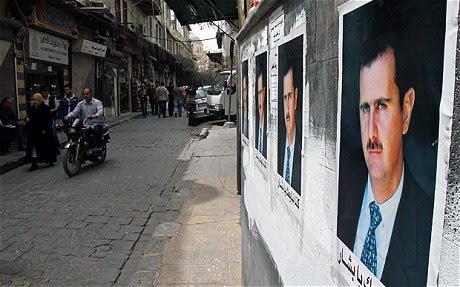
Syria Broadens Deadly Military Crackdown on Protesters
By ANTHONY SHADID
Published: May 8, 2011

BEIRUT — A military crackdown on Syria’s seven-week uprising broadened Sunday, with reinforcements sent to two cities under siege and more forces deployed in a town in a restive region in the south of the country, activists and human rights groups said. Fourteen were killed in Homs, the groups said, and hundreds reported arrested.

The crackdown — from the Mediterranean coast to the poor steppe of southern Syria — seemed to mark a decisive turn in an uprising that has posed the gravest challenge to the 11-year rule of President Bashar al-Assad. Even though government officials have continued to hint at reforms, and even gingerly reached out to some dissidents last week, the crackdown seemed to signal the government’s intent to end the uprising by force.

At least 30 tanks were said to be inside Baniyas, one of Syria’s most restive locales, where the military entered Saturday. Activists and human rights groups said they had almost no information about the coastal town of 50,000, but one activist said at least six people were killed and 250 arrested since the operation began.

Fighting was also reported in Homs, Syria’s third-largest city, where tanks entered Friday. Wissam Tarif, the executive director of Insan, a Syrian human rights group, said that 14 people had been killed there, but he could not confirm the casualties in Baniyas. He said that the military had also entered Tafas, a town in southern Syria.

“This is a campaign that’s going to more cities,” he said. “It’s escalating and it’s very worrying because they’re also getting better at isolating these places.”

He said that his group had documented the arrest of 750 people, most of them in the suburbs of Damascus, but he had no precise figures for Homs and Baniyas.

Since the beginning of the uprising, Syria has barred most foreign journalists, and many accounts have relied on groups like Mr. Tarif’s and networks of activists inside the country. But Mr. Tarif complained that his group was almost entirely unable to speak with people in both Homs and Baniyas. Even satellite phones that protest organizers had sought to smuggle into towns and cities across Syria were not working, he said.

“It seems they got better in tracking satellite mobiles,” he said.

The uprising began last month with protests in Dara’a, a town near the border with Jordan. The protesters gathered after security forces had arrested and mistreated high school students for scrawling anti-government graffiti on walls. The protests soon spread across the country, with successive Fridays witnessing thousands in the streets in dozens of towns.

??? ???? ???????? ???? ????? ?????? ?????? ???????
?????? ?????? ???? ?????? ?????? ??????? ?? ??? ?????? ??????? ?????? ????? ????? ??? ???? ???????? ???????. ????? ?????? ?? ??????? ?? ??? ?????? ????? ???? ??? ??? ?????? (???? ?????? ?? ??????? ???????? ?????? ?????? ?????????? ????? ?? ?????? ???? ?????? ?? ???????)? ??? ?? ???? ??? ??? ??? ?? ?????? ????? ?????? ?? ???? ??? ??????? ?????? ???????. ????? ????? ??? ?????????? ???? ????????? ?????? ?? ??? ??? ?????? ?????? ????? ?????? ??? ????? ???? ??? ????? ??? ????????. ?? ???? ???????


Landis and Seale on Prosepects for a Government Comeback


Antigovernment protesters gathered Friday after noon prayer in the coastal town of Baniyas, Syria, in a cellphone photo provided by an onlooker.
Anthony Shadid gives the best assessment today
Protests Across Syria Despite Military Presence
May 6, 2011 New York Times

The worst violence was reported in Homs, Syria’s third largest city, where activists described a chaotic, bloody day, as tanks entered the town. The government said 10 soldiers had been killed there by what it described as “terrorists,” while activists said at least 9 soldiers had defected to their side. Sixteen protesters were killed, they said.

“We answered the call to protest today, but the intelligence forces attacked us right away by opening fire on us,” said a resident in Homs, reached by telephone.

Another resident there said the security forces fired without provocation.

“They took us by surprise,” he said by phone, over the sound of gunfire.

Both sides in the seven-week struggle claimed victories of sorts on Friday. Thousands of demonstrators gathered again in dozens of towns and cities, despite the government’s deployment of security and military forces from the Mediterranean coast to the steppe in southern Syria. But the crackdown seemed to have slowed the force of the protests, and even some of the government’s opponents acknowledged that crowds may have been smaller than on past Fridays.

“The protests can’t get the momentum to increase the numbers on the ground, as we saw in Egypt and Tunisia,” said Radwan Ziadeh, a Syrian human rights advocate and visiting scholar at George Washington University in Washington. “The collective punishment of cities, mass arrests and the tactics of snipers have created some fear.”

President Bashar al-Assad, who inherited power from his father, Hafez, in 2000, initially claimed that Syria was immune to the tumult sweeping the Arab world. When the uprising erupted in Dara’a, a poor town near the Jordanian border, he initially responded with a mix of crackdown and concessions that proved largely rhetorical. For the past two weeks, the government has relied almost entirely on force to crush dissent, and there appears to be a sense in official circles that the government has gained the upper hand.

Over the past week, opposition figures said, Butheina Shaaban, an adviser to Mr. Assad, has reached out to some dissidents. One of them, Michel Kilo, said he met with Ms. Shaaban on Thursday and insisted that a dialogue could begin only after an end to the crackdown, recognition of the right to protest and agreement on a political solution to the crisis.

“I didn’t go to hold dialogue,” he said. “I went to express my opinion.”

Other opposition figures dismissed the tentative outreach and pointed to the arrests of two government opponents — Riad al-Seif, a former member of Parliament ailing with prostate cancer who was jailed twice in 2002, and Mouaz al-Khatib, a prominent Muslim cleric. Mr. Khatib was arrested Thursday, and Mr. Seif on Friday, after attending a small protest in the capital, Damascus, outside the Hassan Mosque that was quickly dispersed.

“These are maneuvers,” said Burhan Ghalioun, a Syrian scholar and director of the Center for Contemporary Oriental Studies at the Sorbonne in Paris. “They are maneuvering, and they are playing with the opposition to try to break its ranks.”

Obama administration officials say that while some figures in the Syrian leadership, Ms. Shaaban and Vice President Farouk al-Sharaa among them, seem to favor at least some reform, hard-liners in the leadership are ascendant. In the past two weeks, the military has been deployed in force to Dara’a, Baniyas on the Mediterranean coast and Rastan, a town near Homs. Thousands have been arrested, particularly in Dara’a and towns on the capital’s outskirts.

But officials say the ire of France and, in particular, Turkey, which had emerged as one of Syria’s closest allies, has worried the Syrian leadership. So has the threat of international action. On Friday, the European Union decided to impose a travel ban and a freeze of assets of 14 Syrian officials, though Mr. Assad was excluded.

“The government has been saying this will be over in two to three weeks,” an administration official said in Washington. “They seem to think they have control over the situation, that it’s dying down, but we don’t really understand why they think that.”

The toll on Friday paled before that of past weeks, especially April 22, when more than 100 people were killed as security forces opened fire on demonstrations across the country…..

With the Western media focused on bin Laden, the situation in Syria has been deteriorating
Justin Elliott of Salon.com

While the U.S. media has been focused on Libya, the president’s birth certificate and Osama bin Laden, a dramatic and brutal showdown has been unfolding between the government of Syria and opposition protesters.

An estimated 500 to 600 civilians have been killed in the 50-day uprising, and forces of the Bashar al-Assad regime have repeatedly opened fire on protesters. Part of the reason for the lack of American media coverage is that Western reporters were expelled from the country early on, and most are now covering the situation from neighboring Lebanon.

For an update on the uprising and a take on the Obama administration’s Syria policy, I spoke to Joshua Landis, a professor at the University of Oklahoma and the proprietor of the well-respected blog Syria Comment.

Who makes up the opposition?

Well we know a certain sliver of the opposition well because there are a number of activists who have been supported by U.S. pro-democracy money for five years now. They’ve been working away developing websites and expertise on democratic transformation. They are very liberal, pro-American — everything that America likes. But we don’t know how big or important that group of liberals is. Civil society in Syria has been so severely restricted. Not as much as it had been in Iraq, but it’s not far from that scale. So we don’t know how powerful various parties would become if we take a lid off.

The strength of the opposition is that has no leadership, and therefore the leadership cannot be easily snuffed out. It is led by young activists in their 20s and early 30s who are determined and who have until very recently been able to keep the opposition focused on liberal slogans about freedom, unity, peace, anti-corruption, and regime change. They’ve shown great courage in the face of a very tough repression. But the great weakness of the opposition is that they have no leadership. There are no faces that people can identify with, and no personalities to reassure the silent majority that the future is going to be handled in a way that they would find acceptable.

Describe the new sanctions on Syria imposed by the Obama administration.

Well America already has several sets of sanctions. Sanctions because it is a terror-supporting state, according to the U.S. Primarily because it supports Hezbollah and Hamas. Sanctions placed by President Bush against people who interfere in Lebanon and people who are corrupt. And now Obama has added another lawyer, against the leaders of Syria’s security state, who are most directly responsible for clamping down on the protests. The effect of the sanctions overall has been to slow down the Syrian economy and to put the Syrians on a diet, to reduce their incomes. Sanctions scare away foreign investment. But the new sanctions so far are more symbolic than they are meaningful.

So has the administration had a consistent policy throughout this crisis?

The policy has been to show horror at the brutal treatment of the protesters, to denounce Syria’s actions, but not to do anything that would make it incumbent on the U.S. to intervene militarily as it did in Libya. There, Obama said that Gadhafi had to go. And once he said that, the pressure mounted quickly for the U.S. to do something. But Libya is 6 million people. Syria is 22 million. It is an ethnically and religiously divided society, like in Iraq. If the regime is toppled, it’s quite likely there would be a civil war. And if that happens, the calls for intervention will be very hard to resist.

There have been more and more criticisms from Republican leaders that the Obama administration has been too soft on Syria. Where is this coming from? Is this all about Israel?

It is largely about Israel. U.S. interest in Syria has almost always been a subset of the U.S.-Israel relationship. We have sanctions on Syria because it is part of the Arab-Israeli conflict, and they are trying to get their occupied territory — the Golan Heights — back. So they look for allies in the fight against Israel, and this makes them our enemy.

You mentioned the courage the protesters have shown. The numbers of dead seem quite high. How bad has the crackdown been?

There’s been 500 and 600 dead. The Syrian government has shot at people. They haven’t let the demonstrations grow. If you adjust for population, in Bahrain, the government killed twice as many of its citizens. They were given a pass, their ambassador was invited to the royal wedding in London. That’s because America has oil interests in the Gulf and wants to please Saudi Arabia, and America doesn’t care as much about Shiite dead because it doesn’t like Iran.

Have the demonstrations been entirely non-violent?

No. There have been about 80 Syrian soldiers that have been shot. The opposition claims that Syrian soldiers were shot by other government forces. But this has never been proven and is unlikely. The government is saying they are being shot by armed elements — either Salafists or Al Qaeda-type people, or just those that want to destabilize Syria. That argument wins sympathy from many Syrians. But many others want to see revolution. The country is split down the middle, along religious lines — like Iraq was.

Which side has the momentum right now?

The state. The chances are quite high that the Syrian government will be able to beat back the opposition because the government has a monopoly of power. The army and the security forces have remained loyal to the president. They have not split as they did in Libya. They have not turned on the president as they did in Egypt.

But if the regime does collapse, the state institutions will collapse, as they did in Iraq. Syria is a one-party state, which is the Baath Party. If the opposition takes over the government, the Baath Party will be purged. The state institutions like the military, the intelligence forces, and the Republican Guard will all be disbanded and perhaps some of the leadership will be tried. One can expect close to 2 million people losing their jobs or being affected directly by this. They’re going to fight to keep their privileges and their position, just as the Sunnis in Iraq fought. This would turn into a sectarian war. The slogans of freedom, although important, conceal a sectarian split in the country.

That scenario seems grim. Is there a possible positive outcome and what would it look like?

There is a possible positive outcome, which is that Bashar al-Assad remains in power and yet carries out deep reforms. That’s what a number of people are hoping for, that he will become humble and realize that in order to bring peace to Syria he’s going to have to enact deep reforms.

But based on what he’s doing right now, it would seem like things are going in the opposition direction.

Is This the End of the Assad Dynasty?
By Patrick SealeGreat clamour for change has arisen in more than a dozen Syrian cities in recent weeks. Has the time come for President Bashar al-Assad to give way to pressure from the street and perhaps even to bow out altogether? Asks Patrick Seale.

….The difficult and perilous task Bashar now faces is nothing less than the profound restructuring — under great popular pressure — of a fossilised system of governance inherited from his father, but which is no longer appropriate to the modern age, and no longer tolerated by the bulk of the population. Like other Arabs, Syrians want real political freedoms, the release of political prisoners, an independent judiciary, the punishment of corrupt bigwigs, a free press, a new law on political parties allowing for genuine pluralism (and the cancellation of article 8 of the constitution which enshrines the Ba’ath Party as “the leader of state and society”), and an end, once and for all, to arbitrary arrest, police brutality and torture.

Can Bashar meet these demands? Does he have the will and ability to do so? Can he hope to prevail over the entrenched interests of his extended family, of his intelligence and army chiefs, of powerful figures in his Alawite community, of rich Sunni merchants of Damascus traditionally allied to the Assad family, and of the small but powerful “new bourgeoisie,” made rich by the transition from a state-controlled to a market-oriented economy, over which he has himself presided in the past decade? All these disparate forces want no change in a system which has brought them privilege and wealth. Above all, can Bashar change the brutal methods of his police and security forces? Could anyone in just a few weeks hope to change habits of repression ingrained over half a century, and indeed far longer? (For autocracy is not an Assad invention.)

The Bashar years

Until the outbreak of the crisis, Bashar al-Assad had little or nothing of the menacing pose of a traditional Arab dictator. His manner was modest and, at 45, he looked astonishingly young. His tall willowy frame has none of the robustness of a fighter, while his gaze, questioning and often perplexed, has none of the certainties of a man born to power. He was a young doctor studying ophthalmology in London when the accidental death in 1994 of his elder brother, Basil, an altogether tougher character who was being groomed for the succession, propelled him somewhat reluctantly onto the political scene.

The country he came to rule in 2000 seemed backward in an increasingly globalised and technologically advanced world. His first reforms were therefore financial and commercial. Mobile phones and the internet were introduced. Private schools and universities proliferated. In 2004 private banks and insurance companies were allowed to operate for the first time, and a stock exchange was opened in March 2009. A political and economic alliance was forged with Turkey (and visas abolished), which allowed trade to grow along that border, benefiting Aleppo. The Old City of Damascus was revitalised, ancient courtyard houses restored and hotels and restaurants opened to cater for the growing number of tourists. Before the crisis erupted, Syria was negotiating to join the World Trade Organisation and conclude an association agreement with the European Union.

But Bashar’s years in power seem to have hardened him. He developed a taste for control — control over the media, over the university, over the economy (through cronies such as his exorbitantly rich cousin Rami Makhlouf), control over society at large. Free expression is not allowed. Political decision-making is restricted to a tight circle around the president and security services. Like his father, Bashar clearly does not like to be pushed around or to seem to yield to pressure. Even so, many Syrians still support him in the belief that, as an educated, modern and secular ruler, he is better placed than most to bring about necessary change.

At the time of writing, Bashar still seems to have a chance, if a slim one, of stabilising the situation and perhaps earning a further spell in power — but only if he calls a halt to the killing of protesters and takes the lead of the reform movement, and in effect carries out a silent coup against the hardliners.

But it may well be too late for that. Indeed, Bashar may already have lost authority to men like his brother, Maher al-Assad, commander of the regime’s Republican Guard, who seems to advocate crushing the protests by force. If the army and the security services remain loyal, it will be difficult for the opposition to unseat the regime. But there have been ominous rumours of army defections as well as reports that some members of the Ba’ath Party have resigned…..

some Islamists still dream of revenge, while minorities such as the Alawites fear that if the regime were to fall, they would be massacred in turn. Emerging from underground, the Muslim Brothers have now called on the people to join the protests. The cry for freedom risks being drowned by sectarian strife.

Such has been Bashar al-Assad’s harsh apprenticeship. He has had to surmount a series of regime-threatening crises much like those his father confronted in his time. Both Assads felt some satisfaction at managing to survive them and thus provide Syria with a measure of stability and security, especially compared with Iraq and Lebanon. There was, however, a price to pay. Having to live and survive in a hostile environment inevitably conferred great powers on the security services, guardians of the regime — to the increasing resentment of ordinary Syrians. A dialogue of the deaf ensued. The Assads’ intense preoccupation with external crises led them to neglect the internal scene. Who would need political freedoms, they no doubt thought, if given the benefits of security and stability? As the regime’s official daily newspaper Tishrin wrote on 25 April: “The most sublime form of freedom is the security of the nation.”

The recent explosion of popular anger has evidently taken Bashar by surprise, as it did other Arab autocrats. He has had to wrench his attention away from the perils and excitements of foreign policy to urgent challenges at home. To devise and implement far-reaching domestic reforms, as the present situation urgently demands, will require a radical change of focus. It will not be easy, and a favourable outcome is far from certain. Bashar now faces an internal threat to his regime at least as dangerous as any of the external threats he and his father confronted so successfully.

Yes, it does seem that way. And in order to enforce his control, he’s going to resort to greater sectarian divide-and-rule, which will ultimately weaken Syria and eliminate the possibility of deep reforms. So this looks like a lose-lose situation.

Day 53 of the Syrian Uprising; over Six Killed; Fewer Demonstrators; Clinton Says Reform Still Possible

Death tolls for this Friday have been hard to quantify, according to the Guardian. The London-based Syrian Observatory for Human Rights said at least six people had been shot dead after security forces opened fire in Homs and Hama. The National Organisation for Human Rights in Syria put the toll at 16 people nationwide.
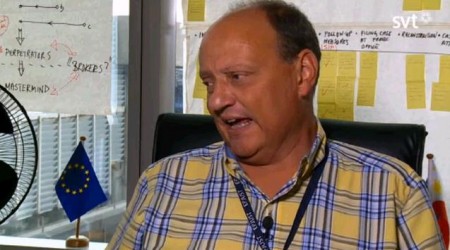
Secretary of State Clinton said that reform was still possible in Syria. She seems to be giving Assad more time.

The death toll since the beginning of the uprising seven weeks ago is high at about 550 but still remains almost half of the death toll in Bahrain as a percent of citizens. In Egypt, over 800 were killed, which is about half of Syria’s toll given that Egypt’s population is over three times that of Syria’s. In Tunisia 219 protesters were killed during the uprising. Tunisia’s population is less than half of Syria’s at 10 million. In Yemen, about 125 people have now been killed. In Libya, The civilian death toll from the war is already estimated in the thousands, while streams of desperate refugees keep pouring into Tunisia, Egypt and Europe.

Syrian state television said an army officer and four policemen were shot dead by a “criminal gang” in Homs.

About 80 of Syria’s deaths are soldiers, security, and police according to Syrian government sources. Many more have been arrested as the government tries to track down the leadership networks and activists who have been organizing demonstrations. One of the main activists in Deraa, who was reporting by satellite phone throughout the confrontations was recently killed.

The opposition claim that Syrian security forces are responsible for shooting teh 80 dead soldiers. They claim that cracks are developing in military loyalty and soldiers are being executed for refusing to shoot on protesters. I have yet to see a reliable report of this.

One journalist writes: “I can’t stand these contradicting sources. As a journalist, it is a HUGE HEADACHE!!! Am jubilant right now because the paper decided to drop the article on Syria today. Didn’t know what to write!!! Press agencies talk about tanks around Damascus and elsewhere, friends from there see no trace of them. Thank God I don’t have to write!!!

Red Cross/Red Crescent report from Daraa

Today as a true eye witness and a Red Crescent FACT team (field assessment and coordination Team) we did an assessment Visit to Daraa city situation and brought some aid items and baby food with us, we also came up with the needs which we are working on for-filling ASAP.

some highlights from the report :

No mass destruction was noticed, water and electricity is available to almost all of Daraa, some shortage in food but not life threatening, army is distributing bread and essential materials to places since most of the shops are closed, shortage in some medicines because the pharmacies among with the shops are closed, water not reaching high floors since no electricity in some places to power the personal pumps, their maybe people whom are afraid to visit the national hospital so SARC will provide mobile clinic for those people in old part of Daraa city ASAP.

An opposition member reports: Day 53 of the Syrian Revolution; Friday of defiance.

Today’s protests in: Ankhel, Jasem, Sanamein, Zabadani, Daraiya, Harasta, Kisweh, Nawa, Al Tal, Barzah, Damascus (Meydan, Saliheiya, sit Zaynab, Hajar Aswad), Homs, Hama, Tal Kalakh, Baniyas, Jableh, Lattakiya, Al Bab, Idlib, Me’arit Nu’man, Salamiyah, Qamishly, Ain Al Arab, Hasakeh, Jisr Al Shoghoor….. (Despite the suffocating repression with live bullets and the threat of shabiey7a thugs..etc..)

Interesting tweets from Ben Wedeman (CNN legendary correspondent in Cairo):

“Good Egyptian source just back from Washington says israel is syrian regime’s most ardent advocate with congress, Obama administration.” Amid Syria’s turmoil, Israel sees Assad as the lesser evil

A regime supporter writes:

Aside from Homs, the total of people who demonstrated in Syria today was less than 5000. In Damascus there were about 500 protesters in the Islamist stronghold of Maydan.

In Banias, Al-Jazeera claimed that there were 10,000, but in the images they showed it was obvious that the protesters were less than a thousand people.

About 500 Kurds demonstrated in the northeast. The Kurdish demonstrations are the only demonstrations that can be called civil and I am glad that they all ended peacefully. The Kurdish demonstrations were the only demonstrations that had clear political demands and they were not motivated by sectarian or even ethnic motives as it appears from their slogans and the quality of people who participated.

In Aleppo as usual there were many failed attempts to start demonstrations. None of them gathered more than a 100 people.

Angry Arab writes: Al-Jazeera “clearly wants to have a day of rage and protests in Syria: so they keep airing the same phone video footage.  They tell viewers that there were massive demonstrations, and then you count like 40 or 50 in the protests.

Khaddam: ‘I expect the Syrian army to topple Assad!’ Friday Lunch Club

From NZ in Comment Section (5 May 2011)

For those who are talking in sectarian terms and saying that Christians are not interested in regime change are wrong.

Every one wishes a free Syria without bloodshed. The way this regime dealt with the latest unrest will no doubt have an organized opposition. They can not be given the benefit of doubt, no more. Their actions spoke volume. The autocratic management style of this regime will end up uglier than any other. Change is imminent. With millions, with or without tanks, they dug out there ending. They are exposed nationally and internationally. Game over.

From John Khouri in Comment Section (5 May 2011)

N.Z – I’m a Christian living in Homs and have relatives living in Aleppo And Damascus and Deir el Zor. I find it absolutely outrageous that people like yourself say that Christians want regime change. Stop speaking on behalf of the Christians of Syria. Come to Syria and see what is happening on the ground. My cousin’s wife in Daraa has packed up and moved in with us in Homs. The Christians in Daraa have had their churches firebombed for not participating in the anti-government demonstrations. Their priest has been threatened with his life. Wake up to ourselves. In Homs, all church ceremonies have been kept indoors due to the fact that thugs from Khaldieh and Bab el Omr keep entering the Hamadieh Christian area and screaming sectarian slogans throughout the night. 99.9% of Christians support the current Syrian government. All these so called freedom demonstrations have been hijacked by Islamists and Salafi’s. Stop being in denial and stop trying to promote these freedom demonstrations, which is completely opposite from the reality on the ground.

How the Syrian Government Refuses to do Public Relations

The United Group, which has been contracted by the Syria Government to help spread their message is not a PR company according to one friend who knows people there. It is a small (in regional standards) media and publishing company. The Syrian government is for some reason allergic to professional PR. The Syria Trust (associated with Assma) was the only entity to hire PR to promote their work. Now the Trust seems to be on hold and the PR guy in NYC, who was helping on the now postponed April 4-6 Historical Culture event, contacted Syria to see if the want help now. The answer was a predictable NO.

Construction and design of several worthy projects meant to boost tourism and promote Syrian culture are on hold such as Masar Al Thaqafi Al Suri and a planned modern arts Museum. Many big Gulf companies are pulling out or putting their work on hold because of the uprising and because their partners are none other than Rami and Maher associates.

Syria’s political crisis puts it on edge of economic precipice
Phil Sands
Last Updated: May 6, 2011

DAMASCUS //At a staff meeting this week, employees at a small but successful private company in Damascus were told they would be working without pay this month, a sign of gathering economic storm clouds, as Syria struggles with a grave political crisis.

According to one of the workers, managers announced pay would be halted for most staff members immediately, with employees asked to stay on effectively as volunteers in order to keep the firm ticking over. Crucially, no timetable was set for when payment of salaries would be resumed.

“They said they didn’t know when things would be back to normal, and that it would depend on what happened on Friday,” he said, on condition of anonymity. He also asked the company not be named because it has made no public announcement of the decision.

“If things are quiet on Friday, maybe it will be OK,” the employee said. “But if it’s another one like we had last week, then I’ll probably lose my job entirely. I expect that to happen.”

The Syrian authorities have been insisting all is well, projecting an air of confidence and normality, and trying to allay any sense of panic that the country might be teetering on the brink of an economic precipice, after more than six weeks of political unrest that has shaken the nation……

Hizbollah’s Most Serious Challenge
By Randa Slim Tuesday, May 3, 2011 – in Foreign Policy

The popular uprisings in Syria represent the most serious challenge to Hezbollah since the 2006 war with Israel. A regime change in Syria would threaten a major arms supply route to Hezbollah; deny the Iran-Syria-Hezbollah-Hamas axis its Arab linchpin; weaken Hezbollah’s deterrence capacities vis-à-vis Israel; and deny the Hezbollah leaders and their families a safe haven when they feel threatened by Israel, as was the case in 2006. This poses a unique challenge to Hezbollah, which had comfortably sided with the revolts in Egypt, Tunisia, Libya, Yemen and Bahrain. When Hezbollah’s Iranian mentor Ali Akbar Mohtashamipour was dismissed from his official post last April because of his sympathies with the Iranian opposition, Hezbollah was silent despite a heated debate inside the party ranks. The uprisings in Syria pose a challenge similar to the one they faced with the 2009 repression of the Green Movement in Iran.

How does Hezbollah really view the prospect of regime change in Damascus? In a recent round of interviews I conducted with Hezbollah officials in Beirut, all those I spoke to agreed that a regime change in Syria would not occur easily or peacefully. So far, Hezbollah officials believe that Bashar al Assad will survive. They believe that unlike Hosni Mubarak or Zein Ben Ali, Assad still enjoys a wide base of support especially in major cities like Damascus and Aleppo. As a senior Hezbollah official pointed out, “Alawites and Christians will not abandon Bashar.” The Assad regime and its wide base of support, they said, will fight back. Should Bashar al Assad fail to rein in the protests quickly, they fear a protracted civil war that would engulf Syria, spill over into Lebanon, especially in the north, and destabilize other countries in the region, including Turkey. Above all, even more than the loss of military and financial supply lines, these Hezbollah leaders fear a mortal blow to the “Resistance Axis” which has been central to their place in the Middle East.

While Syrian President Bashar al Assad was initially taken back by the protests, he and his close associates quickly closed ranks and opted for brute force to deal with future protests. Hezbollah’s reading of the Assad speech made on April 16 is that while responding to the people’s demands by offering a series of reform measures mainly focused on the lifting of the emergency law, Assad also made it clear that further protests will be met with an iron fist. Hezbollah officials to whom I spoke viewed the internal opposition as old, disorganized and decimated by years spent in Syrian jails. If regime change were to happen soon, the Syrian Muslim Brotherhood is the only organized political force in the country and would likely emerge as the main power broker in the country.

Hezbollah officials now believe that negotiations between the regime and the protest movement can no longer be expected to occur. They further argue that the critical factor in other Arab revolutions was the neutral role played by the army. In the case of Syria, they believe that the army still sides with the regime. It has yet to show signs of dissension, especially at the top levels. When questioned about the possibility of an internal coup d’etat led by an Alawite army official, these Hezbollah officials discounted this scenario – as one of them put it, chiefly for lack of an acceptable alternative to Bashar al Assad. They also pointed out that both Alawites and Christians fear the consequences to themselves of a Sunni take-over. A protracted civil war in Syria would eventually lead to a break-up of Syria into a number of mini-states divided among the country’s three major religious and ethnic groups: Alawites, Sunnis, and Kurds…. (an important article. Read the entire thing.)

Untangling Dictators’ Webs
By Brendan Greeley and Nicole Gaouette, BW Magazine

The State Dept. is funding tools to help online activists abroad

Antigovernment protesters in Syria have a hard time reaching the outside world, since the government selectively blocks cell-phone coverage in protest areas, and most use a slow dial-up Internet connection. Some of them rely on a contact overseas. The Syrian, who has seen the inside of prisons before and asked that his name not be printed, receives video files from activists in Daraa. The Syrian helps format the videos and posts them to YouTube. He’s exactly the kind of person the State Dept. would like to help right now: a pro-reform dissident, enabling others to get their story out through the Internet. But the Syrian is skeptical.

As the Administration struggles to keep up with the pace of change in the Arab world, the State Dept. is set to announce $28 million in grants for tools and training to help activists like the Syrian and his compatriots interact and organize online. The grants are a way to combat “repression 2.0,” as Michael Posner, the Assistant Secretary of State for the agency’s Bureau of Democracy, Human Rights, and Labor, puts it. Autocrats and their intelligence operatives are increasingly turning to social media and sophisticated technologies to track and infiltrate dissident groups. Before the fall of dictator Ben Ali, for instance, Tunisian authorities uploaded phony Facebook and Gmail login pages with the aim of stealing the passwords of activists. In the past, U.S. officials thought that if dissidents could simply get to Facebook, Twitter, and other unrestricted sites on the open Web, they could organize themselves. Posner now says that training activists to avoid traps and giving them the tools to stay safe in digital environments is “perhaps the most critical part” of countering online repression.

According to Posner, State has already held training sessions for 5,000 digital activists around the world, including one in February in Beirut that brought together participants from Tunisia, Egypt, and Syria. The sessions, quietly run by local organizations, teach participants which websites and technologies are most vulnerable to government monitoring—and which government-seeded rumors about technology are false. Daniel B. Baer, the deputy assistant secretary in the democracy bureau, says that in one country, the government spread rumors that police took screenshots of every computer every five minutes. Baer says State pays for travel to a safe place for the training and describes the program as “an underground railroad of trust.”

The agency has already awarded about $22 million in Internet freedom grants and plans to raise the total to $50 million by the summer. The current round of grants will largely be dedicated to building the kind of digital tools activists need. To keep up with both activists and governments, the State Dept. will have to start acting more like a venture capitalist, says Posner, doling out seed money to developers.

Katrin Verclas runs MobileActive.org, a New York-based nonprofit. MobileActive has received State funding to build a “panic button” that allows activists, if arrested or pursued, to send a text message to a group of contacts in a way that doesn’t show up on the phone’s call log. The app also erases potentially incriminating data. MobileActive developed the tool to run on Java-enabled phones, such as BlackBerrys and the low-end Nokia phones that overseas activists are more likely to own. The group has made the code freely available and hopes to develop a community to sustain it. An Android version is in the works. “It’s like having a baby,” says Verclas, “you need to keep feeding it.”

Not everyone is eager to take State’s money, particularly when it’s for on-the-ground training. The Syrian, for one, doubts that the money always makes it to the right people. He’s seen foreign aid go to groups with no domestic credibility and seen other groups quietly take U.S. funding and then denounce America. Several other Internet activists reached by phone last week expressed similar sentiments. Hisham Almiraat, a Moroccan blogger based in France who asked to be identified by his pen name, traveled to a conference in Budapest in 2010 that was funded in part by the State Dept. He faced criticism online for attending. “Your credibility, your online reputation, becomes fundamental to your work,” he says. “We cannot afford to be seen as agents.”

The latest Middle Eastern anxiety — America spreading its influence over the Middle East through the Muslim Brotherhood. The new strategy of the US: Using the MB Sunni ‘newlook’ to counter the Iran Shia influence in the region.

La Syrie reste au cœur des spéculations
Par Scarlett HADDAD | 06/05/2011, L’Orient-Le Jour

…..Certains analystes estiment à cet égard que la nouvelle stratégie de l’administration américaine reposerait justement sur l’utilisation des Frères musulmans dans l’ensemble du monde arabe pour combattre l’Iran et ses alliés. Ces analystes ajoutent que maintenant qu’ils se sont débarrassés d’Oussama Ben Laden, les Américains peuvent de nouveau miser sur le courant islamiste pour juguler l’influence iranienne au Moyen-Orient. Ils auraient confié la mission de rendre les Frères musulmans « fréquentables » au parti au pouvoir en Turquie qui représente un islam moderne jugé tout à fait acceptable par l’administration américaine. Cette dernière devait toutefois auparavant frapper un grand coup pour justifier le recours à ces organisations longtemps considérées comme terroristes et non fiables. Ce fut la mort de Ben Laden, considéré comme l’ennemi public numéro 1 des Américains et de la communauté internationale en général.

Les États-Unis ont pendant des années justifié leur appui au régime de Hosni Moubarak en Égypte par le fait que la seule relève possible est formée des Frères musulmans. Ces derniers s’apprêtent aujourd’hui à se lancer dans la prochaine bataille électorale en réclamant la moitié des sièges au Parlement, après avoir formé un parti officiellement laïc, comme l’exige la Constitution du pays. En parallèle, les Frères musulmans de Syrie, qui se sont choisi un nouveau leader, Riyad Chakfa, ont le champ libre à partir d’Istanbul. Championne de l’islam à visage acceptable pour les Américains, la Turquie serait ainsi visiblement appelée à remplacer l’Égypte comme leader des pays musulmans proaméricains dans la région. En même temps, les États-Unis ont rapidement réussi à démanteler ce qui était considéré comme l’axe fort de la région et qui était formé de la Turquie, de la Syrie, de l’Iran et du Qatar. Le Qatar s’est ainsi aligné sur la politique turque qui, elle, ne dissimule pas ses critiques à l’égard du régime syrien…..

Katherine Marsh on the Gay Girl in Damascus blogger that SC highlighted last week.

Hariri Tribunal prosecutor amends indictment – Jpost

Tunisia’s ousted leader charged over shooting deaths…. An arrest warrant has been issued for Tunisia’s former interior minister, Rafik Belhaj Kacem, on charges of murder,

Egyptian Head of Security Tried

In a packed courtroom, a Cairo judge sentenced the former security henchman to seven years for corruption and five years for money laundering, and fined him 15m Egyptian pounds ($2.5m). But Adly still faces the much graver charge of giving the order to kill civilians during the 18-day uprising, as well as misusing public funds. If convicted, he could face the death penalty. “This is just an appetiser,” wrote Khaled Tawfeek on a Facebook page commemorating an activist who died in police custody. “Let’s hold our breath [for] when he falls for killing protesters.”

Adly has been held along with roughly 30 senior members of the old regime, including the deposed prime minister and Mr Mubarak’s two sons, following the uprising. Most face corruption charges, but some will face allegations related to the handling of the protests. Adly will next appear in court on 21 May to face trial for the deaths of protesters.

Mr Mubarak, 82, has also been detained on similar charges and the country’s justice minister has warned that the former president, who is convalescing in hospital after a heart attack, could face the death penalty if convicted.

One of Egypt’s most publicly reviled officials, Adly was the public face behind the feared security services, which tortured its citizens with impunity. Fury at police brutality was one of the primary reasons for the uprising, with the Police Day holiday on 25 January chosen as the first day of the protests.

More than 800 people were killed during the nearly three weeks of protests, many of them shot in the head and upper body, which has been used as evidence by some that security forces aimed to kill.

Food Prices

ROME — U.S. Secretary of State Hillary Rodham Clinton warned Friday that global shortages of food and spiraling prices threaten widespread destabilization and is urging immediate action to forestall a repeat of the 2007 and 2008 crisis that led to riots in dozens of countries around the developing world.

Clinton told a meeting of the U.N.’s Food and Agriculture Organization that urgent steps are needed to hold down costs and boost agricultural production as food prices continue to rise.

Although the situation is not yet as dire as it was four years ago, she said the consequences of inaction would be “grave.”

“We must act now, effectively and cooperatively, to blunt the negative impact of rising food prices and protect people and communities,” she said at the FAO’s headquarters in Rome.

The U.N. estimates that 44 million people have been pushed into poverty since last June because of rising food prices,

The Man Who Wrote the Mehlis Report on Rafiq al-Hariri’s Murder Claims Third Witness was a “full-blown mythomaniac”

Bo Åström, who wrote the Mehlis Report

The Man Who Wrote the Mehlis Report on Rafiq al-Hariri’s Murder Speaks Out about the Quality of their WitnessesSiddiq, Hossam, and Antonios Bani Auda – a “full-blown mythomaniac”
by Aron Lund
For Syria Comment
May 5, 2011

====================

Swedish public television (SVT1) just aired an episode of Uppdrag granskning, a popular show specialized in tracking down government abuses and miscarriages of justice. This episode was headlined “Don’t fuck with the UN”, and concerned a witness in the UN International Independent Investigation Commission (UNIIIC) for the Mehlis report. Below is a summary of the show, which can be seen in its entirety here. It’s in Swedish, but some of the interviews and taped segments are in original English.

***

The show is focused on a Mr. Bo Åström, a veteran Swedish police investigator who worked under Mehlis in the UNIIIC. He left the investigation with Mehlis in 2006, and they still work together, now on another assignment in the Philippines.

Åström was deeply involved in the preparation of the first Mehlis report, and at one point says (it’s possible he wasn’t aware that the camera was rolling) that he wrote most of it, since he was the investigator, while Mehlis more or less only did the preface.

The reporters summarize his view of the Hariri assassination. Åström and Mehlis develop the theory that the main culprits are the four Lebanese generals (Azar, Hajj, Hamdan, Sayyed), on orders of Rustom Ghazaleh and Asef Shawkat. Early on they found two witnesses to corroborate this theory, namely Siddiq and Hossam. Then both witnesses start causing trouble. First, Hossam shows up in Damascus and switches his story. Then, Siddiq is proven to be unreliable, after they investigate the apartment in the Dahiye where he claims the murder plot was hatched, and find that it had not been used by anyone during the relevant period. Åström is very frustrated by all this.

***

Antonios Bani Auda, the "third witness" after Siddiq and Hossam

At that point however, in October 2005, a certain Abdelbaset Ahmed Bani Auda, known as Antonios Bani Auda is referred to the UNIIIC by Lebanese authorities. Bani Auda is an Arab Israeli with a really shady history as a double or triple agent in the Israeli-Palestinian conflict, having been a team leader of some sorts in the Israeli Shabak, while simultaneously working for Arafat. He was married to the Lebanese singer Nada Rizq, also an Israeli agent. When she revealed his double-agent role, he had to flee from Israel to Lebanon. There, he explains, he was put in prison, where he claims he was visited by Lebanese intelligence. They tell him that he’ll stay there for the rest of his life unless he agrees to work for them. He accepts, and is freed.

After his release, he says, he is fortunate enough to get asylum in Sweden on a UN quota, and moves to the northern town of Umeå, where he still lives as a refugee with asylum (no citizenship). Lebanese security continue to contact him, and comes to visit him in Umeå repeatedly. They give him money, promise him government jobs and all sorts of things, and start demanding that he must kill Rafiq el-Hariri. He is taken to Lebanon a few times, shown the Qureitem and Hariri’s car, etc. The mission is for him to place bombs in two places, in Lebanon and in another country in Europe, to kill Hariri. He is also taken to meet Syrian officers in Greece and Syria, including Maher el-Assad. He refuses to participate in the mission. The following year, Hariri is murdered by someone else. Bani Auda explains that if he had accepted the mission, Hariri would have been killed already in 2004.

At this point he contacts Lebanese police, who put him in contact with UNIIIC, somewhere around October 2005. Since he lives in Sweden, he’s put in contact with Bo Åström, but also with Günter Neifer, a German investigator. They listen to his testimony and decide that he is trustworthy. He is mentioned in the second Mehlis report (Dec. 2005) as “a new witness”, from paragraph 32 onwards.

***

Bani Auda claims he is at this point beginning to be threatened and monitored (by Syria or its allies, presumably). He sets a condition for his testimony: he will not testify unless the UNIIIC promises him protection, help in getting a new citizenship (preferably Swedish), etc.

The UNIIIC prepares a written contract to this effect. There appears to be no talk of money or anything apart from protection for him and his family, but among the things mentioned is a new citizenship, protection, help in changing his appearance, etc. The contract states that his testimony will not leave the UNIIIC until these things have been arranged. This contract is read to him over the phone by Åström, and he accepts. He is flown to Vienna, and formally deposits his testimony.

***

Åström then gets to work on trying to arrange the protection. The problem is that the contract makes promises that the UNIIIC can’t deliver on – the UN can’t issue citizenships in Sweden or elsewhere. The program makes the point that Åström/UNIIIC must have known this. They tricked Bani Auda into making his testimony in return for protection that they couldn’t deliver. Still, Åström tries to use his contacts in Sweden to help Bani Auda.

However, when Åström gets in touch with police in Umeå, he is shocked to hear that they already know about the case. Bani Auda has been talking to local police, possibly someone he already knew there and had discussed the affair with earlier. Åström gets the impression that “the whole community knows”. He is outraged, says he was laughed at. He calls Bani Auda and curses him, telling him that he can’t and won’t arrange protection if Bani Auda can’t do his part and keep quiet about his involvement. He says he’s been made an ass of in front of his colleagues (he repeatedly shouts the phrase, “you’ve given me the donkey’s face”, which makes no sense in either Swedish or English, as far as I know). Still shouting, he appears to threaten Bani Auda, saying he must keep quiet, stop embarrassing him, and allow him to work on the protection detail, or the UNIIIC will “kick your fucking ass back to Israel” etc. At one point, he yells: “Tell us all you know, or we’re going to kick your ass! You don’t fuck with the UN!”, hence the program’s title.

***

All of the above phone calls have been secretly recorded by Bani Auda himself. At this point, the program sidetracks onto what the reporters apparently felt is the real scandal, namely the question of whether Swedish police has failed to deliver on a witness protection program, and whether Åström has threatened Bani Auda with repatriation to Israel, from where he fled. (This part is not so relevant to the Hariri affair.)

The reporter traps Åström by confronting with the issue, at which point he denies everything. He is then immediately shown the contract, and responds by denying he knew about it. They then play Bani Auda’s recording of him reading the contract, at which point he, deeply embarrassed, claims he doesn’t remember.

It is revealed that the written contract included a clause that wasn’t read out loud by Åström to Bani Auda, which says that the UNIIIC isn’t bound to provide these things unless Bani Auda’s testimony turns out to be true. The reporters say that since some of these details cannot be confirmed, this constitutes a loophole, but it isn’t clear that this is why the UNIIIC failed to deliver. When asked about this, Åström says in passing that he feels that Bani Auda didn’t deliver on his part of the contract, since he didn’t provide all the info he had promised. Günter Neifer is interviewed by phone, and says the contract was Åströms idea, but Swedish authorities apparently refused to provide protection/citizenship etc.

Some half-hearted efforts apparently continue after this point to help Bani Auda, but by February 2006 Mehlis and Åström both leave the UNIIIC, when Brammertz replaces Mehlis. Mehlis explains that this is because he had been informed that there were certain parties that wanted him dead, and that is why he left his post. Åström left with him (as mentioned above, they still work together).

***

When Åström leaves the mission, Bani Auda is provided with a new contact in the UNIIIC – British policeman who has now left the mission, but who still refuses to be identified to viewers, since he is fears for his life (apparently because of his work in the UNIIIC). He, too, fails to get someone to help Bani Auda, despite trying. Meanwhile, the Bani Auda testimony is (despite the clause in the contract banning this) handed over to the legal defense of the four generals, and then promptly leaked to the Lebanese press. Clips are shown from al-Manar, where Bani Auda’s name and picture is discussed. When interviewed by phone, the British policeman says that Bani Auda had been “horribly treated” by the UNIIIC and “could be killed”. The UNIIIC opinion is apparently that the contract between Åström and Bani Auda “isn’t worth the paper it was written on”.

Åström is asked about this, and says that Bani Auda’s “personal information has been out in the open for five years, and so far I haven’t heard anything other than that he’s alive and well.” He explains that he has changed his opinion about Bani Auda and now considers him a “full-blown mythomaniac”, but he remains convinced that Syria & the four generals were really behind the Hariri hit.

***

Bani Auda has still received no help from the UN. He has filed a complaint with Swedish police against Åström, for the threat to repatriate him to Israel, and provided his recorded phone calls as proof. The investigation was canceled almost immediately, without hearing either Bani Auda or Åström.

***

And that’s it. Just to be clear, I’m only describing what was said on the show. I don’t know what’s true or false, and I had nothing to do with its making.

Aron Lund is the author of Drömmen om Damaskus (Silc, 2010), a Swedish-language history of Syria and its opposition movements.

Preparing for Friday Demonstrations (5 May 2011)

A friend in Damascus writes:

Dear Joshua,

A friend of mine living in Kafar Batna (near Saqba) just told me that his wife called him to say that she can hear a lot of shooting going out in the street. Last night hundreds of people were detained in Saqba.
Today an Alawi businessman with connection to the establishment told me that around 1 million of people (between army, Alawi armed militia, bath party armed militia, police, security services etc…) will be deployed tomorrow to put a stop to any kind of demonstration or uprising. The use of violence or live fire have been permitted to all these forces. Perhaps it is an exaggeration they want to spread to terrorize the people and keep them home? I do not know (in any case i will stay home like all the 4 past Fridays). Today is the martyrs day.

A Sunni friend with connections to the Sunni “respected” shaikhs of Damascus (i do not want to tell their names) told me that some of them already asked their followers to go in the street and protest. Others, like Bouti are still trying to mediate but the blood of many of them is boiling. I heard from this side many times the word “war” … i do not know what to expect from tomorrow: a big calm or a big blood bath…
Suria Allah Hamiha…

Kuwaitis and Emiratis to the Rescue?

This Arab News article copied below states that business men from Kuwait and the Emirates are pouring millions into the Syrian economy in an effort to protect it.

??? ????? ??????????? ? ????????? .. ???? ????? ??? ????? ???? ???????? ?????? ???????? ??????
??? ????
??? ???? : ??? ????? ??????????? ? ????????? .. ???? ????? ??? ????? ???? ???????? ?????? ???????? ??????

???? ????? ????? ?? ?????? ????? ????? ??????? ??????? ???? ????? ??? ????????? ??????? ??????? ?? ????????? ???? ?? ????? ???? ?????? ??????? ???????? ??? ????? ?? ????? ?????? ?? ??? ????? ??? ???? ????? ??????? ????? ?????? ?????? ????? ???????? ??? ?? ?????? ?? ???????? ???? ???? ????? ????? ??? ?????? ??????? ???????? ???? ??? ??????????? ???? ????? ???? ?? ??? ?????? ???? 500 ????? ?????. ????? ??????? ???? ????? ?????? ???? ??? ?????? ???? ??????? ????? ????? ????? . ????? ????? ?????? ?? ????? ???? ?????? ??? ????? ????? ?????? ????? ?? ?? ???? ????? ????????..???? ?? ????? ??????? ?? ????????? ?????? ?????? ?????? ??? ????? ????? ?? ????? ?????? ??????? ??? ????? ??? ????. ?? ??????? ??? ??? ?? ?? ??? ?????? ???? ??????? ???? ????? ??????? ?? ?????? ????????? ?????? ???? ?? ?????????? ?????????? ??? ?? ???? ???? ????? ?????????

‘Bashar or chaos’: Syrian regime’s new mantra
Thursday, 05 May 2011 16:47 Mohideen Miftha

DAMASCUS, May 5, 2011 (AFP) – Bashar al-Assad or chaos. This is the new media mantra unleashed by the Syrian authorities to discredit the protest movement against the embattled president’s autocratic rule.
“We Syria,” “The collaborators are seeking discord,” “Yes to stability rather than chaos,” and “Freedom is not sabotage,” are some of the string of slogans screaming out on street posters and television clips in Damascus.
“The message of our campaign is simple. The word freedom as defined by protesters is not true freedom,” says Shaza Ferzli, 33, who heads the regime’s media account at United Group, the largest advertising company in Syria.
Wherever one turns one’s head in Damascus there is a slogan.

There are signs calling for “national unity” and “co-existence between communities” on buildings, bus stops and public transport alongside giant posters of President Bashar al-Assad.
One poster with the slogan “No to Dissent” is put up next to a picture of a church and a mosque under the slogan “Yes to coexistence.”It is evident that in this multi-confessional country, the authorities want to put across the message that the anti-government protesters are extremists who want to break the prevailing harmony.

For Zulfiqar Mohammed of United Group, the campaigns launched so far aim to “revive the national fabric which is confronted with an alien phenomenon. It’s a foreign conspiracy,” he says referring to the unprecedented demonstrations against Assad’s 11-year rule which began seven weeks ago as a wave of revolt swept the Arab world. Syrian and international human rights groups say that more than 600 civilians have been killed so far.

To show that the country is in danger, state television regularly broadcasts commercials glorifying the nation using slogans such as “Darling Syria,” or “Syria’s head is high,” alongside images of major tourist attractions.
The authorities also use derogatory terms to refer to the protesters like “terrorists”, “mercenaries” or “plotters.”Assad’s supporters, like their opponents, are also making full use of new media, like social networking sites, to drive home their message.

Ammar Ismail Shaie wages a relentless war on Facebook and Twitter against the young protesters of the so-called “Syrian Revolution 2011” group. “I spend sleepless nights,” says Shaie, browsing the DNN (Damascus News Network), one of the 15 pro-Assad pages on Facebook.

The main objective is to discredit the protesters by pointing to their “lies” and denounce the coverage of television channels such as Qatar-based network Al-Jazeera, the bete noire of the Syrian authorities.
“They broadcast only the view of the opposition, not that of the loyalists. There is no voice for those who love the president,” says Ammar.

“Look at these mock funerals shown by the media,” he says, showing a video on Youtube depicting two dead men rising to join an angry mob. The protesters too broadcast daily dozens of videos accusing government loyalists of fabricating lies aimed at discrediting them. In a country which forbids foreign journalists from going out to report on the protests, it is a cyberwar on YouTube between pro- and anti-government forces.

Thu, May. 05 2011 03:10 AM EDT
Christians Under Attack From Anti-Government Protesters in Syria
By Alison Matheson|Christian Post Correspondent

Christian communities across Syria have been attacked by anti-government protesters in recent weeks.

International Christian Concern says that protesters are being led by hard-line Islamists and that Christians have come under pressure to either join in protests demanding the resignation of President Bashir Assad, or else leave the country.

Eye witnesses report seeing around 20 masked men on motorcycles open fire on a home in a Christian village outside Dara’a, in southern Syria.

Another source told ICC that churches had received threatening letters over Easter, telling them either to join the protests or leave.

In Karak, Muslim Salafists forced villagers to join the protests and remove pictures of the president from their home. One man who refused was reportedly found hanged on his front porch the next morning.

One Syrian Christian leader told ICC: “People want to go out and peacefully ask for certain changes, but Muslim Salafi groups are sneaking in with their goal, which is not to make changes for the betterment of Syria, but to take over the country with their agenda.

“We want to improve life and rights in Syria under this president, but we do not want terrorism. Christians will be the first to pay the price of terrorism.”

ICC fears that the intimidation tactics may drive Christians out of Syria in a similar way to the exodus of believers from other parts of the Middle East, most notably Iraq.

Syrian Christians fear that if the hardliners succeed in taking over the government, they will try to drive Christians out of the country.

One Syrian Christian leader told ICC: “If Muslim Salafis gain political influence, they will make sure that there will be no trace of Christianity in Syria.”

Another source told ICC that protesters in Duma, a suburb of Damascus, were last week heard shouting: “Alawites to the grave and Christians to Beirut!”

ICC’s regional manager for the Middle East, Aidan Clay, urged the U.S. administration to take a cautious approach in its diplomatic relations with Syria.

“Unlike in Egypt, where Christians predominantly supported the revolution that removed President Hosni Mubarak from power, Syrian Christians have not participated in protests, anticipating that chaos and bloodshed will follow if radical Islam takes hold of the country,” he said.

“Throughout the Middle East, Christians have been fleeing their homeland in unprecedented numbers. Now, in a country where Christians have historically taken refuge from nearby purges in places like Turkey a century ago and Iraq in recent years, Islamists are threatening their existence.

“We urge the U.S. Government to act wisely and carefully when developing policies that have deep political ramifications for Syria’s minorities by not indirectly supporting a foothold to be used by radical Islamists to carry out their anti-Christian agenda.”

The Syrian constitution provides for freedom of religion but the government imposes restrictions on this right. Sunnis constitute 74 percent of the population while various Christian groups constitute 10 percent, although there are estimates that the Christian population, mostly due to migration, may have dropped to 8 percent, according to the U.S. State Department’s International Religious Freedom report.

Suicide Car Bomber Kills 18 Iraqi Policemen, Associated Press

The bombing in Hillah is the second significant attack in Iraq since the death of Osama bin Laden.

EU Moves Closer to Sanctions on Syria Over ‘Brutal Crackdown’ – Bloomberg 

St Andrews University clears itself over links to Syria: 05 May 2011
By FIONA MACLEOD – Scotsman

ONE of Scotland’s most prestigious universities has dismissed accusations of political influence over its research on Syria.

St Andrews University launched an investigation into its Centre for Syrian Studies (CSS) after it was criticised for taking £105,000 from a businessman with links to the Syrian government. The Middle East state’s regime has recently come under the spotlight for heavy-handed tactics against pro-democracy campaigners.

An internal review by the university concluded the research conducted by the centre maintained the highest levels of academic independence.

At the end of last month it was reported that funding for the centre from British- Syrian businessman Ayman Asfari had been “arranged” by the Syrian ambassador to the UK, Sami Kiyami, and that the university was too close to figures inside the controversial regime.

However, the deputy principal of St Andrews last night said his investigation had found “no evidence” of prejudice in the centre’s research or any inappropriate links with Syria.

Professor Chris Hawkesworth said: “We have found no evidence that the source of funding for the CSS prejudices the outcome of our research, and we robustly refute the allegation that we should be in any way embarrassed by the Asfari Foundation’s support of the Centre for Syrian Studies or the centre’s contacts.”……

News Round Up (5 May 2011)

“In the coastal city of Banias, about 1,000 protesters marched in the city’s Sunni district this Wednesday carrying loaves of bread, in solidarity with the people of Deraa.” Elsewhere quite reigned, except for Deraa, where the crackdown continues and the government says it is “completing its mission.” According to the Syrian press both the US and French Ambassadors have said that the foreign press has distorted Syrian realities. None of this has been picked up by the Western press that I have noticed, which suggests that it may be taken out of context by the Syrian press. Although both sides have been distorting news stories, often egregiously, I find it hard to imagine that either Ambassador would be quoted saying that the foreign press is distorting the story at this time.

The IMF lowered Syria’s economic growth rate to three percent from 5.5 for this year. It said if peace returns to the country, then in 2012 growth could rise to 5.1 percent. This is undoubtedly a conservative estimate of Syria’s likely growth drop.

The Russian parliament has declared that any attempt to destabilize Syria should be rejected. This provoked a pro-Russia demonstration in Damascus in front of the embassy.

???? ????? ?????: ???? ????? ????? ?? ???? ????? ??? ???????? ??? ????? ???? ???????

04 ???? , 2011

????-????

??? ???? ????? ????? ??? ???.. ????? ????? ????? ??????? ??????? ?????? ???? ????? ??? ???????? ?? ????? ???? ??? ????? ???? ??????? ???? ???? ?? ????? ??? ??? ?????? ?????? ?? ???? ??????? ????????? ??????? ???? ???? ???? ?????? ??????? ????? ????? ??????? ?????? ?? ???? ??????? ?????? ?? ????? ????? ??? ??????? ???? ??????? ????? ????? ?? ??????? ??????? ???????? ???????? ?? ????? ?????? ?? ???? ?? ????? ?????? ?????????? ????? ???????

The Emir of Qatar says that he will not put sanctions on Syria and supports an internal solution to Syria’s problems.

?????? ???? ??????? ??????? ????? ??? ?? ???? ?? ???? ?????? ??????? ?????? ???????? ???? ???? ????? ??? ??? ?????? ??? ?????? ??????? ????? ??? ?????? ?? ????? ??????? ??????? ?? ????? ??? ?? ????? ?????. ???? ??«??????» ?? ?????? «????? ?????? ????? ?? ?????? ?????? ???? ??? ??????? ??????? ????? ??????????. ???? ???? ???? ?? (????????) ????? ??? ???? ??? ?? ???? ????? ?????? ????? ????? ????? ??????».

???? ?????? ?? ????? : ???? ????? ??? ???? ?? ????? ?? ???? ????? ??????? ?????????

????? | ?????? ??????: ??????? ????? ????????? ?? ????? ??? ??? ?????

Economy

Syria moves to curb forex flight amid protests
4 May 2011, Agence France Presse

Syria on Wednesday launched a string of measures to curb the flight of foreign currency triggered by anti-regime protests by permitting for the first time savings in dollars and euros.

The measures come after Syria’s economic prospects weakened, with the International Monetary Fund revising downward its growth rate, the local currency diving about 10 percent in the black market and the Damascus Stock Exchange plunging 20 percent in the past six weeks.

“From today, Syrians are permitted to open savings accounts in dollars and euros worth up to 120,000 dollars as long as the amount is blocked for at least six months,” a director at the central bank told AFP.

The central bank also decided to increase the interest rate on savings in Syrian pounds by two percent to nine percent in a bid to “support the national currency.”

Syria, whose foreign exchange reserves are estimated at 17 billion dollars, also lowered the cash reserve ratio on bank deposits to five percent from 10 and since Monday cut retail dollar withdrawals to 5,000 from 10,000.

“This is to avoid speculation as customers were buying the dollar at the official rate of 47.5 pounds and sold it (in the black market) at 50 pounds,” said the director.

A banker in Damascus said that during the past month, daily withdrawals have exceeded deposits, with retail customers storming bank teller machines…..

The IMF, meanwhile, lowered Syria’s economic growth rate to three percent from 5.5 for this year. It said if peace returns to the country, then in 2012 growth could rise to 5.1 percent.

The economic growth rate was revised downward largely due to a fall in income from tourism and the textiles industry.

An economics expert based in Damascus said if the protests continue, the 11th five-year plan worth 100 billion dollars which began this year could be affected.

“This plan is crucial if Syria wants to grow in the long term,” he said, adding it would also “reduce the unemployment rate which is officially 11 percent, but in reality it is around 20 percent

The OECD has lowered Syria’s credit risk rating by one notch to 7, the lowest rate in its scale, as protests taking place across the country are expected to create a severe economic downturn.

Syria and the sectarian ‘plot’
Salwa Ismail, guardian, Thursday 28 April 2011
Bashar al-Assad’s regime has been fostering fears of a religious divide in order to undermine protesters

The role of sectarianism in Syrian politics and the position in the power structure of the Alawi community – a minority sect in Islam thought to comprise approximately 12% of the population – have been off limits as a subject in public discourse until the recent crisis. This prohibition has been abandoned by the regime which is now raising the threat of sectarianism in official media narratives about armed gangs, Salafi militants and foreign conspiracies against Syrian national unity.

In response the opposition, human rights activists and local observers accuse the security forces of themselves sowing the seeds of sectarianism. According to independent reports, in coastal cities and villages where members of both Alawi and Sunni communities live, patrols of unidentified men have visited residents belonging to either group to warn them of impending sectarian attacks and to mobilise them against the other group. Similar attempts at stirring conflict on a sectarian basis are reported by residents in Barzeh al-Balad, a Damascus suburb. There, it is believed, security personnel spread rumours that Sunni residents were planning attacks on their Alawi neighbours.

An undercurrent of the regime’s rhetoric has been the fragility of Syria’s social fabric, and the possibility that Syrians as a people could retrench to their narrow religious and ethnic identities. By manipulating Syrians’ concerns about national unity, the regime is trying to counter the opposition…..

The security approach is hinged on a strategy that holds minorities hostage, raising the spectre of sectarian aggression to cow protesters into compliance and justify the use of violence against demonstrations.

This strategy may not hold for much longer. The danger remains that the regime, in its desperation to hold on to power, will seek to turn its warnings of sectarian conflict into reality. But it is more likely to be faced with a general uprising that cannot be contained by deploying yet more violence.

Assad retrenches into Alawite power base
4 May 2011
Reuters News
* Assad uses language his father used to counter dissent
* Alawite figures among opposition leaders

By Khaled Yacoub Oweis

AMMAN, May 4 (Reuters) – President Bashar al-Assad is increasingly relying on his Alawite power base to crush pro-democracy protests that have posed the boldest challenge to the Assad family’s 41 years of rule over Syria.

Assad, an Alawite, sent army and secret police units dominated by officers from the same minority sect, an offshoot of Shi’ite Islam, into mainly Sunni urban centres to crush demonstrations calling for his removal for the last six weeks.

Their use of tanks to shell the city of Deraa last week, storming of mosques and attacks on unarmed civilians — as reported by residents and activists — have raised the stakes.

Reports say that Sunni conscripts, Syria’s majority sect, refused to fire at their co-religionists.

The 45-year-old president, who has kept the Soviet-era political system he inherited from his father intact, has hinted repeatedly that the protesters were serving a foreign conspiracy to spread sectarian strife.

The warning was reminiscent of language his father, the late President Hafez al-Assad, used when he put down an Islamist and secular leftist challenge to his rule in the 1980s and has not found wide resonance.

Mass protests for political freedoms and an end to corruption spread after Assad made his remarks. An official media campaign was launched last month with the motto “surround the symbols of sectarian strife”.

Security forces have shot dead at least 560 civilians in attacks on protesters, human rights groups say. Hundreds more are missing, many feared killed, and thousands have been arrested, adding to thousands of political prisoners.

But Assad may have struck a chord among members of the Alawite sect, who rose to prominence in the army under French rule, when the colonial administration used “divide and rule” tactics to control Syria.

Alawite officers expanded in numbers and gained control over the armed forces a few years after the Baath Party took power in 1963, especially key air squadrons, missile and armoured brigades and intelligence.

“The army is mostly Sunni in terms of numbers, but an Alawite captain has more say than a Sunni general,” said a former member of the army’s personnel division.

Alawites received preferential treatment in government and security jobs, although many Alawite villages remained poor and prominent Alawite figures led part of the secular opposition against Assad family rule.

A declaration signed last month by Aref Dalila, a leading Alawite economist who spent eight years as a political prisoner after critcising monopolies granted to an Assad cousin, denounced what he called the sectarian scare tactics used by authorities.

Assad, who allowed Islamists to exert more control over society as long as they did not interfere in politics, tried during the protests to placate conservative Sunnis by promising to open an Islamic university and easing bans on wearing the full veil.

His father used a blend of repression and the granting of privileges to ensure that the Sunni merchant class, whose influence has gradually waned as a new business generation tied to the Assad family rose, supports Syria’s minority rulers.

ARMY CONTROL KEY

Control of the army, however, has remained key to perpetuating Assad family rule over a majority Sunni population.

The Fourth Mechanised Brigade, headed by Assad’s brother Maher, bombed and machine-gunned the city of Deraa into submission last week. Republican Guards units deployed around Damascus. In Rastan north of Homs, residents said Military Intelligence agents killed 17 protesters on Friday.

Witnesses said authorities have begun to arm villages in the Alawite Mountains overlooking the mixed coastal cities of Latakia, Banias and Tartous, where Alawites who descended from there were employed in the government and security apparatus, marginalising traditional Sunni communities.

Gunmen loyal to Assad, known as ‘shabbiha’, have rampaged in Banias and Latakia to scare demonstrators, killing at least six civilians in a sectarian-driven attacks, residents said.

“I was driving with my wife and children through the Alawite Mountains over Banias and road blocks appeared in almost every Alawite village. Villagers were carrying brand new AK-47s,” said a Syrian Christian engineer, whose community has stayed on the sidelines during the unrest.

Anas al-Shughri, a protest leader in mostly Sunni Banias, said armed Alawite villagers in the hills overlooking the restive city have been loosely grouped into loyalist militias.

“I regret to say that the propaganda that Assad is spreading that the Alawites will not survive if he is toppled is receiving an audience among our Alawite neighbours,” Shughri said.

A report by the Arab Centre for Research and Policy Studies, which is headquartered in Doha, said sectarian “agitation has reached an advanced stage in mixed areas” but that Syrians in general have not fallen for it.

“There is no dispute that the ‘shabbiha’ are semi-criminal gangs comprosed of thugs close to the regime,” it said.

Syria’s leadership was exploring “the importance of the sectarian factor and how to use it to confront the mass demonstrations freedom and dignity,” the report said.

The Structure of Syria’s Repression, Will the Army Break With the Regime?
Ahed Al Hendi,  May 3, 2011
Foreign Affairs

the fact that the Alawites occupy many top positions in the army could actually undermine the regime. And the people respect the army in Syria; the Syrian national anthem, for instance, which has been sung at the protests, highly praises the military. The army was not involved in Assad’s daily oppression (except for the aforementioned Republican Guard and the Fourth Division).

Yet although the opportunity exists for the protesters to co-opt the army, it will not be easy to bring it into direct conflict with Assad. To convince the army to switch sides, the dissidents require international assistance. This should include imposing severe sanctions on targeted elements of Assad’s regime and attempts to communicate with positive elements in Assad’s leadership, such as Defense Minister Ali Habib, the officer who participated in the Gulf War as part of the international coalition to liberate Kuwait from Saddam Hussein. By helping to widen the cleavages between the army and Maher al-Assad’s Fourth Division and Republican Guard, the international community can greatly assist the dissidents’ cause. …. should the greater part of the army defect, the Fourth Division and the Republican Guard will be unable to defend the regime alone. The Assad family may then surrender, giving way to the wishes of the Syrian people.

In Iraq, assassinations are a nightly event. Washington Post

BAGHDAD — The assassins strike quietly, often just after dark, as Iraq’s political and military leaders speed home surrounded by armed guards. The dead in April alone included generals, police commanders, a deputy minister and the head of Iraq’s tax agency. The wounded included a member of parliament, a judge and the head of the national theater, survivors of attacks on their motorcades. Among 50 targeted killings last month, most were carried out by gunmen using silenced weapons, according to Iraq’s Interior Ministry, which oversees the country’s police forces. Read full article >>
(Aaron C. Davis)

All quiet in Damascus despite protests across Syria Washington Post

DAMASCUS, Syria — Even as protests spread across Syria, the capital has mostly remained quiet. Anti-government demonstrations have erupted in all corners of the country in the past six weeks, meeting a fierce government crackdown along the way. But though people in Damascus watch the events with concern, most doubt that the scenes being broadcast on television from across the country will be repeated here. About 500 people marched in the Midan area of the capital Friday and reportedly shouted pro-freedom slogans. But for the most part in Damascus, the heart of the Sunni business class, residents say they have too much to lose to join in. Read full article >>
(The Washington Post)

Post-revolution Tunisia needs to be saved by the international community from violence and bankruptcy says Le Monde

Like Iraq after the violent fall of Saddam, Tunisia lives now under the fear of the violent reprisals of the men of Ben Ali, some examples: 3 prisons burnt and 800 criminals let loose, 500 Salafists using violence in the street, an international hotel attacked.

A revolution that was done without violence is maybe now turning into a violent post-revolution.
In addition 4 billions is estimated to put the country back on track economically… Promises from the country supporters of the democracies that did not yet materialize.

Désormais, la Tunisie vit sous la menace des hommes de main de l’ancien régime. Policiers, mafieux, voyous, notables de l’ex-RCD : tous s’unissent pour salir, casser, tabasser le pays. Leur objectif : instaurer le règne de la peur. Se venger. Tuer la révolution. Chaparder le pouvoir. Quelques exemples : samedi 30 avril, ce sont trois prisons qui sont incendiées afin que 800 détenus s’échappent. Samedi encore, ce sont 500 salafistes qui font violence, avec la complicité de la police politique, avenue Bourguiba. Dimanche 1er mai, c’est un hôtel international de Tunis qui est attaqué comme dans le plus mauvais des westerns. Total : la multiplication des opérations coup-de-poing menée par de petits mercenaires rémunérés par les ex du RCD.
….Les besoins immédiats sont estimés à 4 milliards de dollars par la Banque mondiale. Le prix à payer pour remettre le pays sur les rails de la croissance. Et le sauver définitivement des complots fomentés par ceux qui firent fortune sous Ben Ali et perdraient tout sous un régime démocratique.