Opposition Disunity Becomes the Problem as the West Gets its Ducks in a Row

Western diplomats have gotten their ducks in a row. They have fulfilled their goal of diplomatically isolating President Bashar al-Assad and the Syrian regime. Sanctions have been tightened and plans drawn up for a total oil purchasing ban by the EU. The major European countries have now all reiterated Washington’s statement that Assad must go. They are committed to bringing down the Baath regime.

The Arab League has taken the initiative to ask for presidential elections in Syria and an end of repression. Russia and Iran, although presently sticking by Syria’s side, have openly criticized Assad for his repression. Russia’s delegation has just returned from Damascus. Western leaders have prepared the world to support the Syrian revolution. Some may even be contemplating an eventual military solution. Today arming Syrians is not being openly discussed, but many are coming to the conclusion that it may very well have to be somewhere down the road.

The stumbling block in the way of developing further momentum for the revolution is the Syrian opposition itself. Western capitals have been driving the momentum over the last weeks with condemnations, enhanced economic embargoes, and by herding Arab and Middle Eastern statesmen to make accusatory and condemning statements about the Syrian regime. If the opposition continues sniping among factions, momentum will be lost. To whom should aid be sent? To whom could arms be sent if a military option is to be opened? More importantly, whom should the Syrian people look to as an alternative to this government?

Burhan Ghalioun

The announcement of the formation of the Syrian National Council with Burhan Ghalioun, a sociology professor at the Sorbonne, as its president was immediately denounced by leaders of the opposition within Syria, who claimed it had no connection to activists within the country or control over events on the ground. Muhammad Rahhal, Chairman of the Syrian Revolutionary Council of the Coordination Committees, said:

“Those who formed the Syrian National Council are ghosts claiming to represent a large part of the Syrian people, while they have no relations whatsoever with the revolution. We are not part of the opposition abroad. The revolution has an internal body that decides its course.”

A full fledged food fight has broken out among opposition leaders over who should assume control over the revolution, whether it should take up arms, and what role foreign powers are playing. Underlying these overt clashes is the question of how much play should be given to Islam and the Muslim Brotherhood; Arabism versus Syrianism (the Kurds want recognition of their national and linguistic rights within a Syria that is not defined ethnically), and can ex-patriots lead or do they establish a “Chalabi effect?” Distrust of the West remains strong in Syria. Activists inside Syria don’t appreciate how Western governments must be brought along step by step. They cannot get out too far ahead of their people, who don’t want to spend money right now. Expats believe that Western governments are going to be crucial in bringing down the Assad regime and must be treated with respect and brought along. Some in Washington are already warning that the Syrian opposition will soon begin calling for external military intervention and that Washington should prepare itself and NATO to intervene.

[End of Landis commentary]

New Round Up

Formation of the Syrian National Council, August 29, 2011

A meeting of the Syrian opposition in Ankara, Turkey has formed the Syrian National Transitional Council, following in the Libyan opposition’s footsteps. It is to be headed by Dr Burhan Ghalioun, a prominent opposition figure.

He is a Syrian thinker, director of the Centre d’Etudes sur l’Orient Contemporain (Ceoc) in Paris, and a professor of political sociology at the Université de Paris III

They have chosen 94 members for the council, 42 of whom are inside Syria and the rest are in the Diaspora.

The press statement was delivered by a spokesman for the Youth of the Revolution, saying the choices of the head and members of the council were mad based on consultations and agreement with those in Syria.

Addendum: Majhool corrects in the comment section:

I just spoke to a Homsi Friend, he confirmed that Ghalioun Family is a small modest Sunni family.

Abughassan writes in the comment section:

It is premature to draw conclusions about the choice of Dr Galioun to be the president of the transitional council formed by the opposition. I am not even sure if this council will be THE council for the opposition. I certainly see it as a positive step that must be followed by the public release of a roadmap for change. The opposition needs to tell us where it is headed.

Contacts with moderate elements in the army and among community leaders seem to be a reasonable second step. The council will be DOA if it does not deliver a moderate and inclusive message that is peaceful at its core.

Galioun, as most of you know, is a secular Alawi who is a bitter opponent of the Baath Party. But he is also just as fiercely opposed to Islamist.  It remains to be seen how he will be received by conservative Muslims and how effective and influential he will be at his position. He is also an expat which will be used against him by both foes and friends.

Naming Galioun was a political move to assure some Alawis and deliver a message to islamists but it is obviously too early to say much about his appointment or election by the council.

Syrian uprising to get aggressive- Activist,
29/08/2011, By Paula Astatih

“Regarding the announcement of the establishment of the Syrian National Council, Rahhal told Asharq Al-Awsat: “Those who formed the council are ghosts claiming to represent a large part of the Syrian people, while they have no relations whatsoever with the revolution. We are not part of the opposition abroad. The revolution has an internal body that decides its course.”

Beirut, Asharq Al-Awsat- Muhammad Rahhal, Chairman of the Syrian Revolutionary Council of the Coordination Committees has announced that the council has adopted a resolution to soon move into the second stage of the revolution, which requires arming it, and moving towards an aggressive direction.

Rahhal told Asharq al-Awsat: “We have adopted the resolution to arm the revolution, which will take an aggressive direction very soon, because what we are facing today is an international conspiracy that cannot be confronted except by armed uprising.” Rahhal considers: “The circumstances no longer allow peaceful dealing with the criminality of the regime. Moreover, confronting the ghoul that seeks the protection of the world countries requires weapons, especially as it has become evident to all that the world has not supported the Syrian uprising except by words.”

“We will declare the revolution with what we have in our hands of weapons and stones, and we will respond to the calls of the masses for arming the uprising.” Rahhal added.

With regard to the sources of weapons, the Syrian activist told Asharq Al Awsat: “The Arab countries, which are supposed to help and support us, are cowards, and they refuse to act. Therefore, we will follow the Afghan example; when the Afghans were asked: Where will you get the weapons? They answered: As long as the United States is here, there will be weapons.”

Regarding the announcement of the establishment of the Syrian National Council, Rahhal told Asharq Al-Awsat: “Those who formed the council are ghosts claiming to represent a large part of the Syrian people, while they have no relations whatsoever with the revolution. We are not part of the opposition abroad. The revolution has an internal body that decides its course.”

Divisions in Syrian opposition over arming protesters
Aug 29, 2011, AFP

Cairo – The first signs of divisions among Syrian opposition groups emerged Monday over the contentious issue of arming the pro-democracy protesters.

The Local Coordination Committees of Syria (LCC) rejected calls by some opposition groups to arm the protesters, saying such a move would be ‘unacceptable politically, nationally, and ethically.’

The LCC, one of several online groups that have been organizing and documenting the protests, said arming the protesters would minimize popular support for and participation in the rallies.

The group said in a statement that it understood the motivation to take up arms, but rejected it. ‘The method by which the regime is overthrown is an indication of what Syria will be like post-regime,’ it said.

‘If an armed confrontation or international military intervention becomes a reality, it will be virtually impossible to establish a legitimate foundation for a proud future Syria,’ the statement said.

The regime of President Bashar al-Assad has cracked down on the pro-democracy protests that started mid-March, triggering international condemnation. The United Nations says more than 2,200 people have been killed.

Mohammad Rahhal of another group, Syrian Coordination Committees, supported the decision to arm the protesters.

‘We made our decision to arm the revolution which will turn violent very soon because what we are being subjected to today is a global conspiracy that can only be faced by an armed uprising,’ he told the London-based Asharq al-Awsat newspaper on Sunday.

In Turkey meanwhile, some opposition members announced the formation of a National Transitional Council to lead activists calling for al-Assad’s ouster.

While a council spokesman said the members were chosen after consultations with activists and protesters in Syria, according to Al Jazeera, some members told regional broadcasters that they were not notified about or consulted on their appointments.

The council is to comprise 94 members – 42 in Syria – and be led by Burhan Ghalioun, a sociologist at the Sorbonne in Paris. Hundreds of Syrian dissidents had gathered in Istanbul last month and agreed to form a council in order to unify the opposition. more…

Syrian opposition decides to take up arms against Assad regime, 28.08.11

Leader of Revolutionary Council tell London-based As-Sharq al-Awsat that the only solution to regime’s violence is armed uprising.

The leader of the Revolutionary Council of the Syrian Coordination Committees, Mohammad Rahhal, said in remarks published Sunday that the council took the decision to arm the Syrian revolution.

Since mid-March pro-democracy protests have engulfed most of Syria calling for political and economic reforms as well as for the ousting of Syrian president Bashar Assad.

“We made our decision to arm the revolution which will turn violent very soon because what we are being subjected to today is a global conspiracy that can only be faced by an armed uprising,” he told the London-based As-Sharq al-Awsat newspaper. Circumstances no longer allow dealing peacefully with the regime’s “crimes,” he added. “We will use whatever arms and rocks … We will respond to the people’s calls to arm the revolution,” he said.

“Confronting this monster (the Syrian regime) now requires arms, especially after it has become clear to everyone that the world only supports the Syrian uprising through speeches,” he added. Rahal lashed out some Arab regimes and described them as “cowards.”

Assad’s troops have harshly cracked down on protests against almost five decades of Baath Party rule, killing over 2,200 people and triggering a wide-scale international condemnation.

Sami Moubayed in Gulfnews

….The Syrian state, however, until this very day, does not feel weak or in danger. Wishful thinking is one thing, but hard reality is another. On the contrary, Syrian authorities are firmly convinced that the “crisis” is ending and the nation is still very much under control. Schools and universities are opening next September, infrastructure projects are still underway, employees are still showing up at ministries, and state salaries are still being paid. No serious defections have taken place in the army or the foreign ministry, and no critical mass has been recorded in the capital Damascus. Also, the state feels that the demonstrators are getting fatigued because of fear, death and so many arrests during the past two months.

For their part, the rioters are also now certain that the state is much stronger than they expected and unlikely to relinquish power as the case in Tunisia or Egypt, anytime soon. Given the current balance of power, the street will probably never take Damascus or Aleppo — the two largest cities in Syria — and nor will the protesters ever occupy a central part of the capital, as they did with Tahrir Square in Cairo.

That explains why there are certain voices in the Syrian underground now calling for taking up arms, claiming that a “peaceful revolt” will never achieve its objective…..

Syrian Attorney General Bakkour Kidnapped in Hama, Sana Says, 2011-08-29
By Vivian Salama

Aug. 29 (Bloomberg) — A group of armed gunmen have reportedly kidnapped Syrian Attorney General Adnan Bakkour in the city of Hama while he was on his way to work today, state-run Sana news agency reported today, citing Hama police.

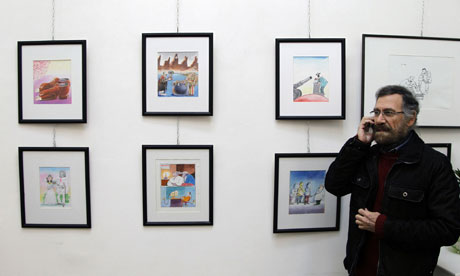
Everyone should buy this book of Ali Ferzat’s cartoons that Scott Davis published at Cune Press. It is excellent.

Some fear war, foreign intervention in Syria
By Phil Sand, Aug 30, 2011, the National

Damascus // With no sign that a political solution will be found to end a six-month-old uprising, Syria is sliding towards a full-blown war involving foreign forces, analysts and political figures in Damascus fear.

Pro-and anti-regime figures and independent analysts once spoke of civil war and international military intervention as remote possibilities. In the past 10 days, however, the already sombre mood in the Syrian capital has turned even darker and now there is a growing consensus that an escalation of armed conflict is likely, if not inevitable.

A turning point came on August 21, with the arrival of Libyan rebels in Tripoli. With the collapse of the Qaddafi regime, Mr Al Assad’s government saw its hope that Nato would be mired in another Afghanistan-style conflict melt away. Meanwhile, opposition activists and analysts took it as a signal that a once-distracted international community will now focus its attention – and perhaps military resources – on Damascus.

The fact that no state, including the Western nations most at odds with the Syrian regime, has proposed military intervention has done nothing to prevent grim speculation.

The gloom has been compounded by increasingly critical positions from the Arab League and from Turkey, whose president, Abdullah Gul, said Sunday that any reforms would now be “too little, too late.”

“Scenarios that lead to foreign military action in Syria grow more likely every day,” said one well-connected political analyst in Damascus, speaking on condition of anonymity.

He brushed aside Western and Arab League assurances that military action was not on the agenda, citing the rapid march to war in Libya as a precedent for how rapidly policies could change.

“The situation could start moving very quickly. If the [Syrian] regime keeps killing people in large numbers, we will enter a civil war, and if that happens Turkey, the West and the Arab states would decide to step in and finish it,” the analyst said. “That is exactly the direction we are now heading in.”…. “Every day we are coming up with political initiatives that we put to the authorities to avert the disaster of war and foreign military intervention but nothing is happening to change course,” said Mohammad Habash, a Syrian MP pushing for reforms. “Without real change, we go deeper and deeper into crisis. We are marching towards more bloodshed.”

Arab League proposes Syria peace plan, Telegraph
By Ben Farmer, 28 Aug 2011

The Arab League is sending its chief to Damascus with a peace plan to try and solve the bloody five-month-old Syrian crisis.

Nabil al-Arabi will visit the Syrian capital with “an initiative” to end the deadlock between the government and protesters, the league said in a statement demanding an end to the bloodshed.

The statement provoked an angry rejection from Syria though, which condemned it as “a clear violation … of the principles of the Arab League charter and of the foundations of joint Arab action.” Foreign ministers from the 22-member League met over the weekend in Cairo as an onslaught against anti-government protesters defied growing pressure from Damascus’s allies.

The United Nations has estimated more than 2,200 have been killed.

Months of international condemnation have failed to halt the bloodshed, which has seen the regime deploy tanks, snipers, and allegedly naval bombardment against street protesters.

In some of the weekend’s heaviest clashes, army defectors who had refused to fire on unarmed protesters reportedly fought loyalist troops in a northeast suburb of the capital.

Dozens of soldiers defected and fled into al-Ghouta, an area of orchards and farmland, after pro-Assad forces shot at a crowd of demonstrators near the Damascus suburb of Harasta to prevent them from marching on the capital, residents said.

Syrian authorities have denied any army defections, though protesters claim growing numbers of rank-and-file soldiers are mutinying against officers loyal to the Assad family.

One resident, who declined to be named, said: “The army has been firing heavy machineguns throughout the night at al-Ghouta and they were being met with response from smaller rifles.”

Security forces on Sunday shot dead two and wounded nine others in the northwestern province of Idlib, the Syrian Observatory for Human Rights said.

Abdullah Gul, president of neighbouring Turkey, said he had lost confidence in Damascus’s promises to halt the crackdown and deliver reform.

“Today in the world there is no place for authoritarian administrations, one-party rule, closed regimes. Those either will be replaced by force, or the governors of states will take the initiative to administer,” Mr Gul warned.

Iran at the weekend warned Mr Assad to heed the “legitimate demands” of his people, but warned Nato would become bogged down in a quagmire if it interfered.

Ali Akbar Salehi, Tehran’s foreign minister, said: “Syria is the front-runner in Middle Eastern resistance (to Israel) and Nato cannot intimidate this country with an attack.

“If, God forbid, such a thing happened, Nato would drown in a quagmire from which it would never be able to escape …

“If the West should want to follow the same course as they have done in Iraq and Afghanistan they would not realise the desired result.”

William Hague, British Foreign Secretary, ruled out a Libya-style Nato military campaign in Syria.

He claimed the success of Libyan rebels in taking Tripoli “vindicated” Britain’s policy of military action, but said there was no consensus for action in Syria.

It was unclear when the Arab League delegation would reach Damascus and details of the peace plan were not disclosed.

Russian diplomats were also preparing to send their own delegation with a competing initiative, Moscow said.

Council seeks ‘resort to reason‘; Delegates also recognize Libyan rebels, ask UN to release frozen funds, assets
By SAMI ABOUDI, Reuters August 29, 2011

Arab foreign ministers told Syria on Sunday to work to end months of bloodshed, and decided to send Arab League Secretary-General Nabil Elaraby to Damascus to push for political and economic reforms.

But in a conciliatory message to Damascus, the ministers also said after an extraordinary meeting in Cairo that Syria’s stability was crucial for the Arab World and the whole region.

Assad receives a message on the Russian vision towards regional issues
2011-08-30

DAMASCUS, Aug. 29 (Xinhua) — Syrian President Bashar al-Assad received Monday a message from his Russian counterpart Dmitry Medvedev ….

SANA said Assad has expressed “appreciation of Russia’s balanced stance towards the developments in Syria.”

Assad said “each step Syria has taken towards issuing laws that lay foundations for a new political era was followed by an escalation of the regional and international campaign towards Syria’s Arab and regional role.”

Bogdanov voiced his country’s support to the process of reforms Syria has commenced in the economic and political fields, underlining the importance of continued coordination between the two countries in all fields.

The Russian envoy’s visit aims likely to feel out Syria’s position on the draft resolution and to what extent Damascus would commit itself to its provisions if Russia and China were able to pass it in the Security Council instead of the Europeans’ proposed one.

The Russian draft stresses that the only solution to the current crisis is “an inclusive and Syrian-led political process,” and urges the opposition to engage in political dialogue with the government.

US ‘encouraged’ by tougher Arab stand on Syria

WASHINGTON – The United States said Monday that it was “encouraged” and “heartened” by a tougher stand from Arab countries toward Syria’s deadly crackdown pro-democracy protesters.

“We are very much encouraged, heartened by the strong statements that we’ve seen over the weekend by the Arab League as well as by the Gulf Cooperation Council,” State Department deputy spokesman Mark Toner told reporters.

These are “further signs that the international community… is repulsed by the brutal actions of the Syrian government and is standing with the Syrian people,” he added.

If the Arab Spring Turns Ugly
By VALI NASR
Published: August 27, 2011

Vali Nasr is professor at Tufts University, a senior fellow at the Brookings Institution and the author of “The Shia Revival: How Conflicts Within Islam Will Shape the Future.”
Graphic
Points of Confrontation

THE Arab Spring is a hopeful chapter in Middle Eastern politics, but the region’s history points to darker outcomes. There are no recent examples of extended power-sharing or peaceful transitions to democracy in the Arab world. When dictatorships crack, budding democracies are more than likely to be greeted by violence and paralysis. Sectarian divisions — the bane of many Middle Eastern societies — will then emerge, as competing groups settle old scores and vie for power. Syria today stands at the edge of such an upheaval. The brutality of Bashar al-Assad’s regime is opening a dangerous fissure between the Alawite minority, which rules the country, and the majority Sunni population. After Mr. Assad’s butchery in the largely Sunni city of Hama on July 31, on the eve of the holy month of Ramadan, the Muslim Brotherhood, a Sunni group, accused the regime of conducting “a war of sectarian cleansing.” It is now clear that Mr. Assad’s strategy is to divide the opposition by stoking sectarian conflict.

Sunni extremists have reacted by attacking Alawite families and businesses, especially in towns near the Iraq border. The potential for a broader clash between Alawites and Sunnis is clear, and it would probably not be confined to Syria. Instead, it would carry a risk of setting off a regional dynamic that could overwhelm the hopeful narrative of the Arab Spring itself, replacing it with a much aggravated power struggle along sectarian lines.

That is because throughout the Middle East there is a strong undercurrent of simmering sectarian tension between Sunnis and Shiites, of whom the Alawites are a subset. ….

Tehran presses ally Assad for reforms
Published: Aug 27, 2011 22:48 Updated: Aug 27, 2011 22:48

TEHRAN: The Syrian government should recognize the “legitimate demands” of its people, Iranian Foreign Minister Ali Akbar Salehi, whose nation is the main ally of Damascus, was quoted as saying Saturday.

“The government should answer to the demands of its people, be it Syria, Yemen or other countries,” the ISNA news agency quoted him as saying. “The people of these nations have legitimate demands and the governments should respond to these demands as soon as possible,” Salehi added.

“We have the same stance toward popular developments in the Middle East and North Africa. We believe that the developments in the region emanate from discontent and dissatisfaction in these countries,” he said.

But he warned against toppling the Syrian regime. “A vacuum in the Syrian regime would have an unpredictable impact for the region and its neighbors,” Salehi said, referring to calls by the United States and European leaders for President Bashar Assad to step down.

Salehi’s comments came two days after Iranian President Mahmoud Ahmadinejad called for dialogue between Damascus and the opposition to end months of deadly violence. “The people and government of Syria must come together to reach an understanding,” Ahmadinejad said on Wednesday.

Syria’s opposition has failed to offer a viable alternative, Aug 28, 2011. Russian News

Shortly after the execution of Saddam Hussein in December 2006, two stories began to circulate about his fate. One told of otherwise sane people reportedly seeing the face of the late Iraqi dictator on the moon on the night of his death. Another told a more believable tale: that the “real” Saddam was alive and well after a body double died on the gallows. It would only be a matter of time before he rose again.

These stories were, of course, nothing more than paranoid fiction. But they spoke to the psychological hold that Saddam maintained over much of the Iraqi public. People simply couldn’t believe his reign of terror was over. Indeed, some people didn’t want it to be.

A similar scenario is playing out in Syria today. Much like his father before him, Bashar Al Assad’s political decisions have rendered him illegitimate in the eyes of many. But fear of what could come next has kept his regime alive.

Mr Al Assad, like all totalitarian rulers, holds on to power in different ways: by force, by coercion, or by a combination of both. Decades of brutality have pushed some to accept tyranny.

But there are others who support the Assad regime for legitimate reasons. These Syrians, predominantly minorities, have profound concerns that must be duly addressed. And so far, the Syrian opposition has failed to reassure those sitting on the fence….

August 26, 2011
Iran Monitors Turkey’s Rising Regional Power
By Stratfor

A high ranking Iranian cleric used some tough language against Turkey on Wednesday. Ayatollah Mahmoud Hashemi Shahroudi – recently appointed to head the newly constituted Arbitration Council- accused Turkey of promoting a Westernized version of Islam to advance its interests in the region. Shahroudi, who is seen as a possible successor to Supreme Leader Ayatollah Ali Khamenei, said Turkey’s claims to be the “guardian of the resistance movement” are tarnished by Ankara’s relations with Israel and alliance with the United States. He said that Iran, despite its support of the Palestinians and efforts against the West, has been pushed to the margins.

Shahroudis comments come a day after another high-ranking cleric, Naser Makarrem-Shirazi (a grand ayatollah who is very close to the Iranian political establishment) criticized the Turkish government for turning against Syria, accusing Ankara of being at the complete disposal of the West. Earlier on Monday, President Mahmoud Ahmadinejad sought Ankara’s help in protecting the Syrian regime from Western pressure during a meeting with Turkish Prime Minister Recep Tayyip Erdogan that lasted more than thirty minutes….

Turkey’s ‘house of glass’
Thursday, August 25, 2011
BURAK BEKD?L

Deputy Prime Minister Cemil Çiçek has an explanation for the most recent escalation of violence in Turkey’s southeast: Foreign powers!

Mr. Çiçek’s reply to a reporter’s question as to who these foreign powers are may well earn him a nomination for the 2011 Speech Apraxia Award: “We know who they are… Those who know who they are know who they are… And they (the evil foreign powers) know it’s them.”

In the previous rise of armed conflict between the Turkish military and the Kurdistan Workers’ Party, or PKK, the Turkish government subtly accused Israel for playing the Kurdish card against Turkey – while not minding to play the Hamas card against the Jewish state. Today, it seems, “those who know it’s them” are either the Iranians or the Syrians, or both. But is it not bizarre to see Israel, Iran and Syria in the same camp? A very rare gathering, indeed…

Wikileaks has released a US embassy cable dated 2008 about the sale of commercial Airbus planes which has been blocked by the USA .

The blockage was already a well known fact. What was not known is : It also stressed that the airframer had “no intention of structuring the deal to attempt to circumvent [US government] sanctions” – ruling out lease and purchase agreements with private third parties.

Russia, China resist U.N. Syria sanctions push: envoys
By Louis Charbonneau
UNITED NATIONS | Fri Aug 26, 2011

UNITED NATIONS (Reuters) – A U.S. and European push to impose U.N. Security Council sanctions on Syria for its bloody crackdown on pro-democracy demonstrators is meeting fierce resistance from Russia and China, U.N. diplomats said.

The United States, Britain, France, Germany and Portugal have circulated a draft resolution that calls for sanctions against Syrian President Bashar al-Assad, influential members of his family and close associates. They say they want to put it to a vote as soon as possible.

The measures are not as severe as U.S. sanctions in place and a proposed expansion of European Union steps against Damascus that would forbid the import of Syrian oil.

U.S., Israel Said to Monitor Suspected Syrian Weapons: WSJ 2011-08-27

WASHINGTON—The U.S. and Israel are closely monitoring Syria’s suspected cache of weapons of mass destruction, fearing that terror groups could take advantage of the revolt against President Bashar al-Assad to obtain blistering agents, nerve gas …

Nasrallah urges Arabs to end unrest in Syria
By Dana Khraiche

BEIRUT: Hezbollah leader Sayyed Hasan Nasrallah called Friday on Arab and friendly states to combine efforts to end the nearly six-month unrest in Syria, adding Syrian support for Hezbollah had been essential in the liberation of south Lebanon from Israeli occupation.

“Everyone who is a friend of Syria and seeks to preserve the country and its unity should combine efforts to help push them toward dialogue and peaceful resolution,” Nasrallah said during a ceremony for the occasion of Jerusalem International Day in Maroun al-Ras, a village on the Lebanese border with Israel.

Nasrallah praised Syria’s support for the Lebanese and Palestinian resistance, noting that if it wasn’t for the support of the Syrian leadership, Hezbollah would not have succeeded in liberating south Lebanon in 2000.

“This land here [south Lebanon] would not have been liberated it wasn’t for the resistance and the resistance would not have won if it wasn’t for the Syrian support,” Nasrallah said, adding that the Iran had also provided support, via Syria.

In 2000, Israel withdrew from south Lebanon in what has been described by Hezbollah as a victory for the party, as has the 2006 war between Lebanon and Israel.

Nasrallah also warned that any positive or negative developments in Syria would affect the entire region, including Lebanon, and would harm the chances of liberating Palestine, praising Syria’s role in supporting the Palestinian cause.

Syrian opposition tries to unite, Turkey pledges more support
25/08/2011

Syria’s fragmented opposition is on the edge of forming their leadership, as the unrest in the country is about to enter its sixth month.

The Syrian opposition gathered in Istanbul earlier this week and established the National Council after three days of meetings. The 120 members will be determined in two weeks.

“Options for the Assad regime are growing narrower by the day while the opposition is becoming bolder and more conscious of the pressing need to demonstrate that they are able to address the question of what happens after the collapse of the Assad regime,” says Amr al-Azm, a Syrian-American history professor.

Meanwhile, al-Azm adds, the opposition is unable to unite around a single representative body “that would then be able to speak on its behalf and articulate these demands in a cohesive and comprehensive manner”.

This is not easy “due to the unsettled relations between the various opposition groups and tensions that exist between those on the inside and the diaspora”, he tells SETimes.

“It is this daunting challenge of attempting to help the Syrian opposition coalesce around a representative body or council that Turkey may find a role to play in the coming days and weeks,” he adds.

Edward Dark, an activist from Aleppo and editor of the website Syrialeaks, said… “We view Turkey as a big brother who should protect us in our time of trouble… maybe [our] expectations are too high and sometimes unrealistic,” he tells SETimes.

Turkey, however, finds itself in a difficult position on the Syrian issue, while it tries to juggle its relations with the regime and links to the people.

“Maintaining this balance is not possible anymore,” Dark says, “The activists demand that Turkey sever its ties with the regime and take a very tough line, with threats of military intervention, under the umbrella of the UN or NATO.”

But in Ankara, officials seem unsure about the next step in their strategy.

“Our diplomacy is the diplomacy of persuasion,” Canan Kalsin, ruling Justice and Development Party (AKP) vice-chairman for foreign affairs, tells SETimes, adding that Turkey will continue its efforts to bring the sides together for dialog.

“[Erdogan] warned last week that unrest in Syria is part of Turkey’s internal affairs. That means the strengthening of the PKK in Syria is very sensitive for us,” she adds.

Oytun Orhan, Syria analyst at the Center for Middle Eastern Strategic Studies, an Ankara-based think tank, explains that some in Turkey blame the recent wave of PKK attacks on Syria, believing that the al-Assad regime is tacitly backing the rebels in response to AKP government turning against its former ally.

“The regional picture is more complicated,” he told SETimes. “Syria is a key ally of Iran, which has, in recent weeks, suddenly stepped up its own attacks on PJAK, the PKK’s Iranian wing. Apparently, Iran also influences Turkey in this matter.”

Syrian Opposition Leader Riad Seif Recounts His Experiences in Prison and Says: ‘Dialogue Cannot Take Place between a Hangman and His Victim’
MEMRI TV

German prize for Syrian poet Sunday, August 28, 2011, BERLIN – The Associated Press

Adonis received the prize for bringing modern European ideas and critical thinking into current Arab culture.

Kordahi; Arab Star’s TV show pulled for his pro-Syria views
(DP-News – AFP)28/08/2011

DUBAI- The influential Saudi media group MBC has blocked the transmission of a game show because of the overtly pro-Syrian regime views of its Lebanese star presenter, Georges Kordahi. The Arabic-language version of the US show “You Deserve It” was to have been broadcast from September 10, and episodes had already been recorded.

In a statement received by AFP on Sunday, the Dubai-based Middle East Broadcasting Corporation said it had “taken this decision through respect for the feelings of the Syrian people.”

The Internet site of the Al-Arabiya satellite channel, which belongs to the MBC group, said Kordahi had been targeted by social networks and in Arab media for his remarks on the pro-government Dunia channel and on pro-Syrian Lebanese stations.

Diary from Syria: Ramadan Kareem or Ramadan Massacre
August 28, 2011 | By Jasmine Roman

….It has been confirmed that in a very wealthy neighborhood in Damascus city, gunshots were fired by security and police men on August 5th, 2011. The area was raided by more than fifty thugs and security officers searching for one unarmed young protestor who hopelessly hid behind the garbage box in the school yard. He was caught and beat violently by all fifty men with their wooden rods and guns. They then broke into the school and threatened to wreck the whole neighborhood if any word, photo, or video is released. This happened in my own street and the whole incident was witnessed by my own eyes. I was almost dragged and imprisoned by the security men as I was standing in the balcony with my family…..

Syrian gov’t troops kill 2 armed near capital: witness

DAMASCUS, Aug. 28 (Xinhua) — Two armed men were killed in clashes with Syrian government forces in Harasta suburb of capital Damascus late Saturday, an eye witness told Xinhua Sunday.

The witness, who asked for anonymity, said intense shooting occurred Saturday in Harasta after Ramadan night prayers between the government forces and armed men, adding that a number of parked cars were smashed with bullets from both sides.

The gunmen were armed with M16 rifles and pistols, said the witness.

After the shooting the government forces sealed off entrances of Harasta and prevented people of entering it, the witness added.

The report couldn’t be independently verified as journalists are banned from going to restive areas.

Iraq-Kuwait Tensions Rise Over Rocket Strikes – August 28, 2011

Shi’ite Militia Accused of Firing Rockets Against Kuwaiti Project

The disputes between Iraq and neighboring Kuwait are long-standing and well documented. Tensions between the two nations seem to be on the rise again as Iraqis loudly oppose the Mubarak al-Kabir Port project.

The opposition to the port centers from concern that it will reduce the value Iraq’s own nearby port of Grand Faw. This led a number of Iraqis to rally against the Kuwaiti project, with the port being the latest in a long line of bones of contention between the two.

Now, it seems, matters have gone beyond simple protest, as a group inside Iraq has fired a number of rockets against Kuwait. So far the rockets fell short of Kuwaiti territory, but led to angry complaints from Kuwait and a rebuke from Iraqi MPs, who warned that the situation could escalate.

CFR.org: How Will Assad Fall?
2011-08-29 by Elliott Abrams

It is easy to say that with Qaddafi gone, the next vicious regime to fall is that of Bashar al-Assad in Syria. ‘Tis a consummation devoutly to be wished, but realists and pessimists have …

Amid Syrian Raids, Reports of Desertions, By NADA BAKRI in NYTimes

reports that dozens of soldiers, possibly encouraged by the rout in Libya of Col. Muammar el-Qaddafi, had deserted their positions in a village near Homs,…

No Bullet Holes in Bab Touma; Several Accounts of Life in Syria

An intrepid reporter working for the SC community has cleared up a mystery. Over a week ago I published an article in which the author Ammar Shami wrote that “armed men sprayed bullets” at a church front in Bab Touma during the opening weeks of the revolt. The article was entitled “Did Syria Use Tanks and Gun Boats to Shell Hama and Latakia?,” which set off a heated debate. A commentator who goes by the name, “Some Guy in Damascus” immediately disputed the claim that a gunman had shot up the front of a Bab Touma church and set out to prove it. This weekend Some Guy in Damascus went to investigate the churches of Bab Touma and found no evidence of bullet holes on any of the church fronts. He posted this short video on Youtube of himself in front of al Saleeb Church in Damascus by way of proof that he has investigated the churches of Bab Touma and found no evidence of bullet holes.

We have yet to hear back from the author of the original article, explaining his account that contradicts SGID’s findings.

I want to thank SGID for his intrepid reporting. Again this story underlines how difficult it is to rely on reports coming out of Syria, when there are no professional journalist to count on. It is also underlines how important it is for journalists, publishers, and bloggers, such as myself, to publish corrections and counter evidence when we find out that we have made a mistake or published articles based on erroneous accounts. We continue to await a professional treatment of the main contentions of Shami’s article – that the Syrian army did not use gunships to shell Latakia or tanks to shell Hama, as most journalists have reported. Certainly his broader claims are now in doubt too.

I apologize for the false report and thank Some Guy in Damascus for his video, good humor, and reporting in these dark times. Joshua Landis

Here are several accounts and short articles

The foreign media ban and its effect on the Syrian perception of the uprising
By Daniel Paul-Schultz (A Master’s student who recently returned from a year in Damascus)
For Syria Comment, 6/24/2011

The Syrian uprising, while influenced by the unrest in the rest of the Arab world, is set apart by the impact of the foreign media ban. No foreign reporters have been allowed to operate freely inside Syria since the protests began in the middle of March. While Arabic and English foreign media networks such as Aljazeera and BBC have consistently shown footage of the massive protests in Yemen, and have even filmed the rebels in Libya, there have been no independent reports coming out of Syria. Instead, the foreign media has been forced to rely largely on a mixture of YouTube videos and telephone conversations with both pro and anti government Syrians. This lack of firm sourcing has caused many Syrians, who generally have equal access to state and foreign news sources, to discount the foreign media as at best subjective, and at worst actively fomenting discord. As a result, the propaganda effort launched by the Syrian has benefited immensely.

While state Syrian television has always been the propaganda arm of the government, its role has become more crucial as the protests have escalated, and with them the violence of the government’s reaction. On a typical Friday, while shows grainy footage of alleged protests from around the country, the state television attempts to reassure the country that nothing is actually happening by showing videos of calm streets in major cities and interviews with mothers in the parks with their children rejoicing that the country is free of the ‘armed terrorist gangs’ whom the government blames for the deaths during the protests.

I spent the last nine months in Syria, and although many young educated Syrians I spoke to did not believe the government’s story, many more Syrians considered the state news reports to be accurate. This may be due to the propaganda embedded in the curriculum through the education system that strongly discourages any questioning or distrust of the regime. It is also due to the fact that Syrian society is replete with conspiracy theories that accuse Israel, the United States and the Gulf states of plotting against Syria. Accordingly, foreign media organizations, along with other outside groups such as human rights groups and other non-governmental organizations, are viewed with distrust by many Syrians, and with the government’s encouragement, seen as potential agents for foreign interests.

The foreign media ban has been an invaluable instrument for the Syrian government because it forces the foreign media to rely on unreliable eyewitness accounts from protesters rather than on neutral and more informed testimony from journalists. While channels such as BCC Arabic dutifully interview Syrian government spokespeople every day, they are quite aware that they will always receive the same rehearsed line blaming armed terrorist gangs for all deaths and denying even the existence of protests in the country. Therefore, to learn any real information, the networks are forced to rely almost exclusively on phone calls with various protesters who own satellite phones.

While these activists are certainly courageous, their testimony is not unbiased. They have a clear vested interest in portraying the events in a particular way that promotes their perspectives. Though their information is undoubtedly accurate to some extent, it is often relayed by the foreign networks as fact rather than opinion. This reliance on vague and unverifiable information ultimately undermines the credibility of the foreign media with their Syrian audience, to the great benefit of the Syrian government.

There is no easy solution to the dilemma facing the Arabic foreign media. Attempts to openly defy the ban on foreign media put reporters in significant danger, as the case of Dorothy Parvaz illustrates. Moreover, in an age of increased competition for the speedy conveyance of news, simply refusing to report on Syria is not an option for major news outlets.

One option, however, is for the networks to become more transparent in detailing exactly how they arrive at specific information, without revealing the names of any sources. For instance, networks could choose to explain to the viewers the specific procedures they go through in order to verify the death of a protester, the size of a protest, and claims made of human rights violations during the unrest.

The networks might also stress, when possible, that the information they are reporting comes from multiple independent sources. While these sources cannot be identified by name for theirown safety, giving ancillary details about their job or age will give more confidence to the Syrian public that this information is accurate.

Although these options will not necessarily cause a rapid change in the of average Syrians, it may convince some doubters that the protests are in fact real and that the government propaganda is in fact lies. While the Syrian public is not the only target of the foreign media, it is the group for which the foreign media has the potential to have the most significant impact. It is therefore imperative that the networks take stronger measures to convince Syrians that they, and not the Syrian government, are reporting the truth.

A Syrian Friend in Beirut

I’m amazed of how fast the Syrian business community are beginning to dump Bashar and the regime. I have also met very rich and influential Syrian business people here in Beirut who are ready to accept mayhem and chaos in return for the departure of Assad and the regime. Just last year, I swear, they were arguing with me how great the regime and Bashar were. Last year, they insisted that Bashar was moving in the right direction. When I asked them about the sanctions, they now say that sanctions are good because they will force Bashar to leave. Now of course these do not represent the majority, but I’m shocked. Damascus looks normal. But it is simmering from the inside.

Another Syrian friend

I’m meeting more and more people wanting violence as means of “resistance” to the brutal regime.

An Atassi – one of the thousands

In the end, revolutions are so seldom about the people, especially if the people are not what they need to be. I might not be old enough, but I know that the Alawites have paid a high and heavy price to get to where they are today.

More than any other minority in the Levant, Alawites paid with their blood for centuries of abuse by the Sunni majority. And they have nowhere to go.

They were poor and hungry (many still are, unfortunately). They were denied the very basic of human rights and dignity. My grandfather used to tell me that in Homs, the Alawites were not even allowed to walk the sidewalks, they needed to be on the street like the rest of the animals.

No one will sell them anything, and few bought from them. Why?  They are heretics and the enemy of God and His Messenger.

They were so poor, living over land that cannot be properly cultivated, they sold their daughters to homes in Homs, Hama, Lattakia and other major cities so they can survive with the few pennies that we threw at them.

We continuously deny the horrible facts in our history and we continuously pretend that other sects and religions coexisted peacefully in Syria. Baloney. Not true! And our history is written by Sunni historians or historians that were enriched by the Sunnis.

I am a Muslim Sunni and I know; I am ashamed of my sect and my people and my religion for not coming in full force to repent and pay back for the severe injustices they were perpetrated on other sects – all in the name of we are Muslim and we Muslims are good.

The only time I will trust Syrians with democracy is when I see heads of families treating their families with respect. When adult children are free to make choices away from family and tribal pressures. When families tell their children about the value of the Syrian mosaic and how to respect and treasure diversity in Syria. When they tell their children that we have abused minorities and it’s time to talk about it.

I will trust my fellow Syrians when I see them revolt and getting disgusted when a brother slaughters his sister because he thought she harmed the family honor.

I trust Syrians when they start trusting one another because they all belong to the same institutions of law and order.

Until we start a national dialogue, and until the MBs apologize for the killings they committed, and the regime erects monuments for the people they killed, and the Sunni admits their unmistakable prejudices, and until the people break the taboo of not talking about sectarian hatred and cynicism, and until the people are genuinely free as individual people, and until relations between religious sects becomes a national topic that is taught in classrooms, and until the constitution is clearly written to protect the minorities from the oppression of the majority, and to protect the Syrians from their own government, I’m doomed to not trust any outcome.

It’s amusing to me when i hear people talking about Article 8, and how to remove it and by when, at the time when the whole country is boiling with sectarian hatred and terrible class relations. Talk about misaligned priorities.

I am currently a rebel on the loose looking for a revolution that fits my definition.

Muhammad writes:

Yesterday one of my friends reminded me of a conversation a while back when I stated that I would vote for Bashar if he stood in an election. It gave me insight how much my position has shifted during the last 5 months. I’m sure there are millions of stories similar to mine. Bashar has lost his biggest asset and rather than being a strength to the regime he is now a liability.

A little story from my home city (Edleb). Edleb has seen massive demos for a while. The first casualty was over a month ago and it resulted in a significant shift of mood in the city. Before then, there used to be pro-regime demos. After that guy got killed (he was shot while still inside the mosque – they were trying to stop the demos early) none of this happens. A lot of people who used to be pro-regime came to his funeral and stated through speakers their “repentance”. The participation in the strike after his death was easily 95%. Adunnya channel tried to play a really dirty game by blaming his murder on another family in the city. The two families the biggest in Edleb in terms of numbers. It did not work well for Adunnya. The second family set up their own funeral for the martyr and the two locations became permanent anti-regime demos for days. The city became a completely different place following this event.

In terms of demos Edleb is on a par with Deir Alzor & Hama (considering it is smaller city). It has seen relatively very little bloodshed (I think 4 killed so far) although there has been a lot of violence on the streets between the police and the demonstrators. It is the only Governorate Centre currently that sees one large demo daily instead of multiple small once. There are areas the demos don’t go through (mainly by the last standing statue of Hafez). The army surrounds the city but as for now it has not gone in (snipers were deployed at one time though). I’m not sure whether the government has too much on their hands currently or whether they are afraid of a massive refugees movement similar to Jisr (we are about 20 km from the Turkish border) should the army go in.

“We Will Have to Eat Brown Bread,” Adib Mayaleh, Head of Syria’s Central Bank

Adib Mayaleh promised Syrians “brown bread” rather than cake yesterday. Coming from Syria’s head banker, this is not reassuring. “It will be more and more difficult because of sanctions and the events. We will have to tighten our belts”, he said. “I say the opposite of Marie Antoinette who said that if the French have no bread they should eat cake. I think we will have to give up the cake to eat brown bread”.

Dr. Adib Mayaleh & Dr. Rateb Shallah, the son of Badr al-Din Shallah, who assured Hafiz al-Assad that the Damascene Sunni elite would not join the Muslim Brotherhood in their uprising against the regime in 1982. Photo taken in 23/4/2005 during the The first Tourism Investment Market in Syria.

Iran, Syria’s only backer and ally, is hedging its bets. It’s leaders no longer have confidence that Assad will survive. Ahmedinejad “warned” Bashar yesterday in an interview on Hizballa’s Almanar TV that “the people should have the right to elect and get their freedoms”. He also said that a timeline and deadlines should be put in place so the west can’t have an excuse to interfere. Iran is worried about throwing good money after bad.

The EU stopped just short of ordering a full oil embargo, but it cannot be far off. Syria only exports 110,521 barrels of oil a day. At $85 a barrel, this is just short of $10 million a day or $3.6 billion a year.This is the amount of Syria’s export revenues from oil. It is chump change for the international market. Italy has been buying half of all Syrian oil exports in an effort to make up for the Libyan exports that are no longer available to it. Replacing Syrian oil with another source will cause modest inconvenience and a small financial hit. Italy, it would seem, is being given more time by the EU to negotiate a favorable deal for a replacement source.

President Assad will not be able to survive this. It is not clear how he will be pushed out. Today, he appears strong militarily. The Syrian army has retaken Hama and destroyed large demonstrations in Homs, Deir and many other places, but the people are boiling. Anger is traveling up the Syrian social hierarchy. People cannot support this killing if there is no end in sight. Sunni merchants, the professional classes, and Christians stood by Bashar yesterday. They considered him Syria’s only option. They are rethinking. They can see that there is no light at the end of the Assad tunnel. They are beginning to pray that the change comes quickly. How that change will come remains unknown.

Will the Syrian opposition be able to rise to the challenge. That is the question that hovers over every discussion today. Can it resolve its internal squabbles in order to provide sober and disciplined leadership? Can it assume power without prolonging Syria’s agony? The Syrian youth have shown tremendous courage, but the time for wisdom and compromise has arrived.
[End of Landis Commentary]

News Round Up

Mayaleh Says $2 Billion Used to Back Syria Pound Amid Unrest
By Massoud A. Derhally, 2011-08-26 12

Aug. 26 (Bloomberg) — Syria has spent $2 billion defending its currency since the start of an uprising five months ago against the rule of President Bashar al-Assad, said Adib Mayaleh, governor of the central bank. The money came from a fund the government created two years ago that had $5 billion when the revolt began, Mayaleh said in a phone interview from Damascus today without giving details of the currency transactions. The Syrian currency has lost 3 percent against the dollar during the same period.

“These funds were for specific use in hard times like these,” he said. “As we say in Syria, save your pennies for black days.” He added, “We are in these times at the moment, these are hard days that Syria is going through and everyone is coming together to find solutions.”…

The European Union imposed sanctions against 50 people and nine entities in Syria and the bloc is preparing to prohibit imports of crude oil from the country. It has placed Assad on its asset-freeze and travel-ban lists. The EU imported 3.2 billion euros ($4.6 billion) in crude oil from Syria in 2010, or 88 percent of the total of goods shipped to the bloc from the country last year, according to the 27-nation European Commission, the EU’s executive.

“We hope the Europeans will stop these sanctions because they are imposed directly on the Syrian people,” Mayaleh said.“All countries that have had sanctions imposed against them,  and the Europeans know this, it’s possible to go around them, but at a higher cost,” he said, adding, “that’s what happenedin Iraq and a number of other countries.” …

EU extends Syria sanctions but stops short of oil embargo
Tuesday, 23 August 2011
By AFP
BRUSSELS

EU governments formally adopted sanctions on Tuesday against 15 more people and five businesses, but stopped short of concrete moves to impose a full oil embargo on Damascus.

The list of names covered by asset freezes and travel bans now runs to 50 people and nine businesses, with legal enforcement entering play when they are published in Wednesday’s legislative log, the EU’s Official Journal.

But a diplomat told AFP on Tuesday that despite a first discussion in Brussels on the oil embargo, “no clear decision has yet been taken,” with London in particular determined to ensure that sanctions do not impact on the Syrian people.

The source said: “We are in a process of working through what further tools we want to use.”

“We are open to all options–the oil embargo, sanctions on banks and telecoms, in line with the Americans–but we want to make sure sanctions are targeted at the Assad regime.”

“We are acutely aware of the need to ramp up sanctions, but we don’t want them to impact on the Syrian people,” he underlined.

Some 90 percent of Syrian crude oil is exported to the EU, where the main buyers are Denmark, Italy, France, the Netherlands, Austria and Spain, in that order. …

Western Sanctions May Put Slow Squeeze On Syria = August 26, 2011, NPR

Syrian street vendors display their goods in downtown Damascus on Tuesday, Aug. 23. Syria’s economy was hit hard initially by the anti-government uprising. It has bounced back, but now the U.S. is urging the E.U. to join in banning import of crude oil from Syria.

The Syrian economy has so far weathered the mass protests and widespread violence that have rocked most every major city. But in a move that could increase the pressure, the European Union is considering a ban on imported Syrian oil, similar to sanctions the U.S. imposed earlier this month.

Western governments say the Syrian regime’s harsh response to an anti-government uprising has demonstrated that it is not fit to lead.

In March, when the uprising first began, Syria’s economy took a huge hit. Tourism — which accounts for a large segment of the economy — dropped to almost nothing.

But later, the economy bounced back a bit, and the middle and upper classes of Syria, based mainly in the city of Aleppo and in the capital, Damascus, recovered.

Guardian (GB): Bashar al-Assad’s fall is inevitable, 2011-08-26
by Salwa Ismail

Syrians will not stop protesting until the regime is gone. They don’t need military intervention….The uprising has entered a new phase, with the opposition and protest movement widening to include professional groups such as lawyers and doctors. This adds a new dynamic to confrontations with the regime.  …  Inside Syria itself, though, there has been no call for external military …

Syrian Arab Airlines A350s blocked by US sanctions: embassy cable

Syrian Arab Airlines had been in line to receive Airbus A350s as part of a broad fleet renewal covering 50 aircraft, newly-disclosed diplomatic cables reveal. But the airframer’s plan to supply the jets – a package which included 10 A330s and 30 A320s – foundered over US government sanctions on Syria’s administration.

Russia, China boycott sanction talks – Friday, August 26, 2011

Russia and China have boycotted UN Security Council talks on a proposal to impose sanctions on Syria’s President Bashar al-Assad, diplomats say. Their absence at the talks signalled the tough negotiations ahead on the move to act against Assad’s deadly crackdown on opposition protests, diplomats said.

DJ EU Embargo On Syrian Oil Would Hit Italy Hardest-Document
2011-08-25, By Benoit Faucon and Konstantin Rozhnov, DOW JONES NEWSWIRES

LONDON (Dow Jones)–A shipping document suggests a European Union embargo on Syrian crude oil–expected to be finalized next week–would hit Italy hardest,
even as the southern European country continues to make do without Libyan crude. Nearly half of the crude oil exported by Syria ended up in Italian ports last month–the equivalent of about 55,132 barrels a day out of 110,521 barrels a day of total Syrian oil shipments, according to a Syrian ports document reviewed by Dow Jones Newswires. Italian oil giant Eni SpA (E, ENI.MI) and refiners IES Italiana and Saras SpA (SRS.MI) said they do refine some Syrian crude as part of a broader slate of oil grades. ….

“European refineries are already grappling with the loss of Libyan crude,” Barclays Capital said in a note last week. “Given that one half of Syria’s key production stream is the sweet and lighter Syrian Light grade, any loss in Syrian crude volumes can significantly jeopardise European refinery operations.”

The E.U. has condemned Syrian President Bashar al-Assad following recent violence and announced a series of sanctions against the government and senior officials there. The E.U. next week is expected to finalize a plan to extend sanctions on Syria to cover oil exports to the E.U., an E.U. official said Tuesday. EU officials didn’t return a request for comment Thursday. Apart from Italy, the Syrian port document shows Syria exported crude and products to Spain, France and Turkey, among others. And a spokesperson for OMV, who declined to comment on the list of Syrian loadings, said that 7.8% of the 7.8 million metric tons of oil refined at the company’s Schwechat refinery in Austria last year came from Syria.

Yet Syrian imports remain only a small part of the roughly 1.3 million barrels of oil Italy imports every day, and government officials and refiners in the country say they can cope.

Syria has ceased all transactions in dollars Tuesday in favor of the euro
26/08/2011

Syria opposition must learn from Libya’s council
National Editorial
Aug 24, 2011

The one lesson that Syrians must learn from Libya is this: set up a truly representative national council. The Libyan Transitional Council was formed on February 27, only 12 days after Colonel Muammar Qaddafi declared a war against his own people. Libya’s council, headed by an honest politician, Mustafa Abdel Jalil, then began rigorous diplomatic efforts to gain international legitimacy, support and access to funds. The council has done a good job overall.

In Syria, more than five months after the uprising began, no such body has been established, despite the killing of over 2,000 people. And the lack of an organised and united opposition makes the future of Syria after President Bashar Al Assad, well, oblique.

A national council including credible dissidents would convince many Syrians who currently sit on the fence to side with the protesters. By discussing post-Assad Syria, a council could also encourage the international community to move more aggressively against the regime. Military intervention is both unlikely and undesirable, but there is more to be done with smart sanctions and pressure.

In fairness, the opposition has little political or diplomatic experience, after decades of suppression. But although delay means more bloodshed, opposition figures are still disagreeing on lesser issues than the continuing killings. Some even pulled out of talks about starting a national council. If such discord continues, some in the opposition will bear some of the blame for a lack of success….. The heaviest blow to Mr Al Assad is an alternative to his rule. Only then will his regime surely crumble.

????? ??? ?????? ?????? ??????? ????? ?????
al-Qabas
???? ????? ??? ??? ????? ????? ??? ?????? ????? ????? ??? ??????? ?????? ??? ???????? ?? ????? ??? ??????? ????? ?????? ?????? ????? ?????? ????? ?????? ???? ??????? ????? ?????? ??? ??????????. ??????? ?????? ???? ????? ????? ??? ????? ??? ??????? ??????. ????? ??? ?? ?????? ?????? ????????:

After Arab Revolts, Reigns of Uncertainty
By ANTHONY SHADID,
August 24, 2011, New York Times

DJERBA, Tunisia — The idealism of the revolts in Egypt and Tunisia, where the power of the street revealed the frailty of authority, revived an Arab world anticipating change. But Libya’s unfinished revolution, as inspiring as it is unsettling, illustrates how perilous that change has become as it unfolds in this phase of the Arab Spring.

Though the rebels’ flag has gone up in Tripoli, their leadership is fractured and opaque; the intentions and influence of Islamists in their ranks are uncertain; Col. Muammar el-Qaddafi remains at large in a flight reminiscent of Saddam Hussein’s; and foreigners have been involved in the fight in the kind of intervention that has long been toxic to the Arab world.

Not to mention, of course, that a lot of young men have a lot of guns.

No uprising is alike, but Libya’s complexities echo in the revolts in Bahrain, Syria and, most of all, Yemen, suggesting that the prolonged transition of Arab countries to a new order may prove as tumultuous to the region as Egypt’s moment was stirring.

Unlike at the start of the year, when the revolutionary momentum seemed unstoppable, uncertainty is far more pronounced today, as several countries face the prospect of stalemate, sustained conflict or power vacuums that may render them ungovernable. Already in Yemen, militant Islamists have found a haven. Across the region, the repercussions of the uprisings are colliding with the assumptions of the older, American-backed system: control of oil, the influence of a reactionary Saudi Arabia, an Arab-Israeli truce, and the maintenance of order at the expense of freedom in a region that for decades has been, at least superficially, one of the world’s most stable.

In just the past week, Colonel Qaddafi lost his capital, Tripoli; the United States and European countries called on President Bashar al-Assad of Syria to step down; the president of Yemen, still recovering from burns suffered in an attack, has promised to return; and the relationship between Egypt and Israel descended into crisis, to the jubilation of many Egyptians who saw a more assertive government as a windfall of Mr. Mubarak’s fall.

“There is going to be a transfer of power in our societies, and a new order has begun to take shape in the region,” said Michel Kilo, an opposition figure in Damascus, Syria.

Aug 24 (Reuters) – Arab ministers will hold an urgent meeting in Cairo on Saturday to discuss the situation on Syria, an Arab League official said on Wednesday.

“The Arab League Peace Committee will hold an urgent meeting on Saturday on the latest events in Syria and the League’s secretariat is making calls to know the number of countries and the names of ministers to attend,” the official said, asking not to be named.

The United Nations says 2,200 people have been killed in Syria since the start of a five-month-old uprising against President Bashar al-Assad. (Reporting by Ayman Samir and Omar Fahmy, writing by Yasmine Saleh)

Experts Offer Guidance for President on Syria
4:57 PM, Aug 19, 2011 • By DANIEL HALPER in Weekly Standard

In a letter being circulated by the Foundation for Defense of Democracies, conservative foreign policy experts, including Bill Kristol and Lee Smith, urge President Obama take a series of actions that will hasten the fall of Syrian strongman Bashar al-Assad. The letter follows President Obama’s statement yesterday that “the time has come for [Syrian] President Assad to step aside.”

The primary recommendation in the letter is that the U.S., together with our European allies, should sanction Syria’s energy (especially oil) and financial sectors, as well as those individuals who are committing human right abuses and promoting terrorism. The experts also argue that the U.S. should “Engage Syrian opposition figures outside the country and ensure that all available aid and assistance, including secure communications and Internet circumvention technology is being made available to these groups” and recall Ambassador Robert Ford from Syria. Here’s the full text of the letter:

Maersk Cancels Tanker Calling at Syrian Port on U.S. Sanctions
2011-08-25, By Rob Sheridan

Aug. 25 (Bloomberg) — Maersk Tankers, a unit of A.P. Moeller-Maersk A/S, canceled a scheduled tanker loading in Syria because it would contravene U.S. sanctions. The Maersk Edward was due to pick up a cargo at the Syrian port of Banias, said Michael Christian Storgaard, a spokesman for the company in Copenhagen. Security was “not an issue as such,” Storgaard said by phone today.

Qatar Emir: Iran visit part of ‘friendly ties’, QNA/Tehran

HH the Emir of Qatar Sheikh Hamad bin Khalifa al-Thani and Iranian President Mahmoud Ahmadinejad yesterday held a session of official talks at the presidential compound in the Iranian capital Tehran. The session was attended by the members of the high-level official delegation accompanying the Emir

HH the Emir of Qatar Sheikh Hamad bin Khalifa al-Thani has said his visit to Tehran and meeting with Iranian President Mahmoud Ahmadinejad was part of the “friendly ties” with Iran.

“We have discussed bilateral relations and co-operation between the two countries besides matters of common concern,” the Emir said last night.

On his vision on the developments in Syria, the Emir said all countries that supported Syria in difficult circumstances have tried to encourage our Syrian brothers to take steps to implement a real reform process.

The Syrian people took to the streets in Syria on a real popular and civil uprising calling for change, justice and freedom, HH the Emir added.

The security solution has failed in Syria, the Emir said, noting that the Syrian people are not willing to back down after the price paid.

HH the Emir expressed hope that the decision-makers in Syria would understand the need for change in response to the aspirations of the Syrian people, adding that “we must help them to take such a decision.”

Visa, other cards not valid under Syria sanctions
By ALBERT AJI, Associated Press

Visa and MasterCard credit cards are no longer valid in Syria under new U.S. sanctions targeting Damascus because of its deadly crackdown on a 5-month-old uprising, officials said Thursday.

The Treasury Department this month added the state-owned Commercial Bank of Syria and its Lebanon-based subsidiary to its sanctions list, citing their links to human rights abuses and to illegal weapons trade with North Korea. The action freezes any assets the firms have in U.S. jurisdictions and bans Americans from doing business with them.

In a statement faxed to the AP, the state-run Commercial Bank of Syria said the victims of the sanctions would be Syrian citizens and foreign tourists who will be “obliged to deal in cash with all its undesirable problems.”….

“This will be the key point for Syria … if Arabs stop trading with” the country, said Said Hirsh, Mideast economist with the London-based Capital Economics. He said 60 percent of Syrian exports go to Arab countries. “It’s the Arabs that will be able to cripple (Assad’s regime) more than the international sanctions.”

The move to ban the credit cards, which Syrian banks began issuing in 2005 for local customers, may also affect the country’s influential merchant class – a wealthy cadre of businessmen whose support, or at least lack of outright opposition, is seen as key to Assad’s hold on power.

George Badi, a sales manager at the Dedeman Hotel in Damascus, said the measure will hurt business and wipe out many Internet-based reservations.

“It seems that the U.S. is slapping sanctions on the entire Syrian people not only the Syrian regime,” he said.

Inside Syria’s failed rebellion
Praveen Swami
ON THE EDGE OF AN ABYSS: Syrians demonstrate against the government, in this July 2011 file picture.
President Bashar al-Assad’s government has imposed order — but is yet to slay the three-headed dragon which threatens its survival.

Thick black lines had been scored over the graffiti under the cherubic image of President Bashar al-Assad that guards the road into Hama{minute}a. The military’s clean-up squad had been less than diligent though: the word kalib, dog, survived the paint-brush censorship, and the soldiers had forgotten to have the President’s gouged-out eyes repainted.

Inside the city, the rebels had left behind evidence no amount of paint could obscure: the burned-down military officers’ mess on the Ard al-Khadra street, which mobs stormed in the hope of seizing weapons; the gutted office block which housed the justice department; the charred walls of the al-Hadr police station, pockmarked with machine-gun fire, where 17 police officers were lynched, before their mutilated bodies were thrown into a nearby canal.

Behind the justice ministry’s office, a small group of young men described what happened when the military moved in on July 31, three months after rebel groups, armed with guns, knives and petrol bombs, seized control of much of the town. “They used snipers to shoot at us,” one says, and “more than a dozen people were killed.” The army, he claims, then tied the hands of local residents and forced them to roll on the street, all the while beating them with rifle butts.

Ever since the spring uprising in Syria, the most serious challenge to the regime since it took power in 1970, commentators had been predicting that President al-Assad’s regime was on the edge of collapse. In spite of an energetic western media campaign, largely based on overblown accounts provided by exiled opposition groups, it is in fact becoming clear that the rebellion has all but collapsed: Damascus, for example, is more alive with everyday civic life than New Delhi.

But there is no disputing that Syria’s government is far from slaying the three-headed dragon which threatens its future: a threat from the West; an economic crisis engendered by neoliberal economic reform; and a mounting Islamist threat.
The failed rebellion…..

Turkey’s ‘house of glass’
Thursday, August 25, 2011, Hurriyet
BURAK BEKD?L

Deputy Prime Minister Cemil Çiçek has an explanation for the most recent escalation of violence in Turkey’s southeast: Foreign powers!

Mr. Çiçek’s reply to a reporter’s question as to who these foreign powers are may well earn him a nomination for the 2011 Speech Apraxia Award: “We know who they are… Those who know who they are know who they are… And they (the evil foreign powers) know it’s them.”

In the previous rise of armed conflict between the Turkish military and the Kurdistan Workers’ Party, or PKK, the Turkish government subtly accused Israel for playing the Kurdish card against Turkey – while not minding to play the Hamas card against the Jewish state. Today, it seems, “those who know it’s them” are either the Iranians or the Syrians, or both. But is it not bizarre to see Israel, Iran and Syria in the same camp? A very rare gathering, indeed…

Syria-Russian Venture to Build Oil Rigs From 2016, Watan Says Bloomberg News

The Syrian-European Group for Heavy Industries plans to build a plant that will produce oil rigs from 2016, Al Watan reported, citing a government official.

The company is partnering with Russia’s Uralmash Machine Building Corp. to produce the country’s first drilling rig by early 2016 from the plant that will cost at least 250 million euros ($362 million), the newspaper said, citing Syrian Deputy Oil Minister Hassan Zainab. The factory will manufacture about 10 rigs a year and export some of them to Middle Eastern markets, according to the newspaper.

Syrian-European, established in Syria in 2007 and located in an industrial compound near the central city of Homs, will also produce the nation’s first locally made wind turbine to generate electricity in early 2012, Zainab said.

Libya Rebel Oil Official Says China, Russia Will Have Trouble Getting New Deals

LONDON (Dow Jones)–Global powers who took chilly positions toward Libya’s insurgents–such as China, Russia or India–will have trouble getting new oil contracts in the future, a spokesman for a rebel-controlled company said this week.

The US war of words against Syria is marred by hypocrisy and a lack of realism. al-Jazeera

You’d need a team of linguists to tease out the internal contradictions, brazen hypocrisies and verbal contortions in President Barack Obama’s call for Syrian President Bashar al-Assad to relinquish power.

“The future of Syria must be determined by its people, but …”

The “but” belies the preceding phrase – particularly since its speaker controls the ability and possible willingness to enforce his desires at the point of a depleted uranium warhead.

“The future of Syria must be determined by its people, but President Bashar al-Assad is standing in their way. His calls for dialogue and reform have rung hollow while he is imprisoning, torturing and slaughtering his own people,” Obama continued. One might say the same thing of Obama’s own calls for dialogue and reform in Iraq and Afghanistan. Except, perhaps, for the fact that the Iraqis and Afghans being killed are not Obama’s “own people”. As you no doubt remember from Bush’s statements about Saddam Hussein, American leaders keep returning to that phrase: “killing his own people”.

The 5 Things Everyone Should Know about Syria
Robert G. Rabil, August 25, 2011, The National Interest

The Syrian regime is similar to a mafia regime, with al-Asads as the Corleone family…..

Jerusalem Post: Arab World: Is Bashar next?
2011-08-26 13:54:32.543 GMT

The apparently imminent eclipse of the Gaddafi regime in Libya has re-ignited hope among some Western commentators concerning the so-called Arab Spring. The entry of Libyan rebels to Tripoli is being depicted in some circles as the removal of a …

Valerie, an American Business Owner in Latakia, Tells Her Story of Gun Boats, Rimal al-Janubi, the Evacuation, and Miliatry Operations

Valerie – an American business owner in Latakia – tells her story of Gun Boats, Rimal al-Janubi, the Evacuation, and the Military Operation in Latakia

Reuters: Smoke rises in the city of Latakia August 14, 2011.

It is scary here. It seems the longer this goes on the worse the outcome is going to be for the Syrian people. Latakia is pretty much empty. This is supposed to be the busy season for most businesses here. Many of the business owners like us have been paying employees to sit and do nothing but busy work for months now. We are emptying our own personal savings to pay them. We won’t be able to do this for much longer.
Below is my account of what happened a few weeks ago in Latakia.

Regarding the military operation in Latakia on August 12th – 15th.

I am an American woman living in Latakia. I was at the Assad Sports City complex when residents from Rimal al Janubi and the Rimal Palestinian refugee camp were sheltered there.

On Thursday, August 11th, my husband called me from Turkey, where he was working for business, to tell me I should plan on staying close to home for the weekend. He told me the government had made an announcement of a planned military operation in Rimal al Janubi, a poor neighborhood that includes the nearby Palestinian camp. He said that the government was advising residents of the Rimal neighborhood to evacuate and that anyone who remained behind risked being caught in the gunfights they expected to ensue. They would also risk being arrested for suspicion of aiding the opposition fighters. Rimal is on the outskirts of Latakia and at the opposite side of the city from where I live. My husband was concerned that fighting might spill out from Rimal and into neighborhoods near the center of the city.

Gun Boats

My apartment is in the Al Asher neighborhood not far from Al Assad Sports City. I can see the complex from the balcony and roof of my apartment. Friday I stayed home with my children and listened to the news waiting to hear about what was going on in Rimal and if anything was happening in other parts of the city. My electricity, water, and internet were never cut. When I began hearing reports later in the day that the military was using war ships to shell parts of the Rimal neighborhood, I called another American friend who lives in an apartment near the southern corniche that overlooks the sea onto the Rimal neighborhood. He said he could see the ships sailing back and forth near Rimal, but had not seen or heard them firing. Like me he had been home all day. He had noticed the ships when he first awoke and had been watching them all day. He explained that he knew about the planned military operation and was thus waiting it see if anything happened and for that reason paid particular attention to the gun ships. When I spoke with him later, he said he had spent most of the weekend watching the ships and said never saw or heard them fire anything.

The Sports City complex

On Saturday morning my driver arrived at 8:45 am and went with me on my run. I run 6 days a week around the perimeter of the Sports City complex. While on the run I noticed about 4 or 5 cars of people pulling into the complex. I also noticed several children playing near the entrances with park staff. The complex is usually fairly empty at this time of the morning unless there is an event going on. When I asked, my driver later told me that these were people coming from Rimal and that many of them were staying inside the stadium. When the cars pulled in they had to register and show their ids to the guards. This is a standard procedure for anyone entering the complex at anytime. At about 10:30 am, after my run I sent the driver on a shopping errand in the center of the city. He came back early and told me that there was a lot of gunfire in the city and didn’t feel it was safe to be there. He said there were no protests going on. This was also the first time there had been gunfire in the center of the city so early in the day. During the day I watched a 3 or 4 buses of people from Rimal dropping off residents at Sports City. I also watched as truckloads of supplies and food were brought in. The Joud family (a prominent family in Latakia) donated a truckload of food for the Iftar dinner each night.

On Sunday, I watched as 2 or 3 more buses dropped Rimal residents off at Sports City. I had heard on the news that 5,000 people were staying at Sports City. This report seemed to be a great exaggeration. From what I could see from my apartment, I estimate there were only about 500. My driver told me that because of the announcement made early by the government of the planned military operation and the on going violence in the neighborhood many people had left the city to stay in the villages with family members. Latakia as a whole is nearly empty. Most residents who are able to, have escaped the daily gunfights here to their familial villages.

Four Soldiers and 50 Non-Soldiers Killed

On Monday, the government announced it had finished its’ military operation in Latakia. I watched as several bus loads (maybe 5 or 6, but definitely not 5,000 people) carried people from Sports City back to Rimal. Government television said 4 soldiers had been killed and 35 were wounded by gunfire. Approximately 50 others were killed and many others were wounded. It is difficult to determine if these were opposition fighters or civilians caught in the crossfire. No one that I have spoken to in Latakia believes there were any protests taking place in Rimal that weekend.

There have been rumors circulating in Latakia, some from credible sources, that the reason the military had gone into Rimal al Janubi and the Palestinian camp was that opposition fighters had taken over the neighborhood. Some rumors have gone as far as to say that the opposition had actually been able to set up their own check points and had closed several of the roads into the neighborhood. Being in Latakia and seeing what I have seen over the past 5 months these rumors seem more credible than the reports I see everyday on the news on peaceful protesters being murdered en masse.

I don’t believe all of the deaths in Syria are those of innocent non-violent protesters. I also don’t believe that the government is responsible for all of the deaths. The events I have witnessed here in Latakia lead me to believe opposition groups are taking arms up against the government forces (I have seen a Palestinian girl arrested after weapons were found in her apartment, the cousin of a friend was killed while walking in an Alawi neighborhood that has never seen any protests, another expat friend of mine saw a man setting up a sniper rifle on the rooftop across from the building where he worked and watched as the man was arrested after someone else called the police, the list goes on…). If the opposition is taking up arms against the government here in Latakia, the sheer number of deaths make it easy to believe opposition groups in cities and villages like Homs and Jisr al Shuggour are not peacefully opposing the government as the western media would like us to believe.

____

A Syrian from Aleppo writes:

I can confirm the death of the 4 soldiers in Latakia that day as Valarie mentioned. My cousin is serving his compulsory military service in the navy in a base in Latakia. He’s a medicine graduate, so he is a medic. That day in the morning they gave everyone on the base bulletproof vests and ordered them to wear them all day. Later in the day they took the medics to al-raml Al-janoobi area. My cousin saw 4 dead soldiers brought in and many others wounded. There is no question about the existence of militancy in the opposition. The coastal and boarder areas have surely witnessed a flood of arms coming in during the past six months. With the 24/7 incitement on Aljazeera and 2 dedicated extremist channels funded by Saudi and calling for people to jihad against the “heretics” and “Shiaa” and “rawafedh” in Syria, it would be strange if Al-Qaeda and other extremists aren’t pushing for holly war in Syria with arms and money.

Militancy is still a limited phenomenon in the revolt. My concern is that the media and activists want us to believe that the militancy does not exist and that the government wants us to believe that all demonstrators and revolutionaries are armed. This is not true. The activists should denounce the violence and the government should allow real peaceful demos to take place.

BBC Report: “It’s the first time, for a long time, that they’ve used gunboats.”

NYTimes: Syrian Navy Joins Attack on Key Rebellious Port City

Al-Jazeera video footage: Tanks and gunboats ‘fire on Latakia’

News Round Up (25 August 2011)

Ali Ferzat, Syria’s most loved cartoonist was beaten by mukhabarat and thrown out of a car. His most recent cartoon was of Qaddafi stopping in his Jeed to pick up Bashar al-Assad, who was hitching a ride. The cartoon and Ali’s site is no longer available on the internet….

Two opposing views of Syria’s economy. One claims Syria can tough out the economic hit for quite a bit longer. The other, by Carnegie, says no. Master Card in Syria is down. More top Syrians are sanctioned by the EU. Gulf Sands, the oil company partly owned by Rami Makhlouf is hit with more troubles and the West is chiseling away at the Syrian economy.

Gulf countries, in an apparent reversal of position, seem to be distancing themselves from the US effort to strangle Assad’s regime. Saudi arrested anti-Assad demonstrators and Qatar has backed away from its anti-Syria diplomacy as its leader heads for a visit to Iran.

Syria’s Opposition woes are cataloged by Reuters. Here is a photo of Ali Ferzat.

Russia hints at veto of UN sanctions on Syria – 2011-08-25 06:26 AM

The U.N. Security Council should use dialogue to persuade Syria to end its violent crackdown on protesters, Russia’s envoy said Wednesday, hinting he may veto a draft resolution being circulated to impose an arms embargo and other measures on President Bashar Assad’s regime.

Ambassador Vitaly Churkin told reporters outside council chambers that instead of punishing Syria, the council should use dialogue and diplomacy to help end the violence.

Churkin said he had registered his country’s opposition on Wednesday to the sanctions proposed by Britain and supported by France, Germany, Portugal and the United States.

The proposal is expected to come up for a vote as early as this week and Russia is among five permanent council members empowered to veto it. Churkin said such sanctions could “encourage further confrontation” and “we need to instead encourage dialogue.”

Asked whether he would register a veto, Churkin said: “I think you can make your conclusion from my words.”

The resolution could also face possible opposition from other council members, including veto-wielding China.

US lawmaker: Aid to Egypt depends on peace with Israel, By HERB KEINON, 08/23/2011 00:47

Kay Granger tells ‘Post’ that level of Muslim Brotherhood involvement in new Egyptian government will impact US assistance. Washington’s $2 billion in annual aid to Egypt will be cut off if Cairo backs out of the peace treaty with Israel, Congresswoman Kay Granger – whose job as chairwoman of the US House appropriations foreign operations subcommittee means she literally writes America’s annual foreign aid bill – told The Jerusalem Post on Monday. more…

Mastercard blocked in Syria
20 Aug 2011

In response to these sanctions MasterCard will institute a block of all transactions originating in Syria as of 20 August 2011. This block will be in effect until further notice. A notification will be sent in the event that the block is removed.

Unified Syrian opposition council hit by delay
25/08/2011
AMMAN |

(Reuters) – Syrian opposition figures who met in Istanbul to form a broad-based council to represent the uprising against President Bashar al-Assad said on Thursday that they needed more time to consult with activists inside Syria on its composition.

The delay indicates the difficulty in uniting an opposition decimated by decades of Assad family repression, and integrating a generation of younger activists playing a direct role on the ground in street protests facing the brunt of military assaults.

“We need two more weeks to coordinate with the opposition on the inside. All currents need to be represented,” Adib al-Shishakly, whose grandfather was an early president of Syria after independence from France in 1946.

Encouraged by international support for their cause, leading opposition figures held lengthy discussions in Istanbul this week to nominate a council that could help with a transition of power if Assad were to be toppled by the five-month uprising against his rule.

Most delegates had left but a core group remained to continue discussions with opposition figures inside Syria, Shishakly said by phone.

Attendees at the conference included Moulhem Droubi, a high-level member of the Syrian Muslim Brotherhood; Sheikh Muteih al-Butain, a leader of the street protests in Deraa that helped ignite the uprising; former political prisoner Khaled al-Haj Saleh, scion of a leftist political family; and writer Hazem Nahar, who was imprisoned during the uprising and managed to leave Syria.

DIFFERENCES PERSIST

Another delegate said more work was needed to convince skeptical activists inside Syria how the proposed council would further the cause of the uprising and bridge differences over the posts assigned to different groups and how different factions should be represented.

“I think a consensus is developing that a council is needed and its credibility will be boosted by as much support from the inside,” said the young delegate, who recently fled Syria and did not wish to be identified.

A statement by the participants said the proposed council was designed to “be part of a national safety net needed to guarantee civic peace and achieve broad consensus about the process of transition.”

“We affirm the principle of non-violent revolution. The absence of a unified political forum along the revolution … is a dangerous shortcoming of Syria’s march toward a civic democratic state,” the declaration said.

But Ammar Qurabi, a member of a consultative committee that emerged from an earlier opposition conference in the Turkish city of Antalya, said in a statement the group had withdrawn from the Istanbul talks because the meeting did not build on earlier efforts to unite the opposition.

Western governments, which have stepped up sanctions on Assad in reaction to his crackdown on protesters, have privately expressed frustration with opposition’s lack of unity, diplomats say.

At a meeting with anti-Assad Syrian activists in Washington this month, U.S. Secretary of State Hillary Clinton encouraged them to work toward a “unified vision” for Syria.

The proposed council aims to speak for dissidents in exile, who are playing a key role in supporting the uprising financially, and activists on the ground.

A number of activists are wary about establishing a linear opposition structure, saying it would make it an easier target for assassinations and arrests by Assad’s forces.

Dissident writer Michel Kilo, a former political prisoner who belongs to an elder generation of dissidents said this week that a transitional council would be of little value before Assad actually falls from power.

Syrian opposition sidelining Turkmens, community leader says
Wednesday, August 24, 2011
?PEK YEZDAN? – [email protected]
ISTANBUL – Hürriyet Daily News

Turkmens in Syria have been sidelined by the opposition groups who recently formed a national council to represent the uprising in the Arab republic, community representatives have said while also criticizing Turkey for neglecting their plight.

Turkmens have been suppressed by the regime of President of Bashar al-Assad for many years, yet they were not invited to recent opposition meetings in Istanbul, said Ali Öztürkmen, a representative of the community, adding that he could only attend as an “observer” because they became aware of the meetings at the last minute.

Although official numbers indicate there are between 900,000 and 1.5 million Turkmens in Syria, Öztürkmen said there were actually close to 3 million Turkmens in Syria as many of them, like a large number of Syrian Kurds, had been deprived of citizenship by the Syrian regime.

“The Turkish government is also not showing any interest in Turkmens in Syria,” he said.

Refuting the claims, a Turkish Foreign Ministry official said the Turkish government had always showed interest in all its kin and living outside Turkey.

The official said the government’s first priority was the integration of these groups in the society in which they live; in cases like Syria, however, the priority is to seek the rights of these groups if there is evidence that they have been treated unjustly, the official….

From Arab hero to zero – Sami Moubayed – Aug 26, 2011 – A great article about Qaddafi

Syria economy hit by demos but still standing: experts
August 25, 2011 01:24 AM
By Sammy Ketz
Agence France Presse

DAMASCUS: The Syrian economy, hit hard by five months of anti-government protests, could survive unrest and sanctions into next year but experts and officials warn of a sharp deterioration afterward.

The protests, which have rocked much of the country since mid-March, have dramatically slowed economic activity, with analysts predicting negative economic growth in 2011 as a result of a decline in tourism and investment.

“During the first three months of the revolt, everything stopped because consumers were stunned,” said Abdul Ghani Attar, vice president of Attar Group, a Syrian conglomerate with investments in hotels, finance, pharmaceuticals and office equipment.

“Since June, economic activity has resumed, but is down about 40 percent from a year ago.”

“For the moment, the private sector, which represents 70 percent of GDP, has survived, but if the situation does not improve next year, the economy will really suffer. There is a risk of layoffs,” the 32-year-old continued.

Even now, Syria’s economic indicators paint a grim picture.

The Washington-based International Institute of Finance predicts the country’s economy will contract by 3 percent, and tourism, which accounts for 12 percent of GDP and 11 percent of employment, is sharply down.

The overall number of investment projects, meanwhile, are down 47.84 percent in the first half of 2011 compared to the same period of 2010, according to official figures.

To make matters worse, the population is now only buying the bare necessities because of a fear of the unknown, according to Naji Shawi, who heads the Shawi Group.

The turnover of the Shawi Group, which is involved in food, pharmaceuticals, cleaning products and finance, is down between five and 10 percent compared to last year, he said.

“Until now, the business sector is surviving, but if this crisis continues for more than six months, there will be problems,” he said.

Syria’s main stock market has plunged 40 percent since mid-March and consumption is markedly lower, with clothing and electrical stores in Damascus lying bare.

The country imported just 2,000 cars in May, against 20,000 in March, and overall imports have halved compared to last year, according to a European diplomat, who spoke on condition of anonymity.

By contrast, building materials are booming because, with police occupied with protests, unsupervised construction is on the rise. Street vendors are also doing well for similar reasons.

So far, the economic decline has not spread to the currency, as the Syrian pound is down just 8 percent against the U.S. dollar since March.

Syrian central bank Governor Adib Mayalheh last week took increased steps to limit foreign exchange transactions, and the country still has around $17 billion in reserves.

“They are probably lower now but in all cases we have no clear data on that,” said Jihad Yazigi, editor of the Syria Report economic newsletter.

“Also, at least half of the budget goes to investment expenses, so the government could very well decide to skip most investment expenses [actually it has already partly done so] and use that for current expenses, i.e. salaries, running overhead,” he added in an emailed response to questions.

Syria’s 2011 budget amounted to $16.7 billion, 43.4 percent of which was dedicated to investment.

According to Shawi, Mayalheh told him that “during the good times, it [the central bank] held $5 billion to manage the fluctuation of the Syrian pound, and until now, it has injected $2 billion to support the currency.”

The European diplomat, meanwhile, claimed that Iran had recently provided $6 billion to help Damascus manage the currency, but could provide no proof.

“The situation has deteriorated, but it is not desperate,” said Lahcen Achy, a Syria specialist at the Carnegie Middle East Center in Beirut. “The regime can survive this for a long time.”

Achy added: “The economy will not bring down the regime and if it did, it would take a long time. Experience shows that regimes can survive embargos because they can smuggle in goods and money via Turkey and Lebanon.”

“In any case, if he has to make a choice, the security forces will be the last to experience any cuts.”

Shawi concurred, noting that “the West relies on the economic weapon, but one can always adapt. Look at Iraq in the past. Sanctions are good for headlines, but they hurt the people, especially the poor, never the regime.”

A potential European oil embargo could have an impact, however, as 95 percent of Syria’s oil exports go to Europe, amounting to a third of the country’s revenue.

In the absence of a U.N.-backed ban, however, Damascus could still sell its crude to non-European countries.

In any case, according to an economic expert based in Damascus who did not want to be identified, “the 11th five-year plan which called for investment of $100 billion, half of which was to come from the private sector, is now out the window.”

The Economic Consequences of Syria’s Social Unrest
Lahcen Achy Los Angeles Times, August 17, 2011

Popular protests in Syria over the last five months have caused a notable decline in the country’s economic indicators. Gross domestic product is expected to contract by 5% for the current year, after International Monetary Fund estimates had originally predicted 3% growth before the protests erupted.

The budget deficit has increased due to expanded social expenditure and shrinking tax revenues. The economic and security situation is expected to deteriorate further as the unrest continues to grow. The international community may resort to additional sanctions affecting the private companies and government institutions that form the backbone of the Syrian economy. This could throw the country into an unprecedented economic and fiscal crisis.

Tourism, which accounts for about 12% of Syria’s GDP and directly contributes more than 10% of total employment, is one of the economic sectors most damaged since the protests began. Over the last three years, Syria has spent huge sums to increase its ability to receive Arab and foreign tourists and improve the quality of services provided to them. Tourist numbers rose from 6 million visitors in 2008 to 8.5 million in 2010, an increase of more than 40%. This activity supplied Syria with about $8 billion of hard currency over the same period.

Although little detailed data exist on the effect of the current social unrest on tourist numbers, most hotels are almost empty now that international tourism trip organizers have stopped proposing Syria as a destination, and most Arab embassies have issued statements urging their citizens to refrain from visiting Syria until further notice.

Recurrent unrest in various Syrian provinces has also driven a number of foreign investors to review their investment programs. Several Persian Gulf and foreign companies have announced plans to stop or cancel huge projects due to the uncertainty that overshadows Syria’s economic future. Some reports indicate that investments are being redirected — probably to Jordan, especially now that it may soon join the Gulf Cooperation Council.

This drop in tourism and the stoppage of large investment projects is worsening the living conditions of many Syrian families. Some of them will see their incomes fall, while others will join the unemployment lines.

To soften the hardship of this crisis and contain popular anger, the Syrian government has increased government salaries and fuel subsidies and reduced taxes on food. In the first few days after the protests started, Syria’s president, Bashar Assad, issued a decree increasing monthly salaries and wages by 1,500 Syrian lira ($30), in addition to a 30% increase for monthly salaries under 10,000 lira ($200) and a 20% increase for salaries at or above 10,000 lira. The government also reduced fuel prices by 25% to aid citizens’ purchasing power and counter negative effects of the inflationary pressures accompanying the protest wave.

The cost of these measures, which were not anticipated in this year’s fiscal law, is estimated at more than 2% of GDP. This means the budget deficit will expand and could surpass 8% of GDP unless tax revenues — and economic activity — rise.

The deteriorating budget situation raises questions about the government’s ability to cover the deficit gap without resorting to foreign loans. Bank deposits have dropped due to an increase in withdrawals after the protests began. To remedy this situation, the central bank has raised interest rates on lira deposits by two points to stimulate savings and stop the depletion of bank deposits. Although this measure may help improve liquidity in the banking sector, it is causing an increase in the cost of funding, especially for the governmental sector, which receives nearly 55% of bank loans.

The Syrian lira has also recorded a drop in its value versus the dollar, falling up to 15% at times. There has also been an increase in currency trading in the unregulated (black) market. The Syrian central bank announced the insurance of foreign currency for individuals and companies as needed in an effort to stop the lira’s devaluation and black market activity.

It is possible that the monetary authorities’ intervention to reduce pressures on the lira could exhaust a significant portion of the central bank’s hard currency reserve. Such fears are reinforced by the drop in tourism revenues and foreign investment, and they may have been the motive behind the central bank’s imposition of a 0.7% charge on dollar cash withdrawals from personal accounts. At the beginning of 2011, foreign exchange reserves were estimated at $17 billion. Under normal conditions, this would be enough to fund seven months of imports.

Implementing credible political and economic reforms was a genuine option in the hands of the regime. Harsh repression and excessive use of force against people killed that option. Today, Syria is facing critical socioeconomic challenges that could lead to an increase in the unrest’s human and financial costs, worsening living conditions for broad sections of the population. This will only further fuel popular anger and likely lead to the regime’s collapse.

Iraq Adopts Iran’s Backing of Assad
August 24, 2011 | 9:37am
Juan Cole

* What impact will the call by the United States and major European powers for Syrian President Bashar Assad to step down–followed by heightened U.S. and EU sanctions–have on Syria-Iran relations?

They will push Syria even more into the arms of Iran. Syria is being gradually cut off from Western finances and relationships. So if the regime is going to survive, it will want to look east to Iran and perhaps China. Syria seems to also be improving its relationship with Iraq.

* Why has Iraq opted to align with Syria and Iran in backing Assad?

It is not entirely clear. Prime Minister Nouri al Maliki does not state motivations. But it appears that two things are going on. There is a domestic reason; Maliki is worried about Bashar al Assad being overthrown. Assad belongs to the minority Shiite sect of Alawites. Many of Assad’s opponents are Sunnis- some of whom are Sunni fundamentalists. And some of those are the sort of people who were supporting the Sunni insurgency in Iraq. Maliki does not want them to come to power in Damascus and become his neighbors.

Another consideration that has been suggested is that Maliki owes his position as prime minister in this round [of elections held in 2010] to the support of Iran for coalition building of the Iraq Shiites. So he may be paying back a debt.

* Is this a new de facto alliance?

There seems to be a growing Tehran-Baghdad-Damascus axis for certain purposes. Iraq is a very complex place and it still is, in odd ways, an American ally. Though in this particular instance, Baghdad is siding with Iran and Syria against the stated U.S. position. The alliance appears to be over sectarianism and regional politics. There is nothing that Syria can do for Iraq, economically. Syria is potentially a trading partner but there is no economic carrot that Syria can offer Iraq. It is actually the other way around. According to one report-that Maliki has denied-the Iranians had pressured the Iraqi government to donate $ 10 billion to Syria to help Damascus get through its current crisis. The alliance is very much about who you will like to have in the capital of your neighbor.

* What are the factors behind the support of Iran and Iraq for Syria?

…. Iraq is not similarly isolated but it is in some ways being pushed into a Shiite set of alliances, both by the sectarian undertones to the uprising in Syria and by events in Bahrain, where the Shiite majority demanded the Sunni monarchy become a constitutional monarchy. [But the Shiites] were crushed with the help of Saudi Arabia and the United Arab Emirates, who were essentially acting as Sunni powers in the Gulf. This crushing of Bahrain’s democracy movement by Sunni powers provoked large demonstrations in Iraq and angered a lot of Iraqi Shiites. Of course, Maliki is both the prime minister of Iraq and the main political leader of the Iraqi Shiites. .

Cheney Says He Urged Bush to Bomb Syria in ’07 – August 24, 2011

WASHINGTON — Former Vice President Dick Cheney says in a new memoir that he urged President George W. Bush to bomb a suspected Syrian nuclear reactor site in June 2007. But, he wrote, Mr. Bush opted for a diplomatic approach after other advisers — still stinging over “the bad intelligence we had received about Iraq’s stockpiles of weapons of mass destruction” — expressed misgivings.

“I again made the case for U.S. military action against the reactor,” Mr. Cheney wrote about a meeting on the issue. “But I was a lone voice. After I finished, the president asked, ‘Does anyone here agree with the vice president?’ Not a single hand went up around the room.”….

Syrian expatriates arrested in Saudi Arabia for staging rally in support of uprising – 24 Aug 2011

Saudi security forces have arrested 164 Syrian expatriates who staged a rally in Riyadh in support of the five-month uprising in their homeland against the rule of President Bashar al-Assad, a Syrian human rights organisation said.

Syrians were surprised by Qatar’s stance calling for Assad to reform and stop the violence, a drawback from their previous positions. This announcement precedes the prince of Qatar’s visit to Iran, to include extensive talks covering Iran’s relationship with the GCC.

U.S. believes its ties to Iraq are stronger than Iran’s – August 24, 2011

BAGHDAD — The U.S. ambassador to Iraq said Sunday that the U.S. maintains stronger relations with Iraq than does Iran, despite recent media reports that Prime Minister Nouri al-Maliki’s statements about the unrest in Syria were soft and indicated a philosophical shift toward Iran.

Interventionists Versus Non-Interventionists

Interventionists Versus Non-Interventionists
Two distinct camps are forming to battle over Syria policy in Washington.

[This article was picked up by CNN as Washington’s battle over Syria]

The first is made up of the neocons, who are busy fitting the Arab Spring into US strategic interests as they see them. Bolton, Doran, and Abrams have been leading the charge in articulating this argument. (Bolton and Doran articles are copied below)

The second group are the “realists,” with a liberal coating. Anthony Cordesman of the Centre for Strategic and International Studies has articulated a “don’t get involved” argument in the article copied below.

The first want to take down Assad’s Syria and the second do not.  The first group believe that flipping Syria’s orientation from being pro-Iran and anti-Israel to inverse is as a vital US strategic goal, the second do not. The first see it as part of a broader effort to help friends and hurt enemies. They see Israel and Saudi Arabia as America’s main allies in the region and want to build them up. They want to crush, Iran, Syria, Hizbullah, and Hamas. Syria is important because of Iran, America’s number one enemy. They tend to depict the battle in the Middle East as a struggle between good and evil, and freedom versus tyranny. The second see shades of gray. They see an ugly civil war lurking behind the surface of democracy promotion and are not sure Washington would be wise to get sucked into further expensive commitments that have more to do with messy emerging national identities and less to do with US interests.

The neocons have a number of strengths. Clarity is first among them. Second is the nature of the Assad regime, which is oppressive and run by a family surrounded by a narrow elite, dominated by Alawis, a minority community unpopular among a broad section of the Sunni population. The regime has failed to deliver sufficient economic growth to reverse the growing pool of unemployed youth and to raise the standard of living for most Syrians. The country is suffering from all the ills of a growing income gap, drought and bad policies. Reform has been too slow and many believe it will never come because of the vested interests of the narrow and highly corrupt elite at the top. A growing number of Syrians argue that the entire system must be destroyed and Syria must rebuild itself. Increasingly, leaders of the Syrian uprising are beginning to embrace the ideas being put forward by the neocons. In order to win full US backing, they are pushing for acceptance of a complete strategic reversal of Syria’s foreign policy goals.

The neocons are not advocating direct US military involvement in Syria today. They understand this is not politically feasible. But they are preparing the grounds for a much higher level of military commitment in the future. They understand full well that in order to take down the Assad regime and counter the force of the Syrian military, the Syrian opposition will need to develop a full military option. To do so, it will need major US and NATO backing. This will not be a fight for the feint of heart.

Their strategy for angling the US toward making such a commitment in the future is economic sanctions. Broad economic sanctions imposed on Syria by the EU would have major moral implications down the road. Should Syrians start to starve, as they surely would if real sanctions are imposed, the moral argument for intervention and military escalation would improve. Should the poorest and most vulnerable Syrians begin to expire, as happened in Iraq in the 1990s, military intervention would become necessary to end the suffering and starvation. Liberals would have to support the military option in such a case. Today, most do not. Sanctions imposed now will make military intervention in the future imperative. Liberals embraced the invasion of Iraq in large part because of the moral argument. Saddam was starving his people. It would be hard to resist such an argument.

Europeans governments have so far resisted imposing blanket trade sanctions on Syria for this exact reason. Once we see European governments impose devastating sanctions on Damascus, we may safely assume that they have accepted the notion of greater military involvement down the line in order to solve the humanitarian problem that sanctions will create. Perhaps they will not support a ground invasion as was done in Iraq, but they could support establishing a no-fly-zone and arming and training a proper Syrian insurgency, as was done in Libya. Of course, in Syria it will be a much bigger and more expensive operation as Syria has no frozen assets that can be diverted to fund the opposition. They Syrian army is much tougher than Libya’s was.

The realists argue that the US should not get militarily involved. They argue that Assad is too strong, and that the US is trying to prune its military commitments rather than grow them. The Assad regime still has the support of important sections of the population. It is not a clear question of good versus evil in Syria; rather, the struggle for power reflects deeper civil and sectarian divisions in Syria. The Syrian opposition is hopelessly divided. Perhaps it will develop a leadership, but that will take time and must be left to emerge organically. The US should not tie its cart so closely to Israel and Saudi Arabia because both countries are pursuing policies which are not good for US interests in the long run. What is more, the realists do not believe that the US should take sides in the broader religious war being fought between Shiites and Sunnis in the Middle East. The US wants to check Iranian power and dissuade it from going nuclear, but it does not want to enter into the religious war. Most importantly, the US has too many military commitments in the Middle East, a region that has sucked up far too much of Washington’s time and money over the last decade. Greater involvement in Syria is not popular. In the end, this is a Syrian battle and the US cannot decide it’s outcome.

[End of Landis Commentary]

From the Comment Section: Should the Opposition go Military?

Tara writes:

Time may have come for the revolution to change course.  I am specifically worried about what I read in 190.  Selmiayh my not work anymore.  Armed resistance with no fly zone and a buffer zone near the northern border might be the way to go.  The buffer zone will be the safe haven for the defectors and I am sure most Sunnis in the army will defect.  I am not afraid of civil war.  Alawites who support the regime are already in the army or security forces or are Sabbihas.  They are already bearing arms.  Intellectual Alawites and others who do not currently support the regime will not support it either in case of armed resistance.  I doubt Christians civilians will bear arms and die for the regime as deep down their support is pseudo-support stemming dorm minority’s complex disorder.

We started hearing some demonstrators on the ground asking for international protection.  I am sure this is a growing feeling but people have not freely expressed it for fear of being labeled traitors.  External opposition needs to pay attention to these subtleties.  We can waste 2200 lives in vain.

I personally am struggling with this.  Is armed resistance justified? absolutely. 2200 killed in cold blood including 100 infants and small children, more than 10000 arrested, and thousands forced into refugee camps or exile.  Is it moral? Absolutely.  One could argue that allowing the killings to happen without fighting back is not moral.  Armed resistance is not romantic but I am afraid that it might be the only way to a happy ending.

After all in the fairy tales that I like to read, evil must be fought.  It never surrenders out of benevolence.  Bashar speech might be the turning point.  It is clear that he wouldn’t hesitate to unleash all his evil against the people and you may just not be able to win over that evil with non violent means.

sheila writes:

Dear Tara, Even though I usually agree with you on almost everything, I would like to vehemently disagree with you on the call for armed resistance.  I totally understand where you are coming from.  On an emotional level, it is very hard for any decent human being to watch what is going on in Syria and not feel that something drastic needs to be done to stop the blood shed, however, the day the demonstrators carry arms will be the start of the real massacres.  Today, the regime has  no “legitimate” reason to kill massive numbers of protestors because no one believes the “armed gangs” fantasy, even though the regime has exhausted all efforts to cement the theory.  When the peaceful resistance becomes armed resistance, then the regime will have the “legitimacy” to kill en mass.  Also, to have enough arms to fight the regime, you will definitely need outside support to pay for and smuggle the equipment.  This is not what we are looking for.  As hard as it is on an emotional level to let people die without putting up a fight, it is ultimately the strongest weapon that we have to fight the regime with.  Remember that were it not for NATO, Gadaffi would have exterminated all the “rats” of Libya,  A state army versus armed demonstrates is never a fair match or a winning match for the demonstrators. Hang in there.  The days of this regime are numbered.

Revlon writes:

Due to the mounting loss of human lives, imprisonment, and torture amongst street demonstrators, activists and their families, Youth Syria For Freedom website has issued a statement revising its recommendations on the issue of armed resistence.

– The statement stresses the importance of maintining peaceful demonstrations and the speedy formation of a representative national councuil.

– In addition to encouraging army defection, the statement sanctions operations by the FSA against Shabbee7a and Asad’s forces in defense of civilians.

– It also acknowledges, that the time might come when Libya style foreign military assistance would be needed!

Abu Ammar writes:

When your regime is dominated by Alawis and it cracks down with its armed forces and mukhabarat, dominated by Alawis, and slaughters, expels, jails tens of thousands of Syrian Sunnis so that it can maintain its Alawi grip on power, do you honestly expect that there won’t be sectarian hatred, bearing in mind that these actions are supported by the overwhelming majority of Alawis, something proved by the facts on the ground? And the deranged menhebeks have the audacity to talk about sectarianism, when they are the biggest benefactors of it?

Why do you expect the people to go to their graves like sheep and for them to smile at you when you kill them? They demand you be pacifists while they slaughter you. They are no different than their Zionist cousins who are outraged that the Palestinians refused to become refugees in their own land.

majedkhaldoon writes:

Tara

I have been an advocate of arming the people all along,I feel that a brutal dictator will not go unless he is faced with arm protestors, loosing 6000 martyrs between those who were killed,and those who diappeared, and there are more than 20,000 arrest this regime is not going to leave out of embarassment, we just saw two states one in Yemen,it was so far peaceful revolution, and is still going on, and one in Libya, that has just won because it was armed one.

It is not going to be a civil war, it is national uprising, all syrian will join in, even Alawite,and yes Christians, all against the Assad clan, It is wrong to call it civil war,What is called syrian army is not syrian army , it is assad protection army, and yes we have 17 security forces,all with arms, and the Shabiha(Lijan Sha3bieh),how can a peaceful young men prevail,this is big prison,and surrounded by all kind of weapons….

It pains me a lot to see thousand of young men and kids dye this way, in the long run we will loose more people ,killed by Assad clan, than what we would have lost if we use the armed revolution. and with peacefull revolution we may end up getting humilliated and forced to go back to become slaves again.
Syria will not get divided,and under democracy,we will not be sectarian,those who fight for freedom,will respect freedom.

Fred Writes:

Perhaps the best military option is to reform the army so that it operates like Hizballah? The current system of conscription with corruption can be devastating for poor families, and is an unnecessary waste of the young men’s time and the state’s resources. Hizballah fighters seem to have very high morale, unlike the starving wretches the government is throwing at the people. I’ve been told of residents in both Hama and Daraa feeding the soldiers that surround them. Also in Deir Ezzor soldiers from Aleppo were breaking into homes simply to steal food. An acquaintance of mine was recently re-drafted into the military and retrained as an intelligence officer. He paid a lot of bribes in order to be relieved of his duties and he is now a civilian again. While he was there he paid from his own pocket to keep 5 conscripts in food and provisions.

To Tara and Aboud – I understand your point about soldiers’ loyalty to the people but please don’t forget that many of them are terrified, hungry and exhausted and are in some respects the people most abused by the system.

Military question:

How do we get Syria’s arsenal of rockets out of the hands of Assad and Company and into the hands of the new state without losing them to other countries’ intelligence services????

Strategic positions:

I like the idea of keeping both Iran and Turkey happy at the same time without needing the current Assad mafia. I don’t understand why we should throw away a valuable relationship with Iran, simply because it supported Assad. What do you expect it to do? If we get the support of Iran and Turkey, then we can get rid of Assad very quickly, because they can guarantee a way out for him.

News Round Up

US, allies all but rule out Syria military intervention – News agencies

The United States and its allies have all but ruled out military action against Damascus despite their success in Libya because Syria’s opposition is less organised and faces a much stronger regime.

Analysts said the situation is far less conducive to foreign intervention in Syria, despite the success of the NATO air campaign that weakened Muammar Gaddafi’s defences and helped Libyan rebels to reach the heart of Tripoli.

One analyst said that unlike in Libya, the allies would also face Arab opposition to military strikes in Syria, and warned that intervention carried the risk of triggering a broader regional conflict.

State Department spokeswoman Victoria Nuland all but ruled out allied military intervention in Syria if sanctions and diplomatic pressure fail to stop President Bashar al-Assad from using deadly force to crush protests.

The Syrian people “have chosen peaceful means to make their views known to their own government,” Nuland told reporters last week, adding they were following the paths of Gandhi and Martin Luther King.”So military action is not the preferred course of anyone, not the Syrian people, not the Arab or European or American members of the international community,” she said.

Nuland reiterated the US stance when asked whether rebel successes in Libya since the weekend would increase the pressure for intervention in Syria.

In France, which led the charge for military action in Libya, French Foreign Minister Alain Juppe said there would be no such intervention in Syria even if the rebel advances had what he called “significant consequences” for Damascus.

Anthony Cordesman, a security analyst with the Centre for Strategic and International Studies think tank, said the United States and its allies did not have much of a military option in Syria.

“There’s no overt uprising to back, there’s no momentum behind the uprising. Your are talking about a country (Syria) with a real military machine, with a serious military capability, unlike Libya which is largely a facade,” he said.

“Until you see a real opposition develop in Syria, some kind of movement that has some credible reason to be backed, you can’t simply out of context attack Assad’s regime because it’s repressive,” Cordesman said.

“The scale of military operations that would be required (would be much higher than in Libya) and present far more risks of civilian casualties and collateral damage,” he said.

Radwan Ziadeh, a US-based Syrian dissident who has met US Secretary of State Hillary Clinton, said the rebel successes in Libya will spur more calls within Syria for arming the opposition against Assad.

The Nexus and the Olive Tree
The White House needs to tune out the dramatic events of Syria and Libya and focus on America’s strategic goals in the region.
BY MICHAEL DORAN | AUGUST 22, 2011

At the heart of Obama’s grand strategy was a mistaken definition of the strategic challenge. Now that the Arab uprisings have dragged the United States through a crash course on Middle Eastern realities, U.S. policymakers can more easily recognize the deepest drivers of politics in the region — namely, the vast number of severe conflicts that set Muslims against Muslims. From a practical strategic point of view, there is no such thing as “the Muslim world.” Any effort to write a narrative of cooperation with a thing that does not actually exist is bound to encounter severe difficulties.

The United States must therefore dispense entirely with grand strategies that seek to foster a conciliatory image of the United States and to solve the Arab-Israeli conflict. Instead, it should focus on the key challenge posed by the Arab uprisings: managing intra-Muslim conflict.

This requires returning to the question that Saudi Arabia’s King Abdullah first posed to Obama: What is the strategy of the United States toward Iran? At stake in Syria today is nothing less than the future of the Iranian regional security system. It should not escape notice that the Saudis, though hostile to the populist wave in general, have now aligned themselves against Assad. As much as they fear revolution, the Saudis fear the Islamic Republic of Iran even more, and they see the Syrian crisis as an opportunity to deal a severe blow to it. The United States should adopt a similar view.

The contest on the ground in Syria, obviously, has profoundly local causes. Nevertheless, the regional struggle between Iran and its rivals will play a significant role in shaping it. After Assad falls, a proxy war will erupt, with outside powers seeking to cultivate Syrian clients. Iran and Hezbollah will use the covert and brutal methods that they have honed in Lebanon and Iraq. They will preserve what they can from the remnants of Assad’s security services, while simultaneously arming and training new proxies. They will kill off and intimidate those Syrians who get in their way.

The United States has a vital interest in thwarting Iran. To do so effectively, however, it must develop a serious and sustained regional containment strategy. The process of writing the new strategy begins, like before, in Riyadh and Ankara. This time, however, Obama should reverse his attitude toward the preferences of King Abdullah and Prime Minister Erdogan. The Syrian crisis offers a new opportunity to reach a strategic accommodation with the Saudis. At the same time, it should also force Washington to re-evaluate the Turks’ no-problems policy. To date, this policy has worked to the net benefit of Iran and Syria and to the detriment of the United States. There is no reason to believe that it will produce a different result in the future.

Writing a new grand strategy is important, but not urgent. It can always be put off until tomorrow, “when things calm down.” In the meantime, the phone is ringing. The world was treated to images of cheering Libyans retaking their capital on Aug. 21; the United States will surely be called upon to play a role in the messy political transition that will follow. The Aug. 18 terrorist attack in Israel has raised the specter of another Gaza war, while also escalating tensions with Egypt. And next month, the question of Palestinian statehood may well be taken up by the United Nations.

These and many other matters will soon fill up the calendar of U.S. officials. But if Washington is not careful, all these urgent issues will push aside consideration of grand strategy, precisely when it is needed most.

Only 12% Americans Think U.S. Should Step Up Involvement in Syria
Monday, August 22, 2011

The Obama administration has increased its criticism of Syria’s violent response to anti-government protests, and both President Obama and Secretary of State Hillary Clinton are now calling for Syrian President Bashar al-Assad to step down. But most U.S. voters continue to think America should mind its own business when it comes to Syria. Just 12% of Likely U.S. Voters believe the United States should get more directly involved in the Syrian crisis, according to a new Rasmussen Reports national telephone survey. Sixty-six percent (66%) think the United States should leave the Syrian situation alone. Twenty-two percent (22%) are not sure which course is better.

New York Post: Facing facts on O’s Syria miscues

2011-08-24 John Bolton

The end of the Khadafy regime in Libya has focused new attention on the rebels in Syria — as has last week’s belated call by President Obama for the ouster of Bashar al-Assad. But it will take a more radical Obama course correction to make a real …

we should have pursued regime change, aiding legitimate opposition groups and thereby empowering responsible Syrian believers in a free and open society. Instead, we face an environment today where radical Islamists are potential successors to the Ba’athists.

Third, Obama has never understood Iran’s domineering role in Syria. Beyond the Ba’ath Party’s historical propensity for brutality and repression, long ago perfected by Bashar’s father, Iran’s increasingly hegemonic position has virtually ensured that he will not contravene Tehran’s will.

Given Iran’s use of Syria to fund and arm Hezbollah, Hamas and other terrorist groups, and its likely use of Syria to hide aspects of its nuclear-weapons program, Iran was never going to permit “reform.”

Indeed, the administration needs to face Iran’s influence across the region. Syria’s and Hezbollah’s murderous intervention has rendered Lebanon virtually prostrate yet again. Hamas’s indiscriminate terrorism against Israel has destroyed the prospects for Palestinian unity and a responsible path to statehood and representative government. Now, with Mubarak’s fall in Egypt, Hamas can conspire in public with its parent organization, the Muslim Brotherhood, to radicalize Egyptians as well as Palestinians.

Obama either didn’t comprehend this relationship, or was simply unwilling to cross the Iranians because of his ethereal hopes to negotiate with Tehran to end its nuclear-weapons program. White House mistakes continue to allow Iran to prevail in Syria.

Fourth, calling for regime change isn’t just a question of timing but also of leadership. The administration waited far too long, thus minimizing the impact of its rhetoric, which is all that its policy really amounts to.

Moreover, prior sanctions, and those just announced by Obama and being discussed in Europe, haven’t squeezed Syria’s regime, nor are they likely to. Sanctions targeting particular institutions and individuals can almost never be effective because they are so susceptible to evasion. Only sweeping sanctions, swiftly and decisively applied and effectively enforced, have a chance of real effect. That is a far cry from what Obama and the European Union have actually done.

Fifth, Assad’s departure alone doesn’t mean broader change. For example, Alawite and Sunni generals may ditch him but maintain a military dictatorship, quite possibly leaving Iran in a dominant role. Or, absent a deal, Sunnis may use force to exact a heavy, bloody price from Alawites for the long Assad dictatorships. Moreover, Sunni Arab governments certainly want to diminish Iran’s influence in Syria, which means it may simply become another front in the Iranian-Saudi battle for dominance within Islam and in the Middle East, already reflected in Bahrain. That is hardly good news for Syria’s civilian population.

Obama has thus far grievously mishandled Syria, as he has an increasingly long list of other crisis spots. Americans will soon have to decide if they can do better, with a president who remembers that true leaders lead from the front.

John Bolton is a former US ambassador to the UN. His latest book is “Surrender Is Not an Option.”

‘New Sun’ by Sinan Antoon translated to English for your blog. You can view it also on youtube and enjoy the music by Malek Jandali, 23 July 2011

Moscow urges world community to bolster all-Syrian dialogue
MOSCOW, August 23 (RIA Novosti)

The international community should bolster a dialogue between all of the parties of the Syrian conflict, Valery Loshchinin, Permanent Representative of the Russian Federation to the United Nations Office in Geneva said on Tuesday.

“Russia believes that Syrians themselves should settle the situation in their country through an all-Syrian dialogue,” the diplomat said at a UN Human Rights Council special session on the situation of human rights in Syria.

The diplomat emphasized that the global community should assist the Syrian opposition and government to come to terms on necessary reforms.

“The Russian leadership is ready to take additional energetic measures to push forward the process of political and socio-economical reforms,” Loshchinin added.

Syria has been rocked by mass protests demanding reforms and the resignation of President Bashar Assad for almost six months. Pressure from international powers has mounted to end the crackdown.

According to UN investigators, some 2,200 civilians are thought to have been killed since protests began in the southern city of Deraa in mid-March.

The Syrian government says over 500 servicemen and security officers were also killed.

The UN Human Rights Council is drafting a resolution that “deplores the continuing indiscriminate attacks on its [Syrian] population” and seeks an immediate stop to “all acts of violence,” the BBC reported on Monday.

“People are just beginning to form an opposition and so they are treading carefully. This is understandable,” said Mahmud Osman, an opposition member at the meeting in Turkey. “We don’t claim to represent the whole of Syria. But we are talking to everyone and we are trying to build a consensus.”
more…

Syrian opposition moves towards setting up national council – Guardian

Splits remain in opposition fragmented by sectarian and ideological tensions, with no clear next steps beyond demands for more freedom

Syria’s fragmented opposition took steps towards forming a national council on Tuesday, but serious divisions and mistrust among the members prevented them from presenting a unified front against president Bashar al-Assad’s regime more than five months into the country’s uprising, participants said.

The opposition, fragmented by years of sectarian and ideological tensions, has made unprecedented gains against the regime, but there is no clear leadership or platform beyond the demands for more freedom and for Assad to step down.

With Assad’s forces cracking down on the protests, the overall death toll has reached 2,200, the United Nations said this week.

Opposition members have been meeting in neighbouring Turkey in recent days, but there were conflicting reports about exactly what emerged. Obeida al-Nahhas told the Associated Press that a council had been formed but the details were still being completed; others said there was no council to speak of yet.

The Libya lesson

Kadafi may fall, but that doesn’t mean the U.S. should pursue the same strategy in, say, Syria.

August 23, 2011

http://www.latimes.com/news/opinion/opinionla/la-ed-libya-20110823,0,5149844.story

The international campaign against Libyan leader Moammar Kadafi is on the verge of a historic achievement: The judicious use of force by Western nations has given that nation’s rebellion the opportunity to eliminate a longtime scourge. And yet the experience of Libya, though it ushers out an unstable ruler, offers an uncertain model for U.S. foreign policy.

The use of force to address the internal abominations of other nations raises profoundly difficult questions for American policymakers. Eager not to serve as the world’s police force and yet determined to support democratic values and human rights, the United States often finds itself facing limited, unpalatable options. It may stand aside and allow rulers to abuse their people, or it may intervene, risking American lives and reinforcing the international impression that this nation is entitled to govern others.

In Libya, the Obama administration chose a middle course. The U.S. provided limited air and drone support to rebels who might well have been defeated without it. It declined to act unilaterally but rather played a supporting role in an effort led by European nations that have a greater stake in Libya’s stability. And though there were signs of mission creep, of deepening embroilment in Libya’s civil war, the U.S. largely resisted those temptations. Not one American soldier set foot in Libya.

Success should not breed complacency, however. What caused Kadafi to lose control of the country was less the pressure of outsiders than the fundamental weakness of his hollow regime. It would be foolish to assume that other governments, even in the region, are as susceptible to challenge. In Syria, for instance, the government of Bashar Assad retains, at least for the moment, the support of a formidable army and continues to pummel its people into submission; the death toll there is thought to exceed 2,200. Last week, the Obama administration, in conjunction with U.S. allies, called for Assad to step down and imposed sanctions on Syrian oil and American investment in Syria. Those were wise and measured steps, calibrated to the specifics of that situation.

Some will see in the crumbling of Kadafi’s regime a template for action in Syria. That’s the wrong lesson. Instead, the apparent success of the Libyan rebels is a reminder that every crisis is unique, and that each calls for the nuanced application of leverage in defense of American values and interests. Force is sometimes justified, but it should only be deployed when other methods have failed, when it can serve a vital end and when it can be effective in securing that result….

US ambassador visits southern Syria
(AFP) – 23 aug 2011

WASHINGTON — The US ambassador to Damascus on Tuesday visited, without Syrian permission, a town in the south of the country and met with members of the opposition there, US officials said.

Officials said Robert Ford made the visit to Jassem, which they conceded lies beyond a 25-kilometer (15-mile) limit from Damascus that the Syrians set after they were angered by a visit he made last month to the city of Hama.

Beyond that limit, permission is required.

In Washington, US State Department spokeswoman Victoria Nuland said Ford informed the Syrian Foreign Ministry only after he returned to Damascus because three of his previous requests to travel beyond the limit were denied.

“He made clear to them that the reason that he didn’t inform them before the visit was because they haven’t been approving any visits, by anybody, anywhere,” Nuland told reporters.

Nuland said Ford went to Jassem, some 65 kilometers (42 miles) south of Damascus, because there had been peaceful protests there.

“He had a chance there to talk to a number of Syrians, including those in the opposition. And then he drove back to Damascus,” Nuland said.

A large number of security forces accompanied him and the Syrian Foreign Ministry was not surprised to learn of his visit, she said.

An embassy spokesman in Damascus who asked not to be named said Ford visited Jassem “as part of his routine diplomatic duties.” Jassem is in southern Daraa province, epicenter of anti-regime protests that broke out in mid-March, where according to activists 15 people were killed on Friday by security forces when they opened fire to crush a demonstration.
more…

Gulfsands Petrol: Syria Sanctions and Commercial Relationships with Makhlouf Interests, 2011-08-24

London, 24th August, 2011: Gulfsands Petroleum plc (“Gulfsands”, the “Group” or the “Company” – AIM: GPX), the oil and gas production, exploration and development company with activities in Syria, Iraq, Tunisia, Italy and the U.S.A., wish to provide … Gulfsands Petroleum in oil payments to Assad cousin

By Lina Saigol and Sylvia Pfeifer in London

Gulfsands Petroleum, the London-listed oil and gas company, agreed to give a share of profits from its production activities in Syria to a company controlled by Rami Makhlouf, the first cousin of Syrian president Bashar al-Assad.

The company has also paid more than $1m in fees to Ramak, the Makhlouf family’s holding company, for services connected with its operations in the country.

The revelations show that the links between Gulfsands and Mr Makhlouf, who is closely associated with the Syrian regime and is estimated to control up to 60 per cent of the Syrian economy, go much further than previously thought. The Al Mashreq Investment Fund, which is majority controlled by Mr Makhlouf, owns a 5.7 per cent stake in Gulfsands.

Mr Makhlouf has been put under sanctions by both the US and the European Union for his links to the Syrian regime, which has been accused of killing 2,400 protestors since uprisings began in March. However, the EU has not yet imposed any sanctions on Gulfsands.

Gulfsands and its 50:50 joint venture partner at the time, Ocean Energy, were awarded an interest in Block 26, Syria’s biggest oil producing area, in an open tender in 2000. Under an agreement Gulfsands and Ocean agreed to give Ramak a 2.5 per cent net profit interest in Block 26.

Here is an interesting report on Alevis of Trkey by the Turkish Government’s Washington think tank SETA.

ALEVI OPENING AND THE DEMOCRATIZATION INITIATIVE IN TURKEY

ABSTRACT

The “Alevi Issue” is one of the most complicated and, at the same time, largely misunderstood problems in Turkey. Conflicts, resentments, grievances, and perpetual fears about Alevis that have existed for centuries have been publicly voiced through different mechanisms; yet, the message had never been understood thoroughly by the interlocutors of the Alevis. The discussions on the issue in various social and political contexts have often revolved around a rather limited list of Alevi identity-based claims…..

The overall objectives of the Alevi identity struggle fall under four major categories that are closely related to each other:19 i) maintenance of the Alevi identity in modern, urban social contexts, ii) recognition of Alevi identity as an equal and legitimate element of Turkish society, iii) allocation of material resources for the Alevi identity-based institutions, iv) acknowledgement of the historical traumas and victimhood of Alevis and certain guarantees that would prevent the possible recurrence of traumatic experiences. …

Islamic Evolution: How Turkey taught the Syrian Muslim Brotherhood to reconcile faith and democracy.
BY PIOTR ZALEWSKI | AUGUST 11, 2011 in Foreign Policy

ISTANBUL — Fawaz Zakri was 17 years old when his father told him to pack his bags, bid goodbye to his family, and cross the border into Turkey. The year was 1981, and the northern Syrian city of Aleppo, where Zakri had grown up, was in the throes of a violent anti-government insurgency led by the Syrian Muslim Brotherhood.

Zakri’s father feared that his son’s links with the Brothers would be enough to land him in jail, or worse. “I was a sympathizer,” Zakri qualifies, “but not a member.” Two years earlier, the Brotherhood had attacked a local military academy, killing dozens of cadets in an assault that marked the beginning of an all-out war between the Sunni Islamist group and the Alawite regime of Syrian President Hafez al-Assad.

Protests, assassinations, and terrorist attacks, many carried out by the Brotherhood, had since become routine. Syrian troops and security forces responded with a ruthless crackdown, at times employing artillery fire against neighborhoods in Aleppo. The war culminated in 1982, when, in the wake of another Brotherhood uprising, Assad’s troops killed tens of thousands of people in the city of Hama. The massacre crushed the Brotherhood’s Syrian wing, and its surviving activists scattered — many eventually settling across the border in Turkey.

Zakri’s escape placed him beyond not only the reach of the Syrian regime, but also the militant ideology of the Syrian Muslim Brotherhood of that era. Thirty years removed from his flight, Zakri is a graduate of one of Turkey’s finest universities, an iPhone-toting businessman with a trade in grains and heavy machinery, and a fluent English speaker. He is also, at least to some extent, a changed man — a committed Islamist, to be sure, but one of a different hue. “After we came to Turkey,” he says, “people like me, we faced a revolution in our thoughts.”

While many in Europe and the United States fear that Turkey’s ruling Justice and Development Party (AKP) has introduced a dangerous Islamist influence into the country’s traditionally secular and Western-oriented stance, religious groups struggling to overthrow stagnant autocracies across the Arab world take a different lesson from the party’s success. Particularly in Syria, where President Bashar al-Assad’s crackdown on a domestic uprising has become increasingly brutal during the holy month of Ramadan, pious activists have looked to Turkey as a model for reconciling their faith with the democratic hopes of the Arab Spring.

But Turkish politicians steer clear of the “M” word. “We do not use that language because we do not want to patronize anyone,” Prime Minister Recep Tayyip Erdogan’s chief foreign-policy adviser, Ibrahim Kalin, told me this spring. “We do not want to impose our experience on others.” There is more to this, of course. The days when the Arab world suspected Turkey of being a U.S. “Trojan horse” in the Middle East might be long gone, but the Turks, who remember President George W. Bush’s repeated references to the “Turkish model,” remain wary of being seen as doing the West’s bidding.

As Syrians continue to risk their lives to call for an end to the Assad regime, however, the impact of the Turkish experience on the Brotherhood’s political evolution is coming into clearer focus. In 2002, under the leadership of Ali al-Bayanouni, the Brotherhood publicly disavowed violence and embraced parliamentary democracy. In the years that followed, it called for free elections in Syria and announced its support for women’s rights. This April, during the early days of the Syrian uprising, Brotherhood leaders held a news conference in Istanbul in which they denounced the Assad regime. And then in June, at a Syrian opposition conference held in the Turkish city of Antalya, Brotherhood members put their signatures on a declaration that called for “the freedom of belief, expression and practice of religion, under a civil state.”

Bayanouni, who headed the group from 1996 to 2010, continues to strike notes that place him more in line with today’s pious Turkish politicians than the hard-edged Brotherhood leaders of days past. “Firstly, we believe that the state in Islam is a civil state, not a state ruled by any religious leaders or clerics,” he told me, speaking from London. “Secondly, we cannot impose any particular way of dressing on citizens…. We do call for and encourage [women] to wear the hijab and to follow Islamic behavior and action, but individuals must be free to choose what they want.”

Although the Brotherhood isn’t new to parliamentary democracy, said Bayanouni, citing the group’s participation in Syria’s 1961 elections, the AKP has provided it with a blueprint for reform. “The AKP is neutral in the area of religion — neither does it impose religion upon Turkish citizens nor does it seek to fight religion,” Bayanouni noted, “and for this reason we find [it] to be an excellent model.”….

“I think [the Brothers] themselves know that the very strong fundamentalist positions are impossible to apply these days in Syria,” says Rime Allaf, a Syrian researcher at Chatham House. “Twenty or 30 years ago, they were a force that would have presented a lot of question marks for the rest of society.” Today, however, “speaking as somebody who is secular … I can give them the benefit of the doubt.”…

The AKP’s success in bridging the gap between Islamist principles and Western norms attracted the admiration of Brotherhood sympathizers such as Khaled Khoja, head of the Turkish chapter of the Damascus Declaration committee, an umbrella group of the Syrian opposition. Khoja spent two years in a Syrian jail between 1980 and 1982, he says, on account of his father’s affiliation with the Brotherhood. Following his release, Khoja left Syria and arrived, via Libya, in Turkey. He was only 17 years old.

“[Abul Ala] Maududi, [Ruhollah] Khomeini, Sayyid Qutb,” he says, listing the names of the Islamist firebrands from years past. “Their manner was not successful for Islamic communities, producing division and conflict. The Turkish manner has showed us a different [way].”….

The AKP’s success in bridging the gap between Islamist principles and Western norms attracted the admiration of Brotherhood sympathizers such as Khaled Khoja, head of the Turkish chapter of the Damascus Declaration committee, an umbrella group of the Syrian opposition. Khoja spent two years in a Syrian jail between 1980 and 1982, he says, on account of his father’s affiliation with the Brotherhood. Following his release, Khoja left Syria and arrived, via Libya, in Turkey. He was only 17 years old.

“[Abul Ala] Maududi, [Ruhollah] Khomeini, Sayyid Qutb,” he says, listing the names of the Islamist firebrands from years past. “Their manner was not successful for Islamic communities, producing division and conflict. The Turkish manner has showed us a different [way].”…

But first, activists like Nahas may need to break ranks with their own leaders, they say. The story of the AKP’s rise — Erdogan’s break with Erbakan, his former mentor, and his subsequent embrace of a more inclusionary type of politics — has not gone unnoticed among the Syrian Brotherhood’s younger members. The AKP’s success, says Nahas, “made people feel that they could do a revolution inside their organization and get somewhere.” Groups like the Brotherhood were designed as secretive, underground organizations to escape the reach of hostile security forces. “This means that now, with the openness, they have to change.”

Is Turkey shutting its doors to Syrians?

by Burcu Gültekin Punsmann*

Are we on the verge of losing Syria? This idea fills me with bitterness and frustration since Syria is facing what may be its greatest isolation in more than four decades of rule by the al-Assad family. Turkey was on its way to helping Syrians win…

…There was much hope that in the case of Syria, economic interdependence could have been converted into political convergence, that it was possible to tame the other side’s behavior with our force of traction. Turkey has become the country that enjoys the most leverage in Syria. Syria could be managed as long as the regime felt comfortable of its survival. Today Damascus and Aleppo remain calm as the economic elite are fearful of a chaotic aftermath to Mr. Assad’s government. No one can wish to see Damascus and Aleppo go up in flames. The Syrian government should return to rationality.

There will be no going back to the ’90s in Turkish-Syrian relations. Turkey will not become the enemy of yesterday again. A total of 7,239 Syrians escaping from their own government found shelter in Turkey, while some 17,000 more are said to be on their way. This refugee flow was boosted the public’s sympathy for the plight of their persecuted neighbors.

No one had ever pursued any democratization agenda in Syria. That can’t be a ground to put Turkey’s engagement policy on trial. According to the data of the Turkish National Police, entries from Syria to Turkey have increased by 635 percent in the last 10 years, the fastest growth registered from countries in the Middle East. Syria ranks second after Iran in terms of visitors, which equaled 899,494 in 2010. Over holiday periods, hotels in Mersin were full of Syrian tourists, mainly middle class families. By opening its gates, Turkey has had the most powerful effect, demonstrating the benefits of democracy, and has directly supported the social transformation process across the border.

Are we going to shut our doors to Syrians today? Will this be the best way to stand by the Syrian people?

What is behind Assad’s Violence? Three Opinions

The Syria Revolution 2011 Page on Facebook reveals the “Libya affect” on the Syrian opposition. The administrators keep pushing the “selmiye” or “peaceful” message. Commentators are largely getting upset and claiming that the Syrian revolution is losing momentum. Many claim that peaceful methods are flagging and cannot win against Syria’s determined and far superior security forces. They want a real military struggle like Libya’s. The individual Facebook pages of a number of leading Syrian activists demonstrate the same conflict and internal debate that is ranging among activists over whether they should take the big step to go military.

In Libya, the anti-Qaddafi forces were able to prevail because they used force. They organized an insurgency which won international backing. Foreign intelligence agencies gave them crash courses on warfare and tactics; arms were provided, and money made available. Many Syrians are coming to the conclusion that they must follow this example. Others are arguing that if the peaceful uprising becomes a civil war, the objectives of the civil society movement will be lost; revenge and the logic of violence will take over. What is more, the rebel army will have to depend on foreign help, which will leave it vulnerable to influence and meddling. Many Syrians fear a future of war. They look at Libya with foreboding, while others are inspired by the example and believe it must be emulated. [Landis Commentary]

News Round Up

Did Syria Use Tanks and Gun Boats to Shell Hama and Latakia?
by Ammar Shami (Not the author’s real name. He lives in Damascus.)
For Syria Comment, August 20, 2011

Did Syria use tanks and gunboats to shell their own cities? This is what a number of activists with obvious policy objectives have been telling Western reporters. But do Syrian authorities really have to use such unbridled force? Making claims that the Syrian army and navy shelled Latakia and Hama with gunboats and tanks may rally international support for the rebel cause, but distorting the truth can backfire. Hama has recently been visited by a delegation of foreign journalists. I was waiting to read their reports and see the newsreel of Hama’s devastation from “shelling.” The silence has been deafening. French and US journalists were included among those who traveled to Hama. So far there is no evidence of artillery being used in either city, whether from tanks or ships.

We have all heard about “shelling” and I put shelling into quotes because for the life of me, I couldn’t find any. I looked up over a dozen videos from YouTube. I searched for “Syrian army shelling” and I went through the results expecting to see cratered buildings, great chunks of concrete dangling from twisted re-bar and the sort of desolate moonscape that I had grown accustomed to watching the news after the US military swept through cities such as Falouja and al-Qaim hunting militant gangs and terrorists.

When I click on a YouTube clip titled, “Syrian Tanks shell Hama,” call me crazy, but I actually expect to see some shelling. Everyone knows what shelling looks like. The tanks stop, they move their turret and fire a huge projectile towards a target, the tank flings back a few meters and a loud explosion is heard, dust flies everywhere, the end. None of what I just described is to be seen. Even though, these days, everyone has a video camera on their phone, or a video camera. Yet for some reason, the exact moment of shelling is never captured, why would the word “shelling footage” be in the title of those clips? And boats? Shelling the coast, bombarding Latakia? The Syrian army might be aggressive, but only an idiot would use a boat to shell land on the coast. Those boats aren’t state of the art; they would do an effective job of bringing down an entire block, but they cannot be used to fight demonstrations or take out militants.

The only “possible” shelling I could see was of the mosque in Deir-El-Zoar. Mosques have been known to be used as great sniping and scouting locations, not to mention great for hiding weapons. If this mosque was used for that purpose, I wouldn’t be very surprised. Those tactics from Iraq are showing up all over Syria. More important is the coverage this video has seen. During the start of the events I visited my dentist in Bab-touma, a Christian part of town. The same day I was there a group of armed men stopped in front of the church and sprayed it with bullets. This story never made it to the news even though I saw the bullet holes with my own eyes.

Some of the videos displayed on YouTube of Hama show long plumes of black smoke twisting up above the city. These are used to prove that the city was shelled, but in all likelihood the cause of the black smoke is the burning of tires. People in Hama blocked roads with cinder blocks and burning tires. Most people who have never seen warfare would not know the difference between burning tires, shelling and buildings being ripped apart by heavy caliber shells. My father who served in the 1973 war has a good idea of what the plumes of smoke from shell-fire look like. He was the first to point it out to me.  “Tanks don’t make long plumes of black smoke, burning tires do,” he explained.

I’m guessing that the foreign journalists did visit Hama and they did see damage and lots of bullet holes, because soldiers did shoot up parts of the town. I cannot for the life of me find any evidence that Hama was shelled, however. I do believe that lots of live fire was used, and much of it had to have come from the machine guns placed on the top of the tanks. Tanks serve as effective troop carriers in urban warfare. They provide lots of armor for soldiers moving down the streets, but so far, the Syrian Army does not seem to have used them to shell the city or take down snipers. Jets have not been called in to drop 2,000 pound bombs or even 500 pound ordinance as has become standard practice in hunting rebels in Afghanistan or Iraq. Helicopter gun ships are not being depended to pound safe houses with cannon fire. And the Syrian Navy did not bombard the coast with gunships.

I don’t want to defend the Syrian Army’s handling of this uprising, anymore than I want to excuse the killing of my innocent countrymen. It is killing activists and sewing fear among the protestors. All the same, it is very frustrating to watch the international press repeat the spin of five or six activists living abroad, who have every incentive to paint Syrian soldiers as monsters. They want to win adherents for their cause by demonizing Syrians who have not joined them. US policy makers made bad mistakes because of the cheer-leading by the world press in the lead up to the invasion of Iraq. Ahmed Chalabi and his cousin were able to play the West and excite its fears about Iraq’s possession of nukes and chemical weapons. This came at a tremendous cost to everyone concerned because reporters thought they were doing good by repeating tall tales. One got fired, as I recall. But most turned into critics of the war they helped start.

Why haven’t any of the international reporters who have visited Hama spoken out about whether Syrians shelled the city with tanks and artillery? Numerous articles have been written about how the suppression of Hama in 2011 was a replay of the terrible destruction of the city in 1982 under Hafiz al-Assad. Certainly there are parallels to be made, but shelling the city with tanks is not one of them. Why can’t any of those reporters – and there are many – just come clean and write an investigative report about the evidence – or lack of it – for the shelling of Hama and Latakia?

Reporting on the situation in Syria incorrectly can have many consequences. The government could decide to use heavier guns if it is convinced that the world already believes it is using them and has nothing to lose. Foreign governments could push ahead with policies that will fail because they are based on falsehoods or an improper grasp on reality.

A typical headline – Reuters: “Smoke rose from the Syrian city of Latakia on Sunday as the government bombarded it with gunfire from navy vessels.”

Why Assad need not fear Gaddafi’s fate
By Ed Husain, August 23, 2011, Financial Times

The dramatic scenes in Tripoli are already being seized upon by those keen to depose other despotic regimes. Taken alongside the unstable situation in Syria, there is now a risk of a dangerous moment of western triumphalism. This must be resisted, especially given that the odds of overthrowing dictator Bashar al-Assad are so small.

After months of holding his nerve, US president Barack Obama last week succumbed to calls from commentators and Syrian opposition leaders, and demanded Mr Assad’s removal. The decision was a mistake. Earlier in the week, Hillary Clinton, secretary of state, noted that, if the US called for Mr Assad’s head, then what?”. And, indeed, then what?

I lived in Syria for two years and still visit regularly, so I know only too well that the US is viewed with deep animosity. Officials told me many times, and with straight faces, that America is at war with Arabs and Muslims – a view also ingrained among the wider population, particularly after the Iraq war.

Calls for regime change will thus help Syria, as Mr Assad defies the west with ease. As elsewhere in the Middle East, defying Washington is a cause of strength and popularity, as Hamas, Hezbollah and Iran show. Every passing day will now be seen as a humiliation for Mr Obama, while the fragmented and shambolic Syrian opposition will be more credibly dubbed “American stooges”, or “Zionist agents”. For a population that is vehemently anti-American and anti-Israel, such labels are powerful and destructive.

The regime has been barbaric in responding to the brave people on the streets, but we must be careful about accepting the narrative that the whole of Syria is demanding change. The largest cities of Aleppo and Damascus remain relatively calm, while opinion in western capitals is led by reports generated via opposition movements, often using social media of questionable reliability. The army has committed many atrocities but hundreds of its members appear to have been killed, too. In the absence of international media, it is debatable whether the protesters are altogether peaceful.

Already, calls for military intervention are being made by Syrian opposition activists in meetings at the White House and US state department. Yet such movements have led us astray before, as when politicians such as Ahmed Chalabi misled the US about realities in Iraq. In truth, Mr Assad’s regime is much less likely to fall than that of Muammer Gaddafi: there have been no high-profile political or military defections, while Mr Assad remains relatively popular among senior military commanders, Syrian mosque clerics, the middle-classes and business leaders.

This brings us back to the “then what” question. The numbers being killed now will wither in comparison with a possible future civil war, if an increasingly sectarian Syria splinters between the ruling Alawites, the elite and urban Christians, the majority Sunnis, the Kurds, Druze and others. There is no civil society to engineer a peaceful transition, while Syria could plausibly become another Lebanon, acting as a proxy battleground for regional powers.

This risk partly explains why Syria’s ally Turkey has exerted such effort to rein in the slaughter, and why Saudi Arabia, Russia and China have not joined America’s lead. They all want to give Mr Assad more time – because they recognise the thin chance of getting rid of him, and because they fear the violence that would follow if he did fall.

Almost 90 per cent of Syria’s crude oil exports go to European countries. Almost $3bn of its annual trade is conducted with Turkey. Saudi Arabia is a regional power with vested interests in the country, and Russia and Syria enjoy historical relations, as well as arms deals. It is these countries that now must be on the front lines of reform, with the US largely working behind the scenes.

For the west, the most powerful and poignant moment in recent months came when US ambassador Robert Ford travelled to Hama, scene of protests, to show solidarity and monitor the regime’s actions. His quiet move warmed usually hostile Sunni communities elsewhere in the Middle East to America, while putting fear into the heart of the tyrant himself. Such innovative, soft power strategies will do more to help Syrian democracy than loud statements from the White House.

The most powerful pressure on Mr Assad so far, however, has been from Al Jazeera’s Arabic coverage, which encouraged Syrians to take control of their own destiny. This is surely right, for any long-term change must come from within. Sadly, in the short term and in a highly volatile region, at present Mr Assad remains the least worst option.

The writer is a senior fellow at the Council on Foreign Relations, and author of The Islamist

Assad Knows What He’s Doing
Gary C. Gambill, August 23, 2011

For all of their disagreement over particulars, Western pundits share a nearly unanimous consensus that Syrian President Bashar Assad has bungled his response to the current uprising. The Syrian regime is “digging its own grave,” the International Crisis Group concluded in a report last month. One prominent analyst went so far as to assert that the president “is losing his marbles.” The Obama administration’s recent call for Assad to resign, while long overdue, is largely premised on such boat-without-a-paddle views of the Syrian leader.

In fact, Assad’s strategy and tactics have proven astonishingly effective. By any objective measure of political vulnerability, Assad should have been among the first casualties of the Arab Spring. That he’s held on this long is no small achievement.

Unflattering portrayals of Assad’s decision making are invariably premised on the assumption that some combination of reform and restraint on his part could have defused popular mobilization after the outbreak of protests in March. However, given his Alawite-dominated regime’s unusually thin claim (even by Middle Eastern standards) to represent the will of the people and the infectious wave of popular revolt spreading across the surrounding Arab world, allowing his predominantly Sunni subjects to assemble and express themselves without consequence would have doomed the regime (or doomed Assad by precipitating a hard-liner coup).

The Syrian president recognized very early on that brute force (tempered by largely cosmetic “reforms”) would have to be the mainstay of his survival strategy, and he has employed it with great acumen. Contrary to formulaic Western media characterizations, government violence against protestors has hardly been “indiscriminate.” Most of the deaths have been the result not of panicked security personnel firing blindly into crowds of people, but of what the UN recently called an “apparent shoot-to-kill” policy. Regime snipers carefully selected their targets on the basis of specific criteria (filming demonstrations with cell phones, using megaphones, carrying banners, etc) designed to incapacitate mid-level organizers. It took nearly three months for the death toll in Syria to surpass the number of people murdered by Egypt’s government in just 18 days—an extraordinarily large bang for the bullet.

To be sure, security forces have opened fire on crowds—particularly in predominantly Sunni areas close to Syria’s porous borders with Turkey, Jordan, and Lebanon—but these have mostly been targeted massacres. Lacking the ability to suppress all protests at all times, the regime has been selective as to when and where it strikes. In June, for example, Assad allowed the city of Hama to slip from his control, only to storm it with tanks last month. The fact the protests have not yet snowballed into a nationwide mass uprising (Syria’s two largest cities, Aleppo and Damascus have experienced comparatively little unrest) testifies to the effectiveness of these tactics.

This doesn’t mean Assad can “win” in the sense implicit in most outside commentary. Bloodletting cannot restore the status quo ante in Syria. It only takes a small minority of highly committed people to ensure that protests and killings continue as Assad remains in power. This can only spell the end of his regime in the long-term, pariah status a few notches above North Korea in the medium term, and the looming threat of civil war in the short term.

Assad likely recognizes this (the assumption that he is somehow ignorant of political realities apparent to outside observers is another glaring absurdity of conventional wisdom in the West), but that doesn’t mean the game is over. At this stage, maintaining Alawite solidarity is his primary goal, not subduing the masses. So long as the security apparatus remains loyal, he can be overthrown only through a long and bloody civil war that may prove unpalatable to regional and international governments. Even if the regime collapses, it’s quite possible that Assad and his security barons will regroup in the coastal mountain enclaves of their ancestors (offering physical protection and access to Iranian resupply by sea) and set up a de facto Alawite micro-state. Although the Syrian president’s predicament is unquestionably dire, it’s a good bet he knows what he’s doing.

Syria: Opposition undermined by divisions of the society
(Translated from french)
Propos recueillis par Emilie SUEUR | olj.com | 22/08/2011

Post-speech analysis, “Bashar al-Assad proceeds in his reform agenda as if nothing had happened, without regard to Western or Turkish pressure,” said Fabrice Balanche, a specialist in Syria.

Sunday night, Syrian President Bashar al-Assad, in an interview with state television, has rejected international pressure and announced that the reform program was under way, notably with local elections in December and  legislative elections in four to  eight months. “Bashar al-Assad proceeds in his reform agenda as if nothing had happened, without regard to Western  or Turkish pressure. And the fall that seems imminent fo Muammar Gaddafi does not seem to move him, “said Fabrice Balanche, a specialist in Syria within the Group for Research and Studies on the Mediterranean and the Middle East. A “serenity,” according to the expert,  that is based notably on the Russian veto to any international military intervention in Syria.

Furthermore, in regard to reforms and elections announced, they do not threaten the power to Assad. “The basic premise of Assad: I keep myself in power and from that, I see what I can offer as a reform to the people and the international community,” Mr. Balanche. In fact, the draft law on political parties precludes the formation of a Kurdish party or a party of the Muslim Brotherhood. “And anyway, the election will be handled as usual. Bashar al-Assad is simply trying to integrate the system of new players that do not threaten his power, “continued the expert. New players such as members of the Socialist Democratic Party, formed by the former director of the pro-government daily Teshreen, an incarnation, Balanche says, “the official opposition.”

Syrian President can also play the show because of the deep divisions that cross the opposition. “Between Islamists and others, there is no collaboration possible. They always meet separately. For example, in Lyon, in the begining, the seculars led the challenge. Today it is increasingly the Islamists who lead the protest, with about more and more radical. And they ejected secular committees, “says the researcher, who believes that the Islamists” want to take over the fight against Assad. ” As for the seculars, “they are still divided between young and old, between current human right and former communists.”

Fabrice Balanche, divisions within the opposition are just a reflection of the strong divisions across the Syrian society. Divisions at the heart of the policy of Assad. “Hafez al-Assad has played on the divisions of Syrian society and has only accentuated them. He managed to unify the Alawite community behind him and did everything to divide the Sunnis between city and countryside, between Kurds and Arabs, between Aleppo and Damascus … “said the researcher, giving the example of Damascus to support its About. “Damascus is a city unmanageable because it is divided into two provinces: Damascus city, that is to say that the center has 1.5 million inhabitants, and Damascus countryside, encircling Damascus city. Any proposed development on Damascus can not see the day, as the two governments hamper the others. From the perspective of management of the city, the situation is catastrophic, but from a political point of view, this scenario is great because it’s always the preside!
nt decides. And Syria, all works on this model. This is the principle of divide and rule “.

In this context, says Fabrice Balanche, “only a strong personality could unfortunately, bring people together. Today is Bashar al-Assad, before it was his father. And same goes for the opposition. In contrast, only tough individuals can gather to grip, so the least democratic. Those who play democracy can only go to the division. ”

According to the expert, the big fear was that the Syrian President for the month of Ramadan, the Sunni Arab world united against him. “That’s why he played on the map of social classes. To keep the “haves” with him, the President raises the specter of poor people who want to take power and appropriate the wealth. ” Until now, the Sunni bourgeoisie, and a broader middle class, have not shifted in the dispute, according to the researcher.

And to be certain that the religious fervor of Ramadan does not close the Sunni ranks, Bashar al-Assad has decided to strike hard, hence the violent suppression of recent weeks. “Assad knew he had to strike hard to reassure the military that could have broke up, to reassure expectations, and also show the Russians that it is able to hold the country so they can put their veto on foreign intervention “notes the researcher.

According to him, so we are going to a “quagmire” and “to a radicalization of the opposition, probably with the attacks. A scenario similar to the early 80’s. ” The only factor that could tilt things being the economic factor. On this point, the sanctions against the Syrian Petroleum taken by the Americans and announced by the Europeans, will hurt the regime. “Oil accounts for almost one third of the state budget and a lot of subsidies to the barons of the regime that divert part of oil production. Moreover, the fact that Assad has been declared illegitimate, will result in a cessation of foreign investment in Syria. However, these investments were still an engine of economic growth in recent years, “Mr. Balanche. The Syrian economy will emerge profoundly weakened. “But the process will take time,” says Fabrice Balanche who considers, however, that Western leaders are determined to topple the Syrian president: “For them, this time, they really want break the pro Iranian axis”.

UK minister cautious on Syrian oil sanctions
Sat, Aug 20 2011

LONDON, Aug 20 (Reuters) – Britain has not yet decided whether to back proposed EU sanctions on Syrian oil, and is wary of measures that could hurt the Syrian people more than President Bashar al-Assad, a junior foreign minister said on Saturday.

The United States imposed an oil embargo on Syria on Thursday in protest against Assad’s crackdown on civil unrest that the United Nations says has killed around 2,000 people.

But the European Union has taken a more incremental approach on sanctions. It agreed on Friday to expand the number of Syrian officials and institutions targeted, deferring discussion of an oil embargo until next week.

Some EU governments are concerned about harming their commercial interests and long-term relations with the government . Firms like Anglo-Dutch Royal Dutch Shell (RDSa.L: Quote, Profile, Research, Stock Buzz) and France’s Total are significant investors in Syria.

“We have not taken a decision on oil,” British Foreign Office Minister Alistair Burt said in a BBC interview.

“Our view is that sanctions must continue to be targeted on those who support the regime, and sanctions should be considered on the basis of what will have most effect on changing that situation or improving the situation of the Syrian people.”

EU countries such as Sweden have been more supportive of an embargo on Syrian oil. Europe is a major consumer of Syrian oil exports, which are an important source of revenue for Assad’s government.

However, some analysts say that sanctions might drive Assad closer to Iran, and might have little short-term impact on the level of violence in Syria.

Burt said an oil embargo would need to be EU-wide, and that EU governments had to be wary of enabling Assad to blame them for any future economic hardship that Syrians suffer.

“What we have got to do and what we are doing is increasing the pressure in a manner that does not enable a Syrian spokesman to say ‘You are damaging the Syrian people’,” Burt said. (Reporting by David Milliken; editing by Elizabeth Piper)

Dissent in Syria Emerges as Front Line of Arab Uprisings
By ANTHONY SHADID
Published: August 22, 2011

“I am not worried,” President Bashar al-Assad declared in a television interview on Sunday.

But with the end of Colonel Qaddafi near and rebellions elsewhere in the Arab world either repressed or dangerously anarchic, the uprising in Syria emerges as the front line of the Arab revolts. In eight months, three strongmen have fallen in a region renowned for decades for its leaders dying on their thrones. While Libya and Syria have little in common beyond their repression, the arithmetic of the region seems to be betting against authoritarian rule that fails to reform.

“The change taking place in Libya in compliance with people’s demands, following what happened in Egypt and Tunisia, should teach a lesson to everyone,” the Turkish foreign minister, Ahmet Davutoglu, said Monday in Ethiopia, in a thinly veiled reference to Mr. Assad. “Leaders of other countries must also be aware of the fact that they will be in power as long as they satisfy the demands of the people.”

Jubilation, fascination and a hint of disdain at the Libyan rebels’ reliance on Western power reverberated through the Arab world Monday, as scenes were broadcast of rebels in Tripoli’s Green Square. “Victory” was a word heard about the end of a figure seen by many as despotic and unhinged; a line from a speech early on by Colonel Qaddafi, when he vowed to fight “zanga zanga,” or alley to alley, became a pop culture reference and was mockingly introduced as a new phrase into colloquial Arabic.

Syrian activists were quick to caution against parallels. Unlike Libya, they hold no cities; few if any are calling for Western intervention; and the military and security forces engaged in a brutal crackdown against them show little sign of fracture. But the lesson of the Arab revolts was reiterated — that absolute power can no longer go uncontested and that repression alone will not clear the streets.

“The fall of the Libyan regime is a victory for the Arab world,” said Samir Nashar, an opposition figure who took part in earlier acts of opposition to Mr. Assad.

He recalled the scene Sunday night at a cafe in Aleppo, Syria’s second-largest city and, until now, relatively quiescent. When the television announced the arrest of Seif al-Islam, Colonel Qaddafi’s son often described as the heir apparent, many in the mostly intellectual crowd of about 70 jumped out of the chairs, congratulated each other and exchanged kisses. …

In a region with deep suspicions of foreign intentions, columnists, analysts and residents wondered what Libya’s rebels might owe the countries that intervened on their behalf. Others went further, suggesting that Colonel Qaddafi’s greatest crime was to surrender Libya to foreign states he once ostensibly defied.

“The return of colonial powers dressed as liberators is more dangerous than anyone can imagine,” wrote Talal Salman, the editor of As-Safir, a leftist Lebanese newspaper. “What a miserable choice it is that the dictators impose on the people of the Arab world: Either they lose their voice and give up their rights in their countries and agree to live without dignity, or they live under colonialism that comes this time under new slogans of liberation, ending oppression and giving the land back to its people.”

Fear of a new imperialism was an argument that Mr. Assad deployed on Sunday night. He never mentioned Libya in the interview. He did not have to.

“No matter what you do, they will still tell you it is not enough,” he said. “They don’t want to introduce reforms because they want your country to remain backward and unable to progress. We will not allow any country to interfere in Syria’s decisions.”

Atlas Shrugs: Muslim Brotherhood Goes After Syria: Fatwa in the Gulf, Signed by Yousuf Al-Qaradhawi
2011-08-23 11:00:29.136 GMT

Musim Brotherhood poised to grab Syria: Fatwa in the Gulf, Signed by Yousuf Al-Qaradhawi: Syrian Regime Is ‘Heretical’; Sever Ties with It MEMRI A fatwa recently published in Kuwaiti papers, issued by “the religious scholars of Kuwait,” states that …

China concerned with latest developments in Syria: envoy – 2011-08-23 03:43:26

GENEVA, Aug. 22 (Xinhua) — China has been following the latest developments of Syria with great concern and called on all sides to resolve the issue in a peaceful way, Chinese diplomat He Yafei said here Monday at a special session of UN Human Rights Council on Syria.

China has hoped all parties in Syria would show maximum restraint and refrain from all acts of violence, He, Chinese Permanent Representative to the UN office at Geneva, said in a statement.

The concerned parties should seek a political solution through dialogue and consultations, so as to prevent escalating violence and more bloodshed, and restore stability and order to the country as soon as possible, He added.

“The future of Syria should be determined by its people rather than being dictated by outside forces,” He said, stressing that the only way to end the current crisis is to initiate a home-led and inclusive political process.

DJ UN Team Ordered Out Of Syrian Protest City -Spokesman
2011-08-22 18:05:08.734 GMT

UNITED NATIONS (AFP)–Syrian authorities ordered a UN team to leave the city of Homs on Monday after protests erupted there, a U.N. spokesman said. Three people were shot dead when security forces opened fire on a rally in Homs on Monday, according to activists. The U.N. team was in the city as part of a mission to assess Syria’s humanitarian needs as President Bashar al-Assad pursues a deadly crackdown on protests. “The mission proceeded to Homs today as planned. A protest situation developed and the mission was advised to leave for security reasons,” U.N. deputy spokesman Farhan Haq told reporters. “The mission did not come under fire,” he added. Crowds took to the streets of Homs when they heard the UN mission was in the city to make their voices heard, Syrian Observatory for Human Rights chief Rami Abdel Rahman told AFP. “Three people were killed and several wounded when some shabiha [pro-regime militiamen] and members of the security forces opened fire,” he said. The U.N. mission arrived Saturday for a five-day inspection and began its work the next day in Damascus to assess humanitarian needs, officials said. While the team was in the Damascus suburb of Douma protesters also rallied against Assad, witnesses said.

Why Turkey’s Kurdish Conflict Is Making a Worrying Comeback
Time.com By PELIN TURGUT / ISTANBUL

A sharp escalation in fighting between Turkey and the Kurdish separatist PKK over the past three weeks has bucked the trend of recent years that saw Turkey inching towards a peaceful solution to three decades of conflict with its restive Kurdish minority.

The government of Prime Minister Recep Tayyip Erdogan had eased efforts to snuff out the Kurdish language and culture, and once-banned Kurdish music, literature and television flourished. Turkish authorities even took the once unthinkable step of holding secret talks abounding to ending the fighting with Abdullah Ocalan, the jailed PKK leader that Turkey would gladly have hanged after his capture in 1999 if it hadn’t been seeking to join the European Union which forbids the death penalty. And in June, a record 36 deputies from a pro-Kurdish party were elected to parliament.

But the potential consequences of a violent government crackdown are worrying – especially against the backdrop of the Arab Spring. The PKK enjoys huge support in the Kurdish southeast where tens of thousands take to the streets at a moment’s notice when called upon. (See why Turkey’s vote is good for democracy.)
….
Some Turkish observers blame the recent wave of PKK attacks on Syria, which shares an 840km border with Turkey, arguing that the regime of President Bashar al-Assad is tacitly backing the rebels in response to Erdogan turning against his former ally. (Syria had during the mid-1990s allowed Ocalan to operate from Lebanon’s Bekaa Valley, then under Syrian control, during a previous round of Syrian-Turkish tensions.) Erdogan warned on Thursday that he considered the unrest in Syria part of Turkey’s “internal affairs”.

The regional picture is more complicated: Syria’s key ally, Iran, has in recent weeks suddenly stepped up its own attacks on PJAK, the PKK’s Iranian wing. The U.S., which needs Turkey to do the heavy lifting on Syria, is expected to back Ankara’s stance on the PKK. “I think Turkey has America’s complete support regarding the PKK,” says Soli Ozel. “The US is so dependent on Turkish backing when to comes to Syria and Iraq, I don’t think they will think twice about writing the PKK off.” (Indeed, the PKK is listed by the U.S. State Department as a terrorist organization.) The Iraqi Kurdish leadership, a close US ally, has been largely silent on recent Turkish airstrikes on their region, and has previously cooperated with Turkish military efforts against the PKK. (See TIME’s photoessay: “Portrait of the Kurdish Rebels.”)

Erdogan is in a strong domestic political position, having won reelection by a convincing margin in June, and appearing to have prevailed in a showdown with the top military brass earlier this month. But any hopes that Erdogan’s rise and the military’s decline in political influence would bring a political solution to the Kurdish issue have been dashed by the prime minister’s hawkish rhetoric. His immediate plans include more air strikes, drone attacks and the re-introduction of specially empowered police teams to control the southeast. Human rights groups accused these paramilitary units of widespread abuses during the 1990s.

“You can see that the government hasn’t really internalised the idea of a peaceful solution,” says Mustafa Gundogdu, Turkey and Iraq desk officer at the Kurdish Human Rights Project in London. “There is no commitment. Before this they were constantly hedging. Now they think they can end it using the military and the police.”

… The difference, this time, may be that the calculations have changed in Syria, Iraq and Iran. The fate of Turkey’s Kurds may to some extent rest not only on Ankara’s decisions but also on those made in Damascus, Tehran and Erbil. And the consequences of decision made in any of those cities will certainly have an impact in the others.

Libya and Syria – Looking Over Our Shoulder

The fall of Qaddafi yesterday at the very time that President Assad was addressing his country about the uprising at home created much comment.  Here are a few comments collected from the comment section and emails.

Looking over our shoulder
Aug 22, 2011, By Sami Moubayed

The dramatic developments in Libya have raised eyebrows throughout the Arab world and within the international community. In the early hours of August 21, Libyan rebels finally entered the capital, Tripoli, with the aim of arresting – or killing – Libyan leader Muammar Gaddafi. Common sense dictates that Gaddafi’s days are numbered; he will be gone, one way or another, within days.

Gaddafi has lasted five months of North Atlantic Treaty Organization (NATO) strikes. Had he not shot at his own people when young Libyans rebelled on February 17, then perhaps his fortunes would have played out better. He might have been allowed a dignified exit, for example, and offered an exile in Italy. He is now either going to be dragged in chains to the International Criminal Court or might commit suicide before angry Libyans get hold of him, and tear him apart.

In typical fashion, Gaddafi spoke to what remains of his supporters on Sunday, accusing his enemies of being “traitors” who want to “give” Libya to the French. He shouted, “March forward! March forward! March forward! They have lost. Now is [their ending].” His bravado echoed those of Saddam Hussein on the eve of Iraq’s 1991 war with the United States, when he said, “We and the Americans are at the tip of the pyramid – and we will see who falls off first!” History remembers only too well who fell first, with the dictator meeting his end in a hangman’s noose.

Many would have expected Gaddafi’s collapse to spark happiness in the angry Syrian street, where rebels have been trying to topple the Damascus regime since mid-March. On the contrary, many Syrians were clearly worried as news of the march into Tripoli reached Damascus.

True, they hate Gaddafi and long to see his end – but as of Sunday morning it was no longer Gaddafi that mattered to Libya-observers inside Syria. Rather, it was Syria itself. Having succeeded in Libya, NATO might now rethink its options on Syria, where pressure has been growing from the international community for President Bashar al-Assad to step down.

Internationalizing the Syrian crisis militarily has to date not been on many minds in Syria – until now. Few on the Syrian street and within the opposition have contemplated any kind of foreign intervention, claiming that political escalation and sanctions headed by the Barack Obama White House is one thing, an armed attack by NATO quite another.

For weeks, people have been saying: “No matter what happens, NATO will never strike Syria.” That made sense as long as the mess in Libya dragged on – Western taxpayers were fed up with fighting a war that did not concern them and that was failing to achieve its end objective: getting rid of Colonel Gaddafi……

….Its territory has not been under attack since 1945, when the French army bombarded its capital during the colonial era. Simply put, its people are not used to war, unlike the Libyans – and more importantly – they don’t want it to happen.

The Syrians feel that they can solve their problems on their own, whether by democratizing the regime, keeping it as it is, or bringing it down completely.

Off the Wall writes:

Just heard the following on Aljazeera

??? ????? ??????? ??? ????? ??? ????? ??????? ??????? ??? ????? ???? ??? ?????

I can’t stop crying.

Syr. Expat writes:

The official Syrian media is mum about Libya. Can anyone guess why?

A Syrian writes

The president had a wonderful balanced speech!!! I loved it. He was calm and confident. But sadly sounding hurt and wounded! What a decent man!! And what a vicious crime being committed against the Syria and Syrian people!!!! Advocating civil war between Syrians, implementing measures that leads to starving Syrians and trying to replace this young educated reformer with extremists and morons, in order to serve Israel and the needs of the US. I am praying for Bashar and for the Syrian people, to be strong in facing this crime and conspiracy!!! Peace for Syria!!!!

EHSANI2 writes:

By March 13 1973, the late Hafez Assad was able to put the finishing touches on one of the most intricate houses of cards ever assembled. That was the day of course when the current Syrian constitution was adopted. This essentially helped codify his master plan and legally shield his house of cards from any attempts to bring it down. Those who have read all the 156 articles that make the construction cannot help but be impressed by the air-tight quality of its construction. Article 8 of course is the linchpin that ties the entire system together. The constitution even foresaw the need for what is currently is referred to as the “shabihha”. It refers to them more officially as popular organizations or

“lijan Shaabiye”. Set below is the relevant article:

Article 49 [Organizational Functions]

The popular organizations by law effectively participate in the various sectors and councils to realize the following:

(1) Building the socialist Arab society and defending the system.

Defending the system is, therefore, the “constitutional” right and duty of these organizations.

When Bashar came to power, he may have had all the right intentions. By his own admission, he was not particularly into politics growing up. Presumably, he was not appreciative of how tightly and intricately his father constructed his house of cards. His first instinct was to allow some free speech. The Atassi forum quickly followed. Too quickly and successfully for the “system” it turns out. Those in the security services, in particular, had to sit the young President down and show him the full master plan that his father used to construct this system that he was now in charge of.

It did not take long for Bashar to realize that this was a house of cards. Many of us built those during our childhoods. No matter how impressive the structure is, pulling out one card inevitably results in a speedy crash.

One does not need an advanced engineering degree to realize that a house of cards can come down with the slightest of tinkering (reforms).

Prior to the fourth appearance today, many were hopeful that some reforms were soon on the way. Some even speculated that article 8 was going to be deleted, modified, frozen, suspended, something. 10 minutes into the interview all such hope were dashed, yet again.

Deleting article 8 from the constitution is akin to telling the Baath party that your 48-year monopoly on power is history. That all its 2-3 million members are just like the rest of their country fellowmen. No privileges. No access to power. No monetary or social benefits. Most importantly, that its head will not have the luxury of an uncontested referendum that quickly lands him at the highest office in the land unopposed. Indeed, we were told today that changing article 8 was thought to make no sense (gheir mantiki) as it is “jawhar al nizam al siyassi”. To be sure, during the interview we were told that the reason for keeping it was because it is interlinked with other articles and that unless the whole constitution is rewritten it would be hard to cancel it alone.

Today’s interview helped clarify beyond a shadow of a doubt that the Syrian system will not be tinkered with. It is built on resisting America and the west. It is built on giving the appearance of strength regardless of the external and internal realities. It is built on giving the security services a carte-blanch to promote – well security. It is also built on steadfastness and sacrifice (accept poverty) to achieve the nation’s lofty and noble goal.

Why did I think that this interview was rather scripted?

1- My wife thought that the answers were given too fast after the question was asked. Surely a short pause to think and calibrate the answers during such a crucial period would have made more sense unless the questions were prepared in advance.

2- Surely, the Saudi decision last week required an explicit question. It seems that the two sad interviewers were not allowed to go there.

A Young Syrian Writes:

I attended the national dialogue and I’m working very hard with everybody including many dissidents to finish the unrest in a peaceful way. But the solution is not a national one, it is now in the hands of the int. community.

The protesters can’t topple Assad without direct foreign assistance from the West, as in Libya. But also the situation in Syria is much more complex than in Libya. Syria is part of a regional order and any military intervention will lead to large scale destruction in many countries. I agree with one of the Syrian dissidents who told me “only a strong and firm Russian objection can make things better” because foreign interference would be much worse than the current regime. Believe me Joshua no one in Syria want the current security regime, but many of them believe in Assad because he was a good president and he did a lot of improvements for Syria. The majority of Syrians are silent now because they are afraid of Nato intervention and another Iraq.

The next stop on the Arab freedom train is Damascus
A critical mass of deposed Arab leaders is starting to form, but phase two of the Libyan revolution will prove to be harder than just ousting Gadhafi.
By Zvi Bar’el in haaretz

“The world would be a better place without Gadhafi, and our region is beginning to rid itself of those leaders who brought their citizens nothing but destruction,” Tariq Alhomayed, the editor of the pan-Arab daily Asharq Al-Awsat, wrote on Monday.

Alhomayed, whose boss is one of the princes of the Saudi royal family, surely does not mean to get rid of the Saudi king, whose regime symbolizes the exemplary model of autocratic rule in the Middle East.

But today, when Gadhafi is slowly losing its grip on the Libyan capital, and the Arab revolution movement has checked off a third victory after Tunisia and Egypt, a “critical mass” of ousted leaders is accumulating, which may pave the steep slope for more leaders. King Abdullah, whose streets are absent of riots and protests, could also afford to have a look at Alhomayed’s op-ed.

The following two leaders are already waiting in line: Syria’s Bashar Assad and Yemen’s Ali Abdullah Saleh. Like their ousted predecessors, each of them is still certain that his own fate and luck are more successful than that of his colleagues.

Arrogant Assad has shrugged off with contempt demands made by the United States and European states that he relinquish power. He does not see any problems with continuing the crackdown on protesters, such as Saddam Hussein in his time, or like Iran under sanctions, and he continues to call the protesters “armed gangs.”

Yemen’s Saleh is convinced that his deviousness and his street smarts, which have held him in power for 21 years, will continue to serve him well in the future.

However, the toppling of rulers, which turned into the ultimate symbol of the revolutions, is not a sure recipe for a lifetime of happiness. Whoever is impressed by the coordinated operation of Western states and local resistance movements, cannot ignore the Western abandonment which characterized the revolutions that the West initiated in Afghanistan and Iraq, the American foot-dragging on all that relates to aiding Egypt, and the panic that struck the West in light of the protests that arose in Bahrain. There are “convenient” revolutions for the West and there are “dangerous” ones.

Libya is a “convenient” revolution. After the West received a green light from the Arab League, and after it turned out there is an impressive military force in Libya that can carry out a violent offensive against the regime, and especially after the apathetic response toward the Tunisia revolution, the right circumstances have led to a Western intervention.

Here ends the role of outside intervention, and Libya, who got to topple its dictator after his 42-year rule, must now decide what to do with this tremendous victory. There are many options.

….

Chapter Two of the revolution is likely to be even more critical than Gadhafi’s ouster. Its impact will not only affect Libya, but will also determine the Western and Arab countries’ stances towards similar interventions in Syria or Yemen.

Syria opposition may announce council names this week: – Dunya Times

Senior Syrian opposition figures expect to finish talks this week on nominating a broad-based council to support the uprising against President Bashar al-Assad, organisers said on Tuesday.

They say one main purpose of forming such a council would be to allay concerns of a power vacuum if Assad should be toppled by the ongoing unrest in the country.

“The discussions are focusing on moving away from quotas toward a more merit-based council,” Professor Wael Merza, a political scientist based in the Gulf, told Reuters after a second day of talks ended early in the Turkish capital

“We expect to reach consensus on the list of names by the end of this week,” he said.

Another delegate, who declined to be named, said participants are dealing with the delicate issue of the safety of would-be council members from inside Syria….

Western governments, which have stepped up sanctions on Assad in reaction to his crackdown on protesters, privately have expressed frustration with opposition’s lack of unity. At a meeting with anti-Assad Syrian activists in Washington this month, U.S. Secretary of State Hillary Clinton encouraged them to work toward a “unified vision” for Syria.

The Syrian opposition strongly criticized the idea of ??establishing an interim council, which was taking place in Istanbul. Activists said that the rush to form these councils was precipitated by participants who were eager to share the cake and to get positions only…..

??????? ??????? ???? ??????? ?????????? ?? ????? Elaph

???? ??????? GMT 22:00:00 2011 ????? 20 ?????

????? ??????? ?????? ???? ???? ????? ????? ??????? ?? ????? ?? ??? ??? ????????? ????? ?????? ???? ?????? ???? ?????? ?? ??????? ??? ??? ??????? ?? ??????? ?????? ??? ??? ????????? ???? ?????? ?????? ??? ??????? ???.

?????? ?????? ?????? ??????? ???? ??? ????? ?? ????? ????????? ??????? ??? ????? ????? ?????? ????? ??? ????? ??? ??????

2011/08/21

???? ? ?????? ??:

??? ?????? ?????? ?????? ??????? ??? ?????? ??? ????? ??????? ? ?????? ? ? ?? ?????? ??? ????? ???????? ???? ?????? ???????? ????? ???????????? ????? ??????? ????? ?? ???? ??????? ???? ?????

??????? ?? ???? ?????? ?????? ???????:” .. ???? ?????? ???????? ??????? ?? ?????? ??????? ??????

??? ?? ?????????? ?????? ???????? ???? … ???? ?????? ???????????? ??????? ????? ??? ???? ????? ?????? ???? ???????? ??????? ?? ?????? ??????? ??? ???? ?????? ???????? ??? ???? ???? – ??????? ??????? ??????? ???????- ??? ?????? ????? ?? ?????\ ?????? ????? ??????? ???? ?? ??? ????? ??? ????????? ??????? ????? ????? ? ?????? ????? ?????? ?? ?????? ???????? ??? ????? ?????? ??????? ?? ????? ??????? ??????? ????? ?????? ?????? ????? ?????? ??????? ??????????? ??? ????????. ????? ?? ?????? ?? ??? ?????? ????? ?? ????????? ???????? ?????!

??? ?? ?????? ??????? ??? ?? ?????? ??? ??? ????????? ????????? ? ?????? ? ? ?? ?????? ??? ????? ???????? ???? ?????? ???????? ????? ???????????? ????? ??????? ????? ?? ???? ??????? ???? ????? ?????. ?????? ???????? ?????? ?????? ??????

U.S., Britain, France Said to Seek UN Sanctions Against Assad
2011-08-22, By Bill Varner

Aug. 22 (Bloomberg) — The U.S., Britain and France are preparing to ask the United Nations Security Council this week to freeze the foreign financial assets of Syria’s President Bashar al-Assad, a Western diplomat said. The measure would also bar foreign travel by the Syrian leader and call for an arms embargo on Syria, the diplomat said. The three nations are planning to introduce the draft resolution that targets Assad and about five other government and military leaders, according to the diplomat, who spoke on condition of not being identified because the text hasn’t been made public.

After the Jamahiriya: TNC Draft Constitution

Brian Whitaker notes that the draft interim constitution released by Libya’s Transitional National Council (TNC) includes no reference to Libya as an “Arab state”. Article 1 of the document reads as follows:

Libya is an independent democratic state wherein the people are the source of authorities. The city of Tripoli shall be the capital of the State. Islam is the Religion of the State and the principal source of legislation is Islamic Jurisprudence (Sharia). Arabic is its official language while preserving the linguistic and cultural rights of all components of the Libyan society. The State shall guarantee for non-Moslems the freedom of practising [sic] religious rights and shall guarantee respect for their systems of personal status.

The omission of any form of ethnic or racial identity is notable; Arab, Berber or African identities receive no specific mention. It has been reported that Berber strugglers in the west of the country had drawn up a list of demands on this issue, in hopes of gaining protections for Berber culture and communities (which simply did not exist under the Qadhafi regime).

More….

Time: Why the Arab Spring’s success depends on jobs, not guns
2011-08-22

Euphoria erupted in Tripoli as rebel forces rolled into the Libyan capital, likely bringing an end to the brutal 42-year reign of Muammar Gaddafi. Libya now joins Egypt and Tunisia on the list of Arab states where opposition movements toppled long …

Free Republic: Iran replaces ambassador in Syria who quit his post

2011-08-22

Iran has appointed a new ambassador to Syria to replace Ahmad Mousavi, who decided to quit his post amid growing popular protests against President Bashar Al Assad and his rule. Iranian Foreign …

Ankara should confront Tehran Zaman

A few days ago the US and the EU finally did what they had been expected to do for some time: In a coordinated action they called on Syrian President Bashar al-Assad to step down.

According to Washington and Brussels the Syrian leader has lost all legitimacy after his government’s recent brutal attacks against his own people.

Before the US and EU issued their call, US Secretary of State Hillary Clinton had made clear that the American and European demands would only be effective if they were joined by countries like Turkey and Saudi Arabia, regional powers that, according to Clinton, have more influence on Syria. White House officials told the press that President Obama had held back from issuing his ultimatum to give Turkey’s diplomatic attempts of the last two weeks more time to work. Unfortunately, Ankara’s pressure on Assad was not effective, so now we are moving to the next phase. The question is whether Turkey will join the US and Europe in their call for Assad to go.

I think Turkey should and probably will do so, preferably together with Saudi Arabia. This last connection is a significant indicator of the fact that the Syrian crisis is having a profound impact on the region’s political balance. Saudi King Abdullah has decided to come out against the Syrian regime because, with good reason, he has made the analysis that getting rid of Assad would seriously weaken Iran, which currently uses its closeness with Damascus to play a role in Lebanon (Hezbollah) and the Palestinian territories (Hamas). For years now, Riyadh has considered Tehran its arch enemy and main rival for control of the Gulf. The Saudi interest in undermining Iran’s influence in the region is clear, but what about Turkey and Iran?

We know how closely Ankara aligned itself with Tehran on the issue of the peaceful use of nuclear energy, voting against sanctions on Iran in the UN Security Council. Turkey’s support for the Syrian opposition has caused some cracks in its relations with Iran, but still the Turkish government claims that because of its past alignment it has the potential to influence Iran’s policy. The problem for Prime Minister Recep Tayyip Erdo?an and Foreign Minister Ahmet Davuto?lu is that a growing number of international observers wonder whether this will really prove true when push comes to shove. Assad did not listen to Turkey’s repeated requests to implement reforms, despite similar claims from Ankara to strong ties with Syria. Why would Iranian President Ahmadinejad pay any attention to Turkey’s concerns about Syria when Iran’s future role in the region is at stake?

In my opinion there are three good reasons why Turkey should join the growing crowd of those who are convinced that there is no future for Assad as president of Syria, thereby knowingly confronting Iran. One is, as Suat K?n?kl?o?lu put it in his column in this paper this week, “If Turkey is going to become a leading player and an inspiration for the people of the Middle East, it needs to come out of the Syrian crisis on the right side.” It is now clear that this means joining the US and Europe, not Iran. A second good reason is the new round of Turkish attacks on the Kurdistan Workers’ Party (PKK) in Iraq. It is true that Iran has the potential to make life difficult on Turkey if it wants to, as Tehran skillfully demonstrated with the well-orchestrated rumors of the arrest of PKK leader Murat Karay?lan. But in the end, in fighting the PKK, Turkey has more to gain from good intelligence cooperation, non-transparent though it might be, with the US, because both have a clear interest in diminishing the presence and influence of terrorists in Iraq.

Finally, my guess is that Turkey and the rest of the world will be confronted with a new wave of protests in Iran in the foreseeable future. In 2009, Turkey sided with the Iranian regime in its violent suppression of the demands for more democracy during and after the rigged presidential elections. After Turkey’s support for the Arab Spring, Ankara should realize that it cannot remain silent when the Persian Spring arrives. Better to be on the right side then as well. For all these reasons, I believe Turkey has a unique chance to use the Syrian revolt to recalibrate its regional alliances and put some more distance between Ankara and Tehran.

SYRIA: Troops caught on camera behaving very badly [Video] LA Times, August 20, 2011 | 8:01 AM

All is calm in Damascus Russia
In an interview to the Voice of Russia, a member of the Russian delegation, the President of the Society of Friendship and Business Cooperation with Arab Countries Vyacheslav Mutuzov shared his impressions.:

“Streets are calm in Damascus. Even if some people are not satisfied with the government, they do not set demonstrations, to say nothing of armed clashes. The real picture is very different from the one that some Western media are trying to present.”

Bashar must go: No No Legitimacy for the Illegitimate

One of the most popular expressions of the Lockian idea of “natural rights” can be seen in the preamble to the US declaration of independence written by Thomas Jefferson: “We hold these truths to be self-evident, that all men are created equal, that they are endowed by their Creator with certain inalienable rights, that among these are life, liberty and the pursuit of happiness.”

The above simply means that it is not up to government to offer its populace personal rights since these are among the bundle of rights that cannot be alienated from the individual. No government can take away that which is embedded into citizens by virtue of birth and to act otherwise is a gross act of hubris and egregious exploitation. When the state adopts policies to take away from people part or all of their natural rights then the state is acting against the will of the governed whose welfare it is supposed to enhance. Such acts of diminution of the rights of citizens are best described as immoral, unethical, exploitative and constitute justifiable uprisings against the ruler whose acts have violated all accepted responsibilities of a governor.

Unfortunately, history is replete with states that have acted as authoritarian rulers, absolute monarchs, brutal dictators and autocrats. Yet the movement towards more democracy and responsible government got its biggest boost with the American and French revolutions of over 235 years ago. Many philosophers and political scientists have argued that the spread of democracy is probably the single best achievement of the 20th century. Alas this glorious trend appears not to have found even a toe hold in the Arab world until the onset of the Arab Spring that started in Tunis, spread to Egypt, Libya and Yemen then Bahrain and Syria not to mention the defensive moves in Morocco, Jordan and possibly Iraq and Palestine…..

China and Syria The Diplomat.com

In the first of a series of interviews, Dean Cheng discusses the likely motivations behind China’s actions over Syria.

This week, The Diplomat has been providing coverage of the Syrian crisis from an Asia-Pacific perspective. China has featured prominently, as any escalation against the Assad regime could threaten Chinese national interests. Given the country’s powerful voice within the United Nations, and its ability to undermine the effectiveness of US-led energy sanctions, The Diplomat’s Eddie Walsh will be conducting a series of interviews with thought leaders from US and regional think tanks looking at how recent events affect China’s position on Syria. The first interview is with Dean Cheng, Research Fellow at the Asian Studies Center at The Heritage Foundation……..

Robert Fisk: It’s his fast-disappearing billions that will worry Assad, not words from Washington

Nearly 10 per cent of Syria’s deposits went in the first four months of 2011, some ending up in Lebanese banks

Obama roars. World trembles. If only.

Obama says Assad must “step aside”. Do we really think Damascus trembles? Or is going to? Indeed, the titan of the White House only dared to go this far after condemnation of Bashar al-Assad by Saudi Arabia, Qatar, Kuwait, Turkey, Jordan, the Palestinian Authority, the EU and Uncle Tom Cobley and all (except, of course, Israel – another story). The terrible triplets – Cameron, Sarkozy and Merkel – did their mimicking act a few minutes later.
But truly, are new sanctions against Assad “and his cronies” – I enjoyed the “cronies” bit, a good old 1665 word as I’m sure Madame Clinton realised, although she was principally referring to Bashar’s businessman cousin Rami Makhlouf – anything more than the usual Obama hogwash? If “strong economic sanctions” mean a mere freeze on petroleum products of Syrian origin, the fact remains that Syria can scarcely produce enough oil for itself, let alone for export. A Swedish government agency recently concluded that Syria was largely unaffected by the world economic crisis – because it didn’t really have an economy.

Of course, in the fantasy of Damascus – where Bashar appears to live in the same “sea of quietness” in which the Egyptian writer Mohamed Heikel believes all dictators breathe – the world goes on as usual. UN Secretary General Ban Ki-moon – another earth-trembler if ever there was one – no sooner demands an “immediate” end to “all military operations and mass arrests”, than dear old Bashar tells him that “military and police action” has stopped…..

Basil Hakki, “Syria’s New Leaders,” Middle East Forum

Finally, political pundits will debate how the struggle for political power will play out in the post Assad Syria between the Baathists, the Islamic fundamentalists, the secularists, etc. etc. All such prognostications are to a large extent beside the point. The emerging free Syria will be a populist country that will chart its own course based on the consensus of its own citizens. And the most important attribute of the future Syria is that it will be a country based on freedom, justice, inclusiveness and respect for human rights. And it will be led by young nationalists who will bring much needed fresh political thinking. Future Syrian leaders will come from the young generation who fought tyranny and paid the price of freedom with their blood. They will be the vanguard of a new Syrian awakening.

??????? ??????? ???????? ????????

Hayat, ?????, 21 ????? 2011

????? ????? ????

?? ???? ?????? ??????? ??????? ????? ??????? ??? ???? ??????? ??????? ???????? ??????? ??? ???? ?????? ?????. ????????? ????? ?????. ??? ????? ??? ???????? ??? ????????? ??????? ???? ?????? ?????? ??? ?? ?????? ???? ?? ????? ?? ?????? ???? ?????? ???????? ???????? ????? ???? ????? ???????? ??????. ??? ?? ????? ???? ?? ?????? ?????? ????? ?????? ?????? ?????? ?????? ????? ??? ??????? ??? ?????? ??????? ??? ?? ???? ?? ???? ????????? ?? «???? ?????»? ????? ?????. ??? ?????? ?? ??? ??? ????? ?? ?????? ????? ????? ?????? ??????? ?? ????? ???! ?????

Escape From Syria
By Michael Weiss, Jul 26 2011, Atlantic
The story of a young opposition activist who says he had to flee for his life

Farid, a 25 year-old Damascene journalist, was sitting with Bashar smoking argileh, Syria’s version of the hookah, when his friend told him, “You should seriously consider leaving the country. It’s not safe for you anymore.”

One of Farid’s many contacts within Syrian President Bashar al-Assad’s regime, Bashar was a “freelance” IT consultant who helped the regime track down cyber-dissidents. Farid, who asked that his real name not be used for fear of retribution, had heard this warning from him before, usually before Bashar ended up crying in his beer about his complicity with a criminal dictatorship. Farid’s stock response was usually to cajole Bashar to quit the losing side and join the revolution. “You’ll get your own weed farm and a brewery in the middle of Damascus. I won’t let them crucify you for catching demonstrations when Assad falls,” he’d promised. But this time was different; there was a more menacing tone to Bashar’s instruction…..

“Now I feel useless,” Farid says. “Like I can’t do anything. But that won’t stop me from trying. It’s personal, my war against the regime is personal. Each Syrian’s war against the regime is personal. The regime deprived us of many things, whether it’s economic, social, cultural, political, religious, or whatever. We want justice. And personally, I want revenge, as that’s what justice would be for me.”

“Get out now.”

“If you are ever to see your girlfriend again, leave the country. Do you still have people who owe you money?” he asked.

“No,” said Farid. “I’ve got some money laying around.”

Statement by Ms. Navi Pillay, UN High Commissioner for Human Rights to the Human Rights Council 17th Special Session on“Situation of human rights in the Syrian Arab Republic” in Geneva
22 August 2011

…… OHCHR fact-finding mission found a pattern of widespread or systematic human rights violations by Syrian security and military forces, including murder, enforced disappearances, torture, deprivation of liberty, and persecution. Although the report covered the period of 15 March to 15 July 2011, there are indications that the pattern of violations continues to this day. It is our assessment that the scale and nature of these acts may amount to crimes against humanity.

It is regrettable that the Government of Syria did not give access to the Mission, despite my repeated requests. Nonetheless, the Mission gathered credible, corroborated, and consistent accounts of violations from victims and witnesses, including military defectors, and Syrian refugees in neighboring countries.

The Mission concluded that while demonstrations have been largely peaceful, the military and security forces have resorted to an apparent “shoot-to-kill” policy. Snipers on rooftops have targeted protestors, bystanders who were trying to help the wounded, and ambulances. The Mission also documented incidents of summary execution outside the context of the demonstrations, and during house-to-house searches and in hospitals. Victims and witnesses reported widespread attempts to cover up killings by the security forces, including through the use of mass graves…..

Amal Hananu – Final Journal Entry – Jadiliyya

Aide Signals That Coburn Will Again Oppose Robert Ford’s Confirmation As U.S. Ambassador To Syria
Ben Armbruster on Aug 11, 2011

Last year, Sen. Tom Coburn (R-OK), “acting on his party’s behalf,” blocked Robert Ford’s confirmation as the next U.S. ambassador to Syria. While President Obama ended up using his power to recess appoint Ford to the position, in a May 14, 2010 letter to Secretary of State Hillary Clinton, twelve Senate Republicans complained that sending an envoy rewarded Syria for its support for terrorism.

The Senate still must confirm Ford if he is to remain at his post. His visit last month to the Syrian city of Hama — which has recently been under assault by the Syrian military — drew wide praise. Sen. Joe Lieberman (I-CT), who opposed Ford’s confirmation last year, now says he supports it and he is urging his colleagues to follow suit. And as The Cable reported yesterday, “Congress is warming to the idea of confirming” Ford. Or is it?

Change In Libya A Lesson For Everyone-Turkish Foreign Minister, 2011-08-22

ANKARA (AFP)–Turkey’s Foreign Minister Ahmet Davutoglu Monday hailed the developments in Libya as a “significant achievement,” and said the change in the north African country was a lesson for everyone. His comments came after Libyan rebels entered the heart of Tripoli in a final drive to oust the country’s leader Moammar Gadhafi. ” The change taking place in Libya in compliance with people’s demands, following the one in Egypt and Tunisia, should teach a lesson to everyone,” Davutoglu told a news conference in Addis Ababa, Ethiopia during a visit, according to the Anatolia news agency. “Leaders of other countries must also be aware of the fact that they will be in power as long as they satisfy the demands of the people,” he said. His remarks were interpreted as an implicit warning to Syrian President Bashar al-Assad.

President Assad’s 4th Speech on TV (21 Aug 2011) “We don’t permit any country … to interfere in Syria”

Translation into English of the President’s speech

Summary of the speech by SANA

DAMASCUS, (SANA)- President Bashar al-Assad on Sunday said that the awareness the Syrian people have shown protected the Homeland and foiled the plot seeking to undermine Syria within few weeks.

In a televised interview with the Syrian TV, President al-Assad assured that the security situation in Syria is better now, saying “We have recently made security achievements which we have not announced yet in order to ensure their success.”

The President pointed out that there are security cases that must be addressed through the security institutions.

President al-Assad stressed that the solution in Syria is political. “We have chosen the political solution since the very first days of events; otherwise, we wouldn’t have headed towards reform in less than a week after the events began.”

“We are at a transitional stage and we will follow up on the laws…there will be elections and a review of the constitution…the most important thing at this stage is to continue dialogue,” said the President, stressing “It is unquestionable that there will be a review of the constitution whether the target is Article 8 or the other political items.”

President al-Assad pointed out that the time expected for conducting the People’s Assembly elections is by February 2012.

The President stressed that everyone who got involved in an offense against a Syrian citizen, whether civilian or military, will be held accountable when proved guilty beyond doubt.

“Reform for all the colonialist Western countries is to give them all they want and to abandon all the rights, and this will be their unattainable dream whether under these circumstances and under any other circumstances,” said the President.

He noted that Syria’s relationship with the West is one of dispute on sovereignty whose persistent goal is to take away the sovereignty of the countries including Syria, stressing “We are unhesitantly committed to our sovereignty.”

President al-Assad warned that “Any military action against Syria will have much more implications that they can bear.”

The President stressed that it is impossible that Syria might suffer hunger as it has self-sufficiency and its geographical position is central for the region’s economy, noting that any blockade on Syria will affect a large number of the countries in the region and will reflect on other countries as well.

“We don’t permit any country in the world, near or far, to interfere in the Syrian decision,” said President al-Assad, adding that the attempt to act as the guide or the instructor or the role player at the expense of the Syrian cause is totally rejected from any official anywhere in the world.

“The only ceiling of media is the law and objectivity…and I share with many who are saying that the Syrian media have made an important leap over the past two months,” said the President.

“I am assured because the Syrian people have always come out of crises stronger…and it is natural that this crisis as any other crisis will give them more strength,” President al-Assad concluded.

Al-Jazeera English provides a short clip of the speech dubbed in English

UK plays down Syria oil ban proposal Independent

Britain today reacted coolly to the prospect of the European Union imposing a ban on oil imports from Syria.

Following the co-ordinated call by western leaders for President Bashar al-Assad to stand down, the EU is planning to discuss extending sanctions against the regime.

However Foreign Office Minister Alistair Burt played down suggestions that the EU could follow the lead given by US President Barack Obama in banning Syrian oil imports.

He stressed sanctions should target the regime without hurting the Syrian people. Europe is the main market for Syrian oil and the government in Damascus has warned the ordinary population would suffer if imports are blocked.

“We have been in the vanguard of encouraging the EU to take action against individuals and entities who support the regime in order to avoid the difficulty of taking sanctions against the Syrian people,” Mr Burt told BBC Radio 4’s Today programme.

“Our view is that sanctions must continue to be targeted on those who support the regime and sanctions should be considered on the basis of what will have most effect on changing that situation or improving the situation for the Syrian people.

“We have not taken a decision on oil. It has got to be discussed because to be effective it has got to work collectively with the rest of the EU.

“What we have got to do, and what we are doing, is increasing the pressure in a manner which does not enable a Syrian spokesman to say ‘You are damaging the Syrian people.”‘

The General Authority of the Syrian Revolution called for the postponement of the formation of any board or body representing a transitional or interim Syrian Parliament. They say it does not keep pace with the ambitions of the Syrian Street.

???? ????? ???? ?? ??? ?????? Youth Syria For Freedom
???? ????? #syria ? ??? ???? ???? ????????? ?

????? ??? ???? ???? ?? ?????? ?????? ?????? ??????? ??? ??? ??? ????? ????? ?? ???? ?? ???? ?????? ?????? ??????? ?? ??????? ?????????? , ???????? ?? ???? ????? ????? ??? ????? ???????? ???? ???? ???? ?????? ???? ???? ??????? ??? ???? ?????? ?????? ????? ???? ???????? ????? ?????? ?????? ????? ????? ?????? , ???

?? ???????? ????? ?????? ?????? ?????? ?…?????? , ??? ??? ?????? ?? ????? ???? ?????? ?????? , ???? ?????? ?? ?????? , ??????? ??????? ?? ?????? ???? ???? ???? ????? , ? ????? ???? ???? ??????? ???????? , ???? ????? ???? ??? ???? ??? ???? ??????? , ??????? ???? , ??? ?? ?? ???? ?? ?????? ???? ????? ?? ????? ??????? ????? ?? ???? ?????? ???? ????? , ???? ?? ???? ??? ??? ???? ??????? , ?? ??? ???? ???? ???? ?????? ??? ????? ????? ????????? ??? ????? , ??? ???? ?????? ?????? ???????? ??????? , ?????? ?? ????? ????? ?? ??????? ??????? , ?????? ????? ?? ????? ??????? ??????? .

?????? ????? ???????? ??? ?????? ?????? ?????? , ??? ?? ????? ???????? ????? ??????? ?? ?????? ??????? ??????????? ?? ?????? , ??? ????? ?? ?????? ???????
????? , ??? ?? ?????? ??? ?????? ?? ???? ???? ????? ???????? ?????? ?????? ?? ???? ???

Assad to Speak Sunday as Opposition Assembly Gathers in Turkey

Thirty-four demonstrators and civilians were killed this Friday, according to the Britain-based Syrian Observatory for Human Rights. Most of the victims in the Homs area. Twelve soldiers were buried on Saturday, and two others killed, according to the Syrian military.

Sunday will be a big day. Assad plans to address the nation on TV. He will speak out against the US and European call for his removal. He will try to reassure his supporters and Syrians that he can right things. Most Syria officials have insisted that the regime will emerge from these trials and protests stronger, wiser and reformed. That argument will convince few today. Some cling to the hope that the President will modify article 8 of the constitution, the article that proclaims the Baath to be the leader of state and society. If the President stays on his present course, the country is poised to descend into uglier violence than we have seen thus far.

The fallout of US and European demands that Assad step down combined with the added sanctions that are to be imposed will be profound. The Syrian regime is boxed in. Turkey and Russia refrained from calling for Assad’s ouster, but they have indicated that they will not defend the Syrian regime for much longer. Assad has allowed a UN group and the Red Cross (ICRC) into the country. The ICRC has been given permission to visit prisons and catalog prisoners.

Economic sanctions will begin to bite in several weeks. Government food and fuel subsidies will likely be cut as government revenues from oil trail off. Syria’s poorest and most vulnerable will likely be the first to feel privation as the wealthy and powerful kick down the pain. The UN estimated that many Iraqis died, most children, as a result of the economic embargo imposed by the international community on the Saddam regime. Here is Wikipedia on the effects of the Iraq sanctions:

Researcher Richard Garfield estimated that “a minimum of 100,000 and a more likely estimate of 227,000 excess deaths among young children from August 1991 through March 1998” from all causes including sanctions.[27] Other estimates have ranged as low as 170,000 children.

UNICEF Executive Director Carol Bellamy said that “if the substantial reduction in child mortality throughout Iraq during the 1980s had continued through the 1990s, there would have been half a million fewer deaths of children under-five in the country as a whole during the eight year period 1991 to 1998. As a partial explanation, she pointed to a March statement of the Security Council Panel on Humanitarian Issues which states: “Even if not all suffering in Iraq can be imputed to external factors, especially sanctions, the Iraqi people would not be undergoing such deprivations in the absence of the prolonged measures imposed by the Security Council and the effects of war.”…. House Democratic Whip David Bonior called the economic sanctions against Iraq “infanticide masquerading as policy.”

On May 12, 1996, Madeleine Albright (then U.S. Ambassador to the United Nations) appeared on a 60 Minutes segment in which Lesley Stahl asked her “We have heard that half a million children have died. I mean, that’s more children than died in Hiroshima. And, you know, is the price worth it?” and Albright replied “we think the price is worth it.” She later complained that she had been sand-bagged by the question and did not mean it, insisting that Saddam was responsible for the deaths and sanctions, which is, of course, partly true.  It is worth mentioning that many US proponents of the invasion of Iraq, argued at the time that military intervention was better than continuing the sanctions, which were inhuman.  They served as a slippery slope.

From Wikipedia

Syrian demonstrators and activists have begun asking for foreign military intervention as the situation becomes more dire. The opposition has been arguing among its various factions about whether to concentrate on developing a military response to the regime. It is not obvious that counting on growing economic hardship and defections to cause the regime to collapse on its own will satisfy the opposition much longer.

The opposition is gathering in Istanbul this Sunday in an effort to find some unity in response to Obama’s demand that President Assad step down.

President al-Assad to Speak on Syrian TV on Sunday (Dp-news)

Syrian anti-government protesters Demanding Intervention of Arab Armies

Media source confirmed DP-News that President Bashar al-Assad will make an interview at Syrian TV which is going to be aired on Sunday. Source said that Syrian Anchor Luna al-Shebl would interview the president at First Syrian Presidential interview ever at a local media agency. President al-Assad is expected to speak about situation in Syria and international pressure at his regime, along with reform program in country which had been announced earlier; according to the same source.

Earlier Rim Haddad, Coordinator at Syrian Information Ministry, said at leaked news online earlier on Friday that President al-Assad is expected to deliver a speech to the nation regarding the recent development at the Syrian incident. President al-Assad delivered three speeches since the beginning of uprising against government in Syria. The first took place at Syrian Parliament, while the second was at chairing a meeting for the new Syrian Cabinet and the last was at Damascus University hall….

WSJ [Reg]: EU to Boost Syria Sanctions Where It Hurts Most: Oil Exports, 2011-08-19

The European Union agreed on Friday to broaden sanctions on Syria’s regime and penalize its backers, advancing an international effort to target the regime’s finances, as security forces continued to crack down on protesters. The move came a day …

Syrian opposition to announce “National Council” – Source
19/08/2011
By Raghida Bahnam

London, Asharq Al-Awsat – Asharq Al-Awsat has learnt that the Syrian opposition is preparing to announce the establishment of a “National Council”, which will form the nucleus of a future Syrian government, following the ouster of the al-Assad regime.

In a telephone interview with Asharq Al-Awsat, Syrian political activist Adib Shishakly said that the announcement of the “National Council” will be made from Istanbul on Sunday, 21 August 2011. He also revealed that he will be a member of this “National Council” which will be made up of between 115 and 125 members.

Shishakly confirmed that the “National Council” will represent all of Syrian society, and bring together the different strands of the Syrian opposition. He revealed that the Syrian opposition figures who took part in the Antalya Conference and the National Salvation Congress in Istanbul, will participate in the “National Council”, adding that efforts are also being exerted to include the Syrian opposition who met in Brussels in June.

Shishakly, who is a member of the National Salvation Congress that was held in Istanbul in mid-July, also told Asharq Al-Awsat that coordination is taking place with the Syrian opposition inside Syria to ensure that the “National Council” represents the Syrian people, of all different backgrounds and sectarian affiliation. He said “we formed an internal committee to consult on this issue” adding that “there will be no icons [within the National Council], but rather technocrats and opposition figures that have been chosen in a scientific manner based upon the geographic distribution of the [Syrian] provinces to ensure that all ethnicities and sects are represented.”

The Syrian political activist denied that the announcement of this “National Council” was in any way tied to the EU and Washington’s recent calls for Syrian President Bashar al-Assad to step down from power. Shishakly stressed that the forthcoming opposition conference in Istanbul – where the “National Council” will be announced – will be different than previous opposition conferences, as it will a “unified conference for the Syrian opposition.” He also revealed that invitations had been sent to Syrian opposition figures at home and abroad, and that the formation of a Syrian opposition human rights committee, and media committee, would also be announced during this conference.

Syria dissidents eye unity in Istanbul
Friday, August 19, 2011
Sevil Küçükko?um, ANKARA- Hürriyet Daily News

Syrian opposition plans to gather in Istanbul on Sunday in order to select a national council among all Syrian opposition committees. Ankara is not contributing to their gatherings but will be watching it closely, according to an official

Members of the Syrian opposition are expected to form a national council Sunday as an alternative to embattled Syrian President Bashar al-Assad during a gathering in Istanbul, according to likely participants.

The task of the Syrian national council is to organize opposition parties and formulate “a road map to transform Syria into a democratic system,” Local Coordination Committees of Syria spokesperson Mohammad al-Abdullah told Radio Sawa on Friday. “The [national] council is an attempt to represent the opposition and [show] the aims of the Syrian revolution to the international community.”

The Syrian opposition has already held meetings in Istanbul; the national council that is expected to be elected Sunday would include all committees elected at previous conferences, Omar al-Muqdad, head of the Legislative and Consultative Committee mandated by Syrian opposition group the Conference of Change, told the Hürriyet Daily News on Friday.

There have been a number of discussions on the election of the national council, and the initiative is still being negotiated, Ammar Qurabi, head of Syria’s National Organization for Human Rights, told the Daily News.

More than 40 Syrian “revolution blocs” have forged a coalition to unite their efforts against the Assad regime, according to a statement received Friday by Agence France-Presse. “We announce today the establishment of [the] ‘Syrian Revolution General Commission,’ the result of merging all the signatory Syrian Revolution blocs both inside and outside Syria and those who are invited to join as well in order to have, through this commission, a representation of the revolutionaries all over our beloved Syria,” the statement said.

Members of Syrian opposition to President Bashar al-Assad are expected to meet in Istanbul on Sunday for a meeting intended to elect a national council, according to an opposition member who will take part in the meeting.

Syrian opposition working to unify, get its act together
By CNN Senior State Department Producer Elise Labott

As international pressure against the Bashar al-Assad regime intensifies, the Syrian opposition says it has been taking steps to better organize its efforts..
…..
Both U.S. officials and activists say that although the fledgling opposition has been making impressive efforts to streamline their activities, it has its work cut out for it. They cite little coordination, either among opposition groups inside and outside Syria or within Syria itself. Additionally, they say, the opposition has little, if any, traction with young protesters on the streets.
….
Elliott Abrams, a former deputy national security adviser in the George W. Bush administration who is now at the Council on Foreign Relations, said that “given the intense oppression by the Assad regime, to ask the opposition to get itself organized and united is unfair.”

???? ??????? ?? ????? ???????? ?? ????? ?????

?????? ?? «?????»: ??????? ????? ??????? ????? ?????? ??? ???? ??? ???? ????? ????? ?????????

| ????? ? ?? ???? ??? |

???? ?????? ?????? ????? ?????? ????? ?? «?????? ?????» ?? ??????? ??????? ??? ???? ???????? ??????? ??????? ?????? ???? ????? ??? ??????? ?????? ??? ?????? ???? ????? ?? ??? ?????.

??? ??? ??? ?????? ?????? ?????? ?????????? ??? ????? ??? ??? ?? ???? ????? ?????? ??????? ?????? ?? ??? ??????? ?????? ?????? «????? ??? ?????».

??????? ???? ???? ???? ???????? ?? ??????? ???? ????? ???????? ??? ?? ????? ?? ????? ??????? ?? ???? ???? ???? ???? ?????? ????? ?????? ?? ??? ?????? ???? ???? ??????? ?????? ?????? «?? ????? ???? ???? ???? ????? ?????? ????? ?? ??????».

«?????» ????? ??????? ?????????? ?????? ??? ??????? ?? ????? ?????? ?????? ?? ????? ????? ??? ?????? ?????

Syria Condemns U.S., Europe Over Calls for Assad to Quit
Friday, August 19, 2011

Aug. 20 (Bloomberg) — Syria condemned the U.S. and Europe over calls for President Bashar al-Assad to relinquish his rule and rejected all interference in the country’s internal affairs.

The allies’ statements reveal the “true face of the conspiracy” against Syria for its role in the Arab-Israeli conflict, according to an editorial today on the website of the government’s al-Thawra newspaper. Removing Syria from the conflict is “a strategic goal for Israel,” according to al- Thawra.

In a coordinated move with U.K. Prime Minister David Cameron, French President Nicolas Sarkozy and German Chancellor Angela Merkel, U.S. President Barack Obama issued a statement on Aug. 18, saying Assad should step down and allow Syrians to chart their own political future. The European Union reached an agreement to broaden sanctions against the Syrian regime, including preparing for an embargo on the import of Syrian crude oil into the bloc, according to an e-mailed statement yesterday.

Faced with the most serious threat to his family’s 40-year rule, Assad has deployed tanks, armored vehicles, artillery and helicopters to crush the uprising that began in mid-March after revolts ousted the leaders of Tunisia and Egypt and sparked a conflict in Libya.

Syria rejects any kind of interference in its internal affairs, al-Thawra said in the editorial. The Assad government “will never permit that,” it said.

Firing on Protesters

Security forces fired on protesters today in the Homs governorate and Daraa, Mahmoud Merhi, head of the Arab Organization for Human Rights, said in a phone interview from Damascus, the capital.

At least 40 people died yesterday in Damascus, Homs and Daraa, the area where the revolt against Syria’s president began in mid-March, according to the website of the National Organization for Human Rights in Syria.

Armed groups killed 12 members of the security forces yesterday in Damascus, Homs and Idlib, the state-run Syrian Arab News Agency reported.

US Says Syrian Opposition Becoming ‘More Cohesive’
2011-08-19 21:16:50.407 GMT

WASHINGTON (AFP)–The Syrian opposition is becoming “more cohesive” and “more
broadly representative” of the country as a whole, a U.S. official said Friday.

The battle to defend al-Assad
20/08/2011
By Tariq Alhomayed

It is clear that the battle to defend the Bashar al-Assad regime has begun in our region, led by Iran, however what is interesting is that Tehran – until now – has played all of its cards, except for Hezbollah. We witnessed the Eliat attack, and the movement along the Gaza front, despite Hamas denying its involvement. In addition to this, we can add the statements made by [Iraqi Prime Minister] Nouri al-Maliki and Moqtada al-Sadr, and the escalation carried out by the Shiite opposition in Bahrain; this is precisely what those affiliated to the al-Assad regime threatened following Saudi King Abdullah Bin Abdulaziz’s address on Syria. However the attempts to ignite the Sinai represent a new development and a grave danger. This is not to mention the intensification of Kurdish attacks against Turkey, which may explain Ankara’s reluctance to take a firm stance against al-Assad until now.

Iran utilizing all of its cards to defend al-Assad – all the while Hezbollah remains noticeably calm – means that Iran is not confident with regards to the resilience of the al-Assad regime, not for external reasons, but rather because of the pressure of the Syrian people. Therefore Iran is today doing the impossible in order to alleviate the pressure on the al-Assad regime, but without risking one of its most important tools in the region, namely Hezbollah. For Iran knows that Israel will not pass up the chance to destroy Hezbollah if it takes action today along the Lebanese front, despite the Israeli eagerness to see the survival of the al-Assad regime, which represents its best line of defense along its Syrian border.

Iran – and also Israel – are both aware that it would be fatal if Hezbollah took action today, for the Lebanese group has lost a lot of popular support, whether in Lebanon or the region, after the game has been exposed. The story is no longer that of there being a moderate camp and a resistance camp, for the sectarian dimensions of the situation have been made clear; for it is Iran and the Shiite ruling elite who are standing with al-Assad today, in addition to those who fall within Iran’s sphere of influence in Iraq, as well as Hezbollah and the Bahraini Shiite opposition. As for those in Gaza – whoever they might be – they are nothing more than cards in the “Abu Adas Axis” [in reference to the Lebanese citizen who appeared in a video allegedly claiming responsibility for the assassination of Rafik Hariri]. Therefore Hezbollah entering the game at this stage would only hasten its destruction. As for the opening of an Egyptian front, this represents a gain for !
Iran on multiple levels, for it harms Egyptian stability, and also represents an opportunity to establish Iranian political influence on Egyptian soil, under the pretext of fighting Israel. Therefore Tehran has been compensated for Hezbollah’s loss of reputation and popularity in the Arab world, for Israeli aggression against Egypt – should this occur – will affect the Arabs far more than it will Hezbollah in Lebanon…..

A French Student Recently returned from Syria Argues that Damascus is boiling with Revolution despite the apparent calm

Quand Damas s’éveillera…
19 août 2011

“Un œil sur la Syrie” est heureux de céder la parole à Emile Dutor. Jeune étudiant récemment rentré de Damas, après quelques mois d’étude de la langue arabe, il souhaite contribuer par son témoignage à la compréhension de ce qui se déroule dans un pays strictement fermé aux journalistes.

Vue de l’extérieur, la révolution syrienne ne semble avoir gagné ni Damas, la capitale du pays, ni même Alep la capitale économique. La propagande du pouvoir présente les troubles comme une rébellion cantonnée aux villes sunnites et aux régions frontalières alors que la majorité des Syriens resterait loyale au régime. Ce récit officiel trouve étrangement un certain écho hors de Syrie. Pour de nombreux observateurs étrangers, la vague révolutionnaire n’a pas encore gagné tout le territoire. La Syrie tremblera nous dit-on, lorsque Damas s’éveillera.

La réalité est tout autre. Les Damascènes sont actifs depuis le début de la contestation, mais la répression particulièrement intense dans la capitale et le maillage sécuritaire de la ville l’obligent à rester dispersée et décentralisée. Il n’y a pas de place Tahrir possible à Damas et la contestation, pourtant bien réelle, reste imperceptible aux yeux étrangers et parfois au Syriens eux-mêmes…..

Syria’s security forces face a moral choice
Globe and Mail, Aug. 19, 2011

Syria’s brutal crackdown on its own people has reached a critical moment. The death rate is rising, with at least 19 more killed on Friday, but so is the level of unrest. Protesters have been emboldened by the international community’s calls for Bashar al-Assad’s resignation. Syria appears to have passed the point where massacres will silence the people. This situation can only end by an awakening within the Syrian security forces.

At the moment, there is no other way for the unrest to end. There is little Western desire for intervention, and the West’s tough new sanctions, though necessary, will not by themselves de-stabilize the regime. The pro-democracy forces have the strength of numbers and the will, but little else.
….
The security forces can regain a measure of theirs. The rank-and-file enlisted men in the army and many senior officials across the services are not as beholden to Mr. al-Assad as a tiny group of dedicated cronies. Like in Egypt, they may soon tire of killing the innocent. They alone have the power to save the country from further calamity.

Five Things Obama Can (and Should) Do to Topple Assad
David Schenker August 20, 2011 | 12:00 am

Assad resignation would destabilize Syria – Moscow
Published: 19 August, 2011, 16:40
Edited: 19 August, 2011, 22:52

Syrian soldiers hold pictures of Syrian President Bashar al-Assad and his late father, former president Hafez al-Assad, (L) as they leave the eastern city of Deir Zor following a 10-day military operation on August 16, 2011 (AFP PHOTO / STR)
At least four people have reportedly been killed and dozens injured in Syria after the army opened fire on anti-government protesters. The attack comes after the US and the EU called for Syria’s leader to step down. Russia has not backed the call.

Rights activists reported gunfire in parts of southern Deraa province, the epicenter of the anti-regime protests that erupted on March 15, as well as in the city of Homs and the capital, Damascus. Tens of thousands reportedly took to the streets after Friday prayers to put pressure on President Bashar al-Assad after Western leaders demanded he steps down.

Russia has maintained its stance that President Assad should be given more time – a minimum of one to two months – to implement promised reforms.

Moscow believes President Assad is moving in the right direction and that the Syrian leader has earned trust with his recent actions: releasing political prisoners and repealing the state of emergency imposed in 1963 and which remained and in force for over four decades. President Assad has also opened the way for a multi-party system in Syria.

“The Syrian leadership needs time to implement its reform program. But significant steps towards that have already been taken: the state of emergency has been lifted, the higher court of state security was abolished and a decree allowing citizens to take part in peaceful demonstrations was accepted. Syrians should negotiate, not fight. And the opposition as well as the regime is responsible for making that happen,” Foreign Ministry spokesman Aleksandr Lukashevich said.

Russian experts believe Bashar Assad’s influence in the country will make ousting him impossible without unleashing a bloody conflict. His exit from the scene will only throw the country in chaos, says E. Minchenko, a Russian political expert. “I think Assad still keeps the controls in his hands. Moreover, I would not exclude the possibility of foreign inspiration of the unrest in Syria”, he explained. “If he leaves office, ethnic and religious confrontation will only intensify the crisis”.

Moscow insists that external pressure would only lead to a deterioration in the current situation in Syria and hamper a transition to a more democratic regime. But Russia also says if Assad does not fulfill his promises then the international community will have to act.

Karl Sharro, the author of Karl reMarks blog, belives that the Syrian people should have been given a chance to decide for themselves how to solve the problem.

“In terms of Russia’s position, if you really want to stand aside and let the Syrian people decide it is not a case of Russia asking for more time for President Assad to implement reforms, because, let’s look at the history, and he has had 11 years to implement these reforms and that has not happened. So I think both sides should actually step aside and say let the dynamics on the ground, let the Syrian people decide for themselves what they want to do, and that is crucial.”

James Corbett, editor of an independent news website, says Russia can play a key role in preventing the situation in Syria from repeating what has transpired in Libya.

“It is really important right now how the Russian position in this unfolds, because obviously we are entering an unthinkable time where the idea of military intervention in Syria is on the table,” he said. “Only a major force like Russia seems at this stage to be capable of really preventing a repeat of what we have seen in Libya.”
James Denselow, a Middle East analyst based at Kings College London, says Americans understand that they will not succeed in Syria without Russia’s support.

“I think the Americans will now… really have to work hard to persuade the Russians that they are right on Syria, and that Russia is currently wrong,” he said. “So that is the next important step.”

Pressures in Syria affect Alawites in Lebanon
Zoi Constantine, Aug 21, 2011

TRIPOLI, LEBANON // Pictures of Syrian President Bashar Al Assad stare out from posters while a Syrian flag fluttered nearby.

“We are for you, Abu Hafez” read a banner, referring to a nickname for the Syrian president.

As pressure mounts on the Syrian regime, it is clear whom many support in Jebel Mohsen in the northern Lebanese city of Tripoli.

This neighbourhood is home to many of the city’s Alawite population – followers of the same offshoot of Shiite Islam as the Al Assad dynasty. The majority of Tripoli’s population of about 500,000 is Sunni. But the city is also home to tens of thousands of Alawites, according to community leaders, although there are no official figures.

One potential flashpoint is around the small enclave of Jebel Mohsen, which sits perched atop a hill surrounded by majority Sunni neighbourhoods, where regular demonstrations against the Assad regime have been taking place.

On Thursday night, sectarian tensions were again heightened, local residents said, when a group from Jebel Mohsen attempted to erect a picture of Mr Al Assad in an area overlooking their Sunni neighbours.

“When I see a picture of Bashar, who killed Muslims, we hate this and we refuse that these pictures should be displayed in Tripoli,” said Sheikh Zakariya Al Masri, a Sunni religious leader who lives nearby. “If everything was normal in Syria then I don’t care, but not under these circumstances.”

Yousef, a 34-year-old from Jebel Mohsen, who works in downtown Tripoli, and did not want to give his surname, called the situation in the community tense.

“Everyone in the Arab world is worried, Lebanese people included,” he said. “Lebanon will be affected if the Assad regime stays or goes … I support Assad to remain because if he goes I think there will be war in Syria between all religions.”

Bashar Assad has one choice: how to exit
August 20, 2011 01:53 AM
By Rami G. Khouri
The Daily Star

President Bashar Assad of Syria has painted himself into a corner from which he has options to determine only one thing: How does he leave office and start a democratic transition in the country?

The past week saw simultaneous and heightened American, Turkish, Arab and United Nations pressure on him to stop using military force against his demonstrating citizens who have challenged his regime across the entire country for five months. Thursday’s demand by leading Western powers that Assad step down immediately seals the imminent collapse of the Damascus regime that was initiated by Syrian citizens and hastened by Arab and Turkish pressure.

Having proved totally insincere in grasping the opportunity to reform in the past 10 years, and incompetent in responding to the domestic challenge he has faced since April, Assad now can only choose the manner of his departure – if he is lucky and is not forced out of office or killed trying to remain there. He might find some instruction in the manners in which three former Soviet-bloc leaders responded when they too faced demands from their people for more rights, dignity and prosperity: Mikhail Gorbachev in the Soviet Union, Wojciech Jaruzelski in Poland and Nicolae Ceausescu in Romania.

Assad can try to change the system by radically reforming it quickly from the top by his own unilateral decisions and then try to ride out the transformation, as Gorbachev did before he was voted out of office democratically (and is now largely remembered positively around the world). Assad can gradually negotiate a democratic transition with the opposition who have demonstrated against him for months or years, as Jaruzelski realized he had to do in Poland before he ultimately stepped aside in 1990 to allow Solidarity and Lech Walesa to lead the country. Or, he can use brute force to try and stay in power, only to find his regime overthrown by popular demand, and he and his colleagues subjected to severe reprisals. This is what happened to Ceausescu after his government was overthrown in December 1989, and he and his wife were executed following a speedy trial…..

‘It’s not peace but regime change the US is after in Syria’ Russian Press

“UN withdrawal is part of campaign to demonize Syria”

GENEVA (Reuters) – Syria is on the verge of granting access for the first time to its prisons — where thousands of activists and other civilians arrested in pro-democracy protests are believed to be held — the International Committee of the Red Cross (ICRC) said on Friday.

Syria poised to grant access to detainees: ICRC
Fri, Aug 19 2011
By Stephanie Nebehay

In an exclusive interview with Reuters, the head of ICRC’s delegation in Syria, Marianne Gasser, said that the independent humanitarian agency was finalizing details with senior Syrian authorities on its visits to detention centers.

“We are very confident that this access will be granted. The visits could begin shortly,” Gasser said in a telephone interview from the capital Damascus. “We have never had access before.”

ICRC President Jakob Kellenberger, who went to Damascus in June as the unrest grew, won an agreement in principle for the prison visits, marking the start of a high-level dialogue on the sensitive issue, according to Gasser.

The ICRC sought access for years to Syrian prisoners but stepped up its requests when the uprising against President Bashar al-Assad first erupted in March. Gasser attributed recent progress to having gained the confidence of Syrian authorities who have given the humanitarian agency unrestricted access to violence-hit areas in recent weeks.

For prison visits, the ICRC has insisted on its standard terms, including full access to all detention centers, the right to interview detainees in private and make follow-up visits.

In exchange for its access to detainees worldwide from Gaza to Guantanamo, the ICRC’s confidential findings on the treatment of prisoners and their conditions of detention are shared only with detaining authorities.

Forces loyal to Assad opened fire to disperse protests demanding his removal on Friday despite a pledge that he had ended the crackdown on a five-month uprising in which 2,000 people have been killed, activists said.

MASS ARRESTS

More than 10,000 have been detained, often in mass arrests, rights groups and United Nations High Commissioner for Human Rights Navi Pillay have said, but the ICRC has no estimate.

“It is very difficult to have figures for the number of people killed, wounded or arrested,” said Gasser, a Swiss who leads a team of 10 foreign aid workers and 20 Syrians working closely with the Syrian Red Crescent.

Bashar Ja’afari (Syria) on Syria – Security Council Media Stakeout
18 August 2011
[English, Arabic and French]
Running time: 00:23:24

Informal comments to the media by H.E. Dr. Bashar Ja’afari, Permanent Representative of the Syrian Arab Republic to the United Nations, on the situation in Syria.

Statement by the Minister for Foreign Affairs of Japan on the Situation in Syria
August 19, 2011, An uncertain Arab transition, By David Ignatius, Published: August 18

American intelligence analysts, like most U.S. observers, have often referred to the process unfolding in the Middle East as the “Arab Spring,” with its implicit message of democratic birth and freedom. But some senior analysts are said to have argued for a more neutral term, such as “Arab transition” — which conveys the essential truth that nobody can predict just where this upheaval is heading.

The uncertain transition rumbled on last week in Syria: President Bashar al-Assad’s hold on power appeared to weaken, with his military stretched to the breaking point in an attempt to control the protests. On Thursday, President Obama, evidently sensing that the endgame is near, called on Assad to step down.

Syria illustrates the paradox of the Arab transition. The courage of the Syrian people in defying Assad’s tanks is breathtaking. Yet this is a movement without clear leadership or an agenda beyond toppling Assad. It could bend toward the hard-line Sunni fundamentalists who have led the street fighting in Daraa and Homs, or to the sophisticated pro-democracy activists of Damascus. The truth is that nobody can predict the face of a post-Assad Syria.

The Syrian confrontation is already devolving into a regional proxy war. Iran has been rushing assistance to Assad, who is Tehran’s key Arab ally and provides a lifeline to the Hezbollah militia in Lebanon. To counter the Iranians, a newly emboldened Saudi Arabia has been pumping money to Sunni fighters in Syria. Damascus is the fault line — for Sunni-Shiite tensions, and for the confrontation between Iran and the United States and Israel.

Despite these uncertainties, Obama is right to demand that Assad must go. Some commentators have chided the White House’s hyper-caution. (Saudi Arabia, hardly a beacon of change, denounced Assad a week ago.) But I think Obama has been wise to move carefully — and avoid the facile embrace of a rebel movement whose trajectory is unknown. America’s goal should be an inclusive democracy that enfranchises the Sunni fighters in the streets, yes, but also protects Alawites, Christians and Druze who fear a bloodbath.

As the Arab transition moves through summer toward fall, it’s a good time to take stock — and to remind ourselves that there won’t be any automatic movement toward prosperity and rule of law. The citizen revolt that began in Tunisia is surely a positive trend — and it’s unstoppable, in any event. But analysts offer some important cautionary points:

The Arab movements for change will probably retard the process of economic reform that was underway in nations such as Egypt. President Hosni Mubarak was an arrogant leader, but over the past decade he did encourage free-market policies that helped boost Egypt’s growth rate over 5 percent. Two architects of those pro-market policies were Prime Minister Ahmed Nazif and Trade Minister Rachid Mohamed Rachid. Both have now been charged with corruption. The populist anger is understandable, but it won’t help Egypt get much-needed international investment.

Democracy is likely to disappoint the protesters. They went into the streets to demand a better life — jobs, freedom from the secret police, personal dignity — and they want these rights now. Hopefully, citizens in Egypt, Tunisia, Syria, Yemen and the rest will soon be able to vote for democratic governments. But struggling democracies often aren’t very good at meeting the basic demands that spawned the revolutions. Asia put economic reform first, with political reform gradually following. The Arabs have decided to go the other direction — with uncertain consequences.

The Arab transition needs to embrace the tolerance of secular societies rather than the intolerance of theocracy. That’s one lesson this generation could learn from the “Arab Renaissance” movements of the last century. The Baath Party and the Nasserites are rightly rejected now, but in celebrating “Arab nationalism” they gave an identity to citizens that was broader than religion, sect or tribe. That spirit of inclusive identity will be essential for a happy Arab future.

Viewing events in the Arab world, President Obama has talked often of being “on the right side of history.” But frankly, that’s an incoherent concept. History doesn’t have a side; it isn’t a straight line that moves inexorably toward progress. Movements that start off calling for liberation often produce the opposite.

What should guide U.S. policy in this time of transition is to be on the right side of America’s own interests and values. Sometimes those two will conflict, requiring difficult choices, but they coincide powerfully in the departure of Syrian President Assad.

Observer (GB): Syria raises tension with Turkey in new border move
2011-08-20

Syrian officials have ordered military units to increase patrols near the restive Turkish border in what amounts to a warning to its increasingly irate northern neighbour not to establish a buffer zone inside Syria. Diplomats in Beirut and Ankara …