Arms, Nukes, Bolton, Birds, and Wine

Arms Probe ‘Torpedoing’ U.S. Overture, Syria Says (Update1)
By Bill Varner

MONCHEGORSK - Ship held in Limosol for transporting small arms from Iran to Syria. Seen in Rotterdam on 27th September 1992

MONCHEGORSK - Ship held in Limosol for transporting small arms from Iran to Syria. Seen in Rotterdam on 27th September 1992

March 20 (Bloomberg) — The Obama administration is hurting its bid to improve relations with Syria by pressing a United Nations probe into an arms shipment seized by Cyprus en route to the Syrian port of Latakia, a Syrian diplomat said.
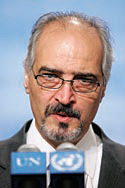
Jaafari

Jaafari

“It is torpedoing this overture,” Syrian Ambassador Bashar Ja’Afari said in an interview today at the UN about the shipment, which the U.S. and Britain say came from Iran. “Maybe some circles within the administration are not in full accord with this effort.”

Ja’Afari was referring to the UN Security Council’s request that by today Iran and Syria explain the arms, including rifles and rocket-propelled grenades, found aboard a ship. Iran has ignored the query, while Syria sent a letter to the Security Council panel accusing it of overlooking arms violations by Israel, Ja’Afari said….

The weapons shipment violates the UN arms embargo on Iran that is among sanctions intended to block its nuclear program, U.S. and U.K. envoys have said.

“The Security Council sanctions committee is currently reviewing the response from Syria and determining next steps,” Mark Kornblau, spokesman for the U.S. mission to the UN, said. “As a member of that committee, the U.S. is engaged in that review.”…

‘Orchestrated Campaign’

“Raising the issue of this shipment is part of an orchestrated campaign to exert pressure on us to get political concessions,” Ja’Afari said in the interview. “We are saying that the Security Council has had all kinds of indications of Israeli violations of international law and has never held them accountable. It is a double standard.”

Ja’Afari said Syria and other Arab nations have the right to obtain weapons to defend against “Israeli invasions and aggressions.” The ambassador wouldn’t say whether he was referring to the weapons seized by Cyprus.

Cyprus has held the Russian-owned, Cypriot-flagged Monchegorsk off the southern port of Limassol since Jan. 29. According to the Israeli newspaper Haaretz, it was traveling to Syria from Iran with weapons destined for Lebanon’s Hezbollah militia or the Palestinian group Hamas, which controls the Gaza Strip….

Iran’s Axis of Nuclear Evil
By JOHN BOLTON in WSJ, March 21, 2009

John Bolton

John Bolton

While President Obama’s unanticipated Nowruz holiday greeting to Iran generated considerable press attention, his video wasn’t really this week’s big news related to the Islamic Republic. Far more important was that a senior defector — Iran’s former Deputy Minister of Defense Ali Reza Asghari — disclosed Tehran’s financing of Syria’s nuclear weapons program. That program’s centerpiece was a North Korean nuclear reactor in Syria. Israel destroyed it in September 2007.

At this point, it is impossible to ignore Iran’s active efforts to expand, improve and conceal its nuclear weapons program in Syria while it pretends to “negotiate” with Britain, France and Germany (the “EU-3”). No amount of video messages will change this reality. The question is whether this new information about Iran will sink in, or if Washington will continue to turn a blind eye toward Iran’s nuclear deceptions.

That the Pyongyang-Damascus-Tehran nuclear axis went undetected and unacknowledged for so long is an intelligence failure of the highest magnitude. It represents a plain unwillingness to allow hard truths to overcome well-entrenched policy views disguised as intelligence findings.

Key elements of our intelligence community (IC) fought against the idea of a Syrian nuclear program for years. In mid-2003, I had a bitter struggle with several IC agencies — news of which was leaked to the press — concerning my testimony before the House Foreign Affairs Committee about the Syrian program. Then Sen. Joe Biden made the Syria testimony an issue in my 2005 confirmation battle to become ambassador to the United Nations, alleging that I had tried to hype concern about Syria’s nuclear intentions. (In fact, my testimony, in both its classified and unclassified versions, was far more anodyne than the facts warranted.)

Key IC agencies made two arguments in 2003 against the possibility of a clandestine Syrian nuclear weapons program. First, they argued that Syria lacked the scientific and technological capabilities to sustain such a program. Second, they said that Syria did not have the necessary economic resources to fund a program.

These assertions were not based on highly classified intelligence. Instead, they were personal views that some IC members developed based on public information. The intelligence that did exist — which I thought warranted close observation of Syria, at a minimum — the IC discounted as inconsistent with its fixed opinions. In short, theirs was not an intelligence conclusion, but a policy view presented under the guise of intelligence.

How wrong they were.

As for Syria’s technical expertise, North Korea obviously had the scientific and technological ability to construct the reactor, which was essentially a clone of the North’s own at Yongbyon. Moreover, it is entirely possible that Syria’s nuclear program — undertaken with Pyongyang’s assistance — is even more extensive. We will certainly never know from Syria directly, since Damascus continues to deny it has any nuclear program whatever. It’s also stonewalling investigation efforts by the International Atomic Energy Agency.

As for Syria’s ability to finance a nuclear program, Iran could easily supply whatever Syria might need — even in a time of fluctuating oil prices. Moreover, given Iran’s hegemony over Syria, it is impossible to believe Syria would ever undertake extensive nuclear cooperation with North Korea without Iran’s acquiescence. Iran was likely an active partner in a three-way joint venture on the reactor, supplying key financial support and its own share of scientific knowledge. Cooperation on ballistic missile programs between Pyongyang and Tehran is longstanding and well-advanced, and thereby forms a basis of trust for nuclear cooperation. Moreover, both Iran and North Korea share a common incentive: to conceal illicit nuclear weapons programs from international scrutiny. What better way to hide such programs than to conduct them in a third country where no one is looking?

Uncovering the North Korean reactor in Syria was a grave inconvenience for the Bush administration. It enormously complicated both the failing six-party talks on North Korea and the EU-3’s diplomatic efforts with Iran, which Secretaries of State Colin Powell and Condoleezza Rice so actively supported.

Mr. Asghari’s revelations about Iranian financing of Syria’s nuclear program — if borne out — will have precisely the same negative impact on Obama administration policies, since they track Mr. Bush’s so closely. In fact, the two administrations’ approaches differ only to the extent that Mr. Obama is poised to pursue policies, like face-to-face negotiations with Iran, that the second term Bush State Department wanted to do, but faced too much internal dissonance to implement.

The Nowruz video reflects the dominant view within the Obama administration that its “open hand” will be reciprocated. It’s likely Iran will respond affirmatively to the near-plaintive administration request to “engage.”

And why not? Such dialogue allows Iran to conceal its true intentions and activities under the camouflage of negotiations, just as it has done for the past six years with the EU-3. What’s more, Iran will see it as confirmation of U.S. weakness and evidence that its policies are succeeding.

There is very little time for Mr. Obama to change course before he is committed to negotiations. He could start by following Iran’s money trail.

Mr. Bolton, a senior fellow at the American Enterprise Institute, is the author of “Surrender Is Not an Option: Defending America at the United Nations” (Simon & Schuster, 2007).

The bald facts
, Times of London

IBald Ibis

Bald Ibis, thought to be extinct in the Middle East in the 1990s, a colony of six was found at Palmyra, Syria, in 2002.

Which brings me to Birds of Syria. It’s a field guide. If you get a copy, remember to read it right to left. It is in Arabic, and is the first field guide to Syria accessible to Syrians. It has been put out by the Syrian Society for the Conservation of Wildlife, with the backing of Birdlife International.

How many Syrians knew that there are 394 species of birds in their country? A field guide allows the scales to fall from your eyes, so you might see the incalculable riches of your own place, and of all places. This has on its cover the extraordinary bald ibis, critically endangered. It includes the sociable lapwing, also endangered, and the Syrian serin, a local speciality.

Syrian Sirin

Syrian Sirin

The bald ibis is worth the admission money alone. This ridiculous looking bird was thought to be extinct in the Middle East in the 1990s. But a colony of six was found at Palmyra, Syria, in 2002. Extraordinary events like this happen in places where there are not many birdwatchers to the square mile. This book will begin to change that, opening the wonders to more people, inspiring more efforts for conservation.

But first, the field guide will tell every one of its readers about the most wonderful thing of all: that there are more different kinds of living things than you thought possible.

See also this wonderful article on Lebanon’s Wine Country, Touring and Tasting in the Bekaa Valley, by BROOKE ANDERSON. She includes a bit about wine production in Syria. Evidently, some 30 winemakers operate in Lebanon, more than double the number that were producing in 2005. … The Saadé Group announced the opening of two new wineries — one called Bargylus in the Syrian coastal province of Latakkia.

The bar at Château Kefraya

The bar at Château Kefraya

Ramzi Ghosn, winemaker at Massaya

Ramzi Ghosn, winemaker at Massaya

Engagement and its Many Critics

Eyal Zisser

Eyal Zisser

Eyal Zisser, in a recent Dayan Center policy piece, argues that Assad should be like Sadat and fly to Jerusalem if he wants Netanyahu to give him back the Golan. He decries the lack of imagination among Syrian statesmen.

I like Zisser. He is the head of the Dayan Center, one of, if not the, premier think thank in Israel. He has always been gracious and kind to me. He is a dependable and careful chronicler of politics in Syrian, the only Arab state to remain inimical to Israel. He has long warned that Assad’s mistakes will catch up to him. His book on Lebanon at independence is excellent.

It is never easy to write about one’s enemy – especially if one has ambitions to be a leading voice within the security architecture of one’s country. Zisser cannot be faulted for complaining that the region has too few original and BIG thinkers. Certainly it doesn’t have enough rulers with BIG hearts. Maybe Zisser is right that Netanyahu could be won over by an extravagant and rule-breaking gesture? Maybe Israel’s leader would be moved by a self-effacing visit from Assad? Counseling one’s enemy to be more humble and gracious can rarely be unwise. These are excellent and daring suggestions.

One quibble… Why doesn’t Zisser also insist on a smidgen of imagination and humility from his own leader? Why not tickle Netanyahu toward “big-think” mode? Why couldn’t he propose something refreshing and original ….. something like… giving back the Golan for peace? ….  or stopping the expansion of settlements and the displacement of Palestinians as a means to reduce radicalism?……  or even… fudging on the possibility of a two state solution?

Washington in Pursuit of Damascus
By Eyal Zisser, March 15, 2008
Dayan Center, TEL AVIV NOTES

….. It appears that the assumption that Syria is prepared, and even desires to bolt from the Iranian embrace and embrace America has no basis in fact. In fact, the opposite is the case. In Syrian eyes, what is actually happening is that the Americans are the ones doing the embracing. Indeed, Syria expects the US to comply entirely with Syria’s demands: in Iraq – a total American withdrawal; in Lebanon – handing it back over to Syrian control; and with regard to Israel – the complete return of the Golan Heights to Syria in return for minimal Syrian concessions. In return for all of these things, Syria will be prepared to maintain friendly relations with the US, but is definitely not prepared to follow Jordan’s and Egypt’s lead and become a client state dependent on the good will and whims of Washington, especially with regard to matters dealing with human rights and democracy. President Bashar al-Asad explains to all those who want to listen that it is actually in America’s interest that Syria maintain its ties to Iran so that Damascus can act as a bridge and a mediator between Washington and Tehran.

Seemingly, the goodwill that the Obama Administration has demonstrated towards Damascus has opened up opportunities for Syria to promote its interests, but it appears likely that Damascus will fail to capitalize on the new circumstances, just as it did in the past. In order to do so, a leader of the caliber of Anwar al-Sadat is required. However, Bashar is neither capable of, nor interested in following the Sadat example. Rather, he is comfortable with his standing as the leader of the radical camp in the Arab world. The role is less dangerous to his life, and also confers upon him considerable popularity among the Arab public. In addition, from the standpoint of cold hard strategic analysis, Syria will not break off its ties from Iran so long as it is in a state of war with Israel, and so long as it does not attain a political settlement which insures the return of the Golan.

Moreover, Syrian foreign policy has always been characterized by hesitation, caution and passivity. It does not appear that Syria is seeking to promote a new direction, but rather to maintain the status quo, internally and in its foreign policy. According to the Syrian view, this policy has produced results, without obligating it to abandon its positions and principles. Hence, during the last few years, Syria’s work has been done by others. The US under Obama is closer than ever to withdrawing from Iraq. Israel under Olmert displayed a willingness to sign a peace agreement with Syria which would include a total withdrawal from the Golan Heights. And finally, with regard to the Lebanese arena, the assumption that it was possible to bring an end to Syrian influence in Lebanon turns out to have been exaggerated and unrealistic. It seems that only Syria is capable of insuring the existence of a stable Lebanese entity.

Incidentally, and against expectations, the Obama Administration has displayed an entirely realistic approach to Syria. Its newly-appointed Special Envoy to the region, George Mitchell, avoided visiting Damascus himself. Instead, two lower level diplomats were dispatched to make the first contact there. The US made it clear that it still expects a change in Syrian behavior with regard to the issues of terrorism, Lebanon and Iraq. And it seems that the bulk of US energies are going to be invested in trying to develop a dialogue with Iran. The degree of success of such an effort will clearly have ramifications for Syria, which in recent years essentially made itself a client state of Iran. If Bashar is sorry about this, he need blame no one but himself.

In conclusion, the Syrian-American relationship has returned to the spotlight and is likely to witness a flurry of diplomatic activity in the coming months. Its importance will only increase in light of the upcoming Lebanese parliamentary elections in June 2009, which are likely to result in a further strengthening of Syrian power and influence in Lebanon. A possible failure of the dialogue which the US is seeking with Iran would only increase Damascus’s standing in Washington. At the same time, it seems doubtful that the American effort to warm up relations with Syria will be sufficient to bring about a real change in Syrian foreign policy, particularly with regard to Iran, as well the peace process with Israel. Nor is it likely to free Lebanon from its clutches, nor effect real social, economic or political change at home. The experience of the last few years taught Bashar that by sticking to his positions and refusing to alter them, he was able to break out of isolation and survive in power. Hence, there is no reason, according to his understanding, to change his positions, particularly as there is no compelling reason or pressure to do so. The fact that the chances of advancing the Israeli-Syrian peace process appears less likely than ever in light of the expected composition of the next Israeli government will also serve to prevent Damascus from accepting the terms of Washington’s embrace.

Nevertheless, in light of the failure of Washington’s policies towards Damascus in recent years, the notion of instituting a dialogue with it is not a bad idea. Dialogue is always preferable to tension and violence, and can potentially prepare the ground for breakthroughs when conditions have sufficiently ripened. Still, such a dialogue also requires a realistic and nuanced understanding of what may or may not be achievable at any particular point in time. Currently, at any rate, the answer to the question of what can be achieved is a simple one: very little.

US-Syria relations still mired in mistrust
By Natalia Antelava, BBC News, Beirut

Weam Wahab

Weam Wahab

…. The pro-Syrian politician Lebanese Weam Wahab told me why it would be so hard for the United States and Syria to find a common language…. Syria has cautiously welcomed President Obama’s efforts. But mistrust still runs deep on both sides, differences are vast and Washington’s agenda in Syria is still the same. The US wants Damascus to stop its support for the two anti-Israeli militant groups – Hamas and Hezbollah, play a more constructive role with its neighbour Lebanon and distance itself from Iran.

Martin Indyk, the former US ambassador to Israel, believes that the plan is realistic.

“I think beneath the bravado, Syria is in fact uncomfortable with Iran and that both President [Bashar] al-Assad and his people would prefer to look to the West,” he says.

Mr Wahab laughs at this assumption. “Iran is the only country that stood with Syria through the hard times. It’s an illusion to think that you can distance Syria from Iran,” he says.

He also questions the value of what Washington could offer Syria in return: relief of economic sanctions and the end of its isolation from the West.

Mr Wahab’s personal experience tells him that Syria can easily carry on without either.

“Two years ago George Bush decided to ban me from entering America and to freeze my assets in the States. I laughed: I have nothing to lose in America. And the people of this region feel the same – we have nothing to lose,” he says….

Karim Makdisi: Obama’s silence on Gaza was noted in the region, and I don’t think that the US administration has taken a real decision in the way they view the Middle East…

Jordan and Syria discuss Arab rapprochement

AMMAN (Reuters) – Jordan’s King Abdullah and Syrian President Bashar al-Assad held talks in Amman Friday, part of a flurry of diplomatic moves to close Arab ranks ahead of a summit later this month in Qatar, officials said.  Full Article

John Hannah at WINEP

Lebanon’s fate has become part of a larger struggle for power and influence that is playing out across the Middle East, a struggle pitting the United States and its friends against Iran and its proxies. The outcome of that struggle will have strategic implications for the United States that extend well beyond Lebanon.

A clear-cut electoral victory for Hizballah would greatly undermine U.S. prestige and credibility in the region…. The result could well be the consolidation of a permanent Iranian military outpost on the eastern Mediterranean and a major presence of Iran’s Qods (Jerusalem) Force — a special unit of the Islamic Revolutionary Guard Corps — directly on Israel’s northern border….

Washington should aggressively use its engagement with Syria to deter Damascus from resorting to violence in Lebanon, either in the run-up to elections or in their aftermath. In mid-March, President Bashar al-Asad gave an interview in which he issued veiled threats against Lebanon should the Hariri tribunal reach the wrong conclusions or should the March 14 coalition win the elections and actually attempt to govern as a democratic majority. It is hard to avoid the conclusion that violence remains an integral part of Syria’s strategy. The Obama administration should act now to put the Syrian regime on notice that the relatively smooth passing of Lebanon’s elections will be a critical metric by which the United States assesses the value of engagement going forward.

If Engagement Fails
It will be important for the administration to have — and for Syria to know that it has — a contingency plan should engagement be given a fair trial and shown not to address key American concerns. At a minimum, such a contingency should include the option of significantly ramping up multilateral pressure and sanctions against the al-Asad regime. In this regard, the administration should do everything in its power to ensure that the two most important levers available — the Hariri tribunal and the International Atomic Energy Agency investigation of Syria’s secret plutonium reactor — remain robust and hanging over the head of the al-Asad regime….. It bears remembering that the withdrawal of Syrian troops from Lebanon four years ago — arguably, the high point of American policy vis-a-vis Syria in the past several decades — was itself the product of a policy of intensely focused confrontation, multilateral pressure, and veiled threats against the al-Asad regime.

Max Boot in LA Times:

“…The Lebanese army lacks the capacity or the will to take on Hezbollah, while the Christian militias, active in the civil war from 1975 to 1990, have been disbanded. That leaves Lebanese democrats almost entirely dependent on outside support. They are cheered that the U.N. tribunal set up to investigate and prosecute those responsible for the Hariri assassination has now convened in The Hague, but they still fear they will be sold out by Western powers intent on doing a deal with Syria or Iran….”

Tom Dine, former Executive Director of AIPAC, has visited Damascus 5 times in the last year and become a leading voice for engagement between Isael and Syria. He explains how difficult it will be to build trust between the two countries in his article: “Slow and Opaque Engagement.”

Yes, Syria is a pivotal player in the region but, as the Syrian leadership is making clear to the Americans, disengagement cannot be overturned and upgraded overnight. A number of Congressional and non-profit delegations have recently visited Damascus to explore what can be done; the weekend official delegation was also exploratory, but came away sullen. What can be exclaimed is that the end of American isolation of Syria has commenced. But until major adjustments and changes in behavior are made by Syria, according to Administration officials, a new policy day in the bilateral sphere will not begin.

We are thus only at the early talks phase. Talks are not a substitute for substantive give-and-take in the international arena. From the American perspective, officials are asking these questions: Will Syria stop foreign fighters from traveling through its international airport and crossing its borders into Iraq to cause havoc and oppose the sitting elected government in Baghdad? Will Syria control and secure its borders not only with Iraq but also with Lebanon. Will Syria change its supportive arrangements toward Hamas, Hezbollah, Islamic Jihad, and other groups in order to begin the process of exiting from the U.S. terrorist list, a place it has been since 1979 and a move that would have direct consequences on Palestine’s current divisions and weaknesses as a crippled entity? Will Syria allow for a free and fair forthcoming election in Lebanon? How will Syria participate or not in the U.N.-sponsored Tribunal investigating the death of Lebanon’s Prime Minister Rafiq al-Hariri? What are Syria’s nuclear intentions; is it pursuing a nuclear option or was that last year’s news? Can Syria and Israel at long last bring to a mutually satisfactory conclusion all of the Golan Heights territory for a full peace? Then there is the anxiety-creating issue of Iran.

Laura Rosen in the Cable Via FLC

Ashkenazi is scheduled to meet with national security advisor Gen. James L. Jones, special advisor Dennis Ross, and top military ….”Netanyahu brought up Iran,” the Israeli diplomat told Foreign Policy. “He told her it was the be all and end all. And [he said] that there is a reverse link: If [Washington] wants anything to move on the Palestinian front, we need to take head on the Iranian threat, diplomatically, with sanctions, and beyond that.”

Clinton responded, “I am aware of that,” the Israeli diplomat relayed leaders ….

“For the last eight years, the U.S. has been pretty adamant on settlement expansion, rhetorically,” the Israeli diplomat continued. “Nothing happens on policy. … My point is, in terms of U.S. policy, it’s either a modified or more polished version of what you and I already know from the last 15 years.”

“I think she is under pressure,” the Israeli diplomat observed. “One side is pressing her to go forward on the Palestinian issue,” the Israeli diplomat observed. But for “the other side,” he said, referring to professional Middle East observers, “let’s face it, the Palestinian issue is about maintenance, not breakthrough.”

Israel’s chief of staff cuts short trip after doors close in Obama’s Washington, WorldTribune.com

WASHINGTON — Israeli Chief of Staff Lt. Gen. Gabi Ashkenazi cut short his visit to Washington after getting an extraordinarily cool reception from the new U.S. administration.

Last year, Israeli Chief of Staff Lt. Gen. Gabi Ashkenazi had no problem setting up meetings with top officials in the U.S. government…..

Diplomatic sources said Ashkenazi failed to obtain access to any Cabinet member, including Defense Secretary Robert Gates. The Israeli military chief, who sought to discuss the Iranian nuclear threat, was also unable meet his counterpart, Adm. Michael Mullen, the chairman of the Joint Chiefs of Staff….

On March 12, Ashkenazi left for a five-day visit to the United States meant to lobby the Obama administration to abandon the planned U.S. dialogue with Iran. Ashkenazi, scheduled to meet with the American-Israel Public Affairs Committee, was expected to have brought new Israeli intelligence on Iran’s nuclear weapons and missile programs.

But the diplomatic sources said the administration made it clear that nobody in a policy-making position was available to sit with Ashkenazi. This included the president, Vice President Joseph Biden, Gates, National Intelligence director Dennis Blair or Mullen….

“The administration is sending a very clear message to Israel, and this is we want to talk about Palestine and not Iran,” a diplomat who has been following U.S.-Israel relations said.

Ashkenazi has obtained a meeting with National Security Advisor James Jones. But the sources said the meeting would focus on U.S. demands for Israel to ease military restrictions in the West Bank and Gaza Strip.

“The Obama administration believes that Israel is as much or more of a problem as it is an ally, at least until Israel’s disagreements with its neighbors are resolved,” former U.S. ambassador to the United Nations, John Bolton, said….

Washington Post

The Israeli population in the West Bank rose from 191,600 at the end of 2000 to 289,600 at the end of 2008, according to Israel’s Central Bureau of Statistics, a rate of growth more than double that of the nation as a whole. So far the White House has not released a detailed position on the issue, and it will be one of Obama’s more closely watched first steps…..

Israel’s top contender for defense minister, Moshe Yaalon, has opposed territorial concessions to the Palestinians for security reasons. As military chief of staff under then-Prime Minister Ariel Sharon, he opposed the Gaza withdrawal and lost his job. A collection of religious parties expected to be in the coalition hold out hope that settlements can be expanded and more of the West Bank brought into Israel…”

Reuters:

Benjamin Netanyahu will likely shelve recently revived Israeli peace talks with Syria given its territorial demands and alliance with Iran, a senior adviser to Israel’s prime minister-designate said on Thursday. A panel of expert advisors have told Prime Minister-designate Benjamin Netanyahu to devote his attention to negotiations with Syria, thereby creating a chance for regional peace.

IRAN

From the White House Blog: President Obama released a special video message for all those celebrating Nowruz.

“…He invoked the shared humanity of the Iranian and U.S. peoples and appealed directly to Iran’s leaders for “engagement that is honest and grounded in mutual respect.” Obama added that he hopes Iran will assume its “rightful place in the community of nations” but that doing so “comes with real responsibilities” and that the goal “cannot be reached through terror or arms.” Obama’s apparent efforts at outreach come ahead of a March 31 international summit on Afghanistan policy, to which Washington has invited Tehran.

Laura Rozen at Foreign Policy’s, The Cable includes this remark from Parsi:

“This is huge,” said Trita Parsi, president of the National Iranian American Council, a group that supports U.S. engagement with Tehran. “First of all, he is addressing the people and the government, which has not been done before. At one point he talks about the Islamic Republic. He’s signaling he’s not looking for regime change; he’s recognizing Iran’s system. “You always heard Rice and Bush say ‘Iranian regime,'” Parsi noted. “It’s a big difference.”

Iran leader says world can’t stop nuclear progress

TEHRAN (Reuters) – Supreme Leader Ayatollah Ali Khamenei said on Friday world powers had been persuaded they could not block Iran’s nuclear progress, but he made no mention of a message by U.S. President Barack Obama to his country.  Full Article

Saad Hariri, said on Monday that the general election in June will be a straight choice between Hizbullah and the country’s sovereignty. …Hariri said if his coalition wins, it will invite the opposition to join a unity government but on condition there is no blocking minority, as is currently the case.

“The current government is not functioning,” he said. “Because there is a blocking minority and tension inside the government. Nobody is able to do anything. We haven’t been able to pass a budget, approve laws or reforms.”

Hariri: Syria-Israeli peace good for Lebanon

Future Movement leader MP Saad Hariri said on Saturday Lebanon would be the first to benefit from a Syrian-Israeli peace deal, adding that Syrian-Saudi rapprochement is needed in order to unite the Arab stance on the Arab Peace Initiative. In an interview with Radio France International, Hariri said that Western openness toward Syria would not occur at Lebanon’s expense adding: “We would be the first to benefit from the peace, because when Syria signs, a lot of things would change.”

Hariri explained that Syrian-Saudi rapprochement is “a needed Arab process” in light of the existing tensions in the region, particularly when “the new Israeli government is not a centrist one.”

The Lebanese Parliamentary Elections:Outcomes May Jeopardize U.S. Security Interests in the Middle East
Sent by Charbel Moussa, MD, PhD, AAN
President, American Lebanese Assembly

The upcoming Lebanese parliamentary elections (June 7th, 2009) signify a momentous shift in Lebanon’s modern history. The democratic forces of the March 14 alliance are campaigning against pro-Iranian and pro-Syrian factions, which constitute the March 8 alliance……

Iran not only aims at religious and ideological domination of the Middle East, but also threatens the strategic assets that the U.S. considers vital to its interests in the region. Iran recognizes that the Islamic expansion, which constitutes the main pillar of the Islamic Revolution, will be hindered by pro-American forces, especially moderate Arab states. To overcome this dilemma, Iran actively attempts to undermine America’s influence in order to secure a strategic regional role.

Destabilization of moderate Arab states. Iran deeply resents the Sunni domination over Islam in the Arab world, and has orchestrated an aggressive campaign to strengthen Shiite Muslims all over the region…..

Threatening the strategic oil reserves in the Middle East. A Hezbollah victory in Lebanon’s parliamentary elections will provide Iran with a valuable strategic and tactical opportunity to win the hearts and minds of people in the region. Iran’s ideological expansion, as declared by the Islamic Revolution, will incite the Shiite population in moderate Arab States and that will lead to political instability. ….

Violating the security and peace of the State of Israel. The friendship between the United States and Israel necessitates that the U.S. binds to the security commitments towards the Jewish State. Should Hezbollah win the Lebanese elections, it will continue its war strategy domestically unopposed and threaten Lebanon and Israel’s national security. Hezbollah will drag the Lebanese institutions, and mainly the army, into confrontation with the Israelis. It is essential for the U.S. to protect the security of Israel via support of human rights in Lebanon and to actively prevent Hezbollah from turning Lebanon into another Gaza. Hezbollah’s takeover of Lebanon is far more serious that the GAZA model, since Hezbollah enjoys more strategic, economic and military support in Lebanon and the entire Shiite Crescent.

U.S. Policy Recommendations:
1- Continue to push for the Implementation of UNSCR 1559 and the disarmament of all militias and groups in Lebanon…..

5- Assist and protect the March 14 forces to adopt a strategy of peace in contrast to Hezbollah’s war and resistance strategy

6- Enable the Lebanese Armed Forces to become the sole protector of Lebanon’s security and peace by maintaining consistent U.S. support and training

7- Assist Lebanon to lobby moderate Arab states and the Arab League into adopting a framework of negotiations between Lebanon and Israel

American Lebanese Assembly (ALA), American Lebanese Coordination Council (ALCC), American Lebanese National Mission (ALNM), Lebanese American Renaissance Partnership (LARP)

France is “not worried” by a Hizbullah victory

in upcoming legislative elections and will continue to fully support the Doha agreement, French diplomats have said. The remarks come ahead of a three-day visit by Lebanese President Michel Suleiman to start on Monday.

France “will not boycott any government that might emerge after the June 7 legislative elections,” a French diplomat told As-Safir daily in comments published Saturday.

The diplomat, who was not identified, said the French government was “not worried that Hizbullah could possibly accede to power.

“The party is considered like any other element (taking part) in the Lebanese game. We believe that everybody will accept the election results.” … Chevalier reiterated his government’s support of the Doha agreement, which he said was instrumental in “stabilizing (Lebanon) … and appeasing tensions.”

Iranian Defector Reportedly Tipped Off U.S. on Syria Nuke Plant

Iranian Defector Reportedly Tipped Off U.S. on Syria Nuke Plant
Fox News, Thursday, March 19, 2009

File: Satellite image shows suspected nuclear reactor site in Syria.

GENEVA — A top-ranked Iranian defector told the United States that Iran was financing North Korean moves to make Syria into a nuclear weapons power, leading to the Israeli air strike that destroyed a secret reactor, a report said Thursday.

The article in the daily Neue Zuercher Zeitung goes into detail about an Iranian connection and fills in gaps about Israel’s Sept. 6, 2007, raid that knocked out Syria’s nearly completed Al Kabir reactor in the country’s eastern desert.

The February 2007 defection to the United States of Ali Reza Asghari, a retired general in Iran’s elite Revolutionary Guards and a former deputy defense minister, provided considerable information on Iran’s own nuclear program, said the article, written by Hans Ruehle, former chief of the planning staff of the German Defense Ministry.

“The biggest surprise, however, was his assertion that Iran was financing a secret nuclear project of Syria and North Korea,” he said. “No one in the American intelligence scene had heard anything of it. And the Israelis who were immediately informed also were completely unaware.”

Ruehle, who did not identify the sources of his information, publishes and comments on security and nuclear proliferation in different European newspapers and broadcasts and has held prominent roles in German and NATO institutions.

U.S. intelligence had detected North Korean ship deliveries of construction supplies to Syria that started in 2002, and American satellites spotted the construction as early as 2003, but regarded the work as nothing unusual, in part because the Syrians had banned radio and telephones from the site and handled communications solely by messengers — “medieval but effective,” Ruehle said.

Intensive investigation followed by U.S. and Israeli intelligence services until Israel sent a 12-man commando unit in two helicopters to the site in August 2007 to take photographs and soil samples, he said.

“The analysis was conclusive that it was a North Korean-type reactor,” a gas graphite model, Ruehle said.

Other sources have suggested that the reactor might have been large enough to make about one nuclear weapon’s worth of plutonium a year.

Just before the Israeli commando raid, a North Korean ship was intercepted en route to Syria with nuclear fuel rods, underscoring the need for fast action, he said.

“On the morning of Sept. 6, 2007, seven Israeli F-15 fighter bombers took off to the north. They flew along the Mediterranean coast, brushed past Turkey and pressed on into Syria. Fifty kilometers (30 miles) from their target they fired 22 rockets at the three identified objects inside the Kibar complex.

“The Syrians were completely surprised. By the time their air defense systems were ready, the Israeli planes were well out of range. The mission was successful, the reactor destroyed,” Ruehle said.

Israel estimates that Iran had paid North Korea between $1 billion and $2 billion for the project, Ruehle said.

Israel has not commented on the strike, but after a delay of several months Washington presented intelligence purporting to show the target was a reactor being built with North Korean help.

Iranian officials were not available for comment because of a national holiday. In general, Iran has been silent about the Syrian facility bombed by Israel. Syrian officials could not be reached for comment. But Syria has denied the facility was a nuclear plant, saying it was an unused military building. It has also denied any nuclear cooperation with North Korea or Iran.

The International Atomic Energy Agency earlier this year said U.N. inspectors had found processed uranium traces in samples taken from the site.

Syria has suggested the traces came from Israel ordnance used to hit the site, but the IAEA said the composition of the uranium made that unlikely. Israel has denied it was the source of the uranium.

Syria has told diplomats that it built a missile facility over the ruins of the site.

“Interview with President Bashar al-Assad” by Alix Van Buren in La Repubblica

Van Buren

Van Buren

Interview with President Bashar al-Assad
By Alix Van Buren
La Repubblica, March 17, 2009

“America today is stronger militarily than at any other time, but politically they are much weaker. Obama will have to restore the American credibility in the Middle East. The first signs are encouraging: by  disengaging from Iraq, closing Guantanamo, and by his interest in peace, he is keeping his word. But whether we are at a historical threshold, it is too early to say. Still, one thing is clear: after the dark years of the Bush Administration, there is new hope. Regarding Iran, I am ready in principle to help in a dialogue. With Israel, we had come very close to a deal.”

President Bashar al-Assad is already at work in the early morning in his private study on the slopes of Mount Qassiun. He has a full agenda. The re-admission of Damascus to the good geopolitical society is still recent, after the arrival on March 7 of the envoys sent by Obama to resume the dialogue interrupted by four years of American sanctions. And Assad, solemn in stature, elegant in his blue flannel suit, is busy, so it seems, in renewing the threads of international diplomacy.

The isolation of Syria is virtually over. Old concepts and labels – Axis of Evil, rogue States – have all of a sudden evaporated. So it is natural to ask him: what is required, Mister President, to relaunch an understanding between America and Syria? What should be done to bring it back as it was in the beginning of the Nineties, when Hafez al-Assad and Bush father had succeeded in creating a mutual trust, with the promise kept in 1991 of the Madrid Peace Conference?

“There is a rule, first of all: States act according to their own national interests. As to how far the American and Syrian interests coincide, well I can say it is 80 per cent, leaving out a margin of 20 per cent for the rest, to be on the safe side”.

Such a positive calculation?

“Why not. If we are realistic, and take the fake labels used by Bush, who spoke without believing in it about stability in Iraq, about fighting terrorism and extremism, about a strong and independent Lebanon, about peace in the region, our interests are the same. Now we can cooperate on those dossiers: we are a regional power, America is a global one.”

Would you give us some examples?

“Examples? Here is a first one: Iraq. With the disengagement announced by president Obama, perhaps the most contentious issue dividing us from Washington has been solved. For it was indeed occupation, regardless of all resolutions and support it had. Now we can work together for the stability of Iraq, without which the disengagement can not succeed.”

So how can one guarantee that success?

“By starting a political process, with the final aim of a national reconciliation. A new Constitution must be drafted, which will in turn create new institutions. But especially one must not allow the disintegration of the Country, for there might arise like a domino effect that could have repercussions in the whole region from the Atlantic to the Pacific Ocean.”

But America and Europe are expecting from you an important step towards Iran. Are you willing to take it?

“If we’re talking about an Iranian influence in Iraq, we must make a clear distinction: the influence, in itself, is not negative when it is based on mutual respect. Interference is something completely different. If we’re talking instead of helping to open a dialogue with Tehran, I already said we are ready. But we are waiting for specific proposals to forward to that government. Until now I’ve only been invited to play a role. That is not enough, there is need for a plan, a framework, specific rules to submit to Tehran’s evaluation.”

In your opinion, will Tehran accept?

“Only through dialogue can one hope to succeed. Containing or isolating a country does not work. In fact, in the end it strengthens that Country. And Iran is an important country, whether one likes it or not. The winning way is to cooperate: look at France, it has embarked on that road with success, even with other regional parties.”

Such as Hezbollah and Hamas? Will you cooperate also regarding them?

“Of course, we have already been engaged in the inter-Palestinian reconciliation. Now the most urgent issue is the truce with Israel, and part of it is lifting the embargo imposed on the Gaza Strip because from this issue descend all the problems, including the conflict that we saw. The embargo is like a slow death, Can that be inflicted on a people without expecting a reaction? That is why pacifying the situation is crucial in determining the final result.”

And what about Hezbollah?

“The same is true: if one wants to play a productive and positive role, one must deal with every influential party. There is need for pragmatism, realism. And whether one labels them terrorists or ‘a State within a State’, it doesn’t matter: they are influential parties in the region. But you can already see some important openings: Great Britain is sending signals to Hezbollah, and here in Damascus the delegations visiting Hamas are doing so in the open, no longer in secret.”

Do you see a renewal in the negotiations with Israel?

“In principle, I should say yes, as we Syrians do not bet on the kind of government in Israel, whether it belongs to the right or to the left. The terms of reference for peace are clear to all: they are the Madrid Conference, the United Nation Resolutions, especially 242, the formula of ‘land for peace’, which means full restoration of the Golan Heights to Syria. All that is needed is the will. If they are ready, we are ready. However…”

However, Mister President?

“I don’t see peace around the corner in the next few years. The idea of a Netanyahu government is not worrying, as much as the shift to the right by the Israeli society, mirrored by the vote for Netanyahu. That is the major obstacle to peace. Yet, we had already come very close to a deal.”

When? Before the Gaza War?

“Indeed. Olmert had told the Turkish Prime Minister Erdogan that he was ready to give back the Golan Heights to Syria. We entered into negotiations. The only item left to discuss were the final details about the line of  1967. Then, we spent a night on the telephone.”

Would you tell us about it?

“Erdogan was on the telephone in Istanbul. Olmert went to Turkey, and had dinner with Erdogan. He was in another room. Erdogan wanted to call me urgently the same day. There was one last obstacle standing before direct negotiations: the acceptation by Israel of a document that defined the line of 1967 through six geographical points on the Lake of Tiberias, the Jordan River and so on.”

Then, what happened?

“We spent several hours on the phone. Olmert kept making maneuvers, we asked him, through Erdogan, a clear word. He asked to postpone the decision by a few days, to go back to Israel to consult with his government. Buth then, four days later, they started the Gaza War. It was another missed opportunity. That is when Turkey got mad: it considered that a deception.”

Is the Arab Peace Plan of 2002 still on the table?

“That will be discussed by the Arab League summit at the end of this month in Doha. The peace plan will probably be dis-activated, like when you turn off the light with a switch, until there emerges a true partner on the Israeli side.”

Yet Obama is talking about a new Middle East Order. Will the American mediation make a difference?

“America is indispensable in its role as a guarantor, as it is a superpower. In addition, Washington can influence Israel more than anyone else. America will still enjoy a leading role in the region, at least until the year 2030. But it is no longer a monopoly: in our new multipolar world there are new actors emerging, and America can no longer act alone.”

What Countries do you have in mind?

“Turkey: it has cultivated good relations with the regional countries, gaining their trust, therefore it has ensured for itself an important role in mediating for peace, where the United States and Europe have failed. But there is also Sarkozy’s France, which today plays a vital role: it has built relations with all the influential parties, it was able to see the movements in the region, and it moved at the right time catching the train that was departing.”

Who is leading the diplomatic effort, Washington or Paris?

“Both, one might say: the Obama Administration is at its first steps, it is still discovering the horizon, therefore it discusses the issues with Paris. As to Sarkozy, you know he showed a strong will to be engaged.”

Mister President, you say you are available in the efforts for peace, in mediating for a dialogue with Iran, but what is the price requested by Syria?

“That is a question I’ve heard many times. But it is the wrong question. This is not about political bribes. I heard talk about Syria requesting the end of sanctions, or the return of an American ambassador to Damascus. But all this does not concern us, it concerns America. The isolation has not weakened us, in fact it strengthened us. What I await in return is the result of the cooperation: the stability that brings prosperity, that defuses terrorism and extremism. I await peace, but that is an end result, I do not have it from America, but from the region, including me, Israel and other concerned parties. In conclusion, what was true in the past, remains true today. I will explain it to you through an anecdote>.”

Which anecdote?

“My Father, president Hafez al-Assad, in 1990 in Geneva told Bush: “Mister President, non one can face up to your military strength. Yet, if with one hand you hold a gun, with the other one you must hold an olive branch. Only thus do superpowers survive”. So here is the point: for eight years America has made mistakes, it hasn’t used the olive branch, only the gun, achieving nothing positive: rather, it has inflamed the region, spreading extremism and terrorism.”

And now, how to repair that?

“Now we must put out those fires by using the correct instruments, which are complex: first of all it is about development, especially in the economic and cultural field, and political solutions to every hot spot that any extremist or terrorist wants to use as a mantle to cover their political agenda. And lastly it is about exchanging information with the Intelligence, which we will resume with the United States.”

What do you expect from president Obama’s announced speech to the Muslim world?

“There are great expectations regarding a new language that signals respect towards other cultures, that helps to release the tensions in our region, especially from the religious aspect, unleashed by the previous Administration when Bush talked about the crusades. And politics, as we all know, starts also with words, terms and statements that can lead towards a  positive or negative direction.”

In this season of openings in the international diplomatic field, how will Syria reposition itself in the arena of democracies? Will it follow through on its promises of civil liberties made at the Congress of 2005?

“We never stopped the reforms. The pace was much slower, that is true. But now that we are less affected by the difficult international circumstances, the pace will pick up. For example by expanding the political participation, having another Chamber in addition to the Parliament, like a Senate, with a legislative role and freely elected, to give more space to the opposition; then, liberalizing more the political media and the Internet to promote dialogue, and finally a law for the political parties. But all that will come about gradually, at or own pace.”

Summing everything up, Mister President, might there appear a brighter horizon?

“Listen, in the beginning there are hopes, signals. Yet, we can…”

That sounds like Obama’s “we can”?

“Well, when Obama said ‘we can’ he was emphasizing ‘we can do’, while those same words in this region mean ‘possibly’. That is conditional. We can ‘if we guard ourselves from the mistakes of the past’, if Europe has learned from the lesson of being absent from the political arena, of being divided because of the Iraq war, if America learns that the army can’t make you a great power, while your credibility and your responsibility can. Only then I can say yes, we are at a historical threshold. But right now it would be exaggerated, we are still at the stage of signs.”

Would you like to meet President Obama?

“Yes, in principle, it would be a very positive sign. But I am not interested in a photo opportunity. We would like to meet, to talk – about what is our plan, about how to find and reach solutions.”

Arab Unity: Can Saudi Arabia Change with the Middle East?

Saudi Arabia has been adrift since Obama won elections in the US. Having tailored its foreign policy over the last 8 years to President Bush’s, even if unhappily, Riyadh must tack with Washington’s new direction. The problem is that Washington’s direction is not yet clear. US diplomats say they are going to change fundamental policies and are engaging Syria and Iran, accommodating themselves to Lebanon’s Doha agreement, and preparing definitively to turn Iraq over to Shiite leadership. None of this makes Saudi Arabia happy, but what can it do? Its partners of the last two decades, Egypt and Israel, are of little use to Saudi Arabia today.  Egypt has no regional plan and is looking inward in preparation for the dynastic hand off. Israel is not interested in cultivating its Saudi alliance. Netanyahu brushes off talk of compromise with Palestinians and continues to embarrass Arab “moderates” who look to it for regional leadership and support against Iran.

The US is not so much preparing to “change” its policies in the region as to withdraw from the commitments that President Bush got it into.  What are these commitments?  Occupying Iraq, pulling Lebanon out of Syria’s sphere of influence, destroying Hizbullah, supporting Israel without public criticism… and, I would add, preventing Iran from developing the capability to build nuclear weapons. Backing away from the commitment to use force against Iran if diplomacy fails will be the most difficult. Today, Obama still claims Washington will use force against Iran. No one believes this threat; it should never have been made. Obama will have to find a way to climb down from such over-wrought fulminations. Hopefully, Tehran will help him retreat gracefully.

Washington’s retreat from Bush’s irresponsible overreach, is embarrassing Saudi Arabia, which must find a way to once again accommodate Syria’s influence in Lebanon and do business with Damascus as it stands by Hamas and sticking pins into Israel to get back the Golan. Saudi and Egypt made a big bet on Bush’s Strategy; they lost. Now Saudi Arabia will have to back away from its Israel strategy, which consists of pretending that the “Saudi” peace plan and the PLO remain operational. Everyone knows they are not. The two state solution is finished. So is the PLO ….. that is so long as it retains the “L” between the “P” and “O”.

Most importantly, Saudi Arabia will have to acculturate to the end of Sunni domination in the Arab World. Shiite culture and influence are here to stay. Thirty years of Islamic rule in Iran, the consolidation of Shiite rule in Iraq, and the emergence of Hizbullah as the strongest force in Lebanon are testimony to the arrival of Shiism. It is transforming the political architecture of the region. Wahhabism cannot sustain itself or guide Arabia as an ideology of state in its present blinkered and puritanical form. The Saudis will have to broaden their narrow outlook on Islam if they intend to remain a source of compromise and unity in the Arab world. Enduring political unity must be accompanied by ideological accommodation.

News Round up: The best articles on the mini Arab summit

Why Syria and Saudi Arabia are talking again
It’s about Iran, Iraq, and Israel. The two foes planned to meet in Riyadh Wednesday to solidify Arab unity amid regional volatility.
By Nicholas Blanford | Correspondent of The Christian Science Monitor

BEIRUT, Lebanon – Saudi Arabia’s steps to end its bitter dispute with Syria appear to be aimed at unifying Arabs against a trio of growing concerns: Iran’s spreading influence in the region, the uncertainties of a US drawdown in Iraq, and the prospect of a right-wing government in Israel.

Saudi outreach follows Washington’s tentative reengagement with Damascus, a move that diplomats hope will have more success in weaning Syria away from its Iranian ally than the Bush administration’s policy of isolation.

“The Saudis want to get Syria away from Iran,” says Andrew Tabler, a Syria expert at the Washington Institute for Near East Policy. “Washington’s style is to try engagement as well, so the Arabs are trying their best to get Syria on board.”

After a month of shuttle diplomacy, Saudi King Abdullah, Syrian President Bashar al-Assad, Egyptian President Hosni Mubarak, and Kuwaiti Emir Sabah al-Ahmad al-Sabah will meet for a fence-mending summit in Riyadh Wednesday.

The rift between Syria and Saudi Arabia followed the assassination in 2005 of Rafik Hariri, a Lebanese former prime minister who was close to the kingdom’s ruling family. The Syrian regime remains a leading suspect in the assassination, although it denies involvement.

The Bush administration, angered by Syrian meddling in Iraq and support for anti-Israel groups such as Hamas, imposed sanctions and froze ties with Damascus in 2005. In response, Syria strengthened its relationship with Iran and sat out President Bush’s final term.

The result: an Arab world split between Western-backed Sunni states (Saudi Arabia and Egypt) and allies of Shiite Iran (Syria, Lebanon’s Hezbollah, and Palestinian Hamas).

Relations between Egypt and Syria have also been cold, the result of tension between Cairo and Tehran. In December, Mr. Mubarak reportedly criticized Iran’s expanding influence, saying: “The Persians are trying to swallow up the Arab states.”

Arab fears of Iranian expansionism were compounded by recent unrest by Shiites in the Gulf. In December and January, Shiites rioted in Bahrain following the arrest of several Shiites on terrorism charges. In January, Saudi Shiites launched rare demonstrations after an altercation between police and Shiite worshippers in Medina.

The unrest does not appear to have been stirred by Iran, but does serve to warn Bahrain and Saudi Arabia that marginalized Shiites could provide an opening for Iranian penetration.

However, a return to traditional diplomacy by the Obama administration appears to have encouraged Saudi Arabia to bridge the rift with Syria. At an economic summit in Kuwait in January, King Abdullah invited the Syrian and Egyptian leaders to a lunch at his private residence. That ice-breaker was followed by reciprocal visits by the Saudi and Syrian foreign ministers that paved the way for the Riyadh summit.

“I do think that one of the reasons Saudi Arabia wanted to patch up with Damascus is that it realized that there was no sense in pursuing a policy that had repeatedly failed since 2006, being on bad terms with Damascus,” says Sami Moubayed, a Syrian political analyst.

Even Egypt appears to have swallowed its anger at Syria, recognizing that Damascus has influence over the Palestinian unity talks under way in Cairo.

“Egypt knows very well that for the Cairo dialogue to succeed it will need the goodwill of Syria,” says Ousama Safa, director of the Lebanese Center for Policy Studies.

Last week, Jeffrey Feltman, acting US assistant secretary of State for Near Eastern affairs, and Daniel Shapiro, a National Security Council official, met with Syrian Foreign Minister Walid Mouallem in Damascus, the first visit to Syria by senior US officials in four years. Mr. Feltman described the meeting as “constructive,” suggesting it could pave the way for further talks.

Whether the overtures will lure Syria from Iran’s orbit remains to be seen. Syria has employed a fence-straddling strategy to deflect international pressure. It held indirect talks with Israel last year and helped broker an end to the political impasse in Lebanon, yet it continues to support Hamas and Hezbollah and has tightened military cooperation with Iran.

“Syria is exploiting the [international] paranoia over Iran very cleverly,” says a Western diplomatic source who spoke on condition of anonymity.

Syria broke off the indirect negotiations with Israel in response to the Gaza war. But Mr. Assad has said he is willing to resume talks even with a right-wing Likud party-led government.

Reuters reported Wednesday that a Likud politician met Syrian diplomats in the US “and felt encouraged about peace prospects.”

But Likud leader Benjamin Netanyahu, who is expected to be Israel’s next prime minister, has indicated he would prefer to concentrate on the Palestinian track.

Still, if the Saudi-Syrian rapprochement bears fruit, it could signal an easing of tensions in Lebanon before June polls – elections in which neither the Saudi and Western-backed parliamentary majority nor the Syrian-supported opposition are assured of victory.

“Elections in Lebanon are always decided by 11th hour deals [between rival factions] and if the Syrian-Saudi rapprochement continues it will impact positively on any 11th hour coalitions that are made,” says Bassel Salloukh, assistant professor of politics at the Lebanese American University.

Syrian-Saudi reconciliation also could facilitate a stable transition in Iraq when the US withdraw troops. Both Saudi Arabia and Iran will be vying to exert greater influence there. “Someone has to fill that vacuum,” says Mr. Moubayed. “Saudi Arabia has an ambition and so does Iran. Syria stands in the middle.”

Syria loyal to Iran after Riyadh meeting
Sat, 14 Mar 2009

Syrian President Bashar Assad (L) shaking hands with his Iranian counterpart Mahmoud Ahmadinejad
Damascus says it will not abandon its strategic ties with Tehran, despite reports of a Saudi and Egyptian effort to distance the two allies.

Iran seen as target of Saudi overtures to Syria (Reuters)
By Alistair Lyon, 10 March 2009

BEIRUT – Bottling its irritation, Saudi Arabia is mending ties with Syria to restore a semblance of Arab harmony before a summit later this month, calm regional tensions and nudge Damascus towards cooling its alliance with Tehran.

After intensive advance diplomacy, Syrian President Bashar al-Assad will visit Riyadh on Wednesday, along with Egypt’s President Hosni Mubarak, the state Saudi Press Agency reported.

While open to Arab detente, Assad has shown no readiness to sever a bond with non-Arab Iran that has lasted 29 years.

“Saudi Arabia’s top priority is to confront Iran and its agenda in the Arab world. The Saudis want to weaken Tehran’s cards in the Arab world, thus the new approach towards Syria,” said an Arab official with close ties to the Saudis.

“They know it’ll be very difficult to break the ties between Syria and Iran, but by showing the Syrians what they have to gain if they return to the Arab fold, they hope to weaken that alliance,” added the official, who asked not to be identified.

On its part, Syria is keen to cast off any remnants of the diplomatic isolation it endured after the 2005 assassination of Lebanon’s ex-premier Rafik al-Hariri, a Saudi citizen and protege. Damascus denied any involvement in the killing, now the focus of an international tribunal that began work this month.

Furious with Saudi Arabia and Egypt for joining Western pressure that forced it to quit Lebanon in 2005, Syria hardened its alignment with Iran, Lebanese Hezbollah guerrillas and Palestinian Hamas militants in shared hostility to Israel and the United States and its conservative Arab allies.

Saudi Arabia tempered its anti-Syrian stance after Damascus backed last year’s Qatari-mediated deal among Lebanese factions and the new U.S. administration spoke of engaging with Damascus.

“It’s about teamwork, concerted Arab action,” Jamal Khashoggi, editor of the Saudi newspaper al-Watan, said. Syria’s presence “back in the team” would enable Lebanon’s election in June to take place without bloodshed, promote Egyptian-sponsored Palestinian reconciliation talks and advance prospects for Arab-Israeli peace negotiations, Khashoggi argued.

He said Saudi Arabia wanted Syria to cooperate on Lebanon, where the two countries support opposing political blocs, and think of its neighbour “as an equal, not a subordinate”. Lebanese Druze leader Walid Jumblatt, a foe of Syria’s role, told Reuters last week that a thaw in Saudi-Syrian ties could reduce communal tensions and promote stability in his country.

“Half-Men” Slur Rankles…..

World Agenda: why Syria key to US hopes of unlocking Middle East
From Times Online
March 11, 2009

Her renewed efforts, which included sending top aides to meet Bashar al-Assad, Syria’s youthful President, last weekend, appear to be bearing fruit already. Mr al-Assad said this week that he was ready for direct talks with Israel if the United States were prepared to act as mediator.
Related Links

“We need the United States to act as an arbitrator when we move from the current indirect negotiations to direct negotiations [with Israel],” he said, marking a potential step toward renewed ties with the West after years of isolation and encirclement.

America and its allies in the region, from Israel to Saudi Arabia, hope to bring Syria in from the cold by luring it away from Iran’s sphere of influence. Syria acts as a middle-man between the Tehran regime and the Arab militias of Hezbollah in Lebanon and Hamas in Gaza. Breaking that link would isolate Iran even more and bring pressure on its armed satellites, both of which have fought wars with Israel in the past two and a half years.

To that end, Saudia Arabia’s King Abdullah met yesterday with Mr al-Assad in Riyadh, marking an abrupt thaw in frosty ties…..

A key sticking point in any Israel-Syria talks will be Damascus’s demands for the return of the Golan Heights.

Raed Rafei, LA Times

Most expect Syria to remain on its best behavior in Lebanon and Iraq for a while in case it is rewarded with better economic and diplomatic relations with the West.

Egypt needs Syria to help mediate a reconciliation between the Islamic militant group Hamas and the Palestinian Authority led by the Western-backed Mahmoud Abbas.

Saudi Arabia is, meanwhile, trying to get Syria back on the wagon of an Arab initiative, which offers Israel peace in exchange for the return of Arab land.

But if Syria doesn’t regain control over the Golan Heights, politicians and diplomats say, it’s hard to imagine why Damascus would let go of proxies such Hezbollah in Lebanon and Hamas in the Gaza Strip.

Israel has not appeared eager to give back the land. So the task of wooing Syria might not be easy after all.

Nasrallah’s Rhetoric Directed East or West?

by By Qifa Nabki
for Syria Comment March 14, 2009

In a speech Friday evening commemorating the Prophet Muhammad’s birthday, Hizbullah secretary-general Sayyed Hassan Nasrallah rejected the recent American offer of dialogue along with its pre-conditions (recognition of Israel and renunciation of violence).

This, in and of itself, was unsurprising. More noteworthy, however, was Nasrallah’s language concerning the Syrian-Saudi reconciliation and the strategic choices that face a more united Middle East, particularly vis-à-vis Israel. In the context of Syria’s peace negotiations, and coming on the heels of President Bashar al-Assad’s recent statement concerning his allies in Lebanon and Palestine (“I will work to involve Hizbullah and Hamas in the negotiations to achieve peace in the region”), one wonders whether Nasrallah’s words were not at least partially intended for Syria. Indeed, as he directed his comments “to those who delight in American delegations coming to Lebanon,” one could hardly help wondering what he made of the American delegations coming to Syria.

Here is the relevant paragraph, with translation below:

????? ???? ???? ??? ???? ??? ???? ??? ???? ??? ???? ?????? ? ??? ???????? ???????? ???????? ? ????? ??? ??? ???? ?? ???? ?? ????? ????????. ???? ???? ???????? ??????? ???? ???? ????? ??? ??????? ???? ?????? ???? ?????? ????? ?????? ????? ???????? ??? ????? ???? ?????? ???? ?? ???? ??? ????? ????? ?? ??? ????? ??? ???? ?????? ????? ??? ??? ?? ??????? ?????? ??????? ?? ???? ????? ????? ???? ??? ??? ?? ?? ????? ??????? ???? ????? ???? ???????? ???? ????? ???? ?????? ???? ???????? ?? ????? ????????? ?????? ???????? ????? ??? ?? ?????? ??? ?????? ??? ???????? ??? ??????! ????? ?? ???????? ?? ????? ?? ???????? ?? ??????? ?? ???????? ?? ????????? ?? ???????? ?? ??????? ?? ???????? ?? ??????? ?? ???????? ??? ?? ?????? ??? ???? ????? ???? ?? ????? ??????? ???????? ??????? ???? ?????? ???? ??? ?????? ?? ???? ???? ?? ???? ???? ??????? ??? ????? ??????? ??? ??? ????? ??? ??? ?????? ??? ?????? ?????? ?????? ?????? ????? ????? ???? ???????? ??????? ???? ??? ??? ?????? ???? ??? ????? ???? ???? ??? ?? ???? ??? ??????? ???????? ?????? ?????? ???? ????? ???? ????????? ??????? ??????? ???????? ?????? ?????? ??????? ?? ?????? ?? ???? ???? ??? ?? ????? ???????  ????? ?????? ???? ?????

“Today, and tomorrow, and after one year, and one hundred years, and one thousand years, until the Hour of Judgment, we and our children and our grandchildren and our people… as long as we are Hizbullah, we will not recognize Israel. What is Israel? Israel is a plundering entity, an illegal and illegitimate state, a racist, belligerent, terrorist state. By what standard can a human being, Muslim or Arab, recognize an entity of this kind, and come and say, simply: “Yes, this is Israel,” while three quarters of it or more has been given to foreigners brought from all corners of the world, and while the people who are in the right, who are the legitimate ones, the people of the land and the holy places, the Palestinians – Muslims and Christians – have to let go, and leave, and surrender, and submit! Show me that standard! What is the religious standard? What is the moral standard? What is the humanitarian standard? What is the nationalist standard? What standard is it?!

“Yes, there is one standard, which is the standard of the Arab tribes and clans that were defeated before the army of Abraha, [the standard which says]: “What can we do? This is Israel, supported by America,” just like those who said: “This is the army of the Ethiopians, and we are unable to confront the elephant, so let’s flee and give up and abandon the holiest of our holy places to Abraha…” There is only this logic, the logic of the Year of the Elephant, which says: “We cannot overcome Israel, for Israel has America behind it, and we have no other choice, and we must be realistic, and common sense, and coexistence, blah blah blah… They search for baseless explanations so as to force us to accept this issue…”

Who was Nasrallah’s audience here? Was it merely the usual suspects (the ‘moderate Arabs’ and March 14th), or was he also firing a shot across Syria’s bow, sending the signal that this was all a little too much, too soon?  After a week in which Britian announced a dialogue with Hizbullah’s political wing, the Americans made a similar offer with strings attached, and the Syrians stated publicly for the first time that they would work to bring Hizbullah to the negotiating table, it is not so hard to imagine that Nasrallah sought to lower expectations.

Hizbullah and its allies are in a good position to become the majority after the June 7 elections. While a victory for either side is unlikely to be a resounding one and will almost certainly result in a consensual government (i.e. one in which the opposition has a cabinet veto), the elections nevertheless promise to be hard fought. The last thing that Hizbullah needs right now is the public impression (created by offers of dialogue from Britain and the U.S., the American engagement of Iran and Syria, and Bashar al-Assad’s suggestion that Hizbullah will agree to negotiations) that the resistance movement is softening its stance vis-à-vis Israel.

(Qifa Nabki is a Beirut-based analyst. He is a contributor to Syria Comment and also blogs regularly at qifanabki.com)

Stock Market Opens: Historic Day for Syrian Capitalism


.
Syria’s stock market is back four decades after President Nasser closed it down and introduced socialism to Syria during the period of the United Arab Republic. Trading on Tuesday, the first day, was confined to one company of the 6 listed: Banque Bemo Saudi Franci. the other companies are Bank of Syria and Overseas, United Group for Publishing, Advertising and Marketing, Arab Bank-Syria, Alahlia Company for Transport, and Bank Audi-Syria. About 20 companies are expected to be listed by the end of the year.

BASIL AL-HAMWI: We are moving from the frontier market to an emerging market. Come March 8th, with the opening of the DSE, we would have banks, we would have large private sector projects, and we would have a securities exchange.

Economist Samir Saifan says brokers and investors will just have to weather the growing pains because the Damascus Securities Exchange is desperately needed. He says Syria has the opposite problem from the rest of the world. There’s no lack of liquidity here; there’s actually a surplus. But here, there’s nothing to do with it.

SAMIR SAIFAN: There is lack of finance in Syria. Until now, the finance from governmental banks is still very costly. The collateral is very high and it’s a kind of obstacle. More than 90% of the businessmen, they don’t have loans from banks. Where, in other country, the bank is partner with all businessmen.


The Syrian Stock Exchange: Success Hinges on the United States

INSS Insight No. 97, March 9, 2009
Feldman, Nizan

After three years of repeated delays, Syria is scheduled this week to launch trading on the Damascus stock exchange. Had the authorities advanced the gala opening slightly and had investors been able to raise capital from foreign investors starting a few weeks ago, presumably their shares would have registered nice gains in light of Senator John Kerry’s visit to Damascus. Even though the Syrian regime has argued stubbornly for the last four years that the economic war waged by the Bush administration against Syria is not causing the state any serious damage, signs of a possible thaw in relations between Washington and Damascus are some of the best news that investors considering potential opportunities in Syria could have hoped for.

In recent years Syrian economic policymakers have earned much praise from International Monetary (IMF) economists, who noted in their reports that the government is spearheading – albeit slowly – crucial steps toward liberalization that will enable Syria to deal with the consistent decline in oil reserves. The rate of oil production in Syria, which only ten years ago stood at over 600,000 barrels a day, shrank dozens of percent and currently does not exceed 380,000 barrels per day. Income from the sale of oil still constitutes over 20 percent of the state’s income, but if the payments to foreign oil companies are factored in, it can be argued that already starting in 2007 Syria in effect had become a net importer of oil. The planned opening of the stock exchange is another key pillar of Syria’s efforts to develop a financial system that will make it possible to finance the development and enhancement of various export sectors that will compensate for the rapid erosion of income from oil export. Nevertheless, the performance of the stock indexes on the Damascus exchange, as well as the success of most of the economic measures the Syrian government promised to undertake are not dependent solely on Syria’s willingness to enact liberalization and develop its economy at a moderate pace. Rather, they also hinge on the diplomatic ties that evolve between Damascus and the Obama administration.

The direct American sanctions ordered by President Bush in May 2004 did not damage the Syrian economy seriously, but the mere fact that the US declared and led an economic war against Syria significantly lessened its attractiveness to foreign investors and companies. The fact that the Damascus exchange is opening only now, even though President Asad ordered its opening as far back as 2006, is one indicator that clearly illustrates this claim: from reports published in recent years in the world financial press it appears that concern over the US’s possible reaction prevented several international companies from supplying Syria with technical support services and helping it set up an electronic trading system. Similarly, there is a list of telecommunications companies, financial corporations, and most important of all, energy companies whose appetite for investing in Syria was
suppressed following the exertion of direct pressure on them by US Treasury officials.

The improved business environment resulting from the economic reforms did indeed enable Syria to increase the flow of direct foreign investments over the last three years by dozens of percent. But a breakdown of the sources of the investments indicates that most of them came from Turkey, Iran, and
other Gulf states, where the existing number of companies cannot provide Syria with all of its needs to rebuild the energy industry and develop other sectors. It is likely that Gulf states’ activities in Syria will decline in the near future due to the sharp fall in oil prices that is curtailing their scale of operations in foreign markets. Even Syrian exports, which in recent years enjoyed increased demand in the Gulf region given the economic upswing, are likely to be affected due to the decline in oil prices and the global recession. The recession is likewise expected to affect the state’s income from tourism as well as the amount of foreign currency sent by Syrian citizens working in the Gulf states.

One of the factors likely to compensate to a certain extent for the expected decline in demand for Syrian exports is the recent warming of Syria’s ties with the European Union (EU). In 2004, the parties initialed a trade agreement, but its implementation was frozen after the assassination of Rafiq al-Hariri in February 2005. The thawing of ties with France paved the way to renewed acceleration of the economic negotiations between the parties, and on December 14, 2008 the parties initialed an updated version of the agreement. The removal of European quotas for a number of Syrian agricultural products – whose yields were hurt by the drought afflicting the country – may help slightly to ease the pressure incurred from the economic crisis and the decline in oil production.

Syria can increase the competitiveness of its products in other potential markets as well if it succeeds in becoming a member of the World Trade Organization (WTO). In 2001, Syria’s request to become a member of the WTO was rejected, in part due to the US’s vigorous efforts to block acceptance. The lifting of American objections to Syria’s becoming a member of the WTO is just one carrot among many that the US can extend to Syria’s economy.

Syria launches stock exchange
By Raed Rafei,  March 11, 2009, LA Times Blog

Trading on the DSE will be indirectly supervised by the government, which is shifting from decades of socialist policies toward a more market-oriented system.

Reporting from Beirut — Syria launched its first stock exchange in decades Tuesday in a bid to upgrade its financial system and attract much-needed foreign investment to its growing economy.

The country, which is seeking to privatize its once heavily state-owned economy and draw new investments into its ailing public sector, is shifting from decades of socialist policies toward a more market-oriented system.

The Damascus Securities Exchange, or DSE, which will be indirectly supervised by the government, began with only six listed companies, including banking, publishing and transport firms, and will be open just two days a week.

“The bourse will constitute an important turning point in the Syrian economy,” Finance Minister Mohammed Husayn said, according to the official Syrian news agency.

About 20 companies are expected to be listed by the end of the year, officials said. Four brokerage companies have been licensed to operate.

Tuesday’s inauguration comes after three weeks of trial trading.

“The government is opening a channel for equity financing which did not exist before,” Nabil Sukkar, a former World Bank senior economist, said in a telephone interview from Damascus. “We want to join the rest of the world.”

But trading at the stock market will be tightly controlled in a first phase to keep speculation in check, officials said. Daily fluctuations in share prices will be limited to 2%. Investors won’t be allowed to buy and resell on the same day, according to the bylaws regulating the market.

“We want the [exchange] to function as an investment market rather than a speculation market, as we aim to attract long-term investment that will contribute to the growth of the economy,” executive director Mohammed Jlelati recently told the Syria Report, a business publication.

Foreign direct investment in Syria totaled $885 million in 2007, almost twice that of 2006, according to a World Bank report issued last year. But the figure represents a fraction of the Syrian economy and is minuscule compared with countries that benefit more from the influx of capital from oil-rich Persian Gulf states.

MEED Mar 13, 2009 Syria’s largest mobile telecoms company, Syriatel, is to list on the Damascus stock exchange. It is owned by Rami Makhlouf who is named as a sanctioned person by the US treasury.

Syrian Exchange Opens as Banque Bemo Is the Only Share to Trade
2009-03-11, By Nadim Issa

March 11 (Bloomberg) — Banque Bemo Saudi Fransi SA was the only share traded on the Syrian stock exchange’s first day of operating yesterday, rising 15 percent. “The bourse approved the listing of 3 new companies last Sunday and therefore investors did not know that the number of companies that will be listed rose from three on March 5 to six on March 8,” Hakam Tarabein, senior financial analyst at the Damascus-based brokerage company Pioneers for Financial Investments-Syria, said today by phone from Damascus.

Trading sessions will initially be held twice a week, Mondays and Thursdays before moving to a Sunday to Thursday schedule, according to the Web site of the Damascus Securities Exchange. Foreign investors will be required to maintain their holdings with a custodian, the exchange said on its Web site.

Banque Bemo climbed to 1,050 Syrian pounds ($22.5), yesterday’s trading statement said. United Group, Bank of Syria & Overseas and Bank Audi Syria SA are also listed on the exchanges so-called main market. Arab Bank – Syria and Al Ahlia Co. for Transport are listed on the so-called growth market.

Assad on Stability in Lebanon

New Photo by popular demand

New Photo by popular demand

Lebanese Pro-American politicians fear that Feltman will sell out Lebanon in order to engage Syria and woo it away from Iran.

Syria fears that the US remains determined to dismantle the Doha agreement which gave the pro-Syrian opposition a permanent foothold in the cabinet and guarantees Syria that Lebanon cannot be “used against Syria.”

The US is trying to reasure the Lebanese that the US will protect them and push for Lebanese sovereignty even as it re-engages with Syria. The Obama administration believes that the two can be had at the same time. Also, Washington can point to the Doha agreement and Israel’s failure to destroy Hizbullah or kill Nasrallah in 2006 to argue that absolute sovereignty for Lebanon is unrealistic. Better for Lebanon to come to an amicable understanding with Syria that will allow it to move forward and get its economic and institutional house beyond the present crisis. Nothing good can come from stalemate. This the same message that Assad is sending. Lebanon can move forward so long as it does not become a danger to Syria.

Undoubtedly this will annoy some Lebanese, who insist that Syria is the problem in Lebanon along with its allies among the Shiites and Christians.

Here is President Assad’s recent statement on Lebanon to the al-Khaleej newspaper of the UAE:

What is important is for the Lebanese to reach an understanding and to live with agreement. Agreement brings stability. If there is no agreement between the factions, there will be no stability. The importance of this election comes from whether the winner will take Lebanon toward agreement or not. If they take it towards agreement over everything, I think the elections will be an important turning point that will create stability in Lebanon. And if there is another power that wants to destroy the agreement [by encouraging one side to proclaim] “I am the winner,” regardless of which side it is or which side wins, there will be one result which is to destroy the stability in Lebanon that was reached following the Doha agreement.

On the Hariri Tribunal, Assad sent a message to the March 14th camp that Lebanon would “pay the price” if it became “politicized.” What exactly that means is not clear.  All the same, Assad went out of his way to say that he was not saying that the Tribunal would not be “objective.” The warning, however, was clear. Syria’s expects Lebanon’s politicians to be polite to Syria.

Question: How worried are you that it will be politicized?

Assad: “There are no guarantees; and we do not see that everything in the world to be unobjective. If the UN and Security Council do not carry out their duties there is no guarantee, but if the trial is politicized, Lebanon will be the first to pay the price. I hope there will not be politicization of the court.

Syria has asked for the formation of a unity government in Lebanon regardless of whether the February 14 (pro-American) or March 8th [pro-Syria] coalition wins.

Jeffrey Feltman says that only the Lebanese can decide this. Naharnet reports:

Syria Demands Unity Government after Elections, Feltman Replies: This is a Lebanese Issue (Naharnet)

Damascus has reportedly told U.S. Acting Assistant Secretary of State for Near Eastern Affairs Jeffrey Feltman that it wants a national unity government following Lebanese elections. Feltman replied: This is a Lebanese issue.

Pan-Arab daily Al Hayat on Tuesday quoted high-ranking political sources as saying that Damascus “took the initiative” to discuss Lebanon during weekend talks with Feltman and fellow envoy Daniel Shapiro.

The sources said Syrian officials conveyed to the U.S. delegation their country’s keenness on holding Lebanese parliamentary elections on time.

This was okay. But when it came to renewing their call for the establishment of a Lebanese national unity government following the June 7 elections, Feltman allegedly told the Syrian officials: “This is a Lebanese issue.”

The sources said the U.S. delegation discussed with Syrian officials the “principles of holding elections without Syrian meddling, not more.”

They said Hizbullah and AMAL Movement leaders have recently been emphasizing the formation of a national unity government following Lebanese elections.

Both Geagea and Jumblat, figure heads of the March 14 coalition, have gotten the message from Saudi Arabia and the US that Syria will no longer be a punching bag and they must repaire what they can of a relationship with Syria’s allies in Lebanon and retract their claws.

Geagea Stresses Need to Set Up Serious Ties with Syria

Lebanese Forces leader Samir Geagea on Tuesday stressed the need to build good relations with Syria. His remarks came following a meeting with Kuwaiti Emir Sheikh Sabah al-Ahmed al-Jaber al-Sabah.

Jumblat in Naharnet:

Jumblat said he was pleased with the meeting between Prime Minister Fouad Saniora and Speaker Nabih Berri at Baabda Palace on Wednesday.

Concerning his own talks with Berri, Jumblat told An-Nahar newspaper that he considered Lebanon’s Shiites to be “partners.”

“Are we going to work towards isolating them or are we going to embark on dialogue with them?” he asked.

He also continued to praise regional developments by saying “the atmosphere that the Arab region has witnessed concerning the reconciliations is a positive thing,” adding that “they should reflect positively on Lebanon.”

“We should benefit from [the reconciliations] and employ them in developing the dialogue amongst ourselves,” the Druze leader said.

Scowcroft argues that there is a high probability of ‘Explosion’ in Lebanon, the Region

Brent Scowcroft, a former U.S. National Security Advisor, has said that the situation in the Middle East is “fragile,” particularly with regard to Lebanon, Iraq, and the Palestine territories.
The U.S. should not “wait until the change of governments because the region is fragile and the probability of it exploding in Lebanon, or Iraq, or Palestine is high,” Scowcroft told the pan-Arab daily al-Hayat in remarks published Tuesday.

Scowcroft stressed that the U.S. should become actively involved in the region ahead of the change in the Israeli government.

He added that, were any explosion in the region to occur, it would “topple… hope for compromise” and thus the U.S. needs to “get involved and get involved strongly.”

Israel has expressed its objection to the British cabinet’s decision to initiate talks with Hizbullah, Isreali media reported on Sunday. Israel called on the United Kingdom to stop establishing any kind of relations with the party. An Israeli foreign affairs spokesman said on Sunday that Israel considered any rapprochement between Britain and Hizbullah as very dangerous, since it said the latter was a terrorist organization.

Signs of U.S. Discontent Over British Contact with Hizbullah

A senior U.S. official said Thursday he was unhappy with a British decision to open low-level contact with Hizbullah and suggested London only indirectly informed the new administration ahead of time.
The remarks contrasted with those last week from the State Department which said U.S. officials had been informed about the move in advance and gave no sign of displeasure — even if Washington was not ready to follow London’s lead.

The senior U.S. government official, speaking on the condition of anonymity to a group of journalists in Washington, clearly expressed discomfort with the British decision.

He said he would like the British to explain to him “the difference between the political, military and social wings of Hizbullah because we don’t see a difference between the integrated leadership that they see.”

Chase Freeman Withdraws from DNI

Addendum: WaPo Editorial attacking Freeman and (Walt and Meirshimer

“…he described himself as the victim of a shadowy and sinister “Lobby” whose “tactics plumb the depths of dishonor and indecency” and which is “intent on enforcing adherence to the policies of a foreign government.” Yes, Mr. Freeman was referring to Americans who support Israel — and his statement was a grotesque libel….

What’s striking about the charges by Mr. Freeman and like-minded conspiracy theorists is their blatant disregard for such established facts. Mr. Freeman darkly claims that “it is not permitted for anyone in the United States” to describe Israel’s nefarious influence. But several of his allies have made themselves famous (and advanced their careers) by making such charges — and no doubt Mr. Freeman himself will now win plenty of admiring attention. Crackpot tirades such as his have always had an eager audience here and around the world.”

LA Times Editorial:

…. Our opinion is this: Israel is America’s friend and ally. It deserves to exist safely within secure borders. We hope it will continue to prosper as a refuge for Jews and a vibrant democracy in the region (alongside an equally democratic Palestinian state in the West Bank and Gaza). But we do not believe that Israel should be immune from criticism or that there is room for only one point of view in our government.

U.S. policy has been extremely supportive of Israel over the years, as have many of our policymakers. That’s fine. But theirs should not be the only voices allowed in the room.

Original Post follows:

Freeman speaks out on his exit

You will by now have seen the statement by Director of National Intelligence Dennis Blair reporting that I have withdrawn my previous acceptance of his invitation to chair the National Intelligence Council.

I have concluded that the barrage of libelous distortions of my record would not cease upon my entry into office. The effort to smear me and to destroy my credibility would instead continue. I do not believe the National Intelligence Council could function effectively while its chair was under constant attack by unscrupulous people with a passionate attachment to the views of a political faction in a foreign country. I agreed to chair the NIC to strengthen it and protect it against politicization, not to introduce it to efforts by a special interest group to assert control over it through a protracted political campaign.

As those who know me are well aware, I have greatly enjoyed life since retiring from government. Nothing was further from my mind than a return to public service. When Admiral Blair asked me to chair the NIC I responded that I understood he was “asking me to give my freedom of speech, my leisure, the greater part of my income, subject myself to the mental colonoscopy of a polygraph, and resume a daily commute to a job with long working hours and a daily ration of political abuse.” I added that I wondered “whether there wasn’t some sort of downside to this offer.” I was mindful that no one is indispensable; I am not an exception. It took weeks of reflection for me to conclude that, given the unprecedentedly challenging circumstances in which our country now finds itself abroad and at home, I had no choice but accept the call to return to public service. I thereupon resigned from all positions that I had held and all activities in which I was engaged. I n!
ow look forward to returning to private life, freed of all previous obligations.

I am not so immodest as to believe that this controversy was about me rather than issues of public policy. These issues had little to do with the NIC and were not at the heart of what I hoped to contribute to the quality of analysis available to President Obama and his administration. Still, I am saddened by what the controversy and the manner in which the public vitriol of those who devoted themselves to sustaining it have revealed about the state of our civil society. It is apparent that we Americans cannot any longer conduct a serious public discussion or exercise independent judgment about matters of great importance to our country as well as to our allies and friends.

The libels on me and their easily traceable email trails show conclusively that there is a powerful lobby determined to prevent any view other than its own from being aired, still less to factor in American understanding of trends and events in the Middle East. The tactics of the Israel Lobby plumb the depths of dishonor and indecency and include character assassination, selective misquotation, the willful distortion of the record, the fabrication of falsehoods, and an utter disregard for the truth. The aim of this Lobby is control of the policy process through the exercise of a veto over the appointment of people who dispute the wisdom of its views, the substitution of political correctness for analysis, and the exclusion of any and all options for decision by Americans and our government other than those that it favors.

There is a special irony in having been accused of improper regard for the opinions of foreign governments and societies by a group so clearly intent on enforcing adherence to the policies of a foreign government – in this case, the government of Israel. I believe that the inability of the American public to discuss, or the government to consider, any option for US policies in the Middle East opposed by the ruling faction in Israeli politics has allowed that faction to adopt and sustain policies that ultimately threaten the existence of the state of Israel. It is not permitted for anyone in the United States to say so. This is not just a tragedy for Israelis and their neighbors in the Middle East; it is doing widening damage to the national security of the United States.

The outrageous agitation that followed the leak of my pending appointment will be seen by many to raise serious questions about whether the Obama administration will be able to make its own decisions about the Middle East and related issues. I regret that my willingness to serve the new administration has ended by casting doubt on its ability to consider, let alone decide what policies might best serve the interests of the United States rather than those of a Lobby intent on enforcing the will and interests of a foreign government.

In the court of public opinion, unlike a court of law, one is guilty until proven innocent. The speeches from which quotations have been lifted from their context are available for anyone interested in the truth to read. The injustice of the accusations made against me has been obvious to those with open minds. Those who have sought to impugn my character are uninterested in any rebuttal that I or anyone else might make.

Still, for the record: I have never sought to be paid or accepted payment from any foreign government, including Saudi Arabia or China, for any service, nor have I ever spoken on behalf of a foreign government, its interests, or its policies. I have never lobbied any branch of our government for any cause, foreign or domestic. I am my own man, no one else’s, and with my return to private life, I will once again – to my pleasure – serve no master other than myself. I will continue to speak out as I choose on issues of concern to me and other Americans.

I retain my respect and confidence in President Obama and DNI Blair. Our country now faces terrible challenges abroad as well as at home. Like all patriotic Americans, I continue to pray that our president can successfully lead us in surmounting them.

Assad on Lebanon Elections, Hariri Tribunal & Peace

President Assad gave a long interview to al-Khaleej March 9 2009 (In Arabic, United Arab Emirates)
The following is my loose translation of a few of the main points. President Assad’s answers to questions about Elections in Lebanon and the Hariri trial suggest that he is putting down a few markers.

Assad: Syria has had good relations with the Emirates, especially during last two years. Syria stands with the Emirates in their policy toward the three Iranian-occupied Islands.

Syria supports a peaceful resolution of this issue. Syria can help because of its good relations with Iran.

On Arab Summits:

The Arab countries should meet to solve the points that they don’t agree on. The visit of the Saudi Foreign Minister was one of a series of efforts to resolve Arab differences. It achieved progress on the issue of repairing relations.

Israel Negotiations

Assad insisted on the conditions for direct negotiations with Israel. The first of which is to give back the land, which is non-negotiable. Assad doubts how trustworthy the Israeli leaders are.

He said if Israel provided all the conditions that Syria asks for, of course Syria will agree to sign an agreement. He distinguished between a peace agreement which

“There is a difference between a peace agreement and peace itself. A peace agreement is a piece of paper you sign. This does not mean trade and normal relations, or borders, or otherwise,” he said.

“Our people will not accept that, especially since there are half a million Palestinians in our country whose position remains unresolved. It is impossible under these terms to have peace in the natural sense.”

The initial signs of this administration are positive and it demonstrates greater acceptance of engagement comparing to the previous administration concerning his pronouncements about Syria and Iraq. “But we want specific, clear words.” (For more on his statement about peace with Israel and the possibility of a resumption of negotiations see this reuters article

On US accusations that Israel bombed an nuclear site in Syria: Assad: Alleged nuclear site hit by IAF has been built over. Syrian president Bashar Assad denounced U.S. claims that a Syrian site bombed by Israel two years ago was a nearly finished nuclear reactor, and said in comments published Monday that the location has been built over. ..

The president answers questions from journalists:

1. How very good relations are between the Emirates and Syria…

2. About the economic environment for investment. “There is weakness in the follow up to investment agreements with the Emirates….”

Lebanon:

What is important is for the Lebanese to reach an understanding and to live with agreement. Agreement brings stability. If there is no agreement between the factions, there will be no stability. The importance of this election comes from whether the winner will take Lebanon toward agreement or not. If they take it towards agreement over everything, I think this is an important turning point that will create stability in Lebanon. And if there is another power that wants to destroy the agreement under “I am the winner” regardless of who it is or which every side it belongs to, there will be one result which is to destroy the stability in Lebanon following the period of stability in Lebanon that was reached following the Doha agreement.

Iraq:

Question: Do you think what happened in Bou Kamal will not happen again (US Special Forces attacking Syrians in a cross border raid.)?

Assad: So long as there is occupation, there cannot be assurances regardless of which administration is in office. But announcing the withdrawal and giving it a date certain gives more assurance and reduces our anxiety, but it is not a complete assurance. This is an important step that the previous administration had not taken.

If the Iraqis are given complete authority to rule themselves, (and I don’t know if this is completely possible) we can say that we are assured.

The Iraqi Foreign Minister came to Syria after the attack on Bou Kamal and before signing the US-Iraq agreement in order to say that they put clear points that prevent Iraq from being used as a base for attacks against any country. And this is good if it is going to be implemented.

Political Reform

Question: Do you believe that political reform in Syria is necessary in order to unite Syria to confront what Syria is going through? And do you think that there will be steps toward political pluralism in Syria and general freedoms, in particular press freedoms. Are you intending to release educated opposition members because of the demands of human rights organizations? This is an issue that has been used against Syria.

Assad: Even if we are 100% wrong and the human rights organizations are 100% right, your demands are rejected because you are outside of Syria and you do not have the right to interfere in Syria’s internal issues. And where were those organizations during the 1,500 people who were murdered in Gaza, and one million and a half were killed in the unfair war in Iraq?

Public Sector and Economics:

Assad: The public sector is an important part of the Syrian economy. We need to make improvements to the administration of the sector to get rid of corruption and mismanagement. We support the private sector but not at the expense of the public sector. That has been our policy during the last years. A big portion of the Syrian economy depends on the public sector and if we do not support this sector we will lose a great deal.

Do you have an intention to create a separate ministry to improve the public sector?

We are talking about this. We have many ideas.

Hariri Tribunal

Question: How worried are you that it will be politicized?

Assad: “There are no guarantees; and we do not see that everything in the world is far from objectivity. If the UN itself does not carry out its duties along with the Security Council, there is nothing to guarantee, but if it is politicized, Lebanon will be the first to pay the price. I hope there will not be politicization of the court. There are no guarantees.