Israeli Trojan Horse Proves Lame: Syrians Unveil New Secret Weapon

DAMASCUS, Syria — The German newspaper Der Spiegel published a shocking piece of investigative journalism this week, providing a behind-the-scenes exposé of the run-up to Israel’s bombing of an alleged nuclear power plant in the Syrian desert in 2007.

The article relates how the Mossad, in a daring tale of high-wire international espionage, hacked into a Syrian government official’s computer while he was staying at a British hotel in late 2006. The Israeli intelligence agency then installed a “Trojan horse” on the laptop in order to obtain classified information about a Syrian nuclear reactor, located outside Deir Ezzore in Syria’s remote northeastern quadrant.

On the basis of this discovery, Israel would launch “Operation Orchard” several months later, destroying what they thought to be the top-secret nuclear site.

However, on the heels of the Der Spiegel article, new evidence has emerged from Syria suggesting that the computer hacked by the Mossad agents was a decoy deliberately intended to distract Israel’s attention away from a much more deadly Syrian secret weapon under development.

“The Syrians knew that the Israelis were following their official in the U.K,” says retired Russian intelligence specialist Vladimir Balakhoff. “So they loaded all of these false photographs of nuclear reactors, diagrams, and documents in North Korean onto his computer. And the Israelis fell for it.”

“Why do you think that no one in Israel made a big deal out of the bombing?” asks Greek political affairs expert Giorgos Kserolas. “Once they realized that they’d been caught with their hand in the cookie jar, they tried to sweep it under the carpet, but that’s hard to do when the milk’s already been spilled. If you catch my drift.”

High-level Syrian sources are now confirming that the laptop decoy was intended to veil a much more sophisticated security project, one with the potential to change the strategic balance of power in the region.

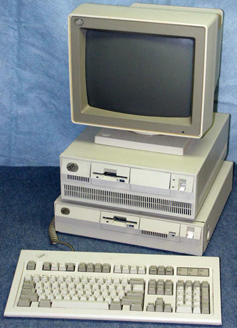
This project, known as the Syrian Computer Society (SCS), is headquartered in another remote town, Hassake, not far from the site of the fake nuclear power plant. It boasts three desktop computers – two IBM compatibles with 486 processors and an iMac G3 – and a 14.4 kbit/s dial-up modem.

Syrian Computer Society, Hassake

Syrian Computer Society, Hassake

Green Imac

486 PCThe project’s director, Dr. Samir Mahdoum, suggested that Syria could use these advanced machines to spy on Israel, thereby denying their arch-enemy the element of surprise.
“Using Google Maps Satellite View, we see all of Israel,” said Dr. Mahdoum, stroking an albino hamster. “Their troop movements, their weapons, everything!”

Dr. Fawwaz al-Kahrabji, the SCS’s director for research and development, says that this technological breakthrough has given Syria the edge in its rivalry with Israel.
“Why Syria wants a nuclear weapon? This is very stupid. The Israelis, they are stupid. If you drop nuclear bombs in Israel, Syria, Lebanon, they kill everybody, not just the enemy. Google Maps is much better weapon. We can spy on Israeli weaknesses.”

Sources in the Israeli Ministry of Defense say that they are monitoring the situation in Hassake very closely and are “not ruling out a military strike on the Syrian Computer Society.” Yitzhak Ben David, a spokesman for the ministry, said yesterday: “When it comes to protecting Israel’s security, we take every threat very seriously, from nuclear weapons to Google Maps. So, all options are on the table.”

Reporting by Jacob Tafnis (Qifa Nabki) for The Qnion

posted by Alex

Observations along the road to Kassab and the streets of Aleppo, by Ehsani

During my recent trip to Syria this summer, I was reminded about the new strict driving laws passed. These include excessive speeding, wearing seat belts and not talking on a cell phone. These are noble and fine rules to pass with the goal of protecting and saving lives.

While driving without a safety belt is fraught with risk, sitting at the back of an open Suzuki totally unprotected seems even more risky. Yet, as far as I could tell, there was no law against that.

As the pictures below show, one is regularly struck by the sight of vehicles driven by a seat belted driver carrying scores of children and women at the back of open vehicles with zero protection. Indeed, one would argue that the police ought to view such incidents with much more alarm than a taxi driver without a seat belt during Damascus rush hour.

Syria_belt3

Syria_belt2

Syria_seat_belt

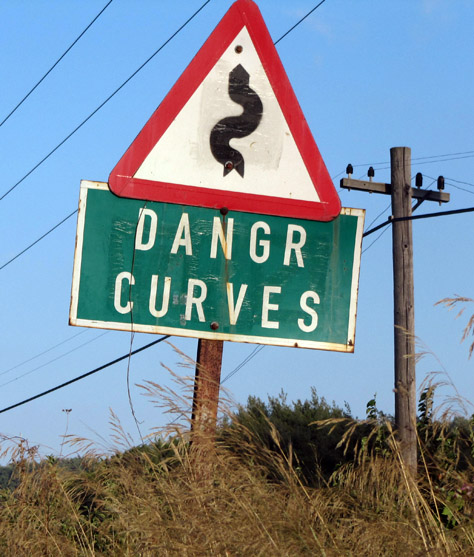
Incidentally, the pictures were taken while I was traveling on the ever so dangerous Kassab to Aleppo route. One strong break by one of these drivers could have seen these passengers at the back land on either the curvy roads or even the connecting highway.

Given the goal of safety and saving lives, shouldn’t the new traffic laws extend to the risky practice of sitting at the back of such vehicles too?

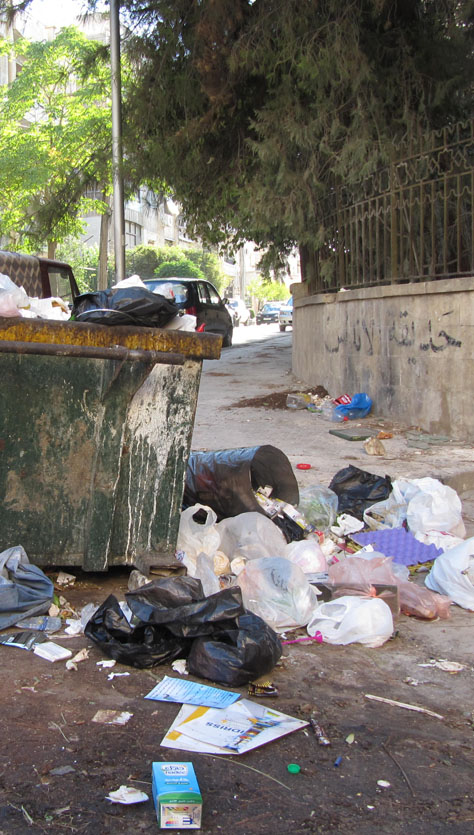
The municipality of the city of Aleppo faces a daunting task when it comes to garbage collection from the ever expanding city. The pictures below were taken from a rather upscale neighborhood. As residents of the city can confirm, this problem is rather widespread.

For a country whose population may hit 45 million in 2023 and 90 million by 2055 according to its own Prime Minister, the issue of garbage disposal from the open streets must be an urgent item on the agenda of local municipalities if not the Government itself.

At the moment, residents simply place their garbage outside their buildings around midnight. By the time the municipality workers show up around 6:00 am, every cat and stray dog has had a chance to peek inside these bags spilling most of its contents on the open streets.

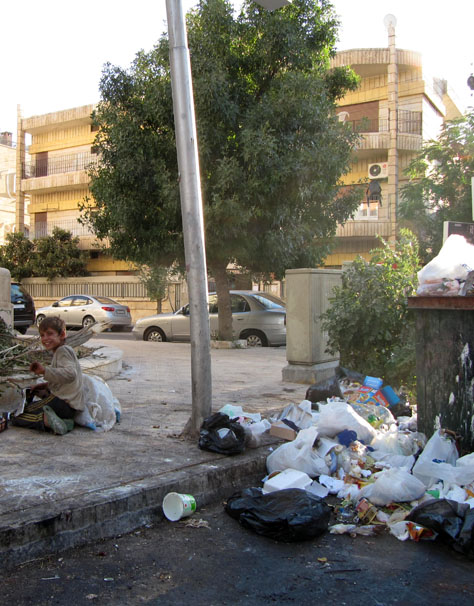
Some of the street corners have these metal containers shown in the picture. Residents are supposed to place their bags in them. Not everyone does and those that do fail to tie the bags well enough to avoid spillage. What you end with is a pile of garbage inside and outside the containers as the pictures show.

aleppo_garbage2

aleppo_garbage

Another feature of these containers is the unseemly picture of men and children sorting out the garbage looking for items they could sell. This is an urgent issue that requires an immediate and comprehensive long term solution.

Syria’s big cities are facing an onslaught from the surrounding countryside. Their populations are growing even faster than the national rate as a result. Unless something is done, these amazingly historical cities face further decay if not ruin.

Written by Ehsani for Syria Comment, posted by Alex

It’s the Economy Stupid – Ehsani Comments

Anyone wanting to know why Syria has not signed the European free trade agreement (Association Agreement) that was finally OK’ed by the EU states recently need look no further than this article in Arabic ???? ????? ?????? ???? ??????? !!, written by Ali Aboud and reprinted by Ayman Abdelnour’s All4Syria. In English the title is “The State Planning Commision Exposes Dardari.”

Abdullah Dardari

Abdullah Dardari

Abdullah Dardari was the head of the State Planning Commission in 2005 and is responsible for writing the Tenth, Five-Year Plan. Dardari was kicked up stairs in 2006 and named Deputy Prime Minister in charge of the Economy, although he does not have authority over a ministry or even a commission.

Tayssir Raddawi was named to replace Dardari as Head of the State Planning commission. Raddawi, who is close to Finance Minister Hussein, has been the number one critic of the 10th five-year plan and never loses a chance to point out the failures of the plan and of the previous five-year plan. He has called it “not populist” because the people don’t understand it. Dardari has been a major promoter of free trade. His efforts took Syria from “socialism” to a “social market” economy. But the impact of liberalization has had many damaging effects on Syrians – in particular – lower income Syrians.

How much of this is due to Dardari’s short comings and bad planning and how much is the necessary pain of getting out from underneath the failure of socialism and incompetence of central planning? I don’t know. My sense is that Syria is due for a lot of economic pain in order to escape bad habits and past mistakes no mater who plans the transition. Dardari had a very small staff. He was fighting large ministries, which fought him every step of the way. He had few experts to help him. Those that were outspoken and gave honest, but impolitic, assessments of the true extent of Syria’s economic problems and the source of corruption were drive out by people other than Dardari. In short, Dardari has had one hand tied behind his back. All the same, Syria has no social network to catch those who are getting crushed by liberalization. But where should the money come from? Somebody deserves the blame – I am just not sure it is Dardari.

Here are some scary facts. The following is a translation of Raddawi’s critique of the liberalization process:

1- The environment for Investment is weak and productivity is low.
2- Low private sector participation, intense global competition and a major collapse in raw material prices.
3- The GDP growth rate that Syria has is unlikely to persist given the continued inconsistencies which have been identified prior to the economic plan.
4- General Low productivity and weak institutional and administrative reforms.
5- Low technology usage in production
6- Continued high unemployment especially for the youth
7- Income is still unfairly distributed between individuals and regions
8- What high economic growth has been witnessed needs a set of metrics to ensure that it continues in both the medium and long term
9- Dependence on foreign demand is difficult since Syrian exports have not improved in both 2006 and 2007
10- A rise in the SYP exchange rate by close to 10% has had a negative effect on exports
11- Falling both private and public investment by close to 12% is a negative sign and runs counter to the economic plan.
12- Worker productivity is still poor compared to other developing countries.
13- The ranks of the unemployed are expected to increase especially for the youth.
14- The economic indicators for manufacturing have fallen significantly because of older machinery, higher costs, lack of worker skills and idle production.
15- The absence of any regular evaluation by the industry ministry of existing policies and whether goals have been met.
16- The failure to earmark enough funding to expand public sector light manufacturing.
17- Public sector light manufacturing needs new investment in machinery and a faster response function from its management regardless whether this may bring inflation.
18- The failure of the relevant government agencies to conduct regular evaluation of both private and public sector entities to help identify shortfalls.
19- Economic planning must not be built on slogans and wishes but must be realistic.
20- The fall in investments in 2007 was due to the lack of clarity in law number 8
21- The private sector is still small or medium size and is still managed mostly by a family structure.
22- The improvement in tax collection ex oil does not reflect the principals of fairness judging by the falling direct tax revenues and the rising indirect tax receipts.
23- There is still a significant amount of tax evasion judging by the fact that the growth in nominal GDP was not matched by indirect tax revenues and as non-oil tax receipts don’t match the fall in taxes revenues from oil.
24- The above tax revenue deficit has had a negative impact on income distribution and reorienting the national economy.
25- Eliminating subsidies partially on some items has had a negative effect on living standards as prices rose.
26- The existence of a stock of foreign currency outside the banking system may add to economic pressures in the event it is exchanged into Syrian Pounds.
27- In spite of the existence of private banks, government owned banks continue to dominate when it comes to both loans and deposits.
28- Inflation has risen to 17.8% in the first half of 2008.
29- The current account is not stable due to the deterioration in the trade deficit.
30- Even though the ranks of those under the poverty line has dropped, there is still 12.2% below what is regarded as extreme poverty while 34.5% under the poverty line
31- There is still no law to facilitate rental financing even though this has been presented to the economic counsel.
32- Wages and salaries now make up 30% of total GDP in 2007 after falling from 32% in 2005. Real wage growth also fell from 9.9% in 2005 to 3.2% in 2005.
33- The implementation of the economic liberalization program has had a negative effect on income and spending due to a fall in real economic growth.
34- There is still no solution to the pollution of the water used for residential, industry or agriculture.
35- Per capita water availability is down to 747 m3 per year which is a level below the water poverty level of 1000 m3.
36- 8% of agricultural land has suffered degradation due to the environmental changes.
37- Land truly used for agriculture has fallen by 2.6% due to increased urbanization and water resources which has increased the risks of investing in agriculture.
38- The agriculture insurance laws is yet to be issued which has made it difficult to implement the past contracts between producers and marketing institutions to help regulate the market. The absence of private marketing concerns with deeper pockets has not helped in organizing the marketing either.
39- The volatility of raw materials has slowed down the implementation of investments in agriculture.
40- The failure of most tenders or managing them effectively to fit the feasibility studies of development projects.
41- Even though a number of laws have been passed, failure to implement them has resulted in deteriorating resources and encroachment on agricultural land.
42- Extended weakness in both private and public Tourism institutions.
43- Goals were unmet in air transport due to the low number of available aircrafts.
44- The unavailability of laws governing BOT type investments and the failure to allocate funding to the government owned entity in charge of highway and road construction.
45- The reluctance of the private sector to invest in high cost infrastructure projects has resulted in the lack of detectable improvement in the road and rail networks.
46- Nothing has been done about the identified inconsistencies in the economic plan.
47- Low investment spending has resulted in lower budget deficit but this made the level of investments inconsistent with the economic plan.
48- Revenues have fallen short for many reasons including the lack of a credible system that of taxation and the avoidance of tax evasion.
49- There is still no strategic plan to deal with the public debt in way that would balance the needs of the national economy as a whole.
50- The level of interest rates is still not conducive to increased investments.
51- Most of the policies that were crafted to deal with the economic crisis are yet to enter the implementation stage.

I asked Ehsani for his comments, which are posted below:

The 51 point-criticism of Dardari and the so-called economic reform plan is extraordinary in both depth and scope. The reformers are being blamed for everything from high raw material prices to low investments, productivity and economic growth that have left 34% of Syrians  (6.8 Million) living below the poverty line, which is 2$ a day. No punches were spared. Even the country’s exchange and interest rates were deemed too high for both exports and investments.

The tone behind the scathing attack is one that identifies with the suffering of the working class — poor workers and farmers — who have seemingly suffered the brunt of the recent economic reforms that are underway.

While few solutions are offered, it is clear that the author is calling for more public sector investment in both agriculture and light manufacturing coupled with more taxation of the rich through direct rather than indirect taxes.

While such solutions may appease  die-hard Baathists, they conveniently overlook the true causes of our economic malaise. Dardari’s liberalization process did not start us down this road. On the contrary, the long absence of liberal reforms brought us to this point. The Baath has been in charge of economic policy for over 40 years. Undoing the damage caused by extensive reliance on  subsidies amid a population explosion and persistently weak economic growth will not be easy.

Some would argue that the economic reformers ought to have provided a wider safety net as they embarked on their program. That criticism fails to explain from where the funding of that safety net would come. The country’s coffers are under severe pressure. One of the criticisms that I have been sympathetic to has to do with taxation distribution. Syria’s very wealthy do not pay their share of taxes. Most boast of their ability to evade taxes and wonder why they should pay any tax given the lack of services. This is a classic chicken and egg problem. Services are weak because tax receipts are low and tax payers don’t want to pay since they receive no services.

In the opinion of this writer, Syria’s problem is not that the reforms have been too fast but rather too little too late. A massive culture of dependency on the state has grown up in Syria; it is so pervasive that average Syrians have come to regard subsidies and government jobs as their right.

Syria’s economic challenges are likely to be enormous. The 51-point document must serve as the best illustration of that. Solutions like increased investment in the public sector caused the problem in the first place; they will not solve it.  Similarly, solutions relating to increased investment in agriculture conveniently overlook the fact that Syria suffers from a severe shortage of water resources. Less dependence on agriculture that heavily depends on water and not more must be the answer.

It is time for bold leadership in economic matters. There are no easy solutions, given the daunting set of issues the country faces. Arguing and bickering between the reformers and the hawkish Baathists merely delay finding a credible set of solutions that have been in short supply thus far.

Why Turkey Went to Iran and What it Means

The fallout of Erdogan’s Iran visit has caused considerable controversy. Erdogan’s planned visit to the US has been postponed until December.

Here is some background to what is at stake and why so many in the West are worried – I think mistakenly. (If you don’t need a backgrounder, skip the indented part)

Turkey is passing through an extraordinary moment in its history because the civilian government is taking a large group of military officers to court, accusing them of planning a coup. Read this article, ‘AK PARTY not listening to military’ which includes a copy of a leaked “secret action plan” devised by some colonels to take on the AK Party.

It gives an incredibly frank description of how some in the secular military in Turkey, led by officers brought up in the “Ataturkist” spirit, look at the government of the AK Party AKP [Justice and Development Party], which is led by Prime Minister Recep Tayyip Erdo?an and President Abdullah Gül, who have been leading Turkey in the direction of moderate Islam, which horrifies the military.

In these secret memos, now made public, a number of military officers spell out a plan for a “coup” against the AK party.

The civilian government is taking the military officers to court. Should they win and be able to “tame” the military, democracy may be the winner. Some think that Islamization will be the winner, which they see as a danger and slippery slope, as do these officers.

In the past, the military has carried out a coup about every 10 years in Turkey, sweeping away civilian parties that have become either too left or two religious in the military’s opinion. The US has traditionally seen this as a good thing and called the military the “guardian” of democracy – especially during the Cold War years. Today, the West has changed its mind. Increasingly it sees the AKP as the best example of a soft Islam that is friendly to the West and which accepts secularism. It is the best antidote to radical Islamic parties, according to many Westerners. This is what the Turkish officers are worried about.

Erdogan’s visit to Iran this week has begun to make many of his fans in the West wonder if the Ataturkists in the Turkish military are right.

Turkey has signed an agreement with Russia, China and Iran to use each others currencies in their trade and not dollars. This is a big deal. China has just signed a deal with Russia to buy gas worth more than the total Russian export to Europe. This is to be in local currencies rather than dollars. Russia will not have to stockpile do many dollars. From the Turkish perspective, expanding the local currency deals is important because Ankara will not have to accumulate dollars or Euros as well. All of Turkey’s energy comes from Russia and Iran.

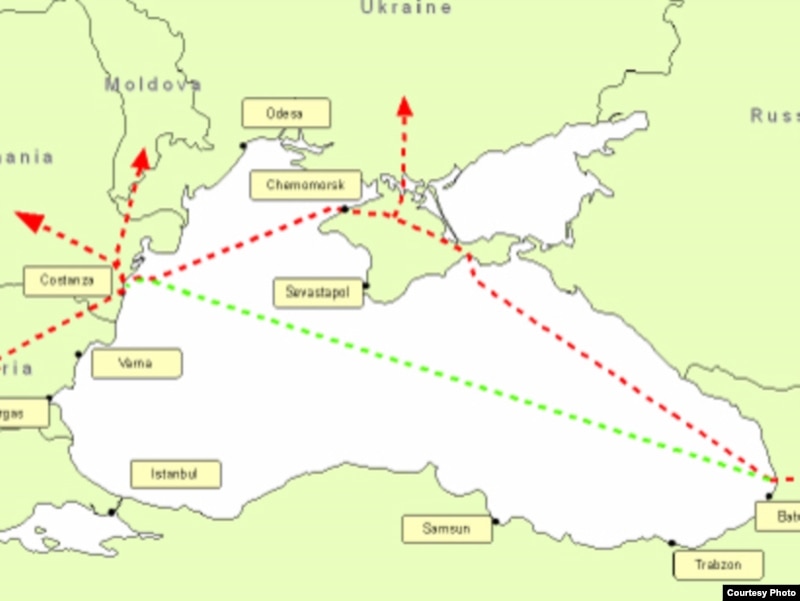
Nabucco Gas Pipeline

For the Nabucco gas pipeline Turkey’s changing foreign policy is also important. Turkish friendship with Armenia and the Kurds is opening up new prospects for energy transport. It ensures that transit through Turkey will be inexpensive and secure. By fixing its Kurdish problem, regularizing relations with Armenia, and having good relations with Iran, the proposed gas pipeline bringing Azerbaijan gas through Turkey to Europe will be seen as secure and reliable.

In the following excellent articles, copied below, Gülnur Aybet explains why Turkey needs Iranian gas to make its Nabucco gas line work. The Iran visit is not about identity or religion, he argues, but about Turkey becoming the hub of a successful gas transport network – a network, by the way, that Syria is counting on to boost its importance and the importance of its allies in the region.

Flynt and Hillary Mann Leverett argue that the US should follow Turkey’s lead in realigning its relations with key Middle Eastern actors such as Iran, rather than trying to stop Turkey from doing it, which would be a losing battle. The problem for the US is that such a shift would bring it into conflict with its close ally, Israel, and possibly cause some friction with Saudi Arabia, although the Gulf countries are a lesser problem for Washington. Turkey and Syria take the view that the Iranian nuclear issue is largely bogus and has been manufactured by Israel in order to turn the world’s attention away from Gaza and settlements on Palestinian land. Another benefit for Israel is that it keeps the Arabs divided. See “Erdogan’s Visit to Tehran Raises Questions over Turkish Foreign Policy” by Emrullah Uslu at Jamestown to get a sense of Erdogan’s stand on this.

Responding to criticism over whether Turkey might be reorienting toward the Middle East, Erdogan said “Turkey is expanding its relations; it is not changing its direction. Our axis is obvious. I guess people cannot get rid of their Cold War mentality. Turkey may be extremely good friends with Syria, Iraq, Iran, Russia, Georgia and Armenia, with Greece or Bulgaria as well. This is neither against NATO, nor can it be considered as a stance against any other country or group of countries. We have to eliminate such restrictive paradigms,” he said (Today’s Zaman, October 29). On Turkey’s relations with Israel, Erdogan noted that Ankara would continue its ongoing bilateral ties with Tel Aviv based on the principle of “rightness,” and without accepting any pressure on its own political will (Today’s Zaman, October 29).

Serious Turkish diplomacy
By: Flynt Leverett & Hillary Mann Leverett
October 29, 2009 05:25 AM EST

Turkey’s prime minister, Recep Tayyip Erdogan, was expected to come to the White House on Thursday for a meeting with President Barack Obama. Erdogan’s visit has now been postponed, and the decision to postpone comes on the heels of the Turkish leader’s high-profile visit to Iran this week.

When Erdogan does come to Washington, Obama would do well to listen to his Turkish visitor about the current state of play in the strategically vital Middle East. Erdogan will come to Washington not only at a time of strong domestic support for his government and the ruling Justice and Development Party, a moderate Islamist party that has dominated Turkish electoral politics in this decade, but also at a time of increasing influence for Turkey in the broader Middle East — while America’s influence in the region continues to decline.

We spent several days in Turkey last week, where we heard Erdogan describe his country’s “zero problems” policy vis-à-vis its neighbors. Regarding the Middle East more specifically, Erdogan’s chief foreign policy adviser explained to us that Turkey’s approach to the region is based on four principles: Engage all actors; respect the results of all democratic elections (including those in the Palestinian territories in 2006 and Iran in 2009); increase cultural and economic relations among countries in the region; and work with regional and international organizations to maximize possibilities for engagement.

Turkey is, of course, a member of NATO and has long had a positive economic and strategic relationship with Israel. But, working from these four principles, the Erdogan government has in recent years effected major improvements in Turkey’s relations with a much wider range of Middle Eastern states, including Iran, Iraq and Syria.

This opening to the broader Middle East has been very strongly in Turkey’s interest. Expanding trade and investment links to Iran, Iraq, Syria and other regional states has boosted the growth of Turkey’s economy and reinforced its status as an “emerging market” of international significance. Moreover, closer ties to Middle Eastern countries, along with links to Hamas and Hezbollah, have made Ankara an increasingly important player across a wide spectrum of regional issues.

Erdogan wants to position Turkey to act as a mediator between its Muslim neighbors and the West — including the United States, which needs to move beyond nice speeches by Obama and undertake concrete diplomatic initiatives to repair its standing in the Middle East. But if Washington is too shortsighted to see the necessity of realigning its relations with key Middle Eastern actors such as Iran, the Erdogan government’s opening to the broader Middle East gives Ankara a wider array of strategic options for pursuing Turkish interests — the essence of successful diplomacy.

During his visit to Tehran this week, Erdogan met with Supreme Leader Ali Khamenei — a rare honor for a foreign leader. (In 2007, Russia’s then-President Vladimir Putin was also accorded a meeting with Khamenei.) Turkey’s expanding ties to the Islamic republic — including gas supply contracts and preliminary agreements for major upstream and pipeline investment projects — are essential to consolidating Turkey’s role as the leading transit “hub” for oil and gas supplies to Europe. While in Iran, Erdogan said that he hopes Turkish-Iranian trade — currently valued at roughly $10 billion — will double by 2011 and strongly supported Iranian participation in the Nabucco gas pipeline. Meeting with Iranian President Mahmoud Ahmadinejad, Erdogan criticized international pressure on Tehran over its nuclear activities as “unjust and unfair” while other states maintain nuclear weapons.

These statements signal that Turkey may well move ahead and conclude significant upstream and pipeline contracts in Iran despite U.S. opposition. The U.S. position on this issue is detached from economic reality. However much the Obama administration resists admitting it, the Nabucco pipeline will almost certainly not be commercially viable in the long run without Iranian gas volumes. In the end, Turkey’s approach to Iran does more for Western interests than does the U.S. approach. Under the Erdogan government, Ankara is increasingly confident that it can pursue its interests in the Middle East without either succumbing to U.S. pressure or fundamentally sacrificing its relationship with Washington. Erdogan’s planned visit to the White House strongly suggests that this confidence is eminently justified.

Israelis and some of Israel’s friends in the United States decry what they see as the expansion of Turkey’s ties to other important Middle Eastern states at the expense of Turkey’s ties to Israel. Ankara has indeed been sharply critical of Israel’s military campaign in Gaza and its role in the continuing humanitarian crisis there — a posture manifested in Erdogan’s highly publicized walkout from a joint event with Israeli President Shimon Peres at the World Economic Forum and the postponement of NATO military exercises in Turkey that would have included Israeli forces. But criticism of Turkey from pro-Israel circles misses an important reality: At this point, Israel arguably needs a relationship with Turkey more than Turkey needs a relationship with Israel.

There is an important lesson here for the Obama administration. America no longer has the economic and political wherewithal to dictate strategic outcomes in the Middle East. Increasingly, if Washington wants to promote and protect U.S. interests in this critical region, it will have to do so through serious diplomacy — by respecting evolving balances of power and accommodating the legitimate interests of others so that U.S. interests will be respected. Turkey’s Middle East policy provides a valuable model of what that kind of diplomacy looks like.

Flynt Leverett directs the New America Foundation’s Iran Project and teaches international affairs at Penn State. Hillary Mann Leverett is CEO of Stratega, a political risk consultancy.

Behind the rhetoric: Why Turkey wants to keep Iran engaged
by  GÜLNUR AYBET* in Zaman

LONDON — Prime Minister Recep Tayyip Erdo?an’s visit to Iran on Oct. 26 and 27 was highlighted with the usual colorful rhetoric the prime minister is now famed for, this time going beyond public criticism of Israel to accusations of “hypocrisy” against the five-plus-one countries who are engaged in talks with Iran over its nuclear ambitions.

While dismissing Western concerns over Iran’s intentions to build a nuclear weapon as mere “gossip” may seem at odds coming from a NATO member aspiring to become an EU member, much lies behind the theatricals of populism.

The prime minister’s visit to Iran raises two questions. First, it highlights Western concerns that Turkey, a traditional ally of the West, may be shifting its foreign policy orientation towards the Islamic world and the Middle East. Second, the timing of the visit, close on the heels of Turkey’s refusal to participate in a military exercise with Israel and the recent mending of relations with Syria, also coincides with the arrival of inspectors from the International Atomic Energy Agency (IAEA) to Iran’s recently disclosed nuclear facility in Qom. There is no doubt that Erdo?an’s populist rhetoric coupled with the Israeli rift is a powerful softener as Iran prepares to engage once again with the West over its nuclear program. No matter how “non Western” the prime minister’s public stance may seem, Turkey’s interests in engaging Iran, in fact run parallel with those of the West.

Turkey’s primary purpose in this visit is not to act as a mediator between Iran and the West but to deliver an independent Turkish message to the Iranian authorities that Iran is not being convincing about the civilian intentions of its nuclear program to the international community. However, Turkey insists it will engage Iran on this issue as a country which empathizes with Iranian sensitivities.

Here, Turkey’s most valuable asset in keeping Iran engaged is its independence from the West, and Prime Minister Erdo?an’s populist rhetoric against Israel and criticism of Western handling of the Iranian issue no doubt helps in this respect. But Turkish interests in this matter are also strongly driven by its objection to further new sanctions on Iran. As a non-permanent member of the UN Security Council, Turkey’s stance on future sanctions could have a considerable impact. Also in a speech at the UN last month, Erdo?an voiced his particular opposition to further sanctions on Iran’s gas industry.

This is linked to the second purpose of this visit — Turkey’s interest to diversify its energy supply options in the region. Turkey would like to keep the door open for Iran’s possible involvement as a supplier to the Nabucco gas pipeline, which will run through Turkey to Europe.

Turkey also has a vested interest to develop three phases of the world’s largest gas field — the South Pars field in the Gulf, in a joint venture with Iran. Although the energy deals are in the shape of a memorandum of understanding between the two governments and have not yet materialized as contracts, the US envoy for Eurasian Energy, Richard Morningstar, sent a clear warning in July, stating that the US opposed Iranian involvement in Nabucco. Despite the US’s consternation in the matter, Turkey’s Energy and Natural Resources Minister Taner Y?ld?z recently said he hopes to finalize a deal over the development of South Pars with Iran.

It is interesting that Turkey is ready to pursue these energy deals with Iran at the risk of deteriorating relations with the US just as the healing process has started after the damaging Bush era in Turkish-American relations. Under a 1996 deal, Turkey already receives some of its gas supply from Iran. But in recent years, the quantity and quality of supply has been disappointing for Turkey, in contrast to Russia, which Turkey does view as a reliable energy supplier. However, filling the Nabucco pipeline with an adequate supply is crucial for long-term Turkish interests to become a major energy hub linking Europe to Asia. As it is doubtful that Azeri gas, the main supplier to Nabucco, will be sufficient to fill the pipeline, other alternative suppliers such as Turkmen gas, which is presently dependent on Russia as the only outlet to Europe, and Iraqi gas, which depends on the security situation improving in that country, look uncertain at best.

Turkey is right to court all options for future suppliers for the pipeline. Turkey’s interest in an energy deal with Iran should therefore not be seen in the context of an “Islamist” empathy, whatever the prime minister’s rhetoric, but a pure realpolitik matter in diversifying its energy options.

This visit is not about deepening relations with a neighboring state on the basis of identity politics. It is about maintaining the status quo by keeping Iran engaged with Turkey and the West without closing the door on Iran’s gas supply to Nabucco as one option out of many. While the West, and in particular the US, may object to Turkey’s energy overtures with Iran, Turkey’s Iranian engagement as an independent player in the region is no doubt an important asset.

When it comes to Turkish-Iranian relations, the West should let Turkey do what it does best — be an independent player in the region with interests parallel to the West.

*Gülnur Aybet is a Southeast Europe policy scholar at the Woodrow Wilson Center and a lecturer at the University of Kent.

Turkey’s “Zero Problem with Neighbors” Reaches Iran: New Currency Deal Eliminates Dollar

Turkey is following its “Zero Problem with Neighbors” policy during P.M. Erdogan’s visit to Tehran. It is worth noting that the Turkish border with Iran has not changed since 1639. Turkey has also been fixing its long troubled relations with Kurds, Georgia, Greece, and with Armenia, not to mention Syria. Turkey has embraced the spirit of Obama’s diplomacy of engagement.

Addendum: Turkey has signed an agreement with Russia, China and Iran to use each others currencies in their trade and not dollars. This is a big deal. China has just signed a deal with Russia to buy gas worth more than the total Russian export to Europe. This is to be in local currencies rather than dollars. Russia will not have to stockpile dollars. From the Turkish perspective, expanding the local currency deals is a big deal because they do not need to accumulate dollars or Euros. All of Turkey’s energy comes from Russia and Iran.

For the Nabucco gas pipeline Turkey’s changing foreign policy is also very important. Turkish friendship with Armenia and the Kurds is opening up new prospects for energy transport. It ensures that transit through Turkey will be inexpensive and secure. By fixing its Kurdish problem, regularizing relations with Armenia, and having good relations with Iran, the proposed gas pipeline bringing Azerbaijan gas through Turkey to Europe will be secure and reliable.

Nabucco Gas Pipeline

Nabucco Gas Pipeline

I am off to London for a conference soon and will not be posting for a week.

Larijani says Iran-Turkey cooperation can strengthen regional security

TEHRAN (ISNA)-Iran’s Parliament Speaker Ali Larijani said on Wednesday Iran-Turkey cooperation can strengthen security in the region.

Larijani in a meeting with Turkish Prime Minister Recep Tayyip Erdogan in Tehran, pointed out to regional developments in Iraq, Afghanistan and Palestine and said Iran and Turkey’s roles in the countries complete each other.

Ali Larijani (right) speaking with Turkish Prime Minister Recep Tayyip Erdogan

He also praised Erdogan’s stance on Palestine and Gaza issues and said taking these approaches improve Ankara’s position in the region and in the Islamic World.

Turkey will go ahead with Iran gas agreement

Britain says Syria deal worth waiting for
Asia Times Online
by Sakhr Al-Makhadhi

Britain’s Foreign Secretary David Miliband insists that efforts to strengthen Europe’s ties with Syria are not on hold, as Damascus calls for a delay in signing a long-awaited association agreement. …..Syria expert Professor Joshua Landis says Damascus wants to be sure the agreement will be a partnership of equals. “Syria remains a country that is deeply distrustful of ‘imperialism’ and anything that reminds it of imperialism,” he said. “It does not like to make itself vulnerable to the West.”

The deal will give Syrian companies preferential access to Europe’s markets. But it will also open up Syria’s economy to EU businesses. And that could be one reason for the delay – to assess the potential impact that the agreement will have on Syrian jobs. Syria would also get greater access to EU markets, increased aid and support for cultural, health and social programs. For the EU, promoting good governance, democratization and human rights are included in the treaty’s text….

Syria’s ambassador to Britain, Sami Khiyami, says his country wants to be at the center of a new regional understanding – bringing together Turkey, Iran and the Arab world.

And on that front, things are moving fast. Syria and Turkey have just created a visa-free zone. And in the space of a few months, Syria and Saudi Arabia have staged a dramatic reconciliation.

Miliband’s conciliatory approach appears to show that the EU realizes it cannot take Syria for granted.

Sasa (of Syria News Wire) writes in the comment section to the previous post about the Yemen conflict:

I don’t think Iran will be too worried about Syria’s position on Yemen. You are right to say that Saudi is deeply involved in the situation there, but Iranian involvement is a product of Yemeni government imagination and nothing more.

To describe the Houthi insurgents are not ‘Shia rebels’ is only half the story. They are Zaidis, which is a different type of Shia from Iran. The Yemeni regime is also Zaidi, so this is not an ethnic conflict. Both sides are throwing accusations of foreign involvement around – the Houthis say that Saudi warplanes have bombed their areas, and the Yemeni government retaliates by saying the Houthis have Iranian funding.

As Ginny Hill (British journalist, researcher, and – if I may say so – the Josh Landis of Yemen!) says, foreign diplomats say any Iranian involvement is limited to private funding, rather than any Iranian government sponsorship. As far as I understand, the Yemeni government has not accused Iranian officials of getting involved either, just pointing their finger at an Iranian monster in the woods to tarnish the Houthis’ domestic reputation.

So would Iran be worried about Syria supporting the Yemeni government – probably no more than they would be worried about Syria and Saudi sorting out their differences. If anything, it gives Iran a new route to talk to unfriendly states.

Addendum: Aron Lund of Sweden writes:

I read the two posts dealing with Yemen on your blog, and I have to disagree. I can’t see what Syria’s role would be in Yemen, and I don’t think Abdullah’s visit had anything to do with that. The issue might have come up, of course, but Damascus couldn’t seriously hope to leverage its very marginal influence on Yemen to gain support on other issues where it does have a major role, like Lebanon, Iraq, Palestine.

There is one thing, though: Ali Nasser Mohammed, the former South Yemeni president, is in exile in Damascus. Apparently, he still has a minor following in southern Yemen. Since much of the south of the country is sliding back into secessionism, and strong leaders are much in demand there, perhaps his presence in Syria could give the government some little influence on the southern conflict. They could stop him from interfering, for example, or prevent him from going back, or pressure him to cooperate with the Saleh regime.

Apart from all that, I agree with Sasa’s characterization of the northern/Houthi war as not quite the Sunni-Shia dispute it’s being made out to be in much of the media There’s certainly ideological sectarianism on the Zeidi side, and among some Salafi forces fighting alongside the government. But the government is essentially patronage-based, tribal and pragmatic, and not very interested in whether you prefer Ali or Mouawyia. In fact, President Ali Abdullah Saleh is a secular Zeidi himself, so it’s hardly a religious battle for him.

BBC,(Via FLC) Yemenis claim they intercepted ‘Iranian ship’ …

“… The Yemeni central government has not commented but officials have long accused the rebels of receiving Iranian support, a claim Tehran denies. …Last week Yemeni President Ali Abdullah Saleh alleged that captured rebels had confessed their funding came from Iranian dignitaries. But he said he did not accuse the Iranian regime itself.

The AFP new agency quoted a local Yemeni official saying that from preliminary enquiries, five of the Iranians captured on Monday were “instructors” who had planned to deliver weapons and then evacuate wounded Iranians.

The rebels, known as Houthis, say they want greater autonomy and an public role for their version of Shia Islam. They complain their community is discriminated against. They accuse Saudi Arabia of supporting Sanaa and last week said they had clashed with Saudi forces along the border between the two countries. ..”

Assad is in Croatia visiting with President Stjepan Mesic. With him are Deputy Prime Minister for Economic Affairs Abdullah al-Dardari, Foreign Minister Walid al-Moallem, and Assistant Foreign Minister Abdelfattah Amoura.

Addendum: White Stream can De-Monopolize the Turkish Transit of Gas to Europe
Jamestown Foundation, October 29, 2009—Volume 6, Issue 199

Political risks to Caspian gas transportation have emerged westward of the Caucasus in Turkey, where such risks were least expected. Azerbaijan has become the first gas-exporting country to experience those risks, stemming from Turkey’s position as a transit monopolist. Turkey’s AKP government is practically blocking the transit of Azerbaijani gas to Europe and slowing down the Shah Deniz and Nabucco projects’ implementation.

Consequently, Baku is now seeking alternative export solutions for its gas. Possible solutions include Russia and Iran overland, as well as the proposed White Stream pipeline across the Black Sea to Europe (EDM, October 21, 22).

White Stream, a private venture, had never deliberately been intended to bypass Turkey. However, it can now be seriously considered for carrying Azerbaijani gas directly to Europe, without recourse to the Turkish route. Activating the White Stream pipeline project at the European Union’s level would demonstrate that Turkey cannot and must not behave as a transit monopolist on Caspian gas to Europe. The proposed White Stream is integrated, along with Nabucco, since November 2008 in the E.U.’s strategy for a Southern Corridor for natural gas to Europe.

Addressing the Azerbaijani government’s recent special session on gas issues, President Ilham Aliyev mentioned the possible export of Azerbaijani gas across the Black Sea. He referred both to White Stream and to liquefied natural gas (LNG) as possible solutions, currently under consideration (www.day.az, October 17).

White Stream is being promoted by a consortium of several small companies in London, currently including the White Stream Pipeline and the Pipeline Systems Engineering companies. It is the first fully private gas pipeline project in any of the former Soviet-ruled countries. The goal is to export Caspian gas via Georgia, the Black Sea, and Romania to markets in E.U. territory (Reuters, October 19)……

Addendum: I received this email:

Dear Joshua,

This upcoming conference should be most interesting. Governments in Israel, Europe and the US are increasingly worried about what they see as a potential major Turkey strategic re-alignment towards the East. The latest developments seem to support that concern but I wonder if the concern is not a bit misplaced. Western reporting continually describes Turkey’s new direction as if the entire country was supporting it. I think this is a gross exaggeration which ignores internal Turkish dynamics. It is essential to discern Turkey as a nation from the AKP as the current governing party. In light of recent election’s returns, it cannot be said that the AKP is in a commending position politically. Although the influence of the military has been certainly curtailed, it is still there. Religious fervor has undoubtedly increased in some segments of society but there is still a broad secular base. In the energy sector, Turkey is concerned about White Stream by-passing them and cutting them off an important revenue source. It is clear that there are significant societal elements that do not share the AKP’s religious ideology nor its apparent rapprochement with the East. In other words,Turkey is not the problem, the AKP is the problem. In light of the significant consequences for the West (political/EU, military/NATO and economic/Nabucco/White Stream) of the emergence of a true Turkey-Syria-Iran axis, it is reasonable to assume that governments, the energy industry and intelligence agencies in Europe and the US are going to focus more closely on how to resolve the “AKP problem” with the aim of preventing the consolidation of any such axis in the first place.

Turkish Chief of the General Staff Struggles to Pacify Military Coup Controversy
by –Emrullah Uslu for Jamestown Foundation

On June 12, the liberal left Taraf daily published an unclassified document outlining an alleged action plan for the military to combat the “reactionary activities” against secularism. Allegedly the “Action Plan against Reactionaries (Irtica),” was prepared by senior staff Colonel Dursun Cicek and defined the ruling AKP and the Gulen movement as threats to the secular order in Turkey. The plan outlined various measures to undermine public support for the AKP and advocated a conspiracy against the Gulen movement to present it as an armed criminal group that could be construed as a terrorist organization. While the public debated whether the document was authentic, military prosecutors launched an investigation and declared that it was a forgery and was not prepared within the headquarters of the Turkish Armed Forces (TSK). Nonetheless, the debate continued and the Chief of the General Staff General Ilker Basbug held a press conference in which he forcefully denied the existence of such a plan and stated that the so-called document was nothing but a “piece of paper” (Taraf, June 12; EDM, June 15, 23).

An anonymous military officer, who appears to be working with Colonel Cicek at the headquarters of the TSK has now written a letter of confession and attached the original document. Regarding the document, a report prepared by three experts at the Istanbul Council of Forensic Medicine (ATK) showed that the signature on the original copy belonged to Colonel Cicek (Hurriyet, October 24).

En route to Pakistan, the Turkish Prime Minister Recep Tayyip Erdogan stated that “the document is now in the hands of justice. We will do exactly what the courts ask of us. We will closely monitor developments. The armed forces cannot accept such a blemish [if the allegations prove to be true]” (Hurriyet Daily News, October 25). In response to the media coverage, General Basbug reacted harshly to the original document being leaked. In a written statement the TSK stressed that the tone of media coverage had varied widely. “It is very worrying that the developments over the letter and the document appear first in the media, in terms of the authority of the state,” Basbug commented (Hurriyet Daily News, October 25). Military prosecutors have launched yet another investigation into the issue and asked the civilian prosecutor to provide the original document and the ATK report (Hurriyet, October 27).

Deputy Prime Minister Bulent Arinc also commented on the issue saying that if there were claims that a similar document was prepared by a deputy, he would remove him from office and urged General Basbug to relieve those behind the plot of their duties (Today’s Zaman, October 28). The ruling Justice and Development Party (AKP) parliamentary group Deputy Chairman Suat Kilic, said the controversy would not have escalated had it been properly investigated when it first emerged in June. “If this plot was prepared with the knowledge of the top commanders, this is grave. It is even worse if it was prepared without their knowledge. The TSK should immediately take action to address suspicions over its role,” he said (Today’s Zaman, October 28).

Turkish intellectuals are questioning General Basbug’s leadership, because he initially misled the public when he claimed that the document was not prepared at the TSK’s headquarters and described it as just a “piece of paper” (Sabah, October 27, Hurriyet, October 28). Even anti-AKP intellectuals are criticizing the military for its involvement in civilian politics and asking General Basbug to act decisively (Cumhuriyet, October 27). Some went as far as to suggest that he should resign, since either he was involved in the plot to overthrow the government or he was unaware of it (Sabah, October 27).

Erdogan, during his visit to Pakistan and Iran, stated that he will ask General Basbug to meet him to discuss this issue, and said that neither the state nor the TSK can accept the present situation. Public pressure is mounting on both the government and the TSK leadership to act. For the military leadership it is even more difficult, despite the evidence in the ATK report, since military officers are convinced that this is not a plot against the AKP government conducted by the armed forces but the reverse.

POWER PLAY
The National

Mohamad Bazzi analyses the methods and motivations of Syria’s attempts to rejoin the Arab political order after years of isolation.

La construction de deux axes routiers en cours de préparation

En dehors de ces preoccupations universitaires, le ministère des transports continue la préparation de la construction de deux axes routiers. Il a notament repoussé au 3 décembre 2009 la date limite de l’appel d’offres concernant la conception, la construction, l’exploitation et la gestion de deux autoroutes internationales. La Société financière internationale, branche privée de la Banque mondiale, aidera ensuite le ministère à évaluer les soumissionnaires.
Il est prévu que la première route, longue de 432 kilomètres, coupe le pays dans toute sa longueur nord-sud, à partir de Bab el-Hawa, frontalière avec la Turquie, jusqu’à la ville de Nassib située à la frontière jordanienne. La seconde autoroute, quant à elle, devrait mesurer 351 kilomètres de longueur et permettre la jonction ouest-est entre Tartous et al-Tanaf, à la frontière irakienne. Le coût combiné de ces deux projets est estimé à environ 1,6 milliard de dollars, dont 1 milliard prévu pour l’axe nord-sud et 600 millions pour l’axe ouest-est.

Le chef de la Grande révolution syrienne se rappelle à notre souvenir
28 octobre 2009

s

Des dizaines de milliers de Syriens de la province de Soueida ont assisté le 16 octobre au transfert de la dépouille de Sultan Pacha El Atrache, chef de la Grande révolution syrienne (1925-1927), vers un grand mausolée dédié aux martyrs tombés au combat contre l’armée française.

U.S. says Syria should release 78-year-old dissident
Sat Oct 24, 2009 2:05pm EDT WASHINGTON (Reuters) –

President Barack Obama’s administration called on Syria on Saturday to release a 78-year-old former judge who was arrested last week and placed under official arrest despite international condemnation.

“We join the United Kingdom, France, and other concerned international parties in expressing our deep concern regarding the detention of human rights lawyer Haitham Maleh by Syrian security services since Wednesday, October 14,” the White House said in a statement.

“Syria should demonstrate its commitment to international legal norms by releasing Maleh and other Syrian citizens who have been imprisoned solely for seeking to exercise their internationally recognized political freedoms,” the White House statement said.

Lebanese militants fired rockets into Israel but the attack was stopped by the Lebanese mil

Feltman: “The United States hopes that Lebanon’s political factions will agree on a cabinet “in the coming days” and looks forward to working with the new government, a top US diplomat said Wednesday.

Barak faces party revolt over peace deadlock (Reuters)

28 October 2009, JERUSALEM – Israeli Defence Minister Ehud Barak faced the possible breakup of his left-of-centre Labour party when a group of lawmakers threatened on Tuesday to break away protesting a lack of movement in peace talks.

Legislator Eitan Cabel of Labour said he was one of four of the party’s 13 legislators launching a movement to press Israel to renew stalled negotiations with Syria and the Palestinians.

Cabel told Reuters the group demanded “a lot more activism by Israel to advance the peace process” and could quit the party unless Barak heeded their message, a step that could weaken rightist Israeli Prime Minister Benjamin Netanyahu’s government.

The threat introduced the risk that Netanyahu’s fractious seven-month-old coalition was vulnerable not only to pressures from ultranationalists against stopping Jewish settlement, but also to demands from moderates seeking more diplomacy.

Netanyahu commands the support of 71 of parliament’s 120 lawmakers, but his coalition comprises an uneasy alliance of unlikely partners as Barak’s Labour as well as far-right and religious factions.

Cabel, a veteran lawmaker removed months ago as party director after criticising the alliance with Netanyahu, accused Barak of “destroying the Labour party and now destroying the Left,” by failing to press further to renew peace talks.

In exile, Iraqis taste a life impossible at home
By OMAR SINAN (AP)

DAMASCUS, Syria — After fleeing their bloodied homeland, where violence and increasing conservatism confine their compatriots’ lives, some Iraqis in exile are taking the opportunity to enjoy living outside the box.

Around 1 a.m., five Iraqi women in tight jeans and tops giggled and exchanged high-fives with male friends they ran into the upscale al-Berjis restaurant in Damascus’ Old City, sitting down to smoke waterpipes and play cards before ordering a late-night meal.

“This is life. Outside Iraq, we are alive,” said Rana Sabah, 37-year-old blonde woman with blue colored contact lenses. She blew out a stream of smoke and threw a card on the table. “Believe me I have been all over the place, Iraqis in Iraq are buried alive.”…..

In Damascus, she and her two daughters and two sons go out nearly every night. One recent night — coming up on 2 a.m. they were at the city’s biggest mall, Damascino, playing at its amusement park. She pointed out the tank tops and tight jeans she and her teen daughters were wearing.

“We could never wear like this or experience such things, we have been deprived living freely in our own country, that is why we do all we can to make it up to ourselves outside Iraq,” she said.

On the other side of Damascus at al-Berjis restaurant, the group of women ordered their late-night meal, speaking to their waiter in the Syrian dialect of Arabic, which is notably different from the dialect of Iraq.

One of the women, Sundus Meshrif, says she finds herself speaking Syrian more and more and shunning the dialect of her homeland, which she fled after husband was killed in Baghdad by Shiite militants.

“We started doing it to avoid being ripped off,” said the 38-year-old Meshrif. “Syrian dialect is softer and frankly, its more feminine and it makes people want to giving you better service. And on top of that, it makes me feel I am another person, neither a refugee nor an Iraqi.”

The Turkey-Syria-Iran Alliance Heats Up; The Economy, Tepid

The emerging Turkey-Syria-Iran alliance has Israel worried. The Gulf states are also trying to figure out what impact it may have on their security. I have been invited to a conference in order to address this topic this weekend. Saudi Arabia’s summit with Syria in Damascus recently was an effort to probe the ramifications of this alliance in the north. Since the conference, Saudi Arabia has been gratified to find that Syria Took a Position in favor of Saudi Arabia in its dispute with Shiite rebels in Yemen. This cannot please Iran. Tariq Alhomayed, the Editor-in-Chief of Asharq Al-Awsat, wrote:

We must also praise Damascus when it prioritizes the interest of Arab states, and supports Arab unity and the security of Arab lands. This is what happened on Wednesday when … Syrian President Bashar al Assad asserted to the Yemeni Foreign Minister Abu Bakr al Qirbi “Syria’s support for the unity of Yemen’s land and nation away from interference from any other states in its internal affairs…

A number of analysts were wondering what Saudi Arabia got out of its meeting with President Assad of Syria. The answer is Yemen. Yemen presents a number of dangers for Saudi Arabia. Read Matein Khalid’s Saudi Arabia’s Autumn of Risks in the Khaleej Times of 25 October 2009. He writes:

The civil war in Yemen has fast replaced Iraq and Lebanon as the high stakes focus of Saudi diplomacy. [It] has escalated into a national security nightmare for Riyadh. Hezbollah has once again checkmated Saudi ally Saad Hariri, the Prime Minister designate of Lebanon. The US… plans to withdraw troops from Iraq and exhibits no real enthusiasm to pressure Israel to halt its settlements or forge a credible military deterrent against Iran’s nuclear programme. Saudi Arabia distrusts the ruling cliques in both Baghdad and Damascus. Meanwhile, Saudi Arabia has faced setbacks in the international oil, money and banking markets that will force Riyadh to roll back its traditional cheque book diplomacy, the fabled “riyal politick”.

‘Iran is our friend,’ says Turkish PM Recep Tayyip Erdogan
We have no difficulty with Ahmadinejad – Erdogan
Warning to Europe not to ignore Turkey’s strengths
Robert Tait in Istanbul
The Guardian, Monday 26 October 2009


…..Recep Tayyip Erdogan had little doubt about who was a friend and who wasn’t.

Mahmoud Ahmadinejad, Iran’s radical president whose fiery rhetoric has made him a bête noire of the west? “There is no doubt he is our friend,” said Erdogan, Turkey’s prime minister for the last six years. “As a friend so far we have very good relations and have had no difficulty at all.”

What about Nicolas Sarkozy, president of France, who has led European opposition to Turkey’s bid to join the EU and, coincidentally, adopted a belligerent tone towards Iran’s nuclear programme? Not a friend?

“Among leaders in Europe there are those who have prejudices against Turkey, like France and Germany. Previously under Mr Chirac, we had excellent relations [with France] and he was very positive towards Turkey. But during the time of Mr Sarkozy, this is not the case. It is an unfair attitude. The European Union is violating its own rules.

“Being in the European Union we would be building bridges between the 1.5bn people of Muslim world to the non-Muslim world. They have to see this. If they ignore it, it brings weakness to the EU.”

Friendly towards a religious theocratic Iran, covetous and increasingly resentful of a secular but maddeningly dismissive Europe: it seems the perfect summary of Turkey’s east-west dichotomy.

Erdogan’s partiality towards Ahmadinejad may surprise some in the west who see Turkey as a western-oriented democracy firmly grounded inside Nato. It has been a member of the alliance since 1952. It will be less surprising to Erdogan’s secular domestic critics, who believe the prime minister’s heart lies in the east and have long suspected his Islamist-rooted Justice and Development party (AKP) government of plotting to transform Turkey into a religious state resembling Iran.

Erdogan vigorously denies the latter charge, but to his critics he and Ahmadinejad are birds of a feather: devout religious conservatives from humble backgrounds who court popular support by talking the language of the street. After Ahmadinejad’s disputed presidential election in June, Erdogan and his ally, the Turkish president, Abdullah Gul, were among the first foreign leaders to make congratulatory phone calls, ignoring the mass demonstrations and concerns of western leaders over the result’s legitimacy.

Talking to the Guardian, Erdogan called the move a “necessity of bilateral relations”. “Mr Ahmadinejad was declared to be the winner, not officially, but with a large vote difference, and since he is someone we have met before, we called to congratulate him,” he said.

“Later it was officially declared that he was elected, he got a vote of confidence and we pay special attention to something like this. It is a basic principle of our foreign policy.”

The gesture will be remembered when Erdogan arrives in Tehran this week for talks with Ahmadinejad and Ayatollah Ali Khamenei, Iran’s supreme leader, that will focus on commercial ties, including Turkey’s need for Iranian natural gas. Ahmadinejad has voiced his admiration for Erdogan, praising Turkey’s recent decision to ban Israel from a planned Nato manoeuvre in protest at last winter’s bombardment of Gaza.

Since the election, Iran has witnessed a fierce crackdown on opposition figures that has resulted in activists, students and journalists being imprisoned and publicly tried. Detainees have died in prison, and there have been allegations of torture and rape. Some of those alleging mistreatment have sought refuge in Turkey.

But Erdogan said he would not raise the post-election crackdown with his hosts, saying it would represent “interference” in Iranian domestic affairs.

He poured cold water on western accusations that Iran is seeking a nuclear weapon, saying: “Iran does not accept it is building a weapon. They are working on nuclear power for the purposes of energy only.”

Erdogan has overseen a dramatic improvement in the previously frigid relations between Turkey and Iran, which was viewed with suspicion by the pro-secularist high command of the powerful Turkish military. Trade between the two countries last year was worth an estimated £5.5bn as Iran has developed into a major market for Turkish exports.

Erdogan’s views will interest US foreign policy makers, who have long seen his AKP government as a model of a pro-western “moderate Islam” that could be adopted in other Muslim countries. They will also find an audience with President Barack Obama, who signalled Turkey’s strategic importance in a visit last April and has invited the prime minister to visit Washington. They are unlikely to impress Israel, which has warned that Erdogan’s criticisms risk harming Turkey’s relations with the US.

Erdogan dismissed the notion, saying: “I don’t think there is any possibility of that. America’s policy in this region is not dictated by Israel.”

He insisted that the Turkey-Israel strategic alliance – which some AKP insiders have said privately is over – remains alive but chided the Israeli foreign minister, Avigdor Lieberman, who he said had threatened to use nuclear weapons against Gaza.

Jerusalem Post: Lion’s Den: Turkey: An ally no more
Written by Daniel Pipes
Tuesday, 27 October 2009 19:42

“There is no doubt he is our friend,” Turkey’s prime minister, Recep Tayyip Erdo?an, says of Iran’s president Mahmoud Ahmadinejad, even as he accuses Israel’s foreign minister Avigdor Lieberman of threatening to use nuclear weapons against Gaza. These outrageous assertions point to the profound change of orientation by Turkey’s government, for six decades the West’s closest Muslim ally, since Erdo?an’s AK party came to power in 2002.

Three events this past month reveal the extent of that change. The first came on October 11 with the news that the Turkish military – a long-time bastion of secularism and advocate of cooperation with Israel – abruptly asked Israeli forces not to participate in the annual “Anatolian Eagle” air force exercise.

Erdo?an cited “diplomatic sensitivities” for the cancelation and Foreign Minister Ahmet Davuto?lu spoke of “sensitivity on Gaza, East Jerusalem and Al-Aqsa mosque.” The Turks specifically rejected Israeli planes that may have attacked Hamas (an Islamist terrorist organization) during last winter’s Gaza Strip operation. While Damascus applauded the disinvitation, it prompted the U.S. and Italian governments to withdraw their forces from Anatolian Eagle, which in turn meant canceling the international exercise.

As for the Israelis, this “sudden and unexpected” shift shook to the core their military alignment with Turkey, in place since 1996. Former air force chief Eytan Ben-Eliyahu, for example, called the cancelation “a seriously worrying development.” Jerusalem immediately responded by reviewing Israel’s practice of supplying Turkey with advanced weapons, such as the recent $140 million sale to the Turkish Air Force of targeting pods. The idea also arose to stop helping the Turks defeat the Armenian genocide resolutions that regularly appear before the U.S. Congress.

Ministers of the Turkish and Syrian governments met at the border town of Öncüp?nar and symbolically lifted a bar dividing their two countries on October 13.

Barry Rubin of the Interdisciplinary Center in Herzliya not only argues that “The Israel-Turkey alliance is over” but concludes that Turkey’s armed forces no longer guard the secular republic and can no longer intervene when the government becomes too Islamist.

The second event took place two days later, on October 13, when Syria’s Foreign Minister Walid al-Moallem announced that Turkish and Syrian forces had just “carried out maneuvers near Ankara.” Moallem rightly called this an important development “because it refutes reports of poor relations between the military and political institutions in Turkey over strategic relations with Syria.” Translation: Turkey’s armed forces lost out to its politicians.

Thirdly, ten Turkish ministers, led by Davuto?lu, joined their Syrian counterparts on October 13 for talks under the auspices of the just-established “Turkey-Syria High Level Strategic Cooperation Council.” The ministers announced having signed almost 40 agreements to be implemented within 10 days; that “a more comprehensive, a bigger” joint land military exercise would be held than the first one in April; and that the two countries’ leaders would sign a strategic agreement in November.

The council’s concluding joint statement announced the formation of “a long-term strategic partnership” between the two sides “to bolster and expand their cooperation in a wide spectrum of issues of mutual benefit and interest and strengthen the cultural bonds and solidarity among their peoples.” The council’s spirit, Davuto?lu explained, “is common destiny, history and future; we will build the future together,” while Moallem called the get-together a “festival to celebrate” the two peoples.

Bilateral relations have indeed been dramatically reversed from a decade earlier, when Ankara came perilously close to war with Syria. But improved ties with Damascus are only one part of a much larger effort by Ankara to enhance relations with regional and Muslim states, a strategy enunciated by Davuto?lu in his influential 2000 book, Stratejik derinlik: Türkiye’nin uluslararas? konumu (“Strategic Depth: Turkey’s International Position”).

In brief, Davuto?lu envisions reduced conflict with neighbors and Turkey emerging as a regional power, a sort-of modernized Ottoman Empire. Implicit in this strategy is a distancing of Turkey from the West in general and Israel in particular. Although not presented in Islamist terms, “strategic depth” closely fits the AK party’s Islamist world view.

As Barry Rubin notes, “the Turkish government is closer politically to Iran and Syria than to the United States and Israel.” Caroline Glick, a Jerusalem Post columnist, goes further: Ankara already “left the Western alliance and became a full member of the Iranian axis.” But official circles in the West seem nearly oblivious to this momentous change in Turkey’s allegiance or its implications.

The cost of their error will soon become evident.

‘Turkey-Israel ties could head for breakup’
By Herb Keinon, Jerusalem Post, October 23, 2009

The crisis in Israeli-Turkish relationship could deteriorate to the point of a breakup, former US ambassador to Israel Martin Indyk said on Wednesday. In an interview with The Jerusalem Post, Indyk, currently the Brookings Institute’s vice president for foreign policy, said that the “three ….

Asked what he thought Israel could do to prevent a further deterioration of ties, Indyk laughed and said he had an “all-purpose solution to every problem that has to do with Israel – make peace, and everything will be all right.”

He said that if Israel would pursue negotiations on both the Palestinian and Syrian tracks, “it would be a lot easier to deal with this type of collateral damage, and with issues like the Goldstone Report. But you can’t beat something with nothing.”

If you have nothing moving on either the Palestinian or Syrian tracks, he said, “It’s like the old bicycle metaphor: If you are not peddling forward you fall off.”

Opportunities Fade Amid Sense of Isolation in Gaza
By: Ethan Bronner | The New York Times

A Syrian Drought
By: Rachelle Kliger | The Media Line

Fate of new Syria bourse hinges on reform
Khalid Oweis, Reuters

There is still an ideological struggle in Syria between old conservative thinking, which wants to rely on the public sector, and economic openness,” he …..
DAMASCUS – The head of the Damascus Stock Exchange urged the government on Tuesday to boost the nascent bourse by offering shares in public companies and shaking off the legacy of a command economy stretching back four decades.

While avoiding the word privatisation, still a taboo in Syria, Mohammad Jleilati told Reuters that restructuring public enterprises and selling stock in the most viable of them was crucial for Syria’s market reforms and for the 11-company bourse.

But he acknowledged that an economic slowdown in the wake of the global financial crisis and a drought that has displaced hundreds of thousands of people inside Syria would make it difficult for government to proceed with reforms to a public sector employing 1.2 million people.

“When we studied widening the ownership of public companies, with the state retaining a major share, the General Labour Union told us, ‘You’re destroying the country’,” Jleilati said.

“The government had taken a decision to move to a market economy, but it also decided not to use shock therapy,” said Jleilati, an official in the ruling Baath Party before being appointed to head the bourse, which opened in March.

Syria’s labour unions, as well as the government, are controlled by the Baath Party, which took power in a 1963 coup, banned opposition and imposed emergency law and Soviet style economic policies that turned once-wealthy Syria into an economic backwater…..

Jleilati pointed to mostly loss-making state industrial companies employing around 270,000 people as an example of the challenges facing any attempt to clean up the public sector.

“We have been studying how to reform these companies for the last 20 years. International experts were recruited and told us realities we know. We achieved absolutely nothing. There needs to be a political decision,” Jleilati said.

“I studied in the former Eastern block and ended up throwing the books of Marx and Lenin in the garbage. There is still an ideological struggle in Syria between old conservative thinking, which wants to rely on the public sector, and economic openness,” he added.

The Syrian government also owns 20 construction companies, notorious for delays in delivering projects, that employ an estimated 150,000.

The electricity, water and telecom landline networks are also in the hands of the state, though a holding company controlled by Syrian tycoon Rami Makhlouf, a cousin of Bashar al-Assad, is negotiating to build and operate a 250 megawatt power plant.

Six of the 11 companies on the bourse are subsidiaries of foreign banks, all Arab.

U.S. sanctions on Syria have largely kept Western investment away since 2004.

Jleilati said seven companies, on top of the quoted 11, have applied to list, including a hotel company controlled by Othman al-Aidi, a Syrian businessman living between Syria and France who is well connected with the two governments. The small bourse trades three days a week, up from an initial two, despite a 2 percent limit on stock price movement, which Jleilati said could rise to 5 percent in the next two months. Volume was $430,000 on Tuesday, with 21,215 shares changing hands, compared with single-digit activity when the market was launched in March.

Brussels buckles, Damascus deliberates
Guardian (GB): 2009-10-25

After five years of patient negotiation, Syria is finally getting what it wants from the EU. Earlier this month Brussels announced that it would sign the long-awaited association agreement with Damascus as soon as 26 October. The agreement, which …

The benefits of an agreement for Syria are obvious: greater access to EU markets, increased aid and support for cultural, health and social programmes. Yet how does Brussels benefit?….

The EU’s primary motivation behind the treaty, and the desire to rush it through, is political. Despite being the greatest trade partner to the Middle East, and ploughing huge quantities of aid into the region (notably the Palestinian Authority), the EU is increasingly impotent in affecting its politics. Nicholas Sarkozy has led a renewed desire to correct this, both by pushing his idea of a Mediterranean Union and his personal goal of increasing France’s traditional influence in Syria and Lebanon. The treaty with Damascus therefore represents a chance to re-establish the Union’s clout in the region, and the sooner the better – perhaps indicating French fears that an EU consensus on Syria might not last….

Why then, is Syria suddenly reluctant to sign? Numerous answers present themselves. Firstly, this could simply be a short-term punishment for Europe’s unilateralism in announcing that Syria would sign the treaty without first consulting Damascus. Syria’s delay in signing might be a warning to Brussels not to take it for granted and to avoid being portrayed as a European vassal.

Alternatively, there might be some truth in Syria’s official explanation that it needs more time to study the document. The agreement has come to primarily represent a diplomatic victory for Damascus in its bid to end isolation, and it is possible that ministers haven’t yet considered how much of Syria’s sovereignty might be compromised by the details. While fellow Euro-Med signatories may have escaped scrutiny over human rights and good governance, there may be realistic fears that, with its human rights “emergency break”, Brussels will actually act on any future violations.

Finally, and in relation to this, stalling might be an attempt to renegotiate certain aspects of the treaty, especially the awkward human rights clauses. Following its recent détente with Saudi Arabia and visa-free agreement with Turkey, Damascus may be feeling confident enough to push the EU harder than before….

Foreign Investment In Syria Grows
Oxford Analytica, 10.26.09

Government efforts to open up the economy bring increase.

The UN Conference on Trade and Development (UNCTAD) World Investment Report, published last month, showed a year-on-year increase of 70% in foreign investment in Syria for 2008, highlighting the government’s efforts to open up the economy.

Trade. Among the key drivers for foreign investment, Syria’s trade policy is significant. The latest UNCTAD World Investment Report underlines the government’s increasing determination to attract investment through the normalization of diplomatic ties and the re-establishment of trade relations with the West. This strategy dovetails with the U.S. policy of pursuing constructive engagement with Syria as a means of achieving a solution to the Arab-Israeli conflict. The next stage in this procedure will be the removal of U.S. sanctions against Syria; assuming congressional support, sanctions against Syria will probably not be renewed next May. Domestic economy. Underpinning these initiatives is the domestic economic situation, most obviously, the running down of Syria’s oil reserves: –Governments have traditionally met investment costs through internally generated revenue. –Investment in Syria, along with the rest of the region, has traditionally been limited to the petrochemicals and refining industries. However, in 2008, it targeted the financial, tourism, retail and real estate sectors, as well as hydrocarbon projects. Low base. Nonetheless, the increase comes from a low base. The UNCTAD report indicates that Syria, despite increases in year-on-year investment, still trails other countries in the region in terms of investment inflows: –The vast bulk of outside investment still goes to Saudi Arabia ($38 billion), the UAE ($14 billion) and Qatar ($6.7 billion). –Even among the non-oil-producing countries, Syria still languishes toward the bottom of the list, outstripped in 2008 by Lebanon ($3.6 billion), Tunisia ($2.8 billion) and Morocco ($2.4 billion). Deterrents. There are several reasons for the overall low level of investment: Poor governance. Research by the World Bank has shown that, in Syria–and indeed across the region–poor governance and administration is a major deterrent for investors. —Bureaucracy. Investors are also deterred by government bureaucracy. For example, businesses seeking to import machines and equipment must gain approval from the Ministry of Industry. —Interference. Investors are also deterred by the continuing degree of government interference in the economy. Although under Decree No. 8, most sectors are open for private investment, the government can–and does–interfere at any stage of production. —Export restrictions. Likewise, closer diplomatic ties between Europe and Syria, and the implementation of the Association Agreement, are unlikely to pave the way for significantly greater economic ties. The fact that possible Syrian exports to Europe, such as agriculture and textiles, will face European protectionism, will serve as a hindrance to European investment. —Political risk. Moreover, despite the improved diplomatic ties with the U.S. and Europe, Syria’s perceived high domestic and regional political risk will continue to undermine investment from these countries. Outlook. Investment will continue to come predominately from the Gulf oil producing nations which are comfortable with Syria’s political risk profile. Gulf investors also have the regional know-how and necessary contacts needed to carry out business in an environment where relationships are of crucial importance. They will maintain their focus on tourism, property and retail, which will enjoy healthy growth due to increasing demand. However, state control over the production process will undermine foreign, including Gulf, investment in industry. Chronic problems in the agricultural sector (such as drought and longer-term questions over the provision of water) will make this sector even less attractive to foreign investors. To read an extended version of this article, log on to Oxford Analytica’s Web site.

Jordan, Syria Cancel Border Levies by The Jordan Times

Jordan and Syria on Monday agreed to reciprocally exempt their citizens travelling between the two countries via land from any departure taxes paid at borders, effective January 1, 2010. … The two sides said the deal is meant to facilitate the flow of passengers and goods between the two neighbors.

Americans Join the Crowds on the Road to Damascus Tuesday, October 27, 2009 By Amy Kellogg

The ancient ruins at Palmyra, a popular Syrian tourist destination. DAMASCUS, Syria — The Syrian Ministry of Tourism invited journalists from Tehran to Tunis to check out its top attractions during a trip to the normally reclusive country. Fox News hopped a caravan and went along for the ride. The country’s capital city Damascus may very well be the oldest continuously populated city in the world. At least it lays claim to that title. By pushing tourism, the Syrian government celebrates the country’s past while trying to improve its present, not just economically but politically….. Tourism is up — 24 percent more Europeans visited this year. Though the bulk of the tourists to Syria are other Arabs, followed by Europeans, it turns out American tourists are among those on the road to Damascus these days….. At the ruins of Palmyra, which was at one point a colony of Rome until its beautiful headstrong Queen Zenobia threw off the Roman yoke, I met famed director Francis Ford Coppola. By the way, Palmyra, with its pinkish sandstone ruins that stretch endlessly across the desert, would make a phenomenal movie set. Coppola had been to a few film festivals in the region and told me he had always wanted to visit Syria, so he took the opportunity to come, he said, just as a tourist. But not any tourist. The red carpet was rolled out for the film legend, who had a private dinner with Syria’s first couple, Bashar and Asma al-Assad. He waxed positive about the country. “We have felt so warmly received. The people you meet are kind and welcoming. The city (Damascus) is fascinating for so many reasons, relating to history. The food is fantastic. The President, his wife and family are lucid, appealing and able to speak on so many levels. In this way he convinces me he has a vision for the country which is positive.”…. –However, the decline of oil reserves has adversely affected the government’s ability to do this, hence the need to attract foreign investment.

Ambassador Imad Moustapha Critiques National Geographic Article on Syria

National Geographic and the Syrian Embassy in Washington have fallen out over what reality really is in Syria. Read the following N.G. article and letter from Ambassador Moustapha. Then vote in the opinion poll on the left.

National Geographic published a controversial article on Syria, entitled: Shadowland by Don Belt. Ambassador Imad Moustapha wrote an eight page critique of the article, which he argues “is laden with inaccuracies and disinformation.” He explains why it is a “misrepresentation of the Syria.” (I asked permission from the Embassy to publish the letter.)

Shadowland
Poised to play a pivotal new role in the Middle East, Syria struggles to escape its dark past.
By Don Belt
Photograph by Ed Kashi

October 22, 2009

Chris Johns, Editor-in-Chief
National Geographic Magazine
1145 17th Street, NW
Washington, DC 20036

Dear Chris Johns:

It is with a heavy heart and a great deal of indignation that I write this letter to you.  I read with deep disappointment on the pages of your November publication the story on Syria by your editor, Don Belt.  This piece, laden with inaccuracies and disinformation, was a misrepresentation of the Syria that I belong to, and the National Geographic that I have read for decades.

The article draws an unfairly bleak and intentionally inaccurate picture of Syria, reminiscent of the neoconservative literature that was prevalent during President Bush’s era, and in stark contradiction to all current, objective reporting covering Syria.  It is skewed to highlight solely negative aspects of an otherwise vibrant country undergoing tremendous transformations on the social, cultural, economic, and political levels. Moreover, as an avid reader of this magazine since my teenage years, this article seems an outlier in the legacy and spirit of the National Geographic that has made a name for itself by exposing the hidden beauty of cultures and geographies of different parts of the world.  This is a political article par excellence inspired by the most radical neoconservative paradigm, and it saddens me to see this great name of your magazine reduced to a propaganda horn.  I can refer you to the Syrian Studies Association, a neutral and authoritative expert body on Syria that includes over 170 American academics, all of who would unequivocally refute and reject this article.

The author clearly did not approach this project with objectivity; rather, he came with a preset thesis and searched for people and settings to prove his point.  It is equivalent to a third-rate foreign journalist who visits the US, talks to neo-Nazi groups, such as the one who recently killed the guard at the Holocaust Museum; talks to the LaRouche group that declares there is no democracy in this country; talks to inmates in Guantanamo; talks to people living in the ghettos with high illiteracy and low life expectancy rates; talks to crime and drug lords; talks to ignorant folks that think all Arabs are terrorist and must be expelled or executed; and then based on that information, he publishes an article on the ‘truth’ about this great country.  It obviously will be a specious, skewed article. A ‘Borat-style’, if you may –in reference to the Hollywood movie character played by Sacha Baron Cohen.

The bottom line is that Syria is admittedly far from a perfect place.  Although the author unfairly focuses on the mukhabarat legacy of Hafez Assad while ignoring how much he helped transform Syria, he makes a point in depicting that President Bashar Assad had much reform to undertake.  However, to show that Syria is still a tenebrous place where people live in fear, where education is lagging, bookstores are dated, factories are defunct, progress is stagnant, run by ‘Beverly Hillbillies’ and mobsters, and lacks entrepreneurship and opportunity is an egregious fallacy.

It also seems that while the First Family of Syria opened their doors and lives to the author in full transparency and candor, he reciprocated with spleen and a supercilious attitude.

Sir, I have included a point-by-point critique of this article.  I hope you take the time to read them carefully.  Unfortunately, the disinformation, lack of objectivity, and unprofessionalism exhibited in this piece assure me that the relationship between your foundation and my country has been permanently damaged.  Indeed, I believe that many other countries in our region will reconsider their working relationship with your organization when they are made aware of this incident.

Sincerely,
Imad Moustapha
Ambassador of Syria to the United States of America

Cc: Terry Adamson, NGS Executive Vice President; Don Belt, Senior Editor

Detailed critique of the article:

“Shadowland.”  This is the first word in the article on the opening photograph.  This is not what the author saw, but what he perceived Syria as before setting foot there on his last trip.  It sets the stage for how he approaches this article, by pithily and hastily listing the drastic positive developments in Syrian society, while digging meticulously and painstakingly to find people and images that would fit his ‘shadowland’ theme.

The opening passage of the article is indicative, truly setting the tone for the article.  This comparison with the Corleone’s is an analogy that neocon, Israeli, and other writers wore-out during the previous eight years in an attempt to veil all of Syria’s reform and development behind a specious veil of a ‘mob-like’ ruling family.  People like Jonathan Schanzer, Trudy Rubin, Eyal Zisser, and even the somewhat unbiased Flynt Leverett and David Lesch have used this analogy on several occasions, especially when Bashar Assad first came to power, rendering it an unimaginative, boring tautology.  More importantly, the University of Maryland, along with the Zogby International Polling, conducted an opinion poll in six Arab countries earlier this year (all US allies), Jordan, Egypt, Saudi Arabia, Morocco, Lebanon, and the UAE, which showed that President Assad was the most popular figure amongst Arab leader.  These results consolidate those of last year’s, where President Assad also came in first place as the most popular Arab leader.  While you might disagree with many of President Bashar Assad’s policies, these numbers year in, year out, indicate that he is actually standing for the demands of his people in particular, and the Arab street as a whole.  To turn the reality around and make him into a mere ‘mafia don’ is unjust.  A mafia don would not capture the imagination and hearts of the Arab street in such a fashion.  Moreover, my understanding is that the author spent several hours with President Assad and his wife, discussing all issues, and even took a trip with the First Lady.  This makes me wonder how can such a ‘mobster’ family, or a ‘Soviet-like’ family as he also likes to describe them, provide him with so much access.  One thinks of mobsters and soviet-era leaders to be secretive, not to allow such access for an unknown journalist.

“Iran pilgrims at the Omayyad”: This is an example of the image the author tries to draw.  The Omayyad mosque that is always bustling with visitors from around the world and from all different backgrounds, is confined to ‘Iranian pilgrims.’ Anyone who visits it, knows that it is a tourist and religious attraction for Christians as much as Muslims, foreigners as much as locals.  Obviously, singling out Iranian pilgrims aims to make specific hints, and adds a certain touch to his pre-conceived story.

“Bab Touma Police Station”: This is the first of many very disturbing distortions and actual lies in the article.  As a Syrian who grew up constantly visiting the Bab Touma area, I can assure you that not only have I never heard the so-called ‘screams’ from the police station, but I have never even heard of such procedures taking place in such a station.  Anyone with basic knowledge of Syria knows that a police station is not involved in any political procedures, interrogations or not.  Moreover, Bab Touma is the second most touristic place in Damascus (after the Omayyad mosque) and it is ludicrous to think that there would be such horrible interrogations taking place among the tourists and visitors of that area.  In fact, this area has underwent the most transformation in the city as the public and private sectors focused on reviving the old city, promoting it into a premier tourist destination by turning its old houses into boutique restaurants and hotels.  Thus, as one reads this awful depiction of screams, seemingly out of a thriller novel, we have to question whether there is any proof for such theatrical stories. I challenge you to find any Syrian who would confirm this woven tale.

The novel continues with Syrians casting “each other knowing glances, but no one says a word.  Someone might be listening.”  Again, a thriller movie taking place in the most awful of places would not contain such descriptions.  Instead of wasting time weaving fables of interrogations and states of fear in Bab Touma, the author could have talked about the beautiful maze of streets and houses that is Bab Touma, dating back centuries, and adorned with beautiful Damascene jasmine overflowing from behind every wall, and shyly bending into the streets as if inviting passers into these beautiful antique homes.  He should have discussed the mosques and churches that stand side-by-side.  He should have described the over 120 boutique restaurants and hotels, which although seem numerous, you still have to make reservations months in advance in order to find room.  That is the heart of the oldest continually inhabited city in the world, which alas, the author renders it a fable of an imaginary torture cell. In reality, the sounds you hear there are not those of “blood-chilling screams”; rather the sounds of giddy locals and tourists sharing a drink and a bite under a Damascene moon, and to the sounds of church bells and Muslim call to prayer.  This is the Bab Touma I grew up knowing, and it is the one I visit every year.

“The Assad regime…by a combination of guile and cozying up to more powerful countries, first the Soviet Union and now Iran.” A brief overview of Syrian political history shows that Syria always maintained an independent foreign policy from either the Soviet Union or Iran.  During the so-called ‘cozying’ to the USSR, Syria engaged with the US on the Peace Process, while disagreeing with the USSR on many issues, including Lebanon.  Also, during that time and later, Presidents Nixon, Ford, Carter, Bush, and Clinton all either visited Damascus or met President Assad in a third country.  Of course, Syria was known to be closer to the Soviet Union, but it was the Cold War, and all developing countries had to take a side.  The Americans took the Israeli side, Syria was forced to turn to the Soviets, all while maintaining good relations with the US.  As for Iran, it is US policy in the region, and its previous attempts to isolate Syria –something which is eerily brought to mind through this article –that brought Syria and Iran even closer.  If the author was honest, or maybe just knowledgeable, he would note that Syria is actually ‘cozying up’ to Turkey, which has become Syria’s closest ally in the region, politically and economically.  We just removed border barriers between Syria and Turkey and our trade amounts to $2.4 billion, as opposed to the mere $0.5 billion of Syrian-Iranian trade.

Relations with US “never good”:  on this topic, all I have to remind the author of is: a) Syria and the US were allies during the Gulf War, fighting side by side against Saddam’s troops, and b) the cooperation on Al-Qaeda which then-Secretary of State Collin Powell described as “saving American lives” in a formal letter to Congress.

The author then sets the premise of the article, stating that as there is a new administration “hungry for success in the ME,” and that we need to know if anything has changed in Syria –implicitly asking if there is change that constitutes this engagement.  Obviously, the author is indirectly arguing in this article that there is not much change, or it is still ‘struggling to escape its dark past’; thus, implying that maybe Syria is not ready for engagement.  Now if this was an op-ed in the Washington Times or the Weekly Standard I would understand, because first, they always discourage US-Syrian rapprochement, and second, because they focus on such matters of policy.  Never, though, did I imagine that the National Geographic Society would advocate such a malicious policy of disengagement within its covers.  After all, one of the founding principles of the magazine was to build bridges with the rest of the world, was it not??

“Tending to its crippling internal disrepair”: I find it hard to believe that President Assad “acknowledges” such a description.  I have heard him say on several occasions that there is much room for reform and improvement, even humbly admitting that reforms are not where he hoped them to be.  Still, Syria has registered an economic growth of over 6.2%, according to World Bank figures, and I find it hard to believe that it could do so with “crippling internal disrepair,” just as I doubt the President would describe it as such.  Still, if he did “acknowledge” such short-comings, it does not strike me as something a ‘mobster’ does.  Does it?

The author then gets lost in describing the town of Qurdaha –which any observer of Syrian politics would easily tell you that it is not quite a center of power as it might have once been or as the author shows it to be.  The author returns to his Soprano-esque style, describing “regime officials…flaunting their unfettered power by padding around town in the pajamas.”  Again, it is either ignorance, or the author’s fascination with the mafia theme that makes him write such fallacies.  If one visits any coastal city in Syria, it is a common sight to see people walking around in pajamas, women more than men.  It is a very rural theme in Syria, and you can even see it amongst farmers in most Syrian villages.  The notion that only gangsters do that is a purely American/Hollywood one, and can be viewed as very patronizing to Syrian citizens.

The author then describes Syria as “ethnically volatile.”  This is also a very egregious statement that would offend most Syrians.  Lebanon is known to be ethnically volatile, not Syria.  Syria has always been an example of co-existence (something attested to by Popes John and Benedict).  The most vivid proof is our long history of coexistence, where violent incidents between ethnicities and sects are almost nonexistent.  Historically, different religious and ethnic groups have fought side-by-side for independence, formed governments and coalitions together, and traded amongst each other.  When the Armenians fled the massacre in the beginning of the 20th C., they chose Syria as their destination where they found a safe haven and managed to prosper and flourish.  That would not have been the case if Syria was “ethnically volatile.”  The author then erroneously claims that Hafez Assad protected other minorities “to counterweight the Sunnis.”  Shamefully, the author ignores all of Syria’s history. The ethnic and religious coexistence in Syria far dates Hafez Assad.  In fact, the main figures of Syria’s independence were the likes of Ibrahim Hanano (Kurdish), Saleh al-Ali (Allawite), Sultan Basha al-Atrash (Druze), Fares al-Khouri (Christian).  These forces all then untied under the National Front and coalesced to fight foreign invaders together.  If there is one fact ordinary Syrians take immense pride in, it is their harmonious coexistence for millennia.

The author then uses the “Beverly Hillbillies” analogy. What a condescending way to describe such a proud ethnic group with centuries-old culture and traditions, and who were so pivotal in the independence of Syria.  Any journalist can get “one diplomat” to describe the US, or any other country, in the most disrespectful way, but does that mean it is something to be promoted?

Hama: once again the author regurgitates Israeli and neocon rhetoric in depicting the events of Hama.  If he had underwent any investigative work, he would have discovered that actually the Muslim brotherhood did not just “launch a series of bombing”, but were rather massacring and beheading government officials, along with women who were ‘too liberal’ or did not confine to Muslim attire.  And that the government response never included the air force, but rather, it sent troops and tanks and surrounded these extremist, and in turn a vicious battle ensued similar to the US’s encounter in Fallujah.  Undoubtedly, innocent civilians lost their lives, as unfortunately is always the case, but Syria was facing what many North African countries, such as Algeria, would then face with these fanatics declaring an ‘Islamic state’ in Hama, and trying to spread it to the rest of the country. Also, the numbers of casualties put forth by the author are grossly exaggerated and again, mainly taken from Israeli and neocon authors.  In fact, there is not one neutral source that can substantiate these allegations.

The author then turns to a young man who tells him about Vitamin Wow.  I cannot claim that just like most developing countries, there is not a certain level of corruption –something that the government has committed to fighting.  However, to show only that side raises suspicion.  The author never interviews the thousands of other young men who are involved in the private sector –a sector employing so many of Syria’s youth. He does not interview someone from, say the Syrian Young Entrepreneurs Association that holds job fairs and conferences, and promotes entrepreneurship and opportunity among young adults (one of its own was just named by the Davos-based World Economic Forum among 200 of the most distinguished young leaders in 2009).  But again, such a detail does not fit the black-and-black portrait this author paints of Syria.

Then, the author surprisingly dedicates one section describing in brevity the actual change and improvement in Syria, which is mindboggling.  After all, the ostensible premise of this article was to “ask what, if anything, has changed?” Yet, he briefly and hastily counts the tremendous improvements, such as privatizing banks and industries, opening of a stock exchange, introducing the internet, recruiting highly qualified minds to the government, developing programs for literacy and economic empowerment, etc.  This all apparently does not constitute ‘change’ for the author, and thus, is unworthy of elaboration.  Instead, he is interested in guys walking around in pajamas, 27-year old colognes, and self-woven fables of dons and mafias.

The author then describes Aleppo as “a medieval mosh pit of shopkeepers, food vendors, gold merchants, donkey carts, craftsmen, trinket peddlers, beggars, and hustlers of all stripes, moving in a great colorful clanking parade of goat bells and sandaled feet.” This could very well be a scene out of Aladdin, which although many in the West find amusing and enchanting, the Arab world finds offensive and emblematic of colonial and Orientalist rhetoric.  The late Edward Said would undoubtedly been outraged by it and considered it further flagrant proof to his treatise on “Orientalism”.

The author then claims that in the 70’s, Syrian officials wanted to bulldoze the Old City (which is already somewhat difficult to believe), until the residents prevented it from happening.  Yet, the author claims that this was a time of “Mao and Stalin” style of dictatorship -“when dictators were dictators.” The author though fails to explain how such a ‘dictatorship’ would heed to the complaints of the people on such a colossal project?!?!

The author then discusses his trip to a state-run factory where he talks to workers with lost fingers and crushed feet.  I will not refute this escapade that he presents, but I am left to wonder why he refuses to take such a trip to some of Syria numerous private factories that he inaccurately describes later as driving prices up and forcing people out of their jobs.  Syria has one of the most productive private industrial sectors in the region, exporting everything from pharmaceuticals to olive oil (Syria is the world’s 4th largest exporter of olive oil) and with international recognition.  These industries and their suppliers provide jobs to millions of Syrians, as well as help catapult Syria on to the international and regional markets.

The section on education is also just as skewed and inaccurate as that of the industrial sector.  To say that “it’s hard to find a bookstore that isn’t full of communist-era tracts,” is either a sign of lack of knowledge or an attempt for deception.  Almost any bookstore in Syria contains a wide range of books from Hemmingway to ‘how to have a healthy sexual relationship’ to theories on capitalism and economic integration. Education wise, private schools and universities in Syria are mushrooming everywhere with internationally recognized curricula.  Even public universities have undergone a tremendous overhaul of their curricula and pedagogical philosophies that is transforming the education process in Syria.  The author also ignores the vibrant cultural scene in Syria widely regarded as the best in the region, with Damascus being elected the Arab cultural capital –Aleppo was the Muslim cultural capital the prior year.  During the year, Damascus put on such a fascinating program of artistic, theatrical and musical performances from around the world, that it received immense international acclaim (more on the cultural scene in the conclusion).

The author then turns to the events of 9/11 and the Iraq war, and their resonance in Syria, where he further demonstrates a complete lack of understanding of the events on the ground and their nature.  When the US invaded Iraq, the Syrian street, like all the Arab streets, was vehemently against such a foreign invasion of a fellow Arab country.  However, among all Arab leaders, President Assad was one of the very few that opposed the war, knowing that it would be detrimental to Syria, the region, and more importantly, Iraq (something that ironically the current US president shares with President Assad).  He demonstrated once again that he represented the Arab street more than any other Arab leader.  I am, therefore, confused regarding why the author said that President Assad “diverted the widespread rage in Syria away from his vulnerable regime toward the Americans…” It is common knowledge that the Syrian, and indeed the Arab, street was against the invasion before the Syrian government can take any position, leaving one wondering about the ‘diversion.’  Furthermore, when we take into consideration that the author actually acknowledges the real threat that Syria faced from Al-Qaeda, the Muslim Brotherhood, the “saber rattling” from the US, and the 1.5 million Iraqi refugees –all which the ‘regime’ had nothing to do –we see further signs of self-contradiction regarding ‘diversion’.

The author then addresses the Hariri assassination with worrisome ambiguity.  He states that it “led to Assad’s doorstep.”  This is a misleading statement that leaves much room for dangerous speculation.  If he means that the assassination affected Syria, then it is true, as it eventually led to Syria’s full withdrawal from Lebanon; however, this does not seem to be his intent as he does not mention such withdrawal.  If by “leading” to his doorstep, he means that President Assad is behind it, then this is another blatant neoconservative/Israeli slogan.  There is a UN investigation currently underway to determine the perpetrator and all the reports by the current and previous lead investigators (Bellamare and Brammertz) have commended Syria for its cooperation in the investigation.  Moreover, all objective reporting on this issue has shown that Syria suffered the most from this incident, which would have made it impossible for it to be behind the assassination.  Regardless, the statement is again, dangerously ambiguous and can be seen to have sinister implications.

Finally, the author again talks about a “cloud of fear” in Syria, depicting it as a dark, sepulchral, state.  Yet, when one walks the streets, sits in coffee shops, and reads the paper, people are freely criticizing most anything.  To claim that it is full freedom of speech is an exaggeration; to describe it as a state where no one dares “say a word” is unjust.

Conclusion:
To sum up, as a Syrian and as a reader of the National Geographic, I expect a piece on Syria in this magazine to give justice for both.  It saddens me that this article gives none to either.

With a preconceived theme for his article, a “shadowland,” the author (and his photographer) sets off on a journey taking pictures and talking to anyone who would help him paint this theme.  He is clearly obsessed with what Syria ‘was’, or how some neocons view it currently, instead of focusing on what it really ‘is’.  The author completely ignores, or barely brushes on, the recent developments evolving in Syria.  Instead, he spends pages weaving a novel-like description of President Hafez Assad’s rise to power and how President Bashar then came to power, while ignoring the ‘real’ issues of change.  It inaccurately depicts Syria as a remnant of an ‘80’s style communist Eastern European’ state that is drowned in corruption and intelligence, rather than presenting a more accurate picture of Syria, which is one with a vibrant social, cultural, and economic scene.

In the past few years, Syria has witnessed tremendous transformations.  Economically, it has registered one of the highest growth rates in the region.  Financial institutions and banks have mushroomed, stock exchange opened, previously government-run sectors privatized, foreign investment flowing and sparking a wide range of new projects and construction, the only law dedicated to microfinance in the region, among many others –some which this author mentions but does not attribute any value to.  Culturally, Syria boasts some of the most sophisticated art and art houses in the region; one of two opera houses in the region; internationally-renowned novelists and poets; and vibrant film, TV, and theater productions.  Politically, Syria weathered a ferocious attempt of isolation, and even regime change by regional and international powers, all while maintaining an astounding economic growth rate (6.2%) and promoting cultural dynamism.

The author asks “what, if anything, has changed” in the past decade.  These are the true answers to his question.  This is what I would expect to find in the National Geographic.  Not a tale of old cologne, mafia guys in pajamas, and a worn-out saga of a brother ‘forced’ into leadership.  I would leave that to Hollywood.

[end of Amb. Moustapha letter]

The following story is the kind that the authorities in Damascus like — and from Fox News no less.

Fox News goes to Syria: Traditional Bedouin women pose for Fox News

Fox News does Syria: Traditional Bedouin women pose for Fox News

Syria: A Crossroads of Civilizations and Contrasts

Monday, October 26, 2009
By Amy Kellogg
Fox News

DAMASCUS, Syria — The Syrian Ministry of Tourism invited journalists from Tehran to Tunis to check out its top attractions during a trip to the normally reclusive country. Fox News hopped a caravan and went along for the ride.

Weaving through the narrow streets of old Damascus you can see women in modest black Islamic dress, or women in little black dresses. Syria is as diverse in public dresscode as Saudi Arabia is not…..

Also read:

Dawn in Damascus
by
Oliver August
Conde Nast Traveler, November 2009

This article by Oliver August who has lived in Syria off and on for years makes a nice contrast to the National Geographic article and captures aspects of Syria that Ambassador Moustapha speaks about in his letter. Read the first page for an excellent hook.

Once the center of the Islamic world, the Syrian capital is celebrating a cultural and economic rebirth—despite authoritarian rule. Amid the avant-garde galleries, hip restaurants, noisy souks, and Roman, Christian, and Ottoman architecture, Oliver August finds a city enthralled with its new freedoms

We have been waiting in our theater seats for half an hour when someone starts clapping. I join in, thinking, Hell, maybe this will persuade the actors to come onstage. We hope to see an adaptation of Richard III, subtitled An Arab Tragedy. Shakespeare has been rewritten to critique dictatorship in the Middle East—not something you see every day in Damascus. I worry that government censors have intervened at the last minute. But quite the opposite.

The clapping was initiated, it turns out, by what in the movie business they call a studio plant. When more and more hands join in, a side door opens, and in walks President Bashar Assad—the real one, not an actor—whose family has ruled Syria for longer than I have been alive. He waves awkwardly, his long neck tilted to one side, and sits down a few feet away from me. So this was the holdup. Tonight there are two kings, only one of them onstage. Most of the audience seems unsure which one to watch when the curtain goes up.

In the play, the homicidal Gloucester decides to have himself elected to the throne. This being the Middle East, the election is rigged. Puff-chested minions tell Glouces­ter that he has won ninety-nine percent of the vote. “What about the other one percent?” he cries. “Why did they not vote for me?” The audience guffaws. They can’t help but look over at Assad. In 2007, he won 97.6 percent of the vote in a presidential “election.” Nobody believed the result. Now he is throwing back his head in laughter and slapping his knee….. (Read the interesting discussion about the Assad’s presence at the play by that took place after?)

Pretty in black: These girls socialize in the Umayyad Mosque, but they have other options now—hundreds of cafés, bars, restaurants.

…. Restaurants are old hat already. The new craze is small hotels in historic buildings. Most Syrians I know seem connected to one or another project that aims to install water beds in old courtyard houses with mother-of-pearl-inlaid furniture and gardens of bougainvillea. May Mamarbachi was the first with Beit al Mamlouka, an eight-room gem. She now has competition from the Talisman Hotel, which has a pool, forty-inch TVs, and twice as many rooms (though half were built illegally, it is whispered). Estimates range from ten to fifty small, chic hotels under construction. Can they all make money? Ask not to reason with those caught in rapture. Even the Aga Khan is in on it: He wants to combine three large palaces to form what must be the Macy’s of small hotels.

Credit for this new spirit goes to people like Evelyne Salloum, the twenty-nine-year-old daughter of a local hotelier. In 2007, she opened a rooftop nightclub called Z Bar (think, if you will, of a French lothario saying, “Let’s go to zee bar”). She charges a presumptuous ten dollars for a bottle of beer, and yet up to six hundred guests come on weekend nights. They lounge in seats covered in fuchsia velvet, lit by crystal chandeliers in the spirit of Dolce & Gabbana, and lean against walls covered with black mock-croc fabric. “People dance here like they have been frustrated for years,” Salloum tells me. I ask her, why now? She says that she used to drive the two hours from Damascus to Beirut most weekends to party. But after Hariri’s assassination, when the Syrian military ended its occupation of Lebanon, she suddenly felt no longer welcome there. Unwilling to quit dancing, she decided to replicate Beirut at home. Z Bar is the result…. Read More

Arabian nights: On weekends, up to six hundred people crowd Z Bar and its dance floor. Here, manager Evelyne Salloum.

“The Syrian Exception: Between Modernization and Resistance” by Caroline Donati

The Syrian Exception: Between Modernization and Resistance by Caroline Donati is an important new addition to the short number of good books on Syria. It is in French.
“L’exception syrienne, entre modernisation et résistance”, (éditions La Découverte)

The following radio interview with the author and Samir Aïta, a leading Syrian intellectual who consults regularly on the Syrian Economy is interesting.

Raido in French: Here is a radio show about the book with Samir Aita
Place des peuples

Samir Aita explains that the rural exodus taking place in the Jazirah, has its roots in 2000 when the government liberalized the agricultural sector and landownership. No social security safety net had ben established to catch those pushed off the land. This made the process very “brutal” according to Aita, and has led to the exodus of almost a million inhabitants from the Jazirah who have moved to the poor suburbs of Syria’s great cities. Samir disputes Donati’s arguement that the result of economic liberalization has been the reemergence of identity politics. He argues that “What we are seeing [in Syria] is the weakness of the state and the progressive erosion of its ability to regulate the distribution of economic benefits or to protect the people. ”

In Arabic: Hoda Barakat of Radio Orient talks about the book. Translation of the book’s cover in Arabic

L’ouvrage de Caroline Donati analyse en profondeur les mutations du «système Assad» depuis les années 70 mais trace aussi un portrait inédit d’un pays confronté à des défis multiples : réveil religieux des sunnites, tentation autonomiste des Kurdes, marginalisation du parti Baas, conséquences sociales et politiques de l’ouverture économique et, enfin, reconfiguration de son rôle régional après l’invasion de l’Irak et son départ contraint du Liban.

Près de dix ans après son arrivée au pouvoir en 2000, Bachar al-Assad demeure confronté à des défis considérables. L’« héritier » d’Hafez al-Assad a entrepris de rendre à la Syrie son statut d’acteur majeur du Moyen-Orient. Or, en dépit de son alliance avec Téhéran, d’une influence maintenue au Liban – après le retrait de son armée en 2005 – et de relais avancés dans le nouvel Irak, la pertinence stratégique syrienne est érodée. Par ailleurs, la recomposition autoritaire a accentué le repli du pouvoir sur lui-même ; elle a marginalisé davantage le Ba’th et creusé les écarts entre une élite enrichie et « mondialisée » et une majorité appauvrie.

Au terme d’un vaste travail d’enquête mené dans tout le pays, Caroline Donati analyse dans ce livre les évolutions du « système Assad » depuis sa mise en place en 1970, ainsi que celles de la société. Elle montre pourquoi l’ouverture économique accélérée sous Bachar a fragilisé les équilibres internes. Enfin, elle décrit comment la détresse sociale, le tarissement des ressources et l’absence de procédures démocratiques font le lit de mobilisations identitaires avivées par le contexte régional : du réveil sunnite au revivalisme chrétien, jusqu’aux velléités autonomistes kurdes et à l’affirmation de l’ordre tribal.

L’aspiration au changement des intellectuels, de la mouvance islamiste et de la jeunesse étant systématiquement sanctionnée par un pouvoir aux aguets, les perspectives apparaissent bien incertaines pour une population dont la moitié a moins de vingt ans.

ISBN: 9782707147998

360 pp. 24 euros

Caroline Donati
Journaliste – consultante
13, rue Arthur Groussier 75010 Paris
33 6 22 19 76 30

The Association Agreement; Authoritarianism; and Arab winds of change

Khalid Oweis and Ibrahim Hamidi both take on the subject of Syria’s vicissitudes about signing the the Association Agreement. There is the indignity of the Dutch add-on language about human rights, but that is surely not the main cause of Syria’s anxiety. Syria is already facing a very tough environment for its industry with liberalization and free trade agreements with the Gulf and Turkey. A number of industries are under the gun. Also, Europe is the West. This makes opening up its doors to European banks, products, and investors much scarier for Syria; it has many political ramifications.

Syria has just come out of the Bush years and is still suffering from residual shell shock caused by Washington’s efforts to destabilize Damascus. Opening up its doors to increased economic dependency and vulnerability is not attractive.

There are other reasons for rejecting the Association Agreement, some internal. The Association Agreement is seen as Dardari’s baby by Syrian officialdom. Those who butter their bread with Finance Minister Mohammad Hussein (Dardari’s rival) are all for scuttling the Association Agreement simply to weaken him. They argue that the agreement sells Syrian independence down the drain. This may be nonsense — I don’t really know — but it sounds convincing if one is Syrian and plays on all the right nationalist strings.  The President is probably caught between his two ministers  and does not want to rush to judgement in order to manage the delicate domestic balancing act with perspicacity and tip-toeing equanimity.  (See further comment below.)

EU still important for Syria, Assad says
Reuters By Khaled Yacoub Oweis

Syria's President Bashar al-Assad (L) talks to his Finnish counterpart Tarja Halonen after reviewing the honour guard at the al-Shaeb presidential palace in Damascus October 22, 2009.

DAMASCUS, Oct 22 (Reuters) – Syrian President Bashar al-Assad sought to ease tension with the European Union on Thursday after an economic and political deal between the two sides faltered.

Diplomats in Damascus said the Syrian government has indefinitely postponed signing the deal, known as the association agreement, which was due to be signed in Brussels next week and took almost 7 years of protracted negotiations.

“As long as Europe is interested in peace, which is my priority, I have to have cooperation with Europe, whether it is the European Union or certain other (European) countries,” Assad said after a meeting with Finland’s President Tarja Halonen.

The deal has a political side, calling for respect for human rights and allowing the issue to be raised in bilateral talks as Syrian authorities intensify a campaign of arrests against dissidents and independent figures opposed to the Baath Party, which has ruled Syria since taking power in a 1963 coup.

Syrian officials have not publicly commented on the reasons for not signing the deal, beyond saying that they needed more time to study the agreement, although the draft text was finalised and initialled in a ceremony in Damascus last December.

Assad did not mention the association agreement directly. He said a drive by Syria to strengthen relations with its northern neighbour Turkey in the last several years would not come at the expense of Europe.

“It is self evident that you have to start with your region, but this does not mean that you substitute it with the rest of the world. Europe is our neighbour with more communication means that there is no longer a distant area.”

The agreement qualifies Syria for more aid from the EU, beyond the 500 million euros ($748.6 million) it has received since 1979, and opens its market further to European goods.

Syria’s trade deficit hit a record of $4 billion last year, partly due to more imports from Turkey, which mediated peace talks between Syria and Israel that were suspended last year.

HUMAN RIGHTS DIMENSION

The agreement encountered opposition from the Netherlands, which voiced concerns about Syria’s human rights record and its the rising number of political prisoners. Other European countries argued that it would strengthen the hand of what they termed as reformers within the Syrian government.

Deputy Prime Minister Abdallah al-Dardari, a proponent of economic reform close to Assad, had spearheaded Syria’s efforts to sign the agreement….

????? ??????? ????????? ??? ???? ????? ??????
????????, 20 ?????? 2009
??????? ????? *

????? ??? ??????? ???????? ?????? ???????? ???????? ?? ?????? ??????? ?? ?????? ?? ????? ????? ???????? ??? ?????? ?????? ??????? ??????: ????? ??? ????? ????????? ??? ????? ?? ??? ????? ???????? ????? ???? ?????? ??? ????????? ????????? ????? ??????? ?? «?????» ????????.??? ??? ????????????? ?????????? ???? ?????? ??? ???????. ?? ??? ????? ????????? ??????? ??? ???? «???? ??????» ?????? ??? ???? «????? ??????? ????? ????? ?????????? ?????? ?? ???».

????? ?????? ?? ??? ??????? ??? ?????? ?????? ?? ??? ?????? ?????? ???? ??? ????? ????? ??????. ?? ?? ???? ???????? ??????? ???? ????? ??? ?? 14 ????? ?????? ?????? ??? ????? ?????? ???? ?????? ????? ???? ???? ??????? ????? ???????? ???? ??? ?? ??????? ?? ????? ????? ?????? ?????? ??????? ?? ??? ???? ?? 26 ??????. ?????? ????? ????? ???? ?????? ????? ????? ??????? ?? ????????? ?? ????? 27 ???? ???????.

??? ????? ?? ?????? ??? ?? ??????? ??????? ?? ????? ???????? ????? ????? ????????? ??? ?????? ??? ???? ????? ?????? ?????? ?? ????? ????? ?????? ???????? ??? ???? ????? ??????? ?? ??? ???? ??? ????? ???? ?? ??? ??????? ?? ??????? ??? ?????? ?? ??????? ?? ????? 2004 ??? ?? ????? ?????????? ?????? ??????.

??????? ?????? ?? ??????? ?????? ?????? ??????? ?????? ??? ????? ???????? ??????? «???? ??? ??????». ?????? ????? ????? ?????? ?????? ??????? ??? ????? ?????? ???????? ??? ????? ??????? ?????? ?????? ?? ????? ??? ??? ?? ??? ????? ?? ????? ??????? ???? ?????? ???????? ????? ?????? ??????? ???? ?????? ??????. ?????? ????? ?????????? ??????? ?? ???? ???????? ???????? ????? ??????? ?????? ????? ???? ??????? ?????? ???????? ??????? ??? ???? ???? ????? ???????? ?? ??? ?? ????? ???? ??? ??? ????? ????? ??????? ?? ??? ??? ???????? ??? ??? ??? ??????? ???? ?? ???? ??????????? ?????? ???? ??????? ????? ??????? ?????? ??? ??????? ??? ???? ????? ???????? ????????? ?? ???? ???? ?? ????? ?????? ??????? ???????? ?? ???? ???? ??????? ????? ???????? ??????????? ?? ???? ????? ???? ???? ?????? ???????? ??????. ????? ??????? ????????????: «?? ?????? ???????? ??? ?? ???? ???????? ???????? ???? ???? ????????? ???????». ??? ???? «??????? ??????? ???????» (????) ?? ???? ???? ???? ?? ???? ??????? ??? ??????? ??? ????? ???????? ??????? ??? ????? ?? ??? ????? ?? ????: «?? ???????? ??????? ??? ??? ????? ???? ????? ??? ??? ?????? ???? ??????? ??? ?????? ??????? ?????????? ?????? ????? ???????? ?? ??????? ?? ?? ????? ????? ????? ???? ???????».

??? ?? ????? ???????? ??????? ??????? ??????? ?? ???????? ??? ??? ??????? ??? ????? ???????. ?? ??? ?????? ?????? ?? 19 ?????? ????? ??? ????? ??????? ????? ?? ???? ?? ???? ??? ??? ????? ???? ???? ????? ??????? ???? ???????? ??? ????? ??????? ???????? ??????? ?? ??????? ??? ????? ?? ????? ???????? ????????? ???? ??? ?????? ???? ??? ????? ?????????? ???????.

??? ??? ????? ?????? ???? ???? ???? ?????????? ??? ???? ????. ??? ??? ??? ???? ?????? ????? ??????? ?????? ???? ??????? ?????? ?? ????? 2004? ??? ???? ???? ?? ????? ?? ?????? ????? ??????? ??? ?????? ?? ????? ???????? ?? ?? ??? ????????? ????? ???? ????? ???????? ??? ???? ????? ??????? ?????????? ?????????? ??????? ???? ?????? ??? ?????? ?????? ???? ????? ??? ??? ????? ??????? ??? ??? ???? ??????? ???????? ????? ???????.

???? 2004 ?2009 «??? ???? ????? ?? ??? ?????» ???? ??????? ???????????? ???? ???? ????? ?????? ?????? ??? ??? ?? ????? ??????? ???? ?????? ????? ?? ??????? ???????? ?????? ?? ??? ??????? ?????? ?? ?????? ????????? ??????? ??? ?? ?????? ?? ?????? ???? ??? ??????? ????? ?? ??????? ?????? ?? ?? ????? ????? ??????? ???????? ?????? ?? ????? ?????? ?????? ??????? ??????? ??????? ???????? ?????????? ?? ???? ?????? ?? 90 ?? ????? ?? ????????? ?? ???? ?????.

????? ??????? ?????????? ??? ?? ????? ?????? ????? ???? ?? ?????? ???????? ???? ???? ???? 780 ????? ???? ????? (??????? ???????? 46 ????) ???? ???? ?????? ???????? ??????????? ????? 20 ?? ????? ?? ??? ??? ???????? ??? ??? ?? ?????? ????? ??? ?????? ????????? ??? ??????? ??? 70 ?? ????? ????????? ??? ??????? ??? 55 ?? ?????.

??? ??????? ???????? ????????? ??????? ?? ???????? ???????? ???? ?????? ??? ????? ??? ??????? ???????? ?? ???? ?????? ??????? ???????? ??? ?????? ??? ?????? ?? ??? ???? ??????? ????? ?? ???????? ?????? ?? ??? ??? ????? ???????? ?? ??? ????? ??? ????? ????? ????? ??? ?? ????? ?????? ??????? ?? ????? ??????? ?????? ????? ????? ?? ??? ????? ???????.

?????? ?? ?????? ???????? ??????? ???????? ???? ?? ??? ??? ????? ????????? ?????? ??????? ?????????? ????????? ?? ???? ???????? ????? ???? ????? ???? ?? ?????? ??????? ???? ??????? ?????? ??????? ???? ?????? ?????????? ??????????? ??? ????????. ????? ????? ??? ?? ??????? ?????? ??? ??????? ?? ????? ????? ?????? ????? ??? ???????: ??????? ????? ???? ??????? ???????? ??? ?? ???????. ??????? ????? ????? ????? ????????? ?????? ???? ???? ??????????? ???????? ?? ??????? ??????? ????????? ??? ????????? ?? ??? ??? ?????? ??????? ???? ???? ?????? ???????.

????? ???? ???????? ??????? ???????? ??? ???????? ?? ??????? ?? ????? ??? ????? ???? ??? ???? ???????? ???????? ???? ???? ?? ??????? ???????? ?? ????? ??? ???? ????? ?? ???? ????? ?????? ???????? ?? ???? ????? ??????? ?? ?????? ????????? ?? ????? ???? ?????? ????? ???? ???? ???? ?????? ????? ???????? ?? ??? ??????? ?? ????? ???????? ?????? ????????? ???????????? ??? ???? ?????? ????????? (???????) ??? ???????? ?????? ?? ???????? ?? ??????? ????????. ??? ?? ??????? ????? ?? ???????? ????????? ?????? ??? ????? ???? ?????? ???????? ???? ????? ????????.

* ????? ?? ???? «??????»

This is why Syria protects Lebanese Resistance – Translated by Mideastwire.com
Al-Quds al-Arabi, On October 19
interview by Bassam al-Badarin with Lebanese MP Walid Soukkariyya, a Sunni elected on Hzzbullah’s list.

“The importance of Lebanese MP is not restricted to the fact that he is the only Sunni to have won a seat in the parliament on Hizbollah list, but is also based on his long experience as a retired officer who served for many years in the Lebanese army, and mainly on the borders with Israel…

“Soukkariyya trusts that Israel can’t accept peace for objective reasons, mainly since peace would prevent it from organizing the pre-emptive strikes it has been famous for and that aimed to end the resistance and induce clashes. In addition to that, if Israel agrees on peace knowing its small dimensions with its current frontiers, it will become a toy in the hands of the US. Hence, the Israelis want peace but after they accomplish the Greater Israel [project] for the current size of the violating Israeli state can’t guarantee its security…

“[He] pointed out that the latest agreement between Syria and the KSA would help in preventing normalization with Israel, and said that Syria’s rush to support the resistance in Lebanon and manage its work at some points is still an inevitable defense strategy for the Syrians, while normalization, initiatives, negotiations and even peace remain tactical matters.

“In this sense and for understandable reasons, Syria can’t engage directly as a resistance, but opens its borders to whoever wants to adopt resistance. Here, it is noticeable how Syria opened its borders with Iraq for al-Qa’idah fighters with whom it clashes ideologically, and how it supports Hezbollah considered as the only resistance in Lebanon…

“Al-Quds al-Arabi asked why did the Israelis failed [in their war on Lebanon], Soukkariyya answered: “Iran is far from the war scene and the US is close to it and sent long-distance bombs. The Israelis were surprised with a fierce ideological fighter and underground missiles planted in scattered strongholds that can’t be discovered by the Israeli intelligence which completely failed in that [regard].”

“Second, this time, Hizbollah is emotionally ready for the fight, and the resistance prepared its forces and weapons for this kind of war, and gathered about 40,000 missiles ready to hit Israel. After the failure in the July war, a parallel plan was set to change the political equation, but the victory of the resistance sent the Americans to Annapolis, and it was important to get ready for the Gaza war. The givens show that the resistance is the right path [to follow], this is why the Sunni- Shiite sedition occurred springing out from Iraq and spreading to Lebanon where resistance is restricted to Shiites…

“Q. What would happen if Iran is no longer present on the scene?

“A. I think that by then, we would enter the Zionist era with a new geography of the region and the division of many states to guarantee the security of Israel. Concerning Iranian expansionist ambitions, 70 million Iranians can’t contain 300 million Arabs, and Iran only works for its own interests [, so it would not do so]. As for Sunnis in Iraq, they insist on Saddam’s return, so I think the situation of both Sunni and Shiites in Iraq is bad for each party which thinks of its own interests not of the national unity.

“When asked about the Syrian management of the resistance in Lebanon, Soukkariyya took a pen and paper and drew a military map expressing his point of view as a professional military man who served on the southern borders of his country. He said “Syria can’t leave Lebanon for reasons that are not related to politics but to the military front and the security. The Syrian military front extends from Al-Sheikh mountain to the Jordanian borders then to the Lebanese borders and the sea. Therefore, Damascus supports the resistance because it does not want to clash with the enemy directly and because supporting the resistance is the only way to protect Syria… Militarily speaking, Damascus has no choice but to secure the delay or the prevention of the Israeli army from entering Syrian grounds. After the Syrian military retreated from Lebanon, the Bekaa valley became open. Thus, the resistance would delay the entrance of the Israeli forces… –

Who are Syria’s real friends?
As its relations with Turkey, Saudi Arabia and Iran blossom, is Syria still keen for a rapprochement with the west?
Ian Black in the Guardian

Bashar al-Assad has every reason to be pleased with himself: barely a week goes by without some western VIP dropping in to see him. The other day it was the Spanish prime minister José Luis Zapatero. Even better, Syria’s deputy foreign minister was in Washington earlier this month after several senior Americans came to Damascus – living proof that there is a thaw in relations with the Obama administration, even if it has not yet gone as far as the president would like.

But a couple of things suggest that the Syrian leader is not as keen as some had thought for a rapprochement with the west – or that he has already reached his own limits. Last week the security authorities arrested Haitham Maleh, a leading lawyer and human rights activist, underlining the ease with which opposition figures are thrown into prison. That brought instant condemnation from the British Foreign Office and international human rights organisations.

The other is that after years of negotiations, the Syrians have just asked to postpone a long-awaited association agreement with the EU, which was supposed to be signed in Luxembourg on 26 October. The EU delay may simply be about trying to obtain better terms: low-tariff or duty-free access to European markets should certainly help boost Syrian exports, though some manufacturers reportedly fear the higher standards it will require. The second thoughts could also be because, at the insistence of the Netherlands, the EU text also included an explicit reference to respect for human rights. Whatever the objections, the sudden postponement still strikes an ill-tempered note that jars with the current make-nice mood in Damascus.

It’s a sensitive subject as talks on the EU agreement were frozen in 2004 under pressure from the Bush White House, angry over Syria facilitating the transit of foreign fighters across the border into Iraq. Jacques Chirac, then French president, resented Assad’s hostility to his old friend Rafiq al-Hariri, the former Lebanese prime minister who was later murdered in Beirut (many assume by Syrian agents, despite denials from Damascus). The Hariri killing sent Syria straight back into the cold.

Maleh’s sudden arrest – apparently because of an interview deemed to contravene the country’s draconian emergency laws – is a depressingly familiar phenomenon: Syria’s securocrats seem to operate on auto-pilot, oblivious to any effect their moves may have on the wish to be part of the wider world. “Syria is busy welcoming foreign diplomats and talking about peace and development,” said Sarah Leah Whitson of Human Rights Watch. “But to its internal critics, it only unfurls the prison mat.” In the past external pressure has been counter-productive: when George Bush made a statement demanding Syria respect human rights, more of the usual suspects were rounded up the next day. Obama should, in theory, be able to be more effective. It is not enough for the US to focus solely on securing Syrian co-operation over Iraq, where there has been real progress.

Officials in Damascus generally exude confidence about things going their way. Relations with Turkey are blossoming as Turkey snubs Israel over the Gaza war. King Abdullah of Saudi Arabia, Assad’s chief Arab adversary, has been mending fences too. The UN’s Hariri tribunal is going nowhere slowly. Above all, Syria wants an end to the bilateral US sanctions imposed because of its support for Hamas in the Palestinian territories and Hezbollah in Lebanon: Washington calls them terrorists; Syria legitimate resistance to Israel. That standoff does not look like ending any time soon. Nor is there any sign that Assad will, as the US would dearly like, drop his odd-man-out alliance with Iran. “Foreign relations are not a zero-sum game,” said Syria’s deputy prime minister, Abdullah Dardari. “Or at least they shouldn’t be.”…..

Embassy of the Syrian Arab Republic, Washington D.C.

In response to Secretary Clinton’s remarks today at the United States Institute of Peace, we would like to stress that first, Syria is a signatory to the NPT and has abided by all its obligations under this treaty, regardless of the false accusations leveled by some circles.  Second, while we verifiably have no nuclear weapons, Israel boasts the largest nuclear weapons arsenal per capita in the world and obstinately refuses to sign the NPT while the US turns a blind eye.

Still, we commend Secretary Clinton’s, and indeed the Obama administration’s, commitment to bolstering the NPT and working on achieving a world free of nuclear weapons.  In this spirit, and in accordance with the administration’s vision, we call on the US to adopt the tabled UN resolution introduced by Syria in 2003 that declares the Middle East, in its entirety, a region free of weapons of mass destruction.  As a region mired by tension, this step would set a great example for the world and would act as a building block for the administration’s broader vision of a world free of WMDs.  We also call on the administration to follow its own commitment and vision by exerting pressure on its ally Israel to join the ranks of the world and sign the NPT.  Pushing to bolster the NPT while allowing a major ally to avoid it, is a double standard that will undermine the US’s nonproliferation efforts in our region in particular, and the world as a whole.

US Vows to Oppose Goldstone Report
AFP

“…  On Tuesday, Rice met Peres and vowed that the US would “continue to stand by Israel as a loyal friend in the fight against the Goldstone report,” according to a statement from Peres’s office on Wednesday…… Israel called the endorsement by the UN Human Rights Council a “diplomatic farce” and said it harmed Middle East peace efforts, but the Palestinians welcomed the resolution which they said should result in follow-up action from the UN Security Council. Goldstone himself rejected the Israeli argument, saying there was currently no peace process to save…”

David Rohde on the “why do they hate us?” question
From Salon.com
A new poll shows substantial support for bombing and invading Iran.
Glenn Greenwald
Oct. 19, 2009 |

Yesterday I wrote about the first installment of the account by The New York Times’ David Rohde of his seven months as a hostage held by the Taliban, and specifically how — as he put it — some of “Washington’s antiterrorism policies had galvanized the Taliban.”  His second installment is now available, describing his first several weeks of captivity after being moved to Pakistan, and it includes this:

For the next several nights, a stream of Haqqani commanders overflowing with hatred for the United States and Israel visited us, unleashing blistering critiques that would continue throughout our captivity.

Some of their comments were factual. They said large numbers of civilians had been killed in Afghanistan, Iraq and the Palestinian territories in aerial bombings. Muslim prisoners had been physically abused and sexually humiliated in Iraq. Scores of men had been detained in Cuba and Afghanistan for up to seven years without charges.

To Americans, these episodes were aberrations. To my captors, they were proof that the United States was a hypocritical and duplicitous power that flouted international law.

When I told them I was an innocent civilian who should be released, they responded that the United States had held and tortured Muslims in secret detention centers for years. Commanders said they themselves had been imprisoned, their families ignorant of their fate. Why, they asked, should they treat me differently?…

[Landis comment: The following article about Middle East security states becoming more institutionalized and modern seems very accurate. My only gripe is that the main source of legitimacy for authoritarianism in the region may be something this author does not discuss, but Brian Whitaker does, which is culture (article copied below). Patriarchal and authoritarian societies produce dynasties. Dynastic rule is familiar in societies with a high degree of tribal and clan heritage. Also, as half-cooked polities, Middle East nation states may not be ready for democracy. The Iraq experience has scared many Middle Easterners from wanting to risk democracy. Many are insecure about their ability to contain the destructive potential of constitutional freedoms in deeply divided societies. The Syrian opposition has had the wind taken out of its sails – not simply because most of its leaders have been arrested or intimidated, but because the Syrian people are not listening right now. They are not confident that they can get to democracy should the government be overthrown or founder.]

MIDDLE EAST: Presidential security states take shape
Wednesday, October 14 2009
Oxford Analytica
SUBJECT: The advent of the Arab presidential security state.
SIGNIFICANCE: Talk of a third wave of democratisation or of a global move towards greater political and economic openness obscures the fact that, in most of the Middle East, developments are moving in the opposite direction — towards the intensification of presidential power and its support by a growing security apparatus.
ANALYSIS: The majority of Arab regimes which used to be styled ‘authoritarian’ are now mutating into something much more durable and powerful and can no longer be seen as transiting towards liberal forms. Instead they are being reworked to concentrate ever more power in life-time presidencies even while paying lip service to electoral democracy
· This is the case in Yemen and Syria as well as all across Arab North Africa.
· Much the same analysis can be applied to the major Arab monarchies such as Jordan and Morocco.
· The Libyan system is similar, especially as regards the inheritance of family power, but is yet more authoritarian.
· Only Lebanon and, for the time being, Iraq, remain immune.

Presidential security state. The basic features of these emerging systems are:
· presidencies that mimic the monarchies in being hereditary and for life (‘republican monarchies’);
· support from a small elite with a vested interest in preserving the existing distribution of power;
· strong backing from the military and from a growing security system (police, intelligence and under-cover forces);
· legitimacy derived from presidential elections that are supposed to express the will of the people, with little respect for constitutions which, thanks to docile parliaments, can be changed more or less at will; and
· support from the United States, Europe and Russia for their role in combating terrorism and facilitating the flow of oil, which involves little criticism of their human rights records, treatment of local oppositions and manipulation of elections.
Presidential power. These systems concentrate power in the hands of the president, who rules by weakening civil society organisations and the legislative and judicial branches, while balancing the various instruments of coercion under his control. They are highly personal and so dependent on the individual relationships and political skills and resources of the president. They also depend on having a family member as a plausible successor whom powerful persons within the elite believe can manage the transition of power while preserving existing political and economic relationships.
Presidents have to be adept at balancing two unequal forces — the military and the internal security apparatus:
· Whereas the military is a unified institution with a clear view of its own political role, the security apparatus is larger, more diffuse, more closely involved with society, omnipresent inside and outside government, and with immediate power to identify and punish persons taken to be a threat to regime.
· Despite its ubiquitous presence, the security apparatus’s lack of broader legitimacy, fragmentation into numerous components and structural subordination to the military militate against it assuming ultimate and direct political power…..

Middle East exceptionalism. The reasons why the Middle East seems to be bucking a world trend towards greater political pluralism include:
· the comparatively large size of the military and its dominant role in post-colonial Arab republics;
· the role of oil and strategic rents in providing patronage to incumbent elites and, in the case of the former, incentives for external actors to accommodate those elites; and
· the legacy of Western interference and confrontation with Arab nationalism and Islamism, which discredit Western systems and preferences.

Given the spread of republican monarchies across North Africa and into the Levant and the south-western corner of the Arabian Peninsula, it seems less likely that either Islam or direct confrontation with Israel have played a decisive role in creating or sustaining the system.
Another explanation of the system’s origins and persistence is the modelling effect in the region. Republican monarchies have learned not only from one another, but from the actual monarchies, the resilience of which has confounded predictions of some 30-40 years ago. In both republics and monarchies the frailty of political infrastructure requires simplification of leadership succession and family inheritance to become the standard type.
Another factor is the support provided to these governments by Western powers in order to combat terrorism or other threats to Western interests, including illegal migration, sometimes reinforced by well-meaning attempts to promote democracy. These typically end up strengthening executive branch institutions or encouraging a quasi-capitalism in political economies monopolised by a small number of business families allied to the regime, thereby reinforcing the regime itself rather than forces seeking to reform or replace it.
CONCLUSION: The trend in the Arab republican states is towards a new form of presidential hereditary system in which security considerations dominate, dissent is fiercely controlled, economic monopolies flourish and electoral results are determined in advance.
Hezbollah versus Israel, UPI

“Hezbollah declared a major victory for its resistance movement against Israel following the discovery of Israeli spy devices in south Lebanon. Hezbollah said it “managed to uncover a spy device” in south Lebanon that it claimed Israel planted following the 34-day conflict with militants in the Shiite resistance movement in 2006.

“The spying gear was planted on a telecommunication cable that was placed after the 2006 July war,” Hezbollah  said in statements on its al-Manar news network. “Right after the device was discovered, the Israeli enemy remotely destroyed the gear.”

Hezbollah said it was upset with language issued by the U.N. Interim Force in Lebanon saying the devices were “apparently” placed by Israeli forces. Hezbollah lawmakers said that suggested UNIFIL was taking sides on the issue….”

Arab winds of change
Who is driving real change in the Arab countries? Not politicians, but feminists, gay people and bloggers
* Brian Whitaker

“Women, bloggers and gays lead change in the Arab world.” That is the headline of an article by Octavia Nasr for CNN’s blog AC360°. “Several new lines are being drawn in the Middle East’s desert sand simultaneously,” she writes. “If they continue to be drawn at this rate longer and thicker, it’s hard to foresee any governments, censors or jails being able to stop them.”

Though Nasr sounds a bit overexcited about the existence of a feminist mag in Arabic in which “no one dares to advertise” and a few other developments which are interesting straws in the wind but scarcely signs of an imminent revolution, I think she has a point. If asked where change is likely to come from in the Arab countries, I would not put much faith in “reformist” politicians and opposition parties – they’re mostly no-hopers – but I would definitely put feminists, gay men, lesbians and bloggers very high on my list.

It’s important not to exaggerate what they are actually achieving at the moment, but let’s consider their potential as challengers of the status quo and drivers of change. The “Arab problem” is mostly perceived in terms of the regimes: the lack of democracy, authoritarian rulers who trample over people’s rights, and so on. That was the perception of the Bush administration in particular and it led to the simplistic idea that regime change was the solution.

It’s now very clear (as I explain in my new book, What’s Really Wrong With the Middle East) that this was a mistake. You can overthrow dictators, you can force countries to have elections and you can even insist on voting procedures that are reasonably fair, but that doesn’t bring freedom unless it forms part of a much bigger social transformation.

What has emerged in Iraq, for example, is not so much a model for the rest of the Middle East (as originally intended by Bush and the neocons) but a model of it. As the smoke drifts away, Iraq is emerging as a fairly typical Arab state with most of their usual negative characteristics – a government with authoritarian aspirations, institutionalised corruption and nepotism, pervasive social discrimination and a rentier economy that produces little besides oil – plus, for good measure, resurgent tribalism and sectarianism.

Arab regimes, by and large, are products of the societies they govern and it is often the society, as much as the government itself, that stands in the way of progress. In Kuwait, for instance, it was not the hereditary emir who resisted granting votes to women, but reactionary elements in the elected parliament – and there are plenty of similar examples.

Khaled Diab, an Egyptian who contributes regularly to Cif, summed it up pithily when he told me: “Egypt has a million Mubaraks.” In other words, the Mubarak way of doing things is not confined to the country’s president; it is found throughout Egyptian society, in business and in families too. The Arab family as traditionally conceived – patriarchal and authoritarian, suppressing individuality and imposing conformity, protecting its members so long as they comply with its wishes – is a microcosm of the Arab state.

Changing the power structures within families (and in many parts of the Arab world this is already happening) will also gradually change the way people view other power structures that replicate those of the traditional family, whether in schools and universities, the workplace, or in government. This is where women come in. In an Arab context, demanding the same rights as men is a first step towards change. Asserting their rights doesn’t mean that all women have to be activists for feminism. Even something as simple as going out to work – if enough people do it – can start to make a difference.

Contrary to popular opinion, most human rights abuses in the Arab countries are perpetrated by society rather than regimes. Yes, ordinary people are oppressed by their rulers, but they are also participants themselves in a system of oppression that includes systematic denial of rights on a grand scale.

In these highly stratified societies, people are discriminated for and against largely according to accidents of birth: by gender, by family, by tribe, by sect. Women, as the largest disadvantaged group, can play a major role in overcoming this and helping smaller disadvantaged groups to do the same. Once the equality principle is accepted for women it becomes easier to apply it to others.

Discrimination against gay people has only begun to be challenged in the Arab countries during the last few years. In a patriarchal system, where masculinity is highly prized, any deviation from the sexual “norms” and expected gender roles is not only subversive but is regarded as extremely threatening. The vigilante killings in Iraq are the nastiest example – not just of men who are thought to be gay, but others who simply don’t dress and behave “as men should”.

The third group driving change are the bloggers. A recent survey found 35,000 people blogging in Arabic, plus countless others who use Facebook, Twitter, etc, to communicate over the internet. There has been much debate about the extent to which this is reshaping public discourse and undermining censorship, but that is not really the main significance of blogging and the internet in the Middle East. The traditional “ideal” of an Arab society is one that is strictly ordered, where everyone knows their place and nobody speaks out of turn. Basically, you do what is required of you and no more. You keep your head down, don’t make waves and let those who supposedly know better get on with running things.

The point about bloggers is that they want none of that. They are engaged, they are alive, and they’ll speak out of turn as much as they like. Put all these elements together and you can see how, sooner or later, the edifice could start to crumble.

Hard sell for Arab films
By Raja Abdulrahim
Filmmakers find that in their communities it’s tough to get support for the stories they want to tell.

Iran bought submarines from N. Korea, helped Syria
Yonhap News:, 2009-10-22
By Hwang Doo-hyong WASHINGTON, Oct. 22 (Yonhap) — Iran has purchased several midget submarines from North Korea and has helped Syria get missiles and other forms of weapons of mass destruction from the North, a report has said.

“Iran purportedly has acted as an intermediary with North Korea to supply Syria with various forms of WMD and missile technology,” said a Congressional Research Service report, “Iran: U.S. Concerns and Policy Responses.” The report, issued Oct. 5, described the Obama administration’s recent engagement with Syria as “means to wean Syria away from its alliance with Iran.”

However, the report predicted that such an effort will not likely succeed, saying, “Iran is a major investor in the Syrian economy, which attracts very little Western investment, and some believe the Iran-Syria alliance is not easily severed.”

U.S. Secretary of State Hillary Clinton Wednesday singled out North Korea and Iran as nonproliferation policy failures, describing “the range and intensity of current nuclear proliferation challenges” as “alarming.”

“The international community failed to prevent North Korea from developing nuclear weapons. We are now engaged in diplomatic efforts to roll back this development,” she said. “Iran continues to ignore resolutions from the United Nations Security Council demanding that it suspend its enrichment activities and live up to those international obligations. Thwarting the nuclear ambitions of North Korea and Iran is critical to shoring up the nonproliferation regime.”

The CRS report also said that Iran “is said to possess several midget submarines, possibly purchased assembled or in kit form from North Korea.”

It noted, “Iran claimed on Nov. 29, 2007, to have produced a new small sub equipped with sonar-evading technology.”

Iran is believed to be one of the biggest buyers of North Korean arms, with annual purchases of up to US$2 billion.

Syria’s Four Seas strategy, by Yoav Stern

For Syria Comment, by Yoav Stern

posted by Alex

Turkish attitude towards the region was very clear last week. Syria in, Israel out.

At the last minute, when Israeli, American and Italian air forces were already on the move towards Turkey, it announced the cancellation of the international part of the exercise.

Israel, and also the US, were of course very unhappy about it. American spokepersons even went public on this.

Syrian officials and analysts were quite satisfied. FM Walid Al-Mouallem said Syria supports the Turkish step. He was very happy in the festive meeting of 20 Turkish and Syrian ministers on the border between the countries (here).

Dr. Imad Fawzi Shoueibi (here on BBC Arabic together with myself and others), elaborated and said it is not only Turkey, but hinted that current honeymoon with Turkey is just a part of a wider new regional order, built on Bashar Al-Assad’s vision of “the Four Seas”.

This, he said, would put Israel in its natural position as a small state in the region. (Small it is, but full of energy… J)

Dr. Shoueibi, head of the Data and Strategic Studies Center in Syria, a well known Syrian analyst, named the states that might take part in this new regional alliance: Turkey, Iran, Iraq, Jordan, and Syria of course.

Those are the states that lie at the shores of the four seas: the Mediterranean, the Black Sea, the Red Sea and the (Persian) Arab Gulf (The Arabian Sea).

So I looked back and checked what was written about this (with my thanks to Alex). I discovered that at least since last June, if not well before, Syrian key figures have been promoting this idea as a main pillar of Syria’s Foreign Policy. And it is not only these states, but Assad also went in the summer further north to Aremenia (here), and Azerbaijan (here).

The image of Syria in the world probably bothers Assad. After all, nobody likes to be friends only with Iran, Hizbullah and Hamas. And yes, also with the friend of everybody, Emir of Qatar.

If you look West and South from Palace of the people in Damascus you see only trouble: Lebanon, Israel, Jordan (which is supposed to be taking part in this new order and signs new agreements with its big sister, here), then Saudi Arabia and Egypt. So why not heading north?

Where did the Arab unity go? Muallem denies (here) any connection:

???? ?????? ?? ???? ????? ??????? ?????????? ???????????? ??? ????? ?????? ??? ??? “???” ?? ???????? ??????? ?? ????? ????? ??? ?? ????? ??????? ??? ???????? ??? ???? ?? ??? ?????? ??? ???? “????? ????? ?????”.

What about advocating for re-engagment with the US under Obama? This is done quietly. Peace agreement with Israel? Unfortunately, the Syrian analysis according to which not a single word is heard from Jerusalem on this, is true.

One may argue that the theory of “the Four Seas” is not a substitute for anything. This might be correct, but still, one should put his efforts somewhere.

What does Syria hope of getting out of this?

The Geo-strategic link between all those countries is of course, Syria. Being the link, Syria hopes for more infrastructure projects (here), more investments (here) and telecommunications opportunities (here), but more importantly, it means that even though the US has not engaged with Syria (yet), the times of isolation are over. So even if Ankara or Yerevan are not Exactly London, and Baku is definitely not DC, it’s good enough for the time being. Is it?

______________________

Yoav Stern is Director, Business and economics department, Peres Center for Peace